EP0473511B1 - Matériau à base de polymère conducteur électronique comprenant des particules magnétiques et son procédé de fabrication - Google Patents
Matériau à base de polymère conducteur électronique comprenant des particules magnétiques et son procédé de fabrication Download PDFInfo
- Publication number
- EP0473511B1 EP0473511B1 EP91402324A EP91402324A EP0473511B1 EP 0473511 B1 EP0473511 B1 EP 0473511B1 EP 91402324 A EP91402324 A EP 91402324A EP 91402324 A EP91402324 A EP 91402324A EP 0473511 B1 EP0473511 B1 EP 0473511B1
- Authority
- EP
- European Patent Office
- Prior art keywords
- magnetic particles
- polymer
- conductive polymer
- particles
- magnetic
- Prior art date
- Legal status (The legal status is an assumption and is not a legal conclusion. Google has not performed a legal analysis and makes no representation as to the accuracy of the status listed.)
- Expired - Lifetime
Links
- 239000006249 magnetic particle Substances 0.000 title claims abstract description 112
- 229920001940 conductive polymer Polymers 0.000 title claims abstract description 51
- 239000000463 material Substances 0.000 title claims abstract description 30
- 238000004519 manufacturing process Methods 0.000 title description 3
- 229920000642 polymer Polymers 0.000 claims abstract description 62
- KAESVJOAVNADME-UHFFFAOYSA-N Pyrrole Chemical compound C=1C=CNC=1 KAESVJOAVNADME-UHFFFAOYSA-N 0.000 claims abstract description 58
- 239000000178 monomer Substances 0.000 claims abstract description 55
- 239000000725 suspension Substances 0.000 claims abstract description 55
- 230000005291 magnetic effect Effects 0.000 claims abstract description 17
- 239000002019 doping agent Substances 0.000 claims abstract description 9
- 239000004020 conductor Substances 0.000 claims abstract description 7
- 239000002245 particle Substances 0.000 claims description 69
- 238000000034 method Methods 0.000 claims description 51
- XEEYBQQBJWHFJM-UHFFFAOYSA-N iron Substances [Fe] XEEYBQQBJWHFJM-UHFFFAOYSA-N 0.000 claims description 43
- 229920000128 polypyrrole Polymers 0.000 claims description 38
- 238000006116 polymerization reaction Methods 0.000 claims description 37
- 239000002243 precursor Substances 0.000 claims description 24
- 239000004816 latex Substances 0.000 claims description 21
- 229920000126 latex Polymers 0.000 claims description 21
- 229910052742 iron Inorganic materials 0.000 claims description 20
- KRKNYBCHXYNGOX-UHFFFAOYSA-N citric acid Chemical compound OC(=O)CC(O)(C(O)=O)CC(O)=O KRKNYBCHXYNGOX-UHFFFAOYSA-N 0.000 claims description 19
- 238000002360 preparation method Methods 0.000 claims description 19
- 229910006297 γ-Fe2O3 Inorganic materials 0.000 claims description 18
- 239000000126 substance Substances 0.000 claims description 16
- YTPLMLYBLZKORZ-UHFFFAOYSA-N Thiophene Chemical compound C=1C=CSC=1 YTPLMLYBLZKORZ-UHFFFAOYSA-N 0.000 claims description 15
- 239000004094 surface-active agent Substances 0.000 claims description 13
- 239000003792 electrolyte Substances 0.000 claims description 12
- 230000000536 complexating effect Effects 0.000 claims description 11
- 150000002500 ions Chemical class 0.000 claims description 11
- 239000008139 complexing agent Substances 0.000 claims description 10
- 125000000962 organic group Chemical group 0.000 claims description 9
- 229930192474 thiophene Natural products 0.000 claims description 9
- 229910052751 metal Inorganic materials 0.000 claims description 8
- 239000002184 metal Substances 0.000 claims description 8
- 230000000379 polymerizing effect Effects 0.000 claims description 8
- PAYRUJLWNCNPSJ-UHFFFAOYSA-N Aniline Chemical compound NC1=CC=CC=C1 PAYRUJLWNCNPSJ-UHFFFAOYSA-N 0.000 claims description 7
- 239000000654 additive Substances 0.000 claims description 7
- 238000006056 electrooxidation reaction Methods 0.000 claims description 7
- 125000001931 aliphatic group Chemical group 0.000 claims description 6
- GIFWAJGKWIDXMY-UHFFFAOYSA-N 2-octylthiophene Chemical group CCCCCCCCC1=CC=CS1 GIFWAJGKWIDXMY-UHFFFAOYSA-N 0.000 claims description 5
- 125000003118 aryl group Chemical group 0.000 claims description 5
- 150000001875 compounds Chemical class 0.000 claims description 5
- 150000003233 pyrroles Chemical class 0.000 claims description 5
- 150000003577 thiophenes Chemical class 0.000 claims description 5
- UQSXHKLRYXJYBZ-UHFFFAOYSA-N Iron oxide Chemical compound [Fe]=O UQSXHKLRYXJYBZ-UHFFFAOYSA-N 0.000 claims description 4
- GSEJCLTVZPLZKY-UHFFFAOYSA-N Triethanolamine Chemical group OCCN(CCO)CCO GSEJCLTVZPLZKY-UHFFFAOYSA-N 0.000 claims description 4
- 230000005611 electricity Effects 0.000 claims description 3
- 229910052748 manganese Inorganic materials 0.000 claims description 3
- 229910052802 copper Inorganic materials 0.000 claims description 2
- 229910052759 nickel Inorganic materials 0.000 claims description 2
- 230000003647 oxidation Effects 0.000 claims description 2
- 238000007254 oxidation reaction Methods 0.000 claims description 2
- 125000000217 alkyl group Chemical group 0.000 claims 1
- 150000001448 anilines Chemical class 0.000 claims 1
- 150000003014 phosphoric acid esters Chemical class 0.000 claims 1
- 230000001105 regulatory effect Effects 0.000 claims 1
- 239000002322 conducting polymer Substances 0.000 abstract 1
- 239000000243 solution Substances 0.000 description 34
- 239000011554 ferrofluid Substances 0.000 description 28
- WEVYAHXRMPXWCK-UHFFFAOYSA-N Acetonitrile Chemical compound CC#N WEVYAHXRMPXWCK-UHFFFAOYSA-N 0.000 description 27
- XLYOFNOQVPJJNP-UHFFFAOYSA-N water Substances O XLYOFNOQVPJJNP-UHFFFAOYSA-N 0.000 description 26
- XKRFYHLGVUSROY-UHFFFAOYSA-N Argon Chemical compound [Ar] XKRFYHLGVUSROY-UHFFFAOYSA-N 0.000 description 16
- HEDRZPFGACZZDS-UHFFFAOYSA-N Chloroform Chemical compound ClC(Cl)Cl HEDRZPFGACZZDS-UHFFFAOYSA-N 0.000 description 16
- 239000002244 precipitate Substances 0.000 description 16
- 238000003786 synthesis reaction Methods 0.000 description 16
- 239000000203 mixture Substances 0.000 description 15
- 230000015572 biosynthetic process Effects 0.000 description 14
- RTZKZFJDLAIYFH-UHFFFAOYSA-N Diethyl ether Chemical compound CCOCC RTZKZFJDLAIYFH-UHFFFAOYSA-N 0.000 description 12
- -1 polyalkylthiophenes Chemical compound 0.000 description 12
- 239000000843 powder Substances 0.000 description 12
- 239000002253 acid Substances 0.000 description 10
- 150000001450 anions Chemical class 0.000 description 10
- CSCPPACGZOOCGX-UHFFFAOYSA-N Acetone Chemical compound CC(C)=O CSCPPACGZOOCGX-UHFFFAOYSA-N 0.000 description 9
- OKKJLVBELUTLKV-UHFFFAOYSA-N Methanol Chemical compound OC OKKJLVBELUTLKV-UHFFFAOYSA-N 0.000 description 9
- HEMHJVSKTPXQMS-UHFFFAOYSA-M Sodium hydroxide Chemical compound [OH-].[Na+] HEMHJVSKTPXQMS-UHFFFAOYSA-M 0.000 description 9
- HZNVUJQVZSTENZ-UHFFFAOYSA-N 2,3-dichloro-5,6-dicyano-1,4-benzoquinone Chemical compound ClC1=C(Cl)C(=O)C(C#N)=C(C#N)C1=O HZNVUJQVZSTENZ-UHFFFAOYSA-N 0.000 description 8
- 229910052786 argon Inorganic materials 0.000 description 8
- 238000002484 cyclic voltammetry Methods 0.000 description 8
- LFQSCWFLJHTTHZ-UHFFFAOYSA-N Ethanol Chemical compound CCO LFQSCWFLJHTTHZ-UHFFFAOYSA-N 0.000 description 7
- 239000007864 aqueous solution Substances 0.000 description 7
- 125000004429 atom Chemical group 0.000 description 7
- 239000008188 pellet Substances 0.000 description 7
- 238000003756 stirring Methods 0.000 description 7
- VYZAMTAEIAYCRO-UHFFFAOYSA-N Chromium Chemical compound [Cr] VYZAMTAEIAYCRO-UHFFFAOYSA-N 0.000 description 6
- MVQBFZXBLLMXGS-UHFFFAOYSA-N chembl331220 Chemical compound C1=CC=C2C(N=NC=3C4=CC=CC=C4C=C(C=3O)C(=O)O)=C(O)C=C(S(O)(=O)=O)C2=C1 MVQBFZXBLLMXGS-UHFFFAOYSA-N 0.000 description 6
- 229910052804 chromium Inorganic materials 0.000 description 6
- 239000011651 chromium Substances 0.000 description 6
- 235000019441 ethanol Nutrition 0.000 description 6
- 230000002209 hydrophobic effect Effects 0.000 description 6
- BASFCYQUMIYNBI-UHFFFAOYSA-N platinum Chemical compound [Pt] BASFCYQUMIYNBI-UHFFFAOYSA-N 0.000 description 6
- 229910021578 Iron(III) chloride Inorganic materials 0.000 description 5
- GRYLNZFGIOXLOG-UHFFFAOYSA-N Nitric acid Chemical compound O[N+]([O-])=O GRYLNZFGIOXLOG-UHFFFAOYSA-N 0.000 description 5
- 239000002131 composite material Substances 0.000 description 5
- RBTARNINKXHZNM-UHFFFAOYSA-K iron trichloride Chemical compound Cl[Fe](Cl)Cl RBTARNINKXHZNM-UHFFFAOYSA-K 0.000 description 5
- 230000005415 magnetization Effects 0.000 description 5
- 229910017604 nitric acid Inorganic materials 0.000 description 5
- 0 C*C(C(C(N(*)O)=C1)O)=C*1=CN(C(C(*)=CC=*)=C(C)*)c(cc1*O)cc(*)c1S*C Chemical compound C*C(C(C(N(*)O)=C1)O)=C*1=CN(C(C(*)=CC=*)=C(C)*)c(cc1*O)cc(*)c1S*C 0.000 description 4
- 229910002651 NO3 Inorganic materials 0.000 description 4
- NHNBFGGVMKEFGY-UHFFFAOYSA-N Nitrate Chemical compound [O-][N+]([O-])=O NHNBFGGVMKEFGY-UHFFFAOYSA-N 0.000 description 4
- WYURNTSHIVDZCO-UHFFFAOYSA-N Tetrahydrofuran Chemical compound C1CCOC1 WYURNTSHIVDZCO-UHFFFAOYSA-N 0.000 description 4
- 125000000129 anionic group Chemical group 0.000 description 4
- 238000006243 chemical reaction Methods 0.000 description 4
- 238000000970 chrono-amperometry Methods 0.000 description 4
- JEIPFZHSYJVQDO-UHFFFAOYSA-N iron(III) oxide Inorganic materials O=[Fe]O[Fe]=O JEIPFZHSYJVQDO-UHFFFAOYSA-N 0.000 description 4
- 238000003760 magnetic stirring Methods 0.000 description 4
- JRKICGRDRMAZLK-UHFFFAOYSA-L peroxydisulfate Chemical class [O-]S(=O)(=O)OOS([O-])(=O)=O JRKICGRDRMAZLK-UHFFFAOYSA-L 0.000 description 4
- 239000000047 product Substances 0.000 description 4
- 239000002904 solvent Substances 0.000 description 4
- WGTYBPLFGIVFAS-UHFFFAOYSA-M tetramethylammonium hydroxide Chemical compound [OH-].C[N+](C)(C)C WGTYBPLFGIVFAS-UHFFFAOYSA-M 0.000 description 4
- UHOVQNZJYSORNB-UHFFFAOYSA-N Benzene Chemical compound C1=CC=CC=C1 UHOVQNZJYSORNB-UHFFFAOYSA-N 0.000 description 3
- KRKNYBCHXYNGOX-UHFFFAOYSA-K Citrate Chemical group [O-]C(=O)CC(O)(CC([O-])=O)C([O-])=O KRKNYBCHXYNGOX-UHFFFAOYSA-K 0.000 description 3
- 238000004566 IR spectroscopy Methods 0.000 description 3
- 238000000151 deposition Methods 0.000 description 3
- 238000001035 drying Methods 0.000 description 3
- 150000002148 esters Chemical class 0.000 description 3
- 238000010438 heat treatment Methods 0.000 description 3
- VLKZOEOYAKHREP-UHFFFAOYSA-N n-Hexane Chemical compound CCCCCC VLKZOEOYAKHREP-UHFFFAOYSA-N 0.000 description 3
- 229910052697 platinum Inorganic materials 0.000 description 3
- 238000001556 precipitation Methods 0.000 description 3
- 238000010992 reflux Methods 0.000 description 3
- 150000003839 salts Chemical class 0.000 description 3
- WQYWXQCOYRZFAV-UHFFFAOYSA-N 3-octylthiophene Chemical compound CCCCCCCCC=1C=CSC=1 WQYWXQCOYRZFAV-UHFFFAOYSA-N 0.000 description 2
- YYROPELSRYBVMQ-UHFFFAOYSA-N 4-toluenesulfonyl chloride Chemical compound CC1=CC=C(S(Cl)(=O)=O)C=C1 YYROPELSRYBVMQ-UHFFFAOYSA-N 0.000 description 2
- CIWBSHSKHKDKBQ-JLAZNSOCSA-N Ascorbic acid Chemical compound OC[C@H](O)[C@H]1OC(=O)C(O)=C1O CIWBSHSKHKDKBQ-JLAZNSOCSA-N 0.000 description 2
- IJGRMHOSHXDMSA-UHFFFAOYSA-N Atomic nitrogen Chemical compound N#N IJGRMHOSHXDMSA-UHFFFAOYSA-N 0.000 description 2
- OKTJSMMVPCPJKN-UHFFFAOYSA-N Carbon Chemical compound [C] OKTJSMMVPCPJKN-UHFFFAOYSA-N 0.000 description 2
- XTHFKEDIFFGKHM-UHFFFAOYSA-N Dimethoxyethane Chemical compound COCCOC XTHFKEDIFFGKHM-UHFFFAOYSA-N 0.000 description 2
- MZRVEZGGRBJDDB-UHFFFAOYSA-N N-Butyllithium Chemical compound [Li]CCCC MZRVEZGGRBJDDB-UHFFFAOYSA-N 0.000 description 2
- VYPSYNLAJGMNEJ-UHFFFAOYSA-N Silicium dioxide Chemical compound O=[Si]=O VYPSYNLAJGMNEJ-UHFFFAOYSA-N 0.000 description 2
- CDBYLPFSWZWCQE-UHFFFAOYSA-L Sodium Carbonate Chemical compound [Na+].[Na+].[O-]C([O-])=O CDBYLPFSWZWCQE-UHFFFAOYSA-L 0.000 description 2
- FAPWRFPIFSIZLT-UHFFFAOYSA-M Sodium chloride Chemical compound [Na+].[Cl-] FAPWRFPIFSIZLT-UHFFFAOYSA-M 0.000 description 2
- DBMJMQXJHONAFJ-UHFFFAOYSA-M Sodium laurylsulphate Chemical compound [Na+].CCCCCCCCCCCCOS([O-])(=O)=O DBMJMQXJHONAFJ-UHFFFAOYSA-M 0.000 description 2
- PBCJIPOGFJYBJE-UHFFFAOYSA-N acetonitrile;hydrate Chemical compound O.CC#N PBCJIPOGFJYBJE-UHFFFAOYSA-N 0.000 description 2
- 125000003158 alcohol group Chemical group 0.000 description 2
- 150000001298 alcohols Chemical class 0.000 description 2
- ROOXNKNUYICQNP-UHFFFAOYSA-N ammonium persulfate Chemical compound [NH4+].[NH4+].[O-]S(=O)(=O)OOS([O-])(=O)=O ROOXNKNUYICQNP-UHFFFAOYSA-N 0.000 description 2
- 238000013459 approach Methods 0.000 description 2
- 239000007900 aqueous suspension Substances 0.000 description 2
- 150000005840 aryl radicals Chemical class 0.000 description 2
- 230000005587 bubbling Effects 0.000 description 2
- 229910052799 carbon Inorganic materials 0.000 description 2
- 150000001732 carboxylic acid derivatives Chemical group 0.000 description 2
- 210000004027 cell Anatomy 0.000 description 2
- 230000015271 coagulation Effects 0.000 description 2
- 238000005345 coagulation Methods 0.000 description 2
- 230000006835 compression Effects 0.000 description 2
- 238000007906 compression Methods 0.000 description 2
- 229920000547 conjugated polymer Polymers 0.000 description 2
- 230000008021 deposition Effects 0.000 description 2
- 239000000839 emulsion Substances 0.000 description 2
- 239000000706 filtrate Substances 0.000 description 2
- 125000004435 hydrogen atom Chemical group [H]* 0.000 description 2
- ROBFUDYVXSDBQM-UHFFFAOYSA-N hydroxymalonic acid Chemical compound OC(=O)C(O)C(O)=O ROBFUDYVXSDBQM-UHFFFAOYSA-N 0.000 description 2
- AMGQUBHHOARCQH-UHFFFAOYSA-N indium;oxotin Chemical compound [In].[Sn]=O AMGQUBHHOARCQH-UHFFFAOYSA-N 0.000 description 2
- 239000003446 ligand Substances 0.000 description 2
- 239000011553 magnetic fluid Substances 0.000 description 2
- 238000005259 measurement Methods 0.000 description 2
- 229920000767 polyaniline Polymers 0.000 description 2
- 229920000123 polythiophene Polymers 0.000 description 2
- 229920002689 polyvinyl acetate Polymers 0.000 description 2
- 239000011118 polyvinyl acetate Substances 0.000 description 2
- 229920006395 saturated elastomer Polymers 0.000 description 2
- 238000005245 sintering Methods 0.000 description 2
- 235000019333 sodium laurylsulphate Nutrition 0.000 description 2
- 230000006641 stabilisation Effects 0.000 description 2
- 238000011105 stabilization Methods 0.000 description 2
- 229910001220 stainless steel Inorganic materials 0.000 description 2
- 239000010935 stainless steel Substances 0.000 description 2
- 238000003860 storage Methods 0.000 description 2
- 238000006467 substitution reaction Methods 0.000 description 2
- UMGDCJDMYOKAJW-UHFFFAOYSA-N thiourea Chemical compound NC(N)=S UMGDCJDMYOKAJW-UHFFFAOYSA-N 0.000 description 2
- 238000005406 washing Methods 0.000 description 2
- BJEPYKJPYRNKOW-REOHCLBHSA-N (S)-malic acid Chemical compound OC(=O)[C@@H](O)CC(O)=O BJEPYKJPYRNKOW-REOHCLBHSA-N 0.000 description 1
- CBCKQZAAMUWICA-UHFFFAOYSA-N 1,4-phenylenediamine Chemical compound NC1=CC=C(N)C=C1 CBCKQZAAMUWICA-UHFFFAOYSA-N 0.000 description 1
- OCUOALVDZGCZHT-UHFFFAOYSA-N 1-(11-iodoundecyl)pyrrole Chemical compound ICCCCCCCCCCCN1C=CC=C1 OCUOALVDZGCZHT-UHFFFAOYSA-N 0.000 description 1
- RTBFRGCFXZNCOE-UHFFFAOYSA-N 1-methylsulfonylpiperidin-4-one Chemical compound CS(=O)(=O)N1CCC(=O)CC1 RTBFRGCFXZNCOE-UHFFFAOYSA-N 0.000 description 1
- WXHLLJAMBQLULT-UHFFFAOYSA-N 2-[[6-[4-(2-hydroxyethyl)piperazin-1-yl]-2-methylpyrimidin-4-yl]amino]-n-(2-methyl-6-sulfanylphenyl)-1,3-thiazole-5-carboxamide;hydrate Chemical compound O.C=1C(N2CCN(CCO)CC2)=NC(C)=NC=1NC(S1)=NC=C1C(=O)NC1=C(C)C=CC=C1S WXHLLJAMBQLULT-UHFFFAOYSA-N 0.000 description 1
- QTBSBXVTEAMEQO-UHFFFAOYSA-M Acetate Chemical compound CC([O-])=O QTBSBXVTEAMEQO-UHFFFAOYSA-M 0.000 description 1
- QGZKDVFQNNGYKY-UHFFFAOYSA-O Ammonium Chemical compound [NH4+] QGZKDVFQNNGYKY-UHFFFAOYSA-O 0.000 description 1
- 125000006539 C12 alkyl group Chemical group [H]C([H])([H])C([H])([H])C([H])([H])C([H])([H])C([H])([H])C([H])([H])C([H])([H])C([H])([H])C([H])([H])C([H])([H])C([H])([H])C([H])([H])* 0.000 description 1
- 238000004435 EPR spectroscopy Methods 0.000 description 1
- VTLYFUHAOXGGBS-UHFFFAOYSA-N Fe3+ Chemical compound [Fe+3] VTLYFUHAOXGGBS-UHFFFAOYSA-N 0.000 description 1
- WHXSMMKQMYFTQS-UHFFFAOYSA-N Lithium Chemical compound [Li] WHXSMMKQMYFTQS-UHFFFAOYSA-N 0.000 description 1
- 229910000708 MFe2O4 Inorganic materials 0.000 description 1
- 239000007832 Na2SO4 Substances 0.000 description 1
- PMZURENOXWZQFD-UHFFFAOYSA-L Sodium Sulfate Chemical compound [Na+].[Na+].[O-]S([O-])(=O)=O PMZURENOXWZQFD-UHFFFAOYSA-L 0.000 description 1
- DWAQJAXMDSEUJJ-UHFFFAOYSA-M Sodium bisulfite Chemical compound [Na+].OS([O-])=O DWAQJAXMDSEUJJ-UHFFFAOYSA-M 0.000 description 1
- NINIDFKCEFEMDL-UHFFFAOYSA-N Sulfur Chemical compound [S] NINIDFKCEFEMDL-UHFFFAOYSA-N 0.000 description 1
- QAOWNCQODCNURD-UHFFFAOYSA-N Sulfuric acid Chemical compound OS(O)(=O)=O QAOWNCQODCNURD-UHFFFAOYSA-N 0.000 description 1
- ATJFFYVFTNAWJD-UHFFFAOYSA-N Tin Chemical compound [Sn] ATJFFYVFTNAWJD-UHFFFAOYSA-N 0.000 description 1
- XSQUKJJJFZCRTK-UHFFFAOYSA-N Urea Natural products NC(N)=O XSQUKJJJFZCRTK-UHFFFAOYSA-N 0.000 description 1
- 238000010521 absorption reaction Methods 0.000 description 1
- 230000002378 acidificating effect Effects 0.000 description 1
- 238000013019 agitation Methods 0.000 description 1
- HSFWRNGVRCDJHI-UHFFFAOYSA-N alpha-acetylene Natural products C#C HSFWRNGVRCDJHI-UHFFFAOYSA-N 0.000 description 1
- BJEPYKJPYRNKOW-UHFFFAOYSA-N alpha-hydroxysuccinic acid Natural products OC(=O)C(O)CC(O)=O BJEPYKJPYRNKOW-UHFFFAOYSA-N 0.000 description 1
- 229910001870 ammonium persulfate Inorganic materials 0.000 description 1
- JFCQEDHGNNZCLN-UHFFFAOYSA-N anhydrous glutaric acid Natural products OC(=O)CCCC(O)=O JFCQEDHGNNZCLN-UHFFFAOYSA-N 0.000 description 1
- 125000002490 anilino group Chemical group [H]N(*)C1=C([H])C([H])=C([H])C([H])=C1[H] 0.000 description 1
- 239000003945 anionic surfactant Substances 0.000 description 1
- 239000008346 aqueous phase Substances 0.000 description 1
- 239000003125 aqueous solvent Substances 0.000 description 1
- 235000010323 ascorbic acid Nutrition 0.000 description 1
- 229960005070 ascorbic acid Drugs 0.000 description 1
- 239000011668 ascorbic acid Substances 0.000 description 1
- 125000004432 carbon atom Chemical group C* 0.000 description 1
- 230000003197 catalytic effect Effects 0.000 description 1
- 125000002091 cationic group Chemical group 0.000 description 1
- 150000001768 cations Chemical class 0.000 description 1
- 238000005119 centrifugation Methods 0.000 description 1
- 239000007795 chemical reaction product Substances 0.000 description 1
- 239000003795 chemical substances by application Substances 0.000 description 1
- 150000001805 chlorine compounds Chemical class 0.000 description 1
- 238000000975 co-precipitation Methods 0.000 description 1
- 230000000052 comparative effect Effects 0.000 description 1
- 238000010668 complexation reaction Methods 0.000 description 1
- 238000007334 copolymerization reaction Methods 0.000 description 1
- 230000001351 cycling effect Effects 0.000 description 1
- 238000010908 decantation Methods 0.000 description 1
- YDVNLQGCLLPHAH-UHFFFAOYSA-N dichloromethane;hydrate Chemical compound O.ClCCl YDVNLQGCLLPHAH-UHFFFAOYSA-N 0.000 description 1
- 239000012153 distilled water Substances 0.000 description 1
- 230000000694 effects Effects 0.000 description 1
- 238000005868 electrolysis reaction Methods 0.000 description 1
- 239000011532 electronic conductor Substances 0.000 description 1
- 125000001495 ethyl group Chemical group [H]C([H])([H])C([H])([H])* 0.000 description 1
- 125000002534 ethynyl group Chemical group [H]C#C* 0.000 description 1
- 238000001914 filtration Methods 0.000 description 1
- 238000005189 flocculation Methods 0.000 description 1
- 230000016615 flocculation Effects 0.000 description 1
- 239000011521 glass Substances 0.000 description 1
- PCHJSUWPFVWCPO-UHFFFAOYSA-N gold Chemical compound [Au] PCHJSUWPFVWCPO-UHFFFAOYSA-N 0.000 description 1
- 229910052737 gold Inorganic materials 0.000 description 1
- 239000010931 gold Substances 0.000 description 1
- 238000000227 grinding Methods 0.000 description 1
- 125000000623 heterocyclic group Chemical group 0.000 description 1
- 125000002887 hydroxy group Chemical group [H]O* 0.000 description 1
- UCNNJGDEJXIUCC-UHFFFAOYSA-L hydroxy(oxo)iron;iron Chemical compound [Fe].O[Fe]=O.O[Fe]=O UCNNJGDEJXIUCC-UHFFFAOYSA-L 0.000 description 1
- 238000010348 incorporation Methods 0.000 description 1
- 229910052738 indium Inorganic materials 0.000 description 1
- APFVFJFRJDLVQX-UHFFFAOYSA-N indium atom Chemical compound [In] APFVFJFRJDLVQX-UHFFFAOYSA-N 0.000 description 1
- 238000002329 infrared spectrum Methods 0.000 description 1
- 150000002484 inorganic compounds Chemical class 0.000 description 1
- 229910010272 inorganic material Inorganic materials 0.000 description 1
- 239000012212 insulator Substances 0.000 description 1
- 229910052744 lithium Inorganic materials 0.000 description 1
- MHCFAGZWMAWTNR-UHFFFAOYSA-M lithium perchlorate Chemical compound [Li+].[O-]Cl(=O)(=O)=O MHCFAGZWMAWTNR-UHFFFAOYSA-M 0.000 description 1
- 229910001486 lithium perchlorate Inorganic materials 0.000 description 1
- 235000011090 malic acid Nutrition 0.000 description 1
- 239000001630 malic acid Substances 0.000 description 1
- 239000011159 matrix material Substances 0.000 description 1
- 229910044991 metal oxide Inorganic materials 0.000 description 1
- 150000004706 metal oxides Chemical class 0.000 description 1
- 239000012046 mixed solvent Substances 0.000 description 1
- 238000002156 mixing Methods 0.000 description 1
- 238000012986 modification Methods 0.000 description 1
- 230000004048 modification Effects 0.000 description 1
- 230000003472 neutralizing effect Effects 0.000 description 1
- 229910052757 nitrogen Inorganic materials 0.000 description 1
- 150000002894 organic compounds Chemical class 0.000 description 1
- 239000012074 organic phase Substances 0.000 description 1
- 239000003960 organic solvent Substances 0.000 description 1
- 239000007800 oxidant agent Substances 0.000 description 1
- XEEVLJKYYUVTRC-UHFFFAOYSA-N oxomalonic acid Chemical compound OC(=O)C(=O)C(O)=O XEEVLJKYYUVTRC-UHFFFAOYSA-N 0.000 description 1
- 125000004430 oxygen atom Chemical group O* 0.000 description 1
- 230000005298 paramagnetic effect Effects 0.000 description 1
- 235000010603 pastilles Nutrition 0.000 description 1
- VLTRZXGMWDSKGL-UHFFFAOYSA-N perchloric acid Chemical class OCl(=O)(=O)=O VLTRZXGMWDSKGL-UHFFFAOYSA-N 0.000 description 1
- 239000003208 petroleum Substances 0.000 description 1
- 125000001997 phenyl group Chemical group [H]C1=C([H])C([H])=C(*)C([H])=C1[H] 0.000 description 1
- 125000005496 phosphonium group Chemical group 0.000 description 1
- 229920001467 poly(styrenesulfonates) Polymers 0.000 description 1
- 238000012207 quantitative assay Methods 0.000 description 1
- 239000011541 reaction mixture Substances 0.000 description 1
- 239000000377 silicon dioxide Substances 0.000 description 1
- 229910000029 sodium carbonate Inorganic materials 0.000 description 1
- 235000017550 sodium carbonate Nutrition 0.000 description 1
- 239000011780 sodium chloride Substances 0.000 description 1
- 235000010267 sodium hydrogen sulphite Nutrition 0.000 description 1
- BAZAXWOYCMUHIX-UHFFFAOYSA-M sodium perchlorate Chemical compound [Na+].[O-]Cl(=O)(=O)=O BAZAXWOYCMUHIX-UHFFFAOYSA-M 0.000 description 1
- 229910001488 sodium perchlorate Inorganic materials 0.000 description 1
- 229940006186 sodium polystyrene sulfonate Drugs 0.000 description 1
- 229910052938 sodium sulfate Inorganic materials 0.000 description 1
- 235000011152 sodium sulphate Nutrition 0.000 description 1
- KVCGISUBCHHTDD-UHFFFAOYSA-M sodium;4-methylbenzenesulfonate Chemical compound [Na+].CC1=CC=C(S([O-])(=O)=O)C=C1 KVCGISUBCHHTDD-UHFFFAOYSA-M 0.000 description 1
- 125000006850 spacer group Chemical group 0.000 description 1
- 125000001424 substituent group Chemical group 0.000 description 1
- ACTRVOBWPAIOHC-UHFFFAOYSA-N succimer Chemical compound OC(=O)C(S)C(S)C(O)=O ACTRVOBWPAIOHC-UHFFFAOYSA-N 0.000 description 1
- 150000003871 sulfonates Chemical class 0.000 description 1
- 125000001273 sulfonato group Chemical group [O-]S(*)(=O)=O 0.000 description 1
- 239000011593 sulfur Substances 0.000 description 1
- 229910052717 sulfur Inorganic materials 0.000 description 1
- 150000003467 sulfuric acid derivatives Chemical class 0.000 description 1
- 235000011149 sulphuric acid Nutrition 0.000 description 1
- 239000010414 supernatant solution Substances 0.000 description 1
- KBLZDCFTQSIIOH-UHFFFAOYSA-M tetrabutylazanium;perchlorate Chemical compound [O-]Cl(=O)(=O)=O.CCCC[N+](CCCC)(CCCC)CCCC KBLZDCFTQSIIOH-UHFFFAOYSA-M 0.000 description 1
- UGNWTBMOAKPKBL-UHFFFAOYSA-N tetrachloro-1,4-benzoquinone Chemical compound ClC1=C(Cl)C(=O)C(Cl)=C(Cl)C1=O UGNWTBMOAKPKBL-UHFFFAOYSA-N 0.000 description 1
- YLQBMQCUIZJEEH-UHFFFAOYSA-N tetrahydrofuran Natural products C=1C=COC=1 YLQBMQCUIZJEEH-UHFFFAOYSA-N 0.000 description 1
- 229910052723 transition metal Inorganic materials 0.000 description 1
- 150000003624 transition metals Chemical class 0.000 description 1
- KJIOQYGWTQBHNH-UHFFFAOYSA-N undecanol Chemical compound CCCCCCCCCCCO KJIOQYGWTQBHNH-UHFFFAOYSA-N 0.000 description 1
- 238000001075 voltammogram Methods 0.000 description 1
Images
Classifications
-
- B—PERFORMING OPERATIONS; TRANSPORTING
- B05—SPRAYING OR ATOMISING IN GENERAL; APPLYING FLUENT MATERIALS TO SURFACES, IN GENERAL
- B05B—SPRAYING APPARATUS; ATOMISING APPARATUS; NOZZLES
- B05B17/00—Apparatus for spraying or atomising liquids or other fluent materials, not covered by the preceding groups
- B05B17/08—Fountains
-
- C—CHEMISTRY; METALLURGY
- C08—ORGANIC MACROMOLECULAR COMPOUNDS; THEIR PREPARATION OR CHEMICAL WORKING-UP; COMPOSITIONS BASED THEREON
- C08K—Use of inorganic or non-macromolecular organic substances as compounding ingredients
- C08K3/00—Use of inorganic substances as compounding ingredients
- C08K3/18—Oxygen-containing compounds, e.g. metal carbonyls
- C08K3/24—Acids; Salts thereof
-
- C—CHEMISTRY; METALLURGY
- C08—ORGANIC MACROMOLECULAR COMPOUNDS; THEIR PREPARATION OR CHEMICAL WORKING-UP; COMPOSITIONS BASED THEREON
- C08G—MACROMOLECULAR COMPOUNDS OBTAINED OTHERWISE THAN BY REACTIONS ONLY INVOLVING UNSATURATED CARBON-TO-CARBON BONDS
- C08G61/00—Macromolecular compounds obtained by reactions forming a carbon-to-carbon link in the main chain of the macromolecule
- C08G61/12—Macromolecular compounds containing atoms other than carbon in the main chain of the macromolecule
- C08G61/122—Macromolecular compounds containing atoms other than carbon in the main chain of the macromolecule derived from five- or six-membered heterocyclic compounds, other than imides
- C08G61/123—Macromolecular compounds containing atoms other than carbon in the main chain of the macromolecule derived from five- or six-membered heterocyclic compounds, other than imides derived from five-membered heterocyclic compounds
- C08G61/124—Macromolecular compounds containing atoms other than carbon in the main chain of the macromolecule derived from five- or six-membered heterocyclic compounds, other than imides derived from five-membered heterocyclic compounds with a five-membered ring containing one nitrogen atom in the ring
-
- C—CHEMISTRY; METALLURGY
- C08—ORGANIC MACROMOLECULAR COMPOUNDS; THEIR PREPARATION OR CHEMICAL WORKING-UP; COMPOSITIONS BASED THEREON
- C08K—Use of inorganic or non-macromolecular organic substances as compounding ingredients
- C08K3/00—Use of inorganic substances as compounding ingredients
- C08K3/18—Oxygen-containing compounds, e.g. metal carbonyls
- C08K3/20—Oxides; Hydroxides
- C08K3/22—Oxides; Hydroxides of metals
-
- H—ELECTRICITY
- H01—ELECTRIC ELEMENTS
- H01B—CABLES; CONDUCTORS; INSULATORS; SELECTION OF MATERIALS FOR THEIR CONDUCTIVE, INSULATING OR DIELECTRIC PROPERTIES
- H01B1/00—Conductors or conductive bodies characterised by the conductive materials; Selection of materials as conductors
- H01B1/06—Conductors or conductive bodies characterised by the conductive materials; Selection of materials as conductors mainly consisting of other non-metallic substances
- H01B1/12—Conductors or conductive bodies characterised by the conductive materials; Selection of materials as conductors mainly consisting of other non-metallic substances organic substances
-
- H—ELECTRICITY
- H01—ELECTRIC ELEMENTS
- H01B—CABLES; CONDUCTORS; INSULATORS; SELECTION OF MATERIALS FOR THEIR CONDUCTIVE, INSULATING OR DIELECTRIC PROPERTIES
- H01B1/00—Conductors or conductive bodies characterised by the conductive materials; Selection of materials as conductors
- H01B1/06—Conductors or conductive bodies characterised by the conductive materials; Selection of materials as conductors mainly consisting of other non-metallic substances
- H01B1/12—Conductors or conductive bodies characterised by the conductive materials; Selection of materials as conductors mainly consisting of other non-metallic substances organic substances
- H01B1/124—Intrinsically conductive polymers
- H01B1/127—Intrinsically conductive polymers comprising five-membered aromatic rings in the main chain, e.g. polypyrroles, polythiophenes
-
- H—ELECTRICITY
- H01—ELECTRIC ELEMENTS
- H01F—MAGNETS; INDUCTANCES; TRANSFORMERS; SELECTION OF MATERIALS FOR THEIR MAGNETIC PROPERTIES
- H01F1/00—Magnets or magnetic bodies characterised by the magnetic materials therefor; Selection of materials for their magnetic properties
- H01F1/42—Magnets or magnetic bodies characterised by the magnetic materials therefor; Selection of materials for their magnetic properties of organic or organo-metallic materials, e.g. graphene
Definitions
- the present invention relates to an electrically conductive material which also has magnetic properties.
- an electrically conductive material consisting of an electronic conductive polymer in which magnetic particles are distributed in a homogeneous manner.
- Materials of this type produced in the form of thin layers of controllable thickness, deposited or not on a support, or in the form of powder are very advantageous for the production of information storage elements because thanks to their properties conductive and magnetic, they allow the storage of multiple information.
- Electronic conductive polymers are known, such as polypyrrole, polythiophene and polyaniline; these can be prepared by chemical or electrochemical oxidation of the corresponding monomers, which leads to polymers doped with an appropriate ion, generally an anion.
- Particular anions such as heteropolyanions can be used to improve the use of the catalytic properties of these heteropolyanions by inclusion in a conductive polymer, as described in document FR-A-2 625 598.
- doping with heteropolyanion is carried out during the synthesis of the electronic conductive polymer by adding this heteropolyanion to the solution of monomers used, for example a solution in acetonitrile.
- This doping can therefore be carried out easily during synthesis due to the small size (10 ⁇ ) and the anionic nature of the dopant to be included in the polymer.
- the particles to be dispersed homogeneously in the polymer during the synthesis of the latter, it is necessary that they remain in suspension in the medium used for the polymerization, that is to say that 'There should be no possibility of flocculation of the suspension.
- Conductive polymers containing magnetic particles can however be prepared electrochemically by dispersing the particles on the deposition electrode before electropolymerization of a precursor monomer of the conductive polymer, or after deposition of a thin layer of conductive polymer as described in Patent Abstracts of Japan, vol. 11, no. 106 (C-414) (2535), April 3, 1987 - JP-A- 61 254669 and in Japanese Journal of Applied Physics, vol. 24, n ° 9, Sept 1985, p. L 687-L 688. In both cases, the particles are obtained in laminar form.
- a conductive polymer containing magnetic particles can also be obtained by uniformly mixing the polymer in the molten state with the magnetic particles as described in the above-mentioned document JP-A-61 254 669.
- EP-A-223 336 describes a material with electrical and magnetic properties consisting of a polymer containing in its chain atoms of a transition metal.
- Such a material does not have the structure of a composite material.
- the present invention specifically relates to an electronic conductive polymer in which permanent magnetic particles are dispersed, which can be prepared using various media from a suspension of magnetic particles adapted to these various media.
- the electronic conductive polymers used in the invention can be conjugated polymers such as polypyrroles, polythiophenes and polyanilines. It is also possible to use in the invention polymers of substituted derivatives of thiophene, of pyrrole or of aniline, such as polyalkylthiophenes, in particular poly (C6 to C12 alkyl) thiophenes.
- the substituted derivatives of pyrrole, thiophene and aniline can correspond to the formula: in which X represents S or NR3 with R3 being a hydrogen atom, an alkyl radical or an aryl radical, and R1 and R2 which may be the same or different, represent a hydrogen atom, a linear or branched alkyl radical, by for example an alkyl radical of 2 to 20 carbon atoms, optionally substituted by groups containing a nitrogen, sulfur or oxygen atom, or an aryl radical, for example phenyl or alkylpyridine.
- R1 and R2 can also represent negatively charged or positively charged groups, for example acidic or basic groups.
- conjugated polymers obtained from paraphenylenediamine, acetylene, benzene and their substituted derivatives It is also possible to use in the invention conjugated polymers obtained from paraphenylenediamine, acetylene, benzene and their substituted derivatives.
- Soluble polymers alkylthiophene polymers
- polymers with soluble precursors polyparaphenylene vinylene
- latex emulsion can also be used, in particular for chemical synthesis.
- the permanent magnetic particles included in the electronic conductive polymer are preferably oxide particles corresponding to the formula: Fe2MO4 in which M is a bivalent metal atom chosen from Fe, Co, Mn, Cu and Ni.
- These particles generally have small dimensions, ranging from 5 to 20 nm.
- the quantity of magnetic particles present in the conductive polymer is chosen according to the properties which it is desired to obtain.
- the materials of the invention can be prepared either by methods of direct polymerization of an appropriate monomer, in the presence or absence of a colloidal suspension of the magnetic particles to be included, or by a method making it possible to exchange the doping ions present in an electronic conductive polymer already produced by charged magnetic particles.
- the direct polymerization processes can be carried out in three different ways.
- the latter consists in polymerizing a precursor monomer of the electronically conductive polymer, in a medium comprising a colloidal suspension of magnetic particles to which negatively charged organic groups are attached.
- a colloidal suspension of magnetic particles is therefore used carrying negative charges on the surface, so that these particles play the role of doping ions of the polymer.
- These negative charges can come from complexing agents capable of complexing an element of the magnetic particle while retaining a free anionic group, for example an acid group such as COO ⁇ , SO3 ⁇ , OSO3 ⁇ or PO42 ⁇ .
- the magnetic particle contains iron, it is possible to use agents which complex iron and which also have an available acid group.
- saturated or unsaturated aliphatic polyalcoholic polyacids of which one or more carbons carry both a carboxylic acid function and an alcohol function such as citric acid, acid tartaric, tartronic acid, mesoxalic acid, malic acid, glutaric acid.
- complexing agents can also be non-aliphatic, in particular aromatic, compounds.
- the OH group may be further from the carboxylic group, as in the case of sulfosalicylic acid, calconcarboxylic acid, i.e. 3-hydroxy-4- (2-hydroxy acid) -4-sulfo-1-naphthylazo) -2-naphthalene carboxylic of formula: and chromium azurol S of formula
- Certain compounds containing heterocycles also bind, in particular ascorbic acid.
- iron complexing molecules can also comprise an -SH group in place of the -OH group, for example 2,3-dimercaptosuccinic acid, which can complex on the particles.
- the main condition for the particles once complexed to be able to be used in the invention is that the complexing molecule, once fixed, still has at least one ionizable function capable of being negatively charged.
- the modified magnetic particles comprising these negative charges can be prepared by treating with an appropriate complexing agent an aqueous suspension of unmodified magnetic particles, such as the magnetic fluids described in FR-A-2 461 521, which are aqueous solutions of polyoxoanions of Fe (III) and at least one metal with the degree of oxidation (II) with an associated cation.
- an appropriate complexing agent an aqueous suspension of unmodified magnetic particles, such as the magnetic fluids described in FR-A-2 461 521, which are aqueous solutions of polyoxoanions of Fe (III) and at least one metal with the degree of oxidation (II) with an associated cation.
- Magnetic particles are thus obtained linked by a coordination bond to the fixed anions whose charges are compensated. by a counter-ion such as N+ (CH3) 4, present in the solution.
- a counter-ion such as N+ (CH3) 4, present in the solution.
- modified particles are therefore different from the starting polyoxoanions and they make it possible to use various media and various polymerization conditions, which was not possible with the unmodified particles.
- the polymerization of the monomer in the presence of the colloidal suspension of modified magnetic particles can be carried out, either electrochemically or chemically.
- the colloidal suspension of modified magnetic particles can play the role of electrolyte, but it is also possible to add to the polymerization medium conventional electrolytes such as perchlorates such as lithium or tetrabutylammonium perchlorate, chlorides like sodium chloride, sulfonates like sodium polystyrene sulfonate, (C4H9) 4N+CF3-SO3 ⁇ , Na+CH3-C6H5-SO3 ⁇ , (C2H5) 4N+CF3SO3 ⁇ , and sulfates like Na+CH3 ( CH2) 11-OSO3 ⁇ .
- perchlorates such as lithium or tetrabutylammonium perchlorate
- chlorides like sodium chloride sulfonates like sodium polystyrene sulfonate
- C4H9 4N+CF3-SO3 ⁇
- Na+CH3-C6H5-SO3 ⁇ Na+CH3-C6H5-SO3 ⁇
- C2H5 4
- the positive charges of the polymer are compensated for by anions coming from the electrolyte which plays the role of dopant.
- these doping ions consist of the modified negatively charged magnetic particles which are thus distributed homogeneously in the conductive polymer.
- the electrodes used for depositing the conductive polymer can be of different types. They can be produced, for example, from platinum, carbon, gold or a mixed oxide of tin and indium.
- the magnetic oxide particles of formula Fe2MO4 used in this first embodiment of the invention can be prepared by a process comprising a reaction of coprecipitation in alkaline medium of a mixture of ferric salt and divalent metal salt M, followed a stabilization treatment of the particles obtained to modify their surface by fixing negatively charged organic groups.
- the polymerization of the monomer can also be carried out chemically by means of a suitable oxidizing agent which can be an inorganic compound, for example a persulfate or a metal salt such as ferric chloride, or a charged or uncharged organic compound such as chloranil and dichlorodicyanobenzoquinone (DDQ).
- a suitable oxidizing agent which can be an inorganic compound, for example a persulfate or a metal salt such as ferric chloride, or a charged or uncharged organic compound such as chloranil and dichlorodicyanobenzoquinone (DDQ).
- the operation is carried out as above in the presence of a colloidal suspension of modified magnetic particles, that is to say bearing negatively charged organic groups, to also dop the polymer with these particles.
- the polymerization reaction is identical to that described above for electrochemical oxidation polymerization, and the quantity of magnetic particles introduced into the conductive polymer can also be adjusted by adding other doping anions to the medium.
- the doped conductive polymer is recovered in the form of a precipitate which is separated from the solution.
- the chemical polymerization reaction can be carried out in a medium comprising additives making it possible to form a polymer latex, that is to say a suspension of polymer particles with a diameter of approximately 100 nm and thus to avoid coagulation of the polymer in powder form.
- additives are, for example, hydrolyzed polyvinyl acetate and a surfactant such as sodium dodecyl sulfate.
- additives have the effect of preventing powder coagulation of the polymer, for example polypyrrole, during its preparation by chemical means, and lead to the formation of latex, that is to say a suspension of particles of polymer having a diameter of about 100nm.
- latex that is to say a suspension of particles of polymer having a diameter of about 100nm.
- the media that is to say the solvents used in this first embodiment of the invention for the chemical or electrochemical polymerization of the precursor monomer can be of different types and depend in particular on the solubility and the stability of the monomer and the colloidal suspension of magnetic particles used.
- organic solvents can be used, for example l acetonitrile, ethyl alcohol, ether, aqueous solvents or mixed solvents (water - acetonitrile, water - methylene chloride).
- the monomer is aniline, an acid medium must be used.
- a completely anhydrous medium is preferred, although an emulsion of thiophene in water can also be used.
- This first embodiment of the process of the invention is therefore very advantageous since it makes it possible, by appropriately choosing the nature of the negatively charged groups attached to the magnetic particles, to carry out the polymerization of the monomer in the solvent and the conditions more suitable, without encountering stability and compatibility problems for the colloidal suspension of magnetic particles used.
- this process allows precise control of the quantity of magnetic particles introduced into the conductive polymer by using, during the synthesis of the polymer, competition between the magnetic particles and another conventional doping anion.
- a film deposited or not on a support (electrode) or even a powder of the conductive polymer doped by the magnetic particles is subjected to washing followed by drying under vacuum, at an appropriate temperature which depends in particular on the solvent used for washing and on the stability of the polymer formed.
- the powders can be used as they are, or pressed in the form of pellets or even sintered with different additives. These powders can also be dispersed in a gel.
- the film deposited on the electrode can be used directly, or peeled off from this electrode to recover only the conductive polymer doped with magnetic particles.
- the film can be used as it is or in the form of powder after appropriate grinding.
- a second embodiment of the process of the invention consists in polymerizing a precursor monomer of the electronic conductive polymer in a medium comprising a colloidal suspension of magnetic particles to which are attached positively charged organic groups.
- This second embodiment of the invention is suitable for the case where the overall charge of the polymer formed by chemical or electrochemical polymerization of the monomer is negative, due to the presence on the monomer of negatively charged substituents.
- the negative charges of the polymer are offset by the positive charges modified magnetic particles present in the polymerization medium.
- the polymerization can be carried out chemically or electrochemically, in the presence or not of a conventional electrolyte.
- a conventional electrolyte the quantity of magnetic particles dispersed in the polymer is also adjusted by appropriately choosing the quantity of electrolyte added.
- the modified magnetic particles comprising positively charged organic groups can be prepared by treating with an appropriate complexing agent an aqueous suspension of unmodified particles such as the magnetic fluids of FR-A-2 461 521.
- the complexing agent used is a complexing molecule which, once attached to the particle, still has at least one ionizable function capable of maintaining a positive charge on the particle, for example an ammonium or quaternary phosphonium function.
- the magnetic particles compensate for the excess of negative charge with respect to those neutralizing the positive doping of the polymer.
- the conductive polymer comprising the magnetic particles is prepared by polymerization of a precursor monomer chemically bonded to a magnetic particle.
- the polymerization can be carried out by chemical or electrochemical oxidation.
- a precursor monomer is thus used which is chemically bonded to a magnetic particle, which ensures that the particle is directly included in the conductive polymer during the polymerization.
- the magnetic particle can be linked to the monomer by a covalent bond, an ionic bond or a complexing bond, optionally by means of a spacer arm.
- the quantity of magnetic particles present in the conductive polymer can be controlled by carrying out the copolymerization of the precursor monomers chemically bonded to the magnetic particles, with precursor monomers which are not bonded to magnetic particles.
- the amount of unbound monomer present in the polymerization medium one can control the amount of magnetic particles dispersed in the conductive polymer.
- the monomers linked to magnetic particles used in this third embodiment of the process of the invention can be prepared by substituting the precursor monomer with an aliphatic or aromatic chain comprising at its free end an iron complexing group, for example a carbon carrying both a carboxylic acid function and an alcohol function.
- modified thiophenes or pyrroles can be obtained from the corresponding alcohols by carrying out the following reactions, illustrated in the case of thiophene.
- the starting alcohols can be prepared by the method described by Bidan et al, Synth. Met., 15 (1986), 49, some are commercial products.
- the precursor monomer can also be substituted by an aliphatic or aromatic chain comprising at the end of the chain a charged ionizable group capable of compensating for the surface charge of a charged magnetic particle.
- monomers not linked to magnetic particles when used in the polymerization medium, it may be the same type of monomers as the linked monomers or different monomers, compatible and polymerizable with the linked monomers.
- pyrrole or bithiophene-2,2 ′ can be used with linked substituted thiophene or linked substituted pyrrole.
- the bound monomers can be prepared by bringing a suspension of the magnetic particles into contact with a solution of the monomer substituted by the complexing agent or the ionizable group capable of compensating for the charges of the particles in suspension.
- the polymerization can be carried out chemically or electrochemically using the same media, the same conditions and the same operating modes as in the first and second embodiment of the process of the invention. 'invention.
- the stoichiometry and the electropolymerization conditions may be different since the particle does not play the role of doping ion.
- a fourth embodiment of the method of the invention consists in chemically polymerizing a precursor monomer of the electronic conductive polymer in a medium comprising a colloidal suspension of particles magnetic modified by a surfactant.
- this surfactant on the magnetic particles gives them a hydrophobic affinity, which makes it possible to establish a physicochemical bond of the hydrophobic-hydrophobic type with a hydrophobic chain of the precursor monomer.
- the polar heads of the surfactant are placed on the magnetic particle and the hydrophobic chains of the surfactant separate from the particle, which allows them to couple to the hydrophobic chains of the precursor monomers.
- the precursor monomer can be an alkylthiophene such as octylthiophene and the surfactant can be a triethanol amine salt of an acid phosphoric ester.
- This embodiment of the process of the invention is particularly suitable for the chemical synthesis of poly (octylthiophene) according to the process described in EP-A-385 523, and makes it possible to homogeneously disperse magnetic particles in the polymer, during its synthesis.
- a conventional electronic conductive polymer doped with ions is prepared in the conventional manner, and at least part of the ions doping the conductive polymer are then exchanged by contacting this one with a suspension of charged magnetic particles, having the same charge as the doping ions.
- the magnetic particles of the suspension have positive charges when the polymer is generally negatively charged, and they exhibit negative charges when the polymer is doped with anions.
- the amount of magnetic particles included in the conductive polymer can be adjusted by appropriately adjusting the concentration of magnetic particles in the suspension and the duration of contact of the conductive polymer with the suspension.
- the magnetic particles used in this fifth embodiment of the process of the invention can also be magnetic particles on the surface of which have been fixed complexing agents comprising an ionizable group capable of being negatively or positively charged.
- the same modified magnetic particles can be used as in the first and second embodiments of the method of the invention.
- Example 1 Electrochemical preparation of polypyrrole doped with ⁇ -Fe2O3.
- the first embodiment of the process of the invention is used by polymerizing pyrrole in the presence of a suspension of ⁇ -Fe2O3 particles whose surface is modified by citrate groups to be negatively charged.
- citric acid (20ml, 0.1mol / l) is added to 100ml of this ferrofluid. A precipitate is formed which is washed, then resuspended in water (50ml), and peptized by addition of tetramethylammonium hydroxide (4ml, 1mol / l). The pH of the solution is close to 7.
- This suspension of charged particles is then introduced into an acetonitrile-water mixture (80/20 by volume) so as to obtain a solution having an iron concentration of the order of 0.1 mol / l.
- This solution is introduced into a 10 cm3 cell comprising a 3-electrode assembly, including a working electrode constituted by a platinum disc 2 mm in diameter, an auxiliary platinum electrode and an Ag / Ag+ reference electrode.
- a working electrode constituted by a platinum disc 2 mm in diameter
- an auxiliary platinum electrode and an Ag / Ag+ reference electrode.
- 340 ml of pyrrole are added to the solution to obtain a pyrrole concentration of 0.5 mol / l.
- the solution is degassed by passing argon, then the working electrode is brought to the potential of 0.80V until it passes into the 6mC circuit.
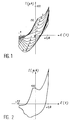
- the results obtained with a scan of 50mV / s are given in FIG. 1 which represents the curves of cyclic voltammetry of the electrode.
- the electrode is then washed in a mixture of acetonitrile and water (80/20 by volume), then the behavior of the electrode is studied by cyclic voltammetry in a solution consisting of a mixture of acetonitrile and water (90/10 by volume) containing 0.1 mol / l of lithium perchlorate with a scanning of the electrode of 50 mV / s.
- FIG. 2 which illustrates the cyclic voltammetry curve obtained, it can be seen that the polypyrrole behaves like a conductive polymer.
- Example 2 Electrochemical preparation of polypyrrole doped with particles of ⁇ -Fe2O3.
- Example 2 The same suspension of charged magnetic particles is used as in Example 1 and it is introduced into water to obtain an iron concentration of the order of 0.1 mol / l. The solution is then introduced into a 10 cm3 tank and it is degassed by a slight bubbling of argon with magnetic stirring. Pyrrole is then added at a rate of 0.5 mol / l.
- Electrochemical polymerization is then carried out using a 3-electrode assembly, including a working electrode made of mixed indium tin oxide of 6 cm 2, an auxiliary electrode made of stainless steel with the same surface area and a Ag / Ag+ reference electrode, connected to a potensiostat.
- a working current of 0.5mA / cm2 is imposed on the working electrode until it passes through the 10.5C circuit.
- the electrode is then washed with water and acetonitrile three times successively, then the film from the electrode is peeled off and it is dried under vacuum at around 60 ° C.
- the electrical conductivity of the film is then measured by the 4-point method and a conductivity of 3.4.10 ⁇ 3S / cm is found.
- the magnetic properties of the film are studied by measurements of SQUID (Superconducting Quantum Interference Device). Thanks to these measurements, it is possible to study the magnetic susceptibility of the material as a function of the temperature and to make a quantitative assay of the iron in the doped polymer.
- SQUID Superconducting Quantum Interference Device
- the magnetic susceptibility of this material is constant depending on the temperature (from 2K to 260K) and it is of the order of 0.06mu / g of iron.
- the electron paramagnetic resonance (EPR) of the material gives two signals centered at g ⁇ 3 whose line widths are 900G (Fe) and 3G (polypyrrole).
- the first embodiment of the process of the invention is used with a suspension of particles of -Fe2O3, the surface of which is modified by calconcarboxylic acid to be negatively charged.
- Calconcarboxylic acid has the following formula:
- Example 1 The same ferrofluid is used as in Example 1 and the colloidal suspension of charged particles is prepared in the following manner.
- This ferrofluid is then diluted with an aqueous solution to obtain an iron concentration of the order of 0.1 mol / l.
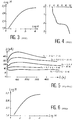
- Electrochemical polymerization is then carried out using a 3-electrode assembly, including a working electrode made of mixed indium tin oxide of 6 cm 2, an auxiliary electrode made of stainless steel with the same surface area and a reference electrode Ag / Ag+, connected to a potensiostat. Pyrrole is added to the solution to obtain a pyrrole concentration of 0.5 mol / l. The solution is degassed by passage of argon, then the working electrode is brought to the potential of 0.70 V which was chosen from the chronoamperometry curves shown in FIG. 5. These curves were established with aqueous solutions having a pyrrole concentration of 0.5 mol / l and a ferrofluid concentration of 0.4 mol / l.
- a polypyrrole film is recovered in which magnetic particles are dispersed in a homogeneous manner and the electrical conductivity of the film is determined as well as the conductivity of the material in the form of a pellet obtained by compression under 800Mpa (8t / cm2). The conductivities are measured by the four-point head technique.
- Example 4 Electrochemical preparation of polypyrrole doped with ⁇ -Fe2O3 modified by chromium azurol S (PPy - FFAZ).
- the first embodiment of the process of the invention is also used with a suspension of ⁇ -Fe2O3 particles whose surface is modified by chromium azurol S, of formula
- Example 5 Electrochemical preparation of polypyrrole doped with ⁇ -Fe2O3 modified with citric acid (PPy - FFCit).
- the electrical conductivities of the films of Examples 3 and 4 are respectively approximately 2 and 3 orders of magnitude greater than that of the film of Example 5.
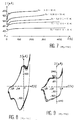
- Figures 8 and 9 show the curves of cyclic voltammetry of the material PPy-FFCl of Example 3 ( Figure 8) and of the material PPy - FFAZ of Example 4 ( Figure 9). These curves were obtained at a scanning speed of 50 mV / s in an aqueous solution containing 0.1 mol / l of NaClO4.
- Example 6 Chemical preparation of polypyrrole doped with particles of ⁇ -Fe2O3.
- the same colloidal suspension of charged magnetic particles is used as in the example. 1 and it is introduced with ammonium persulfate in water so as to obtain an iron concentration of 0.04 mol / l and a persulfate concentration of 0.3 mol / l.
- This mixture is magnetically stirred in air and pyrrole is added to it so that the ratio of pyrrole to persulfate concentrations is 1 / 2.4.
- the reaction starts immediately because a black precipitate of polymer immediately appears. Stirring is continued for 2 h 30 min, then the mixture is filtered on a frit. The precipitate is washed several times with water and acetonitrile to remove the oligomers, and dried in vacuo.
- the properties of the precipitate are then studied by infrared spectrometry with Fourier transform and by electronic paramagnetic resonance.
- Example 7 Chemical preparation of polypyrrole doped with particles of ⁇ -Fe2O3.
- Example 2 the same suspension of charged magnetic particles is used as in Example 1 and it is mixed with water to obtain an iron concentration of approximately 0.2mol / l. 5 ml of this solution (1 mmol) of dichlorodicyanobenzoquinone (DDQ) which is insoluble are added to this solution and the solution is subjected to magnetic stirring at room temperature and in air, then the necessary quantity of pyrrole is added, ie 1 mmol.
- DDQ dichlorodicyanobenzoquinone
- a black precipitate forms immediately and after 12 hours of contact time, the precipitate is separated by centrifugation, then it is washed with water and ethyl alcohol with Soxhlet. After drying, the powder obtained which reacts to the approach of a magnet is pelletized and its conductivity is measured. This is 1.7.10 ⁇ 2S / cm for a 0.35mm thick pellet.
- the infrared spectrum is characteristic of the conductive polypyrrole.
- Example 8 Chemical preparation of polypyrrole latex doped with ⁇ -Fe2O3 particles (PPy - FFCit latex).
- Example 5 For this synthesis, the same colloidal suspension as in Example 5 is used, that is to say particles of ⁇ -Fe2O3 modified with citrate and the procedure is carried out as follows to obtain the doped polymer latex.
- the infrared spectrometry of the film shows the characteristic bands of the polypyrrole matrix at 1160-1170 and 1030-1040cm ⁇ 1.
- the thickness of the film is also determined with a thickness comparator and its conductivity by the 4-point method.
- Example 9 Chemical preparation of polypyrrole latex doped with ⁇ -Fe2O3 particles (PPy - latex - FFCC).
- Example 8 The same procedure is followed as in Example 8, but using the colloidal suspension of Example 3 as ferrofluid.
- Example 10 Chemical preparation of polypyrrole latex doped with ⁇ -Fe2O3 particles (PPy - latex - FFAZ).
- Example 8 The same procedure is followed as in Example 8, but using as ferrofluid the colloidal suspension of Example 4.
- the films obtained have more good magnetic properties, they are attracted by a magnet.
- Example 11 Electrochemical preparation of poly (octylthiophene) containing particles of ⁇ -Fe2O3 modified by a surfactant.
- the fourth embodiment of the method of the invention is used, namely the modification of the magnetic particles. by a surfactant or amphiphilic molecule which makes it possible to confer on the particles an affinity for hydrophobic chains.
- the nitrate ferrofluid of example 1 is thus used and it is treated with a surfactant comprising a polar head and a hydrophobic tail, constituted by a triethanolamine salt of an acid phosphoric ester, to coat each particle with ⁇ -Fe2O3 of these amphiphilic molecules (surfactant).
- a surfactant comprising a polar head and a hydrophobic tail, constituted by a triethanolamine salt of an acid phosphoric ester, to coat each particle with ⁇ -Fe2O3 of these amphiphilic molecules (surfactant).
- the ferrofluid thus treated is soluble in CHCl3 which is the medium used for the polymerization of octylthiophene.
- the precipitate obtained from the nitrate ferrofluid used in Example 1 is dissolved in water and the anionic surfactant consisting of a triethanolamine salt of a phosphoric ester is added to it acid using a 20% mole excess surfactant. The mixture is stirred for 10 min while hot. After precipitation with acetone and magnetic decantation, the precipitate is washed 3 times with methanol, then it is dissolved in a CHCl3 / methanol mixture (3/1 by volume), and the methanol is slowly removed by heating.
- the contents of the two ampoules are introduced in parallel in a few minutes, and stirring is continued at 5 ° C. for 1 hour 30 minutes.
- 15 ml of acetonitrile are added dropwise to the mixture over a period of 15 min.
- the reaction product is filtered through a No. 4 frit, then washed 3 times with acetonitrile until the filtrate becomes colorless.
- the precipitate is dried under vacuum for 5 h and thus 900mg of precipitate is obtained. After sintering, a pellet with a conductivity of 1.74S.cm ⁇ 1 is obtained which is attracted by a magnet.
- Example 12 Preparation of polypyrrole-ferrofluid composite materials with covalent bond between the polymer chains and the magnetic particles.
- the third embodiment of the invention is used, namely the polymerization of pyrrole chemically bonded to a magnetic particle.
- 11- (pyrrol-1-yl) undecane thiol is added to the nitric acid ferrofluid of Example 1, in sufficient quantity to modify each particle of Fe2O3, then various washes and precipitations are carried out with acetone and ether and solubilized in chloroform.
- the polymerization is then carried out as follows.
Landscapes
- Chemical & Material Sciences (AREA)
- Health & Medical Sciences (AREA)
- Chemical Kinetics & Catalysis (AREA)
- Medicinal Chemistry (AREA)
- Polymers & Plastics (AREA)
- Organic Chemistry (AREA)
- Physics & Mathematics (AREA)
- Spectroscopy & Molecular Physics (AREA)
- Engineering & Computer Science (AREA)
- Power Engineering (AREA)
- Polyoxymethylene Polymers And Polymers With Carbon-To-Carbon Bonds (AREA)
- Compositions Of Macromolecular Compounds (AREA)
- Macromolecular Compounds Obtained By Forming Nitrogen-Containing Linkages In General (AREA)
- Processes Of Treating Macromolecular Substances (AREA)
- Polymers With Sulfur, Phosphorus Or Metals In The Main Chain (AREA)
- Soft Magnetic Materials (AREA)
- Polymerisation Methods In General (AREA)
Applications Claiming Priority (2)
| Application Number | Priority Date | Filing Date | Title |
|---|---|---|---|
| FR9010883 | 1990-08-31 | ||
| FR9010883A FR2666443A1 (fr) | 1990-08-31 | 1990-08-31 | Materiau a base de polymere conducteur electronique comprenant des particules magnetiques et son procede de fabrication. |
Publications (2)
| Publication Number | Publication Date |
|---|---|
| EP0473511A1 EP0473511A1 (fr) | 1992-03-04 |
| EP0473511B1 true EP0473511B1 (fr) | 1995-03-15 |
Family
ID=9400000
Family Applications (1)
| Application Number | Title | Priority Date | Filing Date |
|---|---|---|---|
| EP91402324A Expired - Lifetime EP0473511B1 (fr) | 1990-08-31 | 1991-08-28 | Matériau à base de polymère conducteur électronique comprenant des particules magnétiques et son procédé de fabrication |
Country Status (7)
| Country | Link |
|---|---|
| US (1) | US5264157A (cg-RX-API-DMAC7.html) |
| EP (1) | EP0473511B1 (cg-RX-API-DMAC7.html) |
| JP (1) | JP3151242B2 (cg-RX-API-DMAC7.html) |
| KR (1) | KR920004044A (cg-RX-API-DMAC7.html) |
| AT (1) | ATE120028T1 (cg-RX-API-DMAC7.html) |
| DE (1) | DE69108144T2 (cg-RX-API-DMAC7.html) |
| FR (1) | FR2666443A1 (cg-RX-API-DMAC7.html) |
Families Citing this family (29)
| Publication number | Priority date | Publication date | Assignee | Title |
|---|---|---|---|---|
| US5532025A (en) * | 1993-07-23 | 1996-07-02 | Kinlen; Patrick J. | Corrosion inhibiting compositions |
| FR2736197B1 (fr) * | 1995-06-29 | 1997-09-12 | Univ Paris Curie | Nanoparticules magnetiques couplees a de l'annexine et leur utilisation |
| US6933331B2 (en) | 1998-05-22 | 2005-08-23 | Nanoproducts Corporation | Nanotechnology for drug delivery, contrast agents and biomedical implants |
| US5905000A (en) * | 1996-09-03 | 1999-05-18 | Nanomaterials Research Corporation | Nanostructured ion conducting solid electrolytes |
| ATE283536T1 (de) * | 1997-07-25 | 2004-12-15 | Ormecon Gmbh | Chemische verbindungen von intrinsisch leitfähigen polymeren mit metallen |
| US5938979A (en) * | 1997-10-31 | 1999-08-17 | Nanogram Corporation | Electromagnetic shielding |
| KR100296969B1 (ko) * | 1999-02-23 | 2001-09-22 | 허남욱 | 카드형 성형물 제조용 합성수지 사출 노즐 |
| FR2803224B1 (fr) * | 1999-12-30 | 2002-09-27 | Rhodia Chimie Sa | Dispersion colloidale aqueuse a base d'au moins un compose d'un metal et d'un complexant, procede de preparation et utilisation |
| US6379589B1 (en) * | 2000-10-23 | 2002-04-30 | Fractal Systems Inc. | Super-wide band shielding materials |
| US6855426B2 (en) | 2001-08-08 | 2005-02-15 | Nanoproducts Corporation | Methods for producing composite nanoparticles |
| WO2004029176A1 (en) * | 2002-09-24 | 2004-04-08 | E.I. Du Pont De Nemours And Company | Electrically conducting organic polymer/nanoparticle composites and methods for use thereof |
| US7708974B2 (en) | 2002-12-10 | 2010-05-04 | Ppg Industries Ohio, Inc. | Tungsten comprising nanomaterials and related nanotechnology |
| CN101595532B (zh) | 2005-06-28 | 2013-07-31 | E.I.内穆尔杜邦公司 | 缓冲组合物 |
| US20070099067A1 (en) * | 2005-09-23 | 2007-05-03 | Sanjiv Malhotra | Polymer catalyst composite as a membrane electrode assembly in Direct Methanol Fuel Cells |
| US8277690B2 (en) * | 2008-06-09 | 2012-10-02 | Council Of Scientific & Industrial Research | Conducting copolymer ferromagnetic composite and a process for the preparation thereof |
| JP2012520381A (ja) | 2009-03-12 | 2012-09-06 | イー・アイ・デュポン・ドウ・ヌムール・アンド・カンパニー | コーティング用途向け導電性ポリマー組成物 |
| JP5402777B2 (ja) * | 2009-03-31 | 2014-01-29 | 荒川化学工業株式会社 | 導電性高分子/ドーパント分散体、導電性組成物および導電性皮膜 |
| KR101581990B1 (ko) | 2009-04-21 | 2015-12-31 | 이 아이 듀폰 디 네모아 앤드 캄파니 | 전기 전도성 중합체 조성물 및 그로부터 제조된 필름 |
| JP2012524834A (ja) | 2009-04-24 | 2012-10-18 | イー・アイ・デュポン・ドウ・ヌムール・アンド・カンパニー | 導電性ポリマー組成物およびそれから作製されたフィルム |
| TWI485210B (zh) * | 2011-12-09 | 2015-05-21 | Ind Tech Res Inst | 具有導電性與鐵磁性之複合材料及其混成漿料 |
| WO2015168556A1 (en) * | 2014-05-01 | 2015-11-05 | The University Of Utah Research Foundation | Magnetically-modified conducting polymer composites and methods of preparation thereof |
| JP6712413B2 (ja) * | 2016-08-09 | 2020-06-24 | 国立研究開発法人物質・材料研究機構 | 磁場下でのイオン輸送を利用する帯電状態の制御方法及びその用途 |
| CN108305947B (zh) * | 2017-01-11 | 2021-10-22 | 华邦电子股份有限公司 | 传感器、复合材料及其制造方法 |
| US10823691B2 (en) * | 2017-01-11 | 2020-11-03 | Winbond Electronics Corp. | Sensor, composite material and method of manufacturing the same |
| CN107311636B (zh) * | 2017-07-04 | 2020-12-22 | 马鞍山起劲磁塑科技有限公司 | 一种高性能永磁铁氧体的制备方法 |
| KR102224357B1 (ko) * | 2018-10-10 | 2021-03-10 | (주)플렉솔루션 | 도데실 설페이트 도핑된 pedot 필름 및 그 제조방법 |
| CN117480222A (zh) * | 2021-02-26 | 2024-01-30 | 罗兰大学 | 含铁氧化物/氢氧化物的导电聚合物复合材料及其使用高铁酸盐的制备 |
| HUE071342T2 (hu) * | 2021-02-26 | 2025-08-28 | Eoetvoes Lorand Tudomanyegyetem | Vas-oxid/hidroxidot tartalmazó vezetõ polimer kompozitok és azok elõállítása ferrátsók felhasználásával |
| US20240376332A1 (en) * | 2021-09-10 | 2024-11-14 | Virginia Commonwealth University | Method for connection to a rigid or flexible device using multifunctional ink |
Family Cites Families (11)
| Publication number | Priority date | Publication date | Assignee | Title |
|---|---|---|---|---|
| JPS5525482B2 (cg-RX-API-DMAC7.html) * | 1972-02-24 | 1980-07-07 | ||
| JPS5142990A (cg-RX-API-DMAC7.html) * | 1974-10-11 | 1976-04-12 | Fuji Photo Film Co Ltd | |
| JPS5180998A (cg-RX-API-DMAC7.html) * | 1975-01-14 | 1976-07-15 | Fuji Photo Film Co Ltd | |
| FR2461521A1 (fr) * | 1979-07-20 | 1981-02-06 | Anvar | Fluides magnetiques, notamment ferrofluides, et procede pour leur obtention |
| IT1145696B (it) * | 1979-08-24 | 1986-11-05 | Rhone Poulenc Ind | Procedimento di preparazione di perle magnetiche di polimeri vinilaromatici |
| US4334887A (en) * | 1980-02-05 | 1982-06-15 | Akzona Incorporated | Method for flocculating metal oxide particles in an organic medium |
| US4421660A (en) * | 1980-12-15 | 1983-12-20 | The Dow Chemical Company | Colloidal size hydrophobic polymers particulate having discrete particles of an inorganic material dispersed therein |
| JPS61254669A (ja) * | 1985-05-07 | 1986-11-12 | Katsumi Yoshino | 磁性導電性高分子 |
| US4626586A (en) * | 1985-08-13 | 1986-12-02 | Regents Of The University Of California | Transition metal poly(benzodithiolene) |
| FR2628746B1 (fr) * | 1988-03-21 | 1992-03-27 | Solvay | Procede de preparation d'un latex a base de polypyrrole et utilisation de ce latex pour former un film conducteur |
| DE3824333A1 (de) * | 1988-07-18 | 1990-01-25 | Fraunhofer Ges Forschung | Verfahren zur fixierung einer anorganischen spezies in einer organischen matrix |
-
1990
- 1990-08-31 FR FR9010883A patent/FR2666443A1/fr active Granted
-
1991
- 1991-08-20 US US07/747,526 patent/US5264157A/en not_active Expired - Fee Related
- 1991-08-28 DE DE69108144T patent/DE69108144T2/de not_active Expired - Fee Related
- 1991-08-28 EP EP91402324A patent/EP0473511B1/fr not_active Expired - Lifetime
- 1991-08-28 AT AT91402324T patent/ATE120028T1/de not_active IP Right Cessation
- 1991-08-30 JP JP22041291A patent/JP3151242B2/ja not_active Expired - Fee Related
- 1991-08-30 KR KR1019910015066A patent/KR920004044A/ko not_active Withdrawn
Non-Patent Citations (1)
| Title |
|---|
| Polymer and Its Characteristics' * |
Also Published As
| Publication number | Publication date |
|---|---|
| JPH04234453A (ja) | 1992-08-24 |
| DE69108144T2 (de) | 1995-10-19 |
| FR2666443B1 (cg-RX-API-DMAC7.html) | 1995-02-10 |
| ATE120028T1 (de) | 1995-04-15 |
| FR2666443A1 (fr) | 1992-03-06 |
| KR920004044A (ko) | 1992-03-27 |
| EP0473511A1 (fr) | 1992-03-04 |
| JP3151242B2 (ja) | 2001-04-03 |
| US5264157A (en) | 1993-11-23 |
| DE69108144D1 (de) | 1995-04-20 |
Similar Documents
| Publication | Publication Date | Title |
|---|---|---|
| EP0473511B1 (fr) | Matériau à base de polymère conducteur électronique comprenant des particules magnétiques et son procédé de fabrication | |
| Kang et al. | X-ray photoelectron spectroscopic studies of polypyrrole synthesized with oxidative iron (III) salts | |
| Liu et al. | Novel colloidal polyaniline fibrils made by template guided chemical polymerization | |
| US7390439B2 (en) | Sulphonic acids as dopants for polyaniline and for conductive polyaniline-based composite materials | |
| BE1006963A3 (fr) | Procede de depot par electropolymerisation d'un film d'un materiau composite sur une surface conductrice d'electricite. | |
| EP2148747A2 (fr) | Couches minces de polymères conjugués contenant des nanoparticules inorganiques et leur procédé de fabrication | |
| KR20200130541A (ko) | 유기 전기화학 트랜지스터 소자 및 그 제조방법 | |
| EP0672291B1 (fr) | Copolymeres a proprietes redox et leur utilisation pour l'elaboration de materiaux a conduction mixte | |
| US5520849A (en) | Electrically conductive polymer composition | |
| Coche-Guerente et al. | Immobilization of redox anions in poly (amphiphilic pyrrolylalkylammonium) using a simple and monomer-saving one-step procedure in pure water electrolyte | |
| Mao et al. | Polypyrrole-based anion-exchange polymers | |
| FR2833014A1 (fr) | Procede selectif de detection, d'identification et de dosage d'un cation metallique divalent dans un echantillon | |
| EP0592333B1 (fr) | Compositions de polymères contenant des composés organiques amphiphiles électroactifs de la famille des complexes à transfert de charge et/ou des sels d'ions radicaux, leur obtention et leur utilisation | |
| Qi | Synthesis of conducting polymer colloids, hollow nanoparticles, and nanofibers | |
| JP2805018B2 (ja) | 修飾電極の製造方法 | |
| JP2731537B2 (ja) | 高導電性有機重合体膜の製造方法 | |
| JP3354376B2 (ja) | 有機磁性薄膜の製法 | |
| Lahiff et al. | Covalent attachment of functional side-groups to polyaniline nanofibres | |
| JP2736656B2 (ja) | メタロセン誘導体の電荷移動錯体およびそのラングミュア・ブロジェット膜 | |
| FR2886643A1 (fr) | Nouveau type de jonction moleculaire entre semi-conducteur et un metal | |
| JPH0419253B2 (cg-RX-API-DMAC7.html) | ||
| Mahalakshmi et al. | Synthesis and characterization of water soluble nanosize polyaniline using benzalkonium chloride cationic surfactant | |
| Frackowiak et al. | Interaction between electroconducting polymers and C60 | |
| Rimbu et al. | Polyaniline rod-like structure as self-electrocatalyst for hydrogen oxidation reactions | |
| Audebert et al. | Polypyrroles |
Legal Events
| Date | Code | Title | Description |
|---|---|---|---|
| PUAI | Public reference made under article 153(3) epc to a published international application that has entered the european phase |
Free format text: ORIGINAL CODE: 0009012 |
|
| AK | Designated contracting states |
Kind code of ref document: A1 Designated state(s): AT BE CH DE DK ES FR GB GR IT LI LU NL SE |
|
| 17P | Request for examination filed |
Effective date: 19920806 |
|
| 17Q | First examination report despatched |
Effective date: 19930521 |
|
| RAP1 | Party data changed (applicant data changed or rights of an application transferred) |
Owner name: COMMISSARIAT A L'ENERGIE ATOMIQUE Owner name: SOLVAY |
|
| RAP1 | Party data changed (applicant data changed or rights of an application transferred) |
Owner name: COMMISSARIAT A L'ENERGIE ATOMIQUE Owner name: SOLVAY (SOCIETE ANONYME) |
|
| GRAA | (expected) grant |
Free format text: ORIGINAL CODE: 0009210 |
|
| AK | Designated contracting states |
Kind code of ref document: B1 Designated state(s): AT BE CH DE DK ES FR GB GR IT LI LU NL SE |
|
| PG25 | Lapsed in a contracting state [announced via postgrant information from national office to epo] |
Ref country code: IT Free format text: LAPSE BECAUSE OF FAILURE TO SUBMIT A TRANSLATION OF THE DESCRIPTION OR TO PAY THE FEE WITHIN THE PRE;WARNING: LAPSES OF ITALIAN PATENTS WITH EFFECTIVE DATE BEFORE 2007 MAY HAVE OCCURRED AT ANY TIME BEFORE 2007. THE CORRECT EFFECTIVE DATE MAY BE DIFFERENT FROM THE ONE RECORDED.SCRIBED TIME-LIMIT Effective date: 19950315 Ref country code: GR Free format text: LAPSE BECAUSE OF FAILURE TO SUBMIT A TRANSLATION OF THE DESCRIPTION OR TO PAY THE FEE WITHIN THE PRESCRIBED TIME-LIMIT Effective date: 19950315 Ref country code: AT Effective date: 19950315 Ref country code: DK Effective date: 19950315 Ref country code: ES Free format text: THE PATENT HAS BEEN ANNULLED BY A DECISION OF A NATIONAL AUTHORITY Effective date: 19950315 Ref country code: NL Free format text: LAPSE BECAUSE OF NON-PAYMENT OF DUE FEES Effective date: 19950315 |
|
| REF | Corresponds to: |
Ref document number: 120028 Country of ref document: AT Date of ref document: 19950415 Kind code of ref document: T |
|
| REF | Corresponds to: |
Ref document number: 69108144 Country of ref document: DE Date of ref document: 19950420 |
|
| PG25 | Lapsed in a contracting state [announced via postgrant information from national office to epo] |
Ref country code: SE Effective date: 19950615 |
|
| GBT | Gb: translation of ep patent filed (gb section 77(6)(a)/1977) |
Effective date: 19950525 |
|
| PG25 | Lapsed in a contracting state [announced via postgrant information from national office to epo] |
Ref country code: LI Effective date: 19950831 Ref country code: LU Free format text: LAPSE BECAUSE OF NON-PAYMENT OF DUE FEES Effective date: 19950831 Ref country code: CH Effective date: 19950831 |
|
| NLV1 | Nl: lapsed or annulled due to failure to fulfill the requirements of art. 29p and 29m of the patents act | ||
| PLBE | No opposition filed within time limit |
Free format text: ORIGINAL CODE: 0009261 |
|
| STAA | Information on the status of an ep patent application or granted ep patent |
Free format text: STATUS: NO OPPOSITION FILED WITHIN TIME LIMIT |
|
| 26N | No opposition filed | ||
| REG | Reference to a national code |
Ref country code: CH Ref legal event code: PL |
|
| PGFP | Annual fee paid to national office [announced via postgrant information from national office to epo] |
Ref country code: GB Payment date: 19960816 Year of fee payment: 6 |
|
| PGFP | Annual fee paid to national office [announced via postgrant information from national office to epo] |
Ref country code: FR Payment date: 19960826 Year of fee payment: 6 |
|
| PGFP | Annual fee paid to national office [announced via postgrant information from national office to epo] |
Ref country code: DE Payment date: 19960904 Year of fee payment: 6 |
|
| PG25 | Lapsed in a contracting state [announced via postgrant information from national office to epo] |
Ref country code: GB Free format text: LAPSE BECAUSE OF NON-PAYMENT OF DUE FEES Effective date: 19970828 |
|
| GBPC | Gb: european patent ceased through non-payment of renewal fee |
Effective date: 19970828 |
|
| PG25 | Lapsed in a contracting state [announced via postgrant information from national office to epo] |
Ref country code: FR Free format text: LAPSE BECAUSE OF NON-PAYMENT OF DUE FEES Effective date: 19980430 |
|
| PG25 | Lapsed in a contracting state [announced via postgrant information from national office to epo] |
Ref country code: DE Free format text: LAPSE BECAUSE OF NON-PAYMENT OF DUE FEES Effective date: 19980501 |
|
| REG | Reference to a national code |
Ref country code: FR Ref legal event code: ST |
|
| PGFP | Annual fee paid to national office [announced via postgrant information from national office to epo] |
Ref country code: BE Payment date: 19980901 Year of fee payment: 8 |
|
| PG25 | Lapsed in a contracting state [announced via postgrant information from national office to epo] |
Ref country code: BE Free format text: LAPSE BECAUSE OF NON-PAYMENT OF DUE FEES Effective date: 19990831 |
|
| BERE | Be: lapsed |
Owner name: COMMISSARIAT A L'ENERGIE ATOMIQUE Effective date: 19990831 Owner name: S.A. SOLVAY Effective date: 19990831 |