EP0464274B1 - Weichgelatinekapsel - Google Patents
Weichgelatinekapsel Download PDFInfo
- Publication number
- EP0464274B1 EP0464274B1 EP90250146A EP90250146A EP0464274B1 EP 0464274 B1 EP0464274 B1 EP 0464274B1 EP 90250146 A EP90250146 A EP 90250146A EP 90250146 A EP90250146 A EP 90250146A EP 0464274 B1 EP0464274 B1 EP 0464274B1
- Authority
- EP
- European Patent Office
- Prior art keywords
- solvent
- plant
- soft gelatin
- fabricating
- extracts
- Prior art date
- Legal status (The legal status is an assumption and is not a legal conclusion. Google has not performed a legal analysis and makes no representation as to the accuracy of the status listed.)
- Expired - Lifetime
Links
- 239000007903 gelatin capsule Substances 0.000 title abstract description 8
- 239000002904 solvent Substances 0.000 claims abstract description 25
- LFQSCWFLJHTTHZ-UHFFFAOYSA-N Ethanol Chemical compound CCO LFQSCWFLJHTTHZ-UHFFFAOYSA-N 0.000 claims abstract description 15
- XLYOFNOQVPJJNP-UHFFFAOYSA-N water Substances O XLYOFNOQVPJJNP-UHFFFAOYSA-N 0.000 claims abstract description 10
- 239000007788 liquid Substances 0.000 claims abstract description 7
- 150000001298 alcohols Chemical class 0.000 claims abstract description 3
- 229920005862 polyol Polymers 0.000 claims abstract description 3
- 150000003077 polyols Chemical class 0.000 claims abstract description 3
- 239000000284 extract Substances 0.000 claims description 17
- 229920001223 polyethylene glycol Polymers 0.000 claims description 14
- 239000002775 capsule Substances 0.000 claims description 13
- 229920000159 gelatin Polymers 0.000 claims description 8
- 235000019322 gelatine Nutrition 0.000 claims description 8
- RTZKZFJDLAIYFH-UHFFFAOYSA-N Diethyl ether Chemical class CCOCC RTZKZFJDLAIYFH-UHFFFAOYSA-N 0.000 claims description 3
- 229920000223 polyglycerol Polymers 0.000 claims description 3
- LCGLNKUTAGEVQW-UHFFFAOYSA-N Dimethyl ether Chemical class COC LCGLNKUTAGEVQW-UHFFFAOYSA-N 0.000 claims description 2
- 239000002202 Polyethylene glycol Substances 0.000 claims description 2
- 239000001828 Gelatine Substances 0.000 claims 4
- 239000013543 active substance Substances 0.000 claims 3
- 235000013311 vegetables Nutrition 0.000 claims 3
- 239000000590 phytopharmaceutical Substances 0.000 claims 1
- 239000000419 plant extract Substances 0.000 abstract description 21
- 239000000126 substance Substances 0.000 abstract description 14
- 125000002496 methyl group Chemical group [H]C([H])([H])* 0.000 abstract description 2
- 125000001495 ethyl group Chemical group [H]C([H])([H])C([H])([H])* 0.000 abstract 1
- 241000196324 Embryophyta Species 0.000 description 16
- 239000000725 suspension Substances 0.000 description 10
- PEDCQBHIVMGVHV-UHFFFAOYSA-N Glycerine Chemical compound OCC(O)CO PEDCQBHIVMGVHV-UHFFFAOYSA-N 0.000 description 9
- 241000207963 Harpagophytum Species 0.000 description 9
- 244000302413 Carum copticum Species 0.000 description 8
- 235000007034 Carum copticum Nutrition 0.000 description 8
- 235000014493 Crataegus Nutrition 0.000 description 8
- 241001092040 Crataegus Species 0.000 description 8
- 244000133098 Echinacea angustifolia Species 0.000 description 8
- 241001143203 Fumaria Species 0.000 description 8
- 235000006961 Fumaria officinalis Nutrition 0.000 description 8
- 240000006661 Serenoa repens Species 0.000 description 8
- 235000005318 Serenoa repens Nutrition 0.000 description 8
- 235000014134 echinacea Nutrition 0.000 description 8
- 239000000839 emulsion Substances 0.000 description 7
- 239000000203 mixture Substances 0.000 description 7
- 239000003795 chemical substances by application Substances 0.000 description 6
- 229940068918 polyethylene glycol 400 Drugs 0.000 description 6
- 229940109850 royal jelly Drugs 0.000 description 6
- 239000003995 emulsifying agent Substances 0.000 description 5
- 239000003921 oil Substances 0.000 description 5
- 235000019198 oils Nutrition 0.000 description 5
- 238000012545 processing Methods 0.000 description 5
- IIZPXYDJLKNOIY-JXPKJXOSSA-N 1-palmitoyl-2-arachidonoyl-sn-glycero-3-phosphocholine Chemical compound CCCCCCCCCCCCCCCC(=O)OC[C@H](COP([O-])(=O)OCC[N+](C)(C)C)OC(=O)CCC\C=C/C\C=C/C\C=C/C\C=C/CCCCC IIZPXYDJLKNOIY-JXPKJXOSSA-N 0.000 description 4
- 108010010803 Gelatin Proteins 0.000 description 4
- 239000004480 active ingredient Substances 0.000 description 4
- 239000008273 gelatin Substances 0.000 description 4
- 235000011852 gelatine desserts Nutrition 0.000 description 4
- 239000000787 lecithin Substances 0.000 description 4
- 235000010445 lecithin Nutrition 0.000 description 4
- 229940067606 lecithin Drugs 0.000 description 4
- DNIAPMSPPWPWGF-UHFFFAOYSA-N Propylene glycol Chemical compound CC(O)CO DNIAPMSPPWPWGF-UHFFFAOYSA-N 0.000 description 3
- 230000000694 effects Effects 0.000 description 3
- 229960003133 ergot alkaloid Drugs 0.000 description 3
- CFWRDBDJAOHXSH-SECBINFHSA-N 2-azaniumylethyl [(2r)-2,3-diacetyloxypropyl] phosphate Chemical compound CC(=O)OC[C@@H](OC(C)=O)COP(O)(=O)OCCN CFWRDBDJAOHXSH-SECBINFHSA-N 0.000 description 2
- 108090000790 Enzymes Proteins 0.000 description 2
- 102000004190 Enzymes Human genes 0.000 description 2
- 238000010521 absorption reaction Methods 0.000 description 2
- XXJWXESWEXIICW-UHFFFAOYSA-N diethylene glycol monoethyl ether Chemical compound CCOCCOCCO XXJWXESWEXIICW-UHFFFAOYSA-N 0.000 description 2
- 229940075557 diethylene glycol monoethyl ether Drugs 0.000 description 2
- GPLRAVKSCUXZTP-UHFFFAOYSA-N diglycerol Chemical compound OCC(O)COCC(O)CO GPLRAVKSCUXZTP-UHFFFAOYSA-N 0.000 description 2
- 238000004519 manufacturing process Methods 0.000 description 2
- 210000002784 stomach Anatomy 0.000 description 2
- 239000000375 suspending agent Substances 0.000 description 2
- 235000015112 vegetable and seed oil Nutrition 0.000 description 2
- 239000008158 vegetable oil Substances 0.000 description 2
- 108010004032 Bromelains Proteins 0.000 description 1
- FBPFZTCFMRRESA-FSIIMWSLSA-N D-Glucitol Natural products OC[C@H](O)[C@H](O)[C@@H](O)[C@H](O)CO FBPFZTCFMRRESA-FSIIMWSLSA-N 0.000 description 1
- LTMHDMANZUZIPE-AMTYYWEZSA-N Digoxin Natural products O([C@H]1[C@H](C)O[C@H](O[C@@H]2C[C@@H]3[C@@](C)([C@@H]4[C@H]([C@]5(O)[C@](C)([C@H](O)C4)[C@H](C4=CC(=O)OC4)CC5)CC3)CC2)C[C@@H]1O)[C@H]1O[C@H](C)[C@@H](O[C@H]2O[C@@H](C)[C@H](O)[C@@H](O)C2)[C@@H](O)C1 LTMHDMANZUZIPE-AMTYYWEZSA-N 0.000 description 1
- 229920002565 Polyethylene Glycol 400 Polymers 0.000 description 1
- 239000004365 Protease Substances 0.000 description 1
- 235000019484 Rapeseed oil Nutrition 0.000 description 1
- NGFMICBWJRZIBI-JZRPKSSGSA-N Salicin Natural products O([C@H]1[C@H](O)[C@@H](O)[C@@H](O)[C@H](CO)O1)c1c(CO)cccc1 NGFMICBWJRZIBI-JZRPKSSGSA-N 0.000 description 1
- 241000271897 Viperidae Species 0.000 description 1
- 239000000654 additive Substances 0.000 description 1
- 230000001476 alcoholic effect Effects 0.000 description 1
- 239000012675 alcoholic extract Substances 0.000 description 1
- NGFMICBWJRZIBI-UHFFFAOYSA-N alpha-salicin Natural products OC1C(O)C(O)C(CO)OC1OC1=CC=CC=C1CO NGFMICBWJRZIBI-UHFFFAOYSA-N 0.000 description 1
- 235000013871 bee wax Nutrition 0.000 description 1
- 239000012166 beeswax Substances 0.000 description 1
- 235000019835 bromelain Nutrition 0.000 description 1
- 238000002425 crystallisation Methods 0.000 description 1
- 230000008025 crystallization Effects 0.000 description 1
- 230000003111 delayed effect Effects 0.000 description 1
- 238000013461 design Methods 0.000 description 1
- 238000011161 development Methods 0.000 description 1
- LTMHDMANZUZIPE-PUGKRICDSA-N digoxin Chemical compound C1[C@H](O)[C@H](O)[C@@H](C)O[C@H]1O[C@@H]1[C@@H](C)O[C@@H](O[C@@H]2[C@H](O[C@@H](O[C@@H]3C[C@@H]4[C@]([C@@H]5[C@H]([C@]6(CC[C@@H]([C@@]6(C)[C@H](O)C5)C=5COC(=O)C=5)O)CC4)(C)CC3)C[C@@H]2O)C)C[C@@H]1O LTMHDMANZUZIPE-PUGKRICDSA-N 0.000 description 1
- 229960005156 digoxin Drugs 0.000 description 1
- LTMHDMANZUZIPE-UHFFFAOYSA-N digoxine Natural products C1C(O)C(O)C(C)OC1OC1C(C)OC(OC2C(OC(OC3CC4C(C5C(C6(CCC(C6(C)C(O)C5)C=5COC(=O)C=5)O)CC4)(C)CC3)CC2O)C)CC1O LTMHDMANZUZIPE-UHFFFAOYSA-N 0.000 description 1
- 239000003814 drug Substances 0.000 description 1
- 229940079593 drug Drugs 0.000 description 1
- OFKDAAIKGIBASY-VFGNJEKYSA-N ergotamine Chemical compound C([C@H]1C(=O)N2CCC[C@H]2[C@]2(O)O[C@@](C(N21)=O)(C)NC(=O)[C@H]1CN([C@H]2C(C3=CC=CC4=NC=C([C]34)C2)=C1)C)C1=CC=CC=C1 OFKDAAIKGIBASY-VFGNJEKYSA-N 0.000 description 1
- 229960004943 ergotamine Drugs 0.000 description 1
- XCGSFFUVFURLIX-UHFFFAOYSA-N ergotaminine Natural products C1=C(C=2C=CC=C3NC=C(C=23)C2)C2N(C)CC1C(=O)NC(C(N12)=O)(C)OC1(O)C1CCCN1C(=O)C2CC1=CC=CC=C1 XCGSFFUVFURLIX-UHFFFAOYSA-N 0.000 description 1
- 238000011156 evaluation Methods 0.000 description 1
- 239000012530 fluid Substances 0.000 description 1
- 230000002496 gastric effect Effects 0.000 description 1
- 230000002209 hydrophobic effect Effects 0.000 description 1
- 210000004347 intestinal mucosa Anatomy 0.000 description 1
- 210000000936 intestine Anatomy 0.000 description 1
- 230000002427 irreversible effect Effects 0.000 description 1
- 238000006317 isomerization reaction Methods 0.000 description 1
- 238000009533 lab test Methods 0.000 description 1
- 239000008141 laxative Substances 0.000 description 1
- 230000002475 laxative effect Effects 0.000 description 1
- 239000005445 natural material Substances 0.000 description 1
- 239000012188 paraffin wax Substances 0.000 description 1
- 239000000546 pharmaceutical excipient Substances 0.000 description 1
- 230000000144 pharmacologic effect Effects 0.000 description 1
- 231100000614 poison Toxicity 0.000 description 1
- 239000002574 poison Substances 0.000 description 1
- 229920001983 poloxamer Polymers 0.000 description 1
- 229920000642 polymer Polymers 0.000 description 1
- 229920002503 polyoxyethylene-polyoxypropylene Polymers 0.000 description 1
- 238000002360 preparation method Methods 0.000 description 1
- 238000003825 pressing Methods 0.000 description 1
- NGFMICBWJRZIBI-UJPOAAIJSA-N salicin Chemical compound O[C@@H]1[C@@H](O)[C@H](O)[C@@H](CO)O[C@H]1OC1=CC=CC=C1CO NGFMICBWJRZIBI-UJPOAAIJSA-N 0.000 description 1
- 229940120668 salicin Drugs 0.000 description 1
- 239000010018 saw palmetto extract Substances 0.000 description 1
- 229920002545 silicone oil Polymers 0.000 description 1
- 239000007901 soft capsule Substances 0.000 description 1
- 239000007787 solid Substances 0.000 description 1
- 239000000600 sorbitol Substances 0.000 description 1
- 235000012424 soybean oil Nutrition 0.000 description 1
- 239000003549 soybean oil Substances 0.000 description 1
- 230000006641 stabilisation Effects 0.000 description 1
- 238000011105 stabilization Methods 0.000 description 1
- 239000003381 stabilizer Substances 0.000 description 1
- 230000000087 stabilizing effect Effects 0.000 description 1
- 239000003053 toxin Substances 0.000 description 1
- 231100000765 toxin Toxicity 0.000 description 1
- 108700012359 toxins Proteins 0.000 description 1
- 239000003981 vehicle Substances 0.000 description 1
- 239000001993 wax Substances 0.000 description 1
- 239000010497 wheat germ oil Substances 0.000 description 1
Classifications
-
- A—HUMAN NECESSITIES
- A61—MEDICAL OR VETERINARY SCIENCE; HYGIENE
- A61K—PREPARATIONS FOR MEDICAL, DENTAL OR TOILETRY PURPOSES
- A61K9/00—Medicinal preparations characterised by special physical form
- A61K9/48—Preparations in capsules, e.g. of gelatin, of chocolate
- A61K9/4841—Filling excipients; Inactive ingredients
- A61K9/4858—Organic compounds
-
- A—HUMAN NECESSITIES
- A61—MEDICAL OR VETERINARY SCIENCE; HYGIENE
- A61K—PREPARATIONS FOR MEDICAL, DENTAL OR TOILETRY PURPOSES
- A61K31/00—Medicinal preparations containing organic active ingredients
- A61K31/74—Synthetic polymeric materials
- A61K31/80—Polymers containing hetero atoms not provided for in groups A61K31/755 - A61K31/795
-
- A—HUMAN NECESSITIES
- A61—MEDICAL OR VETERINARY SCIENCE; HYGIENE
- A61K—PREPARATIONS FOR MEDICAL, DENTAL OR TOILETRY PURPOSES
- A61K9/00—Medicinal preparations characterised by special physical form
- A61K9/48—Preparations in capsules, e.g. of gelatin, of chocolate
- A61K9/4841—Filling excipients; Inactive ingredients
- A61K9/4866—Organic macromolecular compounds
Definitions
- the invention relates to a soft gelatin capsule with a plant extract contained in a liquid carrier and extracted with water and / or alcohol.
- GB-PS 1 135 709 describes the improvement of the activity stability of enzymes, namely bromelain.
- various substances such as, for example, physiologically compatible lipoids and / or paraffin, which are each intended to be liquid at ambient temperature, and / or PEG can be used. It is only a matter of stabilization problems of substances which have a completely different nature and effect than plant extracts, so that no suggestion can be found for their processing or preparation in this publication.
- the starting point of the present invention is a soft gelatin capsule with a plant extract extracted by means of water and / or alcohol, and it is the object of the invention to improve such bio-availability of such plant extract soft gelatin capsules in a cost-effective, simple manner by optimizing between the substance and its carrier is created.
- liquid carrier of the plant extract is a solvent for it from the group of the polycondensed alcohols, polyols or their monomethyl or monoethyl ether, it being possible advantageously to add biological complex-forming solubilizers of the phosphatide group to the carrier solvent.
- the solvents proposed according to the invention surprisingly combine the properties of the very heterogeneous plant extracts, both as particularly suitable solvents that are compatible with the gelatin and for the hydrophilically extracted plant extracts have a solubility comparable to that of water, to be able to be used as well as to increase the resorption capacity to an extent which has hitherto only been known from essentially homogeneous chemical substances or natural substances, without reducing other essential properties such as miscibility, for example.
- These solvents also have positive stabilizing properties for the plant extracts.
- PEG and polyglycerol have proven to be particularly preferred design options for polycondensed alcohol.
- PEG is generally known as an agent for improving the bioavailability of emulsions based on oil-wax (K. Bauer et al. "Drug Dev. Ind. Pharm. 1984, 10 (5), 699-712” or Chemical Abstracts, Volume 101, No. 12, September 1984, Summary No. 97593k, Columbus, Ohio, US; "Non-aqueous emulsions as vehicles for capsule fillings"), without the specific problems of heterogeneous plant extracts being recognized and being brought to a solution.
- Such a mixture is mixed with PEG, with extracts emulsified in glycerol being able to be mixed with PEG in any ratio and the advantages of PEG then also come into being, that is to say the absorption of the solution compared to the pure emulsion can already take place in the gastric tract and thus more quickly.
- the following encapsulable suspensions for plant extracts were produced in the laboratory test: 1) A 70% strength suspension is produced from extract Agnus Castus (85,683 from Flachsmann), extracting agent 50% by volume ethanol, and from polyethylene glycol 400. The suspension is homogenized on the laboratory roller mill and deaerated in the desiccator. The result is a stable, homogeneous, easily encapsulated suspension. 2) A 60% suspension is produced from extract Crataegi sicc (85,285 from Flachsmann), extracting agent 70% by volume ethanol, and from polyethylene glycol 400. The further processing is carried out as in Example 1).
- a 70% suspension is prepared from extract Harpagophytum sicc (85,566 from Flachsmann), extracting agent 30% by volume ethanol, and from polyethylene glycol 400. The further processing is carried out as in Example 1).
- a 70% mixture is produced from extract Salicis 20% salicin (batch 1725 Paninkret), extracting agent 20 vol% ethanol and from polyethylene glycol 400. The further processing is carried out as in Example 1).
- An extract of Liquiritia 85,810 from Flachsmann Charge 9E 543), extracting agent water, and polyethylene glycol 400 is used to produce an 80% mixture. The further processing is carried out as in Example 1).
Landscapes
- Health & Medical Sciences (AREA)
- Public Health (AREA)
- Chemical & Material Sciences (AREA)
- Pharmacology & Pharmacy (AREA)
- Epidemiology (AREA)
- Life Sciences & Earth Sciences (AREA)
- Animal Behavior & Ethology (AREA)
- Medicinal Chemistry (AREA)
- Veterinary Medicine (AREA)
- General Health & Medical Sciences (AREA)
- Medicinal Preparation (AREA)
- Medicines Containing Plant Substances (AREA)
- Transition And Organic Metals Composition Catalysts For Addition Polymerization (AREA)
- Medicines Containing Antibodies Or Antigens For Use As Internal Diagnostic Agents (AREA)
- Saccharide Compounds (AREA)
- Pharmaceuticals Containing Other Organic And Inorganic Compounds (AREA)
Description
- Die Erfindung betrifft eine Weichgelatinekapsel mit einem in einem flüssigen Träger enthaltenen mittels Wasser und/oder Alkohol extrahierten Pflanzenextrakt.
- Bei der Herstellung von Weichgelatinekapseln mit Pflanzenextrakten werden letztere in aller Regel in Form von Siccum-Extrakten, d.h. Trockenextrakten, eingesetzt, da Fluid-Extrakte wegen des Wasser- bzw. Alkoholgehalts nicht verwendet werden können. Um Trockenextrakte verkapseln zu können, muß der zu verkapselnde Inhalt in eine pumpbare Form gebracht werden. Dies geschieht dadurch, daß mit Hilfe von Pflanzenölen (Sojaöl, Rapsöl, Weizenkeimöl) und Emulgatoren (Lecithin und Bienenwachs) oder wie in der DE-PS 38 18 022.7-41 beschrieben mit Siliconöl eine stabile Emulsion hergestellt wird, die sich problemlos verkapseln läßt.
- Bei der Auflösung einer solchen Kapsel im Magen oder Darm, je nach Behandlung der Gelatine-Hülle, spreidet die Emulsion zwar gut auf der Magen- oder Darmschleimhaut, jedoch ist die Aufnahme des Extrakts, der ja erst aus der öligen Emulsion herausgelöst werden muß stark verzögert.
- Es ist bekannt, Pflanzenextrakte mit Öl zu extrahieren (EP-A3-0 265 338). Dabei handelt es sich um aus der Sägepalmenfrucht gepreßte Extrakte. Da ein solches Öl, wie in jener Druckschrift beschrieben, üblicherweise hydrophob ist, wird ein Zusatz von Polyethylenglykol (im folgenden kurz PEG) verwendet, um solche Extrakte hydrophil zu machen, wodurch eine bessere Resorbierbarkeit des verkapselten, allein durch Pressen gewonnenen Pflanzenextraktes erzielt werden soll.
- Bei chemischen Reinsubstanzen, insbesondere Digoxin, ist es bekannt (DE-OS 26 14 864), Glycerin als Stabilisator für eine Lösung solcher Substanzen einzusetzen. Damit soll für solche speziellen Substanzen eine Lösung zur Verfügung gestellt werden, durch die sich im Vergleich zu Tabletten, die den Ausgangspunkt jener Entwicklung darstellen, eine bessere Resorbierbarkeit ergeben.
- Die GB-PS 1 135 709 beschreibt die Verbesserung der Aktivitätsstabilität von Enzymen, nämlich Bromelain. Um solche Enzyme in quasi flüssigem, gelöstem Zustand zu halten und eine irreversible Aktivitätsminderung infolge Auskristallisieren zu verhindern, können verschiedene Substanzen, wie beispielsweise physiologisch verträgliche Lipoide und/ oder Paraffin, die jeweils bei Umgebungstemperatur flüssig sein sollen, und/oder PEG verwendet werden. Es geht hierbei allein um Stabilisierungsprobleme von Stoffen, die eine völlig andere Beschaffenheit und Wirkung als Pflanzenextrakte haben, so daß für deren Verarbeitung bzw. Aufbereitung dieser Druckschrift keine Anregung zu entnehmen ist.
- Um für Grubenotter-Gifte spezielle orale Verabreichungsformen bereitzustellen, ist u.a. PEG als Suspensionsmittel bekannt (EP-A1-0 243 716). Dieses ist unter anderem als die Homogenität des Kapselinhaltes verbessernder Suspensionsvermittler beschrieben.
- Bei einem unter Verwendung von Pflanzenextrakten hergestellten Laxans ist als Suspensionsmittel ein Polymer des Typs Pluronics (Polyoxyethylenpolyoxypropylen) bekannt geworden (US-PS 3 202 578).
- Bei Weichgelatinekapseln, die als Wirkstoff Giftstoffe in Form von Mutterkornalkaloiden enthalten, d.h. ein klar definiertes Wirkstoffgemisch aus dem Mutterkornpilz, ist es bekannt (CH-PS 655 848), zur Stabilisierung solcher Ergotalkaloide, die sonst für sich in der Kapsel wegen der chemischen Instabilität des Gemisches nicht beständig wären, PEG einzusetzen. Diese Instabilität wird durch Isomerisierungen am Ergotamin-Gerüst verursacht, die in Lösungen selbständig stattfinden. PEG-Lösungen von Ergotalkaloiden besitzen eine stark herabgesetzte Isomerisierungstendenz, so daß sie zur Herstellung von Arzneiformen mit befriedigender Haltbarkeit eingesetzt werden können. Mit anderen Worten dient das Versetzen solcher Gemische mit Propylenglykol und PEG der Herstellung vernünftiger Verabreichungsformen ohne Blick auf die pharmakologische Wirkung.
- Ausgangspunkt der vorliegenden Erfindung ist demgegenüber eine Weichgelatinekapsel mit einem mittels Wasser und/oder Alkohol extrahierten Pflanzenextrakt, und es liegt der Erfindung die Aufgabe zugrunde, derartige Pflanzenextrakt-Weichgelatinekapseln hinsichtlich ihrer Bioverfügbarkeit in kostengünstiger, einfacher Weise zu verbessern, indem eine Optimierung zwischen der Substanz und ihrem Träger geschaffen wird.
- Diese Aufgabe wird erfindungsgemäß dadurch gelöst, daß der flüssige Träger des Pflanzenextrakts ein Lösungsmittel für diesen aus der Gruppe der polykondensierten Alkohole, Polyole oder deren Monomethyl- bzw. Monoethylether ist, wobei vorteilhaft dem Träger-Lösungsmittel biologische komplexbildende Lösungsvermittler der Phosphatidgruppe beigefügt sein können. Im Gegensatz zu Wasser, das als Lösungsmittel in Weichgelatinekapseln aus Verträglichkeitsgründen (Lösen der Gelatine) nicht eingesetzt werden kann, verbinden die erfindungsgemäß vorgeschlagenen Lösungsmittel in überraschender Weise bei den sehr heterogenen Pflanzenextrakten die Eigenschaften, sowohl als besonders geeignete Lösungsmittel, die mit der Gelatine kompatibel sind und für die hydrophil extrahierten Pflanzenextrakte eine dem Wasser vergleichbare Lösungsfähigkeit aufweisen, eingesetzt werden zu können als auch die Resorptionsfähigkeit in einem Maße zu steigern, wie dies bisher nur von im wesentlichen homogenen chemischen Stoffen oder Natursubstanzen her bekannt ist, ohne daß beispielsweise andere wesentliche Eigenschaften wie die Mischbarkeit gemindert werden. Zudem besitzen diese Lösungsmittel noch positive Stabilisierungseigenschaften für die Pflanzenextrakte.
- Als besonders bevorzugte Ausführungsmöglichkeiten für polykondensierten Alkohol haben sich PEG sowie Polyglycerin erwiesen.
- Zwar ist PEG ganz generell als Mittel zur Verbesserung der Bioverfügbarkeit gegenüber Emulsionen auf Öl-Wachs-Basis bekannt (K. Bauer et al. "Drug Dev. Ind. Pharm. 1984, 10(5), 699-712" oder Chemical Abstracts, Band 101, Nr. 12, September 1984, Zusammenfassung Nr. 97593k, Columbus, Ohio, US; "Nichtwässrige Emulsionen als Vehikel für Kapselfüllungen"), ohne daß dabei die spezifischen Probleme heterogener Pflanzenextrakte erkannt und einer Lösung zugeführt wären.
- Vielmehr wird mit Hilfe der erfindungsgemäßen Erkenntnis nicht nur eine bessere Bioverfügbarkeit geschaffen, sondern es kann bei Lösung der benötigten Extraktmenge insbesondere in PEG ganz auf Emulgatoren verzichtet werden, und selbst dann, wenn nicht genügend Pflanzenextrakt direkt in dem polykondensierten Alkohol gelöst wird, kann die Kapselgröße wesentlich verringert werden, da sich ein verbessertes Verhältnis zwischen dem Pflanzenextrakt und den Hilfsstoffen (Pflanzenölen) ergibt. Bezüglich der Lösung in Polyglycerin ist hervorzuheben, daß rein alkoholisch ausgezogene Extrakte sich darin lösen, wobei sich allerdings solche Lösungen bzw. Emulsionen nicht direkt verkapseln lassen, weil das Glycerin durch die Gelatineöle diffundiert und als Folge davon die Kapsel einfallen kann. Eine solche Mischung wird mit PEG versetzt, wobei sich in Glycerin emulgierte Extrakte in jedem Verhältnis mit PEG mischen lassen und die Vorteile des PEG dann auch eintreten, also insbesondere die Resorption der Lösung gegenüber der reinen Emulsion schon im Magentrakt und damit schneller erfolgen kann.
- Als Ausführungsbeispiele der Erfindung wurden im Laborversuch folgende verkapselungsfähige Suspensionen für Pflanzenextrakte erzeugt:
1) Aus Extrakt Agnus Castus (85.683 der Fa. Flachsmann), Auszugsmittel 50 Vol % Ethanol, und aus Polyethylenglykol 400 wird eine 70 %ige Suspension hergestellt.
Die Suspension wird auf dem Laborwalzenstuhl homogenisiert und im Exsikkator entlüftet. Es ergibt sich eine stabile, homogene, gut zu verkapselnde Suspension.
2) Aus Extrakt Crataegi sicc (85.285 Fa. Flachsmann), Auszugsmittel 70 Vol % Ethanol, und aus Polyethylenglykol 400 wird eine 60 %ige Suspension hergestellt.
Die weitere Verarbeitung erfolgt wie im Beispiel 1).
3) Aus Extrakt Harpagophytum sicc (85.566 Fa. Flachsmann), Auszugsmittel 30 Vol % Ethanol, und aus Polyethylenglykol 400 wird eine 70 %ige Suspension hergestellt.
Die weitere Verarbeitung erfolgt wie im Beispiel 1).
4) Aus Extrakt Salicis 20 % Salicin (Charge 1725 Paninkret), Auszugsmittel 20 Vol % Ethanol, und aus Polyethylenglykol 400 wird eine 70 %ige Mischung hergestellt.
Die weitere Verarbeitung erfolgt wie im Beispiel 1).
5) Aus Extrakt Liquiritia (85.810 Fa. Flachsmann Charge 9E 543), Auszugsmittel Wasser, und aus Polyethylenglykol 400 wird eine 80 %ige Mischung hergestellt.
Die weitere Verarbeitung erfolgt wie im Beispiel 1).
6) Im folgenden sind tabellarische Zusammenstellungen wiedergegeben, die die Ergebnisse der Lösungsfähigkeit erfindungsgemäß zusammengesetzter verkapselbarer Stoffe zeigen, die, wie im Beispiel 1) angegeben, hergestellt wurden und jeweils eine Gruppe von zehn (6.1 - 6.3) bzw. zwölf (6.4 - 6.9) Pflanzenextrakten in neun verschiedenen Lösungsmitteln umfassen:
6.1 Lösungsmittel Polyethylenglykol 400
6.2 Lösungsmittel Diethylenglykol-MonoethyletherPflanzentrockenext. Bezeichnung Menge in g Lösungsm. in g Prozentanteil d.Pflanzenext. Bemerkung Agnus Castus 80 20 80 gut verkapselbar Crataegus 70 30 70 " Harpagophytum 70 30 70 " Liquiritiae 60 40 60 " Salicis 80 20 80 " Echinacea 60 40 60 " Bulbus allii 70 30 70 " Sabal serrulata 60 40 60 " Ammi Visnagae 60 40 60 " Fumaria 60 40 60 "
6.3 Lösungsmittel Diethylenglykol-Monoethylether mit 2 Gew.-% LecithinPflanzentrockenext. Bezeichnung Menge in g Lösungsm. in g Prozentanteil d.Pflanzenext. Bemerkung Agnus Castus 80 20 80 gut verkapselbar Crataegus 70 30 70 " Harpagophytum 70 30 70 " Liquiritiae 60 40 60 " Salicis 80 20 80 " Echinacea 80 20 80 " Bulbus allii 80 20 80 " Sabal serrulata 80 20 80 " Ammi Visnagae 70 30 70 " Fumaria 70 30 70 "
6.4 Lösungsmittel PolyglycerinPflanzentrockenext. Bezeichnung Menge in g Lösungsm. in g Prozentanteil d.Pflanzenext. Bemerkung Agnus Castus 60 40 60 gut verkapselbar Crataegus 70 30 70 " Harpagophytum 70 30 70 " Liquiritiae 70 30 70 " Salicis 80 20 80 " Echinacea 80 20 80 " Bulbus allii 60 40 60 " Sabal serrulata 60 40 60 " Ammi Visnagae 60 40 60 " Fumaria 70 30 70 " Gelee royal 80 20 80 " Hippocastanii 70 30 70 "
6.5 Lösungsmittel Polyglycerin + 5 % SorbitPflanzentrockenextr. Bezeichnung Menge in g Lösungsm. in g Prozentanteil d.Pflanzenext. Bemerkung Agnus Castus 60 40 60 gut verkapselbar Crataegus 80 20 80 " Harpagophytum 70 30 70 " Liquiritiae 80 20 80 " Salicis 80 20 80 " Echinacea 80 20 80 " Bulbus allii 60 40 60 " Sabal serrulata 60 40 60 " Ammi Visnagae 70 30 70 " Fumaria 70 30 70 " Gelee royal 80 20 80 " Hippocastanii 70 30 70 "
6.6 Lösungsmittel DiglycerinmonomethyletherPflanzentrockenext. Bezeichnung Menge in g Lösungsm. in g Prozentanteil d.Pflanzenext. Bemerkung Agnus Castus 60 40 60 gut verkapselbar Crataegus 60 40 60 " Harpagophytum 70 30 70 " Liquiritiae 60 40 60 " Salicis 60 40 60 " Echinacea 60 40 60 " Bulbus allii 70 30 70 " Sabal serrulata 80 20 80 " Ammi Visnagae 60 40 60 " Fumaria 60 40 60 " Gelee royal 60 40 60 " Hippocastanii 60 40 60 "
6.7 Lösungsmittel DiglycerinmonoethyletherPflanzentrockenext. Bezeichnung Menge in g Lösungsm. in g Prozentanteil d.Pflanzenext. Bemerkung Agnus Castus 70 30 70 gut verkapselbar Crataegus 60 40 60 " Harpagophytum 70 30 70 " Liquiritiae 60 40 60 " Salicis 60 40 60 " Echinacea 60 40 60 " Bulbus allii 70 30 70 " Sabal serrulata 80 20 80 " Ammi Visnagae 60 40 60 " Fumaria 70 30 70 " Gelee royal 60 40 60 " Hippocastanii 60 40 60 "
6.8 Lösungsmittel Tetraglycerin + 5 % CephalinPflanzentrockenext. Bezeichnung Menge in g Lösungsm. in g Prozentanteil d.Pflanzenext. Bemerkung Agnus Castus 70 30 70 gut verkapselbar Crataegus 70 30 70 " Harpagophytum 70 30 70 " Liquiritiae 60 40 60 " Salicis 80 20 80 " Echinacea 60 40 60 " Bulbus allii 80 20 80 " Sabal serrulata 80 20 80 " Ammi Visnagae 70 30 70 " Fumaria 70 30 70 " Gelee royal 60 40 60 " Hippocastanii 80 20 80 "
6.9 Lösungsmittel PEG 400 + 5 % Cephalin + 5 % IsosorbitPflanzentrockenext. Bezeichnung Menge in g Lösungsm. in g Prozentanteil d.Pflanzenext. Bemerkung Agnus Castus 80 20 80 gut verkapselbar Crataegus 70 30 70 " Harpagophytum 70 30 70 " Liquiritiae 80 20 80 " Salicis 80 20 80 " Echinacea 70 30 70 " Bulbus allii 70 30 70 " Sabal serrulata 80 20 80 " Ammi Visnagae 70 30 70 " Fumaria 80 20 80 " Gelee royal 70 30 70 " Hippocastanii 80 20 80 " - Zusammenfassend läßt sich feststellen, daß sich jeweils mindestens 60 %ige Mischungen alkoholisch oder wässrig ausgezogener Pflanzenextrakte herstellen lassen, die stabil und gut zu verkapseln sind. Dabei sind folgende Vorteile gegenüber bekannten Suspensionen maßgeblich:
- 1. Die Suspensionen wurden ohne Zusatz von Emulgatoren hergestellt.
- 2. Die Pflanzenextrakte liegen jeweils zumindest in Teilen gelöst vor, d.h. sie sind mit Wasser in beliebigen Verhältnis weitermischbar, so daß eine gute Bioverfügbarkeit als gesichert angenommen werden kann.
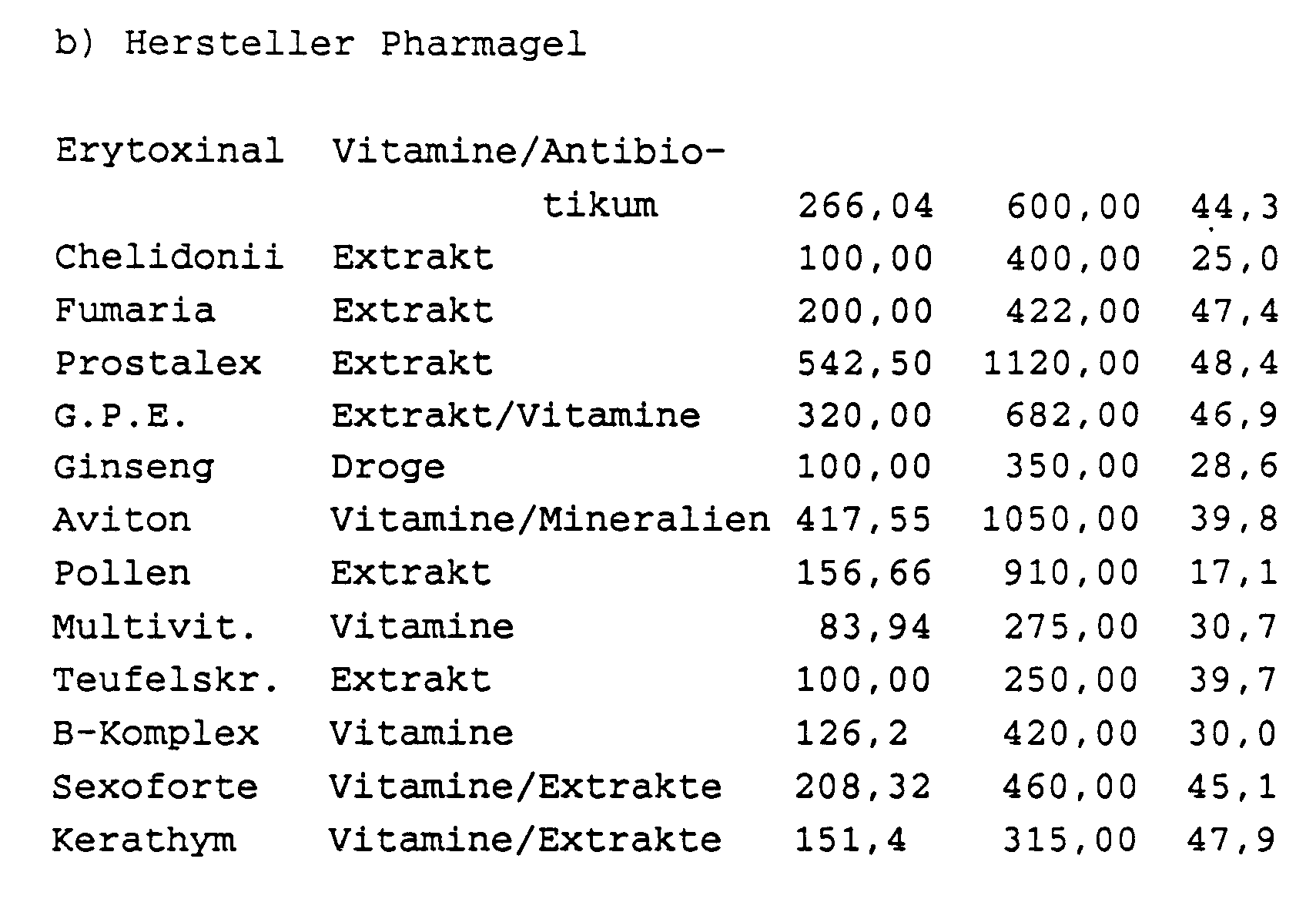
- 3. Solche hohen Wirkstoffanteile konnten mit den bisher verwendeten Öl/Lecithingemischen nicht erreicht werden. Bei diesen galt bisher die Faustregel, daß max. 50 % des Füllgewichtes pulvrige Substanzen sein können; der Rest sind ölige Hilfsstoffe oder ölige Wirkstoffe.
Um dies zu untermauern, wurden einige Analysenzertifikate von den Firmen Swiss Caps und Pharmagel für Suspensionskapseln ausgewertet: - Aus dieser Auswertung ergibt sich unzweifelhaft, daß in bekannten Weichkapseln maximal 55 % Feststoffe, bezogen auf das Gesamtfüllgewicht, verkapselt werden können. Der Rest sind Öle und Emulgatoren. Demgegenüber kann bei den erfindungsgemäß hergestellten Kapseln der Hilfsstoffanteil drastisch reduziert werden, wodurch die Kapsel kleiner und billiger wird. Auf Emulgatoren (wie Lecithin) kann ebenfalls verzichtet werden.

Claims (4)
- Weichgelatinekapsel, enthaltend einen in einem flüssigen Träger suspendierten oder gelösten phytopharmazeutischen Wirkstoff in Form eines mittels Wasser und/oder Alkohol extrahierten Pflanzenextrakts, dadurch gekennzeichnet, daß der Pflanzenextrakt ausschließlicher Wirkstoff und der flüssige Träger ein Lösungsmittel für den Pflanzenextrakt aus der Gruppe der polykondensierten Alkohole, Polyole oder deren Monomethyl- bzw. Monoethylether ist.
- Weichgelatinekapsel nach Anspruch 1, dadurch gekennzeichnet, daß dem Träger-Lösungsmittel biologische komplexbildende Lösungsvermittler der Phosphatidgruppe beigefügt sind.
- Weichgelatinekapsel nach Anspruch 1 oder 2, dadu rch gekennzeichnet, daß das Lösungsmittel Polyethylenglykol ist.
- Weichgelatinekapsel nach Anspruch 1, dadurch gekennzeichnet, daß das Lösungsmittel Polyglycerin ist.
Priority Applications (13)
| Application Number | Priority Date | Filing Date | Title |
|---|---|---|---|
| DE3818022A DE3818022C2 (de) | 1988-05-24 | 1988-05-24 | Weichgelatinekapsel |
| IE166389A IE63327B1 (en) | 1988-05-24 | 1989-05-23 | Soft gelatin capsule |
| ES198989109215T ES2034494T3 (es) | 1988-05-24 | 1989-05-23 | Procedimiento de preparacion de una capsula de gelatina blanda. |
| EP89109215A EP0343575B1 (de) | 1988-05-24 | 1989-05-23 | Weichgelatinekapsel |
| PT90640A PT90640B (pt) | 1988-05-24 | 1989-05-23 | Processo de preparacao de uma capsula de gelatina mole terapeuticamente activa a base de oleo de silicone ou de uma mistura de oleos de silicone e de um agente terapeuticamente activo |
| NO892077A NO178175C (no) | 1988-05-24 | 1989-05-24 | Fremgangsmåte til fremstilling av en mykgelatinkapsel |
| DK251089A DK251089A (da) | 1988-05-24 | 1989-05-24 | Bloed gelatinekapsel |
| FI892524A FI101935B (fi) | 1988-05-24 | 1989-05-24 | Menetelmä pehmytgelatiinikapselin valmistamiseksi |
| DE59008770T DE59008770D1 (de) | 1988-05-24 | 1990-06-06 | Weichgelatinekapsel. |
| AT90250146T ATE120088T1 (de) | 1988-05-24 | 1990-06-06 | Weichgelatinekapsel. |
| EP90250146A EP0464274B1 (de) | 1988-05-24 | 1990-06-06 | Weichgelatinekapsel |
| FI912690A FI912690A7 (fi) | 1988-05-24 | 1991-06-04 | Pehmeägelatiinikapseli |
| NO91912177A NO912177L (no) | 1988-05-24 | 1991-06-06 | Mykgelatinkapsel. |
Applications Claiming Priority (2)
| Application Number | Priority Date | Filing Date | Title |
|---|---|---|---|
| DE3818022A DE3818022C2 (de) | 1988-05-24 | 1988-05-24 | Weichgelatinekapsel |
| EP90250146A EP0464274B1 (de) | 1988-05-24 | 1990-06-06 | Weichgelatinekapsel |
Publications (2)
| Publication Number | Publication Date |
|---|---|
| EP0464274A1 EP0464274A1 (de) | 1992-01-08 |
| EP0464274B1 true EP0464274B1 (de) | 1995-03-22 |
Family
ID=40139159
Family Applications (2)
| Application Number | Title | Priority Date | Filing Date |
|---|---|---|---|
| EP89109215A Expired - Lifetime EP0343575B1 (de) | 1988-05-24 | 1989-05-23 | Weichgelatinekapsel |
| EP90250146A Expired - Lifetime EP0464274B1 (de) | 1988-05-24 | 1990-06-06 | Weichgelatinekapsel |
Family Applications Before (1)
| Application Number | Title | Priority Date | Filing Date |
|---|---|---|---|
| EP89109215A Expired - Lifetime EP0343575B1 (de) | 1988-05-24 | 1989-05-23 | Weichgelatinekapsel |
Country Status (9)
| Country | Link |
|---|---|
| EP (2) | EP0343575B1 (de) |
| AT (1) | ATE120088T1 (de) |
| DE (2) | DE3818022C2 (de) |
| DK (1) | DK251089A (de) |
| ES (1) | ES2034494T3 (de) |
| FI (2) | FI101935B (de) |
| IE (1) | IE63327B1 (de) |
| NO (2) | NO178175C (de) |
| PT (1) | PT90640B (de) |
Families Citing this family (7)
| Publication number | Priority date | Publication date | Assignee | Title |
|---|---|---|---|---|
| DE3818022C2 (de) * | 1988-05-24 | 1994-04-28 | Guenter Stephan | Weichgelatinekapsel |
| CH683594A5 (de) * | 1991-01-24 | 1994-04-15 | Flachsmann Ag Emil | Verfahren zur Herstellung eines Pflanzenextrakt enthaltenden Masse, welche insbesondere für die Einkapselung in ein festes Umhüllungsmaterial geeignet ist. |
| DE4219330C2 (de) * | 1992-06-10 | 1994-06-09 | Guenter Stephan | Wasserlösliches Instanttee-Erzeugnis |
| CA2156726C (en) * | 1993-02-26 | 2000-10-17 | Paula Denise Davis | Bisacodyl dosage form |
| GB2281697A (en) * | 1993-09-14 | 1995-03-15 | Euro Celtique Sa | Laxative compositions in capsules |
| WO1995011024A1 (en) * | 1993-10-19 | 1995-04-27 | The Procter & Gamble Company | Picosulphate dosage form |
| GB2290965A (en) * | 1994-07-11 | 1996-01-17 | Therapicon Srl | Multiple layer capsules for drugs |
Family Cites Families (10)
| Publication number | Priority date | Publication date | Assignee | Title |
|---|---|---|---|---|
| US3202578A (en) * | 1957-09-27 | 1965-08-24 | Elder Paul B Co | Polymeric laxative composition and method of using same |
| FR5549M (de) * | 1966-04-14 | 1967-11-20 | ||
| FR2077790A1 (en) * | 1970-02-13 | 1971-11-05 | Broutin Heliane | Anti-rheumatism medicament - contg butylsalicylamine and ethyl salicylamide |
| DE2614864C3 (de) * | 1976-04-06 | 1979-11-29 | Schwabe, Willmar, Dr., 7500 Karlsruhe | Verfahren zur Herstellung Digoxin enthaltender Arzneipräparate in Weichgelatinekapseln zur oralen Verabfolgung |
| IT1090703B (it) * | 1976-12-03 | 1985-06-26 | Scherer Ltd R P | Perfezionamento nelle composizioni utili quali veicolo per farmaci |
| DE2712161C2 (de) * | 1977-03-19 | 1983-01-05 | Blendax-Werke R. Schneider Gmbh & Co, 6500 Mainz | Zahn- und Mundpflegemittel |
| FR2390953A1 (fr) * | 1977-05-20 | 1978-12-15 | Grimberg Georges | Medicament a base de charbon |
| FR2605223B1 (fr) * | 1986-10-20 | 1989-09-22 | Pf Medicament | Compositions therapeutiques stables a base d' huile vegetale hydrophobe et son procede de preparation |
| HU203285B (en) * | 1988-02-01 | 1991-07-29 | Egyt Gyogyszervegyeszeti Gyar | Method for producing transdermal preparation containing vegetable extract |
| DE3818022C2 (de) * | 1988-05-24 | 1994-04-28 | Guenter Stephan | Weichgelatinekapsel |
-
1988
- 1988-05-24 DE DE3818022A patent/DE3818022C2/de not_active Expired - Fee Related
-
1989
- 1989-05-23 ES ES198989109215T patent/ES2034494T3/es not_active Expired - Lifetime
- 1989-05-23 PT PT90640A patent/PT90640B/pt not_active IP Right Cessation
- 1989-05-23 IE IE166389A patent/IE63327B1/en not_active IP Right Cessation
- 1989-05-23 EP EP89109215A patent/EP0343575B1/de not_active Expired - Lifetime
- 1989-05-24 NO NO892077A patent/NO178175C/no not_active IP Right Cessation
- 1989-05-24 DK DK251089A patent/DK251089A/da not_active Application Discontinuation
- 1989-05-24 FI FI892524A patent/FI101935B/fi not_active IP Right Cessation
-
1990
- 1990-06-06 EP EP90250146A patent/EP0464274B1/de not_active Expired - Lifetime
- 1990-06-06 DE DE59008770T patent/DE59008770D1/de not_active Expired - Fee Related
- 1990-06-06 AT AT90250146T patent/ATE120088T1/de not_active IP Right Cessation
-
1991
- 1991-06-04 FI FI912690A patent/FI912690A7/fi not_active Application Discontinuation
- 1991-06-06 NO NO91912177A patent/NO912177L/no unknown
Non-Patent Citations (2)
| Title |
|---|
| Klinisches Wörterbuch, W. Pschyrembel, W de G, Berlin-New York (1977), Seite 349 * |
| Römpp, Chemie Lexikon, 9. Auflage * |
Also Published As
| Publication number | Publication date |
|---|---|
| FI101935B1 (fi) | 1998-09-30 |
| NO892077L (no) | 1989-11-27 |
| FI912690A0 (fi) | 1991-06-04 |
| FI912690L (fi) | 1991-12-07 |
| DK251089D0 (da) | 1989-05-24 |
| EP0343575B1 (de) | 1992-08-26 |
| FI101935B (fi) | 1998-09-30 |
| NO178175B (no) | 1995-10-30 |
| NO912177D0 (no) | 1991-06-06 |
| FI892524L (fi) | 1989-11-25 |
| IE891663L (en) | 1989-11-24 |
| NO912177L (no) | 1991-12-09 |
| DK251089A (da) | 1989-11-25 |
| NO178175C (no) | 1996-02-07 |
| ES2034494T3 (es) | 1993-04-01 |
| EP0464274A1 (de) | 1992-01-08 |
| FI912690A7 (fi) | 1991-12-07 |
| DE3818022C2 (de) | 1994-04-28 |
| EP0343575A1 (de) | 1989-11-29 |
| DE3818022C1 (de) | 1989-10-19 |
| NO892077D0 (no) | 1989-05-24 |
| ATE120088T1 (de) | 1995-04-15 |
| DE59008770D1 (de) | 1995-04-27 |
| PT90640B (pt) | 1994-10-31 |
| FI892524A0 (fi) | 1989-05-24 |
| IE63327B1 (en) | 1995-04-05 |
| PT90640A (pt) | 1989-11-30 |
Similar Documents
| Publication | Publication Date | Title |
|---|---|---|
| DE60018372T2 (de) | Oralzusammensetzung als mikroemulsion von silybin | |
| DE3224619C2 (de) | ||
| DE69936911T2 (de) | Propofolhaltiges arzneimittel enthaltend sulfite | |
| DE60119082T2 (de) | Anästhetikum enthaltende formulierungen | |
| DE3237814A1 (de) | Wasserfreie emulsionen und verwendung derselben | |
| DE69920201T2 (de) | Zusammensetzungen enthaltend glykolderivate, alkohole und vitamin d | |
| DE60317803T2 (de) | Pharmazeutische zusammensetzungen enthaltend cyclosporin zur oralen verabreichung | |
| EP0152106B1 (de) | Rheumamittel | |
| DE112008003744T5 (de) | Fettemulsion, umfassend Ganoderma-Sporenöl, Verfahren zur Qualitätskontrolle und Verwendung davon | |
| EP0456106B1 (de) | Stabile, zur pharmazeutischen Verabreichung geeignete Emulsion, Verfahren zu deren Herstellung und Emulsion zur Anwendung als Arzneimittel | |
| DE69711267T2 (de) | Cyclosporin enthaltende Weichkapselpräparate | |
| DE3438821A1 (de) | Verwendung von 24,25-dihydroxycholecalciferol | |
| DE69321519T2 (de) | Pharmazeutische Anthocyanoside enthaltende Zusammensetzungen zur oralen Anwendung | |
| DE69921409T2 (de) | Cyclosporin enthaltende Zusammensetzungen | |
| EP0464274A1 (de) | Weichgelatinekapsel | |
| DE60006000T2 (de) | Pharmazeutische zusammensetzungen zur oralen verabreichung | |
| EP0651995A1 (de) | Cyclosporin(e) enthaltende o/w Emulsion zur oralen Verabreichung | |
| DE19744459A1 (de) | Flavonolignan-Zubereitungen, insbesondere Silymarin-Zubereitungen | |
| EP1095659B1 (de) | Celluloseether stabilisierte Öl-in-Wasser Emulsionen als Träger für homöopathische und pflanzliche Wirkstoffe | |
| EP0151987A2 (de) | Mittel zur Behandlung von Erkrankungen der Venen und des Analbereichs | |
| DE602004007164T2 (de) | Transport-und absorptionsmittel und das verfahren seiner herstellung aus hanfsamen | |
| DE202023001867U1 (de) | Formulierung umfassend mindestens eine Kresse-Art | |
| DE3042975A1 (de) | Mikrodispersion mit einem wirkstoff und/oder einem reagens in salzform als disperser phase | |
| WO1992018168A1 (de) | Parenteral verabreichbare, hitzesterilisierbare o/w-emulsion eines röntgenkontrastmittels | |
| DE3873684T2 (de) | Lipidemulsion und verfahren zur intravenoesen infusion. |
Legal Events
| Date | Code | Title | Description |
|---|---|---|---|
| PUAI | Public reference made under article 153(3) epc to a published international application that has entered the european phase |
Free format text: ORIGINAL CODE: 0009012 |
|
| 17P | Request for examination filed |
Effective date: 19901228 |
|
| AK | Designated contracting states |
Kind code of ref document: A1 Designated state(s): AT BE CH DE DK ES FR GB GR IT LI LU NL SE |
|
| 17Q | First examination report despatched |
Effective date: 19930723 |
|
| GRAA | (expected) grant |
Free format text: ORIGINAL CODE: 0009210 |
|
| AK | Designated contracting states |
Kind code of ref document: B1 Designated state(s): AT BE CH DE DK ES FR GB GR IT LI LU NL SE |
|
| PG25 | Lapsed in a contracting state [announced via postgrant information from national office to epo] |
Ref country code: ES Free format text: THE PATENT HAS BEEN ANNULLED BY A DECISION OF A NATIONAL AUTHORITY Effective date: 19950322 Ref country code: IT Free format text: LAPSE BECAUSE OF FAILURE TO SUBMIT A TRANSLATION OF THE DESCRIPTION OR TO PAY THE FEE WITHIN THE PRE;WARNING: LAPSES OF ITALIAN PATENTS WITH EFFECTIVE DATE BEFORE 2007 MAY HAVE OCCURRED AT ANY TIME BEFORE 2007. THE CORRECT EFFECTIVE DATE MAY BE DIFFERENT FROM THE ONE RECORDED.SCRIBED TIME-LIMIT Effective date: 19950322 Ref country code: GR Free format text: LAPSE BECAUSE OF FAILURE TO SUBMIT A TRANSLATION OF THE DESCRIPTION OR TO PAY THE FEE WITHIN THE PRESCRIBED TIME-LIMIT Effective date: 19950322 Ref country code: NL Free format text: LAPSE BECAUSE OF NON-PAYMENT OF DUE FEES Effective date: 19950322 Ref country code: DK Effective date: 19950322 Ref country code: BE Effective date: 19950322 |
|
| REF | Corresponds to: |
Ref document number: 120088 Country of ref document: AT Date of ref document: 19950415 Kind code of ref document: T |
|
| REF | Corresponds to: |
Ref document number: 59008770 Country of ref document: DE Date of ref document: 19950427 |
|
| PG25 | Lapsed in a contracting state [announced via postgrant information from national office to epo] |
Ref country code: SE Effective date: 19950622 |
|
| PG25 | Lapsed in a contracting state [announced via postgrant information from national office to epo] |
Ref country code: LU Free format text: LAPSE BECAUSE OF NON-PAYMENT OF DUE FEES Effective date: 19950630 |
|
| ET | Fr: translation filed | ||
| GBT | Gb: translation of ep patent filed (gb section 77(6)(a)/1977) |
Effective date: 19950704 |
|
| NLV1 | Nl: lapsed or annulled due to failure to fulfill the requirements of art. 29p and 29m of the patents act | ||
| PLBE | No opposition filed within time limit |
Free format text: ORIGINAL CODE: 0009261 |
|
| STAA | Information on the status of an ep patent application or granted ep patent |
Free format text: STATUS: NO OPPOSITION FILED WITHIN TIME LIMIT |
|
| 26N | No opposition filed | ||
| REG | Reference to a national code |
Ref country code: CH Ref legal event code: PUE Owner name: GUENTER STEPHAN TRANSFER- AGON PHARMA GMBH |
|
| REG | Reference to a national code |
Ref country code: FR Ref legal event code: TP |
|
| REG | Reference to a national code |
Ref country code: GB Ref legal event code: 732E |
|
| REG | Reference to a national code |
Ref country code: GB Ref legal event code: IF02 |
|
| PGFP | Annual fee paid to national office [announced via postgrant information from national office to epo] |
Ref country code: GB Payment date: 20040524 Year of fee payment: 15 |
|
| PGFP | Annual fee paid to national office [announced via postgrant information from national office to epo] |
Ref country code: CH Payment date: 20040525 Year of fee payment: 15 |
|
| PGFP | Annual fee paid to national office [announced via postgrant information from national office to epo] |
Ref country code: AT Payment date: 20040601 Year of fee payment: 15 |
|
| PGFP | Annual fee paid to national office [announced via postgrant information from national office to epo] |
Ref country code: FR Payment date: 20040618 Year of fee payment: 15 |
|
| PGFP | Annual fee paid to national office [announced via postgrant information from national office to epo] |
Ref country code: DE Payment date: 20040629 Year of fee payment: 15 |
|
| PG25 | Lapsed in a contracting state [announced via postgrant information from national office to epo] |
Ref country code: GB Free format text: LAPSE BECAUSE OF NON-PAYMENT OF DUE FEES Effective date: 20050606 Ref country code: AT Free format text: LAPSE BECAUSE OF NON-PAYMENT OF DUE FEES Effective date: 20050606 |
|
| PG25 | Lapsed in a contracting state [announced via postgrant information from national office to epo] |
Ref country code: LI Free format text: LAPSE BECAUSE OF NON-PAYMENT OF DUE FEES Effective date: 20050630 Ref country code: CH Free format text: LAPSE BECAUSE OF NON-PAYMENT OF DUE FEES Effective date: 20050630 |
|
| PG25 | Lapsed in a contracting state [announced via postgrant information from national office to epo] |
Ref country code: DE Free format text: LAPSE BECAUSE OF NON-PAYMENT OF DUE FEES Effective date: 20060103 |
|
| REG | Reference to a national code |
Ref country code: CH Ref legal event code: PL |
|
| PG25 | Lapsed in a contracting state [announced via postgrant information from national office to epo] |
Ref country code: FR Free format text: LAPSE BECAUSE OF NON-PAYMENT OF DUE FEES Effective date: 20060228 |
|
| GBPC | Gb: european patent ceased through non-payment of renewal fee |
Effective date: 20050606 |
|
| REG | Reference to a national code |
Ref country code: FR Ref legal event code: ST Effective date: 20060228 |