EP0458484A2 - Gummibasierte Klebebänder - Google Patents
Gummibasierte Klebebänder Download PDFInfo
- Publication number
- EP0458484A2 EP0458484A2 EP91304069A EP91304069A EP0458484A2 EP 0458484 A2 EP0458484 A2 EP 0458484A2 EP 91304069 A EP91304069 A EP 91304069A EP 91304069 A EP91304069 A EP 91304069A EP 0458484 A2 EP0458484 A2 EP 0458484A2
- Authority
- EP
- European Patent Office
- Prior art keywords
- roll
- rolls
- mass
- center
- adhesive
- Prior art date
- Legal status (The legal status is an assumption and is not a legal conclusion. Google has not performed a legal analysis and makes no representation as to the accuracy of the status listed.)
- Withdrawn
Links
Images
Classifications
-
- B—PERFORMING OPERATIONS; TRANSPORTING
- B32—LAYERED PRODUCTS
- B32B—LAYERED PRODUCTS, i.e. PRODUCTS BUILT-UP OF STRATA OF FLAT OR NON-FLAT, e.g. CELLULAR OR HONEYCOMB, FORM
- B32B27/00—Layered products comprising a layer of synthetic resin
- B32B27/32—Layered products comprising a layer of synthetic resin comprising polyolefins
-
- A—HUMAN NECESSITIES
- A23—FOODS OR FOODSTUFFS; TREATMENT THEREOF, NOT COVERED BY OTHER CLASSES
- A23L—FOODS, FOODSTUFFS OR NON-ALCOHOLIC BEVERAGES, NOT OTHERWISE PROVIDED FOR; PREPARATION OR TREATMENT THEREOF
- A23L29/00—Foods or foodstuffs containing additives; Preparation or treatment thereof
- A23L29/20—Foods or foodstuffs containing additives; Preparation or treatment thereof containing gelling or thickening agents
- A23L29/206—Foods or foodstuffs containing additives; Preparation or treatment thereof containing gelling or thickening agents of vegetable origin
- A23L29/238—Foods or foodstuffs containing additives; Preparation or treatment thereof containing gelling or thickening agents of vegetable origin from seeds, e.g. locust bean gum or guar gum
-
- A—HUMAN NECESSITIES
- A23—FOODS OR FOODSTUFFS; TREATMENT THEREOF, NOT COVERED BY OTHER CLASSES
- A23L—FOODS, FOODSTUFFS OR NON-ALCOHOLIC BEVERAGES, NOT OTHERWISE PROVIDED FOR; PREPARATION OR TREATMENT THEREOF
- A23L29/00—Foods or foodstuffs containing additives; Preparation or treatment thereof
- A23L29/20—Foods or foodstuffs containing additives; Preparation or treatment thereof containing gelling or thickening agents
- A23L29/206—Foods or foodstuffs containing additives; Preparation or treatment thereof containing gelling or thickening agents of vegetable origin
- A23L29/262—Cellulose; Derivatives thereof, e.g. ethers
-
- B—PERFORMING OPERATIONS; TRANSPORTING
- B32—LAYERED PRODUCTS
- B32B—LAYERED PRODUCTS, i.e. PRODUCTS BUILT-UP OF STRATA OF FLAT OR NON-FLAT, e.g. CELLULAR OR HONEYCOMB, FORM
- B32B37/00—Methods or apparatus for laminating, e.g. by curing or by ultrasonic bonding
- B32B37/14—Methods or apparatus for laminating, e.g. by curing or by ultrasonic bonding characterised by the properties of the layers
- B32B37/15—Methods or apparatus for laminating, e.g. by curing or by ultrasonic bonding characterised by the properties of the layers with at least one layer being manufactured and immediately laminated before reaching its stable state, e.g. in which a layer is extruded and laminated while in semi-molten state
- B32B37/153—Methods or apparatus for laminating, e.g. by curing or by ultrasonic bonding characterised by the properties of the layers with at least one layer being manufactured and immediately laminated before reaching its stable state, e.g. in which a layer is extruded and laminated while in semi-molten state at least one layer is extruded and immediately laminated while in semi-molten state
-
- G—PHYSICS
- G03—PHOTOGRAPHY; CINEMATOGRAPHY; ANALOGOUS TECHNIQUES USING WAVES OTHER THAN OPTICAL WAVES; ELECTROGRAPHY; HOLOGRAPHY
- G03C—PHOTOSENSITIVE MATERIALS FOR PHOTOGRAPHIC PURPOSES; PHOTOGRAPHIC PROCESSES, e.g. CINE, X-RAY, COLOUR, STEREO-PHOTOGRAPHIC PROCESSES; AUXILIARY PROCESSES IN PHOTOGRAPHY
- G03C5/00—Photographic processes or agents therefor; Regeneration of such processing agents
- G03C5/16—X-ray, infrared, or ultraviolet ray processes
- G03C5/17—X-ray, infrared, or ultraviolet ray processes using screens to intensify X-ray images
-
- G—PHYSICS
- G21—NUCLEAR PHYSICS; NUCLEAR ENGINEERING
- G21K—HANDLING OF PARTICLES OR IONISING RADIATION NOT OTHERWISE PROVIDED FOR; IRRADIATION DEVICES; GAMMA RAY OR X-RAY MICROSCOPES
- G21K4/00—Conversion screens for the conversion of the spatial distribution of X-rays or particle radiation into visible images, e.g. fluoroscopic screens
-
- B—PERFORMING OPERATIONS; TRANSPORTING
- B32—LAYERED PRODUCTS
- B32B—LAYERED PRODUCTS, i.e. PRODUCTS BUILT-UP OF STRATA OF FLAT OR NON-FLAT, e.g. CELLULAR OR HONEYCOMB, FORM
- B32B2309/00—Parameters for the laminating or treatment process; Apparatus details
- B32B2309/02—Temperature
-
- B—PERFORMING OPERATIONS; TRANSPORTING
- B32—LAYERED PRODUCTS
- B32B—LAYERED PRODUCTS, i.e. PRODUCTS BUILT-UP OF STRATA OF FLAT OR NON-FLAT, e.g. CELLULAR OR HONEYCOMB, FORM
- B32B2323/00—Polyalkenes
- B32B2323/04—Polyethylene
- B32B2323/046—LDPE, i.e. low density polyethylene
-
- B—PERFORMING OPERATIONS; TRANSPORTING
- B32—LAYERED PRODUCTS
- B32B—LAYERED PRODUCTS, i.e. PRODUCTS BUILT-UP OF STRATA OF FLAT OR NON-FLAT, e.g. CELLULAR OR HONEYCOMB, FORM
- B32B2405/00—Adhesive articles, e.g. adhesive tapes
-
- C—CHEMISTRY; METALLURGY
- C09—DYES; PAINTS; POLISHES; NATURAL RESINS; ADHESIVES; COMPOSITIONS NOT OTHERWISE PROVIDED FOR; APPLICATIONS OF MATERIALS NOT OTHERWISE PROVIDED FOR
- C09J—ADHESIVES; NON-MECHANICAL ASPECTS OF ADHESIVE PROCESSES IN GENERAL; ADHESIVE PROCESSES NOT PROVIDED FOR ELSEWHERE; USE OF MATERIALS AS ADHESIVES
- C09J2301/00—Additional features of adhesives in the form of films or foils
- C09J2301/10—Additional features of adhesives in the form of films or foils characterized by the structural features of the adhesive tape or sheet
- C09J2301/16—Additional features of adhesives in the form of films or foils characterized by the structural features of the adhesive tape or sheet by the structure of the carrier layer
- C09J2301/162—Additional features of adhesives in the form of films or foils characterized by the structural features of the adhesive tape or sheet by the structure of the carrier layer the carrier being a laminate constituted by plastic layers only
-
- G—PHYSICS
- G21—NUCLEAR PHYSICS; NUCLEAR ENGINEERING
- G21K—HANDLING OF PARTICLES OR IONISING RADIATION NOT OTHERWISE PROVIDED FOR; IRRADIATION DEVICES; GAMMA RAY OR X-RAY MICROSCOPES
- G21K4/00—Conversion screens for the conversion of the spatial distribution of X-rays or particle radiation into visible images, e.g. fluoroscopic screens
- G21K2004/06—Conversion screens for the conversion of the spatial distribution of X-rays or particle radiation into visible images, e.g. fluoroscopic screens with a phosphor layer
-
- G—PHYSICS
- G21—NUCLEAR PHYSICS; NUCLEAR ENGINEERING
- G21K—HANDLING OF PARTICLES OR IONISING RADIATION NOT OTHERWISE PROVIDED FOR; IRRADIATION DEVICES; GAMMA RAY OR X-RAY MICROSCOPES
- G21K4/00—Conversion screens for the conversion of the spatial distribution of X-rays or particle radiation into visible images, e.g. fluoroscopic screens
- G21K2004/08—Conversion screens for the conversion of the spatial distribution of X-rays or particle radiation into visible images, e.g. fluoroscopic screens with a binder in the phosphor layer
-
- G—PHYSICS
- G21—NUCLEAR PHYSICS; NUCLEAR ENGINEERING
- G21K—HANDLING OF PARTICLES OR IONISING RADIATION NOT OTHERWISE PROVIDED FOR; IRRADIATION DEVICES; GAMMA RAY OR X-RAY MICROSCOPES
- G21K4/00—Conversion screens for the conversion of the spatial distribution of X-rays or particle radiation into visible images, e.g. fluoroscopic screens
- G21K2004/12—Conversion screens for the conversion of the spatial distribution of X-rays or particle radiation into visible images, e.g. fluoroscopic screens with a support
-
- Y—GENERAL TAGGING OF NEW TECHNOLOGICAL DEVELOPMENTS; GENERAL TAGGING OF CROSS-SECTIONAL TECHNOLOGIES SPANNING OVER SEVERAL SECTIONS OF THE IPC; TECHNICAL SUBJECTS COVERED BY FORMER USPC CROSS-REFERENCE ART COLLECTIONS [XRACs] AND DIGESTS
- Y10—TECHNICAL SUBJECTS COVERED BY FORMER USPC
- Y10S—TECHNICAL SUBJECTS COVERED BY FORMER USPC CROSS-REFERENCE ART COLLECTIONS [XRACs] AND DIGESTS
- Y10S426/00—Food or edible material: processes, compositions, and products
- Y10S426/804—Low calorie, low sodium or hypoallergic
Definitions
- the present invention relates to polymeric films and, more particularly, to a cost-effective system for the commercial production of tapes meeting consumer specifications and expectations.
- Rubber-based pressure-sensitive adhesive tapes have enjoyed substantial consumer acceptance over a whole line of industrial tapes, as well as for an outer protective wrap for pipelines. They are sold in a wide range of sizes and thicknesses, depending upon the contemplated usage.
- such films comprise a rubber-based pressure-sensitive adhesive formulation carried on a polyolefinic backing for toughness and liquid impermeability.
- a reinforcing cloth material is sandwiched between the adhesive and backing for increased strength and tearability in the cross direction.
- a second possibility might be to reduce the thickness of the tape backing and thereby use less polyethylene. While this might be possible to a very minor degree without encountering performance problems or customer acceptability, it is not a viable alternative to meaningful cost reduction.
- a third possibility would be to mix other less costly materials with the polyethylene in an homogenous blend. However, significant amounts of these other materials cannot be admixed without loss of quality and performance.
- Applicant has considered the possibility of coextruding polyethylene and a less expensive material, e.g. the above-noted selvedge, to form a two-stratum backing onto which the adhesive layer may subsequently be coated in a separate coating step.
- this coextrusion which requires a separate downstream coating operation to apply the adhesive is not cost-effective from a manufacturing standpoint. Production is too slow and more space, equipment and manpower are required than if the backing was made and the adhesive applied in a single operation.
- a multilayer backing prepared simply by coextruding onto a moving belt, for example, and then cooling would not provide the desired film characteristics, particularly a substrate for optimum adhesion of the adhesive layer to be applied downstream.
- the task of this invention is to devise a system to form a tape of the foregoing description having a backing comprising an outer stratum of thermoplastic material of prime grade and an inner stratum of a less expensive material, which system does not sacrifice quality or speed and efficiency of manufacture.
- the aforementioned task is satisfied by utilising a per se known 3-roll calender under specified operating conditions wherein: a molten mass of prime grade polyolefin or other thermoplastic material and a molten mass of a lower grade and less costly thermoplastic material are deposited as separate masses at the nip of a first or bottom roll heated to a temperature above the melting point of both of the two masses and a second or middle roll heated to an elevated temperature below the melting point of the masses, the first roll rotating at a speed substantially slower than the second roll, the masses being deposited such that the prime grade polyolefinic mass first contacts the second roll in advance of the nip; advancing the deposited masses between the nip of the first and second rolls to form discrete strata wherein the inner stratum adhering to the center roll is caused to be the prime polyolefinic mass and the outer stratum is the other or less expensive material, the free outer surface of the outer stratum having a matt finish providing a better substrate for the
- the first roll which operates at a substantially slower speed than the second roll, is heated (preferably internally) to a temperature above the melting point of the particular polymer mass employed, e.g. 270°F (132°C) for polyethylene.
- the second roll is heated (preferably internally) to an elevated temperature below the melting point of the particular polyethylene used, e.g. 190°F (88°C).
- the mass deposited at the nip will be extruded between the nip of the two rolls to form a layer of substantially uniform thickness conforming to the spacing or gap of the nip, which layer will adhere to the surface of the second roll.
- the layer is then carried from the surface of the second roll into contact with the third roll rotating at the same speed as the second roll but chilled relative thereto and having a surface temperature of, for example, on the order of 50°F to 70°F (10°C to 21°C).
- the sheeted layer is stripped from the second roll and passes around the third roll to a takeup roll.
- the first roll is preferably rotated at a very low speed sufficient to equalise wear over its entire surface area.
- the speed of the second roll is then adjusted for satisfactory operation at a greater surface speed.
- the action at the nip is such that the polymer mass is subjected to a drawing action prior to passage into or during passage through the nip under the frictional influence of the surfaces of the first and second rolls operating at the differential in surface speeds; and this drawing action results in a molecular orientation in the direction of advance prior to the emergence of the material from the nip in its sheet form adherent to the second calender roll, so that the sheet as formed on the second roll exhibits longitudinal molecular orientation.
- the matt or rougher side possesses highly favourable adhesive-receptive and retentive characteristics for coatings, e.g. solvent-, heat-, or pressure-sensitive adhesives. Consequently, the patent clearly teaches the efficacy of applying an adhesive coating to the rougher or matt surface of a film formed in the aforementioned calendering operation rather than on the opposed smooth surface.
- thermoplastic material which, for example, may be polyethylene or a blend of polyethylene and another polymer, is applied in molten form at the nip of the first and second rolls and the resulting film having a matt surface is transported from the second roll to the nip of the third roll where another thermoplastic material, e.g. a pressure-sensitive adhesive introduced at the nip between the second and third rolls is deposited on the matt surface.
- another thermoplastic material e.g. a pressure-sensitive adhesive introduced at the nip between the second and third rolls is deposited on the matt surface.
- a film or tape backing layer could be provided by applying a single polymeric mass in molten form at the nip of two opposed rolls of a 3-roll calender and advancing the mass between the nip to provide a film adherent to the center roll and which is molecularly oriented in the machine (longitudinal) direction.
- the film is further characterised as being smooth on the adherent surface and having a rougher or matt finish on the opposed outer surface. It was further known, e.g.
- this film may then be advanced to the nip of the middle and third roll where an adhesive mass is deposited on the outer surface to provide a tape wherein the adhesive is carried on the adhesive-receptive and retentive rough surface.
- the outer stratum comprises a prime grade thermoplastic material such as the polyolefins traditionally employed today in tape manufacture, the free outer surface of which is smooth so as to provide a uniform surface morphology for the adhesive layer of the tape to adhere to as the tape is spirally wound or otherwise overlapped over the substrate to be taped; and the inner stratum is present as a discrete layer of less costly polymeric material laminated to the outer stratum, the free outer surface of the inner stratum being roughened or of a matt appearance, as heretofore discussed, so as to provide the optimum surface characteristics for both receiving the adhesive coating and subsequent retention of the thus applied adhesive layer and thereby inhibit the danger of delamination of the backing and the adhesive.
- the outer stratum comprises a prime grade thermoplastic material such as the polyolefins traditionally employed today in tape manufacture, the free outer surface of which is smooth so as to provide a uniform surface morphology for the adhesive layer of the tape to adhere to as the tape is spirally wound or otherwise overlapped over the substrate to be taped; and the inner stratum
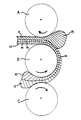
- the figure is a schematic view illustrating the manufacturing process of this invention with the thicknesses of the tape materials greatly exaggerated with respect to the dimensions of the rolls for purposes of clear illustration of the invention.
- a molten mass of prime grade polyolefin 10 and a lesser grade and less expensive molten mass containing polyolefinic material 12 are separately deposited at the nip of adjacent rolls B and C of a conventional 3-roll calender whose respective surface temperatures and speeds of rotation may be individually controlled.
- the prime grade olefinic material may comprise any of the polyolefins or mixtures thereof heretofore employed in tape manufacture, e.g. polyethylene, polypropylene, polyisobutylene, etc., polyethylene being preferred, as was heretofore indicated.
- polyethylene polypropylene, polyisobutylene, etc.
- polyethylene being preferred, as was heretofore indicated.
- LDPE low density polyethylene
- HDPE high density polyethylene
- the second molten mass may in theory comprise any thermoplastic mix which will bond well to both the adhesive layer and the overlying polyolefinic layer.
- it could be more expensive than the polyolefin, in which case it should of course provide some function superior to those of the polyolefin to justify its use. Accordingly, the use of such other mixes is to be understood to be within the scope of this invention.
- the other mix will comprise a lower grade polyolefinic blend, i.e. a mixture of polyolefin, such as the polyolefin in the prime grade stratum, and other ingredients making the mix less expensive than the prime grade. Included in the list of such expensive blends, mention may be made of polyolefin mixes which fall in the categories of reclaim or selvedge.
- an entire production run e.g. an elongated tape which prior to slitting to smaller rolls may, for example, be on the order of 36" (91 cms) wide and perhaps 50 or 90′ (15.2 or 27.4 metres) in length, fails a quality control test for one reason or the other. Since such a roll would consist of backing, adhesive components and other additives, it might normally be relegated to the scrap heap and discarded.
- at least a portion of such a reclaim may be admixed with a prime grade polyolefin to provide the inner stratum to which the adhesive is to be applied.
- the term "reclaimed rubber-based adhesive tape” shall mean the tape previously made, including both the polyolefin backing layer and the rubber-based adhesive carried thereon, which has been reheated above its melting point and the resulting molten mass in whole or in part used as the less expensive material. [In this context, it can often be said that the "less expensive” material has a zero cost, since it may well have had no use and been discarded prior to the present invention.]
- a critical feature to the unexpected results of this invention in maintaining the integrity of the two components to provide discrete strata defining the backing sheet material is the necessity for the polyolefinic prime material 10 being extruded such that a continuous mass of the material contacts the center roll B first and in advance of the nip. If this does not occur, mixing of the masses 10 and 12 occurs and one does not obtain discrete molecularly oriented strata with the prime mass 10 adhering to the center roll B and the free outer surface of mass 12 being characterised as having a matt or roughened finish.
- the respective masses 10 and 12 are coextruded.
- Suitable coextrusion apparatus for this purpose e.g. a so-called coathanger die with a multilayer feedblock, are well known in the art and per se comprise no part of this invention.
- the barrel temperature of the extruder will be well above the melting point of the extrudates, e.g. of the order of 300-500°F (149 to 200°C), and the operating temperature will be maintained so that the extrudate enters the nip between rolls B, C above its melting point.
- the surface of center roll B should desirably be heated to an elevated temperature below the melting point of masses 10, 12. Temperatures of the order of from about 160 to about 190°F (88°C) are particularly preferred.
- the surface of roll C should desirably be heated to a temperature above the melting point of the masses, temperatures of the order of from about 350 (177°C) to about 500°F (260°c) being particularly preferred.
- the bottom roll C should rotate slower and desirably substantially slower than the center roll B.
- the ratio of speed of B:C should be from 1000:1 to 5:4.
- the center roll B may be set to rotate at speeds (calculated in terms of output) of 5-100 yards per minutes (YPM) ( to metres per minute) and bottom roll C may be set to rotate at a speed as low as 0.1 YPM ( metres per minute) to as much as of the order of 80% of the speed of center roll B.
- the polymeric masses 10, 12 advance from the nip of the rolls B, C as discrete layers with the prime olefinic layer 10 adherent to the center roll B.
- the resulting laminate of the layers 10, 12 then advance through the nip of the roll A, maintained at a temperature above the melting point of the layers, e.g. a temperature of the order of that provided for roll C, where a mass of molten pressure-sensitive adhesive 14 is deposited on the matt outer surface of the layer 12.
- the resulting tape then passes through the nip and it is then carried through cooling baths and then taken up on a roll to provide an elongated roll of tape which may then be subjected to the conventional longitudinal slitting process and cutting across the width to provide a series of rolls of the desired width and length, all in the per se known manner.
- the speed of rotation of roll A is not material to the practice of this invention and may, for example, be of the order of about 1.0 YPM ( metres per minute).
- thermoplastic adhesive formulations which may be calendered are well known in the art. Preferred are the commonly used rubber-based pressure sensitive adhesives. Such adhesives will typically comprise at least one rubbery elastomer (polymer having rubber-like properties) and at least one tackifying resin as well as other additives performing specific desired functions, e.g.
- a colorant such as carbon black or titanium dioxide
- fillers, antioxidants, and other suitable elastomers include natural rubber, cyclised rubber, styrene-butadiene copolyer (SBR), acrylonitrile-butadiene copolymer (NBR), chlorinated rubber, polychloroprene (neoprene), rubber hydrochloride, polysulfide rubber, carboxylic elastomers, silicone rubber, polyurethane rubber, acrylonitrile-butadiene-styrene (ABS), reclaimed rubber, butyl rubber, polyisoprene, polyisobutylene, ethylene-propylene-diene monomer terpolymer rubber (EPDM), and the "KRATON” (trademark of Shell Chemical) family of rubbery polymers.
- SBR styrene-butadiene copolyer
- NBR acrylonitrile-butadiene copolymer
- chlorinated rubber polychlor
- the thicknesses of the respective gaps between the rollers and in turn the thicknesses of the backing and adhesive layer formed in the practice of this invention will vary as desired like tapes previously prepared.
- a 3-roll mill such as previously described equipped with internal heating means was set for the following operating conditions:
- the gap between the bottom and center rolls for the backing was set at about 20 mils ( mms) and the gap between the center and top rolls for the adhesive layer was set at about 25 mils ( mms) to prepare a tape on the order of 25 mils ( mms) total thickness.
- a standard rubber-based pressure-sensitive adhesive mix comprising about 1/3 butyl rubber; 1/3 tackifier; and 1/3 clay filler was used to prepare the adhesive layer.
- a coathanger coextrusion die with multilayer feedblock set at an internal temperature of about 450°F (232°C) was used to coextrude the prime and less expensive backing blends between the rolls B and C such that the prime blend contacted the roll B first before the nip.
- two substantially equal layers were formed, about 10 mils ( mms) each, with the prime layer adherent to the roll B and the other, having the expected matt outer surface adherent to the roll C.
- the outer less expensive layer was stripped from the roll C and the resulting laminate was carried to the nip between the rolls A and B where the adhesive mass extruded at this point was deposited on the matt outer surface of the two-stratum backing.
- an adhesive layer about 5 mils ( mms) thick was carried thereon.
- the resulting elongated roll of tape may then be slit to desired widths and cut into desired lengths in per se known manner.
- the less expensive mass coextruded to form the stratum 12 comprised a mixture of 65% prime material and 35% selvedge.
- approx. 17.5% by weight reduction in prime material was obtained to make the 20 mil ( mms) thick backing sheet.
- the present invention provides a one-step calendering procedure wherein two different polymer masses are fed into the same nip to provide discrete strata. It is therefore clear that cost is not a criteria to practising the spirit of the invention taught in the foregoing description and that any two compatible polymeric mixes may be employed.
- the term "compatible" means polymeric mixes which will not adversely interact and which will bond tightly to one another to form a useful laminar structure.
- the polymer mix 14 need not be a pressure-sensitive adhesive or, for that matter, an adhesive at all. It may be another thermoplastic material without adhesive properties to form a 3-stratum sheet material in which the opposed outer surfaces may exhibit the same or different chemical and/or physical properties.
- polyolefins are indeed the preferred materials for tape backings, it will be appreciated that the invention in its broadest aspect is not limited thereto.
- Other thermoplastic materials which may be utilised in the practice of this invention will be readily suggested to those skilled in the art in the light of the foregoing description.
- the invention extends to an adhesive tape comprising an adhesive layer carried on one surface of a multistratum sheet material, the outer stratum consisting essentially of a prime grade polyolefinic material, the inner stratum being less costly and containing a polyolefinic material, the outer surface of said outer stratum being characterised as being substantially smooth, the opposed outer surface of said inner stratum carrying said adhesive layer being characterised as being roughened and as being more adhesive-receptive and adhesive-retentive than said smooth outer surface of said sheet material.
- both the said polyolefins comprise polyethylene.
- the said polyethylene in said inner stratum may be contained in a selvedge mix.
- the said adhesive layer may be a rubber-based pressure-sensitive adhesive formulation.
- the invention also extends in another aspect to a process for preparing multistratum sheet materials from first and second different thermoplastic polymeric masses comprising the steps of:
- the said first polymeric mass preferably consists essentially of a prime commercial grade polyolefin, e.g. at least one polyethylene, which may be a mixture of high and low density polyethylene.
- the said masses are preferably coextruded adjacent the nip of said first and center rolls.
- the said second mass is desirably of lower cost than said first mass.
- the said second mass may include a selvage polyolefin mix.
- the surface of said first stratum of said sheet adherent to said second roll is preferably characterised as being essentially smooth and the outer surface of said second stratum stripped from said first roll is preferably characterised as being roughened and as being adhesive-receptive.
- the invention also extends to a multistratum sheet material prepared by the process of the invention.
- the surface of said second roll is preferably at a temperature of from about 160 to about 190°F and the surface temperature of said first roll is preferably from about 350 to about 500°F.
- the ratio of speed of rotation of said second roll to said slower rotating first roll is preferably from about 1000:1 to about 5:4.
- the said center roll preferably rotates at a speed, in terms of output, of from about 5 to about 100 yards per minute and said first roll preferably rotates at from about 0.1 yards per minutes to as much as 80 percent of the speed of said center roll.
- the invention also preferably extends to a process which includes the steps of:
- the third mass is preferably an adhesive, e.g. a pressure-sensitive rubber-based adhesive.
- the invention also extends to a three layer adhesive tape as prepared by the process of the invention.
- the invention further extends to a process for preparing an adhesive tape comprising an adhesive layer carried on a surface of a multi-stratum sheet material consisting of discrete strata molecularly orientated in the machine direction, the outer stratum of said sheet material consisting essentially of a prime commercial grade polyolefinic material, the inner stratum comprising a polyolefin and being of a less costly grade, the outer surface of said first stratum being characterised as essentially smooth, the outer surface of said inner stratum carrying said adhesive layer being characterised as being roughened, adhesive-receptive and adhesive-retentive, said process comprising the steps of:
- the said first and second mass preferably consists essentially of polyethylene.
- the said second mass preferably includes a selvage polyethylene mix.
- the surface of said center roll is preferably at a temperature of from about 160 to about 190°F and the surface temperature of said first and third rolls is preferably from about 350 to about 500°F.
- the ratio of speed of rotation of said center roll to said slower rotating first roll is preferably about 1000:1 to about 5:4.
- the said center roll preferably rotates at a speed, in terms of output, of from about 5 to about 100 yards per minute and said first roll preferably rotates at from about 0.1 yard per minute to as much as 80 percent of the speed of said center roll.
- the said adhesive preferably comprises a rubber-based pressure-sensitive adhesive.
Landscapes
- Chemical & Material Sciences (AREA)
- Engineering & Computer Science (AREA)
- Life Sciences & Earth Sciences (AREA)
- Food Science & Technology (AREA)
- Polymers & Plastics (AREA)
- Dispersion Chemistry (AREA)
- Health & Medical Sciences (AREA)
- Nutrition Science (AREA)
- Physics & Mathematics (AREA)
- General Physics & Mathematics (AREA)
- General Engineering & Computer Science (AREA)
- High Energy & Nuclear Physics (AREA)
- Conversion Of X-Rays Into Visible Images (AREA)
- Luminescent Compositions (AREA)
- Coloring Foods And Improving Nutritive Qualities (AREA)
- Jellies, Jams, And Syrups (AREA)
- Seasonings (AREA)
- Laminated Bodies (AREA)
- Extrusion Moulding Of Plastics Or The Like (AREA)
Applications Claiming Priority (6)
| Application Number | Priority Date | Filing Date | Title |
|---|---|---|---|
| US35906589A | 1989-05-26 | 1989-05-26 | |
| US51969390A | 1990-05-07 | 1990-05-07 | |
| US51969890A | 1990-05-07 | 1990-05-07 | |
| US519698 | 1990-05-07 | ||
| US07/809,857 US5192569A (en) | 1989-05-26 | 1991-12-18 | Fat-like bulking agent for aqueous foods comprising microcrystalline cellulose and a galactomannan gum |
| DE4142150A DE4142150C2 (de) | 1989-05-26 | 1991-12-20 | Verfahren zur Herstellung einer Röntgenverstärkerfolie |
Publications (2)
| Publication Number | Publication Date |
|---|---|
| EP0458484A2 true EP0458484A2 (de) | 1991-11-27 |
| EP0458484A3 EP0458484A3 (en) | 1992-12-09 |
Family
ID=40134804
Family Applications (2)
| Application Number | Title | Priority Date | Filing Date |
|---|---|---|---|
| EP19910304069 Withdrawn EP0458484A3 (en) | 1989-05-26 | 1991-05-07 | Rubber-based adhesive tapes |
| EP92117674A Expired - Lifetime EP0548484B1 (de) | 1989-05-26 | 1992-10-16 | Verfahren zur Herstellung einer Röntgenverstärkerfolie |
Family Applications After (1)
| Application Number | Title | Priority Date | Filing Date |
|---|---|---|---|
| EP92117674A Expired - Lifetime EP0548484B1 (de) | 1989-05-26 | 1992-10-16 | Verfahren zur Herstellung einer Röntgenverstärkerfolie |
Country Status (3)
| Country | Link |
|---|---|
| US (1) | US5192569A (de) |
| EP (2) | EP0458484A3 (de) |
| DE (1) | DE4142150C2 (de) |
Cited By (1)
| Publication number | Priority date | Publication date | Assignee | Title |
|---|---|---|---|---|
| EP0839621A3 (de) * | 1996-10-19 | 1998-12-09 | Beiersdorf Aktiengesellschaft | Verwendung von Folien aus Recyclingmaterial zur Herstellung von Klebebändern |
Families Citing this family (90)
| Publication number | Priority date | Publication date | Assignee | Title |
|---|---|---|---|---|
| US5409726A (en) * | 1990-02-20 | 1995-04-25 | A. E. Staley Manufacturing Co. | Method of preparing reduced fat foods |
| US5368878A (en) * | 1990-02-20 | 1994-11-29 | A. E. Staley Manufacturing Company | Reduced fat meat products |
| US5436019A (en) * | 1990-02-20 | 1995-07-25 | A. E. Staley Manufacturing Co. | Method of preparing reduced fat foods |
| US5395640A (en) * | 1990-02-20 | 1995-03-07 | A.E. Staley Manufacturing Company | Method of preparing reduced fat foods |
| US5374442A (en) * | 1990-02-20 | 1994-12-20 | A. E. Staley Manufacturing Company | Method of preparing reduced fat foods |
| CA2036490A1 (en) * | 1990-02-20 | 1991-08-21 | Ruth G. Chiou | Method of preparing reduced fat foods |
| US5387426A (en) * | 1990-02-20 | 1995-02-07 | A.E. Staley Manufacturing Company | Method of preparing reduced fat foods |
| US5376399A (en) * | 1992-05-15 | 1994-12-27 | A.E. Staley Manufacturing Co. | Reduced fat cremes |
| USH1395H (en) * | 1992-05-22 | 1995-01-03 | A. E. Staley Manufacturing Company | Composition and method of preparing reduced fat spreads |
| US5294456A (en) * | 1992-06-19 | 1994-03-15 | Rhone-Poulenc Inc. | Dietary fiber compositions for use in comminuted meats |
| US5294457A (en) * | 1992-06-19 | 1994-03-15 | Rhone-Poulenc Inc. | Thermo-irreversible gel particles for use in foods |
| US5380542A (en) * | 1992-06-19 | 1995-01-10 | Rhone-Poulenc Specialties Chemical Co. | Dietary fiber compositions for use in foods |
| US5338562A (en) * | 1992-11-25 | 1994-08-16 | Fmc Corporation | Low fat spread and process for making same |
| US5366742A (en) * | 1993-05-03 | 1994-11-22 | Fmc Corporation | Colloidal microcrystalline cellulose and barrier dispersant composition and method for manufacture |
| WO1995001729A1 (en) * | 1993-07-09 | 1995-01-19 | Fmc Corporation | Reduced fat cheese and method for making |
| EP0716571A4 (de) | 1993-07-26 | 1997-03-05 | Fmc Corp | Fettähnliche stoffe für kaloriearme nahrungsmitteln |
| US5498436A (en) * | 1993-12-30 | 1996-03-12 | Fmc Corporation | Coprocessed galactomannan-glucomannan |
| US5505982A (en) * | 1994-01-28 | 1996-04-09 | Fmc Corporation | Chocolate confection |
| US5441753A (en) * | 1994-01-28 | 1995-08-15 | Fmc Corporation | Coprocessed particulate bulking and formulating AIDS: their composition, production, and use |
| WO1995020328A1 (en) * | 1994-01-28 | 1995-08-03 | Fmc Corporation | Coprocessed particulate bulking and formulating aids |
| DE4406998C2 (de) * | 1994-03-03 | 1998-07-02 | Karlsruhe Forschzent | Verfahren zur Herstellung einer Röntgenverstärkerfolie |
| US5736177A (en) * | 1994-03-08 | 1998-04-07 | Fmc Corporation | Cellulose composition, its preparation, and its use in a lipid |
| US5462761A (en) * | 1994-04-04 | 1995-10-31 | Fmc Corporation | Microcrystalline cellulose and glucomannan aggregates |
| US5629041A (en) * | 1994-07-08 | 1997-05-13 | Fmc Corporation | Low calorie sandwich cookies |
| US6048563A (en) * | 1994-12-21 | 2000-04-11 | Rhodia Inc. | Reduced viscosity, low ash modified guar and process for producing same |
| US5948438A (en) * | 1995-01-09 | 1999-09-07 | Edward Mendell Co., Inc. | Pharmaceutical formulations having improved disintegration and/or absorptivity |
| US5585115A (en) * | 1995-01-09 | 1996-12-17 | Edward H. Mendell Co., Inc. | Pharmaceutical excipient having improved compressability |
| US6395303B1 (en) | 1996-06-10 | 2002-05-28 | Edward Mendell Co., Inc. | Process for preparing a directly compressible solid dosage form containing microcrystalline cellulose |
| US6471994B1 (en) * | 1995-01-09 | 2002-10-29 | Edward Mendell Co., Inc. | Pharmaceutical excipient having improved compressibility |
| US6936277B2 (en) * | 1995-01-09 | 2005-08-30 | J. Rettenmaier & Soehne Gmbh & Co. Kg | Pharmaceutical excipient having improved compressibility |
| IL116674A (en) * | 1995-01-09 | 2003-05-29 | Mendell Co Inc Edward | Microcrystalline cellulose-based excipient having improved compressibility, pharmaceutical compositions containing the same and methods for the preparation of said excipient and of solid dosage form thereof |
| US5686107A (en) * | 1995-01-30 | 1997-11-11 | Fmc Corporation | Chewable pharmaceutical tablets |
| AUPN298695A0 (en) * | 1995-05-17 | 1995-06-08 | Franklin, James Bruce | Improvements in fluorescent materials |
| US5532019A (en) * | 1995-06-05 | 1996-07-02 | Kraft Foods, Inc. | Process for making stable emulsified dressings with polyol fatty acid polyesters |
| WO1997000617A1 (en) * | 1995-06-23 | 1997-01-09 | Fmc Corporation | Reduced-fat food dispersions |
| US5709896A (en) * | 1996-06-18 | 1998-01-20 | Fmc Corporation | Reduced-fat food dispersions and method of preparing |
| EP0760520A1 (de) * | 1995-08-29 | 1997-03-05 | Hewlett-Packard Company | Verbesserung der Resolution von aufgenommenen Bildern mit Speicherphosphoren |
| US5605712A (en) * | 1995-09-29 | 1997-02-25 | Fmc Corporation | Stabilizer compositions, frozen desserts containing the same and stabilizing method |
| US6391337B2 (en) | 1995-11-15 | 2002-05-21 | Edward Mendell Co., Inc. | Directly compressible high load acetaminophen formulations |
| US5733578A (en) * | 1995-11-15 | 1998-03-31 | Edward Mendell Co., Inc. | Directly compressible high load acetaminophen formulations |
| US6852336B2 (en) | 1995-11-15 | 2005-02-08 | J. Rettenmaier & Soehne Gmbh + Co. Kg | Directly compressible high load acetaminophen formulations |
| US5766662A (en) * | 1995-11-28 | 1998-06-16 | The United States Of America As Represented By The Secretary Of Agriculture | Dietary fiber gels for calorie reduced foods and method for preparing the same |
| US5789004A (en) * | 1995-12-15 | 1998-08-04 | Fmc Corporation | Coprocessed microcrystalline cellulose stabilizer compositions, foods containing the same and stabilization method |
| US6149962A (en) * | 1996-03-01 | 2000-11-21 | Kraft Foods, Inc. | Gel composition method of making and products containing same |
| DE69719780T2 (de) * | 1996-10-21 | 2004-02-05 | Asahi Kasei Kabushiki Kaisha | Stabilisierungsmittel für fleischprodukte und fleischproduktzusammensetzung |
| WO1998033394A1 (en) | 1997-01-31 | 1998-08-06 | Fmc Corporation | Texture and stabilizer composition |
| US6037380A (en) * | 1997-04-11 | 2000-03-14 | Fmc Corporation | Ultra-fine microcrystalline cellulose compositions and process |
| GB9817183D0 (en) * | 1998-08-06 | 1998-10-07 | Unilever Plc | Frozen low-fat food emulsions and processes therefor |
| US6391368B1 (en) | 1998-09-25 | 2002-05-21 | Fmc Corporation | Rapidly peptizable microcrystalline cellulose-based stabilizing agents |
| US6723342B1 (en) | 1999-02-08 | 2004-04-20 | Fmc Corporation | Edible coating composition |
| US6432448B1 (en) | 1999-02-08 | 2002-08-13 | Fmc Corporation | Edible coating composition |
| EP1031285B1 (de) * | 1999-02-22 | 2010-03-10 | Societe Des Produits Nestle S.A. | Hydrokolloid enthaltende Schokolade oder Überzugzusammensetzung |
| US6500462B1 (en) * | 1999-10-29 | 2002-12-31 | Fmc Corporation | Edible MCC/PGA coating composition |
| CN100497445C (zh) * | 2000-07-05 | 2009-06-10 | 旭化成株式会社 | 纤维素粉末 |
| WO2002015702A1 (en) * | 2000-08-22 | 2002-02-28 | Agresearch Limited | A thermo-stable bio-matrix |
| US6932861B2 (en) * | 2000-11-28 | 2005-08-23 | Fmc Corporation | Edible PGA coating composition |
| EP1339395A2 (de) | 2000-11-28 | 2003-09-03 | Fmc Corporation | Essbare überzugszusammensetzung aus pga (propylenglykolalginat) |
| CN101404892B (zh) * | 2002-05-14 | 2012-04-04 | Fmc有限公司 | 微晶纤维素组合物 |
| JP2005537347A (ja) * | 2002-07-26 | 2005-12-08 | エフ エム シー コーポレーション | 微結晶質セルロースの製造 |
| BRPI0407065A (pt) * | 2003-02-05 | 2006-01-17 | Fmc Corp | Composição de pasta de dentes |
| GB0310673D0 (en) | 2003-05-09 | 2003-06-11 | Givaudan Sa | Alginate matrix particles |
| US7252850B2 (en) * | 2003-05-30 | 2007-08-07 | Delavau Llc | High protein and high fiber food products |
| US20070031569A1 (en) * | 2003-10-20 | 2007-02-08 | Z Trim Holdings, Inc. | Snack foods comprising emulsified liquid shortening compositions |
| US20050084588A1 (en) * | 2003-10-20 | 2005-04-21 | Shukla Triveni P. | Snack foods comprising emulsified liquid shortening compositions comprising dietary fiber gel, water and lipid |
| US20050084591A1 (en) * | 2003-10-20 | 2005-04-21 | Shukla Triveni P. | Soups comprising emulsified liquid shortening compositions comprising dietary fiber gel, water and lipid |
| US20050084596A1 (en) * | 2003-10-20 | 2005-04-21 | Shukla Triveni P. | Sauces comprising emulsified liquid shortening compositions comprising dietary fiber gel, water and lipid |
| US20050084589A1 (en) * | 2003-10-20 | 2005-04-21 | Shukla Triveni P. | Dressings comprising emulsified liquid shortening compositions comprising dietary fiber gel, water and lipid |
| US20050238785A1 (en) * | 2003-10-20 | 2005-10-27 | Circle Group Holdings, Inc. | Sauces comprising emulsified liquid shortening compositions comprising dietary fiber gel, water and lipid |
| US20050084587A1 (en) * | 2003-10-20 | 2005-04-21 | Shukla Triveni P. | Ice creams comprising emulsified liquid shortening compositions comprising dietary fiber gel, water and lipid |
| US20050084590A1 (en) * | 2003-10-20 | 2005-04-21 | Shukla Triveni P. | Processed meats comprising emulsified liquid shortening compositions comprising dietary fiber gel, water and lipid |
| US20050084600A1 (en) * | 2003-10-20 | 2005-04-21 | Shukla Triveni P. | Dips comprising emulsified liquid shortening compositions comprising dietary fiber gel, water and lipid |
| CN101720965A (zh) * | 2004-04-05 | 2010-06-09 | Fmc有限公司 | Mcc/水胶体稳定剂和包含该稳定剂的可食用组合物 |
| US20050233044A1 (en) * | 2004-04-19 | 2005-10-20 | Don Rader | Encapsulated organic solution particles |
| US20050287269A1 (en) * | 2004-06-28 | 2005-12-29 | Shukla Triveni P | Dips comprising dietary fiber gel |
| US20050287279A1 (en) * | 2004-06-28 | 2005-12-29 | Shukla Triveni P | Dressings comprising dietary fiber gel |
| US20050287274A1 (en) * | 2004-06-28 | 2005-12-29 | Shukla Triveni P | Soups comprising dietary fiber gel |
| US20060029712A1 (en) * | 2004-08-06 | 2006-02-09 | Grain Processing Corporation | Pulp mimetic |
| US20060093720A1 (en) * | 2004-10-28 | 2006-05-04 | Ed Tatz | Pumpable, semi-solid low calorie sugar substitute compositions |
| US20060286268A1 (en) * | 2005-06-14 | 2006-12-21 | Circle Group Holdings, Inc. | Amorphous insoluble cellulosic fiber and method for making same |
| US7879382B2 (en) * | 2005-09-30 | 2011-02-01 | Fmc Corporation | Stabilizers and compositions and products comprising same |
| EP2076249A2 (de) * | 2006-10-27 | 2009-07-08 | FMC Corporation | Trockene granulationsbindemittel, produkte und ihre verwendung |
| US20080203199A1 (en) * | 2007-02-07 | 2008-08-28 | Imation Corp. | Processing of a guar dispersion for particle size reduction |
| EP2326316A1 (de) * | 2008-08-07 | 2011-06-01 | Avantor Performance Materials, Inc. | Gummi und zuckeralkohole enthaltende zusammensetzungen mit verzögerter freisetzung |
| CN102665441B (zh) * | 2009-12-22 | 2016-02-17 | Fmc有限公司 | 用于食品应用的水分散性组合物 |
| JP6188030B2 (ja) | 2011-10-05 | 2017-08-30 | エフ エム シー コーポレーションFmc Corporation | 微結晶セルロースおよびカルボキシメチルセルロースの安定化剤組成物、該組成物の製造方法並びに食品製品 |
| CN103857739B (zh) | 2011-10-05 | 2017-04-19 | Fmc有限公司 | 共磨碎微晶纤维素和羧甲基纤维素的稳定剂组合物、制备方法和应用 |
| CN104010522A (zh) | 2011-12-09 | 2014-08-27 | Fmc有限公司 | 共磨碎稳定剂组合物 |
| DE102014203685A1 (de) | 2014-02-28 | 2015-09-03 | Siemens Aktiengesellschaft | Konversionsfolie zur Konversion von ionisierender Strahlung, Strahlungsdetektor und Verfahren zu Herstellung |
| CN105829914A (zh) | 2013-12-18 | 2016-08-03 | 西门子保健有限责任公司 | 用于转换电离辐射的转换膜、辐射探测器及其制备方法 |
| US20190059435A1 (en) | 2017-08-31 | 2019-02-28 | DuPont Nutrition USA, Inc. | Cellulose-based powdered fiber supplements and methods of preparing same |
Family Cites Families (11)
| Publication number | Priority date | Publication date | Assignee | Title |
|---|---|---|---|---|
| NL123671C (de) * | 1956-10-16 | 1900-01-01 | ||
| US3023104A (en) * | 1960-07-05 | 1962-02-27 | American Viscose Corp | Food compositions incorporating cellulose crystallite aggregates |
| US3573058A (en) * | 1967-01-30 | 1971-03-30 | Swift & Co | Microcrystalline cellulose compositions co-dried with hydrocolloids |
| US3539365A (en) * | 1967-02-13 | 1970-11-10 | Fmc Corp | Dispersing and stabilizing agent comprising beta-1,4 glucan and cmc and method for its preparation |
| JPS5454169A (en) * | 1977-10-08 | 1979-04-28 | Asahi Chem Ind Co Ltd | Compound |
| US4263334A (en) * | 1978-05-31 | 1981-04-21 | Fmc Corporation | Water dispersible cellulosic powder and method of making the same |
| JPS59202100A (ja) * | 1983-04-30 | 1984-11-15 | コニカ株式会社 | 放射線画像変換パネル及びその製造方法 |
| US4734287A (en) * | 1986-06-20 | 1988-03-29 | John Labatt Limited | Protein product base |
| DE3422302A1 (de) * | 1984-06-15 | 1985-12-19 | Hoechst Ag, 6230 Frankfurt | Klebeband |
| US4911446A (en) * | 1988-02-22 | 1990-03-27 | Atlas Smith, Inc. | Ball handling game |
| DE3909450A1 (de) * | 1989-03-22 | 1990-09-27 | Kernforschungsz Karlsruhe | Verfahren zur herstellung von leuchtschirmen, verstaerkungs- oder speicherfolien fuer die roentgendiagnostik |
-
1991
- 1991-05-07 EP EP19910304069 patent/EP0458484A3/en not_active Withdrawn
- 1991-12-18 US US07/809,857 patent/US5192569A/en not_active Expired - Lifetime
- 1991-12-20 DE DE4142150A patent/DE4142150C2/de not_active Expired - Fee Related
-
1992
- 1992-10-16 EP EP92117674A patent/EP0548484B1/de not_active Expired - Lifetime
Cited By (1)
| Publication number | Priority date | Publication date | Assignee | Title |
|---|---|---|---|---|
| EP0839621A3 (de) * | 1996-10-19 | 1998-12-09 | Beiersdorf Aktiengesellschaft | Verwendung von Folien aus Recyclingmaterial zur Herstellung von Klebebändern |
Also Published As
| Publication number | Publication date |
|---|---|
| US5192569A (en) | 1993-03-09 |
| EP0548484B1 (de) | 1996-03-27 |
| EP0548484A2 (de) | 1993-06-30 |
| DE4142150C2 (de) | 1993-09-30 |
| EP0548484A3 (de) | 1994-03-09 |
| DE4142150A1 (de) | 1993-06-24 |
| EP0458484A3 (en) | 1992-12-09 |
Similar Documents
| Publication | Publication Date | Title |
|---|---|---|
| CA2326961C (en) | Backing for duct tapes | |
| US5589122A (en) | Method of making double-sided pressure-sensitive adhesive tape | |
| DE69928316T2 (de) | Mehrschichtfolien und Etiketten | |
| US5476712A (en) | Flexographic plate mounting tape | |
| EP0611037A1 (de) | Verbundmaterial | |
| JP4290759B2 (ja) | 両面感圧接着テープ及びその製造方法 | |
| CA2021420A1 (en) | Tape having improved tear strength | |
| US5093187A (en) | Tear strip | |
| US4897293A (en) | Novel roofing membrane and method of making | |
| JPH10298507A (ja) | ゴムをベースとする両面感圧性接着テープを製造する方法 | |
| EP1436136B1 (de) | Verfahren zur extrusionsbeschichtung von mehreren bahnen | |
| US7799436B2 (en) | Biaxially oriented polyolefins with a reduced blocking tendency with respect to cold sealing products | |
| CA2041448A1 (en) | Rubber-based adhesive tapes | |
| CA2181056A1 (en) | Pressure sensitive adhesive tape | |
| EP0460322B1 (de) | Methode zur Behandlung der Rückseite eines druckempfindlichen Klebebands oder -blatts | |
| US20080213577A1 (en) | Easy Tear Biaxially Stretched Polyester Based Film | |
| JPH0125355B2 (de) | ||
| US5789042A (en) | Thin LCP film process | |
| JPH0365785B2 (de) | ||
| CA1216718A (en) | Method and apparatus for the production of a high- strength, tear-resistant polymer composite | |
| AU720595B2 (en) | Process for longitudinal stretching in the production of oriented polypropylene films | |
| EP3619039B1 (de) | Mehrschichtiges klebematerial für lebensmittelverwendung | |
| JPS61242820A (ja) | ラミネ−ト方法 | |
| JPH0818404B2 (ja) | 金属蒸着フイルムおよびその積層体 | |
| JP3109751B2 (ja) | 裁断方法とそれによって得られたカ−ボンブラック入ポリオレフィン樹脂積層フイルム |
Legal Events
| Date | Code | Title | Description |
|---|---|---|---|
| PUAI | Public reference made under article 153(3) epc to a published international application that has entered the european phase |
Free format text: ORIGINAL CODE: 0009012 |
|
| AK | Designated contracting states |
Kind code of ref document: A2 Designated state(s): AT BE CH DE FR GB IT LI NL SE |
|
| PUAL | Search report despatched |
Free format text: ORIGINAL CODE: 0009013 |
|
| AK | Designated contracting states |
Kind code of ref document: A3 Designated state(s): AT BE CH DE FR GB IT LI NL SE |
|
| 17P | Request for examination filed |
Effective date: 19930525 |
|
| 17Q | First examination report despatched |
Effective date: 19940301 |
|
| STAA | Information on the status of an ep patent application or granted ep patent |
Free format text: STATUS: THE APPLICATION IS DEEMED TO BE WITHDRAWN |
|
| 18D | Application deemed to be withdrawn |
Effective date: 19940712 |