EP0455031A2 - Verfahren zum Herstellen von Mehrlagen-Koplanarleiter/Isolatorschichten unter Verwendung von lichtempfindlichen Polyimiden - Google Patents
Verfahren zum Herstellen von Mehrlagen-Koplanarleiter/Isolatorschichten unter Verwendung von lichtempfindlichen Polyimiden Download PDFInfo
- Publication number
- EP0455031A2 EP0455031A2 EP91105940A EP91105940A EP0455031A2 EP 0455031 A2 EP0455031 A2 EP 0455031A2 EP 91105940 A EP91105940 A EP 91105940A EP 91105940 A EP91105940 A EP 91105940A EP 0455031 A2 EP0455031 A2 EP 0455031A2
- Authority
- EP
- European Patent Office
- Prior art keywords
- layer
- conductor
- microns
- insulator
- photosensitive polyimide
- Prior art date
- Legal status (The legal status is an assumption and is not a legal conclusion. Google has not performed a legal analysis and makes no representation as to the accuracy of the status listed.)
- Granted
Links
- 0 CCC(C)=C(C(*)=C)N(Cc1ccc(C(c2ccc(C(N(C(C(*)*)=C(C)*)C3=O)OC)c3c2)O)cc11)*1=O Chemical compound CCC(C)=C(C(*)=C)N(Cc1ccc(C(c2ccc(C(N(C(C(*)*)=C(C)*)C3=O)OC)c3c2)O)cc11)*1=O 0.000 description 1
Images

Classifications
-
- H—ELECTRICITY
- H10—SEMICONDUCTOR DEVICES; ELECTRIC SOLID-STATE DEVICES NOT OTHERWISE PROVIDED FOR
- H10W—GENERIC PACKAGES, INTERCONNECTIONS, CONNECTORS OR OTHER CONSTRUCTIONAL DETAILS OF DEVICES COVERED BY CLASS H10
- H10W20/00—Interconnections in chips, wafers or substrates
- H10W20/01—Manufacture or treatment
- H10W20/071—Manufacture or treatment of dielectric parts thereof
- H10W20/093—Manufacture or treatment of dielectric parts thereof by modifying materials of the dielectric parts
- H10W20/097—Manufacture or treatment of dielectric parts thereof by modifying materials of the dielectric parts by thermally treating
-
- H—ELECTRICITY
- H10—SEMICONDUCTOR DEVICES; ELECTRIC SOLID-STATE DEVICES NOT OTHERWISE PROVIDED FOR
- H10W—GENERIC PACKAGES, INTERCONNECTIONS, CONNECTORS OR OTHER CONSTRUCTIONAL DETAILS OF DEVICES COVERED BY CLASS H10
- H10W20/00—Interconnections in chips, wafers or substrates
- H10W20/01—Manufacture or treatment
- H10W20/071—Manufacture or treatment of dielectric parts thereof
- H10W20/081—Manufacture or treatment of dielectric parts thereof by forming openings in the dielectric parts
-
- H—ELECTRICITY
- H10—SEMICONDUCTOR DEVICES; ELECTRIC SOLID-STATE DEVICES NOT OTHERWISE PROVIDED FOR
- H10W—GENERIC PACKAGES, INTERCONNECTIONS, CONNECTORS OR OTHER CONSTRUCTIONAL DETAILS OF DEVICES COVERED BY CLASS H10
- H10W20/00—Interconnections in chips, wafers or substrates
- H10W20/01—Manufacture or treatment
- H10W20/071—Manufacture or treatment of dielectric parts thereof
- H10W20/081—Manufacture or treatment of dielectric parts thereof by forming openings in the dielectric parts
- H10W20/084—Manufacture or treatment of dielectric parts thereof by forming openings in the dielectric parts for dual-damascene structures
-
- H—ELECTRICITY
- H10—SEMICONDUCTOR DEVICES; ELECTRIC SOLID-STATE DEVICES NOT OTHERWISE PROVIDED FOR
- H10W—GENERIC PACKAGES, INTERCONNECTIONS, CONNECTORS OR OTHER CONSTRUCTIONAL DETAILS OF DEVICES COVERED BY CLASS H10
- H10W20/00—Interconnections in chips, wafers or substrates
- H10W20/01—Manufacture or treatment
- H10W20/071—Manufacture or treatment of dielectric parts thereof
- H10W20/093—Manufacture or treatment of dielectric parts thereof by modifying materials of the dielectric parts
- H10W20/095—Manufacture or treatment of dielectric parts thereof by modifying materials of the dielectric parts by irradiating with electromagnetic or particle radiation
-
- H—ELECTRICITY
- H10—SEMICONDUCTOR DEVICES; ELECTRIC SOLID-STATE DEVICES NOT OTHERWISE PROVIDED FOR
- H10W—GENERIC PACKAGES, INTERCONNECTIONS, CONNECTORS OR OTHER CONSTRUCTIONAL DETAILS OF DEVICES COVERED BY CLASS H10
- H10W20/00—Interconnections in chips, wafers or substrates
- H10W20/40—Interconnections external to wafers or substrates, e.g. back-end-of-line [BEOL] metallisations or vias connecting to gate electrodes
- H10W20/41—Interconnections external to wafers or substrates, e.g. back-end-of-line [BEOL] metallisations or vias connecting to gate electrodes characterised by their conductive parts
- H10W20/435—Cross-sectional shapes or dispositions of interconnections
Definitions
- This invention relates to the manufacture of VLSI semiconductor chips, and, more particularly, to a process for forming multi-level coplanar metal insulator films on a substrate.
- multi-level metal patterns are used to interconnect devices.
- One technique for accomplishing this is disclosed in IBM Tech. Discl. Bull., Vol. 25, No. 10 (Mar. 1983), pp. 5309-5314, where a first metal pattern is formed in an insulator layer. An insulator layer is deposited, and a series of holes are etched through this layer in locations where interconnections (or stud vias) are desired. The holes are filled with metal, and another insulator layer is deposited; this layer is patterned, and metal is deposited in these openings, thus making contact with the first metal pattern. This process is cumbersome and costly to carry out, however, as it involves several sequences of masking and etching steps.
- a less cumbersome process which employs insulator layers comprising a photosensitive polyimide polymer composition. Openings are formed directly in the insulator layers, without requiring the use of masking layers and pattern transfer steps. The openings which are in at least partial alignment are simultaneously filled with a conductor material, and the material which overlies the upper insulator layer is removed to achieve a coplanar conductor/insulator film. The process steps can be repeated to form additional coplanar conductor/insulator films.
- the process involves forming a multi-level coplanar conductor/insulator film on a substrate by first applying a first layer comprising a photosensitive polyimide polymer composition to the substrate.
- a develop stop layer is applied to the first layer, and a second layer comprising a photosensitive polyimide polymer composition is applied to the develop stop layer.
- the second layer is imagewise exposed and developed so as to selectively expose portions of the develop stop layer, and the exposed portions are removed.
- the first layer is imagewise exposed and developed so as to selectively expose regions of the substrate, the openings formed in the first layer being in alignment with at least a portion of the openings formed in the second layer.
- a conductor material is deposited on the second layer and in the openings in the first and second layers, and the conductor material which overlies the second layer is then removed to coplanarize the surfaces of the conductor material and the second layer.
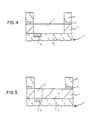
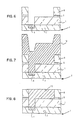
- Figs. 1-8 are cross-sectional views of a semiconductor structure illustrating the structure that results at various stages of the process of a preferred embodiment of the invention.
- the process starts by applying a first insulator layer 1 to a processed semiconductor substrate, indicated generally by the numeral 2.
- the substrate 2 comprises a planarized insulator layer 3 which includes a pattern of conductor material 4.
- the insulator layer 3 is disposed over al integrated circuit chip, and the conductor material 4 is contact metallurgy to devices (not shown) formed in the chip.
- the first insulator layer 1 is deposited over the substrate 2 by spin application, at about 2000 - 6000 rpm for about 20 - 60 seconds, and then baked at a temperature of about 70-90 o C for about 10 - 30 minutes.
- the planarized insulator layer 3 commonly comprises silicon dioxide or reflowed phosphosilicate glass, and the conductor material 4 may be, for example, copper-doped aluminum or doped polycrystalline silicon.
- a second insulator layer 6 is deposited over the develop stop layer 5, preferably under the conditions as described above for application of the first insulator layer 1.
- the first insulator layer 1 is applied to a thickness typically ranging from about 0.2 - 1 microns, preferably from about 0.6 - 0.7 microns, while the second insulator layer 6 has a thickness usually ranging from about 0.05 - 1.2 microns, preferably from about 0.01 - 0.1 microns.
- the develop stop layer is relatively thin, having a thickness generally ranging from about 0.01 - 0.1 microns, preferably from about 0.025 - 0.05 microns.
- both insulator layers 1 and 6 comprise a photosensitive polyimide polymer composition.
- a desired pattern of openings can be formed directly in each of the layers 1 and 6, without requiring application of separate masking layers, followed by image transfer steps.
- Suitable photosensitive polyimide polymer compositions are disclosed, for example, in U.S. Pat. No. 4,629,777, issued to Pfeifer on Dec. 16, 1986; U.S. Pat. No. 4,657,832, issued to Pfeifer on Apr. 14, 1987; U.S. Pat. No. 4,698,295, issued to Pfeifer, et al. on Oct. 6, 1987; and U.S. Pat. No.
- the polymer composition comprises a fully imidized solvent soluble polyimide with a structural unit having the general formula where R represents an aliphatic group, such as methyl, and R' represents an optional aliphatic substituent which may be the same as or different from R, and a suitable solvent for the polymer.
- the second insulator layer 6 is exposed in a predetermined pattern to radiation, such as UV light, in a conventional fashion.
- radiation such as UV light
- both insulator layers 1 and 6 comprise a photosensetive polyimide polymer composition thatt is negative-acting, so that the unexposed portions, designated as 7 and 8 respectively, are removable with a suitable developer.
- the develop stop layer 5 is selected of a material which is capable of transmitting radiation to the underlying insulator layer 1 in the exposed areas.
- portions of the second insulator layer 6 are removed to selectively expose or reveal portions of the develop stop layer 5.
- the unexposed portions 8 of the second insulator layer 6 are removed, preferably by spraying with a conventional developer, such as, for example, gammabutylactone.
- a conventional developer such as, for example, gammabutylactone.
- the development time will depend on the thickness of the second insulator layer 6, as well as other factors known to those skilled in the art. It should be noted that the develop stop layer 5 serves to prevent development of the underlying first insulator layer 1.
- the exposed portions of the develop stop layer 5 are then removed, preferably with a wet chemical etchant, such as 20 wt. % KOH/2 vol. % isopropyl alcohol in water.
- a wet chemical etchant such as 20 wt. % KOH/2 vol. % isopropyl alcohol in water.
- dry etching techniques can also be employed, as should be apparent to those skilled in the art.
- the first insulator layer 1 is then exposed in a predetermined pattern to radiation, such as UV light, in a conventional manner.
- the exposed portions 9 of the first insulator layer 1 are removed, in the manner as described above, to selectively expose regions of the substrate 2.
- the openings formed in the first insulator layer 1 are at least partial alignment with those formed in the second insulator layer 6.
- the openings in the first insulator layer 1 allow contact to be made to the pattern 4 in the substrate 2.
- the structure, as shown in Fig. 6, allows simultaneous formation of conductor material in the openings in the second insulator layer 6 (i.e., wiring channels) and in the openings in the first insulator layer 1 (i.e., stud vias).
- the structure, as shown in Fig. 6, is then subjected to a heating step so as to cure the polyimide layers 1 and 6.
- this step is carried out at a temperature of at least about 10 o C above the temperature at which the conductor material 10 is to be applied, as discussed below.
- this temperature is at least about 350 o C, and is usually within the range of about 350 o -450 o C, depending upon the conductor material 10 which is employed.
- the openings in the layers 1 and 6 are overfilled with conductor material 10, preferably metal, for example, aluminum, copper, Al-Cu, Al-Si or tungsten, preferably by physical vapor deposition, such as evaporation or sputtering, chemical vapor deposition or by plating.
- conductor material 10 preferably metal, for example, aluminum, copper, Al-Cu, Al-Si or tungsten, preferably by physical vapor deposition, such as evaporation or sputtering, chemical vapor deposition or by plating.
- the thickness of the conductor material 10 is at least as great as the combined thickness of the insulator layers 1 and 6 and the develop stop layer 5.
- the conductor material 10, which overlies the second insulating layer 6 is removed so as to coplanarize the surfaces of the conductor material 10 and the second insulator layer 6.
- a preferred method to accomplish this is by using chemical-mechanical polishing, as taught, for example, in Eur. Pat. Appln., No. 0,223,920, published Jun. 3, 1987, by Beyer, et al., the entire disclosure of which is incorporated herein by reference. That process involves the concurrent chemical and mechanical polishing of an overlying layer to expose the surface of a non-planar underlying layer on which it is formed, one layer of which is a conductive film, and the other, an insulator film.
- the process removes the overlying layer at a faster rate than the underlying layer, until the upper surface of the overlying layer becomes coplanar with that of the underlying layer.
- coplanarization can be accomplished by standard sacrificial planarization methods, such as etchback, as should be apparent to those skilled in the art.
- the conductor layer 10 is the final metal level of the semiconductor structure, a final passivation insulator is applied over the substrate. Otherwise, if additional levels of metallization are to be formed, then the steps as described above are repeated for each level desired.
- the first insulator layer 1 can be imagewise exposed in the second exposure step before the exposed portions of the develop stop layer 5 are removed. As noted above, however, it is generally preferred to first remove the exposed portions of the develop stop layer 5, since generally speaking this will provide a better exposure of the first insulator layer 1.
- a sample process flow for this embodiment, prior to application and planarization of metal, is as follows: Spin apply 0.1% 3-aminopropyltriethoxysilane (commercially available from Union Carbide under the designation "A1100") in methanol to a processed semiconductor substrate containing a pattern of metallization; Spin apply "PROBIMIDE 408" at 500 rpms, then hold at 4,000 rpms for 25 sec.; Bake at 80 o C for 20 min.; Apply Si by chemical vapor deposition; Spin apply "PROBIMIDE 408” and bake as above; Expose to UV light (270 mj at 365 nm); Develop second "PROBIMIDE 408" layer with a 45 sec.
- the present invention provides multi-level coplanar conductor/insulator films, by forming the desired channels and stud vias directly in the insulator layers, without the need for separate masking layers and image transfer steps. Accordingly, the need for resist stripping operations, which can damage the patterns formed in the insulator layers, is also avoided.
Landscapes
- Internal Circuitry In Semiconductor Integrated Circuit Devices (AREA)
- Compositions Of Macromolecular Compounds (AREA)
- Formation Of Insulating Films (AREA)
Applications Claiming Priority (2)
| Application Number | Priority Date | Filing Date | Title |
|---|---|---|---|
| US516394 | 1990-04-30 | ||
| US07/516,394 US5091289A (en) | 1990-04-30 | 1990-04-30 | Process for forming multi-level coplanar conductor/insulator films employing photosensitive polyimide polymer compositions |
Publications (3)
| Publication Number | Publication Date |
|---|---|
| EP0455031A2 true EP0455031A2 (de) | 1991-11-06 |
| EP0455031A3 EP0455031A3 (en) | 1992-04-22 |
| EP0455031B1 EP0455031B1 (de) | 1995-11-22 |
Family
ID=24055379
Family Applications (1)
| Application Number | Title | Priority Date | Filing Date |
|---|---|---|---|
| EP91105940A Expired - Lifetime EP0455031B1 (de) | 1990-04-30 | 1991-04-13 | Verfahren zum Herstellen von Mehrlagen-Koplanarleiter/Isolatorschichten unter Verwendung von lichtempfindlichen Polyimiden |
Country Status (4)
| Country | Link |
|---|---|
| US (1) | US5091289A (de) |
| EP (1) | EP0455031B1 (de) |
| JP (1) | JPH0770594B2 (de) |
| DE (1) | DE69114759T2 (de) |
Cited By (5)
| Publication number | Priority date | Publication date | Assignee | Title |
|---|---|---|---|---|
| US5425337A (en) * | 1992-11-19 | 1995-06-20 | Izusu Ceramics Research Institute Co., Ltd. | Pre-chamber type engine |
| DE19614164A1 (de) * | 1995-10-19 | 1997-04-24 | Mitsubishi Electric Corp | Verfahren zum Bilden einer Mehrschichtverbindung |
| FR2789804A1 (fr) * | 1999-02-17 | 2000-08-18 | France Telecom | Procede de gravure anisotrope par plasma gazeux d'un materiau polymere dielectrique organique et application a la microelectronique |
| WO2000075979A1 (en) * | 1999-06-09 | 2000-12-14 | Alliedsignal Inc. | Process of using siloxane dielectric films in the integration of organic dielectric films in electronic devices |
| GB2356974A (en) * | 1999-08-30 | 2001-06-06 | Lucent Technologies Inc | Process for manufacturing a dual damascene structure for an integrated circuit using an etch stop layer |
Families Citing this family (27)
| Publication number | Priority date | Publication date | Assignee | Title |
|---|---|---|---|---|
| US5290396A (en) * | 1991-06-06 | 1994-03-01 | Lsi Logic Corporation | Trench planarization techniques |
| US5413966A (en) * | 1990-12-20 | 1995-05-09 | Lsi Logic Corporation | Shallow trench etch |
| US5252503A (en) * | 1991-06-06 | 1993-10-12 | Lsi Logic Corporation | Techniques for forming isolation structures |
| US5217566A (en) * | 1991-06-06 | 1993-06-08 | Lsi Logic Corporation | Densifying and polishing glass layers |
| US5248625A (en) * | 1991-06-06 | 1993-09-28 | Lsi Logic Corporation | Techniques for forming isolation structures |
| US5225358A (en) * | 1991-06-06 | 1993-07-06 | Lsi Logic Corporation | Method of forming late isolation with polishing |
| US5514616A (en) * | 1991-08-26 | 1996-05-07 | Lsi Logic Corporation | Depositing and densifying glass to planarize layers in semi-conductor devices based on CMOS structures |
| US5397863A (en) * | 1991-09-13 | 1995-03-14 | International Business Machines Corporation | Fluorinated carbon polymer composites |
| US5310622A (en) * | 1992-05-29 | 1994-05-10 | Sgs-Thomson Microelectronics, Inc. | Method of patterning a reflective surface in an integrated circuit |
| US5371047A (en) * | 1992-10-30 | 1994-12-06 | International Business Machines Corporation | Chip interconnection having a breathable etch stop layer |
| US5869175A (en) * | 1994-01-31 | 1999-02-09 | Stmicroelectronics, Inc. | Integrated circuit structure having two photoresist layers |
| US5486493A (en) * | 1994-02-25 | 1996-01-23 | Jeng; Shin-Puu | Planarized multi-level interconnect scheme with embedded low-dielectric constant insulators |
| US5888896A (en) * | 1996-06-27 | 1999-03-30 | Micron Technology, Inc. | Method for making an electrical contact to a node location and process for forming a conductive line or other circuit component |
| US6143640A (en) * | 1997-09-23 | 2000-11-07 | International Business Machines Corporation | Method of fabricating a stacked via in copper/polyimide beol |
| US6127721A (en) * | 1997-09-30 | 2000-10-03 | Siemens Aktiengesellschaft | Soft passivation layer in semiconductor fabrication |
| KR100252049B1 (ko) * | 1997-11-18 | 2000-04-15 | 윤종용 | 원자층 증착법에 의한 알루미늄층의 제조방법 |
| US6265780B1 (en) * | 1998-12-01 | 2001-07-24 | United Microelectronics Corp. | Dual damascene structure for the wiring-line structures of multi-level interconnects in integrated circuit |
| US6965165B2 (en) * | 1998-12-21 | 2005-11-15 | Mou-Shiung Lin | Top layers of metal for high performance IC's |
| US6107006A (en) * | 1999-01-18 | 2000-08-22 | Winbond Electronics Corp. | Method for forming pattern |
| US6803327B1 (en) | 1999-04-05 | 2004-10-12 | Taiwan Semiconductor Manufacturing Company | Cost effective polymide process to solve passivation extrusion or damage and SOG delminates |
| US6387810B2 (en) * | 1999-06-28 | 2002-05-14 | International Business Machines Corporation | Method for homogenizing device parameters through photoresist planarization |
| US6882045B2 (en) * | 1999-10-28 | 2005-04-19 | Thomas J. Massingill | Multi-chip module and method for forming and method for deplating defective capacitors |
| US6428942B1 (en) * | 1999-10-28 | 2002-08-06 | Fujitsu Limited | Multilayer circuit structure build up method |
| US6869750B2 (en) * | 1999-10-28 | 2005-03-22 | Fujitsu Limited | Structure and method for forming a multilayered structure |
| US6798073B2 (en) * | 2001-12-13 | 2004-09-28 | Megic Corporation | Chip structure and process for forming the same |
| JPWO2024143212A1 (de) * | 2022-12-28 | 2024-07-04 | ||
| JPWO2024143209A1 (de) * | 2022-12-28 | 2024-07-04 |
Family Cites Families (15)
| Publication number | Priority date | Publication date | Assignee | Title |
|---|---|---|---|---|
| DE3060913D1 (en) * | 1979-05-12 | 1982-11-11 | Fujitsu Ltd | Improvement in method of manufacturing electronic device having multilayer wiring structure |
| JPS5850417B2 (ja) * | 1979-07-31 | 1983-11-10 | 富士通株式会社 | 半導体装置の製造方法 |
| US4657832A (en) * | 1983-05-18 | 1987-04-14 | Ciba-Geigy Corporation | Photosensitive polymers as coating materials |
| US4629777A (en) * | 1983-05-18 | 1986-12-16 | Ciba-Geigy Corporation | Polyimides, a process for their preparation and their use |
| US4656116A (en) * | 1983-10-12 | 1987-04-07 | Ciba-Geigy Corporation | Radiation-sensitive coating composition |
| EP0167051B1 (de) * | 1984-06-29 | 1988-10-12 | Siemens Aktiengesellschaft | Thermostabiles, durch Bestrahlung vernetzbares Polymersystem auf der Basis von Bisphenolen und Epichlorhydrin sowie Verfahren zu seiner Verwendung |
| US4523976A (en) * | 1984-07-02 | 1985-06-18 | Motorola, Inc. | Method for forming semiconductor devices |
| US4698295A (en) * | 1984-11-16 | 1987-10-06 | Ciba-Geigy Corporation | Polyimides, a process for their preparation and their use, and tetracarboxylic acids and tetracarboxylic acid derivatives |
| US4621045A (en) * | 1985-06-03 | 1986-11-04 | Motorola, Inc. | Pillar via process |
| US4665007A (en) * | 1985-08-19 | 1987-05-12 | International Business Machines Corporation | Planarization process for organic filling of deep trenches |
| US4786569A (en) * | 1985-09-04 | 1988-11-22 | Ciba-Geigy Corporation | Adhesively bonded photostructurable polyimide film |
| US4944836A (en) * | 1985-10-28 | 1990-07-31 | International Business Machines Corporation | Chem-mech polishing method for producing coplanar metal/insulator films on a substrate |
| US4789648A (en) * | 1985-10-28 | 1988-12-06 | International Business Machines Corporation | Method for producing coplanar multi-level metal/insulator films on a substrate and for forming patterned conductive lines simultaneously with stud vias |
| US4842991A (en) * | 1987-07-31 | 1989-06-27 | Texas Instruments Incorporated | Self-aligned nonnested sloped via |
| US4997746A (en) * | 1988-11-22 | 1991-03-05 | Greco Nancy A | Method of forming conductive lines and studs |
-
1990
- 1990-04-30 US US07/516,394 patent/US5091289A/en not_active Expired - Fee Related
-
1991
- 1991-03-29 JP JP3089343A patent/JPH0770594B2/ja not_active Expired - Lifetime
- 1991-04-13 DE DE69114759T patent/DE69114759T2/de not_active Expired - Fee Related
- 1991-04-13 EP EP91105940A patent/EP0455031B1/de not_active Expired - Lifetime
Cited By (8)
| Publication number | Priority date | Publication date | Assignee | Title |
|---|---|---|---|---|
| US5425337A (en) * | 1992-11-19 | 1995-06-20 | Izusu Ceramics Research Institute Co., Ltd. | Pre-chamber type engine |
| DE19614164A1 (de) * | 1995-10-19 | 1997-04-24 | Mitsubishi Electric Corp | Verfahren zum Bilden einer Mehrschichtverbindung |
| DE19614164C2 (de) * | 1995-10-19 | 2000-10-26 | Mitsubishi Electric Corp | Verfahren zum Bilden einer Mehrschichtverbindung |
| FR2789804A1 (fr) * | 1999-02-17 | 2000-08-18 | France Telecom | Procede de gravure anisotrope par plasma gazeux d'un materiau polymere dielectrique organique et application a la microelectronique |
| EP1030353A1 (de) * | 1999-02-17 | 2000-08-23 | France Telecom | Anisotropes Plasmaätzen von dielektrischen, organisch- polymeren Materialien |
| US6326302B1 (en) | 1999-02-17 | 2001-12-04 | France Telecom | Process for the anisotropic etching of an organic dielectric polymer material by a plasma gas and application in microelectronics |
| WO2000075979A1 (en) * | 1999-06-09 | 2000-12-14 | Alliedsignal Inc. | Process of using siloxane dielectric films in the integration of organic dielectric films in electronic devices |
| GB2356974A (en) * | 1999-08-30 | 2001-06-06 | Lucent Technologies Inc | Process for manufacturing a dual damascene structure for an integrated circuit using an etch stop layer |
Also Published As
| Publication number | Publication date |
|---|---|
| JPH0770594B2 (ja) | 1995-07-31 |
| EP0455031A3 (en) | 1992-04-22 |
| JPH04229638A (ja) | 1992-08-19 |
| EP0455031B1 (de) | 1995-11-22 |
| US5091289A (en) | 1992-02-25 |
| DE69114759D1 (de) | 1996-01-04 |
| DE69114759T2 (de) | 1996-06-20 |
Similar Documents
| Publication | Publication Date | Title |
|---|---|---|
| EP0455031B1 (de) | Verfahren zum Herstellen von Mehrlagen-Koplanarleiter/Isolatorschichten unter Verwendung von lichtempfindlichen Polyimiden | |
| EP0455032B1 (de) | Verfahren zum Herstellen von mehrlagigen koplanaren Leitungs-/Isolator-Schichten unter Verwendung von lichtempfindlichem Polyimid | |
| US6319821B1 (en) | Dual damascene approach for small geometry dimension | |
| JP2661652B2 (ja) | 通気性耐エッチング層を有する集積回路装置及び製造方法 | |
| US7256136B2 (en) | Self-patterning of photo-active dielectric materials for interconnect isolation | |
| US7364836B2 (en) | Dual damascene process | |
| AU581110B2 (en) | Method for forming vertical interconnects in polyimide insulating layers | |
| KR20000016960A (ko) | 반도체제조시유전체비반사코팅으로부터포토레지스트포이즌방지방법 | |
| EP0370935B1 (de) | Verfahren zum Herstellen von leitenden Bahnen und Stützen | |
| JP2003163265A (ja) | 配線構造およびその製造方法 | |
| US6803327B1 (en) | Cost effective polymide process to solve passivation extrusion or damage and SOG delminates | |
| JPH0669351A (ja) | 多層金属配線構造のコンタクトの製造方法 | |
| JP2720023B2 (ja) | 半導体装置の製造方法 | |
| JP2006133315A (ja) | 平坦化材料、反射防止膜形成材料、及びこれらを用いた半導体装置の製造方法 | |
| JP2001345380A (ja) | 半導体装置の製造方法および半導体装置 | |
| JPH0750694B2 (ja) | 導電層形成方法 | |
| KR100458594B1 (ko) | 반도체 소자 제조 방법 | |
| JP2002270691A (ja) | 配線構造 | |
| JPH11330077A (ja) | デュアル・ダマスク技術 | |
| JPH06120219A (ja) | 金属配線の形成方法 | |
| CA2039321A1 (en) | Process for forming multi-level coplanar conductor/insulator films employing photosensitive polyimide polymer compositions | |
| JP2002170882A (ja) | 配線構造の製造方法 | |
| JP3166912B2 (ja) | 半導体装置の製造方法 | |
| KR100197124B1 (ko) | 반도체 소자의 금속배선 제조방법 | |
| JP2004040019A (ja) | 金属配線の形成方法 |
Legal Events
| Date | Code | Title | Description |
|---|---|---|---|
| PUAI | Public reference made under article 153(3) epc to a published international application that has entered the european phase |
Free format text: ORIGINAL CODE: 0009012 |
|
| AK | Designated contracting states |
Kind code of ref document: A2 Designated state(s): DE FR GB IT |
|
| 17P | Request for examination filed |
Effective date: 19911219 |
|
| PUAL | Search report despatched |
Free format text: ORIGINAL CODE: 0009013 |
|
| AK | Designated contracting states |
Kind code of ref document: A3 Designated state(s): DE FR GB IT |
|
| 17Q | First examination report despatched |
Effective date: 19950123 |
|
| GRAA | (expected) grant |
Free format text: ORIGINAL CODE: 0009210 |
|
| AK | Designated contracting states |
Kind code of ref document: B1 Designated state(s): DE FR GB IT |
|
| PG25 | Lapsed in a contracting state [announced via postgrant information from national office to epo] |
Ref country code: IT Free format text: LAPSE BECAUSE OF FAILURE TO SUBMIT A TRANSLATION OF THE DESCRIPTION OR TO PAY THE FEE WITHIN THE PRESCRIBED TIME-LIMIT;WARNING: LAPSES OF ITALIAN PATENTS WITH EFFECTIVE DATE BEFORE 2007 MAY HAVE OCCURRED AT ANY TIME BEFORE 2007. THE CORRECT EFFECTIVE DATE MAY BE DIFFERENT FROM THE ONE RECORDED. Effective date: 19951122 |
|
| REF | Corresponds to: |
Ref document number: 69114759 Country of ref document: DE Date of ref document: 19960104 |
|
| ET | Fr: translation filed | ||
| PGFP | Annual fee paid to national office [announced via postgrant information from national office to epo] |
Ref country code: FR Payment date: 19960412 Year of fee payment: 6 |
|
| PG25 | Lapsed in a contracting state [announced via postgrant information from national office to epo] |
Ref country code: GB Effective date: 19960413 |
|
| PLBE | No opposition filed within time limit |
Free format text: ORIGINAL CODE: 0009261 |
|
| STAA | Information on the status of an ep patent application or granted ep patent |
Free format text: STATUS: NO OPPOSITION FILED WITHIN TIME LIMIT |
|
| 26N | No opposition filed | ||
| GBPC | Gb: european patent ceased through non-payment of renewal fee |
Effective date: 19960413 |
|
| PG25 | Lapsed in a contracting state [announced via postgrant information from national office to epo] |
Ref country code: FR Free format text: LAPSE BECAUSE OF NON-PAYMENT OF DUE FEES Effective date: 19971231 |
|
| REG | Reference to a national code |
Ref country code: FR Ref legal event code: ST |
|
| PGFP | Annual fee paid to national office [announced via postgrant information from national office to epo] |
Ref country code: DE Payment date: 19990421 Year of fee payment: 9 |
|
| PG25 | Lapsed in a contracting state [announced via postgrant information from national office to epo] |
Ref country code: DE Free format text: LAPSE BECAUSE OF NON-PAYMENT OF DUE FEES Effective date: 20010201 |