EP0450488B1 - Matériau renforcé par des fibres, procédé pour sa production et son utilisation - Google Patents
Matériau renforcé par des fibres, procédé pour sa production et son utilisation Download PDFInfo
- Publication number
- EP0450488B1 EP0450488B1 EP91104871A EP91104871A EP0450488B1 EP 0450488 B1 EP0450488 B1 EP 0450488B1 EP 91104871 A EP91104871 A EP 91104871A EP 91104871 A EP91104871 A EP 91104871A EP 0450488 B1 EP0450488 B1 EP 0450488B1
- Authority
- EP
- European Patent Office
- Prior art keywords
- fiber
- resin
- reinforced material
- reinforced
- prepreg
- Prior art date
- Legal status (The legal status is an assumption and is not a legal conclusion. Google has not performed a legal analysis and makes no representation as to the accuracy of the status listed.)
- Expired - Lifetime
Links
Images
Classifications
-
- C—CHEMISTRY; METALLURGY
- C08—ORGANIC MACROMOLECULAR COMPOUNDS; THEIR PREPARATION OR CHEMICAL WORKING-UP; COMPOSITIONS BASED THEREON
- C08J—WORKING-UP; GENERAL PROCESSES OF COMPOUNDING; AFTER-TREATMENT NOT COVERED BY SUBCLASSES C08B, C08C, C08F, C08G or C08H
- C08J5/00—Manufacture of articles or shaped materials containing macromolecular substances
- C08J5/24—Impregnating materials with prepolymers which can be polymerised in situ, e.g. manufacture of prepregs
- C08J5/247—Impregnating materials with prepolymers which can be polymerised in situ, e.g. manufacture of prepregs using fibres of at least two types
-
- B—PERFORMING OPERATIONS; TRANSPORTING
- B29—WORKING OF PLASTICS; WORKING OF SUBSTANCES IN A PLASTIC STATE IN GENERAL
- B29C—SHAPING OR JOINING OF PLASTICS; SHAPING OF MATERIAL IN A PLASTIC STATE, NOT OTHERWISE PROVIDED FOR; AFTER-TREATMENT OF THE SHAPED PRODUCTS, e.g. REPAIRING
- B29C70/00—Shaping composites, i.e. plastics material comprising reinforcements, fillers or preformed parts, e.g. inserts
- B29C70/04—Shaping composites, i.e. plastics material comprising reinforcements, fillers or preformed parts, e.g. inserts comprising reinforcements only, e.g. self-reinforcing plastics
- B29C70/06—Fibrous reinforcements only
- B29C70/10—Fibrous reinforcements only characterised by the structure of fibrous reinforcements, e.g. hollow fibres
- B29C70/16—Fibrous reinforcements only characterised by the structure of fibrous reinforcements, e.g. hollow fibres using fibres of substantial or continuous length
- B29C70/22—Fibrous reinforcements only characterised by the structure of fibrous reinforcements, e.g. hollow fibres using fibres of substantial or continuous length oriented in at least two directions forming a two-dimensional [2D] structure
- B29C70/222—Fibrous reinforcements only characterised by the structure of fibrous reinforcements, e.g. hollow fibres using fibres of substantial or continuous length oriented in at least two directions forming a two-dimensional [2D] structure the structure being shaped to form a three dimensional configuration
-
- C—CHEMISTRY; METALLURGY
- C08—ORGANIC MACROMOLECULAR COMPOUNDS; THEIR PREPARATION OR CHEMICAL WORKING-UP; COMPOSITIONS BASED THEREON
- C08J—WORKING-UP; GENERAL PROCESSES OF COMPOUNDING; AFTER-TREATMENT NOT COVERED BY SUBCLASSES C08B, C08C, C08F, C08G or C08H
- C08J5/00—Manufacture of articles or shaped materials containing macromolecular substances
- C08J5/04—Reinforcing macromolecular compounds with loose or coherent fibrous material
-
- C—CHEMISTRY; METALLURGY
- C08—ORGANIC MACROMOLECULAR COMPOUNDS; THEIR PREPARATION OR CHEMICAL WORKING-UP; COMPOSITIONS BASED THEREON
- C08J—WORKING-UP; GENERAL PROCESSES OF COMPOUNDING; AFTER-TREATMENT NOT COVERED BY SUBCLASSES C08B, C08C, C08F, C08G or C08H
- C08J5/00—Manufacture of articles or shaped materials containing macromolecular substances
- C08J5/04—Reinforcing macromolecular compounds with loose or coherent fibrous material
- C08J5/046—Reinforcing macromolecular compounds with loose or coherent fibrous material with synthetic macromolecular fibrous material
-
- C—CHEMISTRY; METALLURGY
- C08—ORGANIC MACROMOLECULAR COMPOUNDS; THEIR PREPARATION OR CHEMICAL WORKING-UP; COMPOSITIONS BASED THEREON
- C08J—WORKING-UP; GENERAL PROCESSES OF COMPOUNDING; AFTER-TREATMENT NOT COVERED BY SUBCLASSES C08B, C08C, C08F, C08G or C08H
- C08J5/00—Manufacture of articles or shaped materials containing macromolecular substances
- C08J5/24—Impregnating materials with prepolymers which can be polymerised in situ, e.g. manufacture of prepregs
- C08J5/249—Impregnating materials with prepolymers which can be polymerised in situ, e.g. manufacture of prepregs characterised by the additives used in the prepolymer mixture
-
- C—CHEMISTRY; METALLURGY
- C08—ORGANIC MACROMOLECULAR COMPOUNDS; THEIR PREPARATION OR CHEMICAL WORKING-UP; COMPOSITIONS BASED THEREON
- C08L—COMPOSITIONS OF MACROMOLECULAR COMPOUNDS
- C08L61/00—Compositions of condensation polymers of aldehydes or ketones; Compositions of derivatives of such polymers
- C08L61/04—Condensation polymers of aldehydes or ketones with phenols only
- C08L61/06—Condensation polymers of aldehydes or ketones with phenols only of aldehydes with phenols
-
- F—MECHANICAL ENGINEERING; LIGHTING; HEATING; WEAPONS; BLASTING
- F16—ENGINEERING ELEMENTS AND UNITS; GENERAL MEASURES FOR PRODUCING AND MAINTAINING EFFECTIVE FUNCTIONING OF MACHINES OR INSTALLATIONS; THERMAL INSULATION IN GENERAL
- F16C—SHAFTS; FLEXIBLE SHAFTS; ELEMENTS OR CRANKSHAFT MECHANISMS; ROTARY BODIES OTHER THAN GEARING ELEMENTS; BEARINGS
- F16C33/00—Parts of bearings; Special methods for making bearings or parts thereof
- F16C33/02—Parts of sliding-contact bearings
- F16C33/04—Brasses; Bushes; Linings
- F16C33/20—Sliding surface consisting mainly of plastics
- F16C33/201—Composition of the plastic
-
- B—PERFORMING OPERATIONS; TRANSPORTING
- B29—WORKING OF PLASTICS; WORKING OF SUBSTANCES IN A PLASTIC STATE IN GENERAL
- B29K—INDEXING SCHEME ASSOCIATED WITH SUBCLASSES B29B, B29C OR B29D, RELATING TO MOULDING MATERIALS OR TO MATERIALS FOR MOULDS, REINFORCEMENTS, FILLERS OR PREFORMED PARTS, e.g. INSERTS
- B29K2027/00—Use of polyvinylhalogenides or derivatives thereof as moulding material
- B29K2027/12—Use of polyvinylhalogenides or derivatives thereof as moulding material containing fluorine
-
- B—PERFORMING OPERATIONS; TRANSPORTING
- B29—WORKING OF PLASTICS; WORKING OF SUBSTANCES IN A PLASTIC STATE IN GENERAL
- B29K—INDEXING SCHEME ASSOCIATED WITH SUBCLASSES B29B, B29C OR B29D, RELATING TO MOULDING MATERIALS OR TO MATERIALS FOR MOULDS, REINFORCEMENTS, FILLERS OR PREFORMED PARTS, e.g. INSERTS
- B29K2101/00—Use of unspecified macromolecular compounds as moulding material
- B29K2101/10—Thermosetting resins
-
- B—PERFORMING OPERATIONS; TRANSPORTING
- B29—WORKING OF PLASTICS; WORKING OF SUBSTANCES IN A PLASTIC STATE IN GENERAL
- B29K—INDEXING SCHEME ASSOCIATED WITH SUBCLASSES B29B, B29C OR B29D, RELATING TO MOULDING MATERIALS OR TO MATERIALS FOR MOULDS, REINFORCEMENTS, FILLERS OR PREFORMED PARTS, e.g. INSERTS
- B29K2233/00—Use of polymers of unsaturated acids or derivatives thereof, as reinforcement
- B29K2233/18—Polymers of nitriles
- B29K2233/20—PAN, i.e. polyacrylonitrile
-
- B—PERFORMING OPERATIONS; TRANSPORTING
- B29—WORKING OF PLASTICS; WORKING OF SUBSTANCES IN A PLASTIC STATE IN GENERAL
- B29K—INDEXING SCHEME ASSOCIATED WITH SUBCLASSES B29B, B29C OR B29D, RELATING TO MOULDING MATERIALS OR TO MATERIALS FOR MOULDS, REINFORCEMENTS, FILLERS OR PREFORMED PARTS, e.g. INSERTS
- B29K2267/00—Use of polyesters or derivatives thereof as reinforcement
-
- B—PERFORMING OPERATIONS; TRANSPORTING
- B29—WORKING OF PLASTICS; WORKING OF SUBSTANCES IN A PLASTIC STATE IN GENERAL
- B29K—INDEXING SCHEME ASSOCIATED WITH SUBCLASSES B29B, B29C OR B29D, RELATING TO MOULDING MATERIALS OR TO MATERIALS FOR MOULDS, REINFORCEMENTS, FILLERS OR PREFORMED PARTS, e.g. INSERTS
- B29K2277/00—Use of PA, i.e. polyamides, e.g. polyesteramides or derivatives thereof, as reinforcement
-
- B—PERFORMING OPERATIONS; TRANSPORTING
- B29—WORKING OF PLASTICS; WORKING OF SUBSTANCES IN A PLASTIC STATE IN GENERAL
- B29L—INDEXING SCHEME ASSOCIATED WITH SUBCLASS B29C, RELATING TO PARTICULAR ARTICLES
- B29L2009/00—Layered products
-
- B—PERFORMING OPERATIONS; TRANSPORTING
- B29—WORKING OF PLASTICS; WORKING OF SUBSTANCES IN A PLASTIC STATE IN GENERAL
- B29L—INDEXING SCHEME ASSOCIATED WITH SUBCLASS B29C, RELATING TO PARTICULAR ARTICLES
- B29L2031/00—Other particular articles
- B29L2031/04—Bearings
- B29L2031/045—Bushes therefor
-
- B—PERFORMING OPERATIONS; TRANSPORTING
- B29—WORKING OF PLASTICS; WORKING OF SUBSTANCES IN A PLASTIC STATE IN GENERAL
- B29L—INDEXING SCHEME ASSOCIATED WITH SUBCLASS B29C, RELATING TO PARTICULAR ARTICLES
- B29L2031/00—Other particular articles
- B29L2031/26—Sealing devices, e.g. packaging for pistons or pipe joints
-
- C—CHEMISTRY; METALLURGY
- C08—ORGANIC MACROMOLECULAR COMPOUNDS; THEIR PREPARATION OR CHEMICAL WORKING-UP; COMPOSITIONS BASED THEREON
- C08J—WORKING-UP; GENERAL PROCESSES OF COMPOUNDING; AFTER-TREATMENT NOT COVERED BY SUBCLASSES C08B, C08C, C08F, C08G or C08H
- C08J2361/00—Characterised by the use of condensation polymers of aldehydes or ketones; Derivatives of such polymers
- C08J2361/04—Condensation polymers of aldehydes or ketones with phenols only
- C08J2361/06—Condensation polymers of aldehydes or ketones with phenols only of aldehydes with phenols
-
- C—CHEMISTRY; METALLURGY
- C08—ORGANIC MACROMOLECULAR COMPOUNDS; THEIR PREPARATION OR CHEMICAL WORKING-UP; COMPOSITIONS BASED THEREON
- C08L—COMPOSITIONS OF MACROMOLECULAR COMPOUNDS
- C08L27/00—Compositions of homopolymers or copolymers of compounds having one or more unsaturated aliphatic radicals, each having only one carbon-to-carbon double bond, and at least one being terminated by a halogen; Compositions of derivatives of such polymers
- C08L27/02—Compositions of homopolymers or copolymers of compounds having one or more unsaturated aliphatic radicals, each having only one carbon-to-carbon double bond, and at least one being terminated by a halogen; Compositions of derivatives of such polymers not modified by chemical after-treatment
- C08L27/12—Compositions of homopolymers or copolymers of compounds having one or more unsaturated aliphatic radicals, each having only one carbon-to-carbon double bond, and at least one being terminated by a halogen; Compositions of derivatives of such polymers not modified by chemical after-treatment containing fluorine atoms
- C08L27/18—Homopolymers or copolymers or tetrafluoroethene
-
- C—CHEMISTRY; METALLURGY
- C08—ORGANIC MACROMOLECULAR COMPOUNDS; THEIR PREPARATION OR CHEMICAL WORKING-UP; COMPOSITIONS BASED THEREON
- C08L—COMPOSITIONS OF MACROMOLECULAR COMPOUNDS
- C08L29/00—Compositions of homopolymers or copolymers of compounds having one or more unsaturated aliphatic radicals, each having only one carbon-to-carbon double bond, and at least one being terminated by an alcohol, ether, aldehydo, ketonic, acetal or ketal radical; Compositions of hydrolysed polymers of esters of unsaturated alcohols with saturated carboxylic acids; Compositions of derivatives of such polymers
- C08L29/14—Homopolymers or copolymers of acetals or ketals obtained by polymerisation of unsaturated acetals or ketals or by after-treatment of polymers of unsaturated alcohols
-
- F—MECHANICAL ENGINEERING; LIGHTING; HEATING; WEAPONS; BLASTING
- F16—ENGINEERING ELEMENTS AND UNITS; GENERAL MEASURES FOR PRODUCING AND MAINTAINING EFFECTIVE FUNCTIONING OF MACHINES OR INSTALLATIONS; THERMAL INSULATION IN GENERAL
- F16C—SHAFTS; FLEXIBLE SHAFTS; ELEMENTS OR CRANKSHAFT MECHANISMS; ROTARY BODIES OTHER THAN GEARING ELEMENTS; BEARINGS
- F16C2208/00—Plastics; Synthetic resins, e.g. rubbers
- F16C2208/80—Thermosetting resins
- F16C2208/82—Composites, i.e. fibre reinforced thermosetting resins
-
- F—MECHANICAL ENGINEERING; LIGHTING; HEATING; WEAPONS; BLASTING
- F16—ENGINEERING ELEMENTS AND UNITS; GENERAL MEASURES FOR PRODUCING AND MAINTAINING EFFECTIVE FUNCTIONING OF MACHINES OR INSTALLATIONS; THERMAL INSULATION IN GENERAL
- F16C—SHAFTS; FLEXIBLE SHAFTS; ELEMENTS OR CRANKSHAFT MECHANISMS; ROTARY BODIES OTHER THAN GEARING ELEMENTS; BEARINGS
- F16C2208/00—Plastics; Synthetic resins, e.g. rubbers
- F16C2208/80—Thermosetting resins
- F16C2208/90—Phenolic resin
-
- F—MECHANICAL ENGINEERING; LIGHTING; HEATING; WEAPONS; BLASTING
- F16—ENGINEERING ELEMENTS AND UNITS; GENERAL MEASURES FOR PRODUCING AND MAINTAINING EFFECTIVE FUNCTIONING OF MACHINES OR INSTALLATIONS; THERMAL INSULATION IN GENERAL
- F16C—SHAFTS; FLEXIBLE SHAFTS; ELEMENTS OR CRANKSHAFT MECHANISMS; ROTARY BODIES OTHER THAN GEARING ELEMENTS; BEARINGS
- F16C2220/00—Shaping
- F16C2220/28—Shaping by winding impregnated fibres
-
- F—MECHANICAL ENGINEERING; LIGHTING; HEATING; WEAPONS; BLASTING
- F16—ENGINEERING ELEMENTS AND UNITS; GENERAL MEASURES FOR PRODUCING AND MAINTAINING EFFECTIVE FUNCTIONING OF MACHINES OR INSTALLATIONS; THERMAL INSULATION IN GENERAL
- F16C—SHAFTS; FLEXIBLE SHAFTS; ELEMENTS OR CRANKSHAFT MECHANISMS; ROTARY BODIES OTHER THAN GEARING ELEMENTS; BEARINGS
- F16C33/00—Parts of bearings; Special methods for making bearings or parts thereof
- F16C33/30—Parts of ball or roller bearings
- F16C33/38—Ball cages
- F16C33/44—Selection of substances
Definitions
- the present invention relates to a fiber-reinforced material made of a sheet-like textile material which at least partially consists of synthetic fibers and a thermosetting resin containing a fluoropolymer, as well as a prepreg for the production of this material and sheet-like or three-dimensional construction elements made of this material.
- Guide elements made of thermoplastics which in themselves have good sliding properties and good flexibility and transverse forces, such as z. B. can occur at high edge loads, endure better than brittle materials, fail under the working conditions described above in hydraulic systems after a short time. they show at low temperatures, such as. B. can occur in winter operation of hydraulic systems, embrittlement, so that they are easily destroyed by edge loads, with increasing temperatures they show plastic deformation.
- British patent 974 629 discloses a method for producing bearings, in which a material is used which consists of a thermosetting resin reinforced by fabric strips. To reduce the friction losses when using these known bearing elements, polytetrafluoroethylene powder is pressed into the surface of the material in the course of the shaping process.
- the fabric strips are made of coarse cotton duck. Alternatively, glass and asbestos fiber bundles can also be used.
- the fluoropolymer is basically not used for impregnation because adding the fluoropolymer to the thermosetting resin reduces the adhesion between the fiber material and the resin. The addition of the fluoropolymer to the thermosetting resin would only be considered if no high demands were placed on the integration of the textile material in the resin matrix.
- the technique described in this document has the disadvantage that the production is more expensive due to the application of an additional surface layer of fluoropolymer and the need to ensure that the fluoropolymer is embedded as well as possible in the thermosetting resin during the shaping. Another disadvantage is that the sliding properties are of course only good until the relatively thin surface layer is worn away in use.
- composition for the production of protective coatings with a low coefficient of friction on substrates such.
- This composition consists essentially of a curable resin, for example a thermosetting phenol formaldehyde resin, in which low molecular weight fluoropolymers are contained in finely divided form.
- liners for self-lubricating bearings, which are a resin, PTFE in the form of fibers , Flake or granules, and a fabric made of reinforcing fibers.
- the present invention now relates to a fiber-reinforced material from which structural elements with a relatively low coefficient of friction and high pressure and abrasion resistance, significantly improved flexibility, extensibility, shear and delamination resistance and high temperature stability can be produced, which are simultaneously inert to solvents and / or swelling liquids, such as.
- As hydraulic or lubricating fluid and which are therefore particularly suitable, for example, for use as guide elements in highly stressed hydraulic systems or for the construction of bearings, in particular plain bearings.
- the fiber-reinforced material according to the invention consists of a sheet-like textile material and a thermoset and is characterized in that it has a fiber part of 30 to 70% by weight, preferably 40 to 60% by weight, in particular 45 to 55% by weight , 30%, preferably at least 50%, in particular at least 80% of polyacrylonitrile fibers. and that the thermosetting resin contains an addition of fluoropolymers in an amount of up to 25% by weight.
- the polyacrylonitrile fibers also referred to as "synthetic fibers”.
- synthetic fibers In principle, all known crosslinkable, ie. H. curable resin systems in question, especially for. B. phenolic resins, but also melamine resins, epoxy resins and alkyd resins.
- thermosetting resin is preferably used which contains up to 25% by weight, preferably 5 to 20% by weight, in particular up to 10% by weight, of a fluoropolymer.
- a fiber-reinforced material according to the invention is particularly preferred, the fiber material of which consists 100% of synthetic fibers.
- Woven fabrics, knitted fabrics / knitted fabrics or nonwovens come into consideration as sheet-like textile materials which can be contained in the fiber-reinforced material according to the invention.
- the fiber material of the sheet-like Textile materials can be in smooth or crimped (textured) form and in the form of staple fibers, staple fiber yarns or multifilament yarns. If the sheet-like textile material contained in the material according to the invention is a nonwoven material, the fiber material generally consists of crimped staple fibers.
- the staple length of these fibers is usually between 20 and 200 mm. In view of special strength requirements, it is particularly advantageous to work with staple fibers of approximately 60 to 150 mm in length.
- Non-woven materials made of staple fibers with an average staple length of 40 to 120 mm are particularly advantageous for the intended use according to the invention.
- the nonwovens used in the materials according to the invention can expediently by heat treatment, for. B. by calendering, in particular with embossing calenders or by bonding strengthening, for example by a thermosetting binder or by binder filaments with a relatively high melting point or by mechanical means such as. B. pre-consolidated by needles.
- Woven and knitted fabrics / knitted fabrics can consist of smooth or preferably of textured multifilament yarns or preferably of secondary spun staple fiber yarns.
- Textured yarn should be understood to mean any yarn structured in a manner known per se, in particular also fancy yarns such.
- the basis weights of the sheet-like textile materials contained in the material according to the invention are expediently in the range from 100 to 280, preferably 120 to 250, in particular in the range from 120 to 150 g / m 2.
- the textile fabric of which consists of a staple fiber yarn which consists of 100% synthetic fibers.
- the staple fiber yarns in turn can be in the form of single yarns or twists and they can have other known spinning or twisting effects.
- the fiber material contained in the materials according to the invention is at least 30% synthetic.
- natural fibers which can be contained in the materials according to the invention, come in particular cellulose fibers such. B. cotton or jute fibers into consideration.
- High-strength polyacrylonitrile fibers in oxidized or non-oxidized form come into consideration as synthetic fibers from which the sheet-like textile materials contained in the materials according to the invention are predominantly, or preferably exclusively, constructed.
- the use of phenolic resins as thermosetting plastic and the use of textile fabrics polyester fibers, in particular of polyethylene terephthalate, of polyacrylonitrile fibers is particularly advantageous.
- the synthetic fibers can be in crimped or non-crimped form and as continuous or staple fiber, depending on the type of textile fabric.
- the titer of the synthetic fibers is expediently 1 to 9 dtex, with 1.7 to 6.7 dtex being preferred for polyacrylonitrile fiber types, in particular 2 to 3 dtex.
- the strength of the high-strength fiber types expediently used for high-strength polyacrylonitrile types is over 55 cN / tex, for single-fiber titers between 2 and 3 dtex and over 43 cN / tex for single-fiber titers in the range above 5 dtex.
- the maximum tensile strength elongation of the synthetic fibers which are expediently used is in the range from 13 to 16% for the particularly preferred polyacrylonitrile fiber types, between 2 and 3 dtex for single fiber titers and about 14 to 17% for single fiber titers over 5 dtex.
- Particularly preferred materials according to the invention contain sheet-like textile materials, in particular woven or non-woven fabrics made from highly stretched, non-oxidized polyacrylonitrile fibers, which are commercially available, for example, under the name ®Dolanit in types 12 and 15. These are crimped long fiber types (cutting length approx. 60-100 mm), which are characterized by good adhesion within the yarn composite and can therefore be easily processed into yarns / fabrics and nonwovens. Such high-strength fibers are distinguished from textile polyacrylonitrile fibers by almost twice the fiber strength, as well as by their good chemical and temperature resistance.
- a particularly preferred embodiment of the material according to the invention contains, for example, a knitted fabric / knitted fabric or in particular a woven fabric made from a crimped, twisted staple fiber yarn made from the high-strength polyacrylonitrile fiber type ®Dolanit 15 or a fleece made from crimped staple fibers made from the high-strength polyacrylonitrile fiber type ®Dolanit 12.
- phenolic resins are preferably used as thermosetting resins.
- Suitable condensation products of phenol and phenol derivatives with formaldehyde are contained as phenolic resin in the fiber-reinforced materials according to the invention.
- Suitable phenol derivatives are in particular substituted phenols, in particular alkyl-substituted phenols such as. B. cresols, xylenols and other alkylphenols such as e.g. p-tert-butylphenol, octylphenol and nonylphenol but also arylphenols, e.g. Phenylphenol, naphthols, and dihydric phenols such as e.g. Resorcinol and bisphenol A.
- phenolic resins are to be understood as meaning both the condensation products of the individual compounds mentioned and also condensation products of mixtures of the above-mentioned phenols and phenol derivatives with formaldehyde. If individual compounds are to be used to prepare the phenolic resins, it should be noted that these must have at least three times the functionality compared to formaldehyde.
- the phenolic resins mentioned can also be used in a manner known per se to optimize special properties by adding unsaturated natural or synthetic compounds such as, for. B. be modified wood oil, rosin or styrene. Condensation products of formaldehyde with phenol itself and mixtures of phenol with lower proportions of the phenol derivatives mentioned, in particular the alkyl-substituted phenols mentioned, are particularly preferred.
- the phenolic resins contained in the materials according to the invention have a molar ratio of phenol to formaldehyde of 1: 1 to 1: 3, preferably of 1: 1.2 to 1: 2.2.
- Suitable phenolic resins are commercially available, for example, under the type designation Phenodur VPR 45.
- the thermosetting resin contained in the materials according to the invention preferably contains, in particular that Phenolic resin, as already stated above, 5 to 25% of a fluoropolymer in finely divided form.
- Suitable fluoropolymers are, in particular, polytetrafluoroethylene types with a molecular weight that is not too high of approximately 20,000 to 500,000. The molecular weight is preferably in the range from 50,000 to 200,000.
- Those fluoropolymers whose specific surface area is between 5 - 15 m 2 / g and a density of about 2.1 - 2.3 g / cm 3 are particularly suitable for the present invention.
- Suitable polymers show a softening point of approx. 200 to 250 ° C and melting points of approx.
- the average particle size of the fluoropolymer which is expediently chosen in the range from 0.5 to 10 ⁇ m, preferably in the range from 2 to 7 ⁇ m.
- the particle size is conveniently z. B. measured in a particle size analyzer from Hitachi in a wetting agent solution.
- the particles of the fluoropolymer, preferably of polytetrafluoroethylene, should be as pore-free as possible so that the material does not tend to float in the phenolic resin composition.
- Suitable fluoropolymer types are e.g. B. under the name ®Hostaflon micropowder of types TF 9205 and in particular TF 9202 in the trade.
- the phenolic resin contained in the fiber-reinforced material according to the invention preferably contains, in addition to the fluoropolymer, one or more substances which serve as plasticizers or adhesion promoters, ie which expand the range of elasticity of the resin and improve its bond with the incorporated fiber materials.
- plasticizers or adhesion promoters ie which expand the range of elasticity of the resin and improve its bond with the incorporated fiber materials.
- Such agents are advantageously contained in the phenolic resin in an amount of 1 to 15% by weight, preferably 3 to 10% by weight, in particular 4 to 7% by weight.
- Preferred types of phenylbutyral are soluble in lower aliphatic alcohols, have a degree of acetalization of 60 to 75%, preferably 68 to 72% and a 6% methanolic solution of the preferred polyvinyl butyral has a viscosity of 2 to 20, preferably 4 to, at 20 ° C. 6 mPas.
- the phenolic resin contained in the materials according to the invention can contain, in addition to the additives indicated, other additives customary in phenolic resins such as, for example, defoamers, wetting agents, leveling agents or also other plasticizers and latent hardeners. If desired, these additives can be present in the resin in a proportion of up to 2% by weight, preferably in the range from 0.1 to 1% by weight.
- the material has a corresponding number of layers of the flat textile material.
- the phenolic resin contained in the fiber-reinforced materials according to the invention is in the cured, ie crosslinked, state.
- the present application also relates to prepregs which are used to produce the fiber-reinforced material according to the invention. These prepregs differ from the materials according to the invention described above in that the phenolic resin is present in them in the uncured state and thereby the deformability of the prepreg under heat and Pressure is guaranteed and in that they usually have only one layer of the flat textile material.
- the degree of condensation of the phenolic resin is increased to such an extent by a drying process that the prepreg is tack-free and therefore easy to roll up and the flow and hardening behavior of the resin is matched to the production conditions of the material.
- the fiber-reinforced material according to the invention can be in various geometric shapes, in particular in the form of sheet-like or three-dimensionally shaped, for. B. tubular semi-finished products or in the form of flat or three-dimensional finished construction elements.
- the sheet-like or three-dimensional fiber-reinforced materials according to the invention are produced in a manner known per se by covering a sheet of the sheet-like textile material described above in a suitable manner, for example by impregnating, slapping, brushing or knife coating with a solution of a thermosetting resin described above on the solid of the impregnation liquor, up to 25% by weight, preferably 5 to 20% by weight, in particular 5 to 10% by weight of a finely divided fluoropolymer described above, 1 to 15% by weight, preferably 3 to 10% by weight, in particular 4 to 7% by weight of one or more plasticizers and adhesion promoters and optionally up to 2% by weight, preferably 0.1 to 1% by weight of further modifiers customary in thermosets, is impregnated in this way that the impregnated material has a fiber content, calculated from solid to solid, from 30 to 70% by weight, preferably from 40 to 60% by weight, preferably from 45 to Contains 55 wt .-% of fiber material.
- the impregnate obtained in this way is, after a drying process until tack-free, in which the major part of the solvent and possibly water is removed and in which the resin is subjected to further condensation in order to adjust the flow and hardening behavior, stacked in several layers and through Application of pressure and heat brought into the desired flat or three-dimensional shape.
- the dry prepreg is cut into suitable sections, which are stacked on top of one another and subjected to a heat treatment under pressure, the layers fusing together as the resin flows.
- Three-dimensional structures made of the materials according to the invention such as. B.
- tubular structures can be obtained in that the dry prepreg, optionally plasticized by heating, is wound on a mandrel in the desired number of turns and the resulting coil on the mandrel is subjected to a heat treatment at a temperature between 100 and 150 ° C without additional pressing pressure or subjected to pressure.
- the desired construction elements such as, for example, guide and sealing sleeves, seals or also plain bearing bushes, bearing shells and cages can then be produced by mechanical processing methods.
- the sheet-like or three-dimensional semi-finished products made from the materials according to the invention and the construction elements made from them are also the subject of the present patent application.
- the end products produced from the fiber-reinforced materials according to the invention are distinguished by a particularly high flexibility and high resilience, by a low tendency to delaminate and by a high resistance to high temperatures and solvents and / or swelling liquids. Furthermore, the construction elements according to the invention have very high mechanical strength with very favorable wear behavior and high wear resistance, excellent sliding properties, low coefficient of friction and very advantageous self-lubricating properties.
- these material properties result in easy assembly and disassembly, reduced friction and tear-away forces, improved absorption of radial loads, reduced abrasion, no contact corrosion, improved emergency running properties, dimensional and shape stability, no evasion under high loads due to creep or cold flow, high Resistance to aging even at high temperatures and in the presence of aggressive media and low moisture absorption.
- the following exemplary embodiment illustrates the production of a fiber-reinforced material according to the invention in tubular form and the processing of this product into various three-dimensional structural elements.
- the impregnation system is impregnated with a resin mixture of 100 kg phenolic resin (®Phenodur VPR 45 from Hoechst AG), 27.7 kg polyvinylbutyral (®Movital 30 TA from Hoechst AG), 7.4 kg powdered tetrafluoroethylene (®Hostaflon micropowder TF 9202 from Hoechst AG), 0.2 kg of a defoamer and 7.9 kg of organic solvent based on a partially etherified low molecular weight alkanediol.
- the phenolic resin was used as a 65% methanolic solution, polyvinyl butyral as a 15% solution in ethanol.
- the volatile components represent the weight loss in percent of a prepreg cured for 10 minutes at 160 ° C.
- This prepreg was wound on a preheated steel core with two heated counter rolls in 15 layers.
- the winding on the core is cured in a drying oven at 150 to 160 ° C for 4 to 8 hours.
- the material tube according to the invention obtained is then turned on a lathe while supplying coolant to the wall thickness required for a guide ring for hydraulic cylinders and cut into lengths.
- Each of the material rings produced in this way is then cut approximately parallel to the axis in such a way that there is a gap of approximately 3 mm between the resulting cutting edges.
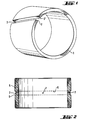
- 1 illustrates the guide ring (1) thus produced with the gap (3) formed by the cut ends (2,2 ').
- This guide ring made of the material according to the invention has an unusually high surface quality in comparison to a guide ring made with the same tools and under the same conditions from conventional materials (cotton-reinforced phenolic resin), so that any further smoothing post-processing of the surface is unnecessary.
- the blanks characteristic of the surface made of conventional composite materials and torn out of the material surface by the cutting tools are completely absent here.
- the surface of the ring proves to be surprisingly homogeneous. Resin matrix and fiber material appear to be largely fused.
- the surface is also extremely dense and absorbs very little moisture, so that the wet turned body hardly needs to be dried.
- the guide ring according to the invention has very good flexibility and a high resilience. It can be compressed to a smaller diameter, whereby push the cut ends (2,2 ') over each other and spring back into their original shape when released. It can therefore be assembled particularly easily by being pushed into a hydraulic cylinder in a compressed state until it reaches the inner groove of the cylinder and "snaps" there.
- the ring according to the invention shows a striking superiority over a ring made of conventional hard fabric tape.
- two identical specimens of a test hydraulic system with high-gloss chrome-plated piston rods are equipped with the guide rings to be compared and left to work under load.
- the initially shiny white piston rod of the test hydraulics equipped with the conventional hard fabric tape appeared dark tinted, the lubrication decreased drastically due to the increasing pore freedom of the piston rod material, and the test had to be ended due to excessive oil leakage.
- the piston rod of the test hydraulics equipped with the guide ring according to the invention was still white after this double stroke number and only showed a fine colorless veil. Even after 200,000 double strokes, the hydraulic system equipped with the ring according to the invention still functions perfectly without any signs of excessive, harmful polishing of the piston rod.
- Unslotted guide rings can also be produced in an analogous manner for mounting on hydraulic pistons with a built-in groove.
- the high extensibility of the material according to the invention is shown here as a considerable advantage.
- the ring to be assembled can easily be stretched from the diameter of the groove base to the diameter of the rod and pushed onto the rod as far as the groove, where it "snaps" in properly without being calibrated.
- FIG. 2 Another example is the slide bearing sleeve (5) shown in FIG. 2 with a circumferential lubrication groove (6) and bores (7), which can be produced in analogy to the manufacture of the guide rings described above.
- This sleeve bearing sleeve has a very long service life, minimizes machine downtimes, saves energy and costs and reduces the noise level produced by the bearing.
Landscapes
- Chemical & Material Sciences (AREA)
- Engineering & Computer Science (AREA)
- Materials Engineering (AREA)
- Organic Chemistry (AREA)
- Health & Medical Sciences (AREA)
- Chemical Kinetics & Catalysis (AREA)
- Medicinal Chemistry (AREA)
- Polymers & Plastics (AREA)
- Manufacturing & Machinery (AREA)
- Mechanical Engineering (AREA)
- General Engineering & Computer Science (AREA)
- Textile Engineering (AREA)
- Composite Materials (AREA)
- Reinforced Plastic Materials (AREA)
- Laminated Bodies (AREA)
- Treatments For Attaching Organic Compounds To Fibrous Goods (AREA)
- Nonwoven Fabrics (AREA)
- Manufacture Of Alloys Or Alloy Compounds (AREA)
Claims (21)
- Matériau renforcé de fibres composé d'une matière textile bidimensionnelle et d'une résine thermodurcissable, caractérisé en ce qu'il se compose d'un taux en fibres de 30 à 70 % en poids, en ce que la matière fibreuse contenue dans celui-ci se compose d'au moins 30 % de fibres polyacrylonitriles et en ce que la résine thermodurcissable contient une addition de polymère fluoré dans une quantité allant jusqu'à 25 % en poids.
- Matériau renforcé de fibres selon la revendication 1, caractérisé en ce que la résine thermodurcissable est une résine phénolique.
- Matériau renforcé de fibres selon au moins l'une des revendications 1 et 2, caractérisé en ce que la matière textile bidimensionnelle contenue dans ce matériau se compose jusqu'à 100 % de fibres polyacrylonitriles.
- Matériau renforcé de fibres selon au moins l'une des revendications 1 à 3, caractérisé en ce que la matière textile bidimensionnelle contenue est un tissu, un article en maille/tricotés ou une nappe.
- Matériau textile selon au moins l'une des revendications 1 à 4, caractérisé en ce que la matière textile bidimensionnelle contenue se compose d'un filé de fibres coupées.
- Matériau renforcé de fibres selon la revendication 5, caractérisé en ce que la matière textile bidimensionnelle contenue est constituée de fibres polyacrylonitriles hautement solides.
- Matériau renforcé de fibres selon au moins l'une des revendications 1 à 6, caractérisé en ce que la résine phénolique contenue est un condensat de phénolformaldéhyde ayant un rapport en moles de phénol:formaldéhyde de 1:1 à 1:3.
- Matériau renforcé de fibres selon au moins l'une des revendications 1 à 7, caractérisé en ce que le polymère fluoré contenu dans la résine phénolique a une viscosité à chaud mesurée à 380 °C de 102 à 105 Pa·s et une granulométrie moyenne de 0,5 à 10 µm.
- Matériau renforcé de fibres selon au moins l'une des revendications 1 à 8, caractérisé en ce que la résine phénolique contient de plus des plastifiants et des agents améliorant l'accrochage.
- Matériau renforcé de fibres selon la revendication 9, caractérisé en ce que le plastifiant et l'agent améliorant l'accrochage est un dérivé de poly(alcool de vinyle).
- Matériau renforcé de fibres selon la revendication 10, caractérisé en ce que le plastifiant et l'agent améliorant l'accrochage sont le butyral de vinyle.
- Matériau renforcé de fibres selon au moins l'une des revendications 1 à 11, caractérisé en ce qu'il présente plusieurs couches de la matière textile bidimensionnelle.
- Matériau renforcé de fibres selon au moins l'une des revendications 1 à 12, caractérisé en ce que la résine thermodurcissable est condensée.
- Prépreg en une matière textile bidimensionnelle et une résine thermoplastique, caractérisé en ce qu'il contient un taux en fibres de 30 à 70 % en poids, en ce que la matière fibreuse qu'il contient se compose d'au moins 30 % de fibres polyacrylonitrile et en ce que la résine thermodurcissable contient une addition de polymère fluoré dans une quantité allant jusqu'à 25 % en poids.
- Prépreg selon la revendication 14, caractérisé en ce que la résine thermodurcissable est une résine phénolique.
- Prépreg selon la revendication 14, caractérisé en ce qu'il présente les propriétés d'au moins l'une des revendications 4 à 12.
- Matériau renforcés de fibres et prépreg selon au moins l'une des revendications 1 à 16, caractérisés en ce que la matière se présente façonnée bidimensionnellement ou tridimensionnellement.
- Procédé pour la préparation d'un prépreg d'une matière textile bidimensionnelle et d'une résine thermodurcissable de façon connue en soi, caractérisé en ce que l'on imprègne une matière textile bidimensionnelle constituée d'au moins 30 % de fibres polyacrylonitriles, d'une résine thermodurcissable qui contient une addition de polymères fluorés dans une quantité jusqu'à 25 % en poids, à une teneur en résine (calculée solide sur solide) de 30 à 70 % et on sèche la matière imprégnée à température élevée et/ou on la soumet à un procédé de façonnage dans lequel on empile l'une sur l'autre plusieurs couches de la matière imprégnée.
- Procédé selon la revendication 18, caractérisé en ce que la matière textile bidimensionnelle est constituée jusqu'à 100 % de fibres polyacrylonitriles.
- Procédé selon au moins l'une des revendications 18 et 19, caractérisé en ce que la résine thermodurcissable utilisée est une résine phénolique.
- Procédé pour la préparation d'un matériau renforcé de fibres selon les revendications 1 à 13, caractérisé en ce que l'on prépare un prépreg selon la revendication 18 et en ce que l'on condense celui-ci par chauffage à une température comprise entre 100 à 150 °C sous pression.
Priority Applications (1)
| Application Number | Priority Date | Filing Date | Title |
|---|---|---|---|
| EP95108596A EP0697430A3 (fr) | 1990-04-03 | 1991-03-27 | Matériau renforcé par des fibres, procédé pour sa production et son utilisation |
Applications Claiming Priority (2)
| Application Number | Priority Date | Filing Date | Title |
|---|---|---|---|
| DE4010694A DE4010694A1 (de) | 1990-04-03 | 1990-04-03 | Faserverstaerkter werkstoff, verfahren zu seiner herstellung und seine verwendung |
| DE4010694 | 1990-04-03 |
Related Child Applications (1)
| Application Number | Title | Priority Date | Filing Date |
|---|---|---|---|
| EP95108596.8 Division-Into | 1991-03-27 |
Publications (3)
| Publication Number | Publication Date |
|---|---|
| EP0450488A2 EP0450488A2 (fr) | 1991-10-09 |
| EP0450488A3 EP0450488A3 (en) | 1992-03-11 |
| EP0450488B1 true EP0450488B1 (fr) | 1996-09-18 |
Family
ID=6403648
Family Applications (2)
| Application Number | Title | Priority Date | Filing Date |
|---|---|---|---|
| EP91104871A Expired - Lifetime EP0450488B1 (fr) | 1990-04-03 | 1991-03-27 | Matériau renforcé par des fibres, procédé pour sa production et son utilisation |
| EP95108596A Ceased EP0697430A3 (fr) | 1990-04-03 | 1991-03-27 | Matériau renforcé par des fibres, procédé pour sa production et son utilisation |
Family Applications After (1)
| Application Number | Title | Priority Date | Filing Date |
|---|---|---|---|
| EP95108596A Ceased EP0697430A3 (fr) | 1990-04-03 | 1991-03-27 | Matériau renforcé par des fibres, procédé pour sa production et son utilisation |
Country Status (12)
| Country | Link |
|---|---|
| EP (2) | EP0450488B1 (fr) |
| JP (1) | JP3121852B2 (fr) |
| AT (1) | ATE143034T1 (fr) |
| CZ (1) | CZ286573B6 (fr) |
| DE (2) | DE4010694A1 (fr) |
| DK (1) | DK0450488T3 (fr) |
| ES (1) | ES2094164T3 (fr) |
| GR (1) | GR3022036T3 (fr) |
| HU (1) | HU209772B (fr) |
| IE (1) | IE911068A1 (fr) |
| PT (1) | PT97226B (fr) |
| SK (1) | SK281639B6 (fr) |
Cited By (1)
| Publication number | Priority date | Publication date | Assignee | Title |
|---|---|---|---|---|
| CN100570165C (zh) * | 2007-04-27 | 2009-12-16 | 洛阳轴研科技股份有限公司 | 滚动轴承用多孔酚醛胶布层压保持架材料及制造方法 |
Families Citing this family (21)
| Publication number | Priority date | Publication date | Assignee | Title |
|---|---|---|---|---|
| EP0554775A2 (fr) * | 1992-02-01 | 1993-08-11 | Hoechst Aktiengesellschaft | Fils, fils retardus ou tissus post-étirés à base de fibres discontinues, procédé pour leur fabrication et matériaux composites fabriqués à partir de ceux-ci |
| DE9415840U1 (de) * | 1994-09-30 | 1994-12-08 | G. Schwartz GmbH & Co. KG, 46509 Xanten | Formmasse |
| RU2117834C1 (ru) | 1996-02-23 | 1998-08-20 | Научно-производственная фирма "Контур" | Армирующий наполнитель, фрикционный полимерный композиционный материал и тормозная автомобильная колодка |
| DE10138410B4 (de) * | 2001-08-04 | 2005-02-10 | Continental Aktiengesellschaft | Notlaufstützkörper für luftbereiftes Fahrzeugrad |
| AT411257B (de) * | 2001-11-07 | 2003-11-25 | Hoerbiger Kompressortech Serv | Dichtelemente für kompressorventile |
| US7061699B2 (en) | 2002-03-28 | 2006-06-13 | Seiko Epson Corporation | Projection lens, producing method of projection lens and projector having projection lens |
| DE102004035212A1 (de) * | 2004-07-21 | 2006-02-16 | Ina-Schaeffler Kg | Wälzlager |
| DE102004058518A1 (de) * | 2004-12-01 | 2006-06-14 | Gebrüder Reinfurt GmbH & Co. KG | Wälzlagerkäfig |
| RU2313010C1 (ru) * | 2006-06-26 | 2007-12-20 | Федеральное государственное унитарное предприятие "Всероссийский научно-исследовательский институт авиационных материалов" (ФГУП "ВИАМ") | Связующее для получения антифрикционных изделий, препрег и изделие, выполненное из него |
| DE102007016734A1 (de) * | 2007-04-03 | 2008-10-09 | Bk - Kunststoffe Bernau Gmbh | Selbstschmierendes Gleitelement und Verbundkörper für Gleitanwendung und Verfahren zur Herstellung |
| JP5249726B2 (ja) * | 2008-11-17 | 2013-07-31 | オイレス工業株式会社 | 摺動部材用繊維強化樹脂組成物及び積層摺動部材 |
| JP5595705B2 (ja) | 2009-09-30 | 2014-09-24 | オイレス工業株式会社 | 摺動面材及び該摺動面材を備えた複層摺動部材 |
| JP5859183B2 (ja) | 2009-09-30 | 2016-02-10 | オイレス工業株式会社 | 摺動面材及び該摺動面材を備えた複層摺動部材 |
| JP6232182B2 (ja) * | 2012-10-01 | 2017-11-15 | ニッタ株式会社 | シャフト用構造体、雄型部材、及び、雌型部材 |
| JP6196813B2 (ja) * | 2012-06-19 | 2017-09-13 | ニッタ株式会社 | シャフト用構造体、雄型部材、及び、雌型部材 |
| KR20150031274A (ko) * | 2012-06-19 | 2015-03-23 | 니타 가부시키가이샤 | 샤프트용 구조체, 수형 부재 및 암형 부재 |
| JP6025434B2 (ja) * | 2012-07-19 | 2016-11-16 | オイレス工業株式会社 | 摺動部材 |
| CN103694606A (zh) * | 2013-11-29 | 2014-04-02 | 马鞍山市中澜橡塑制品有限公司 | 一种改性氟橡胶密封垫材料及其制备方法 |
| DE102014107881A1 (de) * | 2014-06-04 | 2015-12-17 | Lisa Dräxlmaier GmbH | Faserverstärktes Verbundelement und Verfahren zu dessen Herstellung |
| US11162533B2 (en) * | 2018-10-22 | 2021-11-02 | Aktiebolaget Skf | Rolling bearing |
| CN111484691B (zh) * | 2020-02-25 | 2021-02-19 | 中国科学院兰州化学物理研究所 | 一种芳纶纤维布增强聚四氟乙烯轴承保持架材料及其制备方法 |
Citations (1)
| Publication number | Priority date | Publication date | Assignee | Title |
|---|---|---|---|---|
| US3684062A (en) * | 1969-02-14 | 1972-08-15 | Kelsey Hayes Co | Friction lining composition |
Family Cites Families (10)
| Publication number | Priority date | Publication date | Assignee | Title |
|---|---|---|---|---|
| BE564931A (fr) * | 1957-02-18 | |||
| GB974629A (en) * | 1961-01-30 | 1964-11-11 | American Brake Shoe Co | Method of manufacturing bearings |
| US4022942A (en) * | 1972-02-17 | 1977-05-10 | Monsanto Company | Process of preparing fibrous sheet from high-ortho phenolic resole resin varnish |
| DD114238A1 (fr) * | 1974-03-11 | 1975-07-20 | ||
| JPS51111266A (en) * | 1975-03-24 | 1976-10-01 | Tekunishie Tekisuteiren Kaaru | Method of manufacture of bearing material of small friction |
| JPS54148089A (en) * | 1978-05-12 | 1979-11-19 | Akebono Brake Ind | Hardwearing friction material with low friction coefficient |
| DE3111936A1 (de) * | 1981-03-26 | 1982-10-07 | Cassella Ag, 6000 Frankfurt | Verfestigte gebilde aus textilen materialien |
| US4680220A (en) * | 1985-02-26 | 1987-07-14 | W. L. Gore & Associates, Inc. | Dielectric materials |
| JPS61197637A (ja) * | 1985-02-27 | 1986-09-01 | Oiles Ind Co Ltd | 積層摺動部材の製造方法 |
| JPH0267333A (ja) * | 1988-07-15 | 1990-03-07 | Amoco Corp | 樹脂粒を充填した繊維強化複合材 |
-
1990
- 1990-04-03 DE DE4010694A patent/DE4010694A1/de not_active Withdrawn
-
1991
- 1991-03-27 ES ES91104871T patent/ES2094164T3/es not_active Expired - Lifetime
- 1991-03-27 AT AT91104871T patent/ATE143034T1/de not_active IP Right Cessation
- 1991-03-27 DK DK91104871.8T patent/DK0450488T3/da active
- 1991-03-27 EP EP91104871A patent/EP0450488B1/fr not_active Expired - Lifetime
- 1991-03-27 DE DE59108186T patent/DE59108186D1/de not_active Expired - Fee Related
- 1991-03-27 EP EP95108596A patent/EP0697430A3/fr not_active Ceased
- 1991-03-28 IE IE106891A patent/IE911068A1/en not_active IP Right Cessation
- 1991-04-02 PT PT97226A patent/PT97226B/pt not_active IP Right Cessation
- 1991-04-02 CZ CS1991904A patent/CZ286573B6/cs not_active IP Right Cessation
- 1991-04-02 HU HU911060A patent/HU209772B/hu not_active IP Right Cessation
- 1991-04-02 SK SK904-91A patent/SK281639B6/sk unknown
- 1991-04-03 JP JP03070885A patent/JP3121852B2/ja not_active Expired - Fee Related
-
1996
- 1996-12-13 GR GR960403463T patent/GR3022036T3/el unknown
Patent Citations (1)
| Publication number | Priority date | Publication date | Assignee | Title |
|---|---|---|---|---|
| US3684062A (en) * | 1969-02-14 | 1972-08-15 | Kelsey Hayes Co | Friction lining composition |
Non-Patent Citations (3)
| Title |
|---|
| J.K.Lancaster, "composites for Aerospace Dry Bearing Applications" in Friction and Wear of Composites",K.Friedrich ed., Elsevier.Sci. Publ. Amsterdam 1986, pp.363-396. * |
| J.K.Lancaster, "Proceedings of the Leeds/Lyon Symposium on Tribology",1981,pp33-43. * |
| Polnische Patentschrift Nr. 131 464 * |
Cited By (1)
| Publication number | Priority date | Publication date | Assignee | Title |
|---|---|---|---|---|
| CN100570165C (zh) * | 2007-04-27 | 2009-12-16 | 洛阳轴研科技股份有限公司 | 滚动轴承用多孔酚醛胶布层压保持架材料及制造方法 |
Also Published As
| Publication number | Publication date |
|---|---|
| PT97226A (pt) | 1992-01-31 |
| JPH04225037A (ja) | 1992-08-14 |
| IE911068A1 (en) | 1991-10-09 |
| HU911060D0 (en) | 1991-10-28 |
| DK0450488T3 (fr) | 1997-02-17 |
| HU209772B (en) | 1994-10-28 |
| CZ286573B6 (cs) | 2000-05-17 |
| CS90491A3 (en) | 1991-11-12 |
| HUT60664A (en) | 1992-10-28 |
| DE59108186D1 (de) | 1996-10-24 |
| SK281639B6 (sk) | 2001-06-11 |
| JP3121852B2 (ja) | 2001-01-09 |
| EP0697430A3 (fr) | 1996-05-22 |
| PT97226B (pt) | 1999-03-31 |
| EP0450488A3 (en) | 1992-03-11 |
| ES2094164T3 (es) | 1997-01-16 |
| ATE143034T1 (de) | 1996-10-15 |
| GR3022036T3 (en) | 1997-03-31 |
| EP0697430A2 (fr) | 1996-02-21 |
| EP0450488A2 (fr) | 1991-10-09 |
| DE4010694A1 (de) | 1991-10-10 |
Similar Documents
| Publication | Publication Date | Title |
|---|---|---|
| EP0697430A2 (fr) | Matériau renforcé par des fibres, procédé pour sa production et son utilisation | |
| US5880043A (en) | Fiber-reinforced material and production and use thereof | |
| EP1900950B1 (fr) | Couche de glissement en plastique et élément coulissant à une telle couche | |
| EP1670872B1 (fr) | Materiau pour joint plat sous forme d'un film composite renforce | |
| DE69201676T2 (de) | Reibmaterial bestehend aus einem hitzebeständigen Papierträger, welcher harz-gebundene Kohlenstoff-Teilchen trägt. | |
| EP0492498B1 (fr) | Ski comprenant des bandes ou feuilles planes en matériau renforcé en fibres | |
| EP1900948B1 (fr) | Palier pivotant à anneau extérieur en plastique et procédé de sa fabrication | |
| EP1737633B1 (fr) | File impregne d'une resine epoxy et son utilisation pour la production d'une preforme | |
| DE69020554T2 (de) | Verschleissfeste mehrschichtige gegenstände. | |
| DE102011016611A1 (de) | Gleitsystem | |
| DE60111176T2 (de) | Selbstschmierende Lagerbuchse mit poly(p-phenylene-2,6-benzobisoxazole) | |
| DE102004058518A1 (de) | Wälzlagerkäfig | |
| WO2009124525A1 (fr) | Garniture de friction pour embrayage à friction | |
| DE2124161A1 (de) | Lagerwerkstoff niedriger Reibung und Verfahren zu seiner Herstellung | |
| DE102005036690B4 (de) | Verbundmaterial für Gleitanwendungen | |
| DE10250264B4 (de) | Dichtungsmaterial für Stopfbuchspackungen | |
| DE102025109108A1 (de) | Wälzlagerkäfig aus Verbundwerkstoff mit verbessertem Verhalten und zugehörige Wälzlagereinheit | |
| DE102025109104A1 (de) | Wälzlagerkäfig aus Verbundwerkstoff und zugehörige Wälzlagereinheit | |
| DE102025109100A1 (de) | Wälzlagerkäfig aus Verbundwerkstoff mit verbesserter interlaminarer Kohäsion und zugehörige Wälzlagereinheit und Verfahren | |
| DD148030A1 (de) | Verfahren zur herstellung von verbundkoerpern | |
| AT346600B (de) | Zusammensetzungen fuer antifriktionsmaterialien mit einem gehalt an kunstharz und polytetrafluoraethylen | |
| EP0898053B1 (fr) | Aube pour pompe fabriquée en un materiau en feuille résistant à l'usure | |
| DE1525061C (de) | Gleitelement und Verfahren zu seiner Herstellung | |
| DD224641B1 (de) | Verfahren zur herstellung von reibwerkstoffen | |
| DE10211668A1 (de) | Verfahren zur Erzeugung von hochbelastbaren Fadenprepregs |
Legal Events
| Date | Code | Title | Description |
|---|---|---|---|
| PUAI | Public reference made under article 153(3) epc to a published international application that has entered the european phase |
Free format text: ORIGINAL CODE: 0009012 |
|
| AK | Designated contracting states |
Kind code of ref document: A2 Designated state(s): AT BE CH DE DK ES FR GB GR IT LI LU NL SE |
|
| PUAL | Search report despatched |
Free format text: ORIGINAL CODE: 0009013 |
|
| AK | Designated contracting states |
Kind code of ref document: A3 Designated state(s): AT BE CH DE DK ES FR GB GR IT LI LU NL SE |
|
| 17P | Request for examination filed |
Effective date: 19920409 |
|
| 17Q | First examination report despatched |
Effective date: 19940309 |
|
| RAP1 | Party data changed (applicant data changed or rights of an application transferred) |
Owner name: MSH MAIN-SPREE HYDRAULIK GMBH Owner name: HOECHST AKTIENGESELLSCHAFT |
|
| GRAH | Despatch of communication of intention to grant a patent |
Free format text: ORIGINAL CODE: EPIDOS IGRA |
|
| GRAA | (expected) grant |
Free format text: ORIGINAL CODE: 0009210 |
|
| GRAH | Despatch of communication of intention to grant a patent |
Free format text: ORIGINAL CODE: EPIDOS IGRA |
|
| AK | Designated contracting states |
Kind code of ref document: B1 Designated state(s): AT BE CH DE DK ES FR GB GR IT LI LU NL SE |
|
| REF | Corresponds to: |
Ref document number: 143034 Country of ref document: AT Date of ref document: 19961015 Kind code of ref document: T |
|
| XX | Miscellaneous (additional remarks) |
Free format text: TEILANMELDUNG 95108596.8 EINGEREICHT AM 27/03/91. |
|
| REF | Corresponds to: |
Ref document number: 59108186 Country of ref document: DE Date of ref document: 19961024 |
|
| ITF | It: translation for a ep patent filed | ||
| GBT | Gb: translation of ep patent filed (gb section 77(6)(a)/1977) |
Effective date: 19961122 |
|
| ET | Fr: translation filed | ||
| REG | Reference to a national code |
Ref country code: ES Ref legal event code: FG2A Ref document number: 2094164 Country of ref document: ES Kind code of ref document: T3 |
|
| REG | Reference to a national code |
Ref country code: DK Ref legal event code: T3 |
|
| REG | Reference to a national code |
Ref country code: GR Ref legal event code: FG4A Free format text: 3022036 |
|
| PLBE | No opposition filed within time limit |
Free format text: ORIGINAL CODE: 0009261 |
|
| STAA | Information on the status of an ep patent application or granted ep patent |
Free format text: STATUS: NO OPPOSITION FILED WITHIN TIME LIMIT |
|
| 26N | No opposition filed | ||
| PGFP | Annual fee paid to national office [announced via postgrant information from national office to epo] |
Ref country code: GB Payment date: 20010214 Year of fee payment: 11 |
|
| PGFP | Annual fee paid to national office [announced via postgrant information from national office to epo] |
Ref country code: CH Payment date: 20010219 Year of fee payment: 11 |
|
| PGFP | Annual fee paid to national office [announced via postgrant information from national office to epo] |
Ref country code: AT Payment date: 20010226 Year of fee payment: 11 |
|
| PGFP | Annual fee paid to national office [announced via postgrant information from national office to epo] |
Ref country code: NL Payment date: 20010228 Year of fee payment: 11 Ref country code: GR Payment date: 20010228 Year of fee payment: 11 |
|
| PGFP | Annual fee paid to national office [announced via postgrant information from national office to epo] |
Ref country code: SE Payment date: 20010305 Year of fee payment: 11 Ref country code: DK Payment date: 20010305 Year of fee payment: 11 Ref country code: DE Payment date: 20010305 Year of fee payment: 11 |
|
| PGFP | Annual fee paid to national office [announced via postgrant information from national office to epo] |
Ref country code: BE Payment date: 20010309 Year of fee payment: 11 |
|
| PGFP | Annual fee paid to national office [announced via postgrant information from national office to epo] |
Ref country code: FR Payment date: 20010313 Year of fee payment: 11 |
|
| PGFP | Annual fee paid to national office [announced via postgrant information from national office to epo] |
Ref country code: ES Payment date: 20010316 Year of fee payment: 11 |
|
| REG | Reference to a national code |
Ref country code: GB Ref legal event code: IF02 |
|
| PGFP | Annual fee paid to national office [announced via postgrant information from national office to epo] |
Ref country code: LU Payment date: 20020117 Year of fee payment: 11 |
|
| PG25 | Lapsed in a contracting state [announced via postgrant information from national office to epo] |
Ref country code: LU Free format text: LAPSE BECAUSE OF NON-PAYMENT OF DUE FEES Effective date: 20020327 Ref country code: GB Free format text: LAPSE BECAUSE OF NON-PAYMENT OF DUE FEES Effective date: 20020327 Ref country code: AT Free format text: LAPSE BECAUSE OF NON-PAYMENT OF DUE FEES Effective date: 20020327 |
|
| PG25 | Lapsed in a contracting state [announced via postgrant information from national office to epo] |
Ref country code: SE Free format text: LAPSE BECAUSE OF NON-PAYMENT OF DUE FEES Effective date: 20020328 Ref country code: ES Free format text: LAPSE BECAUSE OF NON-PAYMENT OF DUE FEES Effective date: 20020328 |
|
| PG25 | Lapsed in a contracting state [announced via postgrant information from national office to epo] |
Ref country code: LI Free format text: LAPSE BECAUSE OF NON-PAYMENT OF DUE FEES Effective date: 20020331 Ref country code: CH Free format text: LAPSE BECAUSE OF NON-PAYMENT OF DUE FEES Effective date: 20020331 Ref country code: BE Free format text: LAPSE BECAUSE OF NON-PAYMENT OF DUE FEES Effective date: 20020331 |
|
| PG25 | Lapsed in a contracting state [announced via postgrant information from national office to epo] |
Ref country code: DK Free format text: LAPSE BECAUSE OF NON-PAYMENT OF DUE FEES Effective date: 20020402 |
|
| BERE | Be: lapsed |
Owner name: MAIN-SPREE HYDRAULIK G.M.B.H. *MSH Effective date: 20020331 Owner name: *HOECHST A.G. Effective date: 20020331 |
|
| PG25 | Lapsed in a contracting state [announced via postgrant information from national office to epo] |
Ref country code: NL Free format text: LAPSE BECAUSE OF NON-PAYMENT OF DUE FEES Effective date: 20021001 Ref country code: DE Free format text: LAPSE BECAUSE OF NON-PAYMENT OF DUE FEES Effective date: 20021001 |
|
| PG25 | Lapsed in a contracting state [announced via postgrant information from national office to epo] |
Ref country code: GR Free format text: LAPSE BECAUSE OF NON-PAYMENT OF DUE FEES Effective date: 20021007 |
|
| EUG | Se: european patent has lapsed |
Ref document number: 91104871.8 |
|
| REG | Reference to a national code |
Ref country code: CH Ref legal event code: PL |
|
| GBPC | Gb: european patent ceased through non-payment of renewal fee |
Effective date: 20020327 |
|
| REG | Reference to a national code |
Ref country code: DK Ref legal event code: EBP |
|
| PG25 | Lapsed in a contracting state [announced via postgrant information from national office to epo] |
Ref country code: FR Free format text: LAPSE BECAUSE OF NON-PAYMENT OF DUE FEES Effective date: 20021129 |
|
| NLV4 | Nl: lapsed or anulled due to non-payment of the annual fee |
Effective date: 20021001 |
|
| REG | Reference to a national code |
Ref country code: FR Ref legal event code: ST |
|
| REG | Reference to a national code |
Ref country code: ES Ref legal event code: FD2A Effective date: 20030410 |
|
| PG25 | Lapsed in a contracting state [announced via postgrant information from national office to epo] |
Ref country code: IT Free format text: LAPSE BECAUSE OF NON-PAYMENT OF DUE FEES;WARNING: LAPSES OF ITALIAN PATENTS WITH EFFECTIVE DATE BEFORE 2007 MAY HAVE OCCURRED AT ANY TIME BEFORE 2007. THE CORRECT EFFECTIVE DATE MAY BE DIFFERENT FROM THE ONE RECORDED. Effective date: 20050327 |