EP0447964A2 - Geformte Gebilde aus aromatischen Polyetherketonen, die gegen UV-Strahlung stabilisiert sind, und ein Verfahren zu deren Herstellung - Google Patents
Geformte Gebilde aus aromatischen Polyetherketonen, die gegen UV-Strahlung stabilisiert sind, und ein Verfahren zu deren Herstellung Download PDFInfo
- Publication number
- EP0447964A2 EP0447964A2 EP91103925A EP91103925A EP0447964A2 EP 0447964 A2 EP0447964 A2 EP 0447964A2 EP 91103925 A EP91103925 A EP 91103925A EP 91103925 A EP91103925 A EP 91103925A EP 0447964 A2 EP0447964 A2 EP 0447964A2
- Authority
- EP
- European Patent Office
- Prior art keywords
- film
- polyether ketones
- shaped structures
- aromatic polyether
- structures made
- Prior art date
- Legal status (The legal status is an assumption and is not a legal conclusion. Google has not performed a legal analysis and makes no representation as to the accuracy of the status listed.)
- Granted
Links
Classifications
-
- D—TEXTILES; PAPER
- D06—TREATMENT OF TEXTILES OR THE LIKE; LAUNDERING; FLEXIBLE MATERIALS NOT OTHERWISE PROVIDED FOR
- D06M—TREATMENT, NOT PROVIDED FOR ELSEWHERE IN CLASS D06, OF FIBRES, THREADS, YARNS, FABRICS, FEATHERS OR FIBROUS GOODS MADE FROM SUCH MATERIALS
- D06M15/00—Treating fibres, threads, yarns, fabrics, or fibrous goods made from such materials, with macromolecular compounds; Such treatment combined with mechanical treatment
- D06M15/19—Treating fibres, threads, yarns, fabrics, or fibrous goods made from such materials, with macromolecular compounds; Such treatment combined with mechanical treatment with synthetic macromolecular compounds
- D06M15/21—Macromolecular compounds obtained by reactions only involving carbon-to-carbon unsaturated bonds
- D06M15/263—Macromolecular compounds obtained by reactions only involving carbon-to-carbon unsaturated bonds of unsaturated carboxylic acids; Salts or esters thereof
-
- C—CHEMISTRY; METALLURGY
- C08—ORGANIC MACROMOLECULAR COMPOUNDS; THEIR PREPARATION OR CHEMICAL WORKING-UP; COMPOSITIONS BASED THEREON
- C08J—WORKING-UP; GENERAL PROCESSES OF COMPOUNDING; AFTER-TREATMENT NOT COVERED BY SUBCLASSES C08B, C08C, C08F, C08G or C08H
- C08J7/00—Chemical treatment or coating of shaped articles made of macromolecular substances
- C08J7/04—Coating
- C08J7/0427—Coating with only one layer of a composition containing a polymer binder
-
- D—TEXTILES; PAPER
- D06—TREATMENT OF TEXTILES OR THE LIKE; LAUNDERING; FLEXIBLE MATERIALS NOT OTHERWISE PROVIDED FOR
- D06M—TREATMENT, NOT PROVIDED FOR ELSEWHERE IN CLASS D06, OF FIBRES, THREADS, YARNS, FABRICS, FEATHERS OR FIBROUS GOODS MADE FROM SUCH MATERIALS
- D06M13/00—Treating fibres, threads, yarns, fabrics or fibrous goods made from such materials, with non-macromolecular organic compounds; Such treatment combined with mechanical treatment
- D06M13/10—Treating fibres, threads, yarns, fabrics or fibrous goods made from such materials, with non-macromolecular organic compounds; Such treatment combined with mechanical treatment with compounds containing oxygen
- D06M13/12—Aldehydes; Ketones
- D06M13/127—Mono-aldehydes, e.g. formaldehyde; Monoketones
-
- D—TEXTILES; PAPER
- D06—TREATMENT OF TEXTILES OR THE LIKE; LAUNDERING; FLEXIBLE MATERIALS NOT OTHERWISE PROVIDED FOR
- D06M—TREATMENT, NOT PROVIDED FOR ELSEWHERE IN CLASS D06, OF FIBRES, THREADS, YARNS, FABRICS, FEATHERS OR FIBROUS GOODS MADE FROM SUCH MATERIALS
- D06M13/00—Treating fibres, threads, yarns, fabrics or fibrous goods made from such materials, with non-macromolecular organic compounds; Such treatment combined with mechanical treatment
- D06M13/322—Treating fibres, threads, yarns, fabrics or fibrous goods made from such materials, with non-macromolecular organic compounds; Such treatment combined with mechanical treatment with compounds containing nitrogen
- D06M13/35—Heterocyclic compounds
- D06M13/352—Heterocyclic compounds having five-membered heterocyclic rings
-
- D—TEXTILES; PAPER
- D06—TREATMENT OF TEXTILES OR THE LIKE; LAUNDERING; FLEXIBLE MATERIALS NOT OTHERWISE PROVIDED FOR
- D06M—TREATMENT, NOT PROVIDED FOR ELSEWHERE IN CLASS D06, OF FIBRES, THREADS, YARNS, FABRICS, FEATHERS OR FIBROUS GOODS MADE FROM SUCH MATERIALS
- D06M15/00—Treating fibres, threads, yarns, fabrics, or fibrous goods made from such materials, with macromolecular compounds; Such treatment combined with mechanical treatment
- D06M15/19—Treating fibres, threads, yarns, fabrics, or fibrous goods made from such materials, with macromolecular compounds; Such treatment combined with mechanical treatment with synthetic macromolecular compounds
- D06M15/21—Macromolecular compounds obtained by reactions only involving carbon-to-carbon unsaturated bonds
- D06M15/327—Macromolecular compounds obtained by reactions only involving carbon-to-carbon unsaturated bonds of unsaturated alcohols or esters thereof
- D06M15/333—Macromolecular compounds obtained by reactions only involving carbon-to-carbon unsaturated bonds of unsaturated alcohols or esters thereof of vinyl acetate; Polyvinylalcohol
-
- D—TEXTILES; PAPER
- D06—TREATMENT OF TEXTILES OR THE LIKE; LAUNDERING; FLEXIBLE MATERIALS NOT OTHERWISE PROVIDED FOR
- D06M—TREATMENT, NOT PROVIDED FOR ELSEWHERE IN CLASS D06, OF FIBRES, THREADS, YARNS, FABRICS, FEATHERS OR FIBROUS GOODS MADE FROM SUCH MATERIALS
- D06M15/00—Treating fibres, threads, yarns, fabrics, or fibrous goods made from such materials, with macromolecular compounds; Such treatment combined with mechanical treatment
- D06M15/19—Treating fibres, threads, yarns, fabrics, or fibrous goods made from such materials, with macromolecular compounds; Such treatment combined with mechanical treatment with synthetic macromolecular compounds
- D06M15/21—Macromolecular compounds obtained by reactions only involving carbon-to-carbon unsaturated bonds
- D06M15/356—Macromolecular compounds obtained by reactions only involving carbon-to-carbon unsaturated bonds of other unsaturated compounds containing nitrogen, sulfur, silicon or phosphorus atoms
- D06M15/3562—Macromolecular compounds obtained by reactions only involving carbon-to-carbon unsaturated bonds of other unsaturated compounds containing nitrogen, sulfur, silicon or phosphorus atoms containing nitrogen
-
- D—TEXTILES; PAPER
- D06—TREATMENT OF TEXTILES OR THE LIKE; LAUNDERING; FLEXIBLE MATERIALS NOT OTHERWISE PROVIDED FOR
- D06M—TREATMENT, NOT PROVIDED FOR ELSEWHERE IN CLASS D06, OF FIBRES, THREADS, YARNS, FABRICS, FEATHERS OR FIBROUS GOODS MADE FROM SUCH MATERIALS
- D06M15/00—Treating fibres, threads, yarns, fabrics, or fibrous goods made from such materials, with macromolecular compounds; Such treatment combined with mechanical treatment
- D06M15/19—Treating fibres, threads, yarns, fabrics, or fibrous goods made from such materials, with macromolecular compounds; Such treatment combined with mechanical treatment with synthetic macromolecular compounds
- D06M15/37—Macromolecular compounds obtained otherwise than by reactions only involving carbon-to-carbon unsaturated bonds
- D06M15/59—Polyamides; Polyimides
-
- D—TEXTILES; PAPER
- D06—TREATMENT OF TEXTILES OR THE LIKE; LAUNDERING; FLEXIBLE MATERIALS NOT OTHERWISE PROVIDED FOR
- D06M—TREATMENT, NOT PROVIDED FOR ELSEWHERE IN CLASS D06, OF FIBRES, THREADS, YARNS, FABRICS, FEATHERS OR FIBROUS GOODS MADE FROM SUCH MATERIALS
- D06M15/00—Treating fibres, threads, yarns, fabrics, or fibrous goods made from such materials, with macromolecular compounds; Such treatment combined with mechanical treatment
- D06M15/19—Treating fibres, threads, yarns, fabrics, or fibrous goods made from such materials, with macromolecular compounds; Such treatment combined with mechanical treatment with synthetic macromolecular compounds
- D06M15/37—Macromolecular compounds obtained otherwise than by reactions only involving carbon-to-carbon unsaturated bonds
- D06M15/63—Macromolecular compounds obtained otherwise than by reactions only involving carbon-to-carbon unsaturated bonds containing sulfur in the main chain, e.g. polysulfones
-
- D—TEXTILES; PAPER
- D06—TREATMENT OF TEXTILES OR THE LIKE; LAUNDERING; FLEXIBLE MATERIALS NOT OTHERWISE PROVIDED FOR
- D06N—WALL, FLOOR, OR LIKE COVERING MATERIALS, e.g. LINOLEUM, OILCLOTH, ARTIFICIAL LEATHER, ROOFING FELT, CONSISTING OF A FIBROUS WEB COATED WITH A LAYER OF MACROMOLECULAR MATERIAL; FLEXIBLE SHEET MATERIAL NOT OTHERWISE PROVIDED FOR
- D06N3/00—Artificial leather, oilcloth or other material obtained by covering fibrous webs with macromolecular material, e.g. resins, rubber or derivatives thereof
- D06N3/0056—Artificial leather, oilcloth or other material obtained by covering fibrous webs with macromolecular material, e.g. resins, rubber or derivatives thereof characterised by the compounding ingredients of the macro-molecular coating
- D06N3/0059—Organic ingredients with special effects, e.g. oil- or water-repellent, antimicrobial, flame-resistant, magnetic, bactericidal, odour-influencing agents; perfumes
-
- C—CHEMISTRY; METALLURGY
- C08—ORGANIC MACROMOLECULAR COMPOUNDS; THEIR PREPARATION OR CHEMICAL WORKING-UP; COMPOSITIONS BASED THEREON
- C08J—WORKING-UP; GENERAL PROCESSES OF COMPOUNDING; AFTER-TREATMENT NOT COVERED BY SUBCLASSES C08B, C08C, C08F, C08G or C08H
- C08J2365/00—Characterised by the use of macromolecular compounds obtained by reactions forming a carbon-to-carbon link in the main chain; Derivatives of such polymers
-
- C—CHEMISTRY; METALLURGY
- C08—ORGANIC MACROMOLECULAR COMPOUNDS; THEIR PREPARATION OR CHEMICAL WORKING-UP; COMPOSITIONS BASED THEREON
- C08J—WORKING-UP; GENERAL PROCESSES OF COMPOUNDING; AFTER-TREATMENT NOT COVERED BY SUBCLASSES C08B, C08C, C08F, C08G or C08H
- C08J2371/00—Characterised by the use of polyethers obtained by reactions forming an ether link in the main chain; Derivatives of such polymers
-
- Y—GENERAL TAGGING OF NEW TECHNOLOGICAL DEVELOPMENTS; GENERAL TAGGING OF CROSS-SECTIONAL TECHNOLOGIES SPANNING OVER SEVERAL SECTIONS OF THE IPC; TECHNICAL SUBJECTS COVERED BY FORMER USPC CROSS-REFERENCE ART COLLECTIONS [XRACs] AND DIGESTS
- Y10—TECHNICAL SUBJECTS COVERED BY FORMER USPC
- Y10S—TECHNICAL SUBJECTS COVERED BY FORMER USPC CROSS-REFERENCE ART COLLECTIONS [XRACs] AND DIGESTS
- Y10S428/00—Stock material or miscellaneous articles
- Y10S428/913—Material designed to be responsive to temperature, light, moisture
-
- Y—GENERAL TAGGING OF NEW TECHNOLOGICAL DEVELOPMENTS; GENERAL TAGGING OF CROSS-SECTIONAL TECHNOLOGIES SPANNING OVER SEVERAL SECTIONS OF THE IPC; TECHNICAL SUBJECTS COVERED BY FORMER USPC CROSS-REFERENCE ART COLLECTIONS [XRACs] AND DIGESTS
- Y10—TECHNICAL SUBJECTS COVERED BY FORMER USPC
- Y10T—TECHNICAL SUBJECTS COVERED BY FORMER US CLASSIFICATION
- Y10T428/00—Stock material or miscellaneous articles
- Y10T428/29—Coated or structually defined flake, particle, cell, strand, strand portion, rod, filament, macroscopic fiber or mass thereof
- Y10T428/2913—Rod, strand, filament or fiber
- Y10T428/2933—Coated or with bond, impregnation or core
-
- Y—GENERAL TAGGING OF NEW TECHNOLOGICAL DEVELOPMENTS; GENERAL TAGGING OF CROSS-SECTIONAL TECHNOLOGIES SPANNING OVER SEVERAL SECTIONS OF THE IPC; TECHNICAL SUBJECTS COVERED BY FORMER USPC CROSS-REFERENCE ART COLLECTIONS [XRACs] AND DIGESTS
- Y10—TECHNICAL SUBJECTS COVERED BY FORMER USPC
- Y10T—TECHNICAL SUBJECTS COVERED BY FORMER US CLASSIFICATION
- Y10T428/00—Stock material or miscellaneous articles
- Y10T428/29—Coated or structually defined flake, particle, cell, strand, strand portion, rod, filament, macroscopic fiber or mass thereof
- Y10T428/2913—Rod, strand, filament or fiber
- Y10T428/2933—Coated or with bond, impregnation or core
- Y10T428/2938—Coating on discrete and individual rods, strands or filaments
-
- Y—GENERAL TAGGING OF NEW TECHNOLOGICAL DEVELOPMENTS; GENERAL TAGGING OF CROSS-SECTIONAL TECHNOLOGIES SPANNING OVER SEVERAL SECTIONS OF THE IPC; TECHNICAL SUBJECTS COVERED BY FORMER USPC CROSS-REFERENCE ART COLLECTIONS [XRACs] AND DIGESTS
- Y10—TECHNICAL SUBJECTS COVERED BY FORMER USPC
- Y10T—TECHNICAL SUBJECTS COVERED BY FORMER US CLASSIFICATION
- Y10T428/00—Stock material or miscellaneous articles
- Y10T428/29—Coated or structually defined flake, particle, cell, strand, strand portion, rod, filament, macroscopic fiber or mass thereof
- Y10T428/2913—Rod, strand, filament or fiber
- Y10T428/2933—Coated or with bond, impregnation or core
- Y10T428/2964—Artificial fiber or filament
- Y10T428/2967—Synthetic resin or polymer
-
- Y—GENERAL TAGGING OF NEW TECHNOLOGICAL DEVELOPMENTS; GENERAL TAGGING OF CROSS-SECTIONAL TECHNOLOGIES SPANNING OVER SEVERAL SECTIONS OF THE IPC; TECHNICAL SUBJECTS COVERED BY FORMER USPC CROSS-REFERENCE ART COLLECTIONS [XRACs] AND DIGESTS
- Y10—TECHNICAL SUBJECTS COVERED BY FORMER USPC
- Y10T—TECHNICAL SUBJECTS COVERED BY FORMER US CLASSIFICATION
- Y10T428/00—Stock material or miscellaneous articles
- Y10T428/31504—Composite [nonstructural laminate]
- Y10T428/31942—Of aldehyde or ketone condensation product
-
- Y—GENERAL TAGGING OF NEW TECHNOLOGICAL DEVELOPMENTS; GENERAL TAGGING OF CROSS-SECTIONAL TECHNOLOGIES SPANNING OVER SEVERAL SECTIONS OF THE IPC; TECHNICAL SUBJECTS COVERED BY FORMER USPC CROSS-REFERENCE ART COLLECTIONS [XRACs] AND DIGESTS
- Y10—TECHNICAL SUBJECTS COVERED BY FORMER USPC
- Y10T—TECHNICAL SUBJECTS COVERED BY FORMER US CLASSIFICATION
- Y10T428/00—Stock material or miscellaneous articles
- Y10T428/31504—Composite [nonstructural laminate]
- Y10T428/31942—Of aldehyde or ketone condensation product
- Y10T428/31946—Next to second aldehyde or ketone condensation product
Definitions
- Polyether ketones as are known for example from DE-C 2 433 278, have a high melting point, e.g. 350 ° C and higher, and are suitable for the production of high temperature resistant objects.
- UV stabilizers In order to maintain the excellent performance properties, they need to be stabilized against UV radiation. Due to the high melting point and the resulting high processing temperatures, it has proven to be very difficult to add UV stabilizers directly to the melt of the polyether ketone, since UV stabilizers tend to decompose at the high temperatures required.
- This object is achieved by shaped structures made from aromatic polyether ketones which are stabilized against UV radiation, characterized in that they are coated with at least one film-forming polymer containing at least one UV-absorbing agent dissolved and / or dispersed in the film-forming polymer .
- the invention furthermore relates to a process for the production of shaped structures made from aromatic polyether ketones which are stabilized against UV radiation, wherein shaped structures made from aromatic polyether ketones with a solution or dispersion which is indifferent to aromatic polyether ketones and which comprises at least one film-forming polymer which comprises at least one UV Contains radiation-absorbing agent dissolved and / or dispersed, coated and the solvent or dispersant removed at elevated temperature to form a polymer film.
- the shaped structures of aromatic polyether ketones according to the invention which are stabilized against UV rays have the advantage that both the applied polymer film and the UV stabilizer dissolved or dispersed therein absorb ultraviolet radiation.
- the new process has the advantage that it allows multiple layers of different polymers and / or different UV-absorbing agents to be applied to the shaped structures made from aromatic polyether ketones. Furthermore, the new process has the advantage that it is technically inexpensive and the UV stabilizing agents are thermally little stressed. Finally, the new process has the advantage that the UV-stabilizing layer adheres well to the shaped structures made of polyether ketone.
- Suitable aromatic polyether ketones advantageously have a relative viscosity of more than 1.0, for example 1.2 to 1.8, in particular 1.3 to 1.7, measured in each case at 0.5% by weight in 96% by weight sulfuric acid 25 ° C.
- Preferred polyether ketones are constructed from recurring structural units of the formulas I to V
- Copolymers are also suitable in which up to 50% of the CO groups are replaced by SO2 groups, by 1,4-phenylene units or by 4,4'-bisphenylene units.
- Shaped structures are generally understood to mean structures formed from the melt, in particular foils, threads and fibers, and also woven, knitted or nonwoven fabrics made therefrom. Threads and fibers formed from the melt which are stretched, e.g. 1.2 to 10 times.
- the shaped structures made of aromatic polyether ketones are coated with at least one film-forming polymer containing at least one UV-absorbing agent dissolved and / or dispersed in the film-forming polymer.
- Suitable film-forming polymers are, for example, polyvinyl alcohol, polyvinyl acetate or propionate, polyvinyl pyrrolidone, polymers of (meth) acrylic acid esters or copolymers of such (meth) acrylic acid esters and aromatic vinyl compounds such as styrene.
- polyamides e.g. made from 7- to 11-membered lactams, e.g. Caprolactam or polyamides made from dicarboxylic acids, e.g. C6-C12 dicarboxylic acids and diamines, e.g. C6-C15 diamines.
- Suitable starting materials are, for example, adipic acid,fugic acid on the one hand and hexamethylene diamine, octamethylene diamine or 4,4'-dicyclohexyl methane or propane on the other hand.
- Suitable polymers are also mixed polymers from the starting materials mentioned.
- Aromatic polysulfones composed of recurring units of the general formula VI are also suitable as film-forming polymers in which A and B can be the same or different and each denote a 1,4-phenylene or 1,7-naphthalene radical and B can also denote a 4-4'-biphenylene radical and R1 and R2 can be the same or different and each an alkyl radical with 1 to 4 carbon atoms and / or repeating units of the general formula VII -OX-SO2-X- VII, in which X represents a 1,4-phenylene radical, 4,4'-biphenylene radical or a 1,7-naphthalene radical.
- Suitable examples of recurring units of the formulas VI and VII are, for example, those of the formulas VIII, IX and X
- Particularly preferred film-forming polymers are polyacrylic acid esters and acrylic acid copolyesters, as well as polysulfones and polyethersulfones.
- Suitable UV absorbing agents are e.g. sterically hindered phenols such as 5-methyl-3-dodecylphenol, di-tert-amylphenyl or 4-tert-octylphenol.
- Substituted benzophenones such as bis (2,4,4-dihydroxy) benzophenone or bis (2-hydroxy-4-methoxy-6-sulfonato) benzophenone.
- UV-absorbing agents are, for example, benzotriazoles such as 2- (2-hydroxy-3-dodecyl-5-methylphenyl) benzotriazole, 1,6-hexanediol-bis-3- (3-benzotriazol-N-yl-4- hydroxy 5-tert-butyl) phenyl propanoate.
- benzotriazoles such as 2- (2-hydroxy-3-dodecyl-5-methylphenyl) benzotriazole, 1,6-hexanediol-bis-3- (3-benzotriazol-N-yl-4- hydroxy 5-tert-butyl) phenyl propanoate.
- the molded aromatic polyether ketone structures are completely coated with a layer of a film-forming polymer containing an ultraviolet ray absorbing agent.
- the enveloping layer generally has a layer thickness of 10 to 50 ⁇ .
- the enveloping layer can be constructed from a single layer or from several, for example up to three, layers.
- the individual layers can consist of the same film-forming polymers or different film-forming polymers.
- the film-forming polymer layer generally contains 5 to 40% by weight of UV radiation-absorbing agents, based on the enveloping polymer layer. Several UV radiation absorbing agents can be applied to the enveloping layer. If several layers of film-forming polymers are used, different layers absorbing UV radiation can also be contained in each layer.
- the covering layer is generally 2 to 20% by weight, in particular 5 to 15% by weight, based on the weight of the threads or fibers.
- the UV-stabilized shaped structures of aromatic polyether ketones according to the invention are advantageously obtained in a process in which shaped structures of aromatic polyether ketones are obtained with a solution or dispersion of a film-forming polymer which is indifferent to polyether ketones and which contains at least one UV radiation-absorbing agent in solution and / or dispersion , coated and the solvent or dispersant removed at elevated temperature to form a polymer film.
- solvents are used in which polyether ketones are insoluble.
- Suitable solvents are, for example, water, alkanols, e.g. Alkanols with 1 to 4 carbon atoms and their esters with lower fatty acids e.g. with 1 to 4 carbon atoms, sulfoxides such as dimethyl sulfoxide or carboxylic acid amides which are doubly substituted on the nitrogen atom such as dimethylformamide, N-dimethylacetamide, N-diethylacetamide or N-methylpyrrolidone.
- the solvent depends on the solubility of the aforementioned polymers in such solvents. Mixtures of such solvents are also suitable.
- Suitable solutions are, for example, polyvinyl alcohol in water, polyvinyl acetate in alcohols or esters, polyamides in alcohols or in N-methylpyrrolidone, polymers from acrylates and copolymers from acrylates and styrene are generally used as aqueous dispersions, and also polyether sulfones in N-methylpyrrolidone or dimethylformamide.
- the content of film-forming polymers in the solution is advantageously 5 to 20, in particular 7 to 15,% by weight.
- the weight ratio of film-forming polymers to UV radiation-absorbing agents is from 2: 1 to 10: 1, in particular from 3: 1 to 8: 1.
- the film-forming polymers and the solution or dispersion containing UV radiation-absorbing agents are expediently applied by dipping or spraying onto the shaped structures made from aromatic polyether ketones and a uniform layer is produced.
- the solvent or dispersant is then removed at elevated temperature, for example from 50 to 250 ° C., depending on the boiling point of the solvent or dispersant, with the formation of a polymer film.
- the coating is advantageously carried out, for example one to three times, with the subsequent ones Coatings other film-forming polymers and / or UV radiation absorbing agents can be used.
- the shaped structures according to the invention can contain conventional additives such as e.g. contain soluble dyes, pigments, whiteners, brighteners and the like.
- the threads were exposed for 7 days in a Xenotest 450 exposure apparatus (He syndromes, Hanau) to determine the light and UV resistance.
- Polyether ketone threads were, as described in Comparative Example 1, prepared and with a solution of 10 g SnCl2 ⁇ 2 H2O and 12.6 g tetraisopropyl titanate in 20 g abs. Ethanol and 10 g glacial acetic acid coated at room temperature so that a fiber application of about 7% / dried fiber resulted.
- Polyether ketone threads according to Comparative Example 1 were continuously mixed with a solution of 7 g of a polyether sulfone with the repeating units and a rel. Solution viscosity of 1.313, measured 1% in NMP at 25 ° C, and 3.5 g of a UV stabilizer 2,4,2 ', 4'-tetrahydroxybenzophenone in 89.5 g of N-methylpyrrolidone coated so that an order on the Fiber after drying at 230 ° C of 7% resulted. The adhesion of the stabilizing substances on the fiber as a film-like coating was good even after exposure. After exposure for 7 days in the Xenotest 450, the residual strength of the threads was still 84% and the elongation at break was still 10%.
- Polyether ketone threads according to Example 1 were continuously with a solution of 7 g of a polysulfone with the repeating units and a rel. Solution viscosity of 1.306, measured 1% in NMP at 25 ° C and 1 g of a UV stabilizer of the formula coated in 92 g of N-methylpyrrolidone so that an application to the fiber after drying at 230 ° C. of 8% resulted.
- the adhesion of the stabilizer system on the fiber as a film-like coating was good even after exposure. After exposure to Xenotest 450 for 7 days, the residual strength of the threads was still 76% and the elongation at break was still 10%.
- a fabric made of polyether ketone threads according to Example 1 was discontinuously coated with a solution containing 7 g of polyether sulfone and 3.5 g of 2 ', 4', 2 ', 4'-tetrahydroxybenzophenone per 100 g of N-methylpyrrolidone. After drying at 230 ° C to remove the solvent, the coated fabric was exposed. Result after 7 days Xenotest 450: 56% residual strength.
- Polyether ketone threads as described in Example 1, and dyed with 2% by weight of a soluble yellow dye, were treated as described in Example 1. After exposure of the threads in the Xenotest 450 for 7 days, the residual strength was still 87%.
Landscapes
- Engineering & Computer Science (AREA)
- Textile Engineering (AREA)
- Chemical & Material Sciences (AREA)
- Chemical Kinetics & Catalysis (AREA)
- Health & Medical Sciences (AREA)
- Medicinal Chemistry (AREA)
- Polymers & Plastics (AREA)
- Organic Chemistry (AREA)
- Treatments For Attaching Organic Compounds To Fibrous Goods (AREA)
- Compositions Of Macromolecular Compounds (AREA)
- Coating Of Shaped Articles Made Of Macromolecular Substances (AREA)
- Paints Or Removers (AREA)
Abstract
Description
- Polyetherketone, wie sie beispielsweise aus der DE-C 2 433 278 bekannt sind, haben einen hohen Schmelzpunkt, z.B. 350°C und höher, und eignen sich zur Herstellung von hochtemperaturbeständigen Gegenständen.
- Zur Wahrung der hervorragenden Gebrauchseigenschaften bedürfen sie jedoch der Stabilisierung gegenüber UV-Strahlung. Aufgrund des hohen Schmelzpunktes und der dadurch bedingten hohen Verarbeitungstemperaturen, hat es sich als sehr schwierig herausgestellt, UV-Stabilisatoren direkt der Schmelze des Polyetherketons zuzufügen, da UV-Stabilisatoren bei den erforderlichen hohen Temperaturen zur Zersetzung neigen.
- Aus der US-PS 4 089 996 ist bekannt, daß man die Oberfläche von geformten Gegenständen wie Folien aus aromatischen Polysulfonen, mit einem Gemisch aus Zinn- und Titanverbindungen behandelt, um eine Stabilisierung gegenüber UV-Strahlung zu erzielen. Abgesehen davon, daß diese Arbeitsweise sehr aufwendig ist, hat sie sich für aromatische Polyetherketone nicht bewährt.
- Es war deshalb die technische Aufgabe gestellt, geformte Gebilde aus aromatischen Polyetherketonen wirksam gegen UV-Strahlung zu stabilisieren, eine Schädigung der Stabilisatoren zu vermeiden und ein wenig aufwendiges Verfahren zur Stabilisierung zur Verfügung zu stellen.
- Diese Aufgabe wird gelöst durch geformte Gebilde aus aromatischen Polyetherketonen die gegen UV-Strahlung stabilisiert sind, dadurch gekennzeichnet, daß sie mit mindestens einem filmbildenden Polymeren mit einem Gehalt an mindestens einem in dem filmbildenden Polymeren gelösten und/oder dispergierten UV-Strahlung absorbierenden Mittel beschichtet sind.
- Ferner ist ein Gegenstand der Erfindung ein Verfahren zur Herstellung von geformten Gebilden aus aromatischen Polyetherketonen die gegen UV-Strahlung stabilisiert sind, wobei man geformte Gebilde aus aromatischen Polyetherketonen mit einer gegenüber aromatischen Polyetherketonen indifferenten Lösung oder Dispersion mindestens eines filmbildenden Polymeren, die mindestens ein UV-Strahlen absorbierendes Mittel gelöst und/oder dispergiert enthält, beschichtet und das Lösungs- oder Dispergiermittel bei erhöhter Temperatur unter Ausbildung eines Polymerfilmes entfernt.
- Die erfindungsgemäßen geformten Gebilde aus aromatischen Polyetherketonen, die gegen UV-Strahlen stabilisiert sind, haben den Vorteil, daß sowohl der aufgebrachte Polymerfilm als auch der darin gelöste oder dispergierte UV-Stabilisator ultraviolette Strahlung absorbieren. Das neue Verfahren hat den Vorteil, daß es gestattet, mehrere Lagen aus verschiedenen Polymeren und/oder verschiedenen UV-absorbierenden Mitteln auf die geformten Gebilde aus aromatischen Polyetherketonen aufzubringen. Ferner hat das neue Verfahren den Vorteil, daß es technisch wenig aufwendig ist und die UV-stabilisierenden Mittel thermisch wenig belastet werden. Schließlich hat das neue Verfahren den Vorteil, daß die UV-stabilisierende Schicht auf den geformten Gebilden aus Polyetherketon gut haftet.
- Geeignete aromatische Polyetherketone haben vorteilhaft eine relative Viskosität von mehr als 1,0, z.B. 1,2 bis 1,8, insbesondere 1,3 bis 1,7, jeweils gemessen 0,5 gew.%ig in 96 gew.%iger Schwefelsäure bei 25°C. Bevorzugte Polyetherketone sind aufgebaut aus wiederkehrenden Struktureinheiten der Formeln I bis V

- Geeignet sind auch Copolymere, in denen bis zu 50 % der CO-Gruppen durch SO₂-Gruppen, durch 1,4-Phenyleneinheiten oder durch 4,4'-Bisphenyleneinheiten ersetzt sind.
- Unter geformten Gebilden sind in der Regel aus der Schmelze geformte Gebilde, insbesondere Folien, Fäden und Fasern sowie daraus hergestellte Gewebe, Gewirke oder Vliese zu verstehen. Besonders bevorzugt sind aus der Schmelze geformte Fäden und Fasern die verstreckt sind, z.B. auf das 1,2- bis 10-fache.
- Die geformten Gebilde aus aromatischen Polyetherketonen sind mit mindestens einem filmbildenden Polymeren mit einem Gehalt an mindestens einem in dem filmbildenden Polymeren gelösten und/oder dispergierten UV-Strahlung absorbierenden Mittel beschichtet.
- Geeignete filmbildende Polymere sind beispielsweise Polyvinylalkohol, Polyvinylacetat oder -propionat, Polyvinylpyrrolidon, Polymerisate aus (Meth)Acrylsäureestern oder Copolymerisate aus solchen (Meth)Acrylsäureestern und aromatischen Vinylverbindungen wie Styrol.
- Ferner sind als filmbildende Polymere geeignet Polyamide z.B. hergestellt aus 7- bis 11-gliedrigen Lactamen, z.B. Caprolactam oder Polyamide, hergestellt aus Dicarbonsäuren, z.B. C₆-C₁₂-Dicarbonsäuren und Diaminen, z.B. C₆-C₁₅-Diaminen. Geeignete Ausgangsstoffe sind beispielsweise Adipinsäure, Acelainsäure einerseits und Hexamethylendiamin, Octamethylendiamin oder 4,4'-Dicyclohexylmethan oder -propan andererseits. Geeignete Polymere sind auch Mischpolymere aus den genannten Ausgangsstoffen.
- Weiter sind geeignet als filmbildende Polymere aromatische Polysulfone, aufgebaut aus wiederkehrenden Einheiten der allgemeinen Formel VI

in der A und B gleich oder verschieden sein können und jeweils einen 1,4-Phenylenrest oder 1,7-Naphthalinrest bezeichnen und B auch einen 4-4'-Biphenylenrest bezeichnen kann und R₁ und R₂ gleich oder verschieden sein können und jeweils einen Alkylrest mit 1 bis 4 Kohlenstoffatomen bedeuten und/oder wiederkehrende Einheiten der allgemeinen Formel VII
-O-X-SO₂-X- VII,
in der X einen 1,4-Phenylenrest, 4,4'-Biphenylenrest oder einen 1,7-Naphthalinrest bedeutet. Geeignete Beispiele für wiederkehrende Einheiten der Formel VI und VII sind beispielsweise solche der Formeln VIII, IX und X
- Besonders bevorzugt sind als filmbildende Polymere Polyacrylsäureester und Acrylsäure-Copolyester sowie Polysulfone und Polyethersulfone.
- Geeignete UV-Strahlen absorbierende Mittel sind z.B. sterisch gehinderte Phenole wie 5-Methyl-3-dodecylphenol, Di-tert.-amylphenyl oder 4-tert.-Octylphenol.
- Substituierte Benzophenone wie Bis-(2,4,4-dihydroxy)-benzophenon oder Bis-(2-hydroxy-4-methoxy-6-sulfonato)-benzophenon.
- Weitere geeignete UV-Strahlen absorbierende Mittel sind beispielsweise Benztriazole wie 2-(2-Hydroxy-3-dodecyl-5-methylphenyl)-benzotriazol, 1,6-Hexandiol-bis-3-(3-benzotriazol-N-yl-4-hydroxy-5-tert.-butyl)-phenylpropanoat.
- Die geformten Gebilde aus aromatischem Polyetherketon sind vollständig mit einer Schicht eines filmbildenden Polymeren, das ein UV-Strahlung absorbierendes Mittel enthält, umhüllt. Die umhüllende Schicht hat in der Regel eine Schichtdicke von 10 bis 50 µ. Die umhüllende Schicht kann aus einer einzigen Lage oder aus mehreren, z.B. bis zu drei, Lagen aufgebaut sein. Die einzelnen Lagen können aus gleichen filmbildenden Polymeren oder jeweils verschiedenen filmbildenden Polymeren bestehen. Die filmbildende Polymerschicht enthält im allgemeinen 5 bis 40 Gew.% UV-Strahlung absorbierende Mittel, bezogen auf die umhüllende Polymerschicht. Der umhüllenden Schicht können mehrere UV-Strahlung absorbierende Mittel angewandt werden. Sofern mehrere Lagen aus filmbildenden Polymeren angewandt werden, können auch in jeder Lage verschiedene UV-Strahlung absorbierende Mittel enthalten sein.
- Sofern Fäden und Fasern umhüllt werden beträgt die umhüllende Schicht im allgemeinen 2 bis 20 Gew.%, insbesondere 5 bis 15 Gew.%, bezogen auf das Gewicht der Fäden oder Fasern.
- Die erfindungsgemäßen UV-stabilisierten geformten Gebilde aus aromatischen Polyetherketonen erhält man vorteilhaft in einem Verfahren bei dem man geformte Gebilde aus aromatischen Polyetherketonen mit einer gegenüber Polyetherketonen indifferenten Lösung oder Dispersion eines filmbildenden Polymeren, die mindestens ein UV-Strahlen absorbierendes Mittel gelöst und/oder dispergiert enthält, beschichtet und das Lösungsmittel oder Dispergiermittel bei erhöhter Temperatur unter Bildung eines Polymerfilmes entfernt.
- Erfindungsgemäß werden Lösungsmittel verwendet, in denen Polyetherketone unlöslich sind.
- Geeignete Lösungsmittel sind beispielsweise Wasser, Alkanole, z.B. Alkanole mit 1 bis 4 Kohlenstoffatomen und deren Ester mit niederen Fettsäuren z.B. mit 1 bis 4 Kohlenstoffatomen, Sulfoxide wie Dimethylsulfoxid oder am Stickstoffatom zweifach substituierte Carbonsäureamide wie Dimethylformamid, N-Dimethylacetamid, N-Diethylacetamid oder N-Methylpyrrolidon. Das Lösungsmittel richtet sich nach der Löslichkeit der vorgenannten Polymeren in solchen Lösungsmitteln. Geeignet sind auch Gemische solcher Lösungsmittel.
- Geeignete Lösungen sind beispielsweise Polyvinylalkohol in Wasser, Polyvinylacetat in Alkoholen oder Estern, Polyamide in Alkoholen oder in N-Methylpyrrolidon, Polymere aus Acrylaten und Copolymere aus Acrylaten und Styrol werden in der Regel als wäßrige Dispersionen angewandt, ferner Polyethersulfone in N-Methylpyrrolidon oder Dimethylformamid.
- Der Gehalt an filmbildenden Polymeren in der Lösung beträgt vorteilhaft 5 bis 20, insbesondere 7 bis 15 Gew.%. Das Gewichtsverhältnis von filmbildenden Polymeren zu UV-Strahlen absorbierenden Mitteln beträgt von 2:1 bis 10:1, insbesondere von 3:1 bis 8:1.
- Die filmbildende Polymere sowie UV-Strahlen absorbierenden Mittel enthaltende Lösung oder Dispersion wird zweckmäßig durch Tauchen oder Besprühen auf die geformten Gebilde aus aromatischen Polyetherketonen aufgetragen und eine gleichmäßige Schicht erzeugt. Anschließend wird das Lösungs- oder Dispergiermittel bei erhöhter Temperatur, z.B. von 50 bis 250°C in Abhängigkeit vom Siedepunkt des Lösungs- oder Dispergiermittels unter Bildung eines Polymerfilmes entfernt. Vorteilhaft erfolgt die Beschichtung, z.B. ein- bis dreimal, wobei für die nachfolgenden Beschichtungen jeweils andere filmbildende Polymere und/oder UV-Strahlen absorbierende Mittel verwendet werden können.
- Die erfindungsgemäßen geformten Gebilde können übliche Zusätze, wie z.B. lösliche Farbstoffe, Pigmente, Weißtöner, Aufheller und dergleichen enthalten.
- Der Gegenstand der Erfindung sei an folgenden Beispielen veranschaulicht.
- Ein Polyetherketon mit den wiederkehrenden Einheiten
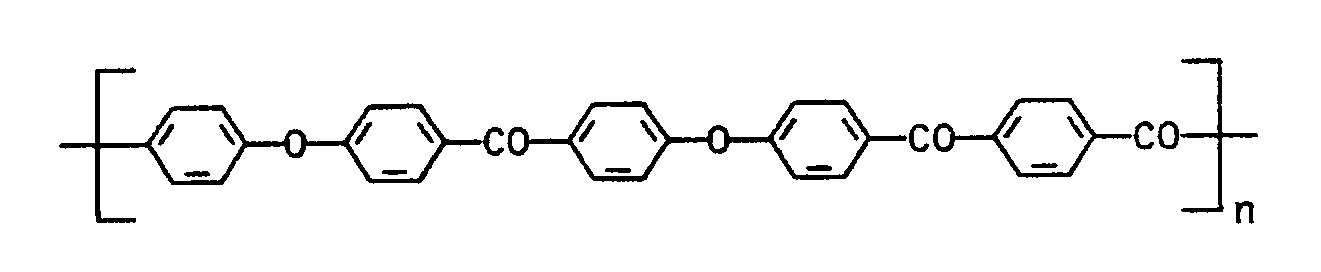
und einer relativen Lösungsviskosität von 1,478, gemessen in einer Lösung von 0,5 g Polymer in 100 ml 96% H₂SO₄ bei 25°C, wurde in an sich bekannter Weise bei einer Schmelztemperatur von 415°C zu einem Multifilamentgarn versponnen und bei einer Temperatur von 250°C im Verhältnis 1:3 verstreckt. Die Fäden hatten folgende Eigenschaften: - Titer:
- 109/30 dtex
- Reißfestigkeit:
- 5 cN/dtex
- Bruchdehnung:
- 12 %
- Die Fäden wurden zwecks Bestimmung der Licht- und UV-Beständigkeit 7 Tage lang in einer Belichtungsapparatur Xenotest 450 (Fa. Heräus, Hanau) exponiert.
- Nach 7 Tagen Belichtung (30°C/65 % rel. Feuchte) hatten die Fäden nur noch 50 % ihrer ursprünglichen Reißfestigkeit und die Bruchdehnung war auf einen Wert von 5 % abgefallen.
- Polyetherketonfäden wurden, wie in Vergleichsbeispiel 1 beschrieben, hergestellt und mit einer Lösung von 10 g SnCl₂ · 2 H₂O und 12,6 g Tetraisopropyltitanat in 20 g abs. Ethanol und 10 g Eisessig bei Zimmertemperatur so beschichtet, daß ein Faserauftrag von ca. 7 %/getrocknete Faser resultierte.
- Nach 7 Tagen Belichtung im Xenotest 450 war die Festigkeit auf 51 % des Anfangswertes abgefallen und die Bruchdehnung betrug nur noch 6 %. Die Haftung der stabilisierenden Verbindungen auf der Faser war schlecht und die stab. Verbindungen selbst waren ungleichmäßig auf der Faseroberfläche verteilt.
- Polyetherketonfäden gemäß Vergleichsbeispiel 1 wurden kontinuierlich mit einer Lösung von 7 g eines Polyethersulfons mit den wiederkehrenden Einheiten

und einer rel. Lösungsviskosität von 1,313, gemessen 1 % in NMP bei 25°C, und 3,5 g eines UV-Stabilisators 2,4,2',4'-Tetrahydroxybenzophenon in 89,5 g N-Methylpyrrolidon so beschichtet, daß ein Auftrag auf der Faser nach dem Trocknen bei 230°C von 7 % resultierte. Die Haftung der als filmartiger überzug auf der Faser befindlichen stabilisierenden Substanzen war auch nach dem Belichten gut. Nach einer Belichtung von 7 Tagen im Xenotest 450 war die Restfestigkeit der Fäden noch 84 % und die Bruchdehnung betrug noch 10 %. - Polyetherketonfäden gemäß Beispiel 1 wurden kontinuierlich mit einer Lösung von 7 g eines Polysulfons mit den wiederkehrenden Einheiten

und einer rel. Lösungsviskosität von 1,306, gemessen 1 % in NMP bei 25°C und 1 g eines UV-Stabilisators der Formel
in 92 g N-Methylpyrrolidon so beschichtet, daß ein Auftrag auf der Faser nach dem Trocknen bei 230°C von 8 % resultierte. - Die Haftung des als filmartiger Überzug auf der Faser befindlichen Stabilisatorsystems war auch nach dem Belichten gut. Nach einer Belichtung von 7 Tagen im Xenotest 450 war die Restfestigkeit der Fäden noch 76 % und die Bruchdehnung noch 10 %.
- Ein Gewebe aus Polyetherketonfäden gemäß Beispiel 1 wurde diskontinuierlich mit einer Lösung beschichtet, die auf 100 g N-Methylpyrrolidon 7 g Polyethersulfon und 3,5 g 2',4',2',4'-Tetrahydroxybenzophenon enthielt. Nach dem Trocknen bei 230°C zwecks Entfernung des Lösungsmittels wurde das beschichtete Gewebe belichtet.
Ergebnis nach 7 Tagen Xenotest 450: 56 % Restfestigkeit. - Polyetherketonfäden, wie in Beispiel 1 beschrieben, und mit 2 Gew.% eines löslichen gelben Farbstoffs eingefärbt, wurde, wie in Beispiel 1 beschrieben, behandelt.
Nach einer Belichtung der Fäden 7 Tage lang im Xenotest 450 betrug die Restfestigkeit noch 87 %.
Claims (9)
- Geformte Gebilde aus aromatischen Polyetherketonen die gegen UV-Strahlung stabilisiert sind, dadurch gekennzeichnet, daß sie mit mindestens einem filmbildenden Polymeren mit einem Gehalt an mindestens einem in dem filmbildenden Polymeren gelösten und/oder dispergierten UV-Strahlung absorbierenden Mitteln beschichtet sind.
- Geformte Gebilde aus aromatischen Polyetherketonen, dadurch gekennzeichnet, daß sie aus der Schmelze geformte Fäden, Fasern oder Folien sind.
- Geformte Gebilde aus aromatischen Polyetherketonen nach den Ansprüchen 1 und 2, dadurch gekennzeichnet, daß sie mit mindestens einem der filmbildenden Polymeren, ausgewählt aus der Gruppe Polyvinylalkohol, Polyvinylacetat, Polyvinylpyrrolidon, Polyamid, Polyarylsulfon und Polyacrylsäureester und deren Copolymeren, beschichtet sind.
- Geformte Gebilde aus aromatischen Polyetherketonen nach den Ansprüchen 1 bis 3, dadurch gekennzeichnet, daß die Schicht aus filmbildenden Polymeren aus 1 bis 3 Lagen besteht.
- Geformte Gebilde aus aromatischen Polyetherketonen nach den Ansprüchen 1 bis 4, dadurch gekennzeichnet, daß die Schicht aus filmbildenden Polymeren mindestens ein sterisch gehindertes Phenol, ein Benztriazol oder Hydroxybenzophenon als UV-Strahlen absorbierendes Mittel enthält.
- Verfahren zur Herstellung von geformten Gebilden aus aromatischen Polyetherketonen die gegen UV-Strahlung stabilisiert sind, dadurch gekennzeichnet, daß man geformte Gebilde aus aromatischen Polyetherketonen mit einer gegenüber Polyetherketonen indifferenten Lösung oder Dispersion eines filmbildenden Polymeren, die mindestens ein UV-Strahlen absorbierendes Mittel gelöst und/oder dispergiert enthält, beschichtet und das Lösungs- oder Dispergiermittel bei erhöhter Temperatur unter Bildung eines Polymerfilms entfernt.
- Verfahren nach Anspruch 6, dadurch gekennzeichnet, daß man als Lösungsmittel N-Methylpyrrolidon, Dimethylformamid, Dimethylsulfoxid, Alkanole mit 1 bis 4 Kohlenstoffatomen, deren Ester mit niederen Fettsäuren, Wasser oder deren Gemische verwendet.
- Verfahren nach den Ansprüchen 6 und 7, dadurch gekennzeichnet, daß man 5 bis 20 gew.%ige Lösungen von filmbildenden Polymeren verwendet.
- Verfahren nach den Ansprüchen 6 bis 8, dadurch gekennzeichnet, daß man die geformten Gebilde aus aromatischen Polyetherketonen mindestens einmal in eine Lösung oder Dispersion aus filmbildenden Polymeren, die ein UV-Strahlen absorbierendes Mittel enthält, taucht und anschließend durch Entfernen des Lösungs- oder Dispergiermittels durch Erhitzen auf eine Temperatur von bis zu 230°C einen Polymerfilm auf der Oberfläche erzeugt.
Applications Claiming Priority (2)
| Application Number | Priority Date | Filing Date | Title |
|---|---|---|---|
| DE4009209A DE4009209A1 (de) | 1990-03-22 | 1990-03-22 | Geformte gebilde aus aromatischen polyetherketonen, die gegen uv-strahlung stabilisiert sind, und ein verfahren zu deren herstellung |
| DE4009209 | 1990-03-22 |
Publications (3)
| Publication Number | Publication Date |
|---|---|
| EP0447964A2 true EP0447964A2 (de) | 1991-09-25 |
| EP0447964A3 EP0447964A3 (en) | 1992-04-08 |
| EP0447964B1 EP0447964B1 (de) | 1995-06-21 |
Family
ID=6402814
Family Applications (1)
| Application Number | Title | Priority Date | Filing Date |
|---|---|---|---|
| EP19910103925 Expired - Lifetime EP0447964B1 (de) | 1990-03-22 | 1991-03-14 | Geformte Gebilde aus aromatischen Polyetherketonen, die gegen UV-Strahlung stabilisiert sind, und ein Verfahren zu deren Herstellung |
Country Status (4)
| Country | Link |
|---|---|
| US (1) | US5217806A (de) |
| EP (1) | EP0447964B1 (de) |
| JP (1) | JPH04222841A (de) |
| DE (2) | DE4009209A1 (de) |
Cited By (1)
| Publication number | Priority date | Publication date | Assignee | Title |
|---|---|---|---|---|
| WO1996025548A1 (en) * | 1995-02-17 | 1996-08-22 | Kimberly-Clark Worldwide,Inc. | Fabrics with improved ultraviolet radiation stability |
Families Citing this family (4)
| Publication number | Priority date | Publication date | Assignee | Title |
|---|---|---|---|---|
| US5900439A (en) * | 1996-09-02 | 1999-05-04 | Basf Aktiengesellschaft | Stabilized polyurethanes |
| KR20160076784A (ko) * | 2014-12-23 | 2016-07-01 | 다이텍연구원 | 폴리케톤 원사의 코팅 가공 방법 |
| KR101717117B1 (ko) * | 2016-10-26 | 2017-03-17 | 다이텍연구원 | 폴리케톤 원사의 코팅 가공 방법 |
| CN110337462B (zh) * | 2017-02-24 | 2023-09-15 | 索尔维特殊聚合物美国有限责任公司 | 用于处理聚合物制品的表面层的uv稳定剂溶液 |
Family Cites Families (8)
| Publication number | Priority date | Publication date | Assignee | Title |
|---|---|---|---|---|
| US3987001A (en) * | 1975-02-03 | 1976-10-19 | Chevron Research Company | Ultraviolet protectorant composition |
| US4288631A (en) * | 1979-09-05 | 1981-09-08 | General Electric Company | UV Stabilizers, coating compositions and composite structures obtained therefrom |
| US4323597A (en) * | 1980-09-15 | 1982-04-06 | General Electric Company | Process for producing an ultraviolet radiation stabilized polymeric article |
| US4556606A (en) * | 1983-12-30 | 1985-12-03 | General Electric Company | UV-Stabilized coated polyester-carbonate articles and process |
| US4600647A (en) * | 1984-09-26 | 1986-07-15 | Union Carbide Corporation | Ultraviolet light stabilized polyarylate containing article |
| US4666779A (en) * | 1985-01-30 | 1987-05-19 | General Electric Company | Methyl methacrylic coatings on thermoplastic substrates |
| US4861651A (en) * | 1988-06-02 | 1989-08-29 | Goldenhersh Michael A | Ultraviolet blocking material and method of making same |
| US5045396A (en) * | 1988-11-23 | 1991-09-03 | Ppg Industries, Inc. | UV resistant primer |
-
1990
- 1990-03-22 DE DE4009209A patent/DE4009209A1/de not_active Withdrawn
-
1991
- 1991-03-11 US US07/666,932 patent/US5217806A/en not_active Expired - Fee Related
- 1991-03-14 EP EP19910103925 patent/EP0447964B1/de not_active Expired - Lifetime
- 1991-03-14 DE DE59105756T patent/DE59105756D1/de not_active Expired - Lifetime
- 1991-03-15 JP JP3050937A patent/JPH04222841A/ja active Pending
Cited By (1)
| Publication number | Priority date | Publication date | Assignee | Title |
|---|---|---|---|---|
| WO1996025548A1 (en) * | 1995-02-17 | 1996-08-22 | Kimberly-Clark Worldwide,Inc. | Fabrics with improved ultraviolet radiation stability |
Also Published As
| Publication number | Publication date |
|---|---|
| EP0447964A3 (en) | 1992-04-08 |
| DE59105756D1 (de) | 1995-07-27 |
| DE4009209A1 (de) | 1991-09-26 |
| US5217806A (en) | 1993-06-08 |
| JPH04222841A (ja) | 1992-08-12 |
| EP0447964B1 (de) | 1995-06-21 |
Similar Documents
| Publication | Publication Date | Title |
|---|---|---|
| DE2445404A1 (de) | Verfahren zum spinnen von faserbildenden polyestern | |
| CH615201A5 (de) | ||
| DE1568351C3 (de) | Symmetrische Oxafsäure-diaryfamide und ihre Verwendung als Lichtschutzmittel | |
| CH350461A (de) | Verwendung von Oxyketonen zum Schutze gegen ultraviolette Strahlung | |
| EP0225280B1 (de) | Verfahren zur Veredlung von textilen Flächengebilden | |
| DE758064C (de) | Verfahren zur Herstellung von elastischen Superpolyamiden | |
| DE1570890A1 (de) | Polymerisate aus Diaminobenzaniliden | |
| EP0447964B1 (de) | Geformte Gebilde aus aromatischen Polyetherketonen, die gegen UV-Strahlung stabilisiert sind, und ein Verfahren zu deren Herstellung | |
| DE69302284T3 (de) | Fasern und folien mit verbesserter flammfestigkeit | |
| DE2427393A1 (de) | Fluorierte faeden, fasern und filme mit guter farbstoffaffinitaet, deren herstellungsverfahren und zusammensetzungen zu deren herstellung | |
| DE2230304A1 (de) | s-Triazinderivate, deren Herstellung und Verwendung | |
| DE2229800C3 (de) | Glanzstabilisierte Fasern und Filme aus Acrylnitrücopolymerisaten | |
| DE1916722C3 (de) | Polymerlösung und deren Verwendung zur Herstellung von Fäden und Filmen | |
| DE941575C (de) | Verfahren zur Herstellung von Kopolymeren von Vinylverbindungen und Vinylidenverbindungen durch Emulsionspolymerisation | |
| EP0449063A2 (de) | Geformte Gebilde aus aromatischen Polyethersulfonen, die gegen UV-Strahlung stabilisiert sind und ein Verfahren zu deren Herstellung | |
| DE2516684A1 (de) | Polyarylamide, ihre herstellung und verwendung als absorptionsmittel fuer ultraviolette strahlen | |
| DE1152257B (de) | Thermoplastische Formkoerper, die synthetische, lineare Polyester und einen Zusatz enthalten | |
| DE60005420T2 (de) | Artikel aus Polybenzazol und Verfahren zu ihrer Herstellung | |
| DE1494658C3 (de) | Verfahren zur Herstellung von aus Mantel und Kern bestehenden Verbundfaden für textile Zwecke | |
| DE2402957A1 (de) | Stabilisierung halogenhaltiger acrylnitrilpolymerer | |
| DE2225282A1 (de) | Neue Zusammensetzungen auf der Basis von Polyestern mit guter Farbaffinität und Verfahren zu deren Herstellung | |
| DE2416891A1 (de) | Verfahren zur herstellung eines weichgemachten formkoerpers auf basis von cellulosederivaten | |
| DE1078732B (de) | Verfahren zur Herstellung von pigmentierten Stuecken aus hochschmelzenden, spinnfaehigen Polyestern | |
| DE1494658B2 (de) | Verfahren zur herstellung von aus mantel und kern bestehenden verbundfaeden fuer textile zwecke | |
| DD296323A5 (de) | Verfahren zum stabilisieren von polyoxadiazol gegen versproeden und verfaerben |
Legal Events
| Date | Code | Title | Description |
|---|---|---|---|
| PUAI | Public reference made under article 153(3) epc to a published international application that has entered the european phase |
Free format text: ORIGINAL CODE: 0009012 |
|
| AK | Designated contracting states |
Kind code of ref document: A2 Designated state(s): BE CH DE FR GB IT LI NL |
|
| PUAL | Search report despatched |
Free format text: ORIGINAL CODE: 0009013 |
|
| AK | Designated contracting states |
Kind code of ref document: A3 Designated state(s): BE CH DE FR GB IT LI NL |
|
| 17P | Request for examination filed |
Effective date: 19920321 |
|
| 17Q | First examination report despatched |
Effective date: 19940224 |
|
| GRAA | (expected) grant |
Free format text: ORIGINAL CODE: 0009210 |
|
| AK | Designated contracting states |
Kind code of ref document: B1 Designated state(s): BE CH DE FR GB IT LI NL |
|
| REF | Corresponds to: |
Ref document number: 59105756 Country of ref document: DE Date of ref document: 19950727 |
|
| GBT | Gb: translation of ep patent filed (gb section 77(6)(a)/1977) |
Effective date: 19950713 |
|
| ITF | It: translation for a ep patent filed | ||
| ET | Fr: translation filed | ||
| PLBE | No opposition filed within time limit |
Free format text: ORIGINAL CODE: 0009261 |
|
| STAA | Information on the status of an ep patent application or granted ep patent |
Free format text: STATUS: NO OPPOSITION FILED WITHIN TIME LIMIT |
|
| 26N | No opposition filed | ||
| REG | Reference to a national code |
Ref country code: GB Ref legal event code: IF02 |
|
| PGFP | Annual fee paid to national office [announced via postgrant information from national office to epo] |
Ref country code: FR Payment date: 20030213 Year of fee payment: 13 |
|
| PGFP | Annual fee paid to national office [announced via postgrant information from national office to epo] |
Ref country code: NL Payment date: 20030214 Year of fee payment: 13 |
|
| PGFP | Annual fee paid to national office [announced via postgrant information from national office to epo] |
Ref country code: GB Payment date: 20030227 Year of fee payment: 13 Ref country code: CH Payment date: 20030227 Year of fee payment: 13 |
|
| PGFP | Annual fee paid to national office [announced via postgrant information from national office to epo] |
Ref country code: BE Payment date: 20030312 Year of fee payment: 13 |
|
| PGFP | Annual fee paid to national office [announced via postgrant information from national office to epo] |
Ref country code: DE Payment date: 20030415 Year of fee payment: 13 |
|
| PG25 | Lapsed in a contracting state [announced via postgrant information from national office to epo] |
Ref country code: GB Free format text: LAPSE BECAUSE OF NON-PAYMENT OF DUE FEES Effective date: 20040314 |
|
| PG25 | Lapsed in a contracting state [announced via postgrant information from national office to epo] |
Ref country code: LI Free format text: LAPSE BECAUSE OF NON-PAYMENT OF DUE FEES Effective date: 20040331 Ref country code: CH Free format text: LAPSE BECAUSE OF NON-PAYMENT OF DUE FEES Effective date: 20040331 Ref country code: BE Free format text: LAPSE BECAUSE OF NON-PAYMENT OF DUE FEES Effective date: 20040331 |
|
| PG25 | Lapsed in a contracting state [announced via postgrant information from national office to epo] |
Ref country code: DE Free format text: LAPSE BECAUSE OF THE APPLICANT RENOUNCES Effective date: 20040429 |
|
| BERE | Be: lapsed |
Owner name: *BASF A.G. Effective date: 20040331 |
|
| PG25 | Lapsed in a contracting state [announced via postgrant information from national office to epo] |
Ref country code: NL Free format text: LAPSE BECAUSE OF NON-PAYMENT OF DUE FEES Effective date: 20041001 |
|
| GBPC | Gb: european patent ceased through non-payment of renewal fee |
Effective date: 20040314 |
|
| REG | Reference to a national code |
Ref country code: CH Ref legal event code: PL |
|
| PG25 | Lapsed in a contracting state [announced via postgrant information from national office to epo] |
Ref country code: FR Free format text: LAPSE BECAUSE OF NON-PAYMENT OF DUE FEES Effective date: 20041130 |
|
| NLV4 | Nl: lapsed or anulled due to non-payment of the annual fee |
Effective date: 20041001 |
|
| REG | Reference to a national code |
Ref country code: FR Ref legal event code: ST |
|
| PG25 | Lapsed in a contracting state [announced via postgrant information from national office to epo] |
Ref country code: IT Free format text: LAPSE BECAUSE OF NON-PAYMENT OF DUE FEES Effective date: 20050314 |