EP0447562B1 - Amorphe feuerfeste zusammensetzung - Google Patents
Amorphe feuerfeste zusammensetzung Download PDFInfo
- Publication number
- EP0447562B1 EP0447562B1 EP90914780A EP90914780A EP0447562B1 EP 0447562 B1 EP0447562 B1 EP 0447562B1 EP 90914780 A EP90914780 A EP 90914780A EP 90914780 A EP90914780 A EP 90914780A EP 0447562 B1 EP0447562 B1 EP 0447562B1
- Authority
- EP
- European Patent Office
- Prior art keywords
- refractory
- flowability
- phenol resin
- novolak type
- type phenol
- Prior art date
- Legal status (The legal status is an assumption and is not a legal conclusion. Google has not performed a legal analysis and makes no representation as to the accuracy of the status listed.)
- Expired - Lifetime
Links
- 239000011819 refractory material Substances 0.000 title abstract description 16
- 239000005011 phenolic resin Substances 0.000 claims abstract description 76
- 229920003986 novolac Polymers 0.000 claims abstract description 67
- 239000007788 liquid Substances 0.000 claims abstract description 49
- 239000000203 mixture Substances 0.000 claims description 79
- 238000000926 separation method Methods 0.000 claims description 31
- 239000003960 organic solvent Substances 0.000 claims description 18
- 238000009472 formulation Methods 0.000 claims description 17
- -1 polyethylene Polymers 0.000 claims description 15
- 239000011823 monolithic refractory Substances 0.000 claims description 14
- 239000003795 chemical substances by application Substances 0.000 claims description 8
- 150000002148 esters Chemical class 0.000 claims description 7
- 238000002844 melting Methods 0.000 claims description 6
- 230000008018 melting Effects 0.000 claims description 6
- 150000003839 salts Chemical class 0.000 claims description 6
- 239000012188 paraffin wax Substances 0.000 claims description 5
- 239000004743 Polypropylene Substances 0.000 claims description 4
- 235000021355 Stearic acid Nutrition 0.000 claims description 4
- 125000001931 aliphatic group Chemical group 0.000 claims description 4
- 229930195733 hydrocarbon Natural products 0.000 claims description 4
- QIQXTHQIDYTFRH-UHFFFAOYSA-N octadecanoic acid Chemical compound CCCCCCCCCCCCCCCCCC(O)=O QIQXTHQIDYTFRH-UHFFFAOYSA-N 0.000 claims description 4
- OQCDKBAXFALNLD-UHFFFAOYSA-N octadecanoic acid Natural products CCCCCCCC(C)CCCCCCCCC(O)=O OQCDKBAXFALNLD-UHFFFAOYSA-N 0.000 claims description 4
- 229920000098 polyolefin Polymers 0.000 claims description 4
- 229920001155 polypropylene Polymers 0.000 claims description 4
- 239000008117 stearic acid Substances 0.000 claims description 4
- 239000004698 Polyethylene Substances 0.000 claims description 3
- 239000002253 acid Substances 0.000 claims description 3
- 235000014593 oils and fats Nutrition 0.000 claims description 3
- 229920000573 polyethylene Polymers 0.000 claims description 3
- 239000004215 Carbon black (E152) Substances 0.000 claims 2
- 238000004062 sedimentation Methods 0.000 abstract description 11
- 238000005204 segregation Methods 0.000 abstract description 3
- 239000003112 inhibitor Substances 0.000 abstract 1
- 230000003019 stabilising effect Effects 0.000 abstract 1
- 239000000463 material Substances 0.000 description 63
- 229920005989 resin Polymers 0.000 description 57
- 239000011347 resin Substances 0.000 description 57
- 230000001070 adhesive effect Effects 0.000 description 19
- 239000000853 adhesive Substances 0.000 description 18
- 238000002156 mixing Methods 0.000 description 16
- 239000007787 solid Substances 0.000 description 16
- 239000011295 pitch Substances 0.000 description 15
- 239000000843 powder Substances 0.000 description 15
- 239000000047 product Substances 0.000 description 13
- 230000008439 repair process Effects 0.000 description 13
- CPLXHLVBOLITMK-UHFFFAOYSA-N Magnesium oxide Chemical compound [Mg]=O CPLXHLVBOLITMK-UHFFFAOYSA-N 0.000 description 12
- 239000000243 solution Substances 0.000 description 12
- 229910052799 carbon Inorganic materials 0.000 description 11
- 238000004898 kneading Methods 0.000 description 8
- 239000011230 binding agent Substances 0.000 description 7
- 238000012360 testing method Methods 0.000 description 7
- OKTJSMMVPCPJKN-UHFFFAOYSA-N Carbon Chemical compound [C] OKTJSMMVPCPJKN-UHFFFAOYSA-N 0.000 description 6
- LYCAIKOWRPUZTN-UHFFFAOYSA-N Ethylene glycol Chemical compound OCCO LYCAIKOWRPUZTN-UHFFFAOYSA-N 0.000 description 6
- DNIAPMSPPWPWGF-UHFFFAOYSA-N Propylene glycol Chemical compound CC(O)CO DNIAPMSPPWPWGF-UHFFFAOYSA-N 0.000 description 6
- VYPSYNLAJGMNEJ-UHFFFAOYSA-N Silicium dioxide Chemical compound O=[Si]=O VYPSYNLAJGMNEJ-UHFFFAOYSA-N 0.000 description 6
- 238000011049 filling Methods 0.000 description 6
- 238000010438 heat treatment Methods 0.000 description 6
- 239000000395 magnesium oxide Substances 0.000 description 6
- 238000000034 method Methods 0.000 description 6
- 239000004033 plastic Substances 0.000 description 6
- 229920003023 plastic Polymers 0.000 description 6
- 238000003860 storage Methods 0.000 description 6
- 238000005452 bending Methods 0.000 description 5
- 239000011294 coal tar pitch Substances 0.000 description 5
- 230000000052 comparative effect Effects 0.000 description 5
- 230000000694 effects Effects 0.000 description 5
- PNEYBMLMFCGWSK-UHFFFAOYSA-N aluminium oxide Inorganic materials [O-2].[O-2].[O-2].[Al+3].[Al+3] PNEYBMLMFCGWSK-UHFFFAOYSA-N 0.000 description 4
- 239000011449 brick Substances 0.000 description 4
- 230000005484 gravity Effects 0.000 description 4
- 230000006872 improvement Effects 0.000 description 4
- 238000004519 manufacturing process Methods 0.000 description 4
- 238000006116 polymerization reaction Methods 0.000 description 4
- 239000002904 solvent Substances 0.000 description 4
- ZWEHNKRNPOVVGH-UHFFFAOYSA-N 2-Butanone Chemical compound CCC(C)=O ZWEHNKRNPOVVGH-UHFFFAOYSA-N 0.000 description 3
- 239000007767 bonding agent Substances 0.000 description 3
- 230000007423 decrease Effects 0.000 description 3
- 238000002474 experimental method Methods 0.000 description 3
- 239000002184 metal Substances 0.000 description 3
- 229910052751 metal Inorganic materials 0.000 description 3
- 239000003208 petroleum Substances 0.000 description 3
- 239000000377 silicon dioxide Substances 0.000 description 3
- 239000002002 slurry Substances 0.000 description 3
- 229910052845 zircon Inorganic materials 0.000 description 3
- GFQYVLUOOAAOGM-UHFFFAOYSA-N zirconium(iv) silicate Chemical compound [Zr+4].[O-][Si]([O-])([O-])[O-] GFQYVLUOOAAOGM-UHFFFAOYSA-N 0.000 description 3
- CSCPPACGZOOCGX-UHFFFAOYSA-N Acetone Chemical compound CC(C)=O CSCPPACGZOOCGX-UHFFFAOYSA-N 0.000 description 2
- LFQSCWFLJHTTHZ-UHFFFAOYSA-N Ethanol Chemical compound CCO LFQSCWFLJHTTHZ-UHFFFAOYSA-N 0.000 description 2
- PEDCQBHIVMGVHV-UHFFFAOYSA-N Glycerine Chemical compound OCC(O)CO PEDCQBHIVMGVHV-UHFFFAOYSA-N 0.000 description 2
- ISWSIDIOOBJBQZ-UHFFFAOYSA-N Phenol Chemical compound OC1=CC=CC=C1 ISWSIDIOOBJBQZ-UHFFFAOYSA-N 0.000 description 2
- 239000011822 basic refractory Substances 0.000 description 2
- 239000006229 carbon black Substances 0.000 description 2
- 235000019241 carbon black Nutrition 0.000 description 2
- 238000003763 carbonization Methods 0.000 description 2
- 230000008859 change Effects 0.000 description 2
- 238000006243 chemical reaction Methods 0.000 description 2
- 239000011280 coal tar Substances 0.000 description 2
- 238000001816 cooling Methods 0.000 description 2
- 238000005520 cutting process Methods 0.000 description 2
- 230000007547 defect Effects 0.000 description 2
- 230000009969 flowable effect Effects 0.000 description 2
- 239000012530 fluid Substances 0.000 description 2
- HYBBIBNJHNGZAN-UHFFFAOYSA-N furfural Chemical compound O=CC1=CC=CO1 HYBBIBNJHNGZAN-UHFFFAOYSA-N 0.000 description 2
- 229910002804 graphite Inorganic materials 0.000 description 2
- 239000010439 graphite Substances 0.000 description 2
- VNWKTOKETHGBQD-UHFFFAOYSA-N methane Chemical compound C VNWKTOKETHGBQD-UHFFFAOYSA-N 0.000 description 2
- 230000003449 preventive effect Effects 0.000 description 2
- 230000003014 reinforcing effect Effects 0.000 description 2
- 239000013049 sediment Substances 0.000 description 2
- 239000000126 substance Substances 0.000 description 2
- 239000004094 surface-active agent Substances 0.000 description 2
- 239000012815 thermoplastic material Substances 0.000 description 2
- 229920001187 thermosetting polymer Polymers 0.000 description 2
- WHRZCXAVMTUTDD-UHFFFAOYSA-N 1h-furo[2,3-d]pyrimidin-2-one Chemical compound N1C(=O)N=C2OC=CC2=C1 WHRZCXAVMTUTDD-UHFFFAOYSA-N 0.000 description 1
- ZNQVEEAIQZEUHB-UHFFFAOYSA-N 2-ethoxyethanol Chemical compound CCOCCO ZNQVEEAIQZEUHB-UHFFFAOYSA-N 0.000 description 1
- 235000006173 Larrea tridentata Nutrition 0.000 description 1
- 244000073231 Larrea tridentata Species 0.000 description 1
- 229920000877 Melamine resin Polymers 0.000 description 1
- 239000004640 Melamine resin Substances 0.000 description 1
- 229910000805 Pig iron Inorganic materials 0.000 description 1
- 238000005299 abrasion Methods 0.000 description 1
- 150000001298 alcohols Chemical class 0.000 description 1
- 229910045601 alloy Inorganic materials 0.000 description 1
- 239000000956 alloy Substances 0.000 description 1
- 125000003118 aryl group Chemical group 0.000 description 1
- QVGXLLKOCUKJST-UHFFFAOYSA-N atomic oxygen Chemical compound [O] QVGXLLKOCUKJST-UHFFFAOYSA-N 0.000 description 1
- 230000015572 biosynthetic process Effects 0.000 description 1
- 239000013590 bulk material Substances 0.000 description 1
- 239000003575 carbonaceous material Substances 0.000 description 1
- 238000010000 carbonizing Methods 0.000 description 1
- 238000005266 casting Methods 0.000 description 1
- 239000004568 cement Substances 0.000 description 1
- 239000002131 composite material Substances 0.000 description 1
- 238000013329 compounding Methods 0.000 description 1
- 150000001875 compounds Chemical class 0.000 description 1
- 229960002126 creosote Drugs 0.000 description 1
- 238000000354 decomposition reaction Methods 0.000 description 1
- 230000008021 deposition Effects 0.000 description 1
- 238000009826 distribution Methods 0.000 description 1
- 239000010459 dolomite Substances 0.000 description 1
- 229910000514 dolomite Inorganic materials 0.000 description 1
- 230000001747 exhibiting effect Effects 0.000 description 1
- 238000005187 foaming Methods 0.000 description 1
- 239000000295 fuel oil Substances 0.000 description 1
- 239000007789 gas Substances 0.000 description 1
- 235000011187 glycerol Nutrition 0.000 description 1
- 150000002430 hydrocarbons Chemical class 0.000 description 1
- 150000002576 ketones Chemical class 0.000 description 1
- 239000007791 liquid phase Substances 0.000 description 1
- 239000011159 matrix material Substances 0.000 description 1
- 230000007246 mechanism Effects 0.000 description 1
- 239000011259 mixed solution Substances 0.000 description 1
- 239000011821 neutral refractory Substances 0.000 description 1
- 239000005416 organic matter Substances 0.000 description 1
- 230000003647 oxidation Effects 0.000 description 1
- 238000007254 oxidation reaction Methods 0.000 description 1
- 229910052760 oxygen Inorganic materials 0.000 description 1
- 239000001301 oxygen Substances 0.000 description 1
- 238000012856 packing Methods 0.000 description 1
- 239000008188 pellet Substances 0.000 description 1
- 239000011301 petroleum pitch Substances 0.000 description 1
- 239000012071 phase Substances 0.000 description 1
- 239000002244 precipitate Substances 0.000 description 1
- 238000001556 precipitation Methods 0.000 description 1
- 238000002360 preparation method Methods 0.000 description 1
- 230000002265 prevention Effects 0.000 description 1
- 230000008569 process Effects 0.000 description 1
- 238000007670 refining Methods 0.000 description 1
- 230000001105 regulatory effect Effects 0.000 description 1
- 238000010008 shearing Methods 0.000 description 1
- 230000035939 shock Effects 0.000 description 1
- HBMJWWWQQXIZIP-UHFFFAOYSA-N silicon carbide Chemical compound [Si+]#[C-] HBMJWWWQQXIZIP-UHFFFAOYSA-N 0.000 description 1
- 229910010271 silicon carbide Inorganic materials 0.000 description 1
- 150000005846 sugar alcohols Polymers 0.000 description 1
- 229920005992 thermoplastic resin Polymers 0.000 description 1
- 239000004634 thermosetting polymer Substances 0.000 description 1
- ZIBGPFATKBEMQZ-UHFFFAOYSA-N triethylene glycol Chemical compound OCCOCCOCCO ZIBGPFATKBEMQZ-UHFFFAOYSA-N 0.000 description 1
Images



Classifications
-
- C—CHEMISTRY; METALLURGY
- C04—CEMENTS; CONCRETE; ARTIFICIAL STONE; CERAMICS; REFRACTORIES
- C04B—LIME, MAGNESIA; SLAG; CEMENTS; COMPOSITIONS THEREOF, e.g. MORTARS, CONCRETE OR LIKE BUILDING MATERIALS; ARTIFICIAL STONE; CERAMICS; REFRACTORIES; TREATMENT OF NATURAL STONE
- C04B35/00—Shaped ceramic products characterised by their composition; Ceramics compositions; Processing powders of inorganic compounds preparatory to the manufacturing of ceramic products
- C04B35/622—Forming processes; Processing powders of inorganic compounds preparatory to the manufacturing of ceramic products
- C04B35/626—Preparing or treating the powders individually or as batches ; preparing or treating macroscopic reinforcing agents for ceramic products, e.g. fibres; mechanical aspects section B
- C04B35/63—Preparing or treating the powders individually or as batches ; preparing or treating macroscopic reinforcing agents for ceramic products, e.g. fibres; mechanical aspects section B using additives specially adapted for forming the products, e.g.. binder binders
- C04B35/632—Organic additives
- C04B35/634—Polymers
- C04B35/63448—Polymers obtained otherwise than by reactions only involving carbon-to-carbon unsaturated bonds
- C04B35/63472—Condensation polymers of aldehydes or ketones
-
- C—CHEMISTRY; METALLURGY
- C04—CEMENTS; CONCRETE; ARTIFICIAL STONE; CERAMICS; REFRACTORIES
- C04B—LIME, MAGNESIA; SLAG; CEMENTS; COMPOSITIONS THEREOF, e.g. MORTARS, CONCRETE OR LIKE BUILDING MATERIALS; ARTIFICIAL STONE; CERAMICS; REFRACTORIES; TREATMENT OF NATURAL STONE
- C04B35/00—Shaped ceramic products characterised by their composition; Ceramics compositions; Processing powders of inorganic compounds preparatory to the manufacturing of ceramic products
- C04B35/622—Forming processes; Processing powders of inorganic compounds preparatory to the manufacturing of ceramic products
- C04B35/626—Preparing or treating the powders individually or as batches ; preparing or treating macroscopic reinforcing agents for ceramic products, e.g. fibres; mechanical aspects section B
- C04B35/63—Preparing or treating the powders individually or as batches ; preparing or treating macroscopic reinforcing agents for ceramic products, e.g. fibres; mechanical aspects section B using additives specially adapted for forming the products, e.g.. binder binders
- C04B35/632—Organic additives
-
- C—CHEMISTRY; METALLURGY
- C04—CEMENTS; CONCRETE; ARTIFICIAL STONE; CERAMICS; REFRACTORIES
- C04B—LIME, MAGNESIA; SLAG; CEMENTS; COMPOSITIONS THEREOF, e.g. MORTARS, CONCRETE OR LIKE BUILDING MATERIALS; ARTIFICIAL STONE; CERAMICS; REFRACTORIES; TREATMENT OF NATURAL STONE
- C04B35/00—Shaped ceramic products characterised by their composition; Ceramics compositions; Processing powders of inorganic compounds preparatory to the manufacturing of ceramic products
- C04B35/66—Monolithic refractories or refractory mortars, including those whether or not containing clay
-
- C—CHEMISTRY; METALLURGY
- C04—CEMENTS; CONCRETE; ARTIFICIAL STONE; CERAMICS; REFRACTORIES
- C04B—LIME, MAGNESIA; SLAG; CEMENTS; COMPOSITIONS THEREOF, e.g. MORTARS, CONCRETE OR LIKE BUILDING MATERIALS; ARTIFICIAL STONE; CERAMICS; REFRACTORIES; TREATMENT OF NATURAL STONE
- C04B2111/00—Mortars, concrete or artificial stone or mixtures to prepare them, characterised by specific function, property or use
- C04B2111/72—Repairing or restoring existing buildings or building materials
Definitions
- the present invention relates to a refractory composition for obtaining a monolithic refractory having self-flowability used for repairing and filling in various high temperature furnaces.
- Hot repairing materials which are used to fill cavities or depressions caused by damage to lining refractories by utilizing flowability of the materials have been widely used, particularly for BOF (Basic Oxygen Furnace), electric furnaces, AOD furnaces, ladles, etc.
- BOF Basic Oxygen Furnace
- hot repairing materials are materials that are generally charged into a furnace at high temperatures and are able to fill cavities caused by damage because of the natural flow of the materials themselves to exhibit effects as repair materials, there are required to have good flowability and high adhesive strength with lining surfaces.
- Coal-tar pitch has been widely used as a binder for a hot repairing material or a baking material, as it has properties wherein the residual carbon after heating is high, forming good carbon bonds and it has a relatively low price.
- Pitch looses volatile matter and carbonizes by decomposition and polymerization reactions at about 500°C or more.
- the reaction proceeds in a complicated fashion. For this reason, it takes a long time for the pitch to carbonize at 500 - 600°C i.e. for the hot repair material or baking material to harden.
- a material in which a novolak type resin is added to a basic aggregate and heat-kneaded to obtain a massive solid body.
- the material begins to set and carbonize on its surfaces before the inside of the massive body begins to melt and soften. Therefore, in many cases, it does not flow as a whole and even if it partially flows, it is difficult to obtain a satisfactory repair effect because warpage is great and adhesive properties are unstable on the periphery portions extended by flowing.
- thermoplastic material selected from a group comprising aromatic petroleum resins, petroleum pitch and heavy oil instead of coal-tar.
- phenol resin or melamine resin and powdery carbon are added to a thermoplastic material selected from a group comprising aromatic petroleum resins, petroleum pitch and heavy oil instead of coal-tar.
- a repair material in which paraffin is added to a material comprising a basic refractory aggregate, a bituminous material such as coal-tar etc. and a thermosetting resin such as phenol resins etc. and which is then kneaded to form it into small lumps. It has advantages in that the use of paraffin allows low temperature kneading and fuming during kneading is prevented. However, it has defects in that surface hardening of the lumps is fast when they are thrown into a high temperature furnace and it is difficult for each of the lumps to unit with each other through melt-softening.
- Japanese Patent Application Laid Open No. 63-156081 a material in which refractory materials and powdery resin are kneaded with polyhydric alcohol has been disclosed. However, it does not flow at all and has scarcely any adhesive strength, particularly when a thermosetting type resin was used as the powdery resin.
- coal-tar pitch since coal-tar pitch, takes a long time to harden and remains in a softened for quite sometime after heating, it shows some flowability, but it causes the generation of harmful substances and repairs require long hours.
- a resin type bonding agent hardening begins on the surface of the agent before softening of the inside of the hot repair materials or baking materials by heating begins. For these reasons, it can not flow as a whole and it has problems in adhering to lining surfaces and tends to be difficult to form into monolithic bodies.
- the present invention has been invented to solve the problems described above.
- the object of the present invention is to provide a refractory composition having excellent flowability under heat, that controls warpage phenomena which readily generates on the periphery of a lined body, and high adhesion by using a phenol resin as a bonding agent capable of forming good carbon bonds.
- the present invention relates to a refractory composition for obtaining a monolithic refractory having self-flowability characterized in that the flow value is in the range of 125 - 180 mm by adding and mixing an organic separation preventative having a melting point or a softening point not less than 50°C to a formulation comprising 80 - 90 wt.% refractory aggregate and 10 - 20 wt.% liquid novolak type phenol resin (hereinafter, this invention being referred to as the first invention).
- the present invention relates to a refractory composition for obtaining a monolithic refractory having self-flowability at room temperature characterized in that the flow value is in the range of 125 - 180 mm by mixing refractory aggregates with a phenol resin solution made from dissolving a novolak type phenol resin having a number-average molecular weight of not more than 600 to an organic solvent in which the phenol resin content is in the range of 3.5 - 10 wt.% (hereinafter, this invention is referred to as the second invention).
- the refractory composition of the first invention of the present invention is not a conventional plastic, solid or powdery state material but is a slurry state material having self flowability and not a material which softens and flows not just from furnace heat but also flows at normal temperatures. Accordingly, when the material is charged into a furnace, it shows good flowability, filling cavities due to damage of the refractory lining walls inside the furnace, forming dense and unified refractory layers together with strong carbon bond, and making effective repair possible..
- a known liquid novolak type resin As a bonding agent for refractory compositions used for a monolithic refractory of the first invention of the present invention, a known liquid novolak type resin is used. Novolak type phenol resins are originally solid at normal temperatures and there are resins which are either powdery or granular form. However, a liquid novolak type resin containing various organic solvents is used in the present invention for giving self-flowability at normal temperatures.
- novolak type phenol resins to be a base for the liquid novolak type phenol resin
- resins having various molecular weights according to their degree of polymerization.
- molecular weight is not particularly limited, resins having higher molecular weights have higher viscosity when they are liquified by adding an organic solvent and as far as imparting self-flowability at normal temperatures is concerned, there are tendencies to increase the mixing amount of liquid resin, which cannot be said to be economic.
- there are tendencies for higher molecular weight resins to proceed faster in polymerization when exposed to high temperatures, to set faster and to lower the flowability under heat, and are therefore not preferable.
- a refractory composition of the first invention of the present invention the most important point resides in reconciling good flowability and preventing precipitation and segregation of aggregates. It is a matter of course that the quality characteristics of hardened bodies lined during heat, namely, filling density, strength etc. should be satisfied.
- Liquid novolak type phenol resins consist of a resinous portion and an organic solvent, and there are various articles on the market which have different viscosities in a liquid state due to said proportion or type of solvent, etc.
- For imparting flowability to a refractory smaller amounts thereof are possible by using a liquid novolak type phenol resin with low viscosity, while rather increased mixing amounts are necessary when a liquid novolak type phenol resin with high viscosity is used. Therefore, it is effective to use a small amount of resins with low viscosity so far as economic efficiency is concerned.
- the viscosity value of the liquid novolak type phenol resin As for the viscosity value of the liquid novolak type phenol resin, this changes according to temperature even if the same resin is used.
- the viscosity value is high at low temperatures and lowers at high temperatures. This is a big enough change to influence the self-flowability of the formulations by changes is atmospheric temperature.
- low viscosity resin if resins with approximately not more than 10 poise are used, changes in flowability over time during storage after mixing the formulations are large and therefore, is not preferable. Although the reasons have not been clarified, it is felt that liquid permeation into aggregate may influence flowability during storage.
- viscosity of the liquid novolak type phenol resin it is preferable to control viscosity of the liquid novolak type phenol resin to approximately the range of 10 to 400 poise for temperature changes in the period from production of the formulations to final use. Further, the same effect can be obtained when liquid resin with high viscosity is used and the viscosity of the liquid phase is controlled to be in the range described above by adding an organic solvent separately.
- liquid novolak type phenol resins As for the ratio of the resin content in the liquid novolak type phenol resin to an organic solvent, there are many resins which have about 50% resin content in normal liquid novolak type phenol resins. However, from the view point of strength due to formation of carbon bonds in a hardened body, it is usable if liquid novolak type phenol resins have not less than approximately 15% resin content.
- the organic solvent contained in the liquid novolak type phenol resin is not specifically limited, a liquid which dissolves phenol resin is available and in general alcohols such as ethanol, Cellosolve, ethylene glycol, triethylene glycol, propylene glycol etc., ketones such as acetone, methyl ethyl ketone etc. or furfural etc. may be used alone or mixed thereof. However, they must be selected with due regard to viscosity and safety such as the flash point thereof.
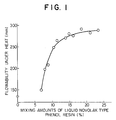
- Fig. 1 shows a relationship between added amounts of liquid novolak type phenol resin and flowability under heat.
- refractory materials regulated grain sized magnesia clinker was used to which a liquid novolak type phenol resin with various viscosities was added.
- the amount of liquid novolak type phenol resin was controlled to give self-flowability to a slurry material after kneading at normal temperatures, of 140 - 145 mm as a flow value.
- an organic separation preventative having a melting or softening point of not less than 50°C
- polyolefins such as polyethylene, polypropylene etc., methane series hydrocarbons such as paraffins etc., aliphatic acids such as stearic acid and their salts or esters, oils and fats and their esters, various synthetic high molecular compounds etc., the compositions thereof being not particularly limited.
- Organic separation preventatives are solids at normal temperatures similar to refractory aggregates, and by adding small amounts, a mix takes on a state in which liquid resin amounts look insufficient, and sedimentation separation of the refractory aggregates can be controlled to a degree that is practically negligible. Therefore an organic separation preventative used in the present invention should stay in solid form at temperatures at least from production of the mix until use, and considering temperature rises during transportation, it should have a melting or softening point of not less than 50°C.
- a processed form with a big surface area such as in powder, flake, fibrous or ribbon like state is preferable.
- the organic separation preventive agent be insoluble or sparingly soluble to an organic solvent contained in liquid novolak type phenol resins used in the first invention of the present invention and it is also preferable that the agent liquefies with low viscosity at relatively low temperatures, for instance, at 200°C and preferably at not more than 150 °C. Since a solid at normal temperatures prevents sedimentation of refractory aggregates, liquefying at relatively low temperatures by heating promotes flowability during heat.
- the specific gravity of an organic separation preventative be the same or smaller than that of the liquid novolak type phenol resin. If the specific gravity is smaller than the liquid resin, a buoyant force acts on the organic separation preventative, and the effect of preventing deposition of refractory aggregates having greater specific gravity is large.
- a small adding amount of an organic separation preventative may be used. Normally, 0.1 - 5 wt% is used for a mixture of refractory aggregates and a liquid novolak type phenol resin. If the adding amount is not more than 0.1 wt%, there is little and when compounding amounts of the liquid resin are large, enough effects are observed by adding not more than 5 wt%, so adding greater amounts is not necessary. When excessive amounts are added, sometimes self-flowability or flowability under heat of the whole mixture may lower. Optimum adding amounts of an organic separation preventative is determined by grain size distribution of the refractory aggregates, viscosity or mixing amounts of the liquid novolak type phenol resin or the form of the organic separation preventative itself, etc.
- the flow value is less than 125mm, the drop of flowability under heat is large and if it exceeds 180mm, liquid resins preferentially flow by the influence of separation of refractory aggregates as well, so this has a tendency to lower the flowability and expansion as a whole. If the flow value exceeds 180mm, the separated depth increases, as sedimentation of refractory aggregates after vibration rapidly increases.
- the flow value should be in the range of 125 - 180mm.
- Refractory aggregates which may be used for the refractory composition for obtaining a monolithic refractory with self-flowability of the first invention of the present invention are preferably basic refractory materials such as magnesia clinker or dolomite clinker, etc. when used for instance in refining furnaces, etc. acid or neutral refractory materials such as silica, zircon or alumina, etc. as well as non-oxide refractories such as silicon-carbide, etc. for molten pig iron vessels, etc. and are not specifically limited.
- Refractory aggregate grain sizes are preferably used for normal refractory compositions, for instance, adjusted to a grade in which fine powder of under 0.3 mm is in the range of 20 - 60%.
- a small amount of super fine powder such as silica, alumina, zircon etc.
- a carbonaceous material such as graphite, carbon-black, solid pitch, meso-phase carbon etc. may be added and for improving flowability, it is possible to add a small amount of a surfactant.
- a refractory composition for obtaining a monolithic refractory with self-flowability of the first invention of the present invention has objects of possessing good flowability and preventing sedimentation and separation of aggregates.
- adhesive strength was insufficient and warpage of the obtained hardened body was sometimes a problem.
- the refractory composition of the second invention of the present invention was developed to give high adhesive strength and to prevent warpage of the hardened body obtained as an object, in which a specific novolak type phenol resin is used in a specific resin concentration range as a binder.
- the refractory composition of the second invention of the present invention is not a conventional material in a state such as plastic, solid or powder but a slurry material with self-flowability as well as a refractory composition of the first invention and not a material which softens and flows by furnace heat but a material having flowability even at normal temperatures Therefore, when the materials are dropped into a furnace under heat, an effective repairing is possible, as the materials show good flowability even under high temperatures, forming a dense unified refractory layer and adhering tightly to lining surfaces inside the furnace.
- the binder used for the refractory composition of the second invention of the present invention may be a specified binder among the known novolak type phenol resins and which is formulated to have a specified resin concentration.
- the flowability of a refractory composition in a high temperature furnace is substantially the same as its behavior under normal temperatures.
- a conventional pitch type material the pitch softens to a flowable state by being exposed to high temperatures even if it is solid, plastic or powder at normal temperatures.
- pitch requires long hours to be hardened through complicated reactions, flow of the whole material is possible.
- materials in which various resins are used are easy to harden compared with pitch. For this reason, a resin softened by heat subsequently begins hardening.
- a solid, plastic or powdery material if the material surfaces begin to soften, the inside remains in its original condition and does not flow and the surface hardening begins before the inside, flow begins so that it cannot flow as a whole material.
- the refractory composition of the second invention of the present invention is not a refractory which softens and flows after receiving heat from a high temperature furnace but flows even at normal temperatures and begins to flow as soon as the refractory is dropped into the furnace.
- a refractory material is produced by kneading with a phenol resin solution in which a binder novolak type phenol resin is dissolved in an organic solvent.
- a material with self-flowability is a material which has a flow value of not less than 125mm according to JIS R-2521 flow testing method.
- a material with self-flowability is a material which has a flow value of not less than 125mm according to JIS R-2521 flow testing method.
- Another object of the refractory composition of the second invention of the present invention is to have high adhesive strength and maintain the strength for a long time after the refractory is lined on a damaged portion inside a furnace.
- a refractory composition is useless for repairing a furnace under heat unless it has high adhesive strength to wall surfaces of a high temperature furnace as it easily peels off from repaired surfaces as a result of mechanical or thermal shock, etc. Therefore, high adhesive strength and stability thereof are required for a refractory composition for repairing.
- Novolak type phenol resins with various molecular weights according to polymerization degree thereof have been sold on the market mainly in pellet or powder state, generally they have a number-average molecular weight of about 400 - 1000.
- Solid or powder resins with a low molecular weight of under 400 for instance a resin in which unreacted free phenol remains, have low softening point and are not sold on the market because they sometimes solidify during storage at normal temperatures.
- phenol resins used as a base need not be in solid or powder form and there are no problems for use if the resins were viscous at normal temperatures due to low molecular weight.
- the inventors of the present invention investigated the influences of various molecular weights novolak type phenol resins on adhesive strength.
- Novolak type phenol resins of various molecular weights were dissolved in ethylene glycol and/or propylene glycol to make a novolak type phenol resin solution with viscosity suitable to give self-flowability.
- magnesia clinkers were used as refractory aggregates and their grain sizes were controlled to have a grain size constitution suitable for a refractory composition 83 parts magnesia clinker and 17 parts novolak type phenol resins were mixed and kneaded to make refractory composition samples.
- the warpage phenomenon appears on the periphery of the lined body, for instance, a molten metal with greater specific gravity enters into any gaps formed by the warpage on the periphery and works like a wedge to peel off the whole lined body, even if the center portion of the lined body had sufficient adhesive strength. Accordingly, it is very important to restrict this warpage phenomenon as much as possible to stabilize adhesion.
- Novolak type phenol resin solutions are prepared by dissolving a novolak type phenol resin having a number-average molecular weight of not more than 600 with various organic solvents in various mixing rates.
- Refractory composition samples having self-flowability for obtaining a monolithic refractory were prepared by mixing and kneading these solutions and grain size controlled magnesia refractory materials in ratios of solution to refractory material of 10:90 - 20:80.
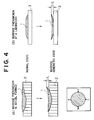
- Warpage amounts on the periphery of the flowed and expanded 1kg samples at 1000°C were measured at 4 points as shown in Fig.4(B) and the average value was regarded as the warpage amount. Correlation was studied from many angles between the warpage amount and kinds of organic solvent, mixing ratio between the organic solvent and resin portion, and viscosity of the solution etc. on these results and it was found that there is a correlation between content of novolak type phenol resin in the formulations and the warpage amount as shown in Fig. 5. From Fig. 5 it can be seen that the warpage amount is smaller when smaller amounts of a novolak type phenol resin are contained in the formulations and when resin amounts are increased, the warpage amounts increase, particularly when the resin amounts exceed 10% where substantial warpage sometimes occurs suddenly.
- the mechanism behind such warpage phenomena is not necessarily clear, it is assumed that the occurrence of volume shrinkage during processes such as softening by heat, transferring from a liquid state to a solid state and carbonizing thereafter of the novolak type phenol resin, is the largest factor. Accordingly, it is considered that the warpage amounts can be reduced by appropriately restricting the amount of novolak type phenol resin in the formulations. Although no occurrence of warpage is most preferable, considering the state of real furnaces, according to the results of this experiment it is preferable to have warpage amounts not greater than 4mm, and if possible not more than 3.5 mm. On the other hand, if the content of a novolak type phenol resin in the formulation is as low as 3%, there is little or no occurrence of warpage.
- the preferable amount of novolak type phenol resin in the formulations in the second invention of the present invention is in the range of 3.5 - 10 wt%.
- the novolak type phenol resin solution of the second invention of the present invention although mixed solutions of a novolak type phenol resin and various solvents were used for various experiments, practically, these so called liquid novolak type phenol resins are generally sold on the market.
- resins having a number-average molecular weight of not more than 600 having a partially free phenol content a suitable viscosity of for instance, about 10 - 400 poise in which the refractory composition for obtaining a monolithic refractory has self-flowability, can be used as described above. It is matter of course that the viscosity can be controlled by adding an organic solvent separately. It is necessary to control the resin content in the refractory composition to be in the range of 3.5 - 10 wt%.
- the mixing ratio between a refractory material and the novolak type phenol resin solution should be determined by totally considering the resin contents in a novolak type phenol resin solution and differences in viscosities of a solution which are related to the kind of organic solvent.
- Organic solvents which dissolve the novolak type phenol resins used for the refractory composition of the second invention of the present invention are not specifically limited, and solvents which dissolve phenol resin are permissible, with solvents used for the first invention described above also being usable.
- Refractory aggregates used for the second invention of the present invention are also not specifically limited, with the same type refractory aggregate as used in the first invention being acceptable along with the same grain sizes of refractory aggregates as in the first invention.
- an organic separation preventative used in the first invention described above such as polyolefins such as polypropylene etc., methane type hydrocarbons such as paraffin etc., aliphatic acids such as stearic acid etc. and the salts or esters thereof are available.
- adding small amounts of super fine powders such as silica, alumina, zircon etc. is also possible.
- adding small amounts of, for instance, graphite, carbon black, solid pitch, mesophase carbon etc., for preventing oxidation of carbon bonds or to improve strength under heat adding small amounts of metal powder of Al, Si, Mg or alloys thereof is allowable.
- adding small amounts of a surfactant to improve flowability is also possible.
- Fig. 1 shows a relationship between mixing amounts of a liquid novolak type phenol resin and flowability under heat.
- Fig. 2 is a graph showing a relationship between flow value and flowability under heat.
- Fig. 3 is a graph showing a relationship between the number-average molecular weight of a novolak type phenol resin and adhesive strength.
- Fig. 4 is a sectional view of warpage phenomenon as observed in a real furnace (A) and in a laboratory furnace (B).
- Fig. 5 is a graph showing a relationship between resin amount in the formulations and amount of warpage.
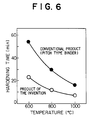
- Fig. 6 is a graph showing hardening time at each of the temperatures in Example 2 and Conventional Example 4.
- 1 denotes a refractory composition
- 2 denotes lined bricks
- 3 denotes a castable refractory plate
- L denotes amount of warpage.
- Refractory compositions of the first invention of the present invention and a refractory composition of a Comparative Example and Conventional Examples with formulations described in Table 1 were prepared, and flowability under heat, sedimentation of refractory aggregate and the properties of cast materials under heat of each of the refractory compositions were measured. The results are shown in Table 1.
- each of the Examples had little separation and showed excellent flowability in a short time.
- the porosity of the cast product was low, strength high and a lined body under heat with good filling ability through excellent flowability could be obtained.
- Conventional Example 1 was a powdery state refractory composition. It had a poor flowability and less filling ability under heat.
- Conventional Example 2 was a lump material with a size of about 30 - 50mm which was prepared by heating and kneading the material at 80°C and then cooling and solidifing it. It took a long time when the resin was liquefied to be flowable from a solids under heat. For this reason, hardening began at the surfaces so that the material had low flowability.
- Conventional Example 3 was a plastic body using a petroleum resin, the strength of cast products under heat with this material was very low and the porosity high.
- Conventional Example 4 was a material using a pitch type binder.
- Fig. 6 is a drawing comparing hardening time at each of the temperatures between Example 2 of the present invention and the pitch type material of Conventional Example 4 in which 500g samples were inserted into steel-cans which were then inserted from an upper portion of a furnace heated to a fixed temperature and the time until the surfaces of the samples in the cans became hard was measured. From the results, it is understood that Example 2 of the present invention hardens in a short time of about 1/2 - 1/3 compared with Conventional Example 4 of the pitch type at every temperature.
- Refractory compositions of the second invention of the present invention and refractory compositions of the Comparative Examples and Conventional Examples with formulations described in Table 2 were prepared, and the properties of each of the refractory compositions were measured. The results are shown in Table 2.
- a refractory sagger with inner dimensions of 200 x 125 x 90 mm was set in a small furnace, it was heated to 1200°C and after burning was stopped and the temperature of the inner surfaces of the sagger cooled to 1000°C, a 6kg sample was charged into the sagger, let stand, and samples were prepared by cutting after cooling to normal temperatures.
- the bending strength was measured on these samples by usual methods. From the results, products of the present invention show good flowability under heat such as not less than 240mm as well as sufficiently high adhering strength. Warpage amount was restricted to a grade of practically no problem. Comparative Example 2 contained a large molecular weight resin and insufficient adhering strength.
- Comparative Example 3 contained a large molecular weight resin and had insufficient adhering strength with much resin content in the refractory composition and the warpage was very large.
- Conventional product 5 was a powdery material and had insufficient flowability under heat, adhering strength, warpage and bending strength.
- Conventional product 6 was a bulk material 1 - 30mm in size which was prepared by kneading refractory materials and resins under warm temperatures, and crushing after the material was cooled and solidified and had insufficient properties similar to conventional product 5.
- Conventional product 7 was a material prepared by kneading refractory materials and thermoset resin powder using glycerin. However, it had very bad flowability under heat and no adhering strength. As the material barely flowed, it was impossible to measure the amount of warpage.
- Refractory compositions for obtaining a monolithic refractory with self-flowability of the first invention of the present invention hardly show sedimentation of refractory aggregates and show excellent flowability. Accordingly, they bring about various advantages. For instance, a large amount such as a ton of the refractory can be packed in a flexible container bag and the transport, storage and charging into a furnace as packed becomes possible. Therefore, the small packing such as in about 5 - 10kg bags which was mainly used in conventional work, is not required and the work becomes easy. In the past, refractory compositions for obtaining a monolithic refractory with flowability have been kneaded by mixers etc. at the site of use.
- the material can be kneaded and stored at a manufacturing factory and can be applied as a material which requires a flowability for lining at normal temperatures, for instance, for a filling material which fills gaps.
- a refractory composition of the second invention of the present invention shows, for instance when it was used for repairing charging walls of a BOF, a 2 - 3 time longer life compared with the life obtained by repairing with a conventional resin bonded or pitch bonded refractory composition. Furthermore, the present invention also has advantages such as a decrease of fuming which resin bonded products originally have and short hardening time etc., and not only an improvement of repairing efficiency (decrease of repairing frequency, improvement of furnace life) but also it became possible to sharply improve the working environment.
Landscapes
- Chemical & Material Sciences (AREA)
- Engineering & Computer Science (AREA)
- Ceramic Engineering (AREA)
- Manufacturing & Machinery (AREA)
- Organic Chemistry (AREA)
- Materials Engineering (AREA)
- Structural Engineering (AREA)
- Inorganic Chemistry (AREA)
- Chemical Kinetics & Catalysis (AREA)
- Ceramic Products (AREA)
- Furnace Housings, Linings, Walls, And Ceilings (AREA)
- Fireproofing Substances (AREA)
- Compositions Of Macromolecular Compounds (AREA)
- Soft Magnetic Materials (AREA)
- Glass Compositions (AREA)
- Insulated Conductors (AREA)
Claims (5)
- Feuerfestzusammensetzung zum Erhalten eines monolithischen feuerfesten Materials, die Selbstfließfähigkeit hat, dadurch gekennzeichnet, daß ein organisches Trennschutzmittel mit einem Schmelzpunkt oder Erweichungspunkt von nicht weniger als 50° C Formulierungen zugesetzt wird, die aus 80 bis 90 Gew.-% Feuerfestaggregaten und 10 bis 20 Gew.% eines flüssigen Phenolharzes vom Novolak-Typ bestehen, um einen Fließwert im Bereich von 125 bis 180 mm, bestimmt gemäß JIS R2521, zu erreichen.
- Feuerfestzusammensetzung nach Anspruch 1, worin das organische Trennschutzmittel ein Polyolefin ist, wie Polyethylen, Polypropylen usw., ein Kohlenwasserstoff der Methanreihe wie Paraffin usw., eine aliphatische Säure wie Stearinsäure und deren Salze oder Ester, oder Öle und Fette und deren Salze oder Ester.
- Feuerfestzusammensetzung zum Erhalten eines monolithischen feuerfesten Materials, die Selbstfließfähigkeit hat und bei Raumtemperatur nicht erhärtet, dadurch gekennzeichnet, daß eine Phenolharzlösung, in der ein Phenolharz vom Novolak-Typ mit einem zahlenmittleren Molekulargewicht von nicht mehr als 600 in einem organischen Lösungsmittel gelöst ist, mit Feuerfestaggregaten verknetet wird, um zu einem Phenolharzgehalt von 3,5 bis 10 Gew.-% zu gelangen und zu einem Fließwert, bestimmt gemäß JIS R2521, von 125 bis 180 mm.
- Feuerfestzusammensetzung nach Anspruch 3, die weiterhin ein organisches Trennschutzmittel mit einem Schmelzpunkt oder Erweichungspunkt von nicht weniger als 50° C enthält.
- Feuerfestzusammensetzung nach Anspruch 4, worin das organische Trennschutzmittel ein Polyolefin ist, wie Polyethylen, Polypropylen usw., ein Kohlenwasserstoff der Methanreihe, wie Paraffin usw., eine aliphatische Säure wie Stearinsäure und deren Salze oder Ester, oder Öle und Fette und deren Salze oder Ester.
Applications Claiming Priority (5)
| Application Number | Priority Date | Filing Date | Title |
|---|---|---|---|
| JP262960/89 | 1989-10-11 | ||
| JP1262960A JPH03126679A (ja) | 1989-10-11 | 1989-10-11 | 不定形耐火材 |
| JP66876/90 | 1990-03-19 | ||
| JP2066876A JPH0631161B2 (ja) | 1990-03-19 | 1990-03-19 | 不定形耐火物 |
| PCT/JP1990/001305 WO1991005748A1 (fr) | 1989-10-11 | 1990-10-09 | Materiau refractaire amorphe |
Publications (3)
| Publication Number | Publication Date |
|---|---|
| EP0447562A1 EP0447562A1 (de) | 1991-09-25 |
| EP0447562A4 EP0447562A4 (en) | 1993-07-28 |
| EP0447562B1 true EP0447562B1 (de) | 1995-05-24 |
Family
ID=26408077
Family Applications (1)
| Application Number | Title | Priority Date | Filing Date |
|---|---|---|---|
| EP90914780A Expired - Lifetime EP0447562B1 (de) | 1989-10-11 | 1990-10-09 | Amorphe feuerfeste zusammensetzung |
Country Status (5)
| Country | Link |
|---|---|
| EP (1) | EP0447562B1 (de) |
| AT (1) | ATE123009T1 (de) |
| AU (1) | AU627945B2 (de) |
| DE (1) | DE69019730T2 (de) |
| WO (1) | WO1991005748A1 (de) |
Cited By (1)
| Publication number | Priority date | Publication date | Assignee | Title |
|---|---|---|---|---|
| US7182891B2 (en) | 2002-11-25 | 2007-02-27 | Refractory Intellectual Property Gmbh & Co. Kg | Non-basic refractory compound as well as its uses |
Families Citing this family (2)
| Publication number | Priority date | Publication date | Assignee | Title |
|---|---|---|---|---|
| JP3020625B2 (ja) * | 1991-03-07 | 2000-03-15 | 株式会社セラテクノ | 高炉出銑口用マッド材 |
| RU2195438C1 (ru) * | 2001-07-17 | 2002-12-27 | Санкт-Петербургский государственный технологический институт (технический университет) | Способ ремонта огнеупорной футеровки |
Citations (1)
| Publication number | Priority date | Publication date | Assignee | Title |
|---|---|---|---|---|
| JPS5645867A (en) * | 1979-09-19 | 1981-04-25 | Nippon Tokushu Rozai Kk | Thermally repairing material |
Family Cites Families (9)
| Publication number | Priority date | Publication date | Assignee | Title |
|---|---|---|---|---|
| LU67749A1 (de) * | 1973-06-06 | 1973-08-16 | ||
| JPS585871B2 (ja) * | 1977-04-09 | 1983-02-02 | 日本坩堝株式会社 | 流動鋳込用耐火材 |
| JPS5525422A (en) * | 1978-08-09 | 1980-02-23 | Matsushita Electric Works Ltd | Preparation of binder for refractory |
| JPS58120573A (ja) * | 1982-01-05 | 1983-07-18 | 大光炉材株式会社 | 不定形耐火物 |
| JPS60137865A (ja) * | 1983-12-22 | 1985-07-22 | 黒崎窯業株式会社 | 流し込み用耐火物組成物 |
| AT385031B (de) * | 1985-03-19 | 1988-02-10 | Veitscher Magnesitwerke Ag | Rieselfaehige, plastische, kohlenstoffhaltige, feuerfeste masse |
| GB2196331B (en) * | 1986-10-16 | 1990-08-08 | Dresser Ind | Resin-bonded taphole mix |
| DE3637720A1 (de) * | 1986-11-05 | 1988-05-11 | Ruetgerswerke Ag | Ungeformte, feuerfeste massen |
| DE3806554A1 (de) * | 1988-03-01 | 1989-11-16 | Didier Werke Ag | Feuerfeste massen oder kitte und ihre verwendung |
-
1990
- 1990-10-09 DE DE69019730T patent/DE69019730T2/de not_active Expired - Fee Related
- 1990-10-09 AU AU65142/90A patent/AU627945B2/en not_active Ceased
- 1990-10-09 EP EP90914780A patent/EP0447562B1/de not_active Expired - Lifetime
- 1990-10-09 WO PCT/JP1990/001305 patent/WO1991005748A1/ja not_active Ceased
- 1990-10-09 AT AT90914780T patent/ATE123009T1/de not_active IP Right Cessation
Patent Citations (1)
| Publication number | Priority date | Publication date | Assignee | Title |
|---|---|---|---|---|
| JPS5645867A (en) * | 1979-09-19 | 1981-04-25 | Nippon Tokushu Rozai Kk | Thermally repairing material |
Cited By (1)
| Publication number | Priority date | Publication date | Assignee | Title |
|---|---|---|---|---|
| US7182891B2 (en) | 2002-11-25 | 2007-02-27 | Refractory Intellectual Property Gmbh & Co. Kg | Non-basic refractory compound as well as its uses |
Also Published As
| Publication number | Publication date |
|---|---|
| EP0447562A1 (de) | 1991-09-25 |
| WO1991005748A1 (fr) | 1991-05-02 |
| DE69019730T2 (de) | 1995-11-16 |
| EP0447562A4 (en) | 1993-07-28 |
| DE69019730D1 (de) | 1995-06-29 |
| AU6514290A (en) | 1991-05-16 |
| AU627945B2 (en) | 1992-09-03 |
| ATE123009T1 (de) | 1995-06-15 |
Similar Documents
| Publication | Publication Date | Title |
|---|---|---|
| JPS62502332A (ja) | 粒状,可塑性,炭素含有耐火組成物 | |
| US5346942A (en) | Monolithic refractories | |
| WO1996027568A1 (en) | Unshaped refractories and gunning refractories prepared therefrom | |
| BE1003691A5 (fr) | Masses ou mastics refractaires et leur utilisation. | |
| EP0447562A1 (de) | Amorphe feuerfeste zusammensetzung | |
| RU2484061C2 (ru) | Смесь для горячего ремонта литейного оборудования | |
| AU594616B2 (en) | Cement for cathode blocks | |
| IE920971A1 (en) | Vibratable resin-bonded refractory composition | |
| US3763085A (en) | Refractory composition | |
| KR0144771B1 (ko) | 열간 보수용 부정형 내화 조성물 | |
| US4436678A (en) | Method for hot repairing the inside of a furnace | |
| JPH03126679A (ja) | 不定形耐火材 | |
| JPH0413316B2 (de) | ||
| US3496256A (en) | Refractory article and method utilizing prepolymerized furfuryl alcohol as a binder | |
| JP3222709B2 (ja) | 粉末状焼付け補修材 | |
| JPH08143372A (ja) | 熱間補修用不定形耐火物及びその製造方法 | |
| TW458950B (en) | Annealing repair mix | |
| US4017433A (en) | Pitch water soluble resin and alkyd resin as binder composition for refractory particles | |
| JPH03271168A (ja) | 不定形耐火物 | |
| JPH02267172A (ja) | 熱間補修材及び熱間補修方法 | |
| JP3223039B2 (ja) | 高耐用性焼付補修材 | |
| JPH09227215A (ja) | 焼付け補修材 | |
| JP3037625B2 (ja) | 焼付け補修材 | |
| JP2919459B1 (ja) | 流動性に優れた焼付け補修材 | |
| JPH07188565A (ja) | 不定型炭素質耐火物用バインダーおよびこれを用いた不定型炭素質耐火物の製造方法 |
Legal Events
| Date | Code | Title | Description |
|---|---|---|---|
| PUAI | Public reference made under article 153(3) epc to a published international application that has entered the european phase |
Free format text: ORIGINAL CODE: 0009012 |
|
| AK | Designated contracting states |
Kind code of ref document: A1 Designated state(s): AT DE FR GB IT |
|
| 17P | Request for examination filed |
Effective date: 19910924 |
|
| A4 | Supplementary search report drawn up and despatched |
Effective date: 19930609 |
|
| AK | Designated contracting states |
Kind code of ref document: A4 Designated state(s): AT DE FR GB IT |
|
| 17Q | First examination report despatched |
Effective date: 19940420 |
|
| GRAA | (expected) grant |
Free format text: ORIGINAL CODE: 0009210 |
|
| AK | Designated contracting states |
Kind code of ref document: B1 Designated state(s): AT DE FR GB IT |
|
| REF | Corresponds to: |
Ref document number: 123009 Country of ref document: AT Date of ref document: 19950615 Kind code of ref document: T |
|
| ITF | It: translation for a ep patent filed | ||
| REF | Corresponds to: |
Ref document number: 69019730 Country of ref document: DE Date of ref document: 19950629 |
|
| ET | Fr: translation filed | ||
| PLBE | No opposition filed within time limit |
Free format text: ORIGINAL CODE: 0009261 |
|
| STAA | Information on the status of an ep patent application or granted ep patent |
Free format text: STATUS: NO OPPOSITION FILED WITHIN TIME LIMIT |
|
| 26N | No opposition filed | ||
| PGFP | Annual fee paid to national office [announced via postgrant information from national office to epo] |
Ref country code: FR Payment date: 19980929 Year of fee payment: 9 |
|
| PGFP | Annual fee paid to national office [announced via postgrant information from national office to epo] |
Ref country code: AT Payment date: 19981030 Year of fee payment: 9 |
|
| PGFP | Annual fee paid to national office [announced via postgrant information from national office to epo] |
Ref country code: DE Payment date: 19981113 Year of fee payment: 9 |
|
| PG25 | Lapsed in a contracting state [announced via postgrant information from national office to epo] |
Ref country code: AT Free format text: LAPSE BECAUSE OF NON-PAYMENT OF DUE FEES Effective date: 19991009 |
|
| PG25 | Lapsed in a contracting state [announced via postgrant information from national office to epo] |
Ref country code: FR Free format text: LAPSE BECAUSE OF NON-PAYMENT OF DUE FEES Effective date: 20000630 |
|
| PG25 | Lapsed in a contracting state [announced via postgrant information from national office to epo] |
Ref country code: DE Free format text: LAPSE BECAUSE OF NON-PAYMENT OF DUE FEES Effective date: 20000801 |
|
| REG | Reference to a national code |
Ref country code: FR Ref legal event code: ST |
|
| PGFP | Annual fee paid to national office [announced via postgrant information from national office to epo] |
Ref country code: GB Payment date: 20010925 Year of fee payment: 12 |
|
| REG | Reference to a national code |
Ref country code: GB Ref legal event code: IF02 |
|
| PG25 | Lapsed in a contracting state [announced via postgrant information from national office to epo] |
Ref country code: GB Free format text: LAPSE BECAUSE OF NON-PAYMENT OF DUE FEES Effective date: 20021009 |
|
| GBPC | Gb: european patent ceased through non-payment of renewal fee |
Effective date: 20021009 |
|
| PG25 | Lapsed in a contracting state [announced via postgrant information from national office to epo] |
Ref country code: IT Free format text: LAPSE BECAUSE OF NON-PAYMENT OF DUE FEES;WARNING: LAPSES OF ITALIAN PATENTS WITH EFFECTIVE DATE BEFORE 2007 MAY HAVE OCCURRED AT ANY TIME BEFORE 2007. THE CORRECT EFFECTIVE DATE MAY BE DIFFERENT FROM THE ONE RECORDED. Effective date: 20051009 |