EP0415258B1 - Process for washing powdery and/or granular resins and a washing device therefor - Google Patents
Process for washing powdery and/or granular resins and a washing device therefor Download PDFInfo
- Publication number
- EP0415258B1 EP0415258B1 EP90116100A EP90116100A EP0415258B1 EP 0415258 B1 EP0415258 B1 EP 0415258B1 EP 90116100 A EP90116100 A EP 90116100A EP 90116100 A EP90116100 A EP 90116100A EP 0415258 B1 EP0415258 B1 EP 0415258B1
- Authority
- EP
- European Patent Office
- Prior art keywords
- powdery
- washing
- tubular body
- granular resin
- washing liquid
- Prior art date
- Legal status (The legal status is an assumption and is not a legal conclusion. Google has not performed a legal analysis and makes no representation as to the accuracy of the status listed.)
- Expired - Lifetime
Links
- 238000005406 washing Methods 0.000 title claims description 122
- 229920005989 resin Polymers 0.000 title claims description 89
- 239000011347 resin Substances 0.000 title claims description 89
- 238000000034 method Methods 0.000 title claims description 36
- 239000007788 liquid Substances 0.000 claims description 48
- 230000003068 static effect Effects 0.000 claims description 24
- 238000002156 mixing Methods 0.000 claims description 19
- 239000002245 particle Substances 0.000 claims description 15
- XLYOFNOQVPJJNP-UHFFFAOYSA-N water Chemical compound O XLYOFNOQVPJJNP-UHFFFAOYSA-N 0.000 claims description 15
- UCKMPCXJQFINFW-UHFFFAOYSA-N Sulphide Chemical compound [S-2] UCKMPCXJQFINFW-UHFFFAOYSA-N 0.000 claims description 12
- 229920000412 polyarylene Polymers 0.000 claims description 12
- 239000008367 deionised water Substances 0.000 claims description 11
- 229910021641 deionized water Inorganic materials 0.000 claims description 11
- 238000007599 discharging Methods 0.000 claims description 8
- 239000002904 solvent Substances 0.000 claims description 8
- FAPWRFPIFSIZLT-UHFFFAOYSA-M Sodium chloride Chemical compound [Na+].[Cl-] FAPWRFPIFSIZLT-UHFFFAOYSA-M 0.000 claims description 6
- 238000006116 polymerization reaction Methods 0.000 claims description 5
- 239000011780 sodium chloride Substances 0.000 claims description 3
- 229920000069 polyphenylene sulfide Polymers 0.000 description 21
- 239000004734 Polyphenylene sulfide Substances 0.000 description 20
- 239000012535 impurity Substances 0.000 description 14
- SECXISVLQFMRJM-UHFFFAOYSA-N N-Methylpyrrolidone Chemical compound CN1CCCC1=O SECXISVLQFMRJM-UHFFFAOYSA-N 0.000 description 9
- 239000000126 substance Substances 0.000 description 7
- 230000000052 comparative effect Effects 0.000 description 6
- 239000000203 mixture Substances 0.000 description 6
- 239000007787 solid Substances 0.000 description 5
- OCJBOOLMMGQPQU-UHFFFAOYSA-N 1,4-dichlorobenzene Chemical compound ClC1=CC=C(Cl)C=C1 OCJBOOLMMGQPQU-UHFFFAOYSA-N 0.000 description 4
- 230000000694 effects Effects 0.000 description 4
- -1 polyethylene Polymers 0.000 description 4
- 239000000047 product Substances 0.000 description 4
- 238000003756 stirring Methods 0.000 description 4
- 238000006243 chemical reaction Methods 0.000 description 3
- 230000005484 gravity Effects 0.000 description 3
- 239000000463 material Substances 0.000 description 3
- 239000000843 powder Substances 0.000 description 3
- DGAQECJNVWCQMB-PUAWFVPOSA-M Ilexoside XXIX Chemical compound C[C@@H]1CC[C@@]2(CC[C@@]3(C(=CC[C@H]4[C@]3(CC[C@@H]5[C@@]4(CC[C@@H](C5(C)C)OS(=O)(=O)[O-])C)C)[C@@H]2[C@]1(C)O)C)C(=O)O[C@H]6[C@@H]([C@H]([C@@H]([C@H](O6)CO)O)O)O.[Na+] DGAQECJNVWCQMB-PUAWFVPOSA-M 0.000 description 2
- 239000006227 byproduct Substances 0.000 description 2
- 239000007795 chemical reaction product Substances 0.000 description 2
- 239000012530 fluid Substances 0.000 description 2
- 239000008187 granular material Substances 0.000 description 2
- 238000004519 manufacturing process Methods 0.000 description 2
- 238000000465 moulding Methods 0.000 description 2
- 239000003960 organic solvent Substances 0.000 description 2
- 229920000642 polymer Polymers 0.000 description 2
- 239000011541 reaction mixture Substances 0.000 description 2
- 238000004062 sedimentation Methods 0.000 description 2
- 239000002002 slurry Substances 0.000 description 2
- 229910052708 sodium Inorganic materials 0.000 description 2
- 239000011734 sodium Substances 0.000 description 2
- 229910000975 Carbon steel Inorganic materials 0.000 description 1
- 239000004952 Polyamide Substances 0.000 description 1
- 239000004698 Polyethylene Substances 0.000 description 1
- 239000004743 Polypropylene Substances 0.000 description 1
- RTAQQCXQSZGOHL-UHFFFAOYSA-N Titanium Chemical compound [Ti] RTAQQCXQSZGOHL-UHFFFAOYSA-N 0.000 description 1
- 239000002253 acid Substances 0.000 description 1
- 239000003513 alkali Substances 0.000 description 1
- 239000000956 alloy Substances 0.000 description 1
- 229910045601 alloy Inorganic materials 0.000 description 1
- 239000010962 carbon steel Substances 0.000 description 1
- 239000003054 catalyst Substances 0.000 description 1
- 239000000919 ceramic Substances 0.000 description 1
- 238000004140 cleaning Methods 0.000 description 1
- 238000001816 cooling Methods 0.000 description 1
- XWKIXFQOFAVHQI-UHFFFAOYSA-N disodium;sulfide;pentahydrate Chemical compound O.O.O.O.O.[Na+].[Na+].[S-2] XWKIXFQOFAVHQI-UHFFFAOYSA-N 0.000 description 1
- 238000009826 distribution Methods 0.000 description 1
- 238000000605 extraction Methods 0.000 description 1
- 239000000835 fiber Substances 0.000 description 1
- 239000011521 glass Substances 0.000 description 1
- 230000002209 hydrophobic effect Effects 0.000 description 1
- KWGKDLIKAYFUFQ-UHFFFAOYSA-M lithium chloride Chemical compound [Li+].[Cl-] KWGKDLIKAYFUFQ-UHFFFAOYSA-M 0.000 description 1
- 229910052751 metal Inorganic materials 0.000 description 1
- 239000002184 metal Substances 0.000 description 1
- 239000011049 pearl Substances 0.000 description 1
- 229920002647 polyamide Polymers 0.000 description 1
- 229920001083 polybutene Polymers 0.000 description 1
- 239000004417 polycarbonate Substances 0.000 description 1
- 229920000515 polycarbonate Polymers 0.000 description 1
- 229920000728 polyester Polymers 0.000 description 1
- 229920000573 polyethylene Polymers 0.000 description 1
- 229920000098 polyolefin Polymers 0.000 description 1
- 229920001155 polypropylene Polymers 0.000 description 1
- 239000004800 polyvinyl chloride Substances 0.000 description 1
- 229920000915 polyvinyl chloride Polymers 0.000 description 1
- 238000002360 preparation method Methods 0.000 description 1
- 238000001226 reprecipitation Methods 0.000 description 1
- 230000000717 retained effect Effects 0.000 description 1
- 150000003839 salts Chemical class 0.000 description 1
- 239000004576 sand Substances 0.000 description 1
- 238000000926 separation method Methods 0.000 description 1
- 238000004904 shortening Methods 0.000 description 1
- 229910052979 sodium sulfide Inorganic materials 0.000 description 1
- GRVFOGOEDUUMBP-UHFFFAOYSA-N sodium sulfide (anhydrous) Chemical compound [Na+].[Na+].[S-2] GRVFOGOEDUUMBP-UHFFFAOYSA-N 0.000 description 1
- 239000010935 stainless steel Substances 0.000 description 1
- 229910001220 stainless steel Inorganic materials 0.000 description 1
- 229920003002 synthetic resin Polymers 0.000 description 1
- 239000000057 synthetic resin Substances 0.000 description 1
- 239000010936 titanium Substances 0.000 description 1
- 229910052719 titanium Inorganic materials 0.000 description 1
- 239000002699 waste material Substances 0.000 description 1
Images
Classifications
-
- B—PERFORMING OPERATIONS; TRANSPORTING
- B01—PHYSICAL OR CHEMICAL PROCESSES OR APPARATUS IN GENERAL
- B01D—SEPARATION
- B01D11/00—Solvent extraction
- B01D11/02—Solvent extraction of solids
-
- B—PERFORMING OPERATIONS; TRANSPORTING
- B29—WORKING OF PLASTICS; WORKING OF SUBSTANCES IN A PLASTIC STATE IN GENERAL
- B29B—PREPARATION OR PRETREATMENT OF THE MATERIAL TO BE SHAPED; MAKING GRANULES OR PREFORMS; RECOVERY OF PLASTICS OR OTHER CONSTITUENTS OF WASTE MATERIAL CONTAINING PLASTICS
- B29B13/00—Conditioning or physical treatment of the material to be shaped
-
- C—CHEMISTRY; METALLURGY
- C08—ORGANIC MACROMOLECULAR COMPOUNDS; THEIR PREPARATION OR CHEMICAL WORKING-UP; COMPOSITIONS BASED THEREON
- C08F—MACROMOLECULAR COMPOUNDS OBTAINED BY REACTIONS ONLY INVOLVING CARBON-TO-CARBON UNSATURATED BONDS
- C08F6/00—Post-polymerisation treatments
- C08F6/008—Treatment of solid polymer wetted by water or organic solvents, e.g. coagulum, filter cakes
-
- C—CHEMISTRY; METALLURGY
- C08—ORGANIC MACROMOLECULAR COMPOUNDS; THEIR PREPARATION OR CHEMICAL WORKING-UP; COMPOSITIONS BASED THEREON
- C08F—MACROMOLECULAR COMPOUNDS OBTAINED BY REACTIONS ONLY INVOLVING CARBON-TO-CARBON UNSATURATED BONDS
- C08F6/00—Post-polymerisation treatments
- C08F6/26—Treatment of polymers prepared in bulk also solid polymers or polymer melts
- C08F6/28—Purification
-
- C—CHEMISTRY; METALLURGY
- C08—ORGANIC MACROMOLECULAR COMPOUNDS; THEIR PREPARATION OR CHEMICAL WORKING-UP; COMPOSITIONS BASED THEREON
- C08G—MACROMOLECULAR COMPOUNDS OBTAINED OTHERWISE THAN BY REACTIONS ONLY INVOLVING UNSATURATED CARBON-TO-CARBON BONDS
- C08G75/00—Macromolecular compounds obtained by reactions forming a linkage containing sulfur with or without nitrogen, oxygen, or carbon in the main chain of the macromolecule
- C08G75/02—Polythioethers
- C08G75/0204—Polyarylenethioethers
-
- C—CHEMISTRY; METALLURGY
- C08—ORGANIC MACROMOLECULAR COMPOUNDS; THEIR PREPARATION OR CHEMICAL WORKING-UP; COMPOSITIONS BASED THEREON
- C08G—MACROMOLECULAR COMPOUNDS OBTAINED OTHERWISE THAN BY REACTIONS ONLY INVOLVING UNSATURATED CARBON-TO-CARBON BONDS
- C08G75/00—Macromolecular compounds obtained by reactions forming a linkage containing sulfur with or without nitrogen, oxygen, or carbon in the main chain of the macromolecule
- C08G75/02—Polythioethers
- C08G75/0204—Polyarylenethioethers
- C08G75/025—Preparatory processes
Definitions
- the present invention relates to a process for washing a powdery and/or granular resin and a washing device for use in the process therefor which are highly efficient in washing, which require simplified equipment, and which are less expensive in running cost.
- Such a powdery and/or granular resin as being produced by polymerisation processes generally contains components of low molecular weights, by-products, residues of catalysts and polymerization promoters, and solvents.
- the powdery and/or granular resin presents drawbacks that it corrodes equipment to be used and it imparts a color.
- the powdery and/or granular resin itself may suffer from the disadvantages that its properties deteriorate with a lapse of the time period and it generates bubbles upon molding.
- the resin containing impurities is used as a material for electrical and electronic instruments, they may cause even an error in operation. Thus, it is required that such impurities should be removed as much as possible.
- polyphenylene sulfide in a form of powder, synthesized by polymerization, has unreacted p-dichlorobenzene (PDCB), N-methylpyrrolidone (NMP) as a solvent, sodium chloride as a by-product, a polymerization promoter, oligomers and so on adhered.
- PDCB p-dichlorobenzene
- NMP N-methylpyrrolidone
- sodium chloride sodium chloride
- oligomers and so on adhered Conventional processes for removing those impurities involve stirring the PPS, together with a washing liquid, by using a washing vessel with a stirring blade.
- the conventional processes suffer from the disadvantage that the impurities cannot be removed to a sufficient extent, thereby placing the limit to an improvement in purity of the resin.
- washing operation should be repeated plural times, i.e., three to ten times, when the products are washed in a batch system, and a plurality of washing vessels, i.e., three to ten washing vessels, should be provided when the products are washed in a continuous system using a complete mixer.
- a plurality of washing vessels i.e., three to ten washing vessels
- US-A-2 519 781 discloses an apparatus for cleaning and/or grading for size, sand or other similar substances, which comprises a tubular body comprising an upper fluid outlet and a lower solids outlet, in which tubular body the solid particles are directed downwardly and radially relatively to the axis of the column while the fluid flows upwardly.
- the tube comprises a series of superposed groups of spaced baffles arranged in the column between the outlets to direct the solid particles radially relatively to the axis of the column.
- the present invention has been completed in the situation as described hereinabove and It has been the object to provide a process for washing a powdery and/or granular resin and a washing device for use in the process therefor, which are high in washing efficiency, which require simplified equipment and low running costs, and which are ready in operation.
- an aspect of the present invention consists of a process for washing a powdery and/or granular resin wherein the powdery and/or granular resin is brought into contact with a washing liquid in a counterflow fashion in a tubular body with a plurality of static mixing elements comprising first spiral mixing elements twisted in a clockwise direction at a twisted angle ranging from 30° to 180° disposed alternately and continuously in series at an intersecting angle ranging from 30° to 90° with second spiral mixing elements twisted in a counterclockwise direction at a twisted angle ranging from 30° to 180°.
- a washing device for washing a powdery and/or granular resin comprising a tubular body with a plurality of static mixing elements comprising first spiral mixing elements twisted in a clockwise direction at a twisted angle ranging from 30° to 180° disposed alternately and continuously in series at an intersecting angle ranging from 30° to 90° with second spiral mixing elements twisted in a counterclockwise direction at a twisted angle ranging from 30° to 180°; wherein the tubular body has a supply section for supplying the powdery and/or granular resin and a discharge section for discharging a washing liquid at a portion of the tubular body and a supply section for supplying the washing liquid and a discharge section for discharging the powdery and/or granular resin at another portion of the tubular body; and wherein the tubular body has a height ranging from 100 cm to 1,000 cm and an inner diameter ranging from
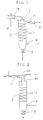
- FIGs. 1 and 2 are diagrammatic representations in section, each showing a washing device for use in the working examples of the washing process according to the present invention.
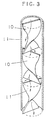
- Fig. 3 is a sectional view showing the tubular body having static mixing elements disposed continuously in series.
- the powdery and/or granular resin to be used for the process according to the present invention is a resin which is in a powdery and/or granular state yet which is not in a bulky state.
- the process for preparing the powdery and/or granular resin to be used therefor is not restricted to any particular one.
- the powdery and/or granular resin to be used for the process according to the present invention may have such a shape as powder, particle, granule, pearl or fiber, and it may be used in such a state that the shapes of the powdery and/or granular resin are mixed and that the powdery and/or granular resin is in a porous state.
- the powdery and/or granular resin which can achieve the effect of the invention highly effectively is in such a granular shape that may have an average particle size ranging from 10 to 5,000 ⁇ m, preferably from 20 to 3,000 ⁇ m. It is also preferred that the powdery and/or granular resin may have a bulk density ranging from 0.2 to 0.9 g/cm3, preferably from 0.3 to 0.8 g/cm3.
- the powdery and/or granular resin to be used for the process according to the present invention is not restricted to a particular kind and it may include, for example, a polyarylene sulfide, such as polyphenylene sulfide, a polyolefin, such as polyethylene, polypropylene and polybutene, a polycarbonate or a polyester.
- a polyarylene sulfide such as polyphenylene sulfide
- a polyolefin such as polyethylene, polypropylene and polybutene
- a polycarbonate such as polycarbonate
- the polyarylene sulfide such as polyphenylene sulfide is particularly preferred for achieving the remarkably high effect of the present invention.
- the washing liquid there may be used a variety of solvents which do not dissolve the powdery and/or granular resin yet which dissolve the impurities which adhere to the powdery and/or granular resin.
- the washing liquid may include, for example, water, a hydrophilic organic solvent, a hydrophobic organic solvent, an acid solution, an alkali solution, and a mixture of two or more.
- the kind of the washing liquid may appropriately be chosen in accordance with the kind of the powdery and/or granular resin to be used, the kind of the impurities to be removed, the difference in specific gravity from the resin to be used, and so on.
- water, particularly deionized water is preferred for the polyarylene sulfide.
- the washing device to be used for the process according to the present invention is a tubular body in which the static mixing elements are disposed continuously in series.
- the static mixing element is as defined above.
- the static mixing element i.e. a spiral element 10
- the static mixing element is in a shape that its plate is constructed such that one end portion of the plate is twisted at the angle of a given angle (hereinafter referred to as a twisted angle) of 180 ° , for example, relative to the other end portion thereof facing the one end portion thereof.
- a plurality of the spiral elements 10 are disposed such that the spiral element 10 in a clockwisely twisted shape is alternately arranged with the spiral element 10 in a counter-clockwisely twisted shape at a given angle (hereinafter referred to as an intersecting angle) of 90 ° , for example, relative to the adjacent spiral element 10.
- the material from which the spiral element 10 is formed is not restricted to a particular one and may be appropriately chosen in accordance, for example, with the kind of the powdery and/or granular resin, and the kind of the washing liquid.
- the material to be used may include, for example, carbon steel, stainless steel, titanium, alloy, special metal, glass, ceramics, and synthetic resin such as polyvinyl chloride.
- the size of the spiral element 10 may be determined on the basis of the scale on which the washing is carried out or other conditions.
- the powdery and/or granular resin may pass through the tubular body in such a manner that it is divided into two sections by the first spiral element 10, disposed in a position closest to the supply section of the tubular body for supplying the powdery and/or granular resin, and each of the section is further divided into two additional sections by the second spiral element 10, disposed immediately adjacent the first spiral element 10.
- the powdery and/or granular resin passes through the tubular body while being divided in an exponential function.
- the powdery and/or granular resin which has been divided into two sections by the first spiral element 10 is further divided into two sections, i.e., into a total of four sections, by the second spiral element 10 and further that the powdery and/or granular resin which has passed in two divided sections through the first spiral element 10 passes through the second spiral element 10 in four divided sections in a direction inverted from or opposite to the direction in which the powdery and/or granular resin has passed in two sections through the first spiral element 10.
- the powdery and/or granular resin may further pass through an additional spiral element 10 disposed adjacent the second spiral element 10 and/or another additional spiral element or elements 10 in the same manner as described hereinabove and divided into smaller sections in an exponential function.
- the washing liquid is fed in a counterflow relative to the powdery and/or granular resin in substantially the same manner as the powdery and/or granular resin except for the direction in which the powdery and/or granular resin passes and it is inverted. More specifically, the washing liquid is caused to pass upwardly, namely, in the direction opposite to the direction in which the powdery and/or granular resin passes, and to be inverted in the direction opposite to the direction in which the powdery and/or granular resin is divided into smaller sections while passing through the spiral element 10.
- the powdery and/or granular resin flowing in the direction in which the washing liquid flows is brought into contact with the washing liquid flowing in the direction opposite to the direction of a flow of the powdery and/or granular resin in the tubular body in an extremely homogeneous state, thereby effecting the washing to an efficient extent.
- the tubular body When the tubular body is used for washing operation while being disposed in a substantially horizontal posture, it requires a transfer means for forcibly transferring the powdery and/or granular resin forward through the tubular body. Further, a medium, such as a solvent, is also required for assisting the powdery and/or granular resin in transferring forward through the tubular body and accompanying the powdery and/or granular resin, which is identical to or similar to the washing liquid.
- a medium such as a solvent
- the tubular body it is preferred to use the tubular body to be disposed in a substantially vertical posture, thereby allowing the powdery and/or granular resin fed from the upper end portion of the body to descend due to gravity without any accompanying medium.
- the tubular body arranged in a vertical posture requires neither means for forcibly transferring the powdery and/or granular resin nor accompanying medium, thereby simplifying equipment.
- the granules of the powdery and/or granular resin flow in the direction opposite to the direction in which the washing liquid flows so that a flow of the powdery and/or granular resin through the tubular body is close to a flow and the ability of washing the powdery and/or granular resin is not reduced even if the speeds of sedimentation of the powdery and/or granular resin would differ among the powdery and/or granular resin having different particle sizes.
- the static mixer is used for mixing various substances and the substances to be mixed together are supplied to the tubular body of the static mixer from the same direction.
- the static mixer is used for washing the powdery and/or granular resin while the washing liquid is fed in the direction opposite to the direction in which the substance to be washed flows, namely, the two substances are flown in the tubular body of the static mixer in a counterflow fashion.
- the powdery and/or granular resin advances forward through the tubular body of the washing device, while it is always brought into contact with a fresh portion of the washing liquid to be fed in the direction opposite to the direction of supply of the powdery and/or granular resin. This is particularly advantageous for improving washing efficiency.
- the washing device has the supply section for supplying the washing liquid at a lower portion of the tubular body while it has the discharge section for discharging the washing liquid at an upper portion thereof, thereby allowing the washing liquid to come into contact with the powdery and/or granular resin which is naturally descending due to gravity in the direction opposite to the direction in which the washing liquid is forcibly flown.
- the present invention can also be said to be based on the novel finding that the static mixer can be used in the field of washing a substance while two substances are allowed to flow through the static mixer in a counterflow fashion.
- the present invention takes advantage of the feature of the static mixer in the washing operation as well as in the mixing operation and furthermore adds new improvements to the static mixer to thereby form a washing device which is highly efficient in washing and which has equipment simplified.
- FIG. 1 shows a preferred embodiment of the washing device according to the present invention, which has a tubular body in a vertical shape.
- the washing device comprises a tubular body 2 having a built-in element 1 similar to that as shown in FIG. 3, which in turn is provided at the upper portion thereof with a supply section 3 for supplying the powdery and/or granular resin and a discharge section 4 for discharging the washing liquid and at the lower portion thereof with a discharge section 5 for discharging the powdery and/or granular resin and a supply section 6 for supplying the washing liquid.
- the discharge section 5 may usually have an ejection valve such as a rotary valve.
- reference numerals 7 and 8 denote filters disposed in an appropriate fashion.
- the solvent is separated from the reaction mixture containing the powdery and/or granular resin by the filter 7 and the powdery and/or granular resin containing impurities is then led from the supply section 3 to the washing device.
- deionized water to be used as the washing liquid is fed from the supply section 6 located at the lower portion of the tubular body and is allowed to flow in the direction opposite to the flow of the powdery and/or granular resin.
- the powdery and/or granular resin is washed with the washing liquid while being descending in constant contact with the washing liquid which is fed from the supply section 6 located at the lower portion of the tubular body and then allowed to ascend through the tubular body.
- the powdery and/or granular resin is withdrawn from the discharge section 5 of the tubular body after it has been washed with the washing liquid supplied in a counterflow fashion.
- the washing liquid such as deionized water, containing impurities is discharged from the discharge section 4 of the tubular body and the impurities are then removed by the filter 8.
- FIG. 2 shows a tubular body having substantially the same structure as that as shown in FIG. 1, except for the provision of a discharge section 4a for discharging the washing liquid at a top portion of the tubular body and the provision of a built-in spiral element 1a in a supply tube 3a for supplying the powdery and/or granular resin.
- the washing device of the structure as described immediately hereinabove the powdery and/or granular resin is supplied through the supply tube 3a with the built-in spiral element 1a together with the washing liquid, thereby allowing the powdery and/or granular resin to be washed in a preliminary fashion.
- the washing device having the vertically shaped tubular body may preferably have the structure which follows, and the washing may preferably be implemented under the following conditions.
- the washing process according to the present invention can achieve a very high efficiency in washing the powdery and/or granular resin by using the washing device with a simplified structure.
- the content of impurities, e.g., sodium chloride, remaining in the powdery and/or granular resin, e.g., polyarylene sulfide in a powdery and/or granular form can be reduced to a level ranging from 1/10 to 1/1000 with respect to the original level of the impurities by appropriately selecting the conditions for washing.
- the present invention can provide a process for washing the powdery and/or granular resin and a washing device for use in the process therefor, which are highly efficient in washing, which require merely simplified equipment, which runs at a very cheap running cost, and which is readily operative.
- a reaction vessel equipped with a fractionating tower was charged with 500 liters of N-methyl-2-pyrrolidone (NMP), 0.83 kg-mole of sodium sulfide pentahydrate (Na2S ⁇ 5H2O) and 0.83 kg-mole of lithium chloride (LiCl), and the mixture was dehydrated at the top column pressure of 13.3 kPa (100 Torr) and the temperature of 130-145°C for 1-2 hours. After cooling, 0.82 kg-mole of p-dichlorobenzene (PDCB) was charged in the reaction vessel, and the resulting mixture was reacted at 260 °C for 3 hours. The resulting reaction mixture was cooled to give a product containing polyphenylene sulfide in a powdery and/or granular form as a reaction production.
- NMP N-methyl-2-pyrrolidone
- Na2S ⁇ 5H2O sodium sulfide pentahydrate
- LiCl lithium chloride
- PDCB
- the resulting reaction product was then fed through the filter 7 of the washing device as shown in FIG. 1 and the NMP as the solvent was separated from the reaction product.
- the PPS in powdery and/or granular form was found to have particle sizes ranging from 500 to 5,000 ⁇ m and an average particle size of 2,000 ⁇ m. Then the PPS in powdery and/or granular form was fed to the washing device through the supply section 3 and washed under the following washing conditions:
- Example 1 The procedure of Example 1 was followed in substantially the same fashion except for using a static mixer having a height of 120 cm.
- Example 1 The procedure of Example 1 was followed in substantially the same fashion except for using a static mixer having a height of 180 cm. The results of washing are shown in Table below.
- Example 1 The procedure of Example 1 was followed in substantially the same manner, with the exception that 80 kg of the PPS in powdery or granular form was charged together with 375 kg of deionized water, prior to washing, into a washing vessel with a stirring blade, the mixture was stirred at the temperature of 22 °C for one hour, and then the mixture was filtered to allow deionized water only to pass through. This operation was repeated twice and the mixture was washed three times in a batchwise fashion. The results of washing are shown in the Table below.
- Example 1 The procedure of Example 1 was followed in substantially the same manner, without using the static mixer.
- This remarkable effect may be achieved by forming a flow in a homogeneously dispersed state even if the powdery and/or granular form would have a considerably broad distribution of particle sizes and by always contacting the powdery and/or granular resin with the salt content reduced by washing with the fresh washing liquid.
Landscapes
- Chemical & Material Sciences (AREA)
- Chemical Kinetics & Catalysis (AREA)
- Health & Medical Sciences (AREA)
- Medicinal Chemistry (AREA)
- Polymers & Plastics (AREA)
- Organic Chemistry (AREA)
- Engineering & Computer Science (AREA)
- Mechanical Engineering (AREA)
- Processing And Handling Of Plastics And Other Materials For Molding In General (AREA)
- Cleaning By Liquid Or Steam (AREA)
- Polymers With Sulfur, Phosphorus Or Metals In The Main Chain (AREA)
- Processes Of Treating Macromolecular Substances (AREA)
Applications Claiming Priority (2)
| Application Number | Priority Date | Filing Date | Title |
|---|---|---|---|
| JP221151/89 | 1989-08-28 | ||
| JP1221151A JPH0386287A (ja) | 1989-08-28 | 1989-08-28 | 粉粒状樹脂の洗浄方法およびその洗浄装置 |
Publications (3)
| Publication Number | Publication Date |
|---|---|
| EP0415258A2 EP0415258A2 (en) | 1991-03-06 |
| EP0415258A3 EP0415258A3 (en) | 1991-05-02 |
| EP0415258B1 true EP0415258B1 (en) | 1996-05-01 |
Family
ID=16762272
Family Applications (1)
| Application Number | Title | Priority Date | Filing Date |
|---|---|---|---|
| EP90116100A Expired - Lifetime EP0415258B1 (en) | 1989-08-28 | 1990-08-22 | Process for washing powdery and/or granular resins and a washing device therefor |
Country Status (8)
| Country | Link |
|---|---|
| US (1) | US5143554A (enExample) |
| EP (1) | EP0415258B1 (enExample) |
| JP (1) | JPH0386287A (enExample) |
| KR (1) | KR910004679A (enExample) |
| CA (1) | CA2023780A1 (enExample) |
| DE (1) | DE69026776T2 (enExample) |
| MY (1) | MY106872A (enExample) |
| TW (1) | TW197395B (enExample) |
Families Citing this family (27)
| Publication number | Priority date | Publication date | Assignee | Title |
|---|---|---|---|---|
| JPH08157719A (ja) * | 1994-12-09 | 1996-06-18 | Idemitsu Petrochem Co Ltd | ポリアリーレンスルフィド樹脂組成物 |
| JP3866821B2 (ja) * | 1997-03-25 | 2007-01-10 | 出光興産株式会社 | 残留ハロゲン化リチウムの変性方法 |
| JP3866822B2 (ja) * | 1997-03-25 | 2007-01-10 | 出光興産株式会社 | ポリアリーレンスルフィドの精製方法 |
| JP2000273175A (ja) * | 1999-03-19 | 2000-10-03 | Idemitsu Petrochem Co Ltd | ポリアリーレンスルフィド系樹脂の精製方法 |
| ATE515300T1 (de) * | 1999-12-17 | 2011-07-15 | Ticona Gmbh | Verfahren und vorrichtung zur abtrennung von feststoffen aus einer flüssigen phase |
| US6750319B2 (en) * | 2001-04-10 | 2004-06-15 | Idemitsu Petrochemical Co., Ltd. | Process for producing polyarylene sulfide and apparatus used therein |
| US7094867B2 (en) | 2001-12-03 | 2006-08-22 | Kureha Corporation | Method of continuously cleansing polyarylene sulfide |
| KR100486767B1 (ko) * | 2002-03-30 | 2005-05-03 | (주)뉴일광 | 목재용 방수 및 방부제와 제조방법 |
| US7276625B2 (en) | 2002-10-15 | 2007-10-02 | Eastman Chemical Company | Process for production of a carboxylic acid/diol mixture suitable for use in polyester production |
| US7074954B2 (en) * | 2002-12-09 | 2006-07-11 | Eastman Chemical Company | Process for the oxidative purification of terephthalic acid |
| RU2005121568A (ru) * | 2002-12-09 | 2006-01-20 | Истман Кемикал Компани (US) | Способ окислительной очистки терефталевой кислоты |
| US7161027B2 (en) | 2002-12-09 | 2007-01-09 | Eastman Chemical Company | Process for the oxidative purification of terephthalic acid |
| US7132566B2 (en) * | 2003-09-22 | 2006-11-07 | Eastman Chemical Company | Process for the purification of a crude carboxylic acid slurry |
| US7193109B2 (en) * | 2003-03-06 | 2007-03-20 | Eastman Chemical Company | Process for production of a carboxylic acid/diol mixture suitable for use in polyester production |
| US20050059709A1 (en) * | 2003-09-15 | 2005-03-17 | Meythaler Jay M. | Treatment of a neuropathy with rapid release aminopyridine |
| US7214760B2 (en) * | 2004-01-15 | 2007-05-08 | Eastman Chemical Company | Process for production of a carboxylic acid/diol mixture suitable for use in polyester production |
| US20070179312A1 (en) * | 2006-02-02 | 2007-08-02 | O'meadhra Ruairi Seosamh | Process for the purification of a crude carboxylic axid slurry |
| US8614350B2 (en) | 2008-01-15 | 2013-12-24 | Eastman Chemical Company | Carboxylic acid production process employing solvent from esterification of lignocellulosic material |
| US8455680B2 (en) | 2008-01-15 | 2013-06-04 | Eastman Chemical Company | Carboxylic acid production process employing solvent from esterification of lignocellulosic material |
| JP5805084B2 (ja) | 2010-07-13 | 2015-11-04 | 株式会社クレハ | ポリアリーレンスルフィドの製造方法及び製造装置 |
| CN106062039B (zh) | 2014-04-30 | 2017-11-14 | 株式会社吴羽 | 聚亚芳基硫醚的制造方法以及聚亚芳基硫醚的制造装置 |
| CN110088171B (zh) * | 2017-10-12 | 2022-03-04 | 株式会社吴羽 | 连续聚合装置及聚合物的连续制造方法 |
| CN111004392B (zh) * | 2019-10-15 | 2021-07-20 | 浙江新和成特种材料有限公司 | 一种聚苯硫醚浆料连续洗涤工艺 |
| CN111842314A (zh) * | 2020-07-09 | 2020-10-30 | 大连天晟通用机械有限公司 | 一种清洗橡胶颗粒的方法 |
| CN114378041A (zh) * | 2022-02-11 | 2022-04-22 | 陈惠玲 | 新型粉状物料和浆料的洗涤设备及洗涤方法 |
| CN114849275A (zh) * | 2022-05-18 | 2022-08-05 | 郑州远洋油脂工程技术有限公司 | 一种粉状物料的乙醇浸提工艺 |
| CN116493329B (zh) * | 2023-03-13 | 2026-01-02 | 铜陵瑞嘉特种材料有限公司 | 一种聚苯硫醚树脂洗涤装置及其应用 |
Family Cites Families (11)
| Publication number | Priority date | Publication date | Assignee | Title |
|---|---|---|---|---|
| US2519781A (en) * | 1946-09-30 | 1950-08-22 | Alexander B Morris | Apparatus for cleaning and/or grading for size, sand, or other similar substances |
| DE1519936B2 (de) * | 1966-04-06 | 1973-09-27 | Davy-Ashmore Ag, 6000 Frankfurt | Extraktionsrohr zum kontinuierlichen Entfernen niedermolekularer Bestandteile aus granulierten Polyamiden |
| JPS497359B1 (enExample) * | 1970-01-30 | 1974-02-20 | ||
| US3849196A (en) * | 1970-05-20 | 1974-11-19 | Gen Electric | Ultrasonic cleaning of resin |
| US4062697A (en) * | 1976-12-30 | 1977-12-13 | General Atomic Company | Method and apparatus for countercurrent washing of particulate solids |
| US4421874A (en) * | 1981-06-02 | 1983-12-20 | Phillips Petroleum Company | Polymer slurry washing |
| US4526684A (en) * | 1981-06-02 | 1985-07-02 | Phillips Petroleum Company, | Polymer slurry washing |
| JPS5949233A (ja) * | 1982-09-10 | 1984-03-21 | フイリツプス・ペトロリユ−ム・コンパニ− | アリ−レンスルフイドポリマ−から不純物を抽出する方法 |
| FR2642356B2 (fr) * | 1984-11-19 | 1994-04-15 | Famechon Rene | Procede de separation et de traitement de dechets de plastiques en vue de leur reutilisation et dispositif pour sa mise en oeuvre |
| JPS61225217A (ja) * | 1985-03-29 | 1986-10-07 | Toto Kasei Kk | ポリフエニレンサルフアイド樹脂からの不純物の除去方法 |
| JPH0668025B2 (ja) * | 1986-03-24 | 1994-08-31 | 東都化成株式会社 | ポリフエニレンサルフアイドの精製方法 |
-
1989
- 1989-08-28 JP JP1221151A patent/JPH0386287A/ja active Pending
-
1990
- 1990-08-22 CA CA002023780A patent/CA2023780A1/en not_active Abandoned
- 1990-08-22 EP EP90116100A patent/EP0415258B1/en not_active Expired - Lifetime
- 1990-08-22 MY MYPI90001407A patent/MY106872A/en unknown
- 1990-08-22 TW TW079107037A patent/TW197395B/zh active
- 1990-08-22 DE DE69026776T patent/DE69026776T2/de not_active Expired - Fee Related
- 1990-08-23 US US07/571,477 patent/US5143554A/en not_active Expired - Fee Related
- 1990-08-27 KR KR1019900013237A patent/KR910004679A/ko not_active Ceased
Also Published As
| Publication number | Publication date |
|---|---|
| KR910004679A (ko) | 1991-03-29 |
| MY106872A (en) | 1995-08-30 |
| CA2023780A1 (en) | 1991-03-01 |
| TW197395B (enExample) | 1993-01-01 |
| JPH0386287A (ja) | 1991-04-11 |
| EP0415258A2 (en) | 1991-03-06 |
| EP0415258A3 (en) | 1991-05-02 |
| DE69026776T2 (de) | 1996-12-12 |
| DE69026776D1 (de) | 1996-06-05 |
| US5143554A (en) | 1992-09-01 |
Similar Documents
| Publication | Publication Date | Title |
|---|---|---|
| EP0415258B1 (en) | Process for washing powdery and/or granular resins and a washing device therefor | |
| KR100345427B1 (ko) | 개스상중합장치용개스분산판 | |
| CA2087647C (en) | Process for the recovery of polymers dissolved in aqueous alkaline or acid media | |
| KR910003255B1 (ko) | 테레프탈산 슬러리의 분산매체 교환방법 | |
| EP0424049B1 (en) | Method and equipment for the preparation of a carrier of a polymerization catalyst | |
| JPH0867708A (ja) | 固体粒子状ハロゲン化チタン含有触媒成分を用いるオレフィン重合方法 | |
| US5241023A (en) | Process and device for the gas phase polymerization of alpha-olefins | |
| US4395523A (en) | Method of making and recovering olefin polymer particles | |
| US4199546A (en) | Manufacture and recovery of olefin polymer particles | |
| WO2001068581A2 (en) | The method of chemical recycling of polyethylene terephthalate waste | |
| JP4685244B2 (ja) | 重合体溶液から固体を分離する方法および装置 | |
| KR100278525B1 (ko) | 폴리알킬렌 테레프탈레이트로부터 알칼리 금속 또는 알칼리토류 금속의 테레프탈레이트 및 알킬렌 글리콜을 회수하는 방법 | |
| KR100695382B1 (ko) | 비스페놀 a 프릴의 제조 방법과 장치 및 그에 따라 제조된 비스페놀 a 프릴 | |
| EP1669140B1 (en) | Method of washing solid grain | |
| US3031433A (en) | Solid phase polymerization of polyamides | |
| CA1193960A (en) | Apparatus for and method of preparing crystals for washing | |
| EP0278246B1 (en) | Production of granular bisphenols | |
| US3801286A (en) | Slurry polymerization reactor | |
| JPH10165710A (ja) | 化学的及び物理的物質変換法における泡形成を減少又は避ける方法及びそれを実施する装置 | |
| JP4358497B2 (ja) | ビスフェノールaの造粒方法 | |
| US4957627A (en) | Process for liquid-solid contact | |
| CN114225880A (zh) | 多塔逆流式连续高效合成六甲基二硅氮烷的系统及方法 | |
| JPS6244531B2 (enExample) | ||
| US7387770B2 (en) | Method for ferric sulfate manufacturing | |
| JP4590188B2 (ja) | ビスフェノールaのプリルの製造方法 |
Legal Events
| Date | Code | Title | Description |
|---|---|---|---|
| PUAI | Public reference made under article 153(3) epc to a published international application that has entered the european phase |
Free format text: ORIGINAL CODE: 0009012 |
|
| 17P | Request for examination filed |
Effective date: 19900822 |
|
| AK | Designated contracting states |
Kind code of ref document: A2 Designated state(s): BE CH DE FR GB IT LI NL SE |
|
| PUAL | Search report despatched |
Free format text: ORIGINAL CODE: 0009013 |
|
| AK | Designated contracting states |
Kind code of ref document: A3 Designated state(s): BE CH DE FR GB IT LI NL SE |
|
| RHK1 | Main classification (correction) |
Ipc: B01D 11/02 |
|
| 17Q | First examination report despatched |
Effective date: 19930215 |
|
| GRAH | Despatch of communication of intention to grant a patent |
Free format text: ORIGINAL CODE: EPIDOS IGRA |
|
| GRAA | (expected) grant |
Free format text: ORIGINAL CODE: 0009210 |
|
| AK | Designated contracting states |
Kind code of ref document: B1 Designated state(s): BE CH DE FR GB IT LI NL SE |
|
| PG25 | Lapsed in a contracting state [announced via postgrant information from national office to epo] |
Ref country code: LI Effective date: 19960501 Ref country code: CH Effective date: 19960501 Ref country code: BE Effective date: 19960501 |
|
| REF | Corresponds to: |
Ref document number: 69026776 Country of ref document: DE Date of ref document: 19960605 |
|
| ITF | It: translation for a ep patent filed | ||
| PG25 | Lapsed in a contracting state [announced via postgrant information from national office to epo] |
Ref country code: SE Effective date: 19960801 |
|
| PGFP | Annual fee paid to national office [announced via postgrant information from national office to epo] |
Ref country code: GB Payment date: 19960815 Year of fee payment: 7 |
|
| PGFP | Annual fee paid to national office [announced via postgrant information from national office to epo] |
Ref country code: FR Payment date: 19960823 Year of fee payment: 7 |
|
| PGFP | Annual fee paid to national office [announced via postgrant information from national office to epo] |
Ref country code: NL Payment date: 19960831 Year of fee payment: 7 |
|
| ET | Fr: translation filed | ||
| REG | Reference to a national code |
Ref country code: CH Ref legal event code: PL |
|
| PLBE | No opposition filed within time limit |
Free format text: ORIGINAL CODE: 0009261 |
|
| STAA | Information on the status of an ep patent application or granted ep patent |
Free format text: STATUS: NO OPPOSITION FILED WITHIN TIME LIMIT |
|
| 26N | No opposition filed | ||
| PG25 | Lapsed in a contracting state [announced via postgrant information from national office to epo] |
Ref country code: GB Free format text: LAPSE BECAUSE OF NON-PAYMENT OF DUE FEES Effective date: 19970822 |
|
| PGFP | Annual fee paid to national office [announced via postgrant information from national office to epo] |
Ref country code: DE Payment date: 19970829 Year of fee payment: 8 |
|
| PG25 | Lapsed in a contracting state [announced via postgrant information from national office to epo] |
Ref country code: NL Free format text: LAPSE BECAUSE OF NON-PAYMENT OF DUE FEES Effective date: 19980301 |
|
| GBPC | Gb: european patent ceased through non-payment of renewal fee |
Effective date: 19970822 |
|
| PG25 | Lapsed in a contracting state [announced via postgrant information from national office to epo] |
Ref country code: FR Free format text: LAPSE BECAUSE OF NON-PAYMENT OF DUE FEES Effective date: 19980430 |
|
| NLV4 | Nl: lapsed or anulled due to non-payment of the annual fee |
Effective date: 19980301 |
|
| REG | Reference to a national code |
Ref country code: FR Ref legal event code: ST |
|
| PG25 | Lapsed in a contracting state [announced via postgrant information from national office to epo] |
Ref country code: DE Free format text: LAPSE BECAUSE OF NON-PAYMENT OF DUE FEES Effective date: 19990601 |
|
| PG25 | Lapsed in a contracting state [announced via postgrant information from national office to epo] |
Ref country code: IT Free format text: LAPSE BECAUSE OF NON-PAYMENT OF DUE FEES Effective date: 20050822 |