EP0407412B1 - Substituierte cyclodextrine und verfahren zur chromatographischen trennung chiraler organischer verbindungen - Google Patents
Substituierte cyclodextrine und verfahren zur chromatographischen trennung chiraler organischer verbindungen Download PDFInfo
- Publication number
- EP0407412B1 EP0407412B1 EP89903476A EP89903476A EP0407412B1 EP 0407412 B1 EP0407412 B1 EP 0407412B1 EP 89903476 A EP89903476 A EP 89903476A EP 89903476 A EP89903476 A EP 89903476A EP 0407412 B1 EP0407412 B1 EP 0407412B1
- Authority
- EP
- European Patent Office
- Prior art keywords
- methyl
- carbon atoms
- substituted cyclodextrins
- group
- alkyl
- Prior art date
- Legal status (The legal status is an assumption and is not a legal conclusion. Google has not performed a legal analysis and makes no representation as to the accuracy of the status listed.)
- Expired - Lifetime
Links
Images


Classifications
-
- C—CHEMISTRY; METALLURGY
- C07—ORGANIC CHEMISTRY
- C07B—GENERAL METHODS OF ORGANIC CHEMISTRY; APPARATUS THEREFOR
- C07B57/00—Separation of optically-active compounds
-
- C—CHEMISTRY; METALLURGY
- C08—ORGANIC MACROMOLECULAR COMPOUNDS; THEIR PREPARATION OR CHEMICAL WORKING-UP; COMPOSITIONS BASED THEREON
- C08B—POLYSACCHARIDES; DERIVATIVES THEREOF
- C08B37/00—Preparation of polysaccharides not provided for in groups C08B1/00 - C08B35/00; Derivatives thereof
- C08B37/0006—Homoglycans, i.e. polysaccharides having a main chain consisting of one single sugar, e.g. colominic acid
- C08B37/0009—Homoglycans, i.e. polysaccharides having a main chain consisting of one single sugar, e.g. colominic acid alpha-D-Glucans, e.g. polydextrose, alternan, glycogen; (alpha-1,4)(alpha-1,6)-D-Glucans; (alpha-1,3)(alpha-1,4)-D-Glucans, e.g. isolichenan or nigeran; (alpha-1,4)-D-Glucans; (alpha-1,3)-D-Glucans, e.g. pseudonigeran; Derivatives thereof
- C08B37/0012—Cyclodextrin [CD], e.g. cycle with 6 units (alpha), with 7 units (beta) and with 8 units (gamma), large-ring cyclodextrin or cycloamylose with 9 units or more; Derivatives thereof
Definitions
- the invention relates to substituted cyclodextrins, a process for their preparation and a process for the separation of chiral organic compounds by chromatographic separation processes, in particular gas chromatography, with the substituted cyclodextrins as the stationary phase.
- Substituted cyclodextrins are known, for example, from the unpublished DE-OS 37 10 569, which describes the production of ultra-thin films from these cyclodextrin compounds or an inclusion compound based on the cyclodextrin compounds. These ultra-thin films can be used, for example, as a protective film for compounds sensitive to light and oxygen or as a support in chromatography.
- Triethyl- ⁇ -cyclodextrin is described in the Journal of Pharmaceutical Sciences (1987, 660).
- the enantiomers to be separated were predominantly converted into derivatives with amide or carbamoyl functions.
- the low volatility of the derivatives formed requires high working temperatures of the chromatographic columns and therefore leads to correspondingly restless baselines of the chromatograms and to a reduced separation efficiency due to cross diffusion.
- the object of the present invention was to provide improved stationary phases for the separation of chiral compounds, in particular enantiomers, and a method for the separation of chiral compounds.
- the substituted cyclodextrins according to the invention enable an enantiomer separation, which is mainly due to inclusion effects on the macrocyclic chiral cyclodextrins, and because of the separation mechanism which is completely different from the separation phases of the prior art, can also be applied to enantiomers which are not capable of forming hydrogen bonds and therefore could not be separated on the previously used chiral separation phases.
- the compounds according to the invention have the advantage, on the one hand, of a very high temperature resistance up to over 200 ° C., on the other hand, however, the separation mechanism, which differs from previously known separation phases, in most cases enables conversion into highly volatile derivatives, such as trifluoroacetylated ones Compounds that are eluted from the column at correspondingly low temperatures.
- the compounds are particularly preferred from the series of the compounds according to the invention of the O-peralkylated ⁇ - and ⁇ -cyclodextrin derivatives and those in which the hydroxyl groups of the cyclodextrin are alkylated in the 2- and 6-position of the glucose units and the hydroxyl group is acylated in the 3-position , in which the radicals R2, R3 and R6 are alkyl or alkenyl groups having 3 to 6 carbon atoms and / or R3 is the acetyl group.
- substituted cyclodextrins are preferred which consist of 6 or 7 glucose rings and contain the n-pentyl group as substituents R2, R3 and R6 or the acetyl group as substituent R3 and as R2 and R6 n-pentyl groups.
- the products according to the invention are produced by first dissolving ⁇ - or ⁇ -cyclodextrin in an anhydrous solvent and reacting with an alkyl halide with the addition of powdered alkali metal hydroxide. This reaction step can be carried out in such a way that either the hydroxyl groups in the 2- and 6-position or the three hydroxyl groups in the 2-, 3- and 6-position are alkylated.
- the 2,6-di-O-alkylated intermediate is optionally isolated and reacted in an anhydrous solvent with the addition of a tertiary amine with an acylating agent, preferably an acid anhydride or chloride.
- an acylating agent preferably an acid anhydride or chloride.
- Aprotic solvents are preferably used as the anhydrous solvent.
- the reactions are preferably carried out under inert gas.
- the crude products obtained in each case can be purified by column chromatography and isolated in pure form.
- the characterization was carried out by 1 H or 13 C nuclear magnetic resonance spectroscopy and by chemical degradation with subsequent analysis of the degradation products by combined gas chromatography and mass spectrometry according to P. Mischnick-Lübbecke, WA Koenig and M. Radeloff, Starch / Starke 39 (1987) 425.
- the separation capillaries are filled with the cyclodextrins substituted according to the invention according to WA Koenig and K. Ernst, J. Chromatogr. 280 (1983) 135.
- the capillaries occupied by the separation phases according to the invention are particularly suitable for the separation of, for example, enantiomers of diols, polyols, monosaccharides, methylglycosides, 1,5-anhydroalditols, hydroxy esters, alcohols, aldols, lactones, spiroacetals, amino alcohols, Amines, amino acid esters and other chiral compounds which, if necessary, can be trifluoroacetylated with trifluoroacetic anhydride in dichloromethane by known processes and thus converted into volatile derivatives suitable for gas chromatography.
- FIGS. 1 to 10 show exemplary separations of enantiomers at the separation phases hexakis (2,3,6-tri-O-pentyl) - ⁇ -cyclodextrin (FIGS. 1-5 and 9) hexakis (2,6-di-O -pentyl-3-O-acetyl) - ⁇ -cyclodextrin (Fig. 10) or Heptakis (2,6-di-O - pentyl-3-O-acetyl) - ⁇ -cyclodextrin (Fig. 6-8) .
- the figures clearly show the calm baseline of the chromatograms and the excellent separation effect of the separation columns covered with the cyclodextrins substituted according to the invention.
- Hexakis (2,3,6-tri-O-pentyl) - ⁇ -cyclodextrin 10.5 g (10 mmol) of ⁇ -cyclodextrin are reacted according to Example 1 with n-pentyl bromide / sodium hydroxide.
- the crude product obtained is dissolved in 300 ml of tetrahydrofuran (Fluka, dried over sodium / benzophenone) under an inert gas (nitrogen). This solution is added to 4.3 g (180 mmol) sodium hydride (Fluka, 80% suspension in mineral oil). Adherent mineral oil is removed by washing the sodium hydride with tetrahydrofuran.
Landscapes
- Chemical & Material Sciences (AREA)
- Organic Chemistry (AREA)
- Health & Medical Sciences (AREA)
- Life Sciences & Earth Sciences (AREA)
- General Health & Medical Sciences (AREA)
- Molecular Biology (AREA)
- Engineering & Computer Science (AREA)
- Biochemistry (AREA)
- Materials Engineering (AREA)
- Chemical Kinetics & Catalysis (AREA)
- Medicinal Chemistry (AREA)
- Polymers & Plastics (AREA)
- Polysaccharides And Polysaccharide Derivatives (AREA)
- Solid-Sorbent Or Filter-Aiding Compositions (AREA)
- Organic Low-Molecular-Weight Compounds And Preparation Thereof (AREA)
- Treatment Of Liquids With Adsorbents In General (AREA)
Description
- Die Erfindung betrifft substituierte Cyclodextrine, ein Verfahren zu ihrer Herstellung sowie ein Verfahren zur Trennung von chiralen organischen Verbindungen durch chromatographische Trennverfahren, insbesondere Gaschromatographie, mit den substituierten Cyclodextrinen als stationärer Phase.
- Substituierte Cyclodextrine sind beispielsweise aus der nicht vorveröffentlichten DE-OS 37 10 569 bekannt, die die Herstellung ultradünner Filme aus diesen Cyclodextrinverbindungen oder einer Einschlußverbindung auf Basis der Cyclodextrin-Verbindungen beschreibt. Diese ultradünne Filme können beispielsweise als Schutzfilm für gegen Licht und Sauerstoff empfindliche Verbindungen oder als Träger in der Chromatographie eingesetzt werden.
- Triethyl-β-cyclodextrin ist im Journal of Pharmaceutical Sciences (1987, 660) beschrieben. Eine Alkyl-acyl-Verbindung (R₂=R₆=Methyl, R₃=Benzoyl, n=7, der nachfolgend genannten allgemeinen Formel) ist in J.Chem.Soc.Perkin Trans. (1987), 1323, beschrieben.
- Einzelne Cyclodextrinderivate wurden auch als mögliche stationäre Phasen genannt, jedoch waren der Realisierung dieser Möglichkeit durch die Eigenschaften der bekannten Substanzen enge Grenzen gesetzt, wie beispielsweise in ACS Symposium Series, 1987, Bd. 342, S.200-217 und Starch/Stärke, 1987, Seite 357 bis 358 beschrieben ist.
- Die Trennung von enantiomeren niedermolekularen chiralen Verbindungen auf gaschromatographischem Weg erfolgte bisher unter Verwendung chiraler niedermolekularer oder polymerer Trennphasen mit Amid- oder Diamid-Struktur.
- Eine derartige Trennung ist nahezu ausschließlich auf Enantiomere beschränkt, die Amid-, Carbamat-, Oxim- oder Hydroxylgruppen tragen. Hierbei bilden sich intermolekulare Wasserstoffbrückenbindungen aus, so daß diastereomere Assoziate zwischen chiraler Trennphase und chiralen Substraten entstehen.
- Zur Verbesserung der Trennergebnisse wurden die zu trennenden Enantiomeren vorwiegend in Derivate mit Amid- oder Carbamoyl-Funktionen überführt.
- Die Schwerflüchtigkeit der gebildeten Derivate erfordert hohe Arbeitstemperaturen der chromatographischen Säulen und führt daher zu entsprechend unruhig verlaufenden Grundlinien der Chromatogramme und zu verminderter Trennwirksamkeit aufgrund von Querdiffusion.
- Der vorliegenden Erfindung lag die Aufgabe zugrunde, verbesserte stationäre Phasen zur Trennung chiraler Verbindungen, insbesondere von Enantiomeren, sowie ein Verfahren zur Trennung chiraler Verbindungen bereitzustellen.
- Es wurde überraschend gefunden, daß diese Aufgabe gelöst wird durch substituierte Cyclodextrine der allgemeinen Formel

in der bedeuten:
R² und R⁶ geradkettige oder verzweigte Alkyl- oder Alkenylgruppen mit 1 bis 8 oder Cycloalkenylgruppen mit 5 bis 8 Kohlenstoffatomen, die gleich oder verschieden sein können und
R³ eine geradkettige oder verzweigte, mit den Resten R² und R⁶ gleiche oder verschiedene Alkyl- oder Alkenylgruppe mit 1 bis 8 oder Cycloalkylgruppe mit 5 bis 8 Kohlenstoffatomen oder
eine Acylgruppe mit einem ggfs. substituierten gesättigten oder olefinisch ungesättigten aliphatischen oder cycloaliphatischen oder einem aromatischen Kohlenwasserstoffrest mit 1 bis 8 Kohlenstoffatomen und
n = 6 oder 7,
wobei die Verbindungen mit
R² = R³ = R⁶ = Methyl, n = 6 oder 7
R² = R³ = R⁶ = Ethyl, n= 7
R² = R⁶ = Allyl, R³ = Methyl, n = 7
R² = R⁶ = Prop-1-enyl, R³ = Methyl, n = 7
R² = R⁶ = Methyl, R³ = n-Butyl, n = 7
R² = R⁶ = Methyl, R³ = Benzoyl, n = 7 und
R² = R³ = Alkyl oder Acyl, R⁶ = C >4-Alkyl
ausgeschlossen sind.
Eine weitere Lösung der der Erfindung zugrundeliegenden Aufgabe liegt in der Bereitstellung eines Verfahrens zur chromatographischen Trennung von chiralen Verbindungen, insbesondere Enantiomeren.
Hierbei sind die Verbindungen mit
R² = R³ = R⁶ = Methyl, n=6 oder 7
R² = R⁶ = Allyl, R³ = Methyl, n= 7
R² = R⁶ = Prop-1-enyl, R³ = Methyl, n=7
R² = R⁶ = Methyl, R³ = n-Butyl, n=7.
ausgenommen. - Die erfindungsgemäßen substituierten Cyclodextrine ermöglichen eine Enantiomerentrennung, die hauptsächlich durch Inklusionseffekte an den makrocyclischen chiralen Cyclodextrinen bedingt ist, und aufgrund des gegenüber den Trennphasen des Standes der Technik völlig andersartigen Trennmechanismus auch auf Enantiomere angewendet werden kann, die nicht zur Ausbildung von Wasserstoffbrücken befähigt sind und daher an den bisher benützten chiralen Trennphasen nichtgetrennt werden konnten.
- Die erfindungsgemäßen Verbindungen weisen für eine Anwendung als Trennphasen in der Gaschromatographie einerseits den Vorteil einer sehr hohen Temperaturbeständigkeit bis über 200°C auf, andererseits ermöglicht der gegenüber bisher bekannten Trennphasen andersartige Trennmechanismus jedoch in den meisten Fällen die Überführung in sehr leicht flüchtige Derivate, wie trifluoracetylierte Verbindungen, die bei entsprechend tiefen Temperaturen aus der Säule eluiert werden.
- Besonders bevorzugt aus der Reihe der erfindungsgemäßen Verbindungen der O-peralkylierten α- und β-Cyclodextrinderivate und derjenigen, bei denen die Hydroxylgruppen des Cyclodextrin in 2- und 6-Stellung der Glukosebausteine alkyliert und die Hydroxylgruppe in 3-Stellung acyliert sind, sind die Verbindungen, bei denen die Reste R², R³ und R⁶ Alkyl- oder Alkenylgruppen mit 3 bis 6 Kohlenstoffatome sind und/oder R³ die Acetylgruppe bedeutet.
- Insbesondere sind die substituierten Cyclodextrine bevorzugt, die aus 6 oder 7 Glukoseringen bestehen und als Substituenten R², R³ und R⁶ die n-Pentyl-Gruppe oder als Substituent R³ die-Acetylgruppe und als R² und R⁶ n-Pentyl-Gruppen enthalten.
- Die erfindungsgemäßen Produkte werden hergestellt, indem zunächst α- oder β-Cyclodextrin in einem wasserfreien Lösungsmittel gelöst und unter Zugabe von gepulvertem Alkalihydroxid mit einem Alkylhalogenid umgesetzt wird. Diese Reaktionsstufe kann so geführt werden, daß wahlweise die Hydroxylgruppen in 2- und 6-Position oder die drei in 2-, 3- und 6-Position befindlichen Hydroxylgruppen alkyliert werden.
- Das 2,6-di-O-alkylierte Zwischenprodukt wird ggfs. isoliert und in einem wasserfreien Lösungsmittel unter Zugabe eines tertiären Amins mit einem Acylierungsmittel, vorzugsweise einem Säureanhydrid oder -chlorid, umgesetzt.
- Als wasserfreie Lösungsmittel werden bevorzugt aprotische Lösungsmittel eingesetzt.
- Die Umsetzungen werden bevorzugt unter Inertgas durchgeführt.
- Die jeweils erhaltenen Rohprodukte können säulenchromatographisch gereinigt und in reiner Form isoliert werden. Die Charakterisierung erfolgte über ¹H- bzw. ¹³C-Kernresonanzspektroskopie und durch chemischen Abbau mit nachfolgender Analyse der Abbauprodukte durch kombinierte Gaschromatographie und Massenspektrometrie entsprechend P. Mischnick-Lübbecke, W.A. König und M. Radeloff, Starch/Stärke 39 (1987) 425.
- Die Belegung der Trennkapillaren mit den erfindungsgemäß substituierten Cyclodextrinen erfolgt nach W.A. König und K. Ernst, J. Chromatogr. 280 (1983) 135. Die mit den Trennphasen gemäß der Erfindung belegten Kapillaren eignen sich insbesondere zur Trennung von beispielsweise Enantiomeren von Diolen, Polyolen, Monosacchariden, Methylglykosiden, 1,5-Anhydroalditolen, Hydroxysäureestern, Alkoholen, Aldolen, Lactonen, Spiroacetalen , Aminoalkoholen, Aminen, Aminosäureestern und anderen chiralen Verbindungen, die erforderlichenfalls nach bekannten Verfahren mit Trifluoressigsäureanhydrid in Dichlormethan trifluoracetyliert und somit in für die Gaschromatographie geeignete, flüchtige Derivate überführt werden können.
- Mit den erfindungsgemäßen Trennphasen wurden 25 m, 40 m oder 50 m lange Glas- oder "fused-silica"-Kapillaren belegt. Die Figuren 1 bis 10 zeigen beispielhaft durchgeführte Trennungen von Enantiomeren an den Trennphasen Hexakis(2,3,6-tri-O-pentyl)-α-cyclodextrin (Fig. 1-5 und 9) Hexakis(2,6-di-O-pentyl-3-O-acetyl)-α-cyclodextrin (Fig. 10) bzw. Heptakis(2,6-di-O--pentyl-3-O-acetyl)-β-cyclodextrin (Fig. 6-8). Die Figuren zeigen deutlich die ruhige Grundlinie der Chromatogramme und die ausgezeichnete Trennwirkung der mit den erfindungsgemäß substituierten Cyclodextrinen belegten Trennsäulen.
- Im einzelnen zeigen die Figuren folgende beispielhafte Trennungen:
- Figur 1:
Enantiomerentrennung einer Mischung razemischer Diole nach Trifluoracetylierung. 40 m-Glaskapillare mit Hexakis(2,3,6-tri-O-pentyl)-α-cyclodextrin; 48°C, 5 min. isotherm, dann 2°/min. - Figur 2:
Enantiomerentrennung von Isopropylidenglycerin nach Trifluoracetylierung. 40 m Glaskapillare mit Hexakis(2,3,6-tri-O-pentyl)-α-cyclodextrin; 70°C. - Figur 3:
Enantiomerentrennung von Glycerinsäure und Weinsäure nach Veresterung mit methanolischer HCl und Trifluoracetylierung; 40 m Glaskapillare mit Hexakis(2,3,6-tri-O-pentyl)-α-cyclodextrin; 90°C. - Figur 4:
Enantiomerentrennung von D- und L-Glucose nach Trifluoracetylierung. 40 m Hexakis(2,3,6-tri-O-pentyl)-α -cyclodextrin-Glaskapillare; 115°C. - Figur 5:
Enantiomerentrennung von 2-Chlor-1-phenylethanol und 2-Brom-1phenylethanol nach Trifluoracetylierung. 40 m Glaskapillare mit Hexakis(2,3,6-tri-O-pentyl)-α-cyclodextrin; 110°C. - Figur 6:
Enantiomerentrennung von Aminen und Aminoalkoholen nach Trifluoracetylierung. R-Enantiomere werden zuerst eluiert. 45 m Glaskapillare mit Heptakis(2,6-di-O-pentyl-3-O-acetyl)-β-cyclodextrin; 140°C, 2°/min. - Figur 7:
Enantiomerentrennung von chiralen Pharmaceutica (Amphetamin, Mexiletin, Pholedrin, Tranylcypromin). 45 m Glaskapillare mit Heptakis(2,6-di-O-pentyl-3-O-acetyl)-β-cyclodextrin; 175°C. - Figur 8:
Enantiomerentrennung von α-Aminobuttersäure, β-Aminobuttersäure und β-Aminoisobuttersäure nach Veresterung mit methanolischer HCl und Trifluoracetylierung. 45 m Glaskapillare mit Heptakis(2,6-di-O-pentyl-3-O--acetyl)-β-cyclodextrin; 140°C. - Figur 9:
Enantiomerentrennung von Spiroacetalen. 40 m Glaskapillare mit Hexakis(2,3,6-tri-O-pentyl)-α-cyclodextrin; 100°C. - Figur 10:
Enantiomerentrennung von γ-Lactonen. 38 m Glaskapillare mit Hexakis(3-O-acetyl-2,6-di-O-pentyl)-α-cyclodextrin; 150°C. - Die Erfindung wird anhand der nachstehenden Beispiele erläutert:
- Herstellung von Hexakis(2,6-di-O-pentyl)-α-cyclodextrin 10.5 g (10 mmol) α-Cyclodextrin (Consortium für Elektrochemische Industrie, München) werden in 250 ml Dimethylsulfoxid (Riedel-de Haen) (getrocknet über Molekularsieb 4 Å) unter Schutzgas (Stickstoff) gelöst. Dazu werden 14.4 g (360 mmol) gepulvertes Natriumhydroxid (Merck) und 54.4 g n-Pentylbromid (Fluka) gegeben und bei Raumtemperatur gerührt. Das Ausfallen eines weißen Niederschlags (Natriumbromid) weist auf das Einsetzen der Reaktion hin. Im Verlaufe von 4 weiteren Tagen werden täglich jeweils 18.5 g (120 mmol) n-Pentylbromid und 4.8 g (120 mmol) Natriumhydroxid zugegeben. Nach insgesamt 5 Tagen Reaktionszeit wird die Reaktionsmischung auf 1.5 l Wasser gegossen und zweimal mit 500 ml t-Butyl-methylether extrahiert. Die vereinigten Etherphasen werden mit Wasser und konz. Kochsalzlösung gewaschen und im Vakuum konzentriert. Der Rückstand, ein gelbes Öl , wird im Vakuum (0.05 torr) 16 Stunden bei 70°C getrocknet.
Das Rohprodukt (15 g) wird durch Säulenchromatographie über 500 g Kieselgel Si6O (40-60 µm; Merck) fraktioniert. Als Laufmittel dient Petrolether (Siedebereich 60-90°C) / t-Butyl-methylether, Mischungsverhältnis 70:30 (v/v). Es werden folgende Fraktionen erhalten: - I 800 ml Verunreinigung
- II 775 ml reines Produkt
- III 700 ml verunreinigtes Produkt
- ¹H-NMR-Daten (Bruker, 300 MHz, interner Standard Tetramethylsilan, δ-Werte in Toluol-d₈): 5.04 (C₁-H), 3.37 (C₂-H), 4.37 (C₃-H), 3.69 (C₄-H), 4.00 (C₅-H), 3.84 (C₆-Ha), 4.0 (C₆-Hb), 3.57 (O-CH2(6)), 3.65 (O-CH2(6')), 3.57 (O-CH2(2')9, 4.15 (O-CH2(2)), 1.5 -1.7 (O-CH₂-CH₂), 1.2 -1.4 (O-CH₂-CH₂-CH₂), 1.2 -1.4 (O-CH₂-CH₂-CH₂-CH₂), 0.8 -1.0 (CH₃), 5.33 (OH).
- Hexakis(2,3,6-tri-O-pentyl)-α-cyclodextrin 10.5 g (10 mmol) α-Cyclodextrin werden gemäß Beispiel 1 mit n-Pentylbromid/Natriumhydroxid umgesetzt. Das dabei erhaltene Rohprodukt wird in 300 ml Tetrahydrofuran (Fluka, getrockent über Natrium/Benzophenon) unter Schutzgas (Stickstoff) gelöst. Diese Lösung wird zu 4.3 g (180 mmol) Natriumhydrid (Fluka, 80% Suspension in Mineralöl) gegeben. Anhaftendes Mineralöl wird durch Waschen des Natriumhydrids mit Tetrahydrofuran entfernt. Anschließend werden 27.2 g (180 mmol) n-Pentylbromid (Fluka) dazugegeben und 5 Tage unter Rühren am Rückfluß gekocht. Danach wird die Reaktionsmischung auf 500 ml Wasser gegossen und das Tetrahydrofuran abdestilliert. Der Rest wird zweimal mit je 200 ml t-Butyl-methylether ausgeschüttelt. Die vereinigten Etherphasen werden mit Wasser und konz. Kochsalzlösung gewaschen und im Vakuum eingeengt. Der gelbe, ölige Rückstand wird im Vakuum (0.05 torr) 1 6 Stunden bei 70°C getrocknet.
Das Rohprodukt wird durch Säulenchromatographie über 500 g Kieselgel Si6O (Merck, 40-63 µm) fraktioniert. - Als Laufmittel dient Petrolether (Siedebereich 60-95°C) / t-Butyl-methylether im Mischungsverhältnis 85:15 (v/v). Es werden folgende Fraktionen erhalten:
- I 825 ml Verunreinigung
- II 150 ml reines Produkt (8.0 g)
- III 225 ml verunreinigtes Produkt (5.0 g)
- ¹H-NMR-Daten (Bruker, 300 MHz, interner Standard Tetramethylsilan, δ-Werte in CDCl₃): 5.21 (C₁-H), 3.21 (C₂-H), 3.59 (C₃-H), 3.79 (C₄-H), 3.70 (C₅-H), 3.45 (C₆-Ha), 3.98 (C₆-Hb), 3.35 (O-CH2(6)), 3.47 (O-CH2(6')), 3.66 (O-CH2(2')), 3.95 (O-CH2(2)), 3.53 (O-CH2(3)), 3.62 (O-CH2(3')), 1.5 -1.7 (O-CH₂-CH₂), 1.2 -1.4 (O-CH₂-CH₂-CH₂), 1.2 - 1.4 (O-CH₂-CH₂-CH₂-CH₂), 0.8 - 1.0 (CH₃).
- Heptakis(2,6-di-O-pentyl-3-acetyl)-β-cyclodextrin 1.06 g (0.5 mmol) Heptakis(2,6-di-O-pentyl)-β-cyclodextrin (hergestellt entsprechend der Vorschrift in Beispiel 2) werden mit 21 mg (0.175 mmol) 4-Dimethylaminopyridin (Merck) in 5 ml CH₂Cl₂ (Aldrich; getrocknet durch Destillation über Diphosphorpentoxid) über Stickstoff als Schutzgas gelöst. Dazu werden zuerst 0.6 ml (8 mmol) Triethylamin (Fluka, getrocknet durch Destillation über Calciumhydrid) und anschließend 0.7 ml (7 mmol) Acetanhydrid (Fluka) gegeben. Nach 24 Std. Kochen am Rückfluß werden weitere 0.6 ml (8 mmol) Triethylamin und 0.7 ml (7 mmol) Acetanhydrid zugegeben. Nach 72 Std. Reaktionszeit wird das Lösungsmittel im Wasserstrahl-Vakuum entfernt und der Rückstand in 40 ml t-Butylmethylether (Merck) aufgenommen. Die organische Phase wird mit Wasser, verdünnter NaHCO₃-Lösung, nochmals Wasser, verd. NaH₂PO₄-Lösung und Wasser gewaschen. Dann wird die organische Phase im Vakuum konzentriert und nach Trocknen im Vakuum (0.05 torr) erhält man ein orange-braunes Öl. Das erhaltene Rohprodukt (0.93 g) wird durch Chromatographie über 35 g Kieselgel Si6O (Merck, 40-63 µm) fraktioniert. Als Elutionsmittel dient Dichlormethan/t-Butylmethylehter 50:50 (v/v). Es werden folgende Fraktionen erhalten:
- I 65 ml Verunreinigung
- II 40 ml verunreinigtes Produkt
- III 180 ml reines Produkt
- ¹H-NMR-Daten (Bruker, 300 MHz, interner Standard Tetramethylsilan, δ-Werte in CDCl₃): 5.03 (C₁-H), 3.26-3.30 (C₂-H), 5.18 (C₃-H), 3.81 (C₄-H), 3.90 - 3.99 (C₅-H und C₆-H), 3.36 - 3.54 (C6'-H, O-CH2(6), O-CH2(6'), O-CH2(2), O-CH2(2')), 1.4 - 1.59 (O-CH₂-CH₂, O-CH₂-CH₂-CH₂), 1.21 - 1.33 (O-CH₂-CH₂-CH₂-CH₂), 0.86 - 0.92 (CH₃); 2.05 (CH₃-CO).
Claims (10)
- Substituierte Cyclodextrine der allgemeinen Formel
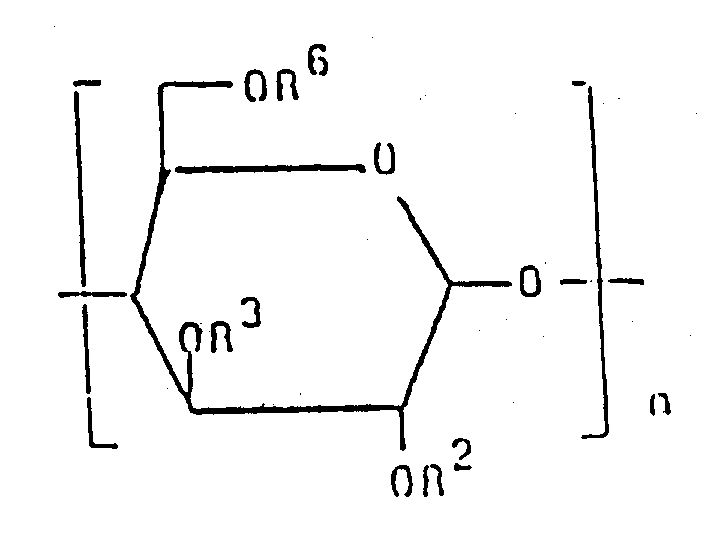
R² und R⁶ geradkettige oder verzweigte Alkyl- oder Alkenylgruppen mit 1 bis 8 oder Cycloalkylgruppen mit 5 bis 8 Kohlenstoffatomen, die gleich oder verschieden sein können und
R³ eine geradkettige oder verzweigte, mit den Resten R² und R⁶ gleiche oder verschiedene Alkyl- oder Alkenylgruppe mit 1 bis 8 oder Cycloalkylgruppe mit 5 bis 8 Kohlenstoffatomen oder
eine Acylgruppe mit einem ggfs. substituierten gesättigten oder olefinisch ungesättigten aliphatischen oder cycloaliphatischen oder einem aromatischen Kohlenwasserstoffrest mit 1 bis 8 Kohlenstoffatomen und n = 6 oder 7,
wobei die Verbindungen mit
R² = R³ = R⁶ = Methyl, n = 6 oder 7
R² = R³ = R⁶ = Ethyl, n= 7
R² = R⁶ = Allyl, R³ = Methyl, n = 7
R² = R⁶ = Propen-(1)-yl, R³ = Methyl, n = 7
R² = R⁶ = Methyl, R³ = n-Butyl, n = 7
R² = R⁶ = Methyl, R³ = Benzoyl, n = 7 und
R² = R³ = Alkyl oder Acyl, R⁶ = C >4-Alkyl
ausgenommen sind. - Substituierte Cyclodextrine nach Anspruch 1, bei denen die Alkyl- und/oder Acylgruppen 3 bis 6 Kohlenstoffatome aufweisen.
- Substituierte Cyclodextrine nach Anspruch 1, bei denen die Reste R², R³ und R⁶ Alkyl- oder Alkenylgruppen mit 3-6 Kohlenstoffatomen sind und/oder R³ die Acetylgruppe bedeutet.
- Substituierte Cylcodextrine nach Anspruch 1, wobei R² und R⁶ eine n-Pentyl-Gruppe und R³ eine Acetylgruppe ist.
- Verfahren zur Herstellung der substiuierten Cyclodextrine gemäß Anspruch 1, bei dem in einer ersten Stufe α -oder β-Cyclodextrin in einem wasserfreien Lösungsmittel gelöst und unter Zugabe von pulversisiertem Alkalihydroxid mit einem Alkylhalogenid umgesetzt und
ggfs. das aus dieser ersten Stufe isolierte Alkylierungsprodukt unter Zugabe eines Amins in einem wasserfreien Lösungsmittel mit einem Acylierungsmittel umgesetzt wird. - Verfahren nach Anspruch 5, dadurch gekennzeichnet, daß als wasserfreie Lösungsmittel aprotische Lösungsmittel eingesetzt werden.
- Verfahren nach Anspruch 5 oder 6, dadurch gekennzeichnet, daß die Umsetzungen unter Inertgas durchgeführt werden.
- Verfahren zur Trennung von chiralen organischen Verbindungen durch chromatographische Trennverfahren, insbesondere durch Gaschromatographie, bei dem als stationäre Phase substituierte Cyclodextrine der allgemeinen Formel verwendet werden:

R² und R⁶ geradkettige oder verzweigte Alkyl- oder Alkenylgruppen mit 1 bis 8 oder Cycloalkylgruppen mit 5 bis 8 Kohlenstoffatomen, die gleich oder verschieden sein können und
R³ eine geradkettige oder verzweigte, mit den Resten R² und R⁶ gleiche oder verschiedene Alkyl- oder Alkenylgruppe mit 1 bis 8 oder Cycloalkylgruppe mit 5 bis 8 Kohlenstoffatomen oder
eine Acylgruppe mit einem ggfs. substituierten gesättigten oder olefinisch ungesättigten aliphatischen oder cycloaliphatischen oder einem aromatischen Kohlenwasserstoffrest mit 1 bis 8 Kohlenstoffatomen und n = 6 oder 7
bedeuten und die folgenden Verbindungen ausgenommen sind:
R² = R³ = R⁶ = Methyl, n=6 oder 7
R² = R⁶ = Allyl, R³ = Methyl, n= 7
R² = R⁶ = Propen-(1)-yl, R³ = Methyl, n=7
R² = R⁶ = Methyl, R³ = n-Butyl, n=7. - Verfahren nach Anspruch 8, dadurch gekennzeichnet, daß die substituierten Cyclodextrine zur Trennung von Enantiomeren verwendet werden.
- Verfahren nach Anspruch 9, dadurch gekennzeichnet, daß die substituierten Cyclodextrine zur Trennung von Enantiomeren von Diolen, Polyolen, Monosacchariden Methylglykosiden, 1,5-Anhydroalditolen, Hydroxysäureestern, Alkoholen, Aldolen, Lactonen, Spiroacetalen, Aminoalkoholen, Aminen, Aminosäureestern verwendet werden, gegebenenfalls nach Trifluoracetylierung dieser Substanzen nach an sich bekannten Verfahren.
Applications Claiming Priority (2)
| Application Number | Priority Date | Filing Date | Title |
|---|---|---|---|
| DE3810737A DE3810737A1 (de) | 1988-03-30 | 1988-03-30 | Substituierte cyclodextrine |
| DE3810737 | 1988-03-30 |
Publications (2)
| Publication Number | Publication Date |
|---|---|
| EP0407412A1 EP0407412A1 (de) | 1991-01-16 |
| EP0407412B1 true EP0407412B1 (de) | 1993-07-14 |
Family
ID=6351021
Family Applications (1)
| Application Number | Title | Priority Date | Filing Date |
|---|---|---|---|
| EP89903476A Expired - Lifetime EP0407412B1 (de) | 1988-03-30 | 1989-03-25 | Substituierte cyclodextrine und verfahren zur chromatographischen trennung chiraler organischer verbindungen |
Country Status (5)
| Country | Link |
|---|---|
| US (2) | US5198429A (de) |
| EP (1) | EP0407412B1 (de) |
| JP (1) | JPH03505337A (de) |
| DE (2) | DE3810737A1 (de) |
| WO (1) | WO1989009235A1 (de) |
Cited By (1)
| Publication number | Priority date | Publication date | Assignee | Title |
|---|---|---|---|---|
| EP3069777A1 (de) * | 2015-03-17 | 2016-09-21 | ZHAW Zurich University for Applied Sciences | Verfahren zur gaschromatographischen trennung eines enantiomerengemisches |
Families Citing this family (26)
| Publication number | Priority date | Publication date | Assignee | Title |
|---|---|---|---|---|
| DE4009621A1 (de) * | 1990-03-26 | 1991-10-02 | Henkel Kgaa | (alpha) -cyanacrylatklebstoffzusammensetzungen |
| EP0494967A4 (en) * | 1990-08-08 | 1993-03-17 | Advanced Separation Technologies, Inc. | Chiral separation media |
| US5491223A (en) * | 1991-02-28 | 1996-02-13 | Daicel Chemical Industries, Ltd. | Polysaccharide derivative and separating agent |
| US5959089A (en) * | 1993-07-19 | 1999-09-28 | Hannessian; Stephen | Amino-cyclodextrin syntheses |
| CA2100820C (en) * | 1993-07-19 | 1999-11-02 | Stephen Hanessian | Amino-cyclodextrin and related structures |
| US5626757A (en) * | 1994-02-22 | 1997-05-06 | Advanced Separation Technologies Inc. | Macrocyclic antibiotics as separation agents |
| DE4414128A1 (de) * | 1994-04-22 | 1995-10-26 | Consortium Elektrochem Ind | Teilweise acylierte beta-Cyclodextrine |
| US5985772A (en) | 1994-06-23 | 1999-11-16 | Cellresin Technologies, Llc | Packaging system comprising cellulosic web with a permeant barrier or contaminant trap |
| US5492947A (en) | 1994-06-23 | 1996-02-20 | Aspen Research Corporation | Barrier material comprising a thermoplastic and a compatible cyclodextrin derivative |
| US5776842A (en) | 1994-06-23 | 1998-07-07 | Cellresin Technologies, Llc | Cellulosic web with a contaminant barrier or trap |
| US5928745A (en) * | 1994-06-23 | 1999-07-27 | Cellresin Technologies, Llc | Thermoplastic fuel tank having reduced fuel vapor emissions |
| FR2741079B1 (fr) * | 1995-11-13 | 1997-12-26 | Oreal | Nouveaux composes, derives de cyclodextrine et leur utilisation, notamment en cosmetique |
| US5882565A (en) | 1995-12-11 | 1999-03-16 | Cellresin Technologies, Llc | Barrier material comprising a thermoplastic and a compatible cyclodextrin derivative |
| JP3865436B2 (ja) * | 1996-07-11 | 2007-01-10 | 塩水港精糖株式会社 | 分岐シクロデキストリンの製造方法 |
| FR2755123B1 (fr) * | 1996-10-28 | 1998-11-20 | Commissariat Energie Atomique | Purification de l'eau au moyen de cyclodextrines |
| KR100435426B1 (ko) * | 1996-11-29 | 2004-08-16 | 주식회사 포스코 | 구조 이성질체의 분리에 유용한 6-디메틸옥틸실릴-2,3-디에틸-베타-시클로덱스트린 및 그 제조방법 |
| KR100411289B1 (ko) * | 1996-11-29 | 2004-02-14 | 주식회사 포스코 | 회전장애 이성질체의 분리에 유용한 6-알릴디메틸실릴-2,3-디에 틸-베타-시클로덱스트린 및 그 제조방법 |
| US6017458A (en) | 1997-08-27 | 2000-01-25 | National University Of Singapore | Separating materials for chromatography and electrophoresis applications comprising regiodefined functionalised cyclodextrins chemically bonded to a support via urethane functionalities |
| FR2767834B1 (fr) * | 1997-08-29 | 1999-12-03 | Inst Francais Du Petrole | Mono et di-derives de cyclodextrines, leurs synthese et purification et leur utilisation en support |
| US6391862B1 (en) * | 1997-10-14 | 2002-05-21 | The Texas A&M University System | Chiral resolving agents for enantioseparations |
| EP1084149A1 (de) * | 1998-05-29 | 2001-03-21 | Janssen Pharmaceutica N.V. | Acylierte und alkylierte cyclodextrinderivate und ihre verwendung als medikamententräger |
| US20040129640A9 (en) * | 2002-01-18 | 2004-07-08 | National University Of Singapore | Materials comprising polymers or oligomers of saccharides chemically bonded to a support useful for chromatography and electrophoresis applications |
| US7589233B2 (en) * | 2003-07-29 | 2009-09-15 | Signature R&D Holdings, Llc | L-Threonine derivatives of high therapeutic index |
| CN103406113B (zh) * | 2013-07-11 | 2015-02-25 | 哈尔滨工程大学 | 固载化型β-环糊精衍生物类手性固定相的制备方法 |
| CN106824141B (zh) * | 2015-12-04 | 2020-11-24 | 中国科学院大连化学物理研究所 | 一种环糊精色谱固定相的制备方法 |
| CN119386508B (zh) * | 2024-08-30 | 2025-04-08 | 广州菲罗门科学仪器有限公司 | 一种高效手性分离色谱柱及其制备方法 |
Family Cites Families (5)
| Publication number | Priority date | Publication date | Assignee | Title |
|---|---|---|---|---|
| HU190584B (en) * | 1983-03-11 | 1986-09-29 | Chinoin Gyogyszer Es Vegyeszeti Termekek Gyara,Rt,Hu | Process for the production of heptakis/2,6-di-o-methyl-beta-cyclodextrin |
| DE3328348A1 (de) * | 1983-08-05 | 1985-02-14 | Degussa Ag, 6000 Frankfurt | Verfahren zur duennschichtchromatographischen trennung von enantiomeren |
| EP0146841A3 (de) * | 1983-12-17 | 1986-11-20 | Consortium für elektrochemische Industrie GmbH | Wasserlösliche Mischether des beta-Cyclodextrins und ein Verfahren zu ihrer Herstellung |
| DE3744742C2 (de) * | 1986-10-31 | 1993-03-11 | Director-General Of Agency Of Industrial Science And Technology, Tokio/Tokyo, Jp | |
| US5078886A (en) * | 1989-10-18 | 1992-01-07 | Lehigh University | Separation of mixtures by two-phase systems |
-
1988
- 1988-03-30 DE DE3810737A patent/DE3810737A1/de not_active Withdrawn
-
1989
- 1989-03-25 US US07/585,117 patent/US5198429A/en not_active Ceased
- 1989-03-25 EP EP89903476A patent/EP0407412B1/de not_active Expired - Lifetime
- 1989-03-25 WO PCT/EP1989/000332 patent/WO1989009235A1/de not_active Ceased
- 1989-03-25 JP JP1503200A patent/JPH03505337A/ja active Pending
- 1989-03-25 DE DE8989903476T patent/DE58904919D1/de not_active Expired - Lifetime
- 1989-03-25 US US08/526,141 patent/USRE36092E/en not_active Expired - Lifetime
Non-Patent Citations (3)
| Title |
|---|
| Cemicals absracts, vol 109, Nr 15, 10 okt 1988(Columbus, Ohio, US) W.A: Koenig et al:"Modified cyclodextrin a new highly enantioselective stationary phase for gas chromatography" page 331, abstract Nr 125206x, & Angew. Chem. 1988 100(7), 989-90. * |
| Starch/Stärke, vol 39, Nr 10, Okt 1987 VHC Verlagsgesellschaft mbh(Weinheim, DE)J.Szejtli:"Application of cyclodextrins in the chromatographie pages 357-362, see page 358 cited in the application. * |
| Tetrahedron, vol 39, Nr 9, 1983, Pergamon Press Ltd(Oxford), GB, A.p Groft et al.:"Synthesis of chemically modified cyclodextrins" pages 1417, 1427-1433, 1472 see page 1431. * |
Cited By (1)
| Publication number | Priority date | Publication date | Assignee | Title |
|---|---|---|---|---|
| EP3069777A1 (de) * | 2015-03-17 | 2016-09-21 | ZHAW Zurich University for Applied Sciences | Verfahren zur gaschromatographischen trennung eines enantiomerengemisches |
Also Published As
| Publication number | Publication date |
|---|---|
| USRE36092E (en) | 1999-02-09 |
| DE3810737A1 (de) | 1989-10-12 |
| EP0407412A1 (de) | 1991-01-16 |
| WO1989009235A1 (fr) | 1989-10-05 |
| US5198429A (en) | 1993-03-30 |
| DE58904919D1 (de) | 1993-08-19 |
| JPH03505337A (ja) | 1991-11-21 |
Similar Documents
| Publication | Publication Date | Title |
|---|---|---|
| WO1989009235A1 (fr) | Cyclodextrines substituees et procede de separation chromatographique de composes organiques chiraux | |
| DE60205624T2 (de) | Methoden zur herstellung von im wesentlichen monodispersen polymermischungen mit polyethylenglykoleinheiten | |
| EP0695287B1 (de) | Fullerenderivate, verfahren zur herstellung und deren verwendung | |
| EP1001951A1 (de) | Thiazolderivate, verfahren zur herstellung und verwendung | |
| EP0445604B1 (de) | Trennmaterialien für die Chromatographie | |
| DE69030649T2 (de) | Polysaccharide derivate sowie trennmittel | |
| DE69233090T2 (de) | Trennmittel | |
| DE19616968A1 (de) | Polymerisierbares Phosphazenderivat, Verfahren zu dessen Herstellung und dessen Verwendung | |
| DE69226578T2 (de) | Production eines Zellulosederivates | |
| EP0605677A1 (de) | Silicium- oder siliciumdioxid-substrat mit modifizierter oberfläche und verfahren zu dessen herstellung | |
| DE69102508T2 (de) | Stationäre Phase für die enantiomere Resolution in der Flüssigkeitschromatographie. | |
| DE19605024A1 (de) | Neue selektive Taxane, Verfahren zu ihrer Herstellung und ihre pharmazeutische Verwendung | |
| DE3879786T2 (de) | Packungsmaterial zur Analyse von Enantiomer-Gemischen durch Flüssig-Chromatographie. | |
| WO2002085921A2 (de) | Einfaches verfahren zur synthese von boswelliasäuren und derivaten davon | |
| DE60102763T2 (de) | Verfahren zur Herstellung von Dihydroperimidinsquarain-Verbindungen | |
| DE2752533C3 (de) | Verfahren zur Herstellung von 10 a -Methoxydihydrolysergol- 5'-bromnicotinsäureester | |
| EP0135162B1 (de) | Weinsäuremonoester von optisch aktiven Alkanolaminen, Verfahren zu ihrer Herstellung und ihre Verwendung | |
| DE19516517C1 (de) | Ferrocenverbindungen, Verfahren zu deren Herstellung sowie der Zwischenprodukte | |
| DE2603046C2 (de) | 4'α- und 4'β-Amino-4'-desoxy-oleandrine, Verfahren zu ihrer Herstellung sowie diese enthaltende pharmazeutische Präparate | |
| DE69621463T2 (de) | Verfahren zum ausgewähltem schutz von baccatinderivaten und ihre verwendung für die synthese von taxanen | |
| EP0043967A1 (de) | 2,9-Dioxatricyclo(4,3,1,0(3,7))decane | |
| DE69219582T2 (de) | Neue verbindung und trennungsreagenz | |
| WO1996009275A1 (de) | Fullerenderivate als synthesebausteine, verfahren zu ihrer herstellung sowie deren verwendung | |
| DE2843136C3 (de) | 6-O-Mono- und 1,6-O-Di-acylierte 2-[3-(2-Chloräthyl)-3-nitroscureido]-2-desoxy-D-glukopyranosen sowie Gemische aus 1,3,6-O-Tri und 1,4,6-O-Tri-acylierten 2-[3-(2-Chloräthyl)-3-nitrosoureido]-2-desoxy-D-glukopyranosen | |
| DE69331814T2 (de) | Salze von Glukopyranosederivate und ihre Zwischenprodukte |
Legal Events
| Date | Code | Title | Description |
|---|---|---|---|
| PUAI | Public reference made under article 153(3) epc to a published international application that has entered the european phase |
Free format text: ORIGINAL CODE: 0009012 |
|
| 17P | Request for examination filed |
Effective date: 19900926 |
|
| AK | Designated contracting states |
Kind code of ref document: A1 Designated state(s): BE DE FR GB LU NL |
|
| 17Q | First examination report despatched |
Effective date: 19920814 |
|
| GRAA | (expected) grant |
Free format text: ORIGINAL CODE: 0009210 |
|
| RAP1 | Party data changed (applicant data changed or rights of an application transferred) |
Owner name: MACHEREY, NAGEL & CO. |
|
| AK | Designated contracting states |
Kind code of ref document: B1 Designated state(s): BE DE FR GB LU NL |
|
| REF | Corresponds to: |
Ref document number: 58904919 Country of ref document: DE Date of ref document: 19930819 |
|
| ET | Fr: translation filed | ||
| GBT | Gb: translation of ep patent filed (gb section 77(6)(a)/1977) |
Effective date: 19931015 |
|
| PLBI | Opposition filed |
Free format text: ORIGINAL CODE: 0009260 |
|
| EPTA | Lu: last paid annual fee | ||
| 26 | Opposition filed |
Opponent name: CHROMPACK INTERNATIONAL B.V. Effective date: 19940414 |
|
| NLR1 | Nl: opposition has been filed with the epo |
Opponent name: CHROMPACK INTERNATIONAL B.V. |
|
| PGFP | Annual fee paid to national office [announced via postgrant information from national office to epo] |
Ref country code: LU Payment date: 19950301 Year of fee payment: 7 |
|
| PG25 | Lapsed in a contracting state [announced via postgrant information from national office to epo] |
Ref country code: LU Free format text: LAPSE BECAUSE OF NON-PAYMENT OF DUE FEES Effective date: 19960325 |
|
| PLBO | Opposition rejected |
Free format text: ORIGINAL CODE: EPIDOS REJO |
|
| PLBN | Opposition rejected |
Free format text: ORIGINAL CODE: 0009273 |
|
| STAA | Information on the status of an ep patent application or granted ep patent |
Free format text: STATUS: OPPOSITION REJECTED |
|
| 27O | Opposition rejected |
Effective date: 19960803 |
|
| NLR2 | Nl: decision of opposition | ||
| REG | Reference to a national code |
Ref country code: GB Ref legal event code: IF02 |
|
| PGFP | Annual fee paid to national office [announced via postgrant information from national office to epo] |
Ref country code: GB Payment date: 20080318 Year of fee payment: 20 |
|
| PGFP | Annual fee paid to national office [announced via postgrant information from national office to epo] |
Ref country code: FR Payment date: 20080314 Year of fee payment: 20 Ref country code: DE Payment date: 20080326 Year of fee payment: 20 |
|
| PGFP | Annual fee paid to national office [announced via postgrant information from national office to epo] |
Ref country code: BE Payment date: 20080321 Year of fee payment: 20 |
|
| PGFP | Annual fee paid to national office [announced via postgrant information from national office to epo] |
Ref country code: NL Payment date: 20080318 Year of fee payment: 20 |
|
| BE20 | Be: patent expired |
Owner name: *MACHEREY NAGEL & CO. Effective date: 20090325 |
|
| REG | Reference to a national code |
Ref country code: GB Ref legal event code: PE20 Expiry date: 20090324 |
|
| PG25 | Lapsed in a contracting state [announced via postgrant information from national office to epo] |
Ref country code: NL Free format text: LAPSE BECAUSE OF EXPIRATION OF PROTECTION Effective date: 20090325 |
|
| NLV7 | Nl: ceased due to reaching the maximum lifetime of a patent |
Effective date: 20090325 |
|
| PG25 | Lapsed in a contracting state [announced via postgrant information from national office to epo] |
Ref country code: GB Free format text: LAPSE BECAUSE OF EXPIRATION OF PROTECTION Effective date: 20090324 |