EP0404039B1 - Arzneimittel, enthaltend Di-tert.-Butylhydroxyphenyl-Derivate sowie neue Derivate - Google Patents
Arzneimittel, enthaltend Di-tert.-Butylhydroxyphenyl-Derivate sowie neue Derivate Download PDFInfo
- Publication number
- EP0404039B1 EP0404039B1 EP90111501A EP90111501A EP0404039B1 EP 0404039 B1 EP0404039 B1 EP 0404039B1 EP 90111501 A EP90111501 A EP 90111501A EP 90111501 A EP90111501 A EP 90111501A EP 0404039 B1 EP0404039 B1 EP 0404039B1
- Authority
- EP
- European Patent Office
- Prior art keywords
- tert
- butyl
- hydroxyphenyl
- derivatives
- acid
- Prior art date
- Legal status (The legal status is an assumption and is not a legal conclusion. Google has not performed a legal analysis and makes no representation as to the accuracy of the status listed.)
- Expired - Lifetime
Links
- 0 C*c(cc(cc1C(C)(C)C)C(O)=O)c1O Chemical compound C*c(cc(cc1C(C)(C)C)C(O)=O)c1O 0.000 description 2
Classifications
-
- C—CHEMISTRY; METALLURGY
- C07—ORGANIC CHEMISTRY
- C07D—HETEROCYCLIC COMPOUNDS
- C07D295/00—Heterocyclic compounds containing polymethylene-imine rings with at least five ring members, 3-azabicyclo [3.2.2] nonane, piperazine, morpholine or thiomorpholine rings, having only hydrogen atoms directly attached to the ring carbon atoms
- C07D295/16—Heterocyclic compounds containing polymethylene-imine rings with at least five ring members, 3-azabicyclo [3.2.2] nonane, piperazine, morpholine or thiomorpholine rings, having only hydrogen atoms directly attached to the ring carbon atoms acylated on ring nitrogen atoms
- C07D295/18—Heterocyclic compounds containing polymethylene-imine rings with at least five ring members, 3-azabicyclo [3.2.2] nonane, piperazine, morpholine or thiomorpholine rings, having only hydrogen atoms directly attached to the ring carbon atoms acylated on ring nitrogen atoms by radicals derived from carboxylic acids, or sulfur or nitrogen analogues thereof
- C07D295/182—Radicals derived from carboxylic acids
- C07D295/185—Radicals derived from carboxylic acids from aliphatic carboxylic acids
-
- A—HUMAN NECESSITIES
- A61—MEDICAL OR VETERINARY SCIENCE; HYGIENE
- A61K—PREPARATIONS FOR MEDICAL, DENTAL OR TOILETRY PURPOSES
- A61K31/00—Medicinal preparations containing organic active ingredients
- A61K31/16—Amides, e.g. hydroxamic acids
- A61K31/165—Amides, e.g. hydroxamic acids having aromatic rings, e.g. colchicine, atenolol, progabide
-
- A—HUMAN NECESSITIES
- A61—MEDICAL OR VETERINARY SCIENCE; HYGIENE
- A61K—PREPARATIONS FOR MEDICAL, DENTAL OR TOILETRY PURPOSES
- A61K31/00—Medicinal preparations containing organic active ingredients
- A61K31/16—Amides, e.g. hydroxamic acids
- A61K31/17—Amides, e.g. hydroxamic acids having the group >N—C(O)—N< or >N—C(S)—N<, e.g. urea, thiourea, carmustine
-
- A—HUMAN NECESSITIES
- A61—MEDICAL OR VETERINARY SCIENCE; HYGIENE
- A61K—PREPARATIONS FOR MEDICAL, DENTAL OR TOILETRY PURPOSES
- A61K31/00—Medicinal preparations containing organic active ingredients
- A61K31/33—Heterocyclic compounds
- A61K31/395—Heterocyclic compounds having nitrogen as a ring hetero atom, e.g. guanethidine or rifamycins
- A61K31/495—Heterocyclic compounds having nitrogen as a ring hetero atom, e.g. guanethidine or rifamycins having six-membered rings with two or more nitrogen atoms as the only ring heteroatoms, e.g. piperazine or tetrazines
-
- A—HUMAN NECESSITIES
- A61—MEDICAL OR VETERINARY SCIENCE; HYGIENE
- A61P—SPECIFIC THERAPEUTIC ACTIVITY OF CHEMICAL COMPOUNDS OR MEDICINAL PREPARATIONS
- A61P11/00—Drugs for disorders of the respiratory system
-
- A—HUMAN NECESSITIES
- A61—MEDICAL OR VETERINARY SCIENCE; HYGIENE
- A61P—SPECIFIC THERAPEUTIC ACTIVITY OF CHEMICAL COMPOUNDS OR MEDICINAL PREPARATIONS
- A61P29/00—Non-central analgesic, antipyretic or antiinflammatory agents, e.g. antirheumatic agents; Non-steroidal antiinflammatory drugs [NSAID]
-
- A—HUMAN NECESSITIES
- A61—MEDICAL OR VETERINARY SCIENCE; HYGIENE
- A61P—SPECIFIC THERAPEUTIC ACTIVITY OF CHEMICAL COMPOUNDS OR MEDICINAL PREPARATIONS
- A61P3/00—Drugs for disorders of the metabolism
- A61P3/06—Antihyperlipidemics
-
- A—HUMAN NECESSITIES
- A61—MEDICAL OR VETERINARY SCIENCE; HYGIENE
- A61P—SPECIFIC THERAPEUTIC ACTIVITY OF CHEMICAL COMPOUNDS OR MEDICINAL PREPARATIONS
- A61P43/00—Drugs for specific purposes, not provided for in groups A61P1/00-A61P41/00
-
- A—HUMAN NECESSITIES
- A61—MEDICAL OR VETERINARY SCIENCE; HYGIENE
- A61P—SPECIFIC THERAPEUTIC ACTIVITY OF CHEMICAL COMPOUNDS OR MEDICINAL PREPARATIONS
- A61P9/00—Drugs for disorders of the cardiovascular system
- A61P9/10—Drugs for disorders of the cardiovascular system for treating ischaemic or atherosclerotic diseases, e.g. antianginal drugs, coronary vasodilators, drugs for myocardial infarction, retinopathy, cerebrovascula insufficiency, renal arteriosclerosis
-
- C—CHEMISTRY; METALLURGY
- C07—ORGANIC CHEMISTRY
- C07C—ACYCLIC OR CARBOCYCLIC COMPOUNDS
- C07C233/00—Carboxylic acid amides
- C07C233/01—Carboxylic acid amides having carbon atoms of carboxamide groups bound to hydrogen atoms or to acyclic carbon atoms
- C07C233/16—Carboxylic acid amides having carbon atoms of carboxamide groups bound to hydrogen atoms or to acyclic carbon atoms having the nitrogen atom of at least one of the carboxamide groups bound to a carbon atom of a hydrocarbon radical substituted by singly-bound oxygen atoms
- C07C233/17—Carboxylic acid amides having carbon atoms of carboxamide groups bound to hydrogen atoms or to acyclic carbon atoms having the nitrogen atom of at least one of the carboxamide groups bound to a carbon atom of a hydrocarbon radical substituted by singly-bound oxygen atoms with the substituted hydrocarbon radical bound to the nitrogen atom of the carboxamide group by an acyclic carbon atom
- C07C233/18—Carboxylic acid amides having carbon atoms of carboxamide groups bound to hydrogen atoms or to acyclic carbon atoms having the nitrogen atom of at least one of the carboxamide groups bound to a carbon atom of a hydrocarbon radical substituted by singly-bound oxygen atoms with the substituted hydrocarbon radical bound to the nitrogen atom of the carboxamide group by an acyclic carbon atom having the carbon atom of the carboxamide group bound to a hydrogen atom or to a carbon atom of an acyclic saturated carbon skeleton
-
- C—CHEMISTRY; METALLURGY
- C07—ORGANIC CHEMISTRY
- C07C—ACYCLIC OR CARBOCYCLIC COMPOUNDS
- C07C235/00—Carboxylic acid amides, the carbon skeleton of the acid part being further substituted by oxygen atoms
- C07C235/02—Carboxylic acid amides, the carbon skeleton of the acid part being further substituted by oxygen atoms having carbon atoms of carboxamide groups bound to acyclic carbon atoms and singly-bound oxygen atoms bound to the same carbon skeleton
- C07C235/04—Carboxylic acid amides, the carbon skeleton of the acid part being further substituted by oxygen atoms having carbon atoms of carboxamide groups bound to acyclic carbon atoms and singly-bound oxygen atoms bound to the same carbon skeleton the carbon skeleton being acyclic and saturated
- C07C235/18—Carboxylic acid amides, the carbon skeleton of the acid part being further substituted by oxygen atoms having carbon atoms of carboxamide groups bound to acyclic carbon atoms and singly-bound oxygen atoms bound to the same carbon skeleton the carbon skeleton being acyclic and saturated having at least one of the singly-bound oxygen atoms further bound to a carbon atom of a six-membered aromatic ring, e.g. phenoxyacetamides
-
- C—CHEMISTRY; METALLURGY
- C07—ORGANIC CHEMISTRY
- C07C—ACYCLIC OR CARBOCYCLIC COMPOUNDS
- C07C235/00—Carboxylic acid amides, the carbon skeleton of the acid part being further substituted by oxygen atoms
- C07C235/02—Carboxylic acid amides, the carbon skeleton of the acid part being further substituted by oxygen atoms having carbon atoms of carboxamide groups bound to acyclic carbon atoms and singly-bound oxygen atoms bound to the same carbon skeleton
- C07C235/32—Carboxylic acid amides, the carbon skeleton of the acid part being further substituted by oxygen atoms having carbon atoms of carboxamide groups bound to acyclic carbon atoms and singly-bound oxygen atoms bound to the same carbon skeleton the carbon skeleton containing six-membered aromatic rings
- C07C235/34—Carboxylic acid amides, the carbon skeleton of the acid part being further substituted by oxygen atoms having carbon atoms of carboxamide groups bound to acyclic carbon atoms and singly-bound oxygen atoms bound to the same carbon skeleton the carbon skeleton containing six-membered aromatic rings having the nitrogen atoms of the carboxamide groups bound to hydrogen atoms or to acyclic carbon atoms
-
- C—CHEMISTRY; METALLURGY
- C07—ORGANIC CHEMISTRY
- C07C—ACYCLIC OR CARBOCYCLIC COMPOUNDS
- C07C235/00—Carboxylic acid amides, the carbon skeleton of the acid part being further substituted by oxygen atoms
- C07C235/42—Carboxylic acid amides, the carbon skeleton of the acid part being further substituted by oxygen atoms having carbon atoms of carboxamide groups bound to carbon atoms of six-membered aromatic rings and singly-bound oxygen atoms bound to the same carbon skeleton
- C07C235/44—Carboxylic acid amides, the carbon skeleton of the acid part being further substituted by oxygen atoms having carbon atoms of carboxamide groups bound to carbon atoms of six-membered aromatic rings and singly-bound oxygen atoms bound to the same carbon skeleton with carbon atoms of carboxamide groups and singly-bound oxygen atoms bound to carbon atoms of the same non-condensed six-membered aromatic ring
- C07C235/48—Carboxylic acid amides, the carbon skeleton of the acid part being further substituted by oxygen atoms having carbon atoms of carboxamide groups bound to carbon atoms of six-membered aromatic rings and singly-bound oxygen atoms bound to the same carbon skeleton with carbon atoms of carboxamide groups and singly-bound oxygen atoms bound to carbon atoms of the same non-condensed six-membered aromatic ring having the nitrogen atom of at least one of the carboxamide groups bound to an acyclic carbon atom of a hydrocarbon radical substituted by singly-bound oxygen atoms
-
- C—CHEMISTRY; METALLURGY
- C07—ORGANIC CHEMISTRY
- C07C—ACYCLIC OR CARBOCYCLIC COMPOUNDS
- C07C235/00—Carboxylic acid amides, the carbon skeleton of the acid part being further substituted by oxygen atoms
- C07C235/42—Carboxylic acid amides, the carbon skeleton of the acid part being further substituted by oxygen atoms having carbon atoms of carboxamide groups bound to carbon atoms of six-membered aromatic rings and singly-bound oxygen atoms bound to the same carbon skeleton
- C07C235/44—Carboxylic acid amides, the carbon skeleton of the acid part being further substituted by oxygen atoms having carbon atoms of carboxamide groups bound to carbon atoms of six-membered aromatic rings and singly-bound oxygen atoms bound to the same carbon skeleton with carbon atoms of carboxamide groups and singly-bound oxygen atoms bound to carbon atoms of the same non-condensed six-membered aromatic ring
- C07C235/56—Carboxylic acid amides, the carbon skeleton of the acid part being further substituted by oxygen atoms having carbon atoms of carboxamide groups bound to carbon atoms of six-membered aromatic rings and singly-bound oxygen atoms bound to the same carbon skeleton with carbon atoms of carboxamide groups and singly-bound oxygen atoms bound to carbon atoms of the same non-condensed six-membered aromatic ring having the nitrogen atom of at least one of the carboxamide groups bound to a carbon atom of a six-membered aromatic ring
-
- C—CHEMISTRY; METALLURGY
- C07—ORGANIC CHEMISTRY
- C07C—ACYCLIC OR CARBOCYCLIC COMPOUNDS
- C07C275/00—Derivatives of urea, i.e. compounds containing any of the groups, the nitrogen atoms not being part of nitro or nitroso groups
- C07C275/04—Derivatives of urea, i.e. compounds containing any of the groups, the nitrogen atoms not being part of nitro or nitroso groups having nitrogen atoms of urea groups bound to acyclic carbon atoms
- C07C275/20—Derivatives of urea, i.e. compounds containing any of the groups, the nitrogen atoms not being part of nitro or nitroso groups having nitrogen atoms of urea groups bound to acyclic carbon atoms of an unsaturated carbon skeleton
- C07C275/24—Derivatives of urea, i.e. compounds containing any of the groups, the nitrogen atoms not being part of nitro or nitroso groups having nitrogen atoms of urea groups bound to acyclic carbon atoms of an unsaturated carbon skeleton containing six-membered aromatic rings
-
- C—CHEMISTRY; METALLURGY
- C07—ORGANIC CHEMISTRY
- C07C—ACYCLIC OR CARBOCYCLIC COMPOUNDS
- C07C323/00—Thiols, sulfides, hydropolysulfides or polysulfides substituted by halogen, oxygen or nitrogen atoms, or by sulfur atoms not being part of thio groups
- C07C323/23—Thiols, sulfides, hydropolysulfides or polysulfides substituted by halogen, oxygen or nitrogen atoms, or by sulfur atoms not being part of thio groups containing thio groups and nitrogen atoms, not being part of nitro or nitroso groups, bound to the same carbon skeleton
- C07C323/39—Thiols, sulfides, hydropolysulfides or polysulfides substituted by halogen, oxygen or nitrogen atoms, or by sulfur atoms not being part of thio groups containing thio groups and nitrogen atoms, not being part of nitro or nitroso groups, bound to the same carbon skeleton at least one of the nitrogen atoms being part of any of the groups, X being a hetero atom, Y being any atom
- C07C323/43—Y being a hetero atom
- C07C323/44—X or Y being nitrogen atoms
-
- C—CHEMISTRY; METALLURGY
- C07—ORGANIC CHEMISTRY
- C07C—ACYCLIC OR CARBOCYCLIC COMPOUNDS
- C07C323/00—Thiols, sulfides, hydropolysulfides or polysulfides substituted by halogen, oxygen or nitrogen atoms, or by sulfur atoms not being part of thio groups
- C07C323/23—Thiols, sulfides, hydropolysulfides or polysulfides substituted by halogen, oxygen or nitrogen atoms, or by sulfur atoms not being part of thio groups containing thio groups and nitrogen atoms, not being part of nitro or nitroso groups, bound to the same carbon skeleton
- C07C323/46—Thiols, sulfides, hydropolysulfides or polysulfides substituted by halogen, oxygen or nitrogen atoms, or by sulfur atoms not being part of thio groups containing thio groups and nitrogen atoms, not being part of nitro or nitroso groups, bound to the same carbon skeleton having at least one of the nitrogen atoms, not being part of nitro or nitroso groups, further bound to other hetero atoms
- C07C323/48—Thiols, sulfides, hydropolysulfides or polysulfides substituted by halogen, oxygen or nitrogen atoms, or by sulfur atoms not being part of thio groups containing thio groups and nitrogen atoms, not being part of nitro or nitroso groups, bound to the same carbon skeleton having at least one of the nitrogen atoms, not being part of nitro or nitroso groups, further bound to other hetero atoms to nitrogen atoms
-
- C—CHEMISTRY; METALLURGY
- C07—ORGANIC CHEMISTRY
- C07C—ACYCLIC OR CARBOCYCLIC COMPOUNDS
- C07C323/00—Thiols, sulfides, hydropolysulfides or polysulfides substituted by halogen, oxygen or nitrogen atoms, or by sulfur atoms not being part of thio groups
- C07C323/50—Thiols, sulfides, hydropolysulfides or polysulfides substituted by halogen, oxygen or nitrogen atoms, or by sulfur atoms not being part of thio groups containing thio groups and carboxyl groups bound to the same carbon skeleton
- C07C323/51—Thiols, sulfides, hydropolysulfides or polysulfides substituted by halogen, oxygen or nitrogen atoms, or by sulfur atoms not being part of thio groups containing thio groups and carboxyl groups bound to the same carbon skeleton having the sulfur atoms of the thio groups bound to acyclic carbon atoms of the carbon skeleton
- C07C323/60—Thiols, sulfides, hydropolysulfides or polysulfides substituted by halogen, oxygen or nitrogen atoms, or by sulfur atoms not being part of thio groups containing thio groups and carboxyl groups bound to the same carbon skeleton having the sulfur atoms of the thio groups bound to acyclic carbon atoms of the carbon skeleton with the carbon atom of at least one of the carboxyl groups bound to nitrogen atoms
-
- C—CHEMISTRY; METALLURGY
- C07—ORGANIC CHEMISTRY
- C07C—ACYCLIC OR CARBOCYCLIC COMPOUNDS
- C07C335/00—Thioureas, i.e. compounds containing any of the groups, the nitrogen atoms not being part of nitro or nitroso groups
- C07C335/04—Derivatives of thiourea
- C07C335/06—Derivatives of thiourea having nitrogen atoms of thiourea groups bound to acyclic carbon atoms
- C07C335/10—Derivatives of thiourea having nitrogen atoms of thiourea groups bound to acyclic carbon atoms of an unsaturated carbon skeleton
- C07C335/12—Derivatives of thiourea having nitrogen atoms of thiourea groups bound to acyclic carbon atoms of an unsaturated carbon skeleton the carbon skeleton containing six-membered aromatic rings
Definitions
- D preferably represents a -CH2-, -CH2-CH2-, - (CH2) 4-, - (CH2) 6-, -CH2-CH2-O-CH2-CH2- or -CH2-CH2-S-CH2-CH2 - group.
- the compounds of general formula I are used as medicaments, in particular as antiarteriosclerotics.
- Di-butylated hydroxyphenyl derivatives which have amide, ester, amine and urea structures between two phenyl nuclei in the spacer, have been known for a long time for stabilizing organic material.
- Antioxidants are substances which - added in small amounts - cause a temporary standstill or at least a considerable delay in the oxidative processes in the product to be protected.
- the 2,6-di-tert-butylphenyl derivatives known to date from the literature are suitable as stabilizers against thermooxidative or light-induced degradation for polyolefin copolymers, polystyrene, acrylic butadiene styrene, polyvinyl chloride, polyester, cellulose derivatives, elastomers, Adhesives, technical Greases, mineral oils, paints and paints.
- Some connections such as Irganox 1076 [octadecyl 3- (3,5-di-tert-butyl-4-hydroxyphenyl) propionate] received FDA approval for food packaging.
- a substance with a sterically hindered alkylphenol is already used as a pharmaceutical.
- Probucol originally used in the plastics and rubber industry as a plasticizer or antioxidant, shows a hypocholesterolemic effect in mice, rats, dogs, monkeys and in humans.
- the reduction in serum cholesterol is associated with a reduced excretion of neutral sterols, total sterols and bile acids in the faeces, while cholesterol-7-alpha-hydroxylase activity is reduced at the same time.
- the antiatherosclerotic effect of Probucol which can be demonstrated in animal experiments, is based on its property as an antioxidant: D. Steinberg et al. were able to show in in vivo experiments on WHHL rabbits that probucol prevents the oxidative modification of the LDL particles and the formation of macrophagocytic foam cells rich in cholesterol in early artery wall lesions [D. Steinberg et al., N Engl J Med 320, 915-924 (1989)].
- the compounds according to the invention are stabilizers of lipoprotein particles and block the reacylation of LDL cholesterol in macrophages. They are therefore suitable on their own or in combination with antihyperlipidemics for the prophylaxis and therapy of diseases which are caused by increased or changed serum cholesterol, such as coronary heart diseases, atherosclerosis, hyperlipoproteinemia and similar diseases.
- the compounds of the general formula I are mixed in a manner known per se with suitable pharmaceutical carriers, flavorings, flavors and colors and shaped, for example, as tablets or dragées or with the addition of appropriate auxiliaries in water or oil, such as, for example, olive oil, suspended or dissolved.
- the substances of the general formula I can be administered orally and parenterally in liquid or solid form.
- Water is preferably used as the injection medium, which contains the stabilizers, solubilizers and / or buffers customary for injection solutions.
- Such additives are e.g. Tartrate or borate buffers, ethanol, dimethyl sulfoxide, complexing agents (such as ethylenediaminetetraacetic acid), high molecular weight polymers (such as liquid polyethylene oxide) for viscosity regulation or polyethylene derivatives of sorbitan hydrides.
- Solid carriers are e.g. Starch, lactose, mannitol, methyl cellulose, talc, highly disperse silica, higher molecular fatty acids (such as stearic acid), gelatin, agar, calcium phosphate, magnesium stearate, animal and vegetable fats or solid high molecular weight polymers (such as polyethylene glycols).
- Preparations suitable for oral administration can, if desired, contain flavorings and sweeteners.
- the dosage administered depends on the age, the health and the weight of the recipient, the extent of the disease, the type of further treatments which may be carried out at the same time, the frequency of the treatments and the type of effect desired.
- the daily dose of the active compound is usually 0.1 to 10 mg / kg body weight.
- Di-tert-butylated hydroxyphenyl derivatives of the general formula I with an amide or urea group and their derivatives can be obtained by known synthetic methods, for example by the reaction of a carboxylic acid or a derivative (general formula II) with an amine of the general Formula III in which A and C and the substituent R have the meaning given in general formula I.
- the reaction is usually carried out in an inert solvent, such as a hydrocarbon, dimethylformamide or in ether.
- an inert solvent such as a hydrocarbon, dimethylformamide or in ether.
- Equimolar amounts of amine and carboxylic acid are preferably used in the presence of equimolar amounts of a base, such as a tert. organ.
- a base such as a tert. organ.
- Amine preferably triethylamine, alkali bicarbonate, hydroxide or carbonate.
- the acid chloride or an ester can serve as derivatives of the carboxylic acid (general formula II).
- the presence of POCl3, SOCl2 or PCl3 is usually required; for the reaction of a carboxylic acid ester with the amine, a basic catalyst, preferably an alkali alcoholate.
- a basic catalyst preferably an alkali alcoholate.
- the reaction of the carboxylic acid with an amine in a solvent such as xylene is also possible by heating under reflux on a water separator.
- the urea derivatives can by reacting the amine of the general formula III can be represented with phosgene. An excess of amine is used.
- Symmetrical urea derivatives can also be prepared by carbonylation of primary amines (aryl and alkyl amines) with carbon monoxide in the presence of a catalyst, such as selenium or sulfur [cf. Sonoda et al., J.Am. Chem. Soc., 93 , 6344 (1971) and Franz et al., J. Org. Chem. 26 , 3309 (1961)].
- a catalyst such as selenium or sulfur
- Symmetrical thioureas are also formed by the action of carbon disulphide on amines, preferably aromatic amines, with elimination of hydrogen sulfide. Alcohol and acetone [cf. Houben-Weyl IX, 885 and Deposited. Doc., Viniti 6343-82, 93-8, CA 100 (19): 156 325 d].
- the thioamide and thiourea derivatives described in the invention can also be prepared from the carbonyl compounds with phosphorus pentasulfide.
- the invention also relates to new compounds of the general formula I, in particular the following compounds: Preferred compounds of the general formula I: N- [2- [3,5-di-tert-butyl-4-hydroxyphenyl] ethyl] -3,5-di-tert-butyl-4-hydroxybenzamide 3,5-di-tert-butyl-4-hydroxyphenylacetic acid- (3,5-di-tert-butyl-4-hydroxyphenyl) methyl amide 3- (3,5-di-tert-butyl-4-hydroxyphenyl) propionic acid- [2- (3,5-di-tert-butyl-4-hydroxyphenyl) ethyl amide 3- (3,5-di-tert-butyl-4-hydroxyphenyl) cinnamic acid- [2- (3,5-di-tert-butyl) -4-hydroxyphenyl) ethyl] amide N, N'-bis- [2- (3,5-di-
- the starting materials are known or, if they are new, can be prepared in a manner known per se in analogy to the known compounds.
Landscapes
- Chemical & Material Sciences (AREA)
- Organic Chemistry (AREA)
- Health & Medical Sciences (AREA)
- Veterinary Medicine (AREA)
- Public Health (AREA)
- General Health & Medical Sciences (AREA)
- Animal Behavior & Ethology (AREA)
- Life Sciences & Earth Sciences (AREA)
- Pharmacology & Pharmacy (AREA)
- Medicinal Chemistry (AREA)
- Chemical Kinetics & Catalysis (AREA)
- Bioinformatics & Cheminformatics (AREA)
- General Chemical & Material Sciences (AREA)
- Nuclear Medicine, Radiotherapy & Molecular Imaging (AREA)
- Engineering & Computer Science (AREA)
- Epidemiology (AREA)
- Vascular Medicine (AREA)
- Diabetes (AREA)
- Urology & Nephrology (AREA)
- Hematology (AREA)
- Cardiology (AREA)
- Heart & Thoracic Surgery (AREA)
- Pain & Pain Management (AREA)
- Rheumatology (AREA)
- Obesity (AREA)
- Pulmonology (AREA)
- Organic Low-Molecular-Weight Compounds And Preparation Thereof (AREA)
- Acyclic And Carbocyclic Compounds In Medicinal Compositions (AREA)
- Pharmaceuticals Containing Other Organic And Inorganic Compounds (AREA)
Description
- Die Erfindung betrifft Di-tert.-Butylhydroxy-phenyl-Derivate (BHT-Derivate) der allgemeinen Formel I

in der
A und C, die gleich oder verschieden sein können, eine Bindung oder eine gesättigte oder ungesättigte Kohlenwasserstoffkette mit 1-8 C-Atomen, die verzweigt oder unverzweigt sein kann oder die gruppe
und B eine der folgenden Gruppen darstellt: - a)
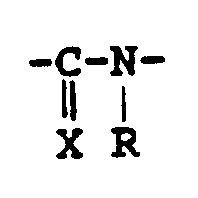
- b)
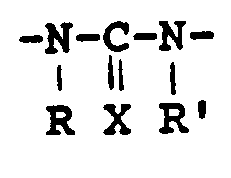
- c)

- d)

- e)

- f)

- Bevorzugte Bedeutungen von A bzw. C sind Valenz, -CH₂-CH₂-,

- D stellt bevorzugt eine -CH₂-, -CH₂-CH₂-, -(CH₂)₄-, -(CH₂)₆-, -CH₂-CH₂-O-CH₂-CH₂- oder -CH₂-CH₂-S-CH₂-CH₂- Gruppe dar.
- Die Verbindungen der allgemeinen Formel I finden aufgrund ihrer antioxidierenden Eigenschaften, stabilisierenden Wirkung auf Lipoproteine und Hemmwirkung auf die Reacylierung des LDL-Cholesterins in Makrophagen Verwendung als Arzneimittel, insbesondere als Antiarteriosklerotica.
- Desweiteren wirken sie antiinflammatorisch, cytoprotektiv sowie antiasthmatisch. Sie können auch als Inhibitoren der Reperfusionsabhängigen Lipidperoxidation und als Stabilisatoren des "lung surfactant factor" eingesetzt werden.
- Di-butylierte Hydroxyphenyl-Derivate, welche zwischen zwei Phenylkernen im Spacer Amid-, Ester-, Amin- und Harnstoffstrukturen haben, sind seit längerer Zeit bereits zum Stabilisieren von organischem Material bekannt.
- So beschreibt beispielsweise die US-B 3.584.047 Benzamide und Phenylalkancarbonsäureamide sowie die DE-A-27 21 398 (Ciba-Geigy) Phenol-Derivate mit Amidstrukturen in der Seitenkette.
- Auch Harnstoffe sowie Thioharnstoffe wurden bereits in der Literatur z.B. als Antioxidantien von T-6 Ölen beschrieben (Oxid. Commun. 5 (1-2), 115 - 28 [CA 102: 9267z] und Neftekhimiya 24 (2), 246 [CA 101: 40727c] sowie Neftekhimiya 27 (5), 703-9) [CA 108: 97496a].
- Als Antioxidantien bezeichnet man Substanzen, welche - in geringen Mengen zugegeben - einen zeitweiligen Stillstand oder zumindest eine erhebliche Verzögerung der oxidativen Vorgänge bei dem zu schützenden Produkt bewirken.
- Die bisher aus der Literatur bekannten 2,6-Di-tert.-Butylphenyl-Derivate eignen sich als Stabilisator gegen thermooxidativen oder lichtinduzierten Abbau für Polyolefin-Copolymere, Polystyrol, Acryl-Butadien-Styrol, Polyvinylchlorid, Polyester, Cellulose-Derivate, Elastomere, Klebstoffe, techn. Fette, Mineralöle, Lacke und Farben. Einige Verbindungen wie z.B. Irganox 1076 [3-(3.5-Di-tert.-butyl-4-hydroxyphenyl)-propionsäureoctadecylester] erhielten die FDA-Zulassung für Lebensmittelverpackungen.
- Als Pharmakon findet bereits eine Substanz mit einem sterisch gehinderten Alkylphenol Anwendung. Probucol (Lurcelle ®),

ursprünglich in der Kunststoff- und Kautschuk- Industrie als Weichmacher bzw. Antioxidans verwendet, zeigt eine hypocholesterinämische Wirkung bei Mäusen, Ratten, Hunden, Affen und am Menschen. - Mit der Reduktion des Serumcholesterins ist eine verminderte Ausscheidung neutraler Sterole, Totalsterole und Gallensäuren in die Faeces verbunden, wobei gleichzeitig die Cholesterin-7-alpha-hydroxylaseaktivität vermindert ist.
- Der genaue Wirkmechanismus ist nicht bekannt.
- Die im Tierversuch nachweisbare antiatherosklerotische Wirkung von Probucol beruht auf seiner Eigenschaft als Antioxidans: D. Steinberg et al. konnten in in vivo-Experimenten an WHHL-Kaninchen zeigen, daß Probucol die oxidative Modifizierung der LDL-Partikel und die Bildung von cholesterinesterreichen makrophagozytären Schaumzellen in Frühläsionen der Arterienwand verhindert [D. Steinberg et al., N Engl J Med 320, 915 - 924 (1989)].
- Die Resorption der stark lipophilen Verbindung ist gering; die Eliminierung aus den Geweben ist äußert langsam, die Ausscheidung erfolgt hauptsächlich über die Faeces [M.N.Cayen, Pharmacol. Ther. 29, 157 (1985)].
- Die erfindungsgemäßen Verbindungen sind Stabilisatoren von Lipoprotein-Partikeln und blockieren die Reacylierung von LDL-Cholesterin in Makrophagen. Sie eignen sich daher alleine oder in Kombination mit Antihyperlipidämika zur Prophylaxe und Therapie von Erkrankungen, die durch erhöhtes bzw. durch Oxidation verändertes Serumcholesterin verursacht werden, wie koronare Herzkrankheiten, Atherosclerose, Hyperlipoproteinämie und ähnliche Erkrankungen.
- Zur Herstellung von Arzneimitteln werden die Verbindungen der allgemeinen Formel I in an sich bekannter Weise mit geeigneten pharmazeutischen Trägersubstanzen, Aroma-, Geschmacks- und Farbstoffen gemischt und beispielsweise als Tabletten oder Dragees ausgeformt oder unter Zugabe entsprechender Hilfsstoffe in Wasser oder Öl, wie z.B. Olivenöl, suspendiert oder gelöst.
- Die Substanzen der allgemeinen Formel I können in flüssiger oder fester Form oral und parenteral appliziert werden. Als Injektionsmedium kommt vorzugsweise Wasser zur Anwendung, welches die bei Injektionslösungen üblichen Stabilisierungsmittel, Lösungsvermittler und/oder Puffer enthält. Derartige Zusätze sind z.B. Tartrat- oder Borat-Puffer, Ethanol, Dimethylsulfoxid, Komplexbildner (wie Ethylendiamintetraessigsäure), hochmolekulare Polymere (wie flüssiges Polyethylenoxid) zur Viskositätsregulierung oder Polyethylen-Derivate von Sorbitanhydriden.
- Feste Trägerstoffe sind z.B. Stärke, Lactose, Mannit, Methylcellulose, Talkum, hochdisperse Kieselsäure, höhermolekulare Fettsäuren (wie Stearinsäure), Gelatine, Agar-Agar, Calciumphosphat, Magnesiumstearat, tierische und pflanzliche Fette oder feste hochmolekulare Polymere (wie Polyethylenglykole). Für die orale Applikation geeignete Zubereitungen können gewünschtenfalls Geschmacks- und Süßstoffe enthalten.
- Die verabreichte Dosierung hängt vom Alter, der Gesundheit und dem Gewicht des Empfängers, dem Ausmaß der Krankheit, der Art gleichzeitiger gegebenenfalls durchgeführter weiterer Behandlungen, der Häufigkeit der Behandlungen und der Art der gewünschten Wirkung ab. Üblicherweise beträgt die tägliche Dosis der aktiven Verbindung 0.1 bis 10 mg/kg Körpergewicht.
- Di-tert.-butylierte Hydroxyphenyl-Derivate der allgemeinen Formel I mit einer Amid- oder Harnstoff-gruppe und deren Derivate können nach bekannten Syntheseverfahren erhalten werden, beispielsweise durch die Umsetzung einer Carbonsäure oder eines Derivats (allgemeine Formel II) mit einem Amin der allgemeinen Formel III


in denen
A und C sowie der Substituent R die in des allgemeinen Formel I angegebene Bedeutung haben. - Die Umsetzung erfolgt in der Regel in einem inerten Lösungsmittel, wie einem Kohlenwasserstoff, Dimethylformamid oder in Ether.
- Vorzugsweise verwendet man äquimolare Mengen an Amin und Carbonsäure in Gegenwart äquimolarer Mengen einer Base, wie einem tert. organ. Amin, bevorzugt Triethylamin, Alkalibicarbonat, Hydroxyd oder - Carbonat.
- Als Derivate der Carbonsäure (allgemeine Formel II) können das Säurechlorid oder ein Ester dienen.
- Für die Umsetzung der freien Carbonsäure ist in der Regel die Anwesenheit von POCl₃, SOCl₂ oder PCl₃ erforderlich; für die Umsetzung eines Carbonsäure-Esters mit dem Amin ein basischer Katalysator, bevorzugt ein Alkalialkoholat. In vielen Fällen gelingt auch die Reaktion der Carbonsäure mit einem Amin in einem Lösungsmittel wie z.B. Xylol durch Erwärmen unter Rückfluß am Wasserabscheider.
- Bei der Darstellung der Diamide werden zwei Äquivalente Carbonsäure (allgemeine Formel II) pro Di-Amin-Komponente (IV) beziehungsweise zwei Äquivalente Amin (III) pro Di-Carbonsäure-Komponente (V) eingesetzt, je nachdem, ob es sich um die Strukturen e) oder f) handelt.
- Die Versuchsbedingungen bleiben identisch wie bei den oben beschriebenen Monoamiden.

HO₂C------D-----CO₂H (V)
R, R′ entsprechen der in der allegemeinen Formel I angegebenen Bedeutung. - Das Teilstück Ⓓ entspricht der in der allgemeinen Formel I angegebenen Bedeutung.
- Die Harnstoff-Derivate können durch Umsetzung des Amins der allgemeinen Formel III

mit Phosgen dargestellt werden. Dabei wird in einem Überschuß an Amin gearbeitet. - Die entsprechende Umsetzung mit Thiocarbonylchlorid (Thiophosgen) und 4 Äquivalenten des Amins der allgmeinen Formel III führt zum Thioharnstoff. Die Thiocarbamidsäurechloride werden als Zwischenstufe nicht isoliert (vgl. T. J. Pullukat et al., Tetrahedron Lett. 1967, 1953).
- Symmetrische Harnstoff-Derivate lassen sich auch durch Carbonylierung von primären Aminen (Aryl- u. Alkylamine) mit Kohlenmonoxid in Gegenwart eines Katalysators, wie Selen oder Schwefel, darstellen [vgl. Sonoda et al., J.Am. Chem.Soc., 93, 6344 (1971) und Franz et al., J.Org.Chem. 26, 3309 (1961)].
- Symmetrische Thioharnstoffe entstehen ebenfalls durch Einwirkung von Schwefelkohlenstoff auf Amine, bevorzugt auf aromatische Amine unter Abspaltung von Schwefelwasserstoff. Als Lösungsmittel bewähren sich Alkohol und Aceton [vgl. Houben-Weyl IX, 885 sowie Deposited. Doc., Viniti 6343-82, 93-8, C.A. 100 (19): 156 325 d].
- Die für die nachstehenden Beispiele am häufigsten angewandte Methode zur Darstellung von symmetrisch wie auch unsysmmetrisch substituierten Harnstoffen stellt die Addition eines Amins (III) an ein Isocyanat (VI) dar (X = O).


- Die Umsetzungen von Isothiocyanaten (X = S) mit einem primären Amin ergibt das Thioharnstoff-Derivat [analog Satchell et al., Chem. Soc. Rev. 4, 231-50 (1975)].
- Diese Methode liefert hervorragende Ausbeuten, wenn in aprotischen Lösungsmitteln, bevorzugt in Kohlenwasserstoffen, oder auch in Ether gearbeitet wird. (Houben-Weyl VIII, 157).
- Die in der Erfindung beschriebenen Thioamid- und Thioharnstoffderivate können ebenso aus den Carbonylverbindungen mit Phosphorpentasulfid dargestellt werden.
- Man verwendet pro Carbonylfunktion etwa 2 Äquivalente Pentasulfid in wasserfreien aprotischen Lösungsmitteln, bevorzugt Kohlenwasserstoffen wie Xylol.
- Als geeigneter erwies sich die Umsetzung mit Lawesson's Reagenz [2,4-Bis-(4-methoxyphenyl)-1,3-dithia-2,4-diphosphetan-2,4-disulfid] in geringem Überschuß (1.1 bis zu 2.0 Äquivalente] in aprotischen Lösungsmitteln, bevorzugt in Toluol oder Xylol bei erhöhten Temperaturen.
- Gegenstand der Erfindung sind auch neue Verbindungen der allegemeinen Formel I, insbesondere die folgenden Verbindungen:
Bevorzugte Verbindungen der allgemeinen Formel I:
N-[2-[3,5-Di-tert.-butyl-4-hydroxyphenyl]ethyl]-3,5-di-tert.-butyl-4-hydroxybenzamid
3,5-Di-tert.-butyl-4-Hydroxyphenylessigsäure-(3,5-di-tert.-butyl-4-hydroxyphenyl)methyl-amid
3-(3,5-Di-tert.-butyl-4-hydroxyphenyl)propionsäure-[2-(3,5-di-tert.-butyl-4-hydroxyphenyl)ethyl-amid
3-(3,5-Di-tert.-butyl-4-hydroxyphenyl)zimtsäure-[2-(3,5-di-tert.-butyl)-4-hydroxyphenyl)ethyl]amid
N,N′-Bis-[2-(3,5-di-tert.-butyl-4-hydroxyphenyl)ethyl]harnstoff
N,N′-Bis-[2-(3,5-di-tert.-butyl-4-hydroxyphenyl)ethyl]thioharnstoff
N,N′-Diethyl-N,N′-bis-(3,5-di-tert.-butyl-4-hydroxyphenethyl)hexansäureamid
- Die folgenden Beispiele erläutern die Erfindung.
- Die Ausgangsstoffe sind bekannt oder können, sofern sie neu sind, in Analogie zu den bekannten Verbindungen in an sich bekannter Weise hergestellt werden.
- Ein Gemisch aus 206.3 g (1 mol) 2,6-Di-tert.-butylphenol, 4.8 g pulv. Natriumborhydrid und 262 ml (4 mol) Acrylnitril wird 16 h im Ölbad auf 90°C erwärmt (leichter Rückfluß). Man kühlt ab, rührt in 1 l Wasser ein, säuert an und gibt 900 ml Methylenchlorid zu. Danach saugt man das gebildete Produkt ab, trennt, wäscht die Wasserphase zweimal mit wenig Methylenchlorid, vereint die Methylenchloridphasen, trocknet sie und engt ein. Das Rohprodukt wird auf der Nutsche zweimal mit je 250 ml Ligroin gewaschen.
Ausbeute: 203.6 g (78 % d. Theorie)
Schmp. 110-113°C
Lit.: Sumitomo, Jap. Kokai 75, 71 638 - Ein Gemisch aus 190 ml Wasser, 148.0 g (3.7 mol) NaOH, 800 ml Ethanol und 95.6 g (0.37 mol) des Propionitrils (s.o.) wird unter Stickstoff 18 h auf Rückflußtemperatur erhitzt. Dann kühlt man ab, säuert mit 6 N Salzsäure auf pH 2 an, saugt ab und wäscht den Filterkuchen mit Wasser. Nach Umkristallisation aus 66proz. Alkohol erhält man 95.0 g (92 % d. Theorie) Carbonsäure.
Schmp.: 169.5-170°C - Man löst 52.8 g (0.256 mol) 2,6-Di-tert.-butylphenol in 200 ml n-Heptan, gibt 250 ml 37proz. Formalinlösung und 500 ml konz. Salzsäure zu, spült mit Stickstoff und rührt 18 h bei Rückflußtemperatur. Nach dem Abkühlen trennt man die org. Phase ab, extrahiert die wässrige Phase mit n-Heptan und wäscht die vereinten Heptanphasen mit Wasser. Nach Trocknen mittels Na₂SO₄ wird i. Vak. eingedampft und der Rückstand i. Vak. destilliert.
Sdp.: 132-134°C/0.01 Torr
Ausbeute: 46.2 g (71 % d. Theorie)
Lit.: Neureither, J.Org.Chem. 28, 3486 (1963) - Zu einer 80-85°C heißen Mischung aus 38.4 g (0.71 mol) Natriumcyanid, 50 ml Wasser und 72 ml Ethanol tropft man innerhalb 1 h eine Lösung aus 104.5 g (0.41 mol) 4-Hydroxy-3,5-di-tert.-butylbenzylchlorid und 155 ml Ethanol. Anschließend hält man weitere 3 h auf Rückflußtemperatur, kühlt ab und saugt anorgan. Material ab. Die flüssige Phase wird eingedampft, der Eindampfrückstand mit Wasser versetzt und mit Ether extrahiert. Man trocknet die Etherphase (Na₂SO₄), dampft ein und bringt durch Ligroin-Zugabe zur Kristallisation.
Ausbeute: 61.1 g (61 % d. Theorie)
Schmp.: 109-110°C
analog Fuson und Rabjohn, Org. Synth. Vol. 25, 66. - Zu einer Suspension aus 19.0 g (0.5 mol) LiAlH₄ und 600 ml absol. Ether tropft man unter Stickstoff eine Lösung aus 60.0 g (0.245 mol) 4-Hydroxy-3,5-di-tert.-butylbenzylcyanid und 400 ml absol. Ether. Man rührt weitere 4 h bei Rückflußtemperatur, zersetzt dann mit Natronlauge und Wasser und saugt ab. Die Etherphase wird getrocknet mit Natriumsulfat und eingedampft.
Ausbeute: 59 g (97 % d. Theorie)
Schmp.: 106-108°C (Umkrist. aus Ligroin). - Eine Lösung von 7.48 g (0.03 mol) 3-(4-Hydroxy-3,5-di-tert.-butylphenyl)propionsäure und 8.35 g (0.03 mol) 4-Hydroxy-3,5-di-tert.-butylphenethylamin in 250 ml Xylol wird 56 h am Wasserabscheider unter Rückfluß erhitzt; weder Carbonsäure noch Amin sind nach dieser Zeit dünnschichtchromatographisch nachweisbar.
Der Ansatz wird eingeengt, der Rückstand kristallisiert durch Verreiben mit Ligroin.
Ausbeute: 10.9 g (71 % d. Theorie)
Schmp.: 172°C - Eine Lösung von 75.5 g (0.3 mol) 3,5-Di-tert.-butyl-4-hydroxybenzaldehyd, 270 ml Pyridin, 10 ml Piperidin und 100 g (0.95 mol) Malonsäure wird 2 h auf 85°C unter Stickstoff unter Rühren erwärmt; anschließend rührt man schnell in 750 g Eis und 150 ml konz. Salzsäure ein. Das entstehende Öl nimmt man in Methylenchlorid auf, extrahiert viermal mit 2 N Salzsäure, wäscht neutral, trocknet über Natriumsulfat und dampft i. Vak. ein. Nach Umkristallisation erhält man das Zimtsäurederivat als Kristallisat mit einem Schmelzpunkt von 198-201°C
Ausbeute: 59 %. - Zu einer Lösung aus 4.44 g (0.016 mol) 3,5-Di-tert.-butyl-4-hydroxyzimtsäure und 4.0 g (0.016 mol) 4-Hydroxy-3,5-di-tert.-butylphenethylamin in 100 ml Pyridin gibt man 1.1 g (0.008 mol) Phosphortrichlorid und erwärmt 10 h auf 90°C.
- Nach dem Einengen wird der Rückstand in Ether aufgenommen, mehrmals mit 0.5 N Natronlauge, anschließend mit 0.5 N Salzsäure und Wasser gewaschen und eingeengt.
Ausbeute: 71 %
Schmp.: 245°C - Eine Lösung aus 24.94 g (0.1 mol) 3,5-Di-tert.-butyl-4-hydroxy-phenethylamin und 100 ml absol. Toluol wird zunächst bis zur sauren Reaktion mit Chlorwasserstoff begast. Dann erhitzt man auf 100°C und leitet langsam 49.4 g (0.5 mol) Phosgen ein. Anschließend hält man 45 min auf Rückflußtemperatur. Nach Stehen über Nacht wird i. Vak. das Toluol abdestilliert, wobei man das Isocyanat als schwarzes Öl erhält, das ohne weitere Aufreinigung für die Harnstoff-Synthese verwendet werden kann.
- Zu einer Lösung aus 19.9 g (80 mmol) 3,5-Di-tert.-butyl-4-hydroxyphenethylamin in 100 ml absol. Ether tropft man unter Stickstoff eine Lösung aus 22 g (80 mmol) des rohen Isocyanats und 40 ml absol. Ether. Nachdem die schwach exotherme Reaktion abgeklungen ist, fällt ein kristalliner Niederschlag aus, der abgesaugt, getrocknet und zweimal aus Ethanol umkristallisiert wird.
Ausbeute: 27.8 g, (66 % d. Theorie)
Schmp.: 191-192°C - Unter Stickstoff mischt man 50.0 g (225 mmol) 2,6-Di-tert.-butyl-hydrochinon mit 500 ml Butanon-2 und 48.4 g (350 mmol) Kaliumcarbonat, rührt 2 h bei 80°C, gibt eine Spatelspitze Kaliumjodid sowie 68.2 g (350 mmol) 2-Brom-2-methylpropionsäureethylester zu und hält 4 h auf Rückflußtemperatur. Man saugt ab, dampft i. Vak. ein und destilliert den Rückstand im Hochvakuum. Zwischen 143°C und 144°C/0.005 Torr erhält man 50.0 g (66 % d. Theorie) farbloses, langsam erstarrendes Produkt, das im Kältebad aus Ligroin umkristallisiert wird.
Schmp.: 50-51°C - 17.0 g (50 mmol) des Ethylesters werden in 125 ml Ethanol und 125 ml 2 N Natronlauge (0.25 mol) 30 min auf Siedetemperatur erwärmt, nach dem Abkühlen mit 125 ml 2 N Salzsäure (0.25 mol) versetzt. Der ausgefallene Niederschlag ergibt 10.7 g (69 % d. Theorie) Säure mit dem Schmp. 122-123°C.
- Zu einer Lösung von 2.62 g (5 mmol) N,N′-Bis-(3,5-di-tert.-butyl-4-hydroxyphenethyl)-harnstoff in 20 ml absol. Toluol gibt man unter Stickstoff 1.2 g (3 mmol) Lawesson's Reagenz [2,4-Bis-(4-methoxyphenyl)-1,3-dithia-2,4-diphosphetan-2,4-disulfid].
- Danach erwärmt man auf 100°C und läßt 1.5 h bei dieser Temperatur rühren. Nach dem Abkühlen wird die Lösung eingeengt und der Rückstand mehrmals aus Ether/Isohexan umkristallisiert.
Ausbeute: 63 %
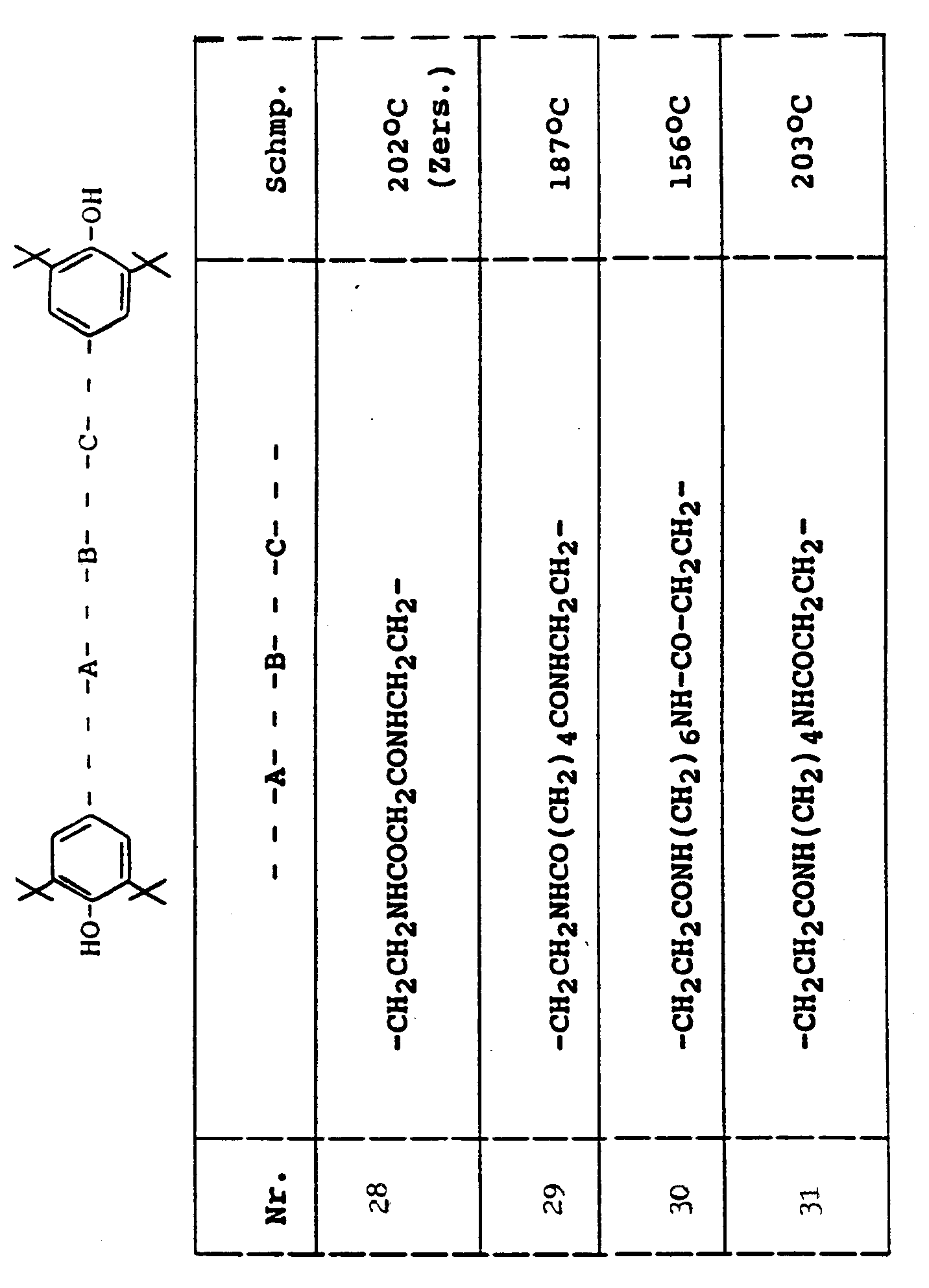
Schmp.: 135-136°C - In analoger Weise wie in den Beispielen 6, 8, 10 bzw. 12 beschrieben erhält man:


in denen
X ein Sauerstoff- oder Schwefel-atom,
R,R′, welche gleich oder verschieden sein können,
ein Wasserstoffatom oder C₁-C₄ Alkyl, bevorzugt Methyl oder Ethyl, bedeuten,
und
D für eine ungesättigte oder gesättigte, verzweigte oder unverzweigte Kette mit ein bis 10 C-Atomen, oder die Gruppen -CH₂-CH₂-O-CH₂-CH₂ oder -CH₂CH₂-S-CH₂-CH₂- steht.
Claims (3)
- Arzneimittel, enthaltend eine Verbindung der allgemeinen Formel I
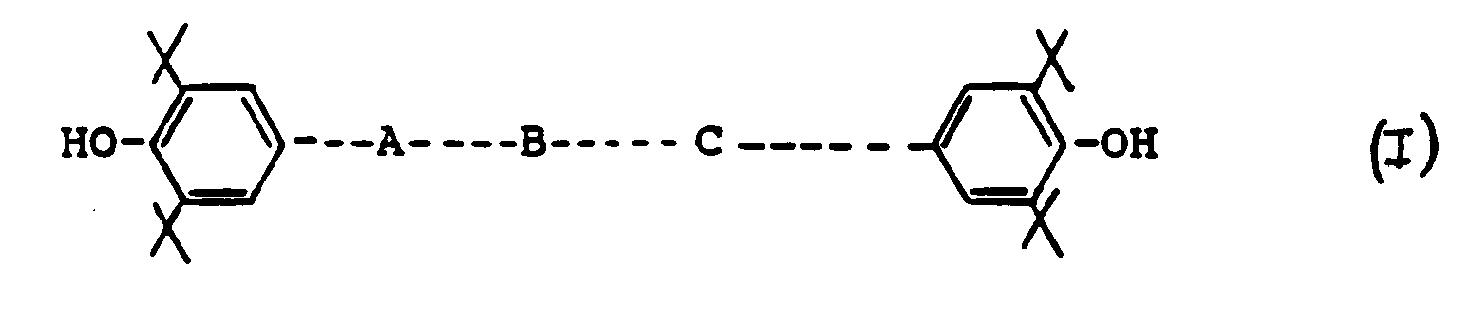
A und C, die gleich oder verschieden sein können, eine Bindung oder eine gesättigte oder ungesättigte Kohlenwasserstoffkette mit 1-8 C-Atomen, die verzweigt oder unverzweigt sein kann oder die Gruppe
und B eine der folgenden Gruppen darstellt:a) b)
b)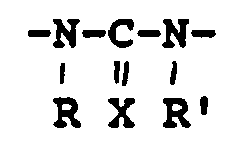
- Verwendung von Verbindungen gemäß Anspruch 1 als Antiarteriosklerotica,
- Verbindungen ausgewählt aus der Gruppe:
N-[2-[3,5-Di-tert,-butyl-4-hydroxyphenyl]ethyl]-3,5-di -tert,-butyl-4-hydroxybenzamid
3,5-Di-tert,-butyl-4-Hydroxyphenylessigsäure-(3,5-di-tert.-butyl-4-hydroxyphenyl)methyl-amid
3-(3,5-Di-tert,-butyl-4-hydroxyphenyl)propionsäure-[2-(3,5-di-tert.-butyl-4-hydroxyphenyl)ethyl-amid
3-(3,5-Di-tert,-butyl-4-hydroxyphenyl)zimtsäure-[2-(3,5-di-tert.-butyl)-4-hydroxyphenyl)ethyl]amid
N,N′-Bis-[2-(3,5-di-tert.-butyl-4-hydroxyphenyl)ethyl]-harnstoff
N,N′-Bis-[2-(3,5-di-tert,-butyl-4-hydroxyphenyl)ethyl]-thioharnstoff
N,N′-Diethyl-N,N′-bis-(3,5-di-tert,-butyl-4-hydroxyphenethyl)hexansäureamid.c) d )
d ) e)
e) f)in denen
X ein Sauerstoff- oder Schwefel-atom,
R, R′, die gleich oder verschieden sein können,
ein Wasserstoffatom oder C₁-C₄ Alkyl bedeuten,
und
D für eine ungesättigte oder gesättigte, verzweigte oder unverzweigte Kette mit ein bis 10 C-Atomen, oder die Gruppen -CH₂-CH₂-O-CH₂-CH₂- oder CH₂-CH₂-S-CH₂-CH₂-, steht, neben üblichen Träger- und Hilfsstoffen.
Applications Claiming Priority (2)
| Application Number | Priority Date | Filing Date | Title |
|---|---|---|---|
| DE3920616 | 1989-06-23 | ||
| DE3920616A DE3920616A1 (de) | 1989-06-23 | 1989-06-23 | Arzneimittel, enthaltend di-tert.-butylhydroxyphenyl-derivate sowie neue derivate |
Publications (2)
| Publication Number | Publication Date |
|---|---|
| EP0404039A1 EP0404039A1 (de) | 1990-12-27 |
| EP0404039B1 true EP0404039B1 (de) | 1993-01-13 |
Family
ID=6383432
Family Applications (1)
| Application Number | Title | Priority Date | Filing Date |
|---|---|---|---|
| EP90111501A Expired - Lifetime EP0404039B1 (de) | 1989-06-23 | 1990-06-19 | Arzneimittel, enthaltend Di-tert.-Butylhydroxyphenyl-Derivate sowie neue Derivate |
Country Status (6)
| Country | Link |
|---|---|
| EP (1) | EP0404039B1 (de) |
| JP (1) | JPH0348648A (de) |
| AT (1) | ATE84413T1 (de) |
| DE (2) | DE3920616A1 (de) |
| DK (1) | DK0404039T3 (de) |
| GR (1) | GR3007513T3 (de) |
Cited By (1)
| Publication number | Priority date | Publication date | Assignee | Title |
|---|---|---|---|---|
| US8575215B2 (en) | 2001-12-10 | 2013-11-05 | Yansheng Du | Treatment of neurodegenerative and cardiovascular disorders |
Families Citing this family (27)
| Publication number | Priority date | Publication date | Assignee | Title |
|---|---|---|---|---|
| US5354782A (en) * | 1991-01-17 | 1994-10-11 | Merrell Dow Pharmaceuticals Inc. | Polyamine phenols as radioprotective agents |
| DE4204405A1 (de) * | 1991-08-02 | 1993-02-04 | Boehringer Mannheim Gmbh | Verwendung von di-tert.-butylhydroxyphenyl-derivaten zur therapie von entzuendlichen erkrankungen des magen-darm-traktes |
| DE4126662A1 (de) | 1991-08-13 | 1993-02-18 | Boehringer Mannheim Gmbh | Neue 3,5-di-tert.butyl-4-hydroxyphenyl-derivate, verfahren zu ihrer herstellung und arzneimittel |
| US5703130A (en) * | 1995-06-07 | 1997-12-30 | Institute Of Materia Medica, An Institute Of The Chinese Academy Of Medical Sciences | Chalcone retinoids and methods of use of same |
| AU702423B2 (en) * | 1995-06-07 | 1999-02-18 | Institute Of Materia Medica | Chalcone retinoids and methods of use of same |
| JP4382880B2 (ja) * | 1996-10-11 | 2009-12-16 | 興和株式会社 | 新規なジアミド化合物及びこれを含有する医薬 |
| DE19747644C2 (de) * | 1997-10-29 | 2001-02-22 | Inst Polymerforschung Dresden | Sterisch gehinderte Phenole und Verfahren zu ihrer Herstellung |
| JP2005522564A (ja) | 2002-04-05 | 2005-07-28 | ユニバーシティ オブ マサチューセッツ ロウエル | ポリマー抗酸化剤 |
| US7595074B2 (en) | 2002-04-05 | 2009-09-29 | University Of Massachusetts Lowell | Polymeric antioxidants |
| US7323511B2 (en) | 2004-01-21 | 2008-01-29 | University Of Massachusetts Lowell | Post-coupling synthetic approach for polymeric antioxidants |
| EP1768954A4 (de) * | 2004-06-24 | 2008-05-28 | Incyte Corp | 2-methylpropanamide und deren verwendung als pharmazeutika |
| WO2006012226A2 (en) | 2004-06-24 | 2006-02-02 | Incyte Corporation | N-substituted piperidines and their use as pharmaceuticals |
| US20060041087A1 (en) * | 2004-07-23 | 2006-02-23 | Cholli Ashok L | Anti-oxidant macromonomers and polymers and methods of making and using the same |
| WO2006060800A1 (en) * | 2004-12-03 | 2006-06-08 | Polnox Corporation | Synthesis of aniline and phenol-based antioxidant macromonomers and corresponding polymers |
| WO2006060801A2 (en) | 2004-12-03 | 2006-06-08 | Polnox Corporation | Process for the synthesis of polyalkylphenol antioxidants |
| WO2006091705A2 (en) | 2005-02-22 | 2006-08-31 | Polnox Corporation | Nitrogen and hindered phenol containing dual functional macromolecular antioxidants: synthesis , performances and applications |
| US7705185B2 (en) | 2005-03-25 | 2010-04-27 | Polnox Corporation | Alkylated and polymeric macromolecular antioxidants and methods of making and using the same |
| US7705176B2 (en) | 2005-10-27 | 2010-04-27 | Polnox Corporation | Macromolecular antioxidants based on sterically hindered phenols and phosphites |
| US20070149660A1 (en) | 2005-10-27 | 2007-06-28 | Vijayendra Kumar | Stabilized polyolefin compositions |
| WO2007064843A1 (en) | 2005-12-02 | 2007-06-07 | Polnox Corporation | Lubricant oil compositions |
| WO2008005358A2 (en) | 2006-07-06 | 2008-01-10 | Polnox Corporation | Novel macromolecular antioxidants comprising differing antioxidant moieties: structures, methods of making and using the same |
| US7767853B2 (en) | 2006-10-20 | 2010-08-03 | Polnox Corporation | Antioxidants and methods of making and using the same |
| US20130143933A1 (en) * | 2011-11-09 | 2013-06-06 | Trt Pharma Inc. | Targeted correction of a genetic defect in cancer therapy |
| MX390820B (es) * | 2013-10-17 | 2025-03-21 | Swimc Llc | Compuestos de di (amido(alquil) fenol) y polimeros formados a partir de estos. |
| EP3071544B1 (de) | 2013-11-22 | 2022-07-06 | Polnox Corporation | Makromolekulare antioxidanzien auf basis eines doppeltyp-anteils pro molekül: strukturen, verfahren zur herstellung und verwendung davon |
| WO2015179064A1 (en) | 2014-05-19 | 2015-11-26 | Valspar Sourcing, Inc. | Polyethers containing non-bisphenolic cyclic groups |
| US20180251695A1 (en) | 2017-03-01 | 2018-09-06 | Polnox Corporation | Macromolecular Corrosion (McIn) Inhibitors: Structures, Methods Of Making And Using The Same |
Family Cites Families (10)
| Publication number | Priority date | Publication date | Assignee | Title |
|---|---|---|---|---|
| US3584047A (en) * | 1967-12-29 | 1971-06-08 | Geigy Chem Corp | Alkylhydroxyphenyl polyamides |
| US3763166A (en) * | 1967-12-29 | 1973-10-02 | Ciba Geigy Corp | N,n'-bis(3-(3,5-di-t-butyl-4-hydroxyphenyl)lower alkanoyl)piperazines |
| DE2240609A1 (de) * | 1972-08-18 | 1974-02-28 | Hoechst Ag | Stoffwechselwirksame derivate der 4-hydroxy-3,5-di-alkylphenyl-propionsaeure |
| GB1405767A (en) * | 1972-12-14 | 1975-09-10 | Ethyl Corp | Method formulation and pharmaceutical composition for reducing plasma lipid levels |
| DE2721398A1 (de) * | 1976-05-19 | 1977-12-01 | Ciba Geigy Ag | Alkylphenol-stabilisatoren |
| US4066610A (en) * | 1976-07-14 | 1978-01-03 | Dart Industries, Inc. | Stabilized pigmented polyolefin compositions |
| NL7905000A (nl) * | 1978-09-25 | 1980-03-27 | Cincinnati Milacron Chem | Gehinderde fenolverbindingen, alsmede organische mate- rialen die met behulp daarvan gestabiliseerd zijn tegen oxydatieve aantasting. |
| US4397868A (en) * | 1982-01-26 | 1983-08-09 | American Cyanamid Company | Method of treating atherosclerosis with trisubstituted ureas |
| US4473579A (en) * | 1982-01-26 | 1984-09-25 | American Cyanamid Company | Antiatherosclerotic tetrasubstituted ureas and thioureas |
| US4835189A (en) * | 1987-06-05 | 1989-05-30 | G. D. Searle & Co. | Phenolic thioalkylamides as inhibitors of 5-lipoxygenase |
-
1989
- 1989-06-23 DE DE3920616A patent/DE3920616A1/de not_active Withdrawn
-
1990
- 1990-06-19 AT AT90111501T patent/ATE84413T1/de not_active IP Right Cessation
- 1990-06-19 DK DK90111501.4T patent/DK0404039T3/da active
- 1990-06-19 EP EP90111501A patent/EP0404039B1/de not_active Expired - Lifetime
- 1990-06-19 DE DE9090111501T patent/DE59000750D1/de not_active Expired - Fee Related
- 1990-06-25 JP JP2164354A patent/JPH0348648A/ja active Pending
-
1993
- 1993-03-31 GR GR920403074T patent/GR3007513T3/el unknown
Cited By (1)
| Publication number | Priority date | Publication date | Assignee | Title |
|---|---|---|---|---|
| US8575215B2 (en) | 2001-12-10 | 2013-11-05 | Yansheng Du | Treatment of neurodegenerative and cardiovascular disorders |
Also Published As
| Publication number | Publication date |
|---|---|
| GR3007513T3 (de) | 1993-08-31 |
| JPH0348648A (ja) | 1991-03-01 |
| DE3920616A1 (de) | 1991-01-03 |
| ATE84413T1 (de) | 1993-01-15 |
| DK0404039T3 (da) | 1993-04-19 |
| EP0404039A1 (de) | 1990-12-27 |
| DE59000750D1 (de) | 1993-02-25 |
Similar Documents
| Publication | Publication Date | Title |
|---|---|---|
| EP0404039A1 (de) | Arzneimittel, enthaltend Di-tert.-Butylhydroxyphenyl-Derivate sowie neue Derivate | |
| EP0600949B1 (de) | Neue 3,5-di-tert.butyl-4-hydroxyphenyl-derivate, verfahren zu ihrer herstellung und arzneimittel | |
| EP0031954B1 (de) | Neue Sulfonamide, Verfahren zu deren Herstellung sowie diese Verbindungen enthaltende Arzneimittel | |
| DE60225316T2 (de) | Cyanoalkylamino-derivate als protease-hemmer | |
| DE3881246T2 (de) | Durch Benzhydryl N-substituierte heterocyclische Derivate, ihre Herstellung und ihre Verwendung. | |
| DE69305492T2 (de) | Im intracerebralen bereich verweisende verbindungen und deren anwendung | |
| DE68904995T2 (de) | Phenolische thioaether, deren herstellung und verwendung. | |
| DE19912638A1 (de) | Naphthylcarbonsäureamid-substituierte Sulfonamide | |
| DE69429591T2 (de) | Therapeutisch wirksame Verbindungen | |
| DE69027472T2 (de) | Arylsubstituierte Rhodaninderivate | |
| WO2001090053A1 (de) | Diphenylmethanderivate | |
| DE3685829T2 (de) | Heterocyclische amide. | |
| DE69020394T2 (de) | Aldose-Reductase-Inhibitor. | |
| DE10038007A1 (de) | Neue Amino-und Amido-Diphenylether für Arzneimittel | |
| DE2602643C2 (de) | 1,2-Benzisothiazolinone-3, Verfahren zu ihrer Herstellung sowie Arzneimittel | |
| EP0119428A2 (de) | Biscarboxamide zur Bekämpfung von Erkrankungen sowie Verfahren zu ihrer Herstellung | |
| DE3884858T2 (de) | Phenol-thioalkylamide als Inhibitoren von 5-Lipoxygenase. | |
| DE3686729T2 (de) | Aminoalkylpyridinamide. | |
| DE69012040T2 (de) | Benzanilidederivate und Ihre Verwendung als anti-atherosclerosis Wirkstoffe. | |
| IE912889A1 (en) | Diphenylurea derivatives | |
| DE69110217T2 (de) | Derivate der Kaffeinsäure und sie enthaltende pharmazeutische Zusammensetzungen. | |
| DE68904203T4 (de) | Cysteinderivate. | |
| DE3879378T2 (de) | Amid-verbindungen. | |
| EP0149201B1 (de) | Neue Carbonsäure-Derivate, Verfahren zu ihrer Herstellung sowie diese Verbindungen enthaltende Arzneimittel | |
| EP0183190A1 (de) | Benzamide und Salze |
Legal Events
| Date | Code | Title | Description |
|---|---|---|---|
| PUAI | Public reference made under article 153(3) epc to a published international application that has entered the european phase |
Free format text: ORIGINAL CODE: 0009012 |
|
| 17P | Request for examination filed |
Effective date: 19900619 |
|
| AK | Designated contracting states |
Kind code of ref document: A1 Designated state(s): AT BE CH DE DK ES FR GB GR IT LI LU NL SE |
|
| 17Q | First examination report despatched |
Effective date: 19920107 |
|
| GRAA | (expected) grant |
Free format text: ORIGINAL CODE: 0009210 |
|
| AK | Designated contracting states |
Kind code of ref document: B1 Designated state(s): AT BE CH DE DK ES FR GB GR IT LI LU NL SE |
|
| REF | Corresponds to: |
Ref document number: 84413 Country of ref document: AT Date of ref document: 19930115 Kind code of ref document: T |
|
| REF | Corresponds to: |
Ref document number: 59000750 Country of ref document: DE Date of ref document: 19930225 |
|
| ET | Fr: translation filed | ||
| ITF | It: translation for a ep patent filed | ||
| REG | Reference to a national code |
Ref country code: DK Ref legal event code: T3 |
|
| PG25 | Lapsed in a contracting state [announced via postgrant information from national office to epo] |
Ref country code: ES Free format text: LAPSE BECAUSE OF FAILURE TO SUBMIT A TRANSLATION OF THE DESCRIPTION OR TO PAY THE FEE WITHIN THE PRESCRIBED TIME-LIMIT Effective date: 19930424 |
|
| GBT | Gb: translation of ep patent filed (gb section 77(6)(a)/1977) |
Effective date: 19930416 |
|
| REG | Reference to a national code |
Ref country code: GR Ref legal event code: FG4A Free format text: 3007513 |
|
| PLBE | No opposition filed within time limit |
Free format text: ORIGINAL CODE: 0009261 |
|
| STAA | Information on the status of an ep patent application or granted ep patent |
Free format text: STATUS: NO OPPOSITION FILED WITHIN TIME LIMIT |
|
| 26N | No opposition filed | ||
| PGFP | Annual fee paid to national office [announced via postgrant information from national office to epo] |
Ref country code: GB Payment date: 19940609 Year of fee payment: 5 Ref country code: FR Payment date: 19940609 Year of fee payment: 5 |
|
| PGFP | Annual fee paid to national office [announced via postgrant information from national office to epo] |
Ref country code: AT Payment date: 19940614 Year of fee payment: 5 |
|
| PGFP | Annual fee paid to national office [announced via postgrant information from national office to epo] |
Ref country code: SE Payment date: 19940615 Year of fee payment: 5 Ref country code: CH Payment date: 19940615 Year of fee payment: 5 |
|
| PGFP | Annual fee paid to national office [announced via postgrant information from national office to epo] |
Ref country code: ES Payment date: 19940627 Year of fee payment: 5 |
|
| PGFP | Annual fee paid to national office [announced via postgrant information from national office to epo] |
Ref country code: GR Payment date: 19940629 Year of fee payment: 5 |
|
| PGFP | Annual fee paid to national office [announced via postgrant information from national office to epo] |
Ref country code: NL Payment date: 19940630 Year of fee payment: 5 Ref country code: LU Payment date: 19940630 Year of fee payment: 5 Ref country code: DK Payment date: 19940630 Year of fee payment: 5 |
|
| PGFP | Annual fee paid to national office [announced via postgrant information from national office to epo] |
Ref country code: DE Payment date: 19940720 Year of fee payment: 5 |
|
| EPTA | Lu: last paid annual fee | ||
| PGFP | Annual fee paid to national office [announced via postgrant information from national office to epo] |
Ref country code: BE Payment date: 19940808 Year of fee payment: 5 |
|
| EAL | Se: european patent in force in sweden |
Ref document number: 90111501.4 |
|
| PG25 | Lapsed in a contracting state [announced via postgrant information from national office to epo] |
Ref country code: LU Free format text: LAPSE BECAUSE OF NON-PAYMENT OF DUE FEES Effective date: 19950619 Ref country code: GB Effective date: 19950619 Ref country code: DK Effective date: 19950619 Ref country code: AT Effective date: 19950619 |
|
| REG | Reference to a national code |
Ref country code: DK Ref legal event code: EBP |
|
| PG25 | Lapsed in a contracting state [announced via postgrant information from national office to epo] |
Ref country code: SE Effective date: 19950620 |
|
| PG25 | Lapsed in a contracting state [announced via postgrant information from national office to epo] |
Ref country code: LI Effective date: 19950630 Ref country code: CH Effective date: 19950630 Ref country code: BE Effective date: 19950630 |
|
| BERE | Be: lapsed |
Owner name: BOEHRINGER MANNHEIM G.M.B.H. Effective date: 19950630 |
|
| PG25 | Lapsed in a contracting state [announced via postgrant information from national office to epo] |
Ref country code: GR Free format text: THE PATENT HAS BEEN ANNULLED BY A DECISION OF A NATIONAL AUTHORITY Effective date: 19951231 |
|
| PG25 | Lapsed in a contracting state [announced via postgrant information from national office to epo] |
Ref country code: NL Effective date: 19960101 |
|
| GBPC | Gb: european patent ceased through non-payment of renewal fee |
Effective date: 19950619 |
|
| PG25 | Lapsed in a contracting state [announced via postgrant information from national office to epo] |
Ref country code: FR Effective date: 19960229 |
|
| REG | Reference to a national code |
Ref country code: CH Ref legal event code: PL Ref country code: GR Ref legal event code: MM2A Free format text: 3007513 |
|
| NLV4 | Nl: lapsed or anulled due to non-payment of the annual fee |
Effective date: 19960101 |
|
| PG25 | Lapsed in a contracting state [announced via postgrant information from national office to epo] |
Ref country code: DE Effective date: 19960301 |
|
| EUG | Se: european patent has lapsed |
Ref document number: 90111501.4 |
|
| REG | Reference to a national code |
Ref country code: FR Ref legal event code: ST |
|
| PG25 | Lapsed in a contracting state [announced via postgrant information from national office to epo] |
Ref country code: IT Free format text: LAPSE BECAUSE OF NON-PAYMENT OF DUE FEES;WARNING: LAPSES OF ITALIAN PATENTS WITH EFFECTIVE DATE BEFORE 2007 MAY HAVE OCCURRED AT ANY TIME BEFORE 2007. THE CORRECT EFFECTIVE DATE MAY BE DIFFERENT FROM THE ONE RECORDED. Effective date: 20050619 |