EP0119428A2 - Biscarboxamide zur Bekämpfung von Erkrankungen sowie Verfahren zu ihrer Herstellung - Google Patents
Biscarboxamide zur Bekämpfung von Erkrankungen sowie Verfahren zu ihrer Herstellung Download PDFInfo
- Publication number
- EP0119428A2 EP0119428A2 EP84101205A EP84101205A EP0119428A2 EP 0119428 A2 EP0119428 A2 EP 0119428A2 EP 84101205 A EP84101205 A EP 84101205A EP 84101205 A EP84101205 A EP 84101205A EP 0119428 A2 EP0119428 A2 EP 0119428A2
- Authority
- EP
- European Patent Office
- Prior art keywords
- radical
- formula
- alkyl
- group
- compounds
- Prior art date
- Legal status (The legal status is an assumption and is not a legal conclusion. Google has not performed a legal analysis and makes no representation as to the accuracy of the status listed.)
- Withdrawn
Links
Classifications
-
- C—CHEMISTRY; METALLURGY
- C07—ORGANIC CHEMISTRY
- C07D—HETEROCYCLIC COMPOUNDS
- C07D213/00—Heterocyclic compounds containing six-membered rings, not condensed with other rings, with one nitrogen atom as the only ring hetero atom and three or more double bonds between ring members or between ring members and non-ring members
- C07D213/02—Heterocyclic compounds containing six-membered rings, not condensed with other rings, with one nitrogen atom as the only ring hetero atom and three or more double bonds between ring members or between ring members and non-ring members having three double bonds between ring members or between ring members and non-ring members
- C07D213/04—Heterocyclic compounds containing six-membered rings, not condensed with other rings, with one nitrogen atom as the only ring hetero atom and three or more double bonds between ring members or between ring members and non-ring members having three double bonds between ring members or between ring members and non-ring members having no bond between the ring nitrogen atom and a non-ring member or having only hydrogen or carbon atoms directly attached to the ring nitrogen atom
- C07D213/60—Heterocyclic compounds containing six-membered rings, not condensed with other rings, with one nitrogen atom as the only ring hetero atom and three or more double bonds between ring members or between ring members and non-ring members having three double bonds between ring members or between ring members and non-ring members having no bond between the ring nitrogen atom and a non-ring member or having only hydrogen or carbon atoms directly attached to the ring nitrogen atom with hetero atoms or with carbon atoms having three bonds to hetero atoms with at the most one bond to halogen, e.g. ester or nitrile radicals, directly attached to ring carbon atoms
- C07D213/72—Nitrogen atoms
- C07D213/75—Amino or imino radicals, acylated by carboxylic or carbonic acids, or by sulfur or nitrogen analogues thereof, e.g. carbamates
-
- C—CHEMISTRY; METALLURGY
- C07—ORGANIC CHEMISTRY
- C07C—ACYCLIC OR CARBOCYCLIC COMPOUNDS
- C07C233/00—Carboxylic acid amides
- C07C233/01—Carboxylic acid amides having carbon atoms of carboxamide groups bound to hydrogen atoms or to acyclic carbon atoms
- C07C233/02—Carboxylic acid amides having carbon atoms of carboxamide groups bound to hydrogen atoms or to acyclic carbon atoms having nitrogen atoms of carboxamide groups bound to hydrogen atoms or to carbon atoms of unsubstituted hydrocarbon radicals
- C07C233/04—Carboxylic acid amides having carbon atoms of carboxamide groups bound to hydrogen atoms or to acyclic carbon atoms having nitrogen atoms of carboxamide groups bound to hydrogen atoms or to carbon atoms of unsubstituted hydrocarbon radicals with carbon atoms of carboxamide groups bound to acyclic carbon atoms of an acyclic saturated carbon skeleton
- C07C233/07—Carboxylic acid amides having carbon atoms of carboxamide groups bound to hydrogen atoms or to acyclic carbon atoms having nitrogen atoms of carboxamide groups bound to hydrogen atoms or to carbon atoms of unsubstituted hydrocarbon radicals with carbon atoms of carboxamide groups bound to acyclic carbon atoms of an acyclic saturated carbon skeleton having the nitrogen atom of at least one of the carboxamide groups bound to a carbon atom of a six-membered aromatic ring
-
- C—CHEMISTRY; METALLURGY
- C07—ORGANIC CHEMISTRY
- C07C—ACYCLIC OR CARBOCYCLIC COMPOUNDS
- C07C233/00—Carboxylic acid amides
- C07C233/01—Carboxylic acid amides having carbon atoms of carboxamide groups bound to hydrogen atoms or to acyclic carbon atoms
- C07C233/02—Carboxylic acid amides having carbon atoms of carboxamide groups bound to hydrogen atoms or to acyclic carbon atoms having nitrogen atoms of carboxamide groups bound to hydrogen atoms or to carbon atoms of unsubstituted hydrocarbon radicals
- C07C233/09—Carboxylic acid amides having carbon atoms of carboxamide groups bound to hydrogen atoms or to acyclic carbon atoms having nitrogen atoms of carboxamide groups bound to hydrogen atoms or to carbon atoms of unsubstituted hydrocarbon radicals with carbon atoms of carboxamide groups bound to carbon atoms of an acyclic unsaturated carbon skeleton
-
- C—CHEMISTRY; METALLURGY
- C07—ORGANIC CHEMISTRY
- C07C—ACYCLIC OR CARBOCYCLIC COMPOUNDS
- C07C233/00—Carboxylic acid amides
- C07C233/64—Carboxylic acid amides having carbon atoms of carboxamide groups bound to carbon atoms of six-membered aromatic rings
- C07C233/65—Carboxylic acid amides having carbon atoms of carboxamide groups bound to carbon atoms of six-membered aromatic rings having the nitrogen atoms of the carboxamide groups bound to hydrogen atoms or to carbon atoms of unsubstituted hydrocarbon radicals
-
- C—CHEMISTRY; METALLURGY
- C07—ORGANIC CHEMISTRY
- C07D—HETEROCYCLIC COMPOUNDS
- C07D213/00—Heterocyclic compounds containing six-membered rings, not condensed with other rings, with one nitrogen atom as the only ring hetero atom and three or more double bonds between ring members or between ring members and non-ring members
- C07D213/02—Heterocyclic compounds containing six-membered rings, not condensed with other rings, with one nitrogen atom as the only ring hetero atom and three or more double bonds between ring members or between ring members and non-ring members having three double bonds between ring members or between ring members and non-ring members
- C07D213/04—Heterocyclic compounds containing six-membered rings, not condensed with other rings, with one nitrogen atom as the only ring hetero atom and three or more double bonds between ring members or between ring members and non-ring members having three double bonds between ring members or between ring members and non-ring members having no bond between the ring nitrogen atom and a non-ring member or having only hydrogen or carbon atoms directly attached to the ring nitrogen atom
- C07D213/60—Heterocyclic compounds containing six-membered rings, not condensed with other rings, with one nitrogen atom as the only ring hetero atom and three or more double bonds between ring members or between ring members and non-ring members having three double bonds between ring members or between ring members and non-ring members having no bond between the ring nitrogen atom and a non-ring member or having only hydrogen or carbon atoms directly attached to the ring nitrogen atom with hetero atoms or with carbon atoms having three bonds to hetero atoms with at the most one bond to halogen, e.g. ester or nitrile radicals, directly attached to ring carbon atoms
- C07D213/78—Carbon atoms having three bonds to hetero atoms, with at the most one bond to halogen, e.g. ester or nitrile radicals
- C07D213/81—Amides; Imides
- C07D213/82—Amides; Imides in position 3
-
- C—CHEMISTRY; METALLURGY
- C07—ORGANIC CHEMISTRY
- C07D—HETEROCYCLIC COMPOUNDS
- C07D401/00—Heterocyclic compounds containing two or more hetero rings, having nitrogen atoms as the only ring hetero atoms, at least one ring being a six-membered ring with only one nitrogen atom
- C07D401/02—Heterocyclic compounds containing two or more hetero rings, having nitrogen atoms as the only ring hetero atoms, at least one ring being a six-membered ring with only one nitrogen atom containing two hetero rings
- C07D401/12—Heterocyclic compounds containing two or more hetero rings, having nitrogen atoms as the only ring hetero atoms, at least one ring being a six-membered ring with only one nitrogen atom containing two hetero rings linked by a chain containing hetero atoms as chain links
-
- C—CHEMISTRY; METALLURGY
- C07—ORGANIC CHEMISTRY
- C07D—HETEROCYCLIC COMPOUNDS
- C07D405/00—Heterocyclic compounds containing both one or more hetero rings having oxygen atoms as the only ring hetero atoms, and one or more rings having nitrogen as the only ring hetero atom
- C07D405/02—Heterocyclic compounds containing both one or more hetero rings having oxygen atoms as the only ring hetero atoms, and one or more rings having nitrogen as the only ring hetero atom containing two hetero rings
- C07D405/12—Heterocyclic compounds containing both one or more hetero rings having oxygen atoms as the only ring hetero atoms, and one or more rings having nitrogen as the only ring hetero atom containing two hetero rings linked by a chain containing hetero atoms as chain links
Definitions
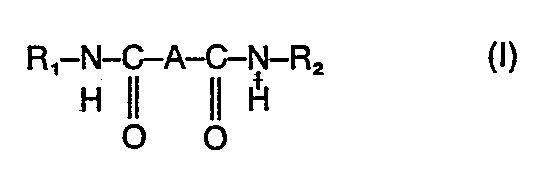
- the invention relates to bis (carboxamide) compounds of the formula I. for use in combating diseases, several processes for their preparation, some new compounds of the formula I and medicaments containing compounds of the formula I as active ingredient
- the invention also relates to their physiologically acceptable salts.
- salts are, for example, hydrochlorides, hydrogen sulfates, sulfates, hydrogen phosphates, acetates, maleates, benzoates, citronates, tartrates or lactates.
- an amine of the general formula (VIII) can also be used instead of an amine of the general formula (IV) if the amines (IV) and (VIII) are likewise exchanged in the process step.
- process variant A the step of activating the carboxylic acid (II) to give a compound of the general formula (III) is carried out according to the process described in the literature (Houben-Weyl 15/2 (1974)).
- this reactive carboxylic acid derivative (III) is reacted with an amine of the general formula (IV) at preferably -70 ° C. to 40 ° C., in particular -70 ° C. to 5 ° C.
- the reaction can be carried out in the presence of a base such as triethylamine, ethyldiisopropylamine, N-methylmorpholine, pyridine, 4-dimethylaminopyridine, N, N-dimethylaniline.
- Possible solvents are: chlorinated hydrocarbons, e.g. Dichloromethane, chloroform, 1,2-dichloroethane, ether, e.g. Diethyl ether, tetrahydrofuran, dioxane, 1,2-dimethoxyethane, aromat. Hydrocarbons, e.g. Benzene or toluene, acetonitrile, nitromethane, DMF, hexamethylphosphoric triamide, pyridine, ethyl acetate, acetone.
- chlorinated hydrocarbons e.g. Dichloromethane, chloroform, 1,2-dichloroethane, ether, e.g. Diethyl ether, tetrahydrofuran, dioxane, 1,2-dimethoxyethane, aromat.
- Hydrocarbons e.g. Benzene or toluene, acetonitrile, nitromethane, D
- the reaction can be carried out under an inert gas atmosphere, e.g. Nitrogen, carbon dioxide, argon, but is generally carried out in air.
- an inert gas atmosphere e.g. Nitrogen, carbon dioxide, argon, but is generally carried out in air.
- the reaction can be carried out at normal pressure, but also at elevated pressure. Generally one works at normal pressure.
- the molar ratio of the amine IV or VIII to the activated carboxylic acid derivative (III) can be varied in a range from 10: 1 to 0.1: 1. Preference - as is carried out in a range between 2: 1: 1 and 0.5.
- the compound of the general formula (V) or (Va) is converted into a carboxylic acid of the general formula (VI) or (VIa).
- the compound (V) or (Va) is hydrolyzed in the process is in an alcoholic solvent, such as methanol or ethanol, or in a mixture of water with an inert organic solvent such as methanol, ethanol, dioxane, tetrahydrofuran while heating to the boiling point of the solvent or solvent mixture in the presence of a base, for example an alkali metal or alkaline earth metal hydroxide , such as sodium or magnesium hydroxide, an alkali metal carbonate, such as sodium or Ka lium carbonate, or an alkali metal alkoxide such as sodium methylate or potassium tert-butoxide.
- an alcoholic solvent such as methanol or ethanol
- an inert organic solvent such as methanol, ethanol, dioxane, tetrahydrofuran
- a base for example an al
- process step d the compounds (VI) or (VIa) obtained in process step @ are activated to a compound (VII) or (VIIa) according to processes described in the literature (Houben-Weyl 15/2 (1974) and cited therein References).
- the reaction can be carried out under normal pressure, but also under elevated pressure. Generally one works at normal pressure.
- the molar ratio of the amine VIII to the reactive carboxylic acid derivative VII can be varied in a range from 10: 1 to 0.1: 1. It is preferable to work in a range between 2: 1 and 0.5: 1.
- a chlorinated hydrocarbon e.g. Dichloromethane, chloroform, 1,2-dichloroethane, an ether, e.g. Dieth
- the reaction can be carried out in the presence of a base such as triethylamine, ethyldiisopropylamine, N-methylmorpholine, pyridine, 4-dimethylaminopyridine or N, N-dimethylaniline.
- a base such as triethylamine, ethyldiisopropylamine, N-methylmorpholine, pyridine, 4-dimethylaminopyridine or N, N-dimethylaniline.
- the reaction can be carried out at normal pressure, but also at elevated pressure. Generally one works at normal pressure.
- the amines (IV) and (VIII) can be interchanged in the process scheme.
- the molar ratio of the amine IV or VIII to the cyclic carboxylic anhydride IX can be varied in a range from 10: 1 to 0.1: 1. It is preferable to work in a range between 2: 1 and 0.5: 1.
- amines, dicarboxylic acids and dicarboxylic anhydrides used as starting compounds are known and / or can be easily prepared (Houben-Weyl 8 (1952); Sandler, Karo, Organic Functional, Group Preparations, Vol. I and III (1972); Patei, The Chemistry of Functional Groups, Supplement B: The chemistry of acid derivatives, Part. 1 (1979); Anschutz, Biernaux, Liebigs Annalen 273, 68; Wegscheider, Perndanner, Spitzer, Monthly Bulletin for Chemistry 31, 1258; Cohen, De Pennigton, J. Chem. Soc. 113, 63).
- the compounds of the formula I have a broad and varied spectrum of pharmacological activity and a surprisingly long duration of action, and are therefore very suitable for combating diseases.
- the compounds according to the invention are suitable for the prophylaxis of acute and chronic ischemic heart disease in the broadest sense, for the therapy of high or low pressure and for the treatment of cerebral and peripheral circulatory disorders.
- the new active compounds can be converted into the customary formulations in a known manner, such as tablets, capsules, dragees, pills, granules, aerosols, syrups, emulsions, suspensions and solutions, using inert, non-toxic pharmaceutically suitable excipients or solvents.
- the therapeutically active compound should in each case be present in a concentration of about 0.5 to 90% by weight of the total mixture, i.e. in amounts sufficient to achieve the dosage range indicated.
- the formulations are prepared, for example, by stretching the active ingredients with solvents and / or carriers, optionally using emulsifiers and / or dispersants, e.g. if water is used as the diluent, organic solvents can optionally be used as auxiliary solvents.
- tablets can of course also contain additives such as sodium citrate, calcium carbonate and dicalcium phosphate together with various additives, in addition to the carriers mentioned.
- additives such as sodium citrate, calcium carbonate and dicalcium phosphate together with various additives, in addition to the carriers mentioned.
- starch preferably potato starch, gelatin and the like.
- Lubricants such as magnesium stearate, sodium lauryl sulfate and talc can also be used for tableting.
- the active ingredients can be mixed with various flavor enhancers or colorants in addition to the abovementioned auxiliaries.
- solutions of the active ingredients can be used using suitable liquid carrier materials.
- the dosage is approximately oral administration 0.05 to 20 mg / kg, preferably 0.5 to 5 mg / kg body weight per day.
- 16.8 g of isophthalic acid monomethyl ester are dissolved in 200 ml of methylene chloride and mixed with 20 g of triethylamine. 10 g of methanesulfonic acid chloride in 10 ml of methylene chloride are then added dropwise at -50 ° C. The mixture is left to stir at -50 ° C. for 30 minutes and 10 g of 3,3-dimethyl-2-butylamine in 20 ml of methylene chloride are then added. After 16 hours of stirring at room temperature, the mixture is extracted 3 times with 2N sulfuric acid and 3 times with sodium hydrogen carbonate solution. The organic phase is dried with sodium sulfate and evaporated.
- the compounds listed in the following table lower the blood pressure in the spontaneously hypertensive rat by at least 15 mm Hg. The lowest effective oral dose is given.
Landscapes
- Chemical & Material Sciences (AREA)
- Organic Chemistry (AREA)
- Pyridine Compounds (AREA)
- Organic Low-Molecular-Weight Compounds And Preparation Thereof (AREA)
- Thiazole And Isothizaole Compounds (AREA)
- Medicines That Contain Protein Lipid Enzymes And Other Medicines (AREA)
- Plural Heterocyclic Compounds (AREA)
- Acyclic And Carbocyclic Compounds In Medicinal Compositions (AREA)
- Pharmaceuticals Containing Other Organic And Inorganic Compounds (AREA)
Abstract







Description
- Die Erfindung betrifft Bis-(carboxamid)-verbindungen der Formel I

- In der Formel I bedeuten
- R1 einen Arylrest mit bevorzugt 6-10 C-Atomen, wie beispielsweise Phenyl oder Naphthyl, der gegebenenfalls, bevorzugt 1-3 mal, substituiert ist durch gleiche oder verschiedene Substituenten aus der Gruppe Halogen (z.B. Fluor, Chlor, Brom), C1-C4-Alkyl, C1-C4-Alkoxy, C1-C4-Alkylmer- capto, jeweils C1-C4-Dialkylamino, C1-C4-Mono- alkylamino, Hydroxy, Mercapto, Amino, Nitro, Cyano, Trifluormethyl, oder einen Heteroarylrest mit 5-6 Ringatomen, wobei 1 oder 2 Atome Stickstoff, Sauerstoff oder Schwefel sind, bevorzugt aus der Gruppe Furyl, Thiophenyl, Pyrryl, Imidazyl, Pyridyl, Pyrimidyl, der gegebenenfalls einfach substituiert ist durch Substituenten aus der Gruppe Haloge (z.B. Fluor, Chlor, Brom), Trifluormethyl, Nitro, Cyano, C1-C4-Alkyl, C1-C4-Alkoxy, C1-C4-Alkylmercapto,
- R2 einen verzweigten Alkylrest mit bevorzugt 4-10 C-Atomen oder einen Cycloalkylrest mit bevorzugt 6-10 C-Atomen,
- A eine Einfachbindung, einen Alkylenrest mit bevorzugt 1-5 C-Atomen, einen Alkenylrest mit bevorzugt 2-6 C-Atomen, eine Gruppe der Formel -CH2-S-CH2- oder -CH2-0-CH2-, einen bivalenten Cycloalkylenrest mit bevorzugt 4-6 C-Atomen, einen bivalenten Cycloalkenylrest mit bevorzugt 4-6 C-Atomen, einen bivalenten Cycloalkenylrest mit bevorzugt 6-7 C-Atomen, einen Arylenrest mit bevorzugt 6-10 C-Atomen, einen Aralkylenrest mit bevorzugt 8-10 C-Atomen, einen bivalenten Heteroalkylrest mit 5-6 Ringatomen, wobei 1 oder 2 Atome Stickstoff, Sauerstoff oder Schwefel sind, bevorzugt aus der Gruppe Furan, Thiophen, Imidazol, Pyrrol, Oxazol, Thiazol, Pyrazol, Pyrazin, Pyridin
- Die Erfindung betrifft auch ihre physiologisch unbedenklichen Salze.
- Diese Salze sind beispielsweise Hydrochloride, Hydrogensulfate, Sulfate, Hydrogenphosphate, Acetate, Maleate, Benzoate, Citronate, Tartrate oder Lactate.
- Von besonderem Interesse sind Verbindungen der Formel I, in der
- R1 einen Phenylrest darstellt, der gegebenenfalls 1-3 mal substituiert ist durch gleiche oder verschiedene Substituenten aus der Gruppe Halogen (z.B. Fluor, Chlor, Brom), Trifluormethyl, Nitro, Cyano, Hydroxy, Amino, C1-C4-Alkyl, C1-C4-Alkoxy, C1-C4-Alkylmercapto, jeweils C1-C4-Dialkylamino, oder einen Heteroarylrest mit 5-6 Ringatomen darstellt, wobei 1 oder 2 Atome Stickstoff, Sauerstoff oder Schwefel sind, bevorzugt aus der gruppe Furyl, Thiophenyl, Pyridyl, Pyrimidyl, der gegebenenfalls einfach substituiert ist durch Substituenten aus der Gruppe Halogen (z. B. Fluor, Chlor, Brom), Trifluormethyl, Nitro, Cyano, C1-C4-Alkyl, C1-C4-Alkoxy, C1-C4-Alkylmercapto,
- R2 einen verzweigten C4-C10-Alkylrest oder einen C6-C10-Cycloalkylrest darstellt,
- A eine Einfachbindung, einen C1-C5-Alkylenrest, einen C2-C6-Alkenylrest, einen bivalenten C4-C6-Cycloalkylenrest, eine Gruppe der Formel -CH2-S-CH2- oder -CH2-O-CH2-,einen bivalenten C6-C7-Cycloalkenylrest, einen C6-C10-Arylenrest oder einen Heteroarylrest aus der Gruppe Furan, Thiophen, Imidazol, Oxazol, Thiazol, Pyrazol, Pyrazin oder Pyridin darstellt, sowie ihre physiologisch unbedenklichen Salze.
- Besonders hervorgehoben seien Verbindungen der Formel I, in der
- R1 einen Phenylrest darstellt, der gegebenenfalls 1-3 mal substituiert ist durch gleiche oder verschiedene Substituenten aus der Gruppe Halogen (z.B. Fluor, Chlor, Brom), Trifluormethyl, C1-C4-Alkyl, C1-C4-Alkoxy, C1-C4-Alkylmercapto, oder Pyridyl oder Pyrimidyl darstellt, welche gegebenenfalls einfach substituiert sind durch Substituenten aus der Gruppe Halogen (z. B. Fluro, Chlor), Tri. fluormethyl, C1-C4-Alkyl, C1-C4-Alkoxy, C1-C4-Alkylmercapto,
- R2 einen verzweigten C4-C10-Alkylrest darstellt,
- A eine Einfachbindung, einen C2-C4-Alkylen oder Alkenylrest darstellt oder eine Gruppe der Formeln -CH2-S-CH2 oder -CH2-0-CH2- bedeutet, oder eine Phenylengruppe oder einen bivalenten Heteroarylrest aus der Gruppe Furan, Thiophen, Imidazol, Pyrazin oder Pyridin darstellt,
- Insbesonders seien Verbindungen der Formel I genannt, in der
- R1 Phenyl, 4-Hydroxyphenyl, 2-Ethoxyphenyl, Py-didyl, 6-Chlorpyridyl darstellt,
- R2 tert.-Butyl, 2,2-Dimethylpropyl, 1,2,2--Trimethylpropyl, 1,1,2,2-Tetramethylpropyl bedeutet,
- A eine Einfachbindung, Methylen, Ethylen, Vinylen, Phenylen, die Gruppe -CH2-S-CH2-, einen bivalenten Heteroarylrest aus der Gruppe Furan, Thiophen, Pyrazin oder Pyridin darstellt,
- Im einzelnen seien folgende Reste aufgeführt:
- a) für R1:
- Phenyl, Naphthyl, Methylphenyl, n-Butylphenyl, Methoxyphenyl, Ethoxyphenyl, (n-Butoxy)phenyl, (Methylthio)phenyl, (n-Butylthio)phenyl, (Dimethylamino)phenyl, (Dibutylamino)phenyl, (Methylamino)phenyl, (Butylamino)phenyl, Chlorphenyl, Bromphenyl, Fluorphenyl, Chlor-(methyl) phenyl, Dimethylphenyl, (Hydroxy)-(methyl)phenyl, (Mercapto)-(methyl)phenyl, Trimethylphenyl, Chlormethoxyphenyl, Dichlorphenyl, Trichlorphenyl, Chlor-nitrophenyl, Methyl-nitrophenyl, Chlor-(trifluormethyl)phenyl, Di(trifluormethyl)phenyl, Ethyl-(methyl)phenyl, Dichlor-methoxyphenyl, Chlor-(methylthio)phenyl, (Hydroxy)-(methyl)phenyl, Chlor-hydroxyphenyl, Dimethoxyphenyl, Diethoxyphenyl, Chlor-dimethoxyphenyl,
- b) für R2:
- tert.-Butyl, 1,1-Dimethylpropyl, 2,2-Dimethylpropyl, 1,2,2-Trimethylpropyl, 1,1-Dimethylbutyl, 1,1,2-Trimethylpropyl, 1-Ethyl-1-methylpropyl, 1,1,3-Trimethylbutyl, 1,1-Diethylpropyl, 1,1-Diethylbutyl, 1,1,2-Triethylbutyl, 1,1,2,2-Tetramethylpropyl, Cyclohexyl, Cyclooctyl, Adamantyl,
- c) für A:
- Methylen, Ethylen, Ethyliden, Propylen, Propyliden, Trimethylen, Isopropyliden, Butyliden, Ethylethylen, s-Methyltrimethylen, Tetramethylen, 1,2-Dimethylethylen oder2-Methyltrimethylethylen, Vinylen, Propenylen, Butenylen, Pentenylen, Butadienylen, Pentadienylen, Cyclohexan, Cyclopenten, Cyclobutan, Cyclohexen, Cyclohexadien, Cyclopenten, Cycloheptadien, Cycloheptatrien, Phenylen, Tolylen, Xylen, Naphthylen, Aralkylenreste der Formeln:


- Methylen, Ethylen, Ethyliden, Propylen, Propyliden, Trimethylen, Isopropyliden, Butyliden, Ethylethylen, s-Methyltrimethylen, Tetramethylen, 1,2-Dimethylethylen oder2-Methyltrimethylethylen, Vinylen, Propenylen, Butenylen, Pentenylen, Butadienylen, Pentadienylen, Cyclohexan, Cyclopenten, Cyclobutan, Cyclohexen, Cyclohexadien, Cyclopenten, Cycloheptadien, Cycloheptatrien, Phenylen, Tolylen, Xylen, Naphthylen, Aralkylenreste der Formeln:
- Beispielhaft seien folgende Verbindungengenannt:
- 1. N-Phenyl-N'-(1,2,2-trimethylpropyl)-oxamid
- 2. N-(2-Ethoxyphenyl)-N'-(1,2,2-trimethylpropyl)-oxamid
- 3. N-Phenyl-N'-(1,2,2-trimethylpropyl)-fumaramid
- 4. N-(2-Ethoxyphenyl)-N'-(1,2,2-trimethylpropyl)-fumar- amid
- 5. N-Phenyl-N'(2,3,3-trimethylpropyl)-succinamid
- 6. N-(2-Ethoxyphenyl)-N'-(1,2,2-trimethylpropyl)-succin- amid
- 7. N-Phenyl-N1-(2,2-dimethylpropyl)-succinamid
- 8. N-Phenyl-N'-(1,2,2-trimethylpropyl)-thiodiglykol- säureamid
- 9. N-(2-Ethoxyphenyl)-N'-(1,2,2-trimethylpropyl)-thiodi- glykolsäureamid
- 10. N-Phenyl-N'-(1,2,2-trimethylpropyl)-phtalamid
- 11. N-(2-Ethoxyphenyl)-N'-(1,2,2-trimethylpropyl)-phtalamid
- 12. N-(2-Ethoxyphenyl)-N'-(2,2-dimethylpropyl)-phthalamid
- 13. N-Phenyl-N'-(1,2,2-trimethylpropyl)-terephthalamid
- 14. N-(2-Ethoxy)-N'-(1,2,2-trimethylpropyl)-terephtalamid
- 15. N-(2-Ethoxy)-N'-(2,2-dimethylpropyl)-terephthalamid
- 16. N-Phenyl-N-(1,2,2-trimethylpropyl)-isophthalamid
- 17. N-(2-Ethoxyphenyl)-N'-(1,2,2-trimethylpropyl)-isophthalamid
- 18. N-(4-Hydroxyphenyl)-N'(1,2,2-trimethylpropyl)-phtalamid
- 19. N-(3-Pyridyl)-N'-(1,2,2-trimethylpropyl)-oxalamid
- 20. N-(4-Pyridyl)-N'-(1,2,2-trimethylpropyl)-oxalamid
- 21. N-(3-Pyridyl)-N'-(1,2,2-trimethylpropyl)-fumaramid
- 22. N-(3-Pyridyl)-N'-(1,2,2-trimethylpropyl)-succinamid
- 23. N-(4-Pyridyl)-N'-(1,2,2-trimethylpropyl)-succinamid
- 24. N-(3-Pyridyl)-N'-(1,2,2-trimethylpropyl)-thiodigly- kolsäureamid
- 25. N-(4-Pyridyl)-N'-(1,2,2-trimethylpropyl)-thiodigly- kolsäureamid
- 26. N-(3-Pyridyl)-N'-(1,2,2-trimethylpropyl)-phtalamid
- 27. N-(3-Pyridyl)-N'-(1,2,2-trimethylpropyl)-terephthal- amid
- 28. N-(4-Pyridyl)-N'-(1,2,2-trimethylpropyl)-terephalamid
- 29. N-(3-Pyridyl)-N'-(1,2,2-trimethylpropyl)-isophthalamid
- 30. N-(4-Pyridyl)-N'-(1,2,2-trimethylpropyl)-isophtalamid
- 31. N-(6-Chlor-3-pyridyl)-N'-( " " )-phthalamid
- 32. N-(3-pyridyl)-N'- ( " - " )-furandicarbonamid
- 33. N-(4-Pyridyl)-N'-( " - " )-pyrazin-2,3-dicar- bonamid
- 34. 3-[N-(1,2,2-Trimethylpropyl)-carbamoyl]-pyridin-2-carbonsäure-N-(3-pyridyl)-amid
- 35. 2-[N-(1,2,2-Trimethylpropyl)-carbamoyl]-pyridin-3-carbonsäure-N-(3-pyridyl)-amid.
- Insbesondere seien genannt:
- 1. N-(4-Pyridyl)-N'-(1,2,2-trimethylpropyl)-thiodigly- kolsäureamid
- 2. N-(3-Pyridyl)-N'-(1,2,2-trimethylpropyl)-phthalamid.
- Die Erfindung betrifft weiterhin neue Verbindungen der Formel I, die dadurch gekennzeichnet sind, daß
- R1 einen eingangs beschriebenen Heteroarylrest darstellt,
- A und R2 die bereits erwähnte Substituentendefinition besitzt,
- mit der Ausnahme, daß A keineEinfachbindung darstellt, falls R1 eine Pyridylgruppe bedeutet.
- Die beschriebenen Verbindungen der Formel I lassen sich beispielsweise nach folgenden Verfahrensvarianten erhalten:
- A.
- Die Variante A ist durch folgendes Schema gekennzeichnet:


- A, R1 und R2 besitzen die bereits angegebenen Bedeutungen.
- R3 steht für einen elektronenziehenden Rest, wie er in der Peptidchemie zur Aktivierung einer Carbonsäuregruppierung üblich ist (Houben-Weyl 15/2 (1974); Schröder, Lübke, The Peptides Vol. 1 (1965)).
- R4 steht für einen geraden oder verzweigten Alkylrest, bevorzugt mit 1 bis 4 Kohlenstoffatomen, der gegebenenfalls 1-3 Reste aus der Gruppe Chlor, Methoxy, Cyano, Nitro, Phenyl, Carboxy, Carboxymethyl, 4-Nitrophenyl trägt, insbesondere Methyl, Ethyl, Propyl, t-Butyl, 2,2,-Trichlorethyl, Methoxymethyl, Cyanomethyl, Nitromethyl, Phenylmethyl, Diphenylmethyl, Carboxymethyl, Methylcarboxymethyl, 4-Nitrophenylmethyl, 2-Cyanoethyl, 2-Chlorethyl, 2-Nitroethyl.
- Im Vrfahrensschritt ⓑ kann statt eines Amins der allgemeinen Formel (IV) auch ein Amin der allgemeinen Formel (VIII) eingesetzt werden, wenn im Verfahrensschritt die Amine (IV) und (VIII) ebenfalls vertauscht werden.
- In der Verfahrensvariante A wird im Schritte die Aktivierung der Carbonsäure (II) zu einer Verbindung der allgemeinen Formel (III) nach in der Literatur (Houben-Weyl 15/2 (1974)) beschriebenen Verfahren vorgenommen.
- Im Verfahrensschrittⓑ wird dieses reaktive Carbonsäurederivat (III) mit einem Amin der allgemeinen Formel (IV) umgesetzt bei bevorzugt -70°C bis 40°C, insbesondere -70°C bis 5°C. Die Umsetzung kann in Gegenwart einer Base wie Triethylamin, Ethyldiisopropylamin, N-Methylmorpholin, Pyridin, 4-Dimethylaminopyridin, N,N-Dimethylanilin erfolgen.
- Als Lösungsmittel kommen in Frage: chlorierte Kohlenwasserstoffe, z.B. Dichlormethan, Chloroform, 1,2-Dichlorethan, Ether, z.B. Diethylether, Tetrahydrofuran, Dioxan, 1,2-Dimethoxyethan, aromat. Kohlenwasserstoffe, z.B. Benzol oder Toluol, Acetonitril, Nitromethan, DMF, Hexamethylphosphorsäuretriamid, Pyridin, Essigester, Aceton.
- Die Umsetzung kann unter Inertgasatmosphäre, z.B. Stickstoff, Kohlendioxid, Argon, durchgeführt werden, wird im allgemeinen aber unter Luft durchgeführt.
- Die Umsetzung kann bei Normaldruck, aber auch bei erhöhtem Druck durchgeführt werden. Im allgemeinen arbeitet man bei Normaldruck.
- Bei dieser Umsetzung kann das Mol-Verhältnis des Amins IV oder VIII zu dem aktivierten Carbonsäurederivat (III) in einem Bereich von 10:1 bis 0,1:1 variiert werden. Vorzugs- weise arbeitet man in einem Bereich, der zwischen 2:1 und 0,5:1 liegt.
- Im Verfahrensschritt(D wird die Verbindung der allgemeinen Formel (V) bzw. (Va) in eine Carbonsäure der allgemeinen Formel (VI) bzw. (VIa) umgewandelt. Dabei wird die Verbindung (V) bzw. (Va) hydrolysiert. Die Hydrolyse wird in einem alkolischen Lösungsmittel, wie Methanol oder Ethanol, oder in einen Gemisch von Wasser mit einem inerten organischen Lösungsmittel wie Methanol, Ethanol, Dioxan, Tetrahydrofuran unter Erhitzen auf den Siedepunkt des Lösungsmittels oder Lösungsmittelgemischs in Gegenwart einer Base, beispielsweise ein Alkalimetall-oder Erdalkalimetallhydroxid, wie Natrium- oder Magnesiumhydroxid, ein Alkalimetallcarbonat, wie Natrium- oder Kaliumcarbonat, oder ein Alkalimetallalkoxid, wie Natriummethylat oder Kalium-tert.-butylat, durchgeführt.
- Im Verfahrensschritt ⓓ erfolgt die Aktivierung der im Verfahrensschritt @ erhaltenen Verbindungen (VI) bzw. (VIa) zu einer Verbindung (VII) bzw. (VIIa) nach in der Literatur beschriebenen Verfahren (Houben-Weyl 15/2 (1974) und darin zitierte Literaturstellen).
- Die erhaltene Verbindung (VII) bzw. (VIIa) wird mit einem Amin der allgemeinen Formel (VIII) oder (IV) bei -70°C bis 40°C, insbesondere bei -60°C bis 10°C umgesetzt. Die Umsetzung kann in Gegenwart einer Base wie Triethylamin, Ethyldiisopropylamin, N-Methylmorpholin, Pyridin, 4-Dimethylaminopyridin oder N,N-Dimethylanilin erfolgen. Als Lösungsmittel für die Umsetzung kommen in Frage:
- chlorierte Kohlenwasserstoffe, z.B. Dichlormethan, Chloroform, 1,2-Dichlorethan,
- Ether, z.B. Diethylether, Tetrahydrofuran, Dioxan, 1,2-Dimethoxyethan,
- aromat. Kohlenwasserstoffe, z.B. Benzol, Toluol, Acetonitril, Nitromethan, Dimethylformamid, Hexamethylphosphorsäuretriamid, Pyridin, Essigsäureethylester, Aceton.
- Die Umsetzung kann unter Normaldruck, aber auch bei erhöhtem Druck durchgeführt werden. Im allgemeinen arbeitet man bei Normaldruck.
- Bei dieser Umsetzung kann das Mol-Verhältnis des Amins VIII zu den reaktiven Carbonsäurederivat VII in einem Bereich von 10:1 bis 0,1:1 variiert werden. Vorzugsweise arbeitet man in einem Bereich, der zwischen 2:1 und 0,5: 1 liegt.
- Die Verbindungen der allgemeinen Formeln (III) und (VII) gehören, je nach der Bedeutung des Restes R3, folgenden Substanzklassen an und sind bekannt bzw. können nach bekannten Verfahren hergestellt werden:
- Ethoxycarbonyl- und Diethoxycarbonyl-methylester, 2-Oxopropylester, 2-Diethylaminoethylester, Brommethylester, Cyanmethylester, Aminocarbonyl-methylester, Propargylester, Glykolsäureester,'Ribosylester, Phenylester, Nitrophenylester, Dinitrophenylester, Dichlor-nitrophenylester, Trichlorphenylester, Pentachlorphenylester, Pentafluorphenylester, 4-Methylsulfonylphenylester, Phenylazophenylester, 4-Cyanphenylester, Chinolyl-(8)-ester, 1-Ethoxycarbonyl-2-ethoxy-1,2-dihydro-chinolylester, Pyridyl-(3)-ester, 2-Hydroxyphenylester, 4-Nitro-guaiacylester, 4-Dimethylaminophenylester, 4-Aminosulfonylphenylester, 4-(Acetylamino-sulfonyl)-phenylester, 4-Propionyl-phenylester, Vinylester, 1-Methyl-2-acetyl- vinylester, 2,2-Diphenylvinylester, 2-Cyan-2-phenylvinyl- ester, Methoxy-methylester, Tetrahydropyranyl-(2)-ester, 1-Methoxy-vinylester, 1-Ethoxy-vinylester, Dimethylaminovinylester, N,N'-Dicyclohexyllactimester, N-Ethyl-N'-(3-dimethylaminopropyl)-lactimester, 2-Hydroxypyridylester, 0-Acyl-N,N-dimethyl-hydroxylämine, O-Acyl-N,N-diethyl-hydroxylamine, O-Acyl-N,N-dibenzyl-hydroxylamine, (N-Hydroxy-piperidin)-ester, 0-Acyl-N-isopropyliden-hydroxylamine, (N-Hydroxy-pivaloamid)-ester, (N-Hydroxy- benzamid)-ester, (1,2-Dihydro-pyridonyl-(1))-ester, (N-Hydraxy-succinimid)-ester, (N-Hydroxyglutarimid)-ester, (N-Hydroxy-phthalimid)-ester, (N-Hydroxychinolinsäure- imid)-ester, O-Methyl-Kohlensäureanhydride, O-Ethyl-Kohlensäureanhydride, O-Isobutyl-Kohlensäureanhydride, 0-Benzyl-Kohlensäureanhydride, O-Phenyl-Kohlensäureanhydride, 2-Ethylbuttersäureanhydride, 2,2-Dimethyl-propionsäureanhydride, Diphenylessigsäureanhydride, Benzoesäureanhydride, 4-Methoxybenzoesäureanhydride, O,O-Dibenzylphosphor- säureanhydride, 0,0-Di-(4-nitrobenzyl)-phosphorsäureanhydride, Methansulfonsäureanhydride, Benzolsulfonsäureanhydride, 4-Methylbenzolsulfonsäureanhydride, Trifluormethylsulfonsäureanhydride, Nonafluorbutylsulfonsäureanhydride, Phenylthioester, 4-Nitrophenylthioester, Phenylselenoester, Carbonsäureazide, Carbonsäureimidazolide, Carbonsäure-1,2,4-triazolide, Carbonsäure-1,2,4-oxadiazolinone-(5), Carbonsäurechloride, Carbonsäurebromide, Carbonsäurejodide, Carbonsäurecyanide.
- Die Amine der Formeln IV und VIII sind ebenfalls bekannt.
- Namentlich seien folgende Amine der Formel IV angegeben:
- t-Butylamin, 1,1-Dimethylpropylamin, 2,2-Dimethylpropylamin, 1,2,2-Trimethylpropylamin, 1,1-Dimethylbutylamin 1,1,2-Trimethylpropylamin, 1-Ethyl-1-methylpropylamin, 1,1,3-Trimethylbutylamin, 1,1-Diethylpropylamin, 1,1-Diethylbutylamin, 1,1,2-Triethylbutylamin, 1,1,2,2-Tetramethylpropylamin.
- Namentlich seien folgende Amine der Formel VIII aufgeführt:
- Anilin, Naphthylamin, Amino-(n-butyl)benzol, Amino-(methoxy)benzol, Amino-(ethoxy)benzol, Amino-(n-butoxy)benzol, Amino-(methylthio)benzol, Amino-(n-butylthio)benzol, Amino-(dimethylamino)benzol, Amino-(dibutylamino)benzol, Amino-(methylamino)benzol, Amino-(n-butylamino)benzol, Amino-chlorbenzol, Amino-brombenzol, Amino-fluorbenzol, Amino-(chlor)-(methyl)benzol, Amino-dimethylbenzol, Amino-(hydroxy)-(methyl)benzol, Amino-(mercapto)-(methyl)-benzol, Amino-trimethylbenzol, Amino-chlor-methoxybenzol, Amino-dichlorbenzol, Aminotrichlorbenzol, Amino-chlor-nitrobenzol, Amino-methyl-nitrobenzol, Amino-chlor-(trifluormethyl)benzol, Amino-bis(trifluormethyl)benzol, Amino-ethyl-methylbenzol, Amino-dichlor-methoxybenzol, Amino-chlor-(methylthio)benzol, Amino-hydroxy-(methyl)-benzol, Amino-chlor-hydroxybenzol, Amino-dimethoxybenzol, Amino-diethoxybenzol, Amino-chlor-dimethoxybenzol.
-


- Die Verfahrensschritte und ⓒ der Variante B entsprechen den Schritten ⓓ und der Variante A.
- Im Verfahrensschritt ⓐ wird ein cyclisches Anhydrid der allgemeinen Formel (IX) mit einem Amin der allgemeinen Formel (IV) oder (VIII) bei -20°C bis + 60°C, insbesondere bei 0°C bis 30°C, in einem inerten Lösungsmittel wie einem chlorierten Kohlenwasserstoff, z.B. Dichlormethan, Chloroform, 1,2-Dichlorethan, einen Ether, z.B. Diethylether, Tetrahydrofuran, Dioxan, 1,2-Dimethoxyethan, einen aromatischen Kohlenwasserstoff, z.B. Benzol oder Toluol oder in Acetonitril, Nitromethan, Dimethylformamid, Hexamethylphosphorsäuretriamid, Pyridin, Essigsäureethylester, Aceton umgesetzt.
- Die Umsetzung kann in Gegenwart einer Base wie-Triethylamin, Ethyldiisopropylamin, N-Methylmorpholin, Pyridin, 4-Dimethylaminopyridin oder N,N-Dimethylanilin erfolgen.
- Die Umsetzung kann bei Normaldruck, aber auch bei erhöhtem Druck durchgeführt werden. Im allgemeinen arbeitet man bei Normaldruck.
- Die Amine (IV) und (VIII) können im Verfahrensschema miteinander vertauscht werden.
- Bei dieser Umsetzung kann das Mol-Verhältnis des Amins IV oder VIII zu dem cyclischen Carbonsäureanhydrid IX in einem Bereich von 10:1 bis 0,1:1 variiert werden. Vorzugsweise arbeitet man in einem Bereich, der zwischen 2:1 und 0,5:1 liegt.
- Die als Ausgangsverbindungen eingesetzten Amine, Dicarbonsäuren und Dicarbonsäureanhydride sind bekannt und/ oder leicht herstellbar (Houben-Weyl 8 (1952); Sandler, Karo, Organic Functional, Group Preparations, Vol. I und III (1972); Patei, The Chemistry of Functional Groups, Supplement B: The chemistry of acid derivatives, Part. 1 (1979); Anschutz, Biernaux, Liebigs Annalen 273, 68; Wegscheider, Perndanner, Anspitzer, Monatshefte für Chemie 31, 1258; Cohen, De Pennigton, J. Chem. Soc. 113, 63).
- Die Verbindungen der Formel I haben ein breites und vielseitiges pharmakologisches Wirkungsspektrum und überraschend lange Wirkungsdauer, sie sind daher zur Bekämpfung von Erkrankungen sehr gut geeignet.
- Im einzelnen konnten im Tierexperiment folgende Hauptwirkungen nachgewiesen werden:
- 1. Der Tonus der glatten Muskulatur der Gefäße wird unter der Wirkung der Verbindungen stark vermindert. Diese gefäBspasmolytische Wirkung kann im gesamten Gefäßsystem stattfinden, oder sich mehr oder weniger isoliert in umschriebenen Gefäßgebieten (wie z.B. dem Zentralnervensystem) manifestieren. Die Verbindungen eignen sich daher besonders als Cerebraltherapeutika.
- 2. Die Verbindungen senken den Blutdruck von normotonen und hypertonen Tieren und können somit als antihypertensive Mittel verwendet werden.
- 3. Einige Verbindungen erhöhen den Blutdruck.
- Die erfindungsgemäßen Verbindungen eignen sich aufgrund dieser Eigenschaften zur Prophylaxe der akuten und chronischen ischämischen Herzkrankheit im weitesten Sinne, zur Therapie des Hoch- bzw. Niederdrucks sowie zur Behandlung von cerebralen und peripheren Durchblutungsstörungen.
- Die neuen Wirkstoffe können in bekannter Weise in die üblichen Formulierungen übergeführt werden, wie Tabletten, Kapseln, Dragees, Pillen, Granulate, Aerosole, Sirupe, Emulsionen, Suspensionen und Lösungen, unter Verwendung inerter, nicht-toxischer pharmazeutisch geeigneter Trägerstoffe oder Lösungsmittel. Hierbei soll die therapeutisch wirksame Verbindung jeweils in einer Konzentration von etwa 0,5 bis 90 Gew.-% der Gesamtmischung vorhanden sein, d.h. in Mengen, die ausreichend sind, um den angegebenen Dosierungsspielraum zu erreichen.
- Die Formulierungen werden beispielsweise hergestellt durch Verstrecken der Wirkstoffe mit Lösungsmiteln und/oder Trägerstoffen, gegebenenfalls unter Verwendung von Emulgiermitteln und/oder Dispergiermitteln, wobei z.B. im Fall der Benutzung von Wasser als Verdünnungsmittel gegebenenfalls organische Lösungsmittel als Hilfslösungsmittel verwendet werden können.
- Als Hilfsstoffe seien beispielsweise aufgeführt:
- Wasser, nicht-toxische organische Lösungsmittel, wie Paraffine (z.B. Erdölfraktionen), pflanzliche öle (z.B. Erdnuß-(Sesam-öl), Alkohole (z.B. Ethylalkohol, Glycerin), Glykole (z.B.Propylenglykol, Polyethylenglykol), feste Trägerstoffe, wie z.B. natürliche Gesteinsmehle (z.B. Kaoline, Tonerden, Talkum, Kreide), synthetische Gesteinsmehle (z.B. hochdisperse Kieselsäure, Silikate), Zucker (z.B. Rohr-, Milch- und Traubenzucker), Emulgiermittel (z.B. Polyoxyethylen-Fettsäure-Ester, Polyoxyethylen-Fettalkohol-Ether, Alkylsulfonate und Arylsulfonate), Dispergiermittel (z.B. Lignin- Sulfitablaugen, Methylcellulose, Stärke und Poylvinylpyrrolidon) und Gleitmittel (z.B. Magnesiumstearat, Talkum, Stearinsäure und Natriumlaurylsulfat).
- Die Applikation erfolgt in üblicher Weise, vorzugsweise oral oder parenteral, insbesondere perlingual oder intravenös. Im Falle der oralen Anwendung könne Tabletten selbstverständlich außer den genannten Trägerstoffen auch Zusätze, wie Natriumcitrat, Calciumcarbonat und Dicalciumphosphat zusammen mit verschiedenen Zuschlagstoffen, wie Stärke, vorzugsweise Kartoffelstärke, Gelatine und dergleichen enthalten. Weiterhin können Gleitmittel, wie Magnesiumstearat, Natriumlaurylsulfat und Talkum zum Tablettieren mitverwendet werden. Im Falle wäßriger Suspensionen und/oder Elixieren, die für orale Anwendungen gedacht sind, können die Wirkstoffe außer mit den obengenannten Hilfsstoffen mit verschiedenen Geschmacksaufbesserern oder Farbstoffen versetzt werden.
- Für den Fall der parenteralen Anwendung können Lösungen der Wirkstoffe unter Verwendung geeigneter flüssiger Trägermaterialien eingesetzt werden.
- Im allgemeinen hat es sich als vorteilhaft erwiesen, bei intravenöser Applikation Mengen von etwa 0,001 bis 10 mg/kg, vorzugsweise etwa 0,05 bis 5 mg/kg Körpergewicht pro Tag zur Erzielung wirksamer Ergebnisse zu verabreichen, und bei oraler Applikation beträgt die Dosierung etwa 0,05 bis 20 mg/kg, vorzugsweise 0,5 bis 5 mg/kg Körpergewicht pro Tag.
- Trotzdem kann es gegebenenfalls erforderlich sein, von den genannten Mengen abzuweichen, und zwar in Abhängigkeit vom Körpergewicht des Versuchstieres bzw. der Art des Applikationsweges, aber auch aufgrund der Tierart und der individuellem Verhalten gegenüber dem Medikament bzw. der Art von dessen Formulierung und dem Zeitpunkt bzw. Intervall, zu welchem die Verabreichung erfolgt. So kann es in einigen Fällen ausreichend sein, mit weniger als der vorgenannten Mindestmenge auszukommen, während in anderen Fällen die genannte obere Grenze überschritten werden muß. Im Falle der Applikation größerer Mengen kann es empfehlenswert sein, diese in mehrere Einzelgaben über den Tag zu verteilen. Für die Applikation in der Humanmedizin ist der gleiche Dosierungsspielraum vorgesehen. Sinngemäß gelten hierbei auch die obigen Ausführungen.
-

- 10 g Bernsteinsäureanhydrid werden in 150 ml Essigester gelöst und mit 10 g 3,3-Dimethyl-2-butylamin in 150 ml Essigester versetzt. Nach 2-stündigem Rühren bei Raumtemperatur wird das Lösungsmittel im Vakuum abgedampft. Man erhält so 20 g Bernsteinsäure mono (1,2,2-trimethylpropyl)amin als öl. Dieses wird in 100 ml Methylenchlorid gelöst, mit 20 g Triethylamin versetzt und auf -50°C gekühlt. Bei dieser Temperatur werden 10 g Methansulfonsäurechlorid in 10 ml Methylenchlorid zugetropft. Man läßt 30 Min. bei -50°C nachrühren und gibt i dann 9,4 g 3-Aminopyridin in 30 ml Methylenchlorid zu dem Reaktionsgemisch. Der Ansatz wird noch 16 h bei Raumtemperatur gerührt. Dann wird das Reaktionsgemisch 3 x mit Methylenchlorid extrahiert. Die vereinigten organischen Phasen werden mit Natriumsulfat getrocknet und eingedampft. Der Rückstand wird an Kieselgel mit Methylenchlorid/Methanol 95/5 als Laufmittel chromatographiert. Die produkthaltigen Fraktionen kristallisieren nach dem Eindampfen aus. Nach Aufschlämmen in Ether werden die Kristalle abgesaugt. Man erhält so 15 g (54 % der theor. Ausbeute) der Titelverbindung, die einen Schmelzpunkt von 130-133°C aufweist.
-

- 16,8 g Isophthalsäuremonomethylester werden in 200 ml Methylenchlorid gelöst und mit 20 g Triethylamin versetzt. Bei -50°C werden dann 10 g Methansulfonsäurechlorid in 10 ml Methylenchlorid zugetropft. Man läßt 30 Min. bei -50°C nachrühren und gibt dann 10 g 3,3-Dimethyl-2-butylamin in 20 ml Methylenchlorid zu. Nach 16 stündigem Rühren bei Raumtemperatur wird 3 x mit 2n Schwefelsäure und 3 x mit Natriumhydrogencarbonatlösung extrahiert. Die organische Phase wird mit Natriumsulfat getrocknet und eingedampft. Man erhält so 19,5 g schwach gelbes, öliges Isophthalsäuremethylester-(1,2,2-trimethylpropyl)amid, die in 200 ml Ethanol gelöst und mit 40 ml 45 % NaOH versetzt werden. Das Reaktionsgemisch wird 10 h bei RT stehen gelassen, dann mit 1 1 Wasser verdünnt und 2 x mit Methylenchlorid extrahiert. Die wäßrige Phase wird mit 2n Schwefelsäure angesäuert und 3 x mit Methylenchlorid extrahiert. Letztere organische Phasen werden vereinigt und mit Natriumsulfat getrocknet. Nach Eindampfen erhält man 12,9 g weißes, kristallines Isophtalsäuremono-(1,2,2-trimethylpropyl)amid vom Schmelzpunkt 210-212°C. 12,9 g dieser Säure werden in 100 ml Methylenchlorid gelöst und mit 10,5 g Triethylamin versetzt. Bei -50°C werden 5,4 g Methansulfonsäurechlorid in 10 ml Methylenchlorid zugetropft. Man läßt 30 Min. bei -50°C nachrühren und gibt dann 4,8 g Anilin in 5 ml Methylenchlorid zu. Man läßt 16 h bei Raumtemperatur rühren und extrahiert die Reaktionslösung dann 2 x mit 2 n Schwefelsäure. Die organische Phase wird mit Natriumsulfat getrocknet und eingedampft. Der kristalline Rückstand wird in Ether aufgeschlämmt und abgesaugt. Man erhält so 12,5 g (74 % der theoretischen Ausbeute) der Titelverbindung, die einen Schmelzpunkt von 216-218°C aufweist.
- Die Herstellung weiterer Verbindungen der allgemeinen Formel I ist in der nachfolgenden Tabelle 1 erläutert. In der Spalte "Methode" ist die Art der Umsetzung angegeben, nach der die Produkte der jeweiligen Beispiele hergestellt werden; vgl. die entsprechenden Methoden in den vorstehenden Beispielen.


- Die in der folgenden Tabelle angeführten Verbindungen senken an der spontan hypertensiven Ratte den Blutdruck um mindestens 15 mm Hg. Angegeben ist die niederste noch wirksame, orale Dosis.

sowie ihre physiologisch unbedenklichen Salze.
sowie ihre pharmazeutisch unbedenklichen Salze.
Claims (9)

sowie ihre physiologisch unbedenklichen Salze, zur Bekämpfung von Erkrankungen.
sowie ihre physiologisch unbedenklichen Salze zur Bekämpfung von Erkrankungen.
sowie ihre physiologisch unbedenklichen Salze, zur Bekämpfung von Erkrankungen.
sowie ihre pharmazeutisch unbedenklichen Salze zur Bekämpfung von Erkrankungen.
mit der Ausnahme, daß A keine Einfachbindung darstellt, falls R1 eine Pyridylgruppe bedeutet.


Applications Claiming Priority (2)
| Application Number | Priority Date | Filing Date | Title |
|---|---|---|---|
| DE19833305569 DE3305569A1 (de) | 1983-02-18 | 1983-02-18 | Biscarboxamide zur bekaempfung von erkrankungen sowie verfahren zu ihrer herstellung |
| DE3305569 | 1983-02-18 |
Publications (2)
| Publication Number | Publication Date |
|---|---|
| EP0119428A2 true EP0119428A2 (de) | 1984-09-26 |
| EP0119428A3 EP0119428A3 (de) | 1985-03-06 |
Family
ID=6191138
Family Applications (1)
| Application Number | Title | Priority Date | Filing Date |
|---|---|---|---|
| EP84101205A Withdrawn EP0119428A3 (de) | 1983-02-18 | 1984-02-07 | Biscarboxamide zur Bekämpfung von Erkrankungen sowie Verfahren zu ihrer Herstellung |
Country Status (6)
| Country | Link |
|---|---|
| EP (1) | EP0119428A3 (de) |
| JP (1) | JPS59163353A (de) |
| DE (1) | DE3305569A1 (de) |
| DK (1) | DK76684A (de) |
| ES (2) | ES8503643A1 (de) |
| ZA (1) | ZA841183B (de) |
Cited By (9)
| Publication number | Priority date | Publication date | Assignee | Title |
|---|---|---|---|---|
| EP0433662A3 (de) * | 1989-11-16 | 1991-07-03 | Warner-Lambert Company | Acat-Hemmstoffe |
| EP0642509A4 (de) * | 1991-10-04 | 1995-01-31 | Sloan Kettering Inst Cancer | Neue potente induktoren der terminalen differenzierung und methoden ihrer verwendung. |
| EP0919542A3 (de) * | 1997-11-25 | 2000-04-12 | Nihon Nohyaku Co., Ltd. | Phthalsaeurediamidderivate, insektizide für landbau und gartenbau, und deren verwendung |
| US6362369B2 (en) | 1997-11-25 | 2002-03-26 | Nihon Nohyaku Co., Ltd. | Phthalic acid diamide derivatives fluorine-containing aniline compounds as starting material, agricultural and horticultural insecticides, and a method for application of the insecticides |
| US6437129B1 (en) * | 1995-11-22 | 2002-08-20 | Allergan Sales, Llc | Substituted aryl or heteroarylamides having retinoid-like biological activity |
| WO2002048137A3 (en) * | 2000-12-11 | 2003-06-05 | Du Pont | Substituted heterocyclic phthalic acid diamide arthropodicides |
| USRE38506E1 (en) | 1991-10-04 | 2004-04-20 | Sloan-Kettering Institute For Cancer Research | Potent inducers of terminal differentiation and methods of use thereof |
| WO2004080984A1 (en) | 2003-03-14 | 2004-09-23 | Bayer Cropscience Ag | Insecticidal phthalamide derivatives |
| US7674807B2 (en) | 2004-03-12 | 2010-03-09 | Bayer Cropscience Ag | Heterocycle-substituted n-phenyl-phthalamide derivatives, related compounds and their use as insecticides |
Families Citing this family (6)
| Publication number | Priority date | Publication date | Assignee | Title |
|---|---|---|---|---|
| CZ299375B6 (cs) | 1998-11-30 | 2008-07-09 | Nihon Nohyaku Co., Ltd. | Ftalamidové deriváty nebo jejich soli, zemedelsko-zahradnický insekticid je obsahující a jeho použití |
| AR030154A1 (es) * | 1999-07-05 | 2003-08-13 | Nihon Nohyaku Co Ltd | Derivado de ftalamida, derivado de amina heterociclico util como intermediario para la produccion del mismo, insecticida agrohorticola y metodo para utilizar dicho insecticida |
| JP4671079B2 (ja) * | 1999-07-05 | 2011-04-13 | 日本農薬株式会社 | フタラミド誘導体、その中間体及び農園芸用殺虫剤並びにその使用方法 |
| US6495550B2 (en) | 1999-08-04 | 2002-12-17 | Icagen, Inc. | Pyridine-substituted benzanilides as potassium ion channel openers |
| ATE380176T1 (de) | 1999-08-04 | 2007-12-15 | Icagen Inc | Benzanilide als öffner des kaliumkanals |
| DE102010048686A1 (de) * | 2010-10-16 | 2012-04-19 | Volkswagen Ag | Einstellelement für ein an einem tragenden Bauteil festzulegendes Anbauteil sowie ein mit einem solchen Einstellelement ausgestattetes Bauteil |
Family Cites Families (1)
| Publication number | Priority date | Publication date | Assignee | Title |
|---|---|---|---|---|
| DE1693010A1 (de) * | 1967-03-20 | 1971-07-22 | Ciba Geigy Ag | Oxalsaeurediamid-Derivate als Ultraviolett-Absorber |
-
1983
- 1983-02-18 DE DE19833305569 patent/DE3305569A1/de not_active Withdrawn
-
1984
- 1984-02-07 EP EP84101205A patent/EP0119428A3/de not_active Withdrawn
- 1984-02-13 ES ES529686A patent/ES8503643A1/es not_active Expired
- 1984-02-14 JP JP59024535A patent/JPS59163353A/ja active Pending
- 1984-02-17 ZA ZA841183A patent/ZA841183B/xx unknown
- 1984-02-17 DK DK76684A patent/DK76684A/da not_active Application Discontinuation
- 1984-11-30 ES ES538151A patent/ES538151A0/es active Granted
Cited By (11)
| Publication number | Priority date | Publication date | Assignee | Title |
|---|---|---|---|---|
| EP0433662A3 (de) * | 1989-11-16 | 1991-07-03 | Warner-Lambert Company | Acat-Hemmstoffe |
| EP0642509A4 (de) * | 1991-10-04 | 1995-01-31 | Sloan Kettering Inst Cancer | Neue potente induktoren der terminalen differenzierung und methoden ihrer verwendung. |
| US6087367A (en) * | 1991-10-04 | 2000-07-11 | Sloan-Kettering Institute For Cancer Research | Potent inducers of terminal differentiation and methods of use thereof |
| USRE38506E1 (en) | 1991-10-04 | 2004-04-20 | Sloan-Kettering Institute For Cancer Research | Potent inducers of terminal differentiation and methods of use thereof |
| US6437129B1 (en) * | 1995-11-22 | 2002-08-20 | Allergan Sales, Llc | Substituted aryl or heteroarylamides having retinoid-like biological activity |
| EP0919542A3 (de) * | 1997-11-25 | 2000-04-12 | Nihon Nohyaku Co., Ltd. | Phthalsaeurediamidderivate, insektizide für landbau und gartenbau, und deren verwendung |
| US6362369B2 (en) | 1997-11-25 | 2002-03-26 | Nihon Nohyaku Co., Ltd. | Phthalic acid diamide derivatives fluorine-containing aniline compounds as starting material, agricultural and horticultural insecticides, and a method for application of the insecticides |
| US6559341B2 (en) | 1997-11-25 | 2003-05-06 | Nihon Nohyaku Co., Ltd. | Phthalic acid diamide derivatives, fluorine-containing aniline compounds as starting material, agricultural and horticultural insecticides, and a method for application of the insecticides |
| WO2002048137A3 (en) * | 2000-12-11 | 2003-06-05 | Du Pont | Substituted heterocyclic phthalic acid diamide arthropodicides |
| WO2004080984A1 (en) | 2003-03-14 | 2004-09-23 | Bayer Cropscience Ag | Insecticidal phthalamide derivatives |
| US7674807B2 (en) | 2004-03-12 | 2010-03-09 | Bayer Cropscience Ag | Heterocycle-substituted n-phenyl-phthalamide derivatives, related compounds and their use as insecticides |
Also Published As
| Publication number | Publication date |
|---|---|
| EP0119428A3 (de) | 1985-03-06 |
| ES529686A0 (es) | 1985-04-01 |
| ES8503643A1 (es) | 1985-04-01 |
| DE3305569A1 (de) | 1984-08-23 |
| DK76684A (da) | 1984-08-19 |
| JPS59163353A (ja) | 1984-09-14 |
| ZA841183B (en) | 1984-10-31 |
| DK76684D0 (da) | 1984-02-17 |
| ES8607916A1 (es) | 1985-11-01 |
| ES538151A0 (es) | 1985-11-01 |
Similar Documents
| Publication | Publication Date | Title |
|---|---|---|
| DE60225316T2 (de) | Cyanoalkylamino-derivate als protease-hemmer | |
| EP0270947B1 (de) | Substituierte basische 2-Aminotetraline | |
| EP0600949B1 (de) | Neue 3,5-di-tert.butyl-4-hydroxyphenyl-derivate, verfahren zu ihrer herstellung und arzneimittel | |
| DE2228012C3 (de) | Phthalidester der 6- [D(-)- a Aminophenylacetamido] -penicillansäure und Verfahren zu seiner Herstellung | |
| EP0119428A2 (de) | Biscarboxamide zur Bekämpfung von Erkrankungen sowie Verfahren zu ihrer Herstellung | |
| DE19636689A1 (de) | Neue Benzamidinderivate | |
| DE3005580C2 (de) | ||
| DE10046029A1 (de) | Indazole | |
| EP1286957B1 (de) | Diphenylmethanderivate | |
| EP0131221A2 (de) | Thioether, Verfahren zu deren Herstellung sowie diese Verbindungen enthaltende Arzneimittel | |
| EP0104423B1 (de) | 2-Nitro-1,1-ethendiamine, Verfahren zu ihrer Herstellung sowie ihre Verwendung als Arzneimittel | |
| EP0725064A1 (de) | Verwendung von Phenylcyclohexylcarbonsäureamiden | |
| EP0665228B1 (de) | Neue 3-Phenylsulfonyl-3,7-diazabicyclo(3,3,1)nonan-Verbindungen enthaltende Arzneimittel | |
| EP0179386B1 (de) | 1,4-Dihydropyridin-hydroxyamine, Verfahren zu ihrer Herstellung sowie ihre Verwendung in Arzneimitteln | |
| DD142545A5 (de) | Verfahren zur herstellung neuer omega thiobutyramide | |
| DE4135473A1 (de) | Triazaspirodecanon-methylchromane | |
| EP0519291A1 (de) | Aminomethyl-substituierte 2,3-Dihydropyrano(2,3-b)pyridine, Verfahren zu ihrer Herstellung und ihre Verwendung in Arzneimitteln | |
| DE4027052C2 (de) | ||
| CH623038A5 (en) | Process for the preparation of novel isobutyl 2,6-dimethyl-3-methoxycarbonyl-4-(2'-nitrophenyl)-1,4-dihydropyridine- 5-carboxylate | |
| DE3779813T2 (de) | 1,4-dihydropyridinderivate. | |
| DE10133277A1 (de) | ß-Alanin-Derivate | |
| EP1157014B1 (de) | Polycyclische 2-amino-dihydrothiazolsysteme, verfahren zu ihrer herstellung und ihre verwendung als arzneimittel | |
| DE3908298A1 (de) | Substituierte (chinolin-2-yl-methoxy)phenyl-n,n'-sulfonylharnstoffe, verfahren zu ihrer herstellung und ihre verwendung in arzneimitteln | |
| EP0045911A1 (de) | Neue Aminopropanol-Derivate, Verfahren zu ihrer Herstellung und diese Verbindungen enthaltende Arzneimittel | |
| EP0011092A1 (de) | Alpha-Aminophenylessigsäurederivate zur Verwendung bei der Behandlung von Entzündungen sowie neue alpha-Aminophenylessigsäurederivate |
Legal Events
| Date | Code | Title | Description |
|---|---|---|---|
| PUAI | Public reference made under article 153(3) epc to a published international application that has entered the european phase |
Free format text: ORIGINAL CODE: 0009012 |
|
| 17P | Request for examination filed |
Effective date: 19840207 |
|
| AK | Designated contracting states |
Designated state(s): AT BE CH DE FR GB IT LI NL SE |
|
| PUAL | Search report despatched |
Free format text: ORIGINAL CODE: 0009013 |
|
| AK | Designated contracting states |
Designated state(s): AT BE CH DE FR GB IT LI NL SE |
|
| STAA | Information on the status of an ep patent application or granted ep patent |
Free format text: STATUS: THE APPLICATION HAS BEEN WITHDRAWN |
|
| 18W | Application withdrawn |
Withdrawal date: 19850930 |
|
| RIN1 | Information on inventor provided before grant (corrected) |
Inventor name: NIEMERS, EKKEHARD, DR. Inventor name: ROSENTRETER, ULRICH, DR. Inventor name: GARTHOFF, BERNWARD, DR. Inventor name: KNORR, ANDREAS, DR. Inventor name: STEGELMEIER, HARTMUT, DR. |