EP0402849A2 - Handhabungsgerät - Google Patents
Handhabungsgerät Download PDFInfo
- Publication number
- EP0402849A2 EP0402849A2 EP90111077A EP90111077A EP0402849A2 EP 0402849 A2 EP0402849 A2 EP 0402849A2 EP 90111077 A EP90111077 A EP 90111077A EP 90111077 A EP90111077 A EP 90111077A EP 0402849 A2 EP0402849 A2 EP 0402849A2
- Authority
- EP
- European Patent Office
- Prior art keywords
- manipulator
- articulations
- terminal
- articulation
- value
- Prior art date
- Legal status (The legal status is an assumption and is not a legal conclusion. Google has not performed a legal analysis and makes no representation as to the accuracy of the status listed.)
- Granted
Links
Images



Classifications
-
- G—PHYSICS
- G05—CONTROLLING; REGULATING
- G05B—CONTROL OR REGULATING SYSTEMS IN GENERAL; FUNCTIONAL ELEMENTS OF SUCH SYSTEMS; MONITORING OR TESTING ARRANGEMENTS FOR SUCH SYSTEMS OR ELEMENTS
- G05B19/00—Program-control systems
- G05B19/02—Program-control systems electric
- G05B19/18—Numerical control [NC], i.e. automatically operating machines, in particular machine tools, e.g. in a manufacturing environment, so as to execute positioning, movement or co-ordinated operations by means of program data in numerical form
- G05B19/19—Numerical control [NC], i.e. automatically operating machines, in particular machine tools, e.g. in a manufacturing environment, so as to execute positioning, movement or co-ordinated operations by means of program data in numerical form characterised by positioning or contouring control systems, e.g. to control position from one programmed point to another or to control movement along a programmed continuous path
-
- B—PERFORMING OPERATIONS; TRANSPORTING
- B25—HAND TOOLS; PORTABLE POWER-DRIVEN TOOLS; MANIPULATORS
- B25J—MANIPULATORS; CHAMBERS PROVIDED WITH MANIPULATION DEVICES
- B25J9/00—Program-controlled manipulators
- B25J9/16—Program controls
- B25J9/1602—Program controls characterised by the control system, structure, architecture
- B25J9/161—Hardware, e.g. neural networks, fuzzy logic, interfaces, processor
-
- G—PHYSICS
- G05—CONTROLLING; REGULATING
- G05B—CONTROL OR REGULATING SYSTEMS IN GENERAL; FUNCTIONAL ELEMENTS OF SUCH SYSTEMS; MONITORING OR TESTING ARRANGEMENTS FOR SUCH SYSTEMS OR ELEMENTS
- G05B19/00—Program-control systems
- G05B19/02—Program-control systems electric
- G05B19/42—Recording and playback systems, i.e. in which the program is recorded from a cycle of operations, e.g. the cycle of operations being manually controlled, after which this record is played back on the same machine
- G05B19/427—Teaching successive positions by tracking the position of a joystick or handle to control the positioning servo of the tool head, leader-follower control
-
- G—PHYSICS
- G05—CONTROLLING; REGULATING
- G05B—CONTROL OR REGULATING SYSTEMS IN GENERAL; FUNCTIONAL ELEMENTS OF SUCH SYSTEMS; MONITORING OR TESTING ARRANGEMENTS FOR SUCH SYSTEMS OR ELEMENTS
- G05B2219/00—Program-control systems
- G05B2219/30—Nc systems
- G05B2219/34—Director, elements to supervisory
- G05B2219/34065—Fuzzy logic, controller
-
- G—PHYSICS
- G05—CONTROLLING; REGULATING
- G05B—CONTROL OR REGULATING SYSTEMS IN GENERAL; FUNCTIONAL ELEMENTS OF SUCH SYSTEMS; MONITORING OR TESTING ARRANGEMENTS FOR SUCH SYSTEMS OR ELEMENTS
- G05B2219/00—Program-control systems
- G05B2219/30—Nc systems
- G05B2219/37—Measurements
- G05B2219/37357—Force, pressure, weight or deflection
-
- G—PHYSICS
- G05—CONTROLLING; REGULATING
- G05B—CONTROL OR REGULATING SYSTEMS IN GENERAL; FUNCTIONAL ELEMENTS OF SUCH SYSTEMS; MONITORING OR TESTING ARRANGEMENTS FOR SUCH SYSTEMS OR ELEMENTS
- G05B2219/00—Program-control systems
- G05B2219/30—Nc systems
- G05B2219/37—Measurements
- G05B2219/37425—Distance, range
-
- G—PHYSICS
- G05—CONTROLLING; REGULATING
- G05B—CONTROL OR REGULATING SYSTEMS IN GENERAL; FUNCTIONAL ELEMENTS OF SUCH SYSTEMS; MONITORING OR TESTING ARRANGEMENTS FOR SUCH SYSTEMS OR ELEMENTS
- G05B2219/00—Program-control systems
- G05B2219/30—Nc systems
- G05B2219/37—Measurements
- G05B2219/37572—Camera, tv, vision
-
- Y—GENERAL TAGGING OF NEW TECHNOLOGICAL DEVELOPMENTS; GENERAL TAGGING OF CROSS-SECTIONAL TECHNOLOGIES SPANNING OVER SEVERAL SECTIONS OF THE IPC; TECHNICAL SUBJECTS COVERED BY FORMER USPC CROSS-REFERENCE ART COLLECTIONS [XRACs] AND DIGESTS
- Y10—TECHNICAL SUBJECTS COVERED BY FORMER USPC
- Y10S—TECHNICAL SUBJECTS COVERED BY FORMER USPC CROSS-REFERENCE ART COLLECTIONS [XRACs] AND DIGESTS
- Y10S706/00—Data processing: artificial intelligence
- Y10S706/90—Fuzzy logic
Definitions
- the present invention generally relates to a manipulator, and more particularly to a fuzzy control method and apparatus for a manipulator, and a manipulator system using the method and apparatus.
- each articulation angle is obtained through geometric coordinate transformation on the basis of a given position/orientation of the manipulator terminal or tip, as described in Chapter III of "Robot Manipulator” by R.P. Pole, translated by Kunio Yoshikawa, published in September, 1984 by Corona Shuppan K.K. If the dynamic characteristics, e.g., vibrations of a manipulator are also to be controlled, a model is formulated and a complicated formula is solved, as described in Japanese Patent Laid-open Publication JP-A-62-235602.
- the above conventional technique requires a voluminous calculation for the determination of command values to articulations of a manipulator, resulting in a problem of a long sampling time starting from measuring a position with a sensor to fetching the calculation results.
- Another significant subject is to process a so-called singular point which has a value 0 at the denominator of a formula. Further, since a manipulator system is expressed by formulas, these formulas are required to change with environmental conditions and control conditions.
- a fuzzy control method and apparatus for a manipulator and a manipulator system using the method and apparatus, wherein a manipulator fuzzy control is executed by determining command values for articulation angles in such a manner that fuzzy inference is replaced with a part of, or whole of, matrix operations in order to make small the amount of calculations, and the fuzzy inference is executed by using not the absolute value of a target value (destination coordinate value) but a finite difference between the target and actual values of the position/orientation of the manipulator terminal to flexibly deal with a change in environmental conditions.
- fuzzy inference is executed by using only comparison operation and proportion operation, i.e., four fundamental arithmetic operations. Therefore, the amount of calculations can be reduced considerably as compared with the matrix operation for coordinate transformation including trigonometric function operation. Fuzzy inference is conducted by using a finite difference, i.e., a relative value, between the target and actual values of the manipulator terminal. It is therefore always possible to ultimately reach the target value even if there is an error from an ideal state, such as a deformation of an arm. In obtaining the results of fuzzy inference, the denominator for a division operation is the sum of membership functions. Therefore, there is no singular point which leads to no solution.
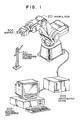
- Fig. 1 is a perspective view of the manipulator system according to the first embodiment of this invention, the manipulator system being realized by the fuzzy control method and apparatus for a manipulator of this invention.
- the manipulator system is constructed of three fundamental sections including a manipulator 201, central processing unit 202 and input/output (I/O) device 203.
- the manipulator 201 is constructed of five articulations and a gripper 306 at the terminal or distal end thereof.
- Reference numeral 501 represents a positioning pointer for the manipulator 201.
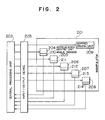
- Fig. 2 is a functional block diagram of the manipulator system shown in Fig. 5.
- Each of the five articulations of the manipulator 201 houses therein corresponding one of articulation driving units 204 to 208 and corresponding one of angle sensors 210 to 214.
- the gripper 306 houses therein a gripper driving unit 209.
- the central processing unit 202 executes all necessary arithmetic operations for the manipulator system, and outputs a command value for each articulation and gripper 306 of the manipulator 201.
- Command values are supplied via the I/O device 203 to the articulation driving units 204 to 208 and gripper driving unit 209 to move the articulations and gripper 306.
- the angle of each articulation is detected with a corresponding one of the angle sensors 210 to 214, and sent to the central processing unit 202 via the I/O device 203.
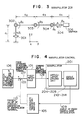
- Fig. 3 is a diagram showing the structure of the manipulator 201 shown in Fig. 1 (Fig. 2).
- the five articulations of the manipulator 201 are named, from the base or proximal end of the manipulator, a first articulation 301, second articulation 302, third articulation 303, fourth articulation 304, and fifth articulation 305.
- the gripper 306 At the terminal or distal end of the manipulator 201, there is mounted the gripper 306 for holding an object work.
- the arm length from the proximal end of the manipulator 201 to the second articulation 301 is represented by al, that from the second articulation 302 to third articulation 303 by a2, that from the third articulation 303 to fourth articulation 304 by a3, and that from the fourth articulation 304 to the fifth articulation 305 by a4.
- the base of the manipulator 201 is used as the origin, the direction extending vertically from the back to the front of the drawing, as the x-axis, the direction extending to the right, as the y-axis, and the direction extending upward, as the x-axis.
- the angles of the first to fifth articulations 301 to 305 are represented by ⁇ 1 to ⁇ 5.
- Fig. 4 is the control block diagram of the control system for the manipulator system shown in Fig. 1 (Figs. 2 and 3).
- a target value 106 of the position/orientation of the terminal of the manipulator 201 is subtracted by an actual value 110 of the position/orientation of the manipulator terminal, to thereby obtain a finite difference 107 of the position/orientation of the manipulator terminal.
- command values 108 for the articulations 301 to 305 of the manipulator 201 are obtained by means of fuzzy inference, and inputted to the articulation driving units 204 to 208 to drive the manipulator 201 accordingly.
- Respective articulation angles 109 detected with the angle sensors 210 to 214 of the manipulator 201 are subjected to coordinate transformation so that the actual value 110 of the position/orientation of the manipulator terminal can be obtained.
- the terminal position of the manipulator 201 is determined by means of rotational coordinate transformation for the articulations 301 to 305 and by means of parallel displacement according to the lengths between the articulations. Accordingly the x-, y-, and z-axis coordinates X, Y, and Z of the terminal position of the manipulator 201 are given by the following equations (1):
- the orientation of the manipulator terminal is represented by the following equations (2): where ⁇ represents an inclination angle of the axis of the gripper 306 relative to the x-y plane, and ⁇ represents a rotational angle around the axis of the gripper 306.
- fuzzy inference 101 shown in Fig. 4 will be described next.
- Various types of fuzzy rules are available because of high redundancy of fuzzy inference 101.
- One example will begiven in the following. It is assumed that the terminal of the manipulator 201 operates at the position forwardly of the first articulation 301, i.e., at the position forwardly of the first articulation 301, i.e., at the position having the positive coordinate value Y in Fig. 3. If the finite difference of the first articulation 301 is a large positive value in the x-axis direction, the first articulation 301 is rotated by a large positive amount to trace the object value.
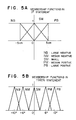
- Figs. 5A and 5B show the membership functions of fuzzy inference 101 shown in Fig. 4, wherein Fig. 5A shows the membership functions for "IF" statement and Fig. 5B shows the membership functions for "THEN" statement.
- the membership function of PB in "IF" statement takes a value 0 for a negative finite difference ⁇ X, increases the value as ⁇ X increases from 0 to 5 cm, and takes a value 1 for ⁇ X ⁇ 5 cm.
- the membership function of NB is a function symmetrical of the membership function of PB relative to the vertical axis.
- the membership functions of PB, PM, SM, NM, and NB in "THEN" statement take values as shown. PM represents a positive medium amount, and NM represents a negative medium amount.
- Fuzzy rules for the second articulation 302 may be expressed by:
- the command value ⁇ 2 to the second articulation 302 is therefore given by:
- the reason for weighting the finite difference ⁇ Z greater than ⁇ Y is that the articulation angle ⁇ 2 of the manipulator 201 has, in many cases, larger influence upon the y-axis components than the z-axis components.
- the degree of influence depends on the angle ⁇ 2. Therefore, if the magnitude of is introduced in "IF" statement of a fuzzy rule, the operation of a computer can be made to converge faster.
- fuzzy rules for the command values ⁇ 3 to ⁇ 5 to the third to fifth articulations 303 to 305 may be expressed by: to obtain the command values 108 to the articulations 301 to 305 and control the manipulator 201.
- the positions X, Y and Z of the articulations ⁇ 1, ⁇ 2, and ⁇ 3 near the base of the manipulator are weighted greater than those of the articulations ⁇ 4 and ⁇ 5 near the manipulator terminal.
- articulations near the terminal rather than articulations near the base are made to have a more important role in the orientation control of the manipulator, whereas for the position control of the manipulator, articulations near the base and not near the terminal are made to have a more important role.
- articulations ⁇ 1 and ⁇ 2 may be considered near the base and articulations ⁇ 3, ⁇ 4, and ⁇ 5 may be considered near the manipulator terminal for the weighting control of orientation and position.
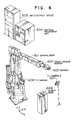
- Fig. 6 is a perspective view of the manipulator system according to the second embodiment of this invention, the manipulator system being realized by the fuzzy control method and apparatus for a manipulator of this invention.
- a manipulator 601 has six articulations with a gripper 603 being mounted at the manipulator terminal.
- a force/torque sensor 602 mounted between the gripper 603 and the manipulator 601 is a force/torque sensor 602 which detects a force/torque.
- a central processing unit 604 executes all arithmetic operations of this system.
- An input/output (I/O) device 605 interfaces between the central processing unit 604 and the manipulator 601.
- Reference numeral 608 represents an object work.
- a TV camera (1) 606 detects the y-direction distance between the gripper 603 and the object work 608 and detects a roll angle deviation.
- Another TV camera (2) 607 detects the x- and z-direction distances between the gripper 603 and the object work 608 and detects a pitch angle and a yaw angle.
- Fig. 7 is a functional block diagram of the manipulator system shown in Fig. 6.
- each of the six articulations of the manipulator 601 houses therein corresponding one of articulation driving units 701 to 706 and corresponding one of angle sensors 708 to 713.
- the gripper 603 houses therein a gripper driving unit 714.
- the central processing unit 604 executes all necessary arithmetic operations for the manipulator system, and outputs a command value for each articulation and gripper 803 of the manipulator 601. Command values are supplied via the I/O device 605 to the articulation driving units 701 to 706 and gripper driving unit 714 to move the articulations and gripper 603.
- the angle of each articulation is detected with a corresponding one of the angle sensors 708 to 713, and sent to the central processing unit 604 via the I/O device 605.
- Signals from the force/torque sensor 602, TV camera (1) 606 and TV camera (2) 607 are also supplied to the central processing unit 604 via the I/O device 605.
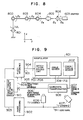
- Fig. 8 is a diagram showing the structure of the manipulator 601 shown in Fig. 6 (Fig. 7).
- the six articulations of the manipulator 601 are named, from the base of the manipulator, a first articulation 801, second articulation 802, third articulation 803, fourth articulation 804, fifth articulation 805, and sixth articulation 806.
- the gripper 603. At the terminal of the manipulator 601, there is mounted the gripper 603.
- the x-, y-, and z- axes of the reference coordinate system of the manipulator 601 are defined as shown in Fig. 8, and the origin is at the base of the manipulator 601.
- the angles of the first to sixth articulations are represented by ⁇ 1 to ⁇ 6.
- the manipulator 601 is first moved to reach near the target value by the similar control method as described with the first embodiment shown in Fig. 1.
- Fuzzy rules for fuzzy inference of the manipulator 601 having six articulations 801 to 806 are given by:
- the definition of X, Y, Z, ⁇ , ⁇ , and ⁇ 1 to ⁇ 5 is similar to that of the first embodiment shown in Fig. 1 to 5.
- ⁇ is one of parameters representative of the orientation of the terminal of the manipulator 601, and it represents the angle, relative to the y-axis, of the terminal image projected upon the x-y plane.
- ⁇ 6 is the angle of the sixth articulation 806 of the manipulator 601. Fuzzy rules are described by using only positive rules.
- reference numeral 901 represents fuzzy inference
- 902 an image processor
- 903 a finite difference of the position/orientation at the manipulator terminal
- 904 a command value to each manipulator articulation
- 905 an angle of each manipulator articulation
- 906 a force/torque at the manipulator terminal
- 907 a force/torque in the tip coordinate system
- 908 coordinate transformation 909 a finite difference of a force/torque
- 910 a target value of a force/torque
- 911 a video signal.
- the main different of the embodiment shown in Fig. 9 from that of Fig. 1 is that the finite difference 903 of the position/orientation at the terminal of the manipulator 601 is obtained by image-processing 902 the video signals 911 from the TV cameras 606 and 607.
- fuzzy inference 901 For the control of determination of only the position of the manipulator 601 shown in Fig. 9, the above-described fuzzy rules can be used for executing fuzzy inference 901. However, in this embodiment, since a compliance motion incorporating the force/torque control is carried out, there is added to fuzzy inference 901 an inference on the basis of the finite difference 909 of the force/torque. This force torque finite difference is obtained in the following manner. A force/torque signal 907 in the tip coordinate system outputted from the force/torque sensor 602 is subjected to coordinate transformation 908.
- fuzzy rules to be added fuzzy inference 901 in order to execute the compliance motion are shown.
- ⁇ X is SM and ⁇ Y is SM and ⁇ Z is SM and ⁇ is SM and ⁇ B is SM and ⁇ is SM, are expressed by ⁇ TCP is SM, then fuzzy rules are given by:
- introducing fuzzy inference for the control of a manipulator allows to realize a desired control, even if an additional control parameter is added, without changing the original rules. Therefore, controls such as a control to take the dynamic characteristics into consideration, a control to aim at reducing a power consumption, a control to suppress vibration of an arm, or the like, may be readily realized by simply adding new rules.
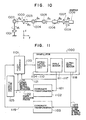
- Fig. 10 is a diagram showing the structure of the manipulator system with seven articulations and redundant degree of freedom according to the third embodiment of this invention, the manipulator system being realized by the fuzzy control method and apparatus for a manipulator of this invention.
- reference numeral 1000 represents a manipulator, 1001 to 1007 first to seventh articulations, 1008 a gripper, and 1009 an ultrasonic sensor.
- ⁇ 1 to ⁇ 7 represent the angles of the articulations 1001 to 1007.
- This embodiment features first in that the manipulator articulations with redundant degree of freedom allow a smooth motion of the manipulator tip or terminal, and second in that seven articulations 1001 to 1007 are disposed such that even if one of the seven articulations 1001 to 1007 of the manipulator 1000 has a trouble, the remaining six articulations can cover the operation area as broad as possible.
- the ultrasonic sensor 1009 is mounted at the manipulator terminal to measure the distance and direction to an object work to be held by the gripper 1008.
- Fig. 11 is a control block diagram of the manipulator system shown in Fig. 10.
- the ultrasonic sensor 1118 (1009) measures a distance/direction 1123 to the object work to be held by the gripper 1008 mounted at the manipulator terminal.
- the obtained distance/direction 1123 is subjected to coordinate transformation 1103 to obtain the finite difference of the position/orientation at the manipulator terminal.
- fuzzy inference 1101 is executed.
- the manipulator 1000 has seven articulations 1001 to 1007, while the position/orientation of the manipulator terminal is made coincident with the target value, there still remain another element to be operated freely in the geometric sense.
- the articulation angles 1121 detected with angle sensors 1111 to 1117 of the articulations 1001 to 1007 of the manipulator 1000 are subjected to coordinate transformation 1102 to thereby obtain the position 1122 of the fourth articulation 1004.
- a distance 1124 between the obstacle and the forth articulation is obtained and used as a parameter for fuzzy inference 1101.
- fuzzy inference 1101 is executed to obtain command values 1120 for the articulations 1001 to 1007 of the manipulator 1000 and supply them to articulation driving units 1104 to 1110.
- fuzzy rules for the first to third articulations 1001 to 1003 of the manipulator 1000 are set such that the finite difference of the position of the manipulator terminal is made small, whereas fuzzy rules for the fifth to seventh articulations are set such that the finite difference of the orientation of the manipulator terminal is made small.
- a fuzzy rule for the fourth articulation 1004 is set such that the finite differences of both position and orientation are made small.
- fuzzy rules for getting away from an obstacle are set with respect to the second articulation 1002 such that the y- and z-axis components of the distance 1124 between the obstacle and the fourth articulation 1004 are made large.
- Such fuzzy fules in this embodiment are given by: wherein the membership function PS represents a small positive amount, and the membership function NS represents a small negative amount.
- Fig. 12 is a schematic diagram showing a master-slave manipulator system according to the fourth embodiment of this invention, the system being realized by the fuzzy control method and apparatus for a manipulator of this invention.
- a central processing unit 1201 executes all arithmetic operations for the system.
- the central processing unit 1201 outputs, via a master arm input/output (I/O) device 1202, command values to articulations of a master arm 1204 for the control of the articulations.
- the articulation angles detected with articulation angle sensors are supplied via the master arm I/O device 1202 to the central processing unit 1201.
- a force/torque detected with a force/torque sensor 1206 mounted at the terminal of the master arm 1204 is supplied via the master arm I/O device 1202 to the central processing unit 1202.
- the central processing unit 1201 outputs, via a slave arm input/output (I/O) device 1203, command values to articulations of the slave arm 1205 for the control of the articulations.
- the articulation angles detected with articulation angle sensors are supplied via the slave arm I/O device 1203 to the central processing unit 1201.
- a force/torque detected with a force/torque sensor 1207 mounted at the terminal of the slave arm 1205 is supplied via the slave arm I/O device 1203 to the central processing unit 1202.
- the master and slave arms 1204 and 1205 each have six articulations, so six command values and six articulation angles are supplied to the articulations.
- Fig. 13 is a functional block diagram of the manipulator system shown in Fig. 12.
- articulation driving units 1301 to 1306 are mounted on the first to sixth articulations of the master arm 1204 to control the master arm 1204.
- the articulation angles are detected with the angle sensors 1307 to 1312 mounted on the first to sixth articulations.
- articulation driving units 1314 to 1319 are mounted on the first to sixth articulations of the slave arm 1205 to control the slave arm 1205.
- the articulation angles are detected with the angle sensors 1320 to 1325.
- Fig. 14 is the control block diagram of the manipulator system shown in Fig. 12 (Fig. 13).
- the control system of the manipulator system basically executes a force feedback bilateral servo control.
- the articulation angles 1407 detected with the angle sensors 1307 to 1312 of the master arm 1204 are subjected to coordinate transformation (I) 1401 to thereby obtain the position/orientation 1408 of the master arm terminal.
- the articulation angles 1409 detected with the angle sensors 1320 to 1325 of the slave arm 1205 are subjected to coordinate transformation (II) 1420 to thereby obtain the position/orientation 1410 of the slave arm terminal.
- This master-slave manipulator aims at causing the slave arm 1205 to move in coincidence with, or following, the position/orientation of the terminal of the master arm 1204. Therefore, it is necessary to make the position/orientation of the master arm terminal coincident with that of the slave arm terminal.
- the finite difference 1411 of the position/orientation by the amount of which the salve arm 1205 should move is obtained by subtracting the position/orientation 1408 by the position/orientation 1410.
- fuzzy inference 1403 is executed by using similar fuzzy rules as described with the position/orientation of the terminal of the manipulator 601 of the second embodiment shown in Fig. 6 (Fig. 9).
- the obtained command values 1412 to articulations of the slave arm 1205 are supplied to drive the articulation driving units 1314 to 1319 to move the slave arm 1205.
- Driving the master arm 1204 is so performed in the following manner that an operator is given a force which the slave arm 1205 receives.
- the force/torque signal 1413 from the force/torque sensor 1206 mounted at the terminal of the master arm 1204 is a force/torque signal described with the coordinate system of the force/torque sensor 1206 itself, i.e., a tip coordinate system of the master arm 1204.
- This force/torque is subjected to coordinate transformation (III) to obtain a force/torque represented by the master arm reference coordinate system.
- the force/torque signal 1415 from the force/torque sensor 1207 on the slave arm 1205 described with the slave arm tip coordinate system is subjected to coordinate transformation (IV) 1405 to obtain the force/torque 1416 described with the slave arm reference coordinate system.
- the finite difference 1417 of the force/torque is obtained by subtracting the force/torque 1416 by the force/torque 1414.
- fuzzy inference 1406 is executed by using similar fuzzy rules for the force/torque as described with the second embodiment.
- the obtained command values 1418 to articulations of the master arm 1204 are supplied to the articulation driving units 1301 to 1306 to drive the master arm 1204.
- fuzzy control using fuzzy inference has been executed for the control of, e.g., six articulations.
- the control of articulations may be made by using a combination of conventional matrix operations and fuzzy reductions.
- matrix operations for coordinate transformation inverse transformation
- fuzzy inference as of this invention is carried out for the remaining articulations.
Landscapes
- Engineering & Computer Science (AREA)
- Automation & Control Theory (AREA)
- Physics & Mathematics (AREA)
- General Physics & Mathematics (AREA)
- Fuzzy Systems (AREA)
- Manufacturing & Machinery (AREA)
- Artificial Intelligence (AREA)
- Evolutionary Computation (AREA)
- Human Computer Interaction (AREA)
- Mathematical Physics (AREA)
- Software Systems (AREA)
- Robotics (AREA)
- Mechanical Engineering (AREA)
- Manipulator (AREA)
- Feedback Control In General (AREA)
- Numerical Control (AREA)
Applications Claiming Priority (2)
| Application Number | Priority Date | Filing Date | Title |
|---|---|---|---|
| JP1146569A JP2698660B2 (ja) | 1989-06-12 | 1989-06-12 | マニピュレータの制御方法及び制御装置並びにマニピュレータ装置 |
| JP146569/89 | 1989-06-12 |
Publications (3)
| Publication Number | Publication Date |
|---|---|
| EP0402849A2 true EP0402849A2 (de) | 1990-12-19 |
| EP0402849A3 EP0402849A3 (de) | 1991-01-30 |
| EP0402849B1 EP0402849B1 (de) | 1996-03-13 |
Family
ID=15410650
Family Applications (1)
| Application Number | Title | Priority Date | Filing Date |
|---|---|---|---|
| EP90111077A Expired - Lifetime EP0402849B1 (de) | 1989-06-12 | 1990-06-12 | Handhabungsgerät |
Country Status (5)
| Country | Link |
|---|---|
| US (1) | US5047701A (de) |
| EP (1) | EP0402849B1 (de) |
| JP (1) | JP2698660B2 (de) |
| CA (1) | CA2018527C (de) |
| DE (1) | DE69025804T2 (de) |
Cited By (8)
| Publication number | Priority date | Publication date | Assignee | Title |
|---|---|---|---|---|
| EP0530138A1 (de) * | 1991-08-23 | 1993-03-03 | Mtf Datentechnik Ag | Verfahren und Vorrichtung zur Herstellung von Bewehrungen |
| EP0695606A1 (de) * | 1994-07-25 | 1996-02-07 | Consorzio per la Ricerca sulla Microelettronica nel Mezzogiorno - CoRiMMe | Fuzzy-Steuerungs-Prozess- und Einrichtung zur Positionierung und raschen Dämpfung mechanischer Schwingungen |
| AT401318B (de) * | 1992-11-27 | 1996-08-26 | Khachatouri Yeghiazarians Vahe | Fuzzy steuerungssystem für manipulatoren |
| AT401633B (de) * | 1995-01-12 | 1996-10-25 | Favre Bulle Bernard Dr | Sensorgestütztes roboter-greifersystem nach dem tentakelprinzip |
| EP0883468B1 (de) * | 1996-02-20 | 2003-05-21 | SMT Tricept AB | Produktionspositionsiereinrichtung |
| EP1162039A3 (de) * | 2000-06-06 | 2009-05-13 | Honda Giken Kogyo Kabushiki Kaisha | Fuzzy-logic Steuerung |
| CN103737592A (zh) * | 2013-12-27 | 2014-04-23 | 柳州职业技术学院 | 一种机械手精确控制系统及其方法 |
| CN106443387A (zh) * | 2016-10-25 | 2017-02-22 | 广东电网有限责任公司珠海供电局 | 一种控制巡检机器人局部放电检测的方法、装置及系统 |
Families Citing this family (36)
| Publication number | Priority date | Publication date | Assignee | Title |
|---|---|---|---|---|
| JPH04310384A (ja) * | 1991-04-09 | 1992-11-02 | Toyota Motor Corp | 複腕ロボット |
| JPH0365704A (ja) * | 1989-08-03 | 1991-03-20 | Toshiba Corp | ファジィ制御装置及びファジィ制御方法 |
| US5206566A (en) * | 1990-03-08 | 1993-04-27 | Matsushita Electric Industrial Co., Ltd. | Access method of actuator and control apparatus therefor |
| JP2682891B2 (ja) * | 1990-07-25 | 1997-11-26 | 新キャタピラー三菱株式会社 | パワーショベルの掘削制御装置 |
| DE4108939A1 (de) * | 1991-03-19 | 1992-09-24 | Bodenseewerk Geraetetech | Verfahren zum kalibrieren von hochgenauen robotern |
| JP2769052B2 (ja) * | 1991-04-09 | 1998-06-25 | インターナショナル・ビジネス・マシーンズ・コーポレイション | 自律移動機械、移動機械の制御装置及び方法 |
| JP2963787B2 (ja) * | 1991-05-27 | 1999-10-18 | オークマ株式会社 | 位置制御装置 |
| JP2778285B2 (ja) * | 1991-05-31 | 1998-07-23 | 松下電器産業株式会社 | 倣いセンサロボットシステム |
| JPH05313705A (ja) * | 1992-05-12 | 1993-11-26 | Hitachi Ltd | プロセス制御方法および装置 |
| US5291113A (en) * | 1992-10-06 | 1994-03-01 | Honeywell Inc. | Servo coupled hand controllers |
| DE4330481A1 (de) * | 1993-09-09 | 1995-03-16 | Bosch Gmbh Robert | Verfahren zum Herstellen einer Fügeverbindung, insbesondere einer Schraubverbindung |
| US5876325A (en) * | 1993-11-02 | 1999-03-02 | Olympus Optical Co., Ltd. | Surgical manipulation system |
| US5502363A (en) * | 1994-01-04 | 1996-03-26 | University Of Maryland-Baltimore County | Apparatus for controlling angular positioning and stiffness modulations of joint of robotic manipulator |
| US5648627A (en) * | 1995-09-27 | 1997-07-15 | Yamaha Corporation | Musical performance control apparatus for processing a user's swing motion with fuzzy inference or a neural network |
| ES2321671T3 (es) * | 1996-10-18 | 2009-06-09 | Kyushu Electric Power Co., Inc. | Vehiculo robot para trabajo en lineas de transmision electrica con corriente. |
| JP3790058B2 (ja) * | 1999-01-14 | 2006-06-28 | 株式会社神戸製鋼所 | 油圧ショベルの制御装置 |
| US6691010B1 (en) * | 2000-11-15 | 2004-02-10 | Caterpillar Inc | Method for developing an algorithm to efficiently control an autonomous excavating linkage |
| CA2437286C (en) | 2002-08-13 | 2008-04-29 | Garnette Roy Sutherland | Microsurgical robot system |
| JP3752494B2 (ja) * | 2003-03-31 | 2006-03-08 | 株式会社東芝 | マスタスレーブマニピュレータ、その制御装置及び制御方法 |
| US7295893B2 (en) | 2003-03-31 | 2007-11-13 | Kabushiki Kaisha Toshiba | Manipulator and its control apparatus and method |
| JP3680064B2 (ja) * | 2003-04-21 | 2005-08-10 | ファナック株式会社 | 数値制御装置 |
| JP4021413B2 (ja) * | 2004-01-16 | 2007-12-12 | ファナック株式会社 | 計測装置 |
| JP3946711B2 (ja) * | 2004-06-02 | 2007-07-18 | ファナック株式会社 | ロボットシステム |
| US8147503B2 (en) * | 2007-09-30 | 2012-04-03 | Intuitive Surgical Operations Inc. | Methods of locating and tracking robotic instruments in robotic surgical systems |
| US8073528B2 (en) * | 2007-09-30 | 2011-12-06 | Intuitive Surgical Operations, Inc. | Tool tracking systems, methods and computer products for image guided surgery |
| US8108072B2 (en) * | 2007-09-30 | 2012-01-31 | Intuitive Surgical Operations, Inc. | Methods and systems for robotic instrument tool tracking with adaptive fusion of kinematics information and image information |
| US10555775B2 (en) * | 2005-05-16 | 2020-02-11 | Intuitive Surgical Operations, Inc. | Methods and system for performing 3-D tool tracking by fusion of sensor and/or camera derived data during minimally invasive robotic surgery |
| CN103398656B (zh) * | 2007-08-10 | 2016-08-10 | 莱卡地球系统公开股份有限公司 | 用于在物体表面上进行非接触坐标测量的方法和勘测系统 |
| US9020240B2 (en) | 2007-08-10 | 2015-04-28 | Leica Geosystems Ag | Method and surveying system for noncontact coordinate measurement on an object surface |
| JP5028219B2 (ja) | 2007-10-30 | 2012-09-19 | オリンパスメディカルシステムズ株式会社 | マニピュレータ装置および医療機器システム |
| WO2013176212A1 (ja) * | 2012-05-25 | 2013-11-28 | 学校法人立命館 | ロボット制御装置、ロボット制御方法、プログラム、記録媒体、ロボットシステム |
| WO2014136583A1 (en) * | 2013-03-05 | 2014-09-12 | Olympus Corporation | Operation input device and master-slave system |
| JP6380828B2 (ja) * | 2014-03-07 | 2018-08-29 | セイコーエプソン株式会社 | ロボット、ロボットシステム、制御装置、及び制御方法 |
| CN108445794B (zh) * | 2018-02-28 | 2021-08-27 | 辽宁科技大学 | 一种感应机器钳夹持控制器系统及控制方法 |
| CN110253573A (zh) * | 2019-06-05 | 2019-09-20 | 重庆工商职业学院 | 一种基于串并联估计模型的柔性机械臂系统模糊控制方法 |
| KR102570962B1 (ko) * | 2021-08-26 | 2023-08-24 | 한국로봇융합연구원 | 로봇 제어 장치 및 이의 동작 방법 |
Family Cites Families (15)
| Publication number | Priority date | Publication date | Assignee | Title |
|---|---|---|---|---|
| JPS58154458A (ja) * | 1982-03-10 | 1983-09-13 | Toshiba Corp | 位置検出修正装置 |
| JPS5930690A (ja) * | 1982-08-09 | 1984-02-18 | 株式会社日立製作所 | 冗長度を持つ多関節形ロボツトの制御方法 |
| JPS59139408A (ja) * | 1983-01-28 | 1984-08-10 | Mitsubishi Electric Corp | ロボツトにおける教示方式 |
| JPS59175987A (ja) * | 1983-03-26 | 1984-10-05 | 株式会社東芝 | 多関節ロボツト装置 |
| DE3405909A1 (de) * | 1984-02-18 | 1985-08-22 | Licentia Patent-Verwaltungs-Gmbh, 6000 Frankfurt | Vorrichtung zur erfassung, messtechnischen analyse und/oder regelung von technischen verfahrensablaeufen |
| JPH0734162B2 (ja) * | 1985-02-06 | 1995-04-12 | 株式会社日立製作所 | 類推制御方法 |
| US4643074A (en) * | 1985-03-07 | 1987-02-17 | Vickers, Incorporated | Power transmission |
| EP0241286B2 (de) * | 1986-04-11 | 1994-11-09 | Mitsubishi Denki Kabushiki Kaisha | Selbsteinstellender Regler |
| JPH0698903B2 (ja) * | 1986-08-06 | 1994-12-07 | 本田技研工業株式会社 | 車両走行制御装置 |
| US4882526A (en) * | 1986-08-12 | 1989-11-21 | Kabushiki Kaisha Toshiba | Adaptive process control system |
| DE3878032T2 (de) * | 1987-05-19 | 1993-05-19 | Honda Motor Co Ltd | Fahrzeug-regelsystem. |
| JPH07114559B2 (ja) * | 1987-09-19 | 1995-12-06 | 三菱電機株式会社 | 電力系統安定化装置 |
| GB2211324B (en) * | 1987-10-16 | 1992-01-15 | Mitsubishi Electric Corp | Fuzzy inference apparatus |
| JPH01132450A (ja) * | 1987-11-17 | 1989-05-24 | Nissan Motor Co Ltd | アンチスキッドブレーキシステム |
| JPH02274480A (ja) * | 1989-04-17 | 1990-11-08 | Toshiba Corp | アーム制御装置 |
-
1989
- 1989-06-12 JP JP1146569A patent/JP2698660B2/ja not_active Expired - Fee Related
-
1990
- 1990-06-07 CA CA002018527A patent/CA2018527C/en not_active Expired - Fee Related
- 1990-06-12 DE DE69025804T patent/DE69025804T2/de not_active Expired - Fee Related
- 1990-06-12 US US07/536,801 patent/US5047701A/en not_active Expired - Lifetime
- 1990-06-12 EP EP90111077A patent/EP0402849B1/de not_active Expired - Lifetime
Cited By (9)
| Publication number | Priority date | Publication date | Assignee | Title |
|---|---|---|---|---|
| EP0530138A1 (de) * | 1991-08-23 | 1993-03-03 | Mtf Datentechnik Ag | Verfahren und Vorrichtung zur Herstellung von Bewehrungen |
| AT401318B (de) * | 1992-11-27 | 1996-08-26 | Khachatouri Yeghiazarians Vahe | Fuzzy steuerungssystem für manipulatoren |
| EP0695606A1 (de) * | 1994-07-25 | 1996-02-07 | Consorzio per la Ricerca sulla Microelettronica nel Mezzogiorno - CoRiMMe | Fuzzy-Steuerungs-Prozess- und Einrichtung zur Positionierung und raschen Dämpfung mechanischer Schwingungen |
| AT401633B (de) * | 1995-01-12 | 1996-10-25 | Favre Bulle Bernard Dr | Sensorgestütztes roboter-greifersystem nach dem tentakelprinzip |
| EP0883468B1 (de) * | 1996-02-20 | 2003-05-21 | SMT Tricept AB | Produktionspositionsiereinrichtung |
| EP1162039A3 (de) * | 2000-06-06 | 2009-05-13 | Honda Giken Kogyo Kabushiki Kaisha | Fuzzy-logic Steuerung |
| CN103737592A (zh) * | 2013-12-27 | 2014-04-23 | 柳州职业技术学院 | 一种机械手精确控制系统及其方法 |
| CN103737592B (zh) * | 2013-12-27 | 2016-06-08 | 柳州职业技术学院 | 一种机械手精确控制系统及其方法 |
| CN106443387A (zh) * | 2016-10-25 | 2017-02-22 | 广东电网有限责任公司珠海供电局 | 一种控制巡检机器人局部放电检测的方法、装置及系统 |
Also Published As
| Publication number | Publication date |
|---|---|
| DE69025804T2 (de) | 1996-07-25 |
| CA2018527C (en) | 1994-05-31 |
| DE69025804D1 (de) | 1996-04-18 |
| JP2698660B2 (ja) | 1998-01-19 |
| EP0402849B1 (de) | 1996-03-13 |
| US5047701A (en) | 1991-09-10 |
| JPH0312709A (ja) | 1991-01-21 |
| EP0402849A3 (de) | 1991-01-30 |
| CA2018527A1 (en) | 1990-12-12 |
Similar Documents
| Publication | Publication Date | Title |
|---|---|---|
| US5047701A (en) | Manipulator | |
| US4833624A (en) | Functioning-distributed robot control system | |
| JP3394322B2 (ja) | 視覚センサを用いた座標系設定方法 | |
| US4661032A (en) | Bilateral master-slave manipulator control device | |
| US4906907A (en) | Robot system | |
| Schmitz et al. | The CMU reconfigurable modular manipulator system | |
| Sharma et al. | Motion perceptibility and its application to active vision-based servo control | |
| Lewis et al. | Robot manipulator control: theory and practice | |
| JP2895672B2 (ja) | 複数ロボット制御方法 | |
| US8160737B2 (en) | Machine tool with numerical controller and on-machine measuring device | |
| EP0129245A1 (de) | Verfahren und Vorrichtung zum Steuern eines Roboters | |
| US4670849A (en) | Position error correcting method and apparatus for industrial robot | |
| US20230251630A1 (en) | Numerical control system | |
| EP0137962B1 (de) | System und Verfahren zur Steuerung eines Industrieroboters | |
| Fong et al. | Distributed microcomputer control system for advanced teleoperation | |
| JP3577124B2 (ja) | 力制御ロボットを用いて嵌合データを取得する方法 | |
| JP2629291B2 (ja) | マニピュレータ学習制御方法 | |
| JPH05345291A (ja) | ロボットの動作範囲制限方式 | |
| Matsuhira et al. | Manoeuvrability of a master-slave manipulator with different configurations and its evaluation tests | |
| JP3007440B2 (ja) | ロボットのオフライン教示装置 | |
| JPH05303425A (ja) | 直接教示方式ロボット | |
| Liao et al. | Generalized impedance control of a redundant manipulator for handling tasks with position uncertainty while avoiding obstacles | |
| US6978193B2 (en) | Positioning data calculating procedure, positioning data calculating apparatus and articulated manipulator | |
| US20230244211A1 (en) | Numerical control system | |
| JPH06114766A (ja) | マニピュレータの遠隔制御装置 |
Legal Events
| Date | Code | Title | Description |
|---|---|---|---|
| PUAI | Public reference made under article 153(3) epc to a published international application that has entered the european phase |
Free format text: ORIGINAL CODE: 0009012 |
|
| PUAL | Search report despatched |
Free format text: ORIGINAL CODE: 0009013 |
|
| 17P | Request for examination filed |
Effective date: 19900612 |
|
| AK | Designated contracting states |
Kind code of ref document: A2 Designated state(s): DE FR |
|
| AK | Designated contracting states |
Kind code of ref document: A3 Designated state(s): DE FR |
|
| 17Q | First examination report despatched |
Effective date: 19930705 |
|
| GRAA | (expected) grant |
Free format text: ORIGINAL CODE: 0009210 |
|
| AK | Designated contracting states |
Kind code of ref document: B1 Designated state(s): DE FR |
|
| REF | Corresponds to: |
Ref document number: 69025804 Country of ref document: DE Date of ref document: 19960418 |
|
| ET | Fr: translation filed | ||
| PLBE | No opposition filed within time limit |
Free format text: ORIGINAL CODE: 0009261 |
|
| STAA | Information on the status of an ep patent application or granted ep patent |
Free format text: STATUS: NO OPPOSITION FILED WITHIN TIME LIMIT |
|
| 26N | No opposition filed | ||
| PGFP | Annual fee paid to national office [announced via postgrant information from national office to epo] |
Ref country code: FR Payment date: 20040526 Year of fee payment: 15 |
|
| PGFP | Annual fee paid to national office [announced via postgrant information from national office to epo] |
Ref country code: DE Payment date: 20040608 Year of fee payment: 15 |
|
| PG25 | Lapsed in a contracting state [announced via postgrant information from national office to epo] |
Ref country code: DE Free format text: LAPSE BECAUSE OF NON-PAYMENT OF DUE FEES Effective date: 20060103 |
|
| PG25 | Lapsed in a contracting state [announced via postgrant information from national office to epo] |
Ref country code: FR Free format text: LAPSE BECAUSE OF NON-PAYMENT OF DUE FEES Effective date: 20060228 |
|
| REG | Reference to a national code |
Ref country code: FR Ref legal event code: ST Effective date: 20060228 |