EP0366608A2 - Pulverlacke für matte Ueberzüge - Google Patents
Pulverlacke für matte Ueberzüge Download PDFInfo
- Publication number
- EP0366608A2 EP0366608A2 EP89810786A EP89810786A EP0366608A2 EP 0366608 A2 EP0366608 A2 EP 0366608A2 EP 89810786 A EP89810786 A EP 89810786A EP 89810786 A EP89810786 A EP 89810786A EP 0366608 A2 EP0366608 A2 EP 0366608A2
- Authority
- EP
- European Patent Office
- Prior art keywords
- radical
- powder coating
- cooh
- alkyl
- oder
- Prior art date
- Legal status (The legal status is an assumption and is not a legal conclusion. Google has not performed a legal analysis and makes no representation as to the accuracy of the status listed.)
- Granted
Links
- 238000000576 coating method Methods 0.000 title claims abstract description 41
- 239000000843 powder Substances 0.000 title claims abstract description 36
- 239000011248 coating agent Substances 0.000 title claims description 26
- -1 polymethylene group Chemical class 0.000 claims abstract description 30
- 239000002253 acid Substances 0.000 claims abstract description 18
- 229920000728 polyester Polymers 0.000 claims abstract description 17
- 125000003178 carboxy group Chemical group [H]OC(*)=O 0.000 claims abstract description 16
- 239000003822 epoxy resin Substances 0.000 claims abstract description 16
- 229920000647 polyepoxide Polymers 0.000 claims abstract description 16
- 229920006395 saturated elastomer Polymers 0.000 claims abstract description 12
- 125000004178 (C1-C4) alkyl group Chemical group 0.000 claims abstract description 10
- 125000004435 hydrogen atom Chemical group [H]* 0.000 claims abstract description 10
- 229940123208 Biguanide Drugs 0.000 claims abstract description 9
- 125000001931 aliphatic group Chemical group 0.000 claims abstract description 9
- 125000004432 carbon atom Chemical group C* 0.000 claims abstract description 9
- QGBSISYHAICWAH-UHFFFAOYSA-N dicyandiamide Chemical compound NC(N)=NC#N QGBSISYHAICWAH-UHFFFAOYSA-N 0.000 claims abstract description 8
- 238000004519 manufacturing process Methods 0.000 claims abstract description 7
- 125000001424 substituent group Chemical group 0.000 claims abstract description 7
- 229910052751 metal Inorganic materials 0.000 claims abstract description 4
- 239000002184 metal Substances 0.000 claims abstract description 4
- 150000002739 metals Chemical class 0.000 claims abstract description 3
- 125000000325 methylidene group Chemical class [H]C([H])=* 0.000 claims abstract description 3
- 239000003795 chemical substances by application Substances 0.000 claims description 11
- 238000007872 degassing Methods 0.000 claims description 3
- 230000009477 glass transition Effects 0.000 claims description 3
- 125000003700 epoxy group Chemical group 0.000 claims description 2
- 239000000049 pigment Substances 0.000 claims description 2
- ISAOCJYIOMOJEB-UHFFFAOYSA-N benzoin Chemical compound C=1C=CC=CC=1C(O)C(=O)C1=CC=CC=C1 ISAOCJYIOMOJEB-UHFFFAOYSA-N 0.000 description 12
- GWEVSGVZZGPLCZ-UHFFFAOYSA-N Titan oxide Chemical compound O=[Ti]=O GWEVSGVZZGPLCZ-UHFFFAOYSA-N 0.000 description 10
- 150000001875 compounds Chemical class 0.000 description 10
- BGTOWKSIORTVQH-UHFFFAOYSA-N cyclopentanone Chemical compound O=C1CCCC1 BGTOWKSIORTVQH-UHFFFAOYSA-N 0.000 description 10
- YXFVVABEGXRONW-UHFFFAOYSA-N Toluene Chemical compound CC1=CC=CC=C1 YXFVVABEGXRONW-UHFFFAOYSA-N 0.000 description 9
- 239000003973 paint Substances 0.000 description 9
- 125000002887 hydroxy group Chemical group [H]O* 0.000 description 8
- 239000000203 mixture Substances 0.000 description 7
- JSKOEDSLYAEINT-UHFFFAOYSA-N 3-[1,3,3-tris(2-carboxyethyl)-2-oxocyclopentyl]propanoic acid Chemical compound OC(=O)CCC1(CCC(O)=O)CCC(CCC(O)=O)(CCC(O)=O)C1=O JSKOEDSLYAEINT-UHFFFAOYSA-N 0.000 description 6
- OKKJLVBELUTLKV-UHFFFAOYSA-N Methanol Chemical compound OC OKKJLVBELUTLKV-UHFFFAOYSA-N 0.000 description 6
- 244000028419 Styrax benzoin Species 0.000 description 6
- 235000000126 Styrax benzoin Nutrition 0.000 description 6
- 235000008411 Sumatra benzointree Nutrition 0.000 description 6
- 229960002130 benzoin Drugs 0.000 description 6
- 235000019382 gum benzoic Nutrition 0.000 description 6
- 229910052739 hydrogen Inorganic materials 0.000 description 6
- 229920005862 polyol Polymers 0.000 description 6
- 150000003077 polyols Chemical class 0.000 description 6
- 150000003254 radicals Chemical class 0.000 description 6
- LCFVJGUPQDGYKZ-UHFFFAOYSA-N Bisphenol A diglycidyl ether Chemical compound C=1C=C(OCC2OC2)C=CC=1C(C)(C)C(C=C1)=CC=C1OCC1CO1 LCFVJGUPQDGYKZ-UHFFFAOYSA-N 0.000 description 5
- PEDCQBHIVMGVHV-UHFFFAOYSA-N Glycerine Chemical compound OCC(O)CO PEDCQBHIVMGVHV-UHFFFAOYSA-N 0.000 description 5
- LNEPOXFFQSENCJ-UHFFFAOYSA-N haloperidol Chemical compound C1CC(O)(C=2C=CC(Cl)=CC=2)CCN1CCCC(=O)C1=CC=C(F)C=C1 LNEPOXFFQSENCJ-UHFFFAOYSA-N 0.000 description 5
- 238000000034 method Methods 0.000 description 5
- 238000002156 mixing Methods 0.000 description 5
- 229910052757 nitrogen Inorganic materials 0.000 description 5
- 229920005989 resin Polymers 0.000 description 5
- 239000011347 resin Substances 0.000 description 5
- 150000007513 acids Chemical class 0.000 description 4
- UJMDYLWCYJJYMO-UHFFFAOYSA-N benzene-1,2,3-tricarboxylic acid Chemical compound OC(=O)C1=CC=CC(C(O)=O)=C1C(O)=O UJMDYLWCYJJYMO-UHFFFAOYSA-N 0.000 description 4
- PXKLMJQFEQBVLD-UHFFFAOYSA-N bisphenol F Chemical compound C1=CC(O)=CC=C1CC1=CC=C(O)C=C1 PXKLMJQFEQBVLD-UHFFFAOYSA-N 0.000 description 4
- JHIVVAPYMSGYDF-UHFFFAOYSA-N cyclohexanone Chemical compound O=C1CCCCC1 JHIVVAPYMSGYDF-UHFFFAOYSA-N 0.000 description 4
- 238000000921 elemental analysis Methods 0.000 description 4
- 238000009863 impact test Methods 0.000 description 4
- 238000002844 melting Methods 0.000 description 4
- 230000008018 melting Effects 0.000 description 4
- 229920006324 polyoxymethylene Polymers 0.000 description 4
- 239000011541 reaction mixture Substances 0.000 description 4
- KQTIIICEAUMSDG-UHFFFAOYSA-N tricarballylic acid Chemical compound OC(=O)CC(C(O)=O)CC(O)=O KQTIIICEAUMSDG-UHFFFAOYSA-N 0.000 description 4
- ARCGXLSVLAOJQL-UHFFFAOYSA-N trimellitic acid Chemical compound OC(=O)C1=CC=C(C(O)=O)C(C(O)=O)=C1 ARCGXLSVLAOJQL-UHFFFAOYSA-N 0.000 description 4
- XLYOFNOQVPJJNP-UHFFFAOYSA-N water Substances O XLYOFNOQVPJJNP-UHFFFAOYSA-N 0.000 description 4
- LYCAIKOWRPUZTN-UHFFFAOYSA-N Ethylene glycol Chemical compound OCCO LYCAIKOWRPUZTN-UHFFFAOYSA-N 0.000 description 3
- 229930182556 Polyacetal Natural products 0.000 description 3
- DKGAVHZHDRPRBM-UHFFFAOYSA-N Tert-Butanol Chemical compound CC(C)(C)O DKGAVHZHDRPRBM-UHFFFAOYSA-N 0.000 description 3
- ZMANZCXQSJIPKH-UHFFFAOYSA-N Triethylamine Chemical compound CCN(CC)CC ZMANZCXQSJIPKH-UHFFFAOYSA-N 0.000 description 3
- 229910052782 aluminium Inorganic materials 0.000 description 3
- XAGFODPZIPBFFR-UHFFFAOYSA-N aluminium Chemical compound [Al] XAGFODPZIPBFFR-UHFFFAOYSA-N 0.000 description 3
- 150000008064 anhydrides Chemical class 0.000 description 3
- IISBACLAFKSPIT-UHFFFAOYSA-N bisphenol A Chemical compound C=1C=C(O)C=CC=1C(C)(C)C1=CC=C(O)C=C1 IISBACLAFKSPIT-UHFFFAOYSA-N 0.000 description 3
- 125000005594 diketone group Chemical group 0.000 description 3
- RAXXELZNTBOGNW-UHFFFAOYSA-N imidazole Natural products C1=CNC=N1 RAXXELZNTBOGNW-UHFFFAOYSA-N 0.000 description 3
- 150000002460 imidazoles Chemical class 0.000 description 3
- 239000000463 material Substances 0.000 description 3
- NFHFRUOZVGFOOS-UHFFFAOYSA-N palladium;triphenylphosphane Chemical compound [Pd].C1=CC=CC=C1P(C=1C=CC=CC=1)C1=CC=CC=C1.C1=CC=CC=C1P(C=1C=CC=CC=1)C1=CC=CC=C1.C1=CC=CC=C1P(C=1C=CC=CC=1)C1=CC=CC=C1.C1=CC=CC=C1P(C=1C=CC=CC=1)C1=CC=CC=C1 NFHFRUOZVGFOOS-UHFFFAOYSA-N 0.000 description 3
- XNLICIUVMPYHGG-UHFFFAOYSA-N pentan-2-one Chemical class CCCC(C)=O XNLICIUVMPYHGG-UHFFFAOYSA-N 0.000 description 3
- 239000002244 precipitate Substances 0.000 description 3
- 238000002360 preparation method Methods 0.000 description 3
- 239000007787 solid Substances 0.000 description 3
- MUTGBJKUEZFXGO-OLQVQODUSA-N (3as,7ar)-3a,4,5,6,7,7a-hexahydro-2-benzofuran-1,3-dione Chemical compound C1CCC[C@@H]2C(=O)OC(=O)[C@@H]21 MUTGBJKUEZFXGO-OLQVQODUSA-N 0.000 description 2
- ZUYKJZQOPXDNOK-UHFFFAOYSA-N 2-(ethylamino)-2-thiophen-2-ylcyclohexan-1-one;hydrochloride Chemical class Cl.C=1C=CSC=1C1(NCC)CCCCC1=O ZUYKJZQOPXDNOK-UHFFFAOYSA-N 0.000 description 2
- LXBGSDVWAMZHDD-UHFFFAOYSA-N 2-methyl-1h-imidazole Chemical compound CC1=NC=CN1 LXBGSDVWAMZHDD-UHFFFAOYSA-N 0.000 description 2
- VEORPZCZECFIRK-UHFFFAOYSA-N 3,3',5,5'-tetrabromobisphenol A Chemical compound C=1C(Br)=C(O)C(Br)=CC=1C(C)(C)C1=CC(Br)=C(O)C(Br)=C1 VEORPZCZECFIRK-UHFFFAOYSA-N 0.000 description 2
- XLSZMDLNRCVEIJ-UHFFFAOYSA-N 4-methylimidazole Chemical compound CC1=CNC=N1 XLSZMDLNRCVEIJ-UHFFFAOYSA-N 0.000 description 2
- ULKLGIFJWFIQFF-UHFFFAOYSA-N 5K8XI641G3 Chemical compound CCC1=NC=C(C)N1 ULKLGIFJWFIQFF-UHFFFAOYSA-N 0.000 description 2
- ZNZYKNKBJPZETN-WELNAUFTSA-N Dialdehyde 11678 Chemical compound N1C2=CC=CC=C2C2=C1[C@H](C[C@H](/C(=C/O)C(=O)OC)[C@@H](C=C)C=O)NCC2 ZNZYKNKBJPZETN-WELNAUFTSA-N 0.000 description 2
- 239000004593 Epoxy Substances 0.000 description 2
- SXRSQZLOMIGNAQ-UHFFFAOYSA-N Glutaraldehyde Chemical compound O=CCCCC=O SXRSQZLOMIGNAQ-UHFFFAOYSA-N 0.000 description 2
- VEXZGXHMUGYJMC-UHFFFAOYSA-N Hydrochloric acid Chemical compound Cl VEXZGXHMUGYJMC-UHFFFAOYSA-N 0.000 description 2
- VYPSYNLAJGMNEJ-UHFFFAOYSA-N Silicium dioxide Chemical compound O=[Si]=O VYPSYNLAJGMNEJ-UHFFFAOYSA-N 0.000 description 2
- KKEYFWRCBNTPAC-UHFFFAOYSA-N Terephthalic acid Chemical compound OC(=O)C1=CC=C(C(O)=O)C=C1 KKEYFWRCBNTPAC-UHFFFAOYSA-N 0.000 description 2
- 239000000654 additive Substances 0.000 description 2
- WNLRTRBMVRJNCN-UHFFFAOYSA-N adipic acid Chemical compound OC(=O)CCCCC(O)=O WNLRTRBMVRJNCN-UHFFFAOYSA-N 0.000 description 2
- WERYXYBDKMZEQL-UHFFFAOYSA-N butane-1,4-diol Chemical compound OCCCCO WERYXYBDKMZEQL-UHFFFAOYSA-N 0.000 description 2
- CZBZUDVBLSSABA-UHFFFAOYSA-N butylated hydroxyanisole Chemical compound COC1=CC=C(O)C(C(C)(C)C)=C1.COC1=CC=C(O)C=C1C(C)(C)C CZBZUDVBLSSABA-UHFFFAOYSA-N 0.000 description 2
- 150000001991 dicarboxylic acids Chemical class 0.000 description 2
- 238000005227 gel permeation chromatography Methods 0.000 description 2
- 235000011187 glycerol Nutrition 0.000 description 2
- LEQAOMBKQFMDFZ-UHFFFAOYSA-N glyoxal Chemical compound O=CC=O LEQAOMBKQFMDFZ-UHFFFAOYSA-N 0.000 description 2
- 239000005457 ice water Substances 0.000 description 2
- QQVIHTHCMHWDBS-UHFFFAOYSA-N isophthalic acid Chemical compound OC(=O)C1=CC=CC(C(O)=O)=C1 QQVIHTHCMHWDBS-UHFFFAOYSA-N 0.000 description 2
- 239000006224 matting agent Substances 0.000 description 2
- BDJRBEYXGGNYIS-UHFFFAOYSA-N nonanedioic acid Chemical compound OC(=O)CCCCCCCC(O)=O BDJRBEYXGGNYIS-UHFFFAOYSA-N 0.000 description 2
- 239000002245 particle Substances 0.000 description 2
- ACVYVLVWPXVTIT-UHFFFAOYSA-N phosphinic acid Chemical compound O[PH2]=O ACVYVLVWPXVTIT-UHFFFAOYSA-N 0.000 description 2
- WLJVNTCWHIRURA-UHFFFAOYSA-N pimelic acid Chemical compound OC(=O)CCCCCC(O)=O WLJVNTCWHIRURA-UHFFFAOYSA-N 0.000 description 2
- 229920002037 poly(vinyl butyral) polymer Polymers 0.000 description 2
- CXMXRPHRNRROMY-UHFFFAOYSA-N sebacic acid Chemical compound OC(=O)CCCCCCCCC(O)=O CXMXRPHRNRROMY-UHFFFAOYSA-N 0.000 description 2
- 239000002904 solvent Substances 0.000 description 2
- TYFQFVWCELRYAO-UHFFFAOYSA-N suberic acid Chemical compound OC(=O)CCCCCCC(O)=O TYFQFVWCELRYAO-UHFFFAOYSA-N 0.000 description 2
- 239000000126 substance Substances 0.000 description 2
- 150000003628 tricarboxylic acids Chemical class 0.000 description 2
- ILUSMKXTLSNIRA-UHFFFAOYSA-N 1,3,5-triazinane-2,4,6-trione Chemical compound O=C1NC(=O)NC(=O)N1.O=C1NC(=O)NC(=O)N1 ILUSMKXTLSNIRA-UHFFFAOYSA-N 0.000 description 1
- OUPZKGBUJRBPGC-UHFFFAOYSA-N 1,3,5-tris(oxiran-2-ylmethyl)-1,3,5-triazinane-2,4,6-trione Chemical compound O=C1N(CC2OC2)C(=O)N(CC2OC2)C(=O)N1CC1CO1 OUPZKGBUJRBPGC-UHFFFAOYSA-N 0.000 description 1
- RYOZFCZYXDOECF-UHFFFAOYSA-N 1,4-diethylpyrazine Chemical class CCN1C=CN(CC)C=C1 RYOZFCZYXDOECF-UHFFFAOYSA-N 0.000 description 1
- OXHNLMTVIGZXSG-UHFFFAOYSA-N 1-Methylpyrrole Chemical compound CN1C=CC=C1 OXHNLMTVIGZXSG-UHFFFAOYSA-N 0.000 description 1
- GVGVUNDFQUSHDM-UHFFFAOYSA-N 1-benzyl-2h-pyridine Chemical class C=1C=CC=CC=1CN1CC=CC=C1 GVGVUNDFQUSHDM-UHFFFAOYSA-N 0.000 description 1
- VLDPXPPHXDGHEW-UHFFFAOYSA-N 1-chloro-2-dichlorophosphoryloxybenzene Chemical compound ClC1=CC=CC=C1OP(Cl)(Cl)=O VLDPXPPHXDGHEW-UHFFFAOYSA-N 0.000 description 1
- QRRKZFCXXBFHSV-UHFFFAOYSA-N 1-ethylindole Chemical class C1=CC=C2N(CC)C=CC2=C1 QRRKZFCXXBFHSV-UHFFFAOYSA-N 0.000 description 1
- MCTWTZJPVLRJOU-UHFFFAOYSA-N 1-methyl-1H-imidazole Chemical compound CN1C=CN=C1 MCTWTZJPVLRJOU-UHFFFAOYSA-N 0.000 description 1
- RTBFRGCFXZNCOE-UHFFFAOYSA-N 1-methylsulfonylpiperidin-4-one Chemical compound CS(=O)(=O)N1CCC(=O)CC1 RTBFRGCFXZNCOE-UHFFFAOYSA-N 0.000 description 1
- KXIXHISTUVHOCY-UHFFFAOYSA-N 1-propan-2-ylpiperidine Chemical class CC(C)N1CCCCC1 KXIXHISTUVHOCY-UHFFFAOYSA-N 0.000 description 1
- HYZJCKYKOHLVJF-UHFFFAOYSA-N 1H-benzimidazole Chemical compound C1=CC=C2NC=NC2=C1 HYZJCKYKOHLVJF-UHFFFAOYSA-N 0.000 description 1
- AHDSRXYHVZECER-UHFFFAOYSA-N 2,4,6-tris[(dimethylamino)methyl]phenol Chemical compound CN(C)CC1=CC(CN(C)C)=C(O)C(CN(C)C)=C1 AHDSRXYHVZECER-UHFFFAOYSA-N 0.000 description 1
- PQAMFDRRWURCFQ-UHFFFAOYSA-N 2-ethyl-1h-imidazole Chemical compound CCC1=NC=CN1 PQAMFDRRWURCFQ-UHFFFAOYSA-N 0.000 description 1
- PHMIILSQQVFWKC-UHFFFAOYSA-N 2-methyl-5-phenyl-1h-imidazole Chemical compound N1C(C)=NC=C1C1=CC=CC=C1 PHMIILSQQVFWKC-UHFFFAOYSA-N 0.000 description 1
- ZCUJYXPAKHMBAZ-UHFFFAOYSA-N 2-phenyl-1h-imidazole Chemical compound C1=CNC(C=2C=CC=CC=2)=N1 ZCUJYXPAKHMBAZ-UHFFFAOYSA-N 0.000 description 1
- MKBBSFGKFMQPPC-UHFFFAOYSA-N 2-propyl-1h-imidazole Chemical compound CCCC1=NC=CN1 MKBBSFGKFMQPPC-UHFFFAOYSA-N 0.000 description 1
- YJESALUAHUVISI-UHFFFAOYSA-N 3,5-dimethylhexan-2-one Chemical compound CC(C)CC(C)C(C)=O YJESALUAHUVISI-UHFFFAOYSA-N 0.000 description 1
- CIVMSMDSVPVXSU-UHFFFAOYSA-N 3-[1,3,3-tris(2-carboxyethyl)-2-oxocyclohexyl]propanoic acid Chemical compound OC(=O)CCC1(CCC(O)=O)CCCC(CCC(O)=O)(CCC(O)=O)C1=O CIVMSMDSVPVXSU-UHFFFAOYSA-N 0.000 description 1
- LRASALMYIKJWRR-UHFFFAOYSA-N 3-[1,3,3-tris(2-cyanoethyl)-2-oxocyclopentyl]propanenitrile Chemical compound O=C1C(CCC#N)(CCC#N)CCC1(CCC#N)CCC#N LRASALMYIKJWRR-UHFFFAOYSA-N 0.000 description 1
- YBRVSVVVWCFQMG-UHFFFAOYSA-N 4,4'-diaminodiphenylmethane Chemical class C1=CC(N)=CC=C1CC1=CC=C(N)C=C1 YBRVSVVVWCFQMG-UHFFFAOYSA-N 0.000 description 1
- VQVIHDPBMFABCQ-UHFFFAOYSA-N 5-(1,3-dioxo-2-benzofuran-5-carbonyl)-2-benzofuran-1,3-dione Chemical compound C1=C2C(=O)OC(=O)C2=CC(C(C=2C=C3C(=O)OC(=O)C3=CC=2)=O)=C1 VQVIHDPBMFABCQ-UHFFFAOYSA-N 0.000 description 1
- FQDOVLXAXBVOKD-UHFFFAOYSA-N 6-[2-(2-methylimidazol-1-yl)ethyl]pyrimidine-2,4-diamine Chemical compound CC1=NC=CN1CCC1=CC(N)=NC(N)=N1 FQDOVLXAXBVOKD-UHFFFAOYSA-N 0.000 description 1
- LGNOJMOIZXJMGP-UHFFFAOYSA-N 6-methylcyclohex-4-ene-1,2,3-tricarboxylic acid Chemical compound CC1C=CC(C(O)=O)C(C(O)=O)C1C(O)=O LGNOJMOIZXJMGP-UHFFFAOYSA-N 0.000 description 1
- RREANTFLPGEWEN-MBLPBCRHSA-N 7-[4-[[(3z)-3-[4-amino-5-[(3,4,5-trimethoxyphenyl)methyl]pyrimidin-2-yl]imino-5-fluoro-2-oxoindol-1-yl]methyl]piperazin-1-yl]-1-cyclopropyl-6-fluoro-4-oxoquinoline-3-carboxylic acid Chemical compound COC1=C(OC)C(OC)=CC(CC=2C(=NC(\N=C/3C4=CC(F)=CC=C4N(CN4CCN(CC4)C=4C(=CC=5C(=O)C(C(O)=O)=CN(C=5C=4)C4CC4)F)C\3=O)=NC=2)N)=C1 RREANTFLPGEWEN-MBLPBCRHSA-N 0.000 description 1
- NLHHRLWOUZZQLW-UHFFFAOYSA-N Acrylonitrile Chemical compound C=CC#N NLHHRLWOUZZQLW-UHFFFAOYSA-N 0.000 description 1
- CXRFDZFCGOPDTD-UHFFFAOYSA-M Cetrimide Chemical compound [Br-].CCCCCCCCCCCCCC[N+](C)(C)C CXRFDZFCGOPDTD-UHFFFAOYSA-M 0.000 description 1
- MQJKPEGWNLWLTK-UHFFFAOYSA-N Dapsone Chemical compound C1=CC(N)=CC=C1S(=O)(=O)C1=CC=C(N)C=C1 MQJKPEGWNLWLTK-UHFFFAOYSA-N 0.000 description 1
- 229910003953 H3PO2 Inorganic materials 0.000 description 1
- KWYHDKDOAIKMQN-UHFFFAOYSA-N N,N,N',N'-tetramethylethylenediamine Chemical compound CN(C)CCN(C)C KWYHDKDOAIKMQN-UHFFFAOYSA-N 0.000 description 1
- 150000001422 N-substituted pyrroles Chemical class 0.000 description 1
- ISWSIDIOOBJBQZ-UHFFFAOYSA-N Phenol Chemical compound OC1=CC=CC=C1 ISWSIDIOOBJBQZ-UHFFFAOYSA-N 0.000 description 1
- 239000002202 Polyethylene glycol Substances 0.000 description 1
- 229910000831 Steel Inorganic materials 0.000 description 1
- KDYFGRWQOYBRFD-UHFFFAOYSA-N Succinic acid Natural products OC(=O)CCC(O)=O KDYFGRWQOYBRFD-UHFFFAOYSA-N 0.000 description 1
- PCSMJKASWLYICJ-UHFFFAOYSA-N Succinic aldehyde Chemical compound O=CCCC=O PCSMJKASWLYICJ-UHFFFAOYSA-N 0.000 description 1
- 229910010413 TiO 2 Inorganic materials 0.000 description 1
- 150000001241 acetals Chemical class 0.000 description 1
- CSCPPACGZOOCGX-UHFFFAOYSA-N acetone Substances CC(C)=O CSCPPACGZOOCGX-UHFFFAOYSA-N 0.000 description 1
- 239000003377 acid catalyst Substances 0.000 description 1
- 229920006243 acrylic copolymer Polymers 0.000 description 1
- 239000001361 adipic acid Substances 0.000 description 1
- 235000011037 adipic acid Nutrition 0.000 description 1
- 150000001412 amines Chemical class 0.000 description 1
- JFCQEDHGNNZCLN-UHFFFAOYSA-N anhydrous glutaric acid Natural products OC(=O)CCCC(O)=O JFCQEDHGNNZCLN-UHFFFAOYSA-N 0.000 description 1
- KDYFGRWQOYBRFD-NUQCWPJISA-N butanedioic acid Chemical compound O[14C](=O)CC[14C](O)=O KDYFGRWQOYBRFD-NUQCWPJISA-N 0.000 description 1
- 238000006243 chemical reaction Methods 0.000 description 1
- 239000007795 chemical reaction product Substances 0.000 description 1
- 239000000470 constituent Substances 0.000 description 1
- QYQADNCHXSEGJT-UHFFFAOYSA-N cyclohexane-1,1-dicarboxylate;hydron Chemical compound OC(=O)C1(C(O)=O)CCCCC1 QYQADNCHXSEGJT-UHFFFAOYSA-N 0.000 description 1
- PDXRQENMIVHKPI-UHFFFAOYSA-N cyclohexane-1,1-diol Chemical compound OC1(O)CCCCC1 PDXRQENMIVHKPI-UHFFFAOYSA-N 0.000 description 1
- QSAWQNUELGIYBC-UHFFFAOYSA-N cyclohexane-1,2-dicarboxylic acid Chemical compound OC(=O)C1CCCCC1C(O)=O QSAWQNUELGIYBC-UHFFFAOYSA-N 0.000 description 1
- DCZFGQYXRKMVFG-UHFFFAOYSA-N cyclohexane-1,4-dione Chemical compound O=C1CCC(=O)CC1 DCZFGQYXRKMVFG-UHFFFAOYSA-N 0.000 description 1
- NZNMSOFKMUBTKW-UHFFFAOYSA-N cyclohexanecarboxylic acid Chemical compound OC(=O)C1CCCCC1 NZNMSOFKMUBTKW-UHFFFAOYSA-N 0.000 description 1
- 230000006866 deterioration Effects 0.000 description 1
- IUNMPGNGSSIWFP-UHFFFAOYSA-N dimethylaminopropylamine Chemical compound CN(C)CCCN IUNMPGNGSSIWFP-UHFFFAOYSA-N 0.000 description 1
- XXBDWLFCJWSEKW-UHFFFAOYSA-N dimethylbenzylamine Chemical compound CN(C)CC1=CC=CC=C1 XXBDWLFCJWSEKW-UHFFFAOYSA-N 0.000 description 1
- 238000004821 distillation Methods 0.000 description 1
- 239000000975 dye Substances 0.000 description 1
- 150000002170 ethers Chemical class 0.000 description 1
- 238000009472 formulation Methods 0.000 description 1
- 229940015043 glyoxal Drugs 0.000 description 1
- 150000002390 heteroarenes Chemical class 0.000 description 1
- 125000000623 heterocyclic group Chemical group 0.000 description 1
- 150000002475 indoles Chemical class 0.000 description 1
- 238000001746 injection moulding Methods 0.000 description 1
- 239000004922 lacquer Substances 0.000 description 1
- 239000004611 light stabiliser Substances 0.000 description 1
- 239000010445 mica Substances 0.000 description 1
- 229910052618 mica group Inorganic materials 0.000 description 1
- SLCVBVWXLSEKPL-UHFFFAOYSA-N neopentyl glycol Chemical compound OCC(C)(C)CO SLCVBVWXLSEKPL-UHFFFAOYSA-N 0.000 description 1
- 150000002825 nitriles Chemical class 0.000 description 1
- 125000004433 nitrogen atom Chemical group N* 0.000 description 1
- 229920003986 novolac Polymers 0.000 description 1
- 239000003960 organic solvent Substances 0.000 description 1
- 150000002924 oxiranes Chemical class 0.000 description 1
- 150000003053 piperidines Chemical class 0.000 description 1
- 229920000058 polyacrylate Polymers 0.000 description 1
- 238000006068 polycondensation reaction Methods 0.000 description 1
- 229920001225 polyester resin Polymers 0.000 description 1
- 239000004645 polyester resin Substances 0.000 description 1
- 229920001223 polyethylene glycol Polymers 0.000 description 1
- 239000004848 polyfunctional curative Substances 0.000 description 1
- 238000006116 polymerization reaction Methods 0.000 description 1
- 229920000036 polyvinylpyrrolidone Polymers 0.000 description 1
- 239000001267 polyvinylpyrrolidone Substances 0.000 description 1
- 235000013855 polyvinylpyrrolidone Nutrition 0.000 description 1
- 239000000047 product Substances 0.000 description 1
- 150000003216 pyrazines Chemical class 0.000 description 1
- 150000003217 pyrazoles Chemical class 0.000 description 1
- 150000003222 pyridines Chemical class 0.000 description 1
- 150000003233 pyrroles Chemical class 0.000 description 1
- 125000001453 quaternary ammonium group Chemical group 0.000 description 1
- 238000010992 reflux Methods 0.000 description 1
- 238000000926 separation method Methods 0.000 description 1
- 239000000377 silicon dioxide Substances 0.000 description 1
- 239000000344 soap Substances 0.000 description 1
- 239000000243 solution Substances 0.000 description 1
- 239000010959 steel Substances 0.000 description 1
- 238000003756 stirring Methods 0.000 description 1
- 239000000454 talc Substances 0.000 description 1
- 229910052623 talc Inorganic materials 0.000 description 1
- LMBFAGIMSUYTBN-MPZNNTNKSA-N teixobactin Chemical compound C([C@H](C(=O)N[C@@H]([C@@H](C)CC)C(=O)N[C@@H](CO)C(=O)N[C@H](CCC(N)=O)C(=O)N[C@H]([C@@H](C)CC)C(=O)N[C@@H]([C@@H](C)CC)C(=O)N[C@@H](CO)C(=O)N[C@H]1C(N[C@@H](C)C(=O)N[C@@H](C[C@@H]2NC(=N)NC2)C(=O)N[C@H](C(=O)O[C@H]1C)[C@@H](C)CC)=O)NC)C1=CC=CC=C1 LMBFAGIMSUYTBN-MPZNNTNKSA-N 0.000 description 1
- 238000010998 test method Methods 0.000 description 1
- 229920002554 vinyl polymer Polymers 0.000 description 1
Classifications
-
- C—CHEMISTRY; METALLURGY
- C08—ORGANIC MACROMOLECULAR COMPOUNDS; THEIR PREPARATION OR CHEMICAL WORKING-UP; COMPOSITIONS BASED THEREON
- C08G—MACROMOLECULAR COMPOUNDS OBTAINED OTHERWISE THAN BY REACTIONS ONLY INVOLVING UNSATURATED CARBON-TO-CARBON BONDS
- C08G59/00—Polycondensates containing more than one epoxy group per molecule; Macromolecules obtained by polymerising compounds containing more than one epoxy group per molecule using curing agents or catalysts which react with the epoxy groups
- C08G59/18—Macromolecules obtained by polymerising compounds containing more than one epoxy group per molecule using curing agents or catalysts which react with the epoxy groups ; e.g. general methods of curing
- C08G59/68—Macromolecules obtained by polymerising compounds containing more than one epoxy group per molecule using curing agents or catalysts which react with the epoxy groups ; e.g. general methods of curing characterised by the catalysts used
- C08G59/686—Macromolecules obtained by polymerising compounds containing more than one epoxy group per molecule using curing agents or catalysts which react with the epoxy groups ; e.g. general methods of curing characterised by the catalysts used containing nitrogen
-
- C—CHEMISTRY; METALLURGY
- C08—ORGANIC MACROMOLECULAR COMPOUNDS; THEIR PREPARATION OR CHEMICAL WORKING-UP; COMPOSITIONS BASED THEREON
- C08G—MACROMOLECULAR COMPOUNDS OBTAINED OTHERWISE THAN BY REACTIONS ONLY INVOLVING UNSATURATED CARBON-TO-CARBON BONDS
- C08G59/00—Polycondensates containing more than one epoxy group per molecule; Macromolecules obtained by polymerising compounds containing more than one epoxy group per molecule using curing agents or catalysts which react with the epoxy groups
- C08G59/18—Macromolecules obtained by polymerising compounds containing more than one epoxy group per molecule using curing agents or catalysts which react with the epoxy groups ; e.g. general methods of curing
- C08G59/40—Macromolecules obtained by polymerising compounds containing more than one epoxy group per molecule using curing agents or catalysts which react with the epoxy groups ; e.g. general methods of curing characterised by the curing agents used
- C08G59/4007—Curing agents not provided for by the groups C08G59/42 - C08G59/66
- C08G59/4014—Nitrogen containing compounds
- C08G59/4021—Ureas; Thioureas; Guanidines; Dicyandiamides
-
- C—CHEMISTRY; METALLURGY
- C08—ORGANIC MACROMOLECULAR COMPOUNDS; THEIR PREPARATION OR CHEMICAL WORKING-UP; COMPOSITIONS BASED THEREON
- C08G—MACROMOLECULAR COMPOUNDS OBTAINED OTHERWISE THAN BY REACTIONS ONLY INVOLVING UNSATURATED CARBON-TO-CARBON BONDS
- C08G59/00—Polycondensates containing more than one epoxy group per molecule; Macromolecules obtained by polymerising compounds containing more than one epoxy group per molecule using curing agents or catalysts which react with the epoxy groups
- C08G59/18—Macromolecules obtained by polymerising compounds containing more than one epoxy group per molecule using curing agents or catalysts which react with the epoxy groups ; e.g. general methods of curing
- C08G59/40—Macromolecules obtained by polymerising compounds containing more than one epoxy group per molecule using curing agents or catalysts which react with the epoxy groups ; e.g. general methods of curing characterised by the curing agents used
- C08G59/42—Polycarboxylic acids; Anhydrides, halides or low molecular weight esters thereof
-
- C—CHEMISTRY; METALLURGY
- C08—ORGANIC MACROMOLECULAR COMPOUNDS; THEIR PREPARATION OR CHEMICAL WORKING-UP; COMPOSITIONS BASED THEREON
- C08G—MACROMOLECULAR COMPOUNDS OBTAINED OTHERWISE THAN BY REACTIONS ONLY INVOLVING UNSATURATED CARBON-TO-CARBON BONDS
- C08G59/00—Polycondensates containing more than one epoxy group per molecule; Macromolecules obtained by polymerising compounds containing more than one epoxy group per molecule using curing agents or catalysts which react with the epoxy groups
- C08G59/18—Macromolecules obtained by polymerising compounds containing more than one epoxy group per molecule using curing agents or catalysts which react with the epoxy groups ; e.g. general methods of curing
- C08G59/40—Macromolecules obtained by polymerising compounds containing more than one epoxy group per molecule using curing agents or catalysts which react with the epoxy groups ; e.g. general methods of curing characterised by the curing agents used
- C08G59/42—Polycarboxylic acids; Anhydrides, halides or low molecular weight esters thereof
- C08G59/4284—Polycarboxylic acids; Anhydrides, halides or low molecular weight esters thereof together with other curing agents
-
- C—CHEMISTRY; METALLURGY
- C09—DYES; PAINTS; POLISHES; NATURAL RESINS; ADHESIVES; COMPOSITIONS NOT OTHERWISE PROVIDED FOR; APPLICATIONS OF MATERIALS NOT OTHERWISE PROVIDED FOR
- C09D—COATING COMPOSITIONS, e.g. PAINTS, VARNISHES OR LACQUERS; FILLING PASTES; CHEMICAL PAINT OR INK REMOVERS; INKS; CORRECTING FLUIDS; WOODSTAINS; PASTES OR SOLIDS FOR COLOURING OR PRINTING; USE OF MATERIALS THEREFOR
- C09D163/00—Coating compositions based on epoxy resins; Coating compositions based on derivatives of epoxy resins
Definitions
- the present invention relates to powder coatings based on epoxy resins and a mixture of certain di-, tri- or tetrakis (ß-carboxyethyl) -cyclohexanones or -cyclopentanones and a carboxyl-terminated saturated polyester, tolyl biguanide or dicyandiamide as curing and matting agent, and also Use of such powder coatings for the production of matt coatings.
- ß-carboxyethyl di-, tri- or tetrakis
- a carboxyl-terminated saturated polyester, tolyl biguanide or dicyandiamide as curing and matting agent
- matting agents are known to be added to the powder resins.
- powder coatings which contain a specific curing agent for the production of coatings with a matt surface.
- DE-OS 23 24 696 discloses using mono- or disalts of polycarboxylic acids with at least three carboxyl groups and cyclic amidines as such a curing agent.
- the preparation of these amidine salts is technically complex because it makes it difficult to control the reaction in such a way that only mono- or disalts are formed.
- component (a) The usual epoxy resins suitable for powder coatings can be used as component (a). Such compounds are described for example in DE-OS 28 38 841. The content of this published specification is therefore part of the present invention.
- the resins used preferably have an epoxy content of 0.5 to 12 equivalents per kg.
- the preferred epoxy resins are solid at room temperature and, if necessary, can be reacted with e.g. be pre-extended with a dihydric phenol.
- Epoxy resins are preferred which contain on average more than one epoxy group in the molecule and are polyglycidyl derivatives of aromatics or heteroaromatics, in particular of aromatics.
- Particularly preferred resins are optionally advanced polyglycidyl ethers of 2,2-bis (4'-hydroxyphenyl) propane (bisphenol A), 2,2-bis (3 ', 5'-dibromo-4'-hydroxyphenyl) propane ( Tetrabromobisphenol A), of bis (4-hydroxyphenyl) methane (bisphenol F) and of novolaks, polyglycidyl derivatives of 4,4'-diaminodiphenylmethane, 4,4'-diaminodiphenylsulfone and 2,4,6-trihydroxy-1, 3,5-triazine (cyanuric acid), such as Triglycidyl isocyanurate.
- bisphenol A 2,2-bis (4'-hydroxyphenyl) propane
- Tetrabromobisphenol A 2,2-bis (3 ', 5'-dibromo-4'-hydroxyphenyl) propane
- bisphenol F bis (4-hydroxyphenyl) methane
- novolaks polyglycidyl derivatives of
- polycarboxylic acids of formula I are known compounds.
- cycloaliphatic polycarboxylic acids of the formula I are described in the aforementioned GB Patent 1,033,697.
- Aliphatic polycarboxylic acids of formula I are known for example from DE-OS 26 09 659.
- R1 to R4 preferably denote the carboxylethyl radical and R5 and R6 preferably together represent an unsubstituted or alkyl-substituted polymethylene group with 2 to 7 C atoms, in particular an unsubstituted polymethylene group with 2 to 4 C atoms.
- Suitable compounds of the formula I are, for example, 2,2,6,6-tetra- ( ⁇ -carboxylethyl) cyclopentanone, 2,2,6,6-tetra- ( ⁇ -carboxylethyl) cyclohexanone, 2,2,4,4 -Tetra- (ß-carboxylethyl) -pentanone- (3) and 1,1,3,3-tetra- (ß-carboxylethyl) -acetone.
- the compounds of formula II have not yet been described in the literature and can be prepared by using compounds of formula III wherein X, m and n have the same meaning as in formula II, with hexahydrophthalic anhydride to give a compound of formula II.
- hexahydrophthalic acid is used in such amounts that at least half of all HO groups in the compounds of the formula III are converted into 2-carboxylcyclohexane carbonyl groups.
- At least 60% of all hydroxyl groups, in particular at least 70% of all hydroxyl groups, in the compounds of the formula III are preferably converted into 2-carboxylcyclohexane carbonyl groups.
- X preferably denotes a direct bond or an aliphatic or cycloaliphatic radical containing up to 20 carbon atoms.
- X denotes a direct bond or an aliphatic radical with up to 12 carbon atoms.
- m is preferably the number 2 or 3 and n is preferably zero or a number from 0.1 to 3.
- Suitable polyols of the formula IV are, for example, the aforementioned polyols of the formula III, in which n is zero.
- Dialdehydes or diketones suitable for the process are, for example, glyoxal, glutaraldehyde, succinaldehyde and 1,4-cyclohexanedione.
- the polycondensation of the polyol of the formula IV with the dialdehyde or diketone to give the hydroxyl-containing polycycloacetal of the formula III is preferably carried out in an inert organic solvent, e.g. Toluene, with an acid catalyst, e.g. in the presence of H3PO2, and with the simultaneous removal of water from the reaction mixture.
- an inert organic solvent e.g. Toluene
- an acid catalyst e.g. in the presence of H3PO2
- compounds of the formula II which are preferably used are those which have a softening temperature of 60 to 180 ° C., preferably between 80 to 140 ° C.
- Saturated polyesters with terminal carboxyl groups which are suitable as component (c) preferably have on average more than two carboxyl groups per molecule, an acid number from 15 to 100 and an average molecular weight from 500 to 10,000.
- the polyesters used are preferably solid at room temperature and have a glass transition temperature of 40 to 80 ° C.
- polyesters are described, for example, in US Pat. No. 3,397,254 and in DE Offenlegungsschrift 21 63 962. They can be obtained, for example, by reacting polyesters with terminal hydroxyl groups with tricarboxylic acid anhydrides or tetracarboxylic acid dianhydrides.
- the polyesters with terminal hydroxyl groups in turn are reaction products of polyols with dicarboxylic acids or anhydrides and advantageously have an average degree of polymerization of at least 3, generally from 3 to 25, preferably from 5 to 12.
- Suitable polyols are, for example, ethylene glycol, glycerol, 1,4-butanediol, neopentanediol and cyclohexanediol.
- Suitable dicarboxylic acids are, for example, isophthalic acid, terephthalic acid, cyclohexanedicarboxylic acid, succinic acid, glutaric acid, adipic acid, pimelic acid, suberic acid, azelaic acid or sebacic acid.
- Suitable tricarboxylic anhydrides are e.g. Anhydrides of aliphatic tricarboxylic acids, such as tricarballylic acid (1,2,3-propane tricarboxylic acid), of aromatic tricarboxylic acids, such as trimellitic acid (benzene-1,2,4-tricarboxylic acid) and hemimellitic acid (benzene-1,2,3-tricarboxylic acid), or of cycloaliphatic tricarboxylic acids such as 6-methylcyclohex-4-ene-1,2,3-tricarboxylic acid.
- Suitable tetracarboxylic dianhydrides are e.g. Pyromellitic dianhydride or benzophenone3,3 ′, 4,4′-tetracarboxylic dianhydride.
- Tolyl biguanide and dicyandiamide which can also be used as component (c) in the powder coating according to the invention, are known and commercially available.
- a carboxyl-terminated saturated polyester as component (c), this is expediently used together with a polycarboxylic acid of the formula I or II with respect to the epoxy resin (a) in approximately stoichiometric amounts, i.e. the ratio of the sum of the carboxyl equivalents per epoxide equivalent is 0 , 5 to 1.5, preferably from 0.7 to 1.3 and in particular from 0.8 to 1.2.
- the ratio of a polycarboxylic acid of the formula I or II to the carboxyl-terminated saturated polyester in the powder coating according to the invention can be from 1:10 to 10: 1.
- the polycarboxylic acid of the formula I or II and the carboxyl-terminated saturated polyester are preferably present in the powder coating according to the invention in a ratio of 1: 5 to 5: 1, in particular 1: 3 to 3: 1. If tolyl biguanide or dicyandiamide is used as component (c), the proportion of a polycarboxylic acid of the formula I or II in the powder coating according to the invention is generally only 10 to 90 equivalent%, preferably 20 to 80 equivalent%, in particular 40 to 60 equivalent %, for the complete curing of the epoxy resin required stoichiometric amount.
- the proportion of dicyandiamide or tolylbiguanide required for complete curing of the epoxy resin can then be calculated, since the person skilled in the field of epoxy resin formulations knows the amount of dicyandiamide or tolylbiguanide required for curing an epoxy resin. Generally, the amount of these curing agents is in the range of 5 to 30 parts by weight per 100 parts by weight of the epoxy resin. If necessary, hardening accelerators can also be added to the powder coatings according to the invention. In addition to tert.
- Amines, Mannich bases and quaternary ammonium bases are suitable for N-heterocyclic compounds, for example pyrazoles, imidazoles, pyrroles, pyridines, pyrazines, indoles and piperidines.
- Heterocycles with at least one tertiary nitrogen atom in the ring are preferred, such as N-substituted pyrroles, for example N-methylpyrrole, N-substituted pyridines, for example N-methyl-, N-ethyl- and N-benzylpyridines, N-substituted pyrazines, for example N, N'-dimethyl and N, N'-diethylpyrazines, N-substituted indoles, for example N-methyl and N-ethyl indoles, N-substituted piperidines, for example N-methyl, N-ethyl and N-isopropylpiperidines and, preferably Imidazoles, such as imidazole, N-substituted imidazoles, e.g.
- Particularly preferred accelerators are N, N-dimethyl-1,3-propanediamine, 2,4,6-tris (dimethylaminomethyl) phenol, N, N, N ′, N′-tetramethylethylenediamine, triethylamine, benzyldimethylamine, 2-methylimidazole and 2- Ethyl 4-methylimidazole.
- additives customary in the coating industry such as, for example, light stabilizers, dyes and in particular degassing agents, leveling agents and / or pigments, such as preferably TiO 2, can be added to the powder coatings.
- Leveling agents are e.g. Polyvinyl acetals, such as polyvinyl butyral (Movital® B 30 H from HOECHST), polyethylene glycol, polyvinyl pyrrolidone, glycerin, acrylic copolymers, such as Modaflow® or Acrylron® MFP from MONSANTO or PROTEX.
- Polyvinyl acetals such as polyvinyl butyral (Movital® B 30 H from HOECHST), polyethylene glycol, polyvinyl pyrrolidone, glycerin, acrylic copolymers, such as Modaflow® or Acrylron® MFP from MONSANTO or PROTEX.
- Benzoin is preferably used as the degassing agent.
- the new powder coatings can be made by simply mixing the components, e.g. in a ball mill. Another way of manufacturing is to melt the components together, preferably in an injection molding machine, e.g. in a Buss co-kneader, and then crushed the cooled mass.
- the mixtures preferably have a particle size in the range from 0.015 to 500 ⁇ m, and in particular from 10-75 ⁇ m.
- Matt coatings are obtained by curing the powder coating materials of the invention.
- the powder coating is applied to the object to be coated and heated to at least 120 ° C., preferably 150 to 250 ° C., in order to cure the resin.
- the invention also relates to the use of the powder coating according to the invention for the production of matt coatings on surfaces, in particular of metals, such as e.g. Aluminum or steel.
- a mixture of the following components is homogenized in an extruder (co-kneader from Buss, Pratteln, CH) at a temperature of 80 ° C: 817.6 g of a bisphenol A diglycidyl ether with a softening point (according to DIN 51 920) of 86 ° C. and an epoxy content of 1.3 equivalents / kg, 5.0 g Acrylron® MFP (butylated polyacrylate from Protex) as leveling agent, 82.3 g Crylcoat® 314 (carboxyl-terminated saturated polyester with an acid number of 73 equivalents KOH / g and a glass transition temperature (T G ) of 60 ° C.
- a paint powder is produced by mixing the following components: 762.5 g of the bisphenol A diglycidyl ether according to Example 1, 5.0 g Acrylron® MFP 153.5 g Crylcoat® 314 79.0 g of 2,2,5,5-tetra- ( ⁇ -carboxyethyl) cyclopentanone, 2.0 g benzoin, 500.0 g TiO2 and 20.0 g hardening accelerator A.
- a paint powder is produced by mixing the following components: 931.0 g of the bisphenol A diglycidyl ether according to Example 1, 5.0 g Acrylron® MFP 30.1 g of 2,2,5,5-tetra- ( ⁇ -carboxyethyl) cyclopentanone, 37.7 g of tolyl biguanide, 2.0 g of benzoin and 500.0 g TiO2.
- a paint powder is produced by mixing the following components: 876.0 g of the bisphenol A diglycidyl ether according to Example 1, 5.0 g Acrylron® MFP 92.0 g of polyacetal I containing carboxyl groups, 32.0 g of tolyl biguanide, 2.0 g of benzoin and 500.0 g TiO2.
- a paint powder is produced by mixing the following substances: 730.0 g bisphenol A diglycidyl ether according to Example 1, 5.0 g Acrylron® MFP 27.0 g of tolyl biguanide, 23.0 g of 2,2,4,4-tetra- ( ⁇ -carboxylethyl) pentanone- (3), 2.0 g of benzoin and 390.0 g TiO2.
Landscapes
- Chemical & Material Sciences (AREA)
- Organic Chemistry (AREA)
- Health & Medical Sciences (AREA)
- Chemical Kinetics & Catalysis (AREA)
- Medicinal Chemistry (AREA)
- Polymers & Plastics (AREA)
- Life Sciences & Earth Sciences (AREA)
- Engineering & Computer Science (AREA)
- Materials Engineering (AREA)
- Wood Science & Technology (AREA)
- Paints Or Removers (AREA)
- Epoxy Resins (AREA)
- Polyesters Or Polycarbonates (AREA)
Abstract
- (a) ein Epoxidharz,
- (b) mindestens eine Polycarbonsäure der Formel I oder II

die Substituenten R unabhängig voneinander je für ein Wasserstoffatom oder den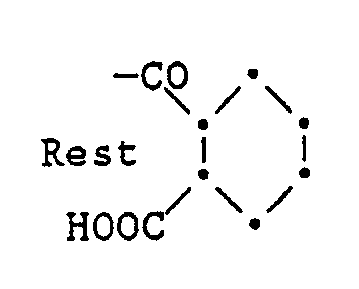
- (c) einen carboxylterminierten gesättigten Polyester, Tolylbiguanid oder Dicyandiamid,
Description
- Die vorliegende Erfindung betrifft Pulverlacke auf der Basis von Epoxidharzen und einem Gemisch aus bestimmten Di-, Tri- oder Tetrakis-(ß-carboxyethyl)-cyclohexanonen oder -cyclopentanonen und einem carboxylterminierten gesättigten Polyester, Tolylbiguanid oder Dicyandiamid als Härtungs- und Mattierungsmittel, sowie die Verwendung solcher Pulverlacke für die Herstellung von matten Ueberzügen. Aus dem GB-Patent 1,033,697 sind unsubstituierte oder alkylsubstituierte Tetrakis-(ß-carboxyethyl)-cyclohexanone und -cyclopentanone als Härtungsmittel für Epoxidharzen bekannt. Die gehärteten Harze sind klar und weisen gute mechanische Eigenschaften auf.
- Zur Herstellung von matten Oberflächen werden den Pulverharzen bekannterweise Mattierungsmittel zugesetzt. Zusätze, die in lösungsmittelhaltigen Lacken häufig verwendet werden, wie beispielsweise Kieselsäure, Talk, Glimmer, Kreide oder Metallseifen, ergeben bei Pulverlacken nicht den erwünschten Mattierungseffekt. Entweder ist die Reduktion des Glanzgrades ungenügend, oder es muss bei erreichtem Mattierungseffekt eine Verschlechterung der lacktechnischen Filmeigenschaften, wie Haftung, Flexibilität, Schlagfestigkeit oder Chemikalienbeständigkeit, in Kauf genommen werden. Es ist auch bekannt, zur Herstellung von Ueberzügen mit matter Oberfläche Pulverlacke zu verwenden, die ein spezifisches Härtungsmittel enthalten. Beispielsweise wird in der DE-OS 23 24 696 offenbart, als ein solches Härtungsmittel Mono- oder Disalze aus Polycarbonsäuren mit mindestens drei Carboxylgruppen und cyclischen Amidinen einzusetzen. Die Herstellung dieser Amidinsalze ist jedoch technisch aufwendig, weil es Schwierigkeiten macht, die Reaktion so zu steuern, dass auschliesslich Mono- oder Disalze gebildet werden.
- Es wurde nun gefunden, dass bei Verwendung von bestimmten Härtungsmittelgemischen auf Basis von Di-, Tri- oder Tetrakis-(ß-carboxyethyl)-cyclohexanonen oder -pentanonen oder carboxylgrupenhaltigen Polyacetalen in Epoxidharzpulverlacken eine starke Glanzreduktion ohne wesentliche Beeinträchtigung der übrigen lacktechnischen Eigenschaften erreicht wird. Gegenstand der vorliegenden Erfindung ist ein Pulverlack enthaltend
- (a) ein Epoxidharz,
- (b) mindestens eine Polycarbonsäure der Formel I oder II

- worin R¹, R², R³ und R⁴ unabhängig voneinander je ein Wasserstoffatom, C₁-C₄-Alkyl oder den Rest -CH₂-CH₂-COOH bedeuten, R⁵ und R⁶ unabhängig voneinander je ein Wasserstoffatom, C₁-C₄-Alkyl, den Rest -CH₂-CH₂-COOH oder zusammen eine unsubstituierte oder alkylsubstituierte Methylen- oder Polymethylengruppe mit 1 bis 7 C-Atomen bedeuten, wobei mindestens zwei der Substituenten R¹ bis R⁶ für den Rest -CH₂-CH₂-COOH stehen,
die Substituenten R unabhängig voneinander je für ein Wasserstoffatom oder den
- (c) einen carboxylterminierten gesättigten Polyester, Tolylbiguanid oder Dicyandiamid.
- Als Komponente (a) können die üblichen, für Pulverbeschichtungen geeigneten Epoxidharze verwendet werden. Solche Verbindungen sind beispielsweise in der DE-OS 28 38 841 beschrieben. Der Inhalt dieser Offenlegungsschrift ist somit Bestandteil vorliegender Erfindung.
- Die verwendeten Harze haben vorzugsweise einen Epoxidgehalt von 0,5 bis 12 Aequivalenten pro kg. Die bevorzugten Epoxidharze sind bei Zimmertemperatur fest und können, falls erforderlich, durch Umsetzung mit z.B. einem zweiwertigen Phenol vorverlängert werden.
- Bevorzugt sind Epoxidharze, die im Durchschnitt mehr als eine Epoxidgruppe im Molekül enthalten und Polyglycidylderivate von Aromaten oder Heteroaromaten, insbesondere von Aromaten, sind.
- Besonders bevorzugte Harze sind gegebenenfalls vorverlängerte Polyglycidylether von 2,2-Bis-(4′-hydroxyphenyl)-propan (Bisphenol A), 2,2-Bis-(3′,5′-dibromo-4′-hydroxyphenyl)-propan (Tetrabrombisphenol A), von Bis-(4-hydroxyphenyl)-methan (Bisphenol F) und von Novolaken, Polyglycidylderivate von 4,4′-Diaminodiphenylmethan, von 4,4′-Diaminodiphenylsulfon sowie von 2,4,6-Trihydroxy-1,3,5-triazin (Cyanursäure), wie z.B. Triglycidylisocyanurat.
- Die Polycarbonsäuren der Formel I sind bekannte Verbindungen. Beispielsweise werden cycloaliphatische Polycarbonsäuren der Formel I im eingangs genannten GB-Patent 1,033,697 beschrieben. Aliphatische Polycarbonsäuren der Formel I sind beispielsweise aus der DE-OS 26 09 659 bekannt.
- In der Formel I bedeuten R¹ bis R⁴ vorzugsweise den Carboxylethylrest und R⁵ und R⁶ vorzugsweise zusammen eine unsubstituierte oder alkylsubstituierte Polymethylengruppe mit 2 bis 7 C-Atomen, insbesondere eine unsubstituierte Polymethylengruppe mit 2 bis 4 C-Atomen.
Geeignete Verbindungen der Formel I sind beispielsweise 2,2,6,6-Tetra-(ß-carboxylethyl)-cyclopentanon, 2,2,6,6-Tetra-(ß-carboxylethyl)-cyclohexanon, 2,2,4,4-Tetra-(ß-carboxylethyl)-pentanon-(3) und 1,1,3,3-Tetra-(ß-carboxylethyl)-aceton. - Die Verbindungen der Formel II sind in der Literatur noch nicht beschrieben worden und können hergestellt werden, indem man Verbindungen der Formel III

- Die Verbindungen der Formel II, die eigens für die Herstellung der erfindungsgemässen Pulverlacke entwickelt wurden, stellen somit ebenfalls einen Erfindungsgegenstand dar.
- In der Formel II bedeutet X vorzugsweise eine direkte Bindung oder einen bis zu 20 C-Atome enthaltenden aliphatischen oder cycloaliphatischen Rest. Insbesondere bedeutet X eine direkte Bindung oder einen aliphatischen Rest mit bis zu 12 C-Atomen. Ferner steht m vorzugsweise für die Zahl 2 oder 3 und bedeutet n vorzugsweise Null oder eine Zahl von 0,1 bis 3.
- Verbindungen der Formel III, worin n für die Zahl 1 oder eine Zahl grösser als 1 steht, sind bekannt und können in bekannter Weise nach dem beispielsweise im US-Patent 4,374,953 offenbarten Verfahren hergestellt werden, indem man ein Polyol der Formel IV
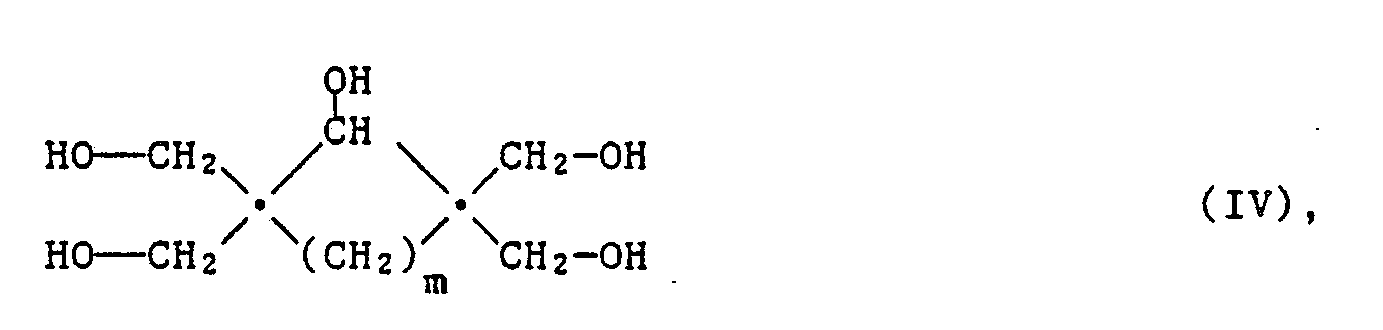
- Geeignete Polyole der Formel IV sind beispielsweise die zuvorgenannten Polyole der Formel III, worin n für Null steht. Für das Verfahren geeignete Dialdehyde oder Diketone sind beispielsweise Glyoxal, Glutaraldehyd, Succinaldehyd und 1,4-Cyclohexandion.
- Die Polykondensation des Polyols der Formel IV mit dem Dialdehyd oder Diketon zum hydroxylgruppenhaltigen Polycycloacetal der Formel III erfolgt vorzugsweise in einem inerten organischen Lösungsmittel, wie z.B. Toluol, mit einem sauren Katalysator, wie z.B. in Anwesenheit von H₃PO₂, und unter gleichzeitiger Entfernung von Wasser aus dem Reaktionsgemisch.
- In den erfindungsgemässen härtbaren Gemischen verwendet man als Verbindungen der Formel II ferner vorzugsweise solche, welche eine Erweichungstemperatur von 60 bis 180°C, vorzugsweise zwischen 80 bis 140°C aufweisen.
- Als Komponente (c) geeignete gesättigte Polyester mit endständigen Carboxylgruppen haben vorzugsweise im Durchschnitt mehr als zwei Carboxylgruppen pro Molekül, eine Säurezahl von 15 bis 100 und ein durchschnittliches Molekulargewicht von 500 bis 10000. Die verwendeten Polyester sind vorzugsweise bei Zimmertemperatur fest und haben eine Glasumwandlungstemperatur von 40 bis 80°C.
- Solche Polyester sind z.B. in der US-Patentschrift 3,397,254 und in der DE Offenlegungsschrift 21 63 962 beschrieben. Sie können z.B. durch Umsetzung von Polyestern mit endständigen Hydroxygruppen mit Tricarbonsäureanhydriden oder Tetracarbonsäuredianhydriden erhalten werden. Die Polyester mit endständigen Hydroxygruppen ihrerseits sind Reaktionsprodukte von Polyolen mit Dicarbonsäuren oder -säureanhydriden und haben zweckmässig einen durchschnittlichen Polymerisationsgrad von wenigstens 3, im allgemeinen von 3 bis 25, vorzugsweise von 5 bis 12. Geeignete Polyole sind z.B. Ethylenglykol, Glycerin, 1,4-Butandiol, Neopentandiol und Cyclohexandiol.
- Geeignete Dicarbonsäuren sind beispielsweise Isophthalsäure, Terephthalsäure, Cyclohexandicarbonsäure, Bernsteinsäure, Glutarsäure, Adipinsäure, Pimelinsäure, Süberinsäure, Azelainsäure oder Sebacinsäure.
- Geeignete Tricarbonsäureanhydride sind z.B. Anhydride von aliphatischen Tricarbonsäuren, wie Tricarballylsäure (1,2,3-Propantricarbonsäure), von aromatischen Tricarbonsäuren, wie Trimellitsäure (Benzol-1,2,4-tricarbonsäure) und Hemimellitsäure (Benzol-1,2,3-tricarbonsäure), oder von cycloaliphatischen Tricarbonsäuren, wie 6-Methylcyclohex-4-en-1,2,3-tricarbonsäure. Geeignete Tetracarbonsäuredianhydride sind z.B. Pyromellitsäuredianhydrid oder Benzophenon3,3′,4,4′-tetracarbonsäuredianhydrid.
- Tolylbiguanid und Dicyandiamid, die ebenfalls im erfindungsgemässen Pulverlack als Komponente (c) eingesetzt werden können, sind bekannt und im Handel erhältlich.
- Bei Verwendung eines carboxylterminierten gesättigten Polyesters als Komponente (c), wird dieser zusammen mit einer Polycarbonsäure der Formel I oder II bezüglich des Epoxidharzes (a) zweckmässig in etwa stöchiometrischen Mengen eingesetzt, das heisst, das Verhältnis der Summe der Carboxyläquivalente pro Epoxidäquivalent beträgt von 0,5 bis 1,5, vorzugsweise von 0,7 bis 1,3 und insbesondere von 0,8 bis 1,2. Dabei kann im erfindungsgemässen Pulverlack das Verhältnis von einer Polycarbonsäure der Formel I oder II zu dem carboxylterminierten gesättigten Polyester von 1:10 bis 10:1 betragen. Vorzugsweise liegen im erfindungsgemässen Pulverlack die Polycarbonsäure der Formel I oder II und der carboxylterminierte gesättigte Polyester im Verhältnis von 1:5 bis 5:1, insbesondere von 1:3 bis 3:1 vor.
Werden als Komponente (c) Tolylbiguanid oder Dicyandiamid eingesetzt, so beträgt im erfindungsgemässen Pulverlack der Anteil an einer Polycarbonsäure der Formel I oder II im allgemeinen nur 10 bis 90 Aequivalent-%, vorzugsweise 20 bis 80 Aequivalent-%, insbesondere 40 bis 60 Aequivalent-%, der zur vollständigen Aushärtung des Epoxidharzes erforderlichen stöchiometrischen Menge. Der dann noch zur vollständigen Aushärtung des Epoxidharzes erforderliche Anteil an Dicyandiamid oder Tolylbiguanid lässt sich kalkulieren, da dem Fachmann auf dem Gebiet der Epoxidharzformulierungen die zur Härtung eines Epoxidharzes erforderliche Menge an Dicyandiamid oder Tolylbiguanid bekannt ist. Im allgemeinen liegt die Menge dieser Härtungsmittel im Bereich von 5 bis 30 Gewichtsteilen pro 100 Gewichtsteile des Epoxidharzes.
Gegebenenfalls können den erfindungsgemässen Pulverlacken noch Härtungsbeschleuniger zugesetzt werden. Neben tert. Aminen, Mannich-Basen und quaternären Ammonium-Basen sind N-heterocyclische Verbindungen geeignet, wie beispielsweise Pyrazole, Imidazole, Pyrrole, Pyridine, Pyrazine, Indole und Piperidine. Bevorzugt werden Heterocyclen mit mindestens einem tertiären Stickstoffatom im Ring, wie N-substituierte Pyrrole, z.B. N-Methylpyrrol, N-substituierte Pyridine, z.B. N-Methyl-, N-Ethyl- und N-Benzylpyridine, N-substituierte Pyrazine, z.B. N,N′-Dimethyl- und N,N′-Diethylpyrazine, N-substituierte Indole, z.B. N-Methyl- und N-Ethylindole, N-substituierte Piperidine, z.B. N-Methyl-, N-Ethyl- und N-Isopropylpiperidine und, vorzugsweise Imidazole, wie z.B. Imidazol, N-substituierte Imidazole, z.B. 1-Methylimidazol und 1-(2′,4′-Diamino-s-triazin-6′-ylethyl)-2-methylimidazol (6-[2-(2-Methyl-1H-imidazol-1-yl)-ethyl]-1,3,3-triazin-2,4-diamin), C-substituierte Imidazole, wie z.B. 2-Methylimidazol, 2-Ethylimidazol, 2-n-Propylimidazol, 4-Methylimidazol, 2-Methyl-4-phenylimidazol, 2-Phenylimidazol, 2-Ethyl-4-methylimidazol und Benzimidazol. - Besonders bevorzugte Beschleuniger sind N,N-Dimethyl-1,3-propandiamin, 2,4,6-Tris(dimethylaminomethyl)phenol, N,N,N′,N′-Tetramethylethylendiamin, Triethylamin, Benzyldimethylamin, 2-Methylimidazol und 2-Ethyl-4-methylimidazol.
- Gewünschtenfalls können den Pulverlacken noch weitere in der Lackindustrie übliche Zusätze, wie beispielsweise Lichtschutzmittel, Farbstoffe und insbesondere Entgasungsmittel, Verlaufsmittel und/oder Pigmente, wie vorzugsweise TiO₂, beigegeben werden.
- Verlaufsmittel sind z.B. Polyvinylacetale, wie Polyvinylbutyral (Movital® B 30 H der HOECHST), Polyethylenglykol, Polyvinylpyrrolidon, Glycerin, Acryl-Mischpolymerisate, wie Modaflow® oder Acrylron® MFP der MONSANTO bzw. der PROTEX.
- Als Entgasungsmittel wird vorzugsweise Benzoin eingesetzt.
- Die neuen Pulverlacke können durch einfaches Mischen der Bestandteile, z.B. in einer Kugelmühle, hergestellt werden. Eine andere Möglichkeit der Herstellung besteht darin, dass man die Bestandteile zusammen schmilzt, vorzugsweise in einer Spritzmaschine, wie z.B. in einem Buss-Kokneter, und dann die abgekühlte Masse zerkleinert. Die Mischungen weisen vorzugsweise eine Partikelgrösse im Bereich von 0,015 bis 500 µm, und insbesondere von 10-75 um, auf.
- Durch Härtung der erfindungsgemässen Pulverlacke werden matte Ueberzüge erhalten. Dabei wird der Pulverlack auf den zu beschichtenden Gegenstand appliziert und auf mindestens 120°C, vorzugsweise auf 150 bis 250°C, erhitzt, um das Harz auszuhärten.
- Gegenstand der Erfindung ist auch die Verwendung des erfindungsgemässen Pulverlacks zur Herstellung matter Ueberzüge auf Oberflächen, insbesondere von Metallen, wie z.B. Aluminium oder Stahl.
- Zur Herstellung der erfindungsgemässen Pulverlacke gemäss den folgenden Beispielen werden einige Bestandteile wie folgt synthetisiert bzw. formuliert:
- Zu 250 g Cyclopentanon und 38 g 40%-iger wässriger KOH in 920 ml tert.-Butylalkohol werden bei 20°C unter Rühren 633 g Acrylnitril zugetropft. Während des Zutropfens bildet sich ein Niederschlag, und am Ende der Zugabe liegt ein dicker Brei vor, der noch eine Stunde gerührt und dann filtriert wird. Der Filterrückstand wird mit 400 ml Eiswasser gewaschen. Es werden 725 g 2,2,5,5-Tetra-(ß-cyanoethyl)-cyclopentanon mit einem Schmelzpunkt von 157-159°C erhalten.
Elementaranalyse für C₁₇H₂₀N₄O: Berechnet: C = 68,90 % H = 6,80 % N = 18,90 % Gefunden: C = 68,83 % H = 6,94 % N = 18,00 %. - 466 g des oben erhaltenen Nitrils werden mit 442 g KOH 6 Stunden lang auf 95°C erhitzt und dann mit 786 g konz. Salzsäure (37%-ig) bei Raumtemperatur auf pH 1 gebracht, wobei sich ein Niederschlag bildet. Der Niederschlag wird abfiltriert und mit 400 ml Eiswasser gewaschen. Es werden 464 g 2,2,5,5-Tetra-(β-carboxyethyl)-cyclopentanon mit einem Schmelzpunkt von 152-155°C erhalten.
Elementaranalyse für C₁₇H₂₄O₉: Berechnet: C = 54,83 % H = 6,50 % Gefunden: C = 55,53 % H = 6,65 % - Gehalt an COOH-Gruppen, berechnet: 10,74 Aequivalente/kg,
gefunden: 10,78 Aequivalente/kg. - Unter Anwendung der bei der Herstellung von 2,2,5,5-Tetra-(ß-carboxyethyl)-cyclopentanon beschriebenen Arbeitsweise und unter Verwendung von Pentanon-(3) anstelle von Cyclopentanon erhält man 2,2,4,4-Tetra-(ß-carboxyethyl)-pentanon mit einem Schmelzpunkt von 176-178°C.
Elementaranalyse für C₁₇H₂₆O₉: Berechnet: C = 54,49 H = 6,94 Gefunden: C = 54,22 H = 7,02 - Gehalt an COOH-Gruppen, berechnet: 10,68 Aequivalente/kg
gefunden: 10,54 Aequivalente/kg. - Unter Anwendung der bei der Herstellung von 2,2,5,5-Tetra-(ß-carboxyethyl)-cyclopentanon beschriebenen Arbeitsweise und unter Verwendung von Cyclohexanon anstelle von Cyclopentanon erhält man 2,2,6,6-Tetra-(ß-carboxyethyl)-cyclohexanon mit einem Schmelzpunkt von 174-176°C.
Elementaranalyse für C₁₈H₂₆O₉: Berechnet: C = 55,95 % H = 6,78 % Gefunden: C = 55,59 % H = 6,75 % - COOH-Gehalt, berechnet: 10,35 Aequivalente/kg,
gefunden: 10,44 Aequivalente/kg. -
- a) 551 g 2,2,6,6-Tetramethylolcyclohexanol-1 und 1,9 g hypophosphorige Säure werden bei 100°C in 2000 ml Toluol suspendiert. Im Verlauf von 50 Minuten tropft man 455 ml einer 50%-igen wässrigen Glutardialdehydlösung zu. Man setzt durch Erniedrigung des Druckes auf etwa 0,15 bar eine Destillation von Waser über einen Wasserabscheider in Gang. Nach Ende der Wasserabscheidung wird das Reaktionsgemisch bei 1,0 bar weitere 2 Stunden unter Rückfluss erhitzt. Man kühlt das Reaktionsgemisch auf 30°C ab, dekantiert die Toluolphase, löst das entstandene Produkt in 350 ml Methanol, destilliert das Methanol am Rotationsverdampfer ab und trocknet den Rückstand bei 120°C und 0,02 bar.
Ausbeute: 640 g (93 % der Theorie mit n = 5,7)
Erweichungspunkt: 147°C
M n (Gelpermeationschromatographie in THF): 1839,M w/M n = 3,65 Hydroxylgehalt: 5,47 Aeq./kg. - b) 50 g des unter a) hergestellten hydroxylguppenhaltigen Polyacetals werden bei 107°C in 120 ml Methylisobutylaceton suspendiert. Im Verlauf von 2 Stunden gibt man 34 g Hexahydrophthalsäureanhydrid zu. Das Reaktionsgemisch wird weitere 3 Stunden erhitzt. Das Lösungsmittel wird am Rotationsverdampfer destilliert und bei 90°C und 0,02 bar getrocknet.
Ausbeute: 75 g (90 % der Theorie)
Erweichungspunkt: 125°C
M n (Gelpermeationschromatographie in THF): 1636,M w/M n = 3,44 Carboxylgehalt: 2,86 Aeq./kg. - Gemisch aus 87,5 Teilen eines carboxylgruppenterminierten, gesättigten, festen Polyesterharzes und 12,5 Teilen Tetradecyltrimethylammoniumbromid.
- In einem Extruder (Kokneter der Fa. Buss, Pratteln, CH) wird bei einer Temperatur von 80°C ein Gemisch aus folgenden Komponenten homogenisiert:
817,6 g eines Bisphenol A-diglycidylethers mit einem Erweichungspunkt (nach DIN 51 920) von 86°C und einem Epoxidgehalt von 1,3 Aequivalenten/kg,
5,0 g Acrylron® MFP (butyliertes Polyacrylat der Fa. Protex) als Verlaufsmittel,
82,3 g Crylcoat® 314 (carboxylterminierter gesättigter Polyester mit einer Säurezahl von 73 Aequivalenten KOH/g und einer Glasumwandlungstemperatur (TG) von 60°C (DSC) der Fa. UCB, Belgien),
95,1 g 2,2,5,5-Tetra-(β-carboxyethyl)-cyclopentanon,
2,0 g Benzoin,
500,0 g TiO₂ und
20,0 g Härtungsbeschleuniger A. - Das Extrudat wird nach bekannten Standardverfahren zu einer Partikelgrösse von etwa 40 µm gemahlen und elektrostatisch auf ein Aluminiumblech aufgesprüht. Nach dem Einbrennen während 30 Minuten bei 200°C entsteht ein Lackfilm mit folgenden Eigenschaften:
Filmdicke (µm) = 61
Erichsentiefziehtest gemäss DIN 53 156 (mm) = 9,3
Schlagverformung, rückseitig *) (cm·kg) = 80
Glanz (∢ 60°) (%) = 0
Gelbwert gemäss DIN 6167 = 2,8
Verlauf bei 200°C**) = gut/sehr gut. - *) Auf das beschichtete Aluminiumblech wird von hinten aus bestimmter Höhe ein Stempel mit einem bekannten Gewicht fallengelassen. Der erhaltene Wert, Höhe (cm) mal Gewicht (kg), zeigt den grössten Schlag an, bei dem die Beschichtung noch unbeschädigt bleibt.)
- (**) Testmethode, bei der der Verlauf der Beschichtung visuell bestimmt wird als mässig) gut oder sehr gut.)
- In genau gleicher Weise wie in Beispiel 1 wird ein Lackpulver durch Mischen folgender Komponenten hergestellt:
762,5 g des Bisphenol A-diglycidylethers gemäss Beispiel 1,
5,0 g Acrylron® MFP
153,5 g Crylcoat® 314
79,0 g 2,2,5,5-Tetra-(ß-carboxyethyl)-cyclopentanon,
2,0 g Benzoin,
500,0 g TiO₂ und
20,0 g Härtungsbeschleuniger A. - Nach dem Einbrennen während 30 Minuten bei 200°C weist der Film folgende Eigenschaften auf:
Filmdicke (µm) = 54 Erichsentiefziehtest (mm) = 8,8
Schlagtest ruckseitig (cm·kg) = 80 Glanz (∢ 60°) (%) = 4
Gelbwert (DIN 6167) = 3,1
Verlauf bei 250°C = sehr gut. - In genau gleicher Weise wie in Beispiel 1 wird ein Lackpulver durch Mischen folgender Komponenten hergestellt:
931,0 g des Bisphenol A-diglycidylethers gemäss Beispiel 1,
5,0 g Acrylron® MFP
30,1 g 2,2,5,5-Tetra-(ß-carboxyethyl)-cyclopentanon,
37,7 g Tolylbiguanid,
2,0 g Benzoin und
500,0 g TiO₂. - Nach dem Einbrennen während 30 Minuten bei 200°C weist der Lackfilm folgende Eigenschaften auf:
Filmdicke (µm) = 56
Erichsentiefziehtest (mm) = 9,5
Schlagtest rückseitig (cm·kg) = 160
Glanz (∢ 60°) (%) = 4
Gelbwert (DIN 6167) - 3,5
Verlauf bei 200°C = gut/mässig. - In genau gleicher Weise wie in Beispiel 1 wird ein Lackpulver durch Mischen folgender Komponenten hergestellt:
876,0 g des Bisphenol A-diglycidylethers gemäss Beispiel 1,
5,0 g Acrylron® MFP
92,0 g carboxylgruppenhaltiges Polyacetal I,
32,0 g Tolylbiguanid,
2,0 g Benzoin und
500,0 g TiO₂. - Nach dem Einbrennen während 30 Minuten bei 200°C weist der Lackfilm folgende Eigenschaften auf:
Filmdicke (µm) = 66
Erichsentiefziehtest (mm) = 10
Schlagtest rückseitig (cm·kg) = 40
Glanz (∢ 60°) (%) = 15
Gelbwert (DIN 6167) = 6,7
Verlauf bei 200°C = sehr gut. - In gleicher Weise wie in Beispiel 1 wird ein Lackpulver durch Mischen folgender Substanzen hergestellt:
730,0 g Bisphenol A-diglycidylether gemäss Beispiel 1,
5,0 g Acrylron® MFP
27,0 g Tolylbiguanid,
23,0 g 2,2,4,4-Tetra-(ß-carboxylethyl)-pentanon-(3),
2,0 g Benzoin und
390,0 g TiO₂. - Nach dem Einbrennen während 30 Minuten bei 200°C weist der Lackfilm folgende Eigenschaften auf:
Filmdicke (µm) = 54
Erichsentiefziehtest (mm) = 9,3
Schlagtest rückseitig (cm·kg) = 160
Glanz (∢ 60°) (%) = 28
Gelbwert (DIN 6167) = 4,2
Verlauf bei 200°C = gut/mässig.
Claims (11)

die Substituenten R unabhängig voneinander je für ein Wasserstoffatom oder den


Applications Claiming Priority (2)
| Application Number | Priority Date | Filing Date | Title |
|---|---|---|---|
| CH399388 | 1988-10-26 | ||
| CH3993/88 | 1988-10-26 |
Publications (3)
| Publication Number | Publication Date |
|---|---|
| EP0366608A2 true EP0366608A2 (de) | 1990-05-02 |
| EP0366608A3 EP0366608A3 (en) | 1990-12-05 |
| EP0366608B1 EP0366608B1 (de) | 1993-12-15 |
Family
ID=4267811
Family Applications (1)
| Application Number | Title | Priority Date | Filing Date |
|---|---|---|---|
| EP19890810786 Expired - Lifetime EP0366608B1 (de) | 1988-10-26 | 1989-10-17 | Pulverlacke für matte Ueberzüge |
Country Status (6)
| Country | Link |
|---|---|
| EP (1) | EP0366608B1 (de) |
| JP (1) | JP2847305B2 (de) |
| BR (1) | BR8905436A (de) |
| CA (1) | CA2001300C (de) |
| DE (1) | DE58906442D1 (de) |
| ES (1) | ES2060812T3 (de) |
Cited By (3)
| Publication number | Priority date | Publication date | Assignee | Title |
|---|---|---|---|---|
| US6472071B2 (en) | 1999-08-31 | 2002-10-29 | Reichhold, Inc. | Burnish resistant powder coating composition |
| WO2011110640A1 (de) | 2010-03-11 | 2011-09-15 | Evonik Degussa Gmbh | Bei hitze härtende pulverlackzusammensetzungen, welche nach aushärtung der beschichtung zu einer matten oberfläche führen, sowie ein einfaches verfahren zur ihrer herstellung |
| EP3476882A1 (de) * | 2017-10-24 | 2019-05-01 | Sika Technology Ag | Hitzehärtende epoxidharzzusammensetzung mit hoher lagerstabilität |
Families Citing this family (5)
| Publication number | Priority date | Publication date | Assignee | Title |
|---|---|---|---|---|
| GB8927375D0 (en) * | 1989-12-04 | 1990-01-31 | Swan Thomas & Co Ltd | Powder coatings |
| ES2090567T3 (es) * | 1991-03-27 | 1996-10-16 | Ciba Geigy Ag | Reticulante para lacas en polvo a base de poliesteres. |
| DE4430400A1 (de) | 1994-08-26 | 1996-02-29 | Inventa Ag | Wärmehärtbares Beschichtungssystem aus mehreren Bindemittelharzen |
| DE4430399C1 (de) | 1994-08-26 | 1996-02-22 | Inventa Ag | Epoxidfreies, wärmehärtbares Beschichtungssystem |
| JP4798422B2 (ja) * | 2005-03-01 | 2011-10-19 | Dic株式会社 | 粉体塗料用樹脂組成物 |
Family Cites Families (2)
| Publication number | Priority date | Publication date | Assignee | Title |
|---|---|---|---|---|
| US3275599A (en) * | 1961-06-28 | 1966-09-27 | American Cyanamid Co | Resinous composition and process for preparing the same |
| GB1033697A (en) * | 1964-05-27 | 1966-06-22 | Ici Ltd | Curing process for epoxy resins |
-
1989
- 1989-10-17 DE DE89810786T patent/DE58906442D1/de not_active Expired - Fee Related
- 1989-10-17 EP EP19890810786 patent/EP0366608B1/de not_active Expired - Lifetime
- 1989-10-17 ES ES89810786T patent/ES2060812T3/es not_active Expired - Lifetime
- 1989-10-24 CA CA 2001300 patent/CA2001300C/en not_active Expired - Fee Related
- 1989-10-25 BR BR8905436A patent/BR8905436A/pt not_active IP Right Cessation
- 1989-10-26 JP JP1279589A patent/JP2847305B2/ja not_active Expired - Fee Related
Cited By (6)
| Publication number | Priority date | Publication date | Assignee | Title |
|---|---|---|---|---|
| US6472071B2 (en) | 1999-08-31 | 2002-10-29 | Reichhold, Inc. | Burnish resistant powder coating composition |
| WO2011110640A1 (de) | 2010-03-11 | 2011-09-15 | Evonik Degussa Gmbh | Bei hitze härtende pulverlackzusammensetzungen, welche nach aushärtung der beschichtung zu einer matten oberfläche führen, sowie ein einfaches verfahren zur ihrer herstellung |
| DE102011005369A1 (de) | 2010-03-11 | 2011-09-15 | Evonik Degussa Gmbh | Bei Hitze härtende Pulverlackzusammensetzungen, welche nach Aushärtung der Beschichtung zu einer matten Oberfläche führen, sowie ein einfaches Verfahren zu ihrer Herstellung |
| EP3476882A1 (de) * | 2017-10-24 | 2019-05-01 | Sika Technology Ag | Hitzehärtende epoxidharzzusammensetzung mit hoher lagerstabilität |
| WO2019081581A1 (de) * | 2017-10-24 | 2019-05-02 | Sika Technology Ag | Hitzehärtende epoxidharzzusammensetzung mit hoher lagerstabilität |
| US11866544B2 (en) | 2017-10-24 | 2024-01-09 | Sika Technology Ag | Heat-curing epoxy resin composition having high storage stability |
Also Published As
| Publication number | Publication date |
|---|---|
| EP0366608B1 (de) | 1993-12-15 |
| JPH02170871A (ja) | 1990-07-02 |
| BR8905436A (pt) | 1991-04-30 |
| EP0366608A3 (en) | 1990-12-05 |
| DE58906442D1 (de) | 1994-01-27 |
| JP2847305B2 (ja) | 1999-01-20 |
| CA2001300A1 (en) | 1990-04-26 |
| CA2001300C (en) | 2001-02-06 |
| ES2060812T3 (es) | 1994-12-01 |
Similar Documents
| Publication | Publication Date | Title |
|---|---|---|
| DE3246072C2 (de) | ||
| DE2248776C3 (de) | Verfahren zur Herstellung von Überzügen auf der Basis von Pulverlacken | |
| DE3044926A1 (de) | Lagerfaehiges hitzehaertbares epoxyharzsystem, seine verwendung zur herstellung hitzegehaerteter gegenstaende sowie ein cohaertungsmittel fuer ein epoxyharzsystem | |
| DE1937715A1 (de) | Neue,heisshaertbare Mischungen aus Polyepoxidverbindungen,Ringe enthaltenden Polyestern und Polyearbonsaeureanhydriden | |
| DE3134236C2 (de) | ||
| EP0366608B1 (de) | Pulverlacke für matte Ueberzüge | |
| EP0536085A2 (de) | Feste Zusammensetzungen aus Polyglycidylverbindungen eines Molekulargewichts unter 1500 | |
| DE1916174C3 (de) | Verfahren zur Herstellung von vorverlängerten, epoxidgruppenhaltigen Addukten und deren Verwendung | |
| EP0394192A2 (de) | Härtbares Gemisch auf Basis von cycloaliphatischen Epoxidharzen | |
| DE2154624A1 (de) | Neue diglycidylderivate von zwei nheterocyclische ringe enthaltenen verbindungen, verfahren zu ihrer herstellung und anwendung | |
| DE2156942A1 (de) | Neue, zweikernige'N-heterocyclische N,N-Diglycidylverbindungen, Verfahren zu ihrer Herstellung und ihrer Anwendung | |
| DE2003016B2 (de) | Diglycidyläther, Verfahren zu ihrer Herstellung und ihre Verwendung | |
| CH639679A5 (de) | Feste, haertbare mischungen in pulverform auf basis von epoxidharzen. | |
| DE1418692B2 (de) | Neue glycidylaether und verfahren zu ihrer herstellung | |
| DE1938327A1 (de) | Neue,lagerstabile,heisshaertbare Vorkondensate aus Polyepoxidverbindungen,Ringe enthaltenden Polyestern und Polycarbonsaeureanhydriden | |
| DE3328134C2 (de) | EP-Pulverlacke und Verfahren zur Herstellung matter Überzüge | |
| DE2319815C2 (de) | Propionsäureglycidylestergruppen enthaltende Cycloalkanone, Verfahren zu deren Herstellung und Verwendung derselben | |
| DE2949385A1 (de) | Addukte aus hydantoin-trisepoxiden und zweikernigen hydantoinen | |
| EP0176484A2 (de) | Diäthylphenyl-biguanid enthaltende härtbare Gemische und deren Verwendung | |
| EP0253115B1 (de) | Pulverlacke, deren Herstellung und Verwendung | |
| EP0297030B1 (de) | Epoxidgruppenhaltige Polycycloacetale | |
| DE2205104A1 (de) | Neue N-heterocyclische Polyglycidylverbindungen, Verfahren zu ihrer Herstellung und ihrer Anwendung | |
| DE2056789A1 (de) | Neue Diglycidyldenvate von zwei N heterocyclische Ringe enthaltenden Ver bindungen. Verfahren zu ihrer Herstellung und Anwendung | |
| DE2949401A1 (de) | Produkte aus einem polyepoxid und zweikernigen hydantoinverbindungen | |
| EP0703258A2 (de) | Härtbare, pulverförmige Mischungen |
Legal Events
| Date | Code | Title | Description |
|---|---|---|---|
| PUAI | Public reference made under article 153(3) epc to a published international application that has entered the european phase |
Free format text: ORIGINAL CODE: 0009012 |
|
| 17P | Request for examination filed |
Effective date: 19891020 |
|
| AK | Designated contracting states |
Kind code of ref document: A2 Designated state(s): BE CH DE ES FR GB IT LI NL |
|
| PUAL | Search report despatched |
Free format text: ORIGINAL CODE: 0009013 |
|
| AK | Designated contracting states |
Kind code of ref document: A3 Designated state(s): BE CH DE ES FR GB IT LI NL |
|
| 17Q | First examination report despatched |
Effective date: 19920605 |
|
| GRAA | (expected) grant |
Free format text: ORIGINAL CODE: 0009210 |
|
| AK | Designated contracting states |
Kind code of ref document: B1 Designated state(s): BE CH DE ES FR GB IT LI NL |
|
| ITF | It: translation for a ep patent filed | ||
| REF | Corresponds to: |
Ref document number: 58906442 Country of ref document: DE Date of ref document: 19940127 |
|
| GBT | Gb: translation of ep patent filed (gb section 77(6)(a)/1977) |
Effective date: 19940126 |
|
| ET | Fr: translation filed | ||
| PLBE | No opposition filed within time limit |
Free format text: ORIGINAL CODE: 0009261 |
|
| STAA | Information on the status of an ep patent application or granted ep patent |
Free format text: STATUS: NO OPPOSITION FILED WITHIN TIME LIMIT |
|
| REG | Reference to a national code |
Ref country code: ES Ref legal event code: FG2A Ref document number: 2060812 Country of ref document: ES Kind code of ref document: T3 |
|
| 26N | No opposition filed | ||
| REG | Reference to a national code |
Ref country code: CH Ref legal event code: PUE Owner name: CIBA-GEIGY AG TRANSFER- CIBA SC HOLDING AG |
|
| BECN | Be: change of holder's name |
Effective date: 19961129 |
|
| NLS | Nl: assignments of ep-patents |
Owner name: CIBA SC HOLDING AG |
|
| REG | Reference to a national code |
Ref country code: CH Ref legal event code: PFA Free format text: CIBA SC HOLDING AG TRANSFER- CIBA SPECIALTY CHEMICALS HOLDING INC. |
|
| REG | Reference to a national code |
Ref country code: GB Ref legal event code: 732E |
|
| NLT1 | Nl: modifications of names registered in virtue of documents presented to the patent office pursuant to art. 16 a, paragraph 1 |
Owner name: CIBA SPECIALTY CHEMICALS HOLDING INC. |
|
| REG | Reference to a national code |
Ref country code: FR Ref legal event code: TP |
|
| REG | Reference to a national code |
Ref country code: ES Ref legal event code: PC2A |
|
| REG | Reference to a national code |
Ref country code: CH Ref legal event code: PUE Owner name: CIBA SPECIALTY CHEMICALS HOLDING INC. TRANSFER- VA |
|
| NLS | Nl: assignments of ep-patents |
Owner name: VANTICO AG |
|
| REG | Reference to a national code |
Ref country code: GB Ref legal event code: IF02 |
|
| REG | Reference to a national code |
Ref country code: FR Ref legal event code: TP |
|
| PGFP | Annual fee paid to national office [announced via postgrant information from national office to epo] |
Ref country code: BE Payment date: 20031009 Year of fee payment: 15 |
|
| PG25 | Lapsed in a contracting state [announced via postgrant information from national office to epo] |
Ref country code: BE Free format text: LAPSE BECAUSE OF NON-PAYMENT OF DUE FEES Effective date: 20041031 |
|
| BERE | Be: lapsed |
Owner name: *VANTICO A.G. Effective date: 20041031 |
|
| PGFP | Annual fee paid to national office [announced via postgrant information from national office to epo] |
Ref country code: GB Payment date: 20051010 Year of fee payment: 17 |
|
| PGFP | Annual fee paid to national office [announced via postgrant information from national office to epo] |
Ref country code: NL Payment date: 20051013 Year of fee payment: 17 |
|
| PGFP | Annual fee paid to national office [announced via postgrant information from national office to epo] |
Ref country code: DE Payment date: 20051014 Year of fee payment: 17 Ref country code: FR Payment date: 20051014 Year of fee payment: 17 Ref country code: CH Payment date: 20051014 Year of fee payment: 17 |
|
| PGFP | Annual fee paid to national office [announced via postgrant information from national office to epo] |
Ref country code: ES Payment date: 20051017 Year of fee payment: 17 |
|
| PG25 | Lapsed in a contracting state [announced via postgrant information from national office to epo] |
Ref country code: LI Free format text: LAPSE BECAUSE OF NON-PAYMENT OF DUE FEES Effective date: 20061031 Ref country code: CH Free format text: LAPSE BECAUSE OF NON-PAYMENT OF DUE FEES Effective date: 20061031 |
|
| PGFP | Annual fee paid to national office [announced via postgrant information from national office to epo] |
Ref country code: IT Payment date: 20061031 Year of fee payment: 18 |
|
| PG25 | Lapsed in a contracting state [announced via postgrant information from national office to epo] |
Ref country code: NL Free format text: LAPSE BECAUSE OF NON-PAYMENT OF DUE FEES Effective date: 20070501 Ref country code: DE Free format text: LAPSE BECAUSE OF NON-PAYMENT OF DUE FEES Effective date: 20070501 |
|
| REG | Reference to a national code |
Ref country code: CH Ref legal event code: PL |
|
| GBPC | Gb: european patent ceased through non-payment of renewal fee |
Effective date: 20061017 |
|
| NLV4 | Nl: lapsed or anulled due to non-payment of the annual fee |
Effective date: 20070501 |
|
| REG | Reference to a national code |
Ref country code: FR Ref legal event code: ST Effective date: 20070629 |
|
| PG25 | Lapsed in a contracting state [announced via postgrant information from national office to epo] |
Ref country code: GB Free format text: LAPSE BECAUSE OF NON-PAYMENT OF DUE FEES Effective date: 20061017 |
|
| BERE | Be: lapsed |
Owner name: *VANTICO A.G. Effective date: 20041031 |
|
| REG | Reference to a national code |
Ref country code: ES Ref legal event code: FD2A Effective date: 20061018 |
|
| PG25 | Lapsed in a contracting state [announced via postgrant information from national office to epo] |
Ref country code: ES Free format text: LAPSE BECAUSE OF NON-PAYMENT OF DUE FEES Effective date: 20061018 Ref country code: FR Free format text: LAPSE BECAUSE OF NON-PAYMENT OF DUE FEES Effective date: 20061031 |
|
| PG25 | Lapsed in a contracting state [announced via postgrant information from national office to epo] |
Ref country code: IT Free format text: LAPSE BECAUSE OF NON-PAYMENT OF DUE FEES Effective date: 20071017 |