EP0364875A1 - Riboflavin-4'5'-cyclo-phosphorsäureesterchlorid, dessen Herstellung und Verwendung zur Herstellung von Riboflavin-5'-phosphat (5'-FMN) bzw. dessen Natriumsalz - Google Patents
Riboflavin-4'5'-cyclo-phosphorsäureesterchlorid, dessen Herstellung und Verwendung zur Herstellung von Riboflavin-5'-phosphat (5'-FMN) bzw. dessen Natriumsalz Download PDFInfo
- Publication number
- EP0364875A1 EP0364875A1 EP89118924A EP89118924A EP0364875A1 EP 0364875 A1 EP0364875 A1 EP 0364875A1 EP 89118924 A EP89118924 A EP 89118924A EP 89118924 A EP89118924 A EP 89118924A EP 0364875 A1 EP0364875 A1 EP 0364875A1
- Authority
- EP
- European Patent Office
- Prior art keywords
- riboflavin
- phosphoric acid
- phosphate
- acid ester
- reaction mixture
- Prior art date
- Legal status (The legal status is an assumption and is not a legal conclusion. Google has not performed a legal analysis and makes no representation as to the accuracy of the status listed.)
- Granted
Links
- 239000011768 flavin mononucleotide Substances 0.000 title claims abstract description 64
- FVTCRASFADXXNN-SCRDCRAPSA-N flavin mononucleotide Chemical compound OP(=O)(O)OC[C@@H](O)[C@@H](O)[C@@H](O)CN1C=2C=C(C)C(C)=CC=2N=C2C1=NC(=O)NC2=O FVTCRASFADXXNN-SCRDCRAPSA-N 0.000 title claims abstract description 31
- 239000004228 Riboflavin-5'-Phosphate Substances 0.000 title claims abstract description 29
- 235000019231 riboflavin-5'-phosphate Nutrition 0.000 title claims abstract description 29
- 238000002360 preparation method Methods 0.000 title claims abstract description 23
- 159000000000 sodium salts Chemical class 0.000 title abstract description 7
- AUNGANRZJHBGPY-SCRDCRAPSA-N Riboflavin Chemical compound OC[C@@H](O)[C@@H](O)[C@@H](O)CN1C=2C=C(C)C(C)=CC=2N=C2C1=NC(=O)NC2=O AUNGANRZJHBGPY-SCRDCRAPSA-N 0.000 claims abstract description 51
- XHXFXVLFKHQFAL-UHFFFAOYSA-N phosphoryl trichloride Chemical compound ClP(Cl)(Cl)=O XHXFXVLFKHQFAL-UHFFFAOYSA-N 0.000 claims abstract description 32
- 235000019192 riboflavin Nutrition 0.000 claims abstract description 27
- 239000002151 riboflavin Substances 0.000 claims abstract description 27
- AUNGANRZJHBGPY-UHFFFAOYSA-N D-Lyxoflavin Natural products OCC(O)C(O)C(O)CN1C=2C=C(C)C(C)=CC=2N=C2C1=NC(=O)NC2=O AUNGANRZJHBGPY-UHFFFAOYSA-N 0.000 claims abstract description 25
- 229960002477 riboflavin Drugs 0.000 claims abstract description 25
- 238000000034 method Methods 0.000 claims abstract description 22
- -1 phosphoric acid ester chloride Chemical class 0.000 claims abstract description 12
- 150000001447 alkali salts Chemical class 0.000 claims abstract description 11
- 239000000010 aprotic solvent Substances 0.000 claims abstract description 8
- HEMHJVSKTPXQMS-UHFFFAOYSA-M Sodium hydroxide Chemical compound [OH-].[Na+] HEMHJVSKTPXQMS-UHFFFAOYSA-M 0.000 claims description 45
- 239000011541 reaction mixture Substances 0.000 claims description 36
- XLYOFNOQVPJJNP-UHFFFAOYSA-N water Substances O XLYOFNOQVPJJNP-UHFFFAOYSA-N 0.000 claims description 26
- KEAYESYHFKHZAL-UHFFFAOYSA-N Sodium Chemical class [Na] KEAYESYHFKHZAL-UHFFFAOYSA-N 0.000 claims description 20
- SBZXBUIDTXKZTM-UHFFFAOYSA-N diglyme Chemical compound COCCOCCOC SBZXBUIDTXKZTM-UHFFFAOYSA-N 0.000 claims description 8
- 230000000630 rising effect Effects 0.000 claims description 8
- 230000007062 hydrolysis Effects 0.000 claims description 7
- 238000006460 hydrolysis reaction Methods 0.000 claims description 7
- 238000006317 isomerization reaction Methods 0.000 claims description 7
- WYURNTSHIVDZCO-UHFFFAOYSA-N Tetrahydrofuran Chemical compound C1CCOC1 WYURNTSHIVDZCO-UHFFFAOYSA-N 0.000 claims description 6
- 238000006243 chemical reaction Methods 0.000 claims description 6
- 229910052783 alkali metal Inorganic materials 0.000 claims description 5
- 229910000147 aluminium phosphate Inorganic materials 0.000 claims description 5
- 238000001816 cooling Methods 0.000 claims description 5
- NBIIXXVUZAFLBC-UHFFFAOYSA-N phosphoric acid Substances OP(O)(O)=O NBIIXXVUZAFLBC-UHFFFAOYSA-N 0.000 claims description 5
- 238000001914 filtration Methods 0.000 claims description 4
- XTHFKEDIFFGKHM-UHFFFAOYSA-N Dimethoxyethane Chemical compound COCCOC XTHFKEDIFFGKHM-UHFFFAOYSA-N 0.000 claims description 3
- 238000006386 neutralization reaction Methods 0.000 claims description 3
- YLQBMQCUIZJEEH-UHFFFAOYSA-N tetrahydrofuran Natural products C=1C=COC=1 YLQBMQCUIZJEEH-UHFFFAOYSA-N 0.000 claims description 3
- RYHBNJHYFVUHQT-UHFFFAOYSA-N 1,4-Dioxane Chemical compound C1COCCO1 RYHBNJHYFVUHQT-UHFFFAOYSA-N 0.000 claims description 2
- YFNKIDBQEZZDLK-UHFFFAOYSA-N triglyme Chemical compound COCCOCCOCCOC YFNKIDBQEZZDLK-UHFFFAOYSA-N 0.000 claims description 2
- LFQSCWFLJHTTHZ-UHFFFAOYSA-N Ethanol Chemical compound CCO LFQSCWFLJHTTHZ-UHFFFAOYSA-N 0.000 description 12
- 239000000047 product Substances 0.000 description 10
- 239000000243 solution Substances 0.000 description 9
- OKKJLVBELUTLKV-UHFFFAOYSA-N Methanol Chemical compound OC OKKJLVBELUTLKV-UHFFFAOYSA-N 0.000 description 6
- 238000004519 manufacturing process Methods 0.000 description 6
- XAEFZNCEHLXOMS-UHFFFAOYSA-M potassium benzoate Chemical compound [K+].[O-]C(=O)C1=CC=CC=C1 XAEFZNCEHLXOMS-UHFFFAOYSA-M 0.000 description 6
- DGAQECJNVWCQMB-PUAWFVPOSA-M Ilexoside XXIX Chemical compound C[C@@H]1CC[C@@]2(CC[C@@]3(C(=CC[C@H]4[C@]3(CC[C@@H]5[C@@]4(CC[C@@H](C5(C)C)OS(=O)(=O)[O-])C)C)[C@@H]2[C@]1(C)O)C)C(=O)O[C@H]6[C@@H]([C@H]([C@@H]([C@H](O6)CO)O)O)O.[Na+] DGAQECJNVWCQMB-PUAWFVPOSA-M 0.000 description 5
- 238000004128 high performance liquid chromatography Methods 0.000 description 5
- 239000000203 mixture Substances 0.000 description 5
- 150000003839 salts Chemical class 0.000 description 5
- 229910052708 sodium Inorganic materials 0.000 description 5
- 239000011734 sodium Substances 0.000 description 5
- WEVYAHXRMPXWCK-UHFFFAOYSA-N Acetonitrile Chemical compound CC#N WEVYAHXRMPXWCK-UHFFFAOYSA-N 0.000 description 3
- MUBZPKHOEPUJKR-UHFFFAOYSA-N Oxalic acid Chemical compound OC(=O)C(O)=O MUBZPKHOEPUJKR-UHFFFAOYSA-N 0.000 description 3
- 229910019142 PO4 Inorganic materials 0.000 description 3
- 239000003795 chemical substances by application Substances 0.000 description 3
- 238000004140 cleaning Methods 0.000 description 3
- 239000010452 phosphate Substances 0.000 description 3
- 230000026731 phosphorylation Effects 0.000 description 3
- 238000006366 phosphorylation reaction Methods 0.000 description 3
- 238000005406 washing Methods 0.000 description 3
- HZAXFHJVJLSVMW-UHFFFAOYSA-N 2-Aminoethan-1-ol Chemical compound NCCO HZAXFHJVJLSVMW-UHFFFAOYSA-N 0.000 description 2
- NGNBDVOYPDDBFK-UHFFFAOYSA-N 2-[2,4-di(pentan-2-yl)phenoxy]acetyl chloride Chemical compound CCCC(C)C1=CC=C(OCC(Cl)=O)C(C(C)CCC)=C1 NGNBDVOYPDDBFK-UHFFFAOYSA-N 0.000 description 2
- CSCPPACGZOOCGX-UHFFFAOYSA-N Acetone Chemical compound CC(C)=O CSCPPACGZOOCGX-UHFFFAOYSA-N 0.000 description 2
- IJGRMHOSHXDMSA-UHFFFAOYSA-N Atomic nitrogen Chemical compound N#N IJGRMHOSHXDMSA-UHFFFAOYSA-N 0.000 description 2
- VEXZGXHMUGYJMC-UHFFFAOYSA-M Chloride anion Chemical compound [Cl-] VEXZGXHMUGYJMC-UHFFFAOYSA-M 0.000 description 2
- WIWGXURDMPANAJ-UHFFFAOYSA-N Mono-Natrium-Salz Natural products S1C=C(COC(N)=O)C(C(O)=O)N2C(=O)C(OC)(NC(=O)CCCC(N)C(O)=O)C21 WIWGXURDMPANAJ-UHFFFAOYSA-N 0.000 description 2
- JUJWROOIHBZHMG-UHFFFAOYSA-N Pyridine Chemical compound C1=CC=NC=C1 JUJWROOIHBZHMG-UHFFFAOYSA-N 0.000 description 2
- 150000001875 compounds Chemical class 0.000 description 2
- 239000003814 drug Substances 0.000 description 2
- BDAGIHXWWSANSR-UHFFFAOYSA-N methanoic acid Natural products OC=O BDAGIHXWWSANSR-UHFFFAOYSA-N 0.000 description 2
- 230000003472 neutralizing effect Effects 0.000 description 2
- 230000000865 phosphorylative effect Effects 0.000 description 2
- 229950001574 riboflavin phosphate Drugs 0.000 description 2
- 239000007858 starting material Substances 0.000 description 2
- 238000003756 stirring Methods 0.000 description 2
- 239000000725 suspension Substances 0.000 description 2
- PAAZPARNPHGIKF-UHFFFAOYSA-N 1,2-dibromoethane Chemical compound BrCCBr PAAZPARNPHGIKF-UHFFFAOYSA-N 0.000 description 1
- OSWFIVFLDKOXQC-UHFFFAOYSA-N 4-(3-methoxyphenyl)aniline Chemical compound COC1=CC=CC(C=2C=CC(N)=CC=2)=C1 OSWFIVFLDKOXQC-UHFFFAOYSA-N 0.000 description 1
- 229920000388 Polyphosphate Polymers 0.000 description 1
- 206010047612 Vitamin B2 deficiency Diseases 0.000 description 1
- 238000010521 absorption reaction Methods 0.000 description 1
- 239000002253 acid Substances 0.000 description 1
- 239000000654 additive Substances 0.000 description 1
- 230000000996 additive effect Effects 0.000 description 1
- 150000008044 alkali metal hydroxides Chemical class 0.000 description 1
- VZTDIZULWFCMLS-UHFFFAOYSA-N ammonium formate Chemical compound [NH4+].[O-]C=O VZTDIZULWFCMLS-UHFFFAOYSA-N 0.000 description 1
- 238000004458 analytical method Methods 0.000 description 1
- 150000001450 anions Chemical class 0.000 description 1
- 239000007864 aqueous solution Substances 0.000 description 1
- 201000007590 ariboflavinosis Diseases 0.000 description 1
- 238000007664 blowing Methods 0.000 description 1
- 239000000872 buffer Substances 0.000 description 1
- 239000000337 buffer salt Substances 0.000 description 1
- 239000006227 byproduct Substances 0.000 description 1
- 239000001913 cellulose Substances 0.000 description 1
- 229920002678 cellulose Polymers 0.000 description 1
- 150000001793 charged compounds Chemical class 0.000 description 1
- 238000003889 chemical engineering Methods 0.000 description 1
- 239000005515 coenzyme Substances 0.000 description 1
- 239000012043 crude product Substances 0.000 description 1
- 238000002425 crystallisation Methods 0.000 description 1
- 230000008025 crystallization Effects 0.000 description 1
- 150000004292 cyclic ethers Chemical class 0.000 description 1
- 229940079593 drug Drugs 0.000 description 1
- 238000001035 drying Methods 0.000 description 1
- 238000010828 elution Methods 0.000 description 1
- 238000006911 enzymatic reaction Methods 0.000 description 1
- 150000002148 esters Chemical class 0.000 description 1
- VWWQXMAJTJZDQX-UYBVJOGSSA-N flavin adenine dinucleotide Chemical compound C1=NC2=C(N)N=CN=C2N1[C@@H]([C@H](O)[C@@H]1O)O[C@@H]1CO[P@](O)(=O)O[P@@](O)(=O)OC[C@@H](O)[C@@H](O)[C@@H](O)CN1C2=NC(=O)NC(=O)C2=NC2=C1C=C(C)C(C)=C2 VWWQXMAJTJZDQX-UYBVJOGSSA-N 0.000 description 1
- 235000019162 flavin adenine dinucleotide Nutrition 0.000 description 1
- 239000011714 flavin adenine dinucleotide Substances 0.000 description 1
- 229940013640 flavin mononucleotide Drugs 0.000 description 1
- 229940093632 flavin-adenine dinucleotide Drugs 0.000 description 1
- 235000013305 food Nutrition 0.000 description 1
- 235000019253 formic acid Nutrition 0.000 description 1
- 238000010438 heat treatment Methods 0.000 description 1
- 125000000623 heterocyclic group Chemical group 0.000 description 1
- 150000002500 ions Chemical class 0.000 description 1
- 238000002955 isolation Methods 0.000 description 1
- 229910052751 metal Inorganic materials 0.000 description 1
- 239000002184 metal Substances 0.000 description 1
- 229910052757 nitrogen Inorganic materials 0.000 description 1
- 238000005580 one pot reaction Methods 0.000 description 1
- 235000006408 oxalic acid Nutrition 0.000 description 1
- 239000001205 polyphosphate Substances 0.000 description 1
- 235000011176 polyphosphates Nutrition 0.000 description 1
- 159000000001 potassium salts Chemical class 0.000 description 1
- UMJSCPRVCHMLSP-UHFFFAOYSA-N pyridine Natural products COC1=CC=CN=C1 UMJSCPRVCHMLSP-UHFFFAOYSA-N 0.000 description 1
- 208000004223 riboflavin deficiency Diseases 0.000 description 1
- 150000003287 riboflavins Chemical class 0.000 description 1
- 238000007142 ring opening reaction Methods 0.000 description 1
- ZNCPFRVNHGOPAG-UHFFFAOYSA-L sodium oxalate Chemical compound [Na+].[Na+].[O-]C(=O)C([O-])=O ZNCPFRVNHGOPAG-UHFFFAOYSA-L 0.000 description 1
- 229940039790 sodium oxalate Drugs 0.000 description 1
- 239000002904 solvent Substances 0.000 description 1
- 229940124597 therapeutic agent Drugs 0.000 description 1
- DQWPFSLDHJDLRL-UHFFFAOYSA-N triethyl phosphate Chemical compound CCOP(=O)(OCC)OCC DQWPFSLDHJDLRL-UHFFFAOYSA-N 0.000 description 1
- 239000002351 wastewater Substances 0.000 description 1
Classifications
-
- C—CHEMISTRY; METALLURGY
- C07—ORGANIC CHEMISTRY
- C07F—ACYCLIC, CARBOCYCLIC OR HETEROCYCLIC COMPOUNDS CONTAINING ELEMENTS OTHER THAN CARBON, HYDROGEN, HALOGEN, OXYGEN, NITROGEN, SULFUR, SELENIUM OR TELLURIUM
- C07F9/00—Compounds containing elements of Groups 5 or 15 of the Periodic Table
- C07F9/02—Phosphorus compounds
- C07F9/547—Heterocyclic compounds, e.g. containing phosphorus as a ring hetero atom
- C07F9/6564—Heterocyclic compounds, e.g. containing phosphorus as a ring hetero atom having phosphorus atoms, with or without nitrogen, oxygen, sulfur, selenium or tellurium atoms, as ring hetero atoms
- C07F9/6571—Heterocyclic compounds, e.g. containing phosphorus as a ring hetero atom having phosphorus atoms, with or without nitrogen, oxygen, sulfur, selenium or tellurium atoms, as ring hetero atoms having phosphorus and oxygen atoms as the only ring hetero atoms
- C07F9/6574—Esters of oxyacids of phosphorus
- C07F9/65742—Esters of oxyacids of phosphorus non-condensed with carbocyclic rings or heterocyclic rings or ring systems
-
- A—HUMAN NECESSITIES
- A61—MEDICAL OR VETERINARY SCIENCE; HYGIENE
- A61P—SPECIFIC THERAPEUTIC ACTIVITY OF CHEMICAL COMPOUNDS OR MEDICINAL PREPARATIONS
- A61P3/00—Drugs for disorders of the metabolism
- A61P3/02—Nutrients, e.g. vitamins, minerals
Definitions
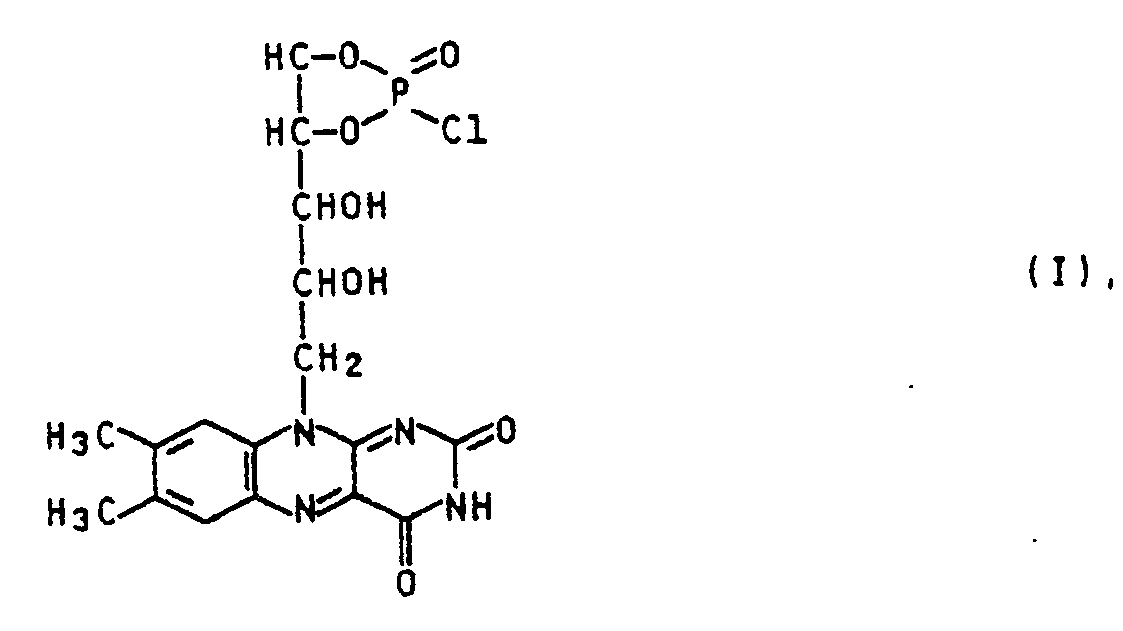
- the invention relates to riboflavin-4 ', 5'-cyclo-phosphoric acid chloride of the formula I. a process for its preparation and its use for the preparation of riboflavin-5'-phosphate (5'-flavin mononucleotide and therefore hereinafter referred to as 5'-FMN) or for the preparation of the commercially available monosodium salt of 5'-FMN.
- 5'-FMN riboflavin-5'-phosphate
- 5'-FMN is a compound which plays an essential role as a coenzyme in various enzyme reactions in the living body and which is therefore used in the form of its salts, in particular in the form of sodium 5'-FMN, as an additive for medicines, foods and animal feed .
- Sodium 5'-FMN also serves as a starting material for flavin adenine dinucleotide, which is used as a therapeutic agent against vitamin B2 deficiency.
- sodium 5'-FMN is generally obtained by directly reacting riboflavin with a phosphorylating agent, such as partially hydrolyzed phosphorus oxychloride, and then treating the 5'-FMN obtained with sodium hydroxide solution.
- a phosphorylating agent such as partially hydrolyzed phosphorus oxychloride
- the selective phosphorylation of riboflavin is not that easy.
- a large excess of phosphorus oxychloride is used.
- phosphorylation is carried out in the presence of pyridine (cf. US Pat. No. 2,111,491) or in the presence of acetonitrile (cf. Techn. Report No. 2715 (1979) by Frantz Kaufmann of Grindstedt Verket, Denmark).
- salts of 5'-FMN are obtained particularly advantageously if, as in the prior art, the free riboflavin is not used for phosphorylation, but rather its metal salts, preferably the alkali metal salts, in particular the potassium salt (II) Riboflavins used.
- the free riboflavin is not used for phosphorylation, but rather its metal salts, preferably the alkali metal salts, in particular the potassium salt (II) Riboflavins used.
- the alkali metal salts in particular the potassium salt (II) Riboflavins used.
- riboflavin-4 ', 5'-cyclo-phosphoric acid ester chloride of the formula I which has not been described in the literature so far, and which can be separated off in church stall form.
- the latter can then be hydrolyzed under suitable conditions with ring opening and converted into the sodium salt of 5'-FMN by partial neutralization with sodium hydroxide solution at pH 5.5.
- the invention therefore provides, in addition to the riboflavin-4 ', 5'-cyclo-phosphoric acid ester chloride of the formula I, a process for its preparation which is characterized in that an alkali metal salt, in particular the potassium salt of riboflavin in a suitable aprotic solvent at temperatures of 20 to 50, preferably at about 30 to 45 ° C with 1.2 to 3 moles of phosphorus oxychloride per mole of the alkali salt and optionally isolating the product which crystallizes from the reaction mixture by filtration.
- an alkali metal salt in particular the potassium salt of riboflavin in a suitable aprotic solvent at temperatures of 20 to 50, preferably at about 30 to 45 ° C with 1.2 to 3 moles of phosphorus oxychloride per mole of the alkali salt and optionally isolating the product which crystallizes from the reaction mixture by filtration.
- Suitable aprotic solvents for the reaction are, in particular, linear or cyclic ethers, such as monoethylene glycol dimethyl ether, diethylene glycol dimethyl ether, triethylene glycol dimethyl ether, tetrahydrofuran or dioxane.
- the alkali metal salt used as the starting compound is obtained in a simple manner by dissolving the riboflavin in equimolar amounts of a dilute aqueous alkali metal hydroxide solution and causing the salt obtained to crystallize by dropwise addition of methanol. Filtration, washing with methanol and drying give the alkali salt in almost quantitative yield.
- the dried alkali salt contains water of crystallization and is as stable as riboflavin itself.
- the phosphoric acid ester chloride of the formula I is particularly advantageous to prepare in such a way that the riboflavin alkali salt is dissolved in a solution of about 2.8 mol of phosphorus oxychloride per mole of alkali salt (ie an approximately 1.8 molar excess) in a suitable aprotic solvent enters. After 2 hours of reaction at 40 to 45 ° C, a conversion of more than 95% is already achieved.
- the crystalline riboflavin-4 ', 5'-cyclo-phosphoric acid ester chloride formed can be isolated by filtration, or hydrolyzed and isomerized immediately by adding water to the reaction mixture and heating to the desired 5'-FMN.
- the 5′-FMN obtained can then, if desired, be obtained by partially neutralizing the monosodium salt of 5′-FMN.
- An intermediate isolation of the 5'-FMN is usually not necessary, since the sodium salt of the 5'-FMN is obtained in the desired purity in one process step by partially neutralizing the free acid.
- the invention accordingly also relates to the use of riboflavin-4 ', 5'-cyclo-phosphoric acid ester chloride of the formula I for the preparation of 5'-FMN by hydrolysis and isomerization and for the preparation of the monosodium salt of 5'-FMN by hydrolysis, isomerization and partial neutralization .
- the reaction of the riboflavin-5'-phosphate with NaOH to its monosodium salt is generally carried out at temperatures of 20 to 50 ° C, preferably 30 to 40 ° C.
- the riboflavin-5'-phosphate obtained in the process according to the invention generally contains less than 6% riboflavin and 75 to 80% riboflavin-5'-phosphate and thus corresponds to the purity requirements applicable in the pharmaceutical field. Subsequent complex cleaning operations are no longer necessary.
- the riboflavin-4 ', 5'-cyclo-phosphoric acid ester chloride of the formula I is a readily available intermediate which opens a simple route to the wished 5'-FMN and its monosodium salt in great purity.
- the yield was approximately 52 g, corresponding to 82.0% of theory.
- the product contains about 75 to 78% riboflavin-5'-phosphate; about 9 to 11% riboflavin-4'-phosphate; about 5 to 7% riboflavin-3'-phosphate and about 4 to 6% free riboflavin.
- Example 2 The procedure was first as described in Example 2, the reaction mixture after the hydrolysis and dropwise addition of 170 ml of water to 30 ° C. and a pH of from 30 to 40 ° C. by slowly metering in a 25% strength aqueous sodium hydroxide solution 5.5 a. After the pH had been reached, the reaction mixture was cooled to 20 ° C., then immediately filtered off with suction and, after washing with a water / ethanol mixture (50% by volume each) and ethanol, dried at 75 ° C. under reduced pressure.
- the yield was 54.5 g, corresponding to 82.1% of theory.
- the product contains 9 to 11% riboflavin-4'-phosphate sodium, 75 to 78% riboflavin-5'-phosphate sodium and 5 to 6% unreacted riboflavin specific rotation: +37.3 to + 38 °
- Sodium content approx. 5% pH of a 3% aqueous solution: 5 to 6.3.
- the product contains approx. 76% riboflavin-5′-phosphate, about 9% riboflavin-4'-phosphate and about 5% riboflavin.
Landscapes
- Chemical & Material Sciences (AREA)
- Health & Medical Sciences (AREA)
- Organic Chemistry (AREA)
- Life Sciences & Earth Sciences (AREA)
- General Health & Medical Sciences (AREA)
- Biochemistry (AREA)
- Molecular Biology (AREA)
- Diabetes (AREA)
- General Chemical & Material Sciences (AREA)
- Bioinformatics & Cheminformatics (AREA)
- Nutrition Science (AREA)
- Hematology (AREA)
- Obesity (AREA)
- Chemical Kinetics & Catalysis (AREA)
- Engineering & Computer Science (AREA)
- Medicinal Chemistry (AREA)
- Nuclear Medicine, Radiotherapy & Molecular Imaging (AREA)
- Pharmacology & Pharmacy (AREA)
- Animal Behavior & Ethology (AREA)
- Public Health (AREA)
- Veterinary Medicine (AREA)
- Pharmaceuticals Containing Other Organic And Inorganic Compounds (AREA)
Abstract
Description
- Die Erfindung betrifft Riboflavin-4′,5′-cyclo-phosphorsäureesterchlorid der Formel I

- 5′-FMN ist eine Verbindung, die eine wesentliche Rolle als Coenzym in verschiedenen Enzymreaktionen im lebenden Körper spielt und die deshalb in Form ihrer Salze, insbesondere in Form von Natrium-5′-FMN, als Zusatz für Arzneimittel, Nahrungsmittel und Futterstoffe verwendet wird. Natrium-5′-FMN dient auch als Ausgangsmaterial für Flavin-adenin-dinukleotid, das als therapeutisches Mittel gegen Vitamin-B₂-Mangel eingesetzt wird.
- Industriell wird Natrium-5′-FMN im allgemeinen durch direktes Umsetzen von Riboflavin mit einem Phosphorylierungsmittel, wie partiell hydrolysiertem Phosphoroxychlorid, und anschließendes Behandeln des erhaltenen 5′-FMN mit Natronlauge gewonnen. Die selektive Phosphorylierung von Riboflavin ist nicht ganz einfach. So arbeitet man beispielsweise gemäß US-2 610 177 mit einem großen Überschuß an Phosphoroxichlorid. Gemäß C.A. 83 (1975), 79551a, C.A. 83 (1975), 79549f (JA-OS 50/25 597) bzw. C.A. 83 (1975), 79550z (JA-OS 50/25 598) wurde ein geringer Überschuß an Phosphoroxichlorid in Lösungsmitteln, wie Tetrahydrofuran, Diethylenglykoldimethylether, Monoethylenglykoldimethylether, Triethylphosphat, 1,2-Dichlor- oder 1,2-Dibromethan empfohlen. Bei der Nacharbeitung der Beispiele ergab sich, daß unter den angegebenen Bedingungen in vielen Fällen überhaupt kein 5′-FMN, in anderen Fällen nur äußerst geringe Mengen an 5′-FMN erhalten werden konnten. Die in loc. cit. angegebenen hohen Ausbeuten beruhen vermutlich auf Problemen bei der Analytik.
- In einigen Fällen wird in Gegenwart von Pyridin (vgl. US 2 111 491) oder in Gegenwart von Acetonitril (vgl. Techn. Rapport Nr. 2715 (1979) von Frantz Kaufmann der Grindstedt Verket, Dänemark) phosphoryliert.
- Bei allen bekannten Herstellungsverfahren wird zunächst ein Rohprodukt erhalten, das noch erhebliche Mengen an unumgesetztem Riboflavin, sowie isomere Mono- und Polyphosphate als Nebenprodukte enthält. Daher muß das 5′-FMN einer technisch aufwendigen Reinigungsprozedur unterzogen werden, damit Produkte erhalten werden, die den Reinheitskriterien der US- und EP-Pharmakopoen entsprechen. So ist z.B. aus Chemical Engineering, Nov. 1954, Seiten 120ff bekannt, daß in einem Produktionsprozess das 5′-FMN angereichert wird, indem man das Isomerengemisch durch mehrmalige Behandlung mit Ethanolamin in Form von Monoammoniumsalzen in Lösung bringt und von nicht umgesetztem und ungelöstem Riboflavin abtrennt.
- Allein an den aufwendigen Verfahrensschritten und darüber hinaus dem Einsatz von großen Mengen Phosphoroxichlorid in Bezug auf das zu phosphorylierende Riboflavin (Vitamin B₂) ist erkennbar, daß solche Verfahren einen nicht unerheblichen Einfluß auf die Chloridbelastung im Abwasser darstellen können. Auch bei Reinigungsverfahren für Vitamin-B₂-Phosphat durch Absorption an einem Celluloseionenaustauscher und Elution mit einem Natriumoxalat/Oxalsäure bzw. Ammoniumformiat/Ameisensäurepuffer (vgl. JA-AS 47/8836 und JA-AS 47/8554) wird das Verfahren nicht wirtschaftlicher und umweltfreundlicher, da bei technischer Nutzung zu große Mengen an Puffersalzen zur Anwendung kommen.
- Es wurde nun gefunden, daß man überraschenderweise Salze des 5′-FMN besonders vorteilhaft erhält, wenn man nicht, wie nach dem Stand der Technik, das freie Riboflavin zur Phosphorylierung, sondern dessen Metallsalze, vorzugsweise die Alkalisalze, insbesondere das Kaliumsalz (II) des Riboflavins einsetzt. Hierbei bildet sich primär das unseres Wissens bisher in der Literatur nicht beschriebene Riboflavin-4′,5′-cyclo-phosphorsäureesterchlorid der Formel I, das in kirstalliner Form abgetrennt werden kann. Letzteres kann dann unter geeigneten Bedingungen unter Ringöffnung hydrolysiert und durch Teilneutralisation mit Natronlauge bei pH 5,5 in das Natriumsalz von 5′-FMN überführt werden.
- Die Umsetzung erfolgt bei Verwendung des Kaliumsalzes nach folgender Gleichung:

- Es war sehr überraschend, daß bei der Umsetzung der Alkalimetallsalze des Riboflavins mit Phosphoroxichlorid oder mit einem Ester des Phosphoroxidichlorids der Angriff des phosphorylierenden Agens in 4′-5′-Stellung des Ribitylrestes erfolgt. Aus der Literatur ist bekannt, daß die negative Ladung im Anion des Riboflavins in den Heterocyclen lokalisiert ist, so daß jeder Fachmann den Angriff des Phorphorylierungsagenses an der Stelle mit der höchsten Ladungsdichte in Pos. 4 und 5 im Isoalloxazinring vermutet hätte und nicht an der weitentfernten 4′,5′-Position des Ribitylrests.
- Gegenstand der Erfindung ist daher neben dem Riboflavin-4′,5′-cyclo-phosphorsäureesterchlorid der Formel I ein Verfahren zu dessen Herstellung, das dadurch gekennzeichnet ist, daß man ein Alkalisalz, insbesondere das Kaliumsalz des Riboflavins in einem geeigneten aprotischen Lösungsmittels bei Temperaturen von 20 bis 50, vorzugsweise bei etwa 30 bis 45°C mit 1,2 bis 3 Mol Phosphoroxichlorid pro Mol des Alkalisalzes umsetzt und gegebenenfalls das aus dem Reaktionsgemisch auskristallisierende Produkt durch Filtration isoliert.
- Als aprotische Lösungsmittel sind für die Umsetzung insbesondere lineare oder cyclische Ether, wie Monoethylenglykoldimethylether, Diethylenglykoldimethylether, Triethylenglykoldimethylether, Tetrahydrofuran oder Dioxan geeignet.
- Das als Ausgangsverbindung verwendete Alkalisalz wird auf einfache Weise dadurch erhalten, daß man das Riboflavin in äquimolaren Mengen einer verdünnten wäßrigen Alkalihydroxidlösung löst und das erhaltene Salz durch Zutropfen von Methanol zur Kristallisation bringt. Durch Filtration, Waschen mit Methanol und Trocknen erhält man das Alkalisalz in nahezu quantitativer Ausbeute. Das Alkalisalz enthält in getrocknetem Zustand ein Kristallwasser und ist so stabil wie Riboflavin selbst.
- Mit besonderem Vorteil arbeitet man bei der Herstellung des Phosphorsäureesterchlorids der Formel I so, daß man das Riboflavin-Alkalisalz in eine Lösung von etwa 2,8 Mol Phosphoroxichlorid pro Mol Alkalisalz (d.h. einen ca. 1,8 molaren Überschuß) in einem geeigneten aprotischen Lösungsmittel einträgt. Nach 2stündiger Reaktion bei 40 bis 45°C ist bereits eine mehr als 95 %ige Umsetzung erreicht. Das gebildete kristalline Riboflavin-4′,5′-cyclo-phosphorsäureesterchlorid kann durch Filtration isoliert werden, oder aber gleich durch Zugabe von Wasser zum Reaktionsgemisch und Erhitzen zum gewünschten 5′-FMN hydrolysiert und isomerisiert werden. Aus dem erhaltenen 5′-FMN kann dann gewünschtenfalls durch Teilneutralisation des Mononatriumsalz von 5′-FMN erhalten werden.
- Eine Zwischenisolierung des 5′-FMN ist meistens nicht nötig, da man in einem Verfahrensschritt durch Teilneutralisation der freien Säure das Natriumsalz des 5′-FMN in gewünschter Reinheit erhält.
- Gegenstand der Erfindung ist dementsprechend auch die Verwendung von Riboflavin-4′,5′-cyclo-phosphorsäureesterchlorid der Formel I zur Herstellung von 5′-FMN durch Hydrolysieren und Isomerisieren sowie zur Herstellung des Mononatriumsalzes von 5′-FMN durch Hydrolysieren, Isomerisieren und Teilneutralisation.
- Gegenstand der Erfindung ist weiterhin das oben beschriebene Verfahren, das dadurch gekennzeichnet ist, daß man zur Herstellung von 5′-FMN bzw. von dessen Natriumsalz das erhaltene Riboflavin-4′,5′-cyclo-phosphorsäurechlorid der Formel I
- a) zum Riboflavin-4′,5′-phosphorsäureester hydrolysiert und
- b) diesen zu 5′-FMN isomerisiert und
- c) dieses gewünschtenfalls mit Natriumhydroxid zu dem Mononatriumsalz von 5′-FMN umsetzt.
- Zur Durchführung dieses Verfahrens geht man im allgemeinen so vor, daß man das Riboflavin-4′,5′-phosphorsäureesterchlorid der Formel I enthaltende Reaktionsgemisch
- a) rasch mit 30 bis 50, vorzugsweise 32 bis 35 Mol Wasser pro Mol Phosphorsäureesterchlorid versetzt, wobei die Temperatur auf über 90°C ansteigt und durch Hydrolyse Riboflavin-4′,5′-phosphorsäureester gebildet wird,
- b) das Reaktionsgemisch durch Einleiten von Dampf noch 5 bis 15, vorzugsweise 8 bis 12 Minuten auf Temperaturen von 80 bis 100°C, vorzugsweise 85 bis 90°C hält, wobei der gebildete Riboflavin-4′,5′-phosphorsäureester im wesentlichen zu 5′-FMN isomerisiert wird,
- c) durch Zugabe von 68 bis 100 Mol Wasser zu dem Reaktionsgemisch und die dadurch bedingte Abkühlung die Isomerisierung abbricht und
- d) ggf. zur Herstellung des Mononatriumsalzes von 5′-FMN das Reaktionsgemisch mit Natriumhydroxid auf einen pH-Wert von 5,5 bis 6 einstellt.
- Geht man von isoliertem Riboflavin-4′,5′-cyclophosphorsäurechlorid aus, so muß man
- a) dieses in eine zur Lösung ausreichende Menge von auf 80 bis 95°C erwärmten Wassers eintragen,
- b) das Reaktionsgemisch durch Einleiten von Dampf noch 5 bis 15 Minuten auf Temperaturen von 80 bis 100°C halten,
- c) durch anschließende Zugabe von 68 bis 100 Mol Wasser die Isomerisierung abbrechen und
- d) gewünschtenfalls zur Herstellung des Mononatriumsalzes von 5′-FMN das Reaktionsgemisch mit Natriumhydroxid auf einen pH-Wert von 5,5 bis 6 einstellen.
- Bei der erfindungsgemäßen Herstellung von 5′-FMN bzw. dessen Mononatriumsalz ist darauf zu achten, daß das Riboflavin-4′,5′-cyclophosphorsäurechlorid enthaltende Reaktionsgemisch möglichst schnell auf Temperaturen von 80 bis 100°C gelangt und die Temperatur für die angegebene Zeit ohne zwischenzeitliches Absinken der Temperatur bei 80 bis 100°C gehalten wird, da sonst ein Produkt mit unakzeptabel hohem Riboflavingehalt erhalten wird.
- Die Umsetzung des Riboflavin-5′-phosphats mit NaOH zu seinem Mononatriumsalz erfolgt im allgemeinen bei Temperaturen von 20 bis 50°C, vorzugsweise 30 bis 40°C.
- Gegenstand der Erfindung ist auch das sich insgesamt ergebende elegante Eintopfverfahren zur Herstellung von reinem Riboflavin-5′-phosphat bzw. von seinem Mononatriumsalz, das dadurch gekennzeichnet ist, daß man
- A) ein Alkalisalz des Riboflavins in einem geeigneten aprotischen Lösungsmittel bei Temperaturen von 20 bis 50°C mit 1,2 bis 3 Mol Phosphoroxichlorid pro Mol des Alkalisalzes umsetzt,
- B) das so erhaltene, das neue Riboflavin-4′,5′-cyclo-phosphorsäureesterchlorid der Formel I enthaltende Reaktionsgemisch rasch mit 30 bis 50 Mol Wasser pro Mol Esterchlorid versetzt, wobei die Temperatur auf über 90°C ansteigt,
- C) das Reaktionsgemisch durch Einleiten von Dampf noch 5 bis 15 Minuten auf Temperaturen von 80 bis 100°C hält,
- D) anschließend 68 bis 100 Mol Wasser zu dem Reaktionsgemisch addiert und das auskristallisierende Riboflavin-5′-phosphat isoliert oder gewünschtenfalls
- E) das gemäß D) erhaltene Reaktionsgemisch bei Temperaturen von 20 bis 50°C, vorzugsweise 30 bis 40°C mit NaOH auf einen pH-Wert zwischen 5,5 und 6 einstellt und das auskristallisierende Mononatriumsalz von Riboflavin-5′-phosphat isoliert.
- Das bei dem erfindungsgemäßen Verfahren erhaltene Riboflavin-5′-phosphat enthält im allgemeinen weniger als 6 % Riboflavin und 75 bis 80 % Riboflavin-5′-phosphat und entspricht damit den auf pharmazeutischem Gebiet geltenden Reinheitsanforderungen. Anschließende aufwendige Reinigungsoperationen erübrigen sich.
- Das Riboflavin-4′,5′-cyclo-phosphorsäureesterchlorid der Formel I ist ein auf einfache Weise erhältliches Zwischenprodukt, das einen einfachen Weg zu dem begehrten 5′-FMN und dessen Mononatriumsalz in großer Reinheit eröffnet.
- In 180 ml Diethylenglykoldimethylether wurden
60,12 g (0,392 mol) Phosphoroxichlorid eingetragen und hierzu unter Rühren
60 g (0,139 mol) Riboflavin-Kalium-Salz, fein pulverisiert, portionsweise zugegeben, wobei die Temperatur auf 30°C anstieg. Anschließend wurde das Reaktionsgemisch auf 45°C erwärmt und 2 Stunden (h) bei 45°C gerührt. Nach Abkühlen auf Raumtempe ratur (RT) wurde die Suspension unter Stickstoff abgesaugt, dann mit Diethylenglykoldimethylether und anschließend mit Aceton gewaschen und schließlich unter vermindertem Druck getrocknet. - Die Ausbeute betrug 62,0 g entsprechend 97,8 % der Theorie.
- - Gehalt nach HPLC an cyclischem Chlorid: 95 %
- Das Molekülion wurde mittels FAB -MS-Methode (vgl. K.L. Rinehart in Science 218 (1982) Seite 254) gemessen.
- Die Molekulargewichtsbestimmung ergab ein Molekulargewicht von 456 g/Mol, welches der Titelverbindung entspricht.
Das Produkt enthielt noch Kalium-Salze. - In ein Gemisch von
180 ml Diethylenglykoldimethylether und
60,12 g (0,392 mol) = 36 ml Phosphoroxichlorid wurden
60 g (0,139 mol) Riboflavin-Kalium-Salz, fein pulverisiert, portionsweise eingetragen und danach das Reaktionsgemisch 2 h bei 45°C gerührt. Anschließend wurden bei dieser Temperatur rasch
75 g Wasser zugegeben, wobei die Temperatur schnell auf 90 bis 95°C anstieg. Durch Einblasen von Dampf wurde die Temperatur 10 bis 15 Minuten bei 90 bis 95°C gehalten. Während des anschließenden Zutropfens von
170 ml Wasser wurde das Reaktionsgemisch langsam abgekühlt, wobei schon zwischen 70 und 80°C Riboflavin-5′-phosphat auszufallen begann. Nach 2 h Nachrührzeit bei 20 bis 25°C wurde abgesaugt und der Rückstand zuerst mit einem Wasser/Ethanol-Gemisch (je 50 Vol.%), danach mit wenig reinem Ethanol gewaschen und anschließend bei 75°C unter vermindertem Druck getrocknet. - Die Ausbeute betrug ca. 52 g entsprechend 82,0 % der Theorie.
- Nach HPLC enthält das Produkt ca. 75 bis 78 % Riboflavin-5′-phosphat;
ca. 9 bis 11 % Riboflavin-4′-phosphat;
ca. 5 bis 7 % Riboflavin-3′-phosphat
und ca. 4 bis 6 % freies Riboflavin. - Man arbeitete zunächst wie in Beispiel 2 beschrieben, kühlte das Reaktionsgemisch nach der Hydrolyse und Zutropfen von 170 ml Wasser auf 30°C ab und stellte bei Temperaturen zwischen 30 und 40°C durch langsames Zudosieren einer 25 %igen wäßrigen Natronlauge einen pH-Wert von ca. 5,5 ein. Nach Erreichen des pH-Wertes wurde das Reaktionsgemisch auf 20°C abgekühlt, dann sofort abgesaugt und nach Waschen mit einem Wasser-/Ethanol-Gemisch (je 50 Vol.%) und Ethanol unter vermindertem Druck bei 75°C getrocknet.
- Die Ausbeute betrug 54,5 g entsprechend 82,1 % der Theorie.
- Nach HPLC enthält das Produkt 9 bis 11 % Riboflavin-4′-phosphat-Natrium,
75 bis 78 % Riboflavin-5′-phosphat-Natrium
und 5 bis 6 % unumgesetztes Riboflavin
spezifische Drehung : +37,3 bis +38°
Gehalt an Natrium : ca. 5 %
pH-Wert einer 3 %igen wäßrigen Lösung: 5 bis 6,3. - In 100 ml Diethylenglykoldimethylether wurden 12 ml Phosphoroxichlorid eingetragen und hierzu unter Rühren 20 g (0,048 mol) Riboflavin-Kalium-Salz feinpulverisiert, portionsweise zugegeben, wobei die Temperatur auf 30°C anstieg. Anschließend wurde das Reaktionsgemisch auf 35°C erwärmt und 3 h bei 35°C gerührt. Nach Abkühlen auf RT wurde die Suspension unter N₂ abgesaugt, dann mit 100 ml Diethylenglykoldimethylether gewaschen und getrocknet. Nach HPLC-Analyse bestand das Produkt zu 91 % aus Riboflavin-4′,5′-phosphorsäurechlorid und zu nur 1 % aus unumgesetztem Riboflavin.
- 200 ml Wasser wurden auf 75 bis 85°C erhitzt und bei dieser Temperatur das unter A. erhaltene Produkt portionsweise eingetragen. Anschließend wurde das Reaktionsgemisch noch 15 min. bei Temperaturen von 90 bis 95°C gerührt. Dann wurde das Reaktionsgemisch langsam abgekühlt und bei 40°C mit 25 %iger wäßriger Natronlauge auf pH 5,5 eingestellt. Nach Erreichen des pH-Wertes wurde das Reaktionsgemisch auf 20°C abgekühlt, dann sofort abgesaugt und nach Waschen mit einem Wasser-Ethanol-Gemisch (je 50 Vol.%) und Ethanol unter vermindertem Druck bei 75°C getrocknet. Die Ausbeute betrug 19 g.
- Nach HPLC enthält das Produkt ca. 76 % Riboflavin-5′-phosphat,
ca. 9 % Riboflavin-4′-phosphat
und ca. 5 % Riboflavin.
Claims (10)
Applications Claiming Priority (2)
| Application Number | Priority Date | Filing Date | Title |
|---|---|---|---|
| DE3835563A DE3835563A1 (de) | 1988-10-19 | 1988-10-19 | Riboflavin-4',5'-cyclo- phosphorsaeureesterchlorid, dessen herstellung und verwendung zur herstellung von riboflavin-5'-phosphat (5'-fmn) bzw. dessen natriumsalz |
| DE3835563 | 1988-10-19 |
Publications (2)
| Publication Number | Publication Date |
|---|---|
| EP0364875A1 true EP0364875A1 (de) | 1990-04-25 |
| EP0364875B1 EP0364875B1 (de) | 1993-03-24 |
Family
ID=6365440
Family Applications (1)
| Application Number | Title | Priority Date | Filing Date |
|---|---|---|---|
| EP89118924A Expired - Lifetime EP0364875B1 (de) | 1988-10-19 | 1989-10-12 | Riboflavin-4'5'-cyclo-phosphorsäureesterchlorid, dessen Herstellung und Verwendung zur Herstellung von Riboflavin-5'-phosphat (5'-FMN) bzw. dessen Natriumsalz |
Country Status (5)
| Country | Link |
|---|---|
| US (1) | US5017700A (de) |
| EP (1) | EP0364875B1 (de) |
| JP (1) | JP2716546B2 (de) |
| CA (1) | CA2000937C (de) |
| DE (2) | DE3835563A1 (de) |
Cited By (3)
| Publication number | Priority date | Publication date | Assignee | Title |
|---|---|---|---|---|
| US5095115A (en) * | 1989-09-14 | 1992-03-10 | Basf Aktiengesellschaft | Preparation of riboflavin 5'-phosphate (fmn) and its sodium salt in a lactone |
| WO2004013142A1 (en) * | 2002-08-02 | 2004-02-12 | The Institute Of Radiation Medicine, Academy Of Miilitary Medical Sciences, People's Liberation Army | A riboflavin derivative and its manufacture and uses |
| US7300372B2 (en) | 2002-07-16 | 2007-11-27 | Dayco Europe S.R.L. Con Unico Socio | Integrated pulley-torsional damper assembly |
Families Citing this family (6)
| Publication number | Priority date | Publication date | Assignee | Title |
|---|---|---|---|---|
| JP3274225B2 (ja) | 1992-06-03 | 2002-04-15 | 富士写真フイルム株式会社 | アミノ酸誘導体及びその用途 |
| CN102617643B (zh) * | 2012-03-06 | 2013-04-10 | 黄金秀 | 一种核黄素磷酸钠化合物 |
| CN103396452B (zh) * | 2013-08-19 | 2015-09-30 | 周晓东 | 一种核黄素磷酸钠化合物及其组合物 |
| CN106674225B (zh) * | 2016-11-09 | 2019-04-02 | 珠海同源药业有限公司 | 一种核黄素磷酸钠化合物及其药物组合物 |
| CN107286194A (zh) * | 2017-06-07 | 2017-10-24 | 山西集翔生物工程有限公司 | 一种核黄素磷酸钠生产工艺 |
| WO2020056714A1 (zh) * | 2018-09-21 | 2020-03-26 | 邦泰生物工程(深圳)有限公司 | 高纯度核黄素磷酸钠的制备方法 |
Family Cites Families (5)
| Publication number | Priority date | Publication date | Assignee | Title |
|---|---|---|---|---|
| US1684738A (en) * | 1928-09-18 | Charles henbi mabschalk | ||
| US2111491A (en) * | 1935-01-26 | 1938-03-15 | Winthrop Chem Co Inc | Process of preparing phosphoric acid esters of hydroxyalkyl isoalloxazines |
| US2661365A (en) * | 1950-03-11 | 1953-12-01 | Monsanto Chemicals | Alkanediol phosphoryl monochlorides |
| US2610177A (en) * | 1950-11-08 | 1952-09-09 | Hoffmann La Roche | Riboflavin monophosphoric acid ester salts and method of preparation |
| SU1007363A1 (ru) * | 1981-05-08 | 1985-07-15 | Ордена Трудового Красного Знамени Институт Органической И Физической Химии Им.А.Е.Арбузова | 2-Замещенные 4-метилен-5,5-диалкил-1,3,2-диоксафосфоланы и способ их получени |
-
1988
- 1988-10-19 DE DE3835563A patent/DE3835563A1/de not_active Withdrawn
-
1989
- 1989-09-28 US US07/413,590 patent/US5017700A/en not_active Expired - Fee Related
- 1989-10-12 EP EP89118924A patent/EP0364875B1/de not_active Expired - Lifetime
- 1989-10-12 DE DE8989118924T patent/DE58903876D1/de not_active Expired - Lifetime
- 1989-10-18 JP JP1269248A patent/JP2716546B2/ja not_active Expired - Lifetime
- 1989-10-18 CA CA002000937A patent/CA2000937C/en not_active Expired - Fee Related
Non-Patent Citations (3)
| Title |
|---|
| CHEMICAL ABSTRACTS * |
| CHEMICAL ABSTRACTS, Band 105, Nr. 9, 1. September 1986, Seite 627, Zusammenfassung Nr. 78740x, Columbus, Ohio, USA; B ZAGALAK et al.: "Phosphorylation of unprotected D-neopterin" & Biochem. Clin. Aspects Pteridines 1985, Band 4 (Cancer, Immunol., Metab. Dis.), Seiten 159-167 * |
| CHEMICAL ABSTRACTS, Band 88, Nr.19, 8. Mai 1978, Seite 501, Zusammenfassung Nr.136229f, Columbus, Ohio, USA; V K SIDORENKO et al.: "Synthesis of some gamma-alkoxy-alpha, beta-propylene glycol esters of phosphoric acid" & Dokl. Akad. Nauk. Tadzh. SSR 1977, Band 20, Nr. 11, Seiten 22-24 * |
Cited By (4)
| Publication number | Priority date | Publication date | Assignee | Title |
|---|---|---|---|---|
| US5095115A (en) * | 1989-09-14 | 1992-03-10 | Basf Aktiengesellschaft | Preparation of riboflavin 5'-phosphate (fmn) and its sodium salt in a lactone |
| US7300372B2 (en) | 2002-07-16 | 2007-11-27 | Dayco Europe S.R.L. Con Unico Socio | Integrated pulley-torsional damper assembly |
| WO2004013142A1 (en) * | 2002-08-02 | 2004-02-12 | The Institute Of Radiation Medicine, Academy Of Miilitary Medical Sciences, People's Liberation Army | A riboflavin derivative and its manufacture and uses |
| EP1553099A4 (de) * | 2002-08-02 | 2006-06-28 | Inst Radiation Med Amms Pla | Riboflavinderivat und dessen herstellung und verwendungen |
Also Published As
| Publication number | Publication date |
|---|---|
| JP2716546B2 (ja) | 1998-02-18 |
| DE3835563A1 (de) | 1990-04-26 |
| DE58903876D1 (de) | 1993-04-29 |
| EP0364875B1 (de) | 1993-03-24 |
| CA2000937A1 (en) | 1990-04-19 |
| JPH02174789A (ja) | 1990-07-06 |
| US5017700A (en) | 1991-05-21 |
| CA2000937C (en) | 1997-03-18 |
Similar Documents
| Publication | Publication Date | Title |
|---|---|---|
| DE3909198A1 (de) | Verfahren zur herstellung von ascorbinsaeure-2-phosphat sowie von 5,6-isorpropyliden-ascorbinsaeure als ausgangsprodukt | |
| DE1620694B2 (de) | Verfahren zur Herstellung von 5-Methyl-7-diäthylamino-s-triazolo [1,5-a] pyrimidin und seinen Salzen mit Säuren | |
| EP0364875B1 (de) | Riboflavin-4'5'-cyclo-phosphorsäureesterchlorid, dessen Herstellung und Verwendung zur Herstellung von Riboflavin-5'-phosphat (5'-FMN) bzw. dessen Natriumsalz | |
| EP0417604B1 (de) | Verfahren zur Herstellung von Riboflavin-5'-phosphat bzw. dessen Natriumsalz | |
| DE1248654B (de) | Verfahren zur Herstellung von Phosphonsäuren und deren Salzen | |
| DE2425983B2 (de) | Sulfonsaeuresalze von acylcholinen, verfahren zu ihrer herstellung und diese enthaltende pharmazeutische zusammensetzung | |
| EP1047704B2 (de) | Verfahren zur herstellung von fludarabin-phosphat-lithium-, natrium-, kalium-, calcium- und magnesium-salzen, reinigungsverfahren zur herstellung von fludarabin-phosphat und fludarabin-phosphat mit mindestens 99,5 %iger reinheit | |
| DE2519063A1 (de) | Verfahren zur herstellung von adeninderivaten | |
| DE3532344A1 (de) | Verfahren zur herstellung von n-phosphonomethylglycin | |
| EP0523582B1 (de) | Verbessertes Verfahren zur Herstellung des Mononatriumsalzes von Riboflavin 5'-phosphat | |
| DE2005959A1 (de) | 7-Nitro-8-hydroxychinolinester, ihre Verwendung und Verfahren zur Herstellung derselben | |
| DE2531257C2 (de) | Verfahren zur Herstellung von 8,2'-Anhydropurinnucleosiden | |
| DE3516953A1 (de) | Verfahren zur herstellung von n(pfeil hoch)6(pfeil hoch)-substituiertem 3',5'-cyclischen adenosinmonophosphat oder eines salzes davon | |
| DE4422587C2 (de) | Verfahren zur Herstellung von Purinen | |
| DE1228238B (de) | Verfahren zur Herstellung von als Schlafmittel verwendbaren halogenhaltigen primaeren Phosphorsaeureestern | |
| CH624396A5 (de) | ||
| DE2538077C3 (de) | Verfahren zum Herstellen von 4-Hydroxypyrazolo-(3,4-d)-pyrimidin | |
| DE3500029A1 (de) | Anthracyclinester | |
| AT371804B (de) | Verfahren zur herstellung von s-methyl-methionin- sulfonium-salzen | |
| DE1545838C3 (de) | 7-(2-Azidooctanamido)-cephalosporansäure, deren Salze und Verfahren zur Herstellung dieser Verbindungen | |
| DE1695297C3 (de) | 5-Fluor-l-(2-tetrahydrofuryl)-uracil und dessen Alkal'imetaUsalze, Verfahren zu deren Herstellung und diese enthaltende Mittel | |
| CH396003A (de) | Verfahren zur Herstellung von Penicillinderivaten | |
| DE2024805C3 (de) | Verfahren zur Herstellung von 2-Amino-3-chlorpyrazin | |
| DE2400608A1 (de) | Verfahren zur herstellung von pyrimidinderivaten | |
| DE2757586A1 (de) | Natrium-formylcyanamid und verfahren zu seiner herstellung |
Legal Events
| Date | Code | Title | Description |
|---|---|---|---|
| PUAI | Public reference made under article 153(3) epc to a published international application that has entered the european phase |
Free format text: ORIGINAL CODE: 0009012 |
|
| AK | Designated contracting states |
Kind code of ref document: A1 Designated state(s): CH DE FR GB IT LI NL |
|
| 17P | Request for examination filed |
Effective date: 19900323 |
|
| 17Q | First examination report despatched |
Effective date: 19920529 |
|
| GRAA | (expected) grant |
Free format text: ORIGINAL CODE: 0009210 |
|
| AK | Designated contracting states |
Kind code of ref document: B1 Designated state(s): CH DE FR GB IT LI NL |
|
| ITF | It: translation for a ep patent filed | ||
| REF | Corresponds to: |
Ref document number: 58903876 Country of ref document: DE Date of ref document: 19930429 |
|
| GBT | Gb: translation of ep patent filed (gb section 77(6)(a)/1977) |
Effective date: 19930407 |
|
| ET | Fr: translation filed | ||
| PLBE | No opposition filed within time limit |
Free format text: ORIGINAL CODE: 0009261 |
|
| STAA | Information on the status of an ep patent application or granted ep patent |
Free format text: STATUS: NO OPPOSITION FILED WITHIN TIME LIMIT |
|
| 26N | No opposition filed | ||
| PGFP | Annual fee paid to national office [announced via postgrant information from national office to epo] |
Ref country code: FR Payment date: 19990924 Year of fee payment: 11 |
|
| PGFP | Annual fee paid to national office [announced via postgrant information from national office to epo] |
Ref country code: GB Payment date: 19991001 Year of fee payment: 11 |
|
| PGFP | Annual fee paid to national office [announced via postgrant information from national office to epo] |
Ref country code: CH Payment date: 19991005 Year of fee payment: 11 |
|
| PGFP | Annual fee paid to national office [announced via postgrant information from national office to epo] |
Ref country code: NL Payment date: 19991007 Year of fee payment: 11 |
|
| PGFP | Annual fee paid to national office [announced via postgrant information from national office to epo] |
Ref country code: DE Payment date: 19991026 Year of fee payment: 11 |
|
| PG25 | Lapsed in a contracting state [announced via postgrant information from national office to epo] |
Ref country code: GB Free format text: LAPSE BECAUSE OF NON-PAYMENT OF DUE FEES Effective date: 20001012 |
|
| PG25 | Lapsed in a contracting state [announced via postgrant information from national office to epo] |
Ref country code: DE Free format text: LAPSE BECAUSE OF THE APPLICANT RENOUNCES Effective date: 20001014 |
|
| PG25 | Lapsed in a contracting state [announced via postgrant information from national office to epo] |
Ref country code: LI Free format text: LAPSE BECAUSE OF NON-PAYMENT OF DUE FEES Effective date: 20001031 Ref country code: CH Free format text: LAPSE BECAUSE OF NON-PAYMENT OF DUE FEES Effective date: 20001031 |
|
| PG25 | Lapsed in a contracting state [announced via postgrant information from national office to epo] |
Ref country code: NL Free format text: LAPSE BECAUSE OF NON-PAYMENT OF DUE FEES Effective date: 20010501 |
|
| GBPC | Gb: european patent ceased through non-payment of renewal fee |
Effective date: 20001012 |
|
| REG | Reference to a national code |
Ref country code: CH Ref legal event code: PL |
|
| PG25 | Lapsed in a contracting state [announced via postgrant information from national office to epo] |
Ref country code: FR Free format text: LAPSE BECAUSE OF NON-PAYMENT OF DUE FEES Effective date: 20010629 |
|
| NLV4 | Nl: lapsed or anulled due to non-payment of the annual fee |
Effective date: 20010501 |
|
| REG | Reference to a national code |
Ref country code: FR Ref legal event code: ST |
|
| PG25 | Lapsed in a contracting state [announced via postgrant information from national office to epo] |
Ref country code: IT Free format text: LAPSE BECAUSE OF NON-PAYMENT OF DUE FEES;WARNING: LAPSES OF ITALIAN PATENTS WITH EFFECTIVE DATE BEFORE 2007 MAY HAVE OCCURRED AT ANY TIME BEFORE 2007. THE CORRECT EFFECTIVE DATE MAY BE DIFFERENT FROM THE ONE RECORDED. Effective date: 20051012 |