EP0360842B1 - Verfahren zur herstellung von hexaferritpulver mit barium oder strontiumhydroxydlösung - Google Patents
Verfahren zur herstellung von hexaferritpulver mit barium oder strontiumhydroxydlösung Download PDFInfo
- Publication number
- EP0360842B1 EP0360842B1 EP89900575A EP89900575A EP0360842B1 EP 0360842 B1 EP0360842 B1 EP 0360842B1 EP 89900575 A EP89900575 A EP 89900575A EP 89900575 A EP89900575 A EP 89900575A EP 0360842 B1 EP0360842 B1 EP 0360842B1
- Authority
- EP
- European Patent Office
- Prior art keywords
- strontium
- barium
- raw material
- hexaferrite
- carbonate
- Prior art date
- Legal status (The legal status is an assumption and is not a legal conclusion. Google has not performed a legal analysis and makes no representation as to the accuracy of the status listed.)
- Expired - Lifetime
Links
- 238000000034 method Methods 0.000 title claims abstract description 31
- 239000000843 powder Substances 0.000 title claims abstract description 21
- UUCCCPNEFXQJEL-UHFFFAOYSA-L strontium dihydroxide Chemical compound [OH-].[OH-].[Sr+2] UUCCCPNEFXQJEL-UHFFFAOYSA-L 0.000 title claims abstract description 12
- 229910001866 strontium hydroxide Inorganic materials 0.000 title claims abstract description 12
- 229910001863 barium hydroxide Inorganic materials 0.000 title claims abstract description 8
- DSAJWYNOEDNPEQ-UHFFFAOYSA-N barium atom Chemical compound [Ba] DSAJWYNOEDNPEQ-UHFFFAOYSA-N 0.000 title abstract description 23
- 239000002994 raw material Substances 0.000 claims abstract description 34
- 239000000203 mixture Substances 0.000 claims abstract description 25
- XLYOFNOQVPJJNP-UHFFFAOYSA-N water Substances O XLYOFNOQVPJJNP-UHFFFAOYSA-N 0.000 claims abstract description 23
- UQSXHKLRYXJYBZ-UHFFFAOYSA-N Iron oxide Chemical compound [Fe]=O UQSXHKLRYXJYBZ-UHFFFAOYSA-N 0.000 claims abstract description 17
- BDAGIHXWWSANSR-NJFSPNSNSA-N hydroxyformaldehyde Chemical compound O[14CH]=O BDAGIHXWWSANSR-NJFSPNSNSA-N 0.000 claims abstract description 16
- 238000004519 manufacturing process Methods 0.000 claims abstract description 16
- 229910000018 strontium carbonate Inorganic materials 0.000 claims abstract description 15
- 239000007787 solid Substances 0.000 claims abstract description 12
- AYJRCSIUFZENHW-UHFFFAOYSA-L barium carbonate Inorganic materials [Ba+2].[O-]C([O-])=O AYJRCSIUFZENHW-UHFFFAOYSA-L 0.000 claims abstract description 10
- 229910052712 strontium Inorganic materials 0.000 claims abstract description 7
- CIOAGBVUUVVLOB-UHFFFAOYSA-N strontium atom Chemical compound [Sr] CIOAGBVUUVVLOB-UHFFFAOYSA-N 0.000 claims abstract description 7
- 238000003825 pressing Methods 0.000 claims description 5
- 238000010304 firing Methods 0.000 claims description 3
- 238000002360 preparation method Methods 0.000 claims description 3
- RQPZNWPYLFFXCP-UHFFFAOYSA-L barium dihydroxide Chemical compound [OH-].[OH-].[Ba+2] RQPZNWPYLFFXCP-UHFFFAOYSA-L 0.000 claims 3
- 239000002002 slurry Substances 0.000 claims 2
- HPYIMVBXZPJVBV-UHFFFAOYSA-N barium(2+);iron(3+);oxygen(2-) Chemical compound [O-2].[O-2].[O-2].[O-2].[O-2].[O-2].[O-2].[O-2].[O-2].[O-2].[O-2].[O-2].[O-2].[O-2].[O-2].[O-2].[O-2].[O-2].[O-2].[Fe+3].[Fe+3].[Fe+3].[Fe+3].[Fe+3].[Fe+3].[Fe+3].[Fe+3].[Fe+3].[Fe+3].[Fe+3].[Fe+3].[Ba+2] HPYIMVBXZPJVBV-UHFFFAOYSA-N 0.000 claims 1
- 229910052788 barium Inorganic materials 0.000 abstract description 5
- BVKZGUZCCUSVTD-UHFFFAOYSA-L Carbonate Chemical compound [O-]C([O-])=O BVKZGUZCCUSVTD-UHFFFAOYSA-L 0.000 abstract description 4
- 238000002485 combustion reaction Methods 0.000 abstract 1
- IATRAKWUXMZMIY-UHFFFAOYSA-N strontium oxide Inorganic materials [O-2].[Sr+2] IATRAKWUXMZMIY-UHFFFAOYSA-N 0.000 description 35
- QVQLCTNNEUAWMS-UHFFFAOYSA-N barium oxide Inorganic materials [Ba]=O QVQLCTNNEUAWMS-UHFFFAOYSA-N 0.000 description 9
- 238000006243 chemical reaction Methods 0.000 description 5
- -1 strontium oxide ions Chemical class 0.000 description 5
- 239000002351 wastewater Substances 0.000 description 5
- 238000002156 mixing Methods 0.000 description 3
- 239000000047 product Substances 0.000 description 3
- CURLTUGMZLYLDI-UHFFFAOYSA-N Carbon dioxide Chemical compound O=C=O CURLTUGMZLYLDI-UHFFFAOYSA-N 0.000 description 2
- 229910052918 calcium silicate Inorganic materials 0.000 description 2
- 239000000378 calcium silicate Substances 0.000 description 2
- OYACROKNLOSFPA-UHFFFAOYSA-N calcium;dioxido(oxo)silane Chemical compound [Ca+2].[O-][Si]([O-])=O OYACROKNLOSFPA-UHFFFAOYSA-N 0.000 description 2
- 239000013078 crystal Substances 0.000 description 2
- 238000001035 drying Methods 0.000 description 2
- 238000005245 sintering Methods 0.000 description 2
- 239000002699 waste material Substances 0.000 description 2
- 229910000859 α-Fe Inorganic materials 0.000 description 2
- 230000015572 biosynthetic process Effects 0.000 description 1
- 229910002092 carbon dioxide Inorganic materials 0.000 description 1
- 239000001569 carbon dioxide Substances 0.000 description 1
- 150000004649 carbonic acid derivatives Chemical class 0.000 description 1
- 238000000975 co-precipitation Methods 0.000 description 1
- 238000001739 density measurement Methods 0.000 description 1
- 239000006185 dispersion Substances 0.000 description 1
- 238000009837 dry grinding Methods 0.000 description 1
- 239000011521 glass Substances 0.000 description 1
- 239000008187 granular material Substances 0.000 description 1
- 238000000227 grinding Methods 0.000 description 1
- XLYOFNOQVPJJNP-UHFFFAOYSA-M hydroxide Chemical compound [OH-] XLYOFNOQVPJJNP-UHFFFAOYSA-M 0.000 description 1
- XEEYBQQBJWHFJM-UHFFFAOYSA-N iron Substances [Fe] XEEYBQQBJWHFJM-UHFFFAOYSA-N 0.000 description 1
- FBAFATDZDUQKNH-UHFFFAOYSA-M iron chloride Chemical compound [Cl-].[Fe] FBAFATDZDUQKNH-UHFFFAOYSA-M 0.000 description 1
- 239000007788 liquid Substances 0.000 description 1
- 239000000696 magnetic material Substances 0.000 description 1
- QSHDDOUJBYECFT-UHFFFAOYSA-N mercury Chemical compound [Hg] QSHDDOUJBYECFT-UHFFFAOYSA-N 0.000 description 1
- 229910052753 mercury Inorganic materials 0.000 description 1
- 229910001510 metal chloride Inorganic materials 0.000 description 1
- UFQXGXDIJMBKTC-UHFFFAOYSA-N oxostrontium Chemical compound [Sr]=O UFQXGXDIJMBKTC-UHFFFAOYSA-N 0.000 description 1
- 239000002245 particle Substances 0.000 description 1
- 235000011837 pasties Nutrition 0.000 description 1
- 238000002459 porosimetry Methods 0.000 description 1
- 239000002244 precipitate Substances 0.000 description 1
- 238000001556 precipitation Methods 0.000 description 1
- 239000002904 solvent Substances 0.000 description 1
- 238000003756 stirring Methods 0.000 description 1
- AHBGXTDRMVNFER-UHFFFAOYSA-L strontium dichloride Chemical class [Cl-].[Cl-].[Sr+2] AHBGXTDRMVNFER-UHFFFAOYSA-L 0.000 description 1
- 239000000126 substance Substances 0.000 description 1
- 239000012856 weighed raw material Substances 0.000 description 1
- 238000005303 weighing Methods 0.000 description 1
- 238000001238 wet grinding Methods 0.000 description 1
Images
Classifications
-
- C—CHEMISTRY; METALLURGY
- C01—INORGANIC CHEMISTRY
- C01G—COMPOUNDS CONTAINING METALS NOT COVERED BY SUBCLASSES C01D OR C01F
- C01G49/00—Compounds of iron
-
- C—CHEMISTRY; METALLURGY
- C01—INORGANIC CHEMISTRY
- C01G—COMPOUNDS CONTAINING METALS NOT COVERED BY SUBCLASSES C01D OR C01F
- C01G49/00—Compounds of iron
- C01G49/0018—Mixed oxides or hydroxides
- C01G49/0036—Mixed oxides or hydroxides containing one alkaline earth metal, magnesium or lead
-
- C—CHEMISTRY; METALLURGY
- C04—CEMENTS; CONCRETE; ARTIFICIAL STONE; CERAMICS; REFRACTORIES
- C04B—LIME, MAGNESIA; SLAG; CEMENTS; COMPOSITIONS THEREOF, e.g. MORTARS, CONCRETE OR LIKE BUILDING MATERIALS; ARTIFICIAL STONE; CERAMICS; REFRACTORIES; TREATMENT OF NATURAL STONE
- C04B35/00—Shaped ceramic products characterised by their composition; Ceramics compositions; Processing powders of inorganic compounds preparatory to the manufacturing of ceramic products
- C04B35/01—Shaped ceramic products characterised by their composition; Ceramics compositions; Processing powders of inorganic compounds preparatory to the manufacturing of ceramic products based on oxide ceramics
- C04B35/26—Shaped ceramic products characterised by their composition; Ceramics compositions; Processing powders of inorganic compounds preparatory to the manufacturing of ceramic products based on oxide ceramics based on ferrites
- C04B35/2683—Other ferrites containing alkaline earth metals or lead
-
- H—ELECTRICITY
- H01—ELECTRIC ELEMENTS
- H01F—MAGNETS; INDUCTANCES; TRANSFORMERS; SELECTION OF MATERIALS FOR THEIR MAGNETIC PROPERTIES
- H01F1/00—Magnets or magnetic bodies characterised by the magnetic materials therefor; Selection of materials for their magnetic properties
- H01F1/01—Magnets or magnetic bodies characterised by the magnetic materials therefor; Selection of materials for their magnetic properties of inorganic materials
- H01F1/03—Magnets or magnetic bodies characterised by the magnetic materials therefor; Selection of materials for their magnetic properties of inorganic materials characterised by their coercivity
- H01F1/032—Magnets or magnetic bodies characterised by the magnetic materials therefor; Selection of materials for their magnetic properties of inorganic materials characterised by their coercivity of hard-magnetic materials
- H01F1/10—Magnets or magnetic bodies characterised by the magnetic materials therefor; Selection of materials for their magnetic properties of inorganic materials characterised by their coercivity of hard-magnetic materials non-metallic substances, e.g. ferrites, e.g. [(Ba,Sr)O(Fe2O3)6] ferrites with hexagonal structure
- H01F1/11—Magnets or magnetic bodies characterised by the magnetic materials therefor; Selection of materials for their magnetic properties of inorganic materials characterised by their coercivity of hard-magnetic materials non-metallic substances, e.g. ferrites, e.g. [(Ba,Sr)O(Fe2O3)6] ferrites with hexagonal structure in the form of particles
Definitions
- the invention relates to a process for the production of barium or strontium hexaferrite powder for the production of permanent magnets, in which the raw material mixture homogenized with the addition of water, which contains iron oxide and barium or strontium carbonate as solids, is reaction-fired to hexaferrite.
- Such a method is known.
- the barium or strontium hexaferrite powder produced with the aid of this process is pressed after the reaction firing by means of a wet press in a magnetic field to form the permanent magnet green compact, which after drying is sintered in a continuous furnace to form the finished permanent magnet.
- This method is preferably suitable for the mass production of permanent magnets, which are used in particular in small electric motors in the automotive industry.
- the magnetic quality of the finished permanent magnet essentially depends on the microcrystalline nature of the reaction-fired hexaferrite powder, which is essentially due to the preparation of the raw material mixture. It is necessary to achieve the most homogeneous possible mixture of the weighed raw materials. This is facilitated in the known method in that water is added to the raw material mixture in the required amount in order to increase the moisture content of the mixture. However, since there should be as little water as possible when entering the continuous furnace, either the amount of water added must be limited or the raw material mixture must be dewatered before the reaction fires.
- Such a method has weak points in that, on the one hand, dewatering the raw material mixture causes costs and, on the other hand, the magnetic values for the hexaferrite powder that can be achieved in the known method are limited. Furthermore, the strontium carbonate added as a solid causes a large part of the raw material costs.
- the invention is therefore based on the object of improving a method of the type mentioned in the introduction in such a way that it becomes more economical on the one hand and the magnetic properties of the hexaferrite powder on the other hand are improved.
- This object is achieved in that a barium or strontium hydroxide solution is added to the raw material mixture which at least partially replaces the barium or strontium carbonate.
- the invention is characterized in that the largest possible proportion of the carbonate added to the raw material mixture as a solid is replaced by a barium or strontium hydroxide solution in which the barium or strontium oxide ions are present in a solvent.
- the raw materials are now mixed on an ionic basis in the mixing process. Due to the better miscibility of the raw material, the water content of the raw material mixture can be reduced.
- the barium or strontium oxide ions accumulate much more uniformly on the iron oxide particles, so that during the subsequent reaction firing the raw material is converted more completely into hexaferrite. This increases the economics of the process.
- the reaction-sintered hexaferrite has a very narrow grain band (between 0.1 to 3 ⁇ m, preferably between 0.5 and 1.5 ⁇ m) with extremely low-defect crystals.
- the barium or strontium oxide solution can be supplied much more easily when the raw materials are weighed in on a batch weigher than the carbonate supplied as a solid, which must be supplied via screw conveyors.
- the hydroxide is taken from a preliminary stage of the barium or strontium carbonate production process.
- carbonated water is added to the barium or strontium oxide solution, whereby the carbonate precipitates, which is further processed as a solid.
- the process step of precipitation can be omitted.
- a further advantageous embodiment of the method is obtained when the press wastewater obtained during the wet pressing of the reaction-fired hexaferrite powder to the permanent magnet, which also contains barium or strontium oxide ions in solution, is used for the raw material batch. Since the processing of the hexaferrite powder for wet pressing usually uses an excess of barium or strontium oxide, the excess barium or strontium oxide is in the emerging press water. This is important because the barium or strontium oxide content is an important factor in raw material costs.
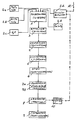
- the drawing shows the process flow in the manufacture of permanent magnets from strontium hexaferrite.
- the components of the raw material mixture are weighed in one after the other.
- a certain proportion of water 2c is also added to the raw material mixture in order to achieve good miscibility.
- the individual components of the raw material batch are dimensioned in such a way that the stoichiometric relationship between strontium oxide (SrO) and iron oxide (Fe 2 O 3 ), which is responsible for the magnetic properties, of about 5.3 to 5.5 is fulfilled.
- a fine-grained and water-dispersed calcium silicate as small component 2e is added to the raw material mixture in a proportion of 0.5 to 0.8%, which functions as a glass former in the ferrite formation process.
- the solid components iron oxide 2a and strontium carbonate 2b are fed to the feed weigher 1 via discharge screws, while the liquid components water 2C, strontium hydroxide 2d and the small component calcium silicate dispersion 2e are fed via pipelines.
- the raw material mixture is fed to a mixer 3, which is advantageously designed as an attritor or a stirring mixer.
- the raw material mixture homogenized in the attritor is then brought to the desired fineness in a continuous ball mill.
- the raw material mixture then passes through a centrifuge 4, in which excess water is centrifuged off, so that the concentrated raw material mixture is used for the highest possible throughput of the furnace designed as a continuous furnace 6 has the consistency required for the reaction fire.
- the water content in this process stage is only 20-30%, preferably 22-26%.
- the raw material mixture is conveyed from the centrifuge into the continuous furnace with the aid of a thick matter pump 5.
- a two-piston thick matter pump is advantageously used, the hydraulically actuated pistons of which operate in tandem.
- reaction-fired hexaferrite is now present in the form of granules, which are further processed into permanent magnets in subsequent production steps.
- the pasty magnetic material is compacted by means of a wet press 8 to form the green compact, which after drying is further processed in the subsequent finished sintering process in a sintering furnace 9 to the finished permanent magnet.
- the press water obtained in the wet press 8 has strontium oxide ions in dissolved form, since a certain excess of strontium oxide is used in the preparation of the magnetic paste for wet pressing.
- the press wastewater is drawn off from the discharge channels of the press tool by means of a water jet pump. Since the strontium oxide concentration in the press waste water is relatively low, the discharged press water is passed through a concentrator 10 which the strontium oxide concentration is increased, for example, by repeatedly passing the waste water stream. The water with the concentrated strontium oxide is then pumped back through a pipe into the batch container 2b of the strontium oxide solution.
- the economic advantage is that a substantial proportion of the strontium carbonate solid can be saved, since the strontium oxide which is reprocessed from waste products can be used in solution instead of the solid.
- the strontium oxide solution obtained in the production of strontium carbonate can also be used directly can be obtained from the manufacturer of the strontium carbonate without having to carry out the intermediate step, which consists of the addition of water containing carbon dioxide to the strontium oxide ions.
Landscapes
- Chemical & Material Sciences (AREA)
- Organic Chemistry (AREA)
- Engineering & Computer Science (AREA)
- Ceramic Engineering (AREA)
- Inorganic Chemistry (AREA)
- Structural Engineering (AREA)
- Manufacturing & Machinery (AREA)
- Life Sciences & Earth Sciences (AREA)
- Materials Engineering (AREA)
- Geology (AREA)
- Power Engineering (AREA)
- General Life Sciences & Earth Sciences (AREA)
- Compounds Of Iron (AREA)
- Hard Magnetic Materials (AREA)
- Manufacturing Cores, Coils, And Magnets (AREA)
- Peptides Or Proteins (AREA)
- Enzymes And Modification Thereof (AREA)
- Preparation Of Compounds By Using Micro-Organisms (AREA)
- Medicines Containing Antibodies Or Antigens For Use As Internal Diagnostic Agents (AREA)
Description
- Die Erfindung betrifft ein Verfahren zur Herstellung von Barium- oder Strontiumhexaferritpulver für die Produktion von Dauermagneten, bei dem die unter Zusatz von Wasser homogenisierte Rohstoffmischung, die Eisenoxid und Barium- bzw. Strontiumcarbonat als Feststoffe enthält, zu Hexaferrit reaktionsgebrannt wird.
- Ein solches Verfahren ist bekannt. Das mit Hilfe dieses Verfahrens hergestellte Barium- oder Strontiumhexaferritpulver wird im Anschluß an den Reaktionsbrand mittels einer Naßpresse im Magnetfeld zum Dauermagnetgrünling verpreßt, der nach dem Trocknen in einem Durchlaufofen zum fertigen Dauermagneten gesintert wird. Dieses Verfahren eignet sich vorzugsweise zur Massenproduktion von Dauermagneten, die insbesondere in Elektrokleinmotoren der Automobilindustrie eingesetzt werden.
- Um eine möglichst hohe Ausbeute an reaktionsgebranntem Hexaferritpulver zu erreichen, ist es wünschenswert, die Rohstoffmischung mit einem möglichst hohen Feststoffanteil, d.h. einem möglichst geringen Wasseranteil, in den Einlauf des Durchlaufofens einzubringen.
- Die magnetische Qualität des fertigen Dauermagneten hängt wesentlich von der mikrokristallinen Beschaffenheit des reaktionsgebrannten Hexaferritpulvers ab, die wesentlich durch das Aufbereiten der Rohstoffmischung bedingt ist. Dabei ist es erforderlich, eine möglichst homogene Mischung der eingewogenen Rohstoffe zu erreichen. Dies wird beim bekannten Verfahren dadurch erleichtert, daß der Rohstoffmischung Wasser in der erforderlichen Menge zugegeben wird, um den Feuchtigkeitsgehalt der Mischung zu erhöhen. Da jedoch beim Einlauf in den Durchlaufofen möglichst wenig Wasser vorhanden sein soll, muß entweder die Zugabemenge des Wassers begrenzt sein, oder die Rohstoffmischung muß vor dem Reaktionsbrand entwässert werden.
- Ein solches Verfahren weist insofern Schwachpunkte auf, als einerseits das Entwässern der Rohstoffmischung Kosten verursacht und andererseits die beim bekannten Verfahren erzielbaren magnetischen Werte für das Hexaferritpulver begrenzt sind. Ferner verursacht das als Feststoff zugegebene Strontiumcarbonat einen Großteil der Rohstoffkosten.
- Ferner ist ein Herstellungsverfahren für Barium- oder Strontiumhexaferritpulver bekannt, bei dem mit Hilfe der chemischen Copräzipitation aus Barium- bzw. Strontiumchloriden und Eisenchlorid unter Zusatz eines Fällungsmittels Hexaferritpulver mit guten magnetischen Eigenschaften gewonnen wird. Ein solches Verfahren ist jedoch für die großtechnische Realisierung unzulänglich, da die Kosten für das Fällungsmittel und die Metallchloride sehr hoch sind.
- Daher liegt der Erfindung die Aufgabe zugrunde, ein Verfahren der eingangs genannten Art derart zu verbessern, daß es einerseits wirtschaftlicher wird und andererseits die magnetischen Eigenschaften des Hexaferritpulvers verbessert werden.
- Diese Aufgabe wird erfindungsgemäß dadurch gelöst, daß der Rohstoffmischung eine Barium- oder Strontiumhydroxidlösung zugegeben wird, die mindestens zum Teil das Barium- bzw. Strontiumcarbonat ersetzt.
- Die Erfindung zeichnet sich dadurch aus, daß ein möglichst großer Anteil des der Rohstoffmischung als Feststoff zugegebenen Carbonates durch eine Barium- oder Strontiumhdroxidlösung ersetzt wird, bei der die Barium- oder Strontiumoxidionen in einem Lösungsmittel vorliegen. Auf diese Weise erfolgt im Mischvorgang eine Durchmischung der Rohstoffe nunmehr auf ionischer Basis. Aufgrund der besseren Mischbarkeit des Rohstoffes kann somit der Wassergehalt der Rohstoffmischung reduziert werden. Beim Mischen lagern sich die Barium- oder Strontiumoxidionen sehr viel gleichmäßiger an den Eisenoxidpartikeln an, so daß beim anschließenden Reaktionsbrand eine vollständigere Umsetzung des Rohstoffes in Hexaferrit erfolgt. Hierdurch erhöht sich die Wirtschaftlichkeit des Verfahrens. Eine Verbesserung der magnetischen Kennwerte des Hexaferritpulvers ergibt sich dadurch, daß infolge der verbesserten Durchmischung der reaktionsgesinterte Hexaferrit ein sehr enges Kornband (zwischen 0,1 bis 3 µm, vorzugsweise zwischen 0,5 und 1,5 µm) mit außerordentlich fehlerarmen Kristallen aufweist. Die Barium- oder Strontiumoxildlösung kann beim Einwiegen der Rohstoffe an einer Ansatzwaage wesentlich leichter zugeführt werden als das als Feststoff zugeführte Carbonat, welches über Transportschnecken zugeführt werden muß.
- Ein zusätzlicher wirtschaftlicher Vorteil ergibt sich dann, wenn das Barium- oder Strontiumhydroxid den Abfallprodukten des Produktionsprozesses entnommen wird. Bei einer vorteilhaften Ausgestaltung des Verfahrens wird das Hydroxid einer Vorstufe des Produktionsprozesses von Barium- bzw. Strontiumcarbonat entnommen. Beim Herstellungsvorgang der Carbonate wird die Barium- oder Strontiumoxidlösung mit kohlesäurehaltigem Wasser versetzt, wobei das Carbonat ausfällt, welches als Feststoff weiterverarbeitet wird. Wenn jedoch direkt die vor dem Versetzen mit kohlesäurehaltigem Wasser schon vorhandene Barium- oder Strontiumoxidlösung der Rohstoffmischung beigegeben wird, kann hierfür der Prozeßschritt des Ausfällens entfallen.
- Eine weitere vorteilhafte Ausführung des Verfahrens ergibt sich dann, wenn das beim Naßpressen des reaktionsgebrannten Hexaferritpulvers zum Dauermagneten anfallende Pressenabwasser, welches ebenfalls Barium- bzw. Strontiumoxidionen in Lösung enthält, für den Rohstoffansatz verwendet wird. Da üblicherweise bei der Aufbereitung des Hexaferritpulvers zum Naßpressen mit einem Barium- oder Strontiumoxidüberschuß gearbeitet wird, befindet sich das überschüssige Barium- oder Strontiumoxid im austretenden Pressenwasser. Dies ist deswegen bedeutsam, da der Barium- bzw. Strontiumoxidanteil einen wesentlichen Faktor bei den Rohstoffkosten ausmacht.
- Die Erfindung wird im folgenden anhand einer ein Ausführungsbeispiel darstellenden Zeichnung näher erläutert.
- Die Zeichnung zeigt den Verfahrensablauf bei der Herstellung von Dauermagneten aus Strontiumhexaferrit.
- Mittels einer Ansatzwaage 1 werden die Komponenten der Rohstoffmischung nacheinander eingewogen. Neben den Hauptkomponenten Eisenoxid 2a und Strontiumcarbonat 2b sowie Strontiumhydroxid 2d wird der Rohstoffmischung auch ein bestimmter Anteil Wasser 2c zugegeben, um eine gute Mischbarkeit zu erreichen. Die Bemessung der einzelnen Komponenten des Rohstoffansatzes erfolgt derart, daß die für die magnetischen Eigenschaften verantwortliche stöchiometrische Relation zwischen Strontiumoxid (SrO) und Eisenoxid (Fe2O3) von etwa 5,3 bis 5,5 erfüllt ist. Zusätzlich wird der Rohstoffmischung ein feinkörniges und in Wasser dispergiertes Calciumsilicat als Kleinkomponente 2e mit einem Anteil von 0,5 bis 0,8% zugegeben, das als Glasbildner beim Ferritbildungsprozeß fungiert.
- Die Ferststoffkomponenten Eisenoxid 2a und Strontiumcarbonat 2b werden über Austragsschnecken der Ansatzwaage 1 zugeführt, während die flüssigen Komponenten Wasser 2C, Strontiumhydroxid 2d und die Kleinkomponente Calciumsilicatdispersion 2e über Rohrleitungen zugeführt wird. Nach dem Einwiegen wird die Rohstoffmischung einem Mischer 3 zugeführt, der vorteilhafterweise als Attritor oder Rührmischer ausgeführt ist. Die im Attritor homogenisierte Rohstoffmischung wird im Anschluß daran in einer Durchlaufkugelmühle auf die gewünschte Feinheit gebracht. Anschließend durchläuft die Rohstoffmischung eine Zentrifuge 4, bei der noch überflüssiges Wasser abzentrifugiert wird, so daß die konzentrierte Rohstoffmischung die für eine möglichst hohe Durchsatzleistung des als Durchlaufofen ausgebildeten Ofens 6 für den Reaktionsbrand erforderliche Konsistenz hat. Der Wassergehalt beträgt in dieser Verfahrensstufe nur noch 20-30%, vorzugsweise 22-26%. Die Rohstoffmischung wird mit Hilfe einer Dickstoffpumpe 5 aus der Zentrifuge in den Durchlaufofen gefördert. Um eine möglichst kontinuierliche Förderung des Rohstoffstranges zu erreichen, wird vorteilhafterweise eine Zweikolbendickstoffpumpe eingesetzt, deren hydraulisch beaufschlagte Kolben in Tandemfunktion arbeiten.
- Nach Durchlauf durch den Durchlaufofen 6 liegt nunmehr reaktionsgebrannter Hexaferrit als Granulat vor, der in nachfolgenden Produktionsschritten zum Dauermagneten weiterverarbeitet wird.
- Nach einem Mahlvorgang, der sich aus einem Trockenmahlprozeß in einer Rohrschwingmühle 7a und einem nachgeschalteten Naßmahlvorgang in einer Kugelmühle 7b zusammensetzt, vor dem das aufgemahlene Pulver wieder mit Wasser versetzt wird, wird das pastöse Magnetmaterial mittels einer Naßpress 8 zum Grünling verdichtet, der nach dem Trocknen im anschließenden Fertigsinterprozeß in einem Sinterofen 9 zum fertigen Dauermagneten weiterverarbeitet wird.
- Das bei der Naßpresse 8 anfallende Pressenwasser weist Strontiumoxidionen in gelöster Form auf, da bei der Aufbereitung der Magnetpaste zum Naßpressen mit einem gewissen Strontiumoxidüberschuß gearbeitet wird. Um eine möglichst große Menge an strontiumoxidhaltigem Abwasser zu gewinnen, wird das Pressenabwasser mittels einer Wasserstrahlpumpe aus den Ablaufkanälen des Pressenwerkzeuges abgesaugt. Da die Strontiumoxidkonzentration im Pressenabwasser verhältnismäßig gering ist, wird das abgeführte Pressenwasser durch einen Konzentrator 10 geleitet, durch den die Strontiumoxidkonzentration z.B. durch mehrfaches Durchleiten des Abwasserstromes erhöht wird. Das Wasser mit dem konzentrierten Strontiumoxid wird anschließend über eine Rohrleitung in den Ansatzbehälter 2b der Strontiumoxidlösung zurückgepumpt. In diesen Ansatzbehälter 2d mündet auch eine Rohrleitung 11, aus der Strontiumhydroxid eingespeist wird, welches als Vorprodukt bei der Herstellung von Strontiumcarbonat anfällt.
- Dadurch, daß bei dem dargestellten Ausführungsbeispiel ein Großteil des Feststoffes Strontiumcarbonat unter Wahrung der stöchiometrischen Relation zwischen Strontiumoxid und Eisenoxid durch Strontiumhydroxidlösung ersetzt wird, erfolgt eine wesentlich innigere Durchmischung des Rohstoffansatzes im Mischer 3. Dies führt im Durchlaufofen 6 zu einem vollständigen Ablauf der Hexaferritbildung, so daß sich äußerst fehlerfreie Kristalle bilden, deren Größe innerhalb eines sehr engen Kornbandes liegt. Die vollständige Umsetzung in die Hexaferritphase kann durch eine Dichtemessung, beispielsweise mit Hilfe der Quecksilber-Porosimetrie, überwacht werden. Mit dem auf diese Weise hergestellten Strontiumferritpulver lassen sich im folgenden Produktionsprozeß Dauermagnete mit erheblich verbesserten magnetischen Eigenschaften herstellen.
- Der wirtschaftliche Vorteil ist darin zu sehen, daß ein erheblicher Anteil des Strontiumcarbonatfeststoffes eingespart werden kann, da das aus Abfallprodukten wierderaufbereitete Strontiumoxid in Lösung anstelle des Feststoffes verwendet werden kann.
- Darüber hinaus kann auch die bei der Herstellung von Strontiumcarbonat anfallende Strontiumoxidlösung direkt vom Hersteller des Strontiumcarbonates bezogen werden, ohne daß die Zwischenstufe, die aus der Versetzung der Strontiumoxidionen mit kohlesäurehaltigem Wasser besteht, ausgeführt werden muß.
Claims (8)
- Verfahren zur Herstellung von Barium- oder Strontiumhexaferritpulver für die Produktion von Dauermagneten, bei dem die unter Zusatz von Wasser (2c) homogenisierte Rohstoffmischung, die Eisenoxid (2a) und Barium- bzw. Strontiumcarbonat (2b) als Feststoffe enthält, zu Hexaferrit reaktionsgebrannt wird, dadurch gekennzeichnet, daß der Rohstoffmischung (2a, 2b, 2c,) eine Barium- oder Strontiumhydroxidlösung (2d) zugegeben wird, die mindestens zum Teil das Barium- bzw. Strontiumcarbonat (2b) ersetzt.
- Verfahren nach Anspruch 1, dadurch gekennzeichnet, daß die Barium- bzw. Strontiumhydroxidlösung einer Vorstufe des Produktionsprozesses für Barium- bzw. Strontiumcarbonat entnommen wird.
- Verfahren nach Anspruch 1 oder 2, dadurch gekennzeichnet, daß die Barium- bzw. Strontiumhydroxidlösung dem beim Naßpressen des reaktionsgebrannten Hexaferritpulvers zum Dauermagneten anfallenden Abwasser entnommen wird.
- Verfahren nach einem der Ansprüche 1 bis 3, dadurch gekennzeichnet, daß der Wassergehalt der Rohstoffmischung unmittelbar vor dem Reaktionsbrand (6) zwischen 20% und 30%, vorzugsweise zwischen 22% und 26% liegt.
- Verfahren nach einem der Ansprüche 1 bis 4, dadurch gekennzeichnet, daß das Kornband des Hexaferritpulvers zwischen 0,1 bis 3µm, vorzugsweise zwischen 0,5 und 1,5 µm liegt.
- Verfahren nach einem der Ansprüche 1 bis 5, dadurch gekennzeichnet, daß die Rohstoffmischung mittels einer Dickstoffpumpe (5) in den Durchlaufofen (6) gefördert wird.
- Verfahren nach Anspruch 6, dadurch gekennzeichnet, daß als Dickstoffpumpe (5) eine hydraulisch beaufschlagte, Zweikolben-Tandempumpe verwendet wird.
- Verfahren nach Anspruch 3, dadurch gekennzeichnet, daß das beim Pressen anfallende Abwasser mittels einer Wasserstrahlpumpe aus den Ablaufkanälen des Pressenwerkzeuges abgesaugt wird.
Applications Claiming Priority (2)
| Application Number | Priority Date | Filing Date | Title |
|---|---|---|---|
| DE3803596A DE3803596C1 (de) | 1988-02-06 | 1988-02-06 | |
| DE3803596 | 1988-02-06 |
Publications (2)
| Publication Number | Publication Date |
|---|---|
| EP0360842A1 EP0360842A1 (de) | 1990-04-04 |
| EP0360842B1 true EP0360842B1 (de) | 1992-09-30 |
Family
ID=6346782
Family Applications (1)
| Application Number | Title | Priority Date | Filing Date |
|---|---|---|---|
| EP89900575A Expired - Lifetime EP0360842B1 (de) | 1988-02-06 | 1988-12-22 | Verfahren zur herstellung von hexaferritpulver mit barium oder strontiumhydroxydlösung |
Country Status (5)
| Country | Link |
|---|---|
| EP (1) | EP0360842B1 (de) |
| JP (1) | JPH02503135A (de) |
| KR (1) | KR960010785B1 (de) |
| DE (2) | DE3803596C1 (de) |
| WO (1) | WO1989007088A1 (de) |
Cited By (1)
| Publication number | Priority date | Publication date | Assignee | Title |
|---|---|---|---|---|
| CN105439208A (zh) * | 2015-11-16 | 2016-03-30 | 东北大学 | 一种利用氧化铁红制备永磁锶铁氧体的方法 |
Families Citing this family (1)
| Publication number | Priority date | Publication date | Assignee | Title |
|---|---|---|---|---|
| JPH07308538A (ja) * | 1994-03-24 | 1995-11-28 | Japan Pionics Co Ltd | 有害ガスの浄化剤 |
Family Cites Families (4)
| Publication number | Priority date | Publication date | Assignee | Title |
|---|---|---|---|---|
| US3155623A (en) * | 1962-08-22 | 1964-11-03 | Gen Magnetic Corp | Method for making barium ferrite magnets |
| US3597357A (en) * | 1968-03-19 | 1971-08-03 | Westinghouse Electric Corp | Method of making strontium-ferrite magnets and the products so produced |
| US3810973A (en) * | 1973-01-12 | 1974-05-14 | Gen Electric | Method of preparing ferrites |
| DD148929A1 (de) * | 1980-02-05 | 1981-06-17 | Dietrich Kaetzel | Verfahren zur herstellung nassgepresster ferritformkoerper |
-
1988
- 1988-02-06 DE DE3803596A patent/DE3803596C1/de not_active Expired
- 1988-12-22 WO PCT/DE1988/000774 patent/WO1989007088A1/de not_active Ceased
- 1988-12-22 EP EP89900575A patent/EP0360842B1/de not_active Expired - Lifetime
- 1988-12-22 KR KR1019890701838A patent/KR960010785B1/ko not_active Expired - Fee Related
- 1988-12-22 JP JP1500299A patent/JPH02503135A/ja active Pending
- 1988-12-22 DE DE8989900575T patent/DE3875115D1/de not_active Expired - Lifetime
Non-Patent Citations (2)
| Title |
|---|
| CHEMICAL ABSTRACST, vol. 85, no.4, 26 July 1976, Columbus, OH (US); S.SOLACOLU et al., p. 295, no. 25871c. * |
| CHEMICAL ABSTRACTS, vol. 107, no. 16, October 1987, Columbus, OH (US); p. 789, no. 146098n. * |
Cited By (1)
| Publication number | Priority date | Publication date | Assignee | Title |
|---|---|---|---|---|
| CN105439208A (zh) * | 2015-11-16 | 2016-03-30 | 东北大学 | 一种利用氧化铁红制备永磁锶铁氧体的方法 |
Also Published As
| Publication number | Publication date |
|---|---|
| DE3875115D1 (de) | 1992-11-05 |
| KR960010785B1 (ko) | 1996-08-08 |
| DE3803596C1 (de) | 1989-07-20 |
| WO1989007088A1 (fr) | 1989-08-10 |
| KR900700395A (ko) | 1990-08-13 |
| EP0360842A1 (de) | 1990-04-04 |
| JPH02503135A (ja) | 1990-09-27 |
Similar Documents
| Publication | Publication Date | Title |
|---|---|---|
| DE3586807T2 (de) | Verfahren zur herstellung von tonerdekoerpern. | |
| DE1571298B2 (de) | Bindemittel für Putz- und/oder Mauermörtel sowie unter Verwendung dieses Bindemittels hergestellter Mörtel | |
| DE3508173A1 (de) | Verfahren zur herstellung von kernbrennstoff-kugeln | |
| DE69802471T2 (de) | Yttriumoxid-Aluminiumoxid Kompositteilchen und Verfahren zu deren Herstellung | |
| DE2512099C3 (de) | ||
| DE3803596C1 (de) | ||
| EP0645437B1 (de) | Farbreine Eisenoxid-Direktrotpigmente, Verfahren zu ihrer Herstellung sowie deren Verwendung | |
| DE69801221T2 (de) | Verfahren zur behandlung von zementklinker | |
| DE2330728B2 (de) | Verfahren zur herstellung eines synthetischen anhydrits einheitlicher qualitaet und dessen verwendung | |
| DE2337374C2 (de) | ||
| DE1288253B (de) | Verfahren zur Herstellung eines Kupferrohres | |
| DE19619263C2 (de) | Verfahren zur Herstellung von Leichtbaustoffen | |
| EP0642826B1 (de) | Selektive Kohlefilter | |
| DE69003311T2 (de) | Verfahren zur Herstellung von Silicaglaspulvern. | |
| DE2601683C3 (de) | Kalk-Kieselsäure-Gemisch sowie Verfahren zur Herstellung von dampfgehärteten Baustoffen daraus | |
| DE1814113C3 (de) | Verfahren zur Herstellung eines bindemittelfreien Pb3 O4 -Granulats | |
| EP0072998A2 (de) | Getterformkörper und Verfahren zu dessen Herstellung | |
| EP0690828B1 (de) | Verfahren und vorrichtung zur herstellung eines bindemittels | |
| DE3245843A1 (de) | Mahlhilfsmittel und diese enthaltende mineralmischung | |
| DE2354024C3 (de) | Verfahren zur Herstellung eines keramischen Materials auf der Basis von Siliciumaluminiumoxynitrid | |
| EP0122970B1 (de) | Tonerdeporzellanmasse | |
| DE102015121553B4 (de) | Verfahren zur Herstellung von Porenbeton und Porenbeton | |
| DE2240926B2 (de) | Verfahren zur Herstellung von Formkörpern | |
| DE2430417A1 (de) | Verfahren zum herstellen von beton mit leichtem gewicht | |
| DE1173885B (de) | Verfahren zur Herstellung von Urandioxyd |
Legal Events
| Date | Code | Title | Description |
|---|---|---|---|
| PUAI | Public reference made under article 153(3) epc to a published international application that has entered the european phase |
Free format text: ORIGINAL CODE: 0009012 |
|
| 17P | Request for examination filed |
Effective date: 19890920 |
|
| AK | Designated contracting states |
Kind code of ref document: A1 Designated state(s): DE FR GB IT |
|
| RAP3 | Party data changed (applicant data changed or rights of an application transferred) |
Owner name: ROBERT BOSCH GMBH |
|
| 17Q | First examination report despatched |
Effective date: 19910211 |
|
| GRAA | (expected) grant |
Free format text: ORIGINAL CODE: 0009210 |
|
| AK | Designated contracting states |
Kind code of ref document: B1 Designated state(s): DE FR GB IT |
|
| GBT | Gb: translation of ep patent filed (gb section 77(6)(a)/1977) | ||
| REF | Corresponds to: |
Ref document number: 3875115 Country of ref document: DE Date of ref document: 19921105 |
|
| ET | Fr: translation filed | ||
| ITF | It: translation for a ep patent filed | ||
| PLBE | No opposition filed within time limit |
Free format text: ORIGINAL CODE: 0009261 |
|
| STAA | Information on the status of an ep patent application or granted ep patent |
Free format text: STATUS: NO OPPOSITION FILED WITHIN TIME LIMIT |
|
| 26N | No opposition filed | ||
| PGFP | Annual fee paid to national office [announced via postgrant information from national office to epo] |
Ref country code: GB Payment date: 19931214 Year of fee payment: 6 |
|
| PGFP | Annual fee paid to national office [announced via postgrant information from national office to epo] |
Ref country code: FR Payment date: 19931230 Year of fee payment: 6 |
|
| PGFP | Annual fee paid to national office [announced via postgrant information from national office to epo] |
Ref country code: DE Payment date: 19940223 Year of fee payment: 6 |
|
| PG25 | Lapsed in a contracting state [announced via postgrant information from national office to epo] |
Ref country code: GB Effective date: 19941222 |
|
| GBPC | Gb: european patent ceased through non-payment of renewal fee |
Effective date: 19941222 |
|
| PG25 | Lapsed in a contracting state [announced via postgrant information from national office to epo] |
Ref country code: FR Effective date: 19950831 |
|
| PG25 | Lapsed in a contracting state [announced via postgrant information from national office to epo] |
Ref country code: DE Effective date: 19950901 |
|
| REG | Reference to a national code |
Ref country code: FR Ref legal event code: ST |
|
| PG25 | Lapsed in a contracting state [announced via postgrant information from national office to epo] |
Ref country code: IT Free format text: LAPSE BECAUSE OF NON-PAYMENT OF DUE FEES;WARNING: LAPSES OF ITALIAN PATENTS WITH EFFECTIVE DATE BEFORE 2007 MAY HAVE OCCURRED AT ANY TIME BEFORE 2007. THE CORRECT EFFECTIVE DATE MAY BE DIFFERENT FROM THE ONE RECORDED. Effective date: 20051222 |