EP0336731B2 - Verfahren zur Vermehrung und zum Nachweis von Nukleinsäuresequenzen - Google Patents
Verfahren zur Vermehrung und zum Nachweis von Nukleinsäuresequenzen Download PDFInfo
- Publication number
- EP0336731B2 EP0336731B2 EP89303351A EP89303351A EP0336731B2 EP 0336731 B2 EP0336731 B2 EP 0336731B2 EP 89303351 A EP89303351 A EP 89303351A EP 89303351 A EP89303351 A EP 89303351A EP 0336731 B2 EP0336731 B2 EP 0336731B2
- Authority
- EP
- European Patent Office
- Prior art keywords
- template
- ligation
- oligonucleotides
- stranded
- strand
- Prior art date
- Legal status (The legal status is an assumption and is not a legal conclusion. Google has not performed a legal analysis and makes no representation as to the accuracy of the status listed.)
- Expired - Lifetime
Links
- 238000000034 method Methods 0.000 title claims description 70
- 150000007523 nucleic acids Chemical group 0.000 title claims description 65
- 108091034117 Oligonucleotide Proteins 0.000 claims description 177
- JLCPHMBAVCMARE-UHFFFAOYSA-N [3-[[3-[[3-[[3-[[3-[[3-[[3-[[3-[[3-[[3-[[3-[[5-(2-amino-6-oxo-1H-purin-9-yl)-3-[[3-[[3-[[3-[[3-[[3-[[5-(2-amino-6-oxo-1H-purin-9-yl)-3-[[5-(2-amino-6-oxo-1H-purin-9-yl)-3-hydroxyoxolan-2-yl]methoxy-hydroxyphosphoryl]oxyoxolan-2-yl]methoxy-hydroxyphosphoryl]oxy-5-(5-methyl-2,4-dioxopyrimidin-1-yl)oxolan-2-yl]methoxy-hydroxyphosphoryl]oxy-5-(6-aminopurin-9-yl)oxolan-2-yl]methoxy-hydroxyphosphoryl]oxy-5-(6-aminopurin-9-yl)oxolan-2-yl]methoxy-hydroxyphosphoryl]oxy-5-(6-aminopurin-9-yl)oxolan-2-yl]methoxy-hydroxyphosphoryl]oxy-5-(6-aminopurin-9-yl)oxolan-2-yl]methoxy-hydroxyphosphoryl]oxyoxolan-2-yl]methoxy-hydroxyphosphoryl]oxy-5-(5-methyl-2,4-dioxopyrimidin-1-yl)oxolan-2-yl]methoxy-hydroxyphosphoryl]oxy-5-(4-amino-2-oxopyrimidin-1-yl)oxolan-2-yl]methoxy-hydroxyphosphoryl]oxy-5-(5-methyl-2,4-dioxopyrimidin-1-yl)oxolan-2-yl]methoxy-hydroxyphosphoryl]oxy-5-(5-methyl-2,4-dioxopyrimidin-1-yl)oxolan-2-yl]methoxy-hydroxyphosphoryl]oxy-5-(6-aminopurin-9-yl)oxolan-2-yl]methoxy-hydroxyphosphoryl]oxy-5-(6-aminopurin-9-yl)oxolan-2-yl]methoxy-hydroxyphosphoryl]oxy-5-(4-amino-2-oxopyrimidin-1-yl)oxolan-2-yl]methoxy-hydroxyphosphoryl]oxy-5-(4-amino-2-oxopyrimidin-1-yl)oxolan-2-yl]methoxy-hydroxyphosphoryl]oxy-5-(4-amino-2-oxopyrimidin-1-yl)oxolan-2-yl]methoxy-hydroxyphosphoryl]oxy-5-(6-aminopurin-9-yl)oxolan-2-yl]methoxy-hydroxyphosphoryl]oxy-5-(4-amino-2-oxopyrimidin-1-yl)oxolan-2-yl]methyl [5-(6-aminopurin-9-yl)-2-(hydroxymethyl)oxolan-3-yl] hydrogen phosphate Polymers Cc1cn(C2CC(OP(O)(=O)OCC3OC(CC3OP(O)(=O)OCC3OC(CC3O)n3cnc4c3nc(N)[nH]c4=O)n3cnc4c3nc(N)[nH]c4=O)C(COP(O)(=O)OC3CC(OC3COP(O)(=O)OC3CC(OC3COP(O)(=O)OC3CC(OC3COP(O)(=O)OC3CC(OC3COP(O)(=O)OC3CC(OC3COP(O)(=O)OC3CC(OC3COP(O)(=O)OC3CC(OC3COP(O)(=O)OC3CC(OC3COP(O)(=O)OC3CC(OC3COP(O)(=O)OC3CC(OC3COP(O)(=O)OC3CC(OC3COP(O)(=O)OC3CC(OC3COP(O)(=O)OC3CC(OC3COP(O)(=O)OC3CC(OC3COP(O)(=O)OC3CC(OC3COP(O)(=O)OC3CC(OC3COP(O)(=O)OC3CC(OC3CO)n3cnc4c(N)ncnc34)n3ccc(N)nc3=O)n3cnc4c(N)ncnc34)n3ccc(N)nc3=O)n3ccc(N)nc3=O)n3ccc(N)nc3=O)n3cnc4c(N)ncnc34)n3cnc4c(N)ncnc34)n3cc(C)c(=O)[nH]c3=O)n3cc(C)c(=O)[nH]c3=O)n3ccc(N)nc3=O)n3cc(C)c(=O)[nH]c3=O)n3cnc4c3nc(N)[nH]c4=O)n3cnc4c(N)ncnc34)n3cnc4c(N)ncnc34)n3cnc4c(N)ncnc34)n3cnc4c(N)ncnc34)O2)c(=O)[nH]c1=O JLCPHMBAVCMARE-UHFFFAOYSA-N 0.000 claims description 91
- 238000003199 nucleic acid amplification method Methods 0.000 claims description 77
- 230000003321 amplification Effects 0.000 claims description 75
- 238000006243 chemical reaction Methods 0.000 claims description 47
- 108020004707 nucleic acids Proteins 0.000 claims description 46
- 102000039446 nucleic acids Human genes 0.000 claims description 46
- 230000000295 complement effect Effects 0.000 claims description 37
- 239000011541 reaction mixture Substances 0.000 claims description 25
- 108091028043 Nucleic acid sequence Proteins 0.000 claims description 14
- FAPWRFPIFSIZLT-UHFFFAOYSA-M Sodium chloride Chemical compound [Na+].[Cl-] FAPWRFPIFSIZLT-UHFFFAOYSA-M 0.000 claims description 14
- 238000003752 polymerase chain reaction Methods 0.000 claims description 13
- 208000007056 sickle cell anemia Diseases 0.000 claims description 10
- 239000011780 sodium chloride Substances 0.000 claims description 7
- 208000026350 Inborn Genetic disease Diseases 0.000 claims description 5
- 208000016361 genetic disease Diseases 0.000 claims description 5
- 108020004414 DNA Proteins 0.000 claims description 4
- 241000894006 Bacteria Species 0.000 claims description 3
- 238000012408 PCR amplification Methods 0.000 claims description 3
- 240000004808 Saccharomyces cerevisiae Species 0.000 claims description 3
- 241000700605 Viruses Species 0.000 claims description 3
- 238000003745 diagnosis Methods 0.000 claims description 3
- 201000010099 disease Diseases 0.000 claims 1
- 208000037265 diseases, disorders, signs and symptoms Diseases 0.000 claims 1
- 239000000047 product Substances 0.000 description 91
- 210000004027 cell Anatomy 0.000 description 29
- 108091005904 Hemoglobin subunit beta Proteins 0.000 description 27
- 239000000758 substrate Substances 0.000 description 27
- 239000002773 nucleotide Substances 0.000 description 19
- 102100021519 Hemoglobin subunit beta Human genes 0.000 description 17
- 125000003729 nucleotide group Chemical group 0.000 description 17
- 102000004190 Enzymes Human genes 0.000 description 12
- 108090000790 Enzymes Proteins 0.000 description 12
- 238000000211 autoradiogram Methods 0.000 description 10
- 208000005980 beta thalassemia Diseases 0.000 description 10
- 239000013612 plasmid Substances 0.000 description 10
- 239000000523 sample Substances 0.000 description 10
- 108010061982 DNA Ligases Proteins 0.000 description 9
- 102000012410 DNA Ligases Human genes 0.000 description 9
- 108090000623 proteins and genes Proteins 0.000 description 9
- 108700028369 Alleles Proteins 0.000 description 8
- 102000003960 Ligases Human genes 0.000 description 8
- 108090000364 Ligases Proteins 0.000 description 8
- 208000000859 Sickle cell trait Diseases 0.000 description 8
- 238000009835 boiling Methods 0.000 description 8
- 239000007795 chemical reaction product Substances 0.000 description 8
- 239000000499 gel Substances 0.000 description 8
- 238000001514 detection method Methods 0.000 description 7
- 108091032973 (ribonucleotides)n+m Proteins 0.000 description 5
- 239000012528 membrane Substances 0.000 description 5
- 239000000203 mixture Substances 0.000 description 5
- 229940124276 oligodeoxyribonucleotide Drugs 0.000 description 5
- 230000002285 radioactive effect Effects 0.000 description 5
- 239000012634 fragment Substances 0.000 description 4
- 238000009396 hybridization Methods 0.000 description 4
- 230000035772 mutation Effects 0.000 description 4
- 108091008146 restriction endonucleases Proteins 0.000 description 4
- QTBSBXVTEAMEQO-UHFFFAOYSA-N Acetic acid Chemical compound CC(O)=O QTBSBXVTEAMEQO-UHFFFAOYSA-N 0.000 description 3
- 108091033380 Coding strand Proteins 0.000 description 3
- KCXVZYZYPLLWCC-UHFFFAOYSA-N EDTA Chemical compound OC(=O)CN(CC(O)=O)CCN(CC(O)=O)CC(O)=O KCXVZYZYPLLWCC-UHFFFAOYSA-N 0.000 description 3
- 239000004677 Nylon Substances 0.000 description 3
- 108091000080 Phosphotransferase Proteins 0.000 description 3
- 239000011543 agarose gel Substances 0.000 description 3
- 238000004925 denaturation Methods 0.000 description 3
- 230000036425 denaturation Effects 0.000 description 3
- VHJLVAABSRFDPM-QWWZWVQMSA-N dithiothreitol Chemical compound SC[C@@H](O)[C@H](O)CS VHJLVAABSRFDPM-QWWZWVQMSA-N 0.000 description 3
- 238000001962 electrophoresis Methods 0.000 description 3
- 229920001778 nylon Polymers 0.000 description 3
- 102000020233 phosphotransferase Human genes 0.000 description 3
- 229920002401 polyacrylamide Polymers 0.000 description 3
- 238000002264 polyacrylamide gel electrophoresis Methods 0.000 description 3
- 239000000243 solution Substances 0.000 description 3
- 102100033195 DNA ligase 4 Human genes 0.000 description 2
- 239000003155 DNA primer Substances 0.000 description 2
- 108010067770 Endopeptidase K Proteins 0.000 description 2
- 101000927810 Homo sapiens DNA ligase 4 Proteins 0.000 description 2
- 101000899111 Homo sapiens Hemoglobin subunit beta Proteins 0.000 description 2
- TWRXJAOTZQYOKJ-UHFFFAOYSA-L Magnesium chloride Chemical compound [Mg+2].[Cl-].[Cl-] TWRXJAOTZQYOKJ-UHFFFAOYSA-L 0.000 description 2
- 101710163270 Nuclease Proteins 0.000 description 2
- 108020005187 Oligonucleotide Probes Proteins 0.000 description 2
- 239000002202 Polyethylene glycol Substances 0.000 description 2
- 208000002903 Thalassemia Diseases 0.000 description 2
- 239000007983 Tris buffer Substances 0.000 description 2
- 229920004890 Triton X-100 Polymers 0.000 description 2
- 238000004458 analytical method Methods 0.000 description 2
- 238000003556 assay Methods 0.000 description 2
- 230000015572 biosynthetic process Effects 0.000 description 2
- 210000004369 blood Anatomy 0.000 description 2
- 239000008280 blood Substances 0.000 description 2
- 238000004587 chromatography analysis Methods 0.000 description 2
- 238000001816 cooling Methods 0.000 description 2
- 230000000694 effects Effects 0.000 description 2
- ZMMJGEGLRURXTF-UHFFFAOYSA-N ethidium bromide Chemical compound [Br-].C12=CC(N)=CC=C2C2=CC=C(N)C=C2[N+](CC)=C1C1=CC=CC=C1 ZMMJGEGLRURXTF-UHFFFAOYSA-N 0.000 description 2
- 229960005542 ethidium bromide Drugs 0.000 description 2
- 108010052305 exodeoxyribonuclease III Proteins 0.000 description 2
- 238000001502 gel electrophoresis Methods 0.000 description 2
- 238000010438 heat treatment Methods 0.000 description 2
- 238000011534 incubation Methods 0.000 description 2
- 238000002372 labelling Methods 0.000 description 2
- 239000012160 loading buffer Substances 0.000 description 2
- 239000002751 oligonucleotide probe Substances 0.000 description 2
- 229920001223 polyethylene glycol Polymers 0.000 description 2
- 238000002360 preparation method Methods 0.000 description 2
- 239000013615 primer Substances 0.000 description 2
- 238000000746 purification Methods 0.000 description 2
- 239000000376 reactant Substances 0.000 description 2
- 238000000926 separation method Methods 0.000 description 2
- LENZDBCJOHFCAS-UHFFFAOYSA-N tris Chemical compound OCC(N)(CO)CO LENZDBCJOHFCAS-UHFFFAOYSA-N 0.000 description 2
- GPRLSGONYQIRFK-MNYXATJNSA-N triton Chemical class [3H+] GPRLSGONYQIRFK-MNYXATJNSA-N 0.000 description 2
- XLYOFNOQVPJJNP-UHFFFAOYSA-N water Substances O XLYOFNOQVPJJNP-UHFFFAOYSA-N 0.000 description 2
- QKNYBSVHEMOAJP-UHFFFAOYSA-N 2-amino-2-(hydroxymethyl)propane-1,3-diol;hydron;chloride Chemical compound Cl.OCC(N)(CO)CO QKNYBSVHEMOAJP-UHFFFAOYSA-N 0.000 description 1
- BTBUEUYNUDRHOZ-UHFFFAOYSA-N Borate Chemical compound [O-]B([O-])[O-] BTBUEUYNUDRHOZ-UHFFFAOYSA-N 0.000 description 1
- 102100024533 Carcinoembryonic antigen-related cell adhesion molecule 1 Human genes 0.000 description 1
- KRKNYBCHXYNGOX-UHFFFAOYSA-K Citrate Chemical compound [O-]C(=O)CC(O)(CC([O-])=O)C([O-])=O KRKNYBCHXYNGOX-UHFFFAOYSA-K 0.000 description 1
- 208000006992 Color Vision Defects Diseases 0.000 description 1
- 108020004635 Complementary DNA Proteins 0.000 description 1
- 102000053602 DNA Human genes 0.000 description 1
- 108010014303 DNA-directed DNA polymerase Proteins 0.000 description 1
- 102000016928 DNA-directed DNA polymerase Human genes 0.000 description 1
- 241000196324 Embryophyta Species 0.000 description 1
- 102100031780 Endonuclease Human genes 0.000 description 1
- 241000588724 Escherichia coli Species 0.000 description 1
- 241000701533 Escherichia virus T4 Species 0.000 description 1
- 108060002716 Exonuclease Proteins 0.000 description 1
- 229920001917 Ficoll Polymers 0.000 description 1
- 208000031220 Hemophilia Diseases 0.000 description 1
- 208000009292 Hemophilia A Diseases 0.000 description 1
- 101000981093 Homo sapiens Carcinoembryonic antigen-related cell adhesion molecule 1 Proteins 0.000 description 1
- 102100024319 Intestinal-type alkaline phosphatase Human genes 0.000 description 1
- 101710184243 Intestinal-type alkaline phosphatase Proteins 0.000 description 1
- 241001465754 Metazoa Species 0.000 description 1
- 108060004795 Methyltransferase Proteins 0.000 description 1
- 101000586272 Mus musculus Osteocalcin-2 Proteins 0.000 description 1
- OKIZCWYLBDKLSU-UHFFFAOYSA-M N,N,N-Trimethylmethanaminium chloride Chemical compound [Cl-].C[N+](C)(C)C OKIZCWYLBDKLSU-UHFFFAOYSA-M 0.000 description 1
- 108020004711 Nucleic Acid Probes Proteins 0.000 description 1
- 108010092799 RNA-directed DNA polymerase Proteins 0.000 description 1
- 102000006382 Ribonucleases Human genes 0.000 description 1
- 108010083644 Ribonucleases Proteins 0.000 description 1
- 241000589500 Thermus aquaticus Species 0.000 description 1
- XSQUKJJJFZCRTK-UHFFFAOYSA-N Urea Chemical compound NC(N)=O XSQUKJJJFZCRTK-UHFFFAOYSA-N 0.000 description 1
- ZKHQWZAMYRWXGA-KNYAHOBESA-N [[(2r,3s,4r,5r)-5-(6-aminopurin-9-yl)-3,4-dihydroxyoxolan-2-yl]methoxy-hydroxyphosphoryl] dihydroxyphosphoryl hydrogen phosphate Chemical compound C1=NC=2C(N)=NC=NC=2N1[C@@H]1O[C@H](COP(O)(=O)OP(O)(=O)O[32P](O)(O)=O)[C@@H](O)[C@H]1O ZKHQWZAMYRWXGA-KNYAHOBESA-N 0.000 description 1
- 238000009825 accumulation Methods 0.000 description 1
- FROZIYRKKUFAOC-UHFFFAOYSA-N amobam Chemical compound N.N.SC(=S)NCCNC(S)=S FROZIYRKKUFAOC-UHFFFAOYSA-N 0.000 description 1
- 238000005571 anion exchange chromatography Methods 0.000 description 1
- 238000000376 autoradiography Methods 0.000 description 1
- 208000022806 beta-thalassemia major Diseases 0.000 description 1
- 238000010804 cDNA synthesis Methods 0.000 description 1
- 244000309466 calf Species 0.000 description 1
- 239000004202 carbamide Substances 0.000 description 1
- 239000003795 chemical substances by application Substances 0.000 description 1
- 201000007254 color blindness Diseases 0.000 description 1
- 239000002299 complementary DNA Substances 0.000 description 1
- 150000001875 compounds Chemical class 0.000 description 1
- 210000004748 cultured cell Anatomy 0.000 description 1
- 238000000326 densiometry Methods 0.000 description 1
- 230000001419 dependent effect Effects 0.000 description 1
- 238000002405 diagnostic procedure Methods 0.000 description 1
- 238000012631 diagnostic technique Methods 0.000 description 1
- 238000010586 diagram Methods 0.000 description 1
- 230000029087 digestion Effects 0.000 description 1
- 102000013165 exonuclease Human genes 0.000 description 1
- GNBHRKFJIUUOQI-UHFFFAOYSA-N fluorescein Chemical compound O1C(=O)C2=CC=CC=C2C21C1=CC=C(O)C=C1OC1=CC(O)=CC=C21 GNBHRKFJIUUOQI-UHFFFAOYSA-N 0.000 description 1
- 230000002068 genetic effect Effects 0.000 description 1
- BHEPBYXIRTUNPN-UHFFFAOYSA-N hydridophosphorus(.) (triplet) Chemical compound [PH] BHEPBYXIRTUNPN-UHFFFAOYSA-N 0.000 description 1
- 210000004698 lymphocyte Anatomy 0.000 description 1
- 229910001629 magnesium chloride Inorganic materials 0.000 description 1
- 239000000463 material Substances 0.000 description 1
- 238000002156 mixing Methods 0.000 description 1
- 238000012544 monitoring process Methods 0.000 description 1
- 239000013642 negative control Substances 0.000 description 1
- 238000002205 phenol-chloroform extraction Methods 0.000 description 1
- 238000006366 phosphorylation reaction Methods 0.000 description 1
- 238000006116 polymerization reaction Methods 0.000 description 1
- 239000013641 positive control Substances 0.000 description 1
- 239000002243 precursor Substances 0.000 description 1
- 239000002987 primer (paints) Substances 0.000 description 1
- 238000011160 research Methods 0.000 description 1
- PYWVYCXTNDRMGF-UHFFFAOYSA-N rhodamine B Chemical compound [Cl-].C=12C=CC(=[N+](CC)CC)C=C2OC2=CC(N(CC)CC)=CC=C2C=1C1=CC=CC=C1C(O)=O PYWVYCXTNDRMGF-UHFFFAOYSA-N 0.000 description 1
- 229920006298 saran Polymers 0.000 description 1
- 239000011734 sodium Substances 0.000 description 1
- 239000001488 sodium phosphate Substances 0.000 description 1
- 229910000162 sodium phosphate Inorganic materials 0.000 description 1
- 238000010186 staining Methods 0.000 description 1
- 239000007858 starting material Substances 0.000 description 1
- 230000002194 synthesizing effect Effects 0.000 description 1
- RYFMWSXOAZQYPI-UHFFFAOYSA-K trisodium phosphate Chemical compound [Na+].[Na+].[Na+].[O-]P([O-])([O-])=O RYFMWSXOAZQYPI-UHFFFAOYSA-K 0.000 description 1
Images



Classifications
-
- C—CHEMISTRY; METALLURGY
- C12—BIOCHEMISTRY; BEER; SPIRITS; WINE; VINEGAR; MICROBIOLOGY; ENZYMOLOGY; MUTATION OR GENETIC ENGINEERING
- C12Q—MEASURING OR TESTING PROCESSES INVOLVING ENZYMES, NUCLEIC ACIDS OR MICROORGANISMS; COMPOSITIONS OR TEST PAPERS THEREFOR; PROCESSES OF PREPARING SUCH COMPOSITIONS; CONDITION-RESPONSIVE CONTROL IN MICROBIOLOGICAL OR ENZYMOLOGICAL PROCESSES
- C12Q1/00—Measuring or testing processes involving enzymes, nucleic acids or microorganisms; Compositions therefor; Processes of preparing such compositions
- C12Q1/68—Measuring or testing processes involving enzymes, nucleic acids or microorganisms; Compositions therefor; Processes of preparing such compositions involving nucleic acids
- C12Q1/6844—Nucleic acid amplification reactions
- C12Q1/6862—Ligase chain reaction [LCR]
-
- A—HUMAN NECESSITIES
- A61—MEDICAL OR VETERINARY SCIENCE; HYGIENE
- A61P—SPECIFIC THERAPEUTIC ACTIVITY OF CHEMICAL COMPOUNDS OR MEDICINAL PREPARATIONS
- A61P7/00—Drugs for disorders of the blood or the extracellular fluid
-
- C—CHEMISTRY; METALLURGY
- C12—BIOCHEMISTRY; BEER; SPIRITS; WINE; VINEGAR; MICROBIOLOGY; ENZYMOLOGY; MUTATION OR GENETIC ENGINEERING
- C12Q—MEASURING OR TESTING PROCESSES INVOLVING ENZYMES, NUCLEIC ACIDS OR MICROORGANISMS; COMPOSITIONS OR TEST PAPERS THEREFOR; PROCESSES OF PREPARING SUCH COMPOSITIONS; CONDITION-RESPONSIVE CONTROL IN MICROBIOLOGICAL OR ENZYMOLOGICAL PROCESSES
- C12Q1/00—Measuring or testing processes involving enzymes, nucleic acids or microorganisms; Compositions therefor; Processes of preparing such compositions
- C12Q1/68—Measuring or testing processes involving enzymes, nucleic acids or microorganisms; Compositions therefor; Processes of preparing such compositions involving nucleic acids
- C12Q1/6844—Nucleic acid amplification reactions
- C12Q1/6858—Allele-specific amplification
Definitions
- This invention relates to a method of amplifying nucleic acid sequences.
- Saiki, R.K., et al., Science 230 :1350 (1985) describes enzymatic amplification of ⁇ -globin genomic sequences, termed the polymerase chain reaction, by providing two oligonucleotide primers flanking the region to be amplified, annealing the primers to strands of denatured genomic DNA and extending them with the Klenow fragment of E. coli DNA polymerase 1 and deoxyribonucleosidetriphosphates.
- U.S. Patent 4,683,202 to Mullis further describes the polymerase chain reaction method.
- U.S. Patent 4,683,194 to Saiki, et al. describes a method of detecting a specific polymorphic restriction site in a nucleic acid sequence by hybridizing the sequence to an oligonucleotide probe complementary to the sequence and spanning the restriction site which is labeled at the end of the probe nearer to the restriction site.
- the nucleic acid sequence and probe hybridized thereto are then digested with a restriction endonuclease, labeled and unlabeled oligomer fragments are separated, and labeled oligonucleotides are detected.
- U.S. Patent 4,683,195 to Mullis et al. describes a process for amplifying nucleic acid sequences using primers and polymerization agents and a process for detecting the presence or absence of a specific nucleic acid sequence. Separate strands of a nucleic acid sample are treated with an excess of two different oligonucleotide primers, and primers are extended to form complementary extension products which act as templates for synthesizing the desired nucleic acid sequence. The amplified sequence is then detected by adding a labeled probe capable of hybridizing to the sequence being detected.
- EP 0 246 864 discloses a split probe hybrid assay wherein a target base sequence lies at the terminal end of a first probe and said terminal end is contiguous with a second probe which may then be linked, by means of a ligase enzyme, to the first probe. The signal thus produced is then amplified, in contrast to the oresent invention wherein the target base sequence itself is amplified.
- the present invention is useful in diagnostic applications because it can be used first, as a means for amplifying given nucleic acid sequences from nucleic acid templates so that the template sequences can be more readily detected.
- a single-stranded template comprising the target sequence and at least one pair of oligonucleotides is hybridised to contiguous sequences of the template such that the oligonucleotides are juxtaposed for ligation on the template.
- the juxtaposed oligonucleotides are ligated to produce a double-stranded ligation product and the double-stranded ligation product is denatured to produce an initial template strand and an oligonucleotide ligation product strand.
- the present invention provides a method for amplifying a nucleic acid comprising a target sequence comprising the steps of:
- the present invention provides a method for amplifying a nucleic acid comprising a target sequence, said method comprising the steps of:
- the present invention provides a method for simultaneously amplifying a plurality of nucleic acid sequences present in one or more nucleic acid molecules each comprising a target sequence, said method comprising the steps of:
- the present invention provides a method for the diagnosis of a genetic disease comprising analysing the genotype of a patient by a method which comprises amplifying a nucleic acid comprising a target sequence, said amplification method comprising the steps of :
- the present invention provides a method for amplifying a nucleic acid comprising a target sequence from genomic DNA, said amplification method comprising the steps of:
- the present invention provides a method for amplifying a nucleic acid comprising a target sequence comprising the steps of:
- the present invention provides a method for amplifying a nucleic acid comprising a target sequence comprising the steps of:
- the present invention provides a method for amplifying a nucleic acid comprising a target sequence comprising the steps of:
- the method of the present invention can be used both to amplify any particular nucleic acid sequence template and distinguish and detect single base differences on nucleic acid templates.
- the present invention is therefore useful to diagnose various genetic disorders that result from point mutations such as sickle cell anemia.
- signal amplification is necessary in order to detect the limited number of DNA template copies in genomic DNA. For example, there are only about one million copies of a single gene in 10 ug of DNA. Further, depending on the particular diagnostic procedure performed, only a limited amount of DNA might be available.
- short oligonucleotide strands are synthesized complementary to a nucleic acid template.
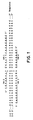
- These relatively short oligonucleotides are generally denoted ON-1, ON-2, ON-3, and ON-4 as illustrated in Fig. 1.
- the oligonucleotides may be synthesized according to methods well known in the art.
- the lengths of the oligonucleotides must be sufficiently long to contain enough of a unique base pattern to cause the oligonucleotides to hybridize or anneal to only the portions of the nucleic acid template which constitutes the target sequence of interest.
- the exact lengths of the oligonucleotides depends on various factors, including the temperature of the reaction, pH conditions, and complexity of the target sequence. In general, oligonucleotides comprising about 4 to about 100 nucleotides form sufficiently stable hybrid complexes at higher reaction temperatures. In most instances, oligonucleotides used in accordance with the present invention preferably comprise about 8 to about 20 nucleotides.
- nucleic acid template which is either single or double stranded. If the nucleic acid template comprises two strands, it is necessary to first separate the strands prior to commencing ligation amplification of the present invention.
- One method of separation of strands of nucleic acid involves heating the nucleic acid until it is completely denatured. Such denaturation is usually carried out at temperatures ranging from about 80° to 105°C for times ranging from about 1 to 10 minutes. Separation of nucleic acid strands may also be induced by enzymes such as the helicase enzymes and Rec A.
- the specific nucleic acid sequence to be amplified may be only a fraction of a larger molecule or it can be a discrete molecule.
- the sequence to be amplified can also be a part of a larger mixture of molecules or fractions thereof.
- the starting nucleic acid may also contain more than one desired sequence containing target bases which may be the same or different, such that all such sequences can be simultaneously amplified. Samples comprising more than one nucleic acid with more than one desired target sequence can also be amplified by the methods of the present invention.
- RNA is used as an initial template, it can be first copied into a DNA molecule by an enzyme such as reverse transcriptase.
- the template is the ⁇ a normal beta globin allele with target base pair *A-T*; in Fig. 2, the template is the ⁇ s sickle cell allele with target base pair *T-A*.
- the particular templates and flanking oligonucleotides shown in Figs. 1 and 2 only illustrate the present invention and in no way limit the invention to the detection or amplification of alleles of the human beta globin gene.
- Oligonucleotides ON-2 and ON-4 are 8-nucleotide long oligonucleotides and ON-1 and ON-3 are 14-nucleotide long oligonucleotides.
- the method of the present invention requires a symmetry similar to that shown in Fig. 1, namely, the 3' oligonucleotides, ON-2 and ON-4, are of the same length and the 5' oligonucleotides, ON-1 and ON-3, are the same length.
- Either the two 3' or two 5' oligonucleotides can be the longer length, or all four oligonucleotides can be the same length.
- the 5' ends of the 3' oligonucleotides must, however, be phosphorylated and those ends can also be optionally labeled with, for example, radioactive phosphorous.
- the 5' oligonucleotides (ON-1 and ON-3) are not usually phosphorylated to prevent self ligation and template-independent ligation.
- the methods of the present invention are not, however, limited to the above-described instances involving single base or single base pair differences.
- the oligonucleotide complementary region can thus contain more than one base or base pair difference which enables the methods of this invention to be used for discrimination and detection of sequences containing multiple base differences.
- the pairs of oligonucleotides are complementary to a nucleic acid sequence harboring the position of possible mutation on either strand. Further, with double-stranded templates, one of the terminal bases of one of the two 3' oligonucleotides and one of the terminal bases of one of the two 5' oligonucleotides to be ligated must be complementary to a base pair in the target sequence. Thus, as shown in Fig.
- base T, ON-2 is complementary to the base A of the (+) template strand
- nucleotide at the 3' end of one of the 5' flanking oligonucleotides is complementary to the base T of the (-) template strand.
- 3' oligonucleotide ON-2 is synthesized so that it is complementary to the ( + ) or upper strand of the template and its 5' end contains base T which is complementary to base A of the (+) strand, and the remainder of the oligonucleotide extends outwardly from the 5' end base.
- 5' oligonucleotide ON-1 is synthesized so that it is complementary to the (+) or upper strand of the template and is oriented such that the base at its 3' end C, is complementary to the base of the (+) strand on the 3' side of the base A on the template. The remainder of the oligonucleotide extends outwardly in the 5' direction.
- 5' oligonucleotide ON-3 is complementary to the (-) or lower strand of the template such that base A at its 3' end is complementary to the base T of the (-) strand and the remainder of ON-3 extends outwardly from that base.
- 3' oligonucleotide ON-4 is complementary to the (-) or lower strand of the template and is oriented such that base G at the 5' end of ON-4 is complementary to the base of the (-) strand that is on the 5' side of the base T. The remainder of ON-4 extends outwardly in the 3' direction.
- the bases on the 5'end of ON-2 and 3' end of ON-3 are complementary to the A-T base pair shown in the target sequence.
- the oligonucleotides can be double-stranded, for example: Such double-stranded oligonucleotides must be treated as described above to separate the strands prior to any amplification ligation reaction.
- polynucleotide ligase ligates ON-1 and ON-2, and/or ON-3 and ON-4 to form significant amounts of longer ligated products only if the correct complementary target bases are present at the site of the template corresponding to the ligation junction.
- Any suitable polynucleotide ligase can be used in the practice of this invention, for example, bacteriophage T4 induced DNA ligase, and E. coli DNA ligase.
- the two oligonucleotides in each pair anneal to the beta globin template at adjacent positions such that the 3' end of one oligonucleotide (ON-1 or ON-s3) and the 5' end of the other (ON-s2 or ON-4) form a ligatable junction.
- the nucleotide T or A on the template pairs with either the 3' end nucleotide or the 5' end nucleotide of the substrate depending on which strand, (+) or (-), serves as the template for ligation.
- the success or failure of a given ligation amplification procedure can be detected by labeling the oligonucleotides with radioactive or fluorescent labels.
- radioactive or fluorescent labels For example, 32 P, 35 S or any other suitable radionuclide may be used as well as other suitable compounds such as fluorescein or rhodamine or their derivatives.
- Ligation amplification product can also be ascertained via any subsequent manipulation that allows distinction between longer ligation product and the shorter precursors such as gel electrophoresis chromatography or hybridization.
- polyacrylamide gel electrophoresis can be used to separate the ligated product from the flanking oligonucleotide reactants according to their sizes.
- the herein described ligation amplifications can be accomplished in a linear or exponential manner as illustrated in the following examples.
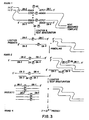
- the steps for exponential ligation-amplification are shown in Fig. 3.
- the DNA sequences of synthetic oligonucleotide substrates and templates used in the examples are given below in Table 1.
- H ⁇ 19S and H ⁇ 19A are unique 19 nucleotide long oligonucleotides that are complementary to the noncoding strand of the beta globin gene and serve as oligonucleotide templates for ligation of ON-1/ON-2 pairs.
- H ⁇ 23S' and H ⁇ 23A', 23 nucleotides long are complementary to the coding strand of the beta globin gene. These two nucleotides serve as templates for ligation of ON-3/ON-4 pairs.
- ON-1/ON-s2 and ON-1/ON-a2 pairs both hybridize to the coding (+) strand, ON-52 and ON-a2 differ by a single nucleotide at their 5' ends, with ON-s2 specifying for the sickle cell allele.
- ON-s3/ON-4 and ON-a3/ON-4 pairs hybridize to the noncoding strand with ON-s3 and ON-a3 differing by a single nucleotide at their 3' ends.
- a set comprising at least one of the pairs of oligonucleotide substrates ON-1/ON-a2 and ON-a3/ON-4 are used for the normal beta globin sequence and at least one of the pairs ON-1/ON-s2 and ON-s3/ON-4 are used for detecting the sickle cell sequence.
- template dependent ligation of either the ON-1/ON-2 or ON-3/ON-4 pairs forms a 22 base product with a sequence complementary to the other substrate pairs.
- ON-1-ON-a2 product would be complementary to ON-a3/ON-4 substrates and ON-s3-ON-4 product would be complementary to ON-1/ON-s2 substrates.
- the ligation products can then serve as template for the ligation of the other pair of oligonucleotide substrates thereby producing more templates for further ligation. If the initial ligation step does not take place as a result of base pair mismatch, subsequent amplification steps will not give rise to a detectable ligation signal.
- the 22 nucleotide long ligation product Once the 22 nucleotide long ligation product is formed, it stays hybridized to its template. Denaturation separates the duplex to yield two new templates. If denaturation is accomplished by boiling, the ligase in the reaction mixture is inactivated. Fresh enzyme must therefore be added to initiate the next round of amplification.
- oligodeoxyribonucleotide ligation reactions on oligonucleotide templates were carried out, unless otherwise indicated, in 50 mM Tris HCl (pH 7.6), 10 mM MgCl 2 , 1 mM DTT (dithiothreitol), 1 mM ATP, 200 mM NaCl and 5% PEG (polyethyleneglycol) with 5-10 ⁇ m of each substrate oligonucleotide mixed with a small amount of radioactively labeled 3' oligonucleotide substrate (100,000-300,000 cpm) and the indicated amount of template.
- Plasmid and genomic DNA template reactions are initiated following 5-10 minutes of boiling, cooling on ice and the addition of ligase (1 U; BRL). Unless otherwise indicated, all ligation reactions are withdrawn for electrophoresis and optionally treated with calf intestinal alkaline phosphatase (1-5 U) for 1-2 hours.
- Linear amplification ligation of nucleic acid sequences is carried out by repeatedly using the original nucleic acid template (oligo, plasmid or genomic DNA) in each round of amplification. Only one oligonucleotide set complementary to the appropriate oligonucleotide template to one strand of duplex plasmid or genomic DNA template is used. For example, either the ON-1 and ON-2, or ON-3 and ON-4 set is used in the amplification rounds but not both.
- Each round of ligation is initiated by adding 1 unit of ligase to the reaction mixture on ice.
- the mixture is incubated for about 30 minutes at 30°C, or for a longer time if template concentration is low.
- the first round, and all subsequent rounds, is terminated by quickly heating the reaction mixture to 100°C for 5 minutes to inactivate the ligase and dissociate the ligated product strand (ON-1 - ON-2) from the template. This frees the template for subsequent amplification rounds.
- the reaction mixture is centrifuged for 10 seconds and immediately cooled to about 0°C. At this point, there is approximately one ON-1-ON-2 ligation product present for each copy of the template.
- Another unit of enzyme is added to the reaction mixture to initiate a second round of ligation. Because a molar excess of oligonucleotides ON-1 and ON-2 are added to the initial reaction mixture, more oligonucleotide substrated are not added.
- the reaction mixture is then incubated as in the first round, boiled to dissociate template from the ligation product, and cooled. At this point, there are approximately 2 copies of ON-1-ON-2 ligation product present for each copy of template.
- Fresh enzyme is added to initiate another round. The steps of incubating, boiling to dissociate template from product, cooling, and adding fresh enzyme are repeated for as many rounds as necessary to produce a detectable signal.
- ON-1 and/or ON-2 can be labeled with radioactive or nonradioactive labels and separated from the reactants by gel electrophoresis, such that ligation product is determined by detecting the presence of label in a position in the gel corresponding to the expected product size.
- ON-a2, ON-s2, and ON-4 are phosphorylated at their 5' ends with either radioactive ( ⁇ [ 32 P] ATP 6000 Ci/mmol; New England Nuclear) or nonradioactive ATP via a kinase reaction.
- the unlabeled 5' phosphorylated substrates are used following incubation in a boiling water bath for 20 minutes to inactive kinase.
- Internal radioactively phosphorylated oligonucleotide products are separated from unreacted ATP and other reaction products with anion exchange chromatography (DE-52 cellulose-Whatman®).
- the radioactive phosphorylation reaction yields products with approximately 10 8 -10 9 cpm/pmol specific activity.
- Detection and quantitation of ligation product by polyacrylamide gel electrophoresis is carried out by mixing samples from ligation reactions with Ficoll loading buffer and subjecting the mixture to electrophoresis in TBE (89 mM Tris, 89 mM Borate, 2 mM EDTA) in 20% polyacrylamide (Bio-Rad) urea (7M) gel at 600 V. for 1.5 hours. The gel is then wrapped in Saran Wrap and autoradiographed between two Lightning Plus intensifier screens (DuPont) overnight. Quantitation of ligation product is obtained either from densitometric measurements of the autoradiograph or directly from the gel via an AMBIS Radioisotope Scanning System II (Automated Microbiology System, Inc.). In the latter instance the polyacrylamide gel is first fixed in a 5% acetic acid solution for 10 minutes.
- the ON-1 - ON-2 ligation product can also be detected by hybridizing the product containing solution to a substrate containing an immobilized complementary DNA or RNA sequence under conditions whereby the ON-1 - ON-2 ligation product will hybridize to the complementary sequence, but neither ON-1 nor ON-2 will. Bound label indicates presence of ligation product.
- the ligated product can also be detected in a subsequent round of ligation employing a radiolabeled counterpart substrate set (ON-3/ON-4). In the case where Ligated ON-3/ON-4 is to be detected, labeled ON-1/ON-2 would be used.
- the product level after N-number of rounds of linear amplification-ligation is equal to N x Q where Q is the efficiency of the ligation.
- Q ranges from 0 to 1, where 1 is equivalent to 100% ligation.
- ON-1/ON-s2* and ON-s3/ON-4* were ligated linearly on oligonucleotide templates using the above methodology.
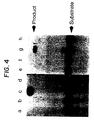
- ON-s2* and ON-s4* are the same as ON-s2 and ON-4 except that they are only 6 nucleotides long. 10 pmoles of 32 P-5' phosphorylated ON-s2* and unlabeled 5' OH-ON-1 (lanes a-d) or 32 P-5' phosphorylated ON-4* and unlabeled 5' OH-ON-s3 (lanes e-h) were ligated on 19 base long or 23 base long oligonucleotide template respectively at 30°C for 30 minutes with 1 U.
- Fig. 4 shows the results of the ligation amplification reactions described below.
- 1 pmole of the following oligonucleotide template was used: H ⁇ 19S (c); H ⁇ 19A (d); H ⁇ 23S' (g); and H ⁇ 23A' - (h).
- the method of the present invention can also be used to exponentially amplify nucleic acid sequences.
- the major difference between exponential amplification ligation and the above-described linear amplification ligation is that all four oligonucleotides (ON-1/ON-2, and ON-3/ON-4) are present as substrates during each reaction round.
- the ligation product of either oligonucleotide set serves as the template for the other oligonucleotide set in subsequent amplification rounds as shown in Fig. 3.
- Radioactively labeled substrate for detection can be included in the starting materials or can be added in the last round.
- ligation efficiency is present at later rounds where the primary template source is ligated oligonucleotide products. During early rounds, ligation efficiency may be lower depending upon reaction conditions, types of ligase used, and source of template.
- Each round of exponential ligation is started by adding one unit of enzyme to the reaction mixture on ice.
- the reaction mixture with the added enzyme is incubated for about 30 minutes at 30°C or for a longer period of time if template concentration is low.
- the reaction mixture is quickly brought to boiling temperature for 5 minutes to inactivate the enzyme and dissociate the product strands from the template strands. Then the reaction mixture is centrifuged for 10 seconds and immediately cooled to about 0°C.
- T4 ligase Another unit of T4 ligase is then added to initiate the second round of amplification.
- the mixture is then incubated, boiled, and cooled as above. At this point there are 3 copies of template present for each copy present at the beginning of the reaction. All subsequent rounds of amplification are carried out by the same sequence of steps for as many times needed in order to produce a detectable signal.
- the progress of the amplification may be monitored by withdrawing from the reaction mixture an approximately 10 ⁇ l aliquot of reaction mixture during predetermined rounds.
- the withdrawn material is heat inactivated and is then combined with 2 to 3 ⁇ l of loading buffer. 2 ⁇ l of this buffered mixture is then loaded onto a 20% polyacrylamide gel and the gel is electrophoresed for one hour at 600V and then autoradiographed overnight with two DuPont Lightening-Plus intensifier screens.
- Fig. 5A is an autoradiogram showing the results of monitoring each round of reaction for each template.
- the ligation reaction was specific for the H ⁇ 23S' template containing the sickle cell sequence.
- the oligonucleotide substrates were not able to ligate in the presence of the H ⁇ 23A' template.
- Fig. 5B shows a logarithmic plot of amplification folds as a function of the number of rounds of ligation amplification performed. A straight line was obtained with a calculated efficiency of 0.98.
- the ligation product of the preceding round serves effectively as the template for further oligonucleotide ligation.
- the methods of the present invention can also be used to detect plasmid and genomic DNA sequences as illustrated in the following example.
- Templates for amplification ligation were derived from plasmids pH ⁇ a and pH ⁇ s which contain respectively an approximately 4.4kbp normal ( ⁇ a ) and sickle cell ( ⁇ s ) beta globin gene insert. All DNA preparations were performed according to a modified Triton® X-100 procedure followed by Proteinase K and RNase treatment.
- the plasmid DNA was treated with restriction enzyme (Bam HI and/or Taq I) and Exonuclease III (Exo III) prior to serving as template in ligation reactions as follows: pH ⁇ a and pH ⁇ b were separately digested with Bam HI (5 U/pmol) for 2 hours at 37°C and terminated in a boiling water bath for 5 minutes. Exo III (100 U/pmol) was then added to the reaction mixture with DTT to make a final concentration of 1 mM. The mixture was incubated 4 hours at 37°C. Phenol-chloroform extraction was performed for final purification.
- restriction enzyme Bam HI and/or Taq I
- Exo III Exonuclease III
- Fig. 6 shows the results of the ligation amplification.
- Product in lanes a-c resulted from reactions not including template
- product in lanes d-f resulted from reactions containing pH ⁇ s template
- product in lanes g-i resulted from reactions containing pH ⁇ a template.
- Reaction products in lanes a, d, and g were withdrawn and analyzed after 10 rounds
- products in lanes b, e, and h were analyzed after 12 rounds
- products in lanes c, f, and i were analyzed after 14 rounds.
- Beta thalassemia major DNA was prepared from EBV transformed lymphocytes in culture (GM 2267 cells from NIGMS Human Genetic Mutant Cell Repository, Camden, N.J.). Thalassemia DNA was subsequently isolated from cultured cells. All DNA preparations were performed according to a modified Triton® X-100 procedure followed by Proteinase K and RNAse treatment.
- Genomic DNA (5 ⁇ g) was digested with Taq I restriction enzyme (10 U/ ⁇ g) (Boehringer Mannheim) overnight at 65°C and followed by Bam HI digestion (10 U./ ⁇ g) (Bethesda Research Laboratory) for 8 hours at 37°C. Subsequently Exo III nuclease (100 U./pmol) was added to the reaction mixture along with DTT to make 1 mM final concentration and the reaction was incubated for 5 hours at 37°C. Phenol-chloroform extraction was carried out for final purification.
- Ligation conditions for genomic DNA and for plasmid DNA are identical except that the total volume of the reaction for the genomic DNA sample is 200 ⁇ l.
- Genomic DNA from ⁇ thalassemia, sickle cell, and normal DNA were amplified using 200 nM of the following sets of oligonucleotides: 32 P-5' labeled ON-s2 (10 6 cpm)/ 32 P-5' labeled ON-4 (10 6 cpm)/5' OH-ON-1/5' OH-ON-s3; and 32 P-5' labeled ON-2 (10 6 cpm)/ 32 P-5' labeled ON-4 (10 6 cpm)/5' OH-ON-1/5' OH-ON-3.
- 5 ⁇ g of genomic DNA contains approximately 500,000 molecules of homozygous single copy gene.
- 5 ug of DNA When used as a template in a 200 ⁇ l reaction mixture, 5 ug of DNA is equivalent to 2.5 x 10 -14 M with respect to template. This concentration is well below the apparent K m of T4 DNA ligase for ligation template. The enzyme activity is therefore expected to be slowed considerably.
- early rounds of the ligation were incubated for a longer time period. The ligation time for initial rounds was 5 hours. With subsequent rounds, the incubation time was gradually reduced to 30 minutes.
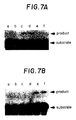
- Figs. 7A and 7B show the results of 70-75 rounds of exponential amplification using these templates and oligonucleotides
- Fig. 7A contains amplification product resulting from the ⁇ s oligonucleotide set
- Fig. 7B contains amplification product resulting from the ⁇ a oligonucleotide set.
- Lanes a and b of each autoradiogram contain reaction product using ⁇ thalassemia genomic DNA template
- lanes c and d contain product from sickle cell genomic DNA template
- lanes e and f contain product using normal beta globin genomic DNA template.
- reaction mixture was incubated 3 hours at 30°C and the reaction was terminated by boiling.
- a second round of amplification was initiated by adding another 0.5 U. of enzyme.
- the reaction mixture was again incubated 3 hours.
- Three rounds of ligation amplification were performed.
- the resulting products were then electrophoresed and autoradiographed as described above.
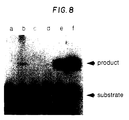
- Fig. 8 shows the resulting autoradiogram.
- Lane a contains reaction product using ⁇ -thalassemia template
- lane b contains reaction product using sickle cell template
- lane c contains reaction product using normal beta globin template. Positive controls were performed with 0.01, 1, and 10 fmoles of H ⁇ 19S template (lanes d-f respectively).
- Lane b shows the expected product
- lanes a and c show an expected lack of product.
- the methods of the present invention can also be used as a means to detect amplification product from other nucleic acid amplification methods such as the polymerase chain reaction.
- Amplification reactions were performed with Polymerase Chain Reaction Kit (Gene Amp Kit, Perkin-Elmer Cetus) including 2.5 U of Thermus aquaticus DNA polymerase and 2.5 ⁇ M of oligonucleotide primers BGP1 and BGP2, 19 base long synthetic oligodeoxyribonucleotides which anneal to the beta globin gene at positions 256 nucleotides apart.
- the enriched 294 base pair fragment contains the ⁇ globin sequence of interest.
- Exponential ligation amplification was then performed on 20 ⁇ l samples of the PCR enriched sequences for 4 rounds with either 200 nM of ⁇ s oligonucleotides (ON-1/ON-s2 and ON-s3/ON-4) or 200 nM of ⁇ a oligonucleotides (ON-1/ON-a2 and ON-a3/ON-4) in a 100 ⁇ l or total reaction volume using T4 DNA ligase. 50 ⁇ l from each samples was analyzed by 20% polyacrylamide gel electrophoresis.
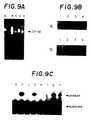
- Ethidium bromide staining of the 1.5% agarose gel shows a single 294 base pair band (Fig.9A, lanes c-e).
- Lanes of Fig. 9A are: (a)-controi; (b) - ⁇ thalassemia; (c) - homozygous sickle cell trait; (d) - normal ⁇ globin; and (e) - heterozygous sickle cell trait.
- PCR amplification of thalassemia DNA (Panel A lane b) amplifies some nonspecific DNA's but shows no 294 base pair band.
- Oligonucleotide hybridization analysis of the PCR enriched samples confirms that the enriched DNA's indeed contain beta globin sequence of interest (Fig. 9B).
- PCR enriched 256 base pair fragments ideally serve as template in the ligation analysis since they are relatively abundant which overcomes the ligase kinetic constraints (i.e., high Km for template).
- Ligation amplification performed on these 294 base pair templates (Fig. 9C templates: a,e - ⁇ thalassemia; b,f - Homozygous sickle cell disease; c,g - normal ⁇ globin; d,h -heterozygous sickle cell trait) with ⁇ s
- oligonucleotide substrates showed positive ligation for sickle cell disease and sickle cell trait samples (Fig. 9C, lanes b and d).
- Ligation amplification with ⁇ a (Fig. 9C, lanes e-h) oligonucleotide substrates is likewise positive for normal and sickle cell trait samples (Fig. 9C, lanes g and h).
Landscapes
- Chemical & Material Sciences (AREA)
- Organic Chemistry (AREA)
- Life Sciences & Earth Sciences (AREA)
- Health & Medical Sciences (AREA)
- Engineering & Computer Science (AREA)
- Proteomics, Peptides & Aminoacids (AREA)
- Zoology (AREA)
- Wood Science & Technology (AREA)
- Chemical Kinetics & Catalysis (AREA)
- General Health & Medical Sciences (AREA)
- Bioinformatics & Cheminformatics (AREA)
- Biochemistry (AREA)
- Molecular Biology (AREA)
- Microbiology (AREA)
- Immunology (AREA)
- Biotechnology (AREA)
- Biophysics (AREA)
- Analytical Chemistry (AREA)
- General Engineering & Computer Science (AREA)
- Physics & Mathematics (AREA)
- Genetics & Genomics (AREA)
- Hematology (AREA)
- Diabetes (AREA)
- General Chemical & Material Sciences (AREA)
- Medicinal Chemistry (AREA)
- Nuclear Medicine, Radiotherapy & Molecular Imaging (AREA)
- Pharmacology & Pharmacy (AREA)
- Animal Behavior & Ethology (AREA)
- Public Health (AREA)
- Veterinary Medicine (AREA)
- Measuring Or Testing Involving Enzymes Or Micro-Organisms (AREA)
- Saccharide Compounds (AREA)
- Medicines That Contain Protein Lipid Enzymes And Other Medicines (AREA)
- Investigating Or Analysing Biological Materials (AREA)
Claims (17)
- Verfahren zur Amplifikation einer Nucleinsäure mit einer Zielsequenz, umfassend die Schritte:wobei die Schritte (b) bis (e) in einem Reaktionsgemisch, welche mindestens 200 mmol NaCl enthält, durchgeführt werden.(a) Erzeugung einer einzelsträngigen Matrize mit der Zielsequenz,(b) Hybridisierung eines Oligonucleotidpaares an angrenzende Sequenzen der Matrize, wobei die angrenzenden Sequenzen die Zielsequenz umfassen, so daß die Oligonucleotide an die Matrize zur Ligation aneinander gelagert werden,(c) Ligation der aneinander gelagerten Oligonucleotide, um ein doppelsträngiges Ligationsprodukt herzustellen,(d) Denaturierung des doppelsträngigen Ligationsproduktes, um einen ursprünglichen Matrizenstrang und einen Oligonucleotid-Ligationsproduktstrang herzustellen, und(e) Wiederholung der Schritte (b) bis (d), so daß beide, der ursprüngliche Matrizenstrang und der Oligonucleotid-Ligationsstrang, als Matrizen für eine weitere Ligationsreaktion fungieren,
- Verfahren zur Amplifikation einer Nucleinsäure mit einer Zielsequenz, wobei das Verfahren die Schritte umfaßt:(a) Erzeugung einer einzelsträngigen Matrize mit der Zielsequenz,(b) Amplifikation der Matrize durch Polymerasekettenreaktion (PCR), um ein PCR-Amplifikationsprodukt herzustellen, welches vielfache Kopien der Matrize mit der Zielsequenz umfaßt,(c) Hybridisierung von Oligonucleotidpaaren an angrenzende Sequenzen der Kopien der Matrize, wobei die angrenzenden Sequenzen die Zielsequenz umfassen, so daß die Oligonucleotide an die Matrizenkopien zur Ligation aneinander gelagert werden,(d) Ligation der aneinander gelagerten Oligonucleotide, um doppelsträngige Produkte herzustellen,(e) Denaturierung des doppelsträngigen Produktes, um eine Vielzahl der ursprünglichen Matrizenstränge und eine Vielzahl der Oligonucleotid-Produktstränge herzustellen, und(f) Wiederholung der Schritte (c) bis (e), so daß beide, die ursprünglichen Matrizenstränge und die Oligonucleotid-Ligationsstränge, als Matrizen für eine weitere Ligationsreaktion fungieren.
- Verfahren zur gleichzeitigen Amplifikation einer Vielzahl von Nucleinsäuresequenzen, die in einem oder mehreren Nucleinsäuremolekülen vorliegen, welche jede eine Zielsequenz umfassen, wobei das Verfahren die Schritte umfaßt:(a) Erzeugung, wie angemessen, einer einzelsträngigen Matrize mit Zielsequenzen oder einer Vielzahl von einzelsträngigen Matrizen, welche jede eine Zielsequenz umfassen,(b) Hybridisierung einer Vielzahl von Oligonucleotidpaaren an angrenzende Sequenzen der Matrize(n), wobei die angrenzenden Sequenzen die Zielsequenzen umfassen, so daß jedes der Oligonucleotidpaare an eine Matrize zur Ligation aneinander gelagert wird,(c) Ligation der so aneinander gelagerten Oligonucleotidpaare, um ein doppelsträngiges Ligationsprodukt herzustellen,(d) Denaturierung des doppelsträngigen Ligationsprodukts, um die ursprünglichen Matrizenstränge und Oligonucleotid-Ligationsproduktstränge herzustellen, und(e) Wiederholung der Schritte (b) bis (d), so daß beide, die ursprünglichen Matrizenstränge und die Oligonucleotid-Ligationsproduktstränge, als Matrizen für weitere Ligationsreaktionen fungieren.
- Verfahren zur Diagnose einer Erbkrankheit, welches das Analysieren des Genotyps eines Patienten durch ein Verfahren umfaßt, welches die Amplifikation einer Nucleinsäure umfaßt, die eine Zielsequenz umfaßt, wobei das Amplifikationsverfahren die Schritte umfaßt:(a) Erzeugung einer einzelsträngigen Matrize einer Zielsequenz,(b) Hybridisierung eines Oligonucleotidpaares an angrenzende Sequenzen der Matrize, wobei die angrenzenden Sequenzen die Zielsequenz umfassen, so daß die Oligonucleotide an die Matrize zur Ligation aneinander gelagert werden,(c) Ligation der aneinander gelagerten Oligonucleotide, um ein doppelsträngiges Ligationsprodukt herzustellen,(d) Denaturierung des doppelsträngigen Ligationsproduktes, um einen ursprünglichen Matrizenstrang und einen Oligonucleotid-Ligationsproduktstrang herzustellen, und(e) Wiederholung der Schritte (b) bis (d), so daß beide, der ursprüngliche Matrizenstrang und der Oligonucleotid-Ligationsproduktstrang, als Matrizen für eine weiter Ligationsreaktion fungieren.
- Verfahren nach einem der Ansprüche 1 bis 4, worin die Nucleinsäure DNA ist.
- Verfahren nach einem der Ansprüche 1 bis 4, worin die Nucleinsäure RNA ist.
- Verfahren zur Amplifikation einer Nucleinsäure mit einer Zielsequenz aus genomischer DNA, wobei das Amplifikationsverfahren die Schritte umfaßt:(a) Erzeugung einer einzelsträngigen Matrize mit der Zielsequenz,(b) Hybridisierung eines Oligonucleotidpaares an angrenzende Sequenzen der Matrize, wobei die angrenzenden Sequenzen die Zielsequenz umfassen, so daß die Oligonucleotide an die Matrize zur Ligation aneinander gelagert werden,(c) Ligation der aneinander gelagerten Oligonucleotide, um ein zweisträngiges Ligationsprodukt herzustellen,(d) Denaturierung des doppelsträngigen Ligationsprodukts, um einen ursprünglichen Matrizenstrang und einen Oligonucleotid-Ligationsproduktstrang herzustellen, und(e) Wiederholung der Schritte (b) bis (d), so daß beide, der ursprüngliche Matrizenstrang und der Oligonucleotid-Ligationsproduktstrang, als Matrizen für eine weitere Ligationsreaktion fungieren.
- Verfahren zur Diagnose von Erbkrankheiten, umfassend das Analysieren des Genotyps eines Patienten durch das Verfahren nach einem der Ansprüche 1 bis 7.
- Verfahren nach Anspruch 7 oder 8, wobei die Erkrankung Sichelzellanämie ist.
- Verfahren nach einem der Ansprüche 1 bis 9, wobei die einzelsträngige Matrize durch Dissoziierung der komplementären Stränge einer doppelsträngigen Nucleinsäure erzeugt wird.
- Verfahren nach Anspruch 10, wobei beide komplementären Stränge als Matrizen verwendet werden.
- Verfahren nach einem der Ansprüche 1 bis 11, ferner umfassend das Herstellen eines Amplifikationsproduktes durch Wiederholung des Schrittes (e) und anschließendem Bestimmen der Anwesenheit oder Abwesenheit einer Nucleinsäuresequenz, die komplementär oder identisch zu der Zielsequenz im Amplifikationsprodukt ist.
- Verfahren zur Amplifikation einer Nucleinsäure mit einer Zielsequenz, umfassend die Schritte:wobei die Matrizennucleinsäure aus Bakterien stammt.(a) Erzeugung einer einzelsträngigen Matrize mit der Zielsequenz,(b) Hybridisierung eines Oligonucleotidpaares an angrenzende Sequenzen der Matrize, wobei die angrenzenden Sequenzen die Zielsequenz umfassen, so daß die Oligonucleotide an die Matrize zur Ligation aneinander gelagert werden,(c) Ligation der aneinander gelagerten Oligonucleotide, um einen doppelsträngiges Ligationsprodukt herzustellen,(d) Denaturierung des doppelsträngigen Ligationsprodukts, um einen ursprünglichen Matrizenstrang und einen Oligonucleotid-Ligationsproduktstrang herzustellen, und(e) Wiederholung der Schritte (b) bis (d), so daß beide, der ursprüngliche Matrizenstrang und der Oligonucleotid-Ligationsstrang, als Matrizen für eine weitere Ligationsreaktion fungieren,
- Verfahren zur Amplifikation einer Nucleinsäure mit einer Zielsequenz, umfassend die Schritte:wobei die Matrizennucleinsäure aus Hefe stammt.(a) Erzeugung einer einzelsträngigen Matrize mit der Zielsequenz,(b) Hybridisierung eines Oligonucleotidpaares an angrenzende Sequenzen der Matrize, wobei die angrenzenden Sequenzen die Zielsequenz umfassen, so daß die Oligonucleotide an die Matrize zur Ligation aneinander gelagert werden,(c) Ligation der aneinander gelagerten Oligonucleotide, um ein doppelsträngiges Ligationsprodukt herzustellen,(d) Denaturierung des doppelsträngigen Ligationsprodukts, um einen ursprünglichen Matrizenstrang und einen Oligonucleotid-Ligationsproduktstrang herzustellen, und(e) Wiederholung der Schritte (b) bis (d), so daß beide, der ursprüngliche Matrizenstrang und der Oligonucleotid-Ligationsstrang als Matrizen für eine weitere Ligationsreaktion fungieren,
- Verfahren zur Amplifikation einer Nucleinsäure mit einer Zielsequenz, umfassend die Schritte:(a) Erzeugung einer einzelsträngigen Matrize mit der Zielsequenz,(b) Hybridisierung eines Oligonucleotidpaares an angrenzende Sequenzen der Matrize, wobei die angrenzenden Sequenzen die Zielsequenz umfassen, so daß die Oligonucleotide an die Matrize zur Ligation aneinander gelagert werden, und(c) Ligation der aneinander gelagerten Oligonucleotide, um ein doppelsträngiges Ligationsprodukt herzustellen,(d) Denaturierung des doppelsträngigen Ligationsproduktes, um einen ursprünglichen Matrizenstrang und einen Oligonucleotid-Ligationsproduktstrang herzustellen, und(e) Wiederholung der Schritte (b) bis (d), so daß beide, der ursprüngliche Matrizenstrang und der Oligonucleotid-Ligationsstrang, als Matrizen für eine weitere Ligationsreaktion fungieren, wobei die Matrizennucleinsäure aus einem Virus stammt.
- Verfahren nach einem der Ansprüche 13 bis 15, worin die Nucleinsäure DNA ist.
- Verfahren nach einem der Ansprüche 13 bis 15, worin die Nucleinsäure RNA ist.
Applications Claiming Priority (2)
| Application Number | Priority Date | Filing Date | Title |
|---|---|---|---|
| US17837788A | 1988-04-06 | 1988-04-06 | |
| US178377 | 1993-12-23 |
Publications (4)
| Publication Number | Publication Date |
|---|---|
| EP0336731A2 EP0336731A2 (de) | 1989-10-11 |
| EP0336731A3 EP0336731A3 (en) | 1990-02-28 |
| EP0336731B1 EP0336731B1 (de) | 1994-05-11 |
| EP0336731B2 true EP0336731B2 (de) | 2004-01-07 |
Family
ID=22652312
Family Applications (1)
| Application Number | Title | Priority Date | Filing Date |
|---|---|---|---|
| EP89303351A Expired - Lifetime EP0336731B2 (de) | 1988-04-06 | 1989-04-05 | Verfahren zur Vermehrung und zum Nachweis von Nukleinsäuresequenzen |
Country Status (6)
| Country | Link |
|---|---|
| EP (1) | EP0336731B2 (de) |
| JP (1) | JP2954232B2 (de) |
| AU (1) | AU630087B2 (de) |
| CA (1) | CA1341584C (de) |
| DE (1) | DE68915202T3 (de) |
| NZ (1) | NZ228580A (de) |
Cited By (6)
| Publication number | Priority date | Publication date | Assignee | Title |
|---|---|---|---|---|
| US7291463B2 (en) | 1996-01-23 | 2007-11-06 | Affymetrix, Inc. | Nucleic acid labeling compounds |
| US7329496B2 (en) | 1990-12-06 | 2008-02-12 | Affymetrix, Inc. | Sequencing of surface immobilized polymers utilizing microflourescence detection |
| US7582420B2 (en) | 2001-07-12 | 2009-09-01 | Illumina, Inc. | Multiplex nucleic acid reactions |
| US7955794B2 (en) | 2000-09-21 | 2011-06-07 | Illumina, Inc. | Multiplex nucleic acid reactions |
| US8076063B2 (en) | 2000-02-07 | 2011-12-13 | Illumina, Inc. | Multiplexed methylation detection methods |
| US8486625B2 (en) | 1999-04-20 | 2013-07-16 | Illumina, Inc. | Detection of nucleic acid reactions on bead arrays |
Families Citing this family (123)
| Publication number | Priority date | Publication date | Assignee | Title |
|---|---|---|---|---|
| AU622426B2 (en) * | 1987-12-11 | 1992-04-09 | Abbott Laboratories | Assay using template-dependent nucleic acid probe reorganization |
| US5449602A (en) * | 1988-01-13 | 1995-09-12 | Amoco Corporation | Template-directed photoligation |
| US8148065B1 (en) * | 1988-04-06 | 2012-04-03 | City Of Hope | Ligation amplification of nucleic acid sequences |
| ATE144556T1 (de) * | 1988-06-24 | 1996-11-15 | Amgen Inc | Verfahren und mittel zum nachweis von nukleinsäuresequenzen |
| AU629845B2 (en) * | 1988-08-30 | 1992-10-15 | Abbott Laboratories | Detection and amplification of target nucleic acid sequences |
| US5035996A (en) | 1989-06-01 | 1991-07-30 | Life Technologies, Inc. | Process for controlling contamination of nucleic acid amplification reactions |
| US5683896A (en) * | 1989-06-01 | 1997-11-04 | Life Technologies, Inc. | Process for controlling contamination of nucleic acid amplification reactions |
| DE69118930T2 (de) * | 1990-01-26 | 1997-01-09 | Abbott Lab | Verbessertes Verfahren zur Amplifikation von Nuklein säurezielsequenz, einsetzbar für die Polymerase und Ligasekettenreaktion |
| US6013431A (en) | 1990-02-16 | 2000-01-11 | Molecular Tool, Inc. | Method for determining specific nucleotide variations by primer extension in the presence of mixture of labeled nucleotides and terminators |
| US5494810A (en) * | 1990-05-03 | 1996-02-27 | Cornell Research Foundation, Inc. | Thermostable ligase-mediated DNA amplifications system for the detection of genetic disease |
| CA2049879A1 (en) * | 1990-08-30 | 1992-03-01 | Keith C. Backman | Controlled initial target-dependent production of templates for ligase chain reaction |
| JPH07505293A (ja) * | 1992-03-31 | 1995-06-15 | アボツト・ラボラトリーズ | 多重リガーゼ連鎖反応方法 |
| US5869252A (en) * | 1992-03-31 | 1999-02-09 | Abbott Laboratories | Method of multiplex ligase chain reaction |
| US6100099A (en) * | 1994-09-06 | 2000-08-08 | Abbott Laboratories | Test strip having a diagonal array of capture spots |
| US6277570B1 (en) | 1993-04-13 | 2001-08-21 | Naxcor | Nucleic acid sequence detection employing probes comprising non-nucleosidic coumarin derivatives as polynucleotide-crosslinking agents |
| US6495676B1 (en) | 1993-04-13 | 2002-12-17 | Naxcor | Nucleic acid sequence detection employing probes comprising non-nucleosidic coumarin derivatives as polynucleotide-crosslinking agents |
| US5616464A (en) * | 1994-12-27 | 1997-04-01 | Naxcor | Nucleic acid sequence detection employing amplification probes |
| US5767259A (en) | 1994-12-27 | 1998-06-16 | Naxcor | Oligonucleotides containing base-free linking groups with photoactivatable side chains |
| EP0734457A1 (de) * | 1994-01-26 | 1996-10-02 | HYBRIDON, Inc. | Verfahren für den Nachweis von Oligonnukleotiden in biologischen Flüssigkeiten |
| SE9400522D0 (sv) * | 1994-02-16 | 1994-02-16 | Ulf Landegren | Method and reagent for detecting specific nucleotide sequences |
| DE69506393T2 (de) * | 1994-04-04 | 1999-07-01 | Ciba Corning Diagnostics Corp., Medfield, Mass. | Hybridisation-ligitation-verfahren zum nachweis von spezifischen dns sequenzen |
| SE9403805D0 (sv) * | 1994-11-07 | 1994-11-07 | Ulf Landegren | Method of preparing oligonucleotide probes or primers, vector therefor and use thereof |
| US6113905A (en) * | 1995-01-06 | 2000-09-05 | The Regents Of The University Of California | Borna disease viral sequences, diagnostics and therapeutics for nervous system diseases |
| US6015660A (en) * | 1995-01-06 | 2000-01-18 | The Regents Of The University Of California | Borna disease viral sequences, diagnostics and therapeutics for nervous system diseases |
| US6077510A (en) * | 1995-01-06 | 2000-06-20 | Regents Of The University Of California | Borna disease viral sequences, diagnostics and therapeutics for nervous system diseases |
| US5801155A (en) | 1995-04-03 | 1998-09-01 | Epoch Pharmaceuticals, Inc. | Covalently linked oligonucleotide minor grove binder conjugates |
| US6312894B1 (en) | 1995-04-03 | 2001-11-06 | Epoch Pharmaceuticals, Inc. | Hybridization and mismatch discrimination using oligonucleotides conjugated to minor groove binders |
| EP0880598A4 (de) | 1996-01-23 | 2005-02-23 | Affymetrix Inc | Verfahren zur analyse von nukleinsäure |
| US7282327B2 (en) | 1996-01-23 | 2007-10-16 | Affymetrix, Inc. | Nucleic acid labeling compounds |
| US7423143B2 (en) | 1996-01-23 | 2008-09-09 | Affymetrix. Inc. | Nucleic acid labeling compounds |
| US6864059B2 (en) | 1996-01-23 | 2005-03-08 | Affymetrix, Inc. | Biotin containing C-glycoside nucleic acid labeling compounds |
| US20010018514A1 (en) | 1998-07-31 | 2001-08-30 | Mcgall Glenn H. | Nucleic acid labeling compounds |
| JP2002515738A (ja) * | 1996-01-23 | 2002-05-28 | アフィメトリックス,インコーポレイティド | 核酸分析法 |
| US6965020B2 (en) | 1996-01-23 | 2005-11-15 | Affymetrix, Inc. | Nucleic acid labeling compounds |
| US6127121A (en) | 1998-04-03 | 2000-10-03 | Epoch Pharmaceuticals, Inc. | Oligonucleotides containing pyrazolo[3,4-D]pyrimidines for hybridization and mismatch discrimination |
| US7014994B1 (en) | 1999-03-19 | 2006-03-21 | Cornell Research Foundation,Inc. | Coupled polymerase chain reaction-restriction-endonuclease digestion-ligase detection reaction process |
| CA2370976C (en) | 1999-04-20 | 2009-10-20 | Illumina, Inc. | Detection of nucleic acid reactions on bead arrays |
| US8481268B2 (en) | 1999-05-21 | 2013-07-09 | Illumina, Inc. | Use of microfluidic systems in the detection of target analytes using microsphere arrays |
| US8080380B2 (en) | 1999-05-21 | 2011-12-20 | Illumina, Inc. | Use of microfluidic systems in the detection of target analytes using microsphere arrays |
| AT410218B (de) | 1999-08-20 | 2003-03-25 | Baxter Ag | Verfahren zur herstellung eines qualitätsgesicherten pools biologischer proben |
| US7205105B2 (en) | 1999-12-08 | 2007-04-17 | Epoch Biosciences, Inc. | Real-time linear detection probes: sensitive 5′-minor groove binder-containing probes for PCR analysis |
| ATE412774T1 (de) | 2000-02-16 | 2008-11-15 | Illumina Inc | Parallele genotypisierung mehrerer patientenproben |
| CA2425663C (en) | 2000-10-11 | 2009-12-29 | Applera Corporation | Fluorescent nucleobase conjugates having anionic linkers |
| EP1366192B8 (de) | 2000-10-24 | 2008-10-29 | The Board of Trustees of the Leland Stanford Junior University | Direkte multiplex charakterisierung von genomischer dna |
| CA2440615A1 (en) | 2001-03-12 | 2002-09-19 | Affymetrix, Inc. | Nucleic acid labeling compounds |
| WO2004059289A2 (en) | 2001-05-22 | 2004-07-15 | Epicentre Technologies | Target-dependent transcription using deletion mutants of n4 rna polymerase |
| CA2453527A1 (en) | 2001-07-12 | 2003-01-23 | Illumina, Inc. | Multiplex nucleic acid reactions |
| KR101078977B1 (ko) | 2002-11-07 | 2011-11-01 | 세키스이 메디칼 가부시키가이샤 | 유전자 변이 검출법 |
| EP1636337A4 (de) | 2003-06-20 | 2007-07-04 | Illumina Inc | Verfahren und zusammensetzungen zur ganzgenomischen amplifikation und genotypisierung |
| US20040259100A1 (en) | 2003-06-20 | 2004-12-23 | Illumina, Inc. | Methods and compositions for whole genome amplification and genotyping |
| US7348146B2 (en) | 2003-10-02 | 2008-03-25 | Epoch Biosciences, Inc. | Single nucleotide polymorphism analysis of highly polymorphic target sequences |
| WO2005043127A2 (en) | 2003-10-28 | 2005-05-12 | Epoch Biosciences, Inc. | Fluorescent probes for dna detection by hybridization with improved sensitivity and low background |
| EP1756562A1 (de) | 2004-05-21 | 2007-02-28 | Atonomics A/S | Ein hydrogel umfassender oberflächenschallwellensensor |
| US8383345B2 (en) | 2008-09-12 | 2013-02-26 | University Of Washington | Sequence tag directed subassembly of short sequencing reads into long sequencing reads |
| GB201001088D0 (en) | 2010-01-23 | 2010-03-10 | Trillion Genomics Ltd | Detection |
| US8828688B2 (en) | 2010-05-27 | 2014-09-09 | Affymetrix, Inc. | Multiplex amplification methods |
| US9074251B2 (en) | 2011-02-10 | 2015-07-07 | Illumina, Inc. | Linking sequence reads using paired code tags |
| WO2013082164A1 (en) | 2011-11-28 | 2013-06-06 | Life Technologies Corporation | Enhanced ligation reactions |
| WO2012106546A2 (en) | 2011-02-02 | 2012-08-09 | University Of Washington Through Its Center For Commercialization | Massively parallel continguity mapping |
| US9181583B2 (en) | 2012-10-23 | 2015-11-10 | Illumina, Inc. | HLA typing using selective amplification and sequencing |
| US9683230B2 (en) | 2013-01-09 | 2017-06-20 | Illumina Cambridge Limited | Sample preparation on a solid support |
| EP3553175B1 (de) | 2013-03-13 | 2021-07-14 | Illumina, Inc. | Verfahren zur herstellung von nukleinsäuresequenzierungsbibliotheken |
| AU2013382195B2 (en) | 2013-03-13 | 2019-09-19 | Illumina, Inc. | Methods and systems for aligning repetitive DNA elements |
| EP3080268A1 (de) | 2013-12-09 | 2016-10-19 | Illumina, Inc. | Verfahren und zusammensetzungen zur gezielten nukleinsäuresequenzierung |
| US10246746B2 (en) | 2013-12-20 | 2019-04-02 | Illumina, Inc. | Preserving genomic connectivity information in fragmented genomic DNA samples |
| WO2015108663A1 (en) | 2014-01-16 | 2015-07-23 | Illumina, Inc. | Amplicon preparation and sequencing on solid supports |
| US9677132B2 (en) | 2014-01-16 | 2017-06-13 | Illumina, Inc. | Polynucleotide modification on solid support |
| US20150353989A1 (en) | 2014-06-09 | 2015-12-10 | Illumina Cambridge Limited | Sample preparation for nucleic acid amplification |
| WO2015189636A1 (en) | 2014-06-13 | 2015-12-17 | Illumina Cambridge Limited | Methods and compositions for preparing sequencing libraries |
| US10829814B2 (en) | 2014-06-19 | 2020-11-10 | Illumina, Inc. | Methods and compositions for single cell genomics |
| WO2016003814A1 (en) | 2014-06-30 | 2016-01-07 | Illumina, Inc. | Methods and compositions using one-sided transposition |
| CN107075545A (zh) | 2014-07-30 | 2017-08-18 | 哈佛学院院长及董事 | 探针文库构建 |
| WO2016040602A1 (en) | 2014-09-11 | 2016-03-17 | Epicentre Technologies Corporation | Reduced representation bisulfite sequencing using uracil n-glycosylase (ung) and endonuclease iv |
| JP6802154B2 (ja) | 2014-09-18 | 2020-12-16 | イラミーナ インコーポレーテッド | 核酸シーケンシングデータを解析するための方法およびシステム |
| JP6808617B2 (ja) | 2014-10-17 | 2021-01-06 | イルミナ ケンブリッジ リミテッド | 連続性を維持した転位 |
| GB201419731D0 (en) | 2014-11-05 | 2014-12-17 | Illumina Cambridge Ltd | Sequencing from multiple primers to increase data rate and density |
| US20180100192A1 (en) | 2015-03-31 | 2018-04-12 | lllumina Cambridge Limited | Surface concatemerization of templates |
| WO2016164407A2 (en) | 2015-04-07 | 2016-10-13 | Polyskope Labs | Detection of one or more pathogens |
| CN107922966B (zh) | 2015-07-06 | 2022-06-28 | 伊卢米纳剑桥有限公司 | 用于核酸扩增的样品制备 |
| PL3377226T3 (pl) | 2016-03-28 | 2021-07-26 | Illumina, Inc. | Wielopłaszczyznowe mikromacierze |
| KR102475710B1 (ko) | 2016-07-22 | 2022-12-08 | 오레곤 헬스 앤드 사이언스 유니버시티 | 단일 세포 전체 게놈 라이브러리 및 이의 제조를 위한 조합 인덱싱 방법 |
| AU2018259202B2 (en) | 2017-04-23 | 2022-03-24 | Illumina Cambridge Limited | Compositions and methods for improving sample identification in indexed nucleic acid libraries |
| ES2893528T3 (es) | 2017-04-23 | 2022-02-09 | Illumina Cambridge Ltd | Composiciones y métodos para mejorar la identificación de muestras en colecciones de ácidos nucleicos indexadas |
| ES2937929T3 (es) | 2017-04-23 | 2023-04-03 | Illumina Inc | Composiciones y métodos para mejorar la identificación de muestras en bibliotecas de ácido nucleico indexadas |
| KR102628035B1 (ko) | 2017-06-07 | 2024-01-22 | 오레곤 헬스 앤드 사이언스 유니버시티 | 메틸화 서열결정을 위한 단일 세포 전체 게놈 라이브러리 |
| EP3662482A1 (de) | 2017-07-31 | 2020-06-10 | Illumina Inc. | Sequenzierungssystem mit multiplexierter aggregation biologischer proben |
| KR102480894B1 (ko) | 2017-08-01 | 2022-12-23 | 일루미나, 인코포레이티드 | 뉴클레오티드 서열분석용 하이드로겔 비드 |
| EP4253562A3 (de) | 2018-02-13 | 2023-10-25 | Illumina, Inc. | Dna-sequenzierung unter verwendung von hydrogelperlen |
| CN110832086A (zh) | 2018-04-02 | 2020-02-21 | 伊鲁米那股份有限公司 | 用于制造用于基于序列的遗传检验的对照的组合物和方法 |
| AU2019257320B2 (en) | 2018-04-20 | 2022-04-07 | Illumina, Inc. | Methods of encapsulating single cells, the encapsulated cells and uses thereof |
| KR102640255B1 (ko) | 2018-05-17 | 2024-02-27 | 일루미나, 인코포레이티드 | 감소된 증폭 편향을 갖는 고속-대량 단일 세포 서열분석 |
| KR102507415B1 (ko) | 2018-06-04 | 2023-03-07 | 일루미나, 인코포레이티드 | 고속 대량 단일 세포 전사체 라이브러리 그리고 이의 제조 및 사용 방법 |
| CA3113271A1 (en) | 2018-10-26 | 2020-04-30 | Illumina, Inc. | Modulating polymer beads for dna processing |
| MX2021003771A (es) | 2018-11-30 | 2021-05-27 | Illumina Inc | Analisis de analitos multiples usando un ensayo unico. |
| CA3122569A1 (en) | 2018-12-13 | 2020-06-18 | President And Fellows Of Harvard College | Amplification methods and systems for merfish and other applications |
| US12624350B2 (en) | 2019-03-01 | 2026-05-12 | Illumina, Inc. | High-throughput single-nuclei and single-cell libraries and methods of making and of using |
| SG11202105836XA (en) | 2019-07-12 | 2021-07-29 | Illumina Cambridge Ltd | Compositions and methods for preparing nucleic acid sequencing libraries using crispr/cas9 immobilized on a solid support |
| AU2020312787A1 (en) | 2019-07-12 | 2021-06-17 | Illumina Cambridge Limited | Nucleic acid library preparation using electrophoresis |
| MX2021011847A (es) | 2019-12-19 | 2021-11-17 | Illumina Inc | Genotecas de celulas unicas de alto rendimiento y metodos para elaborarlas y usarlas. |
| EP4127220B1 (de) | 2020-03-30 | 2024-06-05 | Illumina, Inc. | Verfahren und zusammensetzungen zur herstellung von nukleinsäurebibliotheken |
| EP4150065A2 (de) | 2020-05-12 | 2023-03-22 | Illumina Inc | Erzeugung von nukleinsäuren mit modifizierten basen unter verwendung rekombinanter terminaler deoxynucleotidyltransferase |
| WO2021252617A1 (en) | 2020-06-09 | 2021-12-16 | Illumina, Inc. | Methods for increasing yield of sequencing libraries |
| EP4172364A1 (de) | 2020-06-30 | 2023-05-03 | Illumina, Inc. | Katalytisch gesteuerte sequenzierung durch synthese zur herstellung von narbenfreier dna |
| CA3190588A1 (en) | 2020-08-06 | 2022-02-10 | Illumina, Inc. | Preparation of rna and dna sequencing libraries using bead-linked transposomes |
| IL299783A (en) | 2020-08-18 | 2023-03-01 | Illumina Inc | Sequence-Specific Targeted Transposition, Selection and Sorting of Nucleic Acids |
| IL300983A (en) | 2020-09-11 | 2023-04-01 | Illumina Cambridge Ltd | Methods for enriching a target sequence from a sequence library using hairpin adapters |
| ES3015114T3 (en) | 2021-02-04 | 2025-04-29 | Illumina Inc | Long indexed-linked read generation on transposome bound beads |
| JP2024511766A (ja) | 2021-03-29 | 2024-03-15 | イルミナ インコーポレイテッド | 改善されたライブラリ調製方法 |
| CA3214282A1 (en) | 2021-03-29 | 2022-10-06 | Illumina, Inc. | Compositions and methods for assessing dna damage in a library and normalizing amplicon size bias |
| MX2023010495A (es) | 2021-03-30 | 2023-09-18 | Illumina Inc | Metodos mejorados de preparacion de genoteca y adn complementarios isotermicos. |
| KR20230164668A (ko) | 2021-03-31 | 2023-12-04 | 일루미나, 인코포레이티드 | 오류 수정을 위한 고유 분자 식별자를 이용한 트랜스포존-기반 기술을 사용하는 방향성 태그먼트화 시퀀싱 라이브러리 제조 방법 |
| CN118103750A (zh) | 2021-08-31 | 2024-05-28 | 伊鲁米纳公司 | 具有增强的孔成像分辨率的流动池 |
| EP4504930A1 (de) | 2022-04-07 | 2025-02-12 | Illumina, Inc. | Veränderte cytidindeaminasen und verfahren zur verwendung |
| CN120153070A (zh) | 2022-09-30 | 2025-06-13 | 因美纳有限公司 | 解旋酶-胞苷脱氨酶复合物及其使用方法 |
| EP4594482A1 (de) | 2022-09-30 | 2025-08-06 | Illumina, Inc. | Cytidindeaminasen und verfahren zur verwendung bei der kartierung modifizierter cytosinnukleotide |
| US20250388894A1 (en) | 2022-09-30 | 2025-12-25 | Illumina, Inc. | Methods of using cpg binding proteins in mapping modified cytosine nucleotides |
| WO2025072783A1 (en) | 2023-09-28 | 2025-04-03 | Illumina, Inc. | Altered cytidine deaminases and methods of use |
| WO2025081064A2 (en) | 2023-10-11 | 2025-04-17 | Illumina, Inc. | Thermophilic deaminase and methods for identifying modified cytosine |
| WO2025137222A1 (en) | 2023-12-19 | 2025-06-26 | Illumina, Inc. | Methylation detection assay |
| WO2025264836A1 (en) | 2024-06-18 | 2025-12-26 | Illumina, Inc. | Methods for increasing sequencing quality of gc-rich regions |
| WO2025264831A1 (en) | 2024-06-18 | 2025-12-26 | Illumina, Inc. | Methods for increasing sequencing quality of gc-rich regions |
| WO2026006314A1 (en) | 2024-06-28 | 2026-01-02 | Illumina, Inc. | Tagging target regions prior to nucleotide sequencing |
| WO2026006774A1 (en) | 2024-06-28 | 2026-01-02 | Illumina, Inc. | Altered cytidine deaminases and methods of use |
Family Cites Families (9)
| Publication number | Priority date | Publication date | Assignee | Title |
|---|---|---|---|---|
| GB8311018D0 (en) * | 1983-04-22 | 1983-05-25 | Amersham Int Plc | Detecting mutations in dna |
| CA1222680A (en) * | 1983-07-05 | 1987-06-09 | Nanibhushan Dattagupta | Testing dna samples for particular nucleotide sequences |
| US4883750A (en) * | 1984-12-13 | 1989-11-28 | Applied Biosystems, Inc. | Detection of specific sequences in nucleic acids |
| ZA862335B (en) * | 1985-03-28 | 1987-11-25 | Cetus Corp | Process for amplifying nucleic acid sequences |
| US4683202A (en) * | 1985-03-28 | 1987-07-28 | Cetus Corporation | Process for amplifying nucleic acid sequences |
| GB8612087D0 (en) * | 1986-05-19 | 1986-06-25 | Ici Plc | Hybridisation probes |
| AU622426B2 (en) * | 1987-12-11 | 1992-04-09 | Abbott Laboratories | Assay using template-dependent nucleic acid probe reorganization |
| US4802969A (en) * | 1988-04-28 | 1989-02-07 | Eastman Kodak Company | Gel plate assembly for electrophoresis |
| ATE144556T1 (de) * | 1988-06-24 | 1996-11-15 | Amgen Inc | Verfahren und mittel zum nachweis von nukleinsäuresequenzen |
-
1989
- 1989-03-23 CA CA000594606A patent/CA1341584C/en not_active Expired - Lifetime
- 1989-04-03 NZ NZ228580A patent/NZ228580A/xx unknown
- 1989-04-05 EP EP89303351A patent/EP0336731B2/de not_active Expired - Lifetime
- 1989-04-05 AU AU32457/89A patent/AU630087B2/en not_active Expired
- 1989-04-05 DE DE68915202T patent/DE68915202T3/de not_active Expired - Lifetime
- 1989-04-06 JP JP1087843A patent/JP2954232B2/ja not_active Expired - Lifetime
Cited By (9)
| Publication number | Priority date | Publication date | Assignee | Title |
|---|---|---|---|---|
| US7329496B2 (en) | 1990-12-06 | 2008-02-12 | Affymetrix, Inc. | Sequencing of surface immobilized polymers utilizing microflourescence detection |
| US7291463B2 (en) | 1996-01-23 | 2007-11-06 | Affymetrix, Inc. | Nucleic acid labeling compounds |
| US8486625B2 (en) | 1999-04-20 | 2013-07-16 | Illumina, Inc. | Detection of nucleic acid reactions on bead arrays |
| US9279148B2 (en) | 1999-04-20 | 2016-03-08 | Illumina, Inc. | Detection of nucleic acid reactions on bead arrays |
| US9441267B2 (en) | 1999-04-20 | 2016-09-13 | Illumina, Inc. | Detection of nucleic acid reactions on bead arrays |
| US8076063B2 (en) | 2000-02-07 | 2011-12-13 | Illumina, Inc. | Multiplexed methylation detection methods |
| US8906626B2 (en) | 2000-02-07 | 2014-12-09 | Illumina, Inc. | Multiplex nucleic acid reactions |
| US7955794B2 (en) | 2000-09-21 | 2011-06-07 | Illumina, Inc. | Multiplex nucleic acid reactions |
| US7582420B2 (en) | 2001-07-12 | 2009-09-01 | Illumina, Inc. | Multiplex nucleic acid reactions |
Also Published As
| Publication number | Publication date |
|---|---|
| JP2954232B2 (ja) | 1999-09-27 |
| DE68915202T3 (de) | 2004-07-08 |
| DE68915202T2 (de) | 1994-09-29 |
| CA1341584C (en) | 2008-11-18 |
| EP0336731A3 (en) | 1990-02-28 |
| AU630087B2 (en) | 1992-10-22 |
| AU3245789A (en) | 1989-10-12 |
| EP0336731B1 (de) | 1994-05-11 |
| JPH0223899A (ja) | 1990-01-26 |
| EP0336731A2 (de) | 1989-10-11 |
| DE68915202D1 (de) | 1994-06-16 |
| NZ228580A (en) | 1990-10-26 |
Similar Documents
| Publication | Publication Date | Title |
|---|---|---|
| EP0336731B1 (de) | Verfahren zur Vermehrung und zum Nachweis von Nukleinsäuresequenzen | |
| Wu et al. | The ligation amplification reaction (LAR)—amplification of specific DNA sequences using sequential rounds of template-dependent ligation | |
| US4656127A (en) | Method of detecting mutations in DNA and RNA | |
| AU697642B2 (en) | High throughput screening method for sequences or genetic alterations in nucleic acids | |
| EP0359789B1 (de) | Verstärkung und nachweis von nukleinsäuresequenzen | |
| US5589330A (en) | High-throughput screening method for sequence or genetic alterations in nucleic acids using elution and sequencing of complementary oligonucleotides | |
| AU736534B2 (en) | High fidelity detection of nucleic acid differences by ligase detection reaction | |
| JP2622327B2 (ja) | 核酸配列の増幅手段 | |
| EP0333465B1 (de) | Mutationsnachweis durch kompetitiven Oligonukleotid-Priming | |
| EP0549107B1 (de) | Verfahren zur Herstellung eines Polynukleotids zum Gebrauch in "single-primer" Amplifizierung und Phosphorothioat-enthaltende Oligonukleotide als Primer in Nukleinsäureamplifizierung | |
| JP2788034B2 (ja) | ポリヌクレオチドのアツセイのための増幅方法 | |
| US5683872A (en) | Polymers of oligonucleotide probes as the bound ligands for use in reverse dot blots | |
| US5834181A (en) | High throughput screening method for sequences or genetic alterations in nucleic acids | |
| US5728526A (en) | Method for analyzing a nucleotide sequence | |
| US6235502B1 (en) | Methods for selectively isolating DNA using rolling circle amplification | |
| WO1996003529A9 (en) | High throughput screening method for sequences or genetic alterations in nucleic acids | |
| WO1998003673A9 (en) | High fidelity detection of nucleic acid differences by ligase detection reaction | |
| EP0648222B1 (de) | Verfahren zur einfachen nukleotid-primer-verlängerung zum nachweis spezifischer allele und dafür geeigneter kit | |
| EP0473155A2 (de) | Kontrollierte anfängliche zielabhängige Herstellung von Templaten für die Ligasekettenreaktionen | |
| Carvalho et al. | Optimization of a multiplex minisequencing protocol for population studies and medical genetics | |
| JP4601830B2 (ja) | カップル性ポリメラーゼ連鎖反応−制限エンドヌクレアーゼ消化−リガーゼ検出反応法 | |
| US8148065B1 (en) | Ligation amplification of nucleic acid sequences | |
| CA2205234A1 (en) | High throughput screening method for sequences or genetic alterations in nucleic acids |
Legal Events
| Date | Code | Title | Description |
|---|---|---|---|
| PUAI | Public reference made under article 153(3) epc to a published international application that has entered the european phase |
Free format text: ORIGINAL CODE: 0009012 |
|
| AK | Designated contracting states |
Kind code of ref document: A2 Designated state(s): DE FR GB IT |
|
| PUAL | Search report despatched |
Free format text: ORIGINAL CODE: 0009013 |
|
| AK | Designated contracting states |
Kind code of ref document: A3 Designated state(s): DE FR GB IT |
|
| 17P | Request for examination filed |
Effective date: 19900802 |
|
| 17Q | First examination report despatched |
Effective date: 19920318 |
|
| GRAA | (expected) grant |
Free format text: ORIGINAL CODE: 0009210 |
|
| AK | Designated contracting states |
Kind code of ref document: B1 Designated state(s): DE FR GB IT |
|
| REF | Corresponds to: |
Ref document number: 68915202 Country of ref document: DE Date of ref document: 19940616 |
|
| ET | Fr: translation filed | ||
| ITF | It: translation for a ep patent filed | ||
| PLBI | Opposition filed |
Free format text: ORIGINAL CODE: 0009260 |
|
| 26 | Opposition filed |
Opponent name: ABBOTT LABORATORIES Effective date: 19950210 |
|
| PLBF | Reply of patent proprietor to notice(s) of opposition |
Free format text: ORIGINAL CODE: EPIDOS OBSO |
|
| PLAW | Interlocutory decision in opposition |
Free format text: ORIGINAL CODE: EPIDOS IDOP |
|
| APAC | Appeal dossier modified |
Free format text: ORIGINAL CODE: EPIDOS NOAPO |
|
| APAE | Appeal reference modified |
Free format text: ORIGINAL CODE: EPIDOS REFNO |
|
| APAC | Appeal dossier modified |
Free format text: ORIGINAL CODE: EPIDOS NOAPO |
|
| REG | Reference to a national code |
Ref country code: GB Ref legal event code: IF02 |
|
| APBU | Appeal procedure closed |
Free format text: ORIGINAL CODE: EPIDOSNNOA9O |
|
| PUAH | Patent maintained in amended form |
Free format text: ORIGINAL CODE: 0009272 |
|
| STAA | Information on the status of an ep patent application or granted ep patent |
Free format text: STATUS: PATENT MAINTAINED AS AMENDED |
|
| 27A | Patent maintained in amended form |
Effective date: 20040107 |
|
| AK | Designated contracting states |
Kind code of ref document: B2 Designated state(s): DE FR GB IT |
|
| ET3 | Fr: translation filed ** decision concerning opposition | ||
| APAH | Appeal reference modified |
Free format text: ORIGINAL CODE: EPIDOSCREFNO |
|
| PGFP | Annual fee paid to national office [announced via postgrant information from national office to epo] |
Ref country code: DE Payment date: 20080411 Year of fee payment: 20 |
|
| PLAB | Opposition data, opponent's data or that of the opponent's representative modified |
Free format text: ORIGINAL CODE: 0009299OPPO |
|
| PGFP | Annual fee paid to national office [announced via postgrant information from national office to epo] |
Ref country code: IT Payment date: 20080428 Year of fee payment: 20 |
|
| PGFP | Annual fee paid to national office [announced via postgrant information from national office to epo] |
Ref country code: FR Payment date: 20080414 Year of fee payment: 20 |
|
| PGFP | Annual fee paid to national office [announced via postgrant information from national office to epo] |
Ref country code: GB Payment date: 20080409 Year of fee payment: 20 |
|
| REG | Reference to a national code |
Ref country code: GB Ref legal event code: PE20 Expiry date: 20090404 |
|
| PG25 | Lapsed in a contracting state [announced via postgrant information from national office to epo] |
Ref country code: GB Free format text: LAPSE BECAUSE OF EXPIRATION OF PROTECTION Effective date: 20090404 |