EP0336536A2 - In organischen Lösungsmitteln lösliches Polyimid und Verfahren zu dessen Herstellung - Google Patents
In organischen Lösungsmitteln lösliches Polyimid und Verfahren zu dessen Herstellung Download PDFInfo
- Publication number
- EP0336536A2 EP0336536A2 EP89301419A EP89301419A EP0336536A2 EP 0336536 A2 EP0336536 A2 EP 0336536A2 EP 89301419 A EP89301419 A EP 89301419A EP 89301419 A EP89301419 A EP 89301419A EP 0336536 A2 EP0336536 A2 EP 0336536A2
- Authority
- EP
- European Patent Office
- Prior art keywords
- polyimide
- formula
- phenyl
- solvent
- bis
- Prior art date
- Legal status (The legal status is an assumption and is not a legal conclusion. Google has not performed a legal analysis and makes no representation as to the accuracy of the status listed.)
- Granted
Links
- JLTDJTHDQAWBAV-UHFFFAOYSA-N CN(C)c1ccccc1 Chemical compound CN(C)c1ccccc1 JLTDJTHDQAWBAV-UHFFFAOYSA-N 0.000 description 1
Images

Classifications
-
- C—CHEMISTRY; METALLURGY
- C07—ORGANIC CHEMISTRY
- C07K—PEPTIDES
- C07K5/00—Peptides containing up to four amino acids in a fully defined sequence; Derivatives thereof
- C07K5/02—Peptides containing up to four amino acids in a fully defined sequence; Derivatives thereof containing at least one abnormal peptide link
- C07K5/0202—Peptides containing up to four amino acids in a fully defined sequence; Derivatives thereof containing at least one abnormal peptide link containing the structure -NH-X-X-C(=0)-, X being an optionally substituted carbon atom or a heteroatom, e.g. beta-amino acids
-
- C—CHEMISTRY; METALLURGY
- C08—ORGANIC MACROMOLECULAR COMPOUNDS; THEIR PREPARATION OR CHEMICAL WORKING-UP; COMPOSITIONS BASED THEREON
- C08G—MACROMOLECULAR COMPOUNDS OBTAINED OTHERWISE THAN BY REACTIONS ONLY INVOLVING UNSATURATED CARBON-TO-CARBON BONDS
- C08G73/00—Macromolecular compounds obtained by reactions forming a linkage containing nitrogen with or without oxygen or carbon in the main chain of the macromolecule, not provided for in groups C08G12/00 - C08G71/00
- C08G73/06—Polycondensates having nitrogen-containing heterocyclic rings in the main chain of the macromolecule
- C08G73/10—Polyimides; Polyester-imides; Polyamide-imides; Polyamide acids or similar polyimide precursors
- C08G73/1042—Copolyimides derived from at least two different tetracarboxylic compounds or two different diamino compounds
-
- C—CHEMISTRY; METALLURGY
- C08—ORGANIC MACROMOLECULAR COMPOUNDS; THEIR PREPARATION OR CHEMICAL WORKING-UP; COMPOSITIONS BASED THEREON
- C08G—MACROMOLECULAR COMPOUNDS OBTAINED OTHERWISE THAN BY REACTIONS ONLY INVOLVING UNSATURATED CARBON-TO-CARBON BONDS
- C08G73/00—Macromolecular compounds obtained by reactions forming a linkage containing nitrogen with or without oxygen or carbon in the main chain of the macromolecule, not provided for in groups C08G12/00 - C08G71/00
- C08G73/06—Polycondensates having nitrogen-containing heterocyclic rings in the main chain of the macromolecule
- C08G73/10—Polyimides; Polyester-imides; Polyamide-imides; Polyamide acids or similar polyimide precursors
- C08G73/1057—Polyimides containing other atoms than carbon, hydrogen, nitrogen or oxygen in the main chain
- C08G73/1064—Polyimides containing other atoms than carbon, hydrogen, nitrogen or oxygen in the main chain containing sulfur
Definitions
- This invention relates to a solvent-soluble polyimide and a process for producing the same.
- aromatic polyimides excellent in heat resistance can be obtained by polycondensation of aromatic tetracarboxylic acid anhydrides or derivatives thereof and aromatic diamines. More in detail, a polyamide-acid is first synthesized, followed by curing at high temperatures for imidization to yield a polyimide.
- a polyamide-acid is first synthesized, followed by curing at high temperatures for imidization to yield a polyimide.
- an aromatic polyamide-acid is synthesized from pyromellitic anhydride and diaminodiphenyl ether. But such an aromatic polyamide-acid should be cured at such a high temperature as 300°C or higher for imidization.
- the thus obtained aromatic polyimide is generally insoluble in a solvent.
- the present invention provides a solvent-soluble polyimide obtained by reacting an exo-form dicarboxylic acid anhydride represented by the formula: wherein X is S or SO2, with an aromatic diamine in a polar solvent, followed by dehydration ring closure.
- the present invention also provides a process for producing a solvent-soluble polyimide which comprises reacting an exo-form dicarboxylic acid anhydride represented by the formula: wherein X is S or SO2, with an aromatic diamine in a polar solvent, followed by dehydration ring closure.
- the present invention further provides a process for using said solvent-soluble polyimide as an orientation cotrolling film in a liquid crystal display device.
- the solvent-soluble polyimide of the present invention can be obtained by reacting a special exo-form dicarboxylic acid anhydride with an aromatic diamine.
- exo-HAC-S bis(exo-bicyclo[2,2,1]heptane-2,3-dicarboxylic acid anhydride) sulfide
- exo-HAC-SO2 bis(exo-bicyclo[2,2,1]-heptane-2,3-dicarboxylic acid anhydride) sulfone
- EXO-HAC-S can be synthesized by reacting exo-bicyclo[2,2,1]-heptene-(5)-2,3-dicarboxylic acid anhydride with hydrogen sulfide in the presence of a radical initiator.
- EXO-HAC-SO2 can be synthesized by suspending exo-HAC-S in a suitable solvent and reacting it with an oxidizing agent such as hydrogen peroxide (e.g. see Japanese Patent Unexamined Publication No. 48-92354).
- an oxidizing agent such as hydrogen peroxide (e.g. see Japanese Patent Unexamined Publication No. 48-92354).
- a compound of the formula (I) can be used alone as an acid component, or can be used together with one or more other carboxylic acid anhydrides.
- benzophenonetetracarboxylic dianhydride is used together as an acid component, it is preferable to use 40 to 80% by mole of the exo-form dicarboxylic acid anhydride of the formula (I) and 60 to 20% by mole of benzophenonetetracarboxylic dianhydride, more preferably 50 to 70% by mole of the former and 50 to 30% by mole of the latter.
- the obtained polyimide is improved in water absorption and no undesirable gelation or no undesirable deposition of the resin takes place during the imidization of the polyamide-acid in a solution.
- the use of the compound of the formula (I) is essential in the present invention. But so far as alicyclic polyimides having a certain molecular weight in terms of reduced viscosity of 0.3 dl/g or more measured in a polar solvent can be obtained, one or more modifying agents can be added to the compound of the formula (I).
- acid diannydrides such as bis(endo-bicyclo[2,2,1]-heptane-2,3-dicarboxylic acid anhydride) sulfide (hereinafter referred to as "endo-HAC-S”), bis(endobicyclo[2,2,1]heptane-2,3-dicarboxylic acid anhydride) sulfone (hereinafter referred to as "endo-HAC-SO2”), pyromellitic diannydride, benzophenonetetracarboxylic dianhydride, etc.
- endo-HAC-S bis(endo-bicyclo[2,2,1]-heptane-2,3-dicarboxylic acid anhydride) sulfide
- endo-HAC-SO2 bis(endobicyclo[2,2,1]heptane-2,3-dicarboxylic acid anhydride) sulfone
- modifying agents can be used in an amount of preferably 50% by mole or less, more preferively 30% by mole or less based on the total amounts of dicarboxylic acid anhydrides. In order to maintain transparency of polyimides obtained, it is better to use the modifying agent in a smaller amount.
- aromatic diamine there can be used the following compounds:
- R1 is a hydrogen atom, a lower alkyl group preferably having 1 to 6 carbon atoms, a lower alkoxy group preferably having 1 to 6 carbon atoms, a chlorine atom or a bromide atom.
- R2 and R3 are independently a hydrogen atom, a lower alkyl group preferably having 1 to 6 carbon atoms, a lower alkoxy group preferably having 1 to 6 carbon atoms, a chlorine atom or a bromine atom.
- R4, R5, R6 and R7 are independently a hydrogen atom, a lower alkyl group preferably having 1 to 6 carbon atoms, a lower alkoxy group preferably having 1 to 6 carbon atoms, a chlorine atom or a bromine atom.
- Z is an alkylene group having 1 to 6 carbon are independently a hydrogen atom, a lower alkyl group preferably having 1 to 6 carbon atoms, a lower alkoxy group preferably having 1 to 6 carbon atoms, a chlorine atom, or a bromine atom; and R12 and R13 are independently a lower alkyl group preferably having 1 to 6 carbon atoms.
- R16 and R17 are independently a hydrogen atom, a lower alkyl group preferably having 1 to 6 carbon atoms, a lower alkoxy group preferably having 1 to 6 carbon atoms, a chlorine atom or a bromine atom; and R18 and R19 are independently a lower alkyl group preferably having 1 to 6 carbon atoms.
- one or more aliphatic diamines and/or alicyclic diamines can be co-used.
- the aliphatic diamines and alicyclic diamines are piperazine, hexamethylenediamine, heptamethylenediamine, octamethylenediamine, nonamethylenediamine, decamethylenediamine, p-xylylenediamine, m-xylylenediamine, tetramethylenediamine, dodecamethylenediamine, 4,4-dimethylheptamethylenediamine, 3-methylheptamethylenediamine, 2,11-diaminododecane, 1,12-diaminooctadecane, cyclohexane-1,3-diamine, cyclohexane-1,4-diamine, etc.
- the aliphatic and/or alicyclic diamines are co-used, they are used in amounts of 50% by mole or less based on the total amount of diamine component. Considering reactivity and heat resistance of the resulting polyimide, the amount is preferably 20% by mole or less based on the total amount of diamine component.
- a method for copolymerization there can be employed a method wherein the aliphatic and/or alicyclic diamine is directly copolymerized, or a method wherein the diamine is converted to imidodicarboxylic anhydride with an aromatic tetrabasic acid anhydride, followed by copolymerization.
- diamine component it is also possible to use a diaminosiloxane.
- diaminosiloxane there can be used a compound represented by the formula: wherein R20 is a divalent hydrocarbon group such as an alkylene group preferably having 1 to 5 carbon atoms, a phenylene group, a phenylene group substituted with an alkyl group, or the like; R21 and R22 are independently an alkyl group preferably having 1 to 5 carbon atoms, a phenyl group, a phenyl group substituted with an alkyl group, etc.
- diaminosiloxane is effective for improving heat resistance.
- the use of the diaminosiloxane in an amount of 5 to 25% by mole is particularly preferable from the viewpoint of the reactivity and heat resistance.
- the diaminosiloxane when used, it can be copolymerized as it is, or it can be first reacted with an aromatic tetrabasic acid anhydride to form an imidodicarboxylic acid anhydride, which is then polymerized.
- the total amount of aliphatic and/or alicyclic diamine and diaminosiloxane in the diamine component is preferably 50% by mole or less, more preferably 30% by mole or less, considering the solubility in a solvent.
- a dicarboxylic acid anhydride of the formula (I) is reacted with a diamine in an aprotic polar solvent at a temperature preferably from room temperature to 210°C, more preferably 160 to 200°C.
- the aprotic polar solvent is dimethylacetamide, dimethyl sulfoxide, N-methylpyrrolidone, hexamethylphosphorictriamide, etc. Since this reaction accompanys a dehydration ring closure, it is convenient to add a dehydrating agent to the reaction system in order to obtain a polyimide having a high molecular weight.
- Examples of the dehydrating agent is pentavalent phosphoric acid, a combination of acetic anhydride and a tertiary amine, and an organic acid, etc.
- pentavalent phosphoric acid a combination of acetic anhydride and a tertiary amine, and an organic acid, etc.
- an inert gas such as nitrogen into the reaction system.
- the reaction is carried out initially at 0 to 100°C for several minutes to several days, followed by a later stage reaction at 40 to 300°C (preferably 40 to 180°C) for several tens minutes to several days. Since the imidization is accelerated in the later stage reaction, it is preferable to carry out the reaction in the pressure of acetic anhydride and pyridine.
- the polyimide polymer of the present invention can be produced as follows.
- a dicarboxylic acid anhydride of the formula (I) is reacted with an aromatic diamine in a polar organic solvent such as N-methyl-2-pyrrolidone, dimethylacetamide, or the like at 0° to 100°C, preferably 0°C to 60°C to give a polyamide-acid of the formula: wherein R is a tetracarboxylic acid anhydride residue; R′ is a diamine residue; and n is a positive integer, followed by a conventional dehydration ring closure method.
- the dehydration ring closure method there can be used (i) a method wherein a polymer produced is once isolated, followed by ring closure with heating, (ii) a method wherein the ring closure is carried out with heating in a liquid state, (iii) a method wherein the ring closure is carried out chemically using a dehydrating agent in a liquid state, etc.
- the method (i) is disclosed in C.E. Sruog: Macromolecular Synthesis, collective volume, vol. 1, p 295 (1977) in detail, wherein the heating is carried out at 150 to 350°C.
- the solution is heated at 80 to 400°C, preferably 100 to 250°C.
- a solvent which can form an azeotropic mixture with water examples include benzene, toluene, xylene, etc.
- the reaction is carried out in the presence of a chemical dehydrating agent at 0 to 120°C, preferably at 10 to 80°C.
- the chemical dehydrating agent are acid anhydrides such as acetic anhydride, propionic anhydride, butyric anhydride, benzoic anhydride, etc.
- the non-volatile component is maintained at a concentration of prefer strictlyably 50% by weight or less, more preferably 15 to 30% by weight.
- concentration is too high, stirring of the reaction system becomes difficult, while when the concentration is too low, the using amount of solvent uneconomically increases.
- the synthesis with a high concentration can be carried out so long as the reactor is equipped with a stirring apparatus which can operate in an increased viscosity of the reaction system.
- the polyimide polymer or the polyamide-acid derivative can be recovered by pouring a solvent such as a lower alcohol, e.g., methanol, ethanol, water, etc., said solvent being compatible with the above-mentioned polar organic solvent but a poor solvent for the resin, into the reaction system in large excess to give a precipitate, which is then filtered and dried.
- a solvent such as a lower alcohol, e.g., methanol, ethanol, water, etc.
- the molecular weight of the solvent-soluble polyimide depends on the purity of the monomers used and the molar ratio of the diamine to the dicarboxylic acid anhydride of the formula (I) and one or more dicarboxylic acid anhydrides, if used, such as benzophenonetetracarboxylic acid dianhydride.
- the ratio of -NH2/-COOH of the monomers used is preferably 0.8 to 1.2 (equivalent weight ratio), more preferably 0.95 to 1.05 (equivalent weight ratio).
- a part of the exo-form dicarboxylic acid anhydride of the formula (I) can be replaced by one or more dicarboxylic acid anhydrides in a limited amount as mentioned above.
- a solvent-soluble polyimide having a high molecular weight such as 0.3 dl/g or more in terms of the reduced viscosity.
- the reduced viscosity of the solvent-soluble polyimide is 0.3 dl/g or more, that is, the molecular weight being high, a film obtained from a varnish of such a polyimide is relatively tough. Therefore, it is preferable to use the dicarboxylic acid anhydride and the diamine so as to make the ratio of NH2/COOH 0.8 to 1.2 (equivalent weight ratio) When the reduced viscosity is less than 0.3 dl/g, there is a tendency to make the resulting polyimide film brittle. Further, from the viewpoint of solvent solubility, the reduced viscosity of 3 dl/g or more is preferable.
- BAPP 2,2-bis[4-(4-aminophenoxy)phenyl]propane
- X is S or SO2
- n is a positive integer, preferably 5 or more.
- a solvent-soluble polyimide having a reduced viscosity of 0.3 dl/g or more is preferable.
- the reduced viscosity of the polyimide having the repeating units of the formula (VIII) can be obtained by dissolving 0.5 g of polyimide in dimethylformamide (DMF), making the resulting solution 100 ml, measuring a viscosity of the resulting solution using a Cannon-Fenske viscometer at 30°C and calculating using the following equation: wherein t0 is a time in seconds of DMF; and t is a time in seconds of the sample solution.
- DMF dimethylformamide
- reaction of the dicarboxylic acid anhydride of the formula (I) with BAPP can be carried out as mentioned above.
- the ratio of -NH2/-COOH of the monomers used is preferably 0.9 to 1.2 (equivalent weight ratio), more preferably 0.98 to 1.02 (equivalent weight ratio).
- the reduced viscosity of the solvent-soluble polyimide having the repeating units of the formula (VIII) is 0.3 dl/g or more, a film obtained from a varnish of such a polyimide is relatively tough and the water absorption is 4% or less.
- the dicarboxylic acid and BAPP so as to make the ratio NH2/COOH 0.9 to 1.2 (equivalent weight ratio).
- the reduced viscosity is less than 0.3 dl/g, there is a tendency to make the resulting polyimide film brittle.
- the solvent-soluble polyimide of the present invention can be used for forming films for various uses.
- the solvent-soluble polyimide of the present invention can also be used for forming an orientation controlling film in color or non-color liquid crystal display devices.
- the orientation controlling film can be prepared as follows. First a solution of polyimide or polyamide-acid having a concentration of preferably 0.01 to 10% by weight, more preferably 0.1 to 5% by weight, is prepared. In this case, it is possible to use the reaction solution obtained as mentioned above with dilution, or to dissolve the recovered polymer as mentioned above in an organic solvent. If necessary, one or more other resins may be added thereto.
- the solvent there can be used dimethyl sulfoxide, dimethylformamide, dimethylacetamide, N-methyl-2-pyrrolidone, dimethyl imidazolinone, cyclohexanone, etc., alone or as a mixture thereof.
- the thus obtained solution is coated on a substrate having transparent electrodes thereon by a conventional method such as a spin coating method, a roll coating method, a spray coating method, a dip method, or the like followed by drying with heating. It is possible to use a relatively low heating temperature such as 100 to 200°C. When a polyamide-acid derivative solution is coated, it is necessary to further heat at 170 to 200°C for 10 to 30 minutes to complete the imidization. In the case of the polyimide of the present invention, it is possible to use a lower imidization temperature than a known aromatic polyimide, and a temperature of 100° to 200°C is sufficient.
- the polyimide film After forming a polyimide film of 100 to 30000 ⁇ thick, preferably 500 to 2000 ⁇ thick, on the substrate, the polyimide film is subjected to a rubbing treatment to give an orientation controlling film.
- a pair of thus obtained substrates having said electrodes and orientation films are placed in opposition to each other so that their respective orientation films will face each other, and then they are bonded to each other in a way to form a predetermined space therebetween by interposing a spacer between them or by other means.
- a conventional liquid crystal composition is poured into said space and then the pouring opening is closed. In this way, a liquid crystal display device of this invention can be obtained.
- the liquid crystal display device of the present invention is not only good in orientation properties of liquid crystals but also good in moisture resistance. Therefore, as the substrate material, there can be used glass, a plate of metal such as silicon, aluminum, nickel, or the like, a film or sheet made from an epoxy resin, an acrylate resin, polyethylene terephthalate, etc. Such a substrate has a transparent electroconductive film such as indium oxide film thereon. It is also possible to use conventionally used films or sheets (having a transparent electroconductive film thereon) so long as they are insoluble in or treated so as not to be dissolved in liquid crystals.
- a polyamide-acid was prepared by reacting at 80°C for 4 hours.
- the temperature was raised gradually and dehydration ring closure reaction was carried out at 180°C for 6 hours, while removing the water generated out of the system by distillation.
- the temperature was further raised to 205°C and the reaction was carried out in a temperature range of 205 to 208°C, while removing NMP and remaining condensation water by distillation.
- the end point of the reaction was controlled by the amount of water distilled out and HPLC (high performance liquid chromatography) to obtain a polyimide resin having a reduced viscosity of 2.02 dl/g.
- the obtained polyimide resin solution was diluted with NMP to give a varnish having a resin content of about 15%.
- the varnish was coated on a smooth glass plate in 80 ⁇ m thick and baked in a hot air drying device at 250°C for 30 minutes.
- Example 1 Using the above-mentioned ingredients, a polyimide resin having a reduced viscosity of 1.20 dl/g was obtained in the same manner as described in Example 1. A film was prepared in the same manner as described in Example 1 and evaluated. The results are shown in Table 1.
- Example 1 Using the above-mentioned ingredients, a polyimide resin having a reduced viscosity of 0.6 dl/g was obtained in the same manner as described in Example 1. A film was prepared in the same manner as described in Example 1 and evaluated. The results are shown in Table 1.
- Example 1 Using the above-mentioned ingredients, a polyimide resin having a reduced viscosity of 1.87 dl/g was obtained in the same manner as described in Example 1. This varnish had a higher viscosity than that of Example 1. A film was prepared in the same manner as described in Example 1 and evaluated. The results are shown in Table 1.
- a polyimide resin having a reduced viscosity of 1.60 dl/g was obtained in the same manner as described in Example 1.
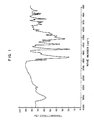
- Infrared absorption spectrum of the obtained polyimide resin is shown in Fig. 1.
- a film was prepared in the same manner as described in Example 1 and evaluated. The results are shown in Table 1.
- Example 1 Using the above-mentioned ingredients, a polyimide resin having a reduced viscosity of 0.67 dl/g was obtained in the same manner as described in Example 1. A film was prepared in the same manner as described in Example 1 and evaluated. The results are shown in Table 1.
- Example 1 Using the above-mentioned ingredients, a polyimide resin having a reduced viscosity of 1.8 dl/g was obtained in the same manner as described in Example 1. A film was prepared in the same manner as described in Example 1 and evaluated. The results are shown in Table 1.
- Example 1 Using the above-mentioned ingredients, a polyimide resin having a reduced viscosity of 0.60 dl/g was obtained in the same manner as described in Example 1. A film was prepared in the same manner as described in Example 1 and evaluated. The results are shown in Table 1.
- Example 1 Using the above-mentioned ingredients, a polyimide resin having a reduced viscosity of 1.0 dl/g was obtained in the same manner as described in Example 1. A film was prepared in the same manner as described in Example 1 and evaluated. The results are shown in Table 1.
- Example 1 Using the above-mentioned ingredients, a polyimide resin having a reduced viscosity of 0.88 dl/g was obtained in the same manner as described in Example 1. A film was prepared in the same manner as described in Example 1 and evaluated. The results are shown in Table 1.
- Example 1 Using the above-mentioned ingredients, a polyimide resin having a reduced viscosity of 0.86 dl/g was obtained in the same manner as described in Example 1. A film was prepared in the same manner as described in Example 1 and evaluated. The results are shown in Table 1.
- Example 1 Using the above-mentioned ingredients, a polyimide resin having a reduced viscosity of 0.6 dl/g was obtained in the same manner as described in Example 1. A film was prepared in the same manner as described in Example 1 and evaluated. The results are shown in Table 1.
- Example 1 Using the above-mentioned ingredients, a polyimide resin having a reduced viscosity of 0.60 dl/g was obtained in the same manner as described in Example 1. A film was prepared in the same manner as described in Example l and evaluated. The results are shown in Table 1.
- Example 1 Using the above-mentioned ingredients, a polyimide having a reduced viscosity of 0.80 dl/g was obtained in the same manner as described in Example 1. A film was prepared in the same manner as described in Example 1 and evaluated. The results are shown in Table 1.
- Example 1 Using the above-mentioned ingredinets, a polyimide having a reduced viscosity of 0.60 dl/g was obtained in the same manner as described in Example 1. A film was prepared in the same manner as described in Example 1 and evaluated. The results are shown in Table 1.
- Example 2 Using the above-mentioned ingredients, the reaction was carried out in the same manner as described in Example 1. A polyamide-acid produced was dissolved in the solvent. But when the dehydration ring closure reaction was carried out at elevated temperatures, an insoluble material was deposited and then became a paste state. Since stirring became difficult, the reaction was stopped.
- the reaction was carried out in the same manner as described in Example 1.
- the reaction solution was a viscous solution. But with the progress of dehydration ring closure while increasing the temperature, an insoluble agar-like material was produced. Since gelation took place, the reaction was stopped.
- a polyimide was prepared in the same manner as described in Example 1. But the resulting polyimide had a reduced viscosity of as low as 0.28 dl/g.
- a film was tried to be prepared in the same manner as described in Example 1, but only scale-like small films were obtained. The films were very brittle.
- the reaction was carried out in the same manner as described in Example 1.
- the reaction solution was viscous.
- an insoluble agar-like material was produced. Since gelation took place, the reaction was stopped.
- Tg of a film was measured by using a thermophysical tester (mfd. by Perkin Elmer Co.) under the following conditions: Measuring conditions: a tension method Temperature rise rate: 5°C/min Load: 5 g Sample: 2 mm wide Span: 10 mm
- transmittance was measured using a Hitachi visible UV spectrophotometer in the wavelength range of 900 to 400 nm. The transmittance was evaluated at a wavelength beginning to reduce the transmittance.
- a polyimide film in an amount of 10 g was placed in 90 ml of dimethylacetamide (DMA), dimethylformamide (DMF), N-methylpyrrolidone (NMP) or methyl sulfoxide (DMSO) and solubility was examined and evaluated as follows: o: completely dissolved x: completely not dissolved and produced a precipitate or clouding
- DMA dimethylacetamide
- DMF dimethylformamide
- NMP N-methylpyrrolidone
- DMSO methyl sulfoxide
- a film obtained in the same manner as described in Example 1 was cut in a size of 10 cm x 10 cm and dipped in purified water at 25°C for 24 hours. The film was then taken out of the water and sandwiched with new filter papers (No. 131) to remove attached water instantly, followed by weighing and calculation using the following equation: wherein A: water absorption w1: weight of the film before water absorption and after pre-dried (heated at 135°C for 2 hours) w2: weight of the film after water absorption
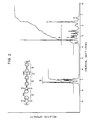
- Fig. 2 is an NMR spectrum of the polyimide resin obtained.
- the absorption A is due to the norbornene group
- the absorption B is due to the diphenyl ether group
- the absorption C is due to the isopropyl group, respectively, of bis(exo-bicyclo-[2,2,1]heptane-2,3-dicarboxylic anhydride.
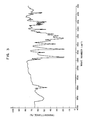
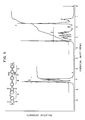
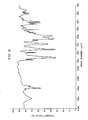
- Fig. 3 is an infrared absorption spectrum of the polyimide resin obtained. In Fig. 3, there are shown absorptions at 1780 cm ⁇ 1 and 1720 cm ⁇ 1 due to the imido group.
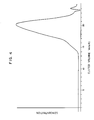
- Fig. 4 is a GPC chromatogram of the polyimide resin obtained.
- the arithmetic average molecular weight converted to polystyrene was 8600.
- the value of n in the formula (VIII) is about 11.
- Example 2 Using the above-mentioned ingredients, a polyimide having a reduced viscosity of 2.0 dl/g was obtained in the same manner as described in Example 1. A film was prepared in the same manner as described in Example 1 and evaluated. The results are shown in Table 2.
- Fig. 5 is an NMR spectrum of the polyimide resin obtained.
- the absorption D is due to the norbornene group
- the absorption E is due to the diphenyl ether group
- the absorption F is due to the diphenyl ether group, respectively, of bis(exobicyclo[2,2,1]heptane-2,3-dicarboxylic acid anhydride.
- Fig. 6 is an infrared absorption spectrum of the polyimide resin obtained. In Fig. 6, there are shown absorptions at 1780 cm ⁇ 1 and 1720 cm ⁇ 1 due to the imido group.
- Fig. 7 is a GPC chromatogram of the polyimide resin obtained.
- the arithmetic average molecular weight was 19000 converted to polystyrene.
- the value of n in the formula (VIII) is about 24.
- the measuring conditions for GPC were the same as those used in Example 17.
- Example 2 Using the above-mentioned ingredients, the reaction was carried out in the same manner as described in Example 1, but no rise in viscosity was observed. The heat treatment at high temperatures was further continued, but no rise in viscosity took place. It was conformed by infrared absorption spectrum that the imidization took place. The resulting polyimide had a reduced viscosity of 0.20 dl/g and was not able to form a film. Using a piece of the resin, properties were evaluated and listed in Table 2.
- the reaction was carried out at room temperature for 4 hours to synthesize a polyamide-acid, followed by dehydration ring closure at 180°C for 4 hours and at 205°C for 2 hours.
- the resulting reaction solution was poured into a large amount of methanol.
- a precipitate was filtered and dried under reduced pressure to yield a polyimide.
- the polyimide had a reduced viscosity of 0.97 dl/g (measured by using 0.2% solution of dimethylformamide at 30°C). Tg of the polyimide was 295°C.
- a 3% varnish was prepared by dissolving 3 g of the polyimide in 97 g of N-methyl-2-pyrrolidone.
- the varnish was uniformly coated on a sufficiently cleaned transparent electroconductive film formed on a glass plate using a spinner at a rate of 2000 rpm, followed by drying at 150°C for 30 minutes to evaporate the solvent to form an orientation controlling film.
- the resulting film was rubbed in a cirtain direction with a piece of felt to give a glass substrate having an orientation controlling film.
- a pair of thus prepared glass substrates were positioned in parallel facing the orientation films each other and sealed with an epoxy resin adhesive via a spacer of 10 ⁇ m thick (cured at 120°C for 30 minutes).
- phenylcyclohexane series liquid crystals ZLI-1132, a trade name, mfd. by Merck & Co., Inc.
- the orientation properties of liquid crystal display device were evaluated by the tilt angle ( ⁇ ), that is, an angle between a long axis direction of liquid crystal molecule and a substrate surface.
- ⁇ tilt angle
- To have a tilt angle of about 1.0° to 7.0° means good orientation properties.
- the tilt angle becomes smaller the response speed is fast.
- the tilt angle becomes larger the absolute value of contrast ratio can be made larger and disadvantages such as reverse twist, etc. can be reduced.
- the tilt angle and measuring method thereof are explained in detail in Journal of Applied Physics, vol. 19, No. 10. pp 2013-2014 (1980), etc.
- Example 19 The process of Example 19 was repeated except for using 466 g (0.9 mole) of 1,1,1,3,3,3-hexafluoro-2,2-bis[4-(4-aminophenoxy)phenyl]propane in place of 369 g (0.9 mole) of BAPP.
- the resulting polyimide had a reduced viscosity of 0.88 dl/g and a glass transition temperature (Tg) of 305°C.
- An orientation controlling film of 900 ⁇ thick was formed in the same manner as described in Example 19.
- a liquid crystal sealed cell was prepared in the same manner as described in Example 19. Said cell showed good orientation properties and had a tilt angle of 5.0°.
- the reaction for producing a polyimide-acid was carried out in the same manner as described in Example 19.
- NMP was added so as to make the solid content 3% in a varnish.
- the resulting varnish was coated on a glass plate having a transparent electroconductive film in the same manner as described in Example 19 and dried at 150°C for 30 minutes to evaporate the solvent. Imidization was completed by further heating at 200°C for 30 minutes to form an orientation controlling film of 800 ⁇ thick.
- a liquid crystal sealed cell prepared in the same manner as described in Example 19 showed good orientation properties and had a tilt angle of 4.1°.
- a polyimide was prepared in the same manner as described in Example 19 except for using 180 g (0.9 mole) of 4,4′-diaminodiphenyl ether in place of 369 g (0.9 mole) of BAPP.
- the polyimide had a reduced viscosity of 1.21 dl/g and Tg of 335°C.
- An orientation controlling film of 1100 ⁇ was formed in the same manner as described in Example 19.
- a liquid crystal sealed cell prepared in the same manner as described in Example 19 showed good orientation properties and had a tilt angle of 4.4°.
- the polyimide resins obtained by the present invention are solvent-soluble, relatively excellent in transparency and good in film forming properties. Further, by using a certain amount of benzophenonetetracarboxylic dianhydride or 2,2-bis[4-(4-aminophenoxy)phenyl]propane as the aromatic diamine, the resulting polyimide is improved in moisture absorbing properties.
- the resulting liquid crystal display device has high contrast due to its high tilt angle.
- the orientation controlling film can sufficiently be formed with heating at 200°C or lower in the production of liquid crystal display device, it is possible to prevent the substrate from deformation and deterioration.
- liquid crystal display devices with high contrast, light-weight and thinned form can be provided easily with low price.
- the liquid crystal display devices of the present invention can contain guest-host type liquid crystals. Further, these devices can use a TFT (thin film transistor) and very good in durability without causing no problem in practical use.
- TFT thin film transistor
Landscapes
- Chemical & Material Sciences (AREA)
- Organic Chemistry (AREA)
- Medicinal Chemistry (AREA)
- Health & Medical Sciences (AREA)
- Chemical Kinetics & Catalysis (AREA)
- Polymers & Plastics (AREA)
- Biophysics (AREA)
- General Health & Medical Sciences (AREA)
- Genetics & Genomics (AREA)
- Biochemistry (AREA)
- Molecular Biology (AREA)
- Proteomics, Peptides & Aminoacids (AREA)
- Life Sciences & Earth Sciences (AREA)
- Crystallography & Structural Chemistry (AREA)
- Macromolecular Compounds Obtained By Forming Nitrogen-Containing Linkages In General (AREA)
- Polymers With Sulfur, Phosphorus Or Metals In The Main Chain (AREA)
Applications Claiming Priority (2)
| Application Number | Priority Date | Filing Date | Title |
|---|---|---|---|
| JP32360/88 | 1988-02-15 | ||
| JP63032360A JPH01207324A (ja) | 1988-02-15 | 1988-02-15 | 溶媒可溶なポリイミド |
Publications (3)
| Publication Number | Publication Date |
|---|---|
| EP0336536A2 true EP0336536A2 (de) | 1989-10-11 |
| EP0336536A3 EP0336536A3 (en) | 1990-10-03 |
| EP0336536B1 EP0336536B1 (de) | 1995-06-28 |
Family
ID=12356789
Family Applications (1)
| Application Number | Title | Priority Date | Filing Date |
|---|---|---|---|
| EP89301419A Expired - Lifetime EP0336536B1 (de) | 1988-02-15 | 1989-02-15 | In organischen Lösungsmitteln lösliches Polyimid und Verfahren zu dessen Herstellung |
Country Status (4)
| Country | Link |
|---|---|
| US (1) | US4954612A (de) |
| EP (1) | EP0336536B1 (de) |
| JP (1) | JPH01207324A (de) |
| DE (1) | DE68923209T2 (de) |
Cited By (1)
| Publication number | Priority date | Publication date | Assignee | Title |
|---|---|---|---|---|
| WO2001080287A3 (en) * | 2000-04-18 | 2002-05-23 | E Ink Corp | Process for fabricating thin film transistors |
Families Citing this family (10)
| Publication number | Priority date | Publication date | Assignee | Title |
|---|---|---|---|---|
| US5000960A (en) * | 1987-03-13 | 1991-03-19 | Micro-Pak, Inc. | Protein coupling to lipid vesicles |
| US5212279A (en) * | 1990-10-22 | 1993-05-18 | Hitachi Chemical Co., Ltd. | Hot-melt adhesive and its use in polyimide film and printed circuit board |
| JP2900229B2 (ja) * | 1994-12-27 | 1999-06-02 | 株式会社半導体エネルギー研究所 | 半導体装置およびその作製方法および電気光学装置 |
| JPH09118825A (ja) * | 1995-10-24 | 1997-05-06 | Shin Etsu Chem Co Ltd | ポリイミド樹脂組成物 |
| JP3968835B2 (ja) * | 1996-12-20 | 2007-08-29 | 日本メクトロン株式会社 | シロキサンポリイミドを含有する耐熱性接着剤 |
| US7893435B2 (en) | 2000-04-18 | 2011-02-22 | E Ink Corporation | Flexible electronic circuits and displays including a backplane comprising a patterned metal foil having a plurality of apertures extending therethrough |
| JP2003151328A (ja) * | 2001-11-15 | 2003-05-23 | Du Pont Toray Co Ltd | 照明用反射装置 |
| TWI252240B (en) * | 2003-05-20 | 2006-04-01 | Eternal Chemical Co Ltd | Epoxy resin polymer and alignment film materials containing same for liquid crystal display |
| JP5320668B2 (ja) * | 2005-11-15 | 2013-10-23 | 三菱化学株式会社 | テトラカルボン酸系化合物及びそのポリイミド、ならびにその製造方法 |
| CN102604093B (zh) * | 2012-03-26 | 2013-09-25 | 长春高琦聚酰亚胺材料有限公司 | 聚酰亚胺的制备方法 |
Family Cites Families (4)
| Publication number | Priority date | Publication date | Assignee | Title |
|---|---|---|---|---|
| GB2101760B (en) * | 1981-07-13 | 1985-07-17 | Hitachi Ltd | Liquid crystal display element |
| US4404350A (en) * | 1982-07-07 | 1983-09-13 | General Electric Company | Silicone-imide copolymers and method for making |
| US4588804A (en) * | 1984-05-04 | 1986-05-13 | E. I. Du Pont De Nemours And Company | Polyimide compositions |
| US4696994A (en) * | 1984-12-14 | 1987-09-29 | Ube Industries, Ltd. | Transparent aromatic polyimide |
-
1988
- 1988-02-15 JP JP63032360A patent/JPH01207324A/ja active Pending
-
1989
- 1989-02-14 US US07/309,878 patent/US4954612A/en not_active Expired - Fee Related
- 1989-02-15 DE DE68923209T patent/DE68923209T2/de not_active Expired - Fee Related
- 1989-02-15 EP EP89301419A patent/EP0336536B1/de not_active Expired - Lifetime
Cited By (1)
| Publication number | Priority date | Publication date | Assignee | Title |
|---|---|---|---|---|
| WO2001080287A3 (en) * | 2000-04-18 | 2002-05-23 | E Ink Corp | Process for fabricating thin film transistors |
Also Published As
| Publication number | Publication date |
|---|---|
| DE68923209D1 (de) | 1995-08-03 |
| DE68923209T2 (de) | 1995-11-16 |
| US4954612A (en) | 1990-09-04 |
| EP0336536B1 (de) | 1995-06-28 |
| JPH01207324A (ja) | 1989-08-21 |
| EP0336536A3 (en) | 1990-10-03 |
Similar Documents
| Publication | Publication Date | Title |
|---|---|---|
| KR100236860B1 (ko) | 액정셀용 배향처리제 | |
| JP3212162B2 (ja) | ジアミノベンゼン誘導体及びポリイミド及び液晶配向膜 | |
| EP0336536A2 (de) | In organischen Lösungsmitteln lösliches Polyimid und Verfahren zu dessen Herstellung | |
| WO2003100510A1 (fr) | Agent d'alignement des cristaux liquides, pellicules d'alignement des cristaux liquides et ecrans a cristaux liquides | |
| KR20030020359A (ko) | 액정배향처리제 및 이것을 사용한 액정표시소자 | |
| US4958001A (en) | Dicyclohexyl-3,4,3',4'-tetracarboxylic acid or dianhydride thereof and polyamide-acid and polyimide obtained therefrom | |
| EP1146063B1 (de) | Polyimidvorläufer und polyimide | |
| US7307139B2 (en) | Diamine compound having dendron side chain and liquid crystal alignment material produced using the same | |
| KR20040046229A (ko) | 감광성 투명 폴리아믹산 유도체와 폴리이미드계 수지 | |
| JPWO2000022029A1 (ja) | ポリイミド前駆体及びポリイミド | |
| Van den Broeck et al. | Synthesis and nonlinear optical properties of high glass transition polyimides | |
| JPH04106127A (ja) | 溶媒可溶性ポリイミド、その製造法及びカラーフィルター用材料 | |
| JP3780534B2 (ja) | ポリイミドワニス | |
| KR0160101B1 (ko) | Stn 표시를 위한 폴리이미드 | |
| KR100351627B1 (ko) | 무색 투명의 고접착성 지방족 폴리이미드 수지와 이를이용한 폴리이미드/무기물 복합 소재 | |
| KR19980048480A (ko) | 광배향성 조성물, 이로부터 형성된 배향막 및 이 배향막을 구비한 액정표시소자 | |
| CN108070388A (zh) | 一种液晶取向剂、液晶取向膜以及液晶显示元件 | |
| KR20000060274A (ko) | 비선형 광학 특성을 갖는 광가교형 폴리이미드계 고분자 화합물 및 그 제조방법 | |
| JP2775493B2 (ja) | アルキル置換シクロブタンテトラカルボン酸二無水物含有組成物、ポリイミド前駆体、硬化膜及びこれらの製造方法 | |
| JPS63205640A (ja) | 液晶表示素子 | |
| JPH05247209A (ja) | 液晶配向膜用塗布液およびその製造方法 | |
| JP3681086B2 (ja) | 液晶配向剤 | |
| JPH04142515A (ja) | 液晶表示素子 | |
| JP3681084B2 (ja) | 液晶配向剤 | |
| JP2591564B2 (ja) | 液晶表示素子用配向膜 |
Legal Events
| Date | Code | Title | Description |
|---|---|---|---|
| PUAI | Public reference made under article 153(3) epc to a published international application that has entered the european phase |
Free format text: ORIGINAL CODE: 0009012 |
|
| AK | Designated contracting states |
Kind code of ref document: A2 Designated state(s): DE FR GB NL |
|
| PUAL | Search report despatched |
Free format text: ORIGINAL CODE: 0009013 |
|
| AK | Designated contracting states |
Kind code of ref document: A3 Designated state(s): DE FR GB NL |
|
| 17P | Request for examination filed |
Effective date: 19910215 |
|
| 17Q | First examination report despatched |
Effective date: 19920706 |
|
| GRAA | (expected) grant |
Free format text: ORIGINAL CODE: 0009210 |
|
| RIN1 | Information on inventor provided before grant (corrected) |
Inventor name: MINAMISAWA, HIROSHI Inventor name: MIYAZIMA, HIROMU Inventor name: HANABUSA, KAZUHITO Inventor name: NOMURA, YOSHIHIRO Inventor name: MORINAGA, TAKASHI Inventor name: NISHIZAWA, HIROSHI Inventor name: SAKATA, TOUICHI Inventor name: MUKOYAMA, YOSHIYUKI |
|
| AK | Designated contracting states |
Kind code of ref document: B1 Designated state(s): DE FR GB NL |
|
| ET | Fr: translation filed | ||
| REF | Corresponds to: |
Ref document number: 68923209 Country of ref document: DE Date of ref document: 19950803 |
|
| PG25 | Lapsed in a contracting state [announced via postgrant information from national office to epo] |
Ref country code: GB Effective date: 19960215 |
|
| PLBE | No opposition filed within time limit |
Free format text: ORIGINAL CODE: 0009261 |
|
| STAA | Information on the status of an ep patent application or granted ep patent |
Free format text: STATUS: NO OPPOSITION FILED WITHIN TIME LIMIT |
|
| 26N | No opposition filed | ||
| PG25 | Lapsed in a contracting state [announced via postgrant information from national office to epo] |
Ref country code: NL Effective date: 19960901 |
|
| GBPC | Gb: european patent ceased through non-payment of renewal fee |
Effective date: 19960215 |
|
| PG25 | Lapsed in a contracting state [announced via postgrant information from national office to epo] |
Ref country code: FR Effective date: 19961031 |
|
| NLV4 | Nl: lapsed or anulled due to non-payment of the annual fee |
Effective date: 19960901 |
|
| PG25 | Lapsed in a contracting state [announced via postgrant information from national office to epo] |
Ref country code: DE Effective date: 19961101 |
|
| REG | Reference to a national code |
Ref country code: FR Ref legal event code: ST |