EP0336340B1 - Verfahren und Vorrichtung zur Steuerung einer Drosselklappe in einer Brennkraftmaschine - Google Patents
Verfahren und Vorrichtung zur Steuerung einer Drosselklappe in einer Brennkraftmaschine Download PDFInfo
- Publication number
- EP0336340B1 EP0336340B1 EP89105815A EP89105815A EP0336340B1 EP 0336340 B1 EP0336340 B1 EP 0336340B1 EP 89105815 A EP89105815 A EP 89105815A EP 89105815 A EP89105815 A EP 89105815A EP 0336340 B1 EP0336340 B1 EP 0336340B1
- Authority
- EP
- European Patent Office
- Prior art keywords
- throttle valve
- motor
- current
- actual
- accelerator pedal
- Prior art date
- Legal status (The legal status is an assumption and is not a legal conclusion. Google has not performed a legal analysis and makes no representation as to the accuracy of the status listed.)
- Expired - Lifetime
Links
Images




Classifications
-
- F—MECHANICAL ENGINEERING; LIGHTING; HEATING; WEAPONS; BLASTING
- F02—COMBUSTION ENGINES; HOT-GAS OR COMBUSTION-PRODUCT ENGINE PLANTS
- F02D—CONTROLLING COMBUSTION ENGINES
- F02D11/00—Arrangements for, or adaptations to, non-automatic engine control initiation means, e.g. operator initiated
- F02D11/06—Arrangements for, or adaptations to, non-automatic engine control initiation means, e.g. operator initiated characterised by non-mechanical control linkages, e.g. fluid control linkages or by control linkages with power drive or assistance
- F02D11/10—Arrangements for, or adaptations to, non-automatic engine control initiation means, e.g. operator initiated characterised by non-mechanical control linkages, e.g. fluid control linkages or by control linkages with power drive or assistance of the electric type
-
- F—MECHANICAL ENGINEERING; LIGHTING; HEATING; WEAPONS; BLASTING
- F02—COMBUSTION ENGINES; HOT-GAS OR COMBUSTION-PRODUCT ENGINE PLANTS
- F02D—CONTROLLING COMBUSTION ENGINES
- F02D41/00—Electrical control of supply of combustible mixture or its constituents
- F02D41/20—Output circuits, e.g. for controlling currents in command coils
-
- F—MECHANICAL ENGINEERING; LIGHTING; HEATING; WEAPONS; BLASTING
- F02—COMBUSTION ENGINES; HOT-GAS OR COMBUSTION-PRODUCT ENGINE PLANTS
- F02D—CONTROLLING COMBUSTION ENGINES
- F02D11/00—Arrangements for, or adaptations to, non-automatic engine control initiation means, e.g. operator initiated
- F02D11/06—Arrangements for, or adaptations to, non-automatic engine control initiation means, e.g. operator initiated characterised by non-mechanical control linkages, e.g. fluid control linkages or by control linkages with power drive or assistance
- F02D11/10—Arrangements for, or adaptations to, non-automatic engine control initiation means, e.g. operator initiated characterised by non-mechanical control linkages, e.g. fluid control linkages or by control linkages with power drive or assistance of the electric type
- F02D2011/101—Arrangements for, or adaptations to, non-automatic engine control initiation means, e.g. operator initiated characterised by non-mechanical control linkages, e.g. fluid control linkages or by control linkages with power drive or assistance of the electric type characterised by the means for actuating the throttles
- F02D2011/102—Arrangements for, or adaptations to, non-automatic engine control initiation means, e.g. operator initiated characterised by non-mechanical control linkages, e.g. fluid control linkages or by control linkages with power drive or assistance of the electric type characterised by the means for actuating the throttles at least one throttle being moved only by an electric actuator
-
- F—MECHANICAL ENGINEERING; LIGHTING; HEATING; WEAPONS; BLASTING
- F02—COMBUSTION ENGINES; HOT-GAS OR COMBUSTION-PRODUCT ENGINE PLANTS
- F02D—CONTROLLING COMBUSTION ENGINES
- F02D41/00—Electrical control of supply of combustible mixture or its constituents
- F02D41/20—Output circuits, e.g. for controlling currents in command coils
- F02D2041/202—Output circuits, e.g. for controlling currents in command coils characterised by the control of the circuit
- F02D2041/2058—Output circuits, e.g. for controlling currents in command coils characterised by the control of the circuit using information of the actual current value
Definitions
- This invention relates to a method and an apparatus for controlling a direct current motor actuated throttle valve in an internal combustion engine so that the throttle valve driven by an electric motor can be opened and closed corresponding to the amount of depression of an accelerator pedal in a vehicle.
- a stepping motor is used to drive the throttle valve.
- the use of such a stepping motor for automatically controlling the open-close movement of the throttle valve is preferable in that the angular position of rotation of the throttle valve can be controlled with high accuracy, there is an inevitable tendency that the operation of the throttle valve is insufficient in its high-speed response capability.
- a d.c.-motor is preferably used in lieu of the stepping motor so as to ensure the desired high-speed response capability of the throttle valve.
- a throttle valve control using a d.c.-motor is shown in the JP-A-63-061748.
- attainment of the desired high-speed response capability of the throttle valve driven by the d.c.-motor tends to be affected by the factors of fluctuation which include: (a) changes in the coefficient of friction of the rotor shaft of the motor, (b) non-uniform spring constants of springs of the throttle valve due to non-uniformity of the characteristics of manufactured products and (c) secular variations (so-called permanent set) of the spring constant.
- the factors of fluctuation affecting the operational characteristic of the d.c.-motor are permanently studied.
- the spring constant in a stably stopped state (a full closed state or a full opened state) of the throttle valve is detected for the purpose of the study described above.
- Fig. 2 shows schematically an internal combustion engine 1 provided with an embodiment of the throttle valve control apparatus according to the present invention and shows also a drive system of a vehicle on which the engine 1 is mounted.
- the output power of the engine 1 is transmitted to wheels through a transmission 2.
- An air cleaner 7 is mounted at the inlet of an air intake pipe 9 of the engine 1, and a butterfly type throttle valve 8 is disposed in the air intake pipe 9.
- the throttle valve 8 is driven for open-close movement by a d.c.-motor 3 as described later with reference to Fig. 3.
- the opening of the throttle valve 8 is detected by a rotation sensor 4 whose detection output signal is applied to a control unit 5.
- the control unit 5 controls a current i supplied to the motor 3 so that the output signal of the rotation sensor 4 coincides with an output signal of an accelerator pedal sensor 6 which detects the amount of depression of an accelerator pedal. That is, the output signal of the accelerator pedal sensor 6 is used as a target value ⁇ t , and the control unit 5 controls the current i supplied to the motor 3 so that the output signal of the rotation sensor 4 can follow up the target value.
- Fig. 3 shows schematically the relation between the d.c.-motor 3, the throttle valve 8 disposed in a venturi V of the air intake pipe 9, and the rotation sensor 4.
- a return spring 12 is imparted with an initial load so as to normally urgue the butterfly type throttle valve 8 in a direction in which the throttle valve 8 is fully closed.
- the throttle valve 8 is placed in its most stable state when the movement of the throttle valve 8 urged by the force of the return spring 12 is stopped by being engaged by a stopper (not shown).
- the d.c.-motor 3 rotates the throttle valve 8 through a gear pair 10 against the biasing force of the return spring 12.
- control system When, in order to provide a desired response capability, feedback of state given by is made, the control system is represented by a block diagram as shown in Fig. 1.
- the controlled blocks are surrounded by broken lines, and a balance of force imparted to the throttle valve 8 is taken into consideration.
- the remaining blocks of the system are processed in the control unit 5 shown in Fig. 2.
- the dashed symbol K m ' in Fig. 1 represents the actual current/torque constant of the d.c. motor 3 and differs from the motor current/torque constant K m used as one of the parameters in the arithmetic and logical processing in the control unit 5 shown in Fig. 2.
- Fig. 4 is a graph in which the horizontal axis represents time, and the vertical axis represents both the actual angular position of rotation of the throttle valve 8 and the actual current value supplied to the d.c.-motor 3.
- the maximum value of the current that can be supplied to the d.c.-motor 3 is restricted so that an excessively large current may not be supplied at the moment of starting the current supply to the d.c.-motor 3.
- the response capability of the control system coincides with the transfer function given by the equation (6) after a period of time of about 0.08 sec on the time axis, because the above restriction is released from that time.
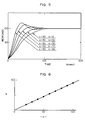
- Fig. 5 is a graph showing the response characteristic of the throttle valve 8 when the value of the parameter b is changed while maintaining the parameter a at a fixed value of 50. It will be seen in Fig. 5 that the parameter b has a value with which the possibility of appearance of an overshoot can be eliminated, and the stabilizing period can be decreased to a minimum.
- Fig. 6 is a graph in which the optimum value of the parameter b relative to a value of the parameter a and the optimum value of the parameter a relative to a value of the parameter b are plotted. It is preferable to determine the values of these parameters a and b on the basis of the graph shown in Fig. 6.
- the initial load setting K s ' x ⁇ ⁇ ' of the return spring 12 is compensated in the form of in the control apparatus.
- the parameter T f ' representing the combination of the frictional torque and the hysteresis of the return spring 12 is compensated in the form of in the control apparatus.
- the parameter T f ' is the function of the differentiated value ⁇ . That is, the value of T f ' changes with the speed.
- a force tending to obstruct the movement of the throttle valve 8 in the direction is produced to provide a frictional load given by (T f ' - T f ).
- Fig. 8 is a graph showing very slight movement of the throttle valve 8 when the current supplied to the d.c.-motor 3 is gradually increased and then decreased. In this case, no position control is effected, and the current supplied to the d.c.-motor 3 is merely primarily considered and changed.
- Fig. 8 is a graph showing very slight movement of the throttle valve 8 when the current supplied to the d.c.-motor 3 is gradually increased and then decreased. In this case, no position control is effected, and the current supplied to the d.c.-motor 3 is merely primarily considered and changed.
- the throttle valve 8 shows that, with the increase in the current supplied to the d.c.-motor 3, the throttle valve 8 starts to move at a time t1 corresponding to a first current value i1, and, with the subsequent decrease in the current, the throttle valve 8 starts to move again at time t2 corresponding to a second current value i2.
- Fig. 9 is a graph showing an example of the response characteristics of the embodiment shown in Fig. 7 when the relation between the parameters T f ' and T f is given by T f ' - T f > 0.
- Fig. 10 shows the internal structure of the control unit 5 shown in Fig. 2.
- a one-chip microprocessor (MPU) 13 is an essential part of the control unit 5 and has a program-storing ROM, a RAM and an A/D converter built therein.
- the output signal of the accelerator pedal sensor 6 and that of the throttle valve position sensor 4 are A/D converted by the A/D converter (not shown) to selectively drive four field-effect transistors FET1 to FET4 thereby controlling the current supplied to the d.c.-motor 3.
- the value of the motor current of the d.c.-motor 3 is detected in the form of a voltage appearing across a detection resistor 14, and, after being amplified by an amplifier 15, the detected voltage is applied to the MPU 13 so as to continuously control the value of the motor current.
- Fig. 11 is a flow chart of a sequence of arithmetic and logical processing and decision steps executed according to a control program stored in the MPU 13. The flow shown in Fig. 11 is run at an interval of a predetermined period of time under control of a time scheduler.
- step 24 the result of decision made in a step 27 as to whether or not the target value ⁇ t is approximately equal to the value of the actual position ⁇ of the throttle valve 8 is "No"
- step 27 is followed by the step 24.
- the flag is referenced in a step 29.
- step 28 is followed by a step 39 in which the flag is cleared, and the studied value of ⁇ o is determined in a step 40.
- ⁇ o is given by This studied value of ⁇ o is used in the later control.
- the current/torque constant of the d.c.-motor in the steady state can be studied so that a steady-state error can be easily cancelled. Therefore, the control system can automatically adapt itself to changes in the environmental conditions and secular variations in the state mounted on the vehicle, so that the throttle valve can be highly accurately positioned without sacrificing the high-speed response capability.
- the control method described above can be easily and effectively practised so as to fully exhibit the advantages enumerated above.
Landscapes
- Engineering & Computer Science (AREA)
- Chemical & Material Sciences (AREA)
- Combustion & Propulsion (AREA)
- Mechanical Engineering (AREA)
- General Engineering & Computer Science (AREA)
- Control Of Throttle Valves Provided In The Intake System Or In The Exhaust System (AREA)
- Electrical Control Of Air Or Fuel Supplied To Internal-Combustion Engine (AREA)
Claims (6)
- Verfahren zum Steuern einer durch einen Gleichstrommotor betätigten Drosselklappe (8), die in einem Einlaßkanal einer Brennkraftmaschine angeordnet ist und durch eine Rückholfeder (12) in Richtung einer vorbestimmten Position gedrückt wird, mit den folgenden Schritten:(A) Lesen einer Ist-Drosselklappenstellung ϑ und einer Ist-Gaspedalstellung ϑt (Schritte 20 und 21);(B) Bestimmen, ob die Ist-Gaspedalstellung ϑt gleich 0 ist (Schritt 23) und ob die Ist-Drosselklappenstellung ϑ etwa gleich der Ist-Gasbedalstellung (ϑt = ϑ) (Schritt 27) ist und wenn diese Bedingungen erfüllt sind, Durchführen der folgenden Schritte (C) und (D):(C) Erhöhen des dem Motor (3) zugeführten Stroms i und Speichern eines ersten Stromwerts i₁, wenn sich die Drosselklappe (8) beginnt zu bewegen und, darauffolgend, Vermindern des den Motor (3) zugeführten Stroms i und Speichern eines zweiten Stromwerts i₂, wenn sich die Drosselklappe wieder zu bewegen beginnt (Schritte 30, 36),
und(D) Aktualisieren eines Parameters ϑ₀ gemäß den gespeicherten Werten des ersten Stromwerts i₁ und des zweiten Stromwerts i₂ (Schritt 40);(E) Bestimmen des Stroms i zum Steuern der Drosselklappe (8) unter Verwendung des aktualisierten Parameters ϑ₀ gemäß der Gleichung
- Verfahren nach Anspruch 1,
dadurch gekennzeichnet, daß
der Parameter ϑ₀ gemäß der Gleichung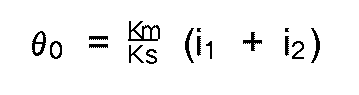
mit
Km als vorbestimmte Motor-Strom/Drehmoment-Konstante
und
Ks als vorbestimmte Federkonstante. - Verfahren nach irgendeinem der Ansprüche 1 bis 2,
dadurch gekennzeichnet, daß
Is als Drosselklappenträgheit,
G als Übersetzungsverhältnis zwischen dem Gleichstrommotor (3) und der Drosselklappe (8)
und
a und b als Parameter, wobei a etwa die doppelte Größe von b aufweist. - Verfahren nach irgendeinem der Ansprüche 1 bis 3,
dadurch gekennzeichnet, daß
der dem Motor (3) zugeführte Maximalstrom i beschränkt ist, zum Vermeiden eines zu hohen Motorstroms beim Starten der Stromzufuhr zum Motor. - Verfahren nach irgendeinem der Ansprüche 1 bis 4,
dadurch gekennzeichnet, daß
die Parameter a und b zur Verursachung eines leichten Überschwingens der Antwort der Drosselklappe (8) eingestellt sind. - Vorrichtung zum Durchführen des Verfahrens gemäß Anspruch 1, mit- einem Drosselklappenmechanismus, der die im Krümmer des Motors (1) angeordnete Drosselklappe (8) und einen mit dem Drosselklappenschaft durch ein Zahnrad (10) verbundenen Gleichstrommotor (3) enthält,- einem Drehwinkelsensor (4) zum Erfassen einer Ist-Drosselklappenstellung ϑ der Drosselklappe (8),- einer Rückholfeder (12), die die Drosselklappe (8) in die Drosselklappenschließrichtung drückt, und- einer Steuereinheit (5) zum Steuern des Stroms i des Motors (3), basierend auf der erfaßten Ist-Drosselklappenstellung ϑ und einer Ist-Gaspedalstellung ϑt, welche durch einen Gaspedalsensor (6) zugeführt wird,dadurch gekennzeichnet, daß
die Steuereinheit (5) folgendes enthält:(A) Mittel zum Lesen der Ist-Drosselklappenstellung ϑ und der Ist-Gaspedalstellung ϑt (Schritte 20 und 21),(B) Mittel zum Bestimmen, ob die Ist-Gaspedalstellung ϑt gleich Null ist (Schritt 23) und ob die Ist-Drosselklappenstellung ϑ etwa gleich der Ist-Gaspedalstellung (ϑt = ϑ) ist (Schritt 27) und Mittel zum Durchführen der folgenden Schritte (C) und (D), wenn diese Bedingungen erfüllt sind,(C) Erhöhen eines dem Motor (3) zugeführten Stroms i und Speichern eines ersten Stromwerts i₁, wenn sich die Drosselklappe (8) beginnt zu bewegen und, darauffolgend, Absenken des dem Motor (3) zugeführten Stroms i und Speichern eines zweiten Stromwerts i₂, wenn sich die Drosselklappe (8) wieder zu bewegen beginnt (Schritt 30, 36) und(D) Aktualisieren eines Parameters ϑ₀ gemäß den gespeicherten Werten des ersten Stromwerts i₁ und des zweiten Stromwerts i₂ (Schritt 40);
und(E) Mittel zum Bestimmen des Stroms zum Steuern der Drosselklappe (8) unter Verwendung des aktualisierten Parameters ϑ₀ gemäß der Gleichung
Applications Claiming Priority (2)
| Application Number | Priority Date | Filing Date | Title |
|---|---|---|---|
| JP63078197A JP2513776B2 (ja) | 1988-04-01 | 1988-04-01 | スロットル弁制御方法及びその装置 |
| JP78197/88 | 1988-04-01 |
Publications (3)
| Publication Number | Publication Date |
|---|---|
| EP0336340A2 EP0336340A2 (de) | 1989-10-11 |
| EP0336340A3 EP0336340A3 (en) | 1990-07-04 |
| EP0336340B1 true EP0336340B1 (de) | 1995-09-27 |
Family
ID=13655286
Family Applications (1)
| Application Number | Title | Priority Date | Filing Date |
|---|---|---|---|
| EP89105815A Expired - Lifetime EP0336340B1 (de) | 1988-04-01 | 1989-04-03 | Verfahren und Vorrichtung zur Steuerung einer Drosselklappe in einer Brennkraftmaschine |
Country Status (5)
| Country | Link |
|---|---|
| US (1) | US4911125A (de) |
| EP (1) | EP0336340B1 (de) |
| JP (1) | JP2513776B2 (de) |
| KR (1) | KR0137942B1 (de) |
| DE (1) | DE68924364T2 (de) |
Families Citing this family (20)
| Publication number | Priority date | Publication date | Assignee | Title |
|---|---|---|---|---|
| GB2251705B (en) * | 1991-01-12 | 1994-07-13 | Rover Group | A throttle valve control system for an engine of a vehicle |
| ZA928107B (en) * | 1991-10-23 | 1993-05-07 | Transcom Gas Tech | Boost pressure control. |
| US5445125A (en) * | 1994-03-16 | 1995-08-29 | General Motors Corporation | Electronic throttle control interface |
| BR9606571A (pt) * | 1995-08-04 | 1997-11-25 | Philips Electronics Nv | Atuador elétrico e dispositivo de estrangulamento para uso em uma entrada de ar de um motor de combustão interna |
| JP3155694B2 (ja) * | 1995-11-09 | 2001-04-16 | 株式会社日立製作所 | スロットルバルブの制御装置及び方法 |
| JPH1113518A (ja) * | 1997-06-27 | 1999-01-19 | Aisin Seiki Co Ltd | スロットルバルブ制御装置 |
| DE19739827B4 (de) * | 1997-09-11 | 2007-05-10 | Robert Bosch Gmbh | Verfahren und Vorrichtung zur Steuerung einer Betriebsgröße eines Kraftfahrzeugs |
| US5996553A (en) * | 1998-02-17 | 1999-12-07 | General Motors Corporation | Idle actuator speed control |
| JP3511577B2 (ja) * | 1998-10-06 | 2004-03-29 | 株式会社日立製作所 | 内燃機関のスロットル装置 |
| US6318337B1 (en) * | 2000-05-19 | 2001-11-20 | Visteon Global Technologies, Inc. | Electronic throttle control |
| US6516932B2 (en) * | 2000-09-29 | 2003-02-11 | New Holland North America, Inc. | Electro-hydraulic clutch hysteresis compensation |
| JP4743948B2 (ja) * | 2000-10-10 | 2011-08-10 | 株式会社ミクニ | アクセルペダル装置 |
| JP2002147257A (ja) * | 2000-11-10 | 2002-05-22 | Mikuni Corp | 電子制御スロットルボディ |
| US6442472B1 (en) | 2001-02-28 | 2002-08-27 | General Motors Corporation | Modification of pedal progression with acceleration feedback using electronic throttle control |
| US6523522B1 (en) | 2001-08-22 | 2003-02-25 | General Motors Corporation | Method and apparatus for operating a throttle plate motor driving a throttle plate having opposing return springs |
| ATE520957T1 (de) * | 2005-01-18 | 2011-09-15 | Teleflex Inc | Pedalanordnung |
| JP4373958B2 (ja) * | 2005-04-25 | 2009-11-25 | ジーイー・メディカル・システムズ・グローバル・テクノロジー・カンパニー・エルエルシー | 撮影装置,被検体移動装置および走査ガントリ装置 |
| JP4473778B2 (ja) * | 2005-05-18 | 2010-06-02 | 日立オートモティブシステムズ株式会社 | 回転角検出装置 |
| KR101164252B1 (ko) | 2006-01-02 | 2012-07-09 | 주식회사 현대오토넷 | 리턴 스프링 및 감속 기어를 사용하는 모터의 제어 장치 및방법 |
| JP2011069336A (ja) * | 2009-09-28 | 2011-04-07 | Keihin Corp | 内燃機関の制御装置 |
Family Cites Families (7)
| Publication number | Priority date | Publication date | Assignee | Title |
|---|---|---|---|---|
| DE2852211C2 (de) * | 1978-12-02 | 1986-01-02 | Vdo Adolf Schindling Ag, 6000 Frankfurt | Einrichtung zum Steuern der Fahrgeschwindigkeit eines Kraftfahrzeuges |
| DE3146652C1 (de) * | 1981-11-25 | 1983-06-01 | Pierburg Gmbh & Co Kg, 4040 Neuss | Einrichtung zur Stellung einer Klappe |
| JPH0621584B2 (ja) * | 1982-07-09 | 1994-03-23 | マツダ株式会社 | エンジンのスロツトル弁制御装置 |
| JPS60190626A (ja) * | 1984-03-09 | 1985-09-28 | Hitachi Ltd | 絞弁制御装置 |
| JPS61129432A (ja) * | 1984-11-27 | 1986-06-17 | Toyota Motor Corp | 車両の加速スリツプ制御装置 |
| JPH0663460B2 (ja) * | 1986-06-02 | 1994-08-22 | 株式会社日立製作所 | 電動機駆動型絞弁用の絞弁組立体 |
| US4781162A (en) * | 1986-08-04 | 1988-11-01 | Honda Giken Kogyo Kabushiki Kaisha | Throttle valve control system for an internal combustion engine |
-
1988
- 1988-04-01 JP JP63078197A patent/JP2513776B2/ja not_active Expired - Fee Related
-
1989
- 1989-03-31 US US07/331,386 patent/US4911125A/en not_active Expired - Lifetime
- 1989-03-31 KR KR1019890004234A patent/KR0137942B1/ko not_active Expired - Fee Related
- 1989-04-03 EP EP89105815A patent/EP0336340B1/de not_active Expired - Lifetime
- 1989-04-03 DE DE68924364T patent/DE68924364T2/de not_active Expired - Fee Related
Non-Patent Citations (1)
| Title |
|---|
| "Development of automobile control and data acquisition equipment employing a 16-bit microcomputer", paper presented at the 16th ISATA-Congress, 1987 in Florence, Italy * |
Also Published As
| Publication number | Publication date |
|---|---|
| KR0137942B1 (ko) | 1998-05-01 |
| US4911125A (en) | 1990-03-27 |
| EP0336340A3 (en) | 1990-07-04 |
| DE68924364T2 (de) | 1996-03-07 |
| DE68924364D1 (de) | 1995-11-02 |
| KR890016285A (ko) | 1989-11-28 |
| EP0336340A2 (de) | 1989-10-11 |
| JP2513776B2 (ja) | 1996-07-03 |
| JPH01253544A (ja) | 1989-10-09 |
Similar Documents
| Publication | Publication Date | Title |
|---|---|---|
| EP0336340B1 (de) | Verfahren und Vorrichtung zur Steuerung einer Drosselklappe in einer Brennkraftmaschine | |
| JP3084929B2 (ja) | スロットル基準開度検出装置 | |
| US4725969A (en) | Constant-speed driving system | |
| US5157956A (en) | Method of calibrating a throttle angle sensor | |
| EP0033616B1 (de) | Leerlaufdrehzahlkontrolle mit geschlossener Schleife für Brennkraftmaschine | |
| US4982710A (en) | Electronic throttle valve opening control method and system therefor | |
| US4718380A (en) | System and method for controlling the opening angle of a throttle valve according to the position of an accelerator for an automotive vehicle | |
| KR880005347A (ko) | 차량용 엔진의 제어장치 | |
| EP0735256A2 (de) | Drosselsteuerung einer Brennkraftmaschine mit variablen Regelkonstanten | |
| US5382206A (en) | Method of and system for controlling the speed of a motor vehicle based on an adjustable control characteristic so that the speed of the vehicle follows a target speed | |
| US4943923A (en) | Constant-speed running control device for vehicles | |
| KR910000771B1 (ko) | 주행제어장치 | |
| JPS5614834A (en) | Electric control device for throttle valve | |
| JP3710073B2 (ja) | 吸気絞り弁制御装置 | |
| JP2550962B2 (ja) | エンジンのスロツトル弁制御装置 | |
| CN1165546A (zh) | 带有精密级联控制单元的电拖动装置 | |
| WO1988006235A1 (en) | Method and device for controlling the operation of an engine for a vehicle | |
| JP3481650B2 (ja) | 車両のアクチュエータ制御方法および装置 | |
| JP3041156B2 (ja) | 内燃機関の絞り弁制御装置 | |
| JP3270726B2 (ja) | 位置制御装置における基準位置検出装置の調整方法 | |
| JP2003161172A (ja) | 電子スロットルの位置フィードフォワード・システム | |
| JPH07304349A (ja) | 車両用定速走行制御装置 | |
| JPH11270364A (ja) | 内燃機関のスロットル制御装置 | |
| JPH04203218A (ja) | エンジンのスロットル弁制御装置 | |
| JP2582457B2 (ja) | 内燃機関のスロットル弁制御装置 |
Legal Events
| Date | Code | Title | Description |
|---|---|---|---|
| PUAI | Public reference made under article 153(3) epc to a published international application that has entered the european phase |
Free format text: ORIGINAL CODE: 0009012 |
|
| AK | Designated contracting states |
Kind code of ref document: A2 Designated state(s): DE FR GB |
|
| PUAL | Search report despatched |
Free format text: ORIGINAL CODE: 0009013 |
|
| AK | Designated contracting states |
Kind code of ref document: A3 Designated state(s): DE FR GB |
|
| 17P | Request for examination filed |
Effective date: 19900706 |
|
| 17Q | First examination report despatched |
Effective date: 19911017 |
|
| GRAA | (expected) grant |
Free format text: ORIGINAL CODE: 0009210 |
|
| AK | Designated contracting states |
Kind code of ref document: B1 Designated state(s): DE FR GB |
|
| REF | Corresponds to: |
Ref document number: 68924364 Country of ref document: DE Date of ref document: 19951102 |
|
| ET | Fr: translation filed | ||
| PLBE | No opposition filed within time limit |
Free format text: ORIGINAL CODE: 0009261 |
|
| STAA | Information on the status of an ep patent application or granted ep patent |
Free format text: STATUS: NO OPPOSITION FILED WITHIN TIME LIMIT |
|
| 26N | No opposition filed | ||
| REG | Reference to a national code |
Ref country code: GB Ref legal event code: IF02 |
|
| PGFP | Annual fee paid to national office [announced via postgrant information from national office to epo] |
Ref country code: FR Payment date: 20030320 Year of fee payment: 15 |
|
| PGFP | Annual fee paid to national office [announced via postgrant information from national office to epo] |
Ref country code: GB Payment date: 20030326 Year of fee payment: 15 |
|
| PGFP | Annual fee paid to national office [announced via postgrant information from national office to epo] |
Ref country code: DE Payment date: 20030605 Year of fee payment: 15 |
|
| PG25 | Lapsed in a contracting state [announced via postgrant information from national office to epo] |
Ref country code: GB Free format text: LAPSE BECAUSE OF NON-PAYMENT OF DUE FEES Effective date: 20040403 |
|
| PG25 | Lapsed in a contracting state [announced via postgrant information from national office to epo] |
Ref country code: DE Free format text: LAPSE BECAUSE OF NON-PAYMENT OF DUE FEES Effective date: 20041103 |
|
| GBPC | Gb: european patent ceased through non-payment of renewal fee | ||
| PG25 | Lapsed in a contracting state [announced via postgrant information from national office to epo] |
Ref country code: FR Free format text: LAPSE BECAUSE OF NON-PAYMENT OF DUE FEES Effective date: 20041231 |
|
| REG | Reference to a national code |
Ref country code: FR Ref legal event code: ST |