EP0335586B1 - Piperidin- und Piperazinderivate, Verfahren zu ihrer Herstellung und pharmazeutische Zusammensetzungen, die sie enthalten - Google Patents
Piperidin- und Piperazinderivate, Verfahren zu ihrer Herstellung und pharmazeutische Zusammensetzungen, die sie enthalten Download PDFInfo
- Publication number
- EP0335586B1 EP0335586B1 EP89302894A EP89302894A EP0335586B1 EP 0335586 B1 EP0335586 B1 EP 0335586B1 EP 89302894 A EP89302894 A EP 89302894A EP 89302894 A EP89302894 A EP 89302894A EP 0335586 B1 EP0335586 B1 EP 0335586B1
- Authority
- EP
- European Patent Office
- Prior art keywords
- group
- compound
- formula
- chlorophenyl
- same
- Prior art date
- Legal status (The legal status is an assumption and is not a legal conclusion. Google has not performed a legal analysis and makes no representation as to the accuracy of the status listed.)
- Expired - Lifetime
Links
- VYWMXRAUKHLALT-NDTYDCLXSA-N C1C2[C@H](C3)N3CC12 Chemical compound C1C2[C@H](C3)N3CC12 VYWMXRAUKHLALT-NDTYDCLXSA-N 0.000 description 1
Classifications
-
- C—CHEMISTRY; METALLURGY
- C07—ORGANIC CHEMISTRY
- C07D—HETEROCYCLIC COMPOUNDS
- C07D401/00—Heterocyclic compounds containing two or more hetero rings, having nitrogen atoms as the only ring hetero atoms, at least one ring being a six-membered ring with only one nitrogen atom
- C07D401/02—Heterocyclic compounds containing two or more hetero rings, having nitrogen atoms as the only ring hetero atoms, at least one ring being a six-membered ring with only one nitrogen atom containing two hetero rings
- C07D401/12—Heterocyclic compounds containing two or more hetero rings, having nitrogen atoms as the only ring hetero atoms, at least one ring being a six-membered ring with only one nitrogen atom containing two hetero rings linked by a chain containing hetero atoms as chain links
-
- C—CHEMISTRY; METALLURGY
- C07—ORGANIC CHEMISTRY
- C07D—HETEROCYCLIC COMPOUNDS
- C07D211/00—Heterocyclic compounds containing hydrogenated pyridine rings, not condensed with other rings
- C07D211/04—Heterocyclic compounds containing hydrogenated pyridine rings, not condensed with other rings with only hydrogen or carbon atoms directly attached to the ring nitrogen atom
- C07D211/06—Heterocyclic compounds containing hydrogenated pyridine rings, not condensed with other rings with only hydrogen or carbon atoms directly attached to the ring nitrogen atom having no double bonds between ring members or between ring members and non-ring members
- C07D211/36—Heterocyclic compounds containing hydrogenated pyridine rings, not condensed with other rings with only hydrogen or carbon atoms directly attached to the ring nitrogen atom having no double bonds between ring members or between ring members and non-ring members with hetero atoms or with carbon atoms having three bonds to hetero atoms with at the most one bond to halogen, e.g. ester or nitrile radicals, directly attached to ring carbon atoms
- C07D211/40—Oxygen atoms
- C07D211/44—Oxygen atoms attached in position 4
- C07D211/46—Oxygen atoms attached in position 4 having a hydrogen atom as the second substituent in position 4
-
- C—CHEMISTRY; METALLURGY
- C07—ORGANIC CHEMISTRY
- C07D—HETEROCYCLIC COMPOUNDS
- C07D235/00—Heterocyclic compounds containing 1,3-diazole or hydrogenated 1,3-diazole rings, condensed with other rings
- C07D235/02—Heterocyclic compounds containing 1,3-diazole or hydrogenated 1,3-diazole rings, condensed with other rings condensed with carbocyclic rings or ring systems
- C07D235/04—Benzimidazoles; Hydrogenated benzimidazoles
- C07D235/24—Benzimidazoles; Hydrogenated benzimidazoles with hetero atoms or with carbon atoms having three bonds to hetero atoms with at the most one bond to halogen, e.g. ester or nitrile radicals, directly attached in position 2
- C07D235/28—Sulfur atoms
-
- C—CHEMISTRY; METALLURGY
- C07—ORGANIC CHEMISTRY
- C07D—HETEROCYCLIC COMPOUNDS
- C07D277/00—Heterocyclic compounds containing 1,3-thiazole or hydrogenated 1,3-thiazole rings
- C07D277/60—Heterocyclic compounds containing 1,3-thiazole or hydrogenated 1,3-thiazole rings condensed with carbocyclic rings or ring systems
- C07D277/62—Benzothiazoles
- C07D277/68—Benzothiazoles with hetero atoms or with carbon atoms having three bonds to hetero atoms with at the most one bond to halogen, e.g. ester or nitrile radicals, directly attached in position 2
- C07D277/70—Sulfur atoms
- C07D277/74—Sulfur atoms substituted by carbon atoms
-
- C—CHEMISTRY; METALLURGY
- C07—ORGANIC CHEMISTRY
- C07D—HETEROCYCLIC COMPOUNDS
- C07D413/00—Heterocyclic compounds containing two or more hetero rings, at least one ring having nitrogen and oxygen atoms as the only ring hetero atoms
- C07D413/02—Heterocyclic compounds containing two or more hetero rings, at least one ring having nitrogen and oxygen atoms as the only ring hetero atoms containing two hetero rings
- C07D413/12—Heterocyclic compounds containing two or more hetero rings, at least one ring having nitrogen and oxygen atoms as the only ring hetero atoms containing two hetero rings linked by a chain containing hetero atoms as chain links
-
- C—CHEMISTRY; METALLURGY
- C07—ORGANIC CHEMISTRY
- C07D—HETEROCYCLIC COMPOUNDS
- C07D413/00—Heterocyclic compounds containing two or more hetero rings, at least one ring having nitrogen and oxygen atoms as the only ring hetero atoms
- C07D413/14—Heterocyclic compounds containing two or more hetero rings, at least one ring having nitrogen and oxygen atoms as the only ring hetero atoms containing three or more hetero rings
-
- C—CHEMISTRY; METALLURGY
- C07—ORGANIC CHEMISTRY
- C07D—HETEROCYCLIC COMPOUNDS
- C07D417/00—Heterocyclic compounds containing two or more hetero rings, at least one ring having nitrogen and sulfur atoms as the only ring hetero atoms, not provided for by group C07D415/00
- C07D417/14—Heterocyclic compounds containing two or more hetero rings, at least one ring having nitrogen and sulfur atoms as the only ring hetero atoms, not provided for by group C07D415/00 containing three or more hetero rings
Definitions
- This invention relates to a novel piperidine derivative and a piperazine derivative, a process for preparing the same and an antihistaminic and antiallergic pharmaceutical composition containing the same.
- Japanese Unexamined Patent Publication No. 129282/1987 discloses bicyclic condensed oxazoles and thiazoleamines which are partially similar in structure to the compounds of the present invention, but they are different in the piperidine site and their pharmacological activity is characterized by anti-Parkinson's disease, which is entirely different from the pharmacological activity of the compounds of the present invention.
- Japanese Unexamined Patent Publication No. 194068/1986 discloses vinyl derivatives and 5-lipoxygenase inhibitors containing the same, in which the structure partially similar to that of the compounds of the present invention are described, but they are different from the compounds of the present invention in structure at the moiety adjacent to carbonyl group and also have different pharmacological activity.
- the novel piperidine and piperazine derivatives of the present invention are compounds represented by Formula (I): wherein Ar1 and Ar2 each independently represent a group selected from the group consisting of a phenyl group; phenyl groups having a halogen atom, a nitro group, a lower alkoxy group having 1 to 4 carbon atoms, a lower alkyl group having 1 to 4 carbon atoms or a lower alkyl group having 1 to 4 carbon atoms substituted with halogen atoms; and a pyridyl group; n is an integer of 0 or 1; A is a group selected from the group consisting of ⁇ N- and ⁇ CH-, with the proviso that when A is ⁇ N-, n is 0, and when A is ⁇ CH-, n is 1; B represents an alkylene group or an alkenylene which may be a straight chain having 2 to 6 carbon atoms or a branched chain having at least 2 carbon atoms in the main chain; Z
- the "lower” means to have 1 to 4 carbon atoms unless otherwise specifically noted.
- examples of the group represented by Ar1 or Ar2 may include phenyl group; a phenyl group substituted with a halogen atom such as 4-fluorophenyl, 2-chlorophenyl, 3-chlorophenyl, 4-chlorophenyl, 2-bromophenyl, 4-bromophenyl, 2-iodophenyl, 4-iodophenyl, etc.; a phenyl group substituted with alkyl groups such as 2-methyl, 3-methyl, 4-methyl, 2,4-dimethyl, 3,4-dimethyl, 4-ethyl, 4-isopropyl, 4-n-propyl, 4-n-butyl, etc.; a phenyl group substituted with a trifluoromethyl group; a phenyl group substituted with alkoxy groups such as 4-methoxy, 2,4-dimethoxy, 3,4-dimethoxy, 4-ethoxy, etc.; a phenyl groups sub
- n is an integer of 0 or 1
- A represents a member selected from the group consisting of ⁇ N- and ⁇ CH-, and when A is ⁇ N-, n is 0, and when A is ⁇ CH-, n is 1
- B represents an alkylene or alkenylene group which may be straight chain or a branched chain having at least 2 carbon atoms in the main chain, and the said alkylene group is exemplified by an ethylene group, a propylene group, a trimethylene group, a tetramethylene group, a pentamethylene group, a hexamethylene group, etc., and the said alkenylene group is exemplified by a vinylene group, a propenylene group, a 2-butenylene group, a 2-pentenylene group, a 3-pentenylene group, etc., and a straight alkylene group or an alkenylene group having 2 to 5 carbon atoms are preferred.
- Z is represented by Formula (II): (wherein X and Y each independently represent a group selected from the group consisting of ⁇ NH-, -O-, and -S-; R1 and R2 each independently represent a group selected from the group consisting of a hydrogen atom; a halogen atom such as fluorine, chlorine, bromine, etc.; a lower alkyl group such as methyl, ethyl, propyl, etc.; a lower alkoxy group such as methoxy, ethoxy, propoxy, etc.) or by Formula (II'): In the formula, Z' represents a lower alkyl group such as methyl, ethyl, propyl, isopropyl, cyclopropyl, butyl, isobutyl, t-butyl, cyclobutyl and the like; hydroxyl group; a lower alkoxy group such as methoxy, ethoxy, propoxy, isopropoxy, butoxy, is
- Z' is a phenyl group or a phenyl group substituted with a lower alkyl group
- at least one of the above Ar1 or Ar2 is a pyridyl group
- Z is represented by Formula (II')
- A is ⁇ CH- and n is 1.
- the compound represented by the above Formula (I) can be prepared by Processes 1 to 5 shown by the following Reaction Schemes 1 to 5.
- Reaction Scheme 1 (wherein W is a leaving group, for example, a halogen atom such as chlorine, bromine, iodine, etc., or a reactive ester group such as a methanesulfonyloxy group, a p-toluenesulfonyloxy group, etc., Ar1, Ar2, n, A, B and Z are the same as defined above).
- W is a leaving group, for example, a halogen atom such as chlorine, bromine, iodine, etc., or a reactive ester group such as a methanesulfonyloxy group, a p-toluenesulfonyloxy group, etc.
- Ar1, Ar2, n, A, B and Z are the same as defined above).
- Compound (I) can be prepared easily by reacting Compound (III) with Compound Formula (IV) as shown in Reaction Scheme (1).
- Compound (IV) is added in an amount of 1 to 3 mols to 1 mol of Compound (III).
- the above reaction is carried out in an appropriate organic solvent inert to the said reaction.
- appropriate organic solvents may include lower alcohols such as methanol, ethanol, propanol, butanol, etc.; aromatic hydrocarbons such as benzene, toluene, xylene, etc.; ethers such as 1,4-dioxane, THF, etc.; ketones such as acetone, ethyl methyl ketone, methyl isobutyl ketone, etc.; amides such as N,N-dimethylformamide, etc.; or solvent mixtures of two or more of these solvents.
- the reaction may be preferably carried out in the presence of a base.
- Examples of such base may include alkali metal hydroxides such as sodium hydroxide, etc.; alkaline earth metal hydroxides such as calcium hydroxide, etc.; alkali metal carbonates such as potassium carbonate, etc.; alkaline earth metal carbonates such as calcium carbonate, etc.; alkali metal hydrogen carbonates such as sodium hydrogen carbonate, etc.; alkali metal hydrides such as sodium hydride, etc.; alkaline earth metal hydrides such as calcium hydride, etc.; alkoxides of alkali metal such as sodium methoxide, etc.; trialkylamines such as triethylamine, etc.; and pyridine and so on. These bases are added in an amount of 1 to 3 mols to 1 mol of Compound (III).
- reaction accelerator a small amount of an appropriate metal iodide such as sodium or potassium iodide may be added.
- an appropriate metal iodide such as sodium or potassium iodide
- the reaction time may be 2 to 24 hours.
- the reaction product is separated from the reaction mixture, and may be further purified according to a method generally known in the art, if necessary.
- Reaction Scheme (2) (wherein W' is a leaving group, for example, a halogen atom such as chlorine, bromine, iodine, etc., and Ar1, Ar2, n, A, B, X, Y, R1 and R2 are the same as defined above).
- W' is a leaving group, for example, a halogen atom such as chlorine, bromine, iodine, etc.
- Ar1, Ar2, n, A, B, X, Y, R1 and R2 are the same as defined above).
- Compound (I-a) can be easily prepared by reacting Compound (V) with Compound (VI) as shown in Reaction Scheme (2).
- Reaction Scheme 3 (wherein Ar1, Ar2, n, A, B, W, Y, R1 and R2 are the same as defined above).
- Compound (I-b) can be easily prepared by reacting Compound (VII) with Compound Formula (VIII) as shown in Reaction Scheme (3).
- the compound of the present invention when Z' represents a lower alkoxy group, a phenoxy group, an amino group, a lower alkylamino group or a anilino group, the compound of the present invention can be prepared in the following process.
- Reaction Scheme 4 (wherein W' is a leaving group, for example, a halogen atom such as chlorine, bromine, iodine, etc. or a hydroxyl group, Z'' is a group selected from the group consisting of a lower alkoxy group, a phenoxy group, an amino group, a lower alkylamino group and an anilino group; and Ar1, Ar2 and B are the same as defined above).
- W' is a leaving group, for example, a halogen atom such as chlorine, bromine, iodine, etc. or a hydroxyl group
- Z'' is a group selected from the group consisting of a lower alkoxy group, a phenoxy group, an amino group, a lower alkylamino group and an anilino group
- Ar1, Ar2 and B are the same as defined above).
- Compound (I-C) can be prepared easily by reacting Compound (IX) with Compound Formula (X) as shown in Reaction Scheme (4). Compound (X) is added in an amount of 1 to 3 mols to 1 mol of Compound (IX).
- Compound (IX) can be obtained by converting the corresponding carboxylic acid to the said halide according to the known method.
- the reaction shown in Reaction Scheme (4) is carried out in an inert solvent at -5 to 30 °C, and the reaction time may be 1 to 10 hours.
- the reaction shown in Reaction Scheme (4) is carried out in an inert solvent in the presence of a dehydrating agent such as dicyclohexylcarbodiimide, anhydrous trifluoroacetic acid, N-acylimidazole, etc.
- the dehydrating agent is used in an amount of 1 to 2 mols to 1 mol of Compound (IX), and the reaction temperature is -5 to 30 °C and the reaction time is 1 to 24 hours.
- Reaction Scheme 5 (wherein R is a lower alkyl group such as methyl, ethyl, etc., and Ar1, Ar2 and B are the same as defined above).
- Compound (I-d) can be easily prepared by hydrolyzing Compound (XI) under basic conditions as shown in Reaction Scheme (5).
- This hydrolysis should be preferably carried out in aqueous alcohols such as aqueous methanol, ethanol, etc. by using an inorganic base such as sodium hydroxide, potassium hydroxide, etc. in an amount of 1 to 5 mol to 1 mol of Compound (XI) at room temperature or at a slightly elevated temperature for increasing the reaction rate, and in some cases, the reaction can be also carried out at a reflux temperature of the reaction mixture.
- the reaction time may be 1 to 10 hours.
- the intermediate product (III-a), wherein A is ⁇ N- and n is 0 is generally known (C.A. 44 : 7327d (1950), C.A. 64 : 3499e (1966), etc.), and all of them can be prepared by application of the processes known in this field of the art.
- Such intermediate products can be prepared by, for example, subjecting an appropriate aroyl halide to Friedel-Crafts reaction by using an appropriate areve to obtain Ar1, Ar2-methanone, which is then reduced in a conventional manner to the corresponding methanol by use of, for example, sodium borohydride.
- the alcohol obtained is converted according to the generally known procedure into a diarylhalogenomethane or a reactive ester (XII) (wherein W is a halogen atom such as chlorine, bromine, etc. or a reactive ester group such as p-toluenesulfonyloxy group, and Ar1 and Ar2 are the same as defined above), and then the desired intermediate product (III-a) is obtained from the reaction of Compound (XII) with piperazine (XIII).
- XII a halogen atom such as chlorine, bromine, etc. or a reactive ester group such as p-toluenesulfonyloxy group
- Ar1 and Ar2 are the same as defined above
- the intermediate product (III-b), wherein A is ⁇ CH- and n is 1, can be easily prepared by O-alkylation of Compound (XIV) (wherein Q represents a general protecting group used for amino group such as formyl group, an ethoxycarbonyl group, a tert-butoxycarbonyl group, represented by Compound (XII)) with a halide or a reactive ester, and then followed by elimination of the protecting group from Compound (XV) in a general method.
- Q represents a general protecting group used for amino group such as formyl group, an ethoxycarbonyl group, a tert-butoxycarbonyl group, represented by Compound (XII)
- Q represents a general protecting group used for amino group such as formyl group, an ethoxycarbonyl group, a tert-butoxycarbonyl group, represented by Compound (XII)
- examples of appropriate acid may include hydrohalogenic acids such as hydrochloric acid, hydrobromic acid, etc.; inorganic acids such as sulfuric acid, nitric acid, phosphoric acid, etc.; and organic acids such as acetic acid, propionic acid, hydroxyacetic acid, 2-hydroxypropionic acid, pyruvic acid, malonic acid, succinic acid, maleic acid, fumaric acid, dihydroxyfumaric acid, oxalic acid, benzoic acid, cinnamic acid, salicylic acid, methanesulfonic acid, ethanesulfonic acid, benzenesulfonic acid, p-toluenesulfonic acid, cyclohexylsulfaminic acid, 4-aminosalicylic acid, etc.
- hydrohalogenic acids such as hydrochloric acid, hydrobromic acid, etc.
- inorganic acids such as sulfuric acid, nitric acid, phosphoric acid, etc.
- organic acids such as
- the compounds of the present invention represented by Formula (I) and their pharmaceutically acceptable acid adducts have useful pharmacological properties, particularly potent antihistaminic and antiallergic activities. Further, they have the specific feature that the secondary effect such as stimulation or inhibition on the central nervous system frequently observed in the prior antihistaminic agents can be reduced to a minimum, and they can be used themselves or in combination with appropriate carrier as effective drugs for therapy for human being and animals. Specifically, they can be applied for therapy or treatment of allergic skin diseases such as urticaria, eczema, dermatitis, etc., and sternutatio, pituita and cough, caused by upper respiratory track inflammation and bronchial asthma, etc.
- allergic skin diseases such as urticaria, eczema, dermatitis, etc.
- sternutatio pituita and cough
- the compound of the present invention When used as the antihistaminic agent, it may be administered primarily orally or by many of external application.
- the dose may be appropriately increased or decreased depending on the difference in disease, the extent of symptom, age, etc., and may be generally about 2 to 50 mg, preferably 5 to 25 mg for an adult per day.
- the compound of the present invention into a preparation, it can be formed into a dosage form such as tablet, capsule, powder, syrup, ointment, etc. according to conventional methods in the technical field of preparation.
- the compound of the present invention can relax smooth muscle of trachea and either in vitro or in vivo , and can significantly inhibit death induced by histamine hydrochloride in a guinea pig to which the compound is orally administered at a dose of 1 mg per 1 kg of the animal body weight. Also, when the influence of these components on the persisting time of the anesthetic action induced by thiopental as the central nerve inhibiting agent was examined, substantially no remarkable potentiating effect was recognized.
- the pharmacological test results for the following representative compounds from the present invention are shown below.
- test results are shown in Table 1.
- ddY-strain male mice of 5 weeks of age were employed.
- Thiopental sodium was dissolved in physiological saline, and the test substance was prepared with a suspending agent of 0.5% Tween 80 (trade name, produced by Atlas Powder Co.; polyoxyethylene (20) sorbitan mono-oleate) and 1% gum tragacanth in the ratio of 1 : 2.5.
- the test animals were starved for 4 hours, 60 mg/10 ml/kg of the test substance was intraperitoneally administered (or orally administered), and then 20 minutes later (1 hour later in the case of oral administration), 30 mg/10 mg/kg of thiopental sodium was intravenously administered. The time immediately from intravenous administration to the righting reflex was measured, and this was defined as the anesthetic time.
- Table 1 Test compound Percent inhibition of histamine-induced death at a dose of 1 mg/kg, P.D. (%) The ratio of the elongation on the anesthetic time induced by thiopental Control 0 1.00 (i.p., p.o.) Chlorophenylamine maleate 100 1.81 (i.p.) Astemizole 100 1.51 (i.p.) Terfenadine 50 1.11 (i.p.) Meqiutazine 80 7.72 (i.p.) Azelastine hydrochloric acid 100 7.69 (p.o.) Oxatomide 100 4.56 (p.o.) A 100 0.89 (i.p.) B 100 1.21 (p.o.) C 100 0.91 (i.p.) D 100 0.88 (p.o.) E 60 1.02 (i.p.) F 80 1.73 (i.p.) G 100 0.92 (p.o.
- H1 receptor antagonist plays an important role.
- an H1 receptor exists not only in the peripheral system, but also in the central nervous system, and when the antihistamine agent blocks the central system receptors, undesirable side-effect of sedation (sleepiness) is brought about. Therefore, it is desirable to prevent the influx of the drug into the central system to minimize the side-effect.
- a drug which can hardly pass through the blood-cerebral barrier led to the central nerous system, and interacts only with the peripheral H1 receptor is preferred.
- Terfanadine and Astemizole as control drugs are reported to have little sedative side-effect.
- novel piperidine and piperazine derivatives which are the compounds of the present invention have generally little potentiating activity for thiopental, and therefore no remarkable elongation of sleeping time is recognized, and yet they have more potent antihistaminic activity than Terfenadine.
- the compounds of the present invention are extremely safe, and can be used continuously for a long term as pharmaceuticals, and were confirmed to have good tolerability in the toxicity test in mice by oral administration.
- the LD50 for male mouse was found to be 1,700 mg/kg, and in the case of the compound D, it was 740 mg/kg, and in the case of the compound K, it was found to be 2,200 mg/kg.
- (+)-tartaric acid 2-[2-[4-[(4-chlorophenyl)-2-pyridylmethoxy]-1-piperidye]-ethylthio]benzoxazole (+)-tartarate was obtained in the same method as described in Example 2. mp 92 to 97 °C Elemental analysis value: Calcd. (for C30H32ClN3O8S H2O): C 55.60 H 5.28 N 6.48 Found: C 55.89 H 5.23 N 6.20
- the residue was separated by silica gel column chromatography using a mixture of ethyl acetate and methanol in the volume ratio 25 : 1 as an eluent.
- the desired fraction was concentrated under reduced pressure, and 60 ml of ethanol and 1.61 g (32.16 mmol) of hydrazine (hydrate) were added to the residue, and the mixture was stirred under reflux. After 200 ml of 1N aqueous sodium hydroxide was added to the reaction mixture, the mixture was extracted twice with 200 ml of chloroform.
Landscapes
- Chemical & Material Sciences (AREA)
- Organic Chemistry (AREA)
- Plural Heterocyclic Compounds (AREA)
- Pharmaceuticals Containing Other Organic And Inorganic Compounds (AREA)
Claims (28)
- Verbindung, dargestellt durch die Formel (I):
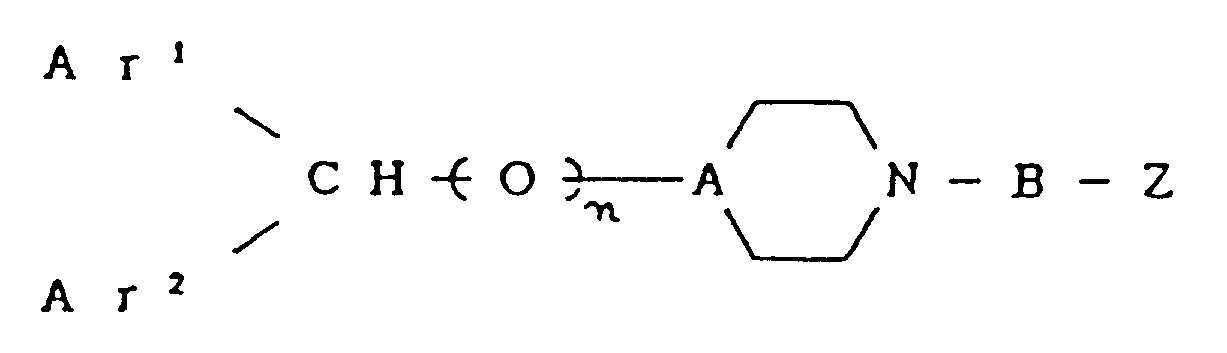


und ihr pharmazeutisch annehmbares Addukt. - Verbindung nach Anspruch 1, bei welcher wenigstens eines der beiden Ar¹ und Ar² eine Pyridylgruppe ist.
- Verbindung nach Anspruch 1, bei welcher wenigstens eines der beiden Ar¹ und Ar² eine Phenylgruppe mit einem Halogenatom ist.
- Verbindung nach Anspruch 1, bei welcher B wenigstens eines ist, ausgewählt aus der Gruppe, enthaltend eine gerade Alkylengruppe und eine gerade Alkenylengruppe mit 2 bis 5 Kohlenstoffatomen.
- Verbindung nach Anspruch 1, bei welcher Z dargestellt ist durch die Gruppe der Formel (II).
- Verbindung nach Anspruch 5, bei welcher eines der beiden R₁ und R₂ ein Kohlenstoffatom und ein anderes der beiden R₁ und R₂ eines darstellt, ausgewählt aus der Gruppe enthaltend ein Wasserstoffatom, ein Chloratom, eine Methylgruppe und eine Ethoxygruppe; X = -S-; und Y = -O-oder -S-.
- Verbindung nach Anspruch 6, bei welcher eine der beiden Ar¹ und Ar² eine Pyridylgruppe und ein anderes eine Phenylgruppe mit einem Halogenatom ist.
- Verbindung nach Anspruch 7, bei welcher eines der beiden Ar¹ und Ar² eine 4-Chlorphenylgruppe und ein anderes eine 2-Pyridylgruppe ist.
- Verbindung nach Anspruch 1, bei welcher Z die Gruppe der Formel (II') darstellt.
- Verbindung nach Anspruch 9, bei welcher Z' wenigstens eines ist, ausgewählt aus der Gruppe, enthaltend eine untere Alkoxygruppe und eine Hydroxygruppe.
- Verbindung nach Anspruch 9, bei welcher eines der beiden Ar¹ und Ar² eine Pyridylgruppe ist und ein anderes eine Phenylgruppe mit einem Halogenatom.
- Verbindung nach Anspruch 11, bei welcher eines der beiden Ar¹ und Ar² eine 4-Chlorphenylgruppe ist und ein anderes eine 2-Pyridylgruppe.
- Verbindung nach Anspruch 12, bei welcher A 〉CH- ist; n = 1; B eine Propylengruppe ist und Z' eine Ethoxygruppe.
- Verbindung nach Anspruch 13, bei welcher die Verbindung das p-Toluensulfonsäureaddukt ist.
- Pharmazeutische Antihistamin- und Antiallergie-Zusammensetzung, welche die Verbindung oder ihr pharmazeutisch annehmbares Säureaddukt nach Anspruch 1 als eine aktive Komponente enthält.
- Verfahren zum Herstellen einer Verbindung der Formel (I):

bei welchem eine Verbindung, dargestellt durch die Formel (III):
reagiert wird mit einer Verbindung der Formel (IV):
W-B-Z
(worin W eine abgehende Gruppe ist; B und Z die gleichen sind wie in Anspruch 1 definiert). - Verfahren zum Herstellen einer Verbindung der Formel (I-a):
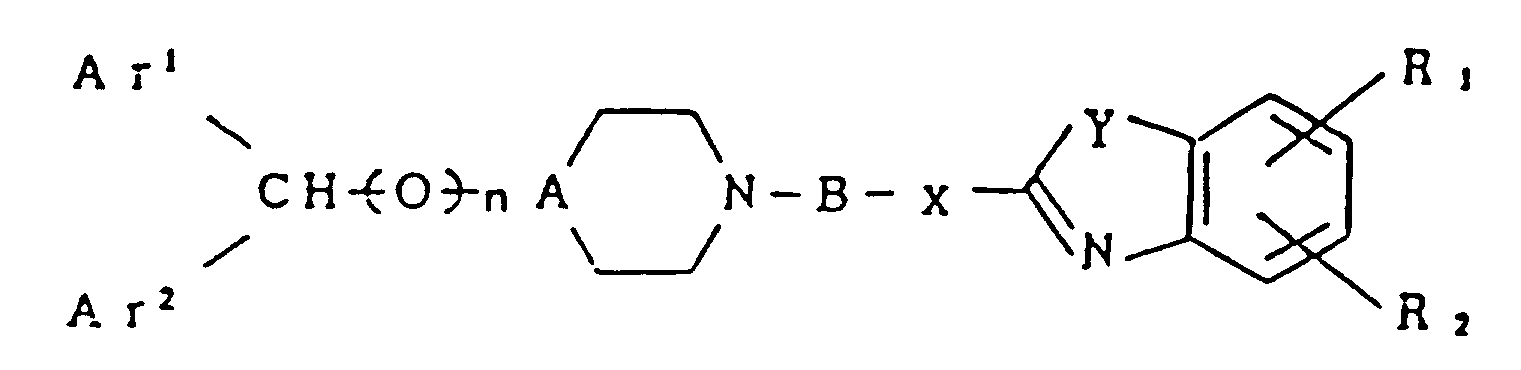
bei welchem eine Verbindung, dargestellt durch die Formel (V):
reagiert wird mit einer Verbindung der Formel (VI):
- Verfahren zum Herstellen einer Verbindung der Formel (I-b):

bei welchem eine Verbindung, dargestellt durch die Formel (VII):
reagiert wird mit einer Verbindung der Formel (VIII):
- Verfahren zum Herstellen einer Verbindung der Formel (I-c):

bei welchem eine Verbindung, dargestellt durch die Formel (IX):
reagiert wird mit einer Verbindung der Formel (X):
HZ''
(worin Z'' das gleiche ist wie vorstehend definiert). - Verfahren nach Anspruch 19, bei welchem eines der beiden Ar¹ und Ar² eine Pyridylgruppe ist und ein anderes eine Phenylgruppe mit einem Halogenatom.
- Verfahren nach Anspruch 19, bei welchem eines der beiden Ar¹ und Ar² eine 4-Chlorphenylgruppe ist und ein anderes eine 2-Pyridylgruppe.
- Verfahren nach Anspruch 19, bei welchem Z' eine Hydroxygruppe ist oder ihr Ester oder Amid.
- Verfahren nach Anspruch 19, bei welchem Z'' eine untere Alkoxygruppe ist.
- Verfahren nach Anspurch 19, bei welchem B Propenylen ist und Z'' eine Ethoxygruppe ist.
- Verfahren zum Herstellen einer Verbindung der Formel (I-d):

bei welchem eine Verbindung der Formel (XI):
- Verfahren nach Anspruch 25, bei welchem eines der beiden Ar¹ und Ar² eine Pyridylgruppe und das andere eine Phenylgruppe mit einem Halogenatom ist.
- Verfahren nach Anspruch 26, bei welchem eines der beiden Ar¹ und Ar² eine 4-Chlorphenylgruppe ist und das andere eine 2-Pyridylgruppe.
- Verfahren nach Anspruch 25, bei welchem B eine Propylengruppe ist.
Applications Claiming Priority (4)
| Application Number | Priority Date | Filing Date | Title |
|---|---|---|---|
| JP69711/88 | 1988-03-25 | ||
| JP6971188A JPH01242574A (ja) | 1988-03-25 | 1988-03-25 | 含窒素縮合環を有するピペリジン及びピペラジン誘導体、その製造方法並びにそれを含む薬学的組成物 |
| JP17514288A JPH0225465A (ja) | 1988-07-15 | 1988-07-15 | ピペリジン誘導体、その製造方法並びにそれを含む抗ヒスタミン剤 |
| JP175142/88 | 1988-07-15 |
Publications (2)
| Publication Number | Publication Date |
|---|---|
| EP0335586A1 EP0335586A1 (de) | 1989-10-04 |
| EP0335586B1 true EP0335586B1 (de) | 1993-06-02 |
Family
ID=26410875
Family Applications (1)
| Application Number | Title | Priority Date | Filing Date |
|---|---|---|---|
| EP89302894A Expired - Lifetime EP0335586B1 (de) | 1988-03-25 | 1989-03-22 | Piperidin- und Piperazinderivate, Verfahren zu ihrer Herstellung und pharmazeutische Zusammensetzungen, die sie enthalten |
Country Status (5)
| Country | Link |
|---|---|
| US (1) | US4929618A (de) |
| EP (1) | EP0335586B1 (de) |
| CA (1) | CA1340207C (de) |
| DE (1) | DE68906816T2 (de) |
| ES (1) | ES2058504T3 (de) |
Families Citing this family (24)
| Publication number | Priority date | Publication date | Assignee | Title |
|---|---|---|---|---|
| US5231104A (en) * | 1988-07-08 | 1993-07-27 | Pfizer Inc. | 1-arylethyl-3-substituted piperidines |
| CA2015949A1 (en) * | 1989-05-22 | 1990-11-22 | Yasuo Ito | Piperidine derivative, method for preparation thereof, and a pharmaceutical composition comprising the same |
| IE910818A1 (en) * | 1990-08-09 | 1992-02-12 | Sankyo Co | (benzhydryloxyethylpiperidyl)aliphatic acid derivatives and¹their use in the treatment of allergies and asthma |
| JP2624372B2 (ja) * | 1990-11-15 | 1997-06-25 | 宇部興産株式会社 | ジアリールメトキシピペリジン誘導体 |
| FI932687L (fi) * | 1990-12-14 | 1993-06-11 | Merrell Dow Pharma | Antiallergiska foereningar |
| TW198008B (de) * | 1991-04-08 | 1993-01-11 | Green Cross Corp | |
| EP0539164A1 (de) * | 1991-10-23 | 1993-04-28 | Sankyo Company Limited | Stickstoff enthaltende tetracyclische Verbindungen mit antiallergischen und antiasthmatischen Wirkungen, ihre Herstellung und Verwendung |
| TW593290B (en) * | 1996-05-10 | 2004-06-21 | Janssen Pharmaceutica Nv | Alkylaminobenzothiazole and -benzoxazole derivatives |
| TW486475B (en) * | 1996-12-26 | 2002-05-11 | Ube Industries | Acid addition salt of optically active piperidine compound and process for preparing the same |
| ATE299023T1 (de) * | 1997-12-17 | 2005-07-15 | Merck & Co Inc | Integrinrezeptor antagonisten |
| US6211191B1 (en) | 1997-12-17 | 2001-04-03 | Merck & Co., Inc. | Integrin receptor antagonists |
| WO2003032912A2 (en) * | 2001-10-16 | 2003-04-24 | Hypnion, Inc. | Treatment of cns disorders using cns target modulators |
| US7355042B2 (en) * | 2001-10-16 | 2008-04-08 | Hypnion, Inc. | Treatment of CNS disorders using CNS target modulators |
| US7189757B2 (en) * | 2001-10-16 | 2007-03-13 | Hypnion, Inc. | Treatment of sleep disorders using CNS target modulators |
| US20060165605A1 (en) | 2001-12-28 | 2006-07-27 | Ye-Mon Chen | Process to regenerate fcc spent catalyst |
| US8784789B2 (en) * | 2002-07-31 | 2014-07-22 | Senju Pharmaceutical Co., Ltd. | Aqueous liquid preparations and light-stabilized aqueous liquid preparations |
| US8877168B1 (en) | 2002-07-31 | 2014-11-04 | Senju Pharmaceuticals Co., Ltd. | Aqueous liquid preparations and light-stabilized aqueous liquid preparations |
| SG172685A1 (en) * | 2006-06-28 | 2011-07-28 | Amgen Inc | Glycine transporter-1 inhibitors |
| KR100879409B1 (ko) | 2007-06-11 | 2009-01-19 | 한미약품 주식회사 | (s)-베포타스틴의 제조방법 및 이에 사용되는 중간체 |
| MX2013008946A (es) | 2011-02-03 | 2013-10-25 | Lupin Ltd | Composiciones farmaceuticas orales de bepotastina de liberacion controlada. |
| CN104151295B (zh) * | 2014-08-26 | 2015-12-30 | 山东川成医药股份有限公司 | 一种2-[(4-氯苯基)(4-哌啶基氧基)甲基]吡啶的合成方法 |
| CN105924429A (zh) * | 2016-05-04 | 2016-09-07 | 河南师范大学 | 一种抗过敏药物贝他斯汀的制备方法 |
| CN108383831B (zh) * | 2018-02-28 | 2020-05-05 | 福建省微生物研究所 | 一种贝托斯汀重要中间体的制备方法 |
| CN117677386A (zh) * | 2021-07-23 | 2024-03-08 | 瓦伦塔有限责任公司 | 具有亲溶酶体和抗病毒活性的化合物 |
Family Cites Families (3)
| Publication number | Priority date | Publication date | Assignee | Title |
|---|---|---|---|---|
| US4250176A (en) * | 1976-12-21 | 1981-02-10 | Janssen Pharmaceutica N.V. | Piperazine derivatives |
| GB8321157D0 (en) * | 1983-08-05 | 1983-09-07 | Fordonal Sa | Piperidine derivatives |
| US4673684A (en) * | 1984-04-04 | 1987-06-16 | Terumo Corporation | Amide derivatives and 5-lipoxygenase inhibitors containing the same as an active ingredient |
-
1989
- 1989-03-16 US US07/325,306 patent/US4929618A/en not_active Expired - Lifetime
- 1989-03-17 CA CA000594067A patent/CA1340207C/en not_active Expired - Lifetime
- 1989-03-22 DE DE89302894T patent/DE68906816T2/de not_active Expired - Lifetime
- 1989-03-22 ES ES89302894T patent/ES2058504T3/es not_active Expired - Lifetime
- 1989-03-22 EP EP89302894A patent/EP0335586B1/de not_active Expired - Lifetime
Non-Patent Citations (1)
| Title |
|---|
| C.W. THORNBER, "Isosterism and molecular modification in drug design", Chem. Soc. Reviews, Vol. 18, 1979, pages 563-564 * |
Also Published As
| Publication number | Publication date |
|---|---|
| DE68906816T2 (de) | 1993-12-09 |
| ES2058504T3 (es) | 1994-11-01 |
| CA1340207C (en) | 1998-12-15 |
| EP0335586A1 (de) | 1989-10-04 |
| US4929618A (en) | 1990-05-29 |
| DE68906816D1 (de) | 1993-07-08 |
Similar Documents
| Publication | Publication Date | Title |
|---|---|---|
| US4929618A (en) | Piperdine and piperazine derivatives, and antihistaminic pharmaceutical compositions containing the same | |
| US5206261A (en) | Oxindole derivative | |
| RU2167152C2 (ru) | N-замещенные азагетероциклические карбоновые кислоты или их фармацевтически приемлемые соли, способ их получения, фармацевтическая композиция на их основе и способ ингибирования нейрогенного воспаления | |
| US7074935B2 (en) | Methods for the syntheses of alfentanil, sufentanil and remifentanil | |
| EP0363963B1 (de) | Piperidinyl-Benzimidazole als Antihistaminica | |
| US5322850A (en) | Antiallergic piperidine derivatives of benzimidazole | |
| IE54667B1 (en) | Dihydropyridine anti-ischaemic and antihypertensive agents, processes for their production, and pharmaceutical compositions containing them | |
| KR100234600B1 (ko) | 중추신경계 약제로서의 1,3-치환된 시클로알켄 및 시클로알칸 | |
| US5225409A (en) | Benzoxazinone compounds | |
| DK162222B (da) | 2-amino-5-hydroxy-4-methylpyrimidin-derivater og farmeceutiske praeparater indeholdende disse | |
| US5872115A (en) | 2-ureido-benzamide derivatives | |
| EP0330353B1 (de) | Tetrazolverbindungen als Antagonisten der excitatorischen Aminosäurerezeptoren | |
| FR2459240A1 (fr) | Aminopiperidines anorexigenes, procede pour leur preparation, intermediaires dans ledit procede et medicaments qui les contiennent | |
| US5135931A (en) | Pyridinylpiperazine derivatives | |
| EP0228959B1 (de) | Aminostyryl-Verbindungen und diese als wirksame Bestandteile enthaltende leukotrienantagonistische Zusammensetzung und Verfahren um durch ihre Anwendung SRS entgegenzuwirken | |
| US5432179A (en) | Piperazine derivatives and pharmaceuticals containing the same | |
| RU2188197C2 (ru) | 1,4-дизамещенные пиперазины, способ их получения, фармацевтическая композиция и способ лечения нейрогенного воспаления | |
| US4493837A (en) | Theobromine derivatives | |
| JPH0533953B2 (de) | ||
| JP3499569B2 (ja) | 新規複素環式化合物 | |
| JPS6399057A (ja) | グリシン誘導体 | |
| US5736558A (en) | 4-(6-fluoro-1,2-benzisoxazolyl)-1 piperidinyl-propoxy-chromen-4-one-one-derivatives, their preparation and their use in the treatment of psychosis, schizophrenia and anxiety | |
| JP2625294B2 (ja) | ピペリジン誘導体 | |
| US6046218A (en) | Pyridine derivative and medicament containing the same as an effective ingredient | |
| PL165125B1 (pl) | Sposób wytwarzania nowych zwiazków heterocyklicznych zawierajacych azot i siarke PL PL |
Legal Events
| Date | Code | Title | Description |
|---|---|---|---|
| PUAI | Public reference made under article 153(3) epc to a published international application that has entered the european phase |
Free format text: ORIGINAL CODE: 0009012 |
|
| AK | Designated contracting states |
Kind code of ref document: A1 Designated state(s): CH DE ES FR GB IT LI NL SE |
|
| 17P | Request for examination filed |
Effective date: 19900317 |
|
| 17Q | First examination report despatched |
Effective date: 19911115 |
|
| GRAA | (expected) grant |
Free format text: ORIGINAL CODE: 0009210 |
|
| AK | Designated contracting states |
Kind code of ref document: B1 Designated state(s): CH DE ES FR GB IT LI NL SE |
|
| REF | Corresponds to: |
Ref document number: 68906816 Country of ref document: DE Date of ref document: 19930708 |
|
| ET | Fr: translation filed | ||
| ITF | It: translation for a ep patent filed | ||
| PLBE | No opposition filed within time limit |
Free format text: ORIGINAL CODE: 0009261 |
|
| STAA | Information on the status of an ep patent application or granted ep patent |
Free format text: STATUS: NO OPPOSITION FILED WITHIN TIME LIMIT |
|
| 26N | No opposition filed | ||
| REG | Reference to a national code |
Ref country code: ES Ref legal event code: FG2A Ref document number: 2058504 Country of ref document: ES Kind code of ref document: T3 |
|
| EAL | Se: european patent in force in sweden |
Ref document number: 89302894.4 |
|
| REG | Reference to a national code |
Ref country code: GB Ref legal event code: IF02 |
|
| PGFP | Annual fee paid to national office [announced via postgrant information from national office to epo] |
Ref country code: ES Payment date: 20080222 Year of fee payment: 20 |
|
| PGFP | Annual fee paid to national office [announced via postgrant information from national office to epo] |
Ref country code: SE Payment date: 20080318 Year of fee payment: 20 Ref country code: NL Payment date: 20080331 Year of fee payment: 20 Ref country code: IT Payment date: 20080327 Year of fee payment: 20 Ref country code: GB Payment date: 20080225 Year of fee payment: 20 |
|
| PGFP | Annual fee paid to national office [announced via postgrant information from national office to epo] |
Ref country code: FR Payment date: 20080229 Year of fee payment: 20 Ref country code: DE Payment date: 20080221 Year of fee payment: 20 Ref country code: CH Payment date: 20080409 Year of fee payment: 20 |
|
| REG | Reference to a national code |
Ref country code: CH Ref legal event code: PL |
|
| REG | Reference to a national code |
Ref country code: GB Ref legal event code: PE20 Expiry date: 20090321 |
|
| REG | Reference to a national code |
Ref country code: ES Ref legal event code: FD2A Effective date: 20090323 |
|
| PG25 | Lapsed in a contracting state [announced via postgrant information from national office to epo] |
Ref country code: NL Free format text: LAPSE BECAUSE OF EXPIRATION OF PROTECTION Effective date: 20090322 |
|
| NLV7 | Nl: ceased due to reaching the maximum lifetime of a patent |
Effective date: 20090322 |
|
| PG25 | Lapsed in a contracting state [announced via postgrant information from national office to epo] |
Ref country code: GB Free format text: LAPSE BECAUSE OF EXPIRATION OF PROTECTION Effective date: 20090321 |
|
| PG25 | Lapsed in a contracting state [announced via postgrant information from national office to epo] |
Ref country code: ES Free format text: LAPSE BECAUSE OF EXPIRATION OF PROTECTION Effective date: 20090323 |