EP0302740A2 - Objektivkappe - Google Patents
Objektivkappe Download PDFInfo
- Publication number
- EP0302740A2 EP0302740A2 EP88307249A EP88307249A EP0302740A2 EP 0302740 A2 EP0302740 A2 EP 0302740A2 EP 88307249 A EP88307249 A EP 88307249A EP 88307249 A EP88307249 A EP 88307249A EP 0302740 A2 EP0302740 A2 EP 0302740A2
- Authority
- EP
- European Patent Office
- Prior art keywords
- title
- lens
- lens cap
- cap
- video camera
- Prior art date
- Legal status (The legal status is an assumption and is not a legal conclusion. Google has not performed a legal analysis and makes no representation as to the accuracy of the status listed.)
- Granted
Links
Images


Classifications
-
- G—PHYSICS
- G03—PHOTOGRAPHY; CINEMATOGRAPHY; ANALOGOUS TECHNIQUES USING WAVES OTHER THAN OPTICAL WAVES; ELECTROGRAPHY; HOLOGRAPHY
- G03B—APPARATUS OR ARRANGEMENTS FOR TAKING PHOTOGRAPHS OR FOR PROJECTING OR VIEWING THEM; APPARATUS OR ARRANGEMENTS EMPLOYING ANALOGOUS TECHNIQUES USING WAVES OTHER THAN OPTICAL WAVES; ACCESSORIES THEREFOR
- G03B11/00—Filters or other obturators specially adapted for photographic purposes
- G03B11/04—Hoods or caps for eliminating unwanted light from lenses, viewfinders or focusing aids
- G03B11/041—Lens caps as separate accessory
-
- G—PHYSICS
- G03—PHOTOGRAPHY; CINEMATOGRAPHY; ANALOGOUS TECHNIQUES USING WAVES OTHER THAN OPTICAL WAVES; ELECTROGRAPHY; HOLOGRAPHY
- G03B—APPARATUS OR ARRANGEMENTS FOR TAKING PHOTOGRAPHS OR FOR PROJECTING OR VIEWING THEM; APPARATUS OR ARRANGEMENTS EMPLOYING ANALOGOUS TECHNIQUES USING WAVES OTHER THAN OPTICAL WAVES; ACCESSORIES THEREFOR
- G03B11/00—Filters or other obturators specially adapted for photographic purposes
- G03B11/04—Hoods or caps for eliminating unwanted light from lenses, viewfinders or focusing aids
- G03B11/06—Lens caps for exposure making
-
- H—ELECTRICITY
- H04—ELECTRIC COMMUNICATION TECHNIQUE
- H04N—PICTORIAL COMMUNICATION, e.g. TELEVISION
- H04N23/00—Cameras or camera modules comprising electronic image sensors; Control thereof
- H04N23/50—Constructional details
- H04N23/51—Housings
Definitions
- This invention relates to lens caps. More particularly, but not exclusively, the invention relates to lens caps for video cameras.
- the video camera in which a so-called title superimpose function is provided has been developed.
- the video camera is provided with a memory for storing at least one still image photographed using a photographic lens, and means for outputting the still image stored in the memory to an image recording portion.
- a still title picture comprising a title element written on paper, etc.
- the title element can then be superimposed and recorded on the image of an object photographed during video photography.
- a paper on which the title element is written may be hung on a wall or hung and supported on a person, and the title element then photographed.
- a title is photographed in this way, there are limits on the location that can be used for photographing the title.
- discreet and careful photography is required to prevent camera fluctuations of photographed object fluctuations adversely effecting the image.
- auxiliary instruments for use exclusively for photographing title elements are provided on some video cameras.
- One such special auxiliary instrument includes an arm having a base end from which a screw extends and a tip or free end from which an integrated supporting piece extends vertically, and a screen frame on which a paper on which the title element is to be written (hereinafter referred to as a title recording paper) can be removably mounted.
- the title recording paper becomes located in front of a photographic lens of the camera when the mounting screw is threaded into a tapped hole (intended for mounting a tripod) provided on the lower surface of a housing or frame of the camera and when the title recording paper is mounted in the screen frame.
- Photographic lenses available on the market include so-called macro lenses or zoom lenses capable of photographing an object at a close distance.
- Many video cameras are provided with a zoom lens as a standard feature, or have the capability of using a special lens, capable of photographing an object at a close distance, which is provided as one of a plurality of exchangeable lenses.
- Such a macro lens or zoom lens can, in general, be focussed even if the photographic distance, i.e. the distance from the camera to the object being photographed, is several centimetres or less.
- a device for titling a photograph which device can removably be attached to a tip or free end portion of a photographic lens capable of photographing an object at a close distance, and on which device a region is provided in which an arbitrary title element can removably be fitted or installed.
- a lens cap comprising a lens cap body capable of removably covering a tip or end portion of a photographic lens which is capable of photographing an object at a close distance, and a title element, the lens cap body having a region on which the title element is removably installed.
- a device for a title applicable to a video camera comprising cap means for removably covering a tip or end portion of a photographic lens of the video camera, which lens is capable of photographing an object in a macro mode, a title member on which the title is written, and holding means for supporting the title member on the cap means so as to be photographed by the video camera through the photographic lens.
- Preferred embodiments of the invention described below provide a lens cap which is or can be removably attached to a lens of a video camera (or other camera) and provides the facility for conveniently photographing a title according to need.
- the lens cap removably covers the lens, which may be a zoom lens or an exchangeable macro lens which is capable of photographing an object at a close distance, e.g. is capable of macrophotography (photographing an object in a macro mode) and capable of photographing a title or titled objects (objects on which a title is written) extremely easily without fluctuations of the camera body and/or photographed objects appearing on the image when displayed on a screen.
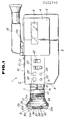
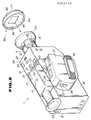
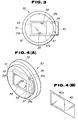
- Figures 1 to 4(B) show a lens cap according to a first preferred embodiment of the invention, which lens cap is applicable to a video camera.
- a video camera 1 includes a frame or casing 2.
- a rear part of a left side surface 3 (not shown in Figure 2) of the camera frame 2 is formed with a cassette hole or opening 4 for removing a cassette from or inserting a cassette into the frame 2.
- a lid 5 is mounted for pivotal movement to open or close the cassette hole 4.
- a cassette holder (not shown), in which a tape cassette 6 is removably mounted, is provided in the inner surface of the lid 5. With the tape cassette 6 inserted in the cassette holder, the lid 5 is moved to the position in which the cassette hole 4 is closed, so that the tape cassette 6 is mounted in a recording and playback portion in the frame 2.
- a photographic lens 7 projects forwardly from a front surface 8 of the frame 2.
- the lens 7 includes a lens mirror envelope 7a in which a plurality of fixed and movable lenses are installed.
- a zooming ring 9 and a focussing ring 10 are rotatably fitted to the outside of the lens mirror envelope 7a for moving a predetermined one of the movable lenses in a predetermined range, in the direction of an optical axis, when rotated.
- An operation knob 11 and a lock release button 12 are provided on the zooming ring 9.
- the zooming ring 9 When the zooming ring 9 is rotated, a variator lens is moved so that a picture angle for an object being photographed by the photographic lens 7 is changed. A focussing lens is moved and focussed together with rotation of the focussing ring 10.
- the zooming ring 9 can be rotated further within a given range in the anticlockwise direction as viewed from the front surface of the video camera 1.
- the photographic lens 7 functions as a macrolens capable of photographing a close object, i.e. an object at a short distance away from the lens. Photographing of an object at a distance of up to about 6 millimetres can be carried out.
- a lens hood 13 is removably threaded on a front end portion of the focussing ring 10.
- the camera 1 further comprises a microphone 14, an electronic view finder (EVF) 15 supported on a rear part of an upper surface 16 of the frame 2, a connector 15a for connecting the EVF 15 to a circuit installed in the frame 2, a battery mounting portion 17 projecting from a right side surface 18 of the frame 2, and a grip belt 19.
- EVF electronic view finder
- a mode selection button 20, for selecting different functional modes of the camera 1, is installed on the upper surface 16 of the frame 2.
- the button 20 has a total of three positions, i.e. a first position in which the camera is put into a photography or camera mode, a second position in which the camera is put into a playback mode, and a third position which selects an off mode in which neither the camera mode nor the playback mode function is carried out
- the camera has operating buttons 21 operable in the playback mode of the camera, e.g. a playback button, a tape forward button, a tape rewind button, a stop button, and a pause button; and operating buttons 22 operable during the photography of camera mode, e.g. an auto/manual switching button for white balance adjustment, an auto/manual switching button for focussing, a focussing button, and an inverse light correction button.
- buttons 21 operable in the playback mode of the camera, e.g. a playback button, a tape forward button, a tape rewind button, a stop button, and a pause button
- operating buttons 22 operable during the photography of camera mode, e.g. an auto/manual switching button for white balance adjustment, an auto/manual switching button for focussing, a focussing button, and an inverse light correction button.
- the camera 1 has operating buttons 23, 24 and 25 for photographing and storing a title, namely a read button 23 for reading a title, a colour selection button 24 for selecting a colour for the title, and an on/off button 25 for storing a read title or for outputting a title stored in memory to an image recording circuit.
- a photography button 26 is disposed on a rear end portion of the battery mounting portion 17.
- the video camera 1 starts to perform photography when the photography button 26 is pressed.
- a standby button 27 is movable between a non-standby position and a standby position.
- the non-standby position is immediately above the photography button 26 and the standby position is more remotely above the photography button 26.
- the video camera 1 can carry out photography or can read a title.
- the camera 1 further comprises an electric-powered zoom button 28 and a cassette removal button 29.
- the video camera 1 is put in the photography (camera) mode, in which an image of an object captured by the lens 7 is displayed on a screen of the EVF 15.
- an image captured by the lens 7 and audio (e.g. a voice) captured by the microphone 14 are recorded by a record/playback portion (not shown) on a magnetic tape of the tape cassette 6.
- Zooming during photography is carried out in response to operation of the electric-powered zooming button 28 or in response to manual rotation of the zooming ring 9. Focussing is carried out automatically or manually.
- Photographing a close object is carried out with the lock release button 12 depressed to enable the zooming lens 9 to rotate within the macrofocus range.
- the lens hood 13 may be removed.
- the standby button 27 moved to the standby position and the photographic lens 7 directed at a title recording paper, the photograph lens 7 is focussed, the operator viewing the image displayed on the EVF 15.
- the read button 23 is then depressed so that the image of the title element is converted into an electrical signal and temporarily stored in a memory in a record/playback circuit of the video camera 1.
- a lens cap 30 removably covers the photographic lens 7 of the video camera 1 via the lens hood 13, chiefly for protecting the lens 7.
- the lens cap 30 includes a main part 31 which is disc-shaped and has a diameter slightly larger than that of a leading or free end 13a of the lens hood 13, and a fitting portion 32 which has circular ring shape and projects away from an outer peripheral edge of the main part 31 towards the video camera 1, as shown in Figure 2, the parts 31 and 32 being formed integrally or a synthetic resin.
- a substantially rectangular space 33 is formed within the main part 31 at a substantially central portion of the main part 31 as viewed in the direction of the thickness of the main part 31.
- windows (apertures) 34 and 35 are formed between an inner surface 31a (the surface nearer the video camera 1) of the main part 31 and the space 33, and between an outer surface 31b of the main part 31 and the space 33, respectively, the windows 34 and 35 each having a rectangular shape about one half smaller than the space 33.
- the lens cap 30 further comprises light transmissive screens 36 and 37 formed of transparent or semitransparent synthetic resins, such as those of a milky white nature.
- the screens 36 and 37 each have a thickness substantially equal to one-third of the width or thickness of the space 33, i.e. the dimension thereof in the direction of the thickness of the main part 31.
- Projections 37a, 37a are formed at side edge portions of and extend along the longitudinal direction of the side of the screen 37 facing the screen 36.
- the screens 36 and 37 are spaced from and confront one another in the direction of their thickness and are housed and supported within the space 33 with a gap between them being maintained by means of the projections 37a, 37a.
- a narrow rectangular space 38 (hereinafter referred to as the title inserting portion), which is substantially twice as large as the windows 34 and 35, is formed between the two sheet-like screens 36 and 37.
- An introduction (entry) slit 39 is formed in the longitudinal direction between one end of the title inserting portion 38 and the outer peripheral surface of the main part 31.
- the light transmissive screen 36 is transparent and the light transmissive screen 37 is transparent or semitransparent.
- the lens cap 30 can serve to assist photographing of a title, in addition serving to protect the photographic lens 7. That is to say, the lens cap 30, as shown in Figure 1, has its fitting portion 32 fitted to the outside of the leading end portion 13a of the lens hood 13 of the video camera 1 so as to enclose the photographic lens 7 via the lens hood 13. Thus, the lens 7 can be protected.
- a title recording paper can be attached to the lens hood 13, the paper being inserted in the title inserting portion 38. If this is done, the photographing of a title can be carried out extremely easily.
- the title recording paper 40 is made of a transparent or semitransparent paper or film of a synthetic resin.
- the recording paper 40 has substantially the same width as that of the title inserting portion 38 and is substantially rectangular, having a length substantially equal to 1.5 times the length of the title inserting portion 38.
- a frame 40a having a size substantially the same as that of each window 34 and 35 is provided at a part of the paper 40 offset towards one end in the longitudinal direction.
- An arbitrary title element is marked (described) in the frame 40a.
- the arbitrary title element is marked by means of ink, relatively thick in colour, within the frame 40a of the paper 40.
- the paper 40 is inserted into the title inserting portion 38 of the lens cap 30, through the introduction slit 39, as shown in Figure 3.
- the photographic lens 7 traps the title element marked on the title recording paper 40 and its image is displayed on the screen of the EVF 15.
- Focussing of the lens on the object, i.e. the title recording paper 40, is carried out by turning the zooming ring 9 within the adjustment range for macrophotography, i.e. the macrofocus range.
- the title element marked (described) on the title recording paper 40 is temporarily stored in the memory. Therefore, when, as described above, upon completion of the colour selection operation effected by using the colour selection button 24, the on/off switch 25 is depressed, the title element is put into memory.
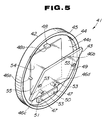
- Figures 5 to 7 show a lens cap 41 according to a second preferred embodiment of the invention.
- the lens cap 41 includes a cap main body 42 formed of a semitransparent synthetic resin and a paper press 43 which is made of a transparent synthetic resin and is pivotally supported on the cap main body 42.
- the cap main body 42 includes a main part 44 which is disc-shaped and has a diameter slightly larger than the diameter of the leading or free end 13a of the lens hood 13, and an integral fitting portion 45 which has a circular ring shape and which projects integrally from the outer peripheral edge portion of the main body 42 in the direction towards the video camera 1.
- Four positioning projections 46a, 46b, 46c, and 46d, two supporting projections 47 and 47, and a supporting projection 48 extend from an inner surface 44a of the main part 44.
- Two (46a and 46b) of the four positioning projections 46a, 46b, 46c and 46d are mounted at positions near opposite ends of a centre portion of the main body part 44.
- the other two positioning projections (46c and 46d) are spaced apart from each other, towards the left and right, respectively, at a position near the bottom of the main body part 44.
- the two supporting projections 47 and 47 are spaced apart from each other, towards the left and right, respectively, below the positioning projections 46c and 46d, and the engagement projection 48 is disposed at an upper central position on the main body part 44.
- the leading or free end of the engagement projection 48 is formed with an engagement portion 48a that projects towards the supporting projections 47 and 47.
- the paper press 43 includes a press plate 49 of a substantially square shape slightly smaller than a square inscribing the inner peripheral surface of the fitting portion 45 of the cap main body 42, and a projecting piece 50 that projects downwardly from a central portion of the lower edge of the press plate 49, the plate 49 and projecting piece 50 being formed integrally.
- a thin hinge portion 51 is formed at a position adjacent the press plate 49 and the projecting piece 50.
- Mounting holes 52, 52 (only one of which is shown in Figure 7) are formed towards the left and right ends, respectively, of a lower edge of the projecting piece 50.
- the supporting projections 47 and 47 extending from the cap main body 42 are inserted through the mounting holes 52 and 52 of the paper press 43 and parts of the projections are fixed to the inner surface 44a of the main part 44 of the cap main body 42 by means of a hot staking or cold staking operation.
- the paper press 43 is supported on the cap main body 42 in a state in which the press plate 49 can be moved to make contact with or be separated from the inner surface 44a of the main part 44 of the main body 42, with the hinge portion 51 of the paper press 43 acting as a pivoting fulcrum to enable the movement of the press plate.
- the positioning projections 46a to 46d are inserted into positioning holes 53 so that the press plate 49 can be located.
- the positioning holes 53 are formed at positions facing towards respective ones of the positioning projections 46a, 46b, 46c, and 46d and have larger diameters than the projections 46a, 46b, 46c and 46d.
- the lens cap 41 uses a title recording paper 54 made of the same material as the title recording paper 40 used in the first preferred embodiment.
- the title recording paper 54 is formed in a rectangular shape which is substantially smaller than the press plate 49 of the paper press 43.
- the press plate 49 of the paper press 43 is pivoted so that the press plate 49 is separated from the main part 44 of the cap main body 42 to some degree.
- the title recording paper 54 is placed within a region 55 enclosed within the positioning projections 46a to 46d and the engagement projection 48.
- the paper press 49 is then moved to the paper press position.
- the title recording paper 54 is held sandwiched between the main part 44 of the cap main body 42 and the press plate 49 of the paper press 43.
- the tip or free end portion of the engagement projection 48 mounted on the main part 44 is forced to flex in the upward direction, the edge of the pivoting end of the press plate 49 may be grasped by a fingertip and pulled towards the operator.
- an aqueous pen, etc. can be used to mark or describe a title element directly on the region 55 of the main part 44, or at a position on the press plate 49 corresponding to the region 55, without using the title recording paper 54.
- Figures 8 to 10 show a lens cap 56 according to a third preferred embodiment of the invention.
- the lens cap 56 includes a cap main body 57, formed of a transparent or semitransparent synthetic resin, and a paper press 58 removably attached to the cap main body 57.
- the paper press 58 is disc-shaped and is dimensioned so as to be capable of fitting tightly into the fitting portion 45 of the cap main body 57.
- the engagement projections 59 are engaged with the outer peripheral edge of the paper press 58 whereby the paper press is grasped on the cap main body 57.
- a hole 60 is formed through an upper end of the main part 44.
- the paper press 58 When the paper press 58 is attached to the cap main body 57 with the title recording paper 54 placed on a region 61 enclosed within the positioning projections 46a, 46b, 46c, and 46d of the main part 44 of the cap main body 57, the paper 54 is held on the lens cap 56 with the paper 54 being supported between the cap main body 57 and paper press 58.
- a fingertip of the operator is inserted from the front surface side into the hole 60 formed in the upper end of the main part 44 of the cap main body 57 to depress the upper end of the paper press 58.
- the paper press 58 is thereby disengaged from the engagement projections 59 at its peripheral edge. Therefore, the paper press 58 can be removed from the cap main body 57 and, subsequently, the title recording paper 54 can be removed from the cap main body 57.
- an aqueous pen can be used to describe or mark a title element directly on the region 61 of the main part 44 of the cap main body 57, or on a position corresponding to the region 61 of the paper press 58.
- the above-described lens caps are each removably attachable to a tip or free end portion of a photographic lens capable of photographing an object at a close distance and are provided with a region to which a title element can removably be attached. Therefore, the photographing of an arbitrary title can be carried out extremely easily.
- title photographing can be carried out without hanging the title recording paper on a wall or without holding the title recording paper on a large-sized holding instrument.
- title photographing is carried out with a fixed positional relationship between the title element and the photographic lens, the title photographing operation is not adversely affected by the occurrence of camera vibrations.
- the lens cap embodying the invention enable the photographing of a title without using a special auxiliary instrument as described above, without selection of a special location for the photographing operation, and without being adversely affected by such vibrations as described above.
- the title arrangement region is provided by a structure in which the title recording paper is held between two plate-like light-transmissive members.
- the title arrangement region is not limited to those described in the respective preferred embodiments. That is to say, the title arrangement region of the lens cap can, in general, have an arbitrary structure in which an arbitrary title element can be removably installed.
- the title region can be arranged such that a plurality of engagement portions enable engageable and disengageable insertion of a side edge portion and a side corner portion of the title recording paper in the region, these engagement portions suspending the title recording paper.
- At least part of the cap which faces the lens is transparent or semitransparent and is formed of a material to which a predetermined ink can be applied and can easily be wiped off (erased).
- a pen employing the predetermined ink can be used to mark or describe the title element directly on the related region.
- the invention is applicable to lens caps attachable to a photographic lens via a lens hood. However, the invention is also applicable to a lens cap removably attachable to a tip or end portion of photographic lens without the interposition of a lens hood. The invention is also applicable to lens caps for various types of camera photographic lenses.
Landscapes
- Physics & Mathematics (AREA)
- General Physics & Mathematics (AREA)
- Engineering & Computer Science (AREA)
- Multimedia (AREA)
- Signal Processing (AREA)
- Blocking Light For Cameras (AREA)
- Accessories Of Cameras (AREA)
Applications Claiming Priority (2)
| Application Number | Priority Date | Filing Date | Title |
|---|---|---|---|
| JP62197210A JPS6440825A (en) | 1987-08-06 | 1987-08-06 | Lens cap |
| JP197210/87 | 1987-08-06 |
Publications (3)
| Publication Number | Publication Date |
|---|---|
| EP0302740A2 true EP0302740A2 (de) | 1989-02-08 |
| EP0302740A3 EP0302740A3 (en) | 1990-06-13 |
| EP0302740B1 EP0302740B1 (de) | 1995-05-10 |
Family
ID=16370656
Family Applications (1)
| Application Number | Title | Priority Date | Filing Date |
|---|---|---|---|
| EP88307249A Expired - Lifetime EP0302740B1 (de) | 1987-08-06 | 1988-08-05 | Objektivkappe |
Country Status (6)
| Country | Link |
|---|---|
| US (1) | US5162942A (de) |
| EP (1) | EP0302740B1 (de) |
| JP (1) | JPS6440825A (de) |
| KR (2) | KR890004200A (de) |
| AU (1) | AU622621B2 (de) |
| DE (1) | DE3853749T2 (de) |
Families Citing this family (13)
| Publication number | Priority date | Publication date | Assignee | Title |
|---|---|---|---|---|
| CA2162578A1 (en) * | 1993-05-10 | 1994-11-24 | L. Michael Hone | Bar code scanner with field replaceable window |
| US6204881B1 (en) | 1993-10-10 | 2001-03-20 | Canon Kabushiki Kaisha | Image data processing apparatus which can combine a plurality of images at different exposures into an image with a wider dynamic range |
| US5887009A (en) * | 1997-05-22 | 1999-03-23 | Optical Biopsy Technologies, Inc. | Confocal optical scanning system employing a fiber laser |
| US20070035699A1 (en) * | 2005-08-10 | 2007-02-15 | Mckee Joel V | Apparatus, system, and method for associating contemporaneous notes with photographed images using a camera slate |
| US20090002823A1 (en) * | 2007-06-30 | 2009-01-01 | David Law | Permanently-Affixed Lens Cap |
| US7717630B1 (en) | 2007-09-07 | 2010-05-18 | Kevin Wan | Lens cap with integral reference surface |
| US7843504B2 (en) * | 2007-09-27 | 2010-11-30 | Chung-Ho Jim Lee | Camera cap with a white balance insert |
| AT507236B1 (de) * | 2008-09-12 | 2010-06-15 | Swarovski Optik Kg | Schutzkappe |
| US8681267B2 (en) * | 2011-08-21 | 2014-03-25 | James Edward Sale | Lens cap with storage device |
| KR101256351B1 (ko) * | 2011-11-22 | 2013-04-19 | 김석진 | 필터 삽입공을 갖는 카메라 후드 |
| US10900748B2 (en) | 2014-03-04 | 2021-01-26 | Sheltered Wings, Inc. | System and method for producing a DOPE chart |
| US10240897B2 (en) | 2014-03-04 | 2019-03-26 | Sheltered Wings, Inc. | Optic cover with releasably retained display |
| US9683812B2 (en) | 2014-03-04 | 2017-06-20 | Sheltered Wings, Inc. | Optic cover with releasably retained display |
Family Cites Families (16)
| Publication number | Priority date | Publication date | Assignee | Title |
|---|---|---|---|---|
| US2168594A (en) * | 1930-04-21 | 1939-08-08 | Anchor Cap & Closure Corp | Closure cap |
| US2583228A (en) * | 1946-07-08 | 1952-01-22 | Numbers William | Combined lens cover and lens brush |
| DE939192C (de) * | 1953-09-18 | 1956-02-16 | Zeiss Jena Veb Carl | Schutzdeckel aus durchsichtigem Material fuer Objektive oder Okulare optischer Geraete, insbesondere fuer Photoobjektive |
| US2961108A (en) * | 1957-12-19 | 1960-11-22 | Frances S Johnson | Magnifying cap for medicine bottle |
| US3133140A (en) * | 1960-09-23 | 1964-05-12 | Winchell Paul | Lens cover |
| US3682055A (en) * | 1969-01-31 | 1972-08-08 | Konan Camera Lab Co Ltd | Lens cap for camera |
| DE7029487U (de) * | 1970-08-05 | 1971-02-11 | Licentia Gmbh | Anordnung zur vermeidung des beschlagens von beobachtungsgeraeten. |
| US3768688A (en) * | 1971-09-08 | 1973-10-30 | Gillette Co | Cap |
| DE2208526A1 (de) * | 1972-02-23 | 1973-08-30 | Fritz Kamps | Verfahren und adapter zum kennzeichnen von filmen |
| US3796477A (en) * | 1972-09-25 | 1974-03-12 | Xomox Corp | Lens housing and lens cover for objective lens ring of an operating microscope |
| EP0083430A1 (de) * | 1981-12-14 | 1983-07-13 | Kenko Co., Ltd. | Filterhalter für ein photographisches Gerät |
| FR2524152A1 (fr) * | 1982-03-29 | 1983-09-30 | Alfille Jules | Ensemble modulaire permettant la mise en place d'accessoires divers sur un objectif d'appareil optique |
| JPS6096967A (ja) * | 1983-11-01 | 1985-05-30 | Asahi Optical Co Ltd | Vtrカメラ用タイトル等の撮像装置 |
| US4687312A (en) * | 1984-06-27 | 1987-08-18 | Panavision, Inc. | Matte box assembly |
| US4603785A (en) * | 1984-11-19 | 1986-08-05 | Sunbeam Plastics Corp. | Tamper indicating closure |
| JPS61257083A (ja) * | 1985-05-10 | 1986-11-14 | Matsushita Electric Ind Co Ltd | ビデオカメラ装置 |
-
1987
- 1987-08-06 JP JP62197210A patent/JPS6440825A/ja active Pending
-
1988
- 1988-07-22 US US07/223,418 patent/US5162942A/en not_active Expired - Fee Related
- 1988-07-26 AU AU20025/88A patent/AU622621B2/en not_active Ceased
- 1988-08-05 KR KR1019880009975A patent/KR890004200A/ko not_active Withdrawn
- 1988-08-05 DE DE3853749T patent/DE3853749T2/de not_active Expired - Fee Related
- 1988-08-05 EP EP88307249A patent/EP0302740B1/de not_active Expired - Lifetime
-
1997
- 1997-07-31 KR KR2019970020591U patent/KR200159074Y1/ko not_active Expired - Lifetime
Also Published As
| Publication number | Publication date |
|---|---|
| DE3853749T2 (de) | 1995-10-12 |
| DE3853749D1 (de) | 1995-06-14 |
| KR200159074Y1 (ko) | 1999-10-15 |
| AU2002588A (en) | 1989-02-09 |
| KR890004200A (ko) | 1989-04-20 |
| AU622621B2 (en) | 1992-04-16 |
| JPS6440825A (en) | 1989-02-13 |
| EP0302740B1 (de) | 1995-05-10 |
| KR19990007077U (ko) | 1999-02-25 |
| US5162942A (en) | 1992-11-10 |
| EP0302740A3 (en) | 1990-06-13 |
Similar Documents
| Publication | Publication Date | Title |
|---|---|---|
| US7537399B2 (en) | Digital camera having camera body | |
| US6683653B1 (en) | Electronic camera and dial control device of electronic equipment | |
| EP0302740B1 (de) | Objektivkappe | |
| US5255120A (en) | Lens cap applicable to a video camera | |
| US6546207B2 (en) | Camera capable of inputting data and selectively displaying image | |
| JP4397058B2 (ja) | 携帯型電子機器 | |
| JPH01282533A (ja) | プリントの縦横比自動変更可能な焼付装置 | |
| JP3948003B2 (ja) | 携帯型電子機器 | |
| KR960039860A (ko) | 스틸카메라 일체형 비디오카메라 | |
| JP4041930B2 (ja) | 電子カメラ | |
| US5784657A (en) | Camera having a display panel | |
| JP4449654B2 (ja) | 電子機器のダイヤル装置 | |
| JP3807529B2 (ja) | 電子カメラ | |
| JPH073735Y2 (ja) | 再生装置付カメラ | |
| JP2660065B2 (ja) | カメラ | |
| JP2001042415A (ja) | 写真カメラ | |
| JP3980467B2 (ja) | 双眼鏡 | |
| JP3467335B2 (ja) | カメラの磁気ヘッド取付構造 | |
| JP3541970B2 (ja) | 電子カメラ用アダプタ | |
| JPH07146507A (ja) | カメラ装置 | |
| JP4586458B2 (ja) | 撮像装置 | |
| JP2001523402A (ja) | ビデオ撮影及び写真撮影用カメラ | |
| JP2007026701A (ja) | 電子機器の蓋装置 | |
| JP2003270710A (ja) | 接写用凸レンズを具えた撮像機器 | |
| JPS63261334A (ja) | スチルカメラ付きビデオカメラ |
Legal Events
| Date | Code | Title | Description |
|---|---|---|---|
| PUAI | Public reference made under article 153(3) epc to a published international application that has entered the european phase |
Free format text: ORIGINAL CODE: 0009012 |
|
| AK | Designated contracting states |
Kind code of ref document: A2 Designated state(s): DE FR GB NL |
|
| PUAL | Search report despatched |
Free format text: ORIGINAL CODE: 0009013 |
|
| AK | Designated contracting states |
Kind code of ref document: A3 Designated state(s): DE FR GB NL |
|
| 17P | Request for examination filed |
Effective date: 19901101 |
|
| 17Q | First examination report despatched |
Effective date: 19921113 |
|
| GRAA | (expected) grant |
Free format text: ORIGINAL CODE: 0009210 |
|
| AK | Designated contracting states |
Kind code of ref document: B1 Designated state(s): DE FR GB NL |
|
| REF | Corresponds to: |
Ref document number: 3853749 Country of ref document: DE Date of ref document: 19950614 |
|
| ET | Fr: translation filed | ||
| PLBE | No opposition filed within time limit |
Free format text: ORIGINAL CODE: 0009261 |
|
| STAA | Information on the status of an ep patent application or granted ep patent |
Free format text: STATUS: NO OPPOSITION FILED WITHIN TIME LIMIT |
|
| 26N | No opposition filed | ||
| PGFP | Annual fee paid to national office [announced via postgrant information from national office to epo] |
Ref country code: DE Payment date: 20010730 Year of fee payment: 14 |
|
| PGFP | Annual fee paid to national office [announced via postgrant information from national office to epo] |
Ref country code: GB Payment date: 20010801 Year of fee payment: 14 |
|
| PGFP | Annual fee paid to national office [announced via postgrant information from national office to epo] |
Ref country code: FR Payment date: 20010810 Year of fee payment: 14 |
|
| PGFP | Annual fee paid to national office [announced via postgrant information from national office to epo] |
Ref country code: NL Payment date: 20010830 Year of fee payment: 14 |
|
| REG | Reference to a national code |
Ref country code: GB Ref legal event code: IF02 |
|
| PG25 | Lapsed in a contracting state [announced via postgrant information from national office to epo] |
Ref country code: GB Free format text: LAPSE BECAUSE OF NON-PAYMENT OF DUE FEES Effective date: 20020805 |
|
| PG25 | Lapsed in a contracting state [announced via postgrant information from national office to epo] |
Ref country code: NL Free format text: LAPSE BECAUSE OF NON-PAYMENT OF DUE FEES Effective date: 20030301 Ref country code: DE Free format text: LAPSE BECAUSE OF NON-PAYMENT OF DUE FEES Effective date: 20030301 |
|
| GBPC | Gb: european patent ceased through non-payment of renewal fee |
Effective date: 20020805 |
|
| PG25 | Lapsed in a contracting state [announced via postgrant information from national office to epo] |
Ref country code: FR Free format text: LAPSE BECAUSE OF NON-PAYMENT OF DUE FEES Effective date: 20030430 |
|
| NLV4 | Nl: lapsed or anulled due to non-payment of the annual fee |
Effective date: 20030301 |
|
| REG | Reference to a national code |
Ref country code: FR Ref legal event code: ST |