EP0286478B1 - Sels d'acide phosphoreux, compositions les contenant et leur application comme agent d'ignifugation - Google Patents
Sels d'acide phosphoreux, compositions les contenant et leur application comme agent d'ignifugation Download PDFInfo
- Publication number
- EP0286478B1 EP0286478B1 EP88400619A EP88400619A EP0286478B1 EP 0286478 B1 EP0286478 B1 EP 0286478B1 EP 88400619 A EP88400619 A EP 88400619A EP 88400619 A EP88400619 A EP 88400619A EP 0286478 B1 EP0286478 B1 EP 0286478B1
- Authority
- EP
- European Patent Office
- Prior art keywords
- phosphite
- process according
- phosphites
- fireproofed
- melamine
- Prior art date
- Legal status (The legal status is an assumption and is not a legal conclusion. Google has not performed a legal analysis and makes no representation as to the accuracy of the status listed.)
- Expired - Lifetime
Links
- OJMIONKXNSYLSR-UHFFFAOYSA-N phosphorous acid Chemical class OP(O)O OJMIONKXNSYLSR-UHFFFAOYSA-N 0.000 title claims description 8
- 239000003063 flame retardant Substances 0.000 title abstract description 10
- 150000001875 compounds Chemical class 0.000 claims abstract description 27
- 239000004952 Polyamide Substances 0.000 claims abstract description 13
- 229920002647 polyamide Polymers 0.000 claims abstract description 13
- 238000000034 method Methods 0.000 claims abstract description 12
- 229920000098 polyolefin Polymers 0.000 claims abstract description 11
- GLUUGHFHXGJENI-UHFFFAOYSA-N Piperazine Chemical compound C1CNCCN1 GLUUGHFHXGJENI-UHFFFAOYSA-N 0.000 claims abstract description 10
- 229920003023 plastic Polymers 0.000 claims abstract description 10
- 239000004033 plastic Substances 0.000 claims abstract description 10
- 238000004079 fireproofing Methods 0.000 claims abstract description 4
- CZPWVGJYEJSRLH-UHFFFAOYSA-N Pyrimidine Chemical compound C1=CN=CN=C1 CZPWVGJYEJSRLH-UHFFFAOYSA-N 0.000 claims abstract 2
- RGKMXIGPEXCRQR-UHFFFAOYSA-N phosphorous acid;1,3,5-triazine-2,4,6-triamine Chemical compound OP(O)O.NC1=NC(N)=NC(N)=N1 RGKMXIGPEXCRQR-UHFFFAOYSA-N 0.000 claims description 21
- WXZMFSXDPGVJKK-UHFFFAOYSA-N pentaerythritol Chemical compound OCC(CO)(CO)CO WXZMFSXDPGVJKK-UHFFFAOYSA-N 0.000 claims description 16
- JDSHMPZPIAZGSV-UHFFFAOYSA-N melamine powder Natural products NC1=NC(N)=NC(N)=N1 JDSHMPZPIAZGSV-UHFFFAOYSA-N 0.000 claims description 13
- 125000003277 amino group Chemical group 0.000 claims description 9
- 125000004432 carbon atom Chemical group C* 0.000 claims description 9
- 229910052736 halogen Inorganic materials 0.000 claims description 9
- ZJIPHXXDPROMEF-UHFFFAOYSA-N dihydroxyphosphanyl dihydrogen phosphite Chemical compound OP(O)OP(O)O ZJIPHXXDPROMEF-UHFFFAOYSA-N 0.000 claims description 8
- 150000002367 halogens Chemical group 0.000 claims description 8
- YNAVUWVOSKDBBP-UHFFFAOYSA-N Morpholine Chemical compound C1COCCN1 YNAVUWVOSKDBBP-UHFFFAOYSA-N 0.000 claims description 4
- DQNFGSXSEXBTFI-UHFFFAOYSA-N OP(O)OP(O)O.N1CCNCC1 Chemical compound OP(O)OP(O)O.N1CCNCC1 DQNFGSXSEXBTFI-UHFFFAOYSA-N 0.000 claims description 4
- 125000001931 aliphatic group Chemical group 0.000 claims description 4
- PAFZNILMFXTMIY-UHFFFAOYSA-N cyclohexylamine Chemical compound NC1CCCCC1 PAFZNILMFXTMIY-UHFFFAOYSA-N 0.000 claims description 4
- 125000000623 heterocyclic group Chemical group 0.000 claims description 4
- AQSJGOWTSHOLKH-UHFFFAOYSA-N phosphite(3-) Chemical class [O-]P([O-])[O-] AQSJGOWTSHOLKH-UHFFFAOYSA-N 0.000 claims description 4
- NDGSBJSAXJUQTE-UHFFFAOYSA-N azane;phosphorous acid Chemical compound N.OP(O)O NDGSBJSAXJUQTE-UHFFFAOYSA-N 0.000 claims description 3
- 125000004433 nitrogen atom Chemical group N* 0.000 claims description 3
- JYEUMXHLPRZUAT-UHFFFAOYSA-N 1,2,3-triazine Chemical group C1=CN=NN=C1 JYEUMXHLPRZUAT-UHFFFAOYSA-N 0.000 claims description 2
- FBPFZTCFMRRESA-FSIIMWSLSA-N D-Glucitol Natural products OC[C@H](O)[C@H](O)[C@@H](O)[C@H](O)CO FBPFZTCFMRRESA-FSIIMWSLSA-N 0.000 claims description 2
- FBPFZTCFMRRESA-KVTDHHQDSA-N D-Mannitol Chemical compound OC[C@@H](O)[C@@H](O)[C@H](O)[C@H](O)CO FBPFZTCFMRRESA-KVTDHHQDSA-N 0.000 claims description 2
- FBPFZTCFMRRESA-JGWLITMVSA-N D-glucitol Chemical compound OC[C@H](O)[C@@H](O)[C@H](O)[C@H](O)CO FBPFZTCFMRRESA-JGWLITMVSA-N 0.000 claims description 2
- 229930195725 Mannitol Natural products 0.000 claims description 2
- NZUIDXBVXHDCBP-UHFFFAOYSA-N aniline;phosphorous acid Chemical class OP(O)O.NC1=CC=CC=C1 NZUIDXBVXHDCBP-UHFFFAOYSA-N 0.000 claims description 2
- 239000000594 mannitol Substances 0.000 claims description 2
- 235000010355 mannitol Nutrition 0.000 claims description 2
- 229920005989 resin Polymers 0.000 claims description 2
- 239000011347 resin Substances 0.000 claims description 2
- 239000000600 sorbitol Substances 0.000 claims description 2
- 235000010356 sorbitol Nutrition 0.000 claims description 2
- 125000001424 substituent group Chemical group 0.000 claims description 2
- 239000004386 Erythritol Substances 0.000 claims 1
- UNXHWFMMPAWVPI-UHFFFAOYSA-N Erythritol Natural products OCC(O)C(O)CO UNXHWFMMPAWVPI-UHFFFAOYSA-N 0.000 claims 1
- 235000019414 erythritol Nutrition 0.000 claims 1
- UNXHWFMMPAWVPI-ZXZARUISSA-N erythritol Chemical compound OC[C@H](O)[C@H](O)CO UNXHWFMMPAWVPI-ZXZARUISSA-N 0.000 claims 1
- 229940009714 erythritol Drugs 0.000 claims 1
- 125000005843 halogen group Chemical group 0.000 claims 1
- 125000001570 methylene group Chemical group [H]C([H])([*:1])[*:2] 0.000 claims 1
- 125000003386 piperidinyl group Chemical group 0.000 claims 1
- -1 amine salts Chemical class 0.000 abstract description 39
- ISIJQEHRDSCQIU-UHFFFAOYSA-N tert-butyl 2,7-diazaspiro[4.5]decane-7-carboxylate Chemical class C1N(C(=O)OC(C)(C)C)CCCC11CNCC1 ISIJQEHRDSCQIU-UHFFFAOYSA-N 0.000 abstract description 6
- HYZJCKYKOHLVJF-UHFFFAOYSA-N 1H-benzimidazole Chemical compound C1=CC=C2NC=NC2=C1 HYZJCKYKOHLVJF-UHFFFAOYSA-N 0.000 abstract description 2
- JIHQDMXYYFUGFV-UHFFFAOYSA-N 1,3,5-triazine Chemical compound C1=NC=NC=N1 JIHQDMXYYFUGFV-UHFFFAOYSA-N 0.000 abstract 1
- NSPMIYGKQJPBQR-UHFFFAOYSA-N 4H-1,2,4-triazole Chemical compound C=1N=CNN=1 NSPMIYGKQJPBQR-UHFFFAOYSA-N 0.000 abstract 1
- OWYWGLHRNBIFJP-UHFFFAOYSA-N Ipazine Chemical compound CCN(CC)C1=NC(Cl)=NC(NC(C)C)=N1 OWYWGLHRNBIFJP-UHFFFAOYSA-N 0.000 abstract 1
- ABLZXFCXXLZCGV-UHFFFAOYSA-N Phosphorous acid Chemical class OP(O)=O ABLZXFCXXLZCGV-UHFFFAOYSA-N 0.000 description 45
- IAZDPXIOMUYVGZ-WFGJKAKNSA-N Dimethyl sulfoxide Chemical compound [2H]C([2H])([2H])S(=O)C([2H])([2H])[2H] IAZDPXIOMUYVGZ-WFGJKAKNSA-N 0.000 description 26
- 239000000047 product Substances 0.000 description 23
- 239000008187 granular material Substances 0.000 description 18
- 239000002904 solvent Substances 0.000 description 18
- XLYOFNOQVPJJNP-UHFFFAOYSA-N water Substances O XLYOFNOQVPJJNP-UHFFFAOYSA-N 0.000 description 16
- 238000001460 carbon-13 nuclear magnetic resonance spectrum Methods 0.000 description 9
- 238000002329 infrared spectrum Methods 0.000 description 9
- 239000000203 mixture Substances 0.000 description 9
- 238000000425 proton nuclear magnetic resonance spectrum Methods 0.000 description 9
- MDFFNEOEWAXZRQ-UHFFFAOYSA-N aminyl Chemical compound [NH2] MDFFNEOEWAXZRQ-UHFFFAOYSA-N 0.000 description 8
- 238000004458 analytical method Methods 0.000 description 8
- 238000007580 dry-mixing Methods 0.000 description 8
- PKWIYNIDEDLDCJ-UHFFFAOYSA-N guanazole Chemical compound NC1=NNC(N)=N1 PKWIYNIDEDLDCJ-UHFFFAOYSA-N 0.000 description 8
- 229910052757 nitrogen Inorganic materials 0.000 description 8
- 229920000642 polymer Polymers 0.000 description 8
- GZVHEAJQGPRDLQ-UHFFFAOYSA-N 6-phenyl-1,3,5-triazine-2,4-diamine Chemical compound NC1=NC(N)=NC(C=2C=CC=CC=2)=N1 GZVHEAJQGPRDLQ-UHFFFAOYSA-N 0.000 description 7
- 229920000877 Melamine resin Polymers 0.000 description 7
- 229920000571 Nylon 11 Polymers 0.000 description 7
- 239000007864 aqueous solution Substances 0.000 description 7
- 0 BCI1c(cccc2)c2NC=C(*)C1 Chemical compound BCI1c(cccc2)c2NC=C(*)C1 0.000 description 6
- 239000004743 Polypropylene Substances 0.000 description 6
- QVGXLLKOCUKJST-UHFFFAOYSA-N atomic oxygen Chemical compound [O] QVGXLLKOCUKJST-UHFFFAOYSA-N 0.000 description 6
- 230000015572 biosynthetic process Effects 0.000 description 6
- 238000002347 injection Methods 0.000 description 6
- 239000007924 injection Substances 0.000 description 6
- 239000001301 oxygen Substances 0.000 description 6
- 229910052760 oxygen Inorganic materials 0.000 description 6
- 229920001155 polypropylene Polymers 0.000 description 6
- 238000003756 stirring Methods 0.000 description 6
- IJGRMHOSHXDMSA-UHFFFAOYSA-N Atomic nitrogen Chemical compound N#N IJGRMHOSHXDMSA-UHFFFAOYSA-N 0.000 description 5
- NJYZCEFQAIUHSD-UHFFFAOYSA-N acetoguanamine Chemical compound CC1=NC(N)=NC(N)=N1 NJYZCEFQAIUHSD-UHFFFAOYSA-N 0.000 description 5
- 239000000243 solution Substances 0.000 description 5
- ZRALSGWEFCBTJO-UHFFFAOYSA-N Guanidine Chemical compound NC(N)=N ZRALSGWEFCBTJO-UHFFFAOYSA-N 0.000 description 4
- 238000006243 chemical reaction Methods 0.000 description 4
- 238000002485 combustion reaction Methods 0.000 description 4
- 239000013078 crystal Substances 0.000 description 4
- 239000006185 dispersion Substances 0.000 description 4
- NAQMVNRVTILPCV-UHFFFAOYSA-N hexane-1,6-diamine Chemical compound NCCCCCCN NAQMVNRVTILPCV-UHFFFAOYSA-N 0.000 description 4
- 238000005259 measurement Methods 0.000 description 4
- 125000000325 methylidene group Chemical group [H]C([H])=* 0.000 description 4
- 239000000843 powder Substances 0.000 description 4
- 239000012429 reaction media Substances 0.000 description 4
- RNFJDJUURJAICM-UHFFFAOYSA-N 2,2,4,4,6,6-hexaphenoxy-1,3,5-triaza-2$l^{5},4$l^{5},6$l^{5}-triphosphacyclohexa-1,3,5-triene Chemical compound N=1P(OC=2C=CC=CC=2)(OC=2C=CC=CC=2)=NP(OC=2C=CC=CC=2)(OC=2C=CC=CC=2)=NP=1(OC=1C=CC=CC=1)OC1=CC=CC=C1 RNFJDJUURJAICM-UHFFFAOYSA-N 0.000 description 3
- QGZKDVFQNNGYKY-UHFFFAOYSA-N Ammonia Chemical compound N QGZKDVFQNNGYKY-UHFFFAOYSA-N 0.000 description 3
- IAZDPXIOMUYVGZ-UHFFFAOYSA-N Dimethylsulphoxide Chemical compound CS(C)=O IAZDPXIOMUYVGZ-UHFFFAOYSA-N 0.000 description 3
- 229920000299 Nylon 12 Polymers 0.000 description 3
- NBIIXXVUZAFLBC-UHFFFAOYSA-N Phosphoric acid Chemical compound OP(O)(O)=O NBIIXXVUZAFLBC-UHFFFAOYSA-N 0.000 description 3
- 150000001412 amines Chemical class 0.000 description 3
- 125000004429 atom Chemical group 0.000 description 3
- 239000003054 catalyst Substances 0.000 description 3
- 239000003795 chemical substances by application Substances 0.000 description 3
- 230000006835 compression Effects 0.000 description 3
- 238000007906 compression Methods 0.000 description 3
- 238000001816 cooling Methods 0.000 description 3
- 230000004927 fusion Effects 0.000 description 3
- 239000007789 gas Substances 0.000 description 3
- 238000010438 heat treatment Methods 0.000 description 3
- YSRVJVDFHZYRPA-UHFFFAOYSA-N melem Chemical compound NC1=NC(N23)=NC(N)=NC2=NC(N)=NC3=N1 YSRVJVDFHZYRPA-UHFFFAOYSA-N 0.000 description 3
- LZFCRKFJSLYVFQ-UHFFFAOYSA-N phosphorous acid;piperazine Chemical compound OP(O)O.C1CNCCN1 LZFCRKFJSLYVFQ-UHFFFAOYSA-N 0.000 description 3
- 238000002360 preparation method Methods 0.000 description 3
- 238000010992 reflux Methods 0.000 description 3
- 150000003839 salts Chemical class 0.000 description 3
- 239000000725 suspension Substances 0.000 description 3
- YZEZMSPGIPTEBA-UHFFFAOYSA-N 2-n-(4,6-diamino-1,3,5-triazin-2-yl)-1,3,5-triazine-2,4,6-triamine Chemical compound NC1=NC(N)=NC(NC=2N=C(N)N=C(N)N=2)=N1 YZEZMSPGIPTEBA-UHFFFAOYSA-N 0.000 description 2
- VTYYLEPIZMXCLO-UHFFFAOYSA-L Calcium carbonate Chemical compound [Ca+2].[O-]C([O-])=O VTYYLEPIZMXCLO-UHFFFAOYSA-L 0.000 description 2
- 229920013683 Celanese Polymers 0.000 description 2
- RTZKZFJDLAIYFH-UHFFFAOYSA-N Diethyl ether Chemical compound CCOCC RTZKZFJDLAIYFH-UHFFFAOYSA-N 0.000 description 2
- OKOBUGCCXMIKDM-UHFFFAOYSA-N Irganox 1098 Chemical compound CC(C)(C)C1=C(O)C(C(C)(C)C)=CC(CCC(=O)NCCCCCCNC(=O)CCC=2C=C(C(O)=C(C=2)C(C)(C)C)C(C)(C)C)=C1 OKOBUGCCXMIKDM-UHFFFAOYSA-N 0.000 description 2
- CHJJGSNFBQVOTG-UHFFFAOYSA-N N-methyl-guanidine Natural products CNC(N)=N CHJJGSNFBQVOTG-UHFFFAOYSA-N 0.000 description 2
- 229920002292 Nylon 6 Polymers 0.000 description 2
- OAICVXFJPJFONN-UHFFFAOYSA-N Phosphorus Chemical compound [P] OAICVXFJPJFONN-UHFFFAOYSA-N 0.000 description 2
- NQRYJNQNLNOLGT-UHFFFAOYSA-N Piperidine Chemical compound C1CCNCC1 NQRYJNQNLNOLGT-UHFFFAOYSA-N 0.000 description 2
- ZJCCRDAZUWHFQH-UHFFFAOYSA-N Trimethylolpropane Chemical compound CCC(CO)(CO)CO ZJCCRDAZUWHFQH-UHFFFAOYSA-N 0.000 description 2
- XSQUKJJJFZCRTK-UHFFFAOYSA-N Urea Chemical compound NC(N)=O XSQUKJJJFZCRTK-UHFFFAOYSA-N 0.000 description 2
- CIUQDSCDWFSTQR-UHFFFAOYSA-N [C]1=CC=CC=C1 Chemical class [C]1=CC=CC=C1 CIUQDSCDWFSTQR-UHFFFAOYSA-N 0.000 description 2
- 239000002253 acid Substances 0.000 description 2
- 238000009529 body temperature measurement Methods 0.000 description 2
- 238000009835 boiling Methods 0.000 description 2
- 239000000470 constituent Substances 0.000 description 2
- 125000004122 cyclic group Chemical group 0.000 description 2
- SWSQBOPZIKWTGO-UHFFFAOYSA-N dimethylaminoamidine Natural products CN(C)C(N)=N SWSQBOPZIKWTGO-UHFFFAOYSA-N 0.000 description 2
- TVIDDXQYHWJXFK-UHFFFAOYSA-N dodecanedioic acid Chemical compound OC(=O)CCCCCCCCCCC(O)=O TVIDDXQYHWJXFK-UHFFFAOYSA-N 0.000 description 2
- 238000001035 drying Methods 0.000 description 2
- JBKVHLHDHHXQEQ-UHFFFAOYSA-N epsilon-caprolactam Chemical compound O=C1CCCCCN1 JBKVHLHDHHXQEQ-UHFFFAOYSA-N 0.000 description 2
- 238000001125 extrusion Methods 0.000 description 2
- 239000006260 foam Substances 0.000 description 2
- 239000001257 hydrogen Substances 0.000 description 2
- 229910052739 hydrogen Inorganic materials 0.000 description 2
- 125000004435 hydrogen atom Chemical class [H]* 0.000 description 2
- 239000002609 medium Substances 0.000 description 2
- 238000002156 mixing Methods 0.000 description 2
- 239000002245 particle Substances 0.000 description 2
- 125000001997 phenyl group Chemical group [H]C1=C([H])C([H])=C(*)C([H])=C1[H] 0.000 description 2
- 235000011007 phosphoric acid Nutrition 0.000 description 2
- 150000003013 phosphoric acid derivatives Chemical class 0.000 description 2
- XFZRQAZGUOTJCS-UHFFFAOYSA-N phosphoric acid;1,3,5-triazine-2,4,6-triamine Chemical compound OP(O)(O)=O.NC1=NC(N)=NC(N)=N1 XFZRQAZGUOTJCS-UHFFFAOYSA-N 0.000 description 2
- 229920002635 polyurethane Polymers 0.000 description 2
- 239000004814 polyurethane Substances 0.000 description 2
- 239000002244 precipitate Substances 0.000 description 2
- 125000002924 primary amino group Chemical group [H]N([H])* 0.000 description 2
- 230000036633 rest Effects 0.000 description 2
- 239000000126 substance Substances 0.000 description 2
- UXTFKIJKRJJXNV-UHFFFAOYSA-N 1-$l^{1}-oxidanylethanone Chemical compound CC([O])=O UXTFKIJKRJJXNV-UHFFFAOYSA-N 0.000 description 1
- 238000001644 13C nuclear magnetic resonance spectroscopy Methods 0.000 description 1
- LZEYUANBTNIFIH-UHFFFAOYSA-N 1h-benzimidazole;phosphorous acid Chemical compound OP(O)O.C1=CC=C2NC=NC2=C1 LZEYUANBTNIFIH-UHFFFAOYSA-N 0.000 description 1
- JWYUFVNJZUSCSM-UHFFFAOYSA-N 2-aminobenzimidazole Chemical compound C1=CC=C2NC(N)=NC2=C1 JWYUFVNJZUSCSM-UHFFFAOYSA-N 0.000 description 1
- LRQKBLKVPFOOQJ-UHFFFAOYSA-N 2-aminohexanoic acid Chemical class CCCCC(N)C(O)=O LRQKBLKVPFOOQJ-UHFFFAOYSA-N 0.000 description 1
- QGZKDVFQNNGYKY-UHFFFAOYSA-O Ammonium Chemical compound [NH4+] QGZKDVFQNNGYKY-UHFFFAOYSA-O 0.000 description 1
- 241000195940 Bryophyta Species 0.000 description 1
- OKTJSMMVPCPJKN-UHFFFAOYSA-N Carbon Chemical compound [C] OKTJSMMVPCPJKN-UHFFFAOYSA-N 0.000 description 1
- 239000004215 Carbon black (E152) Substances 0.000 description 1
- OKTJSMMVPCPJKN-OUBTZVSYSA-N Carbon-13 Chemical compound [13C] OKTJSMMVPCPJKN-OUBTZVSYSA-N 0.000 description 1
- OTMSDBZUPAUEDD-UHFFFAOYSA-N Ethane Chemical compound CC OTMSDBZUPAUEDD-UHFFFAOYSA-N 0.000 description 1
- VGGSQFUCUMXWEO-UHFFFAOYSA-N Ethene Chemical compound C=C VGGSQFUCUMXWEO-UHFFFAOYSA-N 0.000 description 1
- JHWNWJKBPDFINM-UHFFFAOYSA-N Laurolactam Chemical compound O=C1CCCCCCCCCCCN1 JHWNWJKBPDFINM-UHFFFAOYSA-N 0.000 description 1
- 238000005481 NMR spectroscopy Methods 0.000 description 1
- 229910019142 PO4 Inorganic materials 0.000 description 1
- 239000004698 Polyethylene Substances 0.000 description 1
- 229920000388 Polyphosphate Polymers 0.000 description 1
- 241001080024 Telles Species 0.000 description 1
- 150000007513 acids Chemical class 0.000 description 1
- 239000000654 additive Substances 0.000 description 1
- 125000005600 alkyl phosphonate group Chemical group 0.000 description 1
- 229910000147 aluminium phosphate Inorganic materials 0.000 description 1
- 150000001413 amino acids Chemical class 0.000 description 1
- 235000019826 ammonium polyphosphate Nutrition 0.000 description 1
- 229920001276 ammonium polyphosphate Polymers 0.000 description 1
- 239000012736 aqueous medium Substances 0.000 description 1
- 239000007900 aqueous suspension Substances 0.000 description 1
- 230000001174 ascending effect Effects 0.000 description 1
- 238000003556 assay Methods 0.000 description 1
- 150000001536 azelaic acids Chemical class 0.000 description 1
- IUTYMBRQELGIRS-UHFFFAOYSA-N boric acid;1,3,5-triazine-2,4,6-triamine Chemical class OB(O)O.NC1=NC(N)=NC(N)=N1 IUTYMBRQELGIRS-UHFFFAOYSA-N 0.000 description 1
- 150000001642 boronic acid derivatives Chemical class 0.000 description 1
- 229910000019 calcium carbonate Inorganic materials 0.000 description 1
- 239000000378 calcium silicate Substances 0.000 description 1
- 229910052918 calcium silicate Inorganic materials 0.000 description 1
- OYACROKNLOSFPA-UHFFFAOYSA-N calcium;dioxido(oxo)silane Chemical compound [Ca+2].[O-][Si]([O-])=O OYACROKNLOSFPA-UHFFFAOYSA-N 0.000 description 1
- 239000004202 carbamide Substances 0.000 description 1
- 229910052799 carbon Inorganic materials 0.000 description 1
- 239000003575 carbonaceous material Substances 0.000 description 1
- 238000003763 carbonization Methods 0.000 description 1
- 238000010000 carbonizing Methods 0.000 description 1
- 239000003153 chemical reaction reagent Substances 0.000 description 1
- 229920001577 copolymer Polymers 0.000 description 1
- 238000002425 crystallisation Methods 0.000 description 1
- 230000008025 crystallization Effects 0.000 description 1
- 239000011903 deuterated solvents Substances 0.000 description 1
- 150000004985 diamines Chemical class 0.000 description 1
- LXCYSACZTOKNNS-UHFFFAOYSA-N diethoxy(oxo)phosphanium Chemical compound CCO[P+](=O)OCC LXCYSACZTOKNNS-UHFFFAOYSA-N 0.000 description 1
- 239000012153 distilled water Substances 0.000 description 1
- QFTYSVGGYOXFRQ-UHFFFAOYSA-N dodecane-1,12-diamine Chemical compound NCCCCCCCCCCCCN QFTYSVGGYOXFRQ-UHFFFAOYSA-N 0.000 description 1
- 125000001495 ethyl group Chemical group [H]C([H])([H])C([H])([H])* 0.000 description 1
- 239000000945 filler Substances 0.000 description 1
- 239000000706 filtrate Substances 0.000 description 1
- 238000005187 foaming Methods 0.000 description 1
- 229930195733 hydrocarbon Natural products 0.000 description 1
- 238000010348 incorporation Methods 0.000 description 1
- 229910052500 inorganic mineral Inorganic materials 0.000 description 1
- 239000012212 insulator Substances 0.000 description 1
- 238000004898 kneading Methods 0.000 description 1
- 150000003951 lactams Chemical class 0.000 description 1
- 239000000463 material Substances 0.000 description 1
- 239000011159 matrix material Substances 0.000 description 1
- 238000002844 melting Methods 0.000 description 1
- 230000008018 melting Effects 0.000 description 1
- 239000012764 mineral filler Substances 0.000 description 1
- 150000005673 monoalkenes Chemical class 0.000 description 1
- 239000000178 monomer Substances 0.000 description 1
- 235000011929 mousse Nutrition 0.000 description 1
- 229910017464 nitrogen compound Inorganic materials 0.000 description 1
- 150000002830 nitrogen compounds Chemical class 0.000 description 1
- 238000000655 nuclear magnetic resonance spectrum Methods 0.000 description 1
- 239000011368 organic material Substances 0.000 description 1
- 235000021317 phosphate Nutrition 0.000 description 1
- NQQWFVUVBGSGQN-UHFFFAOYSA-N phosphoric acid;piperazine Chemical class OP(O)(O)=O.C1CNCCN1 NQQWFVUVBGSGQN-UHFFFAOYSA-N 0.000 description 1
- LBBVWPYUQTWNSP-UHFFFAOYSA-N phosphorous acid;piperidine Chemical compound OP(O)O.C1CCNCC1 LBBVWPYUQTWNSP-UHFFFAOYSA-N 0.000 description 1
- 150000003017 phosphorus Chemical class 0.000 description 1
- 238000001394 phosphorus-31 nuclear magnetic resonance spectrum Methods 0.000 description 1
- 229920006122 polyamide resin Polymers 0.000 description 1
- 238000006068 polycondensation reaction Methods 0.000 description 1
- 229920000573 polyethylene Polymers 0.000 description 1
- 238000006116 polymerization reaction Methods 0.000 description 1
- 239000001205 polyphosphate Substances 0.000 description 1
- 235000011176 polyphosphates Nutrition 0.000 description 1
- 229920002689 polyvinyl acetate Polymers 0.000 description 1
- 239000011118 polyvinyl acetate Substances 0.000 description 1
- 235000021395 porridge Nutrition 0.000 description 1
- 125000001501 propionyl group Chemical group O=C([*])C([H])([H])C([H])([H])[H] 0.000 description 1
- 150000003254 radicals Chemical class 0.000 description 1
- 239000011342 resin composition Substances 0.000 description 1
- 238000001228 spectrum Methods 0.000 description 1
- 229910001220 stainless steel Inorganic materials 0.000 description 1
- 239000010935 stainless steel Substances 0.000 description 1
- 235000000346 sugar Nutrition 0.000 description 1
- 150000008163 sugars Chemical class 0.000 description 1
- 150000003467 sulfuric acid derivatives Chemical class 0.000 description 1
- LTURHSAEWJPFAA-UHFFFAOYSA-N sulfuric acid;1,3,5-triazine-2,4,6-triamine Chemical class OS(O)(=O)=O.NC1=NC(N)=NC(N)=N1 LTURHSAEWJPFAA-UHFFFAOYSA-N 0.000 description 1
- 239000000454 talc Substances 0.000 description 1
- 229910052623 talc Inorganic materials 0.000 description 1
- 238000005406 washing Methods 0.000 description 1
Classifications
-
- C—CHEMISTRY; METALLURGY
- C07—ORGANIC CHEMISTRY
- C07D—HETEROCYCLIC COMPOUNDS
- C07D295/00—Heterocyclic compounds containing polymethylene-imine rings with at least five ring members, 3-azabicyclo [3.2.2] nonane, piperazine, morpholine or thiomorpholine rings, having only hydrogen atoms directly attached to the ring carbon atoms
- C07D295/02—Heterocyclic compounds containing polymethylene-imine rings with at least five ring members, 3-azabicyclo [3.2.2] nonane, piperazine, morpholine or thiomorpholine rings, having only hydrogen atoms directly attached to the ring carbon atoms containing only hydrogen and carbon atoms in addition to the ring hetero elements
- C07D295/027—Heterocyclic compounds containing polymethylene-imine rings with at least five ring members, 3-azabicyclo [3.2.2] nonane, piperazine, morpholine or thiomorpholine rings, having only hydrogen atoms directly attached to the ring carbon atoms containing only hydrogen and carbon atoms in addition to the ring hetero elements containing only one hetero ring
-
- C—CHEMISTRY; METALLURGY
- C07—ORGANIC CHEMISTRY
- C07D—HETEROCYCLIC COMPOUNDS
- C07D231/00—Heterocyclic compounds containing 1,2-diazole or hydrogenated 1,2-diazole rings
- C07D231/02—Heterocyclic compounds containing 1,2-diazole or hydrogenated 1,2-diazole rings not condensed with other rings
- C07D231/10—Heterocyclic compounds containing 1,2-diazole or hydrogenated 1,2-diazole rings not condensed with other rings having two or three double bonds between ring members or between ring members and non-ring members
- C07D231/12—Heterocyclic compounds containing 1,2-diazole or hydrogenated 1,2-diazole rings not condensed with other rings having two or three double bonds between ring members or between ring members and non-ring members with only hydrogen atoms, hydrocarbon or substituted hydrocarbon radicals, directly attached to ring carbon atoms
-
- C—CHEMISTRY; METALLURGY
- C07—ORGANIC CHEMISTRY
- C07D—HETEROCYCLIC COMPOUNDS
- C07D233/00—Heterocyclic compounds containing 1,3-diazole or hydrogenated 1,3-diazole rings, not condensed with other rings
- C07D233/54—Heterocyclic compounds containing 1,3-diazole or hydrogenated 1,3-diazole rings, not condensed with other rings having two double bonds between ring members or between ring members and non-ring members
- C07D233/56—Heterocyclic compounds containing 1,3-diazole or hydrogenated 1,3-diazole rings, not condensed with other rings having two double bonds between ring members or between ring members and non-ring members with only hydrogen atoms or radicals containing only hydrogen and carbon atoms, attached to ring carbon atoms
-
- C—CHEMISTRY; METALLURGY
- C07—ORGANIC CHEMISTRY
- C07D—HETEROCYCLIC COMPOUNDS
- C07D235/00—Heterocyclic compounds containing 1,3-diazole or hydrogenated 1,3-diazole rings, condensed with other rings
- C07D235/02—Heterocyclic compounds containing 1,3-diazole or hydrogenated 1,3-diazole rings, condensed with other rings condensed with carbocyclic rings or ring systems
- C07D235/04—Benzimidazoles; Hydrogenated benzimidazoles
- C07D235/24—Benzimidazoles; Hydrogenated benzimidazoles with hetero atoms or with carbon atoms having three bonds to hetero atoms with at the most one bond to halogen, e.g. ester or nitrile radicals, directly attached in position 2
- C07D235/30—Nitrogen atoms not forming part of a nitro radical
-
- C—CHEMISTRY; METALLURGY
- C07—ORGANIC CHEMISTRY
- C07D—HETEROCYCLIC COMPOUNDS
- C07D249/00—Heterocyclic compounds containing five-membered rings having three nitrogen atoms as the only ring hetero atoms
- C07D249/02—Heterocyclic compounds containing five-membered rings having three nitrogen atoms as the only ring hetero atoms not condensed with other rings
- C07D249/08—1,2,4-Triazoles; Hydrogenated 1,2,4-triazoles
-
- C—CHEMISTRY; METALLURGY
- C07—ORGANIC CHEMISTRY
- C07D—HETEROCYCLIC COMPOUNDS
- C07D249/00—Heterocyclic compounds containing five-membered rings having three nitrogen atoms as the only ring hetero atoms
- C07D249/02—Heterocyclic compounds containing five-membered rings having three nitrogen atoms as the only ring hetero atoms not condensed with other rings
- C07D249/08—1,2,4-Triazoles; Hydrogenated 1,2,4-triazoles
- C07D249/10—1,2,4-Triazoles; Hydrogenated 1,2,4-triazoles with hetero atoms or with carbon atoms having three bonds to hetero atoms with at the most one bond to halogen, e.g. ester or nitrile radicals, directly attached to ring carbon atoms
- C07D249/14—Nitrogen atoms
-
- C—CHEMISTRY; METALLURGY
- C07—ORGANIC CHEMISTRY
- C07D—HETEROCYCLIC COMPOUNDS
- C07D251/00—Heterocyclic compounds containing 1,3,5-triazine rings
- C07D251/02—Heterocyclic compounds containing 1,3,5-triazine rings not condensed with other rings
- C07D251/12—Heterocyclic compounds containing 1,3,5-triazine rings not condensed with other rings having three double bonds between ring members or between ring members and non-ring members
- C07D251/26—Heterocyclic compounds containing 1,3,5-triazine rings not condensed with other rings having three double bonds between ring members or between ring members and non-ring members with only hetero atoms directly attached to ring carbon atoms
- C07D251/40—Nitrogen atoms
- C07D251/48—Two nitrogen atoms
-
- C—CHEMISTRY; METALLURGY
- C07—ORGANIC CHEMISTRY
- C07D—HETEROCYCLIC COMPOUNDS
- C07D251/00—Heterocyclic compounds containing 1,3,5-triazine rings
- C07D251/02—Heterocyclic compounds containing 1,3,5-triazine rings not condensed with other rings
- C07D251/12—Heterocyclic compounds containing 1,3,5-triazine rings not condensed with other rings having three double bonds between ring members or between ring members and non-ring members
- C07D251/26—Heterocyclic compounds containing 1,3,5-triazine rings not condensed with other rings having three double bonds between ring members or between ring members and non-ring members with only hetero atoms directly attached to ring carbon atoms
- C07D251/40—Nitrogen atoms
- C07D251/54—Three nitrogen atoms
-
- C—CHEMISTRY; METALLURGY
- C08—ORGANIC MACROMOLECULAR COMPOUNDS; THEIR PREPARATION OR CHEMICAL WORKING-UP; COMPOSITIONS BASED THEREON
- C08K—Use of inorganic or non-macromolecular organic substances as compounding ingredients
- C08K3/00—Use of inorganic substances as compounding ingredients
- C08K3/32—Phosphorus-containing compounds
-
- C—CHEMISTRY; METALLURGY
- C08—ORGANIC MACROMOLECULAR COMPOUNDS; THEIR PREPARATION OR CHEMICAL WORKING-UP; COMPOSITIONS BASED THEREON
- C08K—Use of inorganic or non-macromolecular organic substances as compounding ingredients
- C08K5/00—Use of organic ingredients
- C08K5/16—Nitrogen-containing compounds
- C08K5/34—Heterocyclic compounds having nitrogen in the ring
Definitions
- the present invention relates to new salts of phosphorous acid. These products are useful as flame retardants for plastics.
- Japanese patent application 51-123 884 filed October 18, 1976 describes a polyamide resin composition having an improved fire behavior containing an inorganic mineral filler (calcium silicate, talc, calcium carbonate, ...) and a salt of phosphoric acid melamine, the proportion of phosphoric acid can vary from 28% to 55%.
- Novel phosphorous acid derivatives have now been found which are useful as flame retardants in plastics.
- the present invention relates to new phosphorous acid salts of formula: in which R1 a heterocyclic radical, optionally substituted by halogens, amino groups, phenyl, cyclic or alkyl radicals.
- R1 a heterocyclic radical, optionally substituted by halogens, amino groups, phenyl, cyclic or alkyl radicals.
- the invention also relates to products of formula: in which the substituents R2 are residues identical aliphatics having up to 4 carbon atoms which can be substituted by halogens or amino groups, these R2 residues being bridged by a group X which may be a> NH residue or a methylene residue -CH2-.
- the present invention also relates to products of formula (II) in which R '' 1 is a heterocyclic radical optionally substituted by halogens, amino groups, phenyl, cyclic or alkyl radicals, Y is a group: -NH (CH2) n -NH-with n between 2 and 6, or or a simple bond.
- a preferred mode of preparation of the amine phospbites according to the invention consists in treating an aqueous suspension of amine with an aqueous solution of phosphorous acid of concentration between 60 and 80%, preferably close to 70% by weight.
- the reaction can be carried out between 20 and 100 ° C, preferably around 30 to 50 ° C, for a period which can range from one to several hours with good stirring.
- the amine phosphites thus obtained are little or not soluble in the reaction medium. We can reuse the filtrate for further operation, which improves the yield.
- the product is ground to obtain powders of adequate particle size to allow good dispersion in the polymer matrix to be flame retarded.
- the particle size is between 1 and 50 microns and preferably between 5 and 25 microns.
- the products are characterized by elementary, infrared, NMR proton, carbon 13 and phosphorus 31 analysis.
- Purity can be quickly determined by a simple acidimetric assay.
- Amine phosphites are stable products at temperatures below 250 ° C.
- the amine phosphites thus obtained can be used as flame retardants for organic materials and in particular for plastics.
- the present invention also relates to the application of the products of the present invention as flame retardants.
- the present invention also relates to the application of morpholine, cyclohexylamine and aniline phosphites as a flame retardant.
- these products are used to flame retard polyamides and polyolefins.
- polyamides we mean the polymers resulting from the polycondensation of one or more amino acids such as aminocaproic acids, 7-amino heptanoic, 11-amino-undecanoic .... of one or more lactams, such as caprolactam, lauryllactame ... of one or more salts or mixtures of diamines such as hexamethylene diamine, dodecamethylenediamine with diacids such as terephthalic, adipic, azelaic acids, . « or mixtures of all these monomers, which leads to copolyamides.
- amino acids such as aminocaproic acids, 7-amino heptanoic, 11-amino-undecanoic .... of one or more lactams, such as caprolactam, lauryllactame ... of one or more salts or mixtures of diamines such as hexamethylene diamine, dodecamethylenediamine with diacids
- the amine phosphites of the present invention are advantageously used in an amount of 1 to 20% by weight relative to the flame-retardant polyamide and, preferably, in a proportion of 3 to 12%.
- Such polymers which can be flame retarded according to the invention are polyethylenes, ethylene-propylene copolymers, polypropylene, poly (vinyl acetate).
- the amine phosphites of the present invention are advantageously used in an amount of 10 to 60% by weight relative to the flame-retarded polyolefins, and preferably in a proportion of 25 to 35%.
- the amine phosphites of the present invention can also play both the role of spumogen by the presence of the nitrogenous compound and the role of catalyst , by the presence of combined phosphorous acid.
- the amine phosphites of the present invention associated with polyhydroxylated compounds lead to very effective intumescent systems which make it possible to improve the fire behavior of plastics, in particular polyolefins and polyamides, said polyamides and polyolefins having been defined previously .
- polyhydroxyl compounds which may be suitable are erythrytol, sorbitol, mannitol, dianhydrosorbitol, anhydroerythritol, mono-di or tripentaerythritis.
- monopentaerythritis is used, which is called in the following text "pentaerythritol".
- amine phosphites all of the amine phosphites of the present invention can be used, but preferably melamine phosphite is used.
- polyamides in addition to the amine phosphites of the invention, a variable percentage of one or more polyhydroxylated compounds of between 0.2 and 10% by weight relative to the flame-retarded polyamides, and preferably between 1 and 3%.
- the proportions of the constituents defined by the molar ratio can be between 1 and 7, preferably between 2 and 4.
- the polyhydroxy compound can be one or more products.
- It can be between 20 and 60% by weight relative to the flame retardant resin. In general, an improved fire behavior and good conservation of the mechanical properties are obtained, with a charge rate of between 25 and 35%.
- the incorporation of the amine phosphites and the polyhydroxylated compound is carried out by mixing these two compounds, finely divided in the molten polymer - any mixing apparatus ensuring good dispersion may therefore be suitable - the BUSS type mixers are particularly suitable for this purpose.
- the compound obtained is granulated.
- the granules obtained are molded by injection or by compression at suitable temperatures in standardized test pieces to carry out the UL 94 fire reaction test according to standard NF T51072 and to measure the oxygen index according to standard NF T51071.
- a simple way to operate consists in dry mixing the polymer granules, the amine phosphite and the polyhydroxylated compound in a TURBULA type mixer or more simply in a barrel and in supplying with this mixture an appropriate kneader.
- the cake is pasted twice with 300 ml of water, drained and then dried at 80 ° C. under reduced pressure until constant weight.
- Example 2 500 ml of water and 599.3 g of guanazole (6.05 moles) are introduced into an apparatus identical to Example 2. The suspension is stirred and introduced at room temperature 720 g of a 69% aqueous solution of H3PO3 (6.05 moles).
- the medium passes through a homogeneous stage and the temperature rises from 20 to 35 ° C.
- Example 2 250 g of water and 464 g of 3-amino-triazole-1,2,4 (5.5 moles) are introduced into an apparatus identical to Example 2. The suspension is stirred and 624.5 g of a 72.5% aqueous H3PO3 solution (5.52 moles of H3PO3) are introduced dropwise.
- reaction medium When the addition is complete, the reaction medium is brought to 50 ° C. for 1 hour, then cooled, filtered and drained. The product is washed and then dried under reduced pressure at around 100 ° C.
- the precipitate obtained is filtered, drained and then dried at 100 ° C under reduced pressure.
- the granules obtained are injection molded at a temperature of 230 ° C. in test tubes on which the UL 94 test and the measurement of oxygen index IO are carried out.
- a BUSS type PR 46 co-mixer is supplied with this mixture, the average temperature of which is 205/210 ° C.
- the rods which are extruded from it are cooled and cut.
- the granules thus obtained after drying are injection molded at a temperature in the region of 225 ° C.
- the UL 94 test and the measurement of the oxygen index are carried out on these test pieces.
- Example 15 Analogous to Example 15 but with different doses of melamine phosphite and pentaerythritol.
- Example 20 Analogous to Example 20 except that the melamine phosphite is replaced by benzoguanamine phosphite.
- the temperature is raised to 280 ° C. under high pressure from 25 to 30 bars which is maintained for 2 hours.
- the reaction medium is relaxed leaving the temperature at 250 ° C. and the polymerization is continued at atmospheric pressure and under low nitrogen sweep for the time necessary to obtain a polymer with an inherent viscosity of 1.01 which is extruded from the autoclave (by nitrogen pressure) in the form of rods which are solidified by cooling in water.
- Example 24 Analogous to Example 24 except that the melamine phosphite is replaced by 3-amino-triazole-1,2,4 phosphite.
- a BUSS mixer type PR 40/70, whose average temperatures are between 230-235 ° C, is supplied with this mixture.
- the rods are cooled and cut into granules.
- the granules are dried and then injection molded at a temperature between 250/260 ° C in standardized test pieces to carry out the UL 94 test and measure the oxygen index IO.
- a BUSS mixer, type PR 46, is supplied, the average temperature of which is 175 ° C.
- the rods which are extruded therefrom are cooled and cut into granules which are compression molded on a MINIMATIC press at a temperature in the region of 190 ° C.
- Example 28 Similar to Example 28, but the doses of melamine phosphite and pentaerythritol are different.
- the extrusion was carried out on a COLLIN extruder, type ZK 50, at an average temperature of 170/180 ° C.
- Example 30 Analogous to Example 30, except that the melamine phosphite is replaced by acetoguanamine phosphite.
- Polypropylene granules - type 3050 MN1 - sold by the applicant are extruded on a BUSS mixer, type PR 40/70.
- the granules obtained are injection molded into standardized test pieces on which the UL 94 test and the measurement of the oxygen index are carried out.
- a BUSS mixer - type PR 40/70 - is fed with this mixture at the top of the mixer screw, the pentaerythritol powder (1000 g) is introduced by means of a SODER doser in the middle of the mixer with a flow rate such that there is in the final composition a percentage equal to 10% (by weight).
- a SODER doser in the middle of the mixer with a flow rate such that there is in the final composition a percentage equal to 10% (by weight).
- Example 35 Analogous to Example 35, except that the percentages of melamine phosphite and pentaerythritol are different.
Landscapes
- Chemical & Material Sciences (AREA)
- Organic Chemistry (AREA)
- Health & Medical Sciences (AREA)
- Chemical Kinetics & Catalysis (AREA)
- Medicinal Chemistry (AREA)
- Polymers & Plastics (AREA)
- Compositions Of Macromolecular Compounds (AREA)
- Fireproofing Substances (AREA)
- Chemical And Physical Treatments For Wood And The Like (AREA)
- Polymers With Sulfur, Phosphorus Or Metals In The Main Chain (AREA)
- Paper (AREA)
- Nitrogen Condensed Heterocyclic Rings (AREA)
- Organic Low-Molecular-Weight Compounds And Preparation Thereof (AREA)
- Compositions Of Oxide Ceramics (AREA)
- Curing Cements, Concrete, And Artificial Stone (AREA)
- Pharmaceuticals Containing Other Organic And Inorganic Compounds (AREA)
- Luminescent Compositions (AREA)
Description
- La présente invention concerne de nouveaux sels de l'acide phosphoreux. Ces produits sont utiles comme ignifugeants des matières plastiques.
- On connaît de nombreux dérivés du phosphore, notamment des phosphites et des phosphonates qui trouvent une application comme retardateurs de flamme dans de nombreuses matières inflammables. Le brevet US 4 499 222 décrit des alkyls phosphonates halogénés utilisés principalement dans les polyuréthanes.
- L'amélioration du comportement au feu des polyuréthanes peut également être réalisé par l'emploi de phosphates de piperazine -brevet US 3 810 850- ou bien de sels d'amine d'acide phosphoniques -brevet EP 149 480.
- La demande de brevet Japonais 51-123 884 déposée le 18 octobre 1976 décrit une composition de résine polyamide ayant un comportement au feu amélioré contenant une charge inorganique minérale (silicate de calcium, talc, carbonate de calcium, ...) et un sel de mélamine d'acide phosphorique dont la proportion d'acide phosphorique peut varier de 28 % à 55 %.
- On a maintenant trouvé de nouveaux dérivés de l'acide phosphoreux qui sont utiles comme retardateurs de flamme dans les matières plastiques.
- Plus précisément, la présente invention concerne de nouveau sels d'acide phosphoreux de formule :

dans laquelle
R₁ un radical hétérocyclique, éventuellement substitué par des halogènes, des groupements amino, des radicaux phényles, cycliques ou alkyles. L'invention concerne également des produits de formule:
dans laquelle les substituants R₂ sont des restes aliphatiques identiques ayant jusqu'a 4 atomes de carbone pouvant être substitues par des halogènes ou des groupements amino, ces restes R₂ étant pontés par un groupement X qui peut être un reste > NH ou un reste méthylénique -CH2-. - La présente invention concerne aussi des produits de formule (II)

dans laquelle R

-NH(CH₂)n-NH-avec n compris entre 2 et 6,
ou
ou une simple liaison. - On utilise avantageusement des produits de formule (I) et (I-a).
- Les produits de formule (I) dans laquelle R₁ est un hétérocycle contenant des atomes d'azote et pouvant être substitué par des groupements amino, des halogènes, des radicaux aliphatiques ayant jusqu'à 10 atomes de carbone, des radicaux phényles. On préfère les produits dans lesquels R₁ est un des hétérocycles suivants :

dans laquelle R₃ peut être un radical amino, un radical hydrocarboné aliphatique ayant un nombre d'atomes de carbone compris entre 1 et 10, un radical phényle substitué ou non.
et ses isomères dans laquelle R₄ peut être un hydrogène, un radical amino.
On utilise plus particulièrement dans cette première famille : - le phosphite de mélamine :

- le phosphite de melem :

- le phosphite de benzoguanamine :

- le phosphite d'acétoguanamine :

- le phosphite d'amino-3 triazole-1,2,4 :

- le phosphite d'amino-4 triazole-1,2,4 :

- le phosphite de guanazole :

- le phosphite de benzimidazole :
- Dans les produits de formule (I-a), on préfère les restes R₂ tels qu'on ait une structure piperazinique ou pipéridinique. On utilise plus particulièrement :
- le phosphite de pipérazine :

- le phosphite de piperidine :
- le diphosphite de mélam :

- le diphosphite d'éthylène dimélamine :
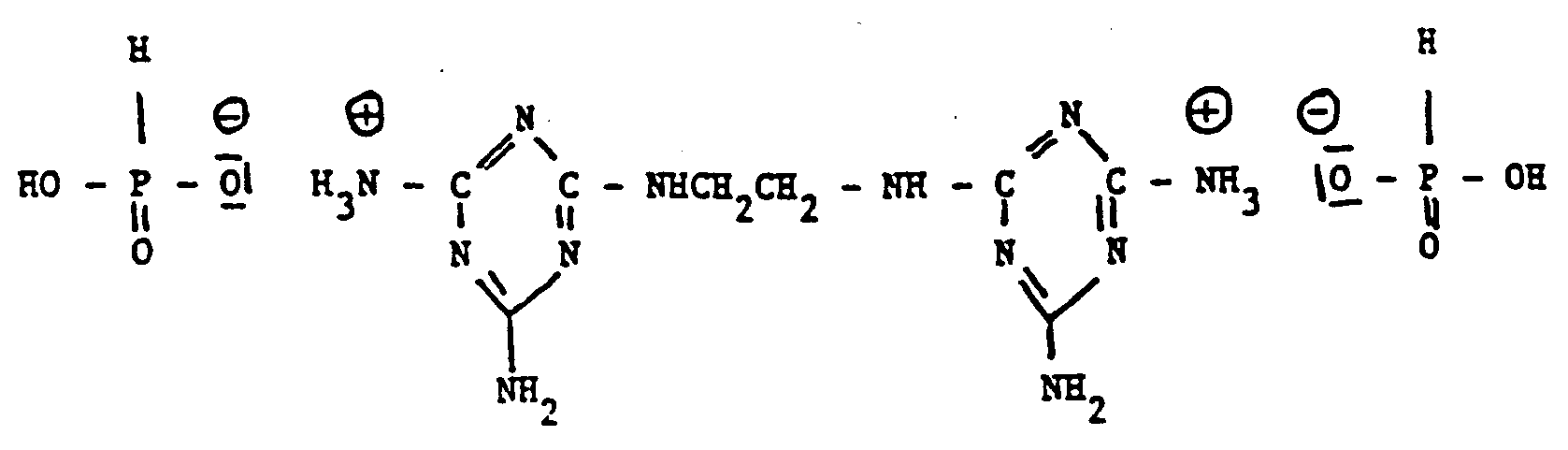
- le diphosphite du diethylènetrimelamine :
- On peut faire réagir ensemble un composé de structure

dans lequel R peut être CH₃ ou CH₃CH₂-, avec un composé de formule générale :
R₁ ayant la même signification que précédemment et de l'eau. Ce procédé est long et peu économique. On a trouvé qu'il était préférable de faire réagir en milieu aqueux l'acide phosphoreux (sous forme de solution aqueuse) avec un composé de structure
selon la réaction :
Avantageusement le rapport molaire
est compris entre 0,9 et 1,1 mais de préférence égal à 1. - Parmi les amines qu'on peut utiliser selon l'invention, on peut citer par exemple la mélamine, la benzoguanamine, l'acétoguanamine, la diamino-2,4 nonyl-6 triazine-1,3,5, l'amino-3 triazole-1,2,4, le guanazole, le mélam, le mélem, la piperazine, l'amino-2 benzimidazole, le bis(triazinyl-1,3,5triamino-2,4,6)-N,N'éthane-1,2.
- Un mode de préparation des phospbites d'amines préfèré selon l'invention consiste à traiter une suspension aqueuse d'amine par une solution aqueuse d'acide phosphoreux de concentration comprise entre 60 et 80 %, de préférence voisine de 70 % en poids. La réaction peut être réalisée entre 20 et 100°C, de préférence vers 30 à 50°C, pendant une durée qui peut aller de une à plusieurs heures sous bonne agitation.
- Les phosphites d'amines ainsi obtenus sont peu ou pas solubles dans le milieu réactionnel. On peut réutiliser avantageusement le filtrat pour une opération ultérieure, ce qui permet d'améliorer le rendement.
- Pour isoler le composé, on procède par les moyens connus : essorage, lavage du gâteau obtenu, séchage vers 100°C sous pression réduite.
- Avantageusement on broie le produit pour obtenir des poudres de granulométrie adéquate pour permettre une bonne dispersion dans la matrice polymérique à ignifuger. Avantageusement la granulométrie est comprise entre 1 et 50 microns et de préférence comprise entre 5 et 25 microns.
- Les produits sont caractérisés par analyse élémentaire, infrarouge, RMN du proton, du carbone 13 et du phosphore 31.
- La pureté peut être rapidement déterminée par un simple dosage acidimétrique.
- Les phosphites d'amines sont des produits stables à des températures inférieures à 250°C. Les phosphites d'amines ainsi obtenus peuvent être utilisés comme ignifugeants de matières organiques et en particulier de matières plastiques.
- La présente invention concerne aussi l'application des produits de la présente invention comme agents d'ignifugation. La présente invention concerne aussi l'application des phosphites de morpholine, cyclohexylamine et d'aniline comme agent d'ignifugation.
- Avantageusement ces produits sont utilisés pour ignifuger les polyamides et les polyoléfines.
- Par "polyamides" nous entendons les polymères résultant de la polycondensation d'un ou plusieurs aminoacides tels que les acides aminocaproïques, amino-7 heptanoïque, amino-11 undécanoïque .... d'un ou plusieurs lactames, tels que le caprolactame, le lauryllactame ... d'un ou plusieurs sels ou mélanges de diamines telles l'hexamethylène diamine, la dodécaméthylènediamine avec des diacides tels que les acides téréphtalique, adipique, azélaïque, ....... ou des mélanges de tous ces monomères, ce qui conduit à des copolyamides.
- On utilise les phosphites d'amine de la présente invention avantageusement à raison de 1 à 20 % en poids par rapport au polyamide ignifugé et, de préférence, en proportion de 3 à 12 %.
- Par "polyoléfines", nous entendons tous les polymères de monooléfines qui répondent à la formule CH₂ = CH - A dans laquelle A représente un hydrogène, un radical hydrocarboné substitué ou non ayant un nombre de carbone compris entre 1 et 10, un radical phényle, un radical acétoxy.
- De tels polymères qu'on peut ignifuger selon l'invention sont les polyéthylènes, les copolymères éthylène-propylène, le polypropylène, le poly(acétate de vinyle).
- On utilise les phosphites d'amines de la présente invention avantageusement à raison de 10 à 60 % en poids par rapport aux polyoléfines ignifugées, et de préférence en proportion de 25 à 35 %.
- Selon un mode préféré de mise en ouvre des produits de l'invention, on les utilise dans des systèmes intumescents.
- Un système intumescent se caractérise par le fait qu'au moment de la combustion les composés dudit système interréagissent pour former une mousse carbonacée plus ou moins alvéolaire incombustible qui ralentit la libération des gaz inflammables libérés de la masse chauffée. De tels systèmes sont constitués d'une façon générale de trois constituants principaux :
- un spumogène qui produit des gaz ou des vapeurs ininflammables qui aident à la formation de la mousse. Ce sont généralement des composés azotés tels que urée, guanidine, mélamine...
- un agent de carbonisation qui contribue à la formation de matières carbonacées ("chars"). Ce sont généralement des composés polyhydroxyles tels que sucres, mono, di ou tripentaerythrite, trimethylolpropane...
- un catalyseur qui est généralement un composé acide ou, plus précisément, un composé générateur d'acide au moment de la combustion. C'est-à-dire que cet acide est le plus souvent sous forme combinée. Les catalyseurs les plus courament employés sont les polyphosphates d'ammonium, les phosphates de mélamine, les borates de mélamine et les sulfates de mélamine. Comme on peut le remarquer nous avons dans la plupart des combinaisons, à la fois le spumogène et l'acide sous forme combinée.
- Les phosphites d'amines de la présente invention peuvent également jouer à la fois le rôle de spumogène de par la présence du composé azoté et le rôle de catalyseur, de par la présence d'acide phosphoreux combiné.
- Ils présentent l'avantage, par rapport aux combinaisons précitées, d'être des combinaisons bien définies, peu ou pas hygroscopiques, faciles à obtenir à partir de réactifs peu côuteux, et d'avoir un caractère plus réducteur que les dérivés des acides phosphoriques, d'ou une très grande efficacité lors de la combustion.
- Les phosphites d'amines de la présente invention associés à des composés polyhydroxylés conduisent à des systèmes intumescents très efficaces qui permettent d'améliorer le comportement au feu des matières plastiques, en particulier des polyoléfines et des polyamides, lesdits polyamides et polyoléfines ayant été définis précédemment.
- Les composés polyhydroxyles qui peuvent convenir sont l'erythrytol, le sorbitol, le mannitol, le dianhydrosorbitol, l'anhydroerythritol, la mono-di ou tripentaerythrite. De préférence on utilise la monopentaerythrite, qu'on appelle dans la suite du texte "pentaerythritol".
- Comme phosphites d'amines, on peut utiliser tous les phosphites d'amines de la présente invention mais de préférence on utilise le phosphite de mélamine.
- S'agissant des polyamides, on ajoute en plus des phosphites d'amines de l'invention, un pourcentage variable d'un ou plusieurs composés polyhydroxylés compris entre 0,2 et 10 % en poids par rapport aux polyamides ignifugées, et de préférence entre 1 et 3 %.
- S'agissant des polyoléfines, les proportions des constituants définis par le rapport molaire

peut être compris entre 1 et 7, de préférence entre 2 et 4. - Comme pour les polyamides, le composé polyhydroxylé peut être un ou plusieurs produits.
- La quantité des constituants - phosphite d'amine plus composé polyhydroxylé - défini comme le taux de charges, est fonction du degré d'ignifugation désiré.
- Il peut être compris entre 20 et 60 % en poids par rapport à la résine ignifugée. D'une façon générale on obtient un comportement au feu amélioré et une bonne conservation des propriétés mécaniques, avec un taux de charges compris entre 25 et 35 %.
- L'incorporation des phosphites d'amine et du composé polyhydroxylé s'effectue par malaxage de ces deux composés, finement divisés dans le polymère fondu - tout appareil de malaxage assurant une bonne dispersion peut donc convenir - conviennent particulièrement bien à cet effet les malaxeurs type BUSS.
- Les conditions d'extrusion doivent être appropriées pour obtenir une bonne dispersion des additifs.
- Le compound obtenu est granulé.
- Les granulés obtenus sont moulés par injection ou par compression à des températures convenables en éprouvettes normalisées pour pratiquer l'essai de réaction au feu UL 94 selon la norme NF T51072 et pour mesurer l'indice d'oxygène selon la norme NF T51071.
- Une manière simple d'opérer consiste à mélanger à sec les granulés de polymère, le phosphite d'amine et le composé polyhydroxylé dans un mélangeur type TURBULA ou plus simplement au tonneau et à alimenter avec ce mélange un malaxeur approprié.
- On peut également préparer des mélanges maîtres polymère - phosphite d'amine. Avec ce compound sous forme de granulés on peut réaliser comme précédemment dans un mélangeur type TURBULA un mélange avec le composé polyhydroxylé puis alimenter un malaxeur. On peut également alimenter une extrudeuse en tête de vis malaxeuse avec un mélange polymère - phosphite d'amine puis au moyen d'un doseur type SODER introduire en milieu de vis le composé polyhydroxylé.
- Les exemples suivants explicitent l'invention.
- Dans un réacteur de 250 ml muni d'une agitation d'une prise de température, d'un réfrigérant à reflux, on introduit :
12,6 g de mélamine (0,1 mole)
50 ml de diethyl phosphite
et 10 g d'eau,
puis on chauffe l'ensemble au bain d'eau bouillante sous bonne agitation. - Pendant la première heure de chauffe, on obtient une bouillie blanche qui devient de plus en limpide, voire transparente. Le chauffage de la solution ainsi obtenu est poursuivi et on observe la formation d'un précipité et un léger moussage. Il se produit un reflux important. Après 2 heures de chauffage on adapte un appareil à distiller, on récupère un produit de point d'ébullition égal à 78°C. La réaction est arrêtée lorsqu'il ne distille plus de produit.
- On filtre à chaud, essore et lave le gâteau avec de l'éther. Le produit essoré est séché sous vide.
- On obtient 18 g de phosphite de mélamine.
- Rendement : 86,5 % exprimé par rapport à la mélamine mise en oeuvre.
-
C₃H₉N₆PO₃ C H N P % calculé 17,3 4,32 40,38 14,90 % trouvé 17,3 4,6 39,94 13,31 - ν P - H = 2400 cm⁻¹
ν P - OH = 2700 cm⁻¹
ν C = N (cycle)= 1620 cm⁻¹, 1520 cm⁻¹
ν NH₃⊕ = 3140 cm⁻¹
ν NH₂ = 3420 cm⁻¹
δ NH₃⊕ = 1405 cm⁻¹ -

- δ =
- 10,1 ppm (s) 1 Ha
- δ =
- 6,75 ppm (d) 1 Hb JP - H(b) = 600 Hz
- δ =
- 7,47 ppm (s) 3 H(c) + 4 H(d)
-
- δ =
- 162,1 ppm C₁ + C₂ + C₃
-
- δ =
- 5,7 ppm
-

Dans un réacteur de 2 l muni d'une agitation, d'une prise de température, d'une ampoule d'addition et d'un réfrigérant ascendant, on introduit 1 l d'eau distillée et 126 g de mélamine (1 mole). - On agite vigoureusement de façon à disperser la mélamine puis on ajoute 117,15 g d'une solution aqueuse d'acide phosphoreux à 70 % (82 g H₃PO₃ : 1 mole) en 30 minutes. L'addition terminée on maintient le milieu réactionnel à température ambiante sous bonne agitation pendant 3 heures.
- On essore, lave et sèche sous pression réduite à 100/120°C. On obtient 171 g de phosphite de mélamine.
Rendement : 82 % -
C₃H₉N₆PO₃ C H N P % calculé 17,3 4,32 40,38 14,90 % trouvé 17,7 4,23 40,76 14,02 - ν P - H = 2356 cm⁻¹
ν P - OH = 2700 cm⁻¹
ν NH
ν P = O = 1078 cm⁻¹ - ν = 6,62 ppm P -JP - H = 612 Hz

- δ = 162,1 ppm
- Préparation du phosphite de mélamine d'une façon analogue à l'exemple 2 sauf qu'on divise par deux la quantité d'eau : 500 ml pour 1 mole de mélamine.
Rendement : 82 % -
C₃H₉N₆PO₃ C H N P % calculé 17,3 4,32 40,38 14,90 % trouvé 17,13 4,29 40,12 14,66 - ν P - H = 2400 cm⁻¹
-
- δ =
- 162,33 ppm
-
- δ =
- 9,76 ppm P - O - H
- δ =
- 6,75 ppm P - H JP - H = 600 Hz
- δ =
- 7,49 ppm NH₂, N₃

- Dans un réacteur de 2 l équipé comme dans l'exemple 2, on introduit 93,6 g de benzoguanamine (0,5 mole) dans 600 ml d'eau, on agite efficacement pour obtenir une bonne dispersion et introduit 62,2 g d'une solution aqueuse de H₃PO₃ à 72,5 % (0,55 mole H₃PO₃ 100 %).
- L'addition terminée on porte 1 h 30 à 70°C. On refroidit, on filtre.
- Le gâteau est empâté deux fois avec 300 ml d'eau, essoré puis séché à 80°C sous pression réduite jusqu'à poids constant.
- On obtient 127 g de phosphite de benzoguanamine.
Rendement : 94,3 % -
C₉H₁₂N₅PO₃ C H N P % calculé 40,14 4,46 26,02 11,52 % trouvé 40,35 4,52 26,15 11,3 - ν P - H = 2300 cm⁻¹
ν P - OH = 2700 - 2800 cm⁻¹
ν CHar = 3060 cm⁻¹
ν NH₃⊕ = 3160 cm⁻¹
ν NH₂ = 3380 cm⁻¹ - δ = 6,67 ppm P - H JP - H = 631 Hz
-

- δ =
- 166,75 ppm C₁ - C₂
- δ =
- 169,76 ppm C₃
- δ =
- 136,46 ppm C₄
- δ =
- 128,76 ppm C₅ - C₉
- δ =
- 127,93 ppm C₆ - C₈
- δ =
- 131,43 ppm C₇
- Dans un appareil identique à l'exemple 2 on introduit 500 ml d'eau et 599,3 g de guanazole (6,05 moles). On agite la suspension et introduit à température ambiante 720 g d'une solution aqueuse à 69 % de H₃PO₃ (6,05 moles).
- Pendant l'addition qui dure 70 minutes le milieu passe par un stade homogène et la température s'élève de 20 à 35°C.
- En fin d'addition on observe un débit de cristallisation. On maintient le milieu à 30/35°C pendant 1 h 30 sous bonne agitation. Puis on refroidit vers 10°C et on essore les cristaux obtenus. On lave avec le minimum d'eau froide. On sèche sous vide à 140°C.
- On obtient 853 g de phosphite de guanazole qui se présente sous forme de cristaux blancs qui fondent à 163,2°C.
Rendement : 77,82 % -
C H N % calculé 13,25 4,41 38,67 % trouvé 12,6 4,38 38,22 - ν P - H = 2200 cm⁻¹
ν P - OH = 2680 cm⁻¹
ν NH₂, NH
-
- δ =
- 6,65 ppm P - H JP - H = 619 Hz
-

- δ =
- 153,4 ppm C₁, C₂
- Dans un appareillage identique à l'exemple 2 on introduit 250 g d'eau et 464 g d'amino-3 triazole-1,2,4 (5,5 moles). On agite la suspension et on introduit goutte à goutte 624,5 g d'une solution aqueuse à 72,5 % H₃PO₃ (5,52 moles de H₃PO₃).
- L'addition s'effectue à température ambiante, la température s'élève à 30°C. L'addition terminée (4 h30), on maintient la suspension vers 35°C sous bonne agitation pendant 1 h 30 puis on filtre, essore, lave le gâteau obtenu et sèche à 100°C sous pression réduite. On obtient 914 g de phosphite d'amino-3 triazole-1,2,4.
Rendement : 84 %
Fusion : 130,9°C -
C₂H₇N₄O₃P C H N P % calculé 14,45 4,21 33,73 18,67 % trouvé 13,89 4,32 32,91 17,85 - ν P - H = 2410 cm⁻¹
ν P - OH = 2680 cm⁻¹
ν NH
ν P = O = 1105 cm⁻¹ -

-
- δ =
- 5,14 ppm
-
- δ =
- 6,88 ppm P - H JP - H = 614 Hz
-
- δ =
- 140,73 ppm C₅
- δ =
- 152,76 ppm C₃
- Dans un réacteur de 4 l, muni d'une agitation, d'une prise de température, d'un réfrigérant à reflux, on introduit 2 l d'eau et 125 g d'acétoguanamine (1 mole). On agite, puis on introduit goutte à goutte 117,7 g d'une solution aqueuse à 69,7 % de H₃PO₃.
- L'addition terminée, on porte le milieu réactionnel à 50°C pendant 1 heure, puis on refroidit, filtre et essore. Le produit est lavé, puis séché sous pression réduite vers 100°C.
-
C₄H₁₀N₅O₃P C H N % calculé 23,18 4,83 33,81 % trouvé 23,28 4,75 33,64 - ν P - H = 2400 cm⁻¹
ν C = N = 1670 cm⁻¹ -

- δ =
- 22,85 ppm C₄
- δ =
- 164,67 ppm C₁, C₂
- δ =
- 171,56 ppm C₃
-

Dans un réacteur de 2 litres équipé comme dans l'exemple 2, on introduit 86 g de pipérazine (1 mole) dans 500 ml d'eau. On agite la solution et on introduit goutte à goutte, en 40 minutes, 116,7 g d'une solution aqueuse de H₃PO₃ à 70,25 %. - La température s'élève de 25°C à environ 40°C en fin d'addition. Après refroidissement on concentre partiellement la solution obtenue sous pression réduite.
- Le précipité obtenu est filtré, essoré puis séché à 100°C sous pression réduite.
- On obtient 127 g de phosphite de pipérazine.
Fusion : 215°C - ν PH = 2320 cm⁻¹
δ NH₂⊕ = 1440 cm⁻¹ -
- δ =
- 6,78 ppm (d) P-H JP-H = 582 Hz
- δ =
- 3,34 ppm (s) -C₂- (8 protons)

-
- δ =
- 43,416 ppm
-

Dans un réacteur de 2 litres équipé comme dans l'exemple 2, on introduit 86 g de pipérazine (1 mole) dans 250 ml d'eau. On agite puis on introduit goutte à goutte en 1 h 30, 233,5 g d'une solution aqueuse de H₃PO₃ à 70,25 % (2 moles de H₃PO₃ 100 %). - La température s'élève à environ 45/50°C.
- On maintient l'agitation pendant 1 heure puis, après refroidissement, on concentre à sec sous pression réduite, puis sèche à 100°C.
- On obtient le diphosphite de pipérazine.
Fusion : 138°C - ν PH = 2360 cm⁻¹
δ NH
-
- δ =
- 6,85 ppm (d) P-H JP-H = 627 Hz
- δ =
- 3,57 ppm (s) -C₂- (8 protons)

-
- δ =
- 42,82 ppm
- L'efficacité des phosphites d'amines utilisés seuls ou associés à du pentaerythritol comme agents améliorant le comportement au feu des polyamides et des polyoléfines a été testée selon les exemples suivants :
- Des granulés de polyamide 11 = grade BMNO commercialisé par la demanderesse et présentant les caractéristiques suivantes : η = 1,01, densité = 1,03, fusion = 185°C, sont extrudés sur un malaxeur BUSS.
- Les granulés obtenus sont moulés par injection à une température de 230°C en éprouvettes sur lesquelles on pratique l'essai UL 94 et la mesure d'indice d'oxygène IO.
- On mélange à sec au tonneau
- 9700 g de granulés de polyamide 11 - type BMNO ayant les mêmes caractéristiques que dans l'exemple 10
- 300 g de phosphite de mélamine.
- On alimente avec ce mélange un comalaxeur BUSS type PR 46, dont la température moyenne est de 205/210°C. Les joncs qui en sont extrudés sont refroidis et découpés. Les granulés ainsi obtenus après séchage sont moulés par injection à une température voisine de 225°C.
- On pratique sur ces éprouvettes l'essai UL 94 et la mesure d'indice d'oxygène.
- Analogues à l'exemple 11 mais avec des doses de phosphite de mélamine différentes.
- On mélange à sec au tonneau :
- 9200 g de granulés de polyamide 11 (grade BMNO)
- 750 g de phosphite de mélamine
- 50 g de pentaerythritol (grade tech. Crystals commercialisé par Celanese Chemical Company)
- On opère ensuite comme dans l'exemple 11.
- Analogues à l'exemple 15 mais avec des doses de phosphite de mélamine et de pentaerythritol différentes.
- Analogue à l'exemple 20 sauf qu'on remplace le phosphite de mélamine par du phosphite de benzoguanamine.
- On mélange à sec au tonneau :
- 8900 g de granulés de polyamide 11 (grade BMNO)
- 800 g de phosphite de guanazole
- 300 g de pentaerythritol
- Préparation d'un polyamide 12 selon un mode opératoire décrit par la demanderesse. Dans un autoclave en inox on introduit :
- 30 kg de lauryllactame
- 3 kg d'eau
- et 255 g d'acide dodécanedioïque.
- On monte en température à 280°C sous pression élevée de 25 à 30 bars qu'on maintient 2 heures. On détend en laissant la température à 250°C et on continue la polymérisation à la pression atmosphérique et sous faible balayage d'azote pendant le temps nécessaire pour obtenir un polymère de viscosité inhérente de 1,01 qu'on extrude hors de l'autoclave (par pression d'azote) sous forme de joncs qui sont solidifiés par refroidissement dans l'eau.
- Ces joncs sont ensuite découpés en granulés qui sont séchés. Les granulés ainsi obtenus sont moulés par injection comme on le décrit dans l'exemple 10.
- On mélange à sec au tonneau :
- 8200 g de granulés de polyamide 12 obtenus dans l'exemple 23,
- 1500 g de phosphite de mélamine,
- 300 g de pentaerythritol.
- On opère ensuite comme dans l'exemple 11.
- Analogue à l'exemple 24 sauf qu'on remplace le phosphite de mélamine par du phosphite d'amino-3 triazole-1,2,4.
- On mélange à sec au tonneau :
- 8950 g d'un polyamide 6 - grade RMN CD, commercialisé par la demanderesse sous le nom D'ORGATER,
- 1000 g de phosphite de mélamine,
- 50 g d'Irganox 1098 (bis[ditertiobutyl-3,5 hydroxy-4, phényl propionyl]-N, N' hexamethylène diamine).
- On alimente avec ce mélange un malaxeur BUSS, type PR 40/70 dont les températures moyennes sont comprises entre 230-235°C. Les joncs sont refroidis et découpés en granulés.
- Les granulés sont séchés puis moulés par injection à une température comprise entre 250/260°C en éprouvettes normalisées pour effectuer l'essai UL 94 et mesurer l'indice d'oxygène IO.
- Les résultats obtenus sont reportés dans le tableau A. Ces exemples montrent bien que les phosphites d'amines seuls, et mieux associés à du pentaerythritol améliorent le comportement au feu des polyamides.
- Les exemples ci-après montrent l'efficacité du système intumescent phosphites d'amines-pentaerythritol pour améliorer le comportement au feu des polyoléfines, en particulier, du polypropylène.
- A partir d'une poudre de polypropylène - PK 1060P, commercialisée par HOESCHT, on moule des éprouvettes normalisées par compression sur presse MINIMATIC pour réaliser l'essai UL 94 et la mesure de l'indice d'oxygène.
- On mélange à sec au tonneau :
- 5450 g de poudre de polypropylène PK 1060P
- 3500 g de phosphite de mélamine
- 1050 g de pentaerythritol.
- On alimente un malaxeur BUSS, type PR 46, dont la température moyenne est de 175°C. Les joncs qui en sont extrudés sont refroidis et découpés en granulés qui sont moulés par compression sur presse MINIMATIC à une température voisine de 190°C.
- Analogues à l'exemple 28, mais les doses de phosphite de mélamine et de pentaerythritol sont différentes. L'extrusion a été réalisée sur extrudeuse COLLIN, type ZK 50, à une température moyenne de 170/180°C.
- Analogue à l'exemple 30, sauf qu'on remplace le phosphite de melamine par le phosphite d'acétoguanamine.
- Des granulés de polypropylène - type 3050 MN1 - commercialisés par la demanderesse sont extrudés sur malaxeur BUSS, type PR 40/70.
- Les granulés obtenus sont moulés par injection en éprouvettes normalisées sur lesquelles on pratique l'essai UL 94 et la mesure de l'indice d'oxygène.
- On mélange à sec au tonneau :
- 6000 g de granulés de prolypropylène 3050 NM1
- 3000 g de phosphite de mélamine.
- On alimente avec ce mélange un malaxeur BUSS - type PR 40/70 - en tête de vis malaxeuse, la poudre de pentaerythritol (1000 g) est introduite au moyen d'un doseur SODER en milieu de vis malaxeuse avec un débit tel, qu'on ait dans la composition finale un pourcentage égal à 10 % (en poids). On procède ensuite comme dans l'exemple 27.
- Analogue à l'exemple 35, sauf que les pourcentages de phosphite de mélamine et de pentaerythritol sont différents.
- Les résultats obtenus sont reportés dans le tableau B.
- Ces exemples montrent bien l'efficacité des phosphites d'amines dans le système intumescent pour améliorer le comportement au feu du polypropylène.
- Au cours des essais feu on observe bien la formation d'une "meringue" qui joue le rôle d'isolant ralentissant la libération des gaz inflammables par la masse chauffée.


Les produits de formule (I-a) dans laquelle R₂ est un reste aliphatique ayant jusqu'à 4 atomes de carbone pouvant être substitué par des halogènes ou des groupements amino, les deux restes R₂ étant pontés par un reste > NH ou un reste méthylénique.

Parmi les produits de formule (II), on utilise avantageusement ceux dans lesquels R'₁ un hétérocycle contenant des atomes d'azote et pouvant être substitué par des groupements amino, des halogènes, des radicaux aliphatiques ayant jusqu'à 10 atomes de carbone. On préfère les produits dans lesquels R'₁ une structure triazinique telle que :

On utilise plus particulièrement :

On peut également utiliser avantageusement des prouduits de formule:

dans laquelle les deux radicaux R₃ sont des restes aliphatiques ayant la 2 atomes de carbone et sont liés par une simple liaison et y une simple liaison, le produit étant de préférence le diphosphite de pipérazine :

Les composés de la présente invention peuvent être obtenus par divers moyens.
On opère ensuite comme dans l'exemple 11.
Claims (18)
- Sels d'acide phosphoreux de formule (I)
 - 1,2,4 triazolyle,- benzimidazolyle,- heptazinique,- 1,3 diazinique (pyrimidique)
 - Produits selon la revendication 1, caractérisé en ce qu'ils sont de formules suivantes :- le phosphite de mélamine :
 - le phosphite de melem :
 - le phosphite de benzoguanamine :
 - le phosphite d'acétoguanamine :
 - le phosphite d'amino-3 triazole-1,2,4 :
 - le phosphite d'amimo-4 triazole-1,2,4 :
 - le phosphite de guanazole :
 - le phosphite de benzimidazole :
- Produits de formule

- Produits selon la revendication 3, caractérisés en ce que les restes R₂ sont tels qu'on ait une structure piperazinique, ou pipéridinique et sont de préférence :- le phosphite de piperazine
 - le phosphite de pipéridine
- Sels d'acide phosphoreux de formule (II)

Y est un groupement :
-NH (CH₂)₂ - NH - (CH₂)₂ - NH-

et que le produit est de préférence :
- Produits selon la revendication 5, caractérisés en ce qu'ils sont de préférence :- le diphosphite de mélam :
 - le diphosphite d'éthylène dimélamine :
 - le diphosphite de diethylènetrimelamine :
- Le diphosphite de pipérazine :

- Application des produits selon l'une des revendications 1 à 7 à l'ignifugation des matières plastiques.
- Procédé selon la revendication 8 caractérisé en ce qu'on utilise de préférence le phosphite de mélamine.
- Procédé selon la revendication 8 ou 9, caractérisé en ce qu'on utilise avantageusement 1 à 20 % en poids de phosphites par rapport aux polyamides ignifugées et de préférence 3 à 12 %.
- Procédé selon la revendication 8 ou 9, caractérisé en ce qu'on utilise avantageusement 10 à 60 % en poids de phosphites par rapport aux polyoléfines ignifugées et de préférence 25 à 35 %.
- Procédé selon l'une des revendications 8 à 11, caractérisé en ce qu'on utilise les phosphites en association avec un ou plusieurs composés polyhydroxylés choisis parmi l'érythrytol, le sorbitol, le mannitol, le dianhydrosorbitol, l'anhydroerythritol, la mono- di ou tripentaerythrite.
- Procédé selon la revendication 12 caractérisé eu ce que le composé polyhydroxylé est de préférence du pentaerythritol.
- Procédé selon l'une des revendications 12 ou 13, caractérisé eu ce qu'on utilise avantageusement 0,2 à 10 % en poids de composés polyhydroxylés par rapport au polyamide ignifugé et de préférence 1 à 3 %.
- Procédé selon l'une des revendications 12 ou 13 caractérisé en ce qu'on utilise avantageusement dans les polyoléfines le composé polyhydroxylé en proportion telle que le rapport molaire

- Procédé selon la revendication 15 caractérisé en ce que la quantité de phosphite d'amine plus composé polyhydroxylé est avantageusement compris entre 20 et 60 % en poids par rapport aux résines ignifugées et de préférence entre 25 et 35 %.
- Matières plastiques ignifugées selon le procédé des revendications 8 à 16.
- Application des phosphites de morpholine, de cyclohexylamine et d'aniline à l'ignifugation des matières plastiques.
Priority Applications (1)
| Application Number | Priority Date | Filing Date | Title |
|---|---|---|---|
| AT88400619T ATE86617T1 (de) | 1987-03-31 | 1988-03-15 | Salze der phosphorigen saeure, ihre zusammensetzungen und ihre verwendung als feuerfeste wirkstoffe. |
Applications Claiming Priority (2)
| Application Number | Priority Date | Filing Date | Title |
|---|---|---|---|
| FR8704488A FR2620119B1 (fr) | 1987-03-31 | 1987-03-31 | Nouveaux sels d'acide phosphoreux, compositions les contenant et leur application comme agent d'ignifugation |
| FR8704488 | 1987-03-31 |
Publications (2)
| Publication Number | Publication Date |
|---|---|
| EP0286478A1 EP0286478A1 (fr) | 1988-10-12 |
| EP0286478B1 true EP0286478B1 (fr) | 1993-03-10 |
Family
ID=9349630
Family Applications (1)
| Application Number | Title | Priority Date | Filing Date |
|---|---|---|---|
| EP88400619A Expired - Lifetime EP0286478B1 (fr) | 1987-03-31 | 1988-03-15 | Sels d'acide phosphoreux, compositions les contenant et leur application comme agent d'ignifugation |
Country Status (11)
| Country | Link |
|---|---|
| US (1) | US4879327A (fr) |
| EP (1) | EP0286478B1 (fr) |
| JP (2) | JP2544315B2 (fr) |
| AT (1) | ATE86617T1 (fr) |
| CA (1) | CA1334093C (fr) |
| DE (1) | DE3878960T2 (fr) |
| DK (1) | DK172305B1 (fr) |
| ES (1) | ES2054839T3 (fr) |
| FR (1) | FR2620119B1 (fr) |
| IE (1) | IE63370B1 (fr) |
| PT (1) | PT87132B (fr) |
Families Citing this family (25)
| Publication number | Priority date | Publication date | Assignee | Title |
|---|---|---|---|---|
| GB8823482D0 (en) * | 1988-10-06 | 1988-11-16 | Ciba Geigy Ag | Flame retardants |
| US5198483A (en) * | 1988-10-06 | 1993-03-30 | Fmc Corporation | Flame retardants |
| IT1230968B (it) * | 1989-07-03 | 1991-11-08 | Mini Ricerca Scient Tecnolog | Composizioni polimeriche autoestinguenti. |
| IT1241109B (it) * | 1990-04-11 | 1993-12-29 | Ministero Del Uni E Della Rice | Composizioni polimeriche autoestinguenti |
| IT1240630B (it) * | 1990-04-11 | 1993-12-17 | Ministero Del Uni E Della Rice | Sali di composti triazinici con acidi ossigenati del fosforo |
| IT1246764B (it) * | 1990-07-11 | 1994-11-26 | Mini Ricerca Scient Tecnolog | Sali di composti triazinici con acidi ossigenati del fosforo e loro impiego in composizioni polimeriche autoestinguenti |
| IT1243493B (it) * | 1990-12-20 | 1994-06-15 | Himont Inc | Cianurato di piperazina e composizioni polimeriche comprendenti il medesimo |
| US5137937A (en) * | 1991-04-02 | 1992-08-11 | Albright & Wilson Americas Inc. | Flame retardant thermoplastic resin composition with intumescent flame retardant |
| IT1251687B (it) * | 1991-10-11 | 1995-05-19 | Mini Ricerca Scient Tecnolog | Sali di composti triazinici con acidi ossigenati del fosforo, e loro impiego in composizioni polimeriche autoestinguenti. |
| DE4200931A1 (de) * | 1992-01-16 | 1993-07-22 | Hoechst Ag | Flammgeschuetzte thermoplastische polyesterformmasse und ihre verwendung |
| JP3462321B2 (ja) | 1995-10-31 | 2003-11-05 | ダイセル化学工業株式会社 | 難燃性樹脂組成物およびその製造方法 |
| TW491843B (en) * | 1997-03-04 | 2002-06-21 | Nissan Chemical Ind Ltd | 1,3,5-triazine derivative salts of polyacids comprising phosphorus, sulfur, and oxygen and process for producing the same |
| KR100623856B1 (ko) | 2003-06-27 | 2006-09-18 | 주식회사 코오롱 | 차량의자용 폴리아미드 수지 조성물 |
| DE102004047257A1 (de) * | 2004-09-29 | 2006-04-06 | Universität Konstanz | Phosphor-haltige Heptazinderivate, Verfahren zu deren Herstellung und deren Verwendung |
| TW201122056A (en) | 2005-09-22 | 2011-07-01 | Fujitsu Ltd | Plant-based resin-containing composition and plant-based resin-containing molded product formed therefrom |
| RU2404964C1 (ru) * | 2009-07-01 | 2010-11-27 | Государственное образовательное учреждение высшего профессионального образования "Казанский государственный технологический университет" | N,n-дифенилгуанидиновая соль бис(оксиметил) фосфиновой кислоты в качестве биостимулятора активного ила для очистки сточных вод и способ ее получения |
| JP2011032462A (ja) * | 2009-07-07 | 2011-02-17 | Sumitomo Chemical Co Ltd | 熱可塑性ポリマー組成物 |
| US9856365B2 (en) * | 2011-08-31 | 2018-01-02 | Radici Plastics Usa, Inc. | Compositions of polyhydric alcohols and polyamides |
| KR102300270B1 (ko) * | 2013-08-23 | 2021-09-09 | 로디아 오퍼레이션스 | 아미드 유도체로부터 제조된 난연제 및 그의 제조 방법 |
| CN105492520B (zh) * | 2013-08-23 | 2018-09-11 | 罗地亚经营管理公司 | 由酰胺衍生物制备的阻燃剂及其制造方法 |
| US10035896B2 (en) | 2014-07-29 | 2018-07-31 | Lanxess Solutions Us Inc. | Salts of pyrophosphonic acid as flame retardants |
| KR20180078242A (ko) * | 2015-10-30 | 2018-07-09 | 도레이 카부시키가이샤 | 폴리아미드 수지를 포함하는 수지 조성물로 이루어지는 성형품 |
| CN106866683A (zh) * | 2017-01-07 | 2017-06-20 | 青岛科技大学 | 一种溴代均草怕津的制备方法 |
| CN107936297A (zh) * | 2017-11-22 | 2018-04-20 | 江苏利思德新材料有限公司 | 玻纤增强尼龙用无卤阻燃复配体系及其在无卤阻燃玻纤增强尼龙材料中的应用 |
| JP2025526122A (ja) * | 2022-08-12 | 2025-08-07 | スリーディー システムズ インコーポレーテッド | 酸素遮断剤を含む、付加製造のための難燃性組成物および関連するプリント3d物品 |
Family Cites Families (9)
| Publication number | Priority date | Publication date | Assignee | Title |
|---|---|---|---|---|
| AT259232B (de) * | 1965-04-13 | 1968-01-10 | Chemiefaser Lenzing Ag | Verfahren zur Herstellung von faser und filmbildenden Polyestern |
| GB1385781A (en) * | 1972-05-01 | 1975-02-26 | Teijin Ltd | Polyamides |
| US3810850A (en) * | 1973-01-08 | 1974-05-14 | Jefferson Chem Co Inc | Piperazine phosphates as fire retardants for organic polymers |
| JPS5062272A (fr) * | 1973-10-05 | 1975-05-28 | ||
| US4119724A (en) * | 1973-11-26 | 1978-10-10 | Pepro | Fungicidal compositions containing phosphorous acid and derivatives thereof |
| JPS5349054A (en) * | 1976-10-18 | 1978-05-04 | Asahi Chem Ind Co Ltd | Thermosetting composition |
| FR2532321B1 (fr) * | 1982-08-24 | 1985-09-13 | Ugine Kuhlmann | Melanges ignifugeants contenant du phosphore pour materiaux de synthese |
| US4574154A (en) * | 1982-12-28 | 1986-03-04 | Ube Industries, Ltd. | Triazine addition compounds |
| DE3569533D1 (en) * | 1984-01-14 | 1989-05-24 | Ciba Geigy Ag | Phosphonic-acid salts |
-
1987
- 1987-03-31 FR FR8704488A patent/FR2620119B1/fr not_active Expired - Lifetime
-
1988
- 1988-03-15 AT AT88400619T patent/ATE86617T1/de not_active IP Right Cessation
- 1988-03-15 EP EP88400619A patent/EP0286478B1/fr not_active Expired - Lifetime
- 1988-03-15 ES ES88400619T patent/ES2054839T3/es not_active Expired - Lifetime
- 1988-03-15 DE DE3878960T patent/DE3878960T2/de not_active Expired - Fee Related
- 1988-03-30 IE IE96188A patent/IE63370B1/en not_active IP Right Cessation
- 1988-03-30 DK DK176188A patent/DK172305B1/da not_active IP Right Cessation
- 1988-03-30 CA CA000562944A patent/CA1334093C/fr not_active Expired - Fee Related
- 1988-03-30 PT PT87132A patent/PT87132B/pt not_active IP Right Cessation
- 1988-03-31 JP JP63080221A patent/JP2544315B2/ja not_active Expired - Lifetime
- 1988-03-31 US US07/175,822 patent/US4879327A/en not_active Expired - Fee Related
-
1996
- 1996-02-13 JP JP8049540A patent/JP2804917B2/ja not_active Expired - Lifetime
Also Published As
| Publication number | Publication date |
|---|---|
| EP0286478A1 (fr) | 1988-10-12 |
| ATE86617T1 (de) | 1993-03-15 |
| ES2054839T3 (es) | 1994-08-16 |
| JP2544315B2 (ja) | 1996-10-16 |
| DK172305B1 (da) | 1998-03-09 |
| US4879327A (en) | 1989-11-07 |
| FR2620119A1 (fr) | 1989-03-10 |
| DK176188D0 (da) | 1988-03-30 |
| IE63370B1 (en) | 1995-04-19 |
| IE880961L (en) | 1988-09-30 |
| DE3878960T2 (de) | 1994-06-30 |
| PT87132B (pt) | 1992-07-31 |
| CA1334093C (fr) | 1995-01-24 |
| JP2804917B2 (ja) | 1998-09-30 |
| JPS63277651A (ja) | 1988-11-15 |
| JPH08245598A (ja) | 1996-09-24 |
| FR2620119B1 (fr) | 1992-04-24 |
| DE3878960D1 (de) | 1993-04-15 |
| PT87132A (pt) | 1988-04-01 |
| DK176188A (da) | 1988-12-01 |
Similar Documents
| Publication | Publication Date | Title |
|---|---|---|
| EP0286478A1 (fr) | Sels d'acide phosphoreux, compositions les contenant et leur application comme agent d'ignifugation | |
| EP0013665B1 (fr) | Polyamino-1,3,5-triazines polymères contenant au moins un reste polyalkylpipéridine, leur préparation, leur utilisation pour la stabilisation de matériaux organiques et le matériau ainsi stabilisé | |
| CA1307613C (fr) | Composes intumescents retardant la propagation de la flamme, contenant un carbonate, un ether ou un ester d'element bicyclique | |
| EP1674459A1 (fr) | Pyrophosphate de piperazine haute purete et procede de production associe | |
| JPH03215564A (ja) | 自消性ポリマー組成物 | |
| US4670483A (en) | Flame retardant polyurethane compositions | |
| JP2000154181A (ja) | 新規2−置換グアナミン化合物及び2−置換グアナミン化合物を有効成分とする難燃性樹脂組成物 | |
| US5142000A (en) | Process for increasing polyamide molecular weight with organophosphonic acid or ester catalysts in the presence of alumina-containing titanium dioxide | |
| EP3176212B1 (fr) | Composition de résine ignifuge et article moulé formé à partir de celle-ci | |
| DE69518946T2 (de) | Polypentaerythrityldiphosphonat und seine Verwendung in selbstverlöschenden thermoplastischen Zusammensetzungen | |
| EP0576833A2 (fr) | Procédé de préparation de dérivés du phosphore trivalent stables à l'hydrolyse et leur utilisation comme stabilisants de matériaux thermoplastiques | |
| US5344855A (en) | Flame-retardant and its composition | |
| JP4303426B2 (ja) | 難燃性組成物およびその製造法 | |
| EP0484832A1 (fr) | Compositions polymères auto-extinctrices | |
| EP0374761B1 (fr) | Procédé de préparation de dérivés organiques de 2,4-di-tetiobutylphénol, de 4,4'-dimagnésium de biphényle et l'utilisation des composés phosphorés organiques comme stabilisants de polymères, en particulier les masses à mouler à partir de polyoléfines | |
| US5281637A (en) | Flameproofed thermoplastic polyester molding material and its use | |
| JPH0687840A (ja) | アメリン系化合物及び自己消炎性ポリマー組成物に於けるその使用 | |
| WO1990010030A1 (fr) | 5-amidotetrazoles a substitution | |
| JP2764282B2 (ja) | 長鎖N−アルキル−α−アルキルニトロン及び安定剤としてのそれらの使用方法 | |
| JPH0649086A (ja) | 安定剤として好適なリン含有有機アミドおよびそれを含むポリマー組成物 | |
| JPH07145186A (ja) | ジホスファイト及びそれを熱酸化安定剤として含有する熱可塑性重合体組成物 | |
| DE2431623A1 (de) | Bicyclische phosphite als verarbeitungsstabilisatoren | |
| FR2620715A1 (fr) | Compositions de resines synthetiques ayant un comportement au feu ameliore renfermant une polyolefine, un additif ignifugeant phosphore associe a des composes bromes et oxyde d'antimoine ou bien associe ou combine avec un compose azote et eventuellement d'autres additifs et/ou charges et objets conformes produits a partir de ces compositions | |
| EP0472564B1 (fr) | Arylesters d'acide phosphoneux, procede pour les preparer et leur utilisation pour stabiliser des matieres synthetiques, en particulier des matieres moulables polyolefiniques | |
| SU687090A1 (ru) | Композици на основе полиэтилентерефталата |
Legal Events
| Date | Code | Title | Description |
|---|---|---|---|
| PUAI | Public reference made under article 153(3) epc to a published international application that has entered the european phase |
Free format text: ORIGINAL CODE: 0009012 |
|
| 17P | Request for examination filed |
Effective date: 19880318 |
|
| AK | Designated contracting states |
Kind code of ref document: A1 Designated state(s): AT BE CH DE ES FR GB GR IT LI LU NL SE |
|
| 17Q | First examination report despatched |
Effective date: 19900704 |
|
| RAP3 | Party data changed (applicant data changed or rights of an application transferred) |
Owner name: ELF ATOCHEM S.A. |
|
| GRAA | (expected) grant |
Free format text: ORIGINAL CODE: 0009210 |
|
| AK | Designated contracting states |
Kind code of ref document: B1 Designated state(s): AT BE CH DE ES FR GB GR IT LI LU NL SE |
|
| REF | Corresponds to: |
Ref document number: 86617 Country of ref document: AT Date of ref document: 19930315 Kind code of ref document: T |
|
| ITF | It: translation for a ep patent filed | ||
| REF | Corresponds to: |
Ref document number: 3878960 Country of ref document: DE Date of ref document: 19930415 |
|
| GBT | Gb: translation of ep patent filed (gb section 77(6)(a)/1977) |
Effective date: 19930318 |
|
| REG | Reference to a national code |
Ref country code: GR Ref legal event code: FG4A Free format text: 3008098 |
|
| PLBE | No opposition filed within time limit |
Free format text: ORIGINAL CODE: 0009261 |
|
| STAA | Information on the status of an ep patent application or granted ep patent |
Free format text: STATUS: NO OPPOSITION FILED WITHIN TIME LIMIT |
|
| 26N | No opposition filed | ||
| EPTA | Lu: last paid annual fee | ||
| REG | Reference to a national code |
Ref country code: ES Ref legal event code: FG2A Ref document number: 2054839 Country of ref document: ES Kind code of ref document: T3 |
|
| EAL | Se: european patent in force in sweden |
Ref document number: 88400619.8 |
|
| PGFP | Annual fee paid to national office [announced via postgrant information from national office to epo] |
Ref country code: SE Payment date: 19990305 Year of fee payment: 12 |
|
| PGFP | Annual fee paid to national office [announced via postgrant information from national office to epo] |
Ref country code: FR Payment date: 19990309 Year of fee payment: 12 |
|
| PGFP | Annual fee paid to national office [announced via postgrant information from national office to epo] |
Ref country code: AT Payment date: 19990311 Year of fee payment: 12 |
|
| PGFP | Annual fee paid to national office [announced via postgrant information from national office to epo] |
Ref country code: GB Payment date: 19990318 Year of fee payment: 12 |
|
| PGFP | Annual fee paid to national office [announced via postgrant information from national office to epo] |
Ref country code: DE Payment date: 19990319 Year of fee payment: 12 |
|
| PGFP | Annual fee paid to national office [announced via postgrant information from national office to epo] |
Ref country code: ES Payment date: 19990323 Year of fee payment: 12 |
|
| PGFP | Annual fee paid to national office [announced via postgrant information from national office to epo] |
Ref country code: CH Payment date: 19990324 Year of fee payment: 12 |
|
| PGFP | Annual fee paid to national office [announced via postgrant information from national office to epo] |
Ref country code: GR Payment date: 19990326 Year of fee payment: 12 |
|
| PGFP | Annual fee paid to national office [announced via postgrant information from national office to epo] |
Ref country code: NL Payment date: 19990329 Year of fee payment: 12 |
|
| PGFP | Annual fee paid to national office [announced via postgrant information from national office to epo] |
Ref country code: LU Payment date: 19990401 Year of fee payment: 12 |
|
| PGFP | Annual fee paid to national office [announced via postgrant information from national office to epo] |
Ref country code: BE Payment date: 19990517 Year of fee payment: 12 |
|
| PG25 | Lapsed in a contracting state [announced via postgrant information from national office to epo] |
Ref country code: LU Free format text: LAPSE BECAUSE OF NON-PAYMENT OF DUE FEES Effective date: 20000315 Ref country code: GB Free format text: LAPSE BECAUSE OF NON-PAYMENT OF DUE FEES Effective date: 20000315 Ref country code: AT Free format text: LAPSE BECAUSE OF NON-PAYMENT OF DUE FEES Effective date: 20000315 |
|
| PG25 | Lapsed in a contracting state [announced via postgrant information from national office to epo] |
Ref country code: SE Free format text: LAPSE BECAUSE OF NON-PAYMENT OF DUE FEES Effective date: 20000316 Ref country code: ES Free format text: LAPSE BECAUSE OF NON-PAYMENT OF DUE FEES Effective date: 20000316 |
|
| PG25 | Lapsed in a contracting state [announced via postgrant information from national office to epo] |
Ref country code: LI Free format text: LAPSE BECAUSE OF NON-PAYMENT OF DUE FEES Effective date: 20000331 Ref country code: GR Free format text: LAPSE BECAUSE OF NON-PAYMENT OF DUE FEES Effective date: 20000331 Ref country code: CH Free format text: LAPSE BECAUSE OF NON-PAYMENT OF DUE FEES Effective date: 20000331 Ref country code: BE Free format text: LAPSE BECAUSE OF NON-PAYMENT OF DUE FEES Effective date: 20000331 |
|
| BERE | Be: lapsed |
Owner name: S.A. ELF ATOCHEM Effective date: 20000331 |
|
| PG25 | Lapsed in a contracting state [announced via postgrant information from national office to epo] |
Ref country code: NL Free format text: LAPSE BECAUSE OF NON-PAYMENT OF DUE FEES Effective date: 20001001 |
|
| EUG | Se: european patent has lapsed |
Ref document number: 88400619.8 |
|
| GBPC | Gb: european patent ceased through non-payment of renewal fee |
Effective date: 20000315 |
|
| REG | Reference to a national code |
Ref country code: CH Ref legal event code: PL |
|
| PG25 | Lapsed in a contracting state [announced via postgrant information from national office to epo] |
Ref country code: FR Free format text: LAPSE BECAUSE OF NON-PAYMENT OF DUE FEES Effective date: 20001130 |
|
| NLV4 | Nl: lapsed or anulled due to non-payment of the annual fee |
Effective date: 20001001 |
|
| REG | Reference to a national code |
Ref country code: FR Ref legal event code: ST |
|
| PG25 | Lapsed in a contracting state [announced via postgrant information from national office to epo] |
Ref country code: DE Free format text: LAPSE BECAUSE OF NON-PAYMENT OF DUE FEES Effective date: 20010103 |
|
| REG | Reference to a national code |
Ref country code: ES Ref legal event code: FD2A Effective date: 20011010 |
|
| PG25 | Lapsed in a contracting state [announced via postgrant information from national office to epo] |
Ref country code: IT Free format text: LAPSE BECAUSE OF NON-PAYMENT OF DUE FEES;WARNING: LAPSES OF ITALIAN PATENTS WITH EFFECTIVE DATE BEFORE 2007 MAY HAVE OCCURRED AT ANY TIME BEFORE 2007. THE CORRECT EFFECTIVE DATE MAY BE DIFFERENT FROM THE ONE RECORDED. Effective date: 20050315 |