EP0277348A2 - Imidazol- und Triazolderivate zur Verwendung als antimykotische Mittel - Google Patents
Imidazol- und Triazolderivate zur Verwendung als antimykotische Mittel Download PDFInfo
- Publication number
- EP0277348A2 EP0277348A2 EP87119011A EP87119011A EP0277348A2 EP 0277348 A2 EP0277348 A2 EP 0277348A2 EP 87119011 A EP87119011 A EP 87119011A EP 87119011 A EP87119011 A EP 87119011A EP 0277348 A2 EP0277348 A2 EP 0277348A2
- Authority
- EP
- European Patent Office
- Prior art keywords
- imidazole
- dichlorophenyl
- lower alkyl
- hydrogen
- halogen
- Prior art date
- Legal status (The legal status is an assumption and is not a legal conclusion. Google has not performed a legal analysis and makes no representation as to the accuracy of the status listed.)
- Withdrawn
Links
- 239000003429 antifungal agent Substances 0.000 title claims abstract description 13
- 229940024986 topical antifungal imidazole and triazole derivative Drugs 0.000 title claims abstract description 9
- -1 biphenylyl Chemical group 0.000 claims abstract description 67
- 125000000217 alkyl group Chemical group 0.000 claims abstract description 26
- 229910052736 halogen Inorganic materials 0.000 claims abstract description 17
- NINIDFKCEFEMDL-UHFFFAOYSA-N Sulfur Chemical compound [S] NINIDFKCEFEMDL-UHFFFAOYSA-N 0.000 claims abstract description 16
- UFHFLCQGNIYNRP-UHFFFAOYSA-N Hydrogen Chemical compound [H][H] UFHFLCQGNIYNRP-UHFFFAOYSA-N 0.000 claims abstract description 15
- 229910052739 hydrogen Inorganic materials 0.000 claims abstract description 15
- 239000001257 hydrogen Substances 0.000 claims abstract description 15
- 229910052760 oxygen Inorganic materials 0.000 claims abstract description 15
- 239000001301 oxygen Substances 0.000 claims abstract description 15
- 125000001997 phenyl group Chemical group [H]C1=C([H])C([H])=C(*)C([H])=C1[H] 0.000 claims abstract description 14
- 229940121375 antifungal agent Drugs 0.000 claims abstract description 13
- 150000002367 halogens Chemical group 0.000 claims abstract description 13
- 125000001624 naphthyl group Chemical group 0.000 claims abstract description 13
- 125000000475 sulfinyl group Chemical group [*:2]S([*:1])=O 0.000 claims abstract description 13
- 229910052717 sulfur Inorganic materials 0.000 claims abstract description 13
- 239000011593 sulfur Substances 0.000 claims abstract description 13
- QVGXLLKOCUKJST-UHFFFAOYSA-N atomic oxygen Chemical compound [O] QVGXLLKOCUKJST-UHFFFAOYSA-N 0.000 claims abstract description 12
- 241000282414 Homo sapiens Species 0.000 claims abstract description 9
- 125000000113 cyclohexyl group Chemical group [H]C1([H])C([H])([H])C([H])([H])C([H])(*)C([H])([H])C1([H])[H] 0.000 claims abstract description 9
- 125000003545 alkoxy group Chemical group 0.000 claims abstract description 8
- 125000004432 carbon atom Chemical group C* 0.000 claims abstract description 8
- 239000003814 drug Substances 0.000 claims abstract description 8
- 125000004076 pyridyl group Chemical group 0.000 claims abstract description 7
- 125000002023 trifluoromethyl group Chemical group FC(F)(F)* 0.000 claims abstract description 7
- 125000002887 hydroxy group Chemical group [H]O* 0.000 claims abstract description 6
- 150000003839 salts Chemical class 0.000 claims abstract description 6
- 125000000472 sulfonyl group Chemical group *S(*)(=O)=O 0.000 claims abstract description 6
- 125000001544 thienyl group Chemical group 0.000 claims abstract description 6
- 150000002431 hydrogen Chemical class 0.000 claims abstract description 5
- 239000002253 acid Substances 0.000 claims abstract description 4
- 125000004201 2,4-dichlorophenyl group Chemical group [H]C1=C([H])C(*)=C(Cl)C([H])=C1Cl 0.000 claims description 26
- IWDFHWZHHOSSGR-UHFFFAOYSA-N 1-ethylimidazole Chemical compound CCN1C=CN=C1 IWDFHWZHHOSSGR-UHFFFAOYSA-N 0.000 claims description 21
- 238000002360 preparation method Methods 0.000 claims description 8
- 125000004435 hydrogen atom Chemical group [H]* 0.000 claims description 5
- 125000004172 4-methoxyphenyl group Chemical group [H]C1=C([H])C(OC([H])([H])[H])=C([H])C([H])=C1* 0.000 claims description 4
- 125000000590 4-methylphenyl group Chemical group [H]C1=C([H])C(=C([H])C([H])=C1*)C([H])([H])[H] 0.000 claims description 4
- WCYWZMWISLQXQU-UHFFFAOYSA-N methyl Chemical compound [CH3] WCYWZMWISLQXQU-UHFFFAOYSA-N 0.000 claims description 4
- 125000002947 alkylene group Chemical group 0.000 claims description 3
- 125000003854 p-chlorophenyl group Chemical group [H]C1=C([H])C(*)=C([H])C([H])=C1Cl 0.000 claims description 3
- 125000005036 alkoxyphenyl group Chemical group 0.000 claims 1
- 150000001875 compounds Chemical class 0.000 description 34
- OKKJLVBELUTLKV-UHFFFAOYSA-N Methanol Chemical compound OC OKKJLVBELUTLKV-UHFFFAOYSA-N 0.000 description 27
- 239000000243 solution Substances 0.000 description 26
- 239000000203 mixture Substances 0.000 description 17
- XLYOFNOQVPJJNP-UHFFFAOYSA-N water Substances O XLYOFNOQVPJJNP-UHFFFAOYSA-N 0.000 description 17
- 239000003085 diluting agent Substances 0.000 description 15
- YMWUJEATGCHHMB-UHFFFAOYSA-N Dichloromethane Chemical compound ClCCl YMWUJEATGCHHMB-UHFFFAOYSA-N 0.000 description 12
- HEMHJVSKTPXQMS-UHFFFAOYSA-M Sodium hydroxide Chemical compound [OH-].[Na+] HEMHJVSKTPXQMS-UHFFFAOYSA-M 0.000 description 12
- YXFVVABEGXRONW-UHFFFAOYSA-N Toluene Chemical compound CC1=CC=CC=C1 YXFVVABEGXRONW-UHFFFAOYSA-N 0.000 description 12
- 238000006243 chemical reaction Methods 0.000 description 12
- 239000002904 solvent Substances 0.000 description 9
- RTZKZFJDLAIYFH-UHFFFAOYSA-N Diethyl ether Chemical compound CCOCC RTZKZFJDLAIYFH-UHFFFAOYSA-N 0.000 description 8
- VEXZGXHMUGYJMC-UHFFFAOYSA-N Hydrochloric acid Chemical compound Cl VEXZGXHMUGYJMC-UHFFFAOYSA-N 0.000 description 8
- 239000003795 chemical substances by application Substances 0.000 description 8
- 239000003921 oil Substances 0.000 description 7
- 235000019198 oils Nutrition 0.000 description 7
- 238000010992 reflux Methods 0.000 description 7
- CSCPPACGZOOCGX-UHFFFAOYSA-N Acetone Chemical compound CC(C)=O CSCPPACGZOOCGX-UHFFFAOYSA-N 0.000 description 6
- UHOVQNZJYSORNB-UHFFFAOYSA-N Benzene Chemical compound C1=CC=CC=C1 UHOVQNZJYSORNB-UHFFFAOYSA-N 0.000 description 6
- LYCAIKOWRPUZTN-UHFFFAOYSA-N Ethylene glycol Chemical compound OCCO LYCAIKOWRPUZTN-UHFFFAOYSA-N 0.000 description 6
- ZMXDDKWLCZADIW-UHFFFAOYSA-N N,N-Dimethylformamide Chemical compound CN(C)C=O ZMXDDKWLCZADIW-UHFFFAOYSA-N 0.000 description 6
- 239000012279 sodium borohydride Substances 0.000 description 6
- 229910000033 sodium borohydride Inorganic materials 0.000 description 6
- 241001480043 Arthrodermataceae Species 0.000 description 5
- 0 CN(C*)C=NCC=* Chemical compound CN(C*)C=NCC=* 0.000 description 5
- 240000004808 Saccharomyces cerevisiae Species 0.000 description 5
- 230000037304 dermatophytes Effects 0.000 description 5
- 239000007788 liquid Substances 0.000 description 5
- 238000000034 method Methods 0.000 description 5
- 239000011541 reaction mixture Substances 0.000 description 5
- HEDRZPFGACZZDS-UHFFFAOYSA-N Chloroform Chemical compound ClC(Cl)Cl HEDRZPFGACZZDS-UHFFFAOYSA-N 0.000 description 4
- 241000699670 Mus sp. Species 0.000 description 4
- LRHPLDYGYMQRHN-UHFFFAOYSA-N N-Butanol Chemical compound CCCCO LRHPLDYGYMQRHN-UHFFFAOYSA-N 0.000 description 4
- AMQJEAYHLZJPGS-UHFFFAOYSA-N N-Pentanol Chemical compound CCCCCO AMQJEAYHLZJPGS-UHFFFAOYSA-N 0.000 description 4
- 241000700159 Rattus Species 0.000 description 4
- WQDUMFSSJAZKTM-UHFFFAOYSA-N Sodium methoxide Chemical compound [Na+].[O-]C WQDUMFSSJAZKTM-UHFFFAOYSA-N 0.000 description 4
- WYURNTSHIVDZCO-UHFFFAOYSA-N Tetrahydrofuran Chemical compound C1CCOC1 WYURNTSHIVDZCO-UHFFFAOYSA-N 0.000 description 4
- 239000004480 active ingredient Substances 0.000 description 4
- 150000001298 alcohols Chemical class 0.000 description 4
- 230000000843 anti-fungal effect Effects 0.000 description 4
- 230000037396 body weight Effects 0.000 description 4
- MVPPADPHJFYWMZ-UHFFFAOYSA-N chlorobenzene Chemical compound ClC1=CC=CC=C1 MVPPADPHJFYWMZ-UHFFFAOYSA-N 0.000 description 4
- 150000002170 ethers Chemical class 0.000 description 4
- 238000002844 melting Methods 0.000 description 4
- 230000008018 melting Effects 0.000 description 4
- 235000015097 nutrients Nutrition 0.000 description 4
- 239000007787 solid Substances 0.000 description 4
- 206010010904 Convulsion Diseases 0.000 description 3
- IAZDPXIOMUYVGZ-UHFFFAOYSA-N Dimethylsulphoxide Chemical compound CS(C)=O IAZDPXIOMUYVGZ-UHFFFAOYSA-N 0.000 description 3
- MYMOFIZGZYHOMD-UHFFFAOYSA-N Dioxygen Chemical compound O=O MYMOFIZGZYHOMD-UHFFFAOYSA-N 0.000 description 3
- XEKOWRVHYACXOJ-UHFFFAOYSA-N Ethyl acetate Chemical compound CCOC(C)=O XEKOWRVHYACXOJ-UHFFFAOYSA-N 0.000 description 3
- GUBGYTABKSRVRQ-QKKXKWKRSA-N Lactose Natural products OC[C@H]1O[C@@H](O[C@H]2[C@H](O)[C@@H](O)C(O)O[C@@H]2CO)[C@H](O)[C@@H](O)[C@H]1O GUBGYTABKSRVRQ-QKKXKWKRSA-N 0.000 description 3
- 241001465754 Metazoa Species 0.000 description 3
- ZMANZCXQSJIPKH-UHFFFAOYSA-N Triethylamine Chemical compound CCN(CC)CC ZMANZCXQSJIPKH-UHFFFAOYSA-N 0.000 description 3
- 239000012190 activator Substances 0.000 description 3
- 150000001338 aliphatic hydrocarbons Chemical class 0.000 description 3
- 230000029936 alkylation Effects 0.000 description 3
- 238000005804 alkylation reaction Methods 0.000 description 3
- 238000009835 boiling Methods 0.000 description 3
- 239000007795 chemical reaction product Substances 0.000 description 3
- 239000003638 chemical reducing agent Substances 0.000 description 3
- 230000036461 convulsion Effects 0.000 description 3
- 239000000284 extract Substances 0.000 description 3
- 238000009472 formulation Methods 0.000 description 3
- 125000005843 halogen group Chemical group 0.000 description 3
- BXWNKGSJHAJOGX-UHFFFAOYSA-N hexadecan-1-ol Chemical compound CCCCCCCCCCCCCCCCO BXWNKGSJHAJOGX-UHFFFAOYSA-N 0.000 description 3
- 239000003112 inhibitor Substances 0.000 description 3
- 230000002503 metabolic effect Effects 0.000 description 3
- 239000002674 ointment Substances 0.000 description 3
- 239000000126 substance Substances 0.000 description 3
- RYHBNJHYFVUHQT-UHFFFAOYSA-N 1,4-Dioxane Chemical compound C1COCCO1 RYHBNJHYFVUHQT-UHFFFAOYSA-N 0.000 description 2
- DURPTKYDGMDSBL-UHFFFAOYSA-N 1-butoxybutane Chemical compound CCCCOCCCC DURPTKYDGMDSBL-UHFFFAOYSA-N 0.000 description 2
- VTYYLEPIZMXCLO-UHFFFAOYSA-L Calcium carbonate Chemical compound [Ca+2].[O-]C([O-])=O VTYYLEPIZMXCLO-UHFFFAOYSA-L 0.000 description 2
- WSFSSNUMVMOOMR-UHFFFAOYSA-N Formaldehyde Chemical compound O=C WSFSSNUMVMOOMR-UHFFFAOYSA-N 0.000 description 2
- 241001149951 Mucor mucedo Species 0.000 description 2
- PHSPJQZRQAJPPF-UHFFFAOYSA-N N-alpha-Methylhistamine Chemical compound CNCCC1=CN=CN1 PHSPJQZRQAJPPF-UHFFFAOYSA-N 0.000 description 2
- GRYLNZFGIOXLOG-UHFFFAOYSA-N Nitric acid Chemical compound O[N+]([O-])=O GRYLNZFGIOXLOG-UHFFFAOYSA-N 0.000 description 2
- CTQNGGLPUBDAKN-UHFFFAOYSA-N O-Xylene Chemical compound CC1=CC=CC=C1C CTQNGGLPUBDAKN-UHFFFAOYSA-N 0.000 description 2
- CYTYCFOTNPOANT-UHFFFAOYSA-N Perchloroethylene Chemical group ClC(Cl)=C(Cl)Cl CYTYCFOTNPOANT-UHFFFAOYSA-N 0.000 description 2
- PMZURENOXWZQFD-UHFFFAOYSA-L Sodium Sulfate Chemical compound [Na+].[Na+].[O-]S([O-])(=O)=O PMZURENOXWZQFD-UHFFFAOYSA-L 0.000 description 2
- 229920002472 Starch Polymers 0.000 description 2
- 230000001476 alcoholic effect Effects 0.000 description 2
- 239000003513 alkali Substances 0.000 description 2
- 150000008044 alkali metal hydroxides Chemical class 0.000 description 2
- 150000001408 amides Chemical class 0.000 description 2
- 150000004945 aromatic hydrocarbons Chemical class 0.000 description 2
- 239000002585 base Substances 0.000 description 2
- HVYWMOMLDIMFJA-DPAQBDIFSA-N cholesterol Chemical compound C1C=C2C[C@@H](O)CC[C@]2(C)[C@@H]2[C@@H]1[C@@H]1CC[C@H]([C@H](C)CCCC(C)C)[C@@]1(C)CC2 HVYWMOMLDIMFJA-DPAQBDIFSA-N 0.000 description 2
- 239000012043 crude product Substances 0.000 description 2
- 238000001035 drying Methods 0.000 description 2
- 238000001704 evaporation Methods 0.000 description 2
- 230000008020 evaporation Effects 0.000 description 2
- 239000008098 formaldehyde solution Substances 0.000 description 2
- 239000000417 fungicide Substances 0.000 description 2
- 239000003701 inert diluent Substances 0.000 description 2
- 238000002347 injection Methods 0.000 description 2
- 239000007924 injection Substances 0.000 description 2
- HQKMJHAJHXVSDF-UHFFFAOYSA-L magnesium stearate Chemical compound [Mg+2].CCCCCCCCCCCCCCCCCC([O-])=O.CCCCCCCCCCCCCCCCCC([O-])=O HQKMJHAJHXVSDF-UHFFFAOYSA-L 0.000 description 2
- 238000004519 manufacturing process Methods 0.000 description 2
- 229910052987 metal hydride Inorganic materials 0.000 description 2
- 150000004681 metal hydrides Chemical class 0.000 description 2
- LXCFILQKKLGQFO-UHFFFAOYSA-N methylparaben Chemical compound COC(=O)C1=CC=C(O)C=C1 LXCFILQKKLGQFO-UHFFFAOYSA-N 0.000 description 2
- 230000001338 necrotic effect Effects 0.000 description 2
- 229910017604 nitric acid Inorganic materials 0.000 description 2
- 231100000252 nontoxic Toxicity 0.000 description 2
- 230000003000 nontoxic effect Effects 0.000 description 2
- 239000012074 organic phase Substances 0.000 description 2
- 239000008194 pharmaceutical composition Substances 0.000 description 2
- 239000000546 pharmaceutical excipient Substances 0.000 description 2
- 239000012071 phase Substances 0.000 description 2
- QELSKZZBTMNZEB-UHFFFAOYSA-N propylparaben Chemical compound CCCOC(=O)C1=CC=C(O)C=C1 QELSKZZBTMNZEB-UHFFFAOYSA-N 0.000 description 2
- 239000008213 purified water Substances 0.000 description 2
- 150000003254 radicals Chemical class 0.000 description 2
- 229910052938 sodium sulfate Inorganic materials 0.000 description 2
- 235000011152 sodium sulphate Nutrition 0.000 description 2
- 239000008107 starch Substances 0.000 description 2
- 235000019698 starch Nutrition 0.000 description 2
- 238000003756 stirring Methods 0.000 description 2
- 239000000725 suspension Substances 0.000 description 2
- 208000024891 symptom Diseases 0.000 description 2
- 229950011008 tetrachloroethylene Drugs 0.000 description 2
- YLQBMQCUIZJEEH-UHFFFAOYSA-N tetrahydrofuran Natural products C=1C=COC=1 YLQBMQCUIZJEEH-UHFFFAOYSA-N 0.000 description 2
- 238000005406 washing Methods 0.000 description 2
- 239000008096 xylene Substances 0.000 description 2
- QVIVQEVJZWBMCS-UHFFFAOYSA-N 1-(2,4-dichlorophenyl)-2-(1h-imidazol-2-yl)ethanone Chemical compound ClC1=CC(Cl)=CC=C1C(=O)CC1=NC=CN1 QVIVQEVJZWBMCS-UHFFFAOYSA-N 0.000 description 1
- YAEYBUZMILPYLT-UHFFFAOYSA-N 1-(2,4-dichlorophenyl)-2-imidazol-1-ylethanone Chemical compound ClC1=CC(Cl)=CC=C1C(=O)CN1C=NC=C1 YAEYBUZMILPYLT-UHFFFAOYSA-N 0.000 description 1
- RHUCLSYANYUYEE-UHFFFAOYSA-N 3-(4-bromophenyl)sulfanylpropan-1-amine;hydrochloride Chemical compound Cl.NCCCSC1=CC=C(Br)C=C1 RHUCLSYANYUYEE-UHFFFAOYSA-N 0.000 description 1
- VVSRYXXUZUUHDJ-UHFFFAOYSA-N 3-(4-chlorophenyl)sulfanylpropan-1-amine Chemical compound NCCCSC1=CC=C(Cl)C=C1 VVSRYXXUZUUHDJ-UHFFFAOYSA-N 0.000 description 1
- 125000004800 4-bromophenyl group Chemical group [H]C1=C([H])C(*)=C([H])C([H])=C1Br 0.000 description 1
- VZXOZSQDJJNBRC-UHFFFAOYSA-N 4-chlorobenzenethiol Chemical compound SC1=CC=C(Cl)C=C1 VZXOZSQDJJNBRC-UHFFFAOYSA-N 0.000 description 1
- 125000006306 4-iodophenyl group Chemical group [H]C1=C([H])C(*)=C([H])C([H])=C1I 0.000 description 1
- 235000001674 Agaricus brunnescens Nutrition 0.000 description 1
- 239000005995 Aluminium silicate Substances 0.000 description 1
- 241001225321 Aspergillus fumigatus Species 0.000 description 1
- 229920003084 Avicel® PH-102 Polymers 0.000 description 1
- AXKLEBBXDCLUEP-UHFFFAOYSA-N Br.Br.C(C)N1C=NC=C1 Chemical compound Br.Br.C(C)N1C=NC=C1 AXKLEBBXDCLUEP-UHFFFAOYSA-N 0.000 description 1
- 241000222122 Candida albicans Species 0.000 description 1
- 241000222178 Candida tropicalis Species 0.000 description 1
- 239000004215 Carbon black (E152) Substances 0.000 description 1
- 229940126062 Compound A Drugs 0.000 description 1
- 241001480036 Epidermophyton floccosum Species 0.000 description 1
- LFQSCWFLJHTTHZ-UHFFFAOYSA-N Ethanol Chemical compound CCO LFQSCWFLJHTTHZ-UHFFFAOYSA-N 0.000 description 1
- 241000233866 Fungi Species 0.000 description 1
- 108010010803 Gelatin Proteins 0.000 description 1
- 206010064571 Gene mutation Diseases 0.000 description 1
- NLDMNSXOCDLTTB-UHFFFAOYSA-N Heterophylliin A Natural products O1C2COC(=O)C3=CC(O)=C(O)C(O)=C3C3=C(O)C(O)=C(O)C=C3C(=O)OC2C(OC(=O)C=2C=C(O)C(O)=C(O)C=2)C(O)C1OC(=O)C1=CC(O)=C(O)C(O)=C1 NLDMNSXOCDLTTB-UHFFFAOYSA-N 0.000 description 1
- 241000282412 Homo Species 0.000 description 1
- DGAQECJNVWCQMB-PUAWFVPOSA-M Ilexoside XXIX Chemical compound C[C@@H]1CC[C@@]2(CC[C@@]3(C(=CC[C@H]4[C@]3(CC[C@@H]5[C@@]4(CC[C@@H](C5(C)C)OS(=O)(=O)[O-])C)C)[C@@H]2[C@]1(C)O)C)C(=O)O[C@H]6[C@@H]([C@H]([C@@H]([C@H](O6)CO)O)O)O.[Na+] DGAQECJNVWCQMB-PUAWFVPOSA-M 0.000 description 1
- KFZMGEQAYNKOFK-UHFFFAOYSA-N Isopropanol Chemical compound CC(C)O KFZMGEQAYNKOFK-UHFFFAOYSA-N 0.000 description 1
- 241000144128 Lichtheimia corymbifera Species 0.000 description 1
- VKEQBMCRQDSRET-UHFFFAOYSA-N Methylone Chemical group CNC(C)C(=O)C1=CC=C2OCOC2=C1 VKEQBMCRQDSRET-UHFFFAOYSA-N 0.000 description 1
- 229920000168 Microcrystalline cellulose Polymers 0.000 description 1
- 241000893980 Microsporum canis Species 0.000 description 1
- 241000893976 Nannizzia gypsea Species 0.000 description 1
- WUGQZFFCHPXWKQ-UHFFFAOYSA-N Propanolamine Chemical compound NCCCO WUGQZFFCHPXWKQ-UHFFFAOYSA-N 0.000 description 1
- 241000607142 Salmonella Species 0.000 description 1
- VYPSYNLAJGMNEJ-UHFFFAOYSA-N Silicium dioxide Chemical compound O=[Si]=O VYPSYNLAJGMNEJ-UHFFFAOYSA-N 0.000 description 1
- 241001045770 Trichophyton mentagrophytes Species 0.000 description 1
- 241000223229 Trichophyton rubrum Species 0.000 description 1
- 241000893966 Trichophyton verrucosum Species 0.000 description 1
- YUDRVAHLXDBKSR-UHFFFAOYSA-N [CH]1CCCCC1 Chemical compound [CH]1CCCCC1 YUDRVAHLXDBKSR-UHFFFAOYSA-N 0.000 description 1
- 239000011149 active material Substances 0.000 description 1
- 239000013543 active substance Substances 0.000 description 1
- 229910052782 aluminium Inorganic materials 0.000 description 1
- XAGFODPZIPBFFR-UHFFFAOYSA-N aluminium Chemical compound [Al] XAGFODPZIPBFFR-UHFFFAOYSA-N 0.000 description 1
- 235000012211 aluminium silicate Nutrition 0.000 description 1
- 150000001414 amino alcohols Chemical class 0.000 description 1
- 229940091771 aspergillus fumigatus Drugs 0.000 description 1
- 239000000440 bentonite Substances 0.000 description 1
- 229910000278 bentonite Inorganic materials 0.000 description 1
- 235000012216 bentonite Nutrition 0.000 description 1
- SVPXDRXYRYOSEX-UHFFFAOYSA-N bentoquatam Chemical compound O.O=[Si]=O.O=[Al]O[Al]=O SVPXDRXYRYOSEX-UHFFFAOYSA-N 0.000 description 1
- 230000004071 biological effect Effects 0.000 description 1
- 239000000872 buffer Substances 0.000 description 1
- 125000000484 butyl group Chemical group [H]C([*])([H])C([H])([H])C([H])([H])C([H])([H])[H] 0.000 description 1
- 229910000019 calcium carbonate Inorganic materials 0.000 description 1
- 235000010216 calcium carbonate Nutrition 0.000 description 1
- 239000001506 calcium phosphate Substances 0.000 description 1
- 229940095731 candida albicans Drugs 0.000 description 1
- 239000002775 capsule Substances 0.000 description 1
- 239000000969 carrier Substances 0.000 description 1
- 229960000541 cetyl alcohol Drugs 0.000 description 1
- 235000012000 cholesterol Nutrition 0.000 description 1
- 239000006071 cream Substances 0.000 description 1
- 239000013078 crystal Substances 0.000 description 1
- 238000010790 dilution Methods 0.000 description 1
- 239000012895 dilution Substances 0.000 description 1
- 239000012153 distilled water Substances 0.000 description 1
- 239000012154 double-distilled water Substances 0.000 description 1
- 239000011363 dried mixture Substances 0.000 description 1
- 229940079593 drug Drugs 0.000 description 1
- 230000000694 effects Effects 0.000 description 1
- 239000003995 emulsifying agent Substances 0.000 description 1
- 125000001495 ethyl group Chemical group [H]C([H])([H])C([H])([H])* 0.000 description 1
- 230000000855 fungicidal effect Effects 0.000 description 1
- 239000000499 gel Substances 0.000 description 1
- 239000008273 gelatin Substances 0.000 description 1
- 229920000159 gelatin Polymers 0.000 description 1
- 235000019322 gelatine Nutrition 0.000 description 1
- 235000011852 gelatine desserts Nutrition 0.000 description 1
- 150000002366 halogen compounds Chemical class 0.000 description 1
- 230000002140 halogenating effect Effects 0.000 description 1
- 238000010438 heat treatment Methods 0.000 description 1
- 125000003187 heptyl group Chemical group [H]C([*])([H])C([H])([H])C([H])([H])C([H])([H])C([H])([H])C([H])([H])C([H])([H])[H] 0.000 description 1
- 125000004051 hexyl group Chemical group [H]C([H])([H])C([H])([H])C([H])([H])C([H])([H])C([H])([H])C([H])([H])* 0.000 description 1
- 238000003898 horticulture Methods 0.000 description 1
- 229930195733 hydrocarbon Natural products 0.000 description 1
- 125000001841 imino group Chemical group [H]N=* 0.000 description 1
- 238000000338 in vitro Methods 0.000 description 1
- 238000011081 inoculation Methods 0.000 description 1
- 239000002054 inoculum Substances 0.000 description 1
- 125000001449 isopropyl group Chemical group [H]C([H])([H])C([H])(*)C([H])([H])[H] 0.000 description 1
- NLYAJNPCOHFWQQ-UHFFFAOYSA-N kaolin Chemical compound O.O.O=[Al]O[Si](=O)O[Si](=O)O[Al]=O NLYAJNPCOHFWQQ-UHFFFAOYSA-N 0.000 description 1
- 239000008101 lactose Substances 0.000 description 1
- 231100000636 lethal dose Toxicity 0.000 description 1
- 239000012669 liquid formulation Substances 0.000 description 1
- 239000012280 lithium aluminium hydride Substances 0.000 description 1
- 239000006210 lotion Substances 0.000 description 1
- 235000019359 magnesium stearate Nutrition 0.000 description 1
- 239000012528 membrane Substances 0.000 description 1
- 125000002496 methyl group Chemical group [H]C([H])([H])* 0.000 description 1
- 229960002216 methylparaben Drugs 0.000 description 1
- 229940016286 microcrystalline cellulose Drugs 0.000 description 1
- 235000019813 microcrystalline cellulose Nutrition 0.000 description 1
- 239000008108 microcrystalline cellulose Substances 0.000 description 1
- 231100000243 mutagenic effect Toxicity 0.000 description 1
- 230000003505 mutagenic effect Effects 0.000 description 1
- 125000004123 n-propyl group Chemical group [H]C([H])([H])C([H])([H])C([H])([H])* 0.000 description 1
- 150000002790 naphthalenes Chemical class 0.000 description 1
- 230000003204 osmotic effect Effects 0.000 description 1
- 238000007911 parenteral administration Methods 0.000 description 1
- 125000001147 pentyl group Chemical group C(CCCC)* 0.000 description 1
- 239000000575 pesticide Substances 0.000 description 1
- 235000019271 petrolatum Nutrition 0.000 description 1
- 239000003208 petroleum Substances 0.000 description 1
- 229940124531 pharmaceutical excipient Drugs 0.000 description 1
- 229940068918 polyethylene glycol 400 Drugs 0.000 description 1
- 229920000036 polyvinylpyrrolidone Polymers 0.000 description 1
- 239000001267 polyvinylpyrrolidone Substances 0.000 description 1
- 235000013855 polyvinylpyrrolidone Nutrition 0.000 description 1
- 239000011148 porous material Substances 0.000 description 1
- 239000000843 powder Substances 0.000 description 1
- 239000003755 preservative agent Substances 0.000 description 1
- 230000003449 preventive effect Effects 0.000 description 1
- 238000001953 recrystallisation Methods 0.000 description 1
- 239000012088 reference solution Substances 0.000 description 1
- 239000013558 reference substance Substances 0.000 description 1
- 229930195734 saturated hydrocarbon Natural products 0.000 description 1
- 125000002914 sec-butyl group Chemical group [H]C([H])([H])C([H])([H])C([H])(*)C([H])([H])[H] 0.000 description 1
- 238000013207 serial dilution Methods 0.000 description 1
- 239000000741 silica gel Substances 0.000 description 1
- 229910002027 silica gel Inorganic materials 0.000 description 1
- 238000010583 slow cooling Methods 0.000 description 1
- 229910052708 sodium Inorganic materials 0.000 description 1
- 239000011734 sodium Substances 0.000 description 1
- 239000003381 stabilizer Substances 0.000 description 1
- 230000001954 sterilising effect Effects 0.000 description 1
- 238000004659 sterilization and disinfection Methods 0.000 description 1
- 239000000829 suppository Substances 0.000 description 1
- 230000009885 systemic effect Effects 0.000 description 1
- 239000003826 tablet Substances 0.000 description 1
- 239000000454 talc Substances 0.000 description 1
- 229910052623 talc Inorganic materials 0.000 description 1
- 235000012222 talc Nutrition 0.000 description 1
- 239000012049 topical pharmaceutical composition Substances 0.000 description 1
- 125000005270 trialkylamine group Chemical group 0.000 description 1
- QORWJWZARLRLPR-UHFFFAOYSA-H tricalcium bis(phosphate) Chemical compound [Ca+2].[Ca+2].[Ca+2].[O-]P([O-])([O-])=O.[O-]P([O-])([O-])=O QORWJWZARLRLPR-UHFFFAOYSA-H 0.000 description 1
- 229940078499 tricalcium phosphate Drugs 0.000 description 1
- 229910000391 tricalcium phosphate Inorganic materials 0.000 description 1
- 235000019731 tricalcium phosphate Nutrition 0.000 description 1
- 229940055035 trichophyton verrucosum Drugs 0.000 description 1
- 235000015112 vegetable and seed oil Nutrition 0.000 description 1
- 239000008158 vegetable oil Substances 0.000 description 1
Classifications
-
- C—CHEMISTRY; METALLURGY
- C07—ORGANIC CHEMISTRY
- C07D—HETEROCYCLIC COMPOUNDS
- C07D233/00—Heterocyclic compounds containing 1,3-diazole or hydrogenated 1,3-diazole rings, not condensed with other rings
- C07D233/54—Heterocyclic compounds containing 1,3-diazole or hydrogenated 1,3-diazole rings, not condensed with other rings having two double bonds between ring members or between ring members and non-ring members
-
- C—CHEMISTRY; METALLURGY
- C07—ORGANIC CHEMISTRY
- C07D—HETEROCYCLIC COMPOUNDS
- C07D231/00—Heterocyclic compounds containing 1,2-diazole or hydrogenated 1,2-diazole rings
- C07D231/02—Heterocyclic compounds containing 1,2-diazole or hydrogenated 1,2-diazole rings not condensed with other rings
- C07D231/10—Heterocyclic compounds containing 1,2-diazole or hydrogenated 1,2-diazole rings not condensed with other rings having two or three double bonds between ring members or between ring members and non-ring members
- C07D231/12—Heterocyclic compounds containing 1,2-diazole or hydrogenated 1,2-diazole rings not condensed with other rings having two or three double bonds between ring members or between ring members and non-ring members with only hydrogen atoms, hydrocarbon or substituted hydrocarbon radicals, directly attached to ring carbon atoms
-
- A—HUMAN NECESSITIES
- A61—MEDICAL OR VETERINARY SCIENCE; HYGIENE
- A61P—SPECIFIC THERAPEUTIC ACTIVITY OF CHEMICAL COMPOUNDS OR MEDICINAL PREPARATIONS
- A61P31/00—Antiinfectives, i.e. antibiotics, antiseptics, chemotherapeutics
- A61P31/04—Antibacterial agents
-
- C—CHEMISTRY; METALLURGY
- C07—ORGANIC CHEMISTRY
- C07D—HETEROCYCLIC COMPOUNDS
- C07D233/00—Heterocyclic compounds containing 1,3-diazole or hydrogenated 1,3-diazole rings, not condensed with other rings
- C07D233/54—Heterocyclic compounds containing 1,3-diazole or hydrogenated 1,3-diazole rings, not condensed with other rings having two double bonds between ring members or between ring members and non-ring members
- C07D233/56—Heterocyclic compounds containing 1,3-diazole or hydrogenated 1,3-diazole rings, not condensed with other rings having two double bonds between ring members or between ring members and non-ring members with only hydrogen atoms or radicals containing only hydrogen and carbon atoms, attached to ring carbon atoms
-
- C—CHEMISTRY; METALLURGY
- C07—ORGANIC CHEMISTRY
- C07D—HETEROCYCLIC COMPOUNDS
- C07D249/00—Heterocyclic compounds containing five-membered rings having three nitrogen atoms as the only ring hetero atoms
- C07D249/02—Heterocyclic compounds containing five-membered rings having three nitrogen atoms as the only ring hetero atoms not condensed with other rings
- C07D249/08—1,2,4-Triazoles; Hydrogenated 1,2,4-triazoles
Definitions
- the invention relates to imidazole and triazole derivatives for use as antifungal agents, and to the use of these compounds for the preparation of antifungal agents.
- EP-A-183 147 describes ⁇ -substituted aminophenethylazole derivatives which are used as fungicides for agriculture and horticulture. From H. Büchel: Fungicide Chemistry Advances and Practical Applications, Am.Chem.Soc. Washington 1986, pp. 11-23 and G.
- Aliphatic or aromatic hydrocarbons which can be chlorinated, such as gasoline fractions, perchlorethylene, benzene, toluene, chlorobenzene, xylene, ethers such as dibutyl ether, dioxane, alcohols such as butanol, pentanol, ethylene glycol, acid amides such as dimethylformamide and mixtures thereof with the above are used as diluents Thinners.
- the components are heated under reflux in a water separator until no more water of reaction separates out.
- the imino compound IV obtained after removal of the diluent is dissolved or suspended in an organic diluent and cooled.
- alcohols preferably methanol, ethers such as diethyl ether or tetrahydrofuran are used as diluents.
- a reducing agent in particular a complex metal hydride such as.
- alkyl radical Ri All conventional alkylation methods can be used for the introduction of the alkyl radical Ri.
- a compound of the formula I in which R 1 is hydrogen can be used in alcoholic, e.g. B. methanolic solution with aqueous formaldehyde solution, the mixture is heated to boiling and a reducing agent, preferably sodium borohydride, is allowed to act on the reaction solution after it has cooled.
- alcoholic e.g. B. methanolic solution with aqueous formaldehyde solution
- a reducing agent preferably sodium borohydride
- the reaction of a compound of general formula II with an amino alcohol of general formula V is carried out in an organic diluent at a temperature between 0 ° C. and 180 ° C., preferably at the reflux temperature of the diluent used.
- Aliphatic or aromatic hydrocarbons which can be chlorinated such as gasoline fractions, perchlorethylene, benzene, toluene, xylene, chlorobenzene, ethers such as dibutyl ether, dioxane, alcohols such as butanol, pentanol, ethylene glycol, acid amides such as dimethylformamide and mixtures of the same with the diluents mentioned above are used as diluents .
- the imino compound VI obtained after removal of the diluent is dissolved or suspended in an organic diluent and the solution or suspension is cooled.
- organic diluent preferably methanol, ethers such as diethyl ether or tetrahydrofuran are used as diluents.
- the reduction is carried out by adding a reducing agent, preferably a complex metal hydride, in particular sodium borohydride, at a temperature of about -20 ° C. to the reflux temperature of the diluent used, preferably at a temperature of about -5 ° C. to +20 ° C.
- the hydroxyalkyl amino compound VII obtained after customary working up is in an organic diluent, preferably in a chlorinated aliphatic hydrocarbon, for. B. chloroform, dissolved and the solution cooled.
- a halogenating agent e.g. B. phosphorus tribromide
- the hydroxyl compound VII is converted into the corresponding halogen compound VIII, the reaction being carried out at a temperature of from about -50 ° C. to room temperature, preferably from -20 ° C. to 0 ° C.
- the reaction of the haloalkylamino compound VIII with the compound of the general formula IX is preferably carried out in alcoholic, for. B. methanolic, solution in the presence of a base, e.g. B. sodium methylate or alkali metal hydroxide at a temperature of about -20 ° C to 120 ° C, preferably at a temperature of 20 ° C to 80 ° C.
- R 1 and R 2 independently of one another denote a hydrogen atom or an alkyl radical having 1 to 4 carbon atoms, preferably a hydrogen atom or the methyl radical.
- Ar is phenyl, biphenylyl, naphthyl or thienyl, preferably 2,4-dichlorophenyl, substituted by halogen, lower alkyl or lower alkoxy.
- Alk means a straight-chain or branched saturated hydrocarbon radical with 1 to 10 C atoms.
- examples of such radicals are methyl, ethyl, n-propyl, i-propyl, butyl, s-butyl, t-butyl radicals, straight-chain or branched pentyl, hexyl, heptyl and octyl radicals.
- the agents according to the invention have interesting antifungal properties and can be used as medicines. This effect could be demonstrated by determining the minimum inhibitor concentration (MIC) in yeast, mold and dermatophytes.
- MIC minimum inhibitor concentration
- the agents according to the invention can be used in the usual way as solid, semi-solid or liquid formulations in the form of tablets, capsules, powders, suppositories, solutions, creams, lotions, gels, ointments or the like.
- Pharmaceutically acceptable non-toxic carriers or excipients that are normally used for solid formulations are tricalcium phosphate, calcium carbonate, kaolin, bentonite, talc, gelatin, lactose, starch and the like.
- semi-solid formulations for example, water, vegetable oils and low-boiling solvents such as i-propanol, hydrogenated naphthalenes and. the like
- the agents according to the invention can be subjected to conventional pharmaceutical measures such as sterilization and can contain conventional pharmaceutical excipients such as preservatives, stabilizers, emulsifiers, salts for adjusting the osmotic pressure and buffers.
- conventional pharmaceutical excipients such as preservatives, stabilizers, emulsifiers, salts for adjusting the osmotic pressure and buffers.
- the agents can also contain other therapeutically active materials.
- the agents according to the invention normally consist of a pharmaceutically acceptable non-toxic carrier in combination with one or more compounds according to the invention in one effective amount that will facilitate or prevent the specific conditions to be treated. Since the active compounds according to the invention show antifungal activity over a wide concentration range, the effective amount can vary. For example, in topical formulations the amount may be about 0.1 to 10% of the total pharmaceutical formulation, whereas in other formulations the amount may be about 5 to about 95% or more.
- the pharmaceutical compositions according to the invention are preferably formulated as a dose unit in order to facilitate application.
- the agents according to the invention can be used for pharmaceutical use in humans and animals in a conventional manner, for. E.g .: administered topically, orally, parenterally or in a similar manner.
- the precise instructions for the pharmaceutical application of the compounds and agents according to the invention necessarily depend on the requirements of the individual case, the type of treatment which can be preventive or curative, for example, and the type of organisms involved.
- the active ingredient for systemic, for example oral or parenteral administration, it is generally appropriate to administer the active ingredient in amounts of about 1 to 120 mg / kg of body weight per day, preferably 5 to 100 mg / kg of body weight per day, these amounts also being administered in several administrations (e.g. 3 per day) can be distributed to achieve good results. However, less active substance is required for localized application.
- a solution of 1 g of compound no. 96 in 50 ml of aquapurificata was mixed with enough polyethylene glycol 400 that a total of 100 ml of solution was formed.
- the antifungal activities of the compounds were determined in vitro by determining the minimum inhibitor concentration (MIC) in yeasts, molds and dermatophytes.
- the minimum inhibitor concentration (MIC) was determined in serial dilution tests in test tubes.
- the volume of the liquid nutrient medium was 4.5 ml per test tube.
- the substances were dissolved in DMSO and diluted with sterile distilled water to 10 concentrations (100, 50, 25, 12.5, 6.25, 3.12, 1.56, 0.78, 0.39 and 0.19 ⁇ g / ml). 0.5 ml of the liquid nutrient medium was added from each of these dilution stages. This ensured a uniform concentration of solvent in all nutrient media regardless of the concentration of the active ingredient.
- a reference solution which contained only the solvent in the appropriate concentration, was taken into account when carrying out the test.
- the individual strains were waited for Sabouraud wort inclined bearings and underwent a passage on a modified Sabouraud liquid medium before they were used in the test.
- the strains were then harvested, washed and processed into a suspension of McFaerland 3 in the yeast and mold and McFaerland 4-5 in the dermatophyte.
- the amount of the inoculum was 100 ⁇ l / test tube (seed density: yeast approx. 10 3 / ml, mold approx. 10 4 / ml, dermatophyte approx. 10 4 / ml).
- the pH of the liquid nutrient medium was 6.0. After inoculation, the mushrooms were incubated at 22 ° C for 14 days.
- the MIC value was then determined. For the determination of the MIC value, that concentration level was used at which macroscopically no visible growth could be determined. 1- (2- (2,4-dichlorophenyl) -2 - ((2,4-dichlorophenyl) methoxy-ethyl) -1-H-imidazole (compound A) was used as the reference substance.
- mice Determination of the LDso of (1-2-2,4-dichlorophenyl-2- (3- (4-chlorophenylthio) propylamide-1 H-imidazole dihydrochloride (compound no. 96)) in mice and rats by iv administration of 5 groups of female and male animals were injected iv (0.9% NACI solution) 12.5, 25.0, 50.0 and 100 mg / kg body weight iv
- mice inactivity
- necrotic tail rats inactivity, necrotic tail, convulsions
- Compound No. 96 was examined for its potential to cause gene mutations in five Salmonella typhimurum strains TA 1535, TA 1537, TA 1538, TA 98 and TA 100. The following concentrations were tested, both with and without metabolic activator (S 9 mix) metabolic activator. I: 10, 33.3, 100.0, 333.3, 1000 ⁇ g / plate II: 3.3, 10, 33.3, 100, 333.3 ⁇ g / plate No mutagenic activity was observed, either with or without metabolic activator.
Landscapes
- Chemical & Material Sciences (AREA)
- Organic Chemistry (AREA)
- Health & Medical Sciences (AREA)
- Chemical Kinetics & Catalysis (AREA)
- Life Sciences & Earth Sciences (AREA)
- General Chemical & Material Sciences (AREA)
- Medicinal Chemistry (AREA)
- Nuclear Medicine, Radiotherapy & Molecular Imaging (AREA)
- Communicable Diseases (AREA)
- Pharmacology & Pharmacy (AREA)
- Oncology (AREA)
- Animal Behavior & Ethology (AREA)
- General Health & Medical Sciences (AREA)
- Public Health (AREA)
- Veterinary Medicine (AREA)
- Pharmaceuticals Containing Other Organic And Inorganic Compounds (AREA)
- Plural Heterocyclic Compounds (AREA)
- Agricultural Chemicals And Associated Chemicals (AREA)
Abstract
Description
- Die Erfindung betrifft Imidazol-und Triazolderivate zur Verwendung als antimykotische Mittel, sowie die Verwendung dieser Verbindungen zur Herstellung von antimykotischen Mitteln. In der EP-A-183 147 sind β-substituierte Aminophenethylazolderivate beschrieben, die als Fungizide für Landwirtschaft und Gartenbau eingesetzt werden. Aus H. Büchel: Fungicide Chemistry Advances and Practical Applications, Am.Chem.Soc. Washington 1986, S.11 - 23 und G.Jäger, Pesticide Chemistry: Human Welfare and the Environment, Vol I, 55 -56, Pergamon Press Oxford 1983 ist bekannt, daß trotz großer struktureller Ähnlichkeit innerhalb der Verbindungsklasse der Azole häufig große Unterschiede in den biologischen Eigenschaften bestehen und in der Landwirtschaft fungizid wirksame Verbindungen nicht für die Anwendung als Antimykotika in der Human-und Tiermedizin geeignet sein müssen. Es wurden nun zum Teil neue Imidazol-und Triazolderivate gefunden, die bei der Anwendung in der Human-und Tiermedizin ausgezeichnete antimykotische Eigenschaften aufweisen.
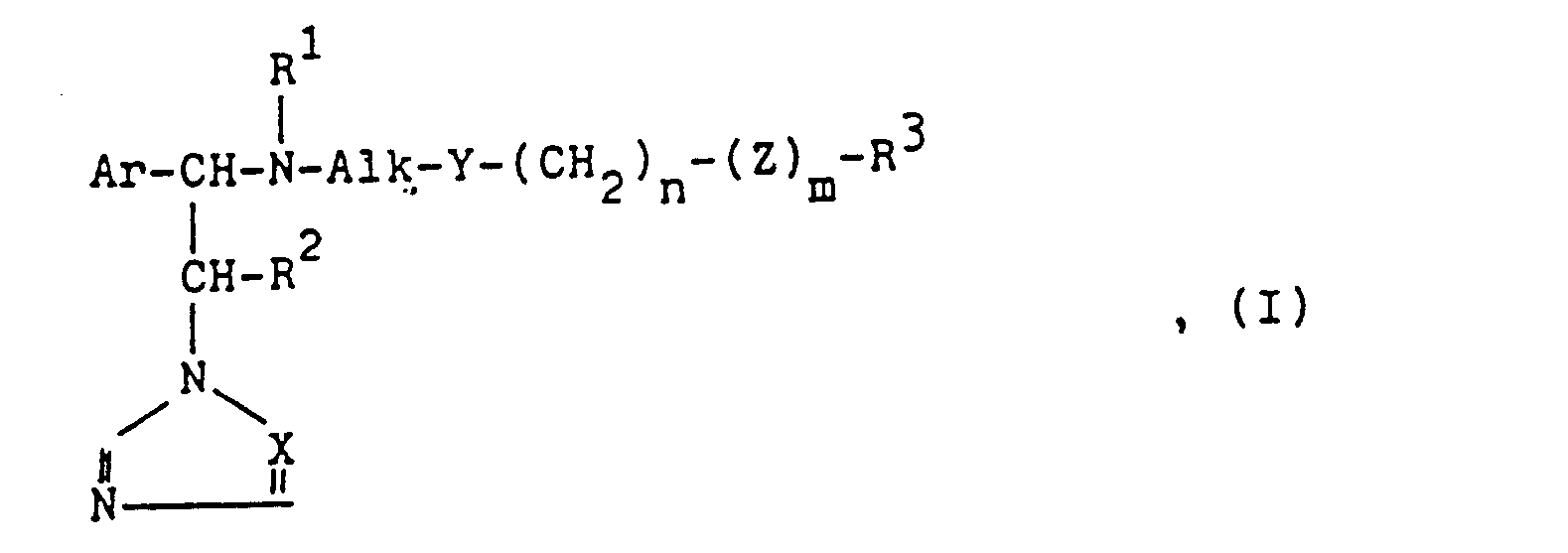
- Gegenstand der Erfindung sind demnach Imidazol-und Triazolderivate der allgemeinen Formel I des Formelblattes,
- in welcher Ar Thienyl, durch Halogen, Niederalkyl oder Niederalkoxy substituiertes Phenyl, Biphenylyl oder Naphthyl, Ri Wasserstoff oder Niederalkyl, Alk geradkettiges oder verzweigtes Alkylen mit 1 bis 10 Kohlenstoffatomen, Y Sauerstoff, Schwefel, Sulfinyl oder Sulfonyl, n Null, 1 oder 2, Z Sauerstoff, Schwefel oder Sulfinyl, m Null oder 1, R3 Wasserstoff, geradkettiges oder verzweigtes Alkyl, Cyclohexyl, gegebenenfalls durch Hydroxy, Halogen, Trifluormethyl, Niederalkyl oder Niederalkoxy substiuiertes Phenyl, Biphenylyl, Pyridyl oder gegebenenfalls durch Halogen substituiertes Naphthyl, X CH oder N und R2 Wasserstoff oder Niederalkyl bedeuten, und deren pharmazeutische annehmbare Säureadditionssalze zur Verwendung als antimykotische Mittel.
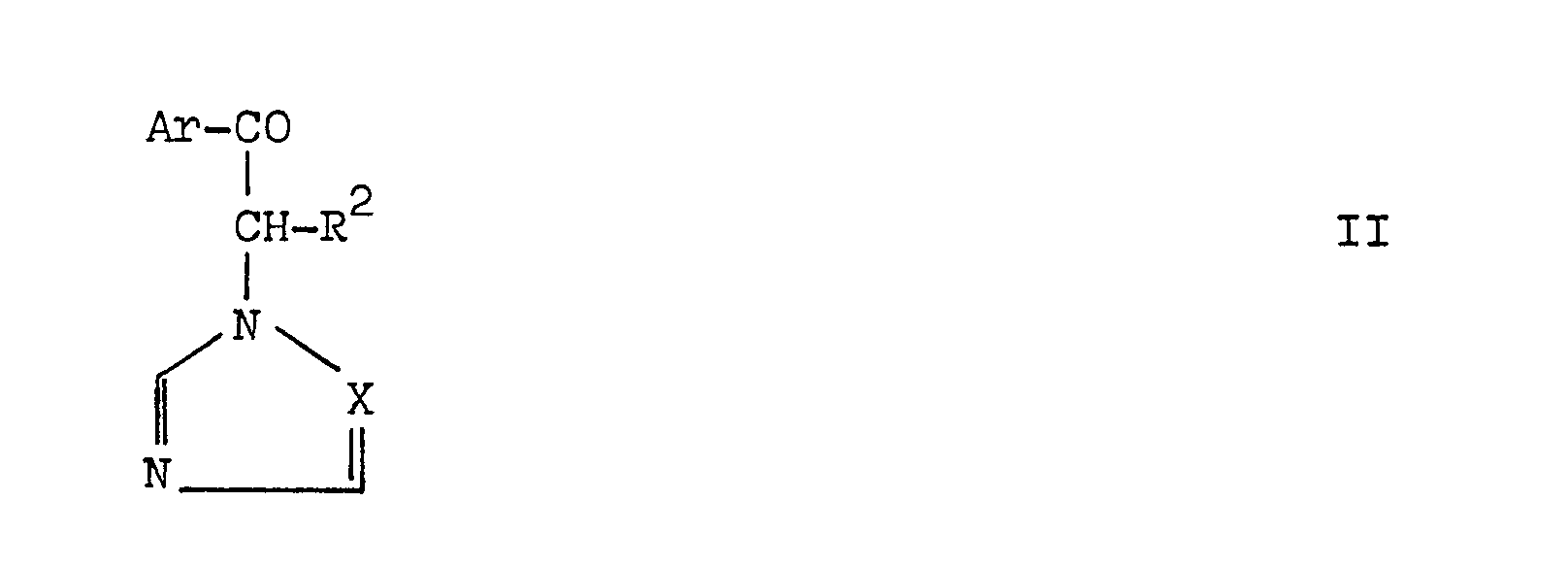
- Die erfindungsgemäßen Substanzen können hergestellt werden, indem man Verbindungen der allgemeinen Formel II des Formelblattes,
- worin Ar und X obige Bedeutung haben, mit Verbindungen der allgemeinen Formel III des Formelblattes, worin R3, Z, m, n, Y und Alk obige Bedeutung haben, gegebenenfalls in Gegenwart eines inerten Verdünnungsmittels umsetzt, die erhaltenen Iminoverbindungen der allgemeinen Formel IV des Formelblattes,
- in welcher Ar, Alk, Y, Z, R2, R3, n und m obige Bedeutung haben, gegebenenfalls in Gegenwart eines inerten Verdünnungsmittels reduziert und gewünschtenfalls die erhaltenen Verbindungen der Formel I, in denen R1 Wasserstoff bedeutet, durch übliche Alkylierungsmethoden in Verbindungen der Formel I, in denen Ri Nieder-alkyl bedeutet, überführt.
- Die Umsetzung der Verbindungen II und III erfolgt z. B. durch Erhitzen des Reaktionsgemisches in einem organischen Verdünnungsmittel. Werden Verbindungen III in Form ihrer Salze eingesetzt, so ist die Zugabe eines Äquivalentes einer Base, wie Trialkylamin, Natriumalkoholat oder Alkalihydroxyd erforderlich.
- Als Verdünnungsmittel dienen aliphatische oder aromatische Kohlenwasserstoffe, die chloriert sein können, wie Benzinfraktionen, Perchloräthylen, Benzol, Toluol, Chlorbenzol, Xylol, Ether wie Dibutylether, Dioxan, Alkohole wie Butanol, Pentanol, Ethylenglykol, Säureamide wie Dimethylformamid und Mischungen derselben mit den oben genannten Verdünnungsmitteln. Die Komponenten werden am Wasserabscheider unter Rückfluß erhitzt bis sich kein Reaktionswasser mehr abscheidet. Die nach Entfernen des Verdünnungsmittels erhaltene Iminoverbindung IV wird in einem organischen Verdünnungsmittel gelöst bzw. suspendiert und gekühlt. Als Verdünnungsmittel dienen insbesondere Alkohole, vorzugsweise Methanol, Ether wie Diethylether oder Tetrahydrofuran. Die Reduktion erfolgt dann durch Zugabe eines Reduktionsmittels, insbesondere eines komplexen Metallhydrides wie z. B. Alkaliborhydrid, Alkalicyanoborhydrid, Aluminiumborhydrid, Lithiumaluminiumhydrid, vorzugsweise Natriumborhydrid bei etwa einer Temperatur zwischen -20 °C und der Rückflußtemperatur des verwendeten Verdünnungsmittels, vorzugsweise bei einer Temperatur von -5 °C bis +20 °C.
- Für die Einführung des Alkylrestes Ri kommen alle gebräuchlichen Alkylierungsmethoden in Frage. Zur Einführung des Methylrestes kann beispielsweise eine Verbindung der Formel I, in der Ri Wasserstoff bedeutet, in alkoholischer, z. B. methanolischer, Lösung mit wässriger Formaldehydlösung versetzt, das Gemisch zum Sieden erhitzt und auf die Reaktionslösung nach ihrem Erkalten ein Reduktionsmittel, vorzugsweise Natriumborhydrid einwirken gelassen werden.
- Nach einem weiteren Verfahren werden die Verbindungen der allgemeinen Formel I erhalten, indem man eine Verbindung der allgemeinen Formel II mit einem Aminoalkanol der allgemeinen Formel V des Formelblattes,
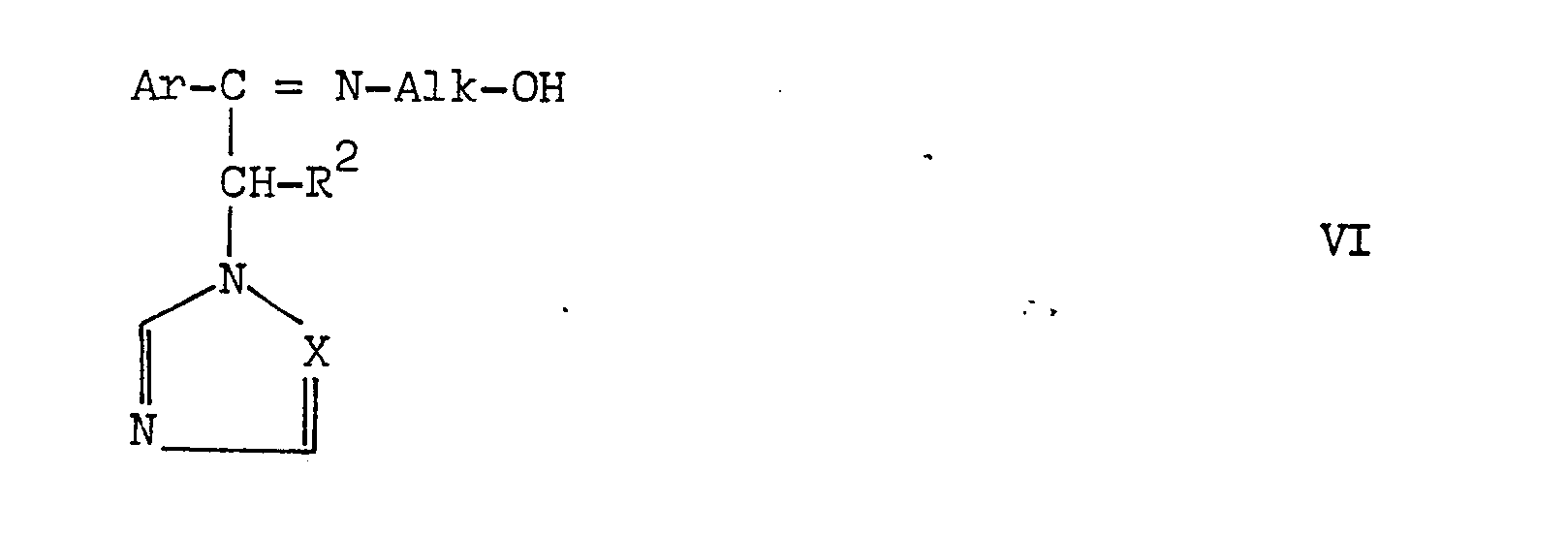
- umsetzt, die als Umsetzungsprodukt erhaltene Iminoverbindung der allgemeinen Formel VI des Formelblattes,
- reduziert, die erhaltene Hydroxylalkylamino-Verbindung der allgemeinen Formel Formel VII des Formelblattes,
- in die entsprechende Halogenalkylamino-Verbindung der allgemeinen Formel VIII des Formelblattes, überführt, diese mit einer Verbindung der allgemeinen Formel IX des Formelblattes,
- umsetzt und gewünschtenfalls die erhaltenen Verbindungen der Formel I, in denen R1 Wasserstoff bedeutet, durch übliche Alkylierungsmethoden in Verbindung der Formel I, in denen R, Niederalkyl bedeutet, überführt, wobei in obigen Formeln V bis IX Ar, Alk, Y, Z, R2, R3, X, n und m die für Formel I angegebene Bedeutung haben und Hal für Halogen steht.
- Die Umsetzung einer Verbindung der allgemeinen Formel II mit einem Aminoalkohol der allgemeinen Formel V wird in einem organischen Verdünnungsmittel bei einer Temperatur zwischen 0 °C und 180 °C, vorzugsweise bei Rückflußtemperatur des verwendeten Verdünnungsmittels durchgeführt. Als Verdünnungsmittel dienen aliphatische oder aromatische Kohlenwasserstoffe die chloriert sein können, wie Benzinfraktionen, Perchloräthylen, Benzol, Toluol, Xylol, Chlorbenzol, Ether wie Dibutylether, Dioxan, Alkohole wie Butanol, Pentanol, Ethylenglykol, Säureamide wie Dimethylformamid und Mischungen desselben mit den oben angeführten Verdünnungsmitteln. Die nach Entfernen des Verdünnungsmittels erhaltene Iminoverbindung VI wird in einem organischen Verdünnungsmittel gelöst bzw. suspendiert und die Lösung bzw. Suspension gekühlt. Als Verdünnungsmittel dienen insbesondere Alkohole, vorzugsweise Methanol, Ether wie Diethylether oder Tetrahydrofuran. Die Reduktion erfolgt durch Zugabe eines Reduktionsmittels, vorzugsweise eines komplexen Metallhydrides, insbesondere Natriumborhydrid bei einer Temperatur von etwa -20 °C bis Rückflußtemperatur des verwendeten Verdünnungsmittels, vorzugsweise bei einer Temperatur von etwa -5 °C bis +20 °C. Die nach üblicher Aufarbeitung erhaltene Hydroxyalkyl amino-Verbindung VII wird in einem organischen Verdünnungsmittel, vorzugsweise in einem chlorierten aliphatischen Kohlenwasserstoff, z. B. Chloroform, gelöst und die Lösung gekühlt. Durch Zugabe eines Halogenierungsmittels, z. B. Phosphortribromid, erfolgt die Überführung der Hydroxyverbindung VII in die entsprechende Halogenverbindung VIII, wobei die Reaktion bei einer Temperatur von etwa -50 °C bis Raumtemperatur, vorzugsweise von -20 °C bis 0 °C durchgeführt wird. Die Umsetzung der Halogenalkylamino-Verbindung VIII mit der Verbindung der allgemeinen Formel IX erfolgt vorzugsweise in alkoholischer, z. B. methanolischer, Lösung in Gegenwart einer Base, z. B. Natriummethylat oder Alkalihydroxyd bei einer Temperatur von etwa -20 °C bis 120 °C, vorzugsweise bei einer Temperatur von 20 °C bis 80 °C.
- In den Formeln bis IX bedeuten Ri und R2 unabhängig voneinander ein Wasserstoffatom oder einen Alkylrest mit 1 bis 4 C-Atomen, vorzugsweise eine Wasserstoffatom oder den Methylrest. Ar bedeutet durch Halogen, Niederalkyl oder Niederalkoxy substituiertes Phenyl, Biphenylyl, Naphthyl oder Thienyl, vorzugsweise 2,4-Dichlorphenyl.
- Alk bedeutet einen geradkettigen oder verzweigten gesättigten Kohlenwasserstoffrest mit 1 bis 10 C-Atomen. Beispiele für solche Reste sind Methyl-, Ethyl-, n-Propyl-, i-Propyl-, Butyl-, s-Butyl-, t-Butylreste, geradkettige oder verzweigte Pentyl-, Hexyl-, Heptyl-und Octylreste.
- Y bedeutet Sauerstoff, Schwefel, Sulfinyl oder Sulfonyl, besonders bevorzugt Schwefel.
- Z kann Sauerstoff, Schwefel oder Sulfinyl bedeuten.
- R3 bedeutet ein Wasserstoffatom, einen geradkettigen oder verzweigten Kohlenwasserstoffrest mit 1 bis 12 C-Atomen, einen Cyclohexylrest, Phenyl oder Naphthylreste, die ein-oder mehrfach durch Halogenatome, Hydroxylgruppen, Alkyl-oder Alkoxyreste mit 1-4 C-Atomen oder Trifluormethyl substituiert sein können, Biphenylyl oder Pyridyl, vorzugsweise 4-Chlorphenyl, 4-Bromphenyl, 4-Jodphenyl, 4-Methoxyphenyl, 4-Methylphenyl, 2,4-, 3,4-oder 2,6-Dichlorphenyl, 2-Methyl-4-chlorphenyl, Cyclohexyl oder Naphthyl.
- Die erfindungsgemäßen Mittel besitzen interessante antimykotische Eigenschaften und können als Heilmittel verwendet werden. Diese Wirkung konnte durch Bestimmung der minmalen Hemmstoffkonzentration (MHK) bei Hefen, Schimmelpilzen und Dermatophyten nachgewiesen werden.
- Die erfindungsgemäßen Mittel können in üblicher Weise als feste, halbfeste oder flüssige Formulierungen in Form von Tabletten, Kapseln, Pulvern, Suppositorien, Lösungen, Cremes, Lotionen, Gels, Salben oder dgl. angewendet werden. Pharmazeutisch verträgliche nicht toxische Träger oder Exzipienten, die normalerweise für feste Formulierungen verwendet werden, sind Tricalciumphosphat, Calciumcarbonat, Kaolin, Bentonit, Talkum, Gelatine, Lactose, Stärke u. dgl. Für halbfeste Formulierungen eignen sich beispielsweise Wasser, pflanzliche Öle und niedrigsiedende Lösungsmittel, wie i-Propanol, hydrierte Naphthaline u. dgl.
- Die erfindungsgemäßen Mittel können herkömmlichen pharmazeutischen Maßnahmen, wie der Sterilisierung unterzogen werden und können herkömmliche pharmazeutische Exzipienten wie Konservierungsmittel, Stabilisierungsmittel, Emulgatoren, Salze zur Einstellung des osmotischen Druckes und Puffer enthalten. Die Mittel können neben den erfindungsgemäßen Verbindungen auch andere therapeutische wirksame Materialien enthalten.
- Die erfindungsgemäßen Mittel bestehen normalerweise aus einem pharmazeutisch verträglichen nicht toxischen Träger in Verbindung mit einer oder mehreren erfindungsgemäßen Verbindungen in einer wirksamen Menge, die zur Erleichterung oder Verhütung der spezifischen zu behandelnden Zustände führt. Da die erfindungsgemäßen Wirkstoffe über einen weiten Konzentrationsbereich antimykotische Wirkung zeigen, kann die wirksame Menge variieren. Bei topischen Formulierungen kann die Menge beispielsweise ungefähr 0,1 bis 10 % der gesamten pharmazeutischen Formulierung betragen, wohingegen bei anderen Formulierungen die Menge ungefähr 5 bis etwa 95 % oder mehr ausmachen kann. Vorzugsweise werden die erfindungsgemäßen pharmazeutischen Mittel als Dosiseinheit formuliert um die Applikation zu erleichtern.
- Die erfindungsgemäßen Mittel können zur pharmazeutischen Anwendung bei Menschen und Tieren auf herkömmliche Weise z. B.: topisch, oral, parenteral oder in ähnlicher Weise verabreicht weerden. Die genaue Vorschrift zur pharmazeutischen Applikation der erfindungsgemäßen Verbindungen und Mittel hängt notwendigerweise von den Anforderungen des Einzelfalls, der Art der Behandlung, die beispielsweise vorbeugend oder heilend sein kann, der Art der beteiligten Organismen ab.
- Zur systemischen, beispielsweise oralen oder parenteralen Applikation ist es im allgemeinen angebracht, den Wirkstoff in Mengen von etwa 1 - 120 mg/kg Körpergewicht pro Tag, vorzugsweise 5 - 100 mg/kg Körpergewicht pro Tag zu verabreichen, wobei diese Mengen auch auf mehrere Gaben (beispielsweise 3 pro Tag) verteilt werden können um gute Resultate zu erzielen. Zur lokalisierten Applikation ist jedoch entsprechend weniger Wirkstoff erforderlich.
- 14.8 g (0.058 Mol) 2,4-Dichlorphenacylimidazol, 16.8 g (0.059 Mol) 4-Bromphenylthiopropylaminhydrochlorid und 6.0 g (0.059 Mol) Triethylamin werden in 100 ml Toluol suspendiert bzw. gelöst und das Gemisch am Wasserabscheider unter Rückfluß erhitzt, bis sich kein Reaktionswasser mehr abscheidet. Danach wäscht man die Reaktionslösung mit Wasser, trocknet die org. Phase mit Natriumsulfat und erhält nach dem Abdampfen des Lösungsmittels 27.9 g 1-(2-(2,4-Dichlorphenyl)-2-(3-(4-bromphenylthio)-propylimino))ethyl-1 H-imidazol als viskoses Öl. (Ausbeute: 98 %)
- 27.9 g (0.057 Mol) 1-(2-(2,4-Dichlorphenyl)-2-(3-(4-bromphenylthio)propylimino))ethyl-1 H-imidazol werden in 150 ml Methanol gelöst, die Lösung auf -5 °C gekühlt und portionsweise 6.4 g (0.169 Mol) Natriumborhydrid so zugefügt, daß die Temperatur nicht über 5 °C steigt. Anschließend rührt man noch 1 Stunde bei 30 °C, dampft hierauf zur Trockene ein und bringt das Reaktionsgemisch mit halbkonzentrierter Salzsäure auf pH = 1. In weiterer Folge wird die Reaktionslösung mit 40%iger Natronlauge auf pH = ca. 12 gebracht und mehrmals mit Dichlormethan extrahiert. Nach Waschen der vereinigten Extrakte mit Wasser, Trocknen und Entfernen des Lösungsmittels im Vakuum erhält man ein Öl, aus dem durch Behandlung mit Aceton und Salpetersäure 10.6 g reines Dinitrat des 1-(2-(2,4-Dichlorphenyl)-2-(3-(4- bromphenylthio)propylamino))ethyl-1 H-imidazols mit dem Schmp. 162 -179 °C erhalten werden. (Ausbeute: 32 %)
- 153.2 g (0.60 Mol) N-(2,4-Dichlorphenacyl)-imidazol und 53.0 g (0.705 Mol) 3-Amino-1-propanol werden in 400 ml Toluol suspendiert bzw. gelöst und das Gemisch am Wasserabscheider unter Rückfluß erhitzt, bis sich kein Reaktionswasser mehr abscheidet. Danach wäscht man die Reaktionslösung 3 Mal mit Wasser, trocknet die organische Phase mit Natriumsulfat und erhält nach dem Abdampfen des Lösungsmittels 179 g 1-(2-(2,4-Dichlorphenyl)-2-(3-hydroxypropylimino))ethyl-1H-imidazol als hochviskoses Öl. (Ausbeute: 95.6 %)
- 179.0 g (0.5737 Mol) 1-(2-(2,4-Dichlorphenyl)-2-(3-hydroxypropylimino))ethyl-1H-imidazol werden in 300 ml Methanol gelöst, die Lösung auf 0 °C gekühlt und portionsweise 50.0 g (1.322 Mol) Natriumborhydrid so zugefügt, daß die Temperatur nicht über 5 °C steigt. Nach Zugabe des Borhydrids rührt man noch 2 Stunden bei Raumtemperatur, dampft anschließend zur Trockene ein und bringt das Reaktionsgemisch mit halbkonzentrierter Salzsäure auf pH = 1. In weiterer Folge wird die Reaktionslösung mit 40%iger Natronlauge auf pH = ca. 12 gebracht und mehrmals mit Dichlormethan extrahiert. Nach Waschen der vereinigten organischen Extrakte mit Wasser, Trocknen und Entfernen des Lösungsmittels im Vakuum, erhält man 169 g Rohprodukt als Öl. Nach Umkristallisation des Öles aus Aceton werden 107 g reines 1-(2-(2,4-Dichlorphenyl)-2-(3-hydroxypropylamino»ethyl-1 H-imidazol vom Schmp. 77 -79 °C erhalten. (Ausbeute: 51 %)
- 12.6 g (0.04 Mol) 1-(2-(2,4-Dichlorphenyl)-2-(3-hydroxypropylamino))ethyl-1H-imidazol werden in 30 ml Chloroform gelöst und die Lösung auf -5 °C gekühlt. Unter Rühren werden langsam 10.83 g Phosphortribromid, gelöst in 20 ml CHCI3, so zugetropft, daß die Temperatur nicht über 0 °C steigt. Nach dem Zutropfen versetzt man das Reaktionsgemisch mit 100 ml Petrolether, wobei 20.5 g kristallines 1-(2-(2,4-Dichlorphenyl)-2-(3-brompropylamino))ethyl-1H-imidazol als Dihydrobromid vom Schmp. 140 - 150 °C erhalten werden, welches aus Stabilitätsgründen sofort weiter umgesetzt wird. (Ausbeute: 95 %)
- 5.4 g (0.01 Mol) frisch bereitetes 1-(2-(2,4-Dichlorphenyl)-2-(3-brompropylamino))ethyl-1 H-imidazoldihydrobromid und 1.45 g (0.01 Mol) 4-Chlorthiophenol werden in 50 ml Methanol gelöst und mit 6 ml einer 30%igen Natriummethylatlösung versetzt. Man erhitzt das Reaktionsgemisch 2 Stunden auf Rückfluß und rührt anschließend noch 14 Stunden bei Raumtemperatur. In der Folge verdampft man das Methanol im Vakuum, nimmt den Rückstand in Dichlormethan auf, schüttelt mit 5%iger Natronlauge und wäscht die organische Phase mit Wasser. Nach Trocknen und Entfernen des Lösungsmittels im Vakuum löst man den Rückstand in Aceton und versetzt tropfenweise mit konzentrierter Salpetersäure, wobei 3.0 g 1-(2-(2,4-Di chlorphenyl)-2-(3-(4-chlorphenylthio)propylamino))ethyl-1H-imidazolals Dinitrat anfallen. Aus Alkohol umkristallisiert erhält man 2.2 g farblose Kristalle vom Schmp. 168 - 177 °C. (Ausbeute: 41 %)
- 8.18 g (0.018 Mol) 1-(2-(2,4-Dichlorphenyl)-2-(3-(4-chlorbenzylthio)propylamino))ethyl-1 H-imidazol werden in 100 ml Methanol gelöst und mit 34.3 g 35%iger wässriger Formaldehydlösung versetzt und das Gemisch 2 Stunden zum Sieden erhitzt. Nach dem Erkalten der Reaktionslösung werden 14.6 g Natriumborhydrid zugesetzt und bei Raumtemperatur 14 Stunden gerührt. In der Folge verdampft man das Methanol im Vakuum, versetzt den Rückstand mit halbkonzentrierter Salzsäure, fügt anschließend bis pH = 12 40%ige Natronlauge zu und extrahiert 3 Mal mit Dichlormethan. Die vereinigten Extrakte werden mit Wasser gewaschen und anschließend das Lösungsmittel im Vakuum verdampft, wobei ein Öl anfällt. Das Rohprodukt wird über Kieselgel chromatographiert (Laufmittel: Essigester/Methanol = 10 : 1). Man erhält ein Öl, aus welchem durch Behandlung mit ethanolischer Salzsäure 2.0 g 1-(2-(2,4-Dichlorphenyl)-2-(N-methyl-N-(3-(4-chlorbenzylthio)propylamino)))ethyl-1 H-imidazol als Dihydrochlorid vom Schmp. 170 - 180 °C erhalten werden. (Ausbeute: 21 %)
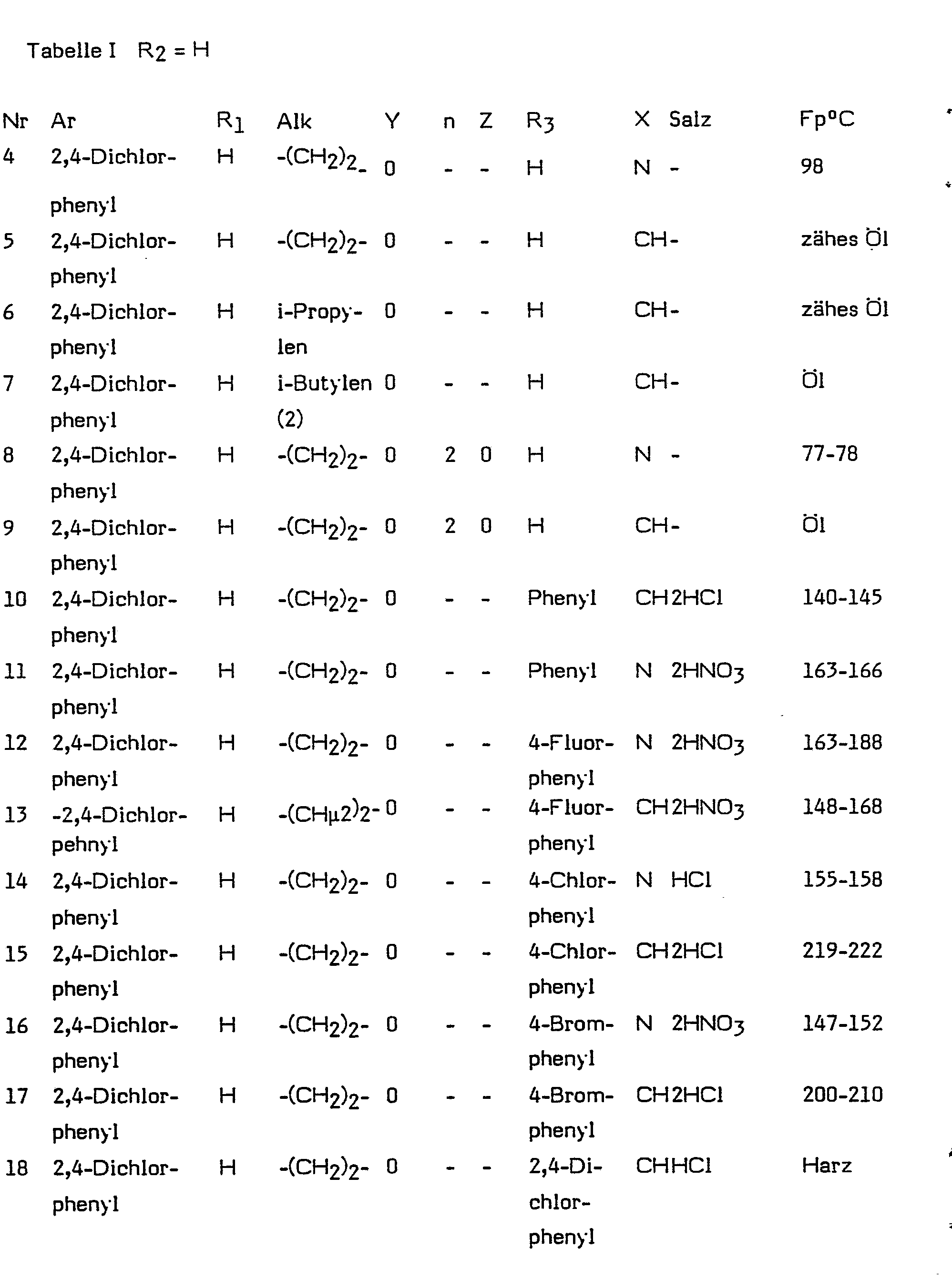
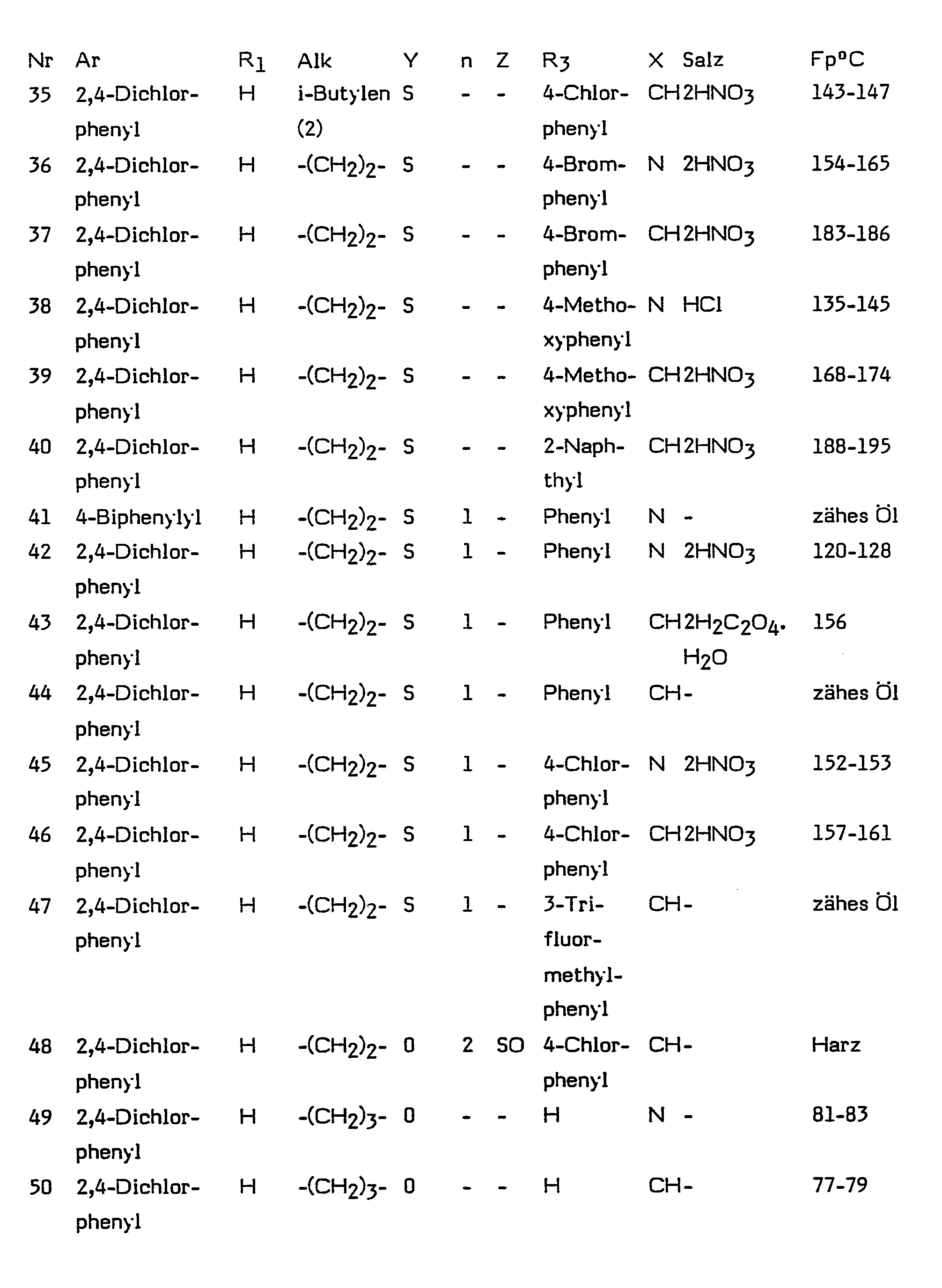
- Nach einem der angegebenen Verfahren wurden folgende Verbindungen erhalten:



- 2 g der Verbindung Nr. 96 und 1 g Milchzucker wuerden mit 1 ml 10%iger wässriger Polyvinylpyrrolidon K25-Lösung granuliert. Das Gemisch wurde durch ein Sieb der Maschenweite 3 - 5 mm geschlagen und getrocknet. Dieses getrocknete Gemisch wird durch ein Sieb der Maschenweite 0,8 - 1,25 mm homogenisiert und dann mit 0,58 g mikrokristalliner Cellulose (Avicel PH102), 30 mg Na-Carboxymethylstärke und 2 mg Magnesiumstearat vermischt. Die so erhaltene Mischung wurde zu 10 Tabletten verpreßt.
- Eine Lösung von 1 g der Verbindung Nr. 96 in 50 ml aquapurificata wurde mit soviel Polyethylenglycol 400 versetzt, daß insgesamt 100 ml Lösung entstanden.
- 66 g Vaseline liquid. wurden am Wasserbad mit 3,5 g Alfol 16 (Cetylalkohol) und 0,1 g Cholesterin aufgeschmolzen und mit einer Lösung von 1 g der Verbindung Nr. 96 in 29,4 g aqua purificata versetzt. Unter langsamen Abkühlen wurde diese Mischung zu 100 g Salbe homogenisiert.
- 3 g der Verbindung Nr. 96 und 0,3 g eines Gemisches aus 2 Teilen p-Hydroxybenzoesäuremethylester und einem Teil p-Hydroxybenzoesäurepropylester wurden mit aqua ad injectionen ad 300 ml gelöst und durch ein Membranfilter der Porenweite 0,2 u.m steril und partikelfrei filtriert, dann unter aseptischen Bedingungen in Ampullen zu 10 ml abgefüllt.
- Die Ermittlung der antimykotischen Aktivitäten der Verbindungen erfolgte in vitro durch Bestimmung der minimalen Hemmstoffkonzentration (MHK) bei Hefen, Schimmelpilzen und Dermatophyten.
- Für die Testung mit Pilzen wurden 6 Dermatophyten, 2 Hefen und 4 Schimmelpilze verwendet: Trichophyton mentagrophytes (Tri.me.) Trichophyton rubrum (Tri.ru.) Trichophyton verrucosum (Tri.ve.) Microsporum canis (Mi.can.) Epidermophyton floccosum (Ep.flo.) Microsporum gypseum (Mi.gyp.) Candida albicans (C.alb.) Candida tropicalis (C.trop.) Aspergillus fumigatus (Asp.fu.) Mucor mucedo plus (Mu.mu ) Mucor mucedo minus (Mu.mu ) Absidia ramosa (Abs.ra.)
- Die Bestimmung der minimalen Hemmstoffkonzentration (MHK) erfolgte in Reihenverdünnungstests in Reagenzgläsern. Das Volumen des flüssigen Nährmediums betrug 4,5 ml pro Reagenzglas.
- Die Substanzen wurden in DMSO gelöst und mit sterilem destillierten Wasser auf 10 Konzentrationen (100, 50, 25, 12.5, 6.25, 3.12, 1.56, 0.78, 0.39 und 0.19 µg/ml) verdünnt. Aus diesen Verdünnungsstufen wurden jeweils 0.5 ml dem flüssigen Nährmedium zugesetzt. Somit war auch eine einheitliche Konzentration von Lösungsmittel in allen Nährmedien unabhängig von der Wirkstoffkonzentration gewährleistet.
- Eine Vergleichslösung, die nur das Lösungsmittel in entsprechender Konzentration enthielt, wurde bei der Durchführung des Tests jeweils mitberücksichtigt.
- Die einzelnen Stämme wurden auf Sabouraud-Bierwürze-Schrägager gewartet, und machten vor ihrem Testeinsatz eine Passage auf einem modifizierten Sabouraud-Flüssig-Nährboden durch. Anschließend wurden die Stämme geerntet, gewaschen und zu einer Suspension von McFaerland 3 bei den Hefen und Schimmelpilzen und McFaerland 4 - 5 bei den Dermatophyten aufbereitet.
- Die Menge des Impfmaterials (Inoculum) betrug 100 ul/Reagenzglas (Einsaatdichten: Hefen ca. 103/ml, Schimmelpilze ca. 104/ml, Dermatophyten ca. 104/ml). Der pH-Wert des Flüssignährbodens betrug 6.0. Nach erfolgter Inoculation wurden die Pilze bei 22 °C 14 Tage bebrütet.
- Anschließend wurde der MHK-Wert bestimmt. Für die Bestimmung des MHK-Wertes wurde jene Konzentrationsstufe herangezogen bei welcher makroskopisch kein sichtbares Wachstum mehr festgestellt werden konnte. Als Vergleichssubstanz diente 1-(2-(2,4-Dichlorphenyl)-2-((2,4-dichlorphenyl)methoxy-ethyl)-1-H-imidazol (Verbindung A)


- Bestimmung der letalen Dosis von (1-(2-(2,4-Dichlorphenyl)-2-(3-(4-chlorphenylthio)-propylamid)ethyl-1-H-imidazol-dihydrochlorid (Verbindung Nr. 96) bei Mäusen und Ratten bei einmaliger Gabe. Jeweils vier Gruppen von weiblichen und männlichen Tieren wurden oral Dosen von 0,500, 1000 und 3000 mg/kg Körpergewicht verabreicht. (Kontrolle: zweifach destilliertes Wasser) Folgende klinische Symptome wurden beobachtet.
- Mäuse: Inaktivität, Konvulsionen Ratten: Inaktivität, gekräuseltes Fell, Konvulsionen

- Bestimmung der LDso von (1-2-2,4-Dichlorphenyl-2-(3-(4-chlorphenylthio)propylamid-1 H-imidazol-dihydrochlorid (Verbindung Nr. 96) an Mäusen und Ratten durch i. v. Gabe jeweils 5 Gruppen von weiblichen und männlichen Tieren wurden 0 (0,9 % NACI-Lösung) 12,5, 25,0, 50,0 und 100 mg/kg Körpergewicht i.v. injiziert. Folgende klinische Symptome wurden beobachtet Mäuse: Inaktivität, necrotischer Schwanz Ratten: Inaktivität, necrotischer Schwanz, Konvulsionen

- Verbindung Nr. 96 wurde auf ihr Potential Genmutationen zu verursachen in fünf Salmonella typhimurum-Stammes TA 1535, TA 1537, TA 1538, TA 98 und TA 100 untersucht. Folgende Konzentrationen wurden getestet, sowohl mit metabolischem Aktivator (S 9 mix) als auch ohne metabolischen Aktivator. I: 10, 33,3, 100,0, 333,3, 1000 µg/Platte II: 3,3, 10, 33,3, 100, 333,3 µg/Platte Es wurde keinerlei mutagene Aktivität beobachtet, weder mit noch ohne metabolischen Aktivator.
Claims (8)





Applications Claiming Priority (2)
| Application Number | Priority Date | Filing Date | Title |
|---|---|---|---|
| DE19863644615 DE3644615A1 (de) | 1986-12-29 | 1986-12-29 | Imidazol- und triazolderivate zur verwendung als antimykotische mittel |
| DE3644615 | 1986-12-29 |
Publications (2)
| Publication Number | Publication Date |
|---|---|
| EP0277348A2 true EP0277348A2 (de) | 1988-08-10 |
| EP0277348A3 EP0277348A3 (de) | 1988-09-21 |
Family
ID=6317327
Family Applications (1)
| Application Number | Title | Priority Date | Filing Date |
|---|---|---|---|
| EP87119011A Withdrawn EP0277348A3 (de) | 1986-12-29 | 1987-12-22 | Imidazol- und Triazolderivate zur Verwendung als antimykotische Mittel |
Country Status (12)
| Country | Link |
|---|---|
| US (1) | US4812465A (de) |
| EP (1) | EP0277348A3 (de) |
| JP (1) | JPS63170314A (de) |
| KR (1) | KR880007479A (de) |
| AU (1) | AU604283B2 (de) |
| CA (1) | CA1323877C (de) |
| CZ (1) | CZ302091A3 (de) |
| DE (1) | DE3644615A1 (de) |
| DK (1) | DK688187A (de) |
| HU (1) | HU205746B (de) |
| MY (1) | MY102275A (de) |
| ZA (1) | ZA879696B (de) |
Families Citing this family (4)
| Publication number | Priority date | Publication date | Assignee | Title |
|---|---|---|---|---|
| US5089622A (en) * | 1988-12-12 | 1992-02-18 | Mitsui Toatsu Chemicals Incorporated | (-)-2-pyrazoline compounds and therapeutic agent for cerebrovascular disorders containing the same as effective ingredient |
| US5110826A (en) * | 1989-11-09 | 1992-05-05 | Kao Corporation | Azole derivatives and antifungal drugs containing the same as an active component |
| IT1273509B (it) * | 1995-04-07 | 1997-07-08 | Zambon Spa | Composti azolici ad attivita' antimicotica per uso umano e veterinario |
| JP5589110B1 (ja) * | 2013-03-08 | 2014-09-10 | 株式会社ポーラファルマ | 晶癖を有する結晶及び該結晶を有効成分として含有する医薬組成物 |
Family Cites Families (11)
| Publication number | Priority date | Publication date | Assignee | Title |
|---|---|---|---|---|
| GB216801A (en) * | 1923-12-10 | 1924-06-05 | Edward Barber | Improved method of and means for releasing life lines, buoys and the like |
| SU557755A3 (ru) * | 1968-08-19 | 1977-05-05 | Янссен Фармасьютика Н.В. (Фирма) | Способ получени производных имидазола |
| DE3100260A1 (de) * | 1981-01-08 | 1982-08-05 | Basf Ag, 6700 Ludwigshafen | Substituierte azolyl-glykolsulfonate, diese enthaltende fungizide und verfahren zu ihrer herstellung |
| CA1189857A (en) * | 1981-03-27 | 1985-07-02 | Janssen Pharmaceutica Naamloze Vennootschap | Antimicrobial triazole derivatives |
| DE3200414A1 (de) * | 1982-01-09 | 1983-07-21 | Bayer Ag, 5090 Leverkusen | Azolyl-thioether-derivate, verfahren zu ihrer herstellung sowie ihre verwendung als fungizide und pflanzenwachstumsregulatoren |
| CH655103A5 (de) * | 1983-03-11 | 1986-03-27 | Sandoz Ag | Azolderivate, verfahren zu ihrer herstellung und ihre verwendung. |
| NL8402755A (nl) * | 1983-09-22 | 1985-04-16 | Sandoz Ag | Azool-derivaten, werkwijze voor het bereiden daarvan, preparaten die ze bevatten, en toepassing daarvan. |
| DE3406908A1 (de) * | 1984-02-25 | 1985-09-05 | Hoechst Ag, 6230 Frankfurt | Neue triazolylalkylderivate, verfahren zu ihrer herstellung sowie ihre verwendung als pflanzenbehandlungsmittel |
| JPS61130272A (ja) * | 1984-11-30 | 1986-06-18 | Nippon Tokushu Noyaku Seizo Kk | β―置換アミノ―フェネチルアゾール誘導体、その製法及び農園芸用殺菌剤 |
| JPS61271280A (ja) * | 1985-05-23 | 1986-12-01 | サンド・アクチエンゲゼルシヤフト | 新規アゾ−ル誘導体、その製造方法と用途 |
| NL8601189A (nl) * | 1985-05-23 | 1986-12-16 | Sandoz Ag | Nieuwe azoolderivaten, werkwijzen voor het bereiden van deze derivaten en voor hun toepassing. |
-
1986
- 1986-12-29 DE DE19863644615 patent/DE3644615A1/de not_active Withdrawn
-
1987
- 1987-12-08 HU HU876031A patent/HU205746B/hu not_active IP Right Cessation
- 1987-12-17 CA CA000554725A patent/CA1323877C/en not_active Expired - Fee Related
- 1987-12-18 MY MYPI87003223A patent/MY102275A/en unknown
- 1987-12-22 EP EP87119011A patent/EP0277348A3/de not_active Withdrawn
- 1987-12-23 US US07/137,551 patent/US4812465A/en not_active Expired - Fee Related
- 1987-12-28 ZA ZA879696A patent/ZA879696B/xx unknown
- 1987-12-28 JP JP62330331A patent/JPS63170314A/ja active Pending
- 1987-12-28 DK DK688187A patent/DK688187A/da not_active Application Discontinuation
- 1987-12-28 KR KR1019870015047A patent/KR880007479A/ko not_active Ceased
- 1987-12-29 AU AU83096/87A patent/AU604283B2/en not_active Ceased
-
1991
- 1991-10-03 CZ CS913020A patent/CZ302091A3/cs unknown
Also Published As
| Publication number | Publication date |
|---|---|
| ZA879696B (en) | 1988-06-23 |
| CZ302091A3 (en) | 1993-04-14 |
| HU205746B (en) | 1992-06-29 |
| EP0277348A3 (de) | 1988-09-21 |
| AU8309687A (en) | 1988-06-30 |
| HUT45508A (en) | 1988-07-28 |
| JPS63170314A (ja) | 1988-07-14 |
| DK688187A (da) | 1988-06-30 |
| KR880007479A (ko) | 1988-08-27 |
| CA1323877C (en) | 1993-11-02 |
| MY102275A (en) | 1992-05-15 |
| DK688187D0 (da) | 1987-12-28 |
| US4812465A (en) | 1989-03-14 |
| AU604283B2 (en) | 1990-12-13 |
| DE3644615A1 (de) | 1988-07-07 |
Similar Documents
| Publication | Publication Date | Title |
|---|---|---|
| DE2037610C3 (de) | ||
| DE2041771B2 (de) | derivate | |
| EP0011768B1 (de) | Hydroxypropyl-triazole, Verfahren zu ihrer Herstellung und diese Verbindungen enthaltende Arzneimittel | |
| EP0001654B1 (de) | Imidazolyläthyl-oxyalkoxy-Derivate und ihre Thio-Analoge, pharmazeutische Zubereitungen mit diesen Stoffen und Verfahren zu ihrer Herstellung | |
| EP0008804A1 (de) | Imidazolylvinylether, Verfahren zu deren Herstellung, deren Verwendung und diese Ether enthaltende Arzneimittel und Pflanzenschutzmittel | |
| EP0411735B1 (de) | Cycloakylenazole, Verfahren zu deren Herstellung, pharmazeutische Präparate, die diese enthalten sowie ihre Verwendung zur Herstellung von Arzneimitteln | |
| EP0036153A1 (de) | 1,1-Diphenyl-2-(1,2,4-triazol-1-yl)-äthan-1-ole als Antimykotika | |
| EP0276466A2 (de) | Aminoazolderivate, Verfahren zu deren Herstellung und deren Verwendung als antimykotische Mittel | |
| EP0085842B1 (de) | Antimykotische Mittel | |
| EP0277348A2 (de) | Imidazol- und Triazolderivate zur Verwendung als antimykotische Mittel | |
| DD207375A1 (de) | Verfahren zur herstellung von imidazolen und imidazolinen | |
| DE2917244C2 (de) | 1-[[2-(2,4-Dichlorphenyl)-2-benzyloxy]-äthyl]-imidazole, Verfahren zu deren Herstellung sowie solche enthaltende Arzneimittel | |
| EP0083750B1 (de) | Antimykotische Azolyl-butanole | |
| EP0370300A2 (de) | Cyclopropyl-Substituierte Azolylmethylcarbinole, Verfarhren zu ihrer Herstellung und ihre Verwendung als Arzneimittel | |
| EP0022969B1 (de) | Antimykotische Mittel, die Azolyl-alkenole enthalten und ihre Herstellung | |
| DE2022206C3 (de) | Basisch substituierte Diphenylazolyl-essigsäureester, Verfahren zu ihrer Herstellung sowie diese Verbindungen enthaltende Arzneimittel | |
| DE2229128C2 (de) | 1-(Dialkylphenyl-phenyl-pyridyl-)methyl-imidazole, Verfahren zu ihrer Herstellung und diese enthaltende Arzneimittel | |
| EP0073931B1 (de) | Neue Anilino-1,2,3-triazol-Derivate, diese enthaltende Arzneimittel sowie Verfahren zu deren Herstellung und deren Verwendung | |
| DE2044621C3 (de) | 33-Diphenyl-3-i]nidazol-l-yl-propine, Verfahren zu ihrer Herstellung sowie ihre Verwendung als Arzneimittel | |
| EP0313983A2 (de) | Verwendung neuer Triazolylalkanole zur Behandlung von Krankheiten | |
| DE1617481C3 (de) | N-Trityl-imidazole, Verfahren zu ihrer Herstellung sowie Arzneimittel | |
| EP0031883A1 (de) | Antimikrobielle Mittel enthaltend Hydroxybutylimidazol-Derivate | |
| DE1620018C3 (de) | i-Methyl-5-nitroimidazol-derivate, ihre Salze mit Säuren, Verfahren zu ihrer Herstellung und antiparasitäre Mittel | |
| EP0033088B1 (de) | Antimykotische Mittel | |
| DE68905332T2 (de) | Azoxy - verbindung. |
Legal Events
| Date | Code | Title | Description |
|---|---|---|---|
| PUAI | Public reference made under article 153(3) epc to a published international application that has entered the european phase |
Free format text: ORIGINAL CODE: 0009012 |
|
| PUAL | Search report despatched |
Free format text: ORIGINAL CODE: 0009013 |
|
| 17P | Request for examination filed |
Effective date: 19871222 |
|
| AK | Designated contracting states |
Kind code of ref document: A2 Designated state(s): AT BE CH DE FR GB IT LI LU NL SE |
|
| AK | Designated contracting states |
Kind code of ref document: A3 Designated state(s): AT BE CH DE FR GB IT LI LU NL SE |
|
| 17Q | First examination report despatched |
Effective date: 19900725 |
|
| RAP1 | Party data changed (applicant data changed or rights of an application transferred) |
Owner name: HAFSLUND NYCOMED PHARMA AKTIENGESELLSCHAFT |
|
| STAA | Information on the status of an ep patent application or granted ep patent |
Free format text: STATUS: THE APPLICATION IS DEEMED TO BE WITHDRAWN |
|
| 18D | Application deemed to be withdrawn |
Effective date: 19920307 |