EP0259762B1 - Graphitmonochromator für Röntgenstrahlen und Neutronen und seine Herstellung - Google Patents
Graphitmonochromator für Röntgenstrahlen und Neutronen und seine Herstellung Download PDFInfo
- Publication number
- EP0259762B1 EP0259762B1 EP87112748A EP87112748A EP0259762B1 EP 0259762 B1 EP0259762 B1 EP 0259762B1 EP 87112748 A EP87112748 A EP 87112748A EP 87112748 A EP87112748 A EP 87112748A EP 0259762 B1 EP0259762 B1 EP 0259762B1
- Authority
- EP
- European Patent Office
- Prior art keywords
- film
- graphite
- denotes
- formula
- polymer
- Prior art date
- Legal status (The legal status is an assumption and is not a legal conclusion. Google has not performed a legal analysis and makes no representation as to the accuracy of the status listed.)
- Expired - Lifetime
Links
- 0 C[C@](CC1)C*(CC2CC2)C1[C@@]1[C@](CC*)C1 Chemical compound C[C@](CC1)C*(CC2CC2)C1[C@@]1[C@](CC*)C1 0.000 description 2
Images
Classifications
-
- G—PHYSICS
- G21—NUCLEAR PHYSICS; NUCLEAR ENGINEERING
- G21K—HANDLING OF PARTICLES OR IONISING RADIATION NOT OTHERWISE PROVIDED FOR; IRRADIATION DEVICES; GAMMA RAY OR X-RAY MICROSCOPES
- G21K1/00—Arrangements for handling particles or ionising radiation, e.g. focusing or moderating
- G21K1/06—Arrangements for handling particles or ionising radiation, e.g. focusing or moderating using diffraction, refraction or reflection, e.g. monochromators
-
- C—CHEMISTRY; METALLURGY
- C01—INORGANIC CHEMISTRY
- C01B—NON-METALLIC ELEMENTS; COMPOUNDS THEREOF; METALLOIDS OR COMPOUNDS THEREOF NOT COVERED BY SUBCLASS C01C
- C01B32/00—Carbon; Compounds thereof
- C01B32/20—Graphite
- C01B32/205—Preparation
-
- G—PHYSICS
- G21—NUCLEAR PHYSICS; NUCLEAR ENGINEERING
- G21K—HANDLING OF PARTICLES OR IONISING RADIATION NOT OTHERWISE PROVIDED FOR; IRRADIATION DEVICES; GAMMA RAY OR X-RAY MICROSCOPES
- G21K2201/00—Arrangements for handling radiation or particles
- G21K2201/06—Arrangements for handling radiation or particles using diffractive, refractive or reflecting elements
- G21K2201/067—Construction details
-
- G—PHYSICS
- G21—NUCLEAR PHYSICS; NUCLEAR ENGINEERING
- G21K—HANDLING OF PARTICLES OR IONISING RADIATION NOT OTHERWISE PROVIDED FOR; IRRADIATION DEVICES; GAMMA RAY OR X-RAY MICROSCOPES
- G21K2201/00—Arrangements for handling radiation or particles
- G21K2201/06—Arrangements for handling radiation or particles using diffractive, refractive or reflecting elements
- G21K2201/068—Arrangements for handling radiation or particles using diffractive, refractive or reflecting elements specially adapted for particle beams
Definitions
- This invention relates to process for producing a graphite monochromator for X-rays and neutrons which uses a graphitized product of polymer film.
- X-rays are very widely used as a means of analysis including, for example, the structural analysis of materials.
- characteristic X-rays obtained from copper, iron, molybdenum etc. are used and, to obtain the strongest K ⁇ characteristic rays alone, monochromators which utilize the reflection at the (002) plane of graphite are commonly used.
- neutrons are actively used for the study of material properties and, they are made monochromatic by the use of graphite monochromators.
- graphite monochromators are used, besides to make neutrons monochromatic by passing them through a graphite monochromator before their incidence upon a sample, also to cut off 1/2 higher harmonics by passing the neutrons reflected by the sample through a graphite monochromator.
- the latter monochromator is sometimes called an analyzer or a filter.
- HOPG highly oriented pyrolytic graphite
- the HOPG mentioned above has disadvantages in that it requires an special apparatus for its production since the production involves steps of preparing pyrolytic carbon by thermal decomposition of hydrocarbon gas and then graphitizing the carbon under severe conditions mentioned above, that only a small portion of the HOPG thus obtained is usable for a monochromator, and that a great difficulty is encountered in preparing a curved monochromator used for focusing X-rays. Accordingly, it is eagerly awaited in the art to obtain a graphite monochromator from a material which can be highly oriented easily and can be worked into a curved form without difficulty.
- the object of this invention is to provide a process for producing a graphite monochromator which can overcome the above-mentioned defects.
- a process for producing a graphite monochromator for X-rays and neutrons which comprises pyrolyzing a polymer film in an inert atmosphere at a temperature of 2,000 to 3,500°C, and laminating the resulting graphitized film or the polymer film prior to the pyrolysis.
- This invention has been accomplished based on the finding that a graphitized product obtained by pyrolyzing a polymer film in an inert atmosphere under specified conditions can be easily worked into a curved form and can exhibit an excellent property when used for a graphite monochromator for X-rays and neutrons.
- the graphite film thus obtained has an extremely excellent plane orientation. Further, when subjected to pretreatment, the film has an excellent smoothness and an excellent characteristic for a monochromator, namely a mosaic spread of 4° or less. Further, the mosaic spread of the graphite monochromator can be controlled by varying the heat treatment conditions.
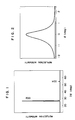
- Figs. 1 and 2 are each a graph showing the X-ray diffraction pattern of a graphite film, the ordinate indicating the reflection intensity (relative intensity) and the abscissa indicating the angle of diffraction.
- R in the above formulae (II) and (III) there may be given a p-phenylene group and di-substituted p-phenylene groups wherein the 2- and 5-position of the p-phenylene group are substituted with chlorine, an alkyl of 1 to 6 carbon atoms (e.g. methyl, ethyl, propyl, butyl and hexyl), or an alkoxy group of 1 to 6 carbon atoms (e.g. methoxy, ethoxy, propoxy, and butoxy).
- the polymeric sulfonium salt having the repeating unit of the formula (III) and when R is for example the p-phenylene group, the polymer goes via.
- the incompletely sulfonium salt-eliminated product contains a small amount of sulfur since it is an intermediate in the course of attaining poly-p-phenylene-vinylene.
- These polymer films can be prepared by methods described in Japanese Patent publication (Examined) No. 97/62 and Japanese Patent Application Laid-Open No. 199,746/84, etc.
- polymer films are preferably oriented ones which have been subjected to orientation, more preferably plane orientation.
- Polymer films subjected to substantially biaxial stretching are particularly preferred.
- these polymer films is not restricted especially, it is usually 50 ⁇ m or less, more preferably 30 ⁇ m or less.
- these polymer films may be subjected to pyrolysis as they are, it is preferable to subject them to a pre-heating prior to the aforesaid pyrolysis to obtain smooth and substantially wrinkle-free graphite films.
- the pre-heating of the polymer film is carried out in an inert atmosphere (e.g. nitrogen, argon) or under vacuum at a temperature of 500 to 1,500°C, preferably 700 to 1,500°C.
- the pre-heating is preferably conducted while the polymer film is being hold between thermally stable plates such as graphite plates or quartz glass plates, more preferably while the film is being closely contacted with the plates of the both sides. When a gap is present between the film and the plate, the film will often develop wrinkles during the pre-heating.
- a heating rate above the temperature at which the polymer begins to decompose is preferably 1°C/minute or more, more preferably 5°C/minute or more, up to the pre-heating temperature.
- the heating rate of not less than 1°C/minute tends to cause bubble formation in the film.
- the graphite film obtained after subjected to the said pre-heating and successively to the pyrolysis described below is free from bubbles and wrinkles and highly excellent in smoothness as compared with that obtained by the pyrolysis alone.
- the pyrolysis is carried out at a temperature of 2,000 to 3,500°C.
- the pyrolyzing temperature is below 2,000°C, graphitization does not proceed substantially; whereas the temperature exceeding 3,500°C leads to a marked sublimation of carbon and enormous energy consumption.
- the pyrolyzing time is not limited particularly, but preferably, it should be determined appropriately, taking the pyrolyzing temperature into consideration, so that the graphitization of the film can be attained sufficiently.
- the pyrolysis may be carried out while the film is either in an unrestrained state or under tension, it is preferably conducted while the film is being hold between graphite plates.
- the clearance between the graphite plates is preferably set at 3 to 100 times, more preferably 5 to 20 times the thickness of the film.
- the clearance is too small, the film will be directly pressed against the graphite plate, which prevents the smooth extension of the film during the graphitization; whereas when it is too large, it will cause wrinkles to develop in the resulting film.
- the graphite film thus prepared is preferably used in a laminated form in order to increase the reflection intensity of X-rays and neutrons.
- the thickness of laminate is preferably 200 ⁇ m to 10 mm, more preferably 300 ⁇ m to 5 mm.
- the lamination can also be accomplished by a method which comprises piling up the sheets of pre-heated film and then subjecting them to pyrolysis or one which comprises piling up the sheets of polymer film and then subjecting them to pyrolysis.
- Some appropriate adhesive may also be used in the lamination which can be turned into carbon atoms alone by the heating.
- Those adhesives which contain an easily graphitizable material are preferable.
- easily graphitizable materials include polyvinyl chloride, pitch and polymeric sulfonium salts represented by the formula (III).
- the sheets of graphite film are in good adhesion to one another and do not peel off to pieces. Accordingly, they can be easily used for monochromators.
- the desired product can be easily prepared by putting the film between thermally stable plates having a predetermined curvature and treating it by the above-mentioned methods.
- the film was fixed onto the sample stage of an X-ray diffractometer and its diffraction pattern was determined by a conventional reflection method using the characteristic X-rays from the copper target. Reflection peaks coming only from the (002) and (004) plane of graphite were observed as shown in Fig. 1, revealing that the film was highly oriented in the plane.
- a diffraction pattern shown in Fig. 2 was obtained, showing a high degree of orientation, namely a mosaic spread of 0.8°.
- the X-ray characteristic of the film was extremely excellent, revealing that the film could be satisfactorily used as a monochromator for X-rays and neutrons.
- An aromatic polyamide-acid film obtained in the same manner as in Example 1 was fixed along its 4 edges and heat-treated at 400°C to effect plane orientation.
- an aromatic polyimide film of 25. ⁇ m thickness was obtained.
- the film was subjected to pre-heating and then to pyrolysis in the same manner as in Example 1 to obtain a graphite film of 10 ⁇ m thickness.
- the film had a surface with a metallic luster and an excellent smoothness and was free from bubbles and wrinkles.
- the X-ray diffraction pattern of the film showed that the film was highly oriented in the plane and the reflection from the (002) plane had a half value width of 0.12°.
- the mosaic spread was 1.2°.
- Example 2 The polyimide film obtained in Example 2 was subjected to preheating and then to pyrolysis in the same manner as in Example 1 except that the maximum temperature of the pyrolysis was altered to 2,900°C.
- the film thus obtained was excellent in smoothness.
- the X-ray diffraction pattern of the film showed that the film was highly oriented in the plane and the reflection from the (002) plane had a half value width of 0.13°.
- the mosaic spread was 2.4°.
- p-Phenylene-bis(methylenedimethylsulfonium bromide) and an aqueous sodium hydroxide solution were mixed and allowed to react to give an aqueous solution of polymeric sulfonium salt.
- the reaction solution obtained above was dialyzed against water for one day by use of a dialysis membrane (Cellotube®, cut-off molecular weight: 8,000).
- the dialyzate was cast and dried under reduced pressure to obtain a polymeric intermediate film.
- the film was subjected to sulfonium salt elimination at a temperature of 300°C while being stretched biaxially.
- a poly-p-phenylenevinylene film of a stretching ratio of 3 and a thickness of 15 ⁇ m was obtained.
- the film was subjected to preheating and pyrolysis in the same manner as in Example 1 to give a graphite film.
- the film was smooth and free from bubbles and wrinkles.
- the X-ray diffraction pattern of the film showed that the film was highly oriented in the plane and the reflection from the (002) plane had a half value width of 0.11°.
- the mosaic spread was 1.64°.
- Example 2 Forty sheets of the graphite film obtained in Example 2 were piled up and put between two graphite plates. Then, the two graphite plates were bound tightly with graphite bolts and nuts. While pressure was thus being applied to the sample, the sample was heated up to 3,000°C in an argon gas atmosphere taking 2 hours and kept at 3,000°C for 20 minutes. The resulting sample comprised 40 sheets of the graphite film closely adhered to one another and was excellent also in smoothness.
- An aromatic polyimide film was obtained in the same manner as in Example 2.
- the film was subjected to pretreatment in the same manner as in Example 2.
- Forty sheets of the pretreated film was piled up and put between two graphite plates. Then, the two graphite plates were bound tightly with graphite bolts and nuts. While pressure was thus being applied to the sample, the sample was heated up to 3,000°C in an argon gas atmosphere taking 2 hours and kept at 3,000°C for 20 minutes.
- the resulting sample composed of 40 sheets of the graphite film closely adhered to one another and showed no peeling. The sample could be cut with a knife, which confirmed that the adhesion between the sheets was excellent.
- One hundred sheets of the graphite film obtained in Example 2 were adhered to one another by using as an adhesive an aqueous solution of the polymeric sulfonium salt represented by the formula (III) and then pressed at 150°C and at 500 kg/cm2 to effect lamination.
- the laminated product was put between graphite plates, then brought up to 850°C in a nitrogen atmosphere and kept at 850°C for one hour to remove off other elements than carbon in the polymeric sulfonium salt.
- the sample obtained after cooling showed that the sheets of graphite film therein were in close adhesion to one another. Determination of the orientation showed that its mosaic spread was 1.9°.
Landscapes
- Physics & Mathematics (AREA)
- Chemical & Material Sciences (AREA)
- Organic Chemistry (AREA)
- High Energy & Nuclear Physics (AREA)
- Inorganic Chemistry (AREA)
- Geology (AREA)
- Engineering & Computer Science (AREA)
- General Life Sciences & Earth Sciences (AREA)
- General Engineering & Computer Science (AREA)
- Life Sciences & Earth Sciences (AREA)
- Spectroscopy & Molecular Physics (AREA)
- Carbon And Carbon Compounds (AREA)
- Ceramic Products (AREA)
- Analysing Materials By The Use Of Radiation (AREA)
Claims (5)
- Verfahren zur Herstellung eines Graphitmonochromators durch Pyrolysieren eines Polymerisatfilms in einer inerten Atmosphäre bei einer Temperatur von 2000°C bis 3500°C und Laminieren des gebildeten graphitisierten Films oder des Polymerisatfilms vor der Pyrolyse.
- Verfahren nach Anspruch 1, dadurch gekennzeichnet, daß das Polymerisat aus der Gruppe aromatische Polyimide mit der wiederkehrenden Einheit der Formel (I)

Polyphenylenvinylene mit der wiederkehrenden Einheit der Formel (II)
(̵R - CH = CH)̵ (II)
worin R für eine mit der benachbarten Vinylengruppe konjugierende aromatische Kohlenwasserstoffgruppe steht, polymere Sulfoniumsalze der Formel (III)
ein Polyoxadiazol mit der wiederkehrenden Einheit der allgemeinen Formel (IV)
- Verfahren nach Anspruch 1, dadurch gekennzeichnet, daß das Laminieren der Graphitfilme durch Verkleben einer Reihe von Graphitfilmen mit einem ein graphitisierbares Material enthaltenden Klebstoff und anschließendes Erhitzen des Laminats auf 700° bis 3500°C erfolgt.
- Verfahren nach Anspruch 3, dadurch gekennzeichnet, daß das graphitisierbare Material aus Polyvinylchlorid, einem Pech oder einem polymeren Sulfoniumsalz der Formel (III)

- Verfahren nach Anspruch 1, dadurch gekennzeichnet, daß der Polymerisatfilm in einer inerten Atmosphäre bei einer Temperatur von 500° bis 1500°C vorerhitzt und eine Mehrzahl der vorerhitzten Filme vor der Pyrolyse laminiert werden.
Applications Claiming Priority (4)
| Application Number | Priority Date | Filing Date | Title |
|---|---|---|---|
| JP21295886 | 1986-09-09 | ||
| JP212958/86 | 1986-09-09 | ||
| JP150699/87 | 1987-06-16 | ||
| JP62150699A JPH0772760B2 (ja) | 1986-09-09 | 1987-06-16 | X線及び中性子線用グラファイトモノクロメ−タ及びその製造法 |
Publications (3)
| Publication Number | Publication Date |
|---|---|
| EP0259762A2 EP0259762A2 (de) | 1988-03-16 |
| EP0259762A3 EP0259762A3 (en) | 1988-11-09 |
| EP0259762B1 true EP0259762B1 (de) | 1992-12-02 |
Family
ID=26480211
Family Applications (1)
| Application Number | Title | Priority Date | Filing Date |
|---|---|---|---|
| EP87112748A Expired - Lifetime EP0259762B1 (de) | 1986-09-09 | 1987-09-01 | Graphitmonochromator für Röntgenstrahlen und Neutronen und seine Herstellung |
Country Status (4)
| Country | Link |
|---|---|
| US (1) | US4842665A (de) |
| EP (1) | EP0259762B1 (de) |
| JP (1) | JPH0772760B2 (de) |
| DE (1) | DE3782892T2 (de) |
Families Citing this family (17)
| Publication number | Priority date | Publication date | Assignee | Title |
|---|---|---|---|---|
| JP2517063B2 (ja) * | 1988-05-02 | 1996-07-24 | 新技術事業団 | 放射線光学素子 |
| DE68923890T2 (de) * | 1988-02-25 | 1996-02-22 | Japan Res Dev Corp | Strahlenoptische Elemente mit Graphit-Schichten. |
| JP2850442B2 (ja) * | 1990-02-13 | 1999-01-27 | 松下電器産業株式会社 | ガス器具 |
| DE69124938T2 (de) * | 1990-11-30 | 1997-08-28 | Japan Res Dev Corp | Verfahren zur Herstellung von Graphitblöcken aus graphitierbaren organischen Polymeren und Verfahren zur Karbonisierung graphitierbarer Polymerfilme |
| DE4143530C2 (de) * | 1991-04-30 | 1995-02-09 | Picolab Oberflaechen Und Spure | Vorrichtung zur Neutronenaktivierungsanalyse |
| DE4127778C2 (de) * | 1991-04-30 | 1994-11-03 | Picolab Oberflaechen Und Spure | Vorrichtung zur Totalreflexions-Röntgenfluoreszenzanalyse |
| JP3152316B2 (ja) * | 1991-05-31 | 2001-04-03 | 東邦レーヨン株式会社 | 炭素フィルム及びその製造方法 |
| JPH0720293A (ja) * | 1993-06-30 | 1995-01-24 | Canon Inc | X線ミラー及びこれを用いたx線露光装置とデバイス製造方法 |
| US5798075A (en) * | 1996-10-11 | 1998-08-25 | Advanced Ceramics Corporation | Adjustment of mosaic spread for highly oriented pyrolytic graphite |
| JP2002308611A (ja) * | 2001-04-06 | 2002-10-23 | Ube Ind Ltd | グラファイト層状シ−ト物及びその製造方法 |
| JP4637839B2 (ja) * | 2003-08-08 | 2011-02-23 | メルク パテント ゲゼルシャフト ミット ベシュレンクテル ハフツング | 反応性メソゲンを有する、液晶分子を配向させるための配向層 |
| US20100062220A1 (en) | 2005-05-30 | 2010-03-11 | Yasushi Nishikawa | Process for producing graphite film and graphite film produced thereby |
| JP5019751B2 (ja) * | 2006-01-31 | 2012-09-05 | 株式会社カネカ | グラファイトフィルムおよびグラファイトフィルムの製造方法 |
| JP5322587B2 (ja) * | 2008-08-12 | 2013-10-23 | 株式会社カネカ | グラファイトフィルムの製造方法 |
| TWI468342B (zh) | 2011-03-28 | 2015-01-11 | 鐘化股份有限公司 | 石墨膜之製造方法 |
| US10020087B1 (en) * | 2015-04-21 | 2018-07-10 | Michael Kozhukh | Highly reflective crystalline mosaic neutron monochromator |
| CN118837390B (zh) * | 2024-07-05 | 2025-03-21 | 中国科学院高能物理研究所 | 一种双曲面单晶石墨中子分析器及其制备方法 |
Family Cites Families (10)
| Publication number | Priority date | Publication date | Assignee | Title |
|---|---|---|---|---|
| US3424428A (en) * | 1965-08-09 | 1969-01-28 | Thiokol Chemical Corp | X-ray spectroscope assembly having an analyzer block composed of annealed pyrolytic graphite on an optically accurate surface |
| US3671385A (en) * | 1970-07-17 | 1972-06-20 | Atomic Energy Commission | Fibrous carbonaceous composites and method for manufacturing same |
| US3859158A (en) * | 1971-04-20 | 1975-01-07 | Celanese Corp | Production of pervious low density carbon fiber reinforced composite articles |
| JPS60181129A (ja) * | 1984-02-28 | 1985-09-14 | Agency Of Ind Science & Technol | 高導電性ポリイミド熱処理物及びその組成物の製造法 |
| US4599193A (en) * | 1983-06-30 | 1986-07-08 | Director-General Of The Agency Of Industrial Science And Technology, An Organ Of The Ministry Of International Trade And Industry Of Japan | Highly electroconductive pyrolyzed product retaining its original shape and composition formed therefrom |
| US4626588A (en) * | 1984-06-26 | 1986-12-02 | Director-General Of The Agency Of Industrial Science And Technology | Conjugated polymer film and pyrolyzed product thereof |
| EP0203581B1 (de) * | 1985-05-30 | 1991-08-14 | Research Development Corporation of Japan | Verfahren zum Erzeugen von Graphit |
| JPS61275116A (ja) * | 1985-05-30 | 1986-12-05 | Res Dev Corp Of Japan | グラフアイトフイルムおよび繊維の製造方法 |
| DE3675080D1 (de) * | 1985-05-30 | 1990-11-29 | Matsushita Electric Industrial Co Ltd | Verfahren zum herstellen von graphitfolien. |
| JPS6287899A (ja) * | 1985-10-15 | 1987-04-22 | 新技術事業団 | 放射線光学素子 |
-
1987
- 1987-06-16 JP JP62150699A patent/JPH0772760B2/ja not_active Expired - Lifetime
- 1987-09-01 EP EP87112748A patent/EP0259762B1/de not_active Expired - Lifetime
- 1987-09-01 DE DE8787112748T patent/DE3782892T2/de not_active Expired - Fee Related
- 1987-09-02 US US07/092,141 patent/US4842665A/en not_active Expired - Fee Related
Also Published As
| Publication number | Publication date |
|---|---|
| EP0259762A3 (en) | 1988-11-09 |
| DE3782892D1 (de) | 1993-01-14 |
| JPH0772760B2 (ja) | 1995-08-02 |
| EP0259762A2 (de) | 1988-03-16 |
| JPH01105199A (ja) | 1989-04-21 |
| DE3782892T2 (de) | 1993-04-15 |
| US4842665A (en) | 1989-06-27 |
Similar Documents
| Publication | Publication Date | Title |
|---|---|---|
| EP0259762B1 (de) | Graphitmonochromator für Röntgenstrahlen und Neutronen und seine Herstellung | |
| DE69026158T2 (de) | Gedruckte Schaltung auf flexibler Leiterplatte und Verfahren zu ihrer Herstellung | |
| Sah et al. | Recovery and analysis of polymeric layers from waste solar modules by chemical route | |
| Bajwa et al. | Swift heavy ion induced modification of C 60 thin films | |
| CA1287938C (en) | Polyimide film and process for producing the same | |
| JPS58144473A (ja) | 摩耗,変形,表面疲労,腐蝕に耐え得る高い硬度を有するクロム層 | |
| US4954193A (en) | Method for making a graphite film or sheet | |
| Hirai et al. | Structural features of pyrolytic graphite | |
| EP0528288B1 (de) | Verfahren zur Herstellung gebogener Graphitgegenstände | |
| Sen et al. | The effect of plasticizer on the polarization of poly (vinylidene fluoride) films | |
| McFarlane III et al. | Lang Topographic Studies of III‐V Heteroepitaxial Films Grown on Sapphire and Spinel | |
| JPS61210179A (ja) | ミクロト−ム用コ−ティング刃の製造方法 | |
| JPS6287899A (ja) | 放射線光学素子 | |
| Noorprajuda et al. | AlN formation by an Al/GaN substitution reaction | |
| Berrehar et al. | Polydiacetylene single crystal thin films | |
| Shimomura et al. | Infrared spectroscopic studies on the molecular orientation of vacuum-deposited thin films of poly (dimethylsilane) and a linear oligosilane | |
| JP2976024B1 (ja) | 炭素膜の製造方法及び被処理膜 | |
| Kiuchi | Advantages of dynamic ion beam mixing | |
| Li et al. | Preparation and characterization of high temperature resistant polyimide films | |
| Popov et al. | Study of the structure of oriented blends of polypropylene and polyethylene obtained by the method of polymerization in situ combination | |
| JPH04202056A (ja) | グラファイトの製造方法 | |
| EP0645416A1 (de) | Harz imprägniertes faserblatt | |
| Mack et al. | A Raman Spectroscopic Study of Vapor Deposited Poly (N, N'-bis (phenoxyphenyl) pyromellitimide) Films | |
| JPH03150216A (ja) | グラファイトの製造方法 | |
| JPH04202054A (ja) | グラファイトの製造方法 |
Legal Events
| Date | Code | Title | Description |
|---|---|---|---|
| PUAI | Public reference made under article 153(3) epc to a published international application that has entered the european phase |
Free format text: ORIGINAL CODE: 0009012 |
|
| AK | Designated contracting states |
Kind code of ref document: A2 Designated state(s): DE FR GB |
|
| PUAL | Search report despatched |
Free format text: ORIGINAL CODE: 0009013 |
|
| AK | Designated contracting states |
Kind code of ref document: A3 Designated state(s): DE FR GB |
|
| RAP3 | Party data changed (applicant data changed or rights of an application transferred) |
Owner name: SUMITOMO CHEMICAL COMPANY, LIMITED |
|
| 17P | Request for examination filed |
Effective date: 19890320 |
|
| 17Q | First examination report despatched |
Effective date: 19910524 |
|
| GRAA | (expected) grant |
Free format text: ORIGINAL CODE: 0009210 |
|
| AK | Designated contracting states |
Kind code of ref document: B1 Designated state(s): DE FR GB |
|
| ET | Fr: translation filed | ||
| REF | Corresponds to: |
Ref document number: 3782892 Country of ref document: DE Date of ref document: 19930114 |
|
| PLBE | No opposition filed within time limit |
Free format text: ORIGINAL CODE: 0009261 |
|
| STAA | Information on the status of an ep patent application or granted ep patent |
Free format text: STATUS: NO OPPOSITION FILED WITHIN TIME LIMIT |
|
| 26N | No opposition filed | ||
| PGFP | Annual fee paid to national office [announced via postgrant information from national office to epo] |
Ref country code: GB Payment date: 19990901 Year of fee payment: 13 |
|
| PGFP | Annual fee paid to national office [announced via postgrant information from national office to epo] |
Ref country code: FR Payment date: 19990928 Year of fee payment: 13 |
|
| PGFP | Annual fee paid to national office [announced via postgrant information from national office to epo] |
Ref country code: DE Payment date: 19991130 Year of fee payment: 13 |
|
| PG25 | Lapsed in a contracting state [announced via postgrant information from national office to epo] |
Ref country code: GB Free format text: LAPSE BECAUSE OF NON-PAYMENT OF DUE FEES Effective date: 20000901 |
|
| GBPC | Gb: european patent ceased through non-payment of renewal fee |
Effective date: 20000901 |
|
| PG25 | Lapsed in a contracting state [announced via postgrant information from national office to epo] |
Ref country code: FR Free format text: LAPSE BECAUSE OF NON-PAYMENT OF DUE FEES Effective date: 20010531 |
|
| PG25 | Lapsed in a contracting state [announced via postgrant information from national office to epo] |
Ref country code: DE Free format text: LAPSE BECAUSE OF NON-PAYMENT OF DUE FEES Effective date: 20010601 |
|
| REG | Reference to a national code |
Ref country code: FR Ref legal event code: ST |