EP0256990A1 - Pyridinio-Verbindungen - Google Patents
Pyridinio-Verbindungen Download PDFInfo
- Publication number
- EP0256990A1 EP0256990A1 EP87810462A EP87810462A EP0256990A1 EP 0256990 A1 EP0256990 A1 EP 0256990A1 EP 87810462 A EP87810462 A EP 87810462A EP 87810462 A EP87810462 A EP 87810462A EP 0256990 A1 EP0256990 A1 EP 0256990A1
- Authority
- EP
- European Patent Office
- Prior art keywords
- formula
- lower alkyl
- compounds
- hydroxyethyl
- cyano
- Prior art date
- Legal status (The legal status is an assumption and is not a legal conclusion. Google has not performed a legal analysis and makes no representation as to the accuracy of the status listed.)
- Withdrawn
Links
- -1 Pyridinio compounds Chemical class 0.000 title claims description 76
- 125000000217 alkyl group Chemical group 0.000 claims abstract description 72
- 150000001875 compounds Chemical class 0.000 claims abstract description 69
- 150000003839 salts Chemical class 0.000 claims abstract description 38
- 125000003178 carboxy group Chemical group [H]OC(*)=O 0.000 claims abstract description 36
- 125000001997 phenyl group Chemical group [H]C1=C([H])C([H])=C(*)C([H])=C1[H] 0.000 claims abstract description 22
- 239000001257 hydrogen Substances 0.000 claims abstract description 19
- 229910052739 hydrogen Inorganic materials 0.000 claims abstract description 19
- 125000002924 primary amino group Chemical group [H]N([H])* 0.000 claims abstract description 13
- 238000000034 method Methods 0.000 claims abstract description 11
- 125000003342 alkenyl group Chemical group 0.000 claims abstract description 10
- 125000004029 hydroxymethyl group Chemical group [H]OC([H])([H])* 0.000 claims abstract description 8
- 125000004076 pyridyl group Chemical group 0.000 claims abstract description 6
- 125000004066 1-hydroxyethyl group Chemical group [H]OC([H])([*])C([H])([H])[H] 0.000 claims abstract description 5
- 125000004435 hydrogen atom Chemical group [H]* 0.000 claims abstract description 5
- 229910052736 halogen Inorganic materials 0.000 claims description 28
- 150000002367 halogens Chemical class 0.000 claims description 27
- 125000003545 alkoxy group Chemical group 0.000 claims description 25
- 125000004093 cyano group Chemical group *C#N 0.000 claims description 21
- 229910052757 nitrogen Inorganic materials 0.000 claims description 19
- 125000004202 aminomethyl group Chemical group [H]N([H])C([H])([H])* 0.000 claims description 18
- 125000004356 hydroxy functional group Chemical group O* 0.000 claims description 17
- 125000004453 alkoxycarbonyl group Chemical group 0.000 claims description 16
- 125000003917 carbamoyl group Chemical group [H]N([H])C(*)=O 0.000 claims description 15
- 150000002431 hydrogen Chemical group 0.000 claims description 12
- 125000000524 functional group Chemical group 0.000 claims description 11
- 125000005115 alkyl carbamoyl group Chemical group 0.000 claims description 9
- 239000000825 pharmaceutical preparation Substances 0.000 claims description 9
- 125000003282 alkyl amino group Chemical group 0.000 claims description 8
- 125000004423 acyloxy group Chemical group 0.000 claims description 7
- 125000004043 oxo group Chemical group O=* 0.000 claims description 7
- 150000001450 anions Chemical class 0.000 claims description 6
- 238000002360 preparation method Methods 0.000 claims description 6
- 125000005237 alkyleneamino group Chemical group 0.000 claims description 5
- 241001465754 Metazoa Species 0.000 claims description 4
- 238000004519 manufacturing process Methods 0.000 claims description 4
- UFHFLCQGNIYNRP-UHFFFAOYSA-N Hydrogen Chemical compound [H][H] UFHFLCQGNIYNRP-UHFFFAOYSA-N 0.000 claims description 2
- 125000001539 acetonyl group Chemical group [H]C([H])([H])C(=O)C([H])([H])* 0.000 claims description 2
- 230000001225 therapeutic effect Effects 0.000 claims 2
- FWLKKPKZQYVAFR-LVEZLNDCSA-N (e)-but-2-enedioic acid;1-(2-ethoxyethyl)-2-(4-methyl-1,4-diazepan-1-yl)benzimidazole Chemical compound OC(=O)\C=C\C(O)=O.OC(=O)\C=C\C(O)=O.N=1C2=CC=CC=C2N(CCOCC)C=1N1CCCN(C)CC1 FWLKKPKZQYVAFR-LVEZLNDCSA-N 0.000 claims 1
- 125000005236 alkanoylamino group Chemical group 0.000 claims 1
- 229960000325 emedastine Drugs 0.000 claims 1
- 125000002887 hydroxy group Chemical group [H]O* 0.000 abstract 3
- 230000003115 biocidal effect Effects 0.000 abstract 1
- WEVYAHXRMPXWCK-UHFFFAOYSA-N Acetonitrile Chemical compound CC#N WEVYAHXRMPXWCK-UHFFFAOYSA-N 0.000 description 69
- XEKOWRVHYACXOJ-UHFFFAOYSA-N Ethyl acetate Chemical compound CCOC(C)=O XEKOWRVHYACXOJ-UHFFFAOYSA-N 0.000 description 66
- XLYOFNOQVPJJNP-UHFFFAOYSA-N water Substances O XLYOFNOQVPJJNP-UHFFFAOYSA-N 0.000 description 45
- 239000000243 solution Substances 0.000 description 44
- HEMHJVSKTPXQMS-UHFFFAOYSA-M Sodium hydroxide Chemical compound [OH-].[Na+] HEMHJVSKTPXQMS-UHFFFAOYSA-M 0.000 description 36
- YXFVVABEGXRONW-UHFFFAOYSA-N Toluene Chemical compound CC1=CC=CC=C1 YXFVVABEGXRONW-UHFFFAOYSA-N 0.000 description 36
- IAZDPXIOMUYVGZ-WFGJKAKNSA-N Dimethyl sulfoxide Chemical compound [2H]C([2H])([2H])S(=O)C([2H])([2H])[2H] IAZDPXIOMUYVGZ-WFGJKAKNSA-N 0.000 description 26
- VYPSYNLAJGMNEJ-UHFFFAOYSA-N Silicium dioxide Chemical compound O=[Si]=O VYPSYNLAJGMNEJ-UHFFFAOYSA-N 0.000 description 19
- OKKJLVBELUTLKV-UHFFFAOYSA-N Methanol Chemical compound OC OKKJLVBELUTLKV-UHFFFAOYSA-N 0.000 description 18
- 239000000741 silica gel Substances 0.000 description 17
- 229910002027 silica gel Inorganic materials 0.000 description 17
- 238000006243 chemical reaction Methods 0.000 description 13
- YMWUJEATGCHHMB-UHFFFAOYSA-N Dichloromethane Chemical compound ClCCl YMWUJEATGCHHMB-UHFFFAOYSA-N 0.000 description 12
- 150000003254 radicals Chemical class 0.000 description 11
- WYURNTSHIVDZCO-UHFFFAOYSA-N Tetrahydrofuran Chemical compound C1CCOC1 WYURNTSHIVDZCO-UHFFFAOYSA-N 0.000 description 10
- 239000000047 product Substances 0.000 description 10
- 239000000126 substance Substances 0.000 description 10
- ZMXDDKWLCZADIW-UHFFFAOYSA-N N,N-Dimethylformamide Chemical compound CN(C)C=O ZMXDDKWLCZADIW-UHFFFAOYSA-N 0.000 description 9
- 238000004108 freeze drying Methods 0.000 description 9
- 239000000203 mixture Substances 0.000 description 9
- 239000011541 reaction mixture Substances 0.000 description 8
- RXCNILVLOHRALM-UWBRJAPDSA-N (5r,6s)-3-(aminomethyl)-6-[(1r)-1-hydroxyethyl]-7-oxo-4-thia-1-azabicyclo[3.2.0]hept-2-ene-2-carboxylic acid Chemical compound S1C(CN)=C(C(O)=O)N2C(=O)[C@H]([C@H](O)C)[C@H]21 RXCNILVLOHRALM-UWBRJAPDSA-N 0.000 description 7
- JUJWROOIHBZHMG-UHFFFAOYSA-N Pyridine Chemical class C1=CC=NC=C1 JUJWROOIHBZHMG-UHFFFAOYSA-N 0.000 description 7
- 239000008346 aqueous phase Substances 0.000 description 7
- 239000003480 eluent Substances 0.000 description 7
- INQOMBQAUSQDDS-UHFFFAOYSA-N iodomethane Chemical compound IC INQOMBQAUSQDDS-UHFFFAOYSA-N 0.000 description 7
- QTBSBXVTEAMEQO-UHFFFAOYSA-N Acetic acid Chemical compound CC(O)=O QTBSBXVTEAMEQO-UHFFFAOYSA-N 0.000 description 6
- ZMANZCXQSJIPKH-UHFFFAOYSA-N Triethylamine Chemical compound CCN(CC)CC ZMANZCXQSJIPKH-UHFFFAOYSA-N 0.000 description 6
- VLKZOEOYAKHREP-UHFFFAOYSA-N n-Hexane Chemical compound CCCCCC VLKZOEOYAKHREP-UHFFFAOYSA-N 0.000 description 6
- 239000002904 solvent Substances 0.000 description 6
- 239000000725 suspension Substances 0.000 description 6
- 125000003903 2-propenyl group Chemical group [H]C([*])([H])C([H])=C([H])[H] 0.000 description 5
- QGZKDVFQNNGYKY-UHFFFAOYSA-N Ammonia Chemical compound N QGZKDVFQNNGYKY-UHFFFAOYSA-N 0.000 description 5
- PMZURENOXWZQFD-UHFFFAOYSA-L Sodium Sulfate Chemical compound [Na+].[Na+].[O-]S([O-])(=O)=O PMZURENOXWZQFD-UHFFFAOYSA-L 0.000 description 5
- 239000013543 active substance Substances 0.000 description 5
- 229910052938 sodium sulfate Inorganic materials 0.000 description 5
- 235000011152 sodium sulphate Nutrition 0.000 description 5
- YLQBMQCUIZJEEH-UHFFFAOYSA-N tetrahydrofuran Natural products C=1C=COC=1 YLQBMQCUIZJEEH-UHFFFAOYSA-N 0.000 description 5
- IJGRMHOSHXDMSA-UHFFFAOYSA-N Atomic nitrogen Chemical compound N#N IJGRMHOSHXDMSA-UHFFFAOYSA-N 0.000 description 4
- ZAMOUSCENKQFHK-UHFFFAOYSA-N Chlorine atom Chemical compound [Cl] ZAMOUSCENKQFHK-UHFFFAOYSA-N 0.000 description 4
- FBPFZTCFMRRESA-KVTDHHQDSA-N D-Mannitol Chemical compound OC[C@@H](O)[C@@H](O)[C@H](O)[C@H](O)CO FBPFZTCFMRRESA-KVTDHHQDSA-N 0.000 description 4
- 229930195725 Mannitol Natural products 0.000 description 4
- HEDRZPFGACZZDS-MICDWDOJSA-N Trichloro(2H)methane Chemical compound [2H]C(Cl)(Cl)Cl HEDRZPFGACZZDS-MICDWDOJSA-N 0.000 description 4
- 239000002253 acid Substances 0.000 description 4
- 239000004480 active ingredient Substances 0.000 description 4
- 150000001412 amines Chemical class 0.000 description 4
- 125000003277 amino group Chemical group 0.000 description 4
- 239000000460 chlorine Substances 0.000 description 4
- 229910052801 chlorine Inorganic materials 0.000 description 4
- 239000000594 mannitol Substances 0.000 description 4
- 235000010355 mannitol Nutrition 0.000 description 4
- 125000001424 substituent group Chemical group 0.000 description 4
- UEAIOHHGRGSGGJ-UHFFFAOYSA-N (4-chloropyridin-2-yl)methanol Chemical compound OCC1=CC(Cl)=CC=N1 UEAIOHHGRGSGGJ-UHFFFAOYSA-N 0.000 description 3
- GOXYBEXWMJZLJB-UHFFFAOYSA-N (6-chloropyridin-3-yl)methanol Chemical compound OCC1=CC=C(Cl)N=C1 GOXYBEXWMJZLJB-UHFFFAOYSA-N 0.000 description 3
- NLXLAEXVIDQMFP-UHFFFAOYSA-N Ammonium chloride Substances [NH4+].[Cl-] NLXLAEXVIDQMFP-UHFFFAOYSA-N 0.000 description 3
- LFQSCWFLJHTTHZ-UHFFFAOYSA-N Ethanol Chemical compound CCO LFQSCWFLJHTTHZ-UHFFFAOYSA-N 0.000 description 3
- LYCAIKOWRPUZTN-UHFFFAOYSA-N Ethylene glycol Chemical compound OCCO LYCAIKOWRPUZTN-UHFFFAOYSA-N 0.000 description 3
- PXGOKWXKJXAPGV-UHFFFAOYSA-N Fluorine Chemical compound FF PXGOKWXKJXAPGV-UHFFFAOYSA-N 0.000 description 3
- VEXZGXHMUGYJMC-UHFFFAOYSA-N Hydrochloric acid Chemical compound Cl VEXZGXHMUGYJMC-UHFFFAOYSA-N 0.000 description 3
- MUBZPKHOEPUJKR-UHFFFAOYSA-N Oxalic acid Chemical compound OC(=O)C(O)=O MUBZPKHOEPUJKR-UHFFFAOYSA-N 0.000 description 3
- KDLHZDBZIXYQEI-UHFFFAOYSA-N Palladium Chemical compound [Pd] KDLHZDBZIXYQEI-UHFFFAOYSA-N 0.000 description 3
- UIIMBOGNXHQVGW-UHFFFAOYSA-M Sodium bicarbonate Chemical compound [Na+].OC([O-])=O UIIMBOGNXHQVGW-UHFFFAOYSA-M 0.000 description 3
- 229920002472 Starch Polymers 0.000 description 3
- 239000000370 acceptor Substances 0.000 description 3
- 150000003973 alkyl amines Chemical class 0.000 description 3
- 125000000852 azido group Chemical group *N=[N+]=[N-] 0.000 description 3
- 239000003054 catalyst Substances 0.000 description 3
- KRKNYBCHXYNGOX-UHFFFAOYSA-N citric acid Chemical compound OC(=O)CC(O)(C(O)=O)CC(O)=O KRKNYBCHXYNGOX-UHFFFAOYSA-N 0.000 description 3
- 239000013078 crystal Substances 0.000 description 3
- 125000001495 ethyl group Chemical group [H]C([H])([H])C([H])([H])* 0.000 description 3
- 239000000706 filtrate Substances 0.000 description 3
- 229910052731 fluorine Inorganic materials 0.000 description 3
- 239000011737 fluorine Substances 0.000 description 3
- 239000012074 organic phase Substances 0.000 description 3
- NFHFRUOZVGFOOS-UHFFFAOYSA-N palladium;triphenylphosphane Chemical compound [Pd].C1=CC=CC=C1P(C=1C=CC=CC=1)C1=CC=CC=C1.C1=CC=CC=C1P(C=1C=CC=CC=1)C1=CC=CC=C1.C1=CC=CC=C1P(C=1C=CC=CC=1)C1=CC=CC=C1.C1=CC=CC=C1P(C=1C=CC=CC=1)C1=CC=CC=C1 NFHFRUOZVGFOOS-UHFFFAOYSA-N 0.000 description 3
- 150000002961 penems Chemical class 0.000 description 3
- 125000006239 protecting group Chemical group 0.000 description 3
- 235000019698 starch Nutrition 0.000 description 3
- FZCYDUZIHRNWSQ-UHFFFAOYSA-N (4-chloropyridin-2-yl)methanamine Chemical compound NCC1=CC(Cl)=CC=N1 FZCYDUZIHRNWSQ-UHFFFAOYSA-N 0.000 description 2
- SVHXYMBNPJCEHF-UHFFFAOYSA-N (6-chloropyridin-3-yl)methyl carbamate Chemical compound NC(=O)OCC1=CC=C(Cl)N=C1 SVHXYMBNPJCEHF-UHFFFAOYSA-N 0.000 description 2
- ABFPKTQEQNICFT-UHFFFAOYSA-M 2-chloro-1-methylpyridin-1-ium;iodide Chemical compound [I-].C[N+]1=CC=CC=C1Cl ABFPKTQEQNICFT-UHFFFAOYSA-M 0.000 description 2
- SKCNYHLTRZIINA-UHFFFAOYSA-N 2-chloro-5-(chloromethyl)pyridine Chemical compound ClCC1=CC=C(Cl)N=C1 SKCNYHLTRZIINA-UHFFFAOYSA-N 0.000 description 2
- YSQIIEIEMVWLQG-UHFFFAOYSA-N 4-chloro-2-(chloromethyl)pyridin-1-ium;chloride Chemical compound Cl.ClCC1=CC(Cl)=CC=N1 YSQIIEIEMVWLQG-UHFFFAOYSA-N 0.000 description 2
- 125000000339 4-pyridyl group Chemical group N1=C([H])C([H])=C([*])C([H])=C1[H] 0.000 description 2
- AAWLCFHBPQEWCG-UHFFFAOYSA-N 5-(azidomethyl)-2-chloropyridine Chemical compound ClC1=CC=C(CN=[N+]=[N-])C=N1 AAWLCFHBPQEWCG-UHFFFAOYSA-N 0.000 description 2
- ZIJAZUBWHAZHPL-UHFFFAOYSA-N 6-chloropyridine-3-carboxamide Chemical compound NC(=O)C1=CC=C(Cl)N=C1 ZIJAZUBWHAZHPL-UHFFFAOYSA-N 0.000 description 2
- CIWBSHSKHKDKBQ-JLAZNSOCSA-N Ascorbic acid Chemical compound OC[C@H](O)[C@H]1OC(=O)C(O)=C1O CIWBSHSKHKDKBQ-JLAZNSOCSA-N 0.000 description 2
- WKBOTKDWSSQWDR-UHFFFAOYSA-N Bromine atom Chemical compound [Br] WKBOTKDWSSQWDR-UHFFFAOYSA-N 0.000 description 2
- HEDRZPFGACZZDS-UHFFFAOYSA-N Chloroform Chemical compound ClC(Cl)Cl HEDRZPFGACZZDS-UHFFFAOYSA-N 0.000 description 2
- RTZKZFJDLAIYFH-UHFFFAOYSA-N Diethyl ether Chemical compound CCOCC RTZKZFJDLAIYFH-UHFFFAOYSA-N 0.000 description 2
- ROSDSFDQCJNGOL-UHFFFAOYSA-N Dimethylamine Chemical compound CNC ROSDSFDQCJNGOL-UHFFFAOYSA-N 0.000 description 2
- VZCYOOQTPOCHFL-OWOJBTEDSA-N Fumaric acid Chemical compound OC(=O)\C=C\C(O)=O VZCYOOQTPOCHFL-OWOJBTEDSA-N 0.000 description 2
- DHMQDGOQFOQNFH-UHFFFAOYSA-N Glycine Chemical compound NCC(O)=O DHMQDGOQFOQNFH-UHFFFAOYSA-N 0.000 description 2
- DGAQECJNVWCQMB-PUAWFVPOSA-M Ilexoside XXIX Chemical compound C[C@@H]1CC[C@@]2(CC[C@@]3(C(=CC[C@H]4[C@]3(CC[C@@H]5[C@@]4(CC[C@@H](C5(C)C)OS(=O)(=O)[O-])C)C)[C@@H]2[C@]1(C)O)C)C(=O)O[C@H]6[C@@H]([C@H]([C@@H]([C@H](O6)CO)O)O)O.[Na+] DGAQECJNVWCQMB-PUAWFVPOSA-M 0.000 description 2
- FYYHWMGAXLPEAU-UHFFFAOYSA-N Magnesium Chemical compound [Mg] FYYHWMGAXLPEAU-UHFFFAOYSA-N 0.000 description 2
- AFVFQIVMOAPDHO-UHFFFAOYSA-N Methanesulfonic acid Chemical compound CS(O)(=O)=O AFVFQIVMOAPDHO-UHFFFAOYSA-N 0.000 description 2
- YNAVUWVOSKDBBP-UHFFFAOYSA-N Morpholine Chemical compound C1COCCN1 YNAVUWVOSKDBBP-UHFFFAOYSA-N 0.000 description 2
- NBIIXXVUZAFLBC-UHFFFAOYSA-N Phosphoric acid Chemical compound OP(O)(O)=O NBIIXXVUZAFLBC-UHFFFAOYSA-N 0.000 description 2
- PXIPVTKHYLBLMZ-UHFFFAOYSA-N Sodium azide Chemical compound [Na+].[N-]=[N+]=[N-] PXIPVTKHYLBLMZ-UHFFFAOYSA-N 0.000 description 2
- QAOWNCQODCNURD-UHFFFAOYSA-N Sulfuric acid Chemical compound OS(O)(=O)=O QAOWNCQODCNURD-UHFFFAOYSA-N 0.000 description 2
- RAHZWNYVWXNFOC-UHFFFAOYSA-N Sulphur dioxide Chemical compound O=S=O RAHZWNYVWXNFOC-UHFFFAOYSA-N 0.000 description 2
- YRKCREAYFQTBPV-UHFFFAOYSA-N acetylacetone Chemical compound CC(=O)CC(C)=O YRKCREAYFQTBPV-UHFFFAOYSA-N 0.000 description 2
- 125000001931 aliphatic group Chemical group 0.000 description 2
- 229910052783 alkali metal Inorganic materials 0.000 description 2
- 150000001340 alkali metals Chemical class 0.000 description 2
- 229910052784 alkaline earth metal Inorganic materials 0.000 description 2
- 229910021529 ammonia Inorganic materials 0.000 description 2
- 150000003863 ammonium salts Chemical class 0.000 description 2
- 230000000844 anti-bacterial effect Effects 0.000 description 2
- 239000007864 aqueous solution Substances 0.000 description 2
- WPYMKLBDIGXBTP-UHFFFAOYSA-N benzoic acid Chemical compound OC(=O)C1=CC=CC=C1 WPYMKLBDIGXBTP-UHFFFAOYSA-N 0.000 description 2
- GDTBXPJZTBHREO-UHFFFAOYSA-N bromine Substances BrBr GDTBXPJZTBHREO-UHFFFAOYSA-N 0.000 description 2
- 229910052794 bromium Inorganic materials 0.000 description 2
- 125000004432 carbon atom Chemical group C* 0.000 description 2
- 150000001735 carboxylic acids Chemical class 0.000 description 2
- BADXJIPKFRBFOT-UHFFFAOYSA-N dimedone Chemical compound CC1(C)CC(=O)CC(=O)C1 BADXJIPKFRBFOT-UHFFFAOYSA-N 0.000 description 2
- XBDQKXXYIPTUBI-UHFFFAOYSA-N dimethylselenoniopropionate Natural products CCC(O)=O XBDQKXXYIPTUBI-UHFFFAOYSA-N 0.000 description 2
- 125000001301 ethoxy group Chemical group [H]C([H])([H])C([H])([H])O* 0.000 description 2
- 208000015181 infectious disease Diseases 0.000 description 2
- 239000012280 lithium aluminium hydride Substances 0.000 description 2
- 229910052749 magnesium Inorganic materials 0.000 description 2
- VNWKTOKETHGBQD-UHFFFAOYSA-N methane Chemical compound C VNWKTOKETHGBQD-UHFFFAOYSA-N 0.000 description 2
- RMEDXVIWDFLGES-UHFFFAOYSA-N methyl 6-chloropyridine-3-carboxylate Chemical compound COC(=O)C1=CC=C(Cl)N=C1 RMEDXVIWDFLGES-UHFFFAOYSA-N 0.000 description 2
- 230000007935 neutral effect Effects 0.000 description 2
- 231100000252 nontoxic Toxicity 0.000 description 2
- 230000003000 nontoxic effect Effects 0.000 description 2
- 230000002829 reductive effect Effects 0.000 description 2
- 238000010992 reflux Methods 0.000 description 2
- 229910052708 sodium Inorganic materials 0.000 description 2
- 239000011734 sodium Substances 0.000 description 2
- 239000007858 starting material Substances 0.000 description 2
- FYSNRJHAOHDILO-UHFFFAOYSA-N thionyl chloride Chemical compound ClS(Cl)=O FYSNRJHAOHDILO-UHFFFAOYSA-N 0.000 description 2
- VZCYOOQTPOCHFL-UHFFFAOYSA-N trans-butenedioic acid Natural products OC(=O)C=CC(O)=O VZCYOOQTPOCHFL-UHFFFAOYSA-N 0.000 description 2
- DBGVGMSCBYYSLD-UHFFFAOYSA-N tributylstannane Chemical compound CCCC[SnH](CCCC)CCCC DBGVGMSCBYYSLD-UHFFFAOYSA-N 0.000 description 2
- LENZDBCJOHFCAS-UHFFFAOYSA-N tris Chemical compound OCC(N)(CO)CO LENZDBCJOHFCAS-UHFFFAOYSA-N 0.000 description 2
- QBYIENPQHBMVBV-HFEGYEGKSA-N (2R)-2-hydroxy-2-phenylacetic acid Chemical compound O[C@@H](C(O)=O)c1ccccc1.O[C@@H](C(O)=O)c1ccccc1 QBYIENPQHBMVBV-HFEGYEGKSA-N 0.000 description 1
- BJEPYKJPYRNKOW-REOHCLBHSA-N (S)-malic acid Chemical compound OC(=O)[C@@H](O)CC(O)=O BJEPYKJPYRNKOW-REOHCLBHSA-N 0.000 description 1
- IXPNQXFRVYWDDI-UHFFFAOYSA-N 1-methyl-2,4-dioxo-1,3-diazinane-5-carboximidamide Chemical compound CN1CC(C(N)=N)C(=O)NC1=O IXPNQXFRVYWDDI-UHFFFAOYSA-N 0.000 description 1
- GRNOZCCBOFGDCL-UHFFFAOYSA-N 2,2,2-trichloroacetyl isocyanate Chemical compound ClC(Cl)(Cl)C(=O)N=C=O GRNOZCCBOFGDCL-UHFFFAOYSA-N 0.000 description 1
- HZAXFHJVJLSVMW-UHFFFAOYSA-N 2-Aminoethan-1-ol Chemical compound NCCO HZAXFHJVJLSVMW-UHFFFAOYSA-N 0.000 description 1
- 125000001731 2-cyanoethyl group Chemical group [H]C([H])(*)C([H])([H])C#N 0.000 description 1
- ILTKGLWEAOKGAK-UHFFFAOYSA-M 4-chloro-1-methylpyridin-1-ium;iodide Chemical compound [I-].C[N+]1=CC=C(Cl)C=C1 ILTKGLWEAOKGAK-UHFFFAOYSA-M 0.000 description 1
- FYBNFLRGZHGUDY-UHFFFAOYSA-N 4-chloropyridine-2-carbonyl chloride Chemical compound ClC(=O)C1=CC(Cl)=CC=N1 FYBNFLRGZHGUDY-UHFFFAOYSA-N 0.000 description 1
- 125000004217 4-methoxybenzyl group Chemical group [H]C1=C([H])C(=C([H])C([H])=C1OC([H])([H])[H])C([H])([H])* 0.000 description 1
- LAOZSCRCYVBSJA-UHFFFAOYSA-N 5,5-dimethyl-1,3-diazinane-2,4,6-trione Chemical compound CC1(C)C(=O)NC(=O)NC1=O LAOZSCRCYVBSJA-UHFFFAOYSA-N 0.000 description 1
- 229920001817 Agar Polymers 0.000 description 1
- GUBGYTABKSRVRQ-XLOQQCSPSA-N Alpha-Lactose Chemical compound O[C@@H]1[C@@H](O)[C@@H](O)[C@@H](CO)O[C@H]1O[C@@H]1[C@@H](CO)O[C@H](O)[C@H](O)[C@H]1O GUBGYTABKSRVRQ-XLOQQCSPSA-N 0.000 description 1
- QGZKDVFQNNGYKY-UHFFFAOYSA-O Ammonium Chemical compound [NH4+] QGZKDVFQNNGYKY-UHFFFAOYSA-O 0.000 description 1
- VHUUQVKOLVNVRT-UHFFFAOYSA-N Ammonium hydroxide Chemical compound [NH4+].[OH-] VHUUQVKOLVNVRT-UHFFFAOYSA-N 0.000 description 1
- 241000894006 Bacteria Species 0.000 description 1
- 241000606124 Bacteroides fragilis Species 0.000 description 1
- 239000005711 Benzoic acid Substances 0.000 description 1
- LSNNMFCWUKXFEE-UHFFFAOYSA-M Bisulfite Chemical compound OS([O-])=O LSNNMFCWUKXFEE-UHFFFAOYSA-M 0.000 description 1
- CPELXLSAUQHCOX-UHFFFAOYSA-M Bromide Chemical compound [Br-] CPELXLSAUQHCOX-UHFFFAOYSA-M 0.000 description 1
- WWZKQHOCKIZLMA-UHFFFAOYSA-N Caprylic acid Natural products CCCCCCCC(O)=O WWZKQHOCKIZLMA-UHFFFAOYSA-N 0.000 description 1
- OKTJSMMVPCPJKN-UHFFFAOYSA-N Carbon Chemical compound [C] OKTJSMMVPCPJKN-UHFFFAOYSA-N 0.000 description 1
- VEXZGXHMUGYJMC-UHFFFAOYSA-M Chloride anion Chemical compound [Cl-] VEXZGXHMUGYJMC-UHFFFAOYSA-M 0.000 description 1
- 241000193464 Clostridium sp. Species 0.000 description 1
- FBPFZTCFMRRESA-FSIIMWSLSA-N D-Glucitol Natural products OC[C@H](O)[C@H](O)[C@@H](O)[C@H](O)CO FBPFZTCFMRRESA-FSIIMWSLSA-N 0.000 description 1
- FBPFZTCFMRRESA-JGWLITMVSA-N D-glucitol Chemical compound OC[C@H](O)[C@@H](O)[C@H](O)[C@H](O)CO FBPFZTCFMRRESA-JGWLITMVSA-N 0.000 description 1
- FEWJPZIEWOKRBE-JCYAYHJZSA-N Dextrotartaric acid Chemical compound OC(=O)[C@H](O)[C@@H](O)C(O)=O FEWJPZIEWOKRBE-JCYAYHJZSA-N 0.000 description 1
- BWLUMTFWVZZZND-UHFFFAOYSA-N Dibenzylamine Chemical compound C=1C=CC=CC=1CNCC1=CC=CC=C1 BWLUMTFWVZZZND-UHFFFAOYSA-N 0.000 description 1
- XBPCUCUWBYBCDP-UHFFFAOYSA-N Dicyclohexylamine Chemical compound C1CCCCC1NC1CCCCC1 XBPCUCUWBYBCDP-UHFFFAOYSA-N 0.000 description 1
- 241000588921 Enterobacteriaceae Species 0.000 description 1
- 241000194032 Enterococcus faecalis Species 0.000 description 1
- 108010010803 Gelatin Proteins 0.000 description 1
- WQZGKKKJIJFFOK-GASJEMHNSA-N Glucose Natural products OC[C@H]1OC(O)[C@H](O)[C@@H](O)[C@@H]1O WQZGKKKJIJFFOK-GASJEMHNSA-N 0.000 description 1
- 239000004471 Glycine Substances 0.000 description 1
- 241000606768 Haemophilus influenzae Species 0.000 description 1
- GUBGYTABKSRVRQ-QKKXKWKRSA-N Lactose Natural products OC[C@H]1O[C@@H](O[C@H]2[C@H](O)[C@@H](O)C(O)O[C@@H]2CO)[C@H](O)[C@@H](O)[C@H]1O GUBGYTABKSRVRQ-QKKXKWKRSA-N 0.000 description 1
- 241001084338 Listeria sp. Species 0.000 description 1
- 244000151018 Maranta arundinacea Species 0.000 description 1
- 235000010804 Maranta arundinacea Nutrition 0.000 description 1
- RJQXTJLFIWVMTO-TYNCELHUSA-N Methicillin Chemical compound COC1=CC=CC(OC)=C1C(=O)N[C@@H]1C(=O)N2[C@@H](C(O)=O)C(C)(C)S[C@@H]21 RJQXTJLFIWVMTO-TYNCELHUSA-N 0.000 description 1
- JGFZNNIVVJXRND-UHFFFAOYSA-N N,N-Diisopropylethylamine (DIPEA) Chemical compound CCN(C(C)C)C(C)C JGFZNNIVVJXRND-UHFFFAOYSA-N 0.000 description 1
- HTLZVHNRZJPSMI-UHFFFAOYSA-N N-ethylpiperidine Chemical compound CCN1CCCCC1 HTLZVHNRZJPSMI-UHFFFAOYSA-N 0.000 description 1
- 241001440871 Neisseria sp. Species 0.000 description 1
- 240000007594 Oryza sativa Species 0.000 description 1
- 235000007164 Oryza sativa Nutrition 0.000 description 1
- 239000002202 Polyethylene glycol Substances 0.000 description 1
- ZLMJMSJWJFRBEC-UHFFFAOYSA-N Potassium Chemical compound [K] ZLMJMSJWJFRBEC-UHFFFAOYSA-N 0.000 description 1
- OFOBLEOULBTSOW-UHFFFAOYSA-N Propanedioic acid Natural products OC(=O)CC(O)=O OFOBLEOULBTSOW-UHFFFAOYSA-N 0.000 description 1
- 241000589517 Pseudomonas aeruginosa Species 0.000 description 1
- IWYDHOAUDWTVEP-UHFFFAOYSA-N R-2-phenyl-2-hydroxyacetic acid Natural products OC(=O)C(O)C1=CC=CC=C1 IWYDHOAUDWTVEP-UHFFFAOYSA-N 0.000 description 1
- UIIMBOGNXHQVGW-DEQYMQKBSA-M Sodium bicarbonate-14C Chemical compound [Na+].O[14C]([O-])=O UIIMBOGNXHQVGW-DEQYMQKBSA-M 0.000 description 1
- 241000191967 Staphylococcus aureus Species 0.000 description 1
- 241000191963 Staphylococcus epidermidis Species 0.000 description 1
- 235000021355 Stearic acid Nutrition 0.000 description 1
- 241000193998 Streptococcus pneumoniae Species 0.000 description 1
- 241000193996 Streptococcus pyogenes Species 0.000 description 1
- KDYFGRWQOYBRFD-UHFFFAOYSA-N Succinic acid Natural products OC(=O)CCC(O)=O KDYFGRWQOYBRFD-UHFFFAOYSA-N 0.000 description 1
- CZMRCDWAGMRECN-UGDNZRGBSA-N Sucrose Chemical compound O[C@H]1[C@H](O)[C@@H](CO)O[C@@]1(CO)O[C@@H]1[C@H](O)[C@@H](O)[C@H](O)[C@@H](CO)O1 CZMRCDWAGMRECN-UGDNZRGBSA-N 0.000 description 1
- 229930006000 Sucrose Natural products 0.000 description 1
- FEWJPZIEWOKRBE-UHFFFAOYSA-N Tartaric acid Natural products [H+].[H+].[O-]C(=O)C(O)C(O)C([O-])=O FEWJPZIEWOKRBE-UHFFFAOYSA-N 0.000 description 1
- 235000012419 Thalia geniculata Nutrition 0.000 description 1
- GSEJCLTVZPLZKY-UHFFFAOYSA-N Triethanolamine Chemical compound OCCN(CCO)CCO GSEJCLTVZPLZKY-UHFFFAOYSA-N 0.000 description 1
- 239000007983 Tris buffer Substances 0.000 description 1
- 241000209140 Triticum Species 0.000 description 1
- 235000021307 Triticum Nutrition 0.000 description 1
- 240000008042 Zea mays Species 0.000 description 1
- 235000005824 Zea mays ssp. parviglumis Nutrition 0.000 description 1
- 235000002017 Zea mays subsp mays Nutrition 0.000 description 1
- CIUQDSCDWFSTQR-UHFFFAOYSA-N [C]1=CC=CC=C1 Chemical compound [C]1=CC=CC=C1 CIUQDSCDWFSTQR-UHFFFAOYSA-N 0.000 description 1
- DPXJVFZANSGRMM-UHFFFAOYSA-N acetic acid;2,3,4,5,6-pentahydroxyhexanal;sodium Chemical compound [Na].CC(O)=O.OCC(O)C(O)C(O)C(O)C=O DPXJVFZANSGRMM-UHFFFAOYSA-N 0.000 description 1
- 125000003668 acetyloxy group Chemical group [H]C([H])([H])C(=O)O[*] 0.000 description 1
- 230000002378 acidificating effect Effects 0.000 description 1
- 239000008186 active pharmaceutical agent Substances 0.000 description 1
- 239000003463 adsorbent Substances 0.000 description 1
- 239000008272 agar Substances 0.000 description 1
- 235000010419 agar Nutrition 0.000 description 1
- 235000010443 alginic acid Nutrition 0.000 description 1
- 239000000783 alginic acid Substances 0.000 description 1
- 229920000615 alginic acid Polymers 0.000 description 1
- 229960001126 alginic acid Drugs 0.000 description 1
- 150000004781 alginic acids Chemical class 0.000 description 1
- 239000003513 alkali Substances 0.000 description 1
- 229910000288 alkali metal carbonate Inorganic materials 0.000 description 1
- 150000008041 alkali metal carbonates Chemical class 0.000 description 1
- 150000008044 alkali metal hydroxides Chemical class 0.000 description 1
- 150000001342 alkaline earth metals Chemical class 0.000 description 1
- 125000005092 alkenyloxycarbonyl group Chemical group 0.000 description 1
- 150000008051 alkyl sulfates Chemical class 0.000 description 1
- BJEPYKJPYRNKOW-UHFFFAOYSA-N alpha-hydroxysuccinic acid Natural products OC(=O)C(O)CC(O)=O BJEPYKJPYRNKOW-UHFFFAOYSA-N 0.000 description 1
- 229910000147 aluminium phosphate Inorganic materials 0.000 description 1
- SNAAJJQQZSMGQD-UHFFFAOYSA-N aluminum magnesium Chemical compound [Mg].[Al] SNAAJJQQZSMGQD-UHFFFAOYSA-N 0.000 description 1
- 235000019270 ammonium chloride Nutrition 0.000 description 1
- 235000011114 ammonium hydroxide Nutrition 0.000 description 1
- 239000003708 ampul Substances 0.000 description 1
- 238000005349 anion exchange Methods 0.000 description 1
- 239000003242 anti bacterial agent Substances 0.000 description 1
- 229940088710 antibiotic agent Drugs 0.000 description 1
- 239000007900 aqueous suspension Substances 0.000 description 1
- 239000011668 ascorbic acid Substances 0.000 description 1
- 235000010323 ascorbic acid Nutrition 0.000 description 1
- 229960005070 ascorbic acid Drugs 0.000 description 1
- 239000002585 base Substances 0.000 description 1
- 235000010233 benzoic acid Nutrition 0.000 description 1
- GONOPSZTUGRENK-UHFFFAOYSA-N benzyl(trichloro)silane Chemical compound Cl[Si](Cl)(Cl)CC1=CC=CC=C1 GONOPSZTUGRENK-UHFFFAOYSA-N 0.000 description 1
- 150000003939 benzylamines Chemical class 0.000 description 1
- 125000001584 benzyloxycarbonyl group Chemical group C(=O)(OCC1=CC=CC=C1)* 0.000 description 1
- WQZGKKKJIJFFOK-VFUOTHLCSA-N beta-D-glucose Chemical compound OC[C@H]1O[C@@H](O)[C@H](O)[C@@H](O)[C@@H]1O WQZGKKKJIJFFOK-VFUOTHLCSA-N 0.000 description 1
- 239000011230 binding agent Substances 0.000 description 1
- 239000000872 buffer Substances 0.000 description 1
- KDYFGRWQOYBRFD-NUQCWPJISA-N butanedioic acid Chemical compound O[14C](=O)CC[14C](O)=O KDYFGRWQOYBRFD-NUQCWPJISA-N 0.000 description 1
- 159000000007 calcium salts Chemical class 0.000 description 1
- CJZGTCYPCWQAJB-UHFFFAOYSA-L calcium stearate Chemical compound [Ca+2].CCCCCCCCCCCCCCCCCC([O-])=O.CCCCCCCCCCCCCCCCCC([O-])=O CJZGTCYPCWQAJB-UHFFFAOYSA-L 0.000 description 1
- 239000008116 calcium stearate Substances 0.000 description 1
- 235000013539 calcium stearate Nutrition 0.000 description 1
- 229910052799 carbon Inorganic materials 0.000 description 1
- 239000001768 carboxy methyl cellulose Substances 0.000 description 1
- 239000012876 carrier material Substances 0.000 description 1
- 239000001913 cellulose Substances 0.000 description 1
- 229920002678 cellulose Polymers 0.000 description 1
- 239000003153 chemical reaction reagent Substances 0.000 description 1
- 239000003795 chemical substances by application Substances 0.000 description 1
- 238000004587 chromatography analysis Methods 0.000 description 1
- 235000015165 citric acid Nutrition 0.000 description 1
- 238000003776 cleavage reaction Methods 0.000 description 1
- 239000003086 colorant Substances 0.000 description 1
- 235000005822 corn Nutrition 0.000 description 1
- 238000002425 crystallisation Methods 0.000 description 1
- 230000008025 crystallization Effects 0.000 description 1
- 150000004292 cyclic ethers Chemical class 0.000 description 1
- 239000008121 dextrose Substances 0.000 description 1
- ZBCBWPMODOFKDW-UHFFFAOYSA-N diethanolamine Chemical compound OCCNCCO ZBCBWPMODOFKDW-UHFFFAOYSA-N 0.000 description 1
- 125000001664 diethylamino group Chemical group [H]C([H])([H])C([H])([H])N(*)C([H])([H])C([H])([H])[H] 0.000 description 1
- 239000003085 diluting agent Substances 0.000 description 1
- 125000002147 dimethylamino group Chemical group [H]C([H])([H])N(*)C([H])([H])[H] 0.000 description 1
- 239000007884 disintegrant Substances 0.000 description 1
- 239000003995 emulsifying agent Substances 0.000 description 1
- 125000003754 ethoxycarbonyl group Chemical group C(=O)(OCC)* 0.000 description 1
- XYIBRDXRRQCHLP-UHFFFAOYSA-N ethyl acetoacetate Chemical compound CCOC(=O)CC(C)=O XYIBRDXRRQCHLP-UHFFFAOYSA-N 0.000 description 1
- 125000000031 ethylamino group Chemical group [H]C([H])([H])C([H])([H])N([H])[*] 0.000 description 1
- 238000001914 filtration Methods 0.000 description 1
- 239000000796 flavoring agent Substances 0.000 description 1
- 235000019634 flavors Nutrition 0.000 description 1
- 235000003599 food sweetener Nutrition 0.000 description 1
- 239000001530 fumaric acid Substances 0.000 description 1
- 239000007789 gas Substances 0.000 description 1
- 229920000159 gelatin Polymers 0.000 description 1
- 239000008273 gelatin Substances 0.000 description 1
- 239000007903 gelatin capsule Substances 0.000 description 1
- 235000019322 gelatine Nutrition 0.000 description 1
- 235000011852 gelatine desserts Nutrition 0.000 description 1
- 229940047650 haemophilus influenzae Drugs 0.000 description 1
- IXCSERBJSXMMFS-UHFFFAOYSA-N hydrogen chloride Substances Cl.Cl IXCSERBJSXMMFS-UHFFFAOYSA-N 0.000 description 1
- 229910000041 hydrogen chloride Inorganic materials 0.000 description 1
- XMBWDFGMSWQBCA-UHFFFAOYSA-N hydrogen iodide Chemical compound I XMBWDFGMSWQBCA-UHFFFAOYSA-N 0.000 description 1
- 238000005984 hydrogenation reaction Methods 0.000 description 1
- 238000007327 hydrogenolysis reaction Methods 0.000 description 1
- QAOWNCQODCNURD-UHFFFAOYSA-M hydrogensulfate Chemical compound OS([O-])(=O)=O QAOWNCQODCNURD-UHFFFAOYSA-M 0.000 description 1
- 238000000338 in vitro Methods 0.000 description 1
- 239000012442 inert solvent Substances 0.000 description 1
- 239000003978 infusion fluid Substances 0.000 description 1
- 150000007529 inorganic bases Chemical class 0.000 description 1
- 238000007918 intramuscular administration Methods 0.000 description 1
- 238000007912 intraperitoneal administration Methods 0.000 description 1
- PNDPGZBMCMUPRI-UHFFFAOYSA-N iodine Chemical compound II PNDPGZBMCMUPRI-UHFFFAOYSA-N 0.000 description 1
- 125000000959 isobutyl group Chemical group [H]C([H])([H])C([H])(C([H])([H])[H])C([H])([H])* 0.000 description 1
- 238000002955 isolation Methods 0.000 description 1
- 125000001449 isopropyl group Chemical group [H]C([H])([H])C([H])(*)C([H])([H])[H] 0.000 description 1
- 239000008101 lactose Substances 0.000 description 1
- 239000007788 liquid Substances 0.000 description 1
- 239000000314 lubricant Substances 0.000 description 1
- 238000012792 lyophilization process Methods 0.000 description 1
- 239000011777 magnesium Substances 0.000 description 1
- HQKMJHAJHXVSDF-UHFFFAOYSA-L magnesium stearate Substances [Mg+2].CCCCCCCCCCCCCCCCCC([O-])=O.CCCCCCCCCCCCCCCCCC([O-])=O HQKMJHAJHXVSDF-UHFFFAOYSA-L 0.000 description 1
- 235000019359 magnesium stearate Nutrition 0.000 description 1
- VZCYOOQTPOCHFL-UPHRSURJSA-N maleic acid Chemical compound OC(=O)\C=C/C(O)=O VZCYOOQTPOCHFL-UPHRSURJSA-N 0.000 description 1
- 239000011976 maleic acid Substances 0.000 description 1
- 239000001630 malic acid Substances 0.000 description 1
- 235000011090 malic acid Nutrition 0.000 description 1
- 229960002510 mandelic acid Drugs 0.000 description 1
- 229910052751 metal Inorganic materials 0.000 description 1
- 239000002184 metal Substances 0.000 description 1
- 150000002736 metal compounds Chemical class 0.000 description 1
- 125000005394 methallyl group Chemical group 0.000 description 1
- 229940098779 methanesulfonic acid Drugs 0.000 description 1
- 125000000956 methoxy group Chemical group [H]C([H])([H])O* 0.000 description 1
- 125000001160 methoxycarbonyl group Chemical group [H]C([H])([H])OC(*)=O 0.000 description 1
- VTENWIPSWAMPKI-UHFFFAOYSA-N methyl 4-chloropyridine-2-carboxylate Chemical compound COC(=O)C1=CC(Cl)=CC=N1 VTENWIPSWAMPKI-UHFFFAOYSA-N 0.000 description 1
- 229920000609 methyl cellulose Polymers 0.000 description 1
- 125000002496 methyl group Chemical group [H]C([H])([H])* 0.000 description 1
- JZMJDSHXVKJFKW-UHFFFAOYSA-M methyl sulfate(1-) Chemical compound COS([O-])(=O)=O JZMJDSHXVKJFKW-UHFFFAOYSA-M 0.000 description 1
- 125000000250 methylamino group Chemical group [H]N(*)C([H])([H])[H] 0.000 description 1
- 239000001923 methylcellulose Substances 0.000 description 1
- 235000010981 methylcellulose Nutrition 0.000 description 1
- 229960003085 meticillin Drugs 0.000 description 1
- 150000007522 mineralic acids Chemical class 0.000 description 1
- 238000002156 mixing Methods 0.000 description 1
- SXPJNKULMGIPDF-UHFFFAOYSA-N n,n-dimethyl-2h-pyridine-1-carboxamide Chemical compound CN(C)C(=O)N1CC=CC=C1 SXPJNKULMGIPDF-UHFFFAOYSA-N 0.000 description 1
- DXXXKESJSDHTPZ-UHFFFAOYSA-M n,n-dimethylpyridin-1-ium-1-carboxamide;iodide Chemical compound [I-].CN(C)C(=O)[N+]1=CC=CC=C1 DXXXKESJSDHTPZ-UHFFFAOYSA-M 0.000 description 1
- 125000004108 n-butyl group Chemical group [H]C([H])([H])C([H])([H])C([H])([H])C([H])([H])* 0.000 description 1
- FUZZWVXGSFPDMH-UHFFFAOYSA-N n-hexanoic acid Natural products CCCCCC(O)=O FUZZWVXGSFPDMH-UHFFFAOYSA-N 0.000 description 1
- 125000004123 n-propyl group Chemical group [H]C([H])([H])C([H])([H])C([H])([H])* 0.000 description 1
- 230000003472 neutralizing effect Effects 0.000 description 1
- 125000006502 nitrobenzyl group Chemical group 0.000 description 1
- QIQXTHQIDYTFRH-UHFFFAOYSA-N octadecanoic acid Chemical compound CCCCCCCCCCCCCCCCCC(O)=O QIQXTHQIDYTFRH-UHFFFAOYSA-N 0.000 description 1
- OQCDKBAXFALNLD-UHFFFAOYSA-N octadecanoic acid Natural products CCCCCCCC(C)CCCCCCCCC(O)=O OQCDKBAXFALNLD-UHFFFAOYSA-N 0.000 description 1
- 150000007530 organic bases Chemical class 0.000 description 1
- 230000003204 osmotic effect Effects 0.000 description 1
- 235000006408 oxalic acid Nutrition 0.000 description 1
- 125000006503 p-nitrobenzyl group Chemical group [H]C1=C([H])C(=C([H])C([H])=C1[N+]([O-])=O)C([H])([H])* 0.000 description 1
- 229910052763 palladium Inorganic materials 0.000 description 1
- 238000007911 parenteral administration Methods 0.000 description 1
- 239000000546 pharmaceutical excipient Substances 0.000 description 1
- 230000000144 pharmacologic effect Effects 0.000 description 1
- UYWQUFXKFGHYNT-UHFFFAOYSA-N phenylmethyl ester of formic acid Natural products O=COCC1=CC=CC=C1 UYWQUFXKFGHYNT-UHFFFAOYSA-N 0.000 description 1
- 125000000587 piperidin-1-yl group Chemical group [H]C1([H])N(*)C([H])([H])C([H])([H])C([H])([H])C1([H])[H] 0.000 description 1
- 229920001223 polyethylene glycol Polymers 0.000 description 1
- 239000001267 polyvinylpyrrolidone Substances 0.000 description 1
- 229920000036 polyvinylpyrrolidone Polymers 0.000 description 1
- 235000013855 polyvinylpyrrolidone Nutrition 0.000 description 1
- 229910052700 potassium Inorganic materials 0.000 description 1
- 239000011591 potassium Substances 0.000 description 1
- 239000003755 preservative agent Substances 0.000 description 1
- MFDFERRIHVXMIY-UHFFFAOYSA-N procaine Chemical compound CCN(CC)CCOC(=O)C1=CC=C(N)C=C1 MFDFERRIHVXMIY-UHFFFAOYSA-N 0.000 description 1
- CAEWJEXPFKNBQL-UHFFFAOYSA-N prop-2-enyl carbonochloridate Chemical group ClC(=O)OCC=C CAEWJEXPFKNBQL-UHFFFAOYSA-N 0.000 description 1
- 235000019260 propionic acid Nutrition 0.000 description 1
- 238000000746 purification Methods 0.000 description 1
- UMJSCPRVCHMLSP-UHFFFAOYSA-N pyridine Natural products COC1=CC=CN=C1 UMJSCPRVCHMLSP-UHFFFAOYSA-N 0.000 description 1
- 125000002112 pyrrolidino group Chemical group [*]N1C([H])([H])C([H])([H])C([H])([H])C1([H])[H] 0.000 description 1
- IUVKMZGDUIUOCP-BTNSXGMBSA-N quinbolone Chemical compound O([C@H]1CC[C@H]2[C@H]3[C@@H]([C@]4(C=CC(=O)C=C4CC3)C)CC[C@@]21C)C1=CCCC1 IUVKMZGDUIUOCP-BTNSXGMBSA-N 0.000 description 1
- 239000012429 reaction media Substances 0.000 description 1
- 230000001105 regulatory effect Effects 0.000 description 1
- 235000009566 rice Nutrition 0.000 description 1
- 125000002914 sec-butyl group Chemical group [H]C([H])([H])C([H])([H])C([H])(*)C([H])([H])[H] 0.000 description 1
- 238000007086 side reaction Methods 0.000 description 1
- 239000000377 silicon dioxide Substances 0.000 description 1
- 235000010413 sodium alginate Nutrition 0.000 description 1
- 239000000661 sodium alginate Substances 0.000 description 1
- 229940005550 sodium alginate Drugs 0.000 description 1
- 229910000030 sodium bicarbonate Inorganic materials 0.000 description 1
- 235000017557 sodium bicarbonate Nutrition 0.000 description 1
- 235000019812 sodium carboxymethyl cellulose Nutrition 0.000 description 1
- 229920001027 sodium carboxymethylcellulose Polymers 0.000 description 1
- 235000002639 sodium chloride Nutrition 0.000 description 1
- UDWXLZLRRVQONG-UHFFFAOYSA-M sodium hexanoate Chemical compound [Na+].CCCCCC([O-])=O UDWXLZLRRVQONG-UHFFFAOYSA-M 0.000 description 1
- 159000000000 sodium salts Chemical class 0.000 description 1
- 239000007787 solid Substances 0.000 description 1
- 239000011877 solvent mixture Substances 0.000 description 1
- 239000000600 sorbitol Substances 0.000 description 1
- 239000003381 stabilizer Substances 0.000 description 1
- 239000008107 starch Substances 0.000 description 1
- 239000008117 stearic acid Substances 0.000 description 1
- 238000003756 stirring Methods 0.000 description 1
- 229940031000 streptococcus pneumoniae Drugs 0.000 description 1
- 238000007920 subcutaneous administration Methods 0.000 description 1
- 239000005720 sucrose Substances 0.000 description 1
- 239000003765 sweetening agent Substances 0.000 description 1
- 239000000454 talc Substances 0.000 description 1
- 229910052623 talc Inorganic materials 0.000 description 1
- 239000011975 tartaric acid Substances 0.000 description 1
- 235000002906 tartaric acid Nutrition 0.000 description 1
- YBRBMKDOPFTVDT-UHFFFAOYSA-N tert-butylamine Chemical compound CC(C)(C)N YBRBMKDOPFTVDT-UHFFFAOYSA-N 0.000 description 1
- 150000003512 tertiary amines Chemical class 0.000 description 1
- BRNULMACUQOKMR-UHFFFAOYSA-N thiomorpholine Chemical compound C1CSCCN1 BRNULMACUQOKMR-UHFFFAOYSA-N 0.000 description 1
- JOXIMZWYDAKGHI-UHFFFAOYSA-N toluene-4-sulfonic acid Chemical compound CC1=CC=C(S(O)(=O)=O)C=C1 JOXIMZWYDAKGHI-UHFFFAOYSA-N 0.000 description 1
- 125000005951 trifluoromethanesulfonyloxy group Chemical group 0.000 description 1
- 238000010792 warming Methods 0.000 description 1
- 239000000080 wetting agent Substances 0.000 description 1
Classifications
-
- C—CHEMISTRY; METALLURGY
- C07—ORGANIC CHEMISTRY
- C07D—HETEROCYCLIC COMPOUNDS
- C07D499/00—Heterocyclic compounds containing 4-thia-1-azabicyclo [3.2.0] heptane ring systems, i.e. compounds containing a ring system of the formula:, e.g. penicillins, penems; Such ring systems being further condensed, e.g. 2,3-condensed with an oxygen-, nitrogen- or sulfur-containing hetero ring
-
- C—CHEMISTRY; METALLURGY
- C07—ORGANIC CHEMISTRY
- C07D—HETEROCYCLIC COMPOUNDS
- C07D499/00—Heterocyclic compounds containing 4-thia-1-azabicyclo [3.2.0] heptane ring systems, i.e. compounds containing a ring system of the formula:, e.g. penicillins, penems; Such ring systems being further condensed, e.g. 2,3-condensed with an oxygen-, nitrogen- or sulfur-containing hetero ring
- C07D499/88—Compounds with a double bond between positions 2 and 3 and a carbon atom having three bonds to hetero atoms with at the most one bond to halogen, e.g. an ester or nitrile radical, directly attached in position 2
-
- A—HUMAN NECESSITIES
- A61—MEDICAL OR VETERINARY SCIENCE; HYGIENE
- A61P—SPECIFIC THERAPEUTIC ACTIVITY OF CHEMICAL COMPOUNDS OR MEDICINAL PREPARATIONS
- A61P31/00—Antiinfectives, i.e. antibiotics, antiseptics, chemotherapeutics
- A61P31/04—Antibacterial agents
Definitions
- the invention relates to penem compounds of the formula wherein R1 is hydroxymethyl or 1-hydroxyethyl, Z is a radical stands in which R2 is optionally substituted lower alkyl, lower alkenyl, optionally substituted phenyl, pyridyl or etherified hydroxy, R3 and R4 independently of one another represent hydrogen, optionally substituted lower alkyl, optionally functionally modified carboxyl, etherified hydroxy, esterified hydroxy or optionally substituted amino and m are one is an integer from 1 to 4, salts of compounds of the formula I, process for the preparation of compounds of the formula I, pharmaceutical preparations which contain such compounds, and their use for the production of pharmaceutical preparations or as active pharmaceutical ingredients.
- Substituted lower alkyl as substituent R2, R3 and R4 is, for example, lower alkyl substituted by hydroxy, etherified or esterified hydroxy, carboxyl, functionally modified carboxyl, amino, azido, optionally substituted phenyl or oxo.
- Substituted phenyl is in particular mono- or else disubstituted phenyl by lower alkyl, lower alkoxy, halogen, cyano and / or carboxy.
- Etherified hydroxy is, for example, lower alkoxy.
- Esterified hydroxy is e.g. Halogen lower alkanoyloxy or carbamoyloxy.
- Functionally modified carboxyl is e.g. esterified or amidated carboxyl, such as lower alkoxycarbonyl, carbamoyl, N-lower alkyl or N, N-di-lower alkylcarbamoyl, or cyano.
- Substituted amino is, for example, lower alkylated amino, such as lower alkylamino or di lower alkylamino, lower alkylene amino or acylated amino, e.g. Niederalkanoylamino.
- Lower alkyl is, for example, n-propyl, isopropyl, n-butyl, sec-butyl, isobutyl and primarily methyl or ethyl.
- Lower alkenyl has 2 to 5 carbon atoms and is e.g. Allyl, methallyl or crotonyl.
- Halogen as a substituent of a lower alkyl or phenyl radical is fluorine, chlorine, bromine or iodine, while halogen as a pyridine ring substituent R3 or R4 is in particular chlorine or bromine.
- Lower alkanoyloxy is e.g. Formyloxy or acetyloxy.
- Lower alkoxy is e.g. n-propyloxy, n-butyloxy and primarily methoxy or ethoxy.
- Lower alkoxycarbonyl is e.g. Methoxycarbonyl or ethoxycarbonyl.
- N-lower alkyl carbamoyl is e.g. N-methyl or N-ethylcarbamoyl, while N, N-di-lower alkylcarbamoyl e.g. Is N, N-dimethylcarbamoyl.
- Lower alkylamino is e.g. Methylamino or ethylamino, while di-lower alkylamino e.g. Is dimethylamino or diethylamino.
- Lower alkylene amino is especially C4-C5 alkylene amino and means, for example, pyrrolidino or piperidino.
- Niederalkanoylamino is e.g. Formylamino, acetamino or propionylamino.
- Pyridyl is e.g. 2-, 3- and especially 4-pyridyl.
- R1 is 1-hydroxyethyl, in particular (1R) -1-hydroxyethyl, and m is 1 or 2.
- Preferred pyridinio residues in compounds of the formula I are 1-lower alkyl, for example 1-methyl or 1-ethyl, 1-carboxy lower alkyl, such as 1-carboxymethyl or 1- (2-carboxyethyl) -, 1-carbamoyl-lower alkyl, 1-N , N-di-lower alkyl-carbamoyl-lower alkyl or 1-lower alkoxycarbonyl-lower alkyl, such as 1-carbamoylmethyl-, 1-N, N-dimethylcarbamoylmethyl-, 1-methoxy-carbonylmethyl- or 1-ethoxycarbonylmethyl-, 1-cyano-lower alkyl- such as 1-cyanomethyl, 1-phenyl-lower alkyl, such as 1-benzyl, 1-pyridyl, such as
- Preferred pyridinio residues in compounds of the formula I are 1-lower alkyl, for example 1-methyl, 1-lower alkyl-5-carbamoyl, such as 1-methyl-5-carbamoyl, 1-lower alkyl-5-hydroxy-lower alkyl, such as 1-methyl 5-hydroxymethyl-, 1- Lower alkyl-5-carbamoyloxy-lower alkyl, such as 1-methyl-5-carbamoyloxy-methyl, and 1-lower alkyl-5-amino lower alkyl, such as 1-methyl-5-aminomethyl-2-pyridinio.
- 1-lower alkyl-5-carbamoyl such as 1-methyl-5-carbamoyl
- 1-lower alkyl-5-hydroxy-lower alkyl such as 1-methyl 5-hydroxymethyl-
- 1- Lower alkyl-5-carbamoyloxy-lower alkyl such as 1-methyl-5-carbamoyloxy-methyl
- Salts of compounds according to the invention are primarily pharmaceutically acceptable, non-toxic salts of compounds of formula I.
- Such salts are, for example, of the acidic groups present in compounds of formula I, e.g. Carboxyl groups (as substituents of the radicals R2, R3 or R4) are formed and are primarily metal or ammonium salts, such as alkali metal and alkaline earth metal, e.g. Sodium, potassium, magnesium or calcium salts, as well as ammonium salts with ammonia or suitable organic amines such as lower alkylamines, e.g. Triethylamine, hydroxy-lower alkylamines, e.g.
- 2-hydroxyethylamine bis- (2-hydroxyethyl) amine, tris- (2-hydroxyethyl) amine or 2-amino-1,3-dihydroxy-2-hydroxymethyl-propane ("Tris")
- basic aliphatic esters of carboxylic acids e.g. 4-aminobenzoic acid-2-diethylaminoethyl ester
- lower alkylene amines e.g. 1-ethyl-piperidine
- cycloalkylamines e.g. Dicyclohexylamine
- benzylamines e.g.
- the invention particularly relates to compounds of formula I, wherein R1 is hydroxymethyl or (1R) -1-hydroxyethyl, Z for a radical is in which R2 is lower alkyl, by hydroxy, halogen, lower alkanoyloxy, carbamoyloxy, lower alkoxy, carboxyl, lower alkoxy-carbonyl, carbamoyl, N-lower alkyl or N, N-di-lower alkylcarbamoyl, cyano, amino, azido, phenyl, by lower alkyl, lower alkoxy, halogen , Cyano and / or carboxy substituted phenyl or oxo substituted lower alkyl; Lower alkenyl, phenyl, phenyl, pyridyl or lower alkoxy substituted by lower alkyl, lower alkoxy, halogen, cyano and / or carboxy means R3 and R4 independently of one another for hydrogen, lower alkyl, by hydroxy
- the invention relates mainly to compounds of formula I, wherein R1 is (1R) -1-hydroxyethyl, Z for a radical is wherein R2 is lower alkyl, acetonyl or lower alkyl substituted by carboxy, lower alkoxycarbonyl, carbamoyl, N, N-di-lower alkylcarbamoyl or phenyl, R3 is hydrogen, R4 is Hydrogen, lower alkyl substituted by hydroxy, carboxy, cyano or amino; Is carboxy, carbamoyl or cyano, and m is 1 or 2, and salts of compounds of formula I.
- R1 is (1R) -1-hydroxyethyl
- Z for a radical is wherein R2 is lower alkyl, acetonyl or lower alkyl substituted by carboxy, lower alkoxycarbonyl, carbamoyl, N, N-di-lower alkylcarbamoyl or phenyl, R3 is hydrogen
- the invention relates primarily to compounds of formula I, wherein R1 (1R) -1-hydroxyethyl, Z for a radical is in which R2 is lower alkyl or lower alkyl substituted by carbamoyl, R3 is hydrogen and R4 is hydrogen or lower alkyl substituted by hydroxy and m is 1, and salts of compounds of the formula I.
- the invention relates in particular to the compounds of the formula I mentioned in examples.
- the compounds of the present invention can be prepared by methods known per se.
- the new compounds are prepared, for example, by using a penem compound of the formula I. wherein R1 and m have the meanings given under formula I, with a pyridinium compounds of the formula wherein R2, R3 and R4 have the meanings given under formula I, functional groups in these radicals optionally being in protected form, X is a leaving group and Y ⁇ being an anion, and, if necessary, protected functional groups in the radicals R2, R3 and / or R4 converted into the free functional groups, and, if desired, converted an available free compound of formula I into a salt.
- the leaving group X is in particular an easily removable leaving group which can be replaced by amino, such as lower halogen, e.g. Fluorine or chlorine, sulfonyloxy, such as in particular lower alkanesulfonyloxy optionally substituted by halogen, e.g. Methane or trifluoromethanesulfonyloxy, or optionally benzenesulfonyloxy substituted by halogen or lower alkyl, e.g. Benzenesulfonyloxy or 4-bromobenzenesulfonyloxy, or lower alkoxysulfonyloxy, such as methoxysulfonyloxy.
- Preferred leaving groups X are fluorine and chlorine.
- the anion Y ⁇ is in particular an anion which promotes good solubility of the compound of the formula III or IIIa in the reaction medium.
- Such anions are, for example, halogen anions, such as chloride, bromide and iodide, furthermore hydrogen sulfate or lower alkyl sulfate, such as methyl sulfate.
- Protecting groups in the compound of the formula III or IIIa are in particular those which are gentle, i.e. without unwanted side reactions taking place, for example gently reductive or solvolytic.
- Preferred protective groups for carboxyl groups in radicals R2, R3 and / or R4 are, for example, optionally substituted by lower alkyl, lower alkoxy, halogen or nitro benzyl, such as 4-methoxy or 4-nitrobenzyl, and also lower alkenyl, such as allyl.
- Preferred protecting groups for amino groups in the radicals R3 and / or R4 are, for example, optionally substituted by lower alkoxy or nitro benzyloxycarbonyl, such as 4-nitrobenzyloxycarbonyl, further lower alkenyloxycarbonyl, such as allyloxycarbonyl, and azido.
- the reaction of the penem compounds of the formula II with the pyridinium compound of the formula III or IIIa takes place at room temperature or slightly reduced temperature, e.g. at -10 ° to + 30 ° C, preferably at about 0 ° to 20 °, in an inert solvent such as water, a cyclic ether, e.g. Tetrahydrofuran, dimethylformamide or mixtures thereof, in the presence of approximately stoichiometric amounts or a slight excess of an organic or inorganic base such as a tertiary amine, e.g. Pyridine or a tri-lower alkylamine, e.g.
- Triethylamine or ethyl diisopropylamine an alkali metal hydroxide, e.g. Sodium hydroxide, or an alkali metal carbonate, e.g. Sodium.
- the pH of the reaction mixture is preferably kept constant at about 7 to 9 by neutralizing the acid H-X released during the reaction by continuously adding a solution of the base in one of the abovementioned solvents or solvent mixtures. In general, the reaction takes place with stoichiometric amounts or with an excess (up to 150% of the theoretically required amount) of the pyridinium compounds of the formula III or IIIa.
- Protected functional groups in the penem compounds obtainable according to the process are converted into the free functional groups in a manner known per se.
- Carboxyl groups protected by allyl and / or amino groups protected by allyloxycarbonyl in radicals R2, R3 and / or R4 are converted, for example, with an allyl group acceptor in the presence of tetrakis-triphenylphosphine palladium into the free carboxyl and / or amino groups.
- Suitable acceptors for lower alkenyl groups are, for example, amines, such as, in particular, sterically hindered amines, for example tert-butylamine, morpholine or thiomorpholine, aliphatic or cycloaliphatic ⁇ -dicarbonyl compounds, for example Acetylacetone, ethyl acetoacetate or dimedone, (C2-C6) lower alkane carboxylic acids, for example acetic acid, propionic acid or hexanoic acid, further salts thereof, for example sodium hexanoate, and tri-lower alkyl, such as tri-n-butyltin hydride.
- Preferred acceptors are dimedone and tri-n-butyltin hydride.
- Optionally substituted benzyloxycarbonyl or benzyloxycarbonylamino and azido can be cleaved by hydrogenolysis in the presence of a metallic hydrogenation catalyst, such as a palladium catalyst. All cleavage reactions are preferred in neutral medium, i.e. at about pH 7.
- Salts of compounds of the formula I with salt-forming groups can be prepared in a manner known per se. So you can salts of compounds of formula I with a free carboxyl group in the rest R2, R3 and / or R4 e.g. by treatment with metal compounds such as alkali metal salts of suitable organic carboxylic acids, or with inorganic alkali or alkaline earth metal salts, e.g. Form sodium bicarbonate, or with ammonia or with a suitable organic amine, preferably using stoichiometric amounts or only a small excess of the salt-forming agent.
- metal compounds such as alkali metal salts of suitable organic carboxylic acids, or with inorganic alkali or alkaline earth metal salts, e.g. Form sodium bicarbonate, or with ammonia or with a suitable organic amine, preferably using stoichiometric amounts or only a small excess of the salt-forming agent.
- Acid addition salts of compounds of formula I with a free amino, lower alkylamino, di-lower alkylamino or lower alkylene amino group in the radical R3 and / or R4 are obtained in a conventional manner, e.g. by treatment with a suitable acid or anion exchange reagent.
- the starting compounds of formula II are known, for example from German Offenlegungsschrift No. 3431980, Japanese Patent Application No. 56166194 [Chemical Abstracts 96 , 142565u (1982)], European Patent No. 3960 and European Patent Application No. 82113.
- the pyridinium compounds of the formula III or IIIa are also known, for example from Adv. Heterocyl. Chem. 3 , 1 (1964) and 22 , 71 (1978) and J.Medicinal Chem. 25 , 457 (1982), or can be prepared in analogy to the processes described therein.
- the compounds of formula I have valuable pharmacological properties. In particular, they have antibacterial effects. For example, they are in vitro against gram-positive and gram-negative cocci, including methicillin-resistant cocci, e.g. Staphylococcus aureus , Staphylococcus epidermidis , Streptococcus pyrogenes , Streptococcus pneumoniae and Streptococcus faecalis , Listeria sp. and Neisseria sp. in minimal concentrations of ⁇ 0.01 to approx.
- methicillin-resistant cocci e.g. Staphylococcus aureus , Staphylococcus epidermidis , Streptococcus pyrogenes , Streptococcus pneumoniae and Streptococcus faecalis , Listeria sp. and Neisseria sp. in minimal concentrations of ⁇ 0.01 to approx.
- the new compounds can be administered as oral or in particular parenteral broad-spectrum antibacterial antibiotics, e.g. in the form of appropriate pharmaceutical preparations, used to treat infections.
- the pharmacologically usable compounds of the present invention can be used, for example, for the production of pharmaceutical preparations which contain a therapeutically effective amount of the active substance together or in a mixture with inorganic or organic, solid or liquid, pharmaceutically acceptable excipients which are suitable for oral or parenteral use. ie intramuscular, subcutaneous or intraperitoneal, administration are suitable.
- tablets or gelatin capsules which contain the active ingredient together with diluents, e.g. Lactose, dextrose, sucrose, mannitol, sorbitol, cellulose and / or glycine, and lubricants, e.g. Silica, talc, stearic acid or salts thereof, such as magnesium or calcium stearate, and / or polyethylene glycol. Tablets also contain binders, e.g.
- disintegrants e.g. Starches, agar, alginic acid or salts thereof, such as sodium alginate, and / or effervescent mixtures or adsorbents, colors, flavors or sweeteners.
- Infusion solutions are preferred for parenteral administration, preferably isotonic aqueous solutions or suspensions, these e.g. from lyophilized preparations which contain the active substance alone or together with a carrier material, e.g. Mannitol can be prepared before use.
- a carrier material e.g. Mannitol
- Such preparations can be sterilized and / or auxiliary substances, e.g. Preservatives, stabilizers, wetting agents and / or emulsifiers, solubilizers, salts for regulating the osmotic pressure and / or buffers.
- the present pharmaceutical preparations which, if desired, may contain other pharmacologically valuable substances, are used in a manner known per se, e.g. by means of conventional mixing, solution or lyophilization processes, and contain from about 0.1% to 100%, in particular from about 1% to about 50%, lyophilisates up to 100% of the active ingredient.
- daily doses oral or parenteral
- about 300 mg to about 5 g are used to treat warm-blooded animals (humans and animals) of about 70 kg in weight.
- a solution of 72 g (0.42 mol) of methyl 4-chloropicolinate in 1 l of tetrahydrofuran is mixed in portions at 0 ° -5 ° with 10 g (0.26 mol) of lithium aluminum hydride and the mixture is stirred at 0 ° -5 ° for 1.5 h .
- the reaction mixture is worked up by adding a) 10 ml of water in 50 ml of tetrahydrofuran, b) 10 ml of 2N sodium hydroxide solution and c) 10 ml of water in 50 ml of tetrahydrofuran and 100 g of sodium sulfate.
- the suspension is filtered and the filtrate is concentrated.
- the reaction mixture is concentrated after 2.5 hours on a rotary evaporator and the residue is purified by chromatography on 30 g of Opti UPC 12 silica gel using the water / acetonitrile 80:20 solvent system.
- the amorphous product is obtained by concentrating the aqueous phase.
- TLC Opti UPC12; water / acetonitrile 70:30
- Rf 0.3
- UV (water) ⁇ max 283 nm
- Example 11 The following compounds are obtained in an analogous manner to that described in Examples 1-10:
- Example 12 The following compounds are prepared in an analogous manner to that described in the preceding examples:
- Example 13 Dry ampoules or vials containing 0.5 g (5R, 6S) -6 - [(1R) -1-hydroxyethyl] -2 - [(2-hydroxymethyl-1-methyl-4-pyridinio) aminomethyl] - 2-penem-3-carboxylate as active substance are produced as follows:
- Composition for 1 ampoule or vial: Active substance 0.5 g Mannitol 0.5 g A sterile aqueous solution of the active substance and the mannitol is subjected to freeze-drying under aseptic conditions in 5 ml ampoules or 5 ml vials, and the ampoules or vials are sealed and checked.
Landscapes
- Chemical & Material Sciences (AREA)
- Organic Chemistry (AREA)
- Health & Medical Sciences (AREA)
- Nuclear Medicine, Radiotherapy & Molecular Imaging (AREA)
- Life Sciences & Earth Sciences (AREA)
- Chemical Kinetics & Catalysis (AREA)
- General Chemical & Material Sciences (AREA)
- Medicinal Chemistry (AREA)
- Communicable Diseases (AREA)
- Pharmacology & Pharmacy (AREA)
- Oncology (AREA)
- Animal Behavior & Ethology (AREA)
- General Health & Medical Sciences (AREA)
- Public Health (AREA)
- Veterinary Medicine (AREA)
- Pharmaceuticals Containing Other Organic And Inorganic Compounds (AREA)
- Pyridine Compounds (AREA)
- Nitrogen And Oxygen Or Sulfur-Condensed Heterocyclic Ring Systems (AREA)
- Liquid Crystal Substances (AREA)
Abstract
Verbindungen der Formel <IMAGE> worin R1 für Hydroxymethyl oder 1-Hydroxyäthyl steht, Z für einen Rest <IMAGE> steht, worin R2 gegebenenfalls substituiertes Niederalkyl, Niederalkenyl, gegebenenfalls substituiertes Phenyl, Pyridyl oder veräthertes Hydroxy bedeutet, R3 und R4 unabhängig voneinander für Wasserstoff, gegebenenfalls substituiertes Niederalkyl, gegebenenfalls funktionell abgewandeltes Carboxyl, veräthertes Hydroxy, verestertes Hydroxy oder gegebenenfalls substituiertes Amino stehen und m eine ganze Zahl von 1 bis 4 ist, und Salze von Verbindungen der Formell I haben antibiotische Wirksamkeit. Die Verbindungen der Formel I werden nach an sich bekannten Verfahren hergestellt.
Description
- Die Erfindung betrifft Penem-Verbindungen der Formel


- Die vor- und nachstehend verwendeten Definitionen haben im Rahmen der vorliegenden Beschreibung vorzugsweise die folgenden Bedeutungen:
- Substituiertes Niederalkyl als Substituent R₂, R₃ und R₄ ist beispielsweise durch Hydroxy, veräthertes oder verestertes Hydroxy, Carboxyl, funktionell abgewandeltes Carboxyl, Amino, Azido, gegebenenfalls substituiertes Phenyl oder Oxo substituiertes Niederalkyl.
- Substituiertes Phenyl ist insbesondere durch Niederalkyl, Niederalkoxy, Halogen, Cyano und/oder Carboxy mono- oder auch disubstituiertes Phenyl.
- Veräthertes Hydroxy ist beispielsweise Niederalkoxy.
- Verestertes Hydroxy ist z.B. Halogen Niederalkanoyloxy oder Carbamoyloxy.
- Funktionell abgewandeltes Carboxyl ist z.B. verestertes oder amidiertes Carboxyl, wie Niederalkoxycarbonyl, Carbamoyl, N-Niederalkyl- oder N,N-Diniederalkylcarbamoyl, oder Cyano.
- Substituiertes Amino ist beispielsweise niederalkyliertes Amino, wie Niederalkylamino oder Diniederalkylamino, Niederalkylenamino oder acyliertes Amino, z.B. Niederalkanoylamino.
- In der vorliegenden Beschreibung bedeutet der im Zusammenhang mit Definitionen von Gruppen bzw. Verbindungen verwendete Ausdruck "nieder", dass die entsprechenden Gruppen bzw. Verbindungen, sofern nicht ausdrücklich anders definiert, 1 bis 7, bevorzugt 1 bis 4, Kohlenstoffatome enthalten.
- Niederalkyl ist z.B. n-Propyl, Isopropyl, n-Butyl, sek.-Butyl, Isobutyl und in erster Linie Methyl oder Aethyl.
- Niederalkenyl hat 2 bis 5 Kohlenstoffatome und ist z.B. Allyl, Methallyl oder Crotonyl.
- Halogen als Substituent eines Niederalkyl- oder Phenylrestes ist Fluor, Chlor, Brom oder Jod, während Halogen als Pyridinring-Substituent R₃ oder R₄ insbesondere Chlor oder Brom ist.
- Niederalkanoyloxy ist z.B. Formyloxy oder Acetyloxy.
- Niederalkoxy ist z.B. n-Propyloxy, n-Butyloxy und in erster Linie Methoxy oder Aethoxy.
- Niederalkoxycarbonyl ist z.B. Methoxycarbonyl oder Aethoxycarbonyl.
- N-Niederalkylcarbamoyl ist z.B. N-Methyl- oder N-Aethylcarbamoyl, während N,N-Diniederalkylcarbamoyl z.B. N,N-Dimethylcarbamoyl ist.
- Niederalkylamino ist z.B. Methylamino oder Aethylamino, während Diniederalkylamino z.B. Dimethylamino oder Diäthylamino ist.
- Niederalkylenamino ist insbesondere C₄-C₅-Alkylenamino und bedeutet beispielsweise Pyrrolidino oder Piperidino.
- Niederalkanoylamino ist z.B. Formylamino, Acetamino oder Propionylamino.
- Pyridyl ist z.B. 2-, 3- und insbesondere 4-Pyridyl.
- In bevorzugten Verbindungen der Formel I steht R₁ für 1-Hydroxyäthyl, insbesondere (1R)-1-Hydroxyäthyl, und m für 1 oder 2. Bevorzugte Pyridinio-Reste

- Bevorzugte Pyridinio-Reste

- Salze von erfindungsgemässen Verbindungen sind in erster Linie pharmazeutisch annehmbare, nicht-toxische Salze von Verbindungen der Formel I. Solche Salze werden beispielsweise von den in Verbindungen der Formel I vorhandenen sauren Gruppen, z.B. Carboxylgruppen (als Substituenten der Reste R₂, R₃ oder R₄) gebildet und sind in erster Linie Metall- oder Ammoniumsalze, wie Alkalimetall- und Erdalkali-metall-, z.B. Natrium-, Kalium-, Magnesium- oder Kalziumsalze, sowie Ammoniumsalze mit Ammoniak oder geeigneten organischen Aminen, wie Niederalkylaminen, z.B. Triäthylamin, Hydroxyniederalkylaminen, z.B. 2-Hydroxyäthylamin, Bis-(2-hydroxyäthyl)-amin, Tris-(2-hydroxyäthyl)-amin oder 2-Amino-1,3-dihydroxy-2-hydroxymethyl-propan ("Tris"), basischen aliphatischen Estern von Carbonsäuren, z.B. 4-Aminobenzoesäure-2-diäthylaminoäthylester, Niederalkylenaminen, z.B. 1-Aethyl-piperidin, Cycloalkylaminen, z.B. Dicyclohexylamin, oder Benzylaminen, z.B. N,Nʹ-Dibenzyläthylendiamin, Dibenzylamin oder N-Benzyl-ß-phenäthylamin. Verbindungen der Formel I mit einer basischen Gruppe, z.B. mit einer Aminogruppe (als Substituent der Reste R₃ oder R₄), können Säureadditionssalze, z.B. mit anorganischen Säuren, wie Salzsäure, Schwefelsäure oder Phosphorsäure, oder mit geeigneten organischen Carbon- oder Sulfonsäure, z.B. Essigsäure, Bernsteinsäure, Fumarsäure, Maleinsäure, Weinsäure, Oxalsäure, Zitronensäure, Benzoesäure, Mandelsäure, Aepfelsäure, Ascorbinsäure, Methansulfonsäure oder 4-Toluolsulfonsäure bilden.
- Zur Isolierung oder Reinigung können auch pharmazeutisch ungeeignete Salze Verwendung finden. Zur therapeutischen Anwendung gelangen nur die pharmazeutisch annehmbaren, nicht-toxischen Salze, die deshalb bevorzugt sind.
- Die Erfindung betrifft insbesondere Verbindungen der Formel I, worin R₁ Hydroxymethyl oder (1R)-1-Hydroxyäthyl ist, Z für einen Rest

- Die Erfindung betrifft hauptsächlich Verbindungen der Formel I, worin R₁ (1R)-1-Hydroxyäthyl ist, Z für einen Rest

- Die Erfindung betrifft in erster Linie Verbindungen der Formel I, worin R₁ (1R)-1-Hydroxyäthyl ist, Z für einen Rest

- Die Erfindung betrifft vor allem die in Beispielen genannten Verbindungen der Formel I.
- Die Verbindungen der vorliegenden Erfindung können nach an sich bekannten Verfahren hergestellt werden.
- Die neuen Verbindungen werden z.B. hergestellt, in dem man eine Penem-Verbindungen der Formel I


- Die Abgangsgruppe X ist insbesondere eine leicht abspaltbare durch Amino ersetzbare Abgangsgruppe, wie niederes Halogen, z.B. Fluor oder Chlor, Sulfonyloxy, wie insbesondere gegebenenfalls durch Halogen substituiertes Niederalkansulfonyloxy, z.B. Methan- oder Trifluormethansulfonyloxy, oder gegebenenfalls durch Halogen oder Niederalkyl substituiertes Benzolsulfonyloxy, z.B. Benzolsulfonyl-oxy oder 4-Brombenzolsulfonyloxy, oder Niederalkoxysulfonyloxy, wie Methoxysulfonyloxy. Bevorzugte Abgangsgruppen X sind Fluor und Chlor.
- Das Anion Y⊖ ist insbesondere ein Anion, welches eine gute Löslich-keit der Verbindung der Formel III bzw. IIIa im Reaktionsmedium begüngstigt. Solche Anionen sind beispielsweise Halogen-Anionen, wie Chlorid, Bromid und Jodid, ferner Hydrogensulfat oder Niederalkylsulfat, wie Methylsulfat.
- Schutzgruppen in der Verbindung der Formel III bzw. IIIa sind insbesondere solche, die sich auf schonende Weise, d.h. ohne dass unerwünschte Nebenreaktionen stattfinden, beispielsweise schonend reduktiv oder solvolytisch, abspalten lassen.
- Bevorzugte Schutzgruppen für Carboxylgruppen in Resten R₂, R₃ und/oder R₄ sind beispielsweise gegebenenfalls durch Niederalkyl, Niederalkoxy, Halogen oder Nitro substituiertes Benzyl, wie 4-Methoxy- oder 4-Nitrobenzyl, ferner auch Niederalkenyl, wie Allyl.
- Bevorzugte Schutzgruppen für Aminogruppen in den Resten R₃ und/oder R₄ sind beispielsweise gegebenenfalls durch Niederalkoxy oder Nitro substituiertes Benzyloxycarbonyl, wie 4-Nitrobenzyloxycarbonyl, ferner Niederalkenyloxycarbonyl, wie Allyloxycarbonyl, und Azido.
- Die Umsetzung der Penem-Verbindungen der Formel II mit der Pyridinium-Verbindung der Formel III bzw. IIIa erfolgt bei Raumtemperatur oder leicht erniedrigter Temperatur, z.B. bei -10° bis +30°C, bevorzugt bei etwa 0° bis 20°, in einem inerten Lösungsmittel, wie Wasser, einem cyclischen Aether, z.B. Tetrahydrofuran, Dimethylformamid oder Mischungen davon, in Gegenwart ungefähr stöchiometrischer Mengen oder eines geringen Ueberschusses an einer organischen oder anorganischen Base, wie eines tertiären Amins, z.B. Pyridin oder eines Triniederalkylamins, z.B. Triäthylamin oder Aethyl-diisopropylamin, eines Alkalimetallhydroxids, z.B. Natriumhydroxid, oder eines Alkalimetallcarbonats, z.B. Natriumcarbonat. Vorzugsweise wird der pH-Wert der Reaktionsmischung konstant bei etwa 7 bis 9 gehalten, indem man die währen der Reaktion freiwerdende Säure H-X durch kontinuierliche Zugabe einer Lösung der Base in einem der oben genannten Lösungsmittel oder Lösungsmittelgemischen neutralisiert. Im allgemeinen erfolgt die Umsetzung mit stöchiometrischen Mengen oder mit einem Ueberschuss (bis 150 % der theoretisch erforderlichen Menge) der Pyridinium-Verbindungen der Formel III bzw. IIIa.
- Geschützte funktionelle Gruppen in den verfahrensgemäss erhältlichen Penem-Verbindungen werden in an sich bekannter Weise in die freien funktionellen Gruppen überführt. Durch Allyl geschützte Carboxylgruppen und/oder durch Allyloxycarbonyl geschützte Aminogruppen in Reste R₂, R₃ und/oder R₄ werden beispielsweise mit einem Allylgruppenakzeptor in Gegenwart von Tetrakis-triphenylphosphinpalladium in die freien Carboxyl- und/oder Aminogruppen überführt.
- Geeignete Akzeptoren für Niederalkenylgruppen, wie insbesondere die Allylgruppe, sind z.B. Amine, wie insbesondere sterisch gehinderte Amine, z.B. tert.-Butylamin, Morpholin oder Thiomorpholin, aliphatische oder cycloaliphatische ß-Dicarbonylverbindungen, z.B. Acetylaceton, Acetessigsäureäthylester oder Dimedon, (C₂-C₆)-Niederalkancarbonsäuren, z.B. Essigsäure, Propionsäure oder Hexansäure, ferner Salze davon, z.B. Natriumhexanoat, sowie Triniederalkyl-, wie Tri-n-butylzinnhydrid. Bevorzugte Akzeptoren sind Dimedon und Tri-n-butylzinnhydrid.
- Gegebenenfalls substituiertes Benzyloxycarbonyl oder Benzyloxycarbonylamino sowie Azido können durch Hydrogenolyse in Gegenwart eines metallischen Hydrierkatalysators, wie eines Palladium-katalysators, gespalten werden. Alle Abspaltungsreaktionen werden bevorzugt in neutralem Medium, d.h. bei ca. pH 7, durchgeführt.
- Salze von Verbindungen der Formel I mit salzbildenden Gruppen können in an sich bekannter Weise hergestellt werden. So kann man Salze von Verbindungen der Formel I mit einer freien Carboxylgruppe im Rest R₂, R₃ und/oder R₄ z.B. durch Behandeln mit Metallverbindungen, wie Alkalimetallsalzen von geeigneten organischen Carbonsäuren, oder mit anorganischen Alkali- oder Erdalkalimetallsalzen, z.B. Natriumhydrogencarbonat, oder mit Ammoniak oder mit einem geeigneten organischen Amin bilden, wobei man vorzugsweise stöchiometrische Mengen oder nur einen kleinen Ueberschuss des salzbildenden Mittels verwendet. Säureadditionssalze von Verbindungen der Formel I mit einer freien Amino-, Niederalkylamino-, Diniederalkylamino- oder Niederalkylenaminogruppe im Rest R₃ und/oder R₄ erhält man in üblicher Weise, z.B. durch Behandeln mit einer geeigneten Säure oder einem geeigneten Anionenaustauscherreagenz.
- Bei allen nachträglichen Umwandlungen erhaltener Verbindungen der Formel I werden solche Reaktionen bevorzugt, die unter gemässigt alkalischen oder insbesondere neutralen Bedingungen erfolgen.
- Die Ausgangsverbindungen der Formel II sind bekannt, beispielsweise aus der Deutschen Offenlegungsschrift Nr. 3431980, der Japanischen Patentanmeldung Nr. 56166194 [Chemical Abstracts 96, 142565u (1982)], dem Europäischen Patent Nr. 3960 und der Europäischen Patentanmeldung Nr. 82113.
- Die Pyridinium-Verbindungen der Formel III bzw. IIIa sind gleichfalls bekannt, beispielsweise aus Adv. Heterocyl. Chem. 3, 1 (1964) und 22, 71 (1978) sowie J.Medicinal Chem. 25, 457 (1982), oder können in Analogie zu den dort beschriebenen Verfahren hergestellt werden.
- Die Verbindungen der Formel I weisen wertvolle pharmakologische Eingenschaften auf. Insbesondere weisen sie antibakterielle Wirkungen auf. Beispielsweise sind sie in vitro gegen grampositive und gramnegative Kokken, inkl. Methicillin-resistente Kokken, z.B. Staphylococcus aureus, Staphylococcus epidermidis, Streptococcus pyrogenes, Streptococcus pneumoniae und Streptococcus faecalis, Listeria sp. und Neisseria sp. in minimalen Konzentrationen von <0,01 bis ca. 16 µg/ml, gegen gramnegative Stäbchenbakterien, wie Enterobacteriaceae, Haemophilus influenzae und Pseudomonas aeruginosa, in minimalen Konzentrationen von ca. 0,01 bis ca. 64 µg/ml und gegen Anaerobier, wie Bacteroides fragilis oder Clostridium sp. in minimalen Konzentrationen von ca. 0,01 bis ca. 2 µg/ml wirksam.
- Die neuen Verbindungen können als oral oder insbesondere parenteral applizierbare antibakterielle Breitspektrum-Antibiotika, z.B. in Form von entsprechenden pharmazeutischen Präparaten, zur Behandlung von Infektionen Verwendung finden.
- Die pharmakologisch verwendbaren Verbindungen der vorliegenden Erfindung können z.B. zur Herstellung von pharmazeutischen Präparaten verwendet werden, welche eine therapeutisch wirksame Menge der Aktivsubstanz zusammen oder im Gemisch mit anorganischen oder organischen, festen oder flüssigen, pharmazeutisch annehmbaren Trägerstoffen enthalten, die sich zur oralen oder zur parenteralen, d.h. z.B. intramuskulären, subcutanen oder intraperitonealen, Verabreichung eignen.
- Zur oralen Verabreichung verwendet man Tabletten oder Gelatinekapseln, welche den Wirkstoff zusammen mit Verdünnungsmitteln, z.B. Lactose, Dextrose, Sucrose, Mannitol, Sorbitol, Cellulose und/oder Glycin, und Schmiermitteln, z.B. Kieselerde, Talk, Stearinsäure oder Salze davon, wie Magnesium- oder Calciumstearat, und/oder Polyäthylenglykol, aufweisen. Tabletten enthalten ebenfalls Bindemittel, z.B. Magnesiumaluminiumsilikat, Stärken, wie Mais-, Weizen-, Reis-oder Pfeilwurzstärke, Gelatine, Tragacant, Methylcellulose, Natriumcarboxymethylcellulose und/oder Polyvinylpyrrolidon, und, wenn erwünscht, Sprengmittel, z.B. Stärken, Agar, Alginsäure oder Salze davon, wie Natriumalginat, und/oder Brausemischungen oder Adsorptionsmittel, Farbstoffe, Geschmackstoffe oder Süssmittel.
- Zur parenteralen Verabreichung eignen sich in erster Linie Infusionslösungen, vorzugsweise isotonische wässrige Lösungen oder Suspensionen, wobei diese z.B. aus lyophilisierten Präparaten, welche die Wirksubstanz allein oder zusammen mit einem Trägermaterial, z.B. Mannit, enthalten, vor Gebrauch hergestellt werden können. Solche Präparate können sterilisiert sein und/oder Hilfsstoffe, z.B. Konservier-, Stabilisier-, Netz- und/oder Emulgiermittel, Löslichkeitsvermittler, Salze zur Regulierung des osmotischen Druckes und/oder Puffer enthalten.
- Die vorliegenden pharmazeutischen Präparate, die, wenn erwünscht, weitere pharmakologisch wertvolle Stoffe enthalten können, werden in an sich bekannter Weise, z.B. mittels konventionellen Mischungs-, Lösungs- oder Lyophilisierungsverfahren, hergestellt und enthalten von etwa 0,1 % bis 100 %, insbesondere von etwa 1 % bis etwa 50 %, Lyophilisate bis zu 100 % des Aktivstoffs.
- Je nach Art der Infektion und Zustand des infizierten Organismus verwendet man tägliche dosen (oral oder parenteral) von etwa 300 mg bis etwa 5 g zur Behandlung von Warmblütern (Menschen und Tiere) von etwa 70 kg Gewicht.
- Die folgenden Beispiele dienen zur Illustration der Erfindung. Temperaturen werden in Celsiusgraden angegeben.
- Eine Lösung von 72 g (0,42 Mol) 4-Chlorpicolinsäuremethylester in 1 l Tetrahydrofuran wird portionenweise bei 0°-5° mit 10 g (0,26 Mol) Lithiumaluminiumhydrid versetzt und während 1,5 h bei 0°-5° nachgerührt. Durch Zugabe von a) 10 ml Wasser in 50 ml Tetrahydrofuran, b) 10 ml 2N Natronlauge und c) 10 ml Wasser in 50 ml Tetrahydrofuran und 100 g Natriumsulfat wird das Reaktionsgemisch aufgearbeitet. Die Suspension wird filtriert und das Filtrat eingeengt. Der Rückstand wird an Silicagel chromatographisch gereinigt.
DC (Silicagel, Toluol/Aethylacetat 1:1) Rf = 0,36;
IR (CH₂Cl₂): 3600, 1580, 1550, 1375 cm⁻¹. - 1,29 g (8,9 mMol) 4-Chlor-2-hydroxymethyl-pyridin werden in 5 ml Acetonitril gelöst, mit 10 ml Methyljodid versetzt und während 60 h bei Raumtemperatur stehen gelassen. Die entstandenen Kristalle werden abfiltriert und mit wenig Acetonitril und Aether gewaschen.
DC (Opti UPC₁₂, Wasser/Acetonitril 4:1) Rf = 0,38;
IR (KBr): 1632, 1570, 1496, 1430, 1400 cm⁻¹. - Eine Lösung von 35 g (0,2 Mol) 4-Chlor-picolinsäurechlorid in 300 ml Toluol werden mit einem Ueberschuss Dimethylamin bei etwa 10° versetzt. Die breiige Mischung wird zur Trockne eingeengt und zwischen Aethylacetat und Natriumhydrogencarbonatlösung verteilt. Die organische Phase wird über Natriumsulfat getrocknet und das Lösungsmittel im Vakuum abedampft. Der Rückstand wird an Silicagel mit Toluol als Laufmittel chromatoghraphisch gereinigt.
DC (Silicagel, Toluol/Aethylacetat 1:1) Rf = 0,17; IR (CH₂Cl₂): 1640, 1575, 1550, 1410 cm⁻¹. - Eine Lösung von 1,4 g (7,5 mMol) 4-Chlor-2-N,N-dinethylcarbamoyl-pyridin in 9,5 ml (0,146 Mol) Methyljodid wird bei 50° während 24 h gerührt. Das entstandene kristalline Produkt wird durch Filtration isoliert.
DC (Opti UPC₁₂, Wasser/Acetonitril 1:1) Rf = 0,36;
IR (KBr): 1655, 1600, 1410 cm⁻¹. - Eine Lösung von 25,1 g (174 mMol) 4-Chlor-2-hydroxymethyl-pyridin in 300 ml Chloroform wird bei etwa 20° mit 24,6 ml (338 mMol) Thionylchlorid versetzt. Es ensteht zuerst eine Suspension, nach leichtem Erwärmen entweicht Schwefeldioxid und es entsteht eine klare Lösung. Das Reaktionsgemisch wird währen 45 min am Rückfluss erwärmt. Dann wird auf Raumtemperatur abgekühlt und mit 250 ml Toluol verdünnt. Due ausgefallenen Kristalle werden abfiltriert und getrocknet.
- Eine Lösung von 9 g (45 mMol) 4-Chlor-2-chlormethyl-pyridiniumchlorid in 250 ml 25 %iger wässriger Ammoniaklösung und 30 ml Methanol werden 1,5 h am Rückfluss erwärmt. Anschliessend wird das Methanol im Vakuum abgedampft und das Produkt mit Aethylacetat extrahiert. Die Lösung wird mit einem Ueberschuss 1M Chlorwasserstoff in Methanol versetzt. wobei das Dihydrochlorid auskristallisiert.
DC (Silicagel, Methylenchlorid/Methanol 9:1) Rf = 0,25. - 6,8 g (38 mMol) 2-Aminomethyl-4-chlor-pyridin, Dihydrochlorid werden in 70 ml Wasser gelöst und der pH der Lösung mit 1N NaOH auf 9.5 eingestellt. Dann werden 6,7 ml (63 mMol) Chlorameisensäureallyl- ester zugetropft und während 1,5 h bei Raumtemperatur gerührt. Die Lösung wird mit Aethylacetat extrahiert, die organische Phase über Natriumsulfat getrocknet und eingeengt. Der Rückstand wird an Silicagel mit Toluol/Aethylacetat 4:1 chromatographisch gereinigt.
DC (Silicagel, Toluol/Aethylacetat 1:1) Rf = 0,66;
IR (CH₂Cl₂): 3440, 1720, 1580, 1510 cm⁻¹. - Eine Lösung von 4,5 g (19,8 mMol) 2-Allyloxycarbonylaminomethyl-4-chlor-pyridin in 41 ml Methyljodid wird während 3 Tagen bei Raumtemperatur stehen gelassen. Das Reaktionsgemisch wird eingeengt, der Rückstand in Methanol aufgenommen und durch Zugabe von Aethylacetat und Hexan zur Kristallisation gebracht.
DC (Opti UPC₁₂, Wasser/Acetonitril 1:1) Rf = 0,3. - Eine Lösung von 8 kg (46 mMol) 6-Chlor-nicotinsäuremethylester in 100 ml Tetrahydrofuran wird portionenweise bei etwa 5° mit 1,15 g (30,2 mMol) Lithiumaluminiumhydrid versetzt und während 3,5 h bei 10° gerührt. Durch Zugabe von a) 1,15 ml Wasser, b) 1,15 ml 2N Natronlauge und c) 1,15 ml Wasser und 10 g Natriumsulfat wird das Reaktionsgemisch aufgearbeitet. Die Suspension wird filtriert und das Filtrat eingeengt. Der Rückstand wird an Silicagel chromatographisch gereinigt.
DC (Silicagel, Toluol/Aethylacetat 1:1) Rf = 0,2. - 4 g (27,8 mMol) 2-Chlor-5-hydroxymethyl-pyridin werden in 20 ml Acetonitril gelöst, mit 37 ml Methyljodid versetzt und während 95 h bei Raumtemperatur gerührt. Die Suspension wird mit Aethylacetat verrührt, das Produkt abfiltriert und getrocknet.
DC (Opti UPC₁₂, Wasser/Acetonitril 7:3) Rf = 0,71;
IR (DMSO-d₆): 1622, 1509, 1434 cm⁻¹. - In eine Suspension von 25 g (0,145 Mol) 6-Chlor-nicotinsäuremethylester in 450 ml Aethylenglykol wird unter Zusatz von 0,5 g Ammoniumchlorid bei 20°-40° Ammoniakgas eingeleitet. Nach ca. 1,5 h werden die Kristalle abfiltriert und mit Aethanol gewaschen.
DC (Silicagel, Aethylacetat) Rf = 0,37;
IR (KBr): 1655, 1581, 1407 cm⁻¹. - 1 g (6,4 mMol) 6-Chlor-nicotinsäureamid werden in einem Gemisch von 6 ml Acetonitril und 6 ml Methyljodid gelöst und im Bombenrohr während 48 h auf 80° erwärmt. Das Reaktionsgemisch wird auf Raumtemperatur gebracht und mit Aethylacetat versetzt. Das kristalline Produkt wird abfiltriert und mit Aethylacetat gewaschen.
DC (Opti UPC₁₂, Wasser/Acetonitril 7:3) Rf = 0,5;
IR (KBr): 1684, 1628, 1558, 1497 cm⁻¹. - 3,7 g (25,7 mMol) 2-Chlor-5-hydroxymethyl-pyridin werden in 150 ml Methylenchlorid gelöst und unter Stickstoff bei Raumtemperatur mit 3,1 ml (25,7 mMol) Trichloracetylisocyanat versetzt. Die weisse Suspension wird 1,5 h bei Raumtemperatur nachgerührt und das Produkt abfiltriert.
DC (Silicagel, Toluol/Aethylacetat 1:1) Rf = 0,56;
IR (DMSO-d₆): 1728, 1589, 1569, 1461 cm⁻¹. - 9,1 g (27,4 mMol) 2-Chlor-5-N-trichloracetylcarbamoyloxymethyl-pyridin werden in 1 l Methanol gelöst und mit 60 g Kieselgel bei Raumtemperatur während 24 h gerührt. Das Kieselgel wird abfiltriert, das Filtrat eingeengt und der Rückstand mit Hexan verrührt.
DC (Silicagel, Toluol/Aethylacetat 1:1) Rf = 0,24;
IR (DMSO-d₆): 1728, 1589, 1569, 1461 cm⁻¹. - 1,65 g (8,84 mMol) 5-Carbamoyloxymethyl-2-chlor-pyridin werden in 20 ml Acetonitril und 10 ml Methyljodid während 22 h auf 60° erwärmt. Die Reaktionsmischung wird mit Aethylacetat verdünnt und das Produkt abfiltriert.
DC (Opti UPC₁₂, Wasser/Acetonitril 9:1) Rf = 0,38;
IR (KBr): 1718, 1700, 1591, 1500 cm⁻¹. - Die Titelverbindung wird in analoger Weise, wie unter E.) beschrieben, hergestellt.
DC (Silicagel, Toluol/Aethylacetat 1:1) Rf = 0,75;
IR (CDCl₃): 1558, 1565, 1462 cm⁻¹. - 5 g (30,8 mMol) 2-Chlor-5-chlormethyl-pyridin werden in 15 ml Dimethylformamid gelöst und mit 2,2 g (33,8 mMol) Natriumazid bei Raumtemperatur während 1 h gerührt. Die Reaktionslösung wird zwischen Wasser und Aethylacetat verteilt, die organische Phase mit Natriumsulfat getrocknet und das Lösungsmittel abgedampft. Dabei kristallisiert das Produkt aus.
DC (Silicagel, Toluol/Aethylacetat 4:1) Rf = 0,68;
IR (CDCl₃): 2104, 1589, 1568, 1463 cm⁻¹. - 4 g (23,7 mMol) 5-Azidomethyl-2-chlor-pyridin werden in 25 ml Methyljodid während 16 h auf 60° erwärmt. Das kristalline Produkt wird abfiltriert und mit Aethylacetat gewaschen.
DC (Opti UPC₁₂, Wasser/Acetonitril) Rf = 0,28;
IR (KBr): 2102, 1622, 1569, 1495 cm⁻¹. - 600 mg (2,45 mMol) (5R,6S)-2-Aminomethyl-6-[(1R)-1-hydroxyäthyl]-2-penem-3-carbonsäure werden in 18,6 ml Wasser gelöst und der pH der Lösung bei 0° mit 1N Natronlauge auf 8,5 eingestellt. Nach der Zugabe von 759 mg (2,97 mMol) 4-Chlor-1-methyl-pyridiniumjodid wird die Reaktionslösung unter Einhalten des pH-Wertes auf 8,5 während 4,75 Stunden bei Raumtemperatur gerührt. Dann wird die Lösung mit Aethylacetat extrahiert und die wässerige Phase lyophilisiert. Der Rückstand wird an 70 g Opti UPC₁₂ (Laufmittel H₂O) chromatographisch gereinigt. Die Titelsubstanz wird durch Lyophilisation erhalten.
DC (Opti UPC₁₂; Wasser/Acetonitril 80:20) Rf = 0,45;
UV (Wasser) λmax = 282 nm;
IR (DMSO-d₆): 1770; 1650, 1625, 1540 cm⁻¹. - Eine Lösung von 263 mg (1,08 mMol) (5R, 6S)-2-Aminomethyl-6-[(1R)-1-hydroxyäthyl]-2-penem-3-carbonsäure in 8,2 ml Wasser wird mit 1 ml 1N Natronlauge auf pH 8,5 eingestellt. Zu dieser Lösung werden bei Raumtemperatur 500 mg (ca. 1,2 mMol) 1-Benzyl-4-fluor-pyridiniumjodid (gelöst in 1,6 ml Wasser) zugetropft. Durch Versetzten mit 1N Natronlauge wird der pH der Lösung konstant bei 8,5 gehalten. Nach 75 Minuten Rühren wird der pH der Lösung auf 7 eingestellt. Das Reaktionsgemisch wird nach 2,5 Stunden am Rotationsverdampfer eingeengt und der Rückstand durch Chromatographie an 30 g Opti UPC₁₂ Kieselgel mit dem Laufmittelsystem Wasser/ Acetonitril 80:20 gereinigt. Durch Einengen der wässerigen Phase erhält man das amorphe Produkt.
DC (Opti UPC₁₂; Wasser/Acetonitril 70:30) Rf = 0,3;
UV (Wasser) λmax = 283 nm;
IR (DMSO-d₆): 1770; 1650, 1620, 1550 cm⁻¹. - 3,6 g (14,7 mMol) (5R,6S)-2-Aminomethyl-6-[(1R)-1-hydroxyäthyl]-2-penem-3-carbonsäure werden in 100 ml Wasser gelöst und der pH der Lösung bei 0° mit 1N Natronlauge auf 7,7 gestellt. Nach der Zugabe von 5,05 g (17,7 mMol) 4-Chlor-2-hydroxymethyl-1-methyl-pyridiniumjodid wird die Reaktionslösung unter Einhaltung des pH-Wertes auf 7,5-7,9 während 5 h bei Raumtemperatur gerührt. Die Reaktionslösung wird lyophilisiert und der Rückstand an 200 g Opti UPC₁₂ (Laufmittel H₂O) chromatographisch gereinigt. Die Titelsubstanz wird durch Lyophilisation erhalten.
DC (Opti UPC₁₂, Wasser/Acetonitril 9:1) Rf = 0,42;
UV (Wasser) λmax = 280 nm;
IR (DMSO-d₆): 1773, 1649, 1618, 1350 cm⁻¹. - 800 mg (3,28 mMol) (5R,6S)-2-Aminomethyl-6-[(1R)-1-hydroxyäthyl]-2-penem-3-carbonsäure werden in 15 ml Wasser gelöst und der pH der Lösung bei 0° mit 1N Natronlauge auf 8,0 eingestellt. Nach der Zugabe von 1,02 g (4,0 mMol) 2-Chlor-1-methyl-pyridiniumjodid wird die Reaktionslösung unter Einhalten des pH-Wertes auf 8,5 während 3 h bei Raumtemperatur gerührt. Dann wird die wässerige Phase lyophilisiert. Der Rückstand wird an 70 g Opti UPC₁₂ (Laufmittel H₂O) chromatographisch gereinigt. Die Titelsubstanz wird durch Lyophilisation erhalten.
DC (Opti UPC₁₂, Wasser/Acetonitril 9:1) Rf = 0,38;
UV (Wasser) λmax = 312 nm;
IR (DMSO-d₆): 1773, 1648, 1620, 1590, 1542 cm⁻¹. - 300 mg (1,16 mMol) (5R,6S)-2-(2-Aminoäthyl)-6-[(1R)-1-hydroxyäthyl]-2-penem-3-carbonsäure werden in 20 ml Wasser gelöst und der pH der Lösung bei 0° mit 0,1N Natronlauge auf 8,0 eingestellt. Nach der Zugabe von 534 mg (2,1 mMol) 2-Chlor-1-methyl-pyridiniumjodid wird die Reaktionslösung unter Einhalten des pH-Wertes auf 8,5-9,0 während 23 h bei Raumtemperatur gerührt. Dann wird die wässerige Phase lyophilisiert. Der Rückstand wird an 70 g Opti UPC₁₂ (Laufmittel H₂O) chromatographisch gereinigt. Die Titelsubstanz wird durch Lyophilisation erhalten.
DC (Opti UPC₁₂, Wasser/Acetonitril 9:1) Rf = 0,22;
UV (Wasser) λmax = 307 nm;
IR (DMSO-d₆): 1772, 1650, 1625, 1581, 1543 cm⁻¹. - 1,5 g (6,14 mMol) (5R,6S)-2-Aminomethyl-6-[(1R)-1-hydroxyäthyl]-2-penem-3-carbonsäure werden in 20 ml Wasser gelöst und der pH der Lösung bei 0° mit 0,1N Natronlauge auf 7,5 eingestellt. Nach der Zugabe von 13,2 mg (32,6 mMol) 4-Chlor-1-methyl-2-methoxycarbonyl-pyridiniumjodid wird die Reaktionslösung unter Einhalten des pH-Wertes auf 7,5 während 16 h bei Raumtemperatur gerührt. Dann wird die wässerige Phase lyophilisiert. Der Rückstand wird an 70 g Opti UPC₁₂ (Laufmittel H₂O) chromatographisch gereinigt. Die Titelsubstanz wird durch Lyophilisation erhalten.
DC (Opti UPC₁₂, Wasser/Acetonitril 9:1) Rf = 0,34;
UV (Wasser) λmax = 282 nm;
IR (DMSO-d₆): 1775, 1637, 1347 cm⁻¹. - 1,5 g (6,1 mMol) (5R,6S)-2-Aminomethyl-6-[(1R)-1-hydroxyäthyl]-2-penem-3-carbonsäure werden in 30 ml Wasser gelöst und der pH der Lösung bei 0° mit 0,1N Natronlauge auf 8,5 eingestellt. Nach der Zugabe von 3,2 g (8,6 mMol) 2-Allyloxycarbonylaminomethyl-4-chlor-1-methyl-pyridiniumjodid wird die Reaktionslösung unter Einhalten des pH-Wertes auf 8,5 während 6,5 h bei Raumtemperatur gerührt. Dann wird die wässerige Phase lyophilisiert. Der Rückstand wird an 70 g XAD₂ (Laufmittel H₂O) chromatographisch gereinigt. Die Titelsubstanz wird durch Lyophilisation erhalten.
DC (Opti UPC₁₂, Wasser/Acetonitril 7:3) Rf = 0,3;
UV (Wasser) λmax = 280 nm;
IR (DMSO-d₆): 1772, 1719, 1649, 1619 cm⁻¹. - 1,4 g (3,1 mMol) (5R,6S)-6-[(1R)-1-Hydroxyäthyl]-2-[(2-allyloxycarbonylaminomethyl-1-methyl-4-pyridinio)-2-penem-3-carboxylat werden in 50 ml Dimethylformamid gelöst und mit 0,54 g (3,45 mMol) Dimethylbarbitursäure versetzt. Anschliessend werden unter Stickstoff 300 mg Tetrakis-(triphenylphosphin)-palladium zugegeben. Es wird 4 h bei Raumtemperatur gerührt. Das Lösungsmittel wird am Hochvakuum abgedampft und der Rückstand zwischen gesättigter Natriumhydrogencarbonatlösung und Aethylacetat verteilt. Die wässerige Phase wird lyophilisiert und der Rückstand an 80 g Opti UPC₁₂ mit Wasser chromatographiert. Die Titelsubstanz wird durch Lyophilisation erhalten.
DC (Opti UPC₁₂, Wasser/Acetonitril) Rf = 0,25;
UV (Wasser) λmax = 280 nm;
IR (DMSO-d₆): 1773, 1649, 1618 cm⁻¹. - In analoger Weise, wie in den Beispielen 1-8 beschrieben, wird (5R,6S)-2-Aminomethyl-6-[(1R)-1-hydroxyäthyl]-2-penem-3-carbonsäure mit 5-Azidomethyl-2-chlor-1-methyl-pyridiniumjodid zur Titelverbindung umgesetzt.
DC (Opti UPC₁₂, Wasser/Acetonitril 9:1) Rf = 0,43;
UV (Wasser) λmax = 315 nm;
IR (DMSO-d₆): 2101, 1773, 1659, 1619, 1576 cm⁻¹. - 279 mg (0.71 mMol) (5R,6S)-6-[(1R)-1-Hydroxyäthyl]-2-[(5-azidomethyl-1-methyl-2-pyridinio)-aminomethyl]-2-penem-3-carboxylat, gelöst in 60 ml Wasser, werden nach Zugabe von 150 mg Pd/C 10% mit Wasserstoff unter Normaldruck und bei Raumtemperatur während 2 h hydriert. Anschliessend wird der Katalysator abfiltriert und das Produkt durch Lyophilisation isoliert.
DC (Opti UPC₁₂, Wasser/Acetonitril 9:1) Rf = 0,39;
UV (Wasser) λmax = 314 nm;
IR (DMSO-d₆): 1773, 1592 cm⁻¹. -

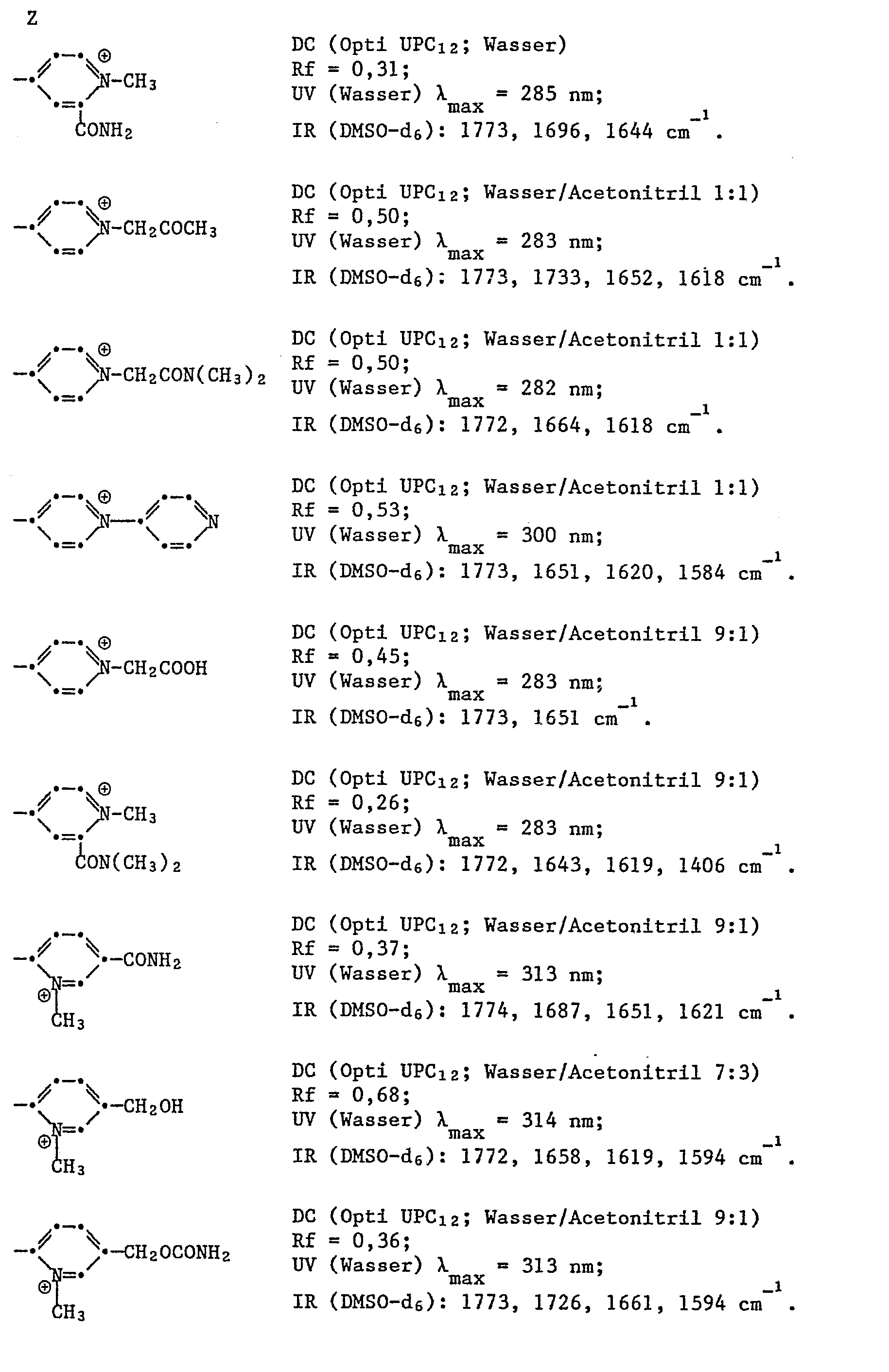
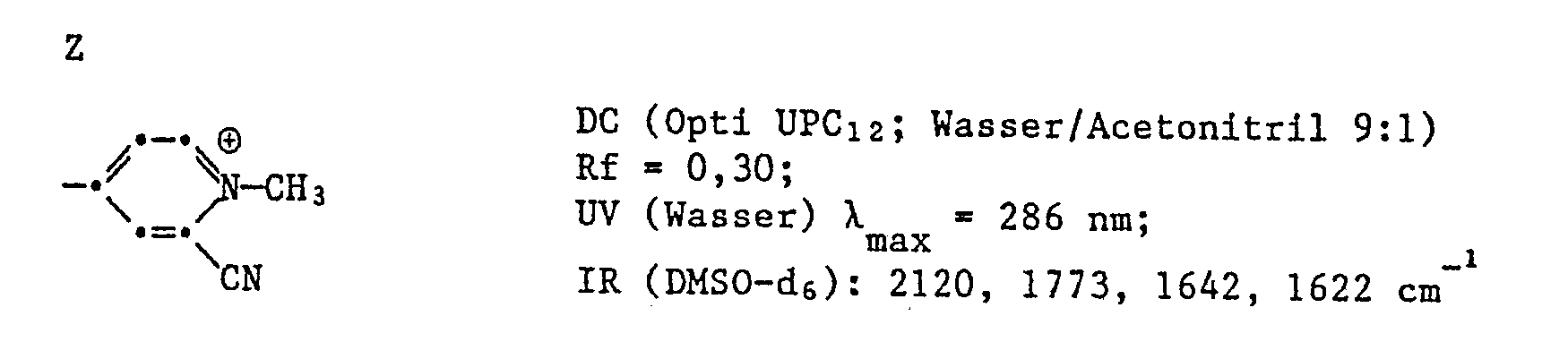
-
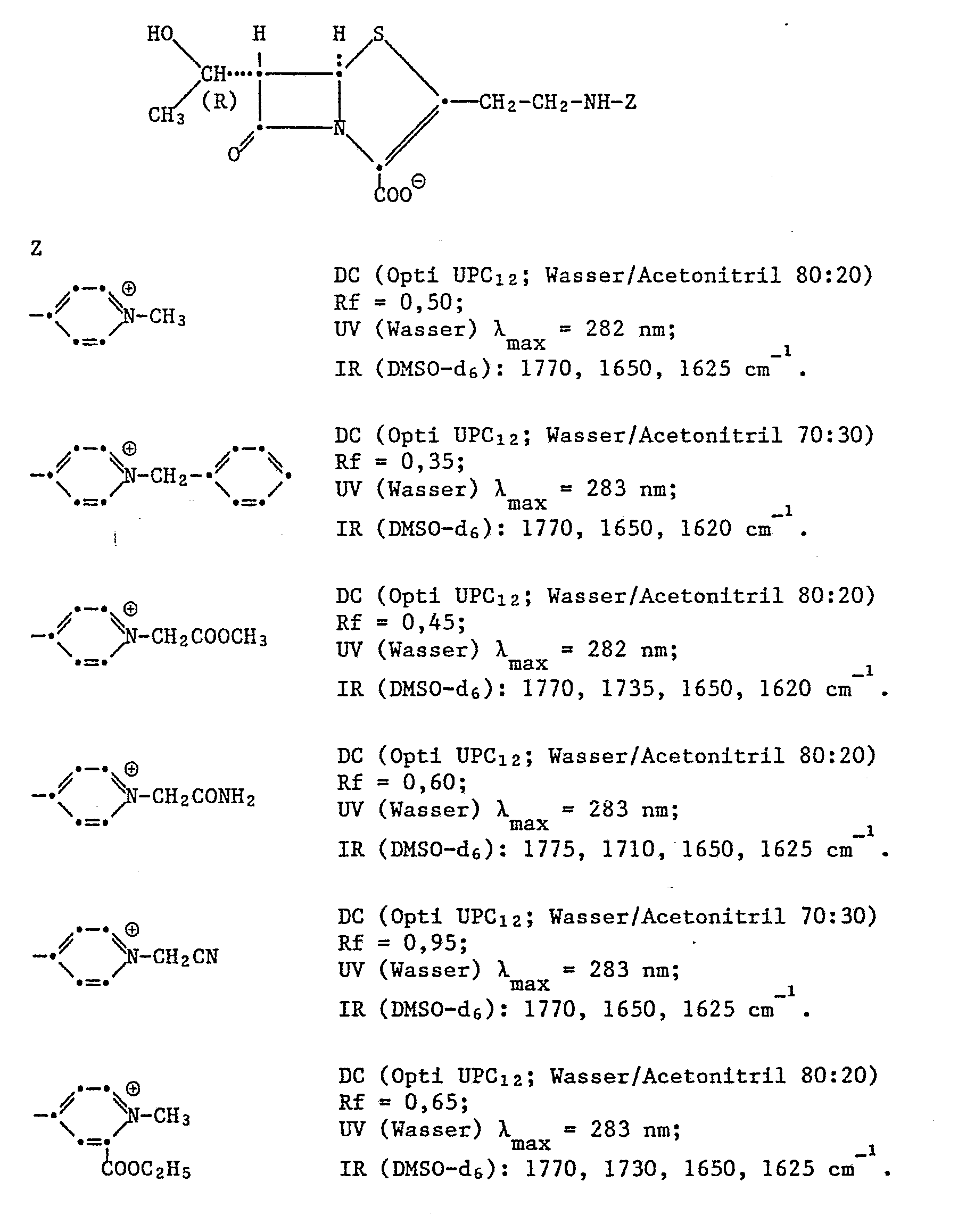

- Zusammensetzung (für 1 Ampulle oder Vial):
Wirksubstanz 0,5 g
Mannit 0,5 g
Eine sterile wässerige Lösung der Wirksubstanz und des Mannits wird unter aseptischen Bedingungen in 5 ml-Ampullen oder 5 ml-Vials der Gefriertrocknung unterworfen und die Ampullen bzw. Vials verschlossen und geprüft. - Anstelle des obengenannten Wirkstoffs kann auch dieselbe Menge eines anderen Wirkstoffs der vorgangehenden Beispiele verwendet werden.
Claims (26)
1. Verbindungen der Formel

worin R₁ für Hydroxymethyl oder 1-Hydroxyäthyl steht, Z für einen Rest

steht, worin R₂ gegebenenfalls substituiertes Niederalkyl, Niederalkenyl, gegebenenfalls substituiertes Phenyl, Pyridyl oder veräthertes Hydroxy bedeutet, R₃ und R₄ unabhängig voneinander für Wasserstoff, gegebenenfalls substituiertes Niederalkyl, gegebenenfalls funktionell abgewandeltes Carboxyl, veräthertes Hydroxy, verestertes Hydroxy oder gegebenenfalls substituiertes Amino stehen und m eine ganze Zahl von 1 bis 4 ist, und Salze von Verbindungen der Formel I.
2. Verbindungen der Formel

worin R₁ für Hydroxymethyl oder 1-Hydroxyäthyl steht, Z für den Rest

steht, worin R₂ gegebenenfalls substituiertes Niederalkyl, Niederalkenyl, gegebenenfalls substituiertes Phenyl oder veräthertes Hydroxy bedeutet, R₃ und R₄ unabhängig voneinander für Wasserstoff, gegebenenfalls substituiertes Niederalkyl, gegebenenfalls funktionell abgewandeltes Carboxyl, veräthertes Hydroxy, Halogen oder gegebenenfalls substituiertes Amino stehen und m eine ganze Zahl von 1 bis 4 ist, und Salze von Verbindungen der Formel I.
3. Verbindungen der Formel I gemäss Anspruch 1, worin R₁ Hydroxymethyl oder (1R)-1-Hydroxyäthyl ist, Z für einen Rest

steht, worin R₂ Niederalkyl, durch Hydroxy, Halogen, Niederalkanoyloxy, Carbamoyloxy, Niederalkoxy, Carboxyl, Niederalkoxycarbonyl, Carbamoyl, N-Niederalkyl- oder N,N-Diniederalkylcarbamoyl, Cyano, Amino, Azido, Phenyl, durch Niederalkyl, Niederalkoxy, Halogen, Cyano und/oder Carboxy substituiertes Phenyl oder Oxo substituiertes Niederalkyl; Niederalkenyl, Phenyl, durch Niederalkyl, Niederalkoxy, Halogen, Cyano und/oder Carboxy substituiertes Phenyl, Pyridyl oder Niederalkoxy bedeutet, R₃ und R₄ unabhängig voneinander für Wasserstoff, Niederalkyl, durch Hydroxy, Halogen, Niederalkanoyloxy, Carbamoyloxy, Niederalkoxy, Carboxy, Niederalkoxycarbonyl, Carbamoyl, N-Niederalkyl- oder N,N-Diniederalkylcarbamoyl, Cyano, Amino, Azido, Phenyl, durch Niederalkyl, Niederalkoxy, Halogen, Cyano und/oder Carboxy substituiertes Phenyl oder Oxo substituiertes Niederalkyl; Carboxyl, Niederalkoxycarbonyl, Carbamoyl, N-Niederalkyl- oder N,N-Diniederalkylcarbamoyl, Cyano, Niederalkoxy, Halogen, Niederalkanoyloxy, Carbamoyloxy, Amino, Niederalkylamino, Diniederalkylamino, Niederalkylenamino oder Niederalkanoylamino stehen, m eine ganze Zahl von 1 bis 4 ist, und Salze von Verbindungen der Formel I.
4. Verbindungen der Formel I gemäss Anspruch 2, worin R₁ Hydroxymethyl oder (1R)-1-Hydroxyäthyl ist, R₂ Niederalkyl, durch Halogen, Niederalkoxy, Carboxyl, Niederalkoxycarbonyl, Carbamoyl, Cyano, Phenyl, durch Niederalkyl, Niederalkoxy, Halogen, Cyano und/oder Carboxy substituiertes Phenyl oder Oxo substituiertes Niederalkyl; Niederalkenyl, Phenyl, durch Niederalkyl, Niederalkoxy, Halogen, Cyano und/oder Carboxy substituiertes Phenyl, oder Niederalkoxy bedeutet, R₃ und R₄ unabhängig voneinander für Wasserstoff, Niederalkyl, durch Halogen, Niederalkoxy, Carboxy, Niederalkoxycarbonyl, Carbamoyl, Cyano, Phenyl, durch Niederalkyl, Niederalkoxy, Halogen, Cyano und/oder Carboxy substituiertes Phenyl oder Oxo substituiertes Niederalkyl; Carboxyl, Niederalkoxycarbonyl, Carbamoyl, Cyano, Niederalkoxy, Halogen, Amino, Niederalkylamino, Diniederalkylamino, Niederalkylenamino oder Niederalkanoylamino stehen, m eine ganze Zahl von 1 bis 4 ist, und Salze von Verbindungen der Formel I.
5. Verbindungen der Formel I gemäss Anspruch 1, worin R₁ (1R)-1-Hydroxyäthyl ist, Z für einen Rest

steht, worin R₂ Niederalkyl, Acetonyl oder durch Carboxy, Niederalkoxycarbonyl, Carbamoyl, N,N-Diniederalkylcarbamoyl oder Phenyl substituiertes Niederalkyl bedeutet, R₃ Wasserstoff bedeutet, R₄ für Wasserstoff, durch Hydroxy, Carboxy, Cyano oder Amino substituiertes Niederalkyl; carboxy, Carbamoyl oder Cyano steht, und m 1 oder 2 ist, und Salze von Verbindungen der Formel I.
6. Verbindungen der Formel I gemäss Anspruch 2, worin R₁ Hydroxymethyl oder (1R)-1-Hydroxyäthyl ist, R₂ Niederalkyl oder durch Carboxy, Niederalkoxycarbonyl, Carbamoyl, Cyano oder Phenyl substituiertes Niederalkyl bedeutet, R₃ Wasserstoff bedeutet, R₄ für Wasserstoff, durch Carboxy, Niederalkoxycarbonyl oder Cyano substituiertes Niederalkyl; Carboxy, Niederalkoxycarbonyl oder Cyano steht, und m 1 oder 2 ist, und Salze von Verbindungen der Formel I.
7. Verbindungen der Formel I gemäss Anspruch 1, worin R₁ (1R)-1-Hydroxyäthyl ist, Z für einen Rest

steht, worin R₂ Niederalkyl oder durch Carbamoyl substituiertes Niederalkyl ist, R₃ Wasserstoff ist und R₄ Wasserstoff oder durch Hydroxy substituiertes Niederalkyl bedeutet und m 1 ist, und Salze von Verbindungen der Formel I.
8. Verbindungen der Formel I gemäss Anspruch 2, worin R₁ (1R)-1-Hydroxyäthyl ist, R₂ Niederalkyl oder Phenylniederalkyl ist, R₃ und R₄ Wasserstoff bedeuten und m 1 ist, und Salze von Verbindungen der Formel I.
9. Pharmazeutisch annehmbare Salze von Verbindungen der Formel I gemäss einem der Ansprüche 1 oder 2.
10. (5R,6S)-6-[(1R)-1-Hydroxyäthyl]-2-[(1-methyl-4-pyridinio)-aminomethyl]-2-penem-3-carboxylat gemäss Anspruch 2.
11. (5R,6S)-2-[(1-Benzyl-4-pyridinio)-aminomethyl]-6-[(1R)-1-hydroxyäthyl]-2-penem-3-carboxylat gemäss Anspruch 2.
12. (5R,6S)-2-[(1-Aminocarbonylmethyl-4-pyridinio)-aminomethyl]-6-[(1R)-1-hydroxyäthyl]-2-penem-3-carboxylat gemäss Anspruch 2.
13. (5R,6S)-6-[(1R)-1-Hydroxyäthyl]-2-[(2-hydroxymethyl-1-methyl-4-pyridinio)-aminomethyl]-2-penem-3-carboxylat gemäss Anspruch 1.
14. (5R,6S)-6-[(1R)-1-Hydroxyäthyl]-2-[(2-carboxy-1-methyl-4-pyridinio)-aminomethyl]-2-penem-3-carboxylat und pharmazeutisch annehmbare Salze davon gemäss Anspruch 1.
15. (5R,6S)-6-[(1R)-1-Hydroxyäthyl]-2-[(2-aminomethyl-1-methyl-4-pyridinio)-aminomethyl]-2-penem-3-carboxylat und pharmazeutisch annehmbare Salze davon gemäss Anspruch 1.
16. (5R,6S)-6-[(1R)-1-Hydroxyäthyl]-2-[(1-acetonyl-4-pyridinio)-aminomethyl]-2-penem-3-carboxylat gemäss Anspruch 1.
17. Pharmazeutisches Präparat enthaltend eine Verbindung der Formel I gemäss Anspruch 1 oder ein pharmazeutisch annehmbares Salz davon.
18. Pharmazeutisches Präparat enthaltend eine Verbindung der Formel I gemäss Anspruch 2 oder ein pharmazeutisch annehmbares Salz davon.
19. Verwendung von Verbindungen der Formel I gemäss Anspruch 1 oder daren pharmazeutisch annehmbarer Salze sur Herstellung von pharmazeutischen Präparaten.
20. Verwendung von Verbindungen der Formel I gemäss Anspruch 2 oder deren pharmazeutisch annehmbarer Salze sur Herstellung von pharmazeutischen Präparaten.
21. Eine Verbindung der Formel I gemäss Anspruch 1 oder ein pharmazeutisch annehmbares Salz einer solchen Verbindungen zur Anwendung in einem Verfahren zur therapeutischen Behandlung des menschlichen oder tierischen Körpers.
22. Eine Verbindung der Formel I gemäss Anspruch 2 oder ein pharmazeutisch annehmbares Salz einer solchen Verbindung zur Anwendung in einem Verfahren zur therapeutischen Behandlung des menschlichen oder tierischen Körpers.
23. Verfahren zur Herstellung von Verbindungen der Formel I gemäss Anspruch 1, dadurch gekennzeichnet, dass man eine Penem-Verbindung der Formel

worin R₁ und m die unter Formel I angegebenen Bedeutungen haben, mit einer Pyridinium-Verbindung der Formel

worin R₂, R₃ und R₄ die unter Formel I angegebenen Bedeutungen haben, wobei funktionelle Gruppen in diesen Resten gegebenenfalls in geschützter Form vorliegen, X eine Abgangsgruppe ist und Y⊖ für ein Anion steht, umsetzt und, falls erforderlich, geschützte funktionelle Gruppen in den Resten R₂, R₃ und/oder R₄ in die freien funktionellen Gruppen überführt, und, wenn erwünscht, eine erhältliche freie Verbindung der Formel I in ein Salz überführt.
24. Verfahren zur Herstellung von Verbindungen der Formel I gemäss Anspruch 2, dadurch gekennzeichnet, dass man eine Penem-Verbindung der Formel

worin R₁ und m die unter Formel I angegebenen Bedeutungen haben, mit einer Pyridinium-Verbindung der Formel

worin R₂, R₃ und R₄ die unter Formel I angegebenen Bedeutungen haben, wobei funktionelle Gruppen in diesen Resten gegebenenfalls in geschützter Form vorliegen, X eine Abgangsgruppe ist und Y⊖ für ein Anion steht, umsetzt und, falls erforderlich, geschützte funktionelle Gruppen in den Resten R₂, R₃ und/oder R₄ in die freien funktionellen Gruppen überführt, und, wenn erwünscht, eine erhältliche freie Verbindung der Formel I in ein Salz überführt.
25. Die nach dem Verfahren gemäss Anspruch 23 erhältlichen Verbindungen.
26. Die nach dem Verfahren gemäss Anspruch 24 erhältlichen Verbindungen.
Applications Claiming Priority (2)
| Application Number | Priority Date | Filing Date | Title |
|---|---|---|---|
| CH334686 | 1986-08-20 | ||
| CH3346/86 | 1986-08-20 |
Publications (1)
| Publication Number | Publication Date |
|---|---|
| EP0256990A1 true EP0256990A1 (de) | 1988-02-24 |
Family
ID=4253985
Family Applications (1)
| Application Number | Title | Priority Date | Filing Date |
|---|---|---|---|
| EP87810462A Withdrawn EP0256990A1 (de) | 1986-08-20 | 1987-08-14 | Pyridinio-Verbindungen |
Country Status (11)
| Country | Link |
|---|---|
| EP (1) | EP0256990A1 (de) |
| JP (1) | JPS6351387A (de) |
| KR (1) | KR880002878A (de) |
| AU (1) | AU7721787A (de) |
| DK (1) | DK432187A (de) |
| FI (1) | FI873556A7 (de) |
| IL (1) | IL83578A0 (de) |
| NO (1) | NO873500L (de) |
| NZ (1) | NZ221491A (de) |
| PT (1) | PT85549B (de) |
| ZA (1) | ZA876135B (de) |
Cited By (1)
| Publication number | Priority date | Publication date | Assignee | Title |
|---|---|---|---|---|
| US5744608A (en) * | 1995-09-08 | 1998-04-28 | Nippon Soda Co., Ltd. | Method for manufacturing 3-(aminomethyl)-6-chloropyridines |
Citations (3)
| Publication number | Priority date | Publication date | Assignee | Title |
|---|---|---|---|---|
| GB2042515A (en) * | 1978-12-18 | 1980-09-24 | Bristol Myers Co | Antibacterial agents |
| GB2118181A (en) * | 1982-04-08 | 1983-10-26 | Erba Farmitalia | Substituted penem derivatives and new process for their preparation |
| EP0109362A1 (de) * | 1982-11-16 | 1984-05-23 | Ciba-Geigy Ag | Heterocyclylverbindungen, Verfahren zu ihrer Herstellung, pharmazeutische Präparate, welche diese Verbindungen enthalten, und Verwendung von letzteren |
-
1987
- 1987-08-14 EP EP87810462A patent/EP0256990A1/de not_active Withdrawn
- 1987-08-17 FI FI873556A patent/FI873556A7/fi not_active Application Discontinuation
- 1987-08-18 IL IL83578A patent/IL83578A0/xx unknown
- 1987-08-18 NZ NZ221491A patent/NZ221491A/xx unknown
- 1987-08-18 PT PT85549A patent/PT85549B/pt unknown
- 1987-08-19 JP JP62204285A patent/JPS6351387A/ja active Pending
- 1987-08-19 NO NO873500A patent/NO873500L/no unknown
- 1987-08-19 ZA ZA876135A patent/ZA876135B/xx unknown
- 1987-08-19 DK DK432187A patent/DK432187A/da not_active Application Discontinuation
- 1987-08-19 AU AU77217/87A patent/AU7721787A/en not_active Abandoned
- 1987-08-19 KR KR870009045A patent/KR880002878A/ko not_active Withdrawn
Patent Citations (3)
| Publication number | Priority date | Publication date | Assignee | Title |
|---|---|---|---|---|
| GB2042515A (en) * | 1978-12-18 | 1980-09-24 | Bristol Myers Co | Antibacterial agents |
| GB2118181A (en) * | 1982-04-08 | 1983-10-26 | Erba Farmitalia | Substituted penem derivatives and new process for their preparation |
| EP0109362A1 (de) * | 1982-11-16 | 1984-05-23 | Ciba-Geigy Ag | Heterocyclylverbindungen, Verfahren zu ihrer Herstellung, pharmazeutische Präparate, welche diese Verbindungen enthalten, und Verwendung von letzteren |
Cited By (1)
| Publication number | Priority date | Publication date | Assignee | Title |
|---|---|---|---|---|
| US5744608A (en) * | 1995-09-08 | 1998-04-28 | Nippon Soda Co., Ltd. | Method for manufacturing 3-(aminomethyl)-6-chloropyridines |
Also Published As
| Publication number | Publication date |
|---|---|
| FI873556A0 (fi) | 1987-08-17 |
| DK432187A (da) | 1988-02-21 |
| NO873500D0 (no) | 1987-08-19 |
| DK432187D0 (da) | 1987-08-19 |
| NO873500L (no) | 1988-02-22 |
| IL83578A0 (en) | 1988-01-31 |
| PT85549B (en) | 1989-11-06 |
| AU7721787A (en) | 1988-02-25 |
| KR880002878A (ko) | 1988-05-12 |
| JPS6351387A (ja) | 1988-03-04 |
| FI873556A7 (fi) | 1988-02-21 |
| ZA876135B (en) | 1988-02-22 |
| PT85549A (en) | 1987-09-01 |
| NZ221491A (en) | 1989-02-24 |
Similar Documents
| Publication | Publication Date | Title |
|---|---|---|
| DE68917163T2 (de) | Antibakterielle Mittel. | |
| DE3780344T2 (de) | Beta-lactam-verbindungen und deren herstellung. | |
| DE3587126T2 (de) | Carbapenem-Derivate und sie enthaltende Zusammensetzung. | |
| DE68917023T2 (de) | 3-Pyrrolidinylthio-1-azabicyclo[3.2.0]-hept-2-en-2-carbonsäureverbindungen. | |
| DE3785163T2 (de) | 3-pyrrolidinylthio-1-azabicyclo(3.2.0)hept-2-en-2-carbonsaeurederivate und verfahren zu deren herstellung. | |
| DE69612374T2 (de) | Derivate des carbapenem-3-carbonsäureesters | |
| EP0335297B1 (de) | Cephalosporinderivate | |
| DE69716455T2 (de) | Azabicycliache carbamoyloxy mutilin derivate als antibakterielles mittel | |
| JPS60233077A (ja) | 1‐テヘロ‐6‐〔1‐ヒドロキシエチル〕‐2‐sr↑8‐1‐カルバデチアペン‐2‐エム‐3‐カルボン酸 | |
| DE3312533A1 (de) | Carbapenem-derivate, verfahren zu ihrer herstellung und pharmazeutische mittel, die diese verbindungen enthalten | |
| DE68916908T2 (de) | Carbapenemderivate. | |
| EP0246187B1 (de) | 2-Pyridyl-penem-Verbindungen | |
| EP0278911B1 (de) | Bicyclische beta-Lactam-carbonsäuren | |
| US5693634A (en) | Urea derivatives for use in treating bacterial infections | |
| DE69625910T2 (de) | Penamsulfone als beta-laktamase inhibitoren | |
| US4880922A (en) | Carbapenems with quaternized heterothioalkylthio substitution at position 2 | |
| EP0256990A1 (de) | Pyridinio-Verbindungen | |
| DE3630857C2 (de) | Carbapenem-Antibiotika, Verfahren zu deren Herstellung und diese Verbindungen enthaltende pharmazeutische Mittel | |
| DD222314A5 (de) | Verfahren zur herstellung von aminomethyl-verbindungen | |
| EP0199675A1 (de) | Heterocyclyl-penem-Verbindungen | |
| DD242408A5 (de) | Verfahren zur herstellung von kristalliner (5r,6s)-2-aminomethyl-6-/(1r)-1-hydroxyaethyl/-2-penem-3-carbonsaeure | |
| DE69130363T2 (de) | Antibakterielle penemverbindungen | |
| JP2832742B2 (ja) | カルバペネム誘導体 | |
| JPS6187682A (ja) | カルバペネム抗生物質 | |
| AT387223B (de) | Verfahren zur herstellung von neuen carbapenem-derivaten |
Legal Events
| Date | Code | Title | Description |
|---|---|---|---|
| PUAI | Public reference made under article 153(3) epc to a published international application that has entered the european phase |
Free format text: ORIGINAL CODE: 0009012 |
|
| 17P | Request for examination filed |
Effective date: 19870817 |
|
| AK | Designated contracting states |
Kind code of ref document: A1 Designated state(s): AT BE CH DE ES FR GB GR IT LI LU NL SE |
|
| STAA | Information on the status of an ep patent application or granted ep patent |
Free format text: STATUS: THE APPLICATION IS DEEMED TO BE WITHDRAWN |
|
| 18D | Application deemed to be withdrawn |
Effective date: 19880825 |
|
| RIN1 | Information on inventor provided before grant (corrected) |
Inventor name: SCHNEIDER, PETER, DR. |