EP0247507B1 - Zusammensetzung für transdermale therapeutische Systeme von Schleifendiuretika und Verfahren zu ihrer Herstellung - Google Patents
Zusammensetzung für transdermale therapeutische Systeme von Schleifendiuretika und Verfahren zu ihrer Herstellung Download PDFInfo
- Publication number
- EP0247507B1 EP0247507B1 EP87107310A EP87107310A EP0247507B1 EP 0247507 B1 EP0247507 B1 EP 0247507B1 EP 87107310 A EP87107310 A EP 87107310A EP 87107310 A EP87107310 A EP 87107310A EP 0247507 B1 EP0247507 B1 EP 0247507B1
- Authority
- EP
- European Patent Office
- Prior art keywords
- composition
- fatty acid
- carbon atoms
- alkanolamide
- mixture
- Prior art date
- Legal status (The legal status is an assumption and is not a legal conclusion. Google has not performed a legal analysis and makes no representation as to the accuracy of the status listed.)
- Expired - Lifetime
Links
- 239000000203 mixture Substances 0.000 title claims abstract description 60
- 230000001225 therapeutic effect Effects 0.000 title claims abstract description 10
- 238000000034 method Methods 0.000 title claims description 3
- 229940097243 high-ceiling diuretic Drugs 0.000 title 1
- 239000000031 sodium potassium chloride symporter inhibitor Substances 0.000 title 1
- 150000004665 fatty acids Chemical class 0.000 claims abstract description 36
- 235000014113 dietary fatty acids Nutrition 0.000 claims abstract description 31
- 239000000194 fatty acid Substances 0.000 claims abstract description 31
- 229930195729 fatty acid Natural products 0.000 claims abstract description 31
- 125000004432 carbon atom Chemical group C* 0.000 claims abstract description 23
- 150000001733 carboxylic acid esters Chemical class 0.000 claims abstract description 23
- ZZUFCTLCJUWOSV-UHFFFAOYSA-N furosemide Chemical compound C1=C(Cl)C(S(=O)(=O)N)=CC(C(O)=O)=C1NCC1=CC=CO1 ZZUFCTLCJUWOSV-UHFFFAOYSA-N 0.000 claims abstract description 13
- 229960003883 furosemide Drugs 0.000 claims abstract description 12
- 239000002171 loop diuretic Substances 0.000 claims abstract description 11
- 150000003839 salts Chemical class 0.000 claims abstract description 8
- 125000002887 hydroxy group Chemical group [H]O* 0.000 claims abstract description 7
- SENZQDBEHBQBNR-UHFFFAOYSA-N 2-(aminomethyl)-4-tert-butyl-6-methylsulfonylphenol Chemical compound CC(C)(C)C1=CC(CN)=C(O)C(S(C)(=O)=O)=C1 SENZQDBEHBQBNR-UHFFFAOYSA-N 0.000 claims abstract description 5
- 125000003158 alcohol group Chemical group 0.000 claims abstract description 5
- 229950005256 lemidosul Drugs 0.000 claims abstract description 5
- UJEWTUDSLQGTOA-UHFFFAOYSA-N Piretanide Chemical compound C=1C=CC=CC=1OC=1C(S(=O)(=O)N)=CC(C(O)=O)=CC=1N1CCCC1 UJEWTUDSLQGTOA-UHFFFAOYSA-N 0.000 claims description 15
- 229960001085 piretanide Drugs 0.000 claims description 14
- -1 fatty acid ester Chemical class 0.000 claims description 6
- 238000002360 preparation method Methods 0.000 claims description 6
- 150000002148 esters Chemical class 0.000 claims description 5
- CMBYOWLFQAFZCP-UHFFFAOYSA-N Hexyl dodecanoate Chemical compound CCCCCCCCCCCC(=O)OCCCCCC CMBYOWLFQAFZCP-UHFFFAOYSA-N 0.000 claims description 4
- AOMUHOFOVNGZAN-UHFFFAOYSA-N N,N-bis(2-hydroxyethyl)dodecanamide Chemical compound CCCCCCCCCCCC(=O)N(CCO)CCO AOMUHOFOVNGZAN-UHFFFAOYSA-N 0.000 claims description 4
- 150000001732 carboxylic acid derivatives Chemical group 0.000 claims description 4
- RGXWDWUGBIJHDO-UHFFFAOYSA-N ethyl decanoate Chemical compound CCCCCCCCCC(=O)OCC RGXWDWUGBIJHDO-UHFFFAOYSA-N 0.000 claims description 4
- 229940031957 lauric acid diethanolamide Drugs 0.000 claims description 4
- 150000001875 compounds Chemical class 0.000 claims description 3
- 239000002253 acid Substances 0.000 claims description 2
- 229940100463 hexyl laurate Drugs 0.000 claims description 2
- BPXGKRUSMCVZAF-UHFFFAOYSA-N n,n-bis(2-hydroxyethyl)decanamide Chemical compound CCCCCCCCCC(=O)N(CCO)CCO BPXGKRUSMCVZAF-UHFFFAOYSA-N 0.000 claims description 2
- 239000013543 active substance Substances 0.000 abstract description 4
- 150000001735 carboxylic acids Chemical group 0.000 abstract description 2
- 239000004480 active ingredient Substances 0.000 description 15
- 230000036765 blood level Effects 0.000 description 6
- 239000011505 plaster Substances 0.000 description 5
- 230000000054 salidiuretic effect Effects 0.000 description 5
- 239000007787 solid Substances 0.000 description 5
- 150000001298 alcohols Chemical class 0.000 description 3
- 231100000673 dose–response relationship Toxicity 0.000 description 3
- 239000007788 liquid Substances 0.000 description 3
- 230000001452 natriuretic effect Effects 0.000 description 3
- 230000035515 penetration Effects 0.000 description 3
- NUPSHWCALHZGOV-UHFFFAOYSA-N Decyl acetate Chemical compound CCCCCCCCCCOC(C)=O NUPSHWCALHZGOV-UHFFFAOYSA-N 0.000 description 2
- 206010020772 Hypertension Diseases 0.000 description 2
- 229920002472 Starch Polymers 0.000 description 2
- 230000000875 corresponding effect Effects 0.000 description 2
- 230000003111 delayed effect Effects 0.000 description 2
- 239000003814 drug Substances 0.000 description 2
- 230000000694 effects Effects 0.000 description 2
- 239000000945 filler Substances 0.000 description 2
- 230000012495 positive regulation of renal sodium excretion Effects 0.000 description 2
- 229920006395 saturated elastomer Polymers 0.000 description 2
- DLFCAVBMDSKMEY-UHFFFAOYSA-M sodium;4-chloro-2-(furan-2-ylmethylamino)-5-sulfamoylbenzoate Chemical class [Na+].C1=C(Cl)C(S(=O)(=O)N)=CC(C([O-])=O)=C1NCC1=CC=CO1 DLFCAVBMDSKMEY-UHFFFAOYSA-M 0.000 description 2
- 239000008107 starch Substances 0.000 description 2
- 235000019698 starch Nutrition 0.000 description 2
- 230000002123 temporal effect Effects 0.000 description 2
- VOXZDWNPVJITMN-ZBRFXRBCSA-N 17β-estradiol Chemical compound OC1=CC=C2[C@H]3CC[C@](C)([C@H](CC4)O)[C@@H]4[C@@H]3CCC2=C1 VOXZDWNPVJITMN-ZBRFXRBCSA-N 0.000 description 1
- NYZKGZBCPGVYGQ-UHFFFAOYSA-N 2-(aminomethyl)-4-tert-butyl-6-methylsulfonylphenol;hydrochloride Chemical compound Cl.CC(C)(C)C1=CC(CN)=C(O)C(S(C)(=O)=O)=C1 NYZKGZBCPGVYGQ-UHFFFAOYSA-N 0.000 description 1
- WJZIPMQUKSTHLV-UHFFFAOYSA-N 2-ethyldecanoic acid Chemical compound CCCCCCCCC(CC)C(O)=O WJZIPMQUKSTHLV-UHFFFAOYSA-N 0.000 description 1
- 229930000680 A04AD01 - Scopolamine Natural products 0.000 description 1
- GJSURZIOUXUGAL-UHFFFAOYSA-N Clonidine Chemical compound ClC1=CC=CC(Cl)=C1NC1=NCCN1 GJSURZIOUXUGAL-UHFFFAOYSA-N 0.000 description 1
- STECJAGHUSJQJN-GAUPFVANSA-N Hyoscine Natural products C1([C@H](CO)C(=O)OC2C[C@@H]3N([C@H](C2)[C@@H]2[C@H]3O2)C)=CC=CC=C1 STECJAGHUSJQJN-GAUPFVANSA-N 0.000 description 1
- STECJAGHUSJQJN-UHFFFAOYSA-N N-Methyl-scopolamin Natural products C1C(C2C3O2)N(C)C3CC1OC(=O)C(CO)C1=CC=CC=C1 STECJAGHUSJQJN-UHFFFAOYSA-N 0.000 description 1
- SNIOPGDIGTZGOP-UHFFFAOYSA-N Nitroglycerin Chemical compound [O-][N+](=O)OCC(O[N+]([O-])=O)CO[N+]([O-])=O SNIOPGDIGTZGOP-UHFFFAOYSA-N 0.000 description 1
- 239000000006 Nitroglycerin Substances 0.000 description 1
- 208000004880 Polyuria Diseases 0.000 description 1
- VYPSYNLAJGMNEJ-UHFFFAOYSA-N Silicium dioxide Chemical compound O=[Si]=O VYPSYNLAJGMNEJ-UHFFFAOYSA-N 0.000 description 1
- 230000002745 absorbent Effects 0.000 description 1
- 239000002250 absorbent Substances 0.000 description 1
- 238000010521 absorption reaction Methods 0.000 description 1
- 229960002896 clonidine Drugs 0.000 description 1
- 239000008119 colloidal silica Substances 0.000 description 1
- 230000002596 correlated effect Effects 0.000 description 1
- 239000003405 delayed action preparation Substances 0.000 description 1
- 230000035619 diuresis Effects 0.000 description 1
- 239000002934 diuretic Substances 0.000 description 1
- 229940030606 diuretics Drugs 0.000 description 1
- 239000002552 dosage form Substances 0.000 description 1
- 238000012377 drug delivery Methods 0.000 description 1
- 229960005309 estradiol Drugs 0.000 description 1
- 229930182833 estradiol Natural products 0.000 description 1
- 230000029142 excretion Effects 0.000 description 1
- 238000009472 formulation Methods 0.000 description 1
- 230000002496 gastric effect Effects 0.000 description 1
- 229960003711 glyceryl trinitrate Drugs 0.000 description 1
- 230000005923 long-lasting effect Effects 0.000 description 1
- 238000004519 manufacturing process Methods 0.000 description 1
- 235000011837 pasties Nutrition 0.000 description 1
- 150000003138 primary alcohols Chemical class 0.000 description 1
- 230000002035 prolonged effect Effects 0.000 description 1
- STECJAGHUSJQJN-FWXGHANASA-N scopolamine Chemical compound C1([C@@H](CO)C(=O)O[C@H]2C[C@@H]3N([C@H](C2)[C@@H]2[C@H]3O2)C)=CC=CC=C1 STECJAGHUSJQJN-FWXGHANASA-N 0.000 description 1
- 229960002646 scopolamine Drugs 0.000 description 1
- 150000003333 secondary alcohols Chemical class 0.000 description 1
- 239000000126 substance Substances 0.000 description 1
- 239000000725 suspension Substances 0.000 description 1
- 150000003509 tertiary alcohols Chemical class 0.000 description 1
- 239000004753 textile Substances 0.000 description 1
- 210000002700 urine Anatomy 0.000 description 1
- XLYOFNOQVPJJNP-UHFFFAOYSA-N water Substances O XLYOFNOQVPJJNP-UHFFFAOYSA-N 0.000 description 1
Classifications
-
- A—HUMAN NECESSITIES
- A61—MEDICAL OR VETERINARY SCIENCE; HYGIENE
- A61K—PREPARATIONS FOR MEDICAL, DENTAL OR TOILETRY PURPOSES
- A61K47/00—Medicinal preparations characterised by the non-active ingredients used, e.g. carriers or inert additives; Targeting or modifying agents chemically bound to the active ingredient
-
- A—HUMAN NECESSITIES
- A61—MEDICAL OR VETERINARY SCIENCE; HYGIENE
- A61K—PREPARATIONS FOR MEDICAL, DENTAL OR TOILETRY PURPOSES
- A61K31/00—Medicinal preparations containing organic active ingredients
- A61K31/33—Heterocyclic compounds
- A61K31/395—Heterocyclic compounds having nitrogen as a ring hetero atom, e.g. guanethidine or rifamycins
- A61K31/40—Heterocyclic compounds having nitrogen as a ring hetero atom, e.g. guanethidine or rifamycins having five-membered rings with one nitrogen as the only ring hetero atom, e.g. sulpiride, succinimide, tolmetin, buflomedil
-
- A—HUMAN NECESSITIES
- A61—MEDICAL OR VETERINARY SCIENCE; HYGIENE
- A61K—PREPARATIONS FOR MEDICAL, DENTAL OR TOILETRY PURPOSES
- A61K31/00—Medicinal preparations containing organic active ingredients
- A61K31/63—Compounds containing para-N-benzenesulfonyl-N-groups, e.g. sulfanilamide, p-nitrobenzenesulfonyl hydrazide
- A61K31/635—Compounds containing para-N-benzenesulfonyl-N-groups, e.g. sulfanilamide, p-nitrobenzenesulfonyl hydrazide having a heterocyclic ring, e.g. sulfadiazine
-
- A—HUMAN NECESSITIES
- A61—MEDICAL OR VETERINARY SCIENCE; HYGIENE
- A61K—PREPARATIONS FOR MEDICAL, DENTAL OR TOILETRY PURPOSES
- A61K47/00—Medicinal preparations characterised by the non-active ingredients used, e.g. carriers or inert additives; Targeting or modifying agents chemically bound to the active ingredient
- A61K47/06—Organic compounds, e.g. natural or synthetic hydrocarbons, polyolefins, mineral oil, petrolatum or ozokerite
- A61K47/08—Organic compounds, e.g. natural or synthetic hydrocarbons, polyolefins, mineral oil, petrolatum or ozokerite containing oxygen, e.g. ethers, acetals, ketones, quinones, aldehydes, peroxides
- A61K47/14—Esters of carboxylic acids, e.g. fatty acid monoglycerides, medium-chain triglycerides, parabens or PEG fatty acid esters
-
- A—HUMAN NECESSITIES
- A61—MEDICAL OR VETERINARY SCIENCE; HYGIENE
- A61K—PREPARATIONS FOR MEDICAL, DENTAL OR TOILETRY PURPOSES
- A61K47/00—Medicinal preparations characterised by the non-active ingredients used, e.g. carriers or inert additives; Targeting or modifying agents chemically bound to the active ingredient
- A61K47/06—Organic compounds, e.g. natural or synthetic hydrocarbons, polyolefins, mineral oil, petrolatum or ozokerite
- A61K47/16—Organic compounds, e.g. natural or synthetic hydrocarbons, polyolefins, mineral oil, petrolatum or ozokerite containing nitrogen, e.g. nitro-, nitroso-, azo-compounds, nitriles, cyanates
- A61K47/18—Amines; Amides; Ureas; Quaternary ammonium compounds; Amino acids; Oligopeptides having up to five amino acids
-
- A—HUMAN NECESSITIES
- A61—MEDICAL OR VETERINARY SCIENCE; HYGIENE
- A61K—PREPARATIONS FOR MEDICAL, DENTAL OR TOILETRY PURPOSES
- A61K9/00—Medicinal preparations characterised by special physical form
- A61K9/0012—Galenical forms characterised by the site of application
- A61K9/0014—Skin, i.e. galenical aspects of topical compositions
-
- A—HUMAN NECESSITIES
- A61—MEDICAL OR VETERINARY SCIENCE; HYGIENE
- A61K—PREPARATIONS FOR MEDICAL, DENTAL OR TOILETRY PURPOSES
- A61K9/00—Medicinal preparations characterised by special physical form
- A61K9/70—Web, sheet or filament bases ; Films; Fibres of the matrix type containing drug
- A61K9/7023—Transdermal patches and similar drug-containing composite devices, e.g. cataplasms
-
- A—HUMAN NECESSITIES
- A61—MEDICAL OR VETERINARY SCIENCE; HYGIENE
- A61P—SPECIFIC THERAPEUTIC ACTIVITY OF CHEMICAL COMPOUNDS OR MEDICINAL PREPARATIONS
- A61P7/00—Drugs for disorders of the blood or the extracellular fluid
- A61P7/10—Antioedematous agents; Diuretics
Definitions
- Retard preparations for oral administration from which the active ingredient is released over a longer period of time - for example up to 6 hours - have been used e.g. already described for the loop diuretics furosemide and piretanide (German Offenlegungsschriften 23 43 218 [corresponding to US Pat. No. 4,324,779] and 26 55 331). It has also been described that active ingredients incorporated into transdermal therapeutic systems (TTS) are released continuously and in a delayed manner for percutaneous absorption. Systems of various types with the active substances nitroglycerin, scopolamine, estradiol and clonidine are described in the literature; they have been in the pharmaceutical market for some time in many countries.
- Patent 4,010,273 and Lemidosul (proposed INN; 2-aminomethyl-4 (1.1-dimethylethyl) -6-methyl-sulfonylphenol hydrochloride; German Offenlegungsschrift 32 08 190 corresponds to U.S. Patent Application No. 472,226) through the living skin are not suitable.
- these systems are based on either hydrophilic or lipophilic substances.
- the invention therefore relates to a composition for a transdermal therapeutic system, which is characterized in that it contains furosemide, piretanide or lemidosul as an active ingredient or a physiologically acceptable salt of these loop diuretics in a base consisting of a fatty acid alkanolamide or a fatty acid alkanolamide mixture each having 8-18 carbon atoms in the fatty acid residue and 2 to 6 carbon atoms and 1 to 3 hydroxyl groups in the alkanolamide radical and optionally a carboxylic acid ester or a carboxylic acid ester mixture each having 1-22 carbon atoms in the carboxylic acid part and 1-22 carbon atoms in the alcohol part.
- a base consisting of a fatty acid alkanolamide or a fatty acid alkanolamide mixture each having 8-18 carbon atoms in the fatty acid residue and 2 to 6 carbon atoms and 1 to 3 hydroxyl groups in the alkanolamide radical and optionally a carboxylic acid ester or
- Both water-soluble and poorly water-soluble salts can be considered as physiologically acceptable salts.
- Suitable carboxylic acid esters are esters with 1-, 2- and 3-valent alcohols.
- the alcohols are primary, secondary and tertiary alcohols.
- the carboxylic acids or alcohols are saturated or unsaturated.
- Esters of aliphatic monocarboxylic acids and aliphatic alcohols are preferably used.
- the basis preferably consists of a fatty acid alkanolamide, such as. B. fatty acid diethanolamide or fatty acid monoisobutanediolamide, and a carboxylic acid ester; the acid residues of the two components are preferably the same.
- Capric acid diethanolamide, lauric acid diethanolamide and capric acid monoisobutanediol amide and capric acid ethyl ester, lauric acid hexyl ester are particularly suitable. If ester mixtures are used, mixtures of ethyl capric acid and decyl acetate are particularly suitable.
- compositions according to the invention can contain further inert fillers or customary auxiliaries such as water, paraffins, colloidal silica or surface-active substances.
- penetration systems are created with different types of delayed release of the active ingredient.
- the penetration of the active ingredient through the skin therefore depends both on this mixing ratio and on the nature of the skin and on the size of the contact area.
- compositions according to the invention preferably contain 1 to 50% by weight of active compound, based on the total weight of the composition.
- the mixing ratio of fatty acid alkanolamide to carboxylic acid ester in the base is e.g. 2 to 98 to 98: 2. The higher the fatty acid alkanolamide content, the greater the retardation.
- composition also contains one or more fillers or customary auxiliaries, their proportion is advantageously 1 to 90% by weight (based on the total weight of the composition).
- the invention further relates to a method for producing the compositions and their use in transdermal therapeutic systems.
- the process is characterized in that furosemide, piretanide or lemisodule or a physiologically compatible salt of these loop diuretics with a fatty acid alkanolamide or a fatty acid alkanolamide mixture each having 8 to 18 carbon atoms in the fatty acid residue and 2 to 6 carbon atoms and 1 to 3 hydroxy groups in the alkanolamide residue and optionally a carboxylic acid ester or a carboxylic ester mixture with 1-22 carbon atoms in the carboxylic acid part and 1-22 carbon atoms in the alcohol part at temperatures between room temperature and 50 ° C intimately mixed.
- the active ingredient can be suspended or dissolved in the carboxylic acid ester or the carboxylic acid ester mixture, the fatty acid alkanolamide added to the suspension or solution and then mixed intimately at temperatures between room temperature and 50 ° C. You can also mix the above-mentioned active ingredients with the fatty acid alkanolamide at temperatures between room temperature and 50 ° C and then add the carboxylic acid ester or the carboxylic acid ester mixture.
- the mixture can e.g. be carried out in a conventional agitator with a built-in homogenizer.
- compositions according to the invention are solid, semi-solid (pasty) or liquid and are suitable for use in transdermal therapeutic systems.
- Such systems are, for example, films or plasters with round or oval contact areas of 0.5 to 25 cm 2 in size, or preferably plasters with a medicament container (cup).
- a plaster pack is particularly suitable, which consists of a casing formed from 2 layers, which includes the composition, and an elastic film that is capable of skin adhesion.
- patch packs are described, for example, in German Offenlegungsschrift 32 04 582.
- Another embodiment of a suitable plaster pack is described in German utility model 84 07 36.
- These plaster packs have medicine containers for holding solid, semi-solid or liquid compositions.
- compositions according to the invention are not only suitable as diuretics but also for the treatment of high blood pressure.
- the dosage unit ie a transdermal therapeutic system, preferably contains 5 to 500 mg of active ingredient, in particular 5 to 200 mg.
- compositions were obtained by mixing the active ingredients with the base in an agitator with a built-in homogenizer. Plaster packs known from German utility model 84 07 036 were used as transdermal therapeutic systems.
- the amounts in the examples relate to the composition for a dosing unit.
- a strong natriuresis only occurred in the collection period 6th - 24th hour, which correlated with the maximum blood level of piretanide in the 6th hour.
- the temporal effect profile of the loop diuretic piretanide could be found in the above Preparation in the sense of an extended effect can be changed (see Tables 1 and 2).
- the temporal activity profile of piretanide corresponds to the activity profile after oral administration (piretanide suspended in 2% strength aqueous starch solution) and thus that of a typical loop diuretic (cf. Table 3).
- Table 4 shows the salidiuretic effect after percutaneous application of furosemide sodium salt in doses of 5.3 mg (composition a) and 21.3 mg (composition b) per rat.
- the TTS furosemide formulations showed a dose-dependent salidiuretic effect after percutaneous application.
- the blood level of furosemide clearly shows dose-dependent differences in concentration (see Table 6), which explains the dose-dependent salidiuretic effect.
- Table 7 shows the salidiuretic effect after percutaneous application of furosemide or furosemide sodium salt from compositions according to Examples 3 to 18 per rat:
Landscapes
- Health & Medical Sciences (AREA)
- Chemical & Material Sciences (AREA)
- Life Sciences & Earth Sciences (AREA)
- Pharmacology & Pharmacy (AREA)
- Veterinary Medicine (AREA)
- Public Health (AREA)
- General Health & Medical Sciences (AREA)
- Medicinal Chemistry (AREA)
- Animal Behavior & Ethology (AREA)
- Epidemiology (AREA)
- Engineering & Computer Science (AREA)
- Chemical Kinetics & Catalysis (AREA)
- Bioinformatics & Cheminformatics (AREA)
- General Chemical & Material Sciences (AREA)
- Oil, Petroleum & Natural Gas (AREA)
- Dermatology (AREA)
- Hematology (AREA)
- Diabetes (AREA)
- Organic Chemistry (AREA)
- Nuclear Medicine, Radiotherapy & Molecular Imaging (AREA)
- Proteomics, Peptides & Aminoacids (AREA)
- Medicinal Preparation (AREA)
- Pharmaceuticals Containing Other Organic And Inorganic Compounds (AREA)
- Medicines That Contain Protein Lipid Enzymes And Other Medicines (AREA)
- Steroid Compounds (AREA)
- Acyclic And Carbocyclic Compounds In Medicinal Compositions (AREA)
Description
- Zur Verbesserung der Patienten-Compliance bei der Behandlung der Hypertonie mit Schleifendiuretika ist es sinnvoll, die initiale Diurese abzuflachen und die Wirkdauer der Wirkstoffe zu verlängern, d.h. das Wirkstoffabgabeprofil aus einer betrachteten Arzneiform heraus sollte konstant und langandauernd sein.
- Retard-Zubereitungen zur oralen Applikation, aus welchen der Wirkstoff über einen längeren Zeitraum - etwa bis zu 6 Stunden - freigesetzt wird, wurden z.B. für die Schleifendiuretika Furosemid und Piretanid bereits beschrieben (Deutsche Offenlegungsschriften 23 43 218 [entspr. US-PS 4.324.779] und 26 55 331). Es ist auch schon beschrieben worden, daß in transdermale therapeutische Systeme (TTS) inkorporierte Wirkstoffe zur perkutanen Resorption kontinuierlich und retardiert abgegeben werden. So werden in der Literatur Systeme unterschiedlicher Art mit den Wirkstoffen Nitroglycerin, Scopolamin, Östradiol, Clonidin beschrieben ; sie sind in vielen Ländern seit einiger Zeit auf dem Arzneimittelmarkt.
- Versuche mit den bekannten Grundlagen dieser Systeme zeigten, daß die in diesen TTS-Systemen enthaltenen Grundlagen zur Penetration der Schleifendiuretika Furosemid (4-ChlorN-furfuryl-5-sulfamo- ylanthranilsäure ; Deutsche Patentschrift 11 22 541 entsprechend US-PS 3.058.882), Piretanid [4-Pheno- xy-3-(1-pyrrolidinyl)-5-sulfamoylbenzoesäure; Deutsche Offenlegungsschrift 24 19 970; US-PS 4.010.273) und Lemidosul (proposed INN ; 2-Aminomethyl-4(1.1-dimethylethyl)-6-methyl-sulfonylphenol-Hydrochlorid ; Deutsche Offenlegungsschrift 32 08 190 entspr. US-Patentanmeldungs Nr. 472.226) durch die lebende Haut nicht geeignet sind. Die Grundlagen dieser Systeme sind je nach Wirkstoff entweder hydrophile oder lipophile Stoffe.
- Es wurde nun überraschend gefunden, daß die genannten Schleifendiuretika und deren physiologisch vertretbare Salze zu TTS mit konstanter Wirkstoffabgabe führen, wenn eine Grundlage aus einem Fettsäurealkanolamid oder einem Fettsäurealkanolamidgemisch und ggf. einem Carbonsäureester oder einem Carbonsäureestergemisch verwendet wird, also eine Grundlage mit stark ausgeprägten lipophilen Eigenschaften neben hydrophilen. Darüber hinaus kommt es insbesondere bei Verwendung von Grundlagen, in denen der Fettsäurealkanolamidanteil größer ist als der Esteranteil zu einer im Vergleich zu oralen Retard-zubereitungen deutlich länger andauernden Wirkstoffabgabe.
- Die Erfindung betrifft daher eine Zusammensetzung für ein transdermales therapeutisches System, welche dadurch gekennzeichnet ist, daß sie als Wirkstoff Furosemid, Piretanid oder Lemidosul oder ein physiologisch verträgliches Salz dieser Schleifendiuretika in einer Grundlage bestehend aus einem Fettsäurealkanolamid odereinem Fettsäurealkanolamidgemisch mit jeweils 8-18 Kohlenstoffatomen im Fettsäurerest und 2 bis 6 Kohlenstoffatomen und 1 bis 3 Hydroxygruppen im Alkanolamidrest und gegebenenfalls einem Carbonsäureester oder einem Carbonsäureestergemisch mit jeweils 1-22 Kohlenstoffatomen im Carbonsäureteil und 1-22 Kohlenstoffatomen im Alkoholteil enthält.
- Als physiologisch verträgliche Salze kommen sowohl wasserlösliche als auch schwerwassedösliche in Betracht.
- In dem vorstehenden und folgenden Ausführungen ist unter einem Fettsäurealkanolamid sowohl ein Fettsäuremonoalkanolamid als auch ein Fettsäuredialkanolamid zu verstehen. Der Fettsäurerest ist gesättigt oder ungesättigt. Die Fettsäurealkanolamide können auch wie folgt bezeichnet werden :
- a) N-Alkanoyl-N-alkylamino-hydroxylalkane bzw. N-Alkenoyl-N-alkylamino-hydroxyalkane
- b) N-Alkanoyl-N-hydroxyalkylamino-hydroxyalkane bzw. N-Alkenoyl-N-hydroxyalkylamino-hydroxyalkane und
- c) N-Alkanoyl-amino-hydroxyalkane bzw. N-Alkenoyl-amino-hydroxyalkane.
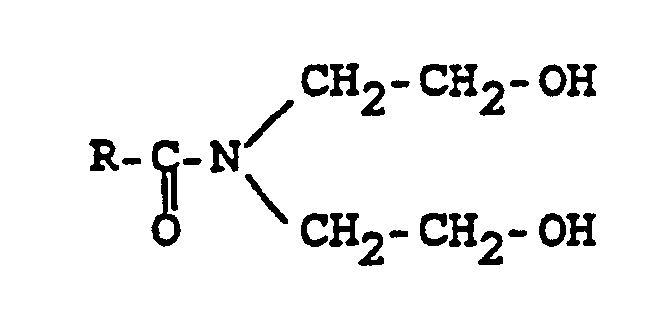
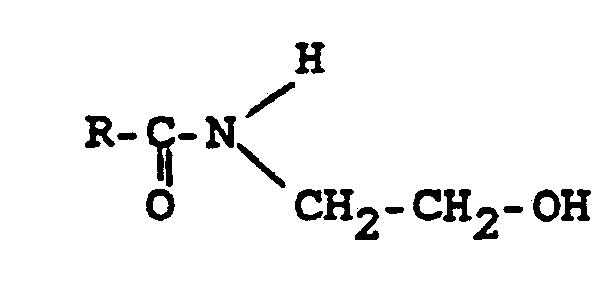
- Bei den Hydroxygruppen handelt es sich um primäre, sekundäre oder tertiäre Hydroxygruppen. Die erfindungsgemäßen Zusammensetzungen enthalten z.B. Fettsäurealkanolamide der folgenden Formeln, wobei R den Rest der Fettsäure darstellt :




- Als Carbonsäureester kommen Ester mit 1-, 2- und 3-wertigen Alkoholen in Betracht. Bei den Alkoholen handelt es sich um primäre, sekundäre sowie tertiäre Alkohole. Die Carbonsäuren bzw. Alkohole sind gesättigt oder ungesättigt.
- Vorzugsweise werden Ester aus aliphatischen Monocarbonsäuren und aliphatischen Alkoholen verwendet.
- Die Grundlage besteht vorzugsweise aus einem Fettsäurealkanolamid, wie z. B. Fettsäurediethanolamid oder Fettsäuremonoisobutandiolamid, und einem Carbonsäureester; die Säurereste der beiden Komponenten sind vorzugsweise gleich. Besonders geeignet sind Caprinsäurediethanolamid, Laurinsäurediethanolamid und Caprinsäuremonoisobutandiolamid und Caprinsäureethylester, Laurinsäurehexylester. Falls Estergemische verwendet werden, eignen sich insbesondere Gemische aus Caprinsäureethylester und Essigsäuredecylester.
- Die erfindungsgemäßen Zusammensetzungen können außer dem Wirkstoff und der Grundlage weitere inerte Füllstoffe oder übliche Hilfsstoffe wie z.B Wasser, Paraffine, kolloidale Kieselsäure oder oberflächenaktive Stoffe enthalten.
- Je nachdem wie das Mischungsverhältnis von Fettsäurealkanolamid und Carbonsäureester ist, entstehen Penetrationssysteme mit unterschiedlich ausgeprägter retardierter Wirkstoffabgabe. Die Penetration des Wirkstoffs durch die Haut hängt daher sowohl von diesem Mischungsverhältnis als auch von der Beschaffenheit der Haut sowie von der Größe der Kontaktfläche ab.
- Die erfindungsgemäBen Zusammensetzungen enthalten vorzugsweise 1 bis 50 Gew.-% Wirkstoff bezogen auf das Gesamtgewicht der Zusammensetzung. Das Mischungsverhältnis von Fettsäurealkanolamid zu Carbonsäureester in der Grundlage beträgt z.B. 2 zu 98 bis 98 : 2. Je höher der Fettsäurealkanolamidanteil ist, desto größer ist die Retardierung.
- Falls die Zusammensetzung noch einen oder mehrere Füllstoffe oder übliche Hilfsstoffe enthält, so beträgt deren Anteil zweckmäßigerweise 1 bis 90 Gew.-% (bezogen auf das Gesamtgewicht der Zusammensetzung).
- Die Erfindung betrifft ferner ein Verfahren zur Herstellung der Zusammensetzungen sowie deren Verwendung in transdermalen therapeutischen Systemen. Das Verfahren ist dadurch gekennzeichnet, daß man Furosemid, Piretanid oder Lemisodul oder ein physiologisch verträgliches Salz dieser Schleifendiuretika mit einen Fettsäurealkanolamid oder einem Fettsäurealkanolamidgemisch mit jeweils 8 bis 18 Kohlenstoffatomen im Fettsäurerest und 2 bis 6 Kohlenstoffatomen und 1 bis 3 Hydroxygruppen im Alkanolamidrest und gegebenenfalls einem Carbonsäureester oder einem Carbonsäureestergemisch mit jeweils 1-22 Kohlenstoffatomen im Carbonsäureteil und 1-22 Kohlenstoffatomen im Alkoholteil bei Temperaturen zwischen Raumtemperatur und 50°C innig vermischt.
- Bei der Herstellung der Mischung kann man den Wirkstoff in dem Carbonsäureester oder dem Carbonsäureestergemisch suspendieren oder lösen, zur Suspension oder Lösung das Fettsäurealkanolamid geben und anschließend bei Temperaturen zwischen Raumtemperatur und 50°C innig vermischen. Man kann auch die genannten Wirkstoffe zunächst mit dem Fettsäurealkanolamid bei Temperaturen zwischen Raumtemperatur und 50°C mischen und danach den Carbonsäureester oder das Carbonsäureestergemisch zusetzen. Die Mischung kann z.B. in einem üblichen Rührwerk mit eingebautem Homogenisator durchgeführt werden.
- Die erfindungsgemäßen Zusammensetzungen sind fest, halbfest (pastös) oder flüssig und eignen sich für die Verwendung in transdermalen therapeutischen Systemen. Solche Systeme sind z.B. Folien oder Pflaster mit runden oder ovalen Kontaktflächen von 0,5 bis 25 cm2 Größe oder vorzugsweise Pflasterpackungen mit Arzneimittelbehälter (Napf). Besonders geeignet ist eine Pflasterpackung, welche acs einer aus 2 Lagen gebildeten Hülle, die die Zusammensetzung einschließt, und einer hauthaftfähigen, elastischen Folie besteht. Solche Pflasterpackungen sind z.B. in der Deutschen Offenlegungsschrift 32 04 582 beschrieben. Eine andere Ausführungsform einer geeigneten Pflasterpackung wird in dem deutschen Gebrauchsmuster 84 07 36 beschrieben. Diese Pflasterpackungen besitzen Arzneimittelbehältner zur Aufnahme von festen, halbfesten oder flüssigen Zusammensetzungen. Falls in eine solche Pflasterpackung eine halbfeste oder flüssige erfindungsgemäße Zusammensetzung eingearbeitet wird, empfiehlt es sich, eine aufsaugende Textileinlage zusätzlich einzusetzen. Aus den erfindungsgemäßen Zusammensetzungen werden die Wirkstoffe retardiert und kontinuierlich percutan abgegeben. Die Bioverfügbarkeit des Wirkstoffs ist z.T. besser als diejenige nach oraler Applikation. Ein weiterer Vorteil besteht in der Vermeidung der Magen-Darmpassage, so daß die neue Applikationsform eine problemlose, für einen großen Patientenkreis geeignete Darreichungsform bedeutet. Aufgrund des Freigabeprofils eignen sich die erfindungsgemäßen Zusammensetzungen nicht nur als Diuretika sondern auch für die Behandlung des Bluthochdrucks. Die Dosierungseinheit, also ein transdermales therapeutisches System, enthält vorzugsweise 5 bis 500 mg Wirkstoff, insbesondere 5 bis 200 mg.
- Die folgenden Beispiele sollen die Erfindung erläutem. Die Zusammensetzungen wurden durch Mischen der Wirkstoffe mit der Grundlage in einem Rührwerk mit eingebautem Homogenisator erhalten. Als transdermale therapeutische Systeme wurden aus dem deutschen Gebrauchsmuster 84 07 036 bekannte Pflasterpackungen verwendet.
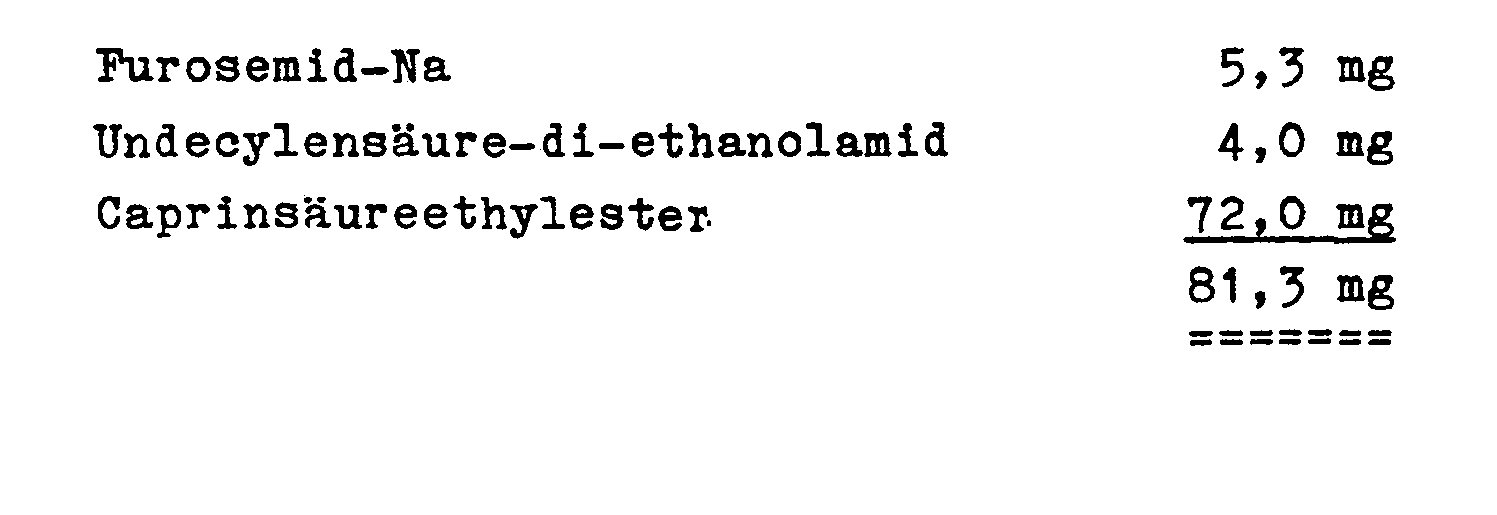
- Die Mengenangaben in den Beispielen beziehen sich jeweils auf die Zusammensetzung für eine Dosiereinheit.
-

- Hinsichtlich der Natriurese an der behaarten Ratte zeigte die Zusammensetzung a) (Mischungsverhältnis Laurinsäurediethanolamid : Laurinsäurehexylester = 8 : 2) in den ersten 5 Stunden nach percutaner Applikation eine mäßige natriuretische Wirkung, die mit einem langsamen Anstieg der Blutspiegel von Piretanid einherging. Erst in der Sammelperiode 6. - 24. Std. kam es zu einer starken Natriurese, die mit dem maximalen Blutspiegel von Piretanid in der 6. Stunde korrelierte. Das zeitliche Wirkprofil des Schleifendiuretikums Piretanid konnte in o.g. Präparation im Sinne einer verlängerten Wirkung verändert werden (vgl. Tabellen 1 und 2).
- Im Gegensatz zu Zusammensetzung a) zeigte die Präparation b) (Mischungsverhältnis Laurinsäurediethanolamid : Laurinsäurherexylrster = 3 : 7) eine starke natriuretische Wirkung in der 1. - 5. Stunden-Sammelperiode, die mit einem starken Anstieg des Blutspiegels von Piretanid einher ging, dessen Maximum bereits in der vierten Stunde nach Applikation erreicht wurde. Danach fiel der Blutspiegel von Piretanid schneller ab als der nach Applikation von a), so daß die natriuretische Wirkung von b) in der 6 - 24 Stunden-Sammelperiode deutlich schwächer war als von a) ; eine verlängerte Wirkung von Piretanid war nicht vorhanden (vgl. Tabellen 1 und 2). Im Falle der Präparation b) entspricht das zeitliche Wirkprofil von Piretanid dem Wirkprofil nach oraler Gabe (Piretanid suspendiert in 2%iger wäßriger Stärkelösung) und somit dem eines typischen Schleifendiuretikums (vgl. Tabelle 3).


-
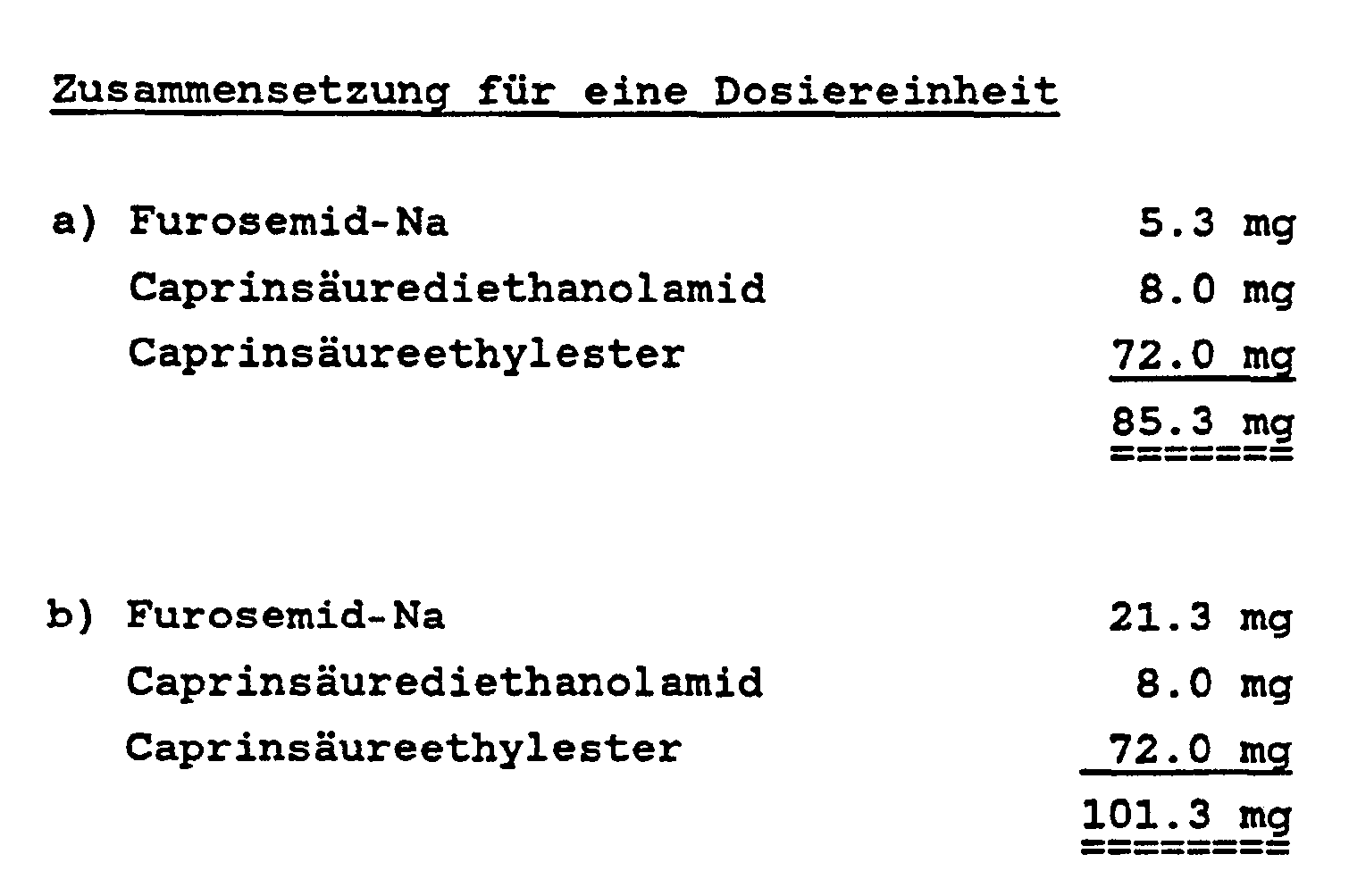
- In Tabelle 4 ist die salidiuretische Wirkung nach percutaner Applikation von Furosemid-Natriumsalz in Dosen von 5.3 mg (Zusammensetzung a) und 21.3 mg (Zusammensetzung b) pro Ratte wiedergegeben. Als Vergleich diente die Ausscheidungsgröße nach oraler Gabe (Furosemid suspendiert in 2%igerwäßriger Stärkelösung) von 5 mg Furosemid pro Ratte (Tabelle 5).
- Die TTS-Furosemid-Formulierungen zeigten nach percutaner Applikation eine dosisabhängige salidiuretische Wirkung. Darüberhinaus weit der Blutspiegel von Furosemid deutliche dosisabhängige Konzentrationsunterschiede auf (vgl. Tabelle 6), wodurch die dosisabhängige salidiuretische Wirkung zu erklären ist.


-

-

-

-

-
-

-

-

-

-

-

-

-

-

-

-

- In der folgenden Tabelle 7 ist die salidiuretische Wirkung nach percutaner Applikation von Furosemid bzw. Furosemid-Natriumsalz aus Zusammensetzungen gemäß Beispiel 3 bis 18 pro Ratte wiedergegeben:


-

- In der folgenden Tabelle 8 sind Blutspiegel, Harnspiegel und salidiuretische Wirkung für die Zusammensetzung gemäß Beispiel 19 zusammengefaßt:

Claims (11)
Priority Applications (1)
| Application Number | Priority Date | Filing Date | Title |
|---|---|---|---|
| AT87107310T ATE59782T1 (de) | 1986-05-27 | 1987-05-20 | Zusammensetzung fuer transdermale therapeutische systeme von schleifendiuretika und verfahren zu ihrer herstellung. |
Applications Claiming Priority (2)
| Application Number | Priority Date | Filing Date | Title |
|---|---|---|---|
| DE19863617824 DE3617824A1 (de) | 1986-05-27 | 1986-05-27 | Zusammensetzung fuer transdermale therapeutische systeme von schleifendiuretika |
| DE3617824 | 1986-05-27 |
Publications (3)
| Publication Number | Publication Date |
|---|---|
| EP0247507A2 EP0247507A2 (de) | 1987-12-02 |
| EP0247507A3 EP0247507A3 (en) | 1988-02-10 |
| EP0247507B1 true EP0247507B1 (de) | 1991-01-09 |
Family
ID=6301739
Family Applications (1)
| Application Number | Title | Priority Date | Filing Date |
|---|---|---|---|
| EP87107310A Expired - Lifetime EP0247507B1 (de) | 1986-05-27 | 1987-05-20 | Zusammensetzung für transdermale therapeutische Systeme von Schleifendiuretika und Verfahren zu ihrer Herstellung |
Country Status (13)
| Country | Link |
|---|---|
| EP (1) | EP0247507B1 (de) |
| JP (1) | JPS62283936A (de) |
| KR (1) | KR870010872A (de) |
| AT (1) | ATE59782T1 (de) |
| AU (1) | AU7338587A (de) |
| CA (1) | CA1306677C (de) |
| DE (2) | DE3617824A1 (de) |
| DK (1) | DK268287A (de) |
| ES (1) | ES2033258T3 (de) |
| GR (1) | GR3001558T3 (de) |
| IL (1) | IL82639A0 (de) |
| PT (1) | PT84946B (de) |
| ZA (1) | ZA873771B (de) |
Families Citing this family (4)
| Publication number | Priority date | Publication date | Assignee | Title |
|---|---|---|---|---|
| DE3806852A1 (de) * | 1988-03-03 | 1989-09-14 | Knoll Ag | Neue (alpha)-aminodicarbonsaeure-derivate, ihre herstellung und verwendung |
| US5686100A (en) * | 1994-11-22 | 1997-11-11 | E.R. Squibb & Sons, Inc. | Prophylactic and therapeutic treatment of skin sensitization and irritation |
| DE10223932A1 (de) * | 2002-05-29 | 2003-12-18 | Rudolf Wank | Verwendung von Diuretika zur Behandlung von Schwellungen |
| GB0517838D0 (en) * | 2005-09-02 | 2005-10-12 | Henderson Morley Plc | Transdermal active principle delivery means |
Family Cites Families (6)
| Publication number | Priority date | Publication date | Assignee | Title |
|---|---|---|---|---|
| US3238102A (en) * | 1961-07-14 | 1966-03-01 | Taisho Pharmaceutical Co Ltd | Solubilization of hydrocortisone acetate |
| US3175949A (en) * | 1962-01-08 | 1965-03-30 | Bristol Myers Co | Emulsion of mineral oil, lauric diethanolamide, and water |
| CA1154024A (en) * | 1980-04-17 | 1983-09-20 | Werner Schafer | Transdermal carrier materials |
| DE3025367A1 (de) * | 1980-07-04 | 1982-01-28 | Hoechst Ag, 6000 Frankfurt | Salz aus furosemid oder piretanid als saeurekomponente und penbutolol oder (-)-3-(4- (3-(3,4-dimethoxyphenylaethylamino)-2-hydroxy-propoxy) -phenyl ) -crotonsaeurenitril als basenkomponente, verfahren zu seiner herstellung, dieses enthaltendes mittel und dessen verwendung |
| EP0139127A1 (de) * | 1983-08-22 | 1985-05-02 | F. HOFFMANN-LA ROCHE & CO. Aktiengesellschaft | Vorrichtung zur transdermalen Abgabe von Heilmitteln und ihre Herstellung |
| JPS61103840A (ja) * | 1984-10-26 | 1986-05-22 | Nitto Electric Ind Co Ltd | 外皮投与用組成物 |
-
1986
- 1986-05-27 DE DE19863617824 patent/DE3617824A1/de not_active Withdrawn
-
1987
- 1987-05-20 DE DE8787107310T patent/DE3767212D1/de not_active Expired - Fee Related
- 1987-05-20 AT AT87107310T patent/ATE59782T1/de active
- 1987-05-20 EP EP87107310A patent/EP0247507B1/de not_active Expired - Lifetime
- 1987-05-20 ES ES198787107310T patent/ES2033258T3/es not_active Expired - Lifetime
- 1987-05-24 IL IL82639A patent/IL82639A0/xx unknown
- 1987-05-26 PT PT84946A patent/PT84946B/de unknown
- 1987-05-26 AU AU73385/87A patent/AU7338587A/en not_active Abandoned
- 1987-05-26 JP JP62127270A patent/JPS62283936A/ja active Pending
- 1987-05-26 DK DK268287A patent/DK268287A/da unknown
- 1987-05-26 ZA ZA873771A patent/ZA873771B/xx unknown
- 1987-05-26 CA CA000538049A patent/CA1306677C/en not_active Expired - Fee Related
- 1987-05-27 KR KR870005256A patent/KR870010872A/ko not_active Withdrawn
-
1991
- 1991-03-06 GR GR91400061T patent/GR3001558T3/el unknown
Also Published As
| Publication number | Publication date |
|---|---|
| JPS62283936A (ja) | 1987-12-09 |
| DE3767212D1 (de) | 1991-02-14 |
| AU7338587A (en) | 1987-12-03 |
| EP0247507A2 (de) | 1987-12-02 |
| DK268287A (da) | 1987-11-28 |
| ATE59782T1 (de) | 1991-01-15 |
| KR870010872A (ko) | 1987-12-18 |
| DK268287D0 (da) | 1987-05-26 |
| IL82639A0 (en) | 1987-11-30 |
| GR3001558T3 (en) | 1992-11-23 |
| ZA873771B (en) | 1987-11-20 |
| CA1306677C (en) | 1992-08-25 |
| PT84946B (de) | 1989-07-21 |
| DE3617824A1 (de) | 1987-12-03 |
| EP0247507A3 (en) | 1988-02-10 |
| ES2033258T3 (es) | 1993-03-16 |
| PT84946A (de) | 1987-06-01 |
Similar Documents
| Publication | Publication Date | Title |
|---|---|---|
| DE69919594T2 (de) | Topische zusammensetzungen zur prostaglandin e1 abgabe | |
| DE68920109T2 (de) | Arzneimittelpräparat für perkutane Absorption. | |
| DE68907858T2 (de) | Arzneizubereitungen zur transdermalen Verabreichung von Wirkstoffen. | |
| DE69018424T2 (de) | Schmerzstillendes und entzündungshemmendes Pflaster. | |
| DE69613463T3 (de) | Filmbildende pharmazeutische zusammensetzungen zur transdermalen verabreichung | |
| DE3503279C2 (de) | ||
| DE2827018C2 (de) | ||
| DE3131610C2 (de) | ||
| DE69715049T2 (de) | Tranilast enthaltendes externum und verfahren zu dessen herstellung | |
| EP0135617B1 (de) | Indomethacin enthaltende, gelartige Salbe | |
| DE1492015A1 (de) | Verbesserte Verabreichungsform pharmazeutischer Praeparate | |
| DE69022678T2 (de) | S(+)-Ibuprofen-L-Aminosäure und S(+)-Ibuprofen-D-Aminosäure als Analgetika mit grösserem pharmakologischem Potential. | |
| DE2727913A1 (de) | Gelartiges arzneipraeparat zur einfuehrung in den mastdarm, die scheide oder urethra sowie grundmasse zu seiner herstellung | |
| CH639845A5 (en) | Solid depot pharmaceutical preparations and process for their production | |
| DE69619052T2 (de) | Feste, wasserfreie, pharmazeutische Zubereitungen für vaginale Verwendung | |
| DE69003906T2 (de) | Triacetin enthaltende, langwirkende injizierbare Zusammensetzungen. | |
| DE69711237T2 (de) | Lokalanästhetikum zur aüsserlichen anwendung | |
| CH643456A5 (de) | Pharmazeutische zubereitung. | |
| CH634994A5 (de) | Grundlagen fuer aeusserlich anzuwendende arzneimittel. | |
| DE60033044T2 (de) | Zusammensetzung von morphin methansulphonat und chitosan zur nasalen verabreicherung | |
| DE3836862A1 (de) | Mittel zur transdermalen applikation von steroidhormonen | |
| EP0277462B1 (de) | Verfahren zur Herstellung nasaler Lösungen enthaltend synthetisches Human calcitonin. | |
| EP0247507B1 (de) | Zusammensetzung für transdermale therapeutische Systeme von Schleifendiuretika und Verfahren zu ihrer Herstellung | |
| DE60103284T2 (de) | Antifungizide zusammensetzung von ketoconazole zum auftragen | |
| DE3782594T2 (de) | Arzneimittel zur transdermalen verabreichung von nicorandil. |
Legal Events
| Date | Code | Title | Description |
|---|---|---|---|
| PUAI | Public reference made under article 153(3) epc to a published international application that has entered the european phase |
Free format text: ORIGINAL CODE: 0009012 |
|
| AK | Designated contracting states |
Kind code of ref document: A2 Designated state(s): AT BE CH DE ES FR GB GR IT LI LU NL SE |
|
| PUAL | Search report despatched |
Free format text: ORIGINAL CODE: 0009013 |
|
| AK | Designated contracting states |
Kind code of ref document: A3 Designated state(s): AT BE CH DE ES FR GB GR IT LI LU NL SE |
|
| 17P | Request for examination filed |
Effective date: 19880704 |
|
| 17Q | First examination report despatched |
Effective date: 19900320 |
|
| GRAA | (expected) grant |
Free format text: ORIGINAL CODE: 0009210 |
|
| AK | Designated contracting states |
Kind code of ref document: B1 Designated state(s): AT BE CH DE ES FR GB GR IT LI LU NL SE |
|
| REF | Corresponds to: |
Ref document number: 59782 Country of ref document: AT Date of ref document: 19910115 Kind code of ref document: T |
|
| REF | Corresponds to: |
Ref document number: 3767212 Country of ref document: DE Date of ref document: 19910214 |
|
| ITF | It: translation for a ep patent filed | ||
| ET | Fr: translation filed | ||
| GBT | Gb: translation of ep patent filed (gb section 77(6)(a)/1977) | ||
| PLBE | No opposition filed within time limit |
Free format text: ORIGINAL CODE: 0009261 |
|
| STAA | Information on the status of an ep patent application or granted ep patent |
Free format text: STATUS: NO OPPOSITION FILED WITHIN TIME LIMIT |
|
| K2C2 | Correction of patent specification (partial reprint) published |
Effective date: 19910109 |
|
| 26N | No opposition filed | ||
| REG | Reference to a national code |
Ref country code: GR Ref legal event code: FG4A Free format text: 3001558 |
|
| REG | Reference to a national code |
Ref country code: ES Ref legal event code: FG2A Ref document number: 2033258 Country of ref document: ES Kind code of ref document: T3 |
|
| PGFP | Annual fee paid to national office [announced via postgrant information from national office to epo] |
Ref country code: FR Payment date: 19930416 Year of fee payment: 7 |
|
| PGFP | Annual fee paid to national office [announced via postgrant information from national office to epo] |
Ref country code: CH Payment date: 19930419 Year of fee payment: 7 |
|
| PGFP | Annual fee paid to national office [announced via postgrant information from national office to epo] |
Ref country code: LU Payment date: 19930421 Year of fee payment: 7 |
|
| PGFP | Annual fee paid to national office [announced via postgrant information from national office to epo] |
Ref country code: SE Payment date: 19930422 Year of fee payment: 7 Ref country code: GB Payment date: 19930422 Year of fee payment: 7 |
|
| PGFP | Annual fee paid to national office [announced via postgrant information from national office to epo] |
Ref country code: AT Payment date: 19930428 Year of fee payment: 7 |
|
| PGFP | Annual fee paid to national office [announced via postgrant information from national office to epo] |
Ref country code: BE Payment date: 19930506 Year of fee payment: 7 |
|
| PGFP | Annual fee paid to national office [announced via postgrant information from national office to epo] |
Ref country code: GR Payment date: 19930507 Year of fee payment: 7 |
|
| PGFP | Annual fee paid to national office [announced via postgrant information from national office to epo] |
Ref country code: ES Payment date: 19930510 Year of fee payment: 7 |
|
| PGFP | Annual fee paid to national office [announced via postgrant information from national office to epo] |
Ref country code: NL Payment date: 19930531 Year of fee payment: 7 |
|
| PGFP | Annual fee paid to national office [announced via postgrant information from national office to epo] |
Ref country code: DE Payment date: 19930716 Year of fee payment: 7 |
|
| EPTA | Lu: last paid annual fee | ||
| PG25 | Lapsed in a contracting state [announced via postgrant information from national office to epo] |
Ref country code: LU Free format text: LAPSE BECAUSE OF NON-PAYMENT OF DUE FEES Effective date: 19940520 Ref country code: GB Effective date: 19940520 Ref country code: AT Effective date: 19940520 |
|
| PG25 | Lapsed in a contracting state [announced via postgrant information from national office to epo] |
Ref country code: SE Effective date: 19940521 Ref country code: ES Free format text: LAPSE BECAUSE OF NON-PAYMENT OF DUE FEES Effective date: 19940521 |
|
| PG25 | Lapsed in a contracting state [announced via postgrant information from national office to epo] |
Ref country code: LI Effective date: 19940531 Ref country code: CH Effective date: 19940531 Ref country code: BE Effective date: 19940531 |
|
| BERE | Be: lapsed |
Owner name: HOECHST A.G. Effective date: 19940531 |
|
| PG25 | Lapsed in a contracting state [announced via postgrant information from national office to epo] |
Ref country code: GR Free format text: THE PATENT HAS BEEN ANNULLED BY A DECISION OF A NATIONAL AUTHORITY Effective date: 19941130 |
|
| PG25 | Lapsed in a contracting state [announced via postgrant information from national office to epo] |
Ref country code: NL Effective date: 19941201 |
|
| NLV4 | Nl: lapsed or anulled due to non-payment of the annual fee | ||
| GBPC | Gb: european patent ceased through non-payment of renewal fee |
Effective date: 19940520 |
|
| EUG | Se: european patent has lapsed |
Ref document number: 87107310.2 Effective date: 19941210 |
|
| PG25 | Lapsed in a contracting state [announced via postgrant information from national office to epo] |
Ref country code: FR Effective date: 19950131 |
|
| REG | Reference to a national code |
Ref country code: CH Ref legal event code: PL |
|
| PG25 | Lapsed in a contracting state [announced via postgrant information from national office to epo] |
Ref country code: DE Effective date: 19950201 |
|
| EUG | Se: european patent has lapsed |
Ref document number: 87107310.2 |
|
| REG | Reference to a national code |
Ref country code: FR Ref legal event code: ST |
|
| REG | Reference to a national code |
Ref country code: GR Ref legal event code: MM2A Free format text: 3001558 |
|
| REG | Reference to a national code |
Ref country code: ES Ref legal event code: FD2A Effective date: 19990201 |
|
| PG25 | Lapsed in a contracting state [announced via postgrant information from national office to epo] |
Ref country code: IT Free format text: LAPSE BECAUSE OF NON-PAYMENT OF DUE FEES;WARNING: LAPSES OF ITALIAN PATENTS WITH EFFECTIVE DATE BEFORE 2007 MAY HAVE OCCURRED AT ANY TIME BEFORE 2007. THE CORRECT EFFECTIVE DATE MAY BE DIFFERENT FROM THE ONE RECORDED. Effective date: 20050520 |