EP0246534A2 - Enantiomerenreine 4,5-disubstituierte gamma-Butyrolactame, Verfahren zu ihrer Herstellung und ihre Verwendung - Google Patents
Enantiomerenreine 4,5-disubstituierte gamma-Butyrolactame, Verfahren zu ihrer Herstellung und ihre Verwendung Download PDFInfo
- Publication number
- EP0246534A2 EP0246534A2 EP87106840A EP87106840A EP0246534A2 EP 0246534 A2 EP0246534 A2 EP 0246534A2 EP 87106840 A EP87106840 A EP 87106840A EP 87106840 A EP87106840 A EP 87106840A EP 0246534 A2 EP0246534 A2 EP 0246534A2
- Authority
- EP
- European Patent Office
- Prior art keywords
- carbon atoms
- alkyl
- substituted
- phenylsulfonyl
- alkylsulfonyl
- Prior art date
- Legal status (The legal status is an assumption and is not a legal conclusion. Google has not performed a legal analysis and makes no representation as to the accuracy of the status listed.)
- Granted
Links
- 0 CC1=CCC(O)=*[C@@]1IO Chemical compound CC1=CCC(O)=*[C@@]1IO 0.000 description 6
Classifications
-
- C—CHEMISTRY; METALLURGY
- C07—ORGANIC CHEMISTRY
- C07D—HETEROCYCLIC COMPOUNDS
- C07D207/00—Heterocyclic compounds containing five-membered rings not condensed with other rings, with one nitrogen atom as the only ring hetero atom
- C07D207/02—Heterocyclic compounds containing five-membered rings not condensed with other rings, with one nitrogen atom as the only ring hetero atom with only hydrogen or carbon atoms directly attached to the ring nitrogen atom
- C07D207/04—Heterocyclic compounds containing five-membered rings not condensed with other rings, with one nitrogen atom as the only ring hetero atom with only hydrogen or carbon atoms directly attached to the ring nitrogen atom having no double bonds between ring members or between ring members and non-ring members
-
- C—CHEMISTRY; METALLURGY
- C07—ORGANIC CHEMISTRY
- C07D—HETEROCYCLIC COMPOUNDS
- C07D207/00—Heterocyclic compounds containing five-membered rings not condensed with other rings, with one nitrogen atom as the only ring hetero atom
- C07D207/02—Heterocyclic compounds containing five-membered rings not condensed with other rings, with one nitrogen atom as the only ring hetero atom with only hydrogen or carbon atoms directly attached to the ring nitrogen atom
- C07D207/18—Heterocyclic compounds containing five-membered rings not condensed with other rings, with one nitrogen atom as the only ring hetero atom with only hydrogen or carbon atoms directly attached to the ring nitrogen atom having one double bond between ring members or between a ring member and a non-ring member
- C07D207/22—Heterocyclic compounds containing five-membered rings not condensed with other rings, with one nitrogen atom as the only ring hetero atom with only hydrogen or carbon atoms directly attached to the ring nitrogen atom having one double bond between ring members or between a ring member and a non-ring member with hetero atoms or with carbon atoms having three bonds to hetero atoms with at the most one bond to halogen, e.g. ester or nitrile radicals, directly attached to ring carbon atoms
- C07D207/24—Oxygen or sulfur atoms
- C07D207/26—2-Pyrrolidones
-
- A—HUMAN NECESSITIES
- A61—MEDICAL OR VETERINARY SCIENCE; HYGIENE
- A61P—SPECIFIC THERAPEUTIC ACTIVITY OF CHEMICAL COMPOUNDS OR MEDICINAL PREPARATIONS
- A61P25/00—Drugs for disorders of the nervous system
- A61P25/28—Drugs for disorders of the nervous system for treating neurodegenerative disorders of the central nervous system, e.g. nootropic agents, cognition enhancers, drugs for treating Alzheimer's disease or other forms of dementia
-
- A—HUMAN NECESSITIES
- A61—MEDICAL OR VETERINARY SCIENCE; HYGIENE
- A61P—SPECIFIC THERAPEUTIC ACTIVITY OF CHEMICAL COMPOUNDS OR MEDICINAL PREPARATIONS
- A61P9/00—Drugs for disorders of the cardiovascular system
-
- C—CHEMISTRY; METALLURGY
- C07—ORGANIC CHEMISTRY
- C07D—HETEROCYCLIC COMPOUNDS
- C07D207/00—Heterocyclic compounds containing five-membered rings not condensed with other rings, with one nitrogen atom as the only ring hetero atom
- C07D207/02—Heterocyclic compounds containing five-membered rings not condensed with other rings, with one nitrogen atom as the only ring hetero atom with only hydrogen or carbon atoms directly attached to the ring nitrogen atom
- C07D207/18—Heterocyclic compounds containing five-membered rings not condensed with other rings, with one nitrogen atom as the only ring hetero atom with only hydrogen or carbon atoms directly attached to the ring nitrogen atom having one double bond between ring members or between a ring member and a non-ring member
- C07D207/22—Heterocyclic compounds containing five-membered rings not condensed with other rings, with one nitrogen atom as the only ring hetero atom with only hydrogen or carbon atoms directly attached to the ring nitrogen atom having one double bond between ring members or between a ring member and a non-ring member with hetero atoms or with carbon atoms having three bonds to hetero atoms with at the most one bond to halogen, e.g. ester or nitrile radicals, directly attached to ring carbon atoms
- C07D207/24—Oxygen or sulfur atoms
- C07D207/26—2-Pyrrolidones
- C07D207/273—2-Pyrrolidones with hetero atoms or with carbon atoms having three bonds to hetero atoms with at the most one bond to halogen, e.g. ester or nitrile radicals, directly attached to other ring carbon atoms
-
- C—CHEMISTRY; METALLURGY
- C07—ORGANIC CHEMISTRY
- C07D—HETEROCYCLIC COMPOUNDS
- C07D207/00—Heterocyclic compounds containing five-membered rings not condensed with other rings, with one nitrogen atom as the only ring hetero atom
- C07D207/02—Heterocyclic compounds containing five-membered rings not condensed with other rings, with one nitrogen atom as the only ring hetero atom with only hydrogen or carbon atoms directly attached to the ring nitrogen atom
- C07D207/18—Heterocyclic compounds containing five-membered rings not condensed with other rings, with one nitrogen atom as the only ring hetero atom with only hydrogen or carbon atoms directly attached to the ring nitrogen atom having one double bond between ring members or between a ring member and a non-ring member
- C07D207/22—Heterocyclic compounds containing five-membered rings not condensed with other rings, with one nitrogen atom as the only ring hetero atom with only hydrogen or carbon atoms directly attached to the ring nitrogen atom having one double bond between ring members or between a ring member and a non-ring member with hetero atoms or with carbon atoms having three bonds to hetero atoms with at the most one bond to halogen, e.g. ester or nitrile radicals, directly attached to ring carbon atoms
- C07D207/24—Oxygen or sulfur atoms
- C07D207/26—2-Pyrrolidones
- C07D207/273—2-Pyrrolidones with hetero atoms or with carbon atoms having three bonds to hetero atoms with at the most one bond to halogen, e.g. ester or nitrile radicals, directly attached to other ring carbon atoms
- C07D207/277—Carbon atoms having three bonds to hetero atoms with at the most one bond to halogen, e.g. ester or nitrile radicals
- C07D207/28—2-Pyrrolidone-5- carboxylic acids; Functional derivatives thereof, e.g. esters, nitriles
-
- C—CHEMISTRY; METALLURGY
- C07—ORGANIC CHEMISTRY
- C07D—HETEROCYCLIC COMPOUNDS
- C07D241/00—Heterocyclic compounds containing 1,4-diazine or hydrogenated 1,4-diazine rings
- C07D241/02—Heterocyclic compounds containing 1,4-diazine or hydrogenated 1,4-diazine rings not condensed with other rings
- C07D241/06—Heterocyclic compounds containing 1,4-diazine or hydrogenated 1,4-diazine rings not condensed with other rings having one or two double bonds between ring members or between ring members and non-ring members
- C07D241/08—Heterocyclic compounds containing 1,4-diazine or hydrogenated 1,4-diazine rings not condensed with other rings having one or two double bonds between ring members or between ring members and non-ring members with oxygen atoms directly attached to ring carbon atoms
Definitions
- the invention relates to enantiomerically pure 4,5-disubstituted ⁇ -butyrolactams, processes for their preparation and their use as intermediates for active pharmaceutical ingredients.
- the invention provides enantiomerically pure 4,5-disubstituted ⁇ -butyrolactams of the general formula (I) in which R1 - stands for with 6 to 14 carbon atoms, which can be substituted up to 5 times the same or different by alkyl, alkoxy, alkylthio, each with up to 8 carbon atoms, by aryl, aryloxy, arylthio, each with 6 to 12 carbon atoms men, by aralkyl with 7 to 14 carbon atoms through halogen, trifluoromethyl, trifluoromethoxy, difluoromethoxy, trifluoromethylthio, nitro, cyano, carboxy, alkoxycarbonyl with up to 8 carbon atoms, sulfo, phenylsulfonyl, tolylsulfonyl, alkylsulfonyl with up to 8 carbon atoms, hydroxy or through one Group of the formula wherein R3 and R4 are identical or
- Preferred compounds of the general formula (I) are those in which R1 - represents phenyl or naphthyl, which can be substituted up to 3 times in the same or different ways by alkyl, alkoxy each having up to 6 carbon atoms, methylthio, phenyl, phenoxy, benzyl, Fluorine, chlorine, bromine, iodine, trifluoromethyl, trifluoromethoxy, difluoromethoxy, trifluoromethylthio, nitro, cyano, alkoxycarbonyl with up to 6 carbon atoms, phenylsulfonyl, tolylsulfonyl, alkylsulfonyl with up to 6 carbon atoms, hydroxy or through a group of the formula in which R3 and R4 are identical or different and are hydrogen, alkyl having up to 6 carbon atoms, phenyl, benzyl, acetyl, ethylcarbonyl, benzoyl, al
- R1 - represents phenyl, which can be substituted by alkyl or alkoxy having up to 4 carbon atoms, by fluorine, chlorine, bromine, trifluoromethyl, trifluoromethoxy, trifluoromethylthio, nitro, cyano, alkoxycarbonyl having up to 4 carbon atoms, phenylsulfonyl, tolylsulfonyl, alkylsulfonyl up to 4 carbon atoms, hydroxy or by a group of the formula in which R3 and R4 are the same or different and are hydrogen with up to 4 carbon atoms, phenyl, benzyl or acetyl, or - represents furyl, thienyl or pyridyl, or - represents straight-chain, branched or cyclic alkyl having up to 6 carbon atoms, which can be substituted by fluorine, chlorine, bromine, phenyl,
- R1 - stands for aryl with 6 to 12 carbon atoms, which can be substituted up to 5 times in the same or different way by alkyl, alkoxy, alkylthio each with up to 8 carbon atoms, by aryl, aryl oxy, arylthio each having 6 to 12 carbon atoms, by aralkyl having 7 to 14 carbon atoms by halogen, trifluoromethyl, trifluoromethoxy, difluoromethoxy, trifluoromethylthio, nitro, cyano, carboxy, alkoxycarbonyl having up to 8 carbon atoms, sulfo, phenylsulfonyl, tolysulfonyl to alkylsulfonyl to 8 carbon atoms, hydroxy or by a group of the formula wherein R3 and
- Suitable solvents are the customary inert solvents which do not change under the reaction conditions. These preferably include water or alcohols such as methanol, ethanol, propanol or isopropanol, or ethers such as diethyl ether, dioxane or tetrahydrofuran, or chlorinated hydrocarbons such as methylene chloride, chloroform or carbon tetrachloride, or mixtures of the solvents mentioned.
- Suitable acids for the hydrolysis are inorganic acids such as hydrochloric acid, hydrobromic acid, sulfuric acid or phosphoric acid, or organic carboxylic or sulfonic acids such as methane, ethane, toluene or benzenesulfonic acid or acetic acid or propionic acid.
- the hydrolysis is particularly preferably carried out in aqueous or alcoholic solutions using hydrogen chloride as the acid.
- the hydrolysis is generally carried out at a temperature from 0 ° C. to + 100 ° C., preferably from + 20 ° C. to + 60 ° C.
- the glutamic acid salts resulting from the hydrolysis can be isolated. However, it has proven to be advantageous to process the amino acid salts directly without purification.
- the salts are treated with bases in an inert solvent.
- Suitable solvents are the customary inert solvents which do not change under the reaction conditions. These preferably include water or alcohols such as methanol, ethanol, propanol or isopropanol, or ethers such as diethyl ether, dioxane or tetrahydrofuran, acetonitrile, dimethylformamide or hexamethylphosphoric triamide or mixtures of the solvents mentioned.
- water or alcohols such as methanol, ethanol, propanol or isopropanol
- ethers such as diethyl ether, dioxane or tetrahydrofuran, acetonitrile, dimethylformamide or hexamethylphosphoric triamide or mixtures of the solvents mentioned.
- bases are suitable as bases.
- bases preferably include inorganic bases such as alkali or alkaline earth hydroxide, for example sodium hydroxide, potassium hydroxide, calcium hydroxide or barium hydroxide, or alkali carbonates such as sodium carbonate, sodium bicarbonate or potassium carbonate, or ammonia or organic amines derived from ammonia such as di- or trialkylamines, for example triethylamine or diisopropylamine, or other tertiary amines such as pyridine, dimethylaminopyridine, picoline or lutidine.
- inorganic bases such as alkali or alkaline earth hydroxide, for example sodium hydroxide, potassium hydroxide, calcium hydroxide or barium hydroxide, or alkali carbonates such as sodium carbonate, sodium bicarbonate or potassium carbonate, or ammonia or organic amines derived from ammonia such as di- or trialkylamines, for example triethylamine or diisopropy
- the treatment of the amino acid salts with bases generally takes place in a temperature range from 0 ° C. to + 100 ° C., preferably from + 20 ° C. to + 40 ° C.
- the free amino acids can be isolated. In general, however, it has proven advantageous to continue working directly without isolating the amino acid.
- the cyclization of the free amino acid is generally carried out without solvent in a temperature range from + 50 ° C to + 200 ° C, preferably from + 70 ° C to + 120 ° C.
- the cyclization can be carried out at normal pressure, at elevated or at reduced pressure. Generally one works at normal pressure.
- the process according to the invention can be carried out, for example, by treating the dihydropyrazines with aqueous hydrochloric acid, then isolating the resulting glutamic acid salts and treating them with aqueous ammonia without purification, then isolating the free amino acids and heating them without solvents, for example in a spherical ear.
- R1 - stands for aryl with 6 to 14 carbon atoms, which can be substituted up to 5 times the same or different by alkyl, alkoxy, alkylthio each with up to 8 carbon atoms, by aryl, aryloxy, arylthio each having 6 to 12 carbon atoms Aralkyl with 7 to 14 carbon atoms, through halogen, trifluoromethyl, trifluoromethoxy, difluoromethoxy, trifluoromethylthio, nitro, cyano, carboxy, alkoxycarbonyl with up to 8 carbon atoms, sulfo, phenylsulfonyl, tolylsulfonyl, alkylsulfonyl with up to 8 carbon atoms, hydroxy or through a group of formula wherein R3 and R4 are the same or different and are hydrogen, alkyl having up to 8 carbon atoms, aryl having
- lactim ethers of type (III) with trans-substituted ⁇ , ⁇ -unsaturated carboxylic acid esters provide 2,3-threo-amino acids and 4,5-trans-substituted ⁇ -butyrolactams therefrom.
- the acrylic esters of the general formula (IV) used as starting materials are known or can be prepared by known methods [cf. e.g. Houben-Weyl, "Methods of Organic Chemistry", 4th edition, Volume 5 / 1b, p. 728 ff.].
- Suitable solvents are the customary inert organic solvents which do not change under the reaction conditions. These preferably include ethers such as diethyl ether, tetrahydrofuran, dioxane, glycol mono- or dimethyl ether, or amides such as dimethylformamide, hexamethylphosphoric triamide, dimethylacetamide, or dimethyl sulfoxide. It is also possible to use mixtures of the solvents mentioned.
- alkali metal organic compounds are suitable as strongly basic organometallic compounds. These preferably include alkali metal alcoholates such as sodium methylate, potassium methylate, sodium ethylate, potassium ethylate or potassium tert-butoxide, or organolithium compounds such as n-, iso- or tert-butyllithium or nyllithium, or alkali amides such as sodium amide, lithium diisopropylamide, lithium tetramethyl piperidide or sodium bis- (trimethylsilyl) amide.
- alkali metal alcoholates such as sodium methylate, potassium methylate, sodium ethylate, potassium ethylate or potassium tert-butoxide
- organolithium compounds such as n-, iso- or tert-butyllithium or nyllithium
- alkali amides such as sodium amide, lithium diisopropylamide, lithium tetramethyl piperidide or sodium bis- (trimethyl
- the usual inorganic or organic acids are suitable as neutralizing acids. These preferably include inorganic acids such as hydrochloric acid, hydrobromic acid, sulfuric acid or phosphoric acid or organic carboxylic or sulfonic acids such as acetic acid, propionic acid, tartaric acid or citric acid, methane or ethanesulfonic acid.
- inorganic acids such as hydrochloric acid, hydrobromic acid, sulfuric acid or phosphoric acid or organic carboxylic or sulfonic acids such as acetic acid, propionic acid, tartaric acid or citric acid, methane or ethanesulfonic acid.
- the process is generally carried out in a temperature range from -80 ° C to 0 ° C, preferably from -70 ° C to -20 ° C.
- the process is generally carried out at normal pressure. It is also possible to work at elevated or reduced pressure.
- step [C] The reduction of the compound of the formula (IX) to compounds of the formula (X) in step [C] is carried out by the same method and under the same conditions as already stated for the reduction of the compounds (V) to the compounds (IIb).
- step [D] The oxidation of compounds of the formula (X) to compounds of the formula (III) in step [D] is carried out by the same methods and under the same conditions as for the oxidation of compounds of the formula (IIa) to compounds of the formula (V) is specified.
- the starting compounds of the formula (VI) are known from the literature or can be prepared by methods known from the literature [GH Cocolas, WH Hartung, J. Am. Chem. Soc. 79 , 5203 (1957); F. Zymalkowski, P. Pachaly, Chem. Ber. 100 , 1137 (1967)].
- (+) - Clausenamid had a pronounced cerebral hypoxia protective and anti-amnestic effect in animal experiments, which is significantly stronger than that of piracetam, which is the structurally most closely related compound in the field of cerebral therapeutics and nootropics.
- hypoxia is apparently not caused by non-specific sedation, which would trigger a reduced oxygen requirement.
- the acute toxicity of the compound has been found to be very low.
- the present invention includes pharmaceutical preparations which, in addition to non-toxic, inert pharmaceutically suitable excipients, contain the compound according to the invention or which consist of the active compound according to the invention and processes for the preparation of these preparations.
- Non-toxic, inert pharmaceutically suitable carriers are to be understood as solid, semi-solid or liquid diluents, fillers or formulation auxiliaries of all kinds.
- Tablets, dragees, capsules, pills, granules, suppositories, solutions, suspensions and emulsions, pastes, ointments, gels, creams, lotions, powders and sprays may be mentioned as preferred pharmaceutical preparations.
- Tablets, coated tablets, capsules, pills and granules can contain the active ingredient (s) in addition to the usual carriers, such as (a) fillers and extenders, for example starch, lactose, cane sugar, glucose, mannitol and silica, (b) binders, for example carboxymethyl cellulose, Alginates, gelatin, polyvinylpyrrolidone, (c) humectants, for example glycerol, (d) disintegrants, for example agar, calcium carbonate and sodium carbonate, (e) solution retarders, for example paraffin and (f) absorption accelerators, for example quaternary ammonium compounds, (g) wetting agents, for example cetyl alcohol, glycerol monostearate, (h) adsorbents, for example kaolin and bentonite and (i) lubricants, for example talc, calcium and magnesium stearate and solid polyethylene glycols or mixtures of the substances listed under (a)
- the tablets, dragees, capsules, pills and granules can be provided with the customary coatings and casings optionally containing opacifying agents and can also be composed in such a way that they release the active substance only or preferably in a certain part of the intestinal tract, if necessary with a delay, with embedding materials e.g. Polymer substances and waxes can be used.
- the active ingredient may optionally also be in microencapsulated form with one or more of the above-mentioned carriers.
- suppositories can contain the usual water-soluble or water-insoluble carriers, e.g. Polyethylene glycols, fats, e.g. Cocoa fat and higher esters (e.g. C14 alcohol with C16 fatty acid) or mixtures of these substances.
- water-soluble or water-insoluble carriers e.g. Polyethylene glycols, fats, e.g. Cocoa fat and higher esters (e.g. C14 alcohol with C16 fatty acid) or mixtures of these substances.
- ointments, pastes, creams and gels can contain the usual carriers, for example animal and vegetable fats, waxes, paraffins, starch, tragacanth, cellulose derivatives, polyethylene glycols, silicones, bentonites, silica, talc and zinc oxide or mixtures of these substances.
- powders and sprays can contain the usual carriers, e.g. Milk sugar, talc, silica, aluminum hydroxide, calcium silicate and polyamide powder or mixtures of these substances.
- Sprays can also contain the usual propellants, e.g. Contain chlorofluorocarbons.
- solutions and emulsions can contain the usual carriers such as solvents, solubilizers and emulsifiers, e.g. Water, ethyl alcohol, isopropyl alcohol, ethyl carbonate, ethyl acetate, benzyl alcohol, dimethylformamide, oils, in particular cottonseed oil, peanut oil, corn oil, olive oil, castor oil and sesame oil, glycerin, glycerin formal, tetrahydrofurfuryl alcohol, polyethylene glycols and fatty acid esters or these contain sorbents.
- solvents e.g. Water, ethyl alcohol, isopropyl alcohol, ethyl carbonate, ethyl acetate, benzyl alcohol, dimethylformamide, oils, in particular cottonseed oil, peanut oil, corn oil, olive oil, castor oil and sesame oil, glycerin, glycerin formal, tetrahydrofurfuryl alcohol
- solutions and emulsions can also be in sterile and blood isotonic form.
- suspensions can contain the usual carriers such as liquid diluents, for example water, ethyl alcohol, propylene glycol, suspending agents, for example ethoxylated isostearyl alcohols, polyoxy contain ethylene sorbitol and sorbitan esters, microcrystalline cellulose, aluminum metahydroxide, bentonite, agar and tragacanth or mixtures of these substances.
- liquid diluents for example water, ethyl alcohol, propylene glycol
- suspending agents for example ethoxylated isostearyl alcohols
- polyoxy contain ethylene sorbitol and sorbitan esters, microcrystalline cellulose, aluminum metahydroxide, bentonite, agar and tragacanth or mixtures of these substances.
- the formulation forms mentioned can also contain colorants, preservatives and odor and taste-improving additives, e.g. Peppermint oil and eucalyptus oil and sweeteners e.g. Saccharin.
- the therapeutically active compound should preferably be present in the pharmaceutical preparations listed above in a concentration of approximately 0.1 to 99.5, preferably approximately 0.5 to 95 percent by weight of the total mixture.
- compositions listed above may also contain other active pharmaceutical ingredients in addition to the compound according to the invention.
- the pharmaceutical preparations listed above are prepared in a conventional manner by known methods, e.g. by mixing the active substance or substances with the carrier substance or substances.
- (+) (3S), (4R), (5R), (7S) -3-hydroxy-5- ⁇ -hydroxybenxyl-1-methyl-4-phenyl-pyrrolidin-2-one from the according to the invention, such as described (4S, 5S) -5-methoxycarbonyl-4-phenyl-pyrrolidin-2-one) can be carried out according to the following scheme:
- step [A] (4S, 5S) -5-methoxycarbonyl-4-phenyl-pyrrolidin-2-one (V) with a methylating agent such as methyl bromide, methyl iodide, methyl-p- toluenesulfonate, diazomethane or dimethyl sulfate, optionally in the presence of a base such as sodium, sodium hydride, sodium amide, butyllithium or lithium diisopropylamide in suitable solvents such as diethyl ether, tetrahydrofuran, dimethylformamide, hexamethylphosphoric acid triamide or mixtures of the solvents at temperatures from -20 ° C.
- a methylating agent such as methyl bromide, methyl iodide, methyl-p- toluenesulfonate, diazomethane or dimethyl sulfate
- a base such as sodium, sodium hydride, sodium amide, butyllithium or
- step [A] is particularly preferably carried out with methyl iodide in a mixture of tetrahydrofuran and hexamethylphosphoric acid triamide in the presence of lithium diisopropylamide as the base.
- step [B] The reduction of (VI) to (4S, 5S) -5-hydroxymethyl-1-methyl-4-phenylpyrrolidin-2-one (VII) in step [B] is preferably carried out using complex metal hydrides such as, for example, lithium hydridotriethyl borate , Lithium hydridotis (1-methylpropyl) borate or sodium borohydride in inert solvents such as ethers, for example diethyl ether, tetrahydrofuran or dioxane at temperatures from -30 ° C. to + 10 ° C., preferably from -20 ° C. to 0 ° C.
- complex metal hydrides such as, for example, lithium hydridotriethyl borate , Lithium hydridotis (1-methylpropyl) borate or sodium borohydride in inert solvents such as ethers, for example diethyl ether, tetrahydrofuran or
- step [C] The oxidation of (VII) to (4S, 5S) -5-formyl-1-methyl-4-phenyl-pyrrolidin-2-one (VIII) in step [C] is carried out with dimethyl sulfoxide as an oxidizing agent with the addition of trifluoroacetic anhydride in chlorinated hydrocarbons such as for example dichloromethane or chloroform, or in ethers such as diethyl ether, dioxane or tetrahydrofuran at temperatures from -80 ° C. to 0 ° C., preferably from -60 ° C. to 0 ° C.
- chlorinated hydrocarbons such as for example dichloromethane or chloroform
- ethers such as diethyl ether, dioxane or tetrahydrofuran
- step [D] the formyl compound (VIII) in suitable solvents such as ether, for example diethyl ether or tetrahydrofuran in a temperature range from -20 ° C to + 50 ° C, preferably from -10 ° C to + 30 ° C with phenylmagnesium bromide (4S , 5S, 7S) -5-hydroxymethylphenyl-1-methyl-4-phenylpyrrolidin-1-one (IX).
- suitable solvents such as ether, for example diethyl ether or tetrahydrofuran in a temperature range from -20 ° C to + 50 ° C, preferably from -10 ° C to + 30 ° C with phenylmagnesium bromide (4S , 5S, 7S) -5-hydroxymethylphenyl-1-methyl-4-phenylpyrrolidin-1-one (IX).
- step [E] The oxidation of (IX) to (4S, 5S) -5-benzoyl-1-methyl-4-phenylpyrrolidin-2-one (X) in step [E] takes place under the same conditions as for the oxidation of (VII ) to (VIII) in step [C].
- step [F] The reduction of (X) to (4S, 5S, 7R) -5-hydroxymethylphenyl-1-methyl-4-phenylpyrrolidin-2-one (XI) in step [F] is carried out under the same conditions as for the reduction of (VI) to (VII) are given in step [B].
- the adsorbate is placed on a column with Al2O3 (neutrak, 50 parts by weight) and the starting material is first eluted with ethyl acetate (flash chromatography, control with TLC and analytical HPLC). The title compound is then eluted with ethyl acetate / methanol mixtures (40/1, 20/1, then 10/1). It was crystallized with ether, stirred with water, filtered off with suction and, after drying in HV (30-40 ° C., 24 h), 0.22 g (46.1% of theory) was obtained (+) - clausenamide (hydrate contains 1 / 4 mol H2O) at 152-3 ° C. (auth.
Landscapes
- Chemical & Material Sciences (AREA)
- Organic Chemistry (AREA)
- Health & Medical Sciences (AREA)
- Engineering & Computer Science (AREA)
- Bioinformatics & Cheminformatics (AREA)
- Pharmacology & Pharmacy (AREA)
- Animal Behavior & Ethology (AREA)
- Neurology (AREA)
- Neurosurgery (AREA)
- Veterinary Medicine (AREA)
- Chemical Kinetics & Catalysis (AREA)
- General Chemical & Material Sciences (AREA)
- Medicinal Chemistry (AREA)
- Nuclear Medicine, Radiotherapy & Molecular Imaging (AREA)
- Biomedical Technology (AREA)
- Life Sciences & Earth Sciences (AREA)
- Public Health (AREA)
- General Health & Medical Sciences (AREA)
- Hospice & Palliative Care (AREA)
- Psychiatry (AREA)
- Cardiology (AREA)
- Heart & Thoracic Surgery (AREA)
- Plural Heterocyclic Compounds (AREA)
- Pharmaceuticals Containing Other Organic And Inorganic Compounds (AREA)
- Pyrrole Compounds (AREA)
- Hydrogenated Pyridines (AREA)
- Pyridine Compounds (AREA)
- Catalysts (AREA)
Abstract
Description
- Die Erfindung betrifft enantiomerenreine 4,5-disubstituierte γ-Butyrolactame, Verfahren zu ihrer Herstellung und ihre Verwendung als Zwischenprodukte für pharmazeutische Wirkstoffe.
- Die Erfindung stellt enantiomerenreine 4,5-disubstituierte γ-Butyrolactame der allgemeinen Formel (I)

R¹ - für mit 6 bis 14 Kohlenstoffatomen steht, das bis zu 5-fach gleich oder verschieden substituiert sein kann durch Alkyl, Alkoxy, Alkylthio mit jeweils bis zu 8 Kohlenstoffatomen, durch Aryl, Aryloxy, Arylthio mit jeweils 6 bis 12 Kohlenstoffato men, durch Aralkyl mit 7 bis 14 Kohlenstoffatomen durch Halogen, Trifluormethyl, Trifluormethoxy, Difluormethoxy, Trifluormethylthio, Nitro, Cyano, Carboxy, Alkoxycarbonyl mit bis zu 8 Kohlenstoffatomen, Sulfo, Phenylsulfonyl, Tolylsulfonyl, Alkylsulfonyl mit bis zu 8 Kohlenstoffatomen, Hydroxy oder durch eine Gruppe der Formel
R³ und R⁴ gleich oder verschieden sind und Wasserstoff, Alkyl mit bis zu 8 Kohlenstoffatomen, Aryl mit 6 bis 12 Kohlenstoffatomen, Aralkyl mit 7 bis 14 Kohlenstoffatomen, Acyl mit bis zu 7 Kohlenstoffatomen, Alkylsulfonyl mit bis zu 6 Kohlenstoffatomen, Phenylsulfonyl oder Tolylsulfonyl bedeuten,
oder
- für einen heterocyclischen Ring der Reihe Furyl, Thienyl, Pyridyl, Pyrimidyl, Pyrazinyl, Pyridazinyl, Chinolyl oder Isochinolyl steht, wobei diese Ringe bis zu 3-fach gleich oder verschieden substituiert sein können durch Alkyl, Alkoxy, Alkylthio mit jeweils bis zu 6 Kohlenstoffatomen, Halogen, Phenyl, Nitro, Cyano oder
durch eine Gruppe der Formel
R³ und R⁴ die oben angegebene Bedeutung haben,
oder
- für geradkettiges, verzweigtes oder cyclisches Alkyl oder Alkenyl mit bis zu 10 Kohlenstoffatomen steht, das substituiert sein kann durch Halogen, Aryl mit 6 bis 14 Kohlenstoffatomen, Furyl, Thienyl, Pyridyl, Pyrimidyl, Pyrazinyl, Pyridazinyl, Chinolyl, Isochinolyl, Hydroxy, Alkoxy, Alkylthio mit jeweils bis zu 6 Kohlenstoffatomen, Carboxy, Alkoxycarbonyl mit bis zu 6 Kohlenstoffatomen, Sulfo, Alkylsulfonyl mit bis zu 6 Kohlenstoffatomen, Phenylsulfonyl, Tolysulfonyl oder durch eine Gruppe der Formel
R⁵ und R⁶ gleich oder verschieden sind und Wasserstoff, Alkyl mit bis zu 8 Kohlenstoffatomen, Aryl mit 6 bis 12 Kohlenstoffatomen, Aralkyl mit 7 bis 14 Kohlenstoffatomen, Acyl mit bis zu 7 Kohlenstoffatomen, Alkylsulfonyl mit bis zu 6 Kohlenstoffatomen, Phenylsulfonyl oder Tolylsulfonyl bedeuten,
oder worin
R⁵ und R⁶ gemeinsam mit dem Stickstoffatom einen Ring aus der Reihe Pyrrolidino, Piperidino, Piperazino, Morpholino oder Thiomorpholino bilden und wobei dieser Ring substituiert sein kann durch Alkyl mit bis zu 4 Kohlenstoff-Atomen oder durch Phenyl
und
R² - für geradkettiges, verzweigtes oder cyclisches Alkyl mit bis zu 8 Kohlenstoffatomen steht,
in welchen das Ringkohlenstoffatom in 5-Stellung S-Konfiguration hat und in welchen der Substituent R¹ in 4-Stellung zum Substituenten COOR² in 5-Stellung cis konfiguriert ist, zur Verfügung. - Bevorzugte Verbindungen der allgemeinen Formel (I) sind solche,
in welchen
R¹ - für Phenyl oder Naphthyl steht, das bis zu 3-fach gleich oder verschieden substituiert sein kann durch Alkyl, Alkoxy mit jeweils bis zu 6 Kohlenstoffatomen, Methylthio, Phenyl, Phenoxy, Benzyl, Fluor, Chlor, Brom, Iod, Trifluormethyl, Trifluormethoxy, Difluormethoxy, Trifluormethylthio, Nitro, Cyano, Alkoxycarbonyl mit bis zu 6 Kohlenstoffatomen, Phenylsulfonyl, Tolylsulfonyl, Alkylsulfonyl mit bis zu 6 Kohlenstoffatomen, Hydroxy oder durch eine Gruppe der Formel
R³ und R⁴ gleich oder verschieden sind und Wasserstoff, Alkyl mit bis zu 6 Kohlenstoffatomen, Phenyl, Benzyl, Acetyl, Ethylcarbonyl, Benzoyl, Alkylsulfonyl mit bis zu 4 Kohlenstoffatomen, Tolylsulfonyl oder Phenylsulfonyl bedeuten,
oder
- für einen heterocyclischen Ring der Reihe Furyl, Thienyl, Pyridyl, Pyrimidyl, Chinolyl oder Isochinolyl steht, wobei diese Ringe substituiert sein können durch Alkyl oder Alkoxy mit jeweils bis zu 4 Kohlenstoffatomen, durch Fluor, Chlor, Brom, Nitro, Cyano oder
durch eine Gruppe der Formel
R³ und R⁴ die oben angegebene Bedeutung haben,
oder
- für geradkettiges, verzweigtes oder cyclisches Alkyl mit bis zu 8 Kohlenstoffatomen steht, das substituiert sein kann durch Fluor, Chlor, Brom, Phenyl, Furyl, Thienyl, Pyridyl, Pyrimidyl, Chinolyl, Isochinolyl, Hydroxy, Alkoxy oder Alkylthio mit bis zu 4 Kohlenstoffatomen, Alkoxycarbonyl mit bis zu 4 Kohlenstoffatomen, Alkylsulfonyl mit bis zu 4 Kohlenstoffatomen, Phenylsulfonyl, Tolysulfonyl oder durch eine Gruppe der Formel
R⁵ und R⁶ gleich oder verschieden sind und Wasserstoff, Alkyl mit bis zu 6 Kohlenstoffatomen, Phenyl, Benzyl, Acetyl, Ethylcarbonyl, Benzoyl Alkylsulfonyl mit bis zu 4 Kohlenstoffatomen, Tolylsulfonyl oder Phenylsulfonyl bedeuten,
oder in welcher
R⁵ und R⁶ gemeinsam mit dem Stickstoffatom einen Ring aus der Reihe Pyrrolidino, Piperidino, N- Methyl- oder N-Phenylpiperazino oder Morpholino bilden
und
R² - für geradkettiges oder verzweigtes Alkyl mit bis zu 6 Kohlenstoffatomen steht,
und in welchen das Ringkohlenstoffatom in 5-Stellung S-Konfiguration hat und in welchen der Substituent R¹ in 4-Stellung zum Substituenten COOR² in 5-Stellung cis konfiguriert ist. - Besonders bevorzugt sind solche Verbindungen der allgemeinen Formel (I)
in welchen
R¹ - für Phenyl steht, das substituiert sein kann durch Alkyl oder Alkoxy mit bis zu 4 Kohlenstoffatomen, durch Fluor, Chlor, Brom, Trifluormethyl, Trifluormethoxy, Trifluormethylthio, Nitro, Cyano, Alkoxycarbonyl mit bis zu 4 Kohlenstoffatomen, Phenylsulfonyl, Tolylsulfonyl, Alkylsulfonyl mit bis zu 4 Kohlenstoffatomen, Hydroxy oder durch eine Gruppe der Formel
R³ und R⁴ gleich oder verschieden sind und Wasserstoff mit bis zu 4 Kohlenstoffatomen, Phenyl, Benzyl oder Acetyl bedeuten,
oder
- für Furyl, Thienyl oder Pyridyl steht, oder
- für geradkettiges, verzweigtes oder cyclisches Alkyl mit bis zu 6 Kohlenstoffatomen steht, das substituiert sein kann durch Fluor, Chlor, Brom, Phenyl, Thienyl, Pyridyl, Furyl oder Alkoxy mit bis zu 4 Kohlenstoffatomen
und
R² - für geradkettiges oder verzweigtes Alkyl mit bis zu 4 Kohlenstoffatomen steht,
in welchen das Ringkohlenstoffatom in 5-Stellung S-Konfiguration hat und in welchen der Substituent R¹ in 4-Stellung zum Substituenten COOR² in 5-Stellung cis konfiguriert ist. - Ebenso wurde ein Verfahren zur Herstellung enantiomerenreiner 4,5-disubstituierter γ-Butyrolactame der allgemeinen Formel (I)
in welcher
R¹ - für Aryl mit 6 bis 12 Kohlenstoffatomen steht, das bis zu 5-fach gleich oder verschieden substituiert sein kann durch Alkyl, Alkoxy, Alkylthio mit jeweils bis zu 8 Kohlenstoffatomen, durch Aryl, Aryl oxy, Arylthio mit jeweils 6 bis 12 Kohlenstoffatomen, durch Aralkyl mit 7 bis 14 Kohlenstoffatomen durch Halogen, Trifluormethyl, Trifluormethoxy, Difluormethoxy, Trifluormethylthio, Nitro, Cyano, Carboxy, Alkoxycarbonyl mit bis zu 8 Kohlenstoffatomen, Sulfo, Phenylsulfonyl, Tolysulfonyl, Alkylsulfonyl mit bis zu 8 Kohlenstoffatomen, Hydroxy oder durch eine Gruppe der Formel
R³ und R⁴ gleich oder verschieden sind und Wasserstoff, Alkyl mit bis zu 8 Kohlenstoffatomen, Aryl mit 6 bis 12 Kohlenstoffatomen, Aralkyl mit 7 bis 14 Kohlenstoffatomen, Acyl mit 2 bis 7 Kohlenstoffatomen, Alkylsulfonyl mit bis zu 6 Kohlenstoffatomen, Phenylsulfonyl oder Tolylsulfonyl bedeuten,
oder
- für einen heterocyclischen Ring der Reihe Furyl, Thienyl, Pyridyl, Pyrimidyl, Pyrazinyl, Pyridazinyl, Chinolyl oder Isochinolyl steht, wobei diese Ringe bis zu 3-fach gleich oder verschieden substituiert sein können durch Alkyl, Alkoxy, Alkylthio mit jeweils bis zu 6 Kohlenstoffatomen, Halogen, Phenyl, Nitro, Cyano oder
durch eine Gruppe der Formel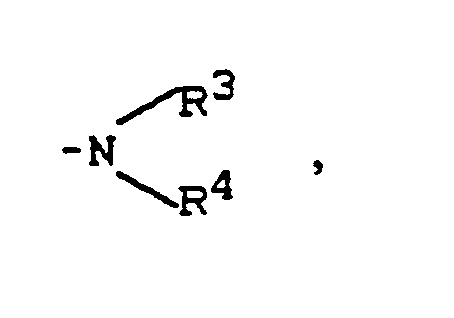
R³ und R⁴ die oben angegebene Bedeutung haben
oder
- für geradkettiges, verzweigtes oder cyclisches Alkyl oder Alkenyl mit bis zu 10 Kohlenstoffatomen steht, das substituiert sein kann durch Halogen, Aryl mit 6 bis 12 Kohlenstoffatomen, Furyl, Thienyl, Pyridyl, Pyrimidyl, Pyrazinyl, Pyridazinyl, Chinolyl, Isochinolyl, Hydroxy, Alkoxy, Alkylthio mit jeweils bis zu 6 Kohlenstoffatomen, Carboxy, Alkoxycarbonyl mit bis zu 6 Kohlenstoffatomen, Phenylsulfonyl, Tolysulfonyl oder durch eine Gruppe der Formel
R⁵ und R⁶ gleich oder verschieden sind und Wasserstoff, Alkyl mit bis zu 8 Kohlenstoffatomen, Aryl mit 6 bis 12 Kohlenstoffatomen, Aralkyl mit 7 bis 14 Kohlenstoffatomen, Acyl mit bis zu 7 Kohlenstoffatomen, Alkylsulfonyl mit bis zu 6 Kohlenstoffatomen, Phenylsulfonyl oder Tolylsulfonyl bedeuten,
oder worin
R⁵ und R⁶ gemeinsam mit dem Stickstoffatom einen Ring aus der Reihe Pyrrolidino, Piperidino, Piperazino, Morpholino oder Thiomorpholino bilden und wobei dieser Ring substituiert sein kann durch Alkyl mit bis zu 4 Kohlenstoffatomen oder durch Phenyl
und
R² - für geradkettiges, verzweigtes oder cyclisches Alkyl mit bis zu 8 Kohlenstoffatomen steht,
in welchen das Ringkohlenstoffatom 5-Stellung S-Konfiguration hat und in welchen der Substituent R¹ in 4-Stellung zum Substituenten COOR² in 5-Stelllung cis konfiguriert ist,
gefunden, das durch gekennzeichnet ist,
daß man
Diohydropyrazine der allgemeinen Formel (II)
R¹ und R² die angegebene Bedeutung haben,
und
R³ - für geradkettiges oder verzweigtes Alkyl mit bis zu 4 Kohlenstoffatomen steht,
und in welchem das Kohlenstoffatom 6 des Dihydropyrazinrings in (II) R-konfiguriert ist, das Kohlenstoffatom 3 des Dihydropyrazinrings in (II) S-konfiguriert ist, wenn R¹ die höhere Priorität hat als die Gruppe CH₂COOR² oder R-konfiguriert ist, wenn R¹ eine niedrigere Priorität hat als die Gruppe CH₂COOR²
zunächst in inerten Lösemitteln mit Säuren hydrolysiert, dann aus den entstehenden sauren Aminosäuresalzen mit Basen in inerten Lösemitteln die freien Aminosäuren herstellt und diese anschließend cyclisiert. - Verwendet man als Ausgangsstoff (3S, 6R, 1ʹS)-2,5-Dimethoxy-6-isopropyl-3-(2ʹ-methoxycarbonyl-1ʹ-phenyl)ethyl-3,6-dihydro-1,4-pyrazin, so läßt sich das Verfahren durch folgendes Schema verdeutlichen:

- Als Lösemittel eignen sich die üblichen inerten Lösemittel, die sich unter den Reaktionsbedingungen nicht verändern. Hierzu gehören bevorzugt Wasser oder Alkohole wie beispielsweise Methanol, Ethanol, Propanol oder Isopropanol, oder Ether wie beispielsweise Diethylether, Dioxan oder Tetrahydrofuran, oder Chlorkohlenwasserstoffe wie beispielsweise Methylenchlorid, Chloroform oder Tetrachlorkohlenstoff, oder aber Gemische der genannten Lösemittel.
- Als Säuren für die Hydrolyse eignen sich anorganische Säuren wie beispielsweise Chlorwasserstoffsäure, Bromwasserstoffsäure, Schwefelsäure oder Phosphorsäure, oder organische Carbon- oder Sulfonsäuren wie beispielsweise Methan-, Ethan-, Toluol- oder Benzolsulfonsäure oder Essigsäure oder Propionsäure.
- Besonders bevorzugt wird die Hydrolyse in wäßrigen oder alkoholischen Lösungen mit Chlorwasserstoff als Säure durchgeführt.
- Die Hydrolyse wird im allgemeinen bei einer Temperatur von 0°C bis +100°C, bevorzugt von +20°C bis +60°C durchgeführt.
- Im allgemeinen arbeitet man bei Normaldruck. Das Verfahren kann aber ebenso bei erhöhtem oder erniedrigtem Druck durchgeführt werden.
- Die bei der Hydrolyse anfallenden Glutaminsäuresalze können isoliert werden. Es hat sich jedoch hierbei als vorteilhaft erwiesen, die Aminosäuresalze ohne Reinigung direkt weiter zu verarbeiten.
- Zur Freisetzung der Aminosäure werden die Salze in einem inerten Lösemittel mit Basen behandelt.
- Als Lösemittel eignen sich hierbei die üblichen inerten Lösemittel, die sich unter den Reaktionsbedingungen nicht verändern. Hierzu gehören bevorzugt Wasser oder Alkohole wie beispielsweise Methanol, Ethanol, Propanol oder Isopropanol, oder Ether wie Diethylether, Dioxan oder Tetrahydrofuran, Acetonitril, Dimethylformamid oder Hexamethylphosphorsäuretriamid oder aber Gemische der genannten Lösemittel.
- Als Basen eignen sich die üblichen basischen Verbindungen. Hierzu gehören bevorzugt anorganische Basen wie Alkali- oder Erdalkalihydroxid beispielsweise Natriumhydroxid, Kaliumhydroxid, Calciumhydroxid oder Barium hydroxid, oder Alkalicarbonate wie Natriumcarbonat, Natriumhydrogencarbonat oder Kaliumcarbonat, oder Ammoniak oder von Ammoniak abgeleitete organische Amine wie Di- oder Trialkylamine beispielsweise Triethylamin oder Diisopropylamin, oder andere tertiäre Amine wie beispielsweise Pyridin, Dimethylaminopyridin, Picolin oder Lutidin.
- Bevorzugt arbeitet man in wäßrigen oder alkoholischen Lösungen mit Ammoniak oder Triethylamin als Basen.
- Die Behandlung der Aminosäuresalze mit Basen erfolgt im allgemeinen in einem Temperaturbereich von 0°C bis +100°C, bevorzugt von +20°C bis +40°C.
- Im allgemeinen arbeitet man bei Normaldruck. Ebenso ist es möglich,das Verfahren bei erhöhtem oder erniedrigtem Druck durchzuführen.
- Die freien Aminosäuren können isoliert werden. Im allgemeinen hat es sich aber als günstig erwiesen, ohne Isolierung der Aminosäure direkt weiter zu arbeiten.
- Die Cyclisierung der freien Aminosäure wird im allgemeinen ohne Lösemittel in einem Temperaturbereich von +50°C bis +200°C, bevorzugt von +70°C bis +120°C durchgeführt.
- Die Cyclisierung kann bei Normaldruck, bei erhöhtem oder bei erniedrigtem Druck durchgeführt werden. Im allgemeinen arbeitet man bei Normaldruck.
- Das erfindungsgemäße Verfahren kann beispielsweise durchgeführt werden, indem man die Dihydropyrazine mit wäßriger Salzsäure behandelt, dann die anfallenden Glutaminsäuresalze isoliert und ohne Reinigung mit wäßrigem Ammoniak behandelt, dann die freien Aminosäuren isoliert und ohne Lösemittel, beispielsweise im Kugelohr, erhitzt.
- Die als Ausgangsstoffe eingesetzten Dihydropyrazin der allgemeinen Formel II

R¹ - für Aryl mit 6 bis 14 Kohlenstoffatomen steht, das bis zu 5-fach gleich oder verschieden substituiert sein kann durch Alkyl, Alkoxy, Alkylthio mit jeweils bis zu 8 Kohlenstoffatomen, durch Aryl, Aryloxy, Arylthio mit jeweils 6 bis 12 Kohlenstoffatomen, durch Aralkyl mit 7 bis 14 Kohlenstoffatomen, durch Halogen, Trifluormethyl, Trifluormethoxy, Difluormethoxy, Trifluormethylthio, Nitro, Cyano, Carboxy, Alkoxycarbonyl mit bis zu 8 Kohlenstoffatomen, Sulfo, Phenylsulfonyl, Tolylsulfonyl, Alkylsulfonyl mit bis kzu 8 Kohlenstoffatomen, Hydroxy oder
durch eine Gruppe der Formel
R³ und R⁴ gleich oder verschieden sind und Wasserstoff, Alkyl mit bis zu 8 Kohlenstoffatomen, Aryl mit 6 bis 12 Kohlenstoffatomen, Aralkyl mit 7 bis 14 Kohlenstoffatomen, Acyl mit 2 bis 7 Kohlenstoffatomen, Alkylsulfonyl mit bis zu 6 Kohlenstoffatomen, Phenylsulfonyl oder Tolylsulfonyl bedeuten,
oder
- für einen heterocyclischen Ring der Reihe Furyl, Thienyl, Pyridyl, Pyrimidyl, Pyrazinyl, Pyridazinyl, Chinolyl oder Isochinolyl steht, wobei diese Ringe bis zu 3-fach gleich oder verschieden substituiert sein können durch Alkyl, Alkoxy, Alkylthio mit jeweils bis zu 6 Kohlenstoffatomen, Halogen, Phenyl, Nitro, Cyano oder
durch eine Gruppe der Formel
R³ und R⁴ die oben angegebene Bedeutung haben,
oder
- für geradkettiges, verzweigtes oder cyclisches Alkyl oder Alkenyl mit bis zu 10 Kohlenstoffatomen steht, das substituiert sein kann durch Halogen, Aryl mit 6 bis 12 Kohlenstoffatomen, Furyl, Thienyl, Pyridyl, Pyrimidyl, Pyrazinyl, Pyridazinyl, Chinolyl, Isochinolyl, Hydroxy, Alkoxy, Alkylthio mit jeweils bis zu 6 Kohlenstoffatomen, Carboxy, Alkoxycarbonyl mit bis zu 6 Kohlenstoffatomen, Sulfo, Alkylsulfonyl mit bis zu 6 Kohlenstoffatomen, Phenylsulfonyl, Tolysulfonyl oder
durch eine Gruppe der Formel
R⁵ und R⁶ gleich oder verschieden sind und Wasserstoff, Alkyl mit bis zu 8 Kohlenstoffatomen, Aryl mit 6 bis 12 Kohlenstoffatomen, Aralkyl mit 7 bis 14 Kohlenstoffatomen, Acyl mit bis zu 7 Kohlenstoffatomen, Alkylsulfonyl mit bis zu 6 Kohlenstoffatomen, Phenylsulfonyl oder Tolylsulfonyl bedeuten,
oder worin
R⁵und R⁶ gemeinsam mit dem Stickstoffatom einen Ring aus der Reihe Pyrrolidino, Piperidino, Piperazino, Morpholino oder Thiomorpholino bilden und wobei dieser Ring substituiert sein kann durch Alkyl mit bis zu 4 Kohlenstoffatomen oder durch Phenyl,
R² - für geradkettiges, verzweigtes oder cyclisches Alkyl mit bis zu 8 Kohlenstoffatomen steht,
und
R³ - für geradkettiges oder verzweigtes Alkyl mit bis zu 4 Kohlenstoffatomen steht,
und worin das Kohlenstoffatom 3 des Dihydropyrazinrings S-konfiguriert und das Kohlenstoffatom 6 R-konfiguriert ist, das Kohlenstoffatom 1ʹ in der Seitenkette S-konfiguriert ist, wenn R¹ die höhere Priorität hat als die Gruppe CH₂COOR² oder R-konfiguriert ist, wenn R¹ eine niedrigere Priorität hat als die Gruppe CH₂COOR²,
sind neu und können hergestellt werden,
indem man
Verbindungen der allgemeinen Formel (III)
R³ die oben angegebene Bedeutung hat und das Kohlenstoffatom 3 des Dihydropyrazinrings R-konfiguriert ist, zunächst mit einer stark basischen metallorganischen Verbindung zu den in 6-Stellung durch das Metall der metallorganischen Verbindungen monosubstituierten Derivaten von (III) umsetzt,
dann diese Metallderivate mit einem cis-substituierten Acrylester der allgemeinen Formel (IV)
R¹ und R² die oben angegebene Bedeutung haben, in inerten Lösemitteln umsetzt und anschließend mit einer Säure neutralisiert. - Aus DOS 29.34.252 ist bekannt, daß man durch Alkylieren oder Umsetzen mit Carbonylverbindungen aus Lactimethern vom Typ III enantiomerenreine 2-Aminosäuren oder Serine erhält.
- Außerdem ist bekannt [Chem. Scripta 25, 105 (1985)], daß Lactimether vom Typ (III) mit trans-substituierten α,β-ungesättigten Carbonsäureestern 2,3-threo-Aminosäuren und daraus 4,5-trans-substituierte γ-Butyrolactame liefern.
- Aufgrund der Kenntnis des Standes der Technik war nicht zu erwarten, daß cis-substituierte α,β-ungesättigte Carbonsäureester vom Typ (IV) mit Lactimethern vom Typ (III) selektiv zu den enantiomerenreinen Dihydropyrazinen des Typs (II) reagieren, die wiederum Vorstufen zu enantiomerenreinen cis-konfigurierten γ-Butyrolactamen der Formel (I) darstellen.
- Verwendet man als Ausgangsstoffe (3R)-2,5-Dimethoxy-3-isopropyl-3,6-dihydro-1,4-pyrazin und cis-Zimtsäuremethylester so läßt sich das Verfahren durch folgendes Schema verdeutlichen:

- Die als Ausgangsstoffe eingesetzten Acrylester der allgemeinen Formel (IV) sind bekannt oder können nach bekannten Methoden hergestellt werden [vgl. z.B. Houben-Weyl, "Methoden der organischen Chemie", 4. Auflage, Band 5/1b, S. 728 ff.].
- Als Lösemittel eignen sich die üblichen inerten organischen Lösemittel, die sich bei den Reaktionbedingungen nicht verändern. Hierzu gehören bevorzugt Ether wie Diethylether, Tetrahydrofuran, Dioxan, Glykolmono- oder Dimethylether, oder Amide wie Dimethylformamid, Hexamethylphosphorsäuretriamid, Dimethylacetamid, oder Dimethylsulfoxid. Ebenso ist es möglich, Gemische der genannten Lösemittel einzusetzen.
- Als stark basische metallorganische Verbindungen eignen sich die üblichen alkalimetallorganischen Verbindungen. Hierzu gehören bevorzugt Alkalialkoholate wie Natriummethylat, Kaliummethylat, Natriumethylat, Kaliumethylat oder Kalium-tert-butylat, oder lithiumorganische Verbindungen wie n-, iso-, oder tert-Butyllithium oder nyllithium, oder Alkaliamide wie beispielsweise Natriumamid, Lithiumdiisopropylamid, Lithiumtetramethylpiperidid oder Natrium-bis-(trimethylsilyl)amid.
- Als Säuren zum Neutralisieren eignen sich die üblichen anorganischen oder organischen Säuren. Hierzu gehören bevorzugt anorganische Säuren wie Salzsäure, Bromwasserstoffsäure, Schwefelsäure oder Phosphorsäure oder organische Carbon- oder Sulfonsäuren wie Essigsäure, Propionsäure, Weinsäure oder Zitronensäure, Methan- oder Ethansulfonsäure.
- Das Verfahren wird im allgemeinen in einem Temperaturbereich von -80°C bis 0°C, bevorzugt von -70°C bis -20°C durchgeführt.
- Das Verfahren wird im allgemeinen bei Normaldruck durchgeführt. Ebenso ist es möglich bei erhöhtem oder erniedrigtem Druck zu arbeiten.
- Verwendet man statt des an Kohlenstoffatom 3 R-konfigurierten 2,5-Dimethoxy-3-isopropyl-3,6-dihydro-1,4-pyrazins das entsprechende S-Enantiomere als Ausgangsmaterial, so entstehen die Verbindungen II mit (6S), (3R), (1ʹR) Konfiguration.
- Die erfindungsgemäßen enantiomerenreine 4,5-disubstituierte γ=Butyrolactame der Formel (I) sind wertvolle Zwischenprodukte für pharmazeutische Wirkstoffe.
- Es ist beispielsweise aus EP 172 514 bekannt, daß Clausenamid [(±) (3S*), (4R*), (5R*), (7S*)-3-Hydroxy-α-hydroxybenzyl-1-methyl-4-phenyl-pyrrolidin-2-on] welches aus dem wäßrigen Extrakt von Clausena lansium (lour) Skeels isoliert wird, ein Racemat ist. Mit Hilfe der erfindungsgemäßen enantiomerenreinen 4,5-disubstituierten γ-Butyrolactamen (I) ist es nun möglich (+) (3R), (4S), (5S), (7R)-3-Hydroxy-5-α-hydroxybenzyl-1-methyl-4-phenyl-pyrrolidin-2-on sowie Derivate in enantiomerenreiner Form zu synthetisieren.
- Die Reduktion der Verbindung der Formel (IX) zu Verbindungen der Formel (X) in Schritt [C] erfolgt nach der gleichen Methode und unter den gleichen Bedingungen wie bereits für die Reduktion der Verbindungen (V) zu den Verbindungen (IIb) angegeben ist.
- Die Oxidation von Verbindungen der Formel (X) zu Verbindungen der Formel (III) in Schritt [D] erfolgt nach den gleichen Methoden und unter den gleichen Bedingungen wie bereits für die Oxidation von Verbindungen der Formel (IIa) zu Verbindungen der Formel (V) angegeben ist.
- Die Ausgangsverbindungen der Formel (VI) sind literaturbekannt oder können nach literaturbekannten Methoden hergestellt werden [G.H. Cocolas, W.H. Hartung, J. Am. Chem. Soc. 79, 5203 (1957); F. Zymalkowski, P. Pachaly, Chem. Ber. 100, 1137 (1967)].
- (+)-Clausenamid hatte in Tierversuchen eine ausgeprägte vor cerebraler Hypoxie schützende und antiamnästische Wirkung, die signifikant stärker ist als diejenige von Piracetam, das die strukturell am engsten verwandte Verbindung auf dem Gebiet cerebraler Therapeutika und Nootropika ist.

- Bei hohen Dosierungen zeigten Tiere keine signifikanten Änderungen ihres Verhaltens. Der Effekt des Schutzes vor Hypoxie wird demgemäß offenbar nicht durch eine unspezifische Sedierung verursacht, die einen verringerten Sauerstoffbedarf auslösen würde. Es wurde gefunden, daß die akute Toxizität der Verbindung sehr niedrig ist.
- Zur vorliegenden Erfindung gehören pharmazeutische Zubereitungen, die neben nichttoxischen, inerten pharmazeutisch geeigneten Trägerstoffen die erfindungsgemäße Verbindung enthalten oder die aus dem erfindungsgemäßen Wirkstoff bestehen sowie Verfahren zur Herstellung dieser Zubereitungen.
- Unter nichttoxischen, inerten pharmazeutisch geeigneten Trägerstoffen sind feste, halbfeste oder flüssige Verdünnungsmittel, Füllstoffe oder Formulierungshilfsmittel jeder Art zu verstehen.
- Als bevorzugte pharmazeutische Zubereitungen seien Tabletten, Dragees, Kapseln, Pillen, Granulate, Suppositorien, Lösungen, Suspensionen und Emulsionen, Pasten, Salben, Gele, Cremes, Lotions, Puder und Sprays genannt.
- Tabletten, Dragees, Kapseln, Pillen und Granulate können den oder die Wirkstoffe neben den üblichen Trägerstoffen enthalten, wie (a) Füll- und Streckmittel, z.B. Stärke, Milchzucker, Rohrzucker, Glukose, Mannit und Kieselsäure, (b) Bindemittel, z.B. Carboxymethylcellulose, Alginate, Gelatine, Polyvinylpyrrolidon, (c) Feuchthaltemittel, z.B. Glycerin, (d) Sprengmittel, z.B. Agar-Agar, Calciumcarbonat und Natriumcarbonat, (e) Lösungsverzögerer, z.B. Paraffin und (f) Resorptionsbeschleuniger, z.B. quarternäre Ammoniumverbindungen, (g) Netzmittel, z.B. Cetylalkohol, Glycerinmonostearat, (h) Adsorptionsmittel, z.B. Kaolin und Bentonit und (i) Gleitmittel, z.B. Talkum, Calcium-und Magnesiumstearat und feste Polyethylenglykole oder Gemische der unter (a) bis (i) aufgeführten Stoffe.
- Die Tabletten, Dragees, Kapseln, Pillen und Granulate können mit den üblichen gegebenenfalls Opakisierungsmittel enthaltenden Überzügen und Hüllen versehen sein und auch so zusammengesetzt sein, daß sie den Wirkstoff nur oder bevorzugt in einem bestimmten Teil des Intestinaltraktes gegebenenfalls verzögert abgeben, wobei als Einbettungsmassen z.B. Polymersubstanzen und Wachse verwendet werden können.
- Der Wirkstoff kann gegebenenfalls mit einem oder mehreren der oben angegebenen Trägerstoffe auch in mikroverkapselter Form vorliegen.
- Suppositorien können neben dem Wirkstoff die üblichen wasserlöslichen oder wasserunlöslichen Trägerstoffen enthalten, z.B. Polyethylenglykole, Fette, z.B. Kakaofett und höhere Ester (z.B. C₁₄-Alkohol mit C₁₆-Fettsäure) oder Gemische dieser Stoffe.
- Salben, Pasten, Cremes und Gele können neben dem Wirkstoff die üblichen Trägerstoffe enthalten, z.B. tierische und pflanzliche Fette, Wachse, Paraffine, Stärke, Tragant, Cellulosederivate, Polyethylenglykole, Silicone, Bentonite, Kieselsäure, Talkum und Zinkoxid oder Gemische dieser Stoffe.
- Puder und Sprays können neben dem Wirkstoff die üblichen Trägerstoffe enthalten, z.B. Milchzucker, Talkum, Kieselsäure, Aluminiumhydroxid, Calciumsilikat und Polyamidpulver oder Gemische dieser Stoffe. Sprays können zusätzlich die üblichen Treibmittel, z.B. Chlorfluorkohlenwasserstoffe enthalten.
- Lösungen und Emulsionen können neben dem Wirkstoff die üblichen Trägerstoffe wie Lösungsmittel, Lösungsvermittler und Emulgatoren, z.B. Wasser, Ethylalkohol, Isopropylalkohol, Ethylcarbonat, Ethylacetat, Benzylalkohol, Dimethylformamid, Öle, insbesondere Baumwollsaatöl, Erdnußöl, Maiskeimöl, Olivenöl, Ricinusöl und Sesamöl, Glycerin, Glycerinformal, Tetrahydrofurfurylalkohol, Polyethylenglykole und Fettsäureester des Sorbitans oder Gemische dieser Stoffe enthalten.
- Zur parenteralen Applikation können die Lösungen und Emulsionen auch in steriler und blutisotonischer Form vorliegen.
- Suspensionen können neben dem Wirkstoff die üblichen Trägerstoffe wie flüssige Verdünnungsmittel, z.B. Wasser, Ethylalkohol, Propylenglykol, Suspendiermittel, z.B. ethoxylierte Isostearylalkohole, Polyoxy ethylensorbit- und Sorbitanester, mikrokristalline Cellulose, Aluminiummetahydroxid, Bentonit, Agar-Agar und Tragant oder Gemische dieser Stoffe enthalten.
- Die genannten Formulierungsformen können auch Färbemittel, Konservierungsstoffe sowie geruchs- und geschmacksverbessernde Zusätze, z. B. Pfefferminzöl und Eukalyptusöl und Süßmittel, z.B. Saccharin, enthalten.
- Die therapeutisch wirksame Verbindung soll in den oben aufgeführen pharmazeutischen Zubereitungen vorzugsweise in einer Konzentration von etwa 0,1 bis 99,5, vorzugsweise von etwa 0,5 bis 95 Gewichstsprozent der Gesamtmischung vorhanden sein.
- Die oben aufgeführten pharmazeutischen Zubereitungen können außer der erfindungsgemäßen Verbindung auch weitere pharmazeutische Wirkstoffe enthalten.
- Die Herstellung der oben aufgeführten pharmazeutischen Zubereitungen erfolgt in üblicher Weise nach bekannten Methoden, z.B. durch Mischen des oder der Wirkstoffe mit dem oder den Trägerstoffen.
- Im allgemeinen hat es sich als vorteilhaft erwiesen, bei intravenöser Applikation Mengen von etwa 0,001 bis 1 mg/kg, vorzugsweise etwa 0,01 bis 0,5 mg/kg Körpergewicht zur Erzielung wirksamer Ergebnisse zu verabreichen, und bei oraler Applikation beträgt die Dosierung etwa 0,01 bis 20 mg/kg, vorzugsweise 0,1 bis 10 mg/kg Körpergewicht.
- Trotzdem kann es gegebenenfalls erforderlich sein, von den genannten Mengen abzuweichen, und zwar in Abhängigkeit vom Körpergewicht bzw. der Art des Applikationsweges, vom individuellen Verhalten gegenüber dem Medikament, der dessen Formulierung und dem Zeitpunkt bzw. Intervall, zu welchen die Verabreichung erfolgt. So kann es in einigen Fällen ausreichend sein, mit weniger als der vorgenannten Mindestmenge auszukommen, während in anderen Fällen die genannte obere Grenze überschritten werden muß. Im Falle der Applikation größer Mengen kann es empfehlenswert sein, diese in mehreren Einzelgaben über den Tag zu verteilen.
- Verwendet man Verbindungen der Formel I mit (4R) , (5R)-Konfiguration, die sich aus Verbindungen II mit (6S), (3R), (1ʹR)-Konfiguration herstellen lassen, als Ausgangsmaterial, so erhält man (-) (3S), (4R), (5R), (7S)-3-Hydroxy-5-α-hydroxybenxyl-1-methyl-4-phenyl-pyrrolidin-2-on.
- So kann beispielsweise die Synthese von (+) (3S), (4R), (5R), (7S)-3-Hydroxy-5-α-hydroxybenxyl-1-methyl-4-phenyl-pyrrolidin-2-on aus dem erfindungsgemäßen, wie beschrieben hergestellten (4S,5S)-5-Methoxycarbonyl-4-phenyl-pyrrolidin-2-on) gemäß folgendem Schema durchgeführt werden:

- Danach wird im Schritt [A] (4S,5S)-5-Methoxycarbonyl-4-phenyl-pyrrolidin-2-on (V) mit einem Methylierungsmittel wie beispielsweise Methylbromid, Methyliodid, Methyl-p- toluolsulfonat, Diazomethan oder Dimethylsulfat gegebenenfalls in Anwesenheit einer Base wie Natrium, Natriumhydrid, Natriumamid, Butyllithium oder Lithiumdiisopropylamid in geeigneten Lösungsmitteln, wie Diethylether, Tetrahydrofuran, Dimethylformamid, Hexamethylphosphorsäuretriamid oder Gemische der Lösungsmittel bei Temperaturen von -20°C bi +80°C, bevorzugt von 0°C bis +40°C methyliert. Besonders bevorzugt wird die Methylierung in Schritt [A] mit Methyliodid in einem Gemisch Tetrahydrofuran und Hexamethylphosphorsäuretriamid in Anwesenheit von Lithiumdiisopropylamid als Base durchgeführt.
- Die Reduktion von (VI) zu (4S, 5S)-5-Hydroxymethyl-1-methyl-4-phenylpyrrolidin-2-on (VII) in Schritt [B] wird bevorzugt mit komplexen Metallhydriden wie beispielsweise Lithium-hydrido-triethyl-borat, Lithium-hydrido-tris(1-methylpropyl)borat oder Natriumborhydrid in inerten Lösungsmitteln wie Ethern beispielsweise Diethylether, Tetrahydrofuran oder Dioxan bei Temperaturen von -30°C bis +10°C, bevorzugt von -20°C bis 0°C durchgeführt.
- Die Oxidation von (VII) zu (4S,5S)-5-Formyl-1-methyl-4-phenyl-pyrrolidin-2-on (VIII) in Schritt [C] wird mit Dimethylsulfoxid als Oxidationsmittel unter Zusatz von Trifluoracetanhydrid in Chlorkohlenwasserstoffen wie beispielsweise Dichlormethan oder Chloroform, oder in Ethern wie Diethylether, Dioxan oder Tetrahydrofuran bei Temperaturen von -80°C bis 0°C, bevorzugt von -60°C bis 0°C durchgeführt.
- In Schritt [D] wird die Formylverbindung (VIII) in geeigneten Lösungsmitteln wie Ether beispielsweise Diethylether oder Tetrahydrofuran in einem Temperaturbereich von -20°C bis +50°C, bevorzugt von -10°C bis +30°C mit Phenylmagnesiumbromid zu (4S, 5S, 7S)-5-Hydroxymethylphenyl-1-methyl-4-phenylpyrrolidin-1-on (IX) umgesetzt.
- Die Oxidation von (IX) zu (4S, 5S)-5-Benzoyl-1-methyl-4-phenylpyrrolidin-2-on (X) in Schritt [E] erfolgt unter den gleichen Bedingungen wie sie bereits für die Oxidation von (VII) zu (VIII) in Schritt [C] angegeben sind.
- Die Reduktion von (X) zu (4S, 5S, 7R)-5-Hydroxymethylphenyl-1-methyl-4-phenylpyrrolidin-2-on (XI) in Schritt [F] erfolgt unter den gleichen Bedingungen wie sie bereits für die Reduktion von (VI) zu (VII) in Schritt [B] angegeben sind.
- Die Hydroxylierung von (XI) zu (+)-(3R,4S,5S,7R)-3-Hydroxy-5-hydroxymethylphenyl-1-methyl-4-phenylpyrrolidin-2-on [(+)-Clausenamid] (XII) in Schritt [G] beschrieben, wird mit Oxidationsmittel wie Molybdänperoxidihyd-Pyridin oder Sauerstoff in Anwesenheit von Phosphiten wie Trialkylphosphite beispielsweise Trimethylphosphit, Triethylphosphit oder Tripropylphosphit, sowie in Anwesenheit von Basen, beispielsweise metallorganischen Basen wie Lithiumdiisopropylamid oder Butyllithium in inerten organischen Lösemitteln wie Ethern, beispielsweise Diethylether oder Tetrahydrofuran, oder Hexamethylphosphorsäuretriamid oder Gemische derselben in einem Temperaturbereich von -80°C bis 0°C durchgeführt.
-

- Die Lösung von 20 g (108,4 mmol) (3R)-2,5-Dimethoxy-3-isopropyl-3,6-dihydro-1,4-pyrazin in 120 ml abs. Tetrahydrofuran kühlte man auf -70°C und gab unter N₂-Atmosphäre 70 ml (108,4 mmol) einer 1,6 N Lösung von n-Butyllithium in Hexan zu. Man rührte 10 min bei dieser Temperatur und gab die Lösung von 19,36 g (119,2 mmol) cis-Zimtsäuremethylester in 60 ml abs. THF zu. Man rührte 12 h bei -70°C und 1 h bei -20°C, gab 6,83 ml (108,4 mmol) Eisessig, gelöst in 10 ml abs. THF zu, ließ auf Raumtemperatur kommen und goß die Reaktionsmischung auf 300 ml Eiswasser. Man extrahierte dreimal mit je 150 ml Essigester, trocknete die vereinigten organischen Extrakte über MgSO₄, filtrierte und zog das Solvens i. Vak. ab. Man erhielt 33.1 g (88% der Theorie) der rohen Titelverbindung als hellgelbes Öl. Flash-Chromatographie an Kieselgel (Amicon, Korngröße 20-45 µm; Eluens: Toluol / Essigester = 20/1) lieferte neben 4,9 g (13% der Theorie) des 6R,3S,1ʹR-Isomeren [Rf(Toluol : Essigester = 9:1) = 0,36] 27,4 g (73% der Theorie) der reinen Titelverbindung mit Rf (Toluol : Essigester = 9:1) = 0,46 als schwach gelbes Öl. ¹H-NMR (CDCl₃, 250 MHZ): δ = 0.57 und 0,89 (je d, J=6,9 Hz, (CH₃)₂C, 2H); 2,1 (m; (CH₃)₂CH, 1H); ABM-Signal (δA=2,91, δB=3,18, JAB=15,6 Hz, JAM=JBM=6,8 Hz, 2H, 2ʹ-H); 3,08 (t, J=3,1 Hz, 1H, C(3)-H); 3,61, 3,65 und 3,72 (je s, je 3H, OCH₃); 3,9 (dt, J=6,8 Hz, J=3,1 Hz, 1H, C(1ʹ)-H); 4,34 (t, J=3,1 Hz, 1H, C(6)-H); 7,0 - 7,25 (m, 5H, Aromaten-H).
MS: M⁺ 347
C₁₉H₂₆N₂O₄ (346.4) Ber.: C 65,9 H 7,6 N 8,1
ef.: C 66,5 H 7,7 N 8,0
-
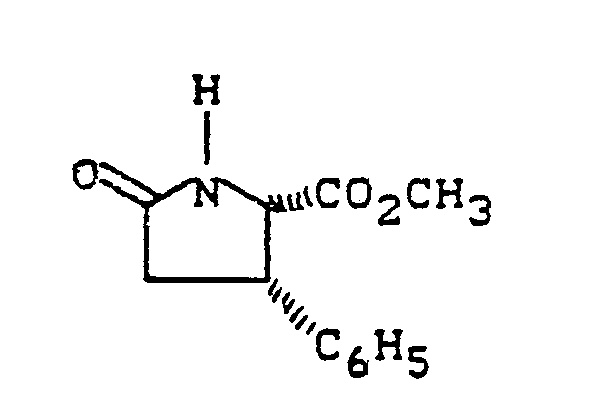
- 13,7 g (39,5 mmol) der Verbindung aus Beispiel 1 wurden in 317 ml 0,25 N Salzsäure 48 h kräftig gerührt. Man extrahierte dreimal mit je 100 ml Diethylether (Zurückgewinnung von Ausgangsmaterial). Die wäßrige Lösung wurde lyophilisiert, der verbleibende Rückstand in 5 ml Wasser suspendiert und mit ca. 2,8 ml konz. Ammoniak auf pH=10 eingestellt. Man extrahierte fünfmal mit je 100 ml Essigsäureethylester unter Zusatz von NaCl bis zur Sättigung, trocknete über MgSO₄ und zog das Solvens i. Vak. ab. Das rohe Aminosäureestergemisch wurde am Kugelrohr 10 h bei 100°C/0,1 Torr gehalten. Man erhielt als Rückstand 5 g (58% der Theorie) der Titelverbindung mit |α|= 209,05 (c=0,54, MeOH); Rf = 0,20 (Essigester) ¹H-NMR (CDCl₃, 200 mHz): δ = 2,78 (dd, J=7,5 Hz, J=2 Hz, 2H, C(3)-H); 3,30 (s, 3H, OCH₃); 3,99 (q, J=7,5 Hz, 1H, C(4)-H); 4,58 (d, J=7,5 Hz, 1H, C(5)-H); 6,85 (br, 1H, NH); 7,19 - 7,35 (m, 5H, C₆H₅).

(C₁₂H₁₃NO₃, 219,24) Ber.: C 65,7 H 6,0 N 6,4
Gef.: C 65,5 H 6,1 N 6,4
-

- 5 g (22,8 mmol) der Titelverbindung des Beispiels 2 wurden in 50 ml abs. Tetrahydrofuran und 15 ml abs. Hexamethylphosphorsäuretriamid im trockenen ausgeheizten Kolben unter N₂-Atmossphäre gelöst und auf -70°C gekühlt. Man tropfte bei dieser Temperatur die Lösung von 25,1 mmol Lithiumdiisopropylamid in THF/Hexan zu (hergestellt aus 15,7 ml 1,55 N BuLi in Hexan und 3,5 ml Diisopropylamin, in 15 ml THF), rührte 20 min bei dieser Temperatur nach und tropfte die Lösung von 4,2 ml (0,114 mol) Methyliodid in 5 ml abs. THF zu, ließ 1 h bei -70°C rühren und ließ innerhalb von 30 min. auf Raumtemperatur kommen. Sobald alles Startmaterial umgesetzt war (DC-Kontrolle) goß man die Reaktionsmischung auf 200 ml Phosphatpuffer (pH=7, pH-Kontrolle) und extrahierte viermal mit je 100 ml Essigester (zum Schluß unter Kochsalz-Zu satz). Trocknen (MgSO₄) und Einrotieren lieferte die rohe Titelverbindung, die über Kieselgel mit Essigester filtriert wurde. Man erhielt 5,05 g (94,6% der Theorie) der reinen Titelverbindung als farblosen Festkörper mit Rf = 0,3 (Essigester) und |α|= 205,95 (c=0,38, MeOH) und Schmp.: 100°C IR (KBr): δ = 1736, 1690 cm⁻¹

¹H-NMR (250 MHz, CDCl₃): δ = ABX-Signal (δa = 2,70, δB = 2,95, JAB = 17,5 Hz, JAX = 10 Hz, JBX = 11 Hz, 2H, C(3)-H); 2,89 (s, 3H, N-CH₃); 3,30 (s, 3H, OCH₃); 3,91 (q, J=10 Hz, 1H, C(4)-H); 4,39 (d, J=9-10 Hz, 1H, C(5)-H); 7,18 - 7,38 (m, 5H, C₆H₅).
C₁₃H₁₅NO₃ (233,27) Ber.: C 66,9 H 6,5 N 6,0
Gef.: C 67,1 H 6,5 N 6,0
-

- Zur Lösung von 3 g (12,8 mmol) der Titelverbindung aus Beispiel 3 in 33 ml abs. Tetrahydrofuran tropfte man bei -15 bis -20°C unter N₂-Atmosphäre 25,6 mmol Li B(Et)₃H (als 1 M-Lösung in THF, 25,6 ml). Man ließ 1 h bei -20°C und 1 h bei 0°C nachrühren, goß die Raktionsmischung in ca. 200 ml eiskalte 2 N-Salzsäure, rührte 30 min. kräftig durch und extrahierte zweimal mit je 200 ml Essig ester. Man sättigte die wäßrige Phase mit Kochsalz und extrahierte nochmals zweimal mit je 200 ml Essigester. Die gesammelten organischen Extrakte wurden mit wenig Wasser gewaschen, über MgSO₄ getrocknet und einrotiert. Der Rückstand wurde mit wenig Ether zur Kristallisation gebracht und anschließend mit Pentan ausgefällt, bis an der Eintropfstelle keine Trübung mehr zu beobachten war. Nach Absaugen und Trocknen erhielt man 2,07 g (79% der Theorie) der Titelverbindung mit Schmp.: 93-95°C. IR (KBr): γ = 3324, 1687 cm⁻¹.
¹H-NMR CDCl₃, 300 MHz): δ = AB-Teil von ABM System, δA = 2,59, δB = 2,97 (je dd, JAB = 15 Hz, JAM = 7,5 Hz, JBM = 9 Hz, 2H, C(3)-H); 2,97 (s, 3H, N-CH₃); AB-Teil von ABM System, δA = 3,36, δB = 3,62 (je dd, JAB = 11,2 Hz, JAM = JBM = 3 hz, 2H, C(7)-H); 3,72 - 3,85 (m, 2H, C(4)-H, C(5)-H); 7,32 (m, 5H, C₆H₅).
CV₁₂H₁₅NO₂ (205,26) Ber.: C 70,2 H 7,4 N 6,8
Gef.: C 70,0 H 7,4 N 6,8
-

- Zur Lösung von 1,9 ml (28 mmol) abs. Dimethylsulfoxid in 14 ml abs. Dichlormethan tropfte man unter N₂-Atmosphäre innerhalb 10 min. bei -60°C die Lösung von 2,97 ml Trifluoracetanhydrid in 5,6 ml abs. Dichlormethan. Man ließ 15 min. bei dieser Temperatur rühren und tropfte die Lösung von 2,9 g (14 mmol) der Titelverbindung aus Beispiel 4 in 25 ml Dichlormethan so zu, daß die Temperatur -60°C nicht überstieg. Man ließ 90 min. bei -60°C nachrühren, erwärmte kurz auf -30°C (5-10 min.) und kühlte wieder auf -60°C ab. Man gab langsam bei dieser Temperatur 5,6 ml abs. Triethylamin zu, ließ 30 min. bei -60°C rühren und erwärmte auf Raumtemperatur. Man gab 60 ml Wasser zu, trennte die Phasen und extrahierte die wäßrige Phase dreimal mit je 25 ml Dichlormethan. Die gesammelten organischen Extrakte wurden zweimal mit je 300 ml Wasser gewaschen, über Magnesiumsulfat getrocknet und extrahiert. Man erhielt 2,83 g (100% der Theorie) der Titelverbindung mit Rf = 0,25 (Essigester) (nach ¹H-NMR-Spektrum zu 91% rein). Das so erhaltene Rohprodukt wurde nach Trocknung (24 h, HV) direkt weiter umgesetzt. IR (CHCl₃): ν = 1734, 1689 cm⁻¹
¹H-NMR (300 MHz, CDCl₃): δ = 2,79 (dd, J=5,3 Hz, J=9,7 Hz, 2H, C(3)-H); 2,91 (s, 3H,N-CH₃); 4,02 (q, J=9,7 Hz, 1H, C(4)-H); 4,30 (dd, J=1 Hz, J=9,7 Hz, 1H, C(5)-H); 7,3 (m, 5H, C₆H₅); 9,17 (d, J=1 Hz, 1H, CHO).
-

- Zu 0,39 g Mg-Späne tropfte man unter N₂ die Lösung von 2,48 g (1,67 ml, 0,0156 mol) Brombenzol in 4,4 ml abs. Tetrahydrofuran so zu, daß das THF gelinde siedete. Man gab anschließend 10 ml abs. THF zu und erhitzte unter Rückfluß zum Sieden bis alles Magnesium gelöst war (1-2 h).
- Man kühlte auf 0°C und tropfte unter kräftigem Rühren die Lösung von 2,47 gl (0,012 mol) der Titelverbindung aus Beispiel 5 in 25 ml abs. THF so zu, daß die Temperatur 5°C nicht überstieg. Gegebenenfalls mußte abs. THF zur besseren Rührfähigkeit zugegeben werden. Man rührte anschließend 1 h bei 0 - 5°C und goß die Reaktionsmischung auf 35 ml 0,5 N HCl-Eis und extrahierte viermal mit je 30 ml Essigester und zweimal mit je 30 ml Dichlormethan. Die gesammelten Essigester- und Dichlormethan-Extrakte wurden (getrennt !) zweimal mit je 20 ml Wasser gewaschen, vereinigt und über Magnesiumsulfat getrocknet. Der nach Abziehen des Solvens (i.Vak.) verbleibende Rückstand wurde mit 10 ml Ether bis zur Kristallisation verrieben. Anschließend gab man 50 ml Pentan langsam zu und ließ über Nacht im Kühlschrank stehen. Absaugen des Festkörpers ergab 2,5 g (74,3% der Theorie) der Titelverbindung mit Schmp.: 210-212°C |α|= 173.1 (c=0,5, MeOH)

IR (KBr): ν = 3362 (br), 1654 cm⁻¹
¹H-NMR (300 MHz, d₆-DMSO): δ = 2,21 (s, 3H, NCH₃); 2,24 (dd, A-Teil vom ABM-System, JAB=15,7 Hz, JAM=9,4 Hz, 1H, cis-C(3)-H); 3,05 (dd, B-Teil vom ABM-System, JBM=12,7 Hz, 1H, trans-C(3)-H); 3,80 (dt, M-Teil vom ABM-System, JAM=9,4 Hz, JB=12,7 Hz, J4,5=8,5 Hz, 1H, C(4)-H); 4,15 (dd, J=8,5 hz, J=1 Hz, 1H, C(5)-H); 4,26 (dd, J=6 Hz, J=1 Hz, 1H, C(7)-H); 5,35 (d, J=6 Hz, 1H, OH); 7,15 - 7,5 (m, 10H, C₆H₅).
C₁₈H₁₉NO₂ (281,4) Ber.: C 76,8 H 6,8
Gef.: C 76,5 H 6,8
-

- Zur Lösung von 1,2 ml (0,0171 mol) abs. Dimethylsulfoxid in 8,7 ml abs. Dichlormethan tropfte man unter N₂-Atmosphäre innerhalb 10 min. bei -60°C die Lösung von 1,8 ml Trifluoracetanhydrid in 34 ml abs. Dichlormethan. Man ließ 15 min. bei dieser Temperatur nachrühren und tropfte die Lösung von 2,4 g (0,0085 mol) der Titelverbindung aus Beispiel 6 in ca. 70 ml abs. Dichlormethan so zu, daß die Temperatur -60°C nicht überstieg. Man ließ 90 min. bei -60°C nachrühren, erwärmte kurz auf -30°C (9-10 min.) und kühlte wieder auf -60°C ab. Man gab langsam bei dieser Temperatur 3,4 ml Triethylamin zu, ließ 20 min. bei -60°C rühren und erwärmte auf Raumtemperatur. Man gab 37 ml Wasser zu, trennte die Phasen und extrahierte die wäßrige Phase dreimal mit je 25 ml Dichlormethan. Die vereinigten organischen Extrakte wurden zweimal mit je 30 ml Wasser gewaschen, über Magnesiumsulfat getrocknet und einrotiert. Der Rückstand wurde zweimal mit je 20 ml Ether abrotiert. Man erhielt 2,3 g (100% der Theorie) der Titelverbindung als Festkörper mit Schmp.: 115-116°C und Rf = 0,25 (Essigester). Das Rohprodukt, das nach ¹H-NMR-Spektrum rein war, wurde direkt weiter umgesetzt. IR (KBr): ν = 1695, 1682 cm⁻¹
¹H-NMR (300 MHz, CDCl₃): δ = 2,78 und 2,91 (AB-Teil vom ABM-Spektrkum, JAB=16,5 Hz, JAM=JBM=8,3 Hz, 2H, C(3)-H); 2,88 (s, 3H, N-CH₃); 4,02 (q, J=8,3 Hz, 1H, C(4)-H); 5,42 (d, J=8,3 Hz, 1H, C(5)-H); 7,0, 7,21, 7,59, 7,50 (je m, 10H, C₆H₅).
-

- Zur Lösung von 2,3 g (8,2 mmol) der Titelverbindung aus Beispiel 7 in 20 bis 27 ml abs. Tetrahydrofuran tropfte man bei -15°C bis -20°C unter N₂-Atmophäre 8,3 mmol Li B(Et)₃J (8,3 ml einer 1 M-Lösung in THF). Man ließ 1 h bei 0°C nachrühren, goß die Reaktionsmischung in 10 ml eiskalte 1 N HCl und extrahierte zweimal mit je 20 ml Essigester. Man sättigte die wäßrige Phase mit Kochsalz und extrahierte nochmals zweimal mit je 20 ml Essigester. Die vereinigten organischen Extrakte wurden über MgSO₄ getrocknet und einrotiert. Den Rückstand löste man in Dichlormethan und wusch zweimal mit je 10 ml Wasser. Die oragnische Phase wurde getrocknet (MgSO₄) und einrotiert. Der Rückstand wurde mit 10 ml Ether zur Kristallisation gebracht und anschließend langsam unter Rühren mit Pentan versetzt bis an der Eintropfstelle keine Trübung mehr zu beobachten war. Der Niederschlag wurde abgesaugt und getrocknet. Man erhielt 1,6 g (72% der Theorie) der Titelverbindung mit Schmp.: 189-195°C. Das Produkt ist nach ¹H-NMR zu 95% rein und wurde direkt weiter umgesetzt.
Zur Analyse wurde aus Aceton umkristallisiert (Schmp.: 197-8°C). IR (KBr): ν = 3251, 1692 cm⁻¹.
¹H-NMR (300 MHz, DMSO): δ = 1,97 und 2,05 (ABM-Signal, J JAB=13,5 Hz, JAM=8,2 Hz, JBM=13 Hz, 2H, C(3)-H); 2,91 (s, 3H, N-CH₃); 3,82 (dt, JAM=J4,5=8,2 Hz, JBM=13 Hz, 1H, C(4)-H); 4,27 (dd, J=8,2 Hz, J=1,5 Hz, 1H, C(5)-H); 4,65 (dd, J=1,5 Hz, J=3,5 Hz, 1H, C(7)-H); 5,34 (d, J=3,5 Hz, 1H, C-(7)- OH); 6,70, 7,11, 7,25 (je m, 10H, C₆H₅).
C₁₈H₁₉NO₂ (281,4) Ber.: C 76,8 H 6,8 N 5,0
Gef.: C 77,0 H 6,9 N 5,0
-
- soviel Pentan zu, bis an der Eintropfstelle keine Trübung mehr zu beobachten war. Man ließ über Nacht im Kühlschrank stehen und saugte ab. Man erhielt ca. 0,4 g eines rohen Festkörpers, der neben der Titelverbindung ca. 35 - 40% Ausgangsmaterial enthielt. Zur Reinigung wurde zweimal aus Methanol umkristallisiert. Man erhält dann die Titelverbindung in ca. 95% Reinheit. Verlustfreier und mit Rückgewinnung des reinen Ausgangsmaterials verläuft die Chromatographie über Aluminiumhydroxid (neutral). Hierzu wird das Rohprodukt auf Kieselgel aufgezogen (Lösen in MeOH in der Wärme, Zugabe von fünf Gewichtsteilen Kieselgel, Einrotieren und mehrfaches Abrotieren mit Essigester, bis ein staubtrockenes MeOH-freies Produkt resultiert). Das Adsorbat wird auf eine Säule mit Al₂O₃ (neutrak, 50 Gewichtsteile) gegeben und mit Essigester zunächst das Ausgangsmaterial eluiert (flash-Chromatographie, Kontrolle mit DC und analyt. HPLC). Anschließend eluiert man die Titelverbindung mit Essigester/Methanol-Gemischen (40/1, 20/1, dann 10/1). Man kristallisierte mit Ether, rührte mit Wasser aus, saugte ab und erhielt nach Trocknung im HV (30-40°C, 24 h) 0,22 g (46,1% der Theorie) (+)-Clausenamid (Hydrat enthält 1/4 Mol H₂O) mit 152-3°C. (auth. (±) - Clausenamid: 236-7°C). Reinheit ca. 98% (nach ¹H-NMR, enthält ca. 2% Ausgangsmaterial). 0,1 g des reinen Ausgangsmaterial konnten zurückgewonnen werden. |α|= + 123,19 (C = 0,46, DMSO/H₂O = 9/1 Vol-%)

IR (KBr): γ = 3402, 3321, 1689 cm⁻¹.
¹H-NMR (300 MHz, DMSO): δ = 3,01 (s, 3H, N-CH₃); 3,50 (dd, J=8 Hz, J=10,5 Hz, 1H, C(4)-H); 3,82 (dd, J=10 Hz, J=7 Hz, 1H, C(3)-H); 4,30 (dd, J=8 Hz,

- In einem i.Vak. ausgeheizten und mit Reinststickstoff belüfteten Kolben gab man die Lösung von 0,44 g (1,57 mmol) der Titelverbindung aus Beispiel 8 in 12,25 ml abs. Tetrahydrofuran und 3,25 ml abs. Hexamethylphosphorsäuretriamid und kühlte auf -70°C. Bei dieser Temperatur tropfte man die Lösung von 0,0038 mol Lithiumdiisopropylamid in 4,5 ml abs. THF/Hexan zu (hergestellt aus 0,553 ml Diisopropylamin in 2ml THF durch Zugabe von 2,6 ml einer 1,5 N-Lösung von n-Butyllithium in Hexan bei -20 °C bis 0 °C). Man rührte 1 h bei -70 °C bis -60 °C nach, gab 0,13 ml frisch dest. Trimethylphosphit (gelöst in wenig abs. Tetrahydrofuran) zu und leitete (über H₂SO₄ und P₄O₁₀ getrockneten) abs. Sauerstoff ein (50 - 100 ml/min). Sobald nach DC-Kontrolle (SiO₂; EE/MeOH : 2/1; Rf=0,3 für Titelverbindung, Rf=0,37 für Ausgangsmaterial, Anfärben mit Molybdatophosphorsäure Sprühreagenz der Fa. Merck, Darmstadt) sich das Verhältnis (Produkt/Ausgangsmaterial) nicht mehr änderte (2-3 h) goß man unter Eiskühlung auf 15 ml 0,5 N HCl und säuerte ggfs. auf pH 3 bis 4 an.
- Man trennte die Phasen und extrahierte die wäßrige Phase viermal mit je 10 ml Essigester. Die vereinigten organischen Extrakte wurden dreimal mit je 10 ml Wasser gewaschen über MgSO₄ getrocknet und einrotiert. Man nahm den Rückstand in 5 - 10 ml Ether auf, rührte bis zu beginnenden Kristallisation und gab langsam unter Rühren J=2 Hz, 1H, C(5)-H); 4,65 (dd, J=2 Hz, J=3 Hz, 1H, C(7)-H); 5,39 (d, J=7 Hz, 1H C(3)-OH); 5,45 (d, J=3 Hz, 1H, C(7)-OH); 6,61 - 6,64 (m, 2H, arom. H); 7,03 - 7,28 (m, 8H, arom. H).
C₁₈H₁₉NO₃ + 1/4 H₂O (315,37) Ber.: C 71,6 H 6,5
Gef.: C 71,6 H 6,4
Claims (10)

R¹ - für Aryl mit 6 bis 14 Kohlenstoffatomen steht, das bis zu 5-fach gleich oder verschieden substituiert sein kann durch Alkyl, Alkoxy, Alkylthio mit jeweils bis zu 8 Kohlenstoffatomen, durch Aryl, Aryloxy, Arylthio mit jeweils 6 bis 12 Kohlenstoffatomen, durch Aralkyl mit 7 bis 14 Kohlenstoffatomen durch Halogen, Trifluormethyl, Trifluormethoxy, Difluormethoxy, Trifluormethylthio, Nitro, Cyano, Carboxy, Alkoxycarbonyl mit bis zu 8 Kohlenstoffatomen, Sulfo, Phenysulfonyl, Tolysulfonyl, Alkylsulfonyl mit bis zu 8 Kohlenstoffatomen, Hydroxy oder durch eine Gruppe der Formel

R³ und R₄ gleich oder verschieden sind und Wasserstoff, Alkyl mit bis zu 8 Kohlenstoffatomen, Aryl mit 6 bis 12 Kohlenstoffatomen, Aralkyl mit 7 bis 14 Kohlenstoffatomen, Acyl mit bis zu 7 Kohlenstoffatomen, Phenylsulfonyl oder Tolylsulfonyl bedeuten,
oder
- für einen heterocyclischen Ring der Reihe Furyl, Thienyl, Pyridyl, Pyrimidyl, Pyrazinyl, Pyridazinyl, Chinolyl oder Isochinolyl steht, wobei diese Ringe bis zu 3-fach gleich oder verschieden substituiert sein können durch Alkyl, Alkoxy, Alkylthio mit jeweils bis zu 6 Kohlenstoffatomen, Halogen, Phenyl, Nitro, Cyano oder durch eine Gruppe der Formel

R³ und R⁴ die oben angegebene Bedeutung haben,
oder
- für geradkettiges, verzweigtes oder cyclisches Alkyl oder Alkenyl mit bis zu 10 Kohlenstoffatomen steht, das substituiert sein kann durch Halogen, Aryl mit 6 bis 14 Kohlenstoffatomen, Furyl, Thienyl, Pyridyl, Pyrimidyl, Pyrazinyl, Pyridazinyl, Chinolyl, Isochinolyl, Hydroxy, Alkoxy, Alkylthio mit jeweils bis zu 6 Kohlenstoffatomen, Carboxy, Alkoxycarbonyl mit bis zu 6 Kohlenstoffatomen, Sulfo, Alkylsulfonyl mit bis zu 6 Kohlenstoffatomen, Phenylsulfonyl, Tolylsulfonyl oder
durch eine Gruppe der Formel

R⁵ und R⁶ gleich oder verschieden sind und Wasserstoff, Alkyl mit bis zu 8 Kohlemstoffatomen, Aryl mit 6 bis 12 Kohlenstoffatomen, Aralkyl mit 7 bis 14 Kohlenstoffatomen, Acyl mit bis zu 7 Kohlenstoffatomen, Alkylsulfonyl mit bis zu 6 Kohlenstoffatomen, Phenylsulfonyl oder Tolylsulfonyl bedeuten,
oder worin
R⁵ und R⁶ gemeinsam mit dem Stickstoffatom einen Ring aus der Reihe Pyrrolidino, Piperidino, Piperazino, Morpholino oder Thiomorpholino bilden und wobei dieser Ring substituiert sein kann durch Alkyl mit bis zu 4 Kohlenstoffatomen oder durch Phenyl
und
R² - für geradkettiges, verzweigtes oder cyclisches Alkyl mit bis zu 8 Kohlenstoffatomen steht,
in welchen das Ringkohlenstoffatom in 5-Stellung S-Konfiguration hat und in welchen der Substituent R¹ in 4-Stellung zum Substituenten COOR² in 5-Stellung cis konfiguriert ist.
R¹ - für Phenyl oder Naphthyl steht, das bis zu 3-fach gleich oder verschieden substituiert sein kann durch Alkyl, Alkoxy mit jeweils bis zu 6 Kohlenstoffatomen, Methylthio, Phenyl, Phenoxy, Benzyl, Fluor, Chlor, Brom, Iod, Trifluormethyl, Trifluormethoxy, Difluormethoxy, Trifluormethylthio, Nitro, Cyano, Alkoxycarbonyl mit bis zu 6 Kohlenstoffatomen, Phenylsulfonyl, Tolylsulfonyl, Alkylsulfonyl mit bis zu 6 Kohlenstoffatomen, Hydroxy oder
durch eine Gruppe der Formel

in welcher
R₃ und R₄ gleich oder verschieden sind und Wasserstoff, Alkyl mit bis zu 6 Kohlenstoffatomen, Phenyl, Benzyl, Acetyl, Ethylcarbonyl, Benzoyl, Alkylsulfonyl mit bis zu 4 Kohlenstoffatomen, Tolylsulfonyl oder Phenylsulfonyl bedeuten,
oder
- für einen heterocyclischen Ring der Reihe Furyl, Thienyl, Pyridyl, Pyrimidyl, Chinolyl oder Isochinolyl steht, wobei diese Ringe substituiert sein können durch Alkyl oder Alkoxy mit bis zu 4 Kohlenstoffatomen, durch Fluor, Chlor, Brom, Nitro, Cyano oder
durch eine Gruppe der Formel

R³ und R⁴ die oben angegebene Bedeutung haben,
oder
- für geradkettiges, verzweigtes oder cyclisches Alkyl mit bis zu 8 Kohlenstoffatomen steht, das substituiert sein kann durch Fluor, Chlor, Brom, Phenyl, Furyl, Thienyl, Pyridyl, Pyrimidyl, Chinolyl, Isochinolyl, Hydroxy, Alkoxy oder Alkylthio mit bis zu 4 Kohlenstoffatomen, Alkoxycarbonyl mit bis zu 4 Kohlenstoffatomen, Alkylsulfonyl mit bis zu 4 Kohlenstoffatomen, Phenylsulfonyl, Tolylsulfonyl oder
durch eine Gruppe der Formel

R⁵ und R⁶ gleich oder verschieden sind und Wasserstoff, Alkyl mit bis zu 6 Kohlenstoffatomen, Phenyl, Benzyl, Acetyl, Ethylcarbonyl, Benzoyl, Alkylsulfonyl mit bis zu 4 Kohlenstoffatomen, Tolylsulfonyl oder Phenylsulfonyl bedeuten
oder in welcher
R⁵ und R⁶ gemeinsam mit dem Stickstoffatom einen Ring aus der Reihe Pyrrolidino, Piperidino, N-Methyl- oder N-Phenylpiperazino oder Morpholino bilden
und
R² - für geradkettiges oder verzweigtes Alkyl mit bis zu 6 Kohlenstoffatomen steht,
und in welchen das Ringkohlenstoffatom in 5-Stellung S-Konfiguration hat und in welchen der Substituent R¹ in 4-Stellung zum Substituenten COOR² in 5-Stellung cis konfiguriert ist.
in welcher
R¹ - für Phenyl steht, das substituiert sein kann durch Alkyl oder Alkoxy mit bis zu 4 Kohlenstoffatomen, durch Fluor, Chlor, Brom, Trifluormethyl, Trifluormethoxy, Trifluormethylthio, Nitro, Cyano, Alkoxycarbonyl mit bis zu 4 Kohlenstoffatomen, Phenylsulfonyl, Tolylsulfonyl, Alkylsulfonyl mit bis zu 4 Kohlenstoffatomen, Hydroxy oder durch eine Gruppe der Formel

R³ und R⁴ gleich oder verschieden sind und Wasserstoff mit bis zu 4 Kohlenstoffatomen, Phenyl, Benzyl oder Acetyl bedeuten,
oder
- für Furyl, Thienyl oder Pyridyl steht, oder
- für geradkettiges, verzweigtes oder cyclisches Alkyl mit bis zu 6 Kohlenstoffatomen steht, das substituiert sein kann durch Fluor, Chlor, Brom, Phenyl, Thienyl, Pyridyl, Furyl oder Alkoxy mit bis zu 4 Kohlenstoffatomen
und
R² - für geradkettiges oder verzweigtes Alkyl mit bis zu 4 Kohlenstoffatomen steht,
in welchen das Ringkohlenstoffatom in 5-Stellung S-Konfiguration hat und in welchen der Substituent R¹ in 4-Stellung zum Substituenten COOR² in 5-Stellung cis konfiguriert ist.
in welcher
¹ - für Aryl mit 6 bis 12 Kohlenstoffatomen steht, das bis zu 5-fach gleich oder verschieden substituiert sein kann durch Alkyl, Alkoxy, Alkylthio mit jeweils bis zu 8 Kohlenstoffatomen, durch Aryl, Aryloxy, Arylthio mit jeweils 6 bis 12 Kohlenstoffatomen, durch Aralkyl mit 7 bis 14 Kohlenstoffatomen durch Halogen, Trifluormethyl, Trifluormethoxy, Difluormethoxy, Trifluormethylthio, Nitro, Cyano, Carboxy, Alkoxycarbonyl mit bis zu 8 Kohlenstoffatomen, Sulfo, Phenylsulfonyl, Tolylsulfonyl, Alkylsulfonyl mit bis zu 8 Kohlenstoffatomen, Hydroxy oder durch eine Gruppe der Formel
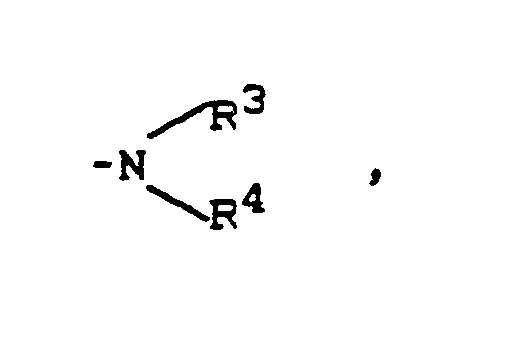
R³ und R⁴ gleich oder verschieden sind und Wasserstoff, Alkyl mit bis zu 8 Kohlenstoffatomen, Aryl mit 6 bis 12 Kohlenstoffatomen, Aralkyl mit 7 bis 14 Kohlenstoffatomen, Acyl mit 2 bis 7 Kohlenstoffatomen, Alkylsulfonyl mit bis zu 6 Kohlenstoffatomen, Phenylsulfonyl oder Tolylsulfonyl bedeuten ,
oder
- für einen heterocyclischen Ring der Reihe Furyl, Thienyl, Pyridyl, Pyrimidyl, Pyrazinyl, Pyridazinyl, Chinolyl oder Isochinolyl steht, wobei diese Ringe bis zu 3-fach gleich oder verschieden substituiert sein können durch Alkyl, Alkoxy, Alkylthio mit jeweils bis zu 6 Kohlenstoffatomen, Halogen, Phenyl, Nitro, Cyano oder
durch eine Gruppe der Formel

R³ und R⁴ die oben angegene Bedeutung haben,
oder
- für geradkettiges, verzweigtes oder cyclisches Alkyl oder Alkenyl mit bis zu 10 Kohlenstoffatomen steht, das substituiert sein kann durch Halogen, Aryl mit 6 bis 12 Kohlenstoffatomen, Furyl, Thienyl, Pyridyl, Pyrimidyl, Pyrazinyl, Pyridazinyl, Chinolyl, Isochinolyl, Hydroxy, Alkoxy, Alkylthio mit jeweils bis zu 6 Kohlenstoffatomen, Carboxy, Alkoxycarbonyl mit bis zu 6 Kohlenstoffatomen, Sulfo, Alkylsulfonyl mit bis zu 6 Kohlenstoffatomen, Phenylsulfonyl, Tolylsulfonyl oder
durch eine Gruppe der Formel

R⁵ und R⁶ gleich oder verschieden sind und Wasserstoff, Alkyl mit bis zu 8 Kohlenstoffatomen, Aryl mit 6 bis 12 Kohlenstoffatomen, Aralkyl mit 7 bis 14 Kohlenstoffatomen, Acyl mit bis zu 7 Kohlenstoffatomen, Alkylsulfonyl mit bis zu 6 Kohlenstoffatomen, Phenylsulfonyl oder Tolylsulfonyl bedeuten,
oder worin
R⁵ und R⁶ gemeinsam mit dem Stickstoffatom einen Ring aus der Reihe Pyrrolidino, Piperidino, Piperazino, Morpholino oder Thiomorpholino bilden und wobei dieser Ring substituiert sein kann durch Alkyl mit bis zu 4 Kohlenstoffatomen oder durch Phenyl
und
R² - für geradkettiges, verzweigtes oder cyclisches Alkyl mit bis zu 8 Kohlenstoffatom steht,
in welchen das Ringkohlenstoffatom 5-Stellung S-Konfiguration hat und in welchen der Substituent R¹ in 4-Stellung zum Substituenten COOR² in 5-Stellung cis konfiguriert ist,
dadurch gekennzeichnet, daß man
Dihdropyrazine der allgemeinen Formel (II)
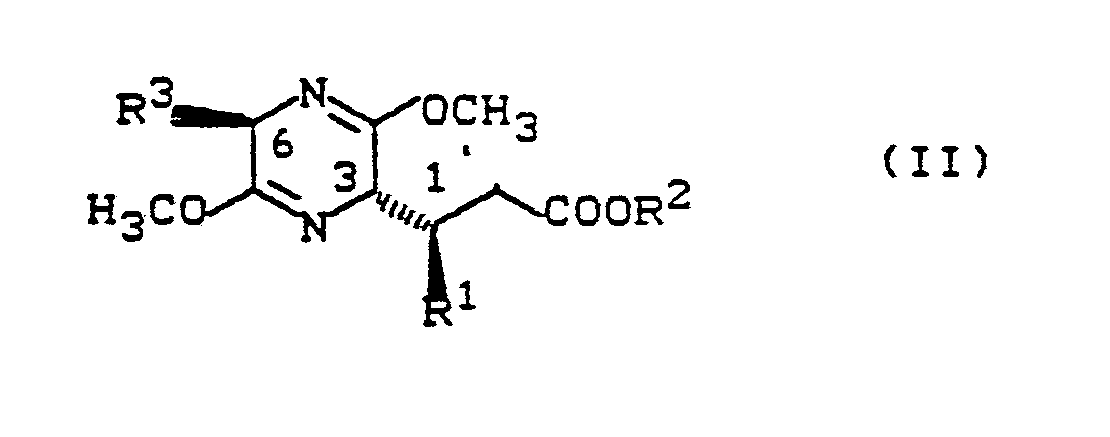
R¹ und R² die angegebene Bedeutung haben,
und
R³ - für geradkettiges oder verzweigtes Alkyl mit bis zu 4 Kohlenstoffatomen steht,
und in welcher das Kohlenstoffatom 6 des Dihydropyrazinrings in (II) R-konfiguriert ist, das Kohlenstoffatom 3 des Pyrazinrings in (II) S-konfiguriert ist und das Kohlenstoffatom in 1ʹ S--konfiguriert ist, wenn R¹ die höhere Priorität hat als die Gruppe CH₂COOR² oder R-konfiguriert ist, wenn R¹ eine niedrigere Priorität hat als die Gruppe CH₂COOR²
zunächst in inerten Lösemitteln mit Säuren hydrolysiert,
dann aus den entstehenden sauren Aminosäuresalzen mit Basen in inerten Lösemitteln die freien Aminosäuren herstellt
und diese anschließend cyclisiert.

R¹ - für Aryl mit 6 bis 14 Kohlenstoffatomen steht, das bis zu 5-fach gleich oder verschieden substituiert sein kann durch Alkyl, Alkoxy, Alkylthio mit jeweils bis zu 8 Kohlenstoffatomen, durch Aryl, Aryloxy, Arylthio mit jeweils 6 bis 12 Kohlenstoffatomen, durch Aralkyl mit 7 bis 14 Kohlenstoffatomen, durch Halogen, Trifluormethyl, Trifluormethoxy, Difluormethoxy, Trifluormethylthio, Nitro, Cyano, Carboxy, Alkoxycarbonyl mit bis zu 8 Kohlenstoffatomen, Sulfo, Phenylsulfonyl, Tolylsulfonyl, Alkylsulfonyl mit bis zu 8 Kohlenstoffatomen, Hydroxy oder durch eine Gruppe der Formel

R³ und R⁴ gleich oder verschieden sind und Wasserstoff, Alkyl mit bis zu 8 Kohlenstoffatomen, Aryl mit 6 bis 12 Kohlenstoffatomen, Aralkyl mit 7 bis 14 Kohlenstoffatomen, Acyl mit bis zu 7 Kohlenstoffatomen, Alkylsulfonyl mit bis zu 6 Kohlenstoffatomen, Phenylsulfonyl oder Tolylsulfonyl bedeuten,
oder
- für einen heterocyclischen Ring der Reihe Furyl, Thienyl, Pyridyl, Pyrimidyl, Pyrazinyl, Pyridazinyl, Chinolyl oder Isochinolyl steht, wobei diese Ringe bis zu 3-fach gleich oder verschieden substituiert sein können durch Alkyl, Alkoxy, Alkylthio mit jeweils bis zu 6 Kohlenstoffatomen, Halogen, Phenyl, Nitro, Cyano oder durch eine Gruppe der Formel
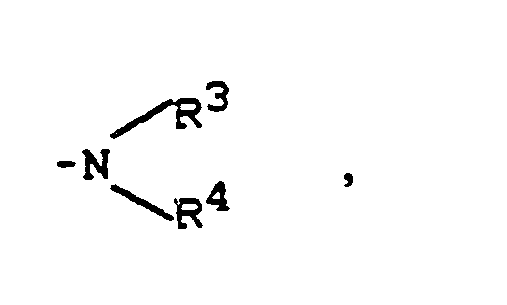
R³ und R⁴ die oben angegebene Bedeutung haben,
oder
- für geradkettiges, verzweigtes oder cyclisches Alkyl oder Alkenyl mit bis zu 10 Kohlenstoffatomen steht, das substituiert sein kann durch Halogen, Aryl mit 6 bis 12 Kohlenstoffatomen, Furyl, Thienyl, Pyridyl, Pyrimidyl, Pyrazinyl, Pyridazinyl, Chinolyl, Isochinolyl, Hydroxy, Alkoxy, Alkylthio mit jeweils bis zu 6 Kohlenstoffatomen, Carboxy, Alkoxycarbonyl mit bis zu 6 Kohlenstoffatoean, Sulfo, Alkylsulfonyl mit bis zu 6 Kohlenstoffatomen, Phenylsulfonyl, Tolylsulfonyl oder
durch eine Gruppe der Formel

R⁵ und R⁶ gleich oder verschieden sind und Wasserstoff, Alkyl mit bis zu 8 Kohlenstoffatomen, Aryl mit 6 bis 12 Kohlenstoffatomen, Aralkyl mit 7 bis 14 Kohlenstoffatomen, Acyl mit bis zu 7 Kohlenstoffatomen, Alkylsulfonyl mit bis zu 6 Kohlenstoffatomen, Phenylsulfonyl oder Tolylsulfonyl bedeuten,
oder worin
R⁵ und R⁶ gemeinsam mit dem Stickstoffatom einen Ring aus der Reihe Pyrrolidino, Piperidino, Piperazino, Morpholino oder Thiomorpholino bilden und wobei dieser Ring substituiert sein kann durch Alkyl mit bis zu 4 Kohlenstoffatomen oder durch Phenyl,
R² - für geradkettiges, verzweigtes oder cyclisches Alkyl mit bis zu 8 Kohlenstoffatomen steht,
und
R³ - für geradkettiges oder verzweigtes Alkyl mit bis zu 4 Kohlenstoffatomen steht,
und worin das Kohlenstoffatom 3 des Dihydropyrazinrings S-konfiguriert und das Kohlenstoffatom 6 R-konfiguriert ist, das Kohlenstoffatom 1ʹ in der Seitenkette S-konfiguriert ist, wenn R¹ die höhere Priorität hat als die Gruppe CH₂COOR² oder R-konfiguriert ist, wenn R¹ eine niedrigere Priorität hat als die Gruppe CH₂COOR².

R³ die oben angegebene Bedeutung hat und das Kohlenstoffatom des Dihydropyrazinrings R-konfiguriert ist,
zunächst mit einer stark basischen metallorganischen Verbindung zu den in 6-Stellung durch das Metall der metallorganischen Verbindungen monosubstituierten
Derivaten von (III) umsetzt,
dann diese Metallderivate mit einem cis-substituierten Acrylester der allgemeinen Formel (IV)

R¹ und R² die oben angegebene Bedeutung haben, in inerten Lösemitteln umsetzt und anschließend mit einer Säure neutralisiert.
Applications Claiming Priority (2)
| Application Number | Priority Date | Filing Date | Title |
|---|---|---|---|
| DE19863616989 DE3616989A1 (de) | 1986-05-21 | 1986-05-21 | Enantiomerenreine 4,5-disubstituierte (gamma)-butyrolactame, verfahren zu ihrer herstellung und ihre verwendung |
| DE3616989 | 1986-05-21 |
Publications (3)
| Publication Number | Publication Date |
|---|---|
| EP0246534A2 true EP0246534A2 (de) | 1987-11-25 |
| EP0246534A3 EP0246534A3 (de) | 1989-05-24 |
| EP0246534B1 EP0246534B1 (de) | 1997-01-15 |
Family
ID=6301243
Family Applications (1)
| Application Number | Title | Priority Date | Filing Date |
|---|---|---|---|
| EP87106840A Expired - Lifetime EP0246534B1 (de) | 1986-05-21 | 1987-05-12 | Enantiomerenreine 4,5-disubstituierte gamma-Butyrolactame, Verfahren zu ihrer Herstellung und ihre Verwendung |
Country Status (8)
| Country | Link |
|---|---|
| US (1) | US4847287A (de) |
| EP (1) | EP0246534B1 (de) |
| JP (2) | JPH0830058B2 (de) |
| KR (1) | KR870011089A (de) |
| CN (1) | CN1017892B (de) |
| AT (1) | ATE147729T1 (de) |
| CA (1) | CA1341159C (de) |
| DE (2) | DE3616989A1 (de) |
Cited By (3)
| Publication number | Priority date | Publication date | Assignee | Title |
|---|---|---|---|---|
| AT391692B (de) * | 1989-04-24 | 1990-11-12 | Fleischhacker Wilhelm Dr | Enantiomerenreine, in position 1 alkylierte 5-oxo-2-pyrrolidinpropansaeuren und deren ester, deren herstellung und verwendung |
| EP0414018A3 (en) * | 1989-08-19 | 1992-01-08 | Bayer Ag | Process for the preparation of dehydrocycloclausenamide and its derivatives in the racemic form and as optically active (+)- or (-)-enantiomers |
| CN102988356A (zh) * | 2013-01-08 | 2013-03-27 | 中国科学院昆明植物研究所 | 以黄皮属植物中的咔唑生物碱为抗肿瘤活性成分的药物组合物及其制备方法与应用 |
Families Citing this family (3)
| Publication number | Priority date | Publication date | Assignee | Title |
|---|---|---|---|---|
| DE3927370A1 (de) * | 1989-08-19 | 1991-02-21 | Bayer Ag | Verfahren zur herstellung von clausenamid und neoclausenamid und deren derivate |
| FR2681640B1 (fr) * | 1991-09-25 | 1993-11-19 | Snecma | Turbomachine a aubes de stator a calage variable. |
| CN116621756A (zh) * | 2023-05-24 | 2023-08-22 | 遵义医科大学 | 一种3,3-二氟-γ-内酰胺化合物的制备方法 |
Family Cites Families (4)
| Publication number | Priority date | Publication date | Assignee | Title |
|---|---|---|---|---|
| FR51M (de) * | 1960-06-03 | 1960-11-28 | ||
| US4296110A (en) * | 1980-10-28 | 1981-10-20 | E. I. Du Pont De Nemours And Company | Antihypertensive I-substituted cyclic lactam-2-carboxylic acids |
| DE3431257A1 (de) * | 1984-08-24 | 1986-03-06 | Bayer Ag, 5090 Leverkusen | Neue (delta)-butyrolactame, pharmakologisch aktive zusammensetzungen derselben, verfahren zu ihrer herstellung und ihre medizinische verwendung |
| DE3632589A1 (de) * | 1985-10-18 | 1987-04-23 | Bayer Ag | Verfahren zur herstellung von (gamma)-butyrolactamen |
-
1986
- 1986-05-21 DE DE19863616989 patent/DE3616989A1/de not_active Withdrawn
-
1987
- 1987-05-12 AT AT87106840T patent/ATE147729T1/de not_active IP Right Cessation
- 1987-05-12 EP EP87106840A patent/EP0246534B1/de not_active Expired - Lifetime
- 1987-05-12 DE DE3752001T patent/DE3752001D1/de not_active Expired - Fee Related
- 1987-05-14 US US07/050,604 patent/US4847287A/en not_active Expired - Lifetime
- 1987-05-19 CA CA000537333A patent/CA1341159C/en not_active Expired - Fee Related
- 1987-05-19 JP JP62120333A patent/JPH0830058B2/ja not_active Expired - Lifetime
- 1987-05-20 KR KR870004987A patent/KR870011089A/ko not_active Withdrawn
- 1987-05-21 CN CN87103770A patent/CN1017892B/zh not_active Expired
-
1995
- 1995-09-27 JP JP7273539A patent/JPH08225542A/ja active Pending
Cited By (4)
| Publication number | Priority date | Publication date | Assignee | Title |
|---|---|---|---|---|
| AT391692B (de) * | 1989-04-24 | 1990-11-12 | Fleischhacker Wilhelm Dr | Enantiomerenreine, in position 1 alkylierte 5-oxo-2-pyrrolidinpropansaeuren und deren ester, deren herstellung und verwendung |
| EP0414018A3 (en) * | 1989-08-19 | 1992-01-08 | Bayer Ag | Process for the preparation of dehydrocycloclausenamide and its derivatives in the racemic form and as optically active (+)- or (-)-enantiomers |
| CN102988356A (zh) * | 2013-01-08 | 2013-03-27 | 中国科学院昆明植物研究所 | 以黄皮属植物中的咔唑生物碱为抗肿瘤活性成分的药物组合物及其制备方法与应用 |
| CN102988356B (zh) * | 2013-01-08 | 2014-08-27 | 中国科学院昆明植物研究所 | 以黄皮属植物中的咔唑生物碱为抗肿瘤活性成分的药物组合物及其制备方法与应用 |
Also Published As
| Publication number | Publication date |
|---|---|
| KR870011089A (ko) | 1987-12-19 |
| CN1017892B (zh) | 1992-08-19 |
| CN87103770A (zh) | 1988-02-03 |
| ATE147729T1 (de) | 1997-02-15 |
| EP0246534A3 (de) | 1989-05-24 |
| US4847287A (en) | 1989-07-11 |
| JPH08225542A (ja) | 1996-09-03 |
| JPS6322066A (ja) | 1988-01-29 |
| EP0246534B1 (de) | 1997-01-15 |
| DE3616989A1 (de) | 1987-11-26 |
| JPH0830058B2 (ja) | 1996-03-27 |
| CA1341159C (en) | 2001-01-02 |
| DE3752001D1 (de) | 1997-02-27 |
Similar Documents
| Publication | Publication Date | Title |
|---|---|---|
| EP0258729B1 (de) | Dihydropyridinverbindungen, Verfahren zu ihrer Herstellung und ihre Verwendung | |
| EP0287890A1 (de) | Substituierte Pyrrole | |
| EP0271795A2 (de) | Octahydro-10-oxo-6H-pyridazo [1,2-a] [1,2] diazepin-Derivate, Zwischenprodukte und Verfahren zu deren Herstellung sowie diese enthaltende Arzneimittel | |
| EP0199446A1 (de) | Penemverbindungen, ihre Herstellung und Verwendung | |
| EP0088938A1 (de) | Verwendung von Pyridinverbindungen zur Herstellung von Arzneimitteln mit antihypoxischer und Ischämie-protektiver Wirkung | |
| EP0300278A2 (de) | Verfahren zur Herstellung von 2-substituierten Pyrrolen | |
| EP0246534B1 (de) | Enantiomerenreine 4,5-disubstituierte gamma-Butyrolactame, Verfahren zu ihrer Herstellung und ihre Verwendung | |
| EP0519291B1 (de) | Aminomethyl-substituierte 2,3-Dihydropyrano(2,3-b)pyridine, Verfahren zu ihrer Herstellung und ihre Verwendung in Arzneimitteln | |
| EP0222163B1 (de) | Verfahren zur Herstellung von gamma-Butyrolactamen | |
| EP0330057A2 (de) | Substituierte Pyrimidine | |
| EP0081748B1 (de) | Verfahren zur Herstellung von (-)-2-(1-(2,6-Dichlorphenoxy)-ethyl)-1,3-diazacyclopent-2-en | |
| DE3531453C2 (de) | Substituierte 7-Oxomitosan-Verbindung, diese Verbindung enthaltendes pharmazeutisches Mittel, Verfahren zur Herstellung substituierter 7-Oxomitosan-Verbindungen | |
| DE2411552A1 (de) | Derivate von benzodiazepinonen, verfahren zu ihrer herstellung und diese verbindungen enthaltende arzneimittel | |
| EP0339342A1 (de) | N-Substituierte N-Amino-pyrrole | |
| DE4139749A1 (de) | Chinolylmethoxyphenyl-essigsaeureamide | |
| EP0334014A2 (de) | Substituierte Imidazolinone und Imidazolinthione | |
| EP0065200B1 (de) | Delta-1-Pyrrolin-thiolactimäther und Verfahren zu ihrer Herstellung | |
| DE2302184C2 (de) | 6-[α-Aminocyclopropylacetamido]-penicillansäure, Verfahren zu seiner Herstellung und diese Verbindung enthaltende Arzneipräparate | |
| EP0334147A1 (de) | Disubstituierte Pyrrole | |
| DE3624102A1 (de) | Substituierte pyrrolidone, verfahren zur herstellung und ihre verwendung | |
| DE69422038T2 (de) | Benzopyranderivate | |
| CH650006A5 (en) | Process for the preparation of 5-fluorouracil derivatives | |
| AT371108B (de) | Verfahren zur herstellung von neuen 2-acetidinonverbindungen und deren salzen und stereoisomeren | |
| EP0081719A2 (de) | 2-Nitroimidazole | |
| DE3223019A1 (de) | Neue cephalosporinderivate, verfahren zu ihrer herstellung und ihre verwendung |
Legal Events
| Date | Code | Title | Description |
|---|---|---|---|
| PUAI | Public reference made under article 153(3) epc to a published international application that has entered the european phase |
Free format text: ORIGINAL CODE: 0009012 |
|
| 17P | Request for examination filed |
Effective date: 19870512 |
|
| AK | Designated contracting states |
Kind code of ref document: A2 Designated state(s): AT BE CH DE ES FR GB IT LI NL SE |
|
| PUAL | Search report despatched |
Free format text: ORIGINAL CODE: 0009013 |
|
| AK | Designated contracting states |
Kind code of ref document: A3 Designated state(s): AT BE CH DE ES FR GB IT LI NL SE |
|
| 17Q | First examination report despatched |
Effective date: 19920120 |
|
| GRAG | Despatch of communication of intention to grant |
Free format text: ORIGINAL CODE: EPIDOS AGRA |
|
| GRAH | Despatch of communication of intention to grant a patent |
Free format text: ORIGINAL CODE: EPIDOS IGRA |
|
| GRAH | Despatch of communication of intention to grant a patent |
Free format text: ORIGINAL CODE: EPIDOS IGRA |
|
| GRAA | (expected) grant |
Free format text: ORIGINAL CODE: 0009210 |
|
| AK | Designated contracting states |
Kind code of ref document: B1 Designated state(s): AT BE CH DE ES FR GB IT LI NL SE |
|
| PG25 | Lapsed in a contracting state [announced via postgrant information from national office to epo] |
Ref country code: NL Free format text: LAPSE BECAUSE OF FAILURE TO SUBMIT A TRANSLATION OF THE DESCRIPTION OR TO PAY THE FEE WITHIN THE PRESCRIBED TIME-LIMIT Effective date: 19970115 |
|
| REF | Corresponds to: |
Ref document number: 147729 Country of ref document: AT Date of ref document: 19970215 Kind code of ref document: T |
|
| REG | Reference to a national code |
Ref country code: CH Ref legal event code: EP |
|
| REF | Corresponds to: |
Ref document number: 3752001 Country of ref document: DE Date of ref document: 19970227 |
|
| GBT | Gb: translation of ep patent filed (gb section 77(6)(a)/1977) |
Effective date: 19970210 |
|
| ET | Fr: translation filed | ||
| ITF | It: translation for a ep patent filed | ||
| ET | Fr: translation filed |
Free format text: CORRECTIONS |
|
| PG25 | Lapsed in a contracting state [announced via postgrant information from national office to epo] |
Ref country code: SE Effective date: 19970415 |
|
| PG25 | Lapsed in a contracting state [announced via postgrant information from national office to epo] |
Ref country code: AT Free format text: LAPSE BECAUSE OF NON-PAYMENT OF DUE FEES Effective date: 19970512 |
|
| PG25 | Lapsed in a contracting state [announced via postgrant information from national office to epo] |
Ref country code: LI Free format text: LAPSE BECAUSE OF NON-PAYMENT OF DUE FEES Effective date: 19970531 Ref country code: CH Free format text: LAPSE BECAUSE OF NON-PAYMENT OF DUE FEES Effective date: 19970531 Ref country code: BE Effective date: 19970531 |
|
| NLV1 | Nl: lapsed or annulled due to failure to fulfill the requirements of art. 29p and 29m of the patents act | ||
| PG25 | Lapsed in a contracting state [announced via postgrant information from national office to epo] |
Ref country code: ES Free format text: LAPSE BECAUSE OF FAILURE TO SUBMIT A TRANSLATION OF THE DESCRIPTION OR TO PAY THE FEE WITHIN THE PRESCRIBED TIME-LIMIT Effective date: 19970723 |
|
| PLBE | No opposition filed within time limit |
Free format text: ORIGINAL CODE: 0009261 |
|
| STAA | Information on the status of an ep patent application or granted ep patent |
Free format text: STATUS: NO OPPOSITION FILED WITHIN TIME LIMIT |
|
| BERE | Be: lapsed |
Owner name: CHINESE ACADEMY OF MEDICAL SCIENCES Effective date: 19970531 Owner name: BAYER A.G. Effective date: 19970531 |
|
| 26N | No opposition filed | ||
| REG | Reference to a national code |
Ref country code: CH Ref legal event code: PL |
|
| REG | Reference to a national code |
Ref country code: GB Ref legal event code: IF02 |
|
| PGFP | Annual fee paid to national office [announced via postgrant information from national office to epo] |
Ref country code: DE Payment date: 20020411 Year of fee payment: 16 |
|
| PGFP | Annual fee paid to national office [announced via postgrant information from national office to epo] |
Ref country code: FR Payment date: 20020422 Year of fee payment: 16 |
|
| PGFP | Annual fee paid to national office [announced via postgrant information from national office to epo] |
Ref country code: GB Payment date: 20020515 Year of fee payment: 16 |
|
| PG25 | Lapsed in a contracting state [announced via postgrant information from national office to epo] |
Ref country code: GB Free format text: LAPSE BECAUSE OF NON-PAYMENT OF DUE FEES Effective date: 20030512 |
|
| PG25 | Lapsed in a contracting state [announced via postgrant information from national office to epo] |
Ref country code: DE Free format text: LAPSE BECAUSE OF NON-PAYMENT OF DUE FEES Effective date: 20031202 |
|
| GBPC | Gb: european patent ceased through non-payment of renewal fee |
Effective date: 20030512 |
|
| PG25 | Lapsed in a contracting state [announced via postgrant information from national office to epo] |
Ref country code: FR Free format text: LAPSE BECAUSE OF NON-PAYMENT OF DUE FEES Effective date: 20040130 |
|
| REG | Reference to a national code |
Ref country code: FR Ref legal event code: ST |
|
| PG25 | Lapsed in a contracting state [announced via postgrant information from national office to epo] |
Ref country code: IT Free format text: LAPSE BECAUSE OF NON-PAYMENT OF DUE FEES;WARNING: LAPSES OF ITALIAN PATENTS WITH EFFECTIVE DATE BEFORE 2007 MAY HAVE OCCURRED AT ANY TIME BEFORE 2007. THE CORRECT EFFECTIVE DATE MAY BE DIFFERENT FROM THE ONE RECORDED. Effective date: 20050512 |