EP0330057A2 - Substituierte Pyrimidine - Google Patents
Substituierte Pyrimidine Download PDFInfo
- Publication number
- EP0330057A2 EP0330057A2 EP89102536A EP89102536A EP0330057A2 EP 0330057 A2 EP0330057 A2 EP 0330057A2 EP 89102536 A EP89102536 A EP 89102536A EP 89102536 A EP89102536 A EP 89102536A EP 0330057 A2 EP0330057 A2 EP 0330057A2
- Authority
- EP
- European Patent Office
- Prior art keywords
- substituted
- alkyl
- aryl
- formula
- trifluoromethoxy
- Prior art date
- Legal status (The legal status is an assumption and is not a legal conclusion. Google has not performed a legal analysis and makes no representation as to the accuracy of the status listed.)
- Withdrawn
Links
- 150000003230 pyrimidines Chemical class 0.000 title claims abstract description 25
- 150000002576 ketones Chemical class 0.000 claims abstract description 12
- 239000003814 drug Substances 0.000 claims abstract description 7
- -1 dialkylsulfamoyl Chemical group 0.000 claims description 236
- 125000000217 alkyl group Chemical group 0.000 claims description 84
- 125000003545 alkoxy group Chemical group 0.000 claims description 65
- 125000003118 aryl group Chemical group 0.000 claims description 64
- 125000002023 trifluoromethyl group Chemical group FC(F)(F)* 0.000 claims description 60
- 125000002496 methyl group Chemical group [H]C([H])([H])* 0.000 claims description 59
- 125000000876 trifluoromethoxy group Chemical group FC(F)(F)O* 0.000 claims description 59
- 125000004414 alkyl thio group Chemical group 0.000 claims description 58
- 125000004390 alkyl sulfonyl group Chemical group 0.000 claims description 57
- 125000004453 alkoxycarbonyl group Chemical group 0.000 claims description 46
- 125000004104 aryloxy group Chemical group 0.000 claims description 39
- 125000005110 aryl thio group Chemical group 0.000 claims description 38
- 125000001072 heteroaryl group Chemical group 0.000 claims description 38
- 125000001997 phenyl group Chemical group [H]C1=C([H])C([H])=C(*)C([H])=C1[H] 0.000 claims description 38
- 125000004093 cyano group Chemical group *C#N 0.000 claims description 37
- 125000004391 aryl sulfonyl group Chemical group 0.000 claims description 36
- 229910052736 halogen Inorganic materials 0.000 claims description 34
- 150000002367 halogens Chemical group 0.000 claims description 34
- 125000005034 trifluormethylthio group Chemical group FC(S*)(F)F 0.000 claims description 34
- ZAMOUSCENKQFHK-UHFFFAOYSA-N Chlorine atom Chemical group [Cl] ZAMOUSCENKQFHK-UHFFFAOYSA-N 0.000 claims description 33
- 239000000460 chlorine Chemical group 0.000 claims description 33
- 229910052801 chlorine Inorganic materials 0.000 claims description 33
- 125000004076 pyridyl group Chemical group 0.000 claims description 33
- 229910052731 fluorine Inorganic materials 0.000 claims description 29
- 239000011737 fluorine Substances 0.000 claims description 29
- 125000004659 aryl alkyl thio group Chemical group 0.000 claims description 28
- 238000000034 method Methods 0.000 claims description 28
- WKBOTKDWSSQWDR-UHFFFAOYSA-N Bromine atom Chemical group [Br] WKBOTKDWSSQWDR-UHFFFAOYSA-N 0.000 claims description 26
- GDTBXPJZTBHREO-UHFFFAOYSA-N bromine Chemical group BrBr GDTBXPJZTBHREO-UHFFFAOYSA-N 0.000 claims description 26
- 229910052794 bromium Inorganic materials 0.000 claims description 26
- 125000003710 aryl alkyl group Chemical group 0.000 claims description 23
- 229910052739 hydrogen Inorganic materials 0.000 claims description 23
- 239000001257 hydrogen Substances 0.000 claims description 23
- 125000005140 aralkylsulfonyl group Chemical group 0.000 claims description 21
- PXGOKWXKJXAPGV-UHFFFAOYSA-N Fluorine Chemical compound FF PXGOKWXKJXAPGV-UHFFFAOYSA-N 0.000 claims description 20
- 125000004397 aminosulfonyl group Chemical group NS(=O)(=O)* 0.000 claims description 20
- 125000003917 carbamoyl group Chemical group [H]N([H])C(*)=O 0.000 claims description 20
- 125000001495 ethyl group Chemical group [H]C([H])([H])C([H])([H])* 0.000 claims description 20
- 125000000484 butyl group Chemical group [H]C([*])([H])C([H])([H])C([H])([H])C([H])([H])[H] 0.000 claims description 19
- 125000005117 dialkylcarbamoyl group Chemical group 0.000 claims description 19
- 125000001449 isopropyl group Chemical group [H]C([H])([H])C([H])(*)C([H])([H])[H] 0.000 claims description 19
- 125000001436 propyl group Chemical group [H]C([*])([H])C([H])([H])C([H])([H])[H] 0.000 claims description 19
- 125000000999 tert-butyl group Chemical group [H]C([H])([H])C(*)(C([H])([H])[H])C([H])([H])[H] 0.000 claims description 19
- 150000005840 aryl radicals Chemical class 0.000 claims description 18
- 125000000959 isobutyl group Chemical group [H]C([H])([H])C([H])(C([H])([H])[H])C([H])([H])* 0.000 claims description 18
- 150000002596 lactones Chemical class 0.000 claims description 17
- 125000002252 acyl group Chemical group 0.000 claims description 16
- 125000000714 pyrimidinyl group Chemical group 0.000 claims description 16
- 125000001797 benzyl group Chemical group [H]C1=C([H])C([H])=C(C([H])=C1[H])C([H])([H])* 0.000 claims description 15
- 125000005956 isoquinolyl group Chemical group 0.000 claims description 15
- UFHFLCQGNIYNRP-UHFFFAOYSA-N Hydrogen Chemical compound [H][H] UFHFLCQGNIYNRP-UHFFFAOYSA-N 0.000 claims description 14
- 150000001299 aldehydes Chemical class 0.000 claims description 14
- 125000004744 butyloxycarbonyl group Chemical group 0.000 claims description 14
- 125000002541 furyl group Chemical group 0.000 claims description 14
- 125000005493 quinolyl group Chemical group 0.000 claims description 14
- 125000001544 thienyl group Chemical group 0.000 claims description 14
- 125000001889 triflyl group Chemical group FC(F)(F)S(*)(=O)=O 0.000 claims description 14
- 238000002360 preparation method Methods 0.000 claims description 13
- 125000003373 pyrazinyl group Chemical group 0.000 claims description 13
- 125000002098 pyridazinyl group Chemical group 0.000 claims description 13
- 125000000753 cycloalkyl group Chemical group 0.000 claims description 11
- 125000001559 cyclopropyl group Chemical group [H]C1([H])C([H])([H])C1([H])* 0.000 claims description 11
- 125000006125 ethylsulfonyl group Chemical group 0.000 claims description 11
- 125000002971 oxazolyl group Chemical group 0.000 claims description 11
- 125000004742 propyloxycarbonyl group Chemical group 0.000 claims description 11
- 125000001424 substituent group Chemical group 0.000 claims description 11
- 125000000335 thiazolyl group Chemical group 0.000 claims description 11
- 125000003236 benzoyl group Chemical group [H]C1=C([H])C([H])=C(C([H])=C1[H])C(*)=O 0.000 claims description 10
- 125000000113 cyclohexyl group Chemical group [H]C1([H])C([H])([H])C([H])([H])C([H])(*)C([H])([H])C1([H])[H] 0.000 claims description 10
- 125000001511 cyclopentyl group Chemical group [H]C1([H])C([H])([H])C([H])([H])C([H])(*)C1([H])[H] 0.000 claims description 10
- 125000003754 ethoxycarbonyl group Chemical group C(=O)(OCC)* 0.000 claims description 10
- 239000012442 inert solvent Substances 0.000 claims description 10
- 125000000449 nitro group Chemical group [O-][N+](*)=O 0.000 claims description 10
- 150000003839 salts Chemical class 0.000 claims description 10
- 239000002253 acid Substances 0.000 claims description 9
- 150000001735 carboxylic acids Chemical class 0.000 claims description 9
- 150000002148 esters Chemical class 0.000 claims description 9
- 125000001153 fluoro group Chemical group F* 0.000 claims description 9
- 125000001041 indolyl group Chemical group 0.000 claims description 9
- 125000005929 isobutyloxycarbonyl group Chemical group [H]C([H])([H])C([H])(C([H])([H])[H])C([H])([H])OC(*)=O 0.000 claims description 9
- KEAYESYHFKHZAL-UHFFFAOYSA-N Sodium Chemical compound [Na] KEAYESYHFKHZAL-UHFFFAOYSA-N 0.000 claims description 8
- 125000002777 acetyl group Chemical group [H]C([H])([H])C(*)=O 0.000 claims description 8
- 150000007513 acids Chemical class 0.000 claims description 8
- 238000004519 manufacturing process Methods 0.000 claims description 8
- 239000012312 sodium hydride Substances 0.000 claims description 8
- 229910000104 sodium hydride Inorganic materials 0.000 claims description 8
- 125000003785 benzimidazolyl group Chemical group N1=C(NC2=C1C=CC=C2)* 0.000 claims description 7
- 125000001164 benzothiazolyl group Chemical group S1C(=NC2=C1C=CC=C2)* 0.000 claims description 7
- 125000004541 benzoxazolyl group Chemical group O1C(=NC2=C1C=CC=C2)* 0.000 claims description 7
- 150000001768 cations Chemical class 0.000 claims description 7
- 150000002431 hydrogen Chemical class 0.000 claims description 7
- 125000002883 imidazolyl group Chemical group 0.000 claims description 7
- 125000001786 isothiazolyl group Chemical group 0.000 claims description 7
- 125000004170 methylsulfonyl group Chemical group [H]C([H])([H])S(*)(=O)=O 0.000 claims description 7
- 125000000951 phenoxy group Chemical group [H]C1=C([H])C([H])=C(O*)C([H])=C1[H] 0.000 claims description 7
- DGAQECJNVWCQMB-PUAWFVPOSA-M Ilexoside XXIX Chemical compound C[C@@H]1CC[C@@]2(CC[C@@]3(C(=CC[C@H]4[C@]3(CC[C@@H]5[C@@]4(CC[C@@H](C5(C)C)OS(=O)(=O)[O-])C)C)[C@@H]2[C@]1(C)O)C)C(=O)O[C@H]6[C@@H]([C@H]([C@@H]([C@H](O6)CO)O)O)O.[Na+] DGAQECJNVWCQMB-PUAWFVPOSA-M 0.000 claims description 6
- 125000005928 isopropyloxycarbonyl group Chemical group [H]C([H])([H])C([H])(OC(*)=O)C([H])([H])[H] 0.000 claims description 6
- 125000003170 phenylsulfonyl group Chemical group C1(=CC=CC=C1)S(=O)(=O)* 0.000 claims description 6
- 125000000094 2-phenylethyl group Chemical group [H]C1=C([H])C([H])=C(C([H])=C1[H])C([H])([H])C([H])([H])* 0.000 claims description 5
- VGGSQFUCUMXWEO-UHFFFAOYSA-N Ethene Chemical class C=C VGGSQFUCUMXWEO-UHFFFAOYSA-N 0.000 claims description 5
- 125000004051 hexyl group Chemical group [H]C([H])([H])C([H])([H])C([H])([H])C([H])([H])C([H])([H])C([H])([H])* 0.000 claims description 5
- 125000004491 isohexyl group Chemical group C(CCC(C)C)* 0.000 claims description 5
- 125000000904 isoindolyl group Chemical group C=1(NC=C2C=CC=CC12)* 0.000 claims description 5
- 125000001972 isopentyl group Chemical group [H]C([H])([H])C([H])(C([H])([H])[H])C([H])([H])C([H])([H])* 0.000 claims description 5
- 125000000842 isoxazolyl group Chemical group 0.000 claims description 5
- 125000000956 methoxy group Chemical group [H]C([H])([H])O* 0.000 claims description 5
- 125000001624 naphthyl group Chemical group 0.000 claims description 5
- 125000001147 pentyl group Chemical group C(CCCC)* 0.000 claims description 5
- 125000004592 phthalazinyl group Chemical group C1(=NN=CC2=CC=CC=C12)* 0.000 claims description 5
- 125000002294 quinazolinyl group Chemical group N1=C(N=CC2=CC=CC=C12)* 0.000 claims description 5
- 125000001567 quinoxalinyl group Chemical group N1=C(C=NC2=CC=CC=C12)* 0.000 claims description 5
- 150000003254 radicals Chemical class 0.000 claims description 5
- 239000011734 sodium Substances 0.000 claims description 5
- 229910052708 sodium Inorganic materials 0.000 claims description 5
- 125000004448 alkyl carbonyl group Chemical group 0.000 claims description 4
- 125000004106 butoxy group Chemical group [*]OC([H])([H])C([H])([H])C(C([H])([H])[H])([H])[H] 0.000 claims description 4
- 125000000259 cinnolinyl group Chemical group N1=NC(=CC2=CC=CC=C12)* 0.000 claims description 4
- 125000003226 pyrazolyl group Chemical group 0.000 claims description 4
- 125000005931 tert-butyloxycarbonyl group Chemical group [H]C([H])([H])C(OC(*)=O)(C([H])([H])[H])C([H])([H])[H] 0.000 claims description 4
- QGZKDVFQNNGYKY-UHFFFAOYSA-O Ammonium Chemical compound [NH4+] QGZKDVFQNNGYKY-UHFFFAOYSA-O 0.000 claims description 3
- FYYHWMGAXLPEAU-UHFFFAOYSA-N Magnesium Chemical compound [Mg] FYYHWMGAXLPEAU-UHFFFAOYSA-N 0.000 claims description 3
- ZLMJMSJWJFRBEC-UHFFFAOYSA-N Potassium Chemical compound [K] ZLMJMSJWJFRBEC-UHFFFAOYSA-N 0.000 claims description 3
- 239000011575 calcium Substances 0.000 claims description 3
- 229910052791 calcium Inorganic materials 0.000 claims description 3
- 125000004672 ethylcarbonyl group Chemical group [H]C([H])([H])C([H])([H])C(*)=O 0.000 claims description 3
- 239000011777 magnesium Substances 0.000 claims description 3
- 229910052749 magnesium Inorganic materials 0.000 claims description 3
- 239000011591 potassium Substances 0.000 claims description 3
- 229910052700 potassium Inorganic materials 0.000 claims description 3
- 125000000168 pyrrolyl group Chemical group 0.000 claims description 3
- AMRYCYKIMYBRAO-UHFFFAOYSA-N 2-aminoethenylphosphonic acid Chemical class NC=CP(O)(O)=O AMRYCYKIMYBRAO-UHFFFAOYSA-N 0.000 claims description 2
- OYPRJOBELJOOCE-UHFFFAOYSA-N Calcium Chemical compound [Ca] OYPRJOBELJOOCE-UHFFFAOYSA-N 0.000 claims description 2
- 208000031226 Hyperlipidaemia Diseases 0.000 claims description 2
- MUMHLNVTWIKASW-UHFFFAOYSA-N benzyl hypofluorite Chemical compound FOCC1=CC=CC=C1 MUMHLNVTWIKASW-UHFFFAOYSA-N 0.000 claims description 2
- 208000020346 hyperlipoproteinemia Diseases 0.000 claims description 2
- 125000002914 sec-butyl group Chemical group [H]C([H])([H])C([H])([H])C([H])(*)C([H])([H])[H] 0.000 claims description 2
- SMWDFEZZVXVKRB-UHFFFAOYSA-N Quinoline Chemical compound N1=CC=CC2=CC=CC=C21 SMWDFEZZVXVKRB-UHFFFAOYSA-N 0.000 claims 2
- 201000001320 Atherosclerosis Diseases 0.000 claims 1
- 201000010099 disease Diseases 0.000 claims 1
- 208000037265 diseases, disorders, signs and symptoms Diseases 0.000 claims 1
- 125000005843 halogen group Chemical group 0.000 claims 1
- 108090000623 proteins and genes Proteins 0.000 claims 1
- 230000001225 therapeutic effect Effects 0.000 claims 1
- 150000001875 compounds Chemical class 0.000 abstract description 24
- 238000000926 separation method Methods 0.000 abstract description 4
- 230000007062 hydrolysis Effects 0.000 abstract description 2
- 238000006460 hydrolysis reaction Methods 0.000 abstract description 2
- 238000005984 hydrogenation reaction Methods 0.000 abstract 1
- HEDRZPFGACZZDS-MICDWDOJSA-N Trichloro(2H)methane Chemical compound [2H]C(Cl)(Cl)Cl HEDRZPFGACZZDS-MICDWDOJSA-N 0.000 description 42
- WYURNTSHIVDZCO-UHFFFAOYSA-N Tetrahydrofuran Chemical compound C1CCOC1 WYURNTSHIVDZCO-UHFFFAOYSA-N 0.000 description 40
- 125000004432 carbon atom Chemical group C* 0.000 description 39
- YMWUJEATGCHHMB-UHFFFAOYSA-N Dichloromethane Chemical compound ClCCl YMWUJEATGCHHMB-UHFFFAOYSA-N 0.000 description 33
- YXFVVABEGXRONW-UHFFFAOYSA-N Toluene Chemical compound CC1=CC=CC=C1 YXFVVABEGXRONW-UHFFFAOYSA-N 0.000 description 30
- RTZKZFJDLAIYFH-UHFFFAOYSA-N Diethyl ether Chemical compound CCOCC RTZKZFJDLAIYFH-UHFFFAOYSA-N 0.000 description 29
- 239000000203 mixture Substances 0.000 description 25
- 238000005160 1H NMR spectroscopy Methods 0.000 description 21
- 239000002904 solvent Substances 0.000 description 19
- UHOVQNZJYSORNB-UHFFFAOYSA-N Benzene Chemical compound C1=CC=CC=C1 UHOVQNZJYSORNB-UHFFFAOYSA-N 0.000 description 18
- LFQSCWFLJHTTHZ-UHFFFAOYSA-N Ethanol Chemical compound CCO LFQSCWFLJHTTHZ-UHFFFAOYSA-N 0.000 description 18
- XEKOWRVHYACXOJ-UHFFFAOYSA-N Ethyl acetate Chemical compound CCOC(C)=O XEKOWRVHYACXOJ-UHFFFAOYSA-N 0.000 description 18
- OKKJLVBELUTLKV-UHFFFAOYSA-N Methanol Chemical compound OC OKKJLVBELUTLKV-UHFFFAOYSA-N 0.000 description 18
- HEMHJVSKTPXQMS-UHFFFAOYSA-M Sodium hydroxide Chemical compound [OH-].[Na+] HEMHJVSKTPXQMS-UHFFFAOYSA-M 0.000 description 15
- KFZMGEQAYNKOFK-UHFFFAOYSA-N Isopropanol Chemical compound CC(C)O KFZMGEQAYNKOFK-UHFFFAOYSA-N 0.000 description 14
- YLQBMQCUIZJEEH-UHFFFAOYSA-N tetrahydrofuran Natural products C=1C=COC=1 YLQBMQCUIZJEEH-UHFFFAOYSA-N 0.000 description 13
- XLYOFNOQVPJJNP-UHFFFAOYSA-N water Substances O XLYOFNOQVPJJNP-UHFFFAOYSA-N 0.000 description 13
- QTBSBXVTEAMEQO-UHFFFAOYSA-N Acetic acid Chemical compound CC(O)=O QTBSBXVTEAMEQO-UHFFFAOYSA-N 0.000 description 11
- 235000019441 ethanol Nutrition 0.000 description 11
- 229930195733 hydrocarbon Natural products 0.000 description 11
- KWYUFKZDYYNOTN-UHFFFAOYSA-M Potassium hydroxide Chemical compound [OH-].[K+] KWYUFKZDYYNOTN-UHFFFAOYSA-M 0.000 description 10
- 239000003960 organic solvent Substances 0.000 description 10
- VEXZGXHMUGYJMC-UHFFFAOYSA-N Hydrochloric acid Chemical compound Cl VEXZGXHMUGYJMC-UHFFFAOYSA-N 0.000 description 9
- 150000002170 ethers Chemical class 0.000 description 9
- RYHBNJHYFVUHQT-UHFFFAOYSA-N 1,4-Dioxane Chemical compound C1COCCO1 RYHBNJHYFVUHQT-UHFFFAOYSA-N 0.000 description 8
- HVYWMOMLDIMFJA-DPAQBDIFSA-N cholesterol Chemical compound C1C=C2C[C@@H](O)CC[C@]2(C)[C@@H]2[C@@H]1[C@@H]1CC[C@H]([C@H](C)CCCC(C)C)[C@@]1(C)CC2 HVYWMOMLDIMFJA-DPAQBDIFSA-N 0.000 description 8
- 125000002485 formyl group Chemical group [H]C(*)=O 0.000 description 8
- 238000007127 saponification reaction Methods 0.000 description 8
- VZGDMQKNWNREIO-UHFFFAOYSA-N tetrachloromethane Chemical compound ClC(Cl)(Cl)Cl VZGDMQKNWNREIO-UHFFFAOYSA-N 0.000 description 8
- HEDRZPFGACZZDS-UHFFFAOYSA-N Chloroform Chemical compound ClC(Cl)Cl HEDRZPFGACZZDS-UHFFFAOYSA-N 0.000 description 7
- 238000006243 chemical reaction Methods 0.000 description 7
- ZMXDDKWLCZADIW-UHFFFAOYSA-N N,N-Dimethylformamide Chemical compound CN(C)C=O ZMXDDKWLCZADIW-UHFFFAOYSA-N 0.000 description 6
- MZRVEZGGRBJDDB-UHFFFAOYSA-N N-Butyllithium Chemical compound [Li]CCCC MZRVEZGGRBJDDB-UHFFFAOYSA-N 0.000 description 6
- 239000007832 Na2SO4 Substances 0.000 description 6
- CTQNGGLPUBDAKN-UHFFFAOYSA-N O-Xylene Chemical compound CC1=CC=CC=C1C CTQNGGLPUBDAKN-UHFFFAOYSA-N 0.000 description 6
- VYPSYNLAJGMNEJ-UHFFFAOYSA-N Silicium dioxide Chemical compound O=[Si]=O VYPSYNLAJGMNEJ-UHFFFAOYSA-N 0.000 description 6
- PMZURENOXWZQFD-UHFFFAOYSA-L Sodium Sulfate Chemical compound [Na+].[Na+].[O-]S([O-])(=O)=O PMZURENOXWZQFD-UHFFFAOYSA-L 0.000 description 6
- 239000002585 base Substances 0.000 description 6
- 150000002430 hydrocarbons Chemical class 0.000 description 6
- 125000002887 hydroxy group Chemical group [H]O* 0.000 description 6
- VLKZOEOYAKHREP-UHFFFAOYSA-N n-Hexane Chemical compound CCCCCC VLKZOEOYAKHREP-UHFFFAOYSA-N 0.000 description 6
- 238000007363 ring formation reaction Methods 0.000 description 6
- 229910052938 sodium sulfate Inorganic materials 0.000 description 6
- 235000011152 sodium sulphate Nutrition 0.000 description 6
- 239000007858 starting material Substances 0.000 description 6
- 239000008096 xylene Substances 0.000 description 6
- 102100029077 3-hydroxy-3-methylglutaryl-coenzyme A reductase Human genes 0.000 description 5
- 239000004215 Carbon black (E152) Substances 0.000 description 5
- 102000004190 Enzymes Human genes 0.000 description 5
- 108090000790 Enzymes Proteins 0.000 description 5
- 239000004480 active ingredient Substances 0.000 description 5
- 239000003638 chemical reducing agent Substances 0.000 description 5
- 150000008280 chlorinated hydrocarbons Chemical class 0.000 description 5
- 235000015424 sodium Nutrition 0.000 description 5
- 239000000126 substance Substances 0.000 description 5
- 229910052717 sulfur Inorganic materials 0.000 description 5
- NQRYJNQNLNOLGT-UHFFFAOYSA-N tetrahydropyridine hydrochloride Natural products C1CCNCC1 NQRYJNQNLNOLGT-UHFFFAOYSA-N 0.000 description 5
- NLXLAEXVIDQMFP-UHFFFAOYSA-N Ammonium chloride Substances [NH4+].[Cl-] NLXLAEXVIDQMFP-UHFFFAOYSA-N 0.000 description 4
- 241000282472 Canis lupus familiaris Species 0.000 description 4
- IAZDPXIOMUYVGZ-UHFFFAOYSA-N Dimethylsulphoxide Chemical compound CS(C)=O IAZDPXIOMUYVGZ-UHFFFAOYSA-N 0.000 description 4
- UIIMBOGNXHQVGW-UHFFFAOYSA-M Sodium bicarbonate Chemical compound [Na+].OC([O-])=O UIIMBOGNXHQVGW-UHFFFAOYSA-M 0.000 description 4
- 229960000583 acetic acid Drugs 0.000 description 4
- 150000001298 alcohols Chemical class 0.000 description 4
- 125000001931 aliphatic group Chemical group 0.000 description 4
- 150000001408 amides Chemical class 0.000 description 4
- 230000037396 body weight Effects 0.000 description 4
- 150000001718 carbodiimides Chemical class 0.000 description 4
- 125000002915 carbonyl group Chemical group [*:2]C([*:1])=O 0.000 description 4
- 229960001701 chloroform Drugs 0.000 description 4
- XYIBRDXRRQCHLP-UHFFFAOYSA-N ethyl acetoacetate Chemical compound CCOC(=O)CC(C)=O XYIBRDXRRQCHLP-UHFFFAOYSA-N 0.000 description 4
- 239000003112 inhibitor Substances 0.000 description 4
- HQKMJHAJHXVSDF-UHFFFAOYSA-L magnesium stearate Chemical compound [Mg+2].CCCCCCCCCCCCCCCCCC([O-])=O.CCCCCCCCCCCCCCCCCC([O-])=O HQKMJHAJHXVSDF-UHFFFAOYSA-L 0.000 description 4
- 229910052987 metal hydride Inorganic materials 0.000 description 4
- 239000003208 petroleum Substances 0.000 description 4
- 239000000741 silica gel Substances 0.000 description 4
- 229910002027 silica gel Inorganic materials 0.000 description 4
- CABVTRNMFUVUDM-VRHQGPGLSA-N (3S)-3-hydroxy-3-methylglutaryl-CoA Chemical compound O[C@@H]1[C@H](OP(O)(O)=O)[C@@H](COP(O)(=O)OP(O)(=O)OCC(C)(C)[C@@H](O)C(=O)NCCC(=O)NCCSC(=O)C[C@@](O)(CC(O)=O)C)O[C@H]1N1C2=NC=NC(N)=C2N=C1 CABVTRNMFUVUDM-VRHQGPGLSA-N 0.000 description 3
- 0 C/C1=C\C=C\C(\*)=C(/C=C[C@@](CC(C2)(C#C*)OC=C)OC2=O)\C(\*)=*1 Chemical compound C/C1=C\C=C\C(\*)=C(/C=C[C@@](CC(C2)(C#C*)OC=C)OC2=O)\C(\*)=*1 0.000 description 3
- ULGZDMOVFRHVEP-RWJQBGPGSA-N Erythromycin Chemical compound O([C@@H]1[C@@H](C)C(=O)O[C@@H]([C@@]([C@H](O)[C@@H](C)C(=O)[C@H](C)C[C@@](C)(O)[C@H](O[C@H]2[C@@H]([C@H](C[C@@H](C)O2)N(C)C)O)[C@H]1C)(C)O)CC)[C@H]1C[C@@](C)(OC)[C@@H](O)[C@H](C)O1 ULGZDMOVFRHVEP-RWJQBGPGSA-N 0.000 description 3
- 108090000895 Hydroxymethylglutaryl CoA Reductases Proteins 0.000 description 3
- PCZOHLXUXFIOCF-UHFFFAOYSA-N Monacolin X Natural products C12C(OC(=O)C(C)CC)CC(C)C=C2C=CC(C)C1CCC1CC(O)CC(=O)O1 PCZOHLXUXFIOCF-UHFFFAOYSA-N 0.000 description 3
- SJRJJKPEHAURKC-UHFFFAOYSA-N N-Methylmorpholine Chemical compound CN1CCOCC1 SJRJJKPEHAURKC-UHFFFAOYSA-N 0.000 description 3
- MUBZPKHOEPUJKR-UHFFFAOYSA-N Oxalic acid Chemical compound OC(=O)C(O)=O MUBZPKHOEPUJKR-UHFFFAOYSA-N 0.000 description 3
- VMHLLURERBWHNL-UHFFFAOYSA-M Sodium acetate Chemical compound [Na+].CC([O-])=O VMHLLURERBWHNL-UHFFFAOYSA-M 0.000 description 3
- WGLPBDUCMAPZCE-UHFFFAOYSA-N Trioxochromium Chemical compound O=[Cr](=O)=O WGLPBDUCMAPZCE-UHFFFAOYSA-N 0.000 description 3
- 239000003513 alkali Substances 0.000 description 3
- 210000004369 blood Anatomy 0.000 description 3
- 239000008280 blood Substances 0.000 description 3
- 239000000872 buffer Substances 0.000 description 3
- 239000003795 chemical substances by application Substances 0.000 description 3
- 238000004587 chromatography analysis Methods 0.000 description 3
- 230000000694 effects Effects 0.000 description 3
- 238000009472 formulation Methods 0.000 description 3
- 125000004029 hydroxymethyl group Chemical group [H]OC([H])([H])* 0.000 description 3
- 239000012280 lithium aluminium hydride Substances 0.000 description 3
- PCZOHLXUXFIOCF-BXMDZJJMSA-N lovastatin Chemical compound C([C@H]1[C@@H](C)C=CC2=C[C@H](C)C[C@@H]([C@H]12)OC(=O)[C@@H](C)CC)C[C@@H]1C[C@@H](O)CC(=O)O1 PCZOHLXUXFIOCF-BXMDZJJMSA-N 0.000 description 3
- QLJODMDSTUBWDW-UHFFFAOYSA-N lovastatin hydroxy acid Natural products C1=CC(C)C(CCC(O)CC(O)CC(O)=O)C2C(OC(=O)C(C)CC)CC(C)C=C21 QLJODMDSTUBWDW-UHFFFAOYSA-N 0.000 description 3
- 150000004681 metal hydrides Chemical class 0.000 description 3
- GRVDJDISBSALJP-UHFFFAOYSA-N methyloxidanyl Chemical compound [O]C GRVDJDISBSALJP-UHFFFAOYSA-N 0.000 description 3
- 229910052757 nitrogen Inorganic materials 0.000 description 3
- 231100000252 nontoxic Toxicity 0.000 description 3
- 230000003000 nontoxic effect Effects 0.000 description 3
- 239000012074 organic phase Substances 0.000 description 3
- 230000003647 oxidation Effects 0.000 description 3
- 238000007254 oxidation reaction Methods 0.000 description 3
- 125000004430 oxygen atom Chemical group O* 0.000 description 3
- BDERNNFJNOPAEC-UHFFFAOYSA-N propan-1-ol Chemical compound CCCO BDERNNFJNOPAEC-UHFFFAOYSA-N 0.000 description 3
- 239000001632 sodium acetate Substances 0.000 description 3
- 235000017281 sodium acetate Nutrition 0.000 description 3
- 239000012279 sodium borohydride Substances 0.000 description 3
- 229910000033 sodium borohydride Inorganic materials 0.000 description 3
- 125000004434 sulfur atom Chemical group 0.000 description 3
- 239000000725 suspension Substances 0.000 description 3
- 239000000454 talc Substances 0.000 description 3
- 235000012222 talc Nutrition 0.000 description 3
- 229910052623 talc Inorganic materials 0.000 description 3
- CXWXQJXEFPUFDZ-UHFFFAOYSA-N tetralin Chemical compound C1=CC=C2CCCCC2=C1 CXWXQJXEFPUFDZ-UHFFFAOYSA-N 0.000 description 3
- LALRXNPLTWZJIJ-UHFFFAOYSA-N triethylborane Chemical compound CCB(CC)CC LALRXNPLTWZJIJ-UHFFFAOYSA-N 0.000 description 3
- 101710158485 3-hydroxy-3-methylglutaryl-coenzyme A reductase Proteins 0.000 description 2
- UOQXIWFBQSVDPP-UHFFFAOYSA-N 4-fluorobenzaldehyde Chemical compound FC1=CC=C(C=O)C=C1 UOQXIWFBQSVDPP-UHFFFAOYSA-N 0.000 description 2
- VHUUQVKOLVNVRT-UHFFFAOYSA-N Ammonium hydroxide Chemical compound [NH4+].[OH-] VHUUQVKOLVNVRT-UHFFFAOYSA-N 0.000 description 2
- IJGRMHOSHXDMSA-UHFFFAOYSA-N Atomic nitrogen Chemical compound N#N IJGRMHOSHXDMSA-UHFFFAOYSA-N 0.000 description 2
- VTYYLEPIZMXCLO-UHFFFAOYSA-L Calcium carbonate Chemical compound [Ca+2].[O-]C([O-])=O VTYYLEPIZMXCLO-UHFFFAOYSA-L 0.000 description 2
- 241000700198 Cavia Species 0.000 description 2
- 229920001268 Cholestyramine Polymers 0.000 description 2
- XTHFKEDIFFGKHM-UHFFFAOYSA-N Dimethoxyethane Chemical compound COCCOC XTHFKEDIFFGKHM-UHFFFAOYSA-N 0.000 description 2
- PEDCQBHIVMGVHV-UHFFFAOYSA-N Glycerine Chemical compound OCC(O)CO PEDCQBHIVMGVHV-UHFFFAOYSA-N 0.000 description 2
- WHXSMMKQMYFTQS-UHFFFAOYSA-N Lithium Chemical compound [Li] WHXSMMKQMYFTQS-UHFFFAOYSA-N 0.000 description 2
- 241001465754 Metazoa Species 0.000 description 2
- WRQNANDWMGAFTP-UHFFFAOYSA-N Methylacetoacetic acid Chemical compound COC(=O)CC(C)=O WRQNANDWMGAFTP-UHFFFAOYSA-N 0.000 description 2
- LRHPLDYGYMQRHN-UHFFFAOYSA-N N-Butanol Chemical compound CCCCO LRHPLDYGYMQRHN-UHFFFAOYSA-N 0.000 description 2
- ZFVLZXXZUGHWSP-UHFFFAOYSA-L N1=CN=CC=C1.[Cr](=O)(=O)(O)Cl Chemical compound N1=CN=CC=C1.[Cr](=O)(=O)(O)Cl ZFVLZXXZUGHWSP-UHFFFAOYSA-L 0.000 description 2
- 229910019142 PO4 Inorganic materials 0.000 description 2
- ISWSIDIOOBJBQZ-UHFFFAOYSA-N Phenol Chemical compound OC1=CC=CC=C1 ISWSIDIOOBJBQZ-UHFFFAOYSA-N 0.000 description 2
- NBIIXXVUZAFLBC-UHFFFAOYSA-N Phosphoric acid Chemical compound OP(O)(O)=O NBIIXXVUZAFLBC-UHFFFAOYSA-N 0.000 description 2
- 229920003171 Poly (ethylene oxide) Polymers 0.000 description 2
- CZPWVGJYEJSRLH-UHFFFAOYSA-N Pyrimidine Chemical compound C1=CN=CN=C1 CZPWVGJYEJSRLH-UHFFFAOYSA-N 0.000 description 2
- DBMJMQXJHONAFJ-UHFFFAOYSA-M Sodium laurylsulphate Chemical compound [Na+].CCCCCCCCCCCCOS([O-])(=O)=O DBMJMQXJHONAFJ-UHFFFAOYSA-M 0.000 description 2
- WQDUMFSSJAZKTM-UHFFFAOYSA-N Sodium methoxide Chemical compound [Na+].[O-]C WQDUMFSSJAZKTM-UHFFFAOYSA-N 0.000 description 2
- 229920002472 Starch Polymers 0.000 description 2
- NINIDFKCEFEMDL-UHFFFAOYSA-N Sulfur Chemical compound [S] NINIDFKCEFEMDL-UHFFFAOYSA-N 0.000 description 2
- QAOWNCQODCNURD-UHFFFAOYSA-N Sulfuric acid Chemical compound OS(O)(=O)=O QAOWNCQODCNURD-UHFFFAOYSA-N 0.000 description 2
- DTQVDTLACAAQTR-UHFFFAOYSA-N Trifluoroacetic acid Chemical compound OC(=O)C(F)(F)F DTQVDTLACAAQTR-UHFFFAOYSA-N 0.000 description 2
- 239000000654 additive Substances 0.000 description 2
- 125000005907 alkyl ester group Chemical group 0.000 description 2
- 125000002947 alkylene group Chemical group 0.000 description 2
- 150000001412 amines Chemical class 0.000 description 2
- 235000011114 ammonium hydroxide Nutrition 0.000 description 2
- 239000008346 aqueous phase Substances 0.000 description 2
- QVGXLLKOCUKJST-UHFFFAOYSA-N atomic oxygen Chemical compound [O] QVGXLLKOCUKJST-UHFFFAOYSA-N 0.000 description 2
- AMEDKBHURXXSQO-UHFFFAOYSA-N azonous acid Chemical class ONO AMEDKBHURXXSQO-UHFFFAOYSA-N 0.000 description 2
- LZCZIHQBSCVGRD-UHFFFAOYSA-N benzenecarboximidamide;hydron;chloride Chemical compound [Cl-].NC(=[NH2+])C1=CC=CC=C1 LZCZIHQBSCVGRD-UHFFFAOYSA-N 0.000 description 2
- 229910052799 carbon Inorganic materials 0.000 description 2
- 150000001733 carboxylic acid esters Chemical class 0.000 description 2
- 239000000969 carrier Substances 0.000 description 2
- 229940117975 chromium trioxide Drugs 0.000 description 2
- GAMDZJFZMJECOS-UHFFFAOYSA-N chromium(6+);oxygen(2-) Chemical compound [O-2].[O-2].[O-2].[Cr+6] GAMDZJFZMJECOS-UHFFFAOYSA-N 0.000 description 2
- ZUOUZKKEUPVFJK-UHFFFAOYSA-N diphenyl Chemical compound C1=CC=CC=C1C1=CC=CC=C1 ZUOUZKKEUPVFJK-UHFFFAOYSA-N 0.000 description 2
- 239000002270 dispersing agent Substances 0.000 description 2
- VHJLVAABSRFDPM-QWWZWVQMSA-N dithiothreitol Chemical compound SC[C@@H](O)[C@H](O)CS VHJLVAABSRFDPM-QWWZWVQMSA-N 0.000 description 2
- 239000003995 emulsifying agent Substances 0.000 description 2
- 238000002474 experimental method Methods 0.000 description 2
- 235000013312 flour Nutrition 0.000 description 2
- 230000002401 inhibitory effect Effects 0.000 description 2
- 150000007529 inorganic bases Chemical class 0.000 description 2
- 239000000543 intermediate Chemical class 0.000 description 2
- 229910052744 lithium Inorganic materials 0.000 description 2
- ZCSHNCUQKCANBX-UHFFFAOYSA-N lithium diisopropylamide Chemical compound [Li+].CC(C)[N-]C(C)C ZCSHNCUQKCANBX-UHFFFAOYSA-N 0.000 description 2
- 210000004185 liver Anatomy 0.000 description 2
- 239000000314 lubricant Substances 0.000 description 2
- 235000019359 magnesium stearate Nutrition 0.000 description 2
- 239000002808 molecular sieve Substances 0.000 description 2
- GCOCYGLSBKOTBU-UHFFFAOYSA-N n-(2-diethoxyphosphorylethenyl)cyclohexanamine Chemical compound CCOP(=O)(OCC)C=CNC1CCCCC1 GCOCYGLSBKOTBU-UHFFFAOYSA-N 0.000 description 2
- 239000003921 oil Substances 0.000 description 2
- 235000019198 oils Nutrition 0.000 description 2
- 229910052760 oxygen Inorganic materials 0.000 description 2
- 239000001301 oxygen Substances 0.000 description 2
- 239000008188 pellet Substances 0.000 description 2
- 239000010452 phosphate Substances 0.000 description 2
- BWHMMNNQKKPAPP-UHFFFAOYSA-L potassium carbonate Chemical compound [K+].[K+].[O-]C([O-])=O BWHMMNNQKKPAPP-UHFFFAOYSA-L 0.000 description 2
- LEHBURLTIWGHEM-UHFFFAOYSA-N pyridinium chlorochromate Chemical compound [O-][Cr](Cl)(=O)=O.C1=CC=[NH+]C=C1 LEHBURLTIWGHEM-UHFFFAOYSA-N 0.000 description 2
- 239000013558 reference substance Substances 0.000 description 2
- 238000010992 reflux Methods 0.000 description 2
- URGAHOPLAPQHLN-UHFFFAOYSA-N sodium aluminosilicate Chemical compound [Na+].[Al+3].[O-][Si]([O-])=O.[O-][Si]([O-])=O URGAHOPLAPQHLN-UHFFFAOYSA-N 0.000 description 2
- 229910000030 sodium bicarbonate Inorganic materials 0.000 description 2
- 235000017557 sodium bicarbonate Nutrition 0.000 description 2
- BEOOHQFXGBMRKU-UHFFFAOYSA-N sodium cyanoborohydride Chemical compound [Na+].[B-]C#N BEOOHQFXGBMRKU-UHFFFAOYSA-N 0.000 description 2
- 235000019333 sodium laurylsulphate Nutrition 0.000 description 2
- 239000008107 starch Substances 0.000 description 2
- 235000019698 starch Nutrition 0.000 description 2
- 239000011593 sulfur Substances 0.000 description 2
- 239000006228 supernatant Substances 0.000 description 2
- 239000003826 tablet Substances 0.000 description 2
- RQEUFEKYXDPUSK-ZETCQYMHSA-N (1S)-1-phenylethanamine Chemical compound C[C@H](N)C1=CC=CC=C1 RQEUFEKYXDPUSK-ZETCQYMHSA-N 0.000 description 1
- MZFBFIIJQKAWCQ-UHFFFAOYSA-N (2-methoxyphenyl) hypofluorite Chemical compound COC1=CC=CC=C1OF MZFBFIIJQKAWCQ-UHFFFAOYSA-N 0.000 description 1
- HSINOMROUCMIEA-FGVHQWLLSA-N (2s,4r)-4-[(3r,5s,6r,7r,8s,9s,10s,13r,14s,17r)-6-ethyl-3,7-dihydroxy-10,13-dimethyl-2,3,4,5,6,7,8,9,11,12,14,15,16,17-tetradecahydro-1h-cyclopenta[a]phenanthren-17-yl]-2-methylpentanoic acid Chemical compound C([C@@]12C)C[C@@H](O)C[C@H]1[C@@H](CC)[C@@H](O)[C@@H]1[C@@H]2CC[C@]2(C)[C@@H]([C@H](C)C[C@H](C)C(O)=O)CC[C@H]21 HSINOMROUCMIEA-FGVHQWLLSA-N 0.000 description 1
- AATHXGVJAFWUIC-RMKNXTFCSA-N (e)-3-[4-(4-fluorophenyl)-2-phenyl-6-propan-2-ylpyrimidin-5-yl]prop-2-enal Chemical compound O=C/C=C/C=1C(C(C)C)=NC(C=2C=CC=CC=2)=NC=1C1=CC=C(F)C=C1 AATHXGVJAFWUIC-RMKNXTFCSA-N 0.000 description 1
- MUHSKLIPKFVZBZ-VMPITWQZSA-N (e)-3-[4-(4-fluorophenyl)-6-methyl-2-phenylpyrimidin-5-yl]prop-2-enal Chemical compound O=C/C=C/C=1C(C)=NC(C=2C=CC=CC=2)=NC=1C1=CC=C(F)C=C1 MUHSKLIPKFVZBZ-VMPITWQZSA-N 0.000 description 1
- WSLDOOZREJYCGB-UHFFFAOYSA-N 1,2-Dichloroethane Chemical compound ClCCCl WSLDOOZREJYCGB-UHFFFAOYSA-N 0.000 description 1
- HZNVUJQVZSTENZ-UHFFFAOYSA-N 2,3-dichloro-5,6-dicyano-1,4-benzoquinone Chemical compound ClC1=C(Cl)C(=O)C(C#N)=C(C#N)C1=O HZNVUJQVZSTENZ-UHFFFAOYSA-N 0.000 description 1
- WZIMSXIXZTUBSO-UHFFFAOYSA-N 2-[[bis(carboxymethyl)amino]methyl-(carboxymethyl)amino]acetic acid Chemical compound OC(=O)CN(CC(O)=O)CN(CC(O)=O)CC(O)=O WZIMSXIXZTUBSO-UHFFFAOYSA-N 0.000 description 1
- ZFFBIQMNKOJDJE-UHFFFAOYSA-N 2-bromo-1,2-diphenylethanone Chemical compound C=1C=CC=CC=1C(Br)C(=O)C1=CC=CC=C1 ZFFBIQMNKOJDJE-UHFFFAOYSA-N 0.000 description 1
- 125000003229 2-methylhexyl group Chemical group [H]C([H])([H])C([H])([H])C([H])([H])C([H])([H])C([H])(C([H])([H])[H])C([H])([H])* 0.000 description 1
- FPQQSJJWHUJYPU-UHFFFAOYSA-N 3-(dimethylamino)propyliminomethylidene-ethylazanium;chloride Chemical compound Cl.CCN=C=NCCCN(C)C FPQQSJJWHUJYPU-UHFFFAOYSA-N 0.000 description 1
- BMYNFMYTOJXKLE-UHFFFAOYSA-N 3-azaniumyl-2-hydroxypropanoate Chemical compound NCC(O)C(O)=O BMYNFMYTOJXKLE-UHFFFAOYSA-N 0.000 description 1
- XKAWGZUTDQEQBB-UHFFFAOYSA-N 4-(4-fluorophenyl)-2,6-dimethylpyrimidine-5-carbaldehyde Chemical compound CC1=NC(C)=C(C=O)C(C=2C=CC(F)=CC=2)=N1 XKAWGZUTDQEQBB-UHFFFAOYSA-N 0.000 description 1
- ZCWOHBSQTYBSRW-UHFFFAOYSA-N 4-(4-fluorophenyl)-2-phenyl-6-propan-2-ylpyrimidine-5-carbaldehyde Chemical compound O=CC=1C(C(C)C)=NC(C=2C=CC=CC=2)=NC=1C1=CC=C(F)C=C1 ZCWOHBSQTYBSRW-UHFFFAOYSA-N 0.000 description 1
- XQMDOOHRBMQHPG-UHFFFAOYSA-N 4-(4-fluorophenyl)-6-methyl-2-phenylpyrimidine-5-carbaldehyde Chemical compound O=CC=1C(C)=NC(C=2C=CC=CC=2)=NC=1C1=CC=C(F)C=C1 XQMDOOHRBMQHPG-UHFFFAOYSA-N 0.000 description 1
- HVCNXQOWACZAFN-UHFFFAOYSA-N 4-ethylmorpholine Chemical compound CCN1CCOCC1 HVCNXQOWACZAFN-UHFFFAOYSA-N 0.000 description 1
- 102100031126 6-phosphogluconolactonase Human genes 0.000 description 1
- 108010029731 6-phosphogluconolactonase Proteins 0.000 description 1
- HBAQYPYDRFILMT-UHFFFAOYSA-N 8-[3-(1-cyclopropylpyrazol-4-yl)-1H-pyrazolo[4,3-d]pyrimidin-5-yl]-3-methyl-3,8-diazabicyclo[3.2.1]octan-2-one Chemical class C1(CC1)N1N=CC(=C1)C1=NNC2=C1N=C(N=C2)N1C2C(N(CC1CC2)C)=O HBAQYPYDRFILMT-UHFFFAOYSA-N 0.000 description 1
- JRLTTZUODKEYDH-UHFFFAOYSA-N 8-methylquinoline Chemical group C1=CN=C2C(C)=CC=CC2=C1 JRLTTZUODKEYDH-UHFFFAOYSA-N 0.000 description 1
- 240000002470 Amphicarpaea bracteata Species 0.000 description 1
- 206010003210 Arteriosclerosis Diseases 0.000 description 1
- 108091003079 Bovine Serum Albumin Proteins 0.000 description 1
- SSUFDOMYCBCHML-UHFFFAOYSA-N CCCCC[S](=O)=O Chemical group CCCCC[S](=O)=O SSUFDOMYCBCHML-UHFFFAOYSA-N 0.000 description 1
- CMXJQGTTZIRDIG-UHFFFAOYSA-N CCOC(C1C(C)=NC(C2=CCCC=C2)=CNC1C1=CCC(C)CC1)=O Chemical compound CCOC(C1C(C)=NC(C2=CCCC=C2)=CNC1C1=CCC(C)CC1)=O CMXJQGTTZIRDIG-UHFFFAOYSA-N 0.000 description 1
- XDTMQSROBMDMFD-UHFFFAOYSA-N Cyclohexane Chemical compound C1CCCCC1 XDTMQSROBMDMFD-UHFFFAOYSA-N 0.000 description 1
- NBSCHQHZLSJFNQ-GASJEMHNSA-N D-Glucose 6-phosphate Chemical compound OC1O[C@H](COP(O)(O)=O)[C@@H](O)[C@H](O)[C@H]1O NBSCHQHZLSJFNQ-GASJEMHNSA-N 0.000 description 1
- BWLUMTFWVZZZND-UHFFFAOYSA-N Dibenzylamine Chemical compound C=1C=CC=CC=1CNCC1=CC=CC=C1 BWLUMTFWVZZZND-UHFFFAOYSA-N 0.000 description 1
- 235000019739 Dicalciumphosphate Nutrition 0.000 description 1
- QOSSAOTZNIDXMA-UHFFFAOYSA-N Dicylcohexylcarbodiimide Chemical compound C1CCCCC1N=C=NC1CCCCC1 QOSSAOTZNIDXMA-UHFFFAOYSA-N 0.000 description 1
- 239000004097 EU approved flavor enhancer Substances 0.000 description 1
- 239000005977 Ethylene Substances 0.000 description 1
- 108010010803 Gelatin Proteins 0.000 description 1
- VFRROHXSMXFLSN-UHFFFAOYSA-N Glc6P Natural products OP(=O)(O)OCC(O)C(O)C(O)C(O)C=O VFRROHXSMXFLSN-UHFFFAOYSA-N 0.000 description 1
- WQZGKKKJIJFFOK-GASJEMHNSA-N Glucose Natural products OC[C@H]1OC(O)[C@H](O)[C@@H](O)[C@@H]1O WQZGKKKJIJFFOK-GASJEMHNSA-N 0.000 description 1
- 108010018962 Glucosephosphate Dehydrogenase Proteins 0.000 description 1
- MHAJPDPJQMAIIY-UHFFFAOYSA-N Hydrogen peroxide Chemical compound OO MHAJPDPJQMAIIY-UHFFFAOYSA-N 0.000 description 1
- 229930194542 Keto Natural products 0.000 description 1
- 102000004316 Oxidoreductases Human genes 0.000 description 1
- 108090000854 Oxidoreductases Proteins 0.000 description 1
- NPYPAHLBTDXSSS-UHFFFAOYSA-N Potassium ion Chemical compound [K+] NPYPAHLBTDXSSS-UHFFFAOYSA-N 0.000 description 1
- 235000021355 Stearic acid Nutrition 0.000 description 1
- 229930006000 Sucrose Natural products 0.000 description 1
- CZMRCDWAGMRECN-UGDNZRGBSA-N Sucrose Chemical compound O[C@H]1[C@H](O)[C@@H](CO)O[C@@]1(CO)O[C@@H]1[C@H](O)[C@@H](O)[C@H](O)[C@@H](CO)O1 CZMRCDWAGMRECN-UGDNZRGBSA-N 0.000 description 1
- LSNNMFCWUKXFEE-UHFFFAOYSA-N Sulfurous acid Chemical compound OS(O)=O LSNNMFCWUKXFEE-UHFFFAOYSA-N 0.000 description 1
- 238000006859 Swern oxidation reaction Methods 0.000 description 1
- SCHORJUPKGSJKD-UHFFFAOYSA-N [4-(4-fluorophenyl)-2,6-dimethylpyrimidin-5-yl]methanol Chemical compound CC1=NC(C)=C(CO)C(C=2C=CC(F)=CC=2)=N1 SCHORJUPKGSJKD-UHFFFAOYSA-N 0.000 description 1
- RJSJGAMEZOCPBW-UHFFFAOYSA-N [4-(4-fluorophenyl)-2-phenyl-6-propan-2-ylpyrimidin-5-yl]methanol Chemical compound OCC=1C(C(C)C)=NC(C=2C=CC=CC=2)=NC=1C1=CC=C(F)C=C1 RJSJGAMEZOCPBW-UHFFFAOYSA-N 0.000 description 1
- MKKYIAKPRTXFNC-UHFFFAOYSA-N [4-(4-fluorophenyl)-6-methyl-2-phenylpyrimidin-5-yl]methanol Chemical compound OCC=1C(C)=NC(C=2C=CC=CC=2)=NC=1C1=CC=C(F)C=C1 MKKYIAKPRTXFNC-UHFFFAOYSA-N 0.000 description 1
- KNDHRUPPBXRELB-UHFFFAOYSA-M [4-[3-(4-ethylphenyl)butyl]phenyl]-trimethylazanium;chloride Chemical compound [Cl-].C1=CC(CC)=CC=C1C(C)CCC1=CC=C([N+](C)(C)C)C=C1 KNDHRUPPBXRELB-UHFFFAOYSA-M 0.000 description 1
- XJLXINKUBYWONI-DQQFMEOOSA-N [[(2r,3r,4r,5r)-5-(6-aminopurin-9-yl)-3-hydroxy-4-phosphonooxyoxolan-2-yl]methoxy-hydroxyphosphoryl] [(2s,3r,4s,5s)-5-(3-carbamoylpyridin-1-ium-1-yl)-3,4-dihydroxyoxolan-2-yl]methyl phosphate Chemical compound NC(=O)C1=CC=C[N+]([C@@H]2[C@H]([C@@H](O)[C@H](COP([O-])(=O)OP(O)(=O)OC[C@@H]3[C@H]([C@@H](OP(O)(O)=O)[C@@H](O3)N3C4=NC=NC(N)=C4N=C3)O)O2)O)=C1 XJLXINKUBYWONI-DQQFMEOOSA-N 0.000 description 1
- 239000000443 aerosol Substances 0.000 description 1
- 229910052783 alkali metal Inorganic materials 0.000 description 1
- 150000008044 alkali metal hydroxides Chemical class 0.000 description 1
- 150000001340 alkali metals Chemical class 0.000 description 1
- 229910052784 alkaline earth metal Inorganic materials 0.000 description 1
- 229910001860 alkaline earth metal hydroxide Inorganic materials 0.000 description 1
- 150000003973 alkyl amines Chemical class 0.000 description 1
- 150000008055 alkyl aryl sulfonates Chemical class 0.000 description 1
- 229940045714 alkyl sulfonate alkylating agent Drugs 0.000 description 1
- 150000008052 alkyl sulfonates Chemical class 0.000 description 1
- 229910052782 aluminium Inorganic materials 0.000 description 1
- XAGFODPZIPBFFR-UHFFFAOYSA-N aluminium Chemical compound [Al] XAGFODPZIPBFFR-UHFFFAOYSA-N 0.000 description 1
- 229910000147 aluminium phosphate Inorganic materials 0.000 description 1
- 235000012211 aluminium silicate Nutrition 0.000 description 1
- QGZKDVFQNNGYKY-UHFFFAOYSA-N ammonia Natural products N QGZKDVFQNNGYKY-UHFFFAOYSA-N 0.000 description 1
- 235000019270 ammonium chloride Nutrition 0.000 description 1
- 150000001450 anions Chemical class 0.000 description 1
- 229940054051 antipsychotic indole derivative Drugs 0.000 description 1
- 239000007900 aqueous suspension Substances 0.000 description 1
- 208000011775 arteriosclerosis disease Diseases 0.000 description 1
- 239000002969 artificial stone Substances 0.000 description 1
- RQPZNWPYLFFXCP-UHFFFAOYSA-L barium dihydroxide Chemical compound [OH-].[OH-].[Ba+2] RQPZNWPYLFFXCP-UHFFFAOYSA-L 0.000 description 1
- 229910001863 barium hydroxide Inorganic materials 0.000 description 1
- 150000007514 bases Chemical class 0.000 description 1
- UPABQMWFWCMOFV-UHFFFAOYSA-N benethamine Chemical compound C=1C=CC=CC=1CNCCC1=CC=CC=C1 UPABQMWFWCMOFV-UHFFFAOYSA-N 0.000 description 1
- JUHORIMYRDESRB-UHFFFAOYSA-N benzathine Chemical compound C=1C=CC=CC=1CNCCNCC1=CC=CC=C1 JUHORIMYRDESRB-UHFFFAOYSA-N 0.000 description 1
- 239000003613 bile acid Substances 0.000 description 1
- 230000015572 biosynthetic process Effects 0.000 description 1
- 239000004305 biphenyl Substances 0.000 description 1
- 235000010290 biphenyl Nutrition 0.000 description 1
- SIPUZPBQZHNSDW-UHFFFAOYSA-N bis(2-methylpropyl)aluminum Chemical compound CC(C)C[Al]CC(C)C SIPUZPBQZHNSDW-UHFFFAOYSA-N 0.000 description 1
- 238000009835 boiling Methods 0.000 description 1
- 229940098773 bovine serum albumin Drugs 0.000 description 1
- 125000006251 butylcarbonyl group Chemical group 0.000 description 1
- 229910000019 calcium carbonate Inorganic materials 0.000 description 1
- 239000001506 calcium phosphate Substances 0.000 description 1
- 239000002775 capsule Substances 0.000 description 1
- 150000001722 carbon compounds Chemical class 0.000 description 1
- 150000004649 carbonic acid derivatives Chemical class 0.000 description 1
- 125000003178 carboxy group Chemical group [H]OC(*)=O 0.000 description 1
- 239000012876 carrier material Substances 0.000 description 1
- 239000007795 chemical reaction product Substances 0.000 description 1
- 235000012000 cholesterol Nutrition 0.000 description 1
- 229910000423 chromium oxide Inorganic materials 0.000 description 1
- 125000005390 cinnolyl group Chemical group N1=NC(=CC2=CC=CC=C12)* 0.000 description 1
- 229960001678 colestyramine Drugs 0.000 description 1
- 239000003086 colorant Substances 0.000 description 1
- 239000000470 constituent Substances 0.000 description 1
- 239000012043 crude product Substances 0.000 description 1
- 238000002425 crystallisation Methods 0.000 description 1
- 230000008025 crystallization Effects 0.000 description 1
- 125000000582 cycloheptyl group Chemical group [H]C1([H])C([H])([H])C([H])([H])C([H])([H])C([H])(*)C([H])([H])C1([H])[H] 0.000 description 1
- 125000000640 cyclooctyl group Chemical group [H]C1([H])C([H])([H])C([H])([H])C([H])([H])C([H])(*)C([H])([H])C([H])([H])C1([H])[H] 0.000 description 1
- ZQSIJRDFPHDXIC-UHFFFAOYSA-N daidzein Chemical compound C1=CC(O)=CC=C1C1=COC2=CC(O)=CC=C2C1=O ZQSIJRDFPHDXIC-UHFFFAOYSA-N 0.000 description 1
- 239000008121 dextrose Substances 0.000 description 1
- 150000004985 diamines Chemical class 0.000 description 1
- NEFBYIFKOOEVPA-UHFFFAOYSA-K dicalcium phosphate Chemical compound [Ca+2].[Ca+2].[O-]P([O-])([O-])=O NEFBYIFKOOEVPA-UHFFFAOYSA-K 0.000 description 1
- 229940038472 dicalcium phosphate Drugs 0.000 description 1
- 229910000390 dicalcium phosphate Inorganic materials 0.000 description 1
- 235000014113 dietary fatty acids Nutrition 0.000 description 1
- SBZXBUIDTXKZTM-UHFFFAOYSA-N diglyme Chemical compound COCCOCCOC SBZXBUIDTXKZTM-UHFFFAOYSA-N 0.000 description 1
- 239000003085 diluting agent Substances 0.000 description 1
- 239000008298 dragée Substances 0.000 description 1
- 229940079593 drug Drugs 0.000 description 1
- 238000001035 drying Methods 0.000 description 1
- 239000000839 emulsion Substances 0.000 description 1
- 125000004185 ester group Chemical group 0.000 description 1
- WCQOBLXWLRDEQA-UHFFFAOYSA-N ethanimidamide;hydrochloride Chemical compound Cl.CC(N)=N WCQOBLXWLRDEQA-UHFFFAOYSA-N 0.000 description 1
- 150000002168 ethanoic acid esters Chemical class 0.000 description 1
- XRQAZXMSTPXVCD-UHFFFAOYSA-N ethyl 4-(4-fluorophenyl)-2,6-dimethyl-1,4-dihydropyrimidine-5-carboxylate Chemical compound CCOC(=O)C1=C(C)NC(C)=NC1C1=CC=C(F)C=C1 XRQAZXMSTPXVCD-UHFFFAOYSA-N 0.000 description 1
- ILJPHPVLMYMDTN-UHFFFAOYSA-N ethyl 4-(4-fluorophenyl)-2,6-dimethylpyrimidine-5-carboxylate Chemical compound CCOC(=O)C1=C(C)N=C(C)N=C1C1=CC=C(F)C=C1 ILJPHPVLMYMDTN-UHFFFAOYSA-N 0.000 description 1
- IDNJHUGAICQDJM-UHFFFAOYSA-N ethyl 4-(4-fluorophenyl)-2-phenyl-6-propan-2-yl-1,4-dihydropyrimidine-5-carboxylate Chemical compound CCOC(=O)C1=C(C(C)C)N=C(C=2C=CC=CC=2)NC1C1=CC=C(F)C=C1 IDNJHUGAICQDJM-UHFFFAOYSA-N 0.000 description 1
- PKYAJIKGVYYYLK-UHFFFAOYSA-N ethyl 4-(4-fluorophenyl)-2-phenyl-6-propan-2-ylpyrimidine-5-carboxylate Chemical compound CCOC(=O)C1=C(C(C)C)N=C(C=2C=CC=CC=2)N=C1C1=CC=C(F)C=C1 PKYAJIKGVYYYLK-UHFFFAOYSA-N 0.000 description 1
- DVVAGJCGTFTZJN-UHFFFAOYSA-N ethyl 4-(4-fluorophenyl)-6-methyl-2-phenyl-1,4-dihydropyrimidine-5-carboxylate Chemical compound CCOC(=O)C1=C(C)N=C(C=2C=CC=CC=2)NC1C1=CC=C(F)C=C1 DVVAGJCGTFTZJN-UHFFFAOYSA-N 0.000 description 1
- RKAAEZSKIBVVGC-UHFFFAOYSA-N ethyl 4-(4-fluorophenyl)-6-methyl-2-phenylpyrimidine-5-carboxylate Chemical compound CCOC(=O)C1=C(C)N=C(C=2C=CC=CC=2)N=C1C1=CC=C(F)C=C1 RKAAEZSKIBVVGC-UHFFFAOYSA-N 0.000 description 1
- XCLDSQRVMMXWMS-UHFFFAOYSA-N ethyl 4-methyl-3-oxopentanoate Chemical compound CCOC(=O)CC(=O)C(C)C XCLDSQRVMMXWMS-UHFFFAOYSA-N 0.000 description 1
- 125000004494 ethyl ester group Chemical group 0.000 description 1
- 239000000194 fatty acid Substances 0.000 description 1
- 229930195729 fatty acid Natural products 0.000 description 1
- 238000001914 filtration Methods 0.000 description 1
- 235000013305 food Nutrition 0.000 description 1
- 235000019264 food flavour enhancer Nutrition 0.000 description 1
- 125000000524 functional group Chemical group 0.000 description 1
- 238000004362 fungal culture Methods 0.000 description 1
- 239000008273 gelatin Substances 0.000 description 1
- 229920000159 gelatin Polymers 0.000 description 1
- 235000019322 gelatine Nutrition 0.000 description 1
- 235000011852 gelatine desserts Nutrition 0.000 description 1
- 229940052308 general anesthetics halogenated hydrocarbons Drugs 0.000 description 1
- 244000243234 giant cane Species 0.000 description 1
- 239000012362 glacial acetic acid Substances 0.000 description 1
- 235000011187 glycerol Nutrition 0.000 description 1
- 239000008187 granular material Substances 0.000 description 1
- 150000008282 halocarbons Chemical class 0.000 description 1
- 238000010438 heat treatment Methods 0.000 description 1
- 125000003187 heptyl group Chemical group [H]C([*])([H])C([H])([H])C([H])([H])C([H])([H])C([H])([H])C([H])([H])C([H])([H])[H] 0.000 description 1
- 125000005842 heteroatom Chemical group 0.000 description 1
- 150000004678 hydrides Chemical class 0.000 description 1
- 150000002440 hydroxy compounds Chemical class 0.000 description 1
- 238000001727 in vivo Methods 0.000 description 1
- 238000011534 incubation Methods 0.000 description 1
- 150000002475 indoles Chemical class 0.000 description 1
- 230000005764 inhibitory process Effects 0.000 description 1
- 229910052500 inorganic mineral Inorganic materials 0.000 description 1
- 238000001990 intravenous administration Methods 0.000 description 1
- PNDPGZBMCMUPRI-UHFFFAOYSA-N iodine Chemical compound II PNDPGZBMCMUPRI-UHFFFAOYSA-N 0.000 description 1
- 229910052740 iodine Inorganic materials 0.000 description 1
- 125000006328 iso-butylcarbonyl group Chemical group [H]C([H])([H])C([H])(C(*)=O)C([H])([H])[H] 0.000 description 1
- 125000000468 ketone group Chemical group 0.000 description 1
- 230000002045 lasting effect Effects 0.000 description 1
- 229920005610 lignin Polymers 0.000 description 1
- 239000007788 liquid Substances 0.000 description 1
- HZRMTWQRDMYLNW-UHFFFAOYSA-N lithium metaborate Chemical compound [Li+].[O-]B=O HZRMTWQRDMYLNW-UHFFFAOYSA-N 0.000 description 1
- UBJFKNSINUCEAL-UHFFFAOYSA-N lithium;2-methylpropane Chemical compound [Li+].C[C-](C)C UBJFKNSINUCEAL-UHFFFAOYSA-N 0.000 description 1
- WGOPGODQLGJZGL-UHFFFAOYSA-N lithium;butane Chemical compound [Li+].CC[CH-]C WGOPGODQLGJZGL-UHFFFAOYSA-N 0.000 description 1
- 229910052751 metal Inorganic materials 0.000 description 1
- 239000002184 metal Substances 0.000 description 1
- 125000001160 methoxycarbonyl group Chemical group [H]C([H])([H])OC(*)=O 0.000 description 1
- ORVKLMUCEUFGET-BUHFOSPRSA-N methyl (e)-7-[4-(4-fluorophenyl)-2-phenyl-6-propan-2-ylpyrimidin-5-yl]-5-hydroxy-3-oxohept-6-enoate Chemical compound COC(=O)CC(=O)CC(O)\C=C\C1=C(C(C)C)N=C(C=2C=CC=CC=2)N=C1C1=CC=C(F)C=C1 ORVKLMUCEUFGET-BUHFOSPRSA-N 0.000 description 1
- LAMGLADUERXMPQ-OUKQBFOZSA-N methyl (e)-7-[4-(4-fluorophenyl)-6-methyl-2-phenylpyrimidin-5-yl]-5-hydroxy-3-oxohept-6-enoate Chemical compound COC(=O)CC(=O)CC(O)\C=C\C1=C(C)N=C(C=2C=CC=CC=2)N=C1C1=CC=C(F)C=C1 LAMGLADUERXMPQ-OUKQBFOZSA-N 0.000 description 1
- 229920000609 methyl cellulose Polymers 0.000 description 1
- 150000004702 methyl esters Chemical class 0.000 description 1
- XMSZANIMCDLNKA-UHFFFAOYSA-N methyl hypofluorite Chemical compound COF XMSZANIMCDLNKA-UHFFFAOYSA-N 0.000 description 1
- 239000001923 methylcellulose Substances 0.000 description 1
- 235000010981 methylcellulose Nutrition 0.000 description 1
- 235000013336 milk Nutrition 0.000 description 1
- 239000008267 milk Substances 0.000 description 1
- 210000004080 milk Anatomy 0.000 description 1
- 235000010755 mineral Nutrition 0.000 description 1
- 239000011707 mineral Substances 0.000 description 1
- 150000007522 mineralic acids Chemical class 0.000 description 1
- GCOCYGLSBKOTBU-ZHACJKMWSA-N n-[(e)-2-diethoxyphosphorylethenyl]cyclohexanamine Chemical compound CCOP(=O)(OCC)\C=C\NC1CCCCC1 GCOCYGLSBKOTBU-ZHACJKMWSA-N 0.000 description 1
- SYSQUGFVNFXIIT-UHFFFAOYSA-N n-[4-(1,3-benzoxazol-2-yl)phenyl]-4-nitrobenzenesulfonamide Chemical class C1=CC([N+](=O)[O-])=CC=C1S(=O)(=O)NC1=CC=C(C=2OC3=CC=CC=C3N=2)C=C1 SYSQUGFVNFXIIT-UHFFFAOYSA-N 0.000 description 1
- 125000004923 naphthylmethyl group Chemical group C1(=CC=CC2=CC=CC=C12)C* 0.000 description 1
- 125000005186 naphthyloxy group Chemical group C1(=CC=CC2=CC=CC=C12)O* 0.000 description 1
- 125000005146 naphthylsulfonyl group Chemical group C1(=CC=CC2=CC=CC=C12)S(=O)(=O)* 0.000 description 1
- 125000005029 naphthylthio group Chemical group C1(=CC=CC2=CC=CC=C12)S* 0.000 description 1
- 239000012299 nitrogen atmosphere Substances 0.000 description 1
- 125000004433 nitrogen atom Chemical group N* 0.000 description 1
- QIQXTHQIDYTFRH-UHFFFAOYSA-N octadecanoic acid Chemical compound CCCCCCCCCCCCCCCCCC(O)=O QIQXTHQIDYTFRH-UHFFFAOYSA-N 0.000 description 1
- OQCDKBAXFALNLD-UHFFFAOYSA-N octadecanoic acid Natural products CCCCCCCC(C)CCCCCCCCC(O)=O OQCDKBAXFALNLD-UHFFFAOYSA-N 0.000 description 1
- 125000002347 octyl group Chemical group [H]C([*])([H])C([H])([H])C([H])([H])C([H])([H])C([H])([H])C([H])([H])C([H])([H])C([H])([H])[H] 0.000 description 1
- 150000002900 organolithium compounds Chemical class 0.000 description 1
- 235000006408 oxalic acid Nutrition 0.000 description 1
- 239000007800 oxidant agent Substances 0.000 description 1
- TWNQGVIAIRXVLR-UHFFFAOYSA-N oxo(oxoalumanyloxy)alumane Chemical compound O=[Al]O[Al]=O TWNQGVIAIRXVLR-UHFFFAOYSA-N 0.000 description 1
- 239000000546 pharmaceutical excipient Substances 0.000 description 1
- 230000000144 pharmacologic effect Effects 0.000 description 1
- 239000012071 phase Substances 0.000 description 1
- NHKJPPKXDNZFBJ-UHFFFAOYSA-N phenyllithium Chemical compound [Li]C1=CC=CC=C1 NHKJPPKXDNZFBJ-UHFFFAOYSA-N 0.000 description 1
- 125000004344 phenylpropyl group Chemical group 0.000 description 1
- 125000003356 phenylsulfanyl group Chemical group [*]SC1=C([H])C([H])=C([H])C([H])=C1[H] 0.000 description 1
- NBIIXXVUZAFLBC-UHFFFAOYSA-K phosphate Chemical compound [O-]P([O-])([O-])=O NBIIXXVUZAFLBC-UHFFFAOYSA-K 0.000 description 1
- 239000006187 pill Substances 0.000 description 1
- 239000001267 polyvinylpyrrolidone Substances 0.000 description 1
- 235000013855 polyvinylpyrrolidone Nutrition 0.000 description 1
- 229920000036 polyvinylpyrrolidone Polymers 0.000 description 1
- 229910000027 potassium carbonate Inorganic materials 0.000 description 1
- 235000011181 potassium carbonates Nutrition 0.000 description 1
- RPDAUEIUDPHABB-UHFFFAOYSA-N potassium ethoxide Chemical compound [K+].CC[O-] RPDAUEIUDPHABB-UHFFFAOYSA-N 0.000 description 1
- NTTOTNSKUYCDAV-UHFFFAOYSA-N potassium hydride Chemical compound [KH] NTTOTNSKUYCDAV-UHFFFAOYSA-N 0.000 description 1
- 229910000105 potassium hydride Inorganic materials 0.000 description 1
- BDAWXSQJJCIFIK-UHFFFAOYSA-N potassium methoxide Chemical compound [K+].[O-]C BDAWXSQJJCIFIK-UHFFFAOYSA-N 0.000 description 1
- LPNYRYFBWFDTMA-UHFFFAOYSA-N potassium tert-butoxide Chemical compound [K+].CC(C)(C)[O-] LPNYRYFBWFDTMA-UHFFFAOYSA-N 0.000 description 1
- JVUYWILPYBCNNG-UHFFFAOYSA-N potassium;oxido(oxo)borane Chemical compound [K+].[O-]B=O JVUYWILPYBCNNG-UHFFFAOYSA-N 0.000 description 1
- 229920001592 potato starch Polymers 0.000 description 1
- 239000000843 powder Substances 0.000 description 1
- 238000011533 pre-incubation Methods 0.000 description 1
- GVIIRWAJDFKJMJ-UHFFFAOYSA-N propan-2-yl 3-oxobutanoate Chemical compound CC(C)OC(=O)CC(C)=O GVIIRWAJDFKJMJ-UHFFFAOYSA-N 0.000 description 1
- DHGFMVMDBNLMKT-UHFFFAOYSA-N propyl 3-oxobutanoate Chemical compound CCCOC(=O)CC(C)=O DHGFMVMDBNLMKT-UHFFFAOYSA-N 0.000 description 1
- 125000004673 propylcarbonyl group Chemical group 0.000 description 1
- 150000003217 pyrazoles Chemical class 0.000 description 1
- 239000000376 reactant Substances 0.000 description 1
- 239000011541 reaction mixture Substances 0.000 description 1
- 229920006395 saturated elastomer Polymers 0.000 description 1
- 239000013049 sediment Substances 0.000 description 1
- 210000002966 serum Anatomy 0.000 description 1
- 239000008159 sesame oil Substances 0.000 description 1
- 235000011803 sesame oil Nutrition 0.000 description 1
- 150000004760 silicates Chemical class 0.000 description 1
- 239000000377 silicon dioxide Substances 0.000 description 1
- ODZPKZBBUMBTMG-UHFFFAOYSA-N sodium amide Chemical compound [NH2-].[Na+] ODZPKZBBUMBTMG-UHFFFAOYSA-N 0.000 description 1
- CDBYLPFSWZWCQE-UHFFFAOYSA-L sodium carbonate Substances [Na+].[Na+].[O-]C([O-])=O CDBYLPFSWZWCQE-UHFFFAOYSA-L 0.000 description 1
- 229910000029 sodium carbonate Inorganic materials 0.000 description 1
- 239000001509 sodium citrate Substances 0.000 description 1
- NLJMYIDDQXHKNR-UHFFFAOYSA-K sodium citrate Chemical compound O.O.[Na+].[Na+].[Na+].[O-]C(=O)CC(O)(CC([O-])=O)C([O-])=O NLJMYIDDQXHKNR-UHFFFAOYSA-K 0.000 description 1
- QDRKDTQENPPHOJ-UHFFFAOYSA-N sodium ethoxide Chemical compound [Na+].CC[O-] QDRKDTQENPPHOJ-UHFFFAOYSA-N 0.000 description 1
- NVIFVTYDZMXWGX-UHFFFAOYSA-N sodium metaborate Chemical compound [Na+].[O-]B=O NVIFVTYDZMXWGX-UHFFFAOYSA-N 0.000 description 1
- 239000000243 solution Substances 0.000 description 1
- 239000008117 stearic acid Substances 0.000 description 1
- 238000003756 stirring Methods 0.000 description 1
- 239000004575 stone Substances 0.000 description 1
- 239000005720 sucrose Substances 0.000 description 1
- 239000006188 syrup Substances 0.000 description 1
- 235000020357 syrup Nutrition 0.000 description 1
- GIZSHQYTTBQKOQ-UHFFFAOYSA-N threo-Syringoylglycerol Chemical compound COC1=CC(C(O)C(O)CO)=CC(OC)=C1O GIZSHQYTTBQKOQ-UHFFFAOYSA-N 0.000 description 1
- JOXIMZWYDAKGHI-UHFFFAOYSA-M toluene-4-sulfonate Chemical compound CC1=CC=C(S([O-])(=O)=O)C=C1 JOXIMZWYDAKGHI-UHFFFAOYSA-M 0.000 description 1
- YFNKIDBQEZZDLK-UHFFFAOYSA-N triglyme Chemical compound COCCOCCOCCOC YFNKIDBQEZZDLK-UHFFFAOYSA-N 0.000 description 1
- XREXPQGDOPQPAH-QKUPJAQQSA-K trisodium;[(z)-18-[1,3-bis[[(z)-12-sulfonatooxyoctadec-9-enoyl]oxy]propan-2-yloxy]-18-oxooctadec-9-en-7-yl] sulfate Chemical compound [Na+].[Na+].[Na+].CCCCCCC(OS([O-])(=O)=O)C\C=C/CCCCCCCC(=O)OCC(OC(=O)CCCCCCC\C=C/CC(CCCCCC)OS([O-])(=O)=O)COC(=O)CCCCCCC\C=C/CC(CCCCCC)OS([O-])(=O)=O XREXPQGDOPQPAH-QKUPJAQQSA-K 0.000 description 1
- 235000015112 vegetable and seed oil Nutrition 0.000 description 1
- 239000008158 vegetable oil Substances 0.000 description 1
- 238000010792 warming Methods 0.000 description 1
- 239000002699 waste material Substances 0.000 description 1
- PZRXQXJGIQEYOG-UHFFFAOYSA-N zinc;oxido(oxo)borane Chemical compound [Zn+2].[O-]B=O.[O-]B=O PZRXQXJGIQEYOG-UHFFFAOYSA-N 0.000 description 1
Classifications
-
- C—CHEMISTRY; METALLURGY
- C07—ORGANIC CHEMISTRY
- C07D—HETEROCYCLIC COMPOUNDS
- C07D239/00—Heterocyclic compounds containing 1,3-diazine or hydrogenated 1,3-diazine rings
- C07D239/02—Heterocyclic compounds containing 1,3-diazine or hydrogenated 1,3-diazine rings not condensed with other rings
- C07D239/24—Heterocyclic compounds containing 1,3-diazine or hydrogenated 1,3-diazine rings not condensed with other rings having three or more double bonds between ring members or between ring members and non-ring members
- C07D239/26—Heterocyclic compounds containing 1,3-diazine or hydrogenated 1,3-diazine rings not condensed with other rings having three or more double bonds between ring members or between ring members and non-ring members with only hydrogen atoms, hydrocarbon or substituted hydrocarbon radicals, directly attached to ring carbon atoms
-
- A—HUMAN NECESSITIES
- A61—MEDICAL OR VETERINARY SCIENCE; HYGIENE
- A61P—SPECIFIC THERAPEUTIC ACTIVITY OF CHEMICAL COMPOUNDS OR MEDICINAL PREPARATIONS
- A61P3/00—Drugs for disorders of the metabolism
- A61P3/06—Antihyperlipidemics
-
- A—HUMAN NECESSITIES
- A61—MEDICAL OR VETERINARY SCIENCE; HYGIENE
- A61P—SPECIFIC THERAPEUTIC ACTIVITY OF CHEMICAL COMPOUNDS OR MEDICINAL PREPARATIONS
- A61P9/00—Drugs for disorders of the cardiovascular system
- A61P9/10—Drugs for disorders of the cardiovascular system for treating ischaemic or atherosclerotic diseases, e.g. antianginal drugs, coronary vasodilators, drugs for myocardial infarction, retinopathy, cerebrovascula insufficiency, renal arteriosclerosis
-
- C—CHEMISTRY; METALLURGY
- C07—ORGANIC CHEMISTRY
- C07D—HETEROCYCLIC COMPOUNDS
- C07D239/00—Heterocyclic compounds containing 1,3-diazine or hydrogenated 1,3-diazine rings
- C07D239/02—Heterocyclic compounds containing 1,3-diazine or hydrogenated 1,3-diazine rings not condensed with other rings
- C07D239/24—Heterocyclic compounds containing 1,3-diazine or hydrogenated 1,3-diazine rings not condensed with other rings having three or more double bonds between ring members or between ring members and non-ring members
- C07D239/28—Heterocyclic compounds containing 1,3-diazine or hydrogenated 1,3-diazine rings not condensed with other rings having three or more double bonds between ring members or between ring members and non-ring members with hetero atoms or with carbon atoms having three bonds to hetero atoms with at the most one bond to halogen, directly attached to ring carbon atoms
-
- C—CHEMISTRY; METALLURGY
- C07—ORGANIC CHEMISTRY
- C07D—HETEROCYCLIC COMPOUNDS
- C07D405/00—Heterocyclic compounds containing both one or more hetero rings having oxygen atoms as the only ring hetero atoms, and one or more rings having nitrogen as the only ring hetero atom
- C07D405/02—Heterocyclic compounds containing both one or more hetero rings having oxygen atoms as the only ring hetero atoms, and one or more rings having nitrogen as the only ring hetero atom containing two hetero rings
- C07D405/06—Heterocyclic compounds containing both one or more hetero rings having oxygen atoms as the only ring hetero atoms, and one or more rings having nitrogen as the only ring hetero atom containing two hetero rings linked by a carbon chain containing only aliphatic carbon atoms
Definitions
- the invention relates to substituted pyrimidines, intermediates for their preparation, their preparation and their use in medicaments.
- lactone derivatives isolated from fungal cultures are inhibitors of 3-hydroxy-3-methyl-glutaryl coenzyme A reductase (HMG-CoA reductase) [EP-A 22 478; US 4,231,938].
- HMG-CoA reductase 3-hydroxy-3-methyl-glutaryl coenzyme A reductase
- certain indole derivatives or pyrazole derivatives are inhibitors of HMG-CoA reductase [EP-A 1 114 027; U.S. Patent 4,613,610].
- the substituted pyrimidines according to the invention have a good inhibitory effect on the HMG-CoA reductase (3-hydroxy-3-methyl-glutaryl coenzyme A reductase).
- Cycloalkyl generally represents a cyclic hydrocarbon radical having 3 to 8 carbon atoms.
- the cyclopropyl, cyclopentyl and cyclohexyl ring is preferred. Examples include cyclopropyl, cyclopentyl, cyclohexyl, cycloheptyl and cyclooctyl.
- Alkyl generally represents a straight-chain or branched hydrocarbon radical having 1 to 12 carbon atoms. Lower alkyl with 1 to approximately is preferred 6 carbon atoms. Examples include methyl, ethyl, propyl, isopropyl, butyl, isobutyl, pentyl, isopentyl, hexyl, isohexyl, heptyl, isoheptyl, octyl and isooctyl.
- Alkoxy generally represents a straight-chain or branched hydrocarbon radical having 1 to 12 carbon atoms which is bonded via an oxygen atom. Lower alkoxy having 1 to about 6 carbon atoms is preferred. An alkoxy radical having 1 to 4 carbon atoms is particularly preferred. Examples include methoxy, ethoxy, propoxy, isopropoxy, butoxy, isobutoxy, pentoxy, isopentoxy, hexoxy, isohexoxy, heptoxy, isoheptoxy, octoxy or isooctoxy.
- Alkylthio generally represents a straight-chain or branched hydrocarbon radical having 1 to 12 carbon atoms which is bonded via a sulfur atom. Lower alkylthio having 1 to about 6 carbon atoms is preferred. An alkylthio radical having 1 to 4 carbon atoms is particularly preferred. Examples include methylthio, ethylthio, propylthio, isopropylthio, butylthio, isobutylthio, pentylthio, isopentylthio, hexylthio, isohexylthio, heptylthio, isoheptylthio, octylthio or isooctylthio.
- Alkylsulfonyl generally represents a straight-chain or branched hydrocarbon radical having 1 to 12 carbon atoms, which is bonded via an SO2 group. Lower alkylsulfonyl is preferred with 1 to about 6 carbon atoms. Examples include: methylsulfonyl, ethylsulfonyl, propylsulfonyl, isopropylsulfonyl, butylsulfonyl, isobutylsulfonyl, pentylsulfonyl, isopentylsulfonyl, hexylsulfonyl, isohexylsulfonyl.
- Aryl generally represents an aromatic radical having 6 to about 12 carbon atoms.
- Preferred aryl radicals are phenyl, naphthyl and biphenyl.
- Aryloxy generally represents an aromatic radical having 6 to about 12 carbon atoms, which is bonded via an oxygen atom.
- Preferred aryloxy radicals are phenoxy or naphthyloxy.
- Arylthio generally represents an aromatic radical having 6 to about 12 carbon atoms, which is bonded via a sulfur atom.
- Preferred arylthio radicals are phenylthio or naphthylthio.
- Arylsulfonyl generally represents an aromatic radical having 6 to about 12 carbon atoms, which is bonded via an SO2 group. Examples include: phenylsulfonyl, naphthylsulfonyl and biphenylsulfonyl.
- Aralkyl generally represents an aryl radical having 7 to 14 carbon atoms bonded via an alkylene chain.
- Aralkyl radicals having 1 to 6 carbon atoms in the aliphatic part and 6 to 12 carbon atoms in the aromatic part are preferred.
- aralkyl radicals are mentioned: benzyl, naphthylmethyl, phenethyl and phenylpropyl.
- Aralkoxy generally represents an aralkyl radical having 7 to 14 carbon atoms, the alkylene chain being bonded via an oxygen atom.
- Aralkoxy radicals having 1 to 6 carbon atoms in the aliphatic part and 6 to 12 carbon atoms in the aromatic part are preferred.
- the following aralkoxy radicals may be mentioned, for example: benzyloxy, naphthylmethoxy, phenethoxy and phenylpropoxy.
- Aralkylthio generally represents an aralkyl radical having 7 to about 14 carbon atoms, the alkyl chain being bonded via a sulfur atom.
- Aralkylthio radicals having 1 to 6 carbon atoms in the aliphatic part and 6 to 12 carbon atoms in the aromatic part are preferred. Examples include the following aralkylthio radicals: benzylthio, naphthylmethylthio, phenethylthio and phenylpropylthio.
- Aralkylsulfonyl generally represents an aralkyl radical having 7 to about 14 carbon atoms, the alkyl radicals being bonded via an SO2 chain.
- Aralkylsulfonyl radicals having 1 to 6 carbon atoms in the aliphatic part and 6 to 12 carbon atoms in the aromatic part are preferred. Examples include the following aralkylsulfonyl radicals: benzylsulfonyl, naphthylmethylsulfonyl, phenethylsulfonyl and phenylpropylsulfonyl.
- Alkoxycarbonyl can, for example, by the formula - -O alkyl being represented.
- Alkyl here is a straight-chain or branched hydrocarbon radical having 1 to 12 carbon atoms. Lower alkoxycarbonyl having 1 to about 6 carbon atoms in the alkyl part is preferred. An alkoxycarbonyl having 1 to 4 carbon atoms in the alkyl part is particularly preferred. Examples include the following alkoxycarbonyl radicals: methoxycarbonyl, ethoxycarbonyl, propoxycarbonyl, isopropoxycarbonyl, butoxycarbonyl or isobutoxycarbonyl.
- Acyl generally represents phenyl or straight-chain or branched lower alkyl having 1 to about 6 carbon atoms which are bonded via a carbonyl group. Phenyl and alkyl radicals having up to 4 carbon atoms are preferred. Examples include: benzoyl, acetyl, ethylcarbonyl, propylcarbonyl, isopropylcarbonyl, butylcarbonyl and isobutylcarbonyl.
- Halogen generally represents fluorine, chlorine, bromine or iodine, preferably fluorine, chlorine or bromine. Halogen is particularly preferably fluorine or chlorine.
- Heteroaryl within the definition given above in general represents a 5- to 6-membered aromatic ring which may contain as hetero atoms oxygen, sulfur and / or nitrogen and further to the aromatic rings can be fused.
- 5- and 6-membered aromatic rings are preferred which contain an oxygen, a sulfur and / or up to 2 nitrogen atoms and which are optionally benzo-condensed.
- heteroaryl groups are: thienyl, furyl, pyrrolyl, pyrazolyl, pyridyl, pyrimidyl, pyrazinyl, pyridazinyl, quinolyl, isoquinolyl, quinazolinyl, quinoxalyl, phthalazinyl, cinnolyl, thiazolyl, benzothiazolyl, isothiazolyl, oxazolyl, benzoxazolyl, isoxazolyl, imidazolyl, benzimidazolyl , Pyrazolyl, indolyl, and isoindolyl.
- R7 is an alkyl, aryl or aralkyl radical, an ester group is formed.
- physiologically compatible esters which are easily hydrolyzed in vivo to form a free carboxyl group and a corresponding physiologically compatible alcohol.
- alkyl esters C1 to C6 aryl (C6 to C12) and aralkyl esters (C7 to C10), preferably lower alkyl esters and benzyl esters.
- Particularly preferred are methyl esters, ethyl esters, propyl esters, benzyl esters.
- R7 stands for a cation
- a physiologically compatible metal or ammonium cation is preferably meant.
- Alkali or. Alkaline earth metal cations such as sodium, potassium, magnesium or calcium cations, and aluminum or ammonium cations, as well as non-toxic substituted ammonium cations
- Amines such as diniederalkylamines (C9 to about C6), tri-lower alkylamines (C1 to about C6), dibenzylamine, N, N′-dibenzylethylenediamine, N-benzyl- ⁇ -phenylethylamine, N-methylmorpholine or N-ethylmorpholine, dihydroabiethylamine, N, N′- Bis-dihydroabiethylethylene diamine, N-lower alkyl piperidine and other amines that can be used to form salts.
- R1 - stands for cyclopropyl, cyclopentyl or cyclohexyl, or - is methyl, ethyl, propyl, isopropyl, butyl, sec-butyl or tert-butyl, which can be substituted by fluorine, chlorine, bromine, cyano, methoxy, ethoxy, propoxy, isopropoxy, butoxy, sec-butoxy, tert .Butoxy, methylthio, ethylthio, propylthio, isopropylthio, methylsulfonyl, ethylsulfonyl, propylsulfonyl, isopropylsulfonyl, trifluoromethyl, trifluoromethoxy, methoxycarbonyl, ethoxycarbonyl, butoxycarbonyl, isobutoxycarbonyl, tert-butoxycarbon
- Butyl, methoxy, ethoxy, propoxy, isopropoxy, butoxy, isobutoxy, tert-butoxy, trifluoromethyl or trifluoromethoxy may be substituted, or - stands for thienyl, furyl, pyridyl, pyrimidyl, pyrazinyl, pyridazinyl, oxazolyl, isooxazolyl, imidazolyl, pyrazolyl, thiazolyl, isothiazolyl, quinolyl, isoquinolyl, benzoxazolyl, benzimidazolyl or benzothiazolyl, with the radicals mentioned being, Propyl, isopropyl, butyl, isobutyl, tert-butyl, methoxy, ethoxy, propoxy, isopropoxy, butoxy, isobutoxy, tert-butoxy, phenyl, phenoxy, trifluoromethyl, triflu
- Butoxycarbonyl may be substituted, or - represents phenyl, which is up to 3 times the same or different by methyl, ethyl, propyl, isopropyl, butyl, isobutyl, tert-butyl, pentyl, isopentyl, hexyl, isohexyl, methoxy, ethoxy, propoxy, isopropoxy, butoxy, isobutoxy , tert-butoxy, methylthio, ethylthio, propylthio, isopropylthio, butylthio, isobutylthio, tert.Butylthio, methylsulfonyl, ethylsulfonyl, propylsulfonyl, isopropylsulfonyl, butylsulfonyl, isobutylsulfonyl, tert.Butylsulfonyl,
- substituted pyrimidines of the general formula (I) according to the invention have several asymmetric carbon atoms and can therefore exist in various stereochemical forms. Both the individual isomers and their mixtures are the subject of the invention.
- R1 - stands for cyclopropyl, methyl, ethyl, propyl, isopropyl, butyl, isobutyl or tert-butyl
- R2 - stands for phenyl, which can be substituted up to two times, identically or differently, by methyl, methoxy, phenoxy, fluorine, chlorine or trifluoromethyl
- R3 - for methyl, isopropyl, tert-butyl or represents phenyl, which can be substituted up to two times, identically or differently, by methyl, methoxy, fluorine or chlorine
- X - for a group of the formula (E-configured) stands and A - for a group of the formula stands in what R6 means hydrogen and R7 means hydrogen, methyl or ethyl or means a sodium or potassium cation.
- the reduction can be carried out using the customary reducing agents, preferably those which are suitable for the reduction of ketones to hydroxy compounds.
- Reduction with complex metal hydrides such as, for example, lithium boranate, sodium boranate, potassium boranate, zinc boranate, lithium trialkyl is preferred hydridoborates, sodium trialkyl hydridoborates, sodium cyano-trihydridoborate or lithium aluminum hydride.
- the reduction with sodium borohydride is very particularly preferably carried out in the presence of triethylborane.
- organic solvents which do not change under the reaction conditions are suitable as solvents.
- solvents preferably include ethers such as diethyl ether, dioxane, tetrahydrofuran or dimethoxyethane, or halogenated hydrocarbons such as dichloromethane, trichloromethane, carbon tetrachloride, 1,2-dichloroethane, or hydrocarbons such as benzene, toluene or xylene. It is also possible to use mixtures of the solvents mentioned.
- the reduction of the ketone group to the hydroxyl group is particularly preferably carried out under conditions in which the other functional groups such as the alkoxycarbonyl group are not changed.
- the use of sodium borohydride as a reducing agent is particularly suitable for this purpose, in the presence of triethylborane in inert solvents such as preferably ethers.
- the reduction generally takes place in a temperature range from -80 ° C. to room temperature (about + 30 ° C.), preferably from -78 ° C. to 0 ° C.
- the process according to the invention is generally carried out at normal pressure. However, it is also possible to carry out the process under negative pressure or under positive pressure (e.g. in a range from 0.5 to 5 bar).
- the reducing agent is used in an amount of 1 to 2 mol, preferably 1 to 1.5 mol, based on 1 mol of the keto compound.
- the carbonyl group is generally reduced to the hydroxyl group without the double bond being reduced to the single bond.
- the reduction of the ketones (III) can be carried out under conditions under which both the carbonyl group and the double bond are reduced.
- lactones in the context of the general formula (I) correspond to the formula (If)
- the carboxylic acid esters of the general formula (Id) or the lactones of the general formula (If) are in general saponified by customary methods.
- the saponification is generally carried out by treating the esters or the lactones in inert solvents with customary bases, the salts of the general formula (Ie) generally being formed first, which are then treated in a second step by treatment with acids into the free acids of the general Formula (Ic) can be transferred.
- the usual inorganic bases are suitable as bases for the saponification.
- bases preferably include alkali metal hydroxides or alkaline earth metal hydroxides such as sodium hydroxide, potassium hydroxide or barium hydroxide, or alkali carbonates such as sodium or potassium carbonate or sodium hydrogen carbonate, or alkali metal alcoholates such as sodium ethanolate, sodium methoxide, potassium methoxide, potassium ethoxide or potassium tert-butoxide.
- alkali metal hydroxides or alkaline earth metal hydroxides such as sodium hydroxide, potassium hydroxide or barium hydroxide
- alkali carbonates such as sodium or potassium carbonate or sodium hydrogen carbonate
- alkali metal alcoholates such as sodium ethanolate, sodium methoxide, potassium methoxide, potassium ethoxide or potassium tert-butoxide.
- Sodium hydroxide or potassium hydroxide are particularly preferably used.
- Suitable solvents for the saponification are water or the organic solvents customary for saponification. These preferably include alcohols such as methanol, ethanol, propanol, isopropanol or butanol, or ethers such as tetrahydrofuran or dioxane, or dimethylformamide or dimethyl sulfoxide. Alcohols such as methanol, ethanol, propanol or isopropanol are particularly preferably used. It is also possible to use mixtures of the solvents mentioned.
- the saponification is generally carried out in a temperature range from 0 ° C. to + 100 ° C., preferably from + 20 ° C. to + 80 ° C.
- the saponification is generally carried out at normal pressure. However, it is also possible to work under negative pressure or overpressure (e.g. from 0.5 to 5 bar).
- the base is generally in an amount of 1 to 3 mol, preferably 1 to 1.5 mol, based on 1 mol of the ester or the like. of the lactone used. Molar amounts of the reactants are particularly preferably used.
- the salts of the compounds (Ie) according to the invention are formed in the first step as intermediates which can be isolated.
- the acids (Ic) according to the invention are obtained by treating the salts (Ie) with conventional inorganic acid Ren. These preferably include mineral acids such as hydrochloric acid, hydrobromic acid, sulfuric acid or phosphoric acid.
- mineral acids such as hydrochloric acid, hydrobromic acid, sulfuric acid or phosphoric acid.
- carboxylic acids (Ic) it has proven advantageous here to acidify the basic reaction mixture of the saponification in a second step without isolating the salts. The acids can then be isolated in the usual way.
- the carboxylic acids (Ic) according to the invention are generally cyclized by customary methods, for example by heating the corresponding acid in inert organic solvents, if appropriate in the presence of molecular sieve.
- Suitable solvents here are hydrocarbons such as benzene, toluene, xylene, petroleum fractions, or tetralin or diglyme or triglyme. Benzene, toluene or xylene are preferably used. It is also possible to use mixtures of the solvents mentioned. Hydrocarbons, in particular toluene, are particularly preferably used in the presence of molecular sieve.
- the cyclization is generally carried out in a temperature range from -40 ° C. to + 200 ° C., preferably from -25 ° C. to + 50 ° C.
- the cyclization is generally carried out at normal pressure, but it is also possible to use the process to be carried out under vacuum or overpressure (for example in a range from 0.5 to 5 bar).
- the cyclization is also carried out in inert organic solvents with the aid of cyclizing or water-releasing agents.
- Carbodiimides are preferably used as water-releasing agents.
- N, N'-Di-cyclohexylcarbodiimide paratoluenesulfonate, N-cyclohexyl-N '- [2- (N ⁇ -methylmorpholinium) ethyl] carbodiimide or N- (3-dimethylaminopropyl) -N'-ethylcarbodiimide hydrochloride are preferably used as carbodiimides .
- organic solvents are suitable as solvents. These preferably include ethers such as diethyl ether, tetrahydrofuran or dioxane, or chlorinated hydrocarbons such as methylene chloride, chloroform or carbon tetrachloride, or hydrocarbons such as benzene, toluene, xylene or petroleum fractions. Chlorinated hydrocarbons such as, for example, methylene chloride, chloroform or carbon tetrachloride, or hydrocarbons such as benzene, toluene, xylene, or petroleum fractions are particularly preferred. Chlorinated hydrocarbons such as methylene chloride, chloroform or carbon tetrachloride are particularly preferably used.
- the reaction is generally carried out in a temperature range from 0 ° C. to + 80 ° C., preferably from + 10 ° C. to + 50 ° C.
- the separation of the isomers into the stereoisomerically uniform constituents is generally carried out by customary methods as described, for example, by EL Eliel, Stereochemistry of Carbon Compounds, McGraw Hill, 1962.
- the separation of the isomers at the racemic lactone stage is preferred here.
- the racemic mixture of the trans-lactones (VII) is particularly preferred here by treatment with either (D - (+) - or L - (-) - ⁇ -methylbenzylamine by customary methods into the diastereomeric dihydroxyamides (Ig) transferred, which can then be separated into the individual diastereomers as usual by chromatography or crystallization.
- ketones (VIII) used as starting materials are new.
- the bases here are the customary strongly basic compounds. These preferably include organolithium compounds such as N-butyllithium, sec-butyllithium, tert-butyllithium or phenyllithium, or amides such as lithium diisopropyl amide, sodium amide or potassium amide, or lithium hexamethyldisilyl amide, or alkali hydrides such as sodium hydride or potassium hydride. It is also possible to use mixtures of the bases mentioned. N-Butyllithium or sodium hydride or a mixture thereof is particularly preferably used.
- organic solvents which do not change under the reaction conditions are suitable as solvents.
- solvents preferably include ethers such as diethyl ether, tetrahydrofuran, dioxane or dimethoxyethane, or hydrocarbons such as benzene, toluene, xylene, cyclohexane, hexane or oil fractions. It is also possible to use mixtures of the solvents mentioned. Ethers such as diethyl ether or tetrahydrofuran are particularly preferably used.
- the reaction is generally carried out in a temperature range from -80 ° C to + 50 ° C, preferably from -20 ° C to room temperature.
- the process is generally carried out under normal pressure, but it is also possible to carry out the process under negative pressure or under positive pressure, e.g. in a range from 0.5 to 5 bar.
- the acetoacetic ester is generally used in an amount of 1 to 2, preferably 1 to 1.5, mol, based on 1 mol of the aldehyde.
- acetoacetic esters of the formula (X) used as starting materials are known or can be prepared by known methods [Beilstein's Handbuch der organic Chemie III , 632; 438].
- acetoacetic esters for the process according to the invention are:
- ethers for example diethyl ether, tetrahydrofuran or dioxane, preferably tetrahydr
- pyrimidines of the formula (XI) in which R8 represents an alkyl having up to 6 carbon atoms, aryl (C6 to C12) or aralkyl (C7 to C18), and R1, R2 and R3 have the meaning given above, in the first step (1) in inert solvents such as ethers, for example diethyl ether, tetrahydrofuran or dioxane, preferably tetrahydrofuran or dioxane, preferably tetrahydrofuran, with metal hydrides as reducing agents, for example lithium aluminum hydride, sodium cyanoborohydride, sodium aluminum hydride or sodium aluminum hydride, sodium aluminum hydride or sodium aluminum hydride Sodium bis (2-methoxyethoxy) dihydroaluminate, in temperature ranges from -70 ° C to + 100 ° C, preferably from -70 ° C to room temperature, or so.
- inert solvents such as ethers, for example
- the reduction is preferably carried out with lithium aluminum hydride in tetrahydrofuran in a temperature range from room temperature to 80 ° C.
- the hydroxymethyl compounds (XII) are oxidized to the aldehydes (XII) in the second step (2) by customary methods.
- the oxidation can be carried out, for example, with pyridinium chlorochromate, optionally in the presence of aluminum oxide, in inert solvents such as chlorinated hydrocarbons, preferably methylene chloride, in a temperature range from 0 ° C.
- the aldehydes (XIII) are preferably in the third step (3) with diethyl 2- (cyclohexylamino) vinyl phosphonate in the presence of sodium hydride in inert solvents such as ethers, for example diethyl ether, tetrahydrofuran or dioxane, preferably in tetrahydrofuran, in a temperature range from -20 ° C to + 40 ° C, preferably from -5 ° C to room temperature to the aldehydes (IX).
- inert solvents such as ethers, for example diethyl ether, tetrahydrofuran or dioxane, preferably in tetrahydrofuran, in a temperature range from -20 ° C to + 40 ° C, preferably from -5 ° C to room temperature to the aldehydes (IX).
- the pyrimidines of the formula (XI) used here as starting materials are generally obtained in accordance with scheme B by oxidation of dihydropyrimidines (XIV).
- the dihydropyrimidines used as starting materials are prepared by methods known from the literature (DE-A 103 796).
- the oxidation of the dihydropyrimidines (XIV) to the pyrimidines (XI can be carried out, for example, with chromium oxide in glacial acetic acid in a temperature range from -20 ° C.
- the compounds of the general formula (I) according to the invention have valuable pharmacological properties and can be used as active ingredients in medicaments.
- they are inhibitors of 3-hydroxy-3-methyl-glutaryl-coenzyme A (HMG-CoA) reductase and consequently inhibitors of cholesterol biosynthesis. They can therefore be used to treat hyperlipoproteinemia, lipoproteinemia or arteriosclerosis.
- HMG-CoA 3-hydroxy-3-methyl-glutaryl-coenzyme A
- the new active compounds can be converted in a known manner into the customary formulations, such as tablets, dragées, pills, granules, aerosols, syrups, emulsions, suspensions and solutions, using inert, non-toxic, pharmaceutically suitable excipients or solvents.
- the therapeutically active compound should in each case be present in a concentration of about 0.5 to 98% by weight, preferably 1 to 90% by weight, of the total mixture, i.e. in amounts sufficient to achieve the dosage range indicated.
- the formulations are prepared, for example, by stretching the active ingredients with solvents and / or carriers, if appropriate using emulsifiers and / or dispersants, it being possible, for example if organic solvents to be used as diluents, to use organic solvents as auxiliary solvents.
- auxiliary substances are: water, non-toxic organic solvents, such as
- Paraffins e.g. petroleum fractions
- vegetable oils e.g. peanut / sesame oil
- alcohols e.g. ethyl alcohol, glycerin
- carriers e.g. natural stone flours (e.g. kaolins, clays, talc, chalk), synthetic stone flours (e.g. highly disperse silica, silicates), sugar (e.g. cane, milk and dextrose), emulsifiers (e.g. polyoxyethylene fatty acid esters, polyoxyethylene fatty alcohol ethers, Alkyl sulfonates and aryl sulfonates), dispersants (e.g.
- lignin sulfite waste liquors methyl cellulose, starch and polyvinyl pyrrolidone
- lubricants e.g. magnesium stearate, talc, stearic acid and sodium lauryl sulfate.
- tablets can of course also contain additives, such as sodium citrate, calcium carbonate and dicalcium phosphate, together with various additives, such as starch, preferably potato starch, gelatin and the like, in addition to the carrier substances mentioned.
- Lubricants such as magnesium stearate, sodium lauryl sulfate and talc can also be used for tableting.
- the active ingredients can be mixed with various flavor enhancers or colorants.
- solutions of the active ingredients can be used using suitable liquid carrier materials.
- Example 2 In 230 ml of ethanol, 23.6 g (0.1 mol) of Example 1, 10.5 g (0.11 mol) of acetamidine hydrochloride and 9.85 g (0.12 mol) of sodium acetate are heated under reflux overnight, the solvent in Vacuum removed, the residue mixed with ethyl acetate and 180 ml of 1N hydrochloric acid, the organic phase washed twice with 100 ml of 1N hydrochloric acid, the combined aqueous phases washed with ether, made alkaline with concentrated sodium hydroxide solution and extracted three times with ethyl acetate. The ethyl acetate phase is washed with water, dried (Na2SO4) and concentrated in vacuo.
- Example 2 12.4 g (45.1 mol) of Example 2 are heated to boiling in 70 ml of acetic acid and 4.6 g (46 mmol) of chromium trioxide are added in portions. After one hour, the mixture is allowed to cool to 25 ° C., poured onto ice / 25% aqueous ammonia solution, made alkaline with ammonia solution, extracted with dichloromethane, the organic phase washed with water and obtained after drying (Na2SO4), concentration in vacuo and filtration over silica gel (Dichloromethane / methanol 10: 1) 7.14 g.
- Example 3 To 5.66 g (20.6 mmol) of Example 3 in 100 ml of toluene, 27 ml (40 mmol) of diisobutylaluminum hydride (1.5 m in toluene) are added dropwise under a nitrogen atmosphere at -78 ° C. After warming to 25 ° C is hydrolyzed with 20% aqueous potassium hydroxide solution, the aqueous phase washed with ethyl acetate, the combined organic phases dried (Na2SO4) and the solvent removed in vacuo.
- diisobutylaluminum hydride 1.5 m in toluene
- a solution of 0.81 g of [2- (cyclohexylamino) vinyl] -phosphonic acid diethyl ester in 20 ml of THF is added dropwise at 0 ° C. to a suspension of 0.5 g (20.8 mmol) of sodium hydride in 20 ml of THF, and the mixture is stirred for 15 min and then a solution of 0.63 g (2.72 mmol) of Example 5 in 15 ml of THF is added dropwise, the mixture is stirred at 0 ° C. for 1 hour, at 25 ° C.
- Example 6 in 10 ml of THF, stirred for 15 min at 0 ° C, hydrolyzed with 30 ml of saturated aqueous ammonium chloride solution, washed three times with dichloromethane, dried (Na2SO4), removed the solvent in vacuo and obtained after chromatography on silica gel (ethyl acetate) ) 2.47 g oil.
- Air is blown for 5 min through a solution of 1.69 g (4.55 mmol) of Example 7 and 5.7 ml (5.7 mmol) of triethylborane (1 m, THF) in 45 ml of THF, and the mixture is cooled to -30 ° C.
- the enzyme activity determination was modified according to GC Ness et al., Archives of Biochemistry and Biophysics 197 , 493-499 (1979).
- Male Ricorats (body weight 300-400 g) were treated with altromin powder feed, to which 40 g cholestyramine / kg feed was added, for 11 days. After decapitation, the liver was removed from the animals and placed on ice.
- the livers were crushed and in the Potter-Elvejem homogenizer 3 times in 3 volumes of 0.1 m sucrose, 0.05 m KCl, 0.04 m K x H y phosphate, 0.03 m ethylenediaminetetraacetic acid, 0.002 m dithiothreitol (SPE) buffer pH 7.2, homogenized.
- the mixture was then centrifuged at 15,000 * g for 15 minutes and the sediment was discarded. The supernatant was sedimented at 100,000 g for 75 minutes.
- the pellet is taken up in 1/4 volume of SPE buffer, homogenized again and then centrifuged again at 1000,000 g for 60 minutes.
- test compounds or mevinolin as reference substance
- dimethylformamide 5% by volume of 1N NaOH
- test was started after 20 minutes of pre-incubation of the compounds with the enzyme at 37 ° C.
- the test batch was 0.380 ml and contained 4 ⁇ mol glucose-6-phosphate, 1.1 mg bovine serum albumin, 2.1 ⁇ mol dithiothreitol, 0.35 ⁇ mol NADP, 1 unit glucose-6-phosphate dehydrogenase 35 ⁇ mol K x H y -phosphate pH 7 , 2, 20 ul enzyme preparation and 56 nmol of 3-hydroxy-3-methyl-glutaryl coenzyme A (glutaryl-3 -14C) 1000 000 dpm.
- the mixture was incubated at 37 ° C. for 60 minutes and the reaction was stopped by adding 300 ⁇ l of 0.24 M HCl. After a post-incubation of 60 minutes at 37 ° C., the mixture was centrifuged and 600 ⁇ l of the supernatant was applied to a column filled with Biorex® 5-Chloride 100-200 mesh (anion exchanger). It was distilled with 2 ml. Wash the water and add 3 ml Aquasol to the flow plus wash water and count in the LKB scintillation counter. IC50 values were determined by applying the percentage inhibition against the concentration of the compound in the test by intrapolation. To determine the relative inhibitory potency, the IC50 value of the reference substance mevinolin was set to 1 and compared with the simultaneously determined IC50 value of the test compound.
- the active ingredients of Examples 1 to 23 show a higher activity compared to mevinolin.
- the serum cholesterol-lowering effect of the compounds according to the invention on the blood cholesterol values of dogs and guinea pigs was found in a feeding experiment lasting several weeks.
- the substance to be investigated was tested once a day in a capsule of healthy beagle dog together with the food p.o. in the case of dog experiments over a period of several weeks. given.
- the feed was also present during the entire trial period, i.e. Before, during and after the application period, the test substance colestyramine (4 g / 100 g feed) was added as a bile acid sequester.
- Venous blood was withdrawn from the dogs twice a week and the serum cholesterol was determined enzymatically using a commercially available test kit. The serum cholesterol values during the application period were compared with the serum cholesterol values before the application period (controls).
- the substance was mixed into the feed for the guinea pigs. After two weeks, blood was taken from the animals and the serum cholesterol was determined.
Landscapes
- Chemical & Material Sciences (AREA)
- Organic Chemistry (AREA)
- Health & Medical Sciences (AREA)
- Engineering & Computer Science (AREA)
- Bioinformatics & Cheminformatics (AREA)
- Veterinary Medicine (AREA)
- Life Sciences & Earth Sciences (AREA)
- Public Health (AREA)
- Chemical Kinetics & Catalysis (AREA)
- General Chemical & Material Sciences (AREA)
- Medicinal Chemistry (AREA)
- Nuclear Medicine, Radiotherapy & Molecular Imaging (AREA)
- General Health & Medical Sciences (AREA)
- Pharmacology & Pharmacy (AREA)
- Animal Behavior & Ethology (AREA)
- Heart & Thoracic Surgery (AREA)
- Vascular Medicine (AREA)
- Cardiology (AREA)
- Urology & Nephrology (AREA)
- Diabetes (AREA)
- Hematology (AREA)
- Obesity (AREA)
- Pharmaceuticals Containing Other Organic And Inorganic Compounds (AREA)
- Plural Heterocyclic Compounds (AREA)
Abstract
Substituierte Pyrimidine können durch Reduktion entsprechender Ketone und gegebenenfalls nachfolgender Verseifung, Cyclisierung, Hydrierung und Isomerentrennung hergestellt werden. Die neuen Verbindungen können als Wirkstoffe in Arzneimittel verwendet werden.
Description
- Die Erfindung betrifft substituierte Pyrimidine, Zwischenverbindungen zu ihrer Herstellung, ihre Herstellung und ihre Verwendung in Arzneimitteln.
- Es ist bekannt, daß aus Pilzkulturen isolierte Lactonderivate Inhibitoren der 3-Hydroxy-3-methyl-glutaryl Coenzym A Reduktase (HMG-CoA-Reduktase) sind [EP-A 22 478; US 4 231 938]. Darüberhinaus sind auch bestimmte Indolderivate bzw. Pyrazolderivate Inhibitoren der HMG- CoA-Reduktase [EP-A 1 114 027; US-Patent 4 613 610].
- Es wurden substituierte Pyrimidine der allgemeinen Formel (I),
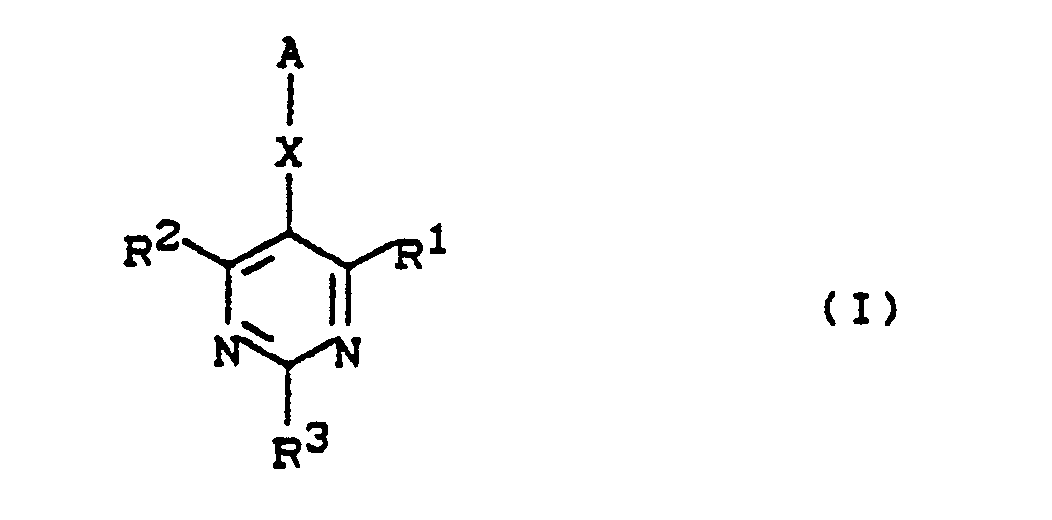
R¹ - für Cycloalkyl steht, oder
- für Alkyl steht, das substituiert sein kann durch Halogen, Cyano, Alkoxy, Alkylthio, Alkylsulfonyl, Trifluormethyl, Trifluormethoxy, Trifluormethylthio, Trifluormethylsulfonyl, Alkoxycarbonyl, Acyl oder durch eine Gruppe der Formel -NR⁴R⁵, worin
R⁴, R⁵ - gleich oder verschieden sind und Alkyl, Aryl, Aralkyl, Acyl, Alkylsulfonyl oder Arylsulfonyl bedeuten,
oder durch Carbamoyl, Dialkylcarbamoyl, Sulfamoyl, Dialkylsulfamoyl, Heteroaryl, Aryl, Aryloxy, Arylthio, Arylsulfonyl, Aralkoxy, Aralkylthio oder Aralkylsulfonyl, wobei die Heteroaryl- und Arylreste der letztgenannten Substituenten bis zu 3-fach gleich oder verschieden durch Halogen, Cyano, Trifluormethyl, Trifluormethoxy, Alkyl, Alkoxy, Alkylthio oder Alkylsulfonyl substituiert sein können,
R² - für Heteroaryl steht, das bis zu 3-fach gleich oder verschieden durch Halogen, Alkyl, Alkoxy, Alkylthio, Alkylsulfonyl, Aryl, Aryloxy, Arylthio, Arylsulfonyl, Trifluormethyl, Trifluormethoxy, Trifluormethylthio, Alkoxycarbonyl oder durch eine Gruppe der Formel -NR⁴R⁵ substitutiert sein kann, worin R⁴, R⁵ die oben angegebene Bedeutung haben, oder
R² - für Aryl steht, das bis zu 5-fach gleich oder verschieden substituiert sein kann durch Alkyl, Alkoxy, Alkylthio, Alkylsulfonyl, Aryl, Aryloxy, Arylthio, Arylsulfonyl, Aralkyl, Aralkoxy, Aralkylthio, Aralkylsulfonyl, Halogen, Cyano, Nitro, Trifluormethyl, Trifluormethoxy, Trifluormethylthio, Alkoxycarbonyl, Sulfamoyl, Dialkylsulfamoyl, Carbamoyl, Dialkylcarbamoyl oder durch eine Gruppe der Formel -NR⁴R⁵, worin R⁴ und R⁵ die oben angegebene Bedeutung haben,
R³ - für Wasserstoff oder
- für Cycloalkyl steht, oder
- für Alkyl steht, das substituiert sein kann durch Halogen, Cyano, Alkoxy, Alkylthio, Alkylsulfonyl, Trifluormethyl, Trifluormethoxy, Trifluormethylthio, Trifluormethylsulfonyl, Alkoxycarbonyl, Acyl oder durch eine Gruppe der Formel -NR⁴R⁵, worin R⁴, R⁵ die oben angegebene Bedeutung haben,
oder durch Carbamoyl, Dialkylcarbamoyl, Sulfamoyl, Dialkylsulfamoyl, Heteroaryl, Aryl, Aryloxy, Arylthio, Arylsulfonyl, Aralkoxy, Aralkylthio oder Aralkylsulfonyl, wobei die Heteroaryl- und Arylreste der letztgenannten Substituenten bis zu 3-fach gleich oder verschieden durch Halogen, Cyano, Trifluormethyl, Trifluormethoxy, Alkyl, Alkoxy, Alkylthio oder Alkylsulfonyl substituiert sein können, oder
R³ - für Heteroaryl steht, das bis zu 3-fach gleich oder verschieden durch Halogen, Alkyl, Alkoxy, Alkylthio, Alkylsulfonyl, Aryl, Aryloxy, Arylthio, Arylsulfonyl, Trifluormethyl, Trifluormethoxy, Trifluormethylthio, Alkoxycarbonyl oder durch eine Gruppe der Formel -NR⁴R⁵ substituiert sein kann, worin R⁴ und R⁵ die oben angegebene Bedeutung haben, oder
R³ - für Aryl steht, das bis zu 5-fach gleich oder verschieden substituiert sein kann durch Alkyl, Alkoxy, Alkylthio, Alkylsulfonyl, Aryl, Aryloxy, Arylthio, Arylsulfonyl, Aralkyl, Aralkoxy, Aralkylthio, Aralkylsulfonyl, Halogen, Cyano, Nitro, Trifluormethyl, Trifluormethoxy, Trifluormethylthio, Alkoxycarbonyl, Sulfamoyl, Dialkylsulfamoyl, Carbamoyl, Dialkylcarbamoyl oder durch eine Gruppe der Formel -NR⁴R⁵, worin R⁴ und R⁵ die oben angegebene Bedeutung haben, oder
R³ - für Alkoxy, Aryloxy, Aralkoxy, Alkylthio, Arylthio, Aralkylthio oder für eine Gruppe der Formel -NR⁴R⁵ steht, worin R⁴ und R⁵ die oben angegebene Bedeutung haben,
X - für eine Gruppe der Formel -CH₂-CH₂- oder -CH=CH- steht und
A - für eine Gruppe der Formel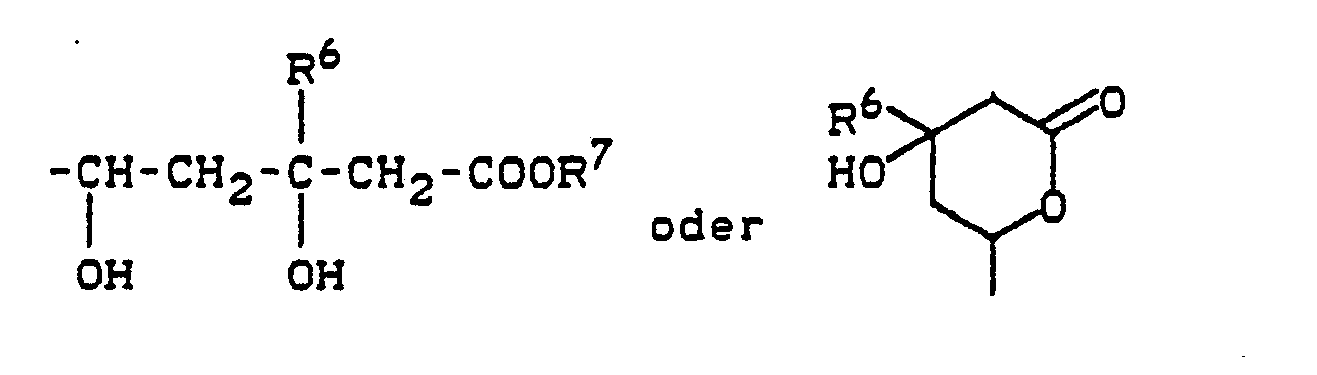
R⁶ - Wasserstoff oder Alkyl bedeutet und
R⁷ - Wasserstoff,
- einen Alkyl-, Aryl- oder Aralkylrest oder
- ein Kation bedeutet
gefunden. - Überraschenderweise zeigen die erfindungsgemäßen substituierten Pyrimidine eine gute inhibitorische Wirkung auf die HMG-CoA Reduktase (3-Hydroxy-3-methyl-glutaryl Coenzym A Reduktase).
- Cycloalkyl steht im allgemeinen für eine cyclischen Kohlenwasserstoffrest mit 3 bis 8 Kohlenstoffatomen. Bevorzugt ist der Cyclopropyl-, Cyclopentyl- und der Cyclohexylring. Beispielsweise seien Cyclopropyl, Cyclopentyl, Cyclohexyl, Cycloheptyl und Cyclooctyl genannt.
- Alkyl steht im allgemeinen für einen geradkettigen oder verzweigten Kohlenwasserstoffrest mit 1 bis 12 Kohlenstoffatomen. Bevorzugt wird Niederalkyl mit 1 bis etwa 6 Kohlenstoffatomen. Beispielsweise seien Methyl, Ethyl, Propyl, Isopropyl, Butyl, Isobutyl, Pentyl, Isopentyl, Hexyl, Isohexyl, Heptyl, Isoheptyl, Octyl und Isooctyl genannt.
- Alkoxy steht im allgemeinen für einen über ein Sauerstoffatom gebundenen geradkettigen oder verzweigten Kohlenwasserstoffrest mit 1 bis 12 Kohlenstoffatomen. Bevorzugt ist Niederalkoxy mit 1 bis etwa 6 Kohlenstoffatomen. Besonders bevorzugt ist ein Alkoxyrest mit 1 bis 4 Kohlenstoffatomen. Beispielsweise seien Methoxy, Ethoxy, Propoxy, Isopropoxy, Butoxy, Isobutoxy, Pentoxy, Isopentoxy, Hexoxy, Isohexoxy, Heptoxy, Isoheptoxy, Octoxy oder Isooctoxy genannt.
- Alkylthio steht im allgemeinen für einen über ein Schwefelatom gebundenen geradkettigen oder verzweigten Kohlenwasserstoffrest mit 1 bis 12 Kohlenstoffatomen. Bevorzugt ist Niederalkylthio mit 1 bis etwa 6 Kohlenstoffatomen. Besonders bevorzugt ist ein Alkylthiorest mit 1 bis 4 Kohlenstoffatomen. Beispielsweise seien Methylthio, Ethylthio, Propylthio, Isopropylthio, Butylthio, Isobutylthio, Pentylthio, Isopentylthio, Hexylthio, Isohexylthio, Heptylthio, Isoheptylthio, Octylthio oder Isooctylthio genannt.
- Alkylsulfonyl steht im allgemeinen für einen geradkettigen oder verzweigten Kohlenwasserstoffrest mit 1 bis 12 Kohlenstoffatomen, der über eine SO₂-Gruppe gebunden ist. Bevorzugt ist Niederalkylsulfonyl mit 1 bis etwa 6 Kohlenstoffatomen. Beispielsweise seien genannt: Methylsulfonyl, Ethylsulfonyl, Propylsulfonyl, Isopropylsulfonyl, Butylsulfonyl, Isobutylsulfonyl, Pentylsulfonyl, Isopentylsulfonyl, Hexylsulfonyl, Isohexylsulfonyl.
- Aryl steht im allgemeinen für einen aromatischen Rest mit 6 bis etwa 12 Kohlenstoffatomen. Bevorzugte Arylreste sind Phenyl, Naphthyl und Biphenyl.
- Aryloxy steht im allgemeinen für einen aromatischen Rest mit 6 bis etwa 12 Kohlenstoffatomen, der über ein Sauerstoffatom gebunden ist. Bevorzugte Aryloxyreste sind Phenoxy oder Naphthyloxy.
- Arylthio steht im allgemeinen für einen aromatischen Rest mit 6 bis etwa 12 Kohlenstoffatomen, der über ein Schwefelatom gebunden ist. Bevorzugte Arylthioreste sind Phenylthio oder Naphthylthio.
- Arylsulfonyl steht im allgemeinen für einen aromatischen Rest mit 6 bis etwa 12 Kohlenstoffatomen, der über eine SO₂-Gruppe gebunden ist. Beispielsweise seien genannt: Phenylsulfonyl, Naphthylsulfonyl und Biphenylsulfonyl.
- Aralkyl steht im allgemeinen für einen über eine Alkylenkette gebundenen Arylrest mit 7 bis 14 Kohlenstoffatomen. Bevorzugt werden Aralkylreste mit 1 bis 6 Kohlenstoffatomen im aliphatischen Teil und 6 bis 12 Kohlenstoffatome im aromatischen Teil. Beispielsweise seien folgende Aralkylreste genannt: Benzyl, Naphthylmethyl, Phenethyl und Phenylpropyl.
- Aralkoxy steht im allgemeinen für einen Aralkylrest mit 7 bis 14 Kohlenstoffatomen, wobei die Alkylenkette über ein Sauerstoffatom gebunden ist. Bevorzugt werden Aralkoxyreste mit 1 bis 6 Kohlenstoffatomen im aliphatischen Teil und 6 bis 12 Kohlenstoffatomen im aromatischen Teil. Beispielsweise seien folgende Aralkoxyreste genannt: Benzyloxy, Naphthylmethoxy, Phenethoxy und Phenylpropoxy.
- Aralkylthio steht im allgemeinen für einen Aralkylrest mit 7 bis etwa 14 Kohlenstoffatomen wobei die Alkylkette über ein Schwefelatom gebunden ist. Bevorzugt werden Aralkylthioreste mit 1 bis 6 Kohlenstoffatomen im aliphatischen Teil und 6 bis 12 Kohlenstoffatomen im aromatischen Teil. Beispielsweise seien folgende Aralkylthioreste genannt: Benzylthio, Naphthylmethylthio, Phenethylthio und Phenylpropylthio.
- Aralkylsulfonyl steht im allgemeinen für einen Aralkylrest mit 7 bis etwa 14 Kohlenstoffatomen, wobei die Alkylreste über eine SO₂-Kette gebunden ist. Bevorzugt werden Aralkylsulfonylreste mit 1 bis 6 Kohlenstoffatomen im aliphatischen Teil und 6 bis 12 Kohlenstoffatomen im aromatischen Teil. Beispielsweise seien folgende Aralkylsulfonylreste genannt: Benzylsulfonyl, Naphthylmethylsulfonyl, Phenethylsulfonyl und Phenylpropylsulfonyl.
- Alkoxycarbonyl kann beispielsweise durch die Formel
--OAlkyl
dargestellt werden. Alkyl steht hierbei für einen geradkettigen oder verzweigten Kohlenwasserstoffrest mit 1 bis 12 Kohlenstoffatomen. Bevorzugt wird Niederalkoxycarbonyl mit 1 bis etwa 6 Kohlenstoffatomen im Alkylteil. Insbesondere bevorzugt wird ein Alkoxycarbonyl mit 1 bis 4 Kohlenstoffatomen im Alkylteil. Beispielsweise seien die folgenden Alkoxycarbonylreste genannt: Methoxycarbonyl, Ethoxycarbonyl, Propoxycarbonyl, Isopropoxycarbonyl, Butoxycarbonyl oder Isobutoxycarbonyl. - Acyl steht im allgemeinen für Phenyl oder geradkettiges oder verzweigtes Niederalkyl mit 1 bis etwa 6 Kohlenstoffatomen, die über eine Carbonylgruppe gebunden sind. Bevorzugt sind Phenyl und Alkylreste mit bis zu 4 Kohlenstoffatomen. Beispielsweise seien genannt: Benzoyl, Acetyl, Ethylcarbonyl, Propylcarbonyl, Isopropylcarbonyl, Butylcarbonyl und Isobutylcarbonyl.
- Halogen steht im allgemeinen für Fluor, Chlor, Brom oder Iod, bevorzugt für Fluor, Chlor oder Brom. Besonders bevorzugt steht Halogen für Fluor oder Chlor.
- Heteroaryl im Rahmen der oben angebenen Definition steht im allgemeinen für einen 5- bis 6-gliedrigen aromatischen Ring, der als Heteroatome Sauerstoff, Schwefel und/oder Stickstoff enthalten kann und an den weitere aromatische Ringe ankondensiert sein können. Bevorzugt sind 5- und 6-gliedrige aromatische Ringe, die einen Sauerstoff, ein Schwefel und/oder bis zu 2 Stickstoffatome enthalten und die gegebenenfalls benzokondensiert sind. Als besonders bevorzugte Heteroarylreste seien genannt: Thienyl, Furyl, Pyrolyl, Pyrazolyl, Pyridyl, Pyrimidyl, Pyrazinyl, Pyridazinyl, Chinolyl, Isochinolyl, Chinazolyl, Chinoxalyl, Phthalazinyl, Cinnolyl, Thiazolyl, Benzothiazolyl, Isothiazolyl, Oxazolyl, Benzoxazolyl, Isoxazolyl, Imidazolyl, Benzimidazolyl, Pyrazolyl, Indolyl, und Isoindolyl.
- Falls R⁷ für einen Alkyl-, Aryl- oder Aralkylrest steht, bildet sich eine Estergruppe.
- Bevorzugt werden physiologisch verträgliche Ester, die in vivo leicht zu einer freien Carboxylgruppe und einem entsprechenden physiologisch verträglichen Alkohol hydrolysiert werden. Hierzu gehören beispielsweise Alkylester (C₁ bis C₆-Aryl (C₆ bis C₁₂), und Aralkylester (C₇ bis C₁₀), bevorzugt Niederalkylester sowie Benzylester. Insbesondere bevorzugt werden Methylester, Ethylester, Propylester, Benzylester.
- Steht R⁷ für ein Kation so, ist bevorzugt ein physiologisch verträgliches Metall-oder Ammoniumkation gemeint. Bevorzugt sind hierbei Alkali-bzw. Erdalkalikationen wie beispielsweise Natrium-, Kalium-, Magnesium- oder Calciumkationen, sowie Aluminium-oder Ammoniumkationen, sowie nicht-toxische substituierte Ammoniumkationen aus Aminen wie Diniederalkylamine (C₉ bis etwa C₆), Triniederalkylamine (C₁ bis etwa C₆), Dibenzylamin, N,N′-Dibenzylethylendiamin, N-Benzyl-β-phenylethylamin, N-Methylmorpholin oder N-Ethylmorpholin, Dihydroabiethylamin, N,N′-Bis-dihydroabiethylethylendiamin, N-Niederalkylpiperidin und andere Amine, die zur Bildung von Salzen verwendet werden können.
- Bevorzugt werden substituierte Pyrimidine der Formel (I), in welcher
R¹ - für Cyclopropyl, Cyclopentyl oder Cyclohexyl steht, oder
- für Niederalkyl steht, das substituiert sein kann durch Fluor, Chlor, Brom, Cyano, Niederalkoxy, Niederalkylthio, Niederalkylsulfonyl, Trifluormethyl, Trifluormethoxy, Trifluormethylsulfonyl, Niederalkoxycarbonyl, Benzoyl, Niederalkylcarbonyl, durch eine Gruppe der Formel -NR⁴R⁵, worin
R⁴ und R⁵ gleich oder verschieden sind und Niederalkyl, Phenyl, Benzyl, Acetyl, Benzoyl, Phenylsulfonyl oder Niederalkylsulfonyl bedeuten,
oder durch Pyridyl, Pyrimidyl, Pyrazinyl, Pyridazinyl, Chinolyl, Isochinolyl, Pyrryl, Indolyl, Thienyl, Furyl, Imidazolyl, Oxazolyl, Thiazolyl, Phenyl, Phenoxy, Phenylthio, Phenylsulfonyl, Benzyloxy, Benzylthio, Benzylsulfonyl, Phenylethoxy, Phenylethylthio oder Phenylethylsulfonyl, wobei die ge nannten Heteroaryl- und Arylreste bis zu 2-fach gleich oder verschieden durch Fluor, Chlor, Brom, Niederalkyl, Niederalkoxy, Trifluormethyl, oder Trifluormethoxy substituiert sein können,
R² - für Thienyl, Furyl, Thiazolyl, Isothiazolyl, Oxazolyl, Isoxazolyl, Pyridyl, Pyrimidyl, Pyrazinyl, Pyridazinyl, Indolyl, Isoindolyl, Chinolyl, Isochinolyl, Phthalazinyl, Chinoxalinyl, Chinazolinyl, Cinnolinyl, Benzothiazolyl, Benzoxazolyl oder Benzimidazolyl steht, das bis zu 2-fach gleich oder verschieden substituiert sein kann durch Fluor, Chlor, Brom, Niederalkyl, Niederalkoxy, Phenyl, Phenoxy, Trifluormethyl, Trifluormethoxy oder Niederalkoxycarbonyl, oder
- für Phenyl oder Naphthyl steht, die bis zu 4-fach gleich oder verschieden substituiert sein kann durch Niederalkyl, Niederalkoxy, Niederalkylthio, Niederalkylsulfonyl, Phenyl, Phenyloxy, Phenylthio, Phenylsulfonyl, Benzyl, Benzyloxy, Benzylthio, Benzylsulfonyl, Phenethyl, Phenylethoxy, Phenylethylthio, Phenylethylsulfonyl, Fluor, Chlor, Brom, Cyano, Trifluormethyl, Trifluormethoxy, Trifluormethylthio, Niederalkoxycarbonyl oder durch eine Gruppe der Formel -NR⁴R⁵, wobei R⁴ und R⁵ die oben angegebene Bedeutung haben,
R³ - für Wasserstoff steht oder
- für Cyclopropyl, Cyclopentyl oder Cyclohexyl steht oder
- für Niederalkyl steht, das substituiert sein kann durch Fluor, Chlor, Brom, Cyano, Niederalkoxy, Niederalkylthio, Niederalkylsulfonyl, Trifluormethyl, Trifluormethoxy, Trifluormethylsulfonyl, Niederalkoxycarbonyl, Benzoyl, Niederalkylcarbonyl, durch eine Gruppe der Formel -NR⁴R⁵, worin R⁴, R⁵ die oben angegebene Bedeutung haben,
oder durch Pyridyl, Pyrimidyl, Pyrazinyl, Pyridazinyl, Chinolyl, Isochinolyl, Pyrrolyl, Indolyl, Thienyl, Furyl, Imidazolyl, Oxazolyl, Thiazolyl, Phenyl, Phenoxy, Phenylthio, Phenylsulfonyl, Benzyloxy, Benzylthio, Benzylsulfonyl, Phenylethoxy, Phenylethylthio oder Phenylethylsulfonyl, wobei die genannten Heteroaryl- und Arylreste bis zu 2-fach gleich oder verschieden durch Fluor, Chlor, Brom, Niederalkyl, Niederalkoxy, Trifluormethyl, oder Trifluormethoxy substituiert sein können, oder
R³ - für Thienyl, Furyl, Thiazolyl, Isothiazolyl, Oxazolyl, Isoxazolyl, Pyridyl, Pyrimidyl, Pyrazinyl, Pyridazinyl, Indolyl, Isoindolyl, Chinolyl, Isochinolyl, Phthalazinyl, Chinoxalinyl, Chinazolinyl, Cinnolinyl, Benzothiazolyl, Benzoxazolyl oder Benzimidazolyl steht, das bis zu 2-fach gleich oder verschieden substituiert sein können durch Fluor, Chlor, Brom, Niederalkyl, Niederalkoxy, Phenyl, Phenoxy, Trifluormethyl, Trifluormethoxy oder Niederalkoxycarbonyl, oder
R³ - für Phenyl oder Naphthyl steht, das bis zu 4-fach gleich oder verschieden substituiert sein kann durch Niederalkyl, Niederalkoxy, Niederalkylthio, Niederalkylsulfonyl, Phenol, Phenyloxy, Phenylthio, Phenylsulfonyl, Benzyl, Benzyloxy, Benzylthio, Benzylsulfonyl, Phenethyl, Phenylethoxy, Phenylethylthio, Phenylethylsulfonyl, Fluor, Chlor, Brom, Cyano, Trifluormethyl, Trifluormethoxy, Trifluormethylthio, Niederalkoxycarbonyl oder durch eine Gruppe der Formel -NR⁴R⁵, wobei R⁴ und R⁵ die oben angegebene Bedeutung haben, oder
R³ - für Alkoxy, Aryloxy, Aralkoxy, Alkylthio, Arylthio, Aralkylthio oder für eine Gruppe der Formel -NR⁴R⁵ steht, worin R⁴ und R⁵ die oben angegebene Bedeutung haben,
X - für eine Gruppe der Formel -CH₂-CH₂- oder -CH=CH- steht und
A - für eine Gruppe der Formel
R⁶ - Wasserstoff oder Niederalkyl bedeutet, und
R⁷ - Alkyl (C₁ bis C₆), Aryl (C₆ bis C₁₂) oder Aralkyl (C₇ bis C₁₀) bedeutet, oder
- ein physiologisch verträgliches Kation bedeutet. - Besonders bevorzugt sind Verbindungen der allgemeinen Formel (I),
in welcher
R¹ - für Cyclopropyl, Cyclopentyl oder Cyclohexyl steht, oder
- für Methyl, Ethyl, Propyl, Isopropyl, Butyl, sec.-Butyl oder tert.Butyl steht, die substituiert sein können durch Fluor, Chlor, Brom, Cyano, Methoxy, Ethoxy, Propoxy, Isopropoxy, Butoxy, sec.Butoxy, tert.Butoxy, Methylthio, Ethylthio, Propylthio, Isopropylthio, Methylsulfonyl, Ethylsulfonyl, Propylsulfonyl, Isopropylsulfonyl, Trifluormethyl, Trifluormethoxy, Methoxycarbonyl, Ethoxycarbonyl, Butoxycarbonyl, Isobutoxycarbonyl, tert.-Butoxycarbonyl, Benzoyl, Acetyl, Pyridyl, Pyrimidyl, Thienyl, Furyl, Phenyl, Phenoxy, Phenylthio, Phenylsulfonyl, Benzyloxy, Benzylthio oder Benzylsulfonyl,
R² - für Pyridyl, Pyrimidyl, Chinolyl oder Isochinolyl steht, das durch Fluor, Chlor, Methyl, Methoxy oder Trifluormethyl substituiert sein kann, oder
- für Phenyl steht, das bis zu 3-fach gleich oder verschieden substituiert sein kann durch Methyl, Ethyl, Propyl, Isopropyl, Butyl, Isobutyl, tert.-Butyl, Methoxy, Ethoxy, Propoxy, Isopropoxy, Butoxy, Isobutoxy, tert.Butoxy, Methylthio, Ethylthio, Propylthio, Isopropylthio, Methylsulfonyl, Ethylsulfonyl, Propylsulfonyl, Isopropylsulfonyl, Phenyl, Phenoxy, Benzyl, Benzyloxy, Fluor, Chlor, Brom, Cyano, Trifluormethyl, Trifluormethoxy, Methoxycarbonyl, Ethoxycarbonyl, Propoxycarbonyl, Isopropoxycarbonyl, Butoxycarbonyl, Isobutoxycarbonyl oder tert.-Butoxycarbonyl,
R³ - für Wasserstoff, Cyclopropyl, Cyclopentyl oder Cyclohexyl steht, oder
- für Methyl, Ethyl, Propyl, Isopropyl, Butyl, Isobutyl, tert.Butyl, Pentyl, Isopentyl, Hexyl oder Isohexyl steht, das substituiert sein kann durch Fluor, Chlor, Brom, Cyano, Methoxy, Ethoxy, Propoxy, Isopropoxy, Butoxy, Isobutoxy, tert.-Butoxy, Methylthio, Ethylthio, Propylthio, Isopropylthio, Butylthio, Isobutylthio, tert.Butylthio, Methylsulfonyl, Ethylsulfonyl, Propylsulfonyl, Isopropylsulfonyl, Butylsulfonyl, Isobutylsulfonyl, tert.-Butylsulfonyl, Trifluormethyl, Trifluormethoxy, Methoxycarbonyl, Ethoxycarbonyl, Propoxycarbonyl, Isopropoxycarbonyl, Butoxycarbonyl, Isobutoxycarbonyl, tert.-Butoxycarbonyl, Benzoyl, Acetyl, Ethylcarbonyl, oder durch eine Gruppe -NR⁴R⁵, wobei
R⁴ und R⁵ gleich oder verschieden sind und Methyl, Ethyl, Propyl, Isopropyl, Butyl, Isobutyl, tert.Butyl, Phenyl, Benzyl, Acetyl, Methylsulfonyl, Ethylsulfonyl, Propylsulfonyl, Isopropylsulfonyl oder Phenylsulfonyl bedeuten,
oder durch Pyridyl, Pyrimidyl, Pyrazinyl, Pyridazinyl, Chinolyl, Isochinolyl, Thienyl, Furyl, Phenyl, Phenoxy, Phenylthio, Phenylsulfonyl, Benzyloxy, Benzylthio oder Benzylsulfonyl, wobei die genannten Heteroaryl- und Arylreste durch Fluor, Chlor, Methyl, Ethyl, Propyl, Isopropyl, Isobutyl, tert. Butyl, Methoxy, Ethoxy, Propoxy, Isopropoxy, Butoxy, Isobutoxy, tert.-Butoxy, Trifluormethyl oder Trifluormethoxy substituiert sein können, oder
- für Thienyl, Furyl, Pyridyl, Pyrimidyl, Pyrazinyl, Pyridazinyl, Oxazolyl, Isooxazolyl, Imidazolyl, Pyrazolyl, Thiazolyl, Isothiazolyl, Chinolyl, Isochinolyl, Benzoxazolyl, Benzimidazolyl oder Benzthiazolyl steht, wobei die genannten Reste durch Fluor, Chlor, Methyl, Ethyl, Propyl, Isopropyl, Butyl, Isobutyl, tert.Butyl, Methoxy, Ethoxy, Propoxy, Isopropoxy, Butoxy, Isobutoxy, tert.Butoxy, Phenyl, Phenoxy, Trifluormethyl, Trifluormethoxy, Methoxycarbonyl, Ethoxycarbonyl, Isopropoxycarbonyl, Propoxycarbonyl, Butoxycarbonyl, Isobutoxycarbonyl oder tert.Butoxycarbonyl substituiert sein können, oder
- für Phenyl steht, das bis zu 3-fach gleich oder verschieden durch Methyl, Ethyl, Propyl, Isopropyl, Butyl, Isobutyl, tert.Butyl, Pentyl, Isopentyl, Hexyl, Isohexyl, Methoxy, Ethoxy, Propoxy, Isopropoxy, Butoxy, Isobutoxy, tert.Butoxy, Methylthio, Ethylthio, Propylthio, Isopropylthio, Butylthio, Isobutylthio, tert.Butylthio, Methylsulfonyl, Ethylsulfonyl, Propylsulfonyl, Isopropylsulfonyl, Butylsulfonyl, Isobutylsulfonyl, tert.Butylsulfonyl, Phenyl, Phenoxy, Phenylthio, Phenylsulfonyl, Benzyl, Benzyloxy, Benzylthio, Benzylsulfonyl, Fluor, Chlor, Brom, Cyano, Trifluormethyl, Trifluormethoxy, Trifluormethylthio, Methoxycarbonyl, Ethoxycarbonyl, Propoxycarbonyl, Isopropoxycarbonyl, Butoxycarbonyl, Isobutoxycarbonyl, tert.Butoxycarbonyl oder durch eine Gruppe -NR⁴R⁵ substituiert sein kann, wobei R⁴ und R⁵ die oben angegebene Bedeutung haben, oder
- für Alkoxy, Aryloxy, Aralkoxy, Alkylthio, Arylthio, Aralkylthio oder für eine Gruppe der Formel -NR⁴R⁵ steht, worin R⁴ und R⁵ die oben angegebene Bedeutung haben,
X - für eine Gruppe der Formel -CH₂-CH₂- oder -CH=CH- steht und
A - für eine Gruppe der Formel
R⁶ - Wasserstoff, Methyl, Ethyl, Propyl, Isopropyl, Butyl, Isobutyl oder tert.Butyl bedeutet, und
R⁷ - Wasserstoff, Methyl, Ethyl, Propyl, Isopropyl, Butyl, Isobutyl, tert.Butyl oder Benzyl bedeutet, oder ein Natrium-, Kalium-, Calcium -, oder Magnesium- oder Ammoniumion bedeutet. - Die erfindungsgemäßen substituierten Pyrimidine der allgemeinen Formel (I) haben mehrere asymmetrische Kohlenstoffatome und können daher in verschiedenen stereochemischen Formen existieren. Sowohl die einzelnen Isomeren als auch deren Mischungen sind Gegenstand der Erfindung.
- Je nach der Bedeutung der Gruppe X bzw. des Restes A ergeben sich unterschiedliche Stereoisomere, die im folgenden näher erläutert werden sollen:
- a) Steht die Gruppe -X- für eine Gruppe der Formel -CH=CH- , so können die erfindungsgemäßen Verbindungen in zwei stereoisomeren Formen existieren, die an der Doppelbindung E-konfiguriert (II) oder Z-konfiguriert (III) sein können:

- b) Steht der Rest -A- für eine Gruppe der Formel

Stellung dieser Hydroxygruppen zueinander, können die erfindungsgemäßen Verbindungen in der erythro-Konfiguration (IV) oder in der threo-Konfiguration (V) vorliegen.
Bevorzugt sind hierbei die Erythro-konfigurierten Isomeren, besonders bevorzugt das 3R,5S-Isomere sowie das 3R,5S-3S,5R-Racemat. - c) Steht der Rest -A- für eine Gruppe der Formel


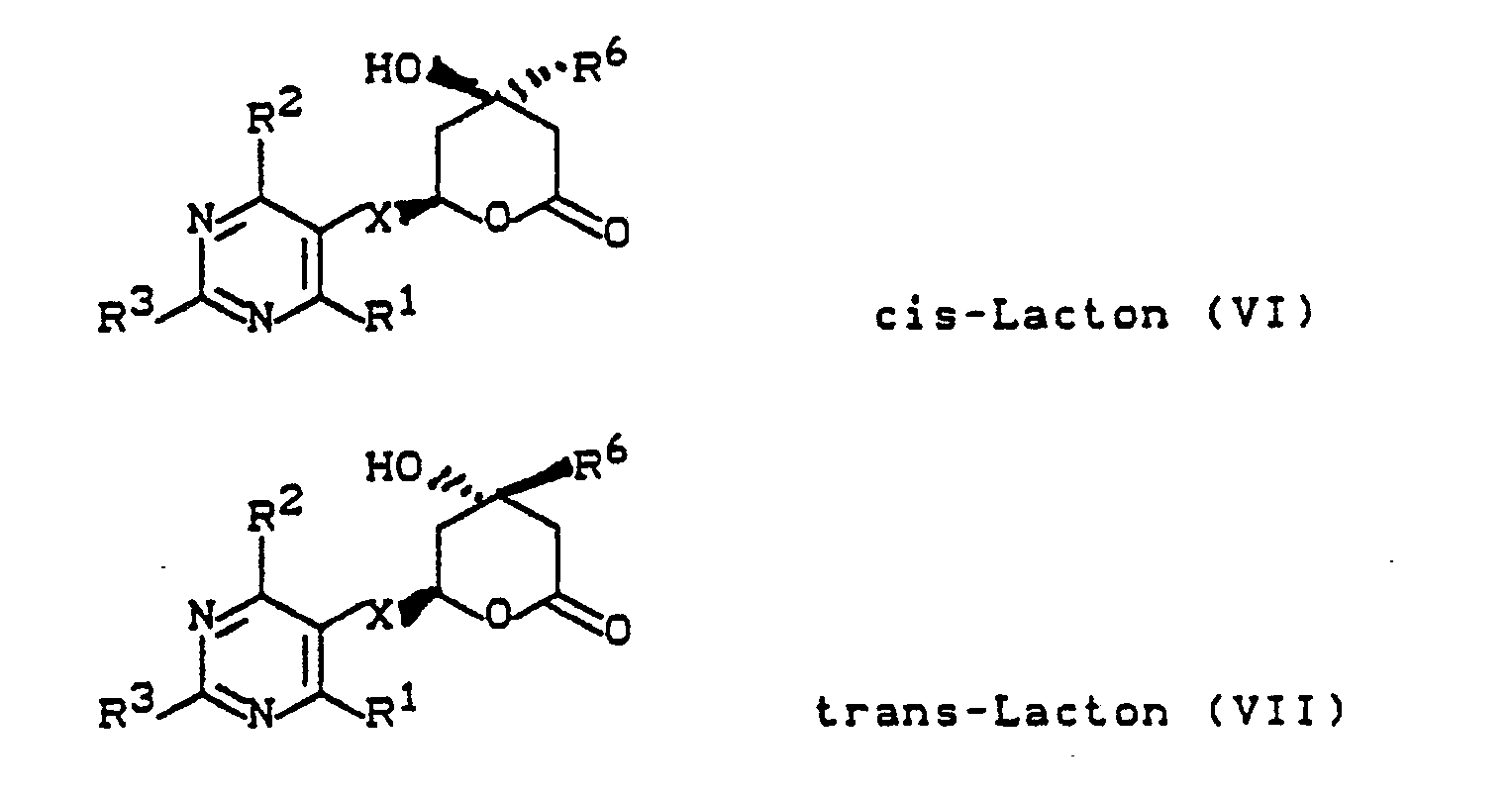
- Beispielsweise seien die folgenden isomeren Formen der substituierten Pyrimidine genannt:


- Ganz besonders bevorzugt sind die Verbindungen der allgemeinen Formel I, in welchen
R¹ - für Cyclopropyl, Methyl, Ethyl, Propyl, Isopropyl, Butyl, Isobutyl oder tert.Butyl steht,
R² - für Phenyl steht, das bis zu 2-fach gleich oder verschieden durch Methyl, Methoxy, Phenoxy, Fluor, Chlor oder Trifluormethyl substituiert sein kann,
R³ - für Methyl, Isopropyl, tert.-Butyl oder
- für Phenyl steht, das bis zu 2-fach gleich oder verschieden durch Methyl, Methoxy, Fluor oder Chlor, substituiert sein kann,
X - für eine Gruppe der Formel
(E-konfiguriert)
steht und
A - für eine Gruppe der Formel
R⁶ - Wasserstoff bedeutet und
R⁷ - Wasserstoff, Methyl oder Ethyl bedeutet oder ein Natrium- oder Kaliumkation bedeutet. - Außerdem wurde ein Verfahren zur Herstellung der substituierten Pyrimidine der allgemeinen Formel (I)

R¹, R², R³, X und A die oben genannte Bedeutung haben,
gefunden, das dadurch gekennzeichnet ist, daß man Ketone der allgemeinen Formel (VIII)
R¹, R² und R³ die oben angegebene Bedeutung haben, und
R⁷′ - für Alkyl, Aryl oder Aralkyl steht,
reduziert,
im Fall der Herstellung der Säuren die Ester verseift,
im Fall der Herstellung der Lactone die Carbonsäuren cyclisiert,
im Fall der Herstellung der Salze entweder die Ester oder die Lactone verseift,
im Fall der Herstellung der Ethylenverbindungen (X = -CH₂-CH₂-) die Ethenverbindungen (X = -CH=CH-) nach üblichen Methoden hydriert,
und gegebenenfalls Isomeren trennt. - Das erfindungsgemäße Verfahren kann durch das folgendes Formelschema erläutert werden:

- Die Reduktion kann mit den üblichen Reduktionsmitteln, bevorzugt mit solchen, die für die Reduktion von Ketonen zu Hydroxyverbindungen geeignet sind, durchgeführt werden. Besonders geeignet ist hierbei die Reduktion mit Metallhydriden oder komplexen Metallhydriden in inerten Lösemitteln, gegebenenfalls in Anwesenheit eines Trialkylborans. Bevorzugt wird die Reduktion mit komplexen Metallhydriden wie beispielsweise Lithiumboranat, Natriumboranat, Kaliumboranat, Zinkboranat, Lithium-trialkyl hydrido-borate, Natrium-trialkyl-hydrido-boranaten, Natrium-cyano-trihydrido-borat oder Lithiumaluminiumhydrid durchgeführt. Ganz besonders bevorzugt wird die Reduktion mit Natriumborhydrid, in Anwesenheit von Triethylboran durchgeführt.
- Als Lösemittel eignen sich hierbei die üblichen organischen Lösemittel, die sich unter den Reaktionsbedingungen nicht verändern. Hierzu gehören bevorzugt Ether wie beispielsweise Diethylether, Dioxan, Tetrahydrofuran oder Dimethoxyethan, oder Halogenkohlenwassertstoffe wie beispielsweise Dichlormethan, Trichlormethan, Tetrachlormethan, 1,2-Dichlorethan, oder Kohlenwasserstoffe wie beispielsweise Benzol, Toluol oder Xylol. Ebenso ist es möglich Gemische der genannten Lösemittel einzusetzen.
- Besonders bevorzugt wird die Reduktion der Ketongruppe zur Hydroxygruppe unter Bedingungen durchgeführt, bei denen die übrigen funktionellen Gruppen wie beispielsweise die Alkoxycarbonylgruppe nicht verändert werden. Hierzu besonders geeignet ist die Verwendung von Natriumborhydrid als Reduktionsmittel, in Anwesenheit von Triethylboran in inerten Lösemitteln wie vorzugsweise Ethern.
- Die Reduktion erfolgt im allgemeinen in einem Temperaturbereich von -80°C bis Raumtemperatur (etwa + 30°C), bevorzugt von - 78°C bis 0°C.
- Das erfindungsgemäße Verfahren wird im allgemeinen bei Normaldruck durchgeführt. Es ist aber auch möglich, das Verfahren bei Unterdruck oder bei Überdruck durchzuführen (z.B. in einem Bereich von 0,5 bis 5 bar).
- Im allgemeinen wird das Reduktionsmittel in einer Menge von 1 bis 2 mol, bevorzugt von 1 bis 1,5 mol bezogen auf 1 mol der Ketoverbindung eingesetzt.
- Unter den ober angegebenen Reaktionsbedingungen wird im allgemeinen die Carbonylgruppe zur Hydroxygruppe reduziert, ohne daß Reduktion an der Doppelbindung zur Einfachbindung erfolgt.
- Zur Herstellung von Verbindungen der allgemeinen Formel (I), in welchen X für eine Ethylengruppierung steht, kann die Reduktion der Ketone (III) unter solchen Bedingungen durchgeführt werden, unter denen sowohl die Carbonylgruppe als auch die Doppelbindung reduziert wird.
- Darüberhinaus ist es auch möglich, die Reduktion der Carbonylgruppe und die Reduktion der Doppelbindung in zwei getrennten Schritten durchzuführen.
- Die Carbonsäuren im Rahmen der allgemeinen Formel (I) entsprechen der Formel (Ic)

- Die Carbonsäureester im Rahmen der allgemeinen Formel (I) entsprechen der Formel (Id)

- Die Salze der erfindungsgemäßen Verbindungen im Rahmen der allgemeinen Formel (I) entsprechen der Formel (Ie)

Mn+ für ein Kation mit der Wertigkeit n steht. Die bevorzugte Wertigkeit ist 1 oder 2. - Die Lactone im Rahmen der allgemeinen Formel (I) entsprechen der Formel (If)

- Zur Herstellung der erfindungsgemäßen Carbonsäuren der allgemeinen Formel (Ic) werden im allgemeinen die Carbonsäureester der allgemeinen Formel (Id) oder die Lactone der allgemeinen Formel (If) nach üblichen Methoden verseift. Die Verseifung erfolgt im allgemeinen indem man die Ester oder die Lactone in inerten Lösemitteln mit üblichen Basen behandelt, wobei im allgemeinen zunächst die Salze der allgemeinen Formel (Ie) entstehen, die anschließend in einem zweiten Schritt durch Behandeln mit Säuren in die freien Säuren der allgemeinen Formel (Ic) überführt werden können.
- Als Basen eignen sich für die Verseifung die üblichen anorganischen Basen. Hierzu gehören bevorzugt Alkalihydroxide oder Erdalkalihydroxide wie beispielsweise Natriumhydroxid, Kaliumhydroxid oder Bariumhydroxid, oder Alkalicarbonate wie Natrium - oder Kaliumcarbonat oder Natriumhydrogencarbonat, oder Alkalialkoholate wie Natriumethanolat, Natriummethanolat, Kaliummethanolat, Kaliumethanolat oder Kalium-tert.butanolat. Besonders bevorzugt werden Natriumhydroxid oder Kaliumhydroxid eingesetzt.
- Als Lösemittel eigen sich für die Verseifung Wasser oder die für eine Verseifung üblichen organischen Lösemittel. Hierzu gehören bevorzugt Alkohole wie Methanol, Ethanol, Propanol, Isopropanol oder Butanol, oder Ether wie Tetrahydrofuran oder Dioxan, oder Dimethylformamid oder Dimethylsulfoxid. Besonders bevorzugt werden Alkohole wie Methanol, Ethanol, Propanol oder Isopropanol verwendet. Ebenso ist es möglich, Gemische der genannten Lösemittel einzusetzen.
- Die Verseifung wird im allgemeinen in einem Temperaturbereich von 0°C bis +100°C, bevorzugt von + 20°C bis +80°C durchgeführt.
- Im allgemeinen wird die Verseifung bei Normaldruck durchgeführt. Es ist aber auch möglich, bei Unterdruck oder bei Überdruck zu arbeiten (z.B. von 0,5 bis 5 bar).
- Bei der Durchführung der Verseifung wird die Base im allgemeinen in einer Menge von 1 bis 3 mol, bevorzugt von 1 bis 1,5 mol bezogen auf 1 mol des Esters bsw. des Lactons eingesetzt. Besonders bevorzugt verwendet man molare Mengen der Reaktanden.
- Bei der Durchführung der Reaktion entstehen im ersten Schritt die Salze der erfindungsgemäßen Verbindungen (Ie) als Zwischenprodukte, die isoliert werden können. Die erfindungsgemäßen Säuren (Ic) erhält man durch Behandeln der Salze (Ie) mit üblichen anorganischen Säu ren. Hierzu gehören bevorzugt Mineralsäuren wie beispielsweise Chlorwasserstoffsäure, Bromwasserstoffsäure, Schwefelsäure oder Phosphorsäure. Es hat sich bei der Herstellung der Carbonsäuren (Ic) hierbei als vorteilhaft erwiesen, die basische Reaktionsmischung der Verseifung in einem zweiten Schritt ohne Isolierung der Salze anzusäueren. Die Säuren können dann in üblicher Weise isoliert werden.
- Zur Herstellung der erfindungsgemäßen Lactone der Formel (If) werden im allgemeinen die erfindungsgemäßen Carbonsäuren (Ic) nach üblichen Methoden cyclisiert, beispielsweise durch Erhitzen der entsprechenden Säure in inerten organischen Lösemitteln, gegebenenfalls in Anwesenheit von Molsieb.
- Als Lösemittel eignen sich hierbei Kohlenwasserstoffe wie Benzol, Toluol, Xylol, Erdölfraktionen, oder Tetralin oder Diglyme oder Triglyme. Bevorzugt werden Benzol, Toluol oder Xylol eingesetzt. Ebenso ist es möglich Gemische der genannten Lösemittel einzusetzen. Besonders bevorzugt verwendet man Kohlenwasserstoffe, insbesondere Toluol, in Anwesenheit von Molsieb.
- Die Cyclisierung wird im allgemeinen in einem Temperaturbereich von -40°C bis +200°C, bevorzugt von -25°C bis +50°C durchgeführt.
- Die Cyclisierung wird im allgemeinen bei Normaldruck durchgeführt, es ist aber auch möglich, das Verfahren bei Unterdruck oder bei Überdruck durchzuführen (z.B. in einem Bereich von 0,5 bis 5 bar).
- Darüberhinaus wird die Cyclisierung auch in inerten organischen Lösemitteln, mit Hilfe von cyclisierenden bzw. wasserabspaltenden Agentien durchgeführt. Als wasserabspaltende Agentien werden hierbei bevorzugt Carbodiimide verwendet. Als Carbodiimide werden bevorzugt N,N′-Di-cyclohexylcarbodiimid-Paratoluolsulfonat, N-Cyclohexyl- N′-[2-(N˝-methylmorpholinium)ethyl]carbodiimid oder N-(3-Dimethylaminopropyl)-N′- ethylcarbodiimid-Hydrochlorid eingesetzt.
- Als Lösemittel eignen sich hierbei die üblichen organischen Lösemittel. Hierzu gehören bevorzugt Ether wie Diethylether, Tetrahydrofuran oder Dioxan, oder Chlorkohlenwasserstoffe wie Methylenchlorid, Chloroform oder Tetrachlorkohlenstoff, oder Kohlenwasserstoffe wie Benzol, Toluol, Xylol oder Erdölfraktionen. Besonders bevorzugt werden Chlorkohlenwasserstoffe wie beispielsweise Methylenchlorid, Chloroform oder Tetrachlorkohlenstoff, oder Kohlenwasserstoffe wie Benzol, Toluol, Xylol, oder Erdölfraktionen. Besonders bevorzugt werden Chlorkohlenwasserstoffe wie beispielsweise Methylenchlorid, Chloroform oder Tetrachlorkohlenstoff eingesetzt.
- Die Reaktion wird im allgemeinen in einem Temperaturbereich von 0°C bis +80°C, bevorzugt von +10°C bis +50°C durchgeführt.
- Bei der Durchführung der Cyclisierung hat es sich als vorteilhaft erwiesen, die Cyclisierungsmethode mit Hilfe von Carbodiimiden als dehydratisierenden Agentien einzusetzen.
- Die Trennung der Isomeren in die stereoisomer einheitlichen Bestandteile erfolgt im allgemeinen nach üblichen Methoden wie sie beispielsweise von E.L. Eliel, Stereochemistry of Carbon Compounds, McGraw Hill, 1962 beschrieben wird, Bevorzugt wird hierbei die Trennung der Isomeren auf der Stufe der racemischen Lactone. Besonders bevorzugt wird hierbei die racemische Mischung der trans-Lactone (VII) durch Behandeln entweder mit (D-(+)- oder L-(-)-α-Methylbenzylamin nach üblichen Methoden in die diastereomeren Dihydroxyamide (Ig)

- Die Isomerentrennung soll im folgenden Schema beispielhaft erläutert werden:

- Die als Ausgangsstoffe eingesetzten Ketone (VIII) sind neu.
- Es wurde ein Verfahren zur Herstellung der erfindungsgemäßen Ketone der allgemeinen Formel (VIII)

R¹ , R² , R³ und R⁷ ′ die oben genannte Bedeutung haben,
gefunden, das dadurch gekennzeichnet ist, daß man Aldehyde der allgemeinen formel (IX)
R¹ , R² und R³ die oben angegebene Bedeutung haben,
in inerten Lösemitteln mit Acetessigester der allgemeinen formel (X)
H₃C--CH₂-COOR7′ (X)
in welcher
R7′ die oben angegebene Bedeutung hat,
in Anwesenheit von Basen umsetzt. - Das erfindungsgemäße Verfahren kann beispielsweise durch folgendes Formelschema erläutert werden:
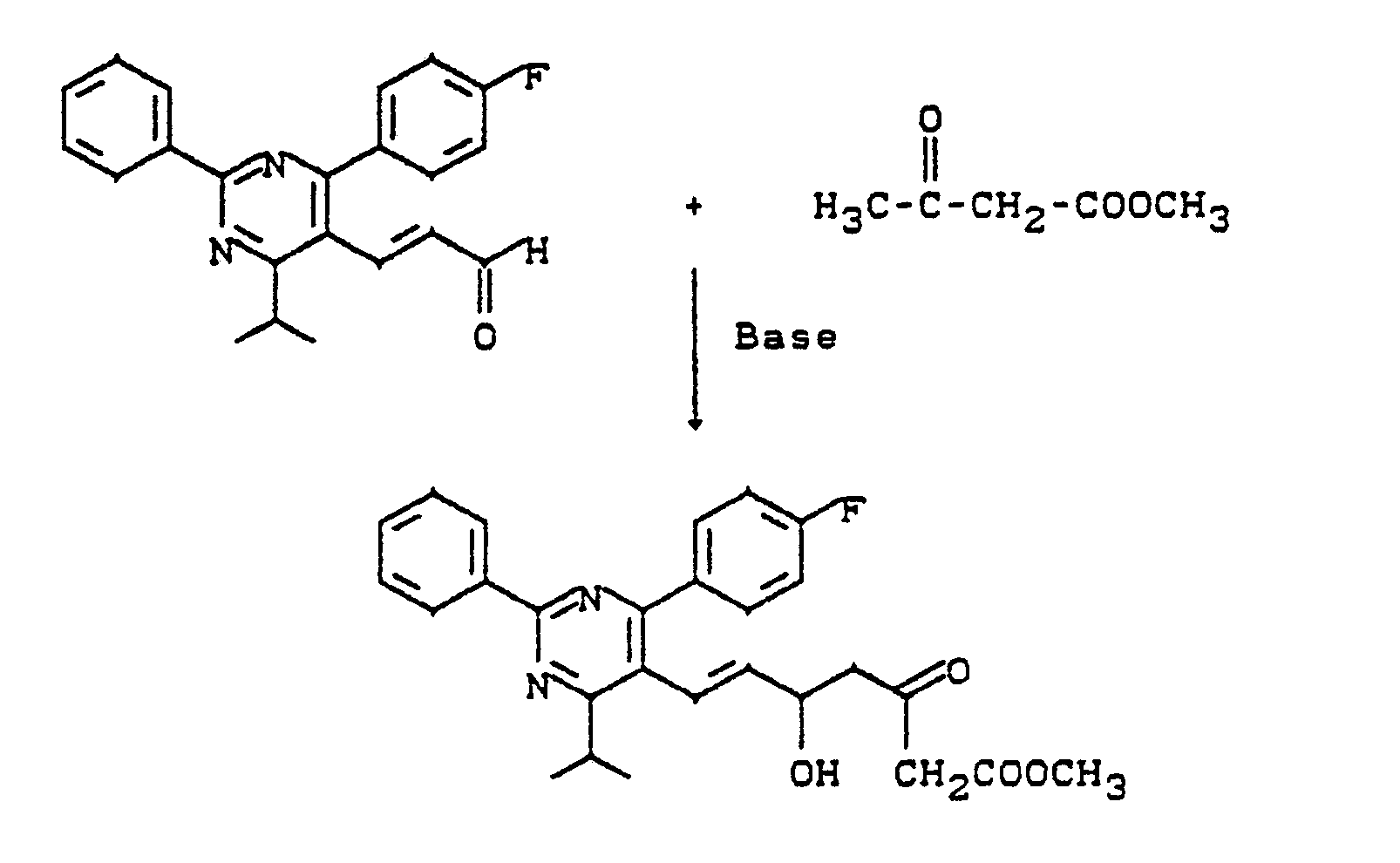
- Als Basen kommen hierbei die üblichen stark basischen Verbindungen in Frage. Hierzu gehören bevorzugt lithiumorganische Verbindungen wie beispielsweise N-Butyllithium, sec.Butyllithium, tert.Butyllithium oder Phenyllithium, oder Amide wie beispielsweise Lithiumdiisopropyl amid, Natriumamid oder Kaliumamid, oder Lithiumhexamethyldisilylamid, oder Alkalihydride wie Natriumhydrid oder Kaliumhydrid. Ebenso ist es möglich, Gemische der genannten Basen einzusetzen. Besonders bevorzugt werden N-Butyllithium oder Natriumhydrid oder deren Gemisch eingesetzt.
- Als Lösemittel eignen sich hierbei die üblichen organischen Lösemittel, die sich unter den Reaktionsbedingungen nicht verändern. Hierzu gehören bevorzugt Ether wie Diethylether, Tetrahydrofuran, Dioxan oder Dimethoxyethan, oder Kohlenwasserstoffe wie Benzol, Toluol, Xylol, Cyclohexan, Hexan oder Erölfraktionen. Ebenso ist es möglich, Gemische der genannten Lösemittel einzusetzen. Besonders bevorzugt werden Ether wie Diethylether oder Tetrahydrofuran verwendet.
- Die Reaktion wird im allgemeinen in einem Temperaturbereich von -80°C bis +50°C, bevorzugt von -20°C bis Raumtemperatur durchgeführt.
- Das Verfahren wird im allgemeinen bei Normaldruck durchgeführt, es ist aber auch möglich das Verfahren bei Unterdruck oder bei Überdruck durchzuführen, z.B. in einem Bereich von 0,5 bis 5 bar.
- Bei der Durchführung des Verfahrens wird der Acetessigester im allgemeinen in einer Menge von 1 bis 2, bevorzugt von 1 bis 1,5 mol, bezogen auf 1 mol des Aldehyds eingesetzt.
- Die als Ausgangsstoffe eingesetzten Acetessigester der Formel (X) sind bekannt oder können nach bekannten Methoden hergestellt werden [Beilstein's Handbuch der organischen Chemie III, 632; 438].
- Als Acetessigester für das erfindungsgemäße Verfahren seien beispielsweise genannt:
- Acetessigsäuremethylester, Acetessigsäureethylester, Acetessigsäurepropylester, Acetessigsäureisopropylester.
- Die als Ausgangsstoffe eingesetzten Aldehyde der allgemeinen formel (IX) sind neu.
- Es wurde außerdem ein Verfahren zur Herstellung der Aldehyde der allgemeinen Formel (IX)

R¹ , R² , R³ die oben angegebene Bedeutung haben,
gefunden, das dadurch gekennzeichnet ist, daß man Pyrimidine der allgemeinen formel (XI) im Temperaturbereich von -70°C bis +100°C zu Hydroxymethylverbindungen der Formel (XII) reduziert, anschließend zu den entsprechenden Aldehyden (XIII) oxidiert und diese mit Dialkyl-(C₁ bis C₄)-aminovinylphosphonaten in Anwesenheit von Natriumhydrid in inerten Lösungsmitteln wie Ethern, beispielsweise Diethylether, Tetrahydrofuran oder Dioxan, vorzugsweise Tetrahydrofuran in einem Temperaturbereich von -20°C bis +40°C, vorzugsweise von -5°C bis Raumtemperatur zu den Aldehyden (IX) umsetzt. - Ihre Herstellung soll im folgenden beispielhaft für die Verbindungen des Typs (I) erläutert werden.

- Hierbei werden gemäß Schema A Pyrimidine der Formel (XI), in welchen
R⁸ für einen Alkyl mit bis zu 6 Kohlenstoffatomen, Aryl (C₆ bis C₁₂) oder Aralkyl (C₇ bis C₁₈) steht, und R¹, R² und R³ die oben genannte Bedeutung haben, im ersten Schritt (1) in inerten Lösemitteln wie Ethern, beispielsweise Diethylether, Tetrahydrofuran oder Dioxan, vorzugsweise Tetrahydrofuran oder Dioxan, vorzugsweise Tetrahydrofuran, mit Metallhydriden als Reduktionsmittel, beispielsweise Lithiumaluminiumhydrid, Natriumcyanoborhydrid, Natriumaluminiumhydrid, Diisobutylaluminiumhydrid oder Natrium-bis-(2-methoxyethoxy)-dihydroaluminat, in Temperaturbereichen von -70°C bis +100°C, vorzugsweise von -70°C bis Raumtemperatur, bsw. von Raumtemperatur bis 70°C je nach verwendetem Reduktionsmittel zu den Hydroxymethylverbindungen (XII) reduziert. Vorzugsweise wird die Reduktion mit Lithiumaluminiumhydrid in Tetrahydrofuran in einem Temperaturbereich von Raumtemperatur bis 80°C durchgeführt. Die Hydroxymethylverbindungen (XII) werden im zweiten Schritt (2) nach üblichen Methoden zu den Aldehyden (XII) oxidiert. Die Oxidation kann beispielsweise mit Pyridiniumchlorochromat, gegebenenfalls in Anwesenheit von Aluminiumoxid, in inerten Lösemitteln wie Chlorkohlenwasserstoffen, vorzugsweise Methylenchlorid, in einem Temperaturbereich von 0°C bis 60°C, bevorzugt bei Raumtemperatur durchgeführt werden, oder aber mit Trifluoressigsäure/Dimethylsulfoxid nach den üblichen Methoden der Swern Oxidation durchgeführt werden. Die Aldehyde (XIII) werden im dritten Schritt (3) bevorzugt mit Diethyl-2- (cyclohexylamino)-vinylphosphonat in Anwesenheit von Natriumhydrid in inerten Lösemitteln wie Ethern, beispielsweise Diethylether, Tetrahydrofuran oder Dioxan, vorzugsweise in Tetrahydrofuran, in einem Temperaturbereich von -20°C bis +40°C, vorzugsweise von -5°C bis Raumtemperatur zu den Aldehyden (IX) umgesetzt. - Die hierbei als Ausgangsstoffe eingesetzten Pyrimidine der Formel (XI) erhält man hierbei im allgemeinen gemäß Schema B durch Oxidation von Dihydropyrimidinen (XIV). Die hierbei als Ausgangsstoffe eingesetzten Dihydropyrimidine werden nach literaturbekannten Methoden hergestellt (DE-A 103 796). Die Oxidation der Dihydropyrimidine (XIV) zu den Pyrimidinen (XI kann beispielsweise mit Chromoxid in Eisessig in einem Temperaturbereich von -20°C bis +150°C, vorzugsweise bei Rückflußtemperatur, oder mit 2,3-Dichlor-5,6-dicyan-p-benzochinon als Oxidationsmittel in inerten Lösungsmitteln wie Chlorkohlenwasserstoffe, vorzugsweise Methylenchlorid in einem Temperaturbereich von 0°C bis +100°C, vorzugsweise bei Raumtemperatur durchgeführt werden.

- Die erfindungsgemäßen Verbindungen der allgemeinen Formel (I) besitzen wertvolle pharmakologische Eigenschaften und können als Wirkstoffe in Arzneimitteln eingesetzt werden. Insbesondere sind sie Inhibitoren der 3-Hydroxy-3-methyl-glutaryl-Coenzym A (HMG-CoA) Reduktase und infolge dessen Inhibitoren der Cholesterolbiosynthese. Sie können deshalb zur Behandlung von Hyperlipoproteinämie, Lipoproteinämie oder Arteriosklerose eingesetzt werden.
- Die neuen Wirkstoffe können in bekannter Weise in die üblichen Formulierungen überführt werden, wie Tabletten, Dragees, Pillen, Granulate, Aerosole, Sirupe, Emulsionen, Suspensionen und Lösungen, unter Verwendung inerter, nicht toxischer, pharmazeutisch geeigneter Trägerstoffe oder Lösungsmittel. Hierbei soll die therapeutisch wirksame Verbindung jeweils in einer Konzentration von etwa 0,5 bis 98-Gew.-%, bevorzugt 1 bis 90 Gew.-%, der Gesamtmischung vorhanden sein, d.h. in Mengen, die ausreichend sind, um den angegebenen Dosierungsspielraum zu erreichen.
- Die Formulierungen werden beispielsweise hergestellt durch Verstrecken der Wirkstoffe mit Lösungsmitteln und/oder Trägerstoffen, gegebenenfalls unter Verwendung von Emulgiermitteln und/oder Dispergiermitteln, wobei z.B. im Fall der Benutzung von Wasser als Verdünnungsmittel gegebenenfalls organische Lösungsmittel als Hilfslösungsmittel verwendet werden können.
- Als Hilfsstoffe seien beispielsweise aufgeführt: Wasser, nicht-toxische organische Lösungsmittel, wie
- Paraffine (z.B. Erdölfraktionen), pflanzliche Öle (z.B. Erdnuß/Sesamöl), Alkohole (z.b: Ethylalkohol, Glycerin), Trägerstoffe, wie z.B. natürliche Gesteinsmehle (z.B. Kaoline, Tonerden, Talkum, Kreide), synthetische Gesteinsmehle (z.B. hochdisperse Kieselsäure, Silikate), Zucker (z.B. Rohr-, Milch- und Traubenzucker), Emulgiermittel (z.B. Polyoxyethylen-Fettsäure-Ester, Polyoxyethylen-Fettalkohol-Ether, Alkylsulfonate und Arylsulfonate), Dispergiermittel (z.B. Lignin-Sulfitablaugen, Methylcellulose, Stärke und Polyvinylpyrrolidon) und Gleitmittel (z.B. Magnesiumstearat, Talkum, Stearinsäure und Natriumlaurylsulfat).
- Die Applikation erfolgt in üblicher Weise, vorzugsweise oral, parenteral, perlingual oder intravenös. Im Falle der oralen Anwendung können Tabletten selbstverständlich außer den genannten Trägerstoffen auch Zusätze, wie Natriumcitrat, Calciumcarbonat und Dicalciumphosphat zusammen mit verschiedenen Zuschlagstoffen, wie Stärke, vorzugsweise Kartoffelstärke, Gelatine und dergleichen enthalten. Weiterhin können Gleitmittel, wie Magnesiumstearat, Natriumlaurylsulfat und Talkum zum Tablettieren mitverwendet werden. Im Falle wäßriger Suspensionen können die Wirkstoffe außer den obengenannten Hilfsstoffen mit verschiedenen Geschmacksaufbesserern oder Farbstoffen versetzt werden.
- Für den Fall der parenteralen Anwendung können Lösungen der Wirkstoffe unter Verwendung geeigneter flüssiger Trägermaterialien eingesetzt werden.
- Im allgemeinen hat es sich als vorteilhaft erwiesen, bei intravenöser Applikation Mengen von etwa 0,001 bis 1 mg/kg, vorzugsweise etwa 0,01 bis 0,5 mg/kg Körpergewich zur Erzielung wirksamer Ergebnisse zu verabreichen, und bei oraler Applikation beträgt die Dosierung etwa 0,01 bis 20 mg/kg, vorzugsweise 0,1 bis 10 mg/kg Körpergewicht.
- Trotzdem kann es gegebenenfalls erforderlich sein, von den genannten Mengen abzuweichen, und zwar in Abhängigkeit vom Körpergewicht bzw. der Art des Applikationsweges, vom individuellen Verhalten gegenüber dem Medikament, der Art von dessen Formulierung und dem Zeitpunkt bzw. Intervall, zu welchen die Verabreichung erfolgt. So kann es in einigen Fällen ausreichend sein, mit weniger als der vorgenannten Mindestmenge auszukommen, während in anderen Fällen die genannte obere Grenze überschritten werden muß. Im Falle der Applikation größerer Mengen kann es empfehlenswert sein, diese in mehreren Einzelgaben über den Tag zu verteilen.
-

- 62 g (0,5 mol) 4-Fluorbenzaldehyd und 53,9 ml (0,5 mol) Acetessigsäureethylester werden in 300 ml Isopropanol vorgelegt, mit einem Gemisch aus 2,81 ml (28 mmol) Piperidin und 1,66 ml (19 mmol) Essigsäure in 40 ml Isopropanol versetzt und 48 h bei Raumtemperatur gerührt. Die Mischung wird im Vakuum eingeengt und der Rückstand im Hochvakuum destilliert.
Kp 0,5 mm: 138°C
Ausbeute: 50,5 g (45,5 % der Theorie). -

- In 230 ml Ethanol werden 23,6 g (0,1 mol) Beispiel 1, 10,5 g (0,11 mol) Acetamidinhydrochlorid und 9,85 g (0,12 mol) Natriumacetat über Nacht unter Rückfluß erhitzt, das Lösungsmittel im Vakuum entfernt, der Rückstand mit Essigsäureethylester und 180 ml 1N-Salzsäure versetzt, die organische Phase noch zweimal mit 100 ml 1N-Salzsäure gewaschen, die vereinigten Wäßrigen Phasen mit Ether gewaschen, mit konzentrierter Natronlauge alkalisch gestellt und dreimal mit Essigester extrahiert. Die Essigesterphase wird mit Wasser gewschen, getrocknet (Na₂SO₄) und im Vakuum eingeengt. Ausbeute: 12,4 g 44,9 % der Theorie
¹H-NMR (CDCl₃) : δ = 1,15(tr, 3H, CH₃); 1,9 (s, 3H, CH₃); 2,3 (s, 3H, CH₃), 4,05 (m, 2H, CH₂); 5,3, 5,5 (2s, 1H, CH); 6,9-7,4 (m, 4H, Aromaten-H) ppm. -

- In 70 ml Essigsäure werden 12,4 g (45,1 mol) Beispiel 2, zum Sieden erhitzt und 4,6 g (46 mmol) Chromtrioxid portionsweise hinzugegeben. Nach einer Stunde läßt man auf 25°C abkühlen, gießt auf Eis/25 % wäßrige Ammoniaklösung, stellt mit Ammoniaklösung alkalisch, extrahiert mit Dichlormethan, wäscht die organische Phase mit Wasser und erhält nach Trocknen (Na₂SO₄), Einengen im Vakuum und Filtration über Kieselgel (Dichlormethan/Methanol 10:1) 7,14 g.
Ausbeute: 57,7 % der Theorie
¹H-NMR (CDCl₃): δ = 1,2 (tr, 3H, CH₃); 2,65 (s, 3H, CH₃); 2,85 (s, 3H, CH₃); 4,3 (q, 2H, CH₂); 7,1-7,8 (m 4H, Aromaten-H) ppm. -

- Zu 5,66 g (20,6 mmol) Beispiel 3 in 100 ml Toluol tropft man unter Stickstoffatmosphäre bei -78°C 27 ml (40 mmol) Diisobutylaluminiumhydrid (1,5 m in Toluol). Nach dem Aufwärmen auf 25°C wird mit 20 %iger wäßrige Kaliumhydroxidlösung hydrolysiert, die wäßrige Phase mit Essigester gewaschen, die vereinigten organischen Phasen getrocknet (Na₂SO₄) und das Lösungsmittel im Vakuum entfernt.
Ausbeute: 4,1 g 85,9 % der Theorie
¹H-NMR (CDCl₃) : δ = 1,8 (tr, 1H, OH); 2,7 (2s, 6H, CH₃); 4,65 (d, 2H, CH₂): 7,1-7,7 (m, 4H Aromaten-H)ppm. -

- Zu einer Lösung von 4,1 g (17,7 mmol) Beispiel 4 in 100 ml Dichlormethan bei Raumtempertaur gibt man portionweise 6,06 g (28,1 mmol) Pyrimidiniumchlorochromat und rührt zwei Stunden. Das Lösungsmittel wird im Vakuum entfernt und der Rückstand über Kieselgel (Dichlormethan/Methanol 3:1) filtriert.
Ausbeute: 3,8 g 93,4 % der Theorie
¹H-NMR (CDCl₃) : δ = 2,8 (2s, 6H, CH₃); 7,1-7,7 (m, 4H, Aromaten-H); 10,0 (s, 1H, CHO) ppm. -

- Zu einer Suspension von 0,5 g (20,8 mmol) Natriumhydrid in 20 ml THF tropft man bei 0°C eine Lösung von 0,81 g [2-(Cyclohexylamino)vinyl]-phosphonsäurediethylester in 20 ml THF, rührt 15 min und tropft dann eine Lösung von 0,63 g (2,72 mmol) Beispiel 5 in 15 ml THF hinzu, rührt 1 h bei 0°C, 1 h bei 25°C, hydrolysiert mit 20 ml Wasser, wäscht mit diethylether, entfernt das Lösungsmittel im Vakuum, nimmt den Rückstand in 40 ml Toluol auf und erhitzt die Lösung mit 2 g Oxalsäure und 40 ml Wasser 1 h bei 60°C, wäscht mit Diethylether, trocknet (Na₂SO₄) und erhält nach Entfernen des Lösungsmittels 0,5 g.
Ausbeute: 71,7 % der Theorie
¹H-NMR (CDCl₃) : δ = 2,7 (s, 3H, CH₃); 2,8 (s, 3H, CH₃); 6,4 (dd, 1H, CHCHO); 7,2 (d, 1H, CH); 7,1-7,7 (m, 4H, Aromaten-H); 9,6 (d, 1H, CHO) ppm. -

- Zu einer Suspension aus 256 mg (10,7 mmol) Natriumhydrid in 25 ml THF tropft man bei 0°C, 1,11 ml (10,3 mmol) Acetessigsäuremethylester. Nach 15 min tropft man innerhalb 10 min 7,3 ml (10,7 mmol) n-Butyllithium (1,5 m in Hexan) zu, rührt 15 min bei 0°C, tropft eine Lösung von 2,4 g (3,8 mmol) Beispiel 6 in 10 ml THF zu, rührt 15 min bei 0°C, hydrolysiert mit 30 ml gesättigter wäßrige Ammoniumchloridlösung, wäscht dreimal mit Dichlormethan, trocknet (Na₂SO₄), entfernt das Lösungsmittel im Vakuum und erhält nach Chromatographie über Kieselgel (Essigsäureethylester) 2,47 g Öl.
Ausbeute: 73,5 % der Theorie
¹H-NMR (CDCl₃) : δ = 2,55 (s, 3H, CH₃; 2,7 (d, 2H, CH₂-CHOH); 2,75 (s, 3H, CH₃); 3,1 (br, s, 1H, OH); 3,5 (s, 2H, CH₂); 3,75 (s, 3H, OCH₃); 4,65 (m, 1H, CHOH); 5,6 (dd, 1H, CHCHOH); 6,6 (d, 1H, CH); 7,0-7,6 (m, 4H, Aromaten-H) ppm. -

- Durch eine Lösung von 1,69 g (4,55 mmol) Beispiel 7 und 5,7 ml (5,7 mmol) Triethylboran (1 m, THF) in 45 ml THF bläst man 5 min Luft, kühlt auf -30°C, gibt 215 mg (5,7 mmol) Natriumborhydrid und langsam 3,8 ml Methanol hinzu, rührt 30 min bei -30°C, gibt langsam eine Lösung von 15,2 ml Wasserstoffperoxid (30 %ig) in 33,4 ml Wasser unterhalb 0°C hinzu, rührt 30 min bei 0°C, nimmt in Essigsäureester auf, wäscht mit Wasser, 1N Salzsäure, wäßrige Natriumhydrogencarbonatlösung, trocknet (Na₂SO₄), entfernt das Lösungsmittel im Vakuum und erhält nach Chromatographie über Kieselgel (Essigsäureethylester) 1,08 g.
Ausbeute: 63 % der Theorie
¹H-NMR (CDCl₃) : δ = 1,8 (br, s, 2H, OH); 2,5 (m, 2H, CH₂); 2,55 (s, 3H, CH₃); 2,7 (s, 3H, CH₃); 3,7 (s, 3H, OCH₃); 4,2 (m, 1H, CHOH); 4,45 (m, 1H, CHOH); 5,6 (dd, 1H, CH, CHOH); 6,5 (d, 1H, CH); 7,0-7,6 (m, 4H, Aromaten-H) ppm. -

- Analog Beispiel 2 erhält man aus 103,6 g (0,56 mol) Benzamidinhydrochlorid, 121,5 g (0,5 mol) Beispiel 1 und 49,2 g (0,6 mol) Natriumacetat 87,5 g.
Ausbeute : 25,9 % der Theorie
¹H-NMR (CDCl₃) : δ = 1,15 (tr, 2H, CH₃); 2,15 (br, s, NH); 2,6 (s, 3H, CH₃); 4,1 (q, 2H, CH₂); 5,8 (s, 1H, CH); 7,1-8,0 (9H, Aromaten-H) ppm. -

- Analog Beispiel 3 erhält man aus 40 g (0,12 mol) Beispiel 9 und 11,8 g (0,12 mol) Chromtrioxid 34,9 g. Ausbeute: 87,9 % der Theorie
¹H-NMR (CDCl₃) : δ = 1,15 (tr, 3H, CH₃); 2,7, (s, 3H, CH₃); 4,25 (q, 2H, CH₂); 7,1-8,6 (9H, Aromaten-H) ppm. -

- Analog Beispiel 4 erhält man aus 30 g (0,09 mol) Beispiel 10 23,1 g.
Ausbeute: 87,3 % der Theorie
¹H-NMR (CDCl₃) : δ = 2,8 (s, 3H, CH₃); 4,5 (br, OH); 4,65 (s, 2H, CH₂); 7,1-8,5 (9H, Aromaten-H) ppm. -

- Analog Beispiel 5 erhält man aus 12,9 g (44 mmol) Beispiel 11 und 14,2 g (66 mmol) Pyrimidiniumchlorochromat 11,9 g.
Ausbeute: 93 % der Theorie
¹H-NMR (CDCl₃) : δ = 2,9 (s, 3H, CH₃); 7,2-8,7 (9H, Aromaten-H); 10,1 (s, 1H, CHO)ppm. -

- Analog Beispiel 6 erhält man aus 8,0 g (27 mmol) Beispiel 12, 0,8 g (33,6 mmol) Natriumhydrid und 8,0 g (32,4 mmol) [2-(Cyclohexylamino)vinyl]phosphonsäurediethylester 5,9 g.
Ausbeute: 68,7 % der Theorie
¹H-NMR (CDCl₃) : δ = 2,8 (s, 3H, CH₃); 6,45 (dd, 1H, CHCHO; 7,1-8,6 (m, 1OH, Aromaten-H, CH); 9,65 (d, 1H, CHO) ppm. -

- Analog Beispiel 7 erhält man aus 3,4 g (10,7 mmol) Beispiel 13 5,18 g Rohprodukt. Rohausbeute: 100 %
¹H-NMR (CDCl₃) : δ = 2,65 (s, 3H, CH₃); 2,7 (d, 2H,
CH₂); 2,9 (br, 1H, OH); 3,5 (s, 3H, CH₃); 3,75 (s, 3H, OCH₃); 4,7 (m, 1H, CHOH); 5,65 (dd, 1H, CH-CHOH); 6,65 (d, 1H, CH Ar); 7,1-8,6 (m, 9H, Aromaten-H) ppm.
-

- Analog Beispiel 8 erhält man aus 8,26 g (16 mmol) Beispiel 14 4,03 g.
Ausbeute: 57,7 % der Theorie
¹H-NMR (CDCl₃) : δ = 1,6 (m, 2H, CH₂); 2,5 (m 2H, CH₂C=O); 2,7 (s, 3H, CH₃); 3,7 (s, 3H, CH₃O); 4,2 (m, 1H, CHOH); 4,5 (m, 1H, CHOH); 5,7 (dd, 1H, CH-CHOH); 6,6 (d, 1H, CH-Ar); 7,0-8,6 (m, 9H, Aromaten-H) ppm. -

- 62 g (0,5 mol) 4-Fluorbenzaldehyd und 79 g (0,5 mol) Isobutyrylessigsäureethylester werden in 300 ml trockenem Isopropanol vorgelegt und mit einem Gemisch aus 2,81 ml (28 mmol) Piperidin und 1,66 ml (29 mmol) Essigsäure in 40 ml Isopropanol versetzt. Man läßt 48 h bei Raumtemperatur rühren, engt im Vakuum ein und destilliert den Rückstand im Hochvakuum.
Kp 0,5 mm; 127°C
Ausbeute: 108,7 g (82,3 % der Theorie). -

- Analog Beispiel 2 erhält man aus 59,5 g (0,3 mol) Benzamidinhydrochlorid, 79,2 g (0,3 mol) Beispiel 16 und 28,7 g (0,35 mol) Natriumacetat in 500 ml Ethanol 39 g. Ausbeute: 35,5 % der Theorie
¹H-NMR (CDCl₃) : δ = 1,2 (m, 9H, CH₃); 2,8 (m, 1 H, CH); 4,1 (q, 2H, CH₂); 4,2 (br, 1H, NH); 5,75 (s, 1H, CHAr); 6,9-8,1 (m, 9H, Aromaten-H) ppm. -

- Analog Beispiel 3 erhält man aus 39,0 g (0,11 mol) Beispiel 17 20,6 g.
Ausbeute: 56,6 % der Theorie
¹H-NMR (CDCl₃) : δ = 1,15 (tr, 3H, CH₃); 1,4 (d, 6H, CH₃); 3,3 (m, 1H, CH); 4,2 (q, 2H, CH₂); 7,0-8,6 (m, 9H, Aromaten-H) ppm. -

- Analog Beispiel 4 erhält man aus 20,0 g (55 mmol) Beispiel 18 16,7 g der Titelverbindung.
Ausbeute: 94 % der Theorie
¹H-NMR (CDCl₃) : δ = 1,4 (d, 6H, CH₃); 1,7 (br, 1H, OH) 3,55 (m, 1H, CH); 4,7 (s, 2H, CH₂); 7,1-8,7 (m, 9H, Aromaten-H) ppm. -

- Analog Beispiel 5 erhält man aus 16,3 g (50 mmol) Beispiel 19 7,9 g der Titelverbindung.
Ausbeute: 49,4 % der Theorie
¹H-NMR (CDCl₃) : δ = 1,4 (d, 6H, CH₃); 4,0 (m, 1H, CH); 7,2-8,7 (m, 9H, Aromaten-H), 10,1 (s, 1H, CHO) ppm. -

- Analog Beispiel 6 erhält man aus 7,9 g (25 mmol) Beispiel 20 6,9 g des Beispiels 21.
Ausbeute: 80 % der Theorie
¹H-NMR (CDCl₃) : δ = 1,4 (d, 6H, CH₃); 3,4 (m, 1H, CH); 6,3 (dd, 1H, CHCHO); 7,1-8,7 (m, 9H, Aromaten-H); 7,6 (d, 1H, CHAr) ppm. -

- Analog Beispiel 7 erhält man aus 1,9 g (5,5 mmol) Beispiel 21 0,8 g des Beispiels 22.
Ausbeute: 30,2 %
¹H-NMR (CDCl₃) : δ = 1,35 (d, 6H, CH₃); 2,65 (d, 2H, CH₂); 3,4 (m, 1H, CH); 3,5 (s, 2H, CH₂); 3,75 (s, 3H, CH₃O; 4,65 (m, 1H, CHOH); 5,5 (dd, 1H, CH CHOH); 6,75 (d, 1H, CHAr); 7,1-8,6 (m, 9H, Aromaten-H) ppm. -
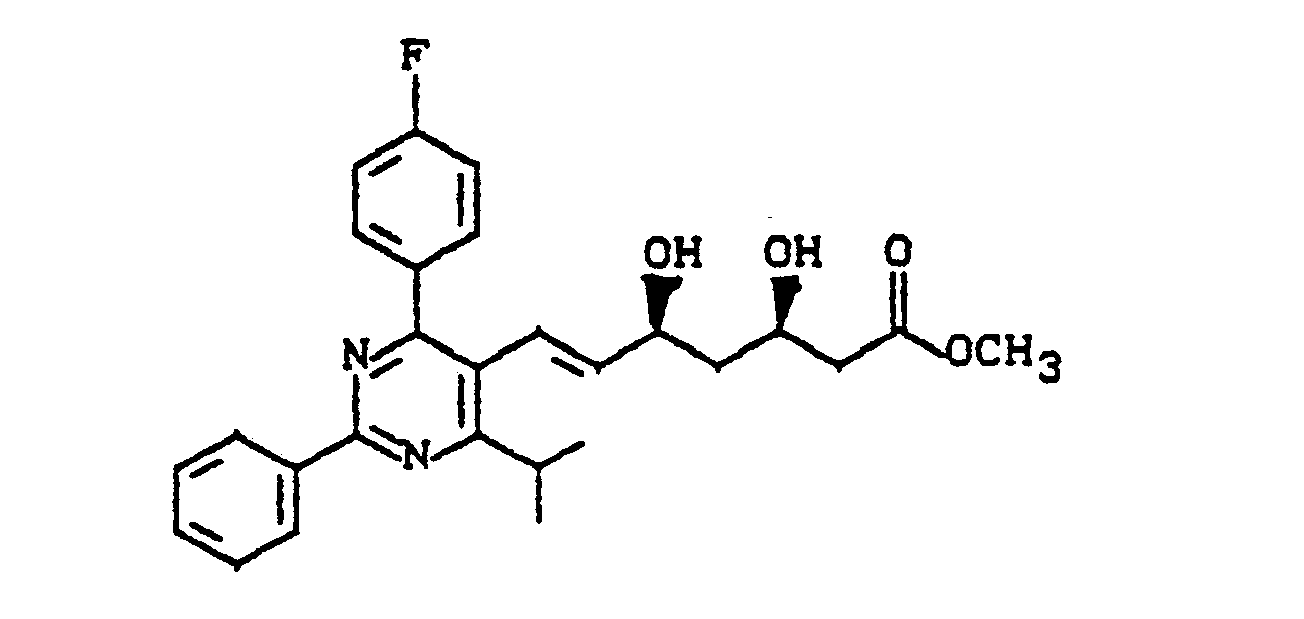
- Analog Beispiel 8 erhält man aus 0,8 g (1,75 mmol) Beispiel 22 0,5 g des Beispiels 23.
Ausbeute: 62 %
¹H-NMR (CDCl₃) : δ = 1,3 (d, 6H, CH₃); 1,6 (m, 2H, CH₂); 2,5 (m, 2H, CH₂C=O); 3,45 (m, 1H, CH); 3,7 (s, 3H, CH₃O); 4,2 (m, 1H, CHOH); 4,5 (m, 1H, CHOH); 5,5 (dd, 1H, CH-CHOH); 6,7 (d, 1H, CHAr); 7,1-8,6 (m, 9H, Aromaten-H) ppm. - Die Enzymaktivitätsbestimmung wurde modifiziert nach G.C. Ness et al., Archives of Biochemistry and Biophysics 197, 493-499 (1979) durchgeführt. Männliche Ricoratten (Körpergewicht 300-400 g) wurden 11 Tage mit Altrominpulverfutter, dem 40 g Cholestyramin/kg Futter zugesetzt war, behandelt. Nach Dekapitation wurde den Tieren die Leber entnommen und auf Eis gegeben. Die Lebern wurden zerkleinert und im Potter-Elvejem-Homogenisator 3 mal in 3 Volumen 0,1 m Saccharose, 0,05 m KCl, 0,04 m KxHy Phosphat, 0.03 m Ethylendiamintetraessigsäure, 0,002 m Dithiothreit (SPE)-Puffer pH 7,2, homogenisiert. Anschließend wurde 15 Minuten bei 15 000* g zentrifugiert und das Sediment verworfen. Der Überstand wurde 75 Minuten bei 100 000 g sedimentiert. Das Pellet wird in 1/4 Volumen SPE-Puffer aufgenommen, nochmals homogenisiert und anschließend erneut 60 Minuten bei 1000 000 g zentrifugiert. Das Pellet wird mit der 5-fachen Mengen ihres Volumens SPE-Puffer aufgenommen, homogenisiert und bei -78°C eingefroren und gelagert (= Enzymlösung).
- Zur Testung wurden die Testverbindungen (oder Mevinolin als Referenzsubstanz) in Dimethylformamid unter Zugabe von 5 Vol. -% 1 n NaOH gelöst und mit 10 µl in verschiedenen Konzentrationen in den Enzymtest eingesetzt. Der Test wurde nach 20 Minuten Vorinkubation der Verbindungen mit dem Enzym bei 37°C gestartet. Der Testansatz betrug 0,380 ml und enthielt 4 µMol Glucose-6-Phosphat, 1,1 mg Rinderserumalbumin, 2,1 µMol Dithiothreit, 0,35 µMol NADP, 1 Einheit Glucose-6-Phosphatdehydrogenase 35 µMol KxHy-Phosphat pH 7,2, 20 µl enzympräparation und 56 nMol 3-Hydroxy-3-methyl-glutaryl Coenzym A (Glutaryl-3-¹⁴C) 1000 000 dpm.
- Man inkubierte 60 Minuten bei 37°C und stoppte die Reaktion durch Zusatz von 300 µl 0,24 m HCl ab. Mach einer Nachinkubation von 60 Minuten bei 37°C wurde der Ansatz zentrifugiert und 600 µl des Überstandes auf eine 0,7 x 4 cm mit Biorex® 5-Chlorid 100-200 mesh (Anionenaustauscher) gefüllte Säule aufgetragen. Es wurde mit 2 ml dest. Wasser nachgewaschen und Durchlauf plus Waschwasser mit 3 ml Aquasol versetzt und im LKB-Scintillationszähler gezählt. IC₅₀-Werte wurden durch Auftrag der prozentualen Hemmung gegen die Konzentration der Verbindung im Test durch Intrapolation bestimmt. Zur Bestimmung der relativen inhibitorischen Potenz wurde der IC₅₀-Wert der Referenzsubstanz Mevinolin als 1 gesetzt und mit dem simultan bestimmten IC₅₀-Wert der Testverbindung verglichen.
- Die Wirkstoffe der Beispiele 1 bis 23 zeigen eine im Vergleich zu Mevinolin höhere Wirkung.
- Die Serum-Cholesterin-senkende Wirkung der erfindungsgemäßen Verbindungen auf die Blutcholesterinwerte von Hunden und Meerschweinchen wurd ein mehrwöchigen Fütterungsexperimenten gefunden. Dazu wurde die zu untersuchende Substanz im Fall der Hundeversuche über einen mehrwöchigen zeitraum einmal täglich i einer Kapsel gesunden Beagle Hund zusammenb mit dem Futter p.o. gegeben. Dem Futter war außerdem während der gesamten Versuchsperiode, d.h. vor, während und nach der Applikationsperiode der zu untersuchenden Susbtanz Colestyramin (4 g/100 g Futter) als Gallensäuresequetrant beigemischt.
- Zweimal wöchentlich wurde den Hunden venöses Blut abgenommen und das Serumcholesterin mit einem handelsübilchen Testkit enzymatisch bestimmt. Die Serumcholestrinwerte währen der Applikationsperiode wurden mi den Serumcholesterinwerten vor der Applicationsperiode (Kontrollen) verglichen.
- Den Meerschweinchen wurde die Substanz in das Futter gemischt. Nach zwei Wochen wurden den Tieren Blut entnommen und das Serum-Cholesterin bestimmt.
Claims (13)
1. Substituierte Pyrimidine der allgemeinen Formel

in welcher
R¹ - für Cycloalkyl steht, oder
- für Alkyl steht, das substituiert sein kann durch Halogen, Cyano, Alkoxy, Alkylthio, Alkylsulfonyl, Trifluormethyl, Trifluormethoxy, Trifluormethylthio, Trifluormethylsulfonyl, Alkoxycarbonyl, Acyl oder durch eine Gruppe der Formel - NR⁴R⁵, worin
R⁴, R⁵ - gleich oder verschieden sind und Alkyl, Aryl, Aralkyl, Acyl, Alkylsulfonyl oder Arylsulfonyl bedeuten,
oder durch Carbamoyl, Dialkylcarbamoyl, Sulfamoyl, Dialkylsulfamoyl, Heteroaryl, Aryl, Aryloxy, Arylthio, Arylsulfonyl, Aralkoxy, Aralkylthio oder Aralkylsulfonyl, wobei die Heteroaryl- und Arylreste der letztgenannten Substituenten bis zu 3-fach gleich oder ver schieden durch Halogen, Cyano, Trifluormethyl, Trifluormethoxy, Alkyl, Alkoxy, Alkylthio oder Alkylsulfonyl substituiert sein können,
R² - für Heteroaryl steht, das bis zu 3-fach gleich oder verschieden durch Halogen, Alkyl, Alkoxy, Alkylthio, Alkylsulfonyl, Aryl, Aryloxy, Arylthio, Arylsulfonyl, Trifluormethyl, Trifluormethoxy, Trifluormethylthio, Alkoxycarbonyl oder durch eine Gruppe der Formel -NR⁴R⁵ substituiert sein kann, worin
R⁴ und R⁵ die oben angegebene Bedeutung haben, oder
R² - für Aryl steht, das bis zu 5-fach gleich oderverschieden substituiert sein kann durch Alkyl, Alkoxy, Alkylthio, Alkylsulfonyl, Aryl, Aryloxy, Arylthio, Arylsulfonyl, Aralkyl, Aralkoxy, Aralkylthio, Aralkylsulfonyl, Halogen, Cyano, Nitro, Trifluormethyl, Trifluormethoxy, Trifluormethylthio, Alkoxycarbonyl, Sulfamoyl, Dialkylsulfamoyl, Carbamoyl, Dialkylcarbamoyl oder durch eine Gruppe der Formel -NR⁴R⁵, worin R⁴,R⁵ die oben angegebene Bedeutung haben,
R³ - für Wasserstoff oder
- für Cycloalkyl steht, oder
- für Alkyl steht, die substituiert sein können durch Halogen, Cyano, Alkoxy, Alkylthio, Alkylsulfonyl, Trifluormethyl, Trifluormethoxy, Trifluormethylthio, Trifluormethylsulfonyl, Alkoxycarbonyl, Acyl oder durch eine Gruppe der Formel -NR⁴R⁵, worin
R⁴ und R⁵ die oben angegebene Bedeutung haben,
oder durch Carbamoyl, Dialkylcarbamoyl, Sulfamoyl, Dialkylsulfamoyl, Heteroaryl, Aryl, Aryloxy, Arylthio, Arylsulfonyl, Aralkoxy, Aralkylthio oder Aralkylsulfonyl, wobei die Heteroaryl- und Arylreste der letztgenannten Substituenten bis zu 3-fach gleich oder verschieden durch Halogen, Cyano, Trifluormethyl, Trifluormethoxy, Alkyl, Alkoxy, Alkylthio oder Alkylsulfonyl substituiert sein können, oder
R³ - für Heteroaryl steht, das bis zu 3-fach gleich oder verschieden durch Halogen, Alkyl, Alkoxy, Alkylthio, Alkylsulfonyl, Aryl, Aryloxy, Arylthio, Arylsulfonyl, Trifluormethyl, Trifluormethoxy, Trifluormethylthio, Alkoxycarbonyl oder durch eine Gruppe der Formel -NR⁴R⁵ substituiert sein kann, worin
R⁴ und R⁵ die oben angegebene Bedeutung haben, oder
R³ - für Aryl steht, das bis zu 5-fach gleich oder verschieden substituiert sein kann durch Alkyl, Alkoxy, Alkylthio, Alkylsulfonyl, Aryl, Aryloxy, Arylthio, Arylsulfonyl, Aralkyl, Aralkoxy, Aralkylthio, Aralkylsulfonyl, Halogen, Cyano, Nitro, Trifluormethyl, Trifluormethoxy, Trifluormethylthio, Alkoxycarbonyl, Sulfamoyl, Dialkylsulfamoyl, Carbamoyl, Dialkylcarbamoyl oder durch eine Gruppe der Formel -NR⁴R⁵, worin
R⁴ und R⁵ die oben angegebene Bedeutung haben, oder
R³ - für Alkox, Aryloxy, Aralkox, Alkylthio, Arylthio, Aralkylthio oder für eine Gruppe der Formel NR⁴R⁵ steht, worin
R⁴ und R⁵ die oben angegebene Bedeutung haben,
X - für eine Gruppe der Formel -CH₂-CH₂- oder - CH=CH-steht, und
A - für eine Gruppe der Formel 
R⁶ - Wasserstoff oder Alkyl bedeutet und
R⁷ - Wasserstoff,
- einen Methyl-, Aryl- oder Aralkylrest oder
- ein Kation bedeutet.
R¹ - für Cycloalkyl steht, oder
- für Alkyl steht, das substituiert sein kann durch Halogen, Cyano, Alkoxy, Alkylthio, Alkylsulfonyl, Trifluormethyl, Trifluormethoxy, Trifluormethylthio, Trifluormethylsulfonyl, Alkoxycarbonyl, Acyl oder durch eine Gruppe der Formel - NR⁴R⁵, worin
R⁴, R⁵ - gleich oder verschieden sind und Alkyl, Aryl, Aralkyl, Acyl, Alkylsulfonyl oder Arylsulfonyl bedeuten,
oder durch Carbamoyl, Dialkylcarbamoyl, Sulfamoyl, Dialkylsulfamoyl, Heteroaryl, Aryl, Aryloxy, Arylthio, Arylsulfonyl, Aralkoxy, Aralkylthio oder Aralkylsulfonyl, wobei die Heteroaryl- und Arylreste der letztgenannten Substituenten bis zu 3-fach gleich oder ver schieden durch Halogen, Cyano, Trifluormethyl, Trifluormethoxy, Alkyl, Alkoxy, Alkylthio oder Alkylsulfonyl substituiert sein können,
R² - für Heteroaryl steht, das bis zu 3-fach gleich oder verschieden durch Halogen, Alkyl, Alkoxy, Alkylthio, Alkylsulfonyl, Aryl, Aryloxy, Arylthio, Arylsulfonyl, Trifluormethyl, Trifluormethoxy, Trifluormethylthio, Alkoxycarbonyl oder durch eine Gruppe der Formel -NR⁴R⁵ substituiert sein kann, worin
R⁴ und R⁵ die oben angegebene Bedeutung haben, oder
R² - für Aryl steht, das bis zu 5-fach gleich oderverschieden substituiert sein kann durch Alkyl, Alkoxy, Alkylthio, Alkylsulfonyl, Aryl, Aryloxy, Arylthio, Arylsulfonyl, Aralkyl, Aralkoxy, Aralkylthio, Aralkylsulfonyl, Halogen, Cyano, Nitro, Trifluormethyl, Trifluormethoxy, Trifluormethylthio, Alkoxycarbonyl, Sulfamoyl, Dialkylsulfamoyl, Carbamoyl, Dialkylcarbamoyl oder durch eine Gruppe der Formel -NR⁴R⁵, worin R⁴,R⁵ die oben angegebene Bedeutung haben,
R³ - für Wasserstoff oder
- für Cycloalkyl steht, oder
- für Alkyl steht, die substituiert sein können durch Halogen, Cyano, Alkoxy, Alkylthio, Alkylsulfonyl, Trifluormethyl, Trifluormethoxy, Trifluormethylthio, Trifluormethylsulfonyl, Alkoxycarbonyl, Acyl oder durch eine Gruppe der Formel -NR⁴R⁵, worin
R⁴ und R⁵ die oben angegebene Bedeutung haben,
oder durch Carbamoyl, Dialkylcarbamoyl, Sulfamoyl, Dialkylsulfamoyl, Heteroaryl, Aryl, Aryloxy, Arylthio, Arylsulfonyl, Aralkoxy, Aralkylthio oder Aralkylsulfonyl, wobei die Heteroaryl- und Arylreste der letztgenannten Substituenten bis zu 3-fach gleich oder verschieden durch Halogen, Cyano, Trifluormethyl, Trifluormethoxy, Alkyl, Alkoxy, Alkylthio oder Alkylsulfonyl substituiert sein können, oder
R³ - für Heteroaryl steht, das bis zu 3-fach gleich oder verschieden durch Halogen, Alkyl, Alkoxy, Alkylthio, Alkylsulfonyl, Aryl, Aryloxy, Arylthio, Arylsulfonyl, Trifluormethyl, Trifluormethoxy, Trifluormethylthio, Alkoxycarbonyl oder durch eine Gruppe der Formel -NR⁴R⁵ substituiert sein kann, worin
R⁴ und R⁵ die oben angegebene Bedeutung haben, oder
R³ - für Aryl steht, das bis zu 5-fach gleich oder verschieden substituiert sein kann durch Alkyl, Alkoxy, Alkylthio, Alkylsulfonyl, Aryl, Aryloxy, Arylthio, Arylsulfonyl, Aralkyl, Aralkoxy, Aralkylthio, Aralkylsulfonyl, Halogen, Cyano, Nitro, Trifluormethyl, Trifluormethoxy, Trifluormethylthio, Alkoxycarbonyl, Sulfamoyl, Dialkylsulfamoyl, Carbamoyl, Dialkylcarbamoyl oder durch eine Gruppe der Formel -NR⁴R⁵, worin
R⁴ und R⁵ die oben angegebene Bedeutung haben, oder
R³ - für Alkox, Aryloxy, Aralkox, Alkylthio, Arylthio, Aralkylthio oder für eine Gruppe der Formel NR⁴R⁵ steht, worin
R⁴ und R⁵ die oben angegebene Bedeutung haben,
X - für eine Gruppe der Formel -CH₂-CH₂- oder - CH=CH-steht, und
A - für eine Gruppe der Formel
R⁷ - Wasserstoff,
- einen Methyl-, Aryl- oder Aralkylrest oder
- ein Kation bedeutet.
2. Substituierte Pyrimidine nach Anspruch 1 wobei
R¹ - für Cyclopropyl, Cyclopentyl oder Cyclohexyl steht, oder
- für Niederalkyl steht, das substituiert sein kann durch Fluor, Chlor, Brom, Cyano, Niederalkoxy, Niederalkylthio, Niederalkylsulfonyl, Trifluormethyl, Trifluormethoxy, Trifluormethylsulfonyl, Niederalkoxycarbonyl, Benzoyl, Niederalkylcarbonyl, durch eine Gruppe der Formel- NR⁴R⁵, worin
R⁴ und R⁵ gleich oder verschieden sind und Niederalkyl, Phenyl, Benzyl, Acetyl, Benzoyl, Phenylsulfonyl oder Niederalkylsulfonyl bedeuten,
oder durch Pyridyl, Pyrimidyl, Pyrazinyl, Pyridazinyl, Chinolyl, Isochinolyl, Pyrryl, Indolyl, Thienyl, Furyl, Imidazolyl, Oxazolyl, Thiazolyl, Phenyl, Phenoxy, Phenylthio, Phenylsulfonyl, Benzyloxy, Benzylthio, Benzylsulfonyl, Phenylethoxy, Phenylethylthio oder Phenylethyl sulfonyl, wobei die genannten Heteroaryl- und Arylreste bis zu 2-fach gleich oder verschieden durch Fluor, Chlor, Brom, Niederalkyl, Niederalkoxy, Trifluormethyl, oder Trifluormethoxy substituiert sein können,
R² - für Thienyl, Furyl, Thiazolyl, Isothiazolyl, Oxazolyl, Isoxazolyl, Pyridyl, Pyrimidyl, Pyrazinyl, Pyridazinyl, Indolyl, Isoindolyl, Chinolyl, Isochinolyl, Phthalazinyl, Chinoxalinyl, Chinazolinyl, Cinnolinyl, Benzothiazolyl, Benzoxazolyl oder Benzimidazolyl steht, das bis zu 2-fach gleich oder verschieden substituiert sein kann durch Fluor, Chlor, Brom, Niederalkyl, Niederalkoxy, Phenyl, Phenoxy, Trifluormethyl, Trifluormethoxy oder Niederalkoxycarbonyl, oder
- für Phenyl oder Naphthyl steht, die bis zu 4-fach gleich oder verschieden substituiert sein kann durch Niederalkyl, Niederalkoxy, Niederalkylthio, Niederalkylsulfonyl, Phenyl, Phenyloxy, Phenylthio, Phenylsulfonyl, Benzyl, Benzyloxy, Benzylthio, Benzylsulfonyl, Phenethyl, Phenylethoxy, Phenylethylthio, Phenylethylsulfonyl, Fluor, Chlor, Brom, Cyano, Trifluormethyl, Trifluormethoxy, Trifluormethylthio, Niederalkoxycarbonyl oder durch eine Gruppe der Formel -NR⁴R⁵, wobei R⁴, R⁵ die oben angegebene Bedeutung haben,
R³ - für Wasserstoff oder
- für Cyclopropyl, Cyclopentyl oder Cyclohexyl steht oder
- für Niederalkyl steht, das substituiert sein kann durch Fluor, Chlor, Brom, Cyano, Niederalkoxy, Niederalkylthio, Niederalkylsulfonyl, Trifluormethyl, Trifluormethoxy, Trifluormethylsulfonyl, Niederalkoxycarbonyl, Benzoyl, Niederalkylcarbonyl, durch eine Gruppe der Formel -NR⁴R⁵, worin R⁴, R⁵ die oben angegebene Bedeutung haben,
oder durch Pyridyl, Pyrimidyl, Pyrazinyl, Pyridazinyl, Chinolyl, Isochinolyl, Pyrrolyl, Indolyl, Thienyl, Furyl, Imidazolyl, Oxazolyl, Thiazolyl, Phenyl, Phenoxy, Phenylthio, Phenylsulfonyl, Benzyloxy, Benzylthio, Benzylsulfonyl, Phenylethoxy, Phenylethylthio oder Phenylethylsulfonyl, wobei die genannten Heteroaryl- und Arylreste bis zu 2-fach gleich oder verschieden durch Fluor, Chlor, Brom, Niederalkyl, Niederalkoxy, Trifluormethyl, oder Trifluormethoxy substituiert sein können, oder
R³ - für Thienyl, Furyl, Thiazolyl,Isothiazolyl, Oxazolyl, Isoxazolyl, Pyridyl, Pyrimidyl, Pyrazinyl, Pyridazinyl, Indolyl, Isoindolyl, Chinolyl, Isochinolyl, Phthalazinyl, Chinoxalinyl, Chinazolinyl, Cinnolinyl, Benzothiazolyl, Benzoxazolyl oder Benzimidazolyl steht, das bis zu 2-fach gleich oder verschieden substituiert sein kann durch Fluor, Chlor, Brom, Niederalkyl, Niederalkoxy, Phenyl, Phenoxy, Trifluormethyl, Trifluormethoxy oder Niederalkoxycarbonyl, oder - für Phenyl oder Naphthyl steht, das bis zu 4-fach gleich oder verschieden substituiert sein kann durch Niederalkyl, Niederalkoxy, Niederalkylthio, Niederalkylsulfonyl, Phenyl, Phenyloxy, Phenylthio, Phenylsulfonyl, Benzyl, Benzyloxy, Benzylthio, Benzylsulfonyl, Phenethyl, Phenylethoxy, Phenylethylthio, Phenylethylsulfonyl, Fluor, Chlor, Brom, Cyano, Trifluormethyl, Trifluormethoxy, Trifluormethylthio, Niederalkoxycarbonyl oder durch eine Gruppe der Formel -NR⁴R⁵, oder
R⁴ und R⁵ die oben angegebene Bedeutung haben, oder
R³ - für Alkoxy, Aryloxy, Aralkoxy, Alkylthio, Arylthio, Aralkylthio oder für eine Gruppe derr Formel NR⁴R⁵ steht, worin
R⁴ und R⁵ die oben angegebene Bedeutung haben,
X - für eine Gruppe der Formel -CH₂-CH₂- oder -CH=CH-steht, und
A - für eine Gruppe der Formel 
R⁶ - Wasserstoff oder Niederalkyl bedeutet, und
R⁷ - einen Alkyl (C₁ bis C₆), Aryl (C₆ bis C₁₂) oder Aralkyl (C₇ bis C₁₂) oder
- ein physiologisch verträgliches Kation bedeutet.
R¹ - für Cyclopropyl, Cyclopentyl oder Cyclohexyl steht, oder
- für Niederalkyl steht, das substituiert sein kann durch Fluor, Chlor, Brom, Cyano, Niederalkoxy, Niederalkylthio, Niederalkylsulfonyl, Trifluormethyl, Trifluormethoxy, Trifluormethylsulfonyl, Niederalkoxycarbonyl, Benzoyl, Niederalkylcarbonyl, durch eine Gruppe der Formel- NR⁴R⁵, worin
R⁴ und R⁵ gleich oder verschieden sind und Niederalkyl, Phenyl, Benzyl, Acetyl, Benzoyl, Phenylsulfonyl oder Niederalkylsulfonyl bedeuten,
oder durch Pyridyl, Pyrimidyl, Pyrazinyl, Pyridazinyl, Chinolyl, Isochinolyl, Pyrryl, Indolyl, Thienyl, Furyl, Imidazolyl, Oxazolyl, Thiazolyl, Phenyl, Phenoxy, Phenylthio, Phenylsulfonyl, Benzyloxy, Benzylthio, Benzylsulfonyl, Phenylethoxy, Phenylethylthio oder Phenylethyl sulfonyl, wobei die genannten Heteroaryl- und Arylreste bis zu 2-fach gleich oder verschieden durch Fluor, Chlor, Brom, Niederalkyl, Niederalkoxy, Trifluormethyl, oder Trifluormethoxy substituiert sein können,
R² - für Thienyl, Furyl, Thiazolyl, Isothiazolyl, Oxazolyl, Isoxazolyl, Pyridyl, Pyrimidyl, Pyrazinyl, Pyridazinyl, Indolyl, Isoindolyl, Chinolyl, Isochinolyl, Phthalazinyl, Chinoxalinyl, Chinazolinyl, Cinnolinyl, Benzothiazolyl, Benzoxazolyl oder Benzimidazolyl steht, das bis zu 2-fach gleich oder verschieden substituiert sein kann durch Fluor, Chlor, Brom, Niederalkyl, Niederalkoxy, Phenyl, Phenoxy, Trifluormethyl, Trifluormethoxy oder Niederalkoxycarbonyl, oder
- für Phenyl oder Naphthyl steht, die bis zu 4-fach gleich oder verschieden substituiert sein kann durch Niederalkyl, Niederalkoxy, Niederalkylthio, Niederalkylsulfonyl, Phenyl, Phenyloxy, Phenylthio, Phenylsulfonyl, Benzyl, Benzyloxy, Benzylthio, Benzylsulfonyl, Phenethyl, Phenylethoxy, Phenylethylthio, Phenylethylsulfonyl, Fluor, Chlor, Brom, Cyano, Trifluormethyl, Trifluormethoxy, Trifluormethylthio, Niederalkoxycarbonyl oder durch eine Gruppe der Formel -NR⁴R⁵, wobei R⁴, R⁵ die oben angegebene Bedeutung haben,
R³ - für Wasserstoff oder
- für Cyclopropyl, Cyclopentyl oder Cyclohexyl steht oder
- für Niederalkyl steht, das substituiert sein kann durch Fluor, Chlor, Brom, Cyano, Niederalkoxy, Niederalkylthio, Niederalkylsulfonyl, Trifluormethyl, Trifluormethoxy, Trifluormethylsulfonyl, Niederalkoxycarbonyl, Benzoyl, Niederalkylcarbonyl, durch eine Gruppe der Formel -NR⁴R⁵, worin R⁴, R⁵ die oben angegebene Bedeutung haben,
oder durch Pyridyl, Pyrimidyl, Pyrazinyl, Pyridazinyl, Chinolyl, Isochinolyl, Pyrrolyl, Indolyl, Thienyl, Furyl, Imidazolyl, Oxazolyl, Thiazolyl, Phenyl, Phenoxy, Phenylthio, Phenylsulfonyl, Benzyloxy, Benzylthio, Benzylsulfonyl, Phenylethoxy, Phenylethylthio oder Phenylethylsulfonyl, wobei die genannten Heteroaryl- und Arylreste bis zu 2-fach gleich oder verschieden durch Fluor, Chlor, Brom, Niederalkyl, Niederalkoxy, Trifluormethyl, oder Trifluormethoxy substituiert sein können, oder
R³ - für Thienyl, Furyl, Thiazolyl,Isothiazolyl, Oxazolyl, Isoxazolyl, Pyridyl, Pyrimidyl, Pyrazinyl, Pyridazinyl, Indolyl, Isoindolyl, Chinolyl, Isochinolyl, Phthalazinyl, Chinoxalinyl, Chinazolinyl, Cinnolinyl, Benzothiazolyl, Benzoxazolyl oder Benzimidazolyl steht, das bis zu 2-fach gleich oder verschieden substituiert sein kann durch Fluor, Chlor, Brom, Niederalkyl, Niederalkoxy, Phenyl, Phenoxy, Trifluormethyl, Trifluormethoxy oder Niederalkoxycarbonyl, oder - für Phenyl oder Naphthyl steht, das bis zu 4-fach gleich oder verschieden substituiert sein kann durch Niederalkyl, Niederalkoxy, Niederalkylthio, Niederalkylsulfonyl, Phenyl, Phenyloxy, Phenylthio, Phenylsulfonyl, Benzyl, Benzyloxy, Benzylthio, Benzylsulfonyl, Phenethyl, Phenylethoxy, Phenylethylthio, Phenylethylsulfonyl, Fluor, Chlor, Brom, Cyano, Trifluormethyl, Trifluormethoxy, Trifluormethylthio, Niederalkoxycarbonyl oder durch eine Gruppe der Formel -NR⁴R⁵, oder
R⁴ und R⁵ die oben angegebene Bedeutung haben, oder
R³ - für Alkoxy, Aryloxy, Aralkoxy, Alkylthio, Arylthio, Aralkylthio oder für eine Gruppe derr Formel NR⁴R⁵ steht, worin
R⁴ und R⁵ die oben angegebene Bedeutung haben,
X - für eine Gruppe der Formel -CH₂-CH₂- oder -CH=CH-steht, und
A - für eine Gruppe der Formel
R⁷ - einen Alkyl (C₁ bis C₆), Aryl (C₆ bis C₁₂) oder Aralkyl (C₇ bis C₁₂) oder
- ein physiologisch verträgliches Kation bedeutet.
3. Substituierte Pyrimidine nach den Ansprüchen 1 und 2, wobei
R¹ - für Cyclopropyl, Cyclopentyl oder Cyclohexyl steht, oder
- für Methyl, Ethyl, Propyl, Isopropyl, Butyl, sec.-Butyl oder tert.Butyl steht, die substituiert sein können durch Fluor, Chlor, Brom, Cyano, Methoxy, Ethoxy, Propoxy, Isopropoxy, Butoxy, sec.Butoxy, tert.Butoxy, Methylthio, Ethylthio, Propylthio, Isopropylthio, Methylsulfonyl, Ethylsulfonyl, Propylsulfonyl, Isopropylsulfonyl, Trifluormethyl, Trifluormethoxy, Methoxycarbonyl, Ethoxycarbonyl, Butoxycarbonyl, Isobutoxycarbonyl, tert.-Butoxycarbonyl, Benzoyl, Acetyl, Pyridyl, Pyrimidyl, Thienyl, Furyl, Phenyl, Phenoxy, Phenylthio, Phenylsulfonyl, Benzyloxy, Benzylthio oder Benzylsulfonyl,
R² - für Pyridyl, Pyrimidyl, Chinolyl oder Isochinolyl stehen, die durch Fluor, Chlor, Methyl, Methoxy oder Trifluormethyl substituiert sein können, oder
- für Phenyl steht, das bis zu 3-fach gleich oder verschieden substituiert sein kann durch Methyl, Ethyl, Propyl, Isopropyl, Butyl, Isobutyl, tert.-Butyl, Methoxy, Ethoxy, Propoxy, Isopropoxy, Butoxy, Isobutoxy, tert.-Butoxy, Methylthio, Ethylthio, Propylthio, Isopropylthio, Methylsulfonyl, Ethylsulfonyl, Propylsulfonyl, Isopropylsulfonyl, Phenyl, Phenoxy, Benzyl, Benzyloxy, Fluor, Chlor, Brom, Cyano, Trifluormethyl, Trifluormethoxy, Methoxycarbonyl, Ethoxycarbonyl, Propoxycarbonyl, Isopropoxycarbonyl, butoxycarbonyl, Isobutoxy carbonyl oder tert.Butoxycarbonyl,
R³ - für Wasserstoff, Cyclopropyl, Cyclopentyl oder Cyclohexyl steht, oder
- für Methyl, Ethyl, Propyl, Isopropyl, Butyl, Isobutyl, tert.Butyl, Pentyl, Isopentyl, Hexyl oder Isohexyl stehen, die substituiert sein können durch Fluor, Chlor, Brom, Cyano, Methoxy, Ethoxy, Propoxy, Isopropoxy, Butoxy, Isobutoxy, tert.Butoxy, Methylthio, Ethylthio, Propylthio, Isopropylthio, Butylthio, Isobutylthio, tert.Butylthio, Methylsulfonyl, Ethylsulfonyl, Propylsulfonyl, Isopropylsulfonyl, Butylsulfonyl, Isobutylsulfonyl, tert.Butylsulfonyl, Trifluormethyl, Trifluormethoxy, Methoxycarbonyl, Ethoxycarbonyl, Propoxycarbonyl, Isopropoxycarbonyl, Butoxycarbonyl, Isobutoxycarbonyl, tert.Butoxycarbonyl, Benzoyl, Acetyl, Ethylcarbonyl, oder durch eine Gruppe -NR⁴R⁵, wobei
R⁴ und R⁵ gleich oder verschieden sind und Methyl, Ethyl, Propyl, Isopropyl, Butyl, Isobutyl, tert.Butyl, Phenyl, Benzyl, Acetyl, Methylsulfonyl, Ethylsulfonyl, Propylsulfonyl, Isopropylsulfonyl oder Phenylsulfonyl bedeuten,
oder durch Pyridyl, Pyrimidyl, Pyrazinyl, Pyridazinyl, Chinolin, Isochinolyl, Thienyl, Furyl, Phenyl, Phenoxy, Phenylthio, Phenylsulfonyl, Benzyloxy, Benzylthio oder Benzylsulfonyl, wobei die genannten Heteroaryl- und Arylreste durch Fluor, Chlor, Methyl, Ethyl, Propyl, Isopropyl, Isobutyl, tert.Butyl, Methoxy, Ethoxy, Propoxy, Isopropoxy, Butoxy, Isobutoxy, tert.-Butoxy, Trifluormethyl oder Trifluormethoxy substituiert sein können, oder
- für Thienyl, Furyl, Pyridyl, Pyrimidyl, Pyrazinyl, Pyridazinyl, Oxazolyl, Isooxazolyl, Imidazolyl, Pyrazolyl, thiazolyl, Isothiazolyl, Chinolyl, Isochinolyl, Benzoxazolyl, Benzimidazolyl oder Benzthiazolyl steht, wobei die genannten Reste durch Fluor, Chlor, Methyl, Ethyl, Propyl, Isopropyl, Butyl, Isobutyl, tert.Butyl, Methoxy, Ethoxy, Propoxy, Isopropoxy, Butoxy, Isobutoxy, tert.Butoxy, Phenyl, Phenoxy, Trifluormethyl, Trifluormethoxy, Methoxycarbonyl, Ethoxycarbonyl, Isopropoxycarbonyl, Propoxycarbonyl, butoxycarbonyl, Isobutoxycarbonyl oder tert.Butoxycarbonyl substituiert sein können, oder
- für Phenyl steht, das bis zu 3-fach gleich oder verschieden durch Methyl, Propyl, Isopropyl, Butyl, Isobutyl, tert.Butyl, Pentyl, Isopentyl, Hexyl, Isohexyl, Methoxy, Ethoxy, Propoxy, Isopropoxy, Butoxy, Isobutoxy, tert.-Butoxy, Methylthio, Ethylthio, Propylthio, Isopropylthio, Butylthio, Isobutylthio, tert.-Butylthio, Methylsulfonyl, Ethylsulfonyl, Propylsulfonyl, Isopropylsulfonyl, Butylsulfonyl, Isobutylsulfonyl, tert.Butylsulfonyl, Phenyl, Phenoxy, Phenylthio, Phenylsulfonyl, Benzyl, Benzyloxy, Benzylthio, Benzylsulfonyl, Fluor, Chlor, Brom, Cyano, Trifluormethyl, Trifluormethoxy, Trifluormethylthio, Methoxycarbonyl, Ethoxycarbonyl, Propoxycarbonyl, Isopropoxycarbonyl, Butoxycarbonyl, Isobutoxycarbonyl, tert.Butoxycarbonyl oder durch eine Gruppe -NR⁴R⁵ substituiert sein können, wobei
R⁴ und R⁵ die oben angegebene Bedeutung haben,
- für Alkoxy, Aryloxy, Aralkoxy, Alkylthio, Arylthio, Aralkylthio oder für eine Gruppe der Formel NR⁴R⁵ steht, worin
R⁴ und R⁵ die oben angegebene Bedeutung haben,
X - für ein Gruppe der Formel -CH₂-CH₂- oder -CH=CH-steht, und
A - für eine Gruppe der Formel 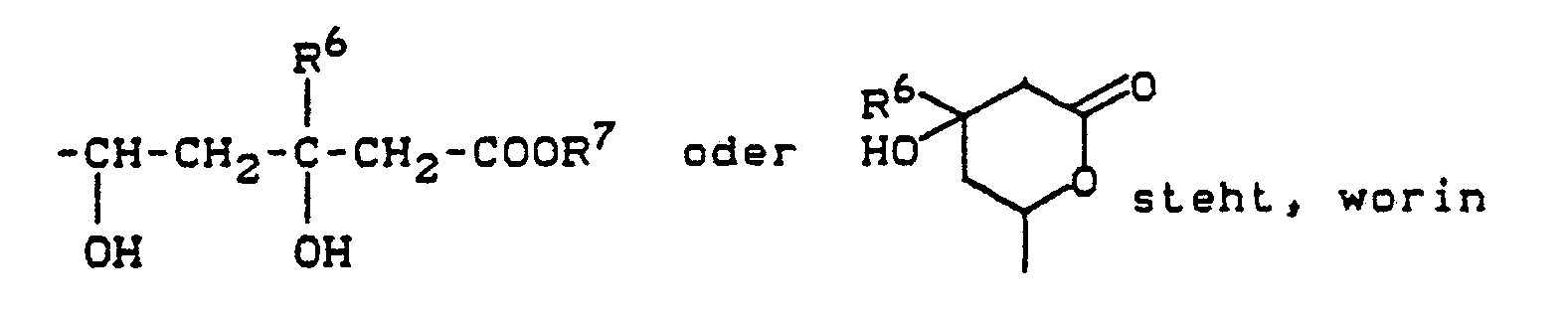
R⁶ - Wasserstoff, Methyl, Ethyl, Propyl, Isopropyl, Butyl, Isobutyl oder tert.Butyl bedeutet, und
R⁷ - Wasserstoff, Methyl, Ethyl, Propyl, Isopropyl, Butyl, Isobutyl, tert.Butyl oder Benzyl bedeutet,oder ein Natrium-, Kalium-, Calcium -, oder Magnesium- oder Amoniumion bedeutet.
R¹ - für Cyclopropyl, Cyclopentyl oder Cyclohexyl steht, oder
- für Methyl, Ethyl, Propyl, Isopropyl, Butyl, sec.-Butyl oder tert.Butyl steht, die substituiert sein können durch Fluor, Chlor, Brom, Cyano, Methoxy, Ethoxy, Propoxy, Isopropoxy, Butoxy, sec.Butoxy, tert.Butoxy, Methylthio, Ethylthio, Propylthio, Isopropylthio, Methylsulfonyl, Ethylsulfonyl, Propylsulfonyl, Isopropylsulfonyl, Trifluormethyl, Trifluormethoxy, Methoxycarbonyl, Ethoxycarbonyl, Butoxycarbonyl, Isobutoxycarbonyl, tert.-Butoxycarbonyl, Benzoyl, Acetyl, Pyridyl, Pyrimidyl, Thienyl, Furyl, Phenyl, Phenoxy, Phenylthio, Phenylsulfonyl, Benzyloxy, Benzylthio oder Benzylsulfonyl,
R² - für Pyridyl, Pyrimidyl, Chinolyl oder Isochinolyl stehen, die durch Fluor, Chlor, Methyl, Methoxy oder Trifluormethyl substituiert sein können, oder
- für Phenyl steht, das bis zu 3-fach gleich oder verschieden substituiert sein kann durch Methyl, Ethyl, Propyl, Isopropyl, Butyl, Isobutyl, tert.-Butyl, Methoxy, Ethoxy, Propoxy, Isopropoxy, Butoxy, Isobutoxy, tert.-Butoxy, Methylthio, Ethylthio, Propylthio, Isopropylthio, Methylsulfonyl, Ethylsulfonyl, Propylsulfonyl, Isopropylsulfonyl, Phenyl, Phenoxy, Benzyl, Benzyloxy, Fluor, Chlor, Brom, Cyano, Trifluormethyl, Trifluormethoxy, Methoxycarbonyl, Ethoxycarbonyl, Propoxycarbonyl, Isopropoxycarbonyl, butoxycarbonyl, Isobutoxy carbonyl oder tert.Butoxycarbonyl,
R³ - für Wasserstoff, Cyclopropyl, Cyclopentyl oder Cyclohexyl steht, oder
- für Methyl, Ethyl, Propyl, Isopropyl, Butyl, Isobutyl, tert.Butyl, Pentyl, Isopentyl, Hexyl oder Isohexyl stehen, die substituiert sein können durch Fluor, Chlor, Brom, Cyano, Methoxy, Ethoxy, Propoxy, Isopropoxy, Butoxy, Isobutoxy, tert.Butoxy, Methylthio, Ethylthio, Propylthio, Isopropylthio, Butylthio, Isobutylthio, tert.Butylthio, Methylsulfonyl, Ethylsulfonyl, Propylsulfonyl, Isopropylsulfonyl, Butylsulfonyl, Isobutylsulfonyl, tert.Butylsulfonyl, Trifluormethyl, Trifluormethoxy, Methoxycarbonyl, Ethoxycarbonyl, Propoxycarbonyl, Isopropoxycarbonyl, Butoxycarbonyl, Isobutoxycarbonyl, tert.Butoxycarbonyl, Benzoyl, Acetyl, Ethylcarbonyl, oder durch eine Gruppe -NR⁴R⁵, wobei
R⁴ und R⁵ gleich oder verschieden sind und Methyl, Ethyl, Propyl, Isopropyl, Butyl, Isobutyl, tert.Butyl, Phenyl, Benzyl, Acetyl, Methylsulfonyl, Ethylsulfonyl, Propylsulfonyl, Isopropylsulfonyl oder Phenylsulfonyl bedeuten,
oder durch Pyridyl, Pyrimidyl, Pyrazinyl, Pyridazinyl, Chinolin, Isochinolyl, Thienyl, Furyl, Phenyl, Phenoxy, Phenylthio, Phenylsulfonyl, Benzyloxy, Benzylthio oder Benzylsulfonyl, wobei die genannten Heteroaryl- und Arylreste durch Fluor, Chlor, Methyl, Ethyl, Propyl, Isopropyl, Isobutyl, tert.Butyl, Methoxy, Ethoxy, Propoxy, Isopropoxy, Butoxy, Isobutoxy, tert.-Butoxy, Trifluormethyl oder Trifluormethoxy substituiert sein können, oder
- für Thienyl, Furyl, Pyridyl, Pyrimidyl, Pyrazinyl, Pyridazinyl, Oxazolyl, Isooxazolyl, Imidazolyl, Pyrazolyl, thiazolyl, Isothiazolyl, Chinolyl, Isochinolyl, Benzoxazolyl, Benzimidazolyl oder Benzthiazolyl steht, wobei die genannten Reste durch Fluor, Chlor, Methyl, Ethyl, Propyl, Isopropyl, Butyl, Isobutyl, tert.Butyl, Methoxy, Ethoxy, Propoxy, Isopropoxy, Butoxy, Isobutoxy, tert.Butoxy, Phenyl, Phenoxy, Trifluormethyl, Trifluormethoxy, Methoxycarbonyl, Ethoxycarbonyl, Isopropoxycarbonyl, Propoxycarbonyl, butoxycarbonyl, Isobutoxycarbonyl oder tert.Butoxycarbonyl substituiert sein können, oder
- für Phenyl steht, das bis zu 3-fach gleich oder verschieden durch Methyl, Propyl, Isopropyl, Butyl, Isobutyl, tert.Butyl, Pentyl, Isopentyl, Hexyl, Isohexyl, Methoxy, Ethoxy, Propoxy, Isopropoxy, Butoxy, Isobutoxy, tert.-Butoxy, Methylthio, Ethylthio, Propylthio, Isopropylthio, Butylthio, Isobutylthio, tert.-Butylthio, Methylsulfonyl, Ethylsulfonyl, Propylsulfonyl, Isopropylsulfonyl, Butylsulfonyl, Isobutylsulfonyl, tert.Butylsulfonyl, Phenyl, Phenoxy, Phenylthio, Phenylsulfonyl, Benzyl, Benzyloxy, Benzylthio, Benzylsulfonyl, Fluor, Chlor, Brom, Cyano, Trifluormethyl, Trifluormethoxy, Trifluormethylthio, Methoxycarbonyl, Ethoxycarbonyl, Propoxycarbonyl, Isopropoxycarbonyl, Butoxycarbonyl, Isobutoxycarbonyl, tert.Butoxycarbonyl oder durch eine Gruppe -NR⁴R⁵ substituiert sein können, wobei
R⁴ und R⁵ die oben angegebene Bedeutung haben,
- für Alkoxy, Aryloxy, Aralkoxy, Alkylthio, Arylthio, Aralkylthio oder für eine Gruppe der Formel NR⁴R⁵ steht, worin
R⁴ und R⁵ die oben angegebene Bedeutung haben,
X - für ein Gruppe der Formel -CH₂-CH₂- oder -CH=CH-steht, und
A - für eine Gruppe der Formel
R⁷ - Wasserstoff, Methyl, Ethyl, Propyl, Isopropyl, Butyl, Isobutyl, tert.Butyl oder Benzyl bedeutet,oder ein Natrium-, Kalium-, Calcium -, oder Magnesium- oder Amoniumion bedeutet.
4. Substituierte Pyrimidine gemäß Anspruch 1 zur therapeutischen Behandlung.
5. Verfahren zur Herstellung von substituierten Pyrimidinen der allgemeinen Formel

in welcher
R¹ - für Cycloalkyl steht, oder
- für Alkyl steht, das substituiert sein kann durch Halogen, Cyano, Alkoxy, Alkylthio, Alkylsulfonyl, Trifluormethyl, Trifluormethoxy, Trifluormethylthio, Trifluormethylsulfonyl, Alkoxycarbonyl, Acyl, oder durch eine Gruppe der Formel -NR⁴R⁵, worin
R⁴, R⁵ - gleich oder verschieden sind und Alkyl, Aryl, Aralkyl, Acyl, Alkylsulfonyl oder Arylsulfonyl bedeuten,
oder durch Carbamoyl, Dialkylcarbamoyl, Sulfamoyl, Dialkylsulfamoyl, Heteroaryl, Aryl, Aryloxy, Arylthio, Arylsulfonyl, Aralkoxy, Aralkylthio oder Aralkylsulfonyl, wobei die Heteroaryl- oder Arylreste der letztgenannten Substituenten bis zu 3-fach gleich oder verschieden durch Halogen, Cyano, Trifluormethyl, Trifluormethoxy, Alkyl, Alkoxy, Alkylthio oder Alkylsulfonyl substituiert sein können,
R² - für Heteroaryl steht, das bis zu 3-fach gleich oder verschieden durch Halogen, Alkyl, Alkoxy, Alkylthio, Alkylsulfonyl, Aryl, Aryloxy, Arylthio, Arylsulfonyl, Trifluormethyl, Trifluormethoxy, Trifluormethylthio, Alkoxycarbonyl oder durch eine Gruppe der Formel -NR⁴R⁵ substituiert sein kann, worin
R⁴ und R⁵ die oben angegebene Bedeutung haben, oder
R² - für Aryl steht, das bis zu 5-fach gleich oder verschieden substituiert sein kann durch Alkyl, Alkoxy, Alkylthio, Alkylsulfonyl, Aryl, Aryloxy, Arylthio, Arylsulfonyl, Aralkyl, Aralkoxy, Aralkylthio, Aralkylsulfonyl, Halogen, Cyano, Nitro, Trifluormethyl, Trifluormethoxy, Trifluormethylthio, Alkoxycarbonyl, Sulfamoyl, Dialkylsulfamoyl, Carbamoyl, Dialkylcarbamoyl oder durch eine Gruppe der Formel -NR⁴R⁵, worin
R⁴ und R⁵ die oben angegebene Bedeutung haben,
R³ - für Wasserstoff oder
- für Cycloalkyl steht, oder
- für Alkyl steht, das substituiert sein kann durch Halogen, Cyano, Alkoxy, Alkylthio, Alkylsulfonyl, Trifluormethyl, Trifluormethoxy, Trifluormethylthio, Trifluormethylsulfonyl, Alkoxycarbonyl, Acyl oder durch eine Gruppe der Formel -NR⁴R⁵, worin
R⁴, R⁵ die oben angegebene Bedeutung haben,
oder durch Carbamoyl, Dialkylcarbamoyl, Sulfamoyl, Dialkylsulfamoyl, Heteroaryl, Aryl, Aryloxy, Arylthio, Arylsulfonyl, Aralkoxy, Aralkylthio oder Aralkylsulfonyl, wobei die Heteroaryl- oder Arylreste der letztgenannten Substituenten bis zu 3-fach gleich oder ver schieden durch Halogen, Cyano, Trifluormethyl, Trifluormethoxy, Alkyl, Alkoxy, Alkylthio oder Alkylsulfonyl substituiert sein können, oder
R³ -für Heteroaryl steht, das bis zu 3-fach gleich oder verschieden durch Halogen, Alkyl, Alkoxy, Alkylthio, Alkylsulfonyl, Aryl, Aryloxy, Arylthio, Arylsulfonyl, Trifluormethyl, Trifluormethoxy, Trifluormethylthio, Alkoxycarbonyl oder durch eine Gruppe der Formel -NR⁴R⁵ substituiert sein kann, worin
R⁴ und R⁵ die oben angegebene Bedeutung haben, oder
R³ - für Aryl steht, das bis zu 5-fach gleich oder verschieden substituiert sein kann durch Alkyl, Alkoxy, Alkylthio, Alkylsulfonyl, Aryl, Aryloxy, Arylthio, Arylsulfonyl, Aralkyl, Aralkoxy, Aralkylthio, Aralkylsulfonyl, Halogen, Cyano, Nitro, Trifluormethyl, Trifluormethoxy, Trifluormethylthio, Alkoxycarbonyl, Sulfamoyl, Dialkylsulfamoyl, Carbamoyl, Dialkylcarbamoyl oder durch eine Gruppe der Formel -NR⁴R⁵, worin
R⁴ und R⁵ die oben angegebene Bedeutung haben oder
R³ - für Alkoxy, Aryloxy, Aralkoxy, Alkylthio, Arylthio, Aralkylthio oder für eine Gruppe der Formel NR⁴R⁵ steht, worin R⁴ R⁵ die oben angegebene Bedeutung haben,
X - für eine Gruppe der Formel -CH₂-CH₂ oder -CH=CH- steht, und
A - für eine Gruppe der Formel 
R⁶ - Wasserstoff oder Alkyl bedeutet und
R⁷ - Wasserstoff,
- einen Alkyl-, Aryl- oder Aralkylrest oder
- ein Kation bedeutet,
dadurch gekennzeichnet, daß man
Ketone der allgemeinen Formel (VIII) 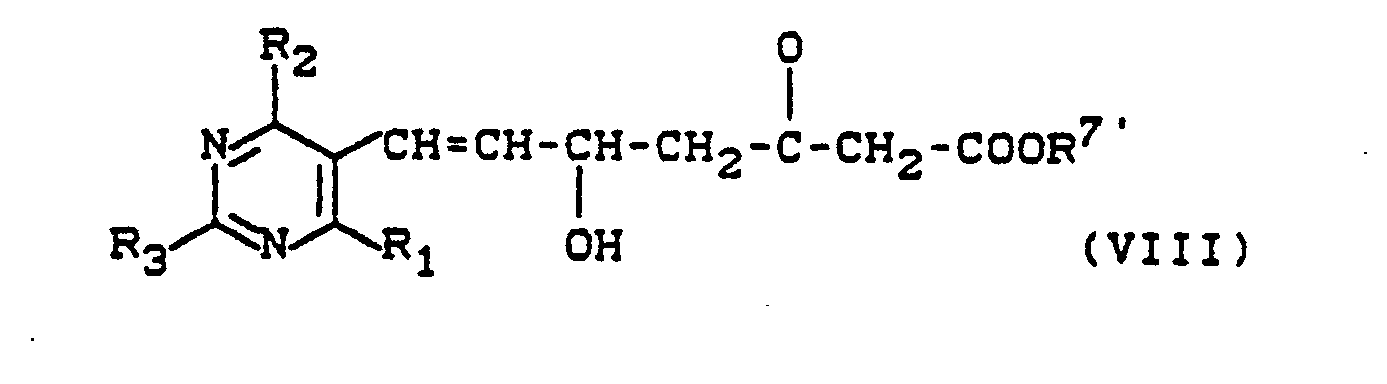
in welcher
R¹, R² und R³ die oben angegebene Bedeutung haben, und
R⁷′ - für Alkyl, Aryl oder Aralkyl steht,
reduziert,
im Fall der Herstellung der Säuren die Ester verseift,
im Fall der Herstellung der Lactone die Carbonsäuren cyclisiert,
im Fall der Herstellung der Salze entweder die Ester oder die Lactone verseift,
im Fall der Herstellung der Ethylenverbindungen (X =-CH₂-CH₂-) die Ethenverbindungen (X = -CH=CH-) nach üblichen Methoden hydriert,
und gegebenenfalls Isomeren trennt.
R¹ - für Cycloalkyl steht, oder
- für Alkyl steht, das substituiert sein kann durch Halogen, Cyano, Alkoxy, Alkylthio, Alkylsulfonyl, Trifluormethyl, Trifluormethoxy, Trifluormethylthio, Trifluormethylsulfonyl, Alkoxycarbonyl, Acyl, oder durch eine Gruppe der Formel -NR⁴R⁵, worin
R⁴, R⁵ - gleich oder verschieden sind und Alkyl, Aryl, Aralkyl, Acyl, Alkylsulfonyl oder Arylsulfonyl bedeuten,
oder durch Carbamoyl, Dialkylcarbamoyl, Sulfamoyl, Dialkylsulfamoyl, Heteroaryl, Aryl, Aryloxy, Arylthio, Arylsulfonyl, Aralkoxy, Aralkylthio oder Aralkylsulfonyl, wobei die Heteroaryl- oder Arylreste der letztgenannten Substituenten bis zu 3-fach gleich oder verschieden durch Halogen, Cyano, Trifluormethyl, Trifluormethoxy, Alkyl, Alkoxy, Alkylthio oder Alkylsulfonyl substituiert sein können,
R² - für Heteroaryl steht, das bis zu 3-fach gleich oder verschieden durch Halogen, Alkyl, Alkoxy, Alkylthio, Alkylsulfonyl, Aryl, Aryloxy, Arylthio, Arylsulfonyl, Trifluormethyl, Trifluormethoxy, Trifluormethylthio, Alkoxycarbonyl oder durch eine Gruppe der Formel -NR⁴R⁵ substituiert sein kann, worin
R⁴ und R⁵ die oben angegebene Bedeutung haben, oder
R² - für Aryl steht, das bis zu 5-fach gleich oder verschieden substituiert sein kann durch Alkyl, Alkoxy, Alkylthio, Alkylsulfonyl, Aryl, Aryloxy, Arylthio, Arylsulfonyl, Aralkyl, Aralkoxy, Aralkylthio, Aralkylsulfonyl, Halogen, Cyano, Nitro, Trifluormethyl, Trifluormethoxy, Trifluormethylthio, Alkoxycarbonyl, Sulfamoyl, Dialkylsulfamoyl, Carbamoyl, Dialkylcarbamoyl oder durch eine Gruppe der Formel -NR⁴R⁵, worin
R⁴ und R⁵ die oben angegebene Bedeutung haben,
R³ - für Wasserstoff oder
- für Cycloalkyl steht, oder
- für Alkyl steht, das substituiert sein kann durch Halogen, Cyano, Alkoxy, Alkylthio, Alkylsulfonyl, Trifluormethyl, Trifluormethoxy, Trifluormethylthio, Trifluormethylsulfonyl, Alkoxycarbonyl, Acyl oder durch eine Gruppe der Formel -NR⁴R⁵, worin
R⁴, R⁵ die oben angegebene Bedeutung haben,
oder durch Carbamoyl, Dialkylcarbamoyl, Sulfamoyl, Dialkylsulfamoyl, Heteroaryl, Aryl, Aryloxy, Arylthio, Arylsulfonyl, Aralkoxy, Aralkylthio oder Aralkylsulfonyl, wobei die Heteroaryl- oder Arylreste der letztgenannten Substituenten bis zu 3-fach gleich oder ver schieden durch Halogen, Cyano, Trifluormethyl, Trifluormethoxy, Alkyl, Alkoxy, Alkylthio oder Alkylsulfonyl substituiert sein können, oder
R³ -für Heteroaryl steht, das bis zu 3-fach gleich oder verschieden durch Halogen, Alkyl, Alkoxy, Alkylthio, Alkylsulfonyl, Aryl, Aryloxy, Arylthio, Arylsulfonyl, Trifluormethyl, Trifluormethoxy, Trifluormethylthio, Alkoxycarbonyl oder durch eine Gruppe der Formel -NR⁴R⁵ substituiert sein kann, worin
R⁴ und R⁵ die oben angegebene Bedeutung haben, oder
R³ - für Aryl steht, das bis zu 5-fach gleich oder verschieden substituiert sein kann durch Alkyl, Alkoxy, Alkylthio, Alkylsulfonyl, Aryl, Aryloxy, Arylthio, Arylsulfonyl, Aralkyl, Aralkoxy, Aralkylthio, Aralkylsulfonyl, Halogen, Cyano, Nitro, Trifluormethyl, Trifluormethoxy, Trifluormethylthio, Alkoxycarbonyl, Sulfamoyl, Dialkylsulfamoyl, Carbamoyl, Dialkylcarbamoyl oder durch eine Gruppe der Formel -NR⁴R⁵, worin
R⁴ und R⁵ die oben angegebene Bedeutung haben oder
R³ - für Alkoxy, Aryloxy, Aralkoxy, Alkylthio, Arylthio, Aralkylthio oder für eine Gruppe der Formel NR⁴R⁵ steht, worin R⁴ R⁵ die oben angegebene Bedeutung haben,
X - für eine Gruppe der Formel -CH₂-CH₂ oder -CH=CH- steht, und
A - für eine Gruppe der Formel
R⁷ - Wasserstoff,
- einen Alkyl-, Aryl- oder Aralkylrest oder
- ein Kation bedeutet,
dadurch gekennzeichnet, daß man
Ketone der allgemeinen Formel (VIII)
R¹, R² und R³ die oben angegebene Bedeutung haben, und
R⁷′ - für Alkyl, Aryl oder Aralkyl steht,
reduziert,
im Fall der Herstellung der Säuren die Ester verseift,
im Fall der Herstellung der Lactone die Carbonsäuren cyclisiert,
im Fall der Herstellung der Salze entweder die Ester oder die Lactone verseift,
im Fall der Herstellung der Ethylenverbindungen (X =-CH₂-CH₂-) die Ethenverbindungen (X = -CH=CH-) nach üblichen Methoden hydriert,
und gegebenenfalls Isomeren trennt.
6. Verfahren nach Anspruch 5, dadurch gekennzeichnet das man die Reduktion im Temperaturbereich von -80°C bis +30°C durchführt.
7. Arzneimittel, enthaltend substituierte Pyrimidine gemäß Anspruch 1.
8. Arzneimittel nach Anspruch 7, enthaltend 0,5 - 98 Gew.-% an substituierten Pyrimidinen bezogen auf die Zubereitung.
9. Verwendung von substituierten Pyrimidinen gemäß Anspruch 1 zur Behandlung von Krankheiten.
10. Verwendung nach Anspruch 9 zur Behandlung von Hyperlipoproteinämie, Lipoproteinämie oder Atherosklerose.
11. Verwendung von substituierten Pyrimidinen gemäß Anspruch 1 zur Herstellung von Arzneimitteln.
12. Aldehyde der allgemeinen Formel

in welcher
R¹ - für Cycloalkyl steht, oder
- für Alkyl steht, das substituiert sein kann durch Halogen, Cyano, Alkoxy, Alkylthio, Alkylsulfonyl, Trifluormethyl, Trifluormethoxy, Trifluormethylthio, Trifluormethylsulfonyl, Alkoxycarbonyl, Acyl oder durch eine Gruppe der Formel -NR⁴R⁵, worin
R⁴, R⁵ -gleich oder verschieden sind und Alkyl, Aryl, Aralkyl, Acyl, Alkylsulfonyl oder Arylsulfonyl bedeuten,
oder durch Carbamoyl, Dialklcarbamoyl, Sulfamoyl, Dialkylsulfamoyl, Heteroaryl, Aryl, Aryloxy, Arylthio, Arylsulfonyl, Aralkoxy, Aralkylthio oder Aralkylsulfonyl, wobei die Heteroaryl- und Arylreste der letztgenannten Substituenten bis zu 3-fach gleich oder verschieden durch Halogen, Cyano, Trifluormethyl, Trifluormethoxy, Alkyl, Alkoxy, Alkylthio oder Alkylsulfonyl substituiert sein können,
R² - für Heteroaryl steht, das bis zu 3-fach gleich oder verschieden durch Halogen, Alkyl, Alkoxy, Alkylthio, Alkylsulfonyl, Aryl, Aryloxy, Arylthio, Arylsulfonyl, Trifluoromethyl, Trifluormethoxy, Trifluormethylthio, Alkoxycarbonyl oder durch eine Gruppe der Form -NR⁴R⁵ substituiert sien kann, worin
R⁴ und R⁵ die oben angegebene Bedeutung haben, oder
R² - für Aryl steht, das bis zu 5-fach gleich oder verschieden substituiert sein kann durch Alkyl, Alkoxy, Alkylthio, Alkylsulfonyl, Aryl, Aryloxy, Arylthio, Arylsulfonyl, Aralkyl, Aralkoxy, Aralkylthio, Aralkylsulfonyl, Halo gen, Cyano, Nitro, Trifluormethyl, Trifluormethoxy, Trifluormethylthio, Alkoxycarbonyl, Sulfamoyl, Dialkylsulfamoyl, Carbamoyl, Dialkylcarbamoyl oder durch eine Gruppe der Formel -NR⁴R⁵, worin
R⁴ und R⁵ die oben angegebene Bedeutung haben,
R³ - für Wasserstoff oder
- für Cycloalkyl steht, oder
- für Alkyl steht, das substituiert sein kann durch Halogen, Cyano, Alkoxy, Alkylthio, Alkylsulfonyl, Trifluormethyl, Trifluormethoxy, Trifluormethylthio, Trifluormethylsulfonyl, Alkoxycarbonyl, Acyl oder durch eine Gruppe der Formel -NR⁴R⁵, worin R⁴, R⁵ die oben angegebene Bedeutung haben,
oder durch Carbamoyl, Dialkylcarbamoyl, Sulfamoyl, Dialkylsulfamoyl, Heteroaryl, Aryl, Aryloxy, Arylthio, Arylsulfonyl, Aralkoxy, Aralkylthio oder Aralkylsulfonyl, wobei die Heteroaryl- und Arylreste der letztgenannten Substituenten bis zu 3-fach gleich oder verschieden durch Halogen, Cyano, Trifluormethyl, Trifluormethoxy, Alkyl, Alkoxy, Alkylthio oder Alkylsulfonyl substituiert sein können, oder R³ - für Heteroaryl steht, das bis zu 3-fach gleich oder verschieden durch Halogen, Alkyl, Alkoxy, Alkylthio, Alkylsulfonyl, Aryl, Aryloxy, Arylthio, Arylsulfonyl, Trifluormethyl, Trifluormethoxy, Trifluormethylthio, Alkoxycarbonyl oder durch eine Gruppe der Formel -NR⁴R⁵ substituiert sein kann, worin
R⁴ und R⁵ die oben angegebene Bedeutung haben, oder
R³ - für Aryl steht, das bis zu 5-fach gleich oder verschieden substituiert sein kann durch Alkyl, Alkoxy, Alkylthio, Alkylsulfonyl, Aryl, Aryloxy, Arylthio, Arylsulfonyl, Aralkyl, Aralkoxy, Aralkylthio, Aralkylsulfonyl, Halogen, Cyano, Nitro, Trifluormethyl, Trifluormethoxy, Trifluormethylthio, Alkoxycarbonyl, Sulfamoyl, Dialkylsulfamoyl, Carbamoyl, Dialkylcarbamoyl oder durch eine Gruppe der Formel -NR⁴R⁵, worin
R⁴ und R⁵ die oben angegebene Bedeutung haben, oder
R³ - für Alkoxy, Aryloxy, Aralkoxy, Alkylthio, Arylthio, Aralkylthio oder für eine Gruppe der Formel NR⁴R⁵ steht, worin
R⁴ und R⁵ die oben angegebene Bedeutung haben.
R¹ - für Cycloalkyl steht, oder
- für Alkyl steht, das substituiert sein kann durch Halogen, Cyano, Alkoxy, Alkylthio, Alkylsulfonyl, Trifluormethyl, Trifluormethoxy, Trifluormethylthio, Trifluormethylsulfonyl, Alkoxycarbonyl, Acyl oder durch eine Gruppe der Formel -NR⁴R⁵, worin
R⁴, R⁵ -gleich oder verschieden sind und Alkyl, Aryl, Aralkyl, Acyl, Alkylsulfonyl oder Arylsulfonyl bedeuten,
oder durch Carbamoyl, Dialklcarbamoyl, Sulfamoyl, Dialkylsulfamoyl, Heteroaryl, Aryl, Aryloxy, Arylthio, Arylsulfonyl, Aralkoxy, Aralkylthio oder Aralkylsulfonyl, wobei die Heteroaryl- und Arylreste der letztgenannten Substituenten bis zu 3-fach gleich oder verschieden durch Halogen, Cyano, Trifluormethyl, Trifluormethoxy, Alkyl, Alkoxy, Alkylthio oder Alkylsulfonyl substituiert sein können,
R² - für Heteroaryl steht, das bis zu 3-fach gleich oder verschieden durch Halogen, Alkyl, Alkoxy, Alkylthio, Alkylsulfonyl, Aryl, Aryloxy, Arylthio, Arylsulfonyl, Trifluoromethyl, Trifluormethoxy, Trifluormethylthio, Alkoxycarbonyl oder durch eine Gruppe der Form -NR⁴R⁵ substituiert sien kann, worin
R⁴ und R⁵ die oben angegebene Bedeutung haben, oder
R² - für Aryl steht, das bis zu 5-fach gleich oder verschieden substituiert sein kann durch Alkyl, Alkoxy, Alkylthio, Alkylsulfonyl, Aryl, Aryloxy, Arylthio, Arylsulfonyl, Aralkyl, Aralkoxy, Aralkylthio, Aralkylsulfonyl, Halo gen, Cyano, Nitro, Trifluormethyl, Trifluormethoxy, Trifluormethylthio, Alkoxycarbonyl, Sulfamoyl, Dialkylsulfamoyl, Carbamoyl, Dialkylcarbamoyl oder durch eine Gruppe der Formel -NR⁴R⁵, worin
R⁴ und R⁵ die oben angegebene Bedeutung haben,
R³ - für Wasserstoff oder
- für Cycloalkyl steht, oder
- für Alkyl steht, das substituiert sein kann durch Halogen, Cyano, Alkoxy, Alkylthio, Alkylsulfonyl, Trifluormethyl, Trifluormethoxy, Trifluormethylthio, Trifluormethylsulfonyl, Alkoxycarbonyl, Acyl oder durch eine Gruppe der Formel -NR⁴R⁵, worin R⁴, R⁵ die oben angegebene Bedeutung haben,
oder durch Carbamoyl, Dialkylcarbamoyl, Sulfamoyl, Dialkylsulfamoyl, Heteroaryl, Aryl, Aryloxy, Arylthio, Arylsulfonyl, Aralkoxy, Aralkylthio oder Aralkylsulfonyl, wobei die Heteroaryl- und Arylreste der letztgenannten Substituenten bis zu 3-fach gleich oder verschieden durch Halogen, Cyano, Trifluormethyl, Trifluormethoxy, Alkyl, Alkoxy, Alkylthio oder Alkylsulfonyl substituiert sein können, oder R³ - für Heteroaryl steht, das bis zu 3-fach gleich oder verschieden durch Halogen, Alkyl, Alkoxy, Alkylthio, Alkylsulfonyl, Aryl, Aryloxy, Arylthio, Arylsulfonyl, Trifluormethyl, Trifluormethoxy, Trifluormethylthio, Alkoxycarbonyl oder durch eine Gruppe der Formel -NR⁴R⁵ substituiert sein kann, worin
R⁴ und R⁵ die oben angegebene Bedeutung haben, oder
R³ - für Aryl steht, das bis zu 5-fach gleich oder verschieden substituiert sein kann durch Alkyl, Alkoxy, Alkylthio, Alkylsulfonyl, Aryl, Aryloxy, Arylthio, Arylsulfonyl, Aralkyl, Aralkoxy, Aralkylthio, Aralkylsulfonyl, Halogen, Cyano, Nitro, Trifluormethyl, Trifluormethoxy, Trifluormethylthio, Alkoxycarbonyl, Sulfamoyl, Dialkylsulfamoyl, Carbamoyl, Dialkylcarbamoyl oder durch eine Gruppe der Formel -NR⁴R⁵, worin
R⁴ und R⁵ die oben angegebene Bedeutung haben, oder
R³ - für Alkoxy, Aryloxy, Aralkoxy, Alkylthio, Arylthio, Aralkylthio oder für eine Gruppe der Formel NR⁴R⁵ steht, worin
R⁴ und R⁵ die oben angegebene Bedeutung haben.
13. Verfahren zur Herstellung von Aldehyden der allgemeinen Formel

in welcher
R¹ - für Cycloalkyl steht, oder
- für Alkyl steht, das substituiert sein kann durch Halogen, Cyano, Alkoxy, Alkylthio, Alkylsulfonyl, Trifluormethyl, Trifluormethoxy, Trifluormethylthio, Trifluormethylsulfonyl, Alkoxycarbonyl, Acyl oder durch eine Gruppe der Formel -NR⁴R⁵, worin
R⁴, R⁵ -gleich oder verschieden sind und Alkyl, Aryl, Aralkyl, Acyl, Alkylsulfonyl oder Arylsulfonyl bedeuten,
oder durch Carbamoyl, Dialkylcarbamoyl, Sulfamoyl, Dialkylsulfamoyl, Heteroaryl, Aryl, Aryloxy, Arylthio, Arylsulfonyl, Aralkoxy, Aralkylthio oder Aralkylsulfonyl, wobei die Heteroaryl- und Arylreste der letztgenannten Substituenten bis zu 3-fach gleich oder
verschieden durch Halogen, Cyano, Trifluormethyl, Trifluormethoxy, Alkyl, Alkoxy, Alkylthio oder Alkylsulfonyl substituiert sein können,
R² - für Heteroaryl steht, das bis zu 3-fach gleich oder verschieden durch Halogen, Alkyl, Alkoxy, Alkylthio, Alkylsulfonyl, Aryl, Aryloxy, Arylthio, Arylsulfonyl, Trifluormethyl, Trifluormethoxy, Trifluormethylthio, Alkoxycarbonyl oder durch eine Gruppe der Formel -NR⁴R⁵ substituiert sein kann, worin
R⁴ und R⁵ die oben angegebene Bedeutung haben, oder
R² - für Aryl steht, das bis zu 5-fach gleich oder verschieden substituiert sein kann durch Alkyl, Alkoxy, Alkylthio, Alkylsulfonyl, Aryl, Aryloxy, Arylthio, Arylsulfonyl, Aralkyl, Aralkoxy, Aralkylthio, Aralkylsulfonyl, Halogen, Cyano, Nitro, Trifluormethyl, Trifluormethoxy, Trifluormethylthio, Alkoxycarbonyl, Sulfamoyl, Dialkylsulfamoyl, Carbamoyl, Dialkylcarbamoyl oder durch eine Gruppe der Formel -NR⁴R⁵, worin
R⁴ und R⁵ die oben angegebene Bedeutung haben,
R³ - für Wasserstoff oder
- für Cycloalkyl steht, oder
- für Alkyl steht, das substituiert sein kann durch Halogen, Cyano, Alkoxy, Alkylthio, Alkylsulfonyl, Trifluormethyl, Trifluormethoxy, Trifluormethylthio, Trifluormethylsulfonyl, Alkoxycarbonyl, Acyl oder durch eine Gruppe der Formel -NR⁴R⁵, worin
R⁴, R⁵ die oben angegebene Bedeutung haben,
oder durch Carbamoyl, Dialkylcarbamoyl, Sulfamoyl, Dialkylsulfamoyl, Heteroaryl, Aryl, Aryloxy, Arylthio, Arylsulfonyl, Aralkoxy, Aralkylthio oder Aralkylsulfonyl, wobei die Heteroaryl- und Arylreste der letztgenannten Substituenten bis zu 3-fach gleich oder verschieden durch Halogen, Cyano, Trifluormethyl, Trifluormethoxy, Alkyl, Alkoxy, Alkylthio oder Alkylsulfonyl substituiert sein können, oder
R³ - für Heteroaryl steht, die bis zu 3-fach gleich oder verschieden durch Halogen, Alkyl, Alkoxy, Alk ylthio, Alkylsulfonyl, Aryl, Aryloxy, Arylthio, Arylsulfonyl, Trifluormethyl, Trifluormethoxy, Trifluormethylthio, Alkoxycarbonyl oder durch eine Gruppe der Formel -NR⁴R⁵ substituiert sein können,
worin
R⁴ und R⁵ die oben angegebene Bedeutung haben, oder
R³ - für Aryl steht, das bis zu 5-fach gleich oder verschieden substituiert sein kann durch Alkyl, Alkoxy, Alkylthio, Alkylsulfonyl, Aryl, Aryloxy, Ary thio, Arylsulfonyl, Aralkyl, Aralkoxy, Aralkylthi Aralkylsulfonyl, Halogen, Cyano, Nitro, Trifluorm thyl, Trifluormethoxy, Trifluormethylthio, Alkoxy carbonyl, Sulfamoyl, Dialkylsulfamoyl, Carbamoyl, Dialkylcarbamoyl oder durch eine Gruppe der Forme -NR⁴R⁵, worin
R⁴ und R⁵ die oben angegebene Bedeutung haben,
dadurch gekennzeichnet, daß man Pyrimidine der allgemeinen Formel 
in der R¹, R² und R³ die oben genannte Bedeutung haben und
R⁸ Alkyl (C₁ bis C₆), Aryl (C₆ bis C₁₀) oder Aralkyl (C₇ bis C₁₀) bedeutet,
im Temperaturbereich von -70°C bis +100°C in Hydroxymethylenverbindungen der Formel 
worin R¹, R² und R³ die oben genannte Bedeutung haben,
reduziert, anschließend zu den entsprechenden Aldehyden der Formel 
worin R¹, R² und R³ die oben genannte Bedeutung haben,
oxidiert und diese mit Dialkyl (C₁ bis C₄) aminovinylphosphonaten in Anwesenheit von Natriumhydrid in inerten Lösungsmitteln im Temperaturbereich von -20°C bis +40°C umsetzt.
R¹ - für Cycloalkyl steht, oder
- für Alkyl steht, das substituiert sein kann durch Halogen, Cyano, Alkoxy, Alkylthio, Alkylsulfonyl, Trifluormethyl, Trifluormethoxy, Trifluormethylthio, Trifluormethylsulfonyl, Alkoxycarbonyl, Acyl oder durch eine Gruppe der Formel -NR⁴R⁵, worin
R⁴, R⁵ -gleich oder verschieden sind und Alkyl, Aryl, Aralkyl, Acyl, Alkylsulfonyl oder Arylsulfonyl bedeuten,
oder durch Carbamoyl, Dialkylcarbamoyl, Sulfamoyl, Dialkylsulfamoyl, Heteroaryl, Aryl, Aryloxy, Arylthio, Arylsulfonyl, Aralkoxy, Aralkylthio oder Aralkylsulfonyl, wobei die Heteroaryl- und Arylreste der letztgenannten Substituenten bis zu 3-fach gleich oder
verschieden durch Halogen, Cyano, Trifluormethyl, Trifluormethoxy, Alkyl, Alkoxy, Alkylthio oder Alkylsulfonyl substituiert sein können,
R² - für Heteroaryl steht, das bis zu 3-fach gleich oder verschieden durch Halogen, Alkyl, Alkoxy, Alkylthio, Alkylsulfonyl, Aryl, Aryloxy, Arylthio, Arylsulfonyl, Trifluormethyl, Trifluormethoxy, Trifluormethylthio, Alkoxycarbonyl oder durch eine Gruppe der Formel -NR⁴R⁵ substituiert sein kann, worin
R⁴ und R⁵ die oben angegebene Bedeutung haben, oder
R² - für Aryl steht, das bis zu 5-fach gleich oder verschieden substituiert sein kann durch Alkyl, Alkoxy, Alkylthio, Alkylsulfonyl, Aryl, Aryloxy, Arylthio, Arylsulfonyl, Aralkyl, Aralkoxy, Aralkylthio, Aralkylsulfonyl, Halogen, Cyano, Nitro, Trifluormethyl, Trifluormethoxy, Trifluormethylthio, Alkoxycarbonyl, Sulfamoyl, Dialkylsulfamoyl, Carbamoyl, Dialkylcarbamoyl oder durch eine Gruppe der Formel -NR⁴R⁵, worin
R⁴ und R⁵ die oben angegebene Bedeutung haben,
R³ - für Wasserstoff oder
- für Cycloalkyl steht, oder
- für Alkyl steht, das substituiert sein kann durch Halogen, Cyano, Alkoxy, Alkylthio, Alkylsulfonyl, Trifluormethyl, Trifluormethoxy, Trifluormethylthio, Trifluormethylsulfonyl, Alkoxycarbonyl, Acyl oder durch eine Gruppe der Formel -NR⁴R⁵, worin
R⁴, R⁵ die oben angegebene Bedeutung haben,
oder durch Carbamoyl, Dialkylcarbamoyl, Sulfamoyl, Dialkylsulfamoyl, Heteroaryl, Aryl, Aryloxy, Arylthio, Arylsulfonyl, Aralkoxy, Aralkylthio oder Aralkylsulfonyl, wobei die Heteroaryl- und Arylreste der letztgenannten Substituenten bis zu 3-fach gleich oder verschieden durch Halogen, Cyano, Trifluormethyl, Trifluormethoxy, Alkyl, Alkoxy, Alkylthio oder Alkylsulfonyl substituiert sein können, oder
R³ - für Heteroaryl steht, die bis zu 3-fach gleich oder verschieden durch Halogen, Alkyl, Alkoxy, Alk ylthio, Alkylsulfonyl, Aryl, Aryloxy, Arylthio, Arylsulfonyl, Trifluormethyl, Trifluormethoxy, Trifluormethylthio, Alkoxycarbonyl oder durch eine Gruppe der Formel -NR⁴R⁵ substituiert sein können,
worin
R⁴ und R⁵ die oben angegebene Bedeutung haben, oder
R³ - für Aryl steht, das bis zu 5-fach gleich oder verschieden substituiert sein kann durch Alkyl, Alkoxy, Alkylthio, Alkylsulfonyl, Aryl, Aryloxy, Ary thio, Arylsulfonyl, Aralkyl, Aralkoxy, Aralkylthi Aralkylsulfonyl, Halogen, Cyano, Nitro, Trifluorm thyl, Trifluormethoxy, Trifluormethylthio, Alkoxy carbonyl, Sulfamoyl, Dialkylsulfamoyl, Carbamoyl, Dialkylcarbamoyl oder durch eine Gruppe der Forme -NR⁴R⁵, worin
R⁴ und R⁵ die oben angegebene Bedeutung haben,
dadurch gekennzeichnet, daß man Pyrimidine der allgemeinen Formel
R⁸ Alkyl (C₁ bis C₆), Aryl (C₆ bis C₁₀) oder Aralkyl (C₇ bis C₁₀) bedeutet,
im Temperaturbereich von -70°C bis +100°C in Hydroxymethylenverbindungen der Formel
reduziert, anschließend zu den entsprechenden Aldehyden der Formel
oxidiert und diese mit Dialkyl (C₁ bis C₄) aminovinylphosphonaten in Anwesenheit von Natriumhydrid in inerten Lösungsmitteln im Temperaturbereich von -20°C bis +40°C umsetzt.
Applications Claiming Priority (4)
| Application Number | Priority Date | Filing Date | Title |
|---|---|---|---|
| DE3805913 | 1988-02-25 | ||
| DE3805913A DE3805913A1 (de) | 1988-02-25 | 1988-02-25 | Substituierte pyrimidine |
| IT8822721A IT1227543B (it) | 1988-11-24 | 1988-11-24 | Pirimidine sostituite. |
| IT2272188 | 1988-11-24 |
Publications (1)
| Publication Number | Publication Date |
|---|---|
| EP0330057A2 true EP0330057A2 (de) | 1989-08-30 |
Family
ID=25865194
Family Applications (1)
| Application Number | Title | Priority Date | Filing Date |
|---|---|---|---|
| EP89102536A Withdrawn EP0330057A2 (de) | 1988-02-25 | 1989-02-15 | Substituierte Pyrimidine |
Country Status (9)
| Country | Link |
|---|---|
| EP (1) | EP0330057A2 (de) |
| JP (1) | JPH01261377A (de) |
| CN (1) | CN1036954A (de) |
| AU (1) | AU3020289A (de) |
| DK (1) | DK88989D0 (de) |
| FI (1) | FI890868A7 (de) |
| IL (1) | IL89376A0 (de) |
| NO (1) | NO890521L (de) |
| PT (1) | PT89809A (de) |
Cited By (7)
| Publication number | Priority date | Publication date | Assignee | Title |
|---|---|---|---|---|
| US4925852A (en) * | 1987-07-10 | 1990-05-15 | Hoechst Aktiengesellschaft | 3-demethylmevalonic acid derivatives, and pharmaceutical products based on these compounds |
| US6218431B1 (en) | 1996-07-31 | 2001-04-17 | Bayer Corporation | Substituted biphenyls |
| USRE37314E1 (en) | 1991-07-01 | 2001-08-07 | Shionogi Seiyaku Kabushiki Kaisha | Pyrimidine derivatives |
| WO2005121106A1 (en) * | 2004-06-11 | 2005-12-22 | N.V. Organon | 4-phenyl-pyrimidine-2-carbonitrile derivatives |
| WO2011130079A1 (en) | 2010-04-16 | 2011-10-20 | Cumberland Pharmaceuticals, Inc. | Stabilized statin formulations |
| WO2012046772A1 (ja) | 2010-10-06 | 2012-04-12 | 国立大学法人東京大学 | リンパ浮腫予防治療剤 |
| EP3184103A1 (de) | 2015-12-21 | 2017-06-28 | Hexal AG | Pharmazeutische zusammensetzung mit atorvastatin oder einem salz davon |
Families Citing this family (4)
| Publication number | Priority date | Publication date | Assignee | Title |
|---|---|---|---|---|
| DE3826814A1 (de) * | 1988-08-06 | 1990-02-08 | Hoechst Ag | Neue 6-fluor-3,5-dihydroxycarbonsaeuren und deren derivate, verfahren zu ihrer herstellung, ihre verwendung als arzneimittel, pharmazeutische praeparate und zwischenprodukte |
| DE3832570A1 (de) * | 1988-09-24 | 1990-03-29 | Hoechst Ag | 7-substituierte derivate der 3,5-dihydroxyhept-6-insaeure, verfahren zur ihrer herstellung, ihre verwendung als arzneimittel, sowie zwischenprodukte |
| US5677455A (en) | 1994-09-06 | 1997-10-14 | Ube Industries, Ltd. | Preparation of 3-oxy-5-oxo-6-heptenoic acid derivatives |
| GB0001621D0 (en) | 2000-01-26 | 2000-03-15 | Astrazeneca Ab | Pharmaceutical compositions |
-
1989
- 1989-02-08 NO NO89890521A patent/NO890521L/no unknown
- 1989-02-15 EP EP89102536A patent/EP0330057A2/de not_active Withdrawn
- 1989-02-22 AU AU30202/89A patent/AU3020289A/en not_active Abandoned
- 1989-02-22 IL IL89376A patent/IL89376A0/xx unknown
- 1989-02-22 JP JP1040462A patent/JPH01261377A/ja active Pending
- 1989-02-23 PT PT89809A patent/PT89809A/pt not_active Application Discontinuation
- 1989-02-23 FI FI890868A patent/FI890868A7/fi not_active Application Discontinuation
- 1989-02-24 DK DK088989A patent/DK88989D0/da unknown
- 1989-02-25 CN CN89101168A patent/CN1036954A/zh active Pending
Cited By (12)
| Publication number | Priority date | Publication date | Assignee | Title |
|---|---|---|---|---|
| US4925852A (en) * | 1987-07-10 | 1990-05-15 | Hoechst Aktiengesellschaft | 3-demethylmevalonic acid derivatives, and pharmaceutical products based on these compounds |
| USRE37314E1 (en) | 1991-07-01 | 2001-08-07 | Shionogi Seiyaku Kabushiki Kaisha | Pyrimidine derivatives |
| US6218431B1 (en) | 1996-07-31 | 2001-04-17 | Bayer Corporation | Substituted biphenyls |
| WO2005121106A1 (en) * | 2004-06-11 | 2005-12-22 | N.V. Organon | 4-phenyl-pyrimidine-2-carbonitrile derivatives |
| US7589095B2 (en) | 2004-06-11 | 2009-09-15 | N.V. Organon | 4-phenyl-pyrimidine-2-carbonitrile derivatives |
| RU2382773C2 (ru) * | 2004-06-11 | 2010-02-27 | Н.В. Органон | Производные 4-фенилпиримидин-2-карбонитрила |
| WO2011130079A1 (en) | 2010-04-16 | 2011-10-20 | Cumberland Pharmaceuticals, Inc. | Stabilized statin formulations |
| US8372877B2 (en) | 2010-04-16 | 2013-02-12 | Cumberland Pharmaceuticals | Stabilized statin formulations |
| US9820966B2 (en) | 2010-04-16 | 2017-11-21 | Cumberland Pharmaceuticals | Stabilized statin formulations |
| EP3524053A1 (de) | 2010-04-16 | 2019-08-14 | Cumberland Pharmaceuticals, Inc. | Stabilisierte statinformulierungen |
| WO2012046772A1 (ja) | 2010-10-06 | 2012-04-12 | 国立大学法人東京大学 | リンパ浮腫予防治療剤 |
| EP3184103A1 (de) | 2015-12-21 | 2017-06-28 | Hexal AG | Pharmazeutische zusammensetzung mit atorvastatin oder einem salz davon |
Also Published As
| Publication number | Publication date |
|---|---|
| DK88989D0 (da) | 1989-02-24 |
| NO890521L (no) | 1989-08-28 |
| JPH01261377A (ja) | 1989-10-18 |
| IL89376A0 (en) | 1989-09-10 |
| CN1036954A (zh) | 1989-11-08 |
| FI890868A0 (fi) | 1989-02-23 |
| PT89809A (pt) | 1989-10-04 |
| FI890868A7 (fi) | 1989-08-26 |
| NO890521D0 (no) | 1989-02-08 |
| AU3020289A (en) | 1989-08-31 |
Similar Documents
| Publication | Publication Date | Title |
|---|---|---|
| EP0373423B1 (de) | Substituierte 2-Pyridone und Pyrid-2-thione, Verfahren zu ihrer Herstellung und ihre Verwendung in Arzneimitteln | |
| EP0325130B1 (de) | Substituierte Pyridine | |
| EP0465970A1 (de) | Substituierte Pyrrolopyridine | |
| EP0287890A1 (de) | Substituierte Pyrrole | |
| EP0325129B1 (de) | Disubstituierte Pyridine | |
| EP0391185B1 (de) | Substituierte 1,8-Naphthyridine | |
| EP0378850B1 (de) | Neue substituierte Pyrido(2,3-d)pyrimidine | |
| EP0317845A2 (de) | Substituierte Hydroxylamine | |
| EP0300278A2 (de) | Verfahren zur Herstellung von 2-substituierten Pyrrolen | |
| EP0468258B1 (de) | Substituierte Pyrido-oxazine | |
| JPH01261377A (ja) | 置換されたピリミジン | |
| EP0339342A1 (de) | N-Substituierte N-Amino-pyrrole | |
| EP0334014A2 (de) | Substituierte Imidazolinone und Imidazolinthione | |
| EP0416383A2 (de) | Substituierte Amino-Pyridine | |
| DE3905908A1 (de) | Substituierte chinoline, verfahren zu ihrer herstellung und ihre verwendung in arzneimitteln | |
| EP0334147A1 (de) | Disubstituierte Pyrrole | |
| EP0388732A2 (de) | Pentasubstituierte Phenyle | |
| EP0411420A2 (de) | Imino-substituierte Pyridine | |
| DE3805884A1 (de) | Substituierte imidazolinone und imidazolinthione | |
| DE3805913A1 (de) | Substituierte pyrimidine | |
| EP0352575A2 (de) | Substituierte anellierte Pyrrole | |
| DE3801406A1 (de) | Substituierte pyridine | |
| DE3813776A1 (de) | N-substituierte n-amino-pyrrole | |
| DE3726528A1 (de) | Substituierte pyrrole | |
| DE3809860A1 (de) | Disubstituierte pyrrole |
Legal Events
| Date | Code | Title | Description |
|---|---|---|---|
| PUAI | Public reference made under article 153(3) epc to a published international application that has entered the european phase |
Free format text: ORIGINAL CODE: 0009012 |
|
| 17P | Request for examination filed |
Effective date: 19890215 |
|
| AK | Designated contracting states |
Kind code of ref document: A2 Designated state(s): AT BE CH DE ES FR GB GR IT LI LU NL SE |
|
| STAA | Information on the status of an ep patent application or granted ep patent |
Free format text: STATUS: THE APPLICATION HAS BEEN WITHDRAWN |
|
| 18W | Application withdrawn |
Withdrawal date: 19890803 |
|
| REG | Reference to a national code |
Ref country code: DE Ref legal event code: 8564 |