EP0245536A2 - Verfahren zur Kontrolle des Aufschlussgrades von lignocellulosehaltigen Materialien - Google Patents
Verfahren zur Kontrolle des Aufschlussgrades von lignocellulosehaltigen Materialien Download PDFInfo
- Publication number
- EP0245536A2 EP0245536A2 EP86110391A EP86110391A EP0245536A2 EP 0245536 A2 EP0245536 A2 EP 0245536A2 EP 86110391 A EP86110391 A EP 86110391A EP 86110391 A EP86110391 A EP 86110391A EP 0245536 A2 EP0245536 A2 EP 0245536A2
- Authority
- EP
- European Patent Office
- Prior art keywords
- digestion
- cooking
- data
- determined
- max
- Prior art date
- Legal status (The legal status is an assumption and is not a legal conclusion. Google has not performed a legal analysis and makes no representation as to the accuracy of the status listed.)
- Granted
Links
Images



Classifications
-
- D—TEXTILES; PAPER
- D21—PAPER-MAKING; PRODUCTION OF CELLULOSE
- D21D—TREATMENT OF THE MATERIALS BEFORE PASSING TO THE PAPER-MAKING MACHINE
- D21D1/00—Methods of beating or refining; Beaters of the Hollander type
- D21D1/002—Control devices
-
- D—TEXTILES; PAPER
- D21—PAPER-MAKING; PRODUCTION OF CELLULOSE
- D21F—PAPER-MAKING MACHINES; METHODS OF PRODUCING PAPER THEREON
- D21F1/00—Wet end of machines for making continuous webs of paper
- D21F1/0009—Regulating the freeness of the pulp
-
- G—PHYSICS
- G01—MEASURING; TESTING
- G01N—INVESTIGATING OR ANALYSING MATERIALS BY DETERMINING THEIR CHEMICAL OR PHYSICAL PROPERTIES
- G01N21/00—Investigating or analysing materials by the use of optical means, i.e. using sub-millimetre waves, infrared, visible or ultraviolet light
- G01N21/17—Systems in which incident light is modified in accordance with the properties of the material investigated
- G01N21/25—Colour; Spectral properties, i.e. comparison of effect of material on the light at two or more different wavelengths or wavelength bands
- G01N21/31—Investigating relative effect of material at wavelengths characteristic of specific elements or molecules, e.g. atomic absorption spectrometry
- G01N21/35—Investigating relative effect of material at wavelengths characteristic of specific elements or molecules, e.g. atomic absorption spectrometry using infrared light
- G01N21/3563—Investigating relative effect of material at wavelengths characteristic of specific elements or molecules, e.g. atomic absorption spectrometry using infrared light for analysing solids; Preparation of samples therefor
-
- G—PHYSICS
- G01—MEASURING; TESTING
- G01N—INVESTIGATING OR ANALYSING MATERIALS BY DETERMINING THEIR CHEMICAL OR PHYSICAL PROPERTIES
- G01N21/00—Investigating or analysing materials by the use of optical means, i.e. using sub-millimetre waves, infrared, visible or ultraviolet light
- G01N21/17—Systems in which incident light is modified in accordance with the properties of the material investigated
- G01N21/25—Colour; Spectral properties, i.e. comparison of effect of material on the light at two or more different wavelengths or wavelength bands
- G01N21/31—Investigating relative effect of material at wavelengths characteristic of specific elements or molecules, e.g. atomic absorption spectrometry
- G01N21/35—Investigating relative effect of material at wavelengths characteristic of specific elements or molecules, e.g. atomic absorption spectrometry using infrared light
- G01N2021/3595—Investigating relative effect of material at wavelengths characteristic of specific elements or molecules, e.g. atomic absorption spectrometry using infrared light using FTIR
Definitions
- the invention relates to a method for checking the degree of digestion of lignocellulose-containing materials and for process control of the digestion.
- O n-line cooking liquor analyzer - A means for effective control of sulfite digesters. 1982 International Sulfite Pulping Conference, Toronto, Oct. 20-22, 1982, TAPPI Proceedings 285-292), however, this only allows an indirect determination of the degree of digestion, and therefore the resulting kappa deviations of the boiled pulps from the specified target value are relatively high.
- the kappa number is a measure of the residual lignin content of the pulp. It is determined in accordance with TAPPI Standard T 236 or Zellcheming IV / 37/80.
- the invention has for its object to achieve a better control of the degree of digestion of lignocellulose-containing materials for the purpose of optimizing the process control.
- This object is achieved in the process defined at the outset by determining (1) the IR spectroscopic behavior of the digestion solution before and during the cooking process and (2) uses the derived IR spectroscopic data to determine the cooking end point and to control the digestion process.
- the process according to the invention can be carried out in all digestion processes, i.e. digestion can be carried out at pH values in the range from 1 to 14.
- digestion can be carried out as a sulfite process or as a sulfate process, although other processes, such as the soda process, can also be used.
- the entire IR spectrum or parts thereof in the near and / or middle IR range (12000 to 400 cm- 1 ) can be used to create an IR data set.
- the method according to the invention makes it possible to determine in a very short time both the change in the composition and concentration of the cooking chemicals and the increase in the concentration of the substances released from the lignocellulose-containing materials in the course of the cooking with very high accuracy directly in the digestion solution.
- the IR measurement data are preferably determined by Fourier transform infrared (FTIR) spectroscopy.
- FTIR Fourier transform infrared
- the IR measurement data can be determined on the basis of the baseline-corrected band heights and / or integral areas and / or spectra profiles.
- Sampling and measurement is carried out either manually or automatically using a connection line between the cooker and the IR spectrometer using a flow cell. In contrast to other methods, there is no need to dilute, fractionate or otherwise modify the digestion solution. There was also no influence of the cooking temperature, the pressure of the cooker or the chemical concentration of the cooking liquid on the lignin concentration measurement by means of IR Absorption can be determined.
- the IR measurement data of the digestion solution in the middle and / or near IR range are measured either by means of transmission measurement or by means of attenuated total reflection (ATR measurement technology), with an IR data set specific to the particular digestion process and the type of wood used from the entire spectrum or parts thereof is formed, which consists of different band heights and / or band integrals and / or spectral profiles.
- the IR measurement data can be determined, in particular, in a circular ATR cell, discontinuously or continuously in a flow cell.
- This IR data set is compared with data sets obtained by other analysis methods about the composition or the concentration of the cooking chemicals as well as with the analytical data of the boiled cellulose-containing materials, e.g. linked to the residual lignin content so that after a sufficient number of boilings the correlations between the data sets can be determined.
- the statistical relevance is continuously improved through constant control examinations of the boiled cellulose-containing materials and the digestion solutions and input of the values obtained into the correlation equations.
- the data relating to the cooking chemicals can e.g. can be determined titrimetrically, while the data relating to the residual lignin content can be determined by determining the kappa number.
- An FTIR spectrometer with software adapted to the mathematical / statistical evaluation methods is able to provide reliable data for determining the end point of cooking.
- the determined IR characteristic data can be fed together with the other characteristic data by manual input or on-line to the data memory of conventional process control systems. where they are used to optimize the cooking process, for example to provide the cook keeper with information about when to start with the flue gas.
- Figures 2a and 2b show the increase in the integral areas (I 1 , I Z ) and the band heights (H 1 , H 2 ) of the same bands against the cooking time.
- a baseline correction is carried out in the evaluation in both cases, the minima being taken into account at approximately 1540, 1485 and 1445 cm -1 .
- Figure 4a shows the IR spectra of the cooking-relevant chemicals of an acidic sodium sulfite cooking.
- the chemical composition and concentration of the digestion solution is determined with the aid of a multi-component analysis in the FTIR spectrometer, for example on the ratio of the bands or bands characteristic of each cooking chemical to one another.
- a characteristic band is about 960 cm -1 for sodium sulfite, about 1215 cm for sodium bisulfite and about 1330 cm -1 for SO 2 water ("free SO 2 ").
- the change in the chemical composition during the digestion of spruce chips by the sulfite process is shown in Figure 4b based on the decrease in the absorption of the band at approx. 1330 cm -1 for free SO 2 .
Landscapes
- Physics & Mathematics (AREA)
- Spectroscopy & Molecular Physics (AREA)
- Health & Medical Sciences (AREA)
- Life Sciences & Earth Sciences (AREA)
- Chemical & Material Sciences (AREA)
- Analytical Chemistry (AREA)
- Biochemistry (AREA)
- General Health & Medical Sciences (AREA)
- General Physics & Mathematics (AREA)
- Immunology (AREA)
- Pathology (AREA)
- Paper (AREA)
- Investigating Or Analysing Materials By Optical Means (AREA)
Abstract
Description
- Die Erfindung betrifft ein Verfahren zur Kontrolle des Aufschlußgrades von lignocellulosehaltigen Materialien und zur Prozeßsteuerung des Aufschlusses.
- Da eine kontinuierliche direkte Messung der Ligninkonzentration in der Aufschlußlösung während der Kochung bis heute noch nicht möglich ist, wird bei bisher entwickelten Prozeßleitsystemen auf Sekundärdaten, die den Aufschluß beeinflussen, zurückgegriffen. Den Aufschlußgrad beeinflussende Faktoren sind die Kochtemperatur, die Kochdauer, der Kocherdruck sowie die Chemikalienkonzentration und -zusammensetzung der Kochflüssigkeit. Auch bei sogenannten Feedback/Feed forward Systemen (Bylund, L.; Hägglund, S.; Thorsell, L.; Wallin, G.:
- On-line cooking liquor analyzer - A means for effective control of sulfite digesters. 1982 Internatinal Sulfite Pulping Conference, Toronto, Oct. 20 - 22, 1982, TAPPI Proceedings 285 - 292) läßt dies aber nur eine indirekte Bestimmung des Aufschlußgrades zu, und deshalb sind die daraus resultierenden Kappazahlabweichungen der erkochten Zellstoffe vom vorgegebenen Zielwert relativ hoch. Die Kappazahl ist ein Maß für den Restligningehalt des Zellstoffs. Sie wird bestimmt gemäß TAPPI Standard T 236 bzw. Zellcheming IV/37/80.
- Aus diesem Grund wurden schon seit längerer Zeit Untersuchungen durchgeführt, die die Anwendbarkeit der Fluoreszenzspektroskopie (Bublitz, W.J.: Fluorescence of pulping liquors: A tool for digester control? TAPPI 64 (6), 73 - 76 (1981)) sowie der Licht-und UV-Photometrie (Helmke, D.: Untersuchungen über die Eignung der UV-Absorptionsmessung von Bisulfitablaugen zur Aufschlußkontrolle bei Zellstoffkochungen. Dissertation, Universität Hamburg, 1973, und Tikka, P.O.; Virkola, N.-E.: A new cooking liquor analyzer for monitoring organic and inorganic substances. 1984 Pulping Conference, San Francisco, Nov. 12 - 14, 1984, TAPPI Proceedings 291 - 296) zur Bestimmung der Ligninkonzentration in der Aufschlußlösung zum Gegenstand hatten. Es zeigte sich allerdings, daß entweder keine gute Korrelation zwischen dem Restligningehalt der erkochten Zellstoffe und der gemessenen Ligninkonzentration in der Aufschlußlösung am Ende der Kochung bestand oder aber der zeitliche Aufwand für die genaue Messung der Ligninkonzentration sehr groß war.
- Der Erfindung liegt die Aufgabe zugrunde, eine bessere Kontrolle des Aufschlußgrades von lignocellulosehaltigen Materialien zum Zwecke einer Optimierung der Prozeßsteuerung zu erreichen.
- Diese Aufgabe wird bei dem eingangs definierten Verfahren dadurch gelöst, daß man (1) das IR-spektroskopische Verhalten der Aufschlußlösung vor und während des Kochprozesses bestimmt und (2) die abgeleiteten IR-spektroskopischen Daten zur Bestimmung des Kochendpunktes und zur Prozeßsteuerung des Aufschlusses heranzieht.
- Das erfindungsgemäße Verfahren kann bei allen Aufschlußverfahren durchgeführt werden, d.h. man kann den Aufschluß bei pH-Werten im Bereich von 1 bis 14 durchführen. Insbesondere kann man den Aufschluß als Sulfitverfahren oder als Sulfatverfahren durchführen, obwohl auch andere Verfahren, wie das Sodaverfahren, angewendet werden können.
- Bei dem erfindungsgemäßen Verfahren kann man das gesamte IR-Spektrum oder Teile davon im nahen und/oder mittleren IR-Bereich (12000 bis 400 cm-1) zur Erstellung eines IR-Datensatzes heranziehen.
- Das erfindungsgemäße Verfahren ermöglicht es, innerhalb kürzester Zeit sowohl die Änderung der Kochchemikalienzusammensetzung und -konzentration als auch den Konzentrationsanstieg der aus den lignocellulosehaltigen Materialien herausgelösten Substanzen im Verlauf der Kochung mit sehr großer Genauigkeit direkt in der Aufschlußlösung zu ermitteln. Die IR-Meßdaten werden hierbei vorzugsweise durch Fourier-Transform-Infrarot(FTIR)-Spektroskopie bestimmt. Die IR-Meßdaten können anhand der basislinienkorrigierten Bandenhöhen und/oder Integralflächen und/oder Spektrenverläufe ermittelt werden.
- Die Probennahme und -messung erfolgt entweder manuell oder automatisch mit Hilfe einer Verbindungsleitung zwischen Kocher und IR-Spektrometer unter Einsatz einer Durchflußküvette. Im Gegensatz zu anderen Methoden ist es nicht nötig, die Aufschlußlösung zu verdünnen, zu fraktionieren oder sie sonstwie zu modifizieren. Es konnte auch kein Einfluß der Kochtemperatur, des Kocherdrucks oder der Chemikalienkonzentration der Kochflüssigkeit auf die Ligninkonzentrationsmessung mittels IR-Absorption festgestellt werden.
- Die IR-Meßdaten der Aufschlußlösung im mittleren und/oder nahen IR-Bereich werden entweder mittels Transmissionsmessung oder mittels abgeschwächter Totalreflexion (ATR-Meßtechnik) gemessen, wobei ein für das jeweilige Aufschlußverfahren sowie für die jeweils eingesetzte Holzart spezifischer IR-Datensatz aus dem gesamten Spektrum oder Teilen davon gebildet wird, der aus verschiedenen Bandenhöhen und/oder Bandenintegralen und/oder Spektrenverläufen besteht. Die IR-Meßdaten können insbesondere in einer Zirkular-ATR-Küvette bestimmt werden, und zwar diskontinuierlich oder kontinuierlich in einer Durchflußküvette.
- Dieser IR-Datensatz wird mit nach anderen Analyseverfahren erhaltenen Datensätzen über die Zusammensetzung bzw. die Konzentration der Kochchemikalien sowie mit den analytischen Daten der erkochten cellulosehaltigen Materialien, z.B. dem Restligningehalt verknüpft, so daß nach einer ausreichenden Anzahl von Kochungen die Korrelationen -zwischen den Datensätzen ermittelt werden können. Durch ständige Kontrolluntersuchungen der erkochten cellulosehaltigen Materialien sowie der Aufschlußlösungen und Eingabe der erhaltenen Werte in die Korrelationsgleichungen wird die statistische Relevanz laufend verbessert.
- Die die Kochchemikalien betreffenden Daten können z.B. titrimetrisch bestimmt werden, während die den Restligningehalt betreffenden Daten durch Bestimmung der Kappazahl ermittelt werden können.
- Ein FTIR-Spektrometer mit einer an die mathematisch/ statistischen Auswertungsmethoden angepaßten Software ist in der Lage, verläßliche Daten zur Kochendpunktbestimmung zu liefern. Die ermittelten IR-Kenndaten können hierbei zusammen mit den anderen Kenndaten durch manuelle Eingabe oder on-line dem Datenspeicher von üblichen Prozeßleitsystemen zugeführt werden, wo sie zur Optimierung der Kochung herangezogen werden, um z.B. dem Kocherwärter Informationen zu liefern, wann mit dem Abgasen zu beginnen ist.
- Die Erfindung ist durch die nachstehenden Beispiele in nicht einschränkender Weise erläutert.
- Einem Kocher, der nach dem Sulfitverfahren arbeitet, werden im Verlauf des Aufschlusses entweder chargenweise per Hand oder kontinuierlich mittels direkter Verbindungsleitung zwischen Kocher und Durchflußküvette Proben entnommen und diese sofort direkt im FTIR-Spektrometer gemessen und die IR-spektroskopischen Kenndaten aufgenommen. Das Fortschreiten einer Magnesiumbisulfitkochung von Buchenhackschnitzeln bei
- a) einer Laborkochung und
- b) einer Industriekochung
- In den Abbildungen 2a und 2b ist der Anstieg der Integralflächen (I1, IZ) und der Bandenhöhen (H1, H2) derselben Banden gegen die Kochdauer aufgetragen. Bei der Auswertung wird in beiden Fällen eine Basislinienkorrektur vorgenommen, wobei die Minima bei etwa 1540, 1485 und 1445 cm-1 berücksichtigt werden.
- Aufschlußbedingungen für
- a) die Laborkochung: Kochsäurekonzentration: 6,65 % Gesamt-S02, 3,38 % freies S02, 2,13 % Mg0 Holzmenge: 800 g absolut trocken (atro) Kochertyp: Mini-mill Digester M/K Systems Inc. Flottenverhältnis: 3,5:1 Aufheizdauer: 65 min Kochdauer bei Maximaltemperatur (Tmax): 360 min T : 140° C max Kocherdruck (p) bei Tmax: 6,3 bar Kappazahl des erkochten Zellstofs: 22,3
- b) die Industriekochung
- Kochsäurekonzentration: 5,50 % Gesamt-SO2, 1,08 % freies S02, 1,38 % Mg0
- Holzmenge: 64 t (atro)
- Kocher: 225 m3 Edelstahlkocher
- Flottenverhältnis: 2,5:1
- Aufheizdauer: 195 min
- Kochzeit bei Tmax: 265 min
- T : 139° C max
- p bei Tmax: 5,5 bar
- Kappazahl des erkochten Zellstoffs: 17,2
- Der Kochverlauf einer Laborkochung von Fichtenhackschnitzeln nach dem Sulfatverfahren wird anhand des Konzentrationsanstiegs an gelösten Lignocellulosesubstanzen in Abhängigkeit von der Kochdauer am Beispiel des Bandenhöhenanstiegs bei ca. 1494 cm-1 über die Kochzeit in Abbildung 3 dargestellt. Aufschlußbedingungen:
- Chemikalieneinsatz: 19 % NaOH/atro Holz, 8 % Na2Co3/atro Holz, 10 % Na2S/atro Holz
- Holzmenge: 800 g atro
- Kochertyp: Mini-mill Digester M/K Systems Inc.
- Flottenverhältnis: 4:1
- Aufheizdauer: 95 min
- Kochdauer bei Tmax: : 120 min
- Tmax: : 170°C max
- p bei Tmax: 7,7 bar
- Kappazahl des erkochten Zellstoffs: 23,5
- In Abbildung 4a sind die IR-Spektren der kochungsrelevanten Chemikalien einer sauren Natriumsulfitkochung dargestellt. Die Chemikalienzusammensetzung und -konzentration der Aufschlußlösung wird mit Hilfe einer Mehrkomponentenanalyse im FTIR-Spektrometer, z.B. an dem Verhältnis der für jede Kochchemikalie charakteristischen Bande oder Banden zueinander, ermittelt. Für Natriumsulfit liegt eine charakteristische Bande bei ca. 960 cm-1, für Natriumhydrogensulfit bei ca. 1215 cm und für SO2-Wasser ("freies SO2") bei ca. 1330 cm-1. Die Änderung der Chemikalienzusammensetzung im Verlauf eines Aufschlusses von Fichtenhackschnitzeln nach dem Sulfitverfahren ist in Abbildung 4b anhand der Abnahme der Absorption der Bande bei ca. 1330 cm-1 für freies SO2 dargestellt.
- Aufschlußbedingungen:
- Kochsäurekonzentration: 7,82 % Gesamt-SO2, 5,10 % freies SO2, 0,86 % Mg0
- Holzmenge: 58,2 t atro
- Kocher: 320 m3 ausgemauerter Stahlkocher
- Flottenverhältnis: 3,4:1
- Aufheizdauer: 180 min
- Kochdauer bei T : 270 min max
- Tmax: 138° C
- p bei Tmax: 6,6 bar
- Kappazahl des erkochten Zellstoffs: 7,2
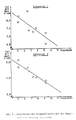
- Buchenhackschnitzeln aus der Industrie entsprechend dem Verfahren von Beispiel 1 untersucht und anschließend die basislinien- und flottenverhältniskorrigierten Integralwerte und Bandenhöhen mit der Kappazahl der erkochten Zellstoffe mittels Regressionsanalyse korreliert. Die Ergebnisse sind in den Abbildungen 5 und 6 dargestellt. Es ergaben sich Korrelationskoeffizienten, die zwischen 0,79 und 0,95 lagen. Bereich der Aufschlußbedingungen:
- Kochsäurekonzentration: 5,5 - 5,8 % Gesamt-SO2 0,8 - 1,1 % freies S02 1,35 - 1,45 % MgO
- Holzmenge: 64 - 75 t atro
- Kocher: 225 m3 Edelstahlkocher
- Flottenverhältnis: 2,1 : 1 - 2,8 : 1
- Tmax : 137° - 143° C max
- Kochdauer bei T 240 - 330 min
- p bei Tmax: 5,0 - 5,8 bar
- Kappazahl der erkochten Zellstoffe: 12 - 26
- Es wurde für 8 Magnesiumbisulfitkochungen von Fichtenhackschnitzeln, ebenfalls aus der Industrie, die zur Erzeugung tiefviskoser Chemiezellstoffe dienten, entsprechend Beispiel 1 und 4 verfahren. Die Korrelationen sind in den Abbildungen 7 und 8 dargestellt.
- Die ermittelten Korrelationskoeffizienten lagen in diesem Fall zwischen 0,75 und 0,94.
- Bereich der Aufschlußbedingungen:
- Kochsäurekonzentration: 7,5 - 8,5 % Gesamt-SO2 5,0 - 6,6 % freies S02 0,75 - 0,95 % MgO
- Holzmenge: 55 - 66 t atro
- Kocher: 320 m3 ausgemauerter Stahlkocher
- Flottenverhältnis: 3,3 : 1 - 4,1 : 1
- Tmax: 136° - 142°C
- Kochdauer bei Tmax: 160 - 270 min
- p bei Tmax: 6,5 - 7,0 bar
- Kappazahl der erkochten Zellstoffe: 5 - 10
wird anhand des Anstiegs der Ligninkonzentration in der Aufschlußlösung in Abhängigkeit von der Kochdauer dargestellt. In den Abbildungen 1a und 1b ist die Zunahme der Absorption zweier Banden mit den Maxima bei ca. 1515 cm-1 und 1465 cm-1 ersichtlich.
Claims (11)
Priority Applications (1)
| Application Number | Priority Date | Filing Date | Title |
|---|---|---|---|
| AT86110391T ATE85119T1 (de) | 1986-05-13 | 1986-07-28 | Verfahren zur kontrolle des aufschlussgrades von lignocellulosehaltigen materialien. |
Applications Claiming Priority (2)
| Application Number | Priority Date | Filing Date | Title |
|---|---|---|---|
| DE19863616051 DE3616051A1 (de) | 1985-02-09 | 1986-05-13 | Verfahren zur kontrolle des aufschlusses von lignocellulosen mit hilfe der ftir-spektroskopie |
| DE3616051 | 1986-05-13 |
Publications (3)
| Publication Number | Publication Date |
|---|---|
| EP0245536A2 true EP0245536A2 (de) | 1987-11-19 |
| EP0245536A3 EP0245536A3 (en) | 1989-06-28 |
| EP0245536B1 EP0245536B1 (de) | 1993-01-27 |
Family
ID=6300703
Family Applications (1)
| Application Number | Title | Priority Date | Filing Date |
|---|---|---|---|
| EP86110391A Expired - Lifetime EP0245536B1 (de) | 1986-05-13 | 1986-07-28 | Verfahren zur Kontrolle des Aufschlussgrades von lignocellulosehaltigen Materialien |
Country Status (5)
| Country | Link |
|---|---|
| US (1) | US4743339A (de) |
| EP (1) | EP0245536B1 (de) |
| AT (1) | ATE85119T1 (de) |
| CA (1) | CA1277110C (de) |
| DE (1) | DE3687658D1 (de) |
Cited By (6)
| Publication number | Priority date | Publication date | Assignee | Title |
|---|---|---|---|---|
| FR2662251A1 (fr) * | 1990-05-18 | 1991-11-22 | Aerojet General Co | Procede pour predire la qualite d'un produit de reaction, par analyse de facteurs etudies sur des spectres des corps dont la reaction donne ce produit. |
| WO1994001769A1 (en) * | 1992-07-08 | 1994-01-20 | Pulp And Paper Research Institute Of Canada | Determination and control of effective alkali in kraft liquors by ir spectroscopy |
| WO1997010384A3 (de) * | 1995-09-15 | 1997-05-09 | Siemens Ag | Verfahren und anordnung zur überwachung der zellstoffkochung |
| US6973701B2 (en) * | 2002-10-19 | 2005-12-13 | General Motors Corporation | Releasable fastening system based on ionic polymer metal composites and method of use |
| WO2024094923A1 (en) * | 2022-11-02 | 2024-05-10 | Upm-Kymmene Corporation | Arrangement and method for treatment of bleaching chemical residues |
| WO2024094925A1 (en) * | 2022-11-02 | 2024-05-10 | Upm-Kymmene Corporation | Arrangement and method for controlling magnesium sulphate feed |
Families Citing this family (15)
| Publication number | Priority date | Publication date | Assignee | Title |
|---|---|---|---|---|
| US5194388A (en) * | 1989-07-10 | 1993-03-16 | Westvaco Corporation | "Kappa" number calibration standard |
| US5151474A (en) * | 1990-02-16 | 1992-09-29 | The Dow Chemical Company | Process control method for manufacturing polyolefin |
| SE507486C3 (sv) * | 1991-09-12 | 1998-07-13 | Valmet Automation Kajaani Ltd | Foerfarande och anordning foer maetning av fiberegenskaper med naera-infra-roed-spektroskopi |
| SE503605C2 (sv) * | 1992-01-09 | 1996-07-15 | Svenska Traeforskningsinst | Analysförfarande med UV-absorptionsmätning |
| FI91446C (fi) * | 1992-01-24 | 1994-06-27 | Abb Stroemberg Drives Oy | Menetelmä ja laitteisto hierteen freeneksen määrittämiseksi |
| SE503644C2 (sv) * | 1994-10-14 | 1996-07-22 | Eka Chemicals Ab | Sätt att bestämma halten organiskt material i effluenter från massa- och pappersbruk |
| US5616214A (en) * | 1995-09-12 | 1997-04-01 | Pulp And Paper Research Institute Of Canada | Determination of sodium sulfide and sulfidity in green liquors and smelt solutions |
| US6174409B1 (en) * | 1997-09-19 | 2001-01-16 | American Air Liquide Inc. | Method to improve final bleached pulp strength properties by adjusting the CI02:03 ration within a single (D/Z) stage of the bleaching process |
| US6339222B1 (en) * | 1998-11-12 | 2002-01-15 | Kvaerner Canada Inc. | Determination of ionic species concentration by near infrared spectroscopy |
| US6635147B1 (en) * | 2000-05-14 | 2003-10-21 | U.S. Borax Inc. | Method for analyzing boron-containing alkaline pulping liquors |
| AU2001271988A1 (en) * | 2000-07-12 | 2002-01-21 | Hercules Incorporated | On-line deposition monitor |
| WO2002086230A1 (en) | 2001-04-20 | 2002-10-31 | Enzymatic Deinking Technologies, Llc | Rapid triglyceride assay for use in pulp pitch control |
| US6864331B1 (en) * | 2003-12-09 | 2005-03-08 | Fina Technology, Inc. | Process for the production of polymers |
| CA2445426A1 (en) * | 2003-10-17 | 2005-04-17 | Alberta Research Council Inc. | A method for characterizing a dispersion using transformation techniques |
| WO2006092045A1 (en) * | 2005-03-04 | 2006-09-08 | Fpinnovations | Method for determining chemical pulp kappa number with visible-near infrared spectrometry |
Family Cites Families (2)
| Publication number | Priority date | Publication date | Assignee | Title |
|---|---|---|---|---|
| US4540468A (en) * | 1983-09-26 | 1985-09-10 | Board Of Trustees Of The University Of Maine | Method for determining the degree of completion and pulp yield |
| DE3504486A1 (de) * | 1985-02-09 | 1986-08-14 | Oskar Dipl.-Holzw. Dr. 2057 Reinbek Faix | Verfahren zur kontrolle des sulfitaufschlusses von lignocellulosen mit hilfe der ftir-spektroskopie |
-
1986
- 1986-07-23 CA CA000514437A patent/CA1277110C/en not_active Expired - Lifetime
- 1986-07-25 US US06/889,222 patent/US4743339A/en not_active Expired - Fee Related
- 1986-07-28 EP EP86110391A patent/EP0245536B1/de not_active Expired - Lifetime
- 1986-07-28 AT AT86110391T patent/ATE85119T1/de not_active IP Right Cessation
- 1986-07-28 DE DE8686110391T patent/DE3687658D1/de not_active Expired - Fee Related
Cited By (6)
| Publication number | Priority date | Publication date | Assignee | Title |
|---|---|---|---|---|
| FR2662251A1 (fr) * | 1990-05-18 | 1991-11-22 | Aerojet General Co | Procede pour predire la qualite d'un produit de reaction, par analyse de facteurs etudies sur des spectres des corps dont la reaction donne ce produit. |
| WO1994001769A1 (en) * | 1992-07-08 | 1994-01-20 | Pulp And Paper Research Institute Of Canada | Determination and control of effective alkali in kraft liquors by ir spectroscopy |
| WO1997010384A3 (de) * | 1995-09-15 | 1997-05-09 | Siemens Ag | Verfahren und anordnung zur überwachung der zellstoffkochung |
| US6973701B2 (en) * | 2002-10-19 | 2005-12-13 | General Motors Corporation | Releasable fastening system based on ionic polymer metal composites and method of use |
| WO2024094923A1 (en) * | 2022-11-02 | 2024-05-10 | Upm-Kymmene Corporation | Arrangement and method for treatment of bleaching chemical residues |
| WO2024094925A1 (en) * | 2022-11-02 | 2024-05-10 | Upm-Kymmene Corporation | Arrangement and method for controlling magnesium sulphate feed |
Also Published As
| Publication number | Publication date |
|---|---|
| EP0245536B1 (de) | 1993-01-27 |
| ATE85119T1 (de) | 1993-02-15 |
| US4743339A (en) | 1988-05-10 |
| EP0245536A3 (en) | 1989-06-28 |
| CA1277110C (en) | 1990-12-04 |
| DE3687658D1 (de) | 1993-03-11 |
Similar Documents
| Publication | Publication Date | Title |
|---|---|---|
| EP0245536B1 (de) | Verfahren zur Kontrolle des Aufschlussgrades von lignocellulosehaltigen Materialien | |
| DE69305172T2 (de) | Bestimmung und Regelung von effektivem Alkali in Kraft-Aufschlusslösungen mittels Infrarotspektroskopie | |
| EP0786082B1 (de) | Verfahren zur bestimmung organischer bestandteile in papierstoffen und den abwassern von papiermaschinen | |
| US6774992B1 (en) | Determination of the property of a solution or solid using raman ratios | |
| DE19510008C2 (de) | Verfahren und Vorrichtung zur Prozeßführung bei der Zellstoff- und/oder Papierherstellung | |
| US5616214A (en) | Determination of sodium sulfide and sulfidity in green liquors and smelt solutions | |
| DE2847176A1 (de) | Kolorimetrie-verfahren | |
| US4348256A (en) | Process for controlling the supply of delignifying and/or bleaching chemicals in the continuous delignification of lignocellulosic material | |
| DE2448731A1 (de) | Verfahren zur regelung der menge an chemischen stoffen in innerhalb der zelluloseindustrie und verwandten industrien vorkommenden fluessigkeiten | |
| DE60018208T2 (de) | Bestimmung der kappa-nummer in chemischem zellstoff durch ramanspektroskopie | |
| DE3504486A1 (de) | Verfahren zur kontrolle des sulfitaufschlusses von lignocellulosen mit hilfe der ftir-spektroskopie | |
| DE19653530C1 (de) | Verfahren und Vorrichtung zur Prozeßführung und zur Prozeßoptimierung bei der Herstellung von Zellstoff | |
| EP0947625B1 (de) | Verfahren und Vorrichtung zur Prozessführung und zur Prozessoptimierung der Chemikalienrückgewinnung bei der Herstellung von Zellstoff | |
| EP1254363A1 (de) | Bestimmung der eigenschaften einer lösung oder eines feststoffes unter verwendung von raman-verhältnissen | |
| DE102007021324B4 (de) | Vorrichtung und Verfahren zur Bestimmung des Mischungsverhältnisses eines aus zwei oder mehreren Einzelkomponenten bestehenden Mediums | |
| DE1077895B (de) | Verfahren und Vorrichtung zur Analyse von gasfoermigen Stoffen | |
| US4889593A (en) | Method of determining rapidly the concentration of the total sulphur dioxide and the lignosulphonate present in sulphite pulping process liquors | |
| US4895618A (en) | Method of controlling alkaline pulping process | |
| DE19927969A1 (de) | Verfahren und Vorrichtung zur Prozeßführung und Prozeßoptimierung bei der Herstellung von Fasermatten und/oder Faserplatten | |
| EP0914602A1 (de) | Verfahren und einrichtung zur bestimmung der extinktion einer lichtstrahlung beim durchdringen einer probe | |
| EP1528148B1 (de) | Verfahren und Vorrichtung zur Prozessführung bei der Zellstoffkochung | |
| US20030178164A1 (en) | Method for regulating a process for manufacturing paper pulp by measuring the amount of hexenuronic acid optically | |
| DE3927183A1 (de) | Verfahren zur steuerung des alkalischen kochens von zellulosehaltigem material | |
| WO1997010384A2 (de) | Verfahren und anordnung zur überwachung der zellstoffkochung | |
| DE2537143C3 (de) | Verfahren zur Regulierung der Zufuhr von Reaktionschemikalien bei der Delignifizierung und/oder Bleichung von Zellstoff |
Legal Events
| Date | Code | Title | Description |
|---|---|---|---|
| PUAI | Public reference made under article 153(3) epc to a published international application that has entered the european phase |
Free format text: ORIGINAL CODE: 0009012 |
|
| AK | Designated contracting states |
Kind code of ref document: A2 Designated state(s): AT DE FR SE |
|
| PUAL | Search report despatched |
Free format text: ORIGINAL CODE: 0009013 |
|
| AK | Designated contracting states |
Kind code of ref document: A3 Designated state(s): AT DE FR SE |
|
| 17P | Request for examination filed |
Effective date: 19891228 |
|
| 17Q | First examination report despatched |
Effective date: 19910605 |
|
| GRAA | (expected) grant |
Free format text: ORIGINAL CODE: 0009210 |
|
| RAP1 | Party data changed (applicant data changed or rights of an application transferred) |
Owner name: BIO-RAD LABORATORIES, INC. |
|
| AK | Designated contracting states |
Kind code of ref document: B1 Designated state(s): AT DE FR SE |
|
| REF | Corresponds to: |
Ref document number: 85119 Country of ref document: AT Date of ref document: 19930215 Kind code of ref document: T |
|
| REF | Corresponds to: |
Ref document number: 3687658 Country of ref document: DE Date of ref document: 19930311 |
|
| ET | Fr: translation filed | ||
| PGFP | Annual fee paid to national office [announced via postgrant information from national office to epo] |
Ref country code: SE Payment date: 19930716 Year of fee payment: 8 Ref country code: FR Payment date: 19930716 Year of fee payment: 8 |
|
| PGFP | Annual fee paid to national office [announced via postgrant information from national office to epo] |
Ref country code: AT Payment date: 19930721 Year of fee payment: 8 |
|
| PGFP | Annual fee paid to national office [announced via postgrant information from national office to epo] |
Ref country code: DE Payment date: 19930811 Year of fee payment: 8 |
|
| PLBE | No opposition filed within time limit |
Free format text: ORIGINAL CODE: 0009261 |
|
| STAA | Information on the status of an ep patent application or granted ep patent |
Free format text: STATUS: NO OPPOSITION FILED WITHIN TIME LIMIT |
|
| 26N | No opposition filed | ||
| PG25 | Lapsed in a contracting state [announced via postgrant information from national office to epo] |
Ref country code: AT Effective date: 19940728 |
|
| PG25 | Lapsed in a contracting state [announced via postgrant information from national office to epo] |
Ref country code: SE Effective date: 19940729 |
|
| EUG | Se: european patent has lapsed |
Ref document number: 86110391.9 Effective date: 19950210 |
|
| PG25 | Lapsed in a contracting state [announced via postgrant information from national office to epo] |
Ref country code: FR Effective date: 19950331 |
|
| PG25 | Lapsed in a contracting state [announced via postgrant information from national office to epo] |
Ref country code: DE Effective date: 19950401 |
|
| EUG | Se: european patent has lapsed |
Ref document number: 86110391.9 |
|
| REG | Reference to a national code |
Ref country code: FR Ref legal event code: ST |