EP0244833B1 - 4(R)-substituierte 6(S)-Phenoxymethyl-, 6(S)-beta-Phenyläthyl- und 6(S)-beta-Styryl-tetrahydropyran-2-one, ein hochstereoselektives Verfahren zu ihrer Herstellung, pharmazeutische Präparate auf Basis dieser Verbindungen und ihre Verwendung - Google Patents
4(R)-substituierte 6(S)-Phenoxymethyl-, 6(S)-beta-Phenyläthyl- und 6(S)-beta-Styryl-tetrahydropyran-2-one, ein hochstereoselektives Verfahren zu ihrer Herstellung, pharmazeutische Präparate auf Basis dieser Verbindungen und ihre Verwendung Download PDFInfo
- Publication number
- EP0244833B1 EP0244833B1 EP87106522A EP87106522A EP0244833B1 EP 0244833 B1 EP0244833 B1 EP 0244833B1 EP 87106522 A EP87106522 A EP 87106522A EP 87106522 A EP87106522 A EP 87106522A EP 0244833 B1 EP0244833 B1 EP 0244833B1
- Authority
- EP
- European Patent Office
- Prior art keywords
- carbon atoms
- formula
- radical
- denotes
- methyl
- Prior art date
- Legal status (The legal status is an assumption and is not a legal conclusion. Google has not performed a legal analysis and makes no representation as to the accuracy of the status listed.)
- Expired - Lifetime
Links
- 150000001875 compounds Chemical class 0.000 title claims abstract description 46
- 238000002360 preparation method Methods 0.000 title claims abstract description 13
- 238000000034 method Methods 0.000 title claims description 17
- 239000000825 pharmaceutical preparation Substances 0.000 title claims description 4
- 230000000707 stereoselective effect Effects 0.000 title 1
- 150000002596 lactones Chemical class 0.000 claims abstract description 28
- 150000002148 esters Chemical class 0.000 claims abstract description 19
- 150000003839 salts Chemical class 0.000 claims abstract description 17
- BVKZGUZCCUSVTD-UHFFFAOYSA-N carbonic acid Chemical class OC(O)=O BVKZGUZCCUSVTD-UHFFFAOYSA-N 0.000 claims abstract description 12
- -1 alkyl radical Chemical class 0.000 claims description 79
- 125000004432 carbon atom Chemical group C* 0.000 claims description 53
- 125000002496 methyl group Chemical group [H]C([H])([H])* 0.000 claims description 47
- 229910052736 halogen Inorganic materials 0.000 claims description 30
- 150000002367 halogens Chemical class 0.000 claims description 29
- 125000000217 alkyl group Chemical group 0.000 claims description 28
- 125000003545 alkoxy group Chemical group 0.000 claims description 24
- ZAMOUSCENKQFHK-UHFFFAOYSA-N Chlorine atom Chemical compound [Cl] ZAMOUSCENKQFHK-UHFFFAOYSA-N 0.000 claims description 22
- 125000002023 trifluoromethyl group Chemical group FC(F)(F)* 0.000 claims description 21
- CIUQDSCDWFSTQR-UHFFFAOYSA-N [C]1=CC=CC=C1 Chemical compound [C]1=CC=CC=C1 CIUQDSCDWFSTQR-UHFFFAOYSA-N 0.000 claims description 20
- UFHFLCQGNIYNRP-UHFFFAOYSA-N Hydrogen Chemical compound [H][H] UFHFLCQGNIYNRP-UHFFFAOYSA-N 0.000 claims description 19
- 229910052801 chlorine Inorganic materials 0.000 claims description 18
- 229910052739 hydrogen Inorganic materials 0.000 claims description 18
- 239000001257 hydrogen Substances 0.000 claims description 18
- YCKRFDGAMUMZLT-UHFFFAOYSA-N Fluorine atom Chemical compound [F] YCKRFDGAMUMZLT-UHFFFAOYSA-N 0.000 claims description 16
- 239000000460 chlorine Substances 0.000 claims description 16
- 239000011734 sodium Substances 0.000 claims description 16
- 229910052708 sodium Inorganic materials 0.000 claims description 16
- 229910052731 fluorine Inorganic materials 0.000 claims description 14
- 125000001495 ethyl group Chemical group [H]C([H])([H])C([H])([H])* 0.000 claims description 12
- 239000011737 fluorine Substances 0.000 claims description 12
- 125000002887 hydroxy group Chemical group [H]O* 0.000 claims description 12
- 125000003178 carboxy group Chemical group [H]OC(*)=O 0.000 claims description 11
- DGAQECJNVWCQMB-PUAWFVPOSA-M Ilexoside XXIX Chemical compound C[C@@H]1CC[C@@]2(CC[C@@]3(C(=CC[C@H]4[C@]3(CC[C@@H]5[C@@]4(CC[C@@H](C5(C)C)OS(=O)(=O)[O-])C)C)[C@@H]2[C@]1(C)O)C)C(=O)O[C@H]6[C@@H]([C@H]([C@@H]([C@H](O6)CO)O)O)O.[Na+] DGAQECJNVWCQMB-PUAWFVPOSA-M 0.000 claims description 10
- ZLMJMSJWJFRBEC-UHFFFAOYSA-N Potassium Chemical compound [K] ZLMJMSJWJFRBEC-UHFFFAOYSA-N 0.000 claims description 10
- 239000011591 potassium Substances 0.000 claims description 10
- 229910052700 potassium Inorganic materials 0.000 claims description 10
- 150000003863 ammonium salts Chemical class 0.000 claims description 9
- 125000000753 cycloalkyl group Chemical group 0.000 claims description 9
- 125000001997 phenyl group Chemical group [H]C1=C([H])C([H])=C(*)C([H])=C1[H] 0.000 claims description 9
- QKIUAMUSENSFQQ-UHFFFAOYSA-N dimethylazanide Chemical compound C[N-]C QKIUAMUSENSFQQ-UHFFFAOYSA-N 0.000 claims description 8
- 150000002431 hydrogen Chemical class 0.000 claims description 8
- QGZKDVFQNNGYKY-UHFFFAOYSA-O ammonium group Chemical group [NH4+] QGZKDVFQNNGYKY-UHFFFAOYSA-O 0.000 claims description 6
- 125000002924 primary amino group Chemical group [H]N([H])* 0.000 claims description 6
- 150000003254 radicals Chemical class 0.000 claims description 6
- 239000004215 Carbon black (E152) Substances 0.000 claims description 4
- 125000002252 acyl group Chemical group 0.000 claims description 4
- 125000001309 chloro group Chemical group Cl* 0.000 claims description 4
- 125000001153 fluoro group Chemical group F* 0.000 claims description 4
- 229930195733 hydrocarbon Natural products 0.000 claims description 4
- 230000000269 nucleophilic effect Effects 0.000 claims description 4
- 239000002243 precursor Substances 0.000 claims description 4
- 125000003342 alkenyl group Chemical group 0.000 claims description 3
- 239000003153 chemical reaction reagent Substances 0.000 claims description 3
- 125000004494 ethyl ester group Chemical group 0.000 claims description 3
- 125000002541 furyl group Chemical group 0.000 claims description 3
- 125000004029 hydroxymethyl group Chemical group [H]OC([H])([H])* 0.000 claims description 3
- 150000004702 methyl esters Chemical class 0.000 claims description 3
- PXGOKWXKJXAPGV-UHFFFAOYSA-N Fluorine Chemical compound FF PXGOKWXKJXAPGV-UHFFFAOYSA-N 0.000 claims description 2
- 125000002777 acetyl group Chemical group [H]C([H])([H])C(*)=O 0.000 claims description 2
- 125000003302 alkenyloxy group Chemical group 0.000 claims description 2
- 125000000113 cyclohexyl group Chemical group [H]C1([H])C([H])([H])C([H])([H])C([H])(*)C([H])([H])C1([H])[H] 0.000 claims description 2
- QUPDWYMUPZLYJZ-UHFFFAOYSA-N ethyl Chemical group C[CH2] QUPDWYMUPZLYJZ-UHFFFAOYSA-N 0.000 claims description 2
- 125000005843 halogen group Chemical group 0.000 claims description 2
- 125000001544 thienyl group Chemical group 0.000 claims description 2
- 125000004044 trifluoroacetyl group Chemical group FC(C(=O)*)(F)F 0.000 claims description 2
- MGJXBDMLVWIYOQ-UHFFFAOYSA-N methylazanide Chemical group [NH-]C MGJXBDMLVWIYOQ-UHFFFAOYSA-N 0.000 claims 4
- 150000002430 hydrocarbons Chemical class 0.000 claims 2
- 125000001301 ethoxy group Chemical group [H]C([H])([H])C([H])([H])O* 0.000 claims 1
- 125000000956 methoxy group Chemical group [H]C([H])([H])O* 0.000 claims 1
- 229940127557 pharmaceutical product Drugs 0.000 claims 1
- 239000003814 drug Substances 0.000 abstract description 4
- XEKOWRVHYACXOJ-UHFFFAOYSA-N Ethyl acetate Chemical compound CCOC(C)=O XEKOWRVHYACXOJ-UHFFFAOYSA-N 0.000 description 42
- UHOVQNZJYSORNB-UHFFFAOYSA-N Benzene Chemical compound C1=CC=CC=C1 UHOVQNZJYSORNB-UHFFFAOYSA-N 0.000 description 24
- HEMHJVSKTPXQMS-UHFFFAOYSA-M Sodium hydroxide Chemical compound [OH-].[Na+] HEMHJVSKTPXQMS-UHFFFAOYSA-M 0.000 description 21
- ZMANZCXQSJIPKH-UHFFFAOYSA-N Triethylamine Chemical compound CCN(CC)CC ZMANZCXQSJIPKH-UHFFFAOYSA-N 0.000 description 21
- LFQSCWFLJHTTHZ-UHFFFAOYSA-N Ethanol Chemical compound CCO LFQSCWFLJHTTHZ-UHFFFAOYSA-N 0.000 description 16
- HVYWMOMLDIMFJA-DPAQBDIFSA-N cholesterol Chemical compound C1C=C2C[C@@H](O)CC[C@]2(C)[C@@H]2[C@@H]1[C@@H]1CC[C@H]([C@H](C)CCCC(C)C)[C@@]1(C)CC2 HVYWMOMLDIMFJA-DPAQBDIFSA-N 0.000 description 16
- YSHOWEKUVWPFNR-UHFFFAOYSA-N burgess reagent Chemical compound CC[N+](CC)(CC)S(=O)(=O)N=C([O-])OC YSHOWEKUVWPFNR-UHFFFAOYSA-N 0.000 description 14
- 238000006243 chemical reaction Methods 0.000 description 13
- 238000005160 1H NMR spectroscopy Methods 0.000 description 12
- 102100029077 3-hydroxy-3-methylglutaryl-coenzyme A reductase Human genes 0.000 description 12
- RTZKZFJDLAIYFH-UHFFFAOYSA-N Diethyl ether Chemical compound CCOCC RTZKZFJDLAIYFH-UHFFFAOYSA-N 0.000 description 12
- OKKJLVBELUTLKV-UHFFFAOYSA-N Methanol Chemical compound OC OKKJLVBELUTLKV-UHFFFAOYSA-N 0.000 description 12
- YXFVVABEGXRONW-UHFFFAOYSA-N Toluene Chemical compound CC1=CC=CC=C1 YXFVVABEGXRONW-UHFFFAOYSA-N 0.000 description 12
- 239000000243 solution Substances 0.000 description 12
- 108090000895 Hydroxymethylglutaryl CoA Reductases Proteins 0.000 description 11
- VYPSYNLAJGMNEJ-UHFFFAOYSA-N Silicium dioxide Chemical compound O=[Si]=O VYPSYNLAJGMNEJ-UHFFFAOYSA-N 0.000 description 11
- 230000015572 biosynthetic process Effects 0.000 description 11
- 239000000741 silica gel Substances 0.000 description 11
- 229910002027 silica gel Inorganic materials 0.000 description 11
- HEDRZPFGACZZDS-UHFFFAOYSA-N Chloroform Chemical compound ClC(Cl)Cl HEDRZPFGACZZDS-UHFFFAOYSA-N 0.000 description 10
- XDTMQSROBMDMFD-UHFFFAOYSA-N Cyclohexane Chemical compound C1CCCCC1 XDTMQSROBMDMFD-UHFFFAOYSA-N 0.000 description 9
- 208000035150 Hypercholesterolemia Diseases 0.000 description 9
- 235000012000 cholesterol Nutrition 0.000 description 8
- 239000000203 mixture Substances 0.000 description 8
- 239000003921 oil Substances 0.000 description 8
- 235000019198 oils Nutrition 0.000 description 8
- 238000002330 electrospray ionisation mass spectrometry Methods 0.000 description 7
- 239000002904 solvent Substances 0.000 description 7
- 0 Cc(c(C)c1*)c(C)c(*)c1OC Chemical compound Cc(c(C)c1*)c(C)c(*)c1OC 0.000 description 6
- 239000000047 product Substances 0.000 description 6
- XLYOFNOQVPJJNP-UHFFFAOYSA-N water Substances O XLYOFNOQVPJJNP-UHFFFAOYSA-N 0.000 description 6
- 201000010099 disease Diseases 0.000 description 5
- 208000037265 diseases, disorders, signs and symptoms Diseases 0.000 description 5
- RPACBEVZENYWOL-XFULWGLBSA-M sodium;(2r)-2-[6-(4-chlorophenoxy)hexyl]oxirane-2-carboxylate Chemical compound [Na+].C=1C=C(Cl)C=CC=1OCCCCCC[C@]1(C(=O)[O-])CO1 RPACBEVZENYWOL-XFULWGLBSA-M 0.000 description 5
- IJGRMHOSHXDMSA-UHFFFAOYSA-N Atomic nitrogen Chemical compound N#N IJGRMHOSHXDMSA-UHFFFAOYSA-N 0.000 description 4
- ROSDSFDQCJNGOL-UHFFFAOYSA-N Dimethylamine Chemical compound CNC ROSDSFDQCJNGOL-UHFFFAOYSA-N 0.000 description 4
- HEDRZPFGACZZDS-MICDWDOJSA-N Trichloro(2H)methane Chemical compound [2H]C(Cl)(Cl)Cl HEDRZPFGACZZDS-MICDWDOJSA-N 0.000 description 4
- 239000002253 acid Substances 0.000 description 4
- WGQKYBSKWIADBV-UHFFFAOYSA-N benzylamine Chemical compound NCC1=CC=CC=C1 WGQKYBSKWIADBV-UHFFFAOYSA-N 0.000 description 4
- 239000003613 bile acid Substances 0.000 description 4
- 238000010438 heat treatment Methods 0.000 description 4
- 239000003208 petroleum Substances 0.000 description 4
- KOUKXHPPRFNWPP-UHFFFAOYSA-N pyrazine-2,5-dicarboxylic acid;hydrate Chemical compound O.OC(=O)C1=CN=C(C(O)=O)C=N1 KOUKXHPPRFNWPP-UHFFFAOYSA-N 0.000 description 4
- CDBYLPFSWZWCQE-UHFFFAOYSA-L sodium carbonate Substances [Na+].[Na+].[O-]C([O-])=O CDBYLPFSWZWCQE-UHFFFAOYSA-L 0.000 description 4
- 238000003786 synthesis reaction Methods 0.000 description 4
- HSINOMROUCMIEA-FGVHQWLLSA-N (2s,4r)-4-[(3r,5s,6r,7r,8s,9s,10s,13r,14s,17r)-6-ethyl-3,7-dihydroxy-10,13-dimethyl-2,3,4,5,6,7,8,9,11,12,14,15,16,17-tetradecahydro-1h-cyclopenta[a]phenanthren-17-yl]-2-methylpentanoic acid Chemical compound C([C@@]12C)C[C@@H](O)C[C@H]1[C@@H](CC)[C@@H](O)[C@@H]1[C@@H]2CC[C@]2(C)[C@@H]([C@H](C)C[C@H](C)C(O)=O)CC[C@H]21 HSINOMROUCMIEA-FGVHQWLLSA-N 0.000 description 3
- CABVTRNMFUVUDM-VRHQGPGLSA-N (3S)-3-hydroxy-3-methylglutaryl-CoA Chemical compound O[C@@H]1[C@H](OP(O)(O)=O)[C@@H](COP(O)(=O)OP(O)(=O)OCC(C)(C)[C@@H](O)C(=O)NCCC(=O)NCCSC(=O)C[C@@](O)(CC(O)=O)C)O[C@H]1N1C2=NC=NC(N)=C2N=C1 CABVTRNMFUVUDM-VRHQGPGLSA-N 0.000 description 3
- KJTLQQUUPVSXIM-ZCFIWIBFSA-N (R)-mevalonic acid Chemical compound OCC[C@](O)(C)CC(O)=O KJTLQQUUPVSXIM-ZCFIWIBFSA-N 0.000 description 3
- KJTLQQUUPVSXIM-UHFFFAOYSA-N DL-mevalonic acid Natural products OCCC(O)(C)CC(O)=O KJTLQQUUPVSXIM-UHFFFAOYSA-N 0.000 description 3
- YMWUJEATGCHHMB-UHFFFAOYSA-N Dichloromethane Chemical compound ClCCl YMWUJEATGCHHMB-UHFFFAOYSA-N 0.000 description 3
- IAZDPXIOMUYVGZ-UHFFFAOYSA-N Dimethylsulphoxide Chemical compound CS(C)=O IAZDPXIOMUYVGZ-UHFFFAOYSA-N 0.000 description 3
- 206010014476 Elevated cholesterol Diseases 0.000 description 3
- PEDCQBHIVMGVHV-UHFFFAOYSA-N Glycerine Chemical compound OCC(O)CO PEDCQBHIVMGVHV-UHFFFAOYSA-N 0.000 description 3
- 238000007792 addition Methods 0.000 description 3
- 239000000654 additive Substances 0.000 description 3
- 150000001408 amides Chemical class 0.000 description 3
- 150000001412 amines Chemical class 0.000 description 3
- 125000003118 aryl group Chemical group 0.000 description 3
- UENWRTRMUIOCKN-UHFFFAOYSA-N benzyl thiol Chemical compound SCC1=CC=CC=C1 UENWRTRMUIOCKN-UHFFFAOYSA-N 0.000 description 3
- 239000012230 colorless oil Substances 0.000 description 3
- 230000000694 effects Effects 0.000 description 3
- XLYOFNOQVPJJNP-ZSJDYOACSA-N heavy water Substances [2H]O[2H] XLYOFNOQVPJJNP-ZSJDYOACSA-N 0.000 description 3
- 239000003112 inhibitor Substances 0.000 description 3
- 230000002401 inhibitory effect Effects 0.000 description 3
- 230000005764 inhibitory process Effects 0.000 description 3
- 238000004519 manufacturing process Methods 0.000 description 3
- 239000011159 matrix material Substances 0.000 description 3
- 238000011321 prophylaxis Methods 0.000 description 3
- 239000011541 reaction mixture Substances 0.000 description 3
- 229910000104 sodium hydride Inorganic materials 0.000 description 3
- 239000007858 starting material Substances 0.000 description 3
- 238000002560 therapeutic procedure Methods 0.000 description 3
- DGVVWUTYPXICAM-UHFFFAOYSA-N β‐Mercaptoethanol Chemical compound OCCS DGVVWUTYPXICAM-UHFFFAOYSA-N 0.000 description 3
- QDKWLJJOYIFEBS-UHFFFAOYSA-N 1-fluoro-4-$l^{1}-oxidanylbenzene Chemical group [O]C1=CC=C(F)C=C1 QDKWLJJOYIFEBS-UHFFFAOYSA-N 0.000 description 2
- HZAXFHJVJLSVMW-UHFFFAOYSA-N 2-Aminoethan-1-ol Chemical compound NCCO HZAXFHJVJLSVMW-UHFFFAOYSA-N 0.000 description 2
- 101710158485 3-hydroxy-3-methylglutaryl-coenzyme A reductase Proteins 0.000 description 2
- YYROPELSRYBVMQ-UHFFFAOYSA-N 4-toluenesulfonyl chloride Chemical compound CC1=CC=C(S(Cl)(=O)=O)C=C1 YYROPELSRYBVMQ-UHFFFAOYSA-N 0.000 description 2
- IAZDPXIOMUYVGZ-WFGJKAKNSA-N Dimethyl sulfoxide Chemical compound [2H]C([2H])([2H])S(=O)C([2H])([2H])[2H] IAZDPXIOMUYVGZ-WFGJKAKNSA-N 0.000 description 2
- 102000004190 Enzymes Human genes 0.000 description 2
- 108090000790 Enzymes Proteins 0.000 description 2
- VEXZGXHMUGYJMC-UHFFFAOYSA-N Hydrochloric acid Chemical compound Cl VEXZGXHMUGYJMC-UHFFFAOYSA-N 0.000 description 2
- XUJNEKJLAYXESH-REOHCLBHSA-N L-Cysteine Chemical compound SC[C@H](N)C(O)=O XUJNEKJLAYXESH-REOHCLBHSA-N 0.000 description 2
- CSNNHWWHGAXBCP-UHFFFAOYSA-L Magnesium sulfate Chemical compound [Mg+2].[O-][S+2]([O-])([O-])[O-] CSNNHWWHGAXBCP-UHFFFAOYSA-L 0.000 description 2
- OFBQJSOFQDEBGM-UHFFFAOYSA-N Pentane Chemical compound CCCCC OFBQJSOFQDEBGM-UHFFFAOYSA-N 0.000 description 2
- 241000700159 Rattus Species 0.000 description 2
- KEAYESYHFKHZAL-UHFFFAOYSA-N Sodium Chemical compound [Na] KEAYESYHFKHZAL-UHFFFAOYSA-N 0.000 description 2
- WYURNTSHIVDZCO-UHFFFAOYSA-N Tetrahydrofuran Chemical compound C1CCOC1 WYURNTSHIVDZCO-UHFFFAOYSA-N 0.000 description 2
- MMCOUVMKNAHQOY-UHFFFAOYSA-N carbonoperoxoic acid Chemical class OOC(O)=O MMCOUVMKNAHQOY-UHFFFAOYSA-N 0.000 description 2
- 208000029078 coronary artery disease Diseases 0.000 description 2
- 229940079919 digestives enzyme preparation Drugs 0.000 description 2
- 230000008030 elimination Effects 0.000 description 2
- 238000003379 elimination reaction Methods 0.000 description 2
- 238000010828 elution Methods 0.000 description 2
- 229940088598 enzyme Drugs 0.000 description 2
- DNJIEGIFACGWOD-UHFFFAOYSA-N ethyl mercaptane Natural products CCS DNJIEGIFACGWOD-UHFFFAOYSA-N 0.000 description 2
- 238000001914 filtration Methods 0.000 description 2
- 210000001853 liver microsome Anatomy 0.000 description 2
- HRDXJKGNWSUIBT-UHFFFAOYSA-N methoxybenzene Chemical group [CH2]OC1=CC=CC=C1 HRDXJKGNWSUIBT-UHFFFAOYSA-N 0.000 description 2
- 229910052757 nitrogen Inorganic materials 0.000 description 2
- KJIFKLIQANRMOU-UHFFFAOYSA-N oxidanium;4-methylbenzenesulfonate Chemical compound O.CC1=CC=C(S(O)(=O)=O)C=C1 KJIFKLIQANRMOU-UHFFFAOYSA-N 0.000 description 2
- XHXFXVLFKHQFAL-UHFFFAOYSA-N phosphoryl trichloride Chemical compound ClP(Cl)(Cl)=O XHXFXVLFKHQFAL-UHFFFAOYSA-N 0.000 description 2
- 125000001436 propyl group Chemical group [H]C([*])([H])C([H])([H])C([H])([H])[H] 0.000 description 2
- 238000007127 saponification reaction Methods 0.000 description 2
- 229910000029 sodium carbonate Inorganic materials 0.000 description 2
- 239000012312 sodium hydride Substances 0.000 description 2
- 239000007787 solid Substances 0.000 description 2
- 239000000758 substrate Substances 0.000 description 2
- FPGGTKZVZWFYPV-UHFFFAOYSA-M tetrabutylammonium fluoride Chemical compound [F-].CCCC[N+](CCCC)(CCCC)CCCC FPGGTKZVZWFYPV-UHFFFAOYSA-M 0.000 description 2
- VEPTXBCIDSFGBF-UHFFFAOYSA-M tetrabutylazanium;fluoride;trihydrate Chemical compound O.O.O.[F-].CCCC[N+](CCCC)(CCCC)CCCC VEPTXBCIDSFGBF-UHFFFAOYSA-M 0.000 description 2
- VZGDMQKNWNREIO-UHFFFAOYSA-N tetrachloromethane Chemical compound ClC(Cl)(Cl)Cl VZGDMQKNWNREIO-UHFFFAOYSA-N 0.000 description 2
- 238000011282 treatment Methods 0.000 description 2
- URAYPUMNDPQOKB-UHFFFAOYSA-N triacetin Chemical compound CC(=O)OCC(OC(C)=O)COC(C)=O URAYPUMNDPQOKB-UHFFFAOYSA-N 0.000 description 2
- RIOQSEWOXXDEQQ-UHFFFAOYSA-N triphenylphosphine Chemical compound C1=CC=CC=C1P(C=1C=CC=CC=1)C1=CC=CC=C1 RIOQSEWOXXDEQQ-UHFFFAOYSA-N 0.000 description 2
- RGTHMVQZKREQSH-LEWJYISDSA-N (3S,4R)-3-[[2-[3-(4-fluorophenoxy)propyl]-4,6-dimethylphenoxy]methyl]-4-hydroxyoxan-2-one Chemical compound CC1=CC(=C(OC[C@@H]2C(OCC[C@H]2O)=O)C(=C1)C)CCCOC1=CC=C(C=C1)F RGTHMVQZKREQSH-LEWJYISDSA-N 0.000 description 1
- LTMRRSWNXVJMBA-UHFFFAOYSA-L 2,2-diethylpropanedioate Chemical compound CCC(CC)(C([O-])=O)C([O-])=O LTMRRSWNXVJMBA-UHFFFAOYSA-L 0.000 description 1
- VXWYQEYFYNAZOD-UHFFFAOYSA-N 2-[3-[(4,4-difluoropiperidin-1-yl)methyl]-4-[2-(2,3-dihydro-1H-inden-2-ylamino)pyrimidin-5-yl]pyrazol-1-yl]-1-(2,4,6,7-tetrahydrotriazolo[4,5-c]pyridin-5-yl)ethanone Chemical compound FC1(F)CCN(CC2=NN(CC(=O)N3CCC4=C(C3)N=NN4)C=C2C2=CN=C(NC3CC4=C(C3)C=CC=C4)N=C2)CC1 VXWYQEYFYNAZOD-UHFFFAOYSA-N 0.000 description 1
- IKOKHHBZFDFMJW-UHFFFAOYSA-N 2-[4-[2-(2,3-dihydro-1H-inden-2-ylamino)pyrimidin-5-yl]-3-(2-morpholin-4-ylethoxy)pyrazol-1-yl]-1-(2,4,6,7-tetrahydrotriazolo[4,5-c]pyridin-5-yl)ethanone Chemical compound C1C(CC2=CC=CC=C12)NC1=NC=C(C=N1)C=1C(=NN(C=1)CC(=O)N1CC2=C(CC1)NN=N2)OCCN1CCOCC1 IKOKHHBZFDFMJW-UHFFFAOYSA-N 0.000 description 1
- RGPXHQLKXPEHMD-UHFFFAOYSA-N 3,5-dihydroxypentanoic acid Chemical class OCCC(O)CC(O)=O RGPXHQLKXPEHMD-UHFFFAOYSA-N 0.000 description 1
- 125000004176 4-fluorobenzyl group Chemical group [H]C1=C([H])C(=C([H])C([H])=C1F)C([H])([H])* 0.000 description 1
- WWRUMEPVBDVWTM-UHFFFAOYSA-N 4-hydroxy-6-(phenoxymethyl)oxan-2-one Chemical compound O1C(=O)CC(O)CC1COC1=CC=CC=C1 WWRUMEPVBDVWTM-UHFFFAOYSA-N 0.000 description 1
- 241001136792 Alle Species 0.000 description 1
- 206010003210 Arteriosclerosis Diseases 0.000 description 1
- 206010003211 Arteriosclerosis coronary artery Diseases 0.000 description 1
- 201000001320 Atherosclerosis Diseases 0.000 description 1
- 229920001268 Cholestyramine Polymers 0.000 description 1
- 229920000858 Cyclodextrin Polymers 0.000 description 1
- OIFBSDVPJOWBCH-UHFFFAOYSA-N Diethyl carbonate Chemical group CCOC(=O)OCC OIFBSDVPJOWBCH-UHFFFAOYSA-N 0.000 description 1
- RWSOTUBLDIXVET-UHFFFAOYSA-N Dihydrogen sulfide Chemical class S RWSOTUBLDIXVET-UHFFFAOYSA-N 0.000 description 1
- XTHFKEDIFFGKHM-UHFFFAOYSA-N Dimethoxyethane Chemical compound COCCOC XTHFKEDIFFGKHM-UHFFFAOYSA-N 0.000 description 1
- 229940121710 HMGCoA reductase inhibitor Drugs 0.000 description 1
- 208000031226 Hyperlipidaemia Diseases 0.000 description 1
- 239000004201 L-cysteine Substances 0.000 description 1
- 235000013878 L-cysteine Nutrition 0.000 description 1
- 239000012359 Methanesulfonyl chloride Substances 0.000 description 1
- 238000006845 Michael addition reaction Methods 0.000 description 1
- 102000004316 Oxidoreductases Human genes 0.000 description 1
- 108090000854 Oxidoreductases Proteins 0.000 description 1
- 239000002202 Polyethylene glycol Substances 0.000 description 1
- XBDQKXXYIPTUBI-UHFFFAOYSA-N Propionic acid Substances CCC(O)=O XBDQKXXYIPTUBI-UHFFFAOYSA-N 0.000 description 1
- FAPWRFPIFSIZLT-UHFFFAOYSA-M Sodium chloride Chemical class [Na+].[Cl-] FAPWRFPIFSIZLT-UHFFFAOYSA-M 0.000 description 1
- 229920002472 Starch Polymers 0.000 description 1
- 101100073357 Streptomyces halstedii sch2 gene Proteins 0.000 description 1
- 238000000692 Student's t-test Methods 0.000 description 1
- 235000019486 Sunflower oil Nutrition 0.000 description 1
- FZNCGRZWXLXZSZ-CIQUZCHMSA-N Voglibose Chemical compound OCC(CO)N[C@H]1C[C@](O)(CO)[C@@H](O)[C@H](O)[C@H]1O FZNCGRZWXLXZSZ-CIQUZCHMSA-N 0.000 description 1
- VLSOAXRVHARBEQ-UHFFFAOYSA-N [4-fluoro-2-(hydroxymethyl)phenyl]methanol Chemical compound OCC1=CC=C(F)C=C1CO VLSOAXRVHARBEQ-UHFFFAOYSA-N 0.000 description 1
- XJLXINKUBYWONI-DQQFMEOOSA-N [[(2r,3r,4r,5r)-5-(6-aminopurin-9-yl)-3-hydroxy-4-phosphonooxyoxolan-2-yl]methoxy-hydroxyphosphoryl] [(2s,3r,4s,5s)-5-(3-carbamoylpyridin-1-ium-1-yl)-3,4-dihydroxyoxolan-2-yl]methyl phosphate Chemical compound NC(=O)C1=CC=C[N+]([C@@H]2[C@H]([C@@H](O)[C@H](COP([O-])(=O)OP(O)(=O)OC[C@@H]3[C@H]([C@@H](OP(O)(O)=O)[C@@H](O3)N3C4=NC=NC(N)=C4N=C3)O)O2)O)=C1 XJLXINKUBYWONI-DQQFMEOOSA-N 0.000 description 1
- 238000010521 absorption reaction Methods 0.000 description 1
- 230000021736 acetylation Effects 0.000 description 1
- 238000006640 acetylation reaction Methods 0.000 description 1
- 238000007171 acid catalysis Methods 0.000 description 1
- 150000007513 acids Chemical class 0.000 description 1
- 238000007259 addition reaction Methods 0.000 description 1
- 230000002730 additional effect Effects 0.000 description 1
- 238000004458 analytical method Methods 0.000 description 1
- 239000003957 anion exchange resin Substances 0.000 description 1
- 150000001450 anions Chemical class 0.000 description 1
- 239000008346 aqueous phase Substances 0.000 description 1
- 239000007864 aqueous solution Substances 0.000 description 1
- 208000011775 arteriosclerosis disease Diseases 0.000 description 1
- 239000002585 base Substances 0.000 description 1
- JPYQFYIEOUVJDU-UHFFFAOYSA-N beclamide Chemical compound ClCCC(=O)NCC1=CC=CC=C1 JPYQFYIEOUVJDU-UHFFFAOYSA-N 0.000 description 1
- 230000037396 body weight Effects 0.000 description 1
- 239000002775 capsule Substances 0.000 description 1
- 150000001732 carboxylic acid derivatives Chemical class 0.000 description 1
- 239000000969 carrier Substances 0.000 description 1
- 230000015556 catabolic process Effects 0.000 description 1
- 239000003054 catalyst Substances 0.000 description 1
- 238000006555 catalytic reaction Methods 0.000 description 1
- 210000004027 cell Anatomy 0.000 description 1
- 239000007795 chemical reaction product Substances 0.000 description 1
- 238000004587 chromatography analysis Methods 0.000 description 1
- 238000003776 cleavage reaction Methods 0.000 description 1
- 239000003026 cod liver oil Substances 0.000 description 1
- 235000012716 cod liver oil Nutrition 0.000 description 1
- 229940125890 compound Ia Drugs 0.000 description 1
- 239000000470 constituent Substances 0.000 description 1
- 238000001816 cooling Methods 0.000 description 1
- 230000008878 coupling Effects 0.000 description 1
- 238000010168 coupling process Methods 0.000 description 1
- 238000005859 coupling reaction Methods 0.000 description 1
- 229960002433 cysteine Drugs 0.000 description 1
- 238000000354 decomposition reaction Methods 0.000 description 1
- SBZXBUIDTXKZTM-UHFFFAOYSA-N diglyme Chemical compound COCCOCCOC SBZXBUIDTXKZTM-UHFFFAOYSA-N 0.000 description 1
- 239000002552 dosage form Substances 0.000 description 1
- 150000002085 enols Chemical class 0.000 description 1
- 150000002170 ethers Chemical class 0.000 description 1
- IIEWJVIFRVWJOD-UHFFFAOYSA-N ethyl cyclohexane Natural products CCC1CCCCC1 IIEWJVIFRVWJOD-UHFFFAOYSA-N 0.000 description 1
- 230000029142 excretion Effects 0.000 description 1
- 238000002474 experimental method Methods 0.000 description 1
- 239000000284 extract Substances 0.000 description 1
- 238000004992 fast atom bombardment mass spectroscopy Methods 0.000 description 1
- 238000003818 flash chromatography Methods 0.000 description 1
- 239000007789 gas Substances 0.000 description 1
- 210000001035 gastrointestinal tract Anatomy 0.000 description 1
- 150000004676 glycans Chemical class 0.000 description 1
- 235000013773 glyceryl triacetate Nutrition 0.000 description 1
- 239000001087 glyceryl triacetate Substances 0.000 description 1
- GNOIPBMMFNIUFM-UHFFFAOYSA-N hexamethylphosphoric triamide Chemical compound CN(C)P(=O)(N(C)C)N(C)C GNOIPBMMFNIUFM-UHFFFAOYSA-N 0.000 description 1
- CBOIHMRHGLHBPB-UHFFFAOYSA-N hydroxymethyl Chemical compound O[CH2] CBOIHMRHGLHBPB-UHFFFAOYSA-N 0.000 description 1
- 239000002471 hydroxymethylglutaryl coenzyme A reductase inhibitor Substances 0.000 description 1
- 208000020346 hyperlipoproteinemia Diseases 0.000 description 1
- 239000012535 impurity Substances 0.000 description 1
- 238000011534 incubation Methods 0.000 description 1
- 239000007788 liquid Substances 0.000 description 1
- 229910052943 magnesium sulfate Inorganic materials 0.000 description 1
- 235000019341 magnesium sulphate Nutrition 0.000 description 1
- 229940126601 medicinal product Drugs 0.000 description 1
- QARBMVPHQWIHKH-UHFFFAOYSA-N methanesulfonyl chloride Chemical compound CS(Cl)(=O)=O QARBMVPHQWIHKH-UHFFFAOYSA-N 0.000 description 1
- VKTOBGBZBCELGC-UHFFFAOYSA-M methyl(triphenoxy)phosphanium;iodide Chemical compound [I-].C=1C=CC=CC=1O[P+](OC=1C=CC=CC=1)(C)OC1=CC=CC=C1 VKTOBGBZBCELGC-UHFFFAOYSA-M 0.000 description 1
- 229930027945 nicotinamide-adenine dinucleotide Natural products 0.000 description 1
- 231100000252 nontoxic Toxicity 0.000 description 1
- 230000003000 nontoxic effect Effects 0.000 description 1
- 238000000655 nuclear magnetic resonance spectrum Methods 0.000 description 1
- UNCAXIZUVRKBMN-UHFFFAOYSA-N o-(4-methylphenyl) chloromethanethioate Chemical compound CC1=CC=C(OC(Cl)=S)C=C1 UNCAXIZUVRKBMN-UHFFFAOYSA-N 0.000 description 1
- 239000003960 organic solvent Substances 0.000 description 1
- TWNQGVIAIRXVLR-UHFFFAOYSA-N oxo(oxoalumanyloxy)alumane Chemical compound O=[Al]O[Al]=O TWNQGVIAIRXVLR-UHFFFAOYSA-N 0.000 description 1
- 239000012071 phase Substances 0.000 description 1
- 229940096701 plain lipid modifying drug hmg coa reductase inhibitors Drugs 0.000 description 1
- 229920000570 polyether Polymers 0.000 description 1
- 229920001223 polyethylene glycol Polymers 0.000 description 1
- 229920000642 polymer Polymers 0.000 description 1
- 229920001282 polysaccharide Polymers 0.000 description 1
- 239000005017 polysaccharide Substances 0.000 description 1
- 229920000036 polyvinylpyrrolidone Polymers 0.000 description 1
- 239000001267 polyvinylpyrrolidone Substances 0.000 description 1
- 235000013855 polyvinylpyrrolidone Nutrition 0.000 description 1
- 239000000843 powder Substances 0.000 description 1
- 239000002244 precipitate Substances 0.000 description 1
- 230000002265 prevention Effects 0.000 description 1
- 238000010992 reflux Methods 0.000 description 1
- 230000001172 regenerating effect Effects 0.000 description 1
- 230000033764 rhythmic process Effects 0.000 description 1
- 238000007142 ring opening reaction Methods 0.000 description 1
- HFHDHCJBZVLPGP-UHFFFAOYSA-N schardinger α-dextrin Chemical compound O1C(C(C2O)O)C(CO)OC2OC(C(C2O)O)C(CO)OC2OC(C(C2O)O)C(CO)OC2OC(C(O)C2O)C(CO)OC2OC(C(C2O)O)C(CO)OC2OC2C(O)C(O)C1OC2CO HFHDHCJBZVLPGP-UHFFFAOYSA-N 0.000 description 1
- 230000007017 scission Effects 0.000 description 1
- 238000000926 separation method Methods 0.000 description 1
- 239000004324 sodium propionate Substances 0.000 description 1
- 229960003212 sodium propionate Drugs 0.000 description 1
- 235000010334 sodium propionate Nutrition 0.000 description 1
- 159000000000 sodium salts Chemical class 0.000 description 1
- 230000003595 spectral effect Effects 0.000 description 1
- 235000019698 starch Nutrition 0.000 description 1
- 239000008107 starch Substances 0.000 description 1
- 238000003756 stirring Methods 0.000 description 1
- 239000000126 substance Substances 0.000 description 1
- 150000005846 sugar alcohols Polymers 0.000 description 1
- 239000002600 sunflower oil Substances 0.000 description 1
- 239000000725 suspension Substances 0.000 description 1
- 238000012353 t test Methods 0.000 description 1
- 239000003826 tablet Substances 0.000 description 1
- UNAYGNMKNYRIHL-UHFFFAOYSA-N tert-butyl-hydroxy-diphenylsilane Chemical compound C=1C=CC=CC=1[Si](O)(C(C)(C)C)C1=CC=CC=C1 UNAYGNMKNYRIHL-UHFFFAOYSA-N 0.000 description 1
- 238000012360 testing method Methods 0.000 description 1
- YLQBMQCUIZJEEH-UHFFFAOYSA-N tetrahydrofuran Natural products C=1C=COC=1 YLQBMQCUIZJEEH-UHFFFAOYSA-N 0.000 description 1
- 150000003528 tetrahydropyranones Chemical class 0.000 description 1
- 230000001225 therapeutic effect Effects 0.000 description 1
- JOXIMZWYDAKGHI-UHFFFAOYSA-N toluene-4-sulfonic acid Chemical compound CC1=CC=C(S(O)(=O)=O)C=C1 JOXIMZWYDAKGHI-UHFFFAOYSA-N 0.000 description 1
- 229960002622 triacetin Drugs 0.000 description 1
- 238000005406 washing Methods 0.000 description 1
- 238000004383 yellowing Methods 0.000 description 1
Classifications
-
- C—CHEMISTRY; METALLURGY
- C07—ORGANIC CHEMISTRY
- C07D—HETEROCYCLIC COMPOUNDS
- C07D309/00—Heterocyclic compounds containing six-membered rings having one oxygen atom as the only ring hetero atom, not condensed with other rings
- C07D309/16—Heterocyclic compounds containing six-membered rings having one oxygen atom as the only ring hetero atom, not condensed with other rings having one double bond between ring members or between a ring member and a non-ring member
- C07D309/28—Heterocyclic compounds containing six-membered rings having one oxygen atom as the only ring hetero atom, not condensed with other rings having one double bond between ring members or between a ring member and a non-ring member with hetero atoms or with carbon atoms having three bonds to hetero atoms with at the most one bond to halogen, e.g. ester or nitrile radicals, directly attached to ring carbon atoms
- C07D309/30—Oxygen atoms, e.g. delta-lactones
-
- A—HUMAN NECESSITIES
- A61—MEDICAL OR VETERINARY SCIENCE; HYGIENE
- A61P—SPECIFIC THERAPEUTIC ACTIVITY OF CHEMICAL COMPOUNDS OR MEDICINAL PREPARATIONS
- A61P3/00—Drugs for disorders of the metabolism
- A61P3/06—Antihyperlipidemics
-
- C—CHEMISTRY; METALLURGY
- C07—ORGANIC CHEMISTRY
- C07D—HETEROCYCLIC COMPOUNDS
- C07D309/00—Heterocyclic compounds containing six-membered rings having one oxygen atom as the only ring hetero atom, not condensed with other rings
- C07D309/32—Heterocyclic compounds containing six-membered rings having one oxygen atom as the only ring hetero atom, not condensed with other rings having two double bonds between ring members or between ring members and non-ring members
Definitions
- HMG-CoA reductase The enzyme 3-hydroxy-3-methylglutaryl-coenzyme A reductase (HMG-CoA reductase) is known to catalyze the formation of mevalonic acid from 3-hydroxy-3-methylglutaryl-coenzyme A (HMG-CoA). This reaction plays a central role in the biosynthesis of cholesterol. Derivatives of 3-hydroxy-3-methyl-gutaric acid (HMG) and mevalonic acid have been described several times as inhibitors of cholesterol biosynthesis.
- the invention further relates to a process for the preparation of compounds of formula V or. V ⁇ as well as their pharmacologically acceptable salts with bases and their pharmacologically acceptable esters and the use of corresponding compounds for the manufacture of medicaments for the prophylaxis and therapy of arteriosclerosis and hypercholesterolemia and pharmaceutical preparations which contain corresponding compounds.
- one or more of the optional measures can be carried out in any order.
- sulfuran reagents also come (JC Martin et al., JACS 93 , 4327 (1971), JACS 94 , 5003 (1972)), triphenylphosphine / carbon tetrachloride (R. Appel et al., Chem. Ber. 109 , 3446 (1976)), methyltriphenoxyphosphonium iodide (CW Spangler et al., J. Chem. Soc. Perkin I, 2287 (1981)), heating in benzene or toluene under acid catalysis, heating in DMSO or HMPT (RS Monson et al., J. Org. Chem. 36 , 3827 (1971)), heating with aluminum oxide (D. Dautzenberg et al., J. Org. Chem. 45 3149 (1980)).
- the reaction of the ⁇ , ⁇ -unsaturated lactones II and IV with nucleophilic compounds R7AH takes place in the presence of basic catalysts such as triethylamine, sodium hydride, sodium carbonate or sodium hydroxide.
- the reaction is carried out in the presence or absence of a solvent, for example ethanol or benzene, preferably at room temperature.
- the ring opening to connections V ⁇ takes place e.g. in an alkaline medium in the presence of sodium hydroxide.
- the 4 (R) addition products V can be formed by the addition of one equivalent of amine, e.g.
- benzylamine also opens the lactone ring to the amide. In such cases, it is advantageous to work with an excess of amine and to produce the double adducts, and to saponify the amide to give the open-chain hydroxycarboxylic acid V ⁇ .
- the ⁇ , ⁇ -unsaturated lactones of the formulas III to VI are new.
- the invention therefore also relates to the compounds of the formulas III and IV and to processes for their preparation.
- HMG-CoA reductase The enzyme HMG-CoA reductase is widespread in nature. It catalyzes the formation of mevalonic acid from HMG-CoA. This reaction is a central step in cholesterol biosynthesis (IR Sabine, 3-hydroxy-3-methylglutaryl coenzyme A reductase, CRC Press, 1983). High cholesterol levels are associated with a number of diseases such as coronary artery disease or atherosclerosis. Therefore, lowering elevated cholesterol levels to prevent and treat such diseases is a therapeutic goal.
- One approach is to inhibit or reduce endogenous cholesterol synthesis.
- HMG-CoA reductase inhibitors block cholesterol biosynthesis at an early stage. They are therefore suitable for the prevention and treatment of diseases caused by an elevated cholesterol level.
- the compounds according to the invention are inhibitors of HMG-CoA reductase. They are therefore suitable for inhibiting or reducing cholesterol biosynthesis and thus for preventing or treating diseases which are caused by elevated cholesterol levels, in particular coronary heart disease, atherosclerosis, hypercholesterolemia, hyperlipoproteinemia and similar diseases.
- the invention therefore also relates to pharmaceutical preparations based on the compounds of the formula V or the corresponding hydroxycarboxylic acids V ⁇ , their salts and esters, and the use of these compounds for the preparation of medicaments, in particular for the treatment of hypercholesterolemia.
- the compounds of formula V or the corresponding acids, salts or esters are administered in various dosage forms, preferably orally in the form of tablets, capsules or liquids.
- the daily dose ranges from 3 mg to 2500 mg, depending on body weight and constitution of the patient, but preferably in the dose range 10 - 500 mg.
- the compounds according to the invention can be used as lactones of the general formula V, in the form of the free acid V ⁇ or in the form of pharmaceutically acceptable salts or esters, in particular dissolved or suspended in pharmacologically acceptable organic solvents such as mono- or polyhydric alcohols such as ethanol or glycerol , in triacetin, oils such as sunflower oil or cod liver oil, ethers such as diethylene glycol dimethyl ether or polyethers such as polyethylene glycol or in the presence of other pharmacologically acceptable polymer carriers such as polyvinylpyrrolidone or in a mixture with other pharmaceutically acceptable additives such as starch, cyclodextrin or polysaccharides.
- pharmacologically acceptable organic solvents such as mono- or polyhydric alcohols such as ethanol or glycerol , in triacetin, oils such as sunflower oil or cod liver oil, ethers such as diethylene glycol dimethyl ether or polyethers such as polyethylene glycol or in the presence of other
- the compounds according to the invention can be combined with additives which bind bile acid, in particular non-toxic, basic anion exchange resins which bind bile acids in a non-absorbable form in the gastrointestinal tract.
- additives which bind bile acid in particular non-toxic, basic anion exchange resins which bind bile acids in a non-absorbable form in the gastrointestinal tract.
- the salts of the hydroxycarboxylic acids can also be processed as an aqueous solution.
- the HMG-CoA reductase activity was determined using the following test system:
- the HMG-CoA reductase activity was measured on solubilized enzyme preparations from liver microsomes of rats, which were induced with cholestyramine ( R Cuemid) after switching in the day-night rhythm.
- the substrate used was (S, R) 1 CoC-HMG-CoA, the concentration of NADPH was maintained during the incubation by a regenerating system.
- the separation of 1 MC-mevalonate from the substrate and other products was carried out by column elution, the elution profile of each individual sample being determined.
- the 3H-Mevalonat was never carried along because the determination is a real indication of the inhibitory effect.
- the reaction mixture was heated to an internal temperature of 50 ° C. for 60 min, during which a fine white solid separated. Since DC control showed little starting material, the mixture was briefly cooled with ice, a further 216 mg of Burgess reagent were added and the mixture was heated to 60 ° C. for a further 30 minutes. 10 ml of water were added at room temperature, the mixture was stirred for 10 min and the benzene phase was separated off. The aqueous phase was extracted twice more with ether, the combined organic extracts were washed with saturated sodium chloride solution, dried over magnesium sulfate, filtered and concentrated.
- Vc (Example 6) were dissolved in 5 ml of ethanol and 1.37 ml of 0.1 N sodium hydroxide solution were added. After 2 hours, the mixture was evaporated to dryness in vacuo. The residue was evaporated to dryness in vacuo. The residue was digested twice with ether. The salt V ⁇ c was dried in vacuo; 69.4 mg (0.127 mmol, 88% yield).
Landscapes
- Chemical & Material Sciences (AREA)
- Organic Chemistry (AREA)
- Health & Medical Sciences (AREA)
- Nuclear Medicine, Radiotherapy & Molecular Imaging (AREA)
- Pharmacology & Pharmacy (AREA)
- Obesity (AREA)
- Diabetes (AREA)
- Chemical Kinetics & Catalysis (AREA)
- General Chemical & Material Sciences (AREA)
- Medicinal Chemistry (AREA)
- Bioinformatics & Cheminformatics (AREA)
- Engineering & Computer Science (AREA)
- Hematology (AREA)
- Life Sciences & Earth Sciences (AREA)
- Animal Behavior & Ethology (AREA)
- General Health & Medical Sciences (AREA)
- Public Health (AREA)
- Veterinary Medicine (AREA)
- Pharmaceuticals Containing Other Organic And Inorganic Compounds (AREA)
- Organic Low-Molecular-Weight Compounds And Preparation Thereof (AREA)
- Pyrane Compounds (AREA)
- Plural Heterocyclic Compounds (AREA)
Description
- Es ist bekannt, daß das Enzym 3-Hydroxy-3-methylglutaryl-Coenzym-A-Reduktase (HMG-CoA-Reduktase) die Bildung von Mevalonsäure aus 3-Hydroxy-3-methylglutaryl-Coenzym A (HMG-CoA) katalysiert. Diese Reaktion spielt eine zentrale Rolle bei der Biosynthese des Cholesterins. Derivate der 3-Hydroxy-3-methyl-gutarsäure (HMG) und der Mevalonsäure sind als Hemmer der Cholesterinbiosynthese mehrfach beschrieben worden.
- So beschreiben G.E. Stokker et al (J. Med. Chem. 28, 347 - 358 (1985)) in 5-Stellung substitutiertes 3,5-Dihydroxypentansäurederivate und deren 4-Hydroxy-Lactone und W.F. Hoffmann et al. (J. Med. Chem. 29, 159 ff. (1986))) in 7-Stellung durch Aryl substituierte 3,5-Dihydroxy-6-heptansäurederivate und deren 4-Hydroxy-Lactone, welche die HMG-CoA-Reduktase hemmen.
- Es wurde bereits vorgeschlagen (vgl. EP-A-0 216 127, Stand der Technik nach Artikel 54 (3) EPü) und EP-A-0 217 092, Stand der Technik nach Artikel 54 (3) EPü, daß 6-Phenoxymethyl-4-hydroxytetrahydropyran-2-one und 6(S)-β-Phenylethyl und 6(S)-β-Styryltetrahydropyran-2-one der darin angegebenen allgemeinen Formeln sowie die entsprechenden Dihydroxycarbonsäuren, deren Salze und Ester Hemmstoffe der HMG-CoA-Reduktase sind und daher als Arzneimittel, insbesondere zur Prophylaxe und Therapie der Hypercholesterinämie, verwendet werden können.
- Die in den genannten Publikationen und Anmeldungen beschriebenen Verbindungen, die die HMG-CoA-Reduktase hemmen, weisen die unveränderte 4(R)-Hydroxygruppe bei den Lactonen bzw. 3(R)Hydroxygruppe bei den Dihydroxycarbonsäuren auf.
- Die wenigen Beispiele für eine Veränderung oder einen Ersatz dieser Hydroxygruppen: 4(S)-Konfiguration (G.E. Stokker et al., J. Med. Chem. 28, 347 (1985)), Enolgruppierung oder Methylgruppe (G.E. Stokker et al., J. Med. Chem. 28, 347 (1985)), Acetylierung (A. Endo. J. Med. Chem. 28, 401 (1985)) bewirkten entspechend den Literaturangaben nur äußerst geringe oder gar keine Inhibierung der HMG-CoA-Reduktase.
- Es wurde nun gefunden, daß Verbindungen entsprechend den deutschen Patentanmeldung P 35 30 798.6 bzw. P 35 43 336.1 (= US-Patentanmeldung Nr. 900 848) sowie P 35 30 497.8 (= US-Patentanmeldung Nr. 900 887), die statt der 4(R)- bzw. 3(R)-Hydroxygruppe den Rest R⁷-A- tragen, ebenfalls die HMG-CoA-Reduktase hemmen und daher als Arzneimittel, insbesondere zur Prophylaxe und Therapie der Hypercholesterinämie, verwendet werden können.
- Die Erfindung betrifft daher Tetrahydropyranone der allgemeinen Formel V

worin bedeuten: - A
- -S-, -NH-, NR⁷ oder -CHR⁷-
- R⁷
-
- a) einen geradkettigen oder verzweigten Alkylrest mit 1 - 3 Kohlenstoffatomen, der substituiert sein kann
- aa) mit einer Hydroxygruppe
- ab) mit einer Amino- oder Ammonium-Gruppe
- ac) mit einer Carboxylgruppe CO₂H, deren Methyl-, Ethyl- oder Benzylester, Methyl- oder Dimethylamid, Natrium-, Kalium- oder Ammonium-Salz
- ad) mit einem Phenylrest
- ae) mit 1 bis 3 Halogenatomen
- b) einen Alkanoylgruppe

- c) eine Carboxylgruppe, deren Methyl-, Ethyl- oder Benzylester, Methyl- oder Dimethylamid, Natrium-, Kalium- oder Ammonium-Salz
- d) Wasserstoff
- a) einen geradkettigen oder verzweigten Alkylrest mit 1 - 3 Kohlenstoffatomen, der substituiert sein kann
- R⁸
- die Strukturelemente der Formeln VI oder VII

- X-Y
- einen Rest der Formel trans -CH=CH- oder -CH₂-CH₂-
- Z
- eine -CH₂- oder -CH₂-CH₂-Gruppe
- R¹, R⁵
- gleich oder verschieden sind und
- a) Wasserstoff oder Halogen
- b) Cycloalkyl mit 4 bis 8 C-Atomen oder einen Phenylrest, der im Kern 1- bis 3-fach substituiert sein kann mit Halogen, Trifluormethyl und/oder Alkyl oder Alkoxy mit je 1 bis 4 C-Atomen oder
- c) einen geradkettigen oder verzweigten Alkylrest mit 1 bis 18 Kohlenstoffatomen oder einen geradkettigen oder verzweigten Alkenylrest mit 2 bis 18 Kohlen stoffatomen bedeuten, wobei die Alkyl- bzw. Alkenylreste ihrerseits 1 bis 3-fach substituiert sein können mit
- α) geradkettigen oder verzweigten Alkoxyresten mit bis zu 10 Kohlenstoffatomen oder Cycloalkoxyresten mit 3 bis 7 Kohlenstoffatomen oder geradkettig oder verzweigten Alkenyloxy- oder Alkinyloxyresten mit 3 bis 6 Kohlenstoffatomen,
- β) Halogen, Hydroxy, Cycloalkyl mit 3 bis 7 C-Atomen, unsubstituierten Phenyl, α- oder β-Thienylresten, oder Phenyl-, α- oder β-Thienylresten, welche ihrerseits im Kern 1- bis 3-fach substituiert sind mit Halogen, Trifluormethyl und/oder Alkyl oder Alkoxy mit 1 bis 4 C-Atomen,
- γ) unsubstituierten Phenoxy-, Benzyloxy-, α- oder β-Thienyloxyresten, oder Phenoxy-, Benzyloxy-, α- oder β-Thienyloxyresten, welche ihrerseits im Kern 1- bis 3-fach substituiert sind mit Halogen, Trifluormethyl und/oder Alkyl oder Alkoxy mit 1 bis 4 Kohlenstoffatomen.
- δ) der Gruppe
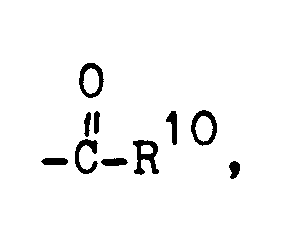
einen geradkettigen oder verzweigten Alkyl- oder Alkenylrest mit bis zu 8 Kohlenstoffatomen, oder einen Cycloalkyl oder Cycloalkenylrest mit jeweils 3 bis 8 C-Atomen, oder einen unsubstituierten Phenylrest oder einen Phenylrest, welcher seinerseits im Kern 1- bis 3-fach substituiert ist mit Halogen, Trifluormethyl und/oder Alkyl oder Alkoxy mit 1 bis 4 C-Atomen, oder einen Pyridylrest,
- R² und R⁴,
- gleich oder verschieden sind und Wasserstoff, Alkyl mit 1 bis 4 C-Atomen, Halogen oder Alkoxy mit 1 bis 4 C-Atomen bedeuten, und
- R³
- Wasserstoff, Alkyl oder Alkenyl mit bis zu 4 C-Atomen Halogen oder Alkoxy mit 1 bis 4 C-Atomen ist.
- R⁶
- einen cycloaliphatischen Kohlenwasserstoffrest mit 3 bis 7 Kohlenstoffatomen, einen Phenylrest, der im Kern 1- bis 3-fach substituiert sein kann mit Halogen, Trifluormethyl, Alkyl oder Alkoxy mit je 1 bis 6 C-Atomen oder mit Hydroxymethyl, oder einen Furyl-, Thienyl- oder Pyridylrest, wobei die heteroaromatischen Reste 1- bis 2-fach substituiert sein können mit Halogen, Trifluormethyl, Alkyl oder Alkoxy mit je 1 bis 6 C-Atomen, sowie die entsprechenden offenkettigen Hydroxycarbonsäuren der Formel Vʹ

- Bevorzugter Gegenstand der Erfindung sind Verbindungen der allgemeinen Formel V bzw. Vʹ worin bedeuten:
- A
- -S-
- R⁷
-
- a) einen geradkettigen oder verzweigten Alkylrest mit 1 bis 2 Kohlenstoffatomen, der substituiert sein kann mit
- aa) einer Hydroxygruppe
- ab) einer Amino- oder Ammonium-Gruppe
- ac) einer Carboxylgruppe, deren Methyl-, Ethyl- oder Benzylester, Methyl- oder Dimethylamid, Natrium-, Kalium- oder Ammoniumsalz
- ad) einen Phenylrest
- ae) einem Fluor- oder Chloratom
- b) eine Alkanoylgruppe

- c) eine Carboxylgruppe, deren Methyl- oder Ethylester, Methyl- oder Dimethylamid, Natrium-, Kalium- oder Amminiumsalz,
- d) Wasserstoff
- a) einen geradkettigen oder verzweigten Alkylrest mit 1 bis 2 Kohlenstoffatomen, der substituiert sein kann mit
- R⁸
- die Strukturelemente der Formeln VI oder VII

- X-Y
- einen Rest der Formel trans -CH=CH- und
- Z
- eine CH₂-Gruppe darstellen,
- R¹, R⁵
- gleich oder verschieden sind und
- a) Wasserstoff oder Chlor,
- b) einen geradkettigen oder verzweigten Alkylrest mit 1 bis 6 Kohlenstoffatomen, wobei der Alkylrest seinerseits 1- bis 2-fach substituiert sein kann mit Phenyl- oder Phenoxy-Resten, die ihrerseits im Kern substituiert sein können mit Fluor oder Chlor, darstellen.
- R², R⁴
- gleich oder verschieden sind und Wasserstoff, Methyl, Ethyl, Fluor oder Chlor sind,
- R³
- Wasserstoff, Methyl oder Chlor,
- R⁶
- einen cycloaliphatischen Kohlenwasserstoffrest,mit 5 bis 6 C-Atomen, einen Phenylrest, der im Kern substituiert sein kann mit Fluor, Chlor, Trifluormethyl, Methyl, Ethyl, Methoxy, Ethoxy, darstellen.
- Besonders bevorzugter Gegenstand der Erfindung sind Verbindungen der allgemeinen Formel V bzw. Vʹ, worin bedeuten
- A
- -S-
- R⁷
-
- a) einen Alkylrest mit 1 oder 2 Kohlenstoffatomen, der substituiert sein kann mit
- aa) einer Hydroxygruppe
- ab) einer Amino- oder Ammonium-Gruppe
- ac) einer Carboxylgruppe, deren Methylester, Natrium-, Kalium- oder Ammonium-Salze
- ad) einem Phenylrest
- ae) einem Fluoratom
- b) einer Acetyl- oder Trifluoracetylgruppe
- a) einen Alkylrest mit 1 oder 2 Kohlenstoffatomen, der substituiert sein kann mit
- R⁸
- die Strukturelemente der Formeln VI oder VII

- X-Y
- ein Rest der Formel trans -CH=CH- und
- Z
- eine -CH₂-Gruppe sind,
- R¹, R⁵
- gleich oder verschieden sind und
- a) Chlor,
- b) geradkettiger oder verzweigter Alkylrest mit 1 bis 3 C-Atomen, wobei der Alkylrest seinerseits 1 bis 2-fach substituiert sein kann mit Phenyl- oder Phenoxyresten, die ihrerseits im Kern substituiert sein können mit Fluor, und
- R², R⁴
- Wasserstoff sind
- R³
- Chlor oder Methyl und
- R⁶
- Cyclohexyl-, unsubstiutierter Phenylrest oder Phenylrest substituiert mit Chlor oder Fluor sind.
- Die Erfindung betrifft ferner ein Verfahren zur Herstellung von Verbindungen der Formel V bzzw. Vʹ sowie von deren pharmakologisch verträglichen Salzen mit Basen und deren pharmakologisch verträglichen Estern und die Verwendung von entsprechenden Verbindungen zur Herstellung von Arzneimitteln für die Prophylaxe und Therapie der Arteriosklerose und Hypercholesterinämie und pharmazeutische Präparate, die entsprechende Verbindungen enthalten.
- Das Verfahren zur Herstellung der Verbindungen der Formel V bzw. Vʹ ist dadurch gekennzeichnet, daß man
- a) Verbindungen der allgemeinen Formeln I oder II


- b) die α,β-ungesättigten Lactone der Formeln III oder IV mit nucleophilen Verbindungen R⁷AH, wie z.B. R⁷-substituierten Mercaptanen, Thiolsäuren, Aminen,
C-H-aciden Verbindungen, zu Verbindungen der Formel V, worin R⁷ und A die zu Formel V angegebenen Bedeutungen haben und R⁸ das Strukturelement VI, worin R¹ bis R⁵ die angegebenen Bedeutungen haben, oder das Strukturelement VII, worin R², R⁴ und R⁶ die angegebenen Bedeutungen haben und X-Y die trans CH=CH-Gruppe darstellt, bedeutet, umsetzt und
gegebenenfalls eine erhaltene Verbindung V, worin X-Y die trans CH=CH-Gruppe darstellt, hydriert zu einer Verbindung V, worin X-Y die CH₂-CH₂-Gruppe darstellt,
gegebenenfalls eine erhaltene Verbindung der Formel V in die offenkettige Hydroxycarbonsäure der Formel Vʹ oder deren Ester oder Salz überführt, oder
gegebenenfalls ein Salz oder einen Ester in die freie Hydroxycarbonsäure überführt. - Bei dem Verfahren können eine oder mehrere der Gegebenenfallsmaßnahmen in beliebiger Reihenfolge durchgeführt werden.
- Bei der Umsetzung mit nucleophilen Verbindungen R⁷AH entstehen unter basischer Katalyse stereospezifisch die 4(R)-Michael-Additionsprodukte (vgl. Schema 1, V). Die 4(S)-Isomeren von V wurden bei diesen Additionen nur in sehr geringen Mengen (< 1 bis 2 %) oder gar nicht gebildet.
- Das Verfahren zur Herstellung von Verbindungen V mit R⁸= Strukturelement VI (Schema 1, Verbindung Va) bzw. mit R⁸= Strukturelement VII mit X-Y= trans CH=CH (Schema 1, Verbindung Vb) ist in dem folgenden Schema 1 anhand eines Beispiels erläutert:

- Die Herstellung der optisch reinen Ausgangsverbindungen der Formeln I und II wird in EP-A-0 216 127 und EP-A-0 217 092 beschrieben.
- In dem nachfolgenden Schema 2 ist die Synthese von Verbindungen der Formel I bzw. Iʹ sowie die Überführung in die α,β-ungestättigten Lactone III anhand eines Beispiels erläutert.

- In dem nachfolgenden Schema 3 ist die Herstellung der Ausgangsverbindungen II sowie die Überführung in die α,β-ungesättigten Lactone IV anhand eines Beispiels erläutert:

- Die Wasserabspaltung aus Verbindungen der Formel I wobei Verbindungen der Formel III entstehen, wie z.B. aus der Verbindung Ia gemäß Schema 2 zu Verbindung IIIa wird zweckmäßig durch Erwärmen mit Burgess-Reagenz (E.M. Burgess et al., J. Org. Chem. 38, 26 (1973)) vorgenommen, jedoch kommen auch andere gängige Methoden wie Phosphoroxychlorid/Base, Tosylchlorid oder Mesylchlorid/Base, p-Tolylchlorothioformiat (W.H. Rastetter et al., J. Org. Chem. 45, 3149 (1980)), Sulfuran-Reagenzien (J.C. Martin et al., JACS 93, 4327 (1971), JACS 94, 5003 (1972)), Triphenylphosphin/Tetrachlormethan (R. Appel et al., Chem. Ber. 109, 3446 (1976)), Methyltriphenoxyphosphoniumjodid (C.W. Spangler et al., J. Chem. Soc. Perkin I, 2287 (1981)), Erwärmen in Benzol oder Toluol unter saurer Katalyse, Erwärmen in DMSO oder HMPT (R.S. Monson et al., J. Org. Chem. 36, 3827 (1971)), Erwärmen mit Aluminiumoxid (D. Dautzenberg et al., J. Org. Chem. 45 3149 (1980)) in Betracht.
- Die Abspaltung von tert.-Butyl-diphenylsilanol aus Iʹa zu IIIa (Schema 2) erfolgt; z.B. mit Tetrabutylammoniumfluorid/para-Toluolsulfonsäure bereits bei Raumtemperatur.
- Die Wasserabspaltung aus Verbindungen II, wobei Lactone IV entstehen, wie z.B. aus IIb zu IVb (Schema 3) wird zweckmäßig durch Erwärmen mit Burgess-Reagenz (E.M. Burgess et al., J. Org. Chem. 38, 26 (1973)) vorgenommen, jedoch kommen auch die obengenannten alternativen Methoden in Betracht. Zur Herstellung des Lactone IV ist dieses Verfahren bevorzugt.
- Die Umsetzung der α,β-ungesättigten Lactone II bzw. IV mit nucleophilen Verbindungen R⁷AH erfolgt in Gegenwart basischer Katalysatoren wie z.B. Triethylamin, Natriumhydrid, Natriumcarbonat oder Natriumhydroxid. Die Reaktion wird in An- oder Abwesenheit eines Lösungsmittels sie z.B. Ethanol oder Benzol, vorzugsweise bei Raumtemperatur durchgeführt.
- Die Ringöffnung zu Verbindungen Vʹ erfolgt z.B. im alkalischen Medium in Gegenwart von Natriumhydroxid.
- Während bei der Addition von z.B. Thioessigsäure, Benzylmercaptan, β-Mercaptoethanol oder L-Cystein stereospezifisch die 4(R)-Additionsprodukte V entstehen, kann bei der Addition von einem Äquivalent Amin, wie z.B. Benzylamin neben der gewünschten Additionsreaktion zu Verbindungen V zusätzlich eine Öffnung des Lacton-Rings zum Amid stattfinden. In solchen Fällen ist es vorteilhaft, mit einem Aminüberschuß zu arbeiten und die Doppeladdukte herzustellen, und das Amid zur offenkettigen Hydroxycarbonsäure Vʹ zu verseifen.
- Die α,β-ungesättigten Lactone der Formeln III bis VI sind neu. Die Erfindung betrifft daher auch die Verbindungen der Formeln III und IV sowie Verfahren zu deren Herstellung.
- Das Enzym HMG-CoA-Reduktase ist in der Natur weit verbreitet. Es katalysiert die Bildung von Mevalonsäure aus HMG-CoA. Diese Reaktion ist ein zentraler Schritt der Cholesterin-Biosynthese (I.R. Sabine, 3-Hydroxy-3-methylglutaryl Coenzym A Reduktase, CRC Press, 1983). Hohe Cholesterinspiegel werden mit einer Reihe von Erkrankungen wie z.B. koronarer Herzkrankheit oder Atherosklerose in Verbindungen gebracht. Daher ist die Senkung erhöhter Cholesterinspiegel zur Vorbeugung und Behandlung solcher Erkrankungen ein therapeutisches Ziel. Ein Ansatzpunkt liegt in der Hemmung bzw. Verminderung der endogenen Cholesterinsynthese. Hemmstoffe der HMG-CoA-Reduktase blockieren die Cholesterin-Biosynthese auf einer frühen Stufe. Sie eignen sich daher zur Vorbeugung und Behandlung von Erkankungen, die durch einen erhöhten Cholesterinspiegel verursacht werden. Eine Verminderung der endogenen Synthese führt zu einer erhöhten Aufnahme von Cholesterin aus dem Plasma in die Zellen. Ein zusätzlicher Effekt läßt sich durch gleichzeitige Gabe Gallensäuren-bindender Stoffe wie Anionenaustauscher erzielen. Die erhöhte Gallensäurenausscheidung führt zu einer verstärkten Neusynthese und damit zu einem erhöhten Chlolesterinabbau (M.S. Brown, P.T. Kovanen, J.L. Goldstein, Science 212, 628 (1981); M.S. Brown, J.L. Goldstein, Spektrum der Wissenschaft 1985, 96). Die erfindungsgemäßen Verbindungen sind Hemmstoffe der HMG-CoA-Reduktase. Sie eignen sich daher zur Hemmung bzw. Verminderung der Cholesterin-Biosynthese und damit zu Vorbeugung oder Behandlung von Erkrankungen, die durch erhöhte Cholesterinspiegel verurusacht werden, insbesondere koronare Herzkrankheit, Atherosklerose, Hypercholesterinämie, Hyperlipoproteinämie und ähnliche Erkrankungen.
- Die Erfindung betrifft daher auch pharmazeutische Präparate auf Basis der Verbindungen der Formel V bzw. der entsprechenden Hydroxycarbonsäuren Vʹ, deren Salzen und Ester, sowie die Verwendung dieser Verbindungen zur Herstellung von Arzneimitteln, insbesondere zur Behandlung der Hypercholesterinämie.
- Die Verbindungen der Formel V bzw. die entsprechenden Säuren, Salze oder Ester werden in verschiedenen Dosierungsformen verabreicht, vorzugsweise oral in Form von Tabletten, Kapseln oder Flüssigkeiten. Die tägliche Dosis bewegt sich je nach Körpergewicht und Konstitution des Patienten im Bereich von 3 mg bis 2500 mg, vorzugsweise jedoch im Dosisbereich 10 - 500 mg.
- Die erfindungsgemäßen Verbindungen können als Laktone der allgemeinen Formel V, in Form der freien Säure Vʹ oder in Form pharmazeutisch annehmbarer Salze oder Ester zur Anwendung kommen, und zwar gelöst oder suspendiert in pharmakologisch unbedenklichen organischen Lösungsmitteln wie ein- oder mehrwertigen Alkohohlen wie z.B. Ethanol oder Glycerin, in Triacetin, Ölen wie z.B. Sonnenblumenöl oder Lebertran, Ethern wie z.B. Diethylenglykoldimethylether oder auch Polyethern wie z.B. Polyethylenglykol oder auch in Gegenwart anderer pharmakologisch unbedenklicher Polymerträger wie z.B. Polyvinylpyrrolidon oder im Gemisch mit anderen pharmazeutisch annehmbaren Zustzstoffen wie Stärke, Cyclodextrin oder Polysacchariden. Ferner können die erfindungsgemäßen Verbindungen kombiniert werden mit Zusatzstoffen, die Gallensäure binden, insbesondere nicht toxische, basische Anionenaustauscherharze, die Gallensäuren in einer nichtresorbierbaren Form im Gastrointestinaltrakt binden. Die Salze der Hydroxycarbonsäuren können auch als wäßrige Lösung verarbeitet werden.
- Die HMG-CoA-Reduktase-Aktivität wurde an solubilisierten Enzympräparationen aus Lebermikrosomen von Ratten gemessen, die nach Umstellung im Tag-Nacht-Rhytmus mit Cholestyramin (RCuemid) induziert wurden. Als Substrat diente (S,R) ¹⁴C-HMG-CoA, die Konzentration von NADPH wurde während der Inkubation durch ein regenerierendes System aufrecherhalten. Die Abtrennung von ¹⁴C-Mevalonat von Substrat und anderen Produkten (z.B. ¹⁴-C-HMG) erfolgte über Säulenelution, wobei das Eltuionsprofil jeder Einzelprobe ermittelt wurde. Auf die ständige Mitführung von ³H-Mevalonat wurde verzichtet, weil es sich bei der Bestimmung um die Realtivangabe der Hemmwirkung handelt. In einer Versuchsreihe wurde jeweils die enzymfreie Kontrolle, der enzymhaltige Normalansatz (= 100 %) und solche mit Präparatezusätzen zusammen behandelt. Jeder Einzelwert wurde als Mittelwert aus 3 Parallelproben gebildet. Die Signifikanz der Mittelwertsunterschiede zwischen präparatfreien und präparathaltigen Proben wurde nach dem t-Test beurteilt.
- Nach der oben beschriebenen Methode wurden von den erfindungsgemäßen Verbindungen V im Vergleich zu den in der deutschen Patentanmeldung P 35 43 336.1 (= US-Patentanmeldung Nr. 900 848) beschriebenen Verbindungen A und B (A= 6(S)-{4,6-Dimethyl-2-[3-(4-fluorphenoxy)propyl]-phenoxymethyl}-3,4,5,6-tetrahydro-4(R)-hydroxy-2H-pyran-2-on; B= 3(R), 5(S)-Dihydroxy-6-{4,6-Dimethyl-2-[3-(4-fluorphenoxy)propyl]phenoxy}hexansäure Natriumsalz) z.B. folgende Hemmwerte auf die HMG-CoA-Reduktase ermittelt [IC₅₀-Wert (Mol/l) bedeutet die molare Konzentration der Verbindungen pro Liter, die für eine 50 %ige Hemmung erforderlich ist]:

- Beispiele:
- alle ¹-NMR-Spektren (wenn nicht anders angegeben) in CDCl₃ mit einer Spur TMS als internem Standard
- Eine Lösung von 482 mg (1,2 mmol) des Hydroxylaktons 6(S)-{4,6-Dimethyl-2-[3-(4-fluorphenoxy)propyl]phenoxymethyl}-3,4,5,6-tetrahydro-4(R)-hydroxy-2H-pyran-2-on (vgl. deutsche Patentanmeldung P 35 43 336.2 = US-Patentanmeldung Nr. 900 848 und Schema 2, Ia) in 10 ml trockenem Benzol wurde zur Lösung von 429 mg (1,8 mmol) des Burgess-Reagenz (E.M. Burgess et al., J. Org. Chem. 38, 26 (1973)) in 30 ml Benzol getropft. Das Reaktionsgemisch wurde 60 min auf 50°C Innentemperatur erwärmt, wobei sich ein feiner weißer Feststoff abschied. Da DC-Kontrolle noch wenig Ausgangsmaterial anzeigte, wurde kurz mit Eis gekühlt, weitere 216 mg Burgess-Reagenz zugesetzt und noch 30 min auf 60°C erwärmt. Bei Raumtemperatur wurden 10 ml Wasser zugegeben, 10 min gerührt und die Benzol-Phase abgetrennt. Die wäßrige Phase wurde noch 2mal mit Ether extrahiert, die vereinigten organischen Extrakte mit gesättigter Kochsalzlösung gewaschen, über Magnesiumsulfat getrocknet, filtriert und eingeengt. Chromatographie über wenig Kieselgel mit 40 % Essigester/60 % Petrolether gabe 426 mg (1,11 mmol, 92 % Ausbeute) α,β-ungesättiges Lacton IIIa als farblosen Feststoff, Schmp. 77 bis 78°C. Rf (Essigester/Cyclohexan 1:1) : Ia (0,28), IIIa (0,66) MS (EI):C₂₃H₂₅O₄F, 384 (M⁺), 273

- ¹H-NMR (270 MHz) : δ = 2,0 - 2,12 (qui, 2H, CH₂), 216 (s, 3H, CH₃), 2,18 (s, 3H, CH₃), 240 - 2,57 (dtd, 1H, Methylen-H), 2,67 - 2,80 (m, 3H), 3,92 - 4,00 (t, überlagert von d, 4H, Methylen-H), 4,68 - 4,80 (d qua, 1H, CH), 6,04 - 6,10 (ddd, 1H, =C-H), 6,8 - 7,0 (m, 3H, =C-H und 2 arom.-H)
- Zu einer Lösung von 128 mg (0,2 mmol) des Silyloxylaktons 6(S)-{4,6-Dimethyl-2-[3-(4-fluorphenoxy)propyl]phenoxymethyl}-3,4,5,6-tetrahydro-4(R)-(t-butyl-diphenylsilyoxy)-2H-pyran-2-on (vgl. deutsche Patentanmeldung P 35 43 336.1 = US-Patentanmeldung Nr. 900 848 und Schema 2, Iʹa) in 7 ml Tetrahydrofuran wurden 190 mg (0,6 mmol) Tetrabutylammoniumfluorid-Trihydrat, dann 38 mg (0,2 mmol) p-Toluolsulfonsäure-Monohydrat gegeben. Man ließ 12 Stunden bei Raumtemperatur rühren, engte ein und chromatographierte den Rückstand über Kieselgel mit Cyclohexan/Essigester (1:1). Erhalten wurden 60,3 mg (0,157 mmol, 79% Ausbeute) IIIa, physikalische und Spektraldaten wie in Beispiel 1.
- 200 mg (0,61 mmol) des Hydroxylaktons (+)-E-6S-[2-(2-(4-Fluorbenzyl)phenyl-ethenyl]-4R-hydroxy-3,4,5,6-tetrahydro-2H-pyran-2-on (vgl. deutsche Patentanmeldung P 35 30 797.8 = US-Patentanmeldung Nr. 900 887 und Schema 3, IIb) und 365 mg (1,53 mmol) Burgess-Reagenz (E.M. Burgess et. al., J. Org. Chem 38, 26 (1973)) wurden in 230 ml trockenem Benzol gelöst. Die Lösung wurde 2 Stunden unter Stickstoff auf 60°C erwärmt. Bei 25°C wurden weitere 182 mg Burgess-Reagenz zugefügt und dann eine weitere Stunde bei 60°C gerührt. DC (Cyclohexan/Essigester 1:1) zeigte vollständige Umsetzung zu IVb an [IIb (Rf= 0,13), IVb (0,42)]. Das Lösungsmittel wurde im Vakuum entfernt und der Rückstand mit obigem Laufmittel über Kieselgel flash-chromatographiert. 130 mg (0,42 mmol, 69 % Ausbeute).
MS (EI) C₂₀H₁₇O₂F, 308 (M⁺), 223, 196
¹H-NMR (270 MHz) : δ = 2,33 - 2,39 (m , 2H, CH₂), 3,96 (s, 2H, CH₂), 496 (qua mit Fernkopplung, 1H, CH), 5,98 (dt, 1H, olef.-H), 6,04 (dd, 1H, olef.-H), 6,78 - 7,22 (m, 9H, 8 arom.-H + 1 olef.-H), 7,40 (m, 1H, olef.-H) - Zu 115 mg (0,3 mmol) des ungesättigten Laktons IIIa (Beispiele 1, 2) wurden 36 µl (0,5 mmol) Thioessigsäure (frisch destilliert), dann 7 µl Triäthylamin gegeben. DC zeigte vollständige Reaktion nach 30 min an (Rf bei 30 % Essigester/70 % Petrolether IIa 0,39, Va 0,48, Thioessigsäure 0,09). Filtration durch eine kurze Kieselgel-Säule gab 130 mg (0,28 mmol, 94 % Ausbeute) Addukt Va als zähes, farbloses Öl.
MS (FAB) : C₂₅H₂₉SO₅F, 461 (M+H⁺), 348 (M⁺ - F-C₆H₄-OH)
¹H-NMR (270 MHz) : δ = 2,0 - 2,1 (qui, 2H, CH₂), 2,1 - 2,2 (dt, 1H, Methylen-H); 2,23 (s, 3H, CH₃), 2,26 (s, 3H, CH₃), 2,36 (s, 3H, CO-CH₃), 2,44 - 2,56 (m, 1H, Methylen-H), 2,63 - 2,73 (ddd, 1H, Methylen-H), 2,76 (t, 2H, CH₂), 2,90 - 3,01 (ddd, 1H, Methylen-H), 3,88 - 4,0 (m, 4H, 2mal OCH₂), 4,15 (qui, 1H, CH), 4,77 (m, 1H, CH), 6,8 - 7,0 (m, 6H, arom.-H) - Zur Lösung von 120 mg (0,39 mmol) des ungesättigten Laktons IV b (Beispiel 3) in 5 ml Toluol wurde die Lösung von 56 µl (0,78 mmol) Thioessigsäure in 1 ml Toluol, dann 27 µl (0,19 mmol) Triethylamin gegeben. Nach einer Stunde wurde das Lösungsmittel entfernt und der Rückstand mit Cyclohexan/Essigester (8:2) über Kieselgel gereinigt. Erhalten wurden 121 mg (0,31 mmol, 81 % Ausbeute) Vb als Öl.
Rf (Cyclohexan/Essigester 1:1) : IVb (0,38), Vb (0,47)
MS (EI): C₂₂H₂₁0₃SF 384 (M⁺), 341 (M⁺ -CH₃-C=0), 308
197, 109 (F-C₆H₄-CH₂⊕)
¹H-NMR (270 MHz) : δ = 2,0 - 2,2 (m, 2H, CH₂), 2,37 (s, 3H, CH₃), 2,61 (dd, 1H, Methylen-H), 2,87 (dd, 1H, Methylen-H), 3,86 (qui, 1H, CH), 4,03 (s, [sehr enges AB-System], 2H, CH₂), 5,12 (m, 1H, olef.-H), 685 (dd, 1H, olef.-H), 6,9 - 7,0 (m, 2H, arom.-H), 7,01 - 7,07 (m, 2H, arom.-H), 7,12 - 7,17 (m, 1H, arom.-H), 7,23 - 7,29 (m, 2H, arom.-H), 7,43 - 7,49 9m, 1H, arom.-H) - Zu 77 mg (0,2 mmol) des ungesättigten Laktons IIIa (Beispiele 1, 2) wurden 59 µl (0,5 mmol) Benzylmercaptan (frisch dest.), dann 14 µl (0,1 mmol) trock. Triethylamin gegeben. DC-Analyse nach 1 Stunde zeigte fast vollständige Reaktion an. Nach dem Stehen über Nacht bei 0°C unter Stickstoff war die Reaktion vollständig. Rf bei 20 % Essigester/80 % Cyclohexan IIIa 0,19, Vc 0,39 Benzylmercaptan 0,82. Das Öl wurde direkt über eine kurze Kieselgelsäule flash-chromatographiert. Erhalten wurden 96,5 mg (0,19 mmol, 96 % Ausb.) Vc als zähes farbloses Öl.
MS (EI) C₃₀H₃₂SO₄F, 508 (M⁺), 396 (M⁺ - F-C₆H₄-OH), 384 (M⁺ - C₆H₅SH)
¹H-NMR (270 MHz) : δ = 1,98 - 2,1 (m, 2H, CH₂ und 1 Methylen-H), 2,23 (s, 3H, CH₃), 2,25 (s, 3H, CH₃), 2,25 - 2,36 (m, 1H, Methylen-H), 2,56 - 2,66 (ddd, 1H, Methylen-H), 2,73 (t, 2H, CH₂), 2,77 - 2,87 (dd, 1H, Methylen-H), 3,27 (qui, 1H, CH), 3,78 (enges AB-System, 2H, SCH₂), 3,87 (t, 2H, OCH₂), 3,94 (t, 2H, OCH₂), 4,85 (m, 1H, CH), 6,79 - 6, 87 (m, 4H, arom.-H), 6,9 - 7,0 (m, 2H, arom.-H) 7,28 - 7,35 (m, arom.-H) - 74 mg (0,145 mmol) Vc (Beispiel 6) wurden in 5 ml Ethanol gelöst und 1,37 ml 0,1 N Natronlauge zugegeben. Nach 2 Stunden wurde im Vakuum zur Trockne eingeengt. Der Rückstand wurde im vakuum zur Trockne eingeengt. Der Rückstand wurde 2mal mit Ether digeriert. Das Salz Vʹc wurde im Vakuum getrocknet; 69,4 mg (0,127 mmol, 88 % Ausbeute).
¹H-NMR (D₂O, 270 MHz, Bezugspunkt HOD δ = 4,80) : δ= 1,2 - 1,56 (dt, 1H, Methylen-H), 1,55 - 1,85 (m, 2H, CH₂), 1,91 (s, 3H, CH₃), 2,01 (s, 3H, CH₃), 2,3 - 2,65 (m, 4H, 2CH₂), 3,0 - 3,45 (m, 3H), 3,45 - 3,6 (m, 4H), 3,96 - 4,11 (breit, 1H, CH), 6,46, 6,63 (m, 4H, arom.-H), 6,65 - 6,80 (m, 2H, arom.-H), 6,85 - 6,92 (m, 1H, arom.-H), 6,93 - 7,00 (t, 2H, arom.-H), 7,02 - 7,11 (t, 2H, arom.-H) - Zu 87 mg (0,2227 mmol) des ungesättigten Laktons IIIa (Beispiele 1, 2) wurden 30 µl (0,43 mmol) Mercaptoethanol, dann 14 µl (0,1 mmol) Triethylamin zugesetzt. DC zeigte vollständige Reaktion nach einer Stunde an. Das Öl wurde direkt mit 50 % Essigester/50 % Petrolether über eine kurze Kieselgel-Säule flash-chromatographiert. Überschüssiges Mercaptoethanol wird vor dem Produkt Vd (63,1 mg, 0,136 mmol, 60 % Ausbeutet, Öl) eluiert.
MS (EI) C₂₅H₃₁SO₅F, 462 (M⁺), 384 (M⁺ -HOCH₂CH₂SH), 350 (M⁺ -FC₆H₄-OH)
¹H-NMR (270 MHz) δ = 1,76 (s, 1H, OH), 2,0 - 2,1 (qui, 2H, CH₂), 2,13 - 2,2 (t, 1H, Methylen-H), 2,23 (s, 3H, CH₃), 2,25 (s, 3H, CH₃), 2,38 - 2,50 (m, 1H, Methylen-H), 2,59 - 2,70 (ddd, 1H, Methylen-H), 2,71 - 2,80 (m, 4H, 2mal CH₂), 2,88 - 2,97 (dd, 1H, Methylen-H), 3,48 - 3,57 (qui, 1H, 4,94 (m, 1H, CH), 6,8 - 6,9 (m, 4H, arom.-H), 6,92 - 7,0 (m, 2H, arom.-H). - Das Gemisch aus 77 mg (0,2 mmol) des ungesättigten Laktons IIIa (Beispiele 1, 2), 32 mg (0,3 mmol) Natriumcarbonat, 62 mg (0,4 mmol) L-Cystein-hydrochlorid wurde bei 25°C in 1 ml absol. Ethanol gelöst. DC nach einer Stunde zeigte keine Reaktion an. Es wurden 50 µl (0,36 mmol) Triethylamin zugegeben, wobei sich sofort ein farbloser Niederschlag bildete. Das Lösungsmittel wurde abgezogen und der Rückstand in der Mindestmenge Chloroform/Methanol (7:3) gelöst. Das Rohrprodukt wurde mit Methylenchloride/Methanol (7:3) durch Kieselgel (⌀ 2,5 cm, Höhe 13 cm) chromatographiert. Erhalten wurden 98,3 mg (0,195 mmol, 97 % Ausbeute) Ve als farbloses Pulver, schmp. (ohne Umkrist.) 175 - 176°C (unter Zersetzung, Gelbfärbung, Gasen)
MS (FAB, NBA-Matrix): C₂₆H₃₂NO₆SF 574 (M+Na₃⁺), 550 (M+NA₂⁺ - H⁺), 528 (M + Na⁺), 506 (M + H⁺), 407, (M + Na⁺ - F-C₆H₄O.)
IR (KBr) : 3600 - 3300 cm⁻¹ (breit, NH₂), 3300 - 3000 breit, -NH₃⁺), 3000 - 2400 (sehr breit, CO₂H), 1740 (C = 0 von Lakton), 1510 (Aromat)
¹H-NMR (DMSO-d₆, 270 MHz) δ = 1,9 - 2,0 (qui, 2H, CH₂), 2,08 (dt, 1H, Methylen-H), 2,18 (s, 3H, CH₃), 2,20 (s, 3H, CH₃), 2,28 (dt, 1H, Methylen-H), 2,56 (dd, 1H, S-CH), 2,70 (t, 2H, CH₂), 2,86 (dd, 1H, Methylen-H), 2,92 (dd, 1H, S-CH), 3,11 (dd, 1H, Methylen-H), 3,2 - 3,5 (breit, 3H, NH₃⁺), 3,37 (qui, 1H, CH), 3,56 (qui, 1H, CH), 3,85 - 3,9 (m, 2H, OCH₂), 3,96 (t, 2H, OCH₂), 4,83 - 4,92 (m, 1H, CH), 6,83 (s, 2H, arom.-H), 6,9 - 6,97 (m, 2H, arom.-H), 7,07 - 7,15 (m, 2H, arom.-H) - 200 mg (0,393 mmol) Ve (Beispiel 9) wurden in 10 ml absol. Ethanol suspendiert. 3,93 ml 0,1 N Natronlauge wurden zugegeben, nach 10 min weitere 3,73 ml 0,1 N NaOH. Nach 30 min wurde das Lösungsmittel abgezogen. Der Rückstand wurde mit 3 mal 3 ml Ethanol gewaschen und im Vakuum getrocknet. Ausbeute 92 mg Vʹe.
¹H-NMR (D₂O, 270 MHz, Bezugspunkt HOD δ = 4,80) : δ = 1,75 - 1,95 (m, 2H, CH₂), 2,0 - 2,12 (qui, 2H, CH₂), 2,22 (s, 3H, CH₃), 2,26 (s, 3H, CH₃), 2,32 (dd, 1H, S-CH), 2,59 (dd, 1H, (S-CH), 2,69 - 2,83 (m, 3H, CH₂ und 1 Methylen-H), 2,9 - 3,0 (m, 1H, Methylen-H), 3,15 - 3,25 (m, 1H, Methylen-H), 3,36 (s, 5H, OH, NH₃⁺, CO₂H), 3,42 (dd, 1H, CH), 3,78 (d, 2H, OCH₂), 4,05 (t, 2H, OCH₂), 4,15 (m, 1H, CH), 6,9 - 7,0 (m, 4H, arom.-H), 7,05 - 7,12 (t, 2H, arom.-H). -
- a) Zu 128 mg (0,3 mmol) des ungesättigten Laktons IIIa (Beispiele 1, 2) wurden 200 ml trockenes Dimethoxyethan und 180 µl (3,5 mmol) Ethanolamin gegeben. Nach 1 Stunde bei 25°C war die Reaktion beendet.
Rf bei 70 % Chloroform/30 % Methanol : IIIa 0,78, Vʹf-Ethanolamid 0,15. Das Reaktionsgemisch wurde mit dem gleichen Laufmittel über eine kurze Kieselgel-Säule filtriert. Erhalten wurden 139 mg Vʹf-Ethanolamid (0,275 mmol, 91 % Ausb.) eines blaßgelben Öls.
MS (FAB, 3-NBA-Matrix) C₂₇H₃₉FN₂O₆ 507 (M + H⁺) MS (EI): 506 (M⁺, sehr schwach), 487 (M⁺ - H₂O - H.), 475 (M⁺ -.CH₂OH), 445 (M⁺ - HOCH₂CH₂NH₂), 4527 ("445" - H₂O), 414 ("475" - HOCH₂CH₂NH₂), 384 (M⁺ - 2HOCH₂CH₂NH₂), 316 ("427" - F-C₆H₄O.), 274 (m⁺ - F-C₆H₄OH-2 HNCH₂CH₂OH)
¹H-NMR (270 MHz) δ = 1,6 - 1,8 (m, 2H, CH₂), 2,4 (qui, 2H, CH₂), 2,22 (s, 6H, 2xCH₃), 2,33 (dd, 1H, Methylen-H), 2,52 (dd, 1H, Methylen-H), 2,7 - 3,1 (m, 7H, 2xCH₂, 2xOH, Amin-H), 3,25 - 3,5 (m, 3H, OCH₂, CH), 3,6 - 3,8 (m, 6H, 3xCH₂), 3,92 (t, 2H, OCH₂), 4,18 (m, 1H, CH), 6,8 - 6,9 (m, 4H, arom.-H), 6,9 - 7,0 (t, 2H, arom.-H), 7,48 (t, 1H, Amid-H) - b) Die Lösung von 55 mg (0,11 mmol) Vʹf-Ethanolamid und 427 mg (10,6 mmol) NaOH in 1,1 ml Wasser und 1 ml Ethanol wurde 3 Stunden unter Rückfluß gekocht. Nach dem Abkühlen wurden 5,2 ml 2 N Salzsäure zugegeben (+ pH 8 - 9) und im Vakuum zur Trockne eingeengt.
Rf bei 50 % Chloroform/50 % Methanol: Vʹf-Ethanolamid 0,16, Vʹf (als Carbonsäure) 0,34 -
- a) Zu 77 mg (0,2 mmol) des ungesättigten Laktons IIIa (Beispiele 1, 2) wurden 44 µl (0,4 mmol) frisch destilliertes Benzylamin und 100 µl Benzol gegeben. Die Reaktionslösung wurde 12 Stunden auf 50 - 60°C erwärmt (nach 6 Stunden wurden weitere 200 µl Benzol zugesetzt). Flash-Chromatographie durch Kieselgel (0̸ 4 cm, Höhe 10 cm) mit 1 l 75 % Essigester/25 % Petrolether, dann mit 99 % Essigester /1 % Triethylamin gab nach einem Vorlauf das reine Produkt Vʹg-benzylamid (starkes Tailing, 119 mg, 0,1999 mmol, 99 % Ausb.) als zähes, gelbliches Öl.
Rf (100 % Essigester) : IIIa 0,9, Vʹg-benzylamid 0,44 MS (FAB, NBA-Matrix); C₃₇H₄₃N₂O₄F 599 (M+H⁺), 450 (M+H⁺-F-C₆H₄-OH - 2H₂O)
IR (CHCl₃) : 3600 - 3100 cm⁻¹ (OH und NH), 1645/1550 (Amid), 1506 (Aryl), 1210
¹H-NMR (270 MHz) δ = 1,65 - 1,76 (m, 2H, CH₂), 2,03 (qui, 2H, CH₂), 2,23 (s, 6H, 2xCH₃), 2,34 (dd, 1H, Methylen-H), 2,59 (dd, 1H, Methylen-H), 2,7 - 2,8 (m, 2H, CH₂), 3,30 (sext., 1H, CH), 3,65 (d, 2H, NCH₂), 3,74 (d, 1H, NCH₂), 3,90 (dd, 1H, NCH₂), 3,90 (t, 2H, OCH₂), 4,1 - 4,2 (m, 1H, CH), 4,42 (AB-Teil von ABX, 2H, OCH₂), 6,77 - 6,92 (m, 6H, arom.-H) 7,2 - 7,35 (m, 12H, 10 arom.-H und 2 NH) - b) Verseifung des Benzylamids von Vʹg wurde in analoger Weise wie in Beispiel 11 beschrieben durchgeführt. Man erhielt das Natriumsalz Vʹg.
- Zur Lösung von 115,2 mg (0,3 mmol) IIIa (Beispiele 1, 2) und 58,6 mg (0,36 mmol) Malonsäurediethylester gibt man das Natriumhydrid, das nach 2maligem Waschen/Dekantieren von 20 mg einer 55 - 60 %igen NaH-Suspension in Öl mit Pentan zurückbleibt. Es wird 2 Stunden bei Raumtemperatur gerührt. Das Reaktionsgemisch wird mittels Filtration mit Cyclohexan/Essigester (2 : 1) durch Kieselgel gereinigt.
Rf (Cyclohexan/Essigester 3 : 2) : Vh 0,49, Verunreinigung (Vh-Stereoisomers) 0,42, IIIa 0,32
Man erhält 115 mg (0,21 mmol, 70 % Ausbeute) Vh als farbloses Öl
MS (EI) : C₃₀H₃₇FO₈, 544 (M⁺), 499 (M⁺-OCH₂CH₃), 432 (M⁺-F-C₆H₄OH), 387 ("432" - OCH₂CH₃), 271
¹H-NMR (270 MHz) δ = 1,25 (t, 3H, Ester, CH₃), 1,30 (t, 3H, Ester, CH₃), 1,82 (qua, 1H, CH), 2,05 (qui, 2H, CH₂, 2,24 (s, 6H, 2xCH₃), 2,25 - 2,40 (m, 2H, 2mal je ein Methylen-H), 2,48 (dd, 1H, Methylen-H), 2,75 (t, 2H, CH₂), 3,32 (d, 1H, CH), 3,88 - 4,0 (m, 4H, 2xOCH₂), 4,20 (qua, 2H, Ester-CH₂), 4,26 (qua, 2H, Ester-CH₂), 4,7 (m, 1H, CH), 6,8 - 6,88 (m, 4H, arom.-H), 6,9 - 7,0 (t, 2H, arom.-H) - 61 mg Vh (0,112 mmol) wurden in 3 ml Ethanol/5 Tropfen Chloroform gelöst und und 3,36 ml (3 Äquivalente) 0,1 N Natronlauge zugesetzt. Nach 6-stündigem Rühren wurden die flüchtigen Bestandteile abgezogen und der Rückstand 2mal mit Toluol im Hochvakuum eingeengt. DC zeigte vollständige Verseifung an zu Vʹh.
Claims (8)
- Verfahren zur Herstellung von 4(R)-substituierte 6(S)-Phenyloxymethyl-, 6(S)-β-Phenyläthyl- und 6(S)-β-Styryl-tetrahydropyran-2-onen der allgemeinen Formel V
 A -S-, -NH-, NR⁷ oder -CHR⁷-R⁷a) einen geradkettigen oder verzweigten Alkylrest mit 1 - 3 Kohlenstoffatomen, der substituiert sein kannaa) mit einer Hydroxygruppeab) mit einer Amino- oder Ammonium-Gruppeac) mit einer Carboxylgruppe CO₂H, deren Methyl-, Ethyl- oder Benzylester, Methyl- oder Dimethylamid, Natrium-, Kalium- oder Ammonium-Salzad) mit einem Phenylrestae) mit 1 bis 3 Halogenatomenb) eine Alkanoylgruppe
 c) eine Carboxylgruppe, deren Methyl-, Ethyl- oder Benzylester, Methyl- oder Dimethylamid, Natrium-, Kalium- oder Ammonium-Salzd) WasserstoffR⁸ die Strukturelemente der Formeln VI oder VII
 X-Y einen Rest der Formel trans -CH=CH- oder -CH₂-CH₂-Z eine -CH₂- oder -CH₂-CH₂-GruppeR¹, R⁵ gleich oder verschieden sind unda) Wasserstoff oder Halogenb) Cycloalkyl mit 4 bis 8 C-Atomen oder einen Phenylrest, der im Kern 1- bis 3-fach substituiert sein kann mit Halogen, Trifluormethyl und/oder Alkyl oder Alkoxy mit je 1 bis 4 C-Atomen oderc) einen geradkettigen oder verzweigten Alkylrest mit 1 bis 18 Kohlenstoffatomen oder einen geradkettigen oder verzweigten Alkenylrest mit 2 bis 18 Kohlenstoffatomen bedeuten, wobei die Alkyl- bzw. Alkenylreste ihrerseits 1 bis 3-fach substituiert sein können mitα) geradkettigen oder verzweigten Alkoxyresten mit bis zu 10 Kohlenstoffatomen oder Cycloalkoxyresten mit 3 bis 7 Kohlenstoffatomen oder geradkettig oder verzweigten Alkenyloxy- oder Alkinyloxyresten mit 3 bis 6 Kohlenstoffatomen,β) Halogen, Hydroxy, Cycloalkyl mit 3 bis 7 C-Atomen, unsubstituierten Phenyl-, α- oder β-Thienylresten, oder Phenyl-, α- oder β-Thienylresten, welche ihrerseits im Kern 1- bis 3-fach substituiert sind mit Halogen, Trifluormethyl und/oder Alkyl oder Alkoxy mit 1 bis 4 C-Atomen,γ) unsubstituierten Phenoxy-, Benzyloxy-, α- oder β- oder β-Thienyloxyresten, welche ihrerseits im Kern 1- bis 3-fach substituiert sind mit Halogen, Trifluormethyl und/oder Alkyl oder Alkoxy mit 1 bis 4 Kohlenstoffatomen.δ) der Gruppe
 R² und R⁴, gleich oder verschieden sind und Wasserstoff, Alkyl mit 1 bis 4 C-Atomen, Halogen oder Alkoxy mit 1 bis 4 C-Atomen bedeuten, undR³ Wasserstoff, Alkyl oder Alkenyl mit bis zu 4 C-Atomen Halogen oder Alkoxy mit 1 bis 4 C-Atomen ist.R⁶ einen cycloaliphatischen Kohlenwasserstoff mit 3 bis 7 Kohlenstoffatomen, einen Phenylrest, der im Kern 1- bis 3-fach substituiert sein kann mit Halogen, Trifluormethyl, Alkyl oder Alkoxy mit je 1 bis 6 C-Atomen oder mit Hyroxymethyl, oder einen Furyl-, Thienyl- oder Pyridylrest, wobei die heteroaromatischen Reste 1- bis 2-fach substituiert sein können mit Halogen, Trifluormethyl, Alkyl oder Alkoxy mit je 1 bis 6 C-Atomen, sowie die entsprechenden offenkettigen Hydroxycarbonsäuren der Formel Vʹ
 a) Verbindungen der allgemeinen Formeln I oder II

 b) die α,β-ungesättigten Lactone der Formeln III oder IV mit nucleophilen Verbindungen R⁷AH, zu Verbindungen der Formel V, worin R⁷ und A die zu Formel V angegebenen Bedeutungen haben und R⁸ das Strukturelement VI, worin R¹ bis R⁵ die angegebenen Bedeutungen haben, oder das Strukturelement VII, worin R², R⁴ und R⁶ die angegebenen Bedeutungen haben und X-Y die trans CH=CH-Gruppe darstellt, bedeutet, umsetzt und
gegebenenfalls eine erhaltene Verbindung V, worin X-Y die trans CH=CH-Gruppe darstellt, hydriert zu einer Verbindung V, worin X-Y die CH₂-CH₂-Gruppe darstellt,
gegebenenfalls eine erhaltene Verbindung der Formel V in die offenkettige Hydroxycarbonsäure der Formel Vʹ oder deren Ester oder Salz überführt, oder
gegebenenfalls ein Salz oder einen Ester in die freie Hydroxycarbonsäure überführt. - Verfahren gemäß Anspruch 1, dadurch gekennzeichnet, daß man eine Verbindung der allgemeinen Formel V bzw. Vʹ, worinA -S-R⁷a) einen geradkettigen oder verzweigten Alkylrest mit 1 bis 2 Kohlenstoffatomen, der substituiert sein kann mitaa) einer Hydroxygruppeab) einer Amino- oder Ammonium-Gruppeac) einer Carboxylgruppe deren Methyl-, Ethyl- oder Benzylester, Methyl- oder Dimethylamid, Natrium-, Kalium- oder Ammoniumsalzad) einem Phenylrestae) einem Fluor- oder Chloratomb) eine Alkanoylgruppe
 c) eine Carboxylgruppe, deren Methyl- oder Ethylester, Methyl- oder Dimethylamid, Natrium-, Kalium- oder Amminiumsalz,d) WasserstoffR⁸ die Strukturelemente der Formeln VI oder VII
 X-Y einen Rest der Formel trans -CH=CH- undZ eine CH₂-Gruppe darstellen,R¹, R⁵ gleich oder verschieden sind unda) Wasserstoff oder Chlor,b) einen geradkettigen oder verzweigten Alkylrest mit 1 bis 6 Kohlenstoffatomen, wobei der Alkylrest seinerseits 1- bis 2-fach substituiert sein kann mit Phenyl- oder Phenoxy-Resten, die ihrerseits im Kern substituiert sein können mit Fluor oder Chlor, darstellen,R², R⁴ gleich oder verschieden sind und Wasserstoff, Methyl, Ethyl, Fluor oder Chlor sind,R³ Wasserstoff, Methyl oder Chlor,R⁶ einen cycloaliphatischen Kohlenwasserstoff mit 5 bis 6 C-Atomen, einen Phenylrest, der im Kern substituiert sein kann mit Fluor, Chlor, Trifluormethyl, Methyl, Ethyl, Methoxy, Ethoxy, darstellen, bedeuten, oder deren Ester oder Salze herstellt.
 - Verfahren gemäß Anspruch 1, dadurch gekennzeichnet, daß man eine Verbindung der allgemeinen Formel V bzw. Vʹ worinA -S-R⁷a) einen Alkylrest mit 1 oder 2 Kohlenstoffatomen, der substituiert sein kann mitaa) einer Hydroxygruppeab) einer Amino- oder Ammonium-Gruppeac) einer Carboxylgruppe, deren Methylester, Natrium-, Kalium- oder Ammonium-Salzead) einem Phenylrestae) einem Fluoratomb) eine Acetyl- oder TrifluoracetylgruppeR⁸ die Strukturelemente der Formeln VI oder VII
 X-Y ein Rest der Formel trans -CH=CH- undZ eine -CH₂-Gruppe sind,R¹, R⁵ gleich oder verschieden sind unda) Chlor,b) geradkettiger oder verzweigter Alkylrest mit 1 bis 3 C-Atomen, wobei der Alkylrest seinerseits 1 bis 2-fach substituiert sein kann mit Phenyl- oder Phenoxyresten, die ihrerseits im Kern substituiert sein können mit Fluor, undR², R⁴ Wasserstoff sindR³ Chlor oder Methyl undR⁶ Cyclohexyl-, unsubstituierter Phenylrest oder Phenylrest substituiert mit Chlor oder Fluor sind, bedeuten, oder deren Ester oder Salze herstellt.
 - Verfahren zur Herstellung eines pharmazeutischen Präparates, dadurch gekennzeichnet, daß man eine Verbindung erhältlich gemäß Verfahren nach Anspruch 1 in eine geeignete Darreichungsform überführt.
- Verfahren gemäß Anspruch 1, dadurch gekennzeichnet, daß man die Zwischenstufe der Formel III

- Verfahren gemäß Anspruch 1, dadurch gekennzeichnet, daß man die Zwischenstufe der Formel IV
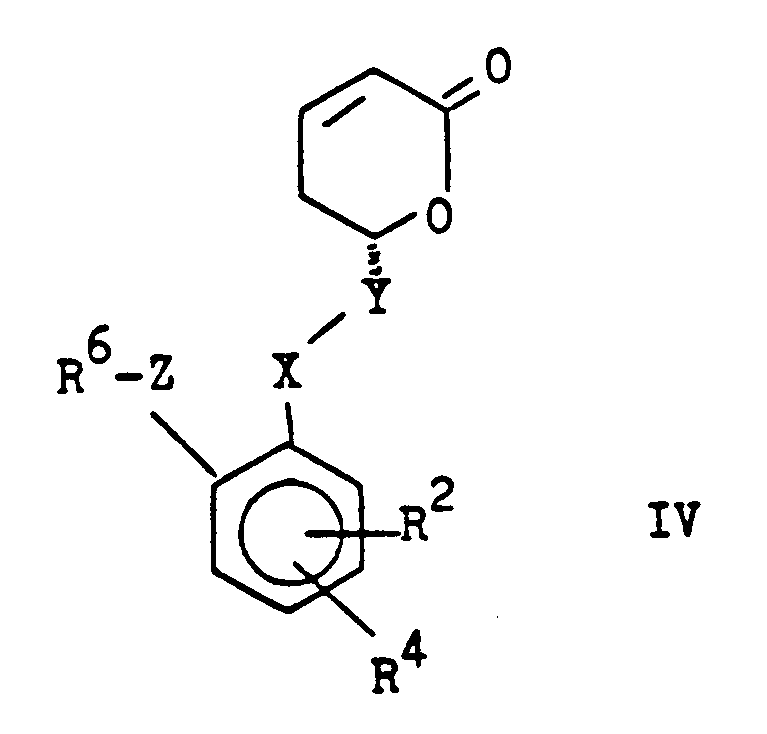
Priority Applications (1)
| Application Number | Priority Date | Filing Date | Title |
|---|---|---|---|
| AT87106522T ATE77623T1 (de) | 1986-05-09 | 1987-05-06 | 4(r)-substituierte 6(s)-phenoxymethyl-, 6(s)-beta-phenylaethyl- und 6(s)-beta-styryl-tetrahydropyran-2-one, ein hochstereoselektives verfahren zu ihrer herstellung, pharmazeutische praeparate auf basis dieser verbindungen und ihre verwendung. |
Applications Claiming Priority (2)
| Application Number | Priority Date | Filing Date | Title |
|---|---|---|---|
| DE3615620 | 1986-05-09 | ||
| DE19863615620 DE3615620A1 (de) | 1986-05-09 | 1986-05-09 | 4(r)-substituierte 6(s)-phenoxymethyl-, 6(s)-(beta)-phenylaethyl-und 6(s)-(beta)-styryl-tetrahydropyran-2-one, ein hochstereoselektives verfahren zu ihrer herstellung, pharmazeutische praeparate auf basis dieser verbindungen und ihre verwendung |
Publications (3)
| Publication Number | Publication Date |
|---|---|
| EP0244833A2 EP0244833A2 (de) | 1987-11-11 |
| EP0244833A3 EP0244833A3 (en) | 1989-10-18 |
| EP0244833B1 true EP0244833B1 (de) | 1992-06-24 |
Family
ID=6300444
Family Applications (1)
| Application Number | Title | Priority Date | Filing Date |
|---|---|---|---|
| EP87106522A Expired - Lifetime EP0244833B1 (de) | 1986-05-09 | 1987-05-06 | 4(R)-substituierte 6(S)-Phenoxymethyl-, 6(S)-beta-Phenyläthyl- und 6(S)-beta-Styryl-tetrahydropyran-2-one, ein hochstereoselektives Verfahren zu ihrer Herstellung, pharmazeutische Präparate auf Basis dieser Verbindungen und ihre Verwendung |
Country Status (6)
| Country | Link |
|---|---|
| US (1) | US4946852A (de) |
| EP (1) | EP0244833B1 (de) |
| JP (1) | JPS62267280A (de) |
| AT (1) | ATE77623T1 (de) |
| DE (2) | DE3615620A1 (de) |
| GR (1) | GR3005769T3 (de) |
Families Citing this family (1)
| Publication number | Priority date | Publication date | Assignee | Title |
|---|---|---|---|---|
| US4789682A (en) * | 1987-03-17 | 1988-12-06 | Merck & Co., Inc. | Antihypercholesterolemic compounds |
Family Cites Families (8)
| Publication number | Priority date | Publication date | Assignee | Title |
|---|---|---|---|---|
| FR2096877B1 (de) * | 1970-07-09 | 1973-08-10 | Hexachimie | |
| JPS53147073A (en) * | 1977-05-24 | 1978-12-21 | Sankyo Co Ltd | Mevalonolactone derivatives |
| JPS5559180A (en) * | 1978-10-30 | 1980-05-02 | Sankyo Co Ltd | 4-hydroxy-2-pyrone ring compound, its preparation, and remedy for hyperlipemia comprising it as active constituent |
| US4710513A (en) * | 1979-08-17 | 1987-12-01 | Merck & Co., Inc. | Substituted pyranone inhibitors of cholesterol synthesis |
| NZ194557A (en) * | 1979-08-17 | 1984-09-28 | Merck & Co Inc | Substituted pyranone derivatives;dihydroxy acids therefrom;pharmaceutical compositions |
| US4440927A (en) * | 1981-06-19 | 1984-04-03 | Merck & Co., Inc. | Process for preparing inhibitors of 3-hydroxy-3-methylglutaryl coenzyme A reductase via a chiral synthon |
| EP0164049B1 (de) * | 1984-06-04 | 1990-12-12 | Merck & Co. Inc. | Herstellungsverfahren von Hemmstoffen der HMG-CoA-Reduktase mit einer 3,5-Dihydroxypentanoatteilstruktur |
| US4661483A (en) * | 1986-05-05 | 1987-04-28 | Merck & Co., Inc. | Antihypercholesterolemic lactone compounds, compositions and use |
-
1986
- 1986-05-09 DE DE19863615620 patent/DE3615620A1/de not_active Withdrawn
-
1987
- 1987-05-06 DE DE8787106522T patent/DE3779959D1/de not_active Expired - Fee Related
- 1987-05-06 EP EP87106522A patent/EP0244833B1/de not_active Expired - Lifetime
- 1987-05-06 AT AT87106522T patent/ATE77623T1/de not_active IP Right Cessation
- 1987-05-08 JP JP62110952A patent/JPS62267280A/ja active Pending
-
1989
- 1989-03-30 US US07/330,979 patent/US4946852A/en not_active Expired - Fee Related
-
1992
- 1992-09-24 GR GR920401780T patent/GR3005769T3/el unknown
Also Published As
| Publication number | Publication date |
|---|---|
| EP0244833A2 (de) | 1987-11-11 |
| DE3615620A1 (de) | 1987-11-12 |
| JPS62267280A (ja) | 1987-11-19 |
| DE3779959D1 (de) | 1992-07-30 |
| ATE77623T1 (de) | 1992-07-15 |
| GR3005769T3 (de) | 1993-06-07 |
| US4946852A (en) | 1990-08-07 |
| EP0244833A3 (en) | 1989-10-18 |
Similar Documents
| Publication | Publication Date | Title |
|---|---|---|
| DE68904083T2 (de) | Hmg-coa-reduktaseinhibitoren. | |
| EP0361273B1 (de) | 7-Substituierte Derivate der 3,5-Dihydroxyhept-6-insäure, Verfahren zu ihrer Herstellung, ihre Verwendung als Arzneimittel, sowie Zwischenprodukte | |
| EP0307342B1 (de) | 3-Desmethyl-mevalonsäurederivate, Verfahren zu ihrer Herstellung, pharmazeutische Präparate auf Basis dieser Verbindungen, ihre Verwendung sowie Zwischenprodukte | |
| DD270529A5 (de) | Verfahren zur herstellung von naphthalinderivaten | |
| EP0052300B1 (de) | C-3 verknüpfte 1,4-Dihydropyridine, ihre Verwendung in Arzneimitteln und Verfahren zu ihrer Herstellung | |
| DE2437487A1 (de) | 7-methoxy-6-thia-tetracycline und verfahren zu ihrer herstellung | |
| PL132249B1 (en) | Process for preparing novel derivatives of 2,4-dihydroxyhex-5-en-1-carboxylic acid | |
| DE2405395A1 (de) | Verfahren zur herstellung von neuen azinen und ihren tautomeren | |
| EP0216127B1 (de) | 6-Phenoxymethyl-4-hydroxytetrahydropyran-2-one, Verfahren zu ihrer Herstellung, ihre Verwendung als Arzneimittel, pharmazeutische Präparate und Zwischenprodukte | |
| EP0330057A2 (de) | Substituierte Pyrimidine | |
| DE3782702T2 (de) | Vorlaeufer von antihypercholesterinaemischen verbindungen. | |
| EP0300249B1 (de) | 7-[1H-Pyrrol-3-yl]-substituierte 3,5-Dihydroxy-heptansäuren, ihre entsprechenden delta-Lactone und Salze, Verfahren zu ihrer Herstellung, ihre Verwendung als Arzneimittel, pharmazeutische Präparate und Zwischenprodukte | |
| EP0244833A2 (de) | 4(R)-substituierte 6(S)-Phenoxymethyl-, 6(S)-beta-Phenyläthyl- und 6(S)-beta-Styryl-tetrahydropyran-2-one, ein hochstereoselektives Verfahren zu ihrer Herstellung, pharmazeutische Präparate auf Basis dieser Verbindungen und ihre Verwendung | |
| AT388162B (de) | 4(r)-substituierte 6(s)-phenoxymethyl-, 6(s)-beta-phenylaethyl- und 6(s)-beta-styryltetrahydropyran-2-one, ein hochstereoselektives verfahren zu ihrer herstellung und pharmazeutische praeparate auf basis dieser verbindungen | |
| DE69105865T2 (de) | Biphenyl-5,5'-bis-Alkansäurederivate, deren Herstellung und Verwendung. | |
| DE3632893A1 (de) | 4-(r)-hydroxy-6(s)-arylthiomethyl-tetrahydropyran-2-one, deren entsprechende sulfoxide und sulfone, verfahren zu ihrer herstellung, ihre verwendung als arzneimittel, pharmazeutische praeparate und zwischenprodukte | |
| CH622777A5 (de) | ||
| EP0019157A1 (de) | 5,6-Dihydro-11-alkylen-morphantridin-6-one und Verfahren zu ihrer Herstellung | |
| EP0023593B1 (de) | Dihydronicotinsäurederivate und deren Herstellung sowie Verwendung | |
| EP0334014A2 (de) | Substituierte Imidazolinone und Imidazolinthione | |
| DE3918364A1 (de) | 3-desmethyl-2-methyl-mevalonsaeurederivate, verfahren zu ihrer herstellung, ihre verwendung als arzneimittel, sowie zwischenprodukte | |
| DE3530798A1 (de) | 6-phenoxymethyl-4-hydroxytetrahydropyran-2-one, verfahren zu ihrer herstellung, ihre verwendung als arzneimittel, pharmazeutische praeparate und zwischenprodukte | |
| EP0350445A1 (de) | Substituierte Azacyclohexyl-Derivate | |
| DE2805485A1 (de) | Alpha-cyano-beta-diketo-verbindungen, verfahren zu ihrer herstellung und diese verbindungen enthaltende arzneipraeparate | |
| DE3006708A1 (de) | Thromboxananaloge und thromboxanzwischenprodukte |
Legal Events
| Date | Code | Title | Description |
|---|---|---|---|
| PUAI | Public reference made under article 153(3) epc to a published international application that has entered the european phase |
Free format text: ORIGINAL CODE: 0009012 |
|
| AK | Designated contracting states |
Kind code of ref document: A2 Designated state(s): AT BE CH DE ES FR GB GR IT LI LU NL SE |
|
| PUAL | Search report despatched |
Free format text: ORIGINAL CODE: 0009013 |
|
| AK | Designated contracting states |
Kind code of ref document: A3 Designated state(s): AT BE CH DE ES FR GB GR IT LI LU NL SE |
|
| 17P | Request for examination filed |
Effective date: 19900208 |
|
| 17Q | First examination report despatched |
Effective date: 19910726 |
|
| GRAA | (expected) grant |
Free format text: ORIGINAL CODE: 0009210 |
|
| AK | Designated contracting states |
Kind code of ref document: B1 Designated state(s): AT BE CH DE ES FR GB GR IT LI LU NL SE |
|
| PG25 | Lapsed in a contracting state [announced via postgrant information from national office to epo] |
Ref country code: GR Free format text: LAPSE BECAUSE OF FAILURE TO SUBMIT A TRANSLATION OF THE DESCRIPTION OR TO PAY THE FEE WITHIN THE PRESCRIBED TIME-LIMIT Effective date: 19920624 |
|
| REF | Corresponds to: |
Ref document number: 77623 Country of ref document: AT Date of ref document: 19920715 Kind code of ref document: T |
|
| REF | Corresponds to: |
Ref document number: 3779959 Country of ref document: DE Date of ref document: 19920730 |
|
| ITF | It: translation for a ep patent filed | ||
| ET | Fr: translation filed | ||
| GBT | Gb: translation of ep patent filed (gb section 77(6)(a)/1977) | ||
| REG | Reference to a national code |
Ref country code: GR Ref legal event code: FG4A Free format text: 3005769 |
|
| PLBE | No opposition filed within time limit |
Free format text: ORIGINAL CODE: 0009261 |
|
| STAA | Information on the status of an ep patent application or granted ep patent |
Free format text: STATUS: NO OPPOSITION FILED WITHIN TIME LIMIT |
|
| PG25 | Lapsed in a contracting state [announced via postgrant information from national office to epo] |
Ref country code: GB Effective date: 19930506 Ref country code: ES Free format text: LAPSE BECAUSE OF THE APPLICANT RENOUNCES Effective date: 19930506 Ref country code: AT Effective date: 19930506 |
|
| PG25 | Lapsed in a contracting state [announced via postgrant information from national office to epo] |
Ref country code: SE Effective date: 19930507 |
|
| PG25 | Lapsed in a contracting state [announced via postgrant information from national office to epo] |
Ref country code: LU Free format text: LAPSE BECAUSE OF NON-PAYMENT OF DUE FEES Effective date: 19930531 Ref country code: LI Effective date: 19930531 Ref country code: CH Effective date: 19930531 Ref country code: BE Effective date: 19930531 |
|
| 26N | No opposition filed | ||
| BERE | Be: lapsed |
Owner name: HOECHST A.G. Effective date: 19930531 |
|
| PG25 | Lapsed in a contracting state [announced via postgrant information from national office to epo] |
Ref country code: NL Effective date: 19931201 |
|
| GBPC | Gb: european patent ceased through non-payment of renewal fee |
Effective date: 19930506 |
|
| NLV4 | Nl: lapsed or anulled due to non-payment of the annual fee | ||
| PG25 | Lapsed in a contracting state [announced via postgrant information from national office to epo] |
Ref country code: FR Effective date: 19940131 |
|
| REG | Reference to a national code |
Ref country code: CH Ref legal event code: PL |
|
| PG25 | Lapsed in a contracting state [announced via postgrant information from national office to epo] |
Ref country code: DE Effective date: 19940201 |
|
| REG | Reference to a national code |
Ref country code: FR Ref legal event code: ST |
|
| REG | Reference to a national code |
Ref country code: GR Ref legal event code: MM2A Free format text: 3005769 |
|
| EUG | Se: european patent has lapsed |
Ref document number: 87106522.3 Effective date: 19931210 |
|
| PG25 | Lapsed in a contracting state [announced via postgrant information from national office to epo] |
Ref country code: IT Free format text: LAPSE BECAUSE OF NON-PAYMENT OF DUE FEES;WARNING: LAPSES OF ITALIAN PATENTS WITH EFFECTIVE DATE BEFORE 2007 MAY HAVE OCCURRED AT ANY TIME BEFORE 2007. THE CORRECT EFFECTIVE DATE MAY BE DIFFERENT FROM THE ONE RECORDED. Effective date: 20050506 |