EP0052300B1 - C-3 verknüpfte 1,4-Dihydropyridine, ihre Verwendung in Arzneimitteln und Verfahren zu ihrer Herstellung - Google Patents
C-3 verknüpfte 1,4-Dihydropyridine, ihre Verwendung in Arzneimitteln und Verfahren zu ihrer Herstellung Download PDFInfo
- Publication number
- EP0052300B1 EP0052300B1 EP81109456A EP81109456A EP0052300B1 EP 0052300 B1 EP0052300 B1 EP 0052300B1 EP 81109456 A EP81109456 A EP 81109456A EP 81109456 A EP81109456 A EP 81109456A EP 0052300 B1 EP0052300 B1 EP 0052300B1
- Authority
- EP
- European Patent Office
- Prior art keywords
- carbon atoms
- different
- phenyl
- alkyl
- hydroxyl
- Prior art date
- Legal status (The legal status is an assumption and is not a legal conclusion. Google has not performed a legal analysis and makes no representation as to the accuracy of the status listed.)
- Expired
Links
- 0 *C1C(**O)=C(*)N(*)C(*)=C1* Chemical compound *C1C(**O)=C(*)N(*)C(*)=C1* 0.000 description 2
Classifications
-
- C—CHEMISTRY; METALLURGY
- C07—ORGANIC CHEMISTRY
- C07D—HETEROCYCLIC COMPOUNDS
- C07D211/00—Heterocyclic compounds containing hydrogenated pyridine rings, not condensed with other rings
- C07D211/04—Heterocyclic compounds containing hydrogenated pyridine rings, not condensed with other rings with only hydrogen or carbon atoms directly attached to the ring nitrogen atom
- C07D211/80—Heterocyclic compounds containing hydrogenated pyridine rings, not condensed with other rings with only hydrogen or carbon atoms directly attached to the ring nitrogen atom having two double bonds between ring members or between ring members and non-ring members
- C07D211/84—Heterocyclic compounds containing hydrogenated pyridine rings, not condensed with other rings with only hydrogen or carbon atoms directly attached to the ring nitrogen atom having two double bonds between ring members or between ring members and non-ring members with hetero atoms or with carbon atoms having three bonds to hetero atoms, with at the most one bond to halogen directly attached to ring carbon atoms
- C07D211/90—Carbon atoms having three bonds to hetero atoms with at the most one bond to halogen
-
- A—HUMAN NECESSITIES
- A61—MEDICAL OR VETERINARY SCIENCE; HYGIENE
- A61P—SPECIFIC THERAPEUTIC ACTIVITY OF CHEMICAL COMPOUNDS OR MEDICINAL PREPARATIONS
- A61P11/00—Drugs for disorders of the respiratory system
-
- A—HUMAN NECESSITIES
- A61—MEDICAL OR VETERINARY SCIENCE; HYGIENE
- A61P—SPECIFIC THERAPEUTIC ACTIVITY OF CHEMICAL COMPOUNDS OR MEDICINAL PREPARATIONS
- A61P13/00—Drugs for disorders of the urinary system
- A61P13/02—Drugs for disorders of the urinary system of urine or of the urinary tract, e.g. urine acidifiers
-
- A—HUMAN NECESSITIES
- A61—MEDICAL OR VETERINARY SCIENCE; HYGIENE
- A61P—SPECIFIC THERAPEUTIC ACTIVITY OF CHEMICAL COMPOUNDS OR MEDICINAL PREPARATIONS
- A61P15/00—Drugs for genital or sexual disorders; Contraceptives
-
- A—HUMAN NECESSITIES
- A61—MEDICAL OR VETERINARY SCIENCE; HYGIENE
- A61P—SPECIFIC THERAPEUTIC ACTIVITY OF CHEMICAL COMPOUNDS OR MEDICINAL PREPARATIONS
- A61P9/00—Drugs for disorders of the cardiovascular system
- A61P9/06—Antiarrhythmics
-
- A—HUMAN NECESSITIES
- A61—MEDICAL OR VETERINARY SCIENCE; HYGIENE
- A61P—SPECIFIC THERAPEUTIC ACTIVITY OF CHEMICAL COMPOUNDS OR MEDICINAL PREPARATIONS
- A61P9/00—Drugs for disorders of the cardiovascular system
- A61P9/08—Vasodilators for multiple indications
-
- A—HUMAN NECESSITIES
- A61—MEDICAL OR VETERINARY SCIENCE; HYGIENE
- A61P—SPECIFIC THERAPEUTIC ACTIVITY OF CHEMICAL COMPOUNDS OR MEDICINAL PREPARATIONS
- A61P9/00—Drugs for disorders of the cardiovascular system
- A61P9/10—Drugs for disorders of the cardiovascular system for treating ischaemic or atherosclerotic diseases, e.g. antianginal drugs, coronary vasodilators, drugs for myocardial infarction, retinopathy, cerebrovascula insufficiency, renal arteriosclerosis
-
- A—HUMAN NECESSITIES
- A61—MEDICAL OR VETERINARY SCIENCE; HYGIENE
- A61P—SPECIFIC THERAPEUTIC ACTIVITY OF CHEMICAL COMPOUNDS OR MEDICINAL PREPARATIONS
- A61P9/00—Drugs for disorders of the cardiovascular system
- A61P9/12—Antihypertensives
Definitions
- the invention relates to new dimeric 1,4-dihydropyridines which are linked to one another in the 3-position, to several processes for their preparation and to their use in medicaments, in particular in medicaments with a circulatory effect.
- symmetrical connections ie connections in which Y and Y ', R 3 and R 3 ' and R 4 and R 4 'are identical, can be produced.
- symmetrical compounds of the general formula in which Y represents a carbonyl group can also be prepared.
- 1,4-dihydropyridine hydroxy derivatives of the general formula II and the 1,4-dihydropyridine-3-carboxylic acid derivatives of the general formula 111 used as starting materials are known or can be prepared by known methods (cf. DE-OS 2 117 571).
- the 1,4-dihydropyridinecarboxylic acids of the general formula IV are known or can be prepared by known methods (cf. EP-A-0 011 706).
- the bifunctional compounds of the general formula V are also known or can be prepared by known methods (cf. Beilstein, volume I, 464-502).
- the ylidene- ⁇ -keto esters of the general formula VI are known or can be prepared by processes known from the literature [cf. G. Jones, The "Knoevenagel-Condensation,” in Org. Reactions Vol. XV, 204ff. (1967)].
- enaminocarboxylic acid esters of the general formula VII used as starting materials are known or can also be prepared by methods known from the literature [cf. A.C. Cope, J. Am. Chem. Soc. 67, 1017 (1945)].
- All aprotic organic solvents are suitable as diluents for use in process variants A and B.
- These preferably include ethers such as dioxane, diethyl ether, tetrahydrofuran, glycol dimethyl ether or hydrocarbons such as benzene, toluene, xylene or dimethylformamide, dimethyl sulfoxide, acetonitrile, pyridine or hexamethylphosphoric acid diamide.
- alcohols e.g. B. methanol, ethanol or isopropanol can be used advantageously.
- reaction temperatures can be varied within a wide range. Generally one works between 0 and 180 ° C, preferably between 20 and 120 ° C.
- the reactions can be carried out at normal pressure or at elevated pressure. Generally one works at normal pressure.
- the compounds of general formula 1 according to the invention have valuable pharmacological properties. Due to their circulatory effects, they can be used as antihypertensive agents, as vasodilators, as cerebral therapeutic agents and as coronary therapeutic agents. Particularly noteworthy is their long-lasting effect, which reduces the frequency of application in the treatment of circulatory diseases. They are an asset to the pharmaceutical industry.
- the new active compounds can be converted into the customary formulations in a known manner, such as tablets, capsules, dragees, pills, granules, aerosols, syrups, emulsions, suspensions and solutions, using inert, non-toxic, pharmaceutically suitable excipients or solvents.
- the therapeutically active compound should be present in a concentration of about 0.5 to 90% by weight of the total mixture, i. H. in amounts sufficient to achieve the dosage range indicated.
- the formulations are prepared, for example, by stretching the active ingredients with solvents and / or carriers, optionally using emulsifiers and / or dispersants, z. B. in the case of the use of water as a diluent, organic solvents can optionally be used as auxiliary solvents.
- tablets can of course also contain additives, such as sodium citrate, calcium carbonate and dicalcium phosphate, together with various additives, such as starch, preferably potato starch, gelatin and the like, in addition to the carrier substances mentioned.
- Lubricants such as magnesium stearate, sodium lauryl sulfate and talc can also be used for tableting.
- the active ingredients can be mixed with various flavor enhancers or colorants in addition to the abovementioned auxiliaries.
- solutions of the active ingredients can be used using suitable liquid carrier materials.
- 25 mmol of ethyl 2,6-dimethyl-5- (4-hydroxybutoxy) carbonyl-4- (3-nitrophenyl) -1,4-dihydropyridine-3-carboxylate are combined with 25 mmol of dicyclohexylcarbodiimide and 25 mmol of 2,6-dimethyl 5-methoxycarbonyl-4- (2-chlorophenyl) -1,4-dihydropyridine-3-carboxylic acid dissolved in 50 ml of anhydrous dimethylformamide and heated to 100 ° C. for 4 hours with the addition of 0.2 g of 4-dimethylaminopyridine. It is then suctioned off, the filtrate is diluted with methylene chloride and shaken out with aqueous NaOH and HCl, dried and evaporated.
- ⁇ 1.2 (t, 3H), 1.4-1.8 (m, 4H), 2.4 (s, 12H), 3.6 (s, 3H), 3.9-4.4 (m, 6H), 5.2 (s, 1H), 5.4 (s, 1H), 5.8 (s, NH), 6.3 (s, NH), 6.9-8 , 3 (m, 8H).
- ⁇ 1.0-1.4 (m, 8H), 1.4-1.7 (m, 4H), 2.2 (2s, 12H), 3.6 (s, 6H), 4.0 ( t, 4H), 5.4 (s, 2H), 5.9 (s, NH), 6.9-7.5 (m, 8H).
- ⁇ 1.2 (t, 6H), 2.2 (s, 12H), 2.4-2.8 (m, 4H), 3.9-4.5 (m, 8H), 5.6 ( s, 2H), 6.7 (s, NH), 7.1-7.7 (m, 8H).
- ⁇ 1.2 (t, 6H), 2.4 (s, 12H), 2.7-3.1 (m, 4H), 3.9-4.5 (m, 8H), 5.1 ( s, 2H), 6.4 (s, NH), 7.2-8.2 (m, 8H).
- ⁇ 0.8-1.5 (m, 12H), 2.3 (2s, 12H), 3.5 (s, 6H), 3.6-4.1 (m, 4H), 5.8 ( s, 2H), 6.1 (s, NH), 7.1-7.8 (m, 14H).
Landscapes
- Health & Medical Sciences (AREA)
- Chemical & Material Sciences (AREA)
- Organic Chemistry (AREA)
- Engineering & Computer Science (AREA)
- Bioinformatics & Cheminformatics (AREA)
- Life Sciences & Earth Sciences (AREA)
- Veterinary Medicine (AREA)
- General Chemical & Material Sciences (AREA)
- Medicinal Chemistry (AREA)
- Nuclear Medicine, Radiotherapy & Molecular Imaging (AREA)
- Chemical Kinetics & Catalysis (AREA)
- Pharmacology & Pharmacy (AREA)
- Public Health (AREA)
- Animal Behavior & Ethology (AREA)
- General Health & Medical Sciences (AREA)
- Cardiology (AREA)
- Heart & Thoracic Surgery (AREA)
- Urology & Nephrology (AREA)
- Vascular Medicine (AREA)
- Pulmonology (AREA)
- Endocrinology (AREA)
- Reproductive Health (AREA)
- Pharmaceuticals Containing Other Organic And Inorganic Compounds (AREA)
- Hydrogenated Pyridines (AREA)
- Pyridine Compounds (AREA)
- Plural Heterocyclic Compounds (AREA)
Description
- Die Erfindung betrifft neue dimere 1,4-Dihydropyridine, die in 3-Position miteinander verknüpft sind, mehrere Verfahren zu ihrer Herstellung sowie ihre Verwendung in Arzneimitteln, insbesondere in Arzneimitteln mit kreislaufbeeinflussender Wirkung.
- Es ist bereits bekannt, daß bestimmte 1,4-Dihydropyridin-Derivate interessante pharmakologische Eigenschaften aufweisen [vgl. F. Bossert et al., Naturwissenschaften 58, 578 (1971) und DE-OS 2117571].
- Die Erfindung betrifft neue C-3 verknüpfte 1,4-Dihydropyridine der allgemeinen Formel I

- R und R' gleich oder verschieden sind und jeweils für einen Phenylrest oder für einen Thienyl-, Furyl-oder Pyridylrest stehen, wobei der Phenylrest gegebenenfalls ein oder zwei gleiche oder verschiedene Substituenten aus der Gruppe Nitro, Cyano, Acido, Halogen, Trifluormethyl, Hydroxy, Amino, Alkyl, Alkoxy, Alkylamino oder Alkylmercapto mit jeweils 1 oder 2 Kohlenstoffatomen in den Alkylgruppen, substituiert ist,
- R1 und R1' gleich oder verschieden sind, jeweils für einen geradkettigen oder verzweigten Kohlenwasserstoffrest mit bis zu 6 Kohlenstoffatomen stehen, der gegebenenfalls durch ein Sauerstoffatom in der Kette unterbrochen ist und der gegebenenfalls substituiert ist durch Fluor, Chlor, Hydroxy, Phenyl oder Phenoxy,
- R2, R2', R4 und R4' gleich oder verschieden sind und jeweils für Wasserstoff, geradkettigen oder verzweigten Alkylrest mit bis zu 4 Kohlenstoffatomen stehen, der gegebenenfalls durch Fluor, Chlor, Hydroxy, Phenyl oder Amino substituiert ist,
- R3 und R3' gleich oder verschieden sind und jeweils für Wasserstoff, Alkyl mit 1 bis 4 Kohlenstoffatomen, Phenyl, Benzyl oder Phenethyl, gegebenenfalls substituiert durch Hydroxy, Fluor oder Chlor, Y und Y' jeweils gleich oder verschieden sind und die Bedeutung - COO -, - CONH -, - CO - oder - SO2- haben, und
- X ein Brückenglied bedeutet, das aus einer bis zehn CHz-Gruppen als Kettenglied besteht, wobei keine dieser CH2-Gruppen ein Ringglied sein darf, und wobei dieses Brückenglied zusätzlich in beliebiger Reihenfolge 1 bis 3 gleiche oder verschiedene Kettenglieder aus der Gruppe O, S, CO, CS, NR5, C(R6)2, CH = N, Phenylen, Naphthylen, Pyrrylen, Cycloalkylen mit 5 bis 7 Kohlenstoffatomen, Piperazinylen, Piperidinylen, Pyrrolidinylen oder Morpholinylen enthalten kann, wobei R5 für Wasserstoff, Benzyl oder Alkyl mit 1 bis 4 Kohlenstoffatomen steht und R6 für Wasserstoff, Benzyl, Phenyl, Fluor, Chlor, Alkyl mit 1 bis 4 Kohlenstoffatomen, Hydroxy, Trifluormethyl, Cyano, Carboxy oder Amino steht,
- Die erfindungsgemäßen Verbindungen der allgemeinen Formel I können erhalten werden, indem man
- A) 1,4-Dihydropyridinhydroxyderivate der allgemeinen Formel II

- R, R1, R2, R3, R4, Y und X die oben angegebene Bedeutung haben,
- in einem inerten organischen Lösungsmittel in Gegenwart von wasserbindenden Mitteln mit 1,4-Dihydropyridin-3-carbonsäurederivaten der allgemeinen Formel III

- R', R1', R2', R3', R4' und Y' die oben angegebene Bedeutung besitzen, wobei Y' nicht für eine Carbonylgruppe steht,
- in äquivalenten Mengen unter Wasserabspaltung bei Temperaturen zwischen 0 und 180°C umsetzt, oder
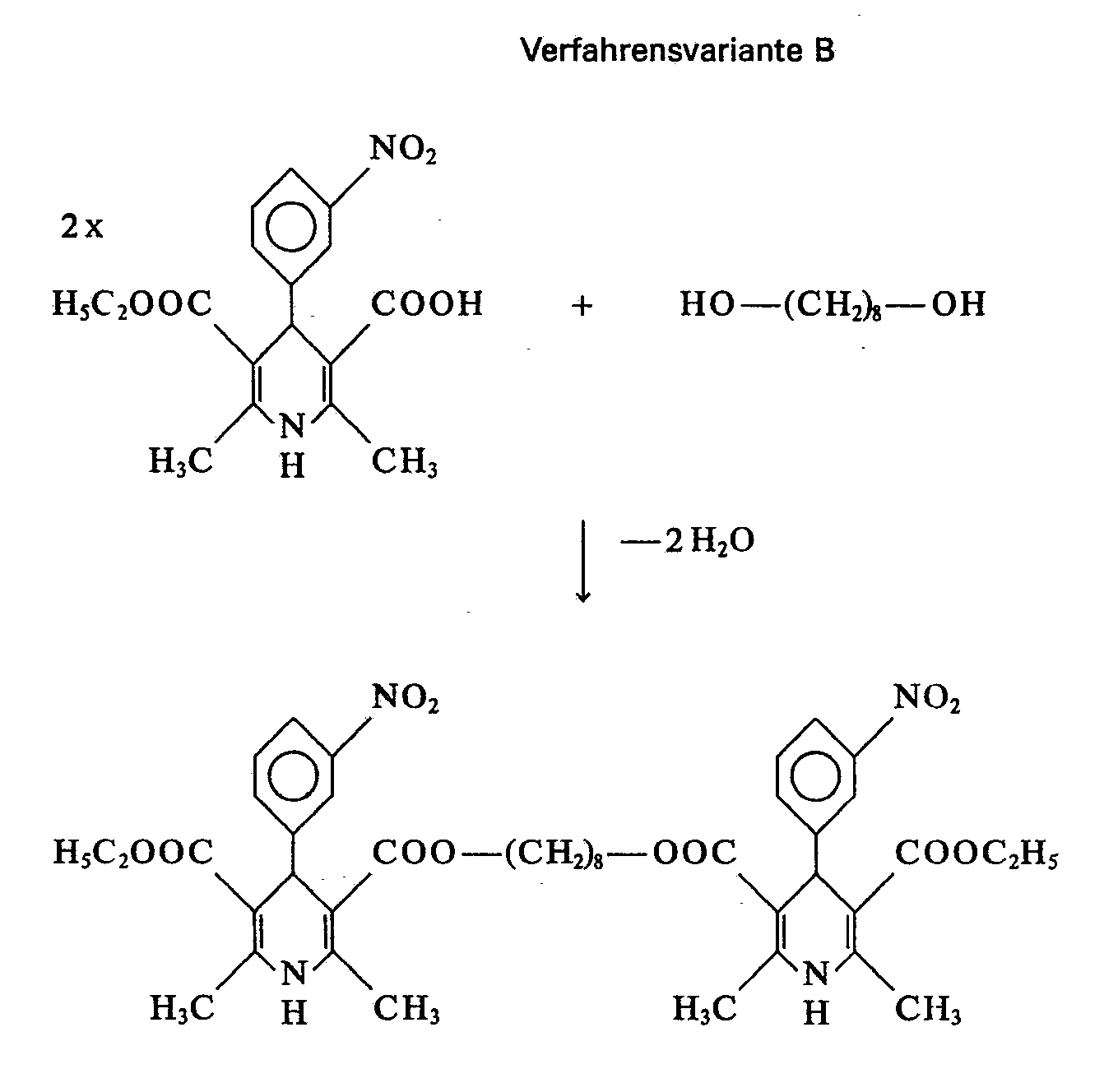
- B) 1,4-Dihydropyridincarbonsäuren der allgemeinen Formel IV

- R, R1, R2, R3 und R4 die oben angegebene Bedeutung haben,
- in Gegenwart eines inerten organischen Lösungsmittels und gegebenenfalls in Gegenwart eines Kondensationsmittels mit einer bifunktionellen Verbindung der allgemeinen Formel V

- X die oben angegebene Bedeutung hat und
- Z und Z' jeweils gleich oder verschieden sind und für Hydroxyl, Mercapto oder den Rest NR5 stehen, wobei R5 die oben angegebene Bedeutung besitzt,
- in einem molaren Verhältnis von etwa 2:1 bei Temperaturen zwischen 0 und 180°C umsetzt, wobei nach dieser Variante nur Verbindungen der allgemeinen Formel I erhalten werden, in denen Y und Y' nicht für eine Carbonylgruppe stehen, oder
- C) Yliden-ß-ketoester der allgemeinen Formel VI

- R, R1 und R2 die oben angegebene Bedeutung haben,
- mit Enaminocarbonsäureestern der allgemeinen Formel VII

- R3, R3', R4, R4', Y und Y' die oben angegebene Bedeutung haben,
in Gegenwart von inerten organischen Lösungsmitteln in molaren Verhältnissen von etwa 2:1 bei Temperaturen zwischen 0 und 180°C umsetzt. - Nach dieser Verfahrensvariante C) lassen sich vorzugsweise symmetrische Verbindungen, d. h. Verbindungen in denen jeweils Y und Y', R3 und R3' und R4 und R4' identisch sind, herstellen. Nach dieser Verfahrensvariante C) lassen sich auch symmetrische Verbindungen der allgemeinen Formel in welcher Y eine Carbonylgruppe bedeutet, herstellen.
- Je nach Art der eingesetzten Ausgangsstoffe kann die Synthese der erfindungsgemäßen Verbindungen der allgemeinen Formel nach den einzelnen Verfahrensvarianten durch folgendes Formelschema wiedergegeben werden:


- Die als Ausgangsstoffe verwendeten 1,4-Dihydropyridinhydroxyderivate der allgemeinen Formel II und die 1,4-Dihydropyridin-3-carbonsäurederivate der allgemeinen Formel 111 sind bekannt oder können nach bekannten Methoden hergestellt werden (vgl. DE-OS 2 117 571).
- Die 1,4-Dihydropyridincarbonsäuren der allgemeinen Formel IV sind bekannt oder können nach bekannten Methoden hergestellt werden (vgl. EP-A-0 011 706).
- Die bifunktionellen Verbindungen der allgemeinen Formel V sind ebenfalls bekannt bzw. können nach bekannten Methoden hergestelllt werden (vgl. Beilstein, Band I, 464-502).
- Die Yliden-ß-ketoester der allgemeinen Formel VI sind bekannt oder können nach literaturbekannten Verfahren hergestellt werden [vgl. G. Jones, The »Knoevenagel-Condensation«, in Org. Reactions Vol. XV, 204ff. (1967)].
- Die als Ausgangsstoffe verwendeten Enaminocarbonsäureester der allgemeinen Formel VII sind bekannt oder können ebenfalls nach literaturbekannten Methoden hergestellt werden [vgl. A. C. Cope, J. Am. Chem. Soc. 67, 1017 (1945)].
- Als Verdünnungsmittel zur Verwendung in den Verfahrensvarianten A und B kommen alle aprotischen organischen Lösungsmittel in Frage. Hierzu gehören vorzugsweise Ether wie Dioxan, Diethylether, Tetrahydrofuran, Glykoldimethylether oder Kohlenwasserstoffe wie Benzol, Toluol, Xylol oder Dimethylformamid, Dimethylsulfoxid, Acetonitril, Pyridin oder Hexamethylphosphorsäurediamid.
- Im Falle der Verfahrensvariante C können außerdem noch Alkohole, z. B. Methanol, Ethanol oder lsopropanol vorteilhaft eingesetzt werden.
- Als wasserbindende Mittel (Verfahrensvarianten A und C) können alle hierfür üblichen Reagentien verwendet werden, insbesondere ist die Verwendung von Dicyclohexylcarbodiimid und der Zusatz eines Katalysators wie z. B. 4-Dimethylaminopyridin, sehr vorteilhaft.
- Die Reaktionstemperaturen können in einem größeren Bereich variiert werden. Im allgemeinen arbeitet man zwischen 0 und 180°C, vorzugsweise zwischen 20 und 120°C.
- Die Umsetzungen können bei Normaldruck oder auch bei erhöhtem Druck durchgeführt werden. Im allgemeinen arbeitet man bei Normaldruck.
- Die erfindungsgemäßen Verbindungen der allgemeinen Formel 1 besitzen wertvolle pharmakologische Eigenschaften. Aufgrund ihrer kreislaufbeeinflussenden Wirkung können sie als antihypertensive Mittel, als Vasodilatatoren, als Zerebraltherapeutika und als Coronartherapeutika Verwendung finden. Besonders hervorgehoben sei ihre langanhaltende Wirkung, welche die Applikationshäufigkeit bei der Behandlung von Kreislauferkrankungen reduziert. Sie stellen somit eine Bereicherung der Pharmazie dar.
- Im einzelnen seien folgende Hauptwirkungen genannt:
- 1. Die Verbindungen bewirken bei parenteraler, oraler und perlingualer Zugabe eine deutliche und langanhaltende Erweiterung der Coronargefäße. Diese Wirkung auf die Coronargefäße wird durch einen gleichzeitigen nitritähnlichen herzentlastenden Effekt verstärkt.
Sie beeinflussen bzw. verändern den Herzstoffwechsel im Sinne einer Energieersparnis. - 2. Die Erregbarkeit des Reizbildungs- und Erregungsleitungssystems innerhalb des Herzens wird herabgesetzt, so daß eine in therapeutischen Dosen nachweisbare Antiflimmerwirkung resultiert.
- 3. Der Tonus der glatten Muskulatur der Gefäße wird unter der Wirkung der Verbindungen stark vermindert. Diese gefäßspasmolytische Wirkung kann im gesamten Gefäßsystem stattfinden, oder sich mehr oder weniger isoliert in umschriebenen Gefäßgebieten (wie z. B. dem Zentralnervensystem) manifestieren.
- 4. Die Verbindungen senken den Blutdruck von normotonen und hypertonen Tieren und können somit als antihypertensive Mittel verwendet werden.
- 5. Die Verbindungen haben stark muskulär-spasmolytische Wirkungen, die an der glatten Muskulator des Magens, Darmtraktes, des Urogenitaltraktes und des Respirationssystems deutlich werden.
- Die neuen Wirkstoffe können in bekannter Weise in die üblichen Formulierungen übergeführt werden, wie Tabletten, Kapseln, Dragees, Pillen, Granulate, Aerosole, Sirupe, Emulsionen, Suspensionen und Lösungen, unter Verwendung inerter, nicht-toxischer, pharmazeutisch geeigneter Trägerstoffe oder Lösungsmittel. Hierbei soll die therapeutisch wirksame Verbindung jeweils in einer Konzentration von etwa 0,5 bis 90 Gew.-%der Gesamtmischung vorhanden sein, d. h. in Mengen, die ausreichend sind, um den angegebenen Dosierungsspielraum zu erreichen.
- Die Formulierungen werden beispielsweise hergestellt durch Verstrecken der Wirkstoffe mit Lösungsmitteln und/oder Trägerstoffen, gegebenenfalls unter Verwendung von Emulgiermitteln und/ oder Dispergiermitteln, wobei z. B. im Fall der Benutzung von Wasser als Verdünnungsmittel gegebenenfalls organische Lösungsmittel als Hilfslösungsmittel verwendet werden können.
- Als Hilfsstoffe seien beispielsweise aufgeführt:
- Wasser, nicht-toxische organische Lösungsmittel, wie Paraffine (z. B. Erdölfraktionen), pflanzliche Öle (z. B. Erdnuß-/Sesamöl), Alkohole (z. B. Ethylalkohol, Glycerin), Glykole (z. B. Propylenglykol, Polyethylenglykol), feste Trägerstoffe, wie z. B. natürliche Gesteinsmehle (z. B. Kaoline, Tonerden, Talkum, Kreide), synthetische Gesteinsmehle (z. B. hochdisperse Kieselsäure, Silikate), Zucker (z. B. Roh-, Milch- und Traubenzucker), Emulgiermittel (z. B. Polyoxyethylen-Fettsäure-Ester, Polyoxyethylen-Fettalkohol-Ether, Alkylsulfonate und Arylsulfonate), Dispergiermittel (z. B. Lignin, Sulfitablaugen, Methylcellulose, Stärke und Polyvinylpyrrolidon) und Gleitmittel (z. B. Magnesiumstearat, Talkum, Stearinsäure und Natriumlaurylsulfat).
- Die Applikation erfolgt in üblicher Weise, vorzugsweise oral oder parenteral, insbesondere perlingual oder intravenös. Im Falle der oralen Anwendung können Tabletten selbstverständlich außer den genannten Trägerstoffen auch Zusätze, wie Natriumcitrat, Calciumcarbonat und Dicalciumphosphat zusammen mit verschiedenen Zuschlagstoffen, wie Stärke, vorzugsweise Kartoffelstärke, Gelatine und dergleichen enthalten. Weiterhin können Gleitmittel, wie Magnesiumstearat, Natriumlaurylsulfat und Talkum zum Tablettieren mitverwendet werden. Im Falle wäßriger Suspensionen und/oder Elixiere, die für orale Anwendungen gedacht sind, können die Wirkstoffe außer den obengenannten Hilfsstoffen mit verschiedenen Geschmacksaufbesserern oder Farbstoffen versetzt werden.
- Für den Fall der parenteralen Anwendung können Lösungen der Wirkstoffe unter Verwendung geeigneter flüssiger Trägermaterialien eingesetzt werden.
- Im allgemeinen hat es sich als vorteilhaft erwiesen, bei intravenöser Applikation Mengen von etwa 0,01 bis 10 mg/kg, vorzugsweise etwa 0,05 bis 5 mg/kg Körpergewicht pro Tag zur Erzielung wirksamer Ergebnisse zu verabreichen, und bei oraler Applikation beträgt die Dosierung etwa 0,05 bis 20 mg/kg, vorzugsweise 0,5 bis 5 mg/kg Körpergewicht pro Tag.
- Trotzdem kann es gegebenenfalls erforderlich sein, von den genannten Mengen abzuweichen, und zwar in Abhängigkeit vom Körpergewicht des Versuchstieres bzw. der Art des Applikationsweges, aber auch aufgrund der Tierart und deren individuellem Verhalten gegenüber dem Medikament bzw. deren Art von dessen Formulierung und dem Zeitpunkt bzw. Intervall, zu welchem die Verabreichung erfolgt. So kann es in einigen Fällen ausreichend sein, mit weniger als der vorgenannten Mindestmenge auszukommen, während in anderen Fällen die genannte obere Grenze überschritten werden muß. Im Falle der Applikation größerer Mengen kann es empfehlenswert sein, diese in mehrere Einzelgaben über den Tag zu verteilen. Für die Applikation in der Humanmedizin ist der gleiche Dosierungsspielraum vorgesehen. Sinngemäß gelten hierbei auch die obigen Ausführungen.
-

- 25 mmol 2,6-Dimethyl-5-(4-hydroxybutoxy)-carbonyl-4-(3-nitrophenyl)-1,4-dihydropyridin-3-carbonsäureethylester werden zusammen mit 25 mmol Dicyclohexylcarbodiimid und 25 mmol 2,6-Dimethyl-5-methoxycarbonyl-4-(2-chlorphenyl)-1,4-dihydropyridin-3-carbonsäure in 50 ml wasserfreiem Dimethylformamid gelöst und unter Zusatz von 0,2 g 4-Dimethylaminopyridin 4 Stunden auf 100°C erhitzt. Anschließend wird abgesaugt, das Filtrat mit Methylenchlorid verdünnt und jeweils mit wäßriger NaOH und HCI ausgeschüttelt, getrocknet und einrotiert.
- Anschließend wird an Kieselgel mit Ether chromatographiert.
- Ausbeute: 25%, amorpher Schaum.
- δ= 1,2 (t, 3H), 1,4-1,8 (m, 4H), 2,4 (s, 12H), 3,6 (s, 3 H), 3,9-4,4 (m, 6 H), 5,2 (s, 1 H), 5,4 (s, 1 H), 5,8 (s, NH), 6,3 (s, NH), 6,9-8,3 (m, 8H).
-

- 50 mmol 2,6-Dimethyl-5-methoxycarbonyl-4-(3-nitrophenyl)-1,4-dihydropyridin-3-carbonsäure werden zusammen mit 50 mmol Dicyclohexylcarbodiimid und 25 mmol Hexandiol-1,6 in 50 ml wasserfreiem Dimethylformamid gelöst und unter Zusatz von 0,2 g 4-Dimethylaminopyridin 4 Stunden bei 100°C gerührt. Anschließend wird abgesaugt, das Filtrat mit Methylenchlorid verdünnt und jeweils mit wäßrigem NaOH und HCI ausgeschüttelt, getrocknet einrotiert und aus Methanol umkristallisiert.
- Schmelzpunkt: 177-179°C; Ausbeute: 37%
-

- 25 mmol Bis-(3-aminocrotonsäure)-1,3-propandiylester werden zusammen mit 50 mmol 2-Chlorbenzylidenacetessigsäuremethylester in 100 ml absolutem Ethanol 14 Stunden unter N2 am Rückfluß gekocht.
- Nach dem Erkalten wird das Lösungsmittel im Vakuum abdestilliert und mit 50%igem wäßrigem Ethanol aufgenommen. Der halbfeste Rückstand wurde aus Methanol umkristallisiert.
- Schmelzpunkt: 200 bis 203°C; Ausbeute: 50%
-

- 100 mmol 2,6-Dimethyl-5-ethoxycarbonyl-4-(3-nitrophenyl)-1,4-dihydropyridin-3-carbonsäure werden analog Beispiel 2 mit 50 mmol Triethylenglykol umgesetzt und aufgearbeitet.
- Schmelzpunkt: 113 bis 120°C; Ausbeute: 32%
-

- 100 mmol 2,6-Dimethyl-5-ethoxycarbonyl-4-(3-nitrophenyl)-1,4-dihydropyridin-3-carbonsäure werden mit 50 mmol 1,10-Decandiol analog Beispiel 2 umgesetzt.
- Schmelzpunkt: 121 bis 125°C; Ausbeute: 35%
-

- 100 mmol 2,6-Dimethyl-5-ethoxycarbonyl-4-(3-nitrophenyl)-1,4-dihydropyridin-3-carbonsäure werden mit 50 mmol 1,8-Octandiol analog Beispiel 2 umgesetzt.
- Schmelzpunkt: 170 bis 184°C; Ausbeute: 47%.
-

- 100 mmol 2,6-Dimethyl-5-ethoxycarbonyl-4-(3-nitrophenyl)-1,4-dihydropyridin-3-carbonsäure werden mit 50 mmol 1,5-Pentandiol analog Beispiel 2 umgesetzt.
- Schmelzpunkt: 145°C; Ausbeute: 11 %
-

- 100 mmol 2,6-Dimethyl-5-ethoxycarbonyl-4-(3-nitrophenyl)-1,4-dihydropyridin-3-carbonsäure werden mit 50 mmol 1,4-Bis-(2-hydroxyethoxy)-benzol analog Beispiel 2 umgesetzt.
- Schmelzpunkt: 160 bis 190°C (Zers.); Ausbeute: 49%
-

- 100 mmol 2,6-Dimethyl-5-ethoxycarbonyl-4-(3-nitrophenyl)-1,4-dihydropyridin-3-carbonsäure werden analog Beispiel 2 mit 50 mmol Tetraethylenglykol umgesetzt und aufgearbeitet.
- Schmelzpunkt: 93 bis 98°C; Ausbeute: 16%
-

- 25 mmol Bis-(3-aminocrotonsäure)-1,6-hexandiylester werden mit 50 mmol 3-Nitrobenzylidenacetessigsäurediisopropylester analog Beispiel 3 umgesetzt.
- Schmelzpunkt: 120-136°C; Ausbeute: 83%
-

- 25 mmol Bis-(3-aminocrotonsäure)-1,6-hexandiyiester werden mit 50 mmol 2-Nitrobenzylidenacetessigsäuremethylester analog Beispiel 3 umgesetzt.
- Schmelzpunkt: 88-95°C; Ausbeute: 82%
-

- 25 mmol Bis-(3-aminocrotonsäure)-1,6-hexandiylester werden mit 50 mmol 2-Chlorbenzylidenacetessigsäuremethylester analog Beispiel 3 umgesetzt.
- Schmelzpunkt: 152-158°C; Ausbeute: 27%
-

- 100 mmol 2,6-Dimethyl-5-ethoxycarbonyl-4-(3-nitrophenyl)-1,4-dihydropyridin-3-carbonsäure werden analog Beispiel 2 mit 50 mmol N,N'-Bis-(2-hydroxyethyl)-piperazin umgesetzt.
- Schmelzpunkt: 203 bis 208°C; Ausbeute: 18%
-

- 100 mmol 2,6-Dimethyl-5-ethoxycarbonyl-4-(2-nitrophenyl)-1,4-dihydropyridin-3-carbonsäure werden analog Beispiel 2 mit 50 mmol Bis-hydroxyethylsulfid umgesetzt.
- Ausbeute: 70%
-
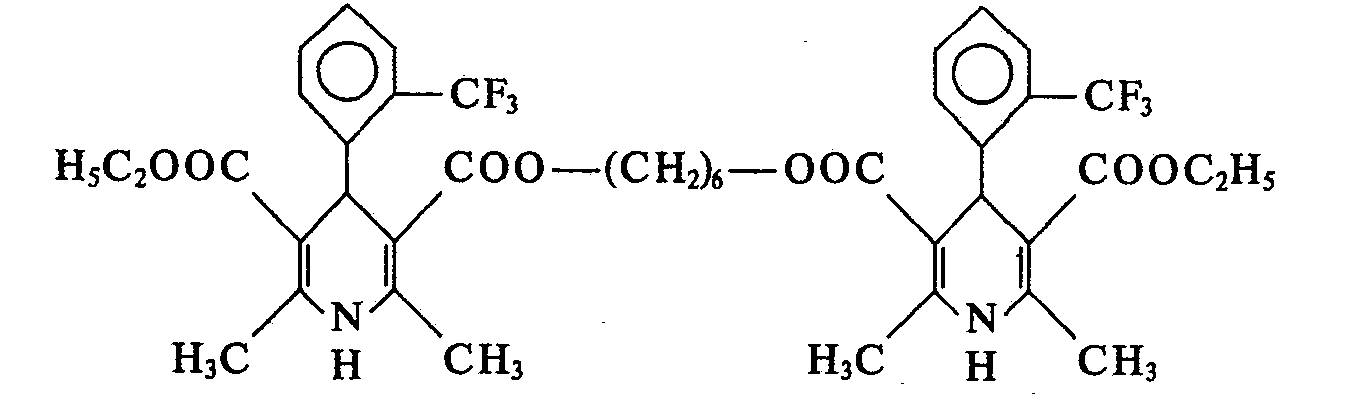
- 25 mmol Bis-(3-aminocrotonsäure)-1,6-hexandiy)ester werden analog Beispiel 3 mit 50 mmol 2-Trifluormethylbenzylidenacetessigsäureethylester umgesetzt.
- Schmelzpunkt: 129-139°C; Ausbeute: 49%
-

- 25 mmol Bis-(3-aminocrotonsäure)-1,6-hexandiylester werden analog Beispiel 3 mit 50 mmol 3-Nitrobenzylidenacetessigsäure-2-methoxyethylester umgesetzt.
- Schmelzpunkt: 144-156°C; Ausbeute: 50%.
-

- 50 mmol 2,6 - Dimethyl - 5 - ethoxycarbonyl - -4- (3 - nitrophenyl) -1,4-dihydropyridin - 3 - carbonsäure werden analog Beispiel 2 mit 25 mmol E-1,4-bis(hydroxymethyl)-cyclohexan umgesetzt.
- Schmelzpunkt: 172-188°C; Ausbeute: 15%.
-

- 50 mmol 2,6-Dimethyl-5-ethoxycarbonyl-4-(3-nitrophenyl)-1,4-dihydropyridin-3-carbonsäure werden analog Beispiel 2 mit 25 mmol 1,4-Bis-(hydroxymethyl)-benzol umgesetzt.
- Schmelzpunkt: 244 bis 259°C; Ausbeute: 30%.
-

- 25 mmol Bis-(3-aminocrotonsäure)-1,6-hexandiylester werden mit 50 mmol 2-Cyanobenzylidenacetessigsäureethylester analog Beispiel 3 umgesetzt.
- Ausbeute: 80%.
-

- 25 mmol 2,6-Dimethyl-5-ethoxycarbonyl-4-(3-nitrophenyl)-1,4-dihydropyridin-3-carbonsäure werden analog Beispiel 2 mit 12,5 mmol 1,6-Diaminohexan umgesetzt.
- Ausbeute: 27%; (Fp.: 147-152°C).
-

- 25 mmol Bis-(3-aminocrotonsäure)-1,6-hexandiylester werden mit 50 mmol 2-Chlorbenzylidenacetessigsäuremethylester analog Beispiel 3 umgesetzt.
- Ausbeute: 80% amorphe Substanz.
- δ=1,0-1,4(m,8H), 1,4-1,7(m,4H), 2,2(2s,12H), 3,6(s,6H), 4,0(t,4H), 5,4(s,2H), 5,9 (s, NH), 6,9-7,5 (m, 8H).
-

- Darstellung analog Beispiel 2 aus N,N'-Bishydroxyethylharnstoff und 2,6-Dimethyl-5-ethoxycarbonyl-4-(3-nitrophenyl)-1,4-dihydropyridin-3-carbonsäure.
- Ausbeute: 32%. Fp.: 178-187°C.
-

- Darstellung analog Beispiel 3 aus Bis-(3-aminocrotonsäure)-bis-(2-hydroxyethyl)-sulfid-diester und 2-Nitrobenzylidenacetessigsäuremethylester.
- Ausbeute: 80% amorphe Substanz.
- δ=2,3(2s,12H), 2,4-2,8 (m, 4H). 3,6 (s, 6H), 3,9-4.3 (m, 4H), 5,8 (s, 2H), 6,3 (s, NH). 7,1-7,8 (m, 8H).
-

- Darstellung analog Beispiel 3 aus 25 mmol Bis-(3-aminocrotonsäure)-1,6-hexandiylester und 50 mmol 2-Chlorbenzylidenacetessigsäure-2-methoxyethylester.
- Ausbeute: 67% (Fp.: 135-153°C).
-

- Darstellung analog Beispiel 3 aus 25 mmol Bis-(3-aminocrotonsäure)-bis-(2-hydroxyethyl)-sulfid- diester und 2-Trifluormethylbenzylidenacetessigsäuremethylester.
- Ausbeute: 79% amorphe Substanz.
- δ=1,2 (t, 6H), 2,2 (s, 12H), 2,4-2,8 (m, 4H), 3,9-4,5 (m, 8H), 5,6 (s, 2H), 6,7 (s, NH), 7,1-7,7 (m, 8H).
-

- 12,5 mmol Bis-(2-hydroxyethyl)-disulfid wurden analog Beispiel 2 mit 25 mmol 2,6-Dimethyl-5-ethoxycarbonyl-4-(3-nitrophenyl)-1,4-dihydropyridin-3-carbonsäure umgesetzt.
- Ausbeute: 77% amorphe Substanz.
- δ=1,2 (t, 6H), 2,4 (s, 12H), 2,7-3,1 (m, 4H), 3,9-4,5 (m, 8H), 5,1 (s, 2H), 6,4 (s, NH), 7,2-8,2 (m, 8H).
-
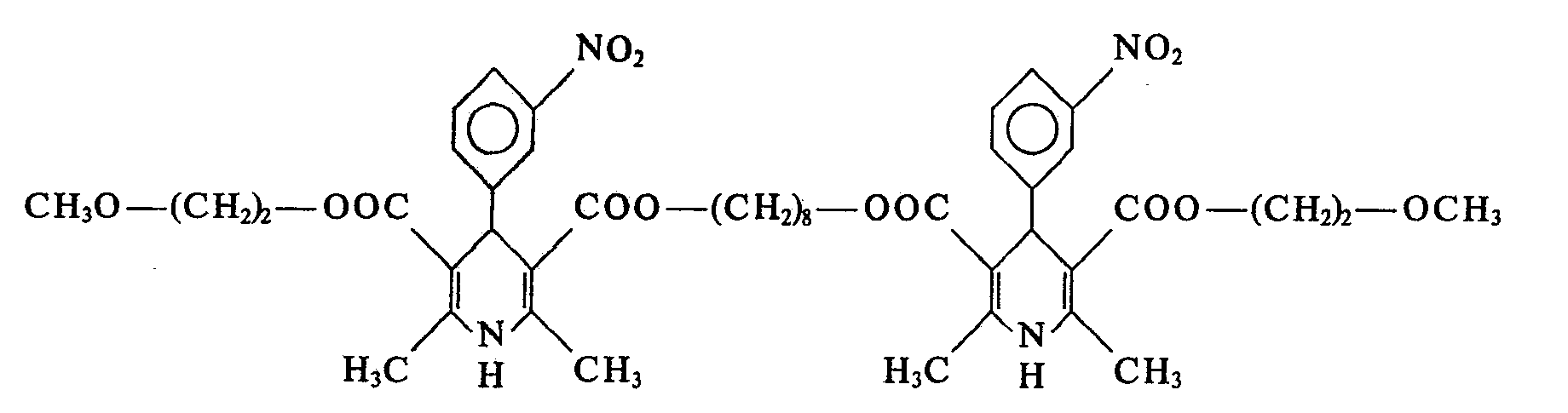
- 25 mmol Bis-(3-aminocrotonsäure)-1,8-octandiylester werden zusammen mit 50 mmol 3-Nitro- benzylidenacetessigsäure-2-methoxyethylester analog Beispiel 3 umgesetzt.
- Ausbeute: 75% (Fp.: 146-150°C).
-

- Darstellung analog Beispiel 3 aus 25 mmol Bis-(3-aminocrotonsäure)-1,4-bis-(hydroxymethyl)-benzol-diester und 50 mmol 3-Nitrobenzylidenacetessigsäure-2-methoxyethylester.
- Ausbeute: 67% (Fp.: 159-162°C).
-

- Darstellung analog Beispiel 3.
- Ausbeute: 28% (Fp.: 100-112°C).
-

- Darstellung analog Beispiel 3.
- Ausbeute: 76% amorphe Substanz.
- δ= 0,8-1,5 (m, 12H), 2,3 (2s, 12H), 3,5 (s, 6H), 3,6-4,1 (m, 4H), 5,8 (s, 2H), 6,1 (s, NH), 7,1-7,8 (m, 14H).
sowie ihre pharmakologisch unbedenklichen Säureadditionssalze.
Claims (7)

sowie ihre pharmakologisch unbedenklichen Säureadditionssalze.

sowie ihre pharmakologisch unbedenklichen Säureadditionssalze,
dadurch gekennzeichnet, daß man


in Gegenwart von inerten organischen Lösungsmitteln in molaren Verhältnissen von etwa 2:1 bei Temperaturen zwischen 0 und 180°C umsetzt.
Priority Applications (1)
| Application Number | Priority Date | Filing Date | Title |
|---|---|---|---|
| AT81109456T ATE11773T1 (de) | 1980-11-13 | 1981-10-31 | C-3 verknuepfte 1,4-dihydropyridine, ihre verwendung in arzneimitteln und verfahren zu ihrer herstellung. |
Applications Claiming Priority (2)
| Application Number | Priority Date | Filing Date | Title |
|---|---|---|---|
| DE19803042769 DE3042769A1 (de) | 1980-11-13 | 1980-11-13 | C-3 verknuepfte 1,4-dihydropyridine, ihre verwendung in arzneimitteln und verfahren zu ihrer herstellung |
| DE3042769 | 1980-11-13 |
Publications (2)
| Publication Number | Publication Date |
|---|---|
| EP0052300A1 EP0052300A1 (de) | 1982-05-26 |
| EP0052300B1 true EP0052300B1 (de) | 1985-02-13 |
Family
ID=6116648
Family Applications (1)
| Application Number | Title | Priority Date | Filing Date |
|---|---|---|---|
| EP81109456A Expired EP0052300B1 (de) | 1980-11-13 | 1981-10-31 | C-3 verknüpfte 1,4-Dihydropyridine, ihre Verwendung in Arzneimitteln und Verfahren zu ihrer Herstellung |
Country Status (16)
| Country | Link |
|---|---|
| EP (1) | EP0052300B1 (de) |
| JP (1) | JPS57109766A (de) |
| AT (1) | ATE11773T1 (de) |
| AU (1) | AU546605B2 (de) |
| CA (1) | CA1179342A (de) |
| DD (1) | DD201900A5 (de) |
| DE (2) | DE3042769A1 (de) |
| DK (1) | DK501881A (de) |
| ES (3) | ES8206477A1 (de) |
| FI (1) | FI813567L (de) |
| GR (1) | GR76338B (de) |
| HU (1) | HU186438B (de) |
| IL (1) | IL64253A (de) |
| NO (1) | NO813649L (de) |
| PT (1) | PT73920B (de) |
| ZA (1) | ZA817840B (de) |
Cited By (2)
| Publication number | Priority date | Publication date | Assignee | Title |
|---|---|---|---|---|
| US6897305B2 (en) | 1998-06-08 | 2005-05-24 | Theravance, Inc. | Calcium channel drugs and uses |
| US7101909B2 (en) | 1998-10-12 | 2006-09-05 | Theravance, Inc. | Calcium channel drugs and uses |
Families Citing this family (13)
| Publication number | Priority date | Publication date | Assignee | Title |
|---|---|---|---|---|
| DE3208628A1 (de) * | 1982-03-10 | 1983-09-22 | Bayer Ag, 5090 Leverkusen | Neue verbindungen, verfahren zu ihrer herstellung sowie ihre verwendung als arzneimittel |
| EP0094159B1 (de) * | 1982-05-10 | 1990-03-14 | Takeda Chemical Industries, Ltd. | Dihydropyridinderivate, deren Herstellung und Verwendung |
| US4656181A (en) * | 1982-11-24 | 1987-04-07 | Cermol S.A. | Esters of 1,4-dihydropyridines, processes for the preparation of the new esters, and medicaments containing the same |
| EP0145956A1 (de) * | 1983-11-16 | 1985-06-26 | Ciba-Geigy Ag | Neue Amid-Verbindungen |
| JPS60120861A (ja) * | 1983-12-02 | 1985-06-28 | Otsuka Pharmaceut Co Ltd | ジヒドロピリジン誘導体 |
| US4672068A (en) * | 1984-05-04 | 1987-06-09 | Fujirebio Kabushiki Kaisha | Antihypertensive 1,4-dihydropyridines having a conjugated ester |
| US4757071A (en) * | 1984-12-14 | 1988-07-12 | Nisshin Flour Milling Co., Ltd. | 1,4-dihydropyridine derivatives, and pharmaceutical compositions containing same, useful for treating cardiovascular diseases |
| IT1203900B (it) * | 1987-04-15 | 1989-02-23 | Lagor Spa | Poli 1,4-diidro-2,6-dimetilpiridine 3,5-dicarbossilesteri utili come stabilizzanti termici per polimeri sintetici |
| GB9002337D0 (en) * | 1990-02-02 | 1990-04-04 | Orion Yhtymae Oy | Compounds useful in treating inflammatory bowel disease |
| US5185370A (en) * | 1988-09-01 | 1993-02-09 | Orion-Yhtyma Oy | Substituted β-diketones and their use |
| IL91382A (en) * | 1988-09-01 | 1995-06-29 | Orion Yhtymae Oy | Alkenyl or arylmethylene-substituted beta-diketones their preparation and pharmaceutical compositions containing them |
| WO1999063992A1 (en) * | 1998-06-08 | 1999-12-16 | Advanced Medicine, Inc. | Novel calcium channel drugs and uses |
| GB0225548D0 (en) | 2002-11-01 | 2002-12-11 | Glaxo Group Ltd | Compounds |
Family Cites Families (3)
| Publication number | Priority date | Publication date | Assignee | Title |
|---|---|---|---|---|
| DE1795788A1 (de) * | 1966-11-16 | 1975-07-31 | Astra Ab | Pyridinderivate, verfahren zu deren herstellung und sie enthaltende arzneimittel |
| DE2117571C3 (de) * | 1971-04-10 | 1979-10-11 | Bayer Ag, 5090 Leverkusen | Unsymmetrische 1,4-Dihydropyridin-33-dicarbonsäureester, Verfahren zu ihrer Herstellung sowie ihre Verwendung als Arzneimittel |
| DE2847236A1 (de) * | 1978-10-31 | 1980-05-14 | Bayer Ag | Neue dihydropyridine mit substituierten estergruppierungen, mehrer verfahren zu ihrer herstellung sowie ihre verwendung als arzneimittel |
-
1980
- 1980-11-13 DE DE19803042769 patent/DE3042769A1/de not_active Withdrawn
-
1981
- 1981-10-28 NO NO813649A patent/NO813649L/no unknown
- 1981-10-31 DE DE8181109456T patent/DE3168955D1/de not_active Expired
- 1981-10-31 EP EP81109456A patent/EP0052300B1/de not_active Expired
- 1981-10-31 AT AT81109456T patent/ATE11773T1/de not_active IP Right Cessation
- 1981-11-03 PT PT73920A patent/PT73920B/pt unknown
- 1981-11-05 AU AU77110/81A patent/AU546605B2/en not_active Ceased
- 1981-11-09 DD DD81234718A patent/DD201900A5/de unknown
- 1981-11-10 IL IL64253A patent/IL64253A/xx unknown
- 1981-11-10 CA CA000389828A patent/CA1179342A/en not_active Expired
- 1981-11-11 FI FI813567A patent/FI813567L/fi not_active Application Discontinuation
- 1981-11-11 GR GR66490A patent/GR76338B/el unknown
- 1981-11-12 ES ES507080A patent/ES8206477A1/es not_active Expired
- 1981-11-12 ZA ZA817840A patent/ZA817840B/xx unknown
- 1981-11-12 DK DK501881A patent/DK501881A/da unknown
- 1981-11-12 JP JP56180437A patent/JPS57109766A/ja active Pending
- 1981-11-13 HU HU813401A patent/HU186438B/hu unknown
-
1982
- 1982-03-09 ES ES510253A patent/ES510253A0/es active Granted
- 1982-03-09 ES ES510254A patent/ES510254A0/es active Granted
Cited By (2)
| Publication number | Priority date | Publication date | Assignee | Title |
|---|---|---|---|---|
| US6897305B2 (en) | 1998-06-08 | 2005-05-24 | Theravance, Inc. | Calcium channel drugs and uses |
| US7101909B2 (en) | 1998-10-12 | 2006-09-05 | Theravance, Inc. | Calcium channel drugs and uses |
Also Published As
| Publication number | Publication date |
|---|---|
| ES8303336A1 (es) | 1983-02-01 |
| FI813567A7 (fi) | 1982-05-14 |
| ES507080A0 (es) | 1982-08-16 |
| FI813567L (fi) | 1982-05-14 |
| ES8303337A1 (es) | 1983-02-01 |
| PT73920B (en) | 1983-03-29 |
| DD201900A5 (de) | 1983-08-17 |
| HU186438B (en) | 1985-07-29 |
| IL64253A (en) | 1985-03-31 |
| ES510254A0 (es) | 1983-02-01 |
| JPS57109766A (en) | 1982-07-08 |
| ATE11773T1 (de) | 1985-02-15 |
| DE3042769A1 (de) | 1982-06-09 |
| CA1179342A (en) | 1984-12-11 |
| NO813649L (no) | 1982-05-14 |
| AU546605B2 (en) | 1985-09-12 |
| GR76338B (de) | 1984-08-04 |
| PT73920A (en) | 1981-12-01 |
| DE3168955D1 (en) | 1985-03-28 |
| ES510253A0 (es) | 1983-02-01 |
| EP0052300A1 (de) | 1982-05-26 |
| ES8206477A1 (es) | 1982-08-16 |
| AU7711081A (en) | 1982-05-20 |
| IL64253A0 (en) | 1982-02-28 |
| ZA817840B (en) | 1982-10-27 |
| DK501881A (da) | 1982-05-14 |
Similar Documents
| Publication | Publication Date | Title |
|---|---|---|
| EP0026317B1 (de) | Optisch aktive 1,4-Dihydropyridine, Verfahren zu ihrer Herstellung und ihre Verwendung als Arzneimittel | |
| EP0088274B1 (de) | Neue 1,4-Dihydropyridine, Verfahren zu ihrer Herstellung und ihrer Verwendung in Arzneimitteln | |
| EP0011706B1 (de) | Verfahren zur Herstellung von teilweise neuen 1,4-Dihydropyridin-3-carbonsäure-Derivaten (I), neue 1,4-Dihydropyridin-3-carbonsäure-Derivate (II) und die Verwendung der Derivate (I) und (II) zur Herstellung von 1,4-Dihydropyridin-3,5-dicarbonsäurediestern | |
| EP0012180B1 (de) | Neue 1,4-Dihydropyridinverbindungen, Verfahren zu ihrer Herstellung, die genannten Verbindungen enthaltende Arzneimittel und Verfahren zur Herstellung dieser Arzneimittel | |
| EP0002208B1 (de) | Nitrosubstituierte 1,4-Dihydropyridine, diese enthaltende Arzneimittel sowie deren Herstellung | |
| EP0103796B1 (de) | Neue Dihydropyrimidine, Verfahren zu ihrer Herstellung sowie ihre Verwendung in Arzneimitteln | |
| EP0052300B1 (de) | C-3 verknüpfte 1,4-Dihydropyridine, ihre Verwendung in Arzneimitteln und Verfahren zu ihrer Herstellung | |
| EP0009206B1 (de) | Fluorhaltige 1,4-Dihydropyridine, diese enthaltende Arzneimittel sowie Verfahren zu ihrer Herstellung | |
| EP0088940B1 (de) | Pyridincarbonsäureester, Verfahren zu ihrer Herstellung sowie ihre Verwendung als Arzneimittel | |
| EP0110073A1 (de) | Verfahren zur Herstellung von Tetrahydropyridinen | |
| EP0039863B1 (de) | 1,4-Dihydropyridine mit unterschiedlichen Substituenten in 2- und 6-Position, Verfahren zu ihrer Herstellung und ihre Verwendung in Arzneimitteln | |
| EP0088938A1 (de) | Verwendung von Pyridinverbindungen zur Herstellung von Arzneimitteln mit antihypoxischer und Ischämie-protektiver Wirkung | |
| EP0163888A1 (de) | Amidinohydrazone von Tetralin-, Chromon-, Thiochromon- und Tetrahydrochinolin-Derivaten, Verfahren zu ihrer Herstellung sowie ihre Verwendung in Arzneimitteln | |
| EP0110259B1 (de) | 1,4-Dihydropyridinderivate, Verfahren zu ihrer Herstellung sowie ihre Verwendung in Arzneimitteln | |
| EP0179386B1 (de) | 1,4-Dihydropyridin-hydroxyamine, Verfahren zu ihrer Herstellung sowie ihre Verwendung in Arzneimitteln | |
| DE3412947A1 (de) | Tetrahydothienopyridine, verfahren zu ihrer herstellung sowie ihre verwendung als arzneimittel | |
| EP0158956B1 (de) | 4-(Nitrophenyl)-tetrahydropyridine, Verfahren zu ihrer Herstellung und ihre Verwendung als Arzneimittel | |
| DE2650013A1 (de) | 1.4-dihydro-2.6-dimethyl-4-(3-nitrophenyl)-3.5-pyridindicarbonsaeure-isopropyl-(2-propoxy-aethyl)-ester, mehrere verfahren zu seiner herstellung sowie seine verwendung als peripherer vasodilatator | |
| EP0042566B1 (de) | 4,4-Disubstituierte 1,4-Dihydropyridine, Verfahren zu ihrer Herstellung sowie ihre Verwendung in Arzneimitteln | |
| EP0124630A1 (de) | Pyrimidin-Thioalkylpyridin-Derivate, Verfahren zu ihrer Herstellung und diese Verbindung enthaltende Arzneimittel | |
| EP0164010B1 (de) | 3-Nitro-dihydropyridine, Verfahren zu ihrer Herstellung sowie ihre Verwendung in Arzneimitteln | |
| EP0167068B1 (de) | 1,4-Dihydro-2,6-dimethyl-4-(3-nitrophenyl)-pyridin-3,5-dicarbonsäure-isopropyl-[2-(3-trifluormethylphenoxy)-ethyl]-ester, mehrere Verfahren zu seiner Herstellung sowie seine Verwendung in Arzneimitteln | |
| EP0042092A2 (de) | 1,4-Dihydropyridin-carbonsäureamide Verfahren zu deren Herstellung, ihre Verwendung in Arzneimitteln sowie deren Herstellung | |
| DE3501855A1 (de) | 5-aryl-dihydropyridine, verfahren zu ihrer herstellung sowie ihre verwendung in arzneimitteln | |
| EP0160256B1 (de) | Annellierte Furanone, Verfahren zu ihrer Herstellung und ihre Verwendung in Arzneimitteln |
Legal Events
| Date | Code | Title | Description |
|---|---|---|---|
| PUAI | Public reference made under article 153(3) epc to a published international application that has entered the european phase |
Free format text: ORIGINAL CODE: 0009012 |
|
| 17P | Request for examination filed |
Effective date: 19811031 |
|
| AK | Designated contracting states |
Designated state(s): AT BE CH DE FR GB IT LU NL SE |
|
| ITF | It: translation for a ep patent filed | ||
| GRAA | (expected) grant |
Free format text: ORIGINAL CODE: 0009210 |
|
| AK | Designated contracting states |
Designated state(s): AT BE CH DE FR GB IT LI LU NL SE |
|
| REF | Corresponds to: |
Ref document number: 11773 Country of ref document: AT Date of ref document: 19850215 Kind code of ref document: T |
|
| REF | Corresponds to: |
Ref document number: 3168955 Country of ref document: DE Date of ref document: 19850328 |
|
| ET | Fr: translation filed | ||
| PG25 | Lapsed in a contracting state [announced via postgrant information from national office to epo] |
Ref country code: LU Free format text: LAPSE BECAUSE OF NON-PAYMENT OF DUE FEES Effective date: 19851031 |
|
| PLBE | No opposition filed within time limit |
Free format text: ORIGINAL CODE: 0009261 |
|
| STAA | Information on the status of an ep patent application or granted ep patent |
Free format text: STATUS: NO OPPOSITION FILED WITHIN TIME LIMIT |
|
| 26N | No opposition filed | ||
| PGFP | Annual fee paid to national office [announced via postgrant information from national office to epo] |
Ref country code: AT Payment date: 19861001 Year of fee payment: 6 |
|
| PGFP | Annual fee paid to national office [announced via postgrant information from national office to epo] |
Ref country code: NL Payment date: 19861031 Year of fee payment: 6 |
|
| PG25 | Lapsed in a contracting state [announced via postgrant information from national office to epo] |
Ref country code: LI Effective date: 19871031 Ref country code: CH Effective date: 19871031 Ref country code: BE Effective date: 19871031 Ref country code: AT Effective date: 19871031 |
|
| BERE | Be: lapsed |
Owner name: BAYER A.G Effective date: 19871031 |
|
| PG25 | Lapsed in a contracting state [announced via postgrant information from national office to epo] |
Ref country code: NL Effective date: 19880501 |
|
| NLV4 | Nl: lapsed or anulled due to non-payment of the annual fee | ||
| REG | Reference to a national code |
Ref country code: CH Ref legal event code: PL |
|
| PG25 | Lapsed in a contracting state [announced via postgrant information from national office to epo] |
Ref country code: GB Effective date: 19881031 |
|
| PG25 | Lapsed in a contracting state [announced via postgrant information from national office to epo] |
Ref country code: SE Effective date: 19881101 |
|
| PG25 | Lapsed in a contracting state [announced via postgrant information from national office to epo] |
Ref country code: FR Free format text: LAPSE BECAUSE OF NON-PAYMENT OF DUE FEES Effective date: 19890630 |
|
| PG25 | Lapsed in a contracting state [announced via postgrant information from national office to epo] |
Ref country code: DE Effective date: 19890701 |
|
| GBPC | Gb: european patent ceased through non-payment of renewal fee | ||
| REG | Reference to a national code |
Ref country code: FR Ref legal event code: ST |
|
| EUG | Se: european patent has lapsed |
Ref document number: 81109456.4 Effective date: 19890726 |