EP0039863B1 - 1,4-Dihydropyridine mit unterschiedlichen Substituenten in 2- und 6-Position, Verfahren zu ihrer Herstellung und ihre Verwendung in Arzneimitteln - Google Patents
1,4-Dihydropyridine mit unterschiedlichen Substituenten in 2- und 6-Position, Verfahren zu ihrer Herstellung und ihre Verwendung in Arzneimitteln Download PDFInfo
- Publication number
- EP0039863B1 EP0039863B1 EP81103338A EP81103338A EP0039863B1 EP 0039863 B1 EP0039863 B1 EP 0039863B1 EP 81103338 A EP81103338 A EP 81103338A EP 81103338 A EP81103338 A EP 81103338A EP 0039863 B1 EP0039863 B1 EP 0039863B1
- Authority
- EP
- European Patent Office
- Prior art keywords
- general formula
- methyl
- optionally
- abovementioned meaning
- dihydro
- Prior art date
- Legal status (The legal status is an assumption and is not a legal conclusion. Google has not performed a legal analysis and makes no representation as to the accuracy of the status listed.)
- Expired
Links
- 0 C1CC*CC1 Chemical compound C1CC*CC1 0.000 description 8
Classifications
-
- C—CHEMISTRY; METALLURGY
- C07—ORGANIC CHEMISTRY
- C07D—HETEROCYCLIC COMPOUNDS
- C07D211/00—Heterocyclic compounds containing hydrogenated pyridine rings, not condensed with other rings
- C07D211/04—Heterocyclic compounds containing hydrogenated pyridine rings, not condensed with other rings with only hydrogen or carbon atoms directly attached to the ring nitrogen atom
- C07D211/80—Heterocyclic compounds containing hydrogenated pyridine rings, not condensed with other rings with only hydrogen or carbon atoms directly attached to the ring nitrogen atom having two double bonds between ring members or between ring members and non-ring members
- C07D211/84—Heterocyclic compounds containing hydrogenated pyridine rings, not condensed with other rings with only hydrogen or carbon atoms directly attached to the ring nitrogen atom having two double bonds between ring members or between ring members and non-ring members with hetero atoms or with carbon atoms having three bonds to hetero atoms, with at the most one bond to halogen directly attached to ring carbon atoms
- C07D211/90—Carbon atoms having three bonds to hetero atoms with at the most one bond to halogen
-
- A—HUMAN NECESSITIES
- A61—MEDICAL OR VETERINARY SCIENCE; HYGIENE
- A61P—SPECIFIC THERAPEUTIC ACTIVITY OF CHEMICAL COMPOUNDS OR MEDICINAL PREPARATIONS
- A61P1/00—Drugs for disorders of the alimentary tract or the digestive system
-
- A—HUMAN NECESSITIES
- A61—MEDICAL OR VETERINARY SCIENCE; HYGIENE
- A61P—SPECIFIC THERAPEUTIC ACTIVITY OF CHEMICAL COMPOUNDS OR MEDICINAL PREPARATIONS
- A61P25/00—Drugs for disorders of the nervous system
- A61P25/28—Drugs for disorders of the nervous system for treating neurodegenerative disorders of the central nervous system, e.g. nootropic agents, cognition enhancers, drugs for treating Alzheimer's disease or other forms of dementia
-
- A—HUMAN NECESSITIES
- A61—MEDICAL OR VETERINARY SCIENCE; HYGIENE
- A61P—SPECIFIC THERAPEUTIC ACTIVITY OF CHEMICAL COMPOUNDS OR MEDICINAL PREPARATIONS
- A61P9/00—Drugs for disorders of the cardiovascular system
- A61P9/06—Antiarrhythmics
-
- A—HUMAN NECESSITIES
- A61—MEDICAL OR VETERINARY SCIENCE; HYGIENE
- A61P—SPECIFIC THERAPEUTIC ACTIVITY OF CHEMICAL COMPOUNDS OR MEDICINAL PREPARATIONS
- A61P9/00—Drugs for disorders of the cardiovascular system
- A61P9/10—Drugs for disorders of the cardiovascular system for treating ischaemic or atherosclerotic diseases, e.g. antianginal drugs, coronary vasodilators, drugs for myocardial infarction, retinopathy, cerebrovascula insufficiency, renal arteriosclerosis
-
- A—HUMAN NECESSITIES
- A61—MEDICAL OR VETERINARY SCIENCE; HYGIENE
- A61P—SPECIFIC THERAPEUTIC ACTIVITY OF CHEMICAL COMPOUNDS OR MEDICINAL PREPARATIONS
- A61P9/00—Drugs for disorders of the cardiovascular system
- A61P9/12—Antihypertensives
Definitions
- the present invention relates to new 1,4-dihydropyridines with different substituents in the 2- and 6-position, several processes for their preparation and their use in medicaments, in particular in agents which influence the circulation.
- dihydropyridines which carry different ester groups in the 3- and 5-positions (DE-OS2117571).
- 1,4-Dihydropyridines with the same ester groups in the 3- and 5-position and different substituents in the 2- and 6-position have not yet been disclosed.
- DE-OS 1 792 764 discloses symmetrical dihydropyridine esters which each carry the same substituents in the 2- and 6-positions.
- DE-OS 2 756 226 also describes 1,4-dihydropyridines which differ from the compounds according to the invention in that they bear a substituent in the 2-position which contains at least 1 oxygen or nitrogen as a heteroatom while the compounds according to the invention in Wear a pure hydrocarbon residue in the 2-position.
- DE-OS 2 302 866 describes some dihydropyridines as starting products or as intermediates. A pharmacological effect for these 2-, 6-asymmetrically substituted intermediates is not specified. In particular, reference is made to the intermediate product of Example 26 from this laid-open document, which is excluded from the substance claim of the present application by disclaimer.
- the 1,4-dihydropyridine derivatives according to the invention have valuable pharmacological properties. Due to their circulatory effects, they can be used as antihypertensive agents, as vasodilators, as cerebral therapeutic agents and as coronary therapeutic agents and are therefore to be regarded as an enrichment of pharmacy.
- 1,4-dihydro-2-ethyl-6-methyl-4- (3'-nitrophenyl) pyridine-3,5-dicarboxylic acid diethyl ester 1,4-Dihydro-2-methyl-4- (3'-trifluoromethylphenyl) pyridine-3,5-dicarboxylic acid diethyl ester may be chosen as examples:
- the ylidene- ⁇ -keto esters of the formula (II) used as starting materials are known from the literature or can be prepared by methods known from the literature (see, for example, G. Jones "The Knoevenagel Condensation in Org. Reactions, Vol. XV, 204 ff (1967)).
- the enaminocarboxylic acid esters of the formula (III) used as starting materials are known from the literature or can be prepared by methods known from the literature (cf. A.C. Cope, J. Amer. Chem. Soc. 67, 1017 (1945)).
- inert organic solvents are suitable as diluents. These preferably include alcohols such as ethanol, methanol, isopropanol, ethers such as dioxane, diethyl ether, tetrahydrofuran, glycol monomethyl ether, glycol dimethyl ether or glacial acetic acid, dimethylformamide, dimethyl sulfoxide, acetonitrile, pyridine and hexamethylphosphoric acid triamide.
- alcohols such as ethanol, methanol, isopropanol
- ethers such as dioxane, diethyl ether, tetrahydrofuran, glycol monomethyl ether, glycol dimethyl ether or glacial acetic acid, dimethylformamide, dimethyl sulfoxide, acetonitrile, pyridine and hexamethylphosphoric acid triamide.
- reaction temperatures can be varied within a wide range. In general, between 20 and 150 ° C, preferably between 20 and 100 ° C, especially at the boiling point of the solvent.
- the reaction can be carried out at normal pressure, but also at elevated pressure. Generally one works under normal pressure.
- one mole of the ylidene- ⁇ -keto ester of the formula (11) is reacted with a mole of enaminocarboxylic acid ester of the formula (11) in a suitable solvent.
- the substances according to the invention are preferably isolated and purified in such a way that the solvent is distilled off in vacuo and the residue, which is optionally obtained in crystalline form only after ice cooling, is recrystallized from a suitable solvent.
- ⁇ -ketocarboxylic acid esters of the formula (V) used as starting materials are known from the literature and can be prepared by methods known from the literature (e.g. BD Borrmann, “Reaction of Diketene with Alcohols, Phenols and Mercaptans”, in Houben-Weyl, Methods of Organic Chemistry, Vol VII / 4, 230 ff (1968); Y. Oikawa, K. Sugano and O. Yonemitsu, J. Org. Chem. 43, 2087 (1978)).
- inert organic solvents are suitable as diluents. These preferably include alcohols such as ethanol, methanol, isopropanol, ethers such as dioxane, diethyl ether, tetrahydrofuran, glycol monomethyl ether, glycol dimethyl ether or glacial acetic acid, dimethylformamide, dimethyl sulfoxide, acetonitrile, pyridine and hexamethylphosphoric acid triamide.
- alcohols such as ethanol, methanol, isopropanol
- ethers such as dioxane, diethyl ether, tetrahydrofuran, glycol monomethyl ether, glycol dimethyl ether or glacial acetic acid, dimethylformamide, dimethyl sulfoxide, acetonitrile, pyridine and hexamethylphosphoric acid triamide.
- reaction temperatures can be varied within a wide range. In general, one works between 20 and 150 ° C, but preferably at the boiling point of the solvent.
- the reaction can be carried out at normal pressure, but also at elevated pressure. Generally one works under normal pressure.
- the substances of the formulas (11), (IV) and (V) involved in the reaction are each used in molar amounts.
- the amine used is advantageously added in an excess of 1 to 2 mol.
- the compounds according to the invention can easily be purified by recrystallization from a suitable solvent.
- the ylidene- ⁇ -keto esters of the formula (VI) used as starting materials are known from the literature or can be prepared by methods known from the literature (see, for example, BG Jones "The Knoevenagel Condensation” in Org. Reactions, Vol. XV, 204 ff (1967)) .
- the enaminocarboxylic acid esters of the formula (VII) used as starting materials are known from the literature or can be prepared by methods known from the literature (cf. A.C. Cope, J. Amer. Chem. Soc. 67, 1017 (1945)).
- inert organic solvents are suitable as diluents. These preferably include alcohols such as ethanol, methanol, isopropanol, ethers such as dioxane, diethyl ether, tetrahydrofuran, glycol monomethyl ether, glycol dimethyl ether or glacial acetic acid, dimethylformamide, dimethyl sulfoxide, acetonitrile, pyridine and hexamethylphosphoric acid triamide.
- alcohols such as ethanol, methanol, isopropanol
- ethers such as dioxane, diethyl ether, tetrahydrofuran, glycol monomethyl ether, glycol dimethyl ether or glacial acetic acid, dimethylformamide, dimethyl sulfoxide, acetonitrile, pyridine and hexamethylphosphoric acid triamide.
- reaction temperatures can be varied within a wide range. In general, between 20 and 150 ° C, preferably between 20 and 100 ° C, especially at the boiling point of the solvent.
- the reaction can be carried out at normal pressure, but also at elevated pressure. Generally one works under normal pressure.
- one mole of the ylidene- ⁇ -keto ester of the formula (VI) is reacted with a mole of enaminocarboxylic acid ester of the formula (VII) in a suitable solvent.
- ⁇ -ketocarboxylic acid esters of the formula (VIII) used as starting materials are known from the literature or can be prepared by methods known from the literature (e.g. BD Borrmann, “Reaction of Diketene with Alcohols, Phenols and Mercaptans”, in Houben-Weyl, Methods of Organic Chemistry, Vol VII / 4, 230 ff (1968); Y. Oikawa, K. Sugano and O. Yonemitsu, J. Org. Chem. 43, 2087 (1978)).
- inert organic solvents are suitable as diluents. These preferably include alcohols such as ethanol, methanol, isopropanol, ethers such as dioxane, diethyl ether, tetrahydrofuran, glycol monomethyl ether, glycol dimethyl ether or glacial acetic acid, dimethylformamide, dimethyl sulfoxide, acetonitrile, pyridine and hexamethylphosphoric acid triamide.
- alcohols such as ethanol, methanol, isopropanol
- ethers such as dioxane, diethyl ether, tetrahydrofuran, glycol monomethyl ether, glycol dimethyl ether or glacial acetic acid, dimethylformamide, dimethyl sulfoxide, acetonitrile, pyridine and hexamethylphosphoric acid triamide.
- reaction temperatures can be varied within a wide range. In general, one works between 20 and 150 ° C, but preferably at the boiling point of the solvent.
- the reaction can be carried out at normal pressure, but also at elevated pressure. Generally one works under normal pressure.
- the substances of the formula (VI), (IV) and (VIII) involved in the reaction are each used in molar amounts.
- the amine used is advantageously added in an excess of 1 to 2 mol.
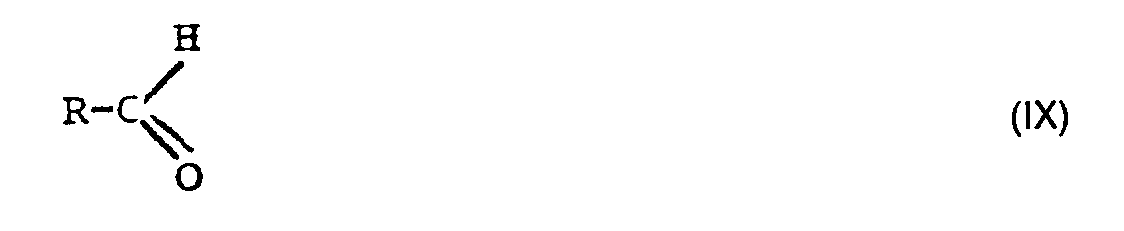
- aldehydes of the formula (IX) used as starting materials are known from the literature or can be prepared by methods known from the literature (see, for example, E. Mosettig, Org. Reactions VIII, 218 ff (1954)).
- inert organic solvents are suitable as diluents. These preferably include alcohols such as ethanol, methanol, isopropanol, ethers such as dioxane, diethyl ether, tetrahydrofuran, glycol monomethyl ether, glycol dimethyl ether or glacial acetic acid, dimethylformamide, dimethyl sulfoxide, acetonitrile, pyridine and hexamethylphosphoric acid triamide.
- alcohols such as ethanol, methanol, isopropanol
- ethers such as dioxane, diethyl ether, tetrahydrofuran, glycol monomethyl ether, glycol dimethyl ether or glacial acetic acid, dimethylformamide, dimethyl sulfoxide, acetonitrile, pyridine and hexamethylphosphoric acid triamide.
- reaction temperatures can be varied within a wide range. In general, one works between 20 and 150 ° C, but preferably at the boiling point of the solvent.
- the reaction can be carried out at normal pressure, but also at elevated pressure. Generally one works under normal pressure.
- inert organic solvents are suitable as diluents. These preferably include alcohols such as ethanol, methanol, isopropanol, ethers such as dioxane, diethyl ether, tetrahydrofuran, glycol monomethyl ether, glycol dimethyl ether or glacial acetic acid, dimethylformamide, dimethyl sulfoxide, acetonitrile, pyridine and hexamethylphosphoric acid triamide.
- alcohols such as ethanol, methanol, isopropanol
- ethers such as dioxane, diethyl ether, tetrahydrofuran, glycol monomethyl ether, glycol dimethyl ether or glacial acetic acid, dimethylformamide, dimethyl sulfoxide, acetonitrile, pyridine and hexamethylphosphoric acid triamide.
- reaction temperatures can be varied within a wide range. In general, one works between 20 and 150 ° C, but preferably at the boiling point of the solvent.
- the reaction can be carried out at normal pressure, but also at elevated pressure. Generally one works under normal pressure.
- the compounds according to the invention can exist in stereoisomeric forms which either behave like images and mirror images (enantiomers) or do not behave like images and mirror images (diastereomers). Both the antipodes and the race forms as well as the diastereomer mixtures are the subject of the present invention.
- the race forms, like the diastereomers, can be separated into the stereoisomerically uniform constituents in a known manner (see, for example, E.L. Eliel, Stereochemistry of Carbon Compounds, McGraw Hill, 1962).
- the new compounds have a broad and varied range of pharmacological effects.
- the compounds according to the invention are particularly suitable for the prophylaxis and therapy of acute and chronic ischemic heart disease in the broadest sense, for the therapy of high pressure and for the treatment of cerebral and peripheral circulatory disorders.
- the new active compounds can be converted into the customary formulations in a known manner, such as tablets, capsules, dragees, pills, granules, aerosols, syrups, emulsions, suspensions and solutions, using inert, non-toxic pharmaceutically suitable excipients or solvents.
- the therapeutically active compound should in each case be present in a concentration of 0.5 to 90% by weight of the total mixture, i.e. H. in amounts sufficient to achieve the dosage range indicated.
- the formulations are prepared, for example, by stretching the active ingredients with solvents and / or carriers, optionally using emulsifiers and / or dispersants, z. B. in the case of the use of water as a diluent, organic solvents can optionally be used as auxiliary solvents.
- tablets can of course also contain additives, such as sodium citrate, calcium carbonate and dicalcium phosphate, together with various additives, such as starch, preferably potato starch, gelatin and the like, in addition to the carrier substances mentioned.
- Lubricants such as magnesium stearate, sodium lauryl sulfate and talc can also be used for tableting.
- the active ingredients can be mixed with various flavor enhancers or colorants in addition to the abovementioned auxiliaries.
- solutions of the active ingredients can be used using suitable liquid carrier materials.
Landscapes
- Health & Medical Sciences (AREA)
- Chemical & Material Sciences (AREA)
- Organic Chemistry (AREA)
- Engineering & Computer Science (AREA)
- Bioinformatics & Cheminformatics (AREA)
- General Health & Medical Sciences (AREA)
- Veterinary Medicine (AREA)
- General Chemical & Material Sciences (AREA)
- Medicinal Chemistry (AREA)
- Nuclear Medicine, Radiotherapy & Molecular Imaging (AREA)
- Chemical Kinetics & Catalysis (AREA)
- Pharmacology & Pharmacy (AREA)
- Life Sciences & Earth Sciences (AREA)
- Animal Behavior & Ethology (AREA)
- Public Health (AREA)
- Heart & Thoracic Surgery (AREA)
- Cardiology (AREA)
- Neurology (AREA)
- Neurosurgery (AREA)
- Biomedical Technology (AREA)
- Vascular Medicine (AREA)
- Hospice & Palliative Care (AREA)
- Urology & Nephrology (AREA)
- Psychiatry (AREA)
- Hydrogenated Pyridines (AREA)
- Pharmaceuticals Containing Other Organic And Inorganic Compounds (AREA)
- Pyridine Compounds (AREA)
- Plural Heterocyclic Compounds (AREA)
Description
- Die vorliegende Erfindung betrifft neue 1,4-Dihydropyridine mit unterschiedlichen Substituenten in 2-und 6-Position, mehrere Verfahren zu ihrer Herstellung sowie ihre Verwendung in Arzneimitteln, insbesondere in kreislaufbeeinflussenden Mitteln.
- Es its bereits bekannt geworden, daß man 1,4-Dihydro-2,6-dimethyl-4-phenyl-pyridin-3,5-dicarbon- säurediethylester erhält, wenn man Benzylidenacetessigsäureethylester mit β-Aminocrotonsäureethylester oder Acetessigsäureethylester und Ammoniak umsetzt (E. Knoevenagel, Ber. dtsch. chem. Ges. 31, 743 (1898)).
- Weiterhin ist bekannt, daß bestimmte 1,4-Dihydropyridine interessante pharmakologische Eigenschaften aufweisen (F. Bossert, W. Vater, Naturwissenschaften 58, 578 (1971)).
- Weiterhin sind Dihydropyridine bekannt, die in 3- und 5-Position unterschiedliche Estergruppen tragen (DE-OS2117571). 1,4-Dihydropyridine mit gleichen Estergruppen in 3- und 5-Position und verschiedenen Substituenten in 2- und 6-Position sind bisher noch nicht bekannt geworden.
- Aus der DE-OS 1 792 764 sind symmetrische Dihydropyridinester bekannt, die in 2- und 6-Position jeweils gleiche Substituenten tragen.
- In der DE-OS 2 756 226 werden ebenfalls 1,4-Dihydropyridine beschrieben, die sich von den erfindungsgemäßen Verbindungen dadurch unterscheiden, daß sie in 2-Position einen Substituenten tragen, der mindestens 1 Sauerstoff oder Stickstoff als Heteroatom enthält während die erfindungsgemäßen Verbindungen in 2-Position einen reinen Kohlenwasserstoffrest tragen.
- In der DE-OS 2 302 866 werden einige Dihydropyridine als Ausgangsprodukte bzw. als Zwischenprodukte beschrieben. Eine pharmakologische Wirkung für diese 2-, 6-unsymmetrisch substituierten Zwischenprodukte ist nicht angegeben. Insbesondere sei auf das Zwischenprodukt des Beispiels 26 aus dieser Offenlegungsschrift hingewiesen, welches durch Disclaimer vom Stoffanspruch der vorliegenden Anmeldung ausgenommen wird.
- Die vorliegende Erfindung betrifft neue 1,4-Dihydropyridine mit unterschiedlichen Substituenten in 2-und 6-Position der allgemeinen Formel (I)

- R für einen Phenylrest steht, der gegebenenfalls 1 oder 2 gleiche oder verschiedene Substituenten aus der Gruppe Nitro, Chlor, Cyano oder Trifluormethyl enthält, ausgenommen ein gleichzeitig orthometa-dichlorsubstituiertes Phenyl, wenn R2 Methyl und R4 Alkyl mit 2-3 Kohlenstoffatomen bedeutet.
- R1 für einen gesättigten Kohlenwasserstoffrest mit bis zu 6 Kohlenstoffatomen steht, der gegebenenfalls durch ein Sauerstoffatom unterbrochen ist,
- R2 und R4 immer voneinander verschieden sind und jeweils für Wasserstoff, Alkyl mit 1 bis 4 Kohlenstoffatomen oder Cyclohexylmethyl stehen, mit Ausnahme der Verbindung Diethyl-2-methyl-6-propyl-4-(3-nitrophenyl)-1,4-dihydro-3,5-carboxylat.
- Es wurde gefunden, daß man die 1,4-Dihydropyridin-Derivate der Formel (I) erhält, wenn man
- A) Yliden-ß-ketoester der allgemeinen Formel (11)

- R, R1 und R2 die oben angegebene Bedeutung haben, mit Enaminocarbonsäureestern der allgemeinen Formel (III)

- R1 und R4 die oben angegebene Bedeutung haben, gegebenenfalls in Gegenwart inerter organischer Lösungsmittel umsetzt, oder
- R, R1 und R2 die oben angegebene Bedeutung haben, mit Enaminocarbonsäureestern der allgemeinen Formel (III)
- B) Yliden-ß-ketoester der allgemeinen Formel (II)

- R, R1 und R2 die oben angegebene Bedeutung haben, mit Aminen der allgemeinen Formel (IV) und β-Ketocarbonsäureestern der allgemeinen Formel (V)

- R4 und R1 die oben angegebene Bedeutung haben, gegebenenfalls in Gegenwart inerter organischer Lösungsmittel umsetzt, oder
- R, R1 und R2 die oben angegebene Bedeutung haben, mit Aminen der allgemeinen Formel (IV) und β-Ketocarbonsäureestern der allgemeinen Formel (V)
- C) Yliden-ß-ketoester der allgemeinen Formel (VI)

- R, R1 und R4 die oben angegebene Bedeutung haben, mit Enaminocarbonsäureestern der allgemeinen Formel (VII)

- R2 und R1 die oben angegebene Bedeutung haben, gegebenenfalls in Gegenwart von inerten organischen Lösungsmitteln umsetzt, oder
- R, R1 und R4 die oben angegebene Bedeutung haben, mit Enaminocarbonsäureestern der allgemeinen Formel (VII)
- D) Yliden-ß-ketoester der Formel (VI)

- R, R1 und R4 die oben angegebene Bedeutung haben, mit Aminen der allgemeinen Formel (IV) und β-Ketocarbonsäureestern der allgemeinen Formel (VIII)

- R2 und R1 die oben angegebene Bedeutung haben, gegebenenfalls in Gegenwart inerter organischer Lösungsmittel umsetzt, oder
- R, R1 und R4 die oben angegebene Bedeutung haben, mit Aminen der allgemeinen Formel (IV) und β-Ketocarbonsäureestern der allgemeinen Formel (VIII)
- E) Aldehyde der allgemeinen Formel (IX)

- R die oben angegebene Bedeutung hat, mit Enaminocarbonsäureestern der allgemeinen Formel (III) und β-Ketocarbonsäureestern der allgemeinen Formel (VIII)

- R4, R1 und R2 die oben angegebene Bedeutung haben gegebenenfalls in Gegenwart inerter organischer Lösungsmittel umsetzt, oder
- R die oben angegebene Bedeutung hat, mit Enaminocarbonsäureestern der allgemeinen Formel (III) und β-Ketocarbonsäureestern der allgemeinen Formel (VIII)
- F) Aldehyde der allgemeinen Formel (IX)

- R die oben angegebene Bedeutung hat, mit Enaminocarbonsäureestern der allgemeinen Formel (VII) und β-Ketocarbonsäureestern der allgemeinen Formel (V)

- R2, R1 und R4 die oben angegebene Bedeutung haben, gegebenenfalls in Gegenwart inerter organischer Lösungsmittel zur Reaktion bringt.
- R die oben angegebene Bedeutung hat, mit Enaminocarbonsäureestern der allgemeinen Formel (VII) und β-Ketocarbonsäureestern der allgemeinen Formel (V)
- Die erfindungsgemäßen 1,4-Dihydropyridin-Derivate besitzen wertvolle pharmakologische Eigenschaften. Aufgrund ihrer kreislaufbeeinflussenden Wirkung können sie als antihypertensive Mittel, als Vasodilatatoren, als Cerebraltherapeutika sowie als Coronartherapeutika Verwendung finden und sind somit als Bereicherung der Pharmazie anzusehen.
- Je nach Art der verwendeten Ausgangsstoffe kann die Synthese der erfindungsgemäßen Verbindungen durch folgende Formelschemata wiedergegeben werden, wobei 1,4-Dihydro-2-ethyl-6-methyl-4-(3'-nitrophenyl)-pyridin-3,5-dicarbonsäurediethylester sowie 1,4-Dihydro-2-methyl-4-(3'-trifluormethylphenyl)-pyridin-3,5-dicarbonsäurediethylester als Beispiele gewählt seien :


- Gemäß Verfahren A wird ein Yliden-ß-ketoester der Formel (II)


- Die als Ausgangsstoffe verwendeten Yliden-ß-ketoester der Formel (II) sind literaturbekannt oder können nach literaturbekannten Methoden hergestellt werden (vgl. z. B. G. Jones « The Knoevenagel Condensation in Org. Reactions, Vol. XV, 204 ff (1967)).
- Die als Ausgangsstoffe verwendeten Enaminocarbonsäureester der Formel (III) sind literaturbekannt oder können nach literaturbekannten Methoden hergestellt werden (vgl. A. C. Cope, J. Amer. chem. Soc. 67, 1017 (1945)).
- Als Verdünnungsmittel kommen alle inerten organischen Lösungsmittel in Frage. Hierzu gehören vorzugsweise Alkohole wie Ethanol, Methanol, Isopropanol, Ether wie Dioxan, Diethylether, Tetrahydrofuran, Glykolmonomethylether, Glykoldimethylether oder Eisessig, Dimethylformamid, Dimethylsulfoxid, Acetonitril, Pyridin und Hexamethylphosphorsäuretriamid.
- Die Reaktionstemperaturen können in einem größeren Bereich variiert werden. Im allgemeinen arbeitet man zwischen 20 und 150 °C, vorzugsweise zwischen 20 und 100 °C, insbesondere bei der Siedetemperatur des jeweiligen Lösungsmittels.
- Die Umsetzung kann bei Normaldruck, aber auch bei erhöhtem Druck durchgeführt werden. Im allgemeinen arbeitet man unter Normaldruck.
- Bei der Durchführung des erfindungsgemäßen Verfahrens wird ein Mol des Yliden-ß-ketoesters der Formel (11) mit einem Mol Enaminocarbonsäureester der Formel (11) in einem geeigneten Lösungsmittel zur Reaktion gebracht. Die Isolierung und Reinigung der erfindungsgemäßen Substanzen erfolgt vorzugsweise derart, daß man das Lösungsmittel im Vakuum abdestilliert und den gegebenenfalls erst nach Eiskühlung kristallin erhaltenen Rückstand aus einem geeigneten Lösungsmittel umkristallisiert.
- Gemäß Verfahren B wird ein Yliden-ß-ketoester der Formel (II)


- Die als Ausgangsstoffe verwendeten β-Ketocarbonsäureester der Formel (V) sind literaturbekannt und können nach literaturbekannten Methoden hergestellt werden (z. B. D. Borrmann, « Umsetzung von Diketen mit Alkoholen, Phenolen und Mercaptanen », in Houben-Weyl, Methoden der Organischen Chemie, Vol. VII/4, 230 ff (1968) ; Y. Oikawa, K. Sugano und O. Yonemitsu, J. Org. Chem. 43, 2087 (1978)).
- Als Verdünnungsmittel kommen alle inerten organischen Lösungsmittel in Frage. Hierzu gehören vorzugsweise Alkohole wie Ethanol, Methanol, Isopropanol, Ether wie Dioxan, Diethylether, Tetrahydrofuran, Glykolmonomethylether, Glykoldimethylether oder Eisessig, Dimethylformamid, Dimethylsulfoxid, Acetonitril, Pyridin und Hexamethylphosphorsäuretriamid.
- Die Reaktionstemperaturen können in einem größeren Bereich variiert werden. Im allgemeinen arbeitet man zwischen 20 und 150 °C, vorzugsweise jedoch bei der Siedetemperatur des jeweiligen Lösungsmittels.
- Die Umsetzung kann bei Normaldruck, aber auch bei erhöhtem Druck durchgeführt werden. Im allgemeinen arbeitet man unter Normaldruck.
- Bei der Durchführung des erfindungsgemäßen Verfahrens werden die an der Reaktion beteiligten Stoffe der Formeln (11), (IV) und (V) jeweils in molaren Mengen eingesetzt. Das verwendete Amin wird zweckmäßigerweise im Überschuß von 1 bis 2 Mol zugegeben. Die erfindungsgemäßen Verbindungen können leicht durch Umkristallisation aus einem geeigneten Lösungsmittel gereinigt werden.
- Gemäß Verfahren C wird ein Yliden-ß-ketoester der Formel (VI) -


- Die als Ausgangsstoffe verwendeten Yliden-ß-ketoester der Formel (VI) sind literaturbekannt oder können nach literaturbekannten Methoden hergestellt werden (vgl. z. B. G. Jones « The Knoevenagel Condensation» in Org. Reactions, Vol. XV, 204 ff (1967)).
- Die als Ausgangsstoffe verwendeten Enaminocarbonsäureester der Formel (VII) sind literaturbekannt oder können nach literaturbekannten Methoden hergestellt werden (vgl. A. C. Cope, J. Amer. Chem. Soc. 67, 1017 (1945)).
- Als Verdünnungsmittel kommen alle inerten organischen Lösungsmittel in Frage. Hierzu gehören vorzugsweise Alkohole wie Ethanol, Methanol, Isopropanol, Ether wie Dioxan, Diethylether, Tetrahydrofuran, Glykolmonomethylether, Glykoldimethylether oder Eisessig, Dimethylformamid, Dimethylsulfoxid, Acetonitril, Pyridin und Hexamethylphosphorsäuretriamid.
- Die Reaktionstemperaturen können in einem größeren Bereich variiert werden. Im allgemeinen arbeitet man zwischen 20 und 150 °C, vorzugsweise zwischen 20 und 100 °C, insbesondere bei der Siedetemperatur des jeweiligen Lösungsmittels.
- Die Umsetzung kann bei Normaldruck, aber auch bei erhöhtem Druck durchgeführt werden. Im allgemeinen arbeitet man unter Normaldruck.
- Bei der Durchführung des erfindungsgemäßen Verfahrens wird ein Mol des Yliden-ß-ketoesters der Formel (VI) mit einem Mol Enaminocarbonsäureester der Formel (VII) in einem geeigneten Lösungsmittel zur Reaktion gebracht.
- Gemäß Verfahren D wird ein Yliden-ß-ketoester der Formel (VI)


- Die als Ausgangsstoffe verwendeten β-Ketocarbonsäureester der Formel (VIII) sind literaturbekannt oder können nach literaturbekannten Methoden hergestellt werden (z. B. D. Borrmann, « Umsetzung von Diketen mit Alkoholen, Phenolen und Mercaptanen », in Houben-Weyl, Methoden der Organischen Chemie, Vol. VII/4, 230 ff (1968) ; Y. Oikawa, K. Sugano und O. Yonemitsu, J. Org. Chem. 43, 2087 (1978)).
- Als Verdünnungsmittel kommen alle inerten organischen Lösungsmittel in Frage. Hierzu gehören vorzugsweise Alkohole wie Ethanol, Methanol, Isopropanol, Ether wie Dioxan, Diethylether, Tetrahydrofuran, Glykolmonomethylether, Glykoldimethylether oder Eisessig, Dimethylformamid, Dimethylsulfoxid, Acetonitril, Pyridin und Hexamethylphosphorsäuretriamid.
- Die Reaktionstemperaturen können in einem größeren Bereich variiert werden. Im allgemeinen arbeitet man zwischen 20 und 150 °C, vorzugsweise jedoch bei der Siedetemperatur des jeweiligen Lösungsmittels.
- Die Umsetzung kann bei Normaldruck, aber auch bei erhöhtem Druck durchgeführt werden. Im allgemeinen arbeitet man unter Normaldruck.
- Bei der Durchführung des erfindungsgemäßen Verfahrens werden die an der Reaktion beteiligten Stoffe der Formel (VI), (IV) und (VIII) jeweils in molaren Mengen eingesetzt. Das verwendete Amin wird zweckmäßigerweise im Überschuß von 1 bis 2 Mol zugegeben.
- Gemäß Verfahren E wird ein Aldehyd der Formel (IX)


- Die als Ausgangsstoffe verwendeten Aldehyde der Formel (IX) sind literaturbekannt oder können nach literaturbekannten Methoden hergestellt werden (vgl. z. B. E. Mosettig, Org. Reactions VIII, 218 ff (1954)).
- Die erfindungsgemäß verwendbaren Enaminocarbonsäureester der Formel (111) sind bereits unter Verfahrensvariante A, die erfindungsgemäß eingesetzten ß-Ketocarbonsäureester der Formel (VIII) unter Verfahrensvariante D angegeben.
- Als Verdünnungsmittel kommen alle inerten organischen Lösungsmittel in Frage. Hierzu gehören vorzugsweise Alkohole wie Ethanol, Methanol, Isopropanol, Ether wie Dioxan, Diethylether, Tetrahydrofuran, Glykolmonomethylether, Glykoldimethylether oder Eisessig, Dimethylformamid, Dimethylsulfoxid, Acetonitril, Pyridin und Hexamethylphosphorsäuretriamid.
- Die Reaktionstemperaturen können in einem größeren Bereich variiert werden. Im allgemeinen arbeitet man zwischen 20 und 150 °C, vorzugsweise jedoch bei der Siedetemperatur des jeweiligen Lösungsmittels.
- Die Umsetzung kann bei Normaldruck, aber auch bei erhöhtem Druck durchgeführt werden. Im allgemeinen arbeitet man unter Normaldruck.
- Bei der Durchführung des erfindungsgemäßen Verfahrens werden die an der Reaktion beteiligten Stoffe der Formel (IX), (111) und (VIII) jeweils in molaren Mengen eingesetzt.
- Gemäß Verfahren F wird ein Aldehyd der Formel (IX)


- Als Verdünngsmittel kommen alle inerten organischen Lösungsmittel in Frage. Hierzu gehören vorzugsweise Alkohole wie Ethanol, Methanol, Isopropanol, Ether wie Dioxan, Diethylether, Tetrahydrofuran, Glykolmonomethylether, Glykoldimethylether oder Eisessig, Dimethylformamid, Dimethylsulfoxid, Acetonitril, Pyridin und Hexamethylphosphorsäuretriamid.
- Die Reaktionstemperaturen können in einem größeren Bereich variiert werden. Im allgemeinen arbeitet man zwischen 20 und 150 °C, vorzugsweise jedoch bei der Siedetemperatur des jeweiligen Lösungsmittels.
- Die Umsetzung kann bei Normaldruck, aber auch bei erhöhtem Druck durchgeführt werden. Im allgemeinen arbeitet man unter Normaldruck.
- Bei der Durchführung des erfindungsgemäßen Verfahrens werden die an der Reaktion beteiligten Stoffe der Formel (IX), (VII) und (V) jeweils in molaren Mengen eingesetzt.
- Die vorstehenden Herstellungsverfahren sind lediglich zur Verdeutlichung der Synthese der erfindungsgemäßen Verbindungen angegeben ; jede übliche Modifikation dieser Verfahren ist in gleicher Weise für die Herstellung der erfindungsgemäßen Verbindungen der Formel I anwendbar.
- Je nach der Wahl der Ausgangssubstanzen können die erfindungsgemäßen Verbindungen in stereoisomeren Formen existieren, die sich entweder wie Bild und Spiegelbild (Enantiomere) oder die sich nicht wie Bild und Spiegelbild (Diastereomere) verhalten. Sowohl die Antipoden als auch die Raceformen als auch die Diastereomerengemische sind Gegenstand der vorliegenden Erfindung. Die Raceformen lassen sich ebenso wie die Diastereomeren in bekannter Weise in die stereoisomer einheitlichen Bestandteile trennen (vgl. z. B. E. L. Eliel, Stereochemistry of Carbon Compounds, McGraw Hill, 1962).
- Außer den unten angeführten Herstellungsbeispielen seien folgende erfindungsgemäßen Wirkstoffe genannt :
- 1,4-Dihydro-2-ethyl-6-methyl-4-(2'-nitrophenyl)-pyridin-3,5-dicarbonsäurediethylester,
- 1,4-Dihydro-2-ethyl-6-methyl-4-(2'-nitrophenyl)-pyridin-3,5-dicarbonsäuredi-n-butylester,
- 1,4-Dihydro-2-ethyl-6-methyl-4-(2'-nitrophenyl)-pyridin-3,5-dicarbonsäurediisobutylester,
- 1,4-Dihydro-2-ethyl-6-methyl-4-(2'-nitrophenyl)-pyridin-3,5-dicarbonsäure-bis-(2-methoxyethyl)ester,
- 1,4-Dihydro-2-ethyl-6-methyl-4-(2'-cyanophenyl)-pyridin-3,5-dicarbonsäuredimethylester,
- 1,4-Dihydro-2-ethyl-6-methyl-4-(2'-cyanophenyl)-pyridin-3,5-dicarbonsäuredipropylester,
- 1,4-Dihydro-2-ethyl-6-methyl-4-(2'-cyanophenyl)-pyridin-3,5-dicarbonsäurediisopropylester,
- 1,4-Dihydro-2-ethyl-6-methyl-4-(2'-trifluormethylphenyl)-pyridin-3,5-dicarbonsäuredimethylester,
- 1,4-Dihydro-2-ethyl-6-methyl-4-(2'-trifluormethylphenyl)-pyridin-3,5-dicarbonsäuredipropylester,
- 1,4-Dihydro-2-ethyl-6-methyl-4-(3'-nitrophenyl)-pyridin-3,5-dicarbonsäurediethylester,
- 1,4-Dihydro-2-ethyl-6-methyl-4-(3'-nitrophenyl)-pyridin-3,5-dicarbonsäuredipropylester,
- 1,4-Dihydro-2-ethyl-6-methyl-4-(3'-nitrophenyl)-pyridin-3,5-dicacbonsäuredicyclopentylester,
- 1,4-Dihydro-2-ethyl-6-methyl-4-(3'-nitrophenyl)-pyridin-3,5-dicarbonsäure-bis-(2-propoxyethyl)ester,
- 1,4-Dihydro-2-ethyl-6-methyl-4-(2'-chlorphenyl)-pyridin-3,5-dicarbonsäurediethylester,
- 1,4-Dihydro-2-propyl-6-methyl-4-(2'-nitrophenyl)-pyridin-3,5-dicarbonsäuredimethylester,
- 1,4-Dihydro-2-isopropyl-6-methyl-4-(2'-nitrophenyl)-pyridin-3,5-dicarbonsäuredimethylester,
- 1,4-Dihydro-2-propyl-6-methyl-4-(3'-nitrophenyl)-pyridin-3,5-dicarbonsäurediisopropylester,
- 1,4-Dihydro-2-propyl-6-methyl-4-(3'-nitrophenyl)-pyridin-3,5-dicarbonsäuredicyclopentylester,
- 1,4-Dihydro-2-propyi-6-methyi-4-(3'-nitrophenyi)-pyridin-3,5-dicarbonsäure-bis-(2-propoxy- ethyl)ester,
- Die neuen Verbindungen haben ein breites und vielseitiges pharmakologisches Wirkungsspektrum.
- Im einzelnen konnten im Tierexperiment folgende Hauptwirkungen nachgewiesen werden :
- 1. Die Verbindungen bewirken bei parenteraler, oraler und perlingualer Zugabe eine deutliche und langanhaltende Erweiterung der Coronargefäße. Diese Wirkung auf die Coronargefäße wird durch einen gleichzeitigen nitritähnlichen herzentlastenden Effekt verstärkt.
- Sie beeinflussen bzw. verändern den Herstoffwechsel im Sinne einer Energieersparnis.
- 2. Die Erregbarkeit des Reizbildungs- und Erregungsleitungssystems innerhalb des Herzens wird herabgesetzt, so daß eine in therapeutischen Dosen nachweisbare Antiflimmerwirkung resultiert.
- 3. Der Tonus der glatten Muskulatur der Gefäße wird unter der Wirkung der Verbindungen stark vermindert. Diese gefäßspasmolytische Wirkung kann im gesamten Gefäßsystem stattfinden, oder sich mehr oder weniger isoliert in umschriebenen Gefäßgebieten (wie z. B. dem Zentralnervensystem) manifestieren. Die Verbindungen eignen sich daher besonders als Cerebraltherapeutika.
- 4. Die Verbindungen senken den Blutdruck von normotonen und hypertonen Tieren und können somit als antihypertensive Mittel verwendet werden.
- 5. Die Verbindungen haben stark muskulär-spasmolytische Wirkungen, die an der glatten Muskulatur des Magens, Darmtraktes, des Urogenitaltraktes und des Respirationssystems deutlich werden.
- Die erfindungsgemäßen Verbindungen eignen sich aufgrund dieser Eigenschaften besonders zur Prophylaxe und Therapie der akuten und chronischen ischämischen Herzkrankheit im weitesten Sinne, zur Therapie des Hochdrucks sowie zur Behandlung von cerebralen und peripheren Durchblutungsstörungen.
- Die neuen Wirkstoffe können in bekannter Weise in die üblichen Formulierungen übergeführt werden, wie Tabletten, Kapseln, Dragees, Pillen, Granulate, Aerosole, Sirupe, Emulsionen, Suspensionen und Lösungen, unter Verwendung inerter, nicht-toxischer pharmazeutisch geeigneter Trägerstoffe oder Lösungsmittel. Hierbei soll die therapeutisch wirksame Verbindung jeweils in einer Konzentration von 0,5 bis 90 Gew.-% der Gesamtmischung vorhanden sein, d. h. in Mengen, die ausreichend sind, um den angegebenen Dosierungsspielraum zu erreichen.
- Die Formulierungen werden beispielsweise hergestellt durch Verstrecken der Wirkstoffe mit Lösungsmitteln und/oder Trägerstoffen, gegebenenfalls unter Verwendung von Emulgiermitteln und/ oder Dispergiermitteln, wobei z. B. im Fall der Benutzung von Wasser als Verdünnungsmittel gegebenenfalls organische Lösungsmittel als Hilfslösungsmittel verwendet werden können.
- Als Hilfsstoffe seien beispielsweise aufgeführt :
- Wasser, nicht-toxische organische Lösungsmittel, wie Paraffine (z. B. Erdölfraktionen), pflanzliche Öle (z. B. Erdnuß-/Sesam-ÖI), Alkohole (z. B. Ethylalkohol, Glycerin), Glykole (z. B. Propylenglykol, Polyethylenglykol), feste Trägerstoffe, wie z. B. natürliche Gesteinsmehle (z. B. Kaoline, Tonerden, Talkum, Kreide), synthetische Gesteinsmehle (z. B. hochdisperse Kieselsäure, Silikate), Zucker (z. B. Roh-, Milch- und Traubenzucker),
- Emulgiermittel (z. B. Polyoxyethylen-Fettsäure-Ester, Polyoxyethylen-Fettalkohol-Ether, Alkylsulfonate und Arylsulfonate), Dispergiermittel (z. B. Lignin, Sulfitablaugen, Methylcellulose, Stärke und Polyvinylpyrrolidon) und Gleitmittel (z. B. Magnesiumstearat, Talkum, Stearinsäure und Natriumlaurylsulfat).
- Die Applikation erfolgt in üblicher Weise, vorzugsweise oral oder parenteral, insbesondere perlingual oder intravenös. Im Falle der oralen Anwendung können Tabletten selbstverständlich außer den genannten Trägerstoffen auch Zusätze, wie Natriumcitrat, Calciumcarbonat und Dicalciumphosphat zusammen mit verschiedenen Zuschlagstoffen, wie Stärke, vorzugsweise Kartoffelstärke, Gelatine und dergleichen enthalten. Weiterhin können Gleitmittel, wie Magnesiumstearat, Natriumlaurylsulfat und Talkum zum Tablettieren mitverwendet werden. Im Falle wäßriger Suspensionen und/oder Elixieren, die für orale Anwendungen gedacht sind, können die Wirkstoffe außer mit den oben genannten Hilfsstoffen mit verschiedenen Geschmacksaufbesserern oder Farbstoffen versetzt werden.
- Für den Fall der parenteralen Anwendung können Lösungen der Wirkstoffe unter Verwendung geeigneter flüssiger Trägermaterialien eingesetzt werden.
- Im allgemeinen hat es sich als vorteilhaft erwiesen, bei intravenöser Applikation Mengen von 0,001 bis 10 mg/kg, vorzugsweise 0,05 bis 5 mg/kg Körpergewicht pro Tag zur Erzielung wirksamer Ergebnisse zu verabreichen, und bei oraler Applikation beträgt die Dosierung 0,05 bis 20 mg/kg, vorzugsweise 0,5 bis 5 mg/kg Körpergewicht pro Tag.
- Trotzdem kann es gegebenenfalls erforderlich sein, von den genannten Mengen abzuweichen, und zwar in Abhängigkeit vom Körpergewicht des Versuchstieres bzw. der Art des Applikationsweges, aber auch aufgrund der Tierart und deren individuellem Verhalten gegenüber dem Medikament bzw. der Art von dessen Formulierung und dem Zeitpunkt bzw. Intervall, zu welchem die Verabreichung erfolgt. So kann es in einigen Fällen ausreichend sein, mit weniger als der vorgenannten Mindestmenge auszukommen, während in anderen Fällen die genannte obere Grenze überschritten werden muß. Im Falle der Applikation größerer Mengen kann es empfehlenswert sein, diese in mehrere Einzelgaben über den Tag zu verteilen. Für die Applikation in der Humanmedizin ist der gleiche Dosierungsspielraum vorgesehen. Sinngemäß gelten hierbei auch die obigen Ausführungen.
-

- Eine Lösung von 18,7 g (75 mMol) 2'-Nitrobenzylidenacetessigsäuremethylester und 9,7 g (75 mMol) β-Amino-β-ethylacrylsäuremethylester in 100 ml Methanol wurde 14 Stunden unter Stickstoff zum Sieden erhitzt. Nach dem Erkalten der Reaktionsmischung wurde das Lösungsmittel im Vakuum abdestilliert und der ölige Rückstand mit wenig Ether verrieben, wobei sich das Rohprodukt bald verfestigte. Es wurde abgesaugt und aus Methanol umkristallisiert.
- Schmelzpunkt: 157 °C ; Ausbeute : 16,9 g (62 %).
-

- Analog Beispiel 1 wurde durch Umsetzung von 2'-Nitrobenzylidenacetessigsäureethylester mit β-Amino-ß-propylacrylsäureethylester in Ethanol der 1,4-Dihydro-2-propyl-6-methyl-4-(2-nitrophenyl)-pyridin-3,5-dicarbonsäurediethylester vom Fp. : 110 °C (Ethanol) erhalten.
- Ausbeute : 48 % der Theorie.
-

- Analog Beispiel 1 wurde durch Umsetzung von 2'-Nitrobenzylidenacetessigsäureisopropylester mit β-Amino-β-ethylacrylsäureisopropylester in Isopropanol der 1,4-Dihydro-2-ethyl-6-methyl-4-(2-nitrophe- nyi)-pyridin-3,5-dicarbonsäurediisopropylester vom Fp : 140 °C (Ethanol) erhalten.
- Ausbeute : 28 % der Theorie.
-

- Analog Beispiel 1 wurde durch Umsetzung von 3'-Nitrobenzylidenacetessigsäuremethylester mit β-Amino-ß-ethylacrylsäuremethylester in Methanol der 1,4-Dihydro-2-ethyl-6-methyl-4-(3-nitrophenyl)-pyridin-3,5-dicarbonsäuredimethylester vom Fp. : 159 °C (Methanol) erhalten.
- Ausbeute : 60 % der Theorie.
-

- Analog Beispiel 1 wurde durch Umsetzung von 3'-Nitrobenzylidenacetessigsäureethylester mit β-Amino-ß-propylacrylsäureethylester in Ethanol der 1,4-Dihydro-2-propyl-6-methyl-4-(3-nitrophenyl)-pyridin-3,5-dicarbonsäurediethylester vom Fp. : 116°C (Ethanol)erhalten.
- Ausbeute : 70 % der Theorie.
-

- Analog Beispiel 1 wurde durch Umsetzung von 3'-Nitrobenzylidenacetessigsäureisopropylester mit β-Amino-β-ethylacrylsäureisopropylester in Isopropanol der 1,4-Dihydro-2-ethyl-6-methyl-4-(3-nitrophenyl)-pyridin-3,5-dicarbonsäurediisopropylester vom Fp. : 108 °C (Methanol) erhalten.
- Ausbeute : 22 % der Theorie.
-

- Analog Beispiel 1 wurde durch Umsetzung von 3'-Nitrobenzylidenacetessigsäure-(2-methoxyethyl)-ester mit β-Amino-β-ethylacrylsäure-(2-methoxyethyl)-ester in Ethanol der 1,4-Dihydro-2-ethyl-6-methyl-4-(3-nitrophenyl)-pyridin-3,5-dicarbonsäure-bis-(2-methoxyethyl)-ester vom Fp. : 86°C (Methanol) erhalten.
- Ausbeute : 55 % der Theorie.
-

- Analog Beispiel 1 wurde durch Umsetzung von 3'-Nitrobenzylidenacetessigsäureethylester mit β-Amino-ß-cyclohexylmethylacrylsäureethylester in Ethanol der 1,4-Dihydro-2-cyclohexylmethyl-6-methyl-4-(3-nitrophenyl)-pyridin-3,5-dicarbonsäure-diethylester vom Fp. : 153 °C (Ethanol) erhalten.
- Ausbeute : 69 % der Theorie.
-

- Analog Beispiel 1 wurde durch Umsetzung von 2'-Chlorbenzylidenacetessigsäuremethylester mit β-Amino-ß-ethylacrylsäuremethylester in Methanol der 1,4-Dihydro-2-ethyl-6-methyl-4-(2-chlorphenyl)-pyridin-3,5-dicarbonsäuredimethylester vom Fp. : 147 °C (Methanol) erhalten.
- Ausbeute : 36 % der Theorie.
-

- Analog Beispiel 1 wurde durch Umsetzung von 2'-Chlorbenzylidenacetessigsäureethylester mit β-Amino-ß-propylacrylsäureethylester in Ethanol der 1,4-Dihydro-2-propyl-6-methyl-4-(2-chlorphenyl)-pyridin-3,5-dicarbonsäurediethylester vom Fp. : 100 °C (Ethanol) erhalten.
- Ausbeute : 27 % der Theorie.
-

- Analog Beispiel 1 wurde durch Umsetzung von 2'-Chlorbenzylidenacetessigsäureethylester mit ß-Amino-ß-cyclohexylmethylacrylsäureethylester in Ethanol der 1,4-Dihydro-2-cyclohexylmethyl-6-methyl-4-(2-chlorphenyl)-pyridin-3,5-dicarbonsäurediethylester vom Fp. : 117 °C (Ethanol) erhalten.
- Ausbeute : 29 % der Theorie.
-

- Analog Beispiel 1 wurde durch Umsetzung von 2'-Cyanobenzylidenacetessigsäureethylester mit ß-Amino-ß-ethylacrylsäureethylester in Ethanol der 1,4-Dihydro-2-ethyl-6-methyl-4-(2-cyanophenyl)-pyridin-3,5-dicarbonsäurediethylester vom Fp. : 123 °C (Ethanol) erhalten.
- Ausbeute : 47 % der Theorie.
-

- Analog Beispiel 1 wurde durch Umsetzung von 2'-Trifluormethylbenzylidenacetessigsäureethylester mit β-Amino-β-propylacrylsäureethylester in Ethanol der 1,4-Dihydro-2-propyl-6-methyl-4-(2-trifluormethylphenyl)-pyridin-3,5-dicarbonsäurediethylester vom Fp. : 95 °C (Isopropanol) erhalten.
- Ausbeute : 48 % der Theorie.
-

- Analog Beispiel 1 wurde durch Umsetzung von 2'-Trifluormethylbenzylidenacetessigsäureethylester mit β-Amino-β-ethylacrylsäureethylester in Ethanol der 1,4-Dihydro-2-ethyl-6-methyl-4-(2-trifluormethylphenyl)-pyridin-3,5-dicarbonsäurediethylester vom Fp. : 81 °C (Isopropanol) erhalten.
- Ausbeute : 62 % der Theorie.
-

- Analog Beispiel 1 wurde durch Umsetzung von 2'-Nitrobenzylidenacetessigsäureethylester mit β-Amino-ß-isopropylacrylsäureethylester in Ethanol der 1,4-Dihydro-2-isopropyl-6-methyl-4-(2-nitrophenyl)-pyridin-3,5-dicarbonsäurediethylester vom Fp. : 117 °C (Ethanol) erhalten.
- Ausbeute : 28 % der Theorie.
-

- Analog Beispiel 1 wurde durch Umsetzung von 2'-Nitrobenzylidenacetessigsäureethylester mit β-Amino-ß-ethylacrylsäureethylester in Ethanol der 1,4-Dihydro-2-ethyl-6-methyl-4-(2-nitrophenyl)-pyridin-3,5-dicarbonsäurediethylester vom Fp. 124 °C (Ethanol) erhalten.
- Ausbeute : 35 % der Theorie.
-


Claims (7)



Applications Claiming Priority (2)
| Application Number | Priority Date | Filing Date | Title |
|---|---|---|---|
| DE3018259 | 1980-05-13 | ||
| DE19803018259 DE3018259A1 (de) | 1980-05-13 | 1980-05-13 | 1,4-dihydropyridine mit unterschiedlichen substituenten in 2- und 6-position, verfahren zu ihrer herstellung und ihre verwendung in arzneimitteln |
Publications (2)
| Publication Number | Publication Date |
|---|---|
| EP0039863A1 EP0039863A1 (de) | 1981-11-18 |
| EP0039863B1 true EP0039863B1 (de) | 1983-12-28 |
Family
ID=6102290
Family Applications (1)
| Application Number | Title | Priority Date | Filing Date |
|---|---|---|---|
| EP81103338A Expired EP0039863B1 (de) | 1980-05-13 | 1981-05-04 | 1,4-Dihydropyridine mit unterschiedlichen Substituenten in 2- und 6-Position, Verfahren zu ihrer Herstellung und ihre Verwendung in Arzneimitteln |
Country Status (17)
| Country | Link |
|---|---|
| EP (1) | EP0039863B1 (de) |
| JP (1) | JPS577468A (de) |
| AT (1) | ATE5718T1 (de) |
| AU (1) | AU541935B2 (de) |
| CA (2) | CA1175438A (de) |
| DE (2) | DE3018259A1 (de) |
| DK (1) | DK210281A (de) |
| ES (2) | ES502132A0 (de) |
| FI (1) | FI811437L (de) |
| GR (1) | GR74910B (de) |
| HU (1) | HU184434B (de) |
| IE (1) | IE51267B1 (de) |
| IL (1) | IL62841A (de) |
| NO (1) | NO811424L (de) |
| PH (1) | PH18747A (de) |
| PT (1) | PT72964B (de) |
| ZA (1) | ZA813141B (de) |
Families Citing this family (13)
| Publication number | Priority date | Publication date | Assignee | Title |
|---|---|---|---|---|
| DE3207982A1 (de) * | 1982-03-05 | 1983-09-08 | Bayer Ag, 5090 Leverkusen | Neue 1,4-dihydropyridine, verfahren zu ihrer herstellung und ihrer verwendung in arzneimitteln |
| DE3208628A1 (de) * | 1982-03-10 | 1983-09-22 | Bayer Ag, 5090 Leverkusen | Neue verbindungen, verfahren zu ihrer herstellung sowie ihre verwendung als arzneimittel |
| US4414213A (en) * | 1982-03-22 | 1983-11-08 | Mead Johnson & Company | Dihydropyridyl cyclic imidate esters and their pharmaceutical use |
| JPS58208271A (ja) * | 1982-04-30 | 1983-12-03 | Kyowa Hakko Kogyo Co Ltd | 1,4−ジヒドロピリジン誘導体 |
| JPS6094963A (ja) * | 1983-10-31 | 1985-05-28 | Teijin Ltd | 1,4−ジヒドロピリジン−3,5−ジカルボン酸ジエステル誘導体及びその製造法 |
| NZ212895A (en) * | 1984-08-22 | 1988-07-28 | Glaxo Spa | 1,4-dihydropyridine derivatives and pharmaceutical compositions |
| DE3447169A1 (de) * | 1984-12-22 | 1986-07-03 | Bayer Ag, 5090 Leverkusen | Optisch aktive nitrodihydropyridine, verfahren zur herstellung und ihre verwendung in arzneimitteln |
| JPS625958A (ja) * | 1985-07-03 | 1987-01-12 | Suntory Ltd | 1,4−ジヒドロピリジン誘導体、その製造法および循環系疾患治療剤 |
| US4761420A (en) * | 1986-06-13 | 1988-08-02 | Laboratoires Syntex S.A. | Antihypertensive dihydropyridine derivatives |
| AU1153088A (en) * | 1986-12-24 | 1988-07-27 | Boehringer Biochemia Robin S.P.A | New aralkyl-1,4-dihydropyridines, a method for their preparation and pharmaceutical compositions containing them |
| US5158963A (en) * | 1989-08-02 | 1992-10-27 | Kaken Pharmaceutical Co., Ltd. | 1-4-dihydropyridine derivative, process for preparing the same and pharmaceutical composition containing the same |
| WO1991009847A1 (en) * | 1989-12-29 | 1991-07-11 | Kaken Pharmaceutical Co., Ltd. | Ethynylphenyl derivative, production thereof, and remedy for diseases of circulatory organs containing the same as active ingredient |
| DK0657432T3 (da) * | 1993-12-10 | 2003-07-07 | Bayer Ag | Phenylsubstituerede 1,4-dihydropyridiner med cerebral aktivitet |
Citations (1)
| Publication number | Priority date | Publication date | Assignee | Title |
|---|---|---|---|---|
| EP0031801A2 (de) * | 1979-12-20 | 1981-07-08 | Aktiebolaget Hässle | Hypotensiv wirksame, in 6-Stellung substituierte 4-(2',3'-Dichlorphenyl)-2-methyl-1,4-dihydropyridin-3,5-dicarbonsäurediester, Verfahren zu ihrer Herstellung und diese Verbindungen enthaltende pharmazeutische Zusammensetzungen |
Family Cites Families (4)
| Publication number | Priority date | Publication date | Assignee | Title |
|---|---|---|---|---|
| DE1792764C3 (de) * | 1967-03-20 | 1981-04-23 | Bayer Ag, 5090 Leverkusen | Coronarmittel |
| GB1430961A (en) * | 1972-01-22 | 1976-04-07 | Yamanouchi Pharma Co Ltd | 1-substituted-1,4-dihyddrypyridine derivatives |
| DE2508181A1 (de) * | 1975-02-26 | 1976-09-09 | Bayer Ag | 1,4-dihydropyridincarbonsaeurearal- kylester, verfahren zu ihrer herstellung sowie ihre verwendung als arzneimittel |
| GB1591089A (en) * | 1976-12-17 | 1981-06-10 | Fujisawa Pharmaceutical Co | 1,4-dihydropyridine derivatives and process for preparation thereof |
-
1980
- 1980-05-13 DE DE19803018259 patent/DE3018259A1/de not_active Withdrawn
-
1981
- 1981-04-27 NO NO811424A patent/NO811424L/no unknown
- 1981-05-04 AT AT81103338T patent/ATE5718T1/de not_active IP Right Cessation
- 1981-05-04 DE DE8181103338T patent/DE3161760D1/de not_active Expired
- 1981-05-04 EP EP81103338A patent/EP0039863B1/de not_active Expired
- 1981-05-04 PT PT72964A patent/PT72964B/pt unknown
- 1981-05-08 JP JP6841081A patent/JPS577468A/ja active Pending
- 1981-05-11 PH PH25616A patent/PH18747A/en unknown
- 1981-05-11 FI FI811437A patent/FI811437L/fi not_active Application Discontinuation
- 1981-05-11 CA CA000377326A patent/CA1175438A/en not_active Expired
- 1981-05-11 IL IL62841A patent/IL62841A/xx unknown
- 1981-05-11 GR GR64908A patent/GR74910B/el unknown
- 1981-05-12 ES ES502132A patent/ES502132A0/es active Granted
- 1981-05-12 AU AU70473/81A patent/AU541935B2/en not_active Ceased
- 1981-05-12 DK DK210281A patent/DK210281A/da not_active Application Discontinuation
- 1981-05-12 IE IE1061/81A patent/IE51267B1/en unknown
- 1981-05-12 ZA ZA00813141A patent/ZA813141B/xx unknown
- 1981-05-13 HU HU811323A patent/HU184434B/hu unknown
-
1982
- 1982-05-27 ES ES512592A patent/ES8304082A1/es not_active Expired
-
1984
- 1984-02-08 CA CA000447060A patent/CA1185182A/en not_active Expired
Patent Citations (1)
| Publication number | Priority date | Publication date | Assignee | Title |
|---|---|---|---|---|
| EP0031801A2 (de) * | 1979-12-20 | 1981-07-08 | Aktiebolaget Hässle | Hypotensiv wirksame, in 6-Stellung substituierte 4-(2',3'-Dichlorphenyl)-2-methyl-1,4-dihydropyridin-3,5-dicarbonsäurediester, Verfahren zu ihrer Herstellung und diese Verbindungen enthaltende pharmazeutische Zusammensetzungen |
Also Published As
| Publication number | Publication date |
|---|---|
| PT72964A (en) | 1981-06-01 |
| NO811424L (no) | 1981-11-16 |
| DK210281A (da) | 1981-11-14 |
| PT72964B (en) | 1982-06-25 |
| CA1175438A (en) | 1984-10-02 |
| ES8300093A1 (es) | 1982-10-01 |
| JPS577468A (en) | 1982-01-14 |
| ES512592A0 (es) | 1983-02-16 |
| HU184434B (en) | 1984-08-28 |
| DE3161760D1 (en) | 1984-02-02 |
| AU7047381A (en) | 1981-11-19 |
| EP0039863A1 (de) | 1981-11-18 |
| AU541935B2 (en) | 1985-01-31 |
| IE51267B1 (en) | 1986-11-26 |
| CA1185182A (en) | 1985-04-09 |
| PH18747A (en) | 1985-09-19 |
| ES8304082A1 (es) | 1983-02-16 |
| IL62841A (en) | 1984-11-30 |
| GR74910B (de) | 1984-07-12 |
| ATE5718T1 (de) | 1984-01-15 |
| IL62841A0 (en) | 1981-07-31 |
| FI811437A7 (fi) | 1981-11-14 |
| DE3018259A1 (de) | 1981-11-19 |
| ES502132A0 (es) | 1982-10-01 |
| ZA813141B (en) | 1982-04-28 |
| FI811437L (fi) | 1981-11-14 |
| IE811061L (en) | 1981-11-13 |
Similar Documents
| Publication | Publication Date | Title |
|---|---|---|
| EP0002208B1 (de) | Nitrosubstituierte 1,4-Dihydropyridine, diese enthaltende Arzneimittel sowie deren Herstellung | |
| EP0088274B1 (de) | Neue 1,4-Dihydropyridine, Verfahren zu ihrer Herstellung und ihrer Verwendung in Arzneimitteln | |
| EP0012180B1 (de) | Neue 1,4-Dihydropyridinverbindungen, Verfahren zu ihrer Herstellung, die genannten Verbindungen enthaltende Arzneimittel und Verfahren zur Herstellung dieser Arzneimittel | |
| EP0088276B1 (de) | Neue Verbindungen, Verfahren zu ihrer Herstellung sowie ihre Verwendung als Arzneimittel | |
| EP0026317B1 (de) | Optisch aktive 1,4-Dihydropyridine, Verfahren zu ihrer Herstellung und ihre Verwendung als Arzneimittel | |
| EP0011706B1 (de) | Verfahren zur Herstellung von teilweise neuen 1,4-Dihydropyridin-3-carbonsäure-Derivaten (I), neue 1,4-Dihydropyridin-3-carbonsäure-Derivate (II) und die Verwendung der Derivate (I) und (II) zur Herstellung von 1,4-Dihydropyridin-3,5-dicarbonsäurediestern | |
| DE2508181C2 (de) | ||
| EP0103796B1 (de) | Neue Dihydropyrimidine, Verfahren zu ihrer Herstellung sowie ihre Verwendung in Arzneimitteln | |
| EP0009206B1 (de) | Fluorhaltige 1,4-Dihydropyridine, diese enthaltende Arzneimittel sowie Verfahren zu ihrer Herstellung | |
| EP0039863B1 (de) | 1,4-Dihydropyridine mit unterschiedlichen Substituenten in 2- und 6-Position, Verfahren zu ihrer Herstellung und ihre Verwendung in Arzneimitteln | |
| EP0001769A1 (de) | 1,4-Dihydropyridincarbonsäureester mit schwefelhaltigen Estergruppen, ihre Herstellung und ihre Verwendung als Arzneimittel | |
| EP0110259B1 (de) | 1,4-Dihydropyridinderivate, Verfahren zu ihrer Herstellung sowie ihre Verwendung in Arzneimitteln | |
| EP0010130B1 (de) | Sila-substituierte 1,4-Dihydropyridinderivate, Verfahren zu ihrer Herstellung, Arzneimittel und Verfahren zu deren Herstellung | |
| DE2658804A1 (de) | Kreislaufbeeinflussende mittel | |
| EP0179386B1 (de) | 1,4-Dihydropyridin-hydroxyamine, Verfahren zu ihrer Herstellung sowie ihre Verwendung in Arzneimitteln | |
| DE2549568C3 (de) | 2,6-Dimethyl-3-methoxycarbonyl-4- (2'-nitrophenyl)-1,4-dihydropyridin-5- carbonsäureisobutylester, mehrere Verfahren zu seiner Herstellung sowie ihn enthaltende Arzneimittel | |
| DE2616995A1 (de) | 1.4-dihydropyridine mit schwefelhaltigen substituenten mehrere verfahren zu ihrer herstellung sowie ihre verwendung als arzneimittel | |
| CH635078A5 (de) | Verfahren zur herstellung des neuen 1.4-dihydro-2.6-dimethyl-4-(3-nitrophenyl)-3.5-pyridindicarbonsaeure-isopropyl-(2-propoxy-aethyl)-esters. | |
| DE2639498A1 (de) | Neue schwefelhaltige amino-dihydropyridine, verfahren zu ihrer herstellung sowie ihre verwendung als arzneimittel | |
| DE3414801A1 (de) | 4-(nitrophenyl)-tetrahydropyridine, verfahren zu ihrer herstellung und ihre verwendung als arzneimittel | |
| EP0042093A2 (de) | 4-Aralkyl-1,4-dihydropyridine, Verfahren zu deren Herstellung, ihre Verwendung in Arzneimitteln sowie deren Herstellung | |
| EP0225574B1 (de) | Neue, fluorhaltige 1,4-Dihydropyridine, Verfahren zu ihrer Herstellung sowie ihre Verwendung als Arzneimittel | |
| DE2616991A1 (de) | Heterocyclisch-substituierte schwefelhaltige dihydropyridine, mehrere verfahren zu ihrer herstellung sowie ihre verwendung als arzneimittel | |
| EP0167068B1 (de) | 1,4-Dihydro-2,6-dimethyl-4-(3-nitrophenyl)-pyridin-3,5-dicarbonsäure-isopropyl-[2-(3-trifluormethylphenoxy)-ethyl]-ester, mehrere Verfahren zu seiner Herstellung sowie seine Verwendung in Arzneimitteln | |
| AT368494B (de) | Verfahren zur herstellung von neuen nitrosubstituierten 1,4-dihydropyridinen |
Legal Events
| Date | Code | Title | Description |
|---|---|---|---|
| PUAI | Public reference made under article 153(3) epc to a published international application that has entered the european phase |
Free format text: ORIGINAL CODE: 0009012 |
|
| 17P | Request for examination filed |
Effective date: 19810504 |
|
| AK | Designated contracting states |
Designated state(s): AT BE CH DE FR GB IT LU NL SE |
|
| ITF | It: translation for a ep patent filed | ||
| GRAA | (expected) grant |
Free format text: ORIGINAL CODE: 0009210 |
|
| AK | Designated contracting states |
Designated state(s): AT BE CH DE FR GB IT LI LU NL SE |
|
| REF | Corresponds to: |
Ref document number: 5718 Country of ref document: AT Date of ref document: 19840115 Kind code of ref document: T |
|
| REF | Corresponds to: |
Ref document number: 3161760 Country of ref document: DE Date of ref document: 19840202 |
|
| ET | Fr: translation filed | ||
| PG25 | Lapsed in a contracting state [announced via postgrant information from national office to epo] |
Ref country code: LU Free format text: LAPSE BECAUSE OF NON-PAYMENT OF DUE FEES Effective date: 19840531 |
|
| PLBE | No opposition filed within time limit |
Free format text: ORIGINAL CODE: 0009261 |
|
| STAA | Information on the status of an ep patent application or granted ep patent |
Free format text: STATUS: NO OPPOSITION FILED WITHIN TIME LIMIT |
|
| 26N | No opposition filed | ||
| PGFP | Annual fee paid to national office [announced via postgrant information from national office to epo] |
Ref country code: NL Payment date: 19870531 Year of fee payment: 7 |
|
| PG25 | Lapsed in a contracting state [announced via postgrant information from national office to epo] |
Ref country code: NL Effective date: 19891201 |
|
| NLV4 | Nl: lapsed or anulled due to non-payment of the annual fee | ||
| PGFP | Annual fee paid to national office [announced via postgrant information from national office to epo] |
Ref country code: AT Payment date: 19900507 Year of fee payment: 10 |
|
| PGFP | Annual fee paid to national office [announced via postgrant information from national office to epo] |
Ref country code: BE Payment date: 19900523 Year of fee payment: 10 |
|
| PGFP | Annual fee paid to national office [announced via postgrant information from national office to epo] |
Ref country code: SE Payment date: 19900528 Year of fee payment: 10 |
|
| ITTA | It: last paid annual fee | ||
| PGFP | Annual fee paid to national office [announced via postgrant information from national office to epo] |
Ref country code: GB Payment date: 19910423 Year of fee payment: 11 |
|
| PGFP | Annual fee paid to national office [announced via postgrant information from national office to epo] |
Ref country code: CH Payment date: 19910430 Year of fee payment: 11 |
|
| PG25 | Lapsed in a contracting state [announced via postgrant information from national office to epo] |
Ref country code: AT Effective date: 19910504 |
|
| PG25 | Lapsed in a contracting state [announced via postgrant information from national office to epo] |
Ref country code: SE Effective date: 19910505 |
|
| PGFP | Annual fee paid to national office [announced via postgrant information from national office to epo] |
Ref country code: FR Payment date: 19910523 Year of fee payment: 11 |
|
| PG25 | Lapsed in a contracting state [announced via postgrant information from national office to epo] |
Ref country code: BE Effective date: 19910531 |
|
| BERE | Be: lapsed |
Owner name: BAYER A.G. Effective date: 19910531 |
|
| PGFP | Annual fee paid to national office [announced via postgrant information from national office to epo] |
Ref country code: DE Payment date: 19920423 Year of fee payment: 12 |
|
| PG25 | Lapsed in a contracting state [announced via postgrant information from national office to epo] |
Ref country code: GB Effective date: 19920504 |
|
| PG25 | Lapsed in a contracting state [announced via postgrant information from national office to epo] |
Ref country code: LI Effective date: 19920531 Ref country code: CH Effective date: 19920531 |
|
| GBPC | Gb: european patent ceased through non-payment of renewal fee |
Effective date: 19920504 |
|
| PG25 | Lapsed in a contracting state [announced via postgrant information from national office to epo] |
Ref country code: FR Effective date: 19930129 |
|
| REG | Reference to a national code |
Ref country code: CH Ref legal event code: PL |
|
| REG | Reference to a national code |
Ref country code: FR Ref legal event code: ST |
|
| PG25 | Lapsed in a contracting state [announced via postgrant information from national office to epo] |
Ref country code: DE Effective date: 19940201 |
|
| EUG | Se: european patent has lapsed |
Ref document number: 81103338.0 Effective date: 19911209 |