EP0243313B1 - Acyl-cyclohexandione und deren Oximäther mit herbizider und das Pflanzenwachstum regulierender Wirkung - Google Patents
Acyl-cyclohexandione und deren Oximäther mit herbizider und das Pflanzenwachstum regulierender Wirkung Download PDFInfo
- Publication number
- EP0243313B1 EP0243313B1 EP87810238A EP87810238A EP0243313B1 EP 0243313 B1 EP0243313 B1 EP 0243313B1 EP 87810238 A EP87810238 A EP 87810238A EP 87810238 A EP87810238 A EP 87810238A EP 0243313 B1 EP0243313 B1 EP 0243313B1
- Authority
- EP
- European Patent Office
- Prior art keywords
- formula
- alkyl
- cyclohexane
- acid
- dione
- Prior art date
- Legal status (The legal status is an assumption and is not a legal conclusion. Google has not performed a legal analysis and makes no representation as to the accuracy of the status listed.)
- Expired - Lifetime
Links
- -1 oxime ethers Chemical class 0.000 title claims description 57
- 230000008635 plant growth Effects 0.000 title claims description 9
- 230000002363 herbicidal effect Effects 0.000 title claims description 8
- 230000000694 effects Effects 0.000 title description 11
- 241000551547 Dione <red algae> Species 0.000 title 1
- 230000001747 exhibiting effect Effects 0.000 title 1
- 125000001797 benzyl group Chemical group [H]C1=C([H])C([H])=C(C([H])=C1[H])C([H])([H])* 0.000 claims abstract description 24
- 150000001875 compounds Chemical class 0.000 claims abstract description 23
- 229910052736 halogen Inorganic materials 0.000 claims abstract description 18
- SQDFHQJTAWCFIB-UHFFFAOYSA-N n-methylidenehydroxylamine Chemical compound ON=C SQDFHQJTAWCFIB-UHFFFAOYSA-N 0.000 claims abstract description 18
- IJGRMHOSHXDMSA-UHFFFAOYSA-N Atomic nitrogen Chemical compound N#N IJGRMHOSHXDMSA-UHFFFAOYSA-N 0.000 claims abstract description 14
- 150000002367 halogens Chemical group 0.000 claims abstract description 14
- 125000001997 phenyl group Chemical group [H]C1=C([H])C([H])=C(*)C([H])=C1[H] 0.000 claims abstract description 14
- 150000003839 salts Chemical class 0.000 claims abstract description 9
- 229910052757 nitrogen Inorganic materials 0.000 claims abstract description 7
- 239000001301 oxygen Substances 0.000 claims abstract description 6
- 229910052760 oxygen Inorganic materials 0.000 claims abstract description 6
- 125000005913 (C3-C6) cycloalkyl group Chemical group 0.000 claims abstract description 5
- 125000000449 nitro group Chemical group [O-][N+](*)=O 0.000 claims abstract description 5
- 125000000286 phenylethyl group Chemical group [H]C1=C([H])C([H])=C(C([H])=C1[H])C([H])([H])C([H])([H])* 0.000 claims abstract description 5
- QVGXLLKOCUKJST-UHFFFAOYSA-N atomic oxygen Chemical group [O] QVGXLLKOCUKJST-UHFFFAOYSA-N 0.000 claims abstract description 4
- 229910052751 metal Inorganic materials 0.000 claims abstract description 3
- 239000002184 metal Substances 0.000 claims abstract description 3
- 150000002739 metals Chemical class 0.000 claims abstract description 3
- 125000004767 (C1-C4) haloalkoxy group Chemical group 0.000 claims abstract 3
- 125000004093 cyano group Chemical group *C#N 0.000 claims abstract 3
- 241000196324 Embryophyta Species 0.000 claims description 55
- 239000004480 active ingredient Substances 0.000 claims description 43
- HJSLFCCWAKVHIW-UHFFFAOYSA-N cyclohexane-1,3-dione Chemical compound O=C1CCCC(=O)C1 HJSLFCCWAKVHIW-UHFFFAOYSA-N 0.000 claims description 26
- 238000002360 preparation method Methods 0.000 claims description 24
- 238000000034 method Methods 0.000 claims description 23
- 239000002253 acid Substances 0.000 claims description 19
- CSCPPACGZOOCGX-UHFFFAOYSA-N Acetone Chemical class CC(C)=O CSCPPACGZOOCGX-UHFFFAOYSA-N 0.000 claims description 18
- 239000003960 organic solvent Substances 0.000 claims description 16
- 230000008569 process Effects 0.000 claims description 16
- 239000002585 base Substances 0.000 claims description 15
- VEXZGXHMUGYJMC-UHFFFAOYSA-N Hydrochloric acid Chemical compound Cl VEXZGXHMUGYJMC-UHFFFAOYSA-N 0.000 claims description 14
- 239000002904 solvent Substances 0.000 claims description 14
- 239000011541 reaction mixture Substances 0.000 claims description 13
- 125000004169 (C1-C6) alkyl group Chemical group 0.000 claims description 11
- HEMHJVSKTPXQMS-UHFFFAOYSA-M Sodium hydroxide Chemical compound [OH-].[Na+] HEMHJVSKTPXQMS-UHFFFAOYSA-M 0.000 claims description 10
- 125000001495 ethyl group Chemical group [H]C([H])([H])C([H])([H])* 0.000 claims description 10
- 239000003795 chemical substances by application Substances 0.000 claims description 9
- LFQSCWFLJHTTHZ-UHFFFAOYSA-N Ethanol Chemical compound CCO LFQSCWFLJHTTHZ-UHFFFAOYSA-N 0.000 claims description 8
- WQDUMFSSJAZKTM-UHFFFAOYSA-N Sodium methoxide Chemical compound [Na+].[O-]C WQDUMFSSJAZKTM-UHFFFAOYSA-N 0.000 claims description 8
- JHIVVAPYMSGYDF-UHFFFAOYSA-N cyclohexyloxide Natural products O=C1CCCCC1 JHIVVAPYMSGYDF-UHFFFAOYSA-N 0.000 claims description 8
- 150000002148 esters Chemical class 0.000 claims description 8
- 125000002496 methyl group Chemical group [H]C([H])([H])* 0.000 claims description 8
- OFOBLEOULBTSOW-UHFFFAOYSA-N Malonic acid Chemical compound OC(=O)CC(O)=O OFOBLEOULBTSOW-UHFFFAOYSA-N 0.000 claims description 7
- 125000005843 halogen group Chemical group 0.000 claims description 7
- 125000004178 (C1-C4) alkyl group Chemical group 0.000 claims description 6
- 125000000229 (C1-C4)alkoxy group Chemical group 0.000 claims description 6
- 239000000969 carrier Substances 0.000 claims description 6
- 150000003254 radicals Chemical group 0.000 claims description 6
- 238000010992 reflux Methods 0.000 claims description 6
- 230000001105 regulatory effect Effects 0.000 claims description 6
- 239000005977 Ethylene Substances 0.000 claims description 5
- KWYUFKZDYYNOTN-UHFFFAOYSA-M Potassium hydroxide Chemical compound [OH-].[K+] KWYUFKZDYYNOTN-UHFFFAOYSA-M 0.000 claims description 5
- 125000002485 formyl group Chemical class [H]C(*)=O 0.000 claims description 5
- 150000004820 halides Chemical class 0.000 claims description 5
- XFXPMWWXUTWYJX-UHFFFAOYSA-N Cyanide Chemical compound N#[C-] XFXPMWWXUTWYJX-UHFFFAOYSA-N 0.000 claims description 4
- WTDHULULXKLSOZ-UHFFFAOYSA-N Hydroxylamine hydrochloride Chemical compound Cl.ON WTDHULULXKLSOZ-UHFFFAOYSA-N 0.000 claims description 4
- 150000008065 acid anhydrides Chemical class 0.000 claims description 4
- 239000012736 aqueous medium Substances 0.000 claims description 4
- 239000003054 catalyst Substances 0.000 claims description 4
- 125000001501 propionyl group Chemical group O=C([*])C([H])([H])C([H])([H])[H] 0.000 claims description 4
- JIAARYAFYJHUJI-UHFFFAOYSA-L zinc dichloride Chemical compound [Cl-].[Cl-].[Zn+2] JIAARYAFYJHUJI-UHFFFAOYSA-L 0.000 claims description 4
- 125000004765 (C1-C4) haloalkyl group Chemical group 0.000 claims description 3
- JBRYLPXIBFPFCT-UHFFFAOYSA-N 2-(2,3-dichlorobenzoyl)-5-(1-methylsulfanylcyclobutyl)cyclohexane-1,3-dione Chemical compound C1C(=O)C(C(=O)C=2C(=C(Cl)C=CC=2)Cl)C(=O)CC1C1(SC)CCC1 JBRYLPXIBFPFCT-UHFFFAOYSA-N 0.000 claims description 3
- VQCQTEZLOOFVQM-UHFFFAOYSA-N 2-(cyclopropanecarbonyl)-5-(1-methylsulfanylcyclobutyl)cyclohexane-1,3-dione Chemical compound C1C(=O)C(C(=O)C2CC2)C(=O)CC1C1(SC)CCC1 VQCQTEZLOOFVQM-UHFFFAOYSA-N 0.000 claims description 3
- XCDHBGGHOVEODN-UHFFFAOYSA-N 5-(1-methylsulfanylcyclopropyl)-2-propanoylcyclohexane-1,3-dione Chemical compound C1C(=O)C(C(=O)CC)C(=O)CC1C1(SC)CC1 XCDHBGGHOVEODN-UHFFFAOYSA-N 0.000 claims description 3
- AVXURJPOCDRRFD-UHFFFAOYSA-N Hydroxylamine Chemical compound ON AVXURJPOCDRRFD-UHFFFAOYSA-N 0.000 claims description 3
- 238000009835 boiling Methods 0.000 claims description 3
- OILAIQUEIWYQPH-UHFFFAOYSA-N cyclohexane-1,2-dione Chemical class O=C1CCCCC1=O OILAIQUEIWYQPH-UHFFFAOYSA-N 0.000 claims description 3
- 150000002576 ketones Chemical class 0.000 claims description 3
- CKBUYSLJZAJYBB-UHFFFAOYSA-N 5-(1-ethylsulfanylcyclopropyl)-2-propanoylcyclohexane-1,3-dione Chemical compound C1C(=O)C(C(=O)CC)C(=O)CC1C1(SCC)CC1 CKBUYSLJZAJYBB-UHFFFAOYSA-N 0.000 claims description 2
- WDJHALXBUFZDSR-UHFFFAOYSA-N Acetoacetic acid Natural products CC(=O)CC(O)=O WDJHALXBUFZDSR-UHFFFAOYSA-N 0.000 claims description 2
- 229910052783 alkali metal Inorganic materials 0.000 claims description 2
- 229910001413 alkali metal ion Inorganic materials 0.000 claims description 2
- 150000001340 alkali metals Chemical class 0.000 claims description 2
- 239000003085 diluting agent Substances 0.000 claims description 2
- 239000012442 inert solvent Substances 0.000 claims description 2
- 239000011592 zinc chloride Substances 0.000 claims description 2
- 235000005074 zinc chloride Nutrition 0.000 claims description 2
- 125000004123 n-propyl group Chemical group [H]C([H])([H])C([H])([H])C([H])([H])* 0.000 claims 3
- 244000045561 useful plants Species 0.000 claims 2
- OSMYDOVHWLHHIL-UHFFFAOYSA-N 2-(2,4-dichlorobenzoyl)-5-(1-methylsulfanylcyclobutyl)cyclohexane-1,3-dione Chemical compound C1C(=O)C(C(=O)C=2C(=CC(Cl)=CC=2)Cl)C(=O)CC1C1(SC)CCC1 OSMYDOVHWLHHIL-UHFFFAOYSA-N 0.000 claims 1
- 239000002671 adjuvant Substances 0.000 claims 1
- 230000001276 controlling effect Effects 0.000 claims 1
- 230000000911 decarboxylating effect Effects 0.000 claims 1
- KSKWGMNRWCYVAT-UHFFFAOYSA-N diethyl 2,5-dioxocyclohexane-1,4-dicarboxylate Chemical compound CCOC(=O)C1CC(=O)C(C(=O)OCC)CC1=O KSKWGMNRWCYVAT-UHFFFAOYSA-N 0.000 claims 1
- 238000005406 washing Methods 0.000 claims 1
- 125000000217 alkyl group Chemical group 0.000 abstract description 8
- 125000003342 alkenyl group Chemical group 0.000 abstract description 3
- 125000000262 haloalkenyl group Chemical group 0.000 abstract description 3
- 125000003545 alkoxy group Chemical group 0.000 abstract description 2
- 125000004414 alkyl thio group Chemical group 0.000 abstract description 2
- 125000000304 alkynyl group Chemical group 0.000 abstract description 2
- 239000000203 mixture Substances 0.000 description 28
- RTZKZFJDLAIYFH-UHFFFAOYSA-N Diethyl ether Natural products CCOCC RTZKZFJDLAIYFH-UHFFFAOYSA-N 0.000 description 27
- 230000012010 growth Effects 0.000 description 19
- 239000003630 growth substance Substances 0.000 description 16
- XLYOFNOQVPJJNP-UHFFFAOYSA-N water Substances O XLYOFNOQVPJJNP-UHFFFAOYSA-N 0.000 description 16
- YMWUJEATGCHHMB-UHFFFAOYSA-N Dichloromethane Chemical compound ClCCl YMWUJEATGCHHMB-UHFFFAOYSA-N 0.000 description 15
- 239000004094 surface-active agent Substances 0.000 description 13
- OKKJLVBELUTLKV-UHFFFAOYSA-N Methanol Chemical compound OC OKKJLVBELUTLKV-UHFFFAOYSA-N 0.000 description 12
- 239000007787 solid Substances 0.000 description 11
- LYCAIKOWRPUZTN-UHFFFAOYSA-N Ethylene glycol Chemical compound OCCO LYCAIKOWRPUZTN-UHFFFAOYSA-N 0.000 description 10
- YXFVVABEGXRONW-UHFFFAOYSA-N Toluene Chemical compound CC1=CC=CC=C1 YXFVVABEGXRONW-UHFFFAOYSA-N 0.000 description 9
- ZMANZCXQSJIPKH-UHFFFAOYSA-N Triethylamine Chemical compound CCN(CC)CC ZMANZCXQSJIPKH-UHFFFAOYSA-N 0.000 description 9
- 239000000047 product Substances 0.000 description 9
- 238000012360 testing method Methods 0.000 description 9
- 239000000654 additive Substances 0.000 description 8
- 235000013339 cereals Nutrition 0.000 description 8
- 239000002689 soil Substances 0.000 description 8
- VYPSYNLAJGMNEJ-UHFFFAOYSA-N Silicium dioxide Chemical compound O=[Si]=O VYPSYNLAJGMNEJ-UHFFFAOYSA-N 0.000 description 7
- 238000006243 chemical reaction Methods 0.000 description 7
- 244000038559 crop plants Species 0.000 description 7
- 239000000839 emulsion Substances 0.000 description 7
- 238000009472 formulation Methods 0.000 description 7
- 239000000543 intermediate Substances 0.000 description 7
- 239000003921 oil Substances 0.000 description 7
- 235000019198 oils Nutrition 0.000 description 7
- 239000000126 substance Substances 0.000 description 7
- MZAGXDHQGXUDDX-JSRXJHBZSA-N (e,2z)-4-ethyl-2-hydroxyimino-5-nitrohex-3-enamide Chemical compound [O-][N+](=O)C(C)C(/CC)=C/C(=N/O)/C(N)=O MZAGXDHQGXUDDX-JSRXJHBZSA-N 0.000 description 6
- HEDRZPFGACZZDS-UHFFFAOYSA-N Chloroform Chemical compound ClC(Cl)Cl HEDRZPFGACZZDS-UHFFFAOYSA-N 0.000 description 6
- XEKOWRVHYACXOJ-UHFFFAOYSA-N Ethyl acetate Chemical compound CCOC(C)=O XEKOWRVHYACXOJ-UHFFFAOYSA-N 0.000 description 6
- JUJWROOIHBZHMG-UHFFFAOYSA-N Pyridine Chemical compound C1=CC=NC=C1 JUJWROOIHBZHMG-UHFFFAOYSA-N 0.000 description 6
- 125000004432 carbon atom Chemical group C* 0.000 description 6
- 239000007788 liquid Substances 0.000 description 6
- VLKZOEOYAKHREP-UHFFFAOYSA-N n-Hexane Chemical compound CCCCCC VLKZOEOYAKHREP-UHFFFAOYSA-N 0.000 description 6
- 239000000243 solution Substances 0.000 description 6
- DGAQECJNVWCQMB-PUAWFVPOSA-M Ilexoside XXIX Chemical compound C[C@@H]1CC[C@@]2(CC[C@@]3(C(=CC[C@H]4[C@]3(CC[C@@H]5[C@@]4(CC[C@@H](C5(C)C)OS(=O)(=O)[O-])C)C)[C@@H]2[C@]1(C)O)C)C(=O)O[C@H]6[C@@H]([C@H]([C@@H]([C@H](O6)CO)O)O)O.[Na+] DGAQECJNVWCQMB-PUAWFVPOSA-M 0.000 description 5
- 235000014113 dietary fatty acids Nutrition 0.000 description 5
- 235000013399 edible fruits Nutrition 0.000 description 5
- 235000019441 ethanol Nutrition 0.000 description 5
- 239000000194 fatty acid Substances 0.000 description 5
- 229930195729 fatty acid Natural products 0.000 description 5
- 239000008187 granular material Substances 0.000 description 5
- 238000003306 harvesting Methods 0.000 description 5
- 238000004519 manufacturing process Methods 0.000 description 5
- BWHMMNNQKKPAPP-UHFFFAOYSA-L potassium carbonate Substances [K+].[K+].[O-]C([O-])=O BWHMMNNQKKPAPP-UHFFFAOYSA-L 0.000 description 5
- 230000009105 vegetative growth Effects 0.000 description 5
- OISVCGZHLKNMSJ-UHFFFAOYSA-N 2,6-dimethylpyridine Chemical compound CC1=CC=CC(C)=N1 OISVCGZHLKNMSJ-UHFFFAOYSA-N 0.000 description 4
- VHYFNPMBLIVWCW-UHFFFAOYSA-N 4-Dimethylaminopyridine Chemical compound CN(C)C1=CC=NC=C1 VHYFNPMBLIVWCW-UHFFFAOYSA-N 0.000 description 4
- IGFHQQFPSIBGKE-UHFFFAOYSA-N 4-nonylphenol Chemical compound CCCCCCCCCC1=CC=C(O)C=C1 IGFHQQFPSIBGKE-UHFFFAOYSA-N 0.000 description 4
- 244000068988 Glycine max Species 0.000 description 4
- 235000010469 Glycine max Nutrition 0.000 description 4
- 241000209504 Poaceae Species 0.000 description 4
- 230000015572 biosynthetic process Effects 0.000 description 4
- 239000012141 concentrate Substances 0.000 description 4
- 238000001816 cooling Methods 0.000 description 4
- 238000005516 engineering process Methods 0.000 description 4
- 150000002170 ethers Chemical class 0.000 description 4
- 150000004665 fatty acids Chemical class 0.000 description 4
- 239000003337 fertilizer Substances 0.000 description 4
- 239000002736 nonionic surfactant Substances 0.000 description 4
- 239000000843 powder Substances 0.000 description 4
- 239000000741 silica gel Substances 0.000 description 4
- 229910002027 silica gel Inorganic materials 0.000 description 4
- 229910052708 sodium Inorganic materials 0.000 description 4
- 239000011734 sodium Substances 0.000 description 4
- 125000001424 substituent group Chemical group 0.000 description 4
- 239000000725 suspension Substances 0.000 description 4
- UHOVQNZJYSORNB-UHFFFAOYSA-N Benzene Chemical compound C1=CC=CC=C1 UHOVQNZJYSORNB-UHFFFAOYSA-N 0.000 description 3
- XDTMQSROBMDMFD-UHFFFAOYSA-N Cyclohexane Chemical compound C1CCCCC1 XDTMQSROBMDMFD-UHFFFAOYSA-N 0.000 description 3
- ZMXDDKWLCZADIW-UHFFFAOYSA-N N,N-Dimethylformamide Chemical compound CN(C)C=O ZMXDDKWLCZADIW-UHFFFAOYSA-N 0.000 description 3
- 239000003513 alkali Substances 0.000 description 3
- HOPRXXXSABQWAV-UHFFFAOYSA-N anhydrous collidine Natural products CC1=CC=NC(C)=C1C HOPRXXXSABQWAV-UHFFFAOYSA-N 0.000 description 3
- 239000012876 carrier material Substances 0.000 description 3
- 239000011248 coating agent Substances 0.000 description 3
- 238000000576 coating method Methods 0.000 description 3
- UTBIMNXEDGNJFE-UHFFFAOYSA-N collidine Natural products CC1=CC=C(C)C(C)=N1 UTBIMNXEDGNJFE-UHFFFAOYSA-N 0.000 description 3
- 235000008504 concentrate Nutrition 0.000 description 3
- 238000009833 condensation Methods 0.000 description 3
- 230000005494 condensation Effects 0.000 description 3
- 239000000463 material Substances 0.000 description 3
- 239000004033 plastic Substances 0.000 description 3
- 229920003023 plastic Polymers 0.000 description 3
- 229910000027 potassium carbonate Inorganic materials 0.000 description 3
- UMJSCPRVCHMLSP-UHFFFAOYSA-N pyridine Natural products COC1=CC=CN=C1 UMJSCPRVCHMLSP-UHFFFAOYSA-N 0.000 description 3
- 230000009467 reduction Effects 0.000 description 3
- 239000004576 sand Substances 0.000 description 3
- 239000007921 spray Substances 0.000 description 3
- 238000003756 stirring Methods 0.000 description 3
- GFYHSKONPJXCDE-UHFFFAOYSA-N sym-collidine Natural products CC1=CN=C(C)C(C)=C1 GFYHSKONPJXCDE-UHFFFAOYSA-N 0.000 description 3
- 125000006552 (C3-C8) cycloalkyl group Chemical group 0.000 description 2
- NGNBDVOYPDDBFK-UHFFFAOYSA-N 2-[2,4-di(pentan-2-yl)phenoxy]acetyl chloride Chemical compound CCCC(C)C1=CC=C(OCC(Cl)=O)C(C(C)CCC)=C1 NGNBDVOYPDDBFK-UHFFFAOYSA-N 0.000 description 2
- NUKYPUAOHBNCPY-UHFFFAOYSA-N 4-aminopyridine Chemical compound NC1=CC=NC=C1 NUKYPUAOHBNCPY-UHFFFAOYSA-N 0.000 description 2
- XGHDEXJZXVMNPY-UHFFFAOYSA-N 5-(1-methylsulfanylcyclobutyl)cyclohexane-1,3-dione Chemical compound C1C(=O)CC(=O)CC1C1(SC)CCC1 XGHDEXJZXVMNPY-UHFFFAOYSA-N 0.000 description 2
- WDYVUKGVKRZQNM-UHFFFAOYSA-N 6-phosphonohexylphosphonic acid Chemical compound OP(O)(=O)CCCCCCP(O)(O)=O WDYVUKGVKRZQNM-UHFFFAOYSA-N 0.000 description 2
- 239000005995 Aluminium silicate Substances 0.000 description 2
- 244000099147 Ananas comosus Species 0.000 description 2
- 235000007119 Ananas comosus Nutrition 0.000 description 2
- 241000219310 Beta vulgaris subsp. vulgaris Species 0.000 description 2
- 229910021532 Calcite Inorganic materials 0.000 description 2
- VTYYLEPIZMXCLO-UHFFFAOYSA-L Calcium carbonate Chemical compound [Ca+2].[O-]C([O-])=O VTYYLEPIZMXCLO-UHFFFAOYSA-L 0.000 description 2
- 244000025254 Cannabis sativa Species 0.000 description 2
- OKTJSMMVPCPJKN-UHFFFAOYSA-N Carbon Chemical compound [C] OKTJSMMVPCPJKN-UHFFFAOYSA-N 0.000 description 2
- ZAMOUSCENKQFHK-UHFFFAOYSA-N Chlorine atom Chemical compound [Cl] ZAMOUSCENKQFHK-UHFFFAOYSA-N 0.000 description 2
- 229920000742 Cotton Polymers 0.000 description 2
- IAZDPXIOMUYVGZ-UHFFFAOYSA-N Dimethylsulphoxide Chemical compound CS(C)=O IAZDPXIOMUYVGZ-UHFFFAOYSA-N 0.000 description 2
- MYMOFIZGZYHOMD-UHFFFAOYSA-N Dioxygen Chemical compound O=O MYMOFIZGZYHOMD-UHFFFAOYSA-N 0.000 description 2
- 244000182067 Fraxinus ornus Species 0.000 description 2
- 244000299507 Gossypium hirsutum Species 0.000 description 2
- 240000005979 Hordeum vulgare Species 0.000 description 2
- 235000007340 Hordeum vulgare Nutrition 0.000 description 2
- SECXISVLQFMRJM-UHFFFAOYSA-N N-Methylpyrrolidone Chemical compound CN1CCCC1=O SECXISVLQFMRJM-UHFFFAOYSA-N 0.000 description 2
- AMQJEAYHLZJPGS-UHFFFAOYSA-N N-Pentanol Chemical compound CCCCCO AMQJEAYHLZJPGS-UHFFFAOYSA-N 0.000 description 2
- 244000061176 Nicotiana tabacum Species 0.000 description 2
- 235000002637 Nicotiana tabacum Nutrition 0.000 description 2
- JCXJVPUVTGWSNB-UHFFFAOYSA-N Nitrogen dioxide Chemical class O=[N]=O JCXJVPUVTGWSNB-UHFFFAOYSA-N 0.000 description 2
- CTQNGGLPUBDAKN-UHFFFAOYSA-N O-Xylene Chemical compound CC1=CC=CC=C1C CTQNGGLPUBDAKN-UHFFFAOYSA-N 0.000 description 2
- OFBQJSOFQDEBGM-UHFFFAOYSA-N Pentane Chemical compound CCCCC OFBQJSOFQDEBGM-UHFFFAOYSA-N 0.000 description 2
- 229920003171 Poly (ethylene oxide) Polymers 0.000 description 2
- 239000002202 Polyethylene glycol Substances 0.000 description 2
- 229920001214 Polysorbate 60 Polymers 0.000 description 2
- 241000209056 Secale Species 0.000 description 2
- 235000021536 Sugar beet Nutrition 0.000 description 2
- WYURNTSHIVDZCO-UHFFFAOYSA-N Tetrahydrofuran Chemical compound C1CCOC1 WYURNTSHIVDZCO-UHFFFAOYSA-N 0.000 description 2
- 240000008042 Zea mays Species 0.000 description 2
- 235000002017 Zea mays subsp mays Nutrition 0.000 description 2
- 230000009471 action Effects 0.000 description 2
- 230000000996 additive effect Effects 0.000 description 2
- 239000000853 adhesive Substances 0.000 description 2
- 230000001070 adhesive effect Effects 0.000 description 2
- 150000001298 alcohols Chemical class 0.000 description 2
- 229910052784 alkaline earth metal Inorganic materials 0.000 description 2
- 150000008055 alkyl aryl sulfonates Chemical class 0.000 description 2
- 235000012211 aluminium silicate Nutrition 0.000 description 2
- 150000003863 ammonium salts Chemical class 0.000 description 2
- 239000003945 anionic surfactant Substances 0.000 description 2
- 230000008901 benefit Effects 0.000 description 2
- 125000003785 benzimidazolyl group Chemical class N1=C(NC2=C1C=CC=C2)* 0.000 description 2
- 239000011230 binding agent Substances 0.000 description 2
- 239000012267 brine Substances 0.000 description 2
- 239000011575 calcium Substances 0.000 description 2
- 229910052791 calcium Inorganic materials 0.000 description 2
- 229910052799 carbon Inorganic materials 0.000 description 2
- 150000001721 carbon Chemical group 0.000 description 2
- 239000003093 cationic surfactant Substances 0.000 description 2
- 239000000460 chlorine Substances 0.000 description 2
- 229910052801 chlorine Inorganic materials 0.000 description 2
- 239000003240 coconut oil Substances 0.000 description 2
- 235000019864 coconut oil Nutrition 0.000 description 2
- 239000012230 colorless oil Substances 0.000 description 2
- 239000007859 condensation product Substances 0.000 description 2
- JHIVVAPYMSGYDF-PTQBSOBMSA-N cyclohexanone Chemical class O=[13C]1CCCCC1 JHIVVAPYMSGYDF-PTQBSOBMSA-N 0.000 description 2
- 239000003599 detergent Substances 0.000 description 2
- 150000005690 diesters Chemical class 0.000 description 2
- 238000010790 dilution Methods 0.000 description 2
- 239000012895 dilution Substances 0.000 description 2
- HPYNZHMRTTWQTB-UHFFFAOYSA-N dimethylpyridine Natural products CC1=CC=CN=C1C HPYNZHMRTTWQTB-UHFFFAOYSA-N 0.000 description 2
- 239000003995 emulsifying agent Substances 0.000 description 2
- 238000001704 evaporation Methods 0.000 description 2
- 230000008020 evaporation Effects 0.000 description 2
- 229960004979 fampridine Drugs 0.000 description 2
- 230000002349 favourable effect Effects 0.000 description 2
- 238000000227 grinding Methods 0.000 description 2
- 230000009036 growth inhibition Effects 0.000 description 2
- 239000003966 growth inhibitor Substances 0.000 description 2
- 239000004009 herbicide Substances 0.000 description 2
- NLYAJNPCOHFWQQ-UHFFFAOYSA-N kaolin Chemical compound O.O.O=[Al]O[Si](=O)O[Si](=O)O[Al]=O NLYAJNPCOHFWQQ-UHFFFAOYSA-N 0.000 description 2
- 238000002844 melting Methods 0.000 description 2
- 230000008018 melting Effects 0.000 description 2
- 230000004060 metabolic process Effects 0.000 description 2
- 238000002156 mixing Methods 0.000 description 2
- 230000017066 negative regulation of growth Effects 0.000 description 2
- 229920001223 polyethylene glycol Polymers 0.000 description 2
- 229920000151 polyglycol Polymers 0.000 description 2
- 239000010695 polyglycol Substances 0.000 description 2
- 229920001451 polypropylene glycol Polymers 0.000 description 2
- BDAWXSQJJCIFIK-UHFFFAOYSA-N potassium methoxide Chemical compound [K+].[O-]C BDAWXSQJJCIFIK-UHFFFAOYSA-N 0.000 description 2
- 239000000344 soap Substances 0.000 description 2
- HPALAKNZSZLMCH-UHFFFAOYSA-M sodium;chloride;hydrate Chemical compound O.[Na+].[Cl-] HPALAKNZSZLMCH-UHFFFAOYSA-M 0.000 description 2
- 238000009331 sowing Methods 0.000 description 2
- 238000003860 storage Methods 0.000 description 2
- 125000001273 sulfonato group Chemical class [O-]S(*)(=O)=O 0.000 description 2
- 150000003467 sulfuric acid derivatives Chemical class 0.000 description 2
- 239000004546 suspension concentrate Substances 0.000 description 2
- VZGDMQKNWNREIO-UHFFFAOYSA-N tetrachloromethane Chemical compound ClC(Cl)(Cl)Cl VZGDMQKNWNREIO-UHFFFAOYSA-N 0.000 description 2
- 239000008096 xylene Substances 0.000 description 2
- 125000000171 (C1-C6) haloalkyl group Chemical group 0.000 description 1
- WRIDQFICGBMAFQ-UHFFFAOYSA-N (E)-8-Octadecenoic acid Natural products CCCCCCCCCC=CCCCCCCC(O)=O WRIDQFICGBMAFQ-UHFFFAOYSA-N 0.000 description 1
- PKBWPNOJHZURJK-QPJJXVBHSA-N (e)-4-(1-methylsulfanylcyclobutyl)but-3-en-2-one Chemical compound CC(=O)/C=C/C1(SC)CCC1 PKBWPNOJHZURJK-QPJJXVBHSA-N 0.000 description 1
- SCYULBFZEHDVBN-UHFFFAOYSA-N 1,1-Dichloroethane Chemical compound CC(Cl)Cl SCYULBFZEHDVBN-UHFFFAOYSA-N 0.000 description 1
- MJJCNUBDKYFMHM-UHFFFAOYSA-N 2,4-dichlorobenzoyl cyanide Chemical compound ClC1=CC=C(C(=O)C#N)C(Cl)=C1 MJJCNUBDKYFMHM-UHFFFAOYSA-N 0.000 description 1
- IXYKWXSAPDYTGR-UHFFFAOYSA-N 2-(2,4-dichlorobenzoyl)cyclohexane-1,3-dione Chemical compound ClC1=CC(Cl)=CC=C1C(=O)C1C(=O)CCCC1=O IXYKWXSAPDYTGR-UHFFFAOYSA-N 0.000 description 1
- TZNQUHKWTYRFTE-UHFFFAOYSA-N 2-(n-ethoxy-c-propylcarbonimidoyl)-5-(1-methylsulfanylcyclobutyl)cyclohexane-1,3-dione Chemical compound C1C(=O)C(C(=NOCC)CCC)C(=O)CC1C1(SC)CCC1 TZNQUHKWTYRFTE-UHFFFAOYSA-N 0.000 description 1
- JDSQBDGCMUXRBM-UHFFFAOYSA-N 2-[2-(2-butoxypropoxy)propoxy]propan-1-ol Chemical group CCCCOC(C)COC(C)COC(C)CO JDSQBDGCMUXRBM-UHFFFAOYSA-N 0.000 description 1
- WBIQQQGBSDOWNP-UHFFFAOYSA-N 2-dodecylbenzenesulfonic acid Chemical class CCCCCCCCCCCCC1=CC=CC=C1S(O)(=O)=O WBIQQQGBSDOWNP-UHFFFAOYSA-N 0.000 description 1
- 125000003903 2-propenyl group Chemical group [H]C([*])([H])C([H])=C([H])[H] 0.000 description 1
- LQJBNNIYVWPHFW-UHFFFAOYSA-N 20:1omega9c fatty acid Natural products CCCCCCCCCCC=CCCCCCCCC(O)=O LQJBNNIYVWPHFW-UHFFFAOYSA-N 0.000 description 1
- KYARBIJYVGJZLB-UHFFFAOYSA-N 7-amino-4-hydroxy-2-naphthalenesulfonic acid Chemical compound OC1=CC(S(O)(=O)=O)=CC2=CC(N)=CC=C21 KYARBIJYVGJZLB-UHFFFAOYSA-N 0.000 description 1
- ZCYVEMRRCGMTRW-UHFFFAOYSA-N 7553-56-2 Chemical group [I] ZCYVEMRRCGMTRW-UHFFFAOYSA-N 0.000 description 1
- HBAQYPYDRFILMT-UHFFFAOYSA-N 8-[3-(1-cyclopropylpyrazol-4-yl)-1H-pyrazolo[4,3-d]pyrimidin-5-yl]-3-methyl-3,8-diazabicyclo[3.2.1]octan-2-one Chemical class C1(CC1)N1N=CC(=C1)C1=NNC2=C1N=C(N=C2)N1C2C(N(CC1CC2)C)=O HBAQYPYDRFILMT-UHFFFAOYSA-N 0.000 description 1
- QSBYPNXLFMSGKH-UHFFFAOYSA-N 9-Heptadecensaeure Natural products CCCCCCCC=CCCCCCCCC(O)=O QSBYPNXLFMSGKH-UHFFFAOYSA-N 0.000 description 1
- QGZKDVFQNNGYKY-UHFFFAOYSA-O Ammonium Chemical compound [NH4+] QGZKDVFQNNGYKY-UHFFFAOYSA-O 0.000 description 1
- BVKZGUZCCUSVTD-UHFFFAOYSA-M Bicarbonate Chemical class OC([O-])=O BVKZGUZCCUSVTD-UHFFFAOYSA-M 0.000 description 1
- LSNNMFCWUKXFEE-UHFFFAOYSA-M Bisulfite Chemical compound OS([O-])=O LSNNMFCWUKXFEE-UHFFFAOYSA-M 0.000 description 1
- WKBOTKDWSSQWDR-UHFFFAOYSA-N Bromine atom Chemical compound [Br] WKBOTKDWSSQWDR-UHFFFAOYSA-N 0.000 description 1
- OYPRJOBELJOOCE-UHFFFAOYSA-N Calcium Chemical compound [Ca] OYPRJOBELJOOCE-UHFFFAOYSA-N 0.000 description 1
- 239000004215 Carbon black (E152) Substances 0.000 description 1
- 241001086557 Centrosema plumieri Species 0.000 description 1
- 241001098036 Centrosema pubescens Species 0.000 description 1
- VEXZGXHMUGYJMC-UHFFFAOYSA-M Chloride anion Chemical compound [Cl-] VEXZGXHMUGYJMC-UHFFFAOYSA-M 0.000 description 1
- 240000007154 Coffea arabica Species 0.000 description 1
- RYGMFSIKBFXOCR-UHFFFAOYSA-N Copper Chemical compound [Cu] RYGMFSIKBFXOCR-UHFFFAOYSA-N 0.000 description 1
- 244000052363 Cynodon dactylon Species 0.000 description 1
- 241000209210 Dactylis Species 0.000 description 1
- MQIUGAXCHLFZKX-UHFFFAOYSA-N Di-n-octyl phthalate Natural products CCCCCCCCOC(=O)C1=CC=CC=C1C(=O)OCCCCCCCC MQIUGAXCHLFZKX-UHFFFAOYSA-N 0.000 description 1
- VGGSQFUCUMXWEO-UHFFFAOYSA-N Ethene Chemical compound C=C VGGSQFUCUMXWEO-UHFFFAOYSA-N 0.000 description 1
- IAYPIBMASNFSPL-UHFFFAOYSA-N Ethylene oxide Chemical compound C1CO1 IAYPIBMASNFSPL-UHFFFAOYSA-N 0.000 description 1
- 241000410074 Festuca ovina Species 0.000 description 1
- 239000004606 Fillers/Extenders Substances 0.000 description 1
- PXGOKWXKJXAPGV-UHFFFAOYSA-N Fluorine Chemical compound FF PXGOKWXKJXAPGV-UHFFFAOYSA-N 0.000 description 1
- 244000043261 Hevea brasiliensis Species 0.000 description 1
- 240000008415 Lactuca sativa Species 0.000 description 1
- 235000003228 Lactuca sativa Nutrition 0.000 description 1
- 240000004296 Lolium perenne Species 0.000 description 1
- 235000007688 Lycopersicon esculentum Nutrition 0.000 description 1
- 239000005642 Oleic acid Substances 0.000 description 1
- ZQPPMHVWECSIRJ-UHFFFAOYSA-N Oleic acid Natural products CCCCCCCCC=CCCCCCCCC(O)=O ZQPPMHVWECSIRJ-UHFFFAOYSA-N 0.000 description 1
- 240000007594 Oryza sativa Species 0.000 description 1
- 235000007164 Oryza sativa Nutrition 0.000 description 1
- 229910019142 PO4 Inorganic materials 0.000 description 1
- 231100000674 Phytotoxicity Toxicity 0.000 description 1
- 241000209049 Poa pratensis Species 0.000 description 1
- ZLMJMSJWJFRBEC-UHFFFAOYSA-N Potassium Chemical compound [K] ZLMJMSJWJFRBEC-UHFFFAOYSA-N 0.000 description 1
- DNIAPMSPPWPWGF-UHFFFAOYSA-N Propylene glycol Chemical group CC(O)CO DNIAPMSPPWPWGF-UHFFFAOYSA-N 0.000 description 1
- 240000000111 Saccharum officinarum Species 0.000 description 1
- 235000007201 Saccharum officinarum Nutrition 0.000 description 1
- 239000004113 Sepiolite Substances 0.000 description 1
- PMZURENOXWZQFD-UHFFFAOYSA-L Sodium Sulfate Chemical compound [Na+].[Na+].[O-]S([O-])(=O)=O PMZURENOXWZQFD-UHFFFAOYSA-L 0.000 description 1
- FAPWRFPIFSIZLT-UHFFFAOYSA-M Sodium chloride Chemical compound [Na+].[Cl-] FAPWRFPIFSIZLT-UHFFFAOYSA-M 0.000 description 1
- 240000003768 Solanum lycopersicum Species 0.000 description 1
- PRXRUNOAOLTIEF-ADSICKODSA-N Sorbitan trioleate Chemical compound CCCCCCCC\C=C/CCCCCCCC(=O)OC[C@@H](OC(=O)CCCCCCC\C=C/CCCCCCCC)[C@H]1OC[C@H](O)[C@H]1OC(=O)CCCCCCC\C=C/CCCCCCCC PRXRUNOAOLTIEF-ADSICKODSA-N 0.000 description 1
- 239000004147 Sorbitan trioleate Substances 0.000 description 1
- 235000021355 Stearic acid Nutrition 0.000 description 1
- VBIIFPGSPJYLRR-UHFFFAOYSA-M Stearyltrimethylammonium chloride Chemical compound [Cl-].CCCCCCCCCCCCCCCCCC[N+](C)(C)C VBIIFPGSPJYLRR-UHFFFAOYSA-M 0.000 description 1
- QAOWNCQODCNURD-UHFFFAOYSA-N Sulfuric acid Chemical class OS(O)(=O)=O QAOWNCQODCNURD-UHFFFAOYSA-N 0.000 description 1
- GSEJCLTVZPLZKY-UHFFFAOYSA-N Triethanolamine Chemical class OCCN(CCO)CCO GSEJCLTVZPLZKY-UHFFFAOYSA-N 0.000 description 1
- 235000005824 Zea mays ssp. parviglumis Nutrition 0.000 description 1
- 235000016383 Zea mays subsp huehuetenangensis Nutrition 0.000 description 1
- HCHKCACWOHOZIP-UHFFFAOYSA-N Zinc Chemical compound [Zn] HCHKCACWOHOZIP-UHFFFAOYSA-N 0.000 description 1
- 239000002250 absorbent Substances 0.000 description 1
- 230000002745 absorbent Effects 0.000 description 1
- 150000007513 acids Chemical class 0.000 description 1
- 239000013543 active substance Substances 0.000 description 1
- 230000000274 adsorptive effect Effects 0.000 description 1
- 230000032683 aging Effects 0.000 description 1
- 239000003905 agrochemical Substances 0.000 description 1
- 239000012872 agrochemical composition Substances 0.000 description 1
- 125000001931 aliphatic group Chemical group 0.000 description 1
- 150000001338 aliphatic hydrocarbons Chemical class 0.000 description 1
- 150000001342 alkaline earth metals Chemical class 0.000 description 1
- PNEYBMLMFCGWSK-UHFFFAOYSA-N aluminium oxide Inorganic materials [O-2].[O-2].[O-2].[Al+3].[Al+3] PNEYBMLMFCGWSK-UHFFFAOYSA-N 0.000 description 1
- VSCWAEJMTAWNJL-UHFFFAOYSA-K aluminium trichloride Chemical compound Cl[Al](Cl)Cl VSCWAEJMTAWNJL-UHFFFAOYSA-K 0.000 description 1
- 239000001099 ammonium carbonate Substances 0.000 description 1
- 230000000844 anti-bacterial effect Effects 0.000 description 1
- 239000006286 aqueous extract Substances 0.000 description 1
- 150000004945 aromatic hydrocarbons Chemical class 0.000 description 1
- 229960000892 attapulgite Drugs 0.000 description 1
- 239000003899 bactericide agent Substances 0.000 description 1
- 239000000440 bentonite Substances 0.000 description 1
- 229910000278 bentonite Inorganic materials 0.000 description 1
- SVPXDRXYRYOSEX-UHFFFAOYSA-N bentoquatam Chemical compound O.O=[Si]=O.O=[Al]O[Al]=O SVPXDRXYRYOSEX-UHFFFAOYSA-N 0.000 description 1
- BCOZLGOHQFNXBI-UHFFFAOYSA-M benzyl-bis(2-chloroethyl)-ethylazanium;bromide Chemical compound [Br-].ClCC[N+](CC)(CCCl)CC1=CC=CC=C1 BCOZLGOHQFNXBI-UHFFFAOYSA-M 0.000 description 1
- 235000021028 berry Nutrition 0.000 description 1
- BJQHLKABXJIVAM-UHFFFAOYSA-N bis(2-ethylhexyl) phthalate Chemical compound CCCCC(CC)COC(=O)C1=CC=CC=C1C(=O)OCC(CC)CCCC BJQHLKABXJIVAM-UHFFFAOYSA-N 0.000 description 1
- 239000011449 brick Substances 0.000 description 1
- GDTBXPJZTBHREO-UHFFFAOYSA-N bromine Substances BrBr GDTBXPJZTBHREO-UHFFFAOYSA-N 0.000 description 1
- 229910052794 bromium Inorganic materials 0.000 description 1
- 230000001680 brushing effect Effects 0.000 description 1
- 125000004369 butenyl group Chemical group C(=CCC)* 0.000 description 1
- 125000000484 butyl group Chemical group [H]C([*])([H])C([H])([H])C([H])([H])C([H])([H])[H] 0.000 description 1
- 125000000480 butynyl group Chemical group [*]C#CC([H])([H])C([H])([H])[H] 0.000 description 1
- DVECBJCOGJRVPX-UHFFFAOYSA-N butyryl chloride Chemical compound CCCC(Cl)=O DVECBJCOGJRVPX-UHFFFAOYSA-N 0.000 description 1
- 229910000019 calcium carbonate Inorganic materials 0.000 description 1
- BVKZGUZCCUSVTD-UHFFFAOYSA-N carbonic acid Chemical compound OC(O)=O BVKZGUZCCUSVTD-UHFFFAOYSA-N 0.000 description 1
- 239000004359 castor oil Substances 0.000 description 1
- 235000019438 castor oil Nutrition 0.000 description 1
- 125000002091 cationic group Chemical group 0.000 description 1
- 230000034303 cell budding Effects 0.000 description 1
- 230000008859 change Effects 0.000 description 1
- 235000020971 citrus fruits Nutrition 0.000 description 1
- 235000016213 coffee Nutrition 0.000 description 1
- 235000013353 coffee beverage Nutrition 0.000 description 1
- 238000004040 coloring Methods 0.000 description 1
- 229910052802 copper Inorganic materials 0.000 description 1
- 239000010949 copper Substances 0.000 description 1
- 235000005822 corn Nutrition 0.000 description 1
- 239000002178 crystalline material Substances 0.000 description 1
- 125000001047 cyclobutenyl group Chemical group C1(=CCC1)* 0.000 description 1
- 125000001995 cyclobutyl group Chemical group [H]C1([H])C([H])([H])C([H])(*)C1([H])[H] 0.000 description 1
- 125000002188 cycloheptatrienyl group Chemical group C1(=CC=CC=CC1)* 0.000 description 1
- 125000001162 cycloheptenyl group Chemical group C1(=CCCCCC1)* 0.000 description 1
- 125000000582 cycloheptyl group Chemical group [H]C1([H])C([H])([H])C([H])([H])C([H])([H])C([H])(*)C([H])([H])C1([H])[H] 0.000 description 1
- 125000003678 cyclohexadienyl group Chemical group C1(=CC=CCC1)* 0.000 description 1
- XBZSBBLNHFMTEB-UHFFFAOYSA-N cyclohexane-1,3-dicarboxylic acid Chemical class OC(=O)C1CCCC(C(O)=O)C1 XBZSBBLNHFMTEB-UHFFFAOYSA-N 0.000 description 1
- 125000000596 cyclohexenyl group Chemical group C1(=CCCCC1)* 0.000 description 1
- 125000000113 cyclohexyl group Chemical group [H]C1([H])C([H])([H])C([H])([H])C([H])(*)C([H])([H])C1([H])[H] 0.000 description 1
- 125000001945 cyclooctatrienyl group Chemical group C1(=CC=CC=CCC1)* 0.000 description 1
- 125000000522 cyclooctenyl group Chemical group C1(=CCCCCCC1)* 0.000 description 1
- 125000000640 cyclooctyl group Chemical group [H]C1([H])C([H])([H])C([H])([H])C([H])([H])C([H])(*)C([H])([H])C([H])([H])C1([H])[H] 0.000 description 1
- 125000000058 cyclopentadienyl group Chemical group C1(=CC=CC1)* 0.000 description 1
- 125000002433 cyclopentenyl group Chemical group C1(=CCCC1)* 0.000 description 1
- 125000001511 cyclopentyl group Chemical group [H]C1([H])C([H])([H])C([H])([H])C([H])(*)C1([H])[H] 0.000 description 1
- 125000000298 cyclopropenyl group Chemical group [H]C1=C([H])C1([H])* 0.000 description 1
- 125000001559 cyclopropyl group Chemical group [H]C1([H])C([H])([H])C1([H])* 0.000 description 1
- 230000018044 dehydration Effects 0.000 description 1
- 238000006297 dehydration reaction Methods 0.000 description 1
- 230000003111 delayed effect Effects 0.000 description 1
- 238000011161 development Methods 0.000 description 1
- 230000018109 developmental process Effects 0.000 description 1
- GUJOJGAPFQRJSV-UHFFFAOYSA-N dialuminum;dioxosilane;oxygen(2-);hydrate Chemical compound O.[O-2].[O-2].[O-2].[Al+3].[Al+3].O=[Si]=O.O=[Si]=O.O=[Si]=O.O=[Si]=O GUJOJGAPFQRJSV-UHFFFAOYSA-N 0.000 description 1
- DOIRQSBPFJWKBE-UHFFFAOYSA-N dibutyl phthalate Chemical group CCCCOC(=O)C1=CC=CC=C1C(=O)OCCCC DOIRQSBPFJWKBE-UHFFFAOYSA-N 0.000 description 1
- MTHSVFCYNBDYFN-UHFFFAOYSA-N diethylene glycol Chemical group OCCOCCO MTHSVFCYNBDYFN-UHFFFAOYSA-N 0.000 description 1
- BEPAFCGSDWSTEL-UHFFFAOYSA-N dimethyl malonate Chemical compound COC(=O)CC(=O)OC BEPAFCGSDWSTEL-UHFFFAOYSA-N 0.000 description 1
- 239000002270 dispersing agent Substances 0.000 description 1
- 238000004821 distillation Methods 0.000 description 1
- 229940060296 dodecylbenzenesulfonic acid Drugs 0.000 description 1
- 239000010459 dolomite Substances 0.000 description 1
- 229910000514 dolomite Inorganic materials 0.000 description 1
- 239000000428 dust Substances 0.000 description 1
- 238000010410 dusting Methods 0.000 description 1
- 230000008030 elimination Effects 0.000 description 1
- 238000003379 elimination reaction Methods 0.000 description 1
- 239000004495 emulsifiable concentrate Substances 0.000 description 1
- 230000001804 emulsifying effect Effects 0.000 description 1
- 238000005538 encapsulation Methods 0.000 description 1
- ZSWFCLXCOIISFI-UHFFFAOYSA-N endo-cyclopentadiene Natural products C1C=CC=C1 ZSWFCLXCOIISFI-UHFFFAOYSA-N 0.000 description 1
- 230000003628 erosive effect Effects 0.000 description 1
- ZKQFHRVKCYFVCN-UHFFFAOYSA-N ethoxyethane;hexane Chemical compound CCOCC.CCCCCC ZKQFHRVKCYFVCN-UHFFFAOYSA-N 0.000 description 1
- 150000005452 ethyl sulfates Chemical class 0.000 description 1
- 238000011156 evaluation Methods 0.000 description 1
- 238000002474 experimental method Methods 0.000 description 1
- 229910052731 fluorine Inorganic materials 0.000 description 1
- 239000011737 fluorine Substances 0.000 description 1
- NVVZQXQBYZPMLJ-UHFFFAOYSA-N formaldehyde;naphthalene-1-sulfonic acid Chemical compound O=C.C1=CC=C2C(S(=O)(=O)O)=CC=CC2=C1 NVVZQXQBYZPMLJ-UHFFFAOYSA-N 0.000 description 1
- 239000000417 fungicide Substances 0.000 description 1
- 238000004817 gas chromatography Methods 0.000 description 1
- ZEMPKEQAKRGZGQ-XOQCFJPHSA-N glycerol triricinoleate Natural products CCCCCC[C@@H](O)CC=CCCCCCCCC(=O)OC[C@@H](COC(=O)CCCCCCCC=CC[C@@H](O)CCCCCC)OC(=O)CCCCCCCC=CC[C@H](O)CCCCCC ZEMPKEQAKRGZGQ-XOQCFJPHSA-N 0.000 description 1
- 150000002334 glycols Chemical class 0.000 description 1
- 125000001188 haloalkyl group Chemical group 0.000 description 1
- 125000004995 haloalkylthio group Chemical group 0.000 description 1
- 229930195733 hydrocarbon Natural products 0.000 description 1
- 239000001257 hydrogen Substances 0.000 description 1
- 229910052739 hydrogen Inorganic materials 0.000 description 1
- WGCNASOHLSPBMP-UHFFFAOYSA-N hydroxyacetaldehyde Natural products OCC=O WGCNASOHLSPBMP-UHFFFAOYSA-N 0.000 description 1
- WCYJQVALWQMJGE-UHFFFAOYSA-M hydroxylammonium chloride Chemical compound [Cl-].O[NH3+] WCYJQVALWQMJGE-UHFFFAOYSA-M 0.000 description 1
- 230000002401 inhibitory effect Effects 0.000 description 1
- 230000005764 inhibitory process Effects 0.000 description 1
- 229910052500 inorganic mineral Inorganic materials 0.000 description 1
- 239000002917 insecticide Substances 0.000 description 1
- 159000000014 iron salts Chemical class 0.000 description 1
- 238000003973 irrigation Methods 0.000 description 1
- 230000002262 irrigation Effects 0.000 description 1
- 125000000959 isobutyl group Chemical group [H]C([H])([H])C([H])(C([H])([H])[H])C([H])([H])* 0.000 description 1
- QXJSBBXBKPUZAA-UHFFFAOYSA-N isooleic acid Natural products CCCCCCCC=CCCCCCCCCC(O)=O QXJSBBXBKPUZAA-UHFFFAOYSA-N 0.000 description 1
- 125000001449 isopropyl group Chemical group [H]C([H])([H])C([H])(*)C([H])([H])[H] 0.000 description 1
- 239000004816 latex Substances 0.000 description 1
- 229920000126 latex Polymers 0.000 description 1
- 230000002015 leaf growth Effects 0.000 description 1
- 235000021374 legumes Nutrition 0.000 description 1
- 229920005610 lignin Polymers 0.000 description 1
- 238000012423 maintenance Methods 0.000 description 1
- 235000009973 maize Nutrition 0.000 description 1
- WPBNNNQJVZRUHP-UHFFFAOYSA-L manganese(2+);methyl n-[[2-(methoxycarbonylcarbamothioylamino)phenyl]carbamothioyl]carbamate;n-[2-(sulfidocarbothioylamino)ethyl]carbamodithioate Chemical compound [Mn+2].[S-]C(=S)NCCNC([S-])=S.COC(=O)NC(=S)NC1=CC=CC=C1NC(=S)NC(=O)OC WPBNNNQJVZRUHP-UHFFFAOYSA-L 0.000 description 1
- 230000007246 mechanism Effects 0.000 description 1
- 239000002609 medium Substances 0.000 description 1
- 125000005394 methallyl group Chemical group 0.000 description 1
- LWJBWIFFYWMKHU-UHFFFAOYSA-N methyl 2-hydroxy-6-(1-methylsulfanylcyclobutyl)-4-oxocyclohexene-1-carboxylate Chemical compound COC(=O)C1=C(O)CC(=O)CC1C1(SC)CCC1 LWJBWIFFYWMKHU-UHFFFAOYSA-N 0.000 description 1
- 150000004702 methyl esters Chemical class 0.000 description 1
- 150000005451 methyl sulfates Chemical class 0.000 description 1
- 235000010755 mineral Nutrition 0.000 description 1
- 239000011707 mineral Substances 0.000 description 1
- 239000003750 molluscacide Substances 0.000 description 1
- 230000002013 molluscicidal effect Effects 0.000 description 1
- 238000009343 monoculture Methods 0.000 description 1
- 229910052901 montmorillonite Inorganic materials 0.000 description 1
- 150000002790 naphthalenes Chemical class 0.000 description 1
- 239000005645 nematicide Substances 0.000 description 1
- 230000007935 neutral effect Effects 0.000 description 1
- 235000015097 nutrients Nutrition 0.000 description 1
- NUXCOKIYARRTDC-UHFFFAOYSA-N o-ethylhydroxylamine;hydron;chloride Chemical compound Cl.CCON NUXCOKIYARRTDC-UHFFFAOYSA-N 0.000 description 1
- QIQXTHQIDYTFRH-UHFFFAOYSA-N octadecanoic acid Chemical class CCCCCCCCCCCCCCCCCC(O)=O QIQXTHQIDYTFRH-UHFFFAOYSA-N 0.000 description 1
- OQCDKBAXFALNLD-UHFFFAOYSA-N octadecanoic acid Chemical class CCCCCCCC(C)CCCCCCCCC(O)=O OQCDKBAXFALNLD-UHFFFAOYSA-N 0.000 description 1
- 150000002888 oleic acid derivatives Chemical class 0.000 description 1
- 150000007530 organic bases Chemical class 0.000 description 1
- 239000012074 organic phase Substances 0.000 description 1
- TWNQGVIAIRXVLR-UHFFFAOYSA-N oxo(oxoalumanyloxy)alumane Chemical compound O=[Al]O[Al]=O TWNQGVIAIRXVLR-UHFFFAOYSA-N 0.000 description 1
- 229910052625 palygorskite Inorganic materials 0.000 description 1
- 239000012071 phase Substances 0.000 description 1
- 235000021317 phosphate Nutrition 0.000 description 1
- 150000003013 phosphoric acid derivatives Chemical class 0.000 description 1
- 150000003014 phosphoric acid esters Chemical class 0.000 description 1
- 150000003021 phthalic acid derivatives Chemical class 0.000 description 1
- 230000000704 physical effect Effects 0.000 description 1
- 230000035790 physiological processes and functions Effects 0.000 description 1
- 235000017807 phytochemicals Nutrition 0.000 description 1
- 230000008121 plant development Effects 0.000 description 1
- 239000005648 plant growth regulator Substances 0.000 description 1
- 229930000223 plant secondary metabolite Natural products 0.000 description 1
- 239000002798 polar solvent Substances 0.000 description 1
- 229920000642 polymer Polymers 0.000 description 1
- 229910052700 potassium Inorganic materials 0.000 description 1
- 239000002244 precipitate Substances 0.000 description 1
- 238000001556 precipitation Methods 0.000 description 1
- 230000002265 prevention Effects 0.000 description 1
- 125000001436 propyl group Chemical group [H]C([*])([H])C([H])([H])C([H])([H])[H] 0.000 description 1
- 125000002568 propynyl group Chemical group [*]C#CC([H])([H])[H] 0.000 description 1
- 239000008262 pumice Substances 0.000 description 1
- 150000003242 quaternary ammonium salts Chemical class 0.000 description 1
- 230000008707 rearrangement Effects 0.000 description 1
- 238000001953 recrystallisation Methods 0.000 description 1
- 230000026267 regulation of growth Effects 0.000 description 1
- 230000002787 reinforcement Effects 0.000 description 1
- 230000033764 rhythmic process Effects 0.000 description 1
- 235000009566 rice Nutrition 0.000 description 1
- 230000005070 ripening Effects 0.000 description 1
- 230000002786 root growth Effects 0.000 description 1
- 238000007127 saponification reaction Methods 0.000 description 1
- 229920006395 saturated elastomer Polymers 0.000 description 1
- 150000004671 saturated fatty acids Chemical class 0.000 description 1
- 235000003441 saturated fatty acids Nutrition 0.000 description 1
- 125000002914 sec-butyl group Chemical group [H]C([H])([H])C([H])([H])C([H])(*)C([H])([H])[H] 0.000 description 1
- 230000007226 seed germination Effects 0.000 description 1
- 230000009758 senescence Effects 0.000 description 1
- 229910052624 sepiolite Inorganic materials 0.000 description 1
- 235000019355 sepiolite Nutrition 0.000 description 1
- 238000004904 shortening Methods 0.000 description 1
- 239000000377 silicon dioxide Substances 0.000 description 1
- 238000002791 soaking Methods 0.000 description 1
- CDBYLPFSWZWCQE-UHFFFAOYSA-L sodium carbonate Substances [Na+].[Na+].[O-]C([O-])=O CDBYLPFSWZWCQE-UHFFFAOYSA-L 0.000 description 1
- 229910000029 sodium carbonate Inorganic materials 0.000 description 1
- 239000011780 sodium chloride Substances 0.000 description 1
- QDRKDTQENPPHOJ-UHFFFAOYSA-N sodium ethoxide Chemical compound [Na+].CC[O-] QDRKDTQENPPHOJ-UHFFFAOYSA-N 0.000 description 1
- 159000000000 sodium salts Chemical class 0.000 description 1
- 229910052938 sodium sulfate Inorganic materials 0.000 description 1
- 235000011152 sodium sulphate Nutrition 0.000 description 1
- 229960000391 sorbitan trioleate Drugs 0.000 description 1
- 235000019337 sorbitan trioleate Nutrition 0.000 description 1
- 235000012424 soybean oil Nutrition 0.000 description 1
- 239000003549 soybean oil Substances 0.000 description 1
- 241000894007 species Species 0.000 description 1
- 238000005507 spraying Methods 0.000 description 1
- 235000020354 squash Nutrition 0.000 description 1
- 239000003381 stabilizer Substances 0.000 description 1
- 239000007858 starting material Substances 0.000 description 1
- 239000008117 stearic acid Chemical class 0.000 description 1
- 230000000638 stimulation Effects 0.000 description 1
- 239000004575 stone Substances 0.000 description 1
- 125000000542 sulfonic acid group Chemical group 0.000 description 1
- 238000003786 synthesis reaction Methods 0.000 description 1
- 230000009885 systemic effect Effects 0.000 description 1
- 239000000454 talc Substances 0.000 description 1
- 229910052623 talc Inorganic materials 0.000 description 1
- 239000003760 tallow Substances 0.000 description 1
- 125000000999 tert-butyl group Chemical group [H]C([H])([H])C(*)(C([H])([H])[H])C([H])([H])[H] 0.000 description 1
- YLQBMQCUIZJEEH-UHFFFAOYSA-N tetrahydrofuran Natural products C=1C=COC=1 YLQBMQCUIZJEEH-UHFFFAOYSA-N 0.000 description 1
- 239000002562 thickening agent Substances 0.000 description 1
- 239000011573 trace mineral Substances 0.000 description 1
- 235000013619 trace mineral Nutrition 0.000 description 1
- 238000012549 training Methods 0.000 description 1
- 150000004670 unsaturated fatty acids Chemical class 0.000 description 1
- 235000021122 unsaturated fatty acids Nutrition 0.000 description 1
- 235000015112 vegetable and seed oil Nutrition 0.000 description 1
- 239000008158 vegetable oil Substances 0.000 description 1
- 235000013311 vegetables Nutrition 0.000 description 1
- 230000003442 weekly effect Effects 0.000 description 1
- 239000004563 wettable powder Substances 0.000 description 1
- 238000009736 wetting Methods 0.000 description 1
- 239000000080 wetting agent Substances 0.000 description 1
- 239000011701 zinc Substances 0.000 description 1
- 229910052725 zinc Inorganic materials 0.000 description 1
Classifications
-
- C—CHEMISTRY; METALLURGY
- C07—ORGANIC CHEMISTRY
- C07C—ACYCLIC OR CARBOCYCLIC COMPOUNDS
- C07C323/00—Thiols, sulfides, hydropolysulfides or polysulfides substituted by halogen, oxygen or nitrogen atoms, or by sulfur atoms not being part of thio groups
- C07C323/22—Thiols, sulfides, hydropolysulfides or polysulfides substituted by halogen, oxygen or nitrogen atoms, or by sulfur atoms not being part of thio groups containing thio groups and doubly-bound oxygen atoms bound to the same carbon skeleton
-
- C—CHEMISTRY; METALLURGY
- C07—ORGANIC CHEMISTRY
- C07C—ACYCLIC OR CARBOCYCLIC COMPOUNDS
- C07C317/00—Sulfones; Sulfoxides
- C07C317/26—Sulfones; Sulfoxides having sulfone or sulfoxide groups and nitrogen atoms, not being part of nitro or nitroso groups, bound to the same carbon skeleton
-
- A—HUMAN NECESSITIES
- A01—AGRICULTURE; FORESTRY; ANIMAL HUSBANDRY; HUNTING; TRAPPING; FISHING
- A01N—PRESERVATION OF BODIES OF HUMANS OR ANIMALS OR PLANTS OR PARTS THEREOF; BIOCIDES, e.g. AS DISINFECTANTS, AS PESTICIDES OR AS HERBICIDES; PEST REPELLANTS OR ATTRACTANTS; PLANT GROWTH REGULATORS
- A01N35/00—Biocides, pest repellants or attractants, or plant growth regulators containing organic compounds containing a carbon atom having two bonds to hetero atoms with at the most one bond to halogen, e.g. aldehyde radical
- A01N35/06—Biocides, pest repellants or attractants, or plant growth regulators containing organic compounds containing a carbon atom having two bonds to hetero atoms with at the most one bond to halogen, e.g. aldehyde radical containing keto or thioketo groups as part of a ring, e.g. cyclohexanone, quinone; Derivatives thereof, e.g. ketals
-
- A—HUMAN NECESSITIES
- A01—AGRICULTURE; FORESTRY; ANIMAL HUSBANDRY; HUNTING; TRAPPING; FISHING
- A01N—PRESERVATION OF BODIES OF HUMANS OR ANIMALS OR PLANTS OR PARTS THEREOF; BIOCIDES, e.g. AS DISINFECTANTS, AS PESTICIDES OR AS HERBICIDES; PEST REPELLANTS OR ATTRACTANTS; PLANT GROWTH REGULATORS
- A01N35/00—Biocides, pest repellants or attractants, or plant growth regulators containing organic compounds containing a carbon atom having two bonds to hetero atoms with at the most one bond to halogen, e.g. aldehyde radical
- A01N35/08—Biocides, pest repellants or attractants, or plant growth regulators containing organic compounds containing a carbon atom having two bonds to hetero atoms with at the most one bond to halogen, e.g. aldehyde radical at least one of the bonds to hetero atoms is to nitrogen
- A01N35/10—Biocides, pest repellants or attractants, or plant growth regulators containing organic compounds containing a carbon atom having two bonds to hetero atoms with at the most one bond to halogen, e.g. aldehyde radical at least one of the bonds to hetero atoms is to nitrogen containing a carbon-to-nitrogen double bond
-
- A—HUMAN NECESSITIES
- A01—AGRICULTURE; FORESTRY; ANIMAL HUSBANDRY; HUNTING; TRAPPING; FISHING
- A01N—PRESERVATION OF BODIES OF HUMANS OR ANIMALS OR PLANTS OR PARTS THEREOF; BIOCIDES, e.g. AS DISINFECTANTS, AS PESTICIDES OR AS HERBICIDES; PEST REPELLANTS OR ATTRACTANTS; PLANT GROWTH REGULATORS
- A01N41/00—Biocides, pest repellants or attractants, or plant growth regulators containing organic compounds containing a sulfur atom bound to a hetero atom
- A01N41/02—Biocides, pest repellants or attractants, or plant growth regulators containing organic compounds containing a sulfur atom bound to a hetero atom containing a sulfur-to-oxygen double bond
- A01N41/10—Sulfones; Sulfoxides
-
- C—CHEMISTRY; METALLURGY
- C07—ORGANIC CHEMISTRY
- C07C—ACYCLIC OR CARBOCYCLIC COMPOUNDS
- C07C317/00—Sulfones; Sulfoxides
- C07C317/24—Sulfones; Sulfoxides having sulfone or sulfoxide groups and doubly-bound oxygen atoms bound to the same carbon skeleton
-
- C—CHEMISTRY; METALLURGY
- C07—ORGANIC CHEMISTRY
- C07C—ACYCLIC OR CARBOCYCLIC COMPOUNDS
- C07C317/00—Sulfones; Sulfoxides
- C07C317/26—Sulfones; Sulfoxides having sulfone or sulfoxide groups and nitrogen atoms, not being part of nitro or nitroso groups, bound to the same carbon skeleton
- C07C317/30—Sulfones; Sulfoxides having sulfone or sulfoxide groups and nitrogen atoms, not being part of nitro or nitroso groups, bound to the same carbon skeleton with sulfone or sulfoxide groups bound to carbon atoms of rings other than six-membered aromatic rings of the carbon skeleton
-
- C—CHEMISTRY; METALLURGY
- C07—ORGANIC CHEMISTRY
- C07C—ACYCLIC OR CARBOCYCLIC COMPOUNDS
- C07C323/00—Thiols, sulfides, hydropolysulfides or polysulfides substituted by halogen, oxygen or nitrogen atoms, or by sulfur atoms not being part of thio groups
- C07C323/23—Thiols, sulfides, hydropolysulfides or polysulfides substituted by halogen, oxygen or nitrogen atoms, or by sulfur atoms not being part of thio groups containing thio groups and nitrogen atoms, not being part of nitro or nitroso groups, bound to the same carbon skeleton
- C07C323/46—Thiols, sulfides, hydropolysulfides or polysulfides substituted by halogen, oxygen or nitrogen atoms, or by sulfur atoms not being part of thio groups containing thio groups and nitrogen atoms, not being part of nitro or nitroso groups, bound to the same carbon skeleton having at least one of the nitrogen atoms, not being part of nitro or nitroso groups, further bound to other hetero atoms
- C07C323/47—Thiols, sulfides, hydropolysulfides or polysulfides substituted by halogen, oxygen or nitrogen atoms, or by sulfur atoms not being part of thio groups containing thio groups and nitrogen atoms, not being part of nitro or nitroso groups, bound to the same carbon skeleton having at least one of the nitrogen atoms, not being part of nitro or nitroso groups, further bound to other hetero atoms to oxygen atoms
-
- C—CHEMISTRY; METALLURGY
- C07—ORGANIC CHEMISTRY
- C07C—ACYCLIC OR CARBOCYCLIC COMPOUNDS
- C07C325/00—Thioaldehydes; Thioketones; Thioquinones; Oxides thereof
-
- C—CHEMISTRY; METALLURGY
- C07—ORGANIC CHEMISTRY
- C07C—ACYCLIC OR CARBOCYCLIC COMPOUNDS
- C07C2601/00—Systems containing only non-condensed rings
- C07C2601/02—Systems containing only non-condensed rings with a three-membered ring
-
- C—CHEMISTRY; METALLURGY
- C07—ORGANIC CHEMISTRY
- C07C—ACYCLIC OR CARBOCYCLIC COMPOUNDS
- C07C2601/00—Systems containing only non-condensed rings
- C07C2601/04—Systems containing only non-condensed rings with a four-membered ring
-
- C—CHEMISTRY; METALLURGY
- C07—ORGANIC CHEMISTRY
- C07C—ACYCLIC OR CARBOCYCLIC COMPOUNDS
- C07C2601/00—Systems containing only non-condensed rings
- C07C2601/06—Systems containing only non-condensed rings with a five-membered ring
- C07C2601/08—Systems containing only non-condensed rings with a five-membered ring the ring being saturated
-
- C—CHEMISTRY; METALLURGY
- C07—ORGANIC CHEMISTRY
- C07C—ACYCLIC OR CARBOCYCLIC COMPOUNDS
- C07C2601/00—Systems containing only non-condensed rings
- C07C2601/12—Systems containing only non-condensed rings with a six-membered ring
- C07C2601/14—The ring being saturated
-
- C—CHEMISTRY; METALLURGY
- C07—ORGANIC CHEMISTRY
- C07C—ACYCLIC OR CARBOCYCLIC COMPOUNDS
- C07C2601/00—Systems containing only non-condensed rings
- C07C2601/12—Systems containing only non-condensed rings with a six-membered ring
- C07C2601/16—Systems containing only non-condensed rings with a six-membered ring the ring being unsaturated
-
- C—CHEMISTRY; METALLURGY
- C07—ORGANIC CHEMISTRY
- C07C—ACYCLIC OR CARBOCYCLIC COMPOUNDS
- C07C2601/00—Systems containing only non-condensed rings
- C07C2601/18—Systems containing only non-condensed rings with a ring being at least seven-membered
Definitions
- the present invention relates to new 2-acyl-1,3-cyclohexanediones and their oxime ether with herbicidal and plant growth-regulating action, process for the preparation of the 2-acyl-1,3-cyclohexanedione and its oxime ether, agents which contain these derivatives and the use of these derivatives or compositions containing them for weed control and for regulating plant growth.
- the invention also encompasses the isomers, enantiomers and diastereomers of the formula I which are characterized by the various end forms and the salts of these compounds with metals and nitrogen bases.
- alkyl itself or as part of another substituent, such as alkoxy, alkylthio, haloalkyl, haloalkylthio, includes both straight-chain and branched radicals, e.g. Methyl, ethyl, propyl, isopropyl, butyl, isobutyl, sec-butyl, tert-butyl and all stereoisomeric forms of the higher homologues.
- Alkenyl and alkynyl are also understood to mean straight-chain and branched radicals and their cis and trans forms, e.g. Allyl, methallyl, butenyl, methyl and dimethylbutenyl, propynyl, butynyl, methylbutinyl, dimethylbutinyl.
- Cycloalkyl radicals as substituents R 2 or which are formed by the carbon atom and the alkylene bridge A include cyclopropyl, cyclobutyl, cyclopentyl, cyclohexyl, cycloheptyl and cyclooctyl.
- Cycloalkenylene radicals formed by the carbon atom and the alkenylene bridge A can be mono- or polyunsaturated.
- Examples include cyclopropenyl, cyclobutenyl, cyclopentenyl, cyclopentadienyl, cyclohexenyl, cyclohexadienyl, cycloheptenyl, cycloheptadienyl, cycloheptatrienyl, cyclooctenyl, cyclooctadienyl and cyclooctatrienyl. These residues can be substituted with up to 5 methyl groups.
- Halogen means fluorine, chlorine, bromine or iodine atoms.
- Alkali and alkaline earth metal salts as well as manganese, copper, zinc and iron salts are particularly suitable.
- acyl-cyclohexanediones and their oxime ether according to the invention are prepared in a manner known per se by reacting a 1,3-cyciohexanedione correspondingly substituted in the 5-position by the remainder with an acid chloride or an acid cyanide and optionally further reacting the 2-acyl-1 obtained , 3-cyclohexanedione with a hydroxylamine.
- cyclohexanone esters of formula IV are new compounds. They and their manufacture are the subject of this invention.
- Inert organic solvents for these reactions are mainly aromatics such as benzene, toluene, hydrogen halides such as chloroform, dichloroethane, dichloromethane, carbon tetrachloride, esters such as e.g. Ethyl acetate in question.
- the reaction temperatures are between room temperature and the boiling point of the reaction mixture. Cooling of the reaction vessel may be indicated during the addition of acid chloride.
- Suitable bases are organic and inorganic. Examples are pyridine, 4-aminopyridine, 4-dimethylaminopyridine, collidine, triethylamine, ammonium, sodium, potassium or calcium carbonate or the corresponding bicarbonates.
- the rearrangement of the cyclohexanone ester of the formula IV to the 2-acyl-cyclohexanedione derivative of the formula Ia takes place e.g. by treatment in an inert organic solvent in the presence of a catalyst or in an organic base as a solvent.
- catalysts are Pyridine, 4-aminopyridine, 4- (dimethylamino) pyridine, aluminum (III) chloride in methylene chloride, collidine, lutidine, cyanohydrins together with nitrogen bases such as triethylamine are suitable.
- the cyclohexanediones of the formula II required as starting products are prepared in a multi-stage process.
- the reaction of the unsaturated methyl ketone of the formula VII with the malonic diester of the formula VIII is carried out in an absolute solvent in the presence of preferably sodium or potassium methylate.
- the ethyl and methyl esters are preferred as malonic esters.
- the saponification and the subsequent precipitation of the acid takes place in an aqueous medium.
- the 2,4-cyclohexanedione-1-carboxylic acid derivative of formula X is then in a solvent such as e.g. Boil water, toluene, xylene or in a chlorine-containing solvent such as methylene chloride or chloroform until no more carbonic acid is produced.
- Another way of producing the 1,3-cyclohexanedione derivatives of the formula II is to use an aldehyde of the formula XI in which A, n and R 1 have the meaning given under formula 1, condensed in a basic solvent with malonic acid to give the unsaturated acid of formula XII, wherein A, n and R 1 have the meaning given under formula 1.
- This acid is then esterified in a known manner with an alkanol R-OH, where RC 1 -C 6 alkyl or benzyl, and the ester of the formula XIV in an absolute solvent, in the presence of sodium methylate or potassium methylate with an alkyl acetoacetic acid Formula XV closed, according to the formula:
- the condensation of the aldehyde of formula XI with malonic acid takes place either in a basic solvent such as pyridine, collidine, lutidine or in an absolute alkanol, e.g. Ethanol or methanol in the presence of sodium ethylate or sodium methylate.
- a basic solvent such as pyridine, collidine, lutidine or in an absolute alkanol, e.g. Ethanol or methanol in the presence of sodium ethylate or sodium methylate.
- the 1,3-cyclohexanedione derivatives of the formula II are new products and their preparation form an object of this invention.
- the methyl ketones of the formula VII required as starting material are obtained by condensation of aldehydes of the formula XI with acetone and subsequent elimination of water from the ⁇ -hydroxy ketone obtained as the condensation product.
- the reaction can be represented by the following scheme:
- the condensation takes place in an aqueous medium in the presence of a base e.g. Sodium or potassium hydroxide solution instead, advantageously at a higher temperature e.g. the boiling point of the reaction mixture.
- a base e.g. Sodium or potassium hydroxide solution instead, advantageously at a higher temperature e.g. the boiling point of the reaction mixture.
- 1-Aikyithio- resp. 1-Alkylsulfinyl- or 1-alkylsulfonyl-cycloalkyl-carbaldehydes of the formula IX are known; their preparation is described, for example, in DE-A 2,120,908 or can be implemented in analogy to DE-A 2,403,236.
- the unsaturated methyl ketones of formula VII are new products. They and their manufacture are the subject of this invention.
- the manufacturing methods described, including all partial cuts, are an important part of the present invention.
- the new active ingredients are solids or oils that can be handled easily.
- the compounds of formula I have herbicidal and plant growth regulating activity, they are suitable e.g. for the selective control of grasses in crops.
- the trans-3-chloroallyloxime ether compounds were particularly effective.
- the compounds of the formula are distinguished by good growth-inhibiting and selective herbicidal properties which make them excellent for use in crops of useful plants, in particular in sugar beets, cereals, cotton, soybeans, corn and rice. Weeds are sometimes damaged, which previously could only be dealt with with total herbicides.
- the compounds of formula 1 also have good plant growth regulating properties.
- the mode of action of plant growth regulators is that an active ingredient can have one or more different effects on plants.
- the effects of the substances essentially depend on the time of use, based on the development stage of the seed or the plant, on the amounts of active ingredient applied to the plants or their environment and on the type of application. In any case, growth regulators should have a positive influence on the crop plants in the desired manner.
- Plant growth regulating substances can be used, for example, to inhibit vegetative plant growth. Such an inhibition of growth is among others in grasses from host economic interest, because this can reduce the frequency of grass cuts in ornamental gardens, parks and sports facilities or on the side of the road. It is also important to inhibit the growth of herbaceous and woody plants on the side of the road and in the vicinity of overhead lines or in general in areas where heavy growth is undesirable.
- growth regulators it is also important to use growth regulators to inhibit the growth in length of cereals, because shortening the stalk reduces or completely eliminates the risk of the plant twisting ("storing") from the harvest.
- growth regulators in cereals can cause stalk reinforcement, which also counteracts storage.
- An inhibition of vegetative growth allows a denser cultivation of the crop in many crop plants, so that an additional yield, based on the soil area, can be achieved.
- Another mechanism of increasing yield with growth inhibitors is based on the fact that the nutrients benefit the bloom and fruit formation to a greater extent, while vegetative growth is restricted.
- Growth regulators can often also be used to promote vegetative growth. This is of great benefit when the vegetative parts of the plant are harvested. A promotion of vegetative growth can also lead to a promotion of generative growth, so that e.g. more or bigger fruits come to training.
- increases in yield can also be achieved by intervening in plant metabolism without any changes in vegetative growth being noticeable.
- Growth regulators can also cause a change in the composition of the plants, so that a better quality of the harvested products is brought about. For example, it is possible to increase the sugar content in sugar beet, sugar cane, pineapple and citrus fruits or to increase the protein content in soybeans or cereals.
- Parthenocarpic fruits can develop under the influence of growth regulators.
- the gender of the flowers can also be influenced.
- Growth regulators can also have a positive impact on the production or outflow of phytochemicals.
- One example is the stimulation of latex flow in rubber trees.
- growth regulators can also be used to increase the lateral branching by chemically breaking the apical dominance. This is e.g. Interest in plant propagation. However, it is also possible to inhibit the growth of the side shoots, e.g. to prevent the formation of side shoots in tobacco plants after decapitation and thus to promote leaf growth.
- growth regulators it is also possible to accelerate or delay the ripening of the crop before or after the harvest. This is particularly advantageous because it can be optimally adapted to the needs of the market. Furthermore, growth regulators can improve fruit coloring in some cases. In addition, growth regulators can also be used to concentrate the maturity over time. This creates the conditions for e.g. for tobacco, tomatoes or coffee, a complete mechanical or manual harvesting can be carried out in just one operation.
- growth regulators can also influence the rest of the seeds or buds of the plants, i.e. the endogenous annual rhythm, so that the plants, e.g. Pineapples or ornamental plants in nurseries, germinate, sprout or bloom at a time when they are usually not ready to do so.
- Growth regulators can also be used to delay bud budding or seed germination, e.g. to avoid damage from late frosts in areas at risk of frost. On the other hand, it is possible to stimulate root growth and / or the formation of sprouts, so that growth can be restricted to a shorter period of time.
- Growth regulators can also produce halophilia in crops. This creates the conditions for cultivating plants on saline soils.
- cover crops are used to inhibit excessive growth in tropical soil cover plants, the so-called cover crops.
- cover crops In tropical and subtropical monocultures, such as in palm plantations, cotton, maize fields, etc., in addition to the actual crop plants, ground cover plants, in particular legume species, are often planted, which are used to maintain or increase soil quality (prevention of Dehydration, supply with nitrogen) and to prevent erosion (removal by wind and water).
- the active compounds according to the invention the growth of these cover crops can now be controlled and the growth height of these ground covering plants can thus be kept at a low level, so that healthy growth of the crop plants and the maintenance of a favorable soil quality is ensured.
- Active ingredients of the formula I are usually used in the form of compositions and can be applied simultaneously or in succession to the area or plant to be treated with further active ingredients.
- These further active ingredients can be both fertilizers, trace element mediators or other preparations which influence plant growth; but it can also be selective herbicides, insecticides, fungicides, bactericides, nematicides, molluscicides or mixtures of several of these preparations, together with any other carriers, surfactants or other application-promoting additives customary in formulation technology.
- Suitable carriers and additives can be solid or liquid and correspond to the substances useful in formulation technology, e.g. natural or regenerated mineral substances, solvents, dispersants, wetting agents, adhesives, thickeners, binders or fertilizers.
- a preferred method for applying an active ingredient of the formula I or an agrochemical composition which contains at least one of these active ingredients is application to the foliage (leaf application).
- the number of applications depends on the type of growth influencing.
- the materials of formula I can also get into the plants via the soil through the root system (systemic effect) by soaking the location of the plants with a liquid preparation or introducing the substances into the soil in solid form, e.g. in the form of granules (floor application).
- the compounds of the formula I can also be applied to seeds (coating) by either impregnating the grains with a liquid preparation of the active ingredient or coating them with a solid preparation.
- other types of application are possible in special cases, e.g. the targeted treatment of plant stems or buds.
- the compounds of the formula I are used in unchanged form or preferably together with the auxiliaries customary in formulation technology and are therefore, for example to emulsion concentrates, spreadable pastes, directly sprayable or dilutable solutions, diluted emulsions, wettable powders, soluble powders, dusts, granules, by encapsulation in e.g. polymeric materials processed in a known manner.
- the application methods such as spraying, atomizing, dusting, scattering, brushing or pouring, are selected in the same way as the type of agent, in accordance with the intended objectives and the prevailing conditions.
- Favorable application rates are generally 10 g to 5 kg of active ingredient (AS) per ha; preferably 100 g to 3 kg ai / ha, in particular at 200 g to 1000 g ai / ha.
- the formulations i.e. the agents, preparations or compositions containing the active ingredient of formula I and optionally a solid or liquid additive are prepared in a known manner, e.g. by intimately mixing and / or grinding the active ingredients with extenders, e.g. with solvents, solid carriers and optionally surface-active compounds (surfactants).
- extenders e.g. with solvents, solid carriers and optionally surface-active compounds (surfactants).
- Aromatic hydrocarbons preferably the fractions Ce to C 12 , such as, for example, xylene mixtures or substituted naphthalenes, phthalic acid esters such as dibutyl or dioctyl phthalate, aliphatic hydrocarbons such as cyclohexane or paraffins, alcohols and glycols and their ethers and esters, such as ethanol , Ethylene glycol, ethylene glycol monomethyl or - ethyl ether, ketones such as cyclohexanone, strongly polar solvents such as N-methyl-2-pyrrolidone, dimethyl sulfoxide or dimethylformamide, and optionally epoxidized vegetable oil such as epoxidized coconut oil or soybean oil; or water.
- Aromatic hydrocarbons preferably the fractions Ce to C 12 , such as, for example, xylene mixtures or substituted naphthalenes, phthalic acid esters such as dibutyl or dioc
- solid carriers e.g. natural dust, such as calcite, talc, kaolin, montmorillonite or attapulgite
- natural dust such as calcite, talc, kaolin, montmorillonite or attapulgite
- highly disperse silica or highly disperse absorbent polymers can also be added.
- the granular, adsorptive granulate carriers are porous types such as Pumice stone, broken brick, sepiolite or bentonite, as non-sorptive carrier materials e.g. Calcite or sand in question.
- a large number of pregranulated materials of inorganic or organic nature such as, in particular, dolomite or comminuted plant residues can be used.
- nonionic, cationic and / or anionic surfactants with good emulsifying, dispersing and wetting properties are suitable as surface-active compounds.
- surfactants are also to be understood as mixtures of surfactants.
- Suitable anionic surfactants can be both so-called water-soluble soaps and water-soluble synthetic surface-active compounds.
- Suitable soaps are the alkali, alkaline earth or optionally substiutiere ammonium salts of higher fatty acids (C l oC 22), obtained for example the Na or K salts of oleic or stearic acid, or of natural fatty acid mixtures for example, from coconut oil or tallow oil can be called.
- the fatty acid methyl taurine salts should also be mentioned.
- the fatty sulfonates or sulfates are usually present as alkali, alkaline earth or optionally substituted ammonium salts and have an alkyl radical with 8 to 22 carbon atoms, alkyl also including the alkyl part of acyl radicals, e.g. the Na or Ca salt of lignin sulfonic acid, dodecylsulfuric acid ester or a fatty alcohol sulfate mixture made from natural fatty acids.
- This subheading also includes the salts of sulfuric acid esters and sulphonic acids of fatty alcohol-ethylene oxide adducts.
- the sulfonated benzimidazole derivatives preferably contain 2 sulfonic acid groups and a fatty acid residue with 8-22 carbon atoms.
- Alkylarylsulfonates are e.g. the sodium, calcium or triethanolamine salts of dodecylbenzenesulfonic acid, dibutylnaphthalenesulfonic acid, or a naphthalenesulfonic acid-formaldehyde condensation product.
- Corresponding phosphates such as e.g. Salts of the phosphoric acid ester of a p-nonylphenol (4-14) ethylene oxide adduct in question.
- Suitable nonionic surfactants are primarily polyglycol ether derivatives of aliphatic or cycloaliphatic alcohols, saturated or unsaturated fatty acids and alkylphenols, which can contain 3 to 30 glycol ether groups and 8 to 20 carbon atoms in the (aliphatic) hydrocarbon radical and 6 to 18 carbon atoms in the alkyl radical of the alkylphenols .
- nonionic surfactants are the water-soluble polyethylene oxide adducts containing 20 to 250 ethylene glycol ether groups and 10 to 100 propylene glycol ether groups with polypropylene glycol, ethylene diaminopolypropylene glycol and alkyl polypropylene glycol with 1 to 10 carbon atoms in the alkyl chain.
- the compounds mentioned usually contain 1 to 5 ethylene glycol units per propylene glycol unit.
- nonionic surfactants include nonylphenol polyethoxyethanols, castor oil polyglycol ethers, polypropylene-polyethylene oxide adducts, tributylphenoxypolyethoxyethanol, polyethylene glycol and oxylphenoxypolyethoxyethanol.
- Fatty acid esters of polyoxyethylene sorbitan such as polyoxyethylene sorbitan trioleate, are also suitable.
- the cationic surfactants are primarily quaternary ammonium salts which contain at least one alkyl radical having 8 to 22 carbon atoms as N substituents and, as further substituents, have lower, optionally halogenated alkyl, benzyl or lower hydroxyalkyl radicals.
- the salts are preferably in the form of halides, methyl sulfates or ethyl sulfates, e.g. the stearyltrimethylammonium chloride or the benzyldi (2-chloroethyl) ethylammonium bromide.
- These preparations generally contain 0.1 to 99%, in particular 0.1 to 95%, active ingredient of the formula 1, 1 to 99% of a solid or liquid additive and 0 to 25%, in particular 0.1 to 25%, of one Surfactants.
- the use forms can be diluted down to 0.001% of active ingredient.
- the agents can also contain other additives such as stabilizers, defoamers, viscosity regulators, binders, adhesives and fertilizers or other active ingredients to achieve special effects.
- Such agrochemicals are part of the present invention.
- the basic aqueous extract is placed in a cold place and ice-cold semi-conc. Neutralized hydrochloric acid up to pH 5.5. The mixture is then extracted again with ether, the ether layer is dried over sodium sulfate, filtered, evaporated and the residue is taken up in pentane. The pentanol solution is treated with activated carbon, filtered and evaporated. 2.5 g of the title product are thus obtained as a colorless oil. N 30 D 1.5428.
- the active ingredient is mixed well with the additives and in a suitable medium.
- Spray powder is obtained which can be diluted with water to give any desired suspension. cool well-minted concentration
- Emulsions of any desired concentration can be prepared from this concentrate by dilution with water.
- Ready-to-use dusts are obtained by mixing the active ingredient with the carrier and grinding it in a suitable mill.
- the active ingredient is mixed with the additives, ground and moistened with water. This mixture is extruded and then dried in an air stream.
- the finely ground active ingredient is applied evenly in a mixer to the kaolin moistened with polyethylene glycol. In this way, dust-free coating granules are obtained.
- the finely ground active ingredient is intimately mixed with the additives. This gives a suspension concentrate from which suspensions of any desired concentration can be prepared by dilution with water.
- Example 8 Herbicidal action before emergence of the plants
- Example 9 Herbicidal action when the active compounds are applied after the plants have emerged
- Various crops and weeds are grown from the seeds in pots in the greenhouse until they reach the 4 to 6 leaf stage. Then the plants are sprayed with aqueous active ingredient emulsions (obtained from the 25% emulsion concentrate) at a dosage of 4 kg / ha. The treated plants are then kept under optimal conditions of light, regular watering, 22-25 ° C temperature and 50-70% relative humidity. The test is evaluated 15 days after the treatment. The tested compounds show good effects in this test.
- test plants centrosema plumieri and centrosema pubescens
- the test plants are grown to the fully grown stage and cut back to a height of 60 cm.
- the active ingredient is injected as an aqueous emulsion.
- the test plants are at 70% relative air humidity and 6000 lux artificial light, 14 hours per day, at temperatures of 27 ° during the day and 21 ° C at night.
- the test is evaluated 4 weeks after the application.
- the new growth compared to the control is estimated and weighed and the phytotoxicity is assessed.
- the plants treated with the active ingredients in Tables 4 and 5 show a significant reduction in new growth (less than 20% of the new growth in untreated control plants), without the test plants being damaged in the process.
- the cereals Hordeum vulgare (summer barley) and Secale (summer rye) are sown in plastic pots with sterilized soil in the greenhouse and watered as required.
- the sprouts are sprayed about 21 days after sowing with the aqueous spray mixture of an active ingredient of the formula I.
- the amount of active ingredient is up to 3000 g of active ingredient per hectare.
- the growth of the grain is assessed 21 days after application. Compared to untreated controls, the treated plants show a reduction in new growth (60-90% of the control), and in some cases an increase in stem diameter.
- the grasses Lolium perenne, Poa pratensis, Festuca ovina, Dactylis glomerate and Cynodon dactylon are sown in plastic trays with a soil-peat-sand mixture (6: 3: 1) in the greenhouse and watered as required.
- the accumulated grasses are cut back weekly to a height of 4 cm and sprayed with the aqueous spray mixture of an active ingredient of the formula I about 50 days after sowing and one day after the last cut.
- the amount of active ingredient is equivalent to up to 3000 g of active ingredient per hectare.
- the growth of the grass is assessed 21 days after application.
- the tested compounds in Tables 4 and 5 bring about a 10-30% reduction in new growth compared to the untreated control.
Landscapes
- Chemical & Material Sciences (AREA)
- Organic Chemistry (AREA)
- Life Sciences & Earth Sciences (AREA)
- General Health & Medical Sciences (AREA)
- Zoology (AREA)
- Health & Medical Sciences (AREA)
- Engineering & Computer Science (AREA)
- Dentistry (AREA)
- Agronomy & Crop Science (AREA)
- Wood Science & Technology (AREA)
- Plant Pathology (AREA)
- Environmental Sciences (AREA)
- Pest Control & Pesticides (AREA)
- Organic Low-Molecular-Weight Compounds And Preparation Thereof (AREA)
- Agricultural Chemicals And Associated Chemicals (AREA)
- Measurement Of The Respiration, Hearing Ability, Form, And Blood Characteristics Of Living Organisms (AREA)
- Pharmaceuticals Containing Other Organic And Inorganic Compounds (AREA)
Description
- Die vorliegende Erfindung betrifft neue 2-Acyl-1,3-cyclohexandione und deren Oximäther mit herbizider und das Pflanzenwachstum regulierender Wirkung, Verfahren zur Herstellung der 2-Acyl-1,3-cyclohexandione und deren Oximäther, Mittel welche diese Derivate enthalten sowie die Verwendung dieser Derivate oder sie enthaltender Mittel zur Unkrautbekämpfung und zur Regulierung des Pflanzenwachstums.
- Die neuen 2-Acyl-1,3-cyclohexandione und deren Oximäther entsprechen der Formel 1

- n Null, eins oder zwei
- R1 CI-C4-Alkyl oder Benzyl
- R2 C1-C6-Alkyl, unsubstituiert oder substituiert durch Halogen, Ci-C4-Alkoxy, CI-C4-Alkylthio; C3-C6-Cycloalkyl; Phenyl, Benzyl oder Phenyläthyl, wobei der Phenylring durch Halogen, C1-C4-Alkyl, C1-C4-Alkoxy, C1-C4-Alkylthio, C1-C4-Halogenalkyl, Ci-C4-Halogenalkoxy, Cyan oder Nitro substituiert sein kann,
- X Sauerstoff oder ein Rest =NOR3 und
- Rs C1-C6-Alkyl, C1-C6-Halogenalkyl, Cs-Cs-Alkenyl, Cs-Cs-Halogenalkenyl oder C3-C6-Alkinyl
- bedeuten.
- Die Erfindung umfasst ebenfalls die durch die verschiedenen Endformen gekennzeichneten Isomeren, Enantiomeren und Diastereomeren der Formel I sowie die Salze dieser Verbindungen mit Metallen und Stickstoffbasen.
- In diesen Definitionen sind unter dem Begriff Alkyl selbst oder als Bestandteil eines anderen Substituenten, wie Alkoxy, Alkylthio, Halogenalkyl, Halogenalkylthio, sowohl geradkettige wie verzweigte Reste, z.B. Methyl, Aethyl, Propyl, Isopropyl, Butyl, Isobutyl, sec.Butyl, tert.Butyl sowie alle stereoisomeren Formen der höheren Homologen. Ebenso werden unter Alkenyl und Alkinyl geradkettige wie verzweigte Reste verstanden sowie deren cis- und trans-Formen, z.B. Allyl, Methallyl, Butenyl, Methyl- und Dimethylbutenyl, Propinyl, Butinyl, Methylbutinyl, Dimethylbutinyl.
- Cycloalkylreste als Substituenten R2 oder welche durch das Kohlenstoffatom und die Alkylenbrücke A gebildet werden umfassen Cyclopropyl, Cyclobutyl, Cyclopentyl, Cyclohexyl, Cycloheptyl sowie Cyclooctyl. Durch das Kohlenstoffatom und die Alkenylenbrücke A gebildete Cycloalkenylenreste können ein- oder mehrfach ungesättigt sein. Beispiele dafür sind Cyclopropenyl, Cyclobutenyl, Cyclopentenyl, Cyclopentadienyl, Cyclohexenyl, Cyclohexadienyl, Cycloheptenyl, Cycloheptadienyl, Cycloheptatrienyl, Cyclooctenyl, Cyclooctadienyl und Cyclooctatrienyl. Diese Reste können mit bis zu 5 Methylgruppen substituiert werden.
- Unter Halogen sind Fluor-, Chlor-, Brom oder Jodatome zu verstehen.
- Die 2-Acyl-1,3-cyclohexandione und ihre Oximäther der Formel I zeichnen sich durch gute herbizide und Pflanzenwuchs regulierende Wirkung aus. Unter den Verbindunge, die durch ihre Wirkung besonders aufgefallen sind, befinden sich folgende Gruppen:
- Die Acylcyclohexandione der Formel 1, in denen
- A eine 2-7 gliedrige Alkylenbrücke,
- n Null, eins oder zwei,
- R1 C1-C4-Alkyl oder Benzyl,
- R2 C1-C6-Alkyl, unsubstituiert oder substituiert durch Halogen, C1-C4-Alkoxy oder C1-C4-Alkylthio; C3-C8-Cycloalkyl; Phenyl, Benzyl oder Phenyläthyl, wobei der Phenylring durch Halogen, C1-C4-Alkyl, CI-C4-Alkoxy, C1-C4-Alkylthio, C1-C4-Halogenalkyl, C1-C4-Halogenalkoxy, Cyan oder Nitro substituiert sein kann und
- X Sauerstoff bedeuten, unter welchen die Verbindungen
- 5-(1-Methylthiocydobutan-1-yl)-2-(2,4-dichlorobenzoyl)-cydohexan-1,3-dion,
- 5-(1-Methylthiocyclobutan-1-yl)-2-n-butyryl-cyclohexan-1,3-dion
- 5-(1-Methylthiocyclobutan-1-yl)-2-cyclopropylcarbonyl-cyclohexan-1,3-dion,
- 5-(1-Methylthiocyclobutan-1-yl)-2-(2,3-dichlorobenzoyl)-cyclohexan1,3-dion,
- 5-(1-Methylsulfonylcyclobutan-1-yl)-2-n-butyryl-cyclohexan-1,3-dion,
- 5-(1-Methylthiocyclopropan-1-yl)-2-propionyl-cyclohexan-1,3-dion,
- 5-(1-Aethylthiocyclopropan-1-yl)-2-propionyl-cyclohexan-1,3-dion und
- 5-(1 1-Methylthiocyclopropan-1-yl)-2-n-butyryl-cyclohexan-1,3-dion.
- Ferner sind die Oximäther der Acylcyclohexandione der Formel I aufgefallen, in denen A eine 2-7 gliedrige Alkylenbrücke, n Null, eins oder zwei,
- Ri C1-C4-Alkyl oder Benzyl,
- R2 C1-C6-Alkyl, unsubstituiert oder substituiert durch Halogen, CI-C4-Alkoxy oder CI-C4-Alkylthio,
- X den Rest = NOR3 und
- Rs C1-C6-Alkyl, C3-C6-Halogenalkyl, C3-C6-Alkenyl, Cs-Cs-Halogenalkenyl oder C3-C6-Alkinyl,
- bedeuten, besonders die Verbindungen
- 5-(1-Methylthiocyclobutan-1-yl)-2-(1-äthoximino-n-butyry1)-cyclohexan-1,3-dion,
- 5-(1-Methylthiocyclopropan-1-yl)-2-(1-äthoximino-n-butyryl)-cyclohexan-1 ,3-dion,
- 5-(1-Methylthiocyclohexan-1-yl)-2-(1-äthoximino-n-butyry1)-cyclohexan-1 ,3-dion,
- 5-(1-Methylthiocyclobutan-1-yl)-2-(1-allyloxyimino-n-butyryl)-cyclohexan-1,3-dion und 5-(1-Methylthiocyclopentan-1-yl)-2-(1-äthoximino-n-butyryl)-cyclohexan-1 ,3-dion,
- 5-(1-Methylthiocyclopropan-1-yl)-2-[1-(trans-3-chlorallyloximino)-n-butyryl]-cyclohexan-1 ,3-dion,
- 5-(1-Methylthiocyclopropan-1-yl)-2-[1-(trans-3-chlorallyloximino )-propionyl]-cyclohexan-1 ,3-dion,
- 5-(1-Methylthlocyclopropan-1-yl)-2-[1-(cis-3-chlorallyloximino)-propionyl]-cyclohexan-1,3-dion und
- 5-(1-Aethylthiocyclopropan-1-yl)-2-[1-(trans-3-chlorallyloximino )-propionyl]-cyclohexan-1 ,3-dion.
- Diese Verbindungen können auch in tautomeren Formen oder als Salze vorliegen. Insbesondere kommen Alkali- und Erdalkalimetallsalze sowie Mangan, Kupfer, Zink und Eisensalze in Betracht.
- Die Herstellung der erfindungsgemässen Acyl-Cyclohexandione und deren Oximäther erfolgt in an sich bekannter Weise durch Umsetzen eines in 5-Stellung durch den Rest entsprechend substituierten 1,3-Cyciohexandions mit einem Säurechlorid oder einem Säurecyanid und gegebenenfalls weiterer Umsetzung des erhaltenen 2-Acyl-1,3-cyclohexandions mit einem Hydroxylamin.
- Ein erstes Verfahren zur Herstellung der Acyl-Cyclohexandione und deren Oximäther der Formel I ist dadurch gekennzeichnet, dass man in einem inerten organischen Lösungsmittel, in Gegenwart der äquimolaren Menge einer Base, ein 1,3-Cyclohexandionderivat der Formel II


- A, n, Ri und R2 die unter der Formel I gegebene Bedeutung haben, in einem inerten organischen Lösungsmittel in Gegenwart eines Katalysators zum 2-Acyl-1,3-cyclohexan-dion-derivat der Formel la umlagert,

- worin R3 die unter der Formel gegebene Bedeutung hat, zum Oximäther der Formel lb umsetzt,

- Die Cyclohexanon-ester der Formel IV sind neue Verbindungen. Sie und ihre Herstellung sind Gegenstand dieser Erfindung.
- Ein zweites direkteres Verfahren zur Herstellung der Acyl-Cyclohexandione und deren Oximäther der Formel I ist dadurch gekennnzeichnet, dass man in einem inerten organischen Lösungs- oder Verdünnungsmittel, in Gegenwart von ZinkchlQrid sowie einer Stickstoffbase ein 1,3-Cyclohexandionderivat der Formel II


- H2NOR3 • HCl (V)
- Als inerte organische Lösungsmittel für diese Umsetzungen kommen vor allem Aromaten wie Benzol, Toluol, Halogenwasserstoffe wie Chloroform, Dichloräthan, Dichlormethan, Tetrachlorkohlenstoff, Ester wie z.B. Aethylacetat in Frage.
- Die Reaktionstemperaturen liegen zwischen Raumtemperatur und dem Siedepunkt des Reaktionsgemisches. Während der Zugabe von Säurechlorid ist möglicherweise eine Kühlung des Reaktionsgefässes angezeigt.
- Als Basen kommen organische wie anorganische in Betracht. Beispiele sind Pyridin, 4-Aminopyridin, 4-Dimethylaminopyridin, Kollidin, Triäthylamin, Ammonium-, Natrium-, Kalium- oder Calciumcarbonat oder die entsprechenden Bicarbonate.
- Solche Umsetzungen sind bekannt. Die Umsetzung mit dem Säurehalogenid oder Säureanhydrid der Formel III ist in Tetrahedron Letters 29 (1973) 249 oder in Synthesis 1978, 925, die Umsetzung mit dem Säurecyanid der Formel V in der EP-A 90 262 beschrieben.
- Die Umlagerung des Cyclohexanonesters der Formel IV zum 2-Acyl-cyclohexandionderivat der Formel la erfolgt z.B. durch Behandeln in einem inerten organischen Lösungsmittel in Gegenwart eines Katalysators oder in einer organischen Base als Lösungsmittel. Als Katalysatoren kommen z.B. Pyridin, 4-Aminopyridin, 4-(Dimethylamino)-pyridin, Aluminium(III)chlorid in Methylenchlorid, Collidin, Lutidin, Cyanhydrine zusammen mit Stickstoffbasen wie Triäthylamin in Frage.
- Die Herstellung der als Ausgangsprodukte benötigten Cyclohexandione der Formel II erfolgt über ein mehrstufiges Verfahren.
- Ein ungesättigtes Methylketon der Formel VII


- Die Umsetzung des ungesättigten Methylketons der Formel VII mit dem Malonsäurediester der Formel VIII wird in einem absoluten Lösungsmittel in Gegenwart von vorzugsweise Natrium- oder Kaliummethylat durchgeführt. Als Malonsäureester sind die Aethyl-und Methylester bevorzugt. Die Verseifung und das darauffolgende Ausfällen der Säure geschieht in wässrigem Medium. Das 2,4-Cyclohexandion-1-carbonsäure-derivat der Formel X wird dann in einem Lösungsmittel, wie z.B. Wasser, Toluol, Xylol oder in einem chlorhaltigen Lösungsmittel wie Methylenchlorid oder Chloroform verkocht bis keine Kohlensäure mehr entsteht.
- Ein anderer Weg zur Herstellung der 1,3-Cyclohexandion-derivate der Formel II besteht darin, dass man einen Aldehyd der Formel XI


- Die Kondensation des Aldehydes der Formel XI mit Malonsäure findet entweder in einem basischen Lösungsmittel wie Pyridin, Collidin, Lutidin, oder in einem absoluten Alkanol, z.B. Aethanol oder Methanol in Gegenwart von Natrium-äthylat oder Natrium-Methylat.
- Die 1,3-Cyclohexandion-derivate der Formel II sind neue Produkte und ihre Herstellung bilden einen Gegenstand dieser Erfindung.
- Die als Ausgangsmaterial benötigten Methylketone der Formel VII werden durch Kondensation von Aldehyden der Formel XI mit Aceton und nachfolgender Wasserabspaltung des als Kondensationsprodukt erhaltenen ß-Hydroxyketons.
- Die Reaktion kann durch folgendes Schema wiedergegeben werden:

- Die Kondensation findet in wässrigem Milieu in Gegenwart einer Base z.B. Natron- oder Kalilauge statt, vorteilhafterweise bei höherer Temperatur z.B. dem Siedepunkt des Reaktionsgemisches.
- Die 1-Aikyithio- resp. 1-Alkylsulfinyl- oder 1-Alkylsulfonyl-cycloalkyl-carbaldehyde der Formel IX sind bekannt, ihre Herstellung ist beispielsweise in der DE-A 2,120,908 beschrieben oder in Analogie zu DE-A 2,403,236 realisierbar.
- Die ungesättigten Methylketone den Formel VII sind neue Produkte. Sie und ihre Herstellung sind Gegenstand dieser Erfindung.
- Das Verfahren zur Herstellung der ungesättigten Methylketone der Formel VII


- Ein ähnliches Verfahren zur Herstellung von ungesättigten Ketonen ist beispielsweise in Agr. Biol. Chem. 37 (1973) 261 beschrieben.
- Die beschriebenen Herstellungsverfahren sind, einschliesslich aller Teilschnitte, ein wichtiger Bestandteil der vorliegenden Erfindung. Die neuen Wirkstoffe sind Feststoffe oder Oele die sich problemlos handhaben lassen.
- Die Verbindungen der Formel I haben herbizide und das Pflanzenwachstum regulierende Wirkung, sie eignen sich z.B. zur selektiven Bekämpfung von Gräsern in Nutzpflanzenkulturen. Besonders wirksam waren die trans-3-chlorallyloximäther-Verbindungen.
- Bei geringen Aufwandmengen zeichnen sich die Verbindungen der Formel durch gute wuchshemmende und selektiv-herbizide Eigenschaften aus, die sie ausgezeichnet zum Einsatz in Kulturen von Nutzpflanzen, insbesondere in Zuckerrüben, Getreide, Baumwolle, Soja, Mais und Reis befähigen. Es werden dabei teilweise auch Unkräuter geschädigt, welchen bisher nur mit Totalherbiziden beizukommen war.
- Die Verbindungen der Formel 1 haben überdies gute pflanzenwuchsregulierende Eigenschaften.
- Es wurde nun überraschend gefunden, dass die neuen Wirkstoffe der Formel 1 bzw. Mittel, die diese Wirkstoffe enthalten, sich vor allem dadurch auszeichnen, dass sie gezielt in den Metabolismus der Pflanzen eingreifen. Dieser gezielte Eingriff in die physiologischen Vorgänge der Pflanzenentwicklung macht die Wirkstoffe der Formel I für verschiedene Zwecke verwendbar, insbesondere für solche, die mit der Ertragssteigerung bei Nutzpflanzen, der Ernteerleichterung und der Arbeitseinsparung bei Massnahmen an Pflanzenkulturen im Zusammenhang stehen.
- Für die Wirkungsweise von Pflanzenwachstumsregulatoren gilt nach der bisherigen Erfahrung, dass ein Wirkstoff eine oder auch mehrere verschiedenartige Wirkungen auf Pflanzen ausüben kann. Die Wirkungen der Stoffe hängen im wesentlichen ab von dem Zeitpunkt der Anwendung, bezogen auf das Entwicklungsstadium des Samens oder der Pflanze sowie von den auf die Pflanzen oder ihre Umgebung aufgebrachten Wirkstoffmengen und von der Art der Applikation. In jedem Fall sollen Wachstumsregulatoren die Kulturpflanzen in gewünschter Weise positiv beeinflussen.
- Pflanzenwuchsregulierende Stoffe können zum Beispiel zur Hemmung des vegetativen Pflanzenwachstums eingesetzt werden. Eine derartige Wuchshemmung ist unter anderem bei Gräsern von wirtschaftlichem Interesse, denn dadurch kann z.B. die Häufigkeit der Grasschnitte in Ziergärten, Park-und Sportanlagen oder an Strassenrändern reduziert werden. Von Bedeutung ist auch die Hemmung des Wuchses von krautigen und holzigen Pflanzen an Strassenrändern und in der Nähe von Ueberlandleitungen oder ganz allgemein in Bereichen, in denen ein starker Bewuchs unerwünscht ist.
- Wichtig ist auch die Anwendung von Wachstumsregulatoren zur Hemmung des Längenwachstums bei Getreide, denn durch eine Halmverkürzung wird die Gefahr des Umknickens ("Lagerns") der Pflanze von der Ernte verringert oder vollkommen beseitigt. Ausserdem können Wachstumsregulatoren bei Getreide eine Halmverstärkung hervorrufen, die ebenfalls dem Lagern entgegenwirkt.
- Eine Hemmung des vegetativen Wachstums erlaubt bei vielen Kulturpflanzen eine dichtere Anpflanzung der Kultur, so dass ein Mehrertrag, bezogen auf die Bodenfläche, erzielt werden kann.
- Ein weiterer Mechanismus der Ertragssteigerung mit Wachstumshemmern beruht darauf, dass die Nährstoffe in stärkerem Masse der Blüten- und Fruchtbildung zugute kommen, während das vegetative Wachstum eingeschränkt wird.
- Mit Wachstumsregulatoren lässt sich häufig auch eine Förderung des vegetativen Wachstums erzielen. Dies ist von grossem Nutzen, wenn die vegetativen Pflanzenteile geerntet werden. Eine Förderung des vegetativen Wachstums kann aber auch gleichzeitig zu einer Förderung des generativen Wachstums führen, so dass z.B. mehr oder grössere Früchte zur Ausbildung kommen.
- Ertragssteigerungen können in manchen Fällen auch durch einen Eingriff in den pflanzlichen Stoffwechsel erreicht werden, ohne dass sich Aenderungen des vegetativen Wachstums bemerkbar machen. Wachstumsregulatoren können ferner eine Veränderung der Zusammensetzung der Pflanzen bewirken, so dass eine bessere Qualität der Ernteprodukte herbeigeführt wird. So ist es beispielsweise möglich, den Gehalt an Zucker in Zuckerrüben, Zuckerrohr, Ananas sowie Zitrusfrüchten zu erhöhen oder den Proteingehalt in Soja oder Getreide zu steigern.
- Unter dem Einfluss von Wachstumsregulatoren kann es zur Ausbildung parthenokarper Früchte kommen. Ferner kann das Geschlecht der Blüten beeinflusst werden.
- Mit Wachstumsregulatoren lässt sich auch die Produktion oder der Abfluss von sekundären Pflanzenstoffen positiv beeinflussen. Als Beispiel sei die Stimulierung des Latexflusses bei Gummibäumen genannt.
- Während des Wachstums der Pflanze kann durch Einsatz von Wachstumsregulatoren auch die seitliche Verzweigung durch eine chemische Brechung der Apikaldominanz vermehrt werden. Daran besteht z.B. Interesse bei der Stecklingsvermehrung von Pflanzen. Es ist jedoch auch möglich, das Wachstum der Seitentriebe zu hemmen, z.B. um bei Tabakpflanzen nach der Dekapitierung die Ausbildung von Seitentrieben zu verhindern und damit das Blattwachstum zu fördern.
- Mit Wachstumsregulatoren lässt sich ferner eine Beschleunigung oder auch eine Verzögerung der Reife des Erntegutes vor oder nach der Ernte erreichen. Dieses ist von besonderem Vorteil, weil sich dadurch eine optimale Anpassung an die Bedürfnisse des Marktes herbeiführen lässt. Weiterhin könne Wachstumsregulatoren in manchen Fällen die Fruchtausfärbung verbessern. Darüberhinaus kann mit Hilfe von Wachstumsregulatoren auch eine zeitliche Konzentrierung der Reife erzielt werden. Damit werden Vorraussetzungen dafür geschaffen, dass z.B. bei Tabak, Tomaten oder Kaffee, eine vollständige mechanische oder manuelle Beerntung in nur einem Arbeitsgang vorgenommen werden kann.
- Durch die Anwendung von Wachstumsregulatoren kann auch die Samen- oder Knospenruhe der Pflanzen, also die endogene Jahresrhythmik, beeinflusst werden, so dass die Pflanzen, wie z.B. Ananas oder Zierpflanzen in Gärtnereien, zu einem Zeitpunkt keimen, austreiben oder blühen, an dem sie normalerweise hierzu keine Bereitschaft zeigen.
- Mit Wachstumsregulatoren kann auch erreicht werden, dass der Austrieb von Knospen oder die Keimung von Samen verzögert wird, z.B. um in frostgefährdeten Gebieten eine Schädigung durch Spätfröste zu vermeiden. Andererseits gelingt es, das Wurzelwachstum zu und/oder die Ausbildung von Sprösslingen zu stimulieren, so dass das Wachstum auf eine kürzere Zeitdauer beschränkt werden kann.
- Wachstumsregulatoren können auch eine Halophilie bei den Kulturpflanzen erzeugen. Damit werden die Voraussetzungen dafür geschaffen, dass eine Kultivierung von Pflanzen auf salzhaltigen Böden durchgeführt werden kann.
- Mit Wachstumsregulatoren kann auch eine Frost- und Trockenresistenz bei Pflanzen induziert werden.
- Unter dem Einfluss von Wachstumsregulatoren kann das Altern (die Seneszenz) von Pflanzen oder Pflanzenteilen gehemmt respektive verzögert werden. Eine solche Wirkung kann von hohem wirtschaftlichem Interesse sein, dadurch, dass bei behandelten Pflanzenteilen oder ganzen Pflanzen wie Obst, Beeren, Gemüse, Salat oder Zierpflanzen deren Lagerfähigkeit nach der Ernte verbessert oder verlängert werden kann. Ebenso kann durch Behandlung von Kulturpflanzen über eine Verlängerung der Phase photosythetischer Aktivität eine beachtliche Ertragssteigerung erzielt werden.
- Ein weiteres wichtiges Anwendungsgebiet für Wuchshemmer ist deren Einsatz zur Hemmung eines übermässigen Wachstums bei tropischen Bodenbedeckungspflanzen, den sogenannten Cover crops. In tropischen und subtropischen Monokulturen, wie z.B. in Palmplantagen, Baumwoll-, Maisfeldern usw. werden neben den eigentlichen Kulturpflanzen oftmals Bodenbedeckungspflanzen, insbesondere Leguminosenarten angepflanzt, die zur Erhaltung oder Steigerung der Bodenqualität (Verhinderung der Austrocknung, Versorgung mit Stickstoff) und zur Verhinderung von Erosion (Abtragung durch Wind und Wasser) dienen. Durch Applikation der erfindungsgemässen Wirkstoffe kann nunmehr das Wachstum dieser Cover crops kontrolliert und somit die Wuchshöhe dieser Bodenbedeckungspflanzen auf einem niedrigen Niveau gehalten werden, so dass ein gesundes Gedeihen der Kulturpflanzen und die Aufrechterhaltung einer günstigen Bodenbeschaffenheit gewährleistet ist.
- Wirkstoffe der Formel I werden üblicherweise in Form von Zusammensetzungen verwendet und können gleichzeitig oder nacheinander mit weiteren Wirkstoffen auf die zu behandelnde Fläche oder Pflanze gegeben werden. Diese weiteren Wirkstoffe können sowohl Düngemittel, Spurenelement-Vermittler oder andere das Pflanzenwachsum beeinflussende Präparate sein; es können aber auch selektive Herbizide, Insektizide, Fungizide, Bakterizide, Nematizide, Molluskizide oder Gemische mehrerer dieser Präparate sein, zusammen mit gegegebenenfalls weiteren in der Formulierungtechnik üblicher Trägerstoffen, Tensiden oder anderen applikationsfördernden Zusätzen.
- Geeignete Träger und Zusätze können fest oder flüssig sein und entsprechen den in der Formulierungstechnik zweckdienlichen Stoffen, wie z.B. natürlichen oder regenerierten mineralischen Stoffen, Lösungs-, Dispergier-, Netz-, Haft-, Verdickungs-, Binde- oder Düngemitteln.
- Ein bevorzugtes Verfahren zum Aufbringen eines Wirkstoffes der Formel I bzw. eines agrochemischen Mittels, das mindestens einen dieser Wirkstoffe enthält, ist das Aufbringen auf das Blattwerk (Blattapplikation). Anzahl der Applikationen richten sich dabei nach der Art der Wachstumsbeeinflussung. Die Werkstoffe der Formel I können aber auch über den Erdboden durch das Wurzelwerk in die Pflanzen gelangen (systemische Wirkung), indem man den Standort der Pflanzen mit einer flüssigen Zubereitung tränkt oder die Substanzen in fester Form in den Boden einbringt, z.B. in Form von Granulat (Bodenapplikation). Die Verbindungen der Formel I können aber auch auf Samenkörner aufgebracht werden (Coating), indem man die Körner entweder mit einer flüssigen Zuberietung des Wirkstoffs tränkt oder sie mit einer festen Zubereitung beschichtet. Darüberhinaus sind in besonderen Fällen weitere Applikationsarten möglich, so z.B. die gezielte Behandlung der Pflanzenstengel oder der Knospen.
- Die Verbindungen der Formel I werden dabei in unveränderter Form oder vorzugsweise zusammen mit den in der Formulierungstechnik üblichen Hilfsmitteln eingesetzt und werden daher z.B. zu Emulsionskonzentraten, streichfähigen Pasten, direkt verprühbaren oder verdünnbaren Lösungen, verdünnten Emulsionen, Spritzpulvern, löslichen Pulvern, Stäubemitteln, Granulaten, durch Verkapselungen in z.B. polymeren Stoffen in bekannter Weise verarbeitet. Die Anwendungsverfahren wie Versprühen, Vernebeln, Verstäuben, Verstreuen, Bestreichen oder Giessen werden gleich wie die Art der Mittel den angestrebten Zielen und den gegebenen Verhältnissen entsprechend gewählt. Günstige Aufwandmengen liegen im allgemeinen bei 10 g bis 5 kg Aktivsubstanz (AS) je ha; bevorzugt 100 g bis 3 kg AS/ha, insbesondere bei 200 g bis 1000 g AS/ha.
- Die Formulierungen, d.h. die den Wirkstoff der Formel I und gegebenenfalls einen festen oder flüssigen Zusatzstoff enthaltenden Mittel, Zubereitungen oder Zusammensetzungen werden in bekannter Weise hergestellt, z.B. durch inniges Vermischen und/oder Vermahlen der Wirkstoffe mit Streckmitteln, wie z.B. mit Lösungsmitteln, festen Trägerstoffen und gegebenenfalls oberflächenaktiven Verbindungen (Tensiden).
- Als Lösungsmittel können in Frage kommen: Aromatische Kohlenwasserstoffe, bevorzugt die Fraktionen Ce bis C12, wie z.B. Xylolgemische oder substituierte Naphthaline, Phthalsäureester wie Dibutyl-oder Dioctylphthalat, aliphatische Kohlenwasserstoffe wie Cyclohexan oder Paraffine, Alkohole und Glykole sowie deren Aether und Ester, wie Aethanol, Aethylenglykol, Aethylenglykolmonomethyl- oder - äthyläther, Ketone wie Cyclohexanon, stark polare Lösungsmittel wie N-Methyl-2-pyrrolidon, Dimethylsulfoxid oder Dimethylformamid, sowie gegegebenenfalls epoxidiertes Pflanzenöl wie epoxydiertes Kokosnussöl oder Sojaöl; oder Wasser.
- Als feste Trägerstoffe, z.B. für Stäubemittel und dispergierbare Pulver, werden in der Regel natürliche Gesteinsmehle verwendet, wie Calcit, Talkum, Kaolin, Montmorillonit oder Attapulgit. Zur Verbesserung der physikalischen Eigenschaften können auch hochdisperse Kieselsäure oder hochdisperse saugfähige Polymerisate zugesetzt werden. Als gekörnte, adsorptive Granulatträger kommen poröse Tpyen wie z.B. Bimsstein, Ziegelbruch, Sepiolit oder Bentonit, als nicht sorptive Trägermaterialien z.B. Calcit oder Sand in Frage. Darüberhinaus kann eine Vielzahl von vorgranulierten Materialien anorganischer oder organischer Natur wie insbesondere Dolomit oder zerkleinerte Pflanzenrückstände verwendet werden.
- Als oberflächenaktive Verbindungen kommen je nach der Art des zu formulierenden Wirkstoffes der Formel 1 nichtionogene, kation- und/oder anionaktive Tenside mit guten Emulgier-, Dispergier- und Netzeigenschaften in Betracht. Unter Tensiden sind auch Tensidgemische zu verstehen.
- Geeignete anionische Tenside können sowohl sog. wasserlösliche Seifen als auch wasserlösliche synthetische oberflächenaktive Verbindungen sein.
- Als Seifen seien die Alkali-, Erdalkali- oder gegebenenfalls substiutierte Ammoniumsalze von höheren Fettsäuren (Clo-C22), wie z.B. die Na- oder K-Salze der Oel- oder Stearinsäure, oder von natürlichen Fettsäuregemischen die z.B. aus Kokosnuss- oder Talgöl gewonnen werden können, genannt. Ferner sind auch die Fettsäuremethyl-taurinsalze zu erwähnen.
- Häufiger werden jedoch sogenannte synthetische Tenside verwendet, insbesondere Fettsulfonate, Fettsulfate, sulfonierte Benzimidazolderivate oder Alkylarylsulfonate.
- Die Fettsulfonate oder -sulfate liegen in der Regel als Alkai-, Erdalkali- oder gegebenenfalls substituierte Ammoniumsalze vor und weisen einen Alkylrest mit 8 bis 22 C-Atomen auf, wobei Alkyl auch den Alkylteil von Acylresten einschliesst, z.B. das Na- oder Ca-Salz der Ligninsulfonsäure, des Dodecylschwefelsäureesters oder eines aus natürlichen Fettsäuren hergestellten Fettalkoholsulfatgemisches. Hierher gehören auch die Salze der Schwefelsäureester und Sulfonsäuren von Fettalkhol-Aethylenoxid-Addukten. Die sulfonierten Benzimidazolderivate enthalten vorzugsweise 2 Sulfonsäuregruppen und einen Fettsäurerest mit 8-22 C-Atomen. Alkylarylsulfonate sind z.B. die Na-, Ca- oder Triäthanolaminsalze der Dodecylbenzolsulfonsäure, der Dibutylnaphthalinsulfonsäure, oder eines Naphthalinsulfonsäure-Formaldehydkondensationsproduktes.
- Ferner kommen auch entsprechende Phosphate wie z.B. Salze des Phosphorsäureesters eines p-Nonylphenol-(4-14)-Aethylenoxid-Adduktes in Frage.
- Als nicht ionische Tenside kommen in erster Linie Polyglykolätherderivate von aliphatischen oder cycloaliphatischen Alkoholen, gesättigten oder ungesättigten Fettsäuren und Alkylphenolen in Frage, die 3 bis 30 Glykoläthergruppen und 8 bis 20 Kohlenstoffatome im (aliphatischen) Kohlenwasserstoffrest und 6 bis 18 Kohlenstoffatome im Alkylrest der Alkylphenole enthalten können.
- Weitere geeignete nichtionische Tenside sind die wasserlöslichen, 20 bis 250 Aethylenglykoläthergruppen und 10 bis 100 Propylenglykoläthergruppen enthaltenden Polyäthylenoxidaddukte an Polypropylenglykol, Aethylendiaminopolypropylenglykol und Alkylpolypropylenglykol mit 1 bis 10 Kohlenstoffatomen in der Alkylkette. Die genannten Verbindungen enthalten üblicherweise pro PropylenglykolEinheit 1 bis 5 Aethylenglykoleinheiten.
- Als Beispiele nichtionischer Tenside seien Nonylphenolpolyäthoxyäthanole, Ricinusölpolyglykoläther, Polypropylen-Polyäthylenoxidaddukte, Tributylphenoxypolyäthoxyäthanol, Polyäthylenglykol und Oxtylphenoxypolyäthoxyäthanol erwähnt.
- Ferner kommen auch Fettsäureester von Polyoxyäthylensorbitan wie das Polyoxyäthylensorbitantrioleat in Betracht.
- Bei den kationischen Tensiden handelt es sich vor allem um quartäre Ammoniumsalze, welche als N-Substituenten mindestens einen Alkylrest mit 8 bis 22 C-Atomen enthalten und als weitere Substituenten niedrige, gegebenenfalls halogenierte Alkyl-, Benzyl- oder niedrige Hydroxyalkylreste aufweisen. Die Salze liegen vorzugsweise als Halogenide, Methylsulfate oder Aethylsulfate vor, z.B. das Stearyltrimethylammoniumchlorid oder das Benzyldi(2-chloräthyl)äthylammoniumbromid.
- Die in der Formulierungstechnik gebräuchlichen Tenside sind u.a. in folgenden Publikationen beschrieben:
- "Mc Cutcheon's Detergents and Emulsifiers Annual" MC Publishing Corp., Ridgewood, New Jersey, 1979.
- M. and J. Ash, "Encyclopedia of Surfactants" Vol. 1-111, Chemical Publishing Co., Inc. New York, 1981.
- H. Stache "Tensid-Taschenbuch" 2. Auflage C. Hanser Verlag, München und Wien 1981
- Diese Zubereitungen enthalten in der Regel 0,1 bis 99 %, insbesondere 0,1 bis 95 %, Wirkstoff der Formel 1, 1 bis 99 % eines festen oder flüssigen Zusatzstoffes und 0 bis 25 %, insbesonders 0,1 bis 25 %, eines Tensides.
- Insbesondere setzen sich bevorzugte Formulierungen folgendermassen zusammen: (% = Gewichtsprozent)
-
- Aktiver Wirkstoff: 5 bis 95 %, vorzugsweise 10 bis 80 %
- Lösungsmittel: 95 bis 5 %, vorzugsweise 90 bis 0 %
- oberflächenaktives Mittel: 1 bis 30 %, vorzugsweise 2 bis 20 %.
-
- Aktiver Wirkstoff 10 bis 50 %, bevorzugt 10 bis 40 %
- oberflächenaktives Mittel: 5 bis 30 %, vorzugsweise 10 bis 20 %
- flüssiges Trägermittel: 20 bis 95 %, vorzugsweise 40 bis 80 %.
- Stäube
-
- Aktiver Wirkstoff: 0,5 bis 10 %, vorzugsweise 2 bis 8 %
- festes Trägermaterial: 99,5 bis 90 %, vorzugsweise 98 bis 92 %.
-
- Aktiver Wirkstoff 5 bis 75 %, vorzugsweise 10 bis 50 %
- Wasser: 94 bis 25 %, vorzugsweise 90 bis 30 %
- oberflächenaktives Mittel: 1 bis 40 %, vorzugsweise 2 bis 30 %.
- Aktiver
- Wirkstoff: 5 bis 90 %, vorzugsweise 10 bis 80 %
- und insbesondere 20 bis 60 %
- oberflächenaktives Mittel: 0,5 bis 20 %, vorzugsweise 1 bis 15 %
- festes Trägermaterial: 5 bis 90 %, vorzgusweise 30 bis 70 %.
- Granulate
-
- Aktiver Wirkstoff: 0,5 bis 30 %, vorzugsweise 3 bis 15 %
- festes Trägermittel: 99,5 bis 70 %, vorzugsweise 97 bis 85 %.
- Während als Handelsware eher konzentrierte Mittel bevorzugt werden, verwendet der Endverbraucher in der Regel verdünnte Mittel. Die Anwendungsformen können bis hinab zu 0,001 % an Wirkstoff verdünnt werden.
- Die Mittel können auch weitere Zusätze wie Stabilisatoren, Entschäumer, Viskositätsregulatoren, Bindemittel, Haftmittel sowie Dünger oder andere Wirkstoffe zur Erzielung spezieller Effekte enthalten.
- Derartige agrochemische Mittel sind ein Bestandteil der vorliegenden Erfindung.
- Die nachfolgenden Beispiele dienen zur näheren Erläuterung der Erfindung, ohne dieselbe zu beschränken. Temperaturen sind in Celsiusgraden angegeben, Druckangaben in Millibar (mbar).
-

- Zu einer Lösung von 39 g Cyclobutan-1-methylthio-1-carbaldehyd in 400 ml Aceton tropft man unter Rühren bei 50°C während 5 Minuten 140 ml wässrige 2N Natronlauge. Das Gemisch wird dann während 15 Stunden bei Raumtemperatur und 8 Stunden unter Rückfluss weitergerührt. Dann wird das Reaktionsgemisch eingedampft, der Rückstand in Aether aufgenommen, mit Wasser und Salzsole gewaschen, getrocknet und der Aether abgedampft. Das zurückbleibende Oel wird bei 0,013 mbar destilliert. Man erhält 41.5 g eines klaren Oeles, das bei 58°/0,013 mbar siedet und einen Gehalt an Titelprodukt von 96.5 % aufweist (Gaschromatographie).
- In analoger Weise zu diesem Beispiel werden die in der Tabelle 1 aufgeführten Methylketone der Formel VII, welche als Zwischenprodukte dienen, hergestellt.


-

- Zu einer gerührten Suspension von 33,5 g Dimethylmalonat und 47 g Natriummethylat (30.8%ig in Methanol) in 900 ml absolutem Toluol tropft man während 15 Minuten 41 g 1-(trans-But-3-en-2-on-1-yl)-1-me- thylthio-cyclobutan. Das breiartige Reaktionsgemisch wird dann innert 5 Stunden zum Rückfluss erhitzt Dabei lässt man Methanol wegdestillieren bis eine Destillationstemperatur von 110° erreicht ist. Das anfänglich schwer rührbare Reaktionsgemisch geht dabei in eine feine Suspension über. Nach dem Abkühlen dampft man zur Trockne ein und wäscht den Rückstand mit Hexan. Man erhält so 70 g Natrium Salz des 5-(1-Methylthio-cyclobutan-1-yl)-6-methoxycarbonyl-cyclohex-6-en-3-on-1-ol's der Formel

- Dieses wird in 250 ml wässriger 2N Kalilauge gelöst, und während 1 ¼ Stunden bei 80°C gerührt. Dann lässt man abkühlen und beginnt bei 70° langsam 80 ml konzentrierte Salzsäure zutropfen. Nach dem Abkühlen fällt das Produkt kristallin aus. Man filtiert es ab, wäscht mit Wasser bis das Waschwasser neutral ist und trocknet bei 40-50°C im Exsikkator. Ausbeute 48 g. Schmelzpunkt nach Umkristallisieren aus Aethanol/Wasser 141-143°.
- In analoger Weise zu diesem Beispiel werden die in der Tabelle 2 aufgeführten 1,3-Cyclohexandion-derivate, welche als Zwischenprodukte benötigt werden, erhalten.


-

- In analoger Weise zu diesem Beispiel werden die in der Tabelle 3 aufgeführten Cyclohexanonester der Formel IV, welche als Zwischenprodukte benötigt werden, erhalten.


-

-

- Zu einem Gemisch von 3,71 g 5-(1-Methylthiocyclobutan-1-yl)-cyclohexan-1,3-dion (Beispiel 2), 3,85 g 2,4-Dichlorbenzoylcyanid und 2,62 g Zinkchlorid in 100 ml Methylenchlorid gibt man unter Kühlen im Eisbad und Rühren tropfenweise 1,94 g Triäthylamin. Das Reaktionsgemisch lässt man dann sich auf Raumtemeperatur erwärmen und rührt während 20 Stunden weiter. Dann giesst man auf eine Mischung von Eis und konzentrierter Salzsäure 1:1, gibt Methylenchlorid dazu und trennt die organische Phase ab. Diese wird zweimal mit Wasser gewaschen, getrocknet und eingedampft. Der Rückstand wird mit Essigester/Hexan 1:1 über eine 150 g Kieselgel-Säule chromatographiert, auf die man eine 1 cm dicke Schicht von Aluminiumoxid (Alox I sauer) gegeben hat. Das Eluat wird eingedampft und der Rückstand in Aether aufgenommen. Unlöslicher Rückstand wird abfiltriert. Es verbleibt nach dem Verdampfen des Aethers ein viskoses Oel, das beim Stehen erstarrt. Man verreibt es in Hexan und erhält so 3,4 g kristallines Material. Schmelzpunkt 82-83°.
- In analoger Weise zu den Beispielen 4 und 5 werden die in der Tabelle 4 aufgeführten 2-Acyl-1,3-cyclohexandione der Formel la hergestellt.


- Herstellung von 5-(1-Methylthiocyclobutan-1-yl)-2-(3-oxa-4-aza-oct-4-en-5-yl)-cyclohexan-1,3-dion [5-(1- Methylthiocyclobutan-1-yl)-2-(1-äthoximino-butyryl)-cyclohexan-1,3-dionJ

- Ein Gemisch von 3,0 g 5-(1-Methylthiocyclobutan-1-yl)-2-n-butyryl-cyclohexan-1,3-dion (Beispiel 4), 1,15 g O-Aethylhydroxylamin-Hydrochlorid und 1,5 g Kaliumcarbonat in 30 ml Chloroform und 3 ml Methanol wird während 3 Tagen bei Raumtemperatur gerührt. Dann dampft man das Reaktionsgemisch zur Trockne ein, nimmt den Rückstand in Ether auf und wäscht die Aetherschicht zuerst mit Wasser, dann mit 1 N Salzsäure. Die Aetherschicht wird dann mit 2N Kalilauge kalt extrahiert und die wässrige Schicht mit Aether nachgewaschen. Das basisch-wässrige Extrakt wird kalt gestellt und mit eiskalter halb-conc. Salzsäure bis pH 5,5 neutralisiert. Anschliessend wird wieder mit Aether extrahiert, die Aetherschicht über Natriumsulfat getrocknet, filtriert, eingedampft und der Rückstand in Pentan aufgenommen. Die Pentanllösung wird mit Aktivkohle behandelt, filtriert und eingedampft. Man erhält so 2,5 g Titelprodukt als farbloses Oel. N30 D 1.5428.
- In analoger Weise zum Beispiel 6 werden die in der Tabelle 5 aufgeführten Oximäther von 2-Acyl-1,3-cyclohexandionen der Formel lb hergestellt.


-

- Der Wirkstoff wird mit den Zusatzstoffen gut vermischt und in einer geeigneten Mi len. Man erhält Spritzpulver, die sich mit Wasser zu Suspensionen jeder gewünscht verdünnen lassen. ühle gut vermahen Konzentration
-

- Aus diesem Konzentrat können durch Verdünnen mit Wasser Emulsionen jeder gewünschten Konzentration hergestellt werden.
- Man erhält anwendungsfertige Stäubemittel, indem der Wirkstoff mit dem Träger vermischt und auf einer geeigneten Mühle vermahlen wird.


- Der Wirkstoff wird mit den Zusatzstoffen vermischt, vermahlen und mit Wasser angefeuchtet. Dieses Gemisch wird extrudiert und anschliessend im Luftstrom getrocknet.

- Der fein gemahlene Wirkstoff wird in einem Mischer auf das mit Polyäthylenglykol angefeuchtete Kaolin gleichmässig aufgetragen. Auf diese Weise erhält man staubfreie Umhüllungs-Granulate.

- Der fein gemahlene Wirkstoff wird mit den Zusatzstoffen innig vermischt. Man erhält so ein Suspensions-Konzentrat, aus welchem durch Verdünnen mit Wasser Suspensionen jeder gewünschten Konzentration hergestellt werden können.

- Im Gewächshaus werden Pflanzensamen in Blumentöpfe von 11 cm Durchmesser gesät. Unmittelbar danach wird die Erdoberfläche mit einer wässrigen Emulsion der Wirkstoffe behandelt. Es wird eine Konzentration von 4 kg Wirkstoffmenge pro Hektar angewendet. Die Töpfe werden dann im Gewächshaus bei einer Temperatur von 22-25°C und 50-70 % relativer Luftfeuchtigkeit gehalten. Nach 3 Wochen wird der Versuch ausgewertet und die Wirkung auf die Versuchspflanzen bewertet. Die geprüften Verbindungen der Tabellen 4 und 5 zeigen dabei gute Wirkung vornehmlich gegen die monokotylen Testpflanzen.
- Verschiedene Kulturpflanzen und Unkräuter werden aus den Samen in Töpfen im Gewächshaus aufgezogen, bis sie das 4- bis 6-Blatt-Stadium erreicht haben. Dann werden die Pflanzen mit wässrigen Wirkstoffemulsionen (erhalten aus dem 25%igen Emulsionskonzentrat) in einer Dosierung von 4 kg/ha gespritzt. Die behandelten Pflanzen werden dann bei optimalen Bedingungen von Licht, regelmässigem Begiessen, 22-25°C Temperatur und 50-70 %iger relativer Luftfeuchtigkeit gehalten. Die Auswertung des Versuches erfolgt 15 Tage nach der Behandlung. Die geprüften Verbindungen zeigen in diesem Versuch gute Wirkung.
- Die Versuchspflanzen (centrosema plumieri und centrosema pubescens) werden bis zum ausgewachsenen Stadium herangezogen und bis auf eine Höhe von 60 cm zurückgeschnitten. Nach 7 Tagen wird der Wirkstoff als wässrige Emulsion gespritzt. Die Versuchspflanzen werden bei 70 % relativer Luftfeuchtigkeit und 6000 lux Kunstlicht, pro Tag 14 Stunden, bei Temperaturen von 27° bei Tag und 21 °C bei Nach gehalten. 4 Wochen nach der Applikation wird der Veruch ausgewertet. Es werden dabei der Neuzuwachs im Vergleich zur Kontrolle abgeschätzt und gewogen und die Phytotoxizität bewertet. In diesem Versuch zeigen die mit den Wirkstoffen der Tabellen 4 und 5 behandelten Pflanzen eine deutliche Reduktion des Neuzuwachses (wengier als 20 % des Neuzuwachses bei unbehandelten Kontrollpflanzen), ohne dass dabei die Versuchspflanzen geschädigt werden.
- In Kunststoffbehältern mit einem Erde-Torf-Sandgemisch im Verhältnis 6:3:1 werden Sojabohnen der Sorte "Hark" angesät und in eine Klimakammer gegeben. Durch optimale Temperaturwahl, Beleuchtung, Düngerzugabe und Bewässerung entwickeln sich die Pflanzen nach ca. 5 Wochen bis zum 5-6 Trifolia-Blattstadium. Zu diesem Zeitpunkt werden die Pflanzen mit der wässrigen Brühe eines Wirkstoffs der Formel I bis zur guten Benetzung besprüht. Die Wirkstoffkonzentration beträgt bis zu 2000 g AS/ha. Die Auswertung erfolgt ca. 5 Wochen nach der Applikation des Wirkstoffs. Im Vergleich zu unbehandelten Kontrollpflanzen zeigen die mit erfindungsgemässen Wirkstoffe der Tabellen 4 und 5 behandelten Pflanzen eine merkliche Erhöhung der Anzahl und des Gewichts der Schoten.
- In Kunststofftöpfen mit sterilisierter Erde werden die Getreidearten Hordeum vulgare (Sommergerste) und Secale (Sommerroggen) im Gewächshaus angesät und nach Bedarf bewässert. Die Sprösslinge werden ca. 21 Tage nach der Aussaat mit der wässrigen Spritzbrühe eines Wirkstoffes der Formel I besprüht. Die Wirkstoffmenge beträgt bis zu 3000 g Aktivsubstanz pro Hektar. 21 Tage nach Applikation wird das Wachstum des Getreides beurteilt. Die behandelten Pflanzen weisen im Vergleich zu unbehandelten Kontrollen eine Verringerung des Neuzuwachses (60-90 % der Kontrolle), sowie teilweise eine Zunahme der Stengeldurchmesser auf.
- In Kunststoffschalen mit Erde-Torf-Sand-Gemisch (6:3:1) werden die Gräser Lolium perenne, Poa pratensis, Festuca ovina, Dactylis glomerate und Cynodon dactylon im Gewächshaus angesät und nach Bedarf bewässert. Die aufgelaufenen Gräser werden wöchentlich bis auf 4 cm Höhe zurückgeschnitten und ca. 50 Tage nach der Aussaat und einen Tag nach dem Letzten Schnitt mit der wässrigen Spritzbrühe eines Wirkstoffes der Formel I besprüht. Die Wirkstoffmenge beträgt umgerechnet bis zu 3000 g Aktivsubstanz pro Hektar. 21 Tage nach Applikation wird das Wachstum der Gräser beurteilt. Die geprüften Verbindungen der Tabellen 4 und 5 bewirken eine Reduktion des Neuzuwachses von um 10-30 % im Vergleich zur unbehandelten Kontrolle.
worin Rs die unter der Formel I gegebene Bedeutung hat, zum Oximäther der Formel lb umsetzt

Claims (37)


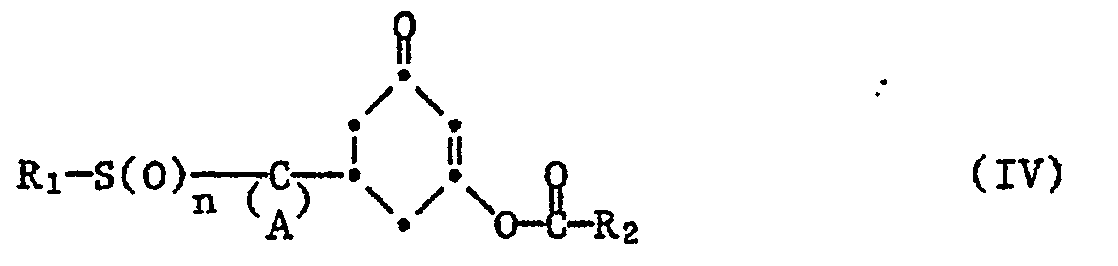


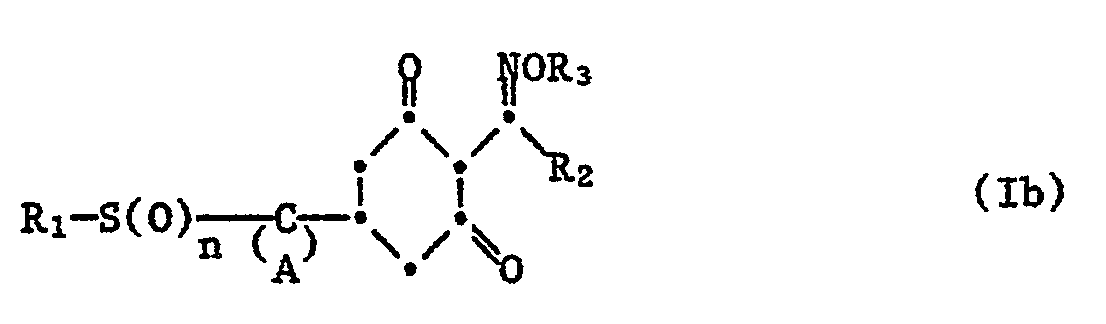









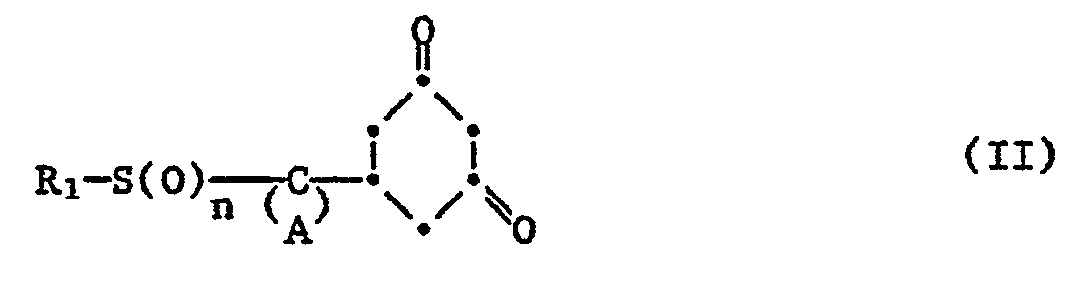




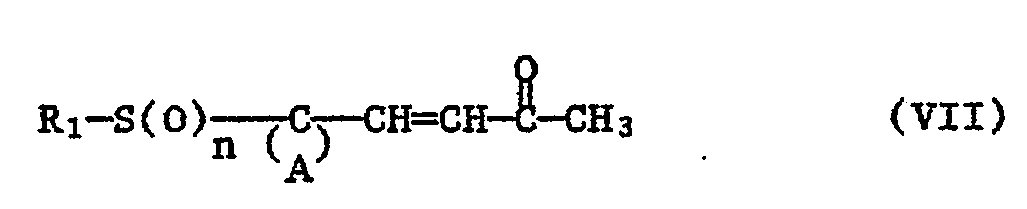


Priority Applications (1)
| Application Number | Priority Date | Filing Date | Title |
|---|---|---|---|
| AT87810238T ATE52769T1 (de) | 1986-04-24 | 1987-04-15 | Acyl-cyclohexandione und deren oximaether mit herbizider und das pflanzenwachstum regulierender wirkung. |
Applications Claiming Priority (2)
| Application Number | Priority Date | Filing Date | Title |
|---|---|---|---|
| CH1664/86 | 1986-04-24 | ||
| CH166486 | 1986-04-24 |
Publications (2)
| Publication Number | Publication Date |
|---|---|
| EP0243313A1 EP0243313A1 (de) | 1987-10-28 |
| EP0243313B1 true EP0243313B1 (de) | 1990-05-16 |
Family
ID=4215736
Family Applications (1)
| Application Number | Title | Priority Date | Filing Date |
|---|---|---|---|
| EP87810238A Expired - Lifetime EP0243313B1 (de) | 1986-04-24 | 1987-04-15 | Acyl-cyclohexandione und deren Oximäther mit herbizider und das Pflanzenwachstum regulierender Wirkung |
Country Status (15)
| Country | Link |
|---|---|
| US (3) | US4909835A (de) |
| EP (1) | EP0243313B1 (de) |
| JP (1) | JPS62267259A (de) |
| KR (1) | KR910000253B1 (de) |
| AT (1) | ATE52769T1 (de) |
| AU (1) | AU593097B2 (de) |
| BR (1) | BR8701933A (de) |
| CZ (1) | CZ287887A3 (de) |
| DE (1) | DE3762742D1 (de) |
| DK (4) | DK205887A (de) |
| ES (1) | ES2014493B3 (de) |
| GR (1) | GR3000487T3 (de) |
| HU (1) | HU203447B (de) |
| IL (1) | IL82285A0 (de) |
| ZA (1) | ZA872873B (de) |
Families Citing this family (29)
| Publication number | Priority date | Publication date | Assignee | Title |
|---|---|---|---|---|
| US2738098A (en) * | 1953-07-21 | 1956-03-13 | Lester A Reed | Tear strip can opener |
| IL85347A0 (en) * | 1987-02-11 | 1988-07-31 | May & Baker Ltd | Cyclic diones |
| US5215570A (en) * | 1988-10-20 | 1993-06-01 | Ciba-Geigy Corporation | Sulfamoylphenylureas |
| DE3838309A1 (de) * | 1988-11-11 | 1990-05-31 | Basf Ag | Cyclohexenonoximether, verfahren zu ihrer herstellung und ihre verwendung als herbizid |
| US5189227A (en) * | 1989-02-02 | 1993-02-23 | Ciba-Geigy Corporation | 1,2,4-trihalobutyl ethers |
| ES2054313T3 (es) * | 1989-02-02 | 1994-08-01 | Ciba Geigy Ag | Procedimiento para la obtencion de ciclopropanocarbaldehidos sustituidos. |
| EP0381624B1 (de) * | 1989-02-02 | 1993-05-12 | Ciba-Geigy Ag | Verfahren zur Herstellung von 1-Alkylthio- und 1-Benzylthio-1-formylcyclopropanen |
| US5256815A (en) * | 1989-02-02 | 1993-10-26 | Ciba-Geigy Corporation | Bisulfite adducts of 2,4-dihalobutraldehyde |
| US5084087A (en) * | 1989-04-26 | 1992-01-28 | Basf Corporation | Ready to dilute adjuvant-containing postemergent herbicide formulations |
| DE59009012D1 (de) | 1989-12-13 | 1995-06-08 | Ciba Geigy Ag | Synergistisch wirkendes Mittel und Verfahren zur Regulierung des Pflanzenwuchses. |
| US5075504A (en) * | 1990-02-02 | 1991-12-24 | Ciba-Geigy Corporation | Process for the preparation of O-substituted hydroxylamines |
| US4965390A (en) * | 1990-02-02 | 1990-10-23 | Ciba-Geigy Corporation | Hydroxamic acid esters |
| US5006159A (en) * | 1990-03-30 | 1991-04-09 | Dowelanco | Substituted cyclohexanediones and their herbicidal uses |
| DE4014988A1 (de) * | 1990-05-09 | 1991-11-14 | Basf Ag | Cyclohexenonoximether, verfahren zu ihrer herstellung und ihre verwendung als herbizid |
| US5364833A (en) * | 1990-05-09 | 1994-11-15 | Basf Aktiengesellschaft | Cyclohexenone oxime ethers, their preparation and their use as herbicides |
| EP0487454A3 (en) * | 1990-11-22 | 1992-08-05 | Ciba-Geigy Ag | Synergistic agent and method for selective weed control |
| DE4126479A1 (de) * | 1991-08-09 | 1993-02-11 | Basf Ag | Cyclohexenone oxime ethers |
| US5604183A (en) * | 1991-08-09 | 1997-02-18 | Basf Aktiengesellschaft | Cyclohexenone oxime ethers |
| DE4227896A1 (de) * | 1992-08-22 | 1994-02-24 | Basf Ag | Cyclohexenonoximether, ihre Herstellung und ihre Verwendung |
| DE4403670A1 (de) * | 1994-02-07 | 1995-09-07 | Basf Ag | 2-Aroylcyclohexandione, Verfahren zu ihrer Herstellung sowie ihre Verwendung als Herbizide oder das Pflanzenwachstum regulierende Mittel |
| DE4427995A1 (de) * | 1994-08-08 | 1996-02-15 | Basf Ag | Saccharinderivate |
| DE4434987A1 (de) * | 1994-09-30 | 1996-04-04 | Basf Ag | 2-Aroylcyclohexandione, Verfahren zu ihrer Herstellung sowie ihre Verwendung als Herbizide oder das Pflanzenwachstum regulierende Mittel |
| CN1096458C (zh) * | 1996-02-24 | 2002-12-18 | 巴斯福股份公司 | 2-杂芳酰基环己烷-1,3-二酮 |
| DE19638486A1 (de) | 1996-09-20 | 1998-03-26 | Basf Ag | Hetaroylderivate |
| WO2002098225A2 (en) * | 2001-06-07 | 2002-12-12 | Basf Corporation | Plant growth regulators and methods for control of annual bluegrass |
| US7214825B2 (en) * | 2003-10-17 | 2007-05-08 | Honeywell International Inc. | O-(3-chloropropenyl) hydroxylamine free base |
| AU2004202517A1 (en) * | 2004-05-06 | 2005-11-24 | Glaxosmithkline Australia Pty Ltd | Method of Altering the Alkaloid Composition in Poppy Plants |
| WO2012087980A1 (en) | 2010-12-21 | 2012-06-28 | Agraquest, Inc. | Sandpaper mutants of bacillus and methods of their use to enhance plant growth, promote plant health and control diseases and pests |
| MX2014002890A (es) | 2011-09-12 | 2015-01-19 | Bayer Cropscience Lp | Metodo para mejorar la salud y/o promover el crecimiento de una planta y/o mejorar la maduracion de frutos. |
Family Cites Families (11)
| Publication number | Priority date | Publication date | Assignee | Title |
|---|---|---|---|---|
| IL54560A (en) * | 1977-05-23 | 1981-06-29 | Nippon Soda Co | Substituted 2-aminoalkylidene-1,3-cyclohexanediones,their preparation and their use as herbicides |
| JPS574964A (en) * | 1980-06-12 | 1982-01-11 | Nippon Soda Co Ltd | Cyclohexane derivative and selective herbicide |
| US4440566A (en) * | 1982-08-05 | 1984-04-03 | Chevron Research Company | Herbicidal substituted 2-(1-(oxyamino)-alkylidene)-cyclohexane-1,3-diones |
| AU556148B2 (en) * | 1982-01-29 | 1986-10-23 | Ici Australia Limited | Cyclohexane -1,3- dione derivatives |
| EP0090262B1 (de) * | 1982-03-25 | 1992-08-05 | Stauffer Chemical Company | 2-(2-Substituierte Benzoyl)-1,3 cyclohexandione |
| DE3219315A1 (de) * | 1982-05-22 | 1983-11-24 | Basf Ag, 6700 Ludwigshafen | Cyclohexan-1,3-dion-derivate |
| DE3227332A1 (de) * | 1982-07-22 | 1984-01-26 | Basf Ag, 6700 Ludwigshafen | Cyclohexan-1,3-dionderivate, verfahren zu ihrer herstellung und ihre verwendung zur bekaempfung unerwuenschten pflanzenwuchses |
| DE3227389A1 (de) * | 1982-07-22 | 1984-01-26 | Basf Ag, 6700 Ludwigshafen | Cyclohexan-1,3-dion-derivate, verfahren zu deren herstellung sowie herbizide, die diese verbindungen enthalten |
| US4626276A (en) * | 1984-06-11 | 1986-12-02 | Chevron Research Company | Herbicidal trans-2-[(3-chloroallyloxyimino)alkyl]-5-(substitutedsulfinylalkyl)-cyclohexane-1,3-diones and derivatives thereof |
| AU583089B2 (en) * | 1985-02-15 | 1989-04-20 | Ici Australia Limited | Process for the preparation of 2-acylcyclohexane-1,3-dione derivatives |
| CH666890A5 (de) * | 1985-08-23 | 1988-08-31 | Chevron Res | 2-(1-(3-chlorallyloxyamino)-alkyliden)-5-alkylthioalkyl-cyclohexan-1,3-dion. |
-
1987
- 1987-04-15 ES ES87810238T patent/ES2014493B3/es not_active Expired - Lifetime
- 1987-04-15 AT AT87810238T patent/ATE52769T1/de not_active IP Right Cessation
- 1987-04-15 DE DE8787810238T patent/DE3762742D1/de not_active Expired - Lifetime
- 1987-04-15 EP EP87810238A patent/EP0243313B1/de not_active Expired - Lifetime
- 1987-04-22 IL IL82285A patent/IL82285A0/xx not_active IP Right Cessation
- 1987-04-23 ZA ZA872873A patent/ZA872873B/xx unknown
- 1987-04-23 BR BR8701933A patent/BR8701933A/pt not_active IP Right Cessation
- 1987-04-23 AU AU71889/87A patent/AU593097B2/en not_active Ceased
- 1987-04-23 HU HU871758A patent/HU203447B/hu not_active IP Right Cessation
- 1987-04-23 CZ CS872878A patent/CZ287887A3/cs unknown
- 1987-04-23 KR KR1019870003918A patent/KR910000253B1/ko not_active Expired
- 1987-04-23 DK DK205887A patent/DK205887A/da not_active Application Discontinuation
- 1987-04-24 JP JP62101725A patent/JPS62267259A/ja active Granted
-
1988
- 1988-02-24 US US07/159,803 patent/US4909835A/en not_active Expired - Fee Related
-
1989
- 1989-12-13 US US07/450,128 patent/US5026899A/en not_active Expired - Fee Related
-
1990
- 1990-05-17 GR GR90400138T patent/GR3000487T3/el unknown
-
1991
- 1991-03-07 US US07/666,178 patent/US5132462A/en not_active Expired - Fee Related
-
1992
- 1992-04-27 DK DK92541A patent/DK54192D0/da not_active Application Discontinuation
- 1992-04-27 DK DK92543A patent/DK54392D0/da not_active Application Discontinuation
- 1992-04-27 DK DK054292A patent/DK54292A/da not_active Application Discontinuation
Also Published As
| Publication number | Publication date |
|---|---|
| DK54292D0 (da) | 1992-04-27 |
| KR870009990A (ko) | 1987-11-30 |
| DK54392A (da) | 1992-04-27 |
| BR8701933A (pt) | 1988-02-02 |
| US4909835A (en) | 1990-03-20 |
| DK54392D0 (da) | 1992-04-27 |
| JPS62267259A (ja) | 1987-11-19 |
| KR910000253B1 (ko) | 1991-01-23 |
| DK54292A (da) | 1992-04-27 |
| ES2014493B3 (es) | 1990-07-16 |
| DK205887D0 (da) | 1987-04-23 |
| DK54192A (da) | 1992-04-27 |
| GR3000487T3 (en) | 1991-06-28 |
| US5026899A (en) | 1991-06-25 |
| AU7188987A (en) | 1987-10-29 |
| DK205887A (da) | 1987-10-25 |
| DK54192D0 (da) | 1992-04-27 |
| CZ287887A3 (en) | 1994-02-16 |
| JPH0571587B2 (de) | 1993-10-07 |
| EP0243313A1 (de) | 1987-10-28 |
| ZA872873B (en) | 1987-12-30 |
| US5132462A (en) | 1992-07-21 |
| AU593097B2 (en) | 1990-02-01 |
| HU203447B (en) | 1991-08-28 |
| DE3762742D1 (de) | 1990-06-21 |
| ATE52769T1 (de) | 1990-06-15 |
| IL82285A0 (en) | 1987-10-30 |
| HUT44121A (en) | 1988-02-29 |
Similar Documents
| Publication | Publication Date | Title |
|---|---|---|
| EP0243313A1 (de) | Acyl-cyclohexandione und deren Oximäther mit herbizider und das Pflanzenwachstum regulierender Wirkung | |
| EP0126713B1 (de) | Cyclohexandion-carbonsäurederivate mit herbizider und das Pflanzenwachstum regulierender Wirkung | |
| EP0002180A1 (de) | Substituierte 3-Aminopyrazole, diese enthaltende Herbizide und Verfahren zur Bekämpfung unerwünschten Pflanzenwuchses | |
| EP0388871B1 (de) | Herbizide und pflanzenwachstumsregulierende Azolylmethyloxirane | |
| DE3146309C2 (de) | ||
| EP0066195B1 (de) | Cyclohexan-1,3-dionderivate, Verfahren zu ihrer Herstellung und ihre Verwendung zur Bekämpfung von unerwünschtem Pflanzenwuchs | |
| EP0177450B1 (de) | Verfahren zur Herstellung von Cyclohexandion-carbonsäurederivaten mit herbizider und das Pflanzenwachstum regulierender Wirkung | |
| EP0044993A2 (de) | Triazolylpropenol-Derivate, Verfahren zu ihrer Herstellung sowie ihre Verwendung als Pflanzenwachstumsregulatoren und Fungizide | |
| EP0156773B1 (de) | Cyclohexenon-carbonsäurederivate mit herbizider und das Pflanzenwachstum regulierender Wirkung | |
| EP0103143B1 (de) | Cyclohexan-1,3-dion-derivate, Verfahren zu ihrer Herstellung und ihre Verwendung zur Bekämpfung unerwünschten Pflanzenwuchses | |
| EP0155911A1 (de) | Purinderivate zur Regulierung des Pflanzenwachstums | |
| EP0080102B1 (de) | Cycloalkyl-(alpha-triazolyl-beta-hydroxy)-ketone, Verfahren zu ihrer Herstellung sowie ihre Verwendung als Fungizide und Pflanzenwachstumsregulatoren | |
| EP0137174B1 (de) | Cyclohexan-1,3-dionderivate, Verfahren zu ihrer Herstellung und ihre Verwendung zur Bekämpfung unerwünschten Pflanzenwuchses | |
| DE3105374A1 (de) | Benzyl-pyrimidinylalkyl-ether, verfahren zu ihrer herstellung, ihre verwendung als pflanzenwachstumsregulatoren und fungizide sowie zwischenprodukte und deren herstellung | |
| JPH03133948A (ja) | シクロヘキセノン化合物およびその除草剤または植物成長調節剤としての利用法 | |
| EP0232724A2 (de) | Cyclohexenonderivate, ein Verfahren zu ihrer Herstellung sowie ihre Verwendung als herbizide und das Pflanzenwachstum regulierende Mittel | |
| CH677664A5 (de) | ||
| EP0095099B1 (de) | Cyclohexan-1,3-dion-Derivate | |
| DE4007683A1 (de) | Herbizide sulfonylharnstoffe, verfahren und zwischenprodukte zu ihrer herstellung | |
| EP0054682B1 (de) | 5-Aryl-cyclohexan-1,3-dion-Derivate, Herbizide, die diese Verbindungen enthalten, und Verfahren zu ihrer Herstellung | |
| US5169988A (en) | Intermediates for the preparation of acylcyclohexanediones and the oxime ethers thereof | |
| EP0345637B1 (de) | N-substituierte 3,4,5,6-Tetrahydrophthalimid-Derivate | |
| EP0175652A2 (de) | 5-Acylaminopyrimidine | |
| EP0145663B1 (de) | 1-Di- oder Triazo1-2,3-diphenyl-propan-2,3-diole als Herbizide und Wuchsregulatoren | |
| EP0287512A2 (de) | Pflanzenwuchsregulatoren |
Legal Events
| Date | Code | Title | Description |
|---|---|---|---|
| PUAI | Public reference made under article 153(3) epc to a published international application that has entered the european phase |
Free format text: ORIGINAL CODE: 0009012 |
|
| 17P | Request for examination filed |
Effective date: 19870418 |
|
| AK | Designated contracting states |
Kind code of ref document: A1 Designated state(s): AT BE CH DE ES FR GB GR IT LI LU NL SE |
|
| 17Q | First examination report despatched |
Effective date: 19890630 |
|
| GRAA | (expected) grant |
Free format text: ORIGINAL CODE: 0009210 |
|
| AK | Designated contracting states |
Kind code of ref document: B1 Designated state(s): AT BE CH DE ES FR GB GR IT LI LU NL SE |
|
| REF | Corresponds to: |
Ref document number: 52769 Country of ref document: AT Date of ref document: 19900615 Kind code of ref document: T |
|
| ITF | It: translation for a ep patent filed | ||
| REF | Corresponds to: |
Ref document number: 3762742 Country of ref document: DE Date of ref document: 19900621 |
|
| ET | Fr: translation filed | ||
| GBT | Gb: translation of ep patent filed (gb section 77(6)(a)/1977) | ||
| REG | Reference to a national code |
Ref country code: GR Ref legal event code: FG4A Free format text: 3000487 |
|
| PLBE | No opposition filed within time limit |
Free format text: ORIGINAL CODE: 0009261 |
|
| STAA | Information on the status of an ep patent application or granted ep patent |
Free format text: STATUS: NO OPPOSITION FILED WITHIN TIME LIMIT |
|
| ITTA | It: last paid annual fee | ||
| 26N | No opposition filed | ||
| EPTA | Lu: last paid annual fee | ||
| PGFP | Annual fee paid to national office [announced via postgrant information from national office to epo] |
Ref country code: AT Payment date: 19930315 Year of fee payment: 7 |
|
| PGFP | Annual fee paid to national office [announced via postgrant information from national office to epo] |
Ref country code: ES Payment date: 19930421 Year of fee payment: 7 |
|
| PGFP | Annual fee paid to national office [announced via postgrant information from national office to epo] |
Ref country code: GR Payment date: 19930427 Year of fee payment: 7 |
|
| PGFP | Annual fee paid to national office [announced via postgrant information from national office to epo] |
Ref country code: SE Payment date: 19930430 Year of fee payment: 7 Ref country code: NL Payment date: 19930430 Year of fee payment: 7 Ref country code: LU Payment date: 19930430 Year of fee payment: 7 |
|
| PGFP | Annual fee paid to national office [announced via postgrant information from national office to epo] |
Ref country code: BE Payment date: 19930504 Year of fee payment: 7 |
|
| PG25 | Lapsed in a contracting state [announced via postgrant information from national office to epo] |
Ref country code: LU Free format text: LAPSE BECAUSE OF NON-PAYMENT OF DUE FEES Effective date: 19940415 Ref country code: AT Effective date: 19940415 |
|
| PG25 | Lapsed in a contracting state [announced via postgrant information from national office to epo] |
Ref country code: SE Effective date: 19940416 Ref country code: ES Free format text: LAPSE BECAUSE OF THE APPLICANT RENOUNCES Effective date: 19940416 |
|
| PG25 | Lapsed in a contracting state [announced via postgrant information from national office to epo] |
Ref country code: BE Effective date: 19940430 |
|
| BERE | Be: lapsed |
Owner name: CIBA-GEIGY A.G. Effective date: 19940430 |
|
| PG25 | Lapsed in a contracting state [announced via postgrant information from national office to epo] |
Ref country code: GR Free format text: THE PATENT HAS BEEN ANNULLED BY A DECISION OF A NATIONAL AUTHORITY Effective date: 19941031 |
|
| PG25 | Lapsed in a contracting state [announced via postgrant information from national office to epo] |
Ref country code: NL Effective date: 19941101 |
|
| NLV4 | Nl: lapsed or anulled due to non-payment of the annual fee | ||
| EUG | Se: european patent has lapsed |
Ref document number: 87810238.3 Effective date: 19941110 |
|
| REG | Reference to a national code |
Ref country code: GR Ref legal event code: MM2A Free format text: 3000487 |
|
| PGFP | Annual fee paid to national office [announced via postgrant information from national office to epo] |
Ref country code: FR Payment date: 19970211 Year of fee payment: 11 |
|
| REG | Reference to a national code |
Ref country code: CH Ref legal event code: PFA Free format text: CIBA-GEIGY AG TRANSFER- NOVARTIS AG |
|
| PGFP | Annual fee paid to national office [announced via postgrant information from national office to epo] |
Ref country code: GB Payment date: 19970304 Year of fee payment: 11 |
|
| PGFP | Annual fee paid to national office [announced via postgrant information from national office to epo] |
Ref country code: CH Payment date: 19970401 Year of fee payment: 11 |
|
| PGFP | Annual fee paid to national office [announced via postgrant information from national office to epo] |
Ref country code: DE Payment date: 19970402 Year of fee payment: 11 |
|
| REG | Reference to a national code |
Ref country code: GB Ref legal event code: 732E |
|
| REG | Reference to a national code |
Ref country code: FR Ref legal event code: TP |
|
| PG25 | Lapsed in a contracting state [announced via postgrant information from national office to epo] |
Ref country code: GB Free format text: LAPSE BECAUSE OF NON-PAYMENT OF DUE FEES Effective date: 19980415 |
|
| PG25 | Lapsed in a contracting state [announced via postgrant information from national office to epo] |
Ref country code: LI Free format text: LAPSE BECAUSE OF NON-PAYMENT OF DUE FEES Effective date: 19980430 Ref country code: FR Free format text: THE PATENT HAS BEEN ANNULLED BY A DECISION OF A NATIONAL AUTHORITY Effective date: 19980430 Ref country code: CH Free format text: LAPSE BECAUSE OF NON-PAYMENT OF DUE FEES Effective date: 19980430 |
|
| GBPC | Gb: european patent ceased through non-payment of renewal fee |
Effective date: 19980415 |
|
| REG | Reference to a national code |
Ref country code: CH Ref legal event code: PL |
|
| PG25 | Lapsed in a contracting state [announced via postgrant information from national office to epo] |
Ref country code: DE Free format text: LAPSE BECAUSE OF NON-PAYMENT OF DUE FEES Effective date: 19990202 |
|
| REG | Reference to a national code |
Ref country code: FR Ref legal event code: ST |
|
| REG | Reference to a national code |
Ref country code: ES Ref legal event code: FD2A Effective date: 19991007 |
|
| PG25 | Lapsed in a contracting state [announced via postgrant information from national office to epo] |
Ref country code: IT Free format text: LAPSE BECAUSE OF NON-PAYMENT OF DUE FEES;WARNING: LAPSES OF ITALIAN PATENTS WITH EFFECTIVE DATE BEFORE 2007 MAY HAVE OCCURRED AT ANY TIME BEFORE 2007. THE CORRECT EFFECTIVE DATE MAY BE DIFFERENT FROM THE ONE RECORDED. Effective date: 20050415 |