EP0434613B1 - Synergistisch wirkendes Mittel und Verfahren zur Regulierung des Pflanzenwuchses - Google Patents
Synergistisch wirkendes Mittel und Verfahren zur Regulierung des Pflanzenwuchses Download PDFInfo
- Publication number
- EP0434613B1 EP0434613B1 EP90810948A EP90810948A EP0434613B1 EP 0434613 B1 EP0434613 B1 EP 0434613B1 EP 90810948 A EP90810948 A EP 90810948A EP 90810948 A EP90810948 A EP 90810948A EP 0434613 B1 EP0434613 B1 EP 0434613B1
- Authority
- EP
- European Patent Office
- Prior art keywords
- formula
- plant growth
- active
- chlorine
- acid
- Prior art date
- Legal status (The legal status is an assumption and is not a legal conclusion. Google has not performed a legal analysis and makes no representation as to the accuracy of the status listed.)
- Expired - Lifetime
Links
- 230000008635 plant growth Effects 0.000 title claims description 13
- 230000001105 regulatory effect Effects 0.000 title claims description 11
- 238000000034 method Methods 0.000 title claims description 8
- 239000012747 synergistic agent Substances 0.000 title description 4
- 239000000203 mixture Substances 0.000 claims description 47
- 150000001875 compounds Chemical class 0.000 claims description 27
- 241000196324 Embryophyta Species 0.000 claims description 26
- 239000000460 chlorine Substances 0.000 claims description 9
- 229910052801 chlorine Inorganic materials 0.000 claims description 9
- 230000002401 inhibitory effect Effects 0.000 claims description 8
- 239000004094 surface-active agent Substances 0.000 claims description 8
- 238000002156 mixing Methods 0.000 claims description 7
- 239000000969 carrier Substances 0.000 claims description 6
- 125000001309 chloro group Chemical group Cl* 0.000 claims description 6
- 125000002496 methyl group Chemical group [H]C([H])([H])* 0.000 claims description 6
- 239000007787 solid Substances 0.000 claims description 6
- WNTGYJSOUMFZEP-UHFFFAOYSA-N 2-(4-chloro-2-methylphenoxy)propanoic acid Chemical compound OC(=O)C(C)OC1=CC=C(Cl)C=C1C WNTGYJSOUMFZEP-UHFFFAOYSA-N 0.000 claims description 5
- LLWADFLAOKUBDR-UHFFFAOYSA-N 2-methyl-4-chlorophenoxybutyric acid Chemical compound CC1=CC(Cl)=CC=C1OCCCC(O)=O LLWADFLAOKUBDR-UHFFFAOYSA-N 0.000 claims description 5
- WHKUVVPPKQRRBV-UHFFFAOYSA-N Trasan Chemical compound CC1=CC(Cl)=CC=C1OCC(O)=O WHKUVVPPKQRRBV-UHFFFAOYSA-N 0.000 claims description 5
- 239000002253 acid Substances 0.000 claims description 5
- 239000007788 liquid Substances 0.000 claims description 4
- OVSKIKFHRZPJSS-UHFFFAOYSA-N 2,4-D Chemical compound OC(=O)COC1=CC=C(Cl)C=C1Cl OVSKIKFHRZPJSS-UHFFFAOYSA-N 0.000 claims description 3
- IUSYSZLVZMUVDO-UHFFFAOYSA-N 5-(2,4-dichlorophenoxy)-2-nitrobenzoic acid Chemical compound C1=C([N+]([O-])=O)C(C(=O)O)=CC(OC=2C(=CC(Cl)=CC=2)Cl)=C1 IUSYSZLVZMUVDO-UHFFFAOYSA-N 0.000 claims description 3
- ZAMOUSCENKQFHK-UHFFFAOYSA-N Chlorine atom Chemical group [Cl] ZAMOUSCENKQFHK-UHFFFAOYSA-N 0.000 claims description 3
- LRMHFDNWKCSEQU-UHFFFAOYSA-N ethoxyethane;phenol Chemical compound CCOCC.OC1=CC=CC=C1 LRMHFDNWKCSEQU-UHFFFAOYSA-N 0.000 claims description 3
- 239000001257 hydrogen Substances 0.000 claims description 3
- 229910052739 hydrogen Inorganic materials 0.000 claims description 3
- 125000004435 hydrogen atom Chemical group [H]* 0.000 claims description 3
- 125000000896 monocarboxylic acid group Chemical group 0.000 claims description 3
- 241000209504 Poaceae Species 0.000 claims description 2
- 125000001495 ethyl group Chemical group [H]C([H])([H])C([H])([H])* 0.000 claims description 2
- 239000002671 adjuvant Substances 0.000 claims 3
- 150000008379 phenol ethers Chemical class 0.000 claims 1
- 244000045561 useful plants Species 0.000 claims 1
- 239000004480 active ingredient Substances 0.000 description 36
- LYCAIKOWRPUZTN-UHFFFAOYSA-N Ethylene glycol Chemical compound OCCO LYCAIKOWRPUZTN-UHFFFAOYSA-N 0.000 description 13
- -1 cyclohexanedione carboxylic acid derivatives Chemical class 0.000 description 13
- 239000003795 chemical substances by application Substances 0.000 description 12
- 239000000575 pesticide Substances 0.000 description 10
- 230000002195 synergetic effect Effects 0.000 description 10
- 239000000654 additive Substances 0.000 description 9
- 239000011734 sodium Substances 0.000 description 8
- XLYOFNOQVPJJNP-UHFFFAOYSA-N water Substances O XLYOFNOQVPJJNP-UHFFFAOYSA-N 0.000 description 8
- 230000012010 growth Effects 0.000 description 7
- IGFHQQFPSIBGKE-UHFFFAOYSA-N 4-nonylphenol Chemical compound CCCCCCCCCC1=CC=C(O)C=C1 IGFHQQFPSIBGKE-UHFFFAOYSA-N 0.000 description 6
- 239000005995 Aluminium silicate Substances 0.000 description 6
- 239000013543 active substance Substances 0.000 description 6
- 235000012211 aluminium silicate Nutrition 0.000 description 6
- 125000004432 carbon atom Chemical group C* 0.000 description 6
- 238000009472 formulation Methods 0.000 description 6
- 239000000126 substance Substances 0.000 description 6
- 239000002202 Polyethylene glycol Substances 0.000 description 5
- 235000014113 dietary fatty acids Nutrition 0.000 description 5
- 230000000694 effects Effects 0.000 description 5
- 239000000839 emulsion Substances 0.000 description 5
- 239000000194 fatty acid Substances 0.000 description 5
- 229930195729 fatty acid Natural products 0.000 description 5
- 239000008187 granular material Substances 0.000 description 5
- NLYAJNPCOHFWQQ-UHFFFAOYSA-N kaolin Chemical compound O.O.O=[Al]O[Si](=O)O[Si](=O)O[Al]=O NLYAJNPCOHFWQQ-UHFFFAOYSA-N 0.000 description 5
- 229920001223 polyethylene glycol Polymers 0.000 description 5
- 239000000843 powder Substances 0.000 description 5
- 150000003839 salts Chemical class 0.000 description 5
- 229910052708 sodium Inorganic materials 0.000 description 5
- RTZKZFJDLAIYFH-UHFFFAOYSA-N Diethyl ether Chemical compound CCOCC RTZKZFJDLAIYFH-UHFFFAOYSA-N 0.000 description 4
- VEXZGXHMUGYJMC-UHFFFAOYSA-N Hydrochloric acid Chemical compound Cl VEXZGXHMUGYJMC-UHFFFAOYSA-N 0.000 description 4
- VYPSYNLAJGMNEJ-UHFFFAOYSA-N Silicium dioxide Chemical compound O=[Si]=O VYPSYNLAJGMNEJ-UHFFFAOYSA-N 0.000 description 4
- 125000000217 alkyl group Chemical group 0.000 description 4
- 235000013339 cereals Nutrition 0.000 description 4
- JHIVVAPYMSGYDF-UHFFFAOYSA-N cyclohexanone Chemical compound O=C1CCCCC1 JHIVVAPYMSGYDF-UHFFFAOYSA-N 0.000 description 4
- 150000004665 fatty acids Chemical class 0.000 description 4
- 230000009036 growth inhibition Effects 0.000 description 4
- 239000002736 nonionic surfactant Substances 0.000 description 4
- 239000005648 plant growth regulator Substances 0.000 description 4
- 239000002904 solvent Substances 0.000 description 4
- LFQSCWFLJHTTHZ-UHFFFAOYSA-N Ethanol Chemical compound CCO LFQSCWFLJHTTHZ-UHFFFAOYSA-N 0.000 description 3
- 229920001732 Lignosulfonate Polymers 0.000 description 3
- ZMXDDKWLCZADIW-UHFFFAOYSA-N N,N-Dimethylformamide Chemical compound CN(C)C=O ZMXDDKWLCZADIW-UHFFFAOYSA-N 0.000 description 3
- 0 O=*C(CC(C1C(C2CC2)=O)=O)CC1=O Chemical compound O=*C(CC(C1C(C2CC2)=O)=O)CC1=O 0.000 description 3
- 229920003171 Poly (ethylene oxide) Polymers 0.000 description 3
- 239000003905 agrochemical Substances 0.000 description 3
- 239000003513 alkali Substances 0.000 description 3
- 239000011575 calcium Substances 0.000 description 3
- 229910052791 calcium Inorganic materials 0.000 description 3
- 239000012141 concentrate Substances 0.000 description 3
- 235000008504 concentrate Nutrition 0.000 description 3
- MTHSVFCYNBDYFN-UHFFFAOYSA-N diethylene glycol Chemical group OCCOCCO MTHSVFCYNBDYFN-UHFFFAOYSA-N 0.000 description 3
- 235000013399 edible fruits Nutrition 0.000 description 3
- 238000005516 engineering process Methods 0.000 description 3
- 235000019441 ethanol Nutrition 0.000 description 3
- 150000002170 ethers Chemical class 0.000 description 3
- 230000005764 inhibitory process Effects 0.000 description 3
- VLKZOEOYAKHREP-UHFFFAOYSA-N n-Hexane Chemical compound CCCCCC VLKZOEOYAKHREP-UHFFFAOYSA-N 0.000 description 3
- 229920000151 polyglycol Polymers 0.000 description 3
- 239000010695 polyglycol Substances 0.000 description 3
- 239000002689 soil Substances 0.000 description 3
- 239000000243 solution Substances 0.000 description 3
- 239000007921 spray Substances 0.000 description 3
- LMBFAGIMSUYTBN-MPZNNTNKSA-N teixobactin Chemical compound C([C@H](C(=O)N[C@@H]([C@@H](C)CC)C(=O)N[C@@H](CO)C(=O)N[C@H](CCC(N)=O)C(=O)N[C@H]([C@@H](C)CC)C(=O)N[C@@H]([C@@H](C)CC)C(=O)N[C@@H](CO)C(=O)N[C@H]1C(N[C@@H](C)C(=O)N[C@@H](C[C@@H]2NC(=N)NC2)C(=O)N[C@H](C(=O)O[C@H]1C)[C@@H](C)CC)=O)NC)C1=CC=CC=C1 LMBFAGIMSUYTBN-MPZNNTNKSA-N 0.000 description 3
- 230000009105 vegetative growth Effects 0.000 description 3
- SCYULBFZEHDVBN-UHFFFAOYSA-N 1,1-Dichloroethane Chemical compound CC(Cl)Cl SCYULBFZEHDVBN-UHFFFAOYSA-N 0.000 description 2
- IJGRMHOSHXDMSA-UHFFFAOYSA-N Atomic nitrogen Chemical compound N#N IJGRMHOSHXDMSA-UHFFFAOYSA-N 0.000 description 2
- 239000005484 Bifenox Substances 0.000 description 2
- 101000742062 Bos taurus Protein phosphatase 1G Proteins 0.000 description 2
- 229910021532 Calcite Inorganic materials 0.000 description 2
- 229920002134 Carboxymethyl cellulose Polymers 0.000 description 2
- 229920000742 Cotton Polymers 0.000 description 2
- IAZDPXIOMUYVGZ-UHFFFAOYSA-N Dimethylsulphoxide Chemical compound CS(C)=O IAZDPXIOMUYVGZ-UHFFFAOYSA-N 0.000 description 2
- SUSRORUBZHMPCO-UHFFFAOYSA-N MC-4379 Chemical compound C1=C([N+]([O-])=O)C(C(=O)OC)=CC(OC=2C(=CC(Cl)=CC=2)Cl)=C1 SUSRORUBZHMPCO-UHFFFAOYSA-N 0.000 description 2
- 239000005574 MCPA Substances 0.000 description 2
- 239000005575 MCPB Substances 0.000 description 2
- 101150039283 MCPB gene Proteins 0.000 description 2
- SECXISVLQFMRJM-UHFFFAOYSA-N N-Methylpyrrolidone Chemical compound CN1CCCC1=O SECXISVLQFMRJM-UHFFFAOYSA-N 0.000 description 2
- CTQNGGLPUBDAKN-UHFFFAOYSA-N O-Xylene Chemical compound CC1=CC=CC=C1C CTQNGGLPUBDAKN-UHFFFAOYSA-N 0.000 description 2
- 239000000853 adhesive Substances 0.000 description 2
- 230000001070 adhesive effect Effects 0.000 description 2
- 150000001298 alcohols Chemical class 0.000 description 2
- 150000008055 alkyl aryl sulfonates Chemical class 0.000 description 2
- 150000003863 ammonium salts Chemical class 0.000 description 2
- 239000003945 anionic surfactant Substances 0.000 description 2
- 125000003785 benzimidazolyl group Chemical class N1=C(NC2=C1C=CC=C2)* 0.000 description 2
- 239000011230 binding agent Substances 0.000 description 2
- 239000001768 carboxy methyl cellulose Substances 0.000 description 2
- 235000010948 carboxy methyl cellulose Nutrition 0.000 description 2
- 239000008112 carboxymethyl-cellulose Substances 0.000 description 2
- 239000004359 castor oil Substances 0.000 description 2
- 235000019438 castor oil Nutrition 0.000 description 2
- 239000003093 cationic surfactant Substances 0.000 description 2
- 239000011248 coating agent Substances 0.000 description 2
- 238000000576 coating method Methods 0.000 description 2
- 239000003240 coconut oil Substances 0.000 description 2
- 244000038559 crop plants Species 0.000 description 2
- 238000010790 dilution Methods 0.000 description 2
- 239000012895 dilution Substances 0.000 description 2
- 125000004494 ethyl ester group Chemical group 0.000 description 2
- 239000003337 fertilizer Substances 0.000 description 2
- ZEMPKEQAKRGZGQ-XOQCFJPHSA-N glycerol triricinoleate Natural products CCCCCC[C@@H](O)CC=CCCCCCCCC(=O)OC[C@@H](COC(=O)CCCCCCCC=CC[C@@H](O)CCCCCC)OC(=O)CCCCCCCC=CC[C@H](O)CCCCCC ZEMPKEQAKRGZGQ-XOQCFJPHSA-N 0.000 description 2
- 238000000227 grinding Methods 0.000 description 2
- 230000009422 growth inhibiting effect Effects 0.000 description 2
- 239000003630 growth substance Substances 0.000 description 2
- 238000003306 harvesting Methods 0.000 description 2
- WGCNASOHLSPBMP-UHFFFAOYSA-N hydroxyacetaldehyde Natural products OCC=O WGCNASOHLSPBMP-UHFFFAOYSA-N 0.000 description 2
- 239000000463 material Substances 0.000 description 2
- 150000004702 methyl esters Chemical class 0.000 description 2
- 238000002360 preparation method Methods 0.000 description 2
- 239000000047 product Substances 0.000 description 2
- 239000000344 soap Substances 0.000 description 2
- 125000001424 substituent group Chemical group 0.000 description 2
- 150000003871 sulfonates Chemical class 0.000 description 2
- 150000003467 sulfuric acid derivatives Chemical class 0.000 description 2
- 239000000725 suspension Substances 0.000 description 2
- 239000004546 suspension concentrate Substances 0.000 description 2
- 239000000454 talc Substances 0.000 description 2
- 229910052623 talc Inorganic materials 0.000 description 2
- 239000008096 xylene Substances 0.000 description 2
- 125000004178 (C1-C4) alkyl group Chemical group 0.000 description 1
- WRIDQFICGBMAFQ-UHFFFAOYSA-N (E)-8-Octadecenoic acid Natural products CCCCCCCCCC=CCCCCCCC(O)=O WRIDQFICGBMAFQ-UHFFFAOYSA-N 0.000 description 1
- ZPFAVCIQZKRBGF-UHFFFAOYSA-N 1,3,2-dioxathiolane 2,2-dioxide Chemical class O=S1(=O)OCCO1 ZPFAVCIQZKRBGF-UHFFFAOYSA-N 0.000 description 1
- AJZFILKUEPSHCN-UHFFFAOYSA-N 1-ethyl-3,5-dioxocyclohexane-1-carboxylic acid Chemical compound CCC1(C(O)=O)CC(=O)CC(=O)C1 AJZFILKUEPSHCN-UHFFFAOYSA-N 0.000 description 1
- XNWFRZJHXBZDAG-UHFFFAOYSA-N 2-METHOXYETHANOL Chemical group COCCO XNWFRZJHXBZDAG-UHFFFAOYSA-N 0.000 description 1
- JDSQBDGCMUXRBM-UHFFFAOYSA-N 2-[2-(2-butoxypropoxy)propoxy]propan-1-ol Chemical group CCCCOC(C)COC(C)COC(C)CO JDSQBDGCMUXRBM-UHFFFAOYSA-N 0.000 description 1
- WBIQQQGBSDOWNP-UHFFFAOYSA-N 2-dodecylbenzenesulfonic acid Chemical class CCCCCCCCCCCCC1=CC=CC=C1S(O)(=O)=O WBIQQQGBSDOWNP-UHFFFAOYSA-N 0.000 description 1
- LQJBNNIYVWPHFW-UHFFFAOYSA-N 20:1omega9c fatty acid Natural products CCCCCCCCCCC=CCCCCCCCC(O)=O LQJBNNIYVWPHFW-UHFFFAOYSA-N 0.000 description 1
- XVMSFILGAMDHEY-UHFFFAOYSA-N 6-(4-aminophenyl)sulfonylpyridin-3-amine Chemical compound C1=CC(N)=CC=C1S(=O)(=O)C1=CC=C(N)C=N1 XVMSFILGAMDHEY-UHFFFAOYSA-N 0.000 description 1
- QSBYPNXLFMSGKH-UHFFFAOYSA-N 9-Heptadecensaeure Natural products CCCCCCCC=CCCCCCCCC(O)=O QSBYPNXLFMSGKH-UHFFFAOYSA-N 0.000 description 1
- LSNNMFCWUKXFEE-UHFFFAOYSA-M Bisulfite Chemical compound OS([O-])=O LSNNMFCWUKXFEE-UHFFFAOYSA-M 0.000 description 1
- 240000002791 Brassica napus Species 0.000 description 1
- 235000004977 Brassica sinapistrum Nutrition 0.000 description 1
- OYPRJOBELJOOCE-UHFFFAOYSA-N Calcium Chemical compound [Ca] OYPRJOBELJOOCE-UHFFFAOYSA-N 0.000 description 1
- 244000025254 Cannabis sativa Species 0.000 description 1
- 239000004215 Carbon black (E152) Substances 0.000 description 1
- 244000060011 Cocos nucifera Species 0.000 description 1
- 235000013162 Cocos nucifera Nutrition 0.000 description 1
- 241000195493 Cryptophyta Species 0.000 description 1
- XDTMQSROBMDMFD-UHFFFAOYSA-N Cyclohexane Chemical compound C1CCCCC1 XDTMQSROBMDMFD-UHFFFAOYSA-N 0.000 description 1
- MQIUGAXCHLFZKX-UHFFFAOYSA-N Di-n-octyl phthalate Natural products CCCCCCCCOC(=O)C1=CC=CC=C1C(=O)OCCCCCCCC MQIUGAXCHLFZKX-UHFFFAOYSA-N 0.000 description 1
- IAYPIBMASNFSPL-UHFFFAOYSA-N Ethylene oxide Chemical compound C1CO1 IAYPIBMASNFSPL-UHFFFAOYSA-N 0.000 description 1
- 239000004606 Fillers/Extenders Substances 0.000 description 1
- 241000208818 Helianthus Species 0.000 description 1
- 235000003222 Helianthus annuus Nutrition 0.000 description 1
- 240000005979 Hordeum vulgare Species 0.000 description 1
- 235000007340 Hordeum vulgare Nutrition 0.000 description 1
- DGAQECJNVWCQMB-PUAWFVPOSA-M Ilexoside XXIX Chemical compound C[C@@H]1CC[C@@]2(CC[C@@]3(C(=CC[C@H]4[C@]3(CC[C@@H]5[C@@]4(CC[C@@H](C5(C)C)OS(=O)(=O)[O-])C)C)[C@@H]2[C@]1(C)O)C)C(=O)O[C@H]6[C@@H]([C@H]([C@@H]([C@H](O6)CO)O)O)O.[Na+] DGAQECJNVWCQMB-PUAWFVPOSA-M 0.000 description 1
- 241000209510 Liliopsida Species 0.000 description 1
- 235000007688 Lycopersicon esculentum Nutrition 0.000 description 1
- 240000008790 Musa x paradisiaca Species 0.000 description 1
- 244000061176 Nicotiana tabacum Species 0.000 description 1
- 235000002637 Nicotiana tabacum Nutrition 0.000 description 1
- 241000207836 Olea <angiosperm> Species 0.000 description 1
- 239000005642 Oleic acid Substances 0.000 description 1
- ZQPPMHVWECSIRJ-UHFFFAOYSA-N Oleic acid Natural products CCCCCCCCC=CCCCCCCCC(O)=O ZQPPMHVWECSIRJ-UHFFFAOYSA-N 0.000 description 1
- 229910019142 PO4 Inorganic materials 0.000 description 1
- 229920001214 Polysorbate 60 Polymers 0.000 description 1
- DNIAPMSPPWPWGF-UHFFFAOYSA-N Propylene glycol Chemical group CC(O)CO DNIAPMSPPWPWGF-UHFFFAOYSA-N 0.000 description 1
- 239000004113 Sepiolite Substances 0.000 description 1
- 240000003768 Solanum lycopersicum Species 0.000 description 1
- 244000061456 Solanum tuberosum Species 0.000 description 1
- 235000002595 Solanum tuberosum Nutrition 0.000 description 1
- PRXRUNOAOLTIEF-ADSICKODSA-N Sorbitan trioleate Chemical compound CCCCCCCC\C=C/CCCCCCCC(=O)OC[C@@H](OC(=O)CCCCCCC\C=C/CCCCCCCC)[C@H]1OC[C@H](O)[C@H]1OC(=O)CCCCCCC\C=C/CCCCCCCC PRXRUNOAOLTIEF-ADSICKODSA-N 0.000 description 1
- 239000004147 Sorbitan trioleate Substances 0.000 description 1
- 235000021355 Stearic acid Nutrition 0.000 description 1
- VBIIFPGSPJYLRR-UHFFFAOYSA-M Stearyltrimethylammonium chloride Chemical compound [Cl-].CCCCCCCCCCCCCCCCCC[N+](C)(C)C VBIIFPGSPJYLRR-UHFFFAOYSA-M 0.000 description 1
- 229940100389 Sulfonylurea Drugs 0.000 description 1
- QAOWNCQODCNURD-UHFFFAOYSA-N Sulfuric acid Chemical class OS(O)(=O)=O QAOWNCQODCNURD-UHFFFAOYSA-N 0.000 description 1
- GSEJCLTVZPLZKY-UHFFFAOYSA-N Triethanolamine Chemical class OCCN(CCO)CCO GSEJCLTVZPLZKY-UHFFFAOYSA-N 0.000 description 1
- 240000008042 Zea mays Species 0.000 description 1
- 235000016383 Zea mays subsp huehuetenangensis Nutrition 0.000 description 1
- 235000002017 Zea mays subsp mays Nutrition 0.000 description 1
- 239000002250 absorbent Substances 0.000 description 1
- 230000002745 absorbent Effects 0.000 description 1
- 150000007513 acids Chemical class 0.000 description 1
- 125000002252 acyl group Chemical group 0.000 description 1
- 230000000996 additive effect Effects 0.000 description 1
- 230000000274 adsorptive effect Effects 0.000 description 1
- 230000009418 agronomic effect Effects 0.000 description 1
- 125000001931 aliphatic group Chemical group 0.000 description 1
- 150000001338 aliphatic hydrocarbons Chemical class 0.000 description 1
- RMRFFCXPLWYOOY-UHFFFAOYSA-N allyl radical Chemical compound [CH2]C=C RMRFFCXPLWYOOY-UHFFFAOYSA-N 0.000 description 1
- 230000003042 antagnostic effect Effects 0.000 description 1
- 238000009305 arable farming Methods 0.000 description 1
- 150000004945 aromatic hydrocarbons Chemical class 0.000 description 1
- 229960000892 attapulgite Drugs 0.000 description 1
- 235000021015 bananas Nutrition 0.000 description 1
- 239000000440 bentonite Substances 0.000 description 1
- 229910000278 bentonite Inorganic materials 0.000 description 1
- SVPXDRXYRYOSEX-UHFFFAOYSA-N bentoquatam Chemical compound O.O=[Si]=O.O=[Al]O[Al]=O SVPXDRXYRYOSEX-UHFFFAOYSA-N 0.000 description 1
- 125000001797 benzyl group Chemical group [H]C1=C([H])C([H])=C(C([H])=C1[H])C([H])([H])* 0.000 description 1
- BCOZLGOHQFNXBI-UHFFFAOYSA-M benzyl-bis(2-chloroethyl)-ethylazanium;bromide Chemical compound [Br-].ClCC[N+](CC)(CCCl)CC1=CC=CC=C1 BCOZLGOHQFNXBI-UHFFFAOYSA-M 0.000 description 1
- 230000003115 biocidal effect Effects 0.000 description 1
- BJQHLKABXJIVAM-UHFFFAOYSA-N bis(2-ethylhexyl) phthalate Chemical compound CCCCC(CC)COC(=O)C1=CC=CC=C1C(=O)OCC(CC)CCCC BJQHLKABXJIVAM-UHFFFAOYSA-N 0.000 description 1
- 239000011449 brick Substances 0.000 description 1
- 230000001680 brushing effect Effects 0.000 description 1
- 239000002775 capsule Substances 0.000 description 1
- 239000012876 carrier material Substances 0.000 description 1
- 125000002091 cationic group Chemical group 0.000 description 1
- 235000019864 coconut oil Nutrition 0.000 description 1
- 239000007859 condensation product Substances 0.000 description 1
- 230000001276 controlling effect Effects 0.000 description 1
- 238000001816 cooling Methods 0.000 description 1
- ZOOSILUVXHVRJE-UHFFFAOYSA-N cyclopropanecarbonyl chloride Chemical compound ClC(=O)C1CC1 ZOOSILUVXHVRJE-UHFFFAOYSA-N 0.000 description 1
- 230000035613 defoliation Effects 0.000 description 1
- 230000003111 delayed effect Effects 0.000 description 1
- 239000003599 detergent Substances 0.000 description 1
- 230000018109 developmental process Effects 0.000 description 1
- GUJOJGAPFQRJSV-UHFFFAOYSA-N dialuminum;dioxosilane;oxygen(2-);hydrate Chemical compound O.[O-2].[O-2].[O-2].[Al+3].[Al+3].O=[Si]=O.O=[Si]=O.O=[Si]=O.O=[Si]=O GUJOJGAPFQRJSV-UHFFFAOYSA-N 0.000 description 1
- DOIRQSBPFJWKBE-UHFFFAOYSA-N dibutyl phthalate Chemical group CCCCOC(=O)C1=CC=CC=C1C(=O)OCCCC DOIRQSBPFJWKBE-UHFFFAOYSA-N 0.000 description 1
- 239000002270 dispersing agent Substances 0.000 description 1
- YRIUSKIDOIARQF-UHFFFAOYSA-N dodecyl benzenesulfonate Chemical compound CCCCCCCCCCCCOS(=O)(=O)C1=CC=CC=C1 YRIUSKIDOIARQF-UHFFFAOYSA-N 0.000 description 1
- MOTZDAYCYVMXPC-UHFFFAOYSA-N dodecyl hydrogen sulfate Chemical compound CCCCCCCCCCCCOS(O)(=O)=O MOTZDAYCYVMXPC-UHFFFAOYSA-N 0.000 description 1
- 229940043264 dodecyl sulfate Drugs 0.000 description 1
- 229940071161 dodecylbenzenesulfonate Drugs 0.000 description 1
- 229940060296 dodecylbenzenesulfonic acid Drugs 0.000 description 1
- 239000010459 dolomite Substances 0.000 description 1
- 229910000514 dolomite Inorganic materials 0.000 description 1
- 239000000428 dust Substances 0.000 description 1
- 238000010410 dusting Methods 0.000 description 1
- 239000003995 emulsifying agent Substances 0.000 description 1
- 230000001804 emulsifying effect Effects 0.000 description 1
- 238000005538 encapsulation Methods 0.000 description 1
- 230000007613 environmental effect Effects 0.000 description 1
- 230000006353 environmental stress Effects 0.000 description 1
- 230000003628 erosive effect Effects 0.000 description 1
- 150000002148 esters Chemical class 0.000 description 1
- 241001233957 eudicotyledons Species 0.000 description 1
- 238000011156 evaluation Methods 0.000 description 1
- 238000001704 evaporation Methods 0.000 description 1
- 230000008020 evaporation Effects 0.000 description 1
- 230000003631 expected effect Effects 0.000 description 1
- 230000002349 favourable effect Effects 0.000 description 1
- 239000000706 filtrate Substances 0.000 description 1
- NVVZQXQBYZPMLJ-UHFFFAOYSA-N formaldehyde;naphthalene-1-sulfonic acid Chemical compound O=C.C1=CC=C2C(S(=O)(=O)O)=CC=CC2=C1 NVVZQXQBYZPMLJ-UHFFFAOYSA-N 0.000 description 1
- 229910021485 fumed silica Inorganic materials 0.000 description 1
- 239000000417 fungicide Substances 0.000 description 1
- 230000002068 genetic effect Effects 0.000 description 1
- 150000002334 glycols Chemical class 0.000 description 1
- 239000003966 growth inhibitor Substances 0.000 description 1
- 150000004820 halides Chemical class 0.000 description 1
- 230000002363 herbicidal effect Effects 0.000 description 1
- 239000004009 herbicide Substances 0.000 description 1
- 229930195733 hydrocarbon Natural products 0.000 description 1
- 229910052500 inorganic mineral Inorganic materials 0.000 description 1
- 239000002917 insecticide Substances 0.000 description 1
- QXJSBBXBKPUZAA-UHFFFAOYSA-N isooleic acid Natural products CCCCCCCC=CCCCCCCCCC(O)=O QXJSBBXBKPUZAA-UHFFFAOYSA-N 0.000 description 1
- 150000002576 ketones Chemical class 0.000 description 1
- 230000002147 killing effect Effects 0.000 description 1
- 239000004816 latex Substances 0.000 description 1
- 229920000126 latex Polymers 0.000 description 1
- 229920005610 lignin Polymers 0.000 description 1
- 235000009973 maize Nutrition 0.000 description 1
- 238000004519 manufacturing process Methods 0.000 description 1
- 150000005451 methyl sulfates Chemical class 0.000 description 1
- 239000011707 mineral Substances 0.000 description 1
- 229910052901 montmorillonite Inorganic materials 0.000 description 1
- 230000004660 morphological change Effects 0.000 description 1
- 230000035772 mutation Effects 0.000 description 1
- 150000002790 naphthalenes Chemical class 0.000 description 1
- 230000017066 negative regulation of growth Effects 0.000 description 1
- 239000005645 nematicide Substances 0.000 description 1
- 229910052757 nitrogen Inorganic materials 0.000 description 1
- 235000015097 nutrients Nutrition 0.000 description 1
- QIQXTHQIDYTFRH-UHFFFAOYSA-N octadecanoic acid Chemical class CCCCCCCCCCCCCCCCCC(O)=O QIQXTHQIDYTFRH-UHFFFAOYSA-N 0.000 description 1
- OQCDKBAXFALNLD-UHFFFAOYSA-N octadecanoic acid Chemical class CCCCCCCC(C)CCCCCCCCC(O)=O OQCDKBAXFALNLD-UHFFFAOYSA-N 0.000 description 1
- UYDLBVPAAFVANX-UHFFFAOYSA-N octylphenoxy polyethoxyethanol Chemical compound CC(C)(C)CC(C)(C)C1=CC=C(OCCOCCOCCOCCO)C=C1 UYDLBVPAAFVANX-UHFFFAOYSA-N 0.000 description 1
- 239000003921 oil Substances 0.000 description 1
- 235000019198 oils Nutrition 0.000 description 1
- 150000002888 oleic acid derivatives Chemical class 0.000 description 1
- 239000002420 orchard Substances 0.000 description 1
- 229910052625 palygorskite Inorganic materials 0.000 description 1
- 235000021317 phosphate Nutrition 0.000 description 1
- 150000003904 phospholipids Chemical class 0.000 description 1
- 150000003013 phosphoric acid derivatives Chemical class 0.000 description 1
- 150000003014 phosphoric acid esters Chemical class 0.000 description 1
- 125000005498 phthalate group Chemical class 0.000 description 1
- 230000000704 physical effect Effects 0.000 description 1
- 230000008121 plant development Effects 0.000 description 1
- 239000004033 plastic Substances 0.000 description 1
- 229920003023 plastic Polymers 0.000 description 1
- 239000002798 polar solvent Substances 0.000 description 1
- 229920000642 polymer Polymers 0.000 description 1
- 229920001451 polypropylene glycol Polymers 0.000 description 1
- 230000008092 positive effect Effects 0.000 description 1
- 235000012015 potatoes Nutrition 0.000 description 1
- 230000002265 prevention Effects 0.000 description 1
- 239000008262 pumice Substances 0.000 description 1
- 238000000746 purification Methods 0.000 description 1
- 150000003242 quaternary ammonium salts Chemical class 0.000 description 1
- 150000003254 radicals Chemical class 0.000 description 1
- 239000011541 reaction mixture Substances 0.000 description 1
- 230000002829 reductive effect Effects 0.000 description 1
- 230000002787 reinforcement Effects 0.000 description 1
- 230000000717 retained effect Effects 0.000 description 1
- 230000005070 ripening Effects 0.000 description 1
- 239000004576 sand Substances 0.000 description 1
- 229920006395 saturated elastomer Polymers 0.000 description 1
- 150000004671 saturated fatty acids Chemical class 0.000 description 1
- 235000003441 saturated fatty acids Nutrition 0.000 description 1
- 229910052624 sepiolite Inorganic materials 0.000 description 1
- 235000019355 sepiolite Nutrition 0.000 description 1
- 229910002027 silica gel Inorganic materials 0.000 description 1
- 239000000741 silica gel Substances 0.000 description 1
- 239000000377 silicon dioxide Substances 0.000 description 1
- 229920002545 silicone oil Polymers 0.000 description 1
- PYODKQIVQIVELM-UHFFFAOYSA-M sodium;2,3-bis(2-methylpropyl)naphthalene-1-sulfonate Chemical compound [Na+].C1=CC=C2C(S([O-])(=O)=O)=C(CC(C)C)C(CC(C)C)=CC2=C1 PYODKQIVQIVELM-UHFFFAOYSA-M 0.000 description 1
- 235000019337 sorbitan trioleate Nutrition 0.000 description 1
- 229960000391 sorbitan trioleate Drugs 0.000 description 1
- 238000009331 sowing Methods 0.000 description 1
- 235000012424 soybean oil Nutrition 0.000 description 1
- 239000003549 soybean oil Substances 0.000 description 1
- 238000005507 spraying Methods 0.000 description 1
- 235000020354 squash Nutrition 0.000 description 1
- 239000003381 stabilizer Substances 0.000 description 1
- 239000008117 stearic acid Chemical class 0.000 description 1
- 238000003756 stirring Methods 0.000 description 1
- 239000004575 stone Substances 0.000 description 1
- 238000003860 storage Methods 0.000 description 1
- 239000003760 tallow Substances 0.000 description 1
- 239000002562 thickening agent Substances 0.000 description 1
- 150000004670 unsaturated fatty acids Chemical class 0.000 description 1
- 235000021122 unsaturated fatty acids Nutrition 0.000 description 1
- 235000015112 vegetable and seed oil Nutrition 0.000 description 1
- 239000008158 vegetable oil Substances 0.000 description 1
- 238000009736 wetting Methods 0.000 description 1
- 239000000080 wetting agent Substances 0.000 description 1
- 239000002023 wood Substances 0.000 description 1
Classifications
-
- A—HUMAN NECESSITIES
- A01—AGRICULTURE; FORESTRY; ANIMAL HUSBANDRY; HUNTING; TRAPPING; FISHING
- A01N—PRESERVATION OF BODIES OF HUMANS OR ANIMALS OR PLANTS OR PARTS THEREOF; BIOCIDES, e.g. AS DISINFECTANTS, AS PESTICIDES OR AS HERBICIDES; PEST REPELLANTS OR ATTRACTANTS; PLANT GROWTH REGULATORS
- A01N37/00—Biocides, pest repellants or attractants, or plant growth regulators containing organic compounds containing a carbon atom having three bonds to hetero atoms with at the most two bonds to halogen, e.g. carboxylic acids
- A01N37/42—Biocides, pest repellants or attractants, or plant growth regulators containing organic compounds containing a carbon atom having three bonds to hetero atoms with at the most two bonds to halogen, e.g. carboxylic acids containing within the same carbon skeleton a carboxylic group or a thio analogue, or a derivative thereof, and a carbon atom having only two bonds to hetero atoms with at the most one bond to halogen, e.g. keto-carboxylic acids
Definitions
- the present invention relates to synergistic agents that contain plant growth-regulating active ingredient combinations.
- the agents according to the invention are suitable for regulating, in particular inhibiting, the growth of useful plant crops.
- the invention further relates to a method for regulating, in particular inhibiting the growth of useful crops, preferably cereals, grass and other crops, and the use of the new agents.
- EP-B-0 126 713 and US-A-4 693 475 are the ethyl esters of 4-cyclopropanoyl-3,5-cyclohexanedione-1-carboxylic acid of the formula known.
- This active ingredient has good properties that regulate plant growth, especially inhibiting properties.
- the invention therefore relates to synergistic agents for regulating plant growth which, in addition to inert carriers, auxiliaries and additives, contain 4-cyclopropionyl-3,5-cyclohexanedione-1-carboxylic acid ethyl ester of the formula I as active ingredient and additionally a synergistically effective amount of one Phenol ether of the formula II wherein R1 is the acid or C1-C4-alkyl ester residue -CH2COOH, CH (CH3) COOH, (CH2) 3COOH or nitrobenzoic acid-5-yl, R2 is chlorine or methyl, R3 is chlorine and R4 is hydrogen, chlorine or methyl .
- the invention also relates to the use of the plant growth regulating agents which contain the active ingredient of the formula I together with a synergistically active amount of an active ingredient of the formula II, e.g. to inhibit plant growth.
- Ethyl 4-cyclopropionyl-3,5-cyclohexanedione-1-carboxylate of the formula I is e.g. manufactured as follows.
- Plant growth regulators are substances which bring about agronomically desired biochemical and / or physiological and / or morphological changes in / on the plant.
- the active substances contained in the agents according to the invention influence plant growth in various ways depending on the time of application, dosage, type of application and environmental conditions.
- the plant growth regulator mixtures according to the invention can, for example, inhibit the vegetative growth of plants. This type of effect is of interest on lawns, in ornamental plants, in orchards, on road embankments, on sports and industrial algae, but also in the targeted inhibition of secondary shoots such as tobacco.
- arable farming the inhibition of vegetative growth in cereals via a stalk reinforcement leads to reduced storage, similar agronomic effects can be achieved in rapeseed, sunflowers, maize and other crops. Furthermore, by inhibiting vegetative growth, the number of plants per area can be increased.
- Another area of application for growth inhibitors is the selective control of soil-covering plants in plantations or long-range crops by strong growth inhibition without killing these ground cover plants, so that competition with the main crop is eliminated, but the agronomically positive effects such as erosion prevention, nitrogen binding and soil loosening are retained.
- Plant growth regulators can quantitatively (eg latex flow) or qualitatively (e.g. sugar content) can be influenced, apical dominance can be broken and side shoots can be promoted (e.g. ornamental plants), blooming and fruiting can be promoted (e.g. thinning in fruit trees to break alternation, fruit absenteeism in olives for mechanical harvesting), fruit ripeness can be controlled with growth regulators harmonized, accelerated or delayed (e.g. opening capsules for cotton, ripening tomatoes or bananas).
- plants can be made more resistant to environmental stress such as drought, cold or soil salinity.
- plant growth regulators the defoliation of crop plants can be induced in a timely manner, so that mechanical harvesting in crops such as cotton, potatoes or vines is facilitated or made possible.
- a process for inhibiting plant growth is to be understood as controlling natural plant development without changing the life cycle of the plant, which is determined by genetic properties, in the sense of a mutation.
- the process of regulating growth is applied at a specific point in time in the development of the plant.
- the active compound mixtures according to the invention can be applied before or after the plants emerge, for example already on the seeds or the seedlings, on roots, bulbs, stems, leaves, flowers or other parts of plants. This can e.g. by applying the active substance itself or in the form of an agent to the plants and / or by treating the nutrient medium of the plant (soil).
- synergistic agents according to the invention for inhibiting growth are preferably used in monocotyledon crops such as cereals, grasses, but also in dicotyledon crops, with postemergent application.
- the synergistic mixtures according to the invention are generally used in amounts of 50 g per hectare to 5000 g per hectare.
- the quantitative ratio between the compound of formula I and the synergistic amount of the compound of formula II can vary within wide limits. As a rule, the quantitative ratio between the compound of formula I and the synergistic mixing partner of formula II is between 100: 1 and 1:20, preferably between 10: 1 and 1:10.
- the present invention also includes the manufacture of agrochemicals which are characterized by intimately mixing the active ingredient with one or more of the substances described herein. Also included is a method for treating plants, which is distinguished by the application of the agents according to the invention.
- compositions are usually used in the form of compositions and can be applied to the area or plant to be treated simultaneously or in succession with further active compounds.
- Suitable carriers and additives can be solid or liquid and correspond to the substances useful in formulation technology, e.g. natural or regenerated mineral substances, solvents, dispersants, wetting agents, adhesives, thickeners, binders or fertilizers.
- the active substance mixtures according to the invention are used in unchanged form or preferably together with the auxiliaries customary in formulation technology and are therefore used, for example, to emulsion concentrates, directly sprayable or dilutable solutions, diluted emulsions, wettable powders, soluble powders, dusts, granules, by encapsulation in e.g. polymeric materials processed in a known manner.
- the methods of application such as spraying, atomizing, dusting, scattering, brushing or pouring are selected in the same way as the type of agent, in accordance with the intended goals and the prevailing conditions.
- Favorable application rates are generally 10 g to 5 kg of active ingredient (AS) per ha; preferably 100 g to 2 kg ai / ha.
- the formulations i.e. the active ingredient mixture of the compound of formula I with a compound of formula II and optionally agents, preparations or compositions containing a solid or liquid additive are prepared in a known manner, e.g. by intimately mixing and / or grinding the active ingredients with extenders, e.g. with solvents, solid carriers, and optionally surface-active compounds (surfactants).
- extenders e.g. with solvents, solid carriers, and optionally surface-active compounds (surfactants).
- Possible solvents are: aromatic hydrocarbons, preferably the fractions C8 to C12, such as xylene mixtures or substituted naphthalenes, phthalates such as dibutyl or dioctyl phthalate, aliphatic hydrocarbons such as Cyclohexane or paraffins, alcohols and glycols and their ethers and esters, such as ethanol, ethylene glycol, ethylene glycol monomethyl or ethyl ether, ketones such as cyclohexanone, strongly polar solvents such as N-methyl-2-pyrrolidone, dimethyl sulfoxide or dimethylformamide, and optionally epoxidized vegetable oils such as epoxidized coconut oil or soybean oil; or water.
- aromatic hydrocarbons preferably the fractions C8 to C12, such as xylene mixtures or substituted naphthalenes, phthalates such as dibutyl or dioctyl phthalate, aliphatic hydrocarbons such as
- solid carriers e.g. natural dust, such as calcite, talc, kaolin, montmorillonite or attapulgite
- solid carriers e.g. natural dust, such as calcite, talc, kaolin, montmorillonite or attapulgite
- highly disperse silica or highly disperse absorbent polymers can also be added.
- adsorptive granulate carriers come porous types such as Pumice stone, broken brick, sepiolite or bentonite, as non-sorptive carrier materials e.g. Calcite or sand in question.
- a large number of pregranulated materials of inorganic or organic nature such as, in particular, dolomite or comminuted plant residues can be used.
- Phospholipids are also particularly suitable additives.
- suitable surface-active compounds are nonionic, cationic and / or anionic surfactants with good emulsifying, dispersing and wetting properties.
- surfactants are also understood to mean surfactant mixtures.
- Suitable anionic surfactants can be both so-called water-soluble soaps and water-soluble synthetic surface-active compounds.
- soaps are the alkali, alkaline earth or optionally substituted ammonium salts of higher fatty acids (C10-C22), e.g. the Na or K salts of oleic or stearic acid, or of natural fatty acid mixtures, e.g. can be obtained from coconut or tallow oil.
- the fatty acid methyl laurine salts should also be mentioned.
- the fatty sulfonates or sulfates are usually present as alkali, alkaline earth or optionally substituted ammonium salts and have an alkali radical with 8 to 22 C atoms, where alkyl also includes the alkyl part of acyl residues, for example the Na or Ca salt of lignin sulfonic acid, dodecyl sulfuric acid ester or a fatty alcohol sulfate mixture made from natural fatty acids.
- This subheading also includes the salts of sulfuric acid esters and sulphonic acids of fatty alcohol-ethylene oxide adducts.
- the sulfonated benzimidazole derivatives contain, preferably 2-sulfonic acid groups and a fatty acid residue with 8-22 carbon atoms.
- Alkylarylsulfonates are e.g. the sodium, calcium or triethanolamine salts of dodecylbenzenesulfonic acid, dibutylnaphthalenesulfonic acid, or a naphthalenesulfonic acid-formaldehyde condensation product.
- Corresponding phosphates such as e.g. Salts of the phosphoric acid ester of a p-nonylphenol (4-14) ethylene oxide adduct in question.
- Suitable nonionic surfactants are primarily polyglycol ether derivatives of aliphatic or cycloaliphatic alcohols, saturated or unsaturated fatty acids and alkylphenols, which can contain 3 to 30 glycol ether groups and 8 to 20 carbon atoms in the (aliphatic) hydrocarbon radical and 6 to 18 carbon atoms in the alkyl radical of the alkylphenols.
- nonionic surfactants are the water-soluble polyethylene oxide adducts containing 20 to 250 ethylene glycol ether groups and 10 to 100 propylene glycol ether groups on polypropylene glycol, ethylenediaminopolypropylene glycol and alkylpolypropylene glycol with 1 to 10 carbon atoms in the alkyl chain.
- the compounds mentioned usually contain 1 to 5 ethylene glycol units per propylene glycol unit.
- nonionic surfactants are nonylphenol polyethoxyethanols, castor oil polyglycol ethers, polypropylene-polyethylene oxide adducts, tributylphenoxypolyethoxyethanol, polyethylene glycol and octylphenoxypolyethoxyethanol.
- fatty acid esters of polyoxyethylene sorbites such as polyoxyethylene sorbitan trioleate.
- the cationic surfactants are primarily quaternary ammonium salts, which contain at least one allyl radical having 8 to 22 carbon atoms as N substituents and have lower, optionally halogenated alkyl, benzyl or lower hydroxyalkyl radicals as further substituents.
- the salts are preferably in the form of halides, methyl sulfates or ethylene sulfates, for example stearyltrimethylammonium chloride or benzyldi (2-chloroethyl) ethylammonium bromide.
- the surfactants commonly used in formulation technology include in the following publications: “Mc Cutcheon's Detergents and Emulsifiers Annual” MC Publishing Corp., Ringwood New Jersey, 1980 Sisely and Wood, “Encyclopedia of Surface Active Agents", Chemical Publishin Co., Inc. New York, 1980.
- the agrochemical preparations generally contain 0.1 to 99%, in particular 0.1 to 95% of the active compound mixture according to the invention, 99.9 to 1%, in particular 99.8 to 5% of solid or liquid additives, of which 0 to 25%, in particular 0 , 1 to 25% of a surfactant.
- the agents can also contain other additives such as stabilizers, defoamers, viscosity regulators, binders, adhesives and fertilizers or other active ingredients to achieve special effects.
- Such agrochemicals are part of the present invention.
- biocidal active substances or agents can be added to the agents according to the invention.
- the new agents can be e.g. Insecticides, fungicides, batkericides, fungistats, bacteriostats or nematicides.
- agents according to the invention can generally be formulated according to the following examples:
- Emulsions of any desired concentration can be prepared from these concentrates by dilution with water.
- dusts a) b) Mixture of active ingredient of formula I and an active ingredient of formula II 5% 8th % talc 95% - kaolin - 92%
- Ready-to-use dusts are obtained by mixing the active ingredient mixture with the carrier and grinding it in a suitable mill.
- extruder granules Mixture of active ingredient of formula I and an active ingredient of formula II 10% Na lignin sulfonate 2% Carboxymethyl cellulose 1 % kaolin 87%
- the mixture of active ingredients is mixed with the additives, ground and moistened with water. This mixture is extruded and then dried in an air stream. e) coating granules Mixture of active ingredient of formula I and an active ingredient of formula II 3% Polyethylene glycol (MG 200) 3% kaolin 94%
- the finely ground mixture of active ingredients is intimately mixed with the additives. This gives a suspension concentrate from which suspensions of any desired concentration can be prepared by dilution with water.
- a synergistic effect is always present when the effect of the combination of active ingredients I and II is greater than the expected effect of the individually applied active ingredients according to "Colby".
- Summer barley of the Iban variety is sown in 15 cm plastic pots with sterile land and grown in the climate chamber at a daytime temperature of 10-15 ° C and a nighttime temperature of 5-10 ° C.
- the lighting duration is 13.5 hours per day with an intensity of approx. 25000 lux.
- Approx. 34 days after sowing and thinning on 4 plants / pot the application is carried out with the amount of active ingredient or mixture of active ingredients per hectare specified in the result tables, in an aqueous spray mixture.
- the water application rate is approx. 500 l / ha.
- the plants are placed in a greenhouse at a daily temperature of at least 10 ° C.
- the lighting duration is at least 13.5 hours / day.
- the evaluation takes place 14 to 35 days after the treatment (the duration is given in the result tables).
- the effect is given as a percentage inhibition of new growth compared to untreated plants. 0% means no inhibitory effect (increase as with untreated control plants), 100% means complete growth stop.
- the amount of new growth is shown as a percentage of the average of the untreated controls.
Landscapes
- Life Sciences & Earth Sciences (AREA)
- Agronomy & Crop Science (AREA)
- Pest Control & Pesticides (AREA)
- Plant Pathology (AREA)
- Health & Medical Sciences (AREA)
- Engineering & Computer Science (AREA)
- Dentistry (AREA)
- General Health & Medical Sciences (AREA)
- Wood Science & Technology (AREA)
- Zoology (AREA)
- Environmental Sciences (AREA)
- Agricultural Chemicals And Associated Chemicals (AREA)
Description
- Die vorliegende Erfindung betrifft synergistische Mittel, die pflanzenwuchsregulierende Wirkstoff-Kombinationen enthalten. Die erfindungsgemässen Mittel eignen sich zur Regulierung, insbesondere Hemmung des Wuchses von Nutzpflanzenkulturen.
- Die Erfindung betrifft weiterhin ein Verfahren zum Regulieren, insbesondere Hemmen des Wachstums von Nutzpflanzenkulturen, vorzugsweise von Getreide, Gras und anderen Kulturen und die Verwendung der neuen Mittel.
- Aus der EP-B-0 126 713 bzw. der US-A-4 693 475 ist der Ethylester der 4-Cyclopropanoyl-3,5-cyclohexandion-1-carbonsäure der Formel

bekannt geworden. Dieser Wirkstoff besitzt gute, den Pflanzenwuchs regulierende, insbesondere hemmende Eigenschaften. - Aus der EP-A-0 338 986 sind synergistisch wirkende Gemische bestehend aus Cyclohexandioncarbonsäure-Derivaten und 5-(Trifluormethansulfonamido)-aceto-2,4-xylidid, und aus der EP-A-0 224 441 sind synergistisch wirkende Gemische bestehend aus Cyclohexandioncarbonsäure-Derivaten und Sulfonylharnstoffen bekannt geworden.
- Es hat sich nun überraschenderweise gezeigt, dass die pflanzenwuchsregulierende Wirkung der Verbindung der Formel I durch Beimischung von bestimmten Wirkstoffen aus der Gruppe
Phenolether in synergistischer Weise gesteigert werden kann. - Gegenstand der Erfindung sind daher synergistische Mittel zur Regulierung des Pflanzenwachstums, die neben inerten Träger-, Hilfs- und Zuschlagstoffen als Wirkstoff 4-Cyclopropionyl-3,5-cyclohexandion-1-carbonsäureethylester der Formel I

und zusätzlich eine synergistisch wirksame Menge eines
Phenolethers der Formel II
worin R₁ den Säure- oder C₁-C₄-Alkylestester-Rest -CH₂COOH, CH(CH₃)COOH, (CH₂)₃COOH oder Nitrobenzoesäure-5-yl, R₂ Chlor oder Methyl, R₃ Chlor und R₄ Wasserstoff, Chlor oder Methyl bedeutet, enthält. - Die Erfindung betrifft ebenfalls die Verwendung der pflanzenwachstumsregulierenden Mittel, welche den Wirkstoff der Formel I zusammen mit einer synergistisch wirkenden Menge eines Wirkstoffes der Formel II enthält, z.B. zur Hemmung des Pflanzenwuchses.
- Die Verbindungen der Formeln I und II sind bekannt.
- 4-Cyclopropionyl-3,5-cyclohexandion-1-carbonsäureethylester der Formel I wird z.B. wie folgt hergestellt.
- Man tropft 30 ml Cyclopropanoylchlorid langsam in eine bei Raumtemperatur gerührte Lösung von 60 ml Cyclohexan-3,5-dion-1-carbonsäureäthylester und 25 ml Pyridin in 400 ml Dichloräthan. Wenn alles zugegeben ist, lässt man weitere 15 Stunden bei Raumtemperatur weiterrühren. Das Reaktionsgemisch wird dann filtriert und das Filtrat wird mit 1N Salzsäure gewaschen, getrocknet und zur Trockne eingedampft. Der Rückstand, das O-acylierte Zwischenprodukt wird in 200 ml Dichloräthan aufgenommen und zusammen mit 4 g 4-Dimethalaminopyridin während 4 Stunden am Rückfluss gekocht. Nach dem Abkühlen wird die Lösung mit 1N Salzsäure gewaschen, getrocknet, zur Trockne eingedampft. Der Rückstand wird zur Reinigung mit Hexan über eine kleine Silikagelsäule chromatographiert. Nach Verdampfen des Lösungsmittels erhält man den Aethylester der 4-Cyclopropionyl-3,5-cyclohexandion-1-carbonsäure als helles Oel mit Brechungsindex n

Als Verbindungen der Formel II sind zu nennen: - IIa) der Methylester der 2-Nitro-5-(2,4-dichlorphenoxy)benzoesäure, common name ''Bifenox'', bekannt aus USP 3 776 715, siehe auch The Pesticide Index 7th Ed. by R. Worthing and S.B. Walker published by the British Crop Protection Council, Lavenham Press Ltd. 1983.
- IIb) 2-(4-Chlor-2-methylphenoxy)-propionsäure, common name "Mecoprop" oder "MCPP", bekannt aus den GBP 820 180, siehe auch "The Pesticide Manual 7th Ed. 1983 7860".
- IIc) 2-(2,4-Dichlorphenoxy)essigsäure, common name "2,4 D", siehe "The Pesticide Manual 7th Ed. 1983 3780".
- IId) 2-(4-Chlor-2-methylphenoxy)essigsäure, common name "MCPA", siehe "The Pesticide Manual 7th Ed. 1983 7790".
- IIe) 4-(4-Chlor-2-methylphenoxy)buttersäure, common name "MCPB", siehe "The Pesticide Manual 7th Ed. 1983 7810".
- Pflanzenwachstumsregulatoren sind Substanzen, die in/an der Pflanze agronomisch erwünschte biochemische und/oder physiologische und/oder morphologische Veränderungen bewirken.
- Die in den erfindungsgemässen Mitteln enthaltenen Wirkstoffe beeinflussen das Pflanzenwachstum je nach Applikationszeitpunkt, Dosierung, Applikationsart und Umweltbedingungen in verschiedener Weise. Die erfindungsgemässen Pflanzenwuchsregulatoren-Gemische können zum Beispiel das vegetative Wachstum von Pflanzen hemmen. Diese Art der Wirkung ist von Interesse auf Rasenflächen, im Zierpflanzenbau, in Obstplantagen, an Strassenböschungen, auf Sport- und Industrianalgen, aber auch bei der gezielten Hemmung von Nebentrieben wie bei Tabak. Im Ackerbau führt die Hemmung des vegetativen Wachstums bei Getreide über eine Halmverstärkung zu reduziertem Lager, ähnliche agronomische Wirkung erreicht man in Raps, Sonnenblumen, Mais und anderen Kulturpflanzen. Des weiteren kann durch Hemmung des vegetativen Wachstums die Anzahl Pflanzen pro Fläche erhöht werden. Ein weiteres Einsatzgebiet von Wuchshemmern ist die selektive Kontrolle von bodendeckenden Pflanzen in Plantagen oder weitreihigen Kulturen durch starke Wuchshemmung, ohne diese Bodendecker abzutöten, sodass die Konkurrenz gegenüber der Hauptkultur ausgeschaltet ist, die agronomisch positiven Effekte wie Erosionsverhinderung, Stickstoffbindung und Bodenlockerung aber erhalten bleiben.
- Durch Pflanzenwachstumsregulatoren kann der Ertrag quantitativ (z.B. Latexfluss) oder qualitativ (z.B. Zuckergehalt) beeinflusst werden, die Apikaldominanz kann gebrochen und die Seitentriebbildung gefördert werden (z.B. Zierpflanzen), Blüten- und Fruchtfall können gefördert werden (z.B. Ausdünnen bei Obstbäumen zur Alternanzbrechung, Fruchtabszission bei Oliven zur mechanischen Ernte), die Fruchtreife kann mit Wachstumsregulatoren harmonisiert, beschleunigt oder verzögert werden (z.B. Kapselöffnen bei Baumwolle, Reifung von Tomaten oder Bananen).
- Mit Wachstumsregulatoren können Pflanzen gegen Umweltstress wie Trockenheit, Kälte oder Bodensalzgehalt resistenter gemacht werden. Schliesslich kann mit Pflanzenwachstumsregulatoren die Entblätterung von Kulturpflanzen zeitlich gezielt induziert werden, so dass die mechanische Ernte in Kulturen wie Baumwolle, Kartoffeln oder Reben erleichtert bzw. ermöglicht wird.
- Unter einem Verfahren zur Hemmung des Pflanzenwachstums ist eine Steuerung der natürlichen Pflanzenentwicklung zu verstehen, ohne den von genetischen Eigenschaften determinierten Lebenszyklus der Pflanze im Sinne einer Mutation zu verändern. Das Verfahren der Wuchsregulierung wird zu einem im Einzelfall zu bestimmenden Entwicklungszeitpunkt der Pflanze angewendet. Die Applikation der erfindungsgemässen Wirkstoffgemische kann vor oder nach dem Auflaufen der Pflanzen erfolgen, beispielsweise bereits auf die Samen oder die Sämlinge, auf Wurzeln, Knollen, Stengel, Blätter, Blüten oder andere Pflanzenteile. Dies kann z.B. durch Aufbringen des Wirkstoffes selbst oder in Form eines Mittels auf die Pflanzen und/oder durch Behandlung des Nährmediums der Pflanze (Erdboden) geschehen.
- Bevorzugt setzt man die erfindungsgemässen synergistischen Mittel zur Wachstumshemmung in monokotylen Kulturen wie Getreide, Gräser, aber auch in dikotylen Kulturen ein, mit postemergenter Applikation.
- Die erfindungsgemässen synergistischen Mischungen kommen im allgemeinen in Aufwandmengen von 50 g pro Hektar bis 5000 g pro Hektar zur Anwendung. Das Mengenverhältnis zwischen der Verbindung der Formel I und der synergistisch wirkenden Menge der Verbindung der Formel II kann in weiten Grenzen varieren. In der Regel liegt das Mengenverhältnis zwischen der Verbindung der Formel I und dem synergistisch wirkenden Mischpartner der Formel II zwischen 100:1 und 1:20, vorzugsweise zwischen 10:1 und 1:10.
- Die vorliegende Erfindung schliesst auch die Herstellung agrochemischer Mittel ein, die gekennzeichnet sind durch das innige Vermischen der Aktivsubstanz mit einem oder mehreren hierin beschriebenen Substanzen. Eingeschlossen ist auch ein Verfahren zur Behandlung von Pflanzen, das sich durch Applikation der erfindungsgemässen Mittel auszeichnet.
- Wirkstoffgemische von Verbindungen der Formel I und II werden üblicherweise in Form von Zusammensetzungen verwendet und können gleichzeitig oder nacheinander mit weiteren Wirkstoffen auf die zu behandelnde Fläche oder Pflanze gegeben werden.
- Geeignete Träger und Zusätze können fest oder flüssig sein und entsprechen den in der Formulierungstechnik zweckdienlichen Stoffen, wie z.B. natürlichen oder regenerierten mineralischen Stoffen, Lösungs-, Dispergier-, Netz-, Haft-, Verdickungs-, Binde- oder Düngemittel.
- Die erfindungsgemässen Wirkstoffgemische werden dabei in unveränderter Form oder vorzugsweise zusammen mit den in der Formulierungstechnik üblichen Hilfsmitteln eingesetzt und werden daher z.B. zu Emulsionskonzentraten, direkt versprühbaren oder verdünnbaren Lösungen, verdünnten Emulsionen, Spritzpulvern, löslichen Pulvern, Stäubemitteln, Granulaten, durch Verkapselungen in z.B. polymeren Stoffen in bekannter Weise verarbeitet. Die Anwendungsverfahren wie Versprühen, Vernebeln, Verstäuben, Verstreuen, Bestreichen oder Giessen werden gleich wie die Art der Mittel den angestrebten Zielen und den gegebenen Verhältnissen entsprechend gewählt. Günstige Aufwandmengen liegen im allgemeinen bei 10 g bis 5 kg Aktivsubstanz (AS) je ha; bevorzugt 100 g bis 2 kg AS/ha.
- Die Formulierungen d.h. das Wirkstoffgemisch der Verbindung der Formel I mit einer Verbindung der Formel II und gegebenenfalls einen festen oder flüssigen Zusatzstoff enthaltenden Mittel, Zubereitungen oder Zusammensetzungen werden in bekannter Weise hergestellt, z.B. durch inniges Vermischen und/oder Vermahlen der Wirkstoffe mit Streckmitteln, wie z.B. mit Lösungsmitteln, festen Trägerstoffen, und gegebenenfalls oberflächenaktiven Verbindungen (Tensiden).
- Als Lösungsmittel können in Frage kommen: Aromatische Kohlenwasserstoffe, bevorzugt die Fraktionen C₈ bis C₁₂, wie z.B. Xylolgemische oder substituierte Naphthaline, Phthalsäueester wie Dibutyl- oder Dioctylphthalat, aliphatische Kohlenwasserstoffe wie Cyclohexan oder Paraffine, Alkohole und Glykole sowie deren Ether und Ester, wie Ethanol, Ethylenglykol, Ethylenglykolmonomethyl- oder Ethylether, Ketone wie Cyclohexanon, stark polare Lösungsmittel wie N-Methyl-2-pyrrolidon, Dimethylsulfoxid oder Dimethylformamid, sowie gegebenenfalls epoxydierte Pflanzenöle wie epoxydiertes Kokosnussöl oder Sojaöl; oder Wasser.
- Als feste Trägerstoffe, z.B. für Stäubemittel und dispergierbare Pulver, werden in der Regel natürliche Gesteinsmehle verwendet, wie Calcit, Talkum, Kaolin, Montmorillonit oder Attapulgit. Zur Verbesserung der physikalischen Eigenschaften können auch hochdisperse Kieselsäure oder hochdisperse saugfähige Polymerisate zugesetzt werden. Als gekörnte, adsorptive Granulatträger kommen poröse Typen wie z.B. Bimsstein, Ziegelbruch, Sepiolit oder Bentonit, als nicht sorptive Trägermaterialien z.B. Calcit oder Sand in Frage. Darüberhinaus kann eine Vielzahl von vorgranulierten Materialien anorganischer oder organischer Natur wie insbesondere Dolomit oder zerkleinerte Pflanzenrückstände verwendet werden. Besonders geeignete Zusatzstoffe sind ferner Phospholipide.
- Als oberflächenaktive Verbindungen kommen je nach Art des zu formulierenden Wirkstoffgemisches nichtionogene, kation- und/oder anionaktive Tenside mit guten Emulgier-, Dispergier- und Netzeigenschaften in Betracht. Unter Tensiden sind auch Tensidgemische zu verstehen.
- Geeignete anionische Tenside können sowohl sog. wasserlösliche Seifen, als auch wasserlösliche synthetische oberflächenaktive Verbindungen sein.
- Als Seifen seien die Alkali-, Erdalkali- oder gegebenenfalls substituierten Ammoniumsalze von höheren Fettsäuren (C₁₀-C₂₂), wie z.B. die Na- oder K-Salze der Oel- oder Stearinsäure, oder von natürlichen Fettsäuregemischen, die z.B. aus Kokosnuss- oder Talgöl gewonnen werden können. Ferner sind auch die Fettsäure-methyllaurinsalze zu erwähnen.
- Häufiger werden jedoch sog. synthetische Tenside verwendet, insbesondere Fettsulfonate, Fettsulfate, sulfonierte Benzimidazolderivate oder Alkylarylsulfonate.
- Die Fettsulfonate oder -sulfate liegen in der Regel als Alkali-, Erdalkali- oder gegebenenfalls substituierte Ammoniumsalze vor und weisen einen Alkalirest mit 8 bis 22 C-Atomen auf, wobei Alkyl auch den Alkylteil von Acylresten einschliesst, z.B. das Na-oder Ca-Salz der Ligninsulfonsäure, des Dodecylschwefelsäureesters oder eines aus natürlichen Fettsäuren hergestellt Fettalkoholsulfatgemisches.
- Hierher gehören auch die Salze der Schwefelsäureester und Sulfonsäuren von Fettalkohol-Ethylenoxyd-Addukten. Die sulfonierten Benzimidazolderivate enthalten, vorzugsweise 2-Sulfonsäuregruppen und einem Fettsäurerest mit 8-22 C-Atomen. Alkylarylsulfonate sind z.B. die Na-, Ca- oder Triethanolaminsalze der Dodecylbenzolsulfonsäure, der Dibutylnaphthalinsulfonsäure, oder eins Naphthalinsulfonsäure-Formaldehydkondensationsproduktes.
- Ferner kommen auch entsprechende Phosphate wie z.B. Salze des Phosphorsäureesters eines p-Nonylphenol-(4-14)-Ethylenoxyd-Adduktes in Frage.
- Als nichtionische Tenside kommen in erster Linie Polyglykoletherderivate von aliphatischen oder cycloaliphatischen Alkoholen, gesättigten oder ungesättigten Fettsäuren und Alkylphenolen in Frage, Die 3 bis 30 Glykolethergruppen und 8 bis 20 Kohlenstoffatome im (aliphatischen) Kohlenwasserstoffrest und 6 bis 18 Kohlenstoffatome im Alkylrest der Alkylphenole enthalten können.
- Weitere geeignete nichtionische Tenside sind die wasserlöslichen, 20 bis 250 Aethylenglykoläthergruppen und 10 bis 100 Propylenglykolethergruppen enthaltenden Polyethylenoxidaddukte an Polypropylenglykol, Aethylendiaminopolypropylenglykol und Alkylpolypropylenglykol mit 1 bis 10 Kohlenstoffatomen in der Alkylkette. Die genannten Verbindungen enthalten üblicherweise pro Propylenglykol-Einheit 1 bis 5 Ethylenglykoleinheiten.
- Als Beispiele nichtionischer Tenside seien Nonylphenolpolyethoxyethanole, Ricinusölpolyglycolether, Polypropylen-Polyethylenoxydaddukte, Tributylphenoxypolyethoxyethanol, Polyethylenglykol und Octylphenoxypolyethoxyethanol erwähnt.
- Ferner kommen auch Fettsäureester von Polyoxyethylensorbiten wie das Polyoxyethylensorbitan-trioleat in Betracht.
- Bei den kationischen Tensiden handelt es sich vor allem um quartäre Ammoniumsalze, welche als N-Substituenten mindestens einen Alylrest mit 8 bis 22 C-Atomen enthalten und als weitere Substituenten niedrige, gegebenenfalls halogenierte Alkyl-, Benzyl- oder niedrige Hydroxyalkylreste aufweisen. Die Salze liegen vorzugsweise als Halogenide, Methylsulfate oder Ethylensulfate vor, z.B. das Stearyltrimethylammoniumchlorid oder das Benzyldi(2-chlorethyl)ethylammoniumbromid.
- Die in der Formulierungstechnik gebräuchlichen Tenside sind u.a. in folgenden Publikationen beschrieben: "Mc Cutcheon's Detergents and Emulsifiers Annual" MC Publishing Corp., Ringwood New Jersey, 1980 Sisely and Wood, "Encyclopedia of Surface Active Agents", Chemical Publishin Co., Inc. New York, 1980.
- Die agrochemischen Zubereitungen enthalten in der Regel 0,1 bis 99 %, insbesondere 0,1 bis 95 % erfindungsgemässes Wirkstoffgemisch, 99,9 bis 1 %, insbesondere 99,8 bis 5% feste oder flüssige Zusatzstoffe wovon 0 bis 25%, insbesondere 0,1 bis 25% eines Tensides.
- Während als Handelsware eher konzentrierte Mittel bevorzugt werden, verwendet der Endverbraucher in der Regel verdünnte Mittel.
- Die Mittel können auch weitere Zusätze wie Stabilisatoren, Entschäumer, Viskositätsregulatoren, Bindemittel, Haftmittel sowie Dünger oder andere Wirkstoffe zur Erzielung spezieller Effekte enthalten.
- Derartige agrochemische Mittel sind ein Bestandteil der vorliegenden Erfindung.
- Den erfindungsgemässen Mitteln lassen sich andere biozide Wirkstoffe oder Mittel beimischen. So können die neuen Mittel ausser den genannten Verbindungen der Formel I und der Formel II z.B. Insektizide, Fungizide, Batkerizide, Fungistatika, Bakteriostatika oder Nematizide enthalten.
- Im Einzelnen lassen sich die erfindungsgemässen Mittel allgemein nach den folgenen Beispielen formulieren:
-
a) Spritzpulver a) b) c) Mischung Wirkstoff der Formel I und ein Wirkstoff der Formel II 25 % 50 % 75 % Na-Ligninsulfonat 5 % 5 % - Na-Laurylsulfat 3 % - 5 % Na-Diisobutylnaphthalinsulfonat - 6 % 10 % Octylphenolpolyäthelynglykoläther (7-8 Mol AeO) - 2 % - Hochdisperse Kieselsäure 5 % 10 % 10 % Kaolin 62 % 27 - - Der Wirkstoffgemisch wird mit den Zusatzstoffen gut vermischt und in einer geeigneten Mühle gut vermahlen. Man erhält Spritzpulver, die sich mit Wasser zu Suspensionen jeder gewünschten Konzentration verdünnen lassen.
b) Emulsions-Konzentrat Mischung Wirkstoff der Formel I und ein Wirkstoff der Formel II 10 % Octylphenolpolyäthylenglykoläther (4-5 Mol AeO) 3 % Ca-Dodecylbenzolsulfonat 3 % Ricinusölpolyglykoläther (36 Mol AeO) 4 % Cyclohexanon 30 % Xylolgemisch 50 % - Aus diesen Konzentraten können durch Verdünnen mit Wasser Emulsionen jeder gewünschten Konzentration hergestellt werden.
c) Stäubemittel a) b) Mischung Wirkstoff der Formel I und ein Wirkstoff der Formel II 5 % 8 % Talkum 95 % - Kaolin - 92 % - Man erhält anwendungsfertige Stäubemittel, indem das Wirkstoffgemisch mit dem Träger vermischt und auf einer geeigneten Mühle vermahlen wird.
d) Extruder Granulat Mischung Wirkstoff der Formel I und ein Wirkstoff der Formel II 10 % Na-Ligninsulfonat 2 % Carboxymethylcellulose 1 % Kaolin 87 % - Das Wirkstoffgemisch wird mit den Zusatzstoffen vermischt, vermahlen und mit Wasser angefeuchtet. Dieses Gemisch wird extrudiert und anschliessend im Luftstrom getrocknet.
e) Umhüllungs-Granulat Mischung Wirkstoff der Formel I und ein Wirkstoff der Formel II 3 % Polyäthylenglykol (MG 200) 3 % Kaolin 94 % - Das fein gemahlene Wirkstoffgemisch wird in einem Mischer auf das mit Polyäthylenglykol angefeuchtete Kaolin gleichmässig aufgetragen. Auf diese Weise erhält man staubfreie Umhüllungs-Granulate.
f) Suspensions-Konzentrat Mischung Wirkstoff der Formel I und ein Wirkstoff der Formel II 40 % Aethylenglykol 10 % Nonylphenolpolyäthylenglykoläther (15 Mol AeO) 6 % Na-Ligninsulfonat 10 % Carboxymethylcellulose 1 % Silikonöl in Form einer 75%igen wässrigen Emulsion 1 % Wasser 32 % - Das fein gemahlene Wirkstoffgemisch wird mit den Zusatzstoffen innig vermischt. Man erhält so ein Suspensions-Konzentrat, aus welchem durch Verdünnen mit Wasser Suspensionen jeder gewünschten Konzentration hergestellt werden können.
- Es ist oft praktischer, den Wirkstoff der Formel I und den Mischpartner der Formel II einzeln zu formulieren und sie dann erst kurz vor dem Ausbringen im Applikator im gewünschten Mischungsverhältnis als "Tankmischung" im Wasser zusammenzubringen.
- Ein synergistischer Effekt liegt immer dann vor, wenn die Wirkung der Wirkstoffkombination I und II grösser ist als die nach "Colby" zu erwartende Wirkung der einzeln applizierten Wirkstoffe.
- Die zu erwartende wachstumshemmende Wirkung We für eine gegebene Kombination zweier Substanzen kann (vgl. COLBY, S.R., "Calculating synergistic and antagonstic response of herbicide combinations", Weeds 15, Seiten 20-22, 1967) wie folgt berechnet werden:

- Dabei bedeuten:
- X =
- Prozent Wachstumshemmung bei Behandlung mit der Verbindung der Formel I mit p kg Aufwandmenge pro Hektar im Vergleich zur unbehandelten Kontrolle (= 0 %).
- Y =
- Prozent Wachstumshemmung bei Behandlung mit einer Verbindung der Formel II mit q kg Aufwandmenge pro Hektar im Vergleich zur unbehandelten Kontrolle.
- We =
- Erwartete wachstumshemmende Wirkung (Prozent Wachstumshemmung im Vergleich zur unbehandelten Kontrolle) nach Behandlung mit der Verbindung der Formel I und II bei einer Aufwandmenge von p + q kg Wirkstoffmenge pro Hektar.
- Ist die tatsächlich beobachtete Wirkung grösser als der zu erwartende Wert We, so liegt Synergismus vor.
- Der synergistische Effekt der Kombinationen der Wirkstoffe I und II wird in den folgenden Beispielen demonstriert.
- Sommergerste der Sorte Iban wird in 15 cm-Kunststofftöpfen mit steriler Landerde angesät und in der Klimakammer bei einer Tagestemperatur von 10-15°C und einer Nachttemperatur von 5-10°C angezogen. Die Beleuchtungsdauer ist 13,5 Stunden pro Tag bei einer Intensität von ca. 25000 Lux.
- Ca. 34 Tage nach der Saat und dem Ausdünnen auf 4 Pflanzen/Topf erfolgt die Applikation mit der in den Resultattabellen genannten Menge Wirkstoff oder Wirkstoffgemisch pro Hektare, in wässriger Spritzbrühe. Die Wasseraufwandmenge ist ca. 500 l/ha. Nach der Applikation werden die Pflanzen im Gewächshaus bei einer Tagestemperatur von mindestens 10°C aufgestellt. Die Beleuchtungsdauer ist mind. 13,5 Stunden/Tag.
- 14 bis 35 Tage nach der Behandlung (die Dauer ist in den Resultattabellen angegeben) findet die Auswertung statt. Die Wirkung wird als Prozent Hemmung des Neuzuwachses im Vergleich zu unbehandelten Pflanzen angegeben. 0 % bedeutet keine Hemmwirkung (Zuwachs wie bei unbehandelten Kontrollpflanzen), 100 % bedeutet völliger Wuchsstopp. Hierbei wird die Höhe des Neuzuwachses in % zum Durchschnitt der unbehandelten Kontrollen dargestellt.


Claims (6)
- Synergistisch wirkendes Mittel zur Regulierung des Pflanzenwachstums, dadurch gekennzeichnet, dass es neben inerten Träger-, Hilfs- und Zusatzstoffen, als Wirkstoff 4-Cyclopropionyl-3,5-cyclohexandion-1-carbonsäureethylester der Formel I

Phenolethern der Formel II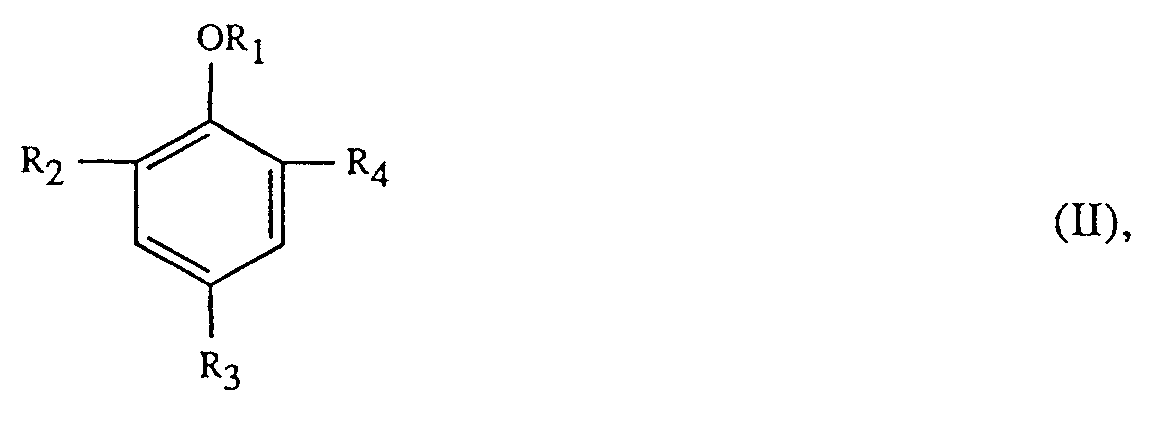
- Mittel zur Regulierung des Pflanzenwachstums gemäss Anspruch 1, dadurch gekennzeichnet, dass es neben inerten Zutaten und dem Wirkstoff der Formel I eine synergistisch wirkende Menge eines Phenolethers der Formel II

- Mittel zur Regulierung des Pflanzenwachstums gemäss Ansprüchen 1 und 2, dadurch gekennzeichnet, dass es eine synergistisch wirkende Menge einer Verbindung enthält, die ausgewählt ist aus 2-Nitro-5(2,4-dichlorphenoxy)-benzoesäure, 2-(4-Chlor-2-methylphenoxy-)-propionsäure, 2-(2,4-Dichlorphenoxy)essigsäure, 2-(4-Chlor-2-methylphenoxy)-essigsäure und 4-(4-Chlor-2-methylphenoxy)-buttersäure.
- Mittel zur Regulierung des Pflanzenwachstums gemäss Anspruch 1, dadurch gekennzeichnet, dass es neben 99,9 bis 5 % fester oder flüssiger Zusatzstoffe, wovon 0,1 bis 25 % eines Tensides 0,1 bis 95 % Wirkstoffgemisch der Verbindung der Formel I mit einer Verbindung der Formel II im Verhältnis 100:1 bis 1:10 enthält.
- Verfahren zur Regulierung des Pflanzenwachstums, dadurch gekennzeichnet, dass man auf die Pflanzen oder deren Standort eine wirksame Menge eines Mittels gemäss Anspruch 1 appliziert resp. den Wirkstoff der Formel I und den Mischpartner der Formel II in Tankmischung appliziert.
- Verfahren zur Hemmung des Pflanzenwachstums in Feldkulturen von Nutzpflanzen oder in Gräsern, dadurch gekennzeichnet, dass man auf die Pflanzen post-emergent eine wirksame Menge eines Mittels gemäss Anspruch 1 appliziert.
Applications Claiming Priority (2)
| Application Number | Priority Date | Filing Date | Title |
|---|---|---|---|
| CH4479/89 | 1989-12-13 | ||
| CH447989 | 1989-12-13 |
Publications (3)
| Publication Number | Publication Date |
|---|---|
| EP0434613A2 EP0434613A2 (de) | 1991-06-26 |
| EP0434613A3 EP0434613A3 (en) | 1991-10-09 |
| EP0434613B1 true EP0434613B1 (de) | 1995-05-03 |
Family
ID=4276865
Family Applications (1)
| Application Number | Title | Priority Date | Filing Date |
|---|---|---|---|
| EP90810948A Expired - Lifetime EP0434613B1 (de) | 1989-12-13 | 1990-12-04 | Synergistisch wirkendes Mittel und Verfahren zur Regulierung des Pflanzenwuchses |
Country Status (9)
| Country | Link |
|---|---|
| EP (1) | EP0434613B1 (de) |
| JP (1) | JP2913214B2 (de) |
| AU (1) | AU640720B2 (de) |
| DE (1) | DE59009012D1 (de) |
| ES (1) | ES2071079T3 (de) |
| IE (1) | IE66326B1 (de) |
| PL (1) | PL166586B1 (de) |
| RU (1) | RU2054869C1 (de) |
| ZA (1) | ZA909981B (de) |
Families Citing this family (16)
| Publication number | Priority date | Publication date | Assignee | Title |
|---|---|---|---|---|
| GB9219631D0 (en) * | 1992-09-16 | 1992-10-28 | Ici Plc | Herbicidal compositions |
| JP3266674B2 (ja) * | 1992-11-19 | 2002-03-18 | クミアイ化学工業株式会社 | 植物成長調整剤組成物 |
| GB9313210D0 (en) * | 1993-06-25 | 1993-08-11 | Sandoz Ltd | Novel combinations |
| ATE235817T1 (de) * | 1997-10-20 | 2003-04-15 | Basf Ag | Das pflanzenwachstum regulierende zusammensetzung |
| WO2000078142A2 (de) * | 1999-06-17 | 2000-12-28 | Basf Aktiengesellschaft | Verfahren zur erhöhung der widerstandskraft von kulturpflanzen gegen chemischen stress |
| GB0022828D0 (en) * | 2000-09-18 | 2000-11-01 | Aventis Cropscience Sa | New herbicidal composition |
| NZ544960A (en) † | 2003-08-08 | 2009-04-30 | Basf Ag | Use of acylcyclohexandione derivatives in conjunction with ethephon for treating pomaceous fruit |
| RU2265660C2 (ru) * | 2003-12-18 | 2005-12-10 | Спиридонов Михаил Ираклиевич | Способ регулирования биохимических процессов (варианты) |
| ATE442042T1 (de) * | 2005-10-07 | 2009-09-15 | Basf Se | Fungizide und bioregulatorische mischungen |
| ES2319818T3 (es) * | 2005-10-07 | 2009-05-12 | Basf Se | Mezclas fungicidas y biorreguladoras. |
| CN101228869B (zh) * | 2007-01-25 | 2011-03-09 | 浙江禾田化工有限公司 | 氟节胺和二甲戊乐灵烟草抑芽复配制剂 |
| AU2008285442B2 (en) | 2007-08-06 | 2014-05-01 | Syngenta Crop Protection Ag | Herbicidal composition and method of use thereof |
| WO2009019431A2 (en) * | 2007-08-06 | 2009-02-12 | Syngenta Limited | Herbicidal compositions |
| JP5694937B2 (ja) * | 2008-09-26 | 2015-04-01 | ビーエーエスエフ ソシエタス・ヨーロピアBasf Se | イネ科植物の生育を改善するための、アシルシクロヘキサンジオンカルボン酸エステルと組み合わされたアシルシクロヘキサンジオンカルボン酸またはその塩の使用 |
| JP5584133B2 (ja) | 2008-10-20 | 2014-09-03 | 株式会社理研グリーン | イネ科雑草用の生育調節剤 |
| EP2503886A2 (de) * | 2009-11-27 | 2012-10-03 | Syngenta Participations AG | Regulierung des pflanzenwachstums |
Family Cites Families (12)
| Publication number | Priority date | Publication date | Assignee | Title |
|---|---|---|---|---|
| US3617252A (en) | 1969-04-01 | 1971-11-02 | United States Borax Chem | Herbicidal dinitro-1,3-phenylenediamine compounds |
| US3776715A (en) | 1969-04-25 | 1973-12-04 | Mobil Oil Corp | Halophenoxy benzoic acid herbicides |
| US3879188A (en) | 1969-10-24 | 1975-04-22 | Amchem Prod | Growth regulation process |
| BE795534A (fr) | 1972-02-18 | 1973-08-16 | Basf Ag | Agents pour la regulation de la croissance des plantes, contenant comme principe actif un sel azote |
| US4022611A (en) * | 1972-06-06 | 1977-05-10 | Ciba-Geigy Corporation | Plant growth regulating agent |
| US4169721A (en) | 1975-11-05 | 1979-10-02 | Ciba-Geigy Corporation | N-(ortho-substituted benzyl)-dinitro-trifluoromethyl-anilines as plant growth regulants |
| US4199669A (en) | 1978-02-21 | 1980-04-22 | Coin Acceptors, Inc. | Coin-sensing assembly |
| US4584013A (en) * | 1983-05-18 | 1986-04-22 | Ciba-Geigy Corporation | Cyclohexanedionecarboxylic acid derivatives with herbicidal and plant growth regulating properties |
| DE3344329A1 (de) | 1983-12-08 | 1985-06-13 | Karl Friedrich 4150 Krefeld Keilhau | Verstellvorrichtung fuer stufenlos drehbaren tennisschlaegergriff |
| DE3672087D1 (de) * | 1985-11-08 | 1990-07-26 | Ciba Geigy Ag | Pflanzenwuchsregulierendes mittel. |
| ES2014493B3 (es) | 1986-04-24 | 1990-07-16 | Ciba-Geigy Ag | Acil-ciclohexandionas y sus eteres de oximas con efecto herbicida y regulador del crecimiento de las plantas. |
| EP0338986B1 (de) * | 1988-04-19 | 1993-01-07 | Ciba-Geigy Ag | Pflanzenwuchshemmendes Mittel |
-
1990
- 1990-12-04 DE DE59009012T patent/DE59009012D1/de not_active Expired - Fee Related
- 1990-12-04 ES ES90810948T patent/ES2071079T3/es not_active Expired - Lifetime
- 1990-12-04 EP EP90810948A patent/EP0434613B1/de not_active Expired - Lifetime
- 1990-12-11 PL PL90288199A patent/PL166586B1/pl unknown
- 1990-12-12 IE IE448090A patent/IE66326B1/en not_active IP Right Cessation
- 1990-12-12 RU SU904831881A patent/RU2054869C1/ru not_active IP Right Cessation
- 1990-12-12 ZA ZA909981A patent/ZA909981B/xx unknown
- 1990-12-12 AU AU68004/90A patent/AU640720B2/en not_active Ceased
- 1990-12-13 JP JP2410485A patent/JP2913214B2/ja not_active Expired - Fee Related
Also Published As
| Publication number | Publication date |
|---|---|
| JPH04234801A (ja) | 1992-08-24 |
| IE66326B1 (en) | 1995-12-27 |
| ES2071079T3 (es) | 1995-06-16 |
| EP0434613A3 (en) | 1991-10-09 |
| PL166586B1 (pl) | 1995-06-30 |
| ZA909981B (en) | 1991-08-28 |
| RU2054869C1 (ru) | 1996-02-27 |
| AU640720B2 (en) | 1993-09-02 |
| EP0434613A2 (de) | 1991-06-26 |
| JP2913214B2 (ja) | 1999-06-28 |
| IE904480A1 (en) | 1991-06-19 |
| DE59009012D1 (de) | 1995-06-08 |
| PL288199A1 (en) | 1991-12-02 |
| AU6800490A (en) | 1991-06-20 |
Similar Documents
| Publication | Publication Date | Title |
|---|---|---|
| EP0434613B1 (de) | Synergistisch wirkendes Mittel und Verfahren zur Regulierung des Pflanzenwuchses | |
| EP0126713A2 (de) | Cyclohexandion-carbonsäurederivate mit herbizider und das Pflanzenwachstum regulierender Wirkung | |
| DE69723750T2 (de) | Herbizide Kombinationen | |
| EP0136976A2 (de) | Verwendung von Phenylpyrimidinen als Pflanzenregulatoren | |
| DE69702968T2 (de) | Herbizide zusammensetzung und deren verwendung zur unkrautbekämpfung | |
| EP0768034B1 (de) | Herbizides synergistisches Mittel und Verfahren zur Unkrautbekämpfung | |
| EP0156773B1 (de) | Cyclohexenon-carbonsäurederivate mit herbizider und das Pflanzenwachstum regulierender Wirkung | |
| EP1290944B1 (de) | Herbizides Mittel | |
| DE4236475A1 (de) | Herbizide Mittel zur Unkrautbekämpfung in Reiskulturen | |
| EP0224441B1 (de) | Pflanzenwuchsregulierendes Mittel | |
| EP0058639B1 (de) | 2-(4-(6-Halogen-chinoxalinyl-2-oxy)-phenoxy)-propionsäureester, Verfahren zu ihrer Herstellung sowie ihre Verwendung als Herbizide und Pflanzenwuchsregulatoren | |
| DE3533440A1 (de) | N-substituierte 3,4,5,6-tetrahydrophthalimide, verfahren zu ihrer herstellung sowie ihre verwendung im pflanzenschutz | |
| EP0233151B1 (de) | Ester als Herbizide | |
| EP0397602A1 (de) | Neue N-Phenylpyrrolidine | |
| EP0542687A1 (de) | Synergistisches Mittel und Verfahren zur selektiven Unkrautbekämpfung | |
| EP0133155A2 (de) | Mittel und Verfahren zur Steigerung des Ernteertrages | |
| DE2943703A1 (de) | 6h-1,2,4,6-thiatriazin-1,1-dioxide, herbizide, die diese verbindungen enthalten, ihre anwendung als herbizide und verfahren zu ihrer herstellung | |
| EP0043349B1 (de) | Synergistisches Mittel und Verfahren zur selektiven Unkrautbekämpfung, insbesondere in Getreide und Sojabohnenkulturen | |
| DE3601066A1 (de) | Cyclohexenonderivate, ein verfahren zu ihrer herstellung sowie ihre verwendung als herbizide und das pflanzenwachstum regulierende mittel | |
| WO1998047356A2 (de) | Dicamba und safener enthaltende herbizide mittel | |
| EP0608009A1 (de) | Synergistisches Mittel und Verfahren zur selektiven Unkrautbekämpfung | |
| EP0338986B1 (de) | Pflanzenwuchshemmendes Mittel | |
| EP0005516B1 (de) | Substituierte Pyridazone, Verfahren zu ihrer Herstellung und ihre Anwendung als Herbizide | |
| DE1618968C2 (de) | ||
| DE3941160A1 (de) | Lagerungsstabile salze von acyl-cyclohexandion-oximaethern mit herbizider und das pflanzenwachstum regulierender wirkung |
Legal Events
| Date | Code | Title | Description |
|---|---|---|---|
| PUAI | Public reference made under article 153(3) epc to a published international application that has entered the european phase |
Free format text: ORIGINAL CODE: 0009012 |
|
| 17P | Request for examination filed |
Effective date: 19901206 |
|
| AK | Designated contracting states |
Kind code of ref document: A2 Designated state(s): AT BE CH DE DK ES FR GB GR IT LI LU NL SE |
|
| PUAL | Search report despatched |
Free format text: ORIGINAL CODE: 0009013 |
|
| AK | Designated contracting states |
Kind code of ref document: A3 Designated state(s): AT BE CH DE DK ES FR GB GR IT LI LU NL SE |
|
| 17Q | First examination report despatched |
Effective date: 19940202 |
|
| RBV | Designated contracting states (corrected) |
Designated state(s): CH DE ES FR GB IT LI |
|
| GRAA | (expected) grant |
Free format text: ORIGINAL CODE: 0009210 |
|
| AK | Designated contracting states |
Kind code of ref document: B1 Designated state(s): CH DE ES FR GB IT LI |
|
| ITF | It: translation for a ep patent filed | ||
| REF | Corresponds to: |
Ref document number: 59009012 Country of ref document: DE Date of ref document: 19950608 |
|
| REG | Reference to a national code |
Ref country code: ES Ref legal event code: FG2A Ref document number: 2071079 Country of ref document: ES Kind code of ref document: T3 |
|
| ET | Fr: translation filed | ||
| GBT | Gb: translation of ep patent filed (gb section 77(6)(a)/1977) |
Effective date: 19950619 |
|
| PLBE | No opposition filed within time limit |
Free format text: ORIGINAL CODE: 0009261 |
|
| STAA | Information on the status of an ep patent application or granted ep patent |
Free format text: STATUS: NO OPPOSITION FILED WITHIN TIME LIMIT |
|
| 26N | No opposition filed | ||
| REG | Reference to a national code |
Ref country code: CH Ref legal event code: PFA Free format text: CIBA-GEIGY AG TRANSFER- NOVARTIS AG |
|
| REG | Reference to a national code |
Ref country code: GB Ref legal event code: 732E |
|
| REG | Reference to a national code |
Ref country code: FR Ref legal event code: TP |
|
| REG | Reference to a national code |
Ref country code: ES Ref legal event code: PC2A |
|
| REG | Reference to a national code |
Ref country code: GB Ref legal event code: IF02 |
|
| PGFP | Annual fee paid to national office [announced via postgrant information from national office to epo] |
Ref country code: GB Payment date: 20021204 Year of fee payment: 13 |
|
| PGFP | Annual fee paid to national office [announced via postgrant information from national office to epo] |
Ref country code: DE Payment date: 20021205 Year of fee payment: 13 |
|
| PGFP | Annual fee paid to national office [announced via postgrant information from national office to epo] |
Ref country code: FR Payment date: 20021210 Year of fee payment: 13 |
|
| PGFP | Annual fee paid to national office [announced via postgrant information from national office to epo] |
Ref country code: CH Payment date: 20021217 Year of fee payment: 13 |
|
| PGFP | Annual fee paid to national office [announced via postgrant information from national office to epo] |
Ref country code: ES Payment date: 20030121 Year of fee payment: 13 |
|
| REG | Reference to a national code |
Ref country code: CH Ref legal event code: PUE Owner name: SYNGENTA PARTICIPATIONS AG Free format text: NOVARTIS AG#SCHWARZWALDALLEE 215#4058 BASEL (CH) -TRANSFER TO- SYNGENTA PARTICIPATIONS AG#SCHWARZWALDALLEE 215#4058 BASEL (CH) |
|
| PG25 | Lapsed in a contracting state [announced via postgrant information from national office to epo] |
Ref country code: GB Free format text: LAPSE BECAUSE OF NON-PAYMENT OF DUE FEES Effective date: 20031204 |
|
| PG25 | Lapsed in a contracting state [announced via postgrant information from national office to epo] |
Ref country code: ES Free format text: LAPSE BECAUSE OF NON-PAYMENT OF DUE FEES Effective date: 20031205 |
|
| PG25 | Lapsed in a contracting state [announced via postgrant information from national office to epo] |
Ref country code: LI Free format text: LAPSE BECAUSE OF NON-PAYMENT OF DUE FEES Effective date: 20031231 Ref country code: CH Free format text: LAPSE BECAUSE OF NON-PAYMENT OF DUE FEES Effective date: 20031231 |
|
| PG25 | Lapsed in a contracting state [announced via postgrant information from national office to epo] |
Ref country code: DE Free format text: LAPSE BECAUSE OF NON-PAYMENT OF DUE FEES Effective date: 20040701 |
|
| GBPC | Gb: european patent ceased through non-payment of renewal fee |
Effective date: 20031204 |
|
| REG | Reference to a national code |
Ref country code: CH Ref legal event code: PL |
|
| PG25 | Lapsed in a contracting state [announced via postgrant information from national office to epo] |
Ref country code: FR Free format text: LAPSE BECAUSE OF NON-PAYMENT OF DUE FEES Effective date: 20040831 |
|
| REG | Reference to a national code |
Ref country code: FR Ref legal event code: ST |
|
| REG | Reference to a national code |
Ref country code: ES Ref legal event code: FD2A Effective date: 20031205 |
|
| PG25 | Lapsed in a contracting state [announced via postgrant information from national office to epo] |
Ref country code: IT Free format text: LAPSE BECAUSE OF NON-PAYMENT OF DUE FEES;WARNING: LAPSES OF ITALIAN PATENTS WITH EFFECTIVE DATE BEFORE 2007 MAY HAVE OCCURRED AT ANY TIME BEFORE 2007. THE CORRECT EFFECTIVE DATE MAY BE DIFFERENT FROM THE ONE RECORDED. Effective date: 20051204 |
|
| REG | Reference to a national code |
Ref country code: FR Ref legal event code: TP |