EP0242401A1 - Verfahren zur herstellung von kohlenstoffasern - Google Patents
Verfahren zur herstellung von kohlenstoffasern Download PDFInfo
- Publication number
- EP0242401A1 EP0242401A1 EP86905935A EP86905935A EP0242401A1 EP 0242401 A1 EP0242401 A1 EP 0242401A1 EP 86905935 A EP86905935 A EP 86905935A EP 86905935 A EP86905935 A EP 86905935A EP 0242401 A1 EP0242401 A1 EP 0242401A1
- Authority
- EP
- European Patent Office
- Prior art keywords
- treatment
- flame
- resisting
- fibers
- temperature
- Prior art date
- Legal status (The legal status is an assumption and is not a legal conclusion. Google has not performed a legal analysis and makes no representation as to the accuracy of the status listed.)
- Granted
Links
Images
Classifications
-
- D—TEXTILES; PAPER
- D01—NATURAL OR MAN-MADE THREADS OR FIBRES; SPINNING
- D01F—CHEMICAL FEATURES IN THE MANUFACTURE OF ARTIFICIAL FILAMENTS, THREADS, FIBRES, BRISTLES OR RIBBONS; APPARATUS SPECIALLY ADAPTED FOR THE MANUFACTURE OF CARBON FILAMENTS
- D01F9/00—Artificial filaments or the like of other substances; Manufacture thereof; Apparatus specially adapted for the manufacture of carbon filaments
- D01F9/08—Artificial filaments or the like of other substances; Manufacture thereof; Apparatus specially adapted for the manufacture of carbon filaments of inorganic material
- D01F9/12—Carbon filaments; Apparatus specially adapted for the manufacture thereof
- D01F9/14—Carbon filaments; Apparatus specially adapted for the manufacture thereof by decomposition of organic filaments
- D01F9/20—Carbon filaments; Apparatus specially adapted for the manufacture thereof by decomposition of organic filaments from polyaddition, polycondensation or polymerisation products
- D01F9/21—Carbon filaments; Apparatus specially adapted for the manufacture thereof by decomposition of organic filaments from polyaddition, polycondensation or polymerisation products from macromolecular compounds obtained by reactions only involving carbon-to-carbon unsaturated bonds
- D01F9/22—Carbon filaments; Apparatus specially adapted for the manufacture thereof by decomposition of organic filaments from polyaddition, polycondensation or polymerisation products from macromolecular compounds obtained by reactions only involving carbon-to-carbon unsaturated bonds from polyacrylonitriles
-
- D—TEXTILES; PAPER
- D01—NATURAL OR MAN-MADE THREADS OR FIBRES; SPINNING
- D01F—CHEMICAL FEATURES IN THE MANUFACTURE OF ARTIFICIAL FILAMENTS, THREADS, FIBRES, BRISTLES OR RIBBONS; APPARATUS SPECIALLY ADAPTED FOR THE MANUFACTURE OF CARBON FILAMENTS
- D01F9/00—Artificial filaments or the like of other substances; Manufacture thereof; Apparatus specially adapted for the manufacture of carbon filaments
- D01F9/08—Artificial filaments or the like of other substances; Manufacture thereof; Apparatus specially adapted for the manufacture of carbon filaments of inorganic material
- D01F9/12—Carbon filaments; Apparatus specially adapted for the manufacture thereof
- D01F9/14—Carbon filaments; Apparatus specially adapted for the manufacture thereof by decomposition of organic filaments
- D01F9/32—Apparatus therefor
Definitions
- the present invention relates to a multistage flame-resisting treatment and carbonization of acrylic fibers in tow form, whereby it is possible to produce carbon fibers in tow form which have properties of high tenacity and high elasticity and are superior in hamo- geneity throughout the monofilaments and have less yarn defects including nap, etc.
- the usual process for producing carbon fibers is roughly divided into the step of flame-resisting wherein acrylic fibers are subjected to heat treatment in an oxidizing atmosphere and the step of carbonization wherein fibers from the flame-resisting treatment are subjected-to heat treatment in an inert atmosphere.
- the step of flame-resisting acrylic fibers is practiced in an oxidizing atmosphere at temperatures of 200 to 300°C over a period generally of 2 to 4 hours.
- This flame-resisting step occupies 90% or more of the total time required for the process to produce carbon fibers. Accordingly it is said that the reduction of carbon fiber production cost resides in shortening the time required for this flame-resisting reaction.
- One of the methods for shortening the flame-resisting step is to raise the temperature of flame-resisting as disclosed in Japanese Patent Publication No. 35938/72.
- this method when adopted may cause a vigorous incontrollable reaction, inducing the inflammation of acrylic fibers.
- the acrylic fibers treated by this method will have flame-resisting structure at the peripheral part of each filament but have insufficiently flame-resisting structure in the inner part thereof, thus turning into flame-resistant fibers of nonuniformly flame-resisting structure.
- Japanese Patent Publication No. 25487/76 discloses a method free of such difficulties, whereby the time for the flame-resisting treatment of acrylic fibers is reduced to 5 -30 minutes.
- This method comprises subjecting acrylic fibers to flame-resisting treatment under such conditions that the heat treatment time until the equilibrium moisture content of the acrylic fibers reaches 4% may be from 5 to 20 minutes, followed by carbonizing the fibers at a temperature of at least 1000°C.
- the flame-resisting fibers having an equilibrium moisture content of 4 % are insufficient in flame-resistant structure and the cross section of each filament shows an outstanding double structure.
- Such flame-resisting fibers undergo pyrolysis in the later step of carbonization and micro-voids are formed in the resulting fibers. Hence it is difficult to convert these fibers into high-tenacity carbon fibers having a tensile strength of 400 kg/mm 2 or more.
- Japanese Patent Application Laid-Open No. 163729/83 discloses an effective method for the flame-resisting such a tow constructed of a large number of acrylic monofilaments.
- This method compriseses heating acrylic tows, each constructed of 1000 to 30,000 filaments of 0.5 to 1.5 deniers in monofilament size in a flame-resisting oven at temperatures of 200 to 260°C to convert the filaments into incompletely flame-resisted filaments having an oxygen content of 3 to 7% (thus preventing the filaments from fusion during the later flame-resisting treatments of higher degrees), treating then the filaments under high-temperature flame-resisting conditions to convert them into completely flame-resisting filaments having an oxygen content of at least 9.5%, followed by carbonizing the filaments.
- the conventional method for improving the elastic modulus has been to raise the carbonization temperature, i.e. the temperature of the final heat treatment.
- This method has a drawback in that, as the elastic modulus is increased, the strength and consequently the elongation decrease.
- a carbonization temperature of about 1800°C is necessary in order to maintain an elastic modulus of 28 ton/mm 2 , but this temperature results in a strength at least 100 kg/mm 2 lower than the value resulting from a carbonization temperature of 1300°C; thus a high strength cannot be achieved at all.
- Such a decrease in the strength with an increase in the carbonization temperature corresponds well with the decrease in the density.
- the causes thereof are exemplified by significant uneveness of the flame-resisting degree throughout the monofilaments constructing the tow, high unevenness in the longitudinal direction of each monofilament subjected to flame-resisting treatment, and minute flaws present in each monofilament itself subjected to flame-resisting treatment.
- this method the occurrence of fusion or agglutination among filaments is relatively limited but the flame-resisting reaction proceeds rapidly in the latter half stage, hence increasing the inter-filament and filament axis directional unevenness of the flame-resisting degree and causing frequently napping and filament breaking phenomena.
- this method is extremely inferior in step passableness and is difficult to provide high-performance carbon fibers.
- Methods for the carbonizing treatment were also investigated, among which a method is known wherein fibers subjected to flame-resisting treatament are treated at a temperature of 250 to 600°C, then at a temperature of 400 to 800°C, and finally at a temperature of 800 to 1300°C (see Japanese Patent Application Laid-Open No. 150116/84). But, carbon fibers having satisfactory performance characteristics are also difficult to obtain according to this method.
- the substance of the invention is that when acrylic fibers in bundle form containing at least 90% by weight of acrylonitrile are continuously subjected to flame-resisting treatment in an oxidizing atmosphere at temperatures of 200 to 350°C by using a plurality of flame-resisting furnaces different in treatment temperature, this treatment is carried out under such conditions that the fiber density P n after each stage of flame-resisting treatment may be maintained on the level defined by the following equation (1) and so that the fiber density P k after completion of the flame-resisting treatment may be from 1.34 to 1.40 g/ml, and successively are subjected to carbonizing treatment in an inert atmosphere; wherein, ⁇ n is the density (g/ml) of the fibers after n-th treatment stage,
- p o is the density (g/ml) of the feedstock acrylic fibers
- p k is the density of the fibers after completion of the flame-resisting treatment and is a value ranging from 1.34 to 1.40 g/ml
- t n is the period of n-th stage of flame-resisting treatment
- k is the number of flame-resisting treatment stages.
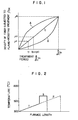
- Fig. 1 is a graph showing the relation between the density of flame-resisted fibers and the period of flame-resisting treatment, for the purpose of explaining the treatment method of the present invention.
- curve A is in the case of high-temperature treatment
- curve B is in the case of low-temperature treatment followed by high-temperature treatment
- curve C is in the case of treatment according to the process of the invention.
- Fig. 2 is a graph showing temperature profiles in low-temperature carbonization, with furnace length as abscissa and temperature as ordinate. Straight lines 1 and 3 show such a temperature profile in the invention.
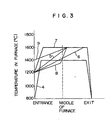
- Fig. 3 shows modes of increasing the gradient of furnace temperature in the case of high-temperature heat treatments for carbonization.
- numeral 4 shows said mode in a high-temperature carbonization heat treatment method according to the prior art, 5 and 6 said modes in the present inventive process, and 7 to 9 those, given for comparison, in high-temperature carbonizing treatment methods.
- the polymer constructing acrylic fibers used in carrying out the invention is a copolymer of 90% by weight or more of acrylonitrile and 10% by weight or less of other copolymerizable vinyl monomer(s).
- This polymer can be produced by various methods including solution polymerization method, suspension polymerization method, emulsion polymerization method, etc., and is desired to have a reduced viscosity ranging from 1.0 to 10.0.
- Fibers formed from a polymer containing less than 90% by weight of acrylonitrile units have low flame-resisting reaction activity. Hence, when such fibers are used, the temperature of initiating the flame-resisting reaction needs to be raised and once the flame-resisting reaction is initiated, a vigorous incontrollable reaction is liable to occur on the contrary.
- the polymer is preferred to contain 95% by weight or more of acrylonitrile units polymerized.
- the other copolymerizable vinyl monomer to be copolymerized with acrylonitrile is a constituent which accelerates the flame-resisting reaction of the acrylic fibers and contributes to reduction in the flame-resisting reaction period.
- Such usable monomers include, for example, hydroxyethylacrylonitrile, methyl vinyl ketone, methyl methacrylate, acrylic acid, methacrylic acid, itaconic acid, and t - butyl methacrylate.
- the total amount of these constituents copolymerized is desirably up to 10%, preferably up to 5%, by weight.
- the above defined acrylonitrile-based polymer is normally spun by a wet spinning method or a dry-wet spinning method to form tows of acrylic fibers of desirably 0.3 to 1.5 deniers in monofilament size, each tow having a whole fiber size of 1000 to 20,000. Fibers of less than 0.3 denier in monofilament size are undesirable since their strength is insufficient for use as feedstock fibers to produce carbon fibers. On the contrary when the size exceeds 1.5 deniers, atendency is observed to lower the rate of oxygen diffusion into the monofilament in the flame-resisting step and make it difficult to prepare fibers flame-resisted uniformly.
- tows of less than 1000 deniers in the whole fiber size of each tow have good passableness through the flame-resisting step but exhibit radpidly-lowered productivity for flame-resisting fibers.
- the whole fiber size of each tow exceeds 20,000 deniers, the diffusion of oxygen into the inner part of the acrylic tow will be retarded in the flame-resisting step and this tends to develop difference in flame resistance between outer-side filaments and inner-side filaments in each tow.
- Properties necessary for the fibers subjected to flame-resisting treatment to have from which high-performance carbon fibers can be produced include that; nap should not be developed; 2% or more, preferably 5% or more, stretch should be possible in the initial stage of the carbonization step; and the amount of tar formed should be limited.
- the tow of flame-resisting fibers provided with such properties need to have no large difference in the density of filaments subjected to flame-resisting treatment between the filaments located in the outer side of the tow of 1000-20,000 deniers and the filaments located in the central part of the tow and the degree of flame-resisting in each treated filament should be uniformed as far as possible.
- micro-voids are formed in each resulting flame-resisting filament and the filament has large difference in the degree of flame-resisting between the outer side and the inner side of itself. It can be seen that such fibers subjected for a short time to flame-resisting treatment do not exhibit stretchability at all in the later carbonizing treatment step and is liable to develop nap.
- the flame-resisting reaction when such flame-resisting treatment conditions that ⁇ n may be in the range defined by equation (1) are applied, proceeds so as to hold a nearly linear relation between the density p ox of the fibers subjected to flame-resisting treatment and the period t n of flame-resisting treatment as shown by line C in Fig. 1, and even when the total period E t n of flame-resisting treatment is limited to 60 minutes or less, the difference between p ox of outer side filaments of each tow resulting from the flame-resisting treatment and P ox of inner side filaments of the tow can be reduced in the extreme.
- the value of p o is normally about 1.18, and P k in the present invention needs to lie in the range of 1.34 to 1.40, preferably 1.35 to 1.38. Flame-resisting fibers having less p k values than 1.34 undergo rapid pyrolysis and tend to develop nap, in the carbonization step, and hence cannot be converted into carbon fibers having good performance characteristics. On the contrary, those having p k values exceeding 1.40 are difficult to provide high-performance carbon fibers having tensile strengths of at least 400 kg/mm2 .
- the present inventive fibers subjected to flame-resisting treatment having p k values ranging from 1.35 to 1.40, can be stretched by as much as 3 to 25% without undergoing abnormal pyrolysis in the carbonization step, providing carbon fibers having excellent performance characteristics.
- the invention produces distinguished effect when the flame-resisting treatment period is up to 90 minutes, particularly in the range of 20 to 60 minutes.
- the number of stages in the multistage flame-resisting furnace used in the invention is at least 3, perferably 3 to 6. A too large number of these stages is undesirable, since such a furnace is uneconomical and much restricted with respect to the installation thereof and has adverse effect on the workability.
- the multistage flame-resisting method of the invention is effective in baking a single or plural acrylic tows of 0.3 to 1.5 deniers in monofilament size and 1000 to 20,000 deniers in each tow size, particularly effective in baking dozens to hundreds of acrylic tows arranged in parallel and in sheet form.
- objects of the present invention can be fully achieved by spacing the tows so suitably that the diffusion of oxygen into each tow may not be hindered and by controlling the rate of heating so that the rate of flame-resisting may satisfy equation (1).
- Fibers obtained by flame-resisting treatment in this way can be baked in the carbonization step while being streched sufficiently and can be converted into carbon fibers having excellent performance characteristics. Additionally, the period of flame-resisting treatment can be reduced notably in this way of baking as compared with the case of the conventional way.
- Fibers subjected to flame-resisting treatment which are convertible into high-performance carbon fibers are those having highly-oriented structure which tend to form graphite net planes.
- acrylic fiber density which is usually about 1.18 g/ml, reaches 1.22 g/ml
- stretch percentage exceeds 30%, the unevenness of the fibers resulting from flame-resisting treatment may increase and simultaneously yarn defects may develop.
- the growth of graphite crystal structure in the carbonization step is facilitated and highly oriented defect-free carbon fibers can be obtained, by the stretch at a draw to give a total stretch percentage of up to 50% until the fiber density reaches 1.26 g/ml.
- the flame-resisting treatment in the region where the fiber density exceeds 1.26 g/ml needs to be conducted under such conditions that the substantial stretch of the fibers may not take place. If the substantial stretch of the fibers takes place in this region, numerous micro-voids will be contained in the carbon fibers and performance characteristics of these fibers will be deteriorated. Shrinkage of the fibers when caused in this step induces disorder in the fine structure of the fibers subjected to flame-resisting treatment and decreases the strength of the resulting carbon fibers.
- An example of methods for stretching the fibers is that the fibers are brought into contact with a number of rotating rolls, the speeds of which are increased for a while until the density reaches 1.26 g/ml and thereafter are maintained constant.
- the fibers of 1.34 to 1.40 g/ml density subjected to flame-resisting treatment are heat-treated in an inert atmosphere at a starting temperature of 300 50°C, final temperature of 450 ⁇ 50°C, and heating rate of 50 to 300°C/min.
- the starting temperature of the heat treatment is below 250°C
- the tarry component formed in the fibers subjected to flame-resisting treatment is difficult to remove effectively.
- the starting temperature exceeds 350°C
- rapid pyrolysis of the flame-resisting fibers followed by frequent filament breaking or napping will take place, deteriorating the step passableness and tending to provide fibers which contain numerous micro-voids, making it impossible to produce high-performance carbon fibers.
- the final heat treatment temperature in this step needs to be 450 ⁇ 50°C.
- the final temperature is below 400°C, a formed tarry component may remain in the fibers.
- the final temperature exceeds 500°C, performance characteristics of the resulting carbon fibers are rapidly deteriorated.
- the rate of heating needs to be from 50 to 300°C/min within the above temperature range. When the rate of heating exceeds 300°C/min, performance characteristics of the resulting carbon fibers are rapidly deteriorated. When the rate of heating is less than 50°C/min, it becomes necessary to increase the furnace length markedly, this being economically unfavorable.
- the fibers are heat-treated in an inert atmosphere at a temperature of 400 to 800°C.
- the treatment period is desirably up to 3 minutes, preferably in the range of 0.1 to 1 minute.
- the treatment period exceeding 3 minutes is undesirable since deterioration is observed in performance characteristics of the resulting carbon fibers.
- Fig. 2 is a graph showing temperature profiles in low-temperature carbonizing treatments, with abscissa as furnace length and temperature as ordinate.
- Straight line 1 shows the profile in case of the heat treatment wherein the starting temperature is 300° C and the final temperature is 450°C and straight line 3 shows the profile in case of the heat treatment at a constant temperature of 600°C.
- Dotted line 2 shows the profile in case of the heat treatment at the same rate of raising temperature as in the case of straight line 1, in the temperature range of 450 to 600°C.
- the treatment to conduct as shown by straight line 1 and dotted line 2 requires a markedly larger furnace length than does the treatment to conduct as shown by straight lines 1 and 3. In the former case, high-performance carbon fibers cannot be obtained.
- the following way of stretching is preferable. That is, the fibers resulting from flame-resisting treatment according to the above described method are treated under tension in an inert atmosphere at temperatures of 300 to 500°C.
- This operation step is necessary to convert the frame-resisting fibers into a carbon fiber structure having excellent performance characteristics. Carbon fibers produced without this step have many yarn defects such as voids and are inferior in performance characteristics.
- the fibers are heat-treated in an inert atmosphere at a temperature of 500 to 800°C while being stretched at a stretch percentage of 0 to 10%.
- the following conditions are also preferable for the purpose of producing carbon fibers having a high elastic modulus. That is, the fibers subjected to low-temperature heat treatment as stated above are heat-treated in an inert atmosphere in a high-temperature heat treating furnace where the starting temperature of heat treatment is from 1000 to 1300°C, the maximum temperature of heat treatment from 1350 to 1900°C, the maximum temperature zone on the fiber exit side of the middle part of the furnace as shown by 5 and 6 in Fig. 3, and thus the gradient of temperature rise is low, so that the nitrogen content of the resulting carbon fibers will be from 0.5 to 5.0% by weight.
- the maximum temperature of heat treatment is from 1350 to 1900°C, preferably from 1450 to 1850°C.
- the maximum temperature is below 1350°C, an elastic modulus of 26 to 33 ton/mm 2 or more cannot be provided to the resulting carbon fibers.
- this temperature exceeds 1900°C, the tensile strength of the resulting carbon fibers decreases to a large extent below 400 kg/mm2 .
- This flame-resisting treatment was operated continuously for 24 hours, during which no inflammation due to an incontrollable run of reaction took place, and the flame-resisting tows obtained were free of fusion and nap, thus being satisfactory.
- fibers resulting from each stage of treatment were sampled and the density thereof was measured by using density gradient tubes. The found densities of fibers from all the stages were in the respective ranges of calculated densities as shown in Table 1.
- Tows treated for flame-resisting were then carbonized in an atmosphere of nitrogen by passing them continuously through a precarbonization furnace at 600°C and a carbonization furnace at 1400°C.
- the percentage of stretch in the precarbonization furnace was changed until nap developed, wherein nap did not develop at all up to 12% stretch and slight nap was observed on 14% stretch.
- the carbonization was carried out while setting the percentage of stretch in the precarbonization furnace at 8%.
- the resulting carbon fibers showed napping very little and high performance characteristics such as a tensile strength of 480 kg/mm 2 and an elastic modulus of 24 ton/mm2.
- Flame-resisting treatment was carrid out according to the procedure of Example 1 but changing temperature conditions as shown in Table 2.
- the flame-resisting treatment was stable without causing napping or fusion.
- carbonizing treatment was conducted according to the procedure of Example 1, but napping occurred frequently in the precarbonization furnace and the stretch could not be performed at all. Therefore the carbonizing treatment was tried without stretch,-but napping took place frequently in the carbonization furnace and the resulting carbon fibers were unworthy ot evaluation.
- the density of fibers from each stage of flame-resisting treatment was also measured in the same manner as in Example 1. As shown in Table 2, the result was that the found densities of fibers from the 1st through 3rd stages departed from the respective ranges of calculated densities shown in Table 1.
- flame-resisting treatment temperatures were determined which satisfy equation (1) when the treatment is conducted for 30 minutes so that the fiber density after completion of the treatment may be 1.36 g/ml, as in Example 1 but using only the 1st and 2nd stages.
- the calculated temperatures of the 1st and 2nd stages were 245°C and 265°C, respectively. Flame-resisting treatment was tried at these temperatures for a treatment period of 30 minutes at a take-off speed of 74.6 m/hr, but the treatment was infeasible as tow break was caused in the 2nd stage by an incontrollable run of reaction.
- the range of fiber density after each of the following flame-resisting treatment stages was calculated by using equation (1). That is, tows each consisting of 12,000 acrylic monofilaments of 1.18 g/ml in density and 1.3d in size are subjected to flame-resisting treatment for a treating period of 45 minutes by using a hot-air circulating type of flame-resisting furnace which has 5 different temperature stages, the 1st to 4th stages being each 8 m long and the 5th stage being 5.3 m long, so that the fiber density after completion of the flame-resisting treatment may become 1.36 g/ml.
- the calculated density ranges were as shown in Table 3.
- This flame-resisting treatment was operated continuously for 24 hours, during which no inflammation due to an incontrollable run of reaction took place, and the flame-resisting tows obtained were free of fusion and nap, thus being satisfactory.
- fibers resulting from each stage of treatment were sampled and the density thereof was measured by using density gradient tubes. The found densities of fibers from all the stages were in the respective ranges of calculated densities as shown in Table 3.
- Tows treated for flame-resisting were then carbonized in an atmosphere of nitrogen by passing them continuously through a precarbonization furnace at a maximum temperature of 600°C and a carbonization furnace at a maximum temperature of 1500°C.
- the percentage of stretch in the 600°C carbonization furnace was changed until nap developed, wherein nap did not develop at all up to 20% stretch and slight nap was observed on 22% stretch.
- the carbonization was carried out while setting the percentage of stretch in the 600°C carbonization furnace at 8% and then giving a shrinkage of 4% at l600°C.
- the resulting carbon fibers showed napping very little and excellent performance characteristics such as a tensile strength of 535 kg/mm 2 and an elastic modulus of 28.5 ton/mm 2 .
- Example 2 The treatment procedure of Example 2 was followed except that the fibers were 20% stretched in the 1st stage of flame-resisting treatment until the treated fiber density reached 1.22 g/ml and further 15% stretched in the 2nd stage until the fiber density reached 1.26 g/ml, thereby giving a total stretch of 38% in the flame-resisting treatment step.
- the obtained carbon fibers exhibited a tensile strength of 555 kg/mm 2 and an elastic modulus of 29.2 ton/mm2.
- Example 2 The procedure of Example 2 was followed, but the fibers were 38% stretched in the 1st stage of flame-resisting treatment to a treated fiber density of 1.22 g/ml. This caused frequent napping and further break of tows in the stretch zone.
- Multifilament tows each consisting of 12,000 filaments of 1.5d in monofilament size were prepared from an acrylonitrile/methacrylic acid (98/2) copolymer by a dry-wet spinning process. These tows were subjected to flame-resisting treatment for a period of about 45 minutes in air having a temperature gradient of from 230 to 270°C while being stretched to a total stretch of 20%, giving flame-resisting fibers of 1.35 - 1.36 g/ml in density.
- 98/2 acrylonitrile/methacrylic acid
- the flame-resisting fibers were treated under 8% stretch in an inert atmosphere having a profile of temperature raised linearly from 300 to 500°C, then under 4% stretch in an inert atmosphere having a temperature profile with a maximum of 800°C, and in an inert atmosphere having a temperature profile with a maximum of 1600°C without stretch.
- Table 5 shows performance characteristics of the thus obtained carbon fibers and conditions of the experiments.
- Nos. 1 and 6 are comparative examples different in the rate of raising temperature in the range of 300 to 500°C and Nos. 9, 10, and 11 are comparative examples different in the treatment period at temperatures of 400. to 800°C.
- Multifilament tows each consisting of 12,000 filaments of 1.5d in monofilament size were prepared from a polymer of 0.25 specific viscosity [nsp] constituted of 98 wt% acrylonitrile and 2 wt% of acrylic acid by a dry-wet spinning process. These tows were arranged in sheet form wherein multifilaments were in intimate contact one with another. These tows in sheet form were subjected to flame-resisting treatment by using a flame-resisting furnace having 5 zones which were maintained under an oxidizing atmosphere by forced circulation of air and were adjusted to temperatures of 232, 240, 248, 255, and 266°C, respectively.
- the treatment period was 8 minutes in each of the 1st to 4th zones and 5.3 minutes in the 5th zone, amounting to 37.3 minutes.
- the density of fibers passed through each zone satisfied the condition of equation (1) and the fiber density after completion of the flame-resisting treatment became 1.35 - 1.36 g/ml.
- the percentage of stretch was 15% in the 1st zone, 5% in the 2nd zone, and 0% in the other zones.
- the thus flame-resisted fibers were subjected to precarbonization treatment in two stages, one having a gradient of temperature raised from 300 to 500°C and the other having a temperature of 600°C, while being stretched as shown in the following table. Thereafter, the fibers were subjected to carbonizing treatment in an inert atmosphere having a gradient of temperature raised from 1300 to 1800°C while being shrinked by 4%. For comparison, carbon fibers were produced in the same manner except that the precarbonization was conducted in an inert atmosphere having a temperature gradient of from 300 to 700°C. Table 6 shows strand strengths and elastic moduli of the obtained carbon fibers.
- Acrylic tows each consisting of 12,000 filament of 1.18 g/ml in density and 1.3 d in monofilament size were subjected to flame-resisting treatment by using a hot-air circulating type of multistage flame-resisting furnace having 5 different temperature stages, the-lst tc 4th stages being each 8 m long and the 5th stage being 5.3 m long, so that a total stretch of 20% might be achieved during a treatment period of 45 minutes and the fiber density might become 1.36 g/ml after completion of the flame-resisting treatment.
- Table 7 shows treatment temperatures preset in this case so that the fiber density after each stage of treatment might be in the density range calculated according to equation (1) and the fiber densities found under the above temperature conditions. It can be seen from Table 7 that the found densities after all the stages lie in the respective calculated density ranges.
- tows from the above flame-resisting treatment were treated under an atmosphere of nitrogen in a heat-treating furnace having a maximum temperature of 600°C and a temperature gradient of 200°C/min from 300 to 600°C, while being 8% stretched.
- the tows were subjected to high-temperature treatment under the same atmosphere in a furnace of temperature profile (5 in Fig. 3) having a heat treatment starting temperature of 1200°C, a maximum treatment temperature of 1600°C and the maximum temperature zone on the fiber exit side of the middle part of the furnace.
- the resulting carbon fibers exhibited a tensile strength of 545 Kg/mm 2 and an elastic modulus of 28.8 ton/mm 2 , being of such considerably high performance, and the nitrogen content thereof was 2.1%.
- the treatment was conducted under the same conditions as applied in Example 6 except that the maximum heat treatment temperature in the high temperature carbonization was changed to 1350°C.
- the obtained carbon fibers exhibited a tensile strength of 565 kg/mm 2 , elastic modulus of 27.2 ton/mm 2 , and nitrogen content of 4.3%.
- the treatment was conducted under the same conditions as applied in Example 6 but using a temperature profile (7 of Fig. 3) having the maximum temperature zone on the fiber entrance side of the middle part of the furnace in the high-temperature carbonizing treatment.
- the obtained carbon fibers exhibited a tensile strength of 448 kg/mm 2 and an elastic modulus of 27.6 ton/mm 2 , which were much lower than those of carbon fibers obtained in Example 6.
- the treatment was conducted under the same conditions as applied in Example 6 except that the heat treatment starting temperature in the high-temperature carbonizing treatment was changed to 1400°C (9 of Fig. 3).
- the obtained carbon fibers exhibited a tensile strength of 460 kg/mm 2 and an elastic modulus of 27.4 ton/mm 2 , which were much lower than those of carbon fibers obtained in Example 6.
Landscapes
- Engineering & Computer Science (AREA)
- Chemical & Material Sciences (AREA)
- Chemical Kinetics & Catalysis (AREA)
- General Chemical & Material Sciences (AREA)
- Textile Engineering (AREA)
- Manufacturing & Machinery (AREA)
- Inorganic Fibers (AREA)
Applications Claiming Priority (8)
| Application Number | Priority Date | Filing Date | Title |
|---|---|---|---|
| JP225773/85 | 1985-10-09 | ||
| JP22577385A JPS6285032A (ja) | 1985-10-09 | 1985-10-09 | アクリロニトリル系重合体繊維束の多段耐炎化処理方法 |
| JP25220285A JPS62110924A (ja) | 1985-11-11 | 1985-11-11 | 高性能炭素繊維の製造法 |
| JP252202/85 | 1985-11-11 | ||
| JP5359786A JPS62215018A (ja) | 1986-03-13 | 1986-03-13 | 炭素繊維の製法 |
| JP53597/86 | 1986-03-13 | ||
| JP9478586A JPS62257424A (ja) | 1986-04-25 | 1986-04-25 | 高強度高弾性炭素繊維の製法 |
| JP947/85 | 1986-04-25 |
Publications (3)
| Publication Number | Publication Date |
|---|---|
| EP0242401A1 true EP0242401A1 (de) | 1987-10-28 |
| EP0242401A4 EP0242401A4 (de) | 1989-10-12 |
| EP0242401B1 EP0242401B1 (de) | 1992-09-09 |
Family
ID=27462928
Family Applications (1)
| Application Number | Title | Priority Date | Filing Date |
|---|---|---|---|
| EP86905935A Expired - Lifetime EP0242401B1 (de) | 1985-10-09 | 1986-10-08 | Verfahren zur herstellung von kohlenstoffasern |
Country Status (4)
| Country | Link |
|---|---|
| US (1) | US4780301A (de) |
| EP (1) | EP0242401B1 (de) |
| KR (1) | KR890005273B1 (de) |
| WO (1) | WO1987002391A1 (de) |
Cited By (2)
| Publication number | Priority date | Publication date | Assignee | Title |
|---|---|---|---|---|
| EP3228738A1 (de) * | 2006-11-22 | 2017-10-11 | Hexcel Corporation | Verfahren zur herstellung von kohlenstofffasern mit erhöhter festigkeit und modul durch mehrstufiges strecken des kohlenstofffaserprecursors |
| CN111485328A (zh) * | 2020-03-18 | 2020-08-04 | 浙江恒澜科技有限公司 | 一种阻燃纳米纤维复合材料的制备方法及装置 |
Families Citing this family (4)
| Publication number | Priority date | Publication date | Assignee | Title |
|---|---|---|---|---|
| TWI527946B (zh) * | 2012-04-12 | 2016-04-01 | 三菱麗陽股份有限公司 | 碳纖維前驅體丙烯酸纖維束及其製造方法、熱氧化處理爐以及碳纖維束的製造方法 |
| JP6119168B2 (ja) * | 2012-10-03 | 2017-04-26 | 三菱ケミカル株式会社 | 耐炎化繊維束の製造方法、及び、炭素繊維束の製造方法 |
| CN108431310A (zh) | 2015-12-31 | 2018-08-21 | Ut-巴特勒有限公司 | 从多用途商业纤维生产碳纤维的方法 |
| WO2023090310A1 (ja) * | 2021-11-19 | 2023-05-25 | 東レ株式会社 | 炭素繊維束およびその製造方法 |
Family Cites Families (18)
| Publication number | Priority date | Publication date | Assignee | Title |
|---|---|---|---|---|
| US3179605A (en) * | 1962-10-12 | 1965-04-20 | Haveg Industries Inc | Manufacture of carbon cloth |
| US3567380A (en) * | 1968-08-26 | 1971-03-02 | Courtaulds Ltd | Continuous carbon filament production |
| US3764662A (en) * | 1971-04-21 | 1973-10-09 | Gen Electric | Process for making carbon fiber |
| JPS516244B2 (de) * | 1972-08-03 | 1976-02-26 | ||
| JPS516244A (ja) * | 1974-07-05 | 1976-01-19 | Seiko Kagaku Kk | Gomuyoretsukaboshizai |
| JPS5663014A (en) * | 1979-10-25 | 1981-05-29 | Toho Rayon Co Ltd | Flameproofing and carbonizing method of acrylonitrile fiber |
| JPS5716921A (en) * | 1980-07-02 | 1982-01-28 | Mitsubishi Rayon Co Ltd | Preparation of carbon fiber |
| JPS5725419A (en) * | 1980-07-16 | 1982-02-10 | Mitsubishi Rayon Co Ltd | Preparation of carbon fiber |
| JPS5742925A (en) * | 1980-08-22 | 1982-03-10 | Toho Rayon Co Ltd | Production of high-performance carbon fiber strand |
| JPS58136834A (ja) * | 1982-02-03 | 1983-08-15 | Mitsubishi Rayon Co Ltd | 高性能炭素繊維の製造法 |
| JPS58144128A (ja) * | 1982-02-18 | 1983-08-27 | Mitsubishi Rayon Co Ltd | 高性能炭素繊維の製法 |
| JPS59137512A (ja) * | 1983-01-25 | 1984-08-07 | Mitsubishi Rayon Co Ltd | 高強度炭素繊維の製造法 |
| JPS59150116A (ja) * | 1983-02-10 | 1984-08-28 | Mitsubishi Rayon Co Ltd | 高強度炭素繊維の製造方法 |
| US4610860A (en) * | 1983-10-13 | 1986-09-09 | Hitco | Method and system for producing carbon fibers |
| DE3485026D1 (de) * | 1983-10-13 | 1991-10-10 | Mitsubishi Rayon Co | Kohlenstoffasern mit hoher festigkeit und hohem elastizitaetsmodul sowie deren herstellungsverfahren. |
| JPS60151317A (ja) * | 1984-01-13 | 1985-08-09 | Mitsubishi Rayon Co Ltd | 炭素繊維の製造法 |
| KR870000533B1 (ko) * | 1984-05-18 | 1987-03-14 | 미쓰비시레이욘 가부시끼가이샤 | 탄소섬유의 제조방법 |
| GB2168966B (en) * | 1984-11-14 | 1988-09-01 | Toho Beslon Co | High-strength carbonaceous fiber |
-
1986
- 1986-10-08 KR KR1019870700479A patent/KR890005273B1/ko not_active Expired
- 1986-10-08 WO PCT/JP1986/000512 patent/WO1987002391A1/ja not_active Ceased
- 1986-10-08 EP EP86905935A patent/EP0242401B1/de not_active Expired - Lifetime
- 1986-10-08 US US07/066,629 patent/US4780301A/en not_active Expired - Lifetime
Cited By (3)
| Publication number | Priority date | Publication date | Assignee | Title |
|---|---|---|---|---|
| EP3228738A1 (de) * | 2006-11-22 | 2017-10-11 | Hexcel Corporation | Verfahren zur herstellung von kohlenstofffasern mit erhöhter festigkeit und modul durch mehrstufiges strecken des kohlenstofffaserprecursors |
| US10151051B2 (en) | 2006-11-22 | 2018-12-11 | Hexcel Corporation | Carbon fibers having improved strength and modulus and an associated method and apparatus for preparing same |
| CN111485328A (zh) * | 2020-03-18 | 2020-08-04 | 浙江恒澜科技有限公司 | 一种阻燃纳米纤维复合材料的制备方法及装置 |
Also Published As
| Publication number | Publication date |
|---|---|
| WO1987002391A1 (fr) | 1987-04-23 |
| KR890005273B1 (ko) | 1989-12-20 |
| KR880700110A (ko) | 1988-02-15 |
| EP0242401B1 (de) | 1992-09-09 |
| US4780301A (en) | 1988-10-25 |
| EP0242401A4 (de) | 1989-10-12 |
Similar Documents
| Publication | Publication Date | Title |
|---|---|---|
| US8236273B2 (en) | Method of producing pre-oxidation fiber and carbon fiber | |
| US4069297A (en) | Process for producing carbon fibers | |
| US3529934A (en) | Process for the preparation of carbon fibers | |
| US4671950A (en) | High-strength carbonaceous fiber | |
| EP0159365B1 (de) | Kohlenstoffasern mit hoher festigkeit und hohem elastizitätsmodul sowie deren herstellungsverfahren | |
| US3533743A (en) | Process for the manufacture of continuous high modulus carbon yarns and monofilaments | |
| US3775520A (en) | Carbonization/graphitization of poly-acrylonitrile fibers containing residual spinning solvent | |
| EP0242401B1 (de) | Verfahren zur herstellung von kohlenstoffasern | |
| US4389387A (en) | Method for preparing carbon fibers | |
| JPS58136838A (ja) | 高性能炭素繊維の製造方法 | |
| US4397831A (en) | Production of carbon fibers from acrylonitrile based fibers | |
| US3914960A (en) | Apparatus for continuously producing preoxidized textile products | |
| JP3002549B2 (ja) | 黒鉛繊維の製造方法 | |
| JPS62257422A (ja) | 炭素繊維の製法 | |
| US3652221A (en) | Process for producing carbon fibers | |
| US5281477A (en) | Carbon fibers having high tenacity and high modulus of elasticity and process for producing the same | |
| JPS62215018A (ja) | 炭素繊維の製法 | |
| EP0487062B1 (de) | Verfahren zur Herstellung von Kohlenstoffasern mit hoher Faserstrangfestigkeit | |
| US3945093A (en) | Method and apparatus for producing high modulus bixial fabric | |
| DE3686715T2 (de) | Verfahren zur herstellung von kohlenstoffasern. | |
| US5413858A (en) | Acrylic fiber and process for production thereof | |
| JPS61119719A (ja) | 高強度を有する炭素質繊維の製造法 | |
| GB2170491A (en) | Method of producing graphite fiber and product thereof | |
| JPH0551686B2 (de) | ||
| Tsai | Optimization of carbon fibre production using the Taguchi method |
Legal Events
| Date | Code | Title | Description |
|---|---|---|---|
| PUAI | Public reference made under article 153(3) epc to a published international application that has entered the european phase |
Free format text: ORIGINAL CODE: 0009012 |
|
| 17P | Request for examination filed |
Effective date: 19870604 |
|
| AK | Designated contracting states |
Kind code of ref document: A1 Designated state(s): DE FR GB |
|
| A4 | Supplementary search report drawn up and despatched |
Effective date: 19891012 |
|
| 17Q | First examination report despatched |
Effective date: 19910409 |
|
| GRAA | (expected) grant |
Free format text: ORIGINAL CODE: 0009210 |
|
| AK | Designated contracting states |
Kind code of ref document: B1 Designated state(s): DE FR GB |
|
| REF | Corresponds to: |
Ref document number: 3686715 Country of ref document: DE Date of ref document: 19921015 |
|
| ET | Fr: translation filed | ||
| PLBE | No opposition filed within time limit |
Free format text: ORIGINAL CODE: 0009261 |
|
| STAA | Information on the status of an ep patent application or granted ep patent |
Free format text: STATUS: NO OPPOSITION FILED WITHIN TIME LIMIT |
|
| 26N | No opposition filed | ||
| REG | Reference to a national code |
Ref country code: GB Ref legal event code: IF02 |
|
| PGFP | Annual fee paid to national office [announced via postgrant information from national office to epo] |
Ref country code: GB Payment date: 20051005 Year of fee payment: 20 |
|
| PGFP | Annual fee paid to national office [announced via postgrant information from national office to epo] |
Ref country code: DE Payment date: 20051006 Year of fee payment: 20 |
|
| PGFP | Annual fee paid to national office [announced via postgrant information from national office to epo] |
Ref country code: FR Payment date: 20051010 Year of fee payment: 20 |
|
| PG25 | Lapsed in a contracting state [announced via postgrant information from national office to epo] |
Ref country code: GB Free format text: LAPSE BECAUSE OF EXPIRATION OF PROTECTION Effective date: 20061007 |
|
| REG | Reference to a national code |
Ref country code: GB Ref legal event code: PE20 |