EP0241984B1 - Blockcopolyester mit verzweigten hydrophilen Endgruppen, verwendbar als Schmutzentfernungsmittel in Waschmittelzusammensetzungen - Google Patents
Blockcopolyester mit verzweigten hydrophilen Endgruppen, verwendbar als Schmutzentfernungsmittel in Waschmittelzusammensetzungen Download PDFInfo
- Publication number
- EP0241984B1 EP0241984B1 EP87200636A EP87200636A EP0241984B1 EP 0241984 B1 EP0241984 B1 EP 0241984B1 EP 87200636 A EP87200636 A EP 87200636A EP 87200636 A EP87200636 A EP 87200636A EP 0241984 B1 EP0241984 B1 EP 0241984B1
- Authority
- EP
- European Patent Office
- Prior art keywords
- moieties
- moiety
- alkyl
- soil release
- ethylene
- Prior art date
- Legal status (The legal status is an assumption and is not a legal conclusion. Google has not performed a legal analysis and makes no representation as to the accuracy of the status listed.)
- Expired - Lifetime
Links
Classifications
-
- C—CHEMISTRY; METALLURGY
- C11—ANIMAL OR VEGETABLE OILS, FATS, FATTY SUBSTANCES OR WAXES; FATTY ACIDS THEREFROM; DETERGENTS; CANDLES
- C11D—DETERGENT COMPOSITIONS; USE OF SINGLE SUBSTANCES AS DETERGENTS; SOAP OR SOAP-MAKING; RESIN SOAPS; RECOVERY OF GLYCEROL
- C11D3/00—Other compounding ingredients of detergent compositions covered in group C11D1/00
- C11D3/0005—Other compounding ingredients characterised by their effect
- C11D3/0036—Soil deposition preventing compositions; Antiredeposition agents
-
- C—CHEMISTRY; METALLURGY
- C08—ORGANIC MACROMOLECULAR COMPOUNDS; THEIR PREPARATION OR CHEMICAL WORKING-UP; COMPOSITIONS BASED THEREON
- C08G—MACROMOLECULAR COMPOUNDS OBTAINED OTHERWISE THAN BY REACTIONS ONLY INVOLVING UNSATURATED CARBON-TO-CARBON BONDS
- C08G63/00—Macromolecular compounds obtained by reactions forming a carboxylic ester link in the main chain of the macromolecule
- C08G63/66—Polyesters containing oxygen in the form of ether groups
- C08G63/668—Polyesters containing oxygen in the form of ether groups derived from polycarboxylic acids and polyhydroxy compounds
- C08G63/672—Dicarboxylic acids and dihydroxy compounds
-
- C—CHEMISTRY; METALLURGY
- C08—ORGANIC MACROMOLECULAR COMPOUNDS; THEIR PREPARATION OR CHEMICAL WORKING-UP; COMPOSITIONS BASED THEREON
- C08G—MACROMOLECULAR COMPOUNDS OBTAINED OTHERWISE THAN BY REACTIONS ONLY INVOLVING UNSATURATED CARBON-TO-CARBON BONDS
- C08G63/00—Macromolecular compounds obtained by reactions forming a carboxylic ester link in the main chain of the macromolecule
- C08G63/68—Polyesters containing atoms other than carbon, hydrogen and oxygen
- C08G63/688—Polyesters containing atoms other than carbon, hydrogen and oxygen containing sulfur
- C08G63/6884—Polyesters containing atoms other than carbon, hydrogen and oxygen containing sulfur derived from polycarboxylic acids and polyhydroxy compounds
- C08G63/6886—Dicarboxylic acids and dihydroxy compounds
-
- C—CHEMISTRY; METALLURGY
- C11—ANIMAL OR VEGETABLE OILS, FATS, FATTY SUBSTANCES OR WAXES; FATTY ACIDS THEREFROM; DETERGENTS; CANDLES
- C11D—DETERGENT COMPOSITIONS; USE OF SINGLE SUBSTANCES AS DETERGENTS; SOAP OR SOAP-MAKING; RESIN SOAPS; RECOVERY OF GLYCEROL
- C11D3/00—Other compounding ingredients of detergent compositions covered in group C11D1/00
- C11D3/16—Organic compounds
- C11D3/37—Polymers
- C11D3/3703—Macromolecular compounds obtained otherwise than by reactions only involving carbon-to-carbon unsaturated bonds
- C11D3/3715—Polyesters or polycarbonates
Definitions
- the present application relates to block polyesters and like compounds having branched hydrophilic capping groups which are useful as soil release agents in laundry detergent compositions.
- laundry detergent compositions desirably have other benefits.
- One is the ability to confer soil release properties to fabrics woven from polyester fibers. These fabrics are mostly co-polymers of ethylene glycol and terephthalic acid, and are sold under a number of tradenames, e.g. Dacron, Fortrel, Kodel and Blue C Polyester.
- the hydrophobic character of polyester fabrics makes their laundering difficult, particularly as regards oily soil and oily stains.
- the oily soil or stain preferentially "wets" the fabric. As a result, the oily soil or stain is difficult to remove in an aqueous laundering process.
- High molecular weight polyesters containing random ethylene terephthalate/polyethylene glycol (PEG) terephthalate units have been used as soil release compounds in laundry detergent compositions. See U.S. Patent 3,962,152 to Nicol et al., issued June 8, 1976. During the laundering operation, these soil release polyesters adsorb onto the surface of fabrics immersed in the wash solution. The adsorbed polyester then forms a hydrophilic film which remains on the fabric after it is removed from the wash solution and dried. This film can be renewed by subsequent washing of the fabric with a detergent composition containing the soil release polyesters.
- PEG polyethylene glycol
- These ethylene terephthalate/PEG terephthalate polyesters are not very water-soluble. It is believed that they form a suspension in the wash solution which does not adsorb efficiently onto the fabrics. As a result, the level of soil release polyester in the detergent composition has to be increased if benefits are to be obtained after several wash cycles. Because of this poor water-solubility, these polyesters are formulated as suspensions in laundry detergent compositions, rather than as isotropic liquids. In certain detergent formulations, these polyesters can also diminish clay soil cleaning performance.
- Polyester anti-static agents formed from dimethyl terephthalate, ethylene glycol and methoxy PEGs .
- U.S. Patent 3,416,952 to McIntyre et al. discloses the treatment of shaped polyester articles with a water-insoluble crystallizable polymeric compound which can contain a water-solvatable polymeric group such as a polyoxyalkylene group having an average molecular weight of from 300-6000.
- Preferred polyoxyalkylene groups are the PEGs having an average molecular weight of from 1000-4000.
- Treatment of the shaped articles is carried out by applying an aqueous dispersion of the crystallizable polymeric compound in the presence of an anti-oxidant, followed by heating to a temperature above 90°C to obtain a durable coating of the compound on the shaped article.
- Example 6 discloses one such crystallizable polymeric compound formed by the reaction of dimethyl terephthalate, ethylene glycol and an O -methyl poly(oxyethylene.) glycol of average molecular weight 350. A 20% solution of this polyester in benzyl alcohol was used to impart anti-static properties to a polyester fabric.
- Example 7 discloses a 20% aqueous solution of a similar polyester used to impart anti-static properties to a polyester fabric.
- Polyester anti-static and soil release agents formed from dimethyl terephthalate, sodium dimethyl 5-sulphoisophthalate, ethylene glycol and polyethylene glycol (PEG)
- U.S. Patent 4,427,557 to Stockburger filed February 15, 1983, issued January 24, 1984, discloses low molecular weight copolyesters (M.W. 2,000 to 10,000) which can be used in aqueous dispersions to impart soil release properties to polyester fibers.
- the copolyesters are formed by the reaction of ethylene glycol, a PEG having an average molecular weight of 200 to 1000, an aromatic dicarboxylic acid (e.g. dimethyl terephthalate), and a sulfonated aromatic dicarboxylic acid (e.g. dimethyl 5-sulfoisophthalate).
- the PEG can be replaced in part with monoalkylethers of PEG such as the methyl, ethyl and butyl ethers.
- a dispersion or solution of the copolyester is applied to the textile material and then heat set at elevated temperatures (90° to 150°C) to impart durable soil release properties.
- Durable soil resistancy and water wicking properties are imparted by wetting the fabric with a composition containing the polyoxyalkylene ester, drying the wetted fabric, and then curing the dried fabric at a temperature of from 190°-200°C for about 45-90 seconds.
- These soil release polyesters have a molecular weight of from about 25,000 to about 55,000, (preferably from about 40,000 to about 55,000) and are used in dilute, aqueous solutions, preferably with an emulsifying agent present. Fabrics are immersed in this solution so that the soil release polyester adsorbs onto the fabric surface.
- the polyester forms a hydrophilic film which remains on the fibers after the fabric is removed from the solution and dried. See also U.S.
- Patent 3,893,929 to Basadur issued July 8, 1975 (compositions for imparting soil release finish containing a polyester having an average molecular weight of 3000-5000 formed from terephthalic acid, PEG and ethylene glycol);
- U.S. Patent 3,712,873 to Zenk issued January 23, 1973 (textile treating composition comprising fatty alcohol polyethoxylates; quaternary ammonium compounds; a polyester having average molecular weight of 3000-5000 formed from terephthalic acid, PEG and ethylene glycol; and starch).
- U.S. Patent 3,962,152 to Nicol et al. discloses detergent compositions containing detergent surfactants and the ethylene terephthalate/PEG terephthalate soil release polyesters disclosed in the Hays patent. See also U.S. Patent 4,116,885 to Derstadt et al., issued September 26, 1978 (detergent compositions containing certain compatible anionic detergent surfactants and ethylene terephthalate/PEG terephthalate soil release polyesters); U.S.
- Patent 4,132,680 to Nicol, issued January 2, 1979 detergent compositions containing detergent surfactants; a composition which disassociates to yield quaternary ammonium cations; and an ethylene terephthalate/PEG terephthalate soil release polyester).
- U.S. Patent 4,201,824 to Violland et al. discloses hydrophilic polyurethanes having soil release and antistatic properties useful in detergent compositions. These polyurethanes are formed from the reaction product of a base polyester with an isocyanate prepolymer (reaction product of diisocyanate and macrodiol).
- Example VI discloses a base polyester formed from dimethyl terephthalate, dimethyl sulfoisophthalate, ethylene glycol and PEG (molecular weight 300) which is reacted with a prepolymer formed from a PEG (molecular weight 1,500) and toluene diisocyanate.
- the present invention relates to compounds of formula: X ⁇ (OCH2CH(Y)) n (OR5) m ⁇ (A-R1-A-R2) u (A-R3-A-R2) v ⁇ -A-R4-A ⁇ (R5O) m (CH(Y)CH2O) n ⁇ X
- the A moieties are essentially or moieties
- the R1 moieties are essentially 1,4-phenylene moieties
- the R2 moieties are essentially ethylene moieties, or substituted ethylene moieties having C1-C4 alkyl or alkoxy substituents
- the R3 moieties are substituted C2-C18 hydrocarbylene moieties having at least one -SO3M, -COOM, -O ⁇ (R5O) m (CH(Y)CH2O) n ⁇ X or -A ⁇ (R2-A-R4-A) ⁇ w ⁇ (R5O) m (CH(
- the present invention further relates to detergent compositions, especially for laundry use, which comprise a soil release component having an effective amount of these compounds.
- These detergent compositions further comprise from about 1 to about 75% by weight of a nonionic, anionic, ampholytic, zwitterionic, or cationic detergent surfactant, or mixture thereof.
- the detergent compositions can optionally comprise from 0 to about 60% by weight of a detergent builder.
- the compounds of the present invention provide excellent soil release benefits to polyester fabrics during laundering, but without diminishing the clay soil cleaning performance of the detergent composition. These compounds can be used at lower levels in detergent compositions to provide soil release benefits at least equivalent to prior art high molecular weight ethylene terephthalate/PEG terephthalate polyesters. Some of the compounds of the present invention can also be formulated to provide isotropic liquid detergent compositions.
- Certain of the soil release compounds of the present invention provide additional through-the-wash static control benefits to laundered fabrics.
- the compounds of the present invention also provide cleaning benefits in terms of greasy/oily stain removal, as well as whiteness maintenance benefits.
- it is expected that the soil release compounds of the present invention will be more biodegradable than prior art ethylene terephthalate/PEG terephthalate soil release polyesters.
- the compounds of the present invention have the formula: X ⁇ (OCH2CH(Y)) n (OR5) m ⁇ (A-R1-A-R2) u (A-R3-A-R2) v ⁇ - A-R4-A ⁇ (R5O) m (CH(Y)CH2O) n ⁇ X
- the moiety ⁇ (A-R1-A-R2) u (A-R3-A-R2) v ⁇ A-R4-A- forms the oligomer or polymer backbone of the compounds. It is believed that the structure of the backbone is what is important to the adsorption of the compounds on polyester fabrics during laundering.
- Groups X ⁇ (OCH2CH(Y)) n (OR5) m ⁇ and ⁇ (R5O) m (CH(Y)CH2O) n ⁇ X are generally connected at the ends of the oligomer/polymer backbone. It is believed that the soil release properties of the compounds (when absorbed on the fabric) are due to these hydrophilic end groups.
- linking A moieties are essentially or moieties, i.e. the compounds of the present invention are polyesters.
- the term "the A moieties are essentially or moieties” refers to compounds where the A moieties consist entirely of moieties or or are partially substituted with linking moieties such as or (amide), and or (urethane). The degree of partial substitution with these other linking moieties should be such that the soil release properties are not adversely affected to any great extent.
- linking moieties A consist entirely of (i.e., comprise 100%) moieties or i.e., each A is either or
- the R1 moieties are essentially 1,4-phenylene moieties.
- the term "the R1 moieties are essentially 1,4-phenylene moieties” refers to compounds where the R1 moieties consist entirely of 1,4-phenylene moieties, or are partially substituted with other arylene or alkarylene moieties, alkylene moieties, alkenylene moieties, or mixtures thereof.
- Arylene and alkarylene moieties which can be partially substituted for 1,4-phenylene include 1,3-phenylene, 1,2-phenylene, 1,8-naphthylene, 1,4-naphthylene, 2,2-biphenylene, 4,4'-biphenylene and mixtures thereof.
- Alkylene and alkenylene moieties which can be partially substituted include ethylene, 1,2-propylene, 1,4-butylene, 1,5-pentylene, 1,6-hexamethylene, 1,7-heptamethylene, 1,8-octamethylene, 1,4-cyclohexylene, and mixtures thereof.
- the degree of partial substitution with moieties other than 1,4-phenylene should be such that the soil release properties of the compound are not adversely affected to any great extent.
- the degree of partial substitution which can be tolerated will depend upon the backbone length of the compound, i.e., longer backbones can have greater partial substitution for 1,4-phenylene moieties.
- compounds where the R1 comprise from about 50 to 100% 1,4-phenylene moieties (from 0 to about 50% moieties other than 1,4-phenylene) have adequate soil release activity.
- polyesters made according to the present invention with a 40:60 mole ratio of isophthalic (1,3-phenylene) to terephthalic (1,4-phenylene) acid have adequate soil release activity.
- the R1 moieties consist entirely of (i.e., comprise 100%) 1,4-phenylene moieties, i.e. each R1 moiety is 1,4-phenylene.
- the R2 moieties are essentially ethylene moieties, or substituted ethylene moieties having C1-C4 alkyl or alkoxy substitutents.
- the term "the R2 moieties are essentially ethylene moieties, or substituted ethylene moieties having C1-C4 alkyl or alkoxy substituents" refers to compounds of the present invention where the R2 moieties consist entirely of ethylene, or substituted ethylene moieties, or are partially substituted with other compatible moieties.
- moieties examples include linear C3-C6 alkylene moieties such as 1,3-propylene, 1,4-butylene, 1,5-pentylene or 1,6-hexamethylene, 1,2-cycloalkylene moieties such as 1,2-cyclohexylene, 1,4-cycloalkylene moieties such as 1,4-cyclohexylene and 1,4-dimethylenecyclohexylene, polyoxyalkylated 1,2-hydroxyalkylenes such as and oxyalkylene moieties such as -CH2CH2OCH2CH2OCH2CH2- or -CH2CH2OCH2CH2-.
- the degree of partial substitution with these other moieties should be such that the soil release properties of the compounds are not adversely affected to any great extent.
- the degree of partial substitution which can be tolerated will depend upon the backbone length of the compound, i.e., longer backbones can have greater partial substitution.
- compounds where the R2 comprise from about 20 to 100% ethylene, or substituted ethylene moieties (from 0 to about 80% other compatible moieties) have adequate soil release activity.
- polyesters made according to the present invention with a 75:25 mole ratio of diethylene glycol (-CH2CH2OCH2CH2-) to ethylene glycol (ethylene) have adequate soil release activity.
- R2 comprises from about 80 to 100% ethylene, or substituted ethylene moieties, and from 0 to about 20% other compatible moieties.
- suitable ethylene or substituted ethylene moieties include ethylene, 1,2-propylene, 1,2-butylene, 1,2-hexylene, 3-methoxy-1,2-propylene and mixtures thereof.
- the R2 moieties are essentially ethylene moieties, 1,2-propylene moieties or mixtures thereof. Inclusion of a greater percentage of ethylene moieties tends to improve the soil release activity of the compounds. Surprisingly, inclusion of a greater percentage of 1,2 propylene moieties tends to improve the water solubility of the compounds.
- suitable substituted C2-C18 hydrocarbylene moieties can include substituted C2-C12 alkylene, alkenylene, arylene, alkarylene and like moieties.
- the substituted alkylene or alkenylene moieties can be linear, branched, or cyclic.
- the R3 moieties can be all the same (e.g. all substituted arylene) or a mixture (e.g. a mixture of substituted arylenes and substituted alkylenes).
- Preferred R3 moieties are those which are substituted 1,3-phenylene moieties.
- the substituted R3 moieties preferably have only one - SO3M, -COOM, -O ⁇ (R5O) m (CH(Y)CH2O) n ⁇ X or -A ⁇ (R2-A-R4-A) ⁇ w ⁇ (R5O) m (CH(Y)CH2O) n ⁇ X substituent.
- M can be H or any compatible water-soluble cation. Suitable water soluble cations include the water soluble alkali metals such as potassium (K+) and especially sodium (Na+), as well as ammonium (NH4+). Also suitable are substituted ammonium cations having the formula: where R1 and R2 are each a C1-C20 hydrocarbyl group (e.g.
- R3 is a C1-C20 hydrocarbyl group; and
- R4 is H (ammonium) or a C1-C20 hydrocarbyl group (quat amine).
- Typical substituted ammonium cationic groups are those where R4 is H (ammonium) or C1-C4 alkyl, especially methyl (quat amine);
- R1 is C10-C18 alkyl, especially C12-C14 alkyl; and
- R2 and R3 are each C1-C4 alkyl, especially methyl.
- R3 moieties having -A ⁇ (R2-A-R4A) ⁇ w ⁇ (R5O) m (CH(Y)CH2O) n ⁇ X substituents provide branched backbone compounds.
- R3 moieties having -A ⁇ (R2-A-R4-A) ⁇ w -R2-A moieties provide crosslinked backbone compounds. Indeed, syntheses used to make the branched backbone compounds typically provide at least some crosslinked backbone compounds.
- the moieties -(R5O)- and -(CH(Y)CH2O)- of the moieties ⁇ (R5O) m (CH(Y)CH2O) n ⁇ and ⁇ (OCH(Y)CH2) n (OR5) m ⁇ can be mixed together or preferably form blocks of -(R5O)- and -(CH(Y)CH2O)-moieties.
- the blocks of -(R5O)- moieties are located next to the backbone of the compound.
- R5 is the moiety -R2-A-R6-
- m is 1; also, the moiety -R2-A-R6- is preferably located next to the backbone of the compound.
- the preferred C3-C4 alkylene is C3H6 (propylene); when R5 is C3-C4 alkylene, m is preferably from 0 to about 5 and is most preferably 0.
- R6 is preferably methylene or 1,4-phenylene.
- the moiety -(CH(Y)CH2O)- preferably comprises at least about 75% by weight of the moiety ⁇ (R5O) m (CH(Y)CH2O) n ⁇ and most preferably 100% by weight (m is 0).
- the Y substituents of each moiety ⁇ (R5O) m (CH(Y)CH2O) n ⁇ are the ether moiety -CH2(OCH2CH2) p O-X, or are, more typically, a mixture of this ether moiety and H; p can range from 0 to 100, but is typically 0.
- moiety -(CH(Y)CH2O) n - can be represented by the following moiety: wherein n1 is at least 1 and the sum of n1 + n2 is the value for n.
- n1 has an average value of from about 1 to about 10.
- the moieties and can be mixed together, but typically form blocks of and moieties.
- X can be H, C1-C4 alkyl or wherein R7 is C1-C4 alkyl.
- X is preferably methyl or ethyl, and most preferably methyl.
- the value for each n is at least about 6, but is preferably at least about 10.
- the value for each n usually ranges from about 12 to about 113. Typically, the value for each n is in the range of from about 12 to about 43.
- the backbone moieties ( ⁇ A-R1-A-R2) ⁇ and -(-A-R3-A-R2) ⁇ can be mixed together or can form blocks of ( ⁇ A-R1-A-R2) ⁇ and ( ⁇ A-R3-A-R2) ⁇ moieties.
- the maximum value for u + v is generally determined by the process by which the compound is made, but can range up to about 25, i.e. the compounds of the present invention are oligomers or low molecular weight polymers.
- polyesters used in fiber making typically have a much higher molecular weight, e.g. have from about 50 to about 250 ethylene terephthalate units.
- the sum of u + v ranges from about 3 to about 10 for the compounds of the present invention.
- the value for w is typically at least 1 and is determined by the process by which the compound is made.
- the value for u + v + w is from about 3 to about 25.
- Preferred compounds of the present invention are block polyesters having the formula: wherein the R1 moieties are all 1,4-phenylene moieties; the R2 moieties are essentially ethylene moieties, 1,2-propylene moieties or mixtures thereof; the R3 moieties are all potassium or preferrably sodium 5-sulfo-1,3-phenylene moieties or substituted 1,3-phenylene moieties having the substituent position; the R4 moieties are R1 or R3 moieties, or mixtures thereof; each X is ethyl or preferably methyl; each n1 is from 1 to about 5; the sum of each n1 + n2 is from about 12 to about 43; when w is 0, u + v is from about 3 to about 10; when w is at least 1, u + v + w is from about 3 to about 10.
- Particularly preferred block polyesters are those where v is 0, i.e. the linear block polyesters.
- u typically ranges from about 3 to about 8.
- the most water soluble of these linear block polyesters are those where u is from about 3 to about 5.
- the compounds of the present invention can be prepared by art-recognized methods. Although the following synthesis description is for the preferred block polyesters of the present invention, other versions can be prepared by appropriate variation.
- the block polyesters of the present invention are typically formed from: (1) ethylene glycol, 1,2-propylene glycol or a mixture thereof; (2) a capping group formed from the reaction of the appropriate glycidyl ether with a polyethylene glycol (PEG) capped at one end with a C1-C4 alkyl group; (3) a dicarboxylic acid (or its diester); and optionally (4) an alkali metal salt of a sulfonated aromatic dicarboxylic acid (or its diester), or if branched polyesters are desired, a polycarboxylic acid (or its ester).
- PEG polyethylene glycol
- dicarboxylic acid or its diester
- an alkali metal salt of a sulfonated aromatic dicarboxylic acid (or its diester) or if branched polyesters are desired, a polycarboxylic acid (or its ester).
- the respective amounts of these four components are selected to prepare polyesters having the desired properties in terms of solub
- the capped PEG used to prepare the capping group is typically methyl capped and can be formed by ethoxylation of the respective alcohol with ethylene oxide.
- the capped PEG, or more typically its alkali metal (Na+ or K+) alkoxide, are reacted with a glycidyl ether to form the capping group used in preparing the polyesters of the present invention.
- a glycidyl ether to form the capping group used in preparing the polyesters of the present invention. See Flores-Gallardo et al, "Epoxy Ethers and Ether Amino Alcohols", J. Org. Chem ., Vol. 12, (1947), pp 831-33, which describes a method for preparing glycidyl ethers useful in the present invention.
- the NMR spectrum of the product included the expected absence of epoxide resonances and the addition of a methoxy resonance. The remaining two methylene, methine, and alcohol resonances were as expected for 1-methoxy-2-hydroxy-3-chloropropane.
- the combined aqueous extracts were washed once with 200 ml of diethyl ether.
- the combined diethyl ether extracts were dried with Na2SO4.
- the dried extracts were distilled at atmospheric pressure to remove diethyl ether, then under reduced pressure (35°C) to obtain 93.5 g (67% yield) of product.
- the NMR spectrum of the product included the expected epoxide, methoxy and the methylene resonances for 1,2-epoxy-3-methoxypropane.
- Step 3 Reaction of 1,2-epoxy-3 methoxypropane and poly(ethylene glycol) methyl ether to form capping group
- reaction mixture was monitored by H-NMR and was considered complete following the absence of epoxide resonances. After 30 hours, the reaction mixture was allowed to cool to room temperature and 10.2 g (0.2 moles) of acetic acid was then added to neutralize the mixture. The reaction mixture was stirred for 15 minutes, then excess acetic acid was removed on a Kugelrohr evaporator at 100°C for 5.5 hrs. This resulted in 255.1 g (97% yield) of product.
- the NMR spectrum of the product containing the capping group included the expected resonances for the methoxy and ethoxylate groups, and the absence of epoxide resonances.
- the only dicarboxylic acid used is terephthalic acid or its diester.
- minor amounts of other aromatic dicarboxylic acids (or their diesters), or aliphatic dicarboxylic acids (or their diesters) can be included to the extent that the soil release properties are substantially maintained.
- other aromatic dicarboxylic acids which can be used include isophthalic acid, phthalic acid, naphthalene dicarboxylic acids, anthracene dicarboxylic acids, biphenyl dicarboxylic acids, oxydibenzoic acids, as well as mixtures of these acids.
- aliphatic dicarboxylic acids adipic, glutaric, succinic, trimethyladipic, pimelic, azelaic, sebacic, suberic, 1,4-cyclohexane dicarboxylic acid and/or dodecanedioic acids can be used.
- Illustrative examples of sulfonated aromatic dicarboxylic acids which can be used to prepare polyesters of the present invention include the alkyl metal salts of benzene-2,5-dicarboxy sulfonate, 2-naphthyl-dicarboxy-benzene sulfonate, 1-naphthyl-dicarboxy-benzene sulfonate, phenyl-dicarboxy benzene sulfonate, 2,6-dimethyl phenyl-3, 5-dicarboxy benzene sulfonate and phenyl-3, 5-dicarboxy-benzene sulfonate.
- the preferred sulfonated salt is the 5-sulfoisophthalic acid sodium salt or its diester. If branched polyesters are desired, a minor amount of a polycarboxylic acid (or its diester) selected from trimesic acid, trimellitic acid, hemimellitic acid, pyromellitic acid, and mixtures thereof can be used.
- the preferred method for preparing block polyesters of the present invention comprises reacting the desired mixture of lower dialkyl esters (methyl, ethyl, propyl or butyl) of the dicarboxylic acid with a mixture of the glycol (ethylene glycol, 1,2-propylene glycol or a mixture thereof) and the capping group.
- the glycol esters and oligomers produced in this ester interchange reaction are then polymerized to the desired degree.
- the ester interchange reaction can be conducted in accordance with reaction conditions generally used for ester interchange reactions. This ester interchange reaction is usually conducted at temperatures of from 120° to 220°C in the presence of an esterification catalyst. Alcohol is formed and constantly removed thus forcing the reaction to completion.
- the temperature and pressure of the reaction are desirably controlled so that glycol does not distill from the reaction mixture. Higher temperatures can be used if the reaction is conducted under pressure.
- the catalysts used for the ester interchange reaction are those well known to the art. These catalysts include alkyl and alkaline earth metals, for example lithium, sodium, calcium, and magnesium, as well as transition and Group II B metals, for example antimony, maganese, cobalt, and zinc, usually as the respective oxides, carbonates, or acetates. Typically, antimony trioxide and calcium acetate are used.
- the extent of the ester interchange reaction can be monitored by the amount of alcohol liberated or the disappearance of the dialkyl esters of the dibasic acids in the reaction mixture as determined by high performance liquid chromatography (HPLC) or any other suitable method.
- HPLC high performance liquid chromatography
- the ester interchange reaction is desirably taken to more than 90% completion. Greater than 95% completion is preferred in order to decrease the amount of sublimates obtained in the polymerization step.
- stabilizers such as phosphorus and phosphoric acid and esters thereof can be added at the end of the ester interchange step.
- the purpose of the stabilizier is to inhibit degradation, oxidation, and other side reactions; to destroy the catalytic activity of the ester interchange catalyst; and to prevent precipitation of insoluble metal carboxylates.
- stabilizers are not used to make the polyesters of the present invention.
- the glycol ester products are then polymerized to produce polyesters.
- the desired degree of polymerization can be determined by HPLC and 13C-NMR analysis.
- the polymerization reaction is usually conducted at temperatures of from about 200° to about 280°C in the presence of a catalyst. Higher temperatures can be used but tend to produce darker colored products.
- catalysts useful for the polymerization step include antimony trioxide, germanium dioxide, titanium alkoxide, hydrated antimony pentoxide, and ester interchange catalysts such the as salts of zinc, cobalt, and maganese.
- reaction mixture is heated under argon to 180°C over a 2 hr. period and then held at 180°C for 23 hrs. During this time, 8.0 g (96% of theoretical value) of methanol is distilled from the reaction mixture. The reaction mixture is then cooled to room temperature, placed in a vacuum, heated to 200°C over a period of 1 hr., and then held at 200°C for 5 hrs. The reaction is determined to be complete by using 13C-NMR.
- a polyester is prepared by substituting 1,2-propylene glycol for ethylene glycol, using reaction conditions similar to those of Example 1.
- a method for determining the degree of polymerization of the polyesters of the present invention involves: (1) alcohol fractionation of the crude polyester composition obtained after synthesis: (2) high performance liquid chromatographic (HPLC) separation of the methanol soluble fraction to yield additional fractions; and (3) 13C NMR analysis to determine backbone length (i.e. value for u) of the polyesters present in each of the various HPLC fractions.
- HPLC high performance liquid chromatographic
- the compounds of the present invention are particularly useful in detergent compositions to provide soil release properties. These compositions can be used as laundry detergents, laundry additives, and laundry pre-treatments.
- the detergent compositions of the present invention comprise a soil release component which contains an effective amount of the soil release compounds previously defined. What is an "effective amount" will depend upon the particular soil release compounds used, the particular type of detergent formulation (liquid, granular, etc.) and the benefits desired. Usually, the soil release compounds are effective when included in an amount from about 0.01 to about 10% by weight of the composition. In terms of soil release benefits, preferred detergent compositions can comprise from about 0.1 to about 5% by weight of the soil release compounds, but typically comprise from about 0.3 to about 3% by weight of these compounds.
- the soil release component typically comprises the soil release compounds, plus any protective enrobing material.
- the soil release compounds could be exposed to highly alkaline materials such as NaOH and KOH.
- the soil release compounds in particular those having shorter backbones, can be degraded by alkaline environments, especially those above a pH of about 8.5. Accordingly, the soil release compounds are preferably enrobed in a material which protects them from the alkaline environment of a granular detergent formulation yet permits the soil release compounds to be dispersed in the laundering operation.
- Suitable enrobing materials include the nonionic surfactants, polyethylene glycols (PEG), fatty acids, fatty acid esters of alcohols, diols and polyols, anionic surfactants, film forming polymers and mixtures of these materials.
- PEG polyethylene glycols
- suitable nonionic surfactant enrobing materials are described in the Detergent Surfactant section of this application.
- suitable PEG enrobing materials are those having an average M.W. of from about 2,000 to 15,000, preferably from about 3,000 to about 10,000 and most preferably from about 4,000 to about 8,000.
- suitable fatty acid enrobing materials are the higher fatty acids having from 12 to 18 carbon atoms.
- Suitable fatty acid ester enrobing materials include the sorbitan fatty acid esters (e.g. sorbitan monolaurate).
- suitable enrobing materials including anionic surfactants and film forming polymers, are disclosed in U.S. Patent 4,486,327 to Murphy et al., issued December 4, 1984.
- the soil release compounds can be enrobed according to the methods disclosed in this Murphy et al. patent.
- the soil release component can be comprised entirely of soil release compounds or can further include a water-soluble organic solvent or an hydrotrope to aid in dissolving the soil release compounds.
- Suitable organic solvents are usually aromatic and can include ethyl benzoate, phenoxyethanol, methyl-o-toluate, 2-methoxybenzyl alcohol and pyrrolidone.
- Suitable hydrotropes include the methyl capped PEGs and shorter backbone block polyesters, i.e. where u is 0 to 2. While these short backbone block polyesters do not have any significant soil release activity, they are water-soluble. Accordingly, these short backbone polyesters function as hydrotropes for the longer backbone, water-insoluble polyesters which have soil release activity.
- liquid detergent formulations containing the soil release compounds of the present invention will depend upon the compounds used, especially what fraction thereof is water soluble, the ingredients present in the laundry detergent system, and whether an isotropic, homogeneous liquid is desired.
- isotropic liquid detergent formulations the soil release compounds need to be dissolved as much as possible which sometimes requires the use of organic solvents or hydrotropes. Also, it has been found that dissolving the compounds in the liquid detergent formulations makes them more effective as soil release agents.
- soil release polyesters prepared from dimethyl terephthalate, 1,2-propylene glycol and the capping group typically contain a substantial fraction of water-soluble polyesters (both active and inactive types) which aid in dissolving less water-soluble soil release polyesters in the liquid detergent formulation. Partial or total inclusion of 1,2-propylene glycol generally increases the solubility of the soil release polyesters. The more water-soluble 1,2-propylene glycol based soil release polyesters are particularly useful in making isotropic liquid detergent formulations which have a large number of ingredients and low water content.
- the amount of detergent surfactant included in the detergent compositions of the present invention can vary from about 1 to about 75% by weight of the composition depending upon the detergent surfactant(s) used, the type of composition to be formulated (e.g. granular, liquid) and the effects desired.
- the detergent surfactant(s) comprises from about 10 to about 50% by weight of the composition, and most preferably from about 15 to about 40% by weight.
- the detergent surfactant can be nonionic, anionic, ampholytic, zwitterionic, cationic, or a mixture thereof:
- Suitable nonionic surfactants for use in detergent compositions of the present invention are generally disclosed in U.S. Patent 3,929,678 to Laughlin et al., issued December 30, 1975 at column 13, line 14 through column 16, line 6. Classes of nonionic surfactants included are:
- Anionic surfactants suitable in detergent compositions of the present invention are generally disclosed in U.S. Patent 3,929,678 to Laughlin et al., issued December 30, 1975 at column 23, line 58 through column 29, line 23.
- Classes of anionic surfactants included are:
- Ampholytic surfactants can be broadly described as aliphatic derivatives of secondary or tertiary amines, or aliphatic derivatives of heterocyclic secondary and tertiary amines in which the aliphatic radical can be straight chain or branched and wherein one of the aliphatic substituents contains from about 8 to 18 carbon atoms and at least one contains an anionic water-solubilizing group, e.g. carboxy, sulfonate, sulfate. See U.S Patent 3,929,678 to Laughlin et al., issued December 30, 1975 at column 19, lines 18-35 for examples of ampholytic surfactants.
- Zwitterionic surfactants can be broadly described as derivatives of secondary and tertiary amines, derivatives of heterocyclic secondary and tertiary amines, or derivatives of quaternary ammonium, quaternary phosphonium or tertiary sulfonium compounds. See U.S. Patent 3,929,678 to Laughlin et al., issued December 30, 1975 at column 19, line 38 through column 22, line 48 for examples of zwitterionic surfactants.
- Cationic surfactants can also be included in detergent compositions of the present invention.
- Suitable cationic surfactants include the quaternary ammonium surfactants having the formula: [R2(OR3) y ][R4(OR3) y ]2R5N+X ⁇ wherein R2 is an alkyl or alkyl benzyl group having from about 8 to about 18 carbon atoms in the alkyl chain; each R3 is selected from the group consisting of -CH2CH2-, -CH2CH(CH3)-, -CH2CH(CH2OH)-, -CH2CH2CH2-, and mixtures thereof; each R4 is selected from the group consisting of C1-C4 alkyl, C1-C4 hydroxyalkyl, benzyl, ring structures formed by joining the two R4 groups, -CH2CHOHCHOHCOR6CHOHCH2OH wherein R6 is any hexose or hexose polymer having a molecular weight less
- alkyl quaternary ammonium surfactants especially the mono-long chain alkyl surfactants described in the above formula when R5 is selected from the same groups as R4.
- the most preferred quaternary ammonium surfactants are the chloride, bromide and methylsulfate C8-C16 alkyl trimethylammonium salts, C8-C16 alkyl di(hydroxyethyl)methylammonium salts, the C8-C16 alkyl hydroxyethyldimethylammonium salts, and C8-C16 alkyloxypropyl trimethylammonium salts.
- decyl trimethylammonium methylsulfate lauryl trimethylammonium chloride, myristyl trimethylammonium bromide and coconut trimethylammonium chloride and methylsulfate are particularly preferred.
- Detergent compositions of the present invention can optionally comprise inorganic or organic detergent builders to assist in mineral hardness control. When included, these builders typically comprise up to about 60% by weight of the detergent composition. Built liquid formulations preferably comprise from about 1 to about 25% by weight detergent builder, most preferably from about 3 to about 20% by weight, while built granular formulations preferably comprise from about 5 to about 50% by weight detergent builder, most preferably from about 10 to about 30% by weight.
- Suitable detergent builders include crystalline aluminosilicate ion exchange materials having the formula: Na z [(A1O2) z ⁇ (SiO2) y ⁇ xH2O wherein z and y are at least about 6, the mole ratio of z to y is from about 1.0 to about 0.5; and x is from about 10 to about 264.
- Amorphous hydrated aluminosilicate materials useful herein have the empirical formula M z (zA1O2 ⁇ ySiO2) wherein M is sodium, potassium, ammonium or substituted ammonium, z is from about 0.5 to about 2; and y is 1; this material having a magnesium ion exchange capacity of at least about 50 milligram equivalents of CaCO3 hardness per gram of anhydrous aluminosilicate.
- the aluminosilicate ion exchange builder materials are in hydrated form and contain from about 10% to about 28% of water by weight if crystalline, and potentially even higher amounts of water if amorphous. Highly preferred crystalline aluminosilicate ion exchange materials contain from about 18% to about 22% water in their crystal matrix.
- the preferred crystalline aluminosilicate ion exchange materials are further characterized by a particle size diameter of from about 0.1 micron to about 10 microns. Amorphous materials are often smaller, e.g., down to less than about 0.01 micron. More preferred ion exchange materials have a particle size diameter of from about 0.2 micron to about 4 microns.
- particle size diameter represents the average particle size diameter of a given ion exchange material as determined by conventional analytical techniques such as, for example, microscopic determination utilizing a scanning electron microscope.
- the crystalline aluminosilicate ion exchange materials are usually further characterized by their calcium ion exchange capacity, which is at least about 200 mg. equivalent of CaCO3 water hardness/g. of aluminosilicate, calculated on an anhydrous basis, and which generally is in the range of from about 300 mg. eq./g. to about 352 mg. eq./g.
- the aluminosilicate ion exchange materials are still further characterized by their calcium ion exchange rate which is at least about 2 grains Ca++/gallon/minute/gram/gallon of aluminosilicate (anhydrous basis), and generally lies within the range of from about 2 grains/gallon/minute/gram/gallon to about 6 grains/gallon/minute/gram/gallon, based on calcium ion hardness.
- Optimum aluminosilicates for builder purposes exhibit a calcium ion exchange rate of at least about 4 grains/gallon/minute/gram/gallon.
- the amorphous aluminosilicate ion exchange materials usually have a Mg++ exchange capacity of at least about 50 mg. eq. CaCO3/g. (12 mg. Mg++/g.) and a Mg++ exchange rate of at least about 1 grain/gallon/minute/gram/gallon. Amorphous materials do not exhibit an observable diffraction pattern when examined by Cu radiation (1.54 Angstrom Units).
- aluminosilicate ion exchange materials are commercially available. These aluminosilicates can be crystalline or amorphous in structure and can be naturally-occurring aluminosilicates or synthetically derived. A method for producing aluminosilicate ion exchange materials is disclosed in U.S. Patent 3,985,669 to Krummel, et al. issued October 12, 1976. Preferred synthetic crystalline aluminosilicate ion exchange materials useful herein are available under the designations Zeolite A, Zeolite P (B), and Zeolite X. In an especially preferred embodiment, the crystalline aluminosilicate ion exchange material has the formula Na12[(A1O2)12(SiO2)12] ⁇ xH2O wherein x is from about 20 to about 30, especially about 27.
- detergency builders include the various water-soluble, alkali metal, ammonium or substituted ammonium phosphates, polyphosphates, phosphonates, polyphosphonates, carbonates, silicates, borates, polyhydroxysulfonates, polyacetates, carboxylates, and polycarboxylates.
- alkali metal especially sodium, salts of the above.
- inorganic phosphate builders are sodium and potassium tripolyphosphate, pyrophosphate, polymeric metaphate having a degree of polymerization of from about 6 to 21, and orthophosphate.
- polyphosphonate builders are the sodium and potassium salts of ethylene-1,1-diphosphonic acid, the sodium and potassium salts of ethane 1-hydroxy-1,1-diphosphonic acid and the sodium and potassium salts of ethane, 1,1,2-triphosphonic acid.
- Other phosphorus builder compounds are disclosed in U.S. Patents 3,159,581; 3,213,030; 3,422,021; 3,422,137; 3,400,176 and 3,400,148.
- nonphosphorus, inorganic builders are sodium and potassium carbonate, bicarbonate, sesquicarbonate, tetraborate decahydrate, and silicate having a mole ratio of SiO2 to alkali metal oxide of from about 0.5 to about 4.0, preferably from about 1.0 to about 2.4.
- Useful water-soluble, nonphosphorus organic builders include the various alkali metal, ammonium and substituted ammonium polyacetates, carboxylates, polycarboxylates and polyhydroxysulfonates.
- polyacetate and polycarboxylate builders are the sodium, potassium, lithium, ammonium and substituted ammonium salts of ethylenediamine tetraacetic acid, nitrilotriacetic acid, oxydisuccinic acid, mellitic acid, benzene polycarboxylic acids, citric acid, and 2-hydroxyethyl ethylenediamine triacetic acid.
- Other useful builders are sodium and potassium carboxymethyloxymalonate, carboxymethyloxysuccinate, cis-cyclohexanehexacarboxylate, cis-cyclopentanetetracarboxylate phloroglucinol trisulfonate, water-soluble polyacrylates (having molecular weights of from about 2,000 to about 200,000 for example), and the copolymers of maleic anhydride with vinyl methyl ether or ethylene.
- polyacetal carboxylates are the polyacetal carboxylates disclosed in U.S. Patent 4,144,226, to Crutchfield et al. issued March 13, 1979, and U.S. Patent 4,246,495, to Crutchfield et al., issued March 27, 1979.
- These polyacetal carboxylates can be prepared by bringing together under polymerization conditions an ester of glyoxylic acid and a polymerization initiator. The resulting polyacetal carboxylate ester is then attached to chemically stable end groups to stabilize the polyacetal carboxylate against rapid depolymerization in alkaline solution, converted to the corresponding salt, and added to a surfactant.
- Laundry detergent compositions of the present invention desirably include a clay soil removal and/or anti-redeposition agent. These clay soil removal/anti-redeposition agents are usually included at from about 0.1 to about 10% by weight of the composition. In terms of the benefits achieved, preferred detergent compositions can comprise from about 0.5 to about 5% by weight of these agents. Typically, these preferred compositions comprise from about 1 to about 3% by weight of these agents.
- ethoxylated amines disclosed in European patent application 112,593 to James M. Vander Meer, published July 4, 1984. These ethoxylated amines are selected from the group consisting of:
- Another group of preferred clay soil removal/anti-redeposition agents are the cationic compounds disclosed in European patent application 111,965 to Young S. Oh and Eugene P. Gosselink, published June 27, 1984. These cationic compounds are selected from the group consisting of:
- clay soil removal/anti-redeposition agents which can be used include the ethoxylated amine polymers disclosed in European patent application 111,984 to Eugene P. Gosselink, published June 27, 1984; the zwitterionic compounds disclosed in European patent application 111,976 to Donn N. Rubingh and Eugene P. Gosselink, published June 27, 1984; the zwitterionic polymers disclosed in European patent application 112,592 to Eugene P. Gosselink, published July 4, 1984; and the amine oxides disclosed in U.S. Patent 4,548,744 to Connor, issued October 22, 1985.
- detergent compositions of the present invention include solvents, bleaching agents, bleach activators, other soil-suspending agents, corrosion inhibitors, dyes, fillers, optical brighteners, germicides, pH adjusting agents (monoethanolamine, sodium carbonate, sodium hydroxide), enzymes, enzyme-stabilizing agents, perfumes, fabric softening components, static control agents.
- granular formulations embodying the detergent compositions of the present invention can be formed by conventional techniques, i.e., by slurrying the individual components in water and then atomizing and spray-drying the resultant mixture, or by pan or drum granulation of the ingredients.
- Granular formulations preferably comprise from about 10 to about 30% detergent surfactant, usually anionic, and most preferably about 15 to about 25% surfactant.
- Liquid formulations embodying the detergent compositions can be built or unbuilt. If unbuilt, these compositions conventionally contain approximately 15 to 50% (preferably 20 to 35%) total surfactant, from 0 to 5% (preferably from 0 to 2%) of an organic base such as a mono-, di-, or tri-alkanol amine, a neutralization system such as an alkali metal hydroxide and a lower primary alcohol such as ethanol or isopropanol, and approximately 20 to 80% water.
- an organic base such as a mono-, di-, or tri-alkanol amine
- a neutralization system such as an alkali metal hydroxide and a lower primary alcohol such as ethanol or isopropanol
- Built liquid detergent compositions can be in the form of single phase liquids provided that the builder is solubilized in the mixture at its level of use.
- Such liquids conventionally contain 10 to 40% (preferably 15 to 25%) total surfactant, 1 to 25% (preferably 3 to 20%) builder which can be organic or inorganic, up to 10% of a hydrotrope system, and 20 to 80% water.
- Built liquid detergents incorporating components that form heterogeneous mixtures (or levels of builder that cannot be completely dissolved) can also comprise detergent compositions of the present invention.
- Such liquids conventionally employ viscosity modifiers to produce systems having plastic shear characteristics to maintain stable dispersions and to prevent phase separation or solid settlement. Care should also be taken to avoid exposing the soil release compounds to highly alkaline environments, e.g. those above a pH of about 8.5, during processing of the liquid detergent formulation.
- the detergent compositions of the present invention are operative within a wide range of wash pHs, they are particularly suitable when formulated to provide a near neutral wash pH, i.e. an initial pH of from about 6.0 to about 8.5 at a concentration of from about 0.1 to about 2% by weight in water at 20°C.
- Near neutral wash pH formulations are better for enzyme stability and for preventing stains from setting.
- the near neutral pH of such formulations is also desirable to insure long term activity for the soil release compounds, especially those having shorter backbones.
- the product pH is preferably from about 7.0 to about 8.5, and more preferably from about 7.5 to about 8.0.
- Preferred near neutral wash pH detergent formulations are disclosed in U.S. Patent 4,561,998 to Wertz et al, issued December 31, 1985. These preferred formulations comprise:
- compositions also preferably contain from about 3 to about 15% by weight of an ethoxylated alcohol or ethoxylated alkyl phenol (nonionic surfactants) as previously defined.
- Highly preferred compositions of this type also preferably contain from about 2 to about 10% by weight (preferably from about 3 to about 8% by weight) of a water-soluble polycarboxylate builder (preferably citric acid) and minor amounts (e.g., less than about 20% by weight) of neutralizing agents, buffering agents, phase regulants, hydrotropes, enzymes, enzyme stabilizing agents, polyacids, suds regulants, opacifiers, antioxidants, bactericides, dyes, perfumes and brighteners, such as those described in U.S. Patent 4,285,841 to Barrat et al., issued August 25, 1981.
- the compounds of the present invention may not deposit as well on the fabric during laundering. See U.S. Patent 4,116,885 to Derstadt et al., issued September 26, 1978, which describes the incompatibility of ethylene terphthalate/PEG terephthalate soil release polyesters with certain anionic detergent surfactants.
- anionic surfactants include the alkyl sulfates and particularly the alkyl benzene sulfonates.
- Inclusion of certain detergent builders such sodium tripolyphosphonate, alkali metal carbonates and aluminosilicate ion exchange materials in such anionic detergent formulations further reduces the soil release activity of the compounds.
- This decreased performance can be offset by inclusion of higher levels of nonionic detergent surfactant, i.e. above about 50% by weight of the surfactant system.
- higher levels of nonionic surfactants do not provide as good cleaning as anionic surfactants, especially in granular detergent formulations.
- inclusion of a small amount (e.g. from about 0.5 to about 2% by weight of the total composition) of a cationic detergent surfactant(s) as previously described can be used to improve the soil release performance of the compounds.
- soil release performance can be boosted by simply including more of the compounds of the present invention.
- a granular detergent composition is as follows:
- the components are added together with continuous mixing to form an aqueous slurry which is then spray dried to form granules.
- the enrobed polyester particles are then mixed with the granules to form the composition.
- a liquid detergent composition is formulated as follows:
- the components are added together with continuous mixing to form the composition.
- Liquid detergent compositions are as follows:
- Embodiment III is prepared by adding the components together with continuous mixing, in the following order to produce a clear liquid: a paste premix of alkylbenzene sulfonic acid, a portion of the sodium hydroxide, propylene glycol, and a portion of the ethanol; a paste premix of alkylpolyethoxysulfuric acid, a portion of the sodium hydroxide and a portion of the ethanol; pentaacetic acid; a portion of the alcohol polyethoxylate; a premix of water, triethanolamine, brighteners and the remainder of the alcohol polyethoxylate; the remaining ethanol; potassium hydroxide and the remaining sodium hydroxide; citric acid; fatty acid; formic acid, boric acid and calcium; alkyl trimethylammonium chloride; PEA189E17 (50% aqueous solution); polyester of Example 1; adjust to pH 8.0; and balance of components.
- Embodiment IV can be prepared in a similar manner.
Landscapes
- Chemical & Material Sciences (AREA)
- Organic Chemistry (AREA)
- Chemical Kinetics & Catalysis (AREA)
- Medicinal Chemistry (AREA)
- Oil, Petroleum & Natural Gas (AREA)
- Wood Science & Technology (AREA)
- Life Sciences & Earth Sciences (AREA)
- Health & Medical Sciences (AREA)
- Engineering & Computer Science (AREA)
- Polymers & Plastics (AREA)
- Detergent Compositions (AREA)
- Polyesters Or Polycarbonates (AREA)
- Organic Low-Molecular-Weight Compounds And Preparation Thereof (AREA)
- Polyamides (AREA)
- Compositions Of Macromolecular Compounds (AREA)
Claims (10)
- Esterverbindung mit verzweigten hydrophilen Endgruppen und einem oligomeren oder polymeren Rückgrat, welche Verbindung dadurch gekennzeichnet ist, daß sie die Formel:
X⁅(OCH₂CH(Y))n(OR⁵)m⁆⁅(A-R¹-A-R²)u(A-R³-A-R²)v-]
-A-R⁴-A⁅(R⁵O)m(CH(Y)CH₂O)n⁆X
besitzt, worin die A-Reste unter

die R¹-Reste unter 1,4-Phenylenresten und Kombinationen hievon mit 0 bis 50 % anderer Arylenreste ausgewählt sind, welche unter 1,3-Phenylen, 1,2-Phenylen, 1,8-Naphthylen, 1,4-Naphthylen, 2,2'-Biphenylen, 4,4'-Biphenylen oder Gemischen hievon ausgewählt sind; die R²-Reste Ethylen oder substituierte Ethylenreste mit C₁-C₄-Alkyl- oder -Alkoxysubstituenten darstellen; die R³-Reste substituierte C₂-C₁₈-Kohlenwasserstoffreste darstellen, welche mindestens einen Substituenten -SO₃M, -COOM, -O-[(R⁵Om(CH(Y)CH₂O)n⁆X oder
-A⁅(R²-A-R⁴-A⁆w⁅(R⁵O)m(CH(Y)CH₂O)n⁆X oder mindestens einen Rest -A⁅(R²-A-R⁴-A)⁆w-R²-A- aufweisen, welcher mit einem weiteren R³ vernetzt ist; die R⁴-Reste R¹- oder R³-Reste oder ein Gemisch hievon sind; jeder Rest R⁵ für C₃-C₄-Alkylen oder den Rest -R²-A-R⁶- steht, worin R⁶ einen C₁-C₁₂-Alkylen-, -Alkenylen-, Arylen- oder Alkarylenrest darstellt; jeder Rest M H oder ein wasserlösliches Kation bedeutet; die Y-Substituenten jedes Restes -[(R⁵O)m(CH(Y)CH₂O)n]- für den Etherrest -CH₂(OCH₂CH₂)pO-X oder ein Gemisch aus dem genannten Etherrest und H stehen; jeder Rest X H, C₁-C₄-Alkyl oder
- Verbindung nach Anspruch 1, worin jeder R¹-Rest ein 1,4-Phenylenrest ist; die genannten R²-Reste 20% bis 100% Ethylenreste, 1,2-Propylenreste oder Gemische hievon umfassen; die genannten R³-Reste unter substituierten C₂-C₁₂-Alkylenen, -Alkenylenen, Arylenen, Alkarylenen und Gemischen hievon ausgewählt sind; und die Y-Substituenten ein Gemisch aus dem genannten -CH₂(OCH₂CH₂)pO-X-Etherrest und H sind.
- Verbindung nach einem der Ansprüche 1 oder 2, worin jeder der genannten R³-Reste einen -SO₃M-Substituenten aufweist.
- Verbindung nach einem der Ansprüche 1 bis 3, worin v 0 ist, p 0 beträgt, m 0 ist und n von 12 bis 119 beträgt.
- Esterverbindung mit verzweigten hydrophilen Endgruppen und einem oligomeren oder polymeren Rückgrat, welche Verbindung dadurch gekennzeichnet ist, daß sie die Formel:
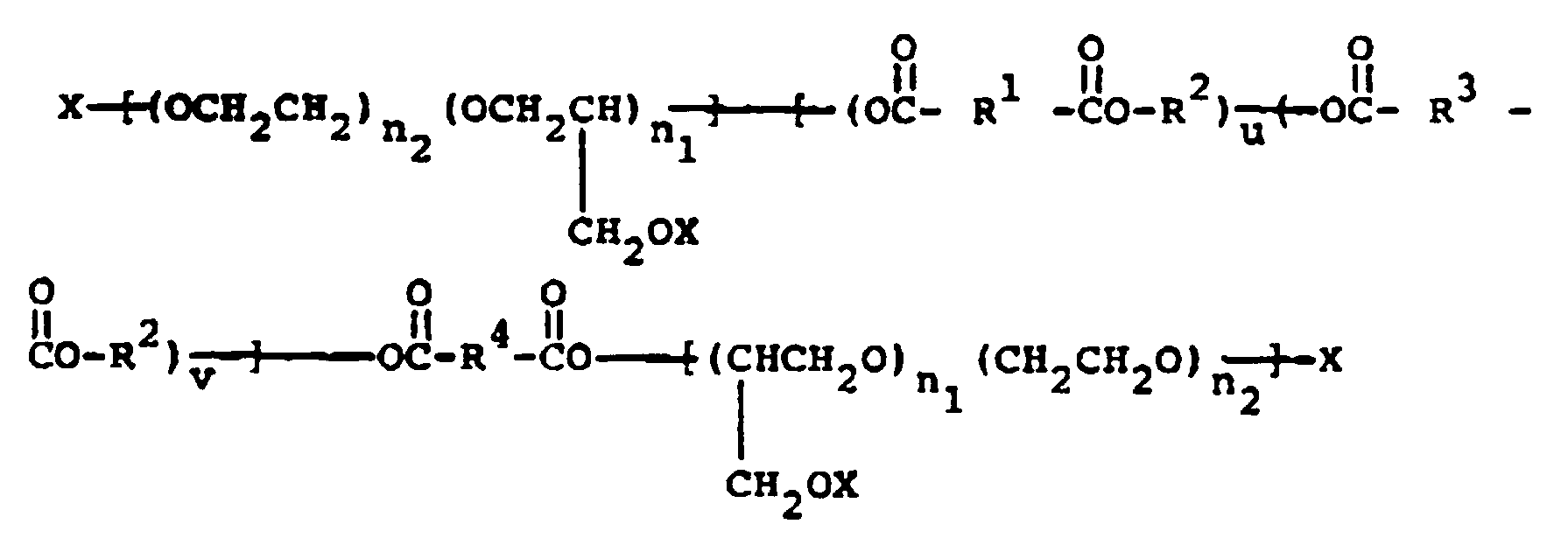

- Verbindung nach Anspruch 5, worin v 0 ist und die genannten R²-Reste 80 bis 100% an Ethylenresten, 1,2-Propylenresten oder Gemischen hievon umfassen.
- Detergenszusammensetzung, dadurch gekennzeichnet, daß sie:(a) 1 Gew.-% bis 75 Gew.-% eines nichtionischen, anionischen, ampholytischen, zwitterionischen oder kationischen grenzflächenaktiven Detergensmittels oder von Gemischen hievon; und(b) eine Schmutzlösekomponente umfaßt, welche 0,01% bis 10% einer Esterverbindung nach einem der Ansprüche 1 bis 6 enthält.
- Detergenszusammensetzung nach Anspruch 7, welche 0,1 bis 5% der Komponente (b) umfaßt.
- Detergenszusammensetzung nach einem der Ansprüche 7 oder 8, worin die Komponente (a) ein nichtionisches grenzflächenaktives Mittel, ein anionisches grenzflächenaktives Mittel oder ein Gemisch hievon ist, welches 10% bis 50% der genannten Zusammensetzung darstellt.
- Detergenszusammensetzung nach einem der Ansprüche 7 bis 9, welche ferner 3% bis 30% eines Detergensgerüststoffes und wahlweise zusätzlich einen optischen Aufheller umfaßt.
Priority Applications (1)
| Application Number | Priority Date | Filing Date | Title |
|---|---|---|---|
| AT87200636T ATE102966T1 (de) | 1986-04-15 | 1987-04-06 | Blockcopolyester mit verzweigten hydrophilen endgruppen, verwendbar als schmutzentfernungsmittel in waschmittelzusammensetzungen. |
Applications Claiming Priority (2)
| Application Number | Priority Date | Filing Date | Title |
|---|---|---|---|
| US852258 | 1986-04-15 | ||
| US06/852,258 US4713194A (en) | 1986-04-15 | 1986-04-15 | Block polyester and like compounds having branched hydrophilic capping groups useful as soil release agents in detergent compositions |
Publications (3)
| Publication Number | Publication Date |
|---|---|
| EP0241984A2 EP0241984A2 (de) | 1987-10-21 |
| EP0241984A3 EP0241984A3 (en) | 1990-07-04 |
| EP0241984B1 true EP0241984B1 (de) | 1994-03-16 |
Family
ID=25312870
Family Applications (1)
| Application Number | Title | Priority Date | Filing Date |
|---|---|---|---|
| EP87200636A Expired - Lifetime EP0241984B1 (de) | 1986-04-15 | 1987-04-06 | Blockcopolyester mit verzweigten hydrophilen Endgruppen, verwendbar als Schmutzentfernungsmittel in Waschmittelzusammensetzungen |
Country Status (9)
| Country | Link |
|---|---|
| US (1) | US4713194A (de) |
| EP (1) | EP0241984B1 (de) |
| JP (2) | JP2837159B2 (de) |
| AT (1) | ATE102966T1 (de) |
| CA (1) | CA1281031C (de) |
| DE (1) | DE3789327T2 (de) |
| DK (1) | DK200687A (de) |
| FI (1) | FI91769C (de) |
| IE (1) | IE62303B1 (de) |
Cited By (25)
| Publication number | Priority date | Publication date | Assignee | Title |
|---|---|---|---|---|
| AU601679B2 (en) * | 1985-04-15 | 1990-09-20 | Procter & Gamble Company, The | Stable liquid detergent composition |
| US5142020A (en) * | 1990-01-19 | 1992-08-25 | Basf Aktiengesellschaft | Polyesters containing nonionic surfactants as cocondensed units, preparation thereof and use thereof in detergents |
| WO1994010277A1 (en) * | 1992-10-27 | 1994-05-11 | The Procter & Gamble Company | Detergent compositions inhibiting dye transfer |
| US5652283A (en) * | 1995-02-25 | 1997-07-29 | Basf Aktiengesellschaft | Preparation of finely divided mixtures of amphiphilic polymers and polycarboxylates and use thereof |
| US5777046A (en) * | 1994-02-08 | 1998-07-07 | Basf Aktiengesellschaft | Amphiphilic polyesters, preparation thereof, and use thereof in laundry detergents |
| US5786318A (en) * | 1995-07-06 | 1998-07-28 | Lever Brothers Company, Division Of Conopco Inc. | Soil Release Polymers and detergent compositions containing them |
| US5789366A (en) * | 1995-11-30 | 1998-08-04 | Lever Brothers Company, Division Of Conopco, Inc. | Detergent compositions containing soil release polymers |
| US5834548A (en) * | 1994-11-18 | 1998-11-10 | Basf Aktiengesellschaft | Process for preparing fine-particle mixtures of amphiphilic polymers and inorganic solids |
| US5972668A (en) * | 1994-06-28 | 1999-10-26 | Henkel Kommanditgesellschaft Auf Aktien | Production of multi-enzyme granules |
| US6200351B1 (en) | 1996-11-13 | 2001-03-13 | Henkel-Ecolab Gmbh & Co. Ohg | Institutional washing process using soil-release polymer |
| US6489395B2 (en) | 1999-12-08 | 2002-12-03 | Clariant Gmbh | Emulsions |
| US7098179B2 (en) | 2001-10-22 | 2006-08-29 | Henkel Kommanditgesellschaft Auf Aktien (Henkel Kgaa) | Cotton active, dirt removing urethane-based polymers |
| US7153818B2 (en) | 2000-07-28 | 2006-12-26 | Henkel Kgaa | Amylolytic enzyme extracted from bacillus sp. A 7-7 (DSM 12368) and washing and cleaning agents containing this novel amylolytic enzyme |
| US7262042B2 (en) | 2001-12-20 | 2007-08-28 | Henkel Kommanditgesellschaft Auf Aktien (Henkel Kgaa) | Alkaline protease from Bacillus gibsonii (DSM 14393) and washing and cleaning products comprising said alkaline protease |
| US7300782B2 (en) | 2001-12-21 | 2007-11-27 | B.R.A.I.N. Biotechnology Research And Information Network Ag | Glycosyl hydrolases |
| US7316995B2 (en) | 2003-02-10 | 2008-01-08 | Henkel Kommanditgesellschaft Auf Aktien | Detergents or cleaning agents comprising a water-soluble building block system and a cellulose derivative with dirt dissolving properties |
| US7320887B2 (en) | 2001-10-31 | 2008-01-22 | Henkel Kommanditgesellschaft Auf Aktien | Alkaline protease variants |
| US7375072B2 (en) | 2003-02-10 | 2008-05-20 | Henkel Kommanditgesellschaft Auf Aktien | Bleach-containing laundry detergents or cleaning compositions comprising water-soluble builder system and soil release-capable cellulose derivative |
| US7449187B2 (en) | 2001-12-20 | 2008-11-11 | Henkel Kommanditgesellschaft Auf Aktien (Henkel Kgaa) | Alkaline protease from Bacillus gibsonii (DSM 14391) and washing and cleaning products comprising said alkaline protease |
| US7510859B2 (en) | 2002-12-20 | 2009-03-31 | Henkel Kommanditgesellschaft Auf Aktien | Subtilisin variants with improved perhydrolase activity |
| US7569226B2 (en) | 2001-12-22 | 2009-08-04 | Henkel Kommanditgesellschaft Auf Aktien (Henkel Kgaa) | Alkaline protease from Bacillus sp. (DSM 14392) and washing and cleaning products comprising said alkaline protease |
| US7888104B2 (en) | 2000-11-28 | 2011-02-15 | Henkel Ag & Co. Kgaa | Cyclodextrin glucanotransferase (CGTase), obtained from<I>Bacillus agaradherens<λ>(DSM 9948) and detergents and cleaning agents containing said novel cyclodextrin glucanotransferase |
| DE102004047777B4 (de) | 2004-10-01 | 2018-05-09 | Basf Se | Alpha-Amylase-Varianten mit erhöhter Lösungsmittelstabilität, Verfahren zu deren Herstellung sowie deren Verwendung |
| DE102004047776B4 (de) | 2004-10-01 | 2018-05-09 | Basf Se | Gegen Di- und/oder Multimerisierung stabilisierte Alpha-Amylase-Varianten, Verfahren zu deren Herstellung sowie deren Verwendung |
| US11396641B2 (en) | 2017-06-16 | 2022-07-26 | Henkel Ag & Co. Kgaa | Viscoelastic, solid surfactant composition |
Families Citing this family (86)
| Publication number | Priority date | Publication date | Assignee | Title |
|---|---|---|---|---|
| US4861512A (en) * | 1984-12-21 | 1989-08-29 | The Procter & Gamble Company | Sulfonated block polyesters useful as soil release agents in detergent compositions |
| GB8617255D0 (en) * | 1986-07-15 | 1986-08-20 | Procter & Gamble Ltd | Laundry compositions |
| US4824606A (en) * | 1987-05-14 | 1989-04-25 | Gaf Corporation | Alkoxylated polyesters |
| US4867750A (en) * | 1988-04-20 | 1989-09-19 | Gaf Corporation | Alkoxylated polyesters |
| US5256168A (en) * | 1989-10-31 | 1993-10-26 | The Procter & Gamble Company | Sulfobenzoyl end-capped ester oligomers useful as soil release agents in granular detergent compositions |
| US5252246A (en) * | 1992-01-10 | 1993-10-12 | Allergan, Inc. | Nonirritating nonionic surfactant compositions |
| US5597795A (en) * | 1992-10-27 | 1997-01-28 | The Procter & Gamble Company | Detergent compositions inhibiting dye transfer |
| EP0629690B1 (de) * | 1993-06-09 | 1999-11-03 | The Procter & Gamble Company | Stabile wässrige nichtionische Tensidemulsionen |
| EP0686190A4 (de) * | 1993-02-26 | 1998-01-14 | Procter & Gamble | Waschzusätze enthaltende parfümkapseln und modifizierte polyester |
| US5415807A (en) * | 1993-07-08 | 1995-05-16 | The Procter & Gamble Company | Sulfonated poly-ethoxy/propoxy end-capped ester oligomers suitable as soil release agents in detergent compositions |
| US5843878A (en) * | 1993-07-08 | 1998-12-01 | Procter & Gamble Company | Detergent compositions comprising soil release agents |
| US5691295A (en) * | 1995-01-17 | 1997-11-25 | Cognis Gesellschaft Fuer Biotechnologie Mbh | Detergent compositions |
| US5691298A (en) * | 1994-12-14 | 1997-11-25 | The Procter & Gamble Company | Ester oligomers suitable as soil release agents in detergent compositions |
| DE19532717A1 (de) | 1995-09-05 | 1997-03-06 | Basf Ag | Verwendung von modifizierten Polyasparaginsäuren in Waschmitteln |
| DE19535082A1 (de) | 1995-09-21 | 1997-03-27 | Henkel Ecolab Gmbh & Co Ohg | Pastenförmiges Wasch- und Reinigungsmittel |
| GB9524494D0 (en) * | 1995-11-30 | 1996-01-31 | Unilever Plc | Detergent compositions containing soil release polymers |
| EP0776965A3 (de) | 1995-11-30 | 1999-02-03 | Unilever N.V. | Polymerzusammetzungen |
| GB9524488D0 (en) * | 1995-11-30 | 1996-01-31 | Unilever Plc | Detergent compositions containing soil release polymers |
| DE19636035A1 (de) | 1996-09-05 | 1998-03-12 | Henkel Ecolab Gmbh & Co Ohg | Pastenförmiges Wasch- und Reinigungsmittel |
| GB2317393A (en) * | 1996-09-24 | 1998-03-25 | Procter & Gamble | Detergent compositions |
| GB2317395A (en) * | 1996-09-24 | 1998-03-25 | Procter & Gamble | Detergent compositions |
| US5922663A (en) | 1996-10-04 | 1999-07-13 | Rhodia Inc. | Enhancement of soil release with gemini surfactants |
| EP0934389B1 (de) * | 1996-10-18 | 2003-12-10 | The Procter & Gamble Company | Waschmittelzusammensetzungen |
| CZ135299A3 (cs) * | 1996-10-18 | 1999-08-11 | The Procter & Gamble Company | Čisticí prostředky |
| DE19703364A1 (de) | 1997-01-30 | 1998-08-06 | Henkel Ecolab Gmbh & Co Ohg | Pastenförmiges Wasch- und Reinigungsmittel |
| DE19725508A1 (de) | 1997-06-17 | 1998-12-24 | Clariant Gmbh | Wasch- und Reinigungsmittel |
| US6127329A (en) * | 1997-10-02 | 2000-10-03 | The Procter & Gamble Company | Detergent compositions |
| US5863887A (en) * | 1997-12-01 | 1999-01-26 | Precision Fabrics Group, Inc. | Laundry compositions having antistatic and fabric softening properties, and laundry detergent sheets containing the same |
| DE19857687A1 (de) | 1998-12-15 | 2000-06-21 | Henkel Ecolab Gmbh & Co Ohg | Pastenförmiges Waschmittel |
| DE10360805A1 (de) | 2003-12-23 | 2005-07-28 | Henkel Kgaa | Neue Alkalische Protease und Wasch- und Reinigungsmittel, enthaltend diese neue Alkalische Protease |
| DE102004019751A1 (de) | 2004-04-23 | 2005-11-17 | Henkel Kgaa | Neue Alkalische Proteasen und Wasch- und Reinigungsmittel, enthaltend diese neuen Alkalischen Proteasen |
| DE102005026544A1 (de) | 2005-06-08 | 2006-12-14 | Henkel Kgaa | Verstärkung der Reinigungsleistung von Waschmitteln durch Polymer |
| DE102005026522B4 (de) | 2005-06-08 | 2007-04-05 | Henkel Kgaa | Verstärkung der Reinigungsleistung von Waschmitteln durch Polymer |
| DE102005053529A1 (de) | 2005-11-08 | 2007-06-21 | Henkel Kgaa | System zur enzymatischen Generierung von Wasserstoffperoxid |
| DE102007003143A1 (de) | 2007-01-16 | 2008-07-17 | Henkel Kgaa | Neue Alkalische Protease aus Bacillus gibsonii und Wasch- und Reinigungsmittel enthaltend diese neue Alkalische Protease |
| DE102007008868A1 (de) | 2007-02-21 | 2008-08-28 | Henkel Ag & Co. Kgaa | Verwendung von N-Zuckersäureamiden zur Entfernung hartnäckiger Anschmutzungen |
| DE102007038456A1 (de) | 2007-08-14 | 2009-02-19 | Henkel Ag & Co. Kgaa | Polycarbonat-, Polyurethan- und/oder Polyharnstoff-Polyorganosiloxan-Verbindungen als schmutzablösevermögende Wirkstoffe |
| KR20090128438A (ko) | 2007-04-03 | 2009-12-15 | 헨켈 아게 운트 코. 카게아아 | 제 1 세척력을 개선하는 활성 성분을 가지는 세제 |
| EP2487230B1 (de) | 2007-04-03 | 2014-12-03 | Henkel AG & Co. KGaA | Farbschützendes Wasch- oder Reinigungsmittel |
| EP2129761B1 (de) | 2007-04-03 | 2016-08-17 | Henkel AG & Co. KGaA | Reinigungsmittel |
| DE102007023827A1 (de) | 2007-05-21 | 2008-11-27 | Henkel Ag & Co. Kgaa | Waschmittel, enthaltend reaktive cyclische Carbonate oder Harnstoffe oder deren Derivate als schmutzablösevermögende Wirkstoffe |
| EP2129760B1 (de) | 2007-04-03 | 2016-07-27 | Henkel AG & Co. KGaA | Mittel zur behandlung harter oberflächen |
| ES2554983T3 (es) | 2007-04-03 | 2015-12-28 | Henkel Ag & Co. Kgaa | Agente de lavado inhibidor del agrisado |
| BRPI0814375A2 (pt) | 2007-08-03 | 2015-01-27 | Basf Se | Espessante associativo, composição líquida de agente de lavagem e limpeza, e, métodos para preparação de uma composição líquida de agente de lavagem e limpeza, e para preparação de um espessante associativo. |
| DE102007049830A1 (de) | 2007-10-16 | 2009-04-23 | Henkel Ag & Co. Kgaa | Neue Proteinvarianten durch zirkulare Permutation |
| DE102007051092A1 (de) | 2007-10-24 | 2009-04-30 | Henkel Ag & Co. Kgaa | Subtilisin aus Becillus pumilus und Wasch- und Reinigungsmittel enthaltend dieses neue Subtilisin |
| KR101530403B1 (ko) | 2007-11-14 | 2015-06-19 | 바스프 에스이 | 증점제 분산액의 제조 방법 |
| EP2083067A1 (de) | 2008-01-25 | 2009-07-29 | Basf Aktiengesellschaft | Verwendung von organischen Komplexbildnern und/oder polymeren carbonsäuregruppenhaltigen Verbindungen in einer flüssigen Wasch- oder Reinigungsmittelzusammensetzung |
| US9376648B2 (en) | 2008-04-07 | 2016-06-28 | The Procter & Gamble Company | Foam manipulation compositions containing fine particles |
| TW201031743A (en) | 2008-12-18 | 2010-09-01 | Basf Se | Surfactant mixture comprising branched short-chain and branched long-chain components |
| WO2011003904A1 (de) | 2009-07-10 | 2011-01-13 | Basf Se | Tensidgemisch mit kurz- und langkettigen komponenten |
| CN102741357B (zh) | 2010-02-09 | 2014-05-28 | 荷兰联合利华有限公司 | 染料聚合物 |
| PL2534234T3 (pl) | 2010-02-12 | 2015-06-30 | Basf Se | Zastosowanie kopolimeru jako środka zagęszczającego w ciekłych środkach piorących o zmniejszonej tendencji do powodowania szarzenia |
| KR101477935B1 (ko) | 2010-06-17 | 2014-12-30 | 바스프 에스이 | 사카라이드 측기를 포함하는 중합체 및 그의 용도 |
| WO2013092052A1 (en) | 2011-12-20 | 2013-06-27 | Unilever Plc | Isotropic liquid detergents comprising soil release polymer |
| AU2015252006A1 (en) | 2014-04-23 | 2016-12-08 | Vinod S. Nair | Cleaning formulations for chemically sensitive individuals: compositions and methods |
| DE102014218951A1 (de) | 2014-09-19 | 2016-03-24 | Henkel Ag & Co. Kgaa | Festförmige Zusammensetzung für die Textilbehandlung |
| DE102014218953A1 (de) | 2014-09-19 | 2016-03-24 | Henkel Ag & Co. Kgaa | Portion für Textilbehandlungsmittel |
| DE102014218950A1 (de) | 2014-09-19 | 2016-03-24 | Henkel Ag & Co. Kgaa | Festförmige Zusammensetzung für die Textilbehandlung |
| JP2017534730A (ja) | 2014-11-11 | 2017-11-24 | クラリアント・インターナシヨナル・リミテツド | ソイルリリースポリマーを含有する洗濯用洗剤 |
| US10240107B2 (en) | 2014-11-11 | 2019-03-26 | Clariant International Ltd. | Laundry detergents containing soil release polymers |
| KR20170105074A (ko) | 2015-01-14 | 2017-09-18 | 그레고리 반 버스커크 | 얼룩 방출을 위한 개선된 직물 처리방법 |
| EP3408180A4 (de) | 2016-01-29 | 2019-10-09 | Henkel IP & Holding GmbH | Mehrkammerreinigungsmittelzusammensetzungen und sowie verfahren zur herstellung und verwendung davon |
| WO2018085382A1 (en) | 2016-11-01 | 2018-05-11 | Milliken & Company | Leuco polymers as bluing agents in laundry care compositions |
| US10377977B2 (en) | 2016-11-01 | 2019-08-13 | The Procter & Gamble Company | Leuco polymers as bluing agents in laundry care compositions |
| JP2018104704A (ja) * | 2016-12-27 | 2018-07-05 | 花王株式会社 | 繊維製品用粉末洗浄剤組成物 |
| WO2018124091A1 (ja) * | 2016-12-27 | 2018-07-05 | 花王株式会社 | 繊維製品用粉末洗浄剤組成物 |
| DE102017210141A1 (de) | 2017-06-16 | 2018-12-20 | Henkel Ag & Co. Kgaa | Portion zur Bereitstellung tensidhaltiger Flotten |
| DE102017223460A1 (de) | 2017-12-20 | 2019-06-27 | Henkel Ag & Co. Kgaa | Viskoselastische, festförmige Tensidzusammensetzung mit hohem Tensidgehalt |
| WO2018229037A1 (de) | 2017-06-16 | 2018-12-20 | Henkel Ag & Co. Kgaa | Viskoelastische, festförmige tensidzusammensetzung mit hohem tensidgehalt |
| EP3638756A1 (de) | 2017-06-16 | 2020-04-22 | Henkel AG & Co. KGaA | Viskoelastische, festförmige tensidzusammensetzung mit hohem tensidgehalt |
| DE102017223456A1 (de) | 2017-12-20 | 2019-06-27 | Henkel Ag & Co. Kgaa | Viskoelastische, festförmige Tensidzusammensetzung mit hohem Tensidgehalt |
| EP3489338A1 (de) | 2017-11-28 | 2019-05-29 | Clariant International Ltd | Waschmittelzusammensetzungen mit erneuerbar bezogenem schmutzablösendem polyester |
| EP3489340A1 (de) | 2017-11-28 | 2019-05-29 | Clariant International Ltd | Erneuerbar beschaffte schmutzablösungspolyester |
| EP3517596B1 (de) * | 2018-01-25 | 2024-03-20 | The Procter & Gamble Company | Verfahren zur herstellung einer opaken flüssigwaschmittelzusammensetzung |
| DE102018201830A1 (de) | 2018-02-06 | 2019-08-08 | Henkel Ag & Co. Kgaa | Viskoelastische, festförmige Tensidzusammensetzung |
| DE102018004071A1 (de) | 2018-05-22 | 2019-11-28 | Gertraud Scholz | Nichtionische Soil Release Polyester und deren Verwendung |
| US12030984B2 (en) | 2018-05-24 | 2024-07-09 | Clariant International Ltd | Soil release polyesters for use in detergent compositions |
| DE102018219415A1 (de) | 2018-11-14 | 2020-05-14 | Henkel Ag & Co. Kgaa | Textilvorbehandlungsmittel enthaltend einen Formkörper mit niedermolekularem Gelbildner |
| DE102018219413A1 (de) | 2018-11-14 | 2020-05-14 | Henkel Ag & Co. Kgaa | Textilvorbehandlungsmittel enthaltend einen Formkörper mit Glucosamin-Derivat als niedermolekularem Gelbildner |
| DE102018221674A1 (de) | 2018-12-13 | 2020-06-18 | Henkel Ag & Co. Kgaa | Vorrichtung und Verfahren zur Herstellung einer wasserlöslichen Hülle sowie diese wasserlösliche Hülle enthaltene Wasch- oder Reinigungsmittelportionen |
| DE102018221671A1 (de) | 2018-12-13 | 2020-06-18 | Henkel Ag & Co. Kgaa | Vorrichtung und Verfahren zur Herstellung einer wasserlöslichen Hülle sowie diese wasserlösliche Hülle enthaltene Wasch- oder Reinigungsmittelportionen mit viskoelastischer, festförmiger Füllsubstanz |
| EP4153710A1 (de) | 2020-05-20 | 2023-03-29 | Clariant International Ltd | Schmutzlösende polyester zur verwendung in waschmittelzusammensetzungen |
| WO2024126303A1 (en) | 2022-12-12 | 2024-06-20 | Clariant International Ltd | Polyesters |
| EP4563616A1 (de) | 2023-11-28 | 2025-06-04 | Clariant International Ltd | Polyester auf basis von recyceltem dimethylterephthalat |
| WO2025132369A1 (en) | 2023-12-19 | 2025-06-26 | Clariant International Ltd | Process for the preparation of polyesters using terephthalic acid |
Family Cites Families (5)
| Publication number | Priority date | Publication date | Assignee | Title |
|---|---|---|---|---|
| DE2737239A1 (de) * | 1977-08-18 | 1979-03-15 | Cassella Ag | Egalisiermittel und verfahren zum gleichmaessigen faerben von materialien aus synthesefasern |
| US4427557A (en) * | 1981-05-14 | 1984-01-24 | Ici Americas Inc. | Anionic textile treating compositions |
| US4411831A (en) * | 1981-12-02 | 1983-10-25 | Purex Industries, Inc. | Stable liquid anionic detergent compositions having soil, release properties |
| US4597898A (en) * | 1982-12-23 | 1986-07-01 | The Proctor & Gamble Company | Detergent compositions containing ethoxylated amines having clay soil removal/anti-redeposition properties |
| US4664848A (en) * | 1982-12-23 | 1987-05-12 | The Procter & Gamble Company | Detergent compositions containing cationic compounds having clay soil removal/anti-redeposition properties |
-
1986
- 1986-04-15 US US06/852,258 patent/US4713194A/en not_active Expired - Fee Related
-
1987
- 1987-04-06 DE DE3789327T patent/DE3789327T2/de not_active Expired - Fee Related
- 1987-04-06 EP EP87200636A patent/EP0241984B1/de not_active Expired - Lifetime
- 1987-04-06 AT AT87200636T patent/ATE102966T1/de not_active IP Right Cessation
- 1987-04-13 CA CA000534543A patent/CA1281031C/en not_active Expired - Lifetime
- 1987-04-14 IE IE96987A patent/IE62303B1/en not_active IP Right Cessation
- 1987-04-14 FI FI871629A patent/FI91769C/fi not_active IP Right Cessation
- 1987-04-15 DK DK200687A patent/DK200687A/da not_active Application Discontinuation
- 1987-04-15 JP JP62092950A patent/JP2837159B2/ja not_active Expired - Lifetime
-
1996
- 1996-11-21 JP JP8310680A patent/JP2768935B2/ja not_active Expired - Lifetime
Cited By (27)
| Publication number | Priority date | Publication date | Assignee | Title |
|---|---|---|---|---|
| AU601679B2 (en) * | 1985-04-15 | 1990-09-20 | Procter & Gamble Company, The | Stable liquid detergent composition |
| US5142020A (en) * | 1990-01-19 | 1992-08-25 | Basf Aktiengesellschaft | Polyesters containing nonionic surfactants as cocondensed units, preparation thereof and use thereof in detergents |
| WO1994010277A1 (en) * | 1992-10-27 | 1994-05-11 | The Procter & Gamble Company | Detergent compositions inhibiting dye transfer |
| AU669029B2 (en) * | 1992-10-27 | 1996-05-23 | Procter & Gamble Company, The | Detergent compositions inhibiting dye transfer |
| US5777046A (en) * | 1994-02-08 | 1998-07-07 | Basf Aktiengesellschaft | Amphiphilic polyesters, preparation thereof, and use thereof in laundry detergents |
| US5972668A (en) * | 1994-06-28 | 1999-10-26 | Henkel Kommanditgesellschaft Auf Aktien | Production of multi-enzyme granules |
| US5834548A (en) * | 1994-11-18 | 1998-11-10 | Basf Aktiengesellschaft | Process for preparing fine-particle mixtures of amphiphilic polymers and inorganic solids |
| US5652283A (en) * | 1995-02-25 | 1997-07-29 | Basf Aktiengesellschaft | Preparation of finely divided mixtures of amphiphilic polymers and polycarboxylates and use thereof |
| US5786318A (en) * | 1995-07-06 | 1998-07-28 | Lever Brothers Company, Division Of Conopco Inc. | Soil Release Polymers and detergent compositions containing them |
| US5789366A (en) * | 1995-11-30 | 1998-08-04 | Lever Brothers Company, Division Of Conopco, Inc. | Detergent compositions containing soil release polymers |
| US6200351B1 (en) | 1996-11-13 | 2001-03-13 | Henkel-Ecolab Gmbh & Co. Ohg | Institutional washing process using soil-release polymer |
| US6489395B2 (en) | 1999-12-08 | 2002-12-03 | Clariant Gmbh | Emulsions |
| US7803604B2 (en) | 2000-07-28 | 2010-09-28 | Henkel Ag & Co. Kgaa | Amylolytic enzyme extracted from Bacillus sp. A 7-7 (DSM 12368) and washing and cleaning agents containing this novel amylolytic enzyme |
| US7153818B2 (en) | 2000-07-28 | 2006-12-26 | Henkel Kgaa | Amylolytic enzyme extracted from bacillus sp. A 7-7 (DSM 12368) and washing and cleaning agents containing this novel amylolytic enzyme |
| US7888104B2 (en) | 2000-11-28 | 2011-02-15 | Henkel Ag & Co. Kgaa | Cyclodextrin glucanotransferase (CGTase), obtained from<I>Bacillus agaradherens<λ>(DSM 9948) and detergents and cleaning agents containing said novel cyclodextrin glucanotransferase |
| US7098179B2 (en) | 2001-10-22 | 2006-08-29 | Henkel Kommanditgesellschaft Auf Aktien (Henkel Kgaa) | Cotton active, dirt removing urethane-based polymers |
| US7320887B2 (en) | 2001-10-31 | 2008-01-22 | Henkel Kommanditgesellschaft Auf Aktien | Alkaline protease variants |
| US7449187B2 (en) | 2001-12-20 | 2008-11-11 | Henkel Kommanditgesellschaft Auf Aktien (Henkel Kgaa) | Alkaline protease from Bacillus gibsonii (DSM 14391) and washing and cleaning products comprising said alkaline protease |
| US7262042B2 (en) | 2001-12-20 | 2007-08-28 | Henkel Kommanditgesellschaft Auf Aktien (Henkel Kgaa) | Alkaline protease from Bacillus gibsonii (DSM 14393) and washing and cleaning products comprising said alkaline protease |
| US7300782B2 (en) | 2001-12-21 | 2007-11-27 | B.R.A.I.N. Biotechnology Research And Information Network Ag | Glycosyl hydrolases |
| US7569226B2 (en) | 2001-12-22 | 2009-08-04 | Henkel Kommanditgesellschaft Auf Aktien (Henkel Kgaa) | Alkaline protease from Bacillus sp. (DSM 14392) and washing and cleaning products comprising said alkaline protease |
| US7510859B2 (en) | 2002-12-20 | 2009-03-31 | Henkel Kommanditgesellschaft Auf Aktien | Subtilisin variants with improved perhydrolase activity |
| US7316995B2 (en) | 2003-02-10 | 2008-01-08 | Henkel Kommanditgesellschaft Auf Aktien | Detergents or cleaning agents comprising a water-soluble building block system and a cellulose derivative with dirt dissolving properties |
| US7375072B2 (en) | 2003-02-10 | 2008-05-20 | Henkel Kommanditgesellschaft Auf Aktien | Bleach-containing laundry detergents or cleaning compositions comprising water-soluble builder system and soil release-capable cellulose derivative |
| DE102004047777B4 (de) | 2004-10-01 | 2018-05-09 | Basf Se | Alpha-Amylase-Varianten mit erhöhter Lösungsmittelstabilität, Verfahren zu deren Herstellung sowie deren Verwendung |
| DE102004047776B4 (de) | 2004-10-01 | 2018-05-09 | Basf Se | Gegen Di- und/oder Multimerisierung stabilisierte Alpha-Amylase-Varianten, Verfahren zu deren Herstellung sowie deren Verwendung |
| US11396641B2 (en) | 2017-06-16 | 2022-07-26 | Henkel Ag & Co. Kgaa | Viscoelastic, solid surfactant composition |
Also Published As
| Publication number | Publication date |
|---|---|
| JP2768935B2 (ja) | 1998-06-25 |
| IE62303B1 (en) | 1995-01-25 |
| FI871629A0 (fi) | 1987-04-14 |
| US4713194A (en) | 1987-12-15 |
| DK200687A (da) | 1987-10-16 |
| IE870969L (en) | 1987-10-15 |
| FI871629L (fi) | 1987-10-16 |
| FI91769C (fi) | 1994-08-10 |
| JPH09169996A (ja) | 1997-06-30 |
| CA1281031C (en) | 1991-03-05 |
| EP0241984A3 (en) | 1990-07-04 |
| EP0241984A2 (de) | 1987-10-21 |
| ATE102966T1 (de) | 1994-04-15 |
| DK200687D0 (da) | 1987-04-15 |
| DE3789327D1 (de) | 1994-04-21 |
| JP2837159B2 (ja) | 1998-12-14 |
| JPS632954A (ja) | 1988-01-07 |
| FI91769B (fi) | 1994-04-29 |
| DE3789327T2 (de) | 1994-08-11 |
Similar Documents
| Publication | Publication Date | Title |
|---|---|---|
| US4713194A (en) | Block polyester and like compounds having branched hydrophilic capping groups useful as soil release agents in detergent compositions | |
| EP0185427B1 (de) | Blockpolyester und ähnliche Verbindungen, verwendbar als Verschmutzungsentferner in Waschmittelzusammensetzungen | |
| US4702857A (en) | Block polyesters and like compounds useful as soil release agents in detergent compositions | |
| US4861512A (en) | Sulfonated block polyesters useful as soil release agents in detergent compositions | |
| EP0241985B1 (de) | Verkappte 1,2-Propylenterephthalat-polyoxyethylenterephthalat-Polyester, verwendbar als Verschmutzungsverhinderungsmittel | |
| EP0274907B1 (de) | Oligomerische Ester mit anionischem Endstück mit schmutzfreigebender Wirkung in Detergenszusammensetzungen | |
| US4659802A (en) | Cationic compounds having clay soil removal/anti-redeposition properties useful in detergent compositions | |
| US4597898A (en) | Detergent compositions containing ethoxylated amines having clay soil removal/anti-redeposition properties | |
| US5451341A (en) | Soil release polymer in detergent compositions containing dye transfer inhibiting agents to improve cleaning performance | |
| US4968451A (en) | Soil release agents having allyl-derived sulfonated end caps | |
| US4891160A (en) | Detergent compositions containing ethoxylated amines having clay soil removal/anti-redeposition properties | |
| US5599782A (en) | Soil release agents for granular laundry detergents | |
| US4661288A (en) | Zwitterionic compounds having clay soil removal/anti/redeposition properties useful in detergent compositions | |
| EP0111984A2 (de) | Ethoxylierte Aminpolymere mit Fleckenentfernungs- und Antiwiederabsetzeigenschaften, verwendbar in Detergenszusammensetzungen | |
| WO1992017523A1 (en) | Nonionic soil release agents | |
| US4551506A (en) | Cationic polymers having clay soil removal/anti-redeposition properties useful in detergent compositions |
Legal Events
| Date | Code | Title | Description |
|---|---|---|---|
| PUAI | Public reference made under article 153(3) epc to a published international application that has entered the european phase |
Free format text: ORIGINAL CODE: 0009012 |
|
| AK | Designated contracting states |
Kind code of ref document: A2 Designated state(s): AT BE CH DE FR GB GR IT LI NL SE |
|
| PUAL | Search report despatched |
Free format text: ORIGINAL CODE: 0009013 |
|
| AK | Designated contracting states |
Kind code of ref document: A3 Designated state(s): AT BE CH DE FR GB GR IT LI NL SE |
|
| 17P | Request for examination filed |
Effective date: 19901222 |
|
| 17Q | First examination report despatched |
Effective date: 19910913 |
|
| GRAA | (expected) grant |
Free format text: ORIGINAL CODE: 0009210 |
|
| AK | Designated contracting states |
Kind code of ref document: B1 Designated state(s): AT BE CH DE FR GB GR IT LI NL SE |
|
| REF | Corresponds to: |
Ref document number: 102966 Country of ref document: AT Date of ref document: 19940415 Kind code of ref document: T |
|
| ITF | It: translation for a ep patent filed | ||
| REF | Corresponds to: |
Ref document number: 3789327 Country of ref document: DE Date of ref document: 19940421 |
|
| PGFP | Annual fee paid to national office [announced via postgrant information from national office to epo] |
Ref country code: GR Payment date: 19940428 Year of fee payment: 9 |
|
| ET | Fr: translation filed | ||
| REG | Reference to a national code |
Ref country code: GR Ref legal event code: FG4A Free format text: 3011114 |
|
| PLBE | No opposition filed within time limit |
Free format text: ORIGINAL CODE: 0009261 |
|
| STAA | Information on the status of an ep patent application or granted ep patent |
Free format text: STATUS: NO OPPOSITION FILED WITHIN TIME LIMIT |
|
| EAL | Se: european patent in force in sweden |
Ref document number: 87200636.6 |
|
| 26N | No opposition filed | ||
| PGFP | Annual fee paid to national office [announced via postgrant information from national office to epo] |
Ref country code: AT Payment date: 19950412 Year of fee payment: 9 |
|
| PGFP | Annual fee paid to national office [announced via postgrant information from national office to epo] |
Ref country code: CH Payment date: 19950413 Year of fee payment: 9 |
|
| PGFP | Annual fee paid to national office [announced via postgrant information from national office to epo] |
Ref country code: SE Payment date: 19950419 Year of fee payment: 9 |
|
| PGFP | Annual fee paid to national office [announced via postgrant information from national office to epo] |
Ref country code: NL Payment date: 19950430 Year of fee payment: 9 |
|
| PGFP | Annual fee paid to national office [announced via postgrant information from national office to epo] |
Ref country code: BE Payment date: 19950602 Year of fee payment: 9 |
|
| PG25 | Lapsed in a contracting state [announced via postgrant information from national office to epo] |
Ref country code: AT Effective date: 19960406 |
|
| PG25 | Lapsed in a contracting state [announced via postgrant information from national office to epo] |
Ref country code: SE Effective date: 19960407 |
|
| PG25 | Lapsed in a contracting state [announced via postgrant information from national office to epo] |
Ref country code: LI Effective date: 19960430 Ref country code: CH Effective date: 19960430 Ref country code: BE Effective date: 19960430 |
|
| BERE | Be: lapsed |
Owner name: THE PROCTER & GAMBLE CY Effective date: 19960430 |
|
| PG25 | Lapsed in a contracting state [announced via postgrant information from national office to epo] |
Ref country code: GR Free format text: THE PATENT HAS BEEN ANNULLED BY A DECISION OF A NATIONAL AUTHORITY Effective date: 19961031 |
|
| PG25 | Lapsed in a contracting state [announced via postgrant information from national office to epo] |
Ref country code: NL Effective date: 19961101 |
|
| REG | Reference to a national code |
Ref country code: GR Ref legal event code: MM2A Free format text: 3011114 |
|
| REG | Reference to a national code |
Ref country code: CH Ref legal event code: PL |
|
| NLV4 | Nl: lapsed or anulled due to non-payment of the annual fee |
Effective date: 19961101 |
|
| EUG | Se: european patent has lapsed |
Ref document number: 87200636.6 |
|
| PGFP | Annual fee paid to national office [announced via postgrant information from national office to epo] |
Ref country code: GB Payment date: 19980330 Year of fee payment: 12 |
|
| PGFP | Annual fee paid to national office [announced via postgrant information from national office to epo] |
Ref country code: FR Payment date: 19980409 Year of fee payment: 12 |
|
| PGFP | Annual fee paid to national office [announced via postgrant information from national office to epo] |
Ref country code: DE Payment date: 19980414 Year of fee payment: 12 |
|
| PG25 | Lapsed in a contracting state [announced via postgrant information from national office to epo] |
Ref country code: GB Free format text: LAPSE BECAUSE OF NON-PAYMENT OF DUE FEES Effective date: 19990406 |
|
| GBPC | Gb: european patent ceased through non-payment of renewal fee |
Effective date: 19990406 |
|
| PG25 | Lapsed in a contracting state [announced via postgrant information from national office to epo] |
Ref country code: FR Free format text: LAPSE BECAUSE OF NON-PAYMENT OF DUE FEES Effective date: 19991231 |
|
| REG | Reference to a national code |
Ref country code: FR Ref legal event code: ST |
|
| PG25 | Lapsed in a contracting state [announced via postgrant information from national office to epo] |
Ref country code: DE Free format text: LAPSE BECAUSE OF NON-PAYMENT OF DUE FEES Effective date: 20000201 |
|
| PG25 | Lapsed in a contracting state [announced via postgrant information from national office to epo] |
Ref country code: IT Free format text: LAPSE BECAUSE OF NON-PAYMENT OF DUE FEES;WARNING: LAPSES OF ITALIAN PATENTS WITH EFFECTIVE DATE BEFORE 2007 MAY HAVE OCCURRED AT ANY TIME BEFORE 2007. THE CORRECT EFFECTIVE DATE MAY BE DIFFERENT FROM THE ONE RECORDED. Effective date: 20050406 |