EP0239031B2 - Verfahren zur herstellung von magnetpulver fuer einen megnetisch anisotropen gebundenen magneten - Google Patents
Verfahren zur herstellung von magnetpulver fuer einen megnetisch anisotropen gebundenen magneten Download PDFInfo
- Publication number
- EP0239031B2 EP0239031B2 EP87104135A EP87104135A EP0239031B2 EP 0239031 B2 EP0239031 B2 EP 0239031B2 EP 87104135 A EP87104135 A EP 87104135A EP 87104135 A EP87104135 A EP 87104135A EP 0239031 B2 EP0239031 B2 EP 0239031B2
- Authority
- EP
- European Patent Office
- Prior art keywords
- magnet
- alloy
- magnetic
- powder
- anisotropic
- Prior art date
- Legal status (The legal status is an assumption and is not a legal conclusion. Google has not performed a legal analysis and makes no representation as to the accuracy of the status listed.)
- Expired - Lifetime
Links
- 239000006247 magnetic powder Substances 0.000 title claims description 15
- 238000004519 manufacturing process Methods 0.000 title claims description 6
- 238000000034 method Methods 0.000 claims description 34
- 229910045601 alloy Inorganic materials 0.000 claims description 32
- 239000000956 alloy Substances 0.000 claims description 32
- 239000013078 crystal Substances 0.000 claims description 18
- 239000000654 additive Substances 0.000 claims description 8
- 238000001816 cooling Methods 0.000 claims description 8
- 238000010791 quenching Methods 0.000 claims description 7
- 229910052761 rare earth metal Inorganic materials 0.000 claims description 7
- 229910052758 niobium Inorganic materials 0.000 claims description 6
- 229910052782 aluminium Inorganic materials 0.000 claims description 5
- 229910052796 boron Inorganic materials 0.000 claims description 5
- 229910052710 silicon Inorganic materials 0.000 claims description 5
- 229910052726 zirconium Inorganic materials 0.000 claims description 5
- 229910052799 carbon Inorganic materials 0.000 claims description 4
- 229910052735 hafnium Inorganic materials 0.000 claims description 4
- 239000012535 impurity Substances 0.000 claims description 4
- 229910052742 iron Inorganic materials 0.000 claims description 4
- ZOXJGFHDIHLPTG-UHFFFAOYSA-N Boron Chemical group [B] ZOXJGFHDIHLPTG-UHFFFAOYSA-N 0.000 claims description 3
- 229910052698 phosphorus Inorganic materials 0.000 claims description 3
- 229910052751 metal Inorganic materials 0.000 claims description 2
- 239000002184 metal Substances 0.000 claims description 2
- 239000002245 particle Substances 0.000 claims description 2
- 230000000717 retained effect Effects 0.000 claims description 2
- 239000000843 powder Substances 0.000 description 23
- XEEYBQQBJWHFJM-UHFFFAOYSA-N Iron Chemical compound [Fe] XEEYBQQBJWHFJM-UHFFFAOYSA-N 0.000 description 14
- 238000010438 heat treatment Methods 0.000 description 12
- 238000000465 moulding Methods 0.000 description 9
- 238000001746 injection moulding Methods 0.000 description 8
- 239000000203 mixture Substances 0.000 description 7
- 229910000938 samarium–cobalt magnet Inorganic materials 0.000 description 7
- 238000000748 compression moulding Methods 0.000 description 6
- 239000000463 material Substances 0.000 description 6
- 229910001172 neodymium magnet Inorganic materials 0.000 description 6
- 229920005989 resin Polymers 0.000 description 6
- 239000011347 resin Substances 0.000 description 6
- 229920001187 thermosetting polymer Polymers 0.000 description 6
- 239000011230 binding agent Substances 0.000 description 5
- 230000006698 induction Effects 0.000 description 5
- 230000014759 maintenance of location Effects 0.000 description 5
- 238000002844 melting Methods 0.000 description 5
- 230000008018 melting Effects 0.000 description 5
- 239000004033 plastic Substances 0.000 description 5
- 238000004663 powder metallurgy Methods 0.000 description 5
- 230000000996 additive effect Effects 0.000 description 4
- 230000006835 compression Effects 0.000 description 3
- 238000007906 compression Methods 0.000 description 3
- 230000000694 effects Effects 0.000 description 3
- 238000005516 engineering process Methods 0.000 description 3
- 238000002156 mixing Methods 0.000 description 3
- 239000008188 pellet Substances 0.000 description 3
- 150000002910 rare earth metals Chemical class 0.000 description 3
- 239000002994 raw material Substances 0.000 description 3
- 238000005096 rolling process Methods 0.000 description 3
- 229910000521 B alloy Inorganic materials 0.000 description 2
- 229910052772 Samarium Inorganic materials 0.000 description 2
- 229910017052 cobalt Inorganic materials 0.000 description 2
- 239000010941 cobalt Substances 0.000 description 2
- GUTLYIVDDKVIGB-UHFFFAOYSA-N cobalt atom Chemical compound [Co] GUTLYIVDDKVIGB-UHFFFAOYSA-N 0.000 description 2
- 230000005347 demagnetization Effects 0.000 description 2
- 238000007731 hot pressing Methods 0.000 description 2
- 230000002427 irreversible effect Effects 0.000 description 2
- 229910001004 magnetic alloy Inorganic materials 0.000 description 2
- KZUNJOHGWZRPMI-UHFFFAOYSA-N samarium atom Chemical compound [Sm] KZUNJOHGWZRPMI-UHFFFAOYSA-N 0.000 description 2
- 238000005245 sintering Methods 0.000 description 2
- 239000000126 substance Substances 0.000 description 2
- 229910000789 Aluminium-silicon alloy Inorganic materials 0.000 description 1
- 239000004593 Epoxy Substances 0.000 description 1
- PXGOKWXKJXAPGV-UHFFFAOYSA-N Fluorine Chemical compound FF PXGOKWXKJXAPGV-UHFFFAOYSA-N 0.000 description 1
- 206010061218 Inflammation Diseases 0.000 description 1
- 229910052779 Neodymium Inorganic materials 0.000 description 1
- 239000004677 Nylon Substances 0.000 description 1
- 239000004952 Polyamide Substances 0.000 description 1
- 239000004642 Polyimide Substances 0.000 description 1
- XUIMIQQOPSSXEZ-UHFFFAOYSA-N Silicon Chemical compound [Si] XUIMIQQOPSSXEZ-UHFFFAOYSA-N 0.000 description 1
- 238000002441 X-ray diffraction Methods 0.000 description 1
- QJVKUMXDEUEQLH-UHFFFAOYSA-N [B].[Fe].[Nd] Chemical compound [B].[Fe].[Nd] QJVKUMXDEUEQLH-UHFFFAOYSA-N 0.000 description 1
- 230000002411 adverse Effects 0.000 description 1
- 230000015572 biosynthetic process Effects 0.000 description 1
- 239000003638 chemical reducing agent Substances 0.000 description 1
- 229910052802 copper Inorganic materials 0.000 description 1
- 238000005868 electrolysis reaction Methods 0.000 description 1
- 239000003822 epoxy resin Substances 0.000 description 1
- 239000011737 fluorine Substances 0.000 description 1
- 229910052731 fluorine Inorganic materials 0.000 description 1
- 230000004907 flux Effects 0.000 description 1
- 239000011261 inert gas Substances 0.000 description 1
- 230000004054 inflammatory process Effects 0.000 description 1
- 238000002347 injection Methods 0.000 description 1
- 239000007924 injection Substances 0.000 description 1
- 238000004898 kneading Methods 0.000 description 1
- 229910052745 lead Inorganic materials 0.000 description 1
- 238000005259 measurement Methods 0.000 description 1
- 229910052750 molybdenum Inorganic materials 0.000 description 1
- QEFYFXOXNSNQGX-UHFFFAOYSA-N neodymium atom Chemical compound [Nd] QEFYFXOXNSNQGX-UHFFFAOYSA-N 0.000 description 1
- 229920001778 nylon Polymers 0.000 description 1
- 230000003647 oxidation Effects 0.000 description 1
- 238000007254 oxidation reaction Methods 0.000 description 1
- 230000002093 peripheral effect Effects 0.000 description 1
- 229920002647 polyamide Polymers 0.000 description 1
- 229920000647 polyepoxide Polymers 0.000 description 1
- 229920000728 polyester Polymers 0.000 description 1
- 229920001721 polyimide Polymers 0.000 description 1
- 150000008442 polyphenolic compounds Chemical class 0.000 description 1
- 235000013824 polyphenols Nutrition 0.000 description 1
- 239000010703 silicon Substances 0.000 description 1
- 238000005476 soldering Methods 0.000 description 1
- 238000009987 spinning Methods 0.000 description 1
- 229920001169 thermoplastic Polymers 0.000 description 1
- 229920005992 thermoplastic resin Polymers 0.000 description 1
- 239000004416 thermosoftening plastic Substances 0.000 description 1
- 229910052718 tin Inorganic materials 0.000 description 1
- 239000011800 void material Substances 0.000 description 1
- XLYOFNOQVPJJNP-UHFFFAOYSA-N water Substances O XLYOFNOQVPJJNP-UHFFFAOYSA-N 0.000 description 1
Images
Classifications
-
- H—ELECTRICITY
- H01—ELECTRIC ELEMENTS
- H01F—MAGNETS; INDUCTANCES; TRANSFORMERS; SELECTION OF MATERIALS FOR THEIR MAGNETIC PROPERTIES
- H01F1/00—Magnets or magnetic bodies characterised by the magnetic materials therefor; Selection of materials for their magnetic properties
-
- H—ELECTRICITY
- H01—ELECTRIC ELEMENTS
- H01F—MAGNETS; INDUCTANCES; TRANSFORMERS; SELECTION OF MATERIALS FOR THEIR MAGNETIC PROPERTIES
- H01F1/00—Magnets or magnetic bodies characterised by the magnetic materials therefor; Selection of materials for their magnetic properties
- H01F1/01—Magnets or magnetic bodies characterised by the magnetic materials therefor; Selection of materials for their magnetic properties of inorganic materials
- H01F1/03—Magnets or magnetic bodies characterised by the magnetic materials therefor; Selection of materials for their magnetic properties of inorganic materials characterised by their coercivity
- H01F1/032—Magnets or magnetic bodies characterised by the magnetic materials therefor; Selection of materials for their magnetic properties of inorganic materials characterised by their coercivity of hard-magnetic materials
- H01F1/04—Magnets or magnetic bodies characterised by the magnetic materials therefor; Selection of materials for their magnetic properties of inorganic materials characterised by their coercivity of hard-magnetic materials metals or alloys
- H01F1/047—Alloys characterised by their composition
- H01F1/053—Alloys characterised by their composition containing rare earth metals
- H01F1/055—Alloys characterised by their composition containing rare earth metals and magnetic transition metals, e.g. SmCo5
- H01F1/057—Alloys characterised by their composition containing rare earth metals and magnetic transition metals, e.g. SmCo5 and IIIa elements, e.g. Nd2Fe14B
- H01F1/0571—Alloys characterised by their composition containing rare earth metals and magnetic transition metals, e.g. SmCo5 and IIIa elements, e.g. Nd2Fe14B in the form of particles, e.g. rapid quenched powders or ribbon flakes
- H01F1/0575—Alloys characterised by their composition containing rare earth metals and magnetic transition metals, e.g. SmCo5 and IIIa elements, e.g. Nd2Fe14B in the form of particles, e.g. rapid quenched powders or ribbon flakes pressed, sintered or bonded together
- H01F1/0578—Alloys characterised by their composition containing rare earth metals and magnetic transition metals, e.g. SmCo5 and IIIa elements, e.g. Nd2Fe14B in the form of particles, e.g. rapid quenched powders or ribbon flakes pressed, sintered or bonded together bonded together
Definitions
- This invention relates to method of manufacturing alloy powder of rare earth elements-iron-boron with crystalline magnetic anisotropy.
- samarium cobalt magnets are produced with the following procedures: Ingot composed of samarium and cobalt is made by mixing samarium and cobalt and then melting the mixture in vacuum or inactive atmosphere. After the ingot has been crushed into fine powder, the powder is molded in a magnetic field and the green body is obtained, a permanent magnet is made by sintering the green body and then heat treating the sintered body.
- the samarium cobalt magnet is caused with magnetic anistropy by being molded in a magnetic field.
- the magnetic property of the magnet is improved substantially by causing magnetic anisotropy.
- Resin-bonded permanent magnet of samarium cobalt magnet can obtain its magnetic anisotropy by mixing the crushed powder of sintered anisotropic samarium cobalt magnet with resin and molding the powder in a magnetic field either by injecting it into a molding die or by compressing it in a molding die.
- the resin-bonded samarium cobalt magnet can be produced by making the sintered magnetically anisotropic magnet and by crushing and then mixing it with resin.
- a rare earth magnet of new type that is, the neodymium- iron-boron magnet
- Those proposals made with Japan Patent Laid-Open Nos. Showa 59-46008 and Showa 59-64733 proposed that, in the same way as in samarium cobalt magnet, ingot of the neodymium-iron-boron alloy is prepared and crushed into fine powder and then the powder is molded in the magnetic field and the green body is obtained. By sintering the green body and heat-treating. the sintered body, permanent magnet is prepared. This method is called the powder metallurgy method.
- Patent Laid-Open No. 60-100402 describes such technology as to furnish the isotropic magnetic alloy with magnetic anisotropy by means of making it a green body by hot press and thereafter causing plastic streaming in a part of the green body under high temperature and high pressure.
- This NdFeB magnet has the following problems:
- the method to mix the rapidly-quenched powder with resin possibly makes such molding as compression molding comparatively easy, its obtainable magnetic property is low because it has magnetic isotropy.
- the magnetic property obtainable by injection molding has (BH)max 2.4 to 4 x 10 8 A/m and the one obtainable by compression molding has (BH)max 6.4 to 8 x 10 8 A/m and, in addition, dependency on the strength of the magnetizing magnetic field.
- the strength of the magnetizing magnetic field of about 4 x 10 6 A/m is usually required and it is difficult in using this magnet in various kind of applications to magnetize it after it has been assembled.
- the hot pressing of the rapidly-quenched powder improves the weather-proof property as the result of the density increases which makes the magnet free of void holes. But since it has isotropy, it has the same problems as in the case of the permanent magnet made with the process to mix the rapidly-quenched powder with resin. Although obtainable (BH)max is increased so much as the density has been improved and about 9.6 x 10 8 A/m is obtainable, it is still impossible to magnetize it after assembled.
- the sintered magnet with magnetic anisotropy made by the powder metallurgy process was crushed, the crushed particles were mixed with resin and the magnet body was molded in a DC magnetic field.
- a high magnetic property was not obtainable.
- the object of the invention is to eliminate such shortcoming as abovementioned caused by depending on the conventional technologies.
- Another object of the invention is to provide a magnetic powder with crystalline magnetic anisotropy.
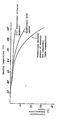
- the sole Figure shows a comparison of thermal stability among the anisotropic bond magnet and anisotropic sintered magnet both composed of Nd 13 DyFe 79 B s AI as well as the Sm 2 C 017 system magnet.
- the abovementioned alloy preferably consists essentially of 11-18 at % of R, 4-11 at % of B, 30 at % or less of Co, and the balance of Fe and unavoidable impurities and more preferably 11-18 at % or R, 4-11 at % of B, 30 at % or less of Co, 0.001-3% of the additives (the additive is at least one selected from the group of Si, Al, Nb, Zr, Hf, Mo, P and C) and the balance of Fe and unavoidable impurities.
- the residual induction of the anisotropic direction of the R-Fe-B system alloy to be crushed should be 0.8 T or more.
- the R-Fe-B system alloy should be the alloy furnished with magnetic anisotropy by plastic deformation after the flake of the alloy obtained by the rapidly-quenching process has been made highly dense with hot isostatic press (HIP) and hot press (HP).
- HIP hot isostatic press
- HP hot press
- the amount of the additive elements is preferable to be 0.001-3 at % and it is preferable that the average ratio of c to a is 2 or more in which (c) is the average crystal grain size in the direction perpendicular to the C axis of the grain and (a) is the average crystal grain size in the direction of the C axis.
- the R-Fe-B alloy furnished with magnetic anisotropy means the R-Fe-B system alloy showing the anisotropic magnetic property in which the shape of the second quadrant of the 4n I-H demagnetization curve is different depending on the magnetizing direction.
- the residual induction of the consolidated body made by HIP from flake is usually 0.75 T or under and, by using the R-Fe-B alloy which has the residual induction of 0.8 T or more, it is possible to make the high performance bond magnet which has the residual magnetic flux density and the energy product both higher than those of isotropic bond magnet.
- the average crystal grain size becomes greater than 0.5 ⁇ m, intrinsic coercive force (IHc) is lowered and the irreversible demagnetizing coefficient at 160°C accounts for 10 at % or higher resulting in lowering thermal stability conspicuously which is inconvenient for using the magnet.
- IHc intrinsic coercive force
- the average crystal grain size is smaller than 0.01 ⁇ m, IHc of the bond magnet after molding is low. Therefore, the average crystal grain size shall be 0.01-0.5 ⁇ m.
- the average crystal grain size in this patent application means the average value of the diameters of the balls which have same volume as those of the crystal grains concerning more than 30 pieces of crystal grains.
- the coercive force of the magnet can be increased.
- heat treatment temperature from 600°C to 900°C.
- the reason thereof is because, with the heat treatment temperature below 600°C, the coercive force cannot be increased whereas, with the one over 900°C, the coercive force becomes lower than thai at the time before heat treatment.
- the time required for the temperature of the samples becoming uniform may be acceptable as the time for the coercive force. Therefore, the retention time was set to 240 minutes or less taking the industrial productivity into account.
- the cooling speed shall be 1°C/s or higher. With a cooling speed lower than 1°C/s the coercive force becomes lower than before heat treatment.
- the cooling speed means the average cooling speed with which a heat treatment temperature (°C) goes down up to (the heat treatment temperature + room temperature) + 2(°C).
- the R-Fe-B system alloy means such an alloy that contains R 2 Fe 14 B or R 2 (Fe, C O ) 14 B as the main phase.
- the reason for the range of compositions recommendable for a permanent magnet is as follows:
- the amount of B is less than 4 at %, formation of the R 2 Fe 14 B phase, which is the main phase of the magnet, is insufficient and both Br and IHc are low; as well.
- the amount of B exceeds 11 at %, Br is lowered due to an undesirous phase in terms of the magnetic property comes into existence.
- the amount of B shall be 4-11 at %, accordingly.
- the amount of Co shall be 30 at % or less, accordingly.
- Si, Al, Nb, Zr, Hf, P and C may be added to the alloy additives.
- Si has the effect to cause the Curie point to go up and AI, Nb and P have the effect to cause the coercive force to go up.
- C is an element which is apt to be mixed in at the time of electrolysis but, if the amount is small, it does not affect adversely on the magnetic property.
- Nb, Zr, Hf and Mo improve the anti-corrosive property.
- the amount of the additive elements shall be 0.001 at % - 3 at %, accordingly.
- impurify AI included in ferro-boron or reducing agents and impurities included at the time of reducing rare earth elements may exist in the alloys of the invention.
- the average grain size is smaller than 1 ⁇ m, it is apt to cause inflammation and handling such powder in the air atmosphere is difficult. If the average grain size is greater than 1,000 ⁇ m, it is difficult to apply such powder to making a thin magnet (thickness 1-2 mm) and such powder is not suited to injection molding, as well. Such being the case, the average grain size shall be the abovementioned range.
- the crushing method the usual method using for making the magnetic powder is available as it is. Namely, disc mill, brown mill, attritor, ball mill, vibration mill, jet mill, etc. can be used.
- thermosetting binder By adding a thermosetting binder to the said coarse powder and making the powder thermoset after compression molding in the magnetic field, it is possible to obtain an anisotropic bond magnet of the compression molded type.
- thermoplastic binder By adding the thermoplastic binder to the coarse powder and injection molding, it is possible to obtain an anisotropic bond magnet of the injection molded type.
- thermosetting resin Polyamide, polyimide, polyester, polyphenol, fluorine, silicon, epoxy, etc. can be used which show all thermal stability.
- Al, Sn, Pb and various sorts of soldering alloys of low melting points can be used.
- thermoplastic resin such as EVA, nylon, etc. can be used in accordance with the usage.
- Nd l7 Fe 75 B 8 alloy was made by arc fusing and flake shaped filaments of the alloy were produced by rapid-quenching with the single roll method in Ar atmosphere.
- the peripheral speed of the roll was 30 m/ sec and the obtained filaments were about 30 ⁇ m thick and of indeterminate form and, as a result of the X-ray diffraction, it was found that these filaments were the mixtures of the amorphous substance and crystal substance.
- the molding pressure was 6 ton/cm 2 and application of the magnetic field was not made.
- the density of the green body was 5.8 g/cm 3 .
- the green body was hot pressed at 700°C with the pressure of 2 kbar.
- the density of the molded body obtained by hot pressing was 7.30 g/cm 3 by which high density could be furnished sufficiently.
- the bulk body with the high density was furthermore processed with upsetting at 700°C.
- the sample processed with upsetting was heated up to 750°C in Ar atmosphere and, after having been retained, the sample was water cooled.
- the cooling speed was 7°C/s.
- the rapidly-quenched filaments of an alloy composed of Nd 17 Fe 75 B 8 were heat treated in a vacuum at 600°C for 1 hr, crushed roughly into 250-500 ⁇ m, and made into a bond magnet with the same method as the one used for the example.
- the results are shown in Table 3.
- the magnetic properties shown in Table 3 are the value obtained by the magnetizing strength of 2 x 10 6 A/m. As shown in Table 3, by increasing the deformation ratio, the magnetic properties of the anisotropic bond magnet are improved.
- the Nd 14 Fe 80 B 6 alloy was treated into magnetic powder with the same method as for the example 1.
- the magnetic powder was kneaded with 33 vol% of EVAand pellets were made. Using the pellets, injection molding was done at 150°C.
- the form of the test piece obtained from injection molding was 20 mm dia.
- x 10 mm t and the magnetic field applied at the time of injection molding was 6.4 x 10 5 A/m.
- the magnetic property is the value with the magnetizing strength of 2 x 10 9 A/m.
- the anisotropic bond magnets having the composition shown in Table 4 were prepared with the method same as for example 1.
- the making method was compression molding.
- the obtained magnetic properties are shown in Table 5.
- the anisotropic bond magnet of compression molded type composed of Nd 13 DyFe 79 B 8 Al was prepared with the same method as for example 1.
- the crystal grain size of the magnet was 0.11 ⁇ m.
- the magnet was machined so as to be 10 mm dia. x 7 mm t and thermal stability was tested. The results are shown in Fig. 1.
- the anisotropic sintered Sm2C017 magnet and the R-Fe-B anisotropic sintered magnet with same composition as that of the sample were used.
- anisotropic bond magnet has thermal stability superior to the anisotropic sintered magnet when compared.
- the Nd 14 Fe 80 B 6 anisotropic bond magnets were made with the same method as for the example 1 except the crushed grain size of the magnetic powder.
- the Nd 13 Dy 2 Fe 78 B 7 anisotropic sintered magnet for reference, the change in the coercive force depending on the change in the crushed grain size was checked. The results are shown in Table 6. Although, when the sintered body is crushed, the coercive force is lowered and becomes unable to be used as raw material for making bond magnets, it is seen that the material made by the invention shows almost no lowering of the coercive force.
- the anisotropic bond magnets were made with the same method as for example 1 except that the crystal grain size was changed by changing the temperature for upsetting. The results are shown in Table 7.
- the magnet when the average crystal size is from 0.001 ⁇ m to 0.5 ⁇ m, the magnet has superior magnetic properties.
- the R-Fe-B system permanent magnets were made with the same method as for example 1 except the retention time in heat treatment. The results are shown in Table 8. It can be seen that there is no change in the magnetic properties provided that the retention time at 750°C is within 240 minutes.
- the R-Fe-B system permanent magnets were made with the same method as for example 1 except that the heat treatment temperature was varied and the retention time was set to 10 minutes. The results are shown in Table 9. It can be seen that the superior magnetic properties are shown when the heat treatment temperature is 600-900°C.
- the R-Fe-B permanent magnets were made with the same method as for example 1 except that the retention time was set to 10 minutes and the cooling method was varied. The results are shown in Table 10. The superior results can be obtained when the cooling speed is 1°C/sec or over.
- the magnetic powder for the anisotropic bond magnet is excellent in the magnetizing property and its irreversible demagnetizing factor is small even under the environment of relatively high temperature and, therefore, it is useful as the raw material used for an anisotropic bond magnet which can be magnetized after the magnet has been assembled.
Landscapes
- Engineering & Computer Science (AREA)
- Power Engineering (AREA)
- Chemical & Material Sciences (AREA)
- Crystallography & Structural Chemistry (AREA)
- Inorganic Chemistry (AREA)
- Hard Magnetic Materials (AREA)
- Manufacture Of Metal Powder And Suspensions Thereof (AREA)
- Manufacturing Cores, Coils, And Magnets (AREA)
Claims (4)
Applications Claiming Priority (4)
| Application Number | Priority Date | Filing Date | Title |
|---|---|---|---|
| JP6217486 | 1986-03-20 | ||
| JP62174/86 | 1986-03-20 | ||
| JP106187/86 | 1986-05-09 | ||
| JP10618786 | 1986-05-09 |
Publications (3)
| Publication Number | Publication Date |
|---|---|
| EP0239031A1 EP0239031A1 (de) | 1987-09-30 |
| EP0239031B1 EP0239031B1 (de) | 1990-06-13 |
| EP0239031B2 true EP0239031B2 (de) | 1994-05-11 |
Family
ID=26403232
Family Applications (1)
| Application Number | Title | Priority Date | Filing Date |
|---|---|---|---|
| EP87104135A Expired - Lifetime EP0239031B2 (de) | 1986-03-20 | 1987-03-20 | Verfahren zur herstellung von magnetpulver fuer einen megnetisch anisotropen gebundenen magneten |
Country Status (5)
| Country | Link |
|---|---|
| US (3) | US4921553A (de) |
| EP (1) | EP0239031B2 (de) |
| JP (1) | JP2530641B2 (de) |
| KR (1) | KR870009410A (de) |
| DE (1) | DE3763272D1 (de) |
Families Citing this family (50)
| Publication number | Priority date | Publication date | Assignee | Title |
|---|---|---|---|---|
| US5538565A (en) * | 1985-08-13 | 1996-07-23 | Seiko Epson Corporation | Rare earth cast alloy permanent magnets and methods of preparation |
| US6136099A (en) * | 1985-08-13 | 2000-10-24 | Seiko Epson Corporation | Rare earth-iron series permanent magnets and method of preparation |
| KR900006533B1 (ko) | 1987-01-06 | 1990-09-07 | 히다찌 긴조꾸 가부시끼가이샤 | 이방성 자성분말과 이의 자석 및 이의 제조방법 |
| US4983232A (en) * | 1987-01-06 | 1991-01-08 | Hitachi Metals, Ltd. | Anisotropic magnetic powder and magnet thereof and method of producing same |
| US5213631A (en) * | 1987-03-02 | 1993-05-25 | Seiko Epson Corporation | Rare earth-iron system permanent magnet and process for producing the same |
| DE3876529T2 (de) * | 1987-07-31 | 1993-06-24 | Tdk Corp | Magnetisches weicheisenpulver zur formung magnetischer abschirmung, verbindung und verfahren zur herstellung. |
| CN1012477B (zh) * | 1987-08-19 | 1991-05-01 | 三菱金属株式会社 | 稀土-铁-硼磁体粉末及其制备方法 |
| DE68912157T2 (de) * | 1988-02-29 | 1994-06-16 | Matsushita Electric Ind Co Ltd | Verfahren zur Herstellung von harzgebundenen Magneten. |
| US5190684A (en) * | 1988-07-15 | 1993-03-02 | Matsushita Electric Industrial Co., Ltd. | Rare earth containing resin-bonded magnet and its production |
| JP2839264B2 (ja) * | 1988-07-15 | 1998-12-16 | 松下電器産業株式会社 | 永久磁石 |
| EP0362812B1 (de) * | 1988-10-04 | 1996-01-24 | Hitachi Metals, Ltd. | Gebundener R-Fe-B-Magnet und Verfahren zur Herstellung |
| DE69003720T3 (de) * | 1989-04-14 | 1999-04-22 | Daido Tokushuko K.K., Nagoya, Aichi | Verfahren und Vorrichtung für die Herstellung eines anisotropen Seltenerd-Magneten. |
| US5026419A (en) * | 1989-05-23 | 1991-06-25 | Hitachi Metals, Ltd. | Magnetically anisotropic hotworked magnet and method of producing same |
| US5098486A (en) * | 1989-05-23 | 1992-03-24 | Hitachi Metals, Ltd. | Magnetically anisotropic hotworked magnet and method of producing same |
| US5180445A (en) * | 1989-06-13 | 1993-01-19 | Sps Technologies, Inc. | Magnetic materials |
| US5244510A (en) * | 1989-06-13 | 1993-09-14 | Yakov Bogatin | Magnetic materials and process for producing the same |
| JP2576672B2 (ja) * | 1989-07-31 | 1997-01-29 | 三菱マテリアル株式会社 | 磁気的異方性および耐食性に優れた希土類ーFeーCoーB系永久磁石粉末およびボンド磁石 |
| JPH03241705A (ja) * | 1989-11-14 | 1991-10-28 | Hitachi Metals Ltd | 磁気異方性磁石及びその製造方法 |
| US5213703A (en) * | 1990-02-09 | 1993-05-25 | Matsushita Electric Industrial Co., Ltd. | Anisotropic neodymium-iron-boron system plastic bonded magnet |
| JP2780429B2 (ja) * | 1990-03-30 | 1998-07-30 | 松下電器産業株式会社 | 希土類―鉄系磁石の製造方法 |
| JP3164810B2 (ja) * | 1990-04-18 | 2001-05-14 | 松下電器産業株式会社 | 異方性永久磁石の製造方法 |
| JP2586199B2 (ja) * | 1990-09-26 | 1997-02-26 | 三菱マテリアル株式会社 | 磁気的異方性および耐食性に優れた希土類―Fe―Co―B系永久磁石粉末およびボンド磁石 |
| JP2586198B2 (ja) * | 1990-09-26 | 1997-02-26 | 三菱マテリアル株式会社 | 磁気的異方性および耐食性に優れた希土類―Fe―B系永久磁石粉末およびボンド磁石 |
| US5250206A (en) * | 1990-09-26 | 1993-10-05 | Mitsubishi Materials Corporation | Rare earth element-Fe-B or rare earth element-Fe-Co-B permanent magnet powder excellent in magnetic anisotropy and corrosion resistivity and bonded magnet manufactured therefrom |
| US5178692A (en) * | 1992-01-13 | 1993-01-12 | General Motors Corporation | Anisotropic neodymium-iron-boron powder with high coercivity and method for forming same |
| US5211766A (en) * | 1992-01-21 | 1993-05-18 | General Motors Corporation | Anisotropic neodymium-iron-boron permanent magnets formed at reduced hot working temperatures |
| WO1993020567A1 (fr) * | 1992-04-02 | 1993-10-14 | Tovarischestvo S Ogranichennoi Otvetstvennostju 'magran' | Aimant permanent |
| GB9217760D0 (en) * | 1992-08-21 | 1992-10-07 | Martinex R & D Inc | Permanent manget material containing a rare-earth element,iron,nitrogen & carbon |
| US5352301A (en) * | 1992-11-20 | 1994-10-04 | General Motors Corporation | Hot pressed magnets formed from anisotropic powders |
| US5454998A (en) * | 1994-02-04 | 1995-10-03 | Ybm Technologies, Inc. | Method for producing permanent magnet |
| US6004407A (en) * | 1995-09-22 | 1999-12-21 | Alps Electric Co., Ltd. | Hard magnetic materials and method of producing the same |
| JPH10125518A (ja) * | 1996-10-18 | 1998-05-15 | Sumitomo Special Metals Co Ltd | 微細結晶組織を有する薄板磁石 |
| JPH1197222A (ja) * | 1997-09-19 | 1999-04-09 | Shin Etsu Chem Co Ltd | 異方性希土類永久磁石材料及び磁石粉末 |
| US6332933B1 (en) | 1997-10-22 | 2001-12-25 | Santoku Corporation | Iron-rare earth-boron-refractory metal magnetic nanocomposites |
| US6423386B2 (en) * | 1998-04-06 | 2002-07-23 | Hitachi Metals, Ltd. | Magnet powder-resin compound particles, method for producing such compound particles and resin-bonded rare earth magnets formed therefrom |
| CN1265401C (zh) | 1998-07-13 | 2006-07-19 | 株式会社三德 | 制造纳米复合磁性材料的方法以及制造粘结磁体的方法 |
| US6302939B1 (en) * | 1999-02-01 | 2001-10-16 | Magnequench International, Inc. | Rare earth permanent magnet and method for making same |
| US6383475B1 (en) | 1999-04-16 | 2002-05-07 | Fd Management, Inc. | Breath freshening lipstick |
| TW514938B (en) * | 1999-11-04 | 2002-12-21 | Seiko Epson Corp | Cooling roll, production method for magnet material, thin-band-like magnet material, magnet powder and bond magnet |
| US6527874B2 (en) * | 2000-07-10 | 2003-03-04 | Sumitomo Special Metals Co., Ltd. | Rare earth magnet and method for making same |
| DE60118623T2 (de) * | 2000-08-31 | 2007-05-03 | Showa Denko K.K. | Schleudergussverfahren und schleudergussvorrichtung |
| DE60118982T2 (de) * | 2001-06-19 | 2006-11-30 | Mitsubishi Denki K.K. | Seltenerdelement-permanentmagnetmaterial |
| US6998538B1 (en) * | 2004-07-30 | 2006-02-14 | Ulectra Corporation | Integrated power and data insulated electrical cable having a metallic outer jacket |
| US7208684B2 (en) * | 2004-07-30 | 2007-04-24 | Ulectra Corporation | Insulated, high voltage power cable for use with low power signal conductors in conduit |
| US8821650B2 (en) * | 2009-08-04 | 2014-09-02 | The Boeing Company | Mechanical improvement of rare earth permanent magnets |
| WO2011031473A2 (en) * | 2009-08-25 | 2011-03-17 | Access Business Group International Llc | Flux concentrator and method of making a magnetic flux concentrator |
| US20170178806A1 (en) * | 2014-02-12 | 2017-06-22 | Nitto Denko Corporation | Permanent magnet, permanent magnet manufacturing method, spm motor, and spm motor manufacturing method |
| CN110767402B (zh) * | 2019-11-06 | 2021-02-26 | 有研稀土新材料股份有限公司 | 一种异方性粘结磁粉及其制备方法 |
| CN110767400B (zh) * | 2019-11-06 | 2021-12-14 | 有研稀土新材料股份有限公司 | 一种稀土异方性粘结磁粉及其制备方法以及磁体 |
| CN121761055A (zh) * | 2024-09-30 | 2026-03-31 | 比亚迪股份有限公司 | 一种导向机构、减振器悬架系统及车辆 |
Family Cites Families (17)
| Publication number | Priority date | Publication date | Assignee | Title |
|---|---|---|---|---|
| US4192696A (en) * | 1975-12-02 | 1980-03-11 | Bbc Brown Boveri & Company Limited | Permanent-magnet alloy |
| US4402770A (en) * | 1981-10-23 | 1983-09-06 | The United States Of America As Represented By The Secretary Of The Navy | Hard magnetic alloys of a transition metal and lanthanide |
| JPS5946008A (ja) * | 1982-08-21 | 1984-03-15 | Sumitomo Special Metals Co Ltd | 永久磁石 |
| JPS5964733A (ja) * | 1982-09-27 | 1984-04-12 | Sumitomo Special Metals Co Ltd | 永久磁石 |
| US4851058A (en) * | 1982-09-03 | 1989-07-25 | General Motors Corporation | High energy product rare earth-iron magnet alloys |
| DE3379084D1 (en) * | 1982-09-27 | 1989-03-02 | Sumitomo Spec Metals | Permanently magnetizable alloys, magnetic materials and permanent magnets comprising febr or (fe,co)br (r=vave earth) |
| JPS5976856A (ja) * | 1982-10-22 | 1984-05-02 | Fujitsu Ltd | 永久磁石材料およびその製法 |
| CA1216623A (en) * | 1983-05-09 | 1987-01-13 | John J. Croat | Bonded rare earth-iron magnets |
| US4597938A (en) * | 1983-05-21 | 1986-07-01 | Sumitomo Special Metals Co., Ltd. | Process for producing permanent magnet materials |
| US4601875A (en) * | 1983-05-25 | 1986-07-22 | Sumitomo Special Metals Co., Ltd. | Process for producing magnetic materials |
| JPS59219904A (ja) * | 1983-05-30 | 1984-12-11 | Sumitomo Special Metals Co Ltd | ボンド磁石の製造方法およびボンド磁石用材料の製造方法 |
| JPS609852A (ja) * | 1983-06-24 | 1985-01-18 | ゼネラル・モ−タ−ズ・コ−ポレ−シヨン | 高エネルギ−積の稀土類−鉄磁石合金 |
| JPS6027105A (ja) * | 1983-07-25 | 1985-02-12 | Sumitomo Special Metals Co Ltd | 希土類・鉄・ボロン系永久磁石用合金粉末 |
| CA1236381A (en) * | 1983-08-04 | 1988-05-10 | Robert W. Lee | Iron-rare earth-boron permanent magnets by hot working |
| JPS60162750A (ja) * | 1984-02-01 | 1985-08-24 | Nippon Gakki Seizo Kk | 希土類磁石およびその製法 |
| CA1244322A (en) * | 1984-09-14 | 1988-11-08 | Robert W. Lee | Hot pressed permanent magnet having high and low coercivity regions |
| US4765848A (en) * | 1984-12-31 | 1988-08-23 | Kaneo Mohri | Permanent magnent and method for producing same |
-
1987
- 1987-02-20 JP JP62037378A patent/JP2530641B2/ja not_active Expired - Lifetime
- 1987-03-17 US US07/026,969 patent/US4921553A/en not_active Expired - Lifetime
- 1987-03-20 EP EP87104135A patent/EP0239031B2/de not_active Expired - Lifetime
- 1987-03-20 DE DE8787104135T patent/DE3763272D1/de not_active Expired - Lifetime
- 1987-03-20 KR KR870002541A patent/KR870009410A/ko not_active Ceased
-
1989
- 1989-06-14 US US07/366,160 patent/US4952239A/en not_active Expired - Lifetime
- 1989-12-04 US US07/443,242 patent/US5085715A/en not_active Expired - Lifetime
Also Published As
| Publication number | Publication date |
|---|---|
| EP0239031B1 (de) | 1990-06-13 |
| US4921553A (en) | 1990-05-01 |
| KR870009410A (ko) | 1987-10-26 |
| JP2530641B2 (ja) | 1996-09-04 |
| JPS63232301A (ja) | 1988-09-28 |
| US4952239A (en) | 1990-08-28 |
| US5085715A (en) | 1992-02-04 |
| DE3763272D1 (de) | 1990-07-19 |
| EP0239031A1 (de) | 1987-09-30 |
Similar Documents
| Publication | Publication Date | Title |
|---|---|---|
| EP0239031B1 (de) | Verfahren zur herstellung von magnetpulver fuer einen megnetisch anisotropen gebundenen magneten | |
| US5096509A (en) | Anisotropic magnetic powder and magnet thereof and method of producing same | |
| EP3291249B1 (de) | Sintermagnet auf mangan-bismuth-basis mit verbesserter thermischer stabilität und herstellungsverfahren dafür | |
| US5538565A (en) | Rare earth cast alloy permanent magnets and methods of preparation | |
| US5009706A (en) | Rare-earth antisotropic powders and magnets and their manufacturing processes | |
| EP0284033A1 (de) | Verfahren zur Herstellung eines anisotropen seltene Erden-Eisen-Bor-Verbundmagneten mit Hilfe von bandähnlichen Spänen aus einer seltene Erden-Eisen-Bor-Legierung | |
| EP0657899A1 (de) | Auf Eisen basierte Dauermagnetpulvern für Harzgebundene Magneten und daraus hergestellte Magneten | |
| JP2731150B2 (ja) | 磁気異方性ボンド磁石、それに用いる磁気異方性磁粉およびその製造方法、ならびに磁気異方性圧粉磁石 | |
| US6136099A (en) | Rare earth-iron series permanent magnets and method of preparation | |
| US5536334A (en) | Permanent magnet and a manufacturing method thereof | |
| EP1632299B1 (de) | Verfahren zur herstellung eines auf seltenen erden basierenden legierungspulvers und verfahren zur herstellung eines gesinterten magneten auf basis seltener erden | |
| JPH0551656B2 (de) | ||
| JPH0320046B2 (de) | ||
| US4099995A (en) | Copper-hardened permanent-magnet alloy | |
| KR900006533B1 (ko) | 이방성 자성분말과 이의 자석 및 이의 제조방법 | |
| JP2739860B2 (ja) | 磁性材料、それから成る磁石及びそれらの製造方法 | |
| JP3037917B2 (ja) | ラジアル異方性ボンド磁石 | |
| JPH044383B2 (de) | ||
| JP2006249456A (ja) | R−Fe−B系希土類焼結磁石およびその製造方法 | |
| JP2739329B2 (ja) | 高分子複合型希土類磁石用合金粉末の製造方法 | |
| JPH04304380A (ja) | 異方性ボンド磁石用磁性粉の製造方法 | |
| JPH02109305A (ja) | 高分子複合型希土類磁石の製造方法 | |
| JPH0513208A (ja) | 希土類ボンド磁石の製造方法 | |
| JPH04240703A (ja) | 永久磁石の製造方法 | |
| JPH0517853A (ja) | 希土類−鉄−ボロン系窒素侵入型永久磁石材料 |
Legal Events
| Date | Code | Title | Description |
|---|---|---|---|
| PUAI | Public reference made under article 153(3) epc to a published international application that has entered the european phase |
Free format text: ORIGINAL CODE: 0009012 |
|
| AK | Designated contracting states |
Kind code of ref document: A1 Designated state(s): DE FR GB |
|
| 17P | Request for examination filed |
Effective date: 19871130 |
|
| 17Q | First examination report despatched |
Effective date: 19890810 |
|
| GRAA | (expected) grant |
Free format text: ORIGINAL CODE: 0009210 |
|
| AK | Designated contracting states |
Kind code of ref document: B1 Designated state(s): DE FR GB |
|
| REF | Corresponds to: |
Ref document number: 3763272 Country of ref document: DE Date of ref document: 19900719 |
|
| ET | Fr: translation filed | ||
| PLBI | Opposition filed |
Free format text: ORIGINAL CODE: 0009260 |
|
| 26 | Opposition filed |
Opponent name: SIEMENS AKTIENGESELLSCHAFT, BERLIN UND MUENCHEN Effective date: 19910306 Opponent name: VACUUMSCHMELZE GMBH, HANAU Effective date: 19910308 |
|
| PUAH | Patent maintained in amended form |
Free format text: ORIGINAL CODE: 0009272 |
|
| STAA | Information on the status of an ep patent application or granted ep patent |
Free format text: STATUS: PATENT MAINTAINED AS AMENDED |
|
| 27A | Patent maintained in amended form |
Effective date: 19940511 |
|
| AK | Designated contracting states |
Kind code of ref document: B2 Designated state(s): DE FR GB |
|
| ET3 | Fr: translation filed ** decision concerning opposition | ||
| APAC | Appeal dossier modified |
Free format text: ORIGINAL CODE: EPIDOS NOAPO |
|
| APAC | Appeal dossier modified |
Free format text: ORIGINAL CODE: EPIDOS NOAPO |
|
| REG | Reference to a national code |
Ref country code: GB Ref legal event code: IF02 |
|
| APAH | Appeal reference modified |
Free format text: ORIGINAL CODE: EPIDOSCREFNO |
|
| PGFP | Annual fee paid to national office [announced via postgrant information from national office to epo] |
Ref country code: FR Payment date: 20060308 Year of fee payment: 20 |
|
| PGFP | Annual fee paid to national office [announced via postgrant information from national office to epo] |
Ref country code: GB Payment date: 20060315 Year of fee payment: 20 |
|
| PGFP | Annual fee paid to national office [announced via postgrant information from national office to epo] |
Ref country code: DE Payment date: 20060316 Year of fee payment: 20 |
|
| PG25 | Lapsed in a contracting state [announced via postgrant information from national office to epo] |
Ref country code: GB Free format text: LAPSE BECAUSE OF EXPIRATION OF PROTECTION Effective date: 20070319 |
|
| REG | Reference to a national code |
Ref country code: GB Ref legal event code: PE20 |