EP0232893A2 - Neue Antibiotika vom Streptogramin-Typ, ein mikrobiologisches Verfahren zu ihrer Herstellung und ihre Verwendung als Arzneimittel und Futterzusatzmittel - Google Patents
Neue Antibiotika vom Streptogramin-Typ, ein mikrobiologisches Verfahren zu ihrer Herstellung und ihre Verwendung als Arzneimittel und Futterzusatzmittel Download PDFInfo
- Publication number
- EP0232893A2 EP0232893A2 EP87101796A EP87101796A EP0232893A2 EP 0232893 A2 EP0232893 A2 EP 0232893A2 EP 87101796 A EP87101796 A EP 87101796A EP 87101796 A EP87101796 A EP 87101796A EP 0232893 A2 EP0232893 A2 EP 0232893A2
- Authority
- EP
- European Patent Office
- Prior art keywords
- grividomycin
- iii
- streptomyces
- neoviridogrisein
- feed additive
- Prior art date
- Legal status (The legal status is an assumption and is not a legal conclusion. Google has not performed a legal analysis and makes no representation as to the accuracy of the status listed.)
- Withdrawn
Links
Images


Classifications
-
- C—CHEMISTRY; METALLURGY
- C07—ORGANIC CHEMISTRY
- C07K—PEPTIDES
- C07K7/00—Peptides having 5 to 20 amino acids in a fully defined sequence; Derivatives thereof
- C07K7/04—Linear peptides containing only normal peptide links
- C07K7/06—Linear peptides containing only normal peptide links having 5 to 11 amino acids
-
- A—HUMAN NECESSITIES
- A23—FOODS OR FOODSTUFFS; TREATMENT THEREOF, NOT COVERED BY OTHER CLASSES
- A23K—FODDER
- A23K20/00—Accessory food factors for animal feeding-stuffs
- A23K20/10—Organic substances
- A23K20/195—Antibiotics
-
- A—HUMAN NECESSITIES
- A61—MEDICAL OR VETERINARY SCIENCE; HYGIENE
- A61P—SPECIFIC THERAPEUTIC ACTIVITY OF CHEMICAL COMPOUNDS OR MEDICINAL PREPARATIONS
- A61P31/00—Antiinfectives, i.e. antibiotics, antiseptics, chemotherapeutics
- A61P31/04—Antibacterial agents
-
- A—HUMAN NECESSITIES
- A61—MEDICAL OR VETERINARY SCIENCE; HYGIENE
- A61K—PREPARATIONS FOR MEDICAL, DENTAL OR TOILETRY PURPOSES
- A61K38/00—Medicinal preparations containing peptides
Definitions
- the present invention relates to the new microorganism Streptomyces species Y-8240155, a process for the preparation of new antibiotics of the streptogramin type using this strain and / or its mutants and variants, and the use of the new antibiotics as medicaments and active substances for improving nutrient utilization and Accelerate the growth of farm animals, especially pigs, cows and poultry.
- the microorganism strain Y-8240155 was obtained from a soil sample collected in Panchgani, Maharashtra, India using a nutrient medium at pH 6.5 to 8.5. Variants and mutants of the strain Y-8240155 are known, e.g. by using a mutagen such as N-methyl-N-nitro-N'-nitrosoguanidine.
- Streptomyces sp. Y-8240155 belongs to the order Actinomycetales, the family Streptomycetaceae and the genus Streptomyces. Several types of Streptomyces forming streptogramin-like antibiotics are known and have been described in the literature (J. Antibiotics 32: 575-583, 1979; GB-A 1 575 533). Streptomyces sp. Y-8240155 is considered a new strain because, as will appear from the description below, it differs from the known strains in some of its morphological and physiological properties and in its breeding behavior.
- strain Streptomyces species Y-8240155 was deposited on January 15, 1986 with the "German Collection of Microorganisms" in Göttingen under the entry number DSM 3640.
- the new antibiotics correspond to the general formula I. wherein the radicals R 1 to R 4 have the following meanings:
- Grividomycin I and II are a pair of diastereoisomers of the same chemical formula.
- the new antibiotics according to the invention are active against numerous microorganisms, such as, inter alia, gram-positive bacteria and mycoplasma. Such microorganisms include the species Staphylococcus aureus, Streptococcas pyogenes, Diplococcas pneumoniae, Mycoplasma gallinarum and Mycoplasma pulmonis.
- the new antibiotics according to the invention are also effective on strains which have become resistant to other antibiotics.
- the new compounds according to the invention can be used as medicines or feed additives in any bioavailable form, alone or in combination with one another or with the known neoviridogriseins I, II, III and / or with neoviridogrisein IV and / or group A streptogramin-like antibiotics such as griseoviridine.
- the nutrient medium used to obtain the microorganism consists of carbon and nitrogen sources, inorganic nutrient salts and solidifying agents.
- Possible carbon sources are glucose, starch, dextrin, glycerin, sucrose or molasses.
- Suitable nitrogen sources are peptone, yeast extract, broth, malt extract, casein, ammonium salts, nitrates or amino acids.
- a suitable solidifying agent is, for example, agar. Sodium, potassium, magnesium, calcium, iron, copper, zinc, manganese or cobalt salts or phosphates or sulfates are suitable as inorganic nutrient salts.
- the new Grividomycins I, II and III are streptogramin antibiotics.
- the latter belong to the group of depsipeptide compounds and are divided into two main groups - A and B (D. Vazquez, Antibiotic III, "Mechanism of action of antimicrobial and antitumor agents” Springer-Verlag Berlin-Heidelberg-New York, 1975, page 521 - 534) and are formed by microorganisms as a complex of these two groups.
- Group A and Group B antibiotics act on closely related sites on ribosome 50 S subunits.
- Group A includes the following antibiotics griseoviridine, Mikamycin A, O streogrycinA, Virginiamycin M 1 , Pristinamycin II A , Synergistin A 1 ; Ostreogrycin G, Virginiamycin M 2 , Pristinamycin IIB, Dihydroostreogrycin A, Madumycin I and II.
- Group B is divided into the subgroups Viridogrisein (Neoviridogrisein) and Vernamycin B (Mikamycin B). The representatives of the subgroup viridogrisein (neoviridogrisein) correspond to formula I with the following meanings for R 1 , R 2 and R 3 :
- Neoviridogriseine (NVG) I, II and III a process for their preparation using the strain Streptomyces species P 8648 (FERM-P 3562) and their use as a medicament or feed additive are already known from DE-A 2 725 163.
- Neoviridogrisein IV is known from US-A 3,023,204 as an antibiotic with activity against actinomycetes, bacteria, rickettsia and viruses, in particular for the treatment of mastitis.
- the subgroup Vernamycin B (Mikamycin B) is in Formula II shown, wherein R 1 , R 2 , R 3 , R 4 and X have the following meanings:
- the above-mentioned new antibiotics formed by Streptomyces species Y-8240155 belong to the viridogrisein subgroup of streptogramin group B, but differ from the known neoviridogriseins I, II, III and IV in their thin-layer chromatogram (see FIG. 1 of the attached drawings), high performance liquid chromatogram, their physico-chemical and their spectroscopic properties.
- the solvent system used for thin layer chromatography (TLC) was 3% methanol in chloroform, and the detection was carried out at 366 nm / 254 nm.
- the microorganism according to the invention forms elongated colorless aerial mycelia from branched substrate mycelia. Spiral spore chains are formed on the aerial mycelia. No formation of vertebrae or ascospores is observed.
- the properties of the microorganisms in the culture on various agar media are described as follows:
- the optimal growth temperature range for the microorganism according to the invention is 25 to 35 ° C.
- the strain liquefies gelatin to a very small extent in glucose-peptone gelatin medium, hydrolyzes starch in inorganic salt starch agar and peptonises skimmed milk.
- melanin pigment is observed in tyrosine agar, peptone / yeast extract iron agar and trypton yeast extract broth.
- the carbon source assimilation scheme of this microorganism is as follows (in Pridham-Gottling medium):
- Streptomyces griseus NRRL 2426 differs in that it belongs to the yellow series, Section Rectiflexibiles, and does not form dark pigments, whereas the microorganism according to the invention belongs to the white series, Section Spirales, and forms dark pigment.
- Streptomyces griseovirides NRR1 2427 can be distinguished from the microorganism according to the invention on the basis of the breeding properties on yeast extract-malt extract agar, oatmeal agar, glycerin, asparagine agar and the formation of dark pigment. Streptomyces sp.
- strain P8648 shows clear differences from the microorganism according to the invention in its carbon source assimilation scheme and the breeding properties on Czapek agar, inorganic salts, starch agar and oatmeal agar. In addition, strain P8648 does not form a dark pigment, whereas strain Y-8240155 forms it. The results of a taxonomic comparison between the two strains are summarized in Table I below:
- the microorganism according to the invention forms in its fermentation mainly neoviridogrisein IV (viridogrisein I), in addition grividomyin I, II and III and griseoviridine, while Streptomyces sp. P8648 only forms neoviridogrisein I, II, III, viridogrisein (neoviridogrisein IV) and griseoviridine, but not grividomycin I, II and III.
- the proportion of griseoviridine in the fermentation product of the new microorganism is only low ( ⁇ 2%), while the known Streptomyces sp. P8646, Streptomyces griseus NRRL 2426 and S. griseoviridis NRRL 2427 consistently produce significant amounts (> 20%) of griseoviridine.
- the microorganism according to the invention is regarded as a new type of Streptomyces.
- the present invention also relates to a process for the preparation of compounds belonging to the class of streptogramin antibiotics, which is characterized in that Streptomyces sp. Y-8240155 (DSM 3640) or its natural and artificial variants and mutants by fermentation at a pH between 6.5 and 8.5 and a temperature between 20 and 40 ° C under aerobic conditions in a carbon and nitrogen sources, inorganic nutrient salts and Culture medium containing trace elements is cultivated and the compounds are isolated from the culture broths in a conventional manner.
- the carbon sources used in the nutrient medium to produce the new antibiotics can be glucose, starch, dextrin, glycerin, sucrose, molasses and oil.
- Suitable nitrogen sources used in the nutrient medium for the production of the new antibiotics are soybean meal, yeast extract, power broth, malt extract, corn steep liquor,
- Suitable inorganic nutrient salts are sodium chloride, magnesium sulfate, ammonium sulfate and calcium carbonate. Iron, manganese, copper, zinc and cobalt come into consideration as trace elements.
- Streptomyces sp. Y-8240155 (DSM 3640) is preferably cultivated at 25-30 ° C and pH 6.5-7.0.
- the fermentation is advantageously stopped after 40 to 50 hours, after which maximum yields of the compounds are obtained.
- the fermentation is preferably a submerged fermentation.
- the course of the fermentation and the formation of the streptogramin compounds can be checked on the basis of the antibacterial activity of the culture fluid and the mycelium against Staphylococcus aureus 209 P.
- DSM 3640 In the fermentative cultivation of Streptomyces sp. Y-8240155 DSM 3640 is mainly formed neoviridogrisein IV, in addition grividomycin I, II and III and neoviridogrisein II, and optionally also griseoviridine and neoviridogrisein I and III.
- the proportions of the individual components can vary within wide limits depending on the composition of the culture medium. As a rule, the isolated fermentation product contains approximately 90% or more NVG IV, while the remaining components together do not make up more than 10%.
- the fermentation products can be at pH 4.5 to 7.5 - preferably at pH 6.5 - from the culture filtrate as a mixture using conventional methods such as extraction with water-immiscible solvents such as chloroform, methylene chloride, n-butanol, ethyl acetate or Butyl acetate (preferably ethyl acetate) can be isolated.
- water-immiscible solvents such as chloroform, methylene chloride, n-butanol, ethyl acetate or Butyl acetate (preferably ethyl acetate) can be isolated.
- Another method for obtaining the antibiotic compounds from the culture broth is based on adsorption.
- the culture filtrate or another solution of the antibiotic complex is subjected to column chromatography or the like, with suitable adsorbents such as activated carbon, Diaion (R) HP 20, Amberlite ( R ) XAD, Sephadex (R) LH-20 or its equivalents can be used.
- suitable adsorbents such as activated carbon, Diaion (R) HP 20, Amberlite ( R ) XAD, Sephadex (R) LH-20 or its equivalents can be used.
- the antibiotic complex can be eluted from the adsorbent using suitable mobile phases such as acetone or methanol (alone or in combination with one another or with water).
- the eluates are evaporated to dryness and further purified using the above procedures.
- the antibiotic complex can be degreased by precipitation with hexane or petroleum ether.
- Grividomycins I, II and III can be separated from neoviridogriseins I, II, III, IV and griseoviridine using routine chromatographic methods. Such methods can be gravity, medium pressure silica gel column chromatography, Sephadex (R) -LH-20 chromatography, droplet countercurrent chromatography with a suitable solvent system, preparative high performance liquid chromatography on ZiChrosorb (R) -RP-18 or thin layer chromatography.
- the antibiotic complex can be obtained from the mycelium by extracting the mycelial cake with an organic solvent, preferably acetone.
- the acetone extract is concentrated, the aqueous layer is adjusted to pH 4.5 to 7.5 - preferably pH 6.5 - and with water-immiscible organic solvents such as chloroform, methylene chloride, n-butanol, ethyl acetate or butyl acetate, ethyl acetate being the solvent is preferred, extracted.
- the ethyl acetate extracts of the mycelium and the culture filtrate are combined or worked up separately. If necessary, the mycelium can be washed with water and the wash water containing antibiotics combined with the culture filtrates or worked up separately.
- the Grividomycins I, II and III are colorless amorphous powders and in methanol, ethanol, n-propanol, iso-propanol, n-butanol, ethyl acetate, n-butyl acetate, acetone, ethyl methyl ketone, methyl isobutyl ketone, benzene, toluene, methylene chloride, chloroform, dimethylformamide and soluble dimethyl sulfoxide, hexane, petroleum ether (40-60), diethyl ether and water difficult or insoluble. They have the following melting points:
- the molecular weight of the three grividomycins is 864.
- the Grividomycins, I, II and III have the following R f values in the thin layer chromatogram (silica gel finished plate):
- Grividomycins I, II and III are antimicrobial against bacteria, mycoplasma and actinomycetes in laboratory tests. They show an in vitro activity against the sensitive and resistant strains of Staphylococcus aureus as well as against strains of Streptococcus pyogenes, Diplococcus pneumoniae, Sarcina lutea, Bacillus subtilis, Mycoplasma gallinarum and Mycoplasma pulmonis. The minimum inhibitory concentration of the new antibiotics was determined on various microorganisms. The results are shown in the table below in comparison to NVG II and NVG IV.
- the Grividomycins, I, II and III have the following R f values in the thin layer chromatogram (silica gel finished plate):
- Grividomycins I, II and III are antimicrobial against bacteria, mycoplasma and actinomycetes in laboratory tests. They show an in vitro activity against the sensitive and resistant strains of Staphylococcus aureus as well as against strains of Streptococcus pyogenes, Diplococcus pneumoniae, Sarcina lutea, Bacillus subtilis, Mycoplasma gallinarum and Mycoplasma pulmonis. The minimum inhibitory concentration of the new antibiotics was determined on various microorganisms. The results are shown in the table below in comparison to NVG II and NVG IV.
- the antibiotic complex essentially obtained according to the invention - consisting of neoviridogrisein IV as the main component along with the new grividomycins I, II and III - shows a pronounced growth-promoting effect in feeding experiments in animals, e.g. in poultry, pigs, beef cattle, sheep and rabbits. This also applies to the individual components, especially for neoviridogrisein IV, for which a growth-promoting effect has not previously been described.
- the laying performance of poultry, in particular the egg weight and milk yield of dairy cows, sheep and goats, is also positively influenced by the antibiotic complex or its individual components.
- concentrations of 2 to 100 ppm, preferably 2 to 50 ppm, in particular 5 to 20 ppm, based on complete feed are used.
- concentrations are correspondingly higher when the antibiotics are administered as an additive to supplementary feed.
- the media were sterilized at 121 ° C for half an hour.
- One ml of the earth suspension was inoculated onto 50 ml of Petri dishes containing any of the above isolation media.
- the inoculated Petri dish was incubated at 30 ° C for two weeks and Streptomyces sp. Y-8240155 was obtained from the growing microorganisms.
- Streptomyces sp. Y-8240155 was grown on yeast malt agar with the following composition:
- the medium was dispensed into test tubes and sterilized at 121 ° C for 30 minutes.
- the glasses were cooled in an inclined position to produce inclined agars.
- the slants were inoculated with the culture and incubated at 25 ° C for 10-15 days, after which good growth and spore formation were observed.
- a suspension of the spores of a slant agar in distilled water was used to inoculate five 500 ml Erlenmeyer flasks, each containing 100 ml of the inoculum culture medium, or a 5 1 suction bottle containing 1 1 of the same inoculum culture medium.
- 100 ml portions of the above medium were distributed in 500 ml Erlenmeyer flasks or 1 liter portions in 5 1 suction bottles and sterilized at 121 ° C. for 30 minutes.
- the flasks / bottles were cooled, inoculated with spore suspension and shaken at 240 rpm for 72 hours at 30 ° C on a rotary shaker with a 3.8 cm (1 1/2 inch) deflection.
- the resulting growth was used to inoculate two 15 liter glass fermenters each containing 10 liters of an 8-10% by volume inoculum culture medium to prepare the second stage of the seed culture used.
- the fermentation was carried out at 27 ° C ( ⁇ 1 ° C) with stirring at 160-180 rpm and an aeration rate of 6-7 lpm for 24 hours.
- the well-grown second stage of the inoculum obtained was used to inoculate the production medium.
- the contents of the fermenter were mixed with 0.025% Desmophen (R) as a defoamer.
- 280 l of the above medium were placed in a 390 l fermenter.
- the medium was sterilized at 121 ° C for 28 minutes by indirect and direct steam.
- the fermenter was cooled and inoculated with the second stage of the inoculum (7% v / v).
- the fermentation was carried out at 27 ° C ( ⁇ 1 ° C) with stirring at 100-120 RPM. Performed for 40-44 hours.
- the ventilation was carried out at a rate of 170 liters per minute.
- the antibiotic concentration was 40-60 mg per liter, and the pH of the culture liquid was in the range 6.5-7.0.
- the mycelium content was 5-6 vol%.
- the harvested culture broth containing the antibiotic complex was centrifuged to separate the mycelium from the culture fluid. These were then processed according to the flow chart in the following diagram:
- the homogeneity of Grividomycins I, II and III was determined using their thin-layer chromatograms on silica gel with 7.5% methanol in chloroform as the eluent and using high pressure liquid chromatography on LiChrosorb (R) RP-18 with acetonitrile / 25 mM ammonium acetate / acetic acid in a ratio of 150: 100 : 3 checked as eluent.
- the fermenter was harvested after 40-44 hours.
- the culture broth was processed as in Example II.
- the antibiotic concentration was 40-60 mg / l
- the pH of the culture solution was 6.8
- the mycelium volume (wet) was 8% by volume.
- the harvested culture boulion containing the antibiotic complex is centrifuged to separate the mycelium from the culture fluid. These were then processed according to the flow chart below.
- composition of the antibiotic complex was as follows:
- the antibiotic complex composed of NVG IV and the grividomycins I, II, III in a ratio of 95: 5 was used in a feeding experiment with 180 male broiler chicks.
- the chicks were 1 day old, had an average starting weight of 39.6 g and were divided into 5 groups of 36 chicks per group as shown below.
- the feeding trial was carried out over 42 days.
Landscapes
- Chemical & Material Sciences (AREA)
- Health & Medical Sciences (AREA)
- Life Sciences & Earth Sciences (AREA)
- Organic Chemistry (AREA)
- Polymers & Plastics (AREA)
- General Health & Medical Sciences (AREA)
- Medicinal Chemistry (AREA)
- Zoology (AREA)
- Biochemistry (AREA)
- Pharmacology & Pharmacy (AREA)
- General Chemical & Material Sciences (AREA)
- Animal Behavior & Ethology (AREA)
- Chemical Kinetics & Catalysis (AREA)
- Public Health (AREA)
- Veterinary Medicine (AREA)
- Animal Husbandry (AREA)
- Oncology (AREA)
- Communicable Diseases (AREA)
- Engineering & Computer Science (AREA)
- Food Science & Technology (AREA)
- Nuclear Medicine, Radiotherapy & Molecular Imaging (AREA)
- Biophysics (AREA)
- Genetics & Genomics (AREA)
- Molecular Biology (AREA)
- Proteomics, Peptides & Aminoacids (AREA)
- Preparation Of Compounds By Using Micro-Organisms (AREA)
- Micro-Organisms Or Cultivation Processes Thereof (AREA)
- Feed For Specific Animals (AREA)
- Fodder In General (AREA)
- Medicines That Contain Protein Lipid Enzymes And Other Medicines (AREA)
- Peptides Or Proteins (AREA)
- Medicines Containing Material From Animals Or Micro-Organisms (AREA)
Abstract
Description
- Die vorliegende Erfindung betrifft den neuen Mikroorganismus Streptomyces species Y-8240155, ein Verfahren zur Herstellung neuer Antibiotika vom Streptogramin-Typ unter Verwendung dieses Stammes und/oder seiner Mutanten und Varianten sowie die Verwendung der neuen Antibiotika als Arzneimittel und Wirkstoffe für eine Verbesserung der Nährstoffverwertung und Beschleunigung des Wachstums von Nutztieren, insbesondere von Schweinen, Kühen und Geflügel.
- Der Mikroorganismus-Stamm Y-8240155 wurde aus einer in Panchgani, Maharashtra, Indien gesammelten Bodenprobe unter Verwendung eines Nährmediums bei pH 6,5 bis 8,5 gewonnen. Varianten und Mutanten des Stammes Y-8240155 sind auf bekannte Weise, z.B. durch Verwendung eines Mutagens wie N-Methyl-N-nitro-N'-nitrosoguanidin erhältlich.
- Der Mikroorganismus Streptomyces sp. Y-8240155 gehört zur Ordnung Actinomycetales, der Familie Streptomycetaceae und der Gattung Streptomyces. Mehrere streptograminartige Antibiotika bildende Streptomycesarten sind bekannt und in der Literatur beschrieben (J. Antibiotics 32:575-583, 1979; GB-A 1 575 533). Streptomyces sp. Y-8240155 wird als neuer Stamm angesehen, da er, wie aus der nachfolgenden Beschreibung hervorgeht, sich in einigen seiner morphologischen und physiologischen Eigenschaften sowie seinem Züchtungsverhalten von den bekannten Stämmen unterscheidet. Er wird auch deswegen als neuer Stamm angesehen, weil er, wie aus der nachfolgenden Beschreibung hervorgeht, neue, als Grividomycin I, II und III bezeichnete Antibiotika bildet. Der Stamm Streptomyces species Y-8240155 wurde am 15. Januar 1986 bei der "Deutsche Sammlung von Mikroorganismen" in Göttingen unter der Eingangsnummer DSM 3640 hinterlegt.
- Durch Züchtung von Streptomyces sp. Y-8040155 (DSM 3640), werden neben dem bekannten Neoviridogrisein IV (US-A 3 023 204) neue Antibiotika erhalten, welche u.a. geeignet sind, in Form von Futterzusätzen das Wachstum von Nutztieren zu beschleunigen.
- Die neuen Antibiotika entsprechen der allgemeinen Formel I


- Bei Grividomycin I und II handelt es sich um ein Diastereoisomerenpaar derselben chemischen Formel.
- Die neuen erfindungsgemäßen Antibiotika sind gegen zahlreiche Mikroorganismen, wie unter anderem grampositive Bakterien und Mykoplasmen wirksam. Zu solchen Mikroorganismen zählen die Arten Staphylococcus aureus, Streptococcas pyogenes, Diplococcas pneumoniae, Mycoplasma gallinarum und Mycoplasma pulmonis. Die neuen erfindungsgemäßen Antibiotika sind auch bei Stämmen wirksam, die gegen andere Antibiotika resistent geworden sind.
- Die neuen erfindungsgemäßen Verbindungen können als Heilmittel oder Futterzusatzmittel in jeder beliebigen bioverfügbaren Form für sich allein oder in Kombination miteinander oder mit den bekannten Neoviridogriseinen I, II, III und/oder mit Neoviridogrisein IV und/oder streptograminartigen Antibiotika der Gruppe A wie Griseoviridin verwendet werden.
- Das zur Gewinnung des Mikroorganismus verwendete Nährmedium besteht aus Kohlenstoff- und Stickstoffquellen, anorganischen Nährsalzen und Verfestigungsmitteln. Als Kohlenstoffquellen kommen Glucose, Stärke, Dextrin, Glycerin, Saccharose oder Melasse in Betracht. Geeignete Stickstoffquellen sind Pepton, Hefeextrakt, Kraftbrühe, Malzextrakt, Kasein, Ammoniumsalze, Nitrate oder Aminosäuren. Ein geeignetes Verfestigungsmittel ist beispielsweise Agar. Als anorganische Nährsalze kommen Natrium-, Kalium-, Magnesium-, Kalzium-, Eisen-, Kupfer-, Zink-, Mangan- oder Kobaltsalze oder Phosphate oder Sulfate in Betracht.
- Die neuen Grividomycine I, II und III sind Streptogramin-antibiotika. Letztere gehören zur Gruppe der Depsipeptidverbindungen und sind in zwei Hauptgruppen - A und B - unterteilt (D. Vazquez, Antibiotic III, "Mechanism of action of antimicrobial and antitumor agents" Springer-Verlag Berlin-Heidelberg-New York, 1975, Seite 521 - 534) und werden von Mikroorganismen als Komplex dieser beiden Gruppen gebildet. Antibiotika der Gruppe A und Gruppe B wirken an eng verwandten Stellen auf Ribosomen-50-S-Untereinheiten.
- Da die Bindung der Gruppe A-Antibiotika in Gegenwart von Gruppe B-Antibiotika stärker ist, zeigen Antibiotika der Gruppe A einen deutlichen Synergismus mit Antibiotika der Gruppe B in ihrer Wirksamkeit gegen grampositive Bakterien. Zur Gruppe A gehören die folgenden Antibiotika Griseoviridin, Mikamycin A, OstreogrycinA, Virginiamycin M1, Pristinamycin IIA, Synergistin A1; Ostreogrycin G, Virginiamycin M2, Pristinamycin IIB, Dihydroostreogrycin A, Madumycin I und II. Die Gruppe B ist in die Untergruppen Viridogrisein (Neoviridogrisein) und Vernamycin B (Mikamycin B) unterteilt. Die Vertreter der Untergruppe Viridogrisein (Neoviridogrisein) entsprechen der Formel I mit folgenden Bedeutungen für R1, R2 und R3:
-

- Die Untergruppe Vernamycin B (Mikamycin B) ist in Formel II


- Gemäß ihren physikalisch-chemischen und spektroskopischen Daten gehören die obengenannten von Streptomyces species Y-8240155 gebildeten neuen Antibiotika zur Viridogrisein-Untergruppe der Streptogramingruppe B, unterscheiden sich aber von den bekannten Neoviridogriseinen I, II, III und IV in ihrem Dünnschichtchromatogramm (siehe Figur 1 der beiliegenden Zeichnungen), Hochleistungsflüssigkeitschromatogramm, ihren physikalisch-chemischen und ihren spektroskopischen Eigenschaften. Das zur Dünnschichtchromatographie (DC) verwendete Lösungsmittelsystem war 3%iges Methanol in Chloroform, und der Nachweis erfolgte bei 366 nm/254 nm.
- Der erfindungsgemäße Mikroorganismus bildet längliche farblose Luftmyzelien aus verzweigten Substratmyzelien. Auf den Luftmyzelien werden spiralförmige Sporenketten gebildet. Es wird weder Wirbel- noch Askosporenbildung beobachtet. Die Eigenschaften der Mikroorganismen bei der Kultur auf verschiedene Agarmedien werden wie folgt beschrieben:


- Der optimale Wachstumstemperaturbereich für den erfindungsgemäßen Mikroorganismus liegt bei 25 bis 35°C. Der Stamm verflüssigt Gelatine in sehr geringem Umfang in Glucose-Pepton-Gelatinemedium, hydrolysiert Stärke in anorganischem Salz-Stärkeagar und peptonisiert Magermilch.
- Die Bildung von Melaninpigment wird in Tyrosinagar, Pepton-/Hefeextrakt-Eisenagar und Trypton-Hefeextraktbouillon beobachtet.
- Das Kohlenstoffquellen-Assimilationsschema dieses Mikroorganismus ist wie folgt (in Pridham-Gottlieb-Medium):
- Positiv D-Xylose, D-Glucose, L-Arabinose, I-Inosit, Rhamnose, Raffinose, D-Mannit
- Schwach positiv: Saccharose, D-Fruktose
- Im Hinblick auf die Bildung von bekannten Streptogramin-antibiotika wie Mikamycin A und B, Virginiamycine, Ostreogrycine, Etamycin, Vernamycin, Viridogrisein, Griseoviridin und Pristinamycine, sollten die folgenden bekannten Mikroorganismen mit Streptomyces species Y-8240155 verglichen werden:
- Streptomyces sp. P8648
- Streptomyces griseus NRL 2426
- Streptomyces griseoviridus NRL 2427
- Streptomyces sp., Etamycinbildner
- Streptomyces conganensis
- Streptomyces ostreogrisius
- Streptomyces mitakensis
- Streptomyces loidensis
- Streptomyces griseoroseus
- Streptomyces lavendulae
- Die veröffentlichten Daten über die Züchtungs- und physiologischen Eigenschaften des genannten Mikroorganismus zeigen klare Unterschiede zwischen dem erfindungsgemäßen Mikroorganismus und den obengenannten bekannten Mikroorganismen. Beispielsweise unterscheidet sich Streptomyces griseus NRRL 2426 dadurch, daß er zur gelben Reihe, Section Rectiflexibiles, gehört und keine dunklen Pigmente bildet, wogegen der erfindungsgemäße Mikroorganismus zur weißen Reihe, Section Spirales, gehört und dunkles Pigment bildet. Streptomyces griseovirides NRR1 2427 läßt sich von dem erfindungsgemäßen Mikroorganismus anhand der Züchtungs-Eigenschaften auf Hefeextrakt-Malzextraktagar, Hafermehlagar, Glycerin, Asparaginagar und der Bildung von dunklem Pigment unterscheiden. Streptomyces sp. P8648 zeigt klare Unterschiede von dem erfindungsgemäßen Mikroorganismus in seinem Kohlenstoffquellen-Assimilationsschema und den Züchtungs-Eigenschaften auf Czapek-Agar, anorganischen Salzen, Stärkeagar und Hafermehlagar. Darüberhinaus bildet der Stamm P8648 kein dunkles Pigment, wogegen der Stamm Y-8240155 dieses bildet. Die Ergebnisse eines taxonomischen Vergleichs zwischen den beiden Stämmen sind in der nachfolgenden Tabelle I zusammengefaßt:

- Wie aus den vorstehenden Daten ersichtlich, wurden zwischen Str. sp. P8648 und den erfindungsgemäßen Streptomyzeten klare Unterschiede in den physiologischen und Züchtungs-Eigenschaften und dem Kohlenstoffquellen-Verwertungsschema bestätigt. Darüberhinaus bildet der erfindungsgemäße Mikroorganismus bei seiner Fermentation in der Hauptsache Neoviridogrisein IV (Viridogrisein I), daneben Grividomyin I, II und III und Griseoviridin, während Streptomyces sp. P8648 nur Neoviridogriseine I, II, III, Viridogrisein (Neoviridogrisein IV) und Griseoviridin, nicht aber Grividomycin I, II und III bildet. Außerdem ist der Anteil an Griseoviridin im Fermentationsprodukt des neuen Mikroorganismus nur gering (≦ 2 %), während die bekannten Streptomyces sp. P8646, Streptomyces griseus NRRL 2426 und S. griseoviridis NRRL 2427 durchweg beträchtliche Mengen (>20 %) Griseoviridin bilden. Aufgrund der obigen Ergebnisse wird der erfindungsgemäße Mikroorganismus als eine neue Streptomycesart angesehen.
- Gegenstand der vorliegenden Erfindung ist auch ein Verfahren zur Herstellung von zur Klasse der Streptogramin-antibiotika gehörenden Verbindungen, das dadurch gekennzeichnet ist, daß man Streptomyces sp. Y-8240155 (DSM 3640) oder seine natürlichen und künstlichen Varianten und Mutanten durch Fermentation bei einem pH zwischen 6,5 und 8,5 und einer Temperatur zwischen 20 und 40°C unter aeroben Bedingungen in einem Kohlenstoff- und Stickstoffquellen, anorganische Nährsalze und Spurenelemente enthaltenden Nährmedium züchtet und die Verbindungen in herkömmlicher Weise aus den Kulturbrühen isoliert.
- Die im Nährmedium zur Herstellung der neuen Antibiotika verwendeten Kohlenstoffquellen können Glucose, Stärke, Dextrin, Glycerin, Saccharose, Melasse und Oel sein. Geeignete, in dem Nährmedium zur Herstellung der neuen Antibiotika verwendete Stickstoffquellen sind Sojabohnenmehl, Hefeextrakt, Kraftbrühe, Malzextrakt, Maisquellwasser,
- Peptone oder Kasein. Geeignete anorganische Nährsalze sind Natriumchlorid, Magnesiumsulfat, Ammoniumsulfat und Kalziumcarbonat. Als Spurenelemente kommen Eisen, Mangan, Kupfer, Zink und Kobalt in Betracht.
- Streptomyces sp. Y-8240155 (DSM 3640) wird vorzugsweise bei 25-30°C und pH 6,5-7,0 kultiviert. Die Fermentation wird vorteilhaft nach 40 bis 50 Stunden abgebrochen, wonach man Höchstausbeuten der Verbindungen erhält. Bei der Fermentation handelt es sich vorzugsweise um eine Submersfermentation.
- Der Fermantationsverlauf und die Bildung der Streptograminverbindungen lassen sich anhand der antibakteriellen Wirksamkeit der Kulturflüssigkeit und des Myzels gegen Staphylococcus aureus 209 P kontrollieren.
- Bei der fermentativen Züchtung von Streptomyces sp. Y-8240155 DSM 3640 wird in der Hauptsache Neoviridogrisein IV, daneben Grividomycin I, II und III und Neoviridogrisein II, außerdem gegebenenfalls Griseoviridin und Neoviridogrisein I und III gebildet. Die Anteile der einzelnen Komponenten können je nach Zusammensetzung des Kulturmediums innerhalb weiter Grenzen schwanken. In der Regel enthält das isolierte Fermentationsprodukt ca. 90 % oder mehr NVG IV, während die übrigen Bestandteile zusammen nicht mehr als 10 % ausmachen. Die Fermentationsprodukte können bei pH 4,5 bis 7,5 - vorzugsweise bei pH 6,5 - aus dem Kulturfiltrat als Gemisch unter Verwendung herkömmlicher Methoden wie Extraktion mit nicht mit Wasser mischbaren Lösungsmitteln wie zum Beispiel Chloroform, Methylenchlorid, n-Butanol, Essigester oder Butylacetat (vorzugsweise Essigester) isoliert werden.
- Ein anderes Verfahren für die Gewinnung der antibiotischen Verbindungen aus der Kulturbrühe beruht auf der Adsorption. Das Kulturfiltrat oder eine andere Lösung des Antibiotikakomplexes wird dabei einer Säulenchromatographie oder dergleichen unterworfen, wobei geeignete Adsorbentien wie Aktivkohle, Diaion(R)HP 20, Amberlite(R)XAD, Sephadex(R) LH-20 oder deren Äquivalente verwendet werden. Der Antibiotikakomplex kann mittels geeigneter mobiler Phasen wie Aceton, oder Methanol (allein oder in Kombination miteinander oder mit Wasser) vom Adsorbens eluiert werden. Die Eluate werden zur Trockne eingedampft und nach den obigen Verfahren weiter gereinigt. In einem geeigneten Stadium des Reinigungsprozesses kann der Antibiotikakomplex durch Ausfällung mit Hexan oder Petroläther entfettet werden.
- Die Grividomycine I, II und III können unter Verwendung chromatographischer Routinemethoden von den Neoviridogriseinen I, II, III, IV und Griseoviridin abgetrennt werden. Bei solchen Methoden kann es sich um Schwerkrafts-, Mitteldruck-Kieselgel-Säulenchromatographie, Sephadex(R)-LH-20-Chromatographie, Tröpfchen-Gegenstromchromatograhie mit einem geeigneten Lösungsmittelsystem, präparative Hochleistungsflüssigkeitschromatographie auf ZiChrosorb(R)-RP-18 oder Dünnschichtchromatographie handeln.
- Aus dem Mycel kann der antibiotisch wirksame Komplex durch Extraktion des Myzelkuchens mit einem organischen Lösungsmittel, vorzugsweise Aceton gewonnen werden. Der Acetonextrakt wird konzentriert, die wäßrige Schicht auf pH 4,5 bis 7,5 - vorzugsweise pH 6,5 - eingestellt und mit nicht mit Wasser mischbaren organischen Lösungsmitteln wie Chloroform, Methylenchlorid, n-Butanol, Essigester oder Butylacetat, wobei Essigester als Lösungsmittel bevorzugt ist, extrahiert. Die Essigesterextrakte des Myzels und das Kulturfiltrat werden vereinigt oder getrennt aufgearbeitet. Wenn nötig, kann das Mycel mit Wasser gewaschen und das antibiotikahaltige Waschwasser mit den Kulturfiltraten vereinigt oder separat aufgearbeitet werden.
- Die Grividomycine I, II und III sind farblose amorphe Pulver und in Methanol, Aethanol, n-Propanol, iso-Propanol, n-Butanol, Essigester, n-Butylacetat, Aceton, Aethylmethylketon, Methylisobutylketon, Benzol, Toluol, Methylenchlorid, Chloroform, Dimethylformamid und Dimethylsulfoxyd löslich, Hexan, Petroläther (40-60), Diäthyläther und Wasser schwer- oder unlöslich. Sie haben folgende Schmelzpunkte:

- Das Molekulargewicht der drei Grividomycine beträgt 864.
- Die spektroskopischen Daten sind in den beigefügten Zeichnungen wie folgt aufgeführt:
- Fig. 2 IR-Spektrum von Grividomycin III (in KBr)
- Fig. 3 Massenspektrum von Grividomycin III
- Fig. 4 IR-Spektrum von Grividomycin II (in KBr)
- Fig. 5 Massenspektrum von Grividomycin II
- Fig. 6 IR-Spektrum von Grividomycin I (in KBr)
- Fig. 7 Massenspektrum von Grividomycin I
- Im Dünnschichtchromatogramm (Kieselgel-Fertigplatte) haben die Grividomycine, I, II und III die folgenden Rf-Werte:

- Bei der analytischen Hochleistungsflüssigkeitschromatographie (HPLC) zeigen die Grividomycine I, II und III die folgenden Retentionszeiten:
- Säulenfüllung: LiChrosorb(R)-RP-18/7µ Teilchengröße [0,4x(25+3)cm]

-

- Die Grividomycine I, II und III sind gegen Bakterien, Mykoplasmen und Actinomyceten in Labortests antimikrobiell wirksam. Sie zeigen eine in-vitro-Wirksamkeit gegen die empfindlichen und resistenten Stämme von Staphylococcus aureus sowie gegen Stämme von Streptococcus pyogenes, Diplococcus pneumoniae, Sarcina lutea, Bacillus subtilis, Mycoplasma gallinarum und Mycoplasma pulmonis. Die minimale Hemmkonzentration der neuen Antibiotika wurde an verschiedenen Mikroorganismen bestimmt. Die Ergebnisse sind in der nachfolgenden Tabelle im Vergleich zu NVG II und NVG IV gezeigt.
- Im Dünnschichtchromatogramm (Kieselgel-Fertigplatte) haben die Grividomycine, I, II und III die folgenden Rf-Werte:

- Bei der analytischen Hochleistungsflüssigkeitschromatographie (HPLC) zeigen die Grividomycine I, II und III die folgenden Retentionszeiten:
- Säulenfüllung: LiChrosorb(R)-RP-18/7µ Teilchengröße [0,4x(25+3)cm]

-

- Die Grividomycine I, II und III sind gegen Bakterien, Mykoplasmen und Actinomyceten in Labortests antimikrobiell wirksam. Sie zeigen eine in-vitro-Wirksamkeit gegen die empfindlichen und resistenten Stämme von Staphylococcus aureus sowie gegen Stämme von Streptococcus pyogenes, Diplococcus pneumoniae, Sarcina lutea, Bacillus subtilis, Mycoplasma gallinarum und Mycoplasma pulmonis. Die minimale Hemmkonzentration der neuen Antibiotika wurde an verschiedenen Mikroorganismen bestimmt. Die Ergebnisse sind in der nachfolgenden Tabelle im Vergleich zu NVG II und NVG IV gezeigt.
-

- Der erfindungsgemäß im wesentlichen erhaltene Antibiotikakomplex - bestehend aus Neoviridogrisein IV als Hauptbestandteil nebst den neuen Grividomycinen I, II und III - zeigt eine ausgeprägte wachstumsfördernde Wirkung in Fütterungsversuchen bei Tieren, z.B. bei Mastgeflügel, Schweinen, Mastrindern, Schafen und Kaninchen. Dies gilt auch für die einzelnen Komponenten, insbesondere für das Neoviridogrisein IV, für das ein wachstumsfördernder -Effekt bisher nicht beschrieben war. Auch die Legeleistung von Geflügel, insbesondere das Eigewicht und die Milchleistung von Milchkühen, -schafen und -ziegen wird durch den Antibiotikakomplex oder seine einzelnen Komponenten positiv beeinflußt.
- Zur Erzielung des Effekts verwendet man Konzentrationen von 2 - 100 ppm, vorzugsweise 2 - 50 ppm, insbesondere 5 - 20 ppm, bezogen auf Alleinfutter. Entsprechend höher sind die Konzentrationen, wenn die Antibiotika als Zusatz zu Beifutter verabreicht werden.
- Die Erfindung wird durch die nachfolgenden Beispiele veranschaulicht:
-


- Die Medien wurden bei 121°C eine halbe Stunde lang sterilisiert.
- 1 Gramm Erde wurde in destilliertem Wasser suspendiert und gut umgeschüttelt. Man ließ die Erde sich absetzen und verwendete den Überstand zur Beimpfung eines jeden der obengenannten Isolierungsmedien.
- Ein ml der Erdsuspension wurde auf 50 ml eines beliebigen der obengenannten Isolierungsnährmedien enthaltende PetriSchalen überimpft.
- Die beimpfte Petri-Schale wurde zwei Wochen lang bei 30°C inkubiert und Streptomyces sp. Y-8240155 wurde aus den wachsenden Mikroorganismen gewonnen.
- Streptomyces sp. Y-8240155 wurde auf Hefe-Malzagar mit folgender Zusammensetzung gezüchtet:

- Das Medium wurde in Reagenzgläser verteilt und 30 Minuten lang bei 121°C sterilisiert. Die Gläser wurden in Schräglage zur Herstellung von Schrägagars gekühlt. Die Schrägagars wurden mit der Kultur beimpft und 10 bis 15 Tage lang bei 25°C inkubiert, wonach gutes Wachstum und Sporenbildung beobachtet wurden. Eine Suspension der Sporen eines Schrägagars in destilliertem Wasser wurde zur Beimpfung von fünf jeweils 100 ml des Impfkulturmediums enthaltenden 500 ml-Erlenmeyerkolben oder einer 1 1 desselben Impfkulturmediums enthaltenden 5 1-Saugflasche verwendet.
-

-

- 280 1 des obigen Mediums wurden in einem 390 1-Fermenter vorgelegt. Das Medium wurde 28 Minuten lang bei 121°C durch indirekten und direkten Dampf sterilisiert. Der Fermenter wurde gekühlt und mit der zweiten Stufe der Impfkultur (7 % v/v) beimpft. Die Fermentation wurde bei 27°C (± 1°C) unter Rühren bei 100-120 U.p.M. 40-44 Stunden lang durchgeführt. Die Belüftung erfolgte mit einer Menge von 170 Litern pro Minute. Am Ende der Fermentation nach 40 bis 44 Stunden betrug die Antibiotikumkonzentration 40-60 mg pro Liter, und der pH der Kulturflüssigkeit lag im Bereich 6,5-7,0. Der Mycelanteil betrug 5-6 Vol-%.
- Die abgeerntete, den Antibiotikakomplex enthaltende Kulturbouillon wurde zur Trennung des Myzels von der Kulturflüssigkeit zentrifugiert. Diese wurden dann gemäß dem Ablaufschema in dem nachfolgenden Diagramm aufgearbeitet:

-

- Die Homogenität der Grividomycine I, II und III wurde anhand ihrer Dünnschichtchromatogramme auf Kieselgel mit 7,5% Methanol in Chloroform als Laufmittel sowie anhand der Hochdruckflüssigkeitschromatographie auf LiChrosorb (R) RP-18 mit Acetonitril/25 mM Ammoniumacetat/ Essigsäure im Verhältnis 150:100:3 als Elutionsmittel überprüft.
- Die Verfahrensweise des Beispiels II wurde mit den folgenden Unterschieden wiederholt:
-

-

- Der Fermenter wurde nach Ablauf von 40 - 44 Stunden abgeerntet. Die Kulturbouillon wurde wie in Beispiel II verarbeitet.
- Die Verfahrensweise des Beispiels II wurde mit den folgenden Änderungen wiederholt:
-

-


- Bei diesem Fermentations- und Aufarbeitungsverfahren war die Zusammensetzung des Antibiotikakomplexes wie folgt:

- Weder Griseoviridin noch NVG I oder III waren nachweisbar.
- Als ein repräsentatives, nicht limitierendes Beispiel wurde der Antibiotikakomplex zusammengesetzt aus NVG IV und den Grividomycinen I, II, III im Verhältnis von 95:5, in einem Fütterungsversuch mit 180 männlichen Broilerküken verwendet. Die Küken waren 1 Tag alt, hatten ein durchschnittliches Anfangsgewicht von 39,6 g und wurden in 5 Gruppen zu je 36 Küken pro Gruppe aufgeteilt, wie unten angegeben.
- Der Fütterungsversuch wurde über 42 Tage durchgeführt.

- Die Ergebnisse des Versuchs zeigen eine bessere Futterverwertung und eine höhere Körpergewichtszunahme im Vergleich zur Kontrollgruppe, welche keinen Zusatz im Futter erhalten hatte.
- Für diesen Fütterungsversuch wurde sprühgetrocknete Kulturlösung benutzt, welche zu 0,2 % den Antibiotikakomplex enthielt (d.h. 2 g/kg). Die Zusammensetzung des Komplexes war NVG IV : Grividomycin : NVG II im Verhältnis von 96 : 3 : 1.
- Der Fütterungsversuch wurde ähnlich durchgeführt wie im Beispiel V bereits beschrieben, mit den folgenden Abweichungen:
- 160 männliche Broilerküken, 1 Tag alt, mit einem Anfangsgewicht von 37,2 g wurden in 5 Gruppen mit je 32 Tieren pro Gruppe aufgeteilt, wie unten dargestellt.
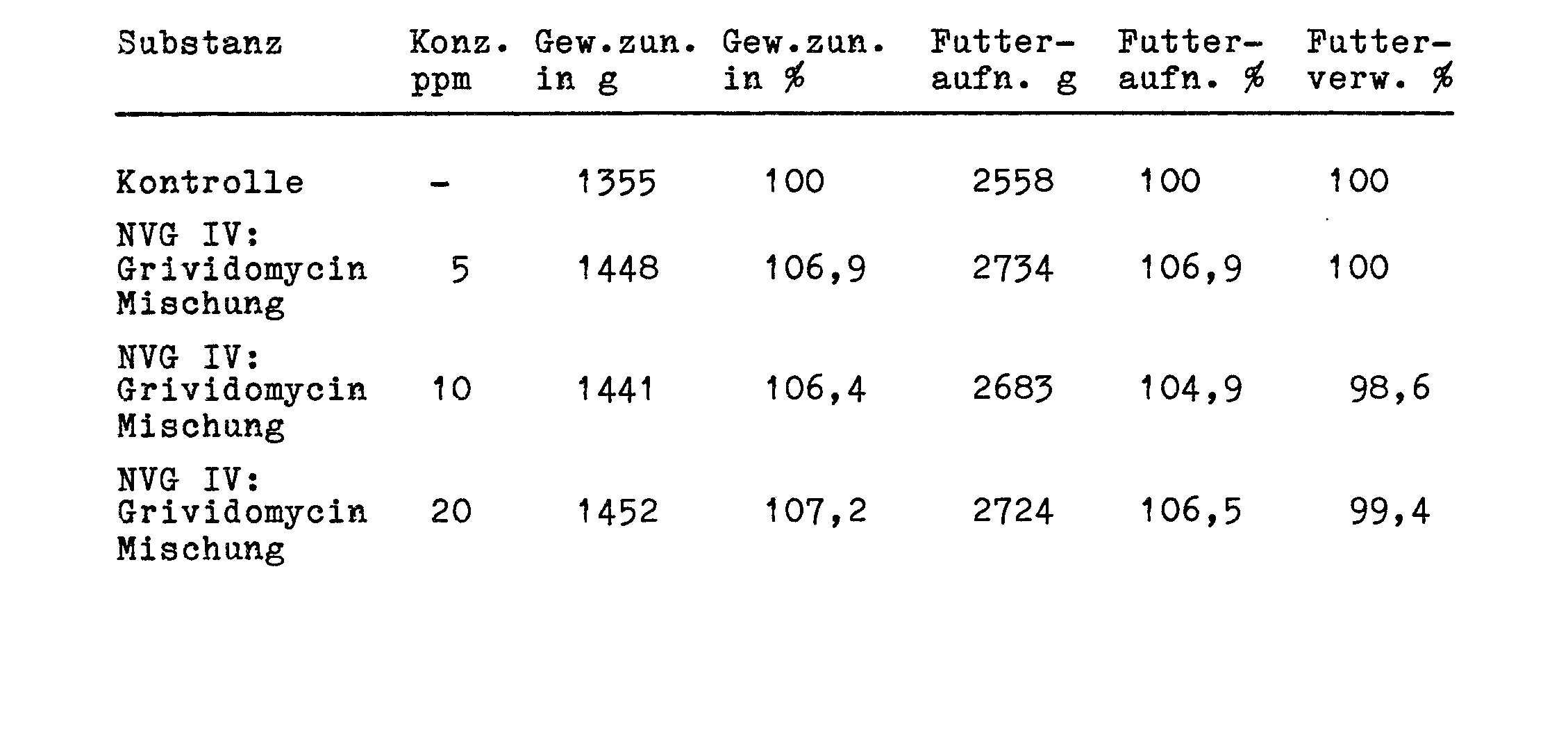
Claims (26)


Applications Claiming Priority (2)
| Application Number | Priority Date | Filing Date | Title |
|---|---|---|---|
| DE19863604678 DE3604678A1 (de) | 1986-02-14 | 1986-02-14 | Neue antibiotika vom streptogramin-typ, ein mikrobiologisches verfahren zu ihrer herstellung und ihre verwendung als arzneimittel und futterzusatzmittel |
| DE3604678 | 1986-02-14 |
Publications (2)
| Publication Number | Publication Date |
|---|---|
| EP0232893A2 true EP0232893A2 (de) | 1987-08-19 |
| EP0232893A3 EP0232893A3 (de) | 1990-03-07 |
Family
ID=6294092
Family Applications (1)
| Application Number | Title | Priority Date | Filing Date |
|---|---|---|---|
| EP87101796A Withdrawn EP0232893A3 (de) | 1986-02-14 | 1987-02-10 | Neue Antibiotika vom Streptogramin-Typ, ein mikrobiologisches Verfahren zu ihrer Herstellung und ihre Verwendung als Arzneimittel und Futterzusatzmittel |
Country Status (14)
| Country | Link |
|---|---|
| EP (1) | EP0232893A3 (de) |
| JP (1) | JPS62201900A (de) |
| AU (1) | AU6880087A (de) |
| BG (1) | BG45856A3 (de) |
| DD (1) | DD263082A5 (de) |
| DE (1) | DE3604678A1 (de) |
| DK (1) | DK73487A (de) |
| FI (1) | FI870596A7 (de) |
| HU (1) | HU197772B (de) |
| IL (1) | IL81563A0 (de) |
| NZ (1) | NZ219246A (de) |
| PL (1) | PL264079A1 (de) |
| PT (1) | PT84289B (de) |
| ZA (1) | ZA871059B (de) |
Families Citing this family (1)
| Publication number | Priority date | Publication date | Assignee | Title |
|---|---|---|---|---|
| IT1234197B (it) * | 1988-06-14 | 1992-05-06 | Mini Ricerca Scient Tecnolog | Antibiotici ottenuti mediante coltivazione aerobica controllata dello streptomyces s.p. ncib 12629 |
Family Cites Families (3)
| Publication number | Priority date | Publication date | Assignee | Title |
|---|---|---|---|---|
| JPS52151191A (en) * | 1976-06-10 | 1977-12-15 | Sanraku Inc | Novel antibiotics neoviridogriseins and their preparation |
| US4456592A (en) * | 1977-06-06 | 1984-06-26 | Sanraku-Ocean Co. | Antibiotics, neoviridogriseins, and their method of production |
| JPS5764654A (en) * | 1980-10-07 | 1982-04-19 | Sanraku Inc | Novel antibiotic neoviridogrissin-mp and its preparation |
-
1986
- 1986-02-14 DE DE19863604678 patent/DE3604678A1/de not_active Withdrawn
-
1987
- 1987-02-10 EP EP87101796A patent/EP0232893A3/de not_active Withdrawn
- 1987-02-11 BG BG078440A patent/BG45856A3/xx unknown
- 1987-02-12 PL PL1987264079A patent/PL264079A1/xx unknown
- 1987-02-12 NZ NZ219246A patent/NZ219246A/xx unknown
- 1987-02-12 FI FI870596A patent/FI870596A7/fi not_active Application Discontinuation
- 1987-02-13 HU HU87565A patent/HU197772B/hu not_active IP Right Cessation
- 1987-02-13 DK DK073487A patent/DK73487A/da not_active Application Discontinuation
- 1987-02-13 IL IL81563A patent/IL81563A0/xx unknown
- 1987-02-13 DD DD87299901A patent/DD263082A5/de not_active IP Right Cessation
- 1987-02-13 AU AU68800/87A patent/AU6880087A/en not_active Abandoned
- 1987-02-13 JP JP62029946A patent/JPS62201900A/ja active Pending
- 1987-02-13 ZA ZA871059A patent/ZA871059B/xx unknown
- 1987-02-13 PT PT84289A patent/PT84289B/pt not_active IP Right Cessation
Also Published As
| Publication number | Publication date |
|---|---|
| AU6880087A (en) | 1987-08-20 |
| PL264079A1 (en) | 1988-07-21 |
| DD263082A5 (de) | 1988-12-21 |
| BG45856A3 (bg) | 1989-08-15 |
| DE3604678A1 (de) | 1987-09-03 |
| DK73487A (da) | 1987-08-15 |
| FI870596A0 (fi) | 1987-02-12 |
| EP0232893A3 (de) | 1990-03-07 |
| PT84289A (de) | 1987-03-01 |
| IL81563A0 (en) | 1987-09-16 |
| HUT46076A (en) | 1988-09-28 |
| FI870596A7 (fi) | 1987-08-15 |
| JPS62201900A (ja) | 1987-09-05 |
| ZA871059B (en) | 1987-09-30 |
| HU197772B (en) | 1989-05-29 |
| DK73487D0 (da) | 1987-02-13 |
| NZ219246A (en) | 1991-06-25 |
| PT84289B (pt) | 1990-02-08 |
Similar Documents
| Publication | Publication Date | Title |
|---|---|---|
| DE2634499A1 (de) | Neue tylosinderivate und verfahren zu ihrer herstellung | |
| DD159644A5 (de) | Verfahren zur herstellung von makroliden | |
| DE3781878T2 (de) | Antibiotikum-a10255-komplex und faktoren, verfahren, mikroorganismen fuer seine herstellung. | |
| DE68912355T2 (de) | Antibiotische Antitumor-Verbindung und Methode zu deren Herstellung. | |
| DE2918711C2 (de) | ||
| DE2839668C2 (de) | ||
| DE2336811C2 (de) | Antibiotikum A-2315, Verfahren zu seiner Herstellung und seine Verwendung | |
| DE3782169T2 (de) | Verfahren zur herstellung von antibiotica 10381b. | |
| DE3779946T2 (de) | Antibiotikum a42125 und verfahren zu dessen herstellung. | |
| CH646432A5 (de) | Beta-lactam-antibiotika. | |
| CH634853A5 (de) | Schwefelhaltige metabolite, ihre herstellung und verwendung in arznei- und futtermitteln. | |
| EP0236894B1 (de) | Efomycin G, seine Herstellung und seine Verwendung als Leistungsförderer bei Tieren | |
| EP0197360B1 (de) | Verwendung von Efomycinen als Leistungsförderer bei Tieren, Efomycine und ihre Herstellung | |
| DE2725163C2 (de) | ||
| EP0232893A2 (de) | Neue Antibiotika vom Streptogramin-Typ, ein mikrobiologisches Verfahren zu ihrer Herstellung und ihre Verwendung als Arzneimittel und Futterzusatzmittel | |
| EP0259751A2 (de) | Annomycin, ein Antibiotikum; mikrobiologisches Verfahren zu dessen Herstellung und seine Verwendung | |
| DD159645A5 (de) | Verfahren zur herstellung von makroliden | |
| DE68918071T2 (de) | Antibiotikum A80915 und Verfahren zu seiner Herstellung. | |
| DE2654266C3 (de) | Verfahren zur mikrobiologischen Herstellung von 5,10,11,1 la-Tetrahydro-9,1 ldihydroxy-e-methyl-Soxo-lH-pyrrolo [2,1-c] [1,4] benzodiazepin-2acrylamid | |
| DE69124390T2 (de) | Polycyclisches etherantibiotikum mit anticoccidose- und wachstumsförderungsaktivität | |
| EP0259778B1 (de) | Antibiotisch wirksames Gentisinsäurederivat | |
| DE2039990C2 (de) | Neue Antibiotika B-5050 A bis F (Maridomycin I bis VI), Verfahren zu ihrer Herstellung und ihre pharmazeutische Zubereitung | |
| DE2830856A1 (de) | Neue antibiotisch wirksame verbindungen, verfahren zu deren herstellung und arzneimittel | |
| DD211476A5 (de) | Tierfutter fuer wiederkaeuer und huehner | |
| DE2034245C2 (de) | Antibiotikum Juvenimicin A↓3↓ |
Legal Events
| Date | Code | Title | Description |
|---|---|---|---|
| PUAI | Public reference made under article 153(3) epc to a published international application that has entered the european phase |
Free format text: ORIGINAL CODE: 0009012 |
|
| AK | Designated contracting states |
Kind code of ref document: A2 Designated state(s): AT BE CH DE ES FR GB GR IT LI LU NL SE |
|
| PUAL | Search report despatched |
Free format text: ORIGINAL CODE: 0009013 |
|
| AK | Designated contracting states |
Kind code of ref document: A3 Designated state(s): AT BE CH DE ES FR GB GR IT LI LU NL SE |
|
| 18W | Application withdrawn |
Withdrawal date: 19900722 |
|
| STAA | Information on the status of an ep patent application or granted ep patent |
Free format text: STATUS: THE APPLICATION HAS BEEN WITHDRAWN |
|
| R18W | Application withdrawn (corrected) |
Effective date: 19900722 |
|
| RIN1 | Information on inventor provided before grant (corrected) |
Inventor name: FEHLHABER, HANS-WOLFRAM, DR. Inventor name: GANGULI, BIMAL NARESH, DR. Inventor name: FRANCO, CHRISTOPHER MILTON MATHEW, DR. Inventor name: RUPP, RICHARD HELMUT, DR. Inventor name: MUKHOPADHYAY, TRIPTIKUMAR |