EP0226984B1 - Antimykotisch wirksamer Nagellack - Google Patents
Antimykotisch wirksamer Nagellack Download PDFInfo
- Publication number
- EP0226984B1 EP0226984B1 EP86117377A EP86117377A EP0226984B1 EP 0226984 B1 EP0226984 B1 EP 0226984B1 EP 86117377 A EP86117377 A EP 86117377A EP 86117377 A EP86117377 A EP 86117377A EP 0226984 B1 EP0226984 B1 EP 0226984B1
- Authority
- EP
- European Patent Office
- Prior art keywords
- nail varnish
- nail
- radical
- antimycotic
- active compound
- Prior art date
- Legal status (The legal status is an assumption and is not a legal conclusion. Google has not performed a legal analysis and makes no representation as to the accuracy of the status listed.)
- Expired - Lifetime
Links
- 239000002966 varnish Substances 0.000 title claims abstract description 19
- 230000001857 anti-mycotic effect Effects 0.000 title claims abstract 7
- 239000002543 antimycotic Substances 0.000 title claims abstract 7
- 239000000126 substance Substances 0.000 claims abstract description 16
- 239000002904 solvent Substances 0.000 claims abstract description 13
- 239000003795 chemical substances by application Substances 0.000 claims abstract description 8
- 125000004432 carbon atom Chemical group C* 0.000 claims abstract description 7
- 239000000654 additive Substances 0.000 claims abstract description 6
- 239000002537 cosmetic Substances 0.000 claims abstract description 6
- 125000004435 hydrogen atom Chemical group [H]* 0.000 claims abstract description 6
- 125000001495 ethyl group Chemical group [H]C([H])([H])C([H])([H])* 0.000 claims abstract description 5
- 125000002496 methyl group Chemical group [H]C([H])([H])* 0.000 claims abstract description 5
- SNUSZUYTMHKCPM-UHFFFAOYSA-N 1-hydroxypyridin-2-one Chemical compound ON1C=CC=CC1=O SNUSZUYTMHKCPM-UHFFFAOYSA-N 0.000 claims abstract description 4
- 239000001257 hydrogen Substances 0.000 claims abstract description 4
- 229910052739 hydrogen Inorganic materials 0.000 claims abstract description 4
- 150000003839 salts Chemical group 0.000 claims abstract description 4
- 229930195734 saturated hydrocarbon Natural products 0.000 claims abstract description 3
- 150000001875 compounds Chemical class 0.000 claims description 19
- -1 alkyl radical Chemical group 0.000 claims description 14
- 238000000034 method Methods 0.000 claims description 11
- 238000002360 preparation method Methods 0.000 claims description 9
- 150000003254 radicals Chemical class 0.000 claims description 5
- 239000000470 constituent Substances 0.000 claims description 4
- YUDRVAHLXDBKSR-UHFFFAOYSA-N [CH]1CCCCC1 Chemical group [CH]1CCCCC1 YUDRVAHLXDBKSR-UHFFFAOYSA-N 0.000 claims description 3
- UFHFLCQGNIYNRP-UHFFFAOYSA-N Hydrogen Chemical compound [H][H] UFHFLCQGNIYNRP-UHFFFAOYSA-N 0.000 claims description 2
- 238000002156 mixing Methods 0.000 claims description 2
- 230000000996 additive effect Effects 0.000 claims 1
- 238000011282 treatment Methods 0.000 description 12
- 208000031888 Mycoses Diseases 0.000 description 10
- 239000004480 active ingredient Substances 0.000 description 10
- YXFVVABEGXRONW-UHFFFAOYSA-N Toluene Chemical compound CC1=CC=CC=C1 YXFVVABEGXRONW-UHFFFAOYSA-N 0.000 description 9
- 239000004922 lacquer Substances 0.000 description 8
- 238000012360 testing method Methods 0.000 description 8
- 229940121375 antifungal agent Drugs 0.000 description 7
- 239000000243 solution Substances 0.000 description 7
- XTXRWKRVRITETP-UHFFFAOYSA-N Vinyl acetate Chemical compound CC(=O)OC=C XTXRWKRVRITETP-UHFFFAOYSA-N 0.000 description 6
- 239000002253 acid Substances 0.000 description 6
- 230000000843 anti-fungal effect Effects 0.000 description 6
- 239000000203 mixture Substances 0.000 description 6
- LFQSCWFLJHTTHZ-UHFFFAOYSA-N Ethanol Chemical compound CCO LFQSCWFLJHTTHZ-UHFFFAOYSA-N 0.000 description 5
- 229920001577 copolymer Polymers 0.000 description 5
- 235000019441 ethanol Nutrition 0.000 description 5
- XEKOWRVHYACXOJ-UHFFFAOYSA-N Ethyl acetate Natural products CCOC(C)=O XEKOWRVHYACXOJ-UHFFFAOYSA-N 0.000 description 4
- KFZMGEQAYNKOFK-UHFFFAOYSA-N Isopropanol Chemical compound CC(C)O KFZMGEQAYNKOFK-UHFFFAOYSA-N 0.000 description 4
- OFOBLEOULBTSOW-UHFFFAOYSA-L Malonate Chemical compound [O-]C(=O)CC([O-])=O OFOBLEOULBTSOW-UHFFFAOYSA-L 0.000 description 4
- 208000010195 Onychomycosis Diseases 0.000 description 4
- 239000013543 active substance Substances 0.000 description 4
- DOIRQSBPFJWKBE-UHFFFAOYSA-N dibutyl phthalate Chemical compound CCCCOC(=O)C1=CC=CC=C1C(=O)OCCCC DOIRQSBPFJWKBE-UHFFFAOYSA-N 0.000 description 4
- 150000002148 esters Chemical class 0.000 description 4
- 230000035515 penetration Effects 0.000 description 4
- 241001480043 Arthrodermataceae Species 0.000 description 3
- QFVAWNPSRQWSDU-UHFFFAOYSA-N Dibenzthion Chemical compound C1N(CC=2C=CC=CC=2)C(=S)SCN1CC1=CC=CC=C1 QFVAWNPSRQWSDU-UHFFFAOYSA-N 0.000 description 3
- 206010017533 Fungal infection Diseases 0.000 description 3
- CERQOIWHTDAKMF-UHFFFAOYSA-N Methacrylic acid Chemical compound CC(=C)C(O)=O CERQOIWHTDAKMF-UHFFFAOYSA-N 0.000 description 3
- OKKJLVBELUTLKV-UHFFFAOYSA-N Methanol Chemical compound OC OKKJLVBELUTLKV-UHFFFAOYSA-N 0.000 description 3
- 150000001298 alcohols Chemical class 0.000 description 3
- 239000003429 antifungal agent Substances 0.000 description 3
- 238000009835 boiling Methods 0.000 description 3
- 230000000052 comparative effect Effects 0.000 description 3
- 239000006071 cream Substances 0.000 description 3
- LDHQCZJRKDOVOX-NSCUHMNNSA-N crotonic acid Chemical compound C\C=C\C(O)=O LDHQCZJRKDOVOX-NSCUHMNNSA-N 0.000 description 3
- 230000037304 dermatophytes Effects 0.000 description 3
- 238000001035 drying Methods 0.000 description 3
- 230000000694 effects Effects 0.000 description 3
- 230000007903 penetration ability Effects 0.000 description 3
- 239000000049 pigment Substances 0.000 description 3
- 229920000642 polymer Polymers 0.000 description 3
- UBQKCCHYAOITMY-UHFFFAOYSA-N pyridin-2-ol Chemical group OC1=CC=CC=N1 UBQKCCHYAOITMY-UHFFFAOYSA-N 0.000 description 3
- 229960002999 sulbentine Drugs 0.000 description 3
- 238000002560 therapeutic procedure Methods 0.000 description 3
- 230000009974 thixotropic effect Effects 0.000 description 3
- LDHQCZJRKDOVOX-UHFFFAOYSA-N trans-crotonic acid Natural products CC=CC(O)=O LDHQCZJRKDOVOX-UHFFFAOYSA-N 0.000 description 3
- SMZOUWXMTYCWNB-UHFFFAOYSA-N 2-(2-methoxy-5-methylphenyl)ethanamine Chemical compound COC1=CC=C(C)C=C1CCN SMZOUWXMTYCWNB-UHFFFAOYSA-N 0.000 description 2
- NIXOWILDQLNWCW-UHFFFAOYSA-N 2-Propenoic acid Natural products OC(=O)C=C NIXOWILDQLNWCW-UHFFFAOYSA-N 0.000 description 2
- NLXLAEXVIDQMFP-UHFFFAOYSA-N Ammonia chloride Chemical compound [NH4+].[Cl-] NLXLAEXVIDQMFP-UHFFFAOYSA-N 0.000 description 2
- DKPFZGUDAPQIHT-UHFFFAOYSA-N Butyl acetate Natural products CCCCOC(C)=O DKPFZGUDAPQIHT-UHFFFAOYSA-N 0.000 description 2
- 241000700199 Cavia porcellus Species 0.000 description 2
- IAZDPXIOMUYVGZ-UHFFFAOYSA-N Dimethylsulphoxide Chemical compound CS(C)=O IAZDPXIOMUYVGZ-UHFFFAOYSA-N 0.000 description 2
- 241000233866 Fungi Species 0.000 description 2
- 239000000020 Nitrocellulose Substances 0.000 description 2
- GWEVSGVZZGPLCZ-UHFFFAOYSA-N Titan oxide Chemical compound O=[Ti]=O GWEVSGVZZGPLCZ-UHFFFAOYSA-N 0.000 description 2
- RTAQQCXQSZGOHL-UHFFFAOYSA-N Titanium Chemical compound [Ti] RTAQQCXQSZGOHL-UHFFFAOYSA-N 0.000 description 2
- 241001045770 Trichophyton mentagrophytes Species 0.000 description 2
- XSQUKJJJFZCRTK-UHFFFAOYSA-N Urea Chemical class NC(N)=O XSQUKJJJFZCRTK-UHFFFAOYSA-N 0.000 description 2
- FJWGYAHXMCUOOM-QHOUIDNNSA-N [(2s,3r,4s,5r,6r)-2-[(2r,3r,4s,5r,6s)-4,5-dinitrooxy-2-(nitrooxymethyl)-6-[(2r,3r,4s,5r,6s)-4,5,6-trinitrooxy-2-(nitrooxymethyl)oxan-3-yl]oxyoxan-3-yl]oxy-3,5-dinitrooxy-6-(nitrooxymethyl)oxan-4-yl] nitrate Chemical compound O([C@@H]1O[C@@H]([C@H]([C@H](O[N+]([O-])=O)[C@H]1O[N+]([O-])=O)O[C@H]1[C@@H]([C@@H](O[N+]([O-])=O)[C@H](O[N+]([O-])=O)[C@@H](CO[N+]([O-])=O)O1)O[N+]([O-])=O)CO[N+](=O)[O-])[C@@H]1[C@@H](CO[N+]([O-])=O)O[C@@H](O[N+]([O-])=O)[C@H](O[N+]([O-])=O)[C@H]1O[N+]([O-])=O FJWGYAHXMCUOOM-QHOUIDNNSA-N 0.000 description 2
- 125000000217 alkyl group Chemical group 0.000 description 2
- POJWUDADGALRAB-UHFFFAOYSA-N allantoin Chemical class NC(=O)NC1NC(=O)NC1=O POJWUDADGALRAB-UHFFFAOYSA-N 0.000 description 2
- 238000002474 experimental method Methods 0.000 description 2
- 208000024386 fungal infectious disease Diseases 0.000 description 2
- 230000009036 growth inhibition Effects 0.000 description 2
- FUZZWVXGSFPDMH-UHFFFAOYSA-N hexanoic acid Chemical compound CCCCCC(O)=O FUZZWVXGSFPDMH-UHFFFAOYSA-N 0.000 description 2
- 229930195733 hydrocarbon Natural products 0.000 description 2
- 208000015181 infectious disease Diseases 0.000 description 2
- 229920001220 nitrocellulos Polymers 0.000 description 2
- 244000052769 pathogen Species 0.000 description 2
- OIQJEQLSYJSNDS-UHFFFAOYSA-N piroctone Chemical compound CC(C)(C)CC(C)CC1=CC(C)=CC(=O)N1O OIQJEQLSYJSNDS-UHFFFAOYSA-N 0.000 description 2
- 239000004014 plasticizer Substances 0.000 description 2
- 229920002689 polyvinyl acetate Polymers 0.000 description 2
- 239000011118 polyvinyl acetate Substances 0.000 description 2
- 229920005989 resin Polymers 0.000 description 2
- 239000011347 resin Substances 0.000 description 2
- YGSDEFSMJLZEOE-UHFFFAOYSA-N salicylic acid Chemical class OC(=O)C1=CC=CC=C1O YGSDEFSMJLZEOE-UHFFFAOYSA-N 0.000 description 2
- 238000013207 serial dilution Methods 0.000 description 2
- 238000010998 test method Methods 0.000 description 2
- CWERGRDVMFNCDR-UHFFFAOYSA-N thioglycolic acid Chemical class OC(=O)CS CWERGRDVMFNCDR-UHFFFAOYSA-N 0.000 description 2
- 239000000080 wetting agent Substances 0.000 description 2
- AFDFUQMUEYLSSW-UHFFFAOYSA-N (2-hydroxy-3-methoxyphenyl)-phenylmethanone Chemical compound COC1=CC=CC(C(=O)C=2C=CC=CC=2)=C1O AFDFUQMUEYLSSW-UHFFFAOYSA-N 0.000 description 1
- DSSYKIVIOFKYAU-XCBNKYQSSA-N (R)-camphor Chemical compound C1C[C@@]2(C)C(=O)C[C@@H]1C2(C)C DSSYKIVIOFKYAU-XCBNKYQSSA-N 0.000 description 1
- YCMLQMDWSXFTIF-UHFFFAOYSA-N 2-methylbenzenesulfonimidic acid Chemical compound CC1=CC=CC=C1S(N)(=O)=O YCMLQMDWSXFTIF-UHFFFAOYSA-N 0.000 description 1
- WBXDEEFCGDIKFC-UHFFFAOYSA-N 6-(3-bicyclo[2.2.1]heptanyl)-1-hydroxy-4-methylpyridin-2-one Chemical compound ON1C(=O)C=C(C)C=C1C1C(C2)CCC2C1 WBXDEEFCGDIKFC-UHFFFAOYSA-N 0.000 description 1
- POJWUDADGALRAB-PVQJCKRUSA-N Allantoin Chemical class NC(=O)N[C@@H]1NC(=O)NC1=O POJWUDADGALRAB-PVQJCKRUSA-N 0.000 description 1
- OYPRJOBELJOOCE-UHFFFAOYSA-N Calcium Chemical compound [Ca] OYPRJOBELJOOCE-UHFFFAOYSA-N 0.000 description 1
- 239000004215 Carbon black (E152) Substances 0.000 description 1
- 241000723346 Cinnamomum camphora Species 0.000 description 1
- PQUCIEFHOVEZAU-UHFFFAOYSA-N Diammonium sulfite Chemical compound [NH4+].[NH4+].[O-]S([O-])=O PQUCIEFHOVEZAU-UHFFFAOYSA-N 0.000 description 1
- 108090000790 Enzymes Chemical class 0.000 description 1
- 102000004190 Enzymes Human genes 0.000 description 1
- 229940124091 Keratolytic Drugs 0.000 description 1
- 239000004166 Lanolin Substances 0.000 description 1
- CERQOIWHTDAKMF-UHFFFAOYSA-M Methacrylate Chemical compound CC(=C)C([O-])=O CERQOIWHTDAKMF-UHFFFAOYSA-M 0.000 description 1
- WHNWPMSKXPGLAX-UHFFFAOYSA-N N-Vinyl-2-pyrrolidone Chemical compound C=CN1CCCC1=O WHNWPMSKXPGLAX-UHFFFAOYSA-N 0.000 description 1
- OFOBLEOULBTSOW-UHFFFAOYSA-N Propanedioic acid Natural products OC(=O)CC(O)=O OFOBLEOULBTSOW-UHFFFAOYSA-N 0.000 description 1
- 240000004808 Saccharomyces cerevisiae Species 0.000 description 1
- 241000282887 Suidae Species 0.000 description 1
- GLLRIXZGBQOFLM-UHFFFAOYSA-N Xanthorin Natural products C1=C(C)C=C2C(=O)C3=C(O)C(OC)=CC(O)=C3C(=O)C2=C1O GLLRIXZGBQOFLM-UHFFFAOYSA-N 0.000 description 1
- 150000001241 acetals Chemical class 0.000 description 1
- 239000011149 active material Substances 0.000 description 1
- 239000002390 adhesive tape Substances 0.000 description 1
- 125000001931 aliphatic group Chemical group 0.000 description 1
- 125000005250 alkyl acrylate group Chemical group 0.000 description 1
- 229960000458 allantoin Drugs 0.000 description 1
- 230000000844 anti-bacterial effect Effects 0.000 description 1
- 230000000845 anti-microbial effect Effects 0.000 description 1
- 230000001762 anti-mycelial effect Effects 0.000 description 1
- 238000013459 approach Methods 0.000 description 1
- 150000004945 aromatic hydrocarbons Chemical class 0.000 description 1
- 150000007980 azole derivatives Chemical class 0.000 description 1
- 238000003287 bathing Methods 0.000 description 1
- 230000003796 beauty Effects 0.000 description 1
- SVPXDRXYRYOSEX-UHFFFAOYSA-N bentoquatam Chemical compound O.O=[Si]=O.O=[Al]O[Al]=O SVPXDRXYRYOSEX-UHFFFAOYSA-N 0.000 description 1
- 239000011575 calcium Substances 0.000 description 1
- 229910052791 calcium Inorganic materials 0.000 description 1
- 229960000846 camphor Drugs 0.000 description 1
- 229930008380 camphor Natural products 0.000 description 1
- 239000004202 carbamide Chemical class 0.000 description 1
- 229910052799 carbon Inorganic materials 0.000 description 1
- SCKYRAXSEDYPSA-UHFFFAOYSA-N ciclopirox Chemical compound ON1C(=O)C=C(C)C=C1C1CCCCC1 SCKYRAXSEDYPSA-UHFFFAOYSA-N 0.000 description 1
- 239000011248 coating agent Substances 0.000 description 1
- 238000000576 coating method Methods 0.000 description 1
- 238000011109 contamination Methods 0.000 description 1
- GUJOJGAPFQRJSV-UHFFFAOYSA-N dialuminum;dioxosilane;oxygen(2-);hydrate Chemical class O.[O-2].[O-2].[O-2].[Al+3].[Al+3].O=[Si]=O.O=[Si]=O.O=[Si]=O.O=[Si]=O GUJOJGAPFQRJSV-UHFFFAOYSA-N 0.000 description 1
- 235000014113 dietary fatty acids Nutrition 0.000 description 1
- 235000019329 dioctyl sodium sulphosuccinate Nutrition 0.000 description 1
- 201000010099 disease Diseases 0.000 description 1
- 208000037265 diseases, disorders, signs and symptoms Diseases 0.000 description 1
- YHAIUSTWZPMYGG-UHFFFAOYSA-L disodium;2,2-dioctyl-3-sulfobutanedioate Chemical compound [Na+].[Na+].CCCCCCCCC(C([O-])=O)(C(C([O-])=O)S(O)(=O)=O)CCCCCCCC YHAIUSTWZPMYGG-UHFFFAOYSA-L 0.000 description 1
- 239000000975 dye Substances 0.000 description 1
- 208000001848 dysentery Diseases 0.000 description 1
- 229940088598 enzyme Drugs 0.000 description 1
- 150000002168 ethanoic acid esters Chemical class 0.000 description 1
- TVFJAZCVMOXQRK-UHFFFAOYSA-N ethenyl 7,7-dimethyloctanoate Chemical compound CC(C)(C)CCCCCC(=O)OC=C TVFJAZCVMOXQRK-UHFFFAOYSA-N 0.000 description 1
- UIWXSTHGICQLQT-UHFFFAOYSA-N ethenyl propanoate Chemical compound CCC(=O)OC=C UIWXSTHGICQLQT-UHFFFAOYSA-N 0.000 description 1
- 150000002170 ethers Chemical class 0.000 description 1
- 125000000816 ethylene group Chemical group [H]C([H])([*:1])C([H])([H])[*:2] 0.000 description 1
- 239000000194 fatty acid Substances 0.000 description 1
- 229930195729 fatty acid Natural products 0.000 description 1
- 150000004665 fatty acids Chemical class 0.000 description 1
- YEQFXLJGRXZCFU-UHFFFAOYSA-N formaldehyde;4-methylbenzenesulfonamide Chemical compound O=C.CC1=CC=C(S(N)(=O)=O)C=C1 YEQFXLJGRXZCFU-UHFFFAOYSA-N 0.000 description 1
- 238000009472 formulation Methods 0.000 description 1
- 230000002538 fungal effect Effects 0.000 description 1
- 150000008282 halocarbons Chemical class 0.000 description 1
- 230000035876 healing Effects 0.000 description 1
- 150000002430 hydrocarbons Chemical class 0.000 description 1
- 230000001771 impaired effect Effects 0.000 description 1
- 238000000338 in vitro Methods 0.000 description 1
- 230000002458 infectious effect Effects 0.000 description 1
- 230000002401 inhibitory effect Effects 0.000 description 1
- 230000035987 intoxication Effects 0.000 description 1
- 231100000566 intoxication Toxicity 0.000 description 1
- 230000001530 keratinolytic effect Effects 0.000 description 1
- 150000002576 ketones Chemical class 0.000 description 1
- 229940039717 lanolin Drugs 0.000 description 1
- 235000019388 lanolin Nutrition 0.000 description 1
- 239000004611 light stabiliser Substances 0.000 description 1
- 230000005923 long-lasting effect Effects 0.000 description 1
- 238000011866 long-term treatment Methods 0.000 description 1
- VZCYOOQTPOCHFL-UPHRSURJSA-N maleic acid Chemical compound OC(=O)\C=C/C(O)=O VZCYOOQTPOCHFL-UPHRSURJSA-N 0.000 description 1
- 239000011976 maleic acid Substances 0.000 description 1
- WCYWZMWISLQXQU-UHFFFAOYSA-N methyl Chemical compound [CH3] WCYWZMWISLQXQU-UHFFFAOYSA-N 0.000 description 1
- XJRBAMWJDBPFIM-UHFFFAOYSA-N methyl vinyl ether Chemical compound COC=C XJRBAMWJDBPFIM-UHFFFAOYSA-N 0.000 description 1
- 125000000325 methylidene group Chemical group [H]C([H])=* 0.000 description 1
- 208000026721 nail disease Diseases 0.000 description 1
- 239000003973 paint Substances 0.000 description 1
- FJKROLUGYXJWQN-UHFFFAOYSA-N papa-hydroxy-benzoic acid Chemical class OC(=O)C1=CC=C(O)C=C1 FJKROLUGYXJWQN-UHFFFAOYSA-N 0.000 description 1
- 239000002245 particle Substances 0.000 description 1
- XNGIFLGASWRNHJ-UHFFFAOYSA-L phthalate(2-) Chemical compound [O-]C(=O)C1=CC=CC=C1C([O-])=O XNGIFLGASWRNHJ-UHFFFAOYSA-L 0.000 description 1
- 229920000191 poly(N-vinyl pyrrolidone) Polymers 0.000 description 1
- 229920002037 poly(vinyl butyral) polymer Polymers 0.000 description 1
- 238000012545 processing Methods 0.000 description 1
- 230000000069 prophylactic effect Effects 0.000 description 1
- 238000011321 prophylaxis Methods 0.000 description 1
- 230000001846 repelling effect Effects 0.000 description 1
- 229960004889 salicylic acid Drugs 0.000 description 1
- 229920006395 saturated elastomer Polymers 0.000 description 1
- 238000004062 sedimentation Methods 0.000 description 1
- 238000012154 short term therapy Methods 0.000 description 1
- 150000004760 silicates Chemical class 0.000 description 1
- 239000007787 solid Substances 0.000 description 1
- 239000011877 solvent mixture Substances 0.000 description 1
- 239000007921 spray Substances 0.000 description 1
- 238000003756 stirring Methods 0.000 description 1
- 229940124530 sulfonamide Drugs 0.000 description 1
- 150000003456 sulfonamides Chemical class 0.000 description 1
- 230000009885 systemic effect Effects 0.000 description 1
- 230000001225 therapeutic effect Effects 0.000 description 1
- 229940024986 topical antifungal imidazole and triazole derivative Drugs 0.000 description 1
- VZCYOOQTPOCHFL-UHFFFAOYSA-N trans-butenedioic acid Natural products OC(=O)C=CC(O)=O VZCYOOQTPOCHFL-UHFFFAOYSA-N 0.000 description 1
- 229940045136 urea Drugs 0.000 description 1
- 229920001567 vinyl ester resin Polymers 0.000 description 1
- 229920002554 vinyl polymer Polymers 0.000 description 1
- 238000005406 washing Methods 0.000 description 1
- XLYOFNOQVPJJNP-UHFFFAOYSA-N water Substances O XLYOFNOQVPJJNP-UHFFFAOYSA-N 0.000 description 1
- 229920003176 water-insoluble polymer Polymers 0.000 description 1
- 239000003232 water-soluble binding agent Substances 0.000 description 1
- 229920003169 water-soluble polymer Polymers 0.000 description 1
- 210000002268 wool Anatomy 0.000 description 1
Classifications
-
- A—HUMAN NECESSITIES
- A61—MEDICAL OR VETERINARY SCIENCE; HYGIENE
- A61K—PREPARATIONS FOR MEDICAL, DENTAL OR TOILETRY PURPOSES
- A61K31/00—Medicinal preparations containing organic active ingredients
- A61K31/33—Heterocyclic compounds
- A61K31/395—Heterocyclic compounds having nitrogen as a ring hetero atom, e.g. guanethidine or rifamycins
- A61K31/435—Heterocyclic compounds having nitrogen as a ring hetero atom, e.g. guanethidine or rifamycins having six-membered rings with one nitrogen as the only ring hetero atom
- A61K31/44—Non condensed pyridines; Hydrogenated derivatives thereof
-
- A—HUMAN NECESSITIES
- A61—MEDICAL OR VETERINARY SCIENCE; HYGIENE
- A61K—PREPARATIONS FOR MEDICAL, DENTAL OR TOILETRY PURPOSES
- A61K8/00—Cosmetics or similar toiletry preparations
- A61K8/18—Cosmetics or similar toiletry preparations characterised by the composition
- A61K8/30—Cosmetics or similar toiletry preparations characterised by the composition containing organic compounds
- A61K8/49—Cosmetics or similar toiletry preparations characterised by the composition containing organic compounds containing heterocyclic compounds
- A61K8/4906—Cosmetics or similar toiletry preparations characterised by the composition containing organic compounds containing heterocyclic compounds with one nitrogen as the only hetero atom
- A61K8/4926—Cosmetics or similar toiletry preparations characterised by the composition containing organic compounds containing heterocyclic compounds with one nitrogen as the only hetero atom having six membered rings
-
- A—HUMAN NECESSITIES
- A61—MEDICAL OR VETERINARY SCIENCE; HYGIENE
- A61Q—SPECIFIC USE OF COSMETICS OR SIMILAR TOILETRY PREPARATIONS
- A61Q3/00—Manicure or pedicure preparations
- A61Q3/02—Nail coatings
Definitions
- onychomycoses Fungal diseases of the nails (onychomycoses) are stubborn forms of disease that have so far not been treated satisfactorily.
- onychomycoses different types of nail mycoses are summarized, of which those caused by dermatophytes are the most difficult to treat, whereas the nail mycoses caused by yeasts have so far been the most successfully treated.
- Another method is to remove the nails surgically or by exposure to chemicals and to hope that healthy, unaffected nails will grow back. This method is naturally very aggressive and also gives no guarantee that the nails will grow back in their natural form; rather, the renewable nails are often disfigured.
- a third, but gentle method is to treat the nails locally with specific, antifungal substances.
- a wide variety of treatment methods have been tried. In a combined treatment, the nails were first treated with solutions of the antifungal substances and cream bandages were applied at night. This method of treatment is naturally very unpleasant and psychologically stressful for the patient. Once treatment of the nails with solutions is necessary several times a day. Secondly, they have to be bandaged, especially at night. Furthermore, a constant filing of the diseased nails is necessary, which is both tedious and contributes to the spread of the pathogens. All of this leads to the fact that the treatment, which usually lasts for many months, is often not carried out by the patient, rather is discouraged and careless, and the result is that the therapy does not succeed. The success of treatment with this method is further impaired by the fact that the solutions and creams are usually miscible with water or hydrophilic and can therefore be removed from the nail surface or detached from the nail surface during washing, bathing and showering, and hence again thereafter must be applied.
- nail mycoses can be treated with resounding success or the infection can be prevented if the nail polish according to the invention is applied to the nails, in particular to the diseased nails.
- saturated here denotes those radicals which contain no aliphatic multiple bonds, that is to say no ethylenic or acetylenic bonds.
- the nail polish according to the invention is also suitable for prophylactic use against nail mycoses, a sufficiently high active ingredient depot being achieved in the nail so that in the event of fungal contamination there is no outbreak of a nail disease caused by fungi.
- the active substance content in the nail polish according to the invention depends on the structure of each active substance and thus on its release from the lacquer film, its penetration behavior in the nail and its antimicrobial properties.
- the active ingredient is generally present in an amount of 0.5 to 20, preferably 2 to 15 percent by weight.
- the minimum content of active ingredient in medical nail polishes, i.e. those for treatment, is usually 4 percent by weight;
- the nail polishes used for prophylaxis usually contain less than 4 and advantageously at least 1 percent by weight of active ingredient.
- the active ingredient in the nail varnishes according to the invention is generally in an amount of 2 to 80, preferably from 10 to 60 and in particular from 20 to 40 percent by weight.
- the hydrocarbon radical R 1 is an alkyl or cyclohexyl radical which can also be bonded to the pyridone ring via a methylene or ethylene group or can contain an endomethylene group.
- R1 can also represent or contain an aromatic radical, which, however, is preferably bonded to the pyridone radical via at least one aliphatic carbon atom.
- Suitable active substances are 1-hydroxy-4-methyl-6-n-hexyl-, -6-isohexyl-, -6-n-heptyl- or -6-iso-heptyl-2-pyridone, 1-hydroxy- 4-methyl-6-octyl- or -6-iso-octyl-2-pyridone, especially as 1-hydroxy-4-methyl-6- (2,4,4-trimethylpentyl) -2-pyridone, 1- Hydroxy-4-methyl-6-cyclohexyl-2-pyridone, 1-hydroxy-4-methyi-6-cydohexyimethyl or -6-cyclohexylethyl-2-pyridone, where the cyclohexyl radical can also carry a methyl radical, 1-hydroxy- 4-methyl-6- (2-bicyclo [2,2,1] heptyl) -2-pyridone, 1-hydroxy-3,4-dimethyl-6-benzyl- or -6-dimethylbenzy
- the nail polishes according to the invention also contain, as necessary constituents, one or more film formers which form a water-insoluble film on the nail after the preparation has dried.
- Suitable film formers are e.g. Substances based on cellulose nitrate or physiologically harmless polymers, such as those e.g. are common in cosmetics, preferably as a mixture with cellulose nitrate.
- Suitable physiologically acceptable solvents are substances such as hydrocarbons, halogenated hydrocarbons, alcohols, ethers, ketones and esters common in cosmetics, in particular acetic acid esters of monohydric alcohols, such as ethyl and butyl acetate, optionally in a mixture with aromatic hydrocarbons such as toluene, and / or alcohols such as ethanol or isopropanol.
- the combination of the solvents is known to be of crucial importance for the drying time, spreadability and other important properties of the lacquer or the lacquer film.
- the nail varnishes according to the invention can furthermore contain additives customary in cosmetics, such as plasticizers based on phthalate or camphor, dyes or colored pigments, pearlescent agents, sedimentation retarders, sulfonamide resins, silicates, odoriferous substances, wetting agents, such as sodium dioctylsulfosuccinate, lanolin derivatives, light stabilizers 4, such as 2-hydroxy methoxybenzophenone, antibacterial substances and substances with keratolytic and / or keratoplastic activity, such as ammonium sulfite, esters and salts of thioglycolic acid, urea, allantoin, enzymes and salicylic acid.
- additives customary in cosmetics such as plasticizers based on phthalate or camphor, dyes or colored pigments, pearlescent agents, sedimentation retarders, sulfonamide resins, silicates, odoriferous substances, wetting agents, such as sodium dioctyl
- Dyed or pigmented nail polishes have e.g. the advantage that the preparation according to the invention can be adapted to the patient's sense of beauty.
- the nail polish is produced in the usual way by combining the individual components and, if necessary, further processing adapted to the respective preparation.
- the nail varnishes according to the invention also fundamentally differ from the antifungal agents known from European patent 55 397, which contain azole derivatives, in particular imidazole and triazole derivatives, as active ingredients.
- These antifungal agents are to be applied as a water-soluble film, have a depot effect and enable short-term therapy. They are also said to be suitable for the treatment of nail mycoses and are used both in solutions and in sprays which form a water-soluble film after drying. The use of such water-soluble binders naturally causes the applied agent to be removed more or less each time it is washed.
- water-insoluble film-forming polymers according to the present invention is in stark contrast to the statement in EP-PS 55 397, according to which, if instead of the formulations described there with water-soluble polymers, water-insoluble polymers, e.g. "Methacrylate” is used, which worsens mycosis.
- water-insoluble polymers e.g. "Methacrylate”
- the nail mycosis can be successfully treated.
- the upper homolayers have the biological task of repelling foreign substances.
- the preparations according to the invention also differ, namely fundamentally, from the preparations hitherto recommended for nail treatment in that they contain active substances which are let through to a considerable extent by the upper horny layers and thus have a long-lasting effect in depth. Hompenetration in an effective concentration is then a specialty of the pyridone compounds used according to the invention, which is to be separated from the antifungal property, and which makes it possible for the first time to treat nail mycoses in a simple and effective manner.
- the effect of the compounds used according to the invention has been demonstrated in penetration tests on excised skin that has healed and in clinical trials on patients with onychomycoses.
- the test method for penetration ability on excised skin of pigs allows compounds to be tested for their penetration ability in an effective concentration against stale tissue.
- the surface of shaved skin pieces was first treated with 0.3% solutions of the compounds 1 - 8 and also with 3 similar unused compounds, each dissolved in a mixture of 1 ml of dimethyl sulfoxide and 9 ml of isopropanol, at room temperature treated and washed off after 2 hours.
- the deepest area of the hom layer was then exposed by removing the superficial layers by ten successive strips of adhesive tape.
- the now deep deep layer of layers was inoculated with virulent pathogens from nail mycoses (dermatophytes). The level of penetration was determined on the basis of the degree of growth inhibition found.
- Table 1 shows the results of these experiments comparing the effectiveness of the pyridone compounds against the highly virulent skin fungus Trichophyton mentagrophytes 109 (100/25) in the in vitro serial dilution test and in the guinea pig trichophytic model.
- the coating base of Examples 9 and 10 or Comparative 4 and 5 was produced by mixing the following components:
- Some compounds according to the invention are processed to nail varnishes as follows (Examples 11-13 colorless, Example 14 pigmented).
- the colorless nail polishes are made by dissolving the various components in the solvents.
- thixotropic paste 12 t of thixotropic paste and 0.8 t of anti-settling agent (eg MPA 2000 X @ , Kronos Titan GmbH) were dispersed in 83.7 t of clear lacquer, with a temperature of at least 38 ° C. to be achieved. Then 1 t of 1-hydroxy-4-methyl-6- (2,4,4-trimethylpentyl) -2-pyridone was dissolved in the thixotropic clearcoat and 2.5 t of color paste was stirred in. The finished nail polish was filtered through a 70 ⁇ m sieve.
- anti-settling agent eg MPA 2000 X @ , Kronos Titan GmbH
Landscapes
- Health & Medical Sciences (AREA)
- Life Sciences & Earth Sciences (AREA)
- Animal Behavior & Ethology (AREA)
- General Health & Medical Sciences (AREA)
- Public Health (AREA)
- Veterinary Medicine (AREA)
- Epidemiology (AREA)
- Chemical & Material Sciences (AREA)
- Medicinal Chemistry (AREA)
- Pharmacology & Pharmacy (AREA)
- Birds (AREA)
- Pharmaceuticals Containing Other Organic And Inorganic Compounds (AREA)
- Cosmetics (AREA)
- Acyclic And Carbocyclic Compounds In Medicinal Compositions (AREA)
- Medicinal Preparation (AREA)
- Agricultural Chemicals And Associated Chemicals (AREA)
- Pyridine Compounds (AREA)
- Detergent Compositions (AREA)
- Impact Printers (AREA)
- Insulated Conductors (AREA)
Description
- Pilzerkrankungen der Nägel (Onychomykosen) sind hartnäckige Krankheitsformen, die bisher nicht befriedigend behandelt werden konnten. Unter dem Begriff Onychomykosen werden verschiedene Typen von Nagelmykosen zusammengefaßt, von denen die durch Dermatophyten verursachten am schwierigsten zu behandeln sind, während die durch Hefepilze verursachten Nagelmykosen bisher am ehesten erfolgreich therapiert werden konnten.
- Die Tücke der durch Dermatophyten bedingten Onychomykosen besteht auch darin, daß sie erheblich zur Verbreitung infektiöser Pilze beitragen. Zu ihrer Behandlung hat man bisher, allerdings ohne durchschlagenden Erfolg, verschiedene Wege beschritten.
- Eine Behandlungsmethode, die systemische, bestand darin, daß man pilzhemmende Mittel oral verabreichte. Dies erforderte eine Langzeitbehandlung, die erfahrungsgemäß zu Intoxikationen führen kann.
- Eine andere Methode besteht darin, die Nägel chirurgisch oder durch Einwirkung von Chemikalien zu entfernen und zu hoffen, daß gesunde, nicht befallene Nägel nachwachsen. Diese Methode ist naturgemäß sehr aggressiv und gibt außerdem auch keine Gewähr, daß die Nägel in der natürlichen Form nachwachsen; vielmehr sind die nachwachsenden Nägel häufig verunstaltet.
- Eine dritte, aber schonende Methode besteht darin, daß man die Nägel lokal mit spezifischen, antimykotisch wirksamen Stoffen behandelt. Hierbei hat man die unterschiedlichsten Behandlungsmethoden versucht. So hat man in einer kombinierten Behandlung die Nägel zunächst mit Lösungen der antimykotisch wirksamen Stoffe behandelt und nachts jeweils Cremeverbände angelegt. Auch diese Behandlungsmethode ist für den Patienten naturgemäß sehr unerfreulich und psychisch belastend. Einmal ist die Behandlung der Nägel mit Lösungen mehrmals täglich erforderlich. Zum anderen müssen sie vor allem nachts mit Verbänden versehen werden. Ferner ist ein ständiges Abfeilen der erkrankten Nägel notwendig, was sowohl mühsam ist als auch zur Verbreitung der Erreger beiträgt. Dies alles führt dazu, daß die gewöhnlich vielmonatige Behandlung von den Patienten vielfach nicht durchgehalten wird, sie vielmehr entmutigt und nachlässig werden und daß damit der Therapieerfolg ausbleibt. Der Behandlungserfolg wird bei dieser Methode weiterhin dadurch beeinträchtigt, daß die Lösungen und Cremes gewöhnlich mit Wasser mischbar bzw. hydrophil sind und daher beim Waschen, Baden und Duschen von der Nageloberfläche wieder entfernt bzw. aus dem Nagel herausgelöst werden können, mithin also danach wieder neu aufgetragen werden müssen.
- Man hat daher große Hoffnungen in eine völlig andere Methode gesetzt, nämlich in die Behandlung mit einem Nagellack, der den antimykotisch wirksamen Stoff Sulbentin, eine Thiadiazin-Verbindung, enthält. Obwohl diese Methode bereits seit etwa 20 Jahren praktiziert wird, hat sie keinen allgemeinen Eingang in die Therapie gefunden, da mit diesen Nagellacken praktisch nur leichtere Nagelmykosen bekämpft werden können. Ein zufriedenstellender Erfolg blieb dieser Zubereitung vermutlich auch mangels ausreichender Bioverfügbarkeit des Wirkstoffs aus dem nach dem Trocknen des Lackes vorliegenden Feststoffsystem versagt.
- Daher hat man viele Fälle, insbesondere die schwereren, nach wie vor mit den oben beschriebenen chirurgischen oder chemischen Methoden bzw. mit der kombinierten Lösungs- und Creme-Therapie behandelt.
- Es wurde nun gefunden, daß man Nagelmykosen mit durchschlagendem Erfolg behandeln bzw. den Befall verhindern kann, wenn man den erfindungsgemäßen Nagellack auf die Nägel, insbesondere auf die erkrankten Nägel aufträgt.
- Gegenstand der Erfindung ist ein antimykotisch wirksamer Nagellack, enthaltend
- a) ein 1-Hydroxy-2-pyridon der allgemeinen Formel

- b) einen wasserunlöslichen Filmbildner,
- c) ein physiologisch unbedenkliches Lösemittel, sowie gegebenenfalls
- d) in Kosmetika gebräuchliche Zusätze.
- Der Begriff "gesättigt" bezeichnet hierbei solche Reste, die keine aliphatischen Mehrfachbindungen, also keine äthylenischen oder acetylenischen Bindungen enthalten.
- Mit dem erfindungsgemäßen Nagellack läßt sich bei der Behandlung von Nagelmykosen eine durchgreifende Heilung erzielen, wobei der Nagel gewöhnlich ohne Deformierung nachwächst. Im Hinblick auf die bisherigen schlechten Therapieerfahrungen ist dies ein überaus wichtiger Befund.
- Der erfindungsgemäße Nagellack eignet sich auch zur prophylaktischen Anwendung gegen Nagelmykosen, wobei ein ausreichend hohes Wirkstoffdepot im Nagel erreicht wird, so daß es im Falle einer Pilzkontamination nicht zum Ausbruch einer durch Pilze hervorgerufenen Nagelerkrankung kommt.
- Der Gehalt an Wirkstoff in dem erfindungsgemäßen Nagellack ist von der Struktur eines jeden Wirkstoffs und damit von dessen Freigabe aus dem Lackfilm, seinem Penetrationsverhalten im Nagel und seinen antimikrobiellen Eigenschaften abhängig.
- In dem erfindungsgemäßen Nagellack, also der Lösemittel enthaltenden Anwendungsform, ist der Wirkstoff im allgemeinen in einer Menge von 0,5 bis 20, vorzugsweise 2 bis 15 Gewichtsprozent enthalten. Der Mindestgehalt an Wirkstoff in den medizinischen Nagellacken, also denen zur Behandlung, beträgt meistens 4 Gewichtsprozent; die zur Prophylaxe verwendeten Nagellacke enthalten meistens weniger als 4 und zweckmäßig mindestens 1 Gewichtsprozent Wirkstoff. Jeweils bezogen auf die Menge der nicht flüchtigen Bestandteile, das ist die Summe der Filmbildner, der gegebenenfalls vorhandenen Pigmente, Weichmacher und anderen nicht flüchtigen Zusätze sowie Wirkstoff, ist in den erfindungsgemä-Ben Nagellacken der Wirkstoff im allgemeinen in einer Menge von 2 bis 80, vorzugsweise von 10 bis 60 und insbesondere von 20 bis 40 Gewichtsprozent enthalten.
- In der Formel I ist der Kohlenwasserstoff-Rest R1 ein Alkyl- oder Cyclohexylrest, der auch über eine Methylen- oder Äthylengruppe an den Pyridonring gebunden sein oder eine Endomethylengruppe enthalten kann. R1 kann auch einen aromatischen Rest darstellen oder enthalten, der jedoch vorzugsweise über wenigstens ein aliphatisches C-Atom an den Pyridonrest gebunden ist.
- Als geeignete Wirkstoffe seien beispielsweise genannt 1-Hydroxy-4-methyl-6-n-hexyl-, -6-isohexyl-, -6-n-heptyl- oder -6-iso-heptyl-2-pyridon, 1-Hydroxy-4-methyl-6-octyl- oder -6-iso-octyl-2-py- ridon, insbesondere als 1-Hydroxy-4-methyl-6-(2,4,4-trimethylpentyl)-2-pyridon, 1-Hydroxy-4-methyl-6-cyclohexyl-2-pyridon, 1-Hydroxy-4-methyi-6-cydohexyimethyi- oder -6-cyclohexyläthyl-2-pyridon, wobei der Cyclohexylrest jeweils noch einen Methylrest tragen kann, 1-Hydroxy-4-methyl-6-(2-bicyclo [2,2,1] heptyl)-2-pyridon, 1-Hydroxy-3,4-dimethyl-6-benzyl- oder -6-dimethylbenzyl-2-pyridon und 1-Hydroxy-4-methyl-6-(ß-phenyl-äthyl)-2-pyridon.
- Die erfindungsgemäßen Nagellacke enthalten außer dem in einem Lösemittel oder Lösemittelgemisch gelösten Wirkstoff als notwendige Bestandteile noch einen oder mehrere Filmbildner, die nach dem Trocknen der Zubereitung einen wasserunlöslichen Film auf dem Nagel bilden.
- Als Filmbildner eignen sich z.B. Stoffe auf der Basis von Cellulosenitrat oder physiologisch unbedenkliche Polymerisate, wie sie z.B. in Kosmetika üblich sind, vorzugsweise als Gemisch mit Cellulosenitrat. Genannt seien z.B. Polyvinylacetat und partiell verseiftes Polyvinylacetat, Mischpolymerisate aus Vinylacetat einerseits und Acrylsäure oder Crotonsäure oder Maleinsäuremonoalkylester andererseits, temäre Mischpolymerisate aus Vinylacetat einerseits und Crotonsäure und Vinylneodecanoat, oder Crotonsäure und Vinylpropionat andererseits, Mischpolymerisate aus Methylvinyläther und Maleinsäuremonoalkylester, insbesondere als Maleinsäuremonobutylester, Mischpolymerisate aus Fettsäurevinylester und Acrylsäure oder Methacrylsäure, Mischpolymerisate aus N-Vinylpyrrolidon, Methacrylsäure und Methacrylsäurealkylester, Mischpolymerisate aus Acrylsäure und Methacrylsäure oder Acrylsäurealkylester oder Methacrylsäurealkylester, Polyvinylacetale und Polyvinylbutyrale, alkylsubstituierte Poly-N-vinylpyrrolidone, Alkylester aus Mischpolymerisaten aus Olefinen und Maleinsäureanhydrid und Umsetzungsprodukte von Kolophonium mit Acrylsäure. In den Estern sind die Alkylreste gewöhnlich kurzkettig und haben meistens nicht mehr als vier C-Atome.
- Als physiologisch unbedenkliche Lösemittel kommen Stoffe wie in Kosmetika übliche Kohlenwasserstoffe, halogenierte Kohlenwasserstoffe, Alkohole, Äther, Ketone und Ester in Betracht, insbesondere Essigsäureester von einwertigen Alkoholen, wie Äthyl- und Butylacetat,, gegebenenfalls im Gemisch mit aromatischen Kohlenwasserstoffen, wie Toluol, und/oder Alkoholen, wie Athanol oder Isopropanol.
- Die Kombination der Lösemittel ist bekanntlich von entscheidender Bedeutung für die Trockenzeit, Verstreichbarkeit und andere wichtige Eigenschaften des Lackes bzw. des Lackfilms. Das Lösemittelsystem besteht vorzugsweise aus einer optimalen Mischung aus Niedrigsiedem (= Lösemittel mit einem Siedepunkt bis 100 °C) und Mittelsiedem (= Lösemittel mit einem Siedepunkt bis 150 "C, gegebenenfalls mit einem kleinen Anteil Hochsiedern (= Lösemittel mit einem Siedepunkt bis 200 °C).
- Die erfindungsgemäßen Nagellacke können weiterhin in Kosmetika gebräuchliche Zusätze enthalten, wie Weichmacher auf Phthalat- oder Campherbasis, Farbstoffe bzw. Farbpigmente, Perlglanzmittel, Sedimentationsverzögerer, Sulfonamidharze, Silikate, Riechstoffe, Netzmittel, wie Natriumdioctylsulfosuccinat, Lanolinderivate, Lichtschutzmittel, wie 2-Hydroxy-4-methoxybenzophenon, antibakteriell wirksame Substanzen und Stoffe mit keratolytischer und/oder keratoplastischer Wirkung, wie Ammoniumsulfit, Ester und Salze der Thioglykolsäure, Harnstoff, Allantoin, Enzyme und Salizylsäure.
- Gefärbte bzw. pigmentierte Nagellacke haben z.B. den Vorteil, daß die erfindungsgemäße Zubereitung dem Schönheitsempfinden des Patienten angepaßt werden kann.
- Die Herstellung des Nagellackes erfolgt in üblicher Weise durch Zusammengeben der einzelnen Komponenten und eine - soweit erforderlich - der jeweiligen Zubereitung angepaßte Weiterverarbeitung.
- Die erfindungsgemäßen Nagellacke unterscheiden sich auch grundsätzlich von den aus der europäischen Patentschrift 55 397 bekannten antimykotischen Mitteln, die als Wirkstoffe Azolderivate, insbesondere Imidazol- und Triazol-Derivate, enthalten. Diese antimykotischen Mittel sollen als wasserlöslicher Film aufgetragen werden, eine Depotwirkung aufweisen und eine Kurzzeittherapie ermöglichen. Sie sollen sich auch zur Behandlung von Nagelmykosen eignen und sowohl in Lösungen als auch in Sprays, die nach dem Trocknen einen wasserlöslichen Film bilden, eingesetzt werden. Die Verwendung derartiger wasserlöslicher Bindemittel bewirkt naturgemäß, daß das aufgetragene Mittel bei jedem Waschen mehr oder weniger entfernt wird.
- Die Verwendung wasserunlöslicher filmbildender Polymerer gemäß der vorliegenden Erfindung steht in krassem Gegensatz zu der Aussage in der EP-PS 55 397, wonach dann, wenn man anstelle der dort beschriebenen Formulierungen mit wasserlöslichen Polymeren wasserunlösliche Polymere, z.B. "Methacrylate" verwendet, die Mykose verschlimmert wird. Mit Hilfe der erfindungsgemäßen Nagellacke, die nach dem Trocknen wasserunlöslich werdende filmbildende Polymere enthalten, läßt sich die Nagelmykose dagegen erfolgreich behandeln.
- Die oberen Homschichten haben bekanntlich u.a. die biologische Aufgabe, eindringende Fremdstoffe abzuwehren. Die erfindungsgemäßen Zubereitungen unterscheiden sich auch dadurch, und zwar grundsätzlich, von den bisher zur Nagelbehandlung empfohlenen Zubereitungen, daß sie solche Wirkstoffe enthalten, die von den oberen Hornschichten in einem beachtlichen Maße durchgelassen werden und so in der Tiefe eine lang anhaltende Wirkung ausüben. Die Hompenetration in wirksamer Konzentration ist danach eine von der antimykotischen Eigenschaft abzutrennende Besonderheit der erfindungsgemäß verwendeten Pyridonverbindungen, die es erstmals erlaubt, Nagelmykosen auf einfache und effektive Weise zu behandeln.
- Die Wirkung der erfindungsgemäß verwendeten Verbindungen wurde in Penetrationstests an exzidierter verhomter Haut und in klinischen Behandlungsversuchen an Patienten mit Onychomykosen nachgewiesen. Das Prüfverfahren auf Penetrationsvermögen an exzidierter Haut von Schweinen erlaubt es, Verbindungen auf ihr Penetrationsvermögen in wirksamer Konzentration gegenüber verhomtem Gewebe zu prüfen.
- Die vorliegende Erfindung wird durch die folgenden Beispiele näher erläutert. Die prozentualen Mengenangaben sind auf das Gewicht bezogen. T bedeutet Gewichtsteile.
- In den Tests auf das Penetrationsvermögen wurde zunächst die Oberfläche von geschorenen Hautstücken mit 0,3%igen Lösungen der Verbindungen 1 - 8 und ebenso mit 3 ähnlichen nicht beanspruchten Verbindungen, jeweils gelöst in einem Gemisch aus 1 ml Dimethylsulfoxyd und 9 ml Isopropanol, bei Raumtemperatur behandelt und nach 2 Stunden wieder abgewaschen. Sodann wurde der tiefste Bereich der Homschicht freigelegt, indem die oberflächlichen Schichten durch 10 aufeinanderfolgende Klebstreifenabrisse entfernt wurden. Die nun freiliegende tiefe Homschicht wurde mit virulenten Erregern von Nagelmykosen (Dermatophyten) inokuliert. Anhand des Grades der gefundenen Wachstumshemmung wurde auf die Höhe des Penetrationsvermögens geschlossen.
- In der Tabelle 1 sind die Ergebnisse dieser Versuche vergleichend zu der Wirksamkeit der PyridonVerbindungen gegen den hochvirulenten Hautpilz Trichophyton mentagrophytes 109(100/25) im In-vitro-Reihenverdünnungstest und im Meerschweinchen-Trichophytie-Modell aufgeführt.
- Obwohl bei der Prüfung auf antimycetische Wirksamkeit im Reihenverdünnungstest und auf antimykotische Wirkung im Meerschweinchen-Trichophytie-Modell an oberflächlichen Homschichten die Verbindungen 1 - 8 ähnliche Ergebnisse wie die Vergleichsverbindungen 1 - 3 zeigen, ergibt sich aus der Wachstumshemmung in dem tiefsten Bereich der Homschicht von Schweinehaut, daß die Verbindungen 1 - 8 ein wesentlich besseres Penetrationsvermögen aufweisen als die Vergleichsverbindungen 1 - 3.
- In weiteren Versuchen wurde die wesentlich stärker verhomte menschliche Haut nach dem oben beschriebenen Prüfverfahren mit 3%igen Nagellacken der Verbindungen 9 und 10 und ebenso mit einer ähnlichen nicht beanspruchten Verbindung 4 im Vergleich zu dem bereits früher erwähnten Sulbentin enthaltenden Nagellack 1 bzw. 2 Stunden bei Raumtemperatur behandelt.
- Die Lackgrundlage der Beispiele 9 und 10 bzw. des Vergleichs 4 und 5 wurde durch Vermischen folgender Bestandteile hergestellt:

- Die in der Tabelle 2 aufgeführten Ergebnisse der Versuche mit Lackzubereitungen an der menschlichen Haut stehen in guter Übereinstimmung mit den Ergebnissen von den mit Wirkstofflösungen an Schweinehaut durchgeführten Untersuchungen. Während die Lacke, die die Verbindungen 9 und 10 enthalten, das Wachstum von Trichophyton mentagrophytes in der tiefen Homschicht der menschlichen Haut nahezu vollständig bzw. vollständig hemmen, zeigen die die Vergleichsverbindung 4 enthaltenden Lacke - ebenso wie der Sulbentin enthaltende Lack - nur ungenügende Hemmwirkung.
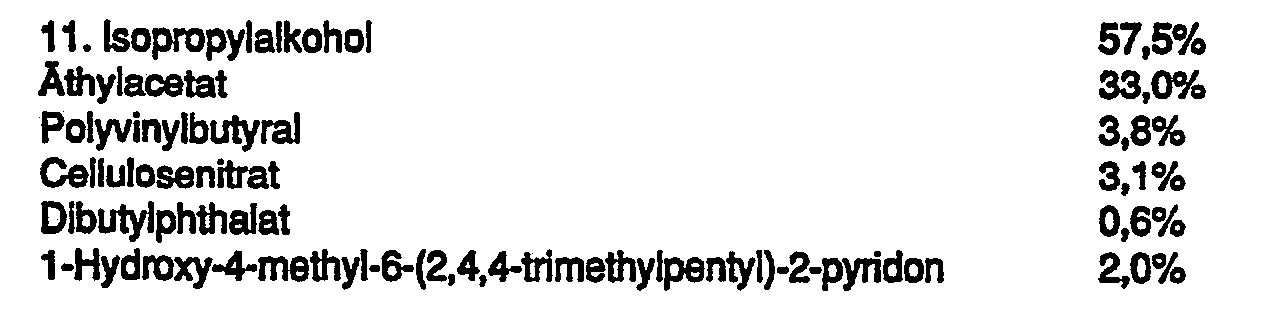
- Einige erfindungsgemäße Verbindungen werden wie folgt zu Nagellacken (Beispiele 11 -13 farblos, Beispiel 14 pigmentiert) verarbeitet. Die farblosen Nagellacke werden durch Lösen der verschiedenen Komponenten in den Lösemitteln hergestellt.


- 14. Durch langsames Einrühren von 10 t eines organisch modifizierten Montmorillonits (z.B. Bentone 27 ®, 27 Kronos Titan GmbH, Leverkusen, Deutschland) in 80 t Toluol und anschließende Zugabe von 8 t Netzmittel (z.B. Anti-Terra-U ®, Byk-Mallinckrodt, Wesel, Deutschland) und 2 t Methanol wurde eine Thixotropierungspaste hergestellt. Weiter stellte man durch Lösen von 22 t Collodiumwolle, butanolfeucht (z.B. Typ E 510, Wolff Walsrode AG, Deutschland), und 8 t Toluolsulfonamidharz (z.B. Santolite MS 80 ®, Monsanto, Mülheim-Ruhr, Deutschland) in einer Mischung aus 3 t Dibutylphthalat, 20 t Äthylacetat, 10 t Butylacetat, 7 t Äthylalkohol und 30 t Toluol einen Klarlack her. Außerdem wurden in einer geeigneten Kugelmühle 40 t DC ROT No. 7 Calciumlack (z.B. Farbpigment C 19021, Sun Chemical Corporation, Pigments Division, Fort Lee, USA) und 60 t Dibutylphthalat zu einer Farbpaste mit einer Teilchengröße unter 1 µm verarbeitet.
- Zur Herstellung des pigmentierten Nagellackes wurden 12 t Thixotropierungspaste und 0,8 t Antiabsetzmittel (z.B. MPA 2000 X @, Kronos Titan GmbH) in 83,7 t Klarlack dispergiert, wobei eine Temperatur von mindestens 38 °C erreicht werden soll. Anschließend wurde 1 t 1-Hydroxy-4-methyl-6-(2,4,4-tri- methylpentyl)-2-pyridon in dem thixotropierten Klarlack gelöst und 2,5 t Farbpaste eingerührt. Der fertige Nagellack wurde durch ein 70-µm-Sieb filtriert.


Claims (9)

Priority Applications (1)
| Application Number | Priority Date | Filing Date | Title |
|---|---|---|---|
| AT86117377T ATE53292T1 (de) | 1985-12-19 | 1986-12-13 | Antimykotisch wirksamer nagellack. |
Applications Claiming Priority (2)
| Application Number | Priority Date | Filing Date | Title |
|---|---|---|---|
| DE19853544983 DE3544983A1 (de) | 1985-12-19 | 1985-12-19 | Antimykotisch wirksamer nagellack |
| DE3544983 | 1985-12-19 |
Publications (2)
| Publication Number | Publication Date |
|---|---|
| EP0226984A1 EP0226984A1 (de) | 1987-07-01 |
| EP0226984B1 true EP0226984B1 (de) | 1990-06-06 |
Family
ID=6288889
Family Applications (1)
| Application Number | Title | Priority Date | Filing Date |
|---|---|---|---|
| EP86117377A Expired - Lifetime EP0226984B1 (de) | 1985-12-19 | 1986-12-13 | Antimykotisch wirksamer Nagellack |
Country Status (25)
| Country | Link |
|---|---|
| US (1) | US4957730A (de) |
| EP (1) | EP0226984B1 (de) |
| JP (1) | JPS62155205A (de) |
| KR (1) | KR940002942B1 (de) |
| AT (1) | ATE53292T1 (de) |
| AU (1) | AU587883B2 (de) |
| CA (1) | CA1283054C (de) |
| DD (1) | DD284598A5 (de) |
| DE (2) | DE3544983A1 (de) |
| DK (1) | DK175104B1 (de) |
| ES (1) | ES2016247B3 (de) |
| FI (1) | FI865147L (de) |
| GR (1) | GR3000641T3 (de) |
| HK (1) | HK81892A (de) |
| HU (1) | HU200908B (de) |
| IE (1) | IE59318B1 (de) |
| IL (1) | IL81021A (de) |
| MA (1) | MA20834A1 (de) |
| MY (1) | MY100300A (de) |
| NO (1) | NO173364C (de) |
| PH (1) | PH22283A (de) |
| PT (1) | PT83964B (de) |
| SG (1) | SG79692G (de) |
| TN (1) | TNSN86163A1 (de) |
| ZA (1) | ZA869497B (de) |
Cited By (2)
| Publication number | Priority date | Publication date | Assignee | Title |
|---|---|---|---|---|
| US7112561B2 (en) | 2003-12-08 | 2006-09-26 | Bentley Pharmaceuticals, Inc. | Pharmaceutical compositions and methods for insulin treatment |
| US7244703B2 (en) | 2001-06-22 | 2007-07-17 | Bentley Pharmaceuticals, Inc. | Pharmaceutical compositions and methods for peptide treatment |
Families Citing this family (75)
| Publication number | Priority date | Publication date | Assignee | Title |
|---|---|---|---|---|
| HU200914B (en) * | 1987-03-09 | 1990-09-28 | Horvath Gyoengyi Lengyelne | Process for producing new medical dosage unit suitable for local treatment of fungus infection of nails |
| DE3720147A1 (de) * | 1987-06-16 | 1988-12-29 | Hoechst Ag | Antimykotisch wirksamer nagellack sowie verfahren zu dessen herstellung |
| US5160737A (en) * | 1988-05-03 | 1992-11-03 | Perio Products Ltd. | Liquid polymer composition, and method of use |
| US5438076A (en) * | 1988-05-03 | 1995-08-01 | Perio Products, Ltd. | Liquid polymer composition, and method of use |
| CA2008775C (en) * | 1989-02-24 | 1998-12-22 | Alberto Ferro | Nail lacquer |
| US5433950A (en) * | 1990-05-07 | 1995-07-18 | Schering-Plough Healthcare Products, Inc. | Flexible collodion compositions |
| US5525389A (en) * | 1990-07-30 | 1996-06-11 | Lts Lohmann Therapie-Systeme Gmbh & Co. Kg | Self-adhesive laminate for nails |
| HU219480B (hu) * | 1991-05-23 | 2001-04-28 | Novartis Ag. | Eljárás gombás körömmegbetegségek ellen helyileg alkalmazható, allil-amin-származékot tartalmazó gyógyászati készítmények előállítására |
| DE4212105A1 (de) * | 1992-04-10 | 1993-10-14 | Roehm Pharma Gmbh | Nagellack zur Behandlung von Onychomykosen |
| US5464610A (en) * | 1992-10-15 | 1995-11-07 | Schering-Plough Healthcare Products, Inc. | Method for treating onychomycosis |
| DE19518262A1 (de) * | 1995-05-18 | 1996-11-21 | Hoechst Ag | Die Verwendung von Glyceryltriacetat zur Behandlung von Onychomykosen |
| US5487776A (en) * | 1994-03-17 | 1996-01-30 | Nimni; Marcel | Anti-fungal nail lacquer and method therefor |
| FR2718349B1 (fr) * | 1994-04-07 | 1996-05-31 | Oreal | Compositions cosmétiques à appliquer sur l'ongle. |
| DK128494A (da) * | 1994-11-08 | 1996-05-09 | Edel K Seidenschnur | Behandling af keratinøse og psoriatiske sygdomstilstande med neglelak indeholdende vitamin D metabolit, eller derivat, og/eller vitamin A derivat |
| DE19643831A1 (de) | 1996-10-30 | 1998-05-07 | Hoechst Ag | Verwendung von 1-Hydroxy-2-pyridonen zur Behandlung von schwer therapierbaren Schleimhauterkrankungen |
| DE19604190A1 (de) * | 1996-02-06 | 1997-08-07 | Hoechst Ag | Nagelwachstumsfördernde Zubereitungen |
| DE19639816A1 (de) * | 1996-09-27 | 1998-04-02 | Hoechst Ag | Antimykotische Mittel mit hoher Wirkstofffreisetzung |
| US20040039030A1 (en) * | 1996-09-27 | 2004-02-26 | Hoechst Akeengesellschaft | Use of 1-hydroxy-2-pyridones for the treatment of seborrheic dermatitis |
| DE19639817A1 (de) | 1996-09-27 | 1998-04-02 | Hoechst Ag | Verwendung von 1-Hydroxy-2-pyridonen zur Behandlung von Hautinfektionen |
| US5968986A (en) * | 1997-12-18 | 1999-10-19 | Woodward Laboratories, Inc. | Antimicrobial nail coating composition |
| RO118174B1 (ro) * | 1997-08-21 | 2003-03-28 | Aventis Pharma Deutschland Gmbh | Lac de unghii şi utilizarea acestuia |
| CA2278328C (en) | 1998-02-09 | 2008-07-22 | Macrochem Corporation | Antifungal nail lacquer and method using same |
| US6231875B1 (en) | 1998-03-31 | 2001-05-15 | Johnson & Johnson Consumer Companies, Inc. | Acidified composition for topical treatment of nail and skin conditions |
| DE69918087D1 (de) * | 1998-04-17 | 2004-07-22 | Bertek Pharm Inc | Topische formulierungen zur behandlung von nagel pilzerkrankungen |
| AU2952999A (en) * | 1998-04-24 | 1999-11-16 | Procter & Gamble Company, The | Nail polish compositions |
| DE50012415D1 (de) * | 2000-01-03 | 2006-05-11 | Karl Kraemer | Zubereitungen zur atraumatischen nagelentfernung |
| US6495124B1 (en) | 2000-02-14 | 2002-12-17 | Macrochem Corporation | Antifungal nail lacquer and method using same |
| DE10011081A1 (de) * | 2000-03-09 | 2001-09-13 | Aventis Pharma Gmbh | Antiinfektive Wirkstoffkombinationen und ihre Verwendung zur topischen Behandlung von Pilzerkrankungen der Fuß- und Fingernägel |
| US8257688B2 (en) * | 2000-03-27 | 2012-09-04 | Taro Pharmaceuticals Industries | Controlled delivery system of antifungal and keratolytic agents for local treatment of fungal infections of the nail and surrounding tissues |
| US7074392B1 (en) * | 2000-03-27 | 2006-07-11 | Taro Pharmaceutical Industries Limited | Controllled delivery system of antifungal and keratolytic agents for local treatment of fungal infections |
| DE10035991A1 (de) * | 2000-07-24 | 2002-02-14 | Polichem Sa | Nagellackzusammensetzung |
| DE10126501A1 (de) * | 2001-05-30 | 2002-12-12 | Aventis Pharma Gmbh | Zubereitung zur Entfernung von abnormen Keratinmaterial |
| US6846847B2 (en) | 2002-07-24 | 2005-01-25 | James G. Holwerda | Biocidal agents and methods of use |
| US20050165104A1 (en) * | 2002-07-24 | 2005-07-28 | Holwerda James G. | Biocidal agents and veterinary methods |
| US20030049307A1 (en) * | 2002-08-15 | 2003-03-13 | Gyurik Robert J. | Pharmaceutical composition |
| US8404751B2 (en) * | 2002-09-27 | 2013-03-26 | Hallux, Inc. | Subunguicide, and method for treating onychomycosis |
| DK2106805T3 (da) * | 2003-03-21 | 2011-08-15 | Nexmed Holdings Inc | Antifungal neglelak og anvendelsesmetode |
| WO2005011565A2 (fr) * | 2003-07-29 | 2005-02-10 | Pierre Fabre Dermo-Cosmetique | Vernis a ongles a action antimycosique |
| DE10341944A1 (de) * | 2003-09-11 | 2005-04-28 | York Pharma Plc | Antimykotisch wirksame Nagellackformulierung mit substituierten 2-Aminothiazolen als Wirkstoff |
| US20050238672A1 (en) * | 2004-04-27 | 2005-10-27 | Nimni Marcel E | Antifungal drug delivery |
| US20060009469A1 (en) * | 2004-05-28 | 2006-01-12 | Leonore Witchey-Lakshmanan | Particulate-stabilized injectable pharmacutical compositions of posaconazole |
| US20060160823A1 (en) * | 2004-05-28 | 2006-07-20 | Leonore Witchey-Lakshmanan | Particulate-stabilized injectable pharmaceutical compositions of Posaconazole |
| WO2006013963A1 (ja) * | 2004-08-05 | 2006-02-09 | Hisamitsu Pharmaceutical Co., Inc. | 爪用外用剤 |
| US20060078580A1 (en) * | 2004-10-08 | 2006-04-13 | Mediquest Therapeutics, Inc. | Organo-gel formulations for therapeutic applications |
| US7740875B2 (en) * | 2004-10-08 | 2010-06-22 | Mediquest Therapeutics, Inc. | Organo-gel formulations for therapeutic applications |
| US20060275230A1 (en) | 2004-12-10 | 2006-12-07 | Frank Kochinke | Compositions and methods for treating conditions of the nail unit |
| MX2007006833A (es) * | 2004-12-10 | 2007-10-08 | Talima Therapeutics Inc | Composiciones y metodos para tratar condiciones de la unidad de una. |
| GB0506139D0 (en) * | 2005-03-24 | 2005-05-04 | Transphase Ltd | A transdermal topical composition and its uses |
| GB0506141D0 (en) * | 2005-03-24 | 2005-05-04 | Transphase Ltd | A topical compostion and its uses |
| US20060251593A1 (en) * | 2005-04-07 | 2006-11-09 | Work By Docs, Inc. | Colored nail enamel treatment |
| MXPA05012961A (es) * | 2005-11-30 | 2007-05-30 | Fernando Ahumada Ayala | Preparaciones para el cuidado de las unas que contienen clorhidrato de terbinafina. |
| US20080153122A1 (en) * | 2006-12-21 | 2008-06-26 | Susan Beth Cantor | Method and system for enhancing self-treatment of onychomycosis |
| US20090175810A1 (en) | 2008-01-03 | 2009-07-09 | Gareth Winckle | Compositions and methods for treating diseases of the nail |
| EP2130540A1 (de) * | 2008-06-02 | 2009-12-09 | Sandoz AG | Pharmazeutische Zusammensetzungen mit einer kristallinen Form von Posaconazol |
| US20090298805A1 (en) * | 2008-06-03 | 2009-12-03 | Polson George A | Topical pyrithione compositions and methods for treatment of nail fungus |
| EP2141159A1 (de) * | 2008-07-03 | 2010-01-06 | Sandoz AG | Kristalline Form von Posaconazol |
| US20100055056A1 (en) * | 2008-09-04 | 2010-03-04 | Sato Pharmaceutical Co., Ltd. | Agent for improving permeation of a drug into a nail and an external treating agent containing the same |
| AU2010254064B2 (en) | 2009-05-29 | 2015-01-22 | Palau Pharma, S.L.U | Azole antifungal compositions |
| CA2767489A1 (en) | 2009-07-09 | 2011-01-13 | Sandoz Ag | A crystalline form of posaconazole |
| ES2369101B2 (es) | 2010-05-07 | 2012-08-02 | Universidade De Santiago De Compostela | Sistema farmacéutico acuoso para la administración de fármacos en las uñas. |
| EP2571847B1 (de) | 2010-05-19 | 2016-09-21 | Sandoz AG | Verfahren zur herstellung chiraler hydrazide |
| CN102892763B (zh) | 2010-05-19 | 2016-03-09 | 桑多斯股份公司 | 泊沙康唑及泊沙康唑中间体的纯化 |
| AU2011254654B2 (en) | 2010-05-19 | 2016-01-07 | Sandoz Ag | Process for the preparation of chiral triazolones |
| US9073904B2 (en) | 2010-05-19 | 2015-07-07 | Sandoz Ag | Preparation of posaconazole intermediates |
| RU2432158C1 (ru) | 2010-07-28 | 2011-10-27 | Закрытое акционерное общество "Институт прикладной нанотехнологии" | Профилактический бактерицидный лак для обработки ногтей |
| CN103635465A (zh) | 2011-06-16 | 2014-03-12 | 桑多斯股份公司 | 制备手性化合物的方法 |
| JP5950528B2 (ja) * | 2011-09-30 | 2016-07-13 | 小林製薬株式会社 | 皮膜形成性外用製剤 |
| US8697753B1 (en) | 2013-02-07 | 2014-04-15 | Polichem Sa | Method of treating onychomycosis |
| CN105377355A (zh) | 2013-03-14 | 2016-03-02 | 拇趾公司 | 治疗甲单元的感染、疾病或病症的方法 |
| MX363386B (es) | 2013-10-03 | 2019-03-20 | Dow Pharmaceutical Sciences | Formulaciones de efinaconazol estabilizadas. |
| EP2910245A1 (de) | 2014-02-21 | 2015-08-26 | Polichem SA | Topische antifungizide Zusammensetzung zur Behandlung von Onychomykose |
| EP2952208A1 (de) | 2014-06-04 | 2015-12-09 | Universidade de Santiago de Compostela | Hydroalkoholisches System zur Nagelbehandlung |
| CN110536687B (zh) * | 2018-03-27 | 2022-12-16 | 华东理工大学 | N-羟基吡啶酮类化合物及其用途 |
| US12115139B2 (en) | 2018-08-15 | 2024-10-15 | Todd Alan Weinfield | Treatment methods and processes for an infected nail |
| EP4129292A1 (de) | 2021-08-04 | 2023-02-08 | OnychoPharm GmbH | Formulierung für substituierte 2-aminothiazole bei der behandlung von allgemeinen und bakteriellen pilzinfektionen des nagels |
Family Cites Families (11)
| Publication number | Priority date | Publication date | Assignee | Title |
|---|---|---|---|---|
| US2752356A (en) * | 1954-07-12 | 1956-06-26 | Reilly Tar & Chem Corp | Process of preparation of 2-hydroxypyridine-1-oxide and homologs |
| FR3691M (fr) * | 1963-05-06 | 1965-11-15 | Olin Mathieson | Nouvelle composition pharmaceutique utile en tant que fongicide. |
| US3883545A (en) * | 1968-08-31 | 1975-05-13 | Hoechst Ag | Certain 1-hydroxy-2-pyridones |
| US3968118A (en) * | 1968-08-31 | 1976-07-06 | Hoechst Aktiengesellschaft | Process for the manufacture of 1-hydroxy-2-pyridones |
| DE1795831C3 (de) * | 1968-08-31 | 1979-04-05 | Hoechst Ag, 6000 Frankfurt | Verfahren zur Herstellung von 1 -Hydroxy-2-pyridonen |
| US4185106A (en) * | 1972-07-11 | 1980-01-22 | Hoechst Aktiengesellschaft | Pyridones as antidandruff agents |
| US4250164A (en) * | 1979-04-09 | 1981-02-10 | Bernstein Joel E | Method of treating psoriasis of the nails and composition |
| DE3045914A1 (de) * | 1980-12-05 | 1982-07-22 | Bayer Ag, 5090 Leverkusen | Antimykotische mittel mit hoher wirkstoff-freisetzung in form von elastischen fluessig-pflastern |
| DE3140954A1 (de) * | 1981-10-15 | 1983-05-05 | Hoechst Ag | "verwendung von 1-hydroxy-2-pyridonen zur prophylaxe und behandlung von akne" |
| JPH0710768B2 (ja) * | 1983-10-28 | 1995-02-08 | 花王株式会社 | 化粧料 |
| DE3687458T2 (de) * | 1985-11-04 | 1993-07-29 | Owen Galderma Lab Inc | Filmbildende arzneimitteltraeger zur verabreichung von arzneimitteln an naegeln |
-
1985
- 1985-12-19 DE DE19853544983 patent/DE3544983A1/de not_active Withdrawn
-
1986
- 1986-12-13 ES ES86117377T patent/ES2016247B3/es not_active Expired - Lifetime
- 1986-12-13 DE DE3671699T patent/DE3671699C5/de not_active Expired - Lifetime
- 1986-12-13 EP EP86117377A patent/EP0226984B1/de not_active Expired - Lifetime
- 1986-12-13 AT AT86117377T patent/ATE53292T1/de not_active IP Right Cessation
- 1986-12-17 FI FI865147A patent/FI865147L/fi not_active Application Discontinuation
- 1986-12-17 HU HU865267A patent/HU200908B/hu unknown
- 1986-12-17 PH PH34605A patent/PH22283A/en unknown
- 1986-12-17 MA MA21066A patent/MA20834A1/fr unknown
- 1986-12-17 US US06/942,699 patent/US4957730A/en not_active Expired - Lifetime
- 1986-12-18 PT PT83964A patent/PT83964B/pt unknown
- 1986-12-18 CA CA000525793A patent/CA1283054C/en not_active Expired - Lifetime
- 1986-12-18 NO NO865158A patent/NO173364C/no not_active IP Right Cessation
- 1986-12-18 MY MYPI86000222A patent/MY100300A/en unknown
- 1986-12-18 TN TNTNSN86163A patent/TNSN86163A1/fr unknown
- 1986-12-18 IL IL81021A patent/IL81021A/xx not_active IP Right Cessation
- 1986-12-18 JP JP61300239A patent/JPS62155205A/ja active Granted
- 1986-12-18 IE IE331286A patent/IE59318B1/en not_active IP Right Cessation
- 1986-12-18 AU AU66707/86A patent/AU587883B2/en not_active Expired
- 1986-12-18 DD DD86297908A patent/DD284598A5/de not_active IP Right Cessation
- 1986-12-18 DK DK198606136A patent/DK175104B1/da not_active IP Right Cessation
- 1986-12-18 ZA ZA869497A patent/ZA869497B/xx unknown
- 1986-12-19 KR KR8610941A patent/KR940002942B1/ko not_active Expired - Fee Related
-
1990
- 1990-07-12 GR GR90400432T patent/GR3000641T3/el unknown
-
1992
- 1992-08-07 SG SG796/92A patent/SG79692G/en unknown
- 1992-10-22 HK HK818/92A patent/HK81892A/xx not_active IP Right Cessation
Cited By (3)
| Publication number | Priority date | Publication date | Assignee | Title |
|---|---|---|---|---|
| US7244703B2 (en) | 2001-06-22 | 2007-07-17 | Bentley Pharmaceuticals, Inc. | Pharmaceutical compositions and methods for peptide treatment |
| US7112561B2 (en) | 2003-12-08 | 2006-09-26 | Bentley Pharmaceuticals, Inc. | Pharmaceutical compositions and methods for insulin treatment |
| US7651996B2 (en) | 2003-12-08 | 2010-01-26 | Cpex Pharmaceuticals, Inc. | Pharmaceutical compositions and methods for insulin treatment |
Also Published As
Similar Documents
| Publication | Publication Date | Title |
|---|---|---|
| EP0298271B1 (de) | Antimykotisch wirksamer Nagellack sowie Verfahren zu dessen Herstellung | |
| EP0226984A1 (de) | Antimykotisch wirksamer Nagellack | |
| EP0565072B1 (de) | Nagellack zur Behandlung von Onychomykosen | |
| AT400518B (de) | Nagellack zur behandlung von onychomykosis enthaltend terbinafine | |
| EP0913154B1 (de) | Antipsoriatisch wirksamer Nagellack | |
| EP0879052B1 (de) | Nagelwachstumsfördernde zubereitungen | |
| WO2001066145A1 (de) | Antiinfektive wirkstoffkombinationen und ihre verwendung zur topischen behandlung von pilzerkrankungen der fuss- und fingernägel | |
| DE3629241A1 (de) | Uv-strahlung-filtrierende polyaminoamide, verfahren zu deren herstellung und verwendung derselben als haut- und haarschutz | |
| EP0777457B1 (de) | Die verwendung von glyceryltriacetat zur behandlung von onychomykosen | |
| DE69033547T2 (de) | Pediculizide zusammensetzungen | |
| EP1263426B1 (de) | Zubereitungen zur atraumatischen nagelentfernung | |
| EP1395231B1 (de) | Zubereitung zur entfernung von abnormen keratinmaterial | |
| EP0306853B1 (de) | Kosmetisches Präparat mit germiziden Eigenschaften | |
| EP0027655A2 (de) | Verwendung von kosmetischen Mitteln zur Behandlung der Haare und der Kopfhaut | |
| DE60214207T2 (de) | Nagellack enthaltend tazaroten und verwendung dessen zur behandlung und/oder zur prävention von psoriasis | |
| DE3615396A1 (de) | Mittel zur behandlung der haare und der kopfhaut | |
| DE1492023C3 (de) | Hautpflegemittel | |
| DE3330228A1 (de) | Kosmetikum | |
| DE4008307A1 (de) | Verwendung von 3,7-dimethyloctan-1-ol als antimikrobieller wirkstoff sowie als wirksames prinzip in antimikrobiell wirksamen kosmetischen und dermatologischen zubereitungen | |
| DE102024205034A1 (de) | Kosmetische Zubereitung zur Reduzierung von Fungalakne |
Legal Events
| Date | Code | Title | Description |
|---|---|---|---|
| PUAI | Public reference made under article 153(3) epc to a published international application that has entered the european phase |
Free format text: ORIGINAL CODE: 0009012 |
|
| AK | Designated contracting states |
Kind code of ref document: A1 Designated state(s): AT BE CH DE ES FR GB GR IT LI LU NL SE |
|
| 17P | Request for examination filed |
Effective date: 19870912 |
|
| 17Q | First examination report despatched |
Effective date: 19890208 |
|
| GRAA | (expected) grant |
Free format text: ORIGINAL CODE: 0009210 |
|
| AK | Designated contracting states |
Kind code of ref document: B1 Designated state(s): AT BE CH DE ES FR GB GR IT LI LU NL SE |
|
| REF | Corresponds to: |
Ref document number: 53292 Country of ref document: AT Date of ref document: 19900615 Kind code of ref document: T |
|
| ITF | It: translation for a ep patent filed | ||
| REF | Corresponds to: |
Ref document number: 3671699 Country of ref document: DE Date of ref document: 19900712 |
|
| ET | Fr: translation filed | ||
| GBT | Gb: translation of ep patent filed (gb section 77(6)(a)/1977) | ||
| REG | Reference to a national code |
Ref country code: GR Ref legal event code: FG4A Free format text: 3000641 |
|
| PLBE | No opposition filed within time limit |
Free format text: ORIGINAL CODE: 0009261 |
|
| STAA | Information on the status of an ep patent application or granted ep patent |
Free format text: STATUS: NO OPPOSITION FILED WITHIN TIME LIMIT |
|
| 26N | No opposition filed | ||
| ITTA | It: last paid annual fee | ||
| EPTA | Lu: last paid annual fee | ||
| EAL | Se: european patent in force in sweden |
Ref document number: 86117377.1 |
|
| NLR3 | Nl: receipt of modified translations in the netherlands language after an opposition procedure | ||
| REG | Reference to a national code |
Ref country code: CH Ref legal event code: PUE Owner name: HOECHST AKTIENGESELLSCHAFT TRANSFER- AVENTIS PHARM |
|
| REG | Reference to a national code |
Ref country code: GB Ref legal event code: IF02 |
|
| NLS | Nl: assignments of ep-patents |
Owner name: AVENTIS PHARMA DEUTSCHLAND GMBH |
|
| REG | Reference to a national code |
Ref country code: FR Ref legal event code: TP |
|
| REG | Reference to a national code |
Ref country code: GB Ref legal event code: 732E |
|
| PGFP | Annual fee paid to national office [announced via postgrant information from national office to epo] |
Ref country code: IT Payment date: 20051025 Year of fee payment: 20 |
|
| PGFP | Annual fee paid to national office [announced via postgrant information from national office to epo] |
Ref country code: AT Payment date: 20051031 Year of fee payment: 20 |
|
| PGFP | Annual fee paid to national office [announced via postgrant information from national office to epo] |
Ref country code: FR Payment date: 20051103 Year of fee payment: 20 Ref country code: NL Payment date: 20051103 Year of fee payment: 20 |
|
| PGFP | Annual fee paid to national office [announced via postgrant information from national office to epo] |
Ref country code: CH Payment date: 20051104 Year of fee payment: 20 Ref country code: GB Payment date: 20051104 Year of fee payment: 20 Ref country code: SE Payment date: 20051104 Year of fee payment: 20 |
|
| PGFP | Annual fee paid to national office [announced via postgrant information from national office to epo] |
Ref country code: LU Payment date: 20051117 Year of fee payment: 20 |
|
| PGFP | Annual fee paid to national office [announced via postgrant information from national office to epo] |
Ref country code: GR Payment date: 20051122 Year of fee payment: 20 |
|
| PGFP | Annual fee paid to national office [announced via postgrant information from national office to epo] |
Ref country code: BE Payment date: 20051201 Year of fee payment: 20 |
|
| PGFP | Annual fee paid to national office [announced via postgrant information from national office to epo] |
Ref country code: ES Payment date: 20051212 Year of fee payment: 20 |
|
| REG | Reference to a national code |
Ref country code: CH Ref legal event code: PFA Owner name: SANOFI-AVENTIS DEUTSCHLAND GMBH Free format text: AVENTIS PHARMA DEUTSCHLAND GMBH#BRUENINGSTRASSE 50#65926 FRANKFURT AM MAIN (DE) -TRANSFER TO- SANOFI-AVENTIS DEUTSCHLAND GMBH##65926 FRANKFURT AM MAIN (DE) |
|
| PGFP | Annual fee paid to national office [announced via postgrant information from national office to epo] |
Ref country code: DE Payment date: 20060101 Year of fee payment: 20 |
|
| NLT1 | Nl: modifications of names registered in virtue of documents presented to the patent office pursuant to art. 16 a, paragraph 1 |
Owner name: SANOFI-AVENTIS DEUTSCHLAND GMBH |
|
| PG25 | Lapsed in a contracting state [announced via postgrant information from national office to epo] |
Ref country code: GB Free format text: LAPSE BECAUSE OF EXPIRATION OF PROTECTION Effective date: 20061212 |
|
| PG25 | Lapsed in a contracting state [announced via postgrant information from national office to epo] |
Ref country code: NL Free format text: LAPSE BECAUSE OF EXPIRATION OF PROTECTION Effective date: 20061213 |
|
| PG25 | Lapsed in a contracting state [announced via postgrant information from national office to epo] |
Ref country code: ES Free format text: LAPSE BECAUSE OF EXPIRATION OF PROTECTION Effective date: 20061214 |
|
| REG | Reference to a national code |
Ref country code: GB Ref legal event code: PE20 |
|
| REG | Reference to a national code |
Ref country code: CH Ref legal event code: PL |
|
| NLV7 | Nl: ceased due to reaching the maximum lifetime of a patent |
Effective date: 20061213 |
|
| EUG | Se: european patent has lapsed | ||
| REG | Reference to a national code |
Ref country code: ES Ref legal event code: FD2A Effective date: 20061214 |
|
| BE20 | Be: patent expired |
Owner name: *SANOFI-AVENTIS DEUTSCHLAND G.M.B.H. Effective date: 20061213 |