EP0221007A1 - Feinnadel-Biopsiekanüle mit Mandrin - Google Patents
Feinnadel-Biopsiekanüle mit Mandrin Download PDFInfo
- Publication number
- EP0221007A1 EP0221007A1 EP86730179A EP86730179A EP0221007A1 EP 0221007 A1 EP0221007 A1 EP 0221007A1 EP 86730179 A EP86730179 A EP 86730179A EP 86730179 A EP86730179 A EP 86730179A EP 0221007 A1 EP0221007 A1 EP 0221007A1
- Authority
- EP
- European Patent Office
- Prior art keywords
- stylet
- cut
- cannula
- biopsy
- biopsy cannula
- Prior art date
- Legal status (The legal status is an assumption and is not a legal conclusion. Google has not performed a legal analysis and makes no representation as to the accuracy of the status listed.)
- Granted
Links
- 238000013188 needle biopsy Methods 0.000 title description 3
- 238000001574 biopsy Methods 0.000 claims abstract description 46
- 210000002517 zygapophyseal joint Anatomy 0.000 abstract 2
- 210000001519 tissue Anatomy 0.000 description 22
- 239000000523 sample Substances 0.000 description 9
- KWGRBVOPPLSCSI-WPRPVWTQSA-N (-)-ephedrine Chemical compound CN[C@@H](C)[C@H](O)C1=CC=CC=C1 KWGRBVOPPLSCSI-WPRPVWTQSA-N 0.000 description 8
- 238000002604 ultrasonography Methods 0.000 description 8
- 210000000056 organ Anatomy 0.000 description 7
- 241001631457 Cannula Species 0.000 description 3
- 238000005070 sampling Methods 0.000 description 3
- 210000002615 epidermis Anatomy 0.000 description 2
- 208000014674 injury Diseases 0.000 description 2
- 239000007788 liquid Substances 0.000 description 2
- 230000035515 penetration Effects 0.000 description 2
- 239000011343 solid material Substances 0.000 description 2
- 208000035126 Facies Diseases 0.000 description 1
- 206010061245 Internal injury Diseases 0.000 description 1
- 241001422033 Thestylus Species 0.000 description 1
- 208000027418 Wounds and injury Diseases 0.000 description 1
- 210000001185 bone marrow Anatomy 0.000 description 1
- 239000002775 capsule Substances 0.000 description 1
- 238000006243 chemical reaction Methods 0.000 description 1
- 238000005352 clarification Methods 0.000 description 1
- 238000010411 cooking Methods 0.000 description 1
- 230000006378 damage Effects 0.000 description 1
- 230000007123 defense Effects 0.000 description 1
- 210000004207 dermis Anatomy 0.000 description 1
- 230000006866 deterioration Effects 0.000 description 1
- 238000003745 diagnosis Methods 0.000 description 1
- 210000003734 kidney Anatomy 0.000 description 1
- 230000007257 malfunction Effects 0.000 description 1
- 239000000463 material Substances 0.000 description 1
- 238000000034 method Methods 0.000 description 1
- 210000000653 nervous system Anatomy 0.000 description 1
- 230000008058 pain sensation Effects 0.000 description 1
- 230000000149 penetrating effect Effects 0.000 description 1
- 230000002093 peripheral effect Effects 0.000 description 1
- 210000003491 skin Anatomy 0.000 description 1
- 230000008733 trauma Effects 0.000 description 1
Images

Classifications
-
- A—HUMAN NECESSITIES
- A61—MEDICAL OR VETERINARY SCIENCE; HYGIENE
- A61B—DIAGNOSIS; SURGERY; IDENTIFICATION
- A61B10/00—Instruments for taking body samples for diagnostic purposes; Other methods or instruments for diagnosis, e.g. for vaccination diagnosis, sex determination or ovulation-period determination; Throat striking implements
- A61B10/02—Instruments for taking cell samples or for biopsy
- A61B10/0233—Pointed or sharp biopsy instruments
- A61B10/0283—Pointed or sharp biopsy instruments with vacuum aspiration, e.g. caused by retractable plunger or by connected syringe
Definitions
- the invention relates to a biopsy cannula with a small bevel with a circumferential cutting edge, with a stylet protruding above the bevel of the cannula, the bevel angle and orientation of which correspond to that of the cannula, and with relief cut facets in the area of the cutting edge of the biopsy cannula.
- a biopsy cannula with stylet is known from DE-GM 79 14 565, in which the stylet is provided with a longitudinal sample notch.
- the cutting cannula is moved forward along the fixed stylet to obtain samples; the tissue mass pressed into the sample notch is separated from the target area by the cutting edge of the cannula.
- the sample is removed from the body by pulling out the stylet, the cutting cannula can remain there.
- the closed system can also be pulled out.
- Additional biopsy cannulas are known as products from B. Braun Melsungen; Just like the well-known cannula from TSK from Japan, these are cannulas with Menghini cuts.
- By varying the grinding angle and the symmetrical stylet tip see brochure from Paul Stocton, Dallas, they experience different designs, but also different forces when penetrating the tissue. A different quality of the removed tissue is also found.
- a flat-section stylet which projects further than the biopsy cutting section through it, is described in US Pat. No. 4,314,565 for bone marrow biopsies. It is designed to prevent cooking chips from entering the inner lumen.
- the cut orientation and slope of this stylet is the same as that of the biopsy cannula cut.
- a disadvantage of all of the aforementioned versions of cuts or cannula-stylet combinations is that they are unable to simultaneously solve all of the tasks that arise from a cannula for ultrasound-controlled or -controlled puncture for tissue biopsy.
- the object of the present invention is to provide a cannula which enables precise sampling from a sonographically recorded target area and which can be avoided with the complication.
- the relief cut facets of the cutting edge of the biopsy cannula are ground up to their inner lumen, that the cut of the stylet is designed as a facet cut, that the rear end of the stylet with the piston rod of an aspiration syringe on which the biopsy cannula is mounted is connected and secured against rotation, and that both cuts are arranged in the longitudinal distance so that they form a functional unit.
- the cut of the stylet is designed as an asymmetrical trocar cut.
- the actual tissue biopsy which then takes place in the target organ, is performed under vacuum with the stylet withdrawn, whereby the two sharp facets of the Menghini cut together with the circumferential cutting edge allow a quick and less tissue-destructive biopsy.
- the partially observed shredding of cells in the peripheral area of the biopsy cylinder which means a deterioration in the yield, is avoided in this way, as is the evasive movement of the target area in the case of punctures on loosely mobile organs.
- the retracted stylet also prevents the biopsy cylinders from slipping into the syringe.
- Such a biopsy is usually carried out with the aid of ultrasound.
- the examining doctor holds the transducer of the ultrasound device in one hand and tracks the target area to be examined on a monitor.
- the aspiration syringe adapted to a syringe holder can be guided into the target area with the biopsy cannula according to the invention.
- the stylet tip should be clearly visible on ultrasound and have good directional stability to ensure that the targeted area is actually hit. To do this, the stylet is withdrawn with the syringe holder and the cannula is briefly pushed into the target area. Due to the Menghini sharpening of the cannula, which is sharpened with a relief, in connection with the vacuum that a tissue cylinder is obtained by withdrawing the stylet and the piston in the cannula. As a result of the improved cutting properties of the cannula, connected tissue cylinders can still be obtained even with very small inner diameters. With conventional cuts, only a cell smear would be obtained here.
- the punched-out sample can be spread out outside the body by moving the stylet. This sample is not destroyed and no cell sample interspersed with foreign tissue is obtained, but rather a larger tissue cylinder that consists exclusively of tissue from the target area. Such a tissue sample can be assessed histologically.
- the biopsy with a cannula diameter in the fine needle area considerably reduces the risk of trauma, the patient has less pain sensation, the subsequent reactions of the vegetative nervous system are reduced, as is the patient's pain defense movements.
- the taking of tissue samples by means of percutaneous fine needle puncture with the cannula according to the invention is possible with little risk.
- the sharp stylet tip protrudes about 2 mm from the cutting edge of the cannula.
- the cannula cutting edge follows the stylet cutting edge running on the outer circumference, as a result of which both cutting edges form a functionally uniform cutting edge.
- This functionally uniform, pointed and very sharp cutting edge enables the epidermis to be cut smoothly without prior incision.
- the immediately following biopsy cannula finds practically no resistance in the path precut from the stylet. If the needle tip, which is clearly visible sonographically, has reached the puncture site, then the stylet attached to the syringe plunger is withdrawn and at the same time a vacuum is built up. The stylet now acts as a stop probe, which prevents the aspirated material from being carried over into the syringe.
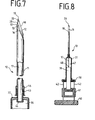
- the biopsy instruments 10 shown in the drawing essentially consists of a fine needle biopsy cannula 11 1 with a longitudinally displaceable stylet 17.
- the cannula 11 1 has a bevel cut 12 with a facet cut 16 which merges into an undercut 13. This creates a cannula tip 28 with a very sharp, pointed cutting edge 45 in the area of the outer free end of the cannula 11.
- the grinding length 15 of the beveled grinding 12 is approximately two to four times, preferably three times as large as the outer diameter 14 of the cannula 11 there is a grinding angle 23 of approximately 20-30 °, preferably 25 °.
- the outer diameter 14 of the cannula 11 1 is 0.6 to 0.9 mm and is therefore in the fine needle region with a risk of complications that is reduced to a minimum.
- the cannula 11 is provided with an inner lumen 22 in which a stylet 17 is slidably arranged.
- the stylet 17 has one Mandrin bevel cut 18, which is provided with a facet cut 20 starting from the stylet tip 19.
- the cut length 15a of this facet cut 20 is relatively short and is approximately 1/5 to 1/3 of the cut length 15 5 of the bevel cut 12.
- the relief section 13 of the cannula 11 runs against the facet section 20 of the stylet 17. These two sections 13 and 20 result in a pointed, sharp cutting edge 45 with a longitudinal angled portion 25 with which the dermis pierce easily and in the correct direction can be.
- the bevel cuts 12 and 18 are oriented in the same direction and fixed in their orientation.
- the stylet 17 is hollow and provided with a stylet longitudinal bore 24.
- this longitudinal bore 24 is provided at the rear end 48 of the stylet 17 with transverse bores 39 in the region of the syringe plunger 36.
- the vacuum present in the aspiration syringe 37 can be quickly transferred to the cannula tip 28 and the sampling can be supported. It can also be used to obtain samples from potentially liquid target areas that are difficult or impossible to identify as such on ultrasound. Such liquid samples can be drawn through the bores 24 and 39 in the direction of the cannula end 26 or up to the interior 47 reach syringe 37.
- the stylet 17, which is provided with a bevel 18, has a longitudinal angled portion 34 in the region of the tip of its hand 19, which facilitates a quick and sharp severing of the epidermis.
- the cannula 11 is provided with a bevel cut 12 with relief-ground facets 13 and has a longitudinal angled portion 25 in the area of the cannula tip 28 and an oblique bend 33 in the area of the cutting edge 45.
- the bevel 12 is asymmetrical and the cannula tip 28 is located off-center.
- FIG. 4 shows a biopsy cannula 11 in which the stylet 17 consists entirely of a solid material 27.
- the stylet tip 31 is provided with an asymmetrical trocar cut 21.
- the stylet 17, as shown in FIG. 6 in plan view, has two curved, obliquely running cutting edges 29 and a straight, vertically extending cutting edge 30 which converge in an off-center stylet tip 31.
- This stylet tip 31, which is located off-center in plan view is oriented in the same direction as the cannula tip 28, which is also located off-center, and is fixed in this orientation.
- the cutting surfaces 32 tapering towards the asymmetrically arranged cutting edges 29 and 30 can be concave.
- a stylet 17 with a bevel 18 is arranged in the cannula 11, which runs exactly in the plane of the bevel 12 of the cannula 11.
- the stylet 17 is guided in the stylus guide 43 in the region of the syringe cone 46 and is fixedly connected to the piston rod 36 of the aspiration syringe 37 by a stylet holder 44.
- the aspiration syringe 37 can be adapted into a syringe holder 38 for one-hand operation.
- This syringe holder 38 consists essentially of a handle 40 for handling the syringe 37, a plunger holder guide 42, via which the handle 40 is connected to the syringe 37, and a plunger holder 41 connected to the plunger 36, which is displaceable on the plunger holder guide 42 .
- Such a syringe holder 38 makes it possible to push the biopsy cannula 11 with only one hand into the tissue of the target area identified on the monitor of an ultrasound device and by pulling back the 10 plunger 36 and thus the stylet 17 while immediately pushing the cannula 11 forward with it released cutting edge 45 to take a tissue sample. This procedure is very quick and therefore relatively painless for the patient.
- the stylet 17 is for easier penetration of the cannula 11 advanced beyond the cutting edge 45 of the cannula 11. This creates a smooth, tissue-preserving puncture channel that does not tear or stretch neighboring tissue. The complication rate can be significantly reduced.
- the very fine cannula 11 can follow the stylet 17 without foreign tissue being able to adhere to it. Since this very fine cannula 11 has an outer diameter of only about 0.6 to 0.9 mm, it falls under the fine needle risk and can be used on the patient without great pain and injury.
Landscapes
- Health & Medical Sciences (AREA)
- Life Sciences & Earth Sciences (AREA)
- Medical Informatics (AREA)
- Engineering & Computer Science (AREA)
- Biomedical Technology (AREA)
- Heart & Thoracic Surgery (AREA)
- Pathology (AREA)
- Molecular Biology (AREA)
- Surgery (AREA)
- Animal Behavior & Ethology (AREA)
- General Health & Medical Sciences (AREA)
- Public Health (AREA)
- Veterinary Medicine (AREA)
- Ultra Sonic Daignosis Equipment (AREA)
- Surgical Instruments (AREA)
Abstract
Description
- Die Erfindung betrifft eine Biopsiekanüle mit kleinem Anschliffwinkel mit einer umlaufenden Schneidkante, mit einem über dem Schliff der Kanüle herausragenden Mandrin, dessen Schliffwinkel und Orientierung dem des Kanülenschliffs entsprechen und mit Hinterschliff-Facetten im Bereich der Schneidkante der Biopsiekanüle.
- Eine Biopsiekanüle mit Mandrin ist aus dem DE-GM 79 14 565 bekannt, bei dem der Mandrin mit einer längsverlaufenden Probenkerbe versehen ist. Zur Probengewinnung wird die Schneidkanüle längs des festgehaltenen Mandrin nach vorne bewegt; die in den Probenkerb eingedrückte Gewebemasse wird dabei durch die Schneidkante der Kanüle aus dem Zielgebiet abgetrennt. Durch Herausziehen des Mandrins wird die Probe aus dem Körper entfernt, die Schneidkanüle kann dabei liegen bleiben. Ebenso kann das geschlossene System herausgezogen werden.
- Weitere Biopsiekanülen sind als Produkte der Fa. B. Braun Melsungen bekannt; es handelt sich hier ebenso wie bei der bekannten Kanüle der Firma TSK aus Japan um Kanülen mit Menghini-Schliffen. Diese erfahren durch Variation des Schliffwinkels und der symmetrischen Mandrinspitze (siehe Prospektblatt der Fa. Paul Stocton, Dallas) unterschiedliche Gestaltungen, damit aber auch unterschiedliche Kräfte beim Eindringen in das Gewebe. Ebenso wird eine unterschiedliche Qualität des entnommenen Gewebes gefunden.
- Ein sehr flacher Menghini-Schliff ist in Med. Welt 22, 1869 (1971), Heft 47 beschrieben. Des weiteren ist im Produkt der Fa. B. Braun Melsungen, Art. Nr. 481014/7 mit der Charge 17080 I 2412 eine Schneidkante mit zwei Facetten vorhanden, welche aber nicht vollständig bis zum Innenlumen geschliffen sind.
- Ein Flachschliffmandrin, welcher weiter als der Biopsieschneidschliff durch diesen nach vorne ragt, wird in der US-PS 4 314 565 für Knochenmarkbiopsien beschrieben. Er soll dort dazu dienen, das Eindringen von Kochenspänen in das Innenlumen zu verhindern. Die Schlifforientierung und Schräge dieses Mandrins ist die gleiche wie jene des Biopsiekanülenschliffs.
- Nachteilig bei allen vorgenannten Schliffversionen bzw. Kanülen-Mandrin Kombinationen ist, daß sie nicht in der Lage sind, sämtliche Aufgaben gleichzeitig zu lösen, die sich an eine Kanüle zur ultraschallgesteuerten oder -kontrollierten Punktion zur Gewebebiopsie stellen.
- Entweder ist die Kraft zum Eindringen durch Facien, Haut oder Organkapseln zu hoch (konischer Mandrin), oder deren Ultraschallsichtbarkeit ist zu schlecht (reine Menghini-Rundschliffe), oder es wird zwischen Mandrin und Schneidkante falsches Gewebe aus zuvor durchdrungenen Gewebeschichten abgeschnitten, was die histologische Diagnoseverfälscht, oder dem Patienten werden so große Schmerzen zugefügt, daß er nicht ruhig liegen bleibt und die Kanüle an eine falsche Stelle abrutscht.
- Aufgabe der vorliegenden Erfindung ist es, eine Kanüle zu schaffen, die eine genaue Probeentnahme aus einem sonographisch erfaßten Zielgebiet ermöglicht und mit der Komplikation vermieden werden können.
- Gelöst wird diese Aufgabe dadurch, daß die Hinterschliff-Facetten der Schneidkante der Biopsie-Kanüle bis an ihr Innenlumen herangeschliffen sind, daß der Schliff des Mandrins als Facettenschliff ausgebildet ist, daß das Hinterende des Mandrins mit der Kolbenstange einer Aspirationsspritze, auf welche die Biopsiekanüle montiert ist, verbunden und gegen Verdrehung gesichert ist, und daß beide Schliffe im Längsabstand so angeordnet sind, daß sie eine funktionelle Einheit bilden. Bei einer anderen Ausführung ist es vorgesehen, daß der Schliff des Mandrins als asymmetrischer Trokarschliff ausgebildet ist.
- Durch die kurz hintereinander folgende Anordnung beider Schliffe und die Befestigung des Mandrins an der nicht verdrehbaren Kolbenstange der Aspirationsspritze entsteht eine funktionelle Einheit zur Penetration ins Zielorgan, die leicht, ohne Schmerzen für den Patienten und ohne das vorherige Abschneiden von falschen Gewebe ablauft.
- Die eigentliche Gewebsbiopsie, die dann im Zielorgan stattfindet, geschieht unter Vakuum mit zurückgezogenem Mandrin, wobei jetzt die beiden scharfen Facetten des Menghini-Schliffs zusammen mit der umlaufenden Schneidkante eine schnelle und wenig gewebszerstörende Biopsie erlauben. Das teilweise beobachtete bisherige Zerfetzen von Zellen im Randbezirk des Biopsiezylinders, das eine Verschlechterung der Ausbeute bedeutet, wird auf diese Weise ebenso vermieden wie die Ausweichbewegung des Zielgebiets bei Punktionen an locker beweglichen Organgen. Der zurückgezogene Mandrin verhindert ebenso das Weiterrutschen der Biopsiezylinder in die Spritze.
- Üblicherweise wird eine derartige Biopsie unter Zuhilfenahme von Ultraschall durchgeführt. Der untersuchende Arzt hält dabei in einer Hand den Schallkopf des Ultraschallgeräts und verfolgt auf einem Monitor das zu untersuchende Zielgebiet. Mit der anderen Hand kann die an einem Spritzenhalter adaptierte Aspirationsspritze mit der erfindungsgemäßen Biopsiekanüle in das Zielgebiet geführt werden.
- Die Mandrinspitze soll dabei im Ultraschall gut sichtbar sein und eine gute Richtungstreue aufweisen um zu gewährleisten, daß auch tatsächlich das anvisierte Zielgebiet getroffen wird. Dazu wird der Mandrin mit dem Spritzenhalter zurückgezogen und die Kanüle kurz in das Zielgebiet vorgestoßen. Durch den mit einem Hinterschliff geschärften Menghini-Schliff der Kanüle in Verbindung mit dem Vakuum, das durch das Zurückziehen des Mandrins und des Kolbens in der Kanüle erzeugt wird, wird ein Gewebezylinder gewonnen. Infolge der verhesserten Schneideigenschaften der Kanüle können auch noch bei sehr kleinen Innendurchmessern zusammenhängende Gewebszylinder gewonnen werden. Mit herkömmlichen Schliffen würde hier nur noch eine Zellschmiere gewonnen werden.
- Während der Biopsie sollte der Patient die Luft anhalten, um innere Verletzungen zu vermeiden. Da eine Biopsie mit der vorgeschlagenen Feinnadel-Biopsiekanüle nur ca. 1 his 3 Sekunden dauert, ist ein ruhiges Verhalten des Patienten problemlos möglich.
- Die ausgestanzte Probe kann außerhalb des Körpers durch das Verschieben des Mandrins ausgestrichen werden. Dabei wird diese Probe nicht zerstört und es wird keine mit Fremdgewebe durchsetzte Zellprobe sondern ein größerer Gewebezylinder gewonnen, der ausschließlich aus Gewebe des Zielgebiets besteht. Eine solche Gewebeprobe kann histologisch beurteilt werden.
- Durch die Biopsie mit einem Kanülendurchmesser im Feinnadelbereich wird die Gefahr des Traumas erheblich verringert, der Patient hat weniger Schmerzempfinden, die Folgereaktionen des vegetativen Nervensystems werden verringert, ebenso die Schmerzabwehrbewegungen des Patienten.
- Durch die Gleichsinnigkeit der spitzen Mandrin- und Kanülen schräganschliffe, die durch eine Verdrehsicherung sichergestellt ist, wird gewährleistet, daß der Mandrin durch das Gewebe eine Bahn vorschneidet, in der die nachfolgende Stanzkanüle geführt wir. Durch diesen Schnitt kann das Gewebe sich nicht so stark verdichten, daß die nachfolgende Schneidkante blockiert wird. Auf diese Weise ist sichergestellt, daß nur Gewebe aus dem Zielgebiet entnommen wird. Durch die Befestigung des Mandrins am Kolben kann dieser schnell und mit einem Zug zurückgezogen und die Schneidkante der Stanzkanüle zur eigentlichen Probeentnahme freigegeben werden. Dadurch ist eine schnelle und sichere Handhabung möglich. Auch können aus locker aufgehängten Organen Proben entnommen werden, ohne daß diese ausweichen können. Die hohe Auflösung moderner Ultraschallgeräte läßt immer häufer Organveränderungen erkennen, die einer weiteren Abklärung bedürfen. Die Entnahme von Gewebeproben mittels perkutaner Feinnadelpunktion mit der erfindungsgemäßen Kanüle ist dabei risikoarm möglich. Die scharfe Mandrinspitze überragt die Schneidkante der Kanüle um ca. 2 mm. Dabei folgt die Kanülen-Schneidkante der am äußeren Umfang verlaufenden Mandrin-Schneidkante, wodurch beide Schneidkanten eine funktionell einheitliche Schneidkante bilden. Diese funktionell einheitliche, spitze und sehr scharfe Schneidkante ermöglicht ein glattes Durchtrennen der Epidermis ohne vorherige Stichinzision. Die unmittelbar folgende Biopsiekanüle findet in der vom Mandrin vorgeschnittenen Bahn praktisch keinen Widerstand. Hat die sonographisch gut sichtbare Nadelspitze den Punktionsort erreicht, so wird der am Spritzenkolben befestigte Mandrin zurückgezogen und gleichzeitig ein Unterdruck aufgebaut. Der Mandrin bewirkt nun als Stopsonde, der das Verschleppen des aspirierten Materials in der Spritze verhindert.
- Weitere vorteilhafte Maßnahmen sind in den Unteransprüchen beschrieben. Die Erfindung ist in der beiliegenden Zeichnung dargestellt und wird nachfolgend näher beschrieben; es zeigt:
- Fig. 1 die Seiten ansicht einer Biopsiekanüle mit einem Schräganschliff mit Hinterschliff und einem Mandrin mit gleichsinnig orientiertem Schräganschliff mit Facettenschliff;
- Fig 2 die Rückansicht einer Biopsiekanüle nach der Fig. 1 mit Schräganschliff, Hinterschliff und Mandrin;
- Fig. 3 die Vorderansicht einer Biopsiekanüle nach Fig. 1 mit einem Mandrin mit Längsbohrung und Facettenschliff;
- Fig. 4 die Vorderansicht einer Biopsiekanüle nach Fig. 1 mit einer Kanüle mit Schräganschliff und einem vollen Mandrin mit asymetrischem Facettenschliff;
- Fig. 5 die Draufsicht auf die Kanüle mit Hinterschliff und den Mandrin mit Facettenschliff nach der Fig. 1;
- Fig. 6 die Draufsicht auf den Mandrin mit außermittiger Mandrinspitze mit Facettenschliff nach der Fig. 4;
- Fig. 7 den Schnitt durch eine Biopsiekanüle nach Fig. 1, mit an dem Spritzenkolben befestigtem Mandrin;
- Fig. 8 den Schnitt durch eine Biopsiekanüle nach der Fig. 7 mit Aspirationspritze und Spritzenhalterung zur Einhandbedienung.
- Das in der Zeichnung dargestellte Biopsieinstrumentarium 10 besteht im wesentlichen aus einer Feinnadelbiopsie-Kanüle 11 1 mit einem längsverschiebbaren Mandrin 17. Die Kanüle 11 1 weist einen Schräganschliff 12 mit einem Facettenschliff 16 auf, der in einen Hinterschliff 13 übergeht. Dadurch entsteht im Bereich des äußeren freien Endes der Kanüle 11 eine Kanülenspitze 28 mit einer sehr scharfen, spitzen Schneidkante 45. Die Schlifflänge 15 des Schräganschliffes 12 ist etwa zwei- bis viermal, vorzugsweise dreimal so groß wie der Außendurchmesser 14 der Kanüle 11. Dadurch ergibt sich ein Anschliffwinkel 23 von ca. 20-30 o, vorzugsweise von 25 o. Der Außendurchmesser 14 der Kanüle 11 1 beträngt 0,6 bis 0,9 mm und liegt damit im Feinnadelbereich mit auf ein Minimum reduziertem Komplikationsrisiko.
- Wie in den Figuren 1 bis 5 dargestellt ist, ist die Kanüle 11 mit einem Innenlumen 22 versehen, in dem ein Mandrin 17 verschiebbar angeordnet ist. Der Mandrin 17 weist einen Mandrin-Schräganschliff 18 auf, der mit einem von der Mandrinspitze 19 ausgehenden Facettenschliff 20 versehen ist. Die Schlifflänge 15a dieses Facettenschliffes 20 ist relativ kurz und beträgt ca. 1/5 bis 1/3 der Schlifflänge 15 5 des Schräganschliffs 12.
- Wie die Figuren 1 und 2 zeigen, verläuft der Hinterschliff 13 der Kanüle 11 gegen den Facettenschliff 20 des Mandrins 17. Durch diese beiden Schliffe 13 und 20 entsteht eine spitze, scharfe Schneidkante 45 mit einer Längsabwinklung 25, mit der die Lederhaut leicht und richtungstreu durchstoßen werden kann. Die Schräganschliffe 12 und 18 sind dabei gleichsinnig orientiert und in ihrer Orientierung festgelegt.
- Bei der in der Fig. 3 dargestellten Ausführung ist der Mandrin 17 hohl ausgebildet und mit einer Mandrin-Längsbohrung 24 versehen. Diese Längsbohrung 24 ist bei diesem Ausführungsbeispiel am Hinterende 48 des Mandrin 17 mit Querbohrungen 39 im Bereich des Spritzenkolbens 36 versehen. Durch diese Längsbohrung 24 und die Querbohrungen 39 kann das in der Aspirationsspritze 37 vorhandene Vakuum schnell an die Kanülenspitze 28 übertragen und die Probennahme unterstützt werden. Auch können dadurch Proben aus eventuell flüssigen Zielgebieten gewonnen werden, die im Ultraschall nicht oder nur sehr schwer als solche erkennbar sind. Derartige flüssigen Proben können durch die Bohrungen 24 und 39 in Richtung auf das Kanülenende 26 gesogen oder bis in den Innenraum 47 Spritze 37 gelangen.
- Der mit einem Schraganschliff 18 versehene Mandrin 17 weist im Bereich seiner Handrinspitze 19 eine Längsabwinklung 34 auf, die ein schnelles und scharfes Durchtrennen der Fpidermis erleichtert. Die Kanüle 11 ist mit einem Schräganschliff 12 mit Hinterschliff-Facetten 13 versehen und weist im Bereich der Kanülenspitze 28 eine Längsabwinklung 25 und im Bereich der Schneidkante 45 eine Schrägabwinhlungen 33 auf. Der Schräganschliff 12 ist asymmetrisch und die Kanülenspitze 28 außermittig gelegen.
- In der Fig. 4 ist eine Biopsiekanüle 11 dargestellt, bei der der Mandrin 17 ganz aus einem Vollmaterial 27 besteht. Die Mandrinspitze 31 ist dabei mit einem asymmetrischen Trokarschliff 21 versehen. Der Mandrin 17 hat, wie in der Fig. 6 in Draufsicht dagestellt ist, zwei gebogene, schrägverlaufende Schneidkanten 29 und eine gerade, senkrechtverlaufende Schneidkante 30, die in einer außermittig gelegenen Mandrinspitze 31 zusammenlaufen. Diese in Draufsicht außermittig gelegene Mandrinspitze 31 ist gleichsinnig orientiert zu der ebenfalls außermittig gelegenen Kanülenspitze 28 und in dieser Orientierung festgelegt. Die auf die asymmetrisch angeordneten Schneidkanten 29 und 30 zulaufenden Schneidenflächen 32 können konkav gewölbt sein. Durch diese Maßnahmen können auch locker aufgehängte Organe, beispielsweise Nieren und dgl., punktiert werden, ohne daß die Gefahr besteht, daß sie der Biopsiekanüle ausweichen. Fehlpunktionen können so wirksam vermieden werden.
- Wie die Fig. 7 zeigt, ist in der Kanüle 11 ein Mandrin 17 mit einem Schraganschliff 18 angeordnet, der genau in der übene das Schrägamschliffes 12 der Kanüle 11 verläuft. Der Mandrin 17 ist im Bereich des Spritzenkonus 46 in einer Mandrinführung 43 geführt und durch eine Mandrinhalterung 44 fest mit der Kolbenstange 36 der Aspirationsspritze 37 verbunden.
- Die Aspirationsspritze 37 kann, wie die Fig. 8 zeigt, in eine Spritzenhalterung 38 für Einhandbedienung adaptiert sein. Diese Spritzenhalterung 38 besteht im wesentlichen aus einem Handgriff 40 zur Handhabung der Spritze 37, einer Kolbenhalterführung 42, über die der Handgriff 40 mit der Spritze 37 verbunden ist, und einem, mit dem Kolben 36 verbundenen Kolbenhalter 41, der auf der Kolbenhalterführung 42 verschiebbar ist. Eine solche Spritzenhalterung 38 ermöglicht es, die Biopsiekanüle 11 mit nur einer Hand in das Gewebe des auf dem Monitor eines Ultraschallgerätes ausgemachten Zielgebietes zu stoßen und durch Zurückziehen des 10 Kolbens 36 und damit des Mandrins 17 bei sich unmitelbar anschließendem Vorstoßen der Kanüle 11 mit der nunmehr freigegebenen Schneidkante 45 eine Gewebeprobe zu entnehmen. Dieser Eingriff ist sehr schnell und damit relativ schmerzfrei für den Patienten durchführbar.
- Zum leichteren Eindringen der Kanüle 11 ist der Mandrin 17 über die Schneidkante 45 der Kanüle 11 hinaus vorgeschoben. Dadurch wird ein glatter, gewebeschonender Stichkanal erzeugt, das benachbarte Gewebe nicht zerrissen und nicht gedehnt. Die Komplikationsrate kann dadurch erheblich gesenkt werden. Die sehr feine Kanüle 11 kann dem Mandrin 17 folgen, ohne daß sich Fremdgewebe an ihr festsetzen kann. Da diese sehr feine Kanüle 11 einen Außendurchmesser von nur ca. 0,6 bis 0,9 mm aufweist, fällt sie unter Feinnadelrisiko und kann ohne große Schmerzen und Verletzungen am Patienten eingesetzt werden.
-
- 10 Biopsieinstrumentarium
- 11 Biopsiekanüle
- 12 Schäganschliff, Kanüle
- 13 Hinterschliff-Facette
- 14 Außendurchmesser
- 15 Schliff lange
- 15a kurze Schlifflänge
- 16 Facettenschliff, Kanüle
- 17 7 Mandrin
- 18 Schräganschliff, Mandrin
- 19 Mandrinspitze
- 20 Facettenschliff, Mandrin
- 21 asymmetrischer Trokarschliff
- 22 Innenlumen
- 23 Schliffwinkel
- 24 Mandrinlängsbohrung
- 25 Kanülenlangsabwinklung 26 Kanülenende
- 27 Vollmaterial
- 28 Kanülenspitze
- 29 Schneidkante
- 30 Schneidkante
- 31 Mandrinspitze
- 32 Schneidfläche
- 33 Schrägabwinklung
- 34 Längsabwinklung
- 35 Schnittpunkt
- 36 Kolbenstange
- 37 Aspirationsspritze
- 38 Spritzenhalterung
- 39 Querbohrung
- 40 Handgriff
- 41 Kolbenhalter
- 42 Kolbenhalterführung
- 43 Mandrinführung
- 44 Mandrinhalterung
- 45 Schneidkante
- 46 Spritzenkonus
- 47 Innenraum
- 48 Hinterende
Claims (8)
Applications Claiming Priority (2)
| Application Number | Priority Date | Filing Date | Title |
|---|---|---|---|
| DE3538956 | 1985-10-30 | ||
| DE3538956 | 1985-10-30 |
Publications (2)
| Publication Number | Publication Date |
|---|---|
| EP0221007A1 true EP0221007A1 (de) | 1987-05-06 |
| EP0221007B1 EP0221007B1 (de) | 1990-12-27 |
Family
ID=6285045
Family Applications (1)
| Application Number | Title | Priority Date | Filing Date |
|---|---|---|---|
| EP86730179A Expired - Lifetime EP0221007B1 (de) | 1985-10-30 | 1986-10-30 | Feinnadel-Biopsiekanüle mit Mandrin |
Country Status (4)
| Country | Link |
|---|---|
| EP (1) | EP0221007B1 (de) |
| DE (1) | DE3676630D1 (de) |
| DK (1) | DK164570C (de) |
| ES (1) | ES2019880B3 (de) |
Cited By (17)
| Publication number | Priority date | Publication date | Assignee | Title |
|---|---|---|---|---|
| EP0455626A1 (de) * | 1990-05-03 | 1991-11-06 | IMMUNO Aktiengesellschaft | Biopsieeinrichtung |
| GB2256369A (en) * | 1991-06-04 | 1992-12-09 | Chiou Rei Kwen | Negative pressure biopsy needle |
| FR2705556A1 (fr) * | 1993-05-28 | 1994-12-02 | Leclerc Yves | Couteau chirurgical. |
| EP0699449A4 (de) * | 1992-11-10 | 1995-08-08 | Seikagaku Kogyo Co Ltd | Injektor und dessen anwendung |
| US5615690A (en) * | 1995-02-15 | 1997-04-01 | Symbiosis Corporation | Tissue core biopsy cannula |
| WO2010054660A1 (en) * | 2008-11-11 | 2010-05-20 | Herlev Hospital | Double cannula system for anaesthetic needle |
| JP2013141488A (ja) * | 2012-01-10 | 2013-07-22 | Nipro Corp | 穿刺針 |
| WO2014091502A1 (en) * | 2012-12-14 | 2014-06-19 | Secretary, Department Of Biotechnology | Devices and methods for biopsy |
| EP3045118A1 (de) * | 2015-01-13 | 2016-07-20 | Covidien LP | Biopsienadel mit auswechselbarem kern |
| US9877708B2 (en) | 2014-07-30 | 2018-01-30 | Covidien Lp | Exchangeable core biopsy needle |
| CN107684441A (zh) * | 2017-09-29 | 2018-02-13 | 黄志伟 | 一种具有细针抽吸活组织检查功能的拉曼探针装置 |
| IT201700005840A1 (it) * | 2017-01-19 | 2018-07-19 | Roberto Zambelli | Dispositivo per biopsia di tessuti molli e metodo per il recupero del materiale organico prelevato |
| US10159470B2 (en) | 2014-07-30 | 2018-12-25 | Covidien Lp | Exchangeable core biopsy needle |
| US10182798B2 (en) | 2014-07-30 | 2019-01-22 | Covidien Lp | Exchangeable core biopsy needle |
| US10363019B2 (en) | 2012-12-14 | 2019-07-30 | Secretary, Department Of Biotechnology | Biopsy needle, biopsy needle assembly, and methods for biopsy |
| WO2021090986A1 (ko) * | 2019-11-08 | 2021-05-14 | 주식회사 플라워메디칼 | 생검용 니들셋 |
| US12527557B2 (en) * | 2020-10-28 | 2026-01-20 | URO-1, Inc. | Biopsy needle set with reduced deflection and improved targeting |
Families Citing this family (3)
| Publication number | Priority date | Publication date | Assignee | Title |
|---|---|---|---|---|
| US6142955A (en) | 1997-09-19 | 2000-11-07 | United States Surgical Corporation | Biopsy apparatus and method |
| US6712773B1 (en) | 2000-09-11 | 2004-03-30 | Tyco Healthcare Group Lp | Biopsy system |
| JP3996057B2 (ja) | 2000-11-27 | 2007-10-24 | タイコ ヘルスケア グループ リミテッド パートナーシップ | 組織取出し器具 |
Citations (6)
| Publication number | Priority date | Publication date | Assignee | Title |
|---|---|---|---|---|
| US3788119A (en) * | 1972-08-17 | 1974-01-29 | Baxter Laboratories Inc | Method of forming spinal needle |
| EP0019104A2 (de) * | 1979-05-19 | 1980-11-26 | Intermedicat GmbH | Biopsiekanüle zur Entnahme histologischer Gewebeproben |
| DE3026657A1 (de) * | 1980-07-14 | 1982-02-04 | Battelle-Institut E.V., 6000 Frankfurt | Punktionskanuele |
| US4314565A (en) | 1978-03-03 | 1982-02-09 | Lee Peter F | Biopsy and aspiration needle unit |
| EP0173653A2 (de) * | 1984-07-31 | 1986-03-05 | Roberto Zambelli | Vorrichtung zur Durchführung von Biopsien |
| EP0186256A1 (de) * | 1984-10-24 | 1986-07-02 | Hakko Electric Machine Works Co. Ltd. | Biopsienadelbesteck |
Family Cites Families (2)
| Publication number | Priority date | Publication date | Assignee | Title |
|---|---|---|---|---|
| DE1817555A1 (de) * | 1968-12-31 | 1971-01-07 | Baxter Laboratories Inc | Chirurgisches Instrument,insbesondere fuer die Biopsie |
| JPS5652575A (en) * | 1979-10-05 | 1981-05-11 | Hitachi Ltd | Sealing for runner of fluid machine |
-
1986
- 1986-10-29 DK DK517386A patent/DK164570C/da not_active IP Right Cessation
- 1986-10-30 EP EP86730179A patent/EP0221007B1/de not_active Expired - Lifetime
- 1986-10-30 ES ES86730179T patent/ES2019880B3/es not_active Expired - Lifetime
- 1986-10-30 DE DE8686730179T patent/DE3676630D1/de not_active Expired - Lifetime
Patent Citations (6)
| Publication number | Priority date | Publication date | Assignee | Title |
|---|---|---|---|---|
| US3788119A (en) * | 1972-08-17 | 1974-01-29 | Baxter Laboratories Inc | Method of forming spinal needle |
| US4314565A (en) | 1978-03-03 | 1982-02-09 | Lee Peter F | Biopsy and aspiration needle unit |
| EP0019104A2 (de) * | 1979-05-19 | 1980-11-26 | Intermedicat GmbH | Biopsiekanüle zur Entnahme histologischer Gewebeproben |
| DE3026657A1 (de) * | 1980-07-14 | 1982-02-04 | Battelle-Institut E.V., 6000 Frankfurt | Punktionskanuele |
| EP0173653A2 (de) * | 1984-07-31 | 1986-03-05 | Roberto Zambelli | Vorrichtung zur Durchführung von Biopsien |
| EP0186256A1 (de) * | 1984-10-24 | 1986-07-02 | Hakko Electric Machine Works Co. Ltd. | Biopsienadelbesteck |
Cited By (23)
| Publication number | Priority date | Publication date | Assignee | Title |
|---|---|---|---|---|
| EP0455626A1 (de) * | 1990-05-03 | 1991-11-06 | IMMUNO Aktiengesellschaft | Biopsieeinrichtung |
| GB2256369A (en) * | 1991-06-04 | 1992-12-09 | Chiou Rei Kwen | Negative pressure biopsy needle |
| DE4206566A1 (de) * | 1991-06-04 | 1992-12-10 | Chiou Rei Kwen | Biopsie-verfahren und vorrichtung zur durchfuehrung des verfahrens |
| GB2256369B (en) * | 1991-06-04 | 1995-10-25 | Chiou Rei Kwen | Improved biopsy device |
| EP0699449A4 (de) * | 1992-11-10 | 1995-08-08 | Seikagaku Kogyo Co Ltd | Injektor und dessen anwendung |
| US5827236A (en) * | 1992-11-10 | 1998-10-27 | Seikagaku Kogyo Kabushiki Kaisha | Injection tool and method of its use |
| FR2705556A1 (fr) * | 1993-05-28 | 1994-12-02 | Leclerc Yves | Couteau chirurgical. |
| US5615690A (en) * | 1995-02-15 | 1997-04-01 | Symbiosis Corporation | Tissue core biopsy cannula |
| US5928162A (en) * | 1995-02-15 | 1999-07-27 | Symbiosis Corporation | Tissue core biopsy cannula |
| WO2010054660A1 (en) * | 2008-11-11 | 2010-05-20 | Herlev Hospital | Double cannula system for anaesthetic needle |
| JP2013141488A (ja) * | 2012-01-10 | 2013-07-22 | Nipro Corp | 穿刺針 |
| WO2014091502A1 (en) * | 2012-12-14 | 2014-06-19 | Secretary, Department Of Biotechnology | Devices and methods for biopsy |
| US10363019B2 (en) | 2012-12-14 | 2019-07-30 | Secretary, Department Of Biotechnology | Biopsy needle, biopsy needle assembly, and methods for biopsy |
| US9877708B2 (en) | 2014-07-30 | 2018-01-30 | Covidien Lp | Exchangeable core biopsy needle |
| US10159470B2 (en) | 2014-07-30 | 2018-12-25 | Covidien Lp | Exchangeable core biopsy needle |
| US10182798B2 (en) | 2014-07-30 | 2019-01-22 | Covidien Lp | Exchangeable core biopsy needle |
| EP3045118A1 (de) * | 2015-01-13 | 2016-07-20 | Covidien LP | Biopsienadel mit auswechselbarem kern |
| US9844362B2 (en) | 2015-01-13 | 2017-12-19 | Covidien Lp | Exchangeable core biopsy needle |
| US10758213B2 (en) | 2015-01-13 | 2020-09-01 | Covidien Lp | Exchangeable core biopsy needle |
| IT201700005840A1 (it) * | 2017-01-19 | 2018-07-19 | Roberto Zambelli | Dispositivo per biopsia di tessuti molli e metodo per il recupero del materiale organico prelevato |
| CN107684441A (zh) * | 2017-09-29 | 2018-02-13 | 黄志伟 | 一种具有细针抽吸活组织检查功能的拉曼探针装置 |
| WO2021090986A1 (ko) * | 2019-11-08 | 2021-05-14 | 주식회사 플라워메디칼 | 생검용 니들셋 |
| US12527557B2 (en) * | 2020-10-28 | 2026-01-20 | URO-1, Inc. | Biopsy needle set with reduced deflection and improved targeting |
Also Published As
| Publication number | Publication date |
|---|---|
| DK517386A (da) | 1987-05-01 |
| EP0221007B1 (de) | 1990-12-27 |
| DE3676630D1 (de) | 1991-02-07 |
| DK164570C (da) | 1992-12-07 |
| DK164570B (da) | 1992-07-20 |
| ES2019880B3 (es) | 1991-07-16 |
| DK517386D0 (da) | 1986-10-29 |
Similar Documents
| Publication | Publication Date | Title |
|---|---|---|
| EP0221007B1 (de) | Feinnadel-Biopsiekanüle mit Mandrin | |
| DE69633750T2 (de) | Vorrichtung zur automatischen Biopsie- und Weichgewebeentnahme | |
| US5823970A (en) | Biopsy needle set | |
| DE19758808B4 (de) | Probenentnahmevorrichtung für Körperflüssigkeit | |
| DE60133297T2 (de) | Biopsiesystem | |
| DE69731921T2 (de) | Minimalinvasive Biopsieeinrichtung | |
| DE3518547C2 (de) | Hohlnadel eines Biopsiebestecks | |
| US5449001A (en) | Biopsy needle | |
| DE69330374T2 (de) | Injektor und dessen anwendung | |
| EP2957233B1 (de) | Gelenk-biopsienadel zur entnahme von gewebeproben | |
| DE3917051A1 (de) | Biopsie-nadel | |
| DE3341117A1 (de) | Biopsiekanuele | |
| EP0843536B1 (de) | Operationsinstrument | |
| WO2001008572A1 (de) | Kanülenanordnung zum einbringen endoskopischer instrumente in einen menschlichen oder tierischen körper | |
| DE69628596T2 (de) | Gerät zur entnahme einer gewebeprobe | |
| DE102021108057A1 (de) | Drehbare gewebeprobennahmevorrichtung | |
| DE3020926A1 (de) | Kanuele, insbesondere fuer die lumbalpunktion und -injektion | |
| EP0243341B1 (de) | Biopsieeinrichtung zur Gewinnung von Gewebeproben und Applikation von Substanzen in einem Arbeitsgang | |
| DE102019105198A1 (de) | Katheteranordnung mit versatzvorrichtung zur gewebeprobenahme | |
| DE202004012970U1 (de) | Pränatale Biopsievorrichtung für die Entnahme von Flüssigkeits- und/oder Gewebeproben | |
| DD287651A5 (de) | Biopsiekanuele | |
| DE4320008C2 (de) | Biopsiekanüle | |
| DE102007002855A1 (de) | Probenahmevorrichtung, insbesondere Biopsienadel | |
| EP0296421B1 (de) | Biopsienadel | |
| DE69737553T2 (de) | Vorrichtung zur Probenentnahme von Körperflüssigkeit |
Legal Events
| Date | Code | Title | Description |
|---|---|---|---|
| PUAI | Public reference made under article 153(3) epc to a published international application that has entered the european phase |
Free format text: ORIGINAL CODE: 0009012 |
|
| AK | Designated contracting states |
Kind code of ref document: A1 Designated state(s): BE DE ES FR GB NL SE |
|
| 17P | Request for examination filed |
Effective date: 19871013 |
|
| 17Q | First examination report despatched |
Effective date: 19890413 |
|
| GRAA | (expected) grant |
Free format text: ORIGINAL CODE: 0009210 |
|
| AK | Designated contracting states |
Kind code of ref document: B1 Designated state(s): BE DE ES FR GB NL SE |
|
| GBT | Gb: translation of ep patent filed (gb section 77(6)(a)/1977) | ||
| ET | Fr: translation filed | ||
| REF | Corresponds to: |
Ref document number: 3676630 Country of ref document: DE Date of ref document: 19910207 |
|
| PLBE | No opposition filed within time limit |
Free format text: ORIGINAL CODE: 0009261 |
|
| STAA | Information on the status of an ep patent application or granted ep patent |
Free format text: STATUS: NO OPPOSITION FILED WITHIN TIME LIMIT |
|
| 26N | No opposition filed | ||
| PGFP | Annual fee paid to national office [announced via postgrant information from national office to epo] |
Ref country code: GB Payment date: 19940930 Year of fee payment: 9 |
|
| PGFP | Annual fee paid to national office [announced via postgrant information from national office to epo] |
Ref country code: SE Payment date: 19941007 Year of fee payment: 9 |
|
| PGFP | Annual fee paid to national office [announced via postgrant information from national office to epo] |
Ref country code: ES Payment date: 19941014 Year of fee payment: 9 |
|
| PGFP | Annual fee paid to national office [announced via postgrant information from national office to epo] |
Ref country code: NL Payment date: 19941031 Year of fee payment: 9 |
|
| PGFP | Annual fee paid to national office [announced via postgrant information from national office to epo] |
Ref country code: BE Payment date: 19941103 Year of fee payment: 9 |
|
| EAL | Se: european patent in force in sweden |
Ref document number: 86730179.8 |
|
| PG25 | Lapsed in a contracting state [announced via postgrant information from national office to epo] |
Ref country code: GB Effective date: 19951030 |
|
| PG25 | Lapsed in a contracting state [announced via postgrant information from national office to epo] |
Ref country code: SE Effective date: 19951031 Ref country code: ES Free format text: LAPSE BECAUSE OF THE APPLICANT RENOUNCES Effective date: 19951031 Ref country code: BE Effective date: 19951031 |
|
| BERE | Be: lapsed |
Owner name: LUBBERS HEIKO Effective date: 19951031 |
|
| PG25 | Lapsed in a contracting state [announced via postgrant information from national office to epo] |
Ref country code: NL Effective date: 19960501 |
|
| GBPC | Gb: european patent ceased through non-payment of renewal fee |
Effective date: 19951030 |
|
| EUG | Se: european patent has lapsed |
Ref document number: 86730179.8 |
|
| NLV4 | Nl: lapsed or anulled due to non-payment of the annual fee |
Effective date: 19960501 |
|
| PGFP | Annual fee paid to national office [announced via postgrant information from national office to epo] |
Ref country code: FR Payment date: 19971016 Year of fee payment: 12 |
|
| PG25 | Lapsed in a contracting state [announced via postgrant information from national office to epo] |
Ref country code: FR Free format text: LAPSE BECAUSE OF NON-PAYMENT OF DUE FEES Effective date: 19990630 |
|
| REG | Reference to a national code |
Ref country code: FR Ref legal event code: ST |
|
| REG | Reference to a national code |
Ref country code: ES Ref legal event code: FD2A Effective date: 19991007 |
|
| PGFP | Annual fee paid to national office [announced via postgrant information from national office to epo] |
Ref country code: DE Payment date: 20041227 Year of fee payment: 19 |
|
| PG25 | Lapsed in a contracting state [announced via postgrant information from national office to epo] |
Ref country code: DE Free format text: LAPSE BECAUSE OF NON-PAYMENT OF DUE FEES Effective date: 20060503 |