EP0183153B1 - Verfahren zur Herstellung einer künstlichen, unregelmässig geformten Wursthülle aus Kollagen und Vorrichtung zur Durchführung des Verfahrens - Google Patents
Verfahren zur Herstellung einer künstlichen, unregelmässig geformten Wursthülle aus Kollagen und Vorrichtung zur Durchführung des Verfahrens Download PDFInfo
- Publication number
- EP0183153B1 EP0183153B1 EP85114571A EP85114571A EP0183153B1 EP 0183153 B1 EP0183153 B1 EP 0183153B1 EP 85114571 A EP85114571 A EP 85114571A EP 85114571 A EP85114571 A EP 85114571A EP 0183153 B1 EP0183153 B1 EP 0183153B1
- Authority
- EP
- European Patent Office
- Prior art keywords
- die member
- bore
- diameter
- core
- stationary
- Prior art date
- Legal status (The legal status is an assumption and is not a legal conclusion. Google has not performed a legal analysis and makes no representation as to the accuracy of the status listed.)
- Expired - Lifetime
Links
- 235000013580 sausages Nutrition 0.000 title claims abstract description 31
- 102000008186 Collagen Human genes 0.000 title claims abstract description 18
- 108010035532 Collagen Proteins 0.000 title claims abstract description 18
- 229920001436 collagen Polymers 0.000 title claims abstract description 18
- 238000000034 method Methods 0.000 title claims abstract description 15
- 238000001125 extrusion Methods 0.000 claims abstract description 7
- 239000000835 fiber Substances 0.000 claims abstract description 7
- 238000004519 manufacturing process Methods 0.000 claims abstract description 7
- 238000004804 winding Methods 0.000 description 8
- 210000000936 intestine Anatomy 0.000 description 4
- 230000001788 irregular Effects 0.000 description 4
- 241001465754 Metazoa Species 0.000 description 3
- DNIAPMSPPWPWGF-UHFFFAOYSA-N Propylene glycol Chemical compound CC(O)CO DNIAPMSPPWPWGF-UHFFFAOYSA-N 0.000 description 3
- 235000013372 meat Nutrition 0.000 description 3
- PEDCQBHIVMGVHV-UHFFFAOYSA-N Glycerine Chemical compound OCC(O)CO PEDCQBHIVMGVHV-UHFFFAOYSA-N 0.000 description 2
- 239000004952 Polyamide Substances 0.000 description 2
- 229920001328 Polyvinylidene chloride Polymers 0.000 description 2
- 241000282898 Sus scrofa Species 0.000 description 2
- LEQAOMBKQFMDFZ-UHFFFAOYSA-N alpha-ketodiacetal Natural products O=CC=O LEQAOMBKQFMDFZ-UHFFFAOYSA-N 0.000 description 2
- 235000019197 fats Nutrition 0.000 description 2
- 239000000203 mixture Substances 0.000 description 2
- 229920002647 polyamide Polymers 0.000 description 2
- 239000005033 polyvinylidene chloride Substances 0.000 description 2
- 235000015277 pork Nutrition 0.000 description 2
- 230000008961 swelling Effects 0.000 description 2
- FHVDTGUDJYJELY-UHFFFAOYSA-N 6-{[2-carboxy-4,5-dihydroxy-6-(phosphanyloxy)oxan-3-yl]oxy}-4,5-dihydroxy-3-phosphanyloxane-2-carboxylic acid Chemical compound O1C(C(O)=O)C(P)C(O)C(O)C1OC1C(C(O)=O)OC(OP)C(O)C1O FHVDTGUDJYJELY-UHFFFAOYSA-N 0.000 description 1
- FBPFZTCFMRRESA-FSIIMWSLSA-N D-Glucitol Natural products OC[C@H](O)[C@H](O)[C@@H](O)[C@H](O)CO FBPFZTCFMRRESA-FSIIMWSLSA-N 0.000 description 1
- FBPFZTCFMRRESA-JGWLITMVSA-N D-glucitol Chemical compound OC[C@H](O)[C@@H](O)[C@H](O)[C@H](O)CO FBPFZTCFMRRESA-JGWLITMVSA-N 0.000 description 1
- SXRSQZLOMIGNAQ-UHFFFAOYSA-N Glutaraldehyde Chemical compound O=CCCCC=O SXRSQZLOMIGNAQ-UHFFFAOYSA-N 0.000 description 1
- UFHFLCQGNIYNRP-UHFFFAOYSA-N Hydrogen Chemical compound [H][H] UFHFLCQGNIYNRP-UHFFFAOYSA-N 0.000 description 1
- 108010073771 Soybean Proteins Proteins 0.000 description 1
- 241000219422 Urtica Species 0.000 description 1
- 235000009108 Urtica dioica Nutrition 0.000 description 1
- 229940072056 alginate Drugs 0.000 description 1
- 235000010443 alginic acid Nutrition 0.000 description 1
- 229920000615 alginic acid Polymers 0.000 description 1
- 210000001557 animal structure Anatomy 0.000 description 1
- 235000015249 blood sausages Nutrition 0.000 description 1
- 235000014121 butter Nutrition 0.000 description 1
- 239000001913 cellulose Substances 0.000 description 1
- 229920002678 cellulose Polymers 0.000 description 1
- 239000003795 chemical substances by application Substances 0.000 description 1
- 229960005188 collagen Drugs 0.000 description 1
- 230000001419 dependent effect Effects 0.000 description 1
- 235000011187 glycerol Nutrition 0.000 description 1
- 229940015043 glyoxal Drugs 0.000 description 1
- 210000002429 large intestine Anatomy 0.000 description 1
- 235000015250 liver sausages Nutrition 0.000 description 1
- 239000000463 material Substances 0.000 description 1
- WSFSSNUMVMOOMR-NJFSPNSNSA-N methanone Chemical compound O=[14CH2] WSFSSNUMVMOOMR-NJFSPNSNSA-N 0.000 description 1
- 230000003278 mimic effect Effects 0.000 description 1
- 238000000465 moulding Methods 0.000 description 1
- 210000000056 organ Anatomy 0.000 description 1
- 230000000737 periodic effect Effects 0.000 description 1
- 230000035699 permeability Effects 0.000 description 1
- 239000004014 plasticizer Substances 0.000 description 1
- 238000003825 pressing Methods 0.000 description 1
- 230000010349 pulsation Effects 0.000 description 1
- 210000000664 rectum Anatomy 0.000 description 1
- 238000009958 sewing Methods 0.000 description 1
- 239000000600 sorbitol Substances 0.000 description 1
- 229940001941 soy protein Drugs 0.000 description 1
- 238000003892 spreading Methods 0.000 description 1
- 239000007858 starting material Substances 0.000 description 1
- 210000002784 stomach Anatomy 0.000 description 1
- 239000000126 substance Substances 0.000 description 1
- 238000006467 substitution reaction Methods 0.000 description 1
- 229920001169 thermoplastic Polymers 0.000 description 1
- 235000013311 vegetables Nutrition 0.000 description 1
- XLYOFNOQVPJJNP-UHFFFAOYSA-N water Chemical compound O XLYOFNOQVPJJNP-UHFFFAOYSA-N 0.000 description 1
Images
Classifications
-
- A—HUMAN NECESSITIES
- A22—BUTCHERING; MEAT TREATMENT; PROCESSING POULTRY OR FISH
- A22C—PROCESSING MEAT, POULTRY, OR FISH
- A22C13/00—Sausage casings
-
- B—PERFORMING OPERATIONS; TRANSPORTING
- B29—WORKING OF PLASTICS; WORKING OF SUBSTANCES IN A PLASTIC STATE IN GENERAL
- B29C—SHAPING OR JOINING OF PLASTICS; SHAPING OF MATERIAL IN A PLASTIC STATE, NOT OTHERWISE PROVIDED FOR; AFTER-TREATMENT OF THE SHAPED PRODUCTS, e.g. REPAIRING
- B29C48/00—Extrusion moulding, i.e. expressing the moulding material through a die or nozzle which imparts the desired form; Apparatus therefor
- B29C48/03—Extrusion moulding, i.e. expressing the moulding material through a die or nozzle which imparts the desired form; Apparatus therefor characterised by the shape of the extruded material at extrusion
- B29C48/09—Articles with cross-sections having partially or fully enclosed cavities, e.g. pipes or channels
-
- B—PERFORMING OPERATIONS; TRANSPORTING
- B29—WORKING OF PLASTICS; WORKING OF SUBSTANCES IN A PLASTIC STATE IN GENERAL
- B29C—SHAPING OR JOINING OF PLASTICS; SHAPING OF MATERIAL IN A PLASTIC STATE, NOT OTHERWISE PROVIDED FOR; AFTER-TREATMENT OF THE SHAPED PRODUCTS, e.g. REPAIRING
- B29C48/00—Extrusion moulding, i.e. expressing the moulding material through a die or nozzle which imparts the desired form; Apparatus therefor
- B29C48/03—Extrusion moulding, i.e. expressing the moulding material through a die or nozzle which imparts the desired form; Apparatus therefor characterised by the shape of the extruded material at extrusion
- B29C48/09—Articles with cross-sections having partially or fully enclosed cavities, e.g. pipes or channels
- B29C48/10—Articles with cross-sections having partially or fully enclosed cavities, e.g. pipes or channels flexible, e.g. blown foils
-
- B—PERFORMING OPERATIONS; TRANSPORTING
- B29—WORKING OF PLASTICS; WORKING OF SUBSTANCES IN A PLASTIC STATE IN GENERAL
- B29C—SHAPING OR JOINING OF PLASTICS; SHAPING OF MATERIAL IN A PLASTIC STATE, NOT OTHERWISE PROVIDED FOR; AFTER-TREATMENT OF THE SHAPED PRODUCTS, e.g. REPAIRING
- B29C48/00—Extrusion moulding, i.e. expressing the moulding material through a die or nozzle which imparts the desired form; Apparatus therefor
- B29C48/03—Extrusion moulding, i.e. expressing the moulding material through a die or nozzle which imparts the desired form; Apparatus therefor characterised by the shape of the extruded material at extrusion
- B29C48/131—Curved articles
-
- B—PERFORMING OPERATIONS; TRANSPORTING
- B29—WORKING OF PLASTICS; WORKING OF SUBSTANCES IN A PLASTIC STATE IN GENERAL
- B29C—SHAPING OR JOINING OF PLASTICS; SHAPING OF MATERIAL IN A PLASTIC STATE, NOT OTHERWISE PROVIDED FOR; AFTER-TREATMENT OF THE SHAPED PRODUCTS, e.g. REPAIRING
- B29C48/00—Extrusion moulding, i.e. expressing the moulding material through a die or nozzle which imparts the desired form; Apparatus therefor
- B29C48/25—Component parts, details or accessories; Auxiliary operations
- B29C48/30—Extrusion nozzles or dies
- B29C48/32—Extrusion nozzles or dies with annular openings, e.g. for forming tubular articles
- B29C48/33—Extrusion nozzles or dies with annular openings, e.g. for forming tubular articles with parts rotatable relative to each other
-
- B—PERFORMING OPERATIONS; TRANSPORTING
- B29—WORKING OF PLASTICS; WORKING OF SUBSTANCES IN A PLASTIC STATE IN GENERAL
- B29C—SHAPING OR JOINING OF PLASTICS; SHAPING OF MATERIAL IN A PLASTIC STATE, NOT OTHERWISE PROVIDED FOR; AFTER-TREATMENT OF THE SHAPED PRODUCTS, e.g. REPAIRING
- B29C48/00—Extrusion moulding, i.e. expressing the moulding material through a die or nozzle which imparts the desired form; Apparatus therefor
- B29C48/001—Combinations of extrusion moulding with other shaping operations
- B29C48/0019—Combinations of extrusion moulding with other shaping operations combined with shaping by flattening, folding or bending
-
- B—PERFORMING OPERATIONS; TRANSPORTING
- B29—WORKING OF PLASTICS; WORKING OF SUBSTANCES IN A PLASTIC STATE IN GENERAL
- B29C—SHAPING OR JOINING OF PLASTICS; SHAPING OF MATERIAL IN A PLASTIC STATE, NOT OTHERWISE PROVIDED FOR; AFTER-TREATMENT OF THE SHAPED PRODUCTS, e.g. REPAIRING
- B29C48/00—Extrusion moulding, i.e. expressing the moulding material through a die or nozzle which imparts the desired form; Apparatus therefor
- B29C48/03—Extrusion moulding, i.e. expressing the moulding material through a die or nozzle which imparts the desired form; Apparatus therefor characterised by the shape of the extruded material at extrusion
- B29C48/13—Articles with a cross-section varying in the longitudinal direction, e.g. corrugated pipes
-
- B—PERFORMING OPERATIONS; TRANSPORTING
- B29—WORKING OF PLASTICS; WORKING OF SUBSTANCES IN A PLASTIC STATE IN GENERAL
- B29L—INDEXING SCHEME ASSOCIATED WITH SUBCLASS B29C, RELATING TO PARTICULAR ARTICLES
- B29L2023/00—Tubular articles
- B29L2023/001—Tubular films, sleeves
- B29L2023/002—Sausage casings
Definitions
- the invention relates to a method for producing an artificial, irregularly shaped sausage casing from collagen, and an apparatus for performing the method.
- the invention relates to the production of an artificial sausage casing made of collagen, which has a corkscrew-like winding of its longitudinal axis about an imaginary central axis and / or which has a diameter which is variable in the longitudinal direction in the case of a straight form of the casing.
- all of these artificial sausage casings consist of straight tubes that are cut to length to make sausages.
- special shapes available that mimic the shape of all possible animal organs that have long been used as natural sausage casings, e.g. Wreath casings, curled casings, butter casings, rectum, fat ends, stomachs, bladders and mutton flaps.
- Such organs, which are used as natural sausage casings usually have an irregular shape, i.e. they deviate more or less from the shape of a straight cylinder.
- Deviations such as in the large intestine of the pig, the so-called swine fry, consists in the fact that, with the intestine itself being straight, the diameter varies over the length of the intestine, i.e. Parts of larger diameter alternate with parts of smaller diameter, these special shapes are usually made from flat-lay, large-caliber hoses by sewing. The shape obtained in this way is mostly only an appeal to the original.
- DE-PS 671 490 describes a device for producing tubular structures which can be used in particular as artificial sausage casings by pressing masses obtained from animal or vegetable starting materials, in particular animal fiber masses, through ring nozzles.
- the core and jacket of the ring nozzle run in opposite directions at the outlet end.
- the object of the invention is to create a machine and continuously producible artificial sausage casing made of collagen, which deviates from the regular straight cylindrical shape.
- a casing would be particularly suitable for the production of raw sausage and smoked blood sausage because of its gas and water vapor permeability and its fat tightness, but can also be used for the production of scalded and cooked sausages, e.g. liver sausage.
- the distance of the longitudinal axis of the collagen sausage casing from an imaginary central axis, i.e. the helix height can be from 0 to a maximum of one fifth of its average diameter, and is preferably approximately one sixth and in particular one seventh of its diameter.
- the pitch of the spiral corresponds to 0.5 to 3 times and preferably 1 to 2 times the average diameter.
- the increase or decrease in diameter can be from 0 to a maximum of a quarter of the mean diameter.
- the increase or decrease in the diameter is preferably between an eighth and a quarter of their diameter.
- An increase or decrease of one sixth of the mean diameter is particularly preferred.
- the fluctuation in diameter in the direction of the longitudinal axis of the sausage casing preferably takes place periodically, the period of the diameter fluctuation being between 0.5 and 3 times, preferably between one and two times the mean diameter of the collagen tube.
- An embodiment is particularly preferred in which both features, firstly the corkscrew-like winding of the longitudinal axis about an imaginary central axis and secondly the diameter changing in the longitudinal direction are more or less present.
- the average diameter of the sausage casing according to the invention can vary within certain ranges and is e.g. 36 to 75 mm, preferably 40 to 65 mm and in particular 47 to 55 mm.
- the average wall thickness of the shell is 40 to 100 ⁇ m, preferably 55 to 85 ⁇ m and in particular 60 to 75 ⁇ m.
- the invention relates to a method for producing an artificial, irregularly shaped sausage casing from collagen by extrusion of a kneadable and mouldable collagen fiber mass from chemically and physically digested cow hide, by means of an extruder with a ring nozzle, which consists of an inner nozzle part with a fixed core and shell and one This outer nozzle part placed in front of the outlet end with core and jacket rotating in opposite directions, characterized in that to achieve a corkscrew-like winding of the longitudinal axis about an imaginary central axis, the bore of the outer nozzle part with the same diameter as the bore of the fixed inner nozzle part opposite the center the bore of the fixed nozzle part is displaced and that in order to achieve different diameters in the longitudinal direction, a pulsating, ie time-varying mass flow is extruded. If the mass exits strongly, a further hose cross-section is created and if the mass exits weakly.
- the composition used for extrusion according to the invention typically has a pH of 2.5 to 3.2, preferably 2.7 to 2.9 and a dry matter content of 5.5 to 15%, preferably 8 to 11%.
- the molding composition may optionally contain auxiliaries such as e.g. Cellulose powder to improve tear resistance, contain glycerin, sorbitol and / or propylene glycol as a plasticizer and formaldehyde, glyoxal and / or glutaraldehyde as a curing agent.
- the invention further relates to a device for carrying out the method in the form of an extruder with an annular die, which consists of an inner die part with a fixed core and casing and an outer die part placed in front of it at the outlet end with a circumferential core and casing which is characterized in that that the bore of the outer nozzle part is offset from the center of the bore of the fixed nozzle part with the same diameter as the bore of the fixed inner nozzle part.
- the bore of the outer nozzle part is preferably offset by a fraction of the nozzle gap of the inner nozzle part.
- the desired corkscrew shape is obtained by rotating the nozzle jacket (sleeve) at the desired frequency, which is matched to the extrusion speed.
- the nozzle core rotates at a much higher speed (e.g. 2 to 4 times the speed), preferably in the opposite direction.
- the drives for the sleeve and core are expediently decoupled and, preferably, the mass can be spread for both completely separate drives and, on the other hand, the desired winding can be achieved at the optimum speed.
- the periodic fluctuations of the caliber and the pitch of the winding do not run synchronously, but rather seemingly overlap one another.
- it is provided to vary the speed controls for the mass feed pump and for the rotation of the eccentric nozzle ring, preferably by means of a microprocessor with a random generator within appropriate limits.
- a double-rotating extruder was fed through 165 strokes / min mass with 8% collagen dry substance. It had a 39 mm diameter core and a 40.7 mm diameter bore in the sleeve. The eccentricity of the hole was 0.35 mm.
- the core rotated at 190 rpm and the sleeve in opposite directions at 110 rpm, the core and sleeve rotating about a common axis.
- the extruded tube was inflated through the central bore of the extruder with enough air to produce an average diameter of 40 mm.
- the casing was removed from the mouthpiece at about 10 m / min and dried, heat-hardened and softened in the customary manner.
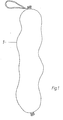
- Figure 1 shows a casing filled with sausage meat according to the invention in the view (not to scale), which was produced according to the example.
- the closed line (1) represents the outline of the filled irregular envelope.
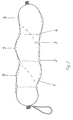
- FIG. 2 An analysis of the shape of the casing according to the invention in FIG. 2 shows that a winding around the longitudinal axis of the sausage, represented by the dashed lines (2) and (3), and a swelling and widening of the diameter, represented by the fine dashed lines (4 ) are superimposed on one another at the locations of the diameter minima and the marking of the maxima by arrows (5).
- the frequency of the swelling is 1.5 times the frequency of the winding.
- the increase or decrease in diameter is one eighth, the eccentricity of the coil is approximately 1 seventh of the diameter.
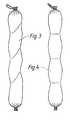
- FIG. 3 shows an envelope that was created by winding only when the mass was conveyed without pulsation, in the view.
- FIG. 4 shows the view of a casing that was created without any spiraling simply by pulsating conveyance of the mass.
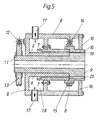
- Figure 5 shows the extruder modified according to the invention in longitudinal section.
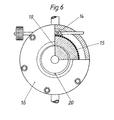
- FIG. 6 shows the device in a front view, a part being drawn in section at the height of the worm wheel drive.
- the core (6) forms with the ring part (7) a fixed nozzle which has an equally large gap of medium gap width on all sides and is firmly attached in the housing (8).
- This fixed nozzle is preceded by a second rotatable ring nozzle in such a way that the core (9), which is advantageously pierced for the passage of air to inflate the extruded tube, forms the straight continuation of the core (6).
- a rotating ring part (10) is placed in front of the ring part (7), with the proviso that its bore is offset from the center by a fraction of the gap width of the fixed nozzle part. Otherwise, this bore has the same diameter as that of the fixed nozzle ring.
- the core (9) is rotated via the extension (11) by means of the worm (12) and worm wheel (13).
- the nozzle ring (10) is also driven by means of a screw (14) and a screw ring (15).
- suitable support - not shown - of the nozzle ring (10) e.g. care is taken on the housing cover (16) that it rotates about the main axis of the extruder.
- the screws (12) and (14) are driven dependent on one another and in opposite directions.
- the collagen mass enters the annular space (18) through a plurality of tubes (17) distributed around the circumference of the housing (8) and passes the gap between the fixed nozzle parts (6) and (7) and then occurs in the gap between the rotating, eccentrically drilled ring part (10).
- the mass is slowed down somewhat on the side of the narrower nozzle gap (19) in comparison with the opposite further side (20) of the gap.
- the hose therefore bends towards the narrow side (19). Due to the constant rotation and the withdrawal in the direction of the extruder axis, a corkscrew-like spiral of the hose is formed.
Landscapes
- Engineering & Computer Science (AREA)
- Mechanical Engineering (AREA)
- Life Sciences & Earth Sciences (AREA)
- Manufacturing & Machinery (AREA)
- Food Science & Technology (AREA)
- Zoology (AREA)
- Wood Science & Technology (AREA)
- Meat, Egg Or Seafood Products (AREA)
- Prostheses (AREA)
- Processing Of Meat And Fish (AREA)
- Medicines That Contain Protein Lipid Enzymes And Other Medicines (AREA)
- Saccharide Compounds (AREA)
- Detergent Compositions (AREA)
Description
- Die Erfindung betrifft ein Verfahren zur Herstellung einer künstlichen, unregelmäßig geformten Wursthülle aus Kollagen, sowie eine Vorrichtung zur Durchführung des Verfahrens. Insbesondere betrifft die Erfindung die Herstellung einer künstlichen Wursthülle aus Kollagen, die eine korkenzieherartige Wendelung ihrer Längsachse um eine gedachte Mittelachse oder/und die bei an sich gerader Form der Hülle einen in Längsrichtung veränderlichen Durchmesser aufweist.
- Zur Verwendung als Wursthülle wurden für den tierischen Darm schon viele Substitutionsprodukte vorgeschlagen. Bekannt sind künstliche Wursthüllen aus Papier, Pergament oder Nesselgewebe, aus chemisch und mechanisch umgewandelten Naturstoffen wie Cellulose, Alginat, Sojaeiweiß oder Kollagen und aus thermoplastichen kunststoffen wie Polyvinylidenchlorid oder Polyamid.
- Im allgemeinen bestehen all diese künstlichen Wursthüllen aus geraden Schläuchen, die zur Herstellung von Würsten abgelängt werden. Es werden aber auch Sonderformen angeboten, die die Form aller möglichen tierischen Organe nachahmen, die als natüraliche Wursthüllen seit langem Verwendung finden, z.B. Kranzdärme, krause Därme, Buttdärme, Enddärme, Fettenden, Mägen, Blasen und Hammelklappen. Solche Organe, die als natürliche Wursthüllen verwendet werden, haben üblicherweise eine unregelmäßige Form, d.h. sie weichen mehr oder weniger stark von der Form eines geraden Zylinders ab. Abweichungen können, wie z.B. beim Dickdarm des Schweins, der sogenannten Schweinekrause darin bestehen, daß bei an sich gerader Form des Darms der Durchmesser über die Darmlänge variiert, d.h. Teile größeren mit Teilen kleineren Durchmessers alternieren, üblicherweise werden diese Sonderformen aus flachgelegten großkalibrigen Schläuchen durch Nähen hergestellt. Die dabei erhaltene Form stellt meistens nur einen Anklang an das Original dar.
- Von den wenigen Versuchen zur maschinellen kontinuierlichen Herstellung solcher Sonderformen ist am längsten der Kollagen-Kranzdarm bekannt, der in der Form einer endlosen Wendel extrudiert und getrocknet wird. Inzwischen werden künstliche Kranzdärme auch aus Polyamid und Polyvinylidenchlorid hergestellt. Mit Wurstbrät gefüllt, sind zumindest die künstlichen Kollagen-Kranzdärme von einem natürlichen Schweinekranzdarm kaum zu unterscheiden.
- In der DE-PS 671 490 ist eine Vorrichtung zum Herstellen von insbesondere als künstliche Wursthüllen verwendbaren schlauchförmigen Gebilden durch Pressen von aus tierischen oder pflanzlichen Ausgangsstoffen gewonnenen Massen, insbesondere tierischen Fasermassen, durch Ringdüsen beschrieben. Kern und Mantel der Ringdüse laufen am Austrittsende entgegengesetzt zueinander um. Mit dieser Vorrichtung wird erreicht, daß die beim Durchgang durch den feststehenden Düsenteil gerichteten Fasern durch die vorgesetzte Düse mit beweglichem Mantel und entgegengesetzt umlaufendem Kern in eine verschränkte Lage gegeneinander gebracht werden und der Schlauch mit den gesperrt liegenden Fasern unmittelbar aus der Düse austritt. Man erhält so eine hohe Festigkeit des austretenden Schlauches.
- Die Aufgabe der Erfindung ist gegenüber diesem Stand der Technik darin zu sehen, eine maschinell und kontinuierlich herstellbare künstliche Wursthülle aus Kollagen zu schuffen, die von der regelmäßigen geraden zylindrischen Form abweicht. Eine solche Hülle wäre wegen ihrer Gas- und Wasserdampfdurchlässigkeit und ihrer Fettdichtheit zur Herstellung von Rohwurst und geräucherter Blutwurst besonders geeignet, kann aber ebenso zur Herstellung von Brüh- und Kochwurst, z.B., Leberwurst, verwendent werden.
- Die Lösung diesen Aufgabe erfolgt durch das im kennzeichnenden Teil des Patentanspruchs 1 angegebene Verfahren und durch die im kennzeichnenden Teil des Patenanspruchs 8 angegebenen Maßnahmen zur Durchführung des Verfahrens.
- Der Abstand der Längsachse der Kollagenwursthülle von einer gedachten Mittelachse, d.h. die Wendelhöhe kann von 0 bis maximal einen Funftel ihres mittleren Durchmessers betragen, und liegt vorzugsweise bei etwa einem Sechstel und insbesondere bei einem Siebentel ihres Durchmessers. Die Steigung der Wendelung entspricht dabei dem 0,5 bis 3-fachen und vorzugsweise dem 1 bis 2-fachen des mittleren Durchmessers.
- Die Zu- bzw. Abnahme des Durchmessers kann von 0 bis maximal einem Viertel des mittleren Durchmessers betragen. Bevorzugt liegt Zu- bzw. Abnahme des Durchmessers zwischen einem Achtel und einem Viertel ihres Durchmessers. Besonders bevorzugt ist eine Zu- bzw. Abnahme von einem Sechstel des mittleren Durchmessers. Die Schwankung Durchmessers in Richtung der Längsachse der Wursthülle erfolgt bevorzugt periodisch, wobei die Periode der Durchmesserschwankung zwischen dem 0,5 und dem 3-fachen, vorzugsweise zwischen dem ein- und zweifachen mittleren Durchmesser des Kollagenschlauchs liegt.
- Besonders bevorzugt ist eine Ausführungsform bei der sich beide Merkmale, einmal die korkenzieherartige Wendelung der Längsachse um eine gedachte Mittelachse und zum Anderen der in Längsrichtung wechselnde Durchmesser mehr oder weniger stark vorhanden sind.
- Es ist nicht erforderlich und auch nicht erwünscht, daß sich die beiden Merkmale der korkenzieherartigen Wendelung und der Durchmesserschwankung in Richtung der Längsachse mit der gleichen Periode wiederholen. Vielmehr ist eine Wursthülle bevorzugt, die zwar beide Merkmale aufweist, jedoch mit unterschiedlicher Periode. Man erhält hierdurch eine Wursthülle mit einem mehr zufällig scheinenden unregelmäßigen Muster von Krümmungen und Durchmesserschwankungen, die einer echten Schweinekrause im Aussehen sehr nahekommen.
- Der mittlere Durchmesser der erfindungsgemäßen Wursthülle kann innerhalb gewisser Bereiche schwanken und beträgt z.B. 36 bis 75 mm, vorzugsweise 40 bis 65 mm und insbesondere 47 bis 55 mm. Die mittlere Wandstärke der Hülle beträgt 40 bis 100 um, vorzugsweise 55 bis 85 pm und insbesondere 60 bis 75 pm.
- Die Erfindung betrifft eine Verfahren zur Herstellung einer künstlichen, unregelmäßig geformten Wursthülle aus Kollagen durch Extrusion einer knet- und formbaren Kollagenfasermassse aus chemisch und physikalisch aufgeschlossenenem Rinderhautspalt, mittels eines Extruders mit einer Ringdüse, die aus einem inneren Düsenteil mit feststehen dem Kern und Mantel und einem diesem am Austrittsende vorgesetzten äußeren Düstenteil mit entgegengeletzt zu-einander umlaufenden Kern und Mantel besteht, dadurch gekennzeichnet, daß zur Erzielung einer korkenzieherartigen Wendelung der Längsachse um eine gedachte Mittelachse die Bohrung des äusseron Düsenteils bei gleichem Durchmesser wie die Bohrung des feststehenden inneren Düsenteils gegenüber der Mitte der Bohrung des feststehenden Düsenteils versetzt wird und daß zur Erzielung unterschiedlicher Durchmesser in Längsrichtung ein pulsierender, d.h. zeitlich unterschiedlicher Massestrom extrudiert wird. Bei starkem Masseaustritt entsteht ein weiterer und bei schwachem Masseaustritt ein engerer Schlauchquerschnitt.
- Die erfindungsgemäß zur Extrusion verwendete Masse hat typisch einen pH-Wert von 2,5 bis 3,2, vorzugsweise von 2,7 bis 2,9 und einen Trockenstoffgehalt von 5,5 bis 15%, vorzugsweise 8 bis 11%. Die Formmasse kann gegebenenfalls Hilfsstoffe wie z.B. Cellulosepulver zur Verbesserung der Reissfestigkeit, Glycerin, Sorbit und/oder Propylenglykol als Weichmacher und Formaldehyd, Glyoxal und/oder Glutaraldehyd als Härtungsmittel enthalten.
- Die Erfindung betrifft ferner eine Vorrichtung zur Durchführung des Verfahrens in Form eines Extruders mit einer Ringdüse, die aus einem inneren Düsenteil mit feststehendem Kern und Mantel und einem diesem am Austrittsende vorgesetzten äusseren Düsenteil mit entgegengesetzt zueinander umlaufendem Kern und Mantel besteht, die dadurch gekennzeichnet, ist, daß die Bohrung des äusseren Düsenteils bei gleichem Durchmesser wie die Bohrung des feststehenden inneren Düsenteils gegenüber der Mitte der Bohrung des feststehenden Düsenteils versetzt ist. Bevorzugt ist die Bohrung des äusseren Düsenteils um einen Bruchteil des Düsenspalts des inneren Düsenteils versetzt. Die gewünschte Korkenzieherform wird erhalten, indem der Düsenmantel (Hülse) mit der gewünschten, auf die Extrusionsgeschwindigkeit abgestimmten Frequenz umläuft. Zum Zweck des Verstreichens der Masse (Faserorientierung quer zur Strömung) rotiert der Düsenkern mit wesentlich höherer Geschwindigkeit (z.B. der 2 bis 4-fachen Geschwindigkeit) vorzugsweise in Gegenrichtung.
- Zweckmäßig werden die Antriebe für Hülse und Kern entkoppelt und vorzugsweise sind für beide völlig getrennt Antriebe Verstreichung der Masse und andererseits die gewünschte Wendelung jeweils mit der optimalen Drehzahl erzielen zu können.
- Um eine dem natürlichen Vorbild möglichst angenähertes Aussehen zu erhalten, verlaufen die periodischen Schwankungen des Kalibers und der Steigung der Wendelung nicht synchron, sondern werden mehr zufällig scheinend einander überlagert. Hierzu ist vorgesehen, die Geschwindigkeitsregelungen für die Masseförderpumpe und für die Rotation des exzentrischen Düsenrings, vorzugsweise mittels eines Mikroprozessors mit Zufalls-generator innerhalb zweckmäßiger Grenzen zu variieren.
- Mit einer einzylinderischen Kolbenpumpe mit 24 mm Bohrung und 14,5 mm Hub wurde durch 165 Hübe/min Masse mit 8% Kollagen-Trockenstoff einem doppeltdrehenden Extruder zugeführt. Dieser hatte einen Kern von 39 mm Durchmesser und in der Hülse eine Bohrung von 40,7 mm Durchmesser. Die Exzentrizität der Bohrung betrug 0,35 mm. Der Kern rotierte mit 190 U/min und die Hülse gegenläufig mit 110 U/min, wobei Kern undf Hülse um eine gemeinsame Achse rotieren.
- Der extrudierte Schlauch wurde durch die zentrale Bohrung des Extruders mit so viel Luft aufgeblasen, daß ein mittlerer Durchmesser von 40 mm entstand. Die Hülle wurde mit ca. 10 m/ min vom Mundstück abgezogen und auf übliche Weise getrocknet, hitzegehärtet und weichgemacht.
- Nach dem Füllen mit Rohwurstbrät zeigte die Wurst eine unregelmäßige Form gemäß Fig. 1.
- Die Erfindung wird anhand folgender Zeichnungen näher erläutert:
- Figur 1 zeigt eine mit Wurstbrät gefüllte erfindungsgemäße Hülle in der Ansicht (nicht maßstäblich), die nach dem Beispiel hergestellt wurde. Die geschlossene Linie (1) stellt den Umriß der gefüllten unregelmäßigen Hülle dar.
- Eine Analyse der Form der erfindungsgemäßen Hülle in Figur 2 zeigt, daß eine Wendelung um die Längsachse der Wurst, dargestellt durch die gestrichelten Linien (2) und (3) und eine An- und Abschwellung des Durchmessers, dargestellt durch die fein gestrichelten Linien (4) an den Stellen der Durchmesserminima und die Markierung der Maxima durch Pfeile (5), einander überlagert sind. Die Frequenz der Anschwellung beträgt das 1,5-fache der Frequenz der Wendelung. Die Zu- bzw. Abnahme des Durchmessers beträgt je eine Achtel, die Exzentrizität der Wendelung ca. 1 Siebentel des Durchmessers.
- Figur 3 zeigt eine Hülle, die bei pulsatioonsfreier Förderung der Masse allein durch Wendelung entstanden ist, in der Ansicht.
- Figur 4 zeigt die Ansicht einer Hülle, die ohne jede Wendelung allein durch pulsierende Förderung der Masse entstanden ist.
- Figur 5 zeigt den erfindungsgemäß modifizierten Extruder im Längsschnitt.
- Figur 6 stellt die Vorrichtung in Vorderansicht dar, wobei ein Teil in Höhe des Schneckenradantriebes geschnitten gezeichnet ist.
- Der Kern (6) bildet mit dem Ringteil (7) eine feststehende Düse, die einen allseits gleich starken Spalt von mittlerer Spaltweite aufweist und fest im Gehäuse (8) angebracht ist. Dieser feststehenden Düse ist eine zweite drehbare Ringdüse vorgesetzt und zwar derart, daß der Kern (9), der vorteilhaft für das Durchleiten von Luft zum Aufblähen des extrudierten Schlauches durchbohrt ist, die geradlinige Fortsetztung des Kerns (6) bildet. Auf gleiche Art ist auch dem Ringteil (7) ein drehbarer Ringteil (10) vorgesetzt mit der Maßgabe, daß seine Bohrung um einen Bruchteil der Spaltweite des festehenden Düsenteils aus der Mitte versetzt angeordnet ist. Im übrigen hat diese Bohrung den gleichen Durchmesser wie die des feststehenden Düsenrings.
- Die Drehung des Kerns (9) erfolgt über die Verlängerung (11) mittels Schnecke (12) und Schneckenrad (13). Ebenso erfolgt der Antrieb des Düsenringes (10) über Schnecke (14) und Schneckenkranz (15). Durch eine geeignete Abstützung - nicht dargestellt - des Düsenringes (10), z.B. an dem Gehäusedeckel (16) wird dafür Sorge getragen, daß er um die Hauptachse des Extruders rotiert. Die Schnecken (12) und (14) werden anabhängig voneinander und gegenläufig angetrieben.
- Die Kollagenmasse tritt durch mehrere Rohre (17), die am Umfang des Gehäuses (8) verteilt sind, in den Ringraum (18) eine und passiert den Spalt zwischen den feststehenden Düsenteilen (6) und (7) und tritt dann in den Spalt zwischen dem rotierenden, exzentrisch gebohrten Ringteil (10) ein. Die Masse wird hier auf der Seite des engeren Düsenspaltes (19) etwas abgebremst im Vergleich mit der gegenüber liegenden weiteren Seite (20) des Spaltes. Daher krümmt sich der Schlauch nach der engeren Seite (19). Durch die dauernde Rotation und den Abzug in Richtung der Extruderachse bildet sich eine korkenzieherartige Wendelung des Schlauches aus.
Claims (11)
Priority Applications (1)
| Application Number | Priority Date | Filing Date | Title |
|---|---|---|---|
| AT85114571T ATE53956T1 (de) | 1984-11-23 | 1985-11-16 | Verfahren zur herstellung einer kuenstlichen, unregelmaessig geformten wursthuelle aus kollagen und vorrichtung zur durchfuehrung des verfahrens. |
Applications Claiming Priority (2)
| Application Number | Priority Date | Filing Date | Title |
|---|---|---|---|
| DE19843442712 DE3442712A1 (de) | 1984-11-23 | 1984-11-23 | Kuenstliche, unregelmaessig geformte wursthuelle aus kollagen, verfahren zu ihrer herstellung und vorrichtung zur durchfuehrung des verfahrens |
| DE3442712 | 1984-11-23 |
Publications (2)
| Publication Number | Publication Date |
|---|---|
| EP0183153A1 EP0183153A1 (de) | 1986-06-04 |
| EP0183153B1 true EP0183153B1 (de) | 1990-06-20 |
Family
ID=6250956
Family Applications (1)
| Application Number | Title | Priority Date | Filing Date |
|---|---|---|---|
| EP85114571A Expired - Lifetime EP0183153B1 (de) | 1984-11-23 | 1985-11-16 | Verfahren zur Herstellung einer künstlichen, unregelmässig geformten Wursthülle aus Kollagen und Vorrichtung zur Durchführung des Verfahrens |
Country Status (5)
| Country | Link |
|---|---|
| EP (1) | EP0183153B1 (de) |
| AT (1) | ATE53956T1 (de) |
| DE (2) | DE3442712A1 (de) |
| DK (1) | DK535885A (de) |
| FI (1) | FI84239C (de) |
Families Citing this family (8)
| Publication number | Priority date | Publication date | Assignee | Title |
|---|---|---|---|---|
| EP0720816B1 (de) * | 1995-01-04 | 1999-10-27 | Unilever Plc | Verfahren zur Herstellung eines Nahrungsprodukt |
| DE19710402C2 (de) * | 1997-03-13 | 2001-09-20 | Kalle Nalo Gmbh | Verfahren und Vorrichtung zur Herstellung von Schläuchen bzw. Hüllen in gekrümmter Form |
| US6103151A (en) * | 1998-03-05 | 2000-08-15 | Standard Starch, Llc | Extrusion die for biodegradable material with flow control device |
| US6183672B1 (en) | 1998-03-05 | 2001-02-06 | Standard Starch, Llc | Extrusion die for biodegradable material with die orifice modifying device and flow control device |
| AU3068799A (en) | 1998-03-05 | 1999-09-20 | Standard Starch Llc | Extrusion die for biodegradable material with die orifice modifying device and flow control device |
| US6599451B2 (en) | 2001-02-13 | 2003-07-29 | Hans G. Franke | Rotating extrusion die with spray nozzle |
| NL2011382C2 (en) * | 2013-09-04 | 2015-03-09 | Marel Townsend Further Proc Bv | Method of extruding sausage sleeves of at least partial collagen, extrusion head and extruded collagen sleeves. |
| ES2954775T3 (es) * | 2020-02-20 | 2023-11-24 | Handtmann Albert Maschf | Dispositivo y procedimiento para la fabricación de productos coextrudidos con grosor variable del material de envoltura |
Family Cites Families (21)
| Publication number | Priority date | Publication date | Assignee | Title |
|---|---|---|---|---|
| DE7038729U (de) * | 1971-01-21 | E I Du Pont De Nemours And Co | Vorrichtung zum Estrudieren von Kunst stoff Schlauchfolie | |
| DD34047A (de) * | ||||
| DE671490C (de) * | 1933-11-29 | 1939-02-08 | Becker & Co Naturinwerk | Vorrichtung zur Herstellung kuenstlicher Wursthuellen |
| FR812048A (fr) * | 1935-05-23 | 1937-04-28 | Naturin G M B H | Procédé pour fabriquer en continu des boyaux en couronne à partir de compositions fibreuses plastiques d'origine animale |
| DE754021C (de) * | 1941-02-19 | 1953-07-06 | Hugo Scholz Fa | Verfahren und Vorrichtung zum Herstellen von kegelstumpffoermigen Wursthuellen |
| GB618536A (en) * | 1946-07-30 | 1949-02-23 | Bx Plastics Ltd | Improvements in or relating to extrusion apparatus |
| DE962580C (de) * | 1952-06-27 | 1957-04-25 | Becker & Co | Ringduese zum Herstellen kuenstlicher Schlaeuche aus Fasermasse |
| LU33401A1 (de) * | 1954-04-14 | 1900-01-01 | ||
| DE1771887U (de) * | 1958-03-28 | 1958-08-07 | Paul Dr Nadler | Kunstdarm. |
| US3070840A (en) * | 1960-03-25 | 1963-01-01 | Plastic Textile Access Ltd | Extrusion of plastic sheeting or netting |
| GB960543A (en) * | 1961-10-17 | 1964-06-10 | Ici Australia Ltd | Improved method and apparatus for extruding thermoplastic material |
| US3221371A (en) * | 1963-03-25 | 1965-12-07 | Stevens Alexander Michael | Extruding dies |
| NL6405195A (de) * | 1963-06-17 | 1964-12-18 | ||
| US3387331A (en) * | 1965-07-27 | 1968-06-11 | Rexall Drug Chemical | Apparatus for extruding seamless plastic tubing |
| DE1782717A1 (de) * | 1966-03-26 | 1972-01-27 | Becker & Co Naturinwerk | Hautfaserdarm sowie Vorrichtung zu dessen Herstellung |
| DE1729374A1 (de) * | 1967-01-25 | 1971-04-08 | Ver Deutsche Metallwerke Ag | Verfahren und Vorrichtung zur Herstellung von gewendelten Strangpressprofilen aus Kunststoff |
| CH461784A (de) * | 1968-01-05 | 1968-08-31 | Weyermann Viktor | Verfahren zur Herstellung eines kontinuierlich geblasenen Kunststoff-Folienschlauches und Düsenkopf zur Ausübung des Verfahrens |
| US3613162A (en) * | 1970-03-10 | 1971-10-19 | Standard Oil Co Ohio | Apparatus for the formation of helical plastic pipe |
| GB1367880A (en) * | 1970-09-11 | 1974-09-25 | Btr Industries Ltd | Reinforced tubes and to a method of and apparatus for making them |
| US4076481A (en) * | 1975-01-15 | 1978-02-28 | Sussex Plastics Engineering, Inc. | Annular extrusion die |
| US4212620A (en) * | 1978-07-03 | 1980-07-15 | The Dow Chemical Company | Tube extrusion die |
-
1984
- 1984-11-23 DE DE19843442712 patent/DE3442712A1/de not_active Withdrawn
-
1985
- 1985-11-16 DE DE8585114571T patent/DE3578319D1/de not_active Expired - Fee Related
- 1985-11-16 EP EP85114571A patent/EP0183153B1/de not_active Expired - Lifetime
- 1985-11-16 AT AT85114571T patent/ATE53956T1/de not_active IP Right Cessation
- 1985-11-18 FI FI854527A patent/FI84239C/fi not_active IP Right Cessation
- 1985-11-20 DK DK535885A patent/DK535885A/da not_active Application Discontinuation
Also Published As
| Publication number | Publication date |
|---|---|
| FI84239B (fi) | 1991-07-31 |
| DK535885D0 (da) | 1985-11-20 |
| DE3442712A1 (de) | 1986-05-28 |
| DK535885A (da) | 1986-05-24 |
| FI854527A0 (fi) | 1985-11-18 |
| EP0183153A1 (de) | 1986-06-04 |
| FI854527L (fi) | 1986-05-24 |
| DE3578319D1 (de) | 1990-07-26 |
| ATE53956T1 (de) | 1990-07-15 |
| FI84239C (fi) | 1991-11-11 |
Similar Documents
| Publication | Publication Date | Title |
|---|---|---|
| DE2600716C2 (de) | ||
| EP1738649B1 (de) | Vorrichtung und Verfahren zum Herstellen eines Wurststrangs mit beliebiger geometrischer Aussenkontur | |
| DE69427774T2 (de) | Kontinuierliches verfahren zur behandlung von nahrungsmitteln | |
| DE1532028B1 (de) | Verfahren und Vorrichtung zur Herstellung von gerafften Wursthuellen | |
| DE69712029T2 (de) | Extrusionsvorrichtung | |
| EP0183153A1 (de) | Verfahren zur Herstellung einer künstlichen, unregelmässig geformten Wursthülle aus Kollagen und Vorrichtung zur Durchführung des Verfahrens | |
| DE659706C (de) | Wursthuelle aus faserigen Pressmassen, insbesondere aus zerkleinerten Hautabfaellen | |
| DE2939318C2 (de) | Vorrichtung zum Raffen von schlauchförmigen Lebensmittelhüllen | |
| DE2944623C2 (de) | Vorrichtung zum axialen Raffen von synthetischem Schlauchmaterial zur Weiterverarbeitung insbesondere auf Wurstfüllautomaten | |
| DE69009021T2 (de) | Füllrohr mit Feder zum Kalibrieren. | |
| DE650526C (de) | Verfahren zur ununterbrochenen Herstellung von kuenstlichen Wursthuellen | |
| EP0250642B1 (de) | Verfahren zur Herstellung eines Dichtringes | |
| DE1954103A1 (de) | Verfahren und Vorrichtung zum Raffen von endlosen stranggepressten Schlaeuchen | |
| DE69930550T2 (de) | Umhüllung für fleischprodukte mit maximal ausziehbarem durchmesser | |
| DE3909661C2 (de) | ||
| EP0031892B1 (de) | Verfahren und Vorrichtung zum axialen Raffen von dünnwandigem aufgeblasenem Schlauchmaterial, insbesondere für die Wurstherstellung | |
| DE102020123206C5 (de) | Verfahren sowie Vorrichtung zum Abdrehen von schlauchförmigen Hüllen und betreffendes System zum Befüllen schlauchförmiger Hüllen | |
| DE2828337C2 (de) | Vorrichtung und Verfahren zum Stopfen von Nahrungsmittelhüllen | |
| DE1015341B (de) | Duese zur Herstellung von kuenstlichen duennwandigen Schlaeuchen, insbesondere Wursthuellen | |
| DE670552C (de) | Verfahren und Vorrichtung zur Herstellung von schraubenfoermigen kuenstlichen Wursthuellen | |
| EP0267473B1 (de) | Verfahren und Vorrichtung zum Raffen von schlauchförmigen Hüllen, insbesondere Wursthüllen | |
| WO1998040201A1 (de) | Verfahren und vorrichtung zur herstellung gekrümmter schläuche | |
| DE848313C (de) | Verfahren und Vorrichtung zur Herstellung von kuenstlichen Hautgebilden, wie Wursthuellen | |
| DE2236600C2 (de) | Geraffte Wursthülle | |
| DEF0014455MA (de) |
Legal Events
| Date | Code | Title | Description |
|---|---|---|---|
| PUAI | Public reference made under article 153(3) epc to a published international application that has entered the european phase |
Free format text: ORIGINAL CODE: 0009012 |
|
| AK | Designated contracting states |
Kind code of ref document: A1 Designated state(s): AT CH DE FR IT LI |
|
| ITCL | It: translation for ep claims filed |
Representative=s name: BARZANO' E ZANARDO MILANO S.P.A. |
|
| EL | Fr: translation of claims filed | ||
| 17P | Request for examination filed |
Effective date: 19860906 |
|
| 17Q | First examination report despatched |
Effective date: 19880209 |
|
| GRAA | (expected) grant |
Free format text: ORIGINAL CODE: 0009210 |
|
| AK | Designated contracting states |
Kind code of ref document: B1 Designated state(s): AT CH DE FR IT LI |
|
| REF | Corresponds to: |
Ref document number: 53956 Country of ref document: AT Date of ref document: 19900715 Kind code of ref document: T |
|
| ITF | It: translation for a ep patent filed | ||
| ET | Fr: translation filed | ||
| REF | Corresponds to: |
Ref document number: 3578319 Country of ref document: DE Date of ref document: 19900726 |
|
| PLBE | No opposition filed within time limit |
Free format text: ORIGINAL CODE: 0009261 |
|
| STAA | Information on the status of an ep patent application or granted ep patent |
Free format text: STATUS: NO OPPOSITION FILED WITHIN TIME LIMIT |
|
| 26N | No opposition filed | ||
| ITTA | It: last paid annual fee | ||
| PGFP | Annual fee paid to national office [announced via postgrant information from national office to epo] |
Ref country code: FR Payment date: 20011119 Year of fee payment: 17 |
|
| PGFP | Annual fee paid to national office [announced via postgrant information from national office to epo] |
Ref country code: AT Payment date: 20011123 Year of fee payment: 17 |
|
| PGFP | Annual fee paid to national office [announced via postgrant information from national office to epo] |
Ref country code: CH Payment date: 20011126 Year of fee payment: 17 |
|
| PGFP | Annual fee paid to national office [announced via postgrant information from national office to epo] |
Ref country code: DE Payment date: 20011127 Year of fee payment: 17 |
|
| PG25 | Lapsed in a contracting state [announced via postgrant information from national office to epo] |
Ref country code: AT Free format text: LAPSE BECAUSE OF NON-PAYMENT OF DUE FEES Effective date: 20021116 |
|
| PG25 | Lapsed in a contracting state [announced via postgrant information from national office to epo] |
Ref country code: LI Free format text: LAPSE BECAUSE OF NON-PAYMENT OF DUE FEES Effective date: 20021130 Ref country code: CH Free format text: LAPSE BECAUSE OF NON-PAYMENT OF DUE FEES Effective date: 20021130 |
|
| PG25 | Lapsed in a contracting state [announced via postgrant information from national office to epo] |
Ref country code: DE Free format text: LAPSE BECAUSE OF NON-PAYMENT OF DUE FEES Effective date: 20030603 |
|
| REG | Reference to a national code |
Ref country code: CH Ref legal event code: PL |
|
| PG25 | Lapsed in a contracting state [announced via postgrant information from national office to epo] |
Ref country code: FR Free format text: LAPSE BECAUSE OF NON-PAYMENT OF DUE FEES Effective date: 20030731 |
|
| REG | Reference to a national code |
Ref country code: FR Ref legal event code: ST |