EP0173832A2 - Sulfate und Sulfonderivate der Beta - Naphtholpolyglykoläther und saure Zinkbäder enthaltend diese Verbindungen - Google Patents
Sulfate und Sulfonderivate der Beta - Naphtholpolyglykoläther und saure Zinkbäder enthaltend diese Verbindungen Download PDFInfo
- Publication number
- EP0173832A2 EP0173832A2 EP85108799A EP85108799A EP0173832A2 EP 0173832 A2 EP0173832 A2 EP 0173832A2 EP 85108799 A EP85108799 A EP 85108799A EP 85108799 A EP85108799 A EP 85108799A EP 0173832 A2 EP0173832 A2 EP 0173832A2
- Authority
- EP
- European Patent Office
- Prior art keywords
- ethylene oxide
- oxide groups
- polyglycol ether
- sulfates
- optionally substituted
- Prior art date
- Legal status (The legal status is an assumption and is not a legal conclusion. Google has not performed a legal analysis and makes no representation as to the accuracy of the status listed.)
- Granted
Links
Classifications
-
- C—CHEMISTRY; METALLURGY
- C07—ORGANIC CHEMISTRY
- C07C—ACYCLIC OR CARBOCYCLIC COMPOUNDS
- C07C305/00—Esters of sulfuric acids
-
- C—CHEMISTRY; METALLURGY
- C07—ORGANIC CHEMISTRY
- C07C—ACYCLIC OR CARBOCYCLIC COMPOUNDS
- C07C309/00—Sulfonic acids; Halides, esters, or anhydrides thereof
- C07C309/01—Sulfonic acids
- C07C309/28—Sulfonic acids having sulfo groups bound to carbon atoms of six-membered aromatic rings of a carbon skeleton
- C07C309/57—Sulfonic acids having sulfo groups bound to carbon atoms of six-membered aromatic rings of a carbon skeleton containing carboxyl groups bound to the carbon skeleton
- C07C309/58—Carboxylic acid groups or esters thereof
-
- C—CHEMISTRY; METALLURGY
- C25—ELECTROLYTIC OR ELECTROPHORETIC PROCESSES; APPARATUS THEREFOR
- C25D—PROCESSES FOR THE ELECTROLYTIC OR ELECTROPHORETIC PRODUCTION OF COATINGS; ELECTROFORMING; APPARATUS THEREFOR
- C25D3/00—Electroplating: Baths therefor
- C25D3/02—Electroplating: Baths therefor from solutions
- C25D3/22—Electroplating: Baths therefor from solutions of zinc
Definitions
- the invention relates to new sulfates and sulfo derivatives of ⁇ -naphthol polyglycol ether according to the preamble of claim 1 and acidic zinc baths containing these compounds according to the preamble of claim 7.
- the object of the present invention is to create new surfactants and acidic zinc baths containing these products with a high cloud point, which enable perfect metal deposition without foaming.
- This object is achieved according to the invention by the provision of sulfates and sulfo derivatives of ⁇ -naphthol polyglycol ether and an acidic zinc bath which contains at least one such compound.
- these compounds are distinguished by an extraordinarily low level of foaming and, at the same time, an excellent interface-like action, in which they are superior to known surfactants of the same action.
- the compounds according to the invention are particularly suitable as additives to acidic zinc baths which, in addition to the usual constituents, contain highly effective brighteners.
- Aromatic ketones and aromatic aldehydes such as, for example, benzalacetone and o-chlorobenzaldehyde, which, because of their low solubility in such baths, are generally used in the presence of certain surface-active substances, may be mentioned as such brighteners.
- Acidic zinc baths which contain the compounds according to the invention, do not develop a disturbing foam layer even when blowing in air, which makes them particularly suitable for use in modern high-performance electrolytes.
- ß-naphthol polyglycol ether sulfosuccinate with 15 ethylene oxide groups and ß-naphthol polyglycol ether sulfosuccinate with 24 ethylene oxide groups may be mentioned as compounds with outstanding activity.
- the compounds of the invention are used in amounts of about 0.5 to 20 g / liter, preferably 4 to 10 g / liter.
- zinc chloride other zinc salts can also be used, at least in part, such as zinc sulfate, zinc acetate, zinc fluoroborate and / or zinc sulfamate.
- Potassium chloride can be partially or completely replaced by ammonium chloride, ammonium sulfate or other conductive salts such as sodium chloride, sodium sulfate or the like.
- the bath can contain aliphatic and / or aromatic carboxylic acids or their salts, such as, for example, benzoic acid, salicylic acid or naphthalic acid.
- Boric acid or other buffer mixtures and non-foaming wetting agents can be present as further additives.
- Electrolyte movement preferably by blowing air and / or cathode rod movement.
- the compounds according to the invention are prepared in a manner known per se a) by sulfating the corresponding ⁇ -naphthol polyglycol ether or b) by esterifying the corresponding ⁇ -naphthol polyglycol ether, for example with maleic acid or maleic anhydride and subsequent reaction with bisulfite or metabisulfite.
- the following examples serve to explain the possible uses of the compounds according to the invention.
- the electrolyte solution listed was used, to which the additives listed in the examples had been added.
- Cloud point approx. 80 ° C High-gloss veiled, ductile zinc deposit with burns on at high current density
Landscapes
- Chemical & Material Sciences (AREA)
- Organic Chemistry (AREA)
- Metallurgy (AREA)
- Chemical Kinetics & Catalysis (AREA)
- Electrochemistry (AREA)
- Materials Engineering (AREA)
- Engineering & Computer Science (AREA)
- Electroplating And Plating Baths Therefor (AREA)
- Organic Low-Molecular-Weight Compounds And Preparation Thereof (AREA)
- Electroplating Methods And Accessories (AREA)
- Hybrid Cells (AREA)
- Catalysts (AREA)
- Polyurethanes Or Polyureas (AREA)
Abstract
Description
- Die Erfindung betrifft neue Sulfate und Sulfoderivate der ß-Naphtholpolyglykoläther gemäß Oberbegriff des Anspruchs 1 und saure Zinkbäder enthaltend diese Verbindungen gemäß Oberbegriff des Anspruchs 7.
- Die Verwendung von sulfonierten und/oder sulfatierten Alkylphenolethoxylaten in sauren galvanischen Zinkbädern ist bereits bekannt (DE - OS 32 48 503). Derartige Bäder zeigen den Nachteil, beim Einblasen von Luft eine störende Schaumschicht zu entwickeln, wodurch eine einwandfreie Metallabscheidung verhindert wird.
- Es ist weiterhin bekannt, polyoxyalkylierte Naphthole neben anionischen Sulfonsäurekondensaten und Sulfonsäuren sowie nichtionogenen Sulfonsäurekondensaten in sauren Zinkbädern zu verwenden (US - PS 4.075.066). Ein Nachteil dieser Bäder ist es, daß im Laufe der Durcharbeit der Trübungspunkt sinkt und durch Überdosierung bestimmter Netzmittel angehoben werden muß.
- Aufgabe der vorliegenden Erfindung ist die Schaffung neuer Tenside und diese Produkte enthaltende saure Zinkbäder mit hohem Trübungspunkt, welche eine einwandfreie Metallabscheidung ohne Schaumentwicklung ermöglichen.
- Diese Aufgabe wird erfindungsgemäß durch die Bereitstellung von Sulfaten und Sulfoderivaten der ß-Naphtholpolyglykoläther und eines sauren Zinkbades, das mindestens eine solche Verbindung enthält, gelöst.
- Diese Sulfate und Sulfoderivate der ß-Naphtholpolyglykoläther besitzen die allgemeine Formel

- X eine gegebenenfalls substituierte divalente Cl-C6-Alkylengruppe oder eine gegebenenfalls substituierte divalente Phenylengruppe,
- M Wasserstoff, eine salzbildende Gruppe, vorzugsweise ein Alkalimetallatom, ein entsprechendes Äquivalent eines zweiwertigen Metalls oder ein Ammoniumion,
- n eine ganze Zahl von 6 bis 60 und
- m 0 oder 1 bedeuten.
- Diese Verbindungen zeichnen sich überraschenderweise durch eine außerordentlich geringe Schaumentwicklung bei gleichzeitig hervorragender grenzflächenartiger Wirkung aus, worin sie bekannten Tensiden gleicher Wirkungsrichtung überlegen sind.
- Die erfindungsgemäßen Verbindungen eignen sich insbesondere als Zusätze zu sauren Zinkbädern, die außer den üblichen Bestandteilen hochwirksame Glanzbildner enthalten.
- Als solche Glanzbildner seien insbesondere aromatische Ketone und aromatische Aldehyde, wie zum Beispiel Benzalaceton und o-Chlorbenzaldehyd, genannt, die aufgrund ihrer geringen Löslichkeit in derartigen Bädern in der Regel in Gegenwart von gewissen oberflächenaktiven Stoffen eingesetzt werden.
- Bekannte Stoffe dieser Art neigen jedoch zur Schaumbildung oder zeigen den Nachteil, in sauren Zinkbädern unbefriedigend zu wirken, was den Trübungspunkt derartiger Bäder stark herabsetzt.
- Die erfindungsgemäßen Verbindungen überwinden die genannten Nachteile des Standes der Technik. Saure Zinkbäder, welche die erfindungsgemäßen Verbindungen enthalten, entwickeln auch beim Einblasen von Luft keine störende Schaumschicht, was sie für den Einsatz in modernen Hochleistungselektrolyten besonders geeignet macht. Als weitere Vorteile sind herauszustellen der stabile und hohe Trübungspunkt der erfindungsgemäßen Bäder sowie die Qualität der hieraus abgeschiedenen Metallüberzüge, die sich durch schleierfreien Glanz auszeichnen.
- Als Verbindungen mit herausragender Wirkung seien insbesondere ß-Naphtholpolyglykoläthersulfosuccinat mit 15 Äthylenoxydgruppen und ß-Naphtholpolyglykoläthersulfosuccinat mit 24 Äthylenoxydgruppen genannt.
- Die erfindungsgemäßen Verbindungen werden in Mengen von etwa 0,5 bis 20 g / Liter, vorzugsweise 4 bis 10 g / Liter, verwendet.
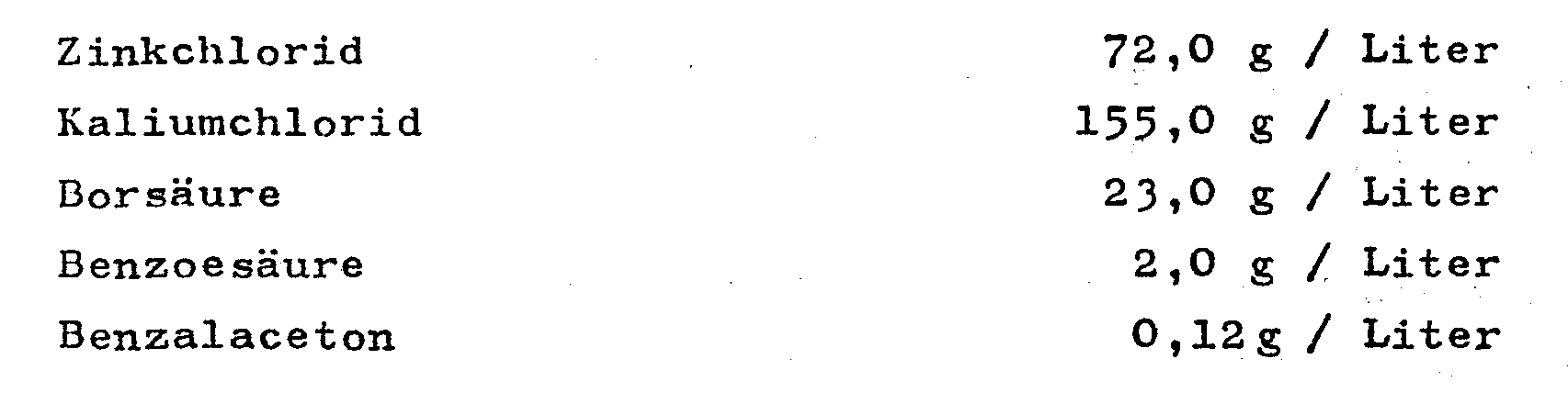
- Als Badlösung wird im allgemeinen eine wässrige Lösung von Zinkchlorid und Kaliumchlorid folgender Konzentration benutzt:
- Zinkchlorid (ZnCl2) 30 - 120 g / Liter
- Kaliumchlorid (KCl) 60 - 200 g / Liter
- Statt Zinkchlorid können zumindest teilweise auch andere Zinksalze benutzt werden, wie zum Beispiel Zinksulfat, Zinkacetat, Zinkfluoroborat und/oder Zinksulfamat. Kaliumchlorid kann teilweise oder ganz durch Ammoniumchlorid, Ammoniumsulfat oder andere Leitsalze, wie Natriumchlorid, Natriumsulfat oder ähnliche ersetzt werden. Schließlich kann das Bad aliphatische und/oder aromatische Carbonsäuren beziehungsweise deren Salze, wie zum Beispiel Benzoesäure, Salicylsäure oder Naphthalsäure, enthalten.
- Als weitere Zusatzstoffe können Borsäure oder andere Puffergemische sowie nichtschäumende Netzmittel enthalten sein.
- Die Arbeitsbedingungen sind wie folgt:
- pH - Wert : 3,0 - 6,0 vorzugsweise 4,5 - 5,5
- Temperatur : 15 - 40°C vorzugsweise 20 - 30°C
- Stromdichte : 0,1 - 10,0 A/dm (kathodisch)
- Elektrolytbewegung vorzugsweise durch Lufteinblasen und/oder Kathodenstangenbewegung.
- Die Herstellung der erfindungsgemäßen Verbindungen erfolgt in an sich bekannter Weise a) durch Sulfatierung der entsprechenden ß-Naphtholpolyglykoläther oder b) durch Veresterung der entsprechenden ß-Naphtholpolyglykoläther, zum Beispiel mit Maleinsäure oder Maleinsäureanhydrid und nachfolgende Umsetzung mit Bisulfit beziehungsweise Metabisulfit. Die folgenden Beispiele dienen zur Erläuterung der Anwendungsmöglichkeiten der erfindungsgemäßen Verbindungen.
- Die Ausführung der Beispiele erfolgte in einer Hullzelle unter den angegebenen Bedingungen.
- Verwendet wurde die jeweils aufgeführte Elektrolytlösung, der die in den Beispielen angeführten Zusätze zugelöst waren.
-
- ß-Naphtholpolyglykoläther- 8,0 g / Liter sulfosuccinat mit 15
- Athylenoxydgruppen
- US - PS 4.075.066)
- ß-Naphtholpolyglykoläther 8,0 g / Liter
- mit 15 Äthylenoxydgruppen
- DE - OS 3248503)
- Sulfatierter Nonylphenolpoly- 8,0 g / Liter glykoläther
- Zellstrom 2 A
- Temperatur 22°C
- Lufteinblasen
- Dauer : 10 Minuten
- Die verzinkten Eisenbleche wurden anschließend zur Hälfte blauchromatiert
- Hochglänzender, duktiler Zinkniederschlag
- Trübungspunkt : 26,5°C Hochglänzender, duktiler Zinkniederschlag mit Anbrennungen bei hoher Stromdichte
- Trübungspunkt : ca. 80°C Hochglänzender verschleierter, duktiler Zinkniederschlag mit Anbrennungen bei hoher Stromdichte
-

- ß - Naphthopolyglykoläthersulfat 8,0 g / Liter mit 24 Äthylenoxydgruppen
- b) mit bekanntem Zusatz (gemäß
- Nonylphenolpolyglykoläther mit 4,0 g / Liter 14 Athylenoxydgruppen
- Sulfatierter Nonylphenolpolygly- 4,0 g / Liter koläther
- Zellstrom 2 A
- Temperatur 22°C
- Lufteinblasen
- Dauer : 10 Minuten
- Die verzinkten Eisenbleche wurden anschließend zur Hälfte blauchromatiert
- Trübungspunkt : 75°C
- Hochglänzender, duktiler Zinkniederschlag
- Trübungspunkt : ca. 71°C
- Hochglänzender,verschleierter, duktiler Zinkniederschlag mit Dendritenbildung im hohen Stromdichtebereich
-

- β-Naphtholpolyglykoläthersulfo- 4,0 g / Liter succinat mit 24 Athylenoxydgruppen
- US-PS 3248503)
- ß-Naphtholpolyglykoläther mit 4,0 g / Liter 15 Athylenoxydgruppen
- Zellstrom 2 A
- Temperatur 22°C
- Lufteinblasen
- Dauer : 10 Minuten
- Die verzinkten Eisenbleche wurden anschließend zur Hälfte blauchromatiert
- Trübungspunkt : 88° C
- Hochglänzender, duktiler Zinkniederschlag
- Trübungspunkt : 44° C (absinkend)
- - Hochglänzender verschleierter,duktiler Zinkniederschlag
-

- ß-Naphtholpolyglykoläthersulfo- 8,0 g / Liter succinat mit 15 Athylenoxydgruppen
- Zellstrom 2 A
- Temperatur 22°C Lufteinblasen
- Dauer : 10 Minuten
- Die verzinkten Eisenbleche wurden anschließend zur Hälfte blauchromatiert
- Trübungspunkt>100° C
- Hochglänzender, duktiler Zinkniederschlag
-

- ß-Naphtholpolyglykoläthersulfat
- mit 12 Äthylenoxydgruppen 8,0 g / Liter
- Zellstrom 2 A
- Temperatur 22°C
- Lufteinblasen
- Dauer : 10 Minuten
- Die verzinkten Eisenbleche wurden anschließend zur Hälfte blauchromatiert
- Badlösung schmäumt nicht
- Trübungspunkt >100°C
- Hochglänzender, duktiler Zinkniederschlag mit geringer Anbrennzone.
Claims (9)

Applications Claiming Priority (2)
| Application Number | Priority Date | Filing Date | Title |
|---|---|---|---|
| DE3432956 | 1984-09-06 | ||
| DE19843432956 DE3432956A1 (de) | 1984-09-06 | 1984-09-06 | Sulfate und sulfoderivate der ss - naphtholpolyglykolaether und saure zinkbaeder enthaltend diese verbindungen |
Publications (3)
| Publication Number | Publication Date |
|---|---|
| EP0173832A2 true EP0173832A2 (de) | 1986-03-12 |
| EP0173832A3 EP0173832A3 (en) | 1986-05-21 |
| EP0173832B1 EP0173832B1 (de) | 1989-01-25 |
Family
ID=6244903
Family Applications (1)
| Application Number | Title | Priority Date | Filing Date |
|---|---|---|---|
| EP85108799A Expired EP0173832B1 (de) | 1984-09-06 | 1985-07-13 | Sulfate und Sulfonderivate der Beta - Naphtholpolyglykoläther und saure Zinkbäder enthaltend diese Verbindungen |
Country Status (7)
| Country | Link |
|---|---|
| US (1) | US4675050A (de) |
| EP (1) | EP0173832B1 (de) |
| JP (1) | JPS6176453A (de) |
| AT (1) | AT389900B (de) |
| CA (1) | CA1267655A (de) |
| DE (2) | DE3432956A1 (de) |
| IE (1) | IE58264B1 (de) |
Cited By (1)
| Publication number | Priority date | Publication date | Assignee | Title |
|---|---|---|---|---|
| WO2016188806A1 (de) | 2015-05-22 | 2016-12-01 | Basf Se | Beta-naphtholethersulfonate, verfahren zu deren herstellung und deren verwendung als glanzverbesserer |
Families Citing this family (3)
| Publication number | Priority date | Publication date | Assignee | Title |
|---|---|---|---|---|
| DE3722778A1 (de) * | 1987-07-09 | 1989-03-09 | Raschig Ag | Polyalkylenglykol-naphthyl-3-sulfopropyl- diether und deren salze, verfahren zur herstellung dieser verbindungen und ihre verwendung als netzmittel in der galvanotechnik |
| JP4733383B2 (ja) * | 2004-12-22 | 2011-07-27 | 京セラミタ株式会社 | 液体現像装置 |
| CN108276979A (zh) * | 2017-12-20 | 2018-07-13 | 武汉奥克特种化学有限公司 | 一种耐温抗盐型聚醚磺酸盐驱油剂及其制备方法 |
Family Cites Families (5)
| Publication number | Priority date | Publication date | Assignee | Title |
|---|---|---|---|---|
| US3472743A (en) * | 1966-12-19 | 1969-10-14 | Du Pont | Zinc plating baths and additives therefor |
| US4075066A (en) * | 1977-01-27 | 1978-02-21 | R. O. Hull & Company, Inc. | Electroplating zinc, ammonia-free acid zinc plating bath therefor and additive composition therefor |
| GB2054554B (en) * | 1979-07-24 | 1983-08-03 | Yorkshire Chemicals Ltd | Additives for tin-plating baths |
| DE3248503A1 (de) * | 1982-12-29 | 1984-07-05 | Basf Ag, 6700 Ludwigshafen | Saures galvanisches zinkbad |
| JPS6017091A (ja) * | 1983-07-06 | 1985-01-28 | Dai Ichi Kogyo Seiyaku Co Ltd | 酸性亜鉛メツキ浴添加剤 |
-
1984
- 1984-09-06 DE DE19843432956 patent/DE3432956A1/de not_active Withdrawn
-
1985
- 1985-07-13 DE DE8585108799T patent/DE3567859D1/de not_active Expired
- 1985-07-13 EP EP85108799A patent/EP0173832B1/de not_active Expired
- 1985-08-29 IE IE212285A patent/IE58264B1/en not_active IP Right Cessation
- 1985-09-03 AT AT0257285A patent/AT389900B/de not_active IP Right Cessation
- 1985-09-05 JP JP60195004A patent/JPS6176453A/ja active Granted
- 1985-09-05 CA CA000490099A patent/CA1267655A/en not_active Expired - Lifetime
- 1985-09-06 US US06/774,401 patent/US4675050A/en not_active Expired - Lifetime
Cited By (2)
| Publication number | Priority date | Publication date | Assignee | Title |
|---|---|---|---|---|
| WO2016188806A1 (de) | 2015-05-22 | 2016-12-01 | Basf Se | Beta-naphtholethersulfonate, verfahren zu deren herstellung und deren verwendung als glanzverbesserer |
| US10611725B2 (en) | 2015-05-22 | 2020-04-07 | Basf Se | Beta-naphthol ether sulfonates, processes for preparing them and use thereof as brightness improvers |
Also Published As
| Publication number | Publication date |
|---|---|
| US4675050A (en) | 1987-06-23 |
| DE3432956A1 (de) | 1986-03-13 |
| JPS6176453A (ja) | 1986-04-18 |
| JPH0141717B2 (de) | 1989-09-07 |
| EP0173832A3 (en) | 1986-05-21 |
| DE3567859D1 (en) | 1989-03-02 |
| CA1267655A (en) | 1990-04-10 |
| IE58264B1 (en) | 1993-08-25 |
| EP0173832B1 (de) | 1989-01-25 |
| ATA257285A (de) | 1989-07-15 |
| AT389900B (de) | 1990-02-12 |
| IE852122L (en) | 1986-03-06 |
Similar Documents
| Publication | Publication Date | Title |
|---|---|---|
| EP0666342A1 (de) | Bad zum galvanischen Abscheiden von Silber-Zinn-Legierungen | |
| DE3628361C2 (de) | ||
| DE1150255B (de) | Cyanidfreies alkalisches Glanzzinkbad | |
| DE2825966A1 (de) | Saures galvanisches nickelbad, das sulfobetaine als glanz- und einebnungsmittel enthaelt | |
| DE2630980C2 (de) | ||
| DE2231988A1 (de) | Verfahren zur galvanischen abscheidung von zinn | |
| EP0173832B1 (de) | Sulfate und Sulfonderivate der Beta - Naphtholpolyglykoläther und saure Zinkbäder enthaltend diese Verbindungen | |
| DE3212118A1 (de) | Bad zur galvanischen abscheidung von glaenzendem metallischem zinn oder legierungen des zinns | |
| EP0526497B1 (de) | Saure nickelbäder, enthaltend 1-(2-sulfoethyl)-pyridiniumbetain | |
| DE2459428C2 (de) | Verfahren zur Herstellung eines Glanzbildners für saure galvanische Zinnbäder und dessen Verwendung | |
| DE3248503A1 (de) | Saures galvanisches zinkbad | |
| US4422908A (en) | Zinc plating | |
| DE69606062T2 (de) | Elektrolytzusammensetzungen zur zinnbeschichtung | |
| DE1941487A1 (de) | Stoffzusammensetzungen und Verfahren zum Verzinken von metallischen Werkstuecken | |
| DE1952218A1 (de) | Verfahren und Mittel zum galvanischen Verzinnen | |
| DE3228911C2 (de) | ||
| DE2815786A1 (de) | Waessriges bad zur edektrochemischen abscheidung von glaenzenden eisen-nickel- ueberzuegen | |
| DE2060120A1 (de) | Verfahren zur elektrolytischen Abscheidung von Kobaltbelaegen oder kobalthaltigen Belaegen | |
| DE3108466C2 (de) | Verwendung eines Acetylenalkohols in einem Bad zur galvanischen Abscheidung einer Palladium/Nickel-Legierung | |
| DE3230807A1 (de) | Neue verbindung und ein alkalisches, diese verbindung enthaltendes bad zur galvanischen abscheidung von zink | |
| DE2948999C2 (de) | Wässriges, saures Bad zur galvanischen Abscheidung von Gold und Verfahren zur galvanischen Abscheidung von Hartgold unter seiner Verwendung | |
| EP0607119B1 (de) | Verfahren zur abscheidung von blei- und bleihaltigen schichten, elektrolyte zur durchführung des verfahrens sowie verwendung von tensiden in sauren blei-elektrolyten | |
| DE3139641A1 (de) | "galvanisches bad und verfahren zur abscheidung halbglaenzender duktiler und spannungsfreier nickelueberzuege" | |
| DE3138792C2 (de) | Verwendung von Benzalaceton in roher Form als Spitzenglanzbildner in sauren galvanischen Zinkbädern | |
| DE2005795A1 (de) | Verbesserungen hinsichtlich der galvanischen Ablagerung von Nickel |
Legal Events
| Date | Code | Title | Description |
|---|---|---|---|
| PUAI | Public reference made under article 153(3) epc to a published international application that has entered the european phase |
Free format text: ORIGINAL CODE: 0009012 |
|
| 17P | Request for examination filed |
Effective date: 19850713 |
|
| AK | Designated contracting states |
Kind code of ref document: A2 Designated state(s): BE CH DE FR GB IT LI LU NL SE |
|
| PUAL | Search report despatched |
Free format text: ORIGINAL CODE: 0009013 |
|
| AK | Designated contracting states |
Kind code of ref document: A3 Designated state(s): BE CH DE FR GB IT LI LU NL SE |
|
| 17Q | First examination report despatched |
Effective date: 19870723 |
|
| ITF | It: translation for a ep patent filed | ||
| GRAA | (expected) grant |
Free format text: ORIGINAL CODE: 0009210 |
|
| AK | Designated contracting states |
Kind code of ref document: B1 Designated state(s): BE CH DE FR GB IT LI LU NL SE |
|
| REF | Corresponds to: |
Ref document number: 3567859 Country of ref document: DE Date of ref document: 19890302 |
|
| GBT | Gb: translation of ep patent filed (gb section 77(6)(a)/1977) | ||
| ET | Fr: translation filed | ||
| PLBE | No opposition filed within time limit |
Free format text: ORIGINAL CODE: 0009261 |
|
| STAA | Information on the status of an ep patent application or granted ep patent |
Free format text: STATUS: NO OPPOSITION FILED WITHIN TIME LIMIT |
|
| 26N | No opposition filed | ||
| PGFP | Annual fee paid to national office [announced via postgrant information from national office to epo] |
Ref country code: LU Payment date: 19930701 Year of fee payment: 9 |
|
| ITTA | It: last paid annual fee | ||
| EPTA | Lu: last paid annual fee | ||
| REG | Reference to a national code |
Ref country code: GB Ref legal event code: 732E |
|
| PG25 | Lapsed in a contracting state [announced via postgrant information from national office to epo] |
Ref country code: LU Free format text: LAPSE BECAUSE OF NON-PAYMENT OF DUE FEES Effective date: 19940713 |
|
| REG | Reference to a national code |
Ref country code: CH Ref legal event code: PUE Owner name: ATOTECH DEUTSCHLAND GMBH |
|
| REG | Reference to a national code |
Ref country code: FR Ref legal event code: TP |
|
| ITPR | It: changes in ownership of a european patent |
Owner name: CESSIONE;ATOTECH DEUTSCHLAND GMBH |
|
| NLS | Nl: assignments of ep-patents |
Owner name: ATOTECH DEUTSCHLAND GMBH TE BERLIJN, BONDSREPUBLIE |
|
| EAL | Se: european patent in force in sweden |
Ref document number: 85108799.9 |
|
| REG | Reference to a national code |
Ref country code: GB Ref legal event code: IF02 |
|
| PGFP | Annual fee paid to national office [announced via postgrant information from national office to epo] |
Ref country code: FR Payment date: 20040610 Year of fee payment: 20 |
|
| PGFP | Annual fee paid to national office [announced via postgrant information from national office to epo] |
Ref country code: CH Payment date: 20040611 Year of fee payment: 20 |
|
| PGFP | Annual fee paid to national office [announced via postgrant information from national office to epo] |
Ref country code: NL Payment date: 20040614 Year of fee payment: 20 Ref country code: GB Payment date: 20040614 Year of fee payment: 20 |
|
| PGFP | Annual fee paid to national office [announced via postgrant information from national office to epo] |
Ref country code: SE Payment date: 20040616 Year of fee payment: 20 |
|
| PGFP | Annual fee paid to national office [announced via postgrant information from national office to epo] |
Ref country code: DE Payment date: 20040621 Year of fee payment: 20 |
|
| PGFP | Annual fee paid to national office [announced via postgrant information from national office to epo] |
Ref country code: BE Payment date: 20040713 Year of fee payment: 20 |
|
| PG25 | Lapsed in a contracting state [announced via postgrant information from national office to epo] |
Ref country code: GB Free format text: LAPSE BECAUSE OF EXPIRATION OF PROTECTION Effective date: 20050712 |
|
| PG25 | Lapsed in a contracting state [announced via postgrant information from national office to epo] |
Ref country code: NL Free format text: LAPSE BECAUSE OF EXPIRATION OF PROTECTION Effective date: 20050713 |
|
| BE20 | Be: patent expired |
Owner name: *ATOTECH DEUTSCHLAND G.M.B.H. Effective date: 20050713 |
|
| REG | Reference to a national code |
Ref country code: GB Ref legal event code: PE20 |
|
| REG | Reference to a national code |
Ref country code: CH Ref legal event code: PL |
|
| EUG | Se: european patent has lapsed | ||
| NLV7 | Nl: ceased due to reaching the maximum lifetime of a patent |
Effective date: 20050713 |
|
| BE20 | Be: patent expired |
Owner name: *ATOTECH DEUTSCHLAND G.M.B.H. Effective date: 20050713 |