EP0172339B1 - Verfahren zur Herstellung eines Gleitmittels für die Kunststoff-Verarbeitung - Google Patents
Verfahren zur Herstellung eines Gleitmittels für die Kunststoff-Verarbeitung Download PDFInfo
- Publication number
- EP0172339B1 EP0172339B1 EP85107287A EP85107287A EP0172339B1 EP 0172339 B1 EP0172339 B1 EP 0172339B1 EP 85107287 A EP85107287 A EP 85107287A EP 85107287 A EP85107287 A EP 85107287A EP 0172339 B1 EP0172339 B1 EP 0172339B1
- Authority
- EP
- European Patent Office
- Prior art keywords
- acid number
- zinc
- esterified
- esterification
- wax
- Prior art date
- Legal status (The legal status is an assumption and is not a legal conclusion. Google has not performed a legal analysis and makes no representation as to the accuracy of the status listed.)
- Expired
Links
- 239000000314 lubricant Substances 0.000 title claims description 9
- 238000004519 manufacturing process Methods 0.000 title claims description 4
- 229920002994 synthetic fiber Polymers 0.000 title 1
- 239000002253 acid Substances 0.000 claims description 23
- 239000001993 wax Substances 0.000 claims description 14
- 239000004698 Polyethylene Substances 0.000 claims description 13
- -1 polyethylene Polymers 0.000 claims description 13
- 229920000573 polyethylene Polymers 0.000 claims description 13
- 230000032050 esterification Effects 0.000 claims description 12
- 238000005886 esterification reaction Methods 0.000 claims description 12
- 230000003647 oxidation Effects 0.000 claims description 10
- 238000007254 oxidation reaction Methods 0.000 claims description 10
- 239000000203 mixture Substances 0.000 claims description 8
- 235000013873 oxidized polyethylene wax Nutrition 0.000 claims description 8
- 150000005846 sugar alcohols Polymers 0.000 claims description 7
- 125000004432 carbon atom Chemical group C* 0.000 claims description 6
- 150000007513 acids Chemical class 0.000 claims description 5
- 238000000034 method Methods 0.000 claims description 5
- 239000000344 soap Substances 0.000 claims description 5
- HCHKCACWOHOZIP-UHFFFAOYSA-N Zinc Chemical compound [Zn] HCHKCACWOHOZIP-UHFFFAOYSA-N 0.000 claims description 4
- 239000004209 oxidized polyethylene wax Substances 0.000 claims description 4
- 239000011541 reaction mixture Substances 0.000 claims description 4
- 150000003751 zinc Chemical class 0.000 claims description 4
- 239000011701 zinc Substances 0.000 claims description 4
- 229910052725 zinc Inorganic materials 0.000 claims description 4
- UGZADUVQMDAIAO-UHFFFAOYSA-L zinc hydroxide Chemical compound [OH-].[OH-].[Zn+2] UGZADUVQMDAIAO-UHFFFAOYSA-L 0.000 claims description 4
- 229910021511 zinc hydroxide Inorganic materials 0.000 claims description 4
- 229940007718 zinc hydroxide Drugs 0.000 claims description 4
- 239000003054 catalyst Substances 0.000 claims description 3
- 239000012188 paraffin wax Substances 0.000 claims description 2
- 229920003023 plastic Polymers 0.000 claims description 2
- 239000004033 plastic Substances 0.000 claims description 2
- 238000006243 chemical reaction Methods 0.000 claims 1
- 239000013067 intermediate product Substances 0.000 claims 1
- KWYUFKZDYYNOTN-UHFFFAOYSA-M Potassium hydroxide Chemical compound [OH-].[K+] KWYUFKZDYYNOTN-UHFFFAOYSA-M 0.000 description 15
- LYCAIKOWRPUZTN-UHFFFAOYSA-N Ethylene glycol Chemical compound OCCO LYCAIKOWRPUZTN-UHFFFAOYSA-N 0.000 description 5
- 238000007127 saponification reaction Methods 0.000 description 5
- 239000004164 Wax ester Substances 0.000 description 4
- 235000019386 wax ester Nutrition 0.000 description 4
- PEDCQBHIVMGVHV-UHFFFAOYSA-N Glycerine Chemical compound OCC(O)CO PEDCQBHIVMGVHV-UHFFFAOYSA-N 0.000 description 3
- WMFOQBRAJBCJND-UHFFFAOYSA-M Lithium hydroxide Chemical compound [Li+].[OH-] WMFOQBRAJBCJND-UHFFFAOYSA-M 0.000 description 3
- HEMHJVSKTPXQMS-UHFFFAOYSA-M Sodium hydroxide Chemical compound [OH-].[Na+] HEMHJVSKTPXQMS-UHFFFAOYSA-M 0.000 description 3
- 239000000155 melt Substances 0.000 description 3
- UTOPWMOLSKOLTQ-UHFFFAOYSA-N octacosanoic acid Chemical class CCCCCCCCCCCCCCCCCCCCCCCCCCCC(O)=O UTOPWMOLSKOLTQ-UHFFFAOYSA-N 0.000 description 3
- PUPZLCDOIYMWBV-UHFFFAOYSA-N (+/-)-1,3-Butanediol Chemical compound CC(O)CCO PUPZLCDOIYMWBV-UHFFFAOYSA-N 0.000 description 2
- LFQSCWFLJHTTHZ-UHFFFAOYSA-N Ethanol Chemical compound CCO LFQSCWFLJHTTHZ-UHFFFAOYSA-N 0.000 description 2
- VGGSQFUCUMXWEO-UHFFFAOYSA-N Ethene Chemical compound C=C VGGSQFUCUMXWEO-UHFFFAOYSA-N 0.000 description 2
- 239000005977 Ethylene Substances 0.000 description 2
- AMQJEAYHLZJPGS-UHFFFAOYSA-N N-Pentanol Chemical compound CCCCCO AMQJEAYHLZJPGS-UHFFFAOYSA-N 0.000 description 2
- WERYXYBDKMZEQL-UHFFFAOYSA-N butane-1,4-diol Chemical compound OCCCCO WERYXYBDKMZEQL-UHFFFAOYSA-N 0.000 description 2
- 230000000694 effects Effects 0.000 description 2
- JIAARYAFYJHUJI-UHFFFAOYSA-L zinc dichloride Chemical compound [Cl-].[Cl-].[Zn+2] JIAARYAFYJHUJI-UHFFFAOYSA-L 0.000 description 2
- XOOUIPVCVHRTMJ-UHFFFAOYSA-L zinc stearate Chemical compound [Zn+2].CCCCCCCCCCCCCCCCCC([O-])=O.CCCCCCCCCCCCCCCCCC([O-])=O XOOUIPVCVHRTMJ-UHFFFAOYSA-L 0.000 description 2
- DNIAPMSPPWPWGF-VKHMYHEASA-N (+)-propylene glycol Chemical compound C[C@H](O)CO DNIAPMSPPWPWGF-VKHMYHEASA-N 0.000 description 1
- DNIAPMSPPWPWGF-GSVOUGTGSA-N (R)-(-)-Propylene glycol Chemical compound C[C@@H](O)CO DNIAPMSPPWPWGF-GSVOUGTGSA-N 0.000 description 1
- YPFDHNVEDLHUCE-UHFFFAOYSA-N 1,3-propanediol Substances OCCCO YPFDHNVEDLHUCE-UHFFFAOYSA-N 0.000 description 1
- OYPRJOBELJOOCE-UHFFFAOYSA-N Calcium Chemical compound [Ca] OYPRJOBELJOOCE-UHFFFAOYSA-N 0.000 description 1
- OFOBLEOULBTSOW-UHFFFAOYSA-N Malonic acid Chemical compound OC(=O)CC(O)=O OFOBLEOULBTSOW-UHFFFAOYSA-N 0.000 description 1
- 239000006227 byproduct Substances 0.000 description 1
- 239000011575 calcium Substances 0.000 description 1
- 229910052791 calcium Inorganic materials 0.000 description 1
- AXCZMVOFGPJBDE-UHFFFAOYSA-L calcium dihydroxide Chemical compound [OH-].[OH-].[Ca+2] AXCZMVOFGPJBDE-UHFFFAOYSA-L 0.000 description 1
- 239000000920 calcium hydroxide Substances 0.000 description 1
- 229910001861 calcium hydroxide Inorganic materials 0.000 description 1
- 239000007795 chemical reaction product Substances 0.000 description 1
- 150000002148 esters Chemical class 0.000 description 1
- 238000009472 formulation Methods 0.000 description 1
- 229930195733 hydrocarbon Natural products 0.000 description 1
- 150000002430 hydrocarbons Chemical class 0.000 description 1
- 125000002887 hydroxy group Chemical group [H]O* 0.000 description 1
- 229910052500 inorganic mineral Inorganic materials 0.000 description 1
- 230000001050 lubricating effect Effects 0.000 description 1
- 239000000463 material Substances 0.000 description 1
- 238000005259 measurement Methods 0.000 description 1
- 239000011707 mineral Substances 0.000 description 1
- 235000010755 mineral Nutrition 0.000 description 1
- DNIAPMSPPWPWGF-UHFFFAOYSA-N monopropylene glycol Natural products CC(O)CO DNIAPMSPPWPWGF-UHFFFAOYSA-N 0.000 description 1
- 239000004206 montan acid ester Substances 0.000 description 1
- 235000013872 montan acid ester Nutrition 0.000 description 1
- WXZMFSXDPGVJKK-UHFFFAOYSA-N pentaerythritol Chemical compound OCC(CO)(CO)CO WXZMFSXDPGVJKK-UHFFFAOYSA-N 0.000 description 1
- 238000006116 polymerization reaction Methods 0.000 description 1
- 229920000098 polyolefin Polymers 0.000 description 1
- 229920000166 polytrimethylene carbonate Polymers 0.000 description 1
- 239000000047 product Substances 0.000 description 1
- 235000013772 propylene glycol Nutrition 0.000 description 1
- 230000035484 reaction time Effects 0.000 description 1
- 238000005096 rolling process Methods 0.000 description 1
- 229920001169 thermoplastic Polymers 0.000 description 1
- 239000004416 thermosoftening plastic Substances 0.000 description 1
- 238000002834 transmittance Methods 0.000 description 1
- 239000011592 zinc chloride Substances 0.000 description 1
- 235000005074 zinc chloride Nutrition 0.000 description 1
- 150000003752 zinc compounds Chemical class 0.000 description 1
Classifications
-
- C—CHEMISTRY; METALLURGY
- C10—PETROLEUM, GAS OR COKE INDUSTRIES; TECHNICAL GASES CONTAINING CARBON MONOXIDE; FUELS; LUBRICANTS; PEAT
- C10M—LUBRICATING COMPOSITIONS; USE OF CHEMICAL SUBSTANCES EITHER ALONE OR AS LUBRICATING INGREDIENTS IN A LUBRICATING COMPOSITION
- C10M177/00—Special methods of preparation of lubricating compositions; Chemical modification by after-treatment of components or of the whole of a lubricating composition, not covered by other classes
-
- B—PERFORMING OPERATIONS; TRANSPORTING
- B29—WORKING OF PLASTICS; WORKING OF SUBSTANCES IN A PLASTIC STATE IN GENERAL
- B29C—SHAPING OR JOINING OF PLASTICS; SHAPING OF MATERIAL IN A PLASTIC STATE, NOT OTHERWISE PROVIDED FOR; AFTER-TREATMENT OF THE SHAPED PRODUCTS, e.g. REPAIRING
- B29C33/00—Moulds or cores; Details thereof or accessories therefor
- B29C33/56—Coatings, e.g. enameled or galvanised; Releasing, lubricating or separating agents
- B29C33/60—Releasing, lubricating or separating agents
- B29C33/62—Releasing, lubricating or separating agents based on polymers or oligomers
-
- C—CHEMISTRY; METALLURGY
- C10—PETROLEUM, GAS OR COKE INDUSTRIES; TECHNICAL GASES CONTAINING CARBON MONOXIDE; FUELS; LUBRICANTS; PEAT
- C10M—LUBRICATING COMPOSITIONS; USE OF CHEMICAL SUBSTANCES EITHER ALONE OR AS LUBRICATING INGREDIENTS IN A LUBRICATING COMPOSITION
- C10M107/00—Lubricating compositions characterised by the base-material being a macromolecular compound
- C10M107/20—Lubricating compositions characterised by the base-material being a macromolecular compound containing oxygen
- C10M107/22—Macromolecular compounds obtained by reactions only involving carbon-to-carbon unsaturated bonds
-
- C—CHEMISTRY; METALLURGY
- C10—PETROLEUM, GAS OR COKE INDUSTRIES; TECHNICAL GASES CONTAINING CARBON MONOXIDE; FUELS; LUBRICANTS; PEAT
- C10M—LUBRICATING COMPOSITIONS; USE OF CHEMICAL SUBSTANCES EITHER ALONE OR AS LUBRICATING INGREDIENTS IN A LUBRICATING COMPOSITION
- C10M2205/00—Organic macromolecular hydrocarbon compounds or fractions, whether or not modified by oxidation as ingredients in lubricant compositions
- C10M2205/14—Synthetic waxes, e.g. polythene waxes
- C10M2205/143—Synthetic waxes, e.g. polythene waxes used as base material
-
- C—CHEMISTRY; METALLURGY
- C10—PETROLEUM, GAS OR COKE INDUSTRIES; TECHNICAL GASES CONTAINING CARBON MONOXIDE; FUELS; LUBRICANTS; PEAT
- C10N—INDEXING SCHEME ASSOCIATED WITH SUBCLASS C10M RELATING TO LUBRICATING COMPOSITIONS
- C10N2040/00—Specified use or application for which the lubricating composition is intended
Definitions
- lubricants are used in the processing of thermoplastics, which u. a. contribute to lowering the required temperature.
- lubricants have been proposed which allow the production of rigid PVC films on heated rollers and calenders.
- Polyethylene hard paraffins and the oxidized polyethylene waxes produced therefrom by oxidation serve as such lubricants.
- the non-polar polyethylene hard paraffins are incompatible with PVC and therefore have a strong external sliding effect, while the more or less polar oxidized polyethylene waxes, depending on the degree of oxidation, are compatible with PVC to a certain degree.
- Such polyethylene waxes therefore not only have an external sliding effect, but they also generally improve the flow properties of rigid PVC melts.
- the new sequence of measures of the claim includes u. a. the condition of a very extensive esterification.
- Fully esterified polyethylene waxes are now claimed in the aforementioned DE-AS-2 201 862, but they are not disclosed. Rather, it appears from DE-AS-2 432 215 that, if one follows the teaching of the older document, long reaction times have to be accepted because of the poor readiness for esterification of the polyethylene oxidates. From the examples in DE-AS-2 201 862 it follows that the claimed temperatures cannot be used either. It can be concluded from everything that completely esterified polyethylene waxes could not be produced in this way and therefore could not be tested in PVC.
- DE-AS-2 201 862 was also unable to suggest the method of operation according to the invention. It starts from differently oxidized and composed polyethylenes, which are characterized by their high dicarboxylic acid Characterize content, must be oxidized in the low molecular weight range to acid numbers above 80 and be esterified by means of certain mineral acids, but the esterification of low molecular weight polyolefin waxes is not recommended and a lubricant, not an ester, but a calcium soap is presented.
- the present invention is based on a specific choice of material and process, which leads to a surprising progress in that another feedstock, implemented by a different process, results in a different product with improved properties.
- the acid number of the oxidates is between 10 and 35, preferably 15 to 30; the saponification numbers here are 15 to 70, preferably 25 to 60. It is also possible to use partially saponified oxidates with acid numbers from 10 to 20 and saponification numbers from 15 to 40; the partial saponification is carried out in a manner known per se by either continuously, during the oxidation or after completion of the oxidation, in the melt the acid groups of the wax oxidate with bases such as sodium hydroxide, potassium hydroxide, lithium hydroxide, calcium hydroxide or zinc hydroxide or with mixtures thereof Bases partially neutralized.
- bases such as sodium hydroxide, potassium hydroxide, lithium hydroxide, calcium hydroxide or zinc hydroxide or with mixtures thereof Bases partially neutralized.
- Hard paraffins suitable for the oxidation can be obtained in a manner known per se by ethylene polymerization according to Ziegler, specifically or as a by-product which is soluble in hydrocarbons. These hard paraffins have molar masses of 1,000 to 4,000, preferably 1,000 to 3,000.
- Polyhydric alcohols of 2 to 5 carbon atoms suitable for the esterification are e.g. B. 1,2-ethanediol, 1,2-propanediol, 1,3-propanediol, 1,3-butanediol, 1,4-butanediol, glycerol and pentaerythritol. It can also be a mixture made of a monoalcohol with an OH group, chain length 4 to 20 carbon atoms and one of the above. polyhydric alcohols, e.g. B. an n-amyl alcohol / 1,2-ethanediol mixture can be used.
- the alcohol is added stoichiometrically to half to double the acid number, preferably in amounts of 0-50% above the amount stoichiometric to the acid number. If necessary, excess alcohol is removed from the reaction mixture after the esterification by applying a vacuum.
- Zinc salts such as zinc chloride or zinc soaps such as zinc stearate or those which were generated as an intermediate by reacting wax acids with zinc hydroxide are used as catalysts.
- the proportions of the zinc compounds, based on the reaction mixture, are 0.01 to 3.0% by weight.
- the acid number of the wax ester obtained should be 8 or less, preferably about 0 to 6. At least 70% of the wax acids determined by the acid number must be esterified.
- the examples show the surprising properties of the wax esters according to the invention.
Landscapes
- Chemical & Material Sciences (AREA)
- Chemical Kinetics & Catalysis (AREA)
- General Chemical & Material Sciences (AREA)
- Oil, Petroleum & Natural Gas (AREA)
- Organic Chemistry (AREA)
- Engineering & Computer Science (AREA)
- Mechanical Engineering (AREA)
- Health & Medical Sciences (AREA)
- Emergency Medicine (AREA)
- Lubricants (AREA)
- Compositions Of Macromolecular Compounds (AREA)
- Addition Polymer Or Copolymer, Post-Treatments, Or Chemical Modifications (AREA)
Description
- Es ist bekannt, daß man bei der Verarbeitung thermoplastischer Kunststoffe Gleitmittel einsetzt, welche u. a. zur Senkung der erforderlichen Temperatur beitragen. Insbesondere sind Gleitmittel vorgeschlagen worden, welche die Herstellung von Hartfolien aus PVC auf geheizten Walzen und Kalandern erlauben.
- Als solche Gleitmittel dienen auch Polyethylenhartparaffine sowie die durch Oxidation daraus hergestellten oxidierten Polyethylenwachse. Die unpolaren Polyethylenhartparaffine sind mit PVC unverträglich und haben daher eine starke äußere Gleitwirkung, während die je nach Oxidationsgrad mehr oder weniger polaren oxidierten Polyethylenwachse bis zu einem gewissen Grade mit PVC verträglich sind. Solche Polyethylenwachse zeigen daher nicht nur eine äußere Gleitwirkung, sondern sie verbessern in der Regel auch die Fließeigenschaften von Hart-PVC-Schmelzen.
- Ähnlich wie die oxidierten Polyethylenwachse selbst sind auch solche, die mit einem mehrwertigen Alkohol, z. B. Ethylenglykol, verestert wurden, als PVC-Gleitmittel geeignet. Von einer geringfügig höheren Lichtdurchlässigkeit, die auf eine etwas bessere Verträglichkeit schließen läßt, abgesehen, unterscheiden sich jedoch derartige ethylenglykolveresterte Polyethylenwachse in ihrem Verhaiten gegenüber Hart-PVC nur unwesentlich von nichtveresterten Polyethylenwachsen, wie es die DE-AS-2 201 882 beschreibt. Der in Tabelle 1 und 2 zusammengestellte Vergleichsversuch bestätigt diese Tatsache. Hier ist ein oxidiertes Polyethylenwachs "A" in zwei unterschiedlichen PVC-Prüfrezepturen dem entsprechenden glykolveresterten Polyethylenwachs, "A verestert" gegenübergestellt, wobei sowohl "A" als auch "A verestert" in den technischen Daten mit den in DE-AS-2 201 862 beschriebenen Gleitmitteln übereinstimmen:
- "A"mit osmometrischer Molmasse etwa 1 300, Säurezahl 63, Verseifungszahl 112, Tropfpunkt 106° C
- "A verestert" mit Säurezahl 32, Verseifungszahl 109
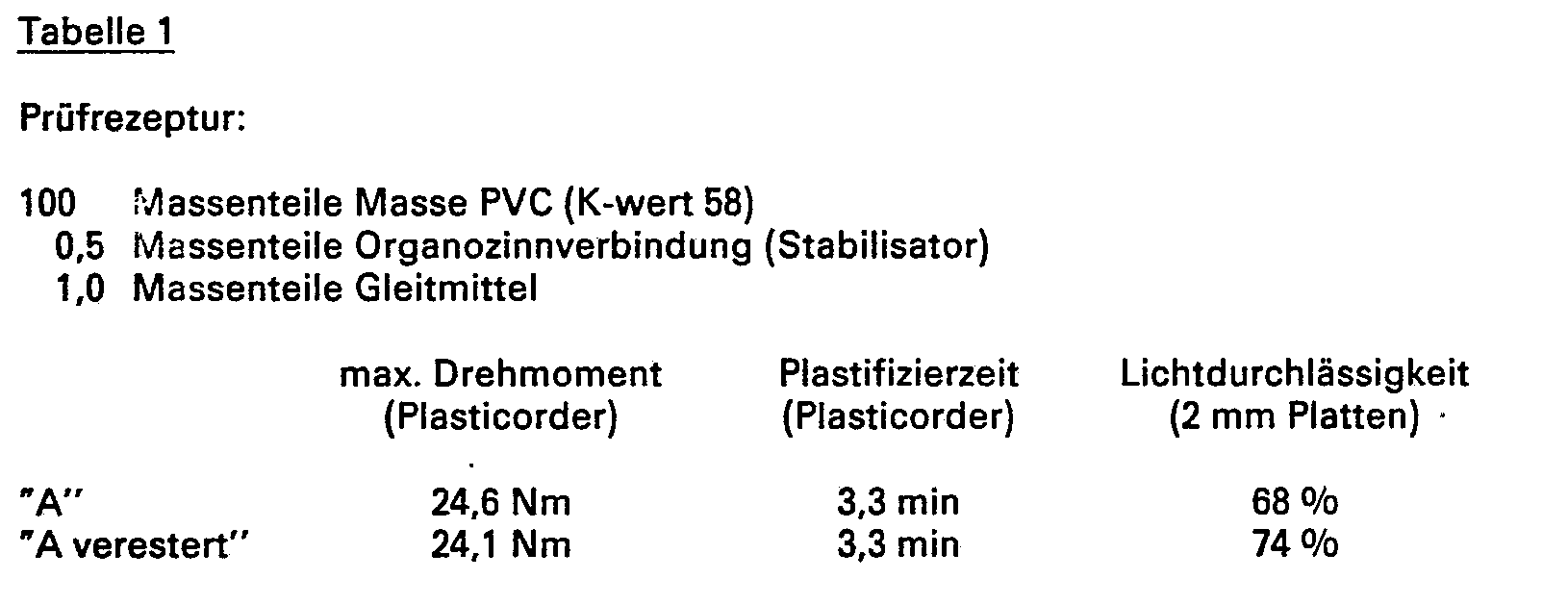

- Dieser Befund läßt keine aus dem Veresterungsschritt herrührenden Vorteile erwarten.
- Überraschend wurde gefunden, daß die Gleiteigenschaften eines anspruchsgemäß hergestellten und veresterten oxidierten Polyethylenwachses sich vom unveresterten beträchtlich unterscheiden.
- Die neue Maßnahmenfolge des Patentanspruches enthält u. a. die Bedingung einer sehr weitgehenden Veresterung. Nun werden zwar in der genannten DE-AS-2 201 862 auch vollständig veresterte Polyethylenwachse beansprucht, sie werden aber nicht offenbart. Vielmehr geht aus der DE-AS-2 432 215 hervor, daß man, wenn man die Lehre der älteren Schrift hefolgt, wegen der schlechten Veresterungsbereitschaft der Polyethylenoxidate lange Reaktionszeiten in Kauf nehmen muß. Aus den Beispielen der DE-AS-2 201 862 folgt, daß man offenbar auch nicht die beanspruchten Temperaturen anwenden kann. Aus allem ist zu schließen, daß auf diesem Wege vollständig veresterte Polyethylenwachse nicht hergestellt und daher in PVC auch nicht geprüft werden konnten.
- Die DE-AS-2 201 862 konnte die erfindungsgemäße Arbeitsweise auch nicht nahelegen. Sie geht nämlich von andersartig oxidierten und zusammengesetzten Polyethylenen aus, die sich durch ihren hohen Dicarbonsäure-Gehalt auszeichnen, im niederen Molgewichtsbereich auf Säurezahlen über 80 oxidiert sein müssen und mittels bestimmter Mineralsäuren verestert werden, wobei aber die Veresterung niedermolekularer Polyolefinwachse nicht empfohlen und als Gleitmittel kein Ester, sondern eine Calciumseife vorgestellt wird.
- Demgegenüber gründet sich die vorliegende Erfindung auf eine bestimmte Stoff- und Verfahrenswahl, die zu einem überraschenden Fortschritt führt, indem ein anderer Einsatzstoff, nach einem anderen Verfahren umgesetzt, ein anderes Erzeugnis mit verbesserten Eigenschaften ergibt.
- Gegenstand der Erfindung ist ein Verfahren zur Herstellung eines Gleitmittels für die Kunststoffverarbeitung durch Veresterung eines oxidierten Polyethylenwachses mit einem mehrwertigen Alkohol der Kettenlänge 2 bis 5 Kohlenstoffatome oder mit einer Mischung eines solchen mehrwertigen alkaholes mit einem Monoalkohol der Kettenlänge 4 bis 20 Kohlenstoffatome, das dadurch gekennzeichnet ist, daß man
- a) ein durch Oxidation eines Hartparaffines einer Molmasse von 1 000 bis 4 000 erhaltenes Palyethylenwachs mit einer Säurezahl von 10 bis 35 mg KOH/g einsetzt.
- b) als Veresterungskatalysator ein Zinksalz, eine Zinkseife oder das intermediäre Umsetzungsprodukt der Wachssäuren mit Zinkhydroxid in einer Menge, bezogen auf das Reaktionsgemisch, von 0.01 bis 3.0 Gew.-% verwendet und
- c) die Veresterung bis zu einer Säurezahl von 8 mg KOH/g oder weniger führt und gleichzeitig mindestens 70 % der durch die Säurezahl erfaßten Sauregruppen verestert.
- Die für die Veresterung benötigten oxidierten Polyethylenwachse erhält man durch an sich bekannte Oxidation von Hartparaffinen in der Schmelze bei Temperaturen von 120 bis 250°C, bevorzugt 130 bis 180=C, mittels Luft. Besonders gut gelingt diese Oxidation in Gegenwart von 0,01 bis 3,9 Gew-% eines Zinksalzes, bevorzugt einer Zinkseife wie Zinkstearat.
- Die Säurezahl der Oxidate liegt zwischen 10 und 35, bevorzugt 15 bis 30; die Verseifungszahlen betragen hierbei 15 bis 70, bevorzugt 25 bis 60. Man kann auch Teilverseifte Oxidate mit Säurezahlen von 10 bis 20 und Verseifungszahlen von 15 bis 40 verwenden; die Teilverseifung führt man in an sich bekannter Weise aus, indem man, entweder kontinuierlich während der Oxidation, oder nach Beendigung der Oxidation, in der Schmelze die Säuregruppen des Wachsoxidats mit Basen wie Natriumhydroxid, Kaliumhydroxid, Lithiumhydroxid, Calciumhydroxid oder Zinkhydroxid bzw. mit Mischungen dieser Basen teilweise neutralisiert.
- Für die Oxidation geeignete Hartparaffine sind in an sich bekannter Weise durch die Ethylenpolymerisation nach Ziegler erhältlich, und zwar gezielt oder als kohlenwasserstofflösliches Nebenprodukt. Diese Hartparaffine besitzen Molmassen von 1 000 bis 4 000, bevorzugt 1 000 bis 3 000.
- Für die Veresterung geeignete mehrwertige Alkohole von 2 bis 5 Kohlenstoffatomen sind z. B. 1,2-Ethandiol, 1,2-Propandiol, 1,3-Propandiol, 1,3-Butandiol, 1,4-Butandiol, Glycerin und Pentaerythrit. Es kann auch eine Mischung, hergestellt aus einem Monoalkohol mit endständiger OH-Gruppe, Kettenlänge 4 bis 20 Kohlenstoffatome und einem der o. g. mehrwertigen Alkohole, z. B. eine n-Amylalkohol/1,2-Ethandiol-Mischung, verwendet werden.
- Der Alkoholzusatz erfolgt stöchiometrisch zur halben bis doppelten Säurezahl, bevorzugt in Mengen von 0 - 50 % über der zur Säurezahl stöchiometrischen Menge. Gegebenenfalls wird überschüssiger Alkohol nach der Veresterung durch Anlegen von Vakuum aus der Reaktionsmischung entiernt.
- Hierbei werden als Katalysatoren Zinksalze wie Zinkchlorid oder Zinkseifen wie Zinkstearat bzw. solche, die intermediär durch Umsetzung von Wachssäuren mit Zinkhydroxid erzeugt wurden, eingesetzt. Die Anteile der Zinkverbindungen, bezogen auf das Reaktionsgemisch, betragen 0,01 bis 3,0 Gew-%.
- Die erhaltene Säurezahl des Wachsesters soll 8 oder weniger betragen, bevorzugt etwa 0 bis 6. Mindestens 70 % der durch die Säurezahl erfaßten Wachssäuren müssen verestert sein.
- Die Beispiele lassen die überraschenden Eigenschaften der erfindungsgemäßen Wachsester erkennen.
- Prüfrezeptur:


-


- Hier übertreffen die Schmiereigenschaften der gefundenen Polyethylenwachsester sogar die der Montansäureester. Dies äußert sich nicht nur in einem niedrigeren Kraftaufwand bei Messungen auf dem Meßwalzwerk, sondern auch in einer höheren Thermostabilität bei einer Dauerwalzprüfung (180°C). Während sich beispielsweise diphenylthioharnstoffstabilisierte, montansäureesterhaltige Hart-PVC-Mischungen nach 7 bis 8 Minuten deutlich gelb färben, treten bei entsprechenden Hart-PVC-Mischungen mit den gefundenen Polyethylenwachsestern unter gleichen Bedingungen keine wesentlichen Farbveränderungen auf.
Claims (1)
- Verfahren zur Herstellung eines Gleitmittels für die Kunststoffverarbeitung durch Veresterung eines oxidierten Polyethylenwachses mit einem mehrwertigen Alkohol der Kettenlänge 2 bis 5 Kohlenstoffatome oder mit einer Mischung eines solchen mehrwertigen Alkoholes mit einem Monoalkohol der Kettenlänge 4 bis 20 Kohlenstoffatome, dadurch gekennzeichnet,
daß mana) ein durch Oxidation eines Hartparaffines einer Molmasse von 1 000 bis 4 000 erhaltenes Polyethylenwachs mit einer Säurezahl von 10 bis 35 mg KOH/g einsetzt.b) als Veresterungskatalysator ein Zinksalz; eine Zinkseife oder das intermediäre Umsetzungsprodukt der Wachssäuren mit Zinkhydroxid in einer Menge, bezogen auf das Reaktionsgemisch, von 0,01 bis 3.0 Gew.- % verwendet undc) die Veresterung bis zu einer Säurezahl von 8 mg KOH/g oder weniger führt und gleichzeitig mindestens 70 % der durch die Säurezahl erfaßten Säuregruppen verestert.
Applications Claiming Priority (2)
| Application Number | Priority Date | Filing Date | Title |
|---|---|---|---|
| DE3427883 | 1984-07-28 | ||
| DE19843427883 DE3427883A1 (de) | 1984-07-28 | 1984-07-28 | Gleitmittel fuer die kunststoff-verarbeitung |
Publications (3)
| Publication Number | Publication Date |
|---|---|
| EP0172339A2 EP0172339A2 (de) | 1986-02-26 |
| EP0172339A3 EP0172339A3 (en) | 1986-03-12 |
| EP0172339B1 true EP0172339B1 (de) | 1988-08-10 |
Family
ID=6241808
Family Applications (1)
| Application Number | Title | Priority Date | Filing Date |
|---|---|---|---|
| EP85107287A Expired EP0172339B1 (de) | 1984-07-28 | 1985-06-13 | Verfahren zur Herstellung eines Gleitmittels für die Kunststoff-Verarbeitung |
Country Status (6)
| Country | Link |
|---|---|
| US (1) | US4661163A (de) |
| EP (1) | EP0172339B1 (de) |
| JP (1) | JPS6140361A (de) |
| DE (2) | DE3427883A1 (de) |
| ES (1) | ES8704528A1 (de) |
| FI (1) | FI85118C (de) |
Families Citing this family (10)
| Publication number | Priority date | Publication date | Assignee | Title |
|---|---|---|---|---|
| GB8617186D0 (en) * | 1986-07-15 | 1986-08-20 | Ici Plc | Dispersed particulate composition |
| US5167024A (en) * | 1989-09-08 | 1992-11-24 | Apple Computer, Inc. | Power management for a laptop computer with slow and sleep modes |
| TW197978B (de) * | 1991-02-07 | 1993-01-11 | Hoechst Ag | |
| US5330568A (en) * | 1992-10-26 | 1994-07-19 | Eastman Chemical Company | Low softening point homopolypropylene wax |
| DE19860174A1 (de) | 1998-12-24 | 2000-06-29 | Clariant Gmbh | Polymeroxidate und ihre Verwendung |
| DE10152716C1 (de) * | 2001-10-19 | 2003-07-03 | Byk Chemie Gmbh | Prozesshilfsmittel für die Verarbeitung von Kunststoffmassen |
| US7709571B2 (en) * | 2006-10-30 | 2010-05-04 | Honeywell International Inc | Multicomponent lubricant composition for processing rigid vinyl chloride polymers |
| US20100279903A1 (en) * | 2009-04-30 | 2010-11-04 | Honeywell International Inc. | Metal Salts Of Oxidized Low Molecular Byproduct Polyethylene As Lubricants For PVC |
| WO2011024399A1 (ja) * | 2009-08-24 | 2011-03-03 | 株式会社Adeka | 透明製品用塩化ビニル系樹脂組成物 |
| CN115873654B (zh) * | 2022-12-01 | 2023-12-15 | 滁州默尔新材料科技有限公司 | 一种润滑效果好的光伏玻璃切削液的制备方法 |
Family Cites Families (6)
| Publication number | Priority date | Publication date | Assignee | Title |
|---|---|---|---|---|
| US3243310A (en) * | 1961-07-27 | 1966-03-29 | Eastman Kodak Co | Stabilized polyethylene waxes and process for preparing same |
| DE1255836B (de) * | 1962-03-30 | 1967-12-07 | Hoechst Ag | Wachsmischungen in ionogenen Selbstglanzwachsemulsionen |
| BE794057A (fr) * | 1972-01-15 | 1973-07-16 | Hoechst Ag | Procede de preparation de produits de reaction cireux de polyethylenes oxydes |
| DE2727329C2 (de) * | 1977-06-16 | 1984-03-01 | Akzo Gmbh, 5600 Wuppertal | Olefin-Maleinsäure-Copolymerisat-Ester |
| US4129536A (en) * | 1977-07-25 | 1978-12-12 | Rca Corporation | Vinyl chloride based injection molding composition |
| JPS54118450A (en) * | 1978-03-06 | 1979-09-13 | Kawaken Fine Chem Co Ltd | Halogen-containing resin composition having improved processability |
-
1984
- 1984-07-28 DE DE19843427883 patent/DE3427883A1/de not_active Withdrawn
-
1985
- 1985-06-13 DE DE8585107287T patent/DE3564276D1/de not_active Expired
- 1985-06-13 EP EP85107287A patent/EP0172339B1/de not_active Expired
- 1985-07-24 ES ES545530A patent/ES8704528A1/es not_active Expired
- 1985-07-24 FI FI852879A patent/FI85118C/fi not_active IP Right Cessation
- 1985-07-26 US US06/759,573 patent/US4661163A/en not_active Expired - Fee Related
- 1985-07-26 JP JP16419885A patent/JPS6140361A/ja active Pending
Also Published As
| Publication number | Publication date |
|---|---|
| ES8704528A1 (es) | 1987-04-16 |
| US4661163A (en) | 1987-04-28 |
| ES545530A0 (es) | 1987-04-16 |
| FI852879A0 (fi) | 1985-07-24 |
| FI852879L (fi) | 1986-01-29 |
| FI85118B (fi) | 1991-11-29 |
| EP0172339A3 (en) | 1986-03-12 |
| FI85118C (fi) | 1992-03-10 |
| EP0172339A2 (de) | 1986-02-26 |
| DE3564276D1 (en) | 1988-09-15 |
| JPS6140361A (ja) | 1986-02-26 |
| DE3427883A1 (de) | 1986-01-30 |
Similar Documents
| Publication | Publication Date | Title |
|---|---|---|
| EP0062813B1 (de) | Stabilisiertes Polyvinylchlorid-Formmassen | |
| DE2727329C2 (de) | Olefin-Maleinsäure-Copolymerisat-Ester | |
| EP0259783A2 (de) | Gleitmittel für thermoplastische Kunststoffe | |
| EP0172339B1 (de) | Verfahren zur Herstellung eines Gleitmittels für die Kunststoff-Verarbeitung | |
| DE2705089C2 (de) | Gleitmittel für die formgebende Verarbeitung thermoplastischer Kunststoffe | |
| DE1130556B (de) | Verfahren zur Herstellung von Antimalariapraeparaten | |
| DE2022011C3 (de) | Glycerintrimontanate, Verfahren zu ihrer Herstellung und deren Verwendung | |
| DE3041073A1 (de) | Wollwachssubstitute | |
| EP0064697B1 (de) | Gleitmittel für die formgebende Verarbeitung von Polyvinylchlorid, die veresterte oligomere mehrwertige Alkohole enthalten | |
| DE2201862C3 (de) | Verfahren zur Herstellung von wachsartigen Veresterungs- und Verseifungsprodukten oxidierter Polyäthylene | |
| DE19734548A1 (de) | Wäßrige Schellacklösung oder -dispersion | |
| DE2632133C2 (de) | Chlor enthaltende Polymerisat-Mischung | |
| DE2826561A1 (de) | Ausgangsprodukte fuer waessrige fluessigkeiten zur metallbearbeitung | |
| EP0170014B1 (de) | Verfahren zur Herstellung von Wachsestern | |
| EP0184128B2 (de) | Verfahren zur Herstellung von Gemischen von neutralen und 2-basischen Blei(II)-Fettsäuresalzen durch Schmelzreaktion | |
| DE590165C (de) | Verfahren zur Herstellung von Emulsionen | |
| DE887986C (de) | Schmiermittel | |
| DE2855351C3 (de) | Mit einem Erdölwachs oder Esterwachs eingekapselte Di-C10-20 -alkylpentaerythritdiphosphhe | |
| DE976871C (de) | Verfahren zur Herstellung von Hartwachsen durch Veresterung von gebleichtem Montanwachs | |
| DE540071C (de) | Verfahren zur Herstellung von Kunststoffen, die Harnstoff- und bzw. oder Thioharnstoff-Formaldehyd-Kondensationsprodukte enthalten | |
| DE1443515C (de) | ||
| DE2613249A1 (de) | Verfahren zur herstellung von staubfreien stabilisatorkombinationen fuer halogenhaltige vinylpolymerisate | |
| DE2452013C2 (de) | Verwendung von Wachsen als Gleitmittel für die Kunststoffverarbeitung | |
| EP0184129A1 (de) | Verfahren zur Herstellung von 2-basischen Blei(II)-fettsäuresalzen durch Schmelzreaktion | |
| DE2452013B1 (de) | Verwendung von Wachsen als Gleitmittel fuer die Kunststoffverarbeitung |
Legal Events
| Date | Code | Title | Description |
|---|---|---|---|
| PUAI | Public reference made under article 153(3) epc to a published international application that has entered the european phase |
Free format text: ORIGINAL CODE: 0009012 |
|
| PUAL | Search report despatched |
Free format text: ORIGINAL CODE: 0009013 |
|
| AK | Designated contracting states |
Kind code of ref document: A2 Designated state(s): BE DE FR GB IT NL SE |
|
| AK | Designated contracting states |
Kind code of ref document: A3 Designated state(s): BE DE FR GB IT NL SE |
|
| 17P | Request for examination filed |
Effective date: 19860131 |
|
| 17Q | First examination report despatched |
Effective date: 19870507 |
|
| GRAA | (expected) grant |
Free format text: ORIGINAL CODE: 0009210 |
|
| AK | Designated contracting states |
Kind code of ref document: B1 Designated state(s): BE DE FR GB IT NL SE |
|
| GBT | Gb: translation of ep patent filed (gb section 77(6)(a)/1977) | ||
| REF | Corresponds to: |
Ref document number: 3564276 Country of ref document: DE Date of ref document: 19880915 |
|
| ET | Fr: translation filed | ||
| ITF | It: translation for a ep patent filed | ||
| PLBI | Opposition filed |
Free format text: ORIGINAL CODE: 0009260 |
|
| 26 | Opposition filed |
Opponent name: HOECHST AG Effective date: 19890506 |
|
| NLR1 | Nl: opposition has been filed with the epo |
Opponent name: HOECHST AG |
|
| ITTA | It: last paid annual fee | ||
| PLBN | Opposition rejected |
Free format text: ORIGINAL CODE: 0009273 |
|
| STAA | Information on the status of an ep patent application or granted ep patent |
Free format text: STATUS: OPPOSITION REJECTED |
|
| PGFP | Annual fee paid to national office [announced via postgrant information from national office to epo] |
Ref country code: SE Payment date: 19910523 Year of fee payment: 7 |
|
| 27O | Opposition rejected |
Effective date: 19901230 |
|
| PGFP | Annual fee paid to national office [announced via postgrant information from national office to epo] |
Ref country code: GB Payment date: 19910530 Year of fee payment: 7 |
|
| PGFP | Annual fee paid to national office [announced via postgrant information from national office to epo] |
Ref country code: FR Payment date: 19910605 Year of fee payment: 7 |
|
| PGFP | Annual fee paid to national office [announced via postgrant information from national office to epo] |
Ref country code: BE Payment date: 19910613 Year of fee payment: 7 |
|
| PGFP | Annual fee paid to national office [announced via postgrant information from national office to epo] |
Ref country code: NL Payment date: 19910630 Year of fee payment: 7 |
|
| PGFP | Annual fee paid to national office [announced via postgrant information from national office to epo] |
Ref country code: DE Payment date: 19910704 Year of fee payment: 7 |
|
| NLR2 | Nl: decision of opposition | ||
| PG25 | Lapsed in a contracting state [announced via postgrant information from national office to epo] |
Ref country code: GB Effective date: 19920613 |
|
| PG25 | Lapsed in a contracting state [announced via postgrant information from national office to epo] |
Ref country code: SE Effective date: 19920614 |
|
| PG25 | Lapsed in a contracting state [announced via postgrant information from national office to epo] |
Ref country code: BE Effective date: 19920630 |
|
| BERE | Be: lapsed |
Owner name: HULS A.G. Effective date: 19920630 |
|
| PG25 | Lapsed in a contracting state [announced via postgrant information from national office to epo] |
Ref country code: NL Effective date: 19930101 |
|
| GBPC | Gb: european patent ceased through non-payment of renewal fee |
Effective date: 19920613 |
|
| NLV4 | Nl: lapsed or anulled due to non-payment of the annual fee | ||
| PG25 | Lapsed in a contracting state [announced via postgrant information from national office to epo] |
Ref country code: FR Effective date: 19930226 |
|
| PG25 | Lapsed in a contracting state [announced via postgrant information from national office to epo] |
Ref country code: DE Effective date: 19930302 |
|
| REG | Reference to a national code |
Ref country code: FR Ref legal event code: ST |
|
| EUG | Se: european patent has lapsed |
Ref document number: 85107287.6 Effective date: 19930109 |