EP0169571A1 - Phenylnonatetraensäurederivate, ihre Herstellung und pharmazeutische Präparate mit diesen Derivaten - Google Patents
Phenylnonatetraensäurederivate, ihre Herstellung und pharmazeutische Präparate mit diesen Derivaten Download PDFInfo
- Publication number
- EP0169571A1 EP0169571A1 EP85109383A EP85109383A EP0169571A1 EP 0169571 A1 EP0169571 A1 EP 0169571A1 EP 85109383 A EP85109383 A EP 85109383A EP 85109383 A EP85109383 A EP 85109383A EP 0169571 A1 EP0169571 A1 EP 0169571A1
- Authority
- EP
- European Patent Office
- Prior art keywords
- formula
- compound
- dimethyl
- phenyl
- hydrogen
- Prior art date
- Legal status (The legal status is an assumption and is not a legal conclusion. Google has not performed a legal analysis and makes no representation as to the accuracy of the status listed.)
- Granted
Links
- 0 Cc1c(*)c(C=CC(*)=CC=CC(*)=C*)c(**)c(*)c1 Chemical compound Cc1c(*)c(C=CC(*)=CC=CC(*)=C*)c(**)c(*)c1 0.000 description 10
- WPHGSKGZRAQSGP-UHFFFAOYSA-N C1C2C1CCCC2 Chemical compound C1C2C1CCCC2 WPHGSKGZRAQSGP-UHFFFAOYSA-N 0.000 description 1
Images


Classifications
-
- C—CHEMISTRY; METALLURGY
- C07—ORGANIC CHEMISTRY
- C07C—ACYCLIC OR CARBOCYCLIC COMPOUNDS
- C07C57/00—Unsaturated compounds having carboxyl groups bound to acyclic carbon atoms
- C07C57/30—Unsaturated compounds having carboxyl groups bound to acyclic carbon atoms containing six-membered aromatic rings
- C07C57/42—Unsaturated compounds having carboxyl groups bound to acyclic carbon atoms containing six-membered aromatic rings having unsaturation outside the rings
-
- C—CHEMISTRY; METALLURGY
- C07—ORGANIC CHEMISTRY
- C07C—ACYCLIC OR CARBOCYCLIC COMPOUNDS
- C07C69/00—Esters of carboxylic acids; Esters of carbonic or haloformic acids
- C07C69/66—Esters of carboxylic acids having esterified carboxylic groups bound to acyclic carbon atoms and having any of the groups OH, O—metal, —CHO, keto, ether, acyloxy, groups, groups, or in the acid moiety
- C07C69/73—Esters of carboxylic acids having esterified carboxylic groups bound to acyclic carbon atoms and having any of the groups OH, O—metal, —CHO, keto, ether, acyloxy, groups, groups, or in the acid moiety of unsaturated acids
- C07C69/734—Ethers
-
- A—HUMAN NECESSITIES
- A61—MEDICAL OR VETERINARY SCIENCE; HYGIENE
- A61P—SPECIFIC THERAPEUTIC ACTIVITY OF CHEMICAL COMPOUNDS OR MEDICINAL PREPARATIONS
- A61P29/00—Non-central analgesic, antipyretic or antiinflammatory agents, e.g. antirheumatic agents; Non-steroidal antiinflammatory drugs [NSAID]
-
- A—HUMAN NECESSITIES
- A61—MEDICAL OR VETERINARY SCIENCE; HYGIENE
- A61P—SPECIFIC THERAPEUTIC ACTIVITY OF CHEMICAL COMPOUNDS OR MEDICINAL PREPARATIONS
- A61P37/00—Drugs for immunological or allergic disorders
- A61P37/02—Immunomodulators
- A61P37/06—Immunosuppressants, e.g. drugs for graft rejection
-
- C—CHEMISTRY; METALLURGY
- C07—ORGANIC CHEMISTRY
- C07C—ACYCLIC OR CARBOCYCLIC COMPOUNDS
- C07C45/00—Preparation of compounds having >C = O groups bound only to carbon or hydrogen atoms; Preparation of chelates of such compounds
-
- C—CHEMISTRY; METALLURGY
- C07—ORGANIC CHEMISTRY
- C07C—ACYCLIC OR CARBOCYCLIC COMPOUNDS
- C07C45/00—Preparation of compounds having >C = O groups bound only to carbon or hydrogen atoms; Preparation of chelates of such compounds
- C07C45/61—Preparation of compounds having >C = O groups bound only to carbon or hydrogen atoms; Preparation of chelates of such compounds by reactions not involving the formation of >C = O groups
- C07C45/67—Preparation of compounds having >C = O groups bound only to carbon or hydrogen atoms; Preparation of chelates of such compounds by reactions not involving the formation of >C = O groups by isomerisation; by change of size of the carbon skeleton
- C07C45/68—Preparation of compounds having >C = O groups bound only to carbon or hydrogen atoms; Preparation of chelates of such compounds by reactions not involving the formation of >C = O groups by isomerisation; by change of size of the carbon skeleton by increase in the number of carbon atoms
- C07C45/72—Preparation of compounds having >C = O groups bound only to carbon or hydrogen atoms; Preparation of chelates of such compounds by reactions not involving the formation of >C = O groups by isomerisation; by change of size of the carbon skeleton by increase in the number of carbon atoms by reaction of compounds containing >C = O groups with the same or other compounds containing >C = O groups
- C07C45/74—Preparation of compounds having >C = O groups bound only to carbon or hydrogen atoms; Preparation of chelates of such compounds by reactions not involving the formation of >C = O groups by isomerisation; by change of size of the carbon skeleton by increase in the number of carbon atoms by reaction of compounds containing >C = O groups with the same or other compounds containing >C = O groups combined with dehydration
-
- C—CHEMISTRY; METALLURGY
- C07—ORGANIC CHEMISTRY
- C07C—ACYCLIC OR CARBOCYCLIC COMPOUNDS
- C07C47/00—Compounds having —CHO groups
- C07C47/52—Compounds having —CHO groups bound to carbon atoms of six—membered aromatic rings
- C07C47/575—Compounds having —CHO groups bound to carbon atoms of six—membered aromatic rings containing ether groups, groups, groups, or groups
-
- C—CHEMISTRY; METALLURGY
- C07—ORGANIC CHEMISTRY
- C07C—ACYCLIC OR CARBOCYCLIC COMPOUNDS
- C07C49/00—Ketones; Ketenes; Dimeric ketenes; Ketonic chelates
- C07C49/20—Unsaturated compounds containing keto groups bound to acyclic carbon atoms
- C07C49/255—Unsaturated compounds containing keto groups bound to acyclic carbon atoms containing ether groups, groups, groups, or groups
-
- C—CHEMISTRY; METALLURGY
- C07—ORGANIC CHEMISTRY
- C07C—ACYCLIC OR CARBOCYCLIC COMPOUNDS
- C07C57/00—Unsaturated compounds having carboxyl groups bound to acyclic carbon atoms
- C07C57/46—Unsaturated compounds having carboxyl groups bound to acyclic carbon atoms containing six-membered aromatic rings and other rings, e.g. cyclohexylphenylacetic acid
- C07C57/48—Unsaturated compounds having carboxyl groups bound to acyclic carbon atoms containing six-membered aromatic rings and other rings, e.g. cyclohexylphenylacetic acid having unsaturation outside the aromatic rings
-
- C—CHEMISTRY; METALLURGY
- C07—ORGANIC CHEMISTRY
- C07C—ACYCLIC OR CARBOCYCLIC COMPOUNDS
- C07C59/00—Compounds having carboxyl groups bound to acyclic carbon atoms and containing any of the groups OH, O—metal, —CHO, keto, ether, groups, groups, or groups
- C07C59/40—Unsaturated compounds
- C07C59/58—Unsaturated compounds containing ether groups, groups, groups, or groups
- C07C59/64—Unsaturated compounds containing ether groups, groups, groups, or groups containing six-membered aromatic rings
-
- C—CHEMISTRY; METALLURGY
- C07—ORGANIC CHEMISTRY
- C07C—ACYCLIC OR CARBOCYCLIC COMPOUNDS
- C07C67/00—Preparation of carboxylic acid esters
- C07C67/30—Preparation of carboxylic acid esters by modifying the acid moiety of the ester, such modification not being an introduction of an ester group
- C07C67/333—Preparation of carboxylic acid esters by modifying the acid moiety of the ester, such modification not being an introduction of an ester group by isomerisation; by change of size of the carbon skeleton
- C07C67/343—Preparation of carboxylic acid esters by modifying the acid moiety of the ester, such modification not being an introduction of an ester group by isomerisation; by change of size of the carbon skeleton by increase in the number of carbon atoms
-
- C—CHEMISTRY; METALLURGY
- C07—ORGANIC CHEMISTRY
- C07F—ACYCLIC, CARBOCYCLIC OR HETEROCYCLIC COMPOUNDS CONTAINING ELEMENTS OTHER THAN CARBON, HYDROGEN, HALOGEN, OXYGEN, NITROGEN, SULFUR, SELENIUM OR TELLURIUM
- C07F9/00—Compounds containing elements of Groups 5 or 15 of the Periodic Table
- C07F9/02—Phosphorus compounds
- C07F9/28—Phosphorus compounds with one or more P—C bonds
- C07F9/54—Quaternary phosphonium compounds
- C07F9/5456—Arylalkanephosphonium compounds
Definitions
- the present invention relates to compounds of the formula wherein R 1 is hydrogen, lower alkyl, chlorine, fluorine or trifluoromethyl: R 2 is hydrogen, lower alkoxy, trifluoromethyl-lower alkoxy. Hydroxy, lower alkyl.
- R 3 is hydrogen, lower alkyl, chlorine or fluorine;
- X -CH (R 10 ) O-, -CH (R 10 ) -, -O-, -C (R 10 ) CH- or -N (R 10 ) -;
- R 7 , R 8 , R 9 and R 10 are lower alkyl or hydrogen
- the invention further relates to a process for the preparation of compounds of the formula I and pharmaceutical compositions which contain such compounds.
- halogen as used herein includes all four halogens, i.e. Chlorine, bromine, iodine and fluorine, with chlorine and bromine being preferred.
- lower alkyl denotes straight-chain and branched alkyl groups with 1-7 C atoms. Preferred lower alkyl groups are methyl, ethyl, isopropyl and n-butyl, with methyl and ethyl being particularly preferred.
- lower alkoxy denotes lower alkoxy groups with 1-7 C atoms such as methoxy, ethoxy, isopropoxy and isobutoxy.
- trifluoromethyl lower alkoxy denotes a lower alkoxy group as defined above. which is substituted by trifluoromethyl.
- alkylidene denotes a saturated aliphatic hydrocarbon radical whose terminal carbon atom has two free valences.
- aryl denotes mononuclear aromatic hydrocarbon groups which may be unsubstituted or substituted in one or more positions by lower alkyl groups, such as phenyl or tolyl; and polynuclear aromatic groups which may be unsubstituted or substituted in one or more positions by a lower alkyl group, such as naphthyl, phenanthryl or anthryl.
- the preferred aryl group is phenyl.
- X is -O-, R 7 and R 8 is lower alkyl, preferably methyl.
- R is 4 - (CH 2 ) y H where y 6-9 is in particular 8-9, preferably 9.
- R 1 , R 2 and R 3 are preferably hydrogen or R 1 and R 3 are hydrogen and R 2 is lower alkoxy such as methoxy or ethoxy.
- R 2 and R 3 can be hydrogen, R 1 can be chlorine or fluorine or R 1 and R 2 can be hydrogen and R 3 can be chlorine or fluorine.
- R 4 is -CH 2 (CH 2 ) n CH 2 OH.
- R 1 , R 2 and R 3 are preferably hydrogen or R 1 is chlorine or fluorine and R 2 and R 3 are hydrogen.
- preferred among these compounds are those in which R 1 and R 3 are hydrogen and R 2 is lower alkoxy, in particular methoxy or ethoxy.
- Compounds in which R 1 and R 2 are hydrogen and R 3 is chlorine or fluorine are also preferred.
- the invention also relates to compounds of the formula I with pharmaceutically usable, non-toxic inorganic or organic bases, for example alkali metal, alkaline earth metal salts.
- Preferred salts are sodium, potassium.
- These salts can be prepared by treating the compound of Formula I in which R 9 is hydrogen can be prepared using inorganic or organic bases by conventional methods.
- the compounds of formula I and their salts are effective as agents for the treatment of rheumatoid arthritis and related diseases such as osteoarthritis. Reduce it these connections the damage to the bone joints caused by the disease as well as the inflammation and the pain caused thereby.
- the compounds of formula I and their salts are also suitable for the treatment of diseases which are caused by excessive immune activity, such as transplant autoimmunity, autoimmune disease and graft versus host disease.
- the compounds according to the invention are unexpectedly non-toxic, as can be seen from the fact that the compound (all-E) -8- [2- (nonyloxy) phenyl] - 3,7-dimethyl -2,4,6,8 -nonatetraenoic acid in mice has an LD 50 over 1000 mg / kg ip and po.
- the antiarthritic activity of the compounds according to the invention can be seen from the test results obtained on rats in the chronic adjuvant arthritis test system (Billingham and Davies “Handbook of Experimental Pharmacology” (editors JR Vane and SH Ferreira volume 50/11, pg. 108-144, Springer-Verlag , Berlin, 1979) were obtained.
- adjuvant arthritis is by subplantar injection of 0.05 ml adjuvant (a suspension of heat-killed, dried Mycobacterium butyricum, 0.5% (w / v) in mineral oil containing 0.2% digitonin ) in the right hind paw of male Charles River Lewis rats (120-140 g).
- the volume of the two hind paws is measured immediately after injection of the adjuvant (day 0).
- the paw volume is measured at 3-7 day intervals to determine the swelling of the arthritic paw caused by the inflammation.
- test substances were administered once a day starting from the day of injection of the adjuvant, using Tween 80 (polyoxyethylene sorbitan monooleate) in an amount of 0.25 ml / 100 g body weight as a vehicle.
- Arthritic control rats received daily doses of the vehicle alone.
- the rats were sacrificed, the plasma was collected and the plasma fibrinogen levels were determined (ammonium sulfate turbidimetric method); Exner et al., Amer. J. Clin. Path, 71: 521-527 (1979).
- the anti-inflammatory activity of the test compounds was determined by comparing the extent of the paw swelling (paw volume on a certain day minus paw volume at the start of the experiment) in the treated animals and those who had received only the vehicle. The decrease in plasma fibrinogen levels was also used to measure anti-inflammatory activity.
- Table I shows the results of the tests with various compounds according to the invention in comparison with indomethacin and 13-cis-vitamin A acid.
- the swelling caused by the adjuvant is effectively reduced by the compounds according to the invention.
- the compounds according to the invention further reduce the plasma fibrinogen level which is generally associated with rheumatoid arthritis. It can also be seen that the compounds according to the invention did not bring about any significant reduction in the weight gain of the animals at the doses indicated. This is a sign of the lack of toxic properties of the compounds according to the invention.
- the compounds of formula I and their pharmaceutically acceptable salts can be used in a variety of pharmaceutical preparations.
- the compounds can be used in such preparations in the form of oral dosage units such as tablets, pills, powders and capsules, as well as injection solutions, solutions, suppositories, ulsions, dispersions and in other suitable forms.
- the pharmaceutical preparations which contain compounds of the formula I are expediently prepared by mixing with a non-toxic pharmaceutical organic or inorganic carrier.
- Typical pharmaceutically acceptable carriers are, for example, water, gelatin, lactose, starch, magnesium stearate, talc, vegetable oils, polyalkylene glycols, petroleum jelly and other commonly used pharmaceutically acceptable carriers.
- the pharmaceutical preparations can also contain non-toxic auxiliary substances such as emulsifiers, preservatives and moisturizers; for example sorbitan monolaurate, triethanolamine oleate, polyoxyethylene sorbitan and dioctyl sodium sulfosuccinate.
- emulsifiers for example sorbitan monolaurate, triethanolamine oleate, polyoxyethylene sorbitan and dioctyl sodium sulfosuccinate.
- the daily dose of the compounds will vary with the compound used, the mode of administration and the size of the recipient.
- the dose administered is not restricted to specific limits, it is usually within the limits for the pharmacological function effective amounts of the compound.
- the compounds of the formula I and salts thereof at doses of 0.5 mg can / kg per T ag to 100 mg / kg per day.
- the compounds are preferably administered daily to patients in oral dosage units with daily dosages of 1-30 mg / kg body weight, preferably 1-10 mg / kg.
- n, R 1, R 2, R 3, R 4, R 7 and R 8 are as above, R '9 is lower alkyl, Z is a A b-gear group.
- Y is aryl, preferably phenyl, and Z 'is halogen.
- the compound of formula III is converted into a compound of formula IV in reaction step a) by reducing the aldehyde group to alcohol.
- This reaction is carried out using conventional reducing agents which convert aldehydes to alcohols.
- an alkali metal borohydride such as sodium borohydride is used as a reducing agent. This can be used for such reductions usual process conditions apply.
- R 2 is hydroxy
- the hydroxy group is preferably protected during the reduction of compound III and the subsequent conversion to a compound of formula I. Any common hydrolyzable hydroxy protecting group, such as lower alkyl groups, can be used here.
- This ester protection group can be split off by conventional ester hydrolysis after the formation of the Wittig salt of the formula XIII and XVI or after the formation of the ether of the formula X.
- the compound of formula IV is converted into a compound of formula VI in reaction step b) by treating compound IV with a triarylphosphine hydrohalide.
- the phosphonium salt of formula VI is produced. All conventional methods of reacting an allyl alcohol with a triarylphosphine hydrohalide can be used in this reaction.
- the phosphonium salt of the formula VI is converted into a compound of the formula VIII by a Wittig reaction with the compound of the formula VII in step c). All conditions customary in the Wittig reaction can be used to carry out the reaction c).
- the compound of formula III can be converted directly into a compound of formula VIII by reaction with the phosphonium salt of the compound of formula IX (step e)).
- the reaction of the phosphonium salt of formula IX with the compound of formula III to the compound of formula VIII is carried out under the same conditions as described in connection with reaction c).
- the compound of formula VIII is converted to a compound of formula X by etherification or alkylation with a compound of formula V (reaction e)).
- Z can be any customary leaving group such as mesyloxy, tosyloxy or a halide. All conventional methods for etherifying a hydroxy group by reaction with a halide or a leaving group can be used in carrying out reaction d).
- a compound of formula X in which a hydroxy group R 2 is protected as a hydrolyzable ester can be obtained from a compound of formula III by alkylation or etherification of the compound of formula III with the compound of formula V to a compound of formula XI getting produced.
- This reaction is carried out by alkylating the compound of formula III with the compound of formula V in step d).
- reactions f) and e) a hydroxy group in a hydroxyalkyl group R 4 need not be protected.
- the compound of formula V reacts with the compound of formula III or the compound of formula VIII to form the compound of formula XI or the compound of formula X without the need for the hydroxy group to protect in the alkyl chain.
- reaction step h a compound of the formula XII is converted into a compound of the formula XIII by treatment with a triarylphosphine hydrohalide in the manner described in connection with step b).
- the compound of formula XIII is converted into a compound of formula X by reaction with a compound of formula VII according to reaction step i).
- This process step is carried out in the same way as in connection with Reaction step c) described.
- the compound of formula X prepared by first converting a compound of formula XI to a compound of formula XIV.
- the compound of formula XI is converted into a compound of formula XIV by aldol condensation with a compound of formula XX.
- the known methods for aldol condensations can be used for this.
- the compound of formula XIV is converted into a compound of formula XV either by Grignard reaction with a vinyl magnesium halide or lithium condensation with vinyl lithium.
- the reaction of step k) can be carried out under conventional conditions for lithium condensation or Grignard reactions.
- the compound of the formula XV is converted into a compound of the formula XVI by reaction with a triarylphosphine hydrohalide in the manner described in connection with the reaction b).
- the compound of formula XVI is then converted in reaction step m) with a compound of formula XVII into a compound of formula X.
- the reaction m) is carried out as a standard Wittig reaction as described in connection with the reaction c).
- R 1 , R 2 , R 3 , R 4 , R 7 , R 8 , R 9 '. Z 'and Y have the above meaning.
- R 13 has the same meaning as R 4 with one carbon atom less than the alkyl group contained in R 4 .
- R 13 is an alkyl group with 3-9 C atoms or -CH 2 (CH 2 ) m CH 2 OH where m is a number less than n, ie m is 5 or 6.
- R 10 is hydrogen or lower alkyl with 1-7 C-atoms and R 10 'is a lower alkyl group with 1 -7 C-atoms.
- R 10 '' is a lower alkyl group with one carbon less than the alkyl group denoted by R 10 '.
- this hydroxy group can be in the form of a hydrolyzable ether are protected. Any conventional ether protection group can be used for this. Examples of preferred ether protecting groups are tetrahydropyranyloxy, t-butoxy, tri-lower alkylsilyloxy, for example trimethylsilyloxy.
- a compound of formula XXII is reacted with a compound of formula XIX to a compound of formula XXIII. All known methods for the condensation of an amine with an acid halide can be used for this reaction.
- the compound of formula XXIII in reaction step n) is converted into a compound of formula XXIV by treatment with a reducing agent. Any conventional alkali metal aluminum hydride can be used, with lithium aluminum hydride being preferred. The reduction with the alkali metal aluminum hydride can be carried out under the usual conditions.
- the compound of the formula XXIV can be converted via the intermediate XXV into a compound of the formula XXVI in process step o).
- the compound of formula XXIV is converted into the phosphonium salt XXV by reaction with a triarylphosphine hydrohalide, as described in connection with reaction d).
- the compound of formula XXV is converted in reaction step p) by reaction with the aldehyde of formula VII into a compound of formula XXVI, compare here to reaction scheme 1.
- the reaction of step p) is carried out in a Wittig reaction in the reaction step c ) described manner.
- the compound of formula XXVI wherein R is lower alkyl can be converted to the free acid by conventional basic hydrolysis.
- the compound of formula XXVI in which R 4 contains an etherified hydroxy group, can be converted into the free alcohol by acid hydrolysis.
- the ether hydrolysis of a compound of formula XXVI can ent be carried out neither before or after acid hydrolysis.
- the compound of formula X in which R 4 contains an etherified hydroxy group can be hydrolyzed in the same manner as a compound of formula XXVI.
- the compound of formula XXIV can also be converted into the tertiary amine of formula XXXI.
- the compound of formula XXIV is reacted in reaction step q) with the acid halide of formula XIX-A in the manner described in connection with the reaction of compound XXII to a compound of formula XXIII to a compound of formula XXVII.
- the compound of formula XXVII is converted in reaction step r) to a compound of formula XXIX by reaction with a lithium aluminum hydride reducing agent as described in connection with step n).
- a compound of the formula XXIX is converted into a compound of the formula XXX by reaction with a triarylphosphine hydroxide crude halide. This reaction is carried out in the same manner as described in connection with step b).
- the compound of the formula XXX is converted into a compound of the formula XXXI in reaction step t) by reaction with a compound of the formula VII (formula scheme 1).
- a Wittig reaction is carried out in this reaction. It can be carried out in the same way as described in connection with reaction c).
- the compound of formula XXXI, in which R 1 9 is lower alkyl, if desired, by base hydrolysis are converted into a corresponding compound having a free acid group.
- a protected hydroxy group contained in R 4 can be converted into a corresponding compound in which R 4 contains a free hydroxyl group by conventional ether hydrolysis.
- This ether hydrolysis can take place before or after the hydrolysis the ester group COOR 9 are carried out.
- R 2 in formula 2 is hydroxy
- this hydroxy group is preferably protected in the form of an ester group.
- the ester protecting group can be removed after the formation of the Wittig salt of formula XXX.
- This reaction is called the Wittig reaction
- a hydroxy group contained in R13 can be protected by forming one of the conventional ether groups mentioned above, on the other hand, it has been found that a free hydroxy group need not be protected and in the reactions in the conversion of the compound of the formula XXXVI is not attacked in a compound of the formula XXXXI In order to achieve the best yields, however, it is generally preferred to protect this hydroxyl group with a hydrolyzable ether group.
- reaction step u) is carried out by means of a Wittig reaction between a compound of the formula XXXV and a compound of the formula XXXIV using the same reaction conditions as described in connection with reaction step c).
- the compound of formula XXXVI can be converted into a compound of formula XXXVII in reaction step v) by hydrogenation. Any conventional hydrogenation method can be used for this.
- the compound of formula XXXVI can be treated with hydrogen gas in the presence of a catalyst in an inert organic solvent.
- Preferred catalysts are palladium catalysts.
- the conventional inert organic solvents and the conventional conditions for catalytic hydrogenations can be used for the reaction.
- the compound of the formula XXXVII is converted into a compound of the formula XXXIX by treatment with formaldehyde or a compound which releases formaldehyde.
- the compound of the formula XXXVII is first metalated with an alkali metal alkyl, for example n-butyllithium.
- this reaction is carried out in an inert organic solvent, for example an ether.
- ether for example an ether.
- the preferred solvents are diethyl ether and tetrahydrofuran.
- Temperature and pressure are not critical in this reaction. The reaction can be carried out at room temperature and atmospheric pressure. If desired, higher or lower temperatures can be used.
- the compound of the formula XXXIX is then converted into a compound of the formula XXXX in the reaction step x) by treatment with a triarylphosphine hydrohalide.
- This reaction is carried out in the same manner as described in connection with reaction step b).
- the compound of formula XXXX is converted into a compound of formula XXXXI in reaction step y) by treatment with a compound of formula VII (see reaction scheme 1).
- This reaction y) is carried out as a Wittig reaction under the conditions described in connection with reaction c).
- the compound of the formula XXXXI can be converted into a corresponding compound which contains a free carboxyl group instead of the R 9 1 group. This is accomplished by conventional ester hydrolysis in the manner previously described.
- R 4 contains a protected hydroxy group
- this ether protecting group can be hydrolyzed by treatment with an aqueous inorganic acid.
- the hydrolysis can be carried out either before or after the hydrolysis of the ester group in the compound of formula XXXXI.
- R 2 represents a hydroxyl group
- this group is preferably protected by esterification with a lower alkane carboxylic acid.
- the ester protecting group can be split after the formation of the Wittig salt of formula XXXX.
- the compound of the formula L is converted into a compound of the formula LI by reaction with an alkali metal alkoxide of the formula L-A.
- the reaction is carried out under customary process conditions for the reaction of alkali metal alkoxides with a halide.
- the compound of the formula LI is converted into a compound of the formula LII by first metallizing the compound of the formula LI with a lithium alkyl such as n-butyllithium. The metalated compound of formula LI is then treated with formaldehyde or a compound, the formaldehyde hyd releases implemented.
- a compound of formula LII the same reaction conditions are used as described in connection with reaction step w).
- the compound of the formula LII is converted into the phosphonium salt of the formula LIII by treatment with a triarylphosphine hydrohalide in the manner described in reaction step b).
- the phosphonium salt of the formula LIII is converted in a Wittig reaction with the compound of the formula VII (reaction scheme 1) to a compound of the formula LIV. This reaction is carried out in the same manner as described in connection with reaction step c).
- R 15 in the compound of the formula LIV contains a protected hydroxyl group, this can be hydrolyzed to the free hydroxyl group by conventional hydrolysis methods.
- the usual hydrolysis methods for ether protecting groups do not attack the other ether group contained in the compound of the formula LIV.
- the compound of formula LIV can be converted into the free acid by conventional ester hydrolysis.
- R 2 in the compounds of formulas L, LI, LII and LIII is hydroxy
- the hydroxy group is preferably protected by a hydrolyzable ester group such as lower alkanoyloxy.
- the hydrolyzable ester group can be split off after the formation of the Wittig salt of the formula LIII.
- the double bonds in the compound of formula I in positions 2-3, 4-5, 6-7 and 8-9 can have either the cis or trans configuration.
- the compounds can be present as a mixture of the different cis and trans isomers.
- the double bonds contained therein can have either the cis or trans configuration, depending on the stereoconfiguration of the double bonds in the compounds of formula I.
- the one in the making of the verbin The formulations of formula I in stages c), e), i) etc. carried out Wittig reactions yielded a mixture of 8-9 cis / trans isomers. These cis / trans isomers can be separated by conventional means such as fractional crystallization.
- the compounds of the formula I have a 2-3 trans double bond
- this isomer can be converted into the corresponding cis double bond by means of isomerization methods which are known per se.
- a compound of formula I can be treated with iodine in an inert organic solvent. Isomerization with iodine provides compounds of the formula I with 2-3 cis double bonds.
- Formula I encompasses all geometric isomers including mixtures of these geometric isomers.
- compound LV is alkylated by reaction with an allyl bromide.
- a hydroxyl group R 2 is protected by esterification, ie R 2 in the compound of the formula LV is a protected hydroxy group.
- R 2 in the compound of the formula LV is a protected hydroxy group.
- the known methods for alkylation of a hydroxy group with a bromide may apply.
- the compound of formula LVI is rearranged by heating to a temperature of 190-230 ° C to a compound of formula LVII.
- the compound of the formula LVII is then converted to a compound of the formula LVIII by reaction with a compound of the formula V (reaction scheme 1) according to reaction step d).
- the compound of formula LVIII is isomerized to a compound of formula LIX by isomerization with a strong base such as an alkali metal alkoxide in the presence of an inert organic solvent, preferably potassium t-butoxide in dimethyl sulfoxide.
- the compound of formula L IX is converted into a compound of formula LX by treatment with ozone. Temperatures of -70 to -20 ° C are used. Furthermore, one works at this temperature in an inert organic solvent. Any conventional inert organic solvent can be used, preference being given to halogenated hydrocarbons such as methylene chloride.
- R 2 is hydroxy in a compound of the formula III, there are 2 hydroxide groups. It is therefore generally preferred to prepare the compound of formula XI in which R 2 is a protected hydroxy group from a compound of formula LXI (Reaction Scheme 6). In this way, compounds of formula I can be prepared in which X is -O- and R 2 is hydroxy and R 3 and R 4 have the meaning given above.
- R 1 and R 15 together with the oxygen atom bonded to them are hydroxy protected by a conventional hydrolyzable protective group, preferably lower alkanoyl.
- reaction scheme 6 the compound of the formula LXI is converted into a compound of the formula LXII, the same reaction conditions being used as described in connection with the conversion of a compound of the formula LV into a compound of the formula LVI (reaction scheme 5).
- the compound of formula LXII is then converted to a compound of formula LXIII using the same procedure described in connection with the conversion of compound LVI to a compound of formula LVII.
- the compound of the formula LXI II is converted into a compound of the formula LXIV by the processes described in step g ') in reaction scheme 5, and d a-to a compound of the formula LXV after the in connection with stage h ') transferred in the procedure described in Scheme 5.
- the conversion of the bromobenzene compound of the formula LXV into the phenol of the formula LXVI is carried out according to methods known per se (Kidwell and Darling, Tetrahedron Letters, (1966) pages 531-535).
- the hydroxyl group in the compound of the formula LXVI is converted into a conventionally hydrolyzable ester group, the formula LXVII being obtained in the R 15 together with the oxygen atom to which it is bound, represents a hydrolyzable ester group.
- Conventional methods of esterification of hydroxy groups with organic acids such as lower alkanoic acids with 1-7 C atoms can be used for this esterification.
- the compound of formula XI-A is prepared from the compound of formula LXVII in the same manner as described above with respect to the conversion of the compound of formula LIX to L (Scheme 5).
- a compound of the formula XI in which R 1 is trifluoromethyl (the compound of the formula XI-B) is prepared from a compound of the formula LXX according to reaction scheme 7.
- the compound of the formula LXX is converted into a compound of the formula LXXI as described in connection with the reaction d) (reaction of the compound VIII with a compound of the formula V to a compound of the formula X).
- R 2 is hydroxy
- the alkylation on the hydroxy group ortho to the trifluoromethyl group proceeds very slowly. As a result, this group does not necessarily have to be protected since the alkylation is preferably carried out with the meta-terminated hydroxyl group.
- a mixture of 110 g of 2-hydroxybenzaldehyde, 180 g of 1-bromononane, 800 ml of dimethylformamide and anhydrous potassium carbonate were heated to 80 ° for 14 hours. Then hexane and water were added. The hexane phase was concentrated and the residue was distilled. 210 g of 2 -nonyloxybenzaldehyde, boiling point 121 ° / 40 Pa were obtained.
- a solution of 100 g of 2-nonyloxybenzaldehyde in 1000 ml of ethanol was mixed with 6 g of sodium borohydride at 10 °. The mixture was stirred at room temperature for 15-20 minutes and the 2-nonyloxybenzyl alcohol extracted with hexane.
- Lithium octanate made from octanol and n-butyllithium was condensed in a mixture of tetrahydrofuran / hexane and dimethylformamide with 2-Br Q mbenzyl bromide to give 2 (octyloxy) methyl bromobenzene.
- This material was treated with n-butyllithium in ether / hexane and then with paraformaldehyde to give 2- (octyloxy) methylbenzyl alcohol.
- 2-Chloro-6-hydroxy-benzaldehyde was alkylated as in Example 1 with 1-bromononane to 2-chloro-6-nonyloxybenzaldehyde.
- Reduction with sodium borohydride as in Example 1 gave 2-chloro-6-nonyloxybenzyl alcohol which by treatment with triphenylphosphine hydrobromide in acetonitrile as in Example 1 gave [[2-chloro-6-nonyloxy] phenyl] methyl] triphenylphosphonium bromide.
- 5-Methoxy-2-hydroxybenzaldehyde was alkylated with nonyl bromide according to Example 1 and reduced with sodium borohydride to 5-methoxy-2-nonyloxy benzyl alcohol, which gave the [(5-methoxy - 2-nonyloxyphenyl) methyl] triphenylphosphonium bromide by treatment with triphenylphosphine hydrobromide .
- the hexane extract was washed with water, dried over magnesium sulfate, mixed with 50 ml of dimethyl sulfide and left at room temperature for 16 hours.
- capsules are produced which contain (all-E) -9- [2-fluoro-6 - (nonyloxy) phenyl] -3,7-dimethyl -2,4,6,8- as active ingredient Contain nonatetraenoic acid.
- compound A is all (E) - 9- [2- (nonyloxy) phenyl] -3,7-dimethyl -2,4,6,8-nonatetraenoic acid. This compound has been tested in various test models for anti-inflammatory activity.
- Compound A and the other retinoids tested were used in formulations in peanut oil that contained 0.05% propyl gallate as an antioxidant.
- the dose volumes were 5 ml / kg for rats and 10 ml / kg for mice.
- Control groups were treated with the appropriate volume of peanut oil.
- mice Male and female MFI mice. Initial weight about 25 g.
- MBSA Methylated bovine serum albumin
- Difco Freund's complete adjuvant
- mice were sensitized in groups of 10, on experiment day 0, by intradermal injection of 0.05 ml of water in oil emulsion from MB SA and Freund's complete adjuvant at two abdominal sites.
- the animals received an injection of 20 ul l% acetic MBSA - solution ote in a Pf and 20 .mu.l of water in the late contrasting rale paw.
- the paw volumes were measured plethysmographically 24 hours later.
- the mean percent increase in paw volume of the MBSA-treated paw compared to the water-treated paw was calculated for each group.
- the treatment with the test substance or the carrier solution was started on day 0 and ended on day 9.
- Test animals AHH / R female rats (initial weight 110-140 g).
- Test substances adjuvant for injection. A homogenized suspension of heat-killed M. tuberculosis (human strain C, DT and PN), 5 mg / ml in liquid paraffin.
- mice received in groups of five subplantar injections of 0.1 ml adjuvant suspension in the right rear paw.
- the test compounds were administered by intubation in the morning, starting on the day of the adjuvant injection.
- Two control groups and a group of three normal rats (for comparison purposes) received vehicle solution.
- the medication was carried out daily until the end of the trial on day 15, with the exception of the first weekend (days 5 and 6).
- the treatment groups are listed in Table III. Etretinate was used as the standard retinoid.
- Test material Type 2 collagen (made from bovine nasal septal cartilage), Freund's incomplete adjuvant (Difco).
- mice were sensitized to type 2 collagen by intradermal injection of 1 ml of a water in oil emulsion from equal parts of a 1 mg / ml solution type 2 collagen in 0.45M NaCl, 0.02M Tris, pH 7.4 and Freund's incomplete adjuvant.
- the rats that developed arthritis were pooled on day 15 after sensitization.
- a control group treated with peanut oil (6 male, 4 female animals) and a group treated with compound A (6 male, 5 female animals) were listed. The volumes of the rear paw were measured to ensure an even distribution of the animals between the groups.
- Urine was collected overnight between days 15 and 16. Medication started on day 16. Urine samples were analyzed for glycosaminoglycans (GAG).
- GAG glycosaminoglycans
- Compound A was dosed at 100 mg / kg po. From day 19 to day 20 the urine was collected again overnight. The urine samples were analyzed for glycosaminoglycans. On day 20 a second measurement of the rear paw was made. The rats were then anesthetized with sodium pentobafbitone and bled and x-rays of the hind and front paws were taken. The rats received the test preparation in 4 doses on days 16-19. The results are summarized in Table IV.
- mice Female Alderley Park rats weighing 170-205 g.
- Test materials Lambda carrageenan, prepared as a solution in saline and sterilized.
- Experimental animals AHH / R female rats with an initial weight of 120-140 g.
- Test material Pellets with a diameter of 6.5 mm were punched out of cellulose sponge cloth. 0.1 ml of a suspension containing 0.5 mg / ml heat-killed M. tuberculosis bacteria (human strain C, DT and PN) in sterile saline was added to each pellet. The pellets were dried, weighed and sterilized.
- the rats were divided into groups of 5. The test compounds were administered daily. After the fifth dose, the rats were anesthetized, the back shaved, and two pellets were dorsally implanted on each side of each rat. 7 days after the implantation, the rats were sacrificed and the pellets removed from the attached tissue and weighed. Each pellet was then placed in 4 ml of distilled water, finely chopped and sonicated. After centrifugation, the sodium and potassium content of the supernatant was determined by flame photometry. In addition, the adrenal glands and thymus glands of each rat were removed and weighed, and the rear lower legs were removed to determine the tibia fracture load. Body weights were also determined during the test. The results are summarized in Table VI.
- Test material heat-killed dried Mycobacterium butyricum.
- the adjuvant arthritis was injected with 0.1 ml adjuvant (suspension of heat-killed Mycobacterium butyricum 0.5% CW / V) in heavy mineral oil. containing 0.2% digitonin) in the tail roots. After the arthritis had developed for 21 days, the volume of both hind paws was measured plethysmographically.
- the rats were divided into groups of 8 with equal mean paw volumes and then treated with Compound A, indomethacin (as a control) or vehicle for 7 days. The volumes of both hind paws were then measured again to determine anti-inflammatory effects. Weight changes were also determined and plasma fibrinogen (Amer. J. Clin. Path, 71: 521-527) was determined at the end of the experiment.
Landscapes
- Chemical & Material Sciences (AREA)
- Organic Chemistry (AREA)
- Health & Medical Sciences (AREA)
- Chemical Kinetics & Catalysis (AREA)
- Life Sciences & Earth Sciences (AREA)
- General Health & Medical Sciences (AREA)
- Immunology (AREA)
- Animal Behavior & Ethology (AREA)
- Veterinary Medicine (AREA)
- Nuclear Medicine, Radiotherapy & Molecular Imaging (AREA)
- Bioinformatics & Cheminformatics (AREA)
- Pharmacology & Pharmacy (AREA)
- Engineering & Computer Science (AREA)
- Medicinal Chemistry (AREA)
- General Chemical & Material Sciences (AREA)
- Public Health (AREA)
- Transplantation (AREA)
- Pain & Pain Management (AREA)
- Rheumatology (AREA)
- Biochemistry (AREA)
- Molecular Biology (AREA)
- Organic Low-Molecular-Weight Compounds And Preparation Thereof (AREA)
- Acyclic And Carbocyclic Compounds In Medicinal Compositions (AREA)
- Pharmaceuticals Containing Other Organic And Inorganic Compounds (AREA)
Abstract
Description
- Die vorliegende Erfindung betrifft Verbindungen der Formel
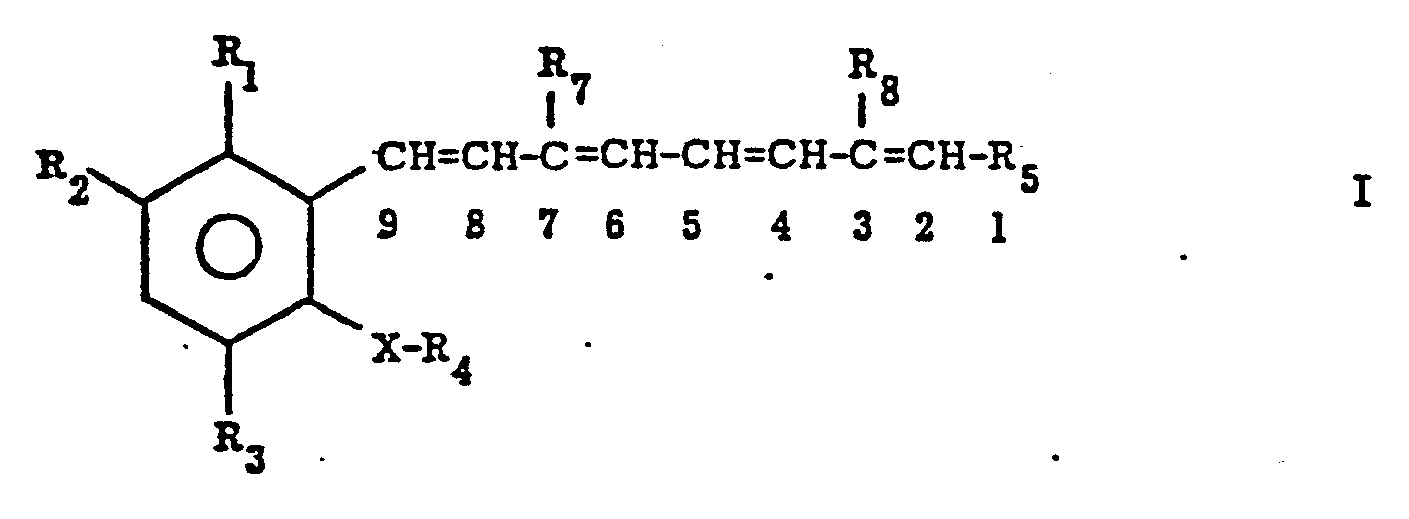
worin R1 Wasserstoff, Niederalkyl, Chlor, Fluor oder Trifluormethyl: R2 Wasserstoff, Nieder- alkoxy, Trifluormethylniederalkoxy. Hydroxy, Nieder- alkyl. Chlor, Trifluormethyl oder Fluor; R3 Wasserstoff, Niederalkyl, Chlor oder Fluor; R4 Alkyl mit 4-10 C-Atomen oder -CH2(CH2)nCH2OH; X -CH(R10)O-, -CH(R10)-, -O-, -C(R10)=CH- oder -N(R10)-; R5 COOR9; n 6 oder 7; und R7, R8, R9 und R10 Niederalkyl oder Wasserstoff bedeuten - Grn/8.7.85 und Salze davon, wenn R Wasserstoff ist.
- Die Erfindung betrifft weiterhin ein Verfahren zur Herstellung von Verbindungen der Formel I und pharmazeutische Kompositionen die solche Verbindungen enthalten.
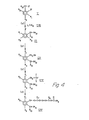
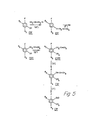
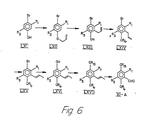
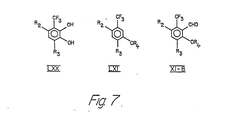
- In den Formelblättern 1, 2, 3, 4, 5, 6 und 7 sind die Verfahrensschritte zur Herstellung der Verbindungen der Formel I schematisch angegeben.
- Der hier verwendete Ausdruck "Halogen" umfasst alle vier Halogene, d.h. Chlor, Brom, Jod und Fluor, wobei Chlor und Brom bevorzugt sind. Der Ausdruck "Niederalkyl" bezeichnet geradkettige und verzweigte Alkylgruppen mit 1-7 C-Atomen. Bevorzugte Niederalkylgruppen sind Methyl, Aethyl, Isopropyl und n-Butyl, wobei Methyl und Aethyl besonders bevorzugt sind. Der Ausdruck "Niederalkoxy" bezeichnet Niederalkoxygruppen mit 1-7 C-Atomen wie Methoxy, Aethoxy, Isopropoxy und Isobutoxy. Der Ausdruck "Trifluormethylniederalkoxy" bezeichnet eine wie oben definierte Niederalkoxygruppe. die durch Trifluormethyl substituiert ist. Der Ausdruck "Alkyliden" bezeichnet einen gesättigten aliphatischen Kohlenwasserstoffrest dessen terminales C-Atom zwei freie Valenzen aufweist.
- Der Ausdruck "Aryl" bezeichnet einkernige aromatische Kohlenwasserstoffgruppen, die unsubstituiert oder in einer oder mehreren Stellungen durch Niederalkylgruppen substituiert sein können, wie Phenyl oder Tolyl; und mehrkernige aromatische Gruppen, die unsubstituiert oder in einer oder mehreren Stellungen durch eine Niederalkylgruppe substituiert sein können wie Naphthyl, Phenanthryl oder Anthryl. Die bevorzugte Arylgruppe ist Phenyl.
- In einer Ausführungsform der Verbindung der Formel I ist X -O-, R7 und R8 Niederalkyl, vorzugsweise Methyl. In einer anderen bevorzugten Ausführungsform ist R4 -(CH2)y H wobei y 6-9 insbesondere 8-9, vorzugsweise 9 ist. In dieser Ausführungsform sind R1, R2 und R3 vorzugsweise Wasserstoff oder R1 und R3 sind Wasserstoff und R2 Niederalkoxy wie Methoxy oder Aethoxy. Andererseits kann in dieser Ausführungsform R2 und R3 Wasserstoff sein, R1 Chlor oder Fluor oder R1 und R2 sind Wasserstoff und R3 ist Chlor oder Fluor.
- Eine weitere bevorzugte Gruppe von Verbindungen der Formel I sind solche, in denen R4 -CH2(CH2)nCH2OH ist. Hierbei sind R1, R2 und R3 vorzugsweise Wasserstoff oder R1 ist Chlor oder Fluor und R2 und R3 sind Wasserstoff. Andererseits sind von diesen Verbindungen solche bevorzugt, in denen R1 und R3 Wasserstoff und R2 Niederalkoxy insbesondere Methoxy oder Aethoxy sind. Weiterhin sind solche Verbindungen bevorzugt, in denen R1 und R2 Wasserstoff sind und R3 Chlor oder Fluor ist.
- Die Erfindung bezieht sich auch auf Verbindungen der Formel I mit pharmazeutisch anwendbaren, nicht toxischen anorganischen oder organischen Basen, z.B. Alkalimetall, Erdalkalimetallsalze. Bevorzugte Salze sind das Natrium-, Kalium-. Magnesium- oder Calciumsalz, wie auch Salze mit Ammoniak oder geeigneten nicht toxischen Aminen wie Niederalkylaminen, beispielsweise Triäthylamin; Hydroxyniederalkylaminen, beispielsweise 2-Hydroxyäthylamin, bis-(1--Hydroxyäthyl)amin oder tris-(2-Hydroxyäthylamin; Cycloalkylaminen, beispielsweise Dicyclohexylamin; oder Benzylaminen, beispielsweise N.N'-Dibenzyläthylendiamin und Dibenzylamin. Diese Salze können durch Behandlung der Verbindung der Formel I in denen R9 Wasserstoff ist mit anorganischen oder organischen Basen nach herkömmlichen Methoden hergestellt werden.
- Die Verbindungen der Formel I und deren Salze sind wirksam als Mittel zur Behandlung von rheumatoider Arthritis und verwandter Erkrankungen wie Osteoarthritis. Dabei vermindern diese Verbindungen die durch die Krankheit hervorgerufenen Schäden an den Knochengelenken wie auch die Entzündung und die dadurch hervorgerufenen Schmerzen.
- Die Verbindungen der Formel I und deren Salze sind weiterhin zur Behandlung von Krankheiten geeignet, die durch übermässige Immunaktivität hervorgerufen werden wie Transplantationsautoimmunität, Autoimmunerkrankung und graft versus host disease. Die erfindungsgemässen Verbindungen sind unerwartet untoxisch, wie aus dem Umstand zu ersehen ist, dass die Verbindung (all-E)-8-[2-(Nonyloxy)-phenyl]--3,7-dimethyl -2,4,6,8-nonatetraensäure bei Mäusen eine LD50 über 1000 mg/kg i.p. und p.o. besitzt.
- Die antiarthritische Wirksamkeit der erfindungsgemässen Verbindungen wird aus den Testresultaten ersichtlich, die an Ratten im Testsystem Chronische Adjuvansarthritis (Billingham und Davies "Handbook of Experimental Pharmacology" (Herausgeber J.R. Vane und S.H. Ferreira Volumen 50/11, pg. 108-144, Springer-Verlag, Berlin, 1979) erhalten wurden.
- Bei diesem Verfahren wird eine Adjuvans-Arthritis durch subplantare Injektion von 0,05 ml Adjuvans (eine Suspension von durch Hitze abgetöteten, getrockneten Mycobacterium butyricum, 0,5% (Gew.-Vol.) in Mineralöl, das 0,2% Digitonin enthält) in die rechte Hinterpfote von männlichen Charles River Lewis-Ratten (120-140 g) erzeugt. Das Volumen der beiden Hinterpfoten wird unmittelbar nach Injektion des Adjuvans (Tag 0) gemessen. Das Pfotenvolumen wird in Abständen 3-7 Tagen gemessen, um die Schwellung der arthritischen Pfote die durch die Entzündung erzeugt wird, zu ermitteln.
- Die Testsubstanzen wurden einmal täglich verabreicht beginnend mit dem Tag der Injektion des Adjuvans, wobei Tween 80 (Polyoxyäthylensorbitanmonooleat) in einer Menge von 0,25 ml/100 g Körpergewicht als Vehikel verwendet wurde. Arthritische Kontrollratten erhielten tägliche Dosen des Vehikels allein. Am 23-25 Versuchstag wurden die Ratten getötet, das Plasma gesammelt und die Plasmafibrinogenspiegel bestimmt (Ammoniumsulfat-turbidimetrische Methode); Exner et al., Amer. J. Clin. Path, 71: 521-527 (1979). Die antiinflammatorische Wirksamkeit der Testverbindungen wurde durch Vergleich des Ausmasses der Pfotenschwellung (Pfotenvolumen an einem bestimmten Tag minus Pfotenvolumen am Versuchsbeginn) bei den behandelten Tieren und denen, die nur das Vehikel erhalten hatten bestimmt. Die Abnahme des Plasmafibrinogenspiegels wurde ebenfalls herangezogen um die antiinflammatorische Aktivität zu messen.
- In Tabelle I sind die Resultate der Versuche mit verschiedenen erfindungsgemäsen Verbindungen im Vergleich mit Indomethacin und 13-cis-Vitamin A Säure angeführt.

- Wie aus der Tabelle I ersichtlich, wird die durch das Adjuvans bewirkte Schwellung durch die erfindungsgemässen Verbindungen wirksam reduziert. Die erfindungsgemässen Verbindungen vermindern weiterhin den Plasmafibrinogenspiegel, der generell mit rheumatoider Arthritis assoziiert ist. Weiterhin ist zu sehen, dass die erfindungsgemässen Verbindungen bei den angegebenen Dosierungen keine wesentliche Verminderung in der Gewichtszunahme der Tiere bewirkten. Dies ist ein Zeichen für das Fehlen toxischer Eigenschaften der erfindungsgemässen Verbindungen.
- Die Verbindungen der Formel I und ihre pharmazeutisch anwendbaren Salze können in einer Vielzahl von pharmazeutischen Präparaten angewandt werden. Die Verbindungen können in solchen Präparaten in Form oraler Dosiseinheiten wie Tabletten, Pillen, Pulvern und Kapseln wie auch als Injektionslösungen, Lösungen, Suppositorien, Elulsionen, Dispersionen und in anderen geeigneten Formen angewandt werden. Die pharmazeutischen Präparate, die Verbindungen der Formel I enthalten, werden zweckmässig durch Vermischen mit einem nicht toxischen pharmazeutischen organischen oder anorganischen Träger hergestellt. Typische pharmazeutisch anwendbare Träger sind beispielsweise Wasser, Gelatine, Laktose, Stärke, Magnesiumstearat, Talk, vegetabile Oele, Polyalkylenglycole, Vaseline und andere üblicherweise angewandte pharmazeutisch akzeptable Träger. Die pharmazeutischen Präparate können auch nicht-toxische Hilfssubstanzen wie Emulgatoren, Konservierungs- und Befeuchtungsmittel enthalten; beispielsweise Sorbitan-monolaurat, Triäthanolaminoleat, Polyoxyäthylensorbitan und Dioctylnatriumsulfosuccinat.
- Die täglich zu verabreichende Dosis der Verbindungen variiert mit der angewandten Verbindung, der Art der Verabreichung und der Grösse des Empfängers. Die verabreichte Dosis ist nicht an bestimmte Grenzen gebunden, sie bewegt sich üblicherweise in den für die pharmakologische Funktion der Verbindung wirksamen Mengen.
- Bei der oralen Verabreichung können die Verbindungen der Formel I und ihre Salze in Dosierungen von 0,5 mg/kg pro Tag bis 100 mg/kg pro Tag verabreicht werden. Vorzugsweise verabreicht man die Verbindungen täglich an Patienten in oralen Dosiseinheiten mit täglichen Dosierungen von 1-30 mg/kg Körpergewicht, vorzugsweise 1-10 mg/kg.
- Die Verbindungen der Formel I, in denen X -O- ist können aus Verbindungen der Formel

worin R1, R2 und R3 die obige Bedeutungen haben, nach dem Reaktionsschema von Formelblatt I hergestellt werden. - In Formelblatt I sind n, R1, R2, R3, R4, R7 und R8 wie oben, R'9 ist Niederalkyl, Z ist eine Ab-gangsgruppe. Y ist Aryl, vorzugsweise Phenyl, und Z' ist Halogen.
- Die Verbindung der Formel III wird in eine Verbindung der Formel IV im Reaktionsschritt a) durch Reduktion der Aldehydgruppe zum Alkohol umgewandelt. Diese Reaktion wird mit üblichen Reduktionsmitteln, die Aldehyde zu Alkoholen umwandeln, durchgeführt. Im allgemeinen wird ein Alkalimetallborhydrid wie Natriumborhydrid als Reduktionsmittel verwendet. Hierbei können die für solche Reduktionen üblichen Verfahrensbedingungen Anwendung finden. Wenn R2 Hydroxy ist, wird die Hydroxygruppe während der Reduktion der Verbindung III und der nachfolgenden Umwandlung in eine Verbindung der Formel I vorzugsweise geschützt. Jede übliche hydrolysierbare Hydroxyschutzgruppe, wie Niederalkylgruppen, kann hierbei Verwendung finden. Diese Esterschutzgrüppe kann durch übliche Esterhydrolyse nach der Bildung des Wittig--Salzes der Formel XIII und XVI oder nach der Bildung des Aethers der Formel X abgespalten werden.
- Die Verbindung der Formel IV wird in eine Verbindung der Formel VI in der Reaktionsstufe b) durch Behandlung der Verbindung IV mit einem Triarylphosphinhydrohalogenid umgewandelt. Dabei wird das Phosphoniumsalz der Formel VI hergestellt. Bei dieser Reaktion können alle konventionellen Methoden der Umsetzung eines Allylalkohols mit einem Triarylphosphinhydrohalogenid Anwendung finden. Das Phosphoniumsalz der Formel VI wird durch eine Wittig-Reaktion mit der Verbindung der Formel VII in Stufe c) zu einer Verbindung der Formel VIII umgesetzt. Alle bei Wittig-Reaktion üblichen Bedingungen können bei der Durchführung der Reaktion c) Anwendung finden.
- Andererseits kann die Verbindung der Formel III direkt in eine Verbindung der Formel VIII durch Reaktion mit dem Phosphoniumsalz der Verbindung der Formel IX (Stufe e)) umgewandelt werden. Die Umsetzung des Phosphoniumsalzes der Formel IX mit der Verbindung der Formel III zu der Verbindung der Formel VIII wird unter den gleichen Bedingungen wie in Verbindung mit Reaktion c) beschrieben ausgeführt.
- Die Verbindung der Formel VIII wird in eine Verbindung der Formel X durch Verätherung oder Alkylierung mit einer Verbindung der Formel V (Reaktion e)) umgewandelt. In der Verbindung der Formel V kann Z jede übliche Abgangsgruppe wie Mesyloxy, Tosyloxy oder ein Halogenid darstellen. Alle konventionellen Methoden zur Verätherung einer Hydroxygruppe durch Reaktion mit einem Halogenid oder einer Abgangsgruppe können bei der Durchführung der Reaktion d) angewandt werden.
- In einer anderen Ausführungsform kann eine Verbindung der Formel X, in der eine Hydroxygruppe R2 als hydrolysierbare Ester geschützt ist, aus einer Verbindung der Formel III durch Alkylierung oder Verätherung der Verbindung der Formel III mit der Verbindung der Formel V zu einer Verbindung der Formel XI hergestellt werden. Diese Umsetzung wird durch Alkylieren der Verbindung der Formel III mit der Verbindung der Formel V in Stufe d) durchgeführt. In den Reaktionen f) und e) braucht eine Hydroxygruppe in einer Hydroxyalkylgruppe R4 nicht geschützt zu werden. Unter den Bedingungen die in diesem Reaktionsschritt angewandt werden, reagiert die Verbindung der Formel V mit der Verbindung der Formel III oder der Verbindung der Formel VIII unter Bildung der Verbindung der Formel XI oder der Verbindung der Formel X, ohne daß die Notwendigkeit besteht, die Hydroxygruppe in der Alkylkette zu schützen. Alkylierung oder Verätherung findet direkt an der phenolischen Gruppe der Verbindung III oder VIII statt und die Hydroxygruppe in der Alkylseitenkette R4 wird nicht oder kaum angegriffen. Die Verbindungen der Formel XI wird im Verfahrensschritt g) durch Reduktion in die Verbindung der Formel XII übergeführt. Hierfür können die im Zusammenhang mit Reaktionsschritt a) beschriebenen Reaktionsbedingungen angewandt werden.
- Im Reaktionsschritt h) wird eine Verbindung der Formel XII in eine Verbindung der Formel XIII durch Behandlung mit einem Triarylphosphinhydrohalogenid in der im Zusammenhang mit Stufe b) beschriebenen Weise übergeführt. Die Verbindung der Formel XIII wird in eine Verbindung der Formel X durch Umsetzung mit einer Verbindung der Formel VII gemäss Reaktionsschritt i) übergeführt. Dieser Verfahrensschritt wird in der gleichen Weise durchgeführt wie im Zusammenhang mit Reaktionsschritt c) beschrieben.
- Gemäss einer anderen Ausführungsform wird die Verbindung der Formel X dadurch hergestellt, dass man zunächst eine Verbindung der Formel XI in eine Verbindung der Formel XIV überführt. Die Verbindung der Formel XI wird durch Aldolkondensation mit einer Verbindung der Formel XX in eine Verbindung der Formel XIV übergeführt. Hierfür können die bekannten Methoden für Aldolkondensationen angewandt werden. Im nächsten Schritt wird die Verbindung der Formel XIV entweder durch Grignard-Reaktion mit einem Vinylmagnesiumhalogenid oder Lithiumkondensation mit Vinyllithium zu einer Verbindung der Formel XV umgesetzt. Die Reaktion von Stufe k) kann unter konventionellen Bedingungen für Lithiumkondensationen oder Grignard-Reationen ausgeführt werden. Die Verbindung der Formel XV wird durch Umsetzung mit einem Triarylphosphinhydrohalogenid in der im Zusammenhang mit der Reaktion b) beschriebenen Weise zu einer Verbindung der Formel XVI umgesetzt. Die Verbindung der Formel XVI wird danach im Reaktionsschritt m) mit einer Verbindung der Formel XVII in eine Verbindung der Formel X übergeführt. Die Reaktion m) wird als Standard-Wittig-Reaktion wie im Zusammenhang mit der Reaktion c) beschrieben durchgeführt. Die Verbindung der Formel X kann in die freie Säure, d.h. in die Verbindung der Formel I, worin R5 COOH ist, durch Esterhydrolyse übergeführt werden. Jedes übliche Verfahren zur Esterhydrolyse liefert eine Verbindung der Formel 1 mit R = COOH.
- Die Verbindungen der Formel 1 worin X -N(R10- ist, werden aus Verbindungen der Formel
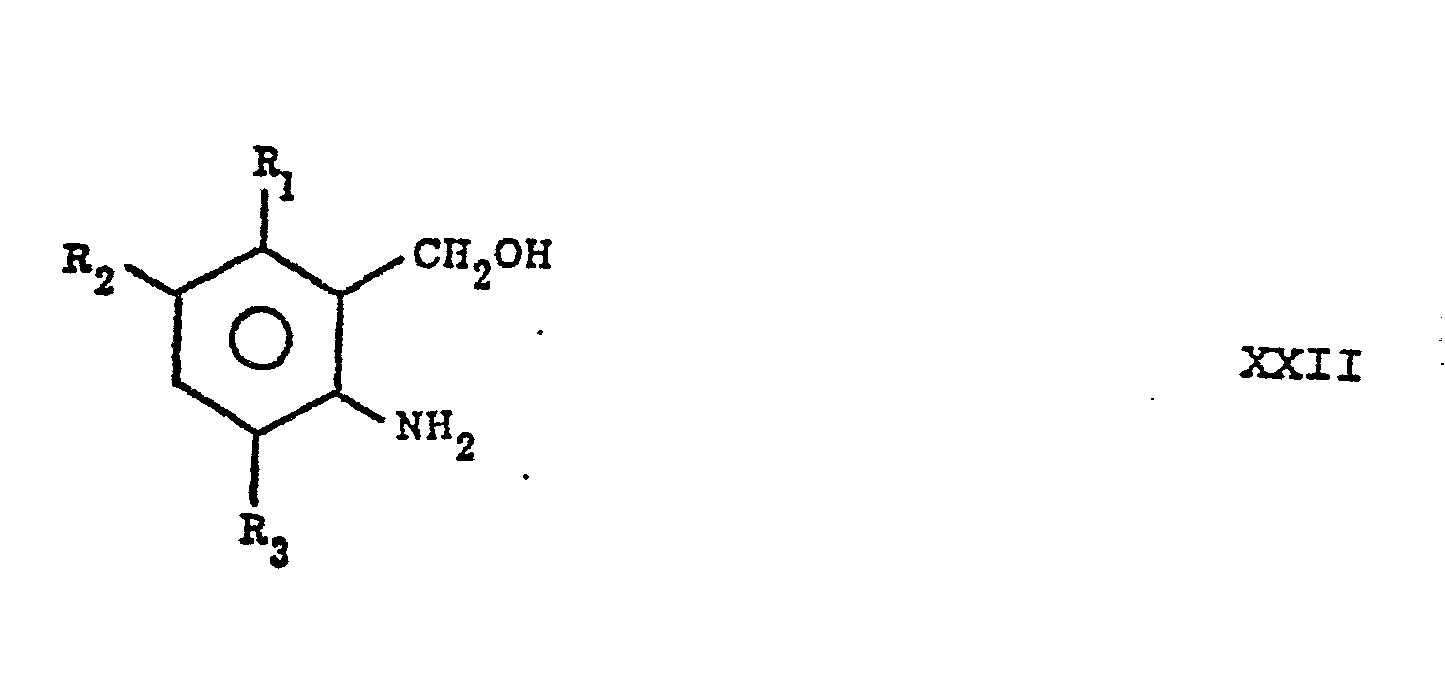
worin R1, R2 und R3 die obige Bedeutung haben. gemäss dem Reaktionsschema in Formelblatt 2 hergestellt. - Im Reaktionsschema 2 haben R1, R2, R3, R4, R7, R8, R9'. Z' und Y die obige Bedeutung. R13 hat die gleiche Bedeutung wie R4 mit einem Kohlenstoffatom weniger als die in R4 enthaltene Alkylgruppe. Infolgedessen ist R13 eine Alkylgruppe mit 3-9 C-Atomen oder -CH2(CH2)mCH2OH wobei m eine um 1 geringere Zahl als n ist, d.h. m ist 5 oder 6. R10 ist Wasserstoff oder Niederalkyl mit 1-7 C-Atomen und R10' ist eine Niederalkylgruppe mit 1-7 C-Atomen. R10'' ist eine Niederalkylgruppe mit einem Kohlenstoff weniger als die durch R10' bezeichnete Alkylgruppe.
- Im Reaktionsschema 2 wird die Verbindung der Formel XXII mit einem Säurechlorid der Formel XIX worin Z' Halogen ist zu einer Verbindung der Formel XXIII umgesetzt, die später entweder zu einer Verbindung der Formel XXVI oder einer Verbindung der Formel XXXI umgewandelt wird. Wenn R13 in der Verbindung der Formel XXIX -CH2-(CH2)mCH2OH ist, hat die Gegenwart der Hydroxygruppe im Substituenten R13 keinen Einfluss auf die Reaktion. Es wurde gefunden, dass die Hydroxygruppe unangegriffen in der Reaktionsfolge von Reaktionsschema 2 bleibt.
- Andererseits kann diese Hydroxygruppe in Form eines hydrolysierbaren Aethers geschützt werden. Jede konventionelle Aetherschutzgruppe kann dafür verwendet werden. Beispiele für bevorzugte Aetherschutzgruppen sind Tetrahydropyranyloxy, t-Butoxy, Triniederalkylsilyloxy z.B. Trimethylsilyloxy.
- In der ersten Reaktionsstufe wird eine Verbindung der Formel XXII mit einer Verbindung der Formel XIX zu einer Verbindung der Formel XXIII umgesetzt. Für diese Umsetzung können alle bekannten Methoden zur Kondensation eines Amins mit einem Säurehalogenid angewandt werden. In der nächsten Stufe wird die Verbindung der Formel XXIII im Reaktionsschritt n) in eine Verbindung der Formel XXIV durch Behandlung mit einem Reduktionsmittel übergeführt. Jedes konventionelle Alkalimetallaluminiumhydrid kann dafür Verwendung finden, wobei Lithiumaluminiumhydrid bevorzugt ist. Die Reduktion mit dem Alkalimetallaluminiumhydrid kann unter den üblichen Bedingungen durchgeführt werden.
- Die Verbindung der Formel XXIV kann über das Zwischenprodukt XXV in eine Verbindung der Formel XXVI im Verfahrensschritt o) übergeführt werden. Zunächst wird die Verbindung der Formel XXIV durch Umsetzung mit einem Triarylphosphinhydrohalogenid, wie im Zusammenhang mit der Reaktion d) beschrieben, in das Phosphoniumsalz XXV übergeführt. Die Verbindung der Formel XXV wird im Reaktionsschritt p) durch Umsetzung mit dem Aldehyd der Formel VII in eine Verbindung der Formel XXVI übergeführt, vergleiche hier zu Reaktionsschema 1. Die Reaktion von Stufe p) wird in einer Wittig--Reaktion in der im Reaktionsschritt c) beschriebenen Weise durchgeführt. Die Verbindung der Formel XXVI, worin R Niederalkyl ist, kann gewünschtenfalls durch konventionelle basische Hydrolyse in die freie Säure übergeführt werden. Andererseits kann die Verbindung der Formel XXVI, in der R4 eine verätherte Hydroxygruppe enthält, durch Säurehydrolyse in den freien Alkohol übergeführt werden. Die Aetherhydrolyse einer Verbindung der Formel XXVI kann entweder vor oder nach der Säurehydrolyse durchgeführt werden. Andererseits kann die Verbindung der Formel X, in der R4 eine verätherte Hydroxygruppe enthält, in der gleichen Weise hydrolysiert werden wie eine Verbindung der Formel XXVI.
- Die Verbindung der Formel XXIV kann auch in das tertiäre Amin der Formel XXXI übergeführt werden. Hierfür wird die Verbindung der Formel XXIV im Reaktionsschritt q) mit dem Säurehalogenid der Formel XIX-A in der im Zusammenhang mit der Umsetzung der Verbindung XXII zu einer Verbindung der Formel XXIII beschriebenen Weise zu einer Verbindung der Formel XXVII umgesetzt.
- Die Verbindung der Formel XXVII wird im Reaktionsschritt r) zu einer Verbindung der Formel XXIX durch Umsetzung mit einem Lithiumaluminiumhydrid-Reduktionsmittel umgesetzt wie im Zusammenhang mit Stufe n) beschrieben.
- In der nächsten Verfahrensstufe s) wird eine Verbindung der Formel XXIX durch Umsetzung mit einem Triarylphosphinhy- drohalogenid in eine Verbindung der Formel XXX übergeführt. Diese Reaktion wird in der gleichen Weise ausgeführt wie im Zusammenhang mit Stufe b) beschrieben. Die Verbindung der Formel XXX wird in Reaktionsschritt t) durch Umsetzung mit einer Verbindung der Formel VII (Formelschema 1) in eine Verbindung der Formel XXXI übergeführt. Bei dieser Reaktion wird eine Wittig-Reaktion durchgeführt. Sie kann in gleicher Weise wie im Zusammenhang mit der Reaktion c) beschrieben durchgeführt werden. Die Verbindung der Formel XXXI, in der R9 1 Niederalkyl ist, kann gewünschtenfalls durch basische Hydrolyse in eine entsprechende Verbindung mit einer freien Säuregruppe übergeführt werden. Andererseits kann eine in R4 enthaltene geschützte Hydroxygruppe durch konventionelle Aetherhydrolyse in eine entsprechende Verbindung, in der R4 eine freie Hydroxygruppe enthält, übergeführt werden. Diese Aetherhydrolyse kann vor oder nach der Hydrolyse der Estergruppe COOR9 durchgeführt werden.
- Falls R2 im Formelschema 2 Hydroxy ist, wird diese Hydroxygruppe vorzugsweise in Form einer Estergruppe geschützt. Die Esterschutzgruppe kann nach der Bildung des Wittig-Salzes der Formel XXX entfernt werden.
- Die Verbindungen der Formel I, in denen X -CH-(R10) ist, werden aus Verbindungen der Formel

worin Z" Brom oder Jod; R10 Wasserstoff oder Nieder- alkyl ist und R1, R2 und R3 die obige Bedeutung haben, gemäss Reaktionsschema 3 hergestellt. - Im Reaktionsschema 3 haben die Substituenten R , R , R3, R4, R7, R8, R9'. R10, R13, Y, Z' und Z" die obige Bedeutung. Eine Verbindung der Formel XXXV wird im Verfahrensschritt u) durch Umsetzung mit einer Verbindung der Formel XXXIV zu einer Verbindung der Formel XXXVI umgesetzt. Diese Reaktion wird als Wittig-Reaktion durchgeführt. In der Verbindung der Formel XXXVI kann eine in R13 enthaltene Hydroxygruppe durch Bildung einer der vorstehend erwähnten konventionellen Aethergruppen geschützt werden. Andererseits wurde gefunden, dass eine freie Hydroxygruppe nicht geschützt zu werden braucht und bei den Reaktionen in der Ueberführung der Verbindung der Formel XXXVI in eine Verbindung der Formel XXXXI nicht angegriffen wird. Zur Erzielung bester Ausbeuten ist es jedoch im allgemeinen bevorzugt, diese Hydroxygruppe durch eine hydrolysierbare Aethergruppe zu schützen.
- Der Reaktionsschritt u) wird mittels einer Wittig-Reaktion zwischen einer Verbindung der Formel XXXV und einer Verbindung der Formel XXXIV unter Anwendung der gleichen Reaktionsbedingungen wie im Zusammenhang mit Reaktionsschritt c) beschrieben durchgeführt.
- Die Verbindung der Formel XXXVI kann in eine Verbindung der Formel XXXVII im Reaktionsschritt v) durch Hydrierung übergeführt werden. Jede konventionelle Hydriermethode kann hierfür angewandt werden. Beispielsweise kann die Verbindung der Formel XXXVI mit Wasserstoffgas in Gegenwart eines Katalysators in einem inerten organischen Lösungsmittel behandelt werden. Bevorzugte Katalysatoren sind Palladiumkatalysatoren. Für die Reaktion können die konventionellen inerten organischen Lösungsmittel und die konventionellen Bedingungen für katalytische Hydrierungen angewandt werden.
- Im nächsten Reaktionsschritt w) wird die Verbindung der Formel XXXVII durch Behandlung mit Formaldehyd oder einer Formaldehyd freisetzenden Verbindung in eine Verbindung der Formel XXXIX übergeführt. Bei dieser Reaktion wird die Verbindung der Formel XXXVII zuerst mit einem Alkalimetallalkyl z.B. n-Butyllithium metalliert. Im allgemeinen wird diese Reaktion in einem inerten organischen Lösungsmittel z.B. einem Aether durchgeführt. Unter den bevorzugten Lösungsmittel sind Diäthyläther und Tetrahydrofuran. Bei dieser Reaktion sind Temperatur und Druck nicht kritisch. Die Reaktion kann bei Raumtemperatur und Atmosphärendruck ausgeführt werden. Gewünschtenfalls können höhere oder niedere Temperaturen angewandt werden. Nach Behandlung der Verbindung der Formel XXXVIII mit einem Alkalimetallalkyl wird dem Reaktionsmedium Formaldehyd oder eine Formaldehyd freisetzende Verbindung zugegeben. Als solche kann z.B. Paraformaldehyd angewandt werden. Die Reaktion wird im gleichen Reaktionsmedium und unter Anwendung der gleichen Bedingungen wie bei der Metallierung einer Verbindung der Formel XXXVIII durchgeführt.
- Die Verbindung der Formel XXXIX wird dann im Reaktionsschritt x) durch Behandlung mit einem Triarylphosphinhydrohalogenid in eine Verbindung der Formel XXXX übergeführt. Diese Reaktion wird in der gleichen Weise wie im Zusammenhang mit Reaktionsschritt b) beschrieben durchgeführt. Die Verbindung der Formel XXXX wird im Reaktionsschritt y) durch Behandlung mit einer Verbindung der Formel VII in eine Verbindung der Formel XXXXI übergeführt (vergl. Reaktionsschema 1). Diese Reaktion y) wird als Wittig-Reaktion unter den im Zusammenhang mit der Reaktion c) beschriebenen Bedingungen durchgeführt. Die Verbindung der Formel XXXXI kann in eine entsprechende Verbindung übergeführt werden, die eine freie Carboxylgruppe anstelle der Gruppe R9 1 enthält. Das wird durch konventionelle Esterhydrolyse in der früher beschriebenen Weise bewerkstelligt. Wenn R4 eine geschützte Hydroxygruppe enthält, kann diese Aetherschutzgruppe hydrolysiert werden durch Behandlung mit einer wässrigen anorganischen Säure. Die Hydrolyse kann entweder vor oder nach der Hydrolyse der Estergruppe in der Verbindung der Formel XXXXI durchgeführt werden.
- Zur Herstellung von Verbindungen der Formel I in denen X -C(R10)=CH darstellt, wird die Verbindung der Formel XXXV gemäss Reaktionsschema 3 und Verfahrensschritt u) mit einer Verbindung der Formel XXXIV. worin R13 R4 ist, zu einer Verbindung der Formel XXXVI, worin R13 R4 ist, umgesetzt. Die letztgenannte Verbindung wird dann der gleichen Reaktionsfolge wie die Verbindung der Formel XXXVII unterworfen, d.h. den Reaktionsschritten w), x) und y) wobei eine Verbindung der Formel X erhalten wird, in der X -C(R10)=CH- darstellt.
- Wenn in einer Verbindung der Formel XXXV im Reaktionsschema 3 R2 eine Hydroxygruppe darstellt, wird diese Gruppe vorzugsweise durch Veresterung mit einer Niederalkancarbonsäure geschützt. Die Esterschutzgruppe kann nach Bildung des Wittig-Salzes der Formel XXXX gespalten werden.
- Verbindungen der Formel I, in denen X -CH(R10)O- darstellt, können aus Verbindungen der Formel

worin R1, R2, R3 und Z' die obige Bedeutung haben, nach dem Reaktionsschema 4 hergestellt werden. In den dort angegebenen Formeln haben R1, R2, R3, R7, R8, R10, R9', Y und Z" die obige Bedeutung, R15 ist ein Rest R4, in dem die darin enthaltene Hydroxygruppe in Form einer hydrolysierbaren Aethergruppe wie Tetrahydropyranyl oder die früher erwähnten Aethergruppen geschützt ist. - Die Verbindung der Formel L wird durch Reaktion mit einem Alkalimetallalkoxid der Formel L-A in eine Verbindung der Formel LI übergeführt. Die Reaktion wird nach üblichen Verfahrensbedingungen für die Umsetzung von Alkalimetallalkoxiden mit einem Halogenid durchgeführt.
- Die Verbindung der Formel LI wird in eine Verbindung der Formel LII übergeführt, indem man zunächst die Verbindung der Formel LI mit einem Lithiumalkyl wie n-Butyllithium metalliert. Die metallierte Verbindung der Formel LI wird danach mit Formaldehyd oder einer Verbindung, die Formaldehyd abgibt umgesetzt. Bei der Umwandlung der Verbindung der Formel LI in eine Verbindung der Formel LII werden die gleichen Reaktionsbedingungen angewandt wie im Zusammenhang mit dem Reaktionsschritt w) beschrieben. Die Verbindung der Formel LII wird in das Phosphoniumsalz der Formel LIII durch Behandlung mit einem Triarylphosphinhydrohalogenid in der in Reaktionsstufe b) beschriebenen Weise übergeführt. Das Phosphoniumsalz der Formel LIII wird in einer Wittig-Reaktion mit der Verbindung der Formel VII (Reaktionsschema 1) zu einer Verbindung der Formel LIV umgesetzt. Diese Reaktion wird in der gleichen Weise wie im Zusammenhang mit Reaktionsschritt c) beschrieben durchgeführt.
- Wenn R15 in der Verbindung der Formel LIV eine geschützte Hydroxygruppe enthält, kann diese durch konventionelle Hydrolysemethoden zur freien Hydroxygruppe hydrolysiert werden. Die üblichen Hydrolysemethoden für Aetherschutzgruppen greifen die andere in der Verbindung der Formel LIV enthaltene Aethergruppe nicht an. Die Verbindung der Formel LIV kann durch konventionelle Esterhydrolyse in die freie Säure übergeführt werden.
- Wenn R 2 in den Verbindungen der Formeln L, LI, LII und LIII Hydroxy ist, wird die Hydroxygruppe vorzugsweise durch eine hydrolysierbare Estergruppe wie Niederalkanoyloxy geschützt. Die hydrolysierbare Estergruppe kann nach Bildung des Wittig-Salzes der Formel LIII abgespalten werden.
- Die Doppelbindungen in der Verbindung der Formel I in den Stellungen 2-3, 4-5, 6-7 und 8-9 können entweder cis- oder trans-Konfiguration aufweisen. Andererseits können die Verbindungen als Gemisch der verschiedenen cis- und trans-Isomeren vorliegen. In der Verbindung der Formel VII können die darin enthaltenen Doppelbindungen entweder cis- oder trans-Konfiguration haben jenachdem welche Stereokonfiguration der Doppelbindungen in den Verbindungen der Formel I erwünscht ist. Die bei der Herstellung der Verbindungen der Formel I in den Stufen c), e), i) etc. durchgeführte Wittig-Reaktionen liefert ein Gemisch von 8-9 cis/trans-Isomeren. Diese cis/trans-Isomeren können durch herkömmliche Mittel wie fraktionierte Kristallisation getrennt werden.
- Wenn die Verbindungen der Formel I eine 2-3 trans-Doppelbindung haben, kann dieses Isomer in die entsprechnde cis-Doppelbindung mittels an sich bekannter Isomerisaionsmethoden umgewandelt werden. Beispielsweise kann eine Verbindung der Formel I mit Jod in einem inerten organischen Lösungsmittel behandelt werden. Isomerisierung mit Jod liefert Verbindungen der Formel I mit 2-3 cis-Doppelbindungen.
- Die Formel I umfasst alle geometrischen Isomeren einschliesslich Mischungen dieser geometrischen Isomeren.
- Verbindungen der Formel XI, worin R1 Fluor ist, sind neu und können aus Verbindung der Formel

worin R2 und R3 die obige Bedeutung haben, nach dem Reaktionsschema 5 hergestellt werden wobei, R2, R3 und R4 die obige Bedeutung haben. - Im Reaktionsschema 5 wird die Verbindung LV durch Umsetzung mit einem Allylbromid alkyliert. Eine Hydroxygruppe R2 wird hierbei durch Veresterung geschützt, d.h. R2 in der Verbindung der Formel LV ist eine geschützte Hydroxygruppe. Für die Umsetzung einer Verbindung der Formel LV zu einer Verbindung der Formel LVI können die für Alkylierungen einer Hydroxygruppen mit einem Allylbromid bekannten Methoden Anwendung finden. Die Verbindung der Formel LVI wird durch Erwärmen auf eine Temperatur von 190-230°C zu einer Verbindung der Formel LVII umgelagert. Diese Umlagerung kann in Gegenwart eines hochsiedenden Kohlenwasserstoffes oder ohne Verwendung irgendeines Lösungsmittels stattfilden Wenn R3 Wasserstoff ist, wird die Verbindung der Forme LVII als Gemisch des Isomeren mit der Verbindung der Formel LVII erhalten in der die Allylgruppe para zum Fluorsubstituenten am Phenylring steht. Dieses Isomer kann abgetrennt werden oder in den nachfolgenden Reaktionen mitgeführt und aus dem Reaktionsgemisch auf einer späteren Stufe abgetrennt werden.
- Die Verbindung der Formel LVII wird danach durch Umsetzung mit einer Verbindung der Formel V (Reaktionsschema 1) gemäss Reaktionsschritt d) zu einer Verbindung der Formel LVIII umgesetzt. Im nächsten Reaktionsschritt wird die Verbindung der Formel LVIII durch Isomerisierung mit einer starken Base wie einem Alkalimetallalkoxid in Gegenwart eines inerten organischen Lösungsmittels, vorzugsweise Kalium-t-butoxid in Dimethylsulfoxid, zu einer Verbindung der Formel LIX isomerisiert. Die Verbindung der Formel LIX wird in eine Verbindung der Formel LX durch Behandlung mit Ozon übergeführt. Hierbei werden Temperaturen von -70 bis -20°C angewandt. Weiterhin arbeitet man bei dieser Temperatur in einem inerten organischen Lösungsmittel. Jedes konventionelle inerte organische Lösungsmittel kann Verwendung finden, bevorzugt sind halogenierte Kohlenwasserstoffe wie Methylenchlorid.
- Eine Verbindung der Formel LX ist eine Verbindung der Formel XI mit R = Fluor. Diese Verbindung kann in eine Verbindung der Formel X gemäss dem Reaktionsschema 1 übergeführt werden.
- Wenn in einer Verbindung der Formel III R2 Hydroxy ist, liegen 2 Hydroxydgruppen vor. Es ist daher im allgemeinen vorzuziehen, die Verbindung der Formel XI, in der R2 eine geschützte Hydroxygruppe darstellt, aus einer Verbindung der Formel LXI (Reaktionsschema 6) herzustellen. Auf diese Weise können Verbindungen der Formel I hergestellt werden, in denen X -O- und R2 Hydroxy ist und R3 und R 4 die obige Bedeutung haben. Im Reaktionsschema 6 sind R1 und R15 zusammen mit dem daran gebundenen Sauerstoffatom durch eine konventionelle hydrolysierbare Schutzgruppe, vorzugsweise Niederalkanoyl, geschütztes Hydroxy.
- Im Reaktionsschema 6 wird die Verbindung der Formel LXI in eine Verbindung der Formel LXII übergeführt, wobei die gleichen Reaktionsbedingungen wie im Zusammenhang mit der Umwandlung einer Verbindung der Formel LV in eine Verbindung der Formel LVI (Reaktionsschema 5 ) beschrieben Anwendung finden. Die Verbindung der Formel LXII wird dann nach dem gleichen Verfahren wie im Zusammenhang mit der Umwandlung der Verbindung LVI in eine Verbindung der Formel LVII beschrieben in eine Verbindung der Formel LXIII übergeführt. In den nächsten Stufen wird die Verbindung der Formel LXIII in eine Verbindung der Formel LXIV nach Verfahren, die im Schritt g') in Reaktionsschema 5 beschrieben sind, und da-nach zu einer Verbindung der Formel LXV nach dem im Zusammenhang mit Stufe h') in Schema 5 beschriebenen Verfahren übergeführt. Die Umwandlung der Brombenzolverbindung der Formel LXV in das Phenol der Formel LXVI wird nach an sich bekannten Verfahren (Kidwell and Darling, Tetrahedron Letters, (1966) Seiten 531-535) durchgeführt.
- Im nächsten Schritt der Herstellung des Zwischenproduktes der Formel XI, in dem R2 eine geschützte Hydroxygruppe ist, d.h. der Verbindung XI-A wird die Hydroxygruppe in der Verbindung der Formel LXVI in eine konventionell hydrolysierbare Estergruppe übergeführt, wobei man die Formel LXVII erhält in der R15 zusammen mit dem Sauerstoffatom, an das sie gebunden ist, eine hydrolysierbare Estergruppe darstellt. Für diese Veresterung können konventionelle Methoden der Veresterung von Hydroxygruppen mit organischen Säuren wie Niederalkansäuren mit 1-7 C-Atomen angewandt werden. Die Verbindung der Formel XI-A wird aus der Verbindung der Formel LXVII in der gleichen Weise hergestellt wie vorstehend inbezug auf die Umwandlung der Verbindung der Formel LIX in L (Schema 5) beschrieben.
- Bei der Umwandlung der Verbindung der Formel XI-A in einer Verbindung der Formel XVII (Reaktionsschema 1) ist es im allgemeinen vorzuziehen, den Estersubstituenten R2 nach der Bildung des Wittig-Salzes der Formel XIII oder XVI zu hydrolysieren.
- In einer anderen Ausführungsform wird eine Verbindung der Formel XI, in der R1 Trifluormethyl ist (die Verbindung der Formel XI-B), gemäss Reaktionsschema 7 aus einer Verbindung der Formel LXX hergestellt. Im ersten Schritt dieser Reaktion wird die Verbindung der Formel LXX in eine Verbindung der Formel LXXI wie im Zusammenhang mit der Reaktion d) (Umsetzung der Verbindung VIII mit einer Verbindung der Formel V zu einer Verbindung der Formel X) beschrieben übergeführt. Wenn hierbei R2 Hydroxy ist, verläuft die Alkylierung an der zur Trifluormethylgruppe ortho-ständigen Hydroxygruppe sehr langsam. Infolgedessen muss diese Gruppe nicht notwendigerweise geschützt werden, da die Alkylierung vorzugsweise mit der meta-ständigen Hydroxygruppe erfolgt. Mischungen alkylierter Produkte, die bei dieser Reaktion erhalten werden, können durch herkömmliche Verfahren getrennt werden. Die Verbindung der Formel LXXI wird in eine Verbindung der Formel XII-B nach herkömmlichen Verfahren zur Formylierung des Benzolringes, z.B. durch Behandlung mit Lithiumalkyl und Dimethylformamid, umgewandelt.
- Die nachstehenden Beispiele erläutern die Erfindung weiter. In den Beispielen ist der verwendete Aether Diäthyl- ätheräther, die Lösungsmittel wurden unter vermindertem Druck entfernt.
- Ein Gemisch von 110 g 2-Hydroxybenzaldehyd, 180 g 1-Bromnonan, 800 ml Dimethylformamid und wasserfreies Kaliumcarbonat wurden 14 Stunden auf 80° erwärmt. Danach wurden Hexan und Wasser zugegeben. Die Hexanphase wurde konzentriert und der Rückstand destilliert. Man erhielt 210 g 2-Nonyloxybenzaldehyd, Siedepunkt 121°/40 Pa. Eine Lösung von 100 g 2-Nonyloxybenzaldehyd in 1000 ml Aethanol wurde mit 6 g Natriumborhydrid bei 10° versetzt. Das Gemisch wurde 15-20 Minuten bei Raumtemperatur gerührt und der 2-Nonyloxybenzylalkohol mit Hexan extrahiert. Entfernung des Lösungsmittels unter vermindertem Druck lieferte 98 g rohen 2-Nonyloxybenzylalkohol, der zu einem Gemisch von 144 g Triphenylphosphinhydrobromid in 500 ml Acetonitril gegeben wurde. Die erhaltene Lösung wurde 14 Stunden zum Rückfluss erhitzt. Entfernung des Lösungsmittels unter vermindertem Druck und Kristallisation des Rückstandes aus Tetrahydrofuran/Aethyläther lieferte reines [[2-(Nonyloxy)phenyl]-methyl]triphenylphosphoniumbromid. Ausbeute 208 g.
- Behandlung von 2-Hydroxybenzylalkohol mit Triphenylphosphinhydrobromid in Acetonitril nach dem in Beispiel 1 beschriebenen Verfahren lieferte [(2-Hydroxyphenyl)-methyl]triphenylphosphoniumbromid.
- Eine Lösung von einem Mol [(2-Hydroxyphenyl)methyl]triphenylphosphoniumbromid in Tetrahydrofuran wurde durch Be- - handlung mit 2,1 Mol-Aequivalent n-Butyllithium in Hexan bei -35° in das Ylid übergeführt, danach mit einem Mol 7-Formyl--3-methyl-2,4,6-octatriensäureäthylester versetzt und 15 Minuten bei -70° gerührt. Isolierung der organischen Stoffe mit Hexan/Aethylacetat (4:1 Volumenteile) und verdünnter Mineralsäure (2M wässrige HCl) lieferte reinen all(E)-9-(2-Hydroxyphenyl)-3,7-dimethyl -2,4,6,8-nona- tetraensäureäthylester in 90% Ausbeute nach Chromatographie und Kristallisation aus Dichlormethan/Hexan.
- Ein Gemisch von 0,5 Mol 2-Hydroxybenzaldehyd, 0,6 Mol (7-Carboxy-2,6-dimethyl-2,4,6-heptatrien-l -yl)triphenylphosphoniumbromid in 750 ml 1,2-Epoxybutan wurde 30 Minuten zum Rückfluss erhitzt, danach gekühlt, in ein Aether/Hexangemisch (1:1 Volumenteile) gegossen, filtriert und konzentriert. Der Rückstand wurde aus Hexan/Aether kristallisiert und lieferte all(E)-9-(2-Hydroxyphenyl)-3,7-dimethyl -2,4,-6,8-nonatetraensäureäthylester in 38% Ausbeute, Schmelzpunkt 143-145°.
- Eine Lösung von 150 g [[2-(Nonyloxy)phenyl]methyl]triphenylphosphoniumbromid in 1100 ml Tetrahydrofuran wurde auf -50° gekühlt. Dabei wurde eine Suspension des festen Salzes erhalten. Zu diesem Gemisch wurde eine Lösung von 180 ml 1,6 molares n-Butyllithium in Hexan gegeben. Das Gemisch wurde dann weitere 15 Minuten bei -40° gerührt, danach auf -70° gekühlt und mit 65 g 7-Formyl-3-methyl-2,4,6-octatriensäureäthylester in 250 ml Tetrahydrofuran versetzt. Zusatz von Hexan und wässrigem Methanol (40%) und nachfolgende Konzentration des Hexanextraktes lieferte 64 g (58%) all(E)-9-[2-(Nonyloxy)phenyl]-3,7-dimethyl-2,4,6,8 -nonatetraensäureäthylester, Schmelzpunkt 52-53°. Dieser Ester wurde wie folgt hydrolysiert: 70 g Ester wurden in 1000 ml Aethanol gelöst. Die Lösung wurde mit einer Lösung von 80 g Kaliumhydroxid in 400 ml Wasser versetzt und 1 Stunde zum Rückfluss erhitzt. Danach wurden Wasser und wässrige Mineralsäure zugesetzt und die Feststoffe mit Chloroform aufgenommen. Konzentration dieses organischen Extraktes und Kristallisation des Rückstandes aus Aethylacetat/Hexan lieferte all(E)-9-[2-(Nonyloxy)phenyl]-3,7-dimethyl -2,4,6,8--nonatetraensäure vom Schmelzpunkt 102-103°, Ausbeute 38 g.
- Ein Gemisch von 24 g Natriumhydrid (50 Gew.-% in Mineralöl) und 1000 ml Dimethylformamid wurden bei 10° mit 0,4 Mol-Aequivalenten all(E)-9-(2-Hydroxyphenyl)-3.7-dimethyl -2,4,6,8-nonatetraensäureäthylester vesetzt. Das erhaltene Gemisch wurde bei Raumtemperatur gerührt, bis die Wasserstoffentwicklung aufgehört hatte und das Natriumsalz gebildet worden war. Eine Lösung von 0,5 Mol-Aequivalenten 1-Nonyltosylat in 200 ml Dimethylformamid wurde dann zu dieser Salzlösung gegeben und das Reaktionsgemisch wurde 14 Stunden bei 45° gerührt. Danach wurden sorgfältig Hexan und Wasser zugesetzt, der Hexanextrakt wurde konzentriert und der Rückstand durch Chromatographie an Silicagel gereinigt. Kristallisation aus Hexan lieferte dann reinen (All-E)-9-[2-Nonyloxy)phenyl]-3,7-dimethyl -2,4,6,8-nona- tetraensäureäthylester. Hydrolyse dieses Esters wie in Beispiel 5 lieferte (All-E)-9-[2-(Nonyloxy)phenyl]-3,7-dimethyl -2,4,6,8-nonatetraensäure.
- 2-Hydroxybenzaldehyd wurde mit 2,2-Dimethyl-1-jodoctan zu 2-(2,2-Dimethyloctyloxy)benzaldehyd kondensiert, der zu 2-(2,2-Dimethyloctyloxy)benzylalkohol reduziert und dann" gemäss Beispiel 1 in [[2-(2,2-Dimethyloctyloxy)phenyl]-methyl] triphenylphosphoniumbromid umgewandelt wurde. Kondensation dieses Phosphoniumbromids mit 7-Formyl-3-methyl--2,4,6 -octatriensäureäthylester gemäss Beispiel 3 und anschliessende Hydrolyse gemäss Beispiel 5 lieferte (All-E)--3,7-Dimethyl-9-[2-[(2,2-dimethyl-octyl)oxy]phenyl] -2,4,-6,8-nonatetraensäure vom Schmelzpunkt 113-1170 (aus Dichlormethan/Hexan).
- Aus Octanol und n-Butyllithium hergestelltes Lithiumoctanat wurde in einem Gemisch von Tetrahydrofuran/Hexan und Dimethylformamid mit 2-BrQmbenzylbromid zu 2(Octyloxy)-methylbrombenzol kondensiert. Dieses Material wurde in Aether/Hexan mit n-Butyllithium behandelt und danach mit Paraformaldehyd, wobei 2-(Octyloxy)methylbenzylalkohol erhalten wurde. Dieses Material wurde dann mit Triphenylphosphoniumbromid zu [[2-[(Octyloxy)-methyl]phenyl]methyl] triphenylphosphoniumbromid umgesetzt. Kondensation dieses Materials mit 7-Formyl-3-methyl-2,4,6-octatriensäureäthylester wie in Beispiel 3 und anschliessende Hydrolyse wie in Beispiel 5 lieferte (All-E)-3,7-Dimethyl-9-[2-[(octyloxy)--methyl]phenyl] -2,4,6,8-nonatetraensäure vom Schmelzpunkt 120-121° (aus Dichlormethan/Hexan).
- 2-Chlor-6-hydroxy-benzaldehyd wurde wie in Beispiel 1 mit 1-Bromnonan zu 2-Chlor-6-nonyloxybenzaldehyd alkyliert. Reduktion mit Natriumborhydrid wie in Beispiel 1 lieferte 2-Chlor-6-nonyloxybenzylalkohol der durch Behandlung mit Triphenylphosphinhydrobromid in Acetonitril wie in Beispiel 1 [[2-Chlor-6-nonyloxy]phenyl]methyl] triphenylphosphoniumbromid lieferte. Kondensation mit 7-Formyl-3-methyl--2,4,6-octatriensäureäthylester wie in Beispiel 3 lieferte (All-E)-9-[2-Chlor-6-(nonyloxy)phenyl] -3,7-dimethyl-2,4,-6,8-nonatetraensäureäthylester. Dieser Ester wurde wie in Beispiel 5 hydrolysiert und lieferte (All-E)-9-[2-Chlor-6--(nonyloxy)phenyl]-3,7-dimethyl -2,4,6,8-nonatetraensäure vom Schmelzpunkt 129-131° (aus Aethylacetat/Hexan).
- 5-Methoxy-2-hydroxybenzaldehyd wurde mit Nonylbromid gemäss Beispiel 1 alkyliert und mit Natriumborhydrid reduziert zu 5-Methoxy-2-nonyloxy-benzylalkohol, der durch Behandlung mit Triphenylphosphinhydrobromid das [(5-Methoxy--2-nonyloxyphenyl)methyl] triphenylphosphoniumbromid lieferte. Kondensation dieses Materials mit 7-Formyl-3-methyl--2,4,6-octatriensäureäthylester gemäss Beispiel 3 und anschliessende Hydrolyse gemäss Beispiel 5 lieferte (All-E)--9-(5-Methoxy-2-nonyloxyphenyl)-3,7-dimethyl -2,4,6,8-nona- tetraensäure vom Schmelzpunkt 125-126° (aus Methanol).
- Das gemäss Beispiel 6 hergestellte Natriumsalz von all(E)-9-(2-Hydroxyphenyl)-3,7-dimethyl -2,4.6,8-nona- tetraensäureäthylester in Dimethylformamid wurde wie in Beispiel 6 mit 1,8-Dihydroxyoctanmonotosylat behandelt und lieferte all(E)-9-[2-[8-Hydroxyoctyl)oxy]phenyl] -3,7-diäthyl--2,4,6,8-nonatetraensäureäthylester nach Chromatographie über Silicagel. Hydrolyse wie in Beispiel 5 lieferte all(E)--9-[2-[(8-Hydroxy-octyl)oxy]phenyl] -3,7-dimethylphenyl]--3,7-dimethyl -2,4,6,8-nonatetraensäure vom Schmelzpunkt 122-123° (aus Aethylacetat).
- 62 g 2-(Nonyloxy)benzaldehyd in 500 ml Aceton wurden mit 100 ml 1M wässrigem Natriumhydroxid 18 Stunden bei Raumtemperatur behandelt. Danach wurden Kochsalzlösung und Aethylacetat/Hexan (1:1 Volumen) zugesetzt. Einengen der organischen Phase und anschliessende Kristallisation aus Hexan lieferte 4-(2-Nonyloxyphenyl)-3-buten-2-on in einer Ausbeute von 53 g.
- Eine Lösung von 58 g 4-(2-Nonyloxyphenyl)-3-buten-2-on in 200 ml Tetrahydrofuran wurde zu einer Lösung von 200 ml 1,6M Vinylmagnesiumbromid in Tetrahydrofuran, die mit weiterem Tetrahydrofuran auf 1 1 verdünnt wurde bei -30° gegeben. Danach wurde das Gemisch 30 Minuten bei 0° gerührt, mit 100 ml wässrigem Ammoniumchloridlösung und 2 1 Aether versetzt und von den Feststoffen abdestilliert. Einengen des organischen Extraktes und Reinigung durch Chromatographie an Silicagel lieferte 40 g (E)-5-(2-Nonyloxyphenyl)-3-hydroxy--3-methyl -1,4-pentadien als Oel.
- Eine Lösung von 66 g (E)-5-(2-Nonyloxyphenyl)-3-hydroxy -3-methyl-1,4-pentadien in 250 ml Acetonitril wurde bei 10° zu einer Aufschlämmung von 66 g Triphenylphosphoniumhydrobromid in 300 ml Acetonitril gegeben. Nach Erwärmen auf Raumtemperatur wurde das Gemisch 2 Stunden bei dieser Temperatur gerührt bis Lösung eingetreten war. Diese Lösung wurde dann mit 2 x 250 ml Hexan extrahiert und die Acetonitrilschicht konzentriert (ca. 400 ml) und auf -10° gekühlt. Die Feststoffe wurden abfiltriert, mit Acetonitril und Hexan gewaschen und getrocknet. Man erhielt 21 g reines all(E)-[5--(2-Nonyloxyphenyl) -3-methyl-2,4-pentadienyl]triphenylphosphoniumbromid.
- Ausgehend von all(E)-[5-(2-Nonyloxyphenyl)-3-methyl-2,4--pentadienyl] triphenylphosphoni-umbromid wurde mittels des Verfahrens von Beispiel 5 das Ylid mit 3-Formyl-2-buten- säureäthylester zu all(E)-9-(2-nonyloxyphenyl)-3,7-dimethyl -2,4,6,8-nonatetraensäure umgesetzt.
- Eine Lösung von 10 g all(E)-9-[2-(Nonyloxy)phenyl] -3,7--dimethyl-2,4,6,8-nonatetraensäureäthylester in 200 ml Hexan, die 0,5 g Jod enthielten, wurde 30 Minuten bei Raumtemperatur gerührt. Das Hexan wurde mit wässriger Natriumthiosulfatlösung (10 Gew.-%) jodfrei gewaschen, getrocknet und eingeengt, wobei ein Gemisch von Doppelbindungsisomeren erhalten wurde. Trennung durch Chromatographie an Silicagel lieferte 1,5 g reinen (Z,E,E,E)-9-[2-(Nonyloxy)phenyll-3,7--dimethyl-2,4,-6,8-nonatetraensäureäthylester. Hydrolyse mit wässrig-äthanolischer Kaliumhydroxidlösung unter Rückfluss lieferte reine (Z,E,E,E)-9-[2-(Nonyloxy)phenyl]-3,7-dimethyl-2,4,6,8-nonatetraensäuresäure, Schmelzpunkt 135-136°.
- Die Mutterlauge bei der Kristallisation von all(E)-9-[2--(Nonyloxy)phenyl] -3,7-dimethyl-2,4,6,8-nonatetraensäure-äthylester aus Beispiel 5 stellte ein Gemisch verschiedener Isomere dar. Reinigung durch Chromatographie lieferte 80% reinen Aethylester, der nach Hydrolyse wie in Beispiel 5 reine (E,E,E,Z)-9[2(Nonyloxy)phenyl]-3,7-dimethyl -2,4,6,8--nonatetraensäure vom Schmelzpunkt 105-109° lieferte.
- 0,1 Mol Nonylmethyltriphenylphosphoniumbromid in 200 ml Tetrahydrofuran wurde bei -10° mit 0,1 Mol-Aequivalent n-Butyllithium (1,6 Mol in Hexan) in das Ylid übergeführt.
- Danach wurden 0,09 Mol 2-Brombenzaldehyd in 25 ml Tetrahydrofuran zugesetzt und das Gemisch 30 Minuten bei 0° gerührt und mit Hexan und wässrigem Methanol (40:60) versetzt. Der Hexanextrakt wurde eingeengt und der Rückstand destilliert. Man erhielt 2-(1-Decenyl)-1-brombenzol in 90% Ausbeute.
- Dieses Material wurde in Hexan gelöst und in Gegenwart von Palladium/Kohle bei Raumtemperatur und Raumdruck hydriert, bis die olefinische Bindung gesättigt war. Die Feststoffe wurden abfiltriert. Entfernung des Hexans und Destillation des Rückstandes lieferten 2-Decyl-1-brombenzol, Siedepunkt 120°/0,133 Pa in einer Ausbeute von 80%.
- Eine Lösung von 0,1 Mol 2-Decyl-l-brombenzol in 150 ml Aether wurde mit 0,11 Aequivalent n-Butyllithium (1,6M in Hexan) versetzt und das Gemisch 2 Stunden bei Raumtemperatur gerührt. Danach wurden 0,2 Mol-Aequivalent trockener Paraformaldehyd zugegeben und das Gemisch weitere 18 Stunden bei Raumtemperatur gerührt. Danach wurden Wasser und Aether zugesetzt und die ätherischen Extrakte getrocknet und konzentriert. Der Rückstand lieferte nach Chromatographie reines 2-Decyl-l-hydroxymethylbenzol in 75% Ausbeute.
- 2-Decyl-l-hydroxymethylbenzol wurde nach dem Verfahren von Beispiel 1 mit Triphenylphosphoniumhydrobromid in Acetonitril in das Phosphoniumsalz übergeführt. Dieses Salz wurde, wie vorstehend beschrieben, mit n-Butyllithium in Tetrahydrofuran umgesetzt und danach mit 7-Formyl-3-methyl--2,4,6-heptatriensäure-methylester behandelt. Reinigung des rohen Kondensationsproduktes durch Chromatographie an Silicagel und anschliessende basische Hydrolyse lieferte reine all(E)-9-(Decylphenyl)-3,7-dimethyl-2,4,6,8-nonatetraensäure vom Schmelzpunkt 107-108° (aus Hexan-Aether).
- 1 Mol 2-Aminobenzylalkohol wurde mit 2,2 Mol Octanoylchlorid in einem Gemisch von Dichlormethan-Triäthylamin bei 0° umgesetzt. Nach 30 Minuten bei 10° wurde das Gemisch mit Wasser gewaschen und der Aether abdestilliert. Der rohe Rückstand wurde in 2000 ml Tetrahydrofuran gelöst, mit 1500 ml 1N wässriger Natronlauge behandelt und 3 Stunden bei Raumtemperatur gerührt.
- Zusatz von Wasser und Aether lieferte das rohe Hydroxymethyloctylamid. Reinigung durch Chromatographie lieferte reines Octylamid in 85% Ausbeute.
- 100 g dieses Materials wurden in 500 ml Tetrahydrofuran gelöst und zu einer Aufschwemmung von 2 Mol-Aequivalent Lithiumaluminiumhydrid in 1000 ml Tetrahydrofuran gegeben. Das Gemisch wurde dann 8 Stunden zum Rückfluss erhitzt, auf 0° gekühlt und mit 100 ml-wässriger Natriumsulfatlösung versetzt.
- Die Feststoffe wurden abfiltriert, die Lösungsmittel unter vermindertem Druck entfernt und der Rückstand durch Chromatographie an Silicagel gereinigt. Man erhielt 75 g reines 2-Hydroxymethyl-N-octylamih.
- Dieses Material wurde in 300 ml Acetonitril, die 1,1 Mol-Aequivalente Triphenylphosphinhydrobromid enthielten, gelöst. Das Gemisch wurde 24 Stunden zum Rückfluss erhitzt und dann eingeengt. Der Rückstand wurde mit Aether behandelt und lieferte das Phosphoniumsalz als weissen Feststoff.
- Dieses Material wurde 1 Stunde unter Rühren bei 0° mit 1,5 Mol-Aequivalent n-Butyllithium umgesetzt und lieferte das entsprechende Ylid. Danach wurden 1,6 Mol-Aequivalente 7-Formyl-3-methyl-2,4,6-heptatriensäureäthylester in Tetrahydrofuran zugesetzt und das Gemisch 1 Stunde bei 10° gerührt.
- Zusatz von Hexan und wässrigem Methanol (2:3) und Entfernung des Hexans unter vermindertem Druck lieferte ein Rohprodukt, das nach Reinigung durch Chromatographie an Silicagel und Kristallisation aus Hexan reinen all(E)-9-(2--Octylaminophenyl)-3,7-dimethyl -2,4,6,8-nonatraensäure- äthylester vom Schmelzpunkt 38-40° in einer Ausbeute von 25% lieferte.
- Eine Lösung von 100 g 3-Fluorphenol in 1000 ml Dimethylformamid, das 165 g Kaliumcarbonat enthielt, wurde mit 115 g Allylbromid versetzt und 18 Stunden auf 80° erwärmt.
- Danach wurden Wasser und Hexan zugesetzt, der Hexanextrakt wurde mit 5%iger wässriger Natriumhydroxidlösung, und gesättigter Kochsalzlösung gewaschen und konzentriert und lieferte 155 g Allyläther. 134 g dieses Materials wurden 16 Stunden auf 220° erwärmt, wobei ein Gemisch von 3-Fluor--2-(2-butenyl)phenol und 5-Fluor-2-(2-butenyl)phenol erhalten wurde. Dieses Gemisch wurde in 2000 ml Dimethylformamid mit 170 g 1-Bromnonan und 150 g Kaliumcarbonat 16 Stunden auf 80° erwärmt. Nach Verdünnen mit Wasser und Extraktion mit Hexan und Einengen wurde ein Gemisch von Produkten erhalten. Destillation lieferte ein Gemisch von 3-[(2-Fluor-6--nonyloxy)phenyl]-buten und 3-[(3-Fluor-2-nonyloxy)phenyl]--buten, Siedepunkt 120-125°/13,3 Pa; Ausbeute 186 g).
- 185 g dieses Isomerengemisches wurden in 1000 ml Dimethylsulfoxid mit 1,5 g Kalium-t-butoxid 6 Stunden bei Raumtemperatur stehengelassen. Zusatz von Wasser und Extraktion mit Hexan lieferte ein Gemisch von 1-[(2-Fluor-6-nonyloxy)-phenyl]-buten und 1-[(3-Fluor-2-nonyloxy)phenyl]-buten.
- 175 g dieses Isomerengemisches wurden in 2000 ml eines Gemisches von Dichlormethan und Methanol (9:1) gelöst und 8 Stunden bei -40° einem Ozonstrom ausgesetzt. Danach wurde das Reaktionsgemisch in 100 ml eines Gemisches von Wasser, Hexan und Dimethylsulfid gegossen und 1 Stunden bei Raumtemperatur gerührt.
- Der Hexanextrakt wurde mit Wasser gewaschen, über Magnesiumsulfat getrocknet, mit 50 ml Dimethylsulfid versetzt und 16 Stunden bei Raumtemperatur stehengelassen.
- Entfernung der Lösungsmittel lieferte 155 g eines Gemisches von 2-Fluor-6-nonyloxybenzaldehyd und 4-Fluor-2--nonyloxy-benzaldehyd.
- 150 g dieses Aldehydgemisches wurden in 2000 ml Aethanol mit 15 g Natriumborhydrid bei 5° versetzt und dann 30 Minuten bei Raumtemperatur gerührt. Danach wurden 1500 ml Wasser und 500 ml Kochsalzlösung zugesetzt und das Alkoholgemisch in Hexan aufgenommen. Entfernung der Lösungsmittel und Chromatographie des Rückstandes an Silicagel (5% Aethylacetat/Hexan) lieferte 76 g reinen 2-Fluor-6-nonyloxy-benzylalkohol.
- Ein Gemisch von 19 g 2-Fluor-6-nonyloxybenzylalkohol und 26 g Triphenylphosphinhydrobromid in 250 ml Acetonitril wurde 14 Stunden zum Rückfluss erhitzt, und danach zur Trockene eingeengt. Man erhielt 42 g [[(2-Fluor -6-nonyl- oxy)phenyl]methyl]triphenylphosphoniumbromid. Dieses Phosphoniumsalz wurde in 600 ml Tetrahydrofuran gelöst, und die Lösung bei -50° mit 45 ml 1,6M n-Butyllithium in Hexan versetzt. Nach 15 Minuten Rühren bei -50° wurden 8,4 g 7-For- myl-3-methyl-2,4,6-octatriensäureäthylester zugesetzt. Das Reaktionsgemisch wurde auf Zimmertemperatur aufgewärmt und weitere 15 Minuten gerührt. Danach wurde Hexan zugesetzt und das Gemisch mit Wasser, 40%igem wässrigen Methanol gewaschen und über Magnesiumsulfat getrocknet. Einengen des Hexanextraktes und Reinigung durch Chromatographie (5% Aether--Hexan) lieferte 11 g reines trans-Isomer.
- Kristallisation aus Hexan-Aethylacetat lieferte (all-E)--9-[2-Fluor-6-(nonyloxy)phenyl]-3,7-dimethyl -2,4,6,8-nona- tetraensäureäthylester in einer Ausbeute von 9,5 g).
- Eine Lösung von 6,5 g Ester in 150 ml Aethanol wurde mit 7 g Kaliumhydroxid in 40 ml Wasser 1 Stunde zum Rückfluss erhitzt. Das gekühlte Reaktionsgemisch wurde in kalte wässrige Salzsäure gegossen und mit Chloroform extrahiert. Entfernung des Lösungsmittels und Kristallisation aus Hexan--Aethylacetat lieferte reine (all-E)-9-[2-Fluor-6-(nonyl- oxy)phenyl]-3,7-dimethyl -2,4,6,8-nonatetraensäure vom Schmelzpunkt 107-109°.
-

- Nach der Vorschrift von Beispiel 22 werden Kapseln hergestellt, die als aktiven Wirkstoff (all-E)-9-[2-Fluor-6--(nonyloxy)phenyl]-3,7-dimethyl -2,4,6,8-nonatetraensäure enthalten.
-
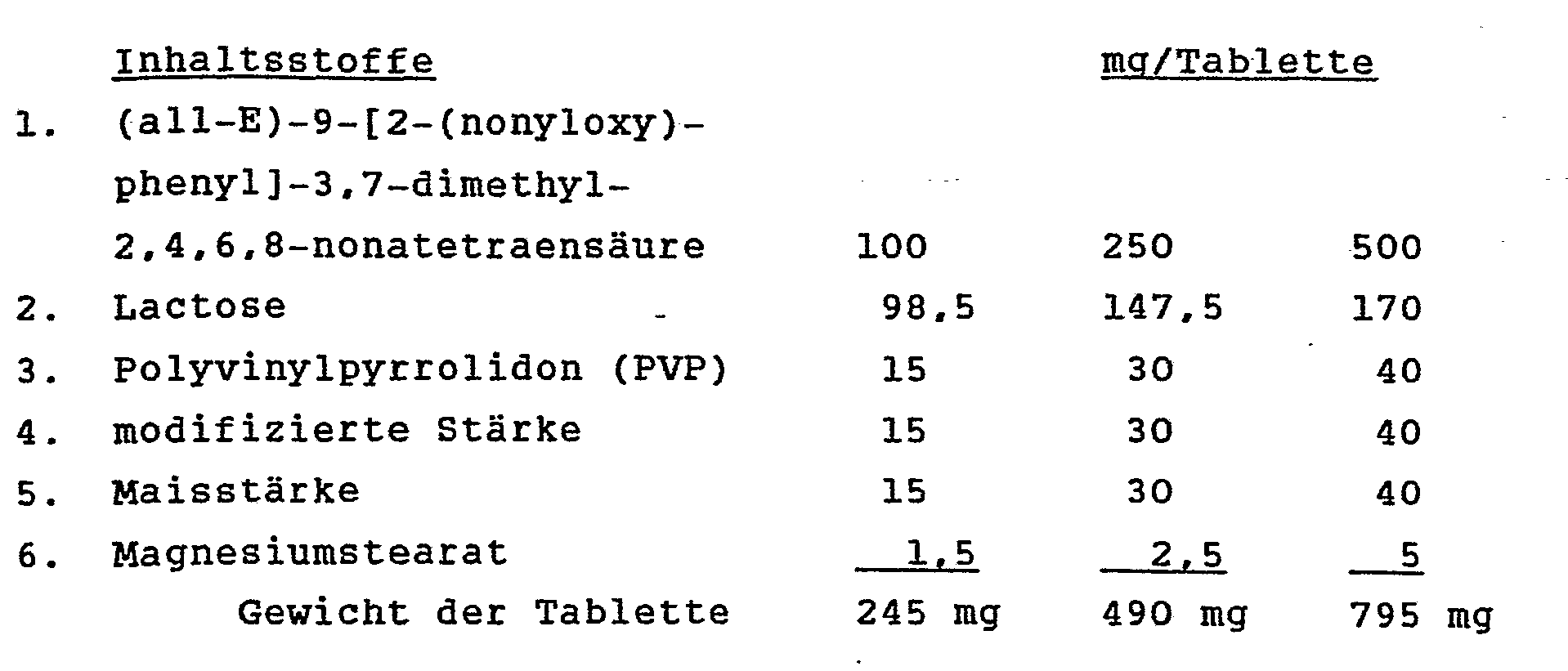
-
- 1) Mischen der Inhaltsstoffe 1, 2, 4 und 5, Granulieren mit PVP und Lösen in Wasser/Alkohol. Trocknen des Granulats. Vermahlen des trockenen Granulats.
- 2) Zusatz von Magnesiumstearat und Verpressen.
- Nach dem in Beispiel 24 beschriebenen Verfahren werden Tabletten mit (all-E)-9-[2-Fluor-6-(nonyloxy)phenyl]-3,7--dimethyl -2,4,6,8-nonatetrensäure als aktiven Wirkstoff hergestellt.
-


-

-

- Ein Gemisch von 51 g α,α,α-Trifluor-m-kresol, 70 g Bromnonan und 100 g Kaliumcarbonat in Dimethylformamid wurde 48 Stunden auf 85° erwärmt. Zusatz von Wasser und Hexan lie- ferte 89 g reinen (3-Trifluormethyl)phenyl-nonyläther, Siedepunkt 115°/13,3 Pa. Dieses Produkt wurde in 1,5 1 Aether bei -20° mit 233 ml 1,5M n-Butylltihium in Hexan gemischt und 2 Stunden bei Raumtemperatur gerührt. Das Gemisch wurde dann auf -40° gekühlt, mit 40 ml trockenem Dimethylformamid in 100 ml Aether versetzt, auf 0° erwärmt und dann mit Wasser behandelt. Extraktion mit Hexan und Chromatographie auf Silicagel (5% Aether-Hexan) lieferte 35 g (2-Trifluormethyl-6-nonyloxy)benzaldehyd. Reduktion dieses Produkts mit Natriumborhydrid in Aethanol nach dem Verfahren von Beispiel 1 lieferte 32 g (2-Trifluormethyl-6-nonyloxy)benzolmethanol nach Chromatographie über Silicagel. 31 g dieses Materials wurden durch Umsetzung mit Triphenylphosphinhydrobromid nach dem Verfahren von Beispiel 1 in [[2-Trifluormethyl -6-(nonyloxy)phenyl]methyl]triphenylphosphoniumbromid übergeführt.
- 97 mMol [[2-Trifluormethyl -6-(nonyloxy)phenyl]methyl]-triphenylphosphoniumbromid in 600 ml Tetrahydrofuran wurde mit 7-Formyl-3-methyl-2,4,6-octatriensäureäthylester nach dem in Beispiel 3 beschriebenen Verfahren zu (all-E)-9-[2--(Trifluormethyl)-6-(nonyloxy)phenyl]-3,7-dimethyl -2,4,6,8--nonatetraensäureäthylester umgesetzt. Reinigung durch Chromatographie und Kristallisation aus Hexan lieferte den reinen Aethylester in 41% Ausbeute. 5,2 g Ester wurden wie in Beispiel 5 hydrolysiert und lieferten 3 g reine (all-E)--9-[2-(Trifluormethyl)-6-(nonyloxy)phenyl]-3,7-dimethyl -2,4,6,8-nonatetraensäure, Schmelzpunkt 135-136° (aus Aethylacetat-Hexan).
- 2-Hydroxybenzaldehyd und 1-Bromhexan wurden nach dem Verfahren von Beispiel 1 zu [[2-(Hexyloxy)phenyl]methyl]triphenylphosphoniumbromid umgesetzt und dieses in (äll-E)-9--[2-(Hexyloxy)phenyl]-3,7-diäthyl -2,4,6,8-nonatetraensäure, Schmelzpunkt 137-138° (aus Aethanol) nach dem Verfahren von Beispiel 3 übergeführt.
- Eine Lösung von 1 Mol 4-Bromphenol in 500 ml Tetrahydrofuran wurde bei 25° zu einer Aufschlämmung von 1,17 Mol Natriumhydrid in 1,2 1 Dimethylformamid gegeben. Nach vollständiger Reaktion wurden 1,32 Mol Allylchlorid zugesetzt und das Produkt nach 3 Stunden Rühren bei 45° mit Wasser und Hexan isoliert. Destillation lieferte Allyl-(4-bromphenyl)-äther, Siedepunkt 65-67°/13,3 Pa in 82% Ausbeute. Dieses Material wurde 4 Stunden mit Dimethylanilin auf 195° erhitzt und dann destilliert. Man erhielt 0,81 Mol 2-Allyl-4-bromphenol. Eine Lösung dieses Materials in 200 ml Tetrahydro- furan wurde bei 25° zu einem Gemisch von 0,8 Mol 1-Bromnonan, 0,92 Mol Natriumhydrid und 1 g Kaliumjodid in 1 1 Dimethylformamid gegeben. Nachdem die Wasserstoffentwicklung beendet war, wurde das Gemisch 14 Stunden auf 50° erwärmt, gekühlt, in überschüssiges Wasser gegeben und mit Hexan extrahiert. Destillation lieferte 256 g Nonyl-(2-allyl-4--bromphenyl)äther, Siedepunkt 147-156°/13,3 Pa. 255 g dieses Materials in 1 1 Dimethylsulfoxid und 0,5 1 Tetrahydrofuran wurden 2 Stunden mit 2 g Kalium-t-butoxid auf 35-40° erwärmt und danach mit 5 ml Essigsäure und Wasser versetzt. Isolierung der Reaktionsprodukte mit Hexan lieferte 234 g reines 1-[2-(Nonyloxy)-5-(brom)phenyl]propen, Siedepunkt 145--l55°/13,3 Pa. 0,56 Mol dieses Materials in 600 ml Tetrahydrofuran wurden mit 1 Mol Magnesium durch 3-stündige Reaktion bei 55° in das Grignard-Reagens übergeführt. Nach Beendigung der Reaktion wurde auf 0° gekühlt und 0,75 Mol Trimethylborat in 200 ml Aether zugesetzt. Nach 30 Minuten Rühren bei 25° wurde das Gemisch auf 0° gekühlt, zu 500 ml eines Gemisches von 10% Ammoniumchloridlösung und 10% Wasserperoxid gegeben und 1 Stunde bei 25° gerührt. Nach Zusatz von Wasser wurde mit Hexan extrahiert und das Hexan unter vermindertem Druck abgedampft. Das Rohprodukt wurde über Silicagel filtriert und lieferte 73 g p-[2-(1-Propenyl)-4--(nonyloxy)phenyl]phenol. Acetylierung von 0,8 g dieses Materials mit Acetylchlorid und Triäthylamin in Dichlormethan lieferte 89% [2-(1-Propenyl)-4-(nonyloxy)-1-(ace- toxy)]benzol. 99 g dieses Materials wurden in einem Gemisch von 150 ml Methanol und 1,5 Dichlormethan gelöst und bei -40° mit Ozon behandelt, bis das gesamte Ausgangsmaterial verbraucht war. Danach wurden 50 ml Dimethylsulfid und 500 ml Wasser zugesetzt, 30 Minuten kräftig bei 25° gerührt,
- die organische Phase über Magnesiumsulfat getrocknet und eingeengt. Man erhielt 83 g [2-(Nonyloxy)-5-(acetoxy)]benz- aldehyd. Reduktion von 80 g dieses Materials mit 6 g Natriumborhydrid in l l Aethanol bei 20° während 2 Stunden lieferte rohes [2-(Nonyloxy)-5-(acetoxy)]benzolmethanol, das sogleich 30 Minuten lang bei 60° mit 300 ml 40% wässrigem Kaliumhydroxid in 1 1 Aethanol behandelt wurde. Ansäuern mit 6 M Salzsäure und Extraktion mit Chloroform liefert nach Einengen das Rohprodukt. Behandlung des Rückstandes mit Hexan lieferte 63 g [3-(Hydroxymethyl)-4-(nonyloxy)]phenol als Feststoff. Eine Lösung von 62 g dieses Materials in einem Gemisch von 0,5 1 Acetonitril und 86 g Triphenylphosphinhydrobromid wurde 14 Stunden zum Rückfluss erhitzt und bei 50° zur Trockene eingeengt. Man erhielt [[2-(Nonyloxy) -5-(hydroxy)phenyl]methyl]triphenylphosphoniumbromid als Glas.
- 0,23 Mol [[2-(Nonyloxy) -5-(hydroxy)phenyl]methyl]triphenylphosphoniumbromid in 1,5 1 Tetrahydrofuran wurden bei -70° mit 315 ml 1.6M n-Butyllithium in Hexan und dann mit 59 g 8-Formyl-3,7-dimethyl-2,4,6-octatriensäureäthylester in Tetrahydrofuran umgesetzt. Das Gemisch wurde dann auf -15° erwärmt, mit Essigsäure angesäuert und mit Aether und 40%igen wässrigem Methanol extrahiert. Reinigung durch Chromatographie an Silicagel lieferte reinen (all-E)-9-[5--Hydroxy-2-(nonyloxy)phenyl]-3,7-dimethyl -2,4,6,8-nona- tetraensäureäthylester. Hydrolyse von 6 g dieses Esters nach dem Verfahren von Beispiel 5 lieferte 3,5 g (all-E)-9-[5--Hydroxy-2-(nonyloxy)phenyl]-3,7-dimethyl -2,4,6,8-nona- tetraensäure, Schmelzpunkt 170-173° (aus Aethylacetat).
- 4,4 g (all-E)-9-[5-Hydroxy-2-(nonyloxy)phenyl]-3,7-dimethyl -2,4,6,8-nonatetraensäureäthylester wurden mit 7 g Kaliumcarbonat, 6 g 2,2,2-Trifluoräthyl-p-toluolsulfonat in 200 ml Dimethylformamid 72 Stunden auf 90° erwärmt. Aufarbeitung mit Wasser und Hexan und anschliessende Reinigung über Silicagel lieferte 0,75 g reinen Aethylester. Hydrolyse von 0,9 g des Esters nach dem Verfahren von Beispiel 5 lieferte 0,6 g reine (all-E)-9-[2-(Nonyloxy)-5-(2,2,2-tri- fluoräthoxy)phenyl]-3,7 -dimethyl-2,4,6,8-nonatetraensäure, Schmelzpunkt 121° (aus Tetrahydrofuran und Hexan).
- Ein (E,Z)-Gemisch von 2-(1-Decenyl)-1-brombenzol (1:4), wie in Beispiel 16 hergestellt, wurde nach dem Verfahren von Beispiel 17 in ein (E.Z)-Gemisch von 2-(1-Decenyl)-1--hydroxymethylbenzol übergeführt. Das Gemisch wurde durch Chromatographie an Silicagel in die reinen (E)- und (Z)-Alkohole aufgetrennt. Umsetzung jedes dieser Isomeren mit Triphenylphosphinhydrobromid, wie in Beispiel 1, lieferten die entsprechenden Phosphoniumsalze, d.h. (Z)-[[2-(1--Decenyl)phenyl]methyl]triphenylphosphoniumbromid und (E)-[[2-(1-Decenyl)phenyl]methyl]triphenylphosphoniumbromid.
- (E)-[[2 -(l-Decenyl)phenyl]methyl]triphenylphosphoniumbromid wurde in den Aethylester der (all-E)-9-[2-(Decenyl)-phenyl]-3,7-dimethyl -2,4,6,8-nonatetraensäure nach dem in Beispiel 1 beschriebenen Verfahren übergeführt. Basische Hydrolyse, wie in Beispiel 1, und Kristallisation der rohen Säure aus Acetonitril lieferte (all-E)-9-[2-(1-Decenyl)-phenyl]-3,7-dimethyl =2,4,6,8-nona-tetraensäure, Schmelzpunkt 105-107°.
- (E,E,E,E,Z)-9-[2-(1-Decenyl)phenyl]-3,7-dimethyl -2,4,- 6,8-nonatetraensäure wurde in der gleichen Weise wie in Beispiel 36 unter Verwendung von (Z)-[[2-(1-Decenyl)phenyl]-methyl]triphenylphosphoniumbromid hergestellt. Hydrolyse des Aethylesters und Kristallisation der rohen Säure aus Aether lieferte reine (E,E,E,E,Z)-9-[2-(1-Decenyl)phenyl]-3,7--dimethyl -2,4,6,8-nonatetraensäure vom Schmelzpunkt 103--105°.
- In den folgenden Beispielen ist die Verbindung A all(E)--9-[2-(Nonyloxy)phenyl]-3,7-dimethyl -2,4,6,8-nonatetraensäure. Diese Verbindung wurde in verschiedenen Testmodellen auf anti-inflammatorische Aktivität geprüft.
- In allen Tests wurde die Verbindung A und die anderen geprüften Retinoide in Formulierungen in Erdnussöl angewandt, die 0,05% Propylgallat als Antioxidans enthielten. Die Dosis-Volumina waren 5 ml/kg für Ratten und 10 ml/kg für Mäuse. Kontrollgruppen wurden mit dem entsprechenden Volumen Erdnussöl behandelt.
- Wirkung der Verbindung A auf die verzögerte Hypersensitivität gegenüber methyliertem Rinderserumalbumin (MBSA).
- Versuchstiere: Männliche und weibliche MFI-Mäuse. Anfangsgewicht etwa 25 g.
- Reaqenzien: Methyliertes Rinderserumalbumin (MBSA) Sigma; Freund's komplettes Adjuvans (Difco).
- Versuchsführunq: Mäuse wurden in Gruppen von 10, am Versuchstag 0, durch intradermale Injektion von 0,05 ml Wasser in Oelemulsion von MBSA und Freund's kompletten Adjuvans an zwei abdominalen Stellen sensibilisiert. Am Versuchstag 9 erhielten die Tiere eine Injektion von 20 µl l%iger MBSA--Lösung in eine Pfote und 20 µl Wasser in die kontralaterale Pfote. Die Pfotenvolumina wurden 24 Stunden später plethysmographisch gemessen. Für jede Gruppe wurde die mittlere prozentuale Zunahme des Pfotenvolumens der mit MBSA behandelten Pfote im Vergleich zu der mit Wasser behandelten Pfote berechnet. Die Behandlung mit der Testsubstanz bzw. der Trägerlösung wurde am Tag 0 begonnen und am Tag 9 beendet.
- Die Resultate sind in der Tabelle II angegeben.
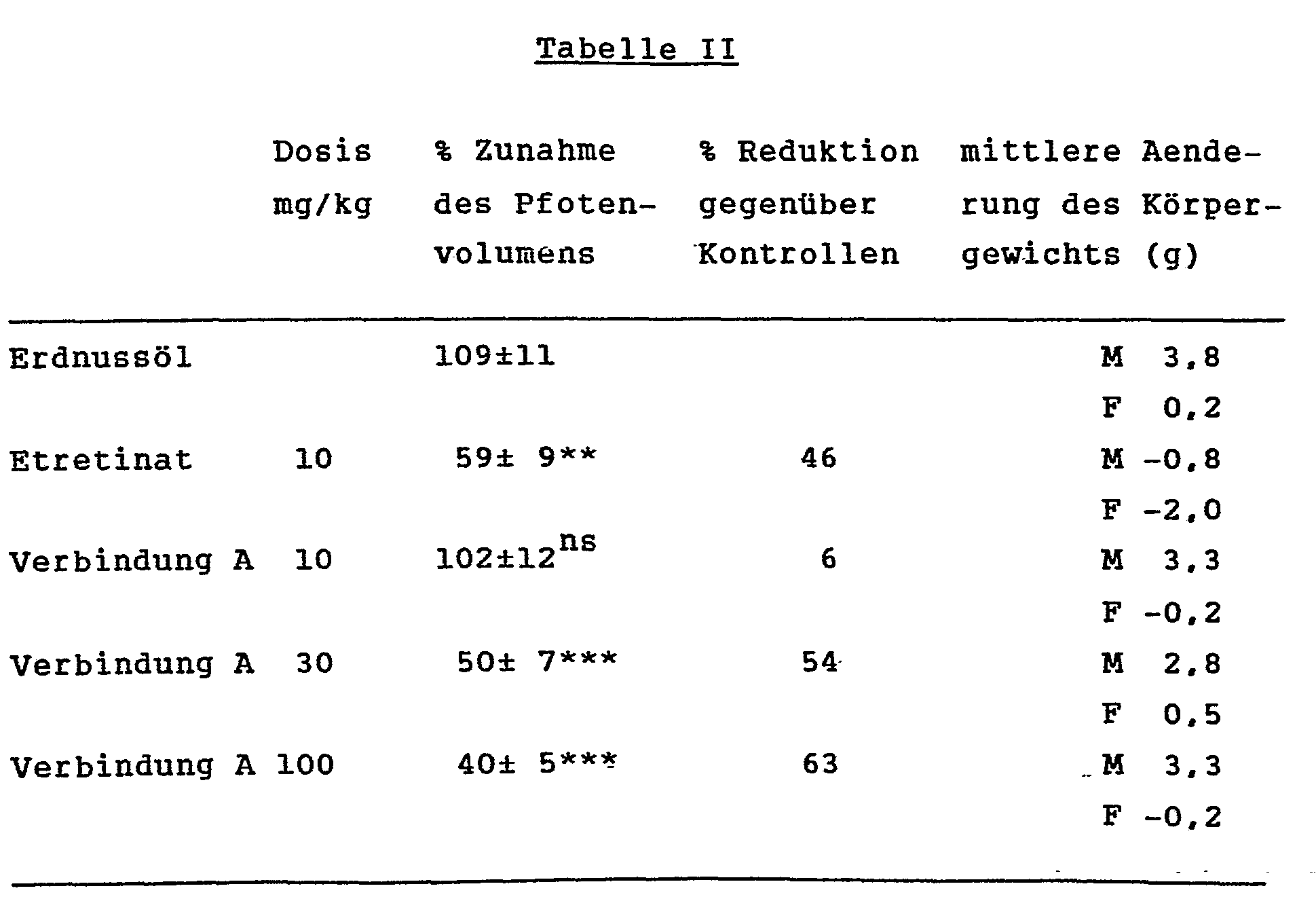
- Jede Gruppe umfasste vier männliche (M) und sechs weibliche (F) Mäuse, die in separaten Käfigen gehalten wurden. Die Verbindungen wurden oral mit einem Dosisvolumen von 10 ml/kg (10 Dosen) verabreicht.
- ns = nicht signifikant
- ** = p <0,01
- *** = p <0,001 (Student's T-Test).
- Wirkung der Verbindung A auf Adjuvans-Arthritis bei der Ratte.
- Versuchstiere: AHH/R-weibliche Ratten (Anfangsgewicht 110-140 g).
- Testsubstanzen: Adjuvans zur Injektion. Eine homogenisierte Suspension hitzeabgetöteter M. tuberculosis (menschlicher Stamm C, DT und PN), 5 mg/ml in flüssigem Paraffin.
- Versuchsführung: Die Ratten erhielten in Gruppen zu fünf subplantarer Injektionen von 0,1 ml Adjuvanssuspension in die rechte hintere Pfote. Die Versuchsverbindungen wurden am Morgen durch Intubation verabreicht, wobei mit dem Tag der Adjuvans-Injektion begonnen wurde. Zwei Kontrollgruppen und eine Gruppe von drei normalen Ratten (für Vergleichszwecke) erhielten Trägerlösung. Die Medikation wurde täglich durchgeführt, bis zum Versuchsende am 15. Tag, mit Ausnahme des ersten Wochenendes (Tage 5 und 6). Die Behandlungsgruppen sind in Tabelle III aufgeführt. Etretinat wurde als Standardretinoid verwendet.
- Messungen des rechten hinteren Pfotenvolumens wurden zu Anfang und den Tagen 2 und 4 (primäre Phase) vorgenommen. Das rechte und hintere Pfotenvolumen wurde am Tag 8 und alle zwei oder drei Tage bis zum Ende des Versuchs am Tag 15 (sekundäre Phase) gemessen. Zu diesem Zeitpunkt wurde die pobilität jedes Fussgelenks und die Häufigkeit und Schwere sekundärer Läsionen an Nase, Ohren, Vorderpfote, linkere hintere Pfote und Schwanz im Hinblick auf die Biegbarkeit unter Anwendung eines Punktesystems bewertet.
- 5 Resultate: Die Zeitverlaufskurven für-die Pfoten mit Injektionen wurden für die Tage 0 bis 4 integriert als Masstab für die primäre Schwellung und vom Tag 8 bis 15 für die sekundäre Schwellung. Die sekundäre Schwellung in der Pfote, die keine Injektion erhalten hatte, wurde ähnlich zwischen den Versuchstagen 8 und 15 integriert. Die Resultate sind in Tabelle III zusammengestellt.

- Wirkung der Verbindung A auf Typ II Collagen-Arthritis.
- Versuchstiere: Männliche und weibliche Alderley Park Ratten.
- Versuchsmaterial: Typ 2 Collagen (hergestellt aus Rindernasenseptumknorpel), Freund's inkomplettes Adjuvans (Difco).
- Versuchsführung: Die Ratten wurden gegen Typ 2 Collagen sensibilisiert durch intradermale Injektion von 1 ml einer Wasser in Oel-Emulsion aus gleichen Teilen einer 1 mg/ml-Lösung Typ 2 Collagen in 0,45M NaCl, 0,02M Tris, pH 7,4 und Freund's inkomplettem Adjuvans. Die Ratten, die Arthritis entwickelten, wurden am Tag 15 nach Sensibilisierung zusammengefasst. Neben dieser Gruppe wurde eine mit Erdnussöl behandelte Kontrollgruppe (6 männliche, 4 weibliche Tiere) und eine mit der Verbindung A behandelte Gruppe (6 männliche, 5 weibliche Tiere) geführt. Die Volumina der hinteren Pfote wurden gemessen, um eine gleichmässige Verteilung der Tiere zwischen den Gruppen sicherzustellen. Zwischen den Tagen 15 und 16 wurde über Nacht der Urin gesammelt. Die Medikation begann am Tag 16. Urinproben wurden auf Glycosaminoglycane (GAG) analysiert. Die Verbindung A wurde mit 100 mg/kg p.o. dosiert. Vom Tag 19 auf den Tag 20 wurde über Nacht erneut der Urin gesammelt. Die Urinproben wurden auf Glycosaminoglycane analysiert. Am Tag 20 wurde eine zweite Messung der hinteren Pfote vorgenommen. Die Ratten wurden dann mit Natriumpentobafbiton anaesthesiert und ausgeblutet und es wurden Röntgenaufnahmen der Hinter- und Vorderpfoten vorgenommen. Die Ratten erhielten das Versuchspräparat in 4 Dosen an den Tagen 16-19. Die Resultate sind in der Tabelle IV zusammengestellt.

- Wirkung der Verbindung A auf nicht-immunogene Entzündung.
- Versuchstiere: Weibliche Alderley Park-Ratten im Gewicht von 170-205 g.
- Versuchsmaterialien: Lambda-Carrageenan, hergestellt als Lösung in Kochsalzlösung und sterilisiert.
- Versuchsführunq: Die Verbindung A wurde während 10 Tagen einmal täglich oral an Ratten in Gruppen von 8 in Dosierungen von 10, 30 und 100 mg/kg verabreicht. Die Kontrolltiere erhielten den Träger. Eine Stunde nach der letzten Dosis wurden die Tiere mit Methohexiton anaesthesiert und 0,2 ml l%iges Lambda-Carrageenan wurde in die Pleuralhöhle injiziert. 4 Stunden später wurden die Tiere durch eine Ueberdosis von Pentobarbiton getötet, das Pleuralexudat wurde gesammelt und die Pleuralhöhle mit 2 ml Phosphat-gepufferter Kochsalzlösung ausgewaschen. Das Exudat-Volumen wurde gemessen und die Zellen mit einem automatischen Zähler bestimmt. Differentialzählbestimmungen wurden an Exudatabstrichen nach Giemsa-Färbung vorgenommen, um die Zahl der mehrkernigen Leukozyten (PMN) und einkernigen Zellen (MN) einzeln zu bestimmen.
- Unmittelbar nach Gewinnung des Pleuralexudats wurden die Tibiae der Tiere entfernt und deren Bruchlast festgestellt. Die Körpergewichte der Tiere wurden täglich ermittelt. Die Resultate sind in Tabelle V zusammengestellt.

- Wirkung der Verbindung A im Schwammgranulom-Test bei der Ratte.
- Versuchstiere: AHH/R weibliche Ratten mit einem Anfangsgewicht von 120-140 g.
- Versuchsmaterial: Aus Celluloseschwammtuch wurden Pellets mit einem Durchmesser von 6,5 mm ausgestanzt. Auf jedes Pellet wurden 0,1 ml einer Suspension, die 0,5 mg/ml hitzeabgetötete M. tuberculosis-Bakterien (menschlicher Stamm C, DT und PN) in steriler Kochsalzlösung enthielt, gegeben. Die Pellets wurden getrocknet, gewogen und sterilisiert.
- Versuchsführung: Die Ratten wurden in Gruppen zu 5 aufgeteilt. Die Testverbindungen wurden täglich verabreicht. Nach der fünften Dosis wurden die Ratten anästhesiert, der Rücken rasiert und zwei Pellets wurden jeder Ratte auf jeder Seite dorsal implantiert. 7 Tage nach der Implantation wurden die Ratten getötet und die Pellets entfernt von anhängendem Gewebe befreit und gewogen. Jedes Pellet wurde dann in 4 ml destilliertes Wasser gegeben, fein zerkleinert und beschallt. Nach Zentrifugieren wurde der Natrium- und Kaliumgehalt des Ueberstands flammenphotometrisch bestimmt. Zusätzlich wurden Nebennieren und Thymusdrüsen jeder Ratte entfernt und gewogen und die hinteren Unterschenkel zur Bestimmung der Tibia-Bruchlast entfernt. Die Körpergewichte wurde ebenfalls im Verlauf des Testes bestimmt. Die Resultate sind in der Tabelle VI zusammengestellt.

- Wirkung auf dem Verlauf von Adjuvans-Arthritis
- Versuchstiere: Männliche Lewis-Ratten
- Versuchsmaterial: Hitzeabgetötetes getrocknetes Mycobacterium butyricum.
- Versuchsführung: Die Adjuvans-Arthritis wurde durch Injektion von 0,1 ml Adjuvans (Suspension hitzeabgetöteter Mycobacterium butyricum 0,5% CW/V) in schwerem Mineralöl. das 0,2% Digitonin enthielt) in die Schwanzwurzeln erzeugt. Nach dem sich die Arthritis 21 Tage entwickelt hatte, wurde das Volumen beider Hinterpfoten plethysmographisch gemessen. Die Ratten wurden in Gruppen von 8 mit gleichen mittleren Pfotenvolumen aufgeteilt und dann mit Verbindung A, Indomethacin (als Kontrolle) oder Vehikel für die Dauer von 7 Tage behandelt. Danach wurden die Volumina beider Hinterpfoten erneut gemessen, um antiinflammatorische Effekte zu bestimmen. Gewichtsänderungen wurden ebenfalls ermittelt und am Versuchsende wurde Plasmafibrinogen (Amer. J. Clin. Path, 71: 521-527) ermittelt.
- Die Resultate sind in der Tabelle VII angegeben.

Claims (24)
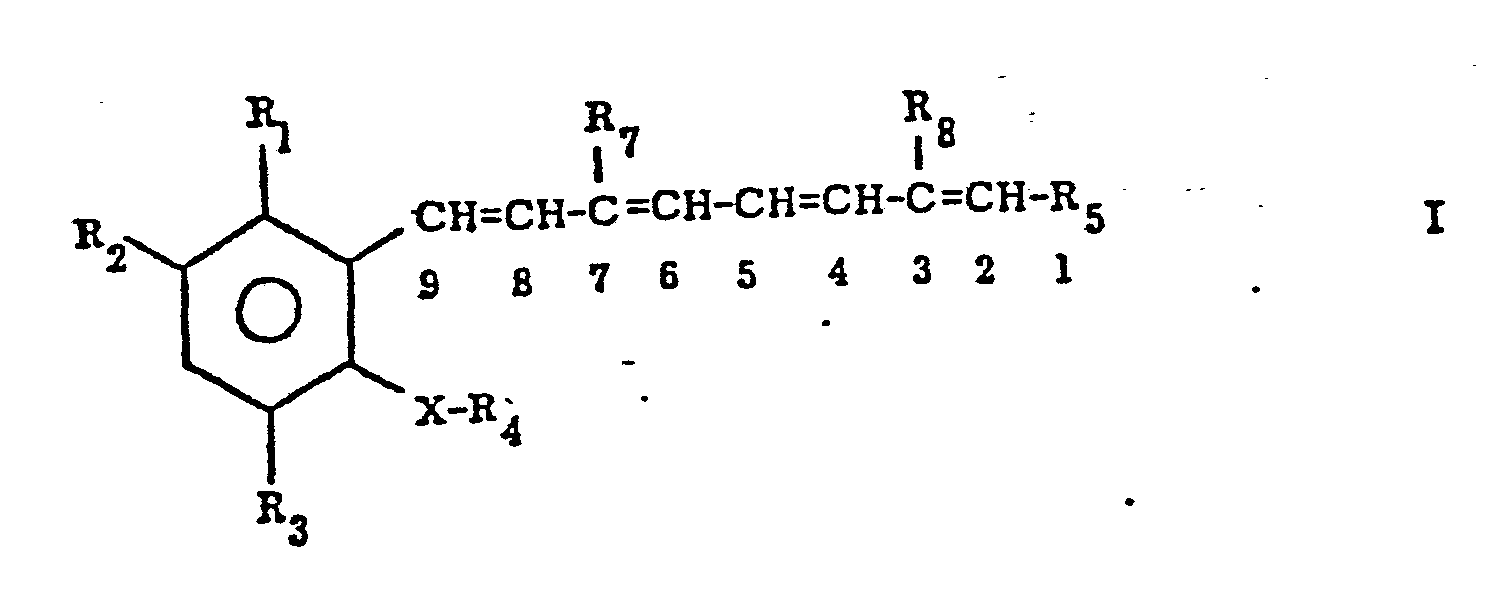
worin R1 Wasserstoff, Niederalkyl, Chlor, Fluor oder Trifluormethyl: R2 Wasserstoff, Nieder- alkoxy, Trifluormethylniederalkoxy, Hydroxy, Nieder- alkyl, Chlor, Trifluormethyl oder Fluor; R3 Wasserstoff, Niederalkyl, Chlor oder Fluor; R4 Alkyl mit 4-10 C-Atomen oder -CH2(CHZ)nCH2OH; X -CH(R10)O-, -CH(R10)-, -O-, -C(R10)=CH- oder -N(R10)-; R5 COOR9: n 6 oder 7; und R7, R8, R9 und R10 Niederalkyl oder Wasserstoff bedeuten und Salze davon, wenn R9 Wasserstoff ist.

worin R1 Wasserstoff. Niederalkyl, Chlor, Fluor oder Trifluormethyl; R2 Wasserstoff, Nieder- alkoxy, Trifluormethylniederalkoxy, Hydroxy, Nieder- alkyl, Chlor, Trifluormethyl oder Fluor; R3 Wasserstoff. Niederalkyl, Chlor oder Fluor; R4 Alkyl mit 4-10 C-Atomen oder -CH2(CH2)nCH2OH; X -CH(R10)O-, -CH(R10)-, -O-, -C(R10)=CH- oder -N(R10)-; R5 COOR9; n 6 oder 7: und R7, R8, R9 und R10 Niederalkyl oder Wasserstoff bedeuten und Salze davon, wenn R9 Wasserstoff ist, dadurch gekennzeichnet, dass man

mit einer Verbindung der Formel

oder
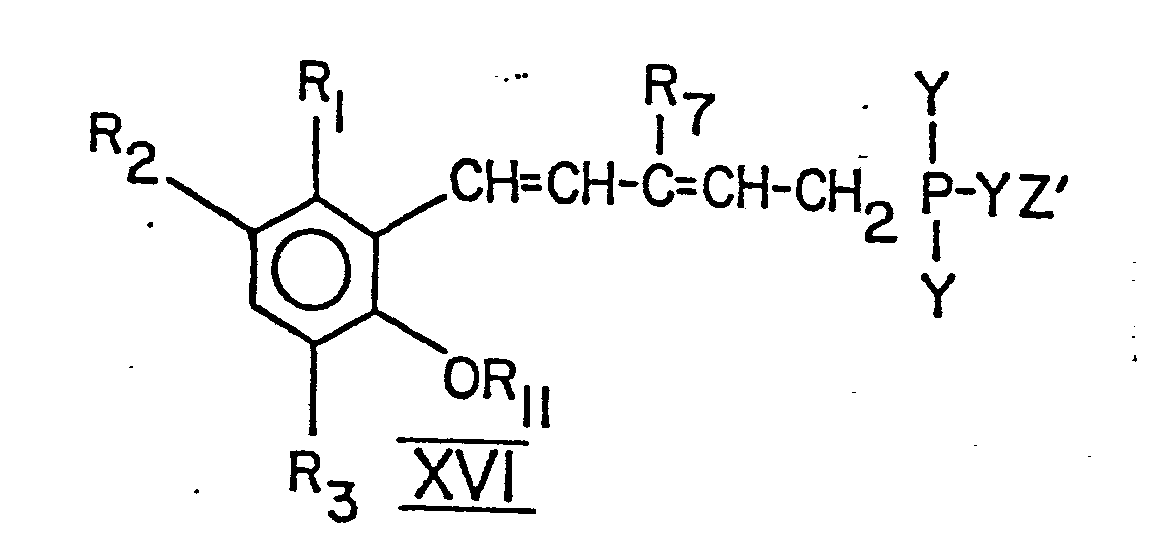
mit einer Verbindung der Formel

oder

mit einer Verbindung der Formel R4 Z umsetzt, wobei in den obigen Formeln R1, R2, R3, R4, R7 und R8 die in Anspruch 1 angegebene Bedeutung haben, R9' nieder-Alkyl; Y Aryl, Z eine Abgangsgruppe und Z' ein Halogenidion ist; und dass man gewünschtenfalls eine Gruppe -COOR9 1 im Reaktionsprodukt in die freie Säure überführt und diese gewünschtenfalls in ein Salz überführt.

worin R1, R2, R3, R7 und R8 die in Anspruch 1 angegebene Bedeutung haben und R9' nieder-Alkyl ist.

worin R2 und R3 die in Anspruch 1 angegebene Bedeutung haben und R11 eine Alkylgruppe mit 8-10 C-Atomen oder eine Gruppe -CH2(CH2)nCH2OR17 ist: n 6 oder 7 und -OR17 Hydroxy oder eine in eine Hydroxygruppe überführbare Aethergruppe ist.

worin R2, R3 und R11 die in Anspruch 1 bzw. 22 angegebene Bedeutung haben.

worin R2, R3 und R11 die in Anspruch 1 bzw. 22 angegebene Bedeutung haben; Y Aryl und z(-) ein Halogenidion ist.
Applications Claiming Priority (2)
| Application Number | Priority Date | Filing Date | Title |
|---|---|---|---|
| US63510084A | 1984-07-27 | 1984-07-27 | |
| US635100 | 1984-07-27 |
Publications (2)
| Publication Number | Publication Date |
|---|---|
| EP0169571A1 true EP0169571A1 (de) | 1986-01-29 |
| EP0169571B1 EP0169571B1 (de) | 1988-03-09 |
Family
ID=24546455
Family Applications (1)
| Application Number | Title | Priority Date | Filing Date |
|---|---|---|---|
| EP85109383A Expired EP0169571B1 (de) | 1984-07-27 | 1985-07-26 | Phenylnonatetraensäurederivate, ihre Herstellung und pharmazeutische Präparate mit diesen Derivaten |
Country Status (23)
| Country | Link |
|---|---|
| EP (1) | EP0169571B1 (de) |
| JP (1) | JPH06716B2 (de) |
| KR (1) | KR930000112B1 (de) |
| AR (1) | AR242023A1 (de) |
| AT (1) | ATE32882T1 (de) |
| AU (2) | AU589130B2 (de) |
| CA (1) | CA1277332C (de) |
| CS (1) | CS256392B2 (de) |
| DE (1) | DE3561808D1 (de) |
| DK (1) | DK173287B1 (de) |
| ES (2) | ES8703825A1 (de) |
| FI (1) | FI84345C (de) |
| GR (1) | GR851841B (de) |
| HU (1) | HU195480B (de) |
| IE (1) | IE58735B1 (de) |
| IL (1) | IL75913A (de) |
| MC (1) | MC1692A1 (de) |
| NO (1) | NO161064C (de) |
| NZ (1) | NZ212868A (de) |
| PH (1) | PH21556A (de) |
| PT (1) | PT80876B (de) |
| ZA (1) | ZA854828B (de) |
| ZW (1) | ZW12185A1 (de) |
Cited By (7)
| Publication number | Priority date | Publication date | Assignee | Title |
|---|---|---|---|---|
| EP0388817A3 (de) * | 1989-03-21 | 1991-07-03 | F. Hoffmann-La Roche Ag | Verwendung von Mischmicellen und Mischmicell-Lösungen von Immunmodulatoren |
| EP0486885A3 (en) * | 1990-11-17 | 1993-01-20 | Basf Aktiengesellschaft | Utilization of arylpolyencarboxylic acids and their derivatives as light protection agents in cosmetic compositions |
| EP0606614A1 (de) * | 1993-01-06 | 1994-07-20 | F. Hoffmann-La Roche Ag | Nonatetraensäurederivate |
| EP0641759A1 (de) * | 1993-09-02 | 1995-03-08 | F. Hoffmann-La Roche Ag | Aromatische Carbonsäurederivate, ihre Herstellung und diese Derivate enthaltende Heilmittel |
| US7098025B1 (en) | 1997-07-25 | 2006-08-29 | Ligand Pharmaceuticals Incorporated | Human peroxisome proliferator activated receptor gamma (pparγ) gene regulatory sequences and uses therefor |
| US7115728B1 (en) | 1995-01-30 | 2006-10-03 | Ligand Pharmaceutical Incorporated | Human peroxisome proliferator activated receptor γ |
| US7655699B1 (en) | 1992-04-22 | 2010-02-02 | Eisai Inc. | Compounds having selective activity for retinoid X receptors, and means for modulation of processes mediated by retinoid X receptors |
Families Citing this family (1)
| Publication number | Priority date | Publication date | Assignee | Title |
|---|---|---|---|---|
| CA2581415C (en) * | 2004-10-28 | 2011-10-04 | Sankyo Company Limited | Optically active 4,4-di-substituted oxazolidine derivatives and procedures for their preparation |
Citations (4)
| Publication number | Priority date | Publication date | Assignee | Title |
|---|---|---|---|---|
| GB1101396A (en) * | 1964-02-26 | 1968-01-31 | Velsicol Chemical Corp | 2-methoxy-3,6-dichlorobenzyl derivatives and their use as pesticidal agents |
| DE2414619A1 (de) * | 1973-03-30 | 1974-10-17 | Hoffmann La Roche | Polyenverbindungen |
| FR2285864A1 (fr) * | 1974-09-26 | 1976-04-23 | Hoffmann La Roche | Nouveaux derives polyeniques, leur procede de preparation et leur application en tant que medicaments |
| EP0059365A2 (de) * | 1979-08-22 | 1982-09-08 | Bayer Ag | Neue 3-Brom-4-fluor-benzyl-Verbindungen und Verfahren zu ihrer Herstellung |
-
1985
- 1985-06-26 ZA ZA854828A patent/ZA854828B/xx unknown
- 1985-07-25 CA CA000487547A patent/CA1277332C/en not_active Expired - Fee Related
- 1985-07-25 NZ NZ212868A patent/NZ212868A/xx unknown
- 1985-07-25 CS CS855502A patent/CS256392B2/cs not_active IP Right Cessation
- 1985-07-25 GR GR851841A patent/GR851841B/el unknown
- 1985-07-25 FI FI852899A patent/FI84345C/fi not_active IP Right Cessation
- 1985-07-25 DK DK198503404A patent/DK173287B1/da active
- 1985-07-25 IL IL75913A patent/IL75913A/xx not_active IP Right Cessation
- 1985-07-25 MC MC851787A patent/MC1692A1/fr unknown
- 1985-07-25 AU AU45575/85A patent/AU589130B2/en not_active Ceased
- 1985-07-25 AR AR85301088A patent/AR242023A1/es active
- 1985-07-25 ZW ZW121/85A patent/ZW12185A1/xx unknown
- 1985-07-26 PH PH32568A patent/PH21556A/en unknown
- 1985-07-26 EP EP85109383A patent/EP0169571B1/de not_active Expired
- 1985-07-26 ES ES545565A patent/ES8703825A1/es not_active Expired
- 1985-07-26 PT PT80876A patent/PT80876B/pt not_active IP Right Cessation
- 1985-07-26 DE DE8585109383T patent/DE3561808D1/de not_active Expired
- 1985-07-26 IE IE188185A patent/IE58735B1/en not_active IP Right Cessation
- 1985-07-26 NO NO852980A patent/NO161064C/no not_active IP Right Cessation
- 1985-07-26 HU HU852841A patent/HU195480B/hu not_active IP Right Cessation
- 1985-07-26 JP JP60164183A patent/JPH06716B2/ja not_active Expired - Lifetime
- 1985-07-26 AT AT85109383T patent/ATE32882T1/de active
- 1985-07-26 KR KR1019850005366A patent/KR930000112B1/ko not_active Expired - Fee Related
-
1986
- 1986-02-17 ES ES552061A patent/ES8705355A1/es not_active Expired
-
1989
- 1989-10-05 AU AU42608/89A patent/AU619901B2/en not_active Ceased
Patent Citations (4)
| Publication number | Priority date | Publication date | Assignee | Title |
|---|---|---|---|---|
| GB1101396A (en) * | 1964-02-26 | 1968-01-31 | Velsicol Chemical Corp | 2-methoxy-3,6-dichlorobenzyl derivatives and their use as pesticidal agents |
| DE2414619A1 (de) * | 1973-03-30 | 1974-10-17 | Hoffmann La Roche | Polyenverbindungen |
| FR2285864A1 (fr) * | 1974-09-26 | 1976-04-23 | Hoffmann La Roche | Nouveaux derives polyeniques, leur procede de preparation et leur application en tant que medicaments |
| EP0059365A2 (de) * | 1979-08-22 | 1982-09-08 | Bayer Ag | Neue 3-Brom-4-fluor-benzyl-Verbindungen und Verfahren zu ihrer Herstellung |
Cited By (12)
| Publication number | Priority date | Publication date | Assignee | Title |
|---|---|---|---|---|
| EP0388817A3 (de) * | 1989-03-21 | 1991-07-03 | F. Hoffmann-La Roche Ag | Verwendung von Mischmicellen und Mischmicell-Lösungen von Immunmodulatoren |
| EP0486885A3 (en) * | 1990-11-17 | 1993-01-20 | Basf Aktiengesellschaft | Utilization of arylpolyencarboxylic acids and their derivatives as light protection agents in cosmetic compositions |
| US5320833A (en) * | 1990-11-17 | 1994-06-14 | Basf Aktiengesellschaft | Arylpolyenecarboxylic acids and their derivatives as sunscreen agents in cosmetic preparations |
| US7655699B1 (en) | 1992-04-22 | 2010-02-02 | Eisai Inc. | Compounds having selective activity for retinoid X receptors, and means for modulation of processes mediated by retinoid X receptors |
| EP0606614A1 (de) * | 1993-01-06 | 1994-07-20 | F. Hoffmann-La Roche Ag | Nonatetraensäurederivate |
| JPH06234698A (ja) * | 1993-01-06 | 1994-08-23 | F Hoffmann La Roche Ag | ノナテトラエン酸誘導体 |
| EP0641759A1 (de) * | 1993-09-02 | 1995-03-08 | F. Hoffmann-La Roche Ag | Aromatische Carbonsäurederivate, ihre Herstellung und diese Derivate enthaltende Heilmittel |
| US5700836A (en) * | 1993-09-02 | 1997-12-23 | Hoffmann-La Roche Inc. | Aromatic carboxylic acid derivatives |
| CN1049423C (zh) * | 1993-09-02 | 2000-02-16 | 霍夫曼-拉罗奇有限公司 | 芳香羧酸衍生物 |
| US6610877B1 (en) | 1993-09-02 | 2003-08-26 | Hoffman-La Roche Inc. | Aromatic carboxylic acid derivatives |
| US7115728B1 (en) | 1995-01-30 | 2006-10-03 | Ligand Pharmaceutical Incorporated | Human peroxisome proliferator activated receptor γ |
| US7098025B1 (en) | 1997-07-25 | 2006-08-29 | Ligand Pharmaceuticals Incorporated | Human peroxisome proliferator activated receptor gamma (pparγ) gene regulatory sequences and uses therefor |
Also Published As
Similar Documents
| Publication | Publication Date | Title |
|---|---|---|
| EP0303186B1 (de) | Arylphosphorderivate, ihre Herstellung und Verwendung | |
| DE2854354A1 (de) | Stilbenderivate, verfahren und zwischenprodukte zu ihrer herstellung und arzneimittel | |
| DE3434947A1 (de) | Isoxazolcarbonsaeure-derivate, ihre herstellung und verwendung | |
| DE2437607A1 (de) | Polyenverbindungen | |
| EP0025192B1 (de) | Substituierte Oxirancarbonsäuren, Verfahren zu ihrer Herstellung, ihre Verwendung und sie enthaltende Arzneimittel | |
| EP0169571B1 (de) | Phenylnonatetraensäurederivate, ihre Herstellung und pharmazeutische Präparate mit diesen Derivaten | |
| EP0046961B1 (de) | Epoxi-cycloalkylalkancarbonsäuren, Verfahren zu ihrer Herstellung, ihre Verwendung sowie sie enthaltende Arzneimittel | |
| DE69322353T2 (de) | Chromen-Derivate mit einer Trien-Kette zur Verwendung bei der Behandlung der Osteoporose und der entzündlichen Erkrankungen | |
| DE2637098A1 (de) | Phenoxyalkylcarbonsaeurederivate und verfahren zu ihrer herstellung | |
| DE2440525A1 (de) | Polyenverbindungen | |
| DE2542612A1 (de) | Polyenverbindungen | |
| US4648996A (en) | Phenyl substituted-2,4,6,8-nonatetraenoic acid | |
| DE2448438A1 (de) | 2-substituierte und 2,2-disubstituierte eckige klammer auf 1,3-dioxoindanyloxy(oder -thio) eckige klammer zu -alkancarbonsaeuren und verfahren zur herstellung derselben | |
| DE2647966C2 (de) | Derivate des 4-(6'-Methoxy-2'- naphthyl)-butan-2-ons, Verfahren zu ihrer Herstellung und diese Verbindungen enthaltende Arzneimittel | |
| EP0310126A2 (de) | Brenzcatechincarbonsäurederivate, ihre Herstellung und Verwendung als Wirkstoffe für Arzneimittel | |
| DE2603541C2 (de) | Phenyl- und Benzylphosphonatester und Verfahren zu ihrer Herstellung | |
| DE3202065A1 (de) | Substituierte n-(tetrazol-5-yl)-benzoesaeureamide, ihre herstellung und diese enthaltende pharmazeutische zubereitungen | |
| EP0071175B1 (de) | Phenylalkyloxirancarbonsäuren, Verfahren zu ihrer Herstellung, ihre Anwendung und sie enthaltende Arzneimittel | |
| DE3438386A1 (de) | Phosphorsaeurevinylbenzylester, ihre herstellung und verwendung | |
| EP0176875A2 (de) | Vinyltetrazolylphenyl-Derivate, ihre Herstellung und Verwendung | |
| US4894480A (en) | Phenyl substituted-2,4,6,8-nonatetraenoic acid | |
| EP0202529B1 (de) | Neue Phenolderivate, diese enthaltende Arzneimittel und Verfahren zur Herstellung dieser Verbindungen und Arzneimittel | |
| DE2449928A1 (de) | Verfahren zur herstellung neuer carbocyclischer verbindungen | |
| US4883613A (en) | Phenyl substituted-2,4,6,8-nonatetraenoic acid | |
| US4780251A (en) | Phenyl substituted-2,4,6,8-nonatetraenoic acid |
Legal Events
| Date | Code | Title | Description |
|---|---|---|---|
| PUAI | Public reference made under article 153(3) epc to a published international application that has entered the european phase |
Free format text: ORIGINAL CODE: 0009012 |
|
| 17P | Request for examination filed |
Effective date: 19850726 |
|
| AK | Designated contracting states |
Designated state(s): AT BE CH DE FR GB IT LI LU NL SE |
|
| 17Q | First examination report despatched |
Effective date: 19870522 |
|
| GRAA | (expected) grant |
Free format text: ORIGINAL CODE: 0009210 |
|
| AK | Designated contracting states |
Kind code of ref document: B1 Designated state(s): AT BE CH DE FR GB IT LI LU NL SE |
|
| REF | Corresponds to: |
Ref document number: 32882 Country of ref document: AT Date of ref document: 19880315 Kind code of ref document: T |
|
| ITF | It: translation for a ep patent filed | ||
| REF | Corresponds to: |
Ref document number: 3561808 Country of ref document: DE Date of ref document: 19880414 |
|
| ET | Fr: translation filed | ||
| GBT | Gb: translation of ep patent filed (gb section 77(6)(a)/1977) | ||
| PLBE | No opposition filed within time limit |
Free format text: ORIGINAL CODE: 0009261 |
|
| STAA | Information on the status of an ep patent application or granted ep patent |
Free format text: STATUS: NO OPPOSITION FILED WITHIN TIME LIMIT |
|
| 26N | No opposition filed | ||
| ITPR | It: changes in ownership of a european patent |
Owner name: CESSIONE;F. HOFFMANN - LA ROCHE AG |
|
| NLS | Nl: assignments of ep-patents |
Owner name: F. HOFFMANN-LA ROCHE AG TE BAZEL, ZWITSERLAND. |
|
| REG | Reference to a national code |
Ref country code: FR Ref legal event code: TP |
|
| REG | Reference to a national code |
Ref country code: CH Ref legal event code: PUE Owner name: F. HOFFMANN-LA ROCHE AG |
|
| REG | Reference to a national code |
Ref country code: GB Ref legal event code: 732 |
|
| ITTA | It: last paid annual fee | ||
| EPTA | Lu: last paid annual fee | ||
| EAL | Se: european patent in force in sweden |
Ref document number: 85109383.1 |
|
| PGFP | Annual fee paid to national office [announced via postgrant information from national office to epo] |
Ref country code: SE Payment date: 20000705 Year of fee payment: 16 |
|
| PGFP | Annual fee paid to national office [announced via postgrant information from national office to epo] |
Ref country code: FR Payment date: 20000711 Year of fee payment: 16 |
|
| PGFP | Annual fee paid to national office [announced via postgrant information from national office to epo] |
Ref country code: AT Payment date: 20000712 Year of fee payment: 16 |
|
| PGFP | Annual fee paid to national office [announced via postgrant information from national office to epo] |
Ref country code: LU Payment date: 20000724 Year of fee payment: 16 Ref country code: DE Payment date: 20000724 Year of fee payment: 16 |
|
| PGFP | Annual fee paid to national office [announced via postgrant information from national office to epo] |
Ref country code: GB Payment date: 20000726 Year of fee payment: 16 Ref country code: CH Payment date: 20000726 Year of fee payment: 16 |
|
| PGFP | Annual fee paid to national office [announced via postgrant information from national office to epo] |
Ref country code: NL Payment date: 20000728 Year of fee payment: 16 |
|
| PGFP | Annual fee paid to national office [announced via postgrant information from national office to epo] |
Ref country code: BE Payment date: 20000918 Year of fee payment: 16 |
|
| PG25 | Lapsed in a contracting state [announced via postgrant information from national office to epo] |
Ref country code: LU Free format text: LAPSE BECAUSE OF NON-PAYMENT OF DUE FEES Effective date: 20010726 Ref country code: GB Free format text: LAPSE BECAUSE OF NON-PAYMENT OF DUE FEES Effective date: 20010726 Ref country code: AT Free format text: LAPSE BECAUSE OF NON-PAYMENT OF DUE FEES Effective date: 20010726 |
|
| PG25 | Lapsed in a contracting state [announced via postgrant information from national office to epo] |
Ref country code: SE Free format text: LAPSE BECAUSE OF NON-PAYMENT OF DUE FEES Effective date: 20010727 |
|
| PG25 | Lapsed in a contracting state [announced via postgrant information from national office to epo] |
Ref country code: LI Free format text: LAPSE BECAUSE OF NON-PAYMENT OF DUE FEES Effective date: 20010731 Ref country code: CH Free format text: LAPSE BECAUSE OF NON-PAYMENT OF DUE FEES Effective date: 20010731 Ref country code: BE Free format text: LAPSE BECAUSE OF NON-PAYMENT OF DUE FEES Effective date: 20010731 |
|
| BERE | Be: lapsed |
Owner name: F. HOFFMANN-LA ROCHE A.G. Effective date: 20010731 |
|
| PG25 | Lapsed in a contracting state [announced via postgrant information from national office to epo] |
Ref country code: NL Free format text: LAPSE BECAUSE OF NON-PAYMENT OF DUE FEES Effective date: 20020201 |
|
| EUG | Se: european patent has lapsed |
Ref document number: 85109383.1 |
|
| REG | Reference to a national code |
Ref country code: CH Ref legal event code: PL |
|
| GBPC | Gb: european patent ceased through non-payment of renewal fee |
Effective date: 20010726 |
|
| PG25 | Lapsed in a contracting state [announced via postgrant information from national office to epo] |
Ref country code: FR Free format text: LAPSE BECAUSE OF NON-PAYMENT OF DUE FEES Effective date: 20020329 |
|
| NLV4 | Nl: lapsed or anulled due to non-payment of the annual fee |
Effective date: 20020201 |
|
| PG25 | Lapsed in a contracting state [announced via postgrant information from national office to epo] |
Ref country code: DE Free format text: LAPSE BECAUSE OF NON-PAYMENT OF DUE FEES Effective date: 20020501 |
|
| REG | Reference to a national code |
Ref country code: FR Ref legal event code: ST |