EP0168752B2 - Verfahren für die Behandlung von flüssigem, Chelate von Schwermetallen enthaltendem Abfall - Google Patents
Verfahren für die Behandlung von flüssigem, Chelate von Schwermetallen enthaltendem Abfall Download PDFInfo
- Publication number
- EP0168752B2 EP0168752B2 EP85108492A EP85108492A EP0168752B2 EP 0168752 B2 EP0168752 B2 EP 0168752B2 EP 85108492 A EP85108492 A EP 85108492A EP 85108492 A EP85108492 A EP 85108492A EP 0168752 B2 EP0168752 B2 EP 0168752B2
- Authority
- EP
- European Patent Office
- Prior art keywords
- heavy metal
- ppm
- flocculant
- ions
- waste
- Prior art date
- Legal status (The legal status is an assumption and is not a legal conclusion. Google has not performed a legal analysis and makes no representation as to the accuracy of the status listed.)
- Expired - Lifetime
Links
Images
Classifications
-
- C—CHEMISTRY; METALLURGY
- C02—TREATMENT OF WATER, WASTE WATER, SEWAGE, OR SLUDGE
- C02F—TREATMENT OF WATER, WASTE WATER, SEWAGE, OR SLUDGE
- C02F9/00—Multistage treatment of water, waste water or sewage
-
- C—CHEMISTRY; METALLURGY
- C02—TREATMENT OF WATER, WASTE WATER, SEWAGE, OR SLUDGE
- C02F—TREATMENT OF WATER, WASTE WATER, SEWAGE, OR SLUDGE
- C02F1/00—Treatment of water, waste water, or sewage
- C02F1/52—Treatment of water, waste water, or sewage by flocculation or precipitation of suspended impurities
-
- C—CHEMISTRY; METALLURGY
- C02—TREATMENT OF WATER, WASTE WATER, SEWAGE, OR SLUDGE
- C02F—TREATMENT OF WATER, WASTE WATER, SEWAGE, OR SLUDGE
- C02F1/00—Treatment of water, waste water, or sewage
- C02F1/58—Treatment of water, waste water, or sewage by removing specified dissolved compounds
- C02F1/62—Heavy metal compounds
-
- C—CHEMISTRY; METALLURGY
- C02—TREATMENT OF WATER, WASTE WATER, SEWAGE, OR SLUDGE
- C02F—TREATMENT OF WATER, WASTE WATER, SEWAGE, OR SLUDGE
- C02F1/00—Treatment of water, waste water, or sewage
- C02F1/52—Treatment of water, waste water, or sewage by flocculation or precipitation of suspended impurities
- C02F1/5236—Treatment of water, waste water, or sewage by flocculation or precipitation of suspended impurities using inorganic agents
-
- C—CHEMISTRY; METALLURGY
- C02—TREATMENT OF WATER, WASTE WATER, SEWAGE, OR SLUDGE
- C02F—TREATMENT OF WATER, WASTE WATER, SEWAGE, OR SLUDGE
- C02F1/00—Treatment of water, waste water, or sewage
- C02F1/52—Treatment of water, waste water, or sewage by flocculation or precipitation of suspended impurities
- C02F1/54—Treatment of water, waste water, or sewage by flocculation or precipitation of suspended impurities using organic material
- C02F1/56—Macromolecular compounds
-
- C—CHEMISTRY; METALLURGY
- C02—TREATMENT OF WATER, WASTE WATER, SEWAGE, OR SLUDGE
- C02F—TREATMENT OF WATER, WASTE WATER, SEWAGE, OR SLUDGE
- C02F1/00—Treatment of water, waste water, or sewage
- C02F1/66—Treatment of water, waste water, or sewage by neutralisation; pH adjustment
-
- C—CHEMISTRY; METALLURGY
- C02—TREATMENT OF WATER, WASTE WATER, SEWAGE, OR SLUDGE
- C02F—TREATMENT OF WATER, WASTE WATER, SEWAGE, OR SLUDGE
- C02F2101/00—Nature of the contaminant
- C02F2101/10—Inorganic compounds
- C02F2101/20—Heavy metals or heavy metal compounds
-
- C—CHEMISTRY; METALLURGY
- C02—TREATMENT OF WATER, WASTE WATER, SEWAGE, OR SLUDGE
- C02F—TREATMENT OF WATER, WASTE WATER, SEWAGE, OR SLUDGE
- C02F2209/00—Controlling or monitoring parameters in water treatment
- C02F2209/06—Controlling or monitoring parameters in water treatment pH
-
- Y—GENERAL TAGGING OF NEW TECHNOLOGICAL DEVELOPMENTS; GENERAL TAGGING OF CROSS-SECTIONAL TECHNOLOGIES SPANNING OVER SEVERAL SECTIONS OF THE IPC; TECHNICAL SUBJECTS COVERED BY FORMER USPC CROSS-REFERENCE ART COLLECTIONS [XRACs] AND DIGESTS
- Y10—TECHNICAL SUBJECTS COVERED BY FORMER USPC
- Y10S—TECHNICAL SUBJECTS COVERED BY FORMER USPC CROSS-REFERENCE ART COLLECTIONS [XRACs] AND DIGESTS
- Y10S210/00—Liquid purification or separation
- Y10S210/902—Materials removed
- Y10S210/911—Cumulative poison
- Y10S210/912—Heavy metal
Definitions
- This invention relates to a method of treating liquid wastes containing heavy metal chelate compounds.
- liquid wastes discharged from plants for manufacturing printed circuit boards or the likes contain heavy metal chelates such as Cu-EDTA derived from chemical copper plating solutions, if the liquid wastes are discharged as they are into river or like other water bodies, they may cause circumstantial pollutions.
- Various methods of treating these liquid wastes have hitherto been put to practical use.
- the object of this invention is to provide a method of treating liquid wastes containing heavy metal chelate compounds giving a high heavy metal and COD removal rates, as well as showing good separatability for flocks upon flocculating treatment.
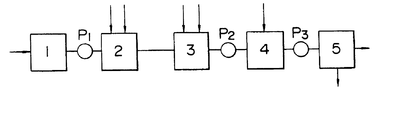
- the drawing is a flow chart of one embodiment for carrying out this invention, wherein are shown a liquid wastes store tank 1, a first treating tank 2, a second treating tank 3, a thickener 4, a dehydrator 5 and pumps P1 - P3.
- Fe ++ , Fe +++ , Cu ++ , Ni ++ , Zn ++ are available, for example, from a solution and a solid of ferrous sulfate, ferric sulfate, ferrous chloride, ferric chloride, copper sulfate, nickel sulfate, nickel chloride, and zinc chloride, and sludges containing the above-mentioned heavy metal ions and calcium ions.
- the amount of these compounds added is from 4 to 10 times, as converted into metal, as large as all chelating equivalents contained in chemical copper plating waste solutions containing copper chelates compounds and chelating agents.
- Ca ++ ions are supplied by dissolving one selected from the group consisting of Ca(OH) 2 , CaO and CaCO 3 , the pH of which is adjusted to 9 or more. Further, NaOH, Na 2 C0 3 and MgO may also be used together. If the pH value is less than 9, chelates of heavy metals other than copper may remain or copper chelate are formed again to reduce the heavy metal and COD removal rates.
- pH For adjusting pH to 4 or less, while sulfuric acid is usually employed, hydrochloric acid may also be used. If pH is greater than 4, heavy metal chelates may remain and no desirable precipitations can be separated even with the addition of the flocculant to reduce the heavy metal removal rate.
- the flocculant While polyacrylamide type anionic polymeric flocculants are preferred, cationic or nonionic polymeric flocculants may also be used. Further, inorganic flocculant such as polyaluminum chloride may be used as well.
- the amount of the flocculant added is from 0.5 to 10 ppm and, preferably, from 1 to 2 ppm. Usually, the flocculant is added in the form of an aqueous 0.05 - 0.2% solution after the addition. Then, liquid wastes are stirred, left for about 2 - 10 minutes and concentrated by a thickener or the like from which slurries are separated to remove by an Oliver type vacuum dehydrator or the like.
- the polyacrylic amide type anionic polymeric flocculant is available, for example, as EDP-351 manufactured by Kurita Kogyo K.K. It has molecular weight of 900 x 10 4 , bulk specific gravity of 0.75, effective pH range from 7 to 12 and pH value in an 0.1% aqueous solution of 8.3.
- the cationic polymeric flocculant can include Himolock MP-473H, Himolock MP-473L manufactured by Kyoritsu Yuki Kagaku Kogyo Institute.
- Example 3 The same procedures as in Example 1 were repeated except for varying the concentration of the chemical copper liquid wastes and the addition amount of the iron polysulfate in the first treating step, and the pH value in the second treating step as shown in Table 3.
- Example 2 The same procedures as in Example 1 were repeated except for varying the concentration of the chemical copper liquid wastes (Cu: 3,000 ppm, EDTA: 35,000 ppm, COD: 18,000 ppm) to 200 liter, the addition amount of the iron polysulfate to 45,000 ppm and the addition amount of the flocculant to 50 ppm. The contents for copper and iron in the treated water were determined to obtain the results as shown in Table 4.
- Example 1 The procedures in Example 1 were repeated without adding the iron polysulfate in the first treating step.
- the copper content in the solution was 10 ppm.
- the precipitating property of the flocks was poor in this treatment after the addition of the flocculant.
- Iron polysulfate was added to the chemical copper liquid wastes with the solution pH as it was not reduced to 2.5 in the first treating step and pH was adjusted to 10 in the second treatment step in the same manner as in Example 1.
- the copper content was 10 ppm and the iron content was 25 ppm in the solution after the treatment.
- the color of the solution after adding the flocculant in this treatment was yellowish blue.
- Example 4 The same procedures as in Example 4 were repeated except for varying the sludges used in the first treatment step (water content 98%, Cu: 370 ppm, Fe: 280 ppm, Ni: 60 ppm, Zn: 160 ppm, Cr: 15 ppm, Ca: 14,000 ppm) from those shown in Table 5.
- the contents for copper, nickel and COD in the supernatant obtained in this treatment were determined to obtain the results as shown in Table 6.
- Example 4 The same procedures as in Example 4 were repeated except for using 2 ppm of the flocculant in the second treatment step and adding 2% (0.2 m 3 ) of sludges together with the flocculant to the solution. The contents for copper, iron and COD in the supernatant obtained in this treatment were determined to obtain the result shown in Table 7. Comparative Example 3
- Example 4 The procedures in Example 4 were repeated without adding the sludges in the first treating step.
- the content was 10 ppm for copper and 107 ppm for COD in the solution.
- the precipitating property of the flocks was poor in this treatment after the addition of the flocculant.
- Example 4 The same procedures as in Example 4 were repeated except for replacing the heavy metal-containing salts used in the first treatment step with a mixed solution of copper sulfate and nickel sulfate (Cu: 50 ppm, Ni: 50 ppm). The contents for copper, nickel and COD in the supernatant obtained in this treatment were determined to obtain the results as shown in Table 9.
- Example 7 The same procedures as in Example 7 were repeated except for using 200 liter of chemical copper liquid wastes (Cu: 3,000 ppm, EDTA: 35,000 ppm and COD 28,500 ppm) and 100 liter of ferric chloride etching liquid wastes (Fe: 140,000 ppm, Cu: 50,000 ppm) and adding 50 ppm of the flocculant.
- the contents for copper, iron and COD in the supernatant of the treated water were determined to obtain the results as shown in Table 10.
- Example 7 The same procedures as in Example 7, were repeated without adding heavy metal-containing salts in the first treatment step.
- the copper concentration in the supernantant was 6.5 ppm. Less flocks were formed in this treatment after the addition of the flocculant, and the precipitating property was poor.
- Example 7 The same procedures as in Example 7 were repeated except for adding heavy metal-containing salts to the chemical copper liquid wastes with the pH solution as it was not reducing to 2.5.
- the copper content in the supernatant was 4.1 ppm and the flock precipitating property was poor like that in Comparative Example 2.
- liquid wastes containing other heavy metal such as, for example, nickel, zinc and cadmium
- liquid wastes containing copper chelate compounds can be applied to treatment of liquid wastes containing other heavy metal such as, for example, nickel, zinc and cadmium, as well as liquid wastes containing copper chelate compounds.
- polyaminocarboxylic acid such as DTPA, NTA, DTA or the like, and amine can be used.
Landscapes
- Life Sciences & Earth Sciences (AREA)
- Hydrology & Water Resources (AREA)
- Engineering & Computer Science (AREA)
- Environmental & Geological Engineering (AREA)
- Water Supply & Treatment (AREA)
- Chemical & Material Sciences (AREA)
- Organic Chemistry (AREA)
- Separation Of Suspended Particles By Flocculating Agents (AREA)
- Removal Of Specific Substances (AREA)
Claims (6)
Applications Claiming Priority (6)
| Application Number | Priority Date | Filing Date | Title |
|---|---|---|---|
| JP14425084A JPS6125692A (ja) | 1984-07-13 | 1984-07-13 | 重金属キレ−ト系廃液の処理方法 |
| JP144251/84 | 1984-07-13 | ||
| JP59144249A JPH0651187B2 (ja) | 1984-07-13 | 1984-07-13 | 重金属キレ−ト系廃液の処理方法 |
| JP14425184A JPS6125693A (ja) | 1984-07-13 | 1984-07-13 | 重金属キレ−ト系廃液の処理方法 |
| JP144249/84 | 1984-07-13 | ||
| JP144250/84 | 1984-07-13 |
Publications (4)
| Publication Number | Publication Date |
|---|---|
| EP0168752A2 EP0168752A2 (de) | 1986-01-22 |
| EP0168752A3 EP0168752A3 (en) | 1987-06-03 |
| EP0168752B1 EP0168752B1 (de) | 1991-05-29 |
| EP0168752B2 true EP0168752B2 (de) | 1994-12-14 |
Family
ID=27318792
Family Applications (1)
| Application Number | Title | Priority Date | Filing Date |
|---|---|---|---|
| EP85108492A Expired - Lifetime EP0168752B2 (de) | 1984-07-13 | 1985-07-09 | Verfahren für die Behandlung von flüssigem, Chelate von Schwermetallen enthaltendem Abfall |
Country Status (4)
| Country | Link |
|---|---|
| US (1) | US4802993A (de) |
| EP (1) | EP0168752B2 (de) |
| KR (1) | KR890002277B1 (de) |
| DE (1) | DE3582964D1 (de) |
Families Citing this family (35)
| Publication number | Priority date | Publication date | Assignee | Title |
|---|---|---|---|---|
| FR2705661B1 (fr) * | 1993-05-24 | 1995-08-25 | Rhone Poulenc Chimie | Composition à base de polychlorure d'aluminium et de sel de fer son mode de préparation et son utilisation dans le traitement des eaux. |
| GB8715155D0 (en) * | 1987-06-25 | 1987-08-05 | Laporte Industries Ltd | Purification of waters |
| WO1989009192A1 (en) * | 1988-03-31 | 1989-10-05 | Commonwealth Scientific And Industrial Research Or | Hydrometallurgical effluent treatment |
| US5211843A (en) * | 1990-07-03 | 1993-05-18 | Spectrulite Consortium, Inc. | Mobile apparatus for environmentally treating spent etchant safely |
| US5108620A (en) * | 1990-07-03 | 1992-04-28 | Spectrulite Consortium, Inc. | Process for recovery of spent etchant |
| US5266210A (en) * | 1992-04-15 | 1993-11-30 | Mclaughlin Water Engineers, Ltd. | Process for removing heavy metals from water |
| US5411149A (en) * | 1992-08-11 | 1995-05-02 | Arch Development Corporation | Aqueous biphasic extraction process with pH and particle control |
| GB2292378A (en) * | 1994-08-13 | 1996-02-21 | Atomic Energy Authority Uk | Effluent treatment |
| US5720886A (en) * | 1995-10-12 | 1998-02-24 | Kennecott Greens Creek Mining Company | Process for removing metal values from mine waste water |
| FR2767143A1 (fr) * | 1997-08-06 | 1999-02-12 | Le Nickel Sln | Procede pour diminuer la quantite d'eau contenue dans les pulpes de minerais nickeliferes oxydes |
| SE514687C2 (sv) * | 1999-07-09 | 2001-04-02 | Sca Graphic Res Ab | Metod för eliminering av skadliga substanser i en processvätska |
| JP4077143B2 (ja) * | 2000-07-31 | 2008-04-16 | 日本特殊陶業株式会社 | クロメート排液の処理方法 |
| US7390416B1 (en) * | 2004-01-26 | 2008-06-24 | American Airlines, Inc. | Method for the removal of metals, including a co-precipitation of molybdenum, from wastewater |
| SE0402889D0 (sv) * | 2004-11-29 | 2004-11-29 | Conlib Ab | Förfarande för rening av vatten från en fordonstvättanläggning |
| CN100378014C (zh) * | 2005-02-03 | 2008-04-02 | 黄伟君 | 污水处理及资源回收的系统和方法 |
| US20080060997A1 (en) * | 2006-09-07 | 2008-03-13 | Musale Deepak A | Method of heavy metals removal from municipal wastewater |
| US10580542B2 (en) | 2010-10-15 | 2020-03-03 | Avantech, Inc. | Concentrate treatment system |
| US9283418B2 (en) | 2010-10-15 | 2016-03-15 | Avantech, Inc. | Concentrate treatment system |
| CN103183421A (zh) * | 2011-12-28 | 2013-07-03 | 北大方正集团有限公司 | 含络合铜的废水的处理方法 |
| US9586306B2 (en) | 2012-08-13 | 2017-03-07 | Omax Corporation | Method and apparatus for monitoring particle laden pneumatic abrasive flow in an abrasive fluid jet cutting system |
| CN102910762A (zh) * | 2012-11-07 | 2013-02-06 | 杭州电子科技大学 | 一种Cu(Ⅱ)-EDTA废水的处理方法 |
| CN103011376A (zh) * | 2012-12-13 | 2013-04-03 | 同济大学 | Edta强化双金属铝铁体系氧化降解氯酚类物质的方法 |
| US9011204B2 (en) | 2013-07-30 | 2015-04-21 | Omax Corporation | Reducing small colloidal particle concentrations in feed and/or byproduct fluids in the context of waterjet processing |
| US9649744B2 (en) | 2013-07-30 | 2017-05-16 | Omax Corporation | Reducing small colloidal particle concentrations in feed and/or byproduct fluids in the context of waterjet processing |
| US11312646B2 (en) | 2014-08-08 | 2022-04-26 | Wisconsin Alumni Research Foundation | Method to remediate effluents containing metals complexed with organic and/or inorganic species |
| US11577366B2 (en) | 2016-12-12 | 2023-02-14 | Omax Corporation | Recirculation of wet abrasive material in abrasive waterjet systems and related technology |
| CN107188330B (zh) * | 2017-05-31 | 2020-09-29 | 郑州大学 | 一种吸附净化酸性废水的方法 |
| US11224987B1 (en) | 2018-03-09 | 2022-01-18 | Omax Corporation | Abrasive-collecting container of a waterjet system and related technology |
| CN108840422A (zh) * | 2018-05-23 | 2018-11-20 | 四川川能环保科技有限公司 | 一种工业污水处理方法 |
| CN109019743A (zh) * | 2018-08-07 | 2018-12-18 | 南京理工大学 | 利用铁盐-脱硫石膏体系去除EDTA-Pb的方法 |
| CN114751582B (zh) * | 2018-08-10 | 2023-01-06 | 广州超邦化工有限公司 | 一种电镀混合废水的处理方法 |
| CN109179803A (zh) * | 2018-09-27 | 2019-01-11 | 惠州市臻鼎环保科技有限公司 | 一种棕化液cod处理工艺 |
| CN110240248A (zh) * | 2019-05-17 | 2019-09-17 | 河南师范大学 | 一种利用铁屑反应床处理复合重金属-edta络合废水的方法 |
| EP4004672A1 (de) | 2019-07-29 | 2022-06-01 | Omax Corporation | Messung der abrasiven strömungsgeschwindigkeit in einer leitung |
| CN119285170B (zh) * | 2024-11-29 | 2025-09-02 | 安徽铜冠产业技术研究院有限责任公司 | 一种一般工业固废填埋场渗沥液中锰的去除方法 |
Family Cites Families (10)
| Publication number | Priority date | Publication date | Assignee | Title |
|---|---|---|---|---|
| US3497459A (en) * | 1965-12-09 | 1970-02-24 | Taki Fertilizer Mfg Co Ltd | Process for producing water soluble basic salts of aluminum and/or iron |
| US3544476A (en) * | 1967-05-09 | 1970-12-01 | Taki Fertilizer Mfg Co Ltd | Coagulant and method for treating aqueous medium comprising a basic metal salt and a multivalent anion |
| JPS5110176A (en) * | 1974-07-16 | 1976-01-27 | Stanley Electric Co Ltd | Edtaame ganjuhaisui haiekino shorihoho |
| DE2642238C3 (de) * | 1976-09-20 | 1980-01-17 | Deutsche Gold- Und Silber-Scheideanstalt Vormals Roessler, 6000 Frankfurt | Verfahren zur Abtrennung von Cu+ + -Ionen aus Abwässern und wäßrigen Lösungen |
| US4260491A (en) * | 1978-11-15 | 1981-04-07 | Amchem Products, Inc. | Chrome removal waste treatment process |
| JPS5725280A (en) * | 1980-07-23 | 1982-02-10 | Chubu Create Kogyo Kk | Heat joining method of heat exchanging pipe |
| US4629570A (en) * | 1981-11-09 | 1986-12-16 | Dowell Schlumberger Incorporated | Removal of iron from chelant solutions |
| US4624790A (en) * | 1981-11-19 | 1986-11-25 | Lancy International, Inc. | Reduction of metal content of treated effluents |
| JPS6096765A (ja) * | 1983-10-28 | 1985-05-30 | Hitachi Plant Eng & Constr Co Ltd | めつき廃水の浄化処理方法 |
| US4512900A (en) * | 1983-12-13 | 1985-04-23 | International Business Machines Corporation | Method for treating waste compositions |
-
1985
- 1985-07-09 EP EP85108492A patent/EP0168752B2/de not_active Expired - Lifetime
- 1985-07-09 KR KR1019850004878A patent/KR890002277B1/ko not_active Expired
- 1985-07-09 DE DE8585108492T patent/DE3582964D1/de not_active Expired - Lifetime
-
1987
- 1987-06-22 US US07/064,562 patent/US4802993A/en not_active Expired - Lifetime
Also Published As
| Publication number | Publication date |
|---|---|
| EP0168752B1 (de) | 1991-05-29 |
| KR890002277B1 (ko) | 1989-06-27 |
| EP0168752A3 (en) | 1987-06-03 |
| EP0168752A2 (de) | 1986-01-22 |
| KR860001010A (ko) | 1986-02-22 |
| DE3582964D1 (de) | 1991-07-04 |
| US4802993A (en) | 1989-02-07 |
Similar Documents
| Publication | Publication Date | Title |
|---|---|---|
| EP0168752B1 (de) | Verfahren für die Behandlung von flüssigem, Chelate von Schwermetallen enthaltendem Abfall | |
| Bhattacharyya et al. | Separation of toxic heavy metals by sulfide precipitation | |
| EP0139622B1 (de) | Verfahren zur Reinigung von wässerigen Lösungen | |
| US3740331A (en) | Method for precipitation of heavy metal sulfides | |
| US4422943A (en) | Method for precipitation of heavy metal sulfides | |
| JPS62253738A (ja) | 危険な金属廃スラツジの除去方法 | |
| US7001583B2 (en) | Essentially insoluble heavy metal sulfide slurry for wastewater treatment | |
| Grosse | Treatment technologies for hazardous wastes: Part IV A review of alternative treatment processes for metal bearing hazardous waste streams | |
| McAnally et al. | Nickel removal from a synthetic nickel-plating wastewater using sulfide and carbonate for precipitation and coprecipitation | |
| US4629570A (en) | Removal of iron from chelant solutions | |
| US6110379A (en) | Method for treating water containing sulfate | |
| US5264135A (en) | Method for stabilizing metals in wastewater sludge | |
| US4250030A (en) | Process for the removal of cyanides from effluent | |
| USH1852H (en) | Waste treatment of metal plating solutions | |
| US5451327A (en) | Compound and method for treating water containing metal ions and organic and/or inorganic impurities | |
| KR100259563B1 (ko) | 칼슘, 마그네슘 함유물질을 이용한 중금속 함유 폐수 처리 방법 | |
| US4428840A (en) | Anionic and cationic removal of copper from cyanide-containing wastewater | |
| US5259975A (en) | Method for stabilizing metals in wastewater sludge | |
| JPS60106585A (ja) | 廃水の処理方法 | |
| JPH0578105A (ja) | セレン含有廃水の処理方法 | |
| WO2007057521A1 (en) | Method for removing substances from aqueous solution | |
| WO1994018126A1 (en) | Process for removing heavy metal ions from water | |
| JP2002126758A (ja) | 廃水処理方法 | |
| JPS6125692A (ja) | 重金属キレ−ト系廃液の処理方法 | |
| Peters et al. | Innovative uses from carbon adsorption of heavy metals from plating wastewaters: II. Seeding the metal hydroxide/metal sulfide reactor with activated carbon |
Legal Events
| Date | Code | Title | Description |
|---|---|---|---|
| PUAI | Public reference made under article 153(3) epc to a published international application that has entered the european phase |
Free format text: ORIGINAL CODE: 0009012 |
|
| 17P | Request for examination filed |
Effective date: 19850709 |
|
| AK | Designated contracting states |
Designated state(s): DE GB |
|
| PUAL | Search report despatched |
Free format text: ORIGINAL CODE: 0009013 |
|
| AK | Designated contracting states |
Kind code of ref document: A3 Designated state(s): DE GB |
|
| 17Q | First examination report despatched |
Effective date: 19890202 |
|
| GRAA | (expected) grant |
Free format text: ORIGINAL CODE: 0009210 |
|
| AK | Designated contracting states |
Kind code of ref document: B1 Designated state(s): DE GB |
|
| REF | Corresponds to: |
Ref document number: 3582964 Country of ref document: DE Date of ref document: 19910704 |
|
| PLBI | Opposition filed |
Free format text: ORIGINAL CODE: 0009260 |
|
| 26 | Opposition filed |
Opponent name: DEUTSCHE SOLVAY-WERKE GMBH Effective date: 19920226 |
|
| PUAH | Patent maintained in amended form |
Free format text: ORIGINAL CODE: 0009272 |
|
| STAA | Information on the status of an ep patent application or granted ep patent |
Free format text: STATUS: PATENT MAINTAINED AS AMENDED |
|
| 27A | Patent maintained in amended form |
Effective date: 19941214 |
|
| AK | Designated contracting states |
Kind code of ref document: B2 Designated state(s): DE GB |
|
| PGFP | Annual fee paid to national office [announced via postgrant information from national office to epo] |
Ref country code: GB Payment date: 19990629 Year of fee payment: 15 |
|
| PGFP | Annual fee paid to national office [announced via postgrant information from national office to epo] |
Ref country code: DE Payment date: 19990827 Year of fee payment: 15 |
|
| PG25 | Lapsed in a contracting state [announced via postgrant information from national office to epo] |
Ref country code: GB Free format text: LAPSE BECAUSE OF NON-PAYMENT OF DUE FEES Effective date: 20000709 |
|
| GBPC | Gb: european patent ceased through non-payment of renewal fee |
Effective date: 20000709 |
|
| PG25 | Lapsed in a contracting state [announced via postgrant information from national office to epo] |
Ref country code: DE Free format text: LAPSE BECAUSE OF NON-PAYMENT OF DUE FEES Effective date: 20010501 |