EP0150436A2 - Procédé de préparation de formaldéhyde - Google Patents
Procédé de préparation de formaldéhyde Download PDFInfo
- Publication number
- EP0150436A2 EP0150436A2 EP84115710A EP84115710A EP0150436A2 EP 0150436 A2 EP0150436 A2 EP 0150436A2 EP 84115710 A EP84115710 A EP 84115710A EP 84115710 A EP84115710 A EP 84115710A EP 0150436 A2 EP0150436 A2 EP 0150436A2
- Authority
- EP
- European Patent Office
- Prior art keywords
- methanol
- water
- layer
- column
- weight
- Prior art date
- Legal status (The legal status is an assumption and is not a legal conclusion. Google has not performed a legal analysis and makes no representation as to the accuracy of the status listed.)
- Granted
Links
Images

Classifications
-
- C—CHEMISTRY; METALLURGY
- C07—ORGANIC CHEMISTRY
- C07C—ACYCLIC OR CARBOCYCLIC COMPOUNDS
- C07C45/00—Preparation of compounds having >C = O groups bound only to carbon or hydrogen atoms; Preparation of chelates of such compounds
- C07C45/78—Separation; Purification; Stabilisation; Use of additives
- C07C45/80—Separation; Purification; Stabilisation; Use of additives by liquid-liquid treatment
-
- C—CHEMISTRY; METALLURGY
- C07—ORGANIC CHEMISTRY
- C07C—ACYCLIC OR CARBOCYCLIC COMPOUNDS
- C07C45/00—Preparation of compounds having >C = O groups bound only to carbon or hydrogen atoms; Preparation of chelates of such compounds
- C07C45/27—Preparation of compounds having >C = O groups bound only to carbon or hydrogen atoms; Preparation of chelates of such compounds by oxidation
- C07C45/32—Preparation of compounds having >C = O groups bound only to carbon or hydrogen atoms; Preparation of chelates of such compounds by oxidation with molecular oxygen
- C07C45/37—Preparation of compounds having >C = O groups bound only to carbon or hydrogen atoms; Preparation of chelates of such compounds by oxidation with molecular oxygen of >C—O—functional groups to >C=O groups
- C07C45/38—Preparation of compounds having >C = O groups bound only to carbon or hydrogen atoms; Preparation of chelates of such compounds by oxidation with molecular oxygen of >C—O—functional groups to >C=O groups being a primary hydroxyl group
-
- C—CHEMISTRY; METALLURGY
- C07—ORGANIC CHEMISTRY
- C07C—ACYCLIC OR CARBOCYCLIC COMPOUNDS
- C07C45/00—Preparation of compounds having >C = O groups bound only to carbon or hydrogen atoms; Preparation of chelates of such compounds
- C07C45/78—Separation; Purification; Stabilisation; Use of additives
-
- C—CHEMISTRY; METALLURGY
- C07—ORGANIC CHEMISTRY
- C07C—ACYCLIC OR CARBOCYCLIC COMPOUNDS
- C07C45/00—Preparation of compounds having >C = O groups bound only to carbon or hydrogen atoms; Preparation of chelates of such compounds
- C07C45/78—Separation; Purification; Stabilisation; Use of additives
- C07C45/81—Separation; Purification; Stabilisation; Use of additives by change in the physical state, e.g. crystallisation
Definitions
- the invention relates to a process for the production of formaldehyde by a) introducing methanol and water with a concentration of between 50 and 90% by weight of methanol, based on the total weight of the two substances, into a packed column, the packed bodies with a total layer thickness of at least 50 cm and a total surface area of at least 0.5 cm 2 per cm 3 packing layer, a circuit of liquid of 15 to 90 g / min per g / min of methanol fed to the column, a concentration of the circuit liquid of 10 to 45% by weight of methanol, a temperature at the inlet of the circulating liquid into the column from 50 to 86 ° C, and has a bottom temperature of 40 to 70 ° C lower from this inlet temperature by 10 to 25 ° C, b) separating a portion of methanol and water from the column by stripping with air, inert gas and / or exhaust gas at a flow rate of 0.5 to 3 t of methanol and water per hour per square meter of column cross section
- the composition of crude methanol can vary depending on the manufacturing process (Ullmann's Encyclopedia of Industrial Chemistry, (3rd ed.), Volume 12, pages 398 ff) and generally contains from 95 to 70% by weight methanol, from 1 to 29.9% by weight .X water and from 0.1 to 6% by weight of impurities.
- the contaminants are, for example, alkali salts such as sodium formate, sodium hydrogen carbonate, sodium carbonate, sodium acetate, sodium sulfide; Sodium or sodium methylate, potassium hydroxide, sodium hydroxide; Formic acid; Aldehydes such as acrolein, glyoxal, butyraldehyde, propionaldehyde, acetaldehyde; Ketones such as acetone and butanone-2; Glycol, diglycol, triglycol, and higher alkanols such as N-butanol, isobutanol, isopropanol, n-propanol, n-pentanol, isohexanol, isoheptanol, n-hexanol; Ethers such as glycol, diglycol methyl ether, dimethyl ether; aliphatic, cycloaliphatic, aromatic hydrocarbons such as benzene
- alkali salts
- Another cause of catalyst poisoning is the action of harmful foreign substances contained in the air used for the oxidation.
- air pollution occurs particularly close to industrial areas and contains e.g. the following components that poison the catalyst: hydrogen sulfide, sulfur dioxide, hydrogen chloride, hydrogen fluoride, halogen, volatile halogen compounds such as carbon tetrachloride; Ammonia, amines such as monomethylamine, dimethylamine, trimethylamine; Arsenic and antimony compounds such as arsenic trioxide, antimony trioxide; Acetylene, phosphorus compounds such as hydrogen phosphide, carbon black, iron oxide dust, hydrogen cyanide, carbon monoxide; foreign substances arising from the anaerobic decomposition of protein-containing waste materials, such as mercaptans, indole, skatol; Nitrogen oxides; Lead compounds such as tetraethyl and tetramethyl lead; organic compounds such as 3,4-benzopyrene, fluoranthrene, pyren
- the water used in the synthesis of formaldehyde is condensed water, but also chlorine-free, suitably softened process water.
- Groundwater, spring water, surface water such as river water, drinking water, boiler feed water and occasionally sea water are considered as process water in this context.
- the water used can contain numerous substances as impurities, e.g. Metal salts such as manganese sulfate, iron chloride, alkaline earth compounds in the form of water hardness, ammonium, alkali salts, metals such as zinc or aluminum or copper e.g. from raw materials, nitrates, silicates, nitrites, fluorides, phosphates, organic decomposition products such as phenols.
- Difficulties occur when evaporating such mixtures of methanol and water, often to a considerable extent: the rate of evaporation slows down, the evaporator sump retains liquid and there are large amounts of foam with relatively large individual bubbles and usually relatively stronger on the surface of the evaporating methanol solution Consistency.
- the pressure in the evaporator can increase and, over time, the liquid, when mixed with the air, increasingly forms a dense foam layer. In some cases, the foam is carried away, reaches the catalyst and disrupts or prevents the conversion of the methanol.
- Valve tray columns are expensive and offer high resistance under high loads.
- the valves do not close completely tight after a long period of operation, so that these columns also empty quickly.
- the load is particularly high in the production processes mentioned, since the steam mixture and air serve as the starting mixture for formaldehyde production.
- the gas mixture of air and steam bubbles through the liquid in the evaporation chamber only very slowly for the aforementioned reasons.
- the steam no longer or does not exchange enough with the liquid because the mixing is low.
- the result is a strong accumulation of methanol in the evaporator sump and thus a pollution of the wastewater, which poses environmental problems and reduces the economics of the process.
- it must be ensured at all times, even at low loads, that a sufficient amount of methanol evaporates when the air is passed through; otherwise airy mixtures are formed that are explosive. Every shutdown of the system therefore requires special commissioning operations for the reasons mentioned.
- DE-OS 23 23 758 describes various older technical methods and a method which is more advantageous with regard to the aforementioned difficulties.
- One proceeds in such a way that one with several in a plate column Ren bell sieve trays, each of which has an upper sieve plate with a hole diameter of 2 to 15 mm and a lower plate-shaped plate that descends to the outside, and the sieve plate has an angle of 2 to 10 ° and the lower plate has an angle forms from 4 to 20 ° with the horizontal, evaporated methanol and water with mixing with air, the liquids at the top and the air at the bottom of the column are fed, and the resulting vaporous starting mixture is oxidatively dehydrated.
- this method also has disadvantages; the sieve trays are complicated to operate and complex to manufacture.
- DE-OS 21 14 370 shows that the apparatuses for evaporating methanol are generally equipped with droplet separators (BIOS Final Report No. 1331; FIAT Final Report No. 999), for example Raschigring packs or packs of wire mesh. Such packs have a certain effect until they contain enough liquid. From there, part of the liquid pushes itself through and sprays behind the pack again into droplets or mists. A large scale formation on the catalyst cannot be prevented by these measures. Thus, the DE-OS 21 14 370 has indicated that for the above reasons, a large-scale use of crude methanol for Formalde - hydher too was not given.
- DE-OS 21 14 370 recommends a process which is more advantageous in relation to this prior art, using crude methanol as the starting material, the reaction with crude methanol which is passed in vapor form before entering the catalyst zone against baffle walls and which is in solid or liquid form on the baffle walls Form contaminants are separated, carried out.
- the steam / gas flow which is directed against the baffle walls, expediently has a speed of 7 to 22 m / sec.
- a flow velocity of 9.2 m / sec and homogeneous metal baffles are used in all examples.
- the cleaning effect of the baffle walls, the formaldehyde yield and the life of the catalyst are unsatisfactory.
- the invention is based on the observation that trouble-free continuous operation with methanol, in particular crude methanol, as the starting material cannot be achieved by one measure alone, e.g. special evaporation, conversion or cleaning methods of the starting materials or compliance with a certain load on the catalyst, is achieved, but requires the combination of the interconnected features of the invention.
- the process according to the invention provides formaldehyde in a good yield and purity in a simpler and more economical way.
- formaldehyde is produced in better yield, space-time yield and purity by the process according to the invention. Liquid mist, finely divided solids or droplets of appropriate solutions are largely separated.
- the aforementioned difficulties and malfunctions are avoided.
- the service life of the catalytic converter is extended accordingly. Rapid poisoning of the catalyst by the reaction air, raw methanol or water of reaction and, accordingly, an accumulation of foreign substances in the solution of the end product are avoided.
- the first or renewed commissioning of a system is easier, quicker and more trouble-free, the downtime of the systems due to catalyst poisoning or malfunctions of the evaporator is reduced. Since, according to the invention, methanol and water are separated from the packed column by stripping and accordingly by evaporation and not by evaporation and are fed to the reaction as a gaseous mixture, optionally via the two wire filter layers, the additional energy required for evaporation is saved. Corresponding heating devices for evaporation, e.g.
- the starting materials used for the process are air, water and methanol produced by a high-pressure or low-pressure process. If you use water-containing methanol, especially raw methanol, you can Save additional or partial addition of water.
- mixtures of crude methanol with water are expediently introduced into the packed column; the concentration of the aqueous mixtures can suitably vary from 50 to 90, preferably from 60 to 85,% by weight of methanol; Accordingly, amounts between 0.11 and 1, preferably from 0.18 to 0.67 g of water per g of methanol are expediently used in the case of separate feeding.
- a methanol containing impurities is a crude methanol with 0.15 to 6, advantageously 0.15 to 5, in particular 0.15 to 4,% by weight of impurities.
- Methanol, water and air are expediently used as a vapor (gaseous) starting mixture in a ratio of 0.25 to 0.6, preferably 0.35 to 0.5, mol of oxygen in the form of air per mol of methanol and 0.1 to 2, preferably 0.2 to 1.2 moles of oxygen in the form of air per mole of water contained in the starting mixture.
- the feed rate of liquid or air, inert gas and / or exhaust gas to the packed column is appropriately regulated so that the mixture entering the reaction chamber has a composition of these molar ratios.
- stripping gas For stripping in the packed column, three components (stripping gas), namely air, inert gas and exhaust gas, either each component alone or a mixture of 2 or all three components can be used as stripping gas.
- Bl air or b2) a mixture of air and exhaust gas are preferred as stripping gas.
- each of the aforementioned components can be introduced into the packed column separately from the other or in the form of the mixture. It is also possible to add a portion of the three components, expediently of air, for stripping and the remaining portion only after passing through the column and, if appropriate, wire layers, expediently before the reactor entry into the gaseous (vapor) starting mixture.
- a mixture of air and exhaust gas is passed through the column as stripping gas and a further proportion of air, advantageously 3 to 20% by weight, based on the total amount of air used, is added to the gaseous (vapor) starting mixture (air , Exhaust gas, methanol and water). It is advisable to choose 20 to 100, advantageously 40 to 80% by weight of 7 inert gas, preferably nitrogen, and / or 20 to 100, advantageously 40 to 80% by weight of exhaust gas, based on the total amount by weight of air.
- part of the exhaust gas from the oxidation according to the invention is allowed to escape and the other is returned to the reaction cycle.
- the proportion of exhaust gas that is expedient with air mixed and thus returned to the reaction is advantageously 20 to 110, in particular 44 to 88, parts by weight, based on the proportion of exhaust gas leaving the system.
- the exhaust gas essentially contains nitrogen, hydrogen, carbon dioxide, carbon monoxide, water, methanol, argon and generally from 0.1 to 0.5 g of formaldehyde in the cubic meter of exhaust gas.
- the waste gas taken from another formaldehyde production by oxidizing dehydrogenation of the methanol, preferably in the presence of silver catalysts or metal oxides, for example oxides of iron and molybdenum, can also be used as waste gas.
- the packed column expediently has a length of 2 to 15, in particular 3 to 10 m, a diameter of 0.5 to 5, in particular 1 to 3.5 m, and has packing, advantageously with a diameter of the individual packing of 15 to 150, in particular 25 to 80 mm.
- the total layer thickness (filling height) of the packing layer is at least 50, advantageously 100 to 1000, in particular 300 to 800 cm.
- the total surface area of the packing is at least 0.5, expediently 0.5 to 2.2, preferably 0.9 to 1.6 cm 2 per cubic centimeter of packing.
- Raschig rings Intos rings, Prym rings, Pall rings, Berlsaddles, Intalox saddles, Torus saddles, Interpack bodies, Stedman bodies, inclined film sheets, wire mesh rings, Haltmeier rolls, twin bodies, Wilson spirals or Braunschweig spirals can be used as packing elements.
- methanol and water are introduced from the column base, air, inert gas and / or exhaust gas, if appropriate in a mixture, from the column base;
- air or the aforementioned air mixtures are passed through the column bottom.
- the columns have a liquid circuit which generally starts at the bottom of the column and ends at the top of the column, advantageously from 30 to 200 cm below the top of the column.
- the circulating liquid expediently has a throughput of 3000 to 6000, in particular from 3500 to 5500 g per cm 2 column cross section and hour, and is usually passed over heat exchangers, in which it serves as a cooling liquid for the hot reaction gases, condensates and absorption solutions.
- part of the heat exchange of the circulating liquid can take place with the hot reaction gases and / or absorption solutions of another formaldehyde synthesis or a formaldehyde follow-up reaction or the heat exchangers of another synthesis.
- at least a portion, expediently 40 to 70, preferably 50 to 60% (based on the total heat supplied to the liquid circuit) of the heat of absorption, which is called in the absorption of formaldehyde from the Reaction gases and / or condensates, advantageously in water or aqueous urea solution, are used to heat the liquid circuit.
- the aqueous urea solution advantageously contains 50 to 70, preferably 65 to 70, parts by weight of urea.
- the circulating liquid is expediently an aqueous methanol mixture which contains 10 to 45, in particular 15 to 40,% by weight of methanol (calculated as methanol 100%) and 0.1 to 15, in particular 1 to 10,% by weight of impurities.
- the circuit feeds liquid to the column in a ratio of 15 to 90, in particular 20 to 70 g (per minute) per gram per minute of fresh methanol fed to the column and has a temperature at the entrance to the column of 50 to 86, in particular 60 to 80 ° C and a temperature in the column bottom of 40 to 70, in particular 45 to 60 ° C.
- the bottom temperature is 10 to 25, advantageously 15 to 20 ° C lower than the inlet temperature of the circulating liquid.
- a small part of the circulating liquid advantageously from 0.01 to 0.1% by weight of the circulating liquid stream, can be separated off and discarded in order to remove high amounts of impurities, the methanol and water contained in this part being isolated, if desired, via an evaporator or stripper and fed back into the reaction.
- the heat of reaction or condensation released during the cooling of the hot reaction gases can also advantageously be used to evaporate these fractions, e.g. in the form of excess steam generated by heat exchange.
- Air, inert gas and / or exhaust gas serve as entrainer (stripping agent) for the mixture of methanol and water fed to the column, for the circulating liquid and, if the gases are passed through the sump, for the bottom liquid; the bottom liquid corresponds to the composition of the components of the circulating liquid at the entrance to the column.
- entrainer stripping agent
- the gas supply is selected so that a balance is established between the above-mentioned throughputs of water / methanol mixture, circulating liquid and gas and the above-mentioned quantitative ratios of the components air, inert gas, exhaust gas, methanol and water during the reaction.
- the portion of methanol and water separated in the column by stripping is mainly gaseous and generally has less than 0.1% by weight of a liquid methanol-water mixture and generally less than 0.01% by weight of liquid and solid impurities .
- Wire filters are understood here to mean wire structures which can be structured in any manner, regularly or irregularly, for example as a woven or knitted fabric, in the form of nets, spirals, spirals and which are combined to form two separate layers, for example in two packs.
- the wire in both layers has a diameter (wire thickness) of 0.1 to 0.5, advantageously 0.1 to 0.3 mm, both layers each have a free layer volume, which here defines the total volume of the layer not occupied by the wire volume is, from 90 to 99.5 in particular 95 to 99.1 vol.X, based on the total volume of the layer.
- the gas stream flows through the first layer at a speed of 7 to 13, in particular 9 to 11 m / sec. and expediently with a load of 12 to 60, in particular 20 to 51 g of methanol per minute and cm 2 layer cross section and the second layer at a speed of 1 to 4, in particular 1.5 to 3.5 m / sec. and expediently with a load of 1 to 20, in particular 1.5 to 18 g of methanol per minute and cm 2 layer cross section.
- the layer thickness of the two layers is expediently 10 to 40 cm, in particular 20 to 30 cm, per layer.
- the gaseous mixture is fed to the reactor with the silver catalyst in c).
- the mixture now only contains impurities in an amount below 2, generally from 0.01 to 1% by weight, based on the total contamination in the crude methanol and 0.00014 to 0.014% by weight, based on the gaseous methanol (calculated 100% ).
- the silver catalysts generally used for the production of formaldehyde are suitable for the process according to the invention, for example the ones in DE-AS 12 31 229, DE-PS 23 22 757, Ullmanns Encyklopadie der Technische Chemie (3rd edition), volume 7 , Pages 656 ff and described in the publications cited for the prior art.
- Two- and multi-layer silver catalysts are preferably used. With regard to the preparation of the catalyst and implementation of the corresponding reaction with these catalysts, reference is made to the publications mentioned.
- the reaction is carried out using a catalyst with a total layer thickness of 15 to 35 mm and 3 or more layers of silver crystals, part of the layers being 72.5 to 89% by weight of the catalyst with particles of particle size 1 to 2.5 mm, part of the layers 2.5 to 7.5% by weight of the catalyst with particles having a particle size of 0.75 to 1 mm and the remaining part of the layers 8.5 to 20% by weight of the catalyst with particles of the Grain size 0.2 to 0.75 mm included.
- Preferred catalysts are those described in German Patent 23 22 757.
- the load during the oxidation is 0.5 to 3, in particular 1 to 2.50 g of methanol (calculated 100 X) per m 2 of catalyst bed cross section and hour.
- the oxidation is otherwise carried out in a known manner, e.g. the gas mixture of methanol vapor, air, water vapor and optionally inert gas and / or exhaust gas in the aforementioned quantities at temperatures of 550 to 750 ° C, in particular 600 to 700 ° C, passes through the silver catalyst.
- the reaction is generally carried out continuously at pressures between 0.5 and 2 bar, preferably between 0.8 and 1.8 bar. It is then expedient in stage d) to cool the reaction gases leaving the catalyst zone within a short time, for example in less than 1/10 seconds, e.g. to temperatures from 150 to 350 ° C.
- the cooled gas mixture is then expediently fed dl) to a condenser for further cooling and then to absorption or d2) directly without condensation to an absorption tower in which the formaldehyde is generally washed out of the gas mixture with water or aqueous urea solutions, advantageously in countercurrent.
- the aforementioned heat exchanger of reaction gas and / or condensate and circulating liquid is expediently located between the reactor and the absorption tower, and the aforementioned heat exchanger of circulating liquid and hot absorption solution is in the circuit of the absorption system.
- an amount of heat is advantageously used which is 10 to 100, in particular 40 to 100% from the heat exchange with the absorption, 0 to 90, in particular 0 to 60% from the condensation and 0 to 50, in particular 0 to 30% comes from the cooling of the reaction gases.
- the formaldehyde which can be prepared by the process of the invention is a disinfectant, tanning agent, reducing agent and valuable starting material for the production of synthetic resins, adhesives and plastics.
- a disinfectant tanning agent
- reducing agent valuable starting material for the production of synthetic resins, adhesives and plastics.
- the sump (circulating liquid) contains 10% by weight of impurity, 28% by weight of methanol and 62% by weight of water.
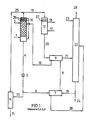
- the circulating liquid was heated indirectly to a temperature of 68 ° C. in countercurrent with absorption liquid via line 19.
- the condenser (9) the circulating liquid was heated indirectly to 79 ° C. by heat exchange with hot reaction gases (via line (20)).
- the temperature at the inlet of the circulating liquid into the column (2) was 78 ° C.
- the bottom temperature of the column (2) was 62 ° C. 1730 kg of circulating liquid were drawn off per line (13) and evaporated together with 3343 kg of water per hour in the evaporator (14).
- the wire diameter was 0.15 mm, the free layer volume 99 vol.X, based on the total volume of the layer.
- the flow rate of the gas-steam mixture was 12.8 m / sec in the first layer and 1.2 m / sec in the second layer. As the gas-steam mixture passed through the two layers (29), an hourly portion (6 kg) was separated and returned to the packed column (2) via line (16).
- a system was used with a vertical tubular reactor (12) which contained the feed of the gaseous starting mixture and the reactor hood at its head.
- the catalyst layer (27) was below the reactor head.
- a cooling zone followed, which was connected to lines (17) and (18).
- a catalyst made of silver crystals (429 kg) of the following composition was introduced into the reactor:
- Layer 2 was sprinkled onto layer 3 as a ring layer in the edge zone of the catalyst.
- the diameter of the catalyst was 310 cm, the clear width of the ring layer was 305 cm.
- 42 111 kg of gaseous mixture which contained 28.6% by weight of methanol, 0.0026% by weight of impurities, 19.0974% by weight of water and 52.3% by weight, were fed to the reactor from line 2 .X air contained. The mixture was passed through the catalyst and reacted at 700 ° C and 1.4 bar.
- the sump (circulating liquid) contains 10% by weight of impurity, 28% by weight of methanol and 62% by weight of water.
- the circulating liquid was heated indirectly to a temperature of 68 ° C. in countercurrent with absorption liquid via line 19.
- the condenser (9) the circulating liquid was heated indirectly to 79 ° C. by heat exchange with hot reaction gases (via line (20)).
- the temperature at the inlet of the circulating liquid into the column (2) was 78 ° C.
- the bottom temperature of the column (2) was 62 ° C. 1730 kg of circulating liquid were drawn off per line (13) and evaporated together with 3343 kg of water per hour in the evaporator (14).
- the wire diameter in each layer was 0.28 mm, the free layer volume 99% by volume, based on the total volume of the layer.
- the flow rate of the gas-steam mixture was 7 m / sec in the first layer and 3.9 m / sec in the second layer. During the passage of the gas-steam mixture through the two layers, an hourly portion (6 kg) was separated and returned to the packed column (2) via line (16).
- a system was used with a vertical tubular reactor (12) which contained the feed of the vaporous starting mixture and the reactor hood at its head.
- the catalyst layer (27) was below the reactor head.
- a cooling zone followed, which was connected to lines (17) and (18).
- a catalyst made of silver crystals (429 kg) of the following composition was introduced into the reactor:
- Layer 2 was sprinkled onto layer 3 as a ring layer in the edge zone of the catalyst.
- the diameter of the catalyst was 310 cm, the clear width of the ring layer was 305 cm.
- 42 111 kg of gaseous mixture containing 28.6% by weight of methanol, 0.0026% by weight of impurities, 19.0974% by weight of water and 52.3% by weight were fed to the reactor from line 2 % Air contained. The mixture was passed through the catalyst and reacted at 700 ° C and 1.4 bar.
- the exhaust gas was removed via line (28).
- 10,000 kg of formaldehyde (calc. 100%) were separated off per hour in the form of a 40% by weight aqueous formaldehyde solution, corresponding to a yield of 88.5% of theory.
- the catalyst life was 116 days.
- the formaldehyde solution contained 3.2% by weight of methanol and 0.022% by weight of formic acid, based on formaldehyde (calc. 100%).
- the packed column was 9 m long, had a diameter of 180 cm and contained 12.5 m 3 pall rings as packing (3.5 cm long, 3.5 cm in diameter).
- the sump (circulating liquid) contained 10% by weight of impurity, 33.3% by weight of methanol and 56.7% by weight of water.
- the circulating liquid was indirectly heated in countercurrent with absorption liquid via line 19 to a temperature of 59 ° C.
- the temperature at the inlet of the circulation liquid into the column (2) was 59 ° C.
- the bottom temperature of the column (2) was 49 ° C.
- 120 kg of circulating liquid were drawn off per hour via line (13) (40 kg of methanol, 68 kg of water, 12 kg of impurity).
- the throughput through the packed column was 0.16 kg of freshly fed crude methanol / water mixture, 0.23 kg of air and 0.13 kg of waste gas per hour and cm 2 column cross section.
- the supplied air and the supplied exhaust gas were passed through the packed column (2), stripping a share of methanol and water, and then the resulting steam-gas mixture was passed through two layers of wire filter (29).
- a pack of knitted wire mesh made of stainless chromium-nickel steel was used as the layer. In each layer the wire diameter was 0.4 mm, the free layer volume 95 vol.X, based on the total volume of the layer.
- the flow rate of the gas-steam mixture was 13 m / sec in the first layer and 4 m / sec in the second layer.
- an hourly portion (2 kg) was separated and returned to the packed column (2) via line (16).
- a system was used with a vertical tubular reactor (12) which contained the feed of the vaporous starting mixture and the reactor hood at its head.
- the catalyst layer (27) was below the reactor head.
- a cooling zone followed, which was connected to lines (17) and (18).
- a catalyst made of silver crystals (187 kg) of the following composition was introduced into the reactor:
- Layer 2 was sprinkled onto layer 3 as a ring layer in the edge zone of the catalyst.
- the diameter of the catalyst was 170 cm, the clear width of the ring layer was 160 cm.
- the reactor was fed 13 104 kg of gaseous mixture per hour from the second wire layer (29) via line (11), which in addition to exhaust gas contained 23% by weight of methanol, 0.0014% by weight of impurities, 8.8% by weight of water and 44. 9 wt.% Air contained.
- the mixture was passed through the catalyst and reacted at 700 ° C and 1.3 bar.
- the packed column was 9 m long, had a diameter of 180 cm and contained 2500 1 pall rings as packing (5 cm length, 5 cm diameter) in the lower region and 10,000 1 pall rings as packing (3.5 cm length, 3.5) cm diameter).
- the sump (circulating liquid) contained 10% by weight of impurity, 33.3% by weight of methanol and 56.7% by weight of water.
- the circulating liquid was indirectly heated in countercurrent with absorption liquid via line 19 to a temperature of 59 ° C.
- the temperature at the inlet of the circulation liquid into the column (2) was 59 ° C.
- the bottom temperature of the column (2) was 49 ° C.
- the flow rate of the gas-steam mixture was 7 m / sec in the first layer and 1 m / sec in the second layer. As the gas-steam mixture passed through the two layers (29), an hourly portion (2 kg) was separated and returned to the packed column (2) via line (16).
- a system was used with a vertical tubular reactor (12) which contained the feed of the vaporous starting mixture and the reactor hood at its head.
- the catalyst layer (27) was below the reactor head.
- a cooling zone followed, which was connected to lines (17) and (18).
- a catalyst made of silver crystals (187 kg) of the following composition was introduced into the reactor:
- Layer 2 was sprinkled onto layer 3 as a ring layer in the edge zone of the catalyst.
- the diameter of the catalyst was 190 cm, the clear width of the ring layer was 180 cm.
- the reactor was fed 13 104 kg of gaseous mixture per hour from line 2 of wire (29) via line 11, which in addition to exhaust gas contained 23% by weight of methanol, 0.00009% by weight of impurities, 8.8% by weight of water and 44.9% by weight % Contained air, supplied.
- the mixture was passed through the catalyst and reacted at 700 ° C and 1.3 bar.
- the sump (circulating liquid) contains 4.7% by weight of impurity, 28% by weight of methanol and 67.3% by weight of water.
- the circulating liquid was heated indirectly to a temperature of 68 ° C. in countercurrent with absorption liquid via line 19.
- the condenser (9) the circulating liquid was heated indirectly to 79 ° C. by heat exchange with hot reaction gases (via line (20)).
- the temperature at the inlet of the circulating liquid into the column (2) was 78 ° C.
- the bottom temperature of the column (2) was 62 ° C. 1730 kg of circulating liquid were drawn off per line (13) and evaporated together with 3343 kg of water per hour in the evaporator (14).
- the wire diameter in the layer was 0.55 mm, the free layer volume was 88 vol.X, based on the total volume of the layer.
- the flow rate of the gas-steam mixture was 0.9 m / sec in the layer. As the gas-steam mixture passed through the layer (29), an hourly portion (6 kg) was separated and returned to the packed column (2) via line (16).
- a system was used with a vertical tubular reactor (12) which contained the feed of the vaporous starting mixture and the reactor hood at its head.
- the catalyst layer (27) was below the top of the reactor.
- a cooling zone followed, which was connected to lines (17) and (18).
- a catalyst made of silver crystals (429 kg) of the following composition was introduced into the reactor:
- Layer 2 was sprinkled onto layer 3 as a ring layer in the edge zone of the catalyst.
- the diameter of the catalyst was 310 cm, the clear width of the ring layer was 305 cm.
- 42 203 kg of gaseous mixture containing 28.55% by weight of methanol, 0.22% by weight of impurities, 19.03% by weight of water and 52.2% by weight of the wire layer (29) were fed to the reactor from line 11 via line 11. Air, contained, supplied. The mixture was passed through the catalyst and reacted at 700 ° C and 1.4 bar.
- the exhaust gas was removed via line (28). 9819 kg of formaldehyde (calc. 100%), corresponding to a yield of 86.9% of theory, were separated off per hour via line (24) in the form of a 40% strength by weight aqueous formaldehyde solution.
- the catalyst life was 20 days.
- the formaldehyde solution contained 5.8% by weight of methanol and 0.1% by weight of formic acid, based on formaldehyde (calc. 100%).
- Example 2 The same system as in Example 1 was used. No circuit liquid was drawn off via line (13) and 3343 kg of water were additionally supplied via line (25). The reaction was carried out analogously to Example 1 with methanol instead of crude methanol and without stage e (none Passage through the wire layers). In the form of a 40 percent by weight formaldehyde solution, 10,000 kg per hour of formaldehyde (calc. 100%) are obtained, corresponding to a yield of 88.5% of theory. The catalyst life was 120 days. The formaldehyde solution has a content of 3.2% by weight of methanol and 0.025% by weight of formic acid, based on formaldehyde (approx. 100%).
Landscapes
- Chemical & Material Sciences (AREA)
- Organic Chemistry (AREA)
- Crystallography & Structural Chemistry (AREA)
- Organic Low-Molecular-Weight Compounds And Preparation Thereof (AREA)
- Catalysts (AREA)
- Low-Molecular Organic Synthesis Reactions Using Catalysts (AREA)
Applications Claiming Priority (2)
| Application Number | Priority Date | Filing Date | Title |
|---|---|---|---|
| DE3402995 | 1984-01-28 | ||
| DE19843402995 DE3402995A1 (de) | 1984-01-28 | 1984-01-28 | Verfahren zur herstellung von formaldehyd |
Publications (3)
| Publication Number | Publication Date |
|---|---|
| EP0150436A2 true EP0150436A2 (fr) | 1985-08-07 |
| EP0150436A3 EP0150436A3 (en) | 1985-10-16 |
| EP0150436B1 EP0150436B1 (fr) | 1986-11-20 |
Family
ID=6226189
Family Applications (1)
| Application Number | Title | Priority Date | Filing Date |
|---|---|---|---|
| EP84115710A Expired EP0150436B1 (fr) | 1984-01-28 | 1984-12-18 | Procédé de préparation de formaldéhyde |
Country Status (4)
| Country | Link |
|---|---|
| US (1) | US4584412A (fr) |
| EP (1) | EP0150436B1 (fr) |
| JP (1) | JPS60185739A (fr) |
| DE (2) | DE3402995A1 (fr) |
Cited By (3)
| Publication number | Priority date | Publication date | Assignee | Title |
|---|---|---|---|---|
| EP0360988A3 (fr) * | 1988-07-19 | 1992-05-13 | Bayer Ag | Procédé pour la fabrication d'une solution aqueuse de formaldéhyde |
| WO2018153736A1 (fr) | 2017-02-24 | 2018-08-30 | Basf Se | Système de catalyseurs à base d'argent à dépressurisation réduite pour la déshydrogénation oxydative des alcools |
| EP3539657A1 (fr) | 2018-03-14 | 2019-09-18 | Basf Se | Catalyseurs améliorés comprenant des composés intermétalliques à base d'argent |
Families Citing this family (13)
| Publication number | Priority date | Publication date | Assignee | Title |
|---|---|---|---|---|
| US10361802B1 (en) | 1999-02-01 | 2019-07-23 | Blanding Hovenweep, Llc | Adaptive pattern recognition based control system and method |
| US8352400B2 (en) | 1991-12-23 | 2013-01-08 | Hoffberg Steven M | Adaptive pattern recognition based controller apparatus and method and human-factored interface therefore |
| US6472566B2 (en) * | 1998-03-31 | 2002-10-29 | Ticona Gmbh | Apparatus for the preparation of formaldehyde from methanol |
| US7966078B2 (en) | 1999-02-01 | 2011-06-21 | Steven Hoffberg | Network media appliance system and method |
| AU2001290746A1 (en) | 2000-09-14 | 2002-03-26 | Lehigh University | Metal molybdate/iron-molybdate dual catalyst bed system and process using the same for methanol oxidation to formaldehyde |
| AU2001290755A1 (en) * | 2000-09-14 | 2002-03-26 | Georgia-Pacific Corporation | Vanadia-titania/metal-molybdate dual catalyst bed system and process using the same for methanol oxidation to formaldehyde |
| SE530611C2 (sv) * | 2006-03-24 | 2008-07-15 | Perstorp Specialty Chem Ab | Återvinning av exoterm energi vid framställning av formaldehyd |
| DE102010040921A1 (de) | 2010-09-16 | 2012-03-22 | Basf Se | Verfahren zur Herstellung von Acrylsäure aus Methanol und Essigsäure |
| DE102010040923A1 (de) | 2010-09-16 | 2012-03-22 | Basf Se | Verfahren zur Herstellung von Acrylsäure aus Ethanol und Formaldehyd |
| DE102011083079A1 (de) | 2011-09-20 | 2013-03-21 | Wacker Chemie Ag | Vanadium-Antimon-Mischoxid Katalysator seine Herstellung und Verfahren zur Partialoxidation von Alkoholen zu Aldehyden |
| US20140121403A1 (en) | 2012-10-31 | 2014-05-01 | Celanese International Corporation | Integrated Process for the Production of Acrylic Acids and Acrylates |
| US9120743B2 (en) | 2013-06-27 | 2015-09-01 | Celanese International Corporation | Integrated process for the production of acrylic acids and acrylates |
| DE102014204628A1 (de) | 2014-03-13 | 2015-09-17 | Technische Universität Darmstadt | Vanadium-Antimon-Mischoxid Katalysator seine Herstellung und Verfahren zur Partialoxidation von Alkoholen zu Aldehyden |
Family Cites Families (9)
| Publication number | Priority date | Publication date | Assignee | Title |
|---|---|---|---|---|
| GB577573A (en) * | 1942-12-30 | 1946-05-23 | American Cyanamid Co | Improvements in or relating to process for the manufacture of formaldehyde |
| DE2114370C3 (de) * | 1971-03-25 | 1982-11-11 | Basf Ag, 6700 Ludwigshafen | Verfahren zur Herstellung von Formaldehyd |
| IT1010299B (it) * | 1973-05-11 | 1977-01-10 | Basf Ag | Processo per la preparazione di formaldeide |
| DE2444586C3 (de) * | 1974-09-18 | 1986-07-10 | Basf Ag, 6700 Ludwigshafen | Verfahren zur Herstellung von konzentrierten, wäßrigen Lösungen von Formaldehyd |
| US4343954A (en) * | 1981-04-28 | 1982-08-10 | E. I. Du Pont De Nemours And Company | Formaldehyde process |
| US4385188A (en) * | 1981-10-09 | 1983-05-24 | Monsanto Company | Process for removing methanol from aqueous formaldehyde |
| US4383123A (en) * | 1981-10-08 | 1983-05-10 | Monsanto Company | Manufacture of aqueous formaldehyde |
| DE3213227A1 (de) * | 1982-04-08 | 1983-10-13 | Basf Ag, 6700 Ludwigshafen | Verfahren zur herstellung von formaldehyd |
| US4454354A (en) * | 1982-08-02 | 1984-06-12 | Monsanto Company | Manufacture of aqueous formaldehyde |
-
1984
- 1984-01-28 DE DE19843402995 patent/DE3402995A1/de not_active Withdrawn
- 1984-12-18 DE DE8484115710T patent/DE3461368D1/de not_active Expired
- 1984-12-18 EP EP84115710A patent/EP0150436B1/fr not_active Expired
-
1985
- 1985-01-23 US US06/693,864 patent/US4584412A/en not_active Expired - Lifetime
- 1985-01-28 JP JP60012741A patent/JPS60185739A/ja active Granted
Cited By (4)
| Publication number | Priority date | Publication date | Assignee | Title |
|---|---|---|---|---|
| EP0360988A3 (fr) * | 1988-07-19 | 1992-05-13 | Bayer Ag | Procédé pour la fabrication d'une solution aqueuse de formaldéhyde |
| WO2018153736A1 (fr) | 2017-02-24 | 2018-08-30 | Basf Se | Système de catalyseurs à base d'argent à dépressurisation réduite pour la déshydrogénation oxydative des alcools |
| EP3539657A1 (fr) | 2018-03-14 | 2019-09-18 | Basf Se | Catalyseurs améliorés comprenant des composés intermétalliques à base d'argent |
| WO2019175128A1 (fr) | 2018-03-14 | 2019-09-19 | Basf Se | Catalyseurs améliorés comprenant des composés intermétalliques à base d'argent |
Also Published As
| Publication number | Publication date |
|---|---|
| JPH0548216B2 (fr) | 1993-07-20 |
| JPS60185739A (ja) | 1985-09-21 |
| EP0150436B1 (fr) | 1986-11-20 |
| EP0150436A3 (en) | 1985-10-16 |
| DE3402995A1 (de) | 1985-08-08 |
| US4584412A (en) | 1986-04-22 |
| DE3461368D1 (en) | 1987-01-08 |
Similar Documents
| Publication | Publication Date | Title |
|---|---|---|
| EP0150436B1 (fr) | Procédé de préparation de formaldéhyde | |
| EP0297445B1 (fr) | Procédé pour la fabrication de l'acide méthacrylique | |
| EP0634386B1 (fr) | Procédé de préparation du carbonate de diméthyle | |
| DE2444586C3 (de) | Verfahren zur Herstellung von konzentrierten, wäßrigen Lösungen von Formaldehyd | |
| EP0033929A1 (fr) | Procédé de fabrication continue de triacétine | |
| DE1923048B2 (de) | Verfahren zur Herstellung von Dicarbonylverbindungen durch Dampfphasenoxydation eines aliphatischen Diols bzw. von Cyclohexan-l,2-diol | |
| DE3876156T2 (de) | Verfahren zum abschrecken eines reaktionsproduktgases mit methacrylsaeureinhalt und verfahren zum behandeln der abgeschreckten fluessigkeit. | |
| DE2451990C3 (de) | Verfahren zur Herstellung von konzentrierten, wäßrigen Lösungen von Formaleyhd und Harnstoff | |
| DE2220665C3 (de) | Verfahren zur Herstellung von Formaldehyd | |
| DE2931353C2 (de) | Verfahren zur Reinigung von rohem, wasserhaltigem Chlorcyan | |
| DE2114370C3 (de) | Verfahren zur Herstellung von Formaldehyd | |
| EP0017206B1 (fr) | Procédé pour la préparation simultanée de solutions aqueuses concentrées de formaldéhyde-urée et de formaldéhyde | |
| DE2323758C3 (de) | Verfahren zur Herstellung von Formaldehyd | |
| DE2442231A1 (de) | Verfahren zur herstellung von formaldehyd | |
| DE2334981C3 (de) | Verfahren zur Herstellung von Formaldehyd | |
| DE2323758A1 (de) | Verfahren zur herstellung von formaldehyd | |
| EP0083427B1 (fr) | Procédé pour la préparation de solutions concentrées, aqueuses du formaldéhyde et de l'urée | |
| DD266083A5 (de) | Verfahren zur herstellung von chlor | |
| DE2334379B2 (de) | Verfahren zur kontinuierlichen Herstellung von Phthalimid | |
| DE2334981B2 (de) | Verfahren zur Herstellung von Formaldehyd | |
| DE2224258C3 (de) | Verfahren zur Herstellung von konzentrierten, wäßrigen Lösungen von Formaldehyd und Harnstoff | |
| DE2442231C (fr) | ||
| DE1956908A1 (de) | Kreislaufprozess zu der Herstellung und Verarbeitung einer Hydroxylammoniumsalzloesung | |
| DE1768216C3 (de) | Verfahren zur Abtrennung von Ammoniak aus den bei der Herstellung von Acrylsäurenitril aus Propylen entstehenden Reaktionsgasen | |
| DE2201434C3 (de) | Verfahren zur Herstellung von Formaldehyd |
Legal Events
| Date | Code | Title | Description |
|---|---|---|---|
| PUAI | Public reference made under article 153(3) epc to a published international application that has entered the european phase |
Free format text: ORIGINAL CODE: 0009012 |
|
| AK | Designated contracting states |
Designated state(s): BE CH DE FR GB IT LI NL |
|
| PUAL | Search report despatched |
Free format text: ORIGINAL CODE: 0009013 |
|
| AK | Designated contracting states |
Designated state(s): BE CH DE FR GB IT LI NL |
|
| 17P | Request for examination filed |
Effective date: 19850822 |
|
| 17Q | First examination report despatched |
Effective date: 19860415 |
|
| GRAA | (expected) grant |
Free format text: ORIGINAL CODE: 0009210 |
|
| AK | Designated contracting states |
Kind code of ref document: B1 Designated state(s): BE CH DE FR GB IT LI NL |
|
| ITF | It: translation for a ep patent filed | ||
| REF | Corresponds to: |
Ref document number: 3461368 Country of ref document: DE Date of ref document: 19870108 |
|
| ET | Fr: translation filed | ||
| PLBE | No opposition filed within time limit |
Free format text: ORIGINAL CODE: 0009261 |
|
| STAA | Information on the status of an ep patent application or granted ep patent |
Free format text: STATUS: NO OPPOSITION FILED WITHIN TIME LIMIT |
|
| 26N | No opposition filed | ||
| ITTA | It: last paid annual fee | ||
| PGFP | Annual fee paid to national office [announced via postgrant information from national office to epo] |
Ref country code: FR Payment date: 19991122 Year of fee payment: 16 |
|
| PGFP | Annual fee paid to national office [announced via postgrant information from national office to epo] |
Ref country code: CH Payment date: 19991129 Year of fee payment: 16 |
|
| PGFP | Annual fee paid to national office [announced via postgrant information from national office to epo] |
Ref country code: NL Payment date: 19991213 Year of fee payment: 16 |
|
| PGFP | Annual fee paid to national office [announced via postgrant information from national office to epo] |
Ref country code: GB Payment date: 19991215 Year of fee payment: 16 |
|
| PGFP | Annual fee paid to national office [announced via postgrant information from national office to epo] |
Ref country code: BE Payment date: 20000105 Year of fee payment: 16 |
|
| PG25 | Lapsed in a contracting state [announced via postgrant information from national office to epo] |
Ref country code: GB Free format text: LAPSE BECAUSE OF NON-PAYMENT OF DUE FEES Effective date: 20001218 |
|
| PG25 | Lapsed in a contracting state [announced via postgrant information from national office to epo] |
Ref country code: LI Free format text: LAPSE BECAUSE OF NON-PAYMENT OF DUE FEES Effective date: 20001231 Ref country code: CH Free format text: LAPSE BECAUSE OF NON-PAYMENT OF DUE FEES Effective date: 20001231 Ref country code: BE Free format text: LAPSE BECAUSE OF NON-PAYMENT OF DUE FEES Effective date: 20001231 |
|
| BERE | Be: lapsed |
Owner name: BASF A.G. Effective date: 20001231 |
|
| PG25 | Lapsed in a contracting state [announced via postgrant information from national office to epo] |
Ref country code: NL Free format text: LAPSE BECAUSE OF NON-PAYMENT OF DUE FEES Effective date: 20010701 |
|
| GBPC | Gb: european patent ceased through non-payment of renewal fee |
Effective date: 20001218 |
|
| REG | Reference to a national code |
Ref country code: CH Ref legal event code: PL |
|
| PG25 | Lapsed in a contracting state [announced via postgrant information from national office to epo] |
Ref country code: FR Free format text: LAPSE BECAUSE OF NON-PAYMENT OF DUE FEES Effective date: 20010831 |
|
| NLV4 | Nl: lapsed or anulled due to non-payment of the annual fee |
Effective date: 20010701 |
|
| REG | Reference to a national code |
Ref country code: FR Ref legal event code: ST |
|
| PGFP | Annual fee paid to national office [announced via postgrant information from national office to epo] |
Ref country code: DE Payment date: 20031204 Year of fee payment: 20 |