EP0149456B1 - Verfahren zur Herstellung eines Glyoxylsäureesters - Google Patents
Verfahren zur Herstellung eines Glyoxylsäureesters Download PDFInfo
- Publication number
- EP0149456B1 EP0149456B1 EP85100067A EP85100067A EP0149456B1 EP 0149456 B1 EP0149456 B1 EP 0149456B1 EP 85100067 A EP85100067 A EP 85100067A EP 85100067 A EP85100067 A EP 85100067A EP 0149456 B1 EP0149456 B1 EP 0149456B1
- Authority
- EP
- European Patent Office
- Prior art keywords
- reactor
- monolith
- catalyst
- monoliths
- acid ester
- Prior art date
- Legal status (The legal status is an assumption and is not a legal conclusion. Google has not performed a legal analysis and makes no representation as to the accuracy of the status listed.)
- Expired
Links
Images
Classifications
-
- C—CHEMISTRY; METALLURGY
- C07—ORGANIC CHEMISTRY
- C07C—ACYCLIC OR CARBOCYCLIC COMPOUNDS
- C07C69/00—Esters of carboxylic acids; Esters of carbonic or haloformic acids
- C07C69/66—Esters of carboxylic acids having esterified carboxylic groups bound to acyclic carbon atoms and having any of the groups OH, O—metal, —CHO, keto, ether, acyloxy, groups, groups, or in the acid moiety
- C07C69/67—Esters of carboxylic acids having esterified carboxylic groups bound to acyclic carbon atoms and having any of the groups OH, O—metal, —CHO, keto, ether, acyloxy, groups, groups, or in the acid moiety of saturated acids
-
- B—PERFORMING OPERATIONS; TRANSPORTING
- B01—PHYSICAL OR CHEMICAL PROCESSES OR APPARATUS IN GENERAL
- B01J—CHEMICAL OR PHYSICAL PROCESSES, e.g. CATALYSIS OR COLLOID CHEMISTRY; THEIR RELEVANT APPARATUS
- B01J19/00—Chemical, physical or physico-chemical processes in general; Their relevant apparatus
- B01J19/32—Packing elements in the form of grids or built-up elements for forming a unit or module inside the apparatus for mass or heat transfer
-
- B—PERFORMING OPERATIONS; TRANSPORTING
- B01—PHYSICAL OR CHEMICAL PROCESSES OR APPARATUS IN GENERAL
- B01J—CHEMICAL OR PHYSICAL PROCESSES, e.g. CATALYSIS OR COLLOID CHEMISTRY; THEIR RELEVANT APPARATUS
- B01J2219/00—Chemical, physical or physico-chemical processes in general; Their relevant apparatus
- B01J2219/32—Details relating to packing elements in the form of grids or built-up elements for forming a unit of module inside the apparatus for mass or heat transfer
- B01J2219/322—Basic shape of the elements
- B01J2219/32203—Sheets
- B01J2219/3221—Corrugated sheets
-
- B—PERFORMING OPERATIONS; TRANSPORTING
- B01—PHYSICAL OR CHEMICAL PROCESSES OR APPARATUS IN GENERAL
- B01J—CHEMICAL OR PHYSICAL PROCESSES, e.g. CATALYSIS OR COLLOID CHEMISTRY; THEIR RELEVANT APPARATUS
- B01J2219/00—Chemical, physical or physico-chemical processes in general; Their relevant apparatus
- B01J2219/32—Details relating to packing elements in the form of grids or built-up elements for forming a unit of module inside the apparatus for mass or heat transfer
- B01J2219/322—Basic shape of the elements
- B01J2219/32203—Sheets
- B01J2219/32213—Plurality of essentially parallel sheets
- B01J2219/3222—Plurality of essentially parallel sheets with sheets having corrugations which intersect at an angle different from 90 degrees
-
- B—PERFORMING OPERATIONS; TRANSPORTING
- B01—PHYSICAL OR CHEMICAL PROCESSES OR APPARATUS IN GENERAL
- B01J—CHEMICAL OR PHYSICAL PROCESSES, e.g. CATALYSIS OR COLLOID CHEMISTRY; THEIR RELEVANT APPARATUS
- B01J2219/00—Chemical, physical or physico-chemical processes in general; Their relevant apparatus
- B01J2219/32—Details relating to packing elements in the form of grids or built-up elements for forming a unit of module inside the apparatus for mass or heat transfer
- B01J2219/322—Basic shape of the elements
- B01J2219/32296—Honeycombs
-
- B—PERFORMING OPERATIONS; TRANSPORTING
- B01—PHYSICAL OR CHEMICAL PROCESSES OR APPARATUS IN GENERAL
- B01J—CHEMICAL OR PHYSICAL PROCESSES, e.g. CATALYSIS OR COLLOID CHEMISTRY; THEIR RELEVANT APPARATUS
- B01J2219/00—Chemical, physical or physico-chemical processes in general; Their relevant apparatus
- B01J2219/32—Details relating to packing elements in the form of grids or built-up elements for forming a unit of module inside the apparatus for mass or heat transfer
- B01J2219/324—Composition or microstructure of the elements
- B01J2219/32425—Ceramic
-
- B—PERFORMING OPERATIONS; TRANSPORTING
- B01—PHYSICAL OR CHEMICAL PROCESSES OR APPARATUS IN GENERAL
- B01J—CHEMICAL OR PHYSICAL PROCESSES, e.g. CATALYSIS OR COLLOID CHEMISTRY; THEIR RELEVANT APPARATUS
- B01J2219/00—Chemical, physical or physico-chemical processes in general; Their relevant apparatus
- B01J2219/32—Details relating to packing elements in the form of grids or built-up elements for forming a unit of module inside the apparatus for mass or heat transfer
- B01J2219/324—Composition or microstructure of the elements
- B01J2219/32466—Composition or microstructure of the elements comprising catalytically active material
Definitions
- glycolic acid esters can be oxydehydrogenated on heterogeneous catalysts in the gas phase to form glyoxylic acid esters.
- This reaction is exothermic, and a lot of heat is released by the total oxidation to CO 2 and water which occurs as secondary or subsequent reactions.
- the reactor tube usually used and filled with granular supported catalyst therefore generally has a reactive small diameter in order to enable good heat dissipation.
- short residence times 0.05 to 1.0 seconds are generally used. Such dwell times are achieved with a high gas throughput. Large amounts of inert carrier gas, e.g. B.
- the present invention accordingly relates to a process for the preparation of a glyoxylic acid ester by oxydehydrogenation of the corresponding glycolic acid ester in the gas phase over a supported catalyst in a tubular reactor, characterized in that the catalyst support consists of at least one cylindrical monolith, the monolith having essentially the same diameter as that Reactor tube has and contains channels with a diameter of 1 to 10 mm, which lead from the entrance to the exit of the reactor tube and wherein 60 to 90% of the monolith volume is formed by cavities.
- a «monolith» is defined as a large, channel-containing carrier made of ceramic material.
- the channels can run parallel or inclined to the axis of the reactor tube. They preferably have a diameter of 1-5 mm.
- a plurality of cylindrical monoliths are preferably arranged one behind the other in the reactor tube or stacked on top of one another, since this is easier than producing and installing a single monolith with the same length as the reactor tube.
- These cylinders can in turn be composed of individual segments.
- Monoliths with channels that run parallel to the axis of the reactor tube have already been used in the detoxification of automobile exhaust gases (Ullmann, Encyklopadie der Technische Chemie, Volume 13, p. 561). Such monoliths can also be used in the present process.
- the channels can have a round or angular cross-section; in the case of an angular cross section, one also speaks of “honeycomb bodies”.
- Such a monolith with channels parallel to the reactor axis dissipates little heat of reaction.
- the reaction tube is therefore preferably subdivided into several reaction zones filled with monolith and cooling zones are installed between the reaction zones (tray reactor).
- the channel structure of the overall catalytic converter must always be such that the gases can get from the inlet to the outlet of the reactor tube with as little resistance as possible. Since the gases meet the cooler reactor wall as they pass through the catalyst, heat removal is easier than in the case of monoliths with channels parallel to the reactor axis. Just like there, the channels here can have a round or angular cross-section.
- monoliths with inclined channels are those which have an ordered, constantly repeating hollow structure in all three spatial directions.
- Such structures are already known in so-called “static mixers” (Chem. Ling. Tech. 51 (1979), pp. 347-364).
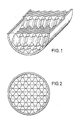
- Monoliths with a structure illustrated by FIGS. 1 and 2, which is also already known from static mixers, are particularly preferred.
- the channels formed by the troughs and crests of the layers lying on top of one another have the cross section of a triangle with strongly rounded corners.
- each monolith element represents a single cavity structure with channels.
- Such monoliths are commercially available under the name “Sulzer pack”.
- the monoliths are also preferred here used in the form of several cylinders stacked on top of each other. The structure described automatically ensures that the channels of the cylinders stacked one on top of the other fit so that the gas used can flow from the inlet of the reactor tube to the outlet.
- the use of a monolith support according to the invention brings a significantly better yield and space-time yield than the use of a conventional bed of spherical catalyst particles.
- the monolith filling according to the invention produces a substantially smaller pressure loss than a ball bed.
- Silicates, aluminum oxides, aluminum silicates or silicon carbide are suitable as ceramic material for the monoliths, preferably with BET surface areas of less than 50 M 2 g- l .
- Monoliths which consist predominantly of aluminum silicate are particularly preferred.
- the catalyst preferably contains at least one of the elements V, Au, Mo, Ag, Cu, Sn, Sb, Bi and P.
- other elements of the 3rd to 5th main group also have a catalytic effect.
- the total amount of elements on the carrier can vary within wide limits. In general, it is 0.01 to 50 wt .-%, preferably 0.1 to 20 wt .-%, based on the total mass of the supported catalyst.
- the catalytically active components are expediently applied to the support in the form of a solution, then the solvent is evaporated off and the catalyst is dried. Water, hydrochloric acid, nitric acid, alkali solutions or aqueous ammonia solution, preferably water or hydrochloric acid, are generally used as solvents.
- glycolic acid esters of the general formula HO-CH 2 -COOR are used in vapor form.
- R is a hydrocarbon radical, preferably an aliphatic, straight-chain or branched alkyl radical with 1 to 8 C atoms, in particular with 1 to 5 C atoms.
- the gaseous glycolic acid esters are passed over the catalyst together with oxygen or an oxygen-containing gas such as air. It is preferably diluted with a carrier gas such as nitrogen or noble gases.
- the oxydehydrogenation is generally carried out at temperatures between 100 and 600 ° C., preferably between 200 and 400 ° C.
- the residence time is preferably between 0.05 and 10 seconds, but in particular between 0.05 and 1 second. Satisfactory results are also obtained outside of these limits.
- the oxydehydrogenation is preferably carried out at normal pressure, but reduced or increased pressures can also be used, i. H. 0.01 to 100 bar.
- the procedure is such that the glycolic acid ester and oxygen or oxygen-containing gas, and optionally the carrier gas, are fed from metering devices into an evaporation zone and the resulting gas mixture is then passed through a reaction tube which is heated from the outside and filled with the catalyst. It has proven advantageous to heat the oxygen or the oxygen-containing gas and the carrier gas to the reaction temperature before they are introduced into the reactor.
- the test was carried out in a vertically arranged V4A tubular steel reactor 1500 mm long and 27 mm in diameter.
- the reactor was heated from the outside and the temperature inside was measured using several thermocouples.
- the catalyst carrier consisted of 9 stacked cylindrical monolith pieces of type I. Each piece had a diameter of 26 mm, a length of 50 mm and a channel diameter of approximately 3 mm. A 9 mm diameter hole was drilled centrally through the monolith body, into which thermocouples were fitted for temperature measurement.
- the monoliths consisted of aluminum silicate coated with aluminum oxide with a surface area of approximately 20M2g-1.
- the catalyst carrier filled a volume of 210 ml in the reactor tube. This volume is referred to below as the catalyst volume.
- the activation of the entire catalyst was carried out in a gas stream of 2.4 mol / h oxygen and 91.6 mol / h nitrogen at 400 ° C. for three hours.
- the catalyst support consisted of aluminum silicate balls (1 mm in diameter) with 1 M 2 g -1 BET surface.
- the catalyst contained 38.5 g of vanadium and 81.1 g of silver per liter of catalyst volume.
- 14.4 g of vanadium pentoxide was dissolved in 109 ml of concentrated hydrochloric acid, 210 ml of catalyst were soaked in this solution and the solvent was evaporated off on a steam bath.
- 26.8 g of silver nitrate was applied after dissolving in 43.7 ml of water.
- the catalyst was then dried at 110 ° C. These 210 ml of catalyst were introduced into the same vertically arranged steel reactor and activated in the same way as in Example 1.
- the pressure loss is significantly higher than in Example 1 and the catalyst performance is somewhat reduced.
Landscapes
- Chemical & Material Sciences (AREA)
- Organic Chemistry (AREA)
- Physics & Mathematics (AREA)
- Thermal Sciences (AREA)
- Chemical Kinetics & Catalysis (AREA)
- Organic Low-Molecular-Weight Compounds And Preparation Thereof (AREA)
- Catalysts (AREA)
Priority Applications (1)
| Application Number | Priority Date | Filing Date | Title |
|---|---|---|---|
| AT85100067T ATE40676T1 (de) | 1984-01-14 | 1985-01-03 | Verfahren zur herstellung eines glyoxylsaeureesters. |
Applications Claiming Priority (2)
| Application Number | Priority Date | Filing Date | Title |
|---|---|---|---|
| DE19843401115 DE3401115A1 (de) | 1984-01-14 | 1984-01-14 | Verfahren zur herstellung eines glyoxylsaeureesters |
| DE3401115 | 1984-01-14 |
Publications (3)
| Publication Number | Publication Date |
|---|---|
| EP0149456A2 EP0149456A2 (de) | 1985-07-24 |
| EP0149456A3 EP0149456A3 (en) | 1986-07-30 |
| EP0149456B1 true EP0149456B1 (de) | 1989-02-08 |
Family
ID=6224956
Family Applications (1)
| Application Number | Title | Priority Date | Filing Date |
|---|---|---|---|
| EP85100067A Expired EP0149456B1 (de) | 1984-01-14 | 1985-01-03 | Verfahren zur Herstellung eines Glyoxylsäureesters |
Country Status (11)
| Country | Link |
|---|---|
| US (1) | US4968833A (enExample) |
| EP (1) | EP0149456B1 (enExample) |
| JP (1) | JPS60158139A (enExample) |
| KR (1) | KR850005399A (enExample) |
| CN (1) | CN85101409A (enExample) |
| AT (1) | ATE40676T1 (enExample) |
| AU (1) | AU570759B2 (enExample) |
| BR (1) | BR8500139A (enExample) |
| CA (1) | CA1249840A (enExample) |
| DE (2) | DE3401115A1 (enExample) |
| ZA (1) | ZA85253B (enExample) |
Families Citing this family (11)
| Publication number | Priority date | Publication date | Assignee | Title |
|---|---|---|---|---|
| FR2588866B1 (fr) * | 1985-10-23 | 1988-01-15 | Hoechst France | Procede de fabrication de glyoxylate d'alkyle |
| DE3602274A1 (de) * | 1986-01-25 | 1987-07-30 | Hoechst Ag | Halbacetale von glyoxylsaeureestern sowie verfahren zur isolierung von glyoxylsaeureestern |
| DK156701C (da) * | 1987-08-27 | 1990-01-29 | Haldor Topsoe As | Fremgangsmaade til gennemfoerelse af heterogene katalytiske kemiske reaktioner |
| US5735158A (en) * | 1996-10-10 | 1998-04-07 | Engelhard Corporation | Method and apparatus for skew corrugating foil |
| WO1998055221A1 (de) * | 1997-06-05 | 1998-12-10 | Sulzer Chemtech Ag | Geordnete packung aus keramischem material |
| CN107445829B (zh) * | 2016-05-30 | 2020-09-04 | 中国石油化工股份有限公司 | 乙醇酸酯氧化制乙醛酸酯的方法 |
| KR20180102335A (ko) * | 2017-03-07 | 2018-09-17 | 주식회사 아모그린텍 | 배기가스를 이용하는 수소 개질기 |
| CN112209818B (zh) * | 2019-07-12 | 2023-04-07 | 中国石油化工股份有限公司 | 一种乙醇酸酯制乙醛酸酯的方法 |
| CN113368867A (zh) * | 2021-06-24 | 2021-09-10 | 新疆至臻化工工程研究中心有限公司 | 一种超声法辅助合成乙醇酸甲酯的催化剂及其制备方法 |
| CN114656360B (zh) * | 2022-03-03 | 2024-03-29 | 常州大学 | 一种利用乙醇酸甲酯连续氧化制备乙醛酸甲酯/乙醛酸的方法 |
| CN116410076B (zh) * | 2023-01-05 | 2026-04-07 | 万华化学集团股份有限公司 | 一种乙醇酸甲酯合成乙醛酸的方法 |
Family Cites Families (5)
| Publication number | Priority date | Publication date | Assignee | Title |
|---|---|---|---|---|
| DE1278411B (de) * | 1963-06-14 | 1968-09-26 | Basf Ag | Verfahren zur Herstellung von Katalysatoren oder Katalysatortraegern in Form von Hohlkugeln |
| US3898180A (en) * | 1970-07-23 | 1975-08-05 | Ici Ltd | Catalyst pellet |
| DE2831595A1 (de) * | 1978-07-19 | 1980-01-31 | Basf Ag | Verfahren zur herstellung von carbonylverbindungen |
| DE2902779C2 (de) * | 1979-01-25 | 1985-09-26 | Süddeutsche Kühlerfabrik Julius Fr. Behr GmbH & Co. KG, 7000 Stuttgart | Matrix für einen katalytischen Reaktor zur Abgasreinigung bei Brennkraftmaschinen |
| DE2904775C2 (de) * | 1979-02-08 | 1985-03-21 | Hoechst Ag, 6230 Frankfurt | Verfahren zur Herstellung von Glyoxylsäureestern |
-
1984
- 1984-01-14 DE DE19843401115 patent/DE3401115A1/de not_active Withdrawn
-
1985
- 1985-01-03 DE DE8585100067T patent/DE3568160D1/de not_active Expired
- 1985-01-03 AT AT85100067T patent/ATE40676T1/de active
- 1985-01-03 EP EP85100067A patent/EP0149456B1/de not_active Expired
- 1985-01-10 CA CA000471852A patent/CA1249840A/en not_active Expired
- 1985-01-11 BR BR8500139A patent/BR8500139A/pt unknown
- 1985-01-11 JP JP60002308A patent/JPS60158139A/ja not_active Ceased
- 1985-01-11 ZA ZA85253A patent/ZA85253B/xx unknown
- 1985-01-11 US US06/690,744 patent/US4968833A/en not_active Expired - Fee Related
- 1985-01-11 AU AU37626/85A patent/AU570759B2/en not_active Ceased
- 1985-01-12 KR KR1019850000168A patent/KR850005399A/ko not_active Withdrawn
- 1985-04-01 CN CN198585101409A patent/CN85101409A/zh not_active Withdrawn
Also Published As
| Publication number | Publication date |
|---|---|
| AU570759B2 (en) | 1988-03-24 |
| CN85101409A (zh) | 1987-01-24 |
| BR8500139A (pt) | 1985-08-20 |
| DE3401115A1 (de) | 1985-07-18 |
| KR850005399A (ko) | 1985-08-24 |
| CA1249840A (en) | 1989-02-07 |
| EP0149456A3 (en) | 1986-07-30 |
| ATE40676T1 (de) | 1989-02-15 |
| DE3568160D1 (en) | 1989-03-16 |
| JPS60158139A (ja) | 1985-08-19 |
| AU3762685A (en) | 1985-07-18 |
| US4968833A (en) | 1990-11-06 |
| EP0149456A2 (de) | 1985-07-24 |
| ZA85253B (en) | 1985-08-28 |
Similar Documents
| Publication | Publication Date | Title |
|---|---|---|
| DE3884441T3 (de) | Verfahren zur Herstellung von Phthalsäureanhydrid. | |
| DE2350212C3 (de) | Verfahren zur Herstellung von Cyanwasserstoff | |
| EP0680374B1 (de) | Verfahren zur katalytischen zersetzung von reinem oder in gasgemischen enthaltenem distickstoffmonoxid | |
| EP0015565A1 (de) | Verfahren zur Herstellung von 3 bis 4 C-Atome enthaltenden alpha,beta-olefinisch ungesättigten Aldehyden | |
| DE2441109A1 (de) | Verfahren zur katalytischen oxydation von tert.-butylalkohol in der dampfphase | |
| DE2752492C3 (de) | Oxidationskatalysator und seine Verwendung zur Dampfphasenoxidation von Olefinen | |
| EP0149456A2 (de) | Verfahren zur Herstellung eines Glyoxylsäureesters | |
| DE3410799C2 (enExample) | ||
| DE60007794T2 (de) | Verfahren zum Herstellen von Methacrylsäure | |
| CH619442A5 (en) | Process for the preparation of a mixture of acrolein and acrylic acid, or methacrolein and methacrylic acid. | |
| EP0767165B1 (de) | Verfahren zur Herstellung von aromatischen oder heteroaromatischen Nitrilen | |
| DE2239801A1 (de) | Katalysatoren fuer die herstellung von pyridin und 3-methylpyridin | |
| DE2550979C2 (de) | Verfahren zur Herstellung von Methacrylsäure durch oxydative Dehydrierung von Isobuttersäure | |
| DE2321150A1 (de) | Verfahren zur herstellung von methacrylnitril | |
| DE1618575C3 (de) | Verfahren zur Herstellung von Glykolestern | |
| DE2632395A1 (de) | Katalysator und dessen verwendung zur herstellung von anisaldehyd | |
| DE2203439B2 (de) | Verfahren zur Herstellung von Acrylnitril aus Propylen | |
| EP0275892B1 (de) | Verfahren zur Oxydehydrierung von Polyglykolmonoäthern zu den entsprechenden Aldehyden | |
| EP0040666B1 (de) | Katalytisches Oxydations- und Dehydrierungsverfahren und Verwendung einer dafür geeigneten Umsetzungsvorrichtung | |
| DE2062025B2 (de) | Verfahren zur herstellung von acrolein oder methacrolein | |
| DE2700960A1 (de) | Verfahren zur herstellung von methacrylsaeure oder acrylsaeure und katalysator zur durchfuehrung des verfahrens | |
| DE2334037A1 (de) | Verfahren zur herstellung von acrolein | |
| EP1074511B1 (de) | Verfahren zur Herstellung von Stickstoffdioxid aus Stickstoffmonoxid | |
| DE3644837A1 (de) | Verfahren zur herstellung von acyloxyacetaldehyden | |
| DE2640099A1 (de) | Antimon- und uranoxid enthaltender oxidationskatalysator sowie herstellung und verwendung desselben |
Legal Events
| Date | Code | Title | Description |
|---|---|---|---|
| PUAI | Public reference made under article 153(3) epc to a published international application that has entered the european phase |
Free format text: ORIGINAL CODE: 0009012 |
|
| AK | Designated contracting states |
Designated state(s): AT BE CH DE FR GB IT LI NL |
|
| PUAL | Search report despatched |
Free format text: ORIGINAL CODE: 0009013 |
|
| AK | Designated contracting states |
Kind code of ref document: A3 Designated state(s): AT BE CH DE FR GB IT LI NL |
|
| 17P | Request for examination filed |
Effective date: 19860906 |
|
| 17Q | First examination report despatched |
Effective date: 19880610 |
|
| GRAA | (expected) grant |
Free format text: ORIGINAL CODE: 0009210 |
|
| AK | Designated contracting states |
Kind code of ref document: B1 Designated state(s): AT BE CH DE FR GB IT LI NL |
|
| REF | Corresponds to: |
Ref document number: 40676 Country of ref document: AT Date of ref document: 19890215 Kind code of ref document: T |
|
| ITF | It: translation for a ep patent filed | ||
| REF | Corresponds to: |
Ref document number: 3568160 Country of ref document: DE Date of ref document: 19890316 |
|
| GBT | Gb: translation of ep patent filed (gb section 77(6)(a)/1977) | ||
| ET | Fr: translation filed | ||
| PLBE | No opposition filed within time limit |
Free format text: ORIGINAL CODE: 0009261 |
|
| STAA | Information on the status of an ep patent application or granted ep patent |
Free format text: STATUS: NO OPPOSITION FILED WITHIN TIME LIMIT |
|
| PG25 | Lapsed in a contracting state [announced via postgrant information from national office to epo] |
Ref country code: GB Effective date: 19900103 Ref country code: AT Effective date: 19900103 |
|
| 26N | No opposition filed | ||
| PG25 | Lapsed in a contracting state [announced via postgrant information from national office to epo] |
Ref country code: LI Effective date: 19900131 Ref country code: CH Effective date: 19900131 Ref country code: BE Effective date: 19900131 |
|
| BERE | Be: lapsed |
Owner name: HOECHST A.G. Effective date: 19900131 |
|
| PG25 | Lapsed in a contracting state [announced via postgrant information from national office to epo] |
Ref country code: NL Effective date: 19900801 |
|
| GBPC | Gb: european patent ceased through non-payment of renewal fee | ||
| NLV4 | Nl: lapsed or anulled due to non-payment of the annual fee | ||
| REG | Reference to a national code |
Ref country code: CH Ref legal event code: PL |
|
| PGFP | Annual fee paid to national office [announced via postgrant information from national office to epo] |
Ref country code: FR Payment date: 19911213 Year of fee payment: 8 |
|
| PGFP | Annual fee paid to national office [announced via postgrant information from national office to epo] |
Ref country code: DE Payment date: 19920310 Year of fee payment: 8 |
|
| PG25 | Lapsed in a contracting state [announced via postgrant information from national office to epo] |
Ref country code: FR Effective date: 19930930 |
|
| PG25 | Lapsed in a contracting state [announced via postgrant information from national office to epo] |
Ref country code: DE Effective date: 19931001 |
|
| REG | Reference to a national code |
Ref country code: FR Ref legal event code: ST |