EP0143668A2 - Elektronische Waage - Google Patents
Elektronische Waage Download PDFInfo
- Publication number
- EP0143668A2 EP0143668A2 EP84308309A EP84308309A EP0143668A2 EP 0143668 A2 EP0143668 A2 EP 0143668A2 EP 84308309 A EP84308309 A EP 84308309A EP 84308309 A EP84308309 A EP 84308309A EP 0143668 A2 EP0143668 A2 EP 0143668A2
- Authority
- EP
- European Patent Office
- Prior art keywords
- key
- article
- keys
- data
- memory
- Prior art date
- Legal status (The legal status is an assumption and is not a legal conclusion. Google has not performed a legal analysis and makes no representation as to the accuracy of the status listed.)
- Granted
Links
Images










Classifications
-
- G—PHYSICS
- G01—MEASURING; TESTING
- G01G—WEIGHING
- G01G19/00—Weighing apparatus or methods adapted for special purposes not provided for in the preceding groups
- G01G19/40—Weighing apparatus or methods adapted for special purposes not provided for in the preceding groups with provisions for indicating, recording, or computing price or other quantities dependent on the weight
- G01G19/413—Weighing apparatus or methods adapted for special purposes not provided for in the preceding groups with provisions for indicating, recording, or computing price or other quantities dependent on the weight using electromechanical or electronic computing means
- G01G19/414—Weighing apparatus or methods adapted for special purposes not provided for in the preceding groups with provisions for indicating, recording, or computing price or other quantities dependent on the weight using electromechanical or electronic computing means using electronic computing means only
- G01G19/4144—Weighing apparatus or methods adapted for special purposes not provided for in the preceding groups with provisions for indicating, recording, or computing price or other quantities dependent on the weight using electromechanical or electronic computing means using electronic computing means only for controlling weight of goods in commercial establishments, e.g. supermarket, P.O.S. systems
Definitions
- the present invention relates to an electronic scale which stores article data such as article names, unit prices, tares, etc., fetches stored article data in response to depression of ten-keys or preset keys, and displays and prints such fetched article data.
- article data such as article names, unit prices, tares, etc.
- Electronic scales generally operate by entering article data such as unit prices and tares into a control unit and storing them in response to actuation of a key- operated input unit such as a ten key pad, fetching article data by entering a call number, and displaying the weight of a desired article and the unit price and price thereof.
- a key- operated input unit such as a ten key pad
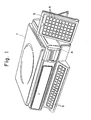
- FIG. 1 of the accompanying drawings illustrates in perspective of an electronic scale of the type described above.
- a control unit contained in the scale effects a required arithmetic operation based on a unit price and other data which have already been fetched by a call number entered by ten-keys 3, for displaying a total price, the unit price, a weight, and other data on a display unit 2.
- the illustrated electronic scale has a printer 4 which prints the article name, date, unit price, total price, and other data as shown in FIG. 3(b) on an unprinted label as shown in FIG. 3(a).
- FIG. 2 is a block diagram of the electronic scale, explanatory of the functions thereof.
- the electronic scale includes a weighing unit 8, an A/D converter 9, an arithmetic control unit 10, a storage unit 11, a key- operated input unit 7, a display unit 2, and a printer 4.
- Article codes, article names, unit prices, and other necessary data are entered in advance through ten-keys and function keys in the key input unit 7, and are stored in a registration memory in the storage unit 11 under the control of the arithmetic control unit 10.
- the storage unit 10 is composed of a RA M and a ROM as shown in FIGS. 13 and 14. Then, an article is placed on the weighing pan 1 as shown in FIG. 1, and the weight of the article is measured by the weighing unit 8.
- the measured weight (in analog representation) is converted by the A/D converter 9 into a digital signal, which is applied as weight data to the arithmetic control unit 10.
- the arithmetic control unit 10 has fetched necessary data on the article from the registration memory, effects an arithmetic operation on the fetched data and the weight data, and then displays data on the display unit 2 and controls the printer 4 to print the data on a label.
- the data for each article is stored into the registration memory by operating the ten-keys to enter numbers.
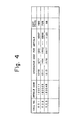
- entering the data through depression of keys has been time-consuming since article names are expressed by characters each composed of 4 numerals, as shown by stored examples in FIG. 4.
- An embodiment of the present invention can provide an electronic scale capable of specifying three character sizes with a single key when printing registered data.
- Another embodiment of the present invention can provide an electronic scale capable of printing registered data in the order of call numbers.
- a further embodiment of the present invention can provide an electronic scale capable of counting and displaying the number of characters entered by keys as representing an article name.
- an electronic scale comprising a weighing unit for weighing an article, an arithmetic control unit for computing a price based on weight data issued from the weighing unit, a storage unit for storing article data having been entered in the arithmetic control unit, a key input unit having keys for registering a character code such as an article name represented by one character corresponding to the article and for calling the registered character code, a display unit for displaying the weight and price of the weighed article which are issued from the arithmetic control unit, and a printer for printing on a label the weight, price, and name of the weighed article which are issued from the arithmetic control unit.
- registered data For printing registered data, three character sizes can be specified by a single key, and registered data can be printed in the order of call numbers, so that the registered data can functionally be printed and printed data are highly readable.
- An electronic scale has a preset key 6 shown in FIG. 1, the preset keys 6 and the ten-keys and function keys which have been conventionally available jointly constituting a key input unit 7.
- the preset keys 6 are operated upon to register and call required data while a sheet 5 is being fitted thereover which bears article names and Kanji characters (Chinese characters) at respective keys.
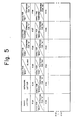
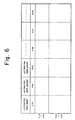
- FIGS. 5 through 10 are illustrative of examples of such sheets. For the sake of illustration, the illustrated sheets also bear key numbers which are not present on actual sheets.
- FIG. 5 shows a sheet for registering article names, the sheets being used while switching between Kanji characters and Katakana characters (Japanese characters). For example, a key K33 is depressed to select a Kanji character mode, and then a key K36 is depressed to register a Kanji character meaning "pork”. When a Katakana selection key K34 is depressed and then the key K36 is selected, a Katakana character for "a" is registered.
- FIG. 6 is a sheet for calling registered data, the sheet bearing character names which are frequently used, such as "beef roast”, “beef sukiyaki” and others, associated with the respective keys.
- FIG. 7 through 10 are illustrative or registration sheets for using Kanji characters, Katakana characters, upper-case alphabetical letters, and lower-case alphabetical letters.
- a key K33 for "sheet 1" is depressed and a key K38 is depressed, for example, a character meaning "pork” is registered
- a key K34 for "sheet 2" is depressed following by depression of the key K38, then a character ieaning "i” is registered.
- FIG. 9 is used and a key K35 for "sheet 3" is depressed and the key K38 is depressed, an upper-case alphabetical letter “B” is registered.
- a key K36 for "sheet 4" is depressed, and if the key K38 is then depressed, a lower-case alphabetical letter "b” is registered.
- characters for article names can be registered by combining numerals through ten-keys, and by the preset keys in association with the sheets shown in FIGS. 5 and 7 through 10.
- article data can be fetched by entering call numbers of FIG. 4 through the ten-keys, and can also be fetched by entering article names using the sheet of FIG. 6.
- the operator fits the call sheet over the preset keys, and puts the arithmetic control unit comprising a microcomputer or the like in a call mode.
- the key K33 is depressed to select "bee roast", whereupon the arithmetic control unit reads data relating to beef roast such as the article code, the character code, and the unit price from the registration memory, and automatically sets such data.
- the call numbers and the preset key numbers are placed in a 1-to-1 correspondence such that the call number 001 corresponds to the preset key K33, the call number 001 to the preset key K34, and so on. Normally, there are 750 call numbers from 001 though 750 are available through the ten-keys.
- the preset keys are limited in number, that is, there are only 54 preset keys from K33 through K87. Therefore, the preset keys are made to correspond to highly frequently used call numbers as desired.
- the call number 001 may correspond to the preset key K50.
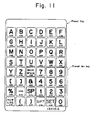
- FIG. 11 shows a sheet to be fitted over the preset keys for using them as keys for registering data such as call numbers, article codes, and article names.
- the 0, 1, ... 9 keys are used as numeral keys for 0, 1, ... 9, and the BACK SPACE key is used as a clear key.
- the 0, 1, ... 9 keys are used as character keys 0, 1, ... 9, and the BACK SPACE key is used as a back space key. That is, the 0 through 9 keys or the preset ten-keys are automatically switched to numerical/character keys when entering article names, and to numeral keys when entering numerical data. By using the sheet of FIG. 11, therefore, all data to be registered can be entered only with the preset keys having the key numbers K33 through K80.
- the sheet will be used as follows:
- FIG. 13 shows registered data printed in the three character sizes thus specified.
- FIG. 14 is illustrative of a sheet to be fitted over the preset keys when they are to be used as keys for calling registered data. For example, when the key K33 is turned on and small-size characters are specified, then "STEAK BONELESS" is printed in a small size as shown in FIG. 13.
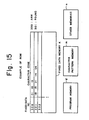
- FIG. 15 shows an example in which "ARM” is stored at a fixed data number 300, and "ROUND” is stored at a fixed data number 301.
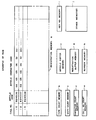
- FIG. 16 illustrates an example of a list prepared by printing registered data in the order of call numbers.
- the registration memory stores registered data On articles in the order of call numbers (from smaller to larger), the data including the call number, the article code, the article name, the unit price, the tare, the effective term, the fixed value, the number of figure positions for printing bar codes, and others), and the registered data are printed on a continuous sheet in the order of call numbers (from larger to smaller).
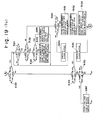
- FIGS. 17 and 18 are flowcharts of processing procedures according to a first embodiment of the present invention.
- the flowchart of FIG. 17 is illustrative of the processing procedure in which the sheet of FIG. 5 is fitted over the preset keys 6 and article names are registered through the ten-keys or preset keys. The procedure will hereinafter be described.
- the arithmetic control unit 10 is entered into a registration mode, and a call number is entered through the ten-keys so as to be stored and set in the buffer memory in the storage unit 11. Where an article name is to be registered, the arithmetic control unit 10 is entered into an article name registration mode (steps Pl through P4).
- the arithmetic control unit 10 checks this key number to determine whether the ten-keys (key numbers K1 through K10) are turn on (steps P5 through P7). If the ten-keys are turned on, the arithmetic control unit 10 stores the number entered by the ten-keys, that is, the article name character code, into a number memory in the storage unit 11 (step P8).
- step P9 determines whether the call key among the function keys is turned on or not. If the call key is turned on, then the aritmetic control unit 10 stores the content of the number memory into the buffer memory in the storage unit 11, and clears the number memory to zero (steps P10, Pll).
- step P9 the program goes to a step P12 in which the arithmetic control unit 10 determines whether the preset keys are turned on or not. The, the arithmetic control unit 10 determines whether the Kanji Key K33 is depressed or not. If the Kanji key is turned on, then the arithmetic control unit 10 sets a Kanji flag to "H" (steps P13, P14). If the Kanji key is not turned on, the arithmetic control unit 10 determines whether the Katakana key K34 is turned on or not. If the Katakana key is turned on, then the arithmetic control unit 10 sets the Kanji key to "L" (steps P15, P16).
- the arithmetic control unit 10 stores the key number converted in the step P6, that is, the key number of any one of the keys K35 through k87, into a key number memory in a step P17. Thereafter, the arithmetic control unit 10 checks whether the Kanji flag is "H” or "L” in a step P18. If the Kanji flag is "H”, then the arithmetic control unit 10 converts the key number into a Kanji character code which is stored in the buffer memory (step P19). If the Kanji flag is "L”, then the arithmetic control unit 10 converts the key number into a Katakana character code which is stored in the buffer memory (step P20).
- the arithmetic control unit 10 checks whether an end key among the function keys is turned on or not in a step P21. If the end key is not turned on, then an alarm buzzer is energized (step P22). If the end key is turned on, then the arithmetic control unit 10 stores the call number and the article name character code stored in the buffer memory into the registration memory.
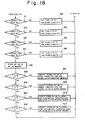
- FIG. 18 is illustrative of a processing flow at the time the sheets of FIGS. 7 through 10 are used, the flow corresponding to the steps P13 through P20 in the flowchart of FIG. 17.
- the arithmetic control unit 10 checks in a step Sl whether the key K33 for the sheet 1 of FIG. 7 is turned on or not. If the sheet-l key is turned on, then the arithmetic control unit sets a flag 1 to " H " in a step S2 and sets other flags to "L". Likewise, the arithmetic control unit 10 checks whether the keys K34, K35, K36 for the sheets 2, 3, 4, respectively, are turned on or not in steps S3, S5, S7, and sets flags 2, 3, 4 to "H” and other flags to "L” dependent on the sheets (steps S4, S6, S8).
- the arithmetic control unit 10 stores key numbers K37 through K87 other than the key numbers K33 through K36 corresponding to the sheets 1 through 4 into the key number memory.
- the arithmetic control unit 10 checks whether the flag 1 is "H” or not in a step S10. If the flag 1 is "H”, then the arithmetic control unit 10 converts the stored key number into a Kanji character code which is stored in the buffer memory (step Sll). If the flag 2 is "H”, then the arithmetic control unit 10 converts the stored key number into a Katakana character code which is stored in the buffer memory (steps S12, S13). Likewise, if the flag 3 is "H”, then the arithmetic control unit converts the stored key number into an upper-case alphabetical letter code which is stored in the buffer memory (steps S14, S15).
- the arithmetic control unit converts the stored key number into a lower-case alphabetical letter code which is stored in the buffer memory (steps S16, S17).
- the preset keys can register a message such as a special bargain day in addition to the article name character.
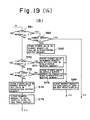
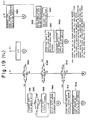
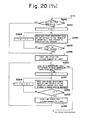
- FIGS. 19 and 20 are flowcharts showing steps of operation according to another embodiment of the present invention.
- the flowchart of FIG. 20 is followed when registering data using the preset keys.
- the following items are stored in memories in the RAM of FIG. 21.
- Registration memory a (1) Registration memory a:
- Registration buffer memory g
- a registration mode is entered, and "P" is displayed on a sum display as shwon in FIG. 12 (step S00). Then, an item registration mode is entered to display "Pl" on the sum display (step S20). “1” is stored in a type count memory and displayed on the sum display, and "0” is stored in a shift count memory and a character count memory (step S30).
- step S60 If the turned-on key is a SET key. (step S60), then the following processing is followed:
- step S61 If the stored value in the type count memory is 1, that is, for the call number (step S61), and when the stored value in the number memory is 9999 (step S62), then the number memory is cleared to zero, and "0" is displayed on the unit price display (step S66), and the item registration mode is released (step S67).
- step S71 If the stored value in the type count memory is 1 and when the stored value in the number memory is not 9999, then the stored value in the number memory is registered as a call number and stored in the buffer memory (step S71). Then, the number memory is cleared to zero and "0" is displayed on the unit price display (step S64). The stored value in the type count memory is incremented by + 1, and the incremented value is displayed on the sum memory (step S65).
- step S70 If the stored value in the type count memory is 2 when the stored value in the type count memory is not 1 (step S70), then the stored value in the number memory is registered as an article code and stored in the registration buffer memory (step S71). If the stored value in the type count memory is 3 (step S72), then the stored value in the article name buffer memory is registered as a character code and stored in the registration buffer memory (step S73).
- the stored value in the type count memory is not 1 through 3
- the stored value in the number memory is stored as a unit price in the registration buffer memory (step S74), and the number memory is cleared to zero, with "0" displayed on the unit price display (step S75).
- the call numbers stored in the registration memory are searched, and all registered data having call numbers larger than the call number stored in the registration buffer memory are shifted, during which time the content stored in the registration buffer memory is stored. Therefore, the registration memory always stores registered data in the order of call numbers (from smaller to larger) (step S76) as indicated in the example of FIG. 16.
- the stored value in the type count memory is 3, that is, for registering an article name
- step S90 If the turned-on key is the SHIFT key (step S90), the shift count memory is incremented by + 1 (step S91), and after the stored value in the shift count memory has been confirmed as being 3, the shift count memory is cleared to zero (step S93). If the stored value in the shift count memory is not 3, the stored value in the shift count memory is displayed on the weight display (step S94).
- step S100 If the turned-on key is the BACK SPACE key when the turned-on key is not the SHIFT key (step S100), then the final data among those stored in the article name buffer memory is cleared, and a space code is stored (step S101). Then, the stored value in the character count memory is decremented by - 1, and the decremented value is displayed on the weight display (step S102). If the turned-on key is an SP key (step S110), then the space code is stored in the article name buffer memory (step S111), and the character count memory is incremented by + 1, with the incremented value displayed on the weight display (step S112).
- step S120 If the turned-on key is a "1" key (step S120), then the following process is carried out:
- the stored value in the number memory is stored as a fixed data number in the article name buffer memory (step S131).
- the fixed data number is employed for storing a character, a word, a phrase, or a sentence which is not present on the preset keys. By registering the data with the fixed data number, the word or the like can automatically be fetched and printed when the fixed data nubmer is called.
- step S1320 the character count memory is incremented by + 1, and the incremented value is displayed on the weight display (step S133).
- step S164 If the stored value in the shift count memory is 1 (step S164), then the stored value in the key number memory is converted into a medium-size character code which is stored in the article name buffer memory (step S165).
- the stored value in the shift count memory is neither 0 nor 1, then the stored value in the shift count memory is 2. Therefore, the stored value in the key number memory is converted into a small-size character code which is stored in the article name buffer memory (step S166). The character count memory is incremented by + 1, and the incremented value is displayed on the weight display (step S163).
- the flowchart of FIG. 20 is illustrative of steps of operation for successively printing registered data. Now, the flowchart of FIG. 20 will be described with reference to an example in which 63 articles are registered at call numbers 10 through 135 as shown in FIG. 16.
- step S230 With the call numbers confirmed as being stored (step S230), the call number count memory is incremented by + 1 (step S231), and whether the stored value in the call number count memory is ⁇ or not is checked (step S 232). If the above condition is met, then the call number count memory is cleared to zero (step S234). If the above condition is not met, then a call number stored next is read out (step S233). Thus, the remainders after has been multiplied by an integer are counted in the steps S230 through S233.
- step S242 If the stored value in the call number count memory is not 0, then an index i is set to 1, and registered data for one article are read out and printed in the order of call numbers (from larger call number) stored in the registration memory (step S242). Then, if the value of i is not equal to the stored value in the call number count memory (step S243), then 1 is added to i, and the process of the step S242 is repeated (step S244). If i is equalized to the stored value in the call number count mory, the program leaves this processing loop and proceeds to a next process in which the sheet is fed for a fixed number of lines to provide a cutting margin for cutting off the printed-out sheet to an A4-size sheet (step S 245).
- step S250 It is confirmed that reading and printing up to the registered data stored at the head address is not yet completed (step S250).
- FIG. 13 shows an example of a sheet printed in the above manner.
- FIG. 12 illustrates a displayed example on the display unit, which will be described below.
- (2) 12 is entered as a call number, and this stored value in the number memory is displayed on the unit price display.
- a character "B" is entered first in order to enter BEED ROUND as an article name.
- the displayed value on the weight display for the stored value in the character count memory becomes 1
- the displayed value on the sum display for the stored value in the type count emmory becomes 3 for registering the article name.
- the number memory is cleared to zero (see the steps S72, S73, S64).
- the "]" key is depressed to increase the stored value in the character count memory up to 6, and a line feed is effected.
- the NEW LINE, SHIFT, SHIFT keys are depressed.
- the stored value in the shfit count memory is displayed as 2 on the weight display, and the number memory is cleared to zero (see the steps S130, S132).
- the character key T is turned on to equalize the stored value in the character count memory to 7.
Landscapes
- Physics & Mathematics (AREA)
- Engineering & Computer Science (AREA)
- Mathematical Physics (AREA)
- Theoretical Computer Science (AREA)
- General Physics & Mathematics (AREA)
- Labeling Devices (AREA)
- Record Information Processing For Printing (AREA)
- Cash Registers Or Receiving Machines (AREA)
- Document Processing Apparatus (AREA)
Applications Claiming Priority (2)
| Application Number | Priority Date | Filing Date | Title |
|---|---|---|---|
| JP58225174A JPS60115816A (ja) | 1983-11-29 | 1983-11-29 | 電子秤 |
| JP225174/83 | 1983-11-29 |
Publications (3)
| Publication Number | Publication Date |
|---|---|
| EP0143668A2 true EP0143668A2 (de) | 1985-06-05 |
| EP0143668A3 EP0143668A3 (en) | 1986-03-12 |
| EP0143668B1 EP0143668B1 (de) | 1990-04-25 |
Family
ID=16825107
Family Applications (1)
| Application Number | Title | Priority Date | Filing Date |
|---|---|---|---|
| EP84308309A Expired EP0143668B1 (de) | 1983-11-29 | 1984-11-29 | Elektronische Waage |
Country Status (6)
| Country | Link |
|---|---|
| US (1) | US4693329A (de) |
| EP (1) | EP0143668B1 (de) |
| JP (1) | JPS60115816A (de) |
| AU (1) | AU565235B2 (de) |
| CA (1) | CA1256463A (de) |
| DE (1) | DE3482055D1 (de) |
Cited By (2)
| Publication number | Priority date | Publication date | Assignee | Title |
|---|---|---|---|---|
| EP0235335A1 (de) * | 1986-03-05 | 1987-09-09 | Esselte Meto International Produktions Gmbh | Preisrechnende Waage |
| DE3915645A1 (de) * | 1989-05-12 | 1990-11-15 | Mettler Toledo Albstadt Gmbh | Preisrechnende elektronische waage |
Families Citing this family (19)
| Publication number | Priority date | Publication date | Assignee | Title |
|---|---|---|---|---|
| JPS61130827A (ja) * | 1984-11-29 | 1986-06-18 | Ishida Scales Mfg Co Ltd | 電子秤 |
| DE3631487A1 (de) * | 1986-09-16 | 1988-03-17 | Mettler Instrumente Ag | Geraet, insbesondere waage, mit einer anzeige der resultate von nacheinander erfolgenden ausgewaehlten funktionsablaeufen |
| US4839675A (en) * | 1987-06-25 | 1989-06-13 | Owen H Drew | Catch and release fish data recording system |
| US4753031A (en) * | 1987-06-25 | 1988-06-28 | Owen H Drew | Catch and release fish data recording system |
| US7214891B1 (en) * | 1992-05-01 | 2007-05-08 | Ishida Co., Ltd. | Method and apparatus for printing merchandising information |
| JP3296621B2 (ja) * | 1992-05-01 | 2002-07-02 | 株式会社イシダ | 販売促進情報の印刷方法、その装置およびラベル |
| US5793707A (en) * | 1995-01-05 | 1998-08-11 | Simplex Time Recorder Company | Programmable time recorder |
| US7168525B1 (en) | 2000-10-30 | 2007-01-30 | Fujitsu Transaction Solutions, Inc. | Self-checkout method and apparatus including graphic interface for non-bar coded items |
| US7845554B2 (en) * | 2000-10-30 | 2010-12-07 | Fujitsu Frontech North America, Inc. | Self-checkout method and apparatus |
| US20030037965A1 (en) * | 2001-08-17 | 2003-02-27 | Bennard Thomas John | Scale system with frequent shopper display and related methods |
| JP4449310B2 (ja) * | 2003-02-27 | 2010-04-14 | 株式会社寺岡精工 | 計量印字装置 |
| US20040238629A1 (en) * | 2003-05-30 | 2004-12-02 | Buchholz Kenneth E. | System and method for conducting sales of goods and retail store employing the same |
| CN100338443C (zh) * | 2004-05-26 | 2007-09-19 | 宇权兴业股份有限公司 | 电子计价秤快速找钱方法及装置 |
| US20070005379A1 (en) * | 2005-06-29 | 2007-01-04 | Santos Juan-Castellanos | Scale with auto identification of frequently weighed items |
| JP4763388B2 (ja) * | 2005-09-02 | 2011-08-31 | 株式会社トーモク | 組立包装箱 |
| US7875813B2 (en) * | 2007-04-04 | 2011-01-25 | Mettler-Toledo, Inc. | Programmable weighing scale that tracks completion time for a process step for multiple concurrent processes |
| CA2631006A1 (en) * | 2007-05-08 | 2008-11-08 | Invatron Systems Corp. | Systems and methods for providing information to a customer |
| US8304668B2 (en) * | 2009-01-22 | 2012-11-06 | Premark Feg L.L.C. | Scale with kiosk ordering interface system and method |
| JP6162075B2 (ja) | 2013-12-10 | 2017-07-12 | レンゴー株式会社 | 係止構造、この係止構造を用いた容器、および、この容器の製函装置 |
Family Cites Families (16)
| Publication number | Priority date | Publication date | Assignee | Title |
|---|---|---|---|---|
| JPS5716937B2 (de) * | 1973-11-27 | 1982-04-08 | ||
| JPS5858632B2 (ja) * | 1974-11-11 | 1983-12-26 | 三菱電機株式会社 | クラツタヨクアツレ−ダ |
| US4125843A (en) * | 1977-10-14 | 1978-11-14 | The Singer Company | Method and apparatus for recording and projecting images |
| US4229794A (en) * | 1978-04-26 | 1980-10-21 | Sanitary Scale Company | Method and apparatus for supplying a label printer with product information |
| US4394693A (en) * | 1979-03-23 | 1983-07-19 | International Business Machines Corporation | System and method for generating enlarged or reduced images |
| AU5745280A (en) * | 1979-04-24 | 1980-10-30 | Franklin Electric Co. Inc. | Printing, price computing weighing scale |
| US4440248A (en) * | 1980-02-09 | 1984-04-03 | Teraoka Seikosho Co., Ltd. | Bar code printer |
| US4544929A (en) * | 1980-07-11 | 1985-10-01 | Lemelson Jerome H | Weighing apparatus and method |
| US4423486A (en) * | 1981-04-30 | 1983-12-27 | Hobart Corporation | Commodity display for weighing scale |
| US4398253A (en) * | 1981-05-04 | 1983-08-09 | Sanitary Scale Company | Scale controller |
| US4430716A (en) * | 1981-06-26 | 1984-02-07 | Pitney Bowes Inc. | Postage value determining scale with expandable memory port |
| DE3149818A1 (de) * | 1981-12-16 | 1983-06-23 | Bizerba-Werke Wilhelm Kraut GmbH & Co KG, 7460 Balingen | Preisrechnende waage |
| US4481587A (en) * | 1981-12-24 | 1984-11-06 | Pitney Bowes Inc. | Apparatus for providing interchangeable keyboard functions |
| EP0087310A1 (de) * | 1982-02-19 | 1983-08-31 | Michael Jackson | Automatische Maschine zum Wiegen, Verschliessen und Erzeugen von Informationen |
| US4499545A (en) * | 1982-06-30 | 1985-02-12 | Pitney Bowes Inc. | Method and apparatus for individualized selection of special fee postage value computations |
| JPS6042932U (ja) * | 1983-08-31 | 1985-03-26 | 株式会社 石田衡器製作所 | 電子秤 |
-
1983
- 1983-11-29 JP JP58225174A patent/JPS60115816A/ja active Pending
-
1984
- 1984-11-28 CA CA000468877A patent/CA1256463A/en not_active Expired
- 1984-11-29 EP EP84308309A patent/EP0143668B1/de not_active Expired
- 1984-11-29 DE DE8484308309T patent/DE3482055D1/de not_active Expired - Lifetime
- 1984-11-29 US US06/676,243 patent/US4693329A/en not_active Expired - Lifetime
- 1984-11-29 AU AU36012/84A patent/AU565235B2/en not_active Expired
Cited By (2)
| Publication number | Priority date | Publication date | Assignee | Title |
|---|---|---|---|---|
| EP0235335A1 (de) * | 1986-03-05 | 1987-09-09 | Esselte Meto International Produktions Gmbh | Preisrechnende Waage |
| DE3915645A1 (de) * | 1989-05-12 | 1990-11-15 | Mettler Toledo Albstadt Gmbh | Preisrechnende elektronische waage |
Also Published As
| Publication number | Publication date |
|---|---|
| EP0143668B1 (de) | 1990-04-25 |
| AU3601284A (en) | 1985-06-06 |
| CA1256463A (en) | 1989-06-27 |
| JPS60115816A (ja) | 1985-06-22 |
| US4693329A (en) | 1987-09-15 |
| EP0143668A3 (en) | 1986-03-12 |
| DE3482055D1 (de) | 1990-05-31 |
| AU565235B2 (en) | 1987-09-10 |
Similar Documents
| Publication | Publication Date | Title |
|---|---|---|
| US4693329A (en) | Electonic scale with label character size change capability | |
| CA1106501A (en) | Operator prompting system | |
| US4872119A (en) | Electronic postal scale for computing a postal charge | |
| US6094186A (en) | Document format setting method and apparatus | |
| EP0089190B1 (de) | Herstellung von Warenauszeichnungsetiketten für verschiedene Artikel | |
| US4360806A (en) | Display for word processor presenting margin zone markers | |
| US4691283A (en) | Automatic registration in an electronic cash register | |
| US4638435A (en) | Electronic cash register having direct price look-up function | |
| US3861479A (en) | Tare entry circuitry for a computing scale | |
| US4700792A (en) | Indication method in balance with item indicator | |
| AU608422B2 (en) | System for making pieces to be dispatched ready for shipping | |
| EP0273764B1 (de) | Textverarbeitungssystem | |
| JPH0812105B2 (ja) | 電子秤 | |
| JPS61130827A (ja) | 電子秤 | |
| JPH0666624A (ja) | 品名入出力装置 | |
| US4511891A (en) | Money information print control system | |
| EP0355020A2 (de) | Geschäftsverarbeitende Vorrichtung, geeignet um zusätzliche Verarbeitung durchzuführen | |
| JP2673050B2 (ja) | ラベルプリンタ | |
| JP2546662B2 (ja) | 電子秤 | |
| JP2546661B2 (ja) | 電子秤 | |
| JP2003270032A (ja) | 電子料金秤 | |
| JPH0661961B2 (ja) | ラベル印字装置 | |
| EP0232616B1 (de) | Speicher für elektronische Waage | |
| JPS5840217B2 (ja) | 電子式キヤツシユレジスタ | |
| JPS58120131A (ja) | 印字器付電子秤の印字削除方法 |
Legal Events
| Date | Code | Title | Description |
|---|---|---|---|
| PUAI | Public reference made under article 153(3) epc to a published international application that has entered the european phase |
Free format text: ORIGINAL CODE: 0009012 |
|
| AK | Designated contracting states |
Designated state(s): BE CH DE GB LI NL SE |
|
| PUAL | Search report despatched |
Free format text: ORIGINAL CODE: 0009013 |
|
| AK | Designated contracting states |
Kind code of ref document: A3 Designated state(s): BE CH DE GB LI NL SE |
|
| 17P | Request for examination filed |
Effective date: 19860729 |
|
| 17Q | First examination report despatched |
Effective date: 19871228 |
|
| GRAA | (expected) grant |
Free format text: ORIGINAL CODE: 0009210 |
|
| AK | Designated contracting states |
Kind code of ref document: B1 Designated state(s): BE CH DE GB LI NL SE |
|
| REF | Corresponds to: |
Ref document number: 3482055 Country of ref document: DE Date of ref document: 19900531 |
|
| PLBE | No opposition filed within time limit |
Free format text: ORIGINAL CODE: 0009261 |
|
| STAA | Information on the status of an ep patent application or granted ep patent |
Free format text: STATUS: NO OPPOSITION FILED WITHIN TIME LIMIT |
|
| 26N | No opposition filed | ||
| EAL | Se: european patent in force in sweden |
Ref document number: 84308309.8 |
|
| REG | Reference to a national code |
Ref country code: GB Ref legal event code: IF02 |
|
| PGFP | Annual fee paid to national office [announced via postgrant information from national office to epo] |
Ref country code: SE Payment date: 20031105 Year of fee payment: 20 Ref country code: NL Payment date: 20031105 Year of fee payment: 20 |
|
| PGFP | Annual fee paid to national office [announced via postgrant information from national office to epo] |
Ref country code: GB Payment date: 20031126 Year of fee payment: 20 |
|
| PGFP | Annual fee paid to national office [announced via postgrant information from national office to epo] |
Ref country code: CH Payment date: 20031128 Year of fee payment: 20 |
|
| PGFP | Annual fee paid to national office [announced via postgrant information from national office to epo] |
Ref country code: DE Payment date: 20031211 Year of fee payment: 20 |
|
| PGFP | Annual fee paid to national office [announced via postgrant information from national office to epo] |
Ref country code: BE Payment date: 20040121 Year of fee payment: 20 |
|
| PG25 | Lapsed in a contracting state [announced via postgrant information from national office to epo] |
Ref country code: LI Free format text: LAPSE BECAUSE OF EXPIRATION OF PROTECTION Effective date: 20041128 Ref country code: GB Free format text: LAPSE BECAUSE OF EXPIRATION OF PROTECTION Effective date: 20041128 Ref country code: CH Free format text: LAPSE BECAUSE OF EXPIRATION OF PROTECTION Effective date: 20041128 |
|
| PG25 | Lapsed in a contracting state [announced via postgrant information from national office to epo] |
Ref country code: NL Free format text: LAPSE BECAUSE OF EXPIRATION OF PROTECTION Effective date: 20041129 |
|
| BE20 | Be: patent expired |
Owner name: *ISHIDA KOKI SEISAKUSHO K.K. Effective date: 20041129 |
|
| REG | Reference to a national code |
Ref country code: GB Ref legal event code: PE20 |
|
| EUG | Se: european patent has lapsed | ||
| REG | Reference to a national code |
Ref country code: CH Ref legal event code: PL |
|
| NLV7 | Nl: ceased due to reaching the maximum lifetime of a patent |
Effective date: 20041129 |