EP0142001B1 - Dispositif assorti pour lier un faisceau de lignes électriques - Google Patents
Dispositif assorti pour lier un faisceau de lignes électriques Download PDFInfo
- Publication number
- EP0142001B1 EP0142001B1 EP84111771A EP84111771A EP0142001B1 EP 0142001 B1 EP0142001 B1 EP 0142001B1 EP 84111771 A EP84111771 A EP 84111771A EP 84111771 A EP84111771 A EP 84111771A EP 0142001 B1 EP0142001 B1 EP 0142001B1
- Authority
- EP
- European Patent Office
- Prior art keywords
- needle
- guide
- thread
- tongued
- catching
- Prior art date
- Legal status (The legal status is an assumption and is not a legal conclusion. Google has not performed a legal analysis and makes no representation as to the accuracy of the status listed.)
- Expired
Links
- 238000005520 cutting process Methods 0.000 claims abstract description 38
- 239000000463 material Substances 0.000 claims description 10
- 230000002441 reversible effect Effects 0.000 claims description 3
- 238000006073 displacement reaction Methods 0.000 claims 1
- 238000000926 separation method Methods 0.000 claims 1
- 230000015572 biosynthetic process Effects 0.000 abstract description 2
- 238000000034 method Methods 0.000 description 30
- 238000004804 winding Methods 0.000 description 12
- 230000003993 interaction Effects 0.000 description 4
- 230000006835 compression Effects 0.000 description 3
- 238000007906 compression Methods 0.000 description 3
- 239000004677 Nylon Substances 0.000 description 2
- 239000011230 binding agent Substances 0.000 description 2
- 229920001778 nylon Polymers 0.000 description 2
- 239000004033 plastic Substances 0.000 description 2
- 241001295925 Gegenes Species 0.000 description 1
- 230000005540 biological transmission Effects 0.000 description 1
- 230000000903 blocking effect Effects 0.000 description 1
- 239000004020 conductor Substances 0.000 description 1
- 238000010276 construction Methods 0.000 description 1
- 230000001419 dependent effect Effects 0.000 description 1
- 238000011161 development Methods 0.000 description 1
- 230000018109 developmental process Effects 0.000 description 1
- 230000000694 effects Effects 0.000 description 1
- 238000005516 engineering process Methods 0.000 description 1
- 238000009751 slip forming Methods 0.000 description 1
Images




Classifications
-
- H—ELECTRICITY
- H01—ELECTRIC ELEMENTS
- H01B—CABLES; CONDUCTORS; INSULATORS; SELECTION OF MATERIALS FOR THEIR CONDUCTIVE, INSULATING OR DIELECTRIC PROPERTIES
- H01B13/00—Apparatus or processes specially adapted for manufacturing conductors or cables
- H01B13/012—Apparatus or processes specially adapted for manufacturing conductors or cables for manufacturing wire harnesses
- H01B13/01263—Tying, wrapping, binding, lacing, strapping or sheathing harnesses
- H01B13/01272—Harness tying apparatus
Definitions
- the invention relates to a device for binding a bundle of electrical lines according to the preamble of claim 1.
- an automatic binder for binding an object with a long, flexible binding material each having a guide device, a conveyor, a tightening device and a gripping device for the flexible material.
- the purpose of this is to place loops of the material, which consists of a nylon strand with inherent rigidity, around a bundle of lines, which are then tightened.
- a cutting device as a mechanical component with two knives for cutting off the ends of the flexible material after tightening, and a drive and control device.
- the guide device and the gripping device are activated by a reversible motor, while a cylinder mechanism operated by compressed air is otherwise present.
- the tightening of the nylon strand as a flexible material takes place in a primary and a secondary process step, in between which a roller mechanism has to be moved relative to the binder.
- the overall structure is comparatively complicated.
- the object of the invention is to provide a device which can work with any thread and is simple in construction.
- this device should be able to be used in fully automatic operation.
- the new device should be usable, in particular, in one-hand operation, without any additional manual steps which have to be carried out in the meantime or subsequently.
- the invention creates a practical device.
- a device implemented according to the new device can be held like a pistol by an operator with one hand during the entire workflow and can be guided with its gripper to the desired binding point. Since the binding method implemented as in DE-A-2705418 works discontinuously, but on the one hand the loop end of the twine is cut off after looping and knotting, but on the other hand the continuous end of the twine is caught, a thread that can be unwound from a bobbin can be used. Nevertheless, binding takes place at certain points, for which the device can be freely guided to the wiring harness.
- a cutting knife and a catching needle are guided in such a way that, in chronological succession, the looping and knotting with the latch needle is carried out first, followed by cutting and catching.
- the tying, knotting, cutting and catching of the thread form a single, completed work cycle.
- the drive is preferably controlled by compressed air and the control is constructed mechanically. However, an electrical / electronic drive control is also possible.
- 100 denotes the housing of a device for tying parallel lines, such as cable harnesses or the like, which is referred to below as a winding gun.
- the term “winding gun” already makes it clear that the housing can be held by the user on a housing knob 105 with one hand, brought into the correct working position and put into operation by means of an actuating lever 106.
- the entire winding gun is so compact that it can be brought into the respective operating position without difficulty even in tight working conditions. It is possible to guide the winding gun along a cable harness manually or mechanically, in particular robot-guided.
- the housing 100 of the winding gun essentially consists of two parallel housing plates 110 and 111 which are connected at a distance and on which the working equipment and the necessary operating resources are arranged.
- a supply roll for twine can be arranged, from which a thread 2 is brought into the working area on the front part of the housing 100 via corresponding guides.
- a thread tensioning and return device 120 provides the necessary tension in the thread.
- the working area is designed with a guide 3 for the thread 2 and a gripper 130 in such a way that a bundle of parallel lines can be wrapped around the thread 2.
- the gripper 130 is roughly horseshoe-shaped and is guided by a gear transmission.
- the needle 4 is referred to as a “tongue needle” because of a driving tongue 9 for the thread 2.
- a forward and backward movement of the latch needle 4 is possible via an associated holder 5 and drive 140 with a compressed air cylinder.
- the holder 5 of the latch needle 4 is likewise guided in the link, so that, in addition to the higher-level forward and backward movement, there is also a movement in a predetermined curve shape.
- corresponding guide plates 131 and 132 are provided on the housing plates 110 and 111 in the area of the gripper 130.
- the basic shape of the winding gun which can be seen in FIG. 1, is essentially known from DE-A-2533640.
- latch needle 4 and gripper 130 In this publication, the interaction of latch needle 4 and gripper 130 is described in detail, loops being continuously formed there for looping around the parallel lines. After the looping processes to form a braid along the extensive cable harness, the binding thread must be cut off there and the end of the thread must be knotted manually.
- the winding gun has additional equipment that is attached to the side of the housing plate 111.
- These are essentially a cutting knife 17 and a so-called catch needle 18, both of which can likewise perform a forward and backward movement via a drive 160 with a pressure cylinder.
- the movement takes place in the direction of the housing plate 111, which can be seen from the groove profile shown.
- the pressure medium-actuated drive units 140 and 160 are coupled to one another in the sense of a time delay in the movement sequence, which will be explained further below.
- 1 represents an already bound conductor bundle.
- 2 identify the binding twine
- 3 a thread guide device
- 4 the latch needle
- 5 the associated holder
- 6 the link wheel
- 10 the associated link guide.
- the assignment of these details to FIG. 1 is clearly recognizable.
- the position of the associated tongue 9 is indicated for the tongue needle 4.
- the device shown is initially used in a manner known per se for tying a wire harness.
- the holder 5 is alternately pushed back and forth in the lower or upper groove of the link guide 10, the wrapping in cooperation with the gripper 130 supply of the wire harness with the thread 2 results.
- the upper guide half of the link guide 10 is blocked for the knot, so that the latch needle 4 can now only move back and forth in the groove of the lower guide half.
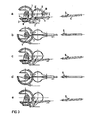
- FIG. 3a shows that the thread 2 runs over the thread guide 3 around the line bundle 1 and forms a loop 8 through which the latch needle is guided.
- the gripper 130 is in the starting position.
- the latch needle 4 is moved back with the tongue 9 open, the twine is taken along and pulled as a loop 7 through the last loop 8 present from the binding process.
- the link wheel 6 moves in the opposite direction, so that a position according to FIG. 3b results.
- the tongue 9 of the latch needle 4 is now closed, which can be achieved by the thread pressure if the latch needle 4 is designed accordingly.
- FIG. 3c the reverse movement sequence according to FIG. 3c, the tongue 9 opening when moving forward and the tongue needle 4 then moving through the newly formed loop into a position according to FIG. 3a.
- Corresponding substeps according to FIGS. 3d and 3e follow, which in principle correspond to the substeps according to FIGS. 3b and 3c, so that the result is a structure with several loops.
- the associated link guide is shown in detail: It consists essentially of a holding plate 11 with the guide groove 10 formed in two guide halves, a pin 12 for guiding the holding device 5 for the latch needle 4, a switching tongue 13, a locking lever 14 and a further pin 15. While during the binding process the holding of the latch needle 4 executes such a path, which is described in FIG. 4 by points 1 through 11 to III and from III to 11 to back to 1, path 11 becomes, for example, during the knotting process locked according to III. The pin 12 and the latch needle 4 thus follow the direct path from 1 to 11 and back again from II to I. The latter movement defines a loop which can be tightened to form a knot and can be repeated as required. The setting is blocked by the switching tongue 13, which is pressed upward by the locking lever 14, the locking lever 14 acting directly on the pin 15.
- the thread 2 of the twine is to be tightened and cut in a defined position, whereby it must be ensured that the cut thread can be caught and is thus immediately available for a new binding process.
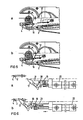
- the kinematics of cutting off on the one hand and catching the thread end on the other hand will be explained in various working phases with reference to FIGS. 5 and 6 on the one hand and FIGS. 7 and 8 on the other hand.
- 16 means the knot to be formed, 17 the cutting knife, 18 the catching needle, 19 the associated holder, 20 a pin on the knife holder, 21 an associated link for guiding the cutting knife 17 and catching needle 18, 22 a compressed air cylinder , 23 a clamping pin, 24 an elbow, 25 a spring, 26 a needle opening and 28 a stop for the catch needle 18th
- FIGS. 5b and 6b show their position immediately after the cutting process.
- the blade 17 is brought along the slide guide 21 into the plane of the latch needle 4, the thread being cut off directly at the knot 16.
- the catching needle 18 is present, the shape and function of which becomes clear in detail on the basis of FIGS. 7 and 8.
- the sectional view of FIG. 8a shows their comparatively complex structure with inner clamping pin 23, inner spring 25 and an outer pin 27 which is resiliently mounted via an angle piece 24.
- the clamping pin 23 is firmly connected to the angle 24 and is pressed forward by the spring 25 , so that a thread 2 can be firmly clamped in the needle opening 26.
- the inner spring pin 27 also serves to support the clamping process.
- 6b and 7b in particular illustrate the interaction of latch needle 4, cutting knife 17 and catch needle 18. After cutting, the end of thread 2 is clamped into opening 26 of needle 18. A stop 28 is used to return the clamping device 23 and 24, so that the needle opening 26 is free and the thread 2 can be caught. It is held in place during the subsequent backward movement of the catching needle 18.
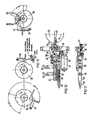
- the latter can in one embodiment of the Er find in connection with a compressed air drive by a cam control, which is illustrated by the description of FIGS. 9 to 11.
- the cam control is driven via the link wheel 6, which is rotated in a known manner during the forward and backward movement of the latch needle 4 to the left or right.
- a drive gear 29, which serves to drive an associated control gear 30, is fastened concentrically to the sliding gear 6. Its fixed axis 31 is screwed to the holding plate 11 of FIG. 4.
- a freewheel 32 is seated in the axis of the control gear 30, which only permits clockwise rotation of the switching disks 34, 35 and 36, which are jointly attached to a bushing 33.
- the gear ratio between the gear wheels 29 and 30 is selected such that a working cycle is completed when the switching disk 34, 35 and 36 is rotated through 360 °.
- This work cycle includes the tying, knotting, cutting and catching or holding process for the twine.
- the switching disk 34 has sawtooth-shaped notches on the circumference, which have an angular distance of 2x90 ° for a two-time binding process, an angular distance of 2x45 ° for a two-time knotting process and a further 90 ° for the zero position.
- a spring-loaded pawl 37 can snap into the notches. The pawl 37 is used for the exact fixing of the switching disks 34, 35 and 36 and thus prevents turning back when the directional gear 6 changes direction.
- the switching disk 35 in FIG. 11 1 is necessary for the knotting process if, as has been shown above, the blocking of the path 11 to 111 in the link guide 10 is to be effected in the angular range of 2 ⁇ 45 °.
- the switching disk 36 with pawl 39 is used to stop the binding device. A reversing slide can be blocked via the pawl 39 and the operating function of the device described can thus be stopped.
- the switching disk 34 carries a switching cam 40 which in each case triggers a separate control for the cutting and thread catching process when the winding gun is stopped.
- the drive and control takes place on a pneumatic / mechanical basis. It is also possible to provide the drive electrically and to create an electronic sequence control.
- a microprocessor system can expediently be used here.
Landscapes
- Engineering & Computer Science (AREA)
- Manufacturing & Machinery (AREA)
- Basic Packing Technique (AREA)
- Insertion, Bundling And Securing Of Wires For Electric Apparatuses (AREA)
Claims (9)
Priority Applications (1)
| Application Number | Priority Date | Filing Date | Title |
|---|---|---|---|
| AT84111771T ATE29797T1 (de) | 1983-10-18 | 1984-10-02 | Vorrichtung zum binden eines buendels elektrischer leitungen. |
Applications Claiming Priority (2)
| Application Number | Priority Date | Filing Date | Title |
|---|---|---|---|
| DE19833337853 DE3337853A1 (de) | 1983-10-18 | 1983-10-18 | Verfahren zum binden eines buendels elektrischer leitungen sowie zugehoerige vorrichtung |
| DE3337853 | 1983-10-18 |
Publications (2)
| Publication Number | Publication Date |
|---|---|
| EP0142001A1 EP0142001A1 (fr) | 1985-05-22 |
| EP0142001B1 true EP0142001B1 (fr) | 1987-09-16 |
Family
ID=6212129
Family Applications (1)
| Application Number | Title | Priority Date | Filing Date |
|---|---|---|---|
| EP84111771A Expired EP0142001B1 (fr) | 1983-10-18 | 1984-10-02 | Dispositif assorti pour lier un faisceau de lignes électriques |
Country Status (4)
| Country | Link |
|---|---|
| US (1) | US4558894A (fr) |
| EP (1) | EP0142001B1 (fr) |
| AT (1) | ATE29797T1 (fr) |
| DE (2) | DE3337853A1 (fr) |
Families Citing this family (16)
| Publication number | Priority date | Publication date | Assignee | Title |
|---|---|---|---|---|
| DE8602386U1 (de) * | 1986-01-30 | 1986-11-06 | Fraunhofer-Gesellschaft zur Förderung der angewandten Forschung e.V., 8000 München | Werkzeug zum Abbinden von Kabelsträngen |
| MY130074A (en) * | 1992-02-28 | 2007-05-31 | Bentac Co Ltd | Method and apparatus for tying one more articles |
| GB2317188B (en) * | 1996-09-14 | 2000-06-14 | Bentley Harris Sa | Wiring harness bundling |
| US6944932B2 (en) * | 1999-08-27 | 2005-09-20 | Giovanni Fortuna | Method for making a self-locking knot in a stator lacing machine |
| ATE237191T1 (de) * | 1999-09-06 | 2003-04-15 | Giovanni Fortuna | Verfahren und vorrichtung zum herstellen eines selbstschliessenden knotens in einer statorschnürmachine |
| US6279970B1 (en) | 2000-06-20 | 2001-08-28 | Michael Torres | Automatic knot-tying device |
| US6648378B1 (en) | 2002-10-04 | 2003-11-18 | Via Science Llc | Automatic knot-tying device |
| KR100804960B1 (ko) * | 2007-03-29 | 2008-02-20 | 이덕희 | 택 부착기의 매듭기의 교체장치 |
| ATE549914T1 (de) | 2009-05-06 | 2012-04-15 | Qimas E U | Portable bindemaschine |
| US8622440B2 (en) * | 2010-10-05 | 2014-01-07 | Ideal Industries, Inc. | Knot tying device and cartridge system for providing tying filament thereto |
| US9433198B2 (en) * | 2014-03-06 | 2016-09-06 | Phyllis D. O'Neal | Fishing line knotter |
| EP3133913B1 (fr) | 2014-04-24 | 2020-02-26 | Cruzzolin, Andrea | Appareil et méthode opérationnelle correspondante pour lier automatiquement ensemble au moins deux éléments |
| JP6803151B2 (ja) * | 2016-05-02 | 2020-12-23 | 東和精工株式会社 | 下げ札装着機 |
| US11970297B2 (en) | 2018-12-18 | 2024-04-30 | The Boeing Company | System, device and method to facilitate tying a knot |
| US11375702B2 (en) * | 2019-04-26 | 2022-07-05 | Nathanael Wills | Knot tying device |
| CN110924205A (zh) * | 2019-11-29 | 2020-03-27 | 李跃 | 一种钢丝绳绳头固定用铁丝缠绕器 |
Family Cites Families (6)
| Publication number | Priority date | Publication date | Assignee | Title |
|---|---|---|---|---|
| US3252723A (en) * | 1964-03-02 | 1966-05-24 | United Shoe Machinery Corp | Cable lacing methods |
| US3670783A (en) * | 1970-11-04 | 1972-06-20 | Goodwill Automated Devices Inc | Cable tying machine |
| US3700010A (en) * | 1971-06-17 | 1972-10-24 | Us Army | Wire tying apparatus including demountable tying mechanism |
| DE2228162C2 (de) * | 1972-06-09 | 1982-10-28 | Goodwill Automated Devices, Inc., New York Mills, N.Y. | Vorrichtung zum Abbinden von Kabelsträngen |
| DE2533640A1 (de) * | 1975-07-28 | 1977-02-03 | Boris Sergeevitsch Egorov | Verfahren zum binden einer gruppe paralleler elektrischer leitungen, einrichtung zur durchfuehrung dieses verfahrens und nach diesem verfahren gebundene elektrische sammelleitung |
| DE2705418C2 (de) * | 1976-02-21 | 1984-05-03 | Max Co. Ltd., Tokyo | Automatischer Binder |
-
1983
- 1983-10-18 DE DE19833337853 patent/DE3337853A1/de not_active Withdrawn
-
1984
- 1984-10-02 DE DE8484111771T patent/DE3466311D1/de not_active Expired
- 1984-10-02 EP EP84111771A patent/EP0142001B1/fr not_active Expired
- 1984-10-02 AT AT84111771T patent/ATE29797T1/de not_active IP Right Cessation
- 1984-10-18 US US06/662,180 patent/US4558894A/en not_active Expired - Fee Related
Also Published As
| Publication number | Publication date |
|---|---|
| DE3466311D1 (en) | 1987-10-22 |
| DE3337853A1 (de) | 1985-04-25 |
| EP0142001A1 (fr) | 1985-05-22 |
| US4558894A (en) | 1985-12-17 |
| ATE29797T1 (de) | 1987-10-15 |
Similar Documents
| Publication | Publication Date | Title |
|---|---|---|
| DE2720027C3 (de) | Bindewerkzeug zum Verdrillen der freien Enden eines Bindedrahtes | |
| DE69606943T2 (de) | Maschine zur herstellung von aufgussbeuteln, die mittels verbindungsfäden befestigte anhänger aufweisen | |
| EP0142001A1 (fr) | Dispositif assorti pour lier un faisceau de lignes électriques | |
| EP0084680B1 (fr) | Appareil pour lier des balles dans une presse à balles | |
| DE2709248C2 (de) | Verfahren und Vorrichtung zum Umschnüren von Ballen | |
| DE3202233C2 (de) | Vorrichtung zum Umschnüren von Ballen | |
| DE69305197T2 (de) | Verfahren und Vorrichtung zum Umschnüren von einem oder mehreren Gegenständen | |
| DE2243210C3 (de) | Verfahren zum Bewickeln von Kollektorankern elektrischer Maschinen | |
| DE2105163C3 (de) | Maschine zum Pressen und Umschnüren von Ballen mit Draht | |
| DE10308432A1 (de) | Verfahren und Vorrichtung zur maschinellen Herstellung von spulenlosen Kabelwickeln | |
| DE2437452A1 (de) | Vorrichtung und verfahren zum schnueren bzw. binden von spulen | |
| DE102019107073B4 (de) | Vorrichtung und verfahren zum automatisierten abbinden von kabeln | |
| DE2313719A1 (de) | Drahtschlingvorrichtung | |
| DE2833257A1 (de) | Verfahren zum ballenpressen und ballenpresse fuer heu, stroh u.dgl. | |
| DE2725511C2 (de) | Einrichtung zur Verstärkung eines Spulendrahtabschnittes | |
| DE1909747C3 (de) | Gerät zum Fädeln von Fadenmaterial durch mindestens eine öffnung eines Körpers | |
| DE2228162C2 (de) | Vorrichtung zum Abbinden von Kabelsträngen | |
| DE3741215C2 (fr) | ||
| DE69827743T2 (de) | Verbessertes mit ultraschall arbeitendes bindewerkzeug | |
| EP2285208B1 (fr) | Machine a ligaturer portable | |
| CH405188A (de) | Verfahren und Vorrichtung zur Gestaltung eines Weberknotens | |
| DE2741786C2 (de) | Knoter für Spulmaschinen | |
| DE2748025A1 (de) | Werkstueck-spannungsvorrichtung fuer eine naeheinheit | |
| DE300959C (fr) | ||
| DE2146560C3 (de) | Vorrichtung zum Herstellen von Drahtbunden |
Legal Events
| Date | Code | Title | Description |
|---|---|---|---|
| PUAI | Public reference made under article 153(3) epc to a published international application that has entered the european phase |
Free format text: ORIGINAL CODE: 0009012 |
|
| AK | Designated contracting states |
Designated state(s): AT DE FR GB IT NL SE |
|
| 17P | Request for examination filed |
Effective date: 19850827 |
|
| 17Q | First examination report despatched |
Effective date: 19860423 |
|
| GRAA | (expected) grant |
Free format text: ORIGINAL CODE: 0009210 |
|
| AK | Designated contracting states |
Kind code of ref document: B1 Designated state(s): AT DE FR GB IT NL SE |
|
| REF | Corresponds to: |
Ref document number: 29797 Country of ref document: AT Date of ref document: 19871015 Kind code of ref document: T |
|
| REF | Corresponds to: |
Ref document number: 3466311 Country of ref document: DE Date of ref document: 19871022 |
|
| ET | Fr: translation filed | ||
| ITF | It: translation for a ep patent filed | ||
| GBT | Gb: translation of ep patent filed (gb section 77(6)(a)/1977) | ||
| PLBE | No opposition filed within time limit |
Free format text: ORIGINAL CODE: 0009261 |
|
| STAA | Information on the status of an ep patent application or granted ep patent |
Free format text: STATUS: NO OPPOSITION FILED WITHIN TIME LIMIT |
|
| RAP2 | Party data changed (patent owner data changed or rights of a patent transferred) |
Owner name: PAUL HELLERMANN GMBH |
|
| 26N | No opposition filed | ||
| NLT2 | Nl: modifications (of names), taken from the european patent patent bulletin |
Owner name: PAUL HELLERMAN GMBH TE PINNEBERG, BONDSREPUBLIEK D |
|
| REG | Reference to a national code |
Ref country code: GB Ref legal event code: 732 |
|
| ITPR | It: changes in ownership of a european patent |
Owner name: CESSIONE;PAUL HELLERMANN GMBH |
|
| REG | Reference to a national code |
Ref country code: FR Ref legal event code: TP |
|
| NLS | Nl: assignments of ep-patents |
Owner name: PAUL HELLERMAN GMBH TE PINNEBERG, BONDSREPUBLIEK D |
|
| ITTA | It: last paid annual fee | ||
| EAL | Se: european patent in force in sweden |
Ref document number: 84111771.6 |
|
| PGFP | Annual fee paid to national office [announced via postgrant information from national office to epo] |
Ref country code: FR Payment date: 19960810 Year of fee payment: 13 |
|
| PGFP | Annual fee paid to national office [announced via postgrant information from national office to epo] |
Ref country code: GB Payment date: 19960911 Year of fee payment: 13 |
|
| PGFP | Annual fee paid to national office [announced via postgrant information from national office to epo] |
Ref country code: SE Payment date: 19961021 Year of fee payment: 13 Ref country code: AT Payment date: 19961021 Year of fee payment: 13 |
|
| PGFP | Annual fee paid to national office [announced via postgrant information from national office to epo] |
Ref country code: NL Payment date: 19961029 Year of fee payment: 13 |
|
| PGFP | Annual fee paid to national office [announced via postgrant information from national office to epo] |
Ref country code: DE Payment date: 19961220 Year of fee payment: 13 |
|
| PG25 | Lapsed in a contracting state [announced via postgrant information from national office to epo] |
Ref country code: GB Free format text: LAPSE BECAUSE OF NON-PAYMENT OF DUE FEES Effective date: 19971002 Ref country code: AT Free format text: LAPSE BECAUSE OF NON-PAYMENT OF DUE FEES Effective date: 19971002 |
|
| PG25 | Lapsed in a contracting state [announced via postgrant information from national office to epo] |
Ref country code: SE Free format text: LAPSE BECAUSE OF NON-PAYMENT OF DUE FEES Effective date: 19971003 |
|
| PG25 | Lapsed in a contracting state [announced via postgrant information from national office to epo] |
Ref country code: FR Free format text: THE PATENT HAS BEEN ANNULLED BY A DECISION OF A NATIONAL AUTHORITY Effective date: 19971031 |
|
| PG25 | Lapsed in a contracting state [announced via postgrant information from national office to epo] |
Ref country code: NL Free format text: LAPSE BECAUSE OF NON-PAYMENT OF DUE FEES Effective date: 19980501 |
|
| GBPC | Gb: european patent ceased through non-payment of renewal fee |
Effective date: 19971002 |
|
| NLV4 | Nl: lapsed or anulled due to non-payment of the annual fee |
Effective date: 19980501 |
|
| PG25 | Lapsed in a contracting state [announced via postgrant information from national office to epo] |
Ref country code: DE Free format text: LAPSE BECAUSE OF NON-PAYMENT OF DUE FEES Effective date: 19980701 |
|
| EUG | Se: european patent has lapsed |
Ref document number: 84111771.6 |
|
| REG | Reference to a national code |
Ref country code: FR Ref legal event code: ST |