EP0118486B1 - Elektromagnetbalken - Google Patents
Elektromagnetbalken Download PDFInfo
- Publication number
- EP0118486B1 EP0118486B1 EP83902741A EP83902741A EP0118486B1 EP 0118486 B1 EP0118486 B1 EP 0118486B1 EP 83902741 A EP83902741 A EP 83902741A EP 83902741 A EP83902741 A EP 83902741A EP 0118486 B1 EP0118486 B1 EP 0118486B1
- Authority
- EP
- European Patent Office
- Prior art keywords
- magnet
- core
- magnetic
- section member
- bearer
- Prior art date
- Legal status (The legal status is an assumption and is not a legal conclusion. Google has not performed a legal analysis and makes no representation as to the accuracy of the status listed.)
- Expired
Links
- 230000017525 heat dissipation Effects 0.000 claims description 9
- 239000000463 material Substances 0.000 claims description 5
- 238000009826 distribution Methods 0.000 claims description 2
- 238000004804 winding Methods 0.000 claims 3
- 238000007493 shaping process Methods 0.000 claims 1
- 239000011248 coating agent Substances 0.000 abstract 1
- 238000000576 coating method Methods 0.000 abstract 1
- 238000010276 construction Methods 0.000 description 13
- 238000001816 cooling Methods 0.000 description 6
- 238000005452 bending Methods 0.000 description 3
- 230000001419 dependent effect Effects 0.000 description 1
- 230000000694 effects Effects 0.000 description 1
- 230000020169 heat generation Effects 0.000 description 1
- 238000009434 installation Methods 0.000 description 1
- 238000003754 machining Methods 0.000 description 1
- 239000002184 metal Substances 0.000 description 1
- 238000005457 optimization Methods 0.000 description 1
- 238000003825 pressing Methods 0.000 description 1
- 230000005855 radiation Effects 0.000 description 1
- 125000006850 spacer group Chemical group 0.000 description 1
- 239000000725 suspension Substances 0.000 description 1
Images


Classifications
-
- B—PERFORMING OPERATIONS; TRANSPORTING
- B23—MACHINE TOOLS; METAL-WORKING NOT OTHERWISE PROVIDED FOR
- B23Q—DETAILS, COMPONENTS, OR ACCESSORIES FOR MACHINE TOOLS, e.g. ARRANGEMENTS FOR COPYING OR CONTROLLING; MACHINE TOOLS IN GENERAL CHARACTERISED BY THE CONSTRUCTION OF PARTICULAR DETAILS OR COMPONENTS; COMBINATIONS OR ASSOCIATIONS OF METAL-WORKING MACHINES, NOT DIRECTED TO A PARTICULAR RESULT
- B23Q3/00—Devices holding, supporting, or positioning work or tools, of a kind normally removable from the machine
- B23Q3/15—Devices for holding work using magnetic or electric force acting directly on the work
- B23Q3/154—Stationary devices
- B23Q3/1543—Stationary devices using electromagnets
-
- B—PERFORMING OPERATIONS; TRANSPORTING
- B23—MACHINE TOOLS; METAL-WORKING NOT OTHERWISE PROVIDED FOR
- B23Q—DETAILS, COMPONENTS, OR ACCESSORIES FOR MACHINE TOOLS, e.g. ARRANGEMENTS FOR COPYING OR CONTROLLING; MACHINE TOOLS IN GENERAL CHARACTERISED BY THE CONSTRUCTION OF PARTICULAR DETAILS OR COMPONENTS; COMBINATIONS OR ASSOCIATIONS OF METAL-WORKING MACHINES, NOT DIRECTED TO A PARTICULAR RESULT
- B23Q11/00—Accessories fitted to machine tools for keeping tools or parts of the machine in good working condition or for cooling work; Safety devices specially combined with or arranged in, or specially adapted for use in connection with, machine tools
- B23Q11/0003—Arrangements for preventing undesired thermal effects on tools or parts of the machine
Definitions
- the invention relates to an electromagnetic bar with a tubular or box-shaped carrier profile with a magnet system inserted therein, which consists of at least one magnetic coil, a magnetic core and a magnetic closing plate, the carrier profile being symmetrical to the plane through the axes of the magnetic cores and being connected to the magnetic cores.
- electromagnetic beams it is a major problem that they remain perfectly straight or flat in any temperature or operating condition, even with large lengths or working widths, and can therefore be used for the highest precision requirements.
- the previously known constructions mostly consist of a plate that is stiffened with a supporting structure and are inserted into the electromagnets.
- the individual electromagnets are inserted into the plate at their free pole end (e.g. screwed in) and connected to one another at the other pole end by means of the end strip.
- the magnetic bar Since it is desirable or technically necessary for the use of the magnetic bars that the magnetic bar should be as straight and flat as possible, it is necessary to dimension the plate and the supporting structure with increasing length with increasing length.
- the task, as described above, which is already difficult for mechanical stability reasons, is further complicated by the fact that magnetic beams are not only mechanically stressed in practice - depending on use - but also, above all, are subjected to electrical stress and are exposed to strong temperature fluctuations. At rest, i.e. the magnetic bar is cold. Depending on the set contact pressure or current, the operating temperatures vary.
- temperature-dependent bends are unavoidable in the case of magnetic beams of greater length.
- the magnitude of such undesirable bends can be more than 1 mm in the case of long magnetic bars and can therefore result in considerable inaccuracies in the machining process to be carried out by the magnetic bar.
- Cooling fans are sometimes installed to keep the temperature and thus the straightness constant. There are also other cooling methods. Cooling is not only expensive, but can only be regarded as a makeshift measure in order to be able to temporarily keep the heat-related bends within reasonably acceptable limits.
- the present invention relates to a novel design principle that makes bending due to temperature non-uniformity impossible.
- This invention is based on the knowledge that it is not the absolute temperature differences, but only the temperature differences occurring relative to one another in the interior of the construction that cause the disruptive bending.
- the support profile consists of two interconnected partial profiles, the shape and the material distribution of the two profile parts being such that the heat dissipation of both profile parts to a plane perpendicular to the plane of symmetry through the axes of the magnetic cores is equal to.
- both profile parts emit the same amounts of heat and there are thus vertical and horizontal compensating conditions in the electromagnetic bar, so that bending due to the heat is avoided.
- FIG. 1 shows a construction of the prior art
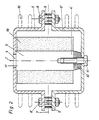
- FIG. 2 shows a section through a magnetic beam construction according to the invention
- FIG. 3 shows another embodiment of the invention
- FIG. 4 shows a further embodiment
- Fig. 5 shows another type of construction according to the invention.
- the plate 1 is stiffened by a support structure 2, and the plate 1 is connected to electromagnetic systems 3.
- the individual electromagnets of the electromagnet systems 3 are at their free pole ends 4 with the plate 1, for. B. by screwing, and they are connected to each other at the other pole end by means of the end bar 5.
- the first type of magnetic beam construction according to the invention shown in Fig. 2 consists of a box-shaped profile part 6, 6 'of the same type and, due to its shape, also even and related to the central planes 7, 7', symmetrically shaped material, such as . B. light metal.
- the z. B. is connected by screw connections 8, 8 'and spacers 9, 9', the electromagnetic systems 3 (with wire coils 18 wound magnetic cores 17, preferably in a paired arrangement (such that the heat dissipation at both pole ends 4, 4 'by positive connection with the profile parts 6, 6 'symmetrically and uniformly on all sides.
- the heat transfer takes place through the magnetic strip 10.
- the pole end 4 is screwed into the profile part 6 and the pole end 4 'is connected to the profile part 6' by means of a screw connection 11 and a magnetic strip 10.
- a magnetically non-conductive heat dissipation rail 12 can additionally be attached to the magnetically conductive end strips 10, which in turn then effects the heat transfer to the part of the carrier and heat dissipation profile opposite the working side by means of a positive connection.
- Fig. 3 shows the magnetic beam construction according to the invention in a variant in which the magnetic cores are not screwed into the profile 6 at their pole end 4 facing the working surface 13, but are held in place by the clamp connection 8 and 9 between the two profile halves 6, 6 ', so that the magnetic force emerging from the free pole end 4 of the cores must penetrate the profile 6 or the wall 13.
- Fig. 4 shows a magnetic bar constructed according to the invention with a curved profile 14, the shape of which is suitable for installation in a magnetic roller 15.
- the straightness is of particular importance in order to be able to set the gap between the magnetic bar and roller shell as small as possible.
- the plane of symmetry 7 ' should not be understood in terms of formal symmetry, but rather in terms of heat dissipation symmetry.
- the possibility of attaching additional cooling fins 16 was indicated by dashed lines in FIGS. 2 and 4.
- FIG. 5 shows a second type of construction according to the invention.
- a magnetic roller was chosen in which the electromagnet (s) are arranged. But it is of course also possible to provide the construction according to the invention in a different jacket.
- the end of the magnetic cores 17 facing away from the working surface rests here again on a magnetic terminal strip 24.
- This magnetic terminal strip 24 is inserted into an H-shaped support profile 19 in its cross member 20.
- the connection between the actual support profile and the magnetic strip 24 can, for. B. done by screws 23.
- the H-shaped support profile 19 is either suspended from supports 25 in the area of its cross bars 20 or the longitudinal bars 21 rest on corresponding supports (not shown). In this case, however, the magnetic terminal strip 24 is connected to a magnetic core 17 only on one side.
- the magnetic core 17 forms a structural unit with the symmetrical carrier profile 19, there is also a symmetrical heat dissipation of the heat caused by the current flow through the coils 18.
- the result is a bimetal effect-free supporting beam construction that serves both as a heat-dissipating and as a radiation body.
- the magnetic core 17 can be brought very close to the jacket 26 and possibly even rest on it. Usually, however, a minimal gap 22 is left between the end of the magnetic core 17 and the jacket 26. In addition, the core 17 only needs to protrude minimally beyond the ends of the coils 18. This results in a very small distance from those devices to which the magnetic field is to be applied, e.g. B. a squeegee made of magnetizable material, pressing devices and the like. This means that one either has a stronger magnetic field with the same current supply to the coils 18 or else that the same magnetic force can be achieved with less energy, which in turn causes reduced heat generation.
- the longitudinal bars 21 of the carrier profile 19 can either extend in one piece over the entire length of the magnetic bar, or each carrier profile 19 encloses only one or two electromagnets, the individual carrier profiles then extending through the magnetic strip 24 extending over all electromagnets and optionally through the suspension strips 25 are connected to each other, ie the supporting structure is divided here in sections.
- cooling can also be provided, for. B. a blower provided in the middle of the electromagnetic bar.
- a blower provided in the middle of the electromagnetic bar.
- a channel may be formed which has openings distributed over its length, from which corresponding cooling air then emerges.
- the electromagnet shown in the lower half of FIG. 5 can be omitted.
- the embodiment with the two electromagnets lying opposite one another can be used in the case of force optimization or in special cases. If the electromagnets are only connected to one side of the magnetic strip 24, the cross bar or bars 20 can also be set lower so that the cores 17 can then be extended.
Landscapes
- Engineering & Computer Science (AREA)
- Mechanical Engineering (AREA)
- Physics & Mathematics (AREA)
- Electromagnetism (AREA)
- Particle Accelerators (AREA)
- Jigs For Machine Tools (AREA)
- Magnetic Treatment Devices (AREA)
- Stabilization Of Oscillater, Synchronisation, Frequency Synthesizers (AREA)
- Liquid Crystal (AREA)
- Heat Treatment Of Articles (AREA)
- Registering, Tensioning, Guiding Webs, And Rollers Therefor (AREA)
- General Induction Heating (AREA)
- Physical Vapour Deposition (AREA)
Applications Claiming Priority (2)
| Application Number | Priority Date | Filing Date | Title |
|---|---|---|---|
| AT3294/82 | 1982-09-02 | ||
| AT0329482A AT376611B (de) | 1982-09-02 | 1982-09-02 | Elektromagnetbalken |
Publications (2)
| Publication Number | Publication Date |
|---|---|
| EP0118486A1 EP0118486A1 (de) | 1984-09-19 |
| EP0118486B1 true EP0118486B1 (de) | 1988-06-29 |
Family
ID=3548331
Family Applications (1)
| Application Number | Title | Priority Date | Filing Date |
|---|---|---|---|
| EP83902741A Expired EP0118486B1 (de) | 1982-09-02 | 1983-08-26 | Elektromagnetbalken |
Country Status (10)
| Country | Link |
|---|---|
| US (1) | US4586014A (cs) |
| EP (1) | EP0118486B1 (cs) |
| JP (1) | JPS59501659A (cs) |
| AT (2) | AT376611B (cs) |
| CS (1) | CS247074B2 (cs) |
| DD (1) | DD213379A5 (cs) |
| DE (2) | DE3390196D2 (cs) |
| HU (1) | HU195440B (cs) |
| SU (1) | SU1438601A3 (cs) |
| WO (1) | WO1984000914A1 (cs) |
Family Cites Families (11)
| Publication number | Priority date | Publication date | Assignee | Title |
|---|---|---|---|---|
| DE265114C (cs) * | ||||
| DE308914C (cs) * | ||||
| DE1068149B (cs) * | 1959-10-29 | |||
| FR562949A (fr) * | 1923-02-23 | 1923-11-22 | Durham Duplex Razor & Cie Soc | Perfectionnements au meulage des couteaux |
| US2193162A (en) * | 1938-09-19 | 1940-03-12 | Roy E Carter | Apparatus for handling magnetic sheets and the like |
| US2627007A (en) * | 1950-06-20 | 1953-01-27 | Westinghouse Electric Corp | Pile regulator |
| AT323697B (de) * | 1968-09-05 | 1975-07-25 | Zimmer Johannes | Magnetbalken |
| US3779063A (en) * | 1972-02-02 | 1973-12-18 | M Gannon | Adapters including electro-magnetic attaching means for use with extruders |
| DE2305477A1 (de) * | 1973-02-03 | 1974-08-08 | Hilmar Herzog | Magnetische vorrichtung zum zuhalten und selbsttaetigen ver- und entriegeln von doppeltueren, insbesondere bei schraenken |
| AT349419B (de) * | 1974-09-12 | 1979-04-10 | Zimmer Johannes | Magnetbalken zur behandlung von warenbahnen |
| US4009459A (en) * | 1975-05-05 | 1977-02-22 | Benson William H | Resin-empotted dry-type electromagnet for dusty and gassey locations |
-
1982
- 1982-09-02 AT AT0329482A patent/AT376611B/de not_active IP Right Cessation
-
1983
- 1983-08-26 DE DE83AT8300026T patent/DE3390196D2/de not_active Expired
- 1983-08-26 HU HU833559A patent/HU195440B/hu not_active IP Right Cessation
- 1983-08-26 DE DE8383902741T patent/DE3377201D1/de not_active Expired
- 1983-08-26 JP JP58502867A patent/JPS59501659A/ja active Granted
- 1983-08-26 WO PCT/AT1983/000026 patent/WO1984000914A1/de not_active Ceased
- 1983-08-26 US US06/610,993 patent/US4586014A/en not_active Expired - Lifetime
- 1983-08-26 AT AT83902741T patent/ATE35390T1/de active
- 1983-08-26 EP EP83902741A patent/EP0118486B1/de not_active Expired
- 1983-08-30 DD DD83254350A patent/DD213379A5/de not_active IP Right Cessation
- 1983-08-31 CS CS836293A patent/CS247074B2/cs unknown
-
1984
- 1984-04-28 SU SU843732810A patent/SU1438601A3/ru active
Also Published As
| Publication number | Publication date |
|---|---|
| SU1438601A3 (ru) | 1988-11-15 |
| ATE35390T1 (de) | 1988-07-15 |
| AT376611B (de) | 1984-12-10 |
| EP0118486A1 (de) | 1984-09-19 |
| ATA329482A (de) | 1984-05-15 |
| CS247074B2 (en) | 1986-11-13 |
| WO1984000914A1 (fr) | 1984-03-15 |
| DD213379A5 (de) | 1984-09-12 |
| DE3377201D1 (en) | 1988-08-04 |
| JPH034340B2 (cs) | 1991-01-22 |
| DE3390196D2 (en) | 1984-10-31 |
| JPS59501659A (ja) | 1984-10-04 |
| HU195440B (en) | 1988-05-30 |
| US4586014A (en) | 1986-04-29 |
Similar Documents
| Publication | Publication Date | Title |
|---|---|---|
| DE2930396C2 (cs) | ||
| DE9011875U1 (de) | Induktive Vorrichtung | |
| DE102014202879A1 (de) | Werkzeugmaschine mit einem aus Strukturteilen aufgebauten Maschinengestell | |
| DE2227488A1 (de) | Induktionsheizeinrichtung | |
| EP0118486B1 (de) | Elektromagnetbalken | |
| DE4241025C2 (de) | Dielektrischer Resonator | |
| DE4214985A1 (de) | Entspannte linearbewegungseinheit | |
| DE102018214990B3 (de) | Schienenanordnung, Schienensystem mit mehreren Schienenanordnungen und Verfahren zur Ermittlung der Stromtragfähigkeit einer Schienenanordnung und eines Schienensystems | |
| DE69400184T2 (de) | Leistungswiderstand mit natürlicher Konvektion | |
| EP0563802B1 (de) | Magnetischer Rückschluss für einen Indukionstiegelofen | |
| DE19634904A1 (de) | An einer an einer Gebäudewand und/oder -decke anbringbare Vorform für Installationsrohre | |
| CH635011A5 (de) | Vorrichtung an stranggussanlagen zum elektromagnetischen ruehren des erkaltenden stranggusskerns. | |
| DE3241016A1 (de) | Baugruppentraeger fuer elektronische baugruppen, insbesondere leiterplatten | |
| DE2549281B2 (de) | Laengsfuehrung | |
| DE102020201842A1 (de) | Bremswiderstand und damit ausgestattetes Fahrzeug | |
| DE3147627A1 (de) | "anordnung zum stranggiessen von metallen" | |
| DE2208541A1 (de) | Infrarot-strahlungsanlage | |
| DE19500670C1 (de) | Kühlvorrichtung | |
| DE2018899B2 (de) | Vorschaltdrossel oder transformator | |
| AT382820B (de) | Einrichtung zum aufbringen eines mediums auf ein flaechenfoermiges material | |
| DE2130964C3 (de) | Feststehende Kontaktanordnung | |
| DE3207668C2 (de) | Verfahren und Düsenstock zum Kühlen von Gußsträngen aus Metall | |
| DE3624923A1 (de) | Stator einer elektrischen maschine mit direkt in das gehaeuse eingeblechtem statorblechkoerper und verfahren zu dessen herstellung | |
| DE20015084U1 (de) | Wärmeprofil und Wärmetauscherdecke | |
| DE29605230U1 (de) | Montagevorrichtung für einen Schaltschrank |
Legal Events
| Date | Code | Title | Description |
|---|---|---|---|
| PUAI | Public reference made under article 153(3) epc to a published international application that has entered the european phase |
Free format text: ORIGINAL CODE: 0009012 |
|
| 17P | Request for examination filed |
Effective date: 19840416 |
|
| AK | Designated contracting states |
Designated state(s): AT BE CH DE FR GB LI NL |
|
| GRAA | (expected) grant |
Free format text: ORIGINAL CODE: 0009210 |
|
| AK | Designated contracting states |
Kind code of ref document: B1 Designated state(s): AT BE CH DE FR GB LI NL |
|
| PG25 | Lapsed in a contracting state [announced via postgrant information from national office to epo] |
Ref country code: BE Effective date: 19880629 |
|
| REF | Corresponds to: |
Ref document number: 35390 Country of ref document: AT Date of ref document: 19880715 Kind code of ref document: T |
|
| GBT | Gb: translation of ep patent filed (gb section 77(6)(a)/1977) | ||
| REF | Corresponds to: |
Ref document number: 3377201 Country of ref document: DE Date of ref document: 19880804 |
|
| ET | Fr: translation filed | ||
| PG25 | Lapsed in a contracting state [announced via postgrant information from national office to epo] |
Ref country code: AT Effective date: 19880826 |
|
| PLBE | No opposition filed within time limit |
Free format text: ORIGINAL CODE: 0009261 |
|
| STAA | Information on the status of an ep patent application or granted ep patent |
Free format text: STATUS: NO OPPOSITION FILED WITHIN TIME LIMIT |
|
| 26N | No opposition filed | ||
| PGFP | Annual fee paid to national office [announced via postgrant information from national office to epo] |
Ref country code: GB Payment date: 19970623 Year of fee payment: 15 |
|
| PGFP | Annual fee paid to national office [announced via postgrant information from national office to epo] |
Ref country code: FR Payment date: 19970624 Year of fee payment: 15 Ref country code: DE Payment date: 19970624 Year of fee payment: 15 |
|
| PGFP | Annual fee paid to national office [announced via postgrant information from national office to epo] |
Ref country code: CH Payment date: 19970625 Year of fee payment: 15 |
|
| PGFP | Annual fee paid to national office [announced via postgrant information from national office to epo] |
Ref country code: NL Payment date: 19970831 Year of fee payment: 15 |
|
| PG25 | Lapsed in a contracting state [announced via postgrant information from national office to epo] |
Ref country code: GB Free format text: LAPSE BECAUSE OF NON-PAYMENT OF DUE FEES Effective date: 19980826 |
|
| PG25 | Lapsed in a contracting state [announced via postgrant information from national office to epo] |
Ref country code: LI Free format text: LAPSE BECAUSE OF NON-PAYMENT OF DUE FEES Effective date: 19980831 Ref country code: CH Free format text: LAPSE BECAUSE OF NON-PAYMENT OF DUE FEES Effective date: 19980831 |
|
| PG25 | Lapsed in a contracting state [announced via postgrant information from national office to epo] |
Ref country code: NL Free format text: LAPSE BECAUSE OF NON-PAYMENT OF DUE FEES Effective date: 19990301 |
|
| REG | Reference to a national code |
Ref country code: CH Ref legal event code: PL |
|
| GBPC | Gb: european patent ceased through non-payment of renewal fee |
Effective date: 19980826 |
|
| PG25 | Lapsed in a contracting state [announced via postgrant information from national office to epo] |
Ref country code: FR Free format text: LAPSE BECAUSE OF NON-PAYMENT OF DUE FEES Effective date: 19990430 |
|
| NLV4 | Nl: lapsed or anulled due to non-payment of the annual fee |
Effective date: 19990301 |
|
| PG25 | Lapsed in a contracting state [announced via postgrant information from national office to epo] |
Ref country code: DE Free format text: LAPSE BECAUSE OF NON-PAYMENT OF DUE FEES Effective date: 19990601 |
|
| REG | Reference to a national code |
Ref country code: FR Ref legal event code: ST |