EP0091069A2 - Dispositif pour présenter des tableaux, par exemple, des calendriers - Google Patents
Dispositif pour présenter des tableaux, par exemple, des calendriers Download PDFInfo
- Publication number
- EP0091069A2 EP0091069A2 EP83103101A EP83103101A EP0091069A2 EP 0091069 A2 EP0091069 A2 EP 0091069A2 EP 83103101 A EP83103101 A EP 83103101A EP 83103101 A EP83103101 A EP 83103101A EP 0091069 A2 EP0091069 A2 EP 0091069A2
- Authority
- EP
- European Patent Office
- Prior art keywords
- symbols
- slide
- window
- sliding direction
- block
- Prior art date
- Legal status (The legal status is an assumption and is not a legal conclusion. Google has not performed a legal analysis and makes no representation as to the accuracy of the status listed.)
- Withdrawn
Links
Images




Classifications
-
- G—PHYSICS
- G06—COMPUTING OR CALCULATING; COUNTING
- G06C—DIGITAL COMPUTERS IN WHICH ALL THE COMPUTATION IS EFFECTED MECHANICALLY
- G06C3/00—Arrangements for table look-up, e.g. menstruation table
-
- G—PHYSICS
- G09—EDUCATION; CRYPTOGRAPHY; DISPLAY; ADVERTISING; SEALS
- G09D—RAILWAY OR LIKE TIME OR FARE TABLES; PERPETUAL CALENDARS
- G09D3/00—Perpetual calendars
- G09D3/04—Perpetual calendars wherein members bearing the indicia are movably mounted in the calendar
Definitions
- a permanent calendar is known from US Pat. No. 1,266,610, in which a rectangular, flat slide is guided in an equally rectangular envelope provided with windows.
- the days of the week are printed next to the windows in the sliding direction of the slide.
- the slider carries columns of successive numbers to represent the data, adjacent columns being offset by seven steps from each other.
- years are printed in rows in the lower half of the cover on the front. In addition to these rows, a slot running in the sliding direction is provided, through the marks that are attached to the slider are visible.
- One of the brands is placed in the row in which the desired year is written. Then you get a calendar assigned to the year in question in the windows. Leap years are taken into account by covering one of two pairs of windows for January and February with a hinged flap.
- a permanent calendar is known from US Pat. No. 3,201,884, which likewise consists of a rectangular, flat slide and a rectangular envelope, the sliding direction being horizontal with respect to the arrangement of the numbers and letters.
- the casing has windows at the front and in a horizontal arrange- n ung weekdays designations along a horizontal side of the window.
- the slider carries rows of numbers corresponding to the data. Numbers appear in slots running transversely to the direction of slide, which, with the numbers provided along these slots, give the years. The desired year can be set by moving the slider.
- the corresponding calendar then appears in the windows. Leap years are taken into account in that the slide is formed in two parts from two parts, which can be shifted against each other by one step, with each part taking the other part with it after this step. In common years the slide is set from one side in one direction and in leap years from the other side in the other direction. This causes the two parts to slide together under the cover of February 29, while in the other case they are pulled apart by one step.
- the invention has for its object to provide a device of the type defined at the outset for displaying tables, e.g. Calendars so that certain, related data, e.g. the dates of moving parties can be marked.
- tables e.g. Calendars
- the other slider can carry stamps for Good Friday, Easter, Pentecost etc. in the corresponding mutual positions. If a reference date e.g. is known from a table, all these moving holidays can be displayed with the further slider.
- Embodiments of the invention are the subject of the dependent claims.
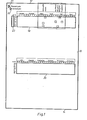
- FIGS. 1 to 5 The embodiment of the invention shown in FIGS. 1 to 5 is a device for displaying calendars for any years between 1582 and 2199.
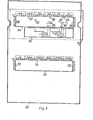
- the device consists of a flat rectangular envelope 10, which is open on the two narrow sides 12 and 14 and which is shown in FIGS. 1 and 2, and a slide 16, which is guided in this envelope 10 slidably.
- the casing 10 On its front plate shown in FIG. 1, the casing 10 has two rectangular windows 18 and 20 at a distance from one another. Instead, a single, correspondingly wide window could also be provided. Under certain circumstances, however, this can make the installation bulky and make handling more difficult.
- the "second symbols" namely, the days of the week “Monday” to "S onntag” in the sliding direction of the slider 16 in equally spaced on top of each other.
- These prints of the days of the week extend along the narrow sides of windows 18 and 20.
- the "first" symbols are at the same intervals as the "second symbols", i.e. the days of the week, corresponding intervals in columns printed on the slider 16 so that they appear behind the window.
- the first symbols obey the given order in each column. they represent consecutive numbers.
- the sequences of symbols in adjacent columns overlap, i.e. e.g. that the numbers "12" to "17” in the third column (Fig. 3) also appear in the fourth column.
- the numbers "19” to "24” also appear in the fifth column.
- Identical symbols in adjacent columns are each offset by a number of steps corresponding to the number of second symbols in the given order, i.e.
- a window 22 which is elongated in the sliding direction of the slide 16 is formed.
- the slider 16 bears a mark 24 behind the window 22.
- the assignment of the first symbols (daily data) to the second symbols (days of the week) depends on an additional state, namely whether it is a general year or a leap year.
- two blocks 26 and 28 are to be found on the slide in the slide direction printed from columns of first symbols.
- the order of the symbols (data) is assigned to a first state (common year) in the first block 26, and the order of the symbols in the second block is assigned to a second state (leap year). This means that the "February" count in blocks 28 through “29” is followed by the "1" of March.
- two openings 30 and 32 are provided next to one another, viewed in the direction of sliding, which are designated as "common year” and "leap year”.
- On the slide 16 are two elongated, elongated, in the sliding direction offset contrasting strips 34 and 36 are attached, of which the strip 34 behind the opening 30 and the strip 36 behind the other opening 32 is displaceable.
- First and second marks are provided on the slide in the sliding direction, of which a first mark 24 is aligned when the one strip 34 is aligned with the associated opening 30 and when the other strip 36 is aligned with the associated one Breakthrough a second mark 38 appears behind the elongated window 22 next to the second symbols (days of the week).
- the distance measured in the sliding direction from one end 40 of one strip 34 to the corresponding end 42 of the other strip 36 is equal to the distance measured in the sliding direction of the edge 44 of the one block 26 of first symbols from the corresponding edge 46 of the other block 28 plus the distance measured in the sliding direction from center to center of the openings 30, 32.
- a second slide 48 made of transparent material is slidably guided transversely to the first slide 16 in front of the window 18.
- This second slider 48 contains marks 50 in the form of printed rectangles.
- a table is attached to the back of the slide 16 facing away from the window.
- the back of the casing 10 (FIG. 2) facing away from the window has an elongated window 52 transversely to the sliding direction of the slide 16 for reading this table.
- the rear side of the casing 10 facing away from the window 18 has a first and at least a second opening 54 and 56, respectively.
- a plurality of second openings 56 and 56A and 56B are provided.
- On the rear side of the slide 16 facing away from the window 18 there are a sequence 58 of third symbols arranged at predetermined intervals and a sequence 60 of in the same predetermined one above the other in the sliding direction.
- the cover is then turned over so that the front panel is visible.
- the slider 16 is displaced so that the strip 34 appears behind the opening 30 (common year) and the mark 24A is set to "Friday".
- the complete calendar for 1982 appears in windows 18 and 20.
- the remainder is 6.
- the slider 16 can be moved so that the number "6" appears behind the opening 54 on the back of the casing 10.
- breakthrough 56 it can then be seen from the sequence of numbers 60 that the full spring of spring falls on April 8th.
- Easter is the 1st Sunday after the spring full moon.
- the slider with a mark 50 which lies in the "Sunday" line can be moved to the next Sunday after April 8th, i.e. April 11th.
- Other stamps 50 on the second slide 48 can then indicate Good Friday, Easter Monday, Ascension Day, Pentecost and Corpus Christi, all of which depend on the date of the Easter festival.
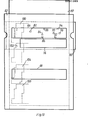
- a first, rectangular slide 60 is displaceably guided in a rectangular envelope 62.
- the sleeve 62 has on the Front of a first rectangular window 64 and a second rectangular window 66.
- the windows 64 and 66 extend with their narrow sides 68 and 70 parallel to the sliding direction of the slide 60 and with their long sides 72 and 74 transversely thereto.
- the names of the days of the week ("second symbols") are printed one above the other along the narrow sides 68, 70.
- Monthly names "January” to "June” or “July” to “December” and the numbering of the weeks are printed side by side along the long sides 72 and 74 of windows 64 and 66, respectively.
- a further rectangular window 76 is provided below the window 64.
- slots or elongated windows 78 are provided in the casing 62, which extend transversely to the sliding direction, namely three slots 78 in an upper row and two slots 78 in two middle slots which are spaced apart from one another and from the first row or lower rows.
- the slits 78 are labeled "15 !, "16 !, “17 ! to "21 ..” after centuries.
- a second slide 80 made of transparent material is slidably guided in front of the window 64 transversely to the first slide 60. This second slide 80 bears markings 82, 84, 86, 88, 90, 92, 94 and 96, the meaning of which will be explained below.
- the second slide 80 also extends behind the window 76.
- the lower part of the slide 80 which lies in the region of the window 76, is opaque or provided with a cover. Inscriptions can be applied to this lower part, which indicate the meaning of the individual markings 82 to 96. As can be seen from FIG. 7, scale lines 98 can also be attached to the rear of the second slide 80 for easier adjustment of the slide 80.
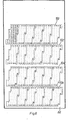
- the first slide 60 contains two blocks 100, 102 and 104, 106 of columns of numbers with consecutive numbers up to 28, 29, 30 or 31 on the front (FIG. 8), each column of columns being offset by seven steps from the adjacent column of columns.
- Blocks 100 and 102 are for the months of January to June and blocks 104 and 106 are for the months of July to December.
- Blocks 100 and 104 can be used for general years and blocks 102 and 106 for leap years.
- the slide 60 bears three groups 108, 110, 112 of two-digit numbers which, in conjunction with a century indication, result in a year over the slots 78.
- Each group again consists of three or two sub-groups, which are each arranged laterally in the area of one of the slots.
- Each subset in turn contains a block 114 of relatively densely packed numbers corresponding to the common years and a field 116 of spaced apart numbers corresponding to the leap years.
- the slide 60 in the sleeve 62 is moved so that behind the slot 78, which is assigned to the century in question, for example 18 ..., the number corresponding to the last two digits of the year appears. In the case of a common year, this is a number from block 114. Then appear on the front behind the windows 64 and 66 parts of the blocks 100 and 104 movable to adjust the Fixed next to the last two digits of the year is used on the R ück- page printed small number, for example "7" 1899, indicating to which of the week Ash Wednesday falls. Marking 82 is assigned to Ash Wednesday on second slide 80.
- This marking is set by moving the second slide 80 to the 8th week, ie below the "8" on the upper long side of the window 64. Then there is the marking 84 Good Friday, marking 86 Easter Sunday, marking 88 Easter Monday, marking 90 Ascension Day, marking 92 Pentecost Sunday, marking 94 Whit Monday and marking 96 Corpus Christi.
- the setting of the second slide 80 can also be e.g. according to the 98 scale.
Landscapes
- Engineering & Computer Science (AREA)
- Physics & Mathematics (AREA)
- General Physics & Mathematics (AREA)
- Theoretical Computer Science (AREA)
- Computer Hardware Design (AREA)
- Computing Systems (AREA)
- Displays For Variable Information Using Movable Means (AREA)
- Sheet Holders (AREA)
Applications Claiming Priority (4)
| Application Number | Priority Date | Filing Date | Title |
|---|---|---|---|
| DE3212565 | 1982-04-03 | ||
| DE3212565 | 1982-04-03 | ||
| DE3308950 | 1983-03-12 | ||
| DE19833308950 DE3308950C2 (de) | 1982-04-03 | 1983-03-12 | Langzeitkalender |
Publications (2)
| Publication Number | Publication Date |
|---|---|
| EP0091069A2 true EP0091069A2 (fr) | 1983-10-12 |
| EP0091069A3 EP0091069A3 (fr) | 1984-07-25 |
Family
ID=25800925
Family Applications (1)
| Application Number | Title | Priority Date | Filing Date |
|---|---|---|---|
| EP83103101A Withdrawn EP0091069A3 (fr) | 1982-04-03 | 1983-03-29 | Dispositif pour présenter des tableaux, par exemple, des calendriers |
Country Status (2)
| Country | Link |
|---|---|
| EP (1) | EP0091069A3 (fr) |
| DE (1) | DE3308950C2 (fr) |
Families Citing this family (1)
| Publication number | Priority date | Publication date | Assignee | Title |
|---|---|---|---|---|
| DE19611299A1 (de) * | 1996-03-22 | 1997-09-25 | Idea Productservice Gmbh | Dauerkalender |
Family Cites Families (6)
| Publication number | Priority date | Publication date | Assignee | Title |
|---|---|---|---|---|
| US1266610A (en) * | 1917-04-13 | 1918-05-21 | Frank X Moerk | Perpetual calendar. |
| FR1002662A (fr) * | 1949-11-04 | 1952-03-10 | Calendrier perpétuel | |
| US3201884A (en) * | 1962-11-13 | 1965-08-24 | John L Aughey | Perpetual calendar |
| US3815269A (en) * | 1971-12-01 | 1974-06-11 | S Roselli | Slide calculator for determining selected periods of time |
| FR2166818A5 (fr) * | 1972-03-28 | 1973-08-17 | Barrue Louis | |
| IT8035659V0 (it) * | 1980-03-24 | 1980-03-24 | Masillo Guido | Regolo-calendario |
-
1983
- 1983-03-12 DE DE19833308950 patent/DE3308950C2/de not_active Expired
- 1983-03-29 EP EP83103101A patent/EP0091069A3/fr not_active Withdrawn
Also Published As
| Publication number | Publication date |
|---|---|
| EP0091069A3 (fr) | 1984-07-25 |
| DE3308950C2 (de) | 1986-03-27 |
| DE3308950A1 (de) | 1983-10-13 |
Similar Documents
| Publication | Publication Date | Title |
|---|---|---|
| DE2840013A1 (de) | Dauer- und mehrere jahre umfassende kalender | |
| DE1436144C3 (de) | Kalendervorrichtung | |
| CH646539A5 (de) | Universelle einrichtung zur auswertung von kalenderdaten. | |
| DE3308950C2 (de) | Langzeitkalender | |
| DE449081C (de) | Einstellbarer Kalender | |
| DE2613296A1 (de) | Kalenderuhr | |
| DE827261C (de) | Immerwaehrender Terminkalender | |
| DE1298047B (de) | Weltzeituhr | |
| DE417107C (de) | Kalender mit verschiebbarem, die Tagesdaten tragenden Band | |
| DE540560C (de) | Kalender | |
| DE395961C (de) | Kartothek, deren Karten, um seitlich gegeneinander versetzt werden zu koennen, mit Vorspruengen in Rinnen des Bodens eingreifen | |
| DE802106C (de) | Immerwaehrender Kalender | |
| AT160769B (de) | Vorrichtung zur Durchführung von Multiplikationen. | |
| DE2336862C3 (de) | Tagesabreißkalender | |
| DE376219C (de) | Dauer- und Erinnerungskalender in Kartothekform | |
| DE407318C (de) | Verstellbarer Dauerkalender | |
| DE8031031U1 (de) | Kalender | |
| DE889369C (de) | Geraet zur Bestimmung der empfaengnisfreien Tage der Frau | |
| DE553271C (de) | Wochenabreisskalender mit Fensterschieber | |
| DE414282C (de) | Stellkalender | |
| DE8209674U1 (de) | Einrichtung zur darstellung von tabellenwerken, z. b. kalendern | |
| DE2217510B1 (de) | Abreiß-Tischkalender | |
| DE845721C (de) | Einstellbarer Kalender mit Monats- und Tageseinteilung | |
| DE378079C (de) | Kalender mit drehbaren Scheiben | |
| DE1233183B (de) | Zwanglaeufig je ein Jahr richtig anzeigende Dauerkalender |
Legal Events
| Date | Code | Title | Description |
|---|---|---|---|
| PUAI | Public reference made under article 153(3) epc to a published international application that has entered the european phase |
Free format text: ORIGINAL CODE: 0009012 |
|
| AK | Designated contracting states |
Designated state(s): AT BE CH DE FR GB IT LI NL |
|
| PUAL | Search report despatched |
Free format text: ORIGINAL CODE: 0009013 |
|
| AK | Designated contracting states |
Designated state(s): AT BE CH DE FR GB IT LI NL |
|
| RAP1 | Party data changed (applicant data changed or rights of an application transferred) |
Owner name: ECHTERHOFF, DIETER |
|
| STAA | Information on the status of an ep patent application or granted ep patent |
Free format text: STATUS: THE APPLICATION IS DEEMED TO BE WITHDRAWN |
|
| 18D | Application deemed to be withdrawn |
Effective date: 19860326 |